WO2025009335A1 - 外部電極用ペースト - Google Patents
外部電極用ペースト Download PDFInfo
- Publication number
- WO2025009335A1 WO2025009335A1 PCT/JP2024/021031 JP2024021031W WO2025009335A1 WO 2025009335 A1 WO2025009335 A1 WO 2025009335A1 JP 2024021031 W JP2024021031 W JP 2024021031W WO 2025009335 A1 WO2025009335 A1 WO 2025009335A1
- Authority
- WO
- WIPO (PCT)
- Prior art keywords
- powder
- glass
- external electrode
- ssa
- paste
- Prior art date
- Legal status (The legal status is an assumption and is not a legal conclusion. Google has not performed a legal analysis and makes no representation as to the accuracy of the status listed.)
- Ceased
Links
Images



Classifications
-
- H—ELECTRICITY
- H01—ELECTRIC ELEMENTS
- H01G—CAPACITORS; CAPACITORS, RECTIFIERS, DETECTORS, SWITCHING DEVICES, LIGHT-SENSITIVE OR TEMPERATURE-SENSITIVE DEVICES OF THE ELECTROLYTIC TYPE
- H01G4/00—Fixed capacitors; Processes of their manufacture
- H01G4/002—Details
- H01G4/228—Terminals
- H01G4/232—Terminals electrically connecting two or more layers of a stacked or rolled capacitor
- H01G4/2325—Terminals electrically connecting two or more layers of a stacked or rolled capacitor characterised by the material of the terminals
-
- C—CHEMISTRY; METALLURGY
- C08—ORGANIC MACROMOLECULAR COMPOUNDS; THEIR PREPARATION OR CHEMICAL WORKING-UP; COMPOSITIONS BASED THEREON
- C08K—Use of inorganic or non-macromolecular organic substances as compounding ingredients
- C08K3/00—Use of inorganic substances as compounding ingredients
- C08K3/02—Elements
- C08K3/08—Metals
-
- C—CHEMISTRY; METALLURGY
- C08—ORGANIC MACROMOLECULAR COMPOUNDS; THEIR PREPARATION OR CHEMICAL WORKING-UP; COMPOSITIONS BASED THEREON
- C08K—Use of inorganic or non-macromolecular organic substances as compounding ingredients
- C08K3/00—Use of inorganic substances as compounding ingredients
- C08K3/40—Glass
-
- C—CHEMISTRY; METALLURGY
- C08—ORGANIC MACROMOLECULAR COMPOUNDS; THEIR PREPARATION OR CHEMICAL WORKING-UP; COMPOSITIONS BASED THEREON
- C08L—COMPOSITIONS OF MACROMOLECULAR COMPOUNDS
- C08L1/00—Compositions of cellulose, modified cellulose or cellulose derivatives
- C08L1/08—Cellulose derivatives
-
- C—CHEMISTRY; METALLURGY
- C08—ORGANIC MACROMOLECULAR COMPOUNDS; THEIR PREPARATION OR CHEMICAL WORKING-UP; COMPOSITIONS BASED THEREON
- C08L—COMPOSITIONS OF MACROMOLECULAR COMPOUNDS
- C08L33/00—Compositions of homopolymers or copolymers of compounds having one or more unsaturated aliphatic radicals, each having only one carbon-to-carbon double bond, and only one being terminated by only one carboxyl radical, or of salts, anhydrides, esters, amides, imides or nitriles thereof; Compositions of derivatives of such polymers
- C08L33/04—Homopolymers or copolymers of esters
-
- H—ELECTRICITY
- H01—ELECTRIC ELEMENTS
- H01G—CAPACITORS; CAPACITORS, RECTIFIERS, DETECTORS, SWITCHING DEVICES, LIGHT-SENSITIVE OR TEMPERATURE-SENSITIVE DEVICES OF THE ELECTROLYTIC TYPE
- H01G4/00—Fixed capacitors; Processes of their manufacture
- H01G4/30—Stacked capacitors
-
- C—CHEMISTRY; METALLURGY
- C08—ORGANIC MACROMOLECULAR COMPOUNDS; THEIR PREPARATION OR CHEMICAL WORKING-UP; COMPOSITIONS BASED THEREON
- C08K—Use of inorganic or non-macromolecular organic substances as compounding ingredients
- C08K3/00—Use of inorganic substances as compounding ingredients
- C08K3/02—Elements
- C08K3/08—Metals
- C08K2003/085—Copper
-
- C—CHEMISTRY; METALLURGY
- C08—ORGANIC MACROMOLECULAR COMPOUNDS; THEIR PREPARATION OR CHEMICAL WORKING-UP; COMPOSITIONS BASED THEREON
- C08K—Use of inorganic or non-macromolecular organic substances as compounding ingredients
- C08K2201/00—Specific properties of additives
- C08K2201/002—Physical properties
- C08K2201/006—Additives being defined by their surface area
Definitions
- This invention relates to a paste for external electrodes.
- Patent Document 1 discloses a paste for external electrodes that contains a resin containing an ethyl cellulose-based resin and an acrylic-based resin, at least some of which are copolymerized, a Cu filler, and a solvent, and in which the interfacial tension generated between the resin and the solvent is 15 N/m or more.
- This paste for external electrodes has sufficient strength as a dry film.
- Patent Document 1 the strength of the dried film is improved by adjusting the interfacial tension between the resin and the solvent, but there is also a demand for the development of an external electrode paste that can improve the strength of the dried film using a different method.
- the main object of this invention is to provide an external electrode paste used to form external electrodes of multilayer ceramic electronic components that can improve the strength of the dried film.
- the external electrode paste used to form the external electrodes of the multilayer ceramic electronic component according to the present invention contains at least a partially copolymerized acrylic resin and ethyl cellulose resin, Cu powder, glass powder, and a solvent, and the ratio (SSA_Glass/SSA_Cu) of the BET specific surface area of the glass powder (SSA_Glass) to the BET specific surface area of the Cu powder (SSA_Cu) is 0.11 or more and 5.8 or less.
- the dried film obtained by applying this external electrode paste to the body of the electronic component has flexibility, in other words, toughness derived from the acrylic resin, and rigidity derived from the ethyl cellulose resin, and the strength of the dried film can be improved. Furthermore, the ratio (SSA_Glass/SSA_Cu) of the BET specific surface area of the glass powder (SSA_Glass) to the BET specific surface area of the Cu powder (SSA_Cu) is 0.11 or more and 5.8 or less.
- the external electrode paste when the external electrode paste is applied to a laminate, the external electrode paste can be prevented from bulging at the end faces of the laminate, and thus a dry film can be formed in a flat shape over substantially the entire end faces of the laminate.
- the external electrode paste by using the above-mentioned external electrode paste, it is possible to flatten the dry film while improving its strength. As a result, even if the dry film is flattened and made thin, it is possible to miniaturize the electronic component while suppressing a decrease in strength.
- This invention provides an external electrode paste that can be used to form external electrodes of multilayer ceramic electronic components and that can improve the strength of the dried film.
- FIG. 1 is an external perspective view showing an example of a multilayer ceramic capacitor as an electronic component according to an embodiment of the present invention.
- 2 is a cross-sectional view taken along line II-II in FIG. 1.
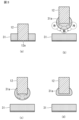
- 5A to 5C are diagrams for explaining a step of applying an external electrode paste to a laminate in the present embodiment.
- FIG. 1A is a diagram showing a schematic LW cross section of a multilayer ceramic capacitor in which external electrodes are formed on a laminate using the external electrode paste of the present embodiment
- FIG. 1B is a diagram showing a schematic LW cross section of a multilayer ceramic capacitor in which external electrodes are formed on a laminate using a conventional external electrode paste.
- An embodiment of the present invention relates to an external electrode paste for forming an external electrode of a multilayer ceramic electronic component.
- the external electrode paste includes an acrylic resin and an ethyl cellulose resin, at least a portion of which are copolymerized, a Cu powder, a glass powder, and a solvent.
- the ratio (SSA_Glass/SSA_Cu) of the BET specific surface area of the glass powder (SSA_Glass) to the BET specific surface area of the Cu powder (SSA_Cu) is 0.11 or more and 5.8 or less.
- the acrylic resin is, for example, at least one of isobutyl methacrylate, methyl methacrylate, hydroxyethyl methacrylate, hydroxypropyl methacrylate, n-butyl methacrylate, and 2-ethylhexyl methacrylate.
- the ethyl cellulose resin is, for example, at least one of ethyl cellulose, methyl cellulose, hydroxypropyl cellulose, trityl cellulose, acetyl cellulose, carboxymethyl cellulose, and nitrocellulose.
- Cu powder is particles made of at least one of Cu and a Cu alloy.
- the glass powder is not particularly limited, but from the viewpoint of promoting the adsorption of Cu powder to the glass powder, it is preferable that it contains B or Bi, for example, Bi-B-Si-O system or Bi-B-Al-Si-O system.
- the glass powder can also contain a borosilicate glass composition.
- a borosilicate glass composition is a glass composition that contains B oxide and Si oxide as network-forming oxides, and contains alkali metal element oxides and alkaline earth metal element oxides as modifying oxides.
- the solvent may include, for example, at least one of terpineol, dihydroterpineol, dihydroterpinyl acetate, propylene glycol phenyl ether, benzyl alcohol, texanol, and butyl carbitol acetate.
- the solvent type may be analyzed by measuring the evolved gas using gas chromatography mass spectrometry. Gas chromatography mass spectrometry may be performed using, for example, a mass spectrometer 7890A/5975C (heated to 500°C) manufactured by Agilent Technologies, Inc.
- the external electrode paste may contain various additives such as dispersants, plasticizers, anti-settling agents, and thixotropic agents.
- the paste for the external electrodes is produced by weighing and mixing at least a partially copolymerized acrylic resin and ethyl cellulose resin with Cu powder, glass powder, and a solvent in a predetermined mixing ratio, and dispersing and kneading the mixture using a three-roll mill or the like.
- the acrylic resin and the ethyl cellulose resin are at least partially copolymerized.
- the OH group of the ethyl cellulose resin is replaced with a vinyl group, and the ethyl cellulose resin and the acrylic resin are bonded via the substituted vinyl group.
- the dried film obtained by applying an external electrode paste containing a resin in which at least a portion of an acrylic resin and an ethyl cellulose resin is copolymerized to the body of an electronic component has the flexibility, or in other words, toughness, derived from the acrylic resin and the rigidity derived from the ethyl cellulose resin, and has sufficient strength as a dried film.
- the ratio (SSA_Glass/SSA_Cu) of the BET specific surface area of the glass powder (SSA_Glass) to the BET specific surface area of the Cu powder (SSA_Cu) is 0.11 or more and 5.8 or less.
- the Cu powder and the glass powder are densely packed in the external electrode paste by convection when the external electrode paste is dried. Therefore, the void ratio in the dried film can be reduced, and the strength of the dried film can be improved. Note that if the void ratio in the dried film is large, cracks tend to develop from the voids when the dried film is subjected to an impact. However, with the external electrode paste having the above configuration, the void ratio can be reduced, and the development of cracks can be suppressed, thereby improving the strength of the dried film.
- the BET specific surface area of the target substance (Cu powder or glass powder) can be measured by a method in which gas molecules with a known adsorption exclusive area are adsorbed onto the surface of the target substance, and the specific surface area of the target substance is measured from the amount of gas molecules adsorbed.
- the BET specific surface area evaluation device used was an MR-6 (manufactured by Microtrac Bell), and after degassing at 150°C for 20 minutes, the measurement was performed using the BET single point method.
- FIG. 1 is an external perspective view showing an example of a multilayer ceramic capacitor as an electronic component according to an embodiment of the present invention.
- FIG. 2 is a cross-sectional view taken along line II-II in FIG. 1.
- FIG. 3 is a diagram for explaining the process of applying the external electrode paste to the laminate in this embodiment.
- the multilayer ceramic capacitor 10 includes a rectangular parallelepiped laminate 12 having an internal electrode layer 16 therein, and external electrodes 30 arranged at both ends of the laminate 12.
- the laminate 12 has a first main surface 12a and a second main surface 12b that face each other in a height direction x (stacking direction), a first side surface 12c and a second side surface 12d that face each other in a width direction y that is perpendicular to the height direction x, and a first end surface 12e and a second end surface 12f that face each other in a length direction z that is perpendicular to the height direction x and the width direction y.
- the laminate 12 includes a plurality of ceramic layers 14.
- the plurality of ceramic layers 14 are stacked in a height direction x.
- a dielectric material forming the ceramic layers 14 for example, a dielectric ceramic containing a component such as BaTiO3 , CaTiO3 , SrTiO3 , or CaZrO3 can be used.
- the electronic component functions as a piezoelectric component when a piezoelectric ceramic material is used for the ceramic layer 14.
- piezoelectric ceramic materials include PZT (lead zirconate titanate) ceramic materials.
- the electronic component functions as a thermistor element when a semiconducting ceramic material is used for the ceramic layer 14.
- semiconducting ceramic materials include spinel ceramic materials.
- magnetic ceramic materials include ferrite ceramic materials.
- the laminate 12 has a plurality of internal electrode layers 16, which are a plurality of first internal electrode layers 16a extending to the first end face 12e and a plurality of second internal electrode layers 16b extending to the second end face 12f.
- the first internal electrode layers 16a and the second internal electrode layers 16b are embedded so as to be alternately arranged at equal intervals with the ceramic layers 14 sandwiched between them along the height direction x of the laminate 12.
- external electrodes 30 are arranged on the first end face 12e and the second end face 12f of the laminate 12.
- the external electrode 30 has a first external electrode 30a and a second external electrode 30b.
- the first external electrode 30a is disposed on at least the surface of the first end face 12e and is connected to the first internal electrode layer 16a.
- the first external electrode 30a extends from the first end face 12e and is disposed on a portion of the first main face 12a and a portion of the second main face 12b, as well as a portion of the first side face 12c and a portion of the second side face 12d.
- the second external electrode 30b is disposed on at least the surface of the second end face 12f and is connected to the second internal electrode layer 16b.
- the second external electrode 30b extends from the second end face 12f and is disposed on a portion of the first main surface 12a and a portion of the second main surface 12b, as well as a portion of the first side surface 12c and a portion of the second side surface 12d.
- the area of the laminate 12 where the external electrode 30 is to be formed is immersed in the external electrode paste 31 (see FIG. 3(a)) and then pulled up (see FIG. 3(b)).
- the area where the external electrode 30 is to be formed is, for example, both end faces of the laminate 12 (first end face 12e, second end face 12f).
- the reference numeral 31a is used to denote the external electrode paste attached to the laminate 12.
- Ethyl cellulose resin is rigid and has high heat storage capacity, so it prevents the external electrode paste from solidifying as it flows during the drying process and promotes the outward flow.
- the strong outward flow causes the external electrode paste to flow from the center to the ends, preventing the external electrode paste from bulging outward in the center (see Figure 3(d)).
- FIG. 4(a) is a schematic diagram showing an LW cross section of a multilayer ceramic capacitor in which external electrodes are formed on a laminate using the external electrode paste of this embodiment.
- FIG. 4(b) is a schematic diagram showing an LW cross section of a multilayer ceramic capacitor in which external electrodes are formed on a laminate using a conventional external electrode paste.
- the first external electrode 3a is formed on the laminate 12 using a conventional paste for external electrodes, and the first external electrode 3a has a convex shape with a thick center part of the end face and a thin end part of the end face.
- the first external electrode 30a is formed on the laminate 12 using the paste for external electrodes of this embodiment, and the first external electrode 30a has a flat shape over almost the entire end face of the laminate 12, and is prevented from having a convex shape as described above.
- the second external electrode 30b is also formed in a flat shape.
- the multilayer ceramic capacitor 10 in which the external electrode 30 is formed using the paste for external electrodes of this embodiment can be made smaller.
- the external electrode 30 when compared at the same size, the external electrode 30 can be made thinner and the internal element can be made larger, making it possible to increase the capacity.
- the method of applying the external electrode paste to the laminate 12 in this embodiment is not limited to immersion in the external electrode paste described above.
- the strength of the dry film can be improved while the dry film can be flattened. This makes it possible to miniaturize electronic components while suppressing a decrease in strength even when the dry film is flattened and thinned.
- the BET specific surface area (SSA_Glass) of the glass powder is preferably 0.38 m2 /g or more.
- the particle size of the glass powder can be reduced assuming that the glass powder is spherical, so that the glass powder is packed more densely in the external electrode paste due to convection during drying of the external electrode paste. This can further reduce the void ratio in the dried film and further improve the strength of the dried film.
- the D50_Cu of the Cu powder obtained by the laser diffraction scattering type particle size distribution measurement method is 3.0 ⁇ m or less.
- the D50_Cu of the Cu powder can be made small, the Cu powder is packed more densely in the external electrode paste due to convection during drying of the external electrode paste. Therefore, the void ratio in the dried film can be further reduced, and the strength of the dried film can be further improved.
- the ratio of Cu powder and glass powder to non-volatile components other than the solvent ((volume of Cu powder and volume of glass powder)/(volume of non-volatile components other than the solvent)) is 50% by volume or more and 70% by volume or less. In this case, shape defects such as wrinkles in the dried film after drying the external electrode paste can be suppressed, and the strength of the dried film can be further improved.
- the ratio exceeds 70% by volume, wrinkles will occur in the dried film when the external electrode paste dries, reducing its strength. If the ratio is less than 50% by volume, the acrylic resin and ethyl cellulose resin will be adsorbed onto the Cu powder and glass powder, reducing the number of mesh chains that are formed. As a result, the mesh becomes larger and the crosslink density decreases, reducing the strength of the dried film.
- the weight ratio of the acrylic resin to the ethyl cellulose resin is 3:7 to 7:3.
- segregation of the Cu powder and glass powder in the external electrode paste can be suppressed, so that stress concentration can be suppressed in the dried film using the external electrode paste.
- the strength of the dried film can be improved.
- Experimental Examples 1 and 2 were performed as experimental examples.
- the weight ratio of the acrylic resin and the ethyl cellulose resin was changed, and the ratio of the Cu powder and the glass powder to the non-volatile components other than the solvent was changed.
- the weight ratio of the acrylic resin and the ethyl cellulose resin was set to 5:5, and the ratio of the Cu powder and the glass powder to the non-volatile components other than the solvent was set to 60 volume %, and the D50_Cu (BET specific surface area (SSA_Cu)) of the Cu powder was changed, and the D50_Glass (BET specific surface area (SSA_Glass)) of the glass powder was changed.
- SSA_Cu BET specific surface area
- SSA_Glass BET specific surface area
- a laminate was used in which the L dimension in the length direction z was 0.6 mm, the W dimension in the width direction y was 0.3 mm, and the T dimension in the height direction x was 0.3 mm.
- the weight ratio of Cu powder to glass powder was 50:5.
- the acrylic resin, ethyl cellulose resin, Cu powder, glass powder, and solvent were mixed, and the solvent was 35% by weight.
- the acrylic resin, ethyl cellulose resin, Cu powder, glass powder, and solvent were mixed in a planetary mixer, and then dispersed and kneaded in a three-roll mill to prepare samples of the paste for external electrodes.
- the samples prepared were 63 types as shown in Table 1 below.
- Table 1 shows the results for each sample.
- the ratio of Cu powder and glass powder to non-volatile components other than the solvent was 45% by volume and 75% by volume, the result was "X". Therefore, it is preferable that the ratio of Cu powder and glass powder to non-volatile components other than the solvent is greater than 45% by volume and less than 75% by volume. More preferably, the ratio is 50% by volume or more and 70% by volume or less.
- the weight ratio of the acrylic resin to the ethyl cellulose resin was 1:9, 2:8, 8:2, or 9:1, the result was "X.” Therefore, if the sum of the weight ratios of the acrylic resin to the ethyl cellulose resin is 10, it is preferable that the acrylic resin is greater than 2 and less than 8, and the ethyl cellulose resin is less than 8 and greater than 2. More preferably, the weight ratio is 3:7 to 7:3.
- the glass powders prepared had D50_Glass and SSA_Glass of 0.21 ⁇ m and 47.0 m 2 /g, 0.32 ⁇ m and 31.0 m 2 /g, 1.2 ⁇ m and 8.2 m 2 /g, 4.6 ⁇ m and 0.58 m 2 /g, 0.57 ⁇ m and 12.0 m 2 /g, 4.6 ⁇ m and 0.58 m 2 /g, 5.5 ⁇ m and 0.38 m 2 /g, and 6.1 ⁇ m and 0.32 m 2 /g.
- the D50_Glass of the glass powders in this specification refers to the spherical equivalent diameter, and more specifically, refers to the particle size at which the cumulative frequency is 50% in the particle size distribution of the powder measured by a laser diffraction scattering particle size distribution measurement method.
- Samples No. 1 to No. 18 shown in Table 2 were prepared as combinations of these Cu powders and glass powders.
- the weight ratio of acrylic resin to ethyl cellulose resin was 5:5, and the ratio of Cu powder and glass powder to non-volatile components other than the solvent was 60% by volume.
- the acrylic resin, ethyl cellulose resin, Cu powder, glass powder, and solvent were mixed at 5% by weight, 50% by weight, 5% by weight, and 40% by weight, respectively, and mixed in a planetary mixer. The mixture was then dispersed and kneaded in a three-roll mill to prepare a sample of paste for external electrodes.
- Table 2 shows the results for each sample.
- the D50_Cu of the Cu powder was 3.0 ⁇ m or less. Therefore, it is preferable that the D50_Cu of the Cu powder is 3.0 ⁇ m or less.
- the BET specific surface area (SSA_Glass) of the glass powder was 0.38 m 2 /g or more in Nos. 1 to 9. Therefore, it is preferable that the BET specific surface area (SSA_Glass) of the glass powder is 0.38 m 2 /g or more.
- the D50_Cu of the Cu powder was 3.1 ⁇ m, and the judgment result was "x" for No. 18, which was outside the range of 3.0 ⁇ m or less.
- the SSA of the glass powder was 0.32 m 2 /g, and the judgment result was "x” for Nos. 13 and 15, which were outside the range of 0.38 m 2 /g or more.
- the judgment result was "x” for Nos. 10 to 14, 16, and 17, which had a BET specific surface area ratio (SSA_Glass/SSA_Cu) outside the range of 0.11 to 5.8.
- An external electrode paste used to form external electrodes of a multilayer ceramic electronic component comprising: an acrylic resin and an ethyl cellulose resin, at least some of which are copolymerized; Cu powder, Glass powder; A solvent, A paste for external electrodes, wherein a ratio (SSA_Glass/SSA_Cu) of a BET specific surface area of the glass powder (SSA_Glass) to a BET specific surface area of the Cu powder (SSA_Cu) is 0.11 or more and 5.8 or less.
- ⁇ 2> The paste for external electrodes according to ⁇ 1>, wherein the glass powder has a BET specific surface area (SSA_Glass) of 0.38 m 2 /g or more.
- SSA_Glass BET specific surface area
- ⁇ 4> The paste for external electrodes according to any one of ⁇ 1> to ⁇ 3>, wherein a ratio of the Cu powder and the glass powder to non-volatile components other than the solvent is 50 vol % or more and 70 vol % or less.
- ⁇ 5> The paste for external electrodes according to any one of ⁇ 1> to ⁇ 4>, wherein a weight ratio of the acrylic resin to the ethyl cellulose resin is 3:7 to 7:3.
- Multilayer ceramic capacitor 12 Laminate 12a: First main surface 12b: Second main surface 12c: First side surface 12d: Second side surface 12e: First end surface 12f: Second end surface 14: Ceramic layer 16: Internal electrode layer 16a: First internal electrode layer 16b: Second internal electrode layer 30: External electrode 30a: First external electrode 30b: Second external electrode 31: External electrode paste 31a: External electrode paste x: Height direction y: Width direction z: Length direction
Landscapes
- Chemical & Material Sciences (AREA)
- Engineering & Computer Science (AREA)
- Power Engineering (AREA)
- Health & Medical Sciences (AREA)
- Chemical Kinetics & Catalysis (AREA)
- Medicinal Chemistry (AREA)
- Polymers & Plastics (AREA)
- Organic Chemistry (AREA)
- Manufacturing & Machinery (AREA)
- Microelectronics & Electronic Packaging (AREA)
- Fixed Capacitors And Capacitor Manufacturing Machines (AREA)
- Ceramic Capacitors (AREA)
Priority Applications (3)
| Application Number | Priority Date | Filing Date | Title |
|---|---|---|---|
| CN202480041322.2A CN121359229A (zh) | 2023-07-04 | 2024-06-10 | 外部电极用膏 |
| JP2025531444A JPWO2025009335A1 (https=) | 2023-07-04 | 2024-06-10 | |
| KR1020257035881A KR20250168516A (ko) | 2023-07-04 | 2024-06-10 | 외부전극용 페이스트 |
Applications Claiming Priority (2)
| Application Number | Priority Date | Filing Date | Title |
|---|---|---|---|
| JP2023-109695 | 2023-07-04 | ||
| JP2023109695 | 2023-07-04 |
Publications (1)
| Publication Number | Publication Date |
|---|---|
| WO2025009335A1 true WO2025009335A1 (ja) | 2025-01-09 |
Family
ID=94171850
Family Applications (1)
| Application Number | Title | Priority Date | Filing Date |
|---|---|---|---|
| PCT/JP2024/021031 Ceased WO2025009335A1 (ja) | 2023-07-04 | 2024-06-10 | 外部電極用ペースト |
Country Status (4)
| Country | Link |
|---|---|
| JP (1) | JPWO2025009335A1 (https=) |
| KR (1) | KR20250168516A (https=) |
| CN (1) | CN121359229A (https=) |
| WO (1) | WO2025009335A1 (https=) |
Citations (3)
| Publication number | Priority date | Publication date | Assignee | Title |
|---|---|---|---|---|
| WO2020040138A1 (ja) * | 2018-08-23 | 2020-02-27 | 昭栄化学工業株式会社 | 導電性ペースト |
| JP2020111682A (ja) * | 2019-01-11 | 2020-07-27 | Jx金属株式会社 | 導電性組成物 |
| JP2021077750A (ja) * | 2019-11-07 | 2021-05-20 | 株式会社村田製作所 | 外部電極用ペースト |
-
2024
- 2024-06-10 JP JP2025531444A patent/JPWO2025009335A1/ja active Pending
- 2024-06-10 WO PCT/JP2024/021031 patent/WO2025009335A1/ja not_active Ceased
- 2024-06-10 KR KR1020257035881A patent/KR20250168516A/ko active Pending
- 2024-06-10 CN CN202480041322.2A patent/CN121359229A/zh active Pending
Patent Citations (3)
| Publication number | Priority date | Publication date | Assignee | Title |
|---|---|---|---|---|
| WO2020040138A1 (ja) * | 2018-08-23 | 2020-02-27 | 昭栄化学工業株式会社 | 導電性ペースト |
| JP2020111682A (ja) * | 2019-01-11 | 2020-07-27 | Jx金属株式会社 | 導電性組成物 |
| JP2021077750A (ja) * | 2019-11-07 | 2021-05-20 | 株式会社村田製作所 | 外部電極用ペースト |
Also Published As
| Publication number | Publication date |
|---|---|
| CN121359229A (zh) | 2026-01-16 |
| KR20250168516A (ko) | 2025-12-02 |
| JPWO2025009335A1 (https=) | 2025-01-09 |
Similar Documents
| Publication | Publication Date | Title |
|---|---|---|
| KR102102800B1 (ko) | 외부전극용 도전성 페이스트 및 그 외부전극용 도전성 페이스트를 이용하여 제조하는 전자부품의 제조 방법 | |
| US10090108B2 (en) | Conductive paste, electronic component, and method for manufacturing electronic component | |
| US8767375B2 (en) | Multilayer ceramic electronic component and method of fabricating the same | |
| CN112992535B (zh) | 多层电子组件 | |
| US9202625B2 (en) | Laminated ceramic electronic component and method of fabricating the same | |
| CN112530703B (zh) | 多层陶瓷电子组件 | |
| US9218909B2 (en) | Multi-layered ceramic electronic component | |
| JP5870625B2 (ja) | 電極焼結体、積層電子部品、内部電極ペースト、電極焼結体の製造方法、積層電子部品の製造方法 | |
| JP7315285B2 (ja) | 積層セラミック電子部品 | |
| JP2002110444A (ja) | 導電性ペーストおよび積層セラミック電子部品 | |
| WO2020166361A1 (ja) | 導電性ペースト、電子部品及び積層セラミックコンデンサ | |
| WO2025009335A1 (ja) | 外部電極用ペースト | |
| WO2025028125A1 (ja) | 外部電極用ペースト | |
| JP4826881B2 (ja) | 導電性ペースト、及び積層セラミック電子部品の製造方法、並びに積層セラミック電子部品 | |
| CN116705506A (zh) | 多层电子组件及其制造方法 | |
| JP2023160719A (ja) | 導電性ペースト及び積層型電子部品 | |
| JP2023095782A (ja) | 積層型電子部品及びその製造方法 | |
| CN116313517A (zh) | 多层电子组件 | |
| KR20230119946A (ko) | 도전성 페이스트의 제조 방법 및 적층 세라믹 전자 부품의 제조 방법 | |
| US20260045412A1 (en) | Multilayer electronic component | |
| WO2025197203A1 (ja) | 積層セラミックコンデンサ | |
| WO2025203887A1 (ja) | 積層セラミックコンデンサ | |
| KR20240102406A (ko) | 적층형 전자 부품 | |
| CN118471688A (zh) | 多层电子组件 | |
| CN121311955A (zh) | 层叠陶瓷电容器 |
Legal Events
| Date | Code | Title | Description |
|---|---|---|---|
| 121 | Ep: the epo has been informed by wipo that ep was designated in this application |
Ref document number: 24835853 Country of ref document: EP Kind code of ref document: A1 |
|
| ENP | Entry into the national phase |
Ref document number: 1020257035881 Country of ref document: KR Free format text: ST27 STATUS EVENT CODE: A-0-1-A10-A15-NAP-PA0105 (AS PROVIDED BY THE NATIONAL OFFICE) |
|
| WWE | Wipo information: entry into national phase |
Ref document number: KR1020257035881 Country of ref document: KR |
|
| ENP | Entry into the national phase |
Ref document number: 2025531444 Country of ref document: JP Kind code of ref document: A |
|
| NENP | Non-entry into the national phase |
Ref country code: DE |