WO2025009216A1 - 熱伝導性組成物及びこれを用いた熱伝導性シートとその製造方法 - Google Patents
熱伝導性組成物及びこれを用いた熱伝導性シートとその製造方法 Download PDFInfo
- Publication number
- WO2025009216A1 WO2025009216A1 PCT/JP2024/007512 JP2024007512W WO2025009216A1 WO 2025009216 A1 WO2025009216 A1 WO 2025009216A1 JP 2024007512 W JP2024007512 W JP 2024007512W WO 2025009216 A1 WO2025009216 A1 WO 2025009216A1
- Authority
- WO
- WIPO (PCT)
- Prior art keywords
- thermally conductive
- component
- mass
- conductive composition
- sheet
- Prior art date
- Legal status (The legal status is an assumption and is not a legal conclusion. Google has not performed a legal analysis and makes no representation as to the accuracy of the status listed.)
- Ceased
Links
Images
Classifications
-
- C—CHEMISTRY; METALLURGY
- C09—DYES; PAINTS; POLISHES; NATURAL RESINS; ADHESIVES; COMPOSITIONS NOT OTHERWISE PROVIDED FOR; APPLICATIONS OF MATERIALS NOT OTHERWISE PROVIDED FOR
- C09K—MATERIALS FOR MISCELLANEOUS APPLICATIONS, NOT PROVIDED FOR ELSEWHERE
- C09K5/00—Heat-transfer, heat-exchange or heat-storage materials, e.g. refrigerants; Materials for the production of heat or cold by chemical reactions other than by combustion
- C09K5/08—Materials not undergoing a change of physical state when used
- C09K5/14—Solid materials, e.g. powdery or granular
-
- C—CHEMISTRY; METALLURGY
- C08—ORGANIC MACROMOLECULAR COMPOUNDS; THEIR PREPARATION OR CHEMICAL WORKING-UP; COMPOSITIONS BASED THEREON
- C08G—MACROMOLECULAR COMPOUNDS OBTAINED OTHERWISE THAN BY REACTIONS ONLY INVOLVING UNSATURATED CARBON-TO-CARBON BONDS
- C08G77/00—Macromolecular compounds obtained by reactions forming a linkage containing silicon with or without sulfur, nitrogen, oxygen or carbon in the main chain of the macromolecule
- C08G77/04—Polysiloxanes
- C08G77/12—Polysiloxanes containing silicon bound to hydrogen
-
- C—CHEMISTRY; METALLURGY
- C08—ORGANIC MACROMOLECULAR COMPOUNDS; THEIR PREPARATION OR CHEMICAL WORKING-UP; COMPOSITIONS BASED THEREON
- C08G—MACROMOLECULAR COMPOUNDS OBTAINED OTHERWISE THAN BY REACTIONS ONLY INVOLVING UNSATURATED CARBON-TO-CARBON BONDS
- C08G77/00—Macromolecular compounds obtained by reactions forming a linkage containing silicon with or without sulfur, nitrogen, oxygen or carbon in the main chain of the macromolecule
- C08G77/04—Polysiloxanes
- C08G77/20—Polysiloxanes containing silicon bound to unsaturated aliphatic groups
-
- C—CHEMISTRY; METALLURGY
- C08—ORGANIC MACROMOLECULAR COMPOUNDS; THEIR PREPARATION OR CHEMICAL WORKING-UP; COMPOSITIONS BASED THEREON
- C08J—WORKING-UP; GENERAL PROCESSES OF COMPOUNDING; AFTER-TREATMENT NOT COVERED BY SUBCLASSES C08B, C08C, C08F, C08G or C08H
- C08J5/00—Manufacture of articles or shaped materials containing macromolecular substances
- C08J5/18—Manufacture of films or sheets
-
- C—CHEMISTRY; METALLURGY
- C08—ORGANIC MACROMOLECULAR COMPOUNDS; THEIR PREPARATION OR CHEMICAL WORKING-UP; COMPOSITIONS BASED THEREON
- C08K—Use of inorganic or non-macromolecular organic substances as compounding ingredients
- C08K3/00—Use of inorganic substances as compounding ingredients
- C08K3/01—Use of inorganic substances as compounding ingredients characterized by their specific function
- C08K3/013—Fillers, pigments or reinforcing additives
-
- C—CHEMISTRY; METALLURGY
- C08—ORGANIC MACROMOLECULAR COMPOUNDS; THEIR PREPARATION OR CHEMICAL WORKING-UP; COMPOSITIONS BASED THEREON
- C08K—Use of inorganic or non-macromolecular organic substances as compounding ingredients
- C08K3/00—Use of inorganic substances as compounding ingredients
- C08K3/18—Oxygen-containing compounds, e.g. metal carbonyls
- C08K3/20—Oxides; Hydroxides
- C08K3/22—Oxides; Hydroxides of metals
-
- C—CHEMISTRY; METALLURGY
- C08—ORGANIC MACROMOLECULAR COMPOUNDS; THEIR PREPARATION OR CHEMICAL WORKING-UP; COMPOSITIONS BASED THEREON
- C08K—Use of inorganic or non-macromolecular organic substances as compounding ingredients
- C08K3/00—Use of inorganic substances as compounding ingredients
- C08K3/28—Nitrogen-containing compounds
-
- C—CHEMISTRY; METALLURGY
- C08—ORGANIC MACROMOLECULAR COMPOUNDS; THEIR PREPARATION OR CHEMICAL WORKING-UP; COMPOSITIONS BASED THEREON
- C08K—Use of inorganic or non-macromolecular organic substances as compounding ingredients
- C08K3/00—Use of inorganic substances as compounding ingredients
- C08K3/38—Boron-containing compounds
-
- C—CHEMISTRY; METALLURGY
- C08—ORGANIC MACROMOLECULAR COMPOUNDS; THEIR PREPARATION OR CHEMICAL WORKING-UP; COMPOSITIONS BASED THEREON
- C08K—Use of inorganic or non-macromolecular organic substances as compounding ingredients
- C08K5/00—Use of organic ingredients
- C08K5/54—Silicon-containing compounds
- C08K5/541—Silicon-containing compounds containing oxygen
-
- C—CHEMISTRY; METALLURGY
- C08—ORGANIC MACROMOLECULAR COMPOUNDS; THEIR PREPARATION OR CHEMICAL WORKING-UP; COMPOSITIONS BASED THEREON
- C08K—Use of inorganic or non-macromolecular organic substances as compounding ingredients
- C08K7/00—Use of ingredients characterised by shape
- C08K7/16—Solid spheres
- C08K7/18—Solid spheres inorganic
-
- C—CHEMISTRY; METALLURGY
- C08—ORGANIC MACROMOLECULAR COMPOUNDS; THEIR PREPARATION OR CHEMICAL WORKING-UP; COMPOSITIONS BASED THEREON
- C08L—COMPOSITIONS OF MACROMOLECULAR COMPOUNDS
- C08L101/00—Compositions of unspecified macromolecular compounds
-
- C—CHEMISTRY; METALLURGY
- C08—ORGANIC MACROMOLECULAR COMPOUNDS; THEIR PREPARATION OR CHEMICAL WORKING-UP; COMPOSITIONS BASED THEREON
- C08L—COMPOSITIONS OF MACROMOLECULAR COMPOUNDS
- C08L83/00—Compositions of macromolecular compounds obtained by reactions forming in the main chain of the macromolecule a linkage containing silicon with or without sulfur, nitrogen, oxygen or carbon only; Compositions of derivatives of such polymers
- C08L83/04—Polysiloxanes
-
- C—CHEMISTRY; METALLURGY
- C09—DYES; PAINTS; POLISHES; NATURAL RESINS; ADHESIVES; COMPOSITIONS NOT OTHERWISE PROVIDED FOR; APPLICATIONS OF MATERIALS NOT OTHERWISE PROVIDED FOR
- C09D—COATING COMPOSITIONS, e.g. PAINTS, VARNISHES OR LACQUERS; FILLING PASTES; CHEMICAL PAINT OR INK REMOVERS; INKS; CORRECTING FLUIDS; WOODSTAINS; PASTES OR SOLIDS FOR COLOURING OR PRINTING; USE OF MATERIALS THEREFOR
- C09D183/00—Coating compositions based on macromolecular compounds obtained by reactions forming in the main chain of the macromolecule a linkage containing silicon, with or without sulfur, nitrogen, oxygen, or carbon only; Coating compositions based on derivatives of such polymers
- C09D183/04—Polysiloxanes
-
- C—CHEMISTRY; METALLURGY
- C08—ORGANIC MACROMOLECULAR COMPOUNDS; THEIR PREPARATION OR CHEMICAL WORKING-UP; COMPOSITIONS BASED THEREON
- C08J—WORKING-UP; GENERAL PROCESSES OF COMPOUNDING; AFTER-TREATMENT NOT COVERED BY SUBCLASSES C08B, C08C, C08F, C08G or C08H
- C08J2300/00—Characterised by the use of unspecified polymers
- C08J2300/24—Thermosetting resins
-
- C—CHEMISTRY; METALLURGY
- C08—ORGANIC MACROMOLECULAR COMPOUNDS; THEIR PREPARATION OR CHEMICAL WORKING-UP; COMPOSITIONS BASED THEREON
- C08J—WORKING-UP; GENERAL PROCESSES OF COMPOUNDING; AFTER-TREATMENT NOT COVERED BY SUBCLASSES C08B, C08C, C08F, C08G or C08H
- C08J2383/00—Characterised by the use of macromolecular compounds obtained by reactions forming in the main chain of the macromolecule a linkage containing silicon with or without sulfur, nitrogen, oxygen, or carbon only; Derivatives of such polymers
- C08J2383/04—Polysiloxanes
-
- C—CHEMISTRY; METALLURGY
- C08—ORGANIC MACROMOLECULAR COMPOUNDS; THEIR PREPARATION OR CHEMICAL WORKING-UP; COMPOSITIONS BASED THEREON
- C08K—Use of inorganic or non-macromolecular organic substances as compounding ingredients
- C08K3/00—Use of inorganic substances as compounding ingredients
- C08K3/18—Oxygen-containing compounds, e.g. metal carbonyls
- C08K3/20—Oxides; Hydroxides
- C08K3/22—Oxides; Hydroxides of metals
- C08K2003/2227—Oxides; Hydroxides of metals of aluminium
-
- C—CHEMISTRY; METALLURGY
- C08—ORGANIC MACROMOLECULAR COMPOUNDS; THEIR PREPARATION OR CHEMICAL WORKING-UP; COMPOSITIONS BASED THEREON
- C08K—Use of inorganic or non-macromolecular organic substances as compounding ingredients
- C08K3/00—Use of inorganic substances as compounding ingredients
- C08K3/28—Nitrogen-containing compounds
- C08K2003/282—Binary compounds of nitrogen with aluminium
-
- C—CHEMISTRY; METALLURGY
- C08—ORGANIC MACROMOLECULAR COMPOUNDS; THEIR PREPARATION OR CHEMICAL WORKING-UP; COMPOSITIONS BASED THEREON
- C08K—Use of inorganic or non-macromolecular organic substances as compounding ingredients
- C08K3/00—Use of inorganic substances as compounding ingredients
- C08K3/38—Boron-containing compounds
- C08K2003/382—Boron-containing compounds and nitrogen
- C08K2003/385—Binary compounds of nitrogen with boron
-
- C—CHEMISTRY; METALLURGY
- C08—ORGANIC MACROMOLECULAR COMPOUNDS; THEIR PREPARATION OR CHEMICAL WORKING-UP; COMPOSITIONS BASED THEREON
- C08K—Use of inorganic or non-macromolecular organic substances as compounding ingredients
- C08K2201/00—Specific properties of additives
- C08K2201/001—Conductive additives
-
- C—CHEMISTRY; METALLURGY
- C08—ORGANIC MACROMOLECULAR COMPOUNDS; THEIR PREPARATION OR CHEMICAL WORKING-UP; COMPOSITIONS BASED THEREON
- C08K—Use of inorganic or non-macromolecular organic substances as compounding ingredients
- C08K2201/00—Specific properties of additives
- C08K2201/002—Physical properties
- C08K2201/003—Additives being defined by their diameter
-
- C—CHEMISTRY; METALLURGY
- C08—ORGANIC MACROMOLECULAR COMPOUNDS; THEIR PREPARATION OR CHEMICAL WORKING-UP; COMPOSITIONS BASED THEREON
- C08K—Use of inorganic or non-macromolecular organic substances as compounding ingredients
- C08K2201/00—Specific properties of additives
- C08K2201/011—Nanostructured additives
-
- C—CHEMISTRY; METALLURGY
- C08—ORGANIC MACROMOLECULAR COMPOUNDS; THEIR PREPARATION OR CHEMICAL WORKING-UP; COMPOSITIONS BASED THEREON
- C08K—Use of inorganic or non-macromolecular organic substances as compounding ingredients
- C08K2201/00—Specific properties of additives
- C08K2201/014—Additives containing two or more different additives of the same subgroup in C08K
-
- C—CHEMISTRY; METALLURGY
- C08—ORGANIC MACROMOLECULAR COMPOUNDS; THEIR PREPARATION OR CHEMICAL WORKING-UP; COMPOSITIONS BASED THEREON
- C08L—COMPOSITIONS OF MACROMOLECULAR COMPOUNDS
- C08L2205/00—Polymer mixtures characterised by other features
- C08L2205/02—Polymer mixtures characterised by other features containing two or more polymers of the same C08L -group
- C08L2205/025—Polymer mixtures characterised by other features containing two or more polymers of the same C08L -group containing two or more polymers of the same hierarchy C08L, and differing only in parameters such as density, comonomer content, molecular weight, structure
Definitions
- the present invention relates to a thermally conductive composition suitable for being interposed between a heat generating portion of an electric or electronic component and a heat sink, a thermally conductive sheet using the same, and a method for producing the same.
- the present invention provides a thermally conductive composition
- a matrix resin (component A) made of a thermosetting resin, a curing catalyst, and thermally conductive particles (component B) The thermally conductive particles (component B) are blended in an amount of 1,500 to 3,000 parts by mass per 100 parts by mass of the matrix resin (component A),
- the thermally conductive particles (component B) include the following components B-1, B-2, B-3, and B-4:
- the thermally conductive particles (component B) have a content of: 10 to 20 mass% of aluminum nitride (B-1 component) having a D50 (median diameter) of less than 20 ⁇ m, 3 to 9 mass% of aluminum nitride (B-2 component) having a D50 (median diameter) of 20 ⁇ m or more, Contains 50 to 60 mass% of alumina (B-3 component) having a D50 (median diameter) of 60 to 80 ⁇ m, and 11 to 37 mass% of alumina (B-4 component)
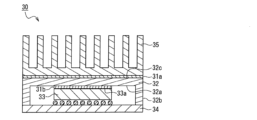
- FIG. 1 is a schematic cross-sectional view showing a method of using a thermally conductive sheet according to one embodiment of the present invention.
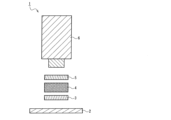
- FIG. 5 is a schematic side cross-sectional view of a compression load measuring device used in one embodiment of the present invention.
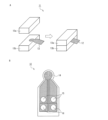
- 6A and 6B are schematic explanatory diagrams showing a method for measuring the thermal conductivity of a sample in one embodiment of the present invention.
- the present invention provides a thermally conductive sheet having high thermal conductivity and low compressive load and plasticity, a thermally conductive composition which is the raw material thereof, and a method for producing a thermally conductive sheet using the same.
- the thermally conductive composition of the present invention is a thermally conductive composition
- a thermally conductive composition comprising a matrix resin (component A) made of a thermosetting resin, a curing catalyst and thermally conductive particles (component B), wherein 1500 to 3000 parts by mass of the thermally conductive particles (component B) are blended with 100 parts by mass of the matrix resin (component A), the thermally conductive particles (component B) comprise the following components B-1, B-2, B-3 and B-4, and when the total amount of the thermally conductive particles (component B) is taken as 100% by mass, 10 to 20 mass% of aluminum nitride (B-1 component) having a D50 (median diameter) of less than 20 ⁇ m, 3 to 9 mass% of aluminum nitride (B-2 component) having a D50 (median diameter) of 20 ⁇ m or more, Contains 50 to 60 mass% of alumina (B-3 component) having a D50 (median diameter) of 60 to 80 ⁇ m,
- the thermally conductive sheet of the present invention contains the thermally conductive composition and is formed into a sheet.
- the method for producing a thermally conductive sheet of the present invention includes the steps of vacuum degassing the thermally conductive composition, rolling it, forming it into a sheet, and then heat curing it to produce a thermally conductive sheet.
- the present invention can provide a thermally conductive sheet having high thermal conductivity and low compression load and plasticity, a thermally conductive composition which is the raw material for the thermally conductive sheet, and a method for producing the thermally conductive sheet.
- the plasticity of the thermally conductive composition before curing and after degassing is preferably 60 or less
- the instantaneous load value of the cured product of the thermally conductive composition at 50% compression with a diameter of 28.6 mm and a thickness of 2 mm is preferably 1000 N or less
- the preferred thermal conductivity is 7 W/m ⁇ K or more.
- the method for producing the thermally conductive sheet of the present invention allows continuous sheet molding because the thermally conductive composition of the present invention has low plasticity and good moldability.
- the present invention is a thermally conductive composition that contains a matrix resin (component A), a curing catalyst (component C), and thermally conductive particles (component B).
- the matrix resin is made of a thermosetting resin.
- the thermosetting resin include silicone resin, epoxy resin, phenol resin, unsaturated polyester resin, melamine resin, acrylic resin, silicone resin, and fluororesin, and silicone resin is preferred.
- the thermosetting resin include rubber, elastomer, gel, putty, and grease.
- Specific examples of the thermosetting resin include silicone rubber, silicone gel, acrylic rubber, and fluororubber. Silicone resin may be cured using any method such as peroxide, addition, and condensation. As the thermosetting resin, silicone resin is preferred because it has high heat resistance.
- the matrix resin is preferably formed from at least one selected from an addition-curing silicone polymer, a peroxide-curing silicone polymer, and a condensation-type silicone polymer.
- the silicone resin is preferably an addition-curing type because it is not corrosive to the surroundings, there are few by-products released outside the system, and it is reliably cured to a deep portion.
- the matrix resin preferably further contains a silane coupling agent.
- the silane coupling agent is preferably added in an amount of 0.1 to 10 parts by mass, more preferably 0.5 to 7 parts by mass, per 100 parts by mass of the matrix resin.
- the silane coupling agent coats the surface of the thermally conductive particles (component B) (surface treatment), making them easier to fill into the matrix resin (component A) (plasticizer function), and has the effect of preventing the curing catalyst (component C) from being adsorbed onto the thermally conductive particles (component B), preventing curing inhibition.
- the matrix resin further contains a silane coupling agent, there is an advantage in that the storage stability of the thermally conductive composition is excellent.
- silane coupling agent examples include a silane compound represented by the formula R( CH3 ) aSi (OR') 4-a (wherein R is an unsubstituted or substituted organic group having 1 to 20 carbon atoms, R' is an alkyl group having 1 to 4 carbon atoms, and a is 0 or 1), or a partial hydrolyzate thereof.
- silane compounds represented by R( CH3 ) aSi (OR') 4-a include methyltrimethoxysilane, ethyltrimethoxysilane, propyltrimethoxysilane, butyltrimethoxysilane, pentyltrimethoxysilane, hexyltrimethoxysilane, hexyltriethoxysilane, octyltrimethoxysilane, octyltriethoxysilane, decyltrimethoxysilane, decyltriethoxysilane, dodecyltrimethoxysilane, dodecyltriethoxysilane, hexadecy
- the matrix resin preferably contains a base polymer component (A1 component) and a crosslinking component (A2).
- Base polymer component (A1 component) The base polymer component is, for example, an organopolysiloxane containing two or more alkenyl groups bonded to silicon atoms in one molecule.
- the organopolysiloxane is the main agent (base polymer component) in the matrix resin of the present invention.
- This organopolysiloxane has two or more alkenyl groups bonded to silicon atoms in one molecule, such as vinyl groups and allyl groups, having 2 to 8 carbon atoms, particularly 2 to 6 carbon atoms.
- the viscosity of the organopolysiloxane is desirably 10 to 1,000,000 mPa ⁇ s, particularly 100 to 100,000 mPa ⁇ s at 25°C, from the viewpoints of workability, curability, etc.
- an organopolysiloxane containing alkenyl groups bonded to silicon atoms at both ends of the molecular chain in one molecule can be used.
- This organopolysiloxane is a linear organopolysiloxane whose side chains are blocked with alkyl groups. From the standpoint of workability, curability, etc., it is desirable for the organopolysiloxane to have a viscosity of 10 to 1,000,000 mPa ⁇ s at 25°C. Note that this linear organopolysiloxane may contain a small amount of branched structure (trifunctional siloxane unit) in the molecular chain.
- Each R 1 may be the same or different and is an unsubstituted or substituted monovalent hydrocarbon group that does not have an aliphatic unsaturated bond, R2 is an alkenyl group; k is 0 or a positive integer.
- the unsubstituted or substituted monovalent hydrocarbon group having no aliphatic unsaturated bond for R 1 is, for example, preferably a hydrocarbon group having 1 to 10 carbon atoms, particularly 1 to 6 carbon atoms.
- unsubstituted monovalent hydrocarbon group having no aliphatic unsaturated bond examples include alkyl groups such as methyl, ethyl, propyl, isopropyl, butyl, isobutyl, tert-butyl, pentyl, neopentyl, hexyl, cyclohexyl, octyl, nonyl, and decyl groups; aryl groups such as phenyl, tolyl, xylyl, and naphthyl groups; and aralkyl groups such as benzyl, phenylethyl, and phenylpropyl groups.
- alkyl groups such as methyl, ethyl, propyl, isopropyl, butyl, isobutyl, tert-butyl, pentyl, neopentyl, hexyl, cyclohexyl, octyl, nonyl
- Examples of the substituted monovalent hydrocarbon group having no aliphatic unsaturated bonds include groups in which some or all of the hydrogen atoms of the unsubstituted monovalent hydrocarbon group have been substituted with halogen atoms such as fluorine, bromine, chlorine, etc.; or a cyano group, etc., such as halogen-substituted alkyl groups such as a chloromethyl group, a chloropropyl group, a bromoethyl group, a trifluoropropyl group, etc.; and a cyanoethyl group.
- halogen atoms such as fluorine, bromine, chlorine, etc.
- a cyano group, etc. such as halogen-substituted alkyl groups such as a chloromethyl group, a chloropropyl group, a bromoethyl group, a trifluoropropyl group, etc.
- a cyanoethyl group such
- the alkenyl group of R2 is preferably, for example, an alkenyl group having 2 to 6 carbon atoms, particularly preferably 2 to 3.
- the alkenyl group include a vinyl group, an allyl group, a propenyl group, an isopropenyl group, a butenyl group, an isobutenyl group, a hexenyl group, and a cyclohexenyl group, and the like, with a vinyl group being preferred.
- k is 0 or a positive integer, preferably 0 or a positive integer satisfying 0 ⁇ k ⁇ 10,000, more preferably 5 ⁇ k ⁇ 2,000, and even more preferably 10 ⁇ k ⁇ 1,200.
- an organopolysiloxane having three or more, usually 3 to 30, and preferably about 3 to 20 alkenyl groups, such as vinyl groups and allyl groups, bonded to silicon atoms having 2 to 8 carbon atoms, especially 2 to 6 carbon atoms, in one molecule may be used in combination.
- the molecular structure of the organopolysiloxane used in combination may be any of linear, cyclic, branched, and three-dimensional network molecular structures.
- the organopolysiloxane used in combination is preferably a linear organopolysiloxane whose main chain is made up of repeated diorganosiloxane units, whose molecular chain ends are blocked with triorganosiloxy groups, and whose viscosity at 25°C is 10 to 1,000,000 mPa ⁇ s, especially 100 to 100,000 mPa ⁇ s.
- the alkenyl groups may be bonded to any part of the molecule.
- they may be bonded to silicon atoms at the ends of the molecular chain or at non-ends (in the middle of the molecular chain).
- linear organopolysiloxanes represented by the following general formula (II) having 1 to 3 alkenyl groups on each of the silicon atoms at both ends of the molecular chain and having a viscosity of 10 to 1,000,000 mPa ⁇ s at 25°C are desirable in terms of workability and curability.
- linear organopolysiloxanes in which the alkenyl groups bonded to silicon atoms at non-ends (in the middle of the molecular chain) are used as substituents in diorganosiloxane units are preferred.
- this linear organopolysiloxane may contain a small amount of branched structure (trifunctional siloxane units) in the molecular chain.
- Each R3 may be the same or different and is an unsubstituted or substituted monovalent hydrocarbon group, at least one of which is an alkenyl group;
- Each R 4 may be the same or different and is an unsubstituted or substituted monovalent hydrocarbon group having no aliphatic unsaturated bonds,
- R5 is an alkenyl group;
- l and m are each independently 0 or a positive integer.
- the unsubstituted or substituted monovalent hydrocarbon group for R 3 is, for example, preferably a hydrocarbon group having 1 to 10 carbon atoms, particularly 1 to 6 carbon atoms.
- the unsubstituted monovalent hydrocarbon group include alkyl groups such as methyl, ethyl, propyl, isopropyl, butyl, isobutyl, tert-butyl, pentyl, neopentyl, hexyl, cyclohexyl, octyl, nonyl, and decyl groups; aryl groups such as phenyl, tolyl, xylyl, and naphthyl groups; aralkyl groups such as benzyl, phenylethyl, and phenylpropyl groups; and alkenyl groups such as vinyl, allyl, propenyl, isopropenyl, butenyl, hexeny
- substituted monovalent hydrocarbon group examples include groups in which some or all of the hydrogen atoms of the unsubstituted monovalent hydrocarbon group have been substituted with halogen atoms such as fluorine, bromine, chlorine, etc.; or a cyano group, etc., such as halogen-substituted alkyl groups such as a chloromethyl group, a chloropropyl group, a bromoethyl group, a trifluoropropyl group, etc.; and a cyanoethyl group.
- halogen atoms such as fluorine, bromine, chlorine, etc.
- a cyano group such as halogen-substituted alkyl groups such as a chloromethyl group, a chloropropyl group, a bromoethyl group, a trifluoropropyl group, etc.
- the unsubstituted or substituted monovalent hydrocarbon group having no aliphatic unsaturated bonds for R4 is preferably a hydrocarbon group having 1 to 10 carbon atoms, particularly 1 to 6 carbon atoms.
- Examples of the unsubstituted or substituted monovalent hydrocarbon group having no aliphatic unsaturated bonds for R4 include the same as the specific examples of the unsubstituted or substituted monovalent hydrocarbon group having no aliphatic unsaturated bonds for R1 , except that alkenyl groups are not included.
- the alkenyl group for R5 is, for example, preferably an alkenyl group having 2 to 6 carbon atoms, particularly preferably an alkenyl group having 2 to 3 carbon atoms. Specific examples thereof include the same alkenyl groups as those for R2 in formula (I), and a vinyl group is preferred.
- l and m are each independently 0 or a positive integer, preferably 0 ⁇ l + m ⁇ 10,000, preferably 5 ⁇ l + m ⁇ 2,000, more preferably 10 ⁇ l + m ⁇ 1,200, and preferably 0 ⁇ l/(l + m) ⁇ 0.2, more preferably 0.0011 ⁇ l/(l + m) ⁇ 0.1.
- the crosslinking component of component A2 of the present invention is, for example, an organohydrogenpolysiloxane.
- This organohydrogenpolysiloxane acts as a crosslinking agent.
- the SiH groups in this organohydrogenpolysiloxane and the organopolysiloxane of component A1 The organohydrogenpolysiloxane has two or more hydrogen atoms bonded to silicon atoms (i.e., SiH groups) in one molecule, and the organohydrogenpolysiloxane forms a cured product by addition reaction (hydrosilylation) with the alkenyl groups in the organohydrogenpolysiloxane.
- any organohydrogenpolysiloxane having such a molecular structure may be used as the crosslinking component (component A2).
- the molecular structure of this organohydrogenpolysiloxane may be any of a linear, cyclic, branched, and three-dimensional network structure.
- the organohydrogenpolysiloxane contains a SiH group as described above.
- the position of the SiH group is not particularly limited, and may be at the end of the molecular chain or at a non-end of the molecular chain (in the middle of the molecular chain).
- examples of the organic group bonded to the silicon atom other than a hydrogen atom include unsubstituted or substituted monovalent hydrocarbon groups that do not have an aliphatic unsaturated bond, similar to R1 in the general formula (I).
- organohydrogenpolysiloxane of component A2 is the one represented by the following formula (III).
- Each R 6 may be the same or different and is an alkyl group, a phenyl group, an epoxy group, an acryloyl group, a methacryloyl group, an alkoxy group, or a hydrogen atom, and at least two of them are hydrogen atoms.
- L is an integer from 0 to 1,000, preferably an integer from 0 to 300; M is an integer from 1 to 200.
- a catalyst used in a hydrosilylation reaction can be used.
- the curing catalyst include platinum black, platinum chloride, chloroplatinic acid, and a reaction product of chloroplatinic acid and a monohydric alcohol.
- the platinum group metal catalyst include platinum-based catalysts such as chloroplatinic acid and olefins or vinyl siloxane complexes, platinum and vinyl disiloxane complexes, platinum bisacetoacetate, palladium-based catalysts, and rhodium-based catalysts.
- the two-component curing silicone polymer usually contains a platinum group metal catalyst.
- the thermally conductive composition of the present invention contains a two-component curing silicone polymer, it is preferable to add The platinum group metal catalyst is added to the thermally conductive composition of the present invention in order to control the curing rate of the thermally conductive composition.
- the curing catalyst is contained in the thermally conductive composition in an amount of, for example, 0.01 to 1000 parts by mass, preferably 0.1 to 100 parts by mass, and more preferably 0.5 to 50 parts by mass, per 100 parts by mass of the matrix resin (component A).
- the thermally conductive particles (component B) include the following components B-1, B-2, B-3, and B-4:
- the thermally conductive particles (component B) have a content of: 10 to 20 mass% of aluminum nitride (B-1 component) having a D50 (median diameter) of less than 20 ⁇ m, 3 to 9 mass% of aluminum nitride (B-2 component) having a D50 (median diameter) of 20 ⁇ m or more, It contains 50 to 60 mass% of alumina (B-3 component) having a D50 (median diameter) of 60 to 80 ⁇ m, and 11 to 37 mass% of alumina (B-4 component) having a D50 (median diameter) of less than 60 ⁇ m.
- the thermally conductive particles (component B) preferably contain 10 to 18 mass % of aluminum nitride (component B-1) having a D50 (median diameter) of less than 20 ⁇ m, 3.5 to 8.5 mass% of aluminum nitride (B-2 component) having a D50 (median diameter) of 20 ⁇ m or more, It contains 50 to 58 mass% of alumina (B-3 component) having a D50 (median diameter) of 60 to 80 ⁇ m, and 15 to 35 mass% of alumina (B-4 component) having a D50 (median diameter) of less than 60 ⁇ m.
- the thermally conductive particles (component B) When the total amount of the thermally conductive particles (component B) is taken as 100 mass%, more preferably, the thermally conductive particles (component B-1) contain 10 to 16 mass% aluminum nitride having a D50 (median diameter) of less than 20 ⁇ m, 4 to 8 mass% of aluminum nitride (B-2 component) having a D50 (median diameter) of 20 ⁇ m or more, It contains 51 to 58 mass% of alumina (B-3 component) having a D50 (median diameter) of 60 to 80 ⁇ m, and 20 to 33 mass% of alumina (B-4 component) having a D50 (median diameter) of less than 60 ⁇ m.
- the thermally conductive particles are made using a combination of multiple types of thermally conductive inorganic particles with different average particle sizes. This is because the thermally conductive inorganic particles with smaller particle sizes are embedded between the larger particles, allowing for a state of nearly close packing, which increases the thermal conductivity of the cured thermally conductive composition. This is also because this results in a thermally conductive composition with low plasticity and good moldability. This also allows the cured thermally conductive composition to be molded into a heat dissipation sheet: TIM (Thermal Interface Material), which has a low compression load and is easier to handle than putty-like materials.
- TIM Thermal Interface Material
- the blending ratio (B-1)/(B-2) of the B-1 component and the B-2 component is 1.2 to 3 by mass, preferably 1.3 to 2.9, and more preferably 1.3 to 2.8. This is because using such a blending ratio makes it possible to obtain a cured product of the thermally conductive composition that has high thermal conductivity and low compressive load and plasticity.
- the thermally conductive particles (component B) are blended in an amount of 1,500 to 3,000 parts by mass per 100 parts by mass of matrix resin (component A).
- the blend amount of the thermally conductive particles (component B) per 100 parts by mass of matrix resin (component A) is preferably 1,700 to 2,800 parts by mass, and more preferably 2,000 to 2,500 parts by mass. This is because using such a blend ratio makes it possible to obtain a cured product of the thermally conductive composition that has high thermal conductivity and low compressive load and plasticity.
- the B-1, B-2, and B-4 components are preferably round or irregularly pulverized particles. Round or irregularly pulverized particles are easy to obtain and are therefore preferred. In the following, irregularly pulverized particles will also simply be referred to as irregular.
- the B-3 component is preferably spherical. By making the B-3 component spherical, it becomes easier to compound the thermally conductive composition.
- the ratio of the total mass of alumina to the total mass of aluminum nitride is preferably 4 to 5.5, and more preferably 4.1 to 5.3. This is because the manufacturing cost of the thermally conductive composition can be reduced by increasing the total mass of alumina.
- the thermally conductive composition of the present invention may contain other components as necessary.
- the thermally conductive composition may contain heat resistance improvers such as red iron oxide, titanium oxide, and cerium oxide, flame retardant assistants, and curing retarders.
- the thermally conductive composition may contain organic or inorganic pigments for coloring and color matching.
- the thermally conductive composition may contain the silane coupling agent.
- the thermally conductive composition of the present invention can be cured by heating or the like.
- the thermal conductivity of the cured product of the thermally conductive composition is preferably 7 W/m K or more, more preferably 7 to 15 W/m K, and even more preferably 7 to 14 W/m K.
- a cured product having such a thermal conductivity is suitable as a heat dissipation sheet: TIM (Thermal Interface Material).
- the cured product of the thermally conductive composition when measured in accordance with ASTM D575-91:2012, preferably has an instantaneous load value of 1000N or less, more preferably 950N or less, and even more preferably 900N or less when compressed 50% to a diameter of 28.6mm and a thickness of 2mm. This makes the cured product easier to crush, and when it is interposed between the heat generating part and the heat sink, the physical load on the heat generating part can be reduced.
- the cured product of the thermally conductive composition when measured in accordance with ASTM D575-91:2012, preferably has a steady load value of 1000N or less, more preferably 950N or less, and even more preferably 900N or less when it is compressed 50% to a diameter of 28.6mm and a thickness of 2mm. This makes the cured product easier to crush, and when it is interposed between the heat generating part and the heat sink, the physical load on the heat generating part can be reduced.
- the plasticity of the thermally conductive composition after defoaming before curing is preferably 60 or less, more preferably 10 to 60, even more preferably 20 to 55, and particularly preferably 30 to 50.
- a thermally conductive composition with such low plasticity has good moldability.
- the thermally conductive composition of the present invention has high versatility when formed into a sheet, and is suitable as a TIM.
- the thickness of the sheet containing the thermally conductive composition i.e., the thermally conductive sheet
- the thickness of the sheet containing the thermally conductive composition is preferably in the range of 0.2 to 10 mm.
- the method for producing a thermally conductive sheet of the present invention includes the steps of vacuum degassing the thermally conductive composition, rolling it, forming it into a sheet, and then heat curing it to obtain a thermally conductive sheet.
- the vacuum degassing can be performed by reducing the pressure of the thermally conductive composition to -0.08 to -0.1 Pa, leaving it for about 5 to 10 minutes, and degassing it.
- the rolling can be performed by roll rolling or press working, but roll rolling is preferred because it allows for continuous production.
- the thermally conductive composition preferably has a breakdown voltage (JIS K6249) of 7 to 16 kV/mm. This allows the thermally conductive composition to become a thermally conductive sheet with high electrical insulation when cured.
- the thermally conductive composition preferably has a volume resistivity (JIS K6249) of 10 10 to 10 14 ⁇ cm, which allows the thermally conductive composition to become a thermally conductive sheet with high electrical insulation when cured.
- JIS K6249 volume resistivity
- an addition reaction type silicone composition (uncured composition) is preferable, and a compound having the following composition is more preferable.
- Component A) Matrix Resin The matrix resin contains the following (A1) and (A2).
- Base polymer component A linear organopolysiloxane containing at least two silicon-bonded alkenyl groups per molecule.
- A2) Crosslinking component An organohydrogenpolysiloxane containing at least two SH groups per molecule in an amount of less than 1 mole per mole of silicon-bonded alkenyl groups in component A1.
- the component (A1) and (A2) may contain an organopolysiloxane having no reactive groups other than those of the component (A1) and (A2), for example, unreacted silicone oil, such as dimethylpolysiloxane.
- the total amount of the base polymer component (A1), the crosslinking component (A2), the unreacted silicone oil and the silane coupling agent is 100 parts by mass.
- the curing catalyst (Component B) and the thermally conductive particles (Component C) are as described above.
- Other additives optional amounts of silane coupling agents, hardening retarders, colorants, etc.
- FIG. 1 is a schematic cross-sectional view of a heat-conducting sheet according to one embodiment of the present invention incorporated into a heat dissipation structure 30.
- the heat-conducting sheet 31b dissipates heat generated by an electronic component 33 such as a semiconductor element, and is fixed to the main surface 32a of the heat spreader 32 facing the electronic component 33, and is sandwiched between the electronic component 33 and the heat spreader 32.
- the heat-conducting sheet 31a is sandwiched between the heat spreader 32 and the heat sink 35.
- the heat spreader 32 is formed, for example, in the shape of a rectangular plate, and has a main surface 32a facing the electronic component 33 and a side wall 32b erected along the outer periphery of the main surface 32a.
- the heat spreader 32 has a thermally conductive sheet 31b on its main surface 32a surrounded by side walls 32b, and a heat sink 35 on its other surface 32c opposite the main surface 32a via the thermally conductive sheet 31a.
- the electronic components 33 are, for example, semiconductor elements such as BGAs, and are mounted on a wiring board 34.
- the present invention includes the following aspects:
- a thermally conductive composition comprising a matrix resin (component A) made of a thermosetting resin, a curing catalyst, and thermally conductive particles (component B),
- the thermally conductive particles (component B) are blended in an amount of 1,500 to 3,000 parts by mass per 100 parts by mass of the matrix resin (component A),
- the thermally conductive particles (component B) include the following components B-1, B-2, B-3, and B-4:
- the thermally conductive particles (component B) have a content of: 10 to 20 mass% of aluminum nitride (B-1 component) having a D50 (median diameter) of less than 20 ⁇ m, 3 to 9 mass% of aluminum nitride (B-2 component) having a D50 (median diameter) of 20 ⁇ m or more, Contains 50 to 60 mass% of alumina (B-3 component) having a D50 (median diameter) of 60 to 80 ⁇ m, and 11 to 37 mass% of alumina (B-4 component) having a
- thermosetting resin is preferably selected from silicone resin, epoxy resin, phenolic resin, unsaturated polyester resin, melamine resin, acrylic resin, silicone resin, and fluororesin, and more preferably silicone resin.
- component B When the total of the thermally conductive particles (component B) is 100 mass%, preferably, aluminum nitride (component B-1) having a D50 (median diameter) of less than 20 ⁇ m is 10 to 18 mass%, 3.5 to 8.5 mass% of aluminum nitride (B-2 component) having a D50 (median diameter) of 20 ⁇ m or more, It contains 50 to 58 mass% of alumina (B-3 component) having a D50 (median diameter) of 60 to 80 ⁇ m, and 15 to 35 mass% of alumina (B-4 component) having a D50 (median diameter) of less than 60 ⁇ m.
- the thermally conductive particles (component B) When the total amount of the thermally conductive particles (component B) is taken as 100 mass%, more preferably, the thermally conductive particles (component B-1) contain 10 to 16 mass% aluminum nitride having a D50 (median diameter) of less than 20 ⁇ m, 4 to 8 mass% of aluminum nitride (B-2 component) having a D50 (median diameter) of 20 ⁇ m or more, Item 9.
- the thermally conductive composition according to any one of items 1 to 8, comprising 51 to 58 mass% of alumina (B-3 component) having a D50 (median diameter) of 60 to 80 ⁇ m, and 20 to 33 mass% of alumina (B-4 component) having a D50 (median diameter) of less than 60 ⁇ m.
- the thermally conductive composition according to any one of Items 1 to 14, wherein the base polymer component is an organopolysiloxane containing two or more alkenyl groups bonded to silicon atoms in one molecule, preferably an organopolysiloxane having two or more alkenyl groups bonded to silicon atoms in one molecule, the alkenyl groups being vinyl groups, allyl groups, or the like, with 2 to 8 carbon atoms, particularly 2 to 6 carbon atoms, and more preferably an organopolysiloxane containing alkenyl groups bonded to silicon atoms at both ends of the molecular chain in one molecule, as represented by general formula (I), or a linear organopolysiloxane having 1 to 3 alkenyl groups on each of the silicon atoms at both ends of the molecular chain, as represented by general formula (II).
- the base polymer component is an organopolysiloxane containing two or more alkenyl groups bonded
- Each R 1 may be the same or different and is an unsubstituted or substituted monovalent hydrocarbon group that does not have an aliphatic unsaturated bond, R2 is an alkenyl group; k is 0 or a positive integer.
- Each R3 may be the same or different and is an unsubstituted or substituted monovalent hydrocarbon group, at least one of which is an alkenyl group;
- Each R 4 may be the same or different and is an unsubstituted or substituted monovalent hydrocarbon group having no aliphatic unsaturated bonds,
- R5 is an alkenyl group;
- l and m are each independently 0 or a positive integer.
- the crosslinking component is an organohydrogenpolysiloxane, preferably an organohydrogenpolysiloxane having two or more hydrogen atoms bonded to silicon atoms (i.e., SiH groups) in one molecule, and more preferably an organohydrogenpolysiloxane represented by general formula (III).
- the thermally conductive composition according to any one of items 1 to 15.
- Each R 6 may be the same or different and is an alkyl group, a phenyl group, an epoxy group, an acryloyl group, a methacryloyl group, an alkoxy group, or a hydrogen atom, and at least two of them are hydrogen atoms.
- L is an integer from 0 to 1,000, preferably an integer from 0 to 300; M is an integer from 1 to 200.
- the curing catalyst is a catalyst used in a hydrosilylation reaction, and is preferably a platinum group metal catalyst such as platinum black, platinum (II) chloride, chloroplatinic acid, a reaction product of chloroplatinic acid with a monohydric alcohol, a complex of chloroplatinic acid with an olefin or vinylsiloxane, a complex of platinum with vinyldisiloxane, a platinum-based catalyst such as platinum bisacetoacetate, a palladium-based catalyst, or a rhodium-based catalyst.
- a platinum group metal catalyst such as platinum black, platinum (II) chloride, chloroplatinic acid, a reaction product of chloroplatinic acid with a monohydric alcohol, a complex of chloroplatinic acid with an olefin or vinylsiloxane, a complex of platinum with vinyldisiloxane, a platinum-based catalyst such as platinum bisacetoacetate, a palladium-based catalyst, or
- the thermally conductive composition is preferably an addition reaction type silicone composition (uncured composition), and more preferably a compound having the following composition:
- the matrix resin contains the following (A1) and (A2).
- the component (A1) and (A2) may contain an organopolysiloxane having no reactive groups other than those of the component (A1) and (A2), for example, unreacted silicone oil, such as dimethylpolysiloxane.
- the total amount of the base polymer component (A1), the crosslinking component (A2), the unreacted silicone oil and the silane coupling agent is 100 parts by mass.
- the curing catalyst (B component) and the thermally conductive particles (C component) are as described in item 1.
- Other additives optional amounts of silane coupling agents, hardening retarders, colorants, etc.
- a thermally conductive sheet comprising the thermally conductive composition described in any one of items 1 to 18 and formed into a sheet.
- a method for producing a thermally conductive sheet comprising the steps of vacuum degassing, rolling, and forming a sheet from the thermally conductive composition described in any one of Items 1 to 18, and then heat curing the sheet to produce a thermally conductive sheet.
- FIG. 5 is a schematic side cross-sectional view of a compression load measuring device used in one embodiment of the present invention.
- This compression load measuring device 1 is equipped with a sample stage 2 and a load cell 6, and a thermally conductive sheet sample 4 is sandwiched between aluminum plates 3 and 5, attached as shown in FIG. 5, and compressed to a specified thickness by the load cell 6.
- the maximum load value when the thickness is compressed by 50% (“50% compression load value (instantaneous)" and the load value after maintaining the compression for one minute "50% compression load value (steady state)" are recorded.
- the thermal conductivity of the thermally conductive sheet was measured using a hot disk (ISO 22007-2: 2008 compliant). As shown in FIG. 6A, this thermal conductivity measuring device 11 sandwiches a polyimide film sensor 12 between two thermally conductive sheet samples 13a and 13b, applies a constant power to the sensor 12, and analyzes the thermal characteristics from the temperature rise value of the sensor 12 by generating a constant amount of heat.
- the sensor 12 has a tip 14 with a diameter of 7 mm, and as shown in FIG. 6B, has a double spiral structure of electrodes, with an applied current electrode 15 and a resistance value electrode (temperature measurement electrode) 16 arranged at the bottom.
- the thermal conductivity was calculated using the following formula (Math. 1).
- the plasticity was measured in accordance with JIS K 6300-3, ISO 2007:1991 using a Wallace plastometer.
- the larger P 0 indicates that the composition is more flexible.
- the pre-curing post-degassing plasticity is the plasticity of the thermally conductive composition after the thermally conductive composition (compound) is degassed for 5 minutes under a reduced pressure of -0.1 Pa.
- This two-liquid room temperature addition curing silicone polymer is addition cured by mixing at room temperature to become a silicone resin.
- Thermally conductive particles (components B-1 to B-4)
- the thermally conductive particles used were those shown in Table 1.
- the average particle size is the D50 (median size) of the cumulative particle size distribution based on volume in particle size distribution measurement by laser diffraction light scattering method.
- An example of the measuring device is the LA-950S2 laser diffraction/scattering type particle distribution measuring device manufactured by Horiba, Ltd.
- AlN is an abbreviation for aluminum nitride.
- B-4: amorphous alumina (D50 0.3 ⁇ m)
- B-4: amorphous alumina (D50 0.7 ⁇ m)
- B-4: amorphous alumina (D50 4.0 ⁇ m)
- B-4: amorphous alumina (D50 2.2 ⁇ m)
- Curing catalyst As the curing catalyst (component C), a platinum-vinyldisiloxane complex (a platinum group metal catalyst) was used. As mentioned above, the two-component curing silicone polymer (silicone component) does not contain a platinum group metal catalyst. In preparing the thermally conductive composition of each example, an additional platinum group metal catalyst was added to the thermally conductive composition so that the polyorganosiloxane was sufficiently cured.
- Thermally conductive composition (compound) The amounts of each material shown in Table 1 were weighed out and placed in a mixer to prepare a thermally conductive composition. This thermally conductive composition was degassed at a reduced pressure of -0.1 Pa for 5 minutes.
- thermoly conductive composition was sandwiched between release-treated polyethylene terephthalate (PET) films, rolled into a sheet of 2.0 mm thickness using a constant speed roll, and cured by heating at 100°C for 10 minutes in this state to obtain a thermally conductive sheet (thermally conductive silicone rubber sheet).
- PET polyethylene terephthalate
- the moldability was judged as "possible” if molding was possible under the above conditions, and "NG” if not.
- Table 1 The conditions and results of the examples are shown in Table 1, and the conditions and results of the comparative examples are shown in Table 2.
- Tables 1 and 2 the amount of each material is shown in parts by mass when the matrix resin (Component A, two-part room temperature curing silicone polymer) is taken as 100 parts by mass (100 g).
- the specific gravities of the matrix resin (component A), silane coupling agent, and platinum group metal catalyst are all 0.98
- the specific gravities of alumina are 3.98
- the specific gravities of aluminum nitride Components B-1 and B-2) are 3.32.
- thermally conductive composition and thermally conductive sheet of the present invention are suitable as a thermal interface material (TIM) that is a heat dissipation sheet to be interposed between a heat generating part of an electric or electronic component and a heat sink.
- TIM thermal interface material
Landscapes
- Chemical & Material Sciences (AREA)
- Chemical Kinetics & Catalysis (AREA)
- Organic Chemistry (AREA)
- Medicinal Chemistry (AREA)
- Polymers & Plastics (AREA)
- Health & Medical Sciences (AREA)
- Engineering & Computer Science (AREA)
- Materials Engineering (AREA)
- Manufacturing & Machinery (AREA)
- Life Sciences & Earth Sciences (AREA)
- Wood Science & Technology (AREA)
- Physics & Mathematics (AREA)
- Combustion & Propulsion (AREA)
- Thermal Sciences (AREA)
- Compositions Of Macromolecular Compounds (AREA)
- Manufacture Of Macromolecular Shaped Articles (AREA)
Priority Applications (4)
| Application Number | Priority Date | Filing Date | Title |
|---|---|---|---|
| EP24835739.4A EP4549519A4 (en) | 2023-07-06 | 2024-02-29 | THERMOCONDUCTIVE COMPOSITION, THERMOCONDUCTIVE SHEET USING IT, AND ASSOCIATED PRODUCTION PROCESS |
| US19/104,104 US20260167797A1 (en) | 2023-07-06 | 2024-02-29 | Thermally conductive composition, thermally conductive sheet obtained from same, and production method therefor |
| JP2024522669A JP7503224B1 (ja) | 2023-07-06 | 2024-02-29 | 熱伝導性組成物及びこれを用いた熱伝導性シートとその製造方法 |
| CN202480003686.1A CN119731274A (zh) | 2023-07-06 | 2024-02-29 | 导热性组合物以及使用其的导热性片材和其制造方法 |
Applications Claiming Priority (2)
| Application Number | Priority Date | Filing Date | Title |
|---|---|---|---|
| JP2023-111523 | 2023-07-06 | ||
| JP2023111523 | 2023-07-06 |
Publications (1)
| Publication Number | Publication Date |
|---|---|
| WO2025009216A1 true WO2025009216A1 (ja) | 2025-01-09 |
Family
ID=94171623
Family Applications (1)
| Application Number | Title | Priority Date | Filing Date |
|---|---|---|---|
| PCT/JP2024/007512 Ceased WO2025009216A1 (ja) | 2023-07-06 | 2024-02-29 | 熱伝導性組成物及びこれを用いた熱伝導性シートとその製造方法 |
Country Status (5)
| Country | Link |
|---|---|
| US (1) | US20260167797A1 (cg-RX-API-DMAC7.html) |
| EP (1) | EP4549519A4 (cg-RX-API-DMAC7.html) |
| JP (1) | JP7503224B1 (cg-RX-API-DMAC7.html) |
| TW (1) | TW202502940A (cg-RX-API-DMAC7.html) |
| WO (1) | WO2025009216A1 (cg-RX-API-DMAC7.html) |
Citations (11)
| Publication number | Priority date | Publication date | Assignee | Title |
|---|---|---|---|---|
| WO2017203924A1 (ja) * | 2016-05-24 | 2017-11-30 | 信越化学工業株式会社 | 熱伝導性シリコーン組成物及びその硬化物 |
| JP6246986B1 (ja) | 2016-07-22 | 2017-12-13 | モメンティブ・パフォーマンス・マテリアルズ・ジャパン合同会社 | 熱伝導性ポリシロキサン組成物 |
| WO2018074247A1 (ja) * | 2016-10-18 | 2018-04-26 | 信越化学工業株式会社 | 熱伝導性シリコーン組成物 |
| JP2020073626A (ja) * | 2019-08-01 | 2020-05-14 | 昭和電工株式会社 | 無機粒子分散樹脂組成物及び無機粒子分散樹脂組成物の製造方法 |
| WO2020116057A1 (ja) * | 2018-12-04 | 2020-06-11 | 信越化学工業株式会社 | 熱伝導性シリコーン組成物の硬化物 |
| WO2021256391A1 (ja) * | 2020-06-18 | 2021-12-23 | 信越化学工業株式会社 | シリコーン組成物、及び高熱伝導性を有する熱伝導性シリコーン硬化物 |
| JP7039157B2 (ja) | 2019-06-26 | 2022-03-22 | モメンティブ・パフォーマンス・マテリアルズ・ジャパン合同会社 | 熱伝導性ポリシロキサン組成物 |
| WO2022215510A1 (ja) * | 2021-04-09 | 2022-10-13 | ダウ・東レ株式会社 | 硬化性オルガノポリシロキサン組成物、熱伝導性部材および放熱構造体 |
| WO2022249754A1 (ja) * | 2021-05-26 | 2022-12-01 | 信越化学工業株式会社 | 熱伝導性シリコーン組成物 |
| JP7205554B2 (ja) | 2018-12-28 | 2023-01-17 | 信越化学工業株式会社 | シリコーン組成物及びその製造方法 |
| JP2023026805A (ja) * | 2021-08-16 | 2023-03-01 | 信越化学工業株式会社 | 熱伝導性シリコーン組成物及び熱伝導性シリコーン硬化物 |
-
2024
- 2024-02-29 JP JP2024522669A patent/JP7503224B1/ja active Active
- 2024-02-29 WO PCT/JP2024/007512 patent/WO2025009216A1/ja not_active Ceased
- 2024-02-29 US US19/104,104 patent/US20260167797A1/en active Pending
- 2024-02-29 EP EP24835739.4A patent/EP4549519A4/en active Pending
- 2024-04-15 TW TW113113937A patent/TW202502940A/zh unknown
Patent Citations (13)
| Publication number | Priority date | Publication date | Assignee | Title |
|---|---|---|---|---|
| WO2017203924A1 (ja) * | 2016-05-24 | 2017-11-30 | 信越化学工業株式会社 | 熱伝導性シリコーン組成物及びその硬化物 |
| JP6246986B1 (ja) | 2016-07-22 | 2017-12-13 | モメンティブ・パフォーマンス・マテリアルズ・ジャパン合同会社 | 熱伝導性ポリシロキサン組成物 |
| WO2018074247A1 (ja) * | 2016-10-18 | 2018-04-26 | 信越化学工業株式会社 | 熱伝導性シリコーン組成物 |
| WO2020116057A1 (ja) * | 2018-12-04 | 2020-06-11 | 信越化学工業株式会社 | 熱伝導性シリコーン組成物の硬化物 |
| JP2020090584A (ja) * | 2018-12-04 | 2020-06-11 | 信越化学工業株式会社 | 熱伝導性シリコーン組成物の硬化物 |
| JP7082563B2 (ja) | 2018-12-04 | 2022-06-08 | 信越化学工業株式会社 | 熱伝導性シリコーン組成物の硬化物 |
| JP7205554B2 (ja) | 2018-12-28 | 2023-01-17 | 信越化学工業株式会社 | シリコーン組成物及びその製造方法 |
| JP7039157B2 (ja) | 2019-06-26 | 2022-03-22 | モメンティブ・パフォーマンス・マテリアルズ・ジャパン合同会社 | 熱伝導性ポリシロキサン組成物 |
| JP2020073626A (ja) * | 2019-08-01 | 2020-05-14 | 昭和電工株式会社 | 無機粒子分散樹脂組成物及び無機粒子分散樹脂組成物の製造方法 |
| WO2021256391A1 (ja) * | 2020-06-18 | 2021-12-23 | 信越化学工業株式会社 | シリコーン組成物、及び高熱伝導性を有する熱伝導性シリコーン硬化物 |
| WO2022215510A1 (ja) * | 2021-04-09 | 2022-10-13 | ダウ・東レ株式会社 | 硬化性オルガノポリシロキサン組成物、熱伝導性部材および放熱構造体 |
| WO2022249754A1 (ja) * | 2021-05-26 | 2022-12-01 | 信越化学工業株式会社 | 熱伝導性シリコーン組成物 |
| JP2023026805A (ja) * | 2021-08-16 | 2023-03-01 | 信越化学工業株式会社 | 熱伝導性シリコーン組成物及び熱伝導性シリコーン硬化物 |
Non-Patent Citations (1)
| Title |
|---|
| See also references of EP4549519A4 |
Also Published As
| Publication number | Publication date |
|---|---|
| TW202502940A (zh) | 2025-01-16 |
| JPWO2025009216A1 (cg-RX-API-DMAC7.html) | 2025-01-09 |
| JP7503224B1 (ja) | 2024-06-19 |
| EP4549519A4 (en) | 2026-03-18 |
| US20260167797A1 (en) | 2026-06-18 |
| EP4549519A1 (en) | 2025-05-07 |
Similar Documents
| Publication | Publication Date | Title |
|---|---|---|
| KR102509813B1 (ko) | 열전도성 조성물 및 이것을 사용한 열전도성 시트 | |
| EP4324885B1 (en) | Thermally conductive composition, thermally conductive sheet obtained from same, and production method therefor | |
| TW202033730A (zh) | 導熱性片及其製造方法 | |
| JP2022060339A (ja) | 熱伝導性シリコーン組成物 | |
| KR102660031B1 (ko) | 열전도성 조성물 및 그 제조 방법 | |
| WO2023188491A1 (ja) | 熱伝導性シリコーン組成物、熱伝導性シリコーンシート及びその製造方法 | |
| US12590237B2 (en) | Thermally conductive composition, thermally conductive sheet obtained from same, and production method therefor | |
| JP7503224B1 (ja) | 熱伝導性組成物及びこれを用いた熱伝導性シートとその製造方法 | |
| JP7553752B1 (ja) | 熱伝導性組成物及びこれを用いた熱伝導性シートとその製造方法 | |
| JP7537050B1 (ja) | 熱伝導性組成物及びこれを用いた熱伝導性シートとその製造方法 | |
| JP2024101552A (ja) | 熱伝導性シリコーン組成物および該組成物の製造方法 | |
| WO2024004242A1 (ja) | 熱伝導性組成物、熱伝導性グリース及び熱伝導性シート | |
| JP7499414B2 (ja) | 熱伝導性組成物、熱伝導性シート及びその製造方法 | |
| JP7650410B1 (ja) | 耐熱性樹脂組成物及びこれを用いた耐熱性樹脂シートとその製造方法 | |
| WO2025225085A1 (ja) | 熱伝導性組成物及びこれを用いた熱伝導性シートとその製造方法 | |
| CN115867613A (zh) | 有机硅凝胶组合物及有机硅凝胶片材 | |
| CN119731274A (zh) | 导热性组合物以及使用其的导热性片材和其制造方法 |
Legal Events
| Date | Code | Title | Description |
|---|---|---|---|
| WWE | Wipo information: entry into national phase |
Ref document number: 2024522669 Country of ref document: JP |
|
| WWE | Wipo information: entry into national phase |
Ref document number: 2024835739 Country of ref document: EP |
|
| ENP | Entry into the national phase |
Ref document number: 2024835739 Country of ref document: EP Effective date: 20250131 |
|
| WWE | Wipo information: entry into national phase |
Ref document number: 202480003686.1 Country of ref document: CN |
|
| 121 | Ep: the epo has been informed by wipo that ep was designated in this application |
Ref document number: 24835739 Country of ref document: EP Kind code of ref document: A1 |
|
| WWP | Wipo information: published in national office |
Ref document number: 202480003686.1 Country of ref document: CN |
|
| WWP | Wipo information: published in national office |
Ref document number: 2024835739 Country of ref document: EP |
|
| NENP | Non-entry into the national phase |
Ref country code: DE |