WO2025005261A1 - 組成物、原料酒及び飲料 - Google Patents
組成物、原料酒及び飲料 Download PDFInfo
- Publication number
- WO2025005261A1 WO2025005261A1 PCT/JP2024/023567 JP2024023567W WO2025005261A1 WO 2025005261 A1 WO2025005261 A1 WO 2025005261A1 JP 2024023567 W JP2024023567 W JP 2024023567W WO 2025005261 A1 WO2025005261 A1 WO 2025005261A1
- Authority
- WO
- WIPO (PCT)
- Prior art keywords
- caryophyllene
- weight
- aroma
- composition
- limonene
- Prior art date
- Legal status (The legal status is an assumption and is not a legal conclusion. Google has not performed a legal analysis and makes no representation as to the accuracy of the status listed.)
- Ceased
Links
Classifications
-
- A—HUMAN NECESSITIES
- A23—FOODS OR FOODSTUFFS; TREATMENT THEREOF, NOT COVERED BY OTHER CLASSES
- A23L—FOODS, FOODSTUFFS OR NON-ALCOHOLIC BEVERAGES, NOT OTHERWISE PROVIDED FOR; PREPARATION OR TREATMENT THEREOF
- A23L27/00—Spices; Flavouring agents or condiments; Artificial sweetening agents; Table salts; Dietetic salt substitutes; Preparation or treatment thereof
- A23L27/10—Natural spices, flavouring agents or condiments; Extracts thereof
- A23L27/12—Natural spices, flavouring agents or condiments; Extracts thereof from fruit, e.g. essential oils
-
- A—HUMAN NECESSITIES
- A23—FOODS OR FOODSTUFFS; TREATMENT THEREOF, NOT COVERED BY OTHER CLASSES
- A23L—FOODS, FOODSTUFFS OR NON-ALCOHOLIC BEVERAGES, NOT OTHERWISE PROVIDED FOR; PREPARATION OR TREATMENT THEREOF
- A23L2/00—Non-alcoholic beverages; Dry compositions or concentrates therefor; Preparation or treatment thereof
- A23L2/52—Adding ingredients
- A23L2/56—Flavouring or bittering agents
-
- A—HUMAN NECESSITIES
- A23—FOODS OR FOODSTUFFS; TREATMENT THEREOF, NOT COVERED BY OTHER CLASSES
- A23L—FOODS, FOODSTUFFS OR NON-ALCOHOLIC BEVERAGES, NOT OTHERWISE PROVIDED FOR; PREPARATION OR TREATMENT THEREOF
- A23L27/00—Spices; Flavouring agents or condiments; Artificial sweetening agents; Table salts; Dietetic salt substitutes; Preparation or treatment thereof
- A23L27/10—Natural spices, flavouring agents or condiments; Extracts thereof
- A23L27/12—Natural spices, flavouring agents or condiments; Extracts thereof from fruit, e.g. essential oils
- A23L27/13—Natural spices, flavouring agents or condiments; Extracts thereof from fruit, e.g. essential oils from citrus fruits
-
- C—CHEMISTRY; METALLURGY
- C12—BIOCHEMISTRY; BEER; SPIRITS; WINE; VINEGAR; MICROBIOLOGY; ENZYMOLOGY; MUTATION OR GENETIC ENGINEERING
- C12G—WINE; PREPARATION THEREOF; ALCOHOLIC BEVERAGES; PREPARATION OF ALCOHOLIC BEVERAGES NOT PROVIDED FOR IN SUBCLASSES C12C OR C12H
- C12G3/00—Preparation of other alcoholic beverages
- C12G3/04—Preparation of other alcoholic beverages by mixing, e.g. for preparation of liqueurs
- C12G3/06—Preparation of other alcoholic beverages by mixing, e.g. for preparation of liqueurs with flavouring ingredients
Definitions
- the present invention relates to compositions, raw alcoholic beverages, beverages, etc.
- a lemon aroma to beverages such as lemon sour.
- the lemon aroma may be imparted by squeezing lemon juice or adding sliced lemons.
- squeezing lemon juice or preparing sliced lemons each time a beverage is consumed is time-consuming, it is not practical to impart a lemon aroma in such a way, particularly in containerized beverages such as canned beverages and PET bottled beverages. From this perspective, there is a demand for a composition that can more easily impart a lemon aroma to beverages.
- the aromatic compounds of lemons are found in particularly high concentrations in the surface layer of the lemon peel (oil glands), and squeezing the lemon peel produces an essential oil that has a fresh and vivid peel aroma (fresh lemon peel aroma).
- Terpeneless oils in which hydrocarbon terpenes have been removed or reduced are used as lemon-flavored fragrances or raw materials thereof (for example, Patent Document 1).
- limonene which is contained in large amounts in lemon essential oil, is easily degraded, and lemon essential oil also contains bitter components such as bergamottin, so adding lemon essential oil as is to a beverage may impair the taste of the beverage.
- Terpene-less oils have a reduced content of limonene, which is easily degraded, but they impair the lemon scent and do not provide a fresh lemon aroma.
- a composition that has a lemon-like sour aroma, a balanced aroma close to that of a fresh lemon peel aroma, good aroma release, and little bitterness, and that can be suitably used to impart a lemon peel aroma to beverages, etc.
- the present invention aims to provide a composition that has a lemon-like sour aroma, a balanced aroma close to that of a fresh lemon peel aroma, good aroma release, and little bitterness, and is suitable for use in imparting a lemon peel aroma to beverages, etc.
- Lemon peel is known to contain limonene, citral, and ⁇ -caryophyllene. All of these are aroma components that belong to the hydrocarbon terpene group. To date, many research and development efforts have been conducted with the aim of recreating the lemon peel aroma, but of these aroma components, limonene has a small contribution to the lemon peel aroma and is unstable and prone to deterioration, so it has been common technical knowledge to reduce its content. Like limonene, ⁇ -caryophyllene also has a small contribution to the lemon peel aroma and is difficult and expensive to fractionate, so it has been common technical knowledge to reduce its content.
- citral is an important aroma component in recreating the lemon peel aroma, it is the cause of a strong deterioration odor due to p-cresol, so it has been common technical knowledge to reduce its content by, for example, substituting it with another aroma component.
- a composition containing limonene, citral, and ⁇ -caryophyllene by setting the limonene content within a specific range, setting the weight ratio of limonene to ⁇ -caryophyllene (limonene/ ⁇ -caryophyllene) and the weight ratio of citral to ⁇ -caryophyllene (citral/ ⁇ -caryophyllene) within specific ranges, and further setting the bergamottin content to a specific amount or less, a composition can be obtained that has a lemon-like sour aroma, a balanced aroma close to a fresh lemon peel aroma, a good aroma, and little bitterness, and is suitable for use in imparting a lemon peel aroma to beverages and the like, and thus completed the present invention.
- the present invention includes the following compositions, etc.
- a fragrance that contains limonene, citral, and ⁇ -caryophyllene the weight ratio of limonene to ⁇ -caryophyllene (limonene/ ⁇ -caryophyllene) is 250 to 2500; a weight ratio of citral to ⁇ -caryophyllene (citral/ ⁇ -caryophyllene) of 5 to 110;
- the limonene content is 2.5 to 90% by weight,
- composition according to [1] or [2] above further comprising at least one selected from the group consisting of linalool, citronellal, ⁇ -terpineol, geranyl acetate, decanal, nerol and geraniol.
- the composition according to any one of [1] to [3] above obtained by using lemon as a part or all of the raw material.
- the composition according to any one of [1] to [5] above which is added to a beverage for use.
- a bottled beverage comprising the composition according to any one of [1] to [6] above and a beverage.
- a fragrance containing limonene, citral, and ⁇ -caryophyllene, the weight ratio of limonene to ⁇ -caryophyllene (limonene/ ⁇ -caryophyllene) is 250 to 2500; a weight ratio of citral to ⁇ -caryophyllene (citral/ ⁇ -caryophyllene) of 5 to 110; A beverage having a limonene content of 0.01 to 2.5% by weight.
- the present invention can provide a composition that has a lemon-like sour aroma, a balanced aroma close to that of a fresh lemon peel aroma, good aroma release, and little bitterness, and is suitable for use in imparting a lemon peel aroma to beverages and the like. It can also provide a base liquor and beverage that exhibit a lemon peel aroma.
- the composition of the present invention contains limonene, citral, and ⁇ -caryophyllene, the weight ratio of limonene to ⁇ -caryophyllene (limonene/ ⁇ -caryophyllene) is 250 to 2500; a weight ratio of citral to ⁇ -caryophyllene (citral/ ⁇ -caryophyllene) of 5 to 110;
- the limonene content is 2.5 to 90% by weight, It is characterized in that the bergamottin content is 0.01% by weight or less.
- the composition of the present invention is a composition containing limonene, citral, and ⁇ -caryophyllene, in which the limonene content is within a specific range, the weight ratio of limonene to ⁇ -caryophyllene (limonene/ ⁇ -caryophyllene) and the weight ratio of citral to ⁇ -caryophyllene (citral/ ⁇ -caryophyllene) are within specific ranges, and the bergamottin content is below a specific amount. Therefore, the composition has a lemon-like sour aroma, a balanced aroma close to a fresh lemon peel aroma, a good aroma, and little bitterness. In one aspect, the composition of the present invention is suitably used to impart a lemon peel aroma to beverages, etc.
- lemon-like sour aroma refers to the tart, lemony aroma that is one of the components of a fresh lemon peel aroma
- aroma balance refers to the balance of aromas that include not only the “lemon-like sour aroma” but also various other aroma qualities (such as the gorgeousness of the aroma, the stimulating or refreshing feeling, the structure/body feel, and the green feel)
- aroma release refers to the speed at which the aroma (not limited to the lemon-like sour aroma) emerges.
- the origin and production method of limonene, citral, and ⁇ -caryophyllene are not particularly limited.
- these components may be contained in plant-derived materials such as essential oils or refined products thereof, or may be synthetic products.
- the plant from which they are derived is preferably a citrus fruit.
- citrus fruits include oranges, mandarin oranges, grapefruits, pomelo, kumquats, lemons, limes, bergamot, sudachi, yuzu, etc.
- Lemon is preferably used as the citrus fruit.
- the limonene, citral and ⁇ -caryophyllene commercially available products can also be used.
- Limonene is a typical monocyclic monoterpene contained in citrus fruits. Limonene may be d-limonene, l-limonene, or a mixture of these, but is preferably d-limonene.
- the content of limonene is not particularly limited as long as it is 2.5 to 90% by weight, but is preferably 15% by weight or more, more preferably 25% by weight or more, even more preferably 35% by weight or more, and is preferably 88% by weight or less, more preferably 84% by weight or less, and even more preferably 80% by weight or less.
- the content of limonene is preferably 15 to 88% by weight, more preferably 25 to 84% by weight, and even more preferably 35 to 80% by weight.
- Citral is a type of acyclic monoterpene and is a collective term for geranial and neral, which are cis-trans isomers of each other.
- the content of citral is not particularly limited, but is preferably 0.005% by weight or more, more preferably 0.05% by weight or more, even more preferably 0.3% by weight or more, particularly preferably 0.6% by weight or more, and is preferably 39.6% by weight or less, more preferably 22.2% by weight or less, and even more preferably 4.9% by weight or less.
- the content of citral is preferably 0.005 to 39.6% by weight, more preferably 0.05 to 22.2% by weight, even more preferably 0.3 to 4.9% by weight, and particularly preferably 0.6 to 4.9% by weight.
- ⁇ -caryophyllene is a type of sesquiterpene.
- the content of ⁇ -caryophyllene is not particularly limited, but is preferably 0.001% by weight or more, more preferably 0.01% by weight or more, even more preferably 0.02% by weight or more, particularly preferably 0.03% by weight or more, and is preferably 0.36% by weight or less, more preferably 0.33% by weight or less, even more preferably 0.30% by weight or less, even more preferably 0.27% by weight or less, and particularly preferably 0.2% by weight or less.
- the content of ⁇ -caryophyllene is preferably 0.001 to 0.36% by weight, more preferably 0.01 to 0.33% by weight, even more preferably 0.02 to 0.30% by weight, even more preferably 0.03 to 0.27% by weight, and particularly preferably 0.03 to 0.2% by weight.
- the content of ⁇ -caryophyllene in the composition of the present invention is preferably 0.01 to 0.2% by weight.
- the weight ratio of limonene to ⁇ -caryophyllene is not particularly limited as long as it is 250 to 2500, but is preferably 300 or more, more preferably 350 or more, and is preferably 2000 or less, more preferably 1600 or less, and even more preferably 1200 or less.
- the weight ratio of limonene to ⁇ -caryophyllene is preferably 300 to 2000, more preferably 350 to 1600, and even more preferably 350 to 1200.
- the weight ratio of citral to ⁇ -caryophyllene is not particularly limited as long as it is 5 to 110, but is preferably 6 or more, more preferably 7 or more, even more preferably 7.5 or more, and is preferably 100 or less, more preferably 90 or less, and even more preferably 75 or less.
- the weight ratio of citral to ⁇ -caryophyllene is preferably 6 to 100, more preferably 7 to 90, and even more preferably 7.5 to 75.
- Bergamottin is a non-volatile component belonging to the coumarin family, and is found in high concentrations in citrus fruits, mainly grapefruit, which causes drug interactions and also has a strong bitter aftertaste.
- bergamottin may be contained in essential oils, fragrances, etc., which use citrus fruits such as grapefruit and lemon as raw materials.
- the composition of the present invention contains 0.01% by weight or less of bergamottin. If the content of bergamottin is 0.01% by weight or less, the aroma of the composition of the present invention will be better. In addition, the strong bitter aftertaste caused by bergamottin is also suppressed.
- the content of bergamottin is not particularly limited as long as it is 0.01% by weight or less, but is preferably 0.0075% by weight or less, more preferably 0.005% by weight or less, and even more preferably 0.0025% by weight or less.
- the lower limit of the content of bergamottin is also not particularly limited, but may be, for example, 0% by weight.
- the content of bergamottin in the composition of the present invention may be 0 to 0.01% by weight, preferably 0 to 0.0075% by weight, more preferably 0 to 0.005% by weight, and even more preferably 0 to 0.0025% by weight.
- the contents of limonene, citral, and ⁇ -caryophyllene can be measured, for example, by gas chromatography-mass spectrometry.
- the content of bergamottin can be measured, for example, by liquid chromatography-mass spectrometry.
- Known conditions can be used as measurement conditions.
- composition of the present invention may contain optional components in addition to limonene, citral, and ⁇ -caryophyllene, to the extent that the effects of the present invention are not impaired.
- Optional components include components that can be used in beverages, such as other volatile aroma components other than limonene, citral, and ⁇ -caryophyllene, solvents, emulsifiers, colorants, antioxidants, etc.
- volatile aroma components other than limonene, citral, and ⁇ -caryophyllene are preferably volatile aroma components contained in lemon, such as linalool, citronellal, ⁇ -terpineol, geranyl acetate, decanal, nerol, and geraniol. These components are aroma components contained in citrus fruits such as lemon. Linalool, citronellal, ⁇ -terpineol, geraniol, and nerol are monoterpene alcohols.
- Decanal is a type of aldehyde, and is a compound also known as decyl aldehyde.
- Geranyl acetate is a type of monoterpene.
- the composition of the present invention may contain one of these other volatile aroma components alone, or may contain two or more of them.
- the origin and production method of linalool, citronellal, ⁇ -terpineol, geranyl acetate, decanal, nerol, and geraniol are not particularly limited.
- these components may be contained in plant-derived materials such as essential oils or their refined products, or may be synthetic products.
- the plant from which they are derived is preferably citrus fruits. Examples of citrus fruits include oranges, mandarin oranges, grapefruits, pomelo, kumquats, lemons, limes, bergamot, sudachi, and yuzu. Lemon is preferably used as the citrus fruit.
- Commercially available products can also be used as linalool, citronellal, ⁇ -terpineol, geranyl acetate, decanal, nerol, and geraniol.
- the composition of the present invention preferably contains linalool from the viewpoint of improving the "splendor" of the fragrance.
- the "splendor” of the fragrance refers to a floral fragrance that brings out or expands the depth of the lemon-like sour fragrance.When the fragrance becomes more splendor, the lemon-like sour fragrance becomes complex or deep.
- the weight ratio of linalool to ⁇ -caryophyllene is not particularly limited, but is preferably 0.20 to 6.00, more preferably 0.20 to 5.00, and even more preferably 0.50 to 4.00.
- the weight ratio of linalool to ⁇ -caryophyllene (linalool/ ⁇ -caryophyllene) is 0.20 to 6.00, the effect of increasing the depth of the lemon-like sour aroma or increasing the floral aroma that expands the depth can also be obtained.
- the composition of the present invention contains linalool, the content is preferably 0.02 to 0.50% by weight, more preferably 0.02 to 0.40% by weight, and even more preferably 0.05 to 0.35% by weight.
- the composition of the present invention preferably contains citronellal from the viewpoint of improving the "stimulating or refreshing" aroma.
- the "stimulating or refreshing" aroma refers to a spicy aroma reminiscent of fresh lemon or lemon fruit.
- the weight ratio of citronellal to ⁇ -caryophyllene is not particularly limited, but is preferably 0.25 to 2.50, more preferably 0.25 to 1.50, and even more preferably 0.25 to 1.00.
- citronellal When the weight ratio of citronellal to ⁇ -caryophyllene (citronellal/ ⁇ -caryophyllene) is 0.25 to 2.50, an effect of strengthening the spicy scent reminiscent of fresh lemon or raw lemon fruit can be obtained.
- the content thereof is preferably from 0.01 to 0.50% by weight, more preferably from 0.01 to 0.30% by weight, and even more preferably from 0.02 to 0.30% by weight.
- the composition of the present invention preferably contains ⁇ -terpineol from the viewpoint of improving the "structure and body" of the fragrance.
- the "structure and body” of the fragrance refers to a green fragrance that enhances the lemon peel feeling and gives depth to the fragrance. When the structure and body of the fragrance become stronger, the lemon peel feeling is enhanced and the width (volume) of the fragrance peak increases.
- the weight ratio of ⁇ -terpineol to ⁇ -caryophyllene is not particularly limited, but is preferably 0.50 to 8.00, more preferably 0.50 to 7.50, and even more preferably 0.50 to 5.00.
- the weight ratio of ⁇ -terpineol to ⁇ -caryophyllene is 0.50 to 8.00, the lemon peel feeling is enhanced and the green fragrance that gives a rich fragrance is strengthened.
- the content thereof is preferably from 0.02 to 0.25% by weight, more preferably from 0.02 to 0.20% by weight, and even more preferably from 0.05 to 0.20% by weight.
- the composition of the present invention preferably contains geranyl acetate from the viewpoint of improving the "elegance/structure/body” of the fragrance.
- the "elegance/structure/body” of the fragrance refers to a floral fragrance that improves the depth and complexity of the lemon-like sour aroma.
- the weight ratio of geranyl acetate to ⁇ -caryophyllene is not particularly limited, but is preferably 1.00 to 30.00, more preferably 2.00 to 20.00, and even more preferably 3.00 to 15.00.
- the floral aroma is strengthened, which improves the depth and complexity of the lemon-like sour aroma.
- the content thereof is preferably 0.05 to 2.50% by weight, more preferably 0.10 to 2.10% by weight, and even more preferably 0.50 to 2.10% by weight.
- the composition of the present invention preferably contains decanal from the viewpoint of improving the "potency/depth" of the fragrance.
- the "potency/depth" of the fragrance refers to a sweet and heavy fragrance that imparts strength to the fragrance.
- the weight ratio of decanal to ⁇ -caryophyllene is not particularly limited, but is preferably 0.10 to 2.00, more preferably 0.10 to 1.50, and even more preferably 0.20 to 1.00.
- the weight ratio of decanal to ⁇ -caryophyllene (decanal/ ⁇ -caryophyllene) is 0.10 to 2.00, the sweet and heavy fragrance that imparts strength to the fragrance is strengthened.
- the content thereof is preferably from 0.01 to 0.20% by weight, more preferably from 0.01 to 0.15% by weight, and even more preferably from 0.03 to 0.12% by weight.
- the composition of the present invention preferably contains nerol from the viewpoint of improving the "green” scent.
- the "green” scent refers to a scent having a refreshing sensation reminiscent of young lemon fruits (green lemons) (the refreshing, cool sensation peculiar to young lemon fruits).
- the weight ratio of nerol to ⁇ -caryophyllene is not particularly limited, but is preferably 0.10 to 2.50, more preferably 0.10 to 2.00, and even more preferably 0.25 to 1.50.
- nerol/ ⁇ -caryophyllene When the weight ratio of nerol to ⁇ -caryophyllene (nerol/ ⁇ -caryophyllene) is 0.10 to 2.50, a scent having a refreshing sensation reminiscent of young lemons (green lemons) (the refreshing refreshing sensation peculiar to young lemons) is imparted.
- the content thereof is preferably 0.02 to 0.20% by weight, more preferably 0.02 to 0.15% by weight, and even more preferably 0.05 to 0.15% by weight.
- the composition of the present invention preferably contains geraniol from the viewpoint of improving the "structural and body feeling due to floral aroma" of the fragrance.
- the "structural and body feeling due to floral aroma” of the fragrance refers to a floral aroma that imparts a mellow and sweet aroma.
- the floral aroma that imparts a mellow and sweet aroma can also be regarded as the aroma of a mellow ripe lemon fruit.
- the weight ratio of geraniol to ⁇ -caryophyllene is not particularly limited, but is preferably 0.10 to 3.00, more preferably 0.10 to 2.50, and even more preferably 0.20 to 2.00.
- the floral fragrance that imparts a mellow and sweet fragrance is strengthened.
- the content thereof is preferably from 0.02 to 0.25% by weight, more preferably from 0.02 to 0.20% by weight, and even more preferably from 0.05 to 0.20% by weight.
- the composition of the present invention preferably further contains at least one selected from the group consisting of linalool, citronellal, ⁇ -terpineol, geranyl acetate, decanal, nerol and geraniol, more preferably contains two or more, even more preferably contains three or more, even more preferably contains four or more, even more preferably contains five or more, and even more preferably contains six or more, and it is particularly preferable that the composition contains linalool, citronellal, ⁇ -terpineol, geranyl acetate, decanal, nerol and geraniol, since this brings the balance of the scent closer to a fresh lemon peel scent.
- the contents of linalool, citronellal, ⁇ -terpineol, geranyl acetate, decanal, nerol, and geraniol can be measured, for example, by gas chromatography-mass spectrometry. Known conditions can be used as measurement conditions.
- the solvent is not particularly limited as long as it is an edible solvent.
- the composition of the present invention may be one in which limonene, citral and ⁇ -caryophyllene, as well as other volatile aroma components other than these, are dissolved, emulsified or dispersed in a small amount of solvent.
- the solvent include water, ethanol, propylene glycol, MCT oil, triacetin, glycerin, etc.
- the composition of the present invention may contain one of these solvents alone or two or more of them.
- the solvent is preferably ethanol or propylene glycol. When the composition of the present invention contains a solvent, the content thereof is not particularly limited.
- emulsifiers include glycerin fatty acid esters, saponin, sucrose fatty acid esters, lecithin, and the like.
- the composition of the present invention may contain one of these emulsifiers alone, or may contain two or more of them.
- the content thereof is not particularly limited.
- Lemon essential oil contains non-volatile components such as bergamottin as mentioned above.
- the composition of the present invention preferably contains 0.01% by weight or less of bergamottin, and in addition, the content of other non-volatile components other than bergamottin is suppressed to a certain amount or less.
- other non-volatile components include coumarins such as citropten and scoparone, limonoids such as limonin, nomilin and obacunone, carotenoids, chlorophyll and its decomposition products, etc.
- the composition of the present invention may contain one type of these other non-volatile components alone, or may contain two or more types.
- the method for producing the composition of the present invention is not particularly limited.
- the composition of the present invention can be obtained by blending limonene, ⁇ -caryophyllene, and citral so that the content of limonene in the composition, the weight ratio of limonene to ⁇ -caryophyllene (limonene/ ⁇ -caryophyllene), the weight ratio of citral to ⁇ -caryophyllene (citral/ ⁇ -caryophyllene), and the content of bergamottin are within the above ranges.
- at least one compound selected from the group consisting of limonene, ⁇ -caryophyllene, and citral can be blended using lemon as a raw material.
- composition of the present invention contains at least one compound selected from the group consisting of linalool, citronellal, ⁇ -terpineol, geranyl acetate, decanal, nerol, and geraniol
- the compound can also be blended using lemon as a raw material.
- composition of the present invention is preferably liquid (liquid composition) at 25°C, and more preferably liquid (liquid composition) at 10°C.
- the composition of the present invention is preferably obtained by using lemon as a part or all of the raw materials.
- at least one of limonene, citral, and ⁇ -caryophyllene is preferably derived from lemon, and more preferably extracted or refined from lemon or its essential oil.
- the composition of the present invention contains bergamottin, the bergamottin may be derived from lemon.
- the composition of the present invention contains at least one compound selected from the group consisting of linalool, citronellal, ⁇ -terpineol, geranyl acetate, decanal, nerol, and geraniol
- the compound is preferably derived from lemon, and more preferably extracted or refined from lemon or its essential oil.
- the composition of the present invention may be, for example, a flavoring (flavoring composition) or the like.
- the composition of the present invention is preferably a flavoring, more preferably a flavoring for addition to a beverage, and even more preferably a flavoring for imparting a lemon peel flavor to a beverage.
- the composition of the present invention can also be called a lemon peel flavor imparting agent.
- the composition of the present invention is preferably used by adding it to a beverage.
- the composition of the present invention may be added to a beverage that does not contain lemon juice, or the composition of the present invention may be added to a beverage that contains lemon juice (such as lemon chuhai) immediately before consumption.
- lemon juice such as lemon chuhai
- a fresh lemon peel aroma can be imparted to the beverage.
- the fresh and vivid peel aroma fresh lemon peel aroma
- the fresh lemon peel aroma fresh lemon peel aroma of the moment the lemon peel is squeezed imparted by the composition of the present invention and the fresh lemon aroma imparted by lemon juice are different from each other.
- the beverages are not particularly limited and include alcoholic and non-alcoholic beverages.
- an alcoholic beverage refers to a beverage containing 1.0% or more by volume of ethanol.
- examples of alcoholic beverages include beer, happoshu, other beer-flavored beverages, wine, chuhai, sour drinks, liqueurs, cocktails, shochu, whiskey, and sake.
- non-alcoholic beverage refers to a beverage containing less than 1.0% by volume of ethanol.
- non-alcoholic beverages examples include tea beverages (green tea, black tea, pu-erh tea, oolong tea, etc.), coffee, coffee beverages, carbonated beverages (carbonated water, carbonated beverages containing fruit juice, carbonated beverages without fruit juice, carbonated beverages containing dairy products, energy drinks, etc.), non-alcoholic beer-flavored beverages, non-alcoholic chuhai, etc.
- black tea lemon tea
- chuhai lemon chuhai
- non-alcoholic chuhai non-alcoholic lemon chuhai
- sour drinks e.g., lemon sour
- beer e.g., Radler
- the name of the beverage to which the lemon peel aroma is to be imparted is shown, followed in parentheses by the name of the beverage obtained by imparting the lemon peel aroma.
- the method of adding the composition of the present invention to a beverage is not particularly limited, and examples include a method of adding the composition of the present invention directly to a beverage, and a method of adding a sugar cube soaked in the composition of the present invention to a beverage.
- Methods of directly adding the composition of the present invention to a beverage include a method of directly dripping the composition of the present invention into the beverage, and a method of directly spraying the composition of the present invention onto the beverage to spray a mist of the composition of the present invention.
- the composition of the present invention may separate from the beverage and become oil droplets, or the composition of the present invention may dissolve, emulsify or disperse in the beverage.
- the composition of the present invention can impart a lemon peel aroma to the beverage, and the lemon peel aroma can be obtained by the composition of the present invention before and during drinking.
- the sugar cubes are water-soluble, by mixing the composition of the present invention into the beverage and dissolving it, a lemon peel aroma can be obtained before and during drinking. In addition, the sweetness of the sugar cubes can be imparted to the beverage.
- the lemon peel aroma is preferably imparted using the composition of the present invention immediately before consuming the beverage (approximately within 15 minutes before consumption). If the beverage is acidic, adding the composition of the present invention to the beverage may facilitate the decomposition of aroma components. Therefore, it is preferable to add the composition of the present invention to the beverage immediately before consuming the beverage to impart a lemon peel aroma.
- the amount of the composition of the present invention to be added to a beverage is not particularly limited, but can be 0.004 to 0.1 g per 100 mL of beverage.
- a packaged beverage having the composition of the present invention and a beverage is also one aspect of the present invention.
- the packaged beverage is not particularly limited, and examples include canned beverages, PET bottle beverages, bottled beverages, etc.
- the packaged beverage of the present invention may be one in which the composition of the present invention and the beverage are mixed in advance and then filled into a container, but a packaged beverage having the composition of the present invention and a beverage separated from the composition is preferred.
- a kit-type packaged beverage in which a portion, spray container, pouch, etc. filled with the composition of the present invention is attached to a container filled with a beverage is preferred because the composition of the present invention can be added to the beverage just before drinking the beverage.
- the container filled with the beverage and the portion, spray container, pouch, etc. filled with the composition of the present invention may be integrated.
- the canned beverage may have a mechanism in which the pouch filled with the composition of the present invention breaks when the pull tab of the can is opened, and the composition of the present invention is added to the beverage.
- the raw material liquor of the present invention is Contains limonene, citral, ⁇ -caryophyllene, and ethanol; the weight ratio of limonene to ⁇ -caryophyllene (limonene/ ⁇ -caryophyllene) is 250 to 2500; a weight ratio of citral to ⁇ -caryophyllene (citral/ ⁇ -caryophyllene) of 5 to 110; The limonene content is 0.05 to 2.5% by weight, The ethanol content is 10% by volume or more.
- the base liquor of the present invention is used to produce an alcoholic beverage by adding another beverage such as water (diluting with another beverage).
- the base liquor of the present invention contains limonene, citral, ⁇ -caryophyllene, and ethanol, and the limonene content is within a specific range, and the weight ratio of limonene to ⁇ -caryophyllene (limonene/ ⁇ -caryophyllene) and the weight ratio of citral to ⁇ -caryophyllene (citral/ ⁇ -caryophyllene) are also within specific ranges.
- This gives the base liquor a lemon-like sour aroma, a well-balanced aroma close to that of fresh lemon peel, and a good aroma.
- the limonene content is not particularly limited as long as it is 0.05 to 2.5% by weight, but is preferably 0.075% by weight or more, more preferably 0.1% by weight or more, even more preferably 0.2% by weight or more, and is preferably 2.4% by weight or less, more preferably 2.3% by weight or less, even more preferably 2.0% by weight or less, and particularly preferably 1.5% by weight or less.
- the limonene content is preferably 0.075 to 2.4% by weight, more preferably 0.075 to 2.3% by weight, even more preferably 0.1 to 2.0% by weight, and particularly preferably 0.2 to 1.5% by weight.
- the citral content is not particularly limited, but is preferably 0.0001% by weight or more, more preferably 0.001% by weight or more, even more preferably 0.005% by weight or more, and is preferably 1.1% by weight or less, more preferably 0.2% by weight or less, and even more preferably 0.1% by weight or less.
- the citral content is preferably 0.0001 to 1.1% by weight, more preferably 0.001 to 0.2% by weight, and even more preferably 0.005 to 0.1% by weight.
- the content of ⁇ -caryophyllene is not particularly limited, but is preferably 0.00002% by weight or more, more preferably 0.0001% by weight or more, even more preferably 0.0005% by weight or more, particularly preferably 0.001% by weight or more, and preferably 0.01% by weight or less, more preferably 0.008% by weight or less, and even more preferably 0.0075% by weight or less.
- the content of ⁇ -caryophyllene is preferably 0.00002 to 0.01% by weight, more preferably 0.0001 to 0.01% by weight, even more preferably 0.0005 to 0.008% by weight, and particularly preferably 0.001 to 0.0075% by weight.
- the weight ratio of limonene to ⁇ -caryophyllene is not particularly limited as long as it is 250 to 2500, but is preferably 300 or more, more preferably 350 or more, and is preferably 2000 or less, more preferably 1600 or less, and even more preferably 1200 or less.
- the weight ratio of limonene to ⁇ -caryophyllene is preferably 300 to 2000, more preferably 350 to 1600, and even more preferably 350 to 1200.
- the weight ratio of citral to ⁇ -caryophyllene is not particularly limited as long as it is 5 to 110, but is preferably 6 or more, more preferably 7 or more, even more preferably 7.5 or more, and is preferably 100 or less, more preferably 90 or less, and even more preferably 75 or less.
- the weight ratio of citral to ⁇ -caryophyllene is preferably 6 to 100, more preferably 7 to 90, and even more preferably 7.5 to 75.
- the raw material liquor of the present invention has an ethanol content of 10% by volume or more.
- the ethanol content can be measured, for example, using a vibration density meter.
- the ethanol content is not particularly limited as long as it is 10% by volume or more, but is preferably 12% by volume or more, and more preferably 14% by volume or more.
- the upper limit of the ethanol content is also not particularly limited, but may be, for example, 80% by volume or 60% by volume.
- the ethanol content is preferably 12 to 80% by volume, and more preferably 14 to 60% by volume.
- the raw liquor of the present invention may contain optional components in addition to limonene, citral, ⁇ -caryophyllene, and ethanol, to the extent that the effects of the present invention are not impaired.
- Optional components include components that can be used in beverages, such as other volatile aroma components other than limonene, citral, and ⁇ -caryophyllene, solvents other than ethanol, emulsifiers, colorants, antioxidants, etc.
- Examples of other volatile aroma components other than limonene, citral, and ⁇ -caryophyllene include linalool, citronellal, ⁇ -terpineol, geranyl acetate, decanal, nerol, geraniol, etc.
- the base liquor of the present invention may contain one or more of these other volatile aroma components.
- preferred aspects of the above-mentioned other volatile aroma components, preferred ranges of the weight ratios to ⁇ -caryophyllene (other volatile aroma components/ ⁇ -caryophyllene), etc. are the same as those of the composition of the present invention described above.
- the raw liquor of the present invention has an aroma balance closer to a fresh lemon peel aroma
- it further contains at least one selected from the group consisting of linalool, citronellal, ⁇ -terpineol, geranyl acetate, decanal, nerol and geraniol, more preferably contains two or more types, even more preferably contains three or more types, even more preferably contains four or more types, even more preferably contains five or more types, and even more preferably contains six or more types, and it is particularly preferable that it contains linalool, citronellal, ⁇ -terpineol, geranyl acetate, decanal, nerol and geraniol.
- the content is preferably 0.00001 to 0.1% by weight, more preferably 0.00001 to 0.067% by weight, and even more preferably 0.0001 to 0.0067% by weight.
- the content is preferably 0.00001 to 0.1% by weight, more preferably 0.00001 to 0.067% by weight, and even more preferably 0.0001 to 0.0067% by weight.
- the content is preferably 0.00001 to 0.1% by weight, more preferably 0.00001 to 0.067% by weight, and even more preferably 0.0001 to 0.0067% by weight.
- the content is preferably 0.0001 to 1.0% by weight, more preferably 0.0001 to 0.067% by weight, and even more preferably 0.001 to 0.067% by weight.
- the content is preferably 0.000005 to 0.1% by weight, more preferably 0.000005 to 0.033% by weight, and even more preferably 0.00005 to 0.033% by weight.
- the content is preferably 0.00001 to 0.1% by weight, more preferably 0.00001 to 0.067% by weight, and even more preferably 0.0001 to 0.0067% by weight.
- the content is preferably 0.00001 to 0.1% by weight, more preferably 0.00001 to 0.067% by weight, and even more preferably 0.0001 to 0.0067% by weight.
- the solvent other than ethanol is not particularly limited as long as it is an edible solvent.
- the raw material liquor of the present invention may be one in which limonene, citral and ⁇ -caryophyllene, as well as other volatile aroma components other than these, are dissolved, emulsified or dispersed in a solvent other than ethanol.
- solvents other than ethanol include water, propylene glycol, MCT oil, triacetin, glycerin, etc. Among these, propylene glycol and water are preferred as solvents other than ethanol, and water is more preferred.
- the raw material liquor of the present invention may contain one of these solvents other than ethanol alone, or may contain two or more of them. When the raw material liquor of the present invention contains a solvent other than ethanol, the content thereof is not particularly limited.
- emulsifiers include glycerin fatty acid esters, saponin, sucrose fatty acid esters, lecithin, and the like.
- the raw material liquor of the present invention may contain one of these emulsifiers alone, or may contain two or more of them.
- the raw material liquor of the present invention contains an emulsifier, its content is not particularly limited.
- the raw material liquor of the present invention preferably has a content of non-volatile components suppressed to a certain level or less.
- non-volatile components include coumarins such as bergamottin, citropten, and scoparone, limonoids such as limonin, nomilin, and obacunone, carotenoids, chlorophyll and its decomposition products, carbohydrates, sweeteners, acidulants, pH adjusters, antioxidants, and polyphenols.
- the raw material liquor of the present invention may contain one type of these non-volatile components alone, or may contain two or more types.
- the bergamottin content is not particularly limited, but is preferably 0.00005% by weight or less, more preferably 0.000025% by weight or less, and even more preferably 0.00001% by weight or less.
- the lower limit of the bergamottin content is also not particularly limited, but may be, for example, 0% by weight.
- the bergamottin content in the raw liquor of the present invention is preferably 0 to 0.00005% by weight, more preferably 0 to 0.000025% by weight, and even more preferably 0 to 0.00001% by weight.
- the method for producing the raw liquor of the present invention is not particularly limited, and the raw liquor of the present invention can be obtained, for example, by diluting the above-mentioned composition of the present invention with a solvent containing ethanol so that the limonene content is 0.05 to 2.5% by weight and the ethanol content is 10% by volume or more.
- a method for producing an alcoholic beverage that incorporates the base liquor of the present invention is also one aspect of the present invention.
- an alcoholic beverage that exhibits a lemon peel aroma can be obtained by incorporating the base liquor of the present invention into another beverage (for example, by diluting the base liquor of the present invention with the other beverage).
- the method for incorporating the base liquor of the present invention into the other beverage there are no particular limitations on the method for incorporating the base liquor of the present invention into the other beverage, and any method known in the art can be used.
- Examples of other beverages include water, tonic water, white wine, spumante (sparkling wine), milk, gin, vodka, etc.
- the water may be carbonated water. Of these other beverages, only one may be used alone, or two or more may be used in combination.
- the weight ratio (other beverage/base alcoholic beverage of the present invention) when the base alcoholic beverage of the present invention is diluted with another beverage is not particularly limited.
- the beverage of the present invention comprises: Contains limonene, citral, and ⁇ -caryophyllene, the weight ratio of limonene to ⁇ -caryophyllene (limonene/ ⁇ -caryophyllene) is 250 to 2500; a weight ratio of citral to ⁇ -caryophyllene (citral/ ⁇ -caryophyllene) of 5 to 110; The limonene content is 0.01 to 2.5% by weight.
- the beverage of the present invention contains limonene, citral, and ⁇ -caryophyllene, and the limonene content is within a specific range, and the weight ratio of limonene to ⁇ -caryophyllene (limonene/ ⁇ -caryophyllene) and the weight ratio of citral to ⁇ -caryophyllene (citral/ ⁇ -caryophyllene) are also within specific ranges, so the beverage has a lemon-like sour aroma, a balanced aroma close to that of fresh lemon peel, and a good aroma.
- the limonene content is not particularly limited as long as it is 0.01 to 2.5% by weight, but is preferably 1.5% by weight or less, more preferably 1.0% by weight or less, even more preferably 0.5% by weight or less, and particularly preferably 0.25% by weight or less.
- the limonene content is preferably 0.01 to 1.5% by weight, more preferably 0.01 to 1.0% by weight, even more preferably 0.01 to 0.5% by weight, and particularly preferably 0.01 to 0.25% by weight.
- the citral content is not particularly limited, but is preferably 0.00002% by weight or more, more preferably 0.0002% by weight or more, even more preferably 0.001% by weight or more, and is preferably 1.1% by weight or less, more preferably 0.2% by weight or less, and even more preferably 0.1% by weight or less.
- the citral content is preferably 0.00002 to 1.1% by weight, more preferably 0.0002 to 0.2% by weight, and even more preferably 0.001 to 0.1% by weight.
- the content of ⁇ -caryophyllene is not particularly limited, but is preferably 0.000004% by weight or more, more preferably 0.00002% by weight or more, even more preferably 0.0001% by weight or more, particularly preferably 0.0002% by weight or more, and preferably 0.01% by weight or less, more preferably 0.008% by weight or less, and even more preferably 0.0075% by weight or less.
- the content of ⁇ -caryophyllene is preferably 0.000004 to 0.01% by weight, more preferably 0.00002 to 0.008% by weight, even more preferably 0.0001 to 0.0075% by weight, and particularly preferably 0.0002 to 0.0075% by weight.
- the weight ratio of limonene to ⁇ -caryophyllene is not particularly limited as long as it is 250 to 2500, but is preferably 300 or more, more preferably 350 or more, and is preferably 2000 or less, more preferably 1600 or less, and even more preferably 1200 or less.
- the weight ratio of limonene to ⁇ -caryophyllene is preferably 300 to 2000, more preferably 350 to 1600, and even more preferably 350 to 1200.
- the weight ratio of citral to ⁇ -caryophyllene is not particularly limited as long as it is 5 to 110, but is preferably 6 or more, more preferably 7 or more, even more preferably 7.5 or more, and is preferably 100 or less, more preferably 90 or less, and even more preferably 75 or less.
- the weight ratio of citral to ⁇ -caryophyllene is preferably 6 to 100, more preferably 7 to 90, and even more preferably 7.5 to 75.
- the beverage of the present invention may or may not contain bergamottin.
- the content of bergamottin is preferably 0.0008% by weight or less, more preferably 0.0001% by weight or less, and even more preferably 0.00005% by weight or less.
- the lower limit of the bergamottin content is not particularly limited, but may be, for example, 0% by weight.
- the content of bergamottin in the beverage of the present invention is preferably 0 to 0.0008% by weight, more preferably 0 to 0.0001% by weight, and even more preferably 0 to 0.00005% by weight.
- the beverage of the present invention may contain optional components in addition to limonene, citral, and ⁇ -caryophyllene, to the extent that the effects of the present invention are not impaired.
- Optional components include components that can be used in beverages, such as other volatile aroma components other than limonene, citral, and ⁇ -caryophyllene, solvents, emulsifiers, carotenoids, chlorophyll and its decomposition products, carbohydrates, proteins, amino acids, sweeteners, acidulants, pH adjusters, antioxidants, polyphenols, carbon dioxide, etc.
- Examples of other volatile aroma components other than limonene, citral, and ⁇ -caryophyllene include linalool, citronellal, ⁇ -terpineol, geranyl acetate, decanal, nerol, and geraniol.
- the beverage of the present invention may contain one or more of these other volatile aroma components.
- preferred aspects of the above-mentioned other volatile aroma components, preferred ranges of the weight ratio to ⁇ -caryophyllene (other volatile aroma components/ ⁇ -caryophyllene), and the like are the same as those of the composition of the present invention described above.
- the beverage of the present invention has an aroma balance closer to a fresh lemon peel aroma, it preferably further contains at least one selected from the group consisting of linalool, citronellal, ⁇ -terpineol, geranyl acetate, decanal, nerol and geraniol, more preferably contains two or more, even more preferably contains three or more, even more preferably contains four or more, even more preferably contains five or more, and even more preferably contains six or more, and it is particularly preferable that the beverage of the present invention contains linalool, citronellal, ⁇ -terpineol, geranyl acetate, decanal, nerol and geraniol.
- the content is preferably 0.000002 to 0.10% by weight, more preferably 0.00002 to 0.05% by weight, and even more preferably 0.00002 to 0.01% by weight.
- the content is preferably 0.000001 to 0.04% by weight, more preferably 0.00001 to 0.02% by weight, and even more preferably 0.00001 to 0.01% by weight.
- the content is preferably 0.000002 to 0.12% by weight, more preferably 0.00002 to 0.05% by weight, and even more preferably 0.00002 to 0.03% by weight.
- the content is preferably 0.000005 to 0.50% by weight, more preferably 0.00005 to 0.20% by weight, and even more preferably 0.00005 to 0.10% by weight.
- the content is preferably 0.000001 to 0.03% by weight, more preferably 0.00001 to 0.02% by weight, and even more preferably 0.00001 to 0.01% by weight.
- the content is preferably 0.000002 to 0.06% by weight, more preferably 0.00002 to 0.03% by weight, and even more preferably 0.00002 to 0.01% by weight.
- the content is preferably 0.000002 to 0.06% by weight, more preferably 0.00002 to 0.03% by weight, and even more preferably 0.00002 to 0.01% by weight.
- the solvent is not particularly limited as long as it is an edible solvent.
- the beverage of the present invention may be one in which limonene, citral and ⁇ -caryophyllene, as well as other volatile aroma components other than these, are dissolved, emulsified or dispersed in a solvent.
- the solvent include water, ethanol, propylene glycol, MCT oil, triacetin, glycerin, etc. Preferably, it is water or ethanol.
- the beverage of the present invention may contain one of these solvents alone, or may contain two or more kinds. When the beverage of the present invention contains a solvent, the content thereof is not particularly limited.
- emulsifiers include glycerin fatty acid esters, saponin, sucrose fatty acid esters, lecithin, and the like.
- the beverage of the present invention may contain one of these emulsifiers alone, or may contain two or more of them.
- the content thereof is not particularly limited.
- the method for producing the beverage of the present invention is not particularly limited, and the beverage of the present invention can be obtained, for example, by diluting the composition or base liquor of the present invention described above with a solvent so that the limonene content is 0.01 to 2.5% by weight.
- the beverage of the present invention may be an alcoholic beverage or a non-alcoholic beverage, but is preferably an alcoholic beverage.
- an alcoholic beverage refers to a beverage having an ethanol content of 1.0% by volume or more.
- a non-alcoholic beverage refers to a beverage having an ethanol content of less than 1.0% by volume.
- the beverage of the present invention include lemon tea, lemon chuhai, non-alcoholic lemon chuhai, lemon sour, and radler.
- the ethanol content is not particularly limited as long as it is 1.0% by volume or more, but is preferably 2.5% by volume or more, and is preferably less than 10.0% by volume, more preferably 9.0% by volume or less, and even more preferably 7.5% by volume or less.
- the ethanol content is preferably 1.0% by volume or more and less than 10.0% by volume, more preferably 1.0 to 9.0% by volume, and even more preferably 2.5 to 7.5% by volume.
- the beverage of the present invention is preferably a packaged beverage.
- Packaged beverages are not particularly limited, and examples include canned beverages, PET bottle beverages, bottled beverages, etc.
- a numerical range expressed by a lower limit and an upper limit includes the lower limit and the upper limit.
- a range expressed by "1 to 2" means 1 to 2, including 1 and 2.
- the upper and lower limits may be in any combination.
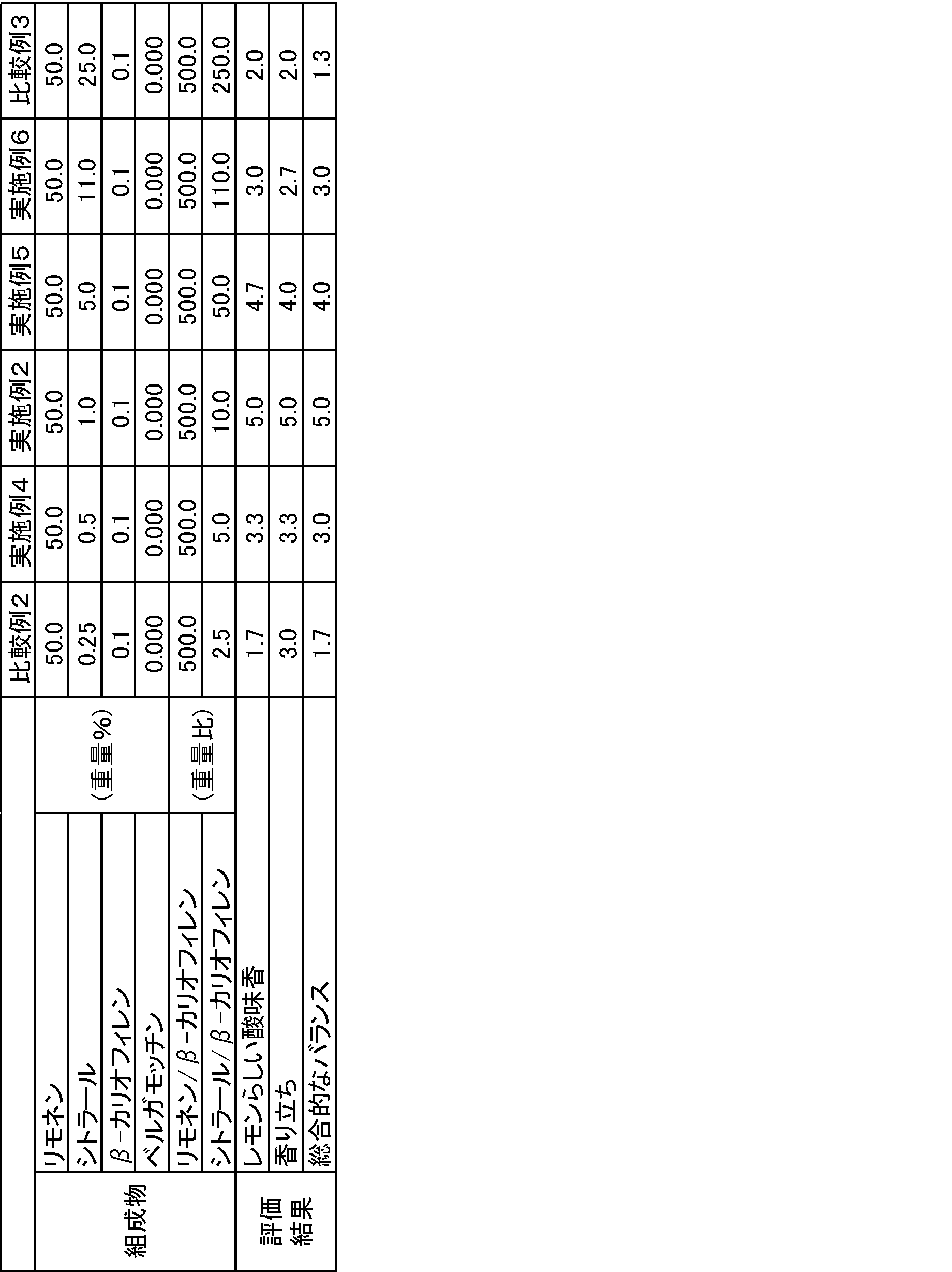
- Example 1 to 8 Comparative Examples 1 to 5
- the following reagents were used.
- Limonene, citral, ⁇ -caryophyllene all manufactured by Sigma-Aldrich
- the limonene used in the examples was (R)-(+)-limonene (d-limonene).
- compositions The above reagents were mixed with ethanol so that the contents of limonene, citral and ⁇ -caryophyllene were the contents (wt%) shown in Tables 1 to 3 below to obtain compositions.
- the weight ratios of limonene to ⁇ -caryophyllene (limonene/ ⁇ -caryophyllene) and the weight ratios of citral to ⁇ -caryophyllene (citral/ ⁇ -caryophyllene) in the compositions are shown in Tables 1 to 3.
- the aromas were evaluated based on three criteria: "lemon-like sour aroma,””aroma,” and “overall balance.”
- "lemon-like sour aroma,””fragrance,” and "overall balance” the composition of Example 2 was given a rating of 5 points as the standard score, and the 5% by volume aqueous ethanol solution was given a rating of 1 point, and the evaluation was carried out in 1 point increments (5-point scale) according to the following criteria.
- “Lemon-like sour aroma” refers to the tart, lemony aroma that is one of the components of fresh lemon peel aroma
- “aroma release” refers to the speed at which the aroma (not limited to lemon-like sour aroma) emerges
- “overall balance” refers to the balance of the aroma as a fresh lemon peel aroma, including the aforementioned “lemon-like sour aroma” and “aroma release.”
- “aroma release” the earlier the aroma releases, the better the aroma is evaluated.
- the evaluation was based on the average score of the three sensory panelists.
- the evaluation results are shown in Tables 1 to 3.
- Example 9 to 10 Comparative Example 6
- limonene citral
- ⁇ -caryophyllene The bergamoccin used was a high-purity product extracted and refined from lemons.
- the above reagents were mixed with ethanol so that the contents of limonene, citral, ⁇ -caryophyllene and bergamottin were the contents (wt%) shown in Table 4 below to obtain a composition.
- the weight ratio of limonene to ⁇ -caryophyllene (limonene/ ⁇ -caryophyllene) and the weight ratio of citral to ⁇ -caryophyllene (citral/ ⁇ -caryophyllene) in the composition are shown in Table 4.
- the evaluation was based on the average score of the four sensory panelists.
- the evaluation results are shown in Table 4.
- Example 11 to 17 and Comparative Examples 7 to 10 ⁇ Reagents used>
- the same reagents as in Example 1 etc. were used as citral and ⁇ -caryophyllene, respectively.
- the limonene a commercially available fragrance with a high limonene content derived from lemon (a fragrance with a high limonene content obtained as a distillate during the production of lemon terpene-less oil, limonene content: 47.6% by weight) was used.
- this commercially available fragrance does not contain any of citral, ⁇ -caryophyllene, linalool, citronellal, ⁇ -terpineol, geranyl acetate, decanal, nerol, geraniol, or bergamottin.
- compositions The above reagents were mixed with ethanol so that the contents of limonene, citral and ⁇ -caryophyllene were the contents (wt%) shown in Tables 5 to 7 below to obtain compositions.
- the weight ratios of limonene to ⁇ -caryophyllene (limonene/ ⁇ -caryophyllene) and the weight ratios of citral to ⁇ -caryophyllene (citral/ ⁇ -caryophyllene) in the compositions are shown in Tables 5 to 7.
- the evaluation was based on the average score of the four sensory panelists.
- the evaluation results are shown in Tables 5 to 7.
- Example 18 to 21, Comparative Example 11 The composition obtained in Example 12 was diluted with a diluent at the dilution ratio (dilution ratio based on weight) shown in Table 8 below to prepare a base liquor.
- the diluent was prepared using Neutral Spirits 95 (ethanol content: 95% by volume) and water so that the ethanol content in the base liquor would be the content (volume %) shown in Table 8 below.
- Example 21 the same reagent as in Example 9 etc. was used as bergamottin, and this reagent was mixed so that the bergamottin content would be the content (weight %) shown in Table 8. In this manner, the base liquor of Examples 18 to 21 and Comparative Example 11 was obtained.
- the evaluation was based on the average score of the four sensory panelists.
- the evaluation results average scores from four sensory panelists of "lemon-like sour aroma,””fragrance,” and “overall balance” are shown in Table 8.
- Example 22 to 45 Comparative Examples 12 to 19
- the same reagents as those in Example 9 etc. were used as limonene, citral, ⁇ -caryophyllene, and bergamottin, respectively.
- the following reagents were used as linalool, citronellal, ⁇ -terpineol, geranyl acetate, decanal, nerol, and geraniol. Linalool, citronellal, ⁇ -terpineol, geranyl acetate, decanal, nerol, geraniol (all manufactured by Sigma-Aldrich)
- the weight ratio of limonene to ⁇ -caryophyllene in the composition (limonene/ ⁇ -caryophyllene), the weight ratio of citral to ⁇ -caryophyllene (citral/ ⁇ -caryophyllene), the weight ratio of linalool to ⁇ -caryophyllene (linalool/ ⁇ -caryophyllene), the weight ratio of citronellal to ⁇ -caryophyllene (citronellal/ ⁇ -caryophyllene), the weight ratio of ⁇ -terpineol to ⁇ -caryophyllene ( ⁇ -terpineol/ ⁇ -caryophyllene), and the weight ratio of ⁇ -terpineol to ⁇ -caryophyllene are shown in Tables 9 to 16 below.
- the weight ratio of geranyl acetate to ⁇ -caryophyllene (geranyl acetate/ ⁇ -caryophyllene), the weight ratio of decanal to ⁇ -caryophyllene (decanal/ ⁇ -caryophyllene), the weight ratio of nerol to ⁇ -caryophyllene (nerol/ ⁇ -caryophyllene), and the weight ratio of geraniol to ⁇ -caryophyllene (geraniol/ ⁇ -caryophyllene) are shown in Tables 9 to 16.
- the "aroma release” was evaluated in increments of 0.5 points (on a 9-point scale) according to the following criteria.
- Table 9 Examples 22 to 24 and Comparative Example 12
- the composition of Example 22 was given a score of 5 as a reference point
- the 5% by volume aqueous ethanol solution was given a score of 1 as a reference point.
- Table 10 Examples 25 to 27 and Comparative Example 13
- the composition of Example 25 was evaluated as having a standard score of 5 points
- the 5% by volume aqueous ethanol solution was evaluated as having a standard score of 1 point.
- Example 11 Examples 28 to 30 and Comparative Example 14
- the composition of Example 28 was evaluated as having a standard score of 5 points, and the 5% by volume aqueous ethanol solution was evaluated as having a standard score of 1 point.
- Table 12 Examples 31 to 33 and Comparative Example 15
- the composition of Example 31 was evaluated as having a standard score of 5 points, and the 5% by volume aqueous ethanol solution was evaluated as having a standard score of 1 point.
- Example 13 Examples 34 to 36 and Comparative Example 16
- the composition of Example 34 was evaluated as having a standard score of 5 points, and the 5% by volume aqueous ethanol solution was evaluated as having a standard score of 1 point.
- Example 14 Examples 37 to 39 and Comparative Example 17
- the composition of Example 37 was evaluated as having a standard score of 5 points, and the 5% by volume aqueous ethanol solution was evaluated as having a standard score of 1 point.
- Example 15 Examples 40 to 42 and Comparative Example 18
- the composition of Example 40 was evaluated as having a standard score of 5 points, and the 5% by volume aqueous ethanol solution was evaluated as having a standard score of 1 point.
- Table 16 Examples 43 to 45 and Comparative Example 19
- the composition of Example 43 was evaluated as having a standard score of 5 points, and the 5% by volume aqueous ethanol solution was evaluated as having a standard score of 1 point.
- the bitterness was evaluated in 0.5 point increments (9-point scale) according to the following criteria, with the composition of Example 22 being evaluated as 5 points as the base point.
- the evaluation was based on the average score of the four sensory panelists.
- the evaluation results are shown in Tables 9 to 16.
- Example 46 to 52 Comparative Examples 20 to 22
- ⁇ Reagents used> the same reagents as in Example 43 etc. were used as limonene, citral, ⁇ -caryophyllene, linalool, citronellal, ⁇ -terpineol, geranyl acetate, decanal, nerol, and geraniol, respectively.
- the weight ratio of limonene to ⁇ -caryophyllene in the composition (limonene/ ⁇ -caryophyllene), the weight ratio of citral to ⁇ -caryophyllene (citral/ ⁇ -caryophyllene), the weight ratio of linalool to ⁇ -caryophyllene (linalool/ ⁇ -caryophyllene), the weight ratio of citronellal to ⁇ -caryophyllene (citronellal/ ⁇ -caryophyllene), the weight ratio of ⁇ -terpineol to ⁇ -caryophyllene ( ⁇ -terpineol/ ⁇ -caryophyllene), and the weight ratio of ⁇ -terpineol to ⁇ -caryophyllene are shown in Tables 17 to 19 below.
- the weight ratio of geranyl acetate to ⁇ -caryophyllene (geranyl acetate/ ⁇ -caryophyllene), the weight ratio of decanal to ⁇ -caryophyllene (decanal/ ⁇ -caryophyllene), the weight ratio of nerol to ⁇ -caryophyllene (nerol/ ⁇ -caryophyllene), and the weight ratio of geraniol to ⁇ -caryophyllene (geraniol/ ⁇ -caryophyllene) are shown in Tables 17 to 19.
- the evaluation was performed in increments of 0.1 points according to the following criteria, with the evaluation of the composition of Example 43 being 10 points, the evaluation of the composition of Example 2 being 5 points, and the evaluation of the 5% by volume aqueous ethanol solution being 1 point.
- the evaluation of the composition of Example 43 being 10 points
- the evaluation of the composition of Example 2 being 5 points
- the evaluation of the 5% by volume aqueous ethanol solution being 1 point.
- Evaluation criteria for the "splendor" of the fragrance 10 points: The “splendor” of the fragrance is extremely enhanced (corresponding to the composition of Example 43) 9 points: the “elegance” of the fragrance is strongly enhanced. 8 points: the “elegance” of the fragrance is enhanced. 7 points: the “elegance” of the fragrance is slightly enhanced. 6 points: the “elegance” of the fragrance is very slightly enhanced. 5 points: the “elegance” of the fragrance is very strongly felt (corresponding to the composition of Example 2).
- Evaluation criteria for "stimulating or refreshing feeling" of the fragrance 10 points: The “stimulating or refreshing feeling” of the fragrance is extremely enhanced (corresponding to the composition of Example 43) 9 points: the “stimulating or refreshing feeling” of the fragrance is strongly enhanced. 8 points: the “stimulating or refreshing feeling” of the fragrance is enhanced. 7 points: the “stimulating or refreshing feeling” of the fragrance is slightly enhanced. 6 points: the “stimulating or refreshing feeling” of the fragrance is very slightly enhanced. 5 points: the "stimulating or refreshing feeling” of the fragrance is very strongly felt (corresponding to the composition of Example 2).
- the scent is strongly “stimulating or refreshing” 3 points: The scent is “stimulating or refreshing” 2 points: The scent is slightly “stimulating or refreshing” 1 point: The scent is not “stimulating or refreshing" (equivalent to a 5% ethanol solution)
- Evaluation criteria for the "structure and body” of the fragrance 10 points: The “structure and body” of the fragrance is extremely enhanced (corresponding to the composition of Example 43) 9 points: The “structure/body feel” of the fragrance is strongly enhanced. 8 points: The “structure/body feel” of the fragrance is strongly enhanced. 7 points: The “structure/body feel” of the fragrance is slightly enhanced. 6 points: The “structure/body feel” of the fragrance is very slightly enhanced. 5 points: The “structure/body feel” of the fragrance is very strongly felt (corresponding to the composition of Example 2). 4 points: The fragrance's “structure/body” is strongly felt. 3 points: The fragrance's "structure/body” is felt. 2 points: The fragrance's “structure/body” is slightly felt. 1 point: The fragrance's "structure/body” is not felt (equivalent to a 5% ethanol solution).
- Aroma "splendor/structure/body” rating scale 10 points: The “splendor/structure/body” of the aroma is extremely enhanced (corresponding to the composition of Example 43) 9 points: The “splendor/structure/body” of the fragrance is strongly enhanced. 8 points: The “splendor/structure/body” of the fragrance is strongly enhanced. 7 points: The “splendor/structure/body” of the fragrance is slightly enhanced. 6 points: The “splendor/structure/body” of the fragrance is very slightly enhanced. 5 points: The “splendor/structure/body” of the fragrance is very strongly felt (corresponding to the composition of Example 2). 4 points: The fragrance's "splendor/structure/body” is strongly felt.
- Aroma "strength/depth” evaluation criteria 10 points: The “strength/depth” of the aroma is extremely enhanced (corresponding to the composition of Example 43) 9 points: the “strength/depth” of the fragrance is strongly enhanced; 8 points: the “strength/depth” of the fragrance is enhanced; 7 points: the “strength/depth” of the fragrance is slightly enhanced; 6 points: the “strength/depth” of the fragrance is very slightly enhanced; 5 points: the “strength/depth” of the fragrance is very strongly felt (corresponding to the composition of Example 2) 4 points: Strongly perceived strength/thickness of the fragrance 3 points: Sensitive strength/thickness of the fragrance 2 points: Slightly perceived strength/thickness of the fragrance 1 point: No perceived strength/thickness of the fragrance (equivalent to 5% ethanol solution)
- Evaluation criteria for the "floral structure and body” of the fragrance 10 points: The “floral structure and body” of the fragrance is extremely enhanced (corresponding to the composition of Example 43). 9 points: The “floral structure and body” of the scent is strongly enhanced. 8 points: The “floral structure and body” of the scent is strongly enhanced. 7 points: The “floral structure and body” of the scent is slightly enhanced. 6 points: The “floral structure and body” of the scent is very slightly enhanced. 5 points: The “floral structure and body” of the scent is very strongly felt (corresponding to the composition of Example 2). 4 points: The “floral structure and body” of the fragrance is strongly felt. 3 points: The “floral structure and body” of the fragrance is strongly felt. 2 points: The “floral structure and body” of the fragrance is slightly felt. 1 point: The “floral structure and body” of the fragrance is not felt (equivalent to a 5% ethanol solution).
- Tables 17 to 19 also show the composition obtained in Example 43, and Table 17 also shows the composition obtained in Example 2.
- Example 53 to 57 Comparative Example 23
- limonene the same commercially available limonene-rich fragrance as in Example 11 etc. was used.
- Example 53 The above reagents and fragrances were mixed with ethanol so that the contents of limonene, citral, ⁇ -caryophyllene, linalool, citronellal, ⁇ -terpineol, geranyl acetate, decanal, nerol, and geraniol were the contents (wt%) shown in Table 20 below, to obtain the composition of Example 53.
- the composition obtained in Example 53 was diluted with a diluent at the dilution ratio (dilution ratio based on weight) shown in Table 20 below to prepare a base liquor.
- Example 57 The diluent was prepared using Neutral Spirits 95 (ethanol content: 95% by volume) and water so that the ethanol content in the base liquor would be the content (volume %) shown in Table 20 below.
- Example 57 the same reagent as in Example 9 etc. was used as bergamottin, and this reagent was mixed so that the bergamottin content would be the content (weight %) shown in Table 20. In this manner, the base liquor of Examples 54 to 57 and Comparative Example 23 was obtained.
- the weight ratio of limonene to ⁇ -caryophyllene (limonene/ ⁇ -caryophyllene), the weight ratio of citral to ⁇ -caryophyllene (citral/ ⁇ -caryophyllene), the weight ratio of linalool to ⁇ -caryophyllene (linalool/ ⁇ -caryophyllene), the weight ratio of citronellal to ⁇ -caryophyllene (citronellal/ ⁇ -caryophyllene), and the weight ratio of ⁇ -terpineol to ⁇ -caryophyllene in the composition or raw liquor
- the weight ratio of geranyl acetate to ⁇ -caryophyllene (geranyl acetate/ ⁇ -caryophyllene), the weight ratio of decanal to ⁇ -caryophyllene (decanal/ ⁇ -caryophyllene), the weight ratio of nerol to ⁇ -caryophyllene (ne
- Aroma rating 10 points: The aroma is significantly improved (equivalent to the base liquor of Example 55). 9 points: “Aroma release” is strongly improved 8 points: “Aroma release” is improved 7 points: “Aroma release” is slightly improved 6 points: “Aroma release” is very slightly improved 5 points: “Aroma release” is very good (corresponding to the composition of Example 2) 4 points: "good aroma” 3 points: “slightly good aroma” 2 points: “poor aroma” 1 point: "very poor aroma” (equivalent to 5% ethanol solution)
- Example 20 For each evaluation axis, the higher the score, the better the evaluation.
- the evaluation was based on the average score of the four sensory panelists.
- the evaluation results average scores from four sensory panelists) of "lemon-like sour aroma,””fragrance,” and “overall balance” are shown in Table 20.
- the evaluation results (average scores from four sensory panelists) of "bitterness" for the base liquors obtained in Examples 55 and 57 were 5.0 for Example 55 and 2.9 for Example 57. Table 20 also shows the composition obtained in Example 43.
Landscapes
- Chemical & Material Sciences (AREA)
- Health & Medical Sciences (AREA)
- Life Sciences & Earth Sciences (AREA)
- Engineering & Computer Science (AREA)
- Organic Chemistry (AREA)
- Nutrition Science (AREA)
- Food Science & Technology (AREA)
- Polymers & Plastics (AREA)
- Biochemistry (AREA)
- Bioinformatics & Cheminformatics (AREA)
- General Engineering & Computer Science (AREA)
- General Health & Medical Sciences (AREA)
- Genetics & Genomics (AREA)
- Oil, Petroleum & Natural Gas (AREA)
- Wood Science & Technology (AREA)
- Zoology (AREA)
- Fats And Perfumes (AREA)
- Non-Alcoholic Beverages (AREA)
- Seasonings (AREA)
Abstract
Description
レモン風味の香料又はその原料として、炭化水素テルペン類を除去又は低減したテルペンレスオイルが使用されている(例えば、特許文献1)。
〔1〕リモネンと、シトラールと、β-カリオフィレンとを含有し、
β-カリオフィレンに対するリモネンの重量比(リモネン/β-カリオフィレン)が250~2500であり、
β-カリオフィレンに対するシトラールの重量比(シトラール/β-カリオフィレン)が5~110であり、
リモネンの含有量が2.5~90重量%であり、
ベルガモッチンの含有量が0.01重量%以下である、組成物。
〔2〕β-カリオフィレンの含有量が0.01~0.2重量%である、上記〔1〕に記載の組成物。
〔3〕さらに、リナロール、シトロネラール、α-テルピネオール、ゲラニルアセテート、デカナール、ネロール及びゲラニオールからなる群より選択される少なくとも1種を含有する、上記〔1〕又は〔2〕に記載の組成物。
〔4〕原料の一部又は全部にレモンを使用して得られる、上記〔1〕~〔3〕のいずれかに記載の組成物。
〔5〕香料である、上記〔1〕~〔4〕のいずれかに記載の組成物。
〔6〕飲料に添加して使用される、上記〔1〕~〔5〕のいずれかに記載の組成物。
〔7〕上記〔1〕~〔6〕のいずれかに記載の組成物と、飲料とを有する、容器詰め飲料。
〔8〕リモネンと、シトラールと、β-カリオフィレンと、エタノールとを含有し、
β-カリオフィレンに対するリモネンの重量比(リモネン/β-カリオフィレン)が250~2500であり、
β-カリオフィレンに対するシトラールの重量比(シトラール/β-カリオフィレン)が5~110であり、
リモネンの含有量が0.05~2.5重量%であり、
エタノールの含有量が10容量%以上である、原料酒。
〔9〕ベルガモッチンの含有量が0.00005重量%以下である、上記〔8〕に記載の原料酒。
〔10〕β-カリオフィレンの含有量が0.0001~0.01重量%である、上記〔8〕又は〔9〕に記載の原料酒。
〔11〕さらに、リナロール、シトロネラール、α-テルピネオール、ゲラニルアセテート、デカナール、ネロール及びゲラニオールからなる群より選択される少なくとも1種を含有する、上記〔8〕~〔10〕のいずれかに記載の原料酒。
〔12〕上記〔8〕~〔11〕のいずれかに記載の原料酒を配合する、アルコール飲料の製造方法。
〔13〕リモネンと、シトラールと、β-カリオフィレンとを含有し、
β-カリオフィレンに対するリモネンの重量比(リモネン/β-カリオフィレン)が250~2500であり、
β-カリオフィレンに対するシトラールの重量比(シトラール/β-カリオフィレン)が5~110であり、
リモネンの含有量が0.01~2.5重量%である、飲料。
〔14〕さらに、リナロール、シトロネラール、α-テルピネオール、ゲラニルアセテート、デカナール、ネロール及びゲラニオールからなる群より選択される少なくとも1種を含有する、上記〔13〕に記載の飲料。
〔15〕アルコール飲料である、上記〔13〕又は〔14〕に記載の飲料。
〔16〕ノンアルコール飲料である、上記〔13〕又は〔14〕に記載の飲料。
〔17〕容器詰め飲料である、上記〔13〕~〔16〕のいずれかに記載の飲料。
β-カリオフィレンに対するリモネンの重量比(リモネン/β-カリオフィレン)が250~2500であり、
β-カリオフィレンに対するシトラールの重量比(シトラール/β-カリオフィレン)が5~110であり、
リモネンの含有量が2.5~90重量%であり、
ベルガモッチンの含有量が0.01重量%以下であることを特徴とする。
植物由来の素材やその精製物の場合、由来となる植物は柑橘類が好ましい。柑橘類としては、オレンジ類、ミカン類、グレープフルーツ類、ブンタン類、キンカン、レモン、ライム、ベルガモット、すだち、ゆず等を挙げることができる。柑橘類としてはレモンを用いることが好ましい。
リモネン、シトラール及びβ-カリオフィレンとしては、それぞれ、市販されているものを使用することもできる。
植物由来の素材やその精製物の場合、由来となる植物は柑橘類が好ましい。柑橘類としては、オレンジ類、ミカン類、グレープフルーツ類、ブンタン類、キンカン、レモン、ライム、ベルガモット、すだち、ゆず等を挙げることができる。柑橘類としてはレモンを用いることが好ましい。リナロール、シトロネラール、α-テルピネオール、ゲラニルアセテート、デカナール、ネロール及びゲラニオールとしては、それぞれ、市販されているものを使用することもできる。
本発明の組成物がリナロールを含有する場合、β-カリオフィレンに対するリナロールの重量比(リナロール/β-カリオフィレン)は、特に限定されないが、0.20~6.00であることが好ましく、0.20~5.00であることがより好ましく、0.50~4.00であることが更に好ましい。β-カリオフィレンに対するリナロールの重量比(リナロール/β-カリオフィレン)が0.20~6.00であると、レモンらしい酸味香の奥行きが出る又は奥行きを広げるフローラルな香りが強くなるという効果も得られる。
本発明の組成物がリナロールを含有する場合、その含有量は、0.02~0.50重量%が好ましく、0.02~0.40重量%がより好ましく、0.05~0.35重量%がさらに好ましい。
本発明の組成物がシトロネラールを含有する場合、β-カリオフィレンに対するシトロネラールの重量比(シトロネラール/β-カリオフィレン)は、特に限定されないが、0.25~2.50であることが好ましく、0.25~1.50であることがより好ましく、0.25~1.00であることが更に好ましい。β-カリオフィレンに対するシトロネラールの重量比(シトロネラール/β-カリオフィレン)が0.25~2.50であると、フレッシュなレモン又はレモン生果を想起させるスパイシーな香りが強くなるという効果も得られる。
本発明の組成物がシトロネラールを含有する場合、その含有量は、0.01~0.50重量%が好ましく、0.01~0.30重量%がより好ましく、0.02~0.30重量%がさらに好ましい。
本発明の組成物がα-テルピネオールを含有する場合、β-カリオフィレンに対するα-テルピネオールの重量比(α-テルピネオール/β-カリオフィレン)は、特に限定されないが、0.50~8.00であることが好ましく、0.50~7.50であることがより好ましく、0.50~5.00であることが更に好ましい。β-カリオフィレンに対するα-テルピネオールの重量比(α-テルピネオール/β-カリオフィレン)が0.50~8.00であると、レモンピール感を増強し、香りに厚みが出るグリーンな香りが強くなる。
本発明の組成物がα-テルピネオールを含有する場合、その含有量は、0.02~0.25重量%が好ましく、0.02~0.20重量%がより好ましく、0.05~0.20重量%がさらに好ましい。
本発明の組成物がゲラニルアセテートを含有する場合、β-カリオフィレンに対するゲラニルアセテートの重量比(ゲラニルアセテート/β-カリオフィレン)は、特に限定されないが、1.00~30.00であることが好ましく、2.00~20.00であることがより好ましく、3.00~15.00であることが更に好ましい。β-カリオフィレンに対するゲラニルアセテートの重量比(ゲラニルアセテート/β-カリオフィレン)が1.00~30.00であると、レモンらしい酸味香の厚み及び複雑さを向上させるフローラルな香りが強くなる。
本発明の組成物がゲラニルアセテートを含有する場合、その含有量は、0.05~2.50重量%が好ましく、0.10~2.10重量%がより好ましく、0.50~2.10重量%がさらに好ましい。
本発明の組成物がデカナールを含有する場合、β-カリオフィレンに対するデカナールの重量比(デカナール/β-カリオフィレン)は、特に限定されないが、0.10~2.00であることが好ましく、0.10~1.50であることがより好ましく、0.20~1.00であることが更に好ましい。β-カリオフィレンに対するデカナールの重量比(デカナール/β-カリオフィレン)が0.10~2.00であると、香りに力強さを付与する甘重い香りが強くなる。
本発明の組成物がデカナールを含有する場合、その含有量は、0.01~0.20重量%が好ましく、0.01~0.15重量%がより好ましく、0.03~0.12重量%がさらに好ましい。
本発明の組成物がネロールを含有する場合、β-カリオフィレンに対するネロールの重量比(ネロール/β-カリオフィレン)は、特に限定されないが、0.10~2.50であることが好ましく、0.10~2.00であることがより好ましく、0.25~1.50であることが更に好ましい。β-カリオフィレンに対するネロールの重量比(ネロール/β-カリオフィレン)が0.10~2.50であると、レモンの若い果実(グリーンレモン)を想起させる清涼感(レモンの若い果実特有の爽やかな清涼感)がある香りが付与される。
本発明の組成物がネロールを含有する場合、その含有量は、0.02~0.20重量%が好ましく、0.02~0.15重量%がより好ましく、0.05~0.15重量%がさらに好ましい。
本発明の組成物がゲラニオールを含有する場合、β-カリオフィレンに対するゲラニオールの重量比(ゲラニオール/β-カリオフィレン)は、特に限定されないが、0.10~3.00であることが好ましく、0.10~2.50であることがより好ましく、0.20~2.00であることが更に好ましい。β-カリオフィレンに対するゲラニオールの重量比(ゲラニオール/β-カリオフィレン)が0.10~3.00であると、芳醇で甘い香りを付与するフローラルな香りが強くなる。
本発明の組成物がゲラニオールを含有する場合、その含有量は、0.02~0.25重量%が好ましく、0.02~0.20重量%がより好ましく、0.05~0.20重量%がさらに好ましい。
本明細書において、アルコール飲料とは、エタノールの含有量が1.0容量%以上である飲料をいう。アルコール飲料としては、例えば、ビール、発泡酒、その他のビールテイスト飲料、ワイン、チューハイ、サワー、リキュール、カクテル、焼酎、ウィスキー、日本酒等が挙げられる。
本明細書において、ノンアルコール飲料とは、エタノールの含有量が1.0容量%未満である飲料をいう。ノンアルコール飲料としては、例えば、茶飲料(緑茶、紅茶、プーアル茶、ウーロン茶等)、コーヒー、コーヒー飲料、炭酸飲料(炭酸水、果汁入り炭酸飲料、無果汁炭酸飲料、乳類入り炭酸飲料、エナジードリンク等)、ノンアルコールビールテイスト飲料、ノンアルコールチューハイ等が挙げられる。
上記の表示では、レモンピール香を付与する対象の飲料の名称を示し、そのあとに括弧書きでレモンピール香を付与して得られる飲料の名称を示している。
リモネンと、シトラールと、β-カリオフィレンと、エタノールとを含有し、
β-カリオフィレンに対するリモネンの重量比(リモネン/β-カリオフィレン)が250~2500であり、
β-カリオフィレンに対するシトラールの重量比(シトラール/β-カリオフィレン)が5~110であり、
リモネンの含有量が0.05~2.5重量%であり、
エタノールの含有量が10容量%以上であることを特徴とする。
本発明の原料酒は、水等の他の飲料を加える(他の飲料で割る)ことによって、アルコール飲料を製造するために使用されるものである。
本発明の原料酒は、香りのバランスがフレッシュなレモンピール香により近くなることから、さらに、リナロール、シトロネラール、α-テルピネオール、ゲラニルアセテート、デカナール、ネロール及びゲラニオールからなる群より選択される少なくとも1種を含有することが好ましく、2種以上を含有することがより好ましく、3種以上を含有することが更に好ましく、4種以上を含有することが更により好ましく、5種以上を含有することが一層好ましく、6種以上を含有することがより一層好ましく、リナロール、シトロネラール、α-テルピネオール、ゲラニルアセテート、デカナール、ネロール及びゲラニオールを含有することが特に好ましい。
リモネンと、シトラールと、β-カリオフィレンとを含有し、
β-カリオフィレンに対するリモネンの重量比(リモネン/β-カリオフィレン)が250~2500であり、
β-カリオフィレンに対するシトラールの重量比(シトラール/β-カリオフィレン)が5~110であり、
リモネンの含有量が0.01~2.5重量%であることを特徴とする。
本発明の飲料は、香りのバランスがフレッシュなレモンピール香により近くなることから、さらに、リナロール、シトロネラール、α-テルピネオール、ゲラニルアセテート、デカナール、ネロール及びゲラニオールからなる群より選択される少なくとも1種を含有することが好ましく、2種以上を含有することがより好ましく、3種以上を含有することが更に好ましく、4種以上を含有することが更により好ましく、5種以上を含有することが一層好ましく、6種以上を含有することがより一層好ましく、リナロール、シトロネラール、α-テルピネオール、ゲラニルアセテート、デカナール、ネロール及びゲラニオールを含有することが特に好ましい。
本発明の飲料として、例えば、レモンティー、レモンチューハイ、ノンアルコールレモンチューハイ、レモンサワー、ラドラー等が挙げられる。
<使用試薬>
実施例1~8及び比較例1~5では、下記の試薬を使用した。
リモネン、シトラール、β-カリオフィレン(いずれもSigma-Aldrich社製)
実施例で使用したリモネンは、(R)-(+)-リモネン(d-リモネン)である。
「レモンらしい酸味香」、「香り立ち」及び「総合的なバランス」の3つについて、訓練された官能パネル3名で官能評価を行った。
ガラス製の官能評価グラスに5容量%エタノール水溶液20mLを入れ、このエタノール水溶液の上に、実施例1~8及び比較例1~5で得られた組成物を25μL添加し、香りの評価軸として「レモンらしい酸味香」、「香り立ち」及び「総合的なバランス」の3つをそれぞれ評価した。
「レモンらしい酸味香」、「香り立ち」及び「総合的なバランス」の3つについては、基準点として、実施例2の組成物の評価を5点とし、5容量%エタノール水溶液の評価を1点として、以下の基準にて、1点刻み(5段階)で評価を行った。
5点:「レモンらしい酸味香」を非常に強く感じる(実施例2の組成物相当)
4点:「レモンらしい酸味香」を強く感じる
3点:「レモンらしい酸味香」を感じる
2点:「レモンらしい酸味香」をわずかに感じる
1点:「レモンらしい酸味香」を感じない(5容量%エタノール水溶液相当)
5点:「香り立ち」が非常に良い(実施例2の組成物相当)
4点:「香り立ち」が良い
3点:「香り立ち」がやや良い
2点:「香り立ち」が悪い
1点:「香り立ち」が非常に悪い(5容量%エタノール水溶液相当)
5点:「総合的なバランス」が非常に良い(実施例2の組成物相当)
4点:「総合的なバランス」が良い
3点:「総合的なバランス」がやや良い
2点:「総合的なバランス」が悪い
1点:「総合的なバランス」が非常に悪い(5容量%エタノール水溶液相当)
評価結果(官能パネル3名の評点の平均値)を表1~3に示す。


<使用試薬>
実施例9~10及び比較例6では、リモネン、シトラール、β-カリオフィレンとして実施例1等と同一の試薬をそれぞれ使用した。
ベルガモッチンとしては、レモンから抽出精製された高純度品を使用した。
「香り立ち」及び「苦味」について、訓練された官能パネル4名で官能評価を行った。
ガラス製の官能評価グラスに5容量%エタノール水溶液20mLを入れ、このエタノール水溶液の上に、実施例2、9~10及び比較例6で得られた組成物を25μL添加し、実施例1の評価と同一の基準にて、「香り立ち」を評価した。
その後、官能パネルが官能評価グラス内の組成物の10mL程度を口に含んで「苦味」を評価した。「苦味」については、基準点として、実施例2の組成物の評価を5点とし、以下の基準にて、1点刻み(5段階)で評価を行った。
5点:苦味を感じない
4点:わずかに苦味を感じる
3点:苦味を感じる
2点:やや強い苦味を感じる
1点:強い苦味を感じる
評価結果(官能パネル4名の評点の平均値)を表4に示す。
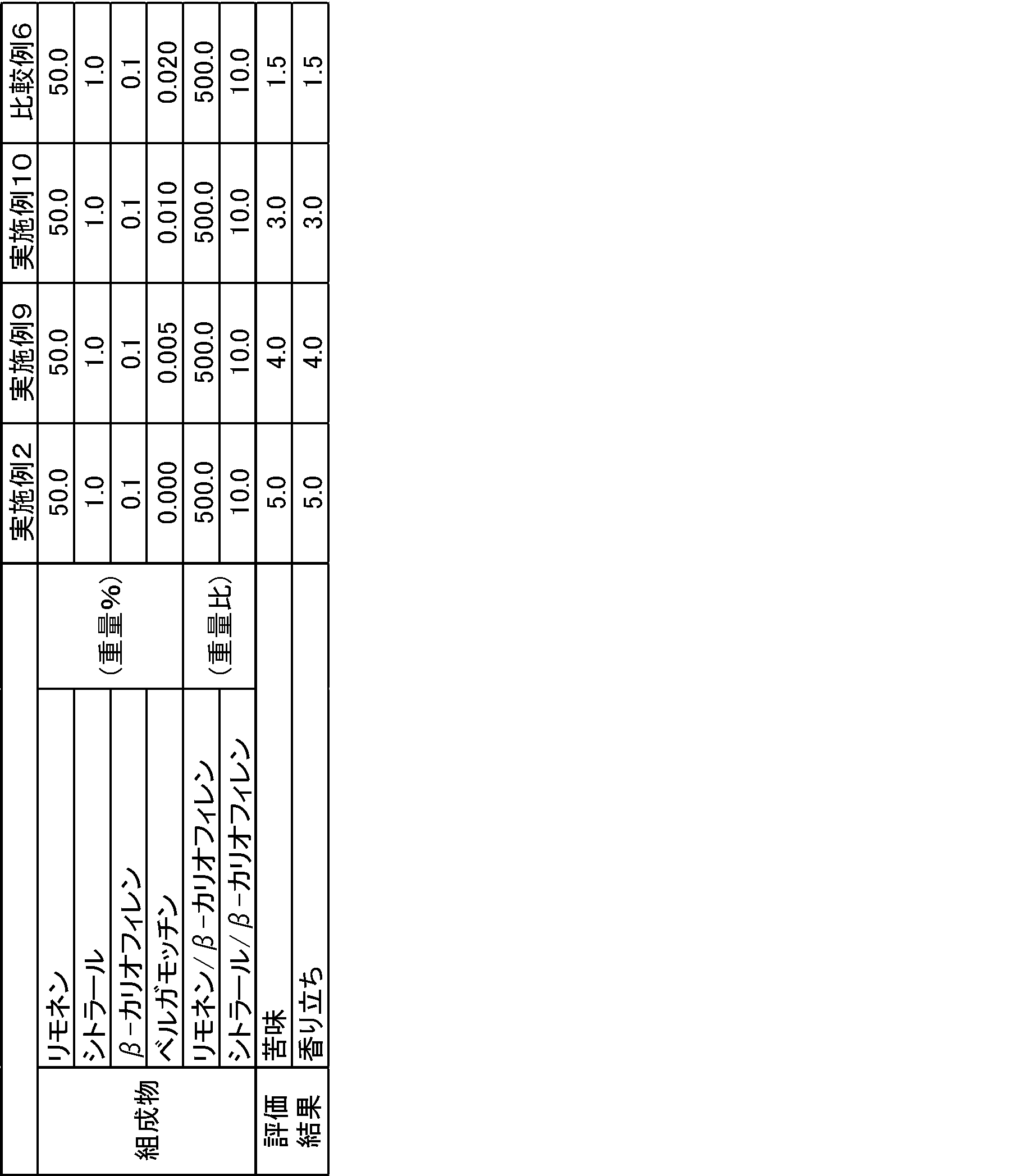
<使用試薬>
実施例11~17及び比較例7~10では、シトラール、β-カリオフィレンとして実施例1等と同一の試薬をそれぞれ使用した。
リモネンとしては、レモン由来のリモネン高含有市販香料(レモンのテルペンレスオイルを製造する際に蒸留物として得られる、リモネンを高含有する香料、リモネン含有量:47.6重量%)を使用した。なお、この市販香料には、シトラール、β-カリオフィレン、リナロール、シトロネラール、α-テルピネオール、ゲラニルアセテート、デカナール、ネロール、ゲラニオール及びベルガモッチンはいずれも含まれない。
「レモンらしい酸味香」、「香り立ち」及び「総合的なバランス」の3つについて、訓練された官能パネル4名で官能評価を行った。
ガラス製の官能評価グラスに5容量%エタノール水溶液20mLを入れ、このエタノール水溶液の上に、実施例11~17及び比較例7~10で得られた組成物を25μL添加し、実施例1の評価と同一の評価基準にて、「レモンらしい酸味香」、「香り立ち」及び「総合的なバランス」の3つをそれぞれ評価した。
評価結果(官能パネル4名の評点の平均値)を表5~7に示す。
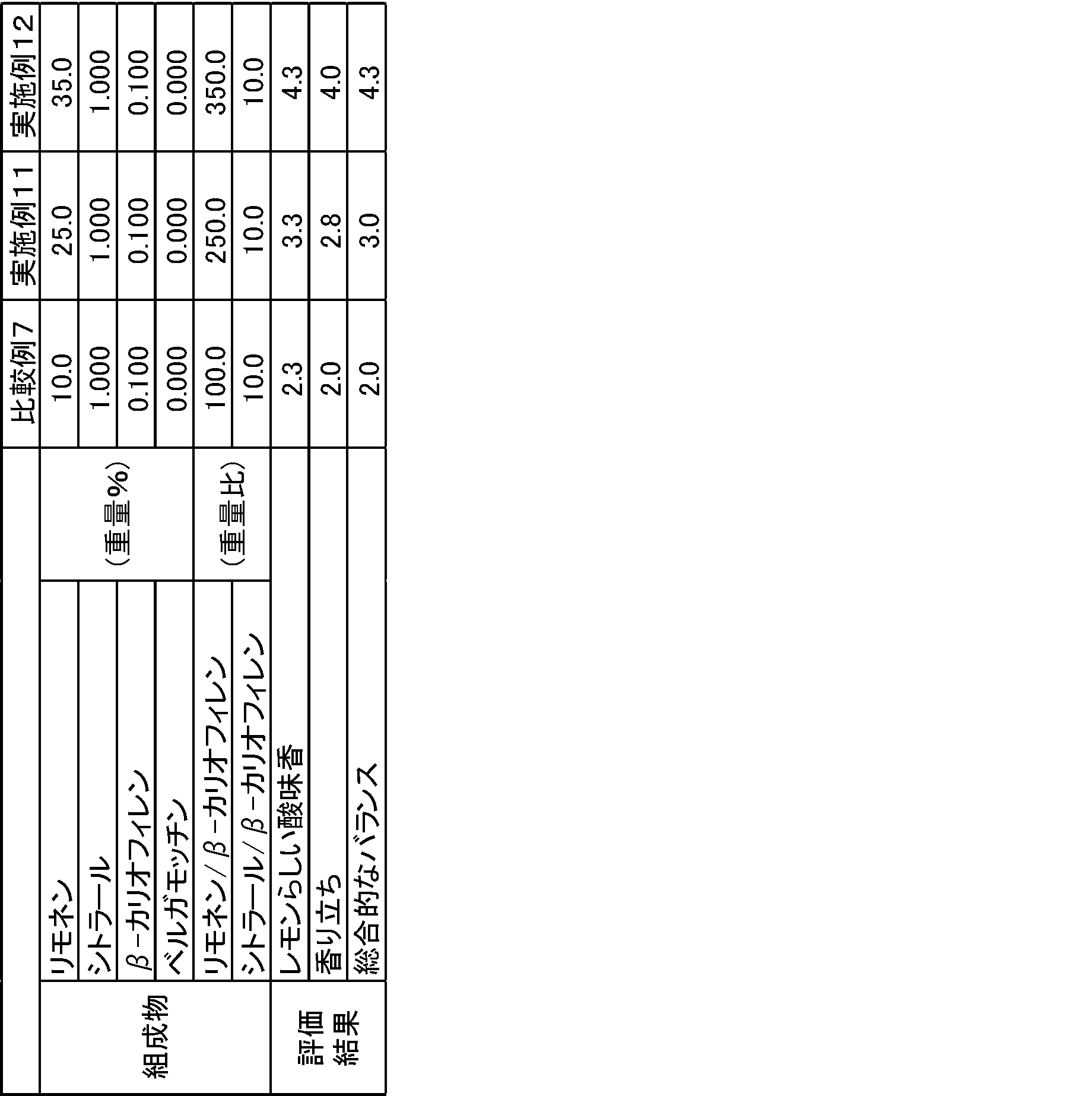
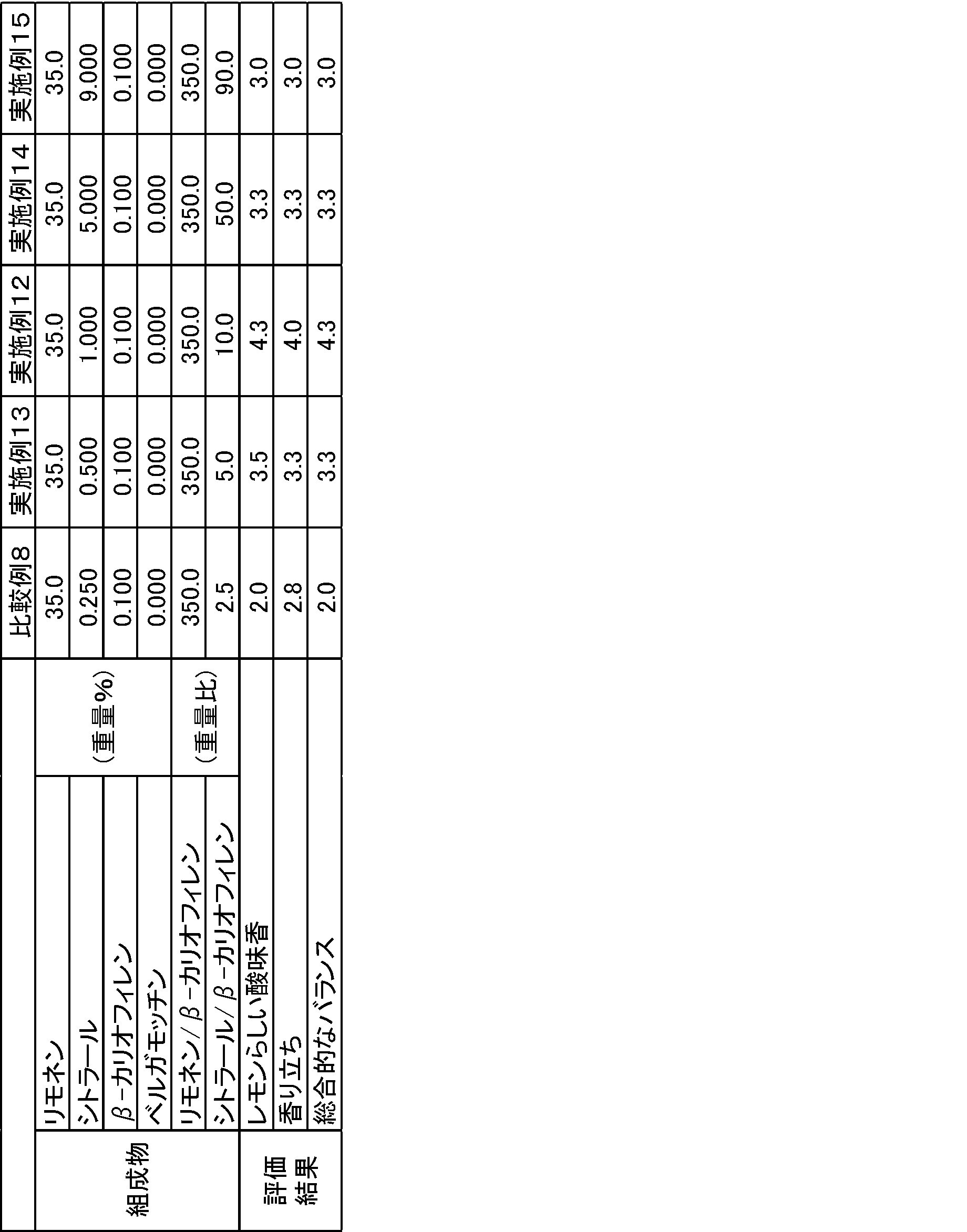

実施例12で得られた組成物を、希釈剤を用いて下記表8に示す希釈倍率(重量に基づく希釈倍率)で希釈し、原料酒を調製した。希釈剤は、原料酒に含まれるエタノールの含有量が下記表8に示す含有量(容量%)となるように、ニュートラルスピリッツ95(エタノール含有量:95容量%)及び水を用いて調製した。また、実施例21では、ベルガモッチンとして実施例9等と同一の試薬を使用し、この試薬を、ベルガモッチンの含有量が表8に示す含有量(重量%)となるように混合した。このようにして、実施例18~21及び比較例11の原料酒を得た。
「レモンらしい酸味香」、「香り立ち」及び「総合的なバランス」の3つについて、訓練された官能パネル4名で官能評価を行った。
ガラス製の官能評価グラスに実施例18~21及び比較例11の原料酒を25mL入れ、実施例1の評価と同一の評価基準にて、「レモンらしい酸味香」、「香り立ち」及び「総合的なバランス」の3つをそれぞれ評価した。
その後、実施例21で得られた原料酒の「苦味」について、訓練された官能パネル4名で官能評価を行った。官能パネルが原料酒の一部(10mL程度)を口に含み、実施例9の評価と同一の評価基準にて、「苦味」を評価した。
「レモンらしい酸味香」、「香り立ち」及び「総合的なバランス」の評価結果(官能パネル4名の評点の平均値)を表8に示す。実施例21で得られた原料酒についての「苦味」の評価結果(官能パネル4名の評点の平均値)は、3.5であった。

<使用試薬>
実施例22~45及び比較例12~19では、リモネン、シトラール、β-カリオフィレン、ベルガモッチンとして実施例9等と同一の試薬をそれぞれ使用した。また、リナロール、シトロネラール、α-テルピネオール、ゲラニルアセテート、デカナール、ネロール、ゲラニオールとして、下記の試薬を使用した。
リナロール、シトロネラール、α-テルピネオール、ゲラニルアセテート、デカナール、ネロール、ゲラニオール(いずれもSigma-Aldrich社製)
「香り立ち」及び「苦味」について、訓練された官能パネル4名で官能評価を行った。
ガラス製の官能評価グラスに5容量%エタノール水溶液20mLを入れ、このエタノール水溶液の上に、実施例22~45及び比較例12~19で得られた組成物を25μL添加し、「香り立ち」を評価した。「香り立ち」については、香り立ちが早いほど、香り立ちが良いと評価した。その後、官能パネルが官能評価グラス内の組成物の10mL程度を口に含んで「苦味」を評価した。
表9(実施例22~24及び比較例12)においては、基準点として、実施例22の組成物の評価を5点とし、5容量%エタノール水溶液の評価を1点として評価した。
表10(実施例25~27及び比較例13)においては、基準点として、実施例25の組成物の評価を5点とし、5容量%エタノール水溶液の評価を1点として評価した。
表11(実施例28~30及び比較例14)においては、基準点として、実施例28の組成物の評価を5点とし、5容量%エタノール水溶液の評価を1点として評価した。
表12(実施例31~33及び比較例15)においては、基準点として、実施例31の組成物の評価を5点とし、5容量%エタノール水溶液の評価を1点として評価した。
表13(実施例34~36及び比較例16)においては、基準点として、実施例34の組成物の評価を5点とし、5容量%エタノール水溶液の評価を1点として評価した。
表14(実施例37~39及び比較例17)においては、基準点として、実施例37の組成物の評価を5点とし、5容量%エタノール水溶液の評価を1点として評価した。
表15(実施例40~42及び比較例18)においては、基準点として、実施例40の組成物の評価を5点とし、5容量%エタノール水溶液の評価を1点として評価した。
表16(実施例43~45及び比較例19)においては、基準点として、実施例43の組成物の評価を5点とし、5容量%エタノール水溶液の評価を1点として評価した。
5点:「香り立ち」が非常に良い(表9~16において、それぞれ、実施例22、25、28、31、34、37、40、43の組成物相当)
4点:「香り立ち」が良い
3点:「香り立ち」がやや良い
2点:「香り立ち」が悪い
1点:「香り立ち」が非常に悪い(表9~16において、5容量%エタノール水溶液相当)
5点:苦味を感じない
4点:わずかに苦味を感じる
3点:苦味を感じる
2点:やや強い苦味を感じる
1点:強い苦味を感じる
評価結果(官能パネル4名の評点の平均値)を表9~16に示す。
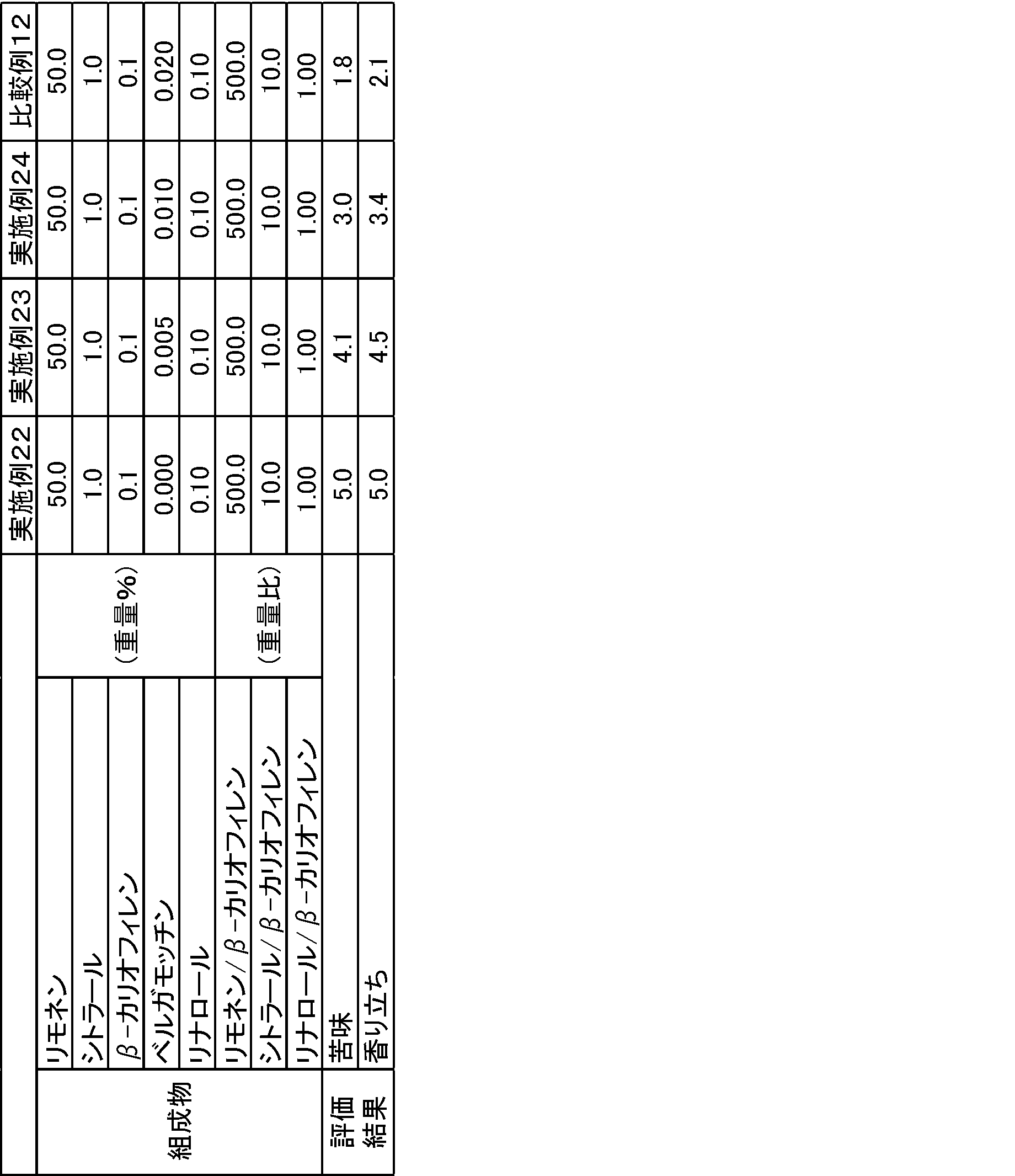
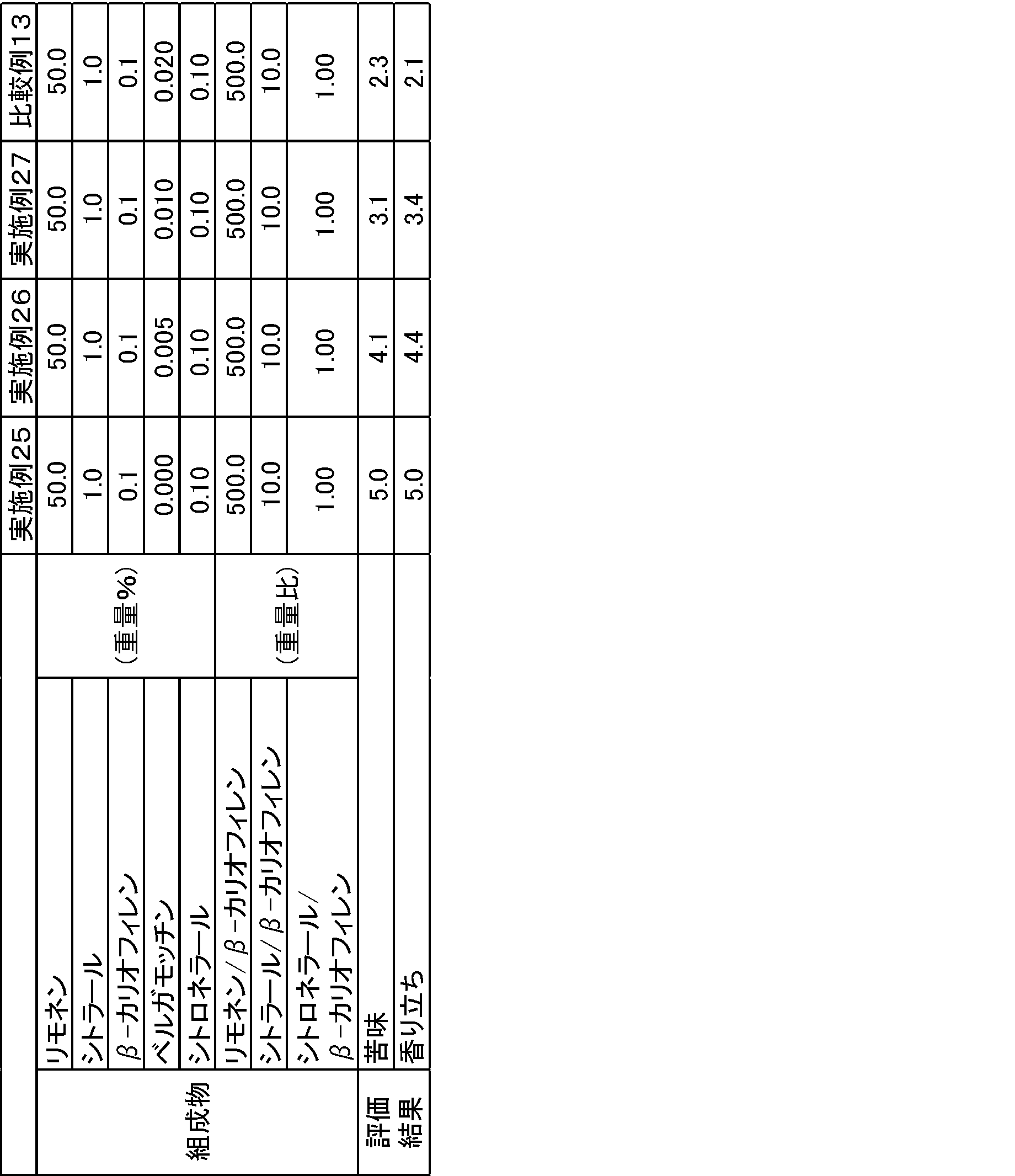
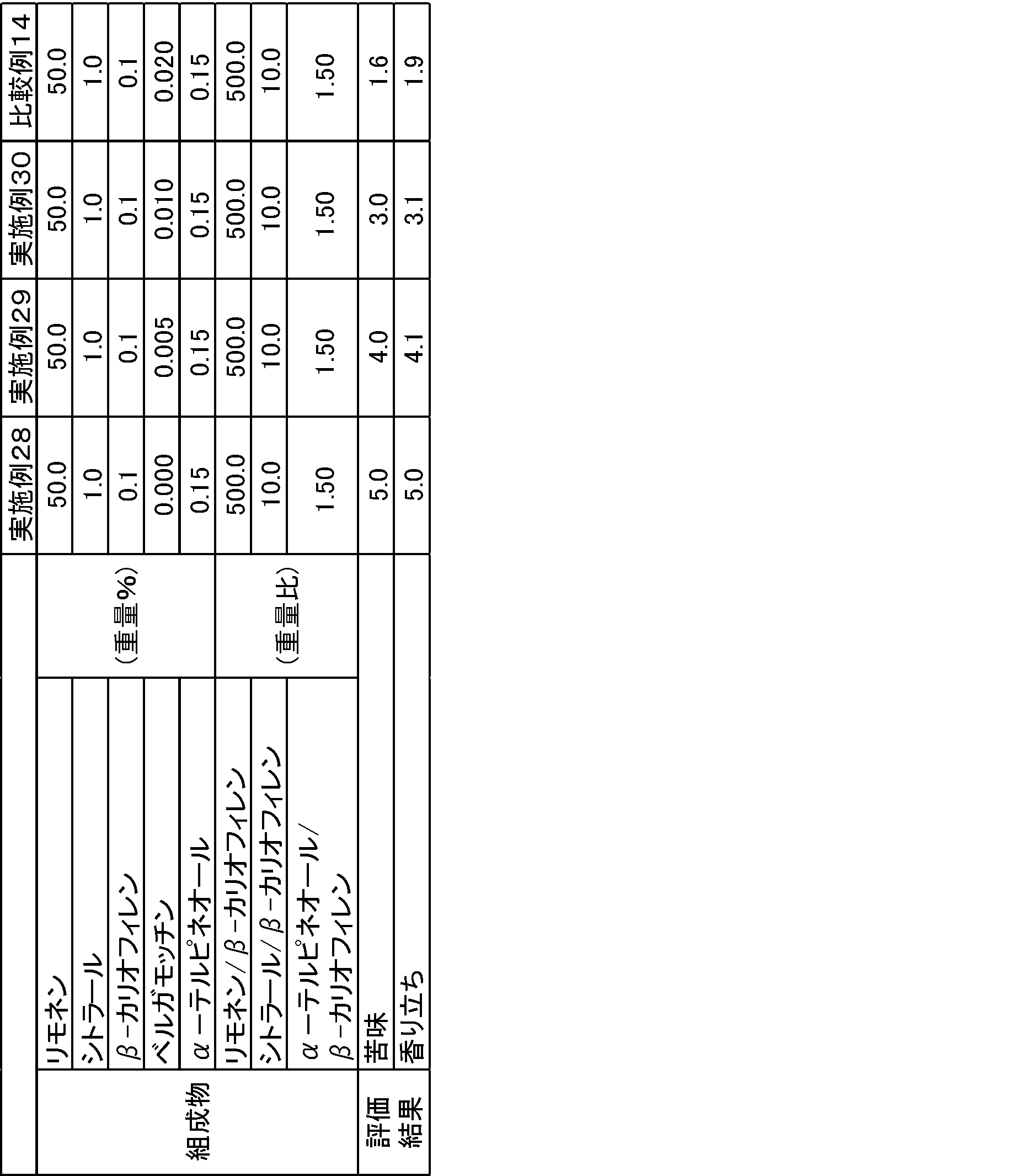

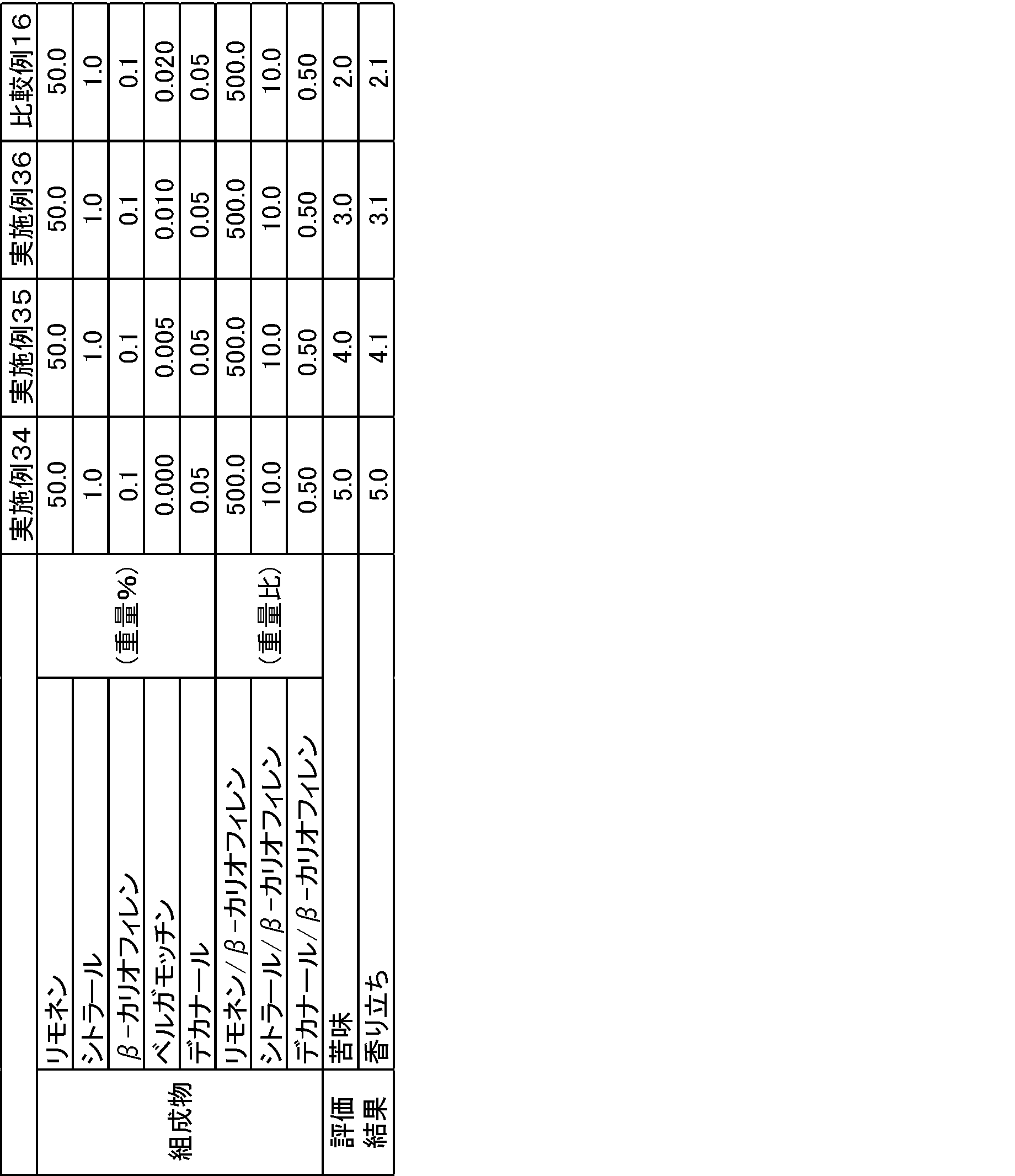
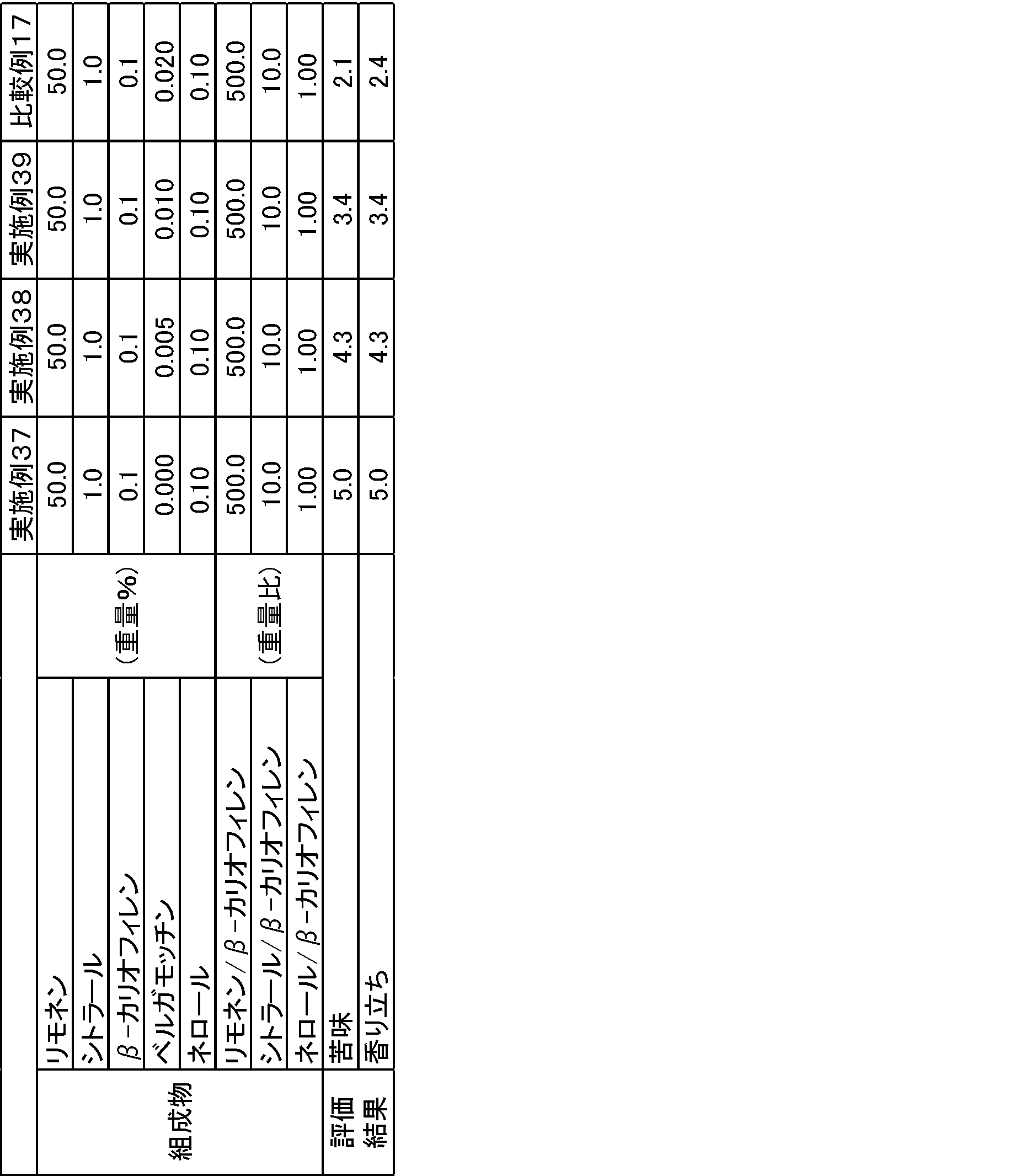
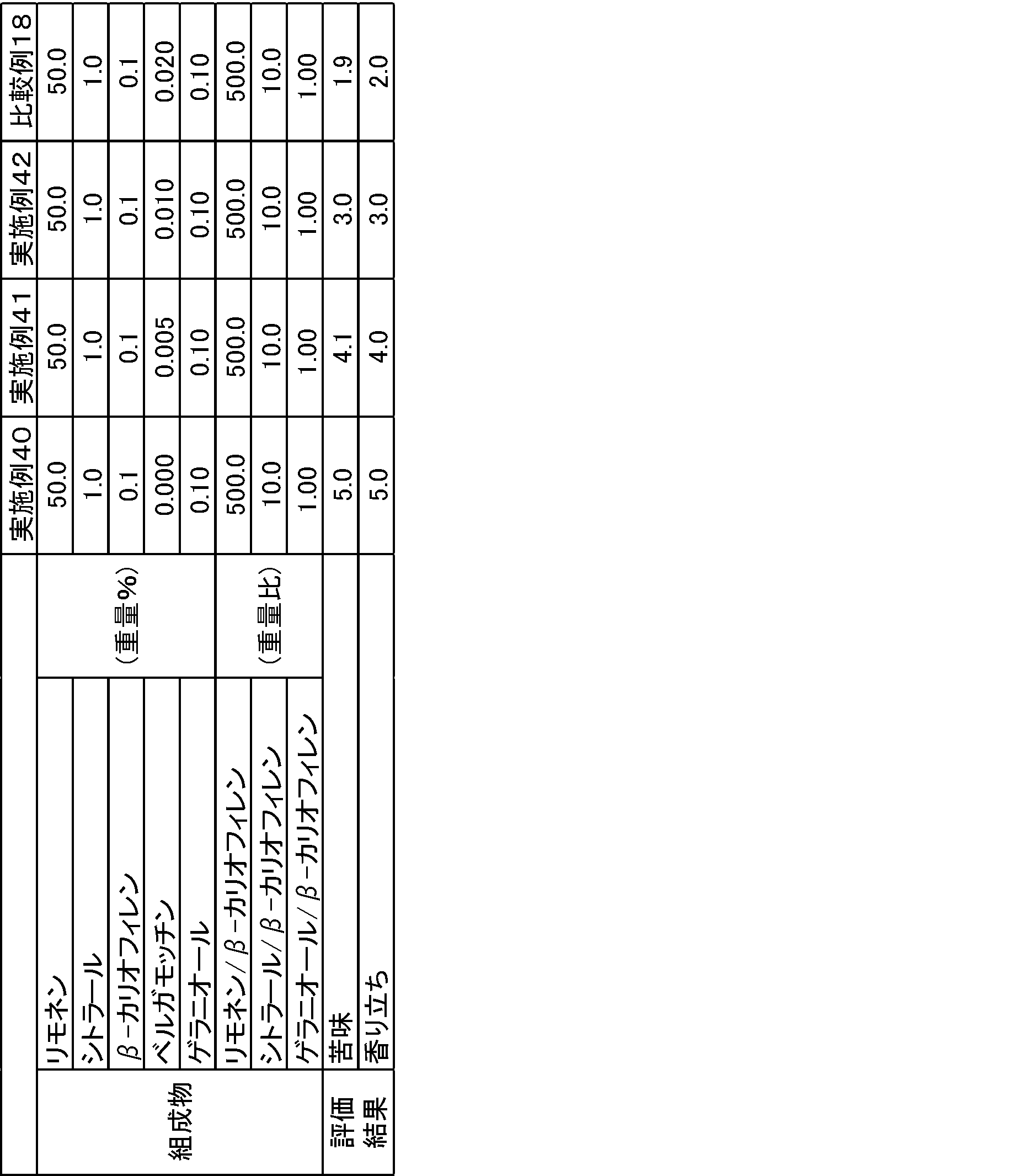
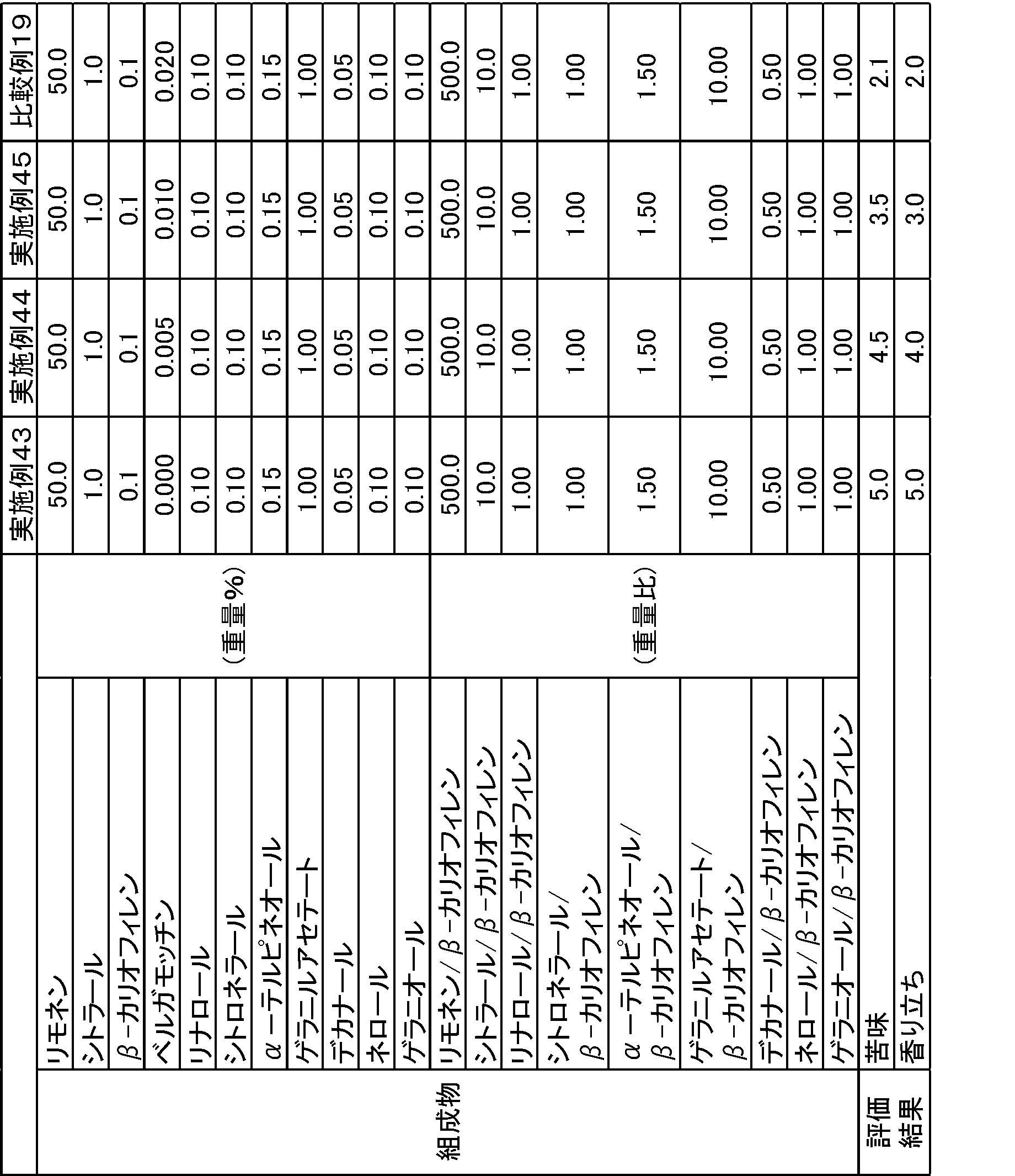
<使用試薬>
実施例46~52及び比較例20~22では、リモネン、シトラール、β-カリオフィレン、リナロール、シトロネラール、α-テルピネオール、ゲラニルアセテート、デカナール、ネロール、ゲラニオールとして実施例43等と同一の試薬をそれぞれ使用した。
「レモンらしい酸味香」、「香り立ち」、「総合的なバランス」、香りの「華やかさ」、「刺激感又は爽快感」、「骨格・ボディ感」、「華やかさ/骨格・ボディ感」、「力価・厚み」、「グリーン感」及び「花香による骨格・ボディ感」の合計10個の評価項目について、訓練された官能パネル4名で官能評価を行った。
ガラス製の官能評価グラスに5容量%エタノール水溶液20mLを入れ、このエタノール水溶液の上に、実施例46~52及び比較例20~22で得られた組成物を25μL添加し、上述した合計10個の評価項目をそれぞれ評価した。
いずれの評価項目についても、基準点として、実施例43の組成物の評価を10点とし、実施例2の組成物の評価を5点とし、5容量%エタノール水溶液の評価を1点として、以下の基準にて、0.1点刻みで評価を行った。「香り立ち」については、香り立ちが早いほど、香り立ちが良いと評価した。下記の「レモンらしい酸味香」、香りの「華やかさ」、「刺激感又は爽快感」、「骨格・ボディ感」、「華やかさ/骨格・ボディ感」、「力価・厚み」、「グリーン感」及び「花香による骨格・ボディ感」の各評価基準の6~10点において、「増強される」とは、「レモンらしい酸味香」等の評価対象の香りが、実施例2の組成物と比べて増強される(実施例2の組成物の評価(5点)を上回る)ことを意味する。また、下記の「総合的なバランス」及び「香り立ち」の評価基準の6~10点において、「向上する」とは、「総合的なバランス」又は「香り立ち」が、実施例2の組成物と比べて向上する(実施例2の組成物の評価(5点)を上回る)ことを意味する。
10点:「レモンらしい酸味香」がきわめて強く増強される(実施例43の組成物相当)
9点:「レモンらしい酸味香」が強く増強される
8点:「レモンらしい酸味香」が増強される
7点:「レモンらしい酸味香」がわずかに増強される
6点:「レモンらしい酸味香」がごくわずかに増強される
5点:「レモンらしい酸味香」を非常に強く感じる(実施例2の組成物相当)
4点:「レモンらしい酸味香」を強く感じる
3点:「レモンらしい酸味香」を感じる
2点:「レモンらしい酸味香」をわずかに感じる
1点:「レモンらしい酸味香」を感じない(5容量%エタノール水溶液相当)
10点:「香り立ち」がきわめて強く向上する(実施例43の組成物相当)
9点:「香り立ち」が強く向上する
8点:「香り立ち」が向上する
7点:「香り立ち」がわずかに向上する
6点:「香り立ち」がごくわずかに向上する
5点:「香り立ち」が非常に良い(実施例2の組成物相当)
4点:「香り立ち」が良い
3点:「香り立ち」がやや良い
2点:「香り立ち」が悪い
1点:「香り立ち」が非常に悪い(5容量%エタノール水溶液相当)
10点:「総合的なバランス」がきわめて強く向上する(実施例43の組成物相当)
9点:「総合的なバランス」が強く向上する
8点:「総合的なバランス」が向上する
7点:「総合的なバランス」がわずかに向上する
6点:「総合的なバランス」がごくわずかに向上する
5点:「総合的なバランス」が非常に良い(実施例2の組成物相当)
4点:「総合的なバランス」が良い
3点:「総合的なバランス」がやや良い
2点:「総合的なバランス」が悪い
1点:「総合的なバランス」が非常に悪い(5容量%エタノール水溶液相当)
10点:香りの「華やかさ」がきわめて強く増強される(実施例43の組成物相当)
9点:香りの「華やかさ」が強く増強される
8点:香りの「華やかさ」が増強される
7点:香りの「華やかさ」がわずかに増強される
6点:香りの「華やかさ」がごくわずかに増強される
5点:香りの「華やかさ」を非常に強く感じる(実施例2の組成物相当)
4点:香りの「華やかさ」を強く感じる
3点:香りの「華やかさ」を感じる
2点:香りの「華やかさ」をわずかに感じる
1点:香りの「華やかさ」を感じない(5容量%エタノール水溶液相当)
10点:香りの「刺激感又は爽快感」がきわめて強く増強される(実施例43の組成物相当)
9点:香りの「刺激感又は爽快感」が強く増強される
8点:香りの「刺激感又は爽快感」が増強される
7点:香りの「刺激感又は爽快感」がわずかに増強される
6点:香りの「刺激感又は爽快感」がごくわずかに増強される
5点:香りの「刺激感又は爽快感」を非常に強く感じる(実施例2の組成物相当)
4点:香りの「刺激感又は爽快感」を強く感じる
3点:香りの「刺激感又は爽快感」を感じる
2点:香りの「刺激感又は爽快感」をわずかに感じる
1点:香りの「刺激感又は爽快感」を感じない(5容量%エタノール水溶液相当)
10点:香りの「骨格・ボディ感」がきわめて強く増強される(実施例43の組成物相当)
9点:香りの「骨格・ボディ感」が強く増強される
8点:香りの「骨格・ボディ感」が増強される
7点:香りの「骨格・ボディ感」がわずかに増強される
6点:香りの「骨格・ボディ感」がごくわずかに増強される
5点:香りの「骨格・ボディ感」を非常に強く感じる(実施例2の組成物相当)
4点:香りの「骨格・ボディ感」を強く感じる
3点:香りの「骨格・ボディ感」を感じる
2点:香りの「骨格・ボディ感」をわずかに感じる
1点:香りの「骨格・ボディ感」を感じない(5容量%エタノール水溶液相当)
10点:香りの「華やかさ/骨格・ボディ感」がきわめて強く増強される(実施例43の組成物相当)
9点:香りの「華やかさ/骨格・ボディ感」が強く増強される
8点:香りの「華やかさ/骨格・ボディ感」が増強される
7点:香りの「華やかさ/骨格・ボディ感」がわずかに増強される
6点:香りの「華やかさ/骨格・ボディ感」がごくわずかに増強される
5点:香りの「華やかさ/骨格・ボディ感」を非常に強く感じる(実施例2の組成物相当)
4点:香りの「華やかさ/骨格・ボディ感」を強く感じる
3点:香りの「華やかさ/骨格・ボディ感」を感じる
2点:香りの「華やかさ/骨格・ボディ感」をわずかに感じる
1点:香りの「華やかさ/骨格・ボディ感」を感じない(5容量%エタノール水溶液相当)
10点:香りの「力価・厚み」がきわめて強く増強される(実施例43の組成物相当)
9点:香りの「力価・厚み」が強く増強される
8点:香りの「力価・厚み」が増強される
7点:香りの「力価・厚み」がわずかに増強される
6点:香りの「力価・厚み」がごくわずかに増強される
5点:香りの「力価・厚み」を非常に強く感じる(実施例2の組成物相当)
4点:香りの「力価・厚み」を強く感じる
3点:香りの「力価・厚み」を感じる
2点:香りの「力価・厚み」をわずかに感じる
1点:香りの「力価・厚み」を感じない(5容量%エタノール水溶液相当)
10点:香りの「グリーン感」がきわめて強く増強される(実施例43の組成物相当)
9点:香りの「グリーン感」が強く増強される
8点:香りの「グリーン感」が増強される
7点:香りの「グリーン感」がわずかに増強される
6点:香りの「グリーン感」がごくわずかに増強される
5点:香りの「グリーン感」を非常に強く感じる(実施例2の組成物相当)
4点:香りの「グリーン感」を強く感じる
3点:香りの「グリーン感」を感じる
2点:香りの「グリーン感」をわずかに感じる
1点:香りの「グリーン感」を感じない(5容量%エタノール水溶液相当)
10点:香りの「花香による骨格・ボディ感」がきわめて強く増強される(実施例43の組成物相当)
9点:香りの「花香による骨格・ボディ感」が強く増強される
8点:香りの「花香による骨格・ボディ感」が増強される
7点:香りの「花香による骨格・ボディ感」がわずかに増強される
6点:香りの「花香による骨格・ボディ感」がごくわずかに増強される
5点:香りの「花香による骨格・ボディ感」を非常に強く感じる(実施例2の組成物相当)
4点:香りの「花香による骨格・ボディ感」を強く感じる
3点:香りの「花香による骨格・ボディ感」を感じる
2点:香りの「花香による骨格・ボディ感」をわずかに感じる
1点:香りの「花香による骨格・ボディ感」を感じない(5容量%エタノール水溶液相当)
評価結果(官能パネル4名の評点の平均値)を表17~19に示す。なお、表17~19には実施例43で得られた組成物を、また、表17には実施例2で得られた組成物を、それぞれ合わせて示す。
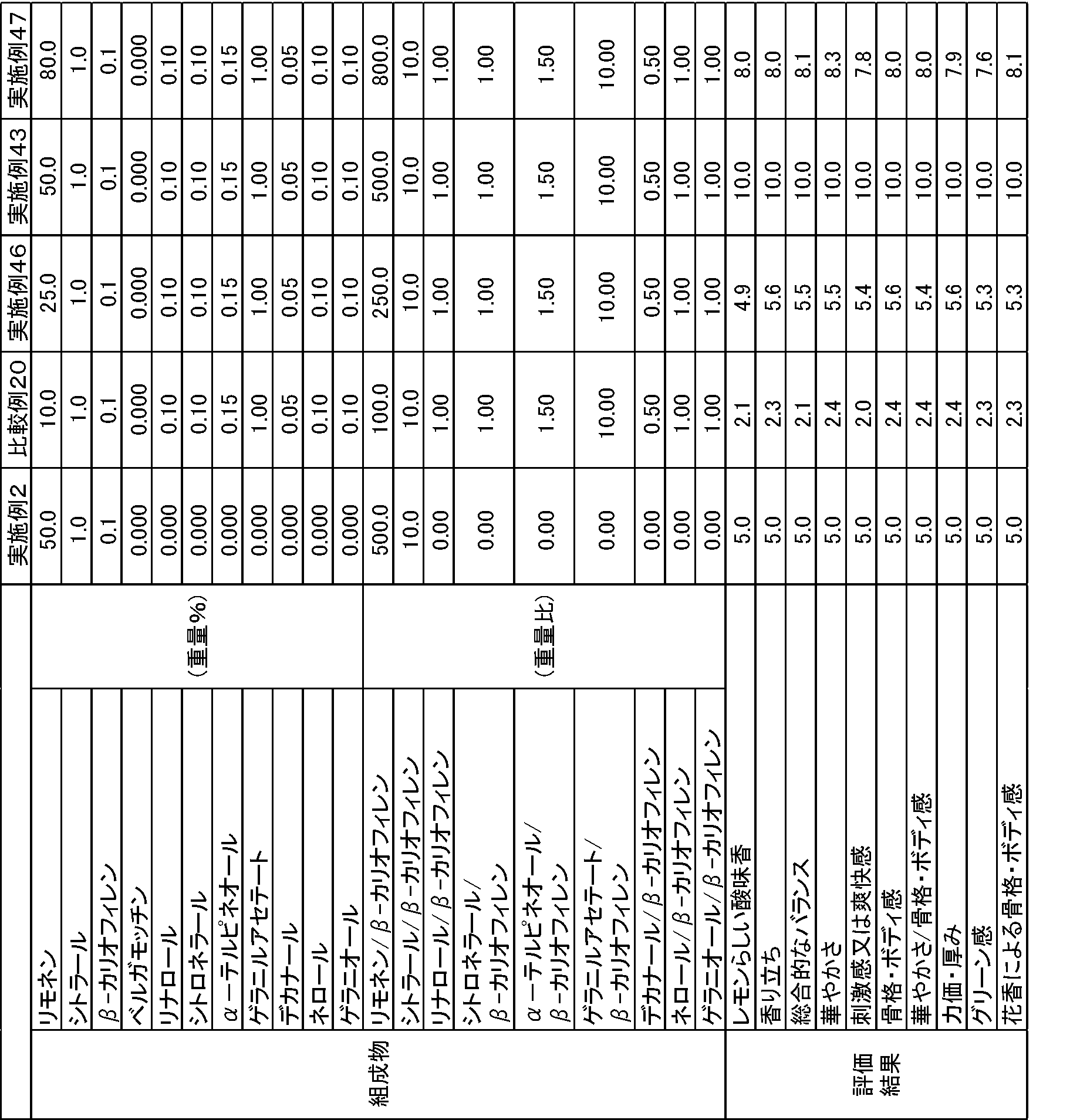
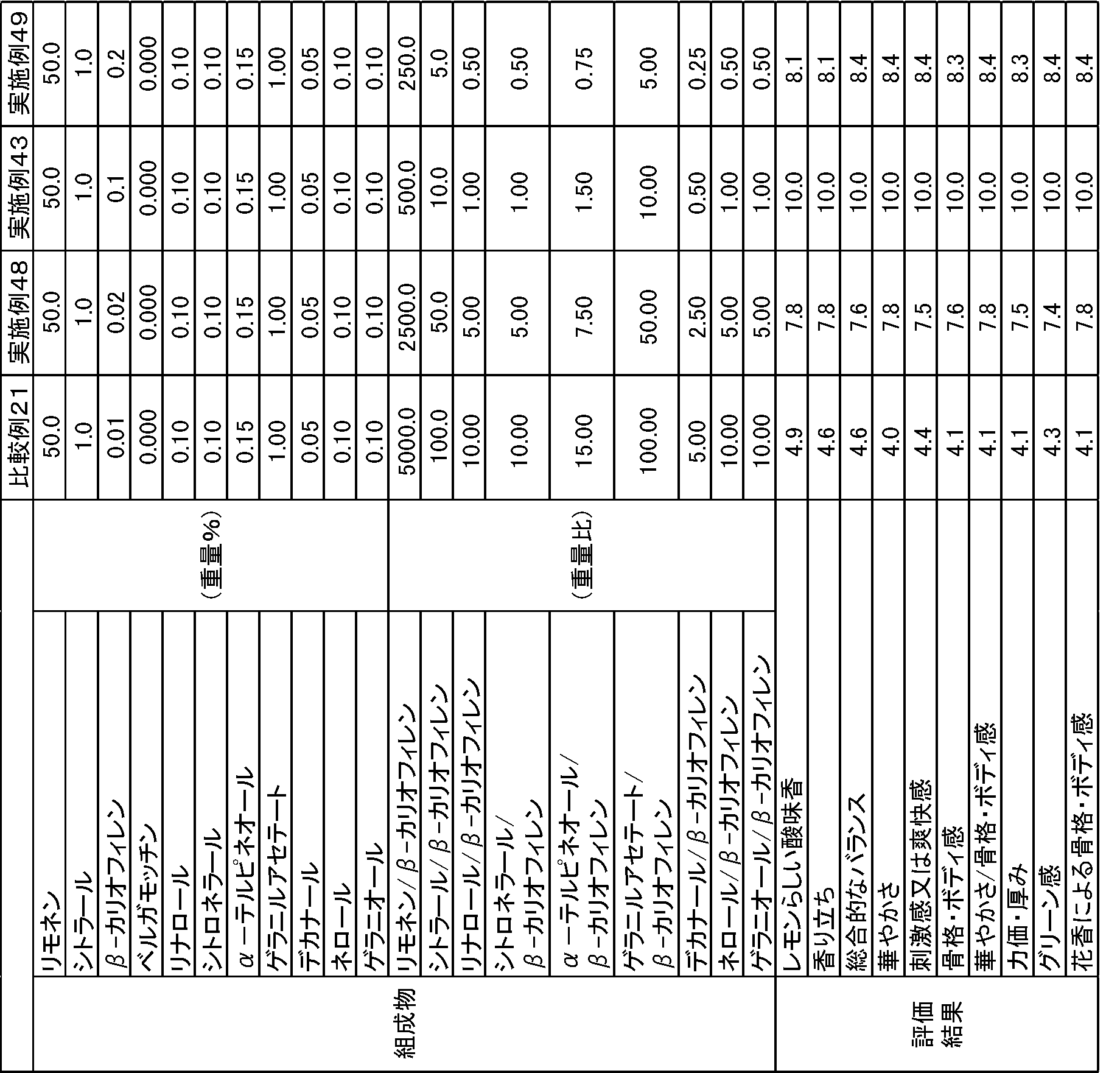
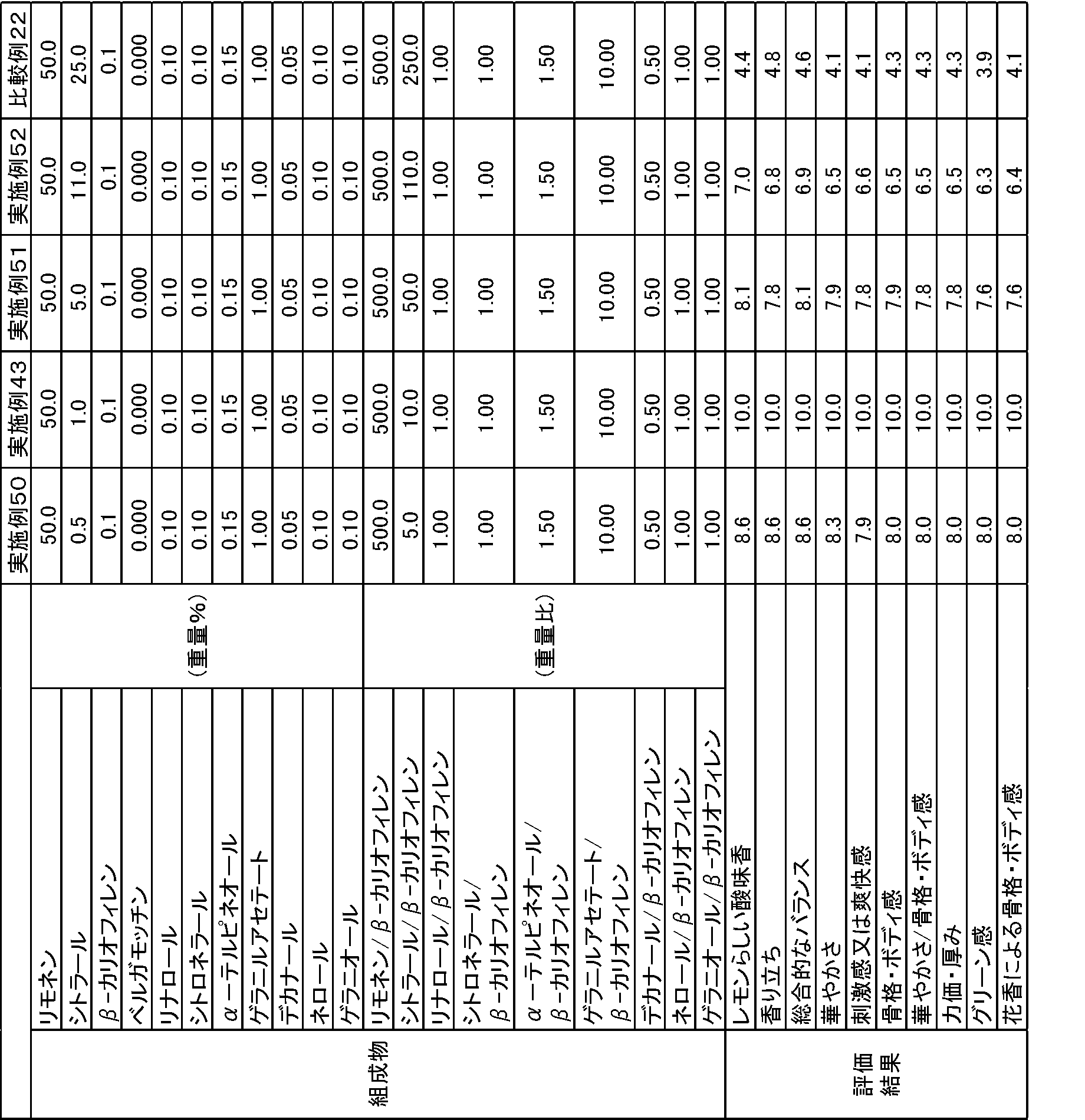
<使用試薬>
実施例53~57及び比較例23では、シトラール、β-カリオフィレン、リナロール、シトロネラール、α-テルピネオール、ゲラニルアセテート、デカナール、ネロール、ゲラニオールとして、実施例43等と同一の試薬をそれぞれ使用した。リモネンとしては、実施例11等と同一のリモネン高含有市販香料を使用した。
実施例53で得られた組成物を、希釈剤を用いて下記表20に示す希釈倍率(重量に基づく希釈倍率)で希釈し、原料酒を調製した。希釈剤は、原料酒に含まれるエタノールの含有量が下記表20に示す含有量(容量%)となるように、ニュートラルスピリッツ95(エタノール含有量:95容量%)及び水を用いて調製した。また、実施例57では、ベルガモッチンとして実施例9等と同一の試薬を使用し、この試薬を、ベルガモッチンの含有量が表20に示す含有量(重量%)となるように混合した。このようにして、実施例54~57及び比較例23の原料酒を得た。
「レモンらしい酸味香」、「香り立ち」及び「総合的なバランス」の3つについて、訓練された官能パネル4名で官能評価を行った。
ガラス製の官能評価グラスに5容量%エタノール水溶液20mLを入れ、このエタノール水溶液の上に、実施例53で得られた組成物を25μL添加し、香りを評価した。組成物の香りの評価では、香りの評価軸として「レモンらしい酸味香」、「香り立ち」及び「総合的なバランス」の3つを、実施例46の評価等と同一の評価基準にて、それぞれ評価した。
また、原料酒の評価においては、ガラス製の官能評価グラスに実施例54~57及び比較例23で得られた原料酒を25mL入れ、香りを評価した。原料酒の香りの評価では、香りの評価軸として「レモンらしい酸味香」、「香り立ち」及び「総合的なバランス」の3つについて、基準点として、実施例55の原料酒の評価を10点とし、実施例2の組成物の評価を5点とし、5容量%エタノール水溶液の評価を1点として、以下の基準にて、0.1点刻みで評価を行った。「香り立ち」については、香り立ちが早いほど、香り立ちが良いと評価した。下記の「レモンらしい酸味香」の評価基準及び「香り立ち」の評価基準の6~10点において、「増強される」とは、「レモンらしい酸味香」又は「香り立ち」が、実施例2の組成物の評価(5点)を上回ることを意味する。また、下記の「総合的なバランス」の評価基準の6~10点において、「向上する」とは、「総合的なバランス」が、実施例2の組成物の評価(5点)を上回ることを意味する。
10点:「レモンらしい酸味香」がきわめて強く増強される(実施例55の原料酒相当)
9点:「レモンらしい酸味香」が強く増強される
8点:「レモンらしい酸味香」が増強される
7点:「レモンらしい酸味香」がわずかに増強される
6点:「レモンらしい酸味香」がごくわずかに増強される
5点:「レモンらしい酸味香」を非常に強く感じる(実施例2の組成物相当)
4点:「レモンらしい酸味香」を強く感じる
3点:「レモンらしい酸味香」を感じる
2点:「レモンらしい酸味香」をわずかに感じる
1点:「レモンらしい酸味香」を感じない(5容量%エタノール水溶液相当)
10点:「香り立ち」がきわめて強く向上する(実施例55の原料酒相当)
9点:「香り立ち」が強く向上する
8点:「香り立ち」が向上する
7点:「香り立ち」がわずかに向上する
6点:「香り立ち」がごくわずかに向上する
5点:「香り立ち」が非常に良い(実施例2の組成物相当)
4点:「香り立ち」が良い
3点:「香り立ち」がやや良い
2点:「香り立ち」が悪い
1点:「香り立ち」が非常に悪い(5容量%エタノール水溶液相当)
10点:「総合的なバランス」がきわめて強く向上する(実施例55の原料酒相当)
9点:「総合的なバランス」が強く向上する
8点:「総合的なバランス」が向上する
7点:「総合的なバランス」がわずかに向上する
6点:「総合的なバランス」がごくわずかに向上する
5点:「総合的なバランス」が非常に良い(実施例2の組成物相当)
4点:「総合的なバランス」が良い
3点:「総合的なバランス」がやや良い
2点:「総合的なバランス」が悪い
1点:「総合的なバランス」が非常に悪い(5容量%エタノール水溶液相当)
「レモンらしい酸味香」、「香り立ち」及び「総合的なバランス」の評価結果(官能パネル4名の評点の平均値)を表20に示す。実施例55及び57で得られた原料酒についての「苦味」の評価結果(官能パネル4名の評点の平均値)は、実施例55が5.0、実施例57が2.9であった。
なお、表20には、実施例43で得られた組成物も合わせて示す。

原料用アルコール1000Lに、生レモンピール350kgと水800Lを混合して常温で一晩浸漬し、その後、浸漬液を常圧蒸溜して得た溜液を原料酒とする。その原料酒に実施例2の香料を1.0重量%添加した。
Claims (17)
- リモネンと、シトラールと、β-カリオフィレンとを含有し、
β-カリオフィレンに対するリモネンの重量比(リモネン/β-カリオフィレン)が250~2500であり、
β-カリオフィレンに対するシトラールの重量比(シトラール/β-カリオフィレン)が5~110であり、
リモネンの含有量が2.5~90重量%であり、
ベルガモッチンの含有量が0.01重量%以下である、組成物。 - β-カリオフィレンの含有量が0.01~0.2重量%である、請求項1に記載の組成物。
- さらに、リナロール、シトロネラール、α-テルピネオール、ゲラニルアセテート、デカナール、ネロール及びゲラニオールからなる群より選択される少なくとも1種を含有する、請求項1又は2に記載の組成物。
- 原料の一部又は全部にレモンを使用して得られる、請求項1又は2に記載の組成物。
- 香料である、請求項1又は2に記載の組成物。
- 飲料に添加して使用される、請求項1又は2に記載の組成物。
- 請求項1又は2に記載の組成物と、飲料とを有する、容器詰め飲料。
- リモネンと、シトラールと、β-カリオフィレンと、エタノールとを含有し、
β-カリオフィレンに対するリモネンの重量比(リモネン/β-カリオフィレン)が250~2500であり、
β-カリオフィレンに対するシトラールの重量比(シトラール/β-カリオフィレン)が5~110であり、
リモネンの含有量が0.05~2.5重量%であり、
エタノールの含有量が10容量%以上である、原料酒。 - ベルガモッチンの含有量が0.00005重量%以下である、請求項8に記載の原料酒。
- β-カリオフィレンの含有量が0.0001~0.01重量%である、請求項8又は9に記載の原料酒。
- さらに、リナロール、シトロネラール、α-テルピネオール、ゲラニルアセテート、デカナール、ネロール及びゲラニオールからなる群より選択される少なくとも1種を含有する、請求項8又は9に記載の原料酒。
- 請求項8又は9に記載の原料酒を配合する、アルコール飲料の製造方法。
- リモネンと、シトラールと、β-カリオフィレンとを含有し、
β-カリオフィレンに対するリモネンの重量比(リモネン/β-カリオフィレン)が250~2500であり、
β-カリオフィレンに対するシトラールの重量比(シトラール/β-カリオフィレン)が5~110であり、
リモネンの含有量が0.01~2.5重量%である、飲料。 - さらに、リナロール、シトロネラール、α-テルピネオール、ゲラニルアセテート、デカナール、ネロール及びゲラニオールからなる群より選択される少なくとも1種を含有する、請求項13に記載の飲料。
- アルコール飲料である、請求項13又は14に記載の飲料。
- ノンアルコール飲料である、請求項13又は14に記載の飲料。
- 容器詰め飲料である、請求項13又は14に記載の飲料。
Priority Applications (4)
| Application Number | Priority Date | Filing Date | Title |
|---|---|---|---|
| CN202480040914.2A CN121335638A (zh) | 2023-06-30 | 2024-06-28 | 组合物、原料酒及饮料 |
| EP24832118.4A EP4736668A1 (en) | 2023-06-30 | 2024-06-28 | Composition, raw material liquor, and beverage |
| JP2025530241A JPWO2025005261A1 (ja) | 2023-06-30 | 2024-06-28 | |
| AU2024309130A AU2024309130A1 (en) | 2023-06-30 | 2024-06-28 | Composition, raw material liquor, and beverage |
Applications Claiming Priority (2)
| Application Number | Priority Date | Filing Date | Title |
|---|---|---|---|
| JP2023108714 | 2023-06-30 | ||
| JP2023-108714 | 2023-06-30 |
Publications (1)
| Publication Number | Publication Date |
|---|---|
| WO2025005261A1 true WO2025005261A1 (ja) | 2025-01-02 |
Family
ID=93939140
Family Applications (1)
| Application Number | Title | Priority Date | Filing Date |
|---|---|---|---|
| PCT/JP2024/023567 Ceased WO2025005261A1 (ja) | 2023-06-30 | 2024-06-28 | 組成物、原料酒及び飲料 |
Country Status (6)
| Country | Link |
|---|---|
| EP (1) | EP4736668A1 (ja) |
| JP (1) | JPWO2025005261A1 (ja) |
| CN (1) | CN121335638A (ja) |
| AU (1) | AU2024309130A1 (ja) |
| TW (1) | TW202512935A (ja) |
| WO (1) | WO2025005261A1 (ja) |
Cited By (1)
| Publication number | Priority date | Publication date | Assignee | Title |
|---|---|---|---|---|
| WO2026004876A1 (ja) * | 2024-06-28 | 2026-01-02 | サントリーホールディングス株式会社 | 組成物、原料酒及び飲料 |
Citations (5)
| Publication number | Priority date | Publication date | Assignee | Title |
|---|---|---|---|---|
| JPH06108088A (ja) | 1992-09-30 | 1994-04-19 | Ogawa Koryo Kk | テルペンレスオイルの製造法 |
| JP2007116930A (ja) | 2005-10-26 | 2007-05-17 | T Hasegawa Co Ltd | 耐アルコール性透明乳化組成物及びその製造方法 |
| US20170367386A1 (en) * | 2016-06-24 | 2017-12-28 | Allied Concessions Group, Inc. | Terpene flavoring compositions |
| JP2018123288A (ja) * | 2017-02-03 | 2018-08-09 | 長谷川香料株式会社 | テルペン系炭化水素香料化合物高含有の水中油型乳化香料組成物 |
| JP2021023146A (ja) * | 2019-07-31 | 2021-02-22 | アサヒビール株式会社 | 果実香の成分を含有しているアルコール飲料 |
-
2024
- 2024-06-28 TW TW113124388A patent/TW202512935A/zh unknown
- 2024-06-28 CN CN202480040914.2A patent/CN121335638A/zh active Pending
- 2024-06-28 EP EP24832118.4A patent/EP4736668A1/en active Pending
- 2024-06-28 WO PCT/JP2024/023567 patent/WO2025005261A1/ja not_active Ceased
- 2024-06-28 JP JP2025530241A patent/JPWO2025005261A1/ja active Pending
- 2024-06-28 AU AU2024309130A patent/AU2024309130A1/en active Pending
Patent Citations (5)
| Publication number | Priority date | Publication date | Assignee | Title |
|---|---|---|---|---|
| JPH06108088A (ja) | 1992-09-30 | 1994-04-19 | Ogawa Koryo Kk | テルペンレスオイルの製造法 |
| JP2007116930A (ja) | 2005-10-26 | 2007-05-17 | T Hasegawa Co Ltd | 耐アルコール性透明乳化組成物及びその製造方法 |
| US20170367386A1 (en) * | 2016-06-24 | 2017-12-28 | Allied Concessions Group, Inc. | Terpene flavoring compositions |
| JP2018123288A (ja) * | 2017-02-03 | 2018-08-09 | 長谷川香料株式会社 | テルペン系炭化水素香料化合物高含有の水中油型乳化香料組成物 |
| JP2021023146A (ja) * | 2019-07-31 | 2021-02-22 | アサヒビール株式会社 | 果実香の成分を含有しているアルコール飲料 |
Non-Patent Citations (3)
| Title |
|---|
| MARIE-LAURE LOTA, DOMINIQUE DE ROCCA SERRA, FÉLIX TOMI, CAMILLE JACQUEMOND, JOSEPH CASANOVA: "Volatile Components of Peel and Leaf Oils of Lemon and Lime Species", JOURNAL OF AGRICULTURAL AND FOOD CHEMISTRY, vol. 50, no. 4, 1 February 2002 (2002-02-01), US , pages 796 - 805, XP055395771, ISSN: 0021-8561, DOI: 10.1021/jf010924l |
| OBOH GANIYU, OLASEHINDE TOSIN A., ADEMOSUN AYOKUNLE O.: "Essential Oil from Lemon Peels Inhibit Key Enzymes Linked to Neurodegenerative Conditions and Pro-oxidant Induced Lipid Peroxidation", JOURNAL OF OLEO SCIENCE, JAPAN OIL CHEMISTS SOCIETY, TOKYO, JP, vol. 63, no. 4, 1 January 2014 (2014-01-01), JP , pages 373 - 381, XP093254384, ISSN: 1345-8957, DOI: 10.5650/jos.ess13166 * |
| 中村 仁 ほか, 柑橘類精油を用いた機能性アロマオイル効果検証に関する研究, 愛媛県産業技術研究所研究報告, no. 51, 2013, pp. 1-6, (NAKAMURA, Hitoshi et al. Effects Verification of Functional Aroma Oil Using Citrus Fruits Essential Oil. Bulletin of Ehime Institute of Industrial Technology.) table 2 * |
Cited By (1)
| Publication number | Priority date | Publication date | Assignee | Title |
|---|---|---|---|---|
| WO2026004876A1 (ja) * | 2024-06-28 | 2026-01-02 | サントリーホールディングス株式会社 | 組成物、原料酒及び飲料 |
Also Published As
| Publication number | Publication date |
|---|---|
| AU2024309130A1 (en) | 2026-01-15 |
| CN121335638A (zh) | 2026-01-13 |
| JPWO2025005261A1 (ja) | 2025-01-02 |
| TW202512935A (zh) | 2025-04-01 |
| EP4736668A1 (en) | 2026-05-06 |
Similar Documents
| Publication | Publication Date | Title |
|---|---|---|
| JP6847288B1 (ja) | 容器詰飲料及びその製造方法 | |
| AU2020250206B2 (en) | A beverage containing wood components | |
| JP2023054273A (ja) | 果実香の成分を含有しているアルコール飲料 | |
| JP7430987B2 (ja) | アルコール飲料、ならびにアルコール飲料における焦げたパンの香りおよび/またはねっとりとした舌触りの向上方法 | |
| JP2019097428A (ja) | リモネンを含有する柑橘系アルコール飲料 | |
| JP6833370B2 (ja) | イソブタノール及び/またはイソアミルアルコール含有飲料 | |
| CN121335638A (zh) | 组合物、原料酒及饮料 | |
| JP7329357B2 (ja) | 柑橘果実様飲料 | |
| JP6952153B2 (ja) | 容器詰飲料 | |
| JP7007415B2 (ja) | 容器詰飲料及び容器詰飲料の嗜好性改善方法 | |
| JP7441025B2 (ja) | 柑橘果実様飲料 | |
| JP2025036744A (ja) | 柑橘風味アルコール飲料 | |
| JP4257938B2 (ja) | 発泡感増強剤およびそれを含有する香料組成物、炭酸飲料 | |
| JP2009017854A (ja) | 菓子類の果実香の改善方法および果実香が改善された菓子用部材 | |
| JP6959385B2 (ja) | 容器詰飲料の製造方法 | |
| WO2026004876A1 (ja) | 組成物、原料酒及び飲料 | |
| JP2020191813A (ja) | アルコール飲料、ならびにアルコール飲料における発酵感および/またはねっとりとした舌触りの向上方法 | |
| JP7534113B2 (ja) | 飲料用濃縮原液及び飲料の製造方法 | |
| JP2023158795A (ja) | 容器詰飲料、容器詰飲料の製造方法及び飲料のボディ感の増強方法 | |
| JP2023167065A (ja) | 柑橘風味飲料 | |
| RU2222581C2 (ru) | Слабоалкогольный коктейль | |
| JP2019115303A (ja) | 柑橘果汁感向上剤、柑橘果汁含有飲料、容器詰柑橘果汁含有飲料、果汁含有飲料の製造方法、及び果汁含有飲料の果汁感の強化方法 |
Legal Events
| Date | Code | Title | Description |
|---|---|---|---|
| 121 | Ep: the epo has been informed by wipo that ep was designated in this application |
Ref document number: 24832118 Country of ref document: EP Kind code of ref document: A1 |
|
| ENP | Entry into the national phase |
Ref document number: 2025530241 Country of ref document: JP Kind code of ref document: A |
|
| WWE | Wipo information: entry into national phase |
Ref document number: AU2024309130 Country of ref document: AU |
|
| WWE | Wipo information: entry into national phase |
Ref document number: 2501008657 Country of ref document: TH |
|
| ENP | Entry into the national phase |
Ref document number: 2024309130 Country of ref document: AU Date of ref document: 20240628 Kind code of ref document: A |
|
| WWE | Wipo information: entry into national phase |
Ref document number: 2024832118 Country of ref document: EP |
|
| NENP | Non-entry into the national phase |
Ref country code: DE |
|
| ENP | Entry into the national phase |
Ref document number: 2024832118 Country of ref document: EP Effective date: 20260130 |
|
| ENP | Entry into the national phase |
Ref document number: 2024832118 Country of ref document: EP Effective date: 20260130 |
|
| WWP | Wipo information: published in national office |
Ref document number: 2024832118 Country of ref document: EP |