WO2025004875A1 - 帯電防止剤 - Google Patents
帯電防止剤 Download PDFInfo
- Publication number
- WO2025004875A1 WO2025004875A1 PCT/JP2024/021834 JP2024021834W WO2025004875A1 WO 2025004875 A1 WO2025004875 A1 WO 2025004875A1 JP 2024021834 W JP2024021834 W JP 2024021834W WO 2025004875 A1 WO2025004875 A1 WO 2025004875A1
- Authority
- WO
- WIPO (PCT)
- Prior art keywords
- compound
- antistatic agent
- substrate
- resin
- aromatic
- Prior art date
- Legal status (The legal status is an assumption and is not a legal conclusion. Google has not performed a legal analysis and makes no representation as to the accuracy of the status listed.)
- Ceased
Links
Images
Classifications
-
- C—CHEMISTRY; METALLURGY
- C08—ORGANIC MACROMOLECULAR COMPOUNDS; THEIR PREPARATION OR CHEMICAL WORKING-UP; COMPOSITIONS BASED THEREON
- C08H—DERIVATIVES OF NATURAL MACROMOLECULAR COMPOUNDS
- C08H6/00—Macromolecular compounds derived from lignin, e.g. tannins, humic acids
-
- C—CHEMISTRY; METALLURGY
- C08—ORGANIC MACROMOLECULAR COMPOUNDS; THEIR PREPARATION OR CHEMICAL WORKING-UP; COMPOSITIONS BASED THEREON
- C08L—COMPOSITIONS OF MACROMOLECULAR COMPOUNDS
- C08L101/00—Compositions of unspecified macromolecular compounds
-
- C—CHEMISTRY; METALLURGY
- C08—ORGANIC MACROMOLECULAR COMPOUNDS; THEIR PREPARATION OR CHEMICAL WORKING-UP; COMPOSITIONS BASED THEREON
- C08L—COMPOSITIONS OF MACROMOLECULAR COMPOUNDS
- C08L97/00—Compositions of lignin-containing materials
-
- C—CHEMISTRY; METALLURGY
- C09—DYES; PAINTS; POLISHES; NATURAL RESINS; ADHESIVES; COMPOSITIONS NOT OTHERWISE PROVIDED FOR; APPLICATIONS OF MATERIALS NOT OTHERWISE PROVIDED FOR
- C09K—MATERIALS FOR MISCELLANEOUS APPLICATIONS, NOT PROVIDED FOR ELSEWHERE
- C09K3/00—Materials not provided for elsewhere
- C09K3/16—Anti-static materials
-
- D—TEXTILES; PAPER
- D06—TREATMENT OF TEXTILES OR THE LIKE; LAUNDERING; FLEXIBLE MATERIALS NOT OTHERWISE PROVIDED FOR
- D06M—TREATMENT, NOT PROVIDED FOR ELSEWHERE IN CLASS D06, OF FIBRES, THREADS, YARNS, FABRICS, FEATHERS OR FIBROUS GOODS MADE FROM SUCH MATERIALS
- D06M15/00—Treating fibres, threads, yarns, fabrics, or fibrous goods made from such materials, with macromolecular compounds; Such treatment combined with mechanical treatment
- D06M15/01—Treating fibres, threads, yarns, fabrics, or fibrous goods made from such materials, with macromolecular compounds; Such treatment combined with mechanical treatment with natural macromolecular compounds or derivatives thereof
- D06M15/17—Natural resins, resinous alcohols, resinous acids, or derivatives thereof
-
- D—TEXTILES; PAPER
- D06—TREATMENT OF TEXTILES OR THE LIKE; LAUNDERING; FLEXIBLE MATERIALS NOT OTHERWISE PROVIDED FOR
- D06M—TREATMENT, NOT PROVIDED FOR ELSEWHERE IN CLASS D06, OF FIBRES, THREADS, YARNS, FABRICS, FEATHERS OR FIBROUS GOODS MADE FROM SUCH MATERIALS
- D06M15/00—Treating fibres, threads, yarns, fabrics, or fibrous goods made from such materials, with macromolecular compounds; Such treatment combined with mechanical treatment
- D06M15/19—Treating fibres, threads, yarns, fabrics, or fibrous goods made from such materials, with macromolecular compounds; Such treatment combined with mechanical treatment with synthetic macromolecular compounds
- D06M15/37—Macromolecular compounds obtained otherwise than by reactions only involving carbon-to-carbon unsaturated bonds
- D06M15/53—Polyethers
Definitions
- the present invention relates to an antistatic agent.
- Patent Document 1 describes that a combination of a synthetic layered silicate, an organic resin binder, a solvent mainly composed of water, and a compound containing an alkoxy group or a compound of a divalent or higher polyvalent metal selected from typical metals and transition metals can be used as a water-resistant antistatic agent.
- Patent Document 2 describes that an antistatic agent containing nano-sized tin oxide powder, a binder, and water can exhibit a uniform and excellent antistatic effect.
- Patent Document 3 describes that a polymer-type antistatic agent for thermoplastic resins that contains a polyurethane compound does not lose its antistatic ability even after washing with water.
- Patent Document 4 describes that a combination of a specific anionic surfactant and a nonionic surfactant shows excellent antistatic effects.
- JP 2020-122040 A International Publication No. 2020/202593 JP 2018-178042 A JP 2018-123306 A
- the object of the present invention is to provide an antistatic agent that can exhibit good antistatic effects and high stability regardless of the base material.
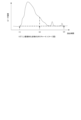
- Peak area ratio of high molecular weight components (area value of high molecular weight components in GPC chart (280 nm)) / (area value of all components in GPC chart (280 nm))
- a resin composition comprising the antistatic agent according to any one of [1] to [7] and a resin substrate.
- the resin composition according to [8] wherein the content of the antistatic agent relative to 100% by weight of the resin substrate is 1.5% by weight or more.
- the present invention provides the following [1-1] to [1-8].
- An antistatic agent comprising a lignin derivative compound containing the following structural units (I) and (II): (I): A structural unit derived from a lignin sulfonic acid compound. (II): A structural unit derived from an aromatic water-soluble compound containing at least an aromatic water-soluble compound having an alkylene oxide chain.
- the aromatic water-soluble compound having an alkylene oxide chain includes an aromatic water-soluble compound having an alkylene oxide chain with an average addition mole number of alkylene oxide of 25 or more.
- Peak area ratio of high molecular weight components (area value of high molecular weight components in GPC chart (280 nm)) / (area value of all components in GPC chart (280 nm)) [2-6]
- a method for treating a resin surface comprising kneading the antistatic agent according to [2-1] or [2-2] into a resin substrate.
- [2-7] A resin composition comprising the antistatic agent according to any one of [2-1] to [2-5] and a resin substrate.
- the resin composition according to [2-7] wherein the content of the antistatic agent relative to 100% by weight of the resin substrate is 1.5% by weight or more.
- Lignin sulfonic acid compounds usually have at least one functional group site that can react with the aromatic water-soluble compound that constitutes the structural unit (II).
- functional group site include carboxyl groups, hydroxyl groups (phenolic hydroxyl groups, alcoholic hydroxyl groups), thiol groups, sulfo groups, aromatic rings, ether bonds, and alkyl chains.
- the functional group site of the lignin sulfonic acid compound is bonded directly or via a condensing agent such as formaldehyde with the aromatic water-soluble compound to form a lignin derivative compound.
- the type of chemical reaction is not particularly limited, and examples thereof include radical reaction, ionic bond, coordinate bond, condensation reaction, reaction accompanied by hydrolysis, reaction accompanied by dehydration, reaction accompanied by oxidation, reaction accompanied by reduction, and reaction accompanied by neutralization.
- the aromatic water-soluble compound preferably has an alkylene oxide chain or a polar group. This can improve the reactivity when forming a bond between the structural units (I) and (II).
- the polar group may be an ionic functional group, such as a carboxyl group, a hydroxyl group, a sulfo group, a nitroxyl group, a carbonyl group, a phosphate group, an amino group, or an epoxy group.
- Anionic functional groups such as a hydroxyl group, a carboxyl group, a sulfo group, or a phosphate group are preferred, and a carboxyl group or a sulfo group is more preferred.
- the anionic functional groups in the lignin derivative compound can be quantitatively and qualitatively observed by instrumental analysis such as NMR or IR.
- aromatic water-soluble compounds include the following compounds:
- the number of carbon atoms of the alkylene oxide units constituting the alkylene oxide chain (group) is not particularly limited, and is usually 2 to 18, preferably 2 to 4, and more preferably 2 to 3.
- Examples of the alkylene oxide units include ethylene oxide units, propylene oxide units, and butylene oxide units, and ethylene oxide units or propylene oxide units are preferred.
- the average number of moles of the alkylene oxide units added is usually 20 or more or 25 or more, preferably 30 or more, and more preferably 35 or more. This can improve dispersibility.
- the upper limit is preferably 300 or less, more preferably 200 or less, and even more preferably 150 or less. This can suppress a decrease in dispersion retention.
- the polyalkylene oxide chain may be composed of one type or two or more types of alkylene oxide groups.
- the addition form of each alkylene oxide group in a polyalkylene oxide chain composed of two or more types of alkylene oxide groups may be random, block, or a mixture of these.
- the terminal unit of the polyalkylene oxide chain is usually a hydroxyl group, but is not limited to this, and may be an alkyl ether or a carboxylate ester as long as it does not interfere with bonding with the lignin sulfonic acid compound.
- aromatic water-soluble compounds having an alkylene oxide chain include oxyalkylene group adducts to aromatic compounds such as phenol, cresol, nonylphenol, naphthol, methylnaphthol, butylnaphthol, bisphenol A, and bisphenol S. More specifically, examples include polyalkylene oxide alkylphenyl ethers, polyalkylene oxide phenyl ethers, polyalkylene oxide alkylnaphthyl ethers, and polyalkylene oxide naphthyl ethers.
- benzene ring derivatives are preferred because they can have good co-condensation properties, and at least one of polyalkylene oxide alkylphenyl ethers and polyalkylene oxide phenyl ethers is more preferred, and polyalkylene oxide phenyl ethers (particularly oxyalkylene group adducts to phenol) (for example, poly(ethylene oxide) monophenyl ether, poly(propylene oxide) monophenyl ether, and the preferred range of the average added mole number of ethylene oxide units and propylene oxide units is as described above) are even more preferred.
- the aromatic water-soluble compound having an alkylene oxide chain may be one type or a combination of two or more types.
- aromatic water-soluble compounds having a carboxyl group examples include naphthalene ring or benzene ring derivatives having at least one carboxyl group. More specifically, examples include isophthalic acid, oxynaphthoic acid, benzoic acid, hydroxybenzoic acid, and isomers thereof. Because of their good reactivity, o-hydroxybenzoic acid, m-hydroxybenzoic acid, and p-hydroxybenzoic acid are preferred, and p-hydroxybenzoic acid is more preferred.
- the aromatic water-soluble compounds having a carboxyl group may be one type or a combination of two or more types.
- the neutralization treatment can be carried out using a neutralizing agent capable of neutralizing the reaction product and the catalyst.
- the neutralizing agent include basic compounds such as sodium hydroxide, calcium hydroxide, Ba(OH) 2 , and the like (including salts and hydroxides thereof).
- the precipitate can be separated and removed by subsequent filtration, and a salt-free polymer can be obtained.
- undesirable sodium sulfate may be separated and removed by dialysis or ultrafiltration.
- Antistatic agents can be used to prevent static electricity in resins.
- Examples of methods for obtaining an antistatic effect for resins include a method of treating the surface of a substrate (usually a solid) and a method of kneading an antistatic agent into a resin substrate containing a resin material.
- a method for treating the substrate surface with an antistatic agent for example, a method of forming a coating layer containing an antistatic agent, i.e., a layer containing the above-mentioned copolymer, on at least a part of the substrate surface.
- the coating layer containing an antistatic agent can function as an antistatic layer. Therefore, a laminate material containing a substrate and a coating layer can exhibit an antistatic effect due to the coating layer, and can suppress the generation of static electricity.
- Coating methods include, but are not limited to, bar coating, spin coating, brush coating, roll coating, spray coating, and screen printing. They can be selected appropriately depending on the substrate and solvent.
- the resin substrate may contain a cellulose-based material.
- a cellulose-based material By adding an antistatic agent to a resin material containing a cellulose-based material, it is possible to expect an antistatic effect as well as an improvement in cellulose dispersibility.
- the cellulose-based material include cellulose powder, cellulose fibers (cellulose nanofibers, cellulose microfibrils), pulp, and modified products thereof (e.g., modified products obtained by chemical modification such as oxidation, etherification, phosphate esterification, silane coupling, fluorination, and cationization).
- the average particle size is preferably 20 ⁇ m or more, more preferably 25 ⁇ m or more, and even more preferably 30 ⁇ m or more. This makes it possible to suppress scattering and improve mixability when the cellulose powder is added to the reaction system.
- the upper limit is preferably 100 ⁇ m or less, more preferably 80 ⁇ m or less, and even more preferably 60 ⁇ m or less. This makes it possible to maintain the kneadability during the formation of the ion complex and the smoothness of the resulting ion complex. Therefore, the average particle size of the cellulose powder is preferably 20 to 100 ⁇ m, more preferably 25 to 80 ⁇ m, and even more preferably 30 to 60 ⁇ m.
- the average particle size is the particle size when the volume accumulation distribution is 50%.
- the volume accumulation distribution can be obtained by a laser scattering method.
- the measuring device and measuring conditions are as follows. Measurement equipment: Laser diffraction particle size distribution measurement equipment (Mastersizer 3000, Spectris Co., Ltd., Malvern Panalytical Division) Measurement conditions: A sample is added to the measurement section in water stirred at 3500 rpm so that the scattering intensity is about 10%, and measurements can be performed under the following conditions. Analysis: General purpose Analysis sensitivity: Enhanced Light scattering model: Mie theory
- the apparent specific gravity of the cellulose powder is preferably 0.1 g/ml or more, and more preferably 0.15 g/ml or more. This can prevent the deterioration of workability due to scattering when the cellulose powder is added to the reaction system.
- the upper limit is preferably 0.6 g/ml or less, more preferably 0.45 g/ml or less, and even more preferably 0.4 g/ml or less. This can prevent the deterioration of dispersibility due to the occurrence of settling when the cellulose powder is added to the reaction system. Therefore, the range of 0.1 to 0.6 g/ml is preferable, the range of 0.1 to 0.45 g/ml is more preferable, and the range of 0.15 to 0.4 g/ml is even more preferable.
- the resin substrate may contain additive components other than the cellulose-based material.
- additive components include known resin additives such as antioxidants, preservatives, stabilizers, solvents, and inorganic fillers (e.g., carbon fiber, talc, mica, titanium oxide, and silica), and are not particularly limited.
- the amount of antistatic agent used in the case of kneading (the amount of copolymer relative to 100% by weight of the resin substrate (including additive components, the same applies below)) is usually 1.0% by weight or more, preferably 1.5% by weight or more or 2.0% by weight or more, more preferably 2.5% by weight or more.
- the upper limit is usually 80% by weight or less, preferably 75% by weight or less, more preferably 70% by weight or less. Therefore, it is usually 1.0 to 80% by weight, preferably 1.5 to 80% by weight or 2.0 to 75% by weight, more preferably 2.5 to 70% by weight.
- the method of kneading (blending) the antistatic agent into the resin substrate is not particularly limited, and any commonly used method can be used.
- a kneading machine may be used as necessary.
- the system may be heated, and the heating temperature is, for example, 100° C. or higher, preferably 150° C. or higher.
- the upper limit is usually 250° C. or lower, preferably 200° C. or lower.
- Production Example 3 (Production of Ligninsulfonate (a-3)) Wood derived from Radiata pine was subjected to sulfite treatment for 3 hours at 140°C and pH 2 using a magnesium sulfite solution with a SO2 concentration of 4 g/100 mL based on the sulfite cooking method, and a magnesium hydroxide solution was added to the resulting composition so that the solid content was 9 wt%, and the composition was held at 90°C for 4 hours to cause an alkaline reaction.
- Example 1 Into a 1L separable flask, 200g of water, 65g of lignin sulfonate (a-1) as compound (i), 35g of poly(ethylene oxide) monophenyl ether (average number of moles of ethylene oxide added: 100) as compound (ii), 10g of 37% aqueous formaldehyde solution, 40g of 72% sulfuric acid, and 0.05g of Pronal 753 (manufactured by Toho Chemical Industry Co., Ltd.) as a defoaming agent were added, and the mixture was stirred while being heated, and the reaction was completed by maintaining the mixture at 105°C for 10 hours.
- lignin sulfonate (a-1) as compound (i)
- 35g of poly(ethylene oxide) monophenyl ether average number of moles of ethylene oxide added: 100
- 10g of 37% aqueous formaldehyde solution 40g of 72% sulfuric acid
- Pronal 753 manufactured by Toh
- a lignin derivative compound (b-1) 80g of 250g/L aqueous calcium hydroxide solution and 20g of 31% aqueous sodium hydroxide solution were added, and the mixture was stirred for 1 hour, followed by filtration to remove the resulting gypsum, to obtain a lignin derivative compound (b-1).
- a lignin derivative compound (b-2) 80g of 250g/L aqueous calcium hydroxide solution and 20g of 31% aqueous sodium hydroxide solution were added, and the mixture was stirred for 1 hour, followed by filtration to remove the resulting gypsum, to obtain a lignin derivative compound (b-2).
- aqueous calcium hydroxide solution 80g was added to the resulting aqueous solution, 80g of 250g/L aqueous calcium hydroxide solution and 20g of 31% aqueous sodium hydroxide solution were added, and the mixture was stirred for 1 hour, followed by filtration to remove the resulting gypsum, to obtain a lignin derivative compound (b-3).
- aqueous calcium hydroxide solution 80g was added to the resulting aqueous solution, 80g of 250g/L aqueous calcium hydroxide solution and 20g of 31% aqueous sodium hydroxide solution were added, and the mixture was stirred for 1 hour, followed by filtration to remove the resulting gypsum, to obtain a lignin derivative compound (b-5).
- Example 7 Into a 1L separable flask, 200g of water, 30g of lignin sulfonate (a-1) as compound (i), 65g of poly(ethylene oxide) monophenyl ether (average mole number of ethylene oxide added: 25) as compound (ii), 5g of p-hydroxybenzoic acid, 10g of 37% aqueous formaldehyde solution, 40g of 72% sulfuric acid, and 0.05g of Pronal 753 (manufactured by Toho Chemical Industry Co., Ltd.) as a defoaming agent were added, and the mixture was stirred while being heated, and the reaction was completed by maintaining the mixture at 105°C for 10 hours.
- lignin sulfonate (a-1) as compound (i)
- 65g of poly(ethylene oxide) monophenyl ether average mole number of ethylene oxide added: 25
- 5g of p-hydroxybenzoic acid 10g of 37% aqueous formaldehy
- a lignin derivative compound (b-7) To the resulting aqueous solution, 80g of 250g/L aqueous calcium hydroxide solution, and 20g of 31% aqueous sodium hydroxide solution were added, and the mixture was stirred for 1 hour, followed by filtration to remove the resulting gypsum, to obtain a lignin derivative compound (b-7).
- Example 8 Into a 1L separable flask, 200g of water, 70g of lignin sulfonate (a-1) as compound (i), 25g of poly(ethylene oxide) monophenyl ether (average mole number of ethylene oxide added: 25) as compound (ii) and 5g of aniline sulfonate, 10g of 37% aqueous formaldehyde solution, 40g of 72% sulfuric acid, and 0.05g of Pronal 753 (manufactured by Toho Chemical Industry Co., Ltd.) as a defoaming agent were added, and the mixture was stirred while being heated, and the reaction was completed by maintaining the mixture at 105 ° C. for 10 hours.
- lignin sulfonate (a-1) as compound (i)
- 25g of poly(ethylene oxide) monophenyl ether average mole number of ethylene oxide added: 25
- aniline sulfonate 10g of 37% aqueous formaldehy
- Ph(EO25) Poly(ethylene oxide) monophenyl ether (average number of moles of ethylene oxide added: 25)
- Ph(EO50) Poly(ethylene oxide) monophenyl ether (average number of moles of ethylene oxide added: 50)
- Ph(EO100) Poly(ethylene oxide) monophenyl ether (average number of moles of ethylene oxide added: 100)
- Ph(PO100) Poly(propylene oxide) monophenyl ether (average number of moles of propylene oxide added: 100)
- PHB p-hydroxybenzoic acid
- ANS aniline sulfonic acid - Evaluation criteria for IPA solubility - ⁇ : In the above IPA dispersion preparation test, an IPA dispersion (solid content 10%) without precipitation of the lignin component was obtained.
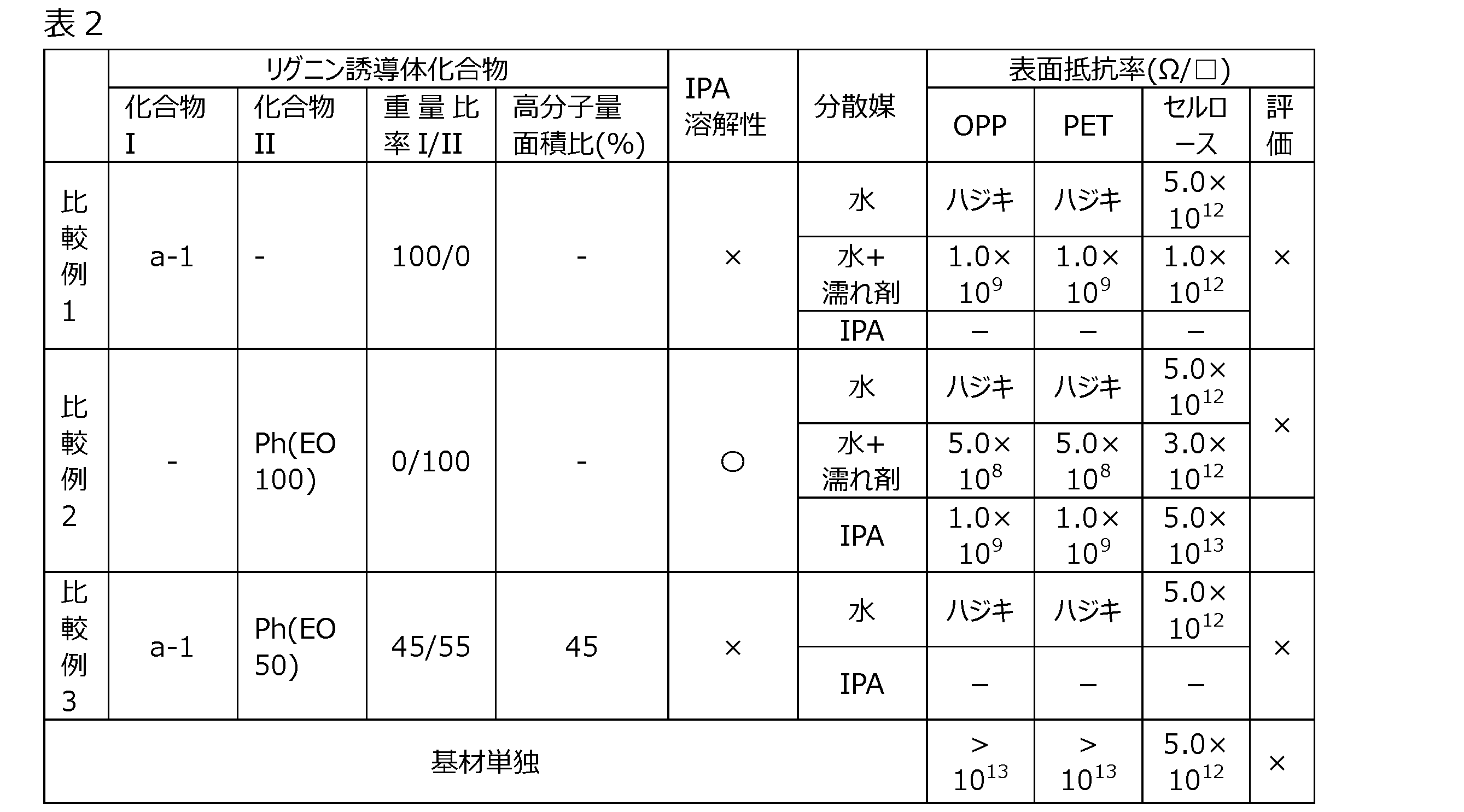
- Comparative Example 1 lignosulfonic acid alone
- Comparative Example 3 a mixture of lignosulfonic acid and an aromatic water-soluble compound having an alkylene oxide chain
- Comparative Example 1 lignosulfonic acid alone
- Comparative Example 2 aromatic water-soluble compound having an alkylene oxide chain alone
- Comparative Example 3 a mixture of lignosulfonic acid and an aromatic water-soluble compound having an alkylene oxide chain
- any one of the following types was used. Sample solutions prepared in the examples and comparative examples Compatibilizer resin (UMEX 1010, manufactured by Sanyo Chemical Industries, Ltd.) - Antistatic resin (Pellestat 300, Sanyo Chemical Industries, Ltd.) When the additive contained moisture, it completely evaporated during kneading and was released outside the system.
- UAEX 1010 Compatibilizer resin
- Antistatic resin Pellestat 300, Sanyo Chemical Industries, Ltd.
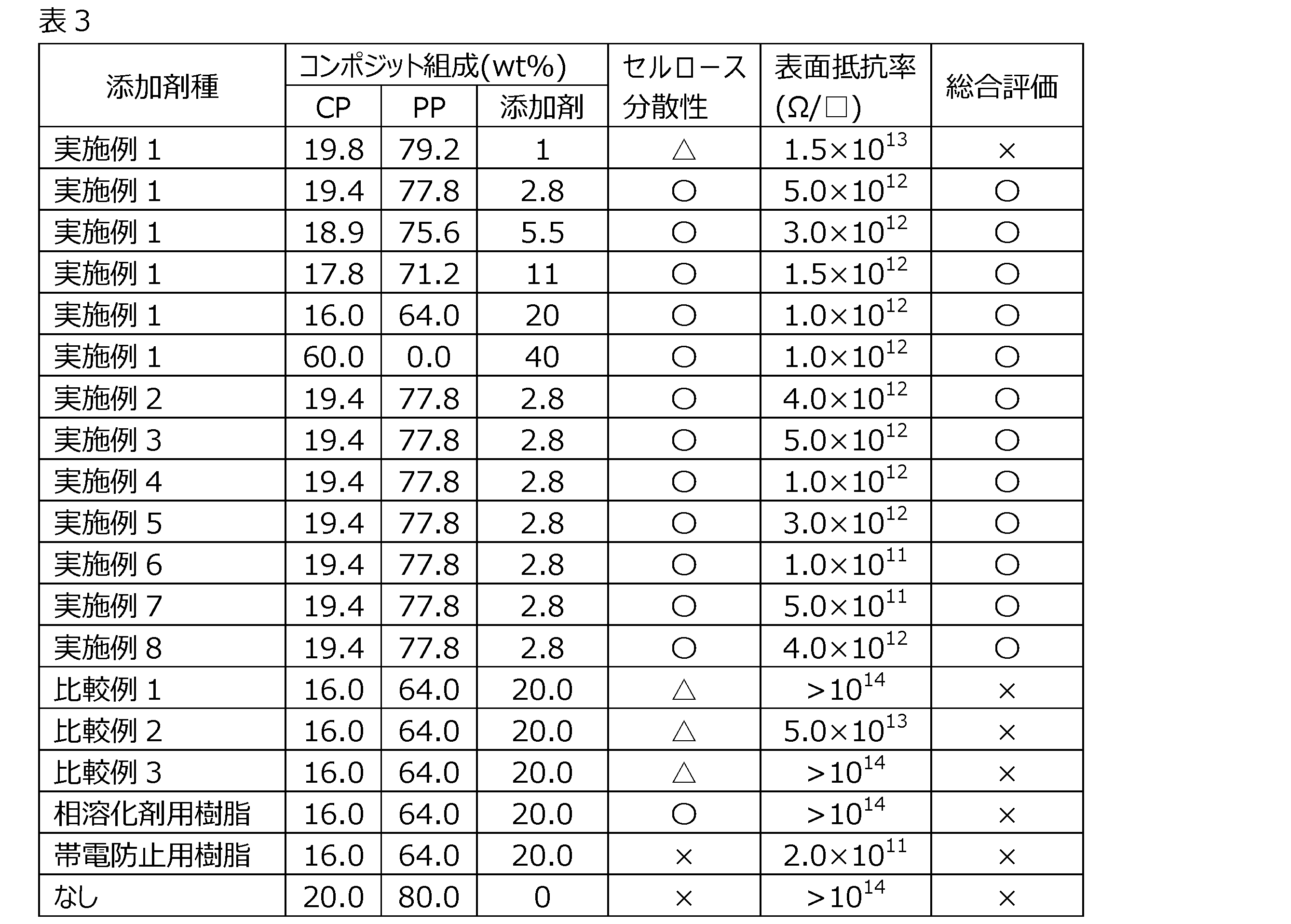
- the evaluation criteria were as follows: "Good”: The number of unmixed cellulose fibers was 0 in a total of five observations. " ⁇ ”: In one to three observations, one to three unmixed cellulose fibers were observed. "X”: Three or more unmixed cellulose fibers were observed in one to three observations, or one or more unmixed cellulose fibers were observed in three or more observations.
- composition of the present invention can improve surface resistivity, and when the resin composition contains a cellulose component, it is expected to improve cellulose dispersibility, and therefore can be used in products for electronic components and environmentally friendly products.
Landscapes
- Chemical & Material Sciences (AREA)
- Engineering & Computer Science (AREA)
- Chemical Kinetics & Catalysis (AREA)
- Organic Chemistry (AREA)
- Polymers & Plastics (AREA)
- Materials Engineering (AREA)
- Health & Medical Sciences (AREA)
- Medicinal Chemistry (AREA)
- Textile Engineering (AREA)
- Life Sciences & Earth Sciences (AREA)
- Biochemistry (AREA)
- Compositions Of Macromolecular Compounds (AREA)
- Treatments For Attaching Organic Compounds To Fibrous Goods (AREA)
Abstract
Description
〔1〕下記構成単位(I)および(II)を含むリグニン誘導体化合物を含む、帯電防止剤。
(I):リグニンスルホン酸系化合物に由来する構成単位
(II):アルキレンオキサイド鎖を有する芳香族系水溶性化合物を少なくとも含む芳香族系水溶性化合物に由来する構成単位
〔2〕アルキレンオキサイド鎖を有する芳香族系水溶性化合物は、アルキレンオキサイド平均付加モル数25以上のアルキレンオキサイド鎖を有する芳香族系水溶性化合物を含む、〔1〕に記載の帯電防止剤。
〔3〕構成単位(I)の構成単位(II)に対する重量比率(I)/(II)が、1/99~99/1である、〔2〕に記載の帯電防止剤。
〔4〕芳香族系水溶性化合物は、カルボキシル基を有する芳香族系化合物及び/又は、スルホ基を有する芳香族系化合物をさらに含む、〔1〕~〔3〕のいずれか1項に記載の帯電防止剤。
〔5〕下記式で表されるリグニン誘導体化合物は高分子成分のピーク面積比が80%以上である、〔1〕~〔4〕のいずれか1項に記載の帯電防止剤。
高分子量成分のピーク面積比=(GPCチャート(280nm)における高分子量成分の面積値)/(GPCチャート(280nm)における全成分の面積値)
〔6〕樹脂用である、〔1〕~〔5〕のいずれか1項に記載の帯電防止剤。
〔7〕樹脂練り込み用又は表面処理用である、〔6〕に記載の帯電防止剤。
〔8〕〔1〕~〔7〕のいずれか1項に記載の帯電防止剤、及び樹脂基材を含む、樹脂組成物。
〔9〕樹脂基材100重量%に対する帯電防止剤の含有量が、1.5重量%以上である、〔8〕に記載の樹脂組成物。
〔10〕樹脂基材は、セルロース系材料をさらに含む、〔8〕又は〔9〕に記載の樹脂組成物。
〔11〕〔8〕~〔10〕のいずれか1項に記載の樹脂組成物の成形品。
〔12〕〔1〕~〔7〕のいずれか1項に記載の帯電防止剤を基材へ練り込む、もしくは基材表面に塗布することを含む、基材の処理方法。
〔13〕基材が、セルロース系材料及び/又は樹脂材料を含む基材である、〔12〕に記載の方法。
〔1-1〕下記構成単位(I)および(II)を含むリグニン誘導体化合物を含む、帯電防止剤。
(I):リグニンスルホン酸系化合物に由来する構成単位
(II):アルキレンオキサイド鎖を有する芳香族系水溶性化合物を少なくとも含む芳香族系水溶性化合物に由来する構成単位
〔1-2〕アルキレンオキサイド鎖を有する芳香族系水溶性化合物は、アルキレンオキサイド平均付加モル数25以上のアルキレンオキサイド鎖を有する芳香族系水溶性化合物を含む、〔1-1〕に記載の帯電防止剤。
〔1-3〕構成単位(I)の構成単位(II)に対する重量比率(I)/(II)が、1/99~99/1である、〔1-2〕に記載の帯電防止剤。
〔1-4〕芳香族系水溶性化合物は、カルボキシル基を有する芳香族系化合物及び/又は、スルホ基を有する芳香族系化合物をさらに含む、〔1-1〕~〔1-3〕のいずれか1項に記載の帯電防止剤。
〔1-5〕下記式で表されるリグニン誘導体化合物は高分子成分のピーク面積比が80%以上である、〔1-1〕~〔1-4〕のいずれか1項に記載の帯電防止剤。
高分子量成分のピーク面積比=(GPCチャート(280nm)における高分子量成分の面積値)/(GPCチャート(280nm)における全成分の面積値)
〔1-6〕〔1-1〕~〔1-5〕のいずれか1項に記載の帯電防止剤で基材表面を処理することを含む、表面処理方法。
〔1-7〕基材が、セルロース系材料及び/又は樹脂材料を含む基材である、〔6〕に記載の方法。
〔1-8〕基材と、
下記構成単位(I)および(II)を含むリグニン誘導体化合物を含有し、基材表面の少なくとも一部を被覆する帯電防止層と
を含む、積層材料。
(I):リグニンスルホン酸系化合物に由来する構成単位
(II):アルキレンオキサイド鎖を有する芳香族系水溶性化合物を少なくとも含む芳香族系水溶性化合物に由来する構成単位
〔2-1〕下記構成単位(I)および(II)を含むリグニン誘導体化合物を含有する、樹脂用帯電防止剤。
(I):リグニンスルホン酸系化合物に由来する構成単位
(II):アルキレンオキサイド鎖を有する芳香族系水溶性化合物を少なくとも含む芳香族系水溶性化合物に由来する構成単位
〔2-2〕アルキレンオキサイド鎖を有する芳香族系水溶性化合物は、アルキレンオキサイド平均付加モル数25以上のアルキレンオキサイド鎖を有する芳香族系水溶性化合物を含む、〔2-1〕に記載の帯電防止剤。
〔2-3〕構成単位(I)の構成単位(II)に対する重量比率(I)/(II)が、1/99~99/1である、〔2-1〕又は〔2-2〕に記載の帯電防止剤。
〔2-4〕芳香族系水溶性化合物は、カルボキシル基を有する芳香族系化合物及び/又は、スルホ基を有する芳香族系化合物をさらに含む、〔2-1〕~〔2-3〕のいずれか1項に記載の帯電防止剤。
〔2-5〕下記式で表されるリグニン誘導体化合物は高分子成分のピーク面積比が80%以上である、〔2-1〕~〔2-4〕のいずれか1項に記載の帯電防止剤。
高分子量成分のピーク面積比=(GPCチャート(280nm)における高分子量成分の面積値)/(GPCチャート(280nm)における全成分の面積値)
〔2-6〕〔2-1〕又は〔2-2〕に記載の帯電防止剤を樹脂基材に練り込むことを含む、樹脂の表面処理方法。
〔2-7〕〔2-1〕~〔2-5〕のいずれか1項に記載の帯電防止剤、及び樹脂基材を含む、樹脂組成物。
〔2-8〕樹脂基材100重量%に対する帯電防止剤の含有量が、1.5重量%以上である、〔2-7〕に記載の樹脂組成物。
〔2-9〕樹脂基材は、セルロース系材料をさらに含む、〔2-7〕又は〔2-8〕に記載の樹脂組成物。
〔2-10〕〔2-7〕又は〔2-8〕に記載の樹脂組成物の成形品。
帯電防止剤は、下記のリグニン誘導体化合物を有効成分として含有する。
リグニン誘導体化合物は、構成単位(I)及び(II)を少なくとも含むポリマーである。構成単位(I)の主骨格であるリグニンが非常に複雑な分子構造をしているため、リグニン誘導体化合物の化学構造を一般式などで一律に特定することは困難である。
構成単位(I)は、リグニンスルホン酸系化合物に由来する構成単位である。
リグニンスルホン酸系化合物とは、リグニンのヒドロキシフェニルプロパン構造の側鎖α位の炭素が開裂してスルホ基(スルホン酸基)が導入された骨格を有する化合物である。上記骨格部分の構造を式(1)に示す。

構成単位(II)は、芳香族系水溶性化合物に由来する構成単位である。
芳香族系水溶性化合物とは、芳香族骨格を少なくとも1つ含み、水溶性を示す化合物を意味する。芳香族系水溶性化合物は、リグニンスルホン酸系化合物に含まれる官能基と化学反応により結合しうる化合物が好ましく、亜硫酸パルプ廃液の主成分としてのリグニンスルホン酸系化合物に含まれる官能基と反応し得る化合物がより好ましい。化学反応の形式も特に限定されず、ラジカル反応、イオン結合、配位結合、縮合反応、加水分解を伴う反応、脱水を伴う反応、酸化を伴う反応、還元を伴う反応、中和を伴う反応が例示される。
アルキレンオキシド鎖(基)を構成するアルキレンオキシド単位の炭素原子数は特に限定されず、通常、通常は2~18、好ましくは2~4であり、より好ましくは2~3である。アルキレンオキシド単位としては例えば、エチレンオキシド単位、プロピレンオキシド単位、ブチレンオキシド単位が挙げられ、エチレンオキシド単位又はプロピレンオキシド単位が好ましい。アルキレンオキシド単位の平均付加モル数は、通常、20以上又は25以上、好ましくは30以上、より好ましくは35以上である。これにより、分散性が良好となり得る。上限は、300以下が好ましく、200以下がより好ましく、150以下が更に好ましい。これにより分散保持性の低下が抑制され得る。従って、平均付加モル数は、好ましくは20~300、又は25~300、より好ましくは30~200、さらに好ましくは35~150である。上述の平均付加モル数は目安であり、上述の範囲を満たすか否かに拘らず、アルキレンオキシド鎖としてアルキレンオキシド単位が繰り返し付加していないもの(モノアルキレンオキシド基)が含まれていてもよい。
カルボキシル基を有する芳香族系水溶性化合物としては、例えば、少なくとも1つのカルボキシル基を有する、ナフタレン環又はベンゼン環誘導体が挙げられる。より詳細には、例えば、イソフタル酸、オキシナフトエ酸、安息香酸、ヒドロキシ安息香酸、これらの異性体が挙げられる。反応性が良好であるため、o-ヒドロキシ安息香酸、m-ヒドロキシ安息香酸、p-ヒドロキシ安息香酸が好ましく、p-ヒドロキシ安息香酸がより好ましい。カルボキシル基を有する芳香族系水溶性化合物は、1種でもよいし、2種以上の組み合わせでもよい。
スルホ基を有する芳香族系水溶性化合物としては、例えば、アルキルナフタレンスルホン酸、アルキルフェノールスルホン酸、アニリンスルホン酸、アルキルベンゼンスルホン酸が挙げられる。より詳細には、例えば、ナフタレンスルホン酸、メチルナフタレンスルホン酸、ブチルナフタレンスルホン酸、フェノールスルホン酸、クレゾールスルホン酸、アニリンスルホン酸、ベンゼンスルホン酸、トルエンスルホン酸、これらの異性体及び縮合物が挙げられる。縮合物としては、例えば、ナフタレンスルホン酸ホルムアルデヒド縮合物が挙げられる。反応性が良好であるため、スルホ基を有するフェノール誘導体、アニリンスルホン酸が好ましく、フェノールスルホン酸、アニリンスルホン酸がより好ましく、アニリンスルホン酸が更に好ましい。スルホ基を有する芳香族系水溶性化合物は、1種でもよいし、2種以上の組み合わせでもよい。
他の芳香族系水溶性化合物としては、アルキレンオキシド鎖、カルボキシル基、スルホ基のいずれも有しない芳香族系水溶性化合物が挙げられ、例えば、フェノール、クレゾール等の(アルキル)フェノールが挙げられる。他の芳香族系水溶性化合物は、1種でもよいし、2種以上の組み合わせでもよい。
リグニン誘導体化合物は、構成単位(I)及び(II)以外の構成単位(III)を有していてもよい。例えば、芳香族系水溶性化合物以外の芳香族系化合物(例、ベンゼン、ナフタレン等の単純芳香族炭化水素化合物)、(ポリ)アルキレングリコールアルケニルエーテル系化合物;両末端基が水素原子である水溶性ポリアルキレングリコール、ポリオキシアルキレン系化合物、ポリカルボン酸系化合物及びポリエステル系化合物、のそれぞれに由来する構成単位(例えば、国際公開第2018/56124号に記載される重合体ブロック)が挙げられる。構成単位(III)は、は、1種でもよいし、2種以上の組み合わせでもよい。
構成単位(I)の構成単位(II)に対する重量比率(I)/(II)は、通常、1/99~99/1、好ましくは2/98~90/10、より好ましくは5/95~70/30、又は10/90~70/30、さらに好ましくは15/85~70/30である。
70~15/30~20である((I)と(II)の合計を100重量%とする)。
リグニン誘導体化合物は、上述した反応により得られる反応生成物であればよく、遊離酸及びその中和塩のいずれでもよい。ポリマーの保存及び使用が容易であることから、中和塩が好ましい。反応生成物の中和塩としては、例えば、ナトリウム塩又はカリウム塩等のアルカリ金属塩;カルシウム塩等のアルカリ土類金属塩;アンモニウム塩;有機アミンの塩が挙げられる。
-重量平均分子量-
リグニン誘導体化合物の重量平均分子量は、特に限定されないが、好ましくは1,000~500,000、より好ましくは2,000~300,000、さらに好ましくは5,000~100,000である。なお、本発明における重量平均分子量は、ゲルパーミエイションクロマトグラフィー(GPC)にてポリエチレングリコール換算する公知の方法にて測定できる。
測定装置;東ソー製
使用カラム;Shodex Column OH-pak SB-806HQ、SB-804HQ、SB-802.5HQ
溶離液;0.05mM硝酸ナトリウム/アセトニトリル 8/2(v/v)
標準物質;ポリエチレングリコール(東ソー製又はGLサイエンス製)
検出器;示差屈折計(東ソー製)
リグニン誘導体化合物の高分子量成分のピーク面積比は、通常、80%以上、好ましくは85%以上である。上限は、97%以下、より好ましくは、より好ましくは95%以下である。この範囲内であることにより、リグニン誘導体化合物中の構成単位(I)と(II)がバランスよく存在し、帯電防止効果を発揮できる。本明細書において、高分子量成分のピーク面積比とは、リグニン誘導体化合物のゲルパーミエイションクロマトグラフィー(GPC)測定において、UV(検出波長280nm)を用いた場合のチャートにおける、重量平均分子量1,200以上である成分のピーク面積値の、全成分のピーク面積に対する比率を意味し、下記の式で算出できる。
高分子量成分のピーク面積比=(GPCチャート(280nm)における高分子量成分の面積値)/(GPCチャート(280nm)における全成分の面積値)
リグニン誘導体の調製は、リグニンスルホン酸系化合物(以下、化合物(i)と言うことがある)、芳香族系水溶性化合物(以下、化合物(ii)と言うことがある)を含む原料化合物を反応させる方法であればよい。例えば、リグニンスルホン酸系化合物と芳香族系水溶性化合物とを反応させる方法が挙げられる。詳細には、例えば、リグニンスルホン酸系化合物に芳香族系水溶性化合物を、縮合(例えば、ホルムアルデヒド縮合)させる方法、ラジカル反応、イオン結合させる方法が挙げられる。ホルムアルデヒド縮合させる方法としては、例えば、リグニンスルホン酸系化合物にホルムアルデヒドを付加し、芳香族系水溶性化合物と結合させる方法が挙げられる。ラジカル反応させる方法としては、リグニンスルホン酸系化合物にラジカル開始剤を作用させるなどして水素ラジカルを引き抜き、発生させたラジカルと少なくとも1種類の芳香族系水溶性化合物をラジカル反応させる方法が挙げられる。
帯電防止剤は、任意成分を含んでもよい。任意成分としては、リグニン誘導体化合物以外の帯電防止成分、溶剤、乳化剤(界面活性剤、濡れ剤:非イオン性、陰イオン性、両性、陽イオン性)、酸化防止剤、熱安定化剤、光安定化剤、紫外線吸収剤、難燃剤、可塑剤、顔料、染料、染料分散剤、キレート剤、未反応の化合物(i)及び(ii)等が挙げられる。任意成分として未反応の化合物(ii)を含むことにより、帯電防止効果をさらに高めることができる。未反応の化合物(ii)の量は、リグニン誘導体化合物に占める構成単位(II)の換算重量よりも少ない量が好ましく、3/7以下がより好ましい。また、任意成分として溶剤を含むことにより、基材への適用を容易に行うことができる。溶剤としては、例えば、水、メチルアルコール、エチルアルコール、イソプロピルアルコールなどの低級アルコールシクロヘキサン、n-ヘキサンなどの脂肪族炭化水素;酢酸エチルなどのエステル類;アセトン、メチルエチルケトンなどのケトン類が挙げられる。
帯電防止剤は、樹脂の帯電防止に利用できる。樹脂に対し帯電防止効果を得る方法としては、例えば、基材(通常は、固体)の表面を処理する方法、及び、帯電防止剤を、樹脂材料を含む樹脂基材に練り込む方法が挙げられる。
-基材-
帯電防止剤で基材表面を処理する場合、基材の基本材料としては、例えば、樹脂、シリコン等の無機材料、これらの組み合わせ等、帯電し得る材料であればよく、特に制限はない。樹脂材料としては、例えば、ポリエチレン、ポリプロピレン、エチレン-プロピレン共重合体、エチレン-酢酸ビニル共重合体、エチレン-エチルアクリレート共重合体等のポリオレフィン樹脂、ポリ塩化ビニル、ポリ塩化ビニリデン、ポリフッ化ビニリデン、ポリテトラフルオロエチレン等の含ハロゲン樹脂ポリアクリロニトリル、ポリスチレン、スチレンと他のモノマーの共重合体(例えば、アクリロニトリル-スチレン(AS)樹脂、アクリロニトリル-ブタジエン-スチレン(ABS)樹脂)等のスチレン系樹脂、ポリエステル、ポリエチレンテレフタレート、ポリブチレンテレフタレート、不飽和ポリエステル等のポリエステル系樹脂、ポリアクリル、ポリメタクリル酸メチル等のアクリル系樹脂、エポキシ系樹脂、フェノール系樹脂、ポリアミド系樹脂、ポリイミド系樹脂、ポリスルホン樹脂、ポリビニルアルコール、ポリウレタン樹脂、ポリカーボネート樹脂、ポリジメチルシロキサン樹脂、これらの組み合わせが挙げられ、合成樹脂、天然樹脂のいずれでもよい。基材は、例えば、セルロース系材料(例えば、セルロース繊維、セルロースパウダー)、無機フィラー(例えば、カーボンファイバー、タルク、マイカ、酸化チタン、シリカ)、セメント等の基本材料以外の副材料、添加成分を含んでいてもよい。無機材料としては、例えば、アルミニウム、ニッケルチタン、ステンレス等の金属、半金属;シリコン;これらの酸化物、炭化物、窒化物、ホウ化物;ガラス、セラミックスが挙げられる。基材は、バイオマス度を有する(例えば、セルロース系材料、植物由来ポリエチレン、ポリプロピレン、ポリエステル等の植物由来樹脂を含む)材料より構成される基材でもよい。バイオマス度は、14Cの濃度であり、加速器質量分析により測定できる。基材の形状は特に限定されず、例えば、成形体、フィルム、繊維、板、粒状などが挙げられる。
帯電防止剤で基材表面を処理する方法としては、例えば、基材表面の少なくとも一部に、帯電防止剤を含む被覆層、すなわち、上記共重合体を含む層を形成する方法が挙げられる。帯電防止剤を含む被覆層は、帯電防止層として機能し得る。従って、基材と被覆層とを含む積層材料は、被覆層による帯電防止効果が発揮され、静電気の発生を抑制できる。
-樹脂材料-
帯電防止剤を樹脂材料に練り込む場合、樹脂材料としては、熱可塑性樹脂、熱硬化性樹脂のいずれでもよいが、熱可塑性樹脂が好ましい。例えば、ポリエチレン、ポリプロピレン、エチレン-プロピレン共重合体、エチレン-酢酸ビニル共重合体、エチレン-エチルアクリレート共重合体等のポリオレフィン樹脂、ポリ塩化ビニル、ポリ塩化ビニリデン、ポリフッ化ビニリデン、ポリテトラフルオロエチレン等の含ハロゲン樹脂ポリアクリロニトリル、ポリスチレン、スチレンと他のモノマーの共重合体(例えば、アクリロニトリル-スチレン(AS)樹脂、アクリロニトリル-ブタジエン-スチレン(ABS)樹脂)等のスチレン系樹脂、ポリエステル、ポリエチレンテレフタレート、ポリブチレンテレフタレート、不飽和ポリエステル等のポリエステル系樹脂、ポリアクリル、ポリメタクリル酸メチル等のアクリル系樹脂、エポキシ系樹脂、フェノール系樹脂、ポリアミド系樹脂、ポリイミド系樹脂、ポリスルホン樹脂、ポリビニルアルコール、ポリウレタン樹脂、ポリカーボネート樹脂、ポリジメチルシロキサン樹脂、これらの組み合わせが挙げられ、合成樹脂、天然樹脂のいずれでもよい。樹脂基材は樹脂1種類でもよいし、2種類以上の樹脂の組み合わせでもよい。
樹脂基材は、セルロース系材料を含んでもよい。セルロース系材料を含む樹脂材料へ帯電防止剤を添加することにより、帯電防止効果とともにセルロース分散性の改善効果も期待できる。セルロース系材料としては、例えば、セルロースパウダー、セルロース繊維(セルロースナノファイバー、セルロースマイクロフィブリル)、パルプ、これらの変性物(例えば、酸化、エーテル化、リン酸エステル化等のエステル化、シランカップリング、フッ素化、カチオン化等の化学変性による変性物)が挙げられる。
・測定装置:レーザー回析式粒度分布測定装置(マスターサイザー3000、スペクトリス株式会社、マルバーンパナリティカル事業部)
・測定条件:3500rpmで攪拌されている水中の測定部に、散乱強度が10%程度になるように試料を添加して下記の条件で測定できる。
解析:汎用
解析感度:強調
光散乱モデル:Mie理論
樹脂基材は、セルロース系材料以外の添加成分を含んでもよい。他の添加成分としては、例えば、酸化防止剤、防腐剤、安定剤、溶剤、無機フィラー(例えば、カーボンファイバー、タルク、マイカ、酸化チタン、シリカ)等の公知の樹脂用添加剤が挙げられ、特に限定されない。
練り込みの場合の帯電防止剤の使用量(樹脂基材(添加成分含む、以下同じ)の重量100重量%に対する共重合体の量)は、通常、1.0重量%以上、好ましくは1.5重量%以上又は2.0重量%以上、より好ましくは2.5重量%以上である。上限は、通常、80重量%以下、好ましくは75重量%以下、より好ましくは70重量%以下である。従って、通常、1.0~80重量%、好ましくは1.5~80重量%又は2.0~75重量%、より好ましくは2.5~70重量%である。
帯電防止剤の樹脂基材への練り込み(配合)方法は特に限定されず、通常使用されている任意の方法によることができる。練り込みの際は、必要に応じて混練機器を用いてもよい。練り込みの際、系内を加熱してもよく、加熱温度は、例えば100℃以上、好ましくは150℃以上である。上限は、通常、250℃以下、好ましくは200℃以下である。
帯電防止剤と樹脂基材を含む樹脂組成物は、帯電防止性を発揮でき、樹脂組成物を成形することにより、帯電防止効果の良好な成形品を得ることができる。成形品の用途としては、例えば、電子部材(例えば、家電製品、半導体輸送用トレー)が挙げられる。
ラジアータパイン由来の木材を亜硫酸蒸解法に基づき、SO2濃度4g/100mLの亜硫酸マグネシウム溶液を用いて、140℃、pH2にて3時間亜硫酸処理し、得られた組成物をろ過して得られたろ液を、水酸化ナトリウム水溶液にてpH5.0へ調整し、分画分子量20,000のポリスルホン系限外濾過膜を用いて濃縮し、スプレードライヤーにて噴霧乾燥し、リグニンスルホン酸塩(ナトリウム塩)(a-1)を得た。
ラジアータパイン由来の木材を亜硫酸蒸解法に基づき、SO2濃度4g/100mLの亜硫酸マグネシウム溶液を用いて、140℃、pH2にて3時間亜硫酸処理し、得られた組成物をろ過して得られたろ液を、水酸化ナトリウム水溶液にてpH12へ調整し、140℃で30分間空気バブリングにて酸化処理し、70%硫酸にてpH3とし、固形物をろ過にて回収して、リグニンスルホン酸塩(ナトリウム塩)(a-2)を得た。
ラジアータパイン由来の木材を亜硫酸蒸解法に基づき、SO2濃度4g/100mLの亜硫酸マグネシウム溶液を用いて、140℃、pH2にて3時間亜硫酸処理し、得られた組成物へ、水酸化マグネシウム溶液を対固形分9wt%となるように添加し、90℃にて4時間保持してアルカリ反応とした。次いで、酸素圧200kPaにて酸素を2時間吹き込んで酸素処理とし、pH7.0へ調整し、スプレードライヤーにて噴霧乾燥してリグニンスルホン酸塩(ナトリウム塩)(a-3)を得た。
1Lセパラブルフラスコへ、水200g、化合物(i)としてリグニンスルホン酸塩(a-1)65g、化合物(ii)としてポリ(エチレンオキサイド)モノフェニルエーテル(エチレンオキサイドの平均付加モル数100)35g、37%ホルムアルデヒド水溶液10g、72%硫酸40g、消泡剤としてプロナール753(東邦化学社製)0.05gを投入し、加温しながら撹拌し、105℃で10時間攪拌保持して反応完結とした。得られた水溶液へ、250g/L水酸化カルシウム水溶液80g、および31%水酸化ナトリウム水溶液20gを添加し、1時間攪拌の後、濾過して生じた石膏を除去して、リグニン誘導体化合物(b-1)を得た。
1Lセパラブルフラスコへ、水200g、化合物(i)としてリグニンスルホン酸塩(a-1)45g、化合物(ii)としてポリ(エチレンオキサイド)モノフェニルエーテル(エチレンオキサイドの平均付加モル数50)55g、37%ホルムアルデヒド水溶液10g、72%硫酸40g、消泡剤としてプロナール753(東邦化学社製)0.05gを投入し、加温しながら撹拌し、105℃で10時間攪拌保持して反応完結とした。得られた水溶液へ、250g/L水酸化カルシウム水溶液80g、および31%水酸化ナトリウム水溶液20gを添加し、1時間攪拌の後、濾過して生じた石膏を除去して、リグニン誘導体化合物(b-2)を得た。
1Lセパラブルフラスコへ、水200g、化合物(i)としてリグニンスルホン酸塩(a-1)30g、化合物(ii)としてポリ(エチレンオキサイド)モノフェニルエーテル(エチレンオキサイドの平均付加モル数25)70g、37%ホルムアルデヒド水溶液10g、72%硫酸40g、消泡剤としてプロナール753(東邦化学社製)0.05gを投入し、加温しながら撹拌し、105℃で10時間攪拌保持して反応完結とした。得られた水溶液へ、250g/L水酸化カルシウム水溶液80g、および31%水酸化ナトリウム水溶液20gを添加し、1時間攪拌の後、濾過して生じた石膏を除去して、リグニン誘導体化合物(b-3)を得た。
1Lセパラブルフラスコへ、水200g、化合物(i)としてリグニンスルホン酸塩(a-2)35g、化合物(ii)としてポリ(プロピレンオキサイド)モノフェニルエーテル(プロピレンオキサイドの平均付加モル数100)65g、37%ホルムアルデヒド水溶液10g、72%硫酸40g、消泡剤としてプロナール753(東邦化学社製)0.05gを投入し、加温しながら撹拌し、105℃で10時間攪拌保持して反応完結とした。得られた水溶液へ、250g/L水酸化カルシウム水溶液80g、および31%水酸化ナトリウム水溶液20gを添加し、1時間攪拌の後、濾過して生じた石膏を除去して、リグニン誘導体化合物(b-4)を得た。
1Lセパラブルフラスコへ、水200g、化合物(i)としてリグニンスルホン酸塩(a-3)70g、化合物(ii)としてポリ(エチレンオキサイド)モノフェニルエーテル(エチレンオキサイドの平均付加モル数50)30g、37%ホルムアルデヒド水溶液10g、72%硫酸40g、消泡剤としてプロナール753(東邦化学社製)0.05gを投入し、加温しながら撹拌し、105℃で10時間攪拌保持して反応完結とした。得られた水溶液へ、250g/L水酸化カルシウム水溶液80g、および31%水酸化ナトリウム水溶液20gを添加し、1時間攪拌の後、濾過して生じた石膏を除去して、リグニン誘導体化合物(b-5)を得た。
1Lセパラブルフラスコへ、水200g、化合物(i)としてリグニンスルホン酸塩(a-3)20g、化合物(ii)としてポリ(エチレンオキサイド)モノフェニルエーテル(エチレンオキサイドの平均付加モル数50)80g、37%ホルムアルデヒド水溶液10g、72%硫酸40g、消泡剤としてプロナール753(東邦化学社製)0.05gを投入し、加温しながら撹拌し、105℃で10時間攪拌保持して反応完結とした。得られた水溶液へ、250g/L水酸化カルシウム水溶液80g、および31%水酸化ナトリウム水溶液20gを添加し、1時間攪拌の後、濾過して生じた石膏を除去して、リグニン誘導体化合物(b-6)を得た。
1Lセパラブルフラスコへ、水200g、化合物(i)としてリグニンスルホン酸塩(a-1)30g、化合物(ii)としてポリ(エチレンオキサイド)モノフェニルエーテル(エチレンオキサイドの平均付加モル数25)65gおよびp-ヒドロキシ安息香酸5g、37%ホルムアルデヒド水溶液10g、72%硫酸40g、消泡剤としてプロナール753(東邦化学社製)0.05gを投入し、加温しながら撹拌し、105℃で10時間攪拌保持して反応完結とした。得られた水溶液へ、250g/L水酸化カルシウム水溶液80g、および31%水酸化ナトリウム水溶液20gを添加し、1時間攪拌の後、濾過して生じた石膏を除去して、リグニン誘導体化合物(b-7)を得た。
1Lセパラブルフラスコへ、水200g、化合物(i)としてリグニンスルホン酸塩(a-1)70g、化合物(ii)としてポリ(エチレンオキサイド)モノフェニルエーテル(エチレンオキサイドの平均付加モル数25)25gおよびアニリンスルホン酸塩5g、37%ホルムアルデヒド水溶液10g、72%硫酸40g、消泡剤としてプロナール753(東邦化学社製)0.05gを投入し、加温しながら撹拌し、105℃で10時間攪拌保持して反応完結とした。得られた水溶液へ、250g/L水酸化カルシウム水溶液80g、および31%水酸化ナトリウム水溶液20gを添加し、1時間攪拌の後、濾過して生じた石膏を除去して、リグニン誘導体化合物(b-8)を得た。
化合物(i)としてリグニンスルホン酸塩(a-1)のみを含有する水溶液を用いた(表1)。
化合物(ii)としてポリ(エチレンオキサイド)モノフェニルエーテル(エチレンオキサイドの平均付加モル数100)のみを含有する水溶液を用いた(表1)。
1Lセパラブルフラスコへ、水200g、化合物(i)としてリグニンスルホン酸塩(a-1)45g、化合物(ii)としてポリ(エチレンオキサイド)モノフェニルエーテル(エチレンオキサイドの平均付加モル数50) 55gを投入し、室温にて10時間撹拌し、化合物(i)および化合物(ii)の混合物を得た。
〔IPA分散体の調製(IPA溶解性の評価)〕
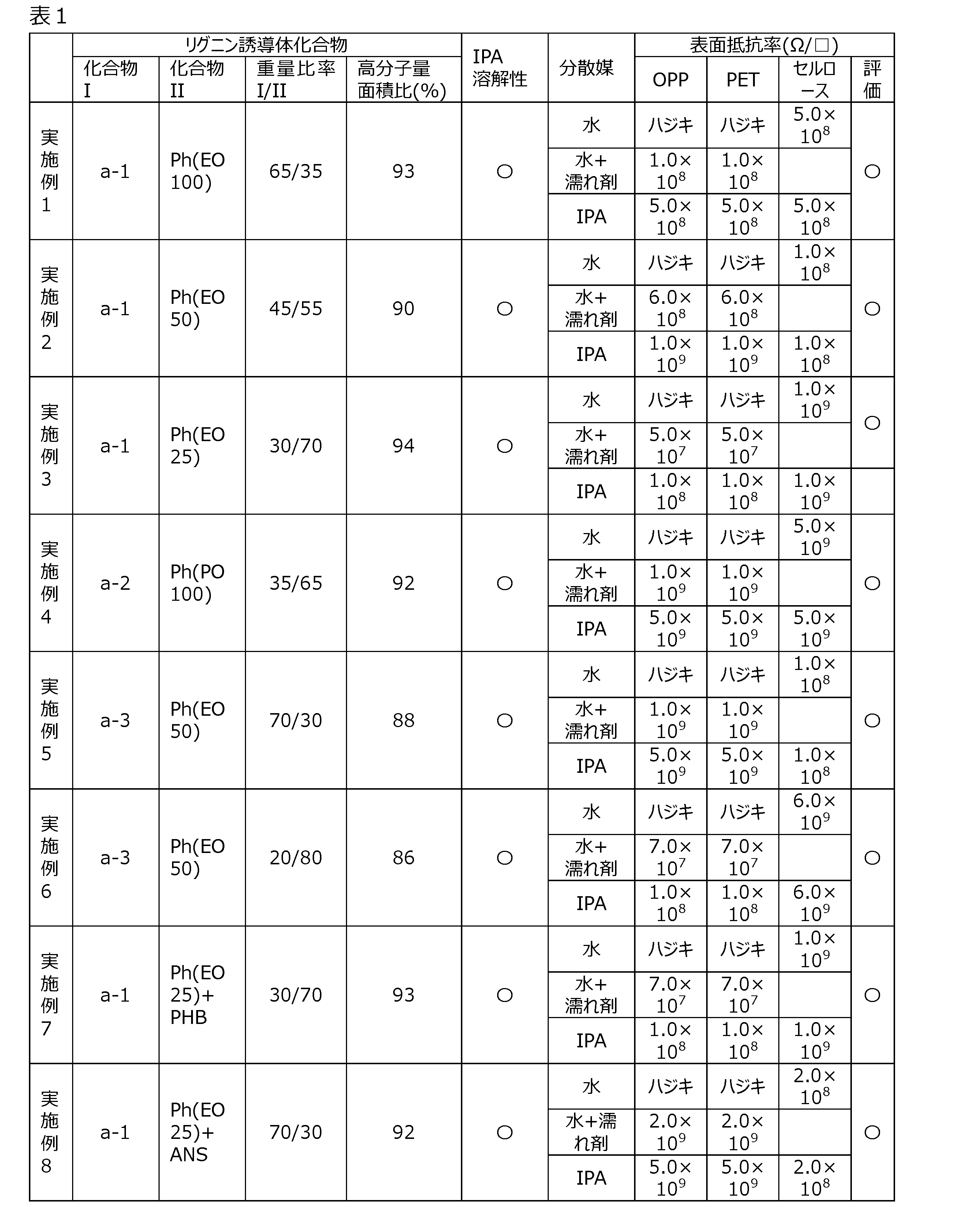
実施例で得られたリグニン誘導体化合物の水溶液を、40℃で十分に送風乾燥し、得られた固形物10gと、IPA90gを混合し、50℃で1時間以上加温攪拌して、リグニン誘導体化合物のIPA分散体(固形分10%)を得た。比較例で得られたリグニン誘導体化合物又は混合物の水溶液に関しても同様の処理を行ったところ、比較例2においてはIPA分散体が得られたが、比較例1および比較例3においては、リグニン成分が析出し、IPA分散体が得られなかった(表1)。
セルロースパウダー(日本製紙製KCフロックW-100GK)約5gを、平板プレス機にて5MPaの圧力にて1分間圧延し、厚さ0.5mmのセルロース基材とした。
共重合体の水溶液(固形分10%)、およびIPA溶液(固形分10%)を、マイヤーバーにて膜厚10μmとなるよう基材上に塗工した。用いた基材は以下のとおり。
・OPP:フタムラ化学製、膜厚60μm、寸法30cm×10cm、コロナ未処理面
・PET:東レ製ルミラー(登録商標)75T60、膜厚75μm、寸法30cm×10cm
・セルロース:上述の製法により得られたセルロースパウダーの圧延基材
高抵抗率計「ハイレスタ-UP」(日東電工製)を用いて、JIS K 6911に準じて測定を行った。上述の方法で作製した10cm×10cmの試験片を、温度25℃、湿度50%の条件下にて、測定テーブルとしてレジテーブルUFL(三菱化学製)のテフロン(登録商標)面上へ静置し、プローブとしてURSプローブ(三菱化学製)を用い、試験片の中央部へプローブを軽く押し当てて10秒後の測定値を記録した。上記の測定を、同サンプルにつき、測定点が重ならないように計5回行い、平均値を表面抵抗率(Ω/sq.)とし、表面抵抗率を評価した(表1)。
-略号の定義-
Ph(EO25):ポリ(エチレンオキサイド)モノフェニルエーテル(エチレンオキサイドの平均付加モル数25)
Ph(EO50):ポリ(エチレンオキサイド)モノフェニルエーテル(エチレンオキサイドの平均付加モル数50)
Ph(EO100):ポリ(エチレンオキサイド)モノフェニルエーテル(エチレンオキサイドの平均付加モル数100)
Ph(PO100):ポリ(プロピレンオキサイド)モノフェニルエーテル(プロピレンオキサイドの平均付加モル数100)
PHB:p-ヒドロキシ安息香酸
ANS:アニリンスルホン酸
-IPA溶解性の評価基準-
〇:上記IPA分散体の作製試験において、リグニン成分の析出のないIPA分散体(固形分10%)が得られた
×:上記IPA分散体の作製試験において、リグニン成分が析出し、IPA分散体が得られなかった
-帯電防止性の評価基準-
〇:水(セルロース基材の場合)又は水+濡れ剤(OPP、PET基材の場合)と、IPA溶液との両方において、全基材上での表面抵抗率が1.0×10¹⁰以下
×:水(セルロース基材の場合)又は水+濡れ剤(OPP、PET基材の場合)、もしくはIPA溶液において、表面抵抗率が1.0×10¹⁰超
〔混練基材の作製〕
ポリプロピレン系樹脂ペレットとしてウィンテック(登録商標)WSX-03(日本ポリプロ製プロピレン-エチレン共重合体)と、セルロースパウダーとしてKCフロックW-100GK(日本製紙製)と、添加剤とを、固形分換算で計40gとなるように、ラボプラストミル(登録商標)(4M150;東洋精機製)にて、温度180℃、回転数150rpmにて5分間混練し、混練基材を得た。
・実施例及び比較例で作製したサンプル溶液
・相溶化剤用樹脂(ユーメックス1010、三洋化成製)
・帯電防止用樹脂(ペレスタット300、三洋化成製)
添加剤が水分を含む場合、混練途中で完全に蒸発して系外へ放出された。
得られた試験片を顕微鏡観察し、長さ2.5mm以上、かつアスペクト比100以上の物体を未混練のセルロース繊維とした。観察条件は以下のとおりとした。
・視野8mm四方、倍率35倍、分解能5.2μmにて観察。
・試験片上の異なる部位を計5回観測し、観測された未混練のセルロース繊維を計測した。
・「〇」 計5回の観測で、未混練のセルロース繊維の数が0である。
・「△」 観測のうち1~3回において、未混練のセルロース繊維が1本以上3本以下観測される。
・「×」 観測のうち1~3回において、未混練のセルロース繊維が3本以上観測される、もしくは、観測のうち3回以上において、未混練のセルロース繊維が1本以上観測される。
高抵抗率計「ハイレスタ-UP」(三菱化学製)を用いて、JIS K 6911に準じて測定を行った。混練基材より作製した試験片を、温度25℃、湿度50%の条件下にて、測定テーブルとしてレジテーブルUFL(三菱化学製)のテフロン(登録商標)面上へ静置し、プローブとしてURSプローブ(三菱化学製)を用い、試験片の中央部へプローブを軽く押し当てて10秒後の測定値を記録した。上記の測定を、同サンプルにつき、測定点が重ならないように計5回行い、平均値を表面抵抗率(Ω/sq.)とした。
セルロース分散性の評価、および表面抵抗率の測定結果を併せて、以下の基準より総合評価とした。
・「〇」 セルロース分散性の評価が「〇」、かつ表面抵抗率の測定値が5.0×10¹²以下。
・「△」 セルロース分散性の評価が「△」、かつ表面抵抗率の測定値が5.0×10¹²以下、もしくはセルロース分散性の評価が「〇」であるが、表面抵抗率の測定値が5.0×10¹²~2.0×10¹³の範囲。
・「×」 セルロース分散性の評価が「×」、及び/又は表面抵抗率の測定値が2.0×1013を超える。
Claims (13)
- 下記構成単位(I)および(II)を含むリグニン誘導体化合物を含む、帯電防止剤。
(I):リグニンスルホン酸系化合物に由来する構成単位
(II):アルキレンオキサイド鎖を有する芳香族系水溶性化合物を少なくとも含む芳香族系水溶性化合物に由来する構成単位 - アルキレンオキサイド鎖を有する芳香族系水溶性化合物は、アルキレンオキサイド平均付加モル数25以上のアルキレンオキサイド鎖を有する芳香族系水溶性化合物を含む、請求項1に記載の帯電防止剤。
- 構成単位(I)の構成単位(II)に対する重量比率(I)/(II)が、1/99~99/1である、請求項2に記載の帯電防止剤。
- 芳香族系水溶性化合物は、カルボキシル基を有する芳香族系化合物及び/又は、スルホ基を有する芳香族系化合物をさらに含む、請求項1~3のいずれか1項に記載の帯電防止剤。
- 下記式で表されるリグニン誘導体化合物は高分子成分のピーク面積比が80%以上である、請求項1~4のいずれか1項に記載の帯電防止剤。
高分子量成分のピーク面積比=(GPCチャート(280nm)における高分子量成分の面積値)/(GPCチャート(280nm)における全成分の面積値) - 樹脂用である、請求項1~5のいずれか1項に記載の帯電防止剤。
- 樹脂練り込み用又は表面処理用である、請求項6に記載の帯電防止剤。
- 請求項1~7のいずれか1項に記載の帯電防止剤、及び樹脂基材を含む、樹脂組成物。
- 樹脂基材100重量%に対する帯電防止剤の含有量が、1.5重量%以上である、請求項8に記載の樹脂組成物。
- 樹脂基材は、セルロース系材料をさらに含む、請求項8又は9に記載の樹脂組成物。
- 請求項8~10のいずれか1項に記載の樹脂組成物の成形品。
- 請求項1~7のいずれか1項に記載の帯電防止剤を基材へ練り込む、もしくは基材表面に塗布することを含む、基材の処理方法。
- 基材が、セルロース系材料及び/又は樹脂材料を含む基材である、請求項12に記載の方法。
Priority Applications (2)
| Application Number | Priority Date | Filing Date | Title |
|---|---|---|---|
| CN202480040555.0A CN121358820A (zh) | 2023-06-26 | 2024-06-17 | 抗静电剂 |
| EP24831738.0A EP4733369A1 (en) | 2023-06-26 | 2024-06-17 | Anti-static agent |
Applications Claiming Priority (4)
| Application Number | Priority Date | Filing Date | Title |
|---|---|---|---|
| JP2023-104416 | 2023-06-26 | ||
| JP2023-104414 | 2023-06-26 | ||
| JP2023104416A JP2025004615A (ja) | 2023-06-26 | 2023-06-26 | 帯電防止剤 |
| JP2023104414A JP2025004613A (ja) | 2023-06-26 | 2023-06-26 | 帯電防止剤 |
Publications (1)
| Publication Number | Publication Date |
|---|---|
| WO2025004875A1 true WO2025004875A1 (ja) | 2025-01-02 |
Family
ID=93938954
Family Applications (1)
| Application Number | Title | Priority Date | Filing Date |
|---|---|---|---|
| PCT/JP2024/021834 Ceased WO2025004875A1 (ja) | 2023-06-26 | 2024-06-17 | 帯電防止剤 |
Country Status (4)
| Country | Link |
|---|---|
| EP (1) | EP4733369A1 (ja) |
| CN (1) | CN121358820A (ja) |
| TW (1) | TW202506954A (ja) |
| WO (1) | WO2025004875A1 (ja) |
Citations (9)
| Publication number | Priority date | Publication date | Assignee | Title |
|---|---|---|---|---|
| JP2011016741A (ja) * | 2009-07-07 | 2011-01-27 | Nissan Chem Ind Ltd | 保存安定性の改善される水性懸濁状農薬組成物 |
| CN106752105A (zh) * | 2016-12-16 | 2017-05-31 | 安徽北马科技有限公司 | 一种二氧化钛包覆的双马来聚酰亚胺改性的碳酸钙填料 |
| WO2018056124A1 (ja) | 2016-09-23 | 2018-03-29 | 日本製紙株式会社 | セメント組成物用添加剤及びセメント組成物 |
| JP2018123306A (ja) | 2017-01-30 | 2018-08-09 | 三洋化成工業株式会社 | 帯電防止剤 |
| JP2018178042A (ja) | 2017-04-20 | 2018-11-15 | 松本油脂製薬株式会社 | 熱可塑性樹脂用帯電防止剤及びその利用 |
| WO2019039609A1 (ja) * | 2017-08-24 | 2019-02-28 | 日本製紙株式会社 | リグニン誘導体化合物及びその用途 |
| JP2020122040A (ja) | 2019-01-29 | 2020-08-13 | 高松油脂株式会社 | 帯電防止剤組成物、帯電防止剤、及び表面処理方法 |
| WO2020202593A1 (ja) | 2019-04-03 | 2020-10-08 | 株式会社ワンアンドオンリー | 帯電防止剤・帯電防止方法・帯電防止用塗膜および帯電防止層形成用樹脂組成物・帯電防止方法 |
| WO2021066166A1 (ja) * | 2019-10-03 | 2021-04-08 | 日本製紙株式会社 | リグニン誘導体及びその用途 |
-
2024
- 2024-06-17 WO PCT/JP2024/021834 patent/WO2025004875A1/ja not_active Ceased
- 2024-06-17 EP EP24831738.0A patent/EP4733369A1/en active Pending
- 2024-06-17 CN CN202480040555.0A patent/CN121358820A/zh active Pending
- 2024-06-24 TW TW113123325A patent/TW202506954A/zh unknown
Patent Citations (9)
| Publication number | Priority date | Publication date | Assignee | Title |
|---|---|---|---|---|
| JP2011016741A (ja) * | 2009-07-07 | 2011-01-27 | Nissan Chem Ind Ltd | 保存安定性の改善される水性懸濁状農薬組成物 |
| WO2018056124A1 (ja) | 2016-09-23 | 2018-03-29 | 日本製紙株式会社 | セメント組成物用添加剤及びセメント組成物 |
| CN106752105A (zh) * | 2016-12-16 | 2017-05-31 | 安徽北马科技有限公司 | 一种二氧化钛包覆的双马来聚酰亚胺改性的碳酸钙填料 |
| JP2018123306A (ja) | 2017-01-30 | 2018-08-09 | 三洋化成工業株式会社 | 帯電防止剤 |
| JP2018178042A (ja) | 2017-04-20 | 2018-11-15 | 松本油脂製薬株式会社 | 熱可塑性樹脂用帯電防止剤及びその利用 |
| WO2019039609A1 (ja) * | 2017-08-24 | 2019-02-28 | 日本製紙株式会社 | リグニン誘導体化合物及びその用途 |
| JP2020122040A (ja) | 2019-01-29 | 2020-08-13 | 高松油脂株式会社 | 帯電防止剤組成物、帯電防止剤、及び表面処理方法 |
| WO2020202593A1 (ja) | 2019-04-03 | 2020-10-08 | 株式会社ワンアンドオンリー | 帯電防止剤・帯電防止方法・帯電防止用塗膜および帯電防止層形成用樹脂組成物・帯電防止方法 |
| WO2021066166A1 (ja) * | 2019-10-03 | 2021-04-08 | 日本製紙株式会社 | リグニン誘導体及びその用途 |
Also Published As
| Publication number | Publication date |
|---|---|
| TW202506954A (zh) | 2025-02-16 |
| CN121358820A (zh) | 2026-01-16 |
| EP4733369A1 (en) | 2026-04-29 |
Similar Documents
| Publication | Publication Date | Title |
|---|---|---|
| KR101650352B1 (ko) | 섬유 강화 수지 복합체, 및 섬유 강화 수지용의 강화 매트릭스 수지 | |
| CN105992688B (zh) | 三维造型用可溶性材料 | |
| Noorunnisa Khanam et al. | Tensile, flexural and chemical resistance properties of sisal fibre reinforced polymer composites: effect of fibre surface treatment | |
| JP5843463B2 (ja) | 繊維状物 | |
| KR20010021563A (ko) | 열경화성 수성 조성물 | |
| EP2014829A1 (en) | A method for coating a paper product | |
| CN114086421B (zh) | 一种无氟防水防油剂及其制备方法和应用 | |
| US4022942A (en) | Process of preparing fibrous sheet from high-ortho phenolic resole resin varnish | |
| CN113563577A (zh) | 一种酚酞啉改性聚芳醚酮水性上浆剂及其制备方法和应用 | |
| US20160215143A1 (en) | Resin composition, molded body, and production method | |
| Bao et al. | Bamboo fibers@ poly (ethylene glycol)‐reinforced poly (butylene succinate) biocomposites | |
| US3940352A (en) | Process for preparation of lignin resin | |
| JP2025004613A (ja) | 帯電防止剤 | |
| US20180237545A1 (en) | Cellulose fiber and method for producing cellulose fiber | |
| JP2025004615A (ja) | 帯電防止剤 | |
| TW202506954A (zh) | 抗靜電劑 | |
| CN121450121A (zh) | 一种高疏水性竹粉、改性方法及复合材料 | |
| KR101577911B1 (ko) | 폴리아세트산비닐 필름의 불균일계 비누화에 의한 폴리비닐알코올 필름의 제조방법 | |
| CN113939560B (zh) | 含有纤维素纳米晶的树脂组合物 | |
| US20060258248A1 (en) | Fiberglass binder comprising epoxidized oil and multifunctional carboxylic acids or anhydrides | |
| JP4117745B2 (ja) | アルデヒド吸収フィルム | |
| CN117157351B (zh) | 含纤维素纳米纤维和木质素或它们的复合体的组合物、及源自木质纤维素的材料的制法 | |
| KR101965599B1 (ko) | 폴리아세트산비닐/폴리메틸메타크릴레이트 블렌드 필름의 불균일계 비누화에 의해 제조된 폴리비닐알코올/폴리메틸메타크릴레이트 블렌드 필름 및 그의 제조방법 | |
| US4495329A (en) | Phenolic resin compounds | |
| US2542484A (en) | Alkali resistant phenolic molding powders and laminate |
Legal Events
| Date | Code | Title | Description |
|---|---|---|---|
| 121 | Ep: the epo has been informed by wipo that ep was designated in this application |
Ref document number: 24831738 Country of ref document: EP Kind code of ref document: A1 |
|
| ENP | Entry into the national phase |
Ref document number: 2024831738 Country of ref document: EP Effective date: 20260126 |
|
| WWE | Wipo information: entry into national phase |
Ref document number: 2024831738 Country of ref document: EP |
|
| NENP | Non-entry into the national phase |
Ref country code: DE |
|
| ENP | Entry into the national phase |
Ref document number: 2024831738 Country of ref document: EP Effective date: 20260126 |
|
| ENP | Entry into the national phase |
Ref document number: 2024831738 Country of ref document: EP Effective date: 20260126 |
|
| WWP | Wipo information: published in national office |
Ref document number: 2024831738 Country of ref document: EP |