WO2025004871A1 - 香料組成物 - Google Patents
香料組成物 Download PDFInfo
- Publication number
- WO2025004871A1 WO2025004871A1 PCT/JP2024/021791 JP2024021791W WO2025004871A1 WO 2025004871 A1 WO2025004871 A1 WO 2025004871A1 JP 2024021791 W JP2024021791 W JP 2024021791W WO 2025004871 A1 WO2025004871 A1 WO 2025004871A1
- Authority
- WO
- WIPO (PCT)
- Prior art keywords
- propanenitrile
- fragrance
- group
- alkylphenyl
- formula
- Prior art date
- Legal status (The legal status is an assumption and is not a legal conclusion. Google has not performed a legal analysis and makes no representation as to the accuracy of the status listed.)
- Ceased
Links
Classifications
-
- A—HUMAN NECESSITIES
- A61—MEDICAL OR VETERINARY SCIENCE; HYGIENE
- A61K—PREPARATIONS FOR MEDICAL, DENTAL OR TOILETRY PURPOSES
- A61K8/00—Cosmetics or similar toiletry preparations
- A61K8/18—Cosmetics or similar toiletry preparations characterised by the composition
- A61K8/30—Cosmetics or similar toiletry preparations characterised by the composition containing organic compounds
- A61K8/40—Cosmetics or similar toiletry preparations characterised by the composition containing organic compounds containing nitrogen
-
- A—HUMAN NECESSITIES
- A61—MEDICAL OR VETERINARY SCIENCE; HYGIENE
- A61Q—SPECIFIC USE OF COSMETICS OR SIMILAR TOILETRY PREPARATIONS
- A61Q13/00—Formulations or additives for perfume preparations
-
- C—CHEMISTRY; METALLURGY
- C07—ORGANIC CHEMISTRY
- C07C—ACYCLIC OR CARBOCYCLIC COMPOUNDS
- C07C253/00—Preparation of carboxylic acid nitriles
- C07C253/30—Preparation of carboxylic acid nitriles by reactions not involving the formation of cyano groups
-
- C—CHEMISTRY; METALLURGY
- C07—ORGANIC CHEMISTRY
- C07C—ACYCLIC OR CARBOCYCLIC COMPOUNDS
- C07C255/00—Carboxylic acid nitriles
- C07C255/01—Carboxylic acid nitriles having cyano groups bound to acyclic carbon atoms
- C07C255/06—Carboxylic acid nitriles having cyano groups bound to acyclic carbon atoms of an acyclic and unsaturated carbon skeleton
- C07C255/07—Mononitriles
-
- C—CHEMISTRY; METALLURGY
- C11—ANIMAL OR VEGETABLE OILS, FATS, FATTY SUBSTANCES OR WAXES; FATTY ACIDS THEREFROM; DETERGENTS; CANDLES
- C11B—PRODUCING, e.g. BY PRESSING RAW MATERIALS OR BY EXTRACTION FROM WASTE MATERIALS, REFINING OR PRESERVING FATS, FATTY SUBSTANCES, e.g. LANOLIN, FATTY OILS OR WAXES; ESSENTIAL OILS; PERFUMES
- C11B9/00—Essential oils; Perfumes
Definitions
- Nitrile compounds having a phenyl group are known as fragrance ingredients, such as peonyl (2-cyclohexylidene-2-phenylacetonitrile) having a grapefruit, geranium, or rose floral scent, and cinnamyl nitrile having a cinnamon or cassia scent (Non-Patent Document 1). It is known that some nitriles corresponding to aldehydes used as perfumes have similar fragrance notes. Non-Patent Document 2 describes a method for deriving aldehydes used as fragrances into the corresponding nitriles, and that the derived nitriles are useful as fragrance ingredients.
- an object of the present invention is to provide a fragrance composition having a novel fragrance and properties, use of a compound capable of imparting novel fragrance and properties to a fragrance composition, and a method for imparting fragrance.
- a fragrance composition containing a specific nitrile compound as an active ingredient has novel fragrances and properties, that the nitrile compound can be used as a fragrance, and that the nitrile compound can impart a fragrance that is useful as a fragrance, and thus completed the present invention.
- fragrance composition according to the above [2], wherein the fragrance substance other than the 3-(4-alkylphenyl)propanenitrile represented by the formula (1) is at least one selected from the group consisting of hydrocarbons, alcohols, esters, phenols, aldehydes, ketones, acetals, ketals, ethers, natural essential oils, natural extracts, and nitriles other than the 3-(4-alkylphenyl)propanenitrile represented by the formula (1).
- R represents an alkyl group having 2 to 4 carbon atoms.
- a method for producing 3-(4-alkylphenyl)propanenitrile comprising the steps of: a step of converting a 4-alkylbenzaldehyde represented by the following formula (3) into cinnamonitrile represented by the following formula (4) through a condensation reaction with acetonitrile; and a hydrogenation step, in this order.
- a nitrile composition comprising a 3-(4-alkylphenyl)propanenitrile represented by the following general formula (1) and a 3-(2-alkylphenyl)propanenitrile represented by the following general formula (2), the nitrile composition containing 0.03 to 0.8 mass% of the 3-(2-alkylphenyl)propanenitrile represented by the following general formula (2) relative to the 3-(4-alkylphenyl)propanenitrile represented by formula (1).
- R represents an alkyl group having 2 to 4 carbon atoms.
- R represents an alkyl group having 2 to 4 carbon atoms.
- 3-(4-alkylphenyl)propanenitrile which can impart a floral fragrance and a green or fruity fragrance, as an active ingredient, it is possible to provide a fragrance composition having a strong floral fragrance. Furthermore, it is possible to provide the use of 3-(4-alkylphenyl)propanenitrile, which has a floral fragrance and a green or fruity fragrance, as a fragrance, a fragrance imparting method, and a method for producing 3-(4-alkylphenyl)propanenitrile.
- XX-YY means "XX or more and YY or less.”
- the fragrance composition of the present invention is a fragrance composition containing 3-(4-alkylphenyl)propanenitrile represented by the following general formula (1) as an active ingredient.
- R represents an alkyl group having 2 to 4 carbon atoms.
- the fragrance composition of the present invention contains 3-(4-alkylphenyl)propanenitrile, which has a floral scent and a green or fruity scent, as an active ingredient, and therefore has a strong floral scent and excellent fragrance strength. Therefore, it is useful as a fragrance component for various products.
- R represents an alkyl group having 2 to 4 carbon atoms.
- R is preferably at least one selected from the group consisting of an ethyl group, an isopropyl group, a normal butyl group, an isobutyl group, and a tertiary butyl group, more preferably at least one selected from the group consisting of an isopropyl group, a normal butyl group, and an isobutyl group, and even more preferably a normal butyl group.
- R is at least one selected from the group consisting of an ethyl group, an isopropyl group, a normal butyl group, an isobutyl group, and a tertiary butyl group, it has a green or fruity scent in addition to a floral scent, and can impart a strong floral scent, making it extremely useful as an active ingredient of a fragrance composition.
- R is at least one selected from the group consisting of an isopropyl group and an isobutyl group, it has a green scent and a fruity scent in addition to a floral scent, and can impart a strong floral scent, making it very useful as an active ingredient of a fragrance composition.
- R When R is a normal butyl group, it has a fruity scent and a spicy scent in addition to a floral scent, and can impart a strong floral scent, making it very useful as an active ingredient of a fragrance composition. Furthermore, when R is a normal butyl group, it can further significantly improve the strength and diffusibility of the scent of the fragrance composition.
- the 3-(4-alkylphenyl)propanenitrile represented by the above formula (1) is useful as an active ingredient of a fragrance composition, has a floral odor, and a green or fruity odor, can impart a strong floral odor, and can further impart odor strength and diffusibility.
- R is an ethyl group, it has a green scent in addition to a floral scent, and imparts a strong floral scent.
- R is an isopropyl group, it has a particularly floral scent, as well as a green scent and a fruity scent, and imparts a strong floral scent.
- R is a normal butyl group, it has a particularly floral fragrance, as well as a fruity fragrance and a spicy fragrance, and imparts a strong floral fragrance.
- R is an isobutyl group
- R has a floral scent, as well as a green scent and a fruity scent, and imparts a strong floral scent.
- R is a tertiary butyl group
- it has a green scent in addition to a floral scent, and imparts a strong floral scent.
- the fragrance composition of the present invention preferably contains 3-(2-alkylphenyl)propanenitrile represented by the following general formula (2).
- the fragrance composition of the present invention more preferably contains 0.03 to 0.8% by mass of the 3-(2-alkylphenyl)propanenitrile represented by formula (2) relative to the 3-(4-alkylphenyl)propanenitrile represented by formula (1). It is believed that the inclusion of a small amount of 3-(2-alkylphenyl)propanenitrile represented by formula (2) results in a more complex and pleasant fragrance.
- R represents an alkyl group having 2 to 4 carbon atoms.
- R is an alkyl group having 2 to 4 carbon atoms, and is preferably the same as the 3-(4-alkylphenyl)propanenitrile represented by formula (1) contained in the fragrance composition.
- R is an alkyl group having 2 to 4 carbon atoms, and is preferably the same as the 3-(4-alkylphenyl)propanenitrile represented by formula (1) contained in the fragrance composition.
- 3-(4-n-butylphenyl)propanenitrile is contained as an active ingredient in the fragrance composition, it is preferable that 3-(2-n-butylphenyl)propanenitrile is also contained.
- the content of the 3-(4-alkylphenyl)propanenitrile in the fragrance composition of the present invention may be appropriately adjusted depending on the type of fragrance composition, the type of desired fragrance, the strength of the fragrance, etc., and is preferably 0.01 to 90% by mass, more preferably 0.1 to 50% by mass, even more preferably 0.5 to 30% by mass, even more preferably 1.0 to 20% by mass, and even more preferably 1.5 to 10% by mass.
- fragrance substances other than the 3-(4-alkylphenyl)propanenitrile contained in the fragrance composition containing the 3-(4-alkylphenyl)propanenitrile include fragrance substances other than the 3-(4-alkylphenyl)propanenitrile represented by formula (1), surfactants, solvents, antioxidants, and colorants, and at least one selected from the group consisting of fragrance substances other than the 3-(4-alkylphenyl)propanenitrile represented by formula (1), surfactants, solvents, antioxidants, and colorants is preferred, at least one selected from the group consisting of fragrance substances other than the 3-(4-alkylphenyl)propanenitrile represented by formula (1) and solvents is more preferred, and fragrance substances other than the 3-(4-alkylphenyl)propanenitrile represented by formula (1) are even more preferred.
- a preferred fragrance composition of the present invention contains the 3-(4-alkylphenyl)propanenitrile represented by formula (1) as an active ingredient and contains a fragrance substance other than the 3-(4-alkylphenyl)propanenitrile represented by formula (1).
- a fragrance substance other than the 3-(4-alkylphenyl)propanenitrile represented by formula (1) the fragrance can be adjusted to suit the target product. Also, by including a solvent, it becomes easy to dissolve and impregnate the target product, and the strength and persistence of the fragrance can be adjusted.
- fragrance substances other than the 3-(4-alkylphenyl)propanenitrile represented by formula (1) there are no particular limitations on the fragrance substances other than the 3-(4-alkylphenyl)propanenitrile represented by formula (1) as long as they are conventionally known fragrance components, and a wide range of fragrances can be used. For example, the following can be selected and used alone or in any mixture of two or more kinds in any ratio:
- the flavoring substance other than the 3-(4-alkylphenyl)propanenitrile represented by formula (1) is preferably at least one selected from the group consisting of hydrocarbons, alcohols, esters, phenols, aldehydes, ketones, acetals, ketals, ethers, natural essential oils, natural extracts, and nitriles other than the 3-(4-alkylphenyl)propanenitrile represented by formula (1).
- the fragrance substance is more preferably at least one selected from the group consisting of hydrocarbons, alcohols, esters, phenols, aldehydes, ketones, acetals, ketals, and ethers, still more preferably at least one selected from the group consisting of alcohols, esters, phenols, and aldehydes, still more preferably at least one selected from the group consisting of esters and aldehydes, and still more preferably esters.
- Hydrocarbons include limonene, ⁇ -pinene, ⁇ -pinene, terpinene, cedrene, longifolene, valencene, etc.
- Alcohols include linalool, citronellol, geraniol, nerol, terpineol, dihydromyrcenol, ethyl linalool, farnesol, nerolidol, cis-3-hexenol, cedrol, menthol, borneol, ⁇ -phenylethyl alcohol, benzyl alcohol, phenylhexanol, 2,2,6-trimethylcyclohexyl-3-hexanol, 1-(2-t-butylcyclohexyloxy)-2-butanol, 4-isopropyl cyclohexanol, methylcyclohexyloxy ...
- Examples include cyclohexanemethanol, 4-t-butylcyclohexanol, 4-methyl-2-(2-methylpropyl)tetrahydro-2H-pyran-4-ol, 2-methyl-4-(2,2,3-trimethyl-3-cyclopenten-1-yl)-2-buten-1-ol, 2-ethyl-4-(2,2,3-trimethyl-3-cyclopenten-1-yl)-2-buten-1-ol, isocamphylcyclohexanol, and 3,7-dimethyl-7-methoxyoctan-2-ol.
- Phenols include eugenol, thymol, vanillin, etc.
- Esters include linalyl formate, citronellyl formate, geranyl formate, n-hexyl acetate, cis-3-hexenyl acetate, linalyl acetate, citronellyl acetate, geranyl acetate, neryl acetate, terpinyl acetate, nopyr acetate, bornyl acetate, isobornyl acetate, o-t-butylcyclohexyl acetate, p-t-butylcyclohexyl acetate, tricyclodecenyl acetate, benzyl acetate, styraryl acetate, cinnamyl acetate, dimethylbenzylcarbinyl acetate, 3-pentyltetrahydropyran-4-yl acetate, citronellyl propionate, tricyclodecenyl propionate, pionate, allyl cycl
- Aldehydes include n-octanal, n-decanal, n-dodecanal, 2-methylundecanal, 10-undecenal, citronellal, citral, hydroxycitronellal, dimethyltetrahydrobenzaldehyde, 4-(4-hydroxy-4-methylpentyl)-3-cyclohexene-1-carbaldehyde, 2-cyclohexylpropanal, p-t-butyl- ⁇ -methylhydrocinnamic aldehyde, p-t-butylhydrocinnamic aldehyde, p-isopropyl- ⁇ -methylhydrocinnamic aldehyde, p-ethyl- ⁇ , ⁇ -dimethylhydrocinnamic aldehyde, ⁇ -amylcinnamic aldehyde, ⁇ -hexylcinnamic aldehyde, piperonal
- Ketones include methylheptenone, 4-methylene-3,5,6,6-tetramethyl-2-heptanone, amylcyclopentanone, 3-methyl-2-(cis-2-penten-1-yl)-2-cyclopenten-1-one, methylcyclopentenolone, rose ketone, ⁇ -methylionone, ⁇ -ionone, carvone, menthone, camphor, nootkatone, benzylacetone, anisylacetone, methyl ⁇ -naphthyl ketone, 2,5-dimethyl-4-hydroxy-3(2H)-furanone, maltol, 7-acetyl-1,2,3,4,5,6,7,8-octahydro-1,1,6,7-tetramethylnaphthalene, muscone, civetone, cyclopentadecanone, and cyclohexadecenone.
- Acetals and ketals include acetaldehyde ethyl phenylpropyl acetal, citral diethyl acetal, phenylacetaldehyde glycerin acetal, ethyl acetoacetate ethylene glycol ketal, etc.
- Ethers include anethole, ⁇ -naphthyl methyl ether, ⁇ -naphthyl ethyl ether, limonene oxide, rose oxide, 1,8-cineole, racemic or optically active dodecahydro-3a,6,6,9a-tetramethylnaphtho[2,1-b]furan, etc.
- Lactones include ⁇ -nonalactone, ⁇ -undecalactone, ⁇ -decalactone, ⁇ -jasmolactone, coumarin, cyclopentadecanolide, cyclohexadecanolide, ambrettolide, ethylene brassylate, 11-oxahexadecanolide, etc.
- Natural essential oils and extracts include orange, lemon, bergamot, mandarin, peppermint, spearmint, lavender, chamomile, rosemary, eucalyptus, sage, basil, rose, geranium, jasmine, ylang-ylang, anise, clove, ginger, nutmeg, cardamom, cedar, cypress, sandalwood, vetiver, patchouli, and labdanum.
- nitriles than the 3-(4-alkylphenyl)propanenitrile represented by formula (1) include citronellyl nitrile, etc.
- the solvent examples include dipropylene glycol, diethyl phthalate, ethylene glycol, propylene glycol, methyl myristate, and triethyl citrate.
- the surfactant may, for example, be polyoxyethylene lauryl sulfate ether.
- the fragrance composition containing the 3-(4-alkylphenyl)propanenitrile represented by the general formula (1) can be used as a fragrance component for various products.
- products in which the fragrance composition can be used include fragrance products such as perfumes and colognes; hair cosmetics such as shampoos, conditioners, hair tonics, hair creams, mousses, gels, pomades, sprays, and other hair cosmetics; skin cosmetics such as lotions, beauty essences, creams, milky lotions, packs, foundations, face powders, lipsticks, and various types of make-up; dishwashing detergents, laundry detergents, softeners, disinfectant detergents, deodorizing detergents, indoor air fresheners, furniture care, glass cleaners, furniture cleaners, floor cleaners, disinfectants, insecticides, bleaches, germicides, repellents, and other various health and hygiene detergents; quasi-drugs such as toothpaste, mouthwash, bath additives, antiperspirant products, and perm solution; miscellaneous goods such as toilet paper and tissue
- the blending amount of the fragrance composition in the above-mentioned product is not particularly limited, and the blending amount of the fragrance composition can be selected depending on the type, properties, and sensory effect of the product to be scented.
- the blending amount of the fragrance composition in the product is preferably 0.00001% by mass or more, more preferably 0.0001% by mass or more, and even more preferably 0.001% by mass or more. Also, it is preferably 80% by mass or less, more preferably 60% by mass or less, and even more preferably 40% by mass or less.
- the amount of the fragrance composition in the product may be 80% by mass or more, or may be 100% by mass.
- the nitrile composition of the present invention contains 3-(4-alkylphenyl)propanenitrile represented by the following general formula (1) and 3-(2-alkylphenyl)propanenitrile represented by the following general formula (2), and is a nitrile composition containing 0.03 to 0.8 mass % of the 3-(2-alkylphenyl)propanenitrile represented by the following general formula (2) relative to the 3-(4-alkylphenyl)propanenitrile represented by formula (1).
- R represents an alkyl group having 2 to 4 carbon atoms.
- formula (2) represents an alkyl group having 2 to 4 carbon atoms.
- the nitrile composition of the present invention contains 3-(4-alkylphenyl)propanenitrile, which has a floral fragrance and a green or fruity fragrance, as an active ingredient, and is considered to have a more complex and pleasant fragrance tone due to the inclusion of a small amount of 3-(2-alkylphenyl)propanenitrile represented by formula (2), and has a strong floral fragrance and excellent fragrance strength. Therefore, it is useful as a fragrance component for various products. It is also useful as a raw material for fragrance compositions.
- R represents an alkyl group having 2 to 4 carbon atoms.
- R is preferably at least one selected from the group consisting of an ethyl group, an isopropyl group, a normal butyl group, an isobutyl group, and a tertiary butyl group, more preferably at least one selected from the group consisting of an isopropyl group, a normal butyl group, and an isobutyl group, and even more preferably a normal butyl group.
- R is at least one selected from the group consisting of an ethyl group, an isopropyl group, a normal butyl group, an isobutyl group, and a tertiary butyl group, it has a green or fruity scent in addition to a floral scent, and can impart a strong floral scent, making it extremely useful as an active ingredient of a fragrance composition.
- R is at least one selected from the group consisting of an isopropyl group and an isobutyl group, it has a green scent and a fruity scent in addition to a floral scent, and can impart a strong floral scent, making it very useful as an active ingredient of a fragrance composition.
- R When R is a normal butyl group, it has a fruity scent and a spicy scent in addition to a floral scent, and can impart a strong floral scent, making it very useful as an active ingredient of a fragrance composition. Furthermore, when R is a normal butyl group, it can further significantly improve the strength and diffusibility of the scent of the fragrance composition.
- the 3-(4-alkylphenyl)propanenitrile represented by the above formula (1) is useful as an active ingredient of a fragrance composition, has a floral odor, and a green or fruity odor, can impart a strong floral odor, and can further impart odor strength and diffusibility.
- R is an ethyl group, it has a green scent in addition to a floral scent, and imparts a strong floral scent.
- R is an isopropyl group, it has a particularly floral scent, as well as a green scent and a fruity scent, and imparts a strong floral scent.
- R is a normal butyl group, it has a particularly floral fragrance, as well as a fruity fragrance and a spicy fragrance, and imparts a strong floral fragrance.
- R is an isobutyl group
- R has a floral scent, as well as a green scent and a fruity scent, and imparts a strong floral scent.
- R is a tertiary butyl group
- it has a green scent in addition to a floral scent, and imparts a strong floral scent.
- R represents an alkyl group having 2 to 4 carbon atoms.
- R in formula (2) is preferably the same as the 3-(4-alkylphenyl)propanenitrile contained in the nitrile composition, and is the same as R in formula (1).
- R is preferably at least one selected from the group consisting of an ethyl group, an isopropyl group, a normal butyl group, an isobutyl group, and a tertiary butyl group, more preferably at least one selected from the group consisting of an isopropyl group, a normal butyl group, and an isobutyl group, and even more preferably a normal butyl group.
- R is at least one selected from the group consisting of an ethyl group, an isopropyl group, a normal butyl group, an isobutyl group, and a tertiary butyl group, it has a green or fruity scent in addition to a floral scent, and can impart a strong floral scent, making it extremely useful as an active ingredient of a fragrance composition.
- R is at least one selected from the group consisting of an isopropyl group and an isobutyl group, it has a green scent and a fruity scent in addition to a floral scent, and can impart a strong floral scent, making it very useful as an active ingredient of a fragrance composition.
- R When R is a normal butyl group, it has a fruity scent and a spicy scent in addition to a floral scent, and can impart a strong floral scent, making it very useful as an active ingredient of a fragrance composition. Furthermore, when R is a normal butyl group, it can further significantly improve the strength and diffusibility of the scent of the fragrance composition.
- the nitrile compound of the present invention contains 3-(2-alkylphenyl)propanenitrile represented by formula (2) in an amount of preferably 0.03 to 0.8% by mass, more preferably 0.04 to 0.7% by mass, and even more preferably 0.2 to 0.7% by mass, relative to 3-(4-alkylphenyl)propanenitrile represented by formula (1).
- the content of the nitrile composition in the fragrance composition may be appropriately adjusted depending on the type of fragrance composition, the type of desired fragrance, the strength of the fragrance, etc., and is preferably 0.01 to 90% by mass, more preferably 0.1 to 50% by mass, even more preferably 0.5 to 30% by mass, even more preferably 1.0 to 20% by mass, and even more preferably 1.5 to 10% by mass.
- 3-(4-alkylphenyl)propanenitrile represented by the following general formula (1) has a floral scent and a green or fruity scent, and can be used as a fragrance.
- the use of 3-(4-alkylphenyl)propanenitrile represented by the following general formula (1) as a fragrance is also included in the present invention.
- R represents an alkyl group having 2 to 4 carbon atoms.
- R represents an alkyl group having 2 to 4 carbon atoms.
- R is preferably at least one selected from the group consisting of an ethyl group, an isopropyl group, a normal butyl group, an isobutyl group, and a tertiary butyl group, more preferably at least one selected from the group consisting of an isopropyl group, a normal butyl group, and an isobutyl group, and even more preferably a normal butyl group.
- R is at least one selected from the group consisting of an ethyl group, an isopropyl group, a normal butyl group, an isobutyl group, and a tertiary butyl group
- the compound has a green or fruity scent in addition to a floral scent, and can therefore be more suitably used as a fragrance.
- R is at least one selected from the group consisting of an isopropyl group and an isobutyl group
- the compound has a green scent and a fruity scent in addition to a floral scent, and can therefore be used more preferably as a fragrance.
- R is a normal butyl group
- the compound has a fruity scent and a spicy scent in addition to a floral scent, and can therefore be used even more preferably as a fragrance.
- R When R is an ethyl group, it has a green scent in addition to a floral scent. When R is an isopropyl group, it has a floral scent, as well as a green and fruity scent. When R is a normal butyl group, the compound has a floral fragrance as well as a fruity and spicy fragrance. When R is an isobutyl group, it has a floral scent as well as a green and fruity scent. When R is a tertiary butyl group, it has a green scent in addition to a floral scent.
- the 3-(4-alkylphenyl)propanenitrile represented by the above formula (1) has a floral fragrance, a green fragrance, or a fruity fragrance. Therefore, the use of the 3-(4-alkylphenyl)propanenitrile represented by the formula (1) imparts a floral fragrance, a green fragrance, or a fruity fragrance to a product. In addition, the strength and diffusibility of the fragrance contained in the product can be improved.
- R is an ethyl group, it imparts a green scent in addition to a floral scent.
- R is an isopropyl group, it imparts a floral scent, as well as a green and fruity scent.
- R When R is a normal butyl group, it imparts a fruity and spicy scent in addition to a floral scent, and further improves the strength and diffusibility of the scent contained in the product. When R is an isobutyl group, it imparts a floral scent as well as a green and fruity scent. When R is a tertiary butyl group, it imparts a green scent in addition to a floral scent.
- the 3-(4-alkylphenyl)propanenitrile represented by formula (1) can be used as a fragrance component of various products.
- the 3-(4-alkylphenyl)propanenitrile represented by formula (1) is used as a fragrance component of various products, it may be used as one component of the fragrance composition.
- Examples of products in which the 3-(4-alkylphenyl)propanenitrile represented by the formula (1) can be used include fragrance products such as perfumes and colognes; shampoos, rinses, hair tonics, hair creams, mousses, gels, pomades, sprays, and other hair cosmetics; skin cosmetics such as lotions, beauty essences, creams, milky lotions, packs, foundations, face powders, lipsticks, and various types of make-up; dishwashing detergents, laundry detergents, softeners, disinfectant detergents, deodorizing detergents, room fresheners, furniture care, glass cleaners, furniture cleaners, floor cleaners, disinfectants, insecticides, bleaches, germicides, repellents, and other various health and hygiene detergents; quasi-drugs such as toothpaste, mouthwash, bath additives, antiperspirant products, and perm solutions; miscellaneous goods such as toilet paper and tissue paper; medicines, and the like; and foods, and the like.
- fragrance products such as perfumes and cologne
- the amount of 3-(4-alkylphenyl)propanenitrile represented by formula (1) in the above product is not particularly limited, and can be selected depending on the type, properties, and sensory effects of the product to be scented.
- the amount of 3-(4-alkylphenyl)propanenitrile represented by formula (1) in the product is preferably 0.00001% by mass or more, more preferably 0.0001% by mass or more, and even more preferably 0.001% by mass or more. Also, it is preferably 80% by mass or less, more preferably 60% by mass or less, and even more preferably 40% by mass or less.
- the amount of the 3-(4-alkylphenyl)propanenitrile represented by the formula (1) in the product may be 80 mass% or more, or may be 100 mass%.
- the 3-(4-alkylphenyl)propanenitrile represented by the above general formula (1) has a floral fragrance and a green or fruity fragrance, and can impart a floral fragrance and, in addition, a green or fruity fragrance to various products.
- the present invention also includes a fragrance imparting method for imparting a floral fragrance and a green or fruity fragrance by using the 3-(4-alkylphenyl)propanenitrile represented by the following general formula (1).
- a method for imparting a floral odor and, in addition, a green odor or a fruity odor to a product when the product is solid, coating, spraying, immersion, etc. may be performed, and when the product is liquid, mixing may be performed.
- the 3-(4-alkylphenyl)propanenitrile represented by formula (1) may be used as one component of the fragrance composition to impart a floral odor and a green odor or a fruity odor to various products.
- R represents an alkyl group having 2 to 4 carbon atoms.
- R is preferably at least one selected from the group consisting of an ethyl group, an isopropyl group, a normal butyl group, an isobutyl group, and a tertiary butyl group, more preferably at least one selected from the group consisting of an isopropyl group, a normal butyl group, and an isobutyl group, and even more preferably a normal butyl group.
- R is at least one selected from the group consisting of an ethyl group, an isopropyl group, a normal butyl group, an isobutyl group, and a tertiary butyl group, it is possible to impart a green or fruity scent in addition to a floral scent.
- R is at least one selected from the group consisting of an isopropyl group and an isobutyl group, it is possible to impart a green scent and a fruity scent in addition to a floral scent.
- R is a normal butyl group, in addition to a floral scent, a fruity scent and a spicy scent can be imparted.
- the 3-(4-alkylphenyl)propanenitrile represented by the above formula (1) has a floral odor, a green odor or a fruity odor, and can impart a floral odor, a green odor or a fruity odor to various products.
- R is an ethyl group, it particularly imparts a green scent to the product in addition to a floral scent.
- R is an isopropyl group, it particularly imparts a floral, as well as a green and fruity, scent to the product.
- R is a normal butyl group, it imparts a fruity and spicy fragrance to the product in addition to a floral fragrance, and further improves the strength and diffusibility of the fragrance contained in the product.
- R is an isobutyl group
- R particularly imparts a floral, as well as a green and fruity, scent to the product.
- R particularly imparts a green scent to the product in addition to a floral scent.
- Products that can be imparted with a floral, green or fruity scent by the 3-(4-alkylphenyl)propanenitrile represented by formula (1) include, for example, fragrance products such as perfumes and colognes; shampoos, rinses, hair tonics, hair creams, mousses, gels, pomades, sprays and other hair cosmetics; skin cosmetics such as lotions, beauty essences, creams, milky lotions, packs, foundations, face powders, lipsticks and various types of make-up; dishwashing detergents, laundry detergents, softeners, disinfectant detergents, deodorizing detergents, room fresheners, furniture care, glass cleaners, furniture cleaners, floor cleaners, disinfectants, insecticides, bleaches, germicides, repellents and other various health and hygiene detergents; toothpaste, mouthwash, bath additives, antiperspirant products, perm solution and other quasi-drugs; miscellaneous goods such as toilet paper and tissue paper; medicines and the like; and foods and the like.
- fragrance products such
- the amount of 3-(4-alkylphenyl)propanenitrile represented by formula (1) in the above product is not particularly limited, and can be selected depending on the type, properties, and sensory effects of the product to be scented.
- the amount of 3-(4-alkylphenyl)propanenitrile represented by formula (1) in the product is preferably 0.00001% by mass or more, more preferably 0.0001% by mass or more, and even more preferably 0.001% by mass or more. Also, it is preferably 80% by mass or less, more preferably 60% by mass or less, and even more preferably 40% by mass or less.
- the amount of the 3-(4-alkylphenyl)propanenitrile represented by the formula (1) in the product may be 80 mass% or more, or may be 100 mass%.
- the method for producing 3-(4-alkylphenyl)propanenitrile of the present invention includes, in this order, a step of deriving cinnamonitrile represented by the following formula (4) by a condensation reaction with acetonitrile using 4-alkylbenzaldehyde represented by the following formula (3) as a raw material, and a hydrogenation step.
- R represents an alkyl group having 2 to 4 carbon atoms.
- the above-mentioned production method includes a condensation step of dehydrating and condensing 4-alkylbenzaldehyde and acetonitrile.
- R represents an alkyl group having 1 to 4 carbon atoms.
- the condensation reaction in this step is preferably carried out using a basic compound as a catalyst.
- the basic compound used as a catalyst include sodium hydroxide, potassium hydroxide, sodium bicarbonate, a mixture thereof, etc.
- the amount of the basic compound is preferably 0.05 equivalents or more, more preferably 0.1 equivalents or more, and even more preferably 0.2 equivalents or more, relative to 1 equivalent of the raw material dimethylbenzaldehyde, and is preferably 3 equivalents or less, more preferably 1 equivalent or less, and even more preferably 0.7 equivalents or less.
- the amount of acetonitrile added is preferably 1 equivalent or more, more preferably 2 equivalents or more, and preferably 10 equivalents or less, more preferably 7 equivalents or less, relative to 1 equivalent of the raw material 4-alkylbenzaldehyde.
- the 4-alkylbenzaldehyde is preferably added stepwise or continuously over a period of time, for example, by dropwise addition.
- the condensation reaction in this step can be carried out using acetonitrile as a solvent, but may also be carried out in the presence of other solvents.
- the solvent to be used is not particularly limited as long as it does not inhibit the condensation reaction, but examples include hydrocarbon solvents such as alcohols such as methanol, ethanol, isopropanol, etc.; aliphatic hydrocarbons such as pentane, hexane, isopentane, heptane, octane, isooctane, etc.; and aromatic hydrocarbons such as benzene, toluene, ethylbenzene, xylene, etc. These may be used alone or in combination of two or more.
- the reaction temperature in the condensation reaction of this step is not particularly limited, but from the viewpoint of reaction rate, it is preferably 0° C. or higher, more preferably 10° C. or higher, and from the viewpoint of suppressing side reactions, it is preferably 100° C. or lower, more preferably 70° C. or lower, and even more preferably 50° C. or lower.
- the reaction time is not particularly limited as long as the condensation is sufficiently carried out, but is preferably 10 minutes or more, more preferably 30 minutes or more, even more preferably 1 hour or more, and is preferably 24 hours or less, more preferably 12 hours or less, even more preferably 6 hours or less, and even more preferably 3 hours or less.
- the reaction can be stopped by neutralization, for example by adding an acid such as acetic acid.
- the method for isolating the intermediate represented by the formula (3) from the solution after the completion of the reaction is not particularly limited, and may be a suitable combination of separation, extraction, and distillation purification.
- the intermediate may be used in the subsequent hydrogenation step without being isolated.
- isolation for example, a method of adding a low polarity or non-polar organic solvent to the solution after completion of the reaction to transfer the intermediate to an oil phase, drying the obtained oil phase with, for example, magnesium sulfate, and then concentrating the filtrate obtained by filtration, and further purifying it by distillation, can be used to isolate the intermediate.
- the above-mentioned production method includes a hydrogenation step after the condensation step, and obtains the 3-(4-alkylphenyl)propanenitrile represented by the above-mentioned formula (1).
- the intermediate represented by formula (4) obtained in the condensation step is hydrogenated to obtain the desired product, 3-(4-alkylphenyl)propanenitrile represented by formula (1).
- the hydrogenation method is not particularly limited, but can be performed by a known method using a hydrogenation catalyst.
- the hydrogenation catalyst is not particularly limited, and known catalysts can be used.
- supported heterogeneous hydrogenation catalysts in which metals such as Ni, Pt, Pd, Ru, etc. are supported on carbon, silica, alumina, diatomaceous earth, etc.
- so-called Ziegler-type hydrogenation catalysts that use transition metal salts such as organic acid salts or acetylacetone salts of Ni, Co, Fe, Cr, etc. and reducing agents such as organoaluminum
- homogeneous hydrogenation catalysts such as so-called organometallic complexes of organometallic compounds such as Ti, Ru, Rh, Zr, etc. can be used.
- the temperature of the hydrogenation reaction in this step is, from the viewpoint of suppressing reactivity and side reactions, preferably 0° C. or higher, more preferably 10° C. or higher, even more preferably 20° C. or higher, and is preferably 150° C. or lower, even more preferably 100° C. or lower.
- the pressure of hydrogen used in the hydrogenation reaction is preferably 0.01 MPaG or more, more preferably 0.03 MPaG or more, even more preferably 0.05 MPaG or more, and preferably 10 MPaG or less, more preferably 3 MPaG or less, even more preferably 1 MPaG or less, and still more preferably 0.5 MPaG or less.
- the reaction time is not particularly limited, but is preferably 3 minutes or more, more preferably 10 minutes or more, and even more preferably 30 minutes or more, and is preferably 24 hours or less, more preferably 12 hours or less, and even more preferably 8 hours or less.
- the hydrogenation reaction may be carried out in the presence of a solvent.
- the solvent to be used is not particularly limited as long as it does not inhibit the hydrogenation reaction, but examples include hydrocarbon solvents such as alcohols such as methanol, ethanol, isopropanol, etc.; aliphatic hydrocarbons such as pentane, hexane, isopentane, heptane, octane, isooctane, etc.; and aromatic hydrocarbons such as benzene, toluene, ethylbenzene, xylene, etc. These may be used alone or in combination of two or more.
- the method for purifying the target 3-(4-alkylphenyl)propanenitrile represented by formula (1) from the solution after completion of the reaction is not particularly limited, and any known method may be appropriately selected and carried out. Specific examples include filtration, chromatography, distillation purification, etc., and the target 3-(4-alkylphenyl)propanenitrile with high purity can be obtained by purifying using an appropriate combination of these.
- composition in each step, the composition of the product, and the composition of the composition described below were determined using gas chromatography (GC-2010Plus, manufactured by Shimadzu Corporation).
- the capillary column used was HR-1701 (inner diameter 0.32 mm ⁇ , length 30 m) manufactured by Shinwa Kako Co., Ltd.
- the temperature increase program was to increase the temperature from 100° C. to 280° C. at a rate of 5° C./min, and hold the temperature for 30 minutes.
- fragrance and fragrance tone of the nitrile compounds and fragrance compositions obtained in the Examples were evaluated by impregnating them into a filter paper 8 mm wide and 15 cm long and having a specialized panel smell them.
- Example 1 [Production of 3-(4-alkylphenyl)propanenitrile]
- Example 1 (Production of 3-(4-ethylphenyl)propanenitrile) (Condensation step)
- acetonitrile manufactured by FUJIFILM Wako Pure Chemical Industries, Ltd., 150.5 g
- potassium hydroxide manufactured by FUJIFILM Wako Pure Chemical Industries, Ltd., 24.4 g
- the temperature was raised to 50°C while stirring, and then 4-ethylbenzaldehyde (manufactured by Mitsubishi Gas Chemical Co., Ltd., 100.0 g) was dropped over 2 hours.
- heptane was distilled off to obtain a crude product.
- the 3-(2-ethylphenyl)propanenitrile was contained in an amount of 0.04% by mass relative to the 3-(4-ethylphenyl)propanenitrile.
- Example 2 (Production of 3-(4-isopropylphenyl)propanenitrile) (Condensation step)
- a round-bottom flask with an internal volume of 500 mL equipped with a stirrer, a thermometer, and a dropping funnel was charged with acetonitrile (manufactured by FUJIFILM Wako Pure Chemical Industries, Ltd., 135.1 g) and potassium hydroxide (manufactured by FUJIFILM Wako Pure Chemical Industries, Ltd., 22.2 g), and the temperature was raised to 50°C while stirring, and then 4-isopropylbenzaldehyde (manufactured by Mitsubishi Gas Chemical Co., Ltd., 100.0 g) was dropped over 2 hours.
- Example 3 (Production of 3-(4-n-butylphenyl)propanenitrile) (Condensation step)
- a round-bottom flask with an internal volume of 500 mL equipped with a stirrer, a thermometer, and a dropping funnel was charged with acetonitrile (manufactured by FUJIFILM Wako Pure Chemical Industries, Ltd., 123.4 g) and potassium hydroxide (manufactured by FUJIFILM Wako Pure Chemical Industries, Ltd., 28.5 g), and the temperature was raised to 50°C while stirring, and then 4-n-butylbenzaldehyde (manufactured by Mitsubishi Gas Chemical Co., Ltd., 100.0 g) was dropped over 2 hours.
- Example 4 (Production of 3-(4-isobutylphenyl)propanenitrile) (Condensation step)
- a round-bottom flask with an internal volume of 500 mL equipped with a stirrer, a thermometer, and a dropping funnel was charged with acetonitrile (manufactured by FUJIFILM Wako Pure Chemical Industries, Ltd., 123.5 g) and potassium hydroxide (manufactured by FUJIFILM Wako Pure Chemical Industries, Ltd., 20.5 g), and the temperature was raised to 50° C. with stirring, and then 4-isobutylbenzaldehyde (manufactured by Mitsubishi Gas Chemical Co., Ltd., 100.0 g) was dropped over 2 hours.
- Example 5 (Production of 3-(4-tert-butylphenyl)propanenitrile) (Condensation step)
- Comparative Example 1 Production of 3-(4-methylphenyl)propanenitrile (Condensation step) A round-bottom flask with an internal volume of 500 mL equipped with a stirrer, a thermometer, and a dropping funnel was charged with acetonitrile (manufactured by FUJIFILM Wako Pure Chemical Industries, Ltd., 167.8 g) and potassium hydroxide (manufactured by FUJIFILM Wako Pure Chemical Industries, Ltd., 38.47 g), and the temperature was raised to 50°C while stirring, and then 4-methylbenzaldehyde (manufactured by Mitsubishi Gas Chemical Co., Ltd., 100.0 g) was dropped over 2 hours.
- acetonitrile manufactured by FUJIFILM Wako Pure Chemical Industries, Ltd., 167.8 g
- potassium hydroxide manufactured by FUJIFILM Wako Pure Chemical Industries, Ltd., 38.47 g
- the 3-(4-alkylphenyl)propanenitrile obtained in the Examples has a green or fruity odor in addition to a floral odor, and therefore can be suitably used as a fragrance. It is further understood that the 3-(4-alkylphenyl)propanenitrile obtained in the Examples can be suitably used in a fragrance method that imparts a green or fruity odor in addition to a floral odor.
- 3-(4-isopropylphenyl)propanenitrile and 3-(4-isobutylphenyl)propanenitrile obtained in Examples 2 and 4 have a green odor and a fruity odor in addition to a floral odor, and therefore can be more suitably used as a fragrance and more suitably used in a fragrance-imparting method.
- the 3-(4-n-butylphenyl)propanenitrile obtained in Example 3 has a fruity odor and a spicy odor in addition to a floral odor, it can be more suitably used as a fragrance and more suitably used in a fragrance application method.
- the 3-(4-methylphenyl)propanenitrile obtained in Comparative Example 1 had a green scent and a herbal scent, and the floral scent was weak.
- Example 6 (Apple-Cinnamon-like Fragrance Composition) To the fragrance composition base shown in Table 1, 3-(4-n-butylphenyl)propanenitrile obtained in Example 3 was added so as to give a concentration of 1.50 mass %, and the fragrance and fragrance tone were evaluated.
- Comparative Example 2 (Apple/Cinnamon-like Fragrance Composition) To the fragrance composition base shown in Table 1, CINNAMALVA ((E)-cinnamyl nitrile) was added so as to give a concentration of 1.50% by mass, and the fragrance and fragrance tone were evaluated.
- the fragrance composition of Example 6 had a stronger floral and fruity scent than the fragrance composition of Comparative Example 2, and was superior in fragrance strength and diffusibility.
- Example 7 (Herbal fragrance composition) To the fragrance composition base shown in Table 2, 3-(4-isopropylphenyl)propanenitrile obtained in Example 2 was added so as to give a concentration of 10.0 mass %, and the fragrance and fragrance tone were evaluated.
- Example 8 (Herbal fragrance composition) To the fragrance composition base shown in Table 2, 3-(4-isobutylphenyl)propanenitrile obtained in Example 4 was added so as to give a concentration of 10.0 mass %, and the fragrance and fragrance tone were evaluated.
- Comparative Example 3 (Herbal Flavor Composition) To the fragrance composition base shown in Table 2, 10.0% by mass of dipropylene glycol (DPG) as a solvent was added to make the total amount 18.0% by mass, and the fragrance and fragrance tone were evaluated.
- DPG dipropylene glycol
- the fragrance composition of Example 7 had a stronger floral scent in the middle notes and a stronger lilac-like floral feel than the fragrance composition of Comparative Example 3.
- the fragrance composition of Example 8 had a stronger floral scent in the middle notes and a stronger geranium-like floral feel than the fragrance composition of Comparative Example 3.
- Example 9 (Fragrance composition for fabric softener) To the fragrance composition base shown in Table 3, 3-(4-isopropylphenyl)propanenitrile obtained in Example 2 was added so as to give a concentration of 6.5% by mass, and the fragrance and fragrance tone were evaluated.
- the fragrance composition of Example 9 had a stronger floral body scent and a stronger lilac-like floral feel than the fragrance composition of Comparative Example 4.
- Example 10 (Fragrance composition for hand cream) To the fragrance composition base shown in Table 4, 3-(4-isobutylphenyl)propanenitrile obtained in Example 4 was added so as to give a concentration of 10.00 mass %, and the fragrance and fragrance tone were evaluated.
- Comparative Example 5 Frarance composition for hand cream
- DPG dipropylene glycol
- the fragrance composition of Example 10 Compared to the fragrance composition of Comparative Example 5, the fragrance composition of Example 10 had a stronger floral scent and a herbal-rosy geranium-like scent.
- Example 11 (Rose-like Fragrance Composition) To the fragrance composition base shown in Table 5, 3-(4-ethylphenyl)propanenitrile obtained in Example 1 was added so as to give a concentration of 7.5% by mass, and the fragrance and fragrance tone were evaluated.
- the fragrance composition of Example 11 had a stronger floral scent than the fragrance composition of Comparative Example 6, and the lingering scent also had a floral scent.
- the fragrance composition of the present invention has a strong floral odor.
- 3-(4-alkylphenyl)propanenitrile can impart a floral odor, a green odor, or a fruity odor to a fragrance composition, and can further impart odor strength and diffusibility, and is therefore useful as an active ingredient of a fragrance composition.
- a fragrance composition containing 3-(4-isobutylphenyl)propanenitrile or 3-(4-isopropylphenyl)propanenitrile is more preferred since it has a lilac-like or geranium-like floral scent.
- a fragrance composition containing 3-(4-n-butylphenyl)propanenitrile is more preferred since it has a floral and fruity scent and is also excellent in scent strength and diffusibility.
Landscapes
- Chemical & Material Sciences (AREA)
- Organic Chemistry (AREA)
- Life Sciences & Earth Sciences (AREA)
- Health & Medical Sciences (AREA)
- Public Health (AREA)
- Veterinary Medicine (AREA)
- General Health & Medical Sciences (AREA)
- Chemical Kinetics & Catalysis (AREA)
- Animal Behavior & Ethology (AREA)
- Engineering & Computer Science (AREA)
- Oil, Petroleum & Natural Gas (AREA)
- Wood Science & Technology (AREA)
- Birds (AREA)
- Epidemiology (AREA)
- Fats And Perfumes (AREA)
- Cosmetics (AREA)
- Organic Low-Molecular-Weight Compounds And Preparation Thereof (AREA)
Abstract
Description
香料として用いられているアルデヒド類に対応するいくつかのニトリル類は、類似する香調を有することが知られている。
非特許文献2には、香料として用いられているアルデヒド類から、対応するニトリル類へと誘導する方法および、誘導されたニトリル類は香料成分として有用であることが記載されている。
そこで、本発明の課題は、新規な香りと性質を有する香料組成物、及び香料組成物に新規な香りと性質を付与することができる化合物の使用、及び賦香方法を提供することである。
[1]下記一般式(1)で表される3-(4-アルキルフェニル)プロパンニトリルを有効成分として含有する香料組成物。
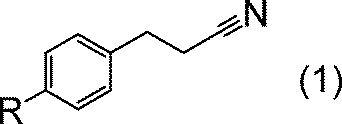
(式(1)中、Rは炭素数2~4のアルキル基を示す。)
[2]更に、式(1)で表される3-(4-アルキルフェニル)プロパンニトリル以外の香料物質を含有する、前記[1]に記載の香料組成物。
[3]式(1)で表される3-(4-アルキルフェニル)プロパンニトリル以外の香料物質が、炭化水素類、アルコール類、エステル類、フェノール類、アルデヒド類、ケトン類、アセタール類、ケタール類、エーテル類、天然精油、天然抽出物、及び式(1)で表される3-(4-アルキルフェニル)プロパンニトリル以外のニトリル類からなる群より選ばれる少なくとも1つである、前記[2]に記載の香料組成物。
[4]Rがエチル基、イソプロピル基、ノルマルブチル基、イソブチル基及びターシャリーブチル基からなる群より選ばれる少なくとも1つである、前記[1]~[3]のいずれか1つに記載の香料組成物。
[5]Rがイソプロピル基、ノルマルブチル基及びイソブチル基からなる群より選ばれる少なくとも1つである、前記[1]~[4]のいずれか1つに記載の香料組成物。
[6]Rがノルマルブチル基である、前記[1]~[5]のいずれか1つに記載の香料組成物。
[7]下記一般式(2)で表される3-(2-アルキルフェニル)プロパンニトリルを、式(1)で表される3-(4-アルキルフェニル)プロパンニトリルに対して0.03~0.8質量%含有する、前記[1]~[6]のいずれか1つに記載の香料組成物。

(式(2)中、Rは炭素数2~4のアルキル基を示す。)
[8]下記一般式(1)で表される3-(4-アルキルフェニル)プロパンニトリルの香料としての使用。
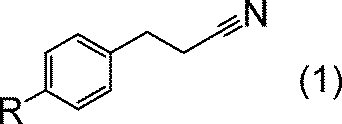
(式(1)中、Rは炭素数2~4のアルキル基を示す。)
[9]Rがエチル基、イソプロピル基、ノルマルブチル基、イソブチル基及びターシャリーブチル基からなる群より選ばれる少なくとも1つである、前記[8]に記載の使用。
[10]前記式(1)で表される3-(4-アルキルフェニル)プロパンニトリルがフローラル香と、グリーン香又はフルーティ香を付与する、前記[8]又は[9]に記載の使用。
[11]Rがイソプロピル基及びイソブチル基からなる群より選ばれる少なくとも1つである、前記[8]~[10]のいずれか1つに記載の使用。
[12]前記式(1)で表される3-(4-アルキルフェニル)プロパンニトリルがフローラル香、グリーン香及びフルーティ香を付与する、前記[11]に記載の使用。
[13]Rがノルマルブチル基である、前記[8]~[10]のいずれか1つに記載の使用。
[14]前記式(1)で表される3-(4-アルキルフェニル)プロパンニトリルがフローラル香、フルーティ香及びスパイシー香を付与する、前記[13]に記載の使用。
[15]下記一般式(1)で表される3-(4-アルキルフェニル)プロパンニトリルによってフローラル香と、グリーン香又はフルーティ香を付与する、賦香方法。
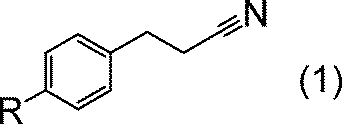
(式(1)中、Rは炭素数2~4のアルキル基を示す。)
[16]下記式(3)で表される4-アルキルベンズアルデヒドを原料として、アセトニトリルとの縮合反応による下記式(4)で表されるシンナモニトリルへと誘導する工程、及び水素添加工程をこの順で有する、3-(4-アルキルフェニル)プロパンニトリルの製造方法。

(式(3)及び式(4)中、Rは炭素数2~4のアルキル基を示す。)
[17]下記一般式(1)で表される3-(4-アルキルフェニル)プロパンニトリルと下記一般式(2)で表される3-(2-アルキルフェニル)プロパンニトリルを含有し、下記一般式(2)で表される3-(2-アルキルフェニル)プロパンニトリルを、式(1)で表される3-(4-アルキルフェニル)プロパンニトリルに対して0.03~0.8質量%含有するニトリル組成物。

(式(1)中、Rは炭素数2~4のアルキル基を示す。式(2)中、Rは炭素数2~4のアルキル基を示す。)
本発明の香料組成物は、下記一般式(1)で表される3-(4-アルキルフェニル)プロパンニトリルを有効成分として含有する香料組成物である。
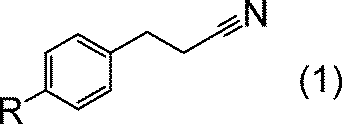
(式(1)中、Rは炭素数2~4のアルキル基を示す。)
式(1)中、Rは炭素数2~4のアルキル基を示す。具体的には、Rは、好ましくはエチル基、イソプロピル基、ノルマルブチル基、イソブチル基及びターシャリーブチル基からなる群より選ばれる少なくとも1つであり、より好ましくはイソプロピル基、ノルマルブチル基及びイソブチル基からなる群より選ばれる少なくとも1つであり、更に好ましくはノルマルブチル基である。
Rがエチル基、イソプロピル基、ノルマルブチル基、イソブチル基及びターシャリーブチル基からなる群より選ばれる少なくとも1つであると、フローラル香に加え、グリーン香又はフルーティ香を有し、強いフローラル香を付与することができるため、香料組成物の有効成分として非常に有用である。
Rがイソプロピル基及びイソブチル基からなる群より選ばれる少なくとも1つであると、フローラル香に加え、グリーン香及びフルーティ香を有し、強いフローラル香を付与することができるため、香料組成物の有効成分として非常に有用である。
Rがノルマルブチル基であると、フローラル香に加え、フルーティ香及びスパイシー香を有し、強いフローラル香を付与することができるため、香料組成物の有効成分として非常に有用である。また、Rがノルマルブチル基であると、更に香料組成物の香りの強さと拡散性を著しく向上させることができる。
Rがエチル基であるとき、特にフローラル香に加え、グリーン香を有し、強いフローラル香を付与する。
Rがイソプロピル基であるとき、特にフローラル香に加え、グリーン香及びフルーティ香を有し、強いフローラル香を付与する。
Rがノルマルブチル基であるとき、特にフローラル香に加え、フルーティ香及びスパイシー香を有し、強いフローラル香を付与する。更に香料組成物の香りの強さと拡散性を著しく向上させることができる。
Rがイソブチル基であるとき、特にフローラル香に加え、グリーン香及びフルーティ香を有し、強いフローラル香を付与する。
Rがターシャリーブチル基であるとき、特にフローラル香に加え、グリーン香を有し、強いフローラル香を付与する。
本発明の香料組成物は、式(2)で表される3-(2-アルキルフェニル)プロパンニトリルを、式(1)で表される3-(4-アルキルフェニル)プロパンニトリルに対して0.03~0.8質量%含有することがより好ましい。
式(2)で表される3-(2-アルキルフェニル)プロパンニトリルが、少量含まれることで、より複雑で良好な香調になると考えられる。

(式(2)中、Rは炭素数2~4のアルキル基を示す。)
前記3-(4-アルキルフェニル)プロパンニトリルを含有する香料組成物に含有される、前記3-(4-アルキルフェニル)プロパンニトリル以外のその他の成分としては、式(1)で表される3-(4-アルキルフェニル)プロパンニトリル以外の香料物質、界面活性剤、溶媒、酸化防止剤及び着色剤等が挙げられ、式(1)で表される3-(4-アルキルフェニル)プロパンニトリル以外の香料物質、界面活性剤、溶媒、酸化防止剤及び着色剤からなる群から選ばれる少なくとも1つが好ましく、式(1)で表される3-(4-アルキルフェニル)プロパンニトリル以外の香料物質、及び溶媒からなる群から選ばれる少なくとも1つがより好ましく、式(1)で表される3-(4-アルキルフェニル)プロパンニトリル以外の香料物質が更に好ましい。すなわち、本発明の好ましい香料組成物は、式(1)で表される3-(4-アルキルフェニル)プロパンニトリルを有効成分として含有し、式(1)で表される3-(4-アルキルフェニル)プロパンニトリル以外の香料物質を含有する。
式(1)で表される3-(4-アルキルフェニル)プロパンニトリル以外の香料物質を含有することで、目的の製品に合わせて香りを調整することができる。また、溶媒を含有することで、目的の製品に溶解、含浸させることが容易となり、香りの強さや香りの持続性を調整することができる。
これらのなかでも、前記香料物質としては、より好ましくは、炭化水素類、アルコール類、エステル類、フェノール類、アルデヒド類、ケトン類、アセタール類、ケタール類、エーテル類からなる群より選ばれる少なくとも1つであり、更に好ましくはアルコール類、エステル類、フェノール類、アルデヒド類からなる群より選ばれる少なくとも1つであり、より更に好ましくはエステル類、アルデヒド類からなる群より選ばれる少なくとも1つであり、より更に好ましくはエステル類である。前記3-(4-アルキルフェニル)プロパンニトリルと、これらの香料物質を組み合わせることにより、より強いフローラル香を発現できるため、好ましい。
界面活性剤としては、ポリオキシエチレンラウリル硫酸エーテル等が挙げられる。
香料組成物を使用することができる製品としては、例えば、香水、コロン類等のフレグランス製品;シャンプー、リンス類、ヘアートニック、ヘアークリーム類、ムース、ジェル、ポマード、スプレーその他毛髪用化粧料;化粧水、美容液、クリーム、乳液、パック、ファンデーション、おしろい、口紅、各種メークアップ類等の肌用化粧料;皿洗い洗剤、洗濯用洗剤、ソフトナー類、消毒用洗剤類、消臭洗剤類、室内芳香剤、ファニチャーケア、ガラスクリーナー、家具クリーナー、床クリーナー、消毒剤、殺虫剤、漂白剤、殺菌剤、忌避剤、その他の各種健康衛生用洗剤類;歯磨、マウスウォッシュ、入浴剤、制汗製品、パーマ液等の医薬部外品;トイレットペーパー、ティッシュペーパー等の雑貨;医薬品等;食品等が挙げられる。
なお、香料組成物をアロマオイル、香水等として用いる場合には、製品中の香料組成物の配合量は、80質量%以上であってもよく、100質量%であってもよい。
本発明のニトリル組成物は、下記一般式(1)で表される3-(4-アルキルフェニル)プロパンニトリルと下記一般式(2)で表される3-(2-アルキルフェニル)プロパンニトリルを含有し、下記一般式(2)で表される3-(2-アルキルフェニル)プロパンニトリルを、式(1)で表される3-(4-アルキルフェニル)プロパンニトリルに対して0.03~0.8質量%含有するニトリル組成物である。

(式(1)中、Rは炭素数2~4のアルキル基を示す。式(2)中、Rは炭素数2~4のアルキル基を示す。)
式(1)中、Rは炭素数2~4のアルキル基を示す。具体的には、Rは、好ましくはエチル基、イソプロピル基、ノルマルブチル基、イソブチル基及びターシャリーブチル基からなる群より選ばれる少なくとも1つであり、より好ましくはイソプロピル基、ノルマルブチル基及びイソブチル基からなる群より選ばれる少なくとも1つであり、更に好ましくはノルマルブチル基である。
Rがエチル基、イソプロピル基、ノルマルブチル基、イソブチル基及びターシャリーブチル基からなる群より選ばれる少なくとも1つであると、フローラル香に加え、グリーン香又はフルーティ香を有し、強いフローラル香を付与することができるため、香料組成物の有効成分として非常に有用である。
Rがイソプロピル基及びイソブチル基からなる群より選ばれる少なくとも1つであると、フローラル香に加え、グリーン香及びフルーティ香を有し、強いフローラル香を付与することができるため、香料組成物の有効成分として非常に有用である。
Rがノルマルブチル基であると、フローラル香に加え、フルーティ香及びスパイシー香を有し、強いフローラル香を付与することができるため、香料組成物の有効成分として非常に有用である。また、Rがノルマルブチル基であると、更に香料組成物の香りの強さと拡散性を著しく向上させることができる。
Rがエチル基であるとき、特にフローラル香に加え、グリーン香を有し、強いフローラル香を付与する。
Rがイソプロピル基であるとき、特にフローラル香に加え、グリーン香及びフルーティ香を有し、強いフローラル香を付与する。
Rがノルマルブチル基であるとき、特にフローラル香に加え、フルーティ香及びスパイシー香を有し、強いフローラル香を付与する。更に香料組成物の香りの強さと拡散性を著しく向上させることができる。
Rがイソブチル基であるとき、特にフローラル香に加え、グリーン香及びフルーティ香を有し、強いフローラル香を付与する。
Rがターシャリーブチル基であるとき、特にフローラル香に加え、グリーン香を有し、強いフローラル香を付与する。
式(2)中、Rは炭素数2~4のアルキル基を示し、3-(2-アルキルフェニル)プロパンニトリルが本発明のニトリル組成物に含まれる場合、式(2)中のRは、好ましくは、ニトリル組成物に含まれる3-(4-アルキルフェニル)プロパンニトリルと同じであり、式(1)中のRと同じである。
具体的には、Rは、好ましくはエチル基、イソプロピル基、ノルマルブチル基、イソブチル基及びターシャリーブチル基からなる群より選ばれる少なくとも1つであり、より好ましくはイソプロピル基、ノルマルブチル基及びイソブチル基からなる群より選ばれる少なくとも1つであり、更に好ましくはノルマルブチル基である。
Rがエチル基、イソプロピル基、ノルマルブチル基、イソブチル基及びターシャリーブチル基からなる群より選ばれる少なくとも1つであると、フローラル香に加え、グリーン香又はフルーティ香を有し、強いフローラル香を付与することができるため、香料組成物の有効成分として非常に有用である。
Rがイソプロピル基及びイソブチル基からなる群より選ばれる少なくとも1つであると、フローラル香に加え、グリーン香及びフルーティ香を有し、強いフローラル香を付与することができるため、香料組成物の有効成分として非常に有用である。
Rがノルマルブチル基であると、フローラル香に加え、フルーティ香及びスパイシー香を有し、強いフローラル香を付与することができるため、香料組成物の有効成分として非常に有用である。また、Rがノルマルブチル基であると、更に香料組成物の香りの強さと拡散性を著しく向上させることができる。
下記一般式(1)で表される3-(4-アルキルフェニル)プロパンニトリルは、フローラル香と、グリーン香又はフルーティ香を有することから、香料として使用することができる。下記一般式(1)で表される3-(4-アルキルフェニル)プロパンニトリルの香料としての使用も本発明に含まれる。
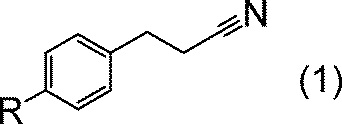
(式(1)中、Rは炭素数2~4のアルキル基を示す。)
Rがエチル基、イソプロピル基、ノルマルブチル基、イソブチル基及びターシャリーブチル基からなる群より選ばれる少なくとも1つであると、フローラル香に加え、グリーン香又はフルーティ香を有するため、香料としてより好適に使用することができる。
Rがイソプロピル基及びイソブチル基からなる群より選ばれる少なくとも1つであると、フローラル香に加え、グリーン香及びフルーティ香を有するため、香料として更に好適に使用することができる。
Rがノルマルブチル基であると、フローラル香に加え、フルーティ香及びスパイシー香を有するため、香料としてより更に好適に使用することができる。
Rがイソプロピル基であるとき、特にフローラル香に加え、グリーン香及びフルーティ香を有する。
Rがノルマルブチル基であるとき、特にフローラル香に加え、フルーティ香及びスパイシー香を有する。
Rがイソブチル基であるとき、特にフローラル香に加え、グリーン香及びフルーティ香を有する。
Rがターシャリーブチル基であるとき、特にフローラル香に加え、グリーン香を有する。
Rがエチル基であるとき、特にフローラル香に加え、グリーン香を付与する。
Rがイソプロピル基であるとき、特にフローラル香に加え、グリーン香及びフルーティ香を付与する。
Rがノルマルブチル基であるとき、特にフローラル香に加え、フルーティ香及びスパイシー香を付与する。更に製品に含まれる香りの強さと拡散性を著しく向上させることができる。
Rがイソブチル基であるとき、特にフローラル香に加え、グリーン香及びフルーティ香を付与する。
Rがターシャリーブチル基であるとき、特にフローラル香に加え、グリーン香を付与する。
式(1)で表される3-(4-アルキルフェニル)プロパンニトリルを使用することができる製品としては、例えば、香水、コロン類等のフレグランス製品;シャンプー、リンス類、ヘアートニック、ヘアークリーム類、ムース、ジェル、ポマード、スプレーその他毛髪用化粧料;化粧水、美容液、クリーム、乳液、パック、ファンデーション、おしろい、口紅、各種メークアップ類等の肌用化粧料;皿洗い洗剤、洗濯用洗剤、ソフトナー類、消毒用洗剤類、消臭洗剤類、室内芳香剤、ファニチャーケア、ガラスクリーナー、家具クリーナー、床クリーナー、消毒剤、殺虫剤、漂白剤、殺菌剤、忌避剤、その他の各種健康衛生用洗剤類;歯磨、マウスウォッシュ、入浴剤、制汗製品、パーマ液等の医薬部外品;トイレットペーパー、ティッシュペーパー等の雑貨;医薬品等;食品等が挙げられる。
なお、式(1)で表される3-(4-アルキルフェニル)プロパンニトリルをアロマオイル、香水等として用いる場合には、製品中の式(1)で表される3-(4-アルキルフェニル)プロパンニトリルの配合量は、80質量%以上であってもよく、100質量%であってもよい。
上記一般式(1)で表される3-(4-アルキルフェニル)プロパンニトリルは、フローラル香と、グリーン香又はフルーティ香を有することから、様々な製品にフローラル香と、それに加えてグリーン香又はフルーティ香を付与することができる。下記一般式(1)で表される3-(4-アルキルフェニル)プロパンニトリルによってフローラル香と、グリーン香又はフルーティ香を付与する、賦香方法も本発明に含まれる。
製品にフローラル香と、それに加えてグリーン香又はフルーティ香を付与する方法としては、製品が固体である場合、塗布、噴霧、浸漬等を行えばよく、製品が液体の場合、混合すればよい。なお、式(1)で表される3-(4-アルキルフェニル)プロパンニトリルによってフローラル香と、グリーン香又はフルーティ香を付与する場合、式(1)で表される3-(4-アルキルフェニル)プロパンニトリルを前記香料組成物の一成分として、様々な製品にフローラル香と、グリーン香又はフルーティ香を付与してもよい。
Rがエチル基、イソプロピル基、ノルマルブチル基、イソブチル基及びターシャリーブチル基からなる群より選ばれる少なくとも1つであると、フローラル香に加え、グリーン香又はフルーティ香を付与することができる。
Rがイソプロピル基及びイソブチル基からなる群より選ばれる少なくとも1つであると、フローラル香に加え、グリーン香及びフルーティ香を付与することができる。
Rがノルマルブチル基であると、フローラル香に加え、フルーティ香及びスパイシー香を付与することができる。
Rがエチル基であるとき、特に、製品にフローラル香に加え、グリーン香を付与する。
Rがイソプロピル基であるとき、特に、製品にフローラル香に加え、グリーン香及びフルーティ香を付与する。
Rがノルマルブチル基であるとき、特に、製品にフローラル香に加え、フルーティ香及びスパイシー香を付与する。更に製品に含まれる香りの強さと拡散性を著しく向上させることができる。
Rがイソブチル基であるとき、特に、製品にフローラル香に加え、グリーン香及びフルーティ香を付与する。
Rがターシャリーブチル基であるとき、特に、製品にフローラル香に加え、グリーン香を付与する。
なお、式(1)で表される3-(4-アルキルフェニル)プロパンニトリルをアロマオイル、香水等として用いる場合には、製品中の式(1)で表される3-(4-アルキルフェニル)プロパンニトリルの配合量は、80質量%以上であってもよく、100質量%であってもよい。
本発明の香料組成物に有効成分として含有される3-(4-アルキルフェニル)プロパンニトリルの製造方法には制限がないが、次に示す製造方法によって得ることが好ましい。なお、次に示す製造方法によって得られた3-(4-アルキルフェニル)プロパンニトリルは、前記のとおり、香料として使用することも好ましく、前記賦香方法に用いることも好ましい。また、次に示す製造方法も本発明に含まれる。

(式(3)及び式(4)中、Rは炭素数2~4のアルキル基を示す。)

(Rは炭素数1~4のアルキル基を示す。)
前記の製造方法は、4-アルキルベンズアルデヒドとアセトニトリルとを脱水縮合させる縮合工程を有する。

(Rは炭素数1~4のアルキル基を示す。)
触媒として使用する塩基性化合物としては、水酸化ナトリウム、水酸化カリウム、重炭酸ナトリウム、又はこれらの混合物などが例示される。塩基性化合物の量は、原料であるジメチルベンズアルデヒド1当量に対して、好ましくは0.05当量以上、より好ましくは0.1当量以上、更に好ましくは0.2当量以上であり、そして、好ましくは3当量以下、より好ましくは1当量以下、更に好ましくは0.7当量以下である。
また、反応時間は特に限定されず、縮合が十分に行われる時間であればよいが、好ましくは10分以上、より好ましくは30分以上、更に好ましくは1時間以上であり、そして、好ましくは24時間以下、より好ましくは12時間以下、更に好ましくは6時間以下、より更に好ましくは3時間以下である。
単離する場合の方法としては、例えば、反応終了後の溶液に低極性又は無極性の有機溶媒を添加し、油相に前記中間体を移相して、得られた油相を、例えば硫酸マグネシウムで乾燥した後、ろ過によって得られたろ液を濃縮し、更に、蒸留精製することで単離することができる。
前記の製造方法は、縮合工程の後に、水素添加工程を有し、前記式(1)で表される3-(4-アルキルフェニル)プロパンニトリルを得る。
水素添加反応に使用される水素の圧力は、好ましくは0.01MPaG以上、より好ましくは0.03MPaG以上、更に好ましくは0.05MPaG以上であり、そして、好ましくは10MPaG以下、より好ましくは3MPaG以下、更に好ましくは1MPaG以下、より更に好ましくは0.5MPaG以下である。
反応時間は、特に限定されないが、好ましくは3分以上、より好ましくは10分以上、更に好ましくは30分以上であり、そして、好ましくは24時間以下、より好ましくは12時間以下、更に好ましくは8時間以下である。
後述する各工程での組成、生成物の組成、及び組成物の組成は、ガスクロマトグラフィー(GC-2010Plus、株式会社島津製作所製)を用いて求めた。
なお、キャピラリーカラムとして、信和化工株式会社製のHR-1701(内径0.32mmφ、長さ30m)を用いた。昇温プログラムは、100℃から5℃/分の割合で280℃まで昇温し、30分間保持した。
装置:Bruker AVANCE NEO 400MHz
溶媒:重クロロホルム(CDCl3)
測定モード:1H、13C
内部標準物質:テトラメチルシラン(TMS)
実施例で得られたニトリル化合物、及び香料組成物の香り及び香調は、幅8mm、長さ15cmのろ紙に含浸し、専門のパネラーが嗅ぐ方法で評価した。
実施例1(3-(4-エチルフェニル)プロパンニトリルの製造)
(縮合工程)
撹拌装置、温度計、滴下漏斗を備えた内容積500mLの丸底フラスコに、アセトニトリル(富士フイルム和光純薬株式会社製、150.5g)、水酸化カリウム(富士フイルム和光純薬株式会社製、24.4g)を仕込み、撹拌しながら50℃に昇温した後、4-エチルベンズアルデヒド(三菱瓦斯化学株式会社製、100.0g)を2時間かけて滴下した。滴下終了後、50℃で2時間保持し、反応を完了させた。酢酸を添加して中和した後、水、ヘプタンを加えて分液にて水相を分離した。次いで、ヘプタンを留去して、粗中間体溶液を得た。この粗中間体溶液を単蒸留し、3-(4-エチルフェニル)プロペンニトリルを異性体混合物(42.0g、合計純度99.3%)として得た。
縮合工程にて得られた3-(4-エチルフェニル)プロペンニトリル(41.0g)、2-プロパノール(41.0g)、5%パラジウム-カーボン触媒(エヌ・イー・ケムキャット株式会社製、含水品、PEタイプ、0.8g)を、磁力誘導式撹拌機を備え、ジャケットにより内部温度を制御できる200mLのステンレス製オートクレーブに仕込み、40℃、水素圧0.4MPaで5時間撹拌して水素添加反応を行った。反応液を濾過して触媒を除き、ヘプタンを加えて分液にて水相を分離した。次いで、ヘプタンを留去して、粗生成物を得た。粗生成物をカラムクロマトグラフィー(シリカゲル、ヘキサン:酢酸エチル=95:5)にて精製し、3-(4-エチルフェニル)プロパンニトリル(20.0g、純度99.0%)を無色透明液体として得た。なお、3-(2-エチルフェニル)プロパンニトリルを3-(4-エチルフェニル)プロパンニトリルに対して0.04質量%含んでいた。
Floral,Green,Mashroomy,Earthy
(NMRスペクトル)
1H-NMR(400MHz,CDCl3)δ 1.23(3H,t,J=7.6Hz),2.57-2.66(4H,m),2.92(2H,t,J=7.4Hz),7.13-7.18(4H,m)
13C-NMR(100MHz,CDCl3)δ 15.5,19.4,28.5,31.2,119.2,128.2,128.4,135.3,143.3
(縮合工程)
撹拌装置、温度計、滴下漏斗を備えた内容積500mLの丸底フラスコに、アセトニトリル(富士フイルム和光純薬株式会社製、135.1g)、水酸化カリウム(富士フイルム和光純薬株式会社製、22.2g)を仕込み、撹拌しながら50℃に昇温した後、4-イソプロピルベンズアルデヒド(三菱瓦斯化学株式会社製、100.0g)を2時間かけて滴下した。滴下終了後、50℃で2時間保持し、反応を完了させた。酢酸を添加して中和した後、水、ヘプタンを加えて分液にて水相を分離した。次いで、ヘプタンを留去して、粗中間体溶液を得た。この粗中間体溶液を単蒸留し、3-(4-イソプロピルフェニル)プロペンニトリルを異性体混合物(53.0g、合計純度98.3%)として得た。
縮合工程にて得られた3-(4-イソプロピルフェニル)プロペンニトリル(51.0g)、2-プロパノール(51.0g)、5%パラジウム-カーボン触媒(エヌ・イー・ケムキャット株式会社製、含水品、PEタイプ、0.5g)を、磁力誘導式撹拌機を備え、ジャケットにより内部温度を制御できる200mLのステンレス製オートクレーブに仕込み、40℃、水素圧0.4MPaで5時間撹拌して水素添加反応を行った。反応液を濾過して触媒を除き、ヘプタンを加えて分液にて水相を分離した。次いで、ヘプタンを留去して、粗生成物を得た。粗生成物をカラムクロマトグラフィー(シリカゲル、ヘキサン:酢酸エチル=95:5)にて精製し、3-(4-イソプロピルフェニル)プロパンニトリル(25.0g、純度99.0%)を無色透明液体として得た。なお、3-(2-イソプロピルフェニル)プロパンニトリルを3-(4-イソプロピルフェニル)プロパンニトリルに対して0.2質量%含んでいた。
Floral,Green,Fruity,Rose,Muguet
(NMRスペクトル)
1H-NMR(400MHz,CDCl3)δ 1.24(6H,d,J=6.9Hz),2.6(2H,t,J=7.4),2.86-2.94(3H,m),7.14-7.21(4H,m)
13C-NMR(100MHz,CDCl3)δ 19.4,24.0,31.2,33.8,119.3,126.9,128.2,135.4,147.9
(縮合工程)
撹拌装置、温度計、滴下漏斗を備えた内容積500mLの丸底フラスコに、アセトニトリル(富士フイルム和光純薬株式会社製、123.4g)、水酸化カリウム(富士フイルム和光純薬株式会社製、28.5g)を仕込み、撹拌しながら50℃に昇温した後、4-ノルマルブチルベンズアルデヒド(三菱瓦斯化学株式会社製、100.0g)を2時間かけて滴下した。滴下終了後、50℃で2時間保持し、反応を完了させた。酢酸を添加して中和した後、水、ヘプタンを加えて分液にて水相を分離した。次いで、ヘプタンを留去して、粗中間体溶液を得た。この粗中間体溶液を単蒸留し(160~162℃/5torr)、3-(4-ノルマルブチルフェニル)プロペンニトリルを異性体混合物(64.0g、合計純度98.5%)として得た。
縮合工程にて得られた3-(4-ノルマルブチルフェニル)プロペンニトリル(64.0g)、2-プロパノール(64.0g)、5%パラジウム-カーボン触媒(エヌ・イー・ケムキャット株式会社製、含水品、PEタイプ、1.2g)を、磁力誘導式撹拌機を備え、ジャケットにより内部温度を制御できる200mLのステンレス製オートクレーブに仕込み、40℃、水素圧0.4MPaで5時間撹拌して水素添加反応を行った。反応液を濾過して触媒を除き、ヘプタンを加えて分液にて水相を分離した。次いで、ヘプタンを留去して、粗生成物を得た。粗生成物を理論段数20段の精留塔を使用して10torrにて精留し、160~166℃の留分として、3-(4-ノルマルブチルフェニル)プロパンニトリル(46.0g、純度99.0%)を無色透明液体として得た。なお、3-(2-ノルマルブチルフェニル)プロパンニトリルを3-(4-ノルマルブチルフェニル)プロパンニトリルに対して0.7質量%含んでいた。
Spicy,Floral,Fuity,Lactonic
(NMRスペクトル)
1H-NMR(400MHz,CDCl3)δ 0.92(3H,t,J=7.3Hz),1.30-1.40(2H,m),1.55-1.62(2H,m),2.57-2.61(4H,m),2.92(2H,t,J=7.4Hz),7.11-7.16(4H,m)
13C-NMR(100MHz,CDCl3)δ 13.9,19.4,22.3,31.2,33.6,35.2,119.2,128.1,128.9,135.2,141.9
(縮合工程)
撹拌装置、温度計、滴下漏斗を備えた内容積500mLの丸底フラスコに、アセトニトリル(富士フイルム和光純薬株式会社製、123.5g)、水酸化カリウム(富士フイルム和光純薬株式会社製、20.5g)を仕込み、撹拌しながら50℃に昇温した後、4-イソブチルベンズアルデヒド(三菱瓦斯化学株式会社製、100.0g)を2時間かけて滴下した。滴下終了後、50℃で2時間保持し、反応を完了させた。酢酸を添加して中和した後、水、ヘプタンを加えて分液にて水相を分離した。次いで、ヘプタンを留去して、粗中間体溶液を得た。この粗中間体溶液を単蒸留し、3-(4-イソブチルフェニル)プロペンニトリルを異性体混合物(55.0g、合計純度97.6%)として得た。
縮合工程にて得られた3-(4-イソブチルフェニル)プロペンニトリル(53.0g)、2-プロパノール(53.0g)、5%パラジウム-カーボン触媒(エヌ・イー・ケムキャット株式会社製、含水品、PEタイプ、1.0g)を、磁力誘導式撹拌機を備え、ジャケットにより内部温度を制御できる200mLのステンレス製オートクレーブに仕込み、40℃、水素圧0.4MPaで5時間撹拌して水素添加反応を行った。反応液を濾過して触媒を除き、ヘプタンを加えて分液にて水相を分離した。次いで、ヘプタンを留去して、粗生成物を得た。粗生成物をカラムクロマトグラフィー(シリカゲル、ヘキサン:酢酸エチル=95:5)にて精製し、3-(4-イソブチルフェニル)プロパンニトリル(22.0g、純度99.2%)を無色透明液体として得た。なお、3-(2-イソブチルフェニル)プロパンニトリルを3-(4-イソブチルフェニル)プロパンニトリルに対して0.2質量%含んでいた。
Floral,Green,Fruity,Green,Muguet
(NMRスペクトル)
1H-NMR(400MHz,CDCl3)δ 0.90(6H,d,J=6.6Hz),1.79-1.90(1H,m),2.45(2H,d,J=7.2Hz),2.60(2H,t,J=7.5Hz),2.93(2H,t,J=7.5Hz),7.09-7.14(4H,m)
13C-NMR(100MHz,CDCl3)δ 19.4,22.3,30.2,31.3,45.0,119.2,128.0,129.6,135.3,140.7
(縮合工程)
撹拌装置、温度計、滴下漏斗を備えた内容積500mLの丸底フラスコに、アセトニトリル(富士フイルム和光純薬株式会社製、123.3g)、水酸化カリウム(富士フイルム和光純薬株式会社製、24.4g)を仕込み、撹拌しながら50℃に昇温した後、4-ターシャリーブチルベンズアルデヒド(東京化成工業株式会社製、50.0g)を1時間かけて滴下した。滴下終了後、50℃で2時間保持し、反応を完了させた。酢酸を添加して中和した後、水、ヘプタンを加えて分液にて水相を分離した。次いで、ヘプタンを留去して、粗中間体溶液を得た。この粗中間体溶液を単蒸留し、3-(4-ターシャリーブチルフェニル)プロペンニトリルを異性体混合物(19.7g、合計純度94.1%)として得た。
縮合工程にて得られた3-(4-ターシャリーブチルフェニル)プロペンニトリル(19.7g)、メタノール(40.0g)、5%パラジウム-カーボン触媒(エヌ・イー・ケムキャット株式会社製、含水品、PEタイプ、0.4g)を、磁力誘導式撹拌機を備え、ジャケットにより内部温度を制御できる200mLのステンレス製オートクレーブに仕込み、40℃、水素圧0.4MPaで5時間撹拌して水素添加反応を行った。反応液を濾過して触媒を除き、ヘプタンを加えて分液にて水相を分離した。次いで、ヘプタンを留去して、粗生成物を得た。粗生成物をカラムクロマトグラフィー(シリカゲル、ヘキサン:酢酸エチル=95:5)にて精製し、3-(4-ターシャリーブチルフェニル)プロパンニトリル(6.4g、純度98.0%)を無色透明液体として得た。なお、3-(2-ターシャリーブチルフェニル)プロパンニトリルを3-(4-ターシャリーブチルフェニル)プロパンニトリルに対して0.6質量%含んでいた。
Floral,Green,Woody,Peony,Musky
(NMRスペクトル)
1H-NMR(400MHz,CDCl3)δ 1.31(9H,s),2.60(2H,t,J=7.5Hz),2.93(2H,t,J=7.5Hz),7.16(2H,d,J=8.4Hz),7.35(2H,d,J=8.4)
13C-NMR(100MHz,CDCl3)δ 19.3,31.1,31.3,34.5,119.3,125.8,127.9,135.0,150.2
(縮合工程)
撹拌装置、温度計、滴下漏斗を備えた内容積500mLの丸底フラスコに、アセトニトリル(富士フイルム和光純薬株式会社製、167.8g)、水酸化カリウム(富士フイルム和光純薬株式会社製、38.47g)を仕込み、撹拌しながら50℃に昇温した後、4-メチルベンズアルデヒド(三菱瓦斯化学株式会社製、100.0g)を2時間かけて滴下した。滴下終了後、50℃で2時間保持し、反応を完了させた。酢酸を添加して中和した後、水、ヘプタンを加えて分液にて水相を分離した。次いで、ヘプタンを留去して、粗中間体溶液を(120.0g、純度81.6%)を固体として得た。粗中間体はそのまま水素添加工程に使用した。
縮合工程にて得られた3-(4-メチルフェニル)プロペンニトリルを含む粗中間体(50.0g)、メタノール(50.0g)、5%パラジウム-カーボン触媒(エヌ・イー・ケムキャット株式会社製、含水品、PEタイプ、1.0g)を、磁力誘導式撹拌機を備え、ジャケットにより内部温度を制御できる200mLのステンレス製オートクレーブに仕込み、40℃、水素圧0.4MPaで5時間撹拌して水素添加反応を行った。反応液を濾過して触媒を除き、ヘプタンを加えて分液にて水相を分離した。次いで、ヘプタンを留去して、粗生成物を得た。粗生成物をカラムクロマトグラフィー(シリカゲル、ヘキサン:酢酸エチル=95:5)にて精製し、3-(4-メチルフェニル)プロパンニトリル(18.0g、純度98.8%)を無色透明液体として得た。なお、3-(2-メチルフェニル)プロパンニトリルを3-(4-メチルフェニル)プロパンニトリルに対して1.0質量%含んでいた。
Green,Herbal,Floral,Spicy,Hyacinth
(NMRスペクトル)
1H-NMR(400MHz,CDCl3)δ 2.33(3H,s),2.59(2H,t,J=7.4),2.91(2H,t,J=7.4Hz),7.10-7.15(4H,m)
13C-NMR(100MHz,CDCl3)δ 19.5,21.0,31.2,119.2,128.1,129.5,135.0,136.9
なかでも、実施例2及び4で得られた3-(4-イソプロピルフェニル)プロパンニトリル及び3-(4-イソブチルフェニル)プロパンニトリルは、フローラル香に加え、グリーン香及びフルーティ香を有するため、香料としてより好適に使用でき、賦香方法により好適に用いることができることがわかる。
また、実施例3で得られた3-(4-ノルマルブチルフェニル)プロパンニトリルは、フローラル香に加え、フルーティ香及びスパイシー香を有するため、香料として更に好適に使用でき、賦香方法に更に好適に用いることができることがわかる。
一方、比較例1で得られた3-(4-メチルフェニル)プロパンニトリルは、グリーン香、ハーバル香を有するものであり、フローラル香は弱いものであった。
実施例6(アップル・シナモン様の香料組成物)
表1に示す香料組成物ベースに対し、実施例3で得られた3-(4-ノルマルブチルフェニル)プロパンニトリルを1.50質量%となるように添加し、香り・香調評価を行った。
表1に示す香料組成物ベースに対し、CINNAMALVA((E)-シンナミルニトリル)を1.50質量%となるように添加し、香り・香調評価を行った。
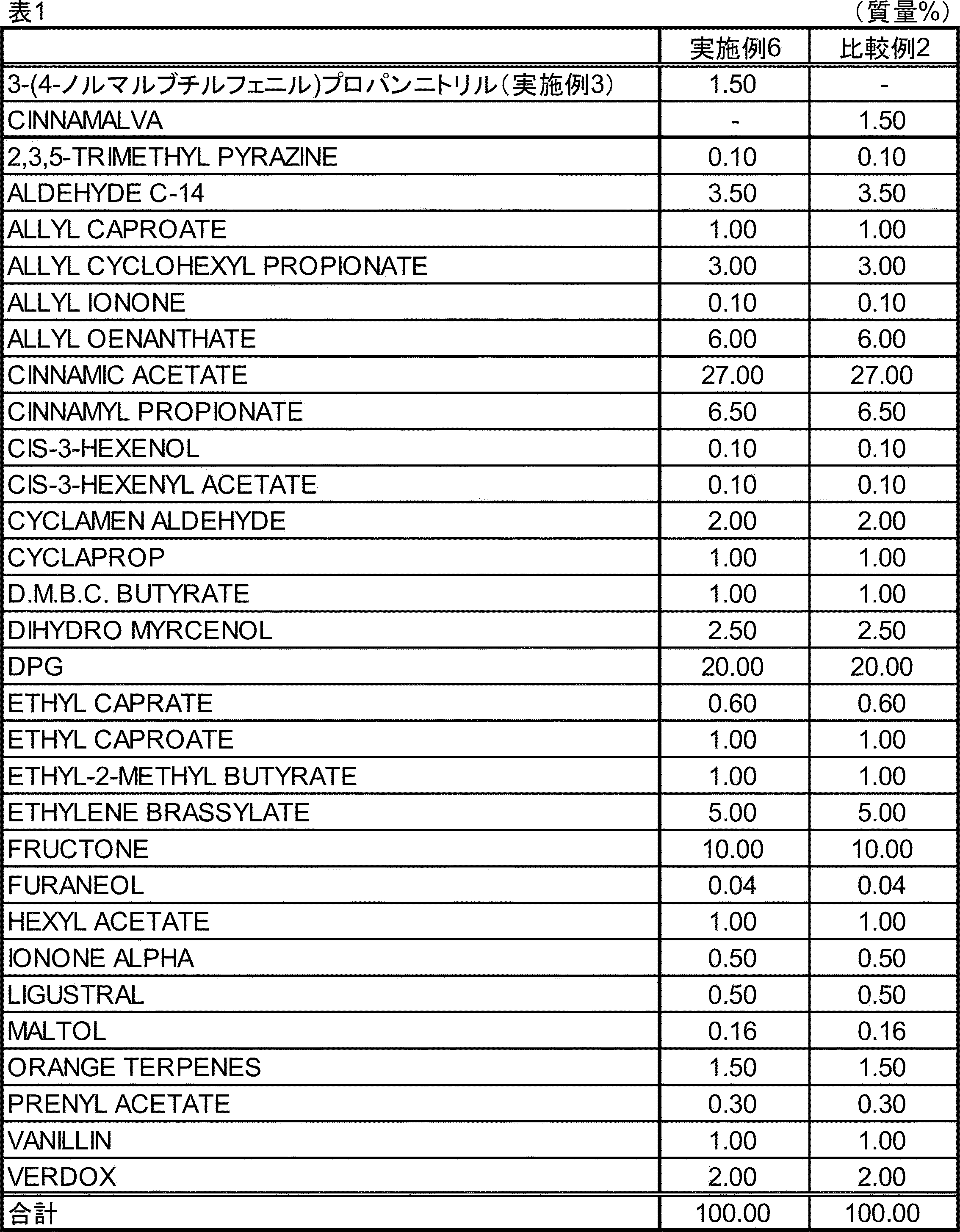
表2に示す香料組成物ベースに対し、実施例2で得られた3-(4-イソプロピルフェニル)プロパンニトリルを10.0質量%となるように添加し、香り・香調評価を行った。
表2に示す香料組成物ベースに対し、実施例4で得られた3-(4-イソブチルフェニル)プロパンニトリルを10.0質量%となるように添加し、香り・香調評価を行った。
表2に示す香料組成物ベースに対し、溶媒であるジプロピレングリコール(DPG)を10.0質量%添加して18.0質量%となるようにし、香り・香調評価を行った。

表3に示す香料組成物ベースに対し、実施例2で得られた3-(4-イソプロピルフェニル)プロパンニトリルを6.5質量%となるように添加し、香り・香調評価を行った。
表3に示す香料組成物ベースに対し、溶媒であるジプロピレングリコール(DPG)を6.5質量%添加して14.3質量%となるようにし、香り・香調評価を行った。

表4に示す香料組成物ベースに対し、実施例4で得られた3-(4-イソブチルフェニル)プロパンニトリルを10.00質量%となるように添加し、香り・香調評価を行った。
表4に示す香料組成物ベースに対し、溶媒であるジプロピレングリコール(DPG)を10.00質量%添加して18.91質量%となるようにし、香り・香調評価を行った。

表5に示す香料組成物ベースに対し、実施例1で得られた3-(4-エチルフェニル)プロパンニトリルを7.5質量%となるように添加し、香り・香調評価を行った。
表5に示す香料組成物ベースに対し、溶媒であるジプロピレングリコール(DPG)を7.5質量%となるように添加し、香り・香調評価を行った。

なかでも、3-(4-イソブチルフェニル)プロパンニトリル又は3-(4-イソプロピルフェニル)プロパンニトリルを含有する香料組成物は、lilac様、geranium様のフローラル感を有するため、より好ましい。
また、3-(4-ノルマルブチルフェニル)プロパンニトリルを含有する香料組成物は、フローラルでフルーティな香りを有し、更に香りの強さや拡散性も優れるため、更に好ましい。
Claims (17)
- 下記一般式(1)で表される3-(4-アルキルフェニル)プロパンニトリルを有効成分として含有する香料組成物。
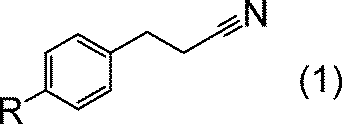
(式(1)中、Rは炭素数2~4のアルキル基を示す。) - 更に、式(1)で表される3-(4-アルキルフェニル)プロパンニトリル以外の香料物質を含有する、請求項1に記載の香料組成物。
- 式(1)で表される3-(4-アルキルフェニル)プロパンニトリル以外の香料物質が、炭化水素類、アルコール類、エステル類、フェノール類、アルデヒド類、ケトン類、アセタール類、ケタール類、エーテル類、天然精油、天然抽出物、及び式(1)で表される3-(4-アルキルフェニル)プロパンニトリル以外のニトリル類からなる群より選ばれる少なくとも1つである、請求項2に記載の香料組成物。
- Rがエチル基、イソプロピル基、ノルマルブチル基、イソブチル基及びターシャリーブチル基からなる群より選ばれる少なくとも1つである、請求項1~3のいずれか1つに記載の香料組成物。
- Rがイソプロピル基、ノルマルブチル基及びイソブチル基からなる群より選ばれる少なくとも1つである、請求項1~4のいずれか1つに記載の香料組成物。
- Rがノルマルブチル基である、請求項1~5のいずれか1つに記載の香料組成物。
- 下記一般式(2)で表される3-(2-アルキルフェニル)プロパンニトリルを、式(1)で表される3-(4-アルキルフェニル)プロパンニトリルに対して0.03~0.8質量%含有する、請求項1~6のいずれか1つに記載の香料組成物。

(式(2)中、Rは炭素数2~4のアルキル基を示す。) - 下記一般式(1)で表される3-(4-アルキルフェニル)プロパンニトリルの香料としての使用。

(式(1)中、Rは炭素数2~4のアルキル基を示す。) - Rがエチル基、イソプロピル基、ノルマルブチル基、イソブチル基及びターシャリーブチル基からなる群より選ばれる少なくとも1つである、請求項8に記載の使用。
- 前記式(1)で表される3-(4-アルキルフェニル)プロパンニトリルがフローラル香と、グリーン香又はフルーティ香を付与する、請求項8又は9に記載の使用。
- Rがイソプロピル基及びイソブチル基からなる群より選ばれる少なくとも1つである、請求項8~10のいずれか1つに記載の使用。
- 前記式(1)で表される3-(4-アルキルフェニル)プロパンニトリルがフローラル香、グリーン香及びフルーティ香を付与する、請求項11に記載の使用。
- Rがノルマルブチル基である、請求項8~10のいずれか1つに記載の使用。
- 前記式(1)で表される3-(4-アルキルフェニル)プロパンニトリルがフローラル香、フルーティ香及びスパイシー香を付与する、請求項13に記載の使用。
- 下記一般式(1)で表される3-(4-アルキルフェニル)プロパンニトリルによってフローラル香と、グリーン香又はフルーティ香を付与する、賦香方法。
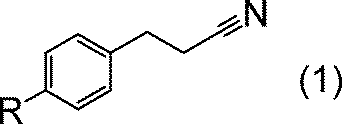
(式(1)中、Rは炭素数2~4のアルキル基を示す。) - 下記式(3)で表される4-アルキルベンズアルデヒドを原料として、アセトニトリルとの縮合反応による下記式(4)で表されるシンナモニトリルへと誘導する工程、及び水素添加工程をこの順で有する、3-(4-アルキルフェニル)プロパンニトリルの製造方法。

(式(3)及び式(4)中、Rは炭素数2~4のアルキル基を示す。) - 下記一般式(1)で表される3-(4-アルキルフェニル)プロパンニトリルと下記一般式(2)で表される3-(2-アルキルフェニル)プロパンニトリルを含有し、下記一般式(2)で表される3-(2-アルキルフェニル)プロパンニトリルを、式(1)で表される3-(4-アルキルフェニル)プロパンニトリルに対して0.03~0.8質量%含有するニトリル組成物。

(式(1)中、Rは炭素数2~4のアルキル基を示す。式(2)中、Rは炭素数2~4のアルキル基を示す。)
Priority Applications (4)
| Application Number | Priority Date | Filing Date | Title |
|---|---|---|---|
| EP24831734.9A EP4737544A1 (en) | 2023-06-29 | 2024-06-17 | Perfume composition |
| JP2025529649A JPWO2025004871A1 (ja) | 2023-06-29 | 2024-06-17 | |
| CN202480041563.7A CN121358833A (zh) | 2023-06-29 | 2024-06-17 | 香料组合物 |
| MX2025014943A MX2025014943A (es) | 2023-06-29 | 2024-06-17 | Composicion de perfume |
Applications Claiming Priority (2)
| Application Number | Priority Date | Filing Date | Title |
|---|---|---|---|
| JP2023107515 | 2023-06-29 | ||
| JP2023-107515 | 2023-06-29 |
Publications (1)
| Publication Number | Publication Date |
|---|---|
| WO2025004871A1 true WO2025004871A1 (ja) | 2025-01-02 |
Family
ID=93938946
Family Applications (1)
| Application Number | Title | Priority Date | Filing Date |
|---|---|---|---|
| PCT/JP2024/021791 Ceased WO2025004871A1 (ja) | 2023-06-29 | 2024-06-17 | 香料組成物 |
Country Status (5)
| Country | Link |
|---|---|
| EP (1) | EP4737544A1 (ja) |
| JP (1) | JPWO2025004871A1 (ja) |
| CN (1) | CN121358833A (ja) |
| MX (1) | MX2025014943A (ja) |
| WO (1) | WO2025004871A1 (ja) |
-
2024
- 2024-06-17 MX MX2025014943A patent/MX2025014943A/es unknown
- 2024-06-17 EP EP24831734.9A patent/EP4737544A1/en active Pending
- 2024-06-17 WO PCT/JP2024/021791 patent/WO2025004871A1/ja not_active Ceased
- 2024-06-17 JP JP2025529649A patent/JPWO2025004871A1/ja active Pending
- 2024-06-17 CN CN202480041563.7A patent/CN121358833A/zh active Pending
Non-Patent Citations (12)
| Title |
|---|
| ARNOLD M. L., ET AL.: "GUANIDINIUM AND AMIDINIUM FUNGICIDES: A NEW CLASS OF CARBOCATION MIMETIC ERGOSTEROL BIOSYNTHESIS IMHIBITORS.", PESTICIDE SCIENCE, vol. 44., no. 04., 1 August 1995 (1995-08-01), GB , pages 341 - 355., XP000535980, ISSN: 0031-613X * |
| BHUNIA ANUP, BERGANDER KLAUS, STUDER ARMIDO: "Cooperative Palladium/Lewis Acid-Catalyzed Transfer Hydrocyanation of Alkenes and Alkynes Using 1-Methylcyclohexa-2,5-diene-1-carbonitrile", JOURNAL OF THE AMERICAN CHEMICAL SOCIETY, vol. 140, no. 47, 28 November 2018 (2018-11-28), US, pages 16353 - 16359, XP093253808, ISSN: 0002-7863, DOI: 10.1021/jacs.8b10651 * |
| DAI JIAN-JUN, ZHANG WEN-MAN, SHU YONG-JIN, SUN YU-YANG, XU JUN, FENG YI-SI, XU HUA-JIAN: "Deboronative cyanation of potassium alkyltrifluoroborates via photoredox catalysis", CHEMICAL COMMUNICATIONS, vol. 52, no. 41, 21 May 2016 (2016-05-21), UK , pages 6793 - 6796, XP093253759, ISSN: 1359-7345, DOI: 10.1039/C6CC01530A * |
| DALLENES JESSE, WUYTS JONAS, VAN VELTHOVEN NIELS, KRAJNC ANDRAŽ, MALI GREGOR, USOLTSEV OLEG A., BUGAEV ARAM L., DE VOS DIRK: "Zeolites as equilibrium-shifting agents in shuttle catalysis", NATURE CATALYSIS, vol. 6, no. 6, UK, pages 495 - 505, XP093253799, ISSN: 2520-1158, DOI: 10.1038/s41929-023-00967-8 * |
| FLAVOR FRAGRANCE JOURNAL, vol. 35, 2020, pages 425 - 435 |
| GU ZHEN; WANG YANFANG; YAO YUAN; XIA XIAOFENG; WANG HAIJUN; LI WEI: "Entangled Cu Complex Over Fe3O4@SiO2as Supported Catalyst for Synthesis of Alkenyl Nitriles with Aromatic Aldehydes and Acetonitrile", CATALYSIS LETTERS, vol. 145, no. 12, 1 September 2015 (2015-09-01), US, pages 2046 - 2054, XP035554808, ISSN: 1011-372X, DOI: 10.1007/s10562-015-1602-8 * |
| KUBOSAKI SUZUKA, TAKEUCHI HARUKA, IWATA YUTAKA, TANAKA YOSUKE, OSAKA KAZUYUKI, YAMAWAKI MUGEN, MORITA TOSHIO, YOSHIMI YASUHARU: "Visible- and UV-Light-Induced Decarboxylative Radical Reactions of Benzoic Acids Using Organic Photoredox Catalysts", THE JOURNAL OF ORGANIC CHEMISTRY, vol. 85, no. 8, 17 April 2020 (2020-04-17), US, pages 5362 - 5369, XP093253807, ISSN: 0022-3263, DOI: 10.1021/acs.joc.0c00055 * |
| KUWAHARA TAKASHI, FUKUYAMA TAKAHIDE, RYU ILHYONG: "Synthesis of Alkylated Nitriles by [RuHCl(CO)(PPh3)3]-catalyzed Alkylation of Acetonitrile Using Primary Alcohols", CHEMISTRY LETTERS, vol. 42, no. 10, 5 October 2013 (2013-10-05), JP, pages 1163 - 1165, XP093253756, ISSN: 0366-7022, DOI: 10.1246/cl.130465 * |
| MARIANNE VIALEMARINGE; MARIE‐JOSÈPHE BOURGEOIS; MONIQUE CAMPAGNOLE; EVELYNE MONTAUDON: "Isomérisation de 2,3‐époxypinanes fonctionnels en présence d'acides de Lewis", HELVETICA CHIMICA ACTA, vol. 83, no. 3, 17 March 2000 (2000-03-17), US, pages 616 - 629, XP071268245, ISSN: 0018-019X, DOI: 10.1002/(SICI)1522-2675(20000315)83:3<616::AID-HLCA616>3.0.CO;2-M * |
| SAWAGUCHI TAKUYA, OBORA YASUSHI: "Iridium-catalyzed α-Alkylation of Acetonitrile with Primary and Secondary Alcohols", CHEMISTRY LETTERS, vol. 40, no. 9, 5 September 2011 (2011-09-05), JP, pages 1055 - 1057, XP093253751, ISSN: 0366-7022, DOI: 10.1246/cl.2011.1055 * |
| YAMAWAKI MUGEN, HASHIMOTO RYOGA, KAWABATA YUKI, ICHIHASHI MIWA, NACHI YASUHIRO, INARI RINPEI, SAKAMOTO CHISATO, MORITA TOSHIO, YOS: "Visible‐Light‐Induced Decarboxylative and Deboronative Radical Addition to Alkenes in Two‐Molecule Photoredox System Using Dibenzo[ g,p ]chrysene", EUROPEAN JOURNAL OF ORGANIC CHEMISTRY, vol. 2022, no. 46, 12 December 2022 (2022-12-12), DE , pages e202201225 - e202201225-6, XP093253795, ISSN: 1434-193X, DOI: 10.1002/ejoc.202201225 * |
| YANYAN ZHANG; YUNHONG HAN; SHENGQING ZHU; FENG‐LING QING; XIAO‐SONG XUE; LINGLING CHU: "Light‐Induced Divergent Cyanation of Alkynes Enabled by Phosphorus Radicals", ANGEWANDTE CHEMIE, vol. 61, no. 50, 15 November 2022 (2022-11-15), US, pages n/a - n/a, XP072496582, ISSN: 1433-7851, DOI: 10.1002/anie.202210838 * |
Also Published As
| Publication number | Publication date |
|---|---|
| MX2025014943A (es) | 2026-02-03 |
| JPWO2025004871A1 (ja) | 2025-01-02 |
| CN121358833A (zh) | 2026-01-16 |
| EP4737544A1 (en) | 2026-05-06 |
Similar Documents
| Publication | Publication Date | Title |
|---|---|---|
| JP7380558B2 (ja) | α-ヒドロキシイソ酪酸エステル化合物、香料組成物、及び香料としての使用 | |
| JP7310813B2 (ja) | α位にアセトキシ基を有するイソ酪酸エステル化合物、香料組成物、及び香料としての使用 | |
| WO2018051776A1 (ja) | 香料組成物 | |
| JP7400800B2 (ja) | α位にノルマルブチリルオキシを有するイソ酪酸エステル化合物、香料組成物、及び香料としての使用 | |
| JP7310814B2 (ja) | α位にホルミルオキシ基を有するイソ酪酸エステル化合物、香料組成物、及び香料としての使用 | |
| JP7310812B2 (ja) | α位にプロパノイルオキシ基を有するイソ酪酸エステル化合物、香料組成物、及び香料としての使用 | |
| JP7609073B2 (ja) | アルデヒド化合物及びその製造方法、並びに香料組成物 | |
| US7786331B2 (en) | Fragrance composition | |
| JP7552922B2 (ja) | アルデヒド組成物 | |
| CN114867829B (zh) | α-羟基异丁酸酯化合物和香料组合物 | |
| WO2025004871A1 (ja) | 香料組成物 | |
| JP7310815B2 (ja) | α-メトキシイソ酪酸エステル化合物を含有する香料組成物及び香料としての使用 | |
| JP7694580B2 (ja) | アルデヒド組成物 | |
| TWI813700B (zh) | 羧酸酯化合物、其製造方法、化粧料組成物、食品添加物組成物、清潔用組成物、以及香料組成物 | |
| JP7552961B2 (ja) | アルデヒド組成物 | |
| WO2021132211A1 (ja) | α位にカーボネート基を有するイソ酪酸エステル化合物及び香料組成物 | |
| RU2845868C1 (ru) | Альдегидная композиция | |
| JP7845360B2 (ja) | α位にアルケノイルオキシ基を有するイソ酪酸エステル化合物、香料組成物、及び香料としての使用 | |
| KR20250169333A (ko) | 향료 조성물 및 지환식 알코올 조성물 | |
| RU2834899C1 (ru) | Соединение класса альдегидов, способ его производства и парфюмерная композиция | |
| WO2024166832A1 (ja) | 香料組成物、及び1-エチルシクロヘキサンカルボン酸エステルの製造方法 | |
| RU2777517C1 (ru) | Соединение эфира карбоновой кислоты, способ его получения, композиция и ароматическая композиция | |
| TW202540075A (zh) | 香料、香料組成物、香料之製造方法及化合物 | |
| KR20230091875A (ko) | 지환식 알코올, 지환식 알코올 조성물, 및 향료 조성물 |
Legal Events
| Date | Code | Title | Description |
|---|---|---|---|
| 121 | Ep: the epo has been informed by wipo that ep was designated in this application |
Ref document number: 24831734 Country of ref document: EP Kind code of ref document: A1 |
|
| ENP | Entry into the national phase |
Ref document number: 2025529649 Country of ref document: JP Kind code of ref document: A |
|
| WWE | Wipo information: entry into national phase |
Ref document number: 2025529649 Country of ref document: JP |
|
| WWE | Wipo information: entry into national phase |
Ref document number: 202517123653 Country of ref document: IN |
|
| WWE | Wipo information: entry into national phase |
Ref document number: MX/A/2025/014943 Country of ref document: MX |
|
| WWP | Wipo information: published in national office |
Ref document number: 202517123653 Country of ref document: IN |
|
| WWE | Wipo information: entry into national phase |
Ref document number: 2024831734 Country of ref document: EP |
|
| NENP | Non-entry into the national phase |
Ref country code: DE |
|
| WWE | Wipo information: entry into national phase |
Ref document number: 11202508156S Country of ref document: SG |
|
| WWP | Wipo information: published in national office |
Ref document number: 11202508156S Country of ref document: SG |
|
| ENP | Entry into the national phase |
Ref document number: 2024831734 Country of ref document: EP Effective date: 20260129 |
|
| WWP | Wipo information: published in national office |
Ref document number: MX/A/2025/014943 Country of ref document: MX |
|
| ENP | Entry into the national phase |
Ref document number: 2024831734 Country of ref document: EP Effective date: 20260129 |