WO2025004394A1 - 部分放電検出装置および部分放電位置標定方法 - Google Patents
部分放電検出装置および部分放電位置標定方法 Download PDFInfo
- Publication number
- WO2025004394A1 WO2025004394A1 PCT/JP2023/038142 JP2023038142W WO2025004394A1 WO 2025004394 A1 WO2025004394 A1 WO 2025004394A1 JP 2023038142 W JP2023038142 W JP 2023038142W WO 2025004394 A1 WO2025004394 A1 WO 2025004394A1
- Authority
- WO
- WIPO (PCT)
- Prior art keywords
- time difference
- detection time
- calculation
- partial discharge
- sensors
- Prior art date
- Legal status (The legal status is an assumption and is not a legal conclusion. Google has not performed a legal analysis and makes no representation as to the accuracy of the status listed.)
- Ceased
Links
Images




Classifications
-
- G—PHYSICS
- G01—MEASURING; TESTING
- G01R—MEASURING ELECTRIC VARIABLES; MEASURING MAGNETIC VARIABLES
- G01R31/00—Arrangements for testing electric properties; Arrangements for locating electric faults; Arrangements for electrical testing characterised by what is being tested not provided for elsewhere
- G01R31/08—Locating faults in cables, transmission lines, or networks
-
- G—PHYSICS
- G01—MEASURING; TESTING
- G01R—MEASURING ELECTRIC VARIABLES; MEASURING MAGNETIC VARIABLES
- G01R31/00—Arrangements for testing electric properties; Arrangements for locating electric faults; Arrangements for electrical testing characterised by what is being tested not provided for elsewhere
- G01R31/12—Testing dielectric strength or breakdown voltage ; Testing or monitoring effectiveness or level of insulation, e.g. of a cable or of an apparatus, for example using partial discharge measurements; Electrostatic testing
Definitions
- This disclosure relates to a partial discharge detection device and a partial discharge location method.
- Partial discharges are generally detected by detecting electromagnetic waves generated by partial discharges or by detecting ultrasonic waves. Furthermore, in addition to detecting whether or not a discharge is occurring, it is important for operation to identify the location where the discharge is occurring when it is detected. This is because, depending on the identified fault location, it is possible to determine whether operation can be continued and whether repairs or replacement are required.
- the location of the discharge can be estimated from the detection time difference by detecting the first peak of the waveform of the ultrasonic waves generated by the discharge with ultrasonic sensors installed in multiple locations (see, for example, Patent Document 1).
- the ultrasonic waves propagate through the electrical equipment, they follow a complex path due to reflections from components inside the equipment such as coils and insulators, which makes the rise of the signal gentle and can make it difficult to estimate the detection time difference. Therefore, it is conceivable to estimate the phase shift of the waveform by applying the cross-correlation method (see, for example, Patent Document 2), which uses not only the rising part but also the signal waveform after it.
- JP-B-6-58392 page 3, left column [Examples], Figures 1, 2, and 4) JP-A-64-74465 (page 2, lower left column, page 3, upper right column, Figures 1 and 2)
- the detection accuracy can be lower than when detecting the first peak, making it difficult to pinpoint the location where the discharge occurred with high accuracy.
- This disclosure discloses technology to solve the problems described above, and aims to accurately identify the location where discharge occurs in electrical equipment.
- the partial discharge detection device disclosed in this disclosure is characterized by comprising a plurality of ultrasonic sensors installed on the surface of an electrical device, a detection time difference calculation unit that calculates the detection time difference of ultrasonic waves from the sensor signals of each of the plurality of ultrasonic sensors, and a discharge position calculation unit that calculates the occurrence position of partial discharges that have occurred inside the electrical device from the calculation result of the detection time difference, and is configured to be able to select either a method of reading a first peak or a cross-correlation method as the method used to calculate the detection time difference.
- the partial discharge location method disclosed herein is characterized by including a detection time difference calculation step for calculating the ultrasonic detection time difference from the respective sensor signals of multiple ultrasonic sensors installed on the surface of an electrical device, a discharge position calculation step for calculating the occurrence position of a partial discharge occurring inside the electrical device from the calculation result of the detection time difference, and a calculation method selection step for selecting either a method of reading a first peak or a cross-correlation method as the method to be used for calculating the detection time difference.
- the partial discharge detection device or partial discharge location method disclosed herein can calculate the detection time difference using a calculation method suited to the situation, making it possible to pinpoint the location where discharge occurs in electrical equipment with high accuracy.
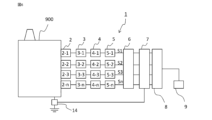
- FIG. 1 is a functional block diagram showing a configuration of a partial discharge detection device according to a first embodiment
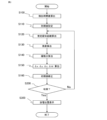
- 3 is a flowchart showing a discharge position calculation operation in the partial discharge detection device and partial discharge position locating method according to the first embodiment
- FIG. 11 is a functional block diagram showing a configuration of a partial discharge detection device according to a second embodiment.
- FIG. 11 is a functional block diagram showing a configuration of a partial discharge detection device according to a third embodiment.
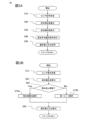
- 5A and 5B are flowcharts showing the operation of the partial discharge detection device according to the third embodiment and its modification, respectively.
- FIG. 13 is a functional block diagram showing the configuration of a partial discharge detection device according to a fourth embodiment.
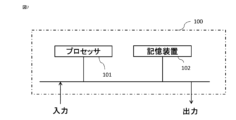
- FIG. 2 is a block diagram showing a hardware configuration of an arithmetic execution portion for executing control in the partial discharge detection device of the present disclosure.
- FIG. 13 is a flowchart showing a discharge position calculation operation in the partial discharge detection device and partial discharge position locating method according to the fifth embodiment.
- Embodiment 1. 1 and 2 are diagrams for explaining the configuration and operation of a partial discharge detection device according to a first embodiment.
- FIG. 1 is a functional block diagram showing the relationship between the partial discharge detection device and an electrical device to be diagnosed.
- FIG. 2 is a flowchart showing the partial discharge detection device and the discharge position calculation operation in the partial discharge position locating method.
- the partial discharge detection device 1 disclosed herein detects partial discharges in electrical equipment 900 and locates their occurrence position.
- the electrical equipment 900 is widely applicable to equipment that is covered with a metal casing or resin, making the parts (inside) where discharges may occur invisible, and whose surfaces are kept at ground potential by metal or conductive paint. Examples include power equipment such as oil-filled transformers, gas-insulated transformers, molded transformers, gas-insulated switchgear, cubicle-type gas-insulated switchgear, generators, rotating machines, instrument transformers, and instrument transformers.
- ultrasonic sensors 2-1, 2-2, 2-3, ..., 2-n are fixedly attached to the surface of the electrical device 900.
- Ultrasound is also known as acoustic emission, and ultrasonic sensors are also known as AE sensors.
- ultrasonic waves are generated and travel through space, propagating through the housing of electrical equipment 900 and generating a voltage in the piezoelectric element on the sensing surface of ultrasonic sensor 2 attached to the frame.
- Arrestor 3 may be one that uses zinc oxide elements, or it may be a diode or a gap arrester.
- bandpass filters 4-1, 4-2, 4-3, ..., 4-n are installed to reduce noise and extract the ultrasonic signal.
- the frequency components of ultrasonic signals are between 10 kHz and 1 MHz, so a filter that transmits only this band is used. If the frequency components of the noise can be identified, a bandpass filter that does not transmit that band is desirable.
- the extracted weak signal is then amplified by amplifiers 5-1, 5-2, 5-3, ..., 5-n (collectively, amplifiers 5). An amplification factor of 20 dB to 150 dB is often used.
- the sensor signals S1, S2, S3, ..., Sn (collectively sensor signals S) amplified by the amplifier 5 are sent to the discharge determination unit 6, which determines that a partial discharge has occurred when the strength (signal strength) of the sensor signal S exceeds a first threshold value.
- the ultrasonic signal strength varies depending on the size of the electrical equipment 900, the layout of the main circuit, the configuration of the frame, and the installation state of the ultrasonic sensor 2, and the ultrasonic attenuation rate. Taking these characteristics into consideration, the threshold value for determining discharge is selected.
- the sensor signal S sent to the discharge determination unit 6 is also sent to the detection time difference calculation unit 7, and if the discharge determination unit 6 determines that a discharge has occurred, the detection time difference calculation unit 7 calculates the time at which each of the multiple ultrasonic sensors 2 detected the discharge.
- the first method is to read the crest value (first peak), also called the pulse, immediately after the waveform of the sensor signal S exceeds a second threshold (different from the first threshold) that is set above the noise level, and is the method explained in the background art using Patent Document 1 as an example.
- the second method is a method using a cross-correlation coefficient, which is explained in the background art using Patent Document 2 as an example. This is a method for calculating the time difference at which the cross-correlation coefficient between the outputs of multiple ultrasonic sensors 2 is maximized.
- the cross-correlation coefficient Rxy(k) of these two waveforms is expressed by the following formula (1), where k is the amount of shift.
- Rxy indicates the similarity between waveforms x(i) and y(i+k), and is at its maximum when both waveforms are most similar. This is a method for finding the time difference from k at which Rxy is at its maximum. For the first peak, the detected time difference is obtained from only the rising portion of the signal, but this method is characterized by the fact that it is not limited to the rising edge and uses the entire waveform to calculate the detected time difference.
- the installation positions of each sensor in the xyz coordinate system are (x1, y1, z1), (x2, y2, z2), (x3, y3, z3), and (x4, y4, z4), respectively. If the speed of sound is C and the discharge position is (xd, yd, zd) in the xyz coordinate system, these relationship equations can be expressed by the following four equations (Equation (3A) to Equation (3D)).
- the discharge position (xd, yd, zd) can be calculated numerically from these four equations (equation (3A) to equation (3D)). The calculation procedure will be explained with reference to the flowchart in Figure 2.
- the detection time difference calculation unit 7 calculates the detection time difference and outputs the calculation result to the discharge position calculation unit 8 (step S100).
- the discharge position calculation unit 8 then sets appropriate initial values xd 0 , yd 0 , zd 0 , and td 0 for xd, yd, zd, and td.
- the initial values input here do not need to be strictly assumed, and for simplicity, there is no problem in using 0 for all of them (it is set to use 0) (step S110).
- a value to be measured as the pseudo distance is calculated (step S120).
- the pseudo distance is the distance from the discharge source to each sensor, and the estimated pseudo distances are r1 0 , r2 0 , r3 0 , r4 0.
- the estimated pseudo distances r1 0 , r2 0 , r3 0 , r4 0 can be calculated by solving the following four simultaneous equations (Equation (4A) to Equation (4D)).
- ⁇ ri ri-ri 0 ... (5)
- i any value from 1 to 4.
- Equation S140 calculate the partial derivatives ⁇ ri/ ⁇ x, ⁇ ri/ ⁇ y, ⁇ ri/ ⁇ z, and ⁇ ri/ ⁇ td of the residual ri with respect to x, y, z, and td (step S140).
- ⁇ r1 ⁇ x( ⁇ r1/ ⁇ x) + ⁇ y( ⁇ r1/ ⁇ y) + ⁇ z( ⁇ r1/ ⁇ z) + ⁇ td( ⁇ r1/ ⁇ td) ...
- ⁇ r2 ⁇ x( ⁇ r2/ ⁇ x) + ⁇ y( ⁇ r2/ ⁇ y) + ⁇ z( ⁇ r2/ ⁇ z) + ⁇ td( ⁇ r2/ ⁇ td) ...
- ⁇ r3 ⁇ x( ⁇ r3/ ⁇ x) + ⁇ y( ⁇ r3/ ⁇ y) + ⁇ z( ⁇ r3/ ⁇ z) + ⁇ td( ⁇ r3/ ⁇ td) ...
- ⁇ r4 ⁇ x( ⁇ r4/ ⁇ x) + ⁇ y( ⁇ r4/ ⁇ y) + ⁇ z( ⁇ r4/ ⁇ z) + ⁇ td( ⁇ r4/ ⁇ td) ...
- equations (8A) to (8D) are used to calculate corrected values (xd 1 , yd 1 , zd 1 , td 1 ) of the initial values xd 0 , yd 0 , zd 0 , td 0 (step S160).
- xd 1 xd 0 + ⁇ x...(8A)
- yd 1 yd 0 + ⁇ y...(8B)
- zd 1 zd 0 + ⁇ z...(8C)
- td 1 td 0 + ⁇ td...(8D)
- step S200 It is determined whether ⁇ x, ⁇ y, ⁇ z, and ⁇ td have converged (step S200). If they have not converged ("No"), the corrected values are substituted for the initial values and the process proceeds to step S120. The above procedure is repeated until ⁇ x, ⁇ y, ⁇ z, and ⁇ td have converged. Convergence often occurs after a few times.
- the end condition for the calculation in operation can be to specify the number of calculations in advance, or to determine whether convergence has occurred by observing the transition of the initial values xd 0 , yd 0 , zd 0 , and td 0 in the repeated calculations.
- step S200 If ⁇ x, ⁇ y, ⁇ z, and ⁇ td converge (Yes in step S200), the corrected values ( xd1 , yd1 , zd1 , td1 ) at this point in time are displayed as the calculated discharge position by the discharge position display unit 9 (step S300).
- the discharge position i.e., the fault position
- the detection time difference calculation unit 7 employs a method using a cross-correlation coefficient out of two methods for calculating the detection time, but this is not limiting and a method of reading the first peak may also be employed. In order to allow selection of either method, it is possible to configure the application operating as the detection time difference calculation unit 7 to be interchangeable. Furthermore, the detection time difference calculation unit 7 may calculate the detection time difference using both of the two methods, the discharge position calculation unit 8 may calculate the discharge position based on each of the detection time differences, and the discharge position display unit 9 may display the calculation results of the discharge position obtained using each of the two methods along with a distinction between the methods.
- a method suitable for the installation target may be selected, and an application for executing the selected method may be installed from a terminal or the like.
- the selection may be made by inserting into a slot either a chip containing an application for executing a cross-correlation function, or a chip containing an application for executing a method for reading the first peak.
- Embodiment 2 In the above-mentioned first embodiment, an example has been described in which one of the two methods for calculating the detection time is set in advance when or before the partial discharge detection device is installed. In the second embodiment, an example will be described in which the method for calculating the detection time difference can be changed as appropriate even after installation.
- Fig. 3 is a block diagram corresponding to Fig. 1 for explaining the configuration and operation of the partial discharge detection device according to the second embodiment. Note that in the second embodiment, the basic configuration and operation relating to the detection of ultrasonic waves and the calculation of the discharge position are similar to those in the first embodiment, and therefore the description of similar parts will be omitted and Fig. 2 of the first embodiment will be used.
- the partial discharge detection device 1 according to the second embodiment is obtained by adding a detection time difference calculation method switching unit 10 that switches the detection time difference calculation method to the partial discharge detection device 1 described in the first embodiment.
- the detection time difference calculation method switching unit 10 or the detection time difference calculation unit 7 stores programs for executing two methods for calculating the detection time in advance.
- the detection time difference calculation unit 7 is configured to calculate the detection time for the sensor signal S using the selected method in response to a command from the detection time difference calculation method switching unit 10.
- the detection time difference calculation unit 7 is configured to calculate both the detection time difference due to the first peak and the detection time difference using the cross-correlation method based on the sensor signal S, and to switch the calculation result to be output to the discharge position calculation unit 8 in response to a command from the detection time difference calculation method switching unit 10.
- the advantage of using the first peak to calculate the detection time difference is that it increases the accuracy of identifying the position, since it is possible to focus on the signal component that has propagated via the shortest path even when the structure inside the electrical device 900 is complex and the propagation path of the ultrasonic waves is complicated. However, when the signal strength is low, it is difficult to identify the first peak, and the accuracy may decrease.
- the advantage of using the cross-correlation method is that it is easy to obtain high positioning accuracy by calculating the detection time difference by looking at the entire waveform even when the signal strength is low. Also, if there are restrictions on the placement of multiple ultrasonic sensors 2 and the sensors cannot be placed to surround the expected discharge source, it is necessary to calculate the detection time difference with higher accuracy, and it is easier to obtain accuracy than with the method using the first peak. However, if the structure inside the electrical device 900 is complex and the propagation path of the ultrasonic waves is complicated, the waveform shapes observed by each ultrasonic sensor 2 will differ significantly, which may reduce the positioning accuracy.
- the calculation of the detection time difference using the cross-correlation method should be used when there is a large amount of noise or the signal to be detected is small, or when the structure inside the electrical device 900 is relatively simple and the ultrasonic propagation path is simple. It is also appropriate to use this method when it is not possible to arrange sensors to surround the anticipated discharge source.
- the electrical devices 900 the molded transformer, generator, rotating machine, instrument transformer, instrument transformer, power cable, power cable connection, and power cable termination meet the conditions for using the cross-correlation method.
- the detection time difference calculation method switching unit 10 switches the calculation method by operating a changeover switch (not shown) that can be accessed from the outside, or by a user instruction via wireless, wired, or other communication. This makes it possible to improve the accuracy of position identification by selecting the detection time difference calculation method according to the above-mentioned situation.
- the detection time difference calculation method switching unit 10 may be configured in a terminal separate from the partial discharge detection device 1.
- Embodiment 3 In the above-mentioned first and second embodiments, an example has been described in which the detection time difference calculation method is switched by a user operation regardless of whether the device is installed or in operation. In the present embodiment 3, an example will be described in which the partial discharge detection device automatically switches to an optimal calculation method based on the waveform of the obtained sensor signal.
- FIGS. 4, 5A, and 5B are used to explain the configuration and operation of a partial discharge detection device according to embodiment 3.
- FIG. 4 is a functional block diagram showing the relationship between the partial discharge detection device and the electrical equipment to be diagnosed.
- FIG. 5A is a flowchart showing the partial discharge detection device and the switching operation of the detection time difference calculation method in the partial discharge location method.
- FIG. 5B is a flowchart showing the partial discharge detection device according to a modified example and the switching operation of the detection time difference calculation method in the partial discharge location method. Note that in embodiment 3, the basic configuration and operation relating to ultrasonic wave detection and discharge location calculation are the same as in embodiment 2, and a description of similar parts will be omitted. Also, as in embodiment 2, FIG. 2 of embodiment 1 is used.
- the partial discharge detection device 1 is provided with additional components compared to the partial discharge detection device 1 described in the second embodiment.
- the additional components are a waveform similarity calculation unit 11 that calculates the similarity between the detected waveforms of the sensors, a waveform similarity display unit 12 that displays the calculated waveform similarity, and a detection time difference calculation method selection unit 13 that receives the output of the waveform similarity calculation unit 11 and selects a calculation method for the detection time difference.
- the waveform similarity calculation unit 11 can calculate the waveform similarity using Euclidean distance, cosine similarity, dynamic time warping, cross-correlation, etc. In addition to the time domain, these can also be compared in the frequency domain obtained by Fourier transforming the sensor signal S (signal waveform).
- the waveform similarity calculation unit 11 receives a sensor signal S from each of the multiple ultrasonic sensors 2 (step S10), it calculates the waveform similarity between the multiple sensor signals S (step S20).
- the waveform similarity calculation unit 11 outputs the calculated waveform similarity to the waveform similarity display unit 12, and displays it so that the diagnostician (user) can recognize it (step S30). This allows the user to refer to the displayed waveform similarity information and determine whether to use the first peak or the cross-correlation method to calculate the detection time difference.
- the detection time difference calculation method selection unit 13 When the detection time difference calculation method selection unit 13 receives information from the waveform similarity calculation unit 11 that the waveform similarity has been calculated, it accepts an input operation for selecting a method via, for example, the waveform similarity display unit 12 in order for the user to select a detection time difference (step S40). When the user performs an input operation for selection, it outputs the selected information (selection information) to the detection time difference calculation method switching unit 10.
- the detection time difference calculation method switching unit 10 adopts a method for calculating the detection time difference based on the selection information (step S50), and the detection time difference calculation unit 7 calculates the detection time difference using the adopted method.
- the process proceeds to the step of calculating the detection time difference and locating the discharge position (steps S100 to S300).
- the waveform similarity display unit 12 may also be configured in a terminal separate from the partial discharge detection device 1, similar to the detection time difference calculation method switching unit 10 explained in the second embodiment.
- a judgment index may be provided, and the partial discharge detection device 1 may automatically select the method.
- the operation in the case of automatic selection will be described with reference to the flowchart in Fig. 5B. Note that the operation of steps S10 to S20 by the waveform similarity calculation unit is the same as that described in Fig. 5A.
- the detection time difference calculation method selection unit 13 receives the waveform similarity information from the waveform similarity calculation unit 11, it determines whether the similarity is equal to or greater than a predetermined third threshold (different from the first threshold and the second threshold) (step S60). If it determines that the similarity is equal to or greater than the third threshold ("Yes" in step S60), it selects the cross-correlation method (step S70A) and causes the detection time difference calculation unit 7 to calculate the detection time difference using the cross-correlation method. On the other hand, if it determines that the similarity is less than the third threshold ("No" in step S60), it selects the first peak (step S70B) and causes the detection time difference calculation unit 7 to calculate the detection time difference using the first peak.
- a predetermined third threshold different from the first threshold and the second threshold
- the waveform similarity display unit 12 displays the automatically selected method in addition to displaying the waveform similarity (step S80). Then, the process proceeds to the step of calculating the detection time difference and locating the discharge position (steps S100 to S300).
- Embodiment 4 an example in which an ultrasonic signal is detected in accordance with the period of the AC voltage of a system connected to an electrical device will be described.
- Fig. 6 is a block diagram corresponding to Fig. 1 for explaining the configuration and operation of a partial discharge detection device according to the fourth embodiment. Note that the fourth embodiment is also similar to the first embodiment except for detecting an ultrasonic signal in accordance with the period of the AC voltage, and therefore a description of the similar parts will be omitted and Fig. 2 of the first embodiment will be used. Furthermore, the configurations described in the second and third embodiments may be added to enable the functions to be exerted.
- the partial discharge detection device 1 according to the fourth embodiment is obtained by adding a current transformer 14 for detecting the AC voltage of the system to the partial discharge detection device 1 described in the first embodiment.
- the current transformer 14 measures the waveform of the AC voltage of the system, for example, 50 Hz or 60 Hz, and outputs the waveform to the detection time difference calculation unit 7.
- the detection time difference calculation unit 7 acquires the signal in one cycle of the AC waveform from the sensor signal S from each of the multiple ultrasonic sensors 2.
- the ultrasonic signal in one cycle is also called the ⁇ -q pattern, and the detection time difference is calculated based on this signal using the cross-correlation method.
- the structure inside the electrical device 900 is complex, the propagation path of the ultrasonic waves is complex, and the sensor signal is unclear in the local noise environment, it becomes difficult to determine the detection time difference due to the first peak.
- ultrasonic waves are repeatedly reflected inside the electrical device 900, and the overall ultrasonic signal detected differs significantly from sensor to sensor, which can make it difficult to calculate the detection time difference using the cross-correlation method.
- the discharge determination unit 6, the detection time difference calculation unit 7, the discharge position calculation unit 8, the detection time difference calculation method switching unit 10, the waveform similarity calculation unit 11, or the detection time difference calculation method selection unit 13 constituting the partial discharge detection device 1 may be configured as one piece of hardware 100 including a processor 101 and a storage device 102, as shown in FIG. 7.
- the storage device 102 includes a volatile storage device such as a random access memory and a non-volatile auxiliary storage device such as a flash memory.
- an auxiliary storage device such as a hard disk may be included.
- the processor 101 executes a program input from the storage device 102. In this case, the program is input from the auxiliary storage device to the processor 101 via the volatile storage device.
- the processor 101 may output data such as the calculation result to the volatile storage device of the storage device 102, or may store the data in the auxiliary storage device via the volatile storage device.
- the number of sensors (n) is described as 4, but this is not limited thereto, and may be 5 or more, as shown in each of the following embodiments.
- the top 4 sensor signals S with the highest similarity among the 5 or more sensor signals S may be selected and used to calculate the detection time difference.
- the frequency with which the similarity becomes low may be stored, and sensors with a higher frequency of low similarity compared to other sensors may be displayed to the user. If the user uses this as a reference to change the installation location of sensors with a higher frequency of low similarity, the frequency with which the similarity becomes low can be reduced, and the accuracy of locating the discharge position can be further improved.
- Embodiment 5 a partial discharge locating method will be described when five or more ultrasonic sensors are installed.
- Fig. 8 is a flowchart corresponding to Fig. 2 for explaining the configuration and operation of a partial discharge detection device according to the fifth embodiment, and the partial discharge locating method. Note that the fifth embodiment is similar to the first embodiment except for the calculation method of partial discharge locating, and therefore the description of the similar parts will be omitted and Fig. 1 of the first embodiment will be used. Furthermore, the configurations described in the second, third and fourth embodiments may be added to enable the fulfillment of their functions.
- the partial discharge detection device 1 includes step S150V instead of step S150 in the operation of the partial discharge detection device 1 described in the first embodiment.
- step S150V the residuals calculated in S130 are used for weighting in the calculation of ⁇ x, ⁇ y, ⁇ z, and ⁇ td.
- the steps before step S140 and the steps after step S160 are the same as those in the first embodiment.
- partial discharge location can be determined with four ultrasonic sensors, and so a calculation method for this case has been shown.
- a calculation method for this case has been shown.
- four signals to be used for location are selected and discarded based on the similarity in the cross-correlation method.
- information from the unselected sensor is discarded, but the partial discharge detection device 1 and partial discharge location method according to the fifth embodiment make use of this information to further improve location accuracy.
- the specific calculation method is described below.
- the basic calculation is the same as that explained in the first embodiment, and the number of variables and equations in the simultaneous equations changes depending on the number of sensors. If the number of sensors is n, the installation positions of each sensor in the xyz coordinates are (x1, y1, z1), (x2, y2, z2), (x3, y3, z3), (x4, y4, z4), ..., (xn, yn, zn).
- the number of simultaneous equations in the simultaneous equations of (3A) to (3D), the simultaneous equations of (4A) to (4D), and the simultaneous equations of (7A) to (7D) is n.
- n 5 or more, the number of equations is greater than the number of unknowns, so in this case it is common to calculate the solution using the least squares method, and the solution to equation (9) can be obtained by equation (11).
- ⁇ x (G ⁇ TG ⁇ (-1)) ⁇ (-1)G ⁇ T ⁇ r...(11)
- ⁇ T represents the transpose
- ⁇ (-1) represents the inverse matrix.
- ⁇ x calculated in step S150V in Fig. 8 is obtained in this manner, and is used to carry out steps S160 and after.
- the sensors used in the calculation are weighted based on the accuracy of the sensor information.
- the accuracy is determined using the residual ⁇ ri obtained in step S130 of FIG. 8.
- the weighting matrix W is a matrix whose diagonal components are ⁇ r1, ..., ⁇ r n and the other components are zero. This weighting matrix can be used to weight the equation and find a solution that minimizes the expected value of the error by calculating ⁇ x using equation (12).
- Steps S120 to S200 in FIG. 8 are repeated in the position location calculation, but empirically it is effective to use the weighting calculation in equation (12) from the fifth time onwards.
- Embodiment 6 a partial discharge location method in which five or more ultrasonic sensors are installed will be described. Note that the sixth embodiment is also similar to the fifth embodiment except for the weighting method in the calculation of partial discharge location, and therefore the description of the similar parts will be omitted and Fig. 1 will be used, as well as Fig. 8 of the fifth embodiment. Furthermore, the configurations described in the second, third, fourth and fifth embodiments may be added to enable the functions thereof to be exerted.
- the ultrasonic waves generated by the discharge travel a complex path as they propagate through electrical equipment, being reflected by coils, insulators, and other components inside the equipment. This causes the signal to attenuate, and as the detection signal becomes unclear and buried in noise, the accuracy of calculating the partial discharge position also decreases. This effect is particularly significant when the sensor is far from the discharge position, or when there are components between the sensor and the discharge position that block the propagation of ultrasonic waves.
- the accuracy of locating the discharge position can be improved by weighting the sensor information with a stronger detected signal strength in the calculation of the discharge position.
- the weight matrix W is a matrix whose diagonal components are V1, ..., Vn and the other components are zero.
- Embodiment 7 a partial discharge locating method in which five or more ultrasonic sensors are installed will be described. Note that the seventh embodiment is also similar to the sixth embodiment except for the weighting criteria in the partial discharge locating calculation, and therefore Fig. 1 will be used without describing the similar parts, and Fig. 8 of the fifth embodiment and Fig. 4 of the third embodiment will be used for the calculation of the similarity that is the weighting criteria. Furthermore, the configurations described in the second, fourth, fifth, and sixth embodiments may be added to enable the functions thereof to be exhibited.
- the structure inside the electrical device 900 is complex, the propagation path of the ultrasonic waves is complex, and the sensor signal is unclear in the local noise environment, it becomes difficult to determine the detection time difference due to the first peak.
- ultrasonic waves are repeatedly reflected inside the electrical device 900, and the overall ultrasonic signal detected differs significantly from sensor to sensor, which can make it difficult to calculate the detection time difference using the cross-correlation method.
- the accuracy of locating the discharge position can be improved by weighting the sensor information with higher similarity in the cross-correlation method.
- the waveform similarity calculation step of step S20 described in FIG. 5A or 5B is executed before at least step S150V in FIG. 8. Then, if the similarities of the sensors obtained by equation (1) are R1, R2, ..., Rn, the weight matrix W is a matrix whose diagonal components are R1, ..., Rn and the other components are zero.
- equation (11) using this weight matrix, the position location calculation is performed with priority given to the information of the more reliable sensor, which in turn improves the position location accuracy.
- the partial discharge detection device 1 disclosed herein includes a plurality of ultrasonic sensors 2 installed on the surface of the electrical device 900, a detection time difference calculation unit 7 that calculates the detection time difference of ultrasonic waves from the sensor signals S of the plurality of ultrasonic sensors 2, and a discharge position calculation unit 8 that calculates the occurrence position of partial discharges that have occurred inside the electrical device 900 from the detection time difference calculation results, and is configured to be able to select either a method of reading the first peak or a cross-correlation method as the method used to calculate the detection time difference. This makes it possible to select a method appropriate to the situation, and to accurately identify the discharge occurrence position in the electrical device 900.
- the optimal method can be selected in response to the situation (changes in situation).
- waveform similarity display unit 12 that displays the results of the similarity calculation. If a display unit (waveform similarity display unit 12) that displays the results of the similarity calculation is provided, an indicator for selecting a method can be shown to the user, enabling an appropriate method to be selected.
- the detection time difference calculation method switching unit 10 which switches the calculation method so that the cross-correlation method is selected as the calculation method when the calculated similarity is equal to or greater than a threshold (third threshold), and the method of reading the first peak is selected when the calculated similarity is less than the threshold (third threshold), the appropriate method is selected according to the similarity of the waveforms, so that the position where the discharge occurred in the electrical device 900 can be identified with high accuracy according to the situation.
- the detection time difference calculation unit 7 is configured to calculate the detection time difference using the signals of the top four sensors in order of similarity when using the cross-correlation method, the discharge occurrence position can be identified more accurately.
- the detection time difference calculation unit 7 is configured to calculate the detection time difference using the signal ( ⁇ -q pattern) in one cycle of the AC voltage from the sensor signals S of each of the multiple ultrasonic sensors 2. This can further improve the calculation accuracy by using, for example, the interval between signals due to multiple discharges as a feature.
- the multiple ultrasonic sensors 2 may be five or more (n ⁇ 5), and the discharge position calculation unit 8 may calculate the difference between the value (estimated pseudo distance: r10 , r20 , r30 , r40 ) set from the initial value set as the generation position used in the repeated value calculation and the calculation result based on the detection time difference (pseudo distance: r1, r2, r3, r4) as the estimated error ⁇ ri.
- the position location accuracy can be further improved.
- the position location accuracy can be further improved by having five or more (n ⁇ 5) ultrasonic sensors 2 and having the discharge position calculation unit 8 weight the information from the sensors with higher detection signal strengths more highly when calculating the generation position.
- the position location accuracy can be further improved by having five or more (n ⁇ 5) ultrasonic sensors 2 and having the discharge position calculation unit 8 weight the information from the five or more sensors more highly similar to the information from the sensors and calculate the discharge position.
- the partial discharge location method disclosed herein includes a detection time difference calculation step (step S100) for calculating the ultrasonic detection time difference from the sensor signals S of the multiple ultrasonic sensors 2 installed on the surface of the electrical device 900, a discharge position calculation step (steps S110 to S200) for calculating the occurrence position of partial discharge occurring inside the electrical device 900 from the detection time difference calculation result, and a calculation method selection step (steps S60, S70A, S70B) for selecting either the method of reading the first peak or the cross-correlation method as the method to be used for calculating the detection time difference.
- step S100 detection time difference calculation step
- step S110 to S200 for calculating the occurrence position of partial discharge occurring inside the electrical device 900 from the detection time difference calculation result
- a calculation method selection step step S60, S70A, S70B
- step S20 for calculating the similarity of the waveforms of the sensor signals S of the multiple ultrasonic sensors 2
- step S30 for displaying the results of the similarity calculation
- an indicator for selecting a method can be shown to the user, enabling the user to select an appropriate method.
- step S60, S70A, S70B if the calculation method is configured to switch so that when the calculated similarity is equal to or greater than a threshold (third threshold), the cross-correlation method is selected as the method to be used for calculation, and when the calculated similarity is less than the threshold (third threshold), the method to read the first peak is selected. Since the method is switched to an appropriate method depending on the similarity of the waveforms, the position where discharge occurs in the electrical device 900 can be identified with high accuracy depending on the situation.
- a threshold third threshold
- the detection time difference calculation step (step S100), if the cross-correlation method is used and five or more signals are input as the sensor signal S, the detection time difference can be calculated using the top four signals in order of similarity, allowing the discharge occurrence position to be identified more accurately.
- the detection time difference calculation step can be configured to calculate the detection time difference using the signal ( ⁇ -q pattern) in one cycle of the AC voltage from the sensor signals S of each of the multiple ultrasonic sensors 2, thereby further improving the calculation accuracy by using, for example, the interval between signals due to multiple discharges as a feature.
- the detection time difference of ultrasonic waves is calculated from the sensor signals S of five or more sensors as the multiple ultrasonic sensors 2, and in the discharge position calculation step (steps S110 to S200), the difference between the value set from the initial value set as the generation position used in the repeated calculation (estimated pseudo distance: r10 , r20 , r30 , r40 ) and the calculation result based on the detection time difference (pseudo distance: r1, r2, r3, r4) is calculated as the estimated error ⁇ ri, and the information of the sensor signals S with smaller estimated errors ⁇ ri are weighted more highly for five or more sensor signals to calculate the generation position, thereby further improving the position location accuracy.
- the detection time difference calculation step (step S100), the detection time difference of ultrasonic waves is calculated from the sensor signals S of five or more sensors as the multiple ultrasonic sensors 2, and in the discharge position calculation step (steps S110 to S200), the information of the sensor signals S with higher detection signal strength is weighted more highly to calculate the generation position, thereby further improving the position location accuracy.
- step S100 the detection time difference of ultrasonic waves is calculated from the sensor signals S of five or more sensors as the multiple ultrasonic sensors 2, and in the discharge position calculation step (steps S110 to S200), the information of the sensor signals S with higher similarity is weighted higher to calculate the generation position, thereby further improving the position location accuracy.
- 1 Partial discharge detection device
- 2 Ultrasonic sensor
- 3 Arrester
- 4 Bandpass filter
- 5 Amplifier
- 6 Discharge determination section
- 7 Detection time difference calculation section
- 8 Discharge position calculation section
- 9 Discharge position display section
- 10 Detection time difference calculation method switching section
- 11 Waveform similarity calculation section
- 12 Waveform similarity display section
- 13 Detection time difference calculation method selection section
- 14 Current transformer
- 900 Electrical equipment
- S Sensor signal.
Landscapes
- Physics & Mathematics (AREA)
- General Physics & Mathematics (AREA)
- Testing Relating To Insulation (AREA)
Priority Applications (1)
| Application Number | Priority Date | Filing Date | Title |
|---|---|---|---|
| JP2025529414A JPWO2025004394A1 (https=) | 2023-06-28 | 2023-10-23 |
Applications Claiming Priority (2)
| Application Number | Priority Date | Filing Date | Title |
|---|---|---|---|
| JP2023-105820 | 2023-06-28 | ||
| JP2023105820 | 2023-06-28 |
Publications (1)
| Publication Number | Publication Date |
|---|---|
| WO2025004394A1 true WO2025004394A1 (ja) | 2025-01-02 |
Family
ID=93938456
Family Applications (1)
| Application Number | Title | Priority Date | Filing Date |
|---|---|---|---|
| PCT/JP2023/038142 Ceased WO2025004394A1 (ja) | 2023-06-28 | 2023-10-23 | 部分放電検出装置および部分放電位置標定方法 |
Country Status (2)
| Country | Link |
|---|---|
| JP (1) | JPWO2025004394A1 (https=) |
| WO (1) | WO2025004394A1 (https=) |
Cited By (3)
| Publication number | Priority date | Publication date | Assignee | Title |
|---|---|---|---|---|
| CN120522531A (zh) * | 2025-07-23 | 2025-08-22 | 国网山西省电力公司电力科学研究院 | 一种基于声成像的局部放电检测系统及方法 |
| CN120801947A (zh) * | 2025-07-18 | 2025-10-17 | 湖北能源集团鄂州发电有限公司 | 一种定位变压器局部放电缺陷的方法及系统 |
| CN121208540A (zh) * | 2025-09-26 | 2025-12-26 | 北京谛声科技有限责任公司 | 一种电力设备轻微局部放电声纹检测方法、装置、计算机设备及可读存储介质 |
Citations (9)
| Publication number | Priority date | Publication date | Assignee | Title |
|---|---|---|---|---|
| JPS6474465A (en) * | 1987-09-17 | 1989-03-20 | Chubu Electric Power | Partial discharge position locating device |
| JPH0658392B2 (ja) * | 1987-09-29 | 1994-08-03 | 富士電機株式会社 | 油中部分放電監視装置の動作チェッカー |
| JPH10288639A (ja) * | 1997-02-13 | 1998-10-27 | Toshiba Corp | 電気機器の異常監視装置および方法 |
| JPH1138075A (ja) * | 1997-07-18 | 1999-02-12 | Mitsubishi Electric Corp | 部分放電検出装置 |
| JP2002090413A (ja) * | 2000-09-18 | 2002-03-27 | Toshiba Corp | 高電圧機器の絶縁異常診断装置 |
| CN108152687A (zh) * | 2017-12-25 | 2018-06-12 | 云南电网有限责任公司昆明供电局 | 一种利用超声反演的电力变压器局部放电定位方法 |
| CN108427067A (zh) * | 2018-06-12 | 2018-08-21 | 国网江苏省电力有限公司宜兴市供电分公司 | 一种开关柜局部放电故障检测方法、装置及系统 |
| CN110927543A (zh) * | 2019-12-18 | 2020-03-27 | 上海电机学院 | 一种电力设备局部放电超声信号时差估计方法 |
| CN112327108A (zh) * | 2020-10-09 | 2021-02-05 | 国网冀北电力有限公司检修分公司 | 一种罐式断路器局部放电超声信号去噪及时间差识别方法 |
-
2023
- 2023-10-23 JP JP2025529414A patent/JPWO2025004394A1/ja active Pending
- 2023-10-23 WO PCT/JP2023/038142 patent/WO2025004394A1/ja not_active Ceased
Patent Citations (9)
| Publication number | Priority date | Publication date | Assignee | Title |
|---|---|---|---|---|
| JPS6474465A (en) * | 1987-09-17 | 1989-03-20 | Chubu Electric Power | Partial discharge position locating device |
| JPH0658392B2 (ja) * | 1987-09-29 | 1994-08-03 | 富士電機株式会社 | 油中部分放電監視装置の動作チェッカー |
| JPH10288639A (ja) * | 1997-02-13 | 1998-10-27 | Toshiba Corp | 電気機器の異常監視装置および方法 |
| JPH1138075A (ja) * | 1997-07-18 | 1999-02-12 | Mitsubishi Electric Corp | 部分放電検出装置 |
| JP2002090413A (ja) * | 2000-09-18 | 2002-03-27 | Toshiba Corp | 高電圧機器の絶縁異常診断装置 |
| CN108152687A (zh) * | 2017-12-25 | 2018-06-12 | 云南电网有限责任公司昆明供电局 | 一种利用超声反演的电力变压器局部放电定位方法 |
| CN108427067A (zh) * | 2018-06-12 | 2018-08-21 | 国网江苏省电力有限公司宜兴市供电分公司 | 一种开关柜局部放电故障检测方法、装置及系统 |
| CN110927543A (zh) * | 2019-12-18 | 2020-03-27 | 上海电机学院 | 一种电力设备局部放电超声信号时差估计方法 |
| CN112327108A (zh) * | 2020-10-09 | 2021-02-05 | 国网冀北电力有限公司检修分公司 | 一种罐式断路器局部放电超声信号去噪及时间差识别方法 |
Cited By (3)
| Publication number | Priority date | Publication date | Assignee | Title |
|---|---|---|---|---|
| CN120801947A (zh) * | 2025-07-18 | 2025-10-17 | 湖北能源集团鄂州发电有限公司 | 一种定位变压器局部放电缺陷的方法及系统 |
| CN120522531A (zh) * | 2025-07-23 | 2025-08-22 | 国网山西省电力公司电力科学研究院 | 一种基于声成像的局部放电检测系统及方法 |
| CN121208540A (zh) * | 2025-09-26 | 2025-12-26 | 北京谛声科技有限责任公司 | 一种电力设备轻微局部放电声纹检测方法、装置、计算机设备及可读存储介质 |
Also Published As
| Publication number | Publication date |
|---|---|
| JPWO2025004394A1 (https=) | 2025-01-02 |
Similar Documents
| Publication | Publication Date | Title |
|---|---|---|
| WO2025004394A1 (ja) | 部分放電検出装置および部分放電位置標定方法 | |
| US11435242B2 (en) | Increasing sensitivity of a sensor using an encoded signal | |
| JP6738135B2 (ja) | 電気ケーブルの故障検出をコンピュータで実行する方法 | |
| CN117148074A (zh) | 低频变压器局部放电联合定位方法及相关设备 | |
| CN112816835B (zh) | 基于电声联合检测信号传播时延补偿的局部放电定位方法 | |
| EP3005050A1 (en) | Detecting multi-touch inputs | |
| CN108896893B (zh) | 一种电气设备中的局部放电源的定位系统及定位方法 | |
| AU2022200028B2 (en) | Insulation diagnostic system and insulation diagnostic method | |
| KR20090002588A (ko) | 전력기기의 부분방전위치 검출시스템 및 방전위치 검출방법 | |
| CN107064846A (zh) | 局部放电带电检测装置的灵敏度检测方法和装置 | |
| CN109917252A (zh) | 变压器内局部放电源定位方法、装置和服务器 | |
| JPWO2025004394A5 (https=) | ||
| JPH11248783A (ja) | 部分放電検出装置 | |
| CN119397200A (zh) | 一种基于电磁波信号的放电电流脉冲宽度反演方法 | |
| CN120801924B (zh) | 一种绝缘电缆运行监管方法及系统 | |
| JP6008833B2 (ja) | 部分放電検出方法および部分放電検出装置 | |
| CN114791543A (zh) | 一种电缆故障检测方法及便携式电缆故障检测仪 | |
| JP2012127684A (ja) | ノイズ分布測定装置 | |
| JP5256483B2 (ja) | 電気機器の部分放電検出方法とその装置 | |
| WO2004001430A1 (en) | Electric power line on-line diagnostic method | |
| JP3247049B2 (ja) | ケーブルの劣化診断方法 | |
| CN113358988B (zh) | 局部放电检测系统、方法、装置、计算机设备和存储介质 | |
| JP2019020407A (ja) | 磁歪位置測定装置を動作させる方法 | |
| WO2022176799A1 (ja) | 部分放電計測システムおよび部分放電計測方法 | |
| CN113447701A (zh) | 雷电流峰值标定方法及装置 |
Legal Events
| Date | Code | Title | Description |
|---|---|---|---|
| 121 | Ep: the epo has been informed by wipo that ep was designated in this application |
Ref document number: 23943780 Country of ref document: EP Kind code of ref document: A1 |
|
| WWE | Wipo information: entry into national phase |
Ref document number: 2025529414 Country of ref document: JP |
|
| NENP | Non-entry into the national phase |
Ref country code: DE |