WO2025004234A1 - 光トランシーバ、並びに、その製造方法及び製造装置 - Google Patents
光トランシーバ、並びに、その製造方法及び製造装置 Download PDFInfo
- Publication number
- WO2025004234A1 WO2025004234A1 PCT/JP2023/024039 JP2023024039W WO2025004234A1 WO 2025004234 A1 WO2025004234 A1 WO 2025004234A1 JP 2023024039 W JP2023024039 W JP 2023024039W WO 2025004234 A1 WO2025004234 A1 WO 2025004234A1
- Authority
- WO
- WIPO (PCT)
- Prior art keywords
- fpc
- dsp
- connection pad
- pad
- optical
- Prior art date
- Legal status (The legal status is an assumption and is not a legal conclusion. Google has not performed a legal analysis and makes no representation as to the accuracy of the status listed.)
- Ceased
Links
Images





Classifications
-
- H—ELECTRICITY
- H04—ELECTRIC COMMUNICATION TECHNIQUE
- H04B—TRANSMISSION
- H04B10/00—Transmission systems employing electromagnetic waves other than radio-waves, e.g. infrared, visible or ultraviolet light, or employing corpuscular radiation, e.g. quantum communication
- H04B10/40—Transceivers
-
- H—ELECTRICITY
- H04—ELECTRIC COMMUNICATION TECHNIQUE
- H04B—TRANSMISSION
- H04B10/00—Transmission systems employing electromagnetic waves other than radio-waves, e.g. infrared, visible or ultraviolet light, or employing corpuscular radiation, e.g. quantum communication
- H04B10/50—Transmitters
-
- H—ELECTRICITY
- H04—ELECTRIC COMMUNICATION TECHNIQUE
- H04B—TRANSMISSION
- H04B10/00—Transmission systems employing electromagnetic waves other than radio-waves, e.g. infrared, visible or ultraviolet light, or employing corpuscular radiation, e.g. quantum communication
- H04B10/60—Receivers
Definitions
- This disclosure relates to an optical transceiver used in optical communications, as well as a manufacturing method and device for the same.
- each of the components was packaged and mounted on a printed circuit board (PCB).
- PCB printed circuit board
- the driver IC and optical modulator chip were each packaged individually, and the packaged IC and chip were mounted on the PCB.
- the transimpedance amplifier (TIA) and optical receiver chip were each packaged individually and mounted as separate components on the PCB.
- OIF The Optical Internetworking Forum
- HB-CDM High-Bandwidth Coherent Driver Modulator
- Non-patent document 1 specifies various types of modules, their physical configurations and interface specifications, etc.
- a TIA and optical receiver are also implemented in an integrated package, and is also called an HB-ICR (High-Bandwidth Intradyne Coherent Receiver).
- An optical transceiver optical transmitting and receiving device
- Tx transmitting side
- Rx optical module on the receiving side
- the optical modules mentioned above used surface mount (SMT) type packages, which offer excellent mounting properties.
- SMT surface mount
- Optical modules using SMT packages are mounted on the PCB of an optical transceiver, so a via (VIA) structure that passes high-frequency electrical signals inside the package is essential. Since degradation of high-frequency characteristics is unavoidable with VIAs, the VIA structure is not suitable for further broadening the bandwidth.
- the high-frequency transmission characteristics of electrical signals also deteriorate due to electromagnetic field mode mismatch and impedance mismatch at the connection between the lead pins and the ceramic package (Non-Patent Document 2). Therefore, a new package configuration using flexible printed circuits (FPCs) has been standardized (Non-Patent Document 1).
- DSP digital signal processor
- This structure is ideal for greatly reducing the loss of high-frequency electrical signals, but the DSP, which is the largest heat source, is placed in close proximity to the optical modulator and optical receiver.
- the optical modulator chip When using an optical modulator that requires temperature control, such as an InP modulator that excels in increasing speed, the optical modulator chip must be mounted on a Peltier element.
- the Peltier element has the risk of increased power consumption and thermal runaway, so it is difficult to mount the Peltier element in a single package in close proximity to the DSP, which is a cause of heat inflow.
- the copackage structure had various issues in terms of the mounting process and realization. As a result, a different optical transceiver configuration has been proposed (Patent Document 1).
- FIG. 1 is a side cross-sectional view showing the configuration of a conventional optical transceiver 800 adapted for higher speeds.
- the cross-sectional view (z-x plane) of the optical transceiver 800 is shown cut along a line passing through a transmitting module 807 mounted on the substrate surface (x-y plane) of a PCB 801.
- the optical transceiver 800 includes a DSP 802, a transmitting module 807, and a receiving module (not shown).
- a DSP chip 805 is mounted on a DSP substrate 804 by a ball grid array (BGA).
- BGA ball grid array
- the entire DSP 802 is further mounted on the PCB 801 by a BGA 803.
- the transmitting module 807 includes a driver IC and an optical modulator chip (not shown) in a package with a terrace, and is equipped with an optical fiber 808.
- the radio frequency (RF) signal connection between the DSP 802 and the optical module 807 is performed by the FPC 806.
- the FPC 806 as an RF interface, the RF signal line formed on the top surface of the DSP board 804 and the RF signal line on the terrace of the optical module are directly connected.
- the signal path was configured via the VIA of the DSP board 804, the RF signal line pattern of the PCB 801, and the VIA of the package of the optical module 807.
- the optical transceiver 800 in FIG. 1 has a configuration that can minimize high frequency loss compared to early optical transceivers using SMT type packages.
- the choice of optical modulator is not limited as in the optical transceiver with a copackage structure, and it is more feasible in terms of implementation. It can also sufficiently suppress high frequency loss compared to early optical transceivers using SMT type packages.
- the specific connection configuration between the FPC 806 and the DSP board 804, the structure of the FPC 806, and the connection configuration between the FPC 806 and the optical module 807 are not clear.
- the configuration of the DSP and the DSP board is also not clear.
- the heat-generating components such as the driver IC inside the package are thermally connected to the side with the terrace, the PCB side, and the heat dissipation direction is below the optical transceiver 800 (-z direction).
- the DSP chip 805 is on the upper side, so the heat dissipation direction is above the optical transceiver 800 (+z direction). Heat dissipation is split into two directions, which is not desirable for simplifying the heat dissipation structure.
- the purpose of this disclosure is to present a configuration for smooth high-frequency connection between a DSP and an optical module in an optical transceiver, and to provide a configuration for realizing an optical transceiver capable of ultra-high speed operation, as well as a manufacturing method and manufacturing device for the same.
- an optical transceiver comprising at least one optical module mounted on a printed circuit board (PCB), a digital signal processor (DSP) mounted on the PCB, and a flexible printed circuit board (FPC) connecting between the DSP and the optical module
- the DSP comprising a DSP chip mounted on a DSP substrate formed of a multilayer wiring board having a core layer for adjusting thickness
- the FPC comprising a first connection PAD on a first surface which is solder-connected to a PAD on the terrace surface of the optical module, a PAD on the top surface of the DSP substrate which is solder-connected to a PAD on the terrace surface of the optical module, and a PAD on the top surface of the DSP substrate.
- the optical transceiver includes a second connection pad on the second surface, the FPC and the first connection pad, and the FPC and the second connection pad are connected by one or more through holes or embedded VIAs, the FPC is connected to the through holes or embedded VIAs, lands are formed on the surface of the FPC, and notches with a diameter of 200 ⁇ m or more can be stably held on both sides of the FPC and at positions 500 ⁇ m or more away from the inner ends of the first connection pad and the second connection pad, and the through holes have a diameter of ⁇ 100 ⁇ m or more.
- the present disclosure also provides a manufacturing apparatus for manufacturing the above-mentioned optical transceiver, the manufacturing apparatus comprising a hot bar that contacts the FPC and applies heat and load to the solder formed between the first connection pad and the pad on the DSP board, and between the second connection pad and the pad on the terrace, a mounting base that holds the PCB from below, and a holding mechanism that holds the FPC from the sides and below by engaging with the notches.
- the present disclosure further provides a manufacturing method for manufacturing the optical transceiver described above, comprising the steps of mounting a DSP on a PCB, connecting an optical module and an FPC by soldering using a hot bar, placing an optical module with an FPC connected thereto on a PCB, connecting the FPC and the DSP by soldering using a hot bar, and connecting a DC interface between the PCB and the optical module, and the manufacturing method described in claim 10, in which the FPC and the first connection pad and the FPC and the second connection pad are through-holes, further comprising: in the soldering using a hot bar, performing a pre-soldering process to form solder on at least a land or a heating pad that is directly heated by the hot bar; and heating and pressurizing the solder formed by the pre-soldering process with the hot bar, and the solder melted by heating and pressurizing is formed into a through-hole.
- soldering using a hot bar a pre-soldering process is performed to form solder between the first connecting PAD and the terrace, and between the second connecting PAD and the DSP board, and a hot bar is used to apply heat and pressure to the land or heating PAD, and the solder formed by the pre-soldering process melts due to heat transfer from the heated and pressurized land or heating PAD, forming solder between the first connecting PAD and the terrace, and between the second connecting PAD and the DSP board.
- FIG. 1 is a side cross-sectional view showing a configuration of a conventional optical transceiver adapted for high speed.
- 1A and 1B are a top view and a cross-sectional view showing an outline of the configuration of an optical transceiver according to the present disclosure.
- 1 is a diagram showing an enlarged cross section of an optical module including a connection portion of an FPC.
- FIG. 2 is a diagram showing an FPC wiring layout in an optical transceiver according to the present disclosure.
- 6 is a flow diagram illustrating steps in a method 600 for manufacturing an optical transceiver 100 in accordance with the present disclosure.
- 7 is a side cross-sectional view showing the configuration of a mounting device 700 for the optical transceiver 100 according to the present disclosure.
- FIG. 1 is a side cross-sectional view showing a configuration of a conventional optical transceiver adapted for high speed.
- 1A and 1B are a top view and a cross-sectional view showing an outline of the configuration of an
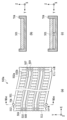
- FIGS. 7A and 7B are diagrams showing in detail the structure of the retention mechanism 704 when the optical transceiver 100 according to the present disclosure is implemented, in which (a) is a top view of the FPC 500-1 in a state in which the retention mechanism 704 and the notch 512 are engaged, (b) is a cross-sectional view taken along the VIIbc-VIIbc cross-sectional line, and (c) is a cross-sectional view taken along the VIIbc-VIIbc cross-sectional line when the retention mechanism 704 has a different form.
- 1A and 1B are diagrams showing a detailed structure of a DSP board 201 of an optical transceiver 100 according to the present disclosure, in which FIG. 1A is a top view and FIG. 1B is a cross-sectional view taken along the Xb-Xb cross-sectional line.
- 1 is a diagram showing a cross-sectional structure within a Tx module in an optical transceiver according to the present disclosure.
- the optical transceiver presents a specific configuration that realizes a smooth high-frequency connection between a DSP and an optical module.
- the optical module may include an optical receiver module and an optical modulator module.
- the optical transceiver may include two separate optical modules, or may include a single optical module that integrates the functions of both an optical receiver and an optical modulator.
- a flexible printed circuit hereinafter, FPC
- Both sides of the FPC are used to electrically connect between the PAD on the top surface of the DSP substrate and the PAD of the optical module package.
- the connection PAD on one side of the FPC is connected to the DSP substrate, and the connection PAD on the other side is connected to the optical module.
- a DSP chip is mounted on the DSP substrate, and the entire DSP may be covered with a lid except for the area of the DSP substrate that is connected to the FPC.
- connection pads on the DSP board The detailed structures of the connection pads on the DSP board, the shape of the high-frequency wiring, the structure of the multilayer wiring board, and the FPC structure are disclosed to avoid deterioration of the transmission characteristics of high-frequency signals caused by impedance mismatch and high-frequency crosstalk.
- the detailed configuration of the optical transceiver is explained below with reference to the drawings.
- the transmitting optical module including the optical modulator and its driver IC is called the "Tx module”
- the receiving optical module including the photodetector (PD) and TIA is called the “Rx module”
- a single optical module that integrates the functions of both the Tx module and the Rx module is called the "TRx module.”
- an optical transceiver including an Rx module and a Tx module is used as an example, but the two modules can also be replaced with one TRX module.
- the following description is based on the cross section of the Tx module, but the connection form between the DSP and the optical module by the FPC is the same for the Rx module, which has a shape that is roughly symmetrical to the Tx module.
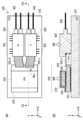
- FIG. 2 is a top view and a cross-sectional view showing an outline of the configuration of the optical transceiver of the present disclosure.
- Fig. 2(a) is a top view of the board surface (xy plane) of the PCB 101
- Fig. 2(b) is a cross-sectional side view (xz plane) taken along line IIb-IIb passing through the Tx module 400.
- the optical transceiver 100 has a DSP 200, an Rx module 300, and a Tx module 400 mounted on the PCB 101.
- the heat dissipation surfaces of DSP 200, Rx module 300, and Tx module 400 are aligned in one direction, taking into consideration manufacturability when mounting each component on PCB 101 and simplification of the heat dissipation structure of the optical transceiver.
- the DSP chip 202 generates the most heat in the optical transceiver, it is desirable to align the heat dissipation direction toward the upward direction (+z direction), which is appropriate for heat dissipation from DSP chip 202.
- the optical transceiver 100 is inverted when mounted on the PCB 101, and is positioned so that the side with the terrace is on the upper side in the height direction (z-axis) of the optical module.
- the optical module is mounted so that the terrace surface faces the upper surface of the PCB, and in the case of the Tx module 400, it is configured so that heat from the driver IC and Peltier element moves toward the side of the package with the terrace surface (in the +z direction).
- FIG. 9 is a diagram showing a cross-sectional structure inside a Tx module in an optical transceiver of the present disclosure.
- a Peltier element 406, a substrate 407, and an optical modulator chip 409 are arranged in this order inside a housing 417.
- Lenses 410 and 411 are provided on the substrate, which is optically coupled to an optical fiber 402.
- a driver IC 408 is formed on the surface of a base 415, and wiring 412 is formed on a package base 416.
- the optical modulator chip 409 is connected to the wiring 412 by wires 413 and 414.
- the inside and outside of the module are separated by the housing 417, package base 416, and package sidewall 405. A portion of the package base 416 is exposed from the housing to form a terrace surface of the optical module.
- An FPC 500-1 is connected to the terrace surface.
- the Peltier element 406 for temperature control and the base 415 which is thermally connected to the driver IC, a heat-generating component, are fixed to the top surface inside the housing 417. Heat dissipation from inside the module is configured so that heat moves from the driver IC and Peltier element to the outside in the +z direction.
- the Rx module is also equipped with a TIA instead of a driver IC, and heat from inside the module moves to the upper side of the module (+z direction).
- the optical module has heat-generating components mounted inside the package so that heat is dissipated toward the bottom surface opposite the surface mounted on the PCB. Therefore, a heat dissipation mechanism (housing) that has a common heat dissipation surface (not shown) on the upper side of the optical transceiver 100 can be used to dissipate heat from the DSP 200 and the Tx module 400.
- a heat dissipation mechanism housing
- a common heat dissipation surface not shown
- DSP200 is composed of DSP board 201, which is made up of a multilayer wiring board (described later), DSP chip 202, and lid 203.
- DSP chip 202 and DSP board 201 are connected by BGA 204.
- DSP board 201 and PCB 101 are connected by BGA 205.
- Lid 203 is made of a single piece of metal to cover at least the entire area of the top surface of DSP chip 202 and the area of the top surface of the DSP substrate excluding the areas where FPCs 500-1 and 500-2 are connected and fixed. Lid 203 may cover the sides of DSP chip 202 or may protrude from the periphery of DSP substrate 201. Lid 203 prevents unexpected direct damage to the DSP chip and the connecting parts such as BGAs 204, 204 caused by mishandling during mounting of DSP 200 in an optical transceiver or during the manufacturing process. By carefully designing the shape of lid 203, it is possible to leave the surface of DSP substrate 201 open from the RF connection pad for connecting to the FPC to the edge of the substrate.
- DSP 200 can be prepared as a DSP module with DSP chip 202 and lid 203 mounted on DSP board 201.
- the manufacturing process of the optical transceiver will be described later, but if it is prepared in the form of a DSP module with a lid, it can be safely mounted on PCB 101 without causing damage during the manufacturing process, just like the Rx module and Tx module.
- DSP 200 it is possible to prepare it without a lid, with only the DSP chip 202 mounted on the DSP board.
- the lid-less DSP 200 can be connected to the optical modules 300 and 400 with FPCs 500-1 and 500-2, respectively, and then the lid 203 can be attached last.
- the lid there is a risk that inadvertent force may be applied to the FPC, or that the lid 203 may short out the FPC wiring.
- it is necessary to thoroughly optimize the position of the pads in the area including the connection pads on the top surface of the DSP board 201, and the shape of the lid. Since the DSP chip and DSP board are exposed until just before the lid is mounted, great care must be taken not to damage the DSP chip, etc.
- the footprint of the lid 203 on the substrate surface is always smaller than the footprint of the DSP substrate 201.
- the footprint of the DSP chip 202 is contained within the footprint of the lid.
- the lid 203 is absent only in the area where at least the RF connection pad is located.
- the lid can be omitted.
- a lid can be provided only on the top surface of the DSP chip.
- the shape of the lid 203 can be modified in various ways, and specific variations will be described later.
- the Rx module 300 and the Tx module 400 are each housed in a package.
- the two optical modules 300, 400 and the DSP 200 are directly connected by FPCs 500-1, 500-2 as an RF interface for electrical signals.
- “directly” connected means that the connection PAD on the terrace of the optical module and the connection PAD on the DSP board are connected only via the FPCs 500-1, 500-2. Therefore, in the optical transceiver 100, there are no high-frequency paths that go through the VIA connecting the optical module to the PCB, the RF signal line in the PCB, the BGA connecting the PCB and the DSP board, and the VIA in the DSP board.
- the electrical signals do not pass through the VIA or BGA that lead to degradation of high-frequency characteristics.
- the DSP and optical module can be connected via the shortest high-frequency path, significantly reducing high-frequency loss.
- the optical transceiver configuration in Figure 2 is also very effective in reducing high-frequency loss caused by impedance mismatch at discontinuous parts of the high-frequency path.
- the direct current (DC) interface of the optical modules 300, 400 can be, for example, DC lead pins 301, 401 as shown in FIG. 2(a).
- the DC interface is not limited to a lead pin structure, and an FPC may be used, similar to the RF interface with the DSP 200.
- the DC lead pins 301, 401 are soldered to a PAD (not shown) of the PCB 101 so that power can be supplied from outside the optical transceiver.
- the Rx module 300, the Tx module 400, and the DSP 200 are optimally positioned to minimize loss of the RF signal, which is a high-frequency electrical signal.
- the two modules and the DSP 200 are positioned symmetrically about the center line along the longitudinal direction of the PCB 101.
- the lengths of the FPCs 500-1 and 500-2, which function as RF interfaces must each be as short as possible.
- the DC lead pins In order to place two optical modules close to each other, the DC lead pins must be grouped on one side of each module and oriented in opposite directions. As shown in FIG. 2(a), the DC lead pins 401 of the Tx module 400 are oriented in the -y-axis direction (downward in the drawing) toward the outer periphery of the PCB 101, while the DC lead pins 301 of the Rx module 300 are oriented in the +y-axis direction (upward in the drawing) toward the outer periphery of the PCB 101.
- This configuration follows the lead pin orientation defined in the HB-CDM standardized by OIF as shown in Non-Patent Document 1.
- the optical module package is made of ceramic. Considering the layout design of the high frequency signal lines and DC lines inside the optical module, it is desirable that the height from the top surface of PCB 101 to the terrace surface of the optical module in the cross-sectional view of FIG. 2(b) be approximately 1 to 2 mm. Similarly, it is desirable that the thickness of DSP board 201 be set in the range of approximately 1 to 2 mm in order to match the height with the terrace surface of the optical module. By matching the height of the top surface of the DSP board with the terrace surface, bending in the thickness direction of the FCP is unnecessary, as described below, and it is made flat.
- the DSP board has a thickness of about 1 to 2 mm, more layers can be used than are required for the DC and RF lines. Normally, in a multilayer wiring board, it is desirable from a cost perspective to minimize the number of layers as much as possible, so a core layer can be used inside to adjust the overall thickness of the board. Multilayer wiring boards that include such a core layer are sometimes called build-up boards.
- the core layer also functions as a separation layer that separates the RF wiring layer from the DC wiring layer. By providing a core layer, it is possible to greatly separate the DC layer from the RF wiring layer, thereby suppressing mutual interference between the wiring layers and the effects of noise.
- the detailed structure of the DSP board will be described later, along with the detailed structure of the PADs and signal lines.
- the DSP 200 in consideration of increasing the speed of DSP operation, it is desirable to house the DSP 200 in a small-sized DSP board 201 in order to reduce high-frequency signal loss and costs.
- the two FPCs should be configured to converge on the center line of the DSP 200 from the optical module side toward the DSP side.
- the FPCs shown in Figure 2 are all pre-shaped to a predetermined shape and are curved within the plane of the base material (x-y plane). It is possible to make the FPCs straight without bending, but this would require the PADs to be arranged in a fan-shaped manner on the board surface of the DSP board 201. This is undesirable as it would increase high-frequency loss on the DSP board and increase the size of the DSP board.
- the optical transceiver 100 disclosed herein has one feature in the connection form of the FPC between the DSP and the optical module.
- the FPC 806 is on a common surface of the board surface of the DSP board 804 and the terrace surface of the optical module 807 facing the same direction, and is connected only on one surface of the FPC 802.
- the FPC 500-1 is on a common surface of the board surface of the DSP board 201 and the terrace surface of the Tx module 400 facing the opposite direction, and is connected on a different surface of the FPC 500-1.
- the optical module 400 is mounted on the PCB 101 upside down from the conventional technology so that the terrace surface having the connection pad for the FPC faces the PCB 101 side.
- FIG. 3 is a diagram showing an enlarged cross section of an optical module including a connection portion of an FPC. It is a side cross section (x-z plane) of an enlarged view of the vicinity of FPC 500-1 in FIG. 2(b), and the height direction (z-axis direction) is enlarged. Please note that the relative size relationship of each part is not drawn accurately in order to make the configuration in the vicinity of the FPC easier to understand.
- FIG. 3 and FIG. 2(b) are cross sections cut perpendicular to the PCB surface through line IIb-IIb in FIG. 2(a), and cross the signal line of the bent FPC 500-1, but are shown along the signal line in the FPC.
- a configuration that minimizes FPC bending is adopted to reduce high-frequency loss caused by bending the FPC in the thickness direction (z-axis direction).
- FIG. 3 shows an FPC 500-1 that connects between a connection PAD 210 at the end of the DSP board 201 and a connection PAD 403 on the terrace surface of the Tx module 400.
- the FPC 500-1 has metal layers formed on both sides of a base material 501, with a signal line 502 on the upper side of the figure and a ground (GND) surface 503 on the opposite side.
- a PAD 504 and a PAD 507 for connection with the optical module are formed on both ends of the signal line 502.
- a PAD 505 for connection with the DSP connected to the PAD 504 by a VIA or through hole 508, and a PAD 506, connected to the connection PAD 507 by a VIA or through hole 509, are formed.
- the connection PAD 505 and the connection PAD 210 are connected by solder 206.
- PAD 506 a connection is made between connection PAD 507 and connection PAD 403 by solder 206.
- the height difference ⁇ H between the terrace surface of the Tx module and the top surface of the DSP board 201 is set to 500 ⁇ m or less in order to minimize bending of the FPC in the thickness direction. If the height difference is up to about 500 ⁇ m, there is no need to bend the FPC significantly in the thickness direction, and a nearly flat connection can be achieved. This reduces the high-frequency loss caused by bending the FPC significantly and the risk of cracks in the metal wiring on the FPC, making it possible to achieve a good high-frequency connection.
- a thicker base material is preferable to keep losses low.
- the thickness of the base material 501 it is desirable for the thickness of the base material 501 to be, for example, 50 ⁇ m or more. Specifically, if the base material 501 is about 50 to 100 ⁇ m thick, even if the height difference ⁇ H between the terrace surface and the DSP board surface described above is about 500 ⁇ m, mounting can be easily performed by slightly adjusting the shape in the thickness direction of the FPC.
- ⁇ H is set to about 500 ⁇ m, damage to the solder joints between the FPC and the optical module during the mounting process can also be suppressed. If the solder 206, 404 at both ends of the FPC becomes thick when completed, the size of the conductor part of the transmission line may change, and the characteristic impedance of the signal line may decrease. It is desirable for the solder thickness between the PADs to be 50 ⁇ m or less.
- the effect of heat from the DSP chip 202 which is the largest heat source in the optical transceiver, must be taken into consideration. If the optical modules 300, 400 and the DSP chip 202 are placed too close together, the optical module may become very hot. If the optical module is equipped with a Peltier element, there is a risk that the power consumption of the Peltier element will increase significantly or that the Peltier element will reach an inoperable state and undergo thermal runaway.
- the FPC is too short, problems will arise in the process of connecting the FPC to the DSP board, such as no part to hold the FPC or the inability to ensure the length to bend the FPC. From the perspectives of both thermal design and mountability, it is preferable that the length of the FPC be 3 mm or more.
- the procedure for mounting the optical transceiver 100 will be outlined below.
- the Rx module 300 and the Tx module 400 are in a state in which the FPCs are soldered onto the respective terrace surfaces in advance.
- the DSP 200 is mounted on the PCB 101 by reflow soldering, and then the optical modules 300 and 400 are mounted on the PCB 101.
- the optical module and the DSP are mounted in separate steps because it is difficult to put the optical module through a normal reflow process due to limitations in heat resistance, etc.
- the optical modules 300 and 400 have their respective FPCs soldered to the connection PAD 210 of the DSP 200.
- the DC lead pins 301 and 401 of the optical modules are fixed onto the PCB 101.
- the FPC of the optical module is an RF interface
- the size of the connection PAD 505 is limited for impedance matching. Since the high-frequency transmission characteristics and connection strength are affected by misalignment between the opposing PADs via the solder, the mounting of the optical module with the FPC must be carried out with extremely high precision.
- the lead pins since the lead pins only need to be reliably connected in a DC manner, it is possible to make the DC PAD size on the PCB side large, and the tolerance for misalignment can be relatively large. For this reason, the optical module is connected from the FPC side, and then the lead pins are connected.
- the VIA 508 can be replaced with a through hole.
- a through hole refers to a hole that penetrates the board and has all of its inner surfaces metallized.
- solder can flow through the holes, so at least one of the FPC connection PAD 505, heating PAD 504, or connection PAD 210 on the DSP board needs to be pre-soldered.
- the DC lead pins 301, 401 of the optical module are DC interfaces, and as long as they are electrically connected, some misalignment is acceptable.
- the PAD size on the PCB can also be set to be sufficiently wide for the lead pins, and high-precision alignment and mounting methods like those on the FPC are not required.
- the lead pins cannot be bent after they are fixed, but the FPC can be bent slightly. For this reason, it is possible to fix the FPC first, and then fine-tune the FPC to connect and fix the DC lead pins.
- the FPC has a structure in which metal layers are provided on both sides of a base material 501, with a signal line 502 of a high-frequency transmission path on one side and a GND surface 503 for the signal line on the other side. It is desirable that the FPC is configured so that the surface on which the signal line 502 is provided faces the terrace surface of the Tx module 400. Conversely, if the FPC is configured so that the signal line 502 faces the board surface of the PCB 101 below, there is a possibility that the metal wiring pattern on the PCB and the signal line 502 on the FPC will interfere with each other.
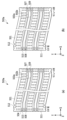
- FIG. 4 shows the FPC wiring layout in the optical transceiver of the present disclosure.
- FIG. 4(a) shows the first surface (x-y surface) on which the signal lines are located
- FIG. 4(b) shows the second surface (x-y surface) on which the GND surface is located, which is opposite to the first surface.
- the coverlay and resist of the FPC are omitted to make the layout easier to see.
- On the first surface side of the FPC 500a in FIG. 4(a), two sets of GSSG differential signal lines 502a, 502b are shown as an example.
- G represents ground
- S represents signal.
- the number of sets of signal lines may differ depending on the type of optical module.
- the area of the PAD on the GND surface is larger than that of the PAD for the signal line. From the viewpoint of high frequency characteristics, it is preferable that the PAD size for the signal line is smaller, but a sufficient area for solder connection is required to ensure the connection strength by solder. Therefore, the GND side PAD is made sufficiently wider than the signal line PAD to ensure the strength of the solder connection.
- the maximum area of the GND PAD between each channel is uniquely determined by the inter-channel pitch of the signal line PAD on the FPC and DSP board. If the inter-channel pitch is narrow and there is not enough area for the GND PAD, it is effective to expand the size of the GND PAD at both ends of the width direction (y direction) of the FPC. There is a risk of short circuit if solder flows to areas other than the soldered PDA area, so the areas of the FPC where solder is not required are covered with resist. Please note that the GND PAD is also defined on the GND surface by dividing the soldered PAD area with resist. Therefore, multiple PADs are placed at the end of the FPC in GSSG differential format. Also, since applying resist to the signal lines leads to increased high-frequency loss, care must be taken to keep the area of the resist as small as possible.
- the second surface side of the bottom surface of the FPC 500a in FIG. 4B is formed with a GND surface 503 for the signal lines 502a and 502b.
- the first surface of the FPC with the signal line 502 is connected to the connection pad on the terrace surface of the optical module 400, and the second surface of the FPC with the GND surface 503 is connected to the connection pad on the top surface of the DSP board 201.
- the first and second surfaces of the FPC are each used for the RF interface. Therefore, the VIA 508 included in the path of the signal line 502 not only serves the function of fixing by solder, but also plays an important role as part of the signal path that transmits high-frequency signals.
- half-through holes 510 are provided at the very end of FPC 500a for signal lines 502a and 502b. If the PAD length is sufficiently short and impedance changes due to stub formation are not a problem within the frequency band used, half-through holes are not essential. Similarly, half-through holes 511 are provided at the very end of FPC 500a to stabilize the high-frequency potential of the GND surface.
- Half-through holes 510 and 511 not only improve high-frequency characteristics, but also help to strengthen the solder connection strength by forming solder fillets on the connecting PAD.
- the half-through hole 510 for the PAD of the signal line if the diameter of the half-through hole is too large and the surrounding land area becomes large, the capacitance at the PAD increases, leading to a lower impedance of the connection PAD and deterioration of the high-frequency characteristics.
- connection pads 505, 210 can be mounted with the same length by adjusting the FPC position so that the edge positions of the two pads are shifted in the length direction (x direction). Also, as shown in the cross-sectional view of Figure 3, one edge of the connection pads 505 and 210 should be aligned, and the length of the connection pad 505 on the FPC side should be about 100 ⁇ m shorter than the connection pad 210 on the DSP board 201.
- the half-through hole 511 at the end of the GND surface does not significantly affect the high-frequency characteristics, so it may be a half-through hole with a larger diameter depending on the required connection strength.
- the FPCs 500-1 and 500-2 further include notches 512 formed on both sides of the base material 501.
- the notches 512 have a shape similar to the half-through holes 510 and 511 described above, but their functions are different. They are fitted with a holding mechanism that aligns the FPCs 500-1 and 500-2 during mounting and holds the FPCs 500-1 and 500-2 when heated and pressurized by a hot bar. In order to prevent heat from being transferred when the notches are fitted with the holding mechanism, it is preferable that the notches of the FPCs 500-1 and 500-2 are separated from the metal that forms the GND and that there is no metal. From a similar perspective, it is preferable that the holding mechanism itself is made of resin rather than metal so that heat is not transferred. This makes it possible to suppress unnecessary heat absorption in parts other than the PAD part and to apply heat concentratedly to the joint of the PAD. Details of the retention mechanism will be described later with reference to Figures 6 and 7.
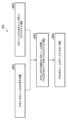
- the manufacturing method 600 includes mounting components other than the optical modules 300 and 400 (e.g., the DSP 200 and other capacitors not shown) on the PCB 101 (S601), connecting the optical modules 300 and 400 and the FPCs 500-1 and 500-2 by soldering using a hot bar (S602), placing the optical modules 300 and 400 to which the FPCs 500-1 and 500-2 are connected on the PCB 101, and connecting the FPCs 500-1 and 500-2 and the DSP 200 by soldering using a hot bar (S603), and connecting the PCB 101 and the optical modules 300 and 400 via the DC lead pins 301 and 401 (S604).
- the manufacturing method 600 includes mounting components other than the optical modules 300 and 400 (e.g., the DSP 200 and other capacitors not shown) on the PCB 101 (S601), connecting the optical modules 300 and 400 and the FPCs 500-1 and 500-2 by soldering using a hot bar (S602), placing the optical modules 300 and 400 to which the FPCs 500-1 and 500-2 are connected on
- the FPC 500-1 and the Tx module, and the FPC 500-2 and the Rx module 300 are connected by soldering using a hot bar. Details of soldering using a hot bar will be described later using S603 (connection of the FPCs 500-1, 500-2 to the DSP board 201) as an example.
- a soldering method using a hot bar for mounting an optical transceiver according to the present disclosure will be described in detail below, taking as an example the connection between FPCs 500-1, 500-2 and DSP board 201 (corresponding to S603 in FIG. 5).
- the FPC 500-1, 500-2 In order to mount using a hot bar, it is not possible to heat only the surface of the connection between the FPC 500-1, 500-2 and the DSP board 201, so in practice it is necessary to apply heat from the top of the FPC 500-1, 500-2 while applying pressure with the hot bar. Therefore, the FPC 500-1, 500-2 must have a structure that allows the heat applied from the top to be transferred to the connection with the DSP board 201. For this reason, the FPC 500-1, 500-2 of the optical transceiver according to the present disclosure is formed with metal patterns on both sides of the base material, and has a heating PAD 504 on the top surface and an RF connection PAD 505 on the bottom surface, as will be described in detail later.
- At least one through hole or buried VIA 508 is formed in each PAD.
- the through-hole or buried VIA has a land, and the molten heat and solder (only in the case of a through-hole) are transferred to the DSP board 201 side via the metal of the land and the through-hole or buried VIA 508, thereby performing soldering between the RF connection PAD 505 and the RF connection PAD 210.
- the heating pad may also serve as a land for forming the VIA or through hole. With such a configuration, the increase in capacitance can be suppressed. Also, since the land size increases as the diameter of the through hole or embedded VIA increases, it is desirable to have the diameter of the through hole or embedded VIA as small as possible.
- pre-soldering When mounting using a hot bar, it is necessary to perform pre-soldering in advance on at least one of the heating pads of the FPCs 500-1 and 500-2 and the RF connection pad of the DSP board 201.
- the method of this pre-soldering differs depending on whether the above-mentioned 508 is a through-hole or a buried via.
- solder is formed in advance on the heating PAD 504 using solder paste or the like (pre-soldering process), and this pre-formed solder is heated and pressurized with the hot bar. By doing so, the pre-formed solder melts at the same time as heating, flows through the through hole 508 to the connection portion, and solder 206 is formed.
- the diameter of the through hole 508 is ⁇ 100 ⁇ m or more.
- solder paste is applied and then the solder portion is heat-treated to fill the through hole portion in advance during the pre-soldering process is also useful.
- this pre-soldering process may be additionally performed on the RF connection PAD 210 on the DSP board 201. By doing so, the solder will be more familiar and stable solder mounting will be possible.
- the pre-soldering is performed on the RF connection pad 210 on the DSP board 201, or on the RF connection pad 505 on the FPCs 500-1 and 500-2.
- the heating pad 504 is then heated and pressurized with a hot bar, since the via 508 is made of metal, heat is applied to the solder formed by the pre-soldering through the via 508, and solder 206 is formed.
- the pre-soldering only needs to be performed on at least one of the RF connection pad 210 or the RF connection pad 505.
- an embedded via it is not necessary to flow solder from the hole, so it is not necessarily necessary for the diameter to be ⁇ 100 ⁇ m or more like a through hole. However, it should be noted that if the diameter becomes too small, the amount of heat transfer decreases. It is desirable to set an appropriate buried via diameter from the perspective of both impedance and heat. For example, when considering heat flow, a diameter of 50 ⁇ m or more is necessary. Note that due to the nature of the manufacturing process for typical FPCs, it is impossible to have both buried vias and through holes, so only one of them is always formed.
- the formation of solder 206 by the hot bar is performed via FPCs 500-1 and 500-2, so the set temperature of the hot bar must be set to a temperature higher than the melting temperature of the solder being used, taking into account the insulating effect of FPCs 500-1 and 500-2.
- the temperature of the hot bar must be set at least 50° C. higher than the melting temperature.
- the hot bar temperature is set too high, excessive heat will be transferred to the DSP chip 202, which may damage the DSP chip 202. For this reason, it is desirable to use a thermocouple or the like and monitor the solder temperature with a small thermistor before soldering.
- the solder material can be a SnAgCu-based lead-free solder that is often used in optical devices, but from the standpoint of suppressing the thermal effects on the DSP chip 202 and of mounting tolerance, a low-temperature solder with a melting point of 184°C or lower, such as a Sn- or Bi-based solder, may be used.
- the load applied by the hot bar needs to be 10 N or more.
- the Tx module 400 is HB-CDM and the Rx module 300 is HB-ICR, and they are mounted with a gap of 1 mm between them, the distance from the edge of FPC 500-1 to the edge of FPC 500-2 is expected to be about 20-30 mm. Therefore, it is assumed that the appropriate length of the hot bar in the Y direction is 20-30 mm. In general, the length must be set taking into account the temperature distribution of the hot bar. For example, in the case of a type in which heat is applied from the center of the hot bar, the heat is long near the center and low near both sides, so in that case it is desirable to make the length as long as possible so that heating can be performed near the center of the hot bar.
- the Y direction length of the hot bar is excessively long, interference between the hot bar and other elements or components (e.g., the lid 203) may occur, so the Y direction length of the hot bar must be set so as not to interfere with other elements or components.
- the size of the RF connection PAD 505 and the RF connection PAD 210 be 1 mm or less in length and 0.2 mm or less in width, because if the capacitance becomes too large, high frequency signals will not pass through. Also, in order to enable the hot bar to efficiently heat the area where the solder 206 is to be formed, it is desirable that the width of the hot bar (length in the X direction) be approximately the same as the size of the RF connection PAD 505 and the RF connection PAD 210 or slightly smaller (for example, approximately 200 to 300 ⁇ m smaller than the pad size).
- FIG. 6 is a side cross-sectional view showing the configuration of an optical transceiver mounting device 700 according to the present disclosure.
- the optical transceiver mounting device 700 according to the present disclosure includes a hot bar 701 for applying heat and load for forming solder 206 between RF connection PAD 505 and RF connection PAD 210, a mounting base 702 for holding PCB 101 during mounting, a lower support structure 703 arranged between the lower surface of PCB 101 and mounting base 702 for supporting from below the portion to be pressed by hot bar 701, and a holding mechanism 704 for realizing high-precision alignment of FPCs 500-1 and 500-2 during mounting and for holding FPCs 500-1 and 500-2 when heating and pressurizing FPCs 500-1 and 500-2 using hot bar 701.
- the heat applied by the hot bar 701 needs to be efficiently applied to the RF connection PAD 505 and the RF connection PAD 210.
- the mounting device 700 is configured so that the heat applied by the hot bar 701 is concentrated on the RF connection PAD 505 and the RF connection PAD 210, and is prevented from being conducted to other elements or released to the outside.
- the mounting device 700 may be configured so that the space between the mounting base 702 and the PCB 101 is hollow.
- the space between the mounting base 702 and the PCB 101 of the mounting device 700 By making the space between the mounting base 702 and the PCB 101 of the mounting device 700 hollow, thermal conduction is blocked in the hollow portion, and heat is concentrated on the RF connection PAD 505 and the RF connection PAD 210. However, if the space between the mounting base 702 and the PCB 101 is hollow, the PCB 101 will deform (warp) when a load is applied by the hot bar 701, and the load applied by the hot bar 701 will not be applied sufficiently to the areas where the pre-soldering process has been performed, the RF connection PAD 505, and the RF connection PAD 210.
- the lower support structure 703 is made of a material with low thermal conductivity (e.g., resin).
- the mounting device for an optical transceiver may be configured so that the mounting base 702 holds the PCB 101 in contact with the entire bottom surface of the PCB 101.
- the PCB 1010 will not deform when a load is applied. Therefore, the lower support structure 703 is not required.
- the mounting base 702 needs to be made of a material with high thermal insulation properties (e.g., resin).
- the holding mechanism 704 needs to be placed near the part where the hot bar 701 comes into contact so that alignment can be easily performed and so that the FPCs 500-1 and 500-2 do not move when heated and pressurized.
- the holding position is unstable. Therefore, as shown in FIG. 4(a), it is desirable that the holding mechanism 704 is a round bar structure that fits into the notches 512 formed on both sides of the base material 501 of the above-mentioned FPCs 500-1 and 500-2. If the diameter of the notch 512 is too small, the diameter of the round bar structure to be fitted becomes too small, and holding etc. becomes unstable, and furthermore, positioning for holding becomes very difficult.
- the notch 512 needs to have a diameter of at least ⁇ 300 ⁇ m or more so that it can be held stably.
- the holding mechanism 704 has a mechanism that supports only the base material 501 of the FPCs 500-1 and 500-2 on the sides and bottom. This configuration allows for stable mounting. Based on the same concept as the device base described above, it is desirable for the holding mechanism 704 to be made of a highly insulating material (e.g., resin).
- the holding mechanism 704 may be made of a highly conductive material such as metal.
- notch 512 By fixing the notch 512 using a rod-shaped holding mechanism 704, it becomes possible to hold the FPCs 500-1 and 500-2 without moving even when they are heated and pressurized by the hot bar 701. Also, to prevent the holding mechanism 704 from interfering with the surface of the DSP board 201 or the hot bar 701, it is desirable to position the notch 512 at a position 500 ⁇ m or more away from the inner edge of the RF connection PAD 505.
- [DSP configuration for implementing the implementation method] 8A and 8B are diagrams showing a detailed structure of the DSP board 201 of the optical transceiver 100 according to the present disclosure, in which (a) is a top view and (b) is a cross-sectional view taken along the Xb-Xb cross-sectional line.
- the DSP board 201 needs to have a thickness of 1 mm or more (for example, 1 to 2 mm).
- a core layer is generally used.
- the VIA formed in the DSP board 201 is ⁇ 100 ⁇ m or less, and in that case, the layer thickness of the build-up board that can be used is 100 ⁇ m or less. This is because, in order to make the DSP board 201 thicker than 1 mm, more layers are required than the number of layers required for RF wiring and DC wiring, which is disadvantageous in terms of cost, etc.
- the DSP board 201 not only is a core layer inserted to make the thickness 1 mm or more, but the second VIA 215 is arranged in the core layer below the PAD.
- the DSP board 201 is reinforced, and deformation and damage in the DSP board 201 are suppressed when pressure is applied with a hot bar. Suppressing such deformation (e.g., warping) is also effective from the viewpoint of realizing uniform loading of the load during solder mounting (suppressing uneven contact).
- the second VIA 215 does not affect the high-frequency characteristics, it may be sufficiently larger than other embedded VIAs, for example, ⁇ 200 ⁇ m or more.
- the ground of the RF connection PAD 210 is desirable for the ground of the RF connection PAD 210 to include a thermal isolation section 231 as shown in Fig. 8(a).
- This thermal isolation section 231 has a structure in which the surface metal of the RF connection PAD 210 is separated into the portion where the solder 206 is formed and the other portions (only the thermal isolation section 231 has no surface metal formed).
- thermal isolation section 231 By providing such a thermal isolation section 231, it is possible to prevent the heat applied from the hot bar 701 from propagating directly to the DSP chip 202 side and damaging the BGA 204 and the DSP chip 202 due to heat.
- the signal of the RF connection PAD 210 only the portion where the solder 206 is formed is provided on the surface of the DSP board 201, and for the portion thereafter, a VIA is provided and wiring is provided on the inner layer of the DSP board 201.
- providing a groove for thermal isolation in the GND metal portion means that if that portion is used as surface wiring, there will be no GND metal in that portion, resulting in impedance mismatch and degradation of high frequency characteristics. Therefore, from the perspective of ensuring high frequency characteristics, it is desirable to use a VIA in this groove portion or closer to the PAD than this groove portion to use inner layer wiring.
- the optical transceiver configuration disclosed herein is also effective for optical transmission and reception module forms (such as IC-TROSA) in which an optical modulator and an optical receiver are packaged together, or other package forms, etc.
- optical transceiver disclosed herein can be used for optical communications.
Landscapes
- Physics & Mathematics (AREA)
- Electromagnetism (AREA)
- Engineering & Computer Science (AREA)
- Computer Networks & Wireless Communication (AREA)
- Signal Processing (AREA)
- Semiconductor Lasers (AREA)
Priority Applications (4)
| Application Number | Priority Date | Filing Date | Title |
|---|---|---|---|
| EP23943631.4A EP4738729A1 (en) | 2023-06-28 | 2023-06-28 | Optical transceiver, and method and apparatus for manufacturing same |
| CN202380099830.1A CN121444366A (zh) | 2023-06-28 | 2023-06-28 | 光收发器及其制造方法和制造设备 |
| PCT/JP2023/024039 WO2025004234A1 (ja) | 2023-06-28 | 2023-06-28 | 光トランシーバ、並びに、その製造方法及び製造装置 |
| JP2025529094A JPWO2025004234A1 (https=) | 2023-06-28 | 2023-06-28 |
Applications Claiming Priority (1)
| Application Number | Priority Date | Filing Date | Title |
|---|---|---|---|
| PCT/JP2023/024039 WO2025004234A1 (ja) | 2023-06-28 | 2023-06-28 | 光トランシーバ、並びに、その製造方法及び製造装置 |
Publications (1)
| Publication Number | Publication Date |
|---|---|
| WO2025004234A1 true WO2025004234A1 (ja) | 2025-01-02 |
Family
ID=93937911
Family Applications (1)
| Application Number | Title | Priority Date | Filing Date |
|---|---|---|---|
| PCT/JP2023/024039 Ceased WO2025004234A1 (ja) | 2023-06-28 | 2023-06-28 | 光トランシーバ、並びに、その製造方法及び製造装置 |
Country Status (4)
| Country | Link |
|---|---|
| EP (1) | EP4738729A1 (https=) |
| JP (1) | JPWO2025004234A1 (https=) |
| CN (1) | CN121444366A (https=) |
| WO (1) | WO2025004234A1 (https=) |
Citations (5)
| Publication number | Priority date | Publication date | Assignee | Title |
|---|---|---|---|---|
| JP2003198034A (ja) * | 2001-12-27 | 2003-07-11 | Mitsubishi Electric Corp | Icパッケージ、光送信器及び光受信器 |
| JP2015026652A (ja) * | 2013-07-24 | 2015-02-05 | 住友電工デバイス・イノベーション株式会社 | フレキシブル基板 |
| WO2016111243A1 (ja) * | 2015-01-07 | 2016-07-14 | Nttエレクトロニクス株式会社 | フレキシブルプリント配線基板およびその実装方法 |
| WO2021171599A1 (ja) | 2020-02-28 | 2021-09-02 | 日本電信電話株式会社 | 高速光送受信装置 |
| JP2022114606A (ja) * | 2021-01-27 | 2022-08-08 | 住友電気工業株式会社 | 光送受信モジュールおよび光トランシーバ |
-
2023
- 2023-06-28 JP JP2025529094A patent/JPWO2025004234A1/ja active Pending
- 2023-06-28 WO PCT/JP2023/024039 patent/WO2025004234A1/ja not_active Ceased
- 2023-06-28 CN CN202380099830.1A patent/CN121444366A/zh active Pending
- 2023-06-28 EP EP23943631.4A patent/EP4738729A1/en active Pending
Patent Citations (5)
| Publication number | Priority date | Publication date | Assignee | Title |
|---|---|---|---|---|
| JP2003198034A (ja) * | 2001-12-27 | 2003-07-11 | Mitsubishi Electric Corp | Icパッケージ、光送信器及び光受信器 |
| JP2015026652A (ja) * | 2013-07-24 | 2015-02-05 | 住友電工デバイス・イノベーション株式会社 | フレキシブル基板 |
| WO2016111243A1 (ja) * | 2015-01-07 | 2016-07-14 | Nttエレクトロニクス株式会社 | フレキシブルプリント配線基板およびその実装方法 |
| WO2021171599A1 (ja) | 2020-02-28 | 2021-09-02 | 日本電信電話株式会社 | 高速光送受信装置 |
| JP2022114606A (ja) * | 2021-01-27 | 2022-08-08 | 住友電気工業株式会社 | 光送受信モジュールおよび光トランシーバ |
Non-Patent Citations (2)
| Title |
|---|
| "Implementation Agreement for the High Bandwidth Coherent Driver Modulator (HB-CDM", OIF, 15 July 2021 (2021-07-15), Retrieved from the Internet <URL:https://www.oiforum.com/wp-content/uploads/OIF-HB-CDM-02.0.pdf> |
| J. OZAKI ET AL.: "Over-85-GHz- Bandwidth InP-Based Coherent Driver Modulator Capable of 1-Tb/s/A-Class Operation", JOURNAL OF LIGHTWAVE TECHNOLOGY, vol. 41, no. 11, 2023, pages 3290 - 3296 |
Also Published As
| Publication number | Publication date |
|---|---|
| CN121444366A (zh) | 2026-01-30 |
| EP4738729A1 (en) | 2026-05-06 |
| JPWO2025004234A1 (https=) | 2025-01-02 |
Similar Documents
| Publication | Publication Date | Title |
|---|---|---|
| JP7335539B2 (ja) | 高速光送受信装置 | |
| JP6929113B2 (ja) | 光アセンブリ、光モジュール、及び光伝送装置 | |
| US6879032B2 (en) | Folded flex circuit interconnect having a grid array interface | |
| JP5263286B2 (ja) | 接続装置および光デバイス | |
| JP6155324B2 (ja) | 誘電性導波路を用いたチップ間通信 | |
| JP6995247B2 (ja) | 光モジュール | |
| US11340412B2 (en) | Optical module | |
| JP7368932B2 (ja) | 光モジュール及び光伝送装置 | |
| CN104220910A (zh) | 使用嵌入式电介质波导和金属波导的芯片间通信 | |
| JP2016127205A (ja) | フレキシブルプリント配線基板およびその実装方法 | |
| CN116936557A (zh) | 一种光电共封装结构及通信设备 | |
| JP2018017761A (ja) | Fpc付き光変調器、及びそれを用いた光送信装置 | |
| JP2006059883A (ja) | インターフェイスモジュール付lsiパッケージ | |
| WO2025004234A1 (ja) | 光トランシーバ、並びに、その製造方法及び製造装置 | |
| CN114879321A (zh) | 一种光模块 | |
| WO2025004226A1 (ja) | 光トランシーバ | |
| WO2025004229A1 (ja) | 光トランシーバ | |
| JP7769265B2 (ja) | 光モジュール | |
| JP2014175319A (ja) | 高周波半導体モジュール | |
| WO2024176458A1 (ja) | 光モジュール | |
| JP7187871B6 (ja) | 光変調器および光送信装置 | |
| WO2025004236A1 (ja) | 光トランシーバ | |
| US20250389913A1 (en) | High-Speed Optical Transceiver | |
| JP7474143B2 (ja) | 光モジュール | |
| JP2025006877A (ja) | モジュールおよびその製造方法 |
Legal Events
| Date | Code | Title | Description |
|---|---|---|---|
| 121 | Ep: the epo has been informed by wipo that ep was designated in this application |
Ref document number: 23943631 Country of ref document: EP Kind code of ref document: A1 |
|
| ENP | Entry into the national phase |
Ref document number: 2025529094 Country of ref document: JP Kind code of ref document: A |
|
| WWE | Wipo information: entry into national phase |
Ref document number: 2025529094 Country of ref document: JP |
|
| WWE | Wipo information: entry into national phase |
Ref document number: 2023943631 Country of ref document: EP |
|
| NENP | Non-entry into the national phase |
Ref country code: DE |
|
| ENP | Entry into the national phase |
Ref document number: 2023943631 Country of ref document: EP Effective date: 20260128 |
|
| ENP | Entry into the national phase |
Ref document number: 2023943631 Country of ref document: EP Effective date: 20260128 |