WO2025004181A1 - 熱交換器 - Google Patents
熱交換器 Download PDFInfo
- Publication number
- WO2025004181A1 WO2025004181A1 PCT/JP2023/023797 JP2023023797W WO2025004181A1 WO 2025004181 A1 WO2025004181 A1 WO 2025004181A1 JP 2023023797 W JP2023023797 W JP 2023023797W WO 2025004181 A1 WO2025004181 A1 WO 2025004181A1
- Authority
- WO
- WIPO (PCT)
- Prior art keywords
- tube
- flow path
- heat exchanger
- heat
- circumferential surface
- Prior art date
- Legal status (The legal status is an assumption and is not a legal conclusion. Google has not performed a legal analysis and makes no representation as to the accuracy of the status listed.)
- Ceased
Links
Images



Classifications
-
- F—MECHANICAL ENGINEERING; LIGHTING; HEATING; WEAPONS; BLASTING
- F28—HEAT EXCHANGE IN GENERAL
- F28D—HEAT-EXCHANGE APPARATUS, NOT PROVIDED FOR IN ANOTHER SUBCLASS, IN WHICH THE HEAT-EXCHANGE MEDIA DO NOT COME INTO DIRECT CONTACT
- F28D7/00—Heat-exchange apparatus having stationary tubular conduit assemblies for both heat-exchange media, the media being in contact with different sides of a conduit wall
- F28D7/10—Heat-exchange apparatus having stationary tubular conduit assemblies for both heat-exchange media, the media being in contact with different sides of a conduit wall the conduits being arranged one within the other, e.g. concentrically
Definitions
- This disclosure relates to a heat exchanger.
- a so-called shell-and-tube type heat exchanger is known.
- the internal space of the shell and the internal space of the tube are separated from each other. Heat is exchanged between the medium flowing through the tube and the medium flowing through the shell through the wall of the tube.
- the heat exchanger disclosed in Patent Document 1 has a strand (70) wound helically around a central core (30).
- a heat exchanger is equipped with a tube through which a medium that receives heat flows and a tube through which a medium that transfers heat flows.
- steam can be an example of a medium that transfers heat.
- the heat contained in the steam is transferred to the medium that receives heat via the wall of the tube.
- a liquid film may form on the surface of the tube through which the medium that receives heat flows.
- the surface of the tube through which the medium that receives heat flows is a path for heat transfer. If a liquid film exists on this path for heat transfer, the liquid film acts as a thermal resistance, making it difficult for heat to transfer. As a result, there is a risk that the efficiency of the heat exchanger may decrease.
- This disclosure describes a heat exchanger that can suppress a decrease in heat exchange efficiency.
- the heat exchanger of the present disclosure includes at least one heat exchange section capable of transferring heat between a first heat medium and a second heat medium.
- the heat exchange section includes a first tube through which the first heat medium flows, a second tube through which the first tube is inserted and which includes a second inner circumferential surface facing the first outer circumferential surface of the first tube via a gap, and through which the second heat medium flows in the region between the first outer circumferential surface and the second inner circumferential surface, and a flow path wall portion extending from the first outer circumferential surface to the second inner circumferential surface.
- the flow path wall portion travels along the extension direction of the first tube or the second tube while circulating between the first outer circumferential surface and the second inner circumferential surface.
- a flow path wall is disposed between the first tube and the second tube, and this flow path wall travels along the direction in which the first tube or the second tube extends while circling between the first outer peripheral surface and the second inner peripheral surface.
- a flow path is formed that travels while circling the first tube.
- the flow path wall may be inclined relative to the radial direction of the first tube. With this configuration, the condensed liquid can flow in the direction in which the flow path wall is inclined.
- the flow path through which the second heat medium flows and which is surrounded by the first outer peripheral surface, the second inner peripheral surface, and the flow path wall may be a spiral that circles around the first tube.
- the flow path wall portion may be integral with the first tube and the second tube.
- the heat exchanger can be manufactured using three-dimensional modeling technology.
- the heat exchanger may further include a first inlet for introducing the first heat medium into the first tube, and a second inlet for introducing the second heat medium into the second tube.
- the heat exchanger may further include a first inlet for directing the first heat medium to the first tubes and a second inlet for directing the second heat medium to the second tubes. This configuration can increase the amount of heat exchangeable medium.
- the heat exchanger disclosed herein can suppress a decrease in heat exchange efficiency.
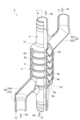
- FIG. 1 is a perspective view showing the appearance of a heat exchanger according to a first embodiment.
- FIG. 2 is a perspective view showing the internal structure of the heat exchanger shown in FIG.
- FIG. 3 is a cross-sectional view showing the internal structure of the heat exchanger shown in FIG.
- FIG. 4 is a perspective view showing the appearance of a heat exchanger according to the second embodiment.
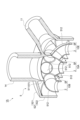
- FIG. 5 is a cross-sectional perspective view showing the main internal structure of the heat exchanger shown in FIG.
- the heat exchanger 1 receives steam 91 (second heat medium). Furthermore, the heat exchanger 1 receives a heat medium 92 (first heat medium). Examples of the heat medium 92 include an organic solvent and acetone.
- the heat exchanger 1 removes heat from the received steam 91. As a result, some or all of the water contained in the steam 91 is condensed. The condensed water is referred to as "condensate" in the following description.
- the heat exchanger 1 discharges condensate 93 as a result of the heat exchange.
- the heat exchanger 1 has a steam inlet 11 (second inlet), a condensate outlet 12, a first heat medium port 13, and a second heat medium port 14 (first inlet).
- the steam inlet 11 is connected to, for example, a boiler.
- the steam inlet 11 receives steam 91 provided from the boiler.
- the steam inlet 11 is connected to a condensate outlet 12.
- the condensate outlet 12 discharges condensate 93.
- the condensate outlet 12 is connected to, for example, a flash tank.
- the condensate outlet 12 provides condensate 93 to the flash tank.
- the first heat medium port 13 is connected to, for example, a raw material tank.
- the first heat medium port 13 receives the heat medium 92 before heat exchange provided from the raw material tank.
- the first heat medium port 13 is connected to a second heat medium port 14.
- the second heat medium port 14 discharges the heat medium 92 after heat exchange.
- the second heat medium port 14 is connected to, for example, a reactor.
- the second heat medium port 14 provides the heat medium 92 after heat exchange to the reactor.
- the heat exchanger 1 is arranged so that the axis L is parallel to the vertical direction as shown in FIG. 1 as an example. Such an arrangement can be said to be “arranged vertically”. With such an arrangement, the steam inlet 11 is arranged vertically above the condensate outlet 12. Therefore, the steam 91 and the condensate 93 move from top to bottom due to gravity. More specifically, the steam 91 and the condensate 93 move from top to bottom while swirling along the spiral flow path SF described later. In contrast, the first heat medium port 13 is arranged vertically below the second heat medium port 14. Therefore, the heat medium 92 moves from bottom to top against gravity. In other words, the direction in which the steam 91 and the condensate 93 move along the axis L is opposite to the direction in which the heat medium 92 moves. Such a flow is called “countercurrent” or "complete countercurrent".
- the direction in which the steam 91 moves and the direction in which the heat medium 92 moves may be the same. That is, in the above description, the heat medium 92 may be introduced from the portion called the second heat medium port 14, and the heat medium 92 may be discharged from the portion called the first heat medium port 13. This type of flow is called "parallel flow.”
- the direction in which the heat medium 92 flows does not make any essential difference to the structure of the heat exchanger 1. That is, the heat exchanger 1 of this embodiment can be used as a counterflow type or a parallel flow type.
- the heat exchanger 1 has an inner tube 2 (first tube) and an outer tube 3 (second tube).
- the inner tube 2 and the outer tube 3 are substantially cylindrical in shape.
- the heat exchanger 1 is a so-called single-tube type, having one inner tube 2 and one outer tube 3.
- the outer diameter of the inner tube 2 is smaller than the inner diameter of the outer tube 3.
- the inner tube 2 is inserted into the outer tube 3 so as to be approximately coaxial with the outer tube 3.
- the first end and the second end of the inner tube 2 protrude from the outer tube 3. That is, the length from the first end to the second end of the inner tube 2 is longer than the length of the outer tube 3.
- the first end of the inner tube 2 is the first heat medium port 13 described above.
- the second end of the inner tube 2 is the second heat medium port 14 described above. Therefore, the inner tube 2 constitutes a flow path for the heat medium 92 to flow.
- the inner circumferential surface 2b (second inner circumferential surface) of the inner tube 2 may be a smooth surface without protrusions.
- the inner circumferential surface 2b of the inner tube 2 may have a plurality of protrusions formed thereon.
- the protrusions have the effect of disturbing the flow of the heat medium 92 and increasing the heat transfer area of the inner circumferential surface 2b. As a result, it is possible to contribute to improving the efficiency of heat exchange.
- the outer tube 3 covers a portion of the inner tube 2.
- the first end of the outer tube 3 is closed by a first cover wall 31.
- the first cover wall 31 extends from the first end of the outer tube 3 to the outer peripheral surface 2a (first outer peripheral surface) of the inner tube 2.
- the first cover wall 31 is connected to a steam inlet pipe section 32.
- the steam inlet pipe section 32 is a tubular portion including the steam inlet 11 described above.
- the steam inlet pipe section 32 includes a parallel pipe section 321 extending parallel to the axis L of the inner tube 2 and a connecting pipe section 322 extending in a direction inclined relative to the axis L.
- the parallel pipe section 321 includes the steam inlet 11 described above.
- the connecting pipe section 322 extends from the parallel pipe section 321 to the first cover wall 31. Steam 91 is received from the steam inlet 11 of the parallel pipe section 321, passes through the parallel pipe section 321, and then reaches the connecting pipe section 322. The steam 91 then flows from the connecting pipe portion 322 through the opening in the first lid wall 31 to the outer tube 3.
- the opposite end of the outer tube 3 has a similar configuration. That is, the second end of the outer tube 3 is closed by the second cover wall 33, and the condensate discharge pipe section 34 is connected to the second cover wall 33.
- the condensate discharge pipe section 34 is a tubular portion including the condensate outlet 12 described above.
- the condensate discharge pipe section 34 also includes a second parallel pipe section 341 extending parallel to the axis L of the inner tube 2 and a second connecting pipe section 342 extending in a direction inclined relative to the axis L.
- the second parallel pipe section 341 includes the condensate outlet 12 described above.
- the second connecting pipe section 342 extends from the first parallel pipe section 321 to the first cover wall 31.
- the condensate 93 reaches the second connecting pipe section 342 from the opening of the second cover wall 33.
- the condensate 93 reaches the second parallel pipe section 341 via the second connecting pipe section 342.
- the condensate 93 is then discharged from the condensate outlet 12 of the second parallel tube section 341.
- the inner circumferential surface 3a of the outer tube 3 is separated from the outer circumferential surface 2a of the inner tube 2. In other words, a gap is formed between the inner circumferential surface 3a of the outer tube 3 and the outer circumferential surface 2a of the inner tube 2.
- Steam 91 received from the steam inlet pipe section 32 passes through the gap between the inner circumferential surface 3a of the outer tube 3 and the outer circumferential surface 2a of the inner tube 2 and reaches the condensate discharge pipe section 34. Heat is lost from the steam 91 as it moves through the gap. As a result, part or all of the steam 91 becomes condensed liquid as it moves through the gap.
- a continuous flow path wall 4 is provided in the gap.
- the flow path wall 4 divides the gap along the direction of the axis L. That is, the inner peripheral edge of the flow path wall 4 is connected to the outer peripheral surface 2a of the inner tube 2.
- the outer peripheral edge of the flow path wall 4 is connected to the inner peripheral surface 3a of the outer tube 3.
- the flow path wall 4 includes a flow path main surface 4a and a flow path back surface 4b.
- the flow path main surface 4a is a surface defined by a normal line that includes a vertically upward component.
- the flow path back surface 4b is a surface defined by a normal line that includes a vertically downward component.
- the flow path wall 4 forms a flow path from the opening of the first cover wall 31 to the opening of the second cover wall 33.
- the flow path is configured to rotate around the inner tube 2. More specifically, the flow path wall 4 travels along the direction of the axis L of the inner tube 2 while rotating between the outer peripheral surface 2a of the inner tube 2 and the inner peripheral surface 3a of the outer tube 3.
- the distance from the flow path main surface 4a to the flow path back surface 4b in the direction along the axis L can be defined as the pitch of the flow path wall 4.
- the pitch of the flow path wall 4 may be approximately constant.
- the flow path is referred to as a "spiral flow path.”
- the "spiral” in this embodiment may be interpreted as a strict “spiral” defined geometrically. Furthermore, the “spiral” in this embodiment may be interpreted as simply going around the inner tube 2.
- the spiral flow path SF travels along the axis L of the inner tube 2 while circling between the outer peripheral surface 2a of the inner tube 2 and the inner peripheral surface 3a of the outer tube 3.
- the cross-sectional shape of the spiral flow path SF is a parallelogram, for example.
- the parallelogram cross sections of the spiral flow path SF are arranged at equal intervals along the direction of the axis L.
- the spiral flow path SF is an area surrounded by the outer peripheral surface 2a of the inner tube 2, the inner peripheral surface 3a of the outer tube 3, the main flow path surface 4a of the flow path wall portion 4, and the back flow path surface 4b of the flow path wall portion 4.
- the outer peripheral surface 2a of the inner tube 2 is parallel to the inner peripheral surface 3a of the outer tube 3.
- the main flow path surface 4a of the flow path wall portion 4 is parallel to the back flow path surface 4b of the flow path wall portion 4.
- the flow path wall 4 is inclined with respect to the outer peripheral surface 2a of the inner tube 2.
- This "inclined” means that the inner angle A1 between the flow path main surface 4a of the flow path wall 4 and the outer peripheral surface 2a of the inner tube 2 is not a right angle.
- the inner angle A1 is a so-called obtuse angle greater than 90 degrees.
- the outer angle A2 between the flow path main surface 4a of the flow path wall 4 and the inner peripheral surface 3a of the outer tube 3 is not a right angle.
- the outer angle A2 is a so-called acute angle less than 90 degrees. If the heat exchanger 1 is arranged vertically, it can also be said that the flow path wall 4 extends vertically downward.
- the inner peripheral surface 3a of the outer tube 3 forming a certain cross section of the spiral flow path SF is located below the outer peripheral surface 2a of the inner tube 2 forming the same cross section.
- the portion 34c where the inner circumferential surface 3a of the outer tube 3 and the main flow path surface 4a of the flow path wall portion 4 are connected is located vertically lower than the portion 24c where the outer circumferential surface 2a of the inner tube 2 and the main flow path surface 4a of the flow path wall portion 4 are connected.
- the flow path wall 4 extends diagonally vertically downward from the outer peripheral surface 2a of the inner tube 2 to the inner peripheral surface 3a of the outer tube 3.
- the heat exchanger 1 is composed of parts such as the inner tube 2, the outer tube 3, and the flow path wall portion 4.
- the heat exchanger 1 is formed by integrally molding these multiple parts. There are no explicit boundaries, such as joint surfaces, between each of the components. In other words, the heat exchanger 1 is not obtained by manufacturing the inner tube 2 and the outer tube 3 as separate parts and then going through a process of combining them. Such a heat exchanger 1 can be manufactured by so-called three-dimensional modeling technology.
- the heat exchanger 1 is formed by stacking materials in the direction of the axis L.
- the cross sections of the inner tube 2 and the outer tube 3 are perpendicular to the axis L, so additive manufacturing is possible without any problems.
- Such a part is called an "overhang" in the field of three-dimensional modeling technology.
- the flow path wall 4 of the heat exchanger 1 does not extend in a direction perpendicular to the axis L, but extends in a direction inclined by a certain angle with respect to the axis L. Therefore, the flow path wall 4 does not need to be treated as a so-called overhang, and additive manufacturing is possible without any problems, just like the inner tube 2 and the outer tube 3.
- the baffle cut direction is vertical so that condensation does not accumulate inside the shell. If the baffle cut direction is horizontal, the baffle may become a weir and cause condensation to accumulate. The part where condensation accumulates does not function as a condensation surface (heat exchange surface). Furthermore, the flow state of the medium may become unstable. Note that the above consideration is not required when the full condensation type heat exchanger is placed horizontally and condensation occurs inside the tube. Furthermore, the above consideration is not required when the full condensation type heat exchanger is placed vertically and condensation occurs outside the tube.
- the inner diameter of the tube needs to be appropriately set so that it is not affected by the growth of a condensation film at the bottom of the tube.
- design strategies that suppress the growth of the condensate film (thinning the film) are not often adopted.
- the heat exchanger 1 of the present disclosure solves the above-mentioned problems by providing the following advantageous effects.
- the heat medium 92 flows from bottom to top in the inner tube 2.
- Steam 91 is introduced from the steam inlet 11.
- the steam 91 has a certain kinetic energy that can be defined by pressure and flow rate.
- This steam 91 moves to the spiral flow path SF.
- the outer peripheral surface 2a of the inner tube 2 that defines the spiral flow path SF functions as a heat exchange surface in the spiral flow path SF.
- the main flow path surface 4a of the flow path wall 4 extends from the inner peripheral surface 3a and can be considered as an area that is influenced by the heat medium 92. Therefore, the main flow path surface 4a of the flow path wall 4 also functions as a heat exchange surface.
- the steam 91 that comes into contact with the outer peripheral surface 2a and/or the main flow path surface 4a loses heat and reaches its saturation limit, causing it to condense.
- the steam 91 that is present in the vicinity of the outer peripheral surface 2a and/or the main flow path surface 4a also loses heat and reaches its saturation limit, causing it to condense.
- water is produced.
- the inner tube 2 is arranged so that its axis L is aligned along the vertical direction, so its outer peripheral surface 2a also extends vertically downward. Therefore, the condensed liquid 93 that has condensed on the outer peripheral surface 2a moves vertically downward due to the action of gravity.
- the condensed liquid 93 then moves from the outer peripheral surface 2a to the main flow path surface 4a of the flow path wall portion 4 that is connected to the outer peripheral surface 2a.
- the main flow path surface 4a is also inclined vertically downward. Therefore, the condensed liquid 93 moves further downward along the main flow path surface 4a. Finally, the condensed liquid 93 reaches the portion 34c where the main flow path surface 4a and the inner peripheral surface 3a of the outer tube 3 are connected.
- the heat exchanger 1 when the heat exchanger 1 is arranged vertically, it is arranged so that the flow path wall portion 4 extends diagonally downward as shown in FIG. 3, etc.
- the portion 24c where the flow path main surface 4a and the outer peripheral surface 2a of the inner tube 2 are connected is located below the portion 34c where the flow path main surface 4a and the inner peripheral surface 3a of the outer tube 3 are connected.
- the condensate 93 accumulates in the area surrounded by the outer peripheral surface 2a of the inner tube 2 and the flow path main surface 4a of the flow path wall portion 4.
- the condensate 93 comes into contact with the outer peripheral surface 2a of the inner tube 2, which functions as the main heat exchange surface. Therefore, when the heat exchanger 1 is arranged vertically, it is preferable to arrange it as shown in FIG. 3, etc.
- the condensate 93 generated by condensation moves quickly from the outer peripheral surface 2a of the inner tube 2, which is the main heat exchange surface. Furthermore, even on the main flow path surface 4a, which is the heat exchange surface, the condensate 93 moves from the part close to the outer peripheral surface 2a, which functions well as a heat exchange surface, to the part farther away. Therefore, the condensate 93 generated by condensation is unlikely to remain in the part that functions as a heat exchange surface. As a result, there is no inhibition of heat transfer due to the condensate 93, and a decrease in the efficiency of the heat exchanger 1 can be suppressed.
- the driving force for the movement of the condensate 93 is gravity.
- the movement of the condensate 93 can also be explained by a driving force other than gravity.
- the steam 91 is received into the heat exchanger 1 at a predetermined flow rate.
- the steam 91 with a predetermined flow rate flows while swirling along the spiral flow path SF.
- the condensate 93 is also dragged by the flow of the steam 91 and flows while swirling along the spiral flow path SF.
- a centrifugal force according to the swirling speed acts on the condensate 93 that flows while swirling.
- the condensate 93 receives a force from the outer peripheral surface 2a of the inner tube 2 toward the inner peripheral surface 3a of the outer tube 3. As a result, the condensate 93 moves quickly from the outer peripheral surface 2a of the inner tube 2, which is the heat exchange surface.
- the amount of condensed liquid 93 increases toward the downstream side of the spiral flow path SF, and the level of condensed liquid 93 that accumulates between the flow path main surface 4a of the flow path wall 4 and the inner circumferential surface 3a of the outer tube 3 rises.
- the portion with which the condensed liquid 93 comes into contact does not function as a heat exchange surface for condensation.
- the area of the flow path main surface 4a of the flow path wall 4 that functions as a heat exchange surface on the upstream side gradually increases toward the downstream side with which the condensed liquid 93 comes into contact.
- the area of the flow path main surface 4a of the flow path wall 4 that functions as a heat exchange surface decreases toward the downstream side.
- the outer circumferential surface 2a of the inner tube 2 continues to function as a heat exchange surface.
- the condensate 93 that accumulates between the flow path main surface 4a of the flow path wall portion 4 and the inner peripheral surface 3a of the outer tube 3 is pulled downstream by gravity and by the steam 91 that flows at high speed.
- the condensed condensate 93 does not remain inside the heat exchanger 1.
- the condensed condensate 93 is promptly discharged from the condensate outlet 12.
- the heat exchanger 1 of the first embodiment transfers heat from steam 91 to a heat medium 92.
- the heat exchanger 1 has an inner tube 2 through which the heat medium 92 flows, an outer tube 3 through which the inner tube 2 is inserted and which includes an inner circumferential surface 3a that faces the outer circumferential surface 2a of the inner tube 2 via a gap, and through which steam 91 flows in the region between the outer circumferential surface 2a and the inner circumferential surface 3a, and a flow path wall portion 4 that extends from the outer circumferential surface 2a to the inner circumferential surface 3a.
- the flow path wall portion 4 travels along the extension direction of the inner tube 2 or the outer tube 3 while circulating between the outer circumferential surface 2a and the inner circumferential surface 3a.
- the heat exchanger 1 of the first embodiment uses centrifugal force and gravity to eliminate the liquid film formed on the outer circumferential surface 2a of the inner tube 2, which is the heat exchange surface, and the flow path main surface 4a of the flow path wall portion 4. Furthermore, the heat exchanger 1 of the first embodiment has a so-called free drain type configuration that does not cause liquid pools. And, in the heat exchanger 1 of the first embodiment, the flow path wall portion 4, which is a spiral partition that forms the spiral flow path SF, functions as a heat exchange portion (fin), so that a heat transfer surface that contributes to heat exchange can be secured. Moreover, the heat exchanger 1 of the first embodiment can perform a complete countercurrent operation. And, since the heat exchanger 1 of the first embodiment flows the steam 91 and the condensate 93 in the relatively thin spiral flow path SF, it is also possible to suppress the retention of non-compressible gas.
- a flow path wall 4 is disposed between the inner tube 2 and the outer tube 3, and this flow path wall 4 travels along the direction in which the inner tube 2 or the outer tube 3 extends while circling between the outer peripheral surface 2a and the inner peripheral surface 3a.
- a spiral flow path SF is formed that travels while circling around the inner tube 2.
- the condensate 93 quickly moves from the outer peripheral surface 2a of the inner tube 2 that functions as a heat exchange surface. Therefore, the condensate 93 does not remain on the outer peripheral surface 2a of the inner tube 2, so that the outer peripheral surface 2a of the inner tube 2 can continue to function as a heat exchange surface. As a result, the decrease in efficiency of the heat exchanger 1 can be suppressed.
- the flow path wall 4 is inclined relative to the radial direction of the inner tube 2. With this configuration, the condensate 93 can flow in the direction in which the flow path wall 4 is inclined.
- the spiral flow path SF through which the steam 91 flows is surrounded by the outer peripheral surface 2a, the inner peripheral surface 3a, and the flow path wall, and is a spiral that circles the inner tube 2. With this configuration, the condensed liquid 93 can flow along the spiral flow path SF without being retained.
- the flow path wall 4 is integral with the inner tube 2 and the outer tube 3. With this configuration, the heat exchanger 1 can be manufactured using three-dimensional modeling technology.
- the heat exchanger 1 further includes a first heat medium port 13 that introduces the heat medium 92 to one inner tube 2, and a steam inlet 11 that introduces the steam 91 to one outer tube 3. With this configuration, a heat exchanger 1 with a simple configuration can be obtained.
- Second Embodiment 4 is a bundle of seven of the above-mentioned heat exchangers 1. With such a configuration, the ability to condense the steam 91 can be improved.
- the heat exchanger 1A has multiple heat exchange sections 10A-10G, a first branched lid section 5, and a second branched lid section 6. As with the heat exchanger 1 of the first embodiment, the heat exchanger 1A of the second embodiment can also be obtained as a single structure using three-dimensional modeling technology.
- the heat exchanger 1A has seven heat exchange sections 10A-10G.
- Six heat exchange sections 10B-10G are arranged side by side around one heat exchange section 10A at an angle of 60 degrees.
- the individual configurations of the heat exchange sections 10A-10G are the same as each other.
- Each of the heat exchange sections 10A-10G has an inner tube 2, an outer tube 3, and a flow path wall section 4.
- the specific configurations of these components are the same as the inner tube 2, outer tube 3, and flow path wall section 4 of the heat exchanger 1 of the first embodiment.
- the first branched lid section 5 is arranged on the side of the first ends of the seven heat exchange sections 10A to 10G.
- the first branched lid section 5 has a first heat medium inlet/outlet section 51 and a steam inlet section 52.
- the first heat medium inlet/outlet section 51 is connected to the inner tubes 2 of the heat exchange sections 10A to 10G.
- the first heat medium inlet/outlet section 51 can receive the heat medium 92 from the inner tubes 2 and can guide the heat medium 92 to the inner tubes 2.
- the first heat medium inlet/outlet section 51 has one first introduction pipe section 511 and multiple (seven) first branch pipe sections 512A to 512G.
- the outer end of the first introduction pipe section 511 is an opening that discharges or receives the heat medium 92.
- Seven first branch pipe sections 512A to 512G are connected to the inner end of the first introduction pipe section 511.
- Each of the first branch pipe sections 512A to 512G is connected to each of the inner tubes 2 in the seven heat exchange sections 10A to 10G.
- the steam introduction section 52 guides the steam 91 received from the steam inlet 11 to the spiral flow paths SF of the seven heat exchange sections 10A to 10G.
- the steam introduction section 52 is a cylindrical section formed to surround the portion where the first introduction pipe section 511 and the first branch pipe sections 512A to 512G are connected in the first heat medium inlet/outlet section 51.
- the steam introduction section 52 includes a lid section 521 corresponding to the first lid wall 31 in the heat exchanger 1 of the first embodiment, and a cylindrical section 522 surrounding the seven first branch pipe sections 512A to 512G.
- the space formed by the lid section 521 and the cylindrical section 522 is connected to each of the seven spiral flow paths SF.
- the space formed by the lid section 521 and the cylindrical section 522 is not connected to the space formed by the first heat medium inlet/outlet section 51.
- a second branched lid portion 6 is disposed on the second end side of the seven heat exchange portions 10A to 10G.
- the configuration of the second branched lid portion 6 is the same as that of the first branched lid portion 5, so a detailed description will be omitted.
- the heat exchanger 1A of the second embodiment can also suppress a decrease in the efficiency of heat exchange, similarly to the heat exchanger 1 of the first embodiment. That is, the heat exchanger 1A of the second embodiment further includes a first inlet for introducing a heat medium to the multiple inner tubes 2 and a second inlet for introducing a second heat medium to the multiple outer tubes 3. With this configuration, the amount of steam 91 that can be heat exchanged can be increased.
- the heat exchanger of the present disclosure is not limited to the embodiments described below, and various modifications are possible without departing from the scope of the present invention.
- the heat exchanger of the present disclosure may have the following configuration.
- the present disclosure is [1] "a heat exchanger characterized by having a spiral flow path through which a heat exchanging fluid flows around the tubes of the heat exchanger.”
- the present disclosure is [2] "a heat exchanger as described in [1] above, in which a portion of the flow path of the fluid flowing around the tube is integrally installed on the outer shape of the tube.”
- the present disclosure is [3] "a heat exchanger as described in [1] or [2] above, in which a portion of the outer diameter of the tube forms a part of a flow path for a fluid flowing around the tube.”
- the present disclosure is [4] "a heat exchanger according to any one of [1] to [3] above, in which the tube and the flow path around the tube have a double-pipe structure, and a flow path for the fluid flowing around the tube is formed on the outside of the internal flow path of the double pipe.”
- the present disclosure is [5] "A heat exchanger according to any one of [1] to [4] above, in which the spiral flow passage is inclined so as to become lower toward the outside in the tube radial direction.”
- the present disclosure is [6] "A heat exchanger according to any one of [1] to [5] above, wherein the heat exchanger includes a plurality of tubes.”
- the present disclosure is [6] "A heat exchanger according to any one of [1] to [6] above, wherein the heat exchanger is manufactured using a 3D printer.”
Landscapes
- Engineering & Computer Science (AREA)
- Physics & Mathematics (AREA)
- Thermal Sciences (AREA)
- Mechanical Engineering (AREA)
- General Engineering & Computer Science (AREA)
- Heat-Exchange Devices With Radiators And Conduit Assemblies (AREA)
Priority Applications (2)
| Application Number | Priority Date | Filing Date | Title |
|---|---|---|---|
| PCT/JP2023/023797 WO2025004181A1 (ja) | 2023-06-27 | 2023-06-27 | 熱交換器 |
| JP2025529045A JPWO2025004181A1 (https=) | 2023-06-27 | 2023-06-27 |
Applications Claiming Priority (1)
| Application Number | Priority Date | Filing Date | Title |
|---|---|---|---|
| PCT/JP2023/023797 WO2025004181A1 (ja) | 2023-06-27 | 2023-06-27 | 熱交換器 |
Publications (1)
| Publication Number | Publication Date |
|---|---|
| WO2025004181A1 true WO2025004181A1 (ja) | 2025-01-02 |
Family
ID=93937851
Family Applications (1)
| Application Number | Title | Priority Date | Filing Date |
|---|---|---|---|
| PCT/JP2023/023797 Ceased WO2025004181A1 (ja) | 2023-06-27 | 2023-06-27 | 熱交換器 |
Country Status (2)
| Country | Link |
|---|---|
| JP (1) | JPWO2025004181A1 (https=) |
| WO (1) | WO2025004181A1 (https=) |
Citations (5)
| Publication number | Priority date | Publication date | Assignee | Title |
|---|---|---|---|---|
| JPS56128965U (https=) * | 1980-03-04 | 1981-09-30 | ||
| JPS58198689A (ja) * | 1982-05-14 | 1983-11-18 | Matsushita Electric Ind Co Ltd | 熱交換器 |
| JPH02150692A (ja) * | 1988-11-30 | 1990-06-08 | Babcock Hitachi Kk | スラリまたはエマルジョン流体の加熱供給装置 |
| JP2006317096A (ja) * | 2005-05-13 | 2006-11-24 | Mitsubishi Electric Corp | 電気温水器用の熱交換器 |
| JP2018091599A (ja) * | 2016-11-30 | 2018-06-14 | 三菱アルミニウム株式会社 | 管式熱交換器とその製造方法 |
-
2023
- 2023-06-27 JP JP2025529045A patent/JPWO2025004181A1/ja active Pending
- 2023-06-27 WO PCT/JP2023/023797 patent/WO2025004181A1/ja not_active Ceased
Patent Citations (5)
| Publication number | Priority date | Publication date | Assignee | Title |
|---|---|---|---|---|
| JPS56128965U (https=) * | 1980-03-04 | 1981-09-30 | ||
| JPS58198689A (ja) * | 1982-05-14 | 1983-11-18 | Matsushita Electric Ind Co Ltd | 熱交換器 |
| JPH02150692A (ja) * | 1988-11-30 | 1990-06-08 | Babcock Hitachi Kk | スラリまたはエマルジョン流体の加熱供給装置 |
| JP2006317096A (ja) * | 2005-05-13 | 2006-11-24 | Mitsubishi Electric Corp | 電気温水器用の熱交換器 |
| JP2018091599A (ja) * | 2016-11-30 | 2018-06-14 | 三菱アルミニウム株式会社 | 管式熱交換器とその製造方法 |
Also Published As
| Publication number | Publication date |
|---|---|
| JPWO2025004181A1 (https=) | 2025-01-02 |
Similar Documents
| Publication | Publication Date | Title |
|---|---|---|
| US7740057B2 (en) | Single shell-pass or multiple shell-pass shell-and-tube heat exchanger with helical baffles | |
| JP6317091B2 (ja) | 伝熱管を用いた分解炉 | |
| FI93774C (fi) | Vaippa- ja putkilämmönvaihdin | |
| BRPI0911382B1 (pt) | processo para trocar calor com um fluido de fase mista | |
| CN105580087B (zh) | 蒸汽发生器以及在蒸汽发生器内抗振地固定换热器管的方法 | |
| JP7671342B2 (ja) | 垂直ロッドバッフル熱交換器のシステムおよび方法 | |
| US20060243653A1 (en) | Dialysis filter | |
| KR101967273B1 (ko) | 쉘 앤드 튜브 타입 열교환기 | |
| JPWO2021124583A5 (https=) | ||
| WO2025004181A1 (ja) | 熱交換器 | |
| US12578149B2 (en) | Vertical vapor generator | |
| JPS5844198B2 (ja) | 多管式熱交換器 | |
| JPH07269800A (ja) | 配管装置 | |
| WO2007088858A1 (ja) | 湿分分離加熱器 | |
| JP6139083B2 (ja) | 軸流排気式復水器 | |
| JP2645304B2 (ja) | 旋回式セパレータ | |
| KR20240126046A (ko) | 회전축을 갖는 로터에 배치하기 위한 열교환기, 특히 쉘-앤드-튜브 열교환기 | |
| AU2019207867B2 (en) | Tubular heat exchanger having corrosion protection | |
| EP2955469A1 (en) | Baffle suitable for evaporators | |
| JP7621917B2 (ja) | 熱交換器 | |
| JP6247541B2 (ja) | 多管式貫流ボイラ | |
| CN119879586A (zh) | 一种真空冷凝器 | |
| JP5230396B2 (ja) | ボイラ装置の配管構造、及び該ボイラ装置 | |
| JP7227756B2 (ja) | 熱交換器 | |
| JP5938243B2 (ja) | 塔頂凝縮器 |
Legal Events
| Date | Code | Title | Description |
|---|---|---|---|
| 121 | Ep: the epo has been informed by wipo that ep was designated in this application |
Ref document number: 23942621 Country of ref document: EP Kind code of ref document: A1 |
|
| ENP | Entry into the national phase |
Ref document number: 2025529045 Country of ref document: JP Kind code of ref document: A |
|
| WWE | Wipo information: entry into national phase |
Ref document number: 2025529045 Country of ref document: JP |
|
| NENP | Non-entry into the national phase |
Ref country code: DE |