WO2024257876A1 - 液体酵素製剤 - Google Patents
液体酵素製剤 Download PDFInfo
- Publication number
- WO2024257876A1 WO2024257876A1 PCT/JP2024/021776 JP2024021776W WO2024257876A1 WO 2024257876 A1 WO2024257876 A1 WO 2024257876A1 JP 2024021776 W JP2024021776 W JP 2024021776W WO 2024257876 A1 WO2024257876 A1 WO 2024257876A1
- Authority
- WO
- WIPO (PCT)
- Prior art keywords
- enzyme preparation
- liquid enzyme
- component
- protein
- protease
- Prior art date
- Legal status (The legal status is an assumption and is not a legal conclusion. Google has not performed a legal analysis and makes no representation as to the accuracy of the status listed.)
- Ceased
Links
Classifications
-
- C—CHEMISTRY; METALLURGY
- C12—BIOCHEMISTRY; BEER; SPIRITS; WINE; VINEGAR; MICROBIOLOGY; ENZYMOLOGY; MUTATION OR GENETIC ENGINEERING
- C12N—MICROORGANISMS OR ENZYMES; COMPOSITIONS THEREOF; PROPAGATING, PRESERVING, OR MAINTAINING MICROORGANISMS; MUTATION OR GENETIC ENGINEERING; CULTURE MEDIA
- C12N9/00—Enzymes; Proenzymes; Compositions thereof; Processes for preparing, activating, inhibiting, separating or purifying enzymes
- C12N9/14—Hydrolases (3)
- C12N9/48—Hydrolases (3) acting on peptide bonds (3.4)
- C12N9/50—Proteinases, e.g. Endopeptidases (3.4.21-3.4.25)
- C12N9/52—Proteinases, e.g. Endopeptidases (3.4.21-3.4.25) derived from bacteria or Archaea
-
- C—CHEMISTRY; METALLURGY
- C12—BIOCHEMISTRY; BEER; SPIRITS; WINE; VINEGAR; MICROBIOLOGY; ENZYMOLOGY; MUTATION OR GENETIC ENGINEERING
- C12N—MICROORGANISMS OR ENZYMES; COMPOSITIONS THEREOF; PROPAGATING, PRESERVING, OR MAINTAINING MICROORGANISMS; MUTATION OR GENETIC ENGINEERING; CULTURE MEDIA
- C12N9/00—Enzymes; Proenzymes; Compositions thereof; Processes for preparing, activating, inhibiting, separating or purifying enzymes
- C12N9/14—Hydrolases (3)
- C12N9/48—Hydrolases (3) acting on peptide bonds (3.4)
- C12N9/50—Proteinases, e.g. Endopeptidases (3.4.21-3.4.25)
- C12N9/52—Proteinases, e.g. Endopeptidases (3.4.21-3.4.25) derived from bacteria or Archaea
- C12N9/54—Proteinases, e.g. Endopeptidases (3.4.21-3.4.25) derived from bacteria or Archaea bacteria being Bacillus
-
- C—CHEMISTRY; METALLURGY
- C12—BIOCHEMISTRY; BEER; SPIRITS; WINE; VINEGAR; MICROBIOLOGY; ENZYMOLOGY; MUTATION OR GENETIC ENGINEERING
- C12N—MICROORGANISMS OR ENZYMES; COMPOSITIONS THEREOF; PROPAGATING, PRESERVING, OR MAINTAINING MICROORGANISMS; MUTATION OR GENETIC ENGINEERING; CULTURE MEDIA
- C12N9/00—Enzymes; Proenzymes; Compositions thereof; Processes for preparing, activating, inhibiting, separating or purifying enzymes
- C12N9/14—Hydrolases (3)
- C12N9/78—Hydrolases (3) acting on carbon to nitrogen bonds other than peptide bonds (3.5)
- C12N9/80—Hydrolases (3) acting on carbon to nitrogen bonds other than peptide bonds (3.5) acting on amide bonds in linear amides (3.5.1)
Definitions
- the present invention relates to a liquid enzyme preparation. More specifically, the present invention relates to a liquid enzyme preparation containing protein deamidase, which has excellent activity stability of protein deamidase.
- protein glutaminase derived from Chryseobacterium gleum JCM2410 strain and protein glutaminase derived from Chryseobacterium proteolyticum 9670 strain are known as enzymes that deamidate the ⁇ -amide and ⁇ -amide groups of glutamine and asparagine residues in proteins. Enzyme preparations of such protein deamidating enzymes are currently only available commercially in powder form.
- Patent Document 2 proposes a liquid enzyme preparation that contains at least one milk protein cross-linking and/or modification enzyme in a polyol-water suspension containing 25% to 100% (w/w) polyol and having a pH value in the range of 4.4 to 5.1.
- Patent Document 2 finds that transglutaminase is less stable at pH 5.2, and based on this finding, it discloses that the stability of a transglutaminase preparation in a glycerol-water suspension at pH 4.4 to 4.8 and a transglutaminase preparation in a sorbitol-water suspension at pH 4.6 is improved, and also discloses a tyrosinase preparation in a glycerol-water suspension at pH 4.6 and a protein glutaminase preparation in a glycerol-water suspension at pH 4.6.
- Patent Document 3 also describes that a useful protein composition, such as a stable interferon, can be produced by bubbling an asphyxiant gas such as nitrogen into a useful protein composition that contains a useful protein, a solvent, and a compound having a thiol structure, to reduce the dissolved oxygen concentration to 3 mg/L or less.
- an asphyxiant gas such as nitrogen
- Patent Document 2 examines the stability of liquid enzyme preparations of transglutaminase preparations, but only discloses the formulation of liquid enzyme preparations of protein deamidase, and does not fully examine the stability of this enzyme.
- Patent Document 3 examines the antiviral activity of an aqueous preparation containing canine interferon- ⁇ , but does not even mention liquid enzyme preparations of protein deamidase, and naturally does not examine them at all.
- some enzyme preparations are composed of a combination of multiple types of enzymes, but no examination is conducted on the stability of protein deamidase in liquid enzyme preparations that contain protein deamidase together with other enzymes.
- the object of the present invention is to provide a liquid enzyme preparation that contains protein deamidase together with other enzymes and has excellent activity stability of protein deamidase.
- a liquid enzyme preparation containing protein deamidase has excellent stability of activity of protein deamidase even when it contains a protease.
- the present inventors have found that in a liquid enzyme preparation containing protein deamidase and protease, the activity stability of protein deamidase is further improved when the preparation is stored in a container whose internal space is replaced with an inert gas, when the upper limit of the protease content is limited to a predetermined amount, and/or when sorbitol is added in the presence of a predetermined amount or more of protease, and that excellent activity stability of protein deamidase is obtained even when citrate is added in the presence of a predetermined amount or more of protease.
- the present invention was completed based on these findings. That is, the present invention includes the following inventions:
- Item 1 A liquid enzyme preparation comprising (A) a protein deamidase and (B) a protease.
- Item 2. The liquid enzyme preparation according to Item 1, wherein the liquid enzyme preparation is contained in a container whose internal space is replaced with an inert gas.
- Item 3. The liquid enzyme preparation according to Item 1 or 2, further comprising (C) sorbitol.
- Item 4. The liquid enzyme preparation according to any one of Items 1 to 3, further comprising (D) a citrate salt.
- Item 5. The liquid enzyme preparation according to Item 3, wherein the content of the component (C) is 30 w/v % or more.
- Item 6. The liquid enzyme preparation according to Item 3 or 4, wherein the content of the component (D) is 1 w/v % or more.
- Item 8. The liquid enzyme preparation according to any one of Items 1 to 7, which has a pH of 8.2 or less.
- Item 9. The liquid enzyme preparation according to any one of Items 1 to 8, wherein the content of the component (A) is 0.1 to 10,000 U/ml.
- Item 10. The liquid enzyme preparation according to any one of Items 1 to 9, wherein the component (A) is a protein deamidase derived from Chryseobacterium proteolyticum.
- Item 11 The liquid enzyme preparation according to any one of Items 1 to 10, wherein the content of the component (B) is 0.01 to 2,000 U/mL.
- Item 13 The liquid enzyme preparation according to Item 12, wherein the bacterial protease is a protease derived from the genus Chryseobacterium.
- Item 14 The liquid enzyme preparation according to Item 12, wherein the bacterial protease is a protease derived from the genus Bacillus and/or Geobacillus.
- Item 15 The liquid enzyme preparation according to any one of Items 1 to 14, wherein the content of the component (B) per 100 U of the component (A) is 0.002 to 400 U.
- the present invention provides a liquid enzyme preparation with excellent activity stability of protein deamidase.
- 1 shows the relationship between the amount of protease added (addition activity) to a liquid enzyme preparation containing protein deamidase and the remaining activity of protein deamidase in the liquid enzyme preparation.
- the liquid enzyme preparation of the present invention is characterized by containing (A) protein deamidase (hereinafter also referred to as “component (A)”) and (B) protease (hereinafter also referred to as “component (B)”).
- component (A) protein deamidase
- component (B) protease
- the liquid enzyme preparation of the present invention will be described in detail below.
- the liquid enzyme preparation of the present invention may contain (C) sorbitol (hereinafter also referred to as “component (C)”) and/or (D) citrate (hereinafter also referred to as “component (D)”).
- the liquid enzyme preparation of the present invention contains protein deamidase as component (A).
- Protein deamidase is an enzyme that exhibits the action of decomposing amide group-containing side chains of proteins without cleavage of peptide bonds and cross-linking of proteins, and its type, origin, etc. are not particularly limited. In addition, as long as the above action is the main activity, it may further have the action of decomposing amide group-containing side chains of proteins with cleavage of peptide bonds and cross-linking of proteins.
- protein deamidase examples include enzymes that deamidate glutamine residues in proteins and convert them to glutamic acid (e.g., protein glutaminase) and enzymes that deamidate asparagine residues in proteins and convert them to aspartic acid (e.g., protein asparaginase). More specific examples of protein deamidating enzymes include those of the genus Chryseobacterium, Flavobacterium, Empedobacter, Sphingobacterium, Aureobacterium, etc., which are disclosed in JP2000-50887A, JP2001-218590A, and WO2006/075772A1.
- protein deamidase examples include a protein deamidase derived from the genus Luteimicrobium, Agromyces, Microbacterium, or Leifsonia disclosed in WO2015/133590; and a commercially available protein glutaminase derived from the genus Chryseobacterium. These protein deamidases may be used alone or in combination of two or more kinds.
- protein deamidating enzymes derived from the genus Chryseobacterium are preferred, protein glutaminases derived from the genus Chryseobacterium are more preferred, and protein glutaminase derived from the species Chryseobacterium proteolyticum is even more preferred.
- Protein deamidase can be prepared from the culture medium of the microorganism from which the protein deamidase is derived. Specific preparation methods include a method of recovering protein deamidase from the culture medium or cells of the microorganism. For example, when a protein deamidase-secreting microorganism is used, the cells can be recovered from the culture medium in advance by filtration, centrifugation, or the like as necessary, and the enzyme can be separated and/or purified. When a protein deamidase-nonsecreting microorganism is used, the cells can be recovered from the culture medium in advance by pressure treatment, ultrasonic treatment, or the like to expose the enzyme, and the enzyme can be separated and/or purified.
- a known protein separation and/or purification method can be used without any particular limitation, and examples of the method include centrifugation, UF concentration, salting out, and various chromatography methods using ion exchange resins, etc.
- the content of component (A) in the liquid enzyme preparation of the present invention is not particularly limited, but may be, for example, 0.1 to 10,000 U/mL, 1 to 5,000 U/mL, 10 to 3,000 U/mL, or 50 to 2,000 U/mL, preferably 100 to 1,500 U/mL, more preferably 200 to 1,000 U/mL, even more preferably 300 to 900 U/mL or 350 to 700 U/mL, and even more preferably 400 to 600 U/mL.
- the amount of enzyme that liberates 1 ⁇ mol of ammonia per minute using benzyloxycarbonyl-L-glutaminylglycine (Z-Gln-Gly) as a substrate is defined as 1 unit (1 U).
- the liquid enzyme preparation of the present invention contains a protease as component (B).
- the protease is not particularly limited in terms of origin, and examples thereof include bacterial proteases.
- Bacterial proteases include proteases derived from the genera Chryseobacterium, Bacillus, and Geobacillus.
- protease derived from the genus Chryseobacterium is not particularly limited as long as it can achieve the desired effects of the present invention.
- Specific examples of proteases derived from the genus Chryseobacterium include Chryseobacterium nematophagum, Chryseobacterium cucumeris, Chryseobacterium lactis, Chryseobacterium rhizoplane, Chrys
- the proteases include those derived from Eobacterium joostei, Chryseobacterium shigense, Chryseobacterium proteolyticum, Chryseobacterium gleum, and Chryseobacterium soil.
- proteases derived from the genus Chryseobacterium may be used alone or in combination of two or more types.
- proteases derived from the genus Chryseobacterium proteases derived from the species Chryseobacterium proteolyticum are preferred from the viewpoint of further enhancing the activity stabilizing effect of protein deamidase.
- the protease derived from the genus Chryseobacterium can be prepared by known methods. For example, it can be easily prepared by culturing bacteria of the genus Chryseobacterium and isolating the protease using known means, or by using genetic recombination technology.
- proteases derived from the genus Bacillus include Bacillus amyloliquefaciens, Bacillus cereus, Bacillus clausii, Bacillus intermedius, and Bacillus lentus.
- proteases that can be used include proteases derived from Geobacillus s, Bacillus licheniformis, Bacillus stearothermophilus, Bacillus subtilis, and Bacillus thermoproteolyticus, and proteases derived from these Geobacillus species.
- the above-mentioned proteases may be used alone or in combination of two or more kinds.
- proteases derived from the genus Bacillus from the viewpoint of further enhancing the activity stabilizing effect of protein deamidase, proteases derived from Bacillus licheniformis, Bacillus amyloliquefaciens, and these proteases derived from the genus Geobacillus are preferred.
- the content of component (B) in the liquid enzyme preparation of the present invention is not particularly limited as long as it does not impair the effects of the present invention, but examples of the content include 0.01 to 10,000 U/mL or 0.01 to 5,000 U/mL.
- the content of component (B) in the liquid enzyme preparation of the present invention is preferably 0.01 to 3,500 U/mL, more preferably 0.01 to 3,000 U/mL or 0.01 to 2,500 U/mL, and even more preferably 0.01 to 2,000 U/mL, 0.01 to 1,800 U/mL, 0.01 to 1,650 U/mL, 0.01 to 1,500 U/mL, 0.01 to 1,400 U/mL, 0.01 to 1,300 U/mL, 0.01 to 1,200 U/mL, 0.01 to 1,100 U/mL, 0.01 to 1,000 U/mL, 0.01 to 900 U/mL, 0.01 to 800 U/mL, 0.01 up to 700 U/mL, 0.01 to 600 U/mL, 0.01 to 500 U/mL, 0.01 to 400 U/mL, 0.01 to 300 U/mL, 0.01 to 200 U/mL, or 0.01 to 150 U/mL, more preferably 0.01 to
- the content of component (B) in the liquid enzyme preparation of the present invention is 0.1 to 2,000 U/mL, 0.5 to 2,000 U/mL, 1 to 2,000 U/mL, 5 to 2,000 U/mL, 10 to 2,000 U/mL, 15 to 2,000 U/mL, 20 to 2,000 U/mL, 30 to 2,000 U/mL, 40 to 400 U/mL, 50 to 600 U/mL, 60 to 800 U/mL, 70 to 800 U/mL, 80 to 900 U/mL, 90 to 1000 U/mL, 100 to 12000 U/mL, 120 to 1400 U/mL, 140 to 1600 U/mL, 160 to 1800 U/mL, 180 to 2000 U/mL, 180 to 2000 U/mL, 190 to 2000 U/mL, 200 to 2000 U/mL, 200 to 2000 U/mL, 300 to 3000 U/mL, 300 to 4000 U/mL, 400 to
- the content of component (B) in the liquid enzyme preparation of the present invention is preferably 100 to 2,000 U/mL, 150 to 2,000 U/mL, 200 to 2,000 U/mL, 250 to 2,000 U/mL, or 300 to 2,000 U/mL.
- component (B) per 100 U of component (A) in the liquid enzyme preparation of the present invention is not particularly limited as long as it does not impair the effects of the present invention, but examples include 0.002 to 2,000 U or 0.002 to 1,000 U.
- the content of component (B) per 100 U of component (A) in the liquid enzyme preparation of the present invention is preferably 0.002 to 700 U, more preferably 0.002 to 600 U or 0.002 to 500 U, and even more preferably 0.002 to 400 U, 0.002 to 360 U, 0.002 to 330 U, 0.002 to 300 U, 0.002 to 280 U, 0.002 to 260 U, 0.002 to 240 U, 0.002 to 220 U, 0.002 to 200 U, 0.002 to 180 U, 0.002 to 160 U, 0.002 to 140 U, 0.002 to 120 U, 0.002 to 100 U, 0.002 to 80 U, 0.002 to 60 U, 0.002 to 40 U, or 0.002 to 30 U, more preferably 0.002 to 20 U, 0.002 to 16 U, 0.002 to 15 U, 0.002 to 14 U, 0.002 to 13 U, 0.002 to 8 U, 0.002
- the content of component (B) per 100 U of component (A) in the liquid enzyme preparation of the present invention may be 0.02-400 U, 0.1-400 U, 0.2-400 U, 1-400 U, 2-400 U, 3-400 U, 4-400 U, 6-400 U, 8-400 U, 10-400 U, 12-400 U, 14-400 U, 16-400 U, 18-400 U, 20-400 U, 30-400 U, 40-400 U, 50-400 U, or 60-400 U.
- the content of component (B) per 100 U of component (A) in the liquid enzyme preparation of the present invention is preferably 20 to 400 U, 30 to 400 U, 40 to 400 U, 50 to 400 U, or 60 to 400 U.
- Protease activity is measured by the Folin method using casein as a substrate.
- protease activity is measured by carrying out an enzyme reaction using casein as a substrate at a pH that is set according to the optimal pH of the protease being measured in a standard manner, and the amount of enzyme that causes an increase in the Folin test solution color substance equivalent to 1 ⁇ g of tyrosine per minute is defined as 1 unit (1 U).
- the liquid enzyme preparation of the present invention may contain sorbitol as component (C). There are no particular limitations on the circumstances in which component (C) may be blended into the liquid enzyme preparation of the present invention.
- the (C) component is particularly preferred when the content of the (B) component in the liquid enzyme preparation of the present invention is 100-2,000 U/mL, 150-2,000 U/mL, 200-2,000 U/mL, 250-2,000 U/mL, or 300-2,000 U/mL, or when the content of the (B) component per 100 U of the (A) component is 20-400 U, 30-400 U, 40-400 U, 50-400 U, or 60-400 U, in that it can further improve the stability of the liquid enzyme preparation.
- the content of component (C) in the liquid enzyme preparation of the present invention may be, for example, 10 w/v% or more, or 15 w/v% or more, preferably 20 w/v% or more, or 25 w/v% or more, more preferably 30 w/v% or more, even more preferably 35 w/v% or more, and even more preferably 38 w/v% or more.
- the upper limit of the above content range of component (C) is not particularly limited, and may be, for example, 80 w/v% or less, 75 w/v% or less, 65 w/v% or less, 55 w/v% or less, 50 w/v% or less, 45 w/v% or less, or 42 w/v% or less.
- Specific ranges for the content of component (C) include, for example, 10-80 w/v%, or 15-75 w/v%, preferably 20-65 w/v%, or 25-55 w/v%, more preferably 30-50 w/v%, even more preferably 35-45 w/v%, and even more preferably 38-42 w/v%.
- the content of the (C) component per 1 U of the (A) component in the liquid enzyme preparation of the present invention may be, for example, 0.15 mg or more, 0.2 mg or more, 0.3 mg or more, 0.4 mg or more, or 0.45 mg or more, preferably 0.5 mg or more, or 0.6 mg or more, and more preferably 0.75 mg or more.
- the upper limit of the above content range of the (C) component per 1 U of the (A) component in the liquid enzyme preparation of the present invention is not particularly limited, and may be, for example, 1.2 mg or less, 1.1 mg or less, 1 mg or less, 0.85 mg or less, or 0.83 mg or less.
- the specific range of the content of the (C) component per 1 U of the (A) component may be, for example, 0.15 to 1.2 mg, 0.2 to 1.1 mg, 0.3 to 1 mg, 0.4 to 1 mg, or 0.45 to 1 mg, preferably 0.5 to 0.85 mg, or 0.6 to 0.85 mg, and more preferably 0.75 to 0.83 mg.
- the liquid enzyme preparation of the present invention may contain a citrate as component (D).
- a citrate as component (D).
- Specific examples of the citrate preferably include alkali metal salts such as potassium salts and sodium salts, more preferably sodium salts.
- component (D) may be incorporated into the liquid enzyme preparation of the present invention.
- Component (D) can be used as a pH buffer. While component (D) suppresses pH fluctuations, it tends to reduce the stability of the liquid enzyme preparation of the present invention.
- the content of component (B) in the liquid enzyme preparation of the present invention is 80 to 2,000 U/mL, 90 to 2,000 U/mL, 100 to 2,000 U/mL, 150 to 2,000 U/mL, 200 to 2,000 U/mL, 250 to 2,000 U/mL, or 300 to 2,000 U/mL, or that the content of component (B) per 100 U of component (A) is 16 to 400 U, 18 to 400 U, 20 to 400 U, 30 to 400 U, 40 to 400 U, 50 to 400 U, or 60 to 400 U, in terms of suppressing a decrease in the stability of the liquid enzyme preparation.
- the content of the (D) component in the liquid enzyme preparation of the present invention may be, for example, 0.5 w/v% or more, preferably 0.8 w/v% or more, more preferably 1 w/v% or more, and even more preferably 1.5 w/v% or more, 2 w/v% or more, 2.5 w/v% or more, or 2.8 w/v% or more.
- the upper limit of the above content range of the (D) component is not particularly limited, and may be, for example, 20 w/v% or less, 18 w/v% or less, 16 w/v% or less, 13 w/v% or less, 11 w/v% or less, 9 w/v% or less, 7 w/v% or less, 5 w/v% or less, 4 w/v% or less, or 3.5 w/v% or less.
- Specific ranges for the content of component (D) include, for example, 0.5 to 20 w/v%, or 0.5 to 18 w/v%, preferably 0.8 to 16 w/v%, or 0.8 to 13 w/v%, more preferably 1 to 11 w/v%, or 1 to 9 w/v%, and even more preferably 1.5 to 7 w/v%, 2 to 5 w/v%, 2.5 to 4 w/v%, or 2.8 to 3.5 w/v%.
- the content of the (D) component per 1 U of the (A) component in the liquid enzyme preparation of the present invention is, for example, 0.0075 mg or more, preferably 0.012 mg or more, more preferably 0.02 mg or more, and even more preferably 0.025 mg or more, 0.03 mg or more, 0.035 mg or more, 0.04 mg or more, 0.045 mg or more, or 0.05 mg or more.
- the upper limit of the above content range of the (D) component per 1 U of the (A) component in the liquid enzyme preparation of the present invention is not particularly limited, and examples thereof include 0.3 mg or less, 0.27 mg or less, 0.24 mg or less, 0.2 mg or less, 0.16 mg or less, 0.14 mg or less, 0.1 mg or less, 0.09 mg or less, 0.08 mg or less, or 0.07 mg or less.
- Specific ranges for the content of component (D) per 1 U of component (A) include 0.0075 to 0.3 mg, preferably 0.012 to 0.27 mg, more preferably 0.02 to 0.24 mg, and even more preferably 0.025 to 0.2 mg, 0.03 to 0.16 mg, 0.035 to 0.14 mg, 0.04 to 0.1 mg, 0.045 to 0.09 mg, 0.045 to 0.08 mg, or 0.05 to 0.07 mg.
- the liquid enzyme preparation of the present invention contains water as a base, in addition to the above-mentioned components (A) and (B), and the components (C) and/or (D) which are blended as necessary. Furthermore, the liquid enzyme preparation of the present invention may or may not contain other components, in addition to the components (A), (B), and water, and the components (C) and/or (D) which are blended as necessary, to the extent that they do not affect the effects of the present invention. Examples of such other components include enzymes other than the components (A) and (B), and additives other than the components (C) and (D).
- enzymes include, for example, amylase ( ⁇ -amylase, ⁇ -amylase, glucoamylase), glucosidase ( ⁇ -glucosidase, ⁇ -glucosidase), galactosidase ( ⁇ -galactosidase, ⁇ -galactosidase), peptidase (leucine peptidase, aminopeptidase), lipase, esterase, cellulase, phosphatase (acid phosphatase, alkaline phosphatase), nuclease, deaminase, oxidase, dehydrogenase, glutaminase, pectinase, catalase, dextranase, transglutaminase, pullulanase, etc. These other enzymes may be contained alone or in combination of multiple types.
- additives include buffers, suspending agents, and physiological saline.
- buffers include phosphate buffers and acetate buffers. These other additives may be included alone or in combination.
- the liquid enzyme preparation of the present invention is a liquid enzyme composition.
- the liquid enzyme preparation of the present invention can be prepared by adding predetermined amounts of protein deamidase, protease, and predetermined additives and other components to be blended as necessary to water, and further sterilizing the mixture as necessary.
- the pH (referring to the pH at 25°C; the same applies below) of the liquid enzyme preparation of the present invention is not particularly limited, but may be, for example, 5.5 or higher, preferably 5.8 or higher.
- the upper limit of the above pH range of the liquid enzyme preparation of the present invention is not particularly limited, but is preferably 8.2 or lower, more preferably 7.5 or lower, even more preferably 7 or lower, and even more preferably 6.5 or lower.
- Specific pH ranges include, for example, 5.5 to 8.2, preferably 5.5 to 7.5, more preferably 5.8 to 7, and even more preferably 5.8 to 6.5.
- the amount of dissolved oxygen contained in the liquid enzyme preparation of the present invention is not particularly limited.
- the liquid enzyme preparation of the present invention has excellent activity stability of protein deamidating enzyme, even if the amount of dissolved oxygen contained in the liquid enzyme preparation is not actively reduced, an activity stabilization effect can be effectively obtained.
- suitable examples of the amount of dissolved oxygen in the liquid enzyme preparation include more than 3 mg/L, preferably more than 4 mg/L, more preferably 4.5 mg/L or more, and even more preferably 5 mg/L or more.
- the upper limit of the range of the amount of dissolved oxygen in the liquid enzyme preparation is not particularly limited, but examples include 8 mg/L or less, preferably 7 mg/L or less, more preferably 6 mg/L or less, and even more preferably 5.5 mg/L or less. Specific examples of the range of the amount of dissolved oxygen include more than 3 mg/L and 8 mg/L or less, preferably more than 4 mg/L and 7 mg/L or less, more preferably 4.5 to 6 mg/L, and even more preferably 5 to 5.5 mg/L. Note that the liquid enzyme preparation of the present invention does not exclude the case where the amount of dissolved oxygen is 3 mg/L or less.
- liquid enzyme preparation of the present invention is appropriately contained in a container capable of containing a liquid.
- the liquid enzyme preparation of the present invention is contained in a container whose internal space is replaced with an inert gas.
- the inert gas is not particularly limited, and examples thereof include nitrogen gas and rare gases (helium gas, argon gas, etc.).
- the method for replacing the internal space of the container with an inert gas is not particularly limited, and examples thereof include a method in which a gaseous inert gas or a liquid inert gas is directly added to the container.
- the liquid enzyme preparation of the present invention can improve the activity stability of protein deamidating enzyme by being stored in a container whose internal space is replaced with an inert gas, even without bubbling an inert gas into the liquid enzyme preparation. For this reason, in a preferred embodiment of the liquid enzyme preparation of the present invention, an inert gas is not bubbled. Note that when the liquid enzyme preparation of the present invention is stored in a container whose internal space is replaced with an inert gas, a form in which an inert gas is bubbled is not excluded.
- the oxygen concentration in the container i.e., in the gas phase in the container
- the oxygen concentration in the container can be, for example, 5 v/v% or less, preferably 3 v/v% or less, more preferably 2 v/v% or less, 1.5 v/v% or less, 1.3 v/v% or less, or 1 v/v% or less.
- the oxygen concentration range in the container is not particularly limited in its lower limit, but can be, for example, 0.01 v/v% or more, 0.05 v/v% or more, 0.1 v/v% or more, 0.4 v/v% or more, 0.6 v/v% or more, 0.8 v/v% or more, or 1 v/v% or more.
- the liquid enzyme preparation of the present invention can be used for any application that utilizes at least protein deamidase activity.
- the liquid enzyme preparation of the present invention can be used for the purpose of protein modification.
- the specific mode of protein modification is not particularly limited, and may be any that utilizes changes in protein properties brought about by deamidation of ⁇ -amide groups and ⁇ -amide groups in glutamine residues and asparagine residues of the protein to generate carboxyl groups.
- protein modification include increased solubility of the protein, increased water dispersibility, improved emulsifying power, and improved emulsion stability.
- the liquid enzyme preparation of the present invention can be widely used in the food industry. Specifically, it can be used in applications such as improving the solubility, dispersibility, emulsifying property, etc. of animal proteins and/or vegetable proteins in a weakly acidic condition environment that is the pH range of normal foods (for example, applications for producing acidic beverages such as coffee whitener, juice, dressings, mayonnaise, and cream); increasing the solubility and dispersibility of poorly soluble vegetable proteins (for example, applications for producing tempura flour using wheat gluten); modifying dough in bread and confectionery (for example, applications for producing crackers, biscuits, cookies, pizza or pie crusts); and detecting allergens in allergenic proteins in foods.
- a weakly acidic condition environment that is the pH range of normal foods
- applications for producing acidic beverages such as coffee whitener, juice, dressings, mayonnaise, and cream
- increasing the solubility and dispersibility of poorly soluble vegetable proteins for example, applications for producing tempura flour using wheat gluten
- modifying dough in bread and confectionery for
- HAP hydrolyzed animal protein
- HVP hydrolyzed vegetable protein
- miso and soy sauce etc.
- liquid enzyme preparation of the present invention can be used for any application that utilizes both protein deamidase activity and protease activity.
- Protein deamidase Insoluble components such as contaminating polymers were removed from the culture solution of Chryseobacterium proteolyticum, a protein deamidase (protein glutaminase) producing strain, and the product was purified by ion exchange chromatography. Protein deamidase activity was measured by the following method.
- 0.1 mL of the sample solution containing protein deamidase was added to 1 mL of 0.2 M phosphate buffer (pH 6.5) containing 30 mM Z-Gln-Gly, and the mixture was left at 37°C for 10 minutes, after which 1 mL of 0.4 M TCA solution was added to stop the reaction.
- 1 mL of 0.4 M TCA solution was added to 1 mL of 0.2 M phosphate buffer (pH 6.5) containing 30 mM Z-Gln-Gly, and 0.1 mL of the sample solution containing protein deamidase was added and the mixture was left at 37°C for 10 minutes.
- the amount of ammonia produced in the reaction solution was measured using an Ammonia Test Wako (Fujifilm Wako Pure Chemicals).
- the ammonia concentration in the reaction solution was calculated from a calibration curve showing the relationship between ammonia concentration and absorbance (630 nm) created using an ammonia standard solution (ammonium chloride).
- the activity of protein deamidating enzyme was calculated from the following formula, with 1 unit (1U) being the amount of enzyme that produces 1 ⁇ mol of ammonia per minute.
- the reaction solution volume is 2.1
- the enzyme solution volume is 0.1
- Df is the dilution ratio of the enzyme solution.
- 17.03 is the molecular weight of ammonia.
- proteases used in the following test examples are as follows. ⁇ Protease derived from Chryseobacterium genus: Protease derived from Chryseobacterium proteolyticum ⁇ Protease derived from Bacillus licheniformis ⁇ Protease derived from Bacillus amyloliquefaciens
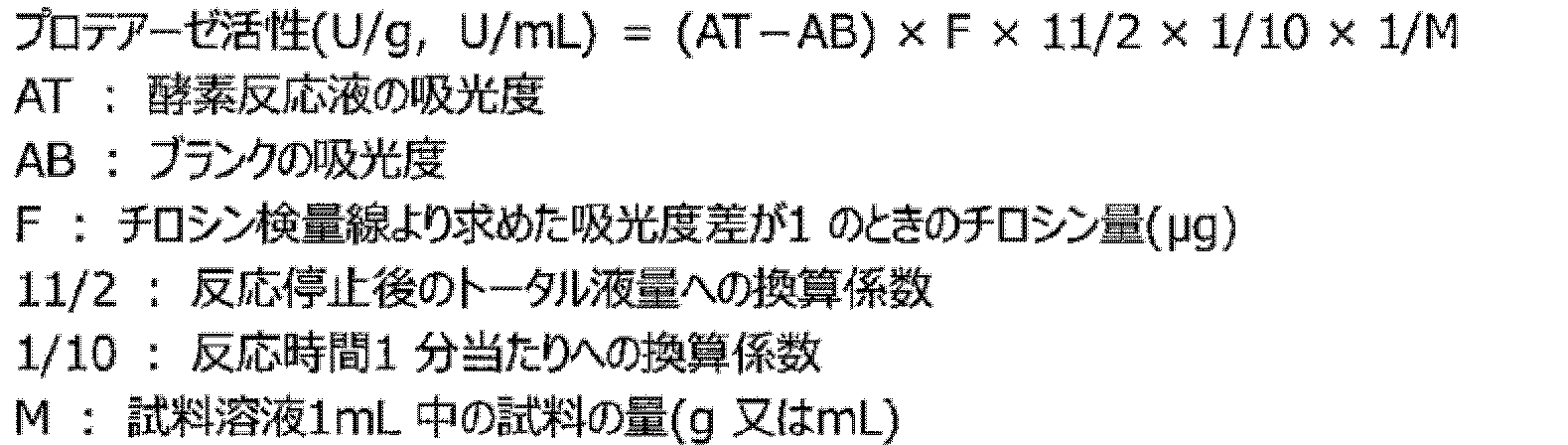
- protease activity was measured by the following method. 5 mL of 0.6% (w/v) casein solution (0.05 mol/L sodium hydrogen phosphate, pH 8.0) was heated at 37°C for 10 minutes, and then 1 mL of a sample solution containing protease was added and immediately shaken. After leaving this solution at 37°C for 10 minutes, 5 mL of trichloroacetic acid test solution (containing 1.8% (w/v) trichloroacetic acid, 1.8% (w/v) sodium acetate and 0.33 mol/L acetic acid) was added and shaken, and the solution was left at 37°C for 30 minutes again and filtered.
- casein solution 0.05 mol/L sodium hydrogen phosphate, pH 8.0
- tyrosine standard stock solution 0.2mol/L hydrochloric acid 1mL, 2mL, 3mL and 4mL were measured, and 0.2mol/L hydrochloric acid test solution was added to each to make 100mL. 2mL of each solution was measured, 5mL of 0.55mol/L sodium carbonate test solution and 1mL of Folin test solution (1 ⁇ 3) were added, and the mixture was immediately shaken and left at 37°C for 30 minutes. For these solutions, 2mL of 0.2mol/L hydrochloric acid test solution was measured and the solution obtained by the same operation as above was used as a control, and the absorbances A1, A2, A3 and A4 at a wavelength of 660nm were measured.
- the absorbances A1, A2, A3 and A4 were plotted on the vertical axis and the amount of tyrosine ( ⁇ g) in 2mL of each solution was plotted on the horizontal axis, and a calibration curve was created to determine the amount of tyrosine ( ⁇ g) relative to the absorbance difference of 1.
- the amount of enzyme that causes an increase in the color substance of Folin's test solution equivalent to 1 ⁇ g of tyrosine per minute was defined as 1 unit (1 U).
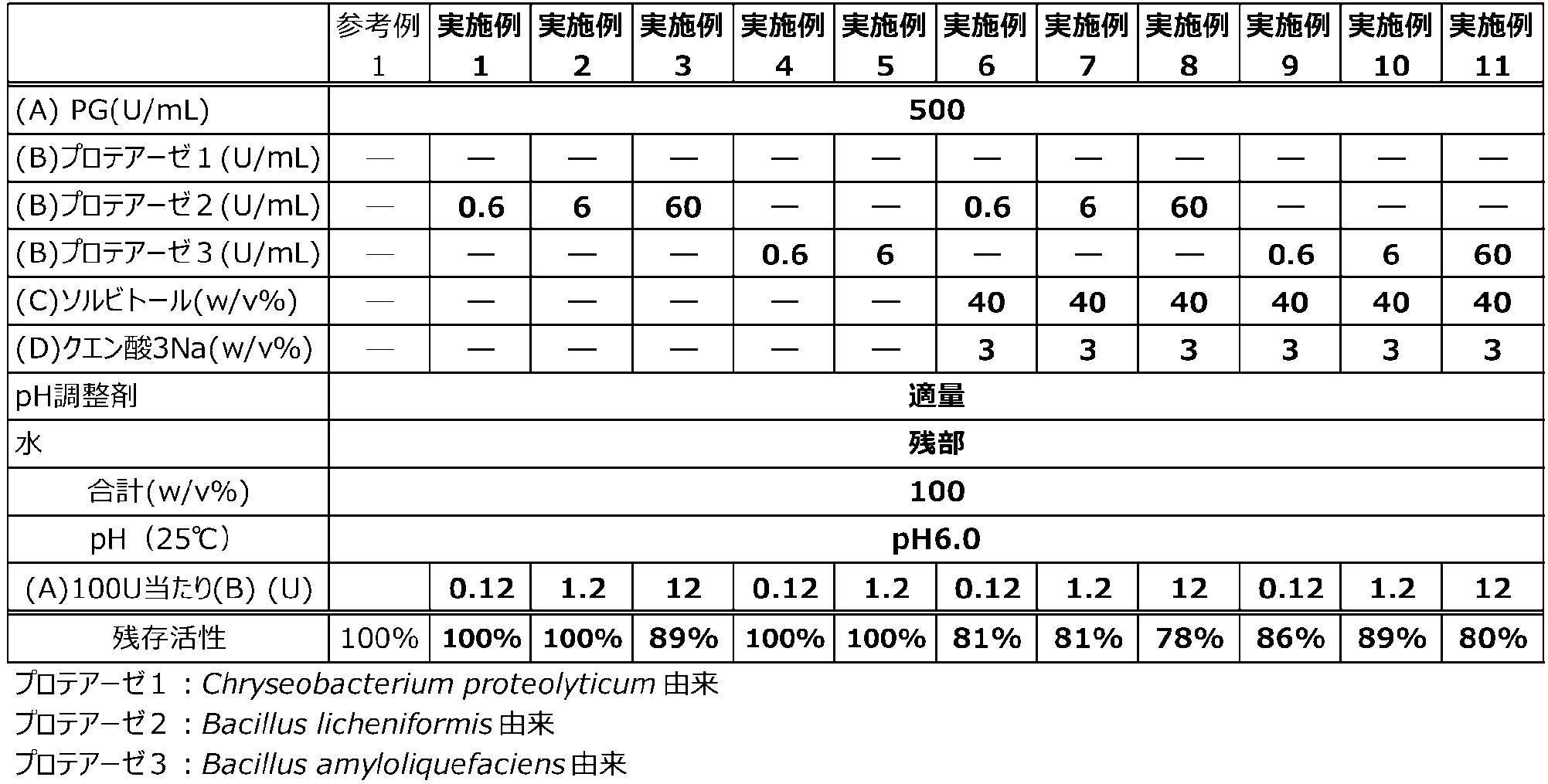
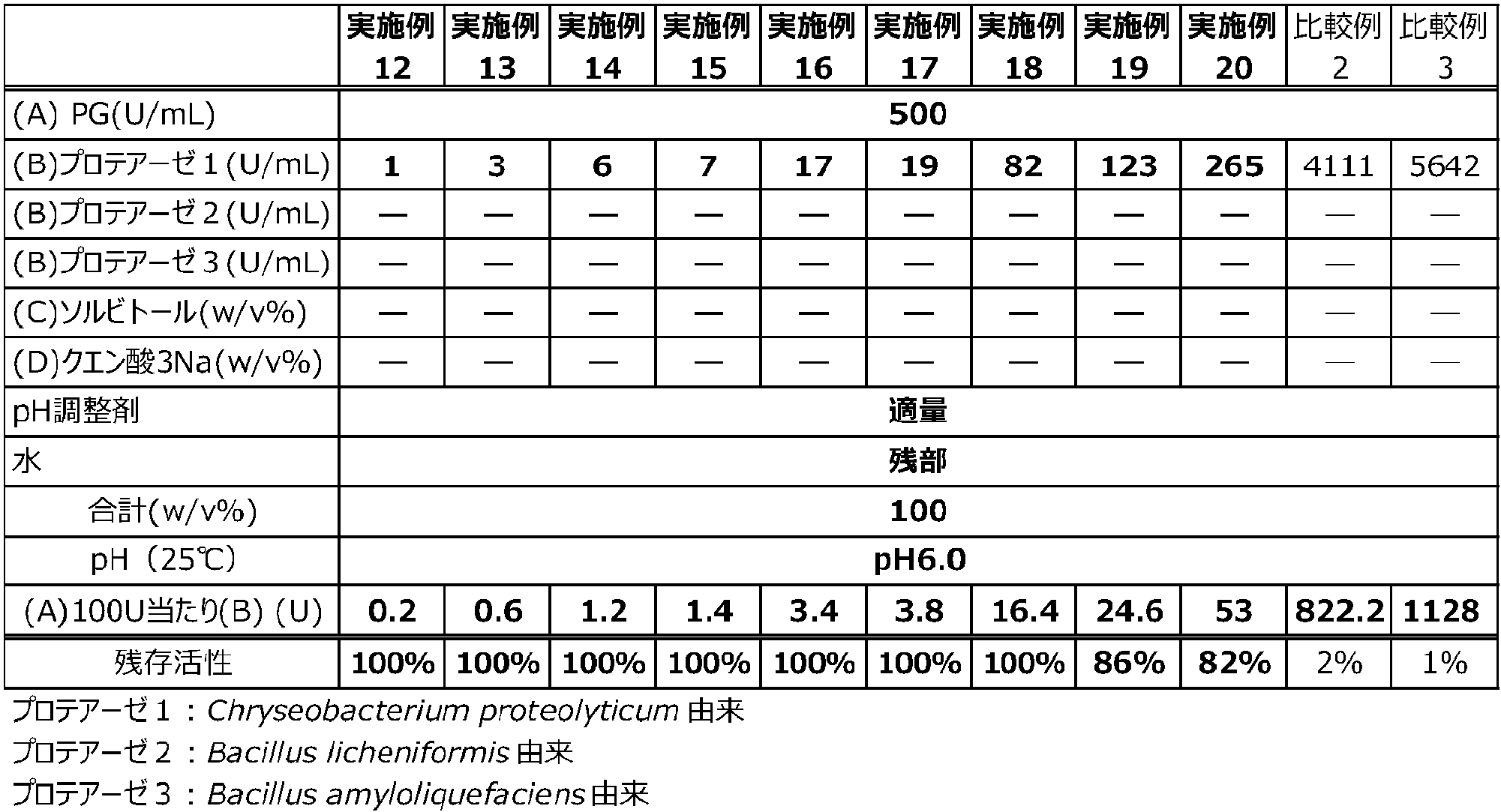
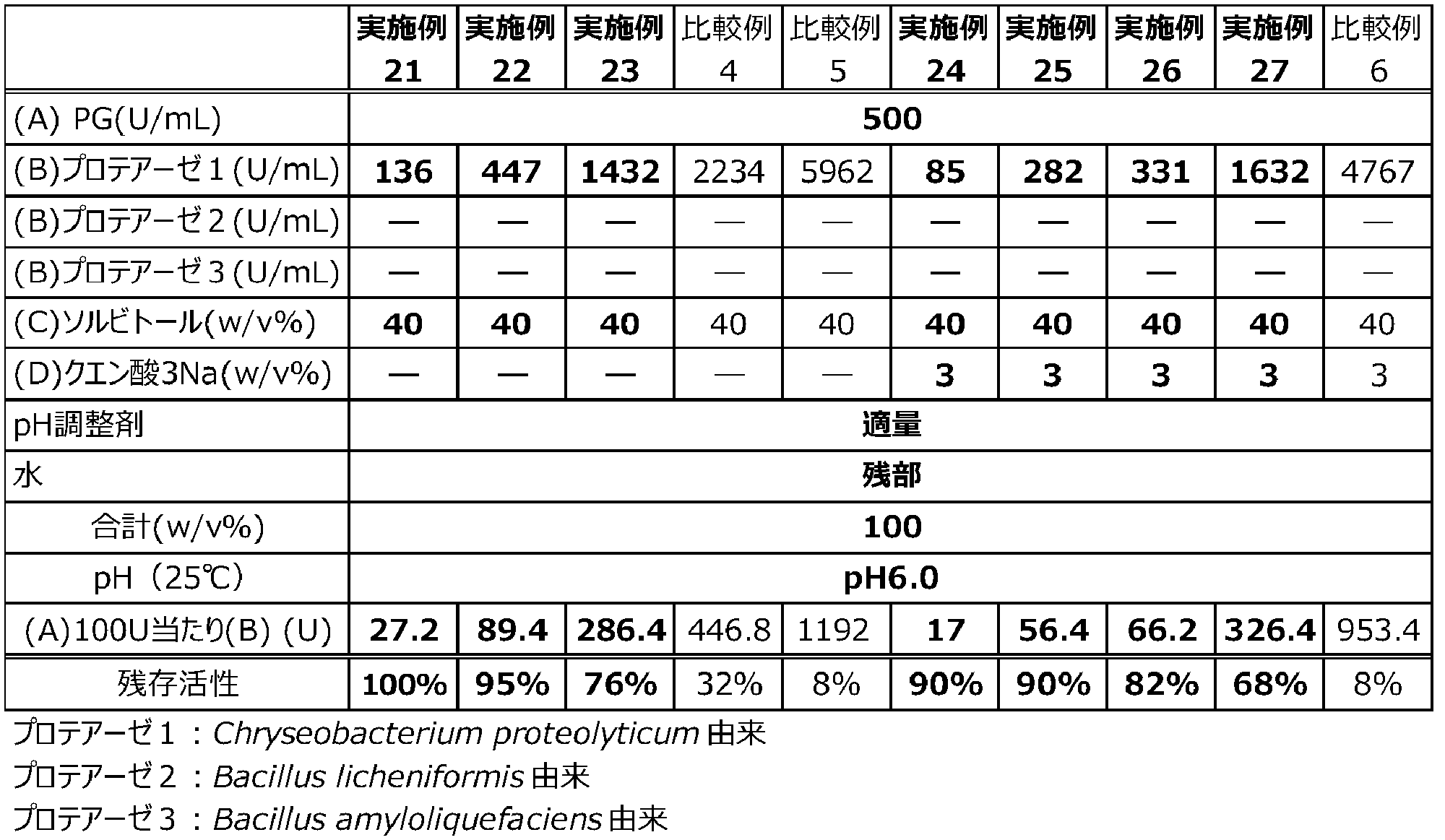
- Protein glutaminase (PG, component (A)) purified by ion exchange chromatography was mixed with protease (component (B)), sorbitol (component (C)) or citric acid (component (D)) in the amounts shown in Tables 1 to 3.
- the pH was adjusted to 6.0 (25°C) using 80% acetic acid or 6N aqueous sodium hydroxide solution as a pH adjuster to prepare a liquid enzyme preparation having a PG concentration as shown in Tables 1 to 3.
- the prepared liquid enzyme preparation was placed in a container, and nitrogen was injected from a nitrogen cylinder into the gas phase of the storage container (the space above the liquid phase consisting of the liquid enzyme preparation), and the container was repeatedly put in and taken out 20 times to almost completely replace the oxygen in the container with nitrogen (i.e., the oxygen in the gas phase was replaced with nitrogen without bubbling nitrogen into the liquid enzyme preparation), and the container was sealed to obtain a liquid enzyme preparation in a container.
- Example 1 and Example 6, between Example 2 and Example 7, between Example 3 and Example 8, between Example 4 and Example 9, between Example 5 and Example 10, and between Example 18 and Example 24 show that when the amount of component (B) is relatively small, the residual activity tends to decrease by adding component (C); however, comparisons between Example 19 and Example 21 and between Example 20 and Example 25 show that when the amount of component (B) is relatively large (specifically, when the amount of component (B) is approximately 100 U/mL or more (approximately 20 U or more of component (B) per 100 U of component (A))), the residual activity improves by adding component (C).
- Example 21 Compared Example 21 with Example 24, and Example 22 with Example 26, it was found that the incorporation of component (D) tended to slightly decrease the residual activity, but because the stability of the liquid enzyme preparation to which component (C) was added was high when the amount of component (B) was relatively large, the decrease in residual activity could be suppressed even when component (D) was added, and high stability was effectively achieved.
- the activity stabilization effect of protein deamidase shown in Tables 1 to 3 was also excellent in that it was improved compared to the case where the oxygen in the container was not replaced with nitrogen. Such an excellent stabilization effect was obtained even when the amount of dissolved oxygen in the liquid enzyme preparation shown in Tables 1 to 3 exceeded 3 mg/L (specifically, more than 3 mg/L and 8 mg/L or less), which is shown in Patent Document 3 to decrease the stability of useful proteins. Therefore, it was completely unexpected that such a stabilization effect could be obtained simply by replacing the internal space with an inert gas regardless of the amount of dissolved oxygen in the liquid enzyme preparation.
Landscapes
- Life Sciences & Earth Sciences (AREA)
- Chemical & Material Sciences (AREA)
- Health & Medical Sciences (AREA)
- Genetics & Genomics (AREA)
- Organic Chemistry (AREA)
- Engineering & Computer Science (AREA)
- Bioinformatics & Cheminformatics (AREA)
- Zoology (AREA)
- Wood Science & Technology (AREA)
- Molecular Biology (AREA)
- Microbiology (AREA)
- Biotechnology (AREA)
- Biomedical Technology (AREA)
- Biochemistry (AREA)
- General Engineering & Computer Science (AREA)
- General Health & Medical Sciences (AREA)
- Medicinal Chemistry (AREA)
- Enzymes And Modification Thereof (AREA)
Abstract
Description
項2. 前記液体酵素製剤が、内部空間が不活性ガスで置換された容器に収容されている、項1に記載の液体酵素製剤。
項3. さらに(C)ソルビトールを含む、項1又は2に記載の液体酵素製剤。
項4. さらに(D)クエン酸塩を含む、項1~3のいずれかに記載の液体酵素製剤。
項5. 前記(C)成分の含有量が30w/v%以上である、項3に記載の液体酵素製剤。
項6. 前記(D)成分の含有量が1w/v%以上である、項3又は4に記載の液体酵素製剤。
項7. pH5.5以上である、項1~6のいずれかに記載の液体酵素製剤。
項8. pH8.2以下である、項1~7のいずれかに記載の液体酵素製剤。
項9. 前記(A)成分の含量が0.1~10,000U/mlである、項1~8のいずれかに記載の液体酵素製剤。
項10. 前記(A)成分がクリセオバクテリウム・プロテオリティカム由来のタンパク質脱アミド酵素である、項1~9のいずれかに記載の液体酵素製剤。
項11. 前記(B)成分の含量が0.01~2,000U/mLである、項1~10のいずれかに記載の液体酵素製剤。
項12. 前記(B)成分が、細菌由来プロテアーゼである、項1~11のいずれかに記載の液体酵素製剤。
項13. 前記細菌由来プロテアーゼが、クリセオバクテリウム属由来のプロテアーゼである、項12に記載の液体酵素製剤。
項14. 前記細菌由来プロテアーゼが、バチルス属及び/又はジオバチルス属由来のプロテアーゼである、項12に記載の液体酵素製剤。
項15. 前記(A)成分100U当たりの前記(B)成分の含有量が、0.002~400Uである、項1~14のいずれかに記載の液体酵素製剤。
本発明の液体酵素製剤は、(A)タンパク質脱アミド酵素(以下において、「(A)成分」とも記載する。)と、(B)プロテアーゼ(以下において、「(B)成分」とも記載する。)とを含むことを特徴とする。以下、本発明の液体酵素製剤について詳述する。さらに、本発明の液体酵素製剤は、(C)ソルビトール(以下において、「(C)成分」とも記載する。)及び/又は(D)クエン酸塩(以下において、「(D)成分」とも記載する。)を含むことができる。
本発明の液体酵素製剤は、(A)成分としてタンパク質脱アミド酵素を含む。タンパク質脱アミド酵素は、ペプチド結合の切断及びタンパク質の架橋を伴わないタンパク質のアミド基含有側鎖を分解する作用を示す酵素であって、その種類及び由来等は特に限定されない。また、上記作用が主活性である限り、ペプチド結合の切断及びタンパク質の架橋を伴うタンパク質のアミド基含有側鎖を分解する作用をさらに有していても良い。タンパク質脱アミド酵素の例として、タンパク質中のグルタミン残基を脱アミド化し、グルタミン酸に変換する酵素(例えばプロテイングルタミナーゼ)、及びタンパク質中のアスパラギン残基を脱アミド化し、アスパラギン酸に変換する酵素(例えばプロテインアスパラギナーゼ)が挙げられる。タンパク質脱アミド酵素のより具体的な例としては、JP2000-50887A、JP2001-218590A、WO2006/075772A1に開示された、クリセオバクテリウム(Chryseobacterium)属、フラボバクテリウム(Flavobacterium)属、エンペドバクター(Empedobacter)属、スフィンゴバクテリウム(Sphingobacterium)属、アウレオバクテリウム(Aureobacterium)属、又はミロイデス(Myroides)属由来のタンパク質脱アミド酵素;WO2015/133590に開示された、ルテイミクロビウム(Luteimicrobium)属、アグロマイセス(Agromyces)属、ミクロバクテリウム(Microbacterium)属、又はレイフソニア(Leifsonia)属由来のタンパク質脱アミド酵素;及びクリセオバクテリウム属由来のプロテイングルタミナーゼの市販品が挙げられる。これらのタンパク質脱アミド酵素は、1種を単独で用いてもよいし、複数種を組み合わせて用いてもよい。
本発明の液体酵素製剤は、(B)成分としてプロテアーゼを含む。本発明において、プロテアーゼは、その由来において特に限定されるものではないが、例えば、細菌由来プロテアーゼが挙げられる。
本発明の液体酵素製剤は、(C)成分としてソルビトールを含むことができる。本発明の液体酵素製剤において、(C)成分を配合してよい場合としては特に制限はない。
本発明の液体酵素製剤は、(D)成分としてクエン酸塩を含むことができる。クエン酸塩の具体例としては、好ましくは、カリウム塩、ナトリウム塩等のアルカリ金属塩が挙げられ、より好ましくはナトリウム塩が挙げられる。
本発明の液体酵素製剤は、上記の(A)成分及び(B)成分、並びに必要に応じて配合される(C)成分及び/又は(D)成分以外に、基剤としての水を含む。さらに、本発明の液体酵素製剤は、(A)成分、(B)成分及び水、並びに必要に応じて配合される(C)成分及び/又は(D)成分以外に、本発明の効果に影響を与えない程度に、他の成分を含んでいてもよいし、含んでいなくてもよい。当該他の成分としては、(A)成分及び(B)成分以外の他の酵素、(C)成分及び(D)成分以外の他の添加剤等が挙げられる。
本発明の液体酵素製剤は液体状の酵素組成物である。本発明の液体酵素製剤は、水に対して、タンパク質脱アミド酵素とプロテアーゼ、及び所定の添加剤と、必要に応じ配合される他の成分とを所定量添加し、さらに必要に応じて滅菌することによって調製することができる。
本発明の液体酵素製剤に含まれる溶存酸素量については特に限定されない。特に、本発明の液体酵素製剤についてはタンパク質脱アミド酵素の活性安定性に優れているため、液体酵素製剤に含まれる溶存酸素量が積極的に低減させられていなくても、効果的に活性安定化効果を得ることができる。このような観点から、液体酵素製剤中の溶存酸素量の好適な例としては、3mg/L超、好ましくは4mg/L超、さらに好ましくは4.5mg/L以上、一層好ましくは5mg/L以上が挙げられる。液体酵素製剤中の上記溶存酸素量範囲の上限としては特に限定されないが、例えば8mg/L以下、好ましくは7mg/L以下、より好ましくは6mg/L以下、一層好ましくは5.5mg/L以下が挙げられる。溶存酸素量の具体的な範囲としては、3mg/L超8mg/L以下、好ましくは4mg/L超7mg/L以下、さらに好ましくは4.5~6mg/L、一層好ましくは5~5.5mg/Lが挙げられる。なお、本発明の液体酵素製剤は、溶存酸素量が3mg/L以下である場合を排除するものではない。
本発明の液体酵素製剤は、適宜、液体を収容可能な容器に収容される。
本発明の液体酵素製剤の用途としては、少なくともタンパク質脱アミド酵素活性を利用する任意の用途に利用することができる。例えば、本発明の液体酵素製剤は、タンパク質の改質を目的として用いることができる。タンパク質の改質の具体的な態様としては特に限定されず、タンパク質のグルタミン残基及びアスパラギン残基のγ-アミド基及びβ-アミド基の脱アミド化によりカルボキシル基が生じることでもたらされるタンパク質の特性変化を利用するものであればよい。具体的には、タンパク質の改質としては、タンパク質の可溶性の増大、水分散性の増大、乳化力の向上、及び乳化安定性の向上等が挙げられる。
タンパク質脱アミド酵素(プロテイングルタミナーゼ)生産株であるクリセオバクテリウム・プロテオリティカム(Chryseobacterium proteolyticum)種の培養液から夾雑高分子等の不溶成分を除去し、イオン交換クロマトグラフィーにて精製した。タンパク質脱アミド酵素活性は、以下の方法で測定した。

以下の試験例において用いたプロテアーゼは、以下の通りである。
・クリセオバクテリウム属由来プロテアーゼ:Chryseobacterium proteolyticum由来プロテアーゼ
・Bacillus licheniformis由来プロテアーゼ
・Bacillus amyloliquefaciens由来プロテアーゼ
0.6%(w/v)カゼイン溶液(0.05mol/Lリン酸水素ナトリウム、pH8.0)5mLを、37℃で10分間加温した後、プロテアーゼを含む試料溶液1mLを加え、直ちに振り混ぜた。この液を37℃で10分間放置した後、トリクロロ酢酸試液(1.8%(w/v)トリクロロ酢酸、1.8%(w/v)酢酸ナトリウム及び0.33mol/L酢酸を含む)5mLを加えて振り混ぜ、再び37℃で30分間放置し、ろ過した。初めのろ液3mLを除き、次のろ液2mLを量り、0.55mol/L炭酸ナトリウム試液5mL及びフォリン試液(1→3)1mLを加え、よく振り混ぜ、37℃で30分間放置した。この液(酵素反応液)につき、水を対照とし、波長660nmにおける吸光度ATを測定した。
1分間にチロシン1μgに相当するフォリン試液呈色物質の増加をもたらす酵素量を1単位(1U)とした。
イオン交換クロマトグラフィー精製したプロテイングルタミナーゼ(PG、(A)成分)に、プロテアーゼ((B)成分)、ソルビトール((C)成分)又はクエン酸((D)成分)を、表1から表3に記載の量で添加し混合した。80%酢酸又は6N水酸化ナトリウム水溶液をpH調整剤として用いてpHを6.0(25℃)に調整し、PGの濃度が表1から表3中の通りである液体酵素製剤を調製した。調製した液体酵素製剤を容器に入れ、窒素ボンベより窒素を保存容器の気相(液体酵素製剤からなる液相の上の空間)に注入し、20回出し入れを繰り返し、容器内の酸素を窒素にほぼ完全に置換(つまり、液体酵素製剤中に窒素をバブリングさせずに、気相の酸素を窒素に置換)して密閉し、容器入り液体酵素製剤を得た。
Claims (15)
- (A)タンパク質脱アミド酵素と、(B)プロテアーゼとを含む、液体酵素製剤。
- 前記液体酵素製剤が、内部空間が不活性ガスで置換された容器に収容されている、請求項1に記載の液体酵素製剤。
- さらに(C)ソルビトールを含む、請求項1に記載の液体酵素製剤。
- さらに(D)クエン酸塩を含む、請求項1に記載の液体酵素製剤。
- 前記(C)成分の含有量が30w/v%以上である、請求項3に記載の液体酵素製剤。
- 前記(D)成分の含有量が1w/v%以上である、請求項4に記載の液体酵素製剤。
- pH5.5以上である、請求項1に記載の液体酵素製剤。
- pH8.2以下である、請求項1に記載の液体酵素製剤。
- 前記(A)成分の含量が0.1~10,000U/mlである、請求項1に記載の液体酵素製剤。
- 前記(A)成分がクリセオバクテリウム・プロテオリティカム由来のタンパク質脱アミド酵素である、請求項1に記載の液体酵素製剤。
- 前記(B)成分の含量が0.01~2,000U/mLである、請求項1に記載の液体酵素製剤。
- 前記(B)成分が、細菌由来プロテアーゼである、請求項1に記載の液体酵素製剤。
- 前記細菌由来プロテアーゼが、クリセオバクテリウム属由来のプロテアーゼである、請求項12に記載の液体酵素製剤。
- 前記細菌由来プロテアーゼが、バチルス属及び/又はジオバチルス属由来のプロテアーゼである、請求項12に記載の液体酵素製剤。
- 前記(A)成分100U当たりの前記(B)成分の含有量が、0.002~400Uである、請求項1に記載の液体酵素製剤。
Priority Applications (4)
| Application Number | Priority Date | Filing Date | Title |
|---|---|---|---|
| AU2024303157A AU2024303157A1 (en) | 2023-06-14 | 2024-06-14 | Liquid enzyme preparation |
| CN202480038444.6A CN121285627A (zh) | 2023-06-14 | 2024-06-14 | 液体酶制剂 |
| JP2025528034A JPWO2024257876A1 (ja) | 2023-06-14 | 2024-06-14 | |
| EP24823489.0A EP4729611A1 (en) | 2023-06-14 | 2024-06-14 | Liquid enzyme preparation |
Applications Claiming Priority (2)
| Application Number | Priority Date | Filing Date | Title |
|---|---|---|---|
| JP2023-098146 | 2023-06-14 | ||
| JP2023098146 | 2023-06-14 |
Publications (1)
| Publication Number | Publication Date |
|---|---|
| WO2024257876A1 true WO2024257876A1 (ja) | 2024-12-19 |
Family
ID=93852276
Family Applications (1)
| Application Number | Title | Priority Date | Filing Date |
|---|---|---|---|
| PCT/JP2024/021776 Ceased WO2024257876A1 (ja) | 2023-06-14 | 2024-06-14 | 液体酵素製剤 |
Country Status (5)
| Country | Link |
|---|---|
| EP (1) | EP4729611A1 (ja) |
| JP (1) | JPWO2024257876A1 (ja) |
| CN (1) | CN121285627A (ja) |
| AU (1) | AU2024303157A1 (ja) |
| WO (1) | WO2024257876A1 (ja) |
Cited By (1)
| Publication number | Priority date | Publication date | Assignee | Title |
|---|---|---|---|---|
| JPWO2022118914A1 (ja) * | 2020-12-04 | 2022-06-09 |
Citations (13)
| Publication number | Priority date | Publication date | Assignee | Title |
|---|---|---|---|---|
| JPH04207194A (ja) * | 1990-11-30 | 1992-07-29 | Ajinomoto Co Inc | 安定化トランスグルタミナーゼ組成物及び保存法 |
| JP2000050887A (ja) | 1998-06-04 | 2000-02-22 | Amano Pharmaceut Co Ltd | 新規蛋白質脱アミド酵素、それをコ―ドする遺伝子、その製造法並びにその用途 |
| JP2001218590A (ja) | 1999-12-03 | 2001-08-14 | Amano Enzyme Inc | 新規蛋白質脱アミド酵素、それを生産する微生物、それをコードする遺伝子、その製造法及び用途 |
| WO2006075772A1 (ja) | 2005-01-13 | 2006-07-20 | Ajinomoto Co., Inc. | 乳製品及びその製造方法 |
| WO2010029685A1 (ja) | 2008-09-09 | 2010-03-18 | 天野エンザイム株式会社 | 変異型酵素の設計法、調製法、及び変異型酵素 |
| JP2013049650A (ja) | 2011-08-31 | 2013-03-14 | Toray Ind Inc | 有用タンパク質組成物およびその製造方法 |
| WO2013064736A1 (en) | 2011-11-01 | 2013-05-10 | Valio Ltd | A liquid enzyme formulation and a process for its preparation |
| WO2015133590A1 (ja) | 2014-03-07 | 2015-09-11 | 味の素株式会社 | 新規タンパク質脱アミド酵素 |
| WO2015158723A1 (en) * | 2014-04-14 | 2015-10-22 | Novozymes A/S | Metalloprotease from chryseobacterium |
| JP2021145603A (ja) * | 2020-03-18 | 2021-09-27 | 味の素株式会社 | 液体製剤中の酵素の安定化方法 |
| WO2022102723A1 (ja) * | 2020-11-11 | 2022-05-19 | 天野エンザイム株式会社 | 加工植物性タンパク質含有液状組成物の製造方法 |
| WO2022118914A1 (ja) * | 2020-12-04 | 2022-06-09 | 天野エンザイム株式会社 | 液体酵素製剤 |
| WO2022215688A1 (ja) * | 2021-04-05 | 2022-10-13 | アマノ エンザイム ヨーロッパ リミテッド | 加工ヘンプタンパク質含有液状組成物の製造方法 |
-
2024
- 2024-06-14 CN CN202480038444.6A patent/CN121285627A/zh active Pending
- 2024-06-14 JP JP2025528034A patent/JPWO2024257876A1/ja active Pending
- 2024-06-14 AU AU2024303157A patent/AU2024303157A1/en active Pending
- 2024-06-14 EP EP24823489.0A patent/EP4729611A1/en active Pending
- 2024-06-14 WO PCT/JP2024/021776 patent/WO2024257876A1/ja not_active Ceased
Patent Citations (14)
| Publication number | Priority date | Publication date | Assignee | Title |
|---|---|---|---|---|
| JPH04207194A (ja) * | 1990-11-30 | 1992-07-29 | Ajinomoto Co Inc | 安定化トランスグルタミナーゼ組成物及び保存法 |
| JP2000050887A (ja) | 1998-06-04 | 2000-02-22 | Amano Pharmaceut Co Ltd | 新規蛋白質脱アミド酵素、それをコ―ドする遺伝子、その製造法並びにその用途 |
| JP2001218590A (ja) | 1999-12-03 | 2001-08-14 | Amano Enzyme Inc | 新規蛋白質脱アミド酵素、それを生産する微生物、それをコードする遺伝子、その製造法及び用途 |
| WO2006075772A1 (ja) | 2005-01-13 | 2006-07-20 | Ajinomoto Co., Inc. | 乳製品及びその製造方法 |
| WO2010029685A1 (ja) | 2008-09-09 | 2010-03-18 | 天野エンザイム株式会社 | 変異型酵素の設計法、調製法、及び変異型酵素 |
| JP2013049650A (ja) | 2011-08-31 | 2013-03-14 | Toray Ind Inc | 有用タンパク質組成物およびその製造方法 |
| WO2013064736A1 (en) | 2011-11-01 | 2013-05-10 | Valio Ltd | A liquid enzyme formulation and a process for its preparation |
| JP2014532421A (ja) * | 2011-11-01 | 2014-12-08 | ヴァリオ・リミテッドValio Ltd. | 液体酵素製剤及びその調製方法 |
| WO2015133590A1 (ja) | 2014-03-07 | 2015-09-11 | 味の素株式会社 | 新規タンパク質脱アミド酵素 |
| WO2015158723A1 (en) * | 2014-04-14 | 2015-10-22 | Novozymes A/S | Metalloprotease from chryseobacterium |
| JP2021145603A (ja) * | 2020-03-18 | 2021-09-27 | 味の素株式会社 | 液体製剤中の酵素の安定化方法 |
| WO2022102723A1 (ja) * | 2020-11-11 | 2022-05-19 | 天野エンザイム株式会社 | 加工植物性タンパク質含有液状組成物の製造方法 |
| WO2022118914A1 (ja) * | 2020-12-04 | 2022-06-09 | 天野エンザイム株式会社 | 液体酵素製剤 |
| WO2022215688A1 (ja) * | 2021-04-05 | 2022-10-13 | アマノ エンザイム ヨーロッパ リミテッド | 加工ヘンプタンパク質含有液状組成物の製造方法 |
Cited By (2)
| Publication number | Priority date | Publication date | Assignee | Title |
|---|---|---|---|---|
| JPWO2022118914A1 (ja) * | 2020-12-04 | 2022-06-09 | ||
| JP7829496B2 (ja) | 2020-12-04 | 2026-03-13 | 天野エンザイム株式会社 | 液体酵素製剤 |
Also Published As
| Publication number | Publication date |
|---|---|
| AU2024303157A1 (en) | 2026-01-08 |
| JPWO2024257876A1 (ja) | 2024-12-19 |
| EP4729611A1 (en) | 2026-04-22 |
| CN121285627A (zh) | 2026-01-06 |
Similar Documents
| Publication | Publication Date | Title |
|---|---|---|
| JP7829496B2 (ja) | 液体酵素製剤 | |
| JP3769289B2 (ja) | 新規蛋白質脱アミド酵素、それを生産する微生物、それをコードする遺伝子、その製造法及び用途 | |
| CN103209605B (zh) | 蛋清水解物及其制造方法 | |
| EP4245149A1 (en) | Method for producing plant-derived processed protein-containing liquid composition | |
| WO2022244875A1 (ja) | 加工オート飲食品又は食品素材の製造方法 | |
| CN116916759A (zh) | 含有加工大麻蛋白质的液态组合物的制造方法 | |
| US11685914B2 (en) | Stabilised dry protein deamidase composition | |
| WO2024257876A1 (ja) | 液体酵素製剤 | |
| JP3961956B2 (ja) | 乳蛋白質の脱アミド化方法及び乳蛋白質の変性方法 | |
| JP5421117B2 (ja) | イースト抽出物を製造する方法 | |
| WO2023149512A1 (ja) | 酵素製剤 | |
| WO2023228953A1 (ja) | 液体酵素製剤 | |
| JP2985193B2 (ja) | 加水分解グルテンの製造法 | |
| WO2025159208A1 (ja) | 植物性タンパク質含有液状組成物の呈味変化抑制剤 | |
| WO2025178049A1 (ja) | タンパク質脱アミド用酵素剤及びその用途 | |
| CN120225690A (zh) | 经加工的含有燕麦蛋白质的液态组合物的制造方法 | |
| JP3639820B2 (ja) | 一定品質のペプチド混合物の製造方法 |
Legal Events
| Date | Code | Title | Description |
|---|---|---|---|
| 121 | Ep: the epo has been informed by wipo that ep was designated in this application |
Ref document number: 24823489 Country of ref document: EP Kind code of ref document: A1 |
|
| ENP | Entry into the national phase |
Ref document number: 2025528034 Country of ref document: JP Kind code of ref document: A |
|
| WWE | Wipo information: entry into national phase |
Ref document number: 2501008388 Country of ref document: TH Ref document number: 2025528034 Country of ref document: JP |
|
| WWE | Wipo information: entry into national phase |
Ref document number: AU2024303157 Country of ref document: AU |
|
| WWE | Wipo information: entry into national phase |
Ref document number: 202517129308 Country of ref document: IN |
|
| ENP | Entry into the national phase |
Ref document number: 2024303157 Country of ref document: AU Date of ref document: 20240614 Kind code of ref document: A |
|
| WWE | Wipo information: entry into national phase |
Ref document number: 2024823489 Country of ref document: EP |
|
| NENP | Non-entry into the national phase |
Ref country code: DE |
|
| ENP | Entry into the national phase |
Ref document number: 2024823489 Country of ref document: EP Effective date: 20260114 |
|
| ENP | Entry into the national phase |
Ref document number: 2024823489 Country of ref document: EP Effective date: 20260114 |
|
| WWP | Wipo information: published in national office |
Ref document number: 202517129308 Country of ref document: IN |
|
| WWP | Wipo information: published in national office |
Ref document number: 2024823489 Country of ref document: EP |