WO2024257818A1 - シラン変性水添ブロック共重合体、重合体組成物および架橋物 - Google Patents
シラン変性水添ブロック共重合体、重合体組成物および架橋物 Download PDFInfo
- Publication number
- WO2024257818A1 WO2024257818A1 PCT/JP2024/021419 JP2024021419W WO2024257818A1 WO 2024257818 A1 WO2024257818 A1 WO 2024257818A1 JP 2024021419 W JP2024021419 W JP 2024021419W WO 2024257818 A1 WO2024257818 A1 WO 2024257818A1
- Authority
- WO
- WIPO (PCT)
- Prior art keywords
- block copolymer
- hydrogenated block
- silane
- polymer
- aromatic vinyl
- Prior art date
- Legal status (The legal status is an assumption and is not a legal conclusion. Google has not performed a legal analysis and makes no representation as to the accuracy of the status listed.)
- Ceased
Links
Classifications
-
- C—CHEMISTRY; METALLURGY
- C08—ORGANIC MACROMOLECULAR COMPOUNDS; THEIR PREPARATION OR CHEMICAL WORKING-UP; COMPOSITIONS BASED THEREON
- C08F—MACROMOLECULAR COMPOUNDS OBTAINED BY REACTIONS ONLY INVOLVING CARBON-TO-CARBON UNSATURATED BONDS
- C08F293/00—Macromolecular compounds obtained by polymerisation on to a macromolecule having groups capable of inducing the formation of new polymer chains bound exclusively at one or both ends of the starting macromolecule
-
- C—CHEMISTRY; METALLURGY
- C08—ORGANIC MACROMOLECULAR COMPOUNDS; THEIR PREPARATION OR CHEMICAL WORKING-UP; COMPOSITIONS BASED THEREON
- C08L—COMPOSITIONS OF MACROMOLECULAR COMPOUNDS
- C08L53/00—Compositions of block copolymers containing at least one sequence of a polymer obtained by reactions only involving carbon-to-carbon unsaturated bonds; Compositions of derivatives of such polymers
- C08L53/02—Compositions of block copolymers containing at least one sequence of a polymer obtained by reactions only involving carbon-to-carbon unsaturated bonds; Compositions of derivatives of such polymers of vinyl-aromatic monomers and conjugated dienes
Definitions
- the present invention relates to a silane-modified hydrogenated block copolymer, a polymer composition, and a crosslinked product.
- Aromatic vinyl-conjugated diene-aromatic vinyl block copolymers such as styrene-isoprene-styrene block copolymer (SIS) and styrene-butadiene-styrene block copolymer (SBS) are thermoplastic elastomers with unique properties in a variety of aspects, and are therefore used in a wide range of applications.
- SIS styrene-isoprene-styrene block copolymer
- SBS styrene-butadiene-styrene block copolymer
- Patent Document 1 discloses a hydrogenated block copolymer having, in its molecule, a polymer block (C) mainly made of a conjugated diene compound, a polymer block (B) mainly made of a conjugated diene compound, and a polymer block (S) mainly made of an aromatic vinyl compound, wherein the polymer block (B) includes polymer blocks (B1) and (B2), the content of the polymer block (C) in the hydrogenated block copolymer is 1 to 20 mass%, the content of the polymer block (B) is 73 to 97 mass%, and the content of the polymer block (S) is 1 to 15 mass%, the vinyl bond amount of the polymer block (C) before hydrogenation is 1 to 25 mol%, the vinyl bond amount of the polymer block (B1) is 40 to 60 mol%, and the vinyl bond amount of the polymer block (B2) is 60 to 100 mol%, and the hydrogenation rate is 80 mol% or more.
- the hydrogenated block copolymer includes poly
- the present invention was made in consideration of these circumstances, and aims to provide a block copolymer with excellent compression recovery.
- the inventors conducted research to achieve the above object, and discovered that the above object can be achieved by a block copolymer having a skeleton derived from a hydrogenated block copolymer (A) represented by a specific general formula (A) and having a silane-containing functional group, which led to the completion of the present invention.
- the present invention provides the following silane-modified hydrogenated block copolymer.
- Ar1a and Ar2a are aromatic vinyl polymer blocks
- HDa is a hydrogenated polymer block of a conjugated diene polymer
- the ratio (Mw(Ar2a)/Mw( Ar1a )) of the weight average molecular weight of Ar2a (Mw( Ar2a )) to the weight average molecular weight of Ar1a (Mw( Ar1a ) ) is 3.0 to 20.
- [3] The silane-modified hydrogenated block copolymer according to [1] or [2], wherein the silane-containing functional group is present as a side chain in the hydrogenated polymer block HDa of the conjugated diene polymer.
- [4] The silane-modified hydrogenated block copolymer according to any one of [1] to [3], wherein the content of aromatic vinyl monomer units in the hydrogenated block copolymer (A) is 20 to 90% by weight.
- [5] The silane-modified hydrogenated block copolymer according to any one of [1] to [4], wherein the hydrogenated block copolymer (A) has a weight average molecular weight of 20,000 to 500,000.
- a silane-modified hydrogenated block copolymer (A-Si) according to any one of [1] to [8], A silane-modified hydrogenated block copolymer (B-Si) having a silane-containing functional group, which is obtained by modifying a hydrogenated block copolymer (B) represented by the following general formula (B) with an unsaturated silane modifier;
- a polymer composition comprising: Ar1 b -HD b -Ar2 b (B) (In the above general formula (B), Ar1 b and Ar2 b are aromatic vinyl polymer blocks, HD b is a hydrogenated polymer block of a conjugated diene polymer, and the ratio (Mw(Ar2 b )/Mw(Ar1 b )) of the weight average molecular weight of Ar2 b (Mw(Ar2 b )) to the weight average molecular weight of Ar1
- [11] A crosslinked product obtained by crosslinking the silane-modified hydrogenated block copolymer according to any one of [1] to [8] or the polymer composition according to any one of [9] to [10].
- [12] The crosslinked product according to [11], having a crosslinked structure derived from the silane-containing functional group.
- the crosslinked product according to any one of [11] to [13] having a melt flow rate of 0.05 to 100 g/10 min as measured in accordance with ISO 1133 (G condition, 200° C., 5 kg).
- the crosslinked product according to any one of [11] to [14] which is a cushioning material, a weather strip, an impact absorbing material, a glass interlayer film, a shoe sole, or a sealing material.
- the present invention provides a block copolymer with excellent compression recovery.
- the silane-modified hydrogenated block copolymer (A-Si) of the present invention is a block copolymer obtained by modifying the hydrogenated block copolymer (A) described below with an unsaturated silane modifier, and is a block copolymer having a silane-containing functional group.
- the silane-modified hydrogenated block copolymer (A-Si) of the present invention has a skeleton derived from the hydrogenated block copolymer (A) represented by a specific general formula (A) and has a silane-containing functional group, and is therefore capable of exhibiting excellent compression recovery. Furthermore, the silane-modified hydrogenated block copolymer (A-Si) of the present invention is also excellent in moldability and transparency.
- the hydrogenated block copolymer (A) is a block copolymer represented by the following general formula (A).
- Ar1 a -HD a -Ar2 a Ar1a and Ar2a are aromatic vinyl polymer blocks
- HDa is a hydrogenated polymer block of a conjugated diene polymer
- the ratio (Mw(Ar2a)/Mw( Ar1a )) of the weight average molecular weight of Ar2a (Mw( Ar2a )) to the weight average molecular weight of Ar1a (Mw( Ar1a ) ) is 3.0 to 20.
- the aromatic vinyl polymer blocks Ar1a and Ar2a of the hydrogenated block copolymer (A) are polymer blocks constituted by aromatic vinyl monomer units.
- aromatic vinyl monomer used to form the aromatic vinyl monomer unit is not particularly limited as long as it is an aromatic vinyl compound.
- aromatic vinyl compounds include styrene; styrenes substituted with alkyl groups such as ⁇ -methylstyrene, 2-methylstyrene, 3-methylstyrene, 4-methylstyrene, 2-ethylstyrene, 3-ethylstyrene, 4-ethylstyrene, 2,4-diisopropylstyrene, 2,4-dimethylstyrene, 4-t-butylstyrene, and 5-t-butyl-2-methylstyrene; styrenes substituted with halogen atoms such as 2-chlorostyrene, 3-chlorostyrene, 4-chlorostyrene, 4-bromostyrene, 2-methyl-4,6-dichlorostyrene, and 2,4-dibromostyrene; and vinyl
- aromatic vinyl monomers can be used alone or in combination of two or more in each aromatic vinyl polymer block.
- aromatic vinyl monomer may be used in each aromatic vinyl polymer block, or different aromatic vinyl monomers may be used.
- the content of aromatic vinyl monomer units in each aromatic vinyl polymer block is preferably 80% by weight or more, more preferably 90% by weight or more, and particularly preferably substantially 100% by weight, based on the total aromatic vinyl polymer block.
- Each of the aromatic vinyl polymer blocks Ar1a and Ar2a may contain a monomer unit other than the aromatic vinyl monomer unit.
- the monomer constituting the monomer unit other than the aromatic vinyl monomer unit include conjugated diene monomers such as 1,3-butadiene and isoprene (2-methyl-1,3-butadiene); ⁇ , ⁇ -unsaturated nitrile monomers; unsaturated carboxylic acid or acid anhydride monomers; unsaturated carboxylic acid ester monomers; non-conjugated diene monomers; and the like.
- the content of the monomer unit other than the aromatic vinyl monomer unit in each aromatic vinyl polymer block is preferably 20% by weight or less, more preferably 10% by weight or less, and particularly preferably substantially 0% by weight, based on the entire aromatic vinyl polymer block.
- the hydrogenated polymer block HDa of the conjugated diene polymer in the hydrogenated block copolymer (A) is a polymer block constituted by conjugated diene monomer units, and at least a part of the conjugated diene monomer units constituting the polymer block are hydrogenated.
- the conjugated diene monomer used to form the conjugated diene monomer unit is not particularly limited as long as it is a conjugated diene compound.
- conjugated diene compounds include 1,3-butadiene, isoprene, 2,3-dimethyl-1,3-butadiene, 2-chloro-1,3-butadiene, 1,3-pentadiene, and 1,3-hexadiene.
- 1,3-butadiene and/or isoprene it is preferable to use 1,3-butadiene and/or isoprene, and it is particularly preferable to use isoprene.
- These conjugated diene monomers can be used alone or in combination of two or more kinds.
- the content of the conjugated diene monomer units (including hydrogenated conjugated diene monomer units) in the hydrogenated polymer block HDa of the conjugated diene polymer is preferably 80% by weight or more, more preferably 90% by weight or more, and particularly preferably substantially 100% by weight, based on the entire hydrogenated polymer block HDa of the conjugated diene polymer.
- the hydrogenated polymer block HDa of the conjugated diene polymer may contain a monomer unit other than the conjugated diene monomer unit.
- the monomer constituting the monomer unit other than the conjugated diene monomer unit include aromatic vinyl monomers such as styrene and ⁇ -methylstyrene; ⁇ , ⁇ -unsaturated nitrile monomers; unsaturated carboxylic acid or acid anhydride monomers; unsaturated carboxylic acid ester monomers; non-conjugated diene monomers; and the like.
- the content of monomer units other than the conjugated diene monomer units (including hydrogenated conjugated diene monomer units) in the hydrogenated polymer block HDa of the conjugated diene polymer is preferably 20% by weight or less, more preferably 10% by weight or less, and particularly preferably substantially 0% by weight, based on the entire hydrogenated polymer block HDa of the conjugated diene polymer.
- the hydrogenated block copolymer (A) has a ratio (Mw( Ar2a )/Mw(Ar1a)) of the weight average molecular weight of Ar2a (Mw( Ar2a )) to the weight average molecular weight of Ar1a ( Mw ( Ar1a )) in the range of 3.0 to 20.
- the hydrogenated block copolymer (A) is a hydrogenated product of an asymmetric aromatic vinyl-conjugated diene-aromatic vinyl block copolymer constituted by an aromatic vinyl polymer block Ar1a having a relatively small weight average molecular weight, a hydrogenated polymer block HDa of a conjugated diene polymer, and an aromatic vinyl polymer block Ar2a having a relatively large weight average molecular weight, connected in this order.
- Mw( Ar2a )/Mw( Ar1a ) is in the range of 3.0 to 20.
- Mw( Ar2a )/Mw( Ar1a ) is preferably in the range of 4.0 to 16, more preferably in the range of 5.0 to 13.
- the compression recovery can be further improved, and the moldability, transparency and compression set resistance can also be improved.
- the weight average molecular weight (Mw) and number average molecular weight (Mn) of the polymer or polymer block are determined as polystyrene equivalent values measured by high performance liquid chromatography.
- the hydrogenation rate of the olefin in the hydrogenated block copolymer (A) is preferably 10 to 100%, more preferably 50 to 100%, further preferably 80 to 100%, particularly preferably 90 to 100%, and most preferably 95 to 100%.
- the silane-modified hydrogenated block copolymer (A-Si) can be made excellent in compression recovery and compression set resistance.
- the hydrogenation rate of the olefin is specifically the proportion (mol%) of hydrogenated non-aromatic carbon-carbon double bonds contained in the hydrogenated block copolymer (A) before hydrogenation.
- the hydrogenation rate of the olefin can be determined by 1 H-NMR spectrum measurement using deuterated chloroform as a solvent.
- the content of aromatic vinyl monomer units relative to the total monomer units of the hydrogenated block copolymer (A) is not particularly limited, but is preferably 20 to 90% by weight, more preferably 30 to 90% by weight, even more preferably 40 to 85% by weight, and particularly preferably 45 to 85% by weight.
- the content of aromatic vinyl monomer units can be determined based on the detection intensity ratio between a differential refractometer and an ultraviolet detector in high-performance liquid chromatography measurements.
- the weight-average molecular weight of the hydrogenated block copolymer (A) is not particularly limited, but is preferably 20,000 to 500,000, more preferably 25,000 to 300,000, and even more preferably 30,000 to 150,000. By setting the weight-average molecular weight within the above range, the compression recovery can be further improved, and the moldability, transparency, and resistance to compression set can also be improved.
- the weight average molecular weight (Mw( Ar1a )) of the aromatic vinyl polymer block Ar1a having a relatively small weight average molecular weight which constitutes the hydrogenated block copolymer (A) is preferably 1,000 to 40,000, more preferably 2,000 to 15,000, and further preferably 3,000 to 8,000.
- the weight average molecular weight (Mw( Ar2a )) of the aromatic vinyl polymer block Ar2a having a relatively large weight average molecular weight constituting the hydrogenated block copolymer (A) is preferably 5,000 to 250,000, more preferably 10,000 to 120,000, and further preferably 20,000 to 80,000.
- the weight average molecular weight (Mw(HD a )) of the hydrogenated polymer block HD a of the conjugated diene polymer constituting the hydrogenated block copolymer (A) is preferably 10,000 to 300,000, more preferably 15,000 to 300,000, further preferably 15,000 to 150,000, and particularly preferably 20,000 to 80,000.
- Mw(HD a ) By setting Mw(HD a ) within the above range, the compression recovery can be further improved, and the moldability, transparency, and resistance to compression set can also be improved.
- the vinyl bond content (proportion of 1,2-vinyl bonds and 3,4-vinyl bonds in all conjugated diene monomer units) of the hydrogenated polymer block HDa of the conjugated diene polymer constituting the hydrogenated block copolymer (A) is preferably 1 to 80 mol%, more preferably 3 to 20 mol%, and even more preferably 5 to 12 mol%.
- the vinyl bond content of the hydrogenated polymer block of the conjugated diene polymer can be determined by 1 H-NMR using deuterated chloroform as a solvent.
- the molecular weight distribution of the hydrogenated block copolymer (A) and each polymer block constituting the hydrogenated block copolymer (A), expressed as the ratio of the weight average molecular weight (Mw) to the number average molecular weight (Mn) [(Mw)/(Mn)], is not particularly limited, but is preferably 1.1 or less, and more preferably 1.05 or less.
- the silane-modified hydrogenated block copolymer (A-Si) of the present invention is a block copolymer obtained by modifying the hydrogenated block copolymer (A) with an unsaturated silane modifier.
- the silane-modified hydrogenated block copolymer (A-Si) of the present invention has a silane-containing functional group as a modifying group derived from the unsaturated silane modifier.
- the silane-modified hydrogenated block copolymer (A-Si) of the present invention may have one type of silane-containing functional group or two or more types of silane-containing functional groups.
- the hydrogenated block copolymer (A) is modified with an unsaturated silane modifier, usually, a carbon atom in the hydrogenated polymer block HD a of the conjugated diene polymer of the hydrogenated block copolymer (A) and the unsaturated silane modifier act to introduce a silane-containing functional group as a side chain into the hydrogenated polymer block HD a of the conjugated diene polymer.
- the silane-modified hydrogenated block copolymer (A-Si) of the present invention has a silane-containing functional group as a side chain in the hydrogenated polymer block HD a of the conjugated diene polymer.
- the unsaturated silane modifier used in the present invention is not particularly limited as long as it is a silane compound containing a carbon-carbon unsaturated bond in the molecule, but is preferably a compound (1) represented by the following general formula (1).
- R 1 to R 3 are each independently a hydrogen atom, an alkyl group having 1 to 6 carbon atoms, or an alkoxy group having 1 to 6 carbon atoms, and R 4 is a hydrocarbon group having a carbon-carbon unsaturated bond.
- R 1 to R 3 are not particularly limited as long as they are each independently a hydrogen atom, an alkyl group having 1 to 6 carbon atoms, or an alkoxy group having 1 to 6 carbon atoms.
- the alkyl group and alkoxy group represented by R 1 to R 3 may be linear, branched, or may contain a cyclic structure.
- R 2 to R 4 may be the same or different.
- R 1 to R 3 are preferably an alkyl group having 1 to 6 carbon atoms and an alkoxy group having 1 to 6 carbon atoms, more preferably an alkoxy group having 1 to 6 carbon atoms.
- the number of carbon atoms in R 1 to R 3 may be independently 0 to 6, preferably 0 to 4, more preferably 0 to 2, and even more preferably 1 (methyl group or methoxy group).
- R 1 to R 3 is an alkoxy group having 1 to 6 carbon atoms, it is more preferable that at least two of R 1 to R 3 are alkoxy groups having 1 to 6 carbon atoms, and it is even more preferable that all of R 1 to R 3 are alkoxy groups having 1 to 6 carbon atoms.
- R 4 is not particularly limited as long as it is a hydrocarbon group having a carbon-carbon unsaturated bond.
- R 4 may be linear, branched, or may contain a cyclic structure.
- R 4 include vinyl group-containing hydrocarbon groups such as vinyl groups, allyl groups, 1-methylethenyl groups, and 3-butenyl groups; and alkynyl groups such as propynyl groups, with vinyl group-containing hydrocarbon groups being preferred.
- the number of carbon atoms in R 4 is not particularly limited, but is preferably 2 to 6, more preferably 2 to 4, and even more preferably 2 (vinyl group).
- compound (1) is compound (2) represented by the following general formula (2).
- R 1 to R 3 are each the above groups, and R 5 is a single bond or a divalent hydrocarbon group.
- the hydrocarbon group represented by R 5 may be linear, branched, or may contain a cyclic structure.
- -R 5 -CH ⁇ CH 2 in general formula (2) corresponds to -R 4 in general formula (1).
- the silane-modified hydrogenated block copolymer (A-Si) of the present invention has a group (3) (silane-containing functional group) represented by the following general formula (3) as a modifying group derived from compound (2).
- a compound (4) represented by the following general formula (4) is preferable.
- R 6 to R 8 are each independently an alkyl group having 1 to 6 carbon atoms
- R 9 is a single bond or an alkylene group having 1 to 4 carbon atoms.
- -OR 6 , -OR 7 , and -OR 8 in general formula (4) correspond to -R 1 , -R 2 , and -R 3 in general formulas (1) to (3), respectively
- R 9 in general formula (4) corresponds to R 5 in general formulas (2) to (3).
- Each of R 6 to R 8 may be linear, branched, or contain a cyclic structure.
- R 6 to R 8 may be the same or different.
- the number of carbon atoms of each of R 6 to R 8 may be independently 1 to 6, preferably 1 to 4, more preferably 1 or 2 (methyl group, ethyl group), and even more preferably 1 (methyl group).
- R 9 may be linear, branched, or may contain a cyclic structure.
- the carbon number of R 9 may be 0 to 4, preferably 0 to 2, more preferably 0 to 1, and further preferably 0 (single bond).
- the amount of silane-containing functional groups in the silane-modified hydrogenated block copolymer (A-Si) of the present invention is not particularly limited.
- the amount of silane-containing functional groups per 100 g of the silane-modified hydrogenated block copolymer (A-Si) of the present invention is preferably 0.01 to 100 mmol, more preferably 0.1 to 50 mmol, and even more preferably 1 to 30 mmol.
- the silane-modified hydrogenated block copolymer (A-Si) of the present invention can be produced by a production method including a modification step of reacting the hydrogenated block copolymer (A) with an unsaturated silane modifier.
- the hydrogenated block copolymer (A) used in the present invention can be produced, for example, by combining a conventional method for producing a block copolymer and a hydrogenation method.
- the method for producing the hydrogenated block copolymer (A) used in the present invention is preferably a production method having the following steps (1A) to (5A).
- (4A) A step of performing a hydrogenation reaction on the solution containing the block copolymer (A') obtained in the above step (3A) to obtain a solution containing a hydrogenated block copolymer (A).
- step (1A) an aromatic vinyl monomer is polymerized in a solvent using a polymerization initiator to obtain a solution containing an aromatic vinyl polymer having an active end.
- polymerization initiator a polymerization initiator that is known to have anionic polymerization activity for aromatic vinyl monomers and conjugated diene monomers can be used.
- the polymerization initiator include organic alkali metal compounds, organic alkaline earth metal compounds, and organic lanthanoid series rare earth metal compounds.
- organic alkali metal compound an organic lithium compound having one or more lithium atoms in the molecule is particularly suitable.
- organic alkali metal compounds include organic monolithium compounds such as ethyllithium, n-propyllithium, isopropyllithium, n-butyllithium, sec-butyllithium, t-butyllithium, hexyllithium, phenyllithium, stilbenelithium, dialkylaminolithium, diphenylaminolithium, and ditrimethylsilylaminolithium; organic dilithium compounds such as methylene dilithium, tetramethylene dilithium, hexamethylene dilithium, isoprenyldilithium, and 1,4-dilithio-ethylcyclohexane; and organic trilithium compounds such as 1,3,5-trilithiobenzene. Of these, organic monolithium compounds are particularly suitable.
- organic alkaline earth metal compounds include n-butyl magnesium bromide, n-hexyl magnesium bromide, ethoxy calcium, calcium stearate, t-butoxy strontium, ethoxy barium, isopropoxy barium, ethylmercapto barium, t-butoxy barium, phenoxy barium, diethylamino barium, barium stearate, and ethyl barium.
- composite catalysts consisting of lanthanoid series rare earth metal compounds containing neodymium, samarium, gadolinium, etc./alkylaluminum/alkylaluminum halide/alkylaluminum hydride, and metallocene catalysts containing titanium, vanadium, samarium, gadolinium, etc., which form homogeneous systems in organic solvents and have living polymerizability.
- the above polymerization initiators may be used alone or in combination of two or more.
- the amount of polymerization initiator used may be determined according to the target molecular weight and is not particularly limited, but is preferably 0.01 to 20 millimoles, more preferably 0.05 to 15 millimoles, and even more preferably 0.1 to 10 millimoles per 100 g of total monomers used in polymerization.
- the solvent used in the polymerization is not particularly limited as long as it is inactive against the polymerization initiator, and examples thereof include chain hydrocarbon solvents, cyclic hydrocarbon solvents, and mixtures thereof.
- chain hydrocarbon solvents include chain alkanes and alkenes having 4 to 6 carbon atoms, such as n-butane, isobutane, 1-butene, isobutylene, trans-2-butene, cis-2-butene, 1-pentene, trans-2-pentene, cis-2-pentene, n-pentane, isopentane, neo-pentane, and n-hexane.
- cyclic hydrocarbon solvents include aromatic compounds such as benzene, toluene, and xylene; alicyclic hydrocarbon compounds such as cyclopentane and cyclohexane; and the like. These solvents may be used alone or in combination of two or more.
- the amount of solvent used is not particularly limited, but is preferably an amount that results in a total block copolymer concentration in the solution after the polymerization reaction of 5 to 60% by weight, more preferably 10 to 55% by weight, and even more preferably 20 to 50% by weight.
- a Lewis base compound may be added to the reaction system in order to control the structure of each polymer block.
- Lewis base compounds include ethers such as tetrahydrofuran, diethyl ether, dibutyl ether, dioxane, ethylene glycol dimethyl ether, ethylene glycol dibutyl ether, diethylene glycol dimethyl ether, and diethylene glycol dibutyl ether; tertiary amines such as tetramethylethylenediamine, trimethylamine, triethylamine, pyridine, and quinuclidine; alkali metal alkoxides such as potassium t-amyl oxide and potassium t-butyl oxide; and phosphines such as triphenylphosphine. These Lewis base compounds may be used alone or in combination of two or more.
- the timing of adding the Lewis base compound is not particularly limited and may be appropriately determined depending on the desired structure. For example, it may be added in advance before the start of polymerization.
- the polymerization reaction temperature is preferably 10 to 150°C, more preferably 30 to 130°C, and even more preferably 40 to 90°C, and the polymerization time is preferably within 48 hours, more preferably 0.5 to 10 hours.
- the polymerization pressure is not particularly limited, and may be within a range sufficient to maintain the monomer and solvent in a liquid phase at the polymerization temperature.
- a solution containing an aromatic vinyl polymer having an active end can be obtained by polymerizing an aromatic vinyl monomer in a solvent using a polymerization initiator.
- the aromatic vinyl polymer having an active end obtained in the step (1A) in this manner constitutes the aromatic vinyl polymer block Ar1a or Ar2a having a relatively small weight average molecular weight of the hydrogenated block copolymer (A). Therefore, each polymerization condition including the amount of the aromatic vinyl monomer in the step (1A) may be determined depending on the target weight average molecular weight of these polymer blocks.
- step (2A) a conjugated diene monomer is added to the solution containing the aromatic vinyl polymer having active ends obtained in step (1A) above, and the conjugated diene monomer is polymerized to obtain a solution containing an aromatic vinyl-conjugated diene block copolymer having active ends.
- step (2A) a conjugated diene monomer is added to the solution containing the aromatic vinyl polymer having active ends obtained in step (1A) above, whereby a conjugated diene polymer chain is formed starting from the active ends, thereby obtaining a solution containing an aromatic vinyl-conjugated diene block copolymer having active ends.
- each polymerization condition including the amount of the conjugated diene polymer in step (2A) may be determined depending on the target weight average molecular weight of this polymer block, etc. (for example, the polymerization conditions may be determined within the ranges explained in the above step (1A)).
- step (3A) an aromatic vinyl monomer is added to the solution containing the aromatic vinyl-conjugated diene block copolymer having an active end obtained in step (2A) above, and the aromatic vinyl monomer is polymerized to obtain a solution containing a block copolymer (A').
- step (3A) an aromatic vinyl monomer is added to the solution containing the aromatic vinyl-conjugated diene block copolymer having active ends obtained in step (2A) above, whereby an aromatic vinyl polymer chain is formed starting from the active end, thereby obtaining a solution containing an aromatic vinyl-conjugated diene-aromatic vinyl block copolymer having active ends.
- the aromatic vinyl polymer chain formed in step (3A) constitutes one of the aromatic vinyl polymer blocks Ar1 a and Ar2 a of the hydrogenated block copolymer (A) (i.e., out of Ar1 a and Ar2 a , it is a block different from the block formed in step (1A); for example, when Ar1 a is formed in step (1A), Ar2 a applies). Therefore, each polymerization condition including the amount of the aromatic vinyl monomer in step (3A) may be determined depending on the target weight average molecular weight of such a polymer block, etc. (for example, the polymerization conditions may be determined within the range explained in the above step (1A)).
- step (3A) By adding a polymerization terminator to the solution containing the aromatic vinyl-conjugated diene-aromatic vinyl block copolymer having active ends obtained as described above, the active ends of the aromatic vinyl-conjugated diene-aromatic vinyl block copolymer having active ends are deactivated to obtain a solution containing block copolymer (A').
- the block copolymer (A') obtained in step (3A) is the block copolymer before hydrogenation to obtain the hydrogenated block copolymer (A).
- the polymerization terminator is not particularly limited as long as it can react with an active terminal to deactivate the active terminal and does not react with another active terminal after reacting with one active terminal, but is preferably a compound that does not contain a halogen atom, and particularly preferably a polymerization terminator that produces a metal alkoxide, metal aryloxide, or metal hydroxide when reacting with an active terminal.
- Specific examples of polymerization terminators include water; monohydric alcohols such as methanol and ethanol; monohydric phenols such as phenol and cresol; and the like. The amount of polymerization terminator used can be selected appropriately.
- step (4A) the solution containing the block copolymer (A') obtained in the above step (3A) is subjected to a hydrogenation reaction to obtain a solution containing a hydrogenated block copolymer (A).
- the method for performing a hydrogenation reaction on a solution containing block copolymer (A') is not particularly limited, but examples include a method in which a solution containing block copolymer (A') is brought into contact with hydrogen in the presence of a hydrogenation catalyst.
- the hydrogenation reaction can be carried out, for example, according to the methods disclosed in JP-B-42-8704, JP-B-43-6636, JP-A-59-133203, JP-A-60-220147, etc.
- the target hydrogenated block copolymer (A) is recovered from the solution containing the hydrogenated block copolymer (A) obtained in the above step (4A).
- the recovery method may be a conventional method and is not particularly limited.
- the desired polymer can be recovered by adding additives such as antioxidants as necessary and then directly drying the solution or applying known solvent methods such as steam stripping.
- the hydrogenated block copolymer (A) When the hydrogenated block copolymer (A) is recovered as a slurry by steam stripping or the like, it is preferable to dehydrate it using any dehydrator such as an extruder-type squeezer to recover the hydrogenated block copolymer (A) in the form of crumbs, and then dry the resulting crumbs using any dryer such as a band dryer or an expansion extrusion dryer.
- the hydrogenated block copolymer (A) thus obtained may be processed into pellets or the like according to a conventional method before use.
- the solid (pellet, crumb, etc.) hydrogenated block copolymer (A) thus obtained is preferably used after reducing the moisture content in the solid hydrogenated block copolymer (A) using a dryer such as a hopper dryer, a hot air circulation tray dryer, a tray vacuum dryer, or an agitation vacuum dryer.
- the drying conditions are not particularly limited as long as the desired moisture content can be achieved, and may be set according to the amount of moisture to be reduced and the type of dryer, but are usually set at a drying temperature of 40 to 90°C and a drying time of 1 to 24 hours.
- the silane-modified hydrogenated block copolymer (A-Si) of the present invention can be produced by a production method including a modification step of reacting the hydrogenated block copolymer (A) with an unsaturated silane modifier.
- the silane-modified hydrogenated block copolymer (A-Si) of the present invention can be produced by melt-kneading the hydrogenated block copolymer (A), the unsaturated silane modifier, and a peroxide.
- the unsaturated silane modifier may be used alone or in combination of two or more types.
- the amount of unsaturated silane modifier used is not particularly limited, but is preferably 0.1 to 20 g, more preferably 0.5 to 15 g, and even more preferably 1 to 10 g per 100 g of the polymer component to be modified with the unsaturated silane modifier.
- the method of melt-kneading the hydrogenated block copolymer (A), the unsaturated silane modifier, and the peroxide is not particularly limited, and examples include a method of heating, melt-kneading each component using a kneading device such as a roll, a Banbury mixer, a kneader, a lab plastomill, a single-screw extruder, or a twin-screw extruder.
- the conditions for heating, melt-kneading are preferably conditions that can suppress excessive decomposition of each component and the progression of unexpected reactions.
- the mixing temperature is preferably 180 to 260°C, and more preferably 200 to 240°C.
- the mixing time is preferably 0.5 to 20 minutes, and more preferably 1 to 10 minutes.
- the present invention also relates to a polymer composition containing the above-mentioned silane-modified hydrogenated block copolymer (A-Si) and the below-mentioned silane-modified hydrogenated block copolymer (B-Si).
- silane-modified hydrogenated block copolymer (B-Si) used in the present invention is a block copolymer obtained by modifying the hydrogenated block copolymer (B) described below with an unsaturated silane modifier, and is a block copolymer having a silane-containing functional group.
- the hydrogenated block copolymer (B) is a block copolymer represented by the following general formula (B).
- Ar1 b -HD b -Ar2 b (B) Ar1 b and Ar2 b are aromatic vinyl polymer blocks
- HD b is a hydrogenated polymer block of a conjugated diene polymer
- the ratio (Mw(Ar2 b )/Mw(Ar1 b )) of the weight average molecular weight of Ar2 b (Mw(Ar2 b )) to the weight average molecular weight of Ar1 b (Mw(Ar1 b ) ) is 0.95 to 1.05.
- the hydrogenated block copolymer (B) is a hydrogenated product of an aromatic vinyl-conjugated diene-aromatic vinyl block copolymer constituted by two aromatic vinyl polymer blocks Ar1 b and Ar2 b bonded to both ends of a conjugated diene polymer block HD b .
- the aromatic vinyl polymer blocks Ar1b and Ar2b of the hydrogenated block copolymer (B) are polymer blocks composed of aromatic vinyl monomer units.
- the monomers used to form the aromatic vinyl polymer blocks Ar1b and Ar2b include the monomers described above as the monomers used to form the aromatic vinyl polymer blocks Ar1a and Ar2a of the hydrogenated block copolymer (A).
- the preferred types and preferred contents of each monomer are the same as the preferred types and preferred contents of the aromatic vinyl polymer blocks Ar1a and Ar2a of the hydrogenated block copolymer (A).
- the hydrogenated polymer block HD b of the conjugated diene polymer of the hydrogenated block copolymer (B) is a polymer block constituted by conjugated diene monomer units, and at least a part of the conjugated diene monomer units constituting the polymer block is hydrogenated.
- monomers used to constitute the hydrogenated polymer block HD b of the conjugated diene polymer include the monomers mentioned above as monomers used to constitute the hydrogenated polymer block HD a of the conjugated diene polymer of the hydrogenated block copolymer (A).
- the suitable type and suitable content of each monomer are the same as the suitable type and suitable content of the hydrogenated polymer block HD a of the conjugated diene polymer of the hydrogenated block copolymer (A).
- the hydrogenated block copolymer (B) has a ratio (Mw( Ar2b )/Mw(Ar1b)) of the weight average molecular weight of Ar2b (Mw( Ar2b )) to the weight average molecular weight of Ar1b (Mw( Ar1b )) in the range of 0.95 to 1.05.
- Mw ( Ar2b )/Mw( Ar1b ) is preferably in the range of 0.98 to 1.02.
- the hydrogenation rate of the olefin in the hydrogenated block copolymer (B) is preferably 10 to 100%, more preferably 50 to 100%, further preferably 80 to 100%, particularly preferably 90 to 100%, and most preferably 95 to 100%.
- the hydrogenation rate of the olefin refers to the proportion (mol%) of hydrogenated non-aromatic carbon-carbon double bonds in the total non-aromatic carbon-carbon double bonds contained in the hydrogenated block copolymer (B) before hydrogenation.
- the hydrogenation rate of the olefin can be determined by 1 H-NMR spectrum measurement using deuterated chloroform as a solvent.
- the content of aromatic vinyl monomer units relative to the total monomer units of the hydrogenated block copolymer (B) is not particularly limited, but is preferably 7 to 60% by weight, more preferably 10 to 50% by weight, and even more preferably 15 to 40% by weight.
- the content of aromatic vinyl monomer units relative to the total monomer units of the hydrogenated block copolymer (B) can be determined based on the detection intensity ratio between a differential refractometer and an ultraviolet detector in high performance liquid chromatography measurements.
- the weight-average molecular weight of the hydrogenated block copolymer (B) is not particularly limited, but is preferably 20,000 to 500,000, more preferably 25,000 to 300,000, and even more preferably 30,000 to 150,000. By setting the weight-average molecular weight within the above range, the compression recovery can be further improved, and the moldability, transparency, and resistance to compression set can also be improved.
- the weight average molecular weights (Mw(Ar1 b ), Mw(Ar2 b )) of the two aromatic vinyl polymer blocks Ar1 b and Ar2 b constituting the hydrogenated block copolymer (B) are preferably 1,000 to 40,000, more preferably 2,000 to 15,000, and even more preferably 3,000 to 8,000.
- the weight average molecular weights (Mw(Ar1 b ) , Mw(Ar2 b )) of the two aromatic vinyl polymer blocks Ar1 b and Ar2 b may be equal to or different from each other, but are preferably substantially equal to each other.
- the ratio of the weight average molecular weight of Ar2 b (Mw(Ar2 b )) to the weight average molecular weight of Ar1 b (Mw(Ar1 b )), (Mw(Ar2 b )/Mw(Ar1 b )) may be in the range of 0.95 to 1.05, and is preferably in the range of 0.97 to 1.03.
- the weight average molecular weight (Mw( Ar1b ), Mw( Ar2b )) of at least one of these two aromatic vinyl polymer blocks Ar1b and Ar2b may be equal to or different from the weight average molecular weight (Mw( Ar1a )) of the aromatic vinyl polymer block Ar1a having a relatively small weight average molecular weight constituting the hydrogenated block copolymer (A), but it is more preferable that it is substantially equal to that of the aromatic vinyl polymer block Ar1a .
- the ratio (Mw( Ar1b )/Mw(Ar1a)) of the weight average molecular weight of Ar1b (Mw( Ar1b )) to the weight average molecular weight of Ar1a (Mw( Ar1a )) is in the range of 0.95 to 1.05, or the ratio (Mw( Ar2b )/Mw( Ar1a )) of the weight average molecular weight of Ar2b (Mw( Ar2b )) to the weight average molecular weight of Ar1a (Mw( Ar1a )) is in the range of 0.95 to 1.05.
- the weight average molecular weight (Mw(HD b )) of the hydrogenated polymer block HD b of the conjugated diene polymer constituting the hydrogenated block copolymer (B) is preferably 10,000 to 300,000, more preferably 15,000 to 300,000, further preferably 15,000 to 150,000, and particularly preferably 20,000 to 80,000.
- the weight average molecular weight (Mw(HD b )) of the hydrogenated polymer block HD b of the conjugated diene polymer may be equal to or different from the weight average molecular weight (Mw(HD a )) of the hydrogenated polymer block HD a of the conjugated diene polymer constituting the hydrogenated block copolymer (A), but it is more preferable that they are substantially equal to each other.
- the ratio (Mw(HD b ) / Mw(HD a )) of the weight average molecular weight (Mw(HD b )) of HD b to the weight average molecular weight (Mw(HD a ) ) of HD a is in the range of 0.95 to 1.05.
- the vinyl bond content of the hydrogenated polymer block HD b of the conjugated diene polymer constituting the hydrogenated block copolymer (B) is preferably 1 to 80 mol %, more preferably 3 to 20 mol %, and even more preferably 5 to 12 mol %.
- the vinyl bond content of the hydrogenated polymer block of the conjugated diene polymer can be determined by 1 H-NMR using deuterated chloroform as a solvent.
- the vinyl bond content of the hydrogenated polymer block HD b of the conjugated diene polymer constituting the hydrogenated block copolymer (B) is substantially equal to the vinyl bond content of the hydrogenated polymer block HD a of the conjugated diene polymer constituting the hydrogenated block copolymer (A).
- the ratio of the vinyl bond content of the hydrogenated polymer block HD b of the conjugated diene polymer constituting the hydrogenated block copolymer (B) to the vinyl bond content of the hydrogenated polymer block HD a of the conjugated diene polymer constituting the hydrogenated block copolymer (A) is in the range of 0.95 to 1.05.
- the molecular weight distribution of the hydrogenated block copolymer (B) and each polymer block constituting the hydrogenated block copolymer (B), expressed as the ratio of the weight average molecular weight (Mw) to the number average molecular weight (Mn) [(Mw)/(Mn)], is not particularly limited, but is preferably 1.1 or less, and more preferably 1.05 or less.
- the hydrogenated polymer block HDb of the conjugated diene polymer constituting the hydrogenated block copolymer (B) may contain a residue of a coupling agent.
- the hydrogenated block copolymer (B) may be a compound represented by the following formula: Ar1 b - (HD b' -X-HD b'' ) - Ar2 b That is, as shown in the above formula, the hydrogenated polymer block HD b of the conjugated diene polymer may be formed by coupling HD b' and HD b'' via a residue X of a coupling agent.
- the residue X of the coupling agent include residues of bifunctional coupling agents exemplified in the production method of the hydrogenated block copolymer (B) having steps (1a) to (6a) described later.
- the silane-modified hydrogenated block copolymer (B-Si) used in the present invention is a block copolymer obtained by modifying the hydrogenated block copolymer (B) with an unsaturated silane modifier.
- the silane-modified hydrogenated block copolymer (B-Si) used in the present invention has a silane-containing functional group as a modifying group derived from the unsaturated silane modifier.
- the silane-modified hydrogenated block copolymer (B-Si) used in the present invention may have one type of silane-containing functional group, or may have two or more types of silane-containing functional groups.
- the hydrogenated block copolymer (B) is modified with an unsaturated silane modifier, usually, a carbon atom in the hydrogenated polymer block HD b of the conjugated diene polymer of the hydrogenated block copolymer (B) and the unsaturated silane modifier act to introduce a silane-containing functional group as a side chain into the hydrogenated polymer block HD b of the conjugated diene polymer.
- the silane-modified hydrogenated block copolymer (B-Si) used in the present invention has a silane-containing functional group as a side chain in the hydrogenated polymer block HD b of the conjugated diene polymer.
- the unsaturated silane modifier used in the present invention is not particularly limited as long as it is a silane compound that contains a carbon-carbon unsaturated bond in the molecule, but is preferably the above-mentioned compound (1).
- the amount of silane-containing functional groups in the silane-modified hydrogenated block copolymer (B-Si) used in the present invention is not particularly limited.
- the amount of silane-containing functional groups per 100 g of the silane-modified hydrogenated block copolymer (B-Si) used in the present invention is preferably 1 to 100 mmol, more preferably 2 to 50 mmol, and even more preferably 3 to 30 mmol.
- the polymer composition of the present invention may contain polymer components other than the silane-modified hydrogenated block copolymer (A-Si) and the silane-modified hydrogenated block copolymer (B-Si) as long as the effects of the present invention are not impaired, or may contain only the silane-modified hydrogenated block copolymer (A-Si) and the silane-modified hydrogenated block copolymer (B-Si) as polymer components.
- polymer components include, for example, aromatic vinyl-conjugated diene-aromatic vinyl block copolymers other than the silane-modified hydrogenated block copolymer (A-Si) and the silane-modified hydrogenated block copolymer (B-Si), aromatic vinyl-conjugated diene block copolymers, aromatic vinyl homopolymers, conjugated diene homopolymers, aromatic vinyl-conjugated diene random copolymers, and branched polymers thereof; thermoplastic elastomers such as polyolefin-based thermoplastic elastomers, polyurethane-based thermoplastic elastomers, polyamide-based thermoplastic elastomers, and polyester-based thermoplastic elastomers; thermoplastic resins such as polyvinyl chloride, acrylonitrile-styrene copolymers, acrylonitrile-butadiene-styrene copolymers, and polyphenylene ether; and the like. These can be used
- the content of polymer components other than the silane-modified hydrogenated block copolymer (A-Si) and the silane-modified hydrogenated block copolymer (B-Si) is preferably 0 to 20 parts by weight, more preferably 0 to 10 parts by weight, even more preferably 0 to 5 parts by weight, particularly preferably 0 to 1 part by weight, and most preferably substantially 0 part by weight, relative to 100 parts by mass of the total content of the silane-modified hydrogenated block copolymer (A-Si) and the silane-modified hydrogenated block copolymer (B-Si) in the polymer composition of the present invention.
- the polymer composition of the present invention may further contain antioxidants, zinc oxide, foaming agents, foaming assistants, fillers, tackifier resins, softeners, antibacterial agents, light stabilizers, UV absorbers, dyes, lubricants, etc., as necessary.
- the timing of adding these components is not particularly limited, and may be before or after the modification step with the unsaturated silane modifier.
- the method for producing the polymer composition of the present invention is not particularly limited, and can be produced, for example, by separately producing the silane-modified hydrogenated block copolymer (A-Si) and the silane-modified hydrogenated block copolymer (B-Si), and mixing them according to a conventional method such as kneading or solution mixing.
- the silane-modified hydrogenated block copolymer (B-Si) can be produced by a production method including a step of obtaining a hydrogenated block copolymer (B) according to a conventional block copolymer production method and hydrogenation method, and a modification step of reacting the obtained hydrogenated block copolymer (B) with an unsaturated silane modifier.
- the conditions for the modification step can be the same as those for the modification step of reacting the hydrogenated block copolymer (A) with an unsaturated silane modifier.
- the polymer composition of the present invention from the viewpoint of being able to produce the polymer composition of the present invention with high productivity, it is preferable to produce it by a production method including a step of obtaining a hydrogenated block copolymer composition containing hydrogenated block copolymer (A) and hydrogenated block copolymer (B), and a modification step of reacting the obtained hydrogenated block copolymer composition with an unsaturated silane modifier.
- the polymer composition of the present invention is obtained by modifying a hydrogenated block copolymer composition containing hydrogenated block copolymer (A) and hydrogenated block copolymer (B) with an unsaturated silane modifier.
- the weight ratio (A/B) of the hydrogenated block copolymer (A) to the hydrogenated block copolymer (B) contained in the hydrogenated block copolymer composition is not particularly limited, but is preferably 10/90 to 80/20, more preferably 20/80 to 60/40, and even more preferably 25/75 to 50/50. By setting the weight ratio (A/B) within the above range, the compression recovery can be further improved, and the moldability, transparency, and compression set resistance can also be improved.
- the weight ratio (A/B) of the hydrogenated block copolymer (A) to the hydrogenated block copolymer (B) can be determined from the area ratio of the peaks corresponding to each block copolymer in a chart obtained by high performance liquid chromatography.
- the proportion of aromatic vinyl monomer units in the entire polymer components in the hydrogenated block copolymer composition (all monomer units constituting the polymer components) (hereinafter sometimes referred to as "total aromatic vinyl monomer unit content”) is preferably 20 to 70% by weight, more preferably 25 to 60% by weight, and even more preferably 30 to 55% by weight.
- total aromatic vinyl monomer unit content is preferably 20 to 70% by weight, more preferably 25 to 60% by weight, and even more preferably 30 to 55% by weight.
- the polymer components in the hydrogenated block copolymer composition are decomposed by ozonolysis according to the method described in Rubber Chem. Technol., 45, 1295 (1972), and then reduced with lithium aluminum hydride. This decomposes the conjugated diene monomer unit portions (including the hydrogenated portions), and allows only the aromatic vinyl monomer unit portions to be extracted, making it easy to measure the total aromatic vinyl monomer unit content.
- the aromatic vinyl monomer unit content and the conjugated diene monomer unit content in each block copolymer can be determined by a similar method.
- the weight average molecular weight of all the polymer components constituting the hydrogenated block copolymer composition is not particularly limited, but is preferably 30,000 to 400,000, more preferably 35,000 to 150,000, and even more preferably 40,000 to 100,000.
- the compression recovery can be further improved, and the moldability, transparency, and resistance to compression set can also be improved.
- the molecular weight distribution which is expressed as the ratio (Mw/Mn) of the weight average molecular weight (Mw) to the number average molecular weight (Mn) of all the polymer components constituting the hydrogenated block copolymer composition, is not particularly limited, but is preferably 1 to 5, more preferably 1.01 to 3, and even more preferably 1.02 to 1.5.
- the method for producing the hydrogenated block copolymer composition is not particularly limited, and for example, the hydrogenated block copolymer (A) and the hydrogenated block copolymer (B) can be produced separately according to conventional block copolymer production methods and hydrogenation methods, and then mixed according to conventional methods such as kneading and solution mixing.
- the production method described below is preferred.
- the method for producing the hydrogenated block copolymer composition is preferably a production method having the following steps (1) to (7).
- the aromatic vinyl polymer having an active end obtained in step (1) constitutes either the aromatic vinyl polymer block Ar1a having a relatively small weight average molecular weight of the hydrogenated block copolymer (A) or one of the aromatic vinyl polymer blocks Ar1b and Ar2b (i.e., Ar1b or Ar2b) of the hydrogenated block copolymer ( B ). Therefore, each polymerization condition including the amount of the aromatic vinyl monomer in step (1) may be determined depending on the target weight average molecular weight of these polymer blocks.
- the conjugated diene polymer chain formed in step (2) constitutes the hydrogenated polymer block HD a of the conjugated diene polymer of the hydrogenated block copolymer (A) and the hydrogenated polymer block HD b of the conjugated diene polymer of the hydrogenated block copolymer (B). Therefore, each polymerization condition including the amount of the conjugated diene polymer in step (2) may be determined depending on the target weight average molecular weight of these polymer blocks, etc.
- the timing of adding the Lewis base compound is not particularly limited and may be appropriately determined depending on the structure of each target block copolymer.
- the Lewis base compound may be added before the start of polymerization, or after some of the polymer blocks have been polymerized.
- the Lewis base compound may be added before the start of polymerization and then further added after some of the polymer blocks have been polymerized.
- Step (3) is similar to the above-mentioned step (3A) except that the active terminal is not inactivated, and similar conditions can be employed.
- the aromatic vinyl polymer chain formed in step (3) constitutes one of the aromatic vinyl polymer blocks Ar1 b and Ar2 b of the hydrogenated block copolymer (B) (i.e., of Ar1 b and Ar2 b , it is a block different from the block formed in step (1); for example, when Ar1 b is formed in step (1), Ar2 b corresponds to this block). Therefore, each polymerization condition including the amount of the aromatic vinyl monomer in step (3) may be determined depending on the target weight average molecular weight of such a polymer block, etc.
- step (4) a polymerization terminator is added to the solution containing the aromatic vinyl-conjugated diene-aromatic vinyl block copolymer having active ends obtained in step (3) in an amount of less than 1 molar equivalent relative to the active ends, thereby deactivating a portion of the active ends of the aromatic vinyl-conjugated diene-aromatic vinyl block copolymer having active ends, thereby obtaining a solution containing block copolymer (B').
- the block copolymer (B') obtained in step (4) is the block copolymer before hydrogenation to obtain the hydrogenated block copolymer (B).
- the amount of the polymerization terminator used can be determined according to the ratio of hydrogenated block copolymer (A) and hydrogenated block copolymer (B) constituting the hydrogenated block copolymer composition, and is not particularly limited as long as it is an amount less than 1 molar equivalent relative to the active terminal of the polymer.
- the amount of the polymerization terminator used is preferably in the range of 0.18 to 0.91 molar equivalents relative to the active terminal of the polymer, and more preferably in the range of 0.35 to 0.80 molar equivalents.
- step (4) by adding a polymerization terminator to a solution containing an aromatic vinyl-conjugated diene-aromatic vinyl block copolymer having active ends in an amount less than 1 molar equivalent relative to the active ends, the active ends of some of the aromatic vinyl-conjugated diene-aromatic vinyl block copolymers having active ends are deactivated, and the copolymers with deactivated active ends become the block copolymer (B') before hydrogenation for constituting the hydrogenated block copolymer (B).
- the remaining part of the aromatic vinyl-conjugated diene-aromatic vinyl block copolymers having active ends that did not react with the polymerization terminator remains in the solution unreacted while maintaining their active ends.
- step (5) an aromatic vinyl monomer is added to the solution containing the block copolymer (B') obtained in step (4) above, and the aromatic vinyl monomer is polymerized to obtain a solution containing the block copolymer (B') and the block copolymer (A').
- step (5) when an aromatic vinyl monomer is added to the solution obtained in step (4), the aromatic vinyl monomer is further polymerized from the aromatic vinyl polymer chain on the side having the active end of the aromatic vinyl-conjugated diene-aromatic vinyl block copolymer having an active end that has remained unreacted with the polymerization terminator, and the aromatic vinyl polymer chain is extended, thereby obtaining block copolymer (A').
- block copolymer (A') is an aromatic vinyl-conjugated diene-aromatic vinyl block copolymer obtained by extending the aromatic vinyl polymer chain, and serves as the block copolymer before hydrogenation to obtain hydrogenated block copolymer (A).
- the aromatic vinyl polymer chain extended in step (5) constitutes an aromatic vinyl polymer block Ar2a having a relatively large weight average molecular weight of the hydrogenated block copolymer (A). Therefore, the polymerization conditions in step (5), including the amount of aromatic vinyl monomer, may be determined according to the target weight average molecular weight of the aromatic vinyl polymer block Ar2a (for example, the polymerization conditions may be determined within the ranges explained in step (1A) above).
- Step (6), Step (7)> The solution containing the block copolymer (B') and the block copolymer (A') obtained in the step (5) is subjected to the operations in the steps (6) and (7) described above, A hydrogenated block copolymer composition can be obtained.
- the above-mentioned steps (6) and (7) are the same as the above-mentioned steps (4A) and (5A), and the same conditions are adopted. It is possible.
- the above-mentioned method for producing a hydrogenated block copolymer composition allows the hydrogenated block copolymer (A) and the hydrogenated block copolymer (B) to be continuously produced in the same reaction vessel, and therefore the desired hydrogenated block copolymer composition can be obtained with superior productivity compared to the case where each hydrogenated block copolymer is produced separately and mixed.
- a production method for a hydrogenated block copolymer composition including the following steps (1a) to (6a) is also preferably used.
- step (3a) a bifunctional coupling agent is added to the solution containing the aromatic vinyl-conjugated diene block copolymer having active ends obtained in step (2a) in an amount such that the total amount of functional groups relative to the active ends is less than 1 molar equivalent, thereby coupling a part of the aromatic vinyl-conjugated diene block copolymer having active ends to obtain a solution containing block copolymer (B').
- Block copolymer (B') obtained in step (3a) is the block copolymer before hydrogenation for obtaining hydrogenated block copolymer (B).
- the bifunctional coupling agent is not particularly limited as long as it has two functional groups that react with the active terminal, and examples thereof include bifunctional halogenated silanes such as dichlorosilane, monomethyldichlorosilane, and dimethyldichlorosilane; bifunctional halogenated alkanes such as dichloroethane, dibromoethane, methylene chloride, and dibromomethane; and bifunctional tin halides such as dichlorotin, monomethyldichlorotin, dimethyldichlorotin, monoethyldichlorotin, diethyldichlorotin, monobutyldichlorotin, and dibutyldichlorotin.
- the amount of the bifunctional coupling agent used may be determined according to the ratio of the hydrogenated block copolymer (A) and the hydrogenated block copolymer (B) that constitute the hydrogenated block copolymer composition.
- step (3a) by adding a bifunctional coupling agent to a solution containing an aromatic vinyl-conjugated diene block copolymer having active ends in an amount such that the total amount of functional groups relative to the active ends is less than 1 molar equivalent, a portion of the aromatic vinyl-conjugated diene block copolymer having active ends is coupled to form the block copolymer (B') before hydrogenation for constituting the hydrogenated block copolymer (B). The remaining portion of the aromatic vinyl-conjugated diene block copolymer having active ends that has not reacted with the bifunctional coupling agent remains in the solution unreacted while maintaining its active ends.
- step (4a) an aromatic vinyl monomer is added to the solution containing the block copolymer (B') obtained in step (3a) above, and the aromatic vinyl monomer is polymerized to obtain a solution containing the block copolymer (B') and the block copolymer (A').
- step (4a) when an aromatic vinyl monomer is added to the solution obtained in step (3a), the aromatic vinyl monomer is polymerized from the active end of the aromatic vinyl-conjugated diene block copolymer having an active end that remains without reacting with the bifunctional coupling agent, forming an aromatic vinyl polymer chain, thereby obtaining block copolymer (A').
- block copolymer (A') is the block copolymer before hydrogenation to obtain hydrogenated block copolymer (A).
- each polymerization condition in step (4a), including the amount of aromatic vinyl monomer may be determined according to the target weight average molecular weight of the aromatic vinyl polymer block Ar2a (for example, the polymerization conditions may be determined within the range explained in the above step (1)).
- Step (6a) the solution containing the block copolymer (B') and the block copolymer (A') obtained in the step (4a) is used to carry out the operations in the above-mentioned steps (5a) and (6a).
- the above-mentioned steps (5a) and (6a) are similar to the above-mentioned steps (6) and (7), and the same conditions can be used for these steps. It can be adopted.
- the polymer composition of the present invention can be produced by a production method including a modification step of reacting a hydrogenated block copolymer composition with an unsaturated silane modifier.
- the polymer composition of the present invention can be produced by mixing the hydrogenated block copolymer composition with the unsaturated silane modifier in the presence of a peroxide.
- the conditions for the modification step can be the same as those for the modification step in which the hydrogenated block copolymer (A) is reacted with the unsaturated silane modifier.
- the crosslinked product of the present invention can be obtained by crosslinking the silane-modified hydrogenated block copolymer (A-Si) of the present invention or the polymer composition of the present invention.
- the crosslinked product of the present invention is excellent not only in compression recovery but also in moldability, transparency, and resistance to compression set (particularly resistance to compression set under high temperature conditions).
- the crosslinked product of the present invention preferably has a crosslinked structure derived from the silane-containing functional group in the silane-modified hydrogenated block copolymer (A-Si) (and the silane-modified hydrogenated block copolymer (B-Si)).
- the crosslinked structure derived from the silane-containing functional group preferably contains a -Si-O-Si- bond. The above structure can further improve compression recovery and moldability.
- the melt flow rate of the crosslinked product of the present invention is not particularly limited, but is preferably 0.05 to 100 g/10 min, more preferably 0.05 to 50 g/10 min, even more preferably 0.1 to 30 g/10 min, and particularly preferably 0.3 to 30 g/10 min.
- the melt flow rate of the crosslinked product of the present invention is preferably 0.3 to 15 g/10 min, and even more preferably 0.3 to 10 g/10 min.
- the melt flow rate of the crosslinked product is measured in accordance with ISO 1133 (G condition, 200°C, 5 kg).
- the melt flow rate of the crosslinked product of the present invention can be adjusted, for example, by adjusting the type of hydrogenated block copolymer (A) or hydrogenated block copolymer composition used in the production, the type and modification conditions of the unsaturated silane modifier, the crosslinking conditions, etc.
- the crosslinked product of the present invention can be preferably produced by a method of contacting a silane-modified hydrogenated block copolymer (A-Si) or a polymer composition with a condensation reaction catalyst for condensing a silane-containing functional group.
- a crosslinked structure derived from a silane-containing functional group can be introduced between polymer chains.
- silane-modified hydrogenated block copolymer (A-Si) or the polymer composition is obtained by using an unsaturated silane modifier having an alkoxy group as an unsaturated silane modifier, a crosslinked structure containing a -Si-O-Si- bond can be introduced between polymer chains by contacting the silane-modified hydrogenated block copolymer (A-Si) or the polymer composition with a condensation reaction catalyst.
- Condensation reaction catalysts include, for example, polyvalent carboxylic acids such as maleic acid, adipic acid, azelaic acid, sebacic acid, itaconic acid, citric acid, succinic acid, trimellitic acid, pyromellitic acid, and their acid anhydrides; sulfonic acids such as paratoluenesulfonic acid; phosphoric acid, monomethyl phosphate, monoethyl phosphate, monobutyl phosphate, monobutyl phosphate, monooctyl phosphate, monodecyl phosphate, dimethyl phosphate, diethyl phosphate, dibutyl phosphate, dioctyl phosphate, didecyl phosphate.
- polyvalent carboxylic acids such as maleic acid, adipic acid, azelaic acid, sebacic acid, itaconic acid, citric acid, succinic acid, trimellitic acid, pyromellitic acid, and
- phosphoric acid or phosphoric acid esters such as propylene oxide, butylene oxide, cyclohexene oxide, glycidyl methacrylate, glycidol, allyl glycidyl ether, ⁇ -glycidoxypropyl trimethoxysilane, ⁇ -glycidoxypropyl triethoxysilane, ⁇ -glycidoxypropyl methyldimethoxysilane, (3,4-epoxycyclohexyl)ethyltrimethoxysilane, Cardura E, Epicoat 828, Epicoat 1001, and other epoxy compounds and phosphoric acid and/or acid monoxide derivatives such as propylene oxide, butylene oxide, cyclohexene oxide, glycidyl methacrylate, glycidol, allyl glycidyl ether, ⁇ -glycidoxypropyl trimethoxysilane, ⁇ -glycidoxypropyl
- polyvalent carboxylic acids, titanium compounds, and tin compounds are preferred, succinic acid, titanium acetylacetonate, and dibutyltin dilaurate are more preferred, and succinic acid and titanium acetylacetonate are even more preferred.
- the amount of the condensation reaction catalyst used is not particularly limited, but is preferably 0.1 to 10 g, and more preferably 0.2 to 5 g, per 100 g of polymer component to be crosslinked.
- the method for contacting the silane-modified hydrogenated block copolymer (A-Si) or polymer composition with the condensation reaction catalyst is not particularly limited, but a method of mixing the silane-modified hydrogenated block copolymer (A-Si) or polymer composition with the condensation reaction catalyst is preferred.
- the method of mixing the silane-modified hydrogenated block copolymer (A-Si) or polymer composition with the condensation reaction catalyst is not particularly limited, and examples include a method of heating and melting and mixing each component with a kneading device such as a roll, a Banbury mixer, a kneader, a lab plastomill, a single-screw extruder, or a twin-screw extruder, and a method of dissolving each component in a solvent, mixing them uniformly, and then removing the solvent by heating or the like.
- a kneading device such as a roll, a Banbury mixer, a kneader, a lab plastomill, a single-screw extruder, or a twin-screw extruder
- the heating and melting and mixing method is preferred from the viewpoint of more efficient mixing.
- the conditions for heating and melting and mixing are preferably conditions that can suppress excessive decomposition of each component and the progress of unexpected reactions.
- the mixing temperature is preferably 180 to 260°C, and more preferably 200 to 240°C.
- the mixing time is preferably 0.5 to 20 minutes, and more preferably 1 to 10 minutes.
- a preferred method is to mix the hydrogenated block copolymer (A) or hydrogenated block copolymer composition, which is the raw material for the silane-modified hydrogenated block copolymer (A-Si) or polymer composition, with an unsaturated silane modifier in the presence of a peroxide (modification step), and then add a condensation reaction catalyst to the resulting mixture and further mix (crosslinking step).
- the modification reaction and crosslinking reaction may proceed simultaneously after the addition of the condensation reaction catalyst.
- the silane-modified hydrogenated block copolymer (A-Si), polymer composition, and crosslinked product of the present invention may be molded into a desired shape (e.g., pellets, sheets, strands, chips) depending on the application.
- the silane-modified hydrogenated block copolymer (A-Si), polymer composition, and crosslinked product of the present invention may be foamed into a foam depending on the application.
- the silane-modified hydrogenated block copolymer (A-Si), polymer composition, and crosslinked product of the present invention can be suitably used for various applications such as clothing, daily necessities, medical equipment, electronic devices, electrical appliances, packaging materials, transport equipment, building materials, and parts thereof, etc.
- they can be suitably used for cushioning materials such as battery cushioning materials, weather strips, impact absorbing materials such as reinforced plastics (CFRP, etc.), glass interlayers, shoe soles, and sealing materials (particularly heat dissipating sealing materials) for electronic devices, etc.
- the silane-modified hydrogenated block copolymer (A-Si), polymer composition, and crosslinked product of the present invention can also be suitably used for adhesive applications, particularly for adhesive applications for bonding different types of materials.
- they can be suitably used for adhesive applications for bonding materials such as glass, silicon wafers, ceramics, metals, plastics, reinforcing fibers, wood, leather, stone, concrete, rocks, paper, cardboard, fabric, glass, bricks, plaster, cement, tiles, mortar, and asphalt.
- Weight ratio of each polymer The weight ratio of each polymer was calculated from the area ratio of the peak corresponding to each polymer in the chart obtained by the above-mentioned high performance liquid chromatography.
- reaction vessel After placing this reaction vessel in a cooling bath and lowering the temperature to -25°C, ozone generated by an ozone generator was introduced into the reaction vessel while oxygen was flowing at a flow rate of 170 ml/min. After 30 minutes had elapsed from the start of the reaction, the reaction was confirmed to be completed by introducing the gas flowing out of the reaction vessel into the aqueous potassium iodide solution. Next, 50 ml of diethyl ether and 470 mg of lithium aluminum hydride were charged into another reaction vessel substituted with nitrogen, and the solution reacted with ozone was slowly dropped into this reaction vessel while cooling the reaction vessel with ice water. Then, the reaction vessel was placed in a water bath, gradually heated, and refluxed at 40°C for 30 minutes.
- Weight average molecular weight of (hydrogenated) isoprene polymer block of each block copolymer The weight average molecular weight of the corresponding styrene polymer block was subtracted from the weight average molecular weight of each polymer determined as above, and the weight average molecular weight of the (hydrogenated) isoprene polymer block was determined based on the calculated value.
- the styrene unit content of the polymer composition was determined based on 1 H-NMR measurement using deuterated chloroform as a solvent.
- both the block copolymer composition before hydrogenation and the hydrogenated block copolymer composition after hydrogenation contained only isoprene units as monomer units derived from olefins, and therefore, in the measurement, the hydrogenation rate of isoprene was determined and this was taken as the olefin hydrogenation rate.
- the Shore A hardness of the hydrogenated block copolymer composition was determined in accordance with ISO 7619.
- melt flow rate The melt flow rate was measured in accordance with ISO 1133 (G condition, 200° C., 5 kg).
- compression restorability The sheet was punched out into a circular shape with a diameter of 13 mm to obtain a circular sample.
- a universal testing machine Instron dual column tabletop universal testing system 5969 load cell type 50 kN
- the sample was compressed to a thickness of 40% (compression rate 60%) at a temperature of 23 ° C. and a compression speed of 1.0 mm / min.
- the sample was then restored at a restoration speed of 1.0 mm / min.
- the 50% compressive stress at the time of compression and the 50% compressive stress at the time of restoration were obtained.
- the compression restoration index was obtained according to the following formula. It can be judged that the closer the compression restoration index is to 1, the better the compression restoration property.
- Compression recovery index 50% compressive stress when compressed / 50% compressive stress when restored
- compression set resistance The sheet was punched out into a circular shape with a diameter of 13 mm, and three of the obtained circular sheets were stacked to prepare a sample.
- the compression set of the sample was measured under compression conditions of a compression ratio of 25%, a temperature of 23°C, and a compression time of 24 hours.
- the compression set of the sample in a high temperature environment was measured in the same manner, except that the temperature was changed to 50°C.
- a gear-type aging tester AG-1110, manufactured by Ueshima Seisakusho Co., Ltd. was used for heating.
- the pellets were placed in a hopper dryer heated to 60°C and dried for 10 hours while circulating dry air at 60°C, to obtain a hydrogenated block copolymer composition (Polymer 1) containing the hydrogenated block copolymer (A) and the hydrogenated block copolymer (B).
- the Shore A hardness of the hydrogenated block copolymer composition was measured according to the above method. The results are shown in Table 2.
- a hydrogenated block copolymer (B) (polymer 3) was obtained in the same manner as in Production Example 1, except that the amounts of each reagent used in the reaction were changed to the amounts shown in Table 1, and measurements were performed in the same manner. The results are shown in Table 2.
- methanol was added as a polymerization terminator in the amount shown in Table 1, and mixed to inactivate all active ends of the styrene-isoprene-styrene triblock copolymer having active ends, thereby completing the polymerization reaction, thereby obtaining a solution containing the block copolymer composition before hydrogenation.
- a hydrogenated block copolymer (B) (polymer 3) was obtained in the same manner as in Production Example 1, except that the obtained solution containing the block copolymer composition before hydrogenation was used.
- Example 1 The hydrogenated block copolymer composition (Polymer 1), vinyltrimethoxysilane, and 2,5-dimethyl-2,5-di(t-butylperoxy)hexane (Perhexa 25B, NOF Corp., organic peroxide) were supplied to a small twin-screw kneader (Xplore MC40) and melt-kneaded at 220° C. for 3 minutes. Successively, succinic acid (condensation reaction catalyst) was supplied to the small twin-screw kneader and melt-kneaded at 220° C. for another 3 minutes. The supply ratio of each component was as shown in Table 3.
- a silane-containing functional group derived from vinyltrimethoxysilane and a crosslinked structure containing a —Si—O—Si— bond derived from the silane-containing functional group were introduced into the hydrogenated polymer block HD a of the hydrogenated block copolymer (A) and the hydrogenated polymer block HD b of the hydrogenated block copolymer (B) in the hydrogenated block copolymer composition (Polymer 1).
- a crosslinked product was obtained by crosslinking a polymer composition containing the silane-modified hydrogenated block copolymer (A-Si) and the silane-modified hydrogenated block copolymer (B-Si).
- the crosslinked product was press-molded using a press set at 200°C to obtain a sheet having a thickness of 2 mm.
- the transparency, melt flow rate, compression recovery, compression set resistance, and peel strength of the obtained sheet were evaluated according to the above-mentioned methods. The results are shown in Table 3.
- Example 2 to 4 Crosslinked products and sheets were obtained and evaluated in the same manner as in Example 1, except that the type of block copolymer composition, the type of acid catalyst, and the supply amount of each component were changed as shown in Table 1. The results are shown in Table 3.
- a silane-containing functional group derived from vinyltrimethoxysilane and a crosslinked structure containing a -Si-O-Si- bond derived from the silane-containing functional group were introduced into the hydrogenated polymer block HD a of the hydrogenated block copolymer (A) and the hydrogenated polymer block HD b of the hydrogenated block copolymer (B) in the hydrogenated block copolymer composition (polymer 1 or 2).
- Comparative Example 1 A crosslinked product was obtained by crosslinking the silane-modified hydrogenated block copolymer (B-Si) in the same manner as in Example 1, except that the hydrogenated block copolymer (B) (Polymer 3) was used instead of the hydrogenated block copolymer composition (Polymer 1). A sheet was obtained in the same manner as in Example 1, except that the obtained crosslinked product was used, and evaluated in the same manner as in Example 1. The results are shown in Table 3.
- thermoplastic elastomer a thermoplastic elastomer mainly composed of crosslinked ethylene propylene terpolymer and polypropylene, product name "Milastomer 8030NS", manufactured by Mitsui Chemicals, Inc.
- a press set at 200°C to obtain a sheet having a thickness of 2 mm.
- the obtained sheet was evaluated in the same manner as in Example 1. The results are shown in Table 3.
- the silane-modified hydrogenated block copolymer having a silane-containing functional group which is obtained by modifying the hydrogenated block copolymer (A) represented by the general formula (A) with an unsaturated silane modifier, has excellent compression recovery (Examples 1 to 6).
Landscapes
- Chemical & Material Sciences (AREA)
- Health & Medical Sciences (AREA)
- Chemical Kinetics & Catalysis (AREA)
- Medicinal Chemistry (AREA)
- Polymers & Plastics (AREA)
- Organic Chemistry (AREA)
- Graft Or Block Polymers (AREA)
- Addition Polymer Or Copolymer, Post-Treatments, Or Chemical Modifications (AREA)
Abstract
Description
Ar1a-HDa-Ar2a (A)
(上記一般式(A)において、Ar1aおよびAr2aは、芳香族ビニル重合体ブロックであり、HDaは、共役ジエン重合体の水添重合体ブロックであり、Ar1aの重量平均分子量(Mw(Ar1a))に対する、Ar2aの重量平均分子量(Mw(Ar2a))の比(Mw(Ar2a)/Mw(Ar1a))は3.0~20である。)
[2] 前記水添ブロック共重合体(A)のオレフィンの水添率が10~100%である[1]に記載のシラン変性水添ブロック共重合体。
[3] 前記シラン含有官能基を、前記共役ジエン重合体の水添重合体ブロックHDa中に側鎖として有する[1]または[2]に記載のシラン変性水添ブロック共重合体。
[4] 前記水添ブロック共重合体(A)の全単量体単位に対する芳香族ビニル単量体単位の含有量が20~90重量%である[1]~[3]のいずれかに記載のシラン変性水添ブロック共重合体。
[5] 前記水添ブロック共重合体(A)の重量平均分子量が20,000~500,000である[1]~[4]のいずれかに記載のシラン変性水添ブロック共重合体。
[6] 上記一般式(A)において、Ar1aの重量平均分子量が1,000~40,000であり、Ar2aの重量平均分子量が5,000~250,000であり、HDaの重量平均分子量が10,000~300,000である[1]~[5]のいずれかに記載のシラン変性水添ブロック共重合体。
[7] 前記不飽和シラン変性剤が、下記一般式(1)で表される化合物(1)である[1]~[6]のいずれかに記載のシラン変性水添ブロック共重合体。

[8] 上記一般式(1)において、R1~R3のうち少なくとも1つが、炭素数1~6のアルコキシ基である[7]に記載のシラン変性水添ブロック共重合体。
[9] [1]~[8]のいずれかに記載のシラン変性水添ブロック共重合体(A-Si)と、
下記一般式(B)で表される水添ブロック共重合体(B)を不飽和シラン変性剤で変性してなる、シラン含有官能基を有するシラン変性水添ブロック共重合体(B-Si)と、
を含有する重合体組成物。
Ar1b-HDb-Ar2b (B)
(上記一般式(B)において、Ar1bおよびAr2bは、芳香族ビニル重合体ブロックであり、HDbは、共役ジエン重合体の水添重合体ブロックであり、Ar1bの重量平均分子量(Mw(Ar1b))に対する、Ar2bの重量平均分子量(Mw(Ar2b))の比(Mw(Ar2b)/Mw(Ar1b))は0.95~1.05である。)
[10] 前記水添ブロック共重合体(A)および前記水添ブロック共重合体(B)を含有する水添ブロック共重合体組成物を、前記不飽和シラン変性剤で変性してなる[9]に記載の重合体組成物。
[11] [1]~[8]のいずれかに記載のシラン変性水添ブロック共重合体または[9]~[10]のいずれかに記載の重合体組成物を架橋させてなる架橋物。
[12] 前記シラン含有官能基に由来の架橋構造を有する[11]に記載の架橋物。
[13] 前記架橋構造が-Si-O-Si-結合を含む[11]または[12]に記載の架橋物。
[14] ISO 1133(G条件、200℃、5kg)に準拠して測定されるメルトフローレートが0.05~100g/10分である[11]~[13]のいずれかに記載の架橋物。
[15] 緩衝材、ウェザーストリップ、衝撃吸収材、ガラス中間膜、シューズソール、または封止材である[11]~[14]のいずれかに記載の架橋物。
本発明のシラン変性水添ブロック共重合体(A-Si)は、後述する水添ブロック共重合体(A)を不飽和シラン変性剤で変性してなるブロック共重合体であって、シラン含有官能基を有するブロック共重合体である。本発明のシラン変性水添ブロック共重合体(A-Si)は、特定の一般式(A)で表される水添ブロック共重合体(A)由来の骨格を有し、かつ、シラン含有官能基を有することにより、優れた圧縮復元性を発現することができるものである。さらに、本発明のシラン変性水添ブロック共重合体(A-Si)は、成形性および透明性にも優れるものである。
水添ブロック共重合体(A)は、下記一般式(A)で表されるブロック共重合体である。
Ar1a-HDa-Ar2a (A)
(上記一般式(A)において、Ar1aおよびAr2aは、芳香族ビニル重合体ブロックであり、HDaは、共役ジエン重合体の水添重合体ブロックであり、Ar1aの重量平均分子量(Mw(Ar1a))に対する、Ar2aの重量平均分子量(Mw(Ar2a))の比(Mw(Ar2a)/Mw(Ar1a))は3.0~20である。)
本発明のシラン変性水添ブロック共重合体(A-Si)は、水添ブロック共重合体(A)を不飽和シラン変性剤で変性してなるブロック共重合体である。本発明のシラン変性水添ブロック共重合体(A-Si)は、当該不飽和シラン変性剤由来の変性基として、シラン含有官能基を有する。本発明のシラン変性水添ブロック共重合体(A-Si)は、1種類のシラン含有官能基を有してもよく、2種類以上のシラン含有官能基を有してもよい。

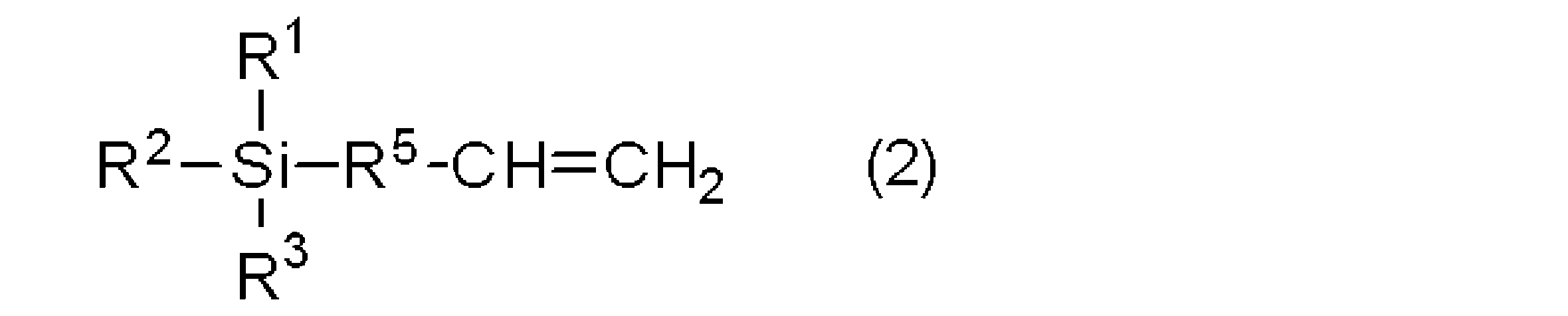
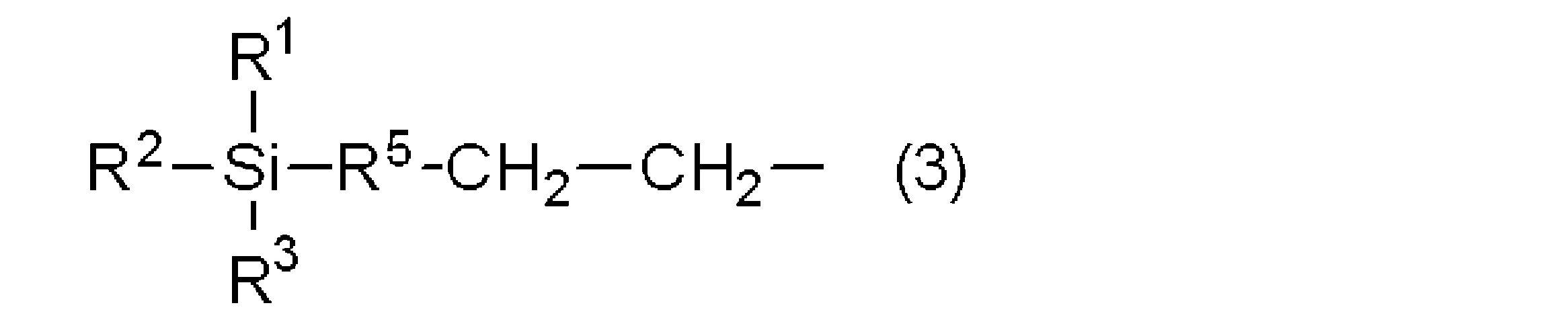
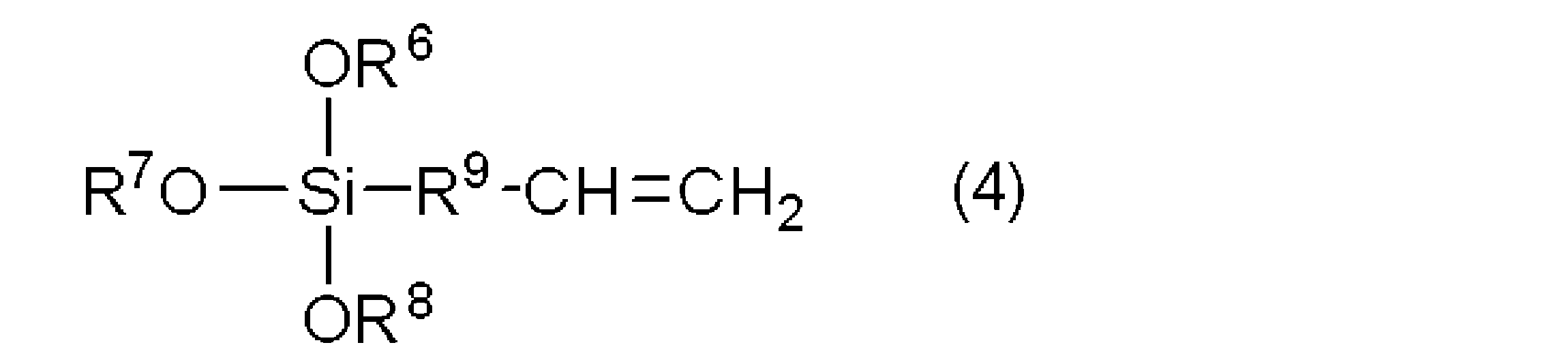
本発明のシラン変性水添ブロック共重合体(A-Si)は、水添ブロック共重合体(A)と不飽和シラン変性剤とを反応させる変性工程を備える製造方法により製造することができる。
(1A):溶媒中で重合開始剤を用いて、芳香族ビニル単量体を重合させることにより、活性末端を有する芳香族ビニル重合体を含有する溶液を得る工程
(2A):上記(1A)の工程で得られる活性末端を有する芳香族ビニル重合体を含有する溶液に共役ジエン単量体を添加して、該共役ジエン単量体を重合させることにより、活性末端を有する芳香族ビニル-共役ジエンブロック共重合体を含有する溶液を得る工程
(3A):上記(2A)の工程で得られる活性末端を有する芳香族ビニル-共役ジエンブロック共重合体を含有する溶液に、芳香族ビニル単量体を添加して、該芳香族ビニル単量体を重合させることにより、ブロック共重合体(A’)を含有する溶液を得る工程
(4A):上記(3A)の工程で得られるブロック共重合体(A’)を含有する溶液について、水素添加反応を行うことで、水添ブロック共重合体(A)を含有する溶液を得る工程
(5A):上記(4A)の工程で得られる水添ブロック共重合体(A)を含有する溶液から、水添ブロック共重合体(A)を回収する工程
上記の製造方法では、まず、工程(1A)において、溶媒中で重合開始剤を用いて、芳香族ビニル単量体を重合させることにより、活性末端を有する芳香族ビニル重合体を含有する溶液を得る。
次に、工程(2A)において、上記工程(1A)で得られた活性末端を有する芳香族ビニル重合体を含有する溶液に、共役ジエン単量体を添加し、該共役ジエン単量体を重合させることにより、活性末端を有する芳香族ビニル-共役ジエンブロック共重合体を含有する溶液を得る。
次に、工程(3A)において、上記工程(2A)で得られた活性末端を有する芳香族ビニル-共役ジエンブロック共重合体を含有する溶液に、芳香族ビニル単量体を添加し、該芳香族ビニル単量体を重合させることにより、ブロック共重合体(A’)を含有する溶液を得る。
次に、工程(4A)において、上記工程(3A)で得られたブロック共重合体(A’)を含有する溶液について、水素添加反応を行うことで、水添ブロック共重合体(A)を含有する溶液を得る。
次に、工程(5A)において、上記工程(4A)で得られた水添ブロック共重合体(A)を含有する溶液から、目的とする水添ブロック共重合体(A)を回収する。
本発明のシラン変性水添ブロック共重合体(A-Si)は、水添ブロック共重合体(A)と不飽和シラン変性剤とを反応させる変性工程を備える製造方法により製造することができる。好ましくは、本発明のシラン変性水添ブロック共重合体(A-Si)は、水添ブロック共重合体(A)と、不飽和シラン変性剤と、過酸化物とを溶融混錬することにより製造することができる。
本発明は、上記のシラン変性水添ブロック共重合体(A-Si)と、後述するシラン変性水添ブロック共重合体(B-Si)と、を含有する重合体組成物にも関する。
本発明で用いるシラン変性水添ブロック共重合体(B-Si)は、後述する水添ブロック共重合体(B)を不飽和シラン変性剤で変性してなるブロック共重合体であって、シラン含有官能基を有するブロック共重合体である。
水添ブロック共重合体(B)は、下記一般式(B)で表されるブロック共重合体である。
Ar1b-HDb-Ar2b (B)
(上記一般式(B)において、Ar1bおよびAr2bは、芳香族ビニル重合体ブロックであり、HDbは、共役ジエン重合体の水添重合体ブロックであり、Ar1bの重量平均分子量(Mw(Ar1b))に対する、Ar2bの重量平均分子量(Mw(Ar2b))の比(Mw(Ar2b)/Mw(Ar1b))は0.95~1.05である。)
Ar1b-(HDb’-X-HDb’’)-Ar2b
すなわち、上記式に示すように、共役ジエン重合体の水添重合体ブロックHDbが、カップリング剤の残基Xを介して、HDb’、HDb’’がカップリングされてなるような態様であってもよい。なお、カップリング剤の残基Xとしては、後述する(1a)~(6a)の工程を有する水添ブロック共重合体(B)の製造方法において例示されている2官能のカップリング剤の残基などが挙げられる。
本発明で用いるシラン変性水添ブロック共重合体(B-Si)は、水添ブロック共重合体(B)を不飽和シラン変性剤で変性してなるブロック共重合体である。本発明で用いるシラン変性水添ブロック共重合体(B-Si)は、当該不飽和シラン変性剤由来の変性基として、シラン含有官能基を有する。本発明で用いるシラン変性水添ブロック共重合体(B-Si)は、1種類のシラン含有官能基を有してもよく、2種類以上のシラン含有官能基を有してもよい。
本発明の重合体組成物は、本発明の作用効果を損なわない範囲であれば、シラン変性水添ブロック共重合体(A-Si)およびシラン変性水添ブロック共重合体(B-Si)以外の他の重合体成分を含有してもよく、シラン変性水添ブロック共重合体(A-Si)およびシラン変性水添ブロック共重合体(B-Si)のみを重合体成分として含有してもよい。
本発明の重合体組成物を製造するための方法としては、特に限定されず、たとえば、シラン変性水添ブロック共重合体(A-Si)と、シラン変性水添ブロック共重合体(B-Si)とをそれぞれ別個に製造し、それらを混練や溶液混合等の常法に従って混合することにより、製造することができる。なお、シラン変性水添ブロック共重合体(B-Si)は、従来のブロック共重合体の製法および水素化方法に従って、水添ブロック共重合体(B)を得る工程、および、得られた水添ブロック共重合体(B)と不飽和シラン変性剤とを反応させる変性工程を備える製造方法により製造することができる。変性工程の条件は、水添ブロック共重合体(A)と不飽和シラン変性剤とを反応させる変性工程の条件と同様の条件を採用することができる。
(1):溶媒中で重合開始剤を用いて、芳香族ビニル単量体を重合させることにより、活性末端を有する芳香族ビニル重合体を含有する溶液を得る工程
(2):上記(1)の工程で得られる活性末端を有する芳香族ビニル重合体を含有する溶液に共役ジエン単量体を添加して、該共役ジエン単量体を重合させることにより、活性末端を有する芳香族ビニル-共役ジエンブロック共重合体を含有する溶液を得る工程
(3):上記(2)の工程で得られる活性末端を有する芳香族ビニル-共役ジエンブロック共重合体を含有する溶液に芳香族ビニル単量体を添加して、該芳香族ビニル単量体を重合させることにより、活性末端を有する芳香族ビニル-共役ジエン-芳香族ビニルブロック共重合体を含有する溶液を得る工程
(4):上記(3)の工程で得られる活性末端を有する芳香族ビニル-共役ジエン-芳香族ビニルブロック共重合体を含有する溶液に、その活性末端に対して1モル当量未満となる量で重合停止剤を添加し、活性末端を有する芳香族ビニル-共役ジエン-芳香族ビニルブロック共重合体の活性末端の一部を失活させて、ブロック共重合体(B’)を含有する溶液を得る工程
(5):上記(4)の工程で得られるブロック共重合体(B’)を含有する溶液に、芳香族ビニル単量体を添加して、該芳香族ビニル単量体を重合させることにより、ブロック共重合体(B’)およびブロック共重合体(A’)を含有する溶液を得る工程
(6):上記(5)の工程で得られるブロック共重合体(B’)およびブロック共重合体(A’)を含有する溶液について、水素添加反応を行うことで、水添ブロック共重合体(B)および水添ブロック共重合体(A)を含有する溶液を得る工程
(7):上記(6)の工程で得られる水添ブロック共重合体(B)および水添ブロック共重合体(A)を含有する溶液から、水添ブロック共重合体組成物を回収する工程
工程(1)、工程(2)は、上述した工程(1A)、工程(2A)と同様であり、同様の条件を採用することができる。
工程(3)は、活性末端を失活させない以外は、上述した工程(3A)と同様であり、同様の条件を採用することができる。
次に、工程(4)において、上記工程(3)で得られた活性末端を有する芳香族ビニル-共役ジエン-芳香族ビニルブロック共重合体を含有する溶液に、その活性末端に対して1モル当量未満となる量で重合停止剤を添加し、活性末端を有する芳香族ビニル-共役ジエン-芳香族ビニルブロック共重合体の活性末端の一部を失活させて、ブロック共重合体(B’)を含有する溶液を得る。
次に、工程(5)において、上記工程(4)で得られたブロック共重合体(B’)を含有する溶液に、芳香族ビニル単量体を添加して、該芳香族ビニル単量体を重合させることにより、ブロック共重合体(B’)およびブロック共重合体(A’)を含有する溶液を得る。
工程(5)において得られた、ブロック共重合体(B’)およびブロック共重合体(A’)を含有する溶液を用いて、上記した工程(6)、工程(7)における操作を経て、水添ブロック共重合体組成物を得ることができる。なお、上記した工程(6)、工程(7)は、上述した工程(4A)、工程(5A)と同様であり、同様の条件を採用することができる。
(1a):溶媒中で重合開始剤を用いて、芳香族ビニル単量体を重合させることにより、活性末端を有する芳香族ビニル重合体を含有する溶液を得る工程
(2a):上記(1a)の工程で得られる活性末端を有する芳香族ビニル重合体を含有する溶液に共役ジエン単量体を添加して、該共役ジエン単量体を重合させることにより、活性末端を有する芳香族ビニル-共役ジエンブロック共重合体を含有する溶液を得る工程
(3a):上記(2a)の工程で得られる活性末端を有する芳香族ビニル-共役ジエンブロック共重合体を含有する溶液に、その活性末端に対して官能基の総量が1モル当量未満となる量で、2官能のカップリング剤を添加し、活性末端を有する芳香族ビニル-共役ジエンブロック共重合体の一部をカップリングさせて、ブロック共重合体(B’)を含有する溶液を得る工程
(4a):上記(3a)の工程で得られるブロック共重合体(B’)を含有する溶液に、芳香族ビニル単量体を添加して、該芳香族ビニル単量体を重合させることにより、ブロック共重合体(B’)およびブロック共重合体(A’)を含有する溶液を得る工程
(5a):上記(4a)の工程で得られるブロック共重合体(B’)およびブロック共重合体(A’)を含有する溶液について、水素添加反応を行うことで、水添ブロック共重合体(B)および水添ブロック共重合体(A)を含有する溶液を得る工程
(6a):上記(5a)の工程で得られる水添ブロック共重合体(B)および水添ブロック共重合体(A)を含有する溶液から、水添ブロック共重合体組成物を回収する工程
工程(1a)、工程(2a)は、上述した工程(1)、工程(2)と同様であり、同様の条件を採用することができる。
工程(3a)においては、上記工程(2a)で得られた活性末端を有する芳香族ビニル-共役ジエンブロック共重合体を含有する溶液に、その活性末端に対して官能基の総量が1モル当量未満となる量で、2官能のカップリング剤を添加し、活性末端を有する芳香族ビニル-共役ジエンブロック共重合体の一部をカップリングさせて、ブロック共重合体(B’)を含有する溶液を得る。工程(3a)で得られるブロック共重合体(B’)は、水添ブロック共重合体(B)を得るための水添前のブロック共重合体となるものである。
次に、工程(4a)においては、上記工程(3a)で得られたブロック共重合体(B’)を含有する溶液に、芳香族ビニル単量体を添加して、該芳香族ビニル単量体を重合させることにより、ブロック共重合体(B’)およびブロック共重合体(A’)を含有する溶液を得る。
そして、工程(4a)により得られたブロック共重合体(B’)およびブロック共重合体(A’)を含有する溶液を用いて、上記した工程(5a)、工程(6a)における操作を経て、水添ブロック共重合体組成物を得ることができる。なお、上記した工程(5a)、工程(6a)は、上述した工程(6)、工程(7)と同様であり、同様の条件を採用することができる。
本発明の重合体組成物は、水添ブロック共重合体組成物と不飽和シラン変性剤とを反応させる変性工程を備える製造方法により製造することができる。好ましくは、本発明の重合体組成物は、水添ブロック共重合体組成物と、不飽和シラン変性剤とを、過酸化物の存在下に混合することにより製造することができる。
本発明のシラン変性水添ブロック共重合体(A-Si)または本発明の重合体組成物を架橋させることにより、本発明の架橋物を得ることができる。本発明の架橋物は、圧縮復元性に優れるのみならず、成形性、透明性、および耐圧縮永久ひずみ性(特に、高温環境下での耐圧縮永久歪性)にも優れるものである。
本発明の架橋物は、好ましくは、シラン変性水添ブロック共重合体(A-Si)または重合体組成物を、シラン含有官能基を縮合させるための縮合反応触媒に接触させる方法により製造することができる。このような製造方法により、重合体鎖間に、シラン含有官能基に由来の架橋構造を導入することができる。また、シラン変性水添ブロック共重合体(A-Si)または重合体組成物が、不飽和シラン変性剤としてアルコキシ基を有する不飽和シラン変性剤を用いて得られたものである場合には、そのようなシラン変性水添ブロック共重合体(A-Si)または重合体組成物を縮合反応触媒に接触させることにより、重合体鎖間に、-Si-O-Si-結合を含む架橋構造を導入することができる。
本発明のシラン変性水添ブロック共重合体(A-Si)、重合体組成物、および架橋物は、衣料品、日用品、医療用具、電子機器、電化製品、包装材料、輸送機、建築材料や、これらの部品などの、さまざまな用途に好適に用いることができる。たとえば、これらは、電池用緩衝材などの緩衝材、ウェザーストリップ、強化プラスチック(CFRP等)等の衝撃吸収材、ガラス中間膜、シューズソール、電子機器などの封止材(特に放熱封止材)などに好適に用いることができる。
流速0.35ml/分のテトラヒドロフランをキャリアとする高速液体クロマトグラフィによりポリスチレン換算の分子量に基づくチャートを得て、得られたチャートに基づいて、重合体組成物の重量平均分子量および分子量分布を求めた。装置は、東ソー社製HLC8320、カラムは昭和電工社製Shodex(登録商標)KF-404HQを3本連結したもの(カラム温度40℃)、検出器は示差屈折計および紫外検出器を用いた。分子量の較正は、ポリマーラボラトリー社製の標準ポリスチレン(500から300万)の12点で実施した。
上記の高速液体クロマトグラフィにより得られたチャートの各重合体に対応するピークの面積比から、各重合体の重量比を求めた。
Rubber Chem.Technol.,45,1295(1972)に記載された方法に従い、(水添)ブロック共重合体をオゾンと反応させ、水素化リチウムアルミニウムで還元することにより、(水添)ブロック共重合体のイソプレン重合体ブロックを分解した。
具体的には、以下の手順で行なった。すなわち、モレキュラーシーブで処理したジクロロメタン100mlを入れた反応容器に、試料を300mg溶解した。この反応容器を冷却槽に入れ-25℃としてから、反応容器に170ml/minの流量で酸素を流しながら、オゾン発生器により発生させたオゾンを導入した。反応開始から30分経過後、反応容器から流出する気体をヨウ化カリウム水溶液に導入することにより、反応が完了したことを確認した。次いで、窒素置換した別の反応容器に、ジエチルエーテル50mlと水素化リチウムアルミニウム470mgを仕込み、氷水で反応容器を冷却しながら、この反応容器にオゾンと反応させた溶液をゆっくり滴下した。そして、反応容器を水浴に入れ、徐々に昇温して、40℃で30分間還流させた。その後、溶液を攪拌しながら、反応容器に希塩酸を少量ずつ滴下し、水素の発生がほとんど認められなくなるまで滴下を続けた。この反応の後、溶液に生じた固形の生成物をろ別し、固形の生成物は、100mlのジエチルエーテルで10分間抽出した。この抽出液と、ろ別した際のろ液とをあわせ、溶媒を留去することにより、固形の試料を得た。このようにして得られた試料について、上記の重量平均分子量の測定法に従い、重量平均分子量を測定し、その値をスチレン重合体ブロックの重量平均分子量とした。
それぞれ上記のようにして求められた、各重合体の重量平均分子量から、対応するスチレン重合体ブロックの重量平均分子量を引き、その計算値に基づいて、(水添)イソプレン重合体ブロックの重量平均分子量を求めた。
溶媒として重クロロホルムを用いた1H-NMRの測定に基づき求めた。
上記の高速液体クロマトグラフィの測定における、示差屈折計と紫外検出器との検出強度比に基づいて求めた。なお、予め、異なるスチレン単位含有量を有する共重合体を用意し、それらを用いて、検量線を作成した。
溶媒として重クロロホルムを用いた1H-NMRの測定に基づき、重合体組成物のスチレン単位含有量を求めた。
溶媒として重クロロホルムを用いた1H-NMRスペクトル測定により、水添前のブロック共重合体組成物および水添後の水添ブロック共重合体組成物のそれぞれについて、オレフィン量を求め、水添前後のオレフィン量の差に基づいてオレフィン水添率(モル%)を算出した。
1H-NMRスペクトル測定では、溶媒に重クロロホルムを用い、NMR測定装置としてJMN-AL seriesAL400(JEOL社製)を用いた。
また、本実施例、比較例においては、水添前のブロック共重合体組成物および水添後の水添ブロック共重合体組成物は、いずれも、オレフィンに由来の単量体の単位として、イソプレン単位のみを含むものであったため、測定に際しては、イソプレンの水添率を求め、これをオレフィン水添率とした。
ISO 7619に準拠して、水添ブロック共重合体組成物のショアーA硬度を求めた。
シートを目視で観察し、シートに白濁部分がなく透明である場合を、透明性「良」と判断した。一方、シートに白濁部分がある場合を、明性「不良」と判断した。
ISO 1133(G条件、200℃、5kg)に準拠して、メルトフローレートを測定した。
シートを直径13mmの円形状に打ち抜き、円形状のサンプルを得た。万能試験機(インストロン社製 デュアルコラム卓上型万能試験システム 5969 ロードセル式 50kN)を用いて、温度23℃、圧縮速度1.0 mm/minの条件で、厚みが40%となるまでサンプルを圧縮した(圧縮率60%)。引き続き、復元速度1.0 mm/minの条件でサンプルを復元した。得られた応力-ひずみヒステリシスループに基づき、圧縮時の50%圧縮応力および復元時の50%圧縮応力を求めた。そして、下記式に従い、圧縮復元性指標を求めた。圧縮復元性指標が1に近いほど、圧縮復元性に優れると判断できる。
圧縮復元性指標=圧縮時の50%圧縮応力/復元時の50%圧縮応力
シートを直径13mmの円形状に打ち抜き、得られた円形状のシートを3枚重ねることで、サンプルを作製した。JIS-K6262に準拠して、圧縮率25%、温度23℃、圧縮時間24hrの圧縮条件にて、サンプルの圧縮永久ひずみを測定した。また、温度を50℃に変更した以外は同様にして、サンプルの高温環境下での圧縮永久ひずみを測定した。なお、加熱には、ギヤー式老化試験機(上島製作所社製 AG-1110)を使用した。
シートをガラス基材上に置いた状態で、ガラスおよびシートを、160℃、0.2MPaで5分間圧縮成形して、ガラス基材とシートとを密着させた。次いで、ASTM F88に従って、ガラス基材からシートを剥離する試験を行い、ガラスへのピール強度(単位:N/10mm)を求めた。
(1)水添前のブロック共重合体組成物の製造
耐圧反応器に、シクロヘキサン56.6kg、ジブチルエーテル387ミリモル、およびスチレン1.23kgを添加した。全容を50℃で攪拌しながら、n-ブチルリチウム(1.6M溶液)208ミリモルを添加した。添加終了後、55℃に昇温して1時間重合反応を行った(重合1段目)。このときのスチレンの重合転化率は100%であった。
上記にて得られた水添前のブロック共重合体組成物を含む溶液に対し、水素添加反応を行うことにより、水添ブロック共重合体組成物を含む溶液を得た。水素添加反応は、上記にて得られた水添前のブロック共重合体組成物を含む溶液に、水素添加触媒として、Ni(AcAc)2-TIBAL触媒を、水添前のブロック共重合体組成物に対して0.5%の割合で添加し、水素圧力3MPa、反応温度80℃、反応時間3時間の条件で行った。このようにして得られた水添ブロック共重合体組成物を含む溶液の一部を取り出し、上記方法に従い測定を行った。結果を表2に示す。
以上のようにして得られた、水添ブロック共重合体組成物を含む溶液100部に、酸化防止剤として、2,6-ジ-t-ブチル-p-クレゾール0.3部を加えて混合し、混合溶液を少量ずつ85~95℃に加熱された温水中に滴下して、溶媒を揮発させて析出物を得た。得られた析出物を粉砕し、85℃で熱風乾燥することにより、クラム状の水添ブロック共重合体組成物を回収した。クラム状の水添ブロック共重合体組成物を、押出機の先端部に水中ホットカット装置を備えた単軸押出機に供給し、平均直径5mmで平均長さが5mm程度の円筒状のペレットとした。このペレットを、60℃に加温したホッパードライヤーに投入し、60℃の乾燥空気を流通させながら10時間乾燥させ、水添ブロック共重合体(A)および水添ブロック共重合体(B)を含有する水添ブロック共重合体組成物(ポリマー1)を得た。上記方法に従い、水添ブロック共重合体組成物のショアーA硬度を測定した。結果を表2に示す。
反応に用いる各試剤の量を、表1に記載の量に変更した以外は、製造例1と同様にして、水添ブロック共重合体(A)および水添ブロック共重合体(B)を含有する水添ブロック共重合体組成物(ポリマー2)を得て、同様に測定を行った。結果を表2に示す。
反応に用いる各試剤の量を、表1に記載の量に変更した以外は、製造例1と同様にして、水添ブロック共重合体(B)(ポリマー3)を得て、同様に測定を行った。結果を表2に示す。なお、製造例3においては、重合3段目の後に、重合停止剤として、メタノールを表1に記載の量添加して、混合することにより、活性末端を有するスチレン-イソプレン-スチレントリブロック共重合体の活性末端を全て失活させて、重合反応を完了させ、これにより、水添前のブロック共重合体組成物を含有する溶液を得た。そして、得られた水添前のブロック共重合体組成物を含む溶液を用いた以外は、製造例1と同様にして、水添ブロック共重合体(B)(ポリマー3)を得た。
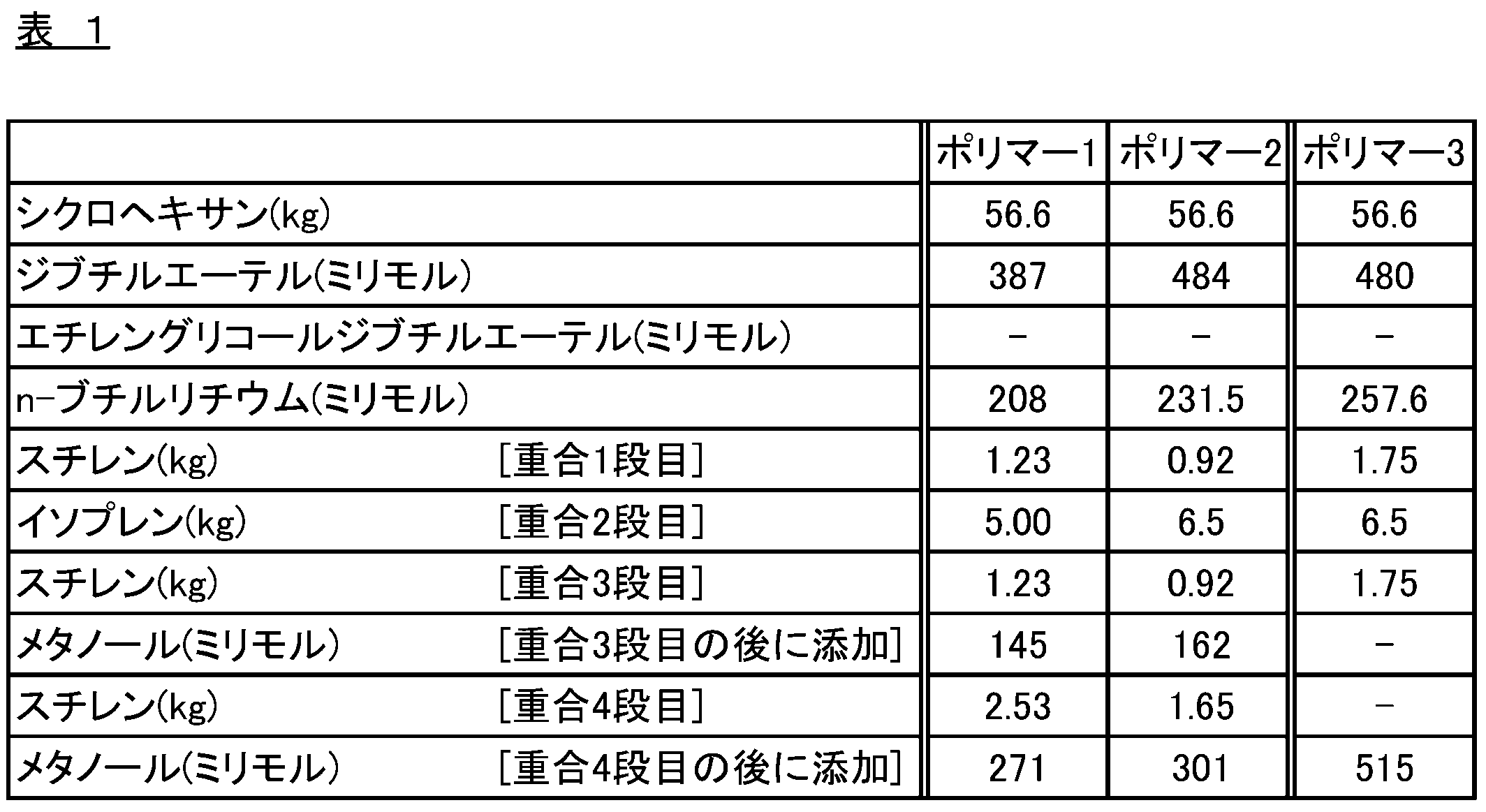
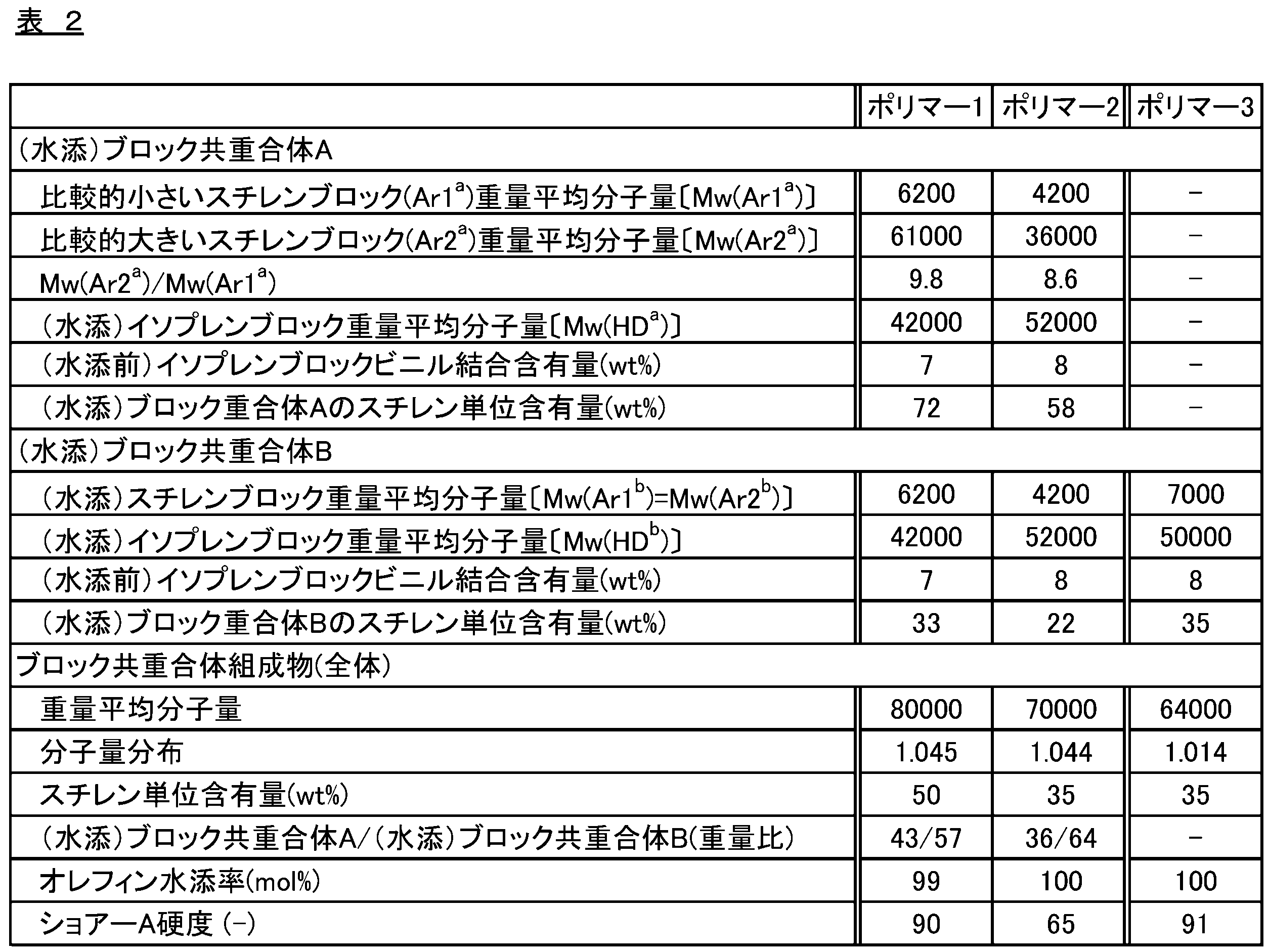
水添ブロック共重合体組成物(ポリマー1)、ビニルトリメトキシシラン、および2,5-ジメチル-2,5-ジ(t-ブチルパーオキシ)ヘキサン(パーヘキサ25B、日油社製、有機過酸化物)を、小型二軸混錬機(Xplore MC40)に供給し、220℃で3分間溶融混錬した。引き続き、コハク酸(縮合反応触媒)を小型二軸混錬機に供給し、220℃でさらに3分間溶融混錬した。なお、各成分の供給比率は、表3に示すとおりとした。これにより、水添ブロック共重合体組成物(ポリマー1)中の、水添ブロック共重合体(A)の水添重合体ブロックHDaおよび水添ブロック共重合体(B)の水添重合体ブロックHDbに、ビニルトリメトキシシラン由来のシラン含有官能基、および、該シラン含有官能基由来の-Si-O-Si-結合を含む架橋構造が導入された。その結果、シラン変性水添ブロック共重合体(A-Si)とシラン変性水添ブロック共重合体(B-Si)とを含有する重合体組成物を架橋させてなる架橋物を得た。得られた架橋物を、200℃に設定したプレス機でプレス成型することで、厚み2mmのシートを得た。得られたシートを用いて、上記方法に従い、透明性、メルトフローレート、圧縮復元性、耐圧縮永久ひずみ性、およびピール強度を評価した。結果を表3に示す。
ブロック共重合体組成物の種類、酸触媒の種類、および各成分の供給量を、表1に記載のとおりに変更した以外は、実施例1と同様にして、架橋物およびシートを得て、同様に評価した。結果を表3に示す。なお、実施例2~4においては、水添ブロック共重合体組成物(ポリマー1または2)中の、水添ブロック共重合体(A)の水添重合体ブロックHDaおよび水添ブロック共重合体(B)の水添重合体ブロックHDbに、ビニルトリメトキシシラン由来のシラン含有官能基、および、該シラン含有官能基由来の-Si-O-Si-結合を含む架橋構造が導入された。
水添ブロック共重合体組成物(ポリマー1)、ビニルトリメトキシシラン、および2,5-ジメチル-2,5-ジ(t-ブチルパーオキシ)ヘキサン(パーヘキサ25B、日油社製、有機過酸化物)を、小型二軸混錬機に供給し、220℃で3分間溶融混錬した。なお、各成分の供給比率は、表3に示すとおりとした。これにより、水添ブロック共重合体組成物(ポリマー1または2)中の、水添ブロック共重合体(A)の水添重合体ブロックHDa、および、水添ブロック共重合体(B)の水添重合体ブロックHDbに、ビニルトリメトキシシラン由来のシラン含有官能基が導入された。その結果、シラン変性水添ブロック共重合体(A-Si)とシラン変性水添ブロック共重合体(B-Si)とを含有する重合体組成物を得た。得られた重合体組成物を、200℃に設定したプレス機でプレス成型することで、厚み2mmのシートを得た。得られたシートを用いて、実施例1と同様に評価した。結果を表3に示す。
水添ブロック共重合体組成物(ポリマー1)に代えて、水添ブロック共重合体(B)(ポリマー3)を用いた以外は、実施例1と同様にして、シラン変性水添ブロック共重合体(B-Si)を架橋させてなる架橋物を得た。得られた架橋物を用いた以外は、実施例1と同様にしてシートを得て、実施例1と同様に評価した。結果を表3に示す。
水添ブロック共重合体組成物(ポリマー1)、エチレンプロピレンゴム(商品名「三井EPT 3092PM」、三井化学社製)、および2,5-ジメチル-2,5-ジ(t-ブチルパーオキシ)ヘキサン(パーヘキサ25B、日油社製、有機過酸化物)を、小型二軸混錬機に供給し、220℃で3分間混錬し、架橋体組成物を得た。各成分の供給比率は、表3に示すとおりとした。得られた架橋体組成物を、200℃に設定したプレス機でプレス成型することで、厚み2mmのシートを得た。得られたシートを用いて、実施例1と同様に評価した。結果を表3に示す。
オレフィン系熱可塑性エラストマー(架橋エチレンプロピレンターポリマーおよびポリプロピレンを主成分とする熱可塑性エラストマー、商品名「ミラストマー8030NS」、三井化学社製)を、200℃に設定したプレス機でプレス成型することで、厚み2mmのシートを得た。得られたシートを用いて、実施例1と同様に評価した。結果を表3に示す。
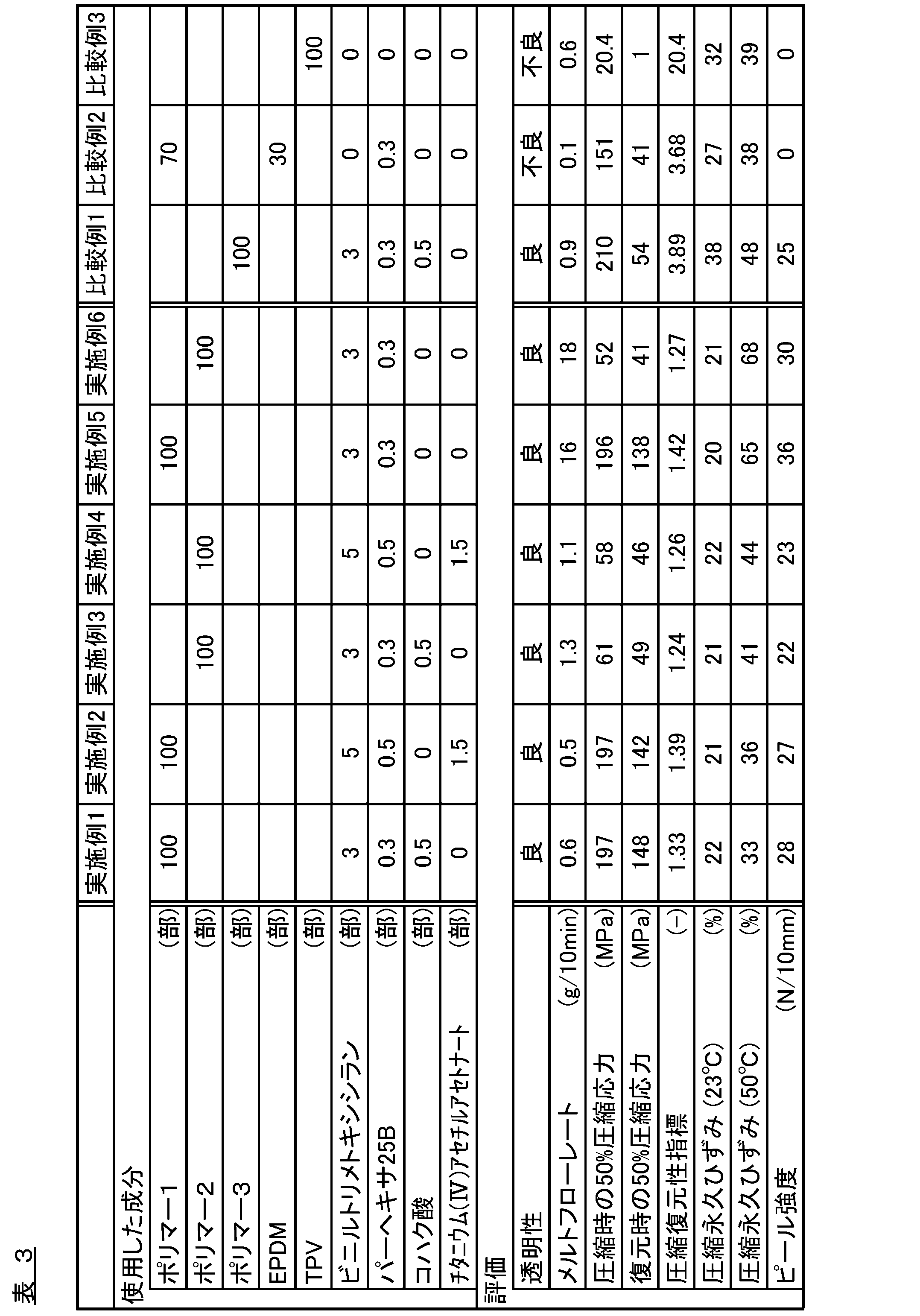
また、不飽和シラン変性剤による変性を行わなかった場合にも、圧縮復元性に劣る結果となることが確認できる(比較例2)。
さらに、オレフィン系熱可塑性エラストマーも、圧縮復元性に劣る結果となることが確認できる(比較例3)。
Claims (15)
- 下記一般式(A)で表される水添ブロック共重合体(A)を不飽和シラン変性剤で変性してなる、シラン含有官能基を有するシラン変性水添ブロック共重合体。
Ar1a-HDa-Ar2a (A)
(上記一般式(A)において、Ar1aおよびAr2aは、芳香族ビニル重合体ブロックであり、HDaは、共役ジエン重合体の水添重合体ブロックであり、Ar1aの重量平均分子量(Mw(Ar1a))に対する、Ar2aの重量平均分子量(Mw(Ar2a))の比(Mw(Ar2a)/Mw(Ar1a))は3.0~20である。) - 前記水添ブロック共重合体(A)のオレフィンの水添率が10~100%である請求項1に記載のシラン変性水添ブロック共重合体。
- 前記シラン含有官能基を、前記共役ジエン重合体の水添重合体ブロックHDa中に側鎖として有する請求項1または2に記載のシラン変性水添ブロック共重合体。
- 前記水添ブロック共重合体(A)の全単量体単位に対する芳香族ビニル単量体単位の含有量が20~90重量%である請求項1~3のいずれかに記載のシラン変性水添ブロック共重合体。
- 前記水添ブロック共重合体(A)の重量平均分子量が20,000~500,000である請求項1~4のいずれかに記載のシラン変性水添ブロック共重合体。
- 上記一般式(A)において、Ar1aの重量平均分子量が1,000~40,000であり、Ar2aの重量平均分子量が5,000~250,000であり、HDaの重量平均分子量が10,000~300,000である請求項1~5のいずれかに記載のシラン変性水添ブロック共重合体。
- 前記不飽和シラン変性剤が、下記一般式(1)で表される化合物(1)である請求項1~6のいずれかに記載のシラン変性水添ブロック共重合体。

- 上記一般式(1)において、R1~R3のうち少なくとも1つが、炭素数1~6のアルコキシ基である請求項7に記載のシラン変性水添ブロック共重合体。
- 請求項1~8のいずれかに記載のシラン変性水添ブロック共重合体(A-Si)と、
下記一般式(B)で表される水添ブロック共重合体(B)を不飽和シラン変性剤で変性してなる、シラン含有官能基を有するシラン変性水添ブロック共重合体(B-Si)と、
を含有する重合体組成物。
Ar1b-HDb-Ar2b (B)
(上記一般式(B)において、Ar1bおよびAr2bは、芳香族ビニル重合体ブロックであり、HDbは、共役ジエン重合体の水添重合体ブロックであり、Ar1bの重量平均分子量(Mw(Ar1b))に対する、Ar2bの重量平均分子量(Mw(Ar2b))の比(Mw(Ar2b)/Mw(Ar1b))は0.95~1.05である。) - 前記水添ブロック共重合体(A)および前記水添ブロック共重合体(B)を含有する水添ブロック共重合体組成物を、前記不飽和シラン変性剤で変性してなる請求項9に記載の重合体組成物。
- 請求項1~8のいずれかに記載のシラン変性水添ブロック共重合体または請求項9~10のいずれかに記載の重合体組成物を架橋させてなる架橋物。
- 前記シラン含有官能基に由来の架橋構造を有する請求項11に記載の架橋物。
- 前記架橋構造が-Si-O-Si-結合を含む請求項11または12に記載の架橋物。
- ISO 1133(G条件、200℃、5kg)に準拠して測定されるメルトフローレートが0.05~100g/10分である請求項11~13のいずれかに記載の架橋物。
- 緩衝材、ウェザーストリップ、衝撃吸収材、ガラス中間膜、シューズソール、または封止材である請求項11~14のいずれかに記載の架橋物。
Priority Applications (2)
| Application Number | Priority Date | Filing Date | Title |
|---|---|---|---|
| JP2025527980A JPWO2024257818A1 (ja) | 2023-06-13 | 2024-06-12 | |
| CN202480037958.XA CN121311521A (zh) | 2023-06-13 | 2024-06-12 | 硅烷改性加氢嵌段共聚物、聚合物组合物以及交联物 |
Applications Claiming Priority (2)
| Application Number | Priority Date | Filing Date | Title |
|---|---|---|---|
| JP2023-097251 | 2023-06-13 | ||
| JP2023097251 | 2023-06-13 |
Publications (1)
| Publication Number | Publication Date |
|---|---|
| WO2024257818A1 true WO2024257818A1 (ja) | 2024-12-19 |
Family
ID=93852181
Family Applications (1)
| Application Number | Title | Priority Date | Filing Date |
|---|---|---|---|
| PCT/JP2024/021419 Ceased WO2024257818A1 (ja) | 2023-06-13 | 2024-06-12 | シラン変性水添ブロック共重合体、重合体組成物および架橋物 |
Country Status (3)
| Country | Link |
|---|---|
| JP (1) | JPWO2024257818A1 (ja) |
| CN (1) | CN121311521A (ja) |
| WO (1) | WO2024257818A1 (ja) |
Cited By (1)
| Publication number | Priority date | Publication date | Assignee | Title |
|---|---|---|---|---|
| WO2025205181A1 (ja) * | 2024-03-29 | 2025-10-02 | 日本ゼオン株式会社 | 重合体組成物 |
Citations (4)
| Publication number | Priority date | Publication date | Assignee | Title |
|---|---|---|---|---|
| JP2010202716A (ja) * | 2009-02-27 | 2010-09-16 | Nippon Zeon Co Ltd | ブロック共重合体組成物の製造方法 |
| WO2017002567A1 (ja) * | 2015-06-29 | 2017-01-05 | 日本ゼオン株式会社 | 樹脂組成物、樹脂積層体及び樹脂積層金属箔 |
| WO2018116997A1 (ja) * | 2016-12-22 | 2018-06-28 | 日本ゼオン株式会社 | 合わせガラス |
| JP2021038286A (ja) * | 2019-08-30 | 2021-03-11 | 日本ゼオン株式会社 | 樹脂組成物、成形体、接合体、および接合体の製造方法 |
-
2024
- 2024-06-12 JP JP2025527980A patent/JPWO2024257818A1/ja active Pending
- 2024-06-12 CN CN202480037958.XA patent/CN121311521A/zh active Pending
- 2024-06-12 WO PCT/JP2024/021419 patent/WO2024257818A1/ja not_active Ceased
Patent Citations (4)
| Publication number | Priority date | Publication date | Assignee | Title |
|---|---|---|---|---|
| JP2010202716A (ja) * | 2009-02-27 | 2010-09-16 | Nippon Zeon Co Ltd | ブロック共重合体組成物の製造方法 |
| WO2017002567A1 (ja) * | 2015-06-29 | 2017-01-05 | 日本ゼオン株式会社 | 樹脂組成物、樹脂積層体及び樹脂積層金属箔 |
| WO2018116997A1 (ja) * | 2016-12-22 | 2018-06-28 | 日本ゼオン株式会社 | 合わせガラス |
| JP2021038286A (ja) * | 2019-08-30 | 2021-03-11 | 日本ゼオン株式会社 | 樹脂組成物、成形体、接合体、および接合体の製造方法 |
Cited By (1)
| Publication number | Priority date | Publication date | Assignee | Title |
|---|---|---|---|---|
| WO2025205181A1 (ja) * | 2024-03-29 | 2025-10-02 | 日本ゼオン株式会社 | 重合体組成物 |
Also Published As
| Publication number | Publication date |
|---|---|
| JPWO2024257818A1 (ja) | 2024-12-19 |
| CN121311521A (zh) | 2026-01-09 |
Similar Documents
| Publication | Publication Date | Title |
|---|---|---|
| CN111918896B (zh) | 制备嵌段共聚物组合物的方法 | |
| JP5527220B2 (ja) | ブロック共重合体組成物およびホットメルト粘接着剤組成物 | |
| JP6398015B2 (ja) | ポリオレフィンーポリスチレンブロック共重合体を含む有機亜鉛化合物及びその製造方法 | |
| CN101981121B (zh) | 嵌段共聚物组合物、其制备方法及薄膜 | |
| CN116217844B (zh) | 双组分嵌段共聚物 | |
| EP2955203B1 (en) | Thermoplastic polymer composition, shoes and outer soles | |
| JP7064909B2 (ja) | 熱可塑性樹脂組成物及び成形品 | |
| CN105899561B (zh) | 聚合物和沥青组合物 | |
| WO2004003027A1 (ja) | 水添共重合体及びその組成物 | |
| WO2010113882A1 (ja) | 伸縮性フィルム用組成物 | |
| CN1735659A (zh) | 用于制造透明且不含凝胶的薄膜的苯乙烯系嵌段共聚物组合物 | |
| JP7697368B2 (ja) | 水添ブロック共重合体組成物、その製造方法およびフィルム | |
| JP2012077158A (ja) | 重合体組成物の製造方法 | |
| CN121311521A (zh) | 硅烷改性加氢嵌段共聚物、聚合物组合物以及交联物 | |
| CN1247667C (zh) | 烷基苯乙烯聚合物的交联方法及含该聚合物的组合物 | |
| JP7354617B2 (ja) | 電気絶縁テープ | |
| JP5402780B2 (ja) | ホットメルト粘接着剤組成物 | |
| WO2025205181A1 (ja) | 重合体組成物 | |
| JP2025163994A (ja) | エポキシ樹脂組成物 | |
| EP3842504B1 (en) | ELASTIC HEAT FUSED ADHESIVE | |
| JP3776589B2 (ja) | 末端に1級水酸基を有する飽和炭化水素系重合体及びその製造方法 | |
| KR20130090728A (ko) | 비닐방향족 탄화수소-공액디엔 블록 공중합체로 개질한 폴리에틸렌 엘라스토머 및 이의 제조방법 | |
| KR100788150B1 (ko) | 커플링된 저 비닐 블록 공중합체 조성물의 제조방법 및결과적으로 수득되는 조성물 | |
| EP4458892A1 (en) | Foam body and buffer material |
Legal Events
| Date | Code | Title | Description |
|---|---|---|---|
| 121 | Ep: the epo has been informed by wipo that ep was designated in this application |
Ref document number: 24823433 Country of ref document: EP Kind code of ref document: A1 |
|
| ENP | Entry into the national phase |
Ref document number: 2025527980 Country of ref document: JP Kind code of ref document: A |
|
| WWE | Wipo information: entry into national phase |
Ref document number: 2025527980 Country of ref document: JP |
|
| NENP | Non-entry into the national phase |
Ref country code: DE |
|
| 122 | Ep: pct application non-entry in european phase |
Ref document number: 24823433 Country of ref document: EP Kind code of ref document: A1 |