WO2024257730A1 - 積層フィルムおよびその製造方法 - Google Patents
積層フィルムおよびその製造方法 Download PDFInfo
- Publication number
- WO2024257730A1 WO2024257730A1 PCT/JP2024/021072 JP2024021072W WO2024257730A1 WO 2024257730 A1 WO2024257730 A1 WO 2024257730A1 JP 2024021072 W JP2024021072 W JP 2024021072W WO 2024257730 A1 WO2024257730 A1 WO 2024257730A1
- Authority
- WO
- WIPO (PCT)
- Prior art keywords
- resin layer
- acid
- film
- resin
- mass
- Prior art date
- Legal status (The legal status is an assumption and is not a legal conclusion. Google has not performed a legal analysis and makes no representation as to the accuracy of the status listed.)
- Ceased
Links
Classifications
-
- C—CHEMISTRY; METALLURGY
- C08—ORGANIC MACROMOLECULAR COMPOUNDS; THEIR PREPARATION OR CHEMICAL WORKING-UP; COMPOSITIONS BASED THEREON
- C08J—WORKING-UP; GENERAL PROCESSES OF COMPOUNDING; AFTER-TREATMENT NOT COVERED BY SUBCLASSES C08B, C08C, C08F, C08G or C08H
- C08J7/00—Chemical treatment or coating of shaped articles made of macromolecular substances
- C08J7/04—Coating
- C08J7/0427—Coating with only one layer of a composition containing a polymer binder
-
- B—PERFORMING OPERATIONS; TRANSPORTING
- B32—LAYERED PRODUCTS
- B32B—LAYERED PRODUCTS, i.e. PRODUCTS BUILT-UP OF STRATA OF FLAT OR NON-FLAT, e.g. CELLULAR OR HONEYCOMB, FORM
- B32B27/00—Layered products comprising a layer of synthetic resin
-
- B—PERFORMING OPERATIONS; TRANSPORTING
- B32—LAYERED PRODUCTS
- B32B—LAYERED PRODUCTS, i.e. PRODUCTS BUILT-UP OF STRATA OF FLAT OR NON-FLAT, e.g. CELLULAR OR HONEYCOMB, FORM
- B32B27/00—Layered products comprising a layer of synthetic resin
- B32B27/06—Layered products comprising a layer of synthetic resin as the main or only constituent of a layer, which is next to another layer of the same or of a different material
- B32B27/08—Layered products comprising a layer of synthetic resin as the main or only constituent of a layer, which is next to another layer of the same or of a different material of synthetic resin
-
- B—PERFORMING OPERATIONS; TRANSPORTING
- B32—LAYERED PRODUCTS
- B32B—LAYERED PRODUCTS, i.e. PRODUCTS BUILT-UP OF STRATA OF FLAT OR NON-FLAT, e.g. CELLULAR OR HONEYCOMB, FORM
- B32B27/00—Layered products comprising a layer of synthetic resin
- B32B27/18—Layered products comprising a layer of synthetic resin characterised by the use of special additives
- B32B27/22—Layered products comprising a layer of synthetic resin characterised by the use of special additives using plasticisers
-
- B—PERFORMING OPERATIONS; TRANSPORTING
- B32—LAYERED PRODUCTS
- B32B—LAYERED PRODUCTS, i.e. PRODUCTS BUILT-UP OF STRATA OF FLAT OR NON-FLAT, e.g. CELLULAR OR HONEYCOMB, FORM
- B32B27/00—Layered products comprising a layer of synthetic resin
- B32B27/32—Layered products comprising a layer of synthetic resin comprising polyolefins
-
- B—PERFORMING OPERATIONS; TRANSPORTING
- B32—LAYERED PRODUCTS
- B32B—LAYERED PRODUCTS, i.e. PRODUCTS BUILT-UP OF STRATA OF FLAT OR NON-FLAT, e.g. CELLULAR OR HONEYCOMB, FORM
- B32B27/00—Layered products comprising a layer of synthetic resin
- B32B27/38—Layered products comprising a layer of synthetic resin comprising epoxy resins
-
- B—PERFORMING OPERATIONS; TRANSPORTING
- B32—LAYERED PRODUCTS
- B32B—LAYERED PRODUCTS, i.e. PRODUCTS BUILT-UP OF STRATA OF FLAT OR NON-FLAT, e.g. CELLULAR OR HONEYCOMB, FORM
- B32B7/00—Layered products characterised by the relation between layers; Layered products characterised by the relative orientation of features between layers, or by the relative values of a measurable parameter between layers, i.e. products comprising layers having different physical, chemical or physicochemical properties; Layered products characterised by the interconnection of layers
- B32B7/02—Physical, chemical or physicochemical properties
- B32B7/022—Mechanical properties
-
- C—CHEMISTRY; METALLURGY
- C08—ORGANIC MACROMOLECULAR COMPOUNDS; THEIR PREPARATION OR CHEMICAL WORKING-UP; COMPOSITIONS BASED THEREON
- C08J—WORKING-UP; GENERAL PROCESSES OF COMPOUNDING; AFTER-TREATMENT NOT COVERED BY SUBCLASSES C08B, C08C, C08F, C08G or C08H
- C08J3/00—Processes of treating or compounding macromolecular substances
- C08J3/24—Crosslinking, e.g. vulcanising, of macromolecules
-
- C—CHEMISTRY; METALLURGY
- C08—ORGANIC MACROMOLECULAR COMPOUNDS; THEIR PREPARATION OR CHEMICAL WORKING-UP; COMPOSITIONS BASED THEREON
- C08J—WORKING-UP; GENERAL PROCESSES OF COMPOUNDING; AFTER-TREATMENT NOT COVERED BY SUBCLASSES C08B, C08C, C08F, C08G or C08H
- C08J7/00—Chemical treatment or coating of shaped articles made of macromolecular substances
- C08J7/04—Coating
-
- C—CHEMISTRY; METALLURGY
- C08—ORGANIC MACROMOLECULAR COMPOUNDS; THEIR PREPARATION OR CHEMICAL WORKING-UP; COMPOSITIONS BASED THEREON
- C08J—WORKING-UP; GENERAL PROCESSES OF COMPOUNDING; AFTER-TREATMENT NOT COVERED BY SUBCLASSES C08B, C08C, C08F, C08G or C08H
- C08J7/00—Chemical treatment or coating of shaped articles made of macromolecular substances
- C08J7/04—Coating
- C08J7/043—Improving the adhesiveness of the coatings per se, e.g. forming primers
-
- B—PERFORMING OPERATIONS; TRANSPORTING
- B32—LAYERED PRODUCTS
- B32B—LAYERED PRODUCTS, i.e. PRODUCTS BUILT-UP OF STRATA OF FLAT OR NON-FLAT, e.g. CELLULAR OR HONEYCOMB, FORM
- B32B2255/00—Coating on the layer surface
- B32B2255/10—Coating on the layer surface on synthetic resin layer or on natural or synthetic rubber layer
-
- B—PERFORMING OPERATIONS; TRANSPORTING
- B32—LAYERED PRODUCTS
- B32B—LAYERED PRODUCTS, i.e. PRODUCTS BUILT-UP OF STRATA OF FLAT OR NON-FLAT, e.g. CELLULAR OR HONEYCOMB, FORM
- B32B2255/00—Coating on the layer surface
- B32B2255/26—Polymeric coating
-
- B—PERFORMING OPERATIONS; TRANSPORTING
- B32—LAYERED PRODUCTS
- B32B—LAYERED PRODUCTS, i.e. PRODUCTS BUILT-UP OF STRATA OF FLAT OR NON-FLAT, e.g. CELLULAR OR HONEYCOMB, FORM
- B32B2305/00—Condition, form or state of the layers or laminate
- B32B2305/07—Parts immersed or impregnated in a matrix
- B32B2305/076—Prepregs
-
- C—CHEMISTRY; METALLURGY
- C08—ORGANIC MACROMOLECULAR COMPOUNDS; THEIR PREPARATION OR CHEMICAL WORKING-UP; COMPOSITIONS BASED THEREON
- C08J—WORKING-UP; GENERAL PROCESSES OF COMPOUNDING; AFTER-TREATMENT NOT COVERED BY SUBCLASSES C08B, C08C, C08F, C08G or C08H
- C08J2367/00—Characterised by the use of polyesters obtained by reactions forming a carboxylic ester link in the main chain; Derivatives of such polymers
- C08J2367/02—Polyesters derived from dicarboxylic acids and dihydroxy compounds
-
- C—CHEMISTRY; METALLURGY
- C08—ORGANIC MACROMOLECULAR COMPOUNDS; THEIR PREPARATION OR CHEMICAL WORKING-UP; COMPOSITIONS BASED THEREON
- C08J—WORKING-UP; GENERAL PROCESSES OF COMPOUNDING; AFTER-TREATMENT NOT COVERED BY SUBCLASSES C08B, C08C, C08F, C08G or C08H
- C08J2423/00—Characterised by the use of homopolymers or copolymers of unsaturated aliphatic hydrocarbons having only one carbon-to-carbon double bond; Derivatives of such polymers
- C08J2423/26—Characterised by the use of homopolymers or copolymers of unsaturated aliphatic hydrocarbons having only one carbon-to-carbon double bond; Derivatives of such polymers modified by chemical after-treatment
-
- C—CHEMISTRY; METALLURGY
- C08—ORGANIC MACROMOLECULAR COMPOUNDS; THEIR PREPARATION OR CHEMICAL WORKING-UP; COMPOSITIONS BASED THEREON
- C08J—WORKING-UP; GENERAL PROCESSES OF COMPOUNDING; AFTER-TREATMENT NOT COVERED BY SUBCLASSES C08B, C08C, C08F, C08G or C08H
- C08J2429/00—Characterised by the use of homopolymers or copolymers of compounds having one or more unsaturated aliphatic radicals, each having only one carbon-to-carbon double bond, and at least one being terminated by an alcohol, ether, aldehydo, ketonic, acetal, or ketal radical; Hydrolysed polymers of esters of unsaturated alcohols with saturated carboxylic acids; Derivatives of such polymer
- C08J2429/02—Homopolymers or copolymers of unsaturated alcohols
- C08J2429/04—Polyvinyl alcohol; Partially hydrolysed homopolymers or copolymers of esters of unsaturated alcohols with saturated carboxylic acids
Definitions
- the present invention relates to a laminated film and a method for producing the same.
- Patent Document 1 discloses a slippery film which has a resin layer with good flatness and good slipperiness during film formation and processing and is suitable as a release material.
- the base film constituting the slippery film disclosed in Patent Document 1 contains particles to impart slippery properties.
- the resin layer is formed on the base film containing particles, the shape of the particles appears on the surface of the resin layer, and there is a risk that this shape will be transferred to the adherend, leaving room for further improvement in order to satisfy the high flatness required for miniaturization of electronic information devices.
- the present invention aims to provide a laminated film in which the resin layer provided on the base film exhibits good releasability from the adherend, has excellent flatness that prevents transfer to the adherend, and has excellent slipperiness during film formation and processing.
- the laminated film of the present invention in which a resin layer is provided on at least one surface of a base film, is The surface of the substrate film on which the resin layer is provided is substantially free of particles, The resin layer contains an acid-modified polyolefin resin (A) and a crosslinking agent (C),
- the resin layer surface is characterized in that the developed interface area ratio (Sdr) is 0.025 to 0.304%, and the maximum height (Sz) is 0.01 to 0.50 ⁇ m, as determined by a non-contact surface shape measuring device.
- the olefin component of the acid-modified polyolefin resin (A) preferably contains propylene or 1-octene.
- the propylene content in the olefin component is preferably 70% by mass or more.
- the content of 1-octene in the olefin component is preferably 15% by mass or more.
- the peel strength between the resin layer and the epoxy prepreg is preferably 0.5 N/cm or less.
- the method for producing a laminated film of the present invention is a method for producing the above-mentioned laminated film, A step of applying a resin layer-forming liquid material, which contains an acid-modified polyolefin resin (A), a crosslinking agent (C), and at least one compound (D) selected from the group consisting of an amphiphilic oligomer, acetylene glycol, and an ethylene oxide adduct of acetylene glycol, to a substrate film, and has a liquid temperature of 20 to 40° C.; A step of drying and stretching the substrate film on which the resin layer-forming liquid has been applied;
- the present invention is characterized in that it comprises: According to the method for producing the laminated film of the present invention, it is preferable to apply a resin layer-forming liquid material having a content of the compound (D) of 2 to 50 parts by mass per 100 parts by mass of the acid-modified polyolefin resin (A).
- the laminated film of the present invention has an excellent flatness on the surface on the resin layer side, good releasability, and easy slippage suitable for film formation and processing, and therefore can be suitably used as a release film for a variety of applications, such as protective films for double-sided tapes and adhesive materials, protective materials and process materials when manufacturing liquid crystal display parts and printed wiring boards, and molding sheet-like structures such as ion exchange membranes, ceramic green sheets, and heat dissipation sheets.
- the laminated film of the present invention has a resin layer provided on at least one of the surfaces of a substrate film that is substantially free of particles.
- the resin layer contains an acid-modified polyolefin resin (A) and a crosslinking agent (C), and the developed interface area ratio (Sdr) of the resin layer surface measured by a non-contact surface profiler is 0.025 to 0.304%, and the maximum height (Sz) of the resin layer surface measured by the non-contact surface profiler is 0.01 to 0.50 ⁇ m.
- polyester films such as polyethylene terephthalate (PET), polybutylene terephthalate (PBT), polyethylene naphthalate (PEN), poly(1,4-cyclohexylene dimethylene terephthalate), and polylactic acid (PLA); polyolefin films such as polypropylene; polystyrene films; polyamide 6, poly-p-xylylene adipamide (MXD6 nylon), polyamide 66, polyamide 46, polyamide 4T, polyamide 6T, polyamide 9T, polyamide 10T, polyamide 11T, polyamide 12T, and polyamide 6I; polycarbonate films; polyacrylonitrile films; polyimide films; and laminates thereof (e.g., polyamide 6/MXD6 nylon/polyamide 6, polyamide 6/ethylene-vinyl alcohol copolymer/polyamide 6, polyamide 6/6T, polyamide 6/6I, and polyamide 6/6T/6I
- polyester films and polyamide films having mechanical strength and dimensional stability are preferred.
- T represents terephthalic acid
- I represents isophthalic acid.
- the base film is preferably a polyethylene terephthalate film from the viewpoint of adhesion to the resin layer, and is preferably a semi-aromatic polyamide film from the viewpoint of heat resistance and adhesion to the resin layer, and is particularly preferably a polyamide 9T film or a polyamide 10T film.
- polyester resin The polymerization method of the polyester resin constituting the base film is not particularly limited, and examples thereof include transesterification and direct polymerization.
- transesterification catalysts include compounds such as oxides and acetates of Mg, Mn, Zn, Ca, Li, Ti, etc.
- polycondensation catalysts include compounds such as oxides and acetates of Sb, Ti, Ge, etc. Since the polyester resin after polymerization contains monomers, oligomers, and by-product acetaldehyde, etc., it may be subjected to solid-phase polymerization at a temperature of 200° C. or higher under reduced pressure or in an inert gas stream.
- the intrinsic viscosity of the polyester resin is preferably 0.55 to 0.80, and more preferably 0.60 to 0.75. If the intrinsic viscosity of the polyester resin is less than the above range, the resin is likely to break during film production, making it difficult to produce a stable film, and the strength of the resulting film is low. On the other hand, if the intrinsic viscosity of the polyester resin exceeds the above range, the shear heat generated during melt extrusion of the resin in the film production process increases, the load on the extruder increases, the production speed has to be sacrificed, and it becomes difficult to control the film thickness, resulting in a decrease in film productivity.
- the resulting film will have an increased amount of thermal decomposition and gelation, resulting in an increase in surface defects, foreign matter, and surface coarse protrusions.
- the intrinsic viscosity is too high, the polymerization time and polymerization process will be long, which will also be a factor in increasing costs.
- the semi-aromatic polyamide resin constituting the base film is composed of a dicarboxylic acid component and a diamine component, and has an aromatic component in the dicarboxylic acid component or the diamine component, and is preferably composed of an aromatic dicarboxylic acid component and an aliphatic diamine component.
- a sufficiently dried resin is fed to an extruder, melted at a temperature at which it is sufficiently plasticized and exhibits fluidity, passed through a filter selected as necessary, and then the molten polymer is discharged in a sheet form from a flat die such as a T-die or an I-die, and brought into contact with the cooling surface of a moving cooling body such as a cooling roll or a steel belt whose temperature is adjusted to a glass transition temperature (Tg) or lower to obtain an unstretched film.
- a flat die such as a T-die or an I-die
- Methods that can be used for cooling and solidifying the molten polymer discharged in a sheet form by bringing it into contact with the moving cooling body include an air knife casting method, an electrostatic application method, and a vacuum chamber method.
- the obtained unstretched film is preferably stretched from the viewpoint of improving mechanical properties and heat resistance, that is, uniaxial orientation is performed by a uniaxial stretching method, or biaxial orientation is performed by a biaxial stretching method.
- the biaxial stretching method is not particularly limited, but flat-type sequential biaxial stretching method, flat-type simultaneous biaxial stretching method, tubular method, etc. can be used. Among them, the flat-type sequential biaxial stretching method is most suitable for stretching polyester films, and the flat-type simultaneous biaxial stretching method is most suitable for stretching semi-aromatic polyamide films.
- an unstretched film is stretched in the longitudinal or transverse direction at a temperature range of from the Tg of the resin to 50° C. higher than the Tg to a stretch ratio of about 2 to 6 times.
- an unstretched film is biaxially stretched to a stretch ratio of about 2 to 4 times in each of the longitudinal and transverse directions in a temperature range of from the Tg of the resin to a temperature 50° C. higher than the Tg.
- the unstretched film Before being introduced into the simultaneous biaxial stretching machine, the unstretched film may be subjected to preliminary longitudinal stretching up to about 1.2 times.
- an unstretched film is heated with a heating roll or infrared rays, and stretched in the longitudinal direction to obtain a longitudinally stretched film.
- the longitudinal stretching is preferably performed at a stretching ratio of 2.5 to 4.0 times in the range of Tg to 40°C higher than Tg of the polyester, utilizing the difference in peripheral speed between two or more rolls.
- the longitudinally stretched film is then continuously subjected to transverse stretching in the width direction, heat setting, and heat relaxation in sequence to obtain a biaxially oriented film.
- the transverse stretching is preferably started at a temperature of Tg to 40°C higher than Tg of the resin, and the maximum temperature is preferably a temperature (100 to 40)°C lower than the melting point (Tm) of the resin.
- the transverse stretching ratio is adjusted depending on the required physical properties of the final film, but is preferably 3.5 times or more, more preferably 3.8 times or more, and more preferably 4.0 times or more.
- the film may be further stretched again in the longitudinal direction and/or the width direction to increase the elastic modulus and dimensional stability of the film.
- the flat-type simultaneous biaxial stretching method is optimal because it has good film thickness accuracy and uniform physical properties in the film width direction as described above.
- a stretching device for the flat-type simultaneous biaxial stretching method a screw-type tenter, a pantograph-type tenter, a linear motor-driven clip-type tenter, etc. can be used.
- the stretching ratio is preferably in the range of 1.5 to 10 times, more preferably 2 to 5 times, in both the longitudinal and transverse directions in order to provide the final semi-aromatic polyamide film with excellent heat resistance and mechanical strength.
- the stretching speed is preferably such that the stretching strain rate in both the longitudinal direction and the width direction exceeds 400%/min, more preferably 800 to 12000%/min, and even more preferably 1200 to 6000%/min. If the strain rate is 400%/min or less, crystals grow during stretching and the film breaks, while if the strain rate is too fast, the unstretched sheet may be unable to keep up with the deformation and break.
- the stretching temperature is preferably equal to or higher than the Tg of the semi-aromatic polyamide resin, and more preferably exceeds the Tg and is equal to or lower than (Tg+50)° C.
- the stretching temperature is lower than the Tg, the film is likely to break and stable production cannot be performed, whereas if the stretching temperature exceeds (Tg+50)° C., uneven stretching may occur.
- the heat setting temperature is preferably 250 to (Tm-5)°C, and more preferably 280 to (Tm-10)°C. If the heat setting temperature is less than 250°C, the resin layer containing the acid-modified olefin resin provided on the semi-aromatic polyamide film before stretching will undergo an insufficient curing reaction, resulting in reduced releasability.
- the film is preferably subjected to a relaxation treatment of 1 to 10%, more preferably 3 to 7%, as necessary while still being held by the clips.
- a relaxation treatment of 1 to 10%, more preferably 3 to 7%, as necessary while still being held by the clips.
- the film can obtain sufficient dimensional stability.
- the film is cooled and wound on a take-up roll to obtain a semi-aromatic polyamide resin stretched film roll.
- the obtained semi-aromatic polyamide resin stretched film roll can be slit to a desired width.
- Multi-layered base film By the above-mentioned production method, a substrate film having a single layer structure can be obtained, but the substrate film may be a film having a multilayer structure in which two or more layers are laminated.
- the multilayer film can be produced by the above-mentioned production method, in which the resins constituting each layer are melted separately, extruded using a multilayer die, laminated and fused before solidification, and then biaxially stretched and heat-set, or by a method in which two or more resins are melted separately, extruded to form films, and laminated and fused in an unstretched state or after stretching, etc. From the viewpoint of process simplicity, it is preferable to use a multilayer die and laminate and fused before solidification.
- the substrate film may have a single layer structure or a multilayer structure (e.g., two-type two-layer, two-type three-layer, three-type three-layer, four-layer or more multilayer, etc.), but from the viewpoint of being able to control the surface roughness for each side and improving handling properties such as winding properties, a multilayer structure is preferable. Two-type two-layer and two-type three-layer structures are more preferable, and two-type two-layer is even more preferable.
- a two-type two-layer structure is a two-layer structure manufactured using two types of layer-forming materials, and these two layers have different compositions (e.g., particle content).
- a two-type three-layer structure is a three-layer structure manufactured using two types of layer-forming materials, and the two outermost layers and the middle layer have different compositions (e.g., particle content).
- a three-type three-layer structure is a three-layer structure manufactured using three types of layer-forming materials, and these three layers have different compositions (e.g., particle content).
- the base film may contain particles for the main purpose of providing easy slippage and preventing scratches in each process.
- the base film constituting the laminated film of the present invention must be substantially free of particles on the side on which the resin layer is laminated. Since the surface of the base film on which the resin layer is formed is substantially free of particles, the surface of the resin layer on which the resin layer containing the specific acid-modified polyolefin resin (A) and the crosslinking agent (C) described later is formed has excellent flatness.
- each layer of the base film other than the surface on which the resin layer is formed may contain particles to the extent that the effect of the present invention is not impaired.
- substantially free of particles means that the surface on which the resin layer of the base film is formed is manufactured without adding particles. Therefore, it is particularly preferable that the particle content of the base film surface on which the resin layer is formed is zero, but it may be 0.001% by mass or less, more preferably 0.0005% by mass or less, within the range that does not impair the effect of the present invention.
- the type of particles contained in the base film is not particularly limited as long as they are particles that can impart slipperiness, and specific examples include inorganic particles such as silica, calcium carbonate, magnesium carbonate, barium carbonate, calcium sulfate, calcium phosphate, magnesium phosphate, kaolin, aluminum oxide, and titanium oxide, and organic particles such as acrylic resin, styrene resin, urea resin, phenolic resin, epoxy resin, and benzoguanamine resin.
- precipitated particles formed by precipitating and finely dispersing a portion of a metal compound such as a catalyst during the manufacturing process of the resin that constitutes the base material can also be used.
- the shape of the particles is not particularly limited, and may be any of spherical, blocky, rod-like, flat, etc. There are no particular limitations on the hardness, specific gravity, color, etc. of the particles. Two or more types of particles may be used in combination as necessary.
- the average particle size of the particles is preferably 5 ⁇ m or less, more preferably in the range of 0.01 to 3 ⁇ m. If the average particle size exceeds 5 ⁇ m, the surface roughness of the base film becomes too high, and for example, when used for transfer, the surface shape of the molded surface to be transferred may be affected.
- the particle content in the base film is usually 5% by mass or less, and preferably in the range of 0.0003 to 3% by mass. If the particle content exceeds 5% by mass, the film may be more likely to break during the stretching process when producing the laminated film of the present invention.
- the method of adding the particles is not particularly limited, and any conventionally known method can be used.
- the particles can be added at any stage in the production of the resin that constitutes each layer.
- the base film may contain additives, as necessary, such as antioxidants, heat stabilizers, ultraviolet absorbers, antistatic agents, pinning agents, etc.
- antioxidants include hindered phenol compounds and hindered amine compounds
- heat stabilizers include phosphorus compounds
- ultraviolet absorbers include benzophenone compounds and benzotriazole compounds.
- the thickness of the substrate film is not particularly limited as long as it is within a range that allows formation of a film, but from the standpoints of mechanical strength, handling properties, productivity, etc., it is usually 5 to 300 ⁇ m, and preferably 10 to 150 ⁇ m.
- the laminated film of the present invention is a film in which a resin layer is provided on at least one side of the layer of the above-mentioned base film that does not substantially contain particles.
- the resin component constituting the resin layer is an acid-modified polyolefin resin (A) from the viewpoint of imparting good releasability to the resin layer, and it is necessary to further contain a crosslinking agent (C).
- the resin layer can be formed by applying a liquid for forming a resin layer containing the acid-modified polyolefin resin (A), the crosslinking agent (C), and at least one compound (D) selected from the group consisting of an amphiphilic oligomer, acetylene glycol, and an ethylene oxide adduct of acetylene glycol.
- the acid-modified polyolefin resin is a resin containing an olefin component as a main component and modified with an acid-modifying component.
- the resin layer may contain two or more types of acid-modified polyolefin resins (A).
- the olefin component constituting the acid-modified polyolefin resin can be at least one selected from ethylene, propylene, 1-butene, 1-pentene, 1-hexene, 1-octene, and 1-nonene.
- the olefin component contains ethylene.
- the ethylene content in the olefin component is preferably 50% by mass or more, more preferably 80% by mass or more, and even more preferably 90% by mass or more.
- the olefin component contains propylene.
- the propylene content in the olefin component is preferably 50% by mass or more, more preferably 60% by mass or more, even more preferably 70% by mass or more, even more preferably 80% by mass or more, even more preferably 90% by mass or more, and most preferably 95% by mass or more.
- the olefin component contains an olefin component having 6 or more carbon atoms, such as 1-hexene, 1-octene, or 1-nonene, and it is particularly preferable that it contains 1-octene.
- the content of 1-octene in the olefin component is preferably 15% by mass or more, and more preferably 25% by mass or more.
- the olefin component constituting the acid-modified polyolefin resin preferably contains 1-butene or 1-pentene in an amount of 20% or less by mass, more preferably 15% or less by mass, and even more preferably 10% or less by mass, and it is particularly preferable that the resin does not contain 1-butene or 1-pentene.
- the acid-modified components constituting the acid-modified polyolefin resin include unsaturated carboxylic acid components, specifically acrylic acid, methacrylic acid, maleic acid, maleic anhydride, itaconic acid, itaconic anhydride, fumaric acid, crotonic acid, etc., as well as half esters and half amides of unsaturated dicarboxylic acids.
- unsaturated carboxylic acid components specifically acrylic acid, methacrylic acid, maleic acid, maleic anhydride, itaconic acid, itaconic anhydride, fumaric acid, crotonic acid, etc.
- acrylic acid, methacrylic acid, maleic acid, and maleic anhydride are preferred, with acrylic acid, methacrylic acid, and maleic anhydride being particularly preferred.
- Two or more types of these acid-modified components may be contained in the acid-modified polyolefin resin.
- the proportion of the acid-modified component in the acid-modified polyolefin resin is preferably 1 to 10% by mass, and more preferably 2 to 9% by mass. If the proportion of the acid-modified component is less than 1% by mass, the proportion of polar groups in the acid-modified polyolefin resin contained in the resin layer is reduced, so the resin layer tends not to have sufficient adhesion to the base film, and may contaminate the adherend released from the resin layer. Furthermore, it tends to be difficult to stably disperse the resin in the aqueous dispersion of the resin described below.
- the proportion of the acid-modified component exceeds 10% by mass, the proportion of polar groups increases, so the adhesion between the resin layer and the base film is sufficient, but the adhesion between the resin layer and the adherend also increases at the same time, so the releasability from the adherend tends to decrease.
- the acid-modified polyolefin resin may contain an ethylenically unsaturated component containing an oxygen atom in the side chain.
- ethylenically unsaturated components containing oxygen atoms in the side chain include esters of (meth)acrylic acid and alcohols having 1 to 30 carbon atoms, and among these, from the viewpoint of availability, esters of (meth)acrylic acid and alcohols having 1 to 20 carbon atoms are preferred.
- Such compounds include methyl (meth)acrylate, ethyl (meth)acrylate, propyl (meth)acrylate, butyl (meth)acrylate, hexyl (meth)acrylate, octyl (meth)acrylate, decyl (meth)acrylate, lauryl (meth)acrylate, dodecyl (meth)acrylate, and stearyl (meth)acrylate. Mixtures of these compounds may also be used.
- methyl (meth)acrylate, ethyl (meth)acrylate, butyl (meth)acrylate, hexyl acrylate, and octyl acrylate are more preferred, ethyl acrylate and butyl acrylate are even more preferred, and ethyl acrylate is particularly preferred.
- "From (meth)acrylic acid” means "from acrylic acid or methacrylic acid”.
- the ethylenically unsaturated component containing an oxygen atom in the side chain has a polar group in the molecule, similar to the acid-modified component.
- the resin layer has high adhesion to the substrate film.
- the amount of the ethylenically unsaturated component containing an oxygen atom in the side chain is too large, the properties of the resin derived from the olefin may be lost, and the releasability of the resin layer from the adherend may be reduced.
- the ratio of the ethylenically unsaturated component containing an oxygen atom in the side chain in the acid-modified polyolefin resin is preferably 1 to 40% by mass, more preferably 2 to 35% by mass, even more preferably 3 to 30% by mass, and particularly preferably 6 to 18% by mass. Even if an acid-modified polyolefin resin containing an ethylenically unsaturated component containing an oxygen atom in the side chain is used, the releasability of the resin layer is not impaired in addition to the adhesion to the substrate film.
- a small amount of other monomers may be copolymerized in the acid-modified polyolefin resin.
- examples of other monomers include dienes, (meth)acrylonitrile, vinyl halides, vinylidene halides, carbon monoxide, and sulfur dioxide.
- the components constituting the acid-modified polyolefin resin may be copolymerized in the acid-modified polyolefin resin, and there are no limitations on the form.
- Examples of the copolymerization state include random copolymerization, block copolymerization, and graft copolymerization (graft modification).
- the melting point of the acid-modified polyolefin resin is preferably 80 to 200°C, and more preferably 90 to 150°C. If the melting point of the acid-modified polyolefin resin exceeds 200°C, high-temperature treatment may be required when forming a resin layer on the surface of the substrate film. On the other hand, if the melting point of the acid-modified polyolefin resin is less than 80°C, the release properties of the resin layer may decrease.
- Acid-modified polyolefin resins that can be used in the present invention include products such as the Bondine series manufactured by Arkema, the Nucrel series manufactured by Mitsui DuPont Polychemicals, the Rexpearl series manufactured by Japan Polyethylene Corporation, the Umex series manufactured by Sanyo Chemical Industries, the Bestplast series manufactured by Evonik, the Primacol series and Affinity series manufactured by Dow Chemical, the Admer series manufactured by Mitsui Chemicals, and the Toyotack series manufactured by Toyobo Co., Ltd.
- the resin layer preferably contains polyvinyl alcohol from the viewpoint of improving releasability.
- the polyvinyl alcohol is not particularly limited, but examples thereof include a polymer of vinyl ester completely or partially saponified.
- the polyvinyl alcohol in the present invention is preferably water-soluble in order to be used as a liquid material as described later.
- the polyvinyl alcohol preferably has a degree of saponification of 90% or more, and more preferably 93% or more.
- the content of polyvinyl alcohol is preferably 10 to 1000 parts by mass, more preferably 100 to 1000 parts by mass, even more preferably 210 to 800 parts by mass, and particularly preferably 300 to 600 parts by mass, per 100 parts by mass of the resin, from the viewpoint of improving releasability between the resin layer and the adherend and suppressing transfer to the adherend after peeling.
- polyvinyl alcohol examples include products manufactured by Japan Vinyl Acetate & Poval Corporation such as “JP-15,” “JT-05,” “JL-05E,” “JM-33,” “JM-17,” “JF-05,” and “VC-10,” and “Kuraray Poval” products manufactured by Kuraray Co., Ltd. such as "PVA-CST,” “PVA-624,” “PVA-203,” “PVA-220,” and “PVA-405.”
- the resin layer needs to contain a crosslinking agent together with the acid-modified polyolefin resin in order to provide good releasability.
- the crosslinking agent By containing the crosslinking agent, the components of the resin layer are crosslinked to improve the releasability, the cohesive force of the resin layer is improved, the resin layer is less likely to transfer to the adherend, and the water resistance is improved.
- the content of the crosslinking agent is preferably 1 to 20 parts by mass, more preferably 2 to 15 parts by mass, and even more preferably 2 to 10 parts by mass, per 100 parts by mass of the acid-modified polyolefin resin. If the content of the crosslinking agent is less than 1 part by mass, the resin layer will have weak cohesive strength, poor adhesion to the substrate film, and will tend to migrate to the adherend. On the other hand, if the content exceeds 20 parts by mass, the resin layer may react with the adherend, resulting in poor releasability, and the liquid used to form the resin layer may thicken and become less stable.
- a compound having a plurality of functional groups in the molecule that react with a carboxyl group can be used, and examples thereof include polyfunctional epoxy compounds; polyfunctional isocyanate compounds; polyfunctional aziridine compounds; carbodiimide group-containing compounds; oxazoline group-containing compounds; phenolic resins; and amino resins such as urea compounds, melamine resins, and benzoguanamine resins.
- polyfunctional epoxy compounds polyfunctional isocyanate compounds
- polyfunctional aziridine compounds polyfunctional aziridine compounds
- carbodiimide group-containing compounds oxazoline group-containing compounds
- phenolic resins phenolic resins
- amino resins such as urea compounds, melamine resins, and benzoguanamine resins.
- One of these may be used, or two or more may be used in combination.
- polyfunctional isocyanate compounds, melamine resins, urea compounds, polyfunctional epoxy compounds, carbodiimide group-containing compounds, and oxazoline group-containing compounds are preferred, with carbodiimide group-containing compounds and oxazoline group-containing compounds being more preferred, and oxazoline group-containing compounds being even more preferred.
- oxazoline group-containing compound By using an oxazoline group-containing compound, it is possible to obtain a laminated film that has excellent releasability from the adherend and adhesion to the substrate film.
- These crosslinking agents may also be used in combination.
- polyfunctional epoxy compounds that can be used include polyepoxy compounds and diepoxy compounds.
- polyepoxy compounds that can be used include sorbitol polyglycidyl ether, polyglycerol polyglycidyl ether, pentaerythritol polyglycidyl ether, diglycerol polyglycidyl ether, triglycidyl tris(2-hydroxyethyl)isocyanate, glycerol polyglycidyl ether, and trimethylolpropane polyglycidyl ether.
- diepoxy compounds examples include neopentyl glycol diglycidyl ether, 1,6-hexanediol diglycidyl ether, resorcinol diglycidyl ether, ethylene glycol diglycidyl ether, polyethylene glycol diglycidyl ether, propylene glycol diglycidyl ether, polypropylene glycol diglycidyl ether, and polytetramethylene glycol diglycidyl ether.
- polyfunctional isocyanate compound examples include tolylene diisocyanate, diphenylmethane-4,4'-diisocyanate, metaxylylene diisocyanate, hexamethylene-1,6-diisocyanate, 1,6-diisocyanatehexane, an adduct of tolylene diisocyanate and hexanetriol, an adduct of tolylene diisocyanate and trimethylolpropane, polyol-modified diphenylmethane-4,4'-diisocyanate, carbodiimide-modified diphenylmethane-4,4'-diisocyanate, isophorone diisocyanate, 1,5-naphthalene diisocyanate, 3,3'-bitrylene-4,4'-diisocyanate, 3,3'-dimethyldiphenylmethane-4,4'-diisocyanate, and metaphenylene diisocyanate
- Blocked isocyanate compounds in which the isocyanate groups are blocked with bisulfites and sulfonic acid group-containing phenols, alcohols, lactams, oximes, active methylene compounds, and the like may also be used.
- An example of a commercially available polyfunctional isocyanate compound is "Basonate HW-100" manufactured by BASF.
- polyfunctional aziridine compounds examples include N,N'-hexamethylene-1,6-bis-(1-aziridinecarboxamide) and trimethylolpropane-tri- ⁇ -aziridinyl propionate.
- the carbodiimide group-containing compound is not particularly limited as long as it has one or more carbodiimide groups in the molecule.
- the carbodiimide compound forms an ester with two carboxyl groups in the acid-modified portion of the acid-modified polyolefin resin at one carbodiimide portion to achieve crosslinking.
- compounds having a carbodiimide group such as p-phenylene-bis(2,6-xylylcarbodiimide), tetramethylene-bis(t-butylcarbodiimide), cyclohexane-1,4-bis(methylene-t-butylcarbodiimide), and polycarbodiimide, which is a polymer having a carbodiimide group, can be used.
- p-phenylene-bis(2,6-xylylcarbodiimide) tetramethylene-bis(t-butylcarbodiimide), cyclohexane-1,4-bis(methylene-t-butylcarbodiimide), and polycarbodiimide, which is a polymer having a carbodiimide group
- polycarbodiimide is preferred because of its ease of handling.
- polycarbodiimide products include the Carbodilite series manufactured by Nisshinbo Chemical Co., Ltd., and specific examples thereof include water-soluble types “SV-02", “V-02", “V-02-L2", and “V-04"; emulsion types "E-01” and “E-02”; organic solution types “V-01”, “V-03”, “V-07”, and “V-09”; and solvent-free type "V-05”.
- the oxazoline group-containing compound is not particularly limited as long as it has two or more oxazoline groups in the molecule.
- each of the two oxazoline moieties forms an amide ester with one carboxyl group in the acid-modified portion of the acid-modified polyolefin resin to achieve crosslinking.
- Such a polymer can be prepared by polymerization of an addition-polymerizable oxazoline group-containing monomer alone or with other monomers.
- addition-polymerizable oxazoline group-containing monomer examples include 2-vinyl-2-oxazoline, 2-vinyl-4-methyl-2-oxazoline, 2-vinyl-5-methyl-2-oxazoline, 2-isopropenyl-2-oxazoline, 2-isopropenyl-4-methyl-2-oxazoline, and 2-isopropenyl-5-ethyl-2-oxazoline.
- the addition-polymerizable oxazoline group-containing monomer can be one of these or a mixture of two or more of them. Among these, 2-isopropenyl-2-oxazoline is industrially easily available and is therefore preferred.
- the other monomer is not limited as long as it is a monomer copolymerizable with the addition-polymerizable oxazoline group-containing monomer, and examples thereof include (meth)acrylic acid esters such as alkyl acrylate and alkyl methacrylate (the alkyl group is methyl, ethyl, n-propyl, isopropyl, n-butyl, isobutyl, t-butyl, 2-ethylhexyl, and cyclohexyl); unsaturated carboxylic acids such as acrylic acid, methacrylic acid, itaconic acid, maleic acid, fumaric acid, crotonic acid, styrenesulfonic acid, and salts thereof (sodium salt, potassium salt, ammonium salt, tertiary amine salt, and the like); unsaturated nitriles such as acrylonitrile and methacrylonitrile; acrylamide, methacrylamide, N-
- the monomer examples include unsaturated amides such as alkyl acrylamide, N-alkyl methacrylamide, N,N-dialkyl acrylamide, and N,N-dialkyl methacrylate (the alkyl group is a methyl group, an ethyl group, an n-propyl group, an isopropyl group, an n-butyl group, an isobutyl group, a t-butyl group, a 2-ethylhexyl group, and a cyclohexyl group); vinyl esters such as vinyl acetate and vinyl propionate; vinyl ethers such as methyl vinyl ether and ethyl vinyl ether; ⁇ -olefins such as ethylene and propylene; halogen-containing ⁇ , ⁇ -unsaturated aliphatic monomers such as vinyl chloride, vinylidene chloride, and vinyl fluoride; and ⁇ , ⁇ -unsaturated aromatic monomers such as sty
- oxazoline group-containing polymers are preferred from the viewpoint of ease of handling.
- Commercially available oxazoline group-containing polymers include the Epocross series manufactured by Nippon Shokubai Co., Ltd., and specific examples thereof include water-soluble types “WS-500” and “WS-700”; emulsion types "K-1010E”, “K-1020E”, “K-1030E”, “K-2010E”, “K-2020E”, and "K-2030E".
- phenolic resins for example, resol-type phenolic resins and/or novolac-type phenolic resins prepared using raw materials such as phenol, bisphenol A, alkylphenols such as p-t-butylphenol, octylphenol, and p-cumylphenol, p-phenylphenol, and cresol, can be used.
- urea resins examples include dimethylol urea, dimethylol ethylene urea, dimethylol propylene urea, tetramethylol acetylene urea, and 4-methoxy 5-dimethyl propylene urea dimethylol.
- Melamine resins are compounds that have, for example, imino groups, methylol groups, and/or alkoxymethyl groups (e.g., methoxymethyl groups, butoxymethyl groups) as functional groups in one molecule.
- Examples of melamine resins that can be used include imino group-type methylated melamine resins, methylol group-type methylated melamine resins, and fully alkylated methylated melamine resins.
- an acid catalyst such as p-toluenesulfonic acid.
- benzoguanamine resins examples include trimethylolbenzoguanamine, hexamethylolbenzoguanamine, trismethoxymethylbenzoguanamine, and hexakismethoxymethylbenzoguanamine.
- the resin layer in the present invention can be formed using a liquid material for forming a resin layer that contains a resin component and a compound (D).
- a liquid material for forming a resin layer that contains a resin component and a compound (D) By adding the compound (D) to the liquid material for forming the resin layer and forming the resin layer by a specific method, it is possible to achieve both flatness and easy lubricity in the resin layer.
- the compound (D) is at least one compound selected from the group consisting of amphiphilic oligomers, acetylene glycol, and ethylene oxide adducts of acetylene glycol.
- An amphiphilic oligomer refers to an oligomer having both a hydrophobic structure (also called a hydrophobic segment) and a hydrophilic structure (also called a hydrophilic segment) in the molecule.
- the hydrophobic segment is not particularly limited, but examples thereof include an alkyl group, an alkenyl group, an alkylphenyl group, a perfluoroalkyl group, a perfluoropolyether group, etc. These may be contained alone or may have a structure in which a plurality of them are combined.
- the hydrophilic segment is not particularly limited, but examples thereof include polyoxyalkylene glycols such as polyethylene glycol and polypropylene glycol; and polyhydric alcohols such as glycerin, sorbitol, sorbitan, polyglycerin, fructose, sucrose, glucose, and maltose.
- polyoxyalkylene glycols such as polyethylene glycol and polypropylene glycol
- polyhydric alcohols such as glycerin, sorbitol, sorbitan, polyglycerin, fructose, sucrose, glucose, and maltose.
- acetylene glycol examples include 2,5,8,11-tetramethyl-6-dodecyne-5,8-diol, 5,8-dimethyl-6-dodecyne-5,8-diol, 2,4,7,9-tetramethyl-5-decyne-4,7-diol, 4,7-dimethyl-5-decyne-4,7-diol, 2,3,6,7-tetramethyl-4-octyne-3,6-diol, 3,6-dimethyl-4-octyne-3,6-diol, 3,6-diethyl-4-octyne-3,6-diol, and 2,5-dimethyl-3-hexyne-2,5-diol.
- ethylene oxide adduct of acetylene glycol examples include ethylene oxide adducts of the compounds listed as specific examples of acetylene glycol.
- the compound (D) is preferably one that dissolves in 100 g of water at 20°C in an amount of 0.05 g or more, or one that disperses when 0.1 g of compound (D) is added to 100 g of water at 20°C and stirred. If the compound (D) dissolves in an amount of less than 0.05 g or does not disperse in water, it will not mix with the liquid for forming the resin layer and will separate over time, which will not only result in the liquid for forming the resin layer being less stable, but also tend to impair the appearance of the formed resin layer.
- the content of the compound (D) in the liquid for forming the resin layer is preferably 2 to 50 parts by mass, more preferably 3.5 to 30 parts by mass, and even more preferably 5 to 25 parts by mass, relative to 100 parts by mass of the acid-modified polyolefin resin (A). If the content of the compound (D) in the liquid for forming the resin layer is less than 2 parts by mass, it may be difficult to obtain a resin layer surface having a developed interface area ratio (Sdr) of 0.025 to 0.304% as determined by a non-contact surface profiler.
- Sar developed interface area ratio
- the resin layer may have reduced releasability, or interference patterns may appear, or the flatness may be reduced, and the maximum height (Sz) may not satisfy 0.01 to 0.50 ⁇ m.
- the compound (D) in the resin layer-forming liquid material may volatilize during heat treatment after application to the substrate film, depending on the type, and may not remain in the formed resin layer.
- Examples of commercially available products that can be used as compound (D) in the present invention include the Polyflow series "KL-900" manufactured by Kyoeisha Chemical Co., Ltd. as an amphiphilic oligomer, the Olfin series “D-10” manufactured by Nissin Kogyo Co., Ltd. as an acetylene glycol, and the ethylene oxide adduct of acetylene glycol includes the Olfin series "E1004", “E1006", and "E1010” manufactured by Nissin Kogyo Co., Ltd., and the Surfynol series "420", "440", and "485", etc.
- the resin layer may contain a lubricant to the extent that the effect of the present invention is not impaired.
- lubricants include inorganic particles such as calcium carbonate, magnesium carbonate, calcium oxide, zinc oxide, magnesium oxide, silicon oxide, sodium silicate, aluminum hydroxide, iron oxide, zirconium oxide, barium sulfate, titanium oxide, tin oxide, antimony trioxide, carbon black, and molybdenum disulfide; organic particles such as acrylic crosslinked polymers, styrene crosslinked polymers, silicone resins, fluororesins, benzoguanamine resins, phenolic resins, nylon resins, and polyethylene wax; and surfactants.
- the liquid medium constituting the resin layer forming liquid material containing the acid-modified polyolefin resin (A), the crosslinking agent (C) and the compound (D) is preferably an aqueous medium.
- the aqueous medium means a solvent containing water and an amphipathic organic solvent and having a water content of 2% by mass or more, and may be water alone.
- An amphipathic organic solvent refers to an organic solvent in which the solubility of water in the organic solvent at 20°C is 5% by mass or more (the solubility of water in organic solvents at 20°C is described in literature such as "Solvent Handbook" (Kodansha Scientific, 10th edition, 1990)).
- amphipathic organic solvents include alcohols such as methanol, ethanol, n-propanol, and isopropanol; ethers such as tetrahydrofuran and 1,4-dioxane; ketones such as acetone and methyl ethyl ketone; esters such as methyl acetate, n-propyl acetate, isopropyl acetate, methyl propionate, ethyl propionate, and dimethyl carbonate; ethylene glycol derivatives such as ethylene glycol n-butyl ether; organic amine compounds containing ammonia such as diethylamine, triethylamine, diethanolamine, triethanolamine, N,N-dimethylethanolamine, and N,N-diethylethanolamine; and lactams such as 2-pyrrolidone and N-methyl-2-pyrrolidone.
- alcohols such as methanol, ethanol, n-propanol, and isopropan
- the solid content concentration of the liquid material for forming the resin layer is not particularly limited and can be appropriately selected depending on lamination conditions, the desired thickness and performance, etc. However, in order to maintain the viscosity of the liquid material at an appropriate level and form a uniform resin layer, the solid content is preferably 2 to 30% by mass, and more preferably 3 to 20% by mass.
- the liquid material for forming the resin layer may contain additives such as antioxidants, ultraviolet absorbers, lubricants, and colorants, provided that the properties of the liquid material are not impaired.
- the method for producing a laminated film of the present invention includes a step of applying a liquid material for forming a resin layer to a substrate film, and drying and stretching the applied substrate film.
- the liquid temperature during application of the liquid material for forming a resin layer must be 20 to 40°C, and is preferably 25 to 35°C. If the liquid temperature during application is less than 20°C, it becomes difficult to apply the liquid material for forming a resin layer uniformly due to increased viscosity, and the maximum height (Sz) of the resin layer surface may become high.
- liquid temperature during application exceeds 40°C
- bumping is likely to occur during drying of the resin layer, and the developed interface area ratio (Sdr) of the resin layer surface may become high.
- Methods for applying the liquid material for forming a resin layer to the substrate film include known methods such as gravure roll coating, reverse roll coating, wire bar coating, lip coating, air knife coating, curtain flow coating, spray coating, dip coating, and brush coating.
- the liquid material for forming a resin layer is particularly effective in the case of gravure roll coating, since it can suppress the occurrence of coating streaks.
- the method for producing the laminated film of the present invention includes a step of applying a liquid material for forming a resin layer during the production process of a substrate film, and a step of drying and stretching the substrate film together with the liquid material. It is preferable that the method further includes a step of performing an orientation stretching or a heat setting treatment.
- the resin layer-forming liquid By applying the resin layer-forming liquid during the manufacturing process of the base film, the resin layer can be formed with a small degree of oriented crystallization on the surface of the base film, improving the adhesion between the base film and the resin layer.
- the resin layer can be heat-treated at a higher temperature while the base film is in a tensed state, the releasability and residual adhesive strength can be improved without deteriorating the quality of the base film.
- a sequential biaxial stretching method in which the liquid is applied to a substrate film that has been stretched in a uniaxial direction, the substrate film to which the liquid has been applied is dried, and then the substrate film is further stretched in a direction perpendicular to the uniaxial direction and heat-treated.
- the developed interface area ratio (Sdr) of the resin layer surface determined by a non-contact surface shape measuring device must be 0.025 to 0.304%, preferably 0.03 to 0.30%, and more preferably 0.04 to 0.25%. If the developed interface area ratio (Sdr) of the surface of the resin layer is less than 0.025%, the air layer contained in the resin layer surface is very small, so the easy slippage is insufficient, which causes problems in winding, rewinding, slitting, etc. during the film manufacturing process, causing scratches on the surface, and impairing the appearance of the wound roll.
- the developed interface area ratio (Sdr) of the surface of the resin layer exceeds 0.304%, the unevenness of the resin layer surface becomes large and the flatness is impaired, making it difficult to meet the flatness required for small electronic devices and the like.
- the developed interface area ratio (Sdr) of the substrate film surface not provided with the resin layer is preferably 0.20% or more. If the developed interface area ratio (Sdr) of the substrate film surface not provided with the resin layer is less than 0.20%, the slipperiness decreases, and processing may become difficult when the film is used for various processing.
- the surface of the resin layer constituting the laminate film must have a surface roughness parameter maximum height (Sz) of 0.01 to 0.50 ⁇ m, preferably 0.01 to 0.40 ⁇ m, and more preferably 0.01 to 0.20 ⁇ m, from the viewpoint of suppressing the transfer of surface properties to the adherend.
- Sz surface roughness parameter maximum height
- the laminated film of the present invention preferably has a peel strength between the resin layer and the epoxy prepreg when the epoxy prepreg is attached to the resin layer and measured, of 0.01 to 0.5 N/cm, more preferably 0.01 to 0.35 N/cm, and even more preferably 0.01 to 0.15 N/cm. If the peel strength exceeds 0.5 N/cm, the peel is severe and it becomes difficult to practically use the film as a release film.
- the peel strength between the resin layer and the adherend is preferably 3.0 N/cm or less, more preferably 2.8 N/cm or less, and even more preferably 2.6 N/cm or less. If the peel strength exceeds 3.0 N/cm, the peeling is heavy and it becomes difficult to practically use the film as a release film.
- the thickness of the resin layer is preferably 0.01 to 1 ⁇ m, more preferably 0.03 to 0.7 ⁇ m, and even more preferably 0.05 to 0.5 ⁇ m. If the resin layer is less than 0.01 ⁇ m thick, sufficient releasability cannot be obtained, and if it exceeds 1 ⁇ m, it is prone to transfer to the adherend and increases costs, which is undesirable.
- the sample was cooled to room temperature to obtain a sample.
- the peel strength between the cured epoxy prepreg and the laminated film of the obtained sample was measured with a tensile tester (Autograph AGX-V manufactured by Shimadzu Corporation) in a thermostatic room at 23° C. under the conditions of a peel angle of 180 degrees and a peel speed of 300 mm/min. The measurement was performed at five locations, and the average value was taken as the measurement result.
- the peel strength between the acrylic adhesive tape and the laminated film of the peel strength measurement sample was measured with a tensile tester (Autograph AGX-V manufactured by Shimadzu Corporation) in a thermostatic room at 23° C. under the conditions of a peel angle of 180 degrees and a peel speed of 300 mm/min. The measurement was performed at five locations, and the average value was taken as the measurement result.
- a tensile tester Autograph AGX-V manufactured by Shimadzu Corporation
- the maximum height (Sz) of the surface of the epoxy resin composition after peeling is preferably 0.40 ⁇ m or less, more preferably 0.30 ⁇ m or less, and even more preferably 0.10 ⁇ m or less.
- an acid-modified polyolefin resin and an aqueous dispersion were produced by the following method.
- This resin was further washed several times with acetone to remove unreacted maleic anhydride, and then dried under reduced pressure in a vacuum dryer to obtain an acid-modified polyolefin resin A-1 (acid modification amount 2.3%, melting point 145° C.).
- a xylene solution of dicumyl peroxide was added over 30 minutes to the xylene solution in which the ethylene-octene copolymer and maleic anhydride were dissolved, and stirring was continued for 5 hours under a nitrogen atmosphere while the temperature in the system was kept at 140° C. Thereafter, the solution in the four-neck flask was cooled to 50° C., and the entire amount was poured into a large amount of methanol to precipitate a resin. This resin was further washed several times with acetone to remove unreacted maleic anhydride, and then dried under reduced pressure in a vacuum dryer to obtain an acid-modified polyolefin resin A-3 (acid modification amount: 2.2%).
- Table 1 shows the structures of the obtained acid-modified polyolefin resins A-1 to A-4.
- the mixture was cooled to room temperature (about 25°C) by air cooling while stirring, and the entire amount of the obtained dispersion was transferred to a 1-liter eggplant flask.
- the solvent was removed under reduced pressure using an evaporator while immersed in a water bath heated to 60°C, and 74 g of the aqueous medium was distilled off.
- 93.6 g of distilled water was added to the dispersion in the recovery flask, and then the mixture was subjected to reduced pressure desolvation using an evaporator while being placed in a hot water bath heated to 60° C., thereby distilling off 82 g of the aqueous medium.
- the dispersion in the recovery flask was subjected to pressure filtration (air pressure 0.2 MPa) using a 300 mesh stainless steel filter (line diameter 0.035 mm, plain weave) to obtain a uniform aqueous dispersion of acid-modified polyolefin resin A-3 (solid content concentration 12.5% by mass).
- B-1 JT-05 manufactured by Japan Vinyl Acetate & Poval Co., Ltd. Saponification rate 94.5%, polymerization degree 500, solid content concentration 8.0%
- B-2 VC-10 manufactured by Japan Vinyl Acetate & Poval Co., Ltd. Saponification rate: 99.3%, polymerization degree: 1000, solid content: 8.0%
- C-1 Oxazoline group-containing compound (Epocross WS-700 manufactured by Nippon Shokubai Co., Ltd., solid content concentration 25% by mass)
- C-2 Carbodiimide group-containing compound (Carbodilite V-02-L2, manufactured by Nisshinbo Chemical Co., Ltd., solid content concentration 40% by mass)
- D-1 Amphiphilic oligomer (Kyoeisha Chemical Co., Ltd. Polyflow KL-900)
- D-2 Acetylene glycol (Olfine D-10 manufactured by Nissin Chemical Industry Co., Ltd.)
- D-3 Acetylene glycol-based ethylene oxide adduct (Olfine E1010, manufactured by Nissin Chemical Industry Co., Ltd.)
- D-4 Modified silicone (Kyoeisha Chemical Co., Ltd. Polyflow KL-401)
- the polyethylene terephthalate constituting the base film was produced by the following method.
- ⁇ Polyethylene terephthalate P-1> Terephthalic acid and ethylene glycol were polymerized in the usual manner using antimony oxide as a catalyst to obtain melt-polymerized polyethylene terephthalate P-1 which was substantially free of particles.
- ⁇ Polyethylene terephthalate P-2> During the polymerization of P-1, silica particles having an average particle size of 2.3 ⁇ m were added in an amount of 0.08% by mass based on the polyethylene terephthalate to obtain melt-polymerized polyethylene terephthalate P-2.
- Example 1 Preparation of Liquid for Forming Resin Layer> An aqueous dispersion of an acid-modified polyolefin resin A-1, an aqueous polyvinyl alcohol solution B-1, an aqueous solution C-1 of an oxazoline group-containing compound as a crosslinking agent, and a compound D-1 were mixed so that the solid contents were 100 parts by mass, 300 parts by mass, 5 parts by mass, and 20 parts by mass, respectively, and the mixture was adjusted with water so that the final solid content concentration was 7% by mass, thereby obtaining a liquid material for forming a resin layer.
- the laminated melt was extruded from the T-die outlet of the multi-layer die, and was closely contacted and quenched on a casting drum by the T-die method-electrostatic pinning method, to form an unstretched film having a thickness of 600 ⁇ m. Then, this unstretched film was stretched 3.5 times with longitudinal stretching rolls heated to 90°C.
- this longitudinally stretched film On one side of this longitudinally stretched film (the surface of the P layer made of polyethylene terephthalate P-1), a liquid for forming a resin layer with a liquid temperature of 30°C was applied to a coating amount of 10 g/m 2 (wet equivalent) using a reverse gravure coater, and the longitudinally stretched film coated with the liquid for forming a resin layer was dried at 120°C and stretched 4.5 times in a transverse stretching tenter, then heat-treated at 230°C for 10 seconds, cooled and wound up.
- the thickness of the obtained laminated film was 38 ⁇ m, and the thickness of the resin layer was approximately 0.10 ⁇ m.
- the developed interface area ratio (Sdr) of the substrate film surface on which the resin layer was not provided was 0.33.
- Examples 2 to 19 Comparative Examples 2 to 4, 6 to 8, 10, and 12 A laminated film was obtained in the same manner as in Example 1, except that the layer structure of the base film, and the structure of the liquid material for forming a resin layer and the liquid temperature during application were changed as shown in Table 2.
- the laminated melt was extruded from the T-die outlet of the multilayer die, and was closely contacted and quenched on a casting drum by the T-die method-electrostatic pinning method, and a 600 ⁇ m thick unstretched film was formed. Then, this unstretched film was stretched 3.5 times with longitudinal stretching rolls heated to 90°C.
- a laminated film was obtained in the same manner as in Example 1, except that the resin layer-forming liquid was applied to one surface of the longitudinally stretched film.
- Comparative Examples 5, 9, and 11 Except for changing the composition of the resin layer-forming liquid material as shown in Tables 2 to 4, the same procedure as in Comparative Example 1 was followed to obtain a laminated film.
- Tables 2 to 4 show the results of various evaluations of the laminated films obtained in the examples and comparative examples.
- the resin layers of the laminated films of Examples 1 to 19 had developed interface area ratios (Sdr) and maximum heights (Sz) within the ranges specified by the present invention, and had excellent slipperiness, allowing for a good winding roll to be obtained, and also had a flat surface shape and good releasability.
- the resin layer of the laminated film of Comparative Examples 1, 5, 9, and 11 was formed in the particle-containing S layer of the multilayer base film, and therefore the maximum height (Sz) was outside the range specified in the present invention, the flatness was poor, and the maximum height (Sz) of the adherend surface after peeling was also high.
- the resin layers of the laminate films of Comparative Examples 2, 3, and 10 were formed in the particle-free P layer of the multilayer base film, and had a maximum height (Sz) within the range specified in the present invention and excellent flatness.
- the developed interface area ratio (Sdr) was outside the range specified in the present invention and the films were poor in slipperiness.
- the resin layers of the laminated films of the other comparative examples also had Sdr and Sz values outside the ranges specified in the present invention, and were therefore inferior in lubricity and flatness.
Landscapes
- Chemical & Material Sciences (AREA)
- Health & Medical Sciences (AREA)
- Chemical Kinetics & Catalysis (AREA)
- Medicinal Chemistry (AREA)
- Polymers & Plastics (AREA)
- Organic Chemistry (AREA)
- Engineering & Computer Science (AREA)
- Mechanical Engineering (AREA)
- Laminated Bodies (AREA)
Abstract
Description
特許文献1には、樹脂層の平坦性と、製膜・加工時の易滑性が良好な、離型材料として好適な易滑性フィルムが開示されている。
樹脂層が設けられた基材フィルム面は、粒子を実質的に含有しておらず、
樹脂層は、酸変性ポリオレフィン樹脂(A)および架橋剤(C)を含有し、
樹脂層面における、非接触表面形状測定機で求めた、展開界面面積率(Sdr)が0.025~0.304%であり、最大高さ(Sz)が0.01~0.50μmであることを特徴とする。
本発明の積層フィルムによれば、酸変性ポリオレフィン樹脂(A)のオレフィン成分が、プロピレンまたは1-オクテンを含有することが好ましい。
本発明の積層フィルムによれば、オレフィン成分におけるプロピレンの含有量が70質量%以上であることが好ましい。
本発明の積層フィルムによれば、オレフィン成分における1-オクテンの含有量が15質量%以上であることが好ましい。
本発明の積層フィルムによれば、樹脂層とエポキシプリプレグとの剥離強度が、0.5N/cm以下であることが好ましい。
本発明の積層フィルムの製造方法は、上記の積層フィルムを製造するための方法であって、
基材フィルムに、酸変性ポリオレフィン樹脂(A)と、架橋剤(C)と、両親媒性オリゴマー、アセチレングリコール、および、アセチレングリコールのエチレンオキサイド付加物からなる群より選ばれた少なくとも1種の化合物(D)を含有し、液温が20~40℃である樹脂層形成用液状物を塗布する工程、
樹脂層形成用液状物が塗布された基材フィルムを乾燥および延伸する工程、
を含むことを特徴とするものである。
本発明の積層フィルムの製造方法によれば、化合物(D)の含有量が、酸変性ポリオレフィン樹脂(A)100質量部に対して、2~50質量部である樹脂層形成用液状物を塗布することが好適である。
本発明の積層フィルムは、粒子を実質的に含有していない少なくとも一方の基材フィルム面に、樹脂層が設けられたものである。樹脂層は、酸変性ポリオレフィン樹脂(A)および架橋剤(C)を含有し、樹脂層面における、非接触表面形状測定機で求めた展開界面面積率(Sdr)が0.025~0.304%であり、樹脂層面における、非接触表面形状測定機で求めた最大高さ(Sz)が0.01~0.50μmである。
本発明の積層フィルムを構成する基材フィルムとしては、例えばポリエチレンテレフタレート(PET)、ポリブチレンテレフタレート(PBT)、ポリエチレンナフタレート(PEN)、ポリ(1,4-シクロヘキシレンジメチレンテレフタレート)、ポリ乳酸(PLA)などのポリエステルフィルム、ポリプロピレンなどのポリオレフィンフィルム、ポリスチレンフィルム、ポリアミド6、ポリ-p-キシリレンアジパミド(MXD6ナイロン)、ポリアミド66、ポリアミド46、ポリアミド4T、ポリアミド6T、ポリアミド9T、ポリアミド10T、ポリアミド11T、ポリアミド12T、ポリアミド6Iなどのポリアミドフィルム、ポリカーボネートフィルム、ポリアクリルニトリルフィルム、ポリイミドフィルム、これらの複層体(例えば、ポリアミド6/MXD6ナイロン/ポリアミド6、ポリアミド6/エチレン-ビニルアルコール共重合体/ポリアミド6、ポリアミド6/6T、ポリアミド6/6I、ポリアミド6/6T/6I)や混合体などが用いられ、機械的強度や寸法安定性を有するポリエステルフィルム、ポリアミドフィルムが好ましい。ここで、Tはテレフタル酸を示し、Iはイソフタル酸を示す。なかでも、基材フィルムは、樹脂層との密着性の観点で、ポリエチレンテレフタレートフィルムが好ましく、また、耐熱性、樹脂層との密着性の観点で、半芳香族ポリアミドフィルムが好ましく、特にポリアミド9Tフィルム、ポリアミド10Tフィルムが好ましい。
基材フィルムを構成するポリエステル樹脂の重合方法は、特に限定されず、エステル交換法、直接重合法等が挙げられる。エステル交換触媒としては、Mg、Mn、Zn、Ca、Li、Tiなどの酸化物、酢酸塩等の化合物が挙げられる。また、重縮合触媒としては、Sb、Ti、Geなどの酸化物、酢酸塩等の化合物が挙げられる。
重合後のポリエステル樹脂は、モノマーやオリゴマー、副生成物のアセトアルデヒド等を含有しているため、減圧もしくは不活性ガス流通下、200℃以上の温度で固相重合してもよい。
基材フィルムを構成する半芳香族ポリアミド樹脂は、ジカルボン酸成分とジアミン成分から構成され、ジカルボン酸成分またはジアミン成分中に芳香族成分を有するものであり、芳香族ジカルボン酸成分と脂肪族ジアミン成分とから構成されることが好ましい。
次に基材フィルムの製造方法について説明する。
まず、十分に乾燥された樹脂を押出機に供給し、十分に可塑化され、流動性を示す温度以上で溶融し、必要に応じて選ばれたフィルターを通過させ、その後TダイやIダイなどのフラットダイから溶融ポリマーをシート状に吐出し、ガラス転移温度(Tg)以下に温度調節した冷却ロールやスチールベルトなどの移動冷却体の冷却面に密着させて未延伸フィルムを得る。シート状に吐出した溶融ポリマーを移動冷却体に密着させて冷却固化するための方法として、エアーナイフキャスト法、静電印加法、バキュームチャンバ法等の方法を使用することができる。
得られた未延伸フィルムは、機械的特性向上や耐熱性向上の観点で延伸することが好ましく、すなわち、一軸延伸法により一軸配向させるか、もしくは二軸延伸法により二軸配向させる。二軸延伸法としては、特に限定はされないが、フラット式逐次二軸延伸法、フラット式同時二軸延伸法、チューブラ法等を用いることができる。
なかでも、ポリエステルフィルムの延伸においては、フラット式逐次二軸延伸法が最適であり、半芳香族ポリアミドフィルムの延伸においては、フラット式同時二軸延伸法が最適である。
同時二軸延伸法では、未延伸フィルムを、樹脂のTg~Tgより50℃高い温度の範囲で、長手および巾方向にそれぞれ2~4倍程度の延伸倍率となるよう二軸延伸する。同時二軸延伸機に導く前に、未延伸フィルムに1.2倍程度までの予備縦延伸を施しておいてもよい。
また、逐次二軸延伸法では、未延伸フィルムを、加熱ロールや赤外線等で加熱し、長手方向に延伸して縦延伸フィルムを得る。縦延伸は2個以上のロールの周速差を利用し、ポリエステルのTg~Tgより40℃高い温度の範囲で、延伸倍率2.5~4.0倍とするのが好ましい。縦延伸フィルムを、続いて連続的に、巾方向に横延伸、熱固定、熱弛緩の処理を順次施して、二軸配向フィルムとする。横延伸は樹脂のTg~Tgより40℃高い温度で開始し、最高温度は樹脂の融点(Tm)より(100~40)℃低い温度であることが好ましい。横延伸の倍率は最終的なフィルムの要求物性に依存し調整されるが、3.5倍以上、さらには3.8倍以上とするのが好ましく、4.0倍以上とするのがより好ましい。長手方向と巾方向に延伸後、さらに、長手方向および/または巾方向に再延伸することにより、フィルムの弾性率を高めたり寸法安定性を高めたりすることもできる。
延伸に続き、樹脂のTmより(50~10)℃低い温度で数秒間の熱固定処理と、熱固定処理と同時にフィルム巾方向に1~10%の弛緩することが好ましい。熱固定処理後、フィルムをTg以下に冷却して二軸延伸フィルムを得る。
延伸倍率は、最終的に得られる半芳香族ポリアミドフィルムの耐熱性や力学強度が優れるために、長手方向および巾方向にそれぞれ1.5~10倍の範囲であることが好ましく、2~5倍であることがより好ましい。
延伸速度は、長手方向と巾方向の延伸歪み速度がいずれも400%/minを超えることが好ましく、800~12000%/minであることがより好ましく、1200~6000%/minであることがより好ましい。歪み速度が400%/min以下であると、延伸の途中で結晶が成長して、フィルムが破断し、反対に歪み速度が速すぎると、未延伸シートは、変形に追随できなくなって破断する場合がある。
延伸温度は、半芳香族ポリアミド樹脂のTg以上であることが好ましく、Tgを超えかつ(Tg+50)℃以下であることがより好ましい。延伸温度がTg未満の場合は、フィルムの破断が生じやすく、安定した製造を行うことができず、反対に(Tg+50)℃を超えると、延伸ムラが生じる場合がある。
半芳香族ポリアミドフィルムは、上記のような延伸を行った後、延伸時に使用したクリップでフィルムを把持したまま、必要に応じて熱固定処理を行うことが好ましい。好ましい熱固定処理温度は、250~(Tm-5)℃であり、280~(Tm-10)℃であることがより好ましい。熱固定処理温度が250℃未満である場合、延伸前に半芳香族ポリアミドフィルム上に設けられた、酸変性オレフィン樹脂を含有する樹脂層は、硬化反応が不十分となり、離型性が低下する。
さらに、熱固定処理を行った後、フィルムは、クリップに把持されたまま、必要に応じて1~10%の弛緩処理を行うことが好ましく、3~7%の弛緩処理を行うことがより好ましい。フィルムは、弛緩処理を行うことで、十分な寸法安定性を得られるようになる。
所望により熱固定処理や弛緩処理を行った後、冷却し、巻き取りロールに巻き取ることで、半芳香族ポリアミド樹脂延伸フィルムロールが得られる。得られた半芳香族ポリアミド樹脂延伸フィルムロールは、所望の巾にスリットすることができる。
上記製造方法によって、単層構成の基材フィルムが得られるが、基材フィルムは、2種以上の層を積層してなる多層構成のフィルムであってもよい。
多層フィルムは、上記製造方法において、それぞれの層を構成する樹脂を別々に溶融して、複層ダイスを用いて押出し、固化前に積層融着させた後、二軸延伸、熱固定する方法や、2種以上の樹脂を別々に溶融、押出してそれぞれフィルム化し、未延伸状態で、または延伸後に、それらを積層融着させる方法などによって製造することができる。プロセスの簡便性から、複層ダイスを用い、固化前に積層融着させることが好ましい。
基材フィルムは、易滑性の付与および各工程での傷発生防止を主たる目的として、粒子を含有することも可能である。しかし、本発明の積層フィルムを構成する基材フィルムは、樹脂層が積層される面側には、粒子を実質的に含有しないことが必要である。基材フィルムの樹脂層を形成する面は粒子を実質的に含有しないため、後述する特定の酸変性ポリオレフィン樹脂(A)および架橋剤(C)を含む樹脂層を形成した樹脂層面は平坦性に優れている。一方、樹脂層を形成する面以外の基材フィルムの各層には、本発明の効果を損なわない範囲で粒子を含有してもよい。なお、「粒子を実質的に含有しない」とは、基材フィルムの樹脂層を形成する面には粒子を添加せずに製造したことを意味する。したがって、樹脂層を形成する基材フィルム面の粒子含有量はゼロであることが特に好ましいが、本発明の効果を損なわない範囲で、0.001質量%以下、さらに好ましくは0.0005質量%以下程度含まれていても差し支えない。
粒子の硬度、比重、色等についても特に制限はない。粒子は、必要に応じて2種類以上を併用してもよい。
粒子の平均粒径は、好ましくは5μm以下であり、より好ましくは0.01~3μmの範囲である。平均粒径が5μmを超える場合には、基材フィルムの表面粗度が粗くなりすぎて、例えば、転写用に使用する場合、転写する成型面の表面形状に影響を与える場合がある。
基材フィルムは、必要に応じ、添加剤、例えば、酸化防止剤、熱安定剤、紫外線吸収剤、帯電防止剤、ピニング剤等を含有することができる。酸化防止剤としては、ヒンダードフェノール系化合物、ヒンダードアミン系化合物等が挙げられ、熱安定剤としては、リン系化合物等が挙げられ、紫外線吸収剤としては、ベンゾフェノン系化合物、ベンゾトリアゾール系化合物等が挙げられる。
基材フィルムの厚みは、フィルムとして製膜可能な範囲であれば特に限定されないが、機械的強度、ハンドリング性および生産性などの点から、通常5~300μmであり、10~150μmが好ましい。
本発明の積層フィルムは、上記の基材フィルムの、粒子を実質的に含有しない層の少なくとも片面に、樹脂層が設けられたものである。樹脂層を構成する樹脂成分は、樹脂層に良好な離型性を付与する観点より、酸変性ポリオレフィン樹脂(A)が用いられ、さらに、架橋剤(C)を含有することが必要である。樹脂層は、酸変性ポリオレフィン樹脂(A)と、架橋剤(C)と、両親媒性オリゴマー、アセチレングリコール、および、アセチレングリコールのエチレンオキサイド付加物からなる群より選ばれた少なくとも1種の化合物(D)を含有する樹脂層形成用液状物を塗布することにより形成することができる。
酸変性ポリオレフィン樹脂は、オレフィン成分を主成分とし、酸変性成分により変性された樹脂である。樹脂層は、酸変性ポリオレフィン樹脂(A)を2種類以上含有してもよい。
酸変性ポリオレフィン樹脂を構成するオレフィン成分は、エチレン、プロピレン、1-ブテン、1-ペンテン、1-ヘキセン、1-オクテン、1-ノネンから選ばれる少なくとも1種を用いることができる。
側鎖に酸素原子を含むエチレン性不飽和成分としては、(メタ)アクリル酸と炭素数1~30のアルコールとのエステル化物が挙げられ、中でも入手のし易さの点から、(メタ)アクリル酸と炭素数1~20のアルコールとのエステル化物が好ましい。そのような化合物の具体例としては、(メタ)アクリル酸メチル、(メタ)アクリル酸エチル、(メタ)アクリル酸プロピル、(メタ)アクリル酸ブチル、(メタ)アクリル酸ヘキシル、(メタ)アクリル酸オクチル、(メタ)アクリル酸デシル、(メタ)アクリル酸ラウリル、(メタ)アクリル酸ドデシル、(メタ)アクリル酸ステアリル等が挙げられる。これらの混合物を用いてもよい。この中で、ポリエステルフィルムとの接着性の点から、(メタ)アクリル酸メチル、(メタ)アクリル酸エチル、(メタ)アクリル酸ブチル、アクリル酸ヘキシル、アクリル酸オクチルがより好ましく、アクリル酸エチル、アクリル酸ブチルがさらに好ましく、アクリル酸エチルが特に好ましい。「(メタ)アクリル酸~」とは、「アクリル酸~またはメタクリル酸~」を意味する。
側鎖に酸素原子を含むエチレン性不飽和成分は、酸変性成分と同様、分子内に極性基を有している。そのため側鎖に酸素原子を含むエチレン性不飽和成分を酸変性ポリオレフィン樹脂中に含めることによって、樹脂層は、基材フィルムとの密着性が高くなる。しかし、側鎖に酸素原子を含むエチレン性不飽和成分量が多すぎると、オレフィン由来の樹脂の性質が失われ、樹脂層は、被着体との離型性が低下する可能性がある。酸変性ポリオレフィン樹脂中における、側鎖に酸素原子を含むエチレン性不飽和成分の割合は、1~40質量%であることが好ましく、2~35質量%であることがより好ましく、3~30質量%であることがさらに好ましく、6~18質量%であること特に好ましい。
なお、側鎖に酸素原子を含むエチレン性不飽和成分を含有する酸変性ポリオレフィン樹脂を用いても、基材フィルムとの密着性以外に樹脂層が有する離型性を損ねることがない。
本発明において、樹脂層は、離型性向上の観点でポリビニルアルコールを含有していることが好ましい。ポリビニルアルコールは、特に限定されないが、ビニルエステルの重合体を完全または部分ケン化したものなどが挙げられる。ポリビニルアルコールは、樹脂層中に含有することによって、樹脂層と基材フィルムとの密着性を向上させ、また樹脂層と被着体との離型性を向上させる効果を奏する。本発明におけるポリビニルアルコールは、後述のように液状物として使用する場合のために、水溶性を有していることが好ましい。
本発明において、樹脂層は、良好な離型性を付与する観点で、上記酸変性ポリオレフィン樹脂とともに架橋剤を含有することが必要である。樹脂層は、架橋剤を含むことにより、樹脂層の構成成分が架橋して離型性が向上し、樹脂層の凝集力が向上し、被着体に移行しにくくなり、また耐水性が向上する。
多官能イソシアネート化合物の市販品としては、例えば、BASF社製「バソナートHW-100」などが挙げられる。
ポリカルボジイミドの市販品としては、日清紡ケミカル社製のカルボジライトシリーズが挙げられ、具体的には、水溶性タイプの「SV-02」、「V-02」、「V-02-L2」、「V-04」;エマルションタイプの「E-01」、「E-02」;有機溶液タイプの「V-01」、「V-03」、「V-07」、「V-09」;無溶剤タイプの「V-05」が挙げられる。
オキサゾリン基含有ポリマーの市販品としては、日本触媒社製のエポクロスシリーズが挙げられ、具体的には、水溶性タイプの「WS-500」、「WS-700」;エマルションタイプの「K-1010E」、「K-1020E」、「K-1030E」、「K-2010E」、「K-2020E」、「K-2030E」などが挙げられる。
本発明における樹脂層は、樹脂成分とともに化合物(D)を含有する樹脂層形成用液状物を用いて形成することができる。樹脂層を形成するための液状物に化合物(D)を含有させて、特定の方法で樹脂層を形成することで、樹脂層において、平坦性と易滑性を両立させることができる。
化合物(D)は、両親媒性オリゴマー、アセチレングリコール、および、アセチレングリコールのエチレンオキサイド付加物からなる群より選ばれた少なくとも1種の化合物である。
両親媒性オリゴマーとは、分子中に疎水性構造(疎水性セグメントともいう)と親水性構造(親水性セグメントともいう)の両方を有するオリゴマーを指す。
疎水性セグメントとしては、特に限定されないが、例えば、アルキル基、アルケニル基、アルキルフェニル基、パーフルオロアルキル基、パーフルオロポリエーテル基等が挙げられる。これらは、単独で含まれていてもよく、また、複数が組み合わされた構造であってもよい。
親水性セグメントとしては、特に限定されないが、例えば、ポリエチレングリコール、ポリプロピレングリコール等のポリオキシアルキレングリコール;グリセリン、ソルビトール、ソルビタン、ポリグリセリン、フルクトース、スクロース、グルコース、マルトース等の多価アルコールが挙げられる。
アセチレングリコールの具体例としては、2,5,8,11-テトラメチル-6-ドデシン-5,8-ジオール、5,8-ジメチル-6-ドデシン-5,8-ジオール、2,4,7,9-テトラメチル-5-デシン-4,7-ジオール、4,7-ジメチル-5-デシン-4,7-ジオール、2,3,6,7-テトラメチル-4-オクチン-3,6-ジオール、3,6-ジメチル-4-オクチン-3,6-ジオール、3,6-ジエチル-4-オクチン-3,6-ジオール、2,5-ジメチル-3-ヘキシン-2,5-ジオール等が挙げられる。
アセチレングリコールのエチレンオキサイド付加物は、アセチレングリコールの具体例で挙げた化合物のエチレンオキサイド付加物が挙げられる。
樹脂層形成用液状物における化合物(D)は、種類によっては、基材フィルムに塗布後の熱処理によって揮発してしまうことがあり、形成された樹脂層には残存しない場合がある。
本発明において、酸変性ポリオレフィン樹脂(A)と架橋剤(C)と化合物(D)を含有する樹脂層形成用液状物を構成する液状媒体は、水性媒体であることが好ましい。水性媒体とは、水と両親媒性有機溶剤とを含み、水の含有量が2質量%以上である溶媒を意味し、水のみでもよい。
両親媒性有機溶剤とは、20℃における有機溶剤に対する水の溶解性が5質量%以上である有機溶剤をいう(20℃における有機溶剤に対する水の溶解性については、例えば「溶剤ハンドブック」(講談社サイエンティフィク、1990年第10版)等の文献に記載されている)。
両親媒性有機溶剤の具体例としては、メタノール、エタノール、n-プロパノール、イソプロパノール等のアルコール類、テトラヒドロフラン、1,4-ジオキサン等のエーテル類、アセトン、メチルエチルケトン等のケトン類、酢酸メチル、酢酸-n-プロピル、酢酸イソプロピル、プロピオン酸メチル、プロピオン酸エチル、炭酸ジメチル等のエステル類、エチレングリコール-n-ブチルエーテル等のエチレングリコール誘導体類、そのほか、アンモニアを含む、ジエチルアミン、トリエチルアミン、ジエタノールアミン、トリエタノールアミン、N,N-ジメチルエタノールアミン、N,N-ジエチルエタノールアミン等の有機アミン化合物、2-ピロリドン、N-メチル-2-ピロリドンなどのラクタム類等を挙げることができる。
樹脂層形成用液状物には、その性能が損なわれない範囲で、酸化防止剤、紫外線吸収剤、滑剤、着色剤などを添加することもできる。
本発明の積層フィルムの製造方法は、基材フィルムに、樹脂層形成用液状物を塗布し、塗布された基材フィルムを、乾燥および延伸する工程を含む。本発明で規定する展開界面面積率(Sdr)を有する樹脂層面を得るためには、樹脂層形成用液状物塗布時の液温は、20~40℃であることが必要であり、25~35℃であることが好ましい。樹脂層形成用液状物は、塗布時の液温が20℃未満であると、増粘により、均一に塗布することが困難になり、樹脂層面の最大高さ(Sz)が高くなる場合がある。一方、樹脂層形成用液状物は、塗布時の液温が40℃を超えると、樹脂層乾燥時に突沸が発生しやすくなり、樹脂層面の展開界面面積率(Sdr)が高くなる場合がある。
樹脂層形成用液状物を基材フィルムに塗布する方法としては、公知の方法、例えば、グラビアロールコーティング、リバースロールコーティング、ワイヤーバーコーティング、リップコーティング、エアナイフコーティング、カーテンフローコーティング、スプレーコーティング、浸漬コーティング、はけ塗り法等を挙げることができ、上記樹脂層形成用液状物は、コートスジの発生を抑制できるため、特にグラビアロールコーティングする場合に有効である。
樹脂層形成用液状物を基材フィルムの製造工程中に塗布することにより、基材フィルム表面の配向結晶化の程度が小さい状態で樹脂層を形成することができるため、基材フィルムと樹脂層の密着力が向上する。また、基材フィルムが緊張した状態で、より高温で樹脂層を熱処理できるので、基材フィルムの品位を低下させることなく、離型性や残存接着力を向上させることができる。
逐次二軸延伸法を採用して、一軸方向に延伸された基材フィルムに前記液状物を塗布し、液状物の塗布された基材フィルムを乾燥、その後、基材フィルムを前記方向と直交する方向にさらに延伸し、熱処理することが、簡便さや操業上の理由から好ましい。
本発明の積層フィルムは、易滑性を付与する観点と、被着体への転写を抑制する観点で、非接触表面形状測定機で求めた、樹脂層面の展開界面面積率(Sdr)が0.025~0.304%であることが必要であり、好ましくは0.03~0.30%であり、より好ましくは0.04~0.25%である。樹脂層は、表面の展開界面面積率(Sdr)が0.025%未満であると、樹脂層表面に含まれる空気層が非常に少ないため、易滑性が不十分となり、フィルム製造工程時の巻き取り、巻き返し、スリット等で支障を及ぼし、表面にスリ傷が入ったり、巻き取ったロールの外観を損ねる原因となる。また、樹脂層は、表面の展開界面面積率(Sdr)が0.304%を超えると、樹脂層表面の凹凸が大きくなり、平坦性が損なわれるため、小型電子機器等で求められる平坦性を満たすことが困難となる。
一方、非接触表面形状測定機で求めた、樹脂層が設けられていない基材フィルム面の展開界面面積率(Sdr)は、0.20%以上であることが好ましい。樹脂層が設けられていない基材フィルム面は、展開界面面積率(Sdr)が0.20%未満であると、易滑性が低下し、フィルムを種々の加工に用いる際、加工が困難となることがある。
非接触表面形状測定機(日立ハイテク社製VS1800)を用い、ISO25178に準拠し、樹脂層面については、展開界面面積率(Sdr)と最大高さ(Sz)を測定し、基材フィルムの樹脂層が設けられていない面については、展開界面面積率(Sdr)を測定した。測定は各層面10箇所行い、平均値を測定結果とした。
(測定条件)
・対物レンズ:50倍
・測定面積:112μm×112μm
・測定モード:WAVE
(解析条件)
・面補正:4次
引張試験機(島津製作所社製EZ-LX)を用い、JISK7125に準拠し、樹脂層面と、基材フィルムの樹脂層が設けられていない面との動摩擦係数(μd)を求め、下記の基準で評価した。測定は5箇所行い、平均値を測定結果とした。
優:0.25未満
良:0.25以上、0.30未満
可:0.30以上、0.40未満
不可:0.40以上
60mm×100mmの大きさのエポキシプリプレグ(住友ベークライト社製EI-6765)の両面を、得られた積層フィルムの樹脂層側で挟み、1.07kPa(8Torr)の真空プレス機中で、30℃から150℃まで15℃/分で昇温し、150℃で22分間保持した後、さらに5℃/分で190℃まで昇温し、5kg/cm2の圧力を10分間かけた後、15kg/cm2の圧力をかけながら、190℃で70分間保持した。その後、室温まで冷却を行うことで、試料を得た。
得られた試料の、硬化後のエポキシプリプレグと積層フィルムとの剥離強度を、23℃の恒温室で引張試験機(島津製作所社製オートグラフAGX-V)にて、剥離角度180度、剥離速度300mm/分の条件で測定した。測定は5箇所行い、平均値を測定結果とした。
得られた積層フィルムの樹脂層側に、巾50mm、長さ150mmのアクリル系粘着テープ(日東電工社製No.31B/アクリル系粘着剤)をゴムロールで圧着して試料とした。試料を、金属板/ゴム板/試料/ゴム板/金属板の形で挟み、2kPa荷重、70℃の雰囲気で20時間放置し、その後30分以上冷却して常温に戻して剥離強度測定用試料を得た。
剥離強度測定用試料の、アクリル系粘着テープと積層フィルムとの剥離強度を、23℃の恒温室で引張試験機(島津製作所社製オートグラフAGX-V)にて、剥離角度180度、剥離速度300mm/分の条件で測定した。測定は5箇所行い、平均値を測定結果とした。
得られた積層フィルムの樹脂層側に、ビスフェノール型エポキシ樹脂(三菱化学社製jER828)100質量部、4-メチルヘキサヒドロ無水フタル酸主成分の酸無水物(新日本理化社製MH―700)50質量部、および硬化促進剤(酸アプロ社製U―CAT18X)2質量部を混合することによって得られたエポキシ樹脂組成物を、乾燥後の厚みが20μmになるようにメイヤーバーを用いて塗布し、160℃で30分間乾燥して、エポキシ樹脂組成物が積層した積層体を得た。
その後、エポキシ樹脂組成物/積層フィルム間で剥離し、エポキシ樹脂組成物の樹脂層面側について、上記「(1)平坦性」に記載された方法で、最大高さ(Sz)を測定し、平均値を算出した。
なお、剥離後のエポキシ樹脂組成物の表面の最大高さ(Sz)は、0.40μm以下であることが好ましく、0.30μm以下であることがより好ましく、0.10μm以下であることがさらに好ましい。
プロピレン-エチレン共重合体(プロピレン/エチレン=99/1(質量比))280gを、4つ口フラスコ中、窒素雰囲気下で加熱溶融させた後、系内温度を170℃に保って攪拌下、不飽和カルボン酸として無水マレイン酸32.0gとラジカル発生剤としてジクミルパーオキサイド6.0gをそれぞれ1時間かけて加え、その後1時間反応させた。反応終了後、得られた反応生成物を多量のアセトン中に投入し、樹脂を析出させた。この樹脂をさらにアセトンで数回洗浄し、未反応の無水マレイン酸を除去した後、減圧乾燥機中で減圧乾燥して、酸変性ポリオレフィン樹脂A-1(酸変性量2.3%、融点145℃)を得た。
上記酸変性ポリオレフィン樹脂A-1の製造において、プロピレン-エチレン共重合体(プロピレン/エチレン=99/1(質量比))を、エチレン-アクリル酸エチル共重合体(エチレン/アクリル酸エチル=93/7(質量比))に変更する以外は、A-1と同様にして、酸変性ポリオレフィン樹脂A-2(酸変性量2.0%、融点105℃)を得た。
エチレン-1-オクテン共重合体(エチレン/1-オクテン=61.9/38.1(質量比))70gと、不飽和カルボン酸として無水マレイン酸14gとを、4つ口フラスコ中、窒素雰囲気下でキシレン320.4gに加熱溶解させ、系内温度を140℃に保って攪拌を継続した。また、別のフラスコに、ラジカル発生剤としてジクミルパーオキサイド4.2gと、キシレン15.6gとを投入し、均一な溶液とした後、系内を窒素にて置換した。上記のエチレンーオクテン共重合体と無水マレイン酸とが溶解したキシレン溶液中に、ジクミルパーオキサイドのキシレン溶液を30分かけて加え、窒素雰囲気下、系内温度を140℃に保って、5時間攪拌を継続した。その後、4つ口フラスコ内の溶液を50℃まで冷却し、その全量を多量のメタノール中に投入することで、樹脂を析出させた。この樹脂をさらにアセトンで数回洗浄し、未反応の無水マレイン酸を除去した後、減圧乾燥機中で減圧乾燥して、酸変性ポリオレフィン樹脂A-3(酸変性量2.2%)を得た。
上記酸変性ポリオレフィン樹脂A-1の製造において、プロピレン-エチレン共重合体(プロピレン/エチレン=99/1(質量比))を、プロピレン-1-ブテン-エチレン三元共重合体(プロピレン/1-ブテン/エチレン=64.8/23.9/11.3(質量比))に変更する以外は、A-1と同様にして、酸変性ポリオレフィン樹脂A-4(酸変性量6.3%、融点135℃)を得た。

ヒーター付きの密閉できる耐圧1リットル容ガラス容器を備えた撹拌機を用いて、上記方法で製造した60.0gの酸変性ポリオレフィン樹脂A-1と、45.0gのエチレングリコール-n-ブチルエーテル(沸点171℃)と、6.9gのN,N-ジメチルエタノールアミン(沸点134℃、樹脂中の無水マレイン酸単位のカルボキシル基に対して1.0倍当量)と、188.1gの蒸留水とを、上記のガラス容器内に仕込み、撹拌翼の回転速度を300rpmとして撹拌した。そうしたところ、容器底部には樹脂の沈澱は認められず、浮遊状態となっていることが確認された。そこでこの状態を保ちつつ、10分後にヒーターの電源を入れ加熱した。そして系内温度を140℃に保ってさらに60分間撹拌した。その後、空冷にて、回転速度300rpmのまま撹拌しつつ室温(約25℃)まで冷却した。さらに、300メッシュのステンレス製フィルター(線径0.035mm、平織)で加圧濾過(空気圧0.2MPa)することで、均一な酸変性ポリオレフィン樹脂A-1の水性分散体(固形分濃度25質量%)を得た。なお、フィルター上には残存樹脂はほとんどなかった。
用いる酸変性ポリオレフィン樹脂をA-2に変更する以外は、A-1を水性分散する方法と同様の方法で、酸変性ポリオレフィン樹脂A-2の水性分散体(固形分濃度25質量%)を得た。
ヒーター付きの密閉できる耐圧1リットル容ガラス容器を備えた撹拌機を用いて、上記方法で製造した30.0gの酸変性ポリオレフィン樹脂A-3と、90.0gのテトラヒドロフランと、15.0gのトリエチルアミンと、2.4gの2-ジメチルアミノエタノールと、165.0gの蒸留水とを、上記のガラス容器内に仕込み、撹拌翼の回転速度を300rpmとして撹拌した。この状態を保ちつつ、10分後にヒーターの電源を入れ加熱を開始した。そして、系内温度を120℃に保ち、さらに60分間撹拌した。その後、撹拌しながら空冷することで室温(約25℃)まで冷却し、得られた分散体の全量を、1リットルナスフラスコに移した。60℃に加熱した湯浴につけながらエバポレーターを用いて減圧脱溶剤し、74gの水性媒体を留去した。続いて、ナスフラスコ内の分散体に蒸留水93.6gを加えた後、60℃に加熱した湯浴につけながらエバポレーターを用いて減圧脱溶剤し、82gの水性媒体を留去した。冷却後、ナスフラスコ内の分散体を300メッシュのステンレス製フィルター(線径0.035mm、平織)で加圧濾過(空気圧0.2MPa)することで、均一な酸変性ポリオレフィン樹脂A-3の水性分散体(固形分濃度12.5質量%)を得た。
用いる酸変性ポリオレフィン樹脂をA-4に変更する以外は、A-1を水性分散する方法と同様の方法で、酸変性ポリオレフィン樹脂A-4の水性分散体(固形分濃度25質量%)を得た。
B-1:日本酢ビ・ポバール社製JT-05 ケン化率94.5%、重合度500、固形分濃度8.0%
B-2:日本酢ビ・ポバール社製VC-10 ケン化率99.3%、重合度1000、固形分濃度8.0%
C-1:オキサゾリン基含有化合物(日本触媒社製エポクロスWS-700 固形分濃度25質量%)
C-2:カルボジイミド基含有化合物(日清紡ケミカル社製カルボジライトV-02-L2 固形分濃度40質量%)
D-1:両親媒性オリゴマー(共栄社化学社製ポリフローKL-900)
D-2:アセチレングリコール(日信化学工業社製オルフィンD―10)
D-3:アセチレングリコール系エチレンオキサイド付加物(日信化学工業社製オルフィンE1010)
D-4:変性シリコーン(共栄社化学社製ポリフローKL-401)
<ポリエチレンテレフタレートP-1>
テレフタル酸とエチレングリコールから、酸化アンチモン触媒とし、常法により重合を行い、実質的に粒子を含有しない溶融重合ポリエチレンテレフタレートP-1を得た。
<ポリエチレンテレフタレートP-2>
前記P-1の重合の際、平均粒径2.3μmのシリカ粒子をポリエチレンテレフタレートに対し0.08質量%添加し、溶融重合ポリエチレンテレフタレートP-2を得た。
<樹脂層形成用液状物の調製>
酸変性ポリオレフィン樹脂A-1水性分散体と、ポリビニルアルコール水溶液B-1と、架橋剤としてのオキサゾリン基含有化合物の水性溶液C―1と、化合物D―1とを、それぞれ固形分が、100質量部と、300質量部と、5質量部と、20質量部になるように混合し、最終固形分濃度が7質量%になるように水で調整して、樹脂層形成用液状物を得た。
<積層フィルムの製造>
ポリエチレンテレフタレートP-1を押出機1(スクリュー径:50mm)に、またポリエチレンテレフタレートP-2を押出機2(スクリュー径:65mm)にそれぞれ投入して280℃で溶融後、それぞれの溶融体をTダイの出口に至る前で、層の厚み比(P-1からなるP層/P-2からなるS層)が33/5となり、総厚みが600μmとなるよう2層で合流積層させた。積層された溶融体を、複層ダイスのTダイ出口より押出し、Tダイ法-静電ピニング方式でキャスティングドラムに密着急冷し、厚さ600μmの未延伸フィルムを成形した。
続いてこの未延伸フィルムを90℃に加熱した縦延伸ロールで3.5倍に延伸した。
この縦延伸したフィルムの片面(ポリエチレンテレフタレートP-1からなるP層の面)に、リバースグラビアコーターを用いて、液温30℃の樹脂層形成用液状物を10g/m2(WET換算)の塗布量になるように塗布し、樹脂層形成用液状物が塗布された縦延伸フィルムを、横延伸テンターにおいて120℃で乾燥および4.5倍延伸後、230℃で10秒間熱処理したのち、冷却し巻き取った。得られた積層フィルムの厚さは38μmであり、樹脂層の厚さはおよそ0.10μmであった。なお、樹脂層が設けられていない基材フィルム面の展開界面面積率(Sdr)は、0.33であった。
基材フィルムの層構成、および、樹脂層形成用液状物の構成と塗布時の液温を表2のとおり変更した以外は、実施例1と同様にして積層フィルムを得た。
ポリエチレンテレフタレートP-1を押出機1(スクリュー径:50mm)に、またポリエチレンテレフタレートP-2を押出機2(スクリュー径:65mm)に、それぞれ投入して280℃で溶融後、それぞれの溶融体を複層ダイスのTダイの出口に至る前で、層の厚み比(P-2からなるS層/P-1からなるP層/P-2からなるS層)が5/28/5となり、総厚みが600μmとなるよう3層で合流積層させた。積層された溶融体を、複層ダイスのTダイ出口より押出し、Tダイ法-静電ピニング方式でキャスティングドラムに密着急冷し、厚さ600μmの未延伸フィルムを成形した。
続いてこの未延伸フィルムを90℃に加熱した縦延伸ロールで3.5倍に延伸した。
そして、この縦延伸したフィルムの片面に樹脂層形成用液状物を塗布した以外は、実施例1と同様にして、積層フィルムを得た。
樹脂層形成用液状物の構成を表2~4のとおり変更した以外は、比較例1と同様にして積層フィルムを得た。
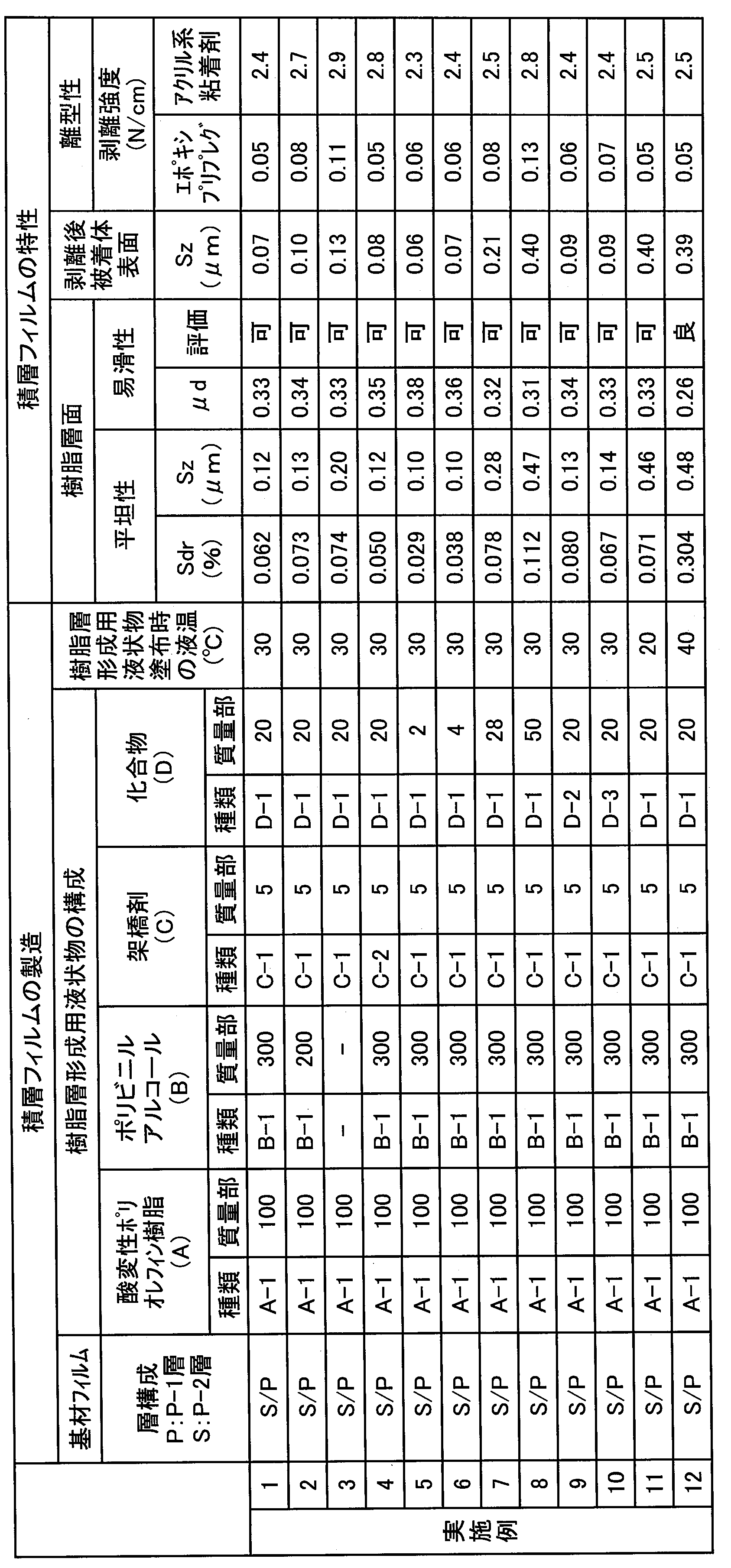
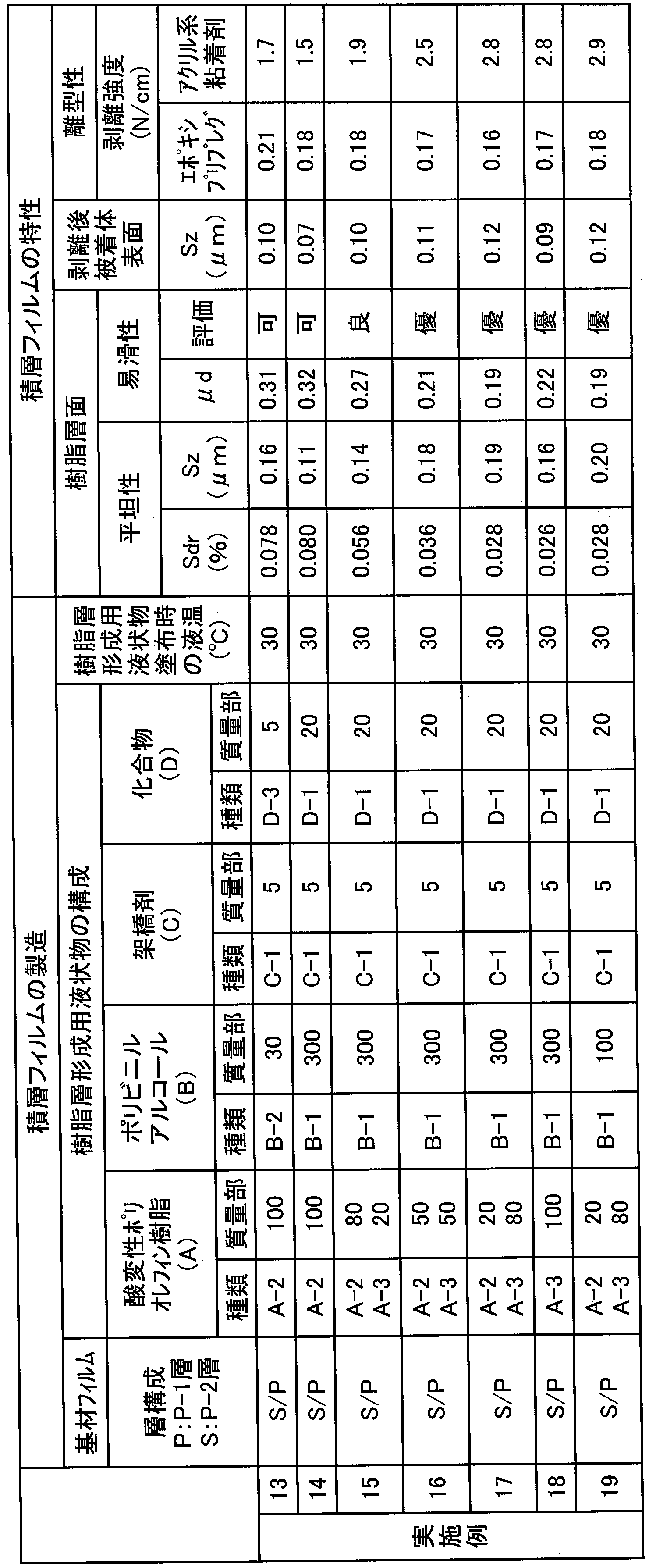
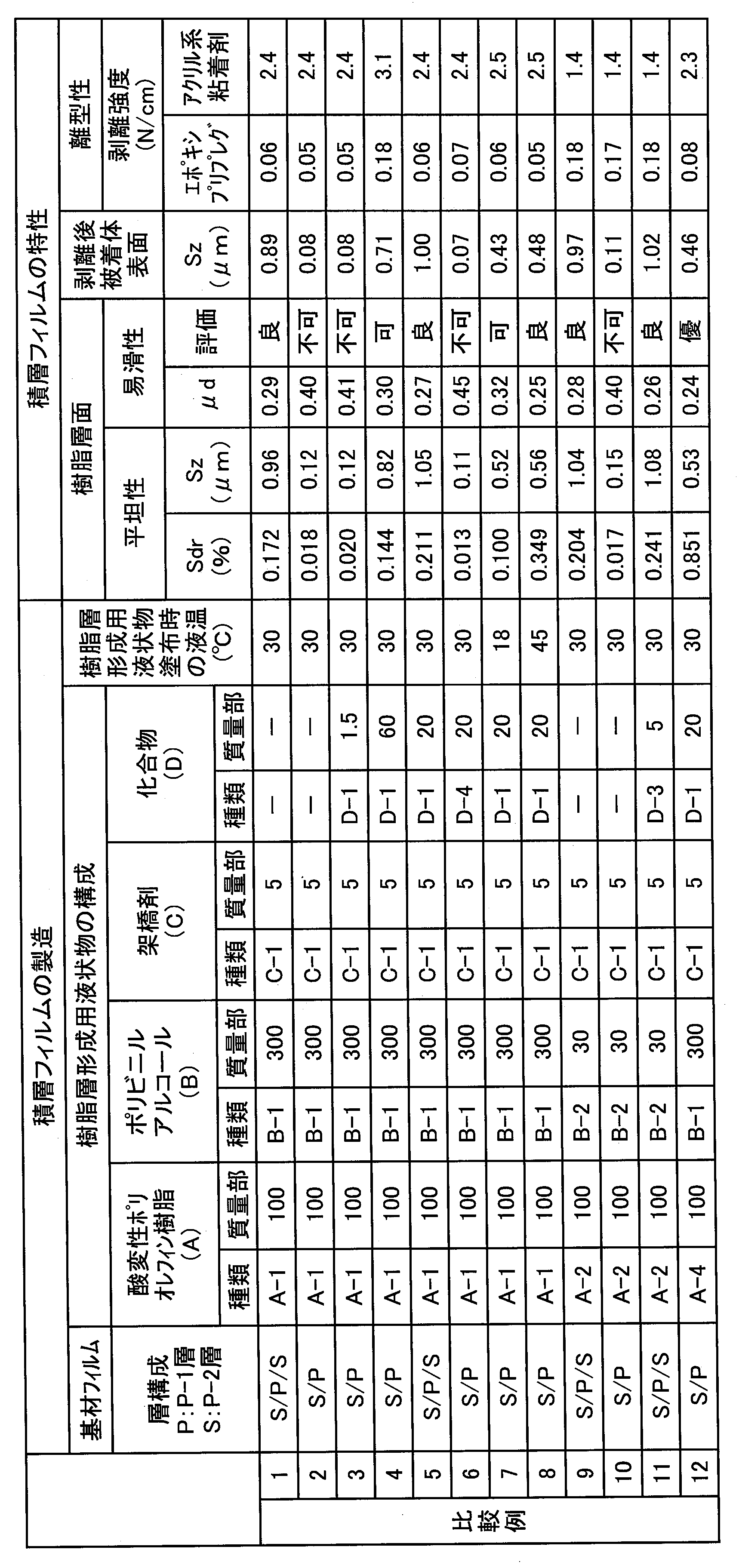
比較例2、3、10の積層フィルムの樹脂層は、多層構造の基材フィルムの、粒子を含有しないP層に形成され、最大高さ(Sz)が、本発明で規定する範囲内となり、平坦性に優れるが、化合物(D)を含有しないか含有量が少ない樹脂層形成用液状物を塗布して形成したため、展開界面面積率(Sdr)が本発明で規定する範囲外となり、易滑性に劣るものであった。
その他の比較例の積層フィルムの樹脂層も、Sdr、Szが本発明で規定する範囲外であるため、易滑性、平坦性に劣るものであった。
Claims (7)
- 基材フィルムの少なくとも片面に樹脂層が設けられた積層フィルムであって、
樹脂層が設けられた基材フィルム面は、粒子を実質的に含有しておらず、
樹脂層は、酸変性ポリオレフィン樹脂(A)および架橋剤(C)を含有し、
樹脂層面における、非接触表面形状測定機で求めた、展開界面面積率(Sdr)が0.025~0.304%であり、最大高さ(Sz)が0.01~0.50μmであることを特徴とする積層フィルム。 - 酸変性ポリオレフィン樹脂(A)のオレフィン成分が、プロピレンまたは1-オクテンを含有することを特徴とする請求項1に記載の積層フィルム。
- オレフィン成分におけるプロピレンの含有量が70質量%以上であることを特徴とする請求項2に記載の積層フィルム。
- オレフィン成分における1-オクテンの含有量が15質量%以上であることを特徴とする請求項2に記載の積層フィルム。
- 樹脂層とエポキシプリプレグとの剥離強度が、0.5N/cm以下であることを特徴とする請求項1~4のいずれかに記載の積層フィルム。
- 請求項1~5のいずれかに記載の積層フィルムを製造するための方法であって、
基材フィルムに、酸変性ポリオレフィン樹脂(A)と、架橋剤(C)と、両親媒性オリゴマー、アセチレングリコール、および、アセチレングリコールのエチレンオキサイド付加物からなる群より選ばれた少なくとも1種の化合物(D)を含有し、液温が20~40℃である樹脂層形成用液状物を塗布する工程、
樹脂層形成用液状物が塗布された基材フィルムを乾燥および延伸する工程、
を含むことを特徴とする積層フィルムの製造方法。 - 化合物(D)の含有量が、酸変性ポリオレフィン樹脂(A)100質量部に対して、2~50質量部である樹脂層形成用液状物を塗布することを特徴とする請求項6記載の積層フィルムの製造方法。
Priority Applications (4)
| Application Number | Priority Date | Filing Date | Title |
|---|---|---|---|
| EP24823346.2A EP4729288A1 (en) | 2023-06-13 | 2024-06-10 | Multilayer film and method for producing same |
| KR1020257039347A KR20260022298A (ko) | 2023-06-13 | 2024-06-10 | 적층 필름 및 그 제조 방법 |
| JP2024536235A JP7638049B1 (ja) | 2023-06-13 | 2024-06-10 | 積層フィルムおよびその製造方法 |
| CN202480039201.4A CN121335801A (zh) | 2023-06-13 | 2024-06-10 | 层叠膜及其制造方法 |
Applications Claiming Priority (4)
| Application Number | Priority Date | Filing Date | Title |
|---|---|---|---|
| JP2023-096638 | 2023-06-13 | ||
| JP2023096638 | 2023-06-13 | ||
| JP2024025137 | 2024-02-22 | ||
| JP2024-025137 | 2024-02-22 |
Publications (1)
| Publication Number | Publication Date |
|---|---|
| WO2024257730A1 true WO2024257730A1 (ja) | 2024-12-19 |
Family
ID=93852001
Family Applications (1)
| Application Number | Title | Priority Date | Filing Date |
|---|---|---|---|
| PCT/JP2024/021072 Ceased WO2024257730A1 (ja) | 2023-06-13 | 2024-06-10 | 積層フィルムおよびその製造方法 |
Country Status (6)
| Country | Link |
|---|---|
| EP (1) | EP4729288A1 (ja) |
| JP (1) | JP7638049B1 (ja) |
| KR (1) | KR20260022298A (ja) |
| CN (1) | CN121335801A (ja) |
| TW (1) | TW202506428A (ja) |
| WO (1) | WO2024257730A1 (ja) |
Citations (6)
| Publication number | Priority date | Publication date | Assignee | Title |
|---|---|---|---|---|
| JP2012020429A (ja) | 2010-07-13 | 2012-02-02 | Unitika Ltd | 易滑性ポリエステルフィルムおよびその製造方法 |
| JP2012144021A (ja) * | 2011-01-14 | 2012-08-02 | Unitika Ltd | 易滑性ポリエステルフィルムおよびその製造方法 |
| WO2014007187A1 (ja) * | 2012-07-02 | 2014-01-09 | ユニチカ株式会社 | 離型用二軸延伸ポリエステルフィルム |
| WO2014021445A1 (ja) * | 2012-08-02 | 2014-02-06 | ユニチカ株式会社 | 積層フィルム、その製造方法、およびその製造に用いる水性分散体 |
| JP2015189014A (ja) * | 2014-03-27 | 2015-11-02 | ユニチカ株式会社 | 離型フィルム |
| JP2021074915A (ja) * | 2019-11-06 | 2021-05-20 | 王子ホールディングス株式会社 | 積層フィルム |
-
2024
- 2024-06-10 WO PCT/JP2024/021072 patent/WO2024257730A1/ja not_active Ceased
- 2024-06-10 EP EP24823346.2A patent/EP4729288A1/en active Pending
- 2024-06-10 JP JP2024536235A patent/JP7638049B1/ja active Active
- 2024-06-10 KR KR1020257039347A patent/KR20260022298A/ko active Pending
- 2024-06-10 CN CN202480039201.4A patent/CN121335801A/zh active Pending
- 2024-06-12 TW TW113121679A patent/TW202506428A/zh unknown
Patent Citations (6)
| Publication number | Priority date | Publication date | Assignee | Title |
|---|---|---|---|---|
| JP2012020429A (ja) | 2010-07-13 | 2012-02-02 | Unitika Ltd | 易滑性ポリエステルフィルムおよびその製造方法 |
| JP2012144021A (ja) * | 2011-01-14 | 2012-08-02 | Unitika Ltd | 易滑性ポリエステルフィルムおよびその製造方法 |
| WO2014007187A1 (ja) * | 2012-07-02 | 2014-01-09 | ユニチカ株式会社 | 離型用二軸延伸ポリエステルフィルム |
| WO2014021445A1 (ja) * | 2012-08-02 | 2014-02-06 | ユニチカ株式会社 | 積層フィルム、その製造方法、およびその製造に用いる水性分散体 |
| JP2015189014A (ja) * | 2014-03-27 | 2015-11-02 | ユニチカ株式会社 | 離型フィルム |
| JP2021074915A (ja) * | 2019-11-06 | 2021-05-20 | 王子ホールディングス株式会社 | 積層フィルム |
Non-Patent Citations (1)
| Title |
|---|
| "Solvent Handbook", 1990, KODANSHA SCIENTIFIC LTD. |
Also Published As
| Publication number | Publication date |
|---|---|
| KR20260022298A (ko) | 2026-02-19 |
| TW202506428A (zh) | 2025-02-16 |
| JP7638049B1 (ja) | 2025-03-03 |
| EP4729288A1 (en) | 2026-04-22 |
| JPWO2024257730A1 (ja) | 2024-12-19 |
| CN121335801A (zh) | 2026-01-13 |
Similar Documents
| Publication | Publication Date | Title |
|---|---|---|
| KR102322398B1 (ko) | 이형 필름 및 그 제조방법 | |
| JP7106112B2 (ja) | 離型フィルムおよびその製造方法 | |
| JP5837411B2 (ja) | インモールド転写用ポリエステルフィルム | |
| WO2006001151A1 (ja) | 両面離型フィルム | |
| JP2022057020A (ja) | 離型フィルム | |
| JP2021133645A (ja) | 積層フィルムおよびその製造方法 | |
| JP7594775B2 (ja) | 積層フィルムおよびその製造方法 | |
| JP7638049B1 (ja) | 積層フィルムおよびその製造方法 | |
| JP6097466B2 (ja) | 偏光板製造工程用ポリエステルフィルム | |
| JP2009262443A (ja) | インモールド転写箔用フィルム | |
| JP5985563B2 (ja) | 積層ポリエステルフィルム | |
| TW202533947A (zh) | 積層膜及其製造方法 | |
| JP7493740B2 (ja) | 離型フィルムおよびその製造方法 | |
| JP7591252B2 (ja) | 水性分散体および離型フィルム | |
| JP2018161797A (ja) | 離型フィルム | |
| JP7728559B2 (ja) | 水性分散体、塗膜、積層フィルムおよびそれらの製造方法 | |
| JP2021133646A (ja) | 積層フィルムおよびその製造方法 | |
| JP2026060993A (ja) | 離型フィルム | |
| JP2022155604A (ja) | 積層フィルムおよびその製造方法 | |
| JP2025153132A (ja) | 積層フィルムおよびその製造方法 | |
| HK40001267A (en) | Release film and method for manufacturing same | |
| JP6005704B2 (ja) | 積層ポリエステルフィルム | |
| HK40001267B (zh) | 脱模膜及其制造方法 | |
| JP2023034957A (ja) | 離型フィルム | |
| HK1211543B (en) | Mold release film and production method for same |
Legal Events
| Date | Code | Title | Description |
|---|---|---|---|
| WWE | Wipo information: entry into national phase |
Ref document number: 2024536235 Country of ref document: JP |
|
| 121 | Ep: the epo has been informed by wipo that ep was designated in this application |
Ref document number: 24823346 Country of ref document: EP Kind code of ref document: A1 |
|
| WWE | Wipo information: entry into national phase |
Ref document number: 2024823346 Country of ref document: EP |
|
| NENP | Non-entry into the national phase |
Ref country code: DE |
|
| ENP | Entry into the national phase |
Ref document number: 2024823346 Country of ref document: EP Effective date: 20260113 |
|
| ENP | Entry into the national phase |
Ref document number: 2024823346 Country of ref document: EP Effective date: 20260113 |
|
| ENP | Entry into the national phase |
Ref document number: 2024823346 Country of ref document: EP Effective date: 20260113 |
|
| ENP | Entry into the national phase |
Ref document number: 2024823346 Country of ref document: EP Effective date: 20260113 |
|
| WWP | Wipo information: published in national office |
Ref document number: 2024823346 Country of ref document: EP |