WO2024257631A1 - 可塑剤、組成物、及び成形品 - Google Patents
可塑剤、組成物、及び成形品 Download PDFInfo
- Publication number
- WO2024257631A1 WO2024257631A1 PCT/JP2024/020074 JP2024020074W WO2024257631A1 WO 2024257631 A1 WO2024257631 A1 WO 2024257631A1 JP 2024020074 W JP2024020074 W JP 2024020074W WO 2024257631 A1 WO2024257631 A1 WO 2024257631A1
- Authority
- WO
- WIPO (PCT)
- Prior art keywords
- plasticizer
- mass
- composition
- parts
- tert
- Prior art date
- Legal status (The legal status is an assumption and is not a legal conclusion. Google has not performed a legal analysis and makes no representation as to the accuracy of the status listed.)
- Ceased
Links
Classifications
-
- C—CHEMISTRY; METALLURGY
- C08—ORGANIC MACROMOLECULAR COMPOUNDS; THEIR PREPARATION OR CHEMICAL WORKING-UP; COMPOSITIONS BASED THEREON
- C08L—COMPOSITIONS OF MACROMOLECULAR COMPOUNDS
- C08L101/00—Compositions of unspecified macromolecular compounds
- C08L101/16—Compositions of unspecified macromolecular compounds the macromolecular compounds being biodegradable
-
- C—CHEMISTRY; METALLURGY
- C08—ORGANIC MACROMOLECULAR COMPOUNDS; THEIR PREPARATION OR CHEMICAL WORKING-UP; COMPOSITIONS BASED THEREON
- C08J—WORKING-UP; GENERAL PROCESSES OF COMPOUNDING; AFTER-TREATMENT NOT COVERED BY SUBCLASSES C08B, C08C, C08F, C08G or C08H
- C08J5/00—Manufacture of articles or shaped materials containing macromolecular substances
- C08J5/18—Manufacture of films or sheets
-
- C—CHEMISTRY; METALLURGY
- C08—ORGANIC MACROMOLECULAR COMPOUNDS; THEIR PREPARATION OR CHEMICAL WORKING-UP; COMPOSITIONS BASED THEREON
- C08K—Use of inorganic or non-macromolecular organic substances as compounding ingredients
- C08K5/00—Use of organic ingredients
- C08K5/0008—Organic ingredients according to more than one of the "one dot" groups of C08K5/01 - C08K5/59
- C08K5/0016—Plasticisers
-
- C—CHEMISTRY; METALLURGY
- C08—ORGANIC MACROMOLECULAR COMPOUNDS; THEIR PREPARATION OR CHEMICAL WORKING-UP; COMPOSITIONS BASED THEREON
- C08K—Use of inorganic or non-macromolecular organic substances as compounding ingredients
- C08K5/00—Use of organic ingredients
- C08K5/04—Oxygen-containing compounds
- C08K5/10—Esters; Ether-esters
- C08K5/101—Esters; Ether-esters of monocarboxylic acids
- C08K5/103—Esters; Ether-esters of monocarboxylic acids with polyalcohols
-
- C—CHEMISTRY; METALLURGY
- C08—ORGANIC MACROMOLECULAR COMPOUNDS; THEIR PREPARATION OR CHEMICAL WORKING-UP; COMPOSITIONS BASED THEREON
- C08L—COMPOSITIONS OF MACROMOLECULAR COMPOUNDS
- C08L67/00—Compositions of polyesters obtained by reactions forming a carboxylic ester link in the main chain; Compositions of derivatives of such polymers
- C08L67/04—Polyesters derived from hydroxycarboxylic acids, e.g. lactones
Definitions
- the present invention relates to a plasticizer, a composition containing the same, and a molded article made from the same.
- biodegradable resins and molded products made from them that decompose in natural environments such as soil and the ocean
- active research into biodegradable resins such as aliphatic polyesters has been conducted.
- polylactic acid resins have a high melting point, can be melt molded, and have excellent transparency, so they are highly anticipated for use as packaging materials and in molded products that take advantage of their transparency.
- Patent Document 1 describes a technique for blending a polypropylene glycol dibenzoate plasticizer with a lactic acid-based polymer.
- Patent Document 2 proposes a plasticizer for lactic acid-based polymers that consists of a polyethylene glycol dibenzoate with a number-average molecular weight of 150 or more.
- the object of the present invention is to provide a plasticizer that imparts excellent plasticity to biodegradable resins, and a composition and molded article that contain the same.
- a plasticizer containing polyalkylene glycol and having a hydroxyl value within a specific range imparts excellent plasticity to biodegradable resins, leading to the completion of the present invention.
- the present invention provides a plasticizer for biodegradable resins, which contains a dibenzoate compound represented by the following general formula (1) and has a hydroxyl value of 0.1 to 20 mgKOH/g.
- R 1 represents an alkanediyl group having 1 to 8 carbon atoms
- n represents an integer of 1 to 8.
- R 1 in general formula (1) preferably represents an alkylene group having 2 to 3 carbon atoms.
- n in general formula (1) represents an integer of 1 to 3.
- the present invention also provides a composition containing a biodegradable resin and the above-mentioned plasticizer.
- composition of the present invention preferably contains 0.1 to 50 parts by mass of plasticizer per 100 parts by mass of biodegradable resin.
- the present invention also provides a molded article obtained from the above composition.
- the present invention provides a plasticizer that imparts excellent plasticity to biodegradable resins, as well as a composition and molded article that contain the plasticizer.
- the present invention relates to a plasticizer, a composition, and a molded article.
- the present invention will be described below based on a preferred embodiment.
- the plasticizer of the present invention contains a dibenzoate compound represented by the following general formula (1).
- R 1 represents an alkanediyl group having 1 to 8 carbon atoms
- n represents an integer of 1 to 8.
- the plasticizer of the present invention preferably has a hydroxyl value within a specific range.
- the hydroxyl value is preferably 0.1 mgKOH/g or more, more preferably 0.3 mgKOH/g or more, even more preferably 0.5 mgKOH/g or more, and particularly preferably 1 mgKOH/g or more.
- the hydroxyl value is preferably 20 mgKOH/g or less, more preferably 15 mgKOH/g or less, even more preferably 10 mgKOH/g or less, and particularly preferably 7 mgKOH/g or less.
- the hydroxyl value can be measured by the method described in JIS K 1557.
- the plasticizer of the present invention has the effect of imparting excellent plasticity to biodegradable resins.
- the reason for this effect is not clear, but is presumed to be as follows.
- plasticizers penetrate between resin molecules, weakening the intermolecular forces of the resin and facilitating the movement of each molecular chain, thereby lowering the glass transition temperature of the resin and imparting plasticity to the resin.
- the plasticizer of the present invention has a polyoxyalkylene structure, which is the structure in parentheses in general formula (1), and has a hydroxyl value within a specific range, so that it has a moderate affinity for biodegradable resin molecules, making it easier to penetrate between the resin molecules, and can moderately suppress strong bonds such as hydrogen bonds that occur between hydroxyl groups derived from the plasticizer and atoms derived from the biodegradable resin, thereby imparting excellent plasticity to the resin.
- This effect is particularly evident in combination with structures that are characteristically contained in biodegradable resins, such as polyester structures and polyvinyl alcohol structures.
- Examples of the alkanediyl group having 1 to 8 carbon atoms represented by R 1 in the above general formula (1) include alkylene groups such as methylene, ethylene, propylene, butylene, pentylene, hexylene, heptylene, and octylene; and alkylidene groups such as ethylidene, propylidene, butylidene, and hexylidene.
- the alkanediyl group may be linear or branched.
- the alkanediyl group may include isomers.
- n in the above general formula (1) is preferably an integer from 1 to 4, more preferably an integer from 1 to 3, even more preferably an integer from 2 to 3, and especially preferably 2.
- Examples of the compound represented by the above general formula (1) include ethylene glycol dibenzoate, diethylene glycol dibenzoate, triethylene glycol dibenzoate, polyethylene glycol dibenzoate, propylene glycol dibenzoate, dipropylene glycol dibenzoate, tripropylene glycol dibenzoate, polypropylene glycol dibenzoate, butylene glycol dibenzoate, dibutylene glycol dibenzoate, tributylene glycol dibenzoate, neopentyl glycol dibenzoate, and the like.
- ethylene glycol dibenzoate, diethylene glycol dibenzoate, triethylene glycol dibenzoate, propylene glycol dibenzoate, dipropylene glycol dibenzoate, and tripropylene glycol dibenzoate are preferred, ethylene glycol dibenzoate, diethylene glycol dibenzoate, propylene glycol dibenzoate, and dipropylene glycol dibenzoate are more preferred, diethylene glycol dibenzoate and dipropylene glycol dibenzoate are even more preferred, and dipropylene glycol dibenzoate is particularly preferred.
- the compound represented by the above general formula (1) can be produced by a conventionally known production method.
- benzoic acid or a benzoic acid derivative can be combined with a glycol corresponding to the structure in parentheses in the above general formula (1) and reacted.
- direct esterification of benzoic acid with glycol, transesterification of methyl benzoate with glycol, reaction of benzoic acid halide with glycol, etc. are possible.
- the compound represented by the above general formula (1) obtained by the above method, etc. may be further separated and purified by separation and purification means such as filtration, concentration, distillation, extraction, crystallization, recrystallization, adsorption, and column chromatography, or a combination of these means, as necessary.
- the plasticizer of the present invention is preferably used with biodegradable resins, since it is easier to obtain the effect of the plasticizer.
- biodegradable resin examples include those exemplified as the biodegradable resins contained in the composition described below. Among them, it is preferable to use the plasticizer with polylactic acid resins, since the effect of improving plasticity can be sufficiently obtained.
- composition of the present invention contains a biodegradable resin and the above-mentioned plasticizer.
- the biodegradable resins include microbially produced resins, natural product resins, and chemically synthesized resins.
- Examples of the microbially produced resin include polyhydroxyalkanoates.
- Examples of natural resins include cellulose derivatives and starch derivatives.
- Examples of chemically synthesized resins include polyester-based biodegradable resins such as polylactic acid resin, polybutylene succinate, polybutylene succinate adipate, polybutylene adipate terephthalate, polyethylene succinate, polyglycolic acid, polycaprolactone, poly(3-hydroxybutyrate-co-hydroxyhexanoate), hydroxyl-containing biodegradable resins such as polyvinyl alcohol, partially acetylated cellulose-based resins, etc.
- polyester-based biodegradable resins are more preferred, and polylactic acid resins are particularly preferred, in that the effect of improving plasticity can be fully obtained.
- the polylactic acid resin used in the present invention includes polylactic acid homopolymer, polylactic acid copolymer, and blend polymer of polylactic acid homopolymer and polylactic acid copolymer.
- the weight average molecular weight (Mw) of the polylactic acid resin is preferably 50,000 to 500,000, and more preferably 100,000 to 250,000, in terms of polystyrene by gel permeation chromatography analysis. This is because being within the above range results in excellent physical properties and moldability.
- Specific examples of such polylactic acid include the "Ingeo” series manufactured by NatureWorks and the “Luminy” series manufactured by Total Corbion.
- the molar ratio (L/D) of the L-lactic acid units and the D-lactic acid units in the polylactic acid resin is not particularly limited and can be selected from the range of 100/0 to 0/100.
- L-lactic acid units or the D-lactic acid units is 75 mol % or more, and to obtain a polylactic acid resin composition with a higher melting point, it is preferable that either the L-lactic acid units or the D-lactic acid units is 90 mol % or more.
- the polylactic acid resin may be a copolymer of lactic acid monomer or lactide with other copolymerizable components.
- other components include dicarboxylic acids, polyhydric alcohols, hydroxycarboxylic acids, lactone acids, and various polyesters, polyethers, polycarbonates, etc. that contain these as constituent components.
- the dicarboxylic acids include succinic acid, adipic acid, azelaic acid, sebacic acid, terephthalic acid, isophthalic acid, etc.
- the above polyhydric alcohols include aromatic polyhydric alcohols such as those obtained by addition reaction of bisphenol with ethylene oxide, aliphatic polyhydric alcohols such as ethylene glycol, propylene glycol, butanediol, hexanediol, octanediol, glycerin, sorbitan, trimethylolpropane, and neopentyl glycol, and ether glycols such as diethylene glycol, triethylene glycol, polyethylene glycol, and polypropylene glycol.
- aromatic polyhydric alcohols such as those obtained by addition reaction of bisphenol with ethylene oxide
- aliphatic polyhydric alcohols such as ethylene glycol, propylene glycol, butanediol, hexanediol, octanediol, glycerin, sorbitan, trimethylolpropane, and neopentyl glycol
- ether glycols such as
- hydroxycarboxylic acids include glycolic acid, hydroxybutyric acid, hydroxybutylcarboxylic acid, hydroxypentanoic acid, hydroxycaproic acid, hydroxyheptanoic acid, etc.
- lactone acids include glycolide, ⁇ -caprolactone glycolide, ⁇ -caprolactone, ⁇ -propiolactone, ⁇ -butyrolactone, ⁇ -butyrolactone, ⁇ -butyrolactone, pivalolactone, ⁇ -valerolactone, etc.
- the method for synthesizing the polylactic acid resin used in the present invention is not particularly limited, and it can be synthesized by a conventionally known method, for example, by direct dehydration condensation from lactic acid monomers, or by ring-opening polymerization of lactic acid cyclic dimer lactide.
- any of the following lactic acids may be used: L-lactic acid, D-lactic acid, DL-lactic acid, and mixtures thereof.
- any of the following lactides may be used: L-lactide, D-lactide, DL-lactide, meso-lactide, and mixtures thereof.
- the catalyst used in the polymerization reaction to obtain the polylactic acid resin is not particularly limited, and may be any known catalyst for lactic acid polymerization.
- the catalyst include tin compounds such as tin lactate, tin tartrate, tin dicaprylate, tin dilaurate, tin dipalmitate, tin distearate, tin dioleate, tin ⁇ -naphthoate, tin ⁇ -naphthoate, and tin octylate, tin powder, tin oxide, zinc powder, zinc halide, zinc oxide, organic zinc compounds, titanium compounds such as tetrapropyl titanate, zirconium compounds such as zirconium isopropoxide, antimony compounds such as antimony trioxide, bismuth compounds such as bismuth (III) oxide, and aluminum compounds such as aluminum isopropoxide.
- a catalyst made of tin or a tin compound is particularly preferred from the viewpoint of activity.
- the amount of the catalyst used is, for example, about 0.001 to 5 parts by mass per 100 parts by mass of lactide in the case of ring-opening polymerization.
- the polymerization reaction can be carried out in the presence of the above catalyst, usually at 100 to 220°C, although this varies depending on the type of catalyst. It is also preferable to carry out the two-stage polymerization described in, for example, JP-A-7-247345.
- biodegradable resin used in the present invention is not limited to polylactic acid resin, and any biodegradable resin can be used.
- the biodegradable resin may be blended with a general-purpose resin other than the biodegradable resin, if necessary, to improve impact strength, etc.
- Preferred general-purpose resins are elastic resins such as ethylene-propylene copolymer rubber and ethylene-propylene-diene copolymer.
- the content of the biodegradable resin in the composition of the present invention is preferably 60 parts by mass or more, more preferably 65 parts by mass or more, even more preferably 70 parts by mass or more, and particularly preferably 75 parts by mass or more, based on 100 parts by mass of the composition, which allows the plasticizer and the biodegradable resin to be sufficiently compatible with each other.
- the content of the biodegradable resin in the composition of the present invention is preferably 99 parts by mass or less, more preferably 95 parts by mass or less, even more preferably 90 parts by mass or less, and particularly preferably 85 parts by mass or less, relative to 100 parts by mass of the composition, whereby the plasticizing effect of the plasticizer can be sufficiently obtained.
- the content of the plasticizer in the composition of the present invention is preferably 1 part by mass or more, more preferably 5 parts by mass or more, even more preferably 10 parts by mass or more, and particularly preferably 15 parts by mass or more, per 100 parts by mass of the biodegradable resin, so that the plasticizing effect of the plasticizer can be sufficiently obtained.
- the content of the plasticizer in the composition of the present invention is preferably 50 parts by mass or less, more preferably 30 parts by mass or less, further preferably 25 parts by mass or less, and particularly preferably 20 parts by mass or less, relative to 100 parts by mass of the biodegradable resin, which allows the plasticizer and the biodegradable resin to be sufficiently compatible with each other.
- the content of the plasticizer in the composition of the present invention is preferably 1 part by mass or more, more preferably 5 parts by mass or more, even more preferably 10 parts by mass or more, and particularly preferably 15 parts by mass or more, based on 100 parts by mass of the composition, whereby the plasticizing effect of the plasticizer can be sufficiently obtained.
- the content of the plasticizer in the composition of the present invention is preferably 50 parts by mass or less, more preferably 30 parts by mass or less, further preferably 25 parts by mass or less, and particularly preferably 20 parts by mass or less, relative to 100 parts by mass of the composition, which allows the plasticizer and the biodegradable resin to be sufficiently compatible with each other.
- composition of the present invention may contain optional components together with the plasticizer of the present invention.
- Optional components that can be incorporated into the composition of the present invention will now be described. It is preferable to add various additives that are usually used in each resin to the composition of the present invention as necessary to stabilize the composition.
- the additives include antioxidants such as phenol-based antioxidants, sulfur-based antioxidants, and phosphorus-based antioxidants, ultraviolet absorbers, and hindered amine-based light stabilizers.
- phenol-based antioxidants examples include 2,6-di-tert-butyl-p-cresol, 2,6-diphenyl-4-octadecyloxyphenol, stearyl (3,5-di-tert-butyl-4-hydroxyphenyl)propionate, distearyl (3,5-di-tert-butyl-4-hydroxybenzyl)phosphonate, tridecyl-3,5-di-tert-butyl-4-hydroxybenzylthioacetate, thiodiethylenebis[(3,5-di-tert-butyl-4-hydroxyphenyl)propionate], and 4,4'-thiobis(6-tert-butyl-m-cresol).
- 2-octylthio-4,6-di(3,5-di-tert-butyl-4-hydroxyphenoxy)-s-triazine 2,2'-methylenebis(4-methyl-6-tert-butylphenol), bis[3,3-bis(4-hydroxy-3-tert-butylphenyl)butyric acid]glycol ester, 4,4'-butylidenebis(4,6-di-tert-butylphenol), 2,2'-ethylidenebis(4,6-di-tert-butylphenol), 1,1,3-tris(2-methyl-4-hydroxy-5-tert-butylphenyl)butane, bis[2-tert-butyl-4-methyl 1,3,5-tris(2,6-dimethyl-3-hydroxy-4-tert-butylbenzyl)isocyanurate, 1,3,5-tris(3,5-di-tert-butyl-4-hydroxybenzyl)isocyanurate, 1,3,5
- sulfur-based antioxidant examples include dialkyl thiodipropionates such as dilauryl thiodipropionate, dimyristyl thiodipropionate, and distearyl thiodipropionate; and ⁇ -alkyl mercaptopropionates of polyols such as pentaerythritol tetra( ⁇ -dodecyl mercaptopropionate).
- the amount of the sulfur-based antioxidant used is preferably 0.001 to 10 parts by mass, and more preferably 0.01 to 5 parts by mass, per 100 parts by mass of the biodegradable resin.
- Examples of the phosphorus-based antioxidants include trisnonylphenyl phosphite, tris(2,4-di-tert-butylphenyl)phosphite, tris[2-tert-butyl-4-(3-tert-butyl-4-hydroxy-5-methylphenylthio)-5-methylphenyl]phosphite, tridecyl phosphite, octyldiphenyl phosphite, didecylmonophenyl phosphite, bis(tridecyl)pentaerythritol diphosphite, bis(nonylphenyl)pentaerythritol diphosphite, bis(2,4-di-tert-butylphenyl)pentaerythritol diphosphite, bis(2,6-di-tert-butyl-4-methylphenyl)pentaerythrito
- phenol-based antioxidants and phosphorus-based antioxidants are particularly suitable because they prevent discoloration of biodegradable resins.
- Examples of the ultraviolet absorber include 2-hydroxybenzophenones such as 2,4-dihydroxybenzophenone, 2-hydroxy-4-methoxybenzophenone, 2-hydroxy-4-octoxybenzophenone, 2-hydroxy-4-tert-butyl-4'-(2-methacryloyloxyethoxyethoxy)benzophenone, and 5,5'-methylenebis(2-hydroxy-4-methoxybenzophenone);2-(2'-hydroxy-5'-methylphenyl)benzotriazole,2-(2'-hydroxy-5'-tert-octylphenyl)benzotriazole,2-(2'-hydroxy-3',5'-di-tert-butylphenyl)-5-chlorobenzotriazole,2-(2'-hydroxy-3'-tert-butyl-5'-methylphenyl)-5-chlorobenzotriazole,2-(2'-hydroxy-3'-dodecyl-5'-methylphenyl)benzotriazole,2-
- 2- (2'-hydroxyphenyl)benzotriazoles such as 2-(2'-hydroxy-3',5'-dicumylphenyl)benzotriazole and polyethylene glycol esters of 2-(2'-hydroxy-3'-tert-butyl-5'-carboxyphenyl)benzotriazole; 2-(2-hydroxy-4-hexyloxyphenyl)-4,6-diphenyl-1,3,5-triazine, 2-(2-hydroxy-4-methoxyphenyl)-4,6-diphenyl-1,3,5-triazine, 2-(2-hydroxy-4-octoxyphenyl)-4,6-bis(2,4-dimethylphenyl)-1,3,5-triazine, 2-(2-hydroxy-4-acryloyloxyethoxyphenyl)-4,6-bis(2,4-dimethylphenyl)-1,3,5-triazine, 2-(2-hydroxy-4-acryloyloxyethoxyphenyl)-4,6-bis(2,4
- hindered amine-based light stabilizer examples include 2,2,6,6-tetramethyl-4-piperidyl stearate, 1,2,2,6,6-pentamethyl-4-piperidyl stearate, 2,2,6,6-tetramethyl-4-piperidyl benzoate, bis(2,2,6,6-tetramethyl-4-piperidyl)sebacate, bis(1,2,2,6,6-pentamethyl-4-piperidyl)sebacate, bis(1-octoxy-2,2,6,6-tetramethyl-4-piperidyl)sebacate, 1,2,2,6,6-pentamethyl-4-piperidyl methacrylate, 2,2,6,6-tetramethyl-piperidyl methacrylate, tetrakis(2,2,6,6-tetramethyl-4-piperidyl)-1,2,3,4-butanetetracarboxylate, tetrakis(1,2,2 ,6,6-pentamethyl-4-piperidyl
- composition of the present invention may further contain additives that are typically used in synthetic resins, such as processing aids, crosslinking agents, antistatic agents, anti-fogging agents, anti-plate-out agents, surface treatment agents, plasticizers other than those of the present invention, fillers, lubricants, nucleating agents, clarifying agents, reinforcing materials, flame retardants, fluorescent agents, antifungal agents, bactericides, foaming agents, metal deactivators, release agents, pigments, silicone oils, silane coupling agents, etc., as long as they do not impair the effects of the present invention.
- additives that are typically used in synthetic resins, such as processing aids, crosslinking agents, antistatic agents, anti-fogging agents, anti-plate-out agents, surface treatment agents, plasticizers other than those of the present invention, fillers, lubricants, nucleating agents, clarifying agents, reinforcing materials, flame retardants, fluorescent agents, antifungal agents, bactericides, foaming agents, metal deactivators, release
- the optional components can be added to the biodegradable resin separately from the plasticizer of the present invention, or the plasticizer is mixed in advance in a desired ratio with a binder, wax, solvent, granulation aid such as silica, etc., which are used as needed, and then granulated to form a one-pack composite additive, which is then added to the biodegradable resin, or a master batch containing the plasticizer of the present invention and the optional components can be prepared and added to the biodegradable resin.
- a binder, wax, solvent, granulation aid such as silica, etc.
- the timing of blending the plasticizer and optional components of the present invention into the composition of the present invention is not particularly limited.
- two or more selected from the blending components other than the biodegradable resin may be packed in one package and then blended with the biodegradable resin, or each component other than the biodegradable resin may be blended sequentially with the biodegradable resin.
- each component may be crushed and then mixed, or mixed and then crushed.
- the biodegradable resin is a polymer blend
- each component other than the biodegradable resin may be added to a pre-blended compound, or may be added during the blending process.
- the method for producing the composition of the present invention is not particularly limited, and known methods can be applied. Specific production methods include a method of mixing using a normal blender, mixer, etc., a method of melt kneading using an extruder, etc., a method of mixing with a solvent and solution casting, etc.
- the shape of the composition of the present invention is not particularly limited, and it can be used in various shapes.
- pellets, granules, powder, chunks, flakes, strands, etc. can be mentioned, and from the viewpoint of handling, pellets or granules are preferable.
- the molded article of the present invention is obtained by molding the above composition.
- the molding method of the above composition is not particularly limited and can be appropriately selected depending on the application, and examples thereof include injection molding, extrusion molding, co-extrusion molding, blow molding, press molding, cast molding, roll molding, vacuum molding, rotational molding, calendar molding, slush molding, dip molding, foam molding, additive manufacturing, T-die casting molding, inflation molding, thermoforming molding, etc.
- the uses of the molded product of the present invention are not particularly limited, and it can be used for a variety of purposes.
- it can be used for a variety of purposes, such as daily necessities, packaging materials, agricultural materials, electrical and electronic parts, machine parts, optical equipment, building materials, and automobile parts.
- the molded products of the present invention can be used in a wide range of industrial fields, such as electricity, electronics, and communications, agriculture, forestry, fisheries, mining, construction, food, textiles, clothing, medicine, coal, petroleum, rubber, leather, automobiles, precision instruments, wood, building materials, civil engineering, furniture, printing, and musical instruments.
- industrial fields such as electricity, electronics, and communications, agriculture, forestry, fisheries, mining, construction, food, textiles, clothing, medicine, coal, petroleum, rubber, leather, automobiles, precision instruments, wood, building materials, civil engineering, furniture, printing, and musical instruments.
- the composition of the present invention and its molded products can be used for window envelopes, plastic envelopes, twist packaging, printed laminated paper, laminated bags, labels, garbage bags, shopping bags, heavy-duty bags, sanitary materials, general packaging, etc., overwrapping, tableware containers, blister packs, clear cases, trays, boards, cushioning materials, slit yarns, sandbags, flexible container bags, ropes, strings, packing bands, fishing line, woven and knitted fabrics, nets, filters, clothing, industrial materials, braids, spun yarns, multi-layered yarns, interiors, wadding, staple fiber nonwoven fabrics, agricultural materials, gardening materials, civil engineering materials, bags, carpet backings, bag-making materials, packaging materials, living materials, household goods, electronic and office equipment housings, automotive interior materials, bottles, etc.
- Biodegradable resin polylactic acid resin (product name: Ingeo 2003D, manufactured by Nature Works, weight average molecular weight: 180,000, melt mass flow rate [210°C, load 2.16 kg]: 6 g/10 min)
- Plasticizer 1 Main component: dipropylene glycol dibenzoate (content 99.2%, hydroxyl value: 2 mg KOH/g)
- Plasticizer 2 Main component: dipropylene glycol dibenzoate (content 93.6%, hydroxyl value: 15 mg KOH/g)
- Plasticizer 3 Main component: diethylene glycol dibenzoate (content 99.0%, hydroxyl value: 2 mg KOH/g)
- Plasticizer 4 Main component: diethylene glycol dibenzoate (content 92.9%, hydroxyl value: 15 mg KOH/g)
- Comparative plasticizer C1 Main component: dipropylene glycol dibenzoate (content 86.4%, hydroxyl value: 32 mg KOH/g) Comparative plasticizer C2
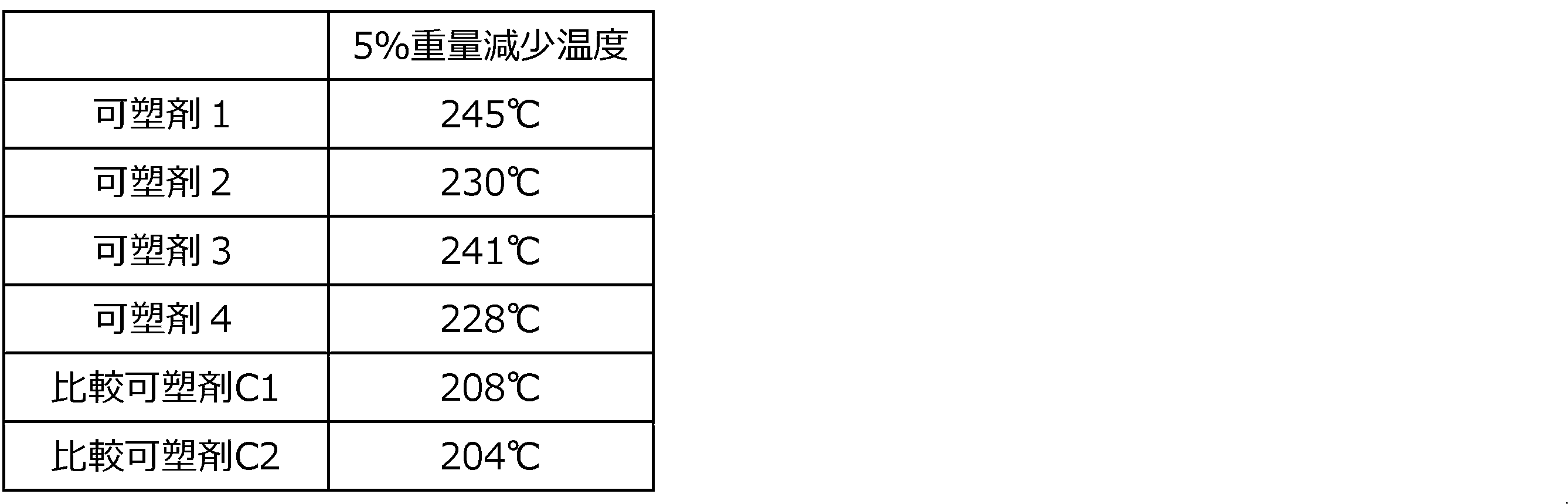
- thermogravimetric/differential thermal analyzer device name: Thermo plus EVO, manufactured by Rigaku. Approximately 10 mg of the plasticizer was precisely weighed, and the weight loss rate (wt%) was measured when the temperature was raised from 30°C to 400°C under a nitrogen atmosphere at a heating rate of 10°C/min, and the temperature (°C) at which the weight had decreased by 5% by weight from the weight at the start of the measurement was determined. This temperature is called the 5% weight loss temperature.
- Table 1 Thermo plus EVO
- the plasticizer of the present invention had a higher 5% weight loss temperature than the comparative plasticizer. This confirmed that the plasticizer of the present invention has excellent heat resistance.
- the pellet-like composition obtained above was used to prepare a cast film having a thickness of 200 ⁇ m.
- the film was prepared using a device in which a single-screw extruder (device name: D1220B) and a T-die (device name: MT60B) were connected to a Labo Plastomill ⁇ (manufactured by Toyo Seiki Seisakusho) under the conditions of melt temperature 210° C., screw speed 20 rpm, T-die extrusion temperature 210° C., chill roll temperature 30° C., and roll rotation speed 0.30 to 0.35 m/min.
- the obtained film was left to stand for 48 hours under conditions of 23° C. and 50% RH, and then subjected to the evaluation described below.
- Tg glass transition temperature
- DSC-EVO differential scanning calorimeter
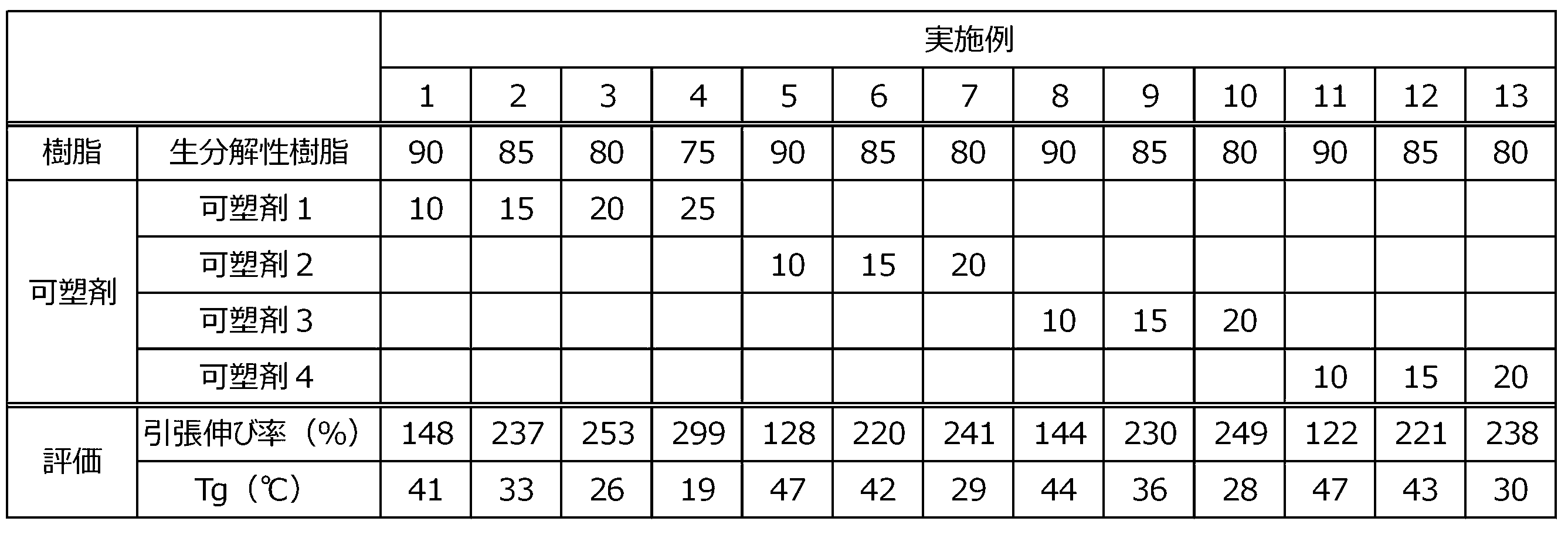
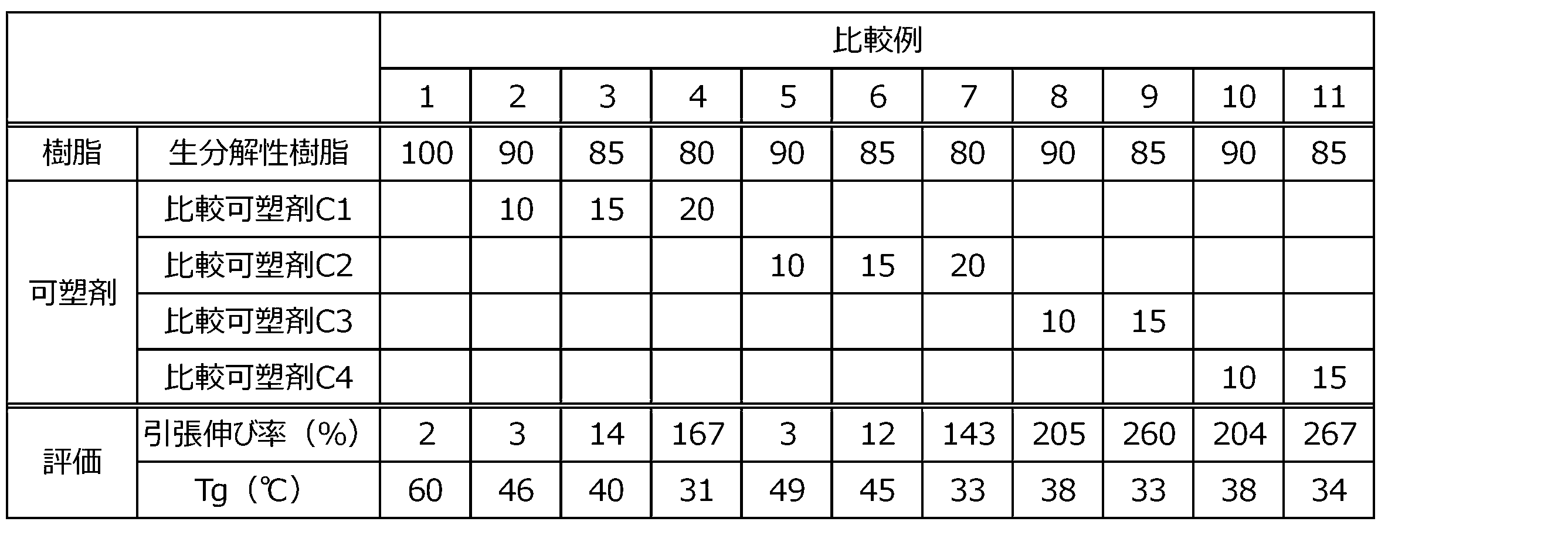
- compositions containing the plasticizer of the present invention had higher tensile elongation and lower glass transition temperatures than the composition not containing the plasticizer of the present invention (Comparative Example 1) and the compositions containing a dibenzoate compound with a high hydroxyl value (Comparative Examples 2 to 7). This confirmed that the compositions of the present invention have excellent plasticity.
- compositions (Comparative Examples 8 to 11) containing plasticizers that do not contain the dibenzoate compound represented by general formula (1) the difference in hydroxyl value had no effect on plasticity. This shows that the effect of the present invention is unique to plasticizers that contain the dibenzoate compound represented by general formula (1).
Landscapes
- Chemical & Material Sciences (AREA)
- Health & Medical Sciences (AREA)
- Chemical Kinetics & Catalysis (AREA)
- Medicinal Chemistry (AREA)
- Polymers & Plastics (AREA)
- Organic Chemistry (AREA)
- Engineering & Computer Science (AREA)
- Manufacturing & Machinery (AREA)
- Materials Engineering (AREA)
- Compositions Of Macromolecular Compounds (AREA)
- Biological Depolymerization Polymers (AREA)
Abstract
Description

本発明の可塑剤は、下記一般式(1)で表されるジベンゾエート化合物を含有する。

中でも、耐熱性及び可塑性の点から、エチレン基、プロピレン基、ブチレン基等の炭素原子数2~4のアルキレン基であることが好ましく、エチレン基、プロピレン基等の炭素原子数2~3のアルキレン基であることがより好ましく、プロピレン基であることがさらに好ましく、1,2-プロピレン基であることが特に好ましい。
中でも、耐熱性及び可塑性の点から、エチレングリコールジベンゾエート、ジエチレングリコールジベンゾエート、トリエチレングリコールジベンゾエート、プロピレングリコールジベンゾエート、ジプロピレングリコールジベンゾエート、トリプロピレングリコールジベンゾエートが好ましく、エチレングリコールジベンゾエート、ジエチレングリコールジベンゾエート、プロピレングリコールジベンゾエート、ジプロピレングリコールジベンゾエートがより好ましく、ジエチレングリコールジベンゾエート、ジプロピレングリコールジベンゾエートがさらにより好ましく、ジプロピレングリコールジベンゾエートが特に好ましい。
本発明の組成物は、生分解性樹脂と、上述の可塑剤とを含有する。
上記生分解性樹脂としては、微生物産生系樹脂、天然物系樹脂、化学合成系樹脂が挙げられる。
天然物系樹脂としては、セルロース誘導体、デンプン誘導体等が挙げられる。
化学合成系樹脂としては、ポリ乳酸樹脂、ポリブチレンサクシネート、ポリブチレンサクシネートアジペート、ポリブチレンアジペートテレフタレート、ポリエチレンサクシネート、ポリグリコール酸、ポリカプロラクトン、ポリ(3-ヒドロキシブチレート-コ-ヒドロキシヘキサノエート)等のポリエステル系生分解性樹脂、ポリビニルアルコール等の水酸基含有生分解性樹脂、部分アセチル化セルロース系樹脂等が挙げられる。中でも、可塑性向上の効果を十分に得られる点から、化学合成系樹脂が好ましく、ポリエステル系生分解性樹脂がより好ましく、ポリ乳酸樹脂が特に好ましい。
本発明で用いるポリ乳酸樹脂としては、ポリ乳酸ホモポリマー、ポリ乳酸コポリマー、ポリ乳酸ホモポリマーとポリ乳酸コポリマーとのブレンドポリマーが挙げられる。
これらの中でも、スズ又はスズ化合物からなる触媒が、活性の点から特に好ましい。上記触媒の使用量は、例えば、開環重合を行う場合、ラクチド100質量部に対して0.001~5質量部程度である。
本発明の組成物における生分解樹脂の含有量は、組成物100質量部に対して、99質量部以下であることが好ましく、95質量部以下であることがより好ましく、90質量部以下であることがさらに好ましく、85質量部以下であることが特に好ましい。これにより、可塑剤の可塑化効果が十分に得られる。
本発明の組成物における可塑剤の含有量は、生分解性樹脂100質量部に対して、50質量部以下であることが好ましく、30質量部以下であることがより好ましく、25質量部以下であることがさらに好ましく、20質量部以下であることが特に好ましい。これにより、可塑剤と生分解性樹脂とが十分に相溶することができる。
本発明の組成物における可塑剤の含有量は、組成物100質量部に対して、50質量部以下であることが好ましく、30質量部以下であることがより好ましく、25質量部以下であることがさらに好ましく、20質量部以下であることが特に好ましい。これにより、可塑剤と生分解性樹脂とが十分に相溶することができる。
以下、本発明の組成物に配合できる任意成分について説明する。
本発明の組成物には、必要に応じて、通常各々の樹脂に用いられる各種の添加剤を添加し、組成物を安定化することが好ましい。添加剤としては、例えば、フェノール系酸化防止剤、硫黄系酸化防止剤及びリン系酸化防止剤等の酸化防止剤、紫外線吸収剤、ヒンダードアミン系光安定剤等が挙げられる。
上記フェノール酸化防止剤の使用量は、生分解性樹脂100質量部に対して、0.001~10質量であることが好ましく、0.01~5質量部であることがより好ましい。
上記硫黄系酸化防止剤の使用量は、生分解性樹脂100質量部に対して、0.001~10質量部であることが好ましく、0.01~5質量部であることがより好ましい。
上記リン系酸化防止剤の使用量は、生分解性樹脂100質量部に対して、0.001~10質量部であることが好ましく、0.01~5質量部であることが好ましい。
上記紫外線吸収剤の使用量は、生分解性樹脂100質量部に対して、0.001~10質量部であることが好ましく、0.01~5質量部であることがより好ましい。
上記ヒンダードアミン系光安定剤の使用量は、生分解性樹脂100質量部に対して、0.001~10質量部であることが好ましく、0.01~5質量部であることがより好ましい。
本発明の成形品は、上記組成物を成形加工して得られるものである。上記組成物の成形加工方法としては、特に制限されず、用途に応じて適宜選定することができ、例えば、射出成形、押出成形、共押出成形、ブロー成形、プレス成形、キャスト成形、ロール成形、真空成形、回転成形、カレンダー成形、スラッシュ成形、ディップ成形、発泡成形、付加製造、Tダイキャスト成形、インフレーション成形、サーモフォーミング成形等が挙げられる。
生分解性樹脂:ポリ乳酸樹脂(商品名:Ingeo 2003D、Nature Works社製、重量平均分子量:180,000、メルトマスフローレート[210℃、荷重2.16kg]:6g/10min)
可塑剤1:主成分:ジプロピレングリコールジベンゾエート(含有量99.2%、水酸基価:2mgKOH/g)
可塑剤2:主成分:ジプロピレングリコールジベンゾエート(含有量93.6%、水酸基価:15mgKOH/g)
可塑剤3:主成分:ジエチレングリコールジベンゾエート(含有量99.0%、水酸基価:2mgKOH/g)
可塑剤4:主成分:ジエチレングリコールジベンゾエート(含有量92.9%、水酸基価:15mgKOH/g)
比較可塑剤C1:主成分:ジプロピレングリコールジベンゾエート(含有量86.4%、水酸基価:32mgKOH/g)
比較可塑剤C2:主成分:ジエチレングリコールジベンゾエート(含有量85.7%、水酸基価:30mgKOH/g)
比較可塑剤C3:主成分:アジピン酸ビス[2-(2-ブトキシエトキシ)エチル](含有量99.0%、水酸基価:2mgKOH/g)
比較可塑剤C4:主成分:アジピン酸ビス[2-(2-ブトキシエトキシ)エチル](含有量84.5%、水酸基価:30mgKOH/g)
上記可塑剤1~4及び比較可塑剤C1~C2の耐熱性を、熱重量・示差熱分析装置(装置名:Thermo plus EVO、リガク製)を用いて評価した。可塑剤約10mgを精秤し、窒素雰囲気下、昇温速度10℃/分の条件で、30℃から400℃まで昇温したときの重量減少率(重量%)を測定し、測定開始時の重量から5重量%減少した時点の温度(℃)を求めた。この温度を5%重量減少温度と呼ぶ。結果を表1に示す。
<組成物の製造>
表2~3に示す割合で各成分を溶融混練し、樹脂ストランドを得た。溶融混練は、ラボプラストミル(東洋精機製作所製)に二軸セグメント押出機(装置名:2D30W2)を接続した装置を用い、溶融温度220℃、スクリュー速度40回転/分の条件で行った。得られた樹脂ストランドをペレタイザーで切断し、ペレット状の組成物を得た。
上記で得られたペレット状の組成物を用いて、厚さ200μmのキャストフィルムを作成した。フィルム作成は、ラボプラストミルμ(東洋精機製作所製)に単軸押出機(装置名:D1220B)及びTダイ(装置名:MT60B)を接続した装置を用い、溶融温度210℃、スクリュー速度20回転/分、Tダイ押出温度210℃、チルロール温度30℃、ロール回転速度0.30~0.35m/分の条件で行った。得られたフィルムは、23℃、50%RH条件下で48時間静置した後、後述の評価に供した。
上記で得られたフィルムから、フィルムの引取方向(MD方向)を縦にして、JIS 5号ダンベル型の試験片を打ち抜いた。JIS K7127に準拠し、試験速度100mm/分、チャック間距離80mm、標線間距離25mmの条件で、引張伸び率(%)を測定した。結果を表2~3に示す。
ガラス転移温度(Tg)は、示差走査熱量計(DSC-EVO、リガク製)を用いて測定した。上記で得られたフィルムから4mgを切り出し、窒素雰囲気下、昇温速度10℃/分の条件で、-20℃から190℃まで昇温した際のDSC曲線から、中点法によりTgを求めた。結果を表2~3に示す。
Claims (6)
- 下記一般式(1)で表されるジベンゾエート化合物を含有し、
水酸基価が0.1~20mgKOH/gであり、
生分解性樹脂用である、可塑剤。

- 請求項1に記載の可塑剤であって、
一般式(1)中のR1が炭素原子数2~3のアルキレン基を表す、可塑剤。 - 請求項1に記載の可塑剤であって、
一般式(1)中のnが1~3の整数を表す、可塑剤。 - 生分解性樹脂と、請求項1~3のいずれか1項に記載の可塑剤とを含有する、組成物。
- 請求項4に記載の組成物であって、
可塑剤の含有量が、生分解性樹脂100質量部に対して、0.1~50質量部である、組成物。 - 請求項4に記載の組成物から得られる成形品。
Priority Applications (3)
| Application Number | Priority Date | Filing Date | Title |
|---|---|---|---|
| JP2025527836A JPWO2024257631A1 (ja) | 2023-06-13 | 2024-05-31 | |
| EP24823251.4A EP4729581A1 (en) | 2023-06-13 | 2024-05-31 | Plasticizer, composition, and molded article |
| CN202480032097.6A CN121195028A (zh) | 2023-06-13 | 2024-05-31 | 增塑剂、组合物及成形品 |
Applications Claiming Priority (2)
| Application Number | Priority Date | Filing Date | Title |
|---|---|---|---|
| JP2023-097293 | 2023-06-13 | ||
| JP2023097293 | 2023-06-13 |
Publications (1)
| Publication Number | Publication Date |
|---|---|
| WO2024257631A1 true WO2024257631A1 (ja) | 2024-12-19 |
Family
ID=93851828
Family Applications (1)
| Application Number | Title | Priority Date | Filing Date |
|---|---|---|---|
| PCT/JP2024/020074 Ceased WO2024257631A1 (ja) | 2023-06-13 | 2024-05-31 | 可塑剤、組成物、及び成形品 |
Country Status (4)
| Country | Link |
|---|---|
| EP (1) | EP4729581A1 (ja) |
| JP (1) | JPWO2024257631A1 (ja) |
| CN (1) | CN121195028A (ja) |
| WO (1) | WO2024257631A1 (ja) |
Citations (6)
| Publication number | Priority date | Publication date | Assignee | Title |
|---|---|---|---|---|
| JPH07247345A (ja) | 1994-01-21 | 1995-09-26 | Shimadzu Corp | ポリ乳酸の製造法 |
| JP2000136300A (ja) | 1998-11-04 | 2000-05-16 | Shimadzu Corp | 可塑化された乳酸系ポリマー組成物及びその成型品 |
| JP2003105182A (ja) | 2001-09-28 | 2003-04-09 | New Japan Chem Co Ltd | 乳酸系ポリマー用可塑剤、該可塑剤及び乳酸系ポリマーを含有する樹脂組成物及び成形体 |
| JP2021529236A (ja) * | 2018-06-28 | 2021-10-28 | エメラルド・カラマ・ケミカル・エルエルシーEmerald Kalama Chemical,LLC | 改善された反応性ポリウレタン系 |
| JP2021536524A (ja) * | 2018-09-07 | 2021-12-27 | ボスティック,インコーポレイテッド | コンポスト化可能なホットメルト接着剤 |
| WO2023032862A1 (ja) * | 2021-08-31 | 2023-03-09 | 株式会社Adeka | ポリエステル系可塑剤、これを含有する塩化ビニル系樹脂組成物、およびその成形体 |
-
2024
- 2024-05-31 CN CN202480032097.6A patent/CN121195028A/zh active Pending
- 2024-05-31 WO PCT/JP2024/020074 patent/WO2024257631A1/ja not_active Ceased
- 2024-05-31 EP EP24823251.4A patent/EP4729581A1/en active Pending
- 2024-05-31 JP JP2025527836A patent/JPWO2024257631A1/ja active Pending
Patent Citations (6)
| Publication number | Priority date | Publication date | Assignee | Title |
|---|---|---|---|---|
| JPH07247345A (ja) | 1994-01-21 | 1995-09-26 | Shimadzu Corp | ポリ乳酸の製造法 |
| JP2000136300A (ja) | 1998-11-04 | 2000-05-16 | Shimadzu Corp | 可塑化された乳酸系ポリマー組成物及びその成型品 |
| JP2003105182A (ja) | 2001-09-28 | 2003-04-09 | New Japan Chem Co Ltd | 乳酸系ポリマー用可塑剤、該可塑剤及び乳酸系ポリマーを含有する樹脂組成物及び成形体 |
| JP2021529236A (ja) * | 2018-06-28 | 2021-10-28 | エメラルド・カラマ・ケミカル・エルエルシーEmerald Kalama Chemical,LLC | 改善された反応性ポリウレタン系 |
| JP2021536524A (ja) * | 2018-09-07 | 2021-12-27 | ボスティック,インコーポレイテッド | コンポスト化可能なホットメルト接着剤 |
| WO2023032862A1 (ja) * | 2021-08-31 | 2023-03-09 | 株式会社Adeka | ポリエステル系可塑剤、これを含有する塩化ビニル系樹脂組成物、およびその成形体 |
Also Published As
| Publication number | Publication date |
|---|---|
| JPWO2024257631A1 (ja) | 2024-12-19 |
| CN121195028A (zh) | 2025-12-23 |
| EP4729581A1 (en) | 2026-04-22 |
Similar Documents
| Publication | Publication Date | Title |
|---|---|---|
| JP4073052B2 (ja) | ポリグリコール酸シート及びその製造方法 | |
| EP2060606B1 (en) | Polycarbonate resin composition comprising plant-derived component | |
| US20100004404A1 (en) | Polylactic acid and method of producing the same | |
| US7910643B2 (en) | Polylactic acid resin composition, moldings, and process for production thereof | |
| KR101545932B1 (ko) | 폴리락트산 수지 조성물 | |
| JP6102315B2 (ja) | ポリエステル樹脂組成物及び該ポリエステル樹脂組成物を成形してなるフィルム | |
| JP4476808B2 (ja) | 高分子量脂肪族ポリエステル及びその製造方法 | |
| JP2014156539A (ja) | ポリエステル樹脂組成物、該樹脂組成物を成形してなるフィルム、及び該フィルムを成形してなる袋 | |
| JP6102314B2 (ja) | ポリエステル樹脂組成物及び該ポリエステル樹脂組成物を成形してなるフィルム | |
| JP2008248176A (ja) | ステレオコンプレックスポリ乳酸の製造方法 | |
| JP2010059354A (ja) | ポリ乳酸組成物 | |
| JP2004143432A (ja) | ポリ乳酸系樹脂延伸フィルムおよびその製造方法 | |
| EP4729581A1 (en) | Plasticizer, composition, and molded article | |
| JP2013136781A (ja) | ポリエステル系樹脂組成物を含有するフィルム | |
| WO2023145496A1 (ja) | ポリ乳酸樹脂用可塑剤及びポリ乳酸樹脂組成物 | |
| KR102208407B1 (ko) | 폴리에틸렌 카보네이트 수지 조성물 및 이의 제조 방법 | |
| KR101204136B1 (ko) | 공중합 폴리에스테르 수지 조성물을 이용하여 프로파일 압출 성형제품을 제조하는 방법 | |
| WO2010038860A1 (ja) | ポリ乳酸組成物およびその製造方法 | |
| JP2015048445A (ja) | 脂肪族ポリエステル樹脂組成物 | |
| KR101159839B1 (ko) | 프로파일 압출 성형용 공중합 폴리에스테르 수지 조성물및 이를 이용한 성형제품 | |
| JP3680233B2 (ja) | 生分解性乳酸系コポリマー組成物 | |
| JP2025060486A (ja) | フィルムおよびその製造方法 | |
| JP2008120873A (ja) | ポリ乳酸の製造方法 | |
| HK1131792A (en) | Polylactic acid and method for producing the same | |
| JP2015071713A (ja) | 脂肪族ポリエステル樹脂組成物の製造方法 |
Legal Events
| Date | Code | Title | Description |
|---|---|---|---|
| 121 | Ep: the epo has been informed by wipo that ep was designated in this application |
Ref document number: 24823251 Country of ref document: EP Kind code of ref document: A1 |
|
| ENP | Entry into the national phase |
Ref document number: 2025527836 Country of ref document: JP Kind code of ref document: A |
|
| WWE | Wipo information: entry into national phase |
Ref document number: 2025527836 Country of ref document: JP |
|
| WWE | Wipo information: entry into national phase |
Ref document number: 2024823251 Country of ref document: EP |
|
| NENP | Non-entry into the national phase |
Ref country code: DE |
|
| ENP | Entry into the national phase |
Ref document number: 2024823251 Country of ref document: EP Effective date: 20260113 |
|
| ENP | Entry into the national phase |
Ref document number: 2024823251 Country of ref document: EP Effective date: 20260113 |
|
| ENP | Entry into the national phase |
Ref document number: 2024823251 Country of ref document: EP Effective date: 20260113 |
|
| ENP | Entry into the national phase |
Ref document number: 2024823251 Country of ref document: EP Effective date: 20260113 |
|
| WWP | Wipo information: published in national office |
Ref document number: 2024823251 Country of ref document: EP |