WO2024253188A1 - エチル基を有するカーボネートの製造方法、及びエチル基を有するカーボネートの製造装置 - Google Patents
エチル基を有するカーボネートの製造方法、及びエチル基を有するカーボネートの製造装置 Download PDFInfo
- Publication number
- WO2024253188A1 WO2024253188A1 PCT/JP2024/020877 JP2024020877W WO2024253188A1 WO 2024253188 A1 WO2024253188 A1 WO 2024253188A1 JP 2024020877 W JP2024020877 W JP 2024020877W WO 2024253188 A1 WO2024253188 A1 WO 2024253188A1
- Authority
- WO
- WIPO (PCT)
- Prior art keywords
- carbonate
- ethyl group
- producing
- reaction
- distillation
- Prior art date
- Legal status (The legal status is an assumption and is not a legal conclusion. Google has not performed a legal analysis and makes no representation as to the accuracy of the status listed.)
- Ceased
Links
Images




Classifications
-
- C—CHEMISTRY; METALLURGY
- C07—ORGANIC CHEMISTRY
- C07C—ACYCLIC OR CARBOCYCLIC COMPOUNDS
- C07C68/00—Preparation of esters of carbonic or haloformic acids
- C07C68/06—Preparation of esters of carbonic or haloformic acids from organic carbonates
-
- C—CHEMISTRY; METALLURGY
- C07—ORGANIC CHEMISTRY
- C07B—GENERAL METHODS OF ORGANIC CHEMISTRY; APPARATUS THEREFOR
- C07B61/00—Other general methods
-
- C—CHEMISTRY; METALLURGY
- C07—ORGANIC CHEMISTRY
- C07C—ACYCLIC OR CARBOCYCLIC COMPOUNDS
- C07C68/00—Preparation of esters of carbonic or haloformic acids
- C07C68/08—Purification; Separation; Stabilisation
-
- C—CHEMISTRY; METALLURGY
- C07—ORGANIC CHEMISTRY
- C07C—ACYCLIC OR CARBOCYCLIC COMPOUNDS
- C07C69/00—Esters of carboxylic acids; Esters of carbonic or haloformic acids
- C07C69/96—Esters of carbonic or haloformic acids
Definitions
- the present invention relates to a method for producing carbonates having ethyl groups, and an apparatus for producing carbonates having ethyl groups.
- Carbonates with an ethyl group such as ethyl methyl carbonate (EMC) and diethyl carbonate (DEC), are used as organic solvents for battery electrolytes. It is known that these carbonate compounds are obtained by the transesterification reaction of dimethyl carbonate (DMC) and ethanol (EtOH).
- DMC dimethyl carbonate
- EtOH ethanol
- an alkali metal compound such as an alkali metal alkoxide compound, is used as a catalyst because of its excellent activity (for example, Patent Document 1 and Patent Document 2).
- an alkali metal compound is used as a catalyst for the transesterification reaction.
- the catalyst used is an alkali metal compound such as sodium methoxide.
- alkali metal compounds have low solubility in organic solvents, such as DMC, EMC, and DEC, and precipitation of alkali metal compounds can cause process problems.
- Patent Document 1 proposes a method of supplying an alkali metal compound dissolved in dimethyl sulfoxide, but the solubility of alkali metal compounds in dimethyl sulfoxide is low at less than 1 mass %, and impurities are produced when the raw material alkali metal compound is mixed with dimethyl sulfoxide and heated.
- Patent Document 2 discloses a method of removing insoluble matter by installing a filtration device after the reaction process, but the filtration device has problems such as the need for cleaning and maintenance work, and the risk of clogging the piping leading to the supply to the filtration device. Furthermore, the solid waste derived from the catalyst is highly alkaline and water-inhibiting, making it highly dangerous and difficult to dispose of.
- the objective of the present invention is to provide a method for producing carbonate having an ethyl group that suppresses the formation of precipitates during the distillation process and enables the distillation process to be operated continuously for a long period of time, and an apparatus for producing carbonate having an ethyl group.
- the inventors have discovered that the above-mentioned problems can be solved by using an adsorbent to remove the catalyst from the reaction composition before the distillation process.
- the present invention includes the following embodiments.
- a method for producing a carbonate having an ethyl group comprising the steps of: A reaction step of transesterifying dimethyl carbonate and ethanol in a reactor in the presence of a catalyst containing an alkali metal compound to obtain a reaction composition; and distilling the reaction composition in a distillation column; A method for producing a carbonate having an ethyl group, comprising an adsorption step of adsorbing an alkali metal compound in the reaction composition with an adsorbent prior to or during the distillation step.
- ⁇ 2> The method for producing a carbonate having an ethyl group according to ⁇ 1>, wherein the insoluble matter concentration in the reaction composition during the reaction step is 50 ppm by mass or less.
- ⁇ 3> The method for producing a carbonate having an ethyl group according to ⁇ 1> or ⁇ 2>, wherein the reaction composition treated in the adsorption step has an alkali metal concentration of 500 ppb by mass or less.
- ⁇ 4> The method for producing a carbonate having an ethyl group according to any one of ⁇ 1> to ⁇ 3>, wherein the adsorbent in the adsorption step is a solid adsorbent.
- ⁇ 5> The method for producing a carbonate having an ethyl group according to any one of ⁇ 1> to ⁇ 4>, wherein the adsorbent in the adsorption step is an acidic cation exchange resin.
- ⁇ 6> The method for producing a carbonate having an ethyl group according to ⁇ 4> or ⁇ 5>, wherein the acidic cation exchange resin has a sulfonic acid group or a carboxylic acid group.
- ⁇ 7> The method for producing a carbonate having an ethyl group according to any one of ⁇ 1> to ⁇ 6>, wherein the catalyst concentration supplied to the reactor in the reaction step satisfies the condition of formula (1).
- ⁇ 10> The method for producing a carbonate having an ethyl group according to any one of ⁇ 1> to ⁇ 9>, wherein the reactor used in the reaction step is a stirred tank reactor or a plug flow reactor. ⁇ 11> ⁇ 1> to ⁇ 10>, wherein an adsorption tower filled with the adsorbent is used in the adsorption step, and the superficial velocity of the adsorption tower is 0.05 to 15 m/h.
- the distillation step includes at least one step selected from the group consisting of an unreacted raw material removal step, a low boiling point compound removal step, an ethyl methyl carbonate high purity purification step, and a diethyl carbonate high purity purification step.
- the distillation step comprises: A process for removing unreacted raw materials; A low boiling point compound removal step; and ⁇ 15> A method for producing a carbonate having an ethyl group according to any one of ⁇ 1> to ⁇ 14>, comprising a step of purifying ethyl methyl carbonate to a high degree or a step of purifying diethyl carbonate to a high degree.
- An apparatus for producing a carbonate having an ethyl group comprising: A reaction apparatus in which dimethyl carbonate and ethanol are subjected to a transesterification reaction in a reactor in the presence of a catalyst containing an alkali metal compound to obtain a reaction composition; a catalyst adsorption device for adsorbing the catalyst from the reaction composition using an adsorbent; a distillation apparatus for distilling the reaction composition; An apparatus for producing a carbonate having an ethyl group, comprising: ⁇ 17> The apparatus for producing a carbonate having an ethyl group according to ⁇ 16>, wherein the adsorbent is a solid adsorbent.
- ⁇ 18> The apparatus for producing a carbonate having an ethyl group according to ⁇ 16> or ⁇ 17>, wherein the adsorbent is an acidic cation exchange resin.
- the adsorbent is an acidic cation exchange resin.
- the acidic cation exchange resin has a sulfonic acid group or a carboxylic acid group.
- the catalytic adsorption apparatus is an adsorption tower filled with the adsorbent.
- the apparatus for producing a carbonate having an ethyl group according to any one of ⁇ 16> to ⁇ 21>, wherein the reaction apparatus is a stirred tank reactor or a plug flow reactor.
- the distillation apparatus includes at least one selected from the group consisting of an unreacted raw material removal distillation column, a low boiling point compound removal distillation column, an ethyl methyl carbonate high purity purification distillation column, and a diethyl carbonate high purity purification distillation column.
- the distillation apparatus comprises: A distillation column for removing unreacted raw materials, A low boiling compound removal distillation column, and ⁇ 16> to ⁇ 24>, comprising an ethyl methyl carbonate high-purity purification distillation column or a diethyl carbonate high-purity purification distillation column.
- the present invention makes it possible to provide a method for producing carbonate having an ethyl group, which suppresses the formation of precipitates during the distillation process and enables the distillation process to be operated continuously for a long period of time, and an apparatus for producing carbonate having an ethyl group.
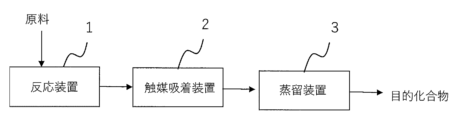
- FIG. 1 is a block diagram of a carbonate production apparatus according to this embodiment.
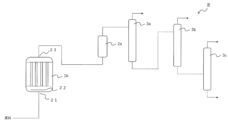
- FIG. 2 is a schematic diagram of the carbonate production apparatus A according to this embodiment.
- FIG. 3 is a schematic diagram of a carbonate production apparatus B according to this embodiment.
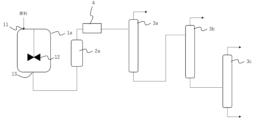
- FIG. 4 is a schematic diagram of a carbonate production apparatus C according to this embodiment.
- FIG. 5 is a schematic diagram of a carbonate production apparatus according to this embodiment.
- FIG. 6 is a schematic diagram of a carbonate production apparatus according to this embodiment.
- FIG. 7 is a schematic diagram of a carbonate production apparatus according to a comparative example.
- the present embodiment an embodiment of the present invention (hereinafter referred to as "the present embodiment") will be described in detail with reference to the drawings as necessary, but the present invention is not limited to this, and various modifications are possible without departing from the gist of the invention.
- positional relationships such as up, down, left, right, etc. are based on the positional relationships shown in the drawings, unless otherwise specified.
- the dimensional ratios of the drawings are not limited to those shown in the drawings.
- the method for producing a carbonate having an ethyl group includes the steps of: A reaction step of transesterifying dimethyl carbonate and ethanol in a reactor in the presence of a catalyst containing an alkali metal compound to obtain a reaction composition; and distilling the reaction composition in a distillation column;
- the method includes an adsorption step of adsorbing the catalyst in the reaction composition with an adsorbent prior to or during the distillation step.
- the method for producing a carbonate having an ethyl group includes a reaction step and a distillation step, and includes an adsorption step before the distillation step or during the distillation step.
- the production method according to this embodiment may include a raw material supply step of supplying a raw material containing dimethyl carbonate and ethanol to the reactor before the reaction step.
- the production method according to this embodiment may also include a reaction composition withdrawal step of withdrawing the reaction composition from the reactor after the reaction step.
- the method for producing carbonate having an ethyl group may be a continuous reaction by including a raw material supplying step of continuously supplying raw materials containing dimethyl carbonate and ethanol to the reactor, and a reaction composition withdrawing step of continuously withdrawing the reaction composition from the reactor.
- a continuous reaction no blockage occurs in the reactor, and a high conversion rate of the raw materials can be achieved.
- the raw material supply step the raw material is supplied to the reactor.
- the raw material supply may be performed continuously.
- the raw material includes dimethyl carbonate (hereinafter, also simply referred to as "DMC”) and ethanol (hereinafter, also referred to as "EtOH”).
- the raw material may also contain a catalyst containing an alkali metal compound.
- alkali metal compounds used as catalysts include sodium hydroxide, potassium hydroxide, and alkali metal alkoxides.
- alkali metal alkoxides include lithium methoxide, lithium ethoxide, sodium methoxide, sodium methoxide, sodium ethoxide, potassium methoxide, and potassium ethoxide.
- alkali metal compounds are highly active, and therefore economical operation at low catalyst concentrations is possible. Therefore, sodium-containing compounds are preferred, and sodium methoxide or sodium ethoxide are more preferred, and sodium methoxide is even more preferred.
- reaction step dimethyl carbonate and ethanol are transesterified in a reactor in the presence of a catalyst containing an alkali metal compound to obtain a reaction composition containing a carbonate having an ethyl group. That is, the methoxy group of dimethyl carbonate is transesterified with ethanol to obtain a carbonate having an ethyl group.
- Examples of carbonates having an ethyl group include ethyl methyl carbonate and diethyl carbonate.
- the reactor is not particularly limited, but examples thereof include a stirred tank reactor, a reactive distillation column, and a plug flow reactor.
- the concentration of the alkali metal compound during the reaction step is preferably 30,000 ppm by mass or less, more preferably 1,000 ppm by mass or less, and even more preferably 10 ppm by mass to 500 ppm by mass, relative to the total amount of the reaction composition.
- the catalyst concentration supplied to the reactor in the reaction step preferably satisfies the condition of formula (1).
- the catalyst concentration By setting the catalyst concentration within this range, the amount of insoluble matter in the reaction composition can be reduced. [Alkali metal concentration in reaction composition (mol ppm)] ⁇ 0.14 ⁇ [reaction temperature (° C.)] ⁇ [alcohol concentration in reaction solution (mol %)] ⁇ 230...Equation (1)
- the alkali metal concentration (mol ppm) in the reaction composition is the molar concentration of the alkali metal relative to the total molar amounts of the five components, namely methanol, ethanol, dimethyl carbonate, ethyl methyl carbonate, and diethyl carbonate, which are the raw materials and reactants in the reaction composition.
- the alcohol concentration (mol %) in the reaction liquid is the molar concentration of methanol and ethanol relative to the total molar amount of the five components, namely methanol, ethanol, dimethyl carbonate, ethyl methyl carbonate, and diethyl carbonate, which are the raw materials and reactants in the feedstock.
- the concentration of insoluble matter in the reaction composition during the reaction step is 50 ppm by mass or less.
- the adsorption step can be continuously operated for a long period of time without requiring a filtration step.
- a catalyst containing an alkali metal compound has low solubility in an organic solvent such as dimethyl carbonate, so that insoluble matter is likely to be generated in the reaction composition. If the adsorption step is performed in a state in which the reaction composition contains a large amount of insoluble matter, clogging is likely to occur in an apparatus such as an adsorption tower.
- solubility in a solvent varies depending on the type of alkali metal compound, it is a preferred embodiment to select an alkali metal compound that is highly soluble in a solvent, has high catalytic activity, and requires a small amount of use, from the viewpoint of sufficiently reducing the catalyst concentration by adsorption without providing a filtration step for removing the catalyst.
- alkoxide salts tend to show solubility at a catalyst concentration that satisfies formula (1), and also have high catalytic activity. For this reason, from the viewpoint of sufficiently reducing the catalyst concentration in the adsorption step, it is preferable to use an alkoxide salt with a catalyst concentration that satisfies formula (1) as a catalyst for the reaction step.
- the insoluble matter concentration in the reaction composition treated in the adsorption step in the reaction step is 50 ppm by mass or less, more preferably 30 ppm by mass or less, and further preferably 1 ppm by mass or less.
- the concentration of insoluble matter in the reaction composition is measured by the method described in the Examples.
- the reaction temperature in the reaction step is preferably 30°C to 110°C, more preferably 35°C to 100°C, and even more preferably 40°C to 90°C.
- the pressure in the reaction process may be, for example, normal pressure to 1000 kPaG.
- the reaction composition is withdrawn from the reactor.
- the reaction composition may be withdrawn continuously.
- the withdrawal rate of the reaction composition is preferably set so that the residence time in the reactor described below is 15 minutes or more and 2 hours or less.
- the production method according to this embodiment has an adsorption step in which an alkali metal compound in a reaction composition is adsorbed by an adsorbent before or during the distillation step.
- the catalyst concentration supplied to a reactor in the reaction step to a range that satisfies the condition of formula (1), there is a tendency for the catalyst to be easily removed sufficiently in the adsorption step.
- the alkali metal compound include an alkali metal compound contained in a catalyst, and a salt of the alkali metal compound reacted with a weak acidic substance.
- the weak acidic substance include carboxylic acids.
- the carboxylic acid include carboxylic acids having 2 to 30 carbon atoms, more specifically, acetic acid, propionic acid, butanoic acid, hexanoic acid, and oleic acid.
- the adsorbent used in the adsorption step is preferably a solid adsorbent, which makes it possible to remove the catalyst from the liquid phase of the reaction composition.
- adsorbents examples include acidic cation exchange resins, synthetic zeolites, silica-alumina-based adsorbents, and special inorganic adsorbents.
- acidic cation exchange materials are preferred because of their high selectivity for alkali metals and their economical nature.
- the acidic cation exchange resin preferably has sulfonic acid groups or carboxylic acid groups.
- acidic cation exchange resins include Amberlite 200CT manufactured by Organo Corporation, Amberlite IRC76 manufactured by Organo Corporation, Amberlite 8400 manufactured by Organo Corporation, and Relite TM WK60L manufactured by Mitsubishi Chemical Corporation.
- an adsorption tower filled with an adsorbent may be used.
- the superficial velocity of the adsorption tower is preferably 0.05 to 15 m/h, more preferably 0.15 to 12 m/h, and further preferably 0.3 to 10 m/h.
- the lower limit of the SV is set for the purpose of optimizing the adsorbent filling amount from an economical point of view.
- the concentration of alkali metal compounds in the reaction composition after the adsorption step is preferably 5000 ppb by mass or less.
- the adsorption device when the adsorption device is an adsorption tower, it is preferable to set the superficial velocity to 0.05 to 15 m/h and the SV to 30 or less, more preferably 10 or less, and even more preferably 5 or less.
- concentration of alkali metal compounds in the reaction composition after the adsorption step By setting the concentration of alkali metal compounds in the reaction composition after the adsorption step to 500 ppb by mass or less, it is possible to prevent a decrease in the yield of ethyl methyl carbonate due to the reaction of ethyl methyl carbonate in the distillation step.
- a more preferable concentration of alkali metal compounds is 150 ppb by mass or less, and even more preferably 100 ppb by mass or less.
- distillation process involves multiple distillation towers or other distillation apparatuses
- the insoluble matter concentration in the reaction composition treated by the adsorption step is preferably 50 ppm by mass or less, more preferably 30 ppm by mass or less, and even more preferably 1 ppm by mass or less.
- the method for measuring the insoluble matter concentration in the reaction composition is the method described in the Examples.
- the concentration of insoluble matter in the reaction composition can be adjusted to fall within the aforementioned range by adjusting the reaction step described above so that the condition of formula (1) is satisfied, or by adding a solvent in which the alkali metal compound has a high solubility, so that the insoluble matter can be dissolved in the reaction composition.
- the production method according to this embodiment preferably includes a solid removal step of removing solids from the reaction composition after both the reaction step and the adsorption step.
- filtration can be used.
- the reaction composition is distilled in a distillation column.
- the distillation step it is preferable to separate a fraction containing 99.9% by mass or more of carbonate having an ethyl group.
- the distillation step preferably includes at least one step selected from the group consisting of an unreacted raw material removal step, a low boiling point compound removal step, an ethyl methyl carbonate high purity purification step, and a diethyl carbonate high purity purification step, and more preferably includes at least three steps selected from the group.
- dimethyl carbonate and ethanol which are unreacted products of the transesterification reaction in the reaction process, are distilled off.
- the dimethyl carbonate and ethanol obtained in this process may be recycled in the reaction process.
- the purified product that has been treated in the unreacted raw material removal process described above is further distilled to increase the purity of the target compounds, ethyl methyl carbonate and diethyl carbonate, which are carbonates having ethyl groups.
- the distillation process A process for removing unreacted raw materials; A low boiling point compound removal step; and It is preferable that the method includes a step of purifying ethyl methyl carbonate to a high purity or a step of purifying diethyl carbonate to a high purity.
- the carbonate having an ethyl group which is the target compound in the manufacturing method according to this embodiment, is ethyl methyl carbonate or dimethyl carbonate, and is preferably ethyl methyl carbonate.
- These carbonates having an ethyl group are used, for example, as electrolytes for lithium ion secondary batteries.
- the manufacturing method according to this embodiment makes it possible to provide a method for manufacturing carbonate having an ethyl group that suppresses the formation of precipitates during the distillation process and enables the distillation process to be operated continuously for a long period of time.
- FIG. 1 is a block diagram of a carbonate production apparatus according to the present embodiment.
- the carbonate production apparatus according to the present embodiment includes a reaction apparatus 1, a catalyst adsorption apparatus 2, and a distillation apparatus 3.
- the production apparatus supplies raw materials to the reaction apparatus 1 and sequentially processes the raw materials, thereby carrying out a reaction process, an adsorption process, and a distillation process in this order.
- FIG. 2 is a schematic diagram of the carbonate production apparatus A according to this embodiment.
- the carbonate production apparatus A has a stirred tank reactor 1a, a catalytic adsorption device 2a, a distillation column for removing unreacted raw materials 3a, a catalytic adsorption device 2b, a distillation column for removing low boiling point compounds 3b, and a distillation column for high purity purification of ethyl methyl carbonate 3c.
- the stirred tank reactor 1a is provided with a raw material supply section 11, through which raw materials are supplied.
- the raw materials are the above-mentioned raw materials, and contain dimethyl carbonate and ethanol, and may contain a catalyst containing an alkali metal compound.
- a raw material supply section may be provided independently for each raw material.
- the stirred tank reactor 1a has a stirring device 12. At the bottom of the stirred tank reactor 1a, an extraction section 13 is provided, from which the reaction composition is extracted.
- the reaction composition extracted from the extraction section 13 is passed through the catalyst adsorption device 2a to remove catalysts containing alkali metal compounds from the reaction composition.
- the reaction composition is then sent to the unreacted raw material removal distillation column 3a, where unreacted substances such as dimethyl carbonate and ethanol are removed.
- the composition from which the unreacted raw materials have been distilled is extracted from the bottom of the unreacted raw material removal distillation column 3a.
- the catalyst containing the alkali metal compounds in the reaction composition is removed again by the catalyst adsorption device 2b.
- the alkali metal compounds in the composition are concentrated by distillation, or the alkali metal compounds are more likely to precipitate due to changes in the composition, so by removing the catalyst again by the catalyst adsorption device 2b, it is possible to suppress the occurrence of precipitates in the subsequent distillation process.
- the composition that has been treated in the catalytic adsorption device 2b is sent to the low-boiling compound removal distillation column 3b, where the low-boiling compounds are further removed.
- the composition from which the low-boiling compounds have been distilled is extracted from the bottom of the low-boiling compound removal distillation column 3b.
- the purity of the target compounds, ethyl methyl carbonate and diethyl carbonate, which are carbonates having ethyl groups is increased.
- the composition treated in the low boiling compound removal distillation column 3b is sent to the ethyl methyl carbonate high purity purification distillation column 3c to further increase the purity of ethyl methyl carbonate.
- the ethyl methyl carbonate high-purity purification distillation column 3c may be a diethyl carbonate high-purity purification distillation column depending on the purpose.
- the raw material supply process, reaction process, extraction process, adsorption process, unreacted raw material removal process, adsorption process, low boiling point compound removal process, and ethyl methyl carbonate high purity purification process are carried out in this order.
- FIG. 3 is a schematic diagram of carbonate production apparatus B according to this embodiment.
- Carbonate production apparatus B has a plug flow reactor 1b, a catalytic adsorption device 2a, an unreacted raw material removal distillation column 3a, a catalytic adsorption device 2b, a low boiling point compound removal distillation column 3b, and an ethyl methyl carbonate high purity purification distillation column 3c. Note that parts common to production method A are given the same reference numerals and explanations are omitted.
- the plug flow reactor 1b is provided with a raw material supply section 21, through which raw materials are supplied.
- the raw materials are the above-mentioned raw materials, and include dimethyl carbonate and ethanol, and may contain a catalyst containing an alkali metal compound.
- the reaction proceeds by a plug flow (extrusion flow) method.
- a raw material supply section may be provided independently for each raw material.
- the plug flow reactor 1b has a dispersion plate 22.
- the plug flow reactor 1b is provided with an extraction section 23, from which the reaction composition is extracted.
- the raw material supply process, reaction process, extraction process, adsorption process, reaction raw material removal process, low boiling point compound removal process, and ethyl methyl carbonate high purity purification process are carried out in this order.
- FIG. 4 is a schematic diagram of carbonate production apparatus C according to this embodiment.
- Carbonate production apparatus C has a stirred tank reactor 1a, a filter 4, a catalytic adsorption device 2a, an unreacted raw material removal distillation column 3a, a catalytic adsorption device 2b, a low boiling point compound removal distillation column 3b, and an ethyl methyl carbonate high purity purification distillation column 3c. Note that parts common to production method A are given the same reference numerals and explanations are omitted.
- the carbonate production apparatus C has a filter 4 to remove insoluble matter from the reaction composition. This prevents clogging of the catalyst adsorption apparatus 2a and allows for longer operation.
- the apparatus shown in Figures 5 and 6 differs from the apparatus shown in Figure 4 in that a filter 4 is provided downstream of the catalytic adsorption apparatus 2a or 3b.
- a filter 4 is provided downstream of the catalytic adsorption apparatus, if the adsorbent, such as ion exchange resin, contained in the catalytic adsorption apparatus flows out from the catalytic adsorption apparatus, it can be captured by the filter.
- the same filter media as in the apparatus shown in Figure 4 can be used.
- the metal compounds used as catalysts are designed to be recoverable by the catalytic adsorption apparatus, a filter to capture the metal compounds is not generally necessary, but a design that takes measures to prevent the distillation process from being affected even if there is a problem with the adsorbent itself flowing out is effective for long-term industrial operation.
- the raw material supply process, reaction process, extraction process, filtration process, adsorption process, unreacted raw material removal process, adsorption process, low boiling point compound removal process, and ethyl methyl carbonate high purity purification process are carried out in this order.
- ICP Inductively Coupled Plasma Atomic Emission Spectroscopy Measurement was performed using an ICP inductively coupled plasma optical emission spectrometer "Agilent 5800 ICP-OES" manufactured by Agilent Technologies, Inc. A weighed sample was concentrated to dryness and then dissolved in nitric acid to prepare a measurement solution, and the Na content of the obtained measurement solution was measured using the above-mentioned device, whereby the Na concentration in the sample could be determined.
- Example 1 Using the production apparatus A for producing a carbonate having an ethyl group having the configuration shown in FIG. 2, a carbonate having an ethyl group is produced as follows. DMC at 970 kg/h, EtOH at 290 kg/h, and a methanol solution of 28% by mass of sodium methoxide at 225 g/h are fed to a stirred tank reactor 1a with an inner diameter of 2,000 mm, a height of 3,000 mm, and a volume of 6 m3 , and reacted under conditions of 60°C and 103 kPaA, and 1,260 kg/h of the reaction product is extracted from the stirred tank reactor 1a to obtain a reaction composition containing a carbonate having an ethyl group.
- the concentration of sodium methoxide, which is a catalyst, in the reaction composition is 50 ppm by mass, and the alkali metal concentration is 68 ppm by mole.
- the amounts of various components in the reaction composition are MeOH 150 kg/h, EtOH 74 kg/h, DMC 581 kg/h, EMC 411 kg/h, and DEC 44 kg/h.
- the insoluble matter concentration in the reaction composition extracted from the stirred tank reactor 1a is 1 ppm by mass or less. Note that the value of "0.14 ⁇ [reaction temperature (° C.)] ⁇ [alcohol concentration in the reaction liquid (mol %)] - 230" in formula (1) is 80.
- the reaction composition is supplied to a tower (inner diameter 800 mm, packed height 1,600 mm) packed with an ion exchange resin having a sulfonic acid group as an exchange group, and the catalyst is adsorbed and removed (adsorption step (1)).
- the superficial velocity of the reaction composition in the adsorption step at this time is 2.7 m/h, and the SV is 1.7 m3/m3-R.
- the Na concentration in the reaction product at the outlet of the ion exchange resin tower was analyzed and found to be 3 ppb by mass.
- the ion exchange resin column outlet liquid is supplied to the distillation step.
- the distillation step is configured such that the bottom outlet liquid of the first distillation column, the unreacted raw material removal column, is supplied to a column similar to the column packed with the ion exchange resin (adsorption step (2)), and then supplied to the second distillation column, the low boiling compound removal column, and the bottom outlet liquid of the second distillation column is supplied to the third distillation column, the high purity EMC purification column.
- a similar catalytic adsorption tower was installed at the bottom outlet of the first distillation tower, no clogging occurred throughout the entire production process, and continuous operation for 1,000 hours or more was possible.
- the yield of ethyl methyl carbonate in the distillation process was 98% or more and 100% or less, and the yield of diethyl carbonate was also 98% or more and 100% or less.
- Example 2 Using the production apparatus B for carbonate having an ethyl group having the configuration shown in FIG. 3, carbonate having an ethyl group is produced as follows. 156 kg/h of DMC, 70 kg/h of EtOH, and 20% by mass of ethanol solution of sodium ethoxide are fed to a plug flow reactor 1b having 6 tubes (volume 0.3 m 3 ) with an inner diameter of 80 mm and a length of 10,000 mm, at a flow rate of 89 g/h, and reacted under conditions of 70° C. and 103 kPaA, and 226 kg/h of the reaction composition is extracted from the plug flow reactor 1b to obtain a reaction composition containing a carbonate having an ethyl group.
- a plug flow reactor 1b having 6 tubes (volume 0.3 m 3 ) with an inner diameter of 80 mm and a length of 10,000 mm, at a flow rate of 89 g/h, and reacted under conditions of 70° C. and 103 kP
- the concentration of sodium ethoxide, which is a catalyst, in the reaction composition is 79 ppm by mass, and the alkali metal concentration is 80 ppm by mole.
- the amounts of various components in the reaction composition were MeOH 32 kg/h, EtOH 24 kg/h, DMC kg/h, EMC 80 kg/h, and DEC 14 kg/h.
- the insoluble matter concentration in the reaction composition discharged from the plug flow reactor 1b is 1 mass ppm or less. Note that the value of "0.14 ⁇ [reaction temperature (° C.)] ⁇ [alcohol concentration in the reaction liquid (mol%)] - 230" in formula (1) is 228.
- the reaction composition is supplied to a tower (inner diameter 800 mm, packed height 1,600 mm) packed with an ion exchange resin having a carboxylic acid group as an exchange group, and the catalyst is adsorbed and removed (adsorption step (1)).
- the superficial velocity of the reaction composition in the adsorption step at this time is 0.05 m/h, and the SV is 0.03 m 3 /m 3 -R.
- the Na concentration in the reaction product at the outlet of the ion exchange resin tower was analyzed and found to be 1 ppb by mass.
- the ion exchange resin column outlet liquid is supplied to the distillation process.
- the distillation process is configured such that the bottom outlet liquid of the unreacted raw material removal column, which is the first distillation column, is supplied to the low boiling compound removal column, which is the second distillation column, and the bottom outlet liquid of the second distillation column is supplied to the EMC high purity purification column, which is the third distillation column. No clogging occurs in the entire production process, and continuous operation for 1,000 hours or more is possible.
- the yield of ethyl methyl carbonate in the distillation process is 98% or more and 100% or less, and the yield of diethyl carbonate is also 98% or more and 100% or less.
- Example 3 Using the production apparatus C for carbonate having an ethyl group having the configuration shown in FIG. 4, carbonate having an ethyl group is produced as follows. DMC at 970 kg/h, EtOH at 290 kg/h, and a methanol solution of 28% by mass of sodium methoxide at a flow rate of 1100 g/h are fed to a stirred tank reactor 1a having an inner diameter of 2,000 mm, a height of 3,000 mm, and a volume of 6 m3, and reacted under conditions of 80°C and 200 kPaA, and 1,261 kg/h of the reaction product is extracted from the stirred tank reactor 1a to obtain a reaction composition containing a carbonate having an ethyl group.
- the concentration of sodium methoxide, which is a catalyst, in the reaction composition is 224 ppm by mass, and the alkali metal concentration is 334 mol ppm.
- the amounts of various components in the reaction composition are MeOH 154 kg/h, EtOH 70 kg/h, DMC 587 kg/h, EMC 389 kg/h, and DEC 61 kg/h.
- the reaction composition is fed to a filter, and the insoluble matter concentration in the reaction composition before filtration is 83 ppm by mass, and the insoluble matter in the reaction composition after filtration is 1 ppm by mass or less.
- reaction composition was supplied to a tower (inner diameter 800 mm, packed height 1,600 mm) packed with an ion exchange resin having a carboxylic acid group as an exchange group, and the catalyst was adsorbed and removed (adsorption step (1)).
- the Na concentration in the reaction product at the outlet of the ion exchange resin tower was analyzed and found to be 3 mass ppb.
- the superficial velocity of the reaction composition in the adsorption step at this time was 2.7 m/h, and the SV was 1.7 m3 / m3 -R.
- the outlet liquid of the ion exchange resin column is supplied to the distillation process.
- the distillation process is configured such that the bottom outlet liquid of the unreacted raw material removal column, which is the first distillation column, is supplied to a column similar to the column packed with the ion exchange resin (adsorption process (2)), and then supplied to the low boiling compound removal column, which is the second distillation column, and the bottom outlet liquid of the second distillation column is supplied to the EMC high purity purification column, which is the third distillation column. No clogging occurs in the entire production process, and continuous operation for 1,000 hours or more is possible.
- the yield of ethyl methyl carbonate in the distillation process is 98% or more and 100% or less, and the yield of diethyl carbonate is also 98% or more and 100% or less.
- Example 4 Using the production apparatus A for producing carbonate having an ethyl group having the configuration shown in FIG. 5, a carbonate having an ethyl group was produced as follows. DMC was supplied at a flow rate of 4,850 g/h, EtOH at 1,450 g/h, and a 28% by mass methanol solution of sodium methoxide at a flow rate of 1,125 mg/h to a stirred tank reactor 1a having an inner diameter of 210 mm, a height of 300 mm, and a volume of 7.3 L, and reacted under conditions of 60°C and 103 kPaA.
- DMC was supplied at a flow rate of 4,850 g/h, EtOH at 1,450 g/h, and a 28% by mass methanol solution of sodium methoxide at a flow rate of 1,125 mg/h to a stirred tank reactor 1a having an inner diameter of 210 mm, a height of 300 mm, and a volume of 7.3 L, and reacted under conditions
- 6,301 g/h of the reaction product was extracted from the stirred tank reactor 1a to obtain a reaction composition containing a carbonate having an ethyl group.
- concentration of the catalyst sodium methoxide in the reaction composition was 50 ppm by mass, and the alkali metal concentration was 68 mol ppm.
- the amounts of various components in the reaction composition were MeOH 751 g/h, EtOH 370 g/h, DMC 2,905 g/h, EMC 2,055 g/h, and DEC 220 g/h.
- the insoluble matter concentration in the reaction composition extracted from the stirred tank reactor 1a was 1 ppm by mass or less.
- the value of "0.14 ⁇ [reaction temperature (° C.)] ⁇ [alcohol concentration in the reaction liquid (mol %)] - 230" in formula (1) was 80.
- the reaction composition was supplied to a tower (inner diameter 30 mm, packed height 500 mm) packed with an ion exchange resin having a sulfonic acid group as an exchange group, and the catalyst was adsorbed and removed (adsorption step (1)).
- the superficial velocity of the reaction composition in the adsorption step at this time was 9.5 m/h, and the SV was 19 m 3 /m 3 -R.
- the Na concentration in the reaction product at the outlet of the ion exchange resin tower was analyzed and found to be 60 ppb by mass.
- the ion exchange resin column outlet liquid was filtered with a filter having a pore size of 3 ⁇ m and then supplied to the distillation step.
- the distillation step was configured such that the bottom outlet liquid of the first distillation column, the unreacted raw material removal column, was supplied to a column similar to the column packed with the ion exchange resin (adsorption step (2)), and then supplied to the second distillation column, the low boiling point compound removal column, and the bottom outlet liquid of the second distillation column was supplied to the third distillation column, the EMC high purity purification column.
- a similar catalytic adsorption tower was installed at the bottom outlet of the first distillation tower, no clogging occurred throughout the entire production process, and continuous operation for more than 1,000 hours was possible.
- the yield of ethyl methyl carbonate in the distillation process was 98% to 100%, and the yield of diethyl carbonate was also 98% to 100%.
- Example 5 Using the production apparatus A for producing carbonate having an ethyl group having the configuration shown in FIG. 6, a carbonate having an ethyl group was produced as follows. DMC 3,120 g / h, EtOH 1,400 g / h, and 20 mass% ethanol solution of sodium ethoxide were fed at a flow rate of 1,780 mg / h to a stirred tank reactor 1a with an inner diameter of 210 mm, a height of 300 mm, and a volume of 7.3 L, and reacted under conditions of 80 ° C.
- reaction product was extracted from the stirred tank reactor 1a to obtain a reaction composition containing a carbonate having an ethyl group.
- concentration of sodium ethoxide as a catalyst in the reaction composition was 79 mass ppm, and the alkali metal concentration was 80 mol ppm.
- the amounts of various components in the reaction composition were MeOH 640 g / h, EtOH 482 g / h, DMC 1,520 g / h, EMC 1,600 g / h, and DEC 280 g / h.
- the insoluble matter concentration in the reaction composition extracted from the stirred tank reactor 1a was 10 ppm by mass, and the insoluble matter was iron oxide.
- the value of "0.14 ⁇ [reaction temperature (° C.)] ⁇ [alcohol concentration in the reaction liquid (mol %)] - 230" in formula (1) was 294.
- the reaction composition is supplied to a tower (inner diameter 80 mm, packed height 500 mm) packed with an ion exchange resin having a carboxylic acid group as an exchange group, and the catalyst is adsorbed and removed (adsorption step (1)).
- the superficial velocity of the reaction composition in the adsorption step at this time is 1.0 m/h, and the SV is 2.0 m 3 /m 3 -R.
- the Na concentration in the reaction product at the outlet of the ion exchange resin tower was analyzed and found to be 3 ppb by mass.
- the ion exchange resin column outlet liquid was supplied to the distillation step.
- the distillation step was configured such that the bottom outlet liquid of the first distillation column, the unreacted raw material removal column, was supplied to the second distillation column, the low boiling point compound removal column, and the bottom outlet liquid of the second distillation column was supplied to the third distillation column, the high purity EMC purification column.
- a similar catalytic adsorption tower was installed at the bottom outlet of the first distillation tower, no clogging occurred throughout the entire production process, and continuous operation for more than 1,000 hours was possible.
- the yield of ethyl methyl carbonate in the distillation process was 98% to 100%, and the yield of diethyl carbonate was also 98% to 100%.
- Example 6 Using the production apparatus A for producing carbonate having an ethyl group having the configuration shown in FIG. 5, a carbonate having an ethyl group was produced as follows. DMC was supplied at a flow rate of 4,850 g/h, EtOH at 1,450 g/h, and a 28% by mass methanol solution of sodium methoxide at a flow rate of 1,125 mg/h to a stirred tank reactor 1a having an inner diameter of 210 mm, a height of 300 mm, and a volume of 7.3 L, and reacted under conditions of 60°C and 103 kPaA.
- DMC was supplied at a flow rate of 4,850 g/h, EtOH at 1,450 g/h, and a 28% by mass methanol solution of sodium methoxide at a flow rate of 1,125 mg/h to a stirred tank reactor 1a having an inner diameter of 210 mm, a height of 300 mm, and a volume of 7.3 L, and reacted under conditions
- 6,301 g/h of the reaction product was extracted from the stirred tank reactor 1a to obtain a reaction composition containing a carbonate having an ethyl group.
- concentration of the catalyst sodium methoxide in the reaction composition was 50 ppm by mass, and the alkali metal concentration was 68 mol ppm.
- the amounts of various components in the reaction composition were MeOH 751 g/h, EtOH 370 g/h, DMC 2,905 g/h, EMC 2,055 g/h, and DEC 220 g/h.
- the insoluble matter concentration in the reaction composition extracted from the stirred tank reactor 1a was 1 ppm by mass or less.
- the value of "0.14 ⁇ [reaction temperature (° C.)] ⁇ [alcohol concentration in the reaction liquid (mol %)] - 230" in formula (1) was 80.
- the reaction composition is supplied to a tower (inner diameter 15 mm, packed height 50 mm) packed with an ion exchange resin having a sulfonic acid group as an exchange group, and the catalyst is adsorbed and removed (adsorption step (1)).
- the superficial velocity of the reaction composition in the adsorption step at this time is 38 m/h, and the SV is 760 m3/m3-R.
- the Na concentration in the reaction product at the outlet of the ion exchange resin tower was analyzed and found to be 1,200 ppb by mass.
- the ion exchange resin column outlet liquid was filtered with a filter having a pore size of 3 ⁇ m and then supplied to the distillation step.
- the distillation step was configured such that the bottom outlet liquid of the first distillation column, the unreacted raw material removal column, was supplied to a column similar to the column packed with the ion exchange resin (adsorption step (2)), and then supplied to the second distillation column, the low boiling point compound removal column, and the bottom outlet liquid of the second distillation column was supplied to the third distillation column, the EMC high purity purification column.
- a similar catalytic adsorption tower was installed at the bottom outlet of the first distillation tower, no clogging occurred throughout the entire production process, and continuous operation for 400 hours or more was possible.
- the yield of ethyl methyl carbonate in the distillation process was 85% to 87%, and the yield of diethyl carbonate was 385% to 395%.
- the yield of diethyl carbonate exceeded 100%, which is believed to be due to the conversion of dimethyl carbonate and ethyl methyl carbonate to diethyl carbonate during distillation due to the remaining catalyst.
- Example 7 Using the production apparatus B for carbonate having an ethyl group having the configuration shown in FIG. 3, carbonate having an ethyl group is produced as follows. 156 kg/h of DMC, 70 kg/h of EtOH, and 20% by mass of ethanol solution of sodium ethoxide are fed to a plug flow reactor 1b having 6 tubes (volume 0.3 m 3 ) with an inner diameter of 80 mm and a length of 10,000 mm, at a flow rate of 89 g/h, and reacted under conditions of 70° C. and 103 kPaA, and 226 kg/h of the reaction composition is extracted from the plug flow reactor 1b to obtain a reaction composition containing a carbonate having an ethyl group.
- the concentration of sodium ethoxide, which is a catalyst, in the reaction composition is 79 ppm by mass, and the alkali metal concentration is 80 ppm by mole.
- the amounts of various components in the reaction composition were MeOH 32 kg/h, EtOH 24 kg/h, DMC kg/h, EMC 80 kg/h, and DEC 14 kg/h.
- the insoluble matter concentration in the reaction composition discharged from the plug flow reactor 1b is 1 mass ppm or less. Note that the value of "0.14 ⁇ [reaction temperature (° C.)] ⁇ [alcohol concentration in the reaction liquid (mol%)] - 230" in formula (1) is 228.
- the reaction composition is supplied to a tower (inner diameter 800 mm, packed height 1,600 mm) packed with acidic activated alumina, and the catalyst is adsorbed and removed (adsorption step (1)).
- the superficial velocity of the reaction composition in the adsorption step at this time is 0.05 m/h, and the SV is 0.03 m 3 /m 3 -R.
- the Na concentration in the reaction product at the outlet of the ion exchange resin tower was analyzed and found to be 410 ppb by mass.
- the outlet liquid of the activated alumina tower is supplied to the distillation process.
- the distillation process is configured such that the bottom outlet liquid of the unreacted raw material removal tower, which is the first distillation tower, is supplied to the low boiling compound removal tower, which is the second distillation tower, and the bottom outlet liquid of the second distillation tower is supplied to the high purity EMC purification tower, which is the third distillation tower. No clogging occurs in the entire production process, and continuous operation for 400 hours or more is possible.
- the yield of ethyl methyl carbonate in the distillation process is 95% or more and 99% or less, and the yield of diethyl carbonate is 115% or more and 125% or less.
- Carbonate having an ethyl group is produced as follows using a production apparatus A for producing carbonate having an ethyl group having the configuration shown in FIG. 2 except that the tower packed with an ion exchange resin is removed.
- DMC at 970 kg/h, EtOH at 290 kg/h, and 28% by mass sodium methoxide solution at a flow rate of 225 g/h are supplied to a stirred tank reactor 1a with a capacity of 6 m3 , reacted at 60 ° C. and 103 kPaG, and 1,260 kg/h of the reaction composition is extracted from the stirred tank reactor 1a to obtain a carbonate having an ethyl group.
- the concentration of sodium methoxide, which is a catalyst, in the reaction composition is 50 ppm by mass, and the alkali metal concentration is 68 mol ppm. Since the condition of the catalyst concentration in the reaction product satisfies formula (1), the insoluble matter concentration in the reaction product is 1 ppm by mass or less. Note that the value of "0.14 ⁇ [reaction temperature (° C.)] ⁇ [alcohol concentration in the reaction liquid (mol%)] - 230" in formula (1) is 56.
- the obtained reaction composition is supplied to the distillation process.
- the distillation process is configured such that the bottom outlet liquid of the unreacted raw material removal column, which is the first distillation column, is supplied to the low boiling compound removal column, which is the second distillation column, and the bottom outlet liquid of the second distillation column is supplied to the EMC high purity purification column, which is the third distillation column. Since clogging occurs in the first distillation column, operation for 100 hours or more is impossible. In addition, the yield of ethyl methyl carbonate in the distillation process is 57% or more and 62% or less, and the yield of diethyl carbonate is 390% or more and 410% or less.
- reaction composition containing a carbonate having an ethyl group was extracted from the stirred tank reactor 1a to obtain a reaction composition containing a carbonate having an ethyl group.
- concentration of sodium methoxide, which is a catalyst, in the reaction composition was 350 mass ppm, and the alkali metal concentration was 1,707 mol ppm.
- the amounts of various components in the reaction composition were MeOH 770 g / h, EtOH 354 g / h, DMC 2,937 g / h, EMC 1,943 g / h, and DEC 303 g / h.
- the insoluble matter concentration in the reaction composition extracted from the stirred tank reactor 1a was 240 ppm by mass.
- the value of "0.14 ⁇ [reaction temperature (° C.)] ⁇ [alcohol concentration in the reaction liquid (mol %)] - 230" in formula (1) was 80.
- the reaction composition was fed to a filter press to remove insoluble matter.
- the Na concentration in the reaction composition at the outlet of the filter press was analyzed and found to be 46 ppm by mass.
- the filter press outlet liquid is supplied to the distillation process.
- the distillation process was configured such that the bottom outlet liquid of the first distillation column, the unreacted raw material removal column, was supplied to the second distillation column, the low boiling compound removal column, and the bottom outlet liquid of the second distillation column was supplied to the third distillation column, the EMC high purity purification column.
- the yield of ethyl methyl carbonate in the distillation process was 65% or more and 70% or less, and the yield of diethyl carbonate was 315% or more and 325% or less.
- the method for producing carbonates having ethyl groups according to the present invention makes it possible to efficiently produce substances such as ethyl methyl carbonate and diethyl carbonate that are used in electrolytes for lithium secondary batteries.
- Reactor 1a Stirred tank type reactor 11: Raw material supply section 12: Stirring device 13: Withdrawal section 1b: Plug flow reactor 2: Catalytic adsorption device 3: Distillation device 3a: Distillation column for removing unreacted raw materials 3b: Distillation column for removing low boiling point compounds 3c: Distillation column for high purity purification of ethyl methyl carbonate
Landscapes
- Chemical & Material Sciences (AREA)
- Organic Chemistry (AREA)
- Organic Low-Molecular-Weight Compounds And Preparation Thereof (AREA)
- Low-Molecular Organic Synthesis Reactions Using Catalysts (AREA)
Priority Applications (4)
| Application Number | Priority Date | Filing Date | Title |
|---|---|---|---|
| CN202480026354.5A CN121039091A (zh) | 2023-06-08 | 2024-06-07 | 具有乙基的碳酸酯的制造方法和具有乙基的碳酸酯的制造装置 |
| EP24819415.1A EP4725936A1 (en) | 2023-06-08 | 2024-06-07 | Method for producing carbonate having ethyl group, and apparatus for producing carbonate having ethyl group |
| KR1020257038375A KR20260002942A (ko) | 2023-06-08 | 2024-06-07 | 에틸기를 갖는 카르보네이트의 제조 방법 및 에틸기를 갖는 카르보네이트의 제조 장치 |
| JP2025526163A JPWO2024253188A1 (https=) | 2023-06-08 | 2024-06-07 |
Applications Claiming Priority (4)
| Application Number | Priority Date | Filing Date | Title |
|---|---|---|---|
| JP2023-094932 | 2023-06-08 | ||
| JP2023094932 | 2023-06-08 | ||
| JP2024020121 | 2024-05-31 | ||
| JPPCT/JP2024/020121 | 2024-05-31 |
Publications (1)
| Publication Number | Publication Date |
|---|---|
| WO2024253188A1 true WO2024253188A1 (ja) | 2024-12-12 |
Family
ID=93795491
Family Applications (1)
| Application Number | Title | Priority Date | Filing Date |
|---|---|---|---|
| PCT/JP2024/020877 Ceased WO2024253188A1 (ja) | 2023-06-08 | 2024-06-07 | エチル基を有するカーボネートの製造方法、及びエチル基を有するカーボネートの製造装置 |
Country Status (6)
| Country | Link |
|---|---|
| EP (1) | EP4725936A1 (https=) |
| JP (1) | JPWO2024253188A1 (https=) |
| KR (1) | KR20260002942A (https=) |
| CN (1) | CN121039091A (https=) |
| TW (1) | TWI896164B (https=) |
| WO (1) | WO2024253188A1 (https=) |
Citations (4)
| Publication number | Priority date | Publication date | Assignee | Title |
|---|---|---|---|---|
| JP2012510975A (ja) * | 2008-12-04 | 2012-05-17 | シエル・インターナシヨナル・リサーチ・マートスハツペイ・ベー・ヴエー | アルカンジオールおよびジアルキルカーボネートの調製方法 |
| WO2022114592A1 (ko) | 2020-11-26 | 2022-06-02 | 롯데케미칼 주식회사 | 우수한 용해도를 가지는 촉매를 이용한 이종 선형 카보네이트를 제조하는 방법 |
| WO2022114576A1 (ko) | 2020-11-26 | 2022-06-02 | 롯데케미칼 주식회사 | 촉매 필터링 단계가 도입된 이종 선형 카보네이트를 제조하는 방법 |
| KR20230080683A (ko) * | 2021-11-30 | 2023-06-07 | 롯데케미칼 주식회사 | 카보네이트의 제조 방법 |
-
2024
- 2024-06-07 JP JP2025526163A patent/JPWO2024253188A1/ja active Pending
- 2024-06-07 TW TW113121358A patent/TWI896164B/zh active
- 2024-06-07 EP EP24819415.1A patent/EP4725936A1/en active Pending
- 2024-06-07 WO PCT/JP2024/020877 patent/WO2024253188A1/ja not_active Ceased
- 2024-06-07 CN CN202480026354.5A patent/CN121039091A/zh active Pending
- 2024-06-07 KR KR1020257038375A patent/KR20260002942A/ko active Pending
Patent Citations (4)
| Publication number | Priority date | Publication date | Assignee | Title |
|---|---|---|---|---|
| JP2012510975A (ja) * | 2008-12-04 | 2012-05-17 | シエル・インターナシヨナル・リサーチ・マートスハツペイ・ベー・ヴエー | アルカンジオールおよびジアルキルカーボネートの調製方法 |
| WO2022114592A1 (ko) | 2020-11-26 | 2022-06-02 | 롯데케미칼 주식회사 | 우수한 용해도를 가지는 촉매를 이용한 이종 선형 카보네이트를 제조하는 방법 |
| WO2022114576A1 (ko) | 2020-11-26 | 2022-06-02 | 롯데케미칼 주식회사 | 촉매 필터링 단계가 도입된 이종 선형 카보네이트를 제조하는 방법 |
| KR20230080683A (ko) * | 2021-11-30 | 2023-06-07 | 롯데케미칼 주식회사 | 카보네이트의 제조 방법 |
Non-Patent Citations (1)
| Title |
|---|
| See also references of EP4725936A1 |
Also Published As
| Publication number | Publication date |
|---|---|
| JPWO2024253188A1 (https=) | 2024-12-12 |
| KR20260002942A (ko) | 2026-01-06 |
| EP4725936A1 (en) | 2026-04-15 |
| CN121039091A (zh) | 2025-11-28 |
| TWI896164B (zh) | 2025-09-01 |
| TW202506623A (zh) | 2025-02-16 |
Similar Documents
| Publication | Publication Date | Title |
|---|---|---|
| EP0818434B1 (en) | Process for the production of high-purity isophthalic acid | |
| TWI498317B (zh) | 醋酸之製造方法 | |
| CN103402967A (zh) | 乙酸的制备方法 | |
| JP7572556B2 (ja) | 優れた溶解度を有する触媒を用いた異種の線状カーボネートを製造する方法 | |
| US20100274034A1 (en) | Method and apparatus for producing fatty acid alkyl ester and/or glycerin | |
| EP2623489A1 (en) | Method for producing ditrimethylolpropane | |
| WO2024253188A1 (ja) | エチル基を有するカーボネートの製造方法、及びエチル基を有するカーボネートの製造装置 | |
| JP7605986B2 (ja) | 触媒フィルタリング段階が導入された異種の線状カーボネートを製造する方法 | |
| EP4442676A1 (en) | Method for preparing carbonate | |
| EP3392233B1 (en) | Method for producing acetic acid | |
| US5883290A (en) | Process for producing benzyl acetate and benzyl alcohol | |
| US20250034078A1 (en) | Method for producing carbonate | |
| EP3599231B1 (en) | Acetic acid production method | |
| CN108064220A (zh) | 乙酸的回收 | |
| WO2018135574A1 (ja) | N-(α-ヒドロキシエチル)ホルムアミドの製造方法およびN-ビニルホルムアミドの製造方法 | |
| US20250034077A1 (en) | Method for producing carbonate | |
| WO2024253046A1 (ja) | エチル基を有するカーボネートの製造方法及びエチル基を有するカーボネートの製造装置 | |
| CN101080433B (zh) | 聚醚多元醇化合物的制造方法 | |
| EP3617180B1 (en) | Method for producing acetic acid | |
| WO2025095124A1 (ja) | エチルメチルカーボネートの製造方法 | |
| WO2019211904A1 (ja) | 酢酸の製造方法 |
Legal Events
| Date | Code | Title | Description |
|---|---|---|---|
| 121 | Ep: the epo has been informed by wipo that ep was designated in this application |
Ref document number: 24819415 Country of ref document: EP Kind code of ref document: A1 |
|
| WWE | Wipo information: entry into national phase |
Ref document number: CN2024800263545 Country of ref document: CN |
|
| ENP | Entry into the national phase |
Ref document number: 2025526163 Country of ref document: JP Kind code of ref document: A |
|
| ENP | Entry into the national phase |
Ref document number: 1020257038375 Country of ref document: KR Free format text: ST27 STATUS EVENT CODE: A-0-1-A10-A15-NAP-PA0105 (AS PROVIDED BY THE NATIONAL OFFICE) |
|
| WWE | Wipo information: entry into national phase |
Ref document number: KR1020257038375 Country of ref document: KR |
|
| REG | Reference to national code |
Ref country code: BR Ref legal event code: B01A Ref document number: 112025024858 Country of ref document: BR |
|
| WWE | Wipo information: entry into national phase |
Ref document number: 202517122564 Country of ref document: IN |
|
| WWP | Wipo information: published in national office |
Ref document number: 202517122564 Country of ref document: IN |
|
| WWE | Wipo information: entry into national phase |
Ref document number: 2024819415 Country of ref document: EP |
|
| NENP | Non-entry into the national phase |
Ref country code: DE |
|
| WWE | Wipo information: entry into national phase |
Ref document number: 2025134321 Country of ref document: RU |
|
| ENP | Entry into the national phase |
Ref document number: 2024819415 Country of ref document: EP Effective date: 20260108 |
|
| ENP | Entry into the national phase |
Ref document number: 2024819415 Country of ref document: EP Effective date: 20260108 |
|
| ENP | Entry into the national phase |
Ref document number: 2024819415 Country of ref document: EP Effective date: 20260108 |
|
| ENP | Entry into the national phase |
Ref document number: 2024819415 Country of ref document: EP Effective date: 20260108 |
|
| ENP | Entry into the national phase |
Ref document number: 2024819415 Country of ref document: EP Effective date: 20260108 |
|
| WWP | Wipo information: published in national office |
Ref document number: 2025134321 Country of ref document: RU |
|
| WWP | Wipo information: published in national office |
Ref document number: 2024819415 Country of ref document: EP |