WO2024252830A1 - 半導体装置および車両 - Google Patents
半導体装置および車両 Download PDFInfo
- Publication number
- WO2024252830A1 WO2024252830A1 PCT/JP2024/016981 JP2024016981W WO2024252830A1 WO 2024252830 A1 WO2024252830 A1 WO 2024252830A1 JP 2024016981 W JP2024016981 W JP 2024016981W WO 2024252830 A1 WO2024252830 A1 WO 2024252830A1
- Authority
- WO
- WIPO (PCT)
- Prior art keywords
- terminal
- semiconductor device
- lead
- tip
- thickness direction
- Prior art date
- Legal status (The legal status is an assumption and is not a legal conclusion. Google has not performed a legal analysis and makes no representation as to the accuracy of the status listed.)
- Ceased
Links
Images















Classifications
-
- H—ELECTRICITY
- H10—SEMICONDUCTOR DEVICES; ELECTRIC SOLID-STATE DEVICES NOT OTHERWISE PROVIDED FOR
- H10W—GENERIC PACKAGES, INTERCONNECTIONS, CONNECTORS OR OTHER CONSTRUCTIONAL DETAILS OF DEVICES COVERED BY CLASS H10
- H10W70/00—Package substrates; Interposers; Redistribution layers [RDL]
- H10W70/40—Leadframes
- H10W70/421—Shapes or dispositions
- H10W70/424—Cross-sectional shapes
- H10W70/427—Bent parts
- H10W70/429—Bent parts being the outer leads
-
- H—ELECTRICITY
- H10—SEMICONDUCTOR DEVICES; ELECTRIC SOLID-STATE DEVICES NOT OTHERWISE PROVIDED FOR
- H10W—GENERIC PACKAGES, INTERCONNECTIONS, CONNECTORS OR OTHER CONSTRUCTIONAL DETAILS OF DEVICES COVERED BY CLASS H10
- H10W72/00—Interconnections or connectors in packages
-
- H—ELECTRICITY
- H10—SEMICONDUCTOR DEVICES; ELECTRIC SOLID-STATE DEVICES NOT OTHERWISE PROVIDED FOR
- H10W—GENERIC PACKAGES, INTERCONNECTIONS, CONNECTORS OR OTHER CONSTRUCTIONAL DETAILS OF DEVICES COVERED BY CLASS H10
- H10W70/00—Package substrates; Interposers; Redistribution layers [RDL]
- H10W70/40—Leadframes
- H10W70/474—Batteries in combination with leadframes
-
- H—ELECTRICITY
- H10—SEMICONDUCTOR DEVICES; ELECTRIC SOLID-STATE DEVICES NOT OTHERWISE PROVIDED FOR
- H10W—GENERIC PACKAGES, INTERCONNECTIONS, CONNECTORS OR OTHER CONSTRUCTIONAL DETAILS OF DEVICES COVERED BY CLASS H10
- H10W72/00—Interconnections or connectors in packages
- H10W72/851—Dispositions of multiple connectors or interconnections
- H10W72/853—On the same surface
- H10W72/868—Die-attach connectors and strap connectors
-
- H—ELECTRICITY
- H10—SEMICONDUCTOR DEVICES; ELECTRIC SOLID-STATE DEVICES NOT OTHERWISE PROVIDED FOR
- H10W—GENERIC PACKAGES, INTERCONNECTIONS, CONNECTORS OR OTHER CONSTRUCTIONAL DETAILS OF DEVICES COVERED BY CLASS H10
- H10W74/00—Encapsulations, e.g. protective coatings
- H10W74/10—Encapsulations, e.g. protective coatings characterised by their shape or disposition
- H10W74/111—Encapsulations, e.g. protective coatings characterised by their shape or disposition the semiconductor body being completely enclosed
- H10W74/114—Encapsulations, e.g. protective coatings characterised by their shape or disposition the semiconductor body being completely enclosed by a substrate and the encapsulations
-
- H—ELECTRICITY
- H10—SEMICONDUCTOR DEVICES; ELECTRIC SOLID-STATE DEVICES NOT OTHERWISE PROVIDED FOR
- H10W—GENERIC PACKAGES, INTERCONNECTIONS, CONNECTORS OR OTHER CONSTRUCTIONAL DETAILS OF DEVICES COVERED BY CLASS H10
- H10W90/00—Package configurations
- H10W90/701—Package configurations characterised by the relative positions of pads or connectors relative to package parts
- H10W90/751—Package configurations characterised by the relative positions of pads or connectors relative to package parts of bond wires
- H10W90/756—Package configurations characterised by the relative positions of pads or connectors relative to package parts of bond wires between a chip and a stacked lead frame, conducting package substrate or heat sink
-
- H—ELECTRICITY
- H10—SEMICONDUCTOR DEVICES; ELECTRIC SOLID-STATE DEVICES NOT OTHERWISE PROVIDED FOR
- H10W—GENERIC PACKAGES, INTERCONNECTIONS, CONNECTORS OR OTHER CONSTRUCTIONAL DETAILS OF DEVICES COVERED BY CLASS H10
- H10W90/00—Package configurations
- H10W90/701—Package configurations characterised by the relative positions of pads or connectors relative to package parts
- H10W90/761—Package configurations characterised by the relative positions of pads or connectors relative to package parts of strap connectors
- H10W90/766—Package configurations characterised by the relative positions of pads or connectors relative to package parts of strap connectors between a chip and a stacked lead frame, conducting package substrate or heat sink
Definitions
- This disclosure relates to a semiconductor device and a vehicle.
- Patent Document 1 discloses an example of a semiconductor device.
- the semiconductor device described in Patent Document 1 comprises a first lead including a first pad having a main pad surface and a back pad surface, a second lead, a third lead, a semiconductor element mounted on the main pad surface, and a sealing resin in contact with the main pad surface and covering the semiconductor element.
- the first lead, the second lead, and the third lead have a first terminal, a second terminal, and a third terminal extending in the same direction.
- the first terminal, the second terminal, and the third terminal are inserted into through holes in a circuit board or the like, thereby mounting the semiconductor device on the circuit board.
- a heat sink for example, an insulating sheet is provided between the back pad surface and the heat sink.
- semiconductor devices may also be required to be surface-mounted on the circuit board.
- An object of the present disclosure is to provide a semiconductor device that is an improvement over conventional semiconductor devices.
- an object of the present disclosure is to provide a semiconductor device that can be surface mounted.
- Another object of the present disclosure is to provide a vehicle equipped with a semiconductor device that can be surface mounted.
- the semiconductor device provided by the first aspect of the present disclosure includes a semiconductor element, a die pad portion having a first lead main surface facing one side of the thickness direction and on which the semiconductor element is mounted, and a first lead back surface facing the other side of the thickness direction, a first terminal portion, and a sealing resin having a first resin surface facing one side of the thickness direction, a second resin surface facing the other side of the thickness direction, and a third resin surface facing one side of a first direction perpendicular to the thickness direction, and covering the semiconductor element and a part of the die pad portion.
- the first lead includes a metal layer covering a part of the first terminal portion.
- the first lead back surface is exposed from the second resin surface.
- the first terminal portion has a first terminal root portion and at least one first terminal tip portion.
- the first terminal root portion penetrates the third resin surface and is separated from the first resin surface in the thickness direction.
- the at least one first terminal tip portion is located on the one side of the thickness direction from the first terminal root portion and is used for mounting.
- the at least one first terminal tip portion has a first tip surface and a concave surface connected to the first tip surface. The first tip surface is exposed from the metal layer, and the concave surface is covered by the metal layer.
- the vehicle provided by the second aspect of the present disclosure includes a drive source, a storage battery that stores power to be supplied to the drive source, and an on-board charger that converts power input from the outside and supplies it to the storage battery.
- the on-board charger includes the semiconductor device provided by the first aspect.
- the above configuration makes it possible to provide a surface-mountable semiconductor device and a vehicle equipped with a surface-mountable semiconductor device.
- FIG. 1 is a perspective view showing a semiconductor device according to a first embodiment.
- FIG. 2 is a perspective view of FIG. 1 in which the sealing resin is shown by imaginary lines and a number of connecting members are omitted.
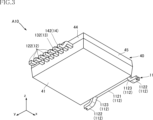
- FIG. 3 is a perspective view showing the semiconductor device according to the first embodiment.
- FIG. 4 is a perspective view of FIG. 3 in which the sealing resin is shown by imaginary lines.
- FIG. 5 is a perspective view showing the semiconductor device according to the first embodiment.
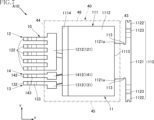
- FIG. 6 is a plan view showing the semiconductor device according to the first embodiment.
- FIG. 7 is a diagram showing the sealing resin by imaginary lines in the plan view of FIG.
- FIG. 8 is a bottom view showing the semiconductor device according to the first embodiment.
- FIG. 9 is a bottom view of FIG.
- FIG. 10 is a front view showing the semiconductor device according to the first embodiment.
- FIG. 11 is a right side view showing the semiconductor device according to the first embodiment.
- FIG. 12 is a cross-sectional view taken along line XII-XII in FIG.
- FIG. 13 is a cross-sectional view taken along line XIII-XIII in FIG.
- FIG. 14 is a cross-sectional view taken along line XIV-XIV in FIG.
- FIG. 15 is a cross-sectional view taken along line XV-XV in FIG.
- FIG. 16 is an enlarged perspective view of a main portion (a tip end portion of the first terminal) of FIG.
- FIG. 10 is a front view showing the semiconductor device according to the first embodiment.
- FIG. 11 is a right side view showing the semiconductor device according to the first embodiment.
- FIG. 12 is a cross-sectional view taken along line XII-XII in FIG.
- FIG. 13 is a cross-sectional view taken along line
- FIG. 17 is an enlarged bottom view of a main portion (a tip portion of the first terminal) of FIG. 8.
- FIG. FIG. 18 is an enlarged front view of a main portion (a tip portion of the first terminal) of FIG.
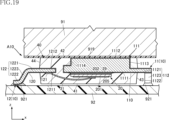
- FIG. 19 is a cross-sectional view showing a state in which the semiconductor device according to the first embodiment is used.
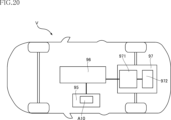
- FIG. 20 is a schematic diagram showing a vehicle including the semiconductor device according to the first embodiment.
- FIG. 21 is a bottom view showing a step of the method for manufacturing the semiconductor device according to the first embodiment.
- FIG. 22 is a perspective view showing a semiconductor device according to the second embodiment and corresponds to FIG.
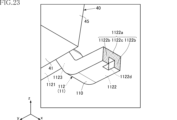
- FIG. 23 is an enlarged perspective view of a main portion (a tip portion of the first terminal) of FIG. 22, and corresponds to FIG.
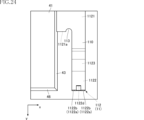
- FIG. 24 is a bottom view of a main part of the semiconductor device according to the second embodiment, and corresponds to FIG. 17.
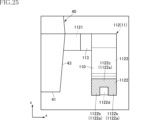
- FIG. 25 is a main part front view showing the semiconductor device according to the second embodiment, and corresponds to FIG.
- FIG. 26 is a perspective view showing a semiconductor device according to the third embodiment, and corresponds to FIG.
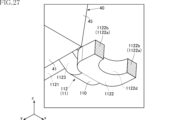
- FIG. 27 is an enlarged perspective view of a main portion (a tip portion of the first terminal) of FIG. 26, and corresponds to FIG.
- FIG. 28 is a bottom view of a main portion showing the semiconductor device according to the third embodiment, and corresponds to FIG. 17.
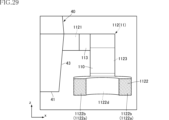
- FIG. 29 is a main part front view showing the semiconductor device according to the third embodiment, and corresponds to FIG. FIG.
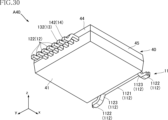
- FIG. 30 is a perspective view showing a semiconductor device according to the fourth embodiment and corresponds to FIG.
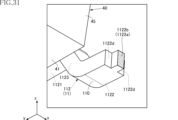
- FIG. 31 is an enlarged perspective view of a main portion (a tip portion of the first terminal) of FIG. 30, and corresponds to FIG.
- FIG. 32 is a bottom view of a main portion showing the semiconductor device according to the fourth embodiment, and corresponds to FIG.
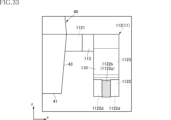
- FIG. 33 is a main part front view showing the semiconductor device according to the fourth embodiment, and corresponds to FIG.
- FIG. 34 is a perspective view showing a semiconductor device according to the fifth embodiment and corresponds to FIG.
- FIG. 35 is a perspective view showing a semiconductor device according to a modification of the fifth embodiment, and corresponds to FIG. FIG.
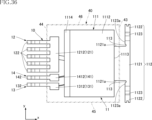
- FIG. 36 is a plan view showing a semiconductor device according to a first modification, in which a sealing resin is indicated by imaginary lines.
- FIG. 37 is a plan view showing a semiconductor device according to a second modification, in which a sealing resin is indicated by imaginary lines.
- 38 is a bottom view showing a step of the method for manufacturing the semiconductor device shown in FIG. 37, and corresponds to FIG. 21.
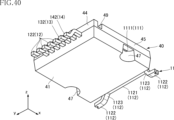
- FIG. FIG. 39 is a perspective view showing a semiconductor device according to a third modified example, and corresponds to FIG.
- FIG. 40 is a perspective view showing a semiconductor device according to a third modified example, and corresponds to FIG.
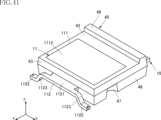
- FIG. 41 is a perspective view showing a semiconductor device according to a fourth modified example, and corresponds to FIG.
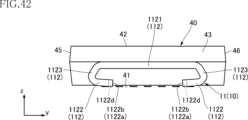
- FIG. 42 is a right side view showing a semiconductor device according to a fifth modified example, and corresponds to FIG.
- an object A is formed on an object B
- an object A is formed on (an object B)
- an object A is formed directly on an object B
- an object A is formed on an object B with another object interposed between the object A and the object B” unless otherwise specified.
- an object A is disposed on an object B” and “an object A is disposed on (an object B)” include “an object A is disposed directly on an object B” and “an object A is disposed on (an object B) with another object interposed between the object A and the object B” unless otherwise specified.
- an object A is located on (an object B) includes “an object A is in contact with an object B and is located on (an object B)” and “an object A is located on (an object B) with another object interposed between the object A and the object B".
- an object A overlaps an object B includes “an object A overlaps the entire object B” and “an object A overlaps a part of an object B” unless otherwise specified.
- An object A (its material) contains a certain material C includes “an object A (its material) is made of a certain material C” and “an object A (its material) is mainly composed of a certain material C.”
- a certain surface A faces a certain direction B (one side or the other side of a certain surface B) includes, unless otherwise specified, not limited to the case where the angle of surface A with respect to direction B is 90°, and includes the case where surface A is inclined with respect to direction B.
- a certain surface A is perpendicular to a certain surface B includes, unless otherwise specified, not limited to the case where the angle of surface A with respect to surface B is 90°, and includes the case where surface A is inclined with respect to surface B.
- First embodiment: 1 to 18 show a semiconductor device A10 according to a first embodiment.
- the semiconductor device A10 includes a conductive member 10, a semiconductor element 20, a plurality of connecting members 31, 32, and 33, and a sealing resin 40.
- the thickness direction of the semiconductor device A10 is referred to as the "thickness direction z".
- one side of the thickness direction z may be referred to as the lower side, and the other side as the upper side.
- the terms “upper”, “lower”, “upper”, “lower”, “top surface” and “bottom surface” indicate the relative positional relationship of each component, etc. in the thickness direction z, and do not necessarily define the relationship with the direction of gravity.
- One direction perpendicular to the thickness direction z is referred to as the "first direction x”.
- the direction perpendicular to the thickness direction z and the first direction x is referred to as the "second direction y”.
- the conductive member 10 is a member that constitutes a conductive path to the semiconductor element 20.
- the conductive member 10 of this embodiment includes a first lead 11, a second lead 12, a third lead 13, and a fourth lead 14.
- the material of the first lead 11, the second lead 12, the third lead 13, and the fourth lead 14 is not limited in any way and includes, for example, copper (Cu) or a copper alloy.
- the first lead 11, the second lead 12, the third lead 13, and the fourth lead 14 are plated in appropriate locations with silver (Ag), nickel (Ni), tin (Sn), or the like.
- the plating corresponds to each of the metal layers 110, 120, 130, and 140, which will be described in detail later. In Figures 1 to 11, the plating (each of the metal layers 110, 120, 130, and 140, which will be described later) is omitted from illustration.
- the first lead 11 includes a metal layer 110, a die pad portion 111, and a first terminal portion 112.
- the metal layer 110 covers a portion of the first lead 11.
- the metal layer 110 is a plating of silver (Ag), nickel (Ni), tin (Sn), or the like.
- the material of the metal layer 110 is not limited to these, but it is preferable that the material has a higher bonding strength with the bonding layer 29 described below than the material of the first lead 11 (e.g., Cu).
- the die pad portion 111 has a first lead main surface 1111 and a first lead back surface 1112.
- the first lead main surface 1111 is a surface facing one side (downward) in the thickness direction z.
- the first lead back surface 1112 is a surface facing the other side (upward) in the thickness direction z.
- a semiconductor element 20 is mounted on the first lead main surface 1111.
- the die pad portion 111 of this embodiment further has a first lead side surface 1113 and a first intermediate surface 1114.
- the first lead side surface 1113 is located between the first lead main surface 1111 and the first lead back surface 1112 in the thickness direction z, and is a surface that faces downward in the first direction x.
- the first intermediate surface 1114 is located between the first lead main surface 1111 and the first lead back surface 1112 in the thickness direction z, and is a surface that faces downward in the thickness direction z (the same side as the first lead main surface 1111).
- the shape of the die pad portion 111 is not limited in any way. In the illustrated example, the die pad portion 111 is rectangular when viewed in the thickness direction z.
- the shapes of the first lead main surface 1111 and the first lead back surface 1112 are not limited in any way, and in the illustrated example, they are rectangular when viewed in the thickness direction z.
- the entire surface of the die pad portion 111 is covered with a metal layer 110.
- the metal layer 110 does not have to be formed in the area where the semiconductor element 20 is bonded (the area in contact with the bonding layer 29 described below), and may be made of a different material from that in other areas.
- the first terminal portion 112 is connected to the die pad portion 111. Most of the first terminal portion 112 is exposed from the sealing resin 40. The first terminal portion 112 protrudes to one side in the first direction x relative to the sealing resin 40. The first terminal portion 112 is bent in a gull-wing shape. The first terminal portion 112 has a first terminal root portion 1121, two first terminal tip portions 1122, and two first terminal middle portions 1123.
- the first terminal root portion 1121 is connected to the die pad portion 111, extends from the die pad portion 111 in one direction in the first direction x, and is parallel to a plane (x-y plane) perpendicular to the thickness direction z in the illustrated example.
- the thickness (dimension along the thickness direction z) of the die pad portion 111 is greater than the thickness (dimension along the thickness direction z) of the first terminal root portion 1121.
- the first terminal portion 112 in this embodiment has one first terminal root portion 1121.
- the shape of the first terminal root portion 1121 is not limited in any way, and in the illustrated example, it is rectangular when viewed in the thickness direction z.
- the first terminal root portion 1121 is separated from the first lead back surface 1112 in the thickness direction z, and in the illustrated example, is in contact with the first lead main surface 1111.
- the bottom surface of the first terminal base portion 1121 (the surface facing downward in the thickness direction z) is flush with the first lead main surface 1111.
- a portion of the surface of the first terminal base portion 1121 facing one side in the first direction x is exposed from the metal layer 110. This portion corresponds to a portion that is connected to the frame body 81 (see FIG. 21) of the lead frame 80, which will be described in detail later.
- the first terminal root portion 1121 has a pair of root side surfaces 1121a.
- the pair of root side surfaces 1121a are spaced apart in the second direction y and face opposite each other in the second direction y.
- the pair of root side surfaces 1121a are parallel to a plane (x-z plane) perpendicular to the second direction y.
- the pair of root side surfaces 1121a may be slightly inclined or curved with respect to the x-z plane.
- a recess 113 is formed in each of the pair of root side surfaces 1121a. That is, the first lead 11 has a pair of recesses 113.
- the pair of recesses 113 are recessed individually from the pair of root side surfaces 1121a in the second direction y. In a configuration different from the semiconductor device A10, the recess 113 may not be formed in the first terminal portion 112.
- the two first terminal tip portions 1122 are each located below the first terminal root portion 1121 in the thickness direction z.
- the two first terminal root portions 1121 are each used when surface-mounting the semiconductor device A10 on a circuit board or the like.
- each of the two first terminal tip portions 1122 has a first tip surface 1122a and a concave surface 1122d.
- the first tip surface 1122a and the concave surface 1122d described below are common to each of the first terminal tip portions 1122.
- the first tip surface 1122a is depicted as a dot in Figures 16 to 18.
- the first tip surface 1122a is the end surface of each first terminal tip portion 1122 opposite the end portion connected to the first terminal intermediate portion 1123, that is, the end surface farthest from the first terminal root portion 1121.
- the first tip surface 1122a is exposed from the metal layer 110.
- the first tip surface 1122a includes two exposed regions 1122b.
- the two exposed regions 1122b are spaced apart in the first direction x.
- the two exposed regions 1122b are each connected to the upper surface of the first terminal tip portion 1122 (the surface facing upward in the thickness direction z) and the lower surface of the first terminal tip portion 1122 (the surface facing downward in the thickness direction z).
- the concave surface 1122d is connected to the first tip surface 1122a.
- the concave surface 1122d is sandwiched between the two exposed areas 1122b.
- the concave surface 1122d is connected to the upper surface (facing upward in the thickness direction z) of the first terminal tip portion 1122 and the lower surface (facing downward in the thickness direction z) of the first terminal tip portion 1122.
- the concave surface 1122d is recessed in the second direction y from the two exposed areas 1122b.
- the concave surface 1122d has a side wall connected to one of the two exposed areas 1122b, a side wall connected to the other of the two exposed areas 1122b, and a bottom connected to the two side walls.
- each side wall is flat, but may be curved, or may be inclined with respect to a plane perpendicular to the first direction x (y-z plane).
- the concave surface 1122d is covered with a metal layer 110.
- the two first terminal intermediate portions 1123 are interposed between the first terminal root portion 1121 and the two first terminal tip portions 1122. Each first terminal intermediate portion 1123 extends downward in the thickness direction z from the first terminal root portion 1121. In the illustrated example, each first terminal intermediate portion 1123 is inclined with respect to the thickness direction z so as to extend outward in the second direction y from the first terminal root portion 1121. Unlike this example, each first terminal intermediate portion 1123 may be parallel to the thickness direction z, and in this configuration, the dimension of the semiconductor device A10 in the first direction x can be reduced.
- each first terminal intermediate portion 1123 is inclined with respect to the thickness direction z, the manufacturing of the semiconductor device A10 (for example, bending the first terminal portion 112) becomes easier.
- the shape of each first terminal intermediate portion 1123 is not limited in any way.
- the two first terminal tip portions 1122 extend outward in the second direction y, individually from the two second terminal intermediate portions 1223.
- the two first terminal tip portions 1122 are each parallel to the second direction y.
- the two first terminal tip portions 1122 and the two first terminal intermediate portions 1123 are at the same position in the first direction x.
- the two first terminal tip portions 1122 are each inclined with respect to the x-y plane. Unlike this example, the two first terminal tip portions 1122 may each be parallel to the x-y plane.
- the first terminal portion 112 is covered by the metal layer 110 except for the two exposed areas 1122b of the first tip surface 1122a. In other words, in the first terminal portion 112, the two exposed areas 1122b are exposed from the metal layer 110.
- the concave surface 1122d is covered by the metal layer 110.
- the second lead 12 is located away from the first lead 11 (die pad portion 111) on the other side of the first direction x.
- the second lead 12 includes a metal layer 120, a pad portion 121, and a plurality of second terminal portions 122.
- the metal layer 120 covers a portion of the second lead 12. As described above, the metal layer 120 is plated with Ag, Ni, Sn, or the like. The material of the metal layer 110 is not limited to these.
- the pad portion 121 has a second lead main surface 1211 and a second lead back surface 1212.
- the second lead main surface 1211 is a surface facing downward (one side) in the thickness direction z.
- the second lead back surface 1212 is a surface facing upward (the other side) in the thickness direction z.
- a connection member 31 is connected to the second lead main surface 1211.
- the shape of the pad portion 121 is not limited in any way, and in the illustrated example, it is an elongated rectangle with the second direction y as the longitudinal direction. When viewed in the thickness direction z, the pad portion 121 is smaller than the die pad portion 111.
- the dimension of the pad portion 121 in the thickness direction z is smaller than the dimension of the die pad portion 111 in the thickness direction z and is the same as the dimension of the first terminal portion 112 in the thickness direction z.
- the position of the second lead main surface 1211 in the thickness direction z is the same as the first lead main surface 1111 of the die pad portion 111.
- the multiple second terminal portions 122 are each connected to the pad portion 121. A large portion of each second terminal portion 122 is exposed from the sealing resin 40. Each second terminal portion 122 protrudes to the other side of the first direction x relative to the sealing resin 40. Thus, each of the multiple second terminal portions 122 is arranged on the opposite side of the first terminal portion 112 in the first direction x, sandwiching the sealing resin 40 therebetween. The multiple second terminal portions 122 are arranged side by side in the second direction y. Each of the multiple second terminal portions 122 is bent into a gull-wing shape. As can be seen from FIG. 12, each of the multiple second terminal portions 122 has a second terminal root portion 1221, a second terminal tip portion 1222, and a second terminal intermediate portion 1223. The second terminal root portion 1221, the second terminal tip portion 1222, and the second terminal middle portion 1223 described below are common to each second terminal portion 122 unless otherwise specified.
- the second terminal root portion 1221 is connected to the pad portion 121 and extends from the pad portion 121 to the other side in the first direction x, and in the illustrated example, is parallel to the xy plane.
- the shape of the second terminal root portion 1221 is not limited in any way, and in the illustrated example, it is rectangular when viewed in the thickness direction z.
- the second terminal tip 1222 is located below the second terminal root 1221 in the thickness direction z.
- the second terminal tip 1222 is used when surface mounting the semiconductor device A10 on a circuit board or the like.
- the second terminal tip 1222 has a shape that extends along the first direction x. In the illustrated example, as shown in FIG. 12, the second terminal tip 1222 is inclined with respect to the x-y plane. Unlike this example, the second terminal tip 1222 may be parallel to the x-y plane.
- the second terminal intermediate portion 1223 is interposed between the second terminal root portion 1221 and the second terminal tip portion 1222.
- the second terminal intermediate portion 1223 extends downward in the thickness direction z from the second terminal root portion 1221.
- the second terminal intermediate portion 1223 is inclined with respect to the thickness direction z (y-z plane).
- the second terminal intermediate portion 1223 may be parallel to the thickness direction z, and in this configuration, the dimension of the semiconductor device A10 in the first direction x can be reduced.
- the manufacturing of the semiconductor device A10 for example, bending the second terminal portion 122 becomes easier.
- the shape of the second terminal intermediate portion 1223 is not limited in any way.
- Each second terminal portion 122 is covered with the metal layer 120 except for the tip surface of the second terminal tip portion 1222.
- the tip surface of the second terminal tip portion 1222 is exposed from the metal layer 120. This tip surface refers to the end surface of the second terminal tip portion 1222 opposite the end connected to the second terminal intermediate portion 1223.
- the third lead 13 is located away from the first lead 11 (die pad portion 111) on the other side in the first direction x.
- the third lead 13 is aligned with the second lead 12 in the second direction y.
- the third lead 13 includes a metal layer 130, a pad portion 131, and a third terminal portion 132.
- the pad portion 131 has a third lead main surface 1311 and a third lead back surface 1312.
- the third lead main surface 1311 faces downward in the thickness direction z.
- the third lead back surface 1312 faces upward in the thickness direction z.
- a connection member 32 is connected to the third lead main surface 1311.
- the shape of the pad portion 131 is not limited in any way, and in the illustrated example, it is rectangular when viewed in the thickness direction z. When viewed in the thickness direction z, the pad portion 131 is smaller than the pad portion 121.
- the thickness (dimension in the thickness direction z) of the pad portion 131 is smaller than the thickness (dimension in the thickness direction z) of the die pad portion 111 and is the same as the thickness (dimension in the thickness direction z) of the pad portion 121.
- the position of the third lead main surface 1311 in the thickness direction z is the same as the first lead main surface 1111 of the die pad portion 111.
- the third terminal portion 132 is connected to the pad portion 131. Most of the third terminal portion 132 is exposed from the sealing resin 40. The third terminal portion 132 protrudes from the sealing resin 40 to the other side of the first direction x. Thus, the third terminal portion 132 is disposed on the opposite side of the first terminal portion 112 in the first direction x, sandwiching the sealing resin 40 therebetween. The third terminal portion 132 is disposed on the other side of the second terminal portions 122 in the second direction y. The third terminal portion 132 is bent in a gull-wing shape. As shown in FIG. 14, the third terminal portion 132 includes a root portion 1321, a tip portion 1322, and an intermediate portion 1323.
- the root portion 1321 is connected to the pad portion 131 and extends from the pad portion 131 to the other side in the first direction x. In the illustrated example, the root portion 1321 is parallel to the xy plane. The shape of the root portion 1321 is not limited in any way, and in the illustrated example, it is rectangular when viewed in the thickness direction z.
- the root portion 1321 includes a portion covered by the sealing resin 40 and a portion exposed from the sealing resin 40.
- the tip portion 1322 is located below the base portion 1321 in the thickness direction z.
- the tip portion 1322 is used when surface mounting the semiconductor device A10 on a circuit board or the like.
- the tip portion 1322 extends along the first direction x.
- the tip portion 1322 is inclined with respect to the x-y plane.
- the tip portion 1322 may be parallel to the x-y plane.
- the intermediate portion 1323 is interposed between the root portion 1321 and the tip portion 1322.
- the intermediate portion 1323 extends downward in the thickness direction z from the root portion 1321.
- the intermediate portion 1323 is inclined with respect to the thickness direction z (y-z plane).
- the intermediate portion 1323 may be parallel to the thickness direction z, and in this configuration, the dimension of the semiconductor device A10 in the first direction x can be reduced.
- the manufacture of the semiconductor device A10 for example, bending the third terminal portion 132 becomes easier.
- the shape of the intermediate portion 1323 is not limited in any way.
- the third terminal portion 132 is covered with the metal layer 130 except for the tip surface of the tip portion 1322.
- the tip surface of the tip portion 1322 is exposed from the metal layer 130.
- This tip surface refers to the end surface of the tip portion 1322 opposite the end portion that is connected to the intermediate portion 1323.
- the fourth lead 14 is located away from the first lead 11 (die pad portion 111) on the other side in the first direction x.
- the fourth lead 14 is located between the second lead 12 and the third lead 13 in the second direction y.
- the fourth lead 14 includes a metal layer 140, a pad portion 141, and a fourth terminal portion 142.
- the pad portion 141 has a fourth lead main surface 1411 and a fourth lead back surface 1412.
- the fourth lead main surface 1411 faces downward in the thickness direction z.
- the fourth lead back surface 1412 faces upward in the thickness direction z.
- the connection member 33 is connected to the fourth lead main surface 1411.
- the shape of the pad portion 141 is not limited in any way, and in the illustrated example, it is rectangular when viewed in the thickness direction z. When viewed in the thickness direction z, the pad portion 141 is smaller than the pad portion 121 and is approximately the same size as the pad portion 131.
- the thickness (dimension in the thickness direction z) of the pad portion 141 is smaller than the thickness (dimension in the thickness direction z) of the die pad portion 111 and is the same as the thickness (dimension in the thickness direction z) of the pad portion 121 and the pad portion 131.
- the position of the fourth lead main surface 1411 in the thickness direction z is the same as the first lead main surface 1111 of the die pad portion 111.
- the fourth terminal portion 142 is connected to the pad portion 141. Most of the fourth terminal portion 142 is exposed from the sealing resin 40. The fourth terminal portion 142 protrudes from the sealing resin 40 to the other side of the first direction x. Thus, the fourth terminal portion 142 is disposed on the opposite side of the first terminal portion 112 in the first direction x, sandwiching the sealing resin 40 therebetween. The fourth terminal portion 142 is disposed on the other side of the second terminal portions 122 in the second direction y, and is located between the second terminal portions 122 and the third terminal portion 132 in the second direction y. The fourth terminal portion 142 is bent in a gull-wing shape. As shown in FIG. 13, the fourth terminal portion 142 includes a root portion 1421, a tip portion 1422, and an intermediate portion 1423.
- the root portion 1421 is connected to the pad portion 141 and extends from the pad portion 141 to the other side in the first direction x. In the illustrated example, the root portion 1421 is parallel to the xy plane. The shape of the root portion 1421 is not limited in any way, and in the illustrated example, it is rectangular when viewed in the thickness direction z.
- the root portion 1421 includes a portion covered by the sealing resin 40 and a portion exposed from the sealing resin 40.
- the tip portion 1422 is located below the base portion 1421 in the thickness direction z.
- the tip portion 1422 is used when surface mounting the semiconductor device A10 on a circuit board or the like.
- the tip portion 1422 extends along the first direction x.
- the tip portion 1422 is inclined with respect to the x-y plane.
- the tip portion 1422 may be parallel to the x-y plane.
- the intermediate portion 1423 is interposed between the root portion 1421 and the tip portion 1422.
- the intermediate portion 1423 extends downward in the thickness direction z from the root portion 1421.
- the intermediate portion 1423 is inclined with respect to the thickness direction z (y-z plane).
- the intermediate portion 1423 may be parallel to the thickness direction z, and in this configuration, the dimension of the semiconductor device A10 in the first direction x can be reduced.
- the manufacture of the semiconductor device A10 for example, bending the fourth terminal portion 142 becomes easier.
- the shape of the intermediate portion 1423 is not limited in any way.
- the fourth terminal portion 142 is covered with the metal layer 140 except for the tip surface of the tip portion 1422.
- the tip surface of the tip portion 1422 is exposed from the metal layer 140.
- This tip surface refers to the end surface of the tip portion 1422 opposite the end portion that is connected to the intermediate portion 1423.
- the width W1123 of each first terminal intermediate portion 1123 of the first lead 11 is, for example, 0.5 to 2 times the width W1223 of each second terminal intermediate portion 1223 of the second lead 12.
- the width W1123 of the first terminal intermediate portion 1123 is a dimension along the following direction, which is an example of the "first dimension" described in the claims. This direction is a direction perpendicular to the thickness direction z and the extension direction of the first terminal intermediate portion 1123 as seen in the thickness direction z, which is the first direction x in this embodiment.
- the width W1123 of the first terminal intermediate portion 1123 is a dimension along the first direction x of the first terminal intermediate portion 1123.
- the width W1223 of the second terminal intermediate portion 1223 is a dimension along the following direction, which is an example of the "second dimension" described in the claims. This direction is perpendicular to the thickness direction z and the extension direction of the second terminal intermediate portion 1223 as viewed in the thickness direction z, and in this embodiment, it is the second direction y. That is, in this embodiment, the width W1223 of the second terminal intermediate portion 1223 is the dimension of the second terminal intermediate portion 1223 along the second direction y.
- the relationship between the width W1123 of the first terminal intermediate portion 1123 and the width W1223 of each second terminal intermediate portion 1223 is not limited to the above.
- the width W1223 of each second terminal intermediate portion 1223 of the second lead 12, the width W1323 of the intermediate portion 1323 of the third lead 13, and the width W1423 of the intermediate portion 1423 of the fourth lead 14 are the same.
- the width W1323 of the intermediate portion 1323 is a dimension along the following direction. This direction is perpendicular to the thickness direction z and the extension direction of the intermediate portion 1323 as viewed in the thickness direction z, which is the second direction y in this embodiment.
- the width W1323 of the intermediate portion 1323 is a dimension along the second direction y of the intermediate portion 1323.
- the width W1423 of the intermediate portion 1423 is a dimension along the following direction.
- This direction is perpendicular to the thickness direction z and the extension direction of the intermediate portion 1423 as viewed in the thickness direction z, which is the second direction y in this embodiment. That is, in this embodiment, the width W1423 of the intermediate portion 1423 is the dimension along the second direction y of the intermediate portion 1423.
- the relationship between the width W1223 of each second terminal intermediate portion 1223, the width W1323 of the intermediate portion 1323, and the width W1423 of the intermediate portion 1423 is not limited to the above.
- the semiconductor element 20 is mounted on the first lead main surface 1111 of the die pad portion 111, as shown in Figures 4, 9 and 12 to 15.
- the semiconductor element 20 is an n-channel type, vertically structured MOSFET (Metal-Oxide-Semiconductor Field-Effect Transistor).
- the semiconductor element 20 is not limited to a MOSFET.
- the semiconductor element 20 may be another transistor such as an IGBT (Insulated Gate Bipolar Transistor).
- the semiconductor element 20 may be a diode.
- the semiconductor element 20 has a semiconductor layer 205, a first electrode 201, a second electrode 202 and a third electrode 203.
- the semiconductor layer 205 includes a compound semiconductor substrate.
- the main material of the compound semiconductor substrate is silicon carbide (SiC).
- silicon (Si) may be used as the main material of the compound semiconductor substrate.
- the first electrode 201 is provided on the side (lower side) of the semiconductor layer 205 facing the first lead main surface 1111 of the die pad portion 111 of the first lead 11 in the thickness direction z.
- the first electrode 201 corresponds to the source electrode of the semiconductor element 20.
- the second electrode 202 is provided on a portion of the semiconductor layer 205 opposite the first electrode 201 in the thickness direction z.
- the second electrode 202 faces the first lead main surface 1111 of the die pad portion 111 of the first lead 11.
- the second electrode 202 corresponds to the drain electrode of the semiconductor element 20.
- the second electrode 202 is bonded to the first lead main surface 1111 via a bonding layer 29.
- the bonding layer 29 is, for example, solder, silver (Ag) paste, baked silver, etc.
- the third electrode 203 is provided in a portion of the semiconductor layer 205 on the same side as the first electrode 201 in the thickness direction z, and is located away from the first electrode 201.
- the third electrode 203 corresponds to the gate electrode of the semiconductor element 20. When viewed in the thickness direction z, the area of the third electrode 203 is smaller than the area of the first electrode 201.
- connection member 31 is joined to the first electrode 201 of the semiconductor element 20 and the second lead main surface 1211 of the pad portion 121 of the second lead 12.
- material of the connection member 31 includes metals such as aluminum (Al), copper (Cu), and gold (Au).
- connection member 31 contains aluminum (Al) and is a flat, band-shaped member.
- connection member 32 is connected to the third electrode 203 of the semiconductor element 20 and the third lead main surface 1311 of the pad portion 131 of the third lead 13.
- the connection member 32 contains gold (Au) and is a linear member that is thinner than the connection member 31.
- connection member 33 is connected to the first electrode 201 of the semiconductor element 20 and the fourth lead main surface 1411 of the pad portion 141 of the fourth lead 14.
- the connection member 33 contains gold (Au) and is a linear member that is thinner than the connection member 31.
- the first terminal portion 112 of the first lead 11 is a drain terminal
- the multiple second terminal portions 122 of the second lead 12 are source terminals
- the third terminal portion 132 of the third lead 13 is a gate terminal
- the fourth terminal portion 142 of the fourth lead 14 is a source sense terminal.
- the sealing resin 40 covers the semiconductor element 20, the multiple connection members 31, 32, 33, and parts of the first lead 11, second lead 12, third lead 13, and fourth lead 14.
- the sealing resin 40 has electrical insulation properties.
- the sealing resin 40 is made of a material that contains, for example, black epoxy resin.
- the sealing resin 40 has a first resin surface 41, a second resin surface 42, a third resin surface 43, a fourth resin surface 44, a fifth resin surface 45, and a sixth resin surface 46.
- the third resin surface 43 faces one side in the first direction x.
- the first terminal root portion 1121 of the first terminal portion 112 of the first lead 11 penetrates the third resin surface 43.
- one first terminal root portion 1121 penetrates the third resin surface 43.
- the first terminal root portion 1121 is separated from the second resin surface 42 in the thickness direction z.
- the fourth resin surface 44 faces the opposite side (the other side) from the third resin surface 43 in the first direction x.
- the second terminal root portions 1221 of the multiple second terminal portions 122 of the second lead 12, the root portion 1321 of the third terminal portion 132 of the third lead 13, and the root portion 1421 of the fourth terminal portion 142 of the fourth lead 14 penetrate the fourth resin surface 44.
- the fifth resin surface 45 and the sixth resin surface 46 face opposite each other in the second direction y.
- the sixth resin surface 46 faces one side of the second direction y, and the fifth resin surface 45 faces the other side of the second direction y.
- the ends in the second direction y of the two first terminal tips 1122 of the first terminal portion 112 of the first lead 11 are located at approximately the same position in the second direction y as the fifth resin surface 45 and the sixth resin surface 46 of the sealing resin 40.
- the ends in the second direction y of the two first terminal tips 1122 may or may not protrude outside the fifth resin surface 45 and the sixth resin surface 46, respectively, in the second direction y.
- the semiconductor device A10 is surface-mounted on the circuit board 92. That is, the first terminal tip 1122 of each of the first terminals 112, the second terminal tip 1222 of each of the second terminals 122, the tip 1322 of the third terminal 132, and the tip 1422 of the fourth terminal 142 are conductively joined to the wiring pattern (not shown) of the circuit board 92, for example, by solder 921.
- a heat sink 91 is disposed opposite the first lead back surface 1112 of the die pad portion 111.
- a sheet material 919 is disposed between the first lead back surface 1112 and the heat sink 91.
- the sheet material 919 is, for example, an insulating sheet.
- FIG. 20 shows a vehicle V equipped with a semiconductor device A10.
- the vehicle V is, for example, an electric vehicle (EV).
- EV electric vehicle
- the vehicle V includes an on-board charger 95, a storage battery 96, and a drive system 97.
- the on-board charger 95 is supplied with power wirelessly from a power supply facility (not shown) installed outdoors. Alternatively, the power supply from the power supply facility to the on-board charger 95 may be wired.
- the on-board charger 95 is configured with a step-up DC-DC converter.
- the semiconductor device A10 is part of the on-board charger 95, and is used, for example, in the DC-DC converter described above.
- the voltage of the power supplied to the on-board charger 95 is stepped up by the converter and then supplied to the storage battery 96.
- the stepped-up voltage is, for example, 600V.
- the drive system 97 drives the vehicle V.
- the drive system 97 has an inverter 971 and a drive source 972.
- the power stored in the storage battery 96 is supplied to the inverter 971.
- the power supplied from the storage battery 96 to the inverter 971 is DC power.
- a step-up DC-DC converter may be further provided between the storage battery 96 and the inverter 971.
- the inverter 971 converts DC power into AC power.
- the inverter 971 is conductive to the drive source 972.
- the drive source 972 has an AC motor and a transmission. When the AC power converted by the inverter 971 is supplied to the drive source 972, the AC motor rotates and the rotation is transmitted to the transmission.
- the transmission appropriately reduces the rotation speed transmitted from the AC motor and then rotates the drive shaft of the vehicle V. This drives the vehicle V.
- the inverter 971 is necessary to output AC power with an appropriate frequency change to correspond to the required rotation speed of the AC motor.
- the lead frame 80 includes a frame body 81.
- the first lead 11, the second lead 12, the third lead 13, and the fourth lead 14 are connected to one another by the frame body 81.
- a through hole 1120 is formed at the connection portion between the first lead 11 and the frame body 81.
- the shape of the through hole 1120 as viewed in the thickness direction z is not limited in any way, but in the illustrated example, it is rectangular.
- plating is applied.
- the surface of the lead frame 80 is covered with a thin metal film by the plating, and the inside of the through hole 1120 is covered with a thin metal film by the plating. This thin metal film becomes each of the metal layers 110, 120, 130, and 140.
- the semiconductor element 20 is mounted, the multiple connection members 31, 32, 33 are joined, and the sealing resin 40 is formed. Then, the first lead 11, the second lead 12, the third lead 13, and the fourth lead 14 are cut off from the frame body 81 by cutting along the cutting line CL, and the first terminal portion 112 of the first lead 11, the second terminal portion 122 of the second lead 12, the third terminal portion 132 of the third lead 13, and the fourth terminal portion 142 of the fourth lead 14 are bent.
- the order of cutting along the cutting line CL and bending the first terminal portion 112 of the first lead 11, the second terminal portion 122 of the second lead 12, the third terminal portion 132 of the third lead 13, and the fourth terminal portion 142 of the fourth lead 14 may be reversed or may be simultaneous. In this way, each semiconductor device A10 is formed.
- the functions and effects of the semiconductor device A10 are as follows:
- the first terminal portion 112 has a first terminal tip portion 1122, which has a first tip surface 1122a and a concave surface 1122d.
- the first tip surface 1122a is exposed from the metal layer 110, and the concave surface 1122d is covered by the metal layer 110.
- the area of the first terminal tip portion 1122 that is covered by the metal layer 110 is expanded. This can increase the mounting strength of the semiconductor device A10.
- the first tip surface 1122a includes two exposed regions 1122b, which are spaced apart in the first direction x.
- the concave surface 1122d is connected in the thickness direction z to the upper surface of the first terminal tip portion 1122 (the surface facing downward in the thickness direction z) and the lower surface of the first terminal tip portion 1122 (the surface facing upward in the thickness direction z), so that the area of the concave surface 1122d can be appropriately secured. Therefore, the area covered by the metal layer 110 in the first terminal portion 112 can be appropriately secured, so that the mounting strength of the semiconductor device A10 can be prevented from being insufficient.
- the first terminal portion 112 has a first terminal middle portion 1123. This allows the first terminal tip portion 1122 to be supported more reliably.
- the first terminal portion 112 has two first terminal tip portions 1122. This increases the mounting strength of the semiconductor device A10.
- the two first terminal tip portions 1122 extend outward from the first terminal intermediate portion 1123 in the second direction y. This further increases the mounting strength of the semiconductor device A10.
- the first terminal tip portion 1122 does not protrude from the first terminal middle portion 1123 in the first direction x. This allows the dimension of the semiconductor device A10 in the first direction x to be reduced.
- the size of the die pad portion 111 in the thickness direction z is greater than the size of the first terminal root portion 1121 in the thickness direction z. This allows the heat to be transmitted over a wider range in the first direction x and the second direction y as it travels from the semiconductor element 20 to the first lead back surface 1112. Therefore, the heat from the semiconductor element 20 can be dissipated to the heat sink 91 or the like over an area larger than the first terminal root portion 1121, improving the heat dissipation efficiency.
- the lower surface of the first terminal root portion 1121 (the surface facing downward in the thickness direction z) is flush with the first lead main surface 1111. This makes it possible to increase the distance from the first terminal root portion 1121 to the third resin surface 43 in the thickness direction z, thereby further increasing the holding force of the sealing resin 40 for the first lead 11.
- the first terminal portion 112 has a recess 113 formed therein.
- the semiconductor device A10 can prevent resin burrs.
- the recess 113 is formed on the root side surface 1121a of the first terminal root portion 1121 of the first terminal portion 112 when viewed in the thickness direction z.
- Second embodiment: 22 to 25 show a semiconductor device A20 according to the second embodiment.
- the semiconductor device A20 is different from the semiconductor device A10 in that the first end surface 1122a of each first terminal end portion 1122 has a connecting region 1122c.
- the connecting region 1122c described below is common to the first end surface 1122a of each first terminal end portion 1122, unless otherwise specified.
- the connecting region 1122c is connected to the two exposed regions 1122b.
- the connecting region 1122c is disposed on the upper side in the thickness direction z.
- the connecting region 1122c is connected to the upper surface (surface facing upward in the thickness direction z) of the first terminal tip portion 1122, and the concave surface 1122d is connected to the lower surface (surface facing downward in the thickness direction z) of the first terminal tip portion 1122.
- the connecting region 1122c may be disposed on the lower side in the thickness direction z.
- the connecting region 1122c is connected to the lower surface (surface facing downward in the thickness direction z) of the first terminal tip portion 1122, and the concave surface 1122d may be connected to the upper surface (surface facing upward in the thickness direction z) of the first terminal tip portion 1122.
- each of the first terminal tips 1122 is formed, for example, as follows. In the state of the lead frame 80 shown in FIG. 21, a groove recessed from the lower side (bottom surface side) in the thickness direction z is formed in place of the through hole 1120, and then a connecting region 1122c is formed on the first tip surface 1122a by cutting along the cutting line CL later.
- the semiconductor device A20 can be surface-mounted using the first terminal tip 1122.
- the first tip surface 1122a is exposed from the metal layer 110, and the concave surface 1122d is covered by the metal layer 110, as in the semiconductor device A10. Therefore, in this embodiment, the area covered by the metal layer 110 is expanded in the first terminal tip 1122, so that the mounting strength of the semiconductor device A20 can be increased.
- the area of the concave surface 1122d of the semiconductor device A10 is larger.
- the semiconductor device A10 is preferable. Furthermore, in the semiconductor device A20, a recess 113 is formed in the first terminal portion 112, as in the semiconductor device A10. Therefore, this embodiment can also suppress resin burrs, and therefore suppress defects of the semiconductor device A20 caused by resin burrs (for example, the above-mentioned mounting defects and processing defects). In addition, the semiconductor device A20 has a common configuration with the semiconductor device A10, and thus achieves the same effects as the semiconductor device A10.
- Third embodiment 26 to 29 show a semiconductor device A30 according to the third embodiment.
- the semiconductor device A30 is different from the semiconductor device A10 in the shape of each of the first terminal tip portions 1122.
- each tip portion in the second direction y of the two first terminal tip portions 1122 is bifurcated.
- each bifurcated tip portion protrudes on both sides in the first direction x beyond the portion connected to the first terminal intermediate portion 1123. Therefore, the two exposed regions 1122b are located outward from the first terminal intermediate portion 1123 when viewed from the first tip surface 1122a in the direction connected to the corresponding first terminal intermediate portion 1123.
- the semiconductor device A30 can be surface-mounted using the first terminal tip 1122.
- the first tip surface 1122a is exposed from the metal layer 110, and the concave surface 1122d is covered by the metal layer 110, as in the semiconductor device A10. Therefore, in this embodiment, the area covered by the metal layer 110 is expanded in the first terminal tip 1122, so that the mounting strength of the semiconductor device A30 can be increased.
- the area of the concave surface 1122d of the semiconductor device A30 is expanded more than the area of the concave surface 1122d of the semiconductor device A10, so that the semiconductor device A30 is preferable in terms of increasing the mounting strength of the semiconductor device disclosed herein.
- the first terminal 112 has a recess 113 formed therein, as in the semiconductor device A10. Therefore, in this embodiment, resin burrs can also be suppressed, so that defects of the semiconductor device A30 caused by resin burrs (for example, the above-mentioned mounting defects and processing defects) can be suppressed.
- the semiconductor device A30 has a common configuration with the semiconductor devices A10 and A20, and thus has the same effects as the semiconductor devices A10 and A20.
- the area of the concave surface 1122d of the semiconductor device A30 is larger than the area of the concave surface 1122d of the semiconductor device A10. With this configuration, the area covered by the metal layer 110 at the first terminal tip portion 1122 is further expanded, thereby further increasing the mounting strength of the semiconductor device A30.
- Fourth embodiment 30 to 33 show a semiconductor device A40 according to the fourth embodiment.
- the semiconductor device A40 is different from the semiconductor device A10 in the arrangement of the first tip faces 1122a of the first terminal tip portions 1122.
- the first tip surface 1122a is sandwiched between two concave surfaces 1122d in the first direction x.
- the two concave surfaces 1122d are disposed on either side of the first tip surface 1122a in the first direction x.
- the semiconductor device A40 can be surface-mounted using the first terminal tip 1122.
- the first tip surface 1122a is exposed from the metal layer 110, and the concave surface 1122d is covered by the metal layer 110, as in the semiconductor device A10. Therefore, in this embodiment, the area covered by the metal layer 110 is expanded in the first terminal tip 1122, so that the mounting strength of the semiconductor device A40 can be increased.
- the first terminal 112 has a recess 113 formed therein, as in the semiconductor device A10. Therefore, this embodiment can also suppress resin burrs, so that defects of the semiconductor device A40 caused by resin burrs (for example, the above-mentioned mounting defects and processing defects) can be suppressed.
- the semiconductor device A40 has a configuration common to the semiconductor devices A10, A20, and A30, and thus has the same effects as the semiconductor devices A10, A20, and A30.
- the first terminal tip 1122 has two concave surfaces 1122d. With this configuration, the area covered by the metal layer 110 in the first terminal tip 1122 is further expanded compared to the semiconductor device A10, so the mounting strength of the semiconductor device A40 can be further increased.
- Fifth embodiment 34 shows a semiconductor device A50 according to the fifth embodiment.
- the semiconductor device A50 has a different configuration of a first terminal portion 112 from the semiconductor device A10.
- the first terminal portion 112 includes a first terminal root portion 1121, one first terminal tip portion 1122, and one first terminal intermediate portion 1123.
- the first terminal intermediate portion 1123 extends downward in the thickness direction z from the first terminal root portion 1121 and is rectangular when viewed in the first direction x.
- the size of the first terminal intermediate portion 1123 in the second direction y is the same as the size of the first terminal root portion 1121 in the second direction y.
- the first terminal tip 1122 extends from the first terminal intermediate portion 1123 to one side (outside) in the first direction x.
- the first terminal tip 1122 has a rectangular shape with the second direction y as the longitudinal direction when viewed in the thickness direction z. Both ends of the first terminal tip 1122 in the second direction y protrude from the first terminal intermediate portion 1123 to the outside in the second direction y.
- the positions of both ends of the first terminal tip 1122 in the second direction y are the same (or approximately the same) as the fifth resin surface 45 and the sixth resin surface 46 of the sealing resin 40. The positions of both ends may or may not protrude to the outside in the second direction y from the fifth resin surface 45 and the sixth resin surface 46.
- the first tip surface 1122a and the concave surface 1122d are arranged at both ends of the first terminal tip 1122 in the second direction y.
- the semiconductor device A50 can be surface-mounted using the first terminal tip 1122.
- the first tip surface 1122a is exposed from the metal layer 110, and the concave surface 1122d is covered by the metal layer 110, as in the semiconductor device A10. Therefore, in this embodiment, the area covered by the metal layer 110 is expanded in the first terminal tip 1122, so that the mounting strength of the semiconductor device A50 can be increased.
- the first terminal 112 has a recess 113 formed therein, as in the semiconductor device A10.
- the semiconductor device A50 has a configuration common to the semiconductor devices A10, A20, and A30, and thus has the same effects as the semiconductor devices A10, A20, and A30.
- the specific configuration of the first terminal tip portion 1122 and the first terminal middle portion 1123 is not limited in any way in the semiconductor device disclosed herein.
- FIG. 35 shows a semiconductor device A51 according to a modified example of the fifth embodiment.
- the semiconductor device A51 differs from the semiconductor device A50 in the arrangement of the first tip surface 1122a and the concave surface 1122d.
- a first tip surface 1122a and multiple concave surfaces 1122d are arranged at the outer end in the first direction x of the first terminal tip portion 1122.
- the first tip surface 1122a faces one side in the first direction x.
- the number of concave surfaces 1122d is not limited in any way and may be, for example, one.
- both ends of the first terminal tip 1122 in the second direction y are connected to the frame 81 of the lead frame 80, so that both end faces of the first terminal tip 1122 in the second direction y are first tip faces 1122a.
- one end of the first terminal tip 1122 in the first direction x is connected to the frame 81 of the lead frame 80, so that one end face of the first terminal tip 1122 in the first direction x is the first tip face 1122a.
- the arrangement of the concave surface 1122d differs depending on the connection portion between the first terminal tip 1122 and the frame 81 of the lead frame 80.
- the semiconductor device A51 can be surface-mounted using the first terminal tip 1122.
- the first tip surface 1122a is exposed from the metal layer 110, and the concave surface 1122d is covered by the metal layer 110, as in the semiconductor device A50. Therefore, in this embodiment, the area covered by the metal layer 110 is expanded in the first terminal tip 1122, so that the mounting strength of the semiconductor device A51 can be increased.
- the first terminal 112 has a recess 113 formed therein, as in the semiconductor device A50. Therefore, this embodiment can also suppress resin burrs, so that defects of the semiconductor device A51 caused by resin burrs (for example, the above-mentioned mounting defects and processing defects) can be suppressed.
- the semiconductor device A51 has the same effects as the semiconductor device A50 due to the configuration common to the semiconductor device A50.
- FIG. 36 to 42 show each semiconductor device according to the modified example of the present disclosure.
- FIG. 36 to FIG. 42 show an example applied to the semiconductor device A10 according to the first embodiment, it is also applicable to the semiconductor devices A20, A30, A40, and A50 according to the other embodiments (second to fifth embodiments).
- the semiconductor devices according to the modified examples described below are common to the semiconductor device A10 in that the first terminal portion 112 includes the first terminal tip portion 1122. Therefore, like the semiconductor device A10, the semiconductor device can be surface-mounted using the first terminal tip portion 1122.
- the semiconductor devices according to the modified examples described below are common to the semiconductor device A10 in that the first tip surface 1122a is exposed from the metal layer 110 and the concave surface 1122d is covered by the metal layer 110.
- the semiconductor device A10 the area covered by the metal layer 110 is expanded in the first terminal tip portion 1122, so that the mounting strength of the semiconductor device can be increased. Furthermore, the semiconductor devices according to the modifications described below have in common that a recess 113 is formed in the first terminal portion 112. Therefore, like the semiconductor device A10, resin burrs can be suppressed, and defects of the semiconductor device caused by resin burrs (for example, the above-mentioned mounting defects and processing defects) can be suppressed.
- each recess 113 is arranged on the side of the corresponding extending surface 1123a that is connected to the root side surface 1121a. As long as each recess 113 is formed on the extending surface 1123a, its arrangement is not limited in any way.
- the arrangement of the recesses 113 is not limited to a configuration in which they are formed on each root side surface 1121a, but may be formed on each extension surface 1123a.
- the recesses 113 may be arranged on the upper surface of the first terminal root portion 1121 (surface facing upward in the thickness direction z) or the lower surface of the first terminal root portion 1121 (surface facing downward in the thickness direction z) of the first terminal portion 112.
- FIG. 37 shows a semiconductor device according to a second modified example.
- the semiconductor device shown in FIG. 37 differs from semiconductor device A10 in that the first terminal portion 112 includes a recess 114.
- the recess 114 is formed in the first terminal root portion 1121. When viewed in the thickness direction z, the recess 114 is recessed from a surface of the first terminal root portion 1121 facing one side in the first direction x.
- the first terminal root portion 1121 is connected to the frame body 81 of the lead frame 80.
- the lead frame 80 has a notch 82 on both sides of the connected portion in the second direction y.
- the notch 82 is recessed when viewed in the thickness direction z.
- the semiconductor device shown in FIG. 37 is manufactured, the first terminal root portion 1121 is cut from the frame body 81 using the notch 82. This forms the recess 114 shown in FIG. 37.
- FIGS. 39 and 40 show a semiconductor device according to a third modified example.
- the semiconductor device shown in FIG. 39 and FIG. 40 differs from semiconductor device A10 in the following respects.
- the sealing resin 40 of the semiconductor device according to this modified example includes a pair of recesses 47.
- the sealing resin 40 of the semiconductor device according to this modified example includes a groove 49.
- One of the recesses 47 is recessed from the first resin surface 41 and the fifth resin surface 45.
- the other recess 47 is recessed from the first resin surface 41 and the sixth resin surface 46.
- a part of the first lead main surface 1111 is exposed from each recess 47.
- the pair of recesses 47 are formed by fixing the die pad portion 111 with a jig during the manufacture of the semiconductor device according to this modification.
- the pair of recesses 47 are traces of the position of the jig. In this way, since the die pad portion 111 is fixed with a jig during the manufacture of the semiconductor device according to this modification, vibration and tilt of the die pad portion 111 can be suppressed. This makes it possible to suppress poor bonding between the die pad portion 111 and the semiconductor element 20.
- the groove 49 is recessed from the second resin surface 42 in the thickness direction z and extends along the second direction y.
- the groove 49 extends from the fifth resin surface 45 to the sixth resin surface 46.
- the groove 49 is located between the first lead back surface 1112 and the fourth resin surface 44.
- the inclusion of the groove 49 in the sealing resin 40 can extend the distance (creepage distance) along the surface of the sealing resin 40 between the first lead back surface 1112 (first lead 11) and each of the second terminal portion 122 (second lead 12), the third terminal portion 132 (third lead 13), and the fourth terminal portion 142 (fourth lead 14). This can improve the dielectric strength between the first lead 11 and the second lead 12, the third lead 13, and the fourth lead 14.
- one groove 49 is formed in the sealing resin 40, but multiple grooves 49 may be formed.
- the multiple grooves 49 are arranged parallel to each other in the first direction x.
- FIG. 41 shows a semiconductor device according to a fourth modified example.
- the semiconductor device shown in FIG. 41 differs from the semiconductor device shown in FIGS. 39 and 40 in that the sealing resin 40 includes a protrusion 48 instead of a groove 49.
- the convex portion 48 protrudes upward from the second resin surface 42 in the thickness direction z.
- the convex portion 48 extends along the second direction y, from the fifth resin surface 45 to the sixth resin surface 46.
- the convex portion 48 is disposed at the other end of the sealing resin 40 in the first direction x, and contacts the fourth resin surface 44.
- the sealing resin 40 has the convex portion 48, which can extend the creepage distance between the first lead back surface 1112 (first lead 11) and each of the second terminal portion 122 (second lead 12), the third terminal portion 132 (third lead 13), and the fourth terminal portion 142 (fourth lead 14). This can improve the dielectric strength between the first lead 11 and the second lead 12, the third lead 13, and the fourth lead 14.
- FIG. 42 shows a semiconductor device according to the fifth modified example.
- the semiconductor device shown in FIG. 42 differs from semiconductor device A10 in the following respect. That is, the two first terminal tip portions 1122 are bent inward relative to the two first terminal middle portions 1123.
- the two first terminal tip portions 1122 each extend individually from the two first terminal intermediate portions 1123 inward in the second direction y. Therefore, the two first terminal tip portions 1122 extend so as to approach each other.
- the first tip surfaces 1122a of the two first terminal tip portions 1122 face each other.
- the extension direction of the first terminal tip portion 1122 relative to the first terminal intermediate portion 1123 is not limited in any way.
- a concave surface 1122d is formed on the first terminal tip portion 1122, but in addition to or instead of this, a concave surface may be formed on at least one of the second terminal tip portions 1222, 1322, and 1422.
- the shape of at least one of the second terminal tip portions 1222, 1322, and 1422 may be configured similarly to the shape of the first terminal tip portion 1122.
- the semiconductor device according to the present disclosure is not limited to the above-described embodiment.
- the specific configuration of each part of the semiconductor device according to the present disclosure can be freely designed in various ways.
- the present disclosure includes the embodiments described in the following appendices. Appendix 1.
- the first tip surface includes two exposed regions spaced apart from each other; 2. The semiconductor device of claim 1, wherein the concave surface is sandwiched between two exposed areas. Appendix 3. 3. The semiconductor device of claim 2, wherein the two exposed regions are spaced apart in the first direction. Appendix 4. the first tip surface has a connecting region that connects the two exposed regions and is flush with the two exposed regions; 4. The semiconductor device of claim 3, wherein the coupling region is exposed from the metal layer. Appendix 5. the at least one first terminal tip portion has a first mounting surface facing the one side in the thickness direction and connected to the first tip surface, 5. The semiconductor device according to claim 4, wherein the concave surface is connected to the first mounting surface. Appendix 6. 6.
- the at least one second terminal portion has a second terminal root portion, a second terminal tip portion, and a second terminal intermediate portion.
- the first terminal intermediate portion has a first dimension; the second terminal intermediate portion has a second dimension; the first dimension is a dimension along a direction perpendicular to the thickness direction and a direction in which the first terminal intermediate portion extends as viewed in the thickness direction, the second dimension is a dimension along a direction perpendicular to the thickness direction and a direction in which the second terminal intermediate portion extends as viewed in the thickness direction, 10.
- the at least one second terminal includes a plurality of second terminals, 11.
- Appendix 12. a third lead including a second pad portion covered with the sealing resin and a third terminal portion exposed from the sealing resin; 12.
- Appendix 13. the at least one first terminal tip includes two first terminal tips; 13.
- the first terminal portion has a recess formed therein, the first terminal root portion has a pair of root side surfaces facing opposite to each other in the thickness direction and a second direction perpendicular to the first direction,
- Appendix 15. 15.
- the semiconductor device wherein the recess is located on each of the pair of root side surfaces that is connected to the pair of extending surfaces in the first direction, when viewed in the thickness direction.
- Appendix 17 A driving source; A storage battery that stores power to be supplied to the driving source; an on-board charger that converts power input from an external source and supplies the power to the storage battery; Equipped with 17.
Landscapes
- Structures Or Materials For Encapsulating Or Coating Semiconductor Devices Or Solid State Devices (AREA)
Priority Applications (2)
| Application Number | Priority Date | Filing Date | Title |
|---|---|---|---|
| JP2025525991A JPWO2024252830A1 (https=) | 2023-06-05 | 2024-05-07 | |
| US19/403,353 US20260090403A1 (en) | 2023-06-05 | 2025-11-28 | Semiconductor device and vehicle |
Applications Claiming Priority (2)
| Application Number | Priority Date | Filing Date | Title |
|---|---|---|---|
| JP2023092158 | 2023-06-05 | ||
| JP2023-092158 | 2023-06-05 |
Related Child Applications (1)
| Application Number | Title | Priority Date | Filing Date |
|---|---|---|---|
| US19/403,353 Continuation US20260090403A1 (en) | 2023-06-05 | 2025-11-28 | Semiconductor device and vehicle |
Publications (1)
| Publication Number | Publication Date |
|---|---|
| WO2024252830A1 true WO2024252830A1 (ja) | 2024-12-12 |
Family
ID=93795287
Family Applications (1)
| Application Number | Title | Priority Date | Filing Date |
|---|---|---|---|
| PCT/JP2024/016981 Ceased WO2024252830A1 (ja) | 2023-06-05 | 2024-05-07 | 半導体装置および車両 |
Country Status (3)
| Country | Link |
|---|---|
| US (1) | US20260090403A1 (https=) |
| JP (1) | JPWO2024252830A1 (https=) |
| WO (1) | WO2024252830A1 (https=) |
Citations (4)
| Publication number | Priority date | Publication date | Assignee | Title |
|---|---|---|---|---|
| JPH0427148A (ja) * | 1990-05-22 | 1992-01-30 | Seiko Epson Corp | 半導体装置用リードフレーム |
| JP2012069780A (ja) * | 2010-09-24 | 2012-04-05 | Shindengen Electric Mfg Co Ltd | 樹脂封止型半導体装置の製造方法、樹脂封止型半導体装置及び樹脂封止型半導体装置用のリードフレーム |
| JP2015095474A (ja) * | 2013-11-08 | 2015-05-18 | アイシン精機株式会社 | 電子部品パッケージ |
| US20170236773A1 (en) * | 2016-02-16 | 2017-08-17 | Tesla, Inc. | Device with top-side base plate |
-
2024
- 2024-05-07 JP JP2025525991A patent/JPWO2024252830A1/ja active Pending
- 2024-05-07 WO PCT/JP2024/016981 patent/WO2024252830A1/ja not_active Ceased
-
2025
- 2025-11-28 US US19/403,353 patent/US20260090403A1/en active Pending
Patent Citations (4)
| Publication number | Priority date | Publication date | Assignee | Title |
|---|---|---|---|---|
| JPH0427148A (ja) * | 1990-05-22 | 1992-01-30 | Seiko Epson Corp | 半導体装置用リードフレーム |
| JP2012069780A (ja) * | 2010-09-24 | 2012-04-05 | Shindengen Electric Mfg Co Ltd | 樹脂封止型半導体装置の製造方法、樹脂封止型半導体装置及び樹脂封止型半導体装置用のリードフレーム |
| JP2015095474A (ja) * | 2013-11-08 | 2015-05-18 | アイシン精機株式会社 | 電子部品パッケージ |
| US20170236773A1 (en) * | 2016-02-16 | 2017-08-17 | Tesla, Inc. | Device with top-side base plate |
Also Published As
| Publication number | Publication date |
|---|---|
| JPWO2024252830A1 (https=) | 2024-12-12 |
| US20260090403A1 (en) | 2026-03-26 |
Similar Documents
| Publication | Publication Date | Title |
|---|---|---|
| US6307272B1 (en) | Semiconductor device and method for manufacturing the same | |
| EP2690658B1 (en) | Power semiconductor module and power unit device | |
| US10886205B2 (en) | Terminal structure and semiconductor module | |
| US20070176266A1 (en) | Semiconductor device | |
| WO2023100659A1 (ja) | 半導体装置 | |
| WO2023021938A1 (ja) | 半導体装置 | |
| WO2024252830A1 (ja) | 半導体装置および車両 | |
| JP7670703B2 (ja) | 半導体モジュールの実装構造 | |
| WO2023100663A1 (ja) | 半導体装置 | |
| US12327780B2 (en) | Semiconductor device including a lead and a sealing resin | |
| JP2002076259A (ja) | パワーモジュール | |
| US12400972B2 (en) | Semiconductor device for suppressing excessive wetting and spreading of bonding layer | |
| WO2025158868A1 (ja) | 半導体装置 | |
| US20240282681A1 (en) | Semiconductor device, and semiconductor device mounting body | |
| JP2021061331A (ja) | 半導体装置 | |
| US20240304525A1 (en) | Semiconductor module and manufacturing method therefor | |
| WO2024128062A1 (ja) | 半導体装置 | |
| WO2023106151A1 (ja) | 半導体装置 | |
| WO2024209899A1 (ja) | 半導体装置および車両 | |
| JP2026054793A (ja) | 半導体装置 | |
| WO2024154566A1 (ja) | 半導体装置 | |
| WO2024252845A1 (ja) | 半導体装置、および半導体装置の製造方法 | |
| WO2024257543A1 (ja) | 半導体装置 | |
| WO2024147269A1 (ja) | 半導体装置 | |
| WO2023100759A1 (ja) | 半導体装置 |
Legal Events
| Date | Code | Title | Description |
|---|---|---|---|
| 121 | Ep: the epo has been informed by wipo that ep was designated in this application |
Ref document number: 24819067 Country of ref document: EP Kind code of ref document: A1 |
|
| ENP | Entry into the national phase |
Ref document number: 2025525991 Country of ref document: JP Kind code of ref document: A |
|
| NENP | Non-entry into the national phase |
Ref country code: DE |