WO2024252662A1 - 電力情報管理装置、電力情報管理システム、電力情報管理方法、およびプログラム - Google Patents
電力情報管理装置、電力情報管理システム、電力情報管理方法、およびプログラム Download PDFInfo
- Publication number
- WO2024252662A1 WO2024252662A1 PCT/JP2023/021510 JP2023021510W WO2024252662A1 WO 2024252662 A1 WO2024252662 A1 WO 2024252662A1 JP 2023021510 W JP2023021510 W JP 2023021510W WO 2024252662 A1 WO2024252662 A1 WO 2024252662A1
- Authority
- WO
- WIPO (PCT)
- Prior art keywords
- information
- identification information
- unit
- power source
- measurement value
- Prior art date
- Legal status (The legal status is an assumption and is not a legal conclusion. Google has not performed a legal analysis and makes no representation as to the accuracy of the status listed.)
- Ceased
Links
Images













Classifications
-
- H—ELECTRICITY
- H02—GENERATION; CONVERSION OR DISTRIBUTION OF ELECTRIC POWER
- H02J—ELECTRIC POWER NETWORKS; CIRCUIT ARRANGEMENTS OR SYSTEMS FOR SUPPLYING OR DISTRIBUTING ELECTRIC POWER; SYSTEMS FOR STORING ELECTRIC ENERGY
- H02J13/00—Circuit arrangements for providing remote monitoring or remote control of equipment in a power distribution network
-
- H—ELECTRICITY
- H02—GENERATION; CONVERSION OR DISTRIBUTION OF ELECTRIC POWER
- H02J—ELECTRIC POWER NETWORKS; CIRCUIT ARRANGEMENTS OR SYSTEMS FOR SUPPLYING OR DISTRIBUTING ELECTRIC POWER; SYSTEMS FOR STORING ELECTRIC ENERGY
- H02J3/00—Circuit arrangements for AC mains or AC distribution networks
- H02J3/38—Arrangements for feeding a single network from two or more generators or sources in parallel; Arrangements for feeding already energised networks from additional generators or sources in parallel
-
- H—ELECTRICITY
- H04—ELECTRIC COMMUNICATION TECHNIQUE
- H04Q—SELECTING
- H04Q9/00—Arrangements in telecontrol or telemetry systems for selectively calling a substation from a main station, in which substation desired apparatus is selected for applying a control signal thereto or for obtaining measured values therefrom
Definitions
- This disclosure relates to a power information management device, a power information management system, a power information management method, and a program.
- next-generation head-end systems are expected to collect not only smart meter readings but also distributed power source readings through a dedicated network (commonly known as Route A).
- Patent Document 1 discloses a technology in which an aggregator system that remotely and centrally controls distributed power sources to create a Virtual Power Plant (VPP) compares the measurement values of a smart meter on route A with the measurement values of a smart meter on route B to determine whether the measurement values of the smart meter on route B have been tampered with.
- VPP Virtual Power Plant
- Patent Document 1 has the problem that it is not possible to detect tampering with the measurement values of distributed power sources.
- This disclosure has been made in consideration of these circumstances, and provides a power information management device, a power information management system, a power information management method, and a program that can detect tampering with the measurement values of distributed power sources.
- a power information management device that includes an information storage unit that stores resource identification information that identifies a distributed power source connected to a power distribution system and business identification information that identifies a power company or an aggregation business operator in association with each other, and a tampering determination unit that acquires measurement values of the distributed power source from a device corresponding to the business identification information, compares the measurement values of the distributed power source stored in the device with the measurement values acquired from the device corresponding to the business identification information, and determines whether or not the measurement values have been tampered with.
- Another aspect of the present disclosure is the above-mentioned power information management device, in which the tampering determination unit determines whether or not tampering has occurred by using values obtained by interpolating measurement values obtained from a device corresponding to the business operator identification information.
- Another aspect of the present disclosure is the power information management device described above, which includes a missing value complementation unit that, when a missing value is detected in the measurement value of the distributed power source stored in the device itself, acquires the measurement value for the period corresponding to the missing value from a device corresponding to the business operator identification information, and complements the measurement value of the distributed power source stored in the device itself.
- Another aspect of the present disclosure is the power information management device described above, in which the missing value complement unit complements the measurement values of the distributed power sources stored in the device itself by using values obtained by interpolating measurement values obtained from a device corresponding to the business operator identification information.
- Another aspect of the present disclosure is the power information management device described above, in which the information storage unit stores, in addition to the resource identification information and the business identification information, consumer identification information that identifies a consumer corresponding to the distributed power source in association with each other.
- Another aspect of the present disclosure is the power information management device described above, in which the information storage unit stores, in addition to the resource identification information and the business identification information, resource identification information of a smart meter corresponding to the distributed power source in association with each other.
- a power information management system including a power management device and a VPP (Virtual Power Plant) control terminal
- the power management device including an information storage unit that stores resource identification information identifying a distributed power source connected to a power distribution system and business identification information identifying a power company or an aggregation business operator in association with each other, and a tamper determination unit that acquires measurement values of the distributed power source from a device corresponding to the business identification information, compares the measurement values of the distributed power source stored in the device with the measurement values acquired from the device corresponding to the business identification information, and determines whether or not the measurement values have been tampered with, and the VPP control terminal transmits the measurement values of the distributed power source to the power management device.
- VPP Virtual Power Plant
- Another aspect of the present disclosure is the above-mentioned power information management system, which includes a device corresponding to the business operator identification information, a smart meter, and an IoT root terminal, and the device corresponding to the business operator identification information obtains the measurement values of the distributed power source from a device that controls the distributed power source via the IoT root terminal and the smart meter.
- a power information management system including a power management device, a smart meter, and an IoT root terminal
- the power management device including an information storage unit that stores resource identification information that identifies a distributed power source connected to a power distribution system and business identification information that identifies a power company or an aggregation business operator in association with each other, and a tampering determination unit that acquires measurement values of the distributed power source from a device corresponding to the business identification information, compares the measurement values of the distributed power source stored in the device itself with the measurement values acquired from the device corresponding to the business identification information, and determines whether or not the measurement values have been tampered with, and the measurement values of the distributed power source are transmitted from a device that controls the distributed power source to the power management device via the IoT root terminal and the smart meter.
- Another aspect of the present disclosure is the above-mentioned power information management system, which includes a device corresponding to the business operator identification information and a VPP (Virtual Power Plant) control terminal, and the VPP control terminal transmits the measurement values of the distributed power source to the device corresponding to the business operator identification information.
- VPP Virtual Power Plant
- Another aspect of the present disclosure is a power information management method having the steps of: correlating and storing resource identification information that identifies a distributed power source connected to a power distribution system with business identification information that identifies a power company or an aggregation business; and acquiring measurement values of the distributed power source from a device corresponding to the business identification information, and comparing the measurement values of the distributed power source stored in the device with the measurement values acquired from the device corresponding to the business identification information to determine whether or not the measurement values have been tampered with.
- Another aspect of the present disclosure is a program for causing a computer to function as an information storage unit that stores resource identification information identifying a distributed power source connected to a power distribution system and business identification information identifying a power company or an aggregation business operator in association with each other, and a tampering determination unit that obtains measurement values of the distributed power source from a device corresponding to the business identification information, compares the measurement values of the distributed power source stored in the device with the measurement values obtained from the device corresponding to the business identification information, and determines whether or not the measurement values have been tampered with.
- the power information management device, power information management system, power information management method, and program disclosed herein can detect tampering with the measurement values of distributed power sources.
- FIG. 1 is a schematic block diagram showing a configuration of a power information management system 10 according to a first embodiment of the present disclosure.
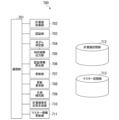
- 5 is a schematic block diagram showing the configuration of a HES server 500 in the embodiment.
- FIG. 7 is a schematic block diagram showing the configuration of an aggregation server 700 in the embodiment.
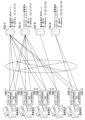
- FIG. 10 is a schematic diagram showing an example of the relationship between resources, a HES server 500, and an aggregation server 700 in the embodiment.
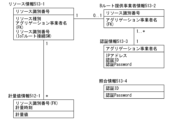
- FIG. 13 is an ER diagram for explaining the relationship between information stored in a measurement value storage unit 512 and a master storage unit 513 in the embodiment.
- FIG. 13 is a table showing an example of measurement value information stored in a measurement value storage unit 512 in the embodiment.
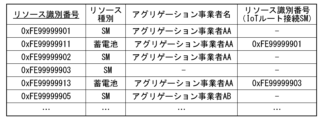
- 13 is a table showing an example of resource information stored in a master storage unit 513 in the embodiment.
- 13 is a table showing an example of B route provider information stored in a master storage unit 513 in the embodiment.
- 13 is a table showing an example of authentication information stored in a master storage unit 513 in the embodiment.
- 13 is a table showing an example of matching information stored in a master storage unit 513 in the embodiment.
- 13 is a sequence diagram illustrating an example of authentication processing when the HES server 500 in the embodiment communicates with the aggregation server 700.
- FIG. 11 is a sequence diagram illustrating an example of a process for updating resource information in the embodiment.
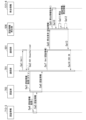
- FIG. 13 is a sequence diagram showing an example of a process for determining whether the HES server 500 has tampered with the data in the embodiment.
- FIG. 13 is a sequence diagram showing an example of a missing data complementation process of the HES server 500 in the embodiment.
- FIG. 13 is a flowchart illustrating a process of an update request unit 508 in the embodiment.
- 13 is a flowchart illustrating a process of a tamper determination unit 504 in the embodiment.
- 13 is a flowchart illustrating the processing of a missing data complementation unit 509 in the embodiment.
- This is an ER (Entity Relation) diagram explaining the relationship between the information stored in the measurement value memory unit 712 and the master memory unit 713 in this embodiment.
- 13 is a table showing an example of measurement value information stored in a measurement value storage unit 712 in the embodiment.
- 13 is a table showing an example of consumer resource information stored in a master storage unit 713 in the embodiment.
- 13 is a table showing an example of B route applied business information stored in the master storage unit 713 in the embodiment.
- 13 is a table showing an example of authentication information stored in a master storage unit 713 in the embodiment.
- 13 is a table showing an example of matching information stored in a master storage unit 713 in the embodiment.
- 13 is a sequence diagram illustrating an example of authentication processing when the aggregation server 700 in the embodiment communicates with the HES server 500.
- FIG. 13 is a sequence diagram illustrating an example of a process for updating resource information for each customer in the embodiment.
- FIG. 13 is a sequence diagram showing an example of a process of determining whether or not the aggregation server 700 has tampered with the data in the embodiment.
- FIG. 13 is a sequence diagram showing an example of a missing data complement process of the aggregation server 700 in the embodiment.
- FIG. 13 is a flowchart illustrating a process of an update request unit 708 in the embodiment.
- 13 is a flowchart illustrating a process of a tamper determination unit 704 in the embodiment.
- 13 is a flowchart illustrating the processing of a missing data complementing unit 709 in the embodiment.
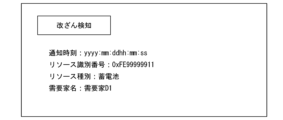
- 13 is a diagram showing an example of an output screen by a determination result output unit 705 in the embodiment.
- FIG. FIG. 2 is an explanatory diagram illustrating a hardware configuration of each device according to the embodiment.
- Fig. 1 is a schematic block diagram showing the configuration of a power information management system 10 according to the first embodiment of the present disclosure.
- the power information management system 10 includes a distributed power source 100, a PCS (Power Conditioning System) 200, an IoT root terminal 300, a smart meter 400, a HES (Head End System) server 500 (power information management device), a VPP (Virtual Power Plant) control terminal 600, and an aggregation server 700 (power information management device).
- Fig. 1 shows one each of the distributed power source 100, the PCS 200, the IoT root terminal 300, the smart meter 400, the HES server 500, the VPP control terminal 600, and the aggregation server 700, but there may be multiple of each.
- the distributed power sources 100 are small-scale power generation facilities that are distributed and placed adjacent to consumer areas.
- the distributed power sources 100 may be any power source, such as solar power generation, wind power generation, hydroelectric power generation, geothermal power generation, fuel cells, gas turbines, storage batteries, and electric vehicles.
- Multiple distributed power sources 100 are remotely and centrally controlled by an aggregation operator and are used to adjust the balance between supply and demand of electricity.
- the PCS 200 controls the distributed power source 100.
- the PCS 200 provides measurement values (e.g., power supply amount, power consumption amount) of the distributed power source 100.
- the IoT root terminal 300 acquires the measurement values of the distributed power source 100 from the PCS 200 and provides them to the HES server 500 via the smart meter 400.
- the VPP control terminal 600 also acquires the measurement values of the distributed power source 100 from the PCS 200 and provides them to the aggregation server 700.
- the IoT root terminal 300 relays communication between the PCS 200 and the smart meter 400 using a protocol such as ECHONET Lite (registered trademark).
- ECHONET Lite registered trademark
- the route from the IoT root terminal 300 to the smart meter 400 is the so-called IoT route.
- the smart meter 400 supplies the measurement values of the consumer (e.g., power consumption) and the measurement values of the distributed power source 100 to the HES server 500.
- This supply route is the so-called route A.
- the smart meter 400 can also supply the measurement values of the consumer to the aggregation server 700 via the VPP control terminal 600.
- This supply route is the so-called route B.
- the HES server 500 is a server operated by the power company, and collects and stores the metering values of consumers and the metering values of the distributed power sources 100.
- the VPP control terminal 600 is a terminal installed on the consumer side for the aggregation operator to perform integrated control of the distributed power sources 100, and controls the PCS 200 using a protocol such as ECHONET Lite (registered trademark).
- the aggregation server 700 is a server operated by the aggregation operator, and collects and stores the metered values of consumers and the metered values of the distributed power sources 100.
- the aggregation operator provides the electricity transmission and distribution operator with functions similar to those of a power plant by remotely and centrally controlling multiple distributed power sources 100.
- FIG. 2 is a schematic block diagram showing the configuration of the HES server 500 in this embodiment.
- the HES server 500 includes a communication unit 501, a measurement value collection unit 502, an authentication unit 503, a tamper determination unit 504, a determination result output unit 505, an authentication information matching unit 506, an update unit 507, an update request unit 508, a missing value completion unit 509, a measurement value request response generation unit 510, a master information update unit 511, a measurement value storage unit 512, and a master storage unit 513 (information storage unit).
- the communication unit 501 communicates with other devices such as the smart meter 400 and the aggregation server 700. Each unit constituting the HES server 500 communicates with other devices via the communication unit 501.
- the meter value collector 502 acquires the meter values of the consumer and the distributed power source 100 from the smart meter 400 and stores them in the meter value memory 512.
- the combination of the PCS 200 and the distributed power source 100 that provide the meter values, and the smart meter 400, are referred to as resources.
- the authentication unit 503 sends authentication information to the aggregation server 700 to request authentication.
- the tampering determination unit 504 obtains the resource metric values from the aggregation server 700, and compares the metric values stored in the device with the metric values obtained from the aggregation server 700 to determine whether tampering has occurred.
- the resource metric values at this time are obtained from the aggregation server 700 corresponding to the aggregation operator name (operator identification information) stored in association with resource identification information that identifies the resource.
- the determination result output unit 505 outputs the determination result by the tamper determination unit 504, for example, to an operation screen or notification screen of the HES server 500.
- the output destination may be the screen of an operation terminal or maintenance terminal capable of communicating with the HES server 500, or may be an audio output.
- the authentication information matching unit 506 compares the authentication information received from the aggregation server 700 with the matching information stored in the master storage unit 513, and authenticates the aggregation server 700.
- the authentication information matching unit 506 transmits the authentication result to the aggregation server 700.
- the update unit 507 receives a request to update resource information from the aggregation server 700 and updates the resource information stored in the master storage unit 513.
- the update request unit 508 sends an update request for the consumer resource information to the aggregation server 700.
- the missing value complementation unit 509 detects a missing value in the measurement value of a distributed power source stored in the measurement value storage unit 512, it obtains the measurement value for the period corresponding to the missing value from the aggregation server 700 and complements the measurement value stored in the device itself.
- the resource measurement value at this time is obtained from the aggregation server 700 corresponding to the aggregation operator name stored in association with the resource identification information that identifies the resource.
- the metric value request response generation unit 510 reads the metric value information requested by the aggregation server 700 from the metric value storage unit 512 and transmits it to the aggregation server 700.
- the master information update unit 511 updates the resource information, Route B subscriber business information, authentication information, and matching information stored in the master storage unit 513 based on input operations by the operator of the HES server 500.
- the measurement value storage unit 512 stores measurement value information.
- the measurement value information is information including a resource identification number, a measurement time, and a measurement value.
- the resource identification number is information for identifying each of the PCS 200 and the smart meter 400, and may be, for example, an ECHONETLite (registered trademark) protocol number, a number that combines the manufacturer and the product serial number, or other information.
- the master memory unit 513 stores resource information, B route provider information, authentication information, and matching information.
- the resource information is information about each resource, and includes a resource identification number (resource identification information), a resource type, and an aggregation provider name (provider identification information). Furthermore, if the resource type is not a smart meter, the resource information may include the resource identification number of the smart meter 400 to which the resource is connected via the IoT route.
- the B route provider information is information about each smart meter 400, and includes the resource identification number and the name of the aggregation provider to which the smart meter 400 provides metered values via the B route.
- the authentication information is information about each aggregation provider, and includes the aggregation provider name, the IP address of the aggregation server 700, an authentication ID, and an authentication password.
- the matching information is information that is matched with the authentication information during authentication for communication connection with the HES server 500, and includes the authentication ID and authentication password. The matching information may differ depending on the device that communicates with the HES server 500.
- FIG. 3 is a schematic block diagram showing the configuration of an aggregation server 700 in this embodiment.
- the aggregation server 700 includes a communication unit 701, a metric value collection unit 702, an authentication unit 703, a tamper determination unit 704, a determination result output unit 705, an authentication information matching unit 706, an update unit 707, an update request unit 708, a missing value completion unit 709, a metric value request response generation unit 710, a master information update unit 711, a metric value storage unit 712, and a master storage unit 713 (information storage unit).
- the communication unit 701 communicates with other devices such as the VPP control terminal 600 and the HES server 500. Each unit constituting the aggregation server 700 communicates with other devices via the communication unit 701.
- the metered value collection unit 702 acquires the metered values of the consumer and the distributed power source 100 via the VPP control terminal 600 and stores them in the metered value storage unit 712.
- the authentication unit 703 sends authentication information to the HES server 500 to request authentication.
- the tamper determination unit 704 obtains the resource measurement values from the HES server 500, and compares the measurement values stored in the device with the measurement values obtained from the HES server 500 to determine whether or not tampering has occurred.
- the resource measurement values at this time are obtained from the HES server 500, which stores the power company name (business operator identification information) in association with the resource identification information that identifies the resource.
- the determination result output unit 705 outputs the determination result by the tamper determination unit 704 to, for example, an operation screen or a notification screen of the aggregation server 700.
- the output destination may be the screen of an operation terminal or a maintenance terminal capable of communicating with the aggregation server 700, or may be an audio output.
- the authentication information matching unit 706 compares the authentication information received from the HES server 500 with the matching information stored in the master storage unit 713 to authenticate the HES server 500.
- the authentication information matching unit 706 transmits the authentication result to the HES server 500.
- the update unit 707 receives an update request for the consumer-specific resource information received from the HES server 500 and updates the consumer-specific resource information stored in the master storage unit 713.
- the update request unit 708 sends a resource information update request to the HES server 500.
- the missing value complementation unit 709 detects a missing value in the measurement value of a distributed power source stored in the measurement value storage unit 712, it obtains the measurement value for the period corresponding to the missing value from the HES server 500 and complements the measurement value stored in the device itself.
- the resource measurement value at this time is obtained from the HES server 500 corresponding to the power company name stored in association with the resource identification information that identifies the resource.
- the measurement value request response generation unit 710 reads the measurement value information requested by the HES server 500 from the measurement value storage unit 712 and transmits it to the HES server 500.
- the master information update unit 711 updates the consumer resource information, B-route application business information, authentication information, and matching information stored in the master storage unit 713 based on input operations by the operator of the aggregation server 700.
- the measurement value storage unit 712 stores measurement value information.
- the master storage unit 713 stores consumer-specific resource information, B-route application business information, authentication information, and matching information.
- Consumer-specific resource information is information about each resource, and includes a resource identification number, resource type, consumer name, and power company name (business identification information).
- B-route application business information is information about each smart meter 400 that has applied for B-route, and includes a resource identification number and power company name.
- Authentication information is information about each power company, and includes the power company name, IP address of the HES server 500, authentication ID, and authentication password.
- Matching information is information that is matched with the authentication information during authentication for communication connection with the aggregation server 700, and includes the authentication ID and authentication password. Matching information may differ depending on the device that communicates with the aggregation server 700.
- FIG. 4 is a schematic diagram showing an example of the relationship between resources and the HES server 500 and aggregation server 700 in this embodiment.
- the relationship shown in FIG. 4 shows which HES server 500 and aggregation server 700 collects the measurement values of each resource.
- the measurement values from the smart meter 400 are the measurement values of the consumer, and the measurement values from the PCS 200 are the measurement values of the distributed power source.
- the measurement values from the smart meter 400-1 of consumer D1 are collected by the HES server 500-A of the power company PA and the aggregation server 700-A of the aggregation operator AA.
- the measurement values from the PCS 200-1 of consumer D1 are collected by the HES server 500-A of the power company PA and the aggregation server 700-A of the aggregation operator AA.
- the measured values from the smart meter 400-2 of consumer D2 are collected by the HES server 500-A of the power company PA and the aggregation server 700-A of the aggregation operator AA.
- the measured values from the PCS 200-1 of consumer D2 are collected by the aggregation server 700-A of the aggregation operator AA.
- the measured values from the smart meter 400-3 of consumer D3 are collected by the HES server 500-A of the power company PA.
- the measured values from the PCS 200-3 of consumer D3 are collected by the HES server 500-A of the power company PA and the aggregation server 700-A of the aggregation operator AA.
- the measured values from the smart meter 400-4 of consumer D4 are collected by the HES server 500-B of the power company PB and the aggregation server 700-A of the aggregation operator AA.
- the measured values from the smart meter 400-5 of consumer D5 are collected by the HES server 500-A of the power company PA and the aggregation server 700-B of the aggregation operator AB.
- the measured values from the PCS 200-5 of consumer D5 are collected by the aggregation server 700-B of the aggregation operator AB.
- the measurement values from the PCS 200 are not necessarily collected by the HES server 500, but when they are collected by the HES server 500, they are collected by the HES server 500 that is collecting the measurement values from the smart meter 400 of the same consumer as the PCS 200.
- the aggregation server 700 that is collecting the measurement values from the PCS 200 also collects the measurement values from the smart meter 400 of the same consumer as the PCS 200.
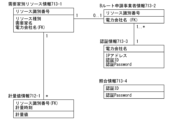
- FIG. 5 is an ER (Entity Relationship) diagram explaining the relationship between the information stored in the measurement value storage unit 512 and the master storage unit 513 in this embodiment.
- Resource information 513-1 for one element includes a key resource identification number, a resource type, an aggregation operator name, and a resource identification number (smart meter 400 connected via an IoT route).
- Measurement value information 512-1 for multiple elements is associated with resource information 513-1 for one element.
- Measurement value information 512-1 for one element includes a key resource identification number and measurement time, and a measurement value.
- B route provider information 513-2 is associated with one element of resource information 513-1.
- One element of B route provider information 513-2 includes key resource identification information and an aggregation provider name.
- One element of authentication information 513-3 is associated with one element or multiple elements of B route provider information 513-2.
- One element of authentication information 513-3 includes key aggregation provider name, IP address, authentication ID, and authentication password.
- one element of matching information 513-4 includes an authentication ID that serves as a key, and an authentication password.
- Figure 6 is a table showing an example of measurement value information stored by the measurement value storage unit 512 in this embodiment.
- the measurement value storage unit 512 stores, as measurement value information, a resource identification number "0xFE99999901", a measurement time "2023/1/16 10:00", and a measurement value "100" in association with each other.
- the measurement value storage unit 512 stores, as measurement value information, a resource identification number "0xFE99999901”, a measurement time "2023/1/16 10:30", and a measurement value "150” in association with each other.
- the measurement value storage unit 512 stores, as measurement value information, a resource identification number "0xFE99999911", a measurement time "2023/1/16 10:00", and a measurement value "200” in association with each other.
- the measurement value storage unit 512 stores the resource identification number "0xFE99999902", the measurement time "2023/1/16 10:00", and the measurement value "50" in association with each other.
- the measurement value storage unit 512 stores the resource identification number "0xFE99999903", the measurement time “2023/1/16 10:00", and the measurement value "60” in association with each other.
- the measurement value storage unit 512 stores the resource identification number "0xFE99999913", the measurement time "2023/1/16 10:00", and the measurement value "120” in association with each other.
- the measurement value storage unit 512 stores the resource identification number "0xFE99999905”, the measurement time "2023/1/16 10:00", and the measurement value "20” in association with each other.
- FIG. 7 is a table showing an example of resource information stored in the master storage unit 513 in this embodiment.
- the master storage unit 513 stores, as resource information, a resource identification number "0xFE99999901", a resource type "SM”, an aggregation operator name "Aggregation operator AA”, and a resource identification number (IoT route connected smart meter 400) "-" in association with each other.
- the resource identification number (IoT route connected smart meter 400) "-" indicates that there is no corresponding smart meter 400.
- the master storage unit 513 stores, as resource information, a resource identification number "0xFE99999911", a resource type “storage battery”, an aggregation operator name "Aggregation operator AA”, and a resource identification number (IoT route connected smart meter 400) "0xFE99999901" in association with each other.
- the master storage unit 513 stores the resource identification number "0xFE99999902", the resource type “SM”, the aggregation operator name "Aggregation operator AA”, and the resource identification number (smart meter 400 connected via the IoT route) "-" in association with each other.
- the master storage unit 513 stores the resource identification number "0xFE99999903", the resource type "SM”, the aggregation operator name "-”, and the resource identification number (smart meter 400 connected via the IoT route) "-” in association with each other.
- the aggregation operator name "-" indicates that there is no aggregation operator (aggregation server 700) that is collecting the measurement values of the corresponding resource.
- the master storage unit 513 stores the resource identification number "0xFE99999913", the resource type "storage battery”, the aggregation operator name “aggregation operator AA”, and the resource identification number (smart meter 400 connected via the IoT route) "0xFE99999903” in association with each other.
- the master storage unit 513 stores the resource identification number "0xFE99999905”, the resource type “SM”, the aggregation operator name “aggregation operator AB”, and the resource identification number (smart meter 400 connected via the IoT route) "-" in association with each other.
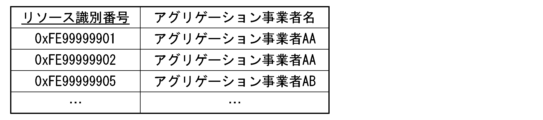
- FIG. 8 is a table showing an example of route B provider information stored in the master storage unit 513 in this embodiment.
- the master storage unit 513 stores, as route B provider information, a resource identification number "0xFE99999901" and an aggregation provider name "Aggregation provider AA" in association with each other.
- the master storage unit 513 stores a resource identification number "0xFE99999902” and an aggregation provider name "Aggregation provider AA" in association with each other.
- the master storage unit 513 stores a resource identification number "0xFE99999905" and an aggregation provider name "Aggregation provider AB" in association with each other.
- FIG. 9 is a table showing an example of authentication information stored by the master storage unit 513 in this embodiment.
- the master storage unit 513 stores, as authentication information, the aggregation operator name "Aggregation operator AA", the IP address "222.111.111.111”, the authentication ID "AGG-A”, and the authentication password "AGG-A-PASSWORD", in association with each other.
- the master storage unit 513 stores, as authentication information, the aggregation operator name "Aggregation operator AB”, the IP address "222.222.222.222", the authentication ID "AGG-B”, and the authentication password "AGG-B-PASSWORD", in association with each other.
- FIG. 10 is a table showing an example of matching information stored in the master storage unit 513 in this embodiment.
- the master storage unit 513 stores the authentication ID "HES-A” and the authentication password "HES-A-PASSWORD" in association with each other as matching information.
- FIG. 11 is a sequence diagram explaining an example of authentication processing when the HES server 500 in this embodiment connects to the aggregation server 700 for communication.
- the communication unit 501 sends HTTP Get() to the communication unit 701 (sequence Sh1).
- the communication unit 701 receives the Get() of sequence Sh1, it returns 401 Unauthorized to the communication unit 501 indicating authentication failure because the HES server 500 is not authenticated (sequence Sh2).
- the communication unit 501 requests the authentication unit 503 to acquire authentication information including the IP address of the aggregation server 700 (sequence Sh3).
- the authentication unit 503 refers to the authentication information 513-3 in the master storage unit 513 (sequence Sh4) and acquires the authentication information (authentication ID, authentication password) for the IP address included in the request to acquire authentication information (sequence Sh5).
- the authentication unit 503 returns the acquired authentication information to the communication unit 501 as a response to sequence Sh3 (sequence Sh6).
- the communication unit 501 When the communication unit 501 receives the authentication information of sequence Sh6, it sends Get() including the authentication information to the communication unit 701 (sequence Sh7).
- the communication unit 701 receives Get() including the authentication information of sequence Sh7, it passes a matching request including the authentication information to the authentication information matching unit 706 (sequence Sh8).
- the authentication information matching unit 706 receives the matching request of sequence Sh8, it refers to the matching information 713-4 in the master storage unit 713 (sequence Sh9) and acquires the matching information (sequence Sh10).
- the authentication information matching unit 706 then invokes a process to match the authentication information received in sequence Sh8 with the matching information acquired in sequence Sh10 (sequence Sh11) and acquires the matching result (sequence Sh12).
- the authentication information and the matching information match, so the authentication information matching unit 706 returns a matching result to the communication unit 701 as a response to sequence Sh8 (sequence Sh13).
- the communication unit 701 transmits 200 OK, indicating that authentication has been achieved, to the communication unit 501 as a response to sequence Sh7 (sequence Sh14).
- FIG. 12 is a sequence diagram illustrating an example of the resource information update process in this embodiment.
- the metered value collector 502 or the master information updater 511 requests the resource to be added (addition of one element of resource information) to the resource information 513-1 in the master memory 513 (sequence Si1).
- the master memory 513 adds the resource to the resource information 513-1, and then notifies the update requester 508 of the resource addition (sequence Si2).
- the information added to the resource information 513-1 includes the resource identification number, resource type, and resource identification number (IoT route connection SM), but does not include the aggregation operator name. Note that the aggregation operator name is included in the request to add resources.
- the update request unit 508 When the update request unit 508 receives the notification of sequence Si2, it requests the resource information 513-1 to obtain the resource identification number (smart meter 400 connected via the IoT route) of the added resource information (hereinafter referred to as update information) (sequence Si3).
- the master storage unit 513 obtains the resource identification number requested in sequence Sbi from the resource information 513-1 and returns it to the update request unit 508 (sequence Si4).
- the update request unit 508 When the update request unit 508 receives the resource identification number in sequence Si4, it requests the authentication information 513-3 in the master storage unit 513 to obtain the IP address associated with the aggregation operator name included in the added resource information (sequence Si5).
- the master storage unit 513 obtains the IP address requested in sequence Si5 from the authentication information 513-3 and returns it to the update request unit 508 (sequence Si6). Note that in sequence Si6, in addition to the IP address, the authentication ID and authentication password are also passed to the update request unit 508.
- the update request unit 508 makes a request to the communication unit 501 to update the update information (sequence Si7).
- the IP address, authentication ID, and authentication password passed to the update request unit 508 in sequence Si6 are also passed to the communication unit 501, and the update information includes the resource identification number received in sequence Si4, i.e., the resource identification number of the smart meter 400.
- the communication unit 501 requests authentication from the communication unit 701 (sequence Si8).
- the communication unit 501 uses the passed IP address, authentication ID, and authentication password.
- the communication unit 701 authenticates the HES server 500 in the same manner as the authentication process shown in FIG. 11 (sequence Si9) and returns 200 OK to the communication unit 501 (sequence Si10).
- the communication unit 501 When the communication unit 501 receives the 200 OK of sequence Si10, it sends the update information to the communication unit 701 using HTTP Put() (sequence Si11).
- the communication unit 701 receives the update information of sequence Si11, it makes an update request including the update information to the update unit 707 (sequence Si12).
- the update unit 707 receives the update request including the update information of sequence Si12, it makes an update request including the update information to the consumer-specific resource information 713-1 in the master memory unit 713 (sequence Si13).
- the master memory unit 713 When the master memory unit 713 has consumer-specific resource information 713-1 whose resource identification number matches the update information, it adds the name of the power company of the HES server 500 that sent the update information to the consumer-specific resource information 713-1.
- the master storage unit 713 does not have customer-specific resource information 713-1 whose resource identification number matches the update information, it does not add anything to the customer-specific resource information 713-1.
- the master memory unit 713 When the master memory unit 713 receives the update request of sequence Si13 and updates the consumer-specific resource information 713-1 by adding the power company name, it returns the update result (here, the update is successful) to the update unit 707 (sequence Si14).
- the update unit 707 receives the update result of sequence Si14, it returns the update result to the communication unit 701 as a response to the update request of sequence Si12 (sequence Si15).
- the communication unit 701 receives the update result of sequence Si15, it returns the update result to the communication unit 501 as a response to the Put of sequence Si11 (sequence Si16).
- the communication unit 501 When the communication unit 501 receives the update result of sequence Si16, it returns the update result to the update request unit 508 in response to the update request of sequence Si7 (sequence Si17).
- the update request unit 508 receives the update result of sequence Si17, the update result is a successful update, so it adds the aggregation provider name to the resource information 513-1 in the master memory unit 513 (sequence Si18).
- the master memory unit 513 returns the update result due to the addition to the update request unit 508 (sequence Si19).
- the aggregation server 700 of the aggregation provider name stores the same resource identification number, that is, the aggregation server 700 collects the metered values of the same distributed power source 100 via route B, so the update request unit 508 adds the aggregation provider name in the resource information requested to be added to the resource information 513-1.
- the update result is not a successful update (update failure)
- FIG. 13 is a sequence diagram showing an example of the tampering determination process of the HES server 500 in this embodiment.
- the tampering determination unit 504 specifies the resource identification number of the PCS 200 of the distributed power source 100 for which tampering is to be determined, and obtains the aggregation operator name associated with the resource identification number from the resource information 513-1 in the master storage unit 513 (sequences Sk1 and Sk2).
- the tampering determination unit 504 obtains the IP address, authentication ID, and authentication password associated with the obtained aggregation operator name from the authentication information 513-3 in the master storage unit 513 (sequences Sk3 and Sk4).
- the tamper determination unit 504 requests the communication unit 501 for the resource identification number for which tamper determination is to be performed and the measurement value information for the target period (sequence Sk5). At this time, the tamper determination unit 504 also passes the IP address, authentication ID, and authentication password acquired in sequences Sk3 and Sk4 to the communication unit 501. From then on, sequences Sk6 to Sk14 are the same as sequences Sj10 to Sj18 in FIG. 26 if the missing period is read as the target period.
- the communication unit 501 returns the measurement value information returned in sequence Sk14 to the tampering determination unit 504 as a response to the request in sequence Sk5 (sequence Sk15).
- the tampering determination unit 504 invokes a determination process (sequence Sk16).
- the tampering determination unit 504 acquires the resource identification number for which the tampering determination is to be performed and the measurement value for the target period from the measurement value information 512-1 in the measurement value storage unit 512 (sequences Sk17, Sk18), and compares the acquired measurement value information with the measurement value information returned in sequence Sk15 to determine whether tampering has occurred (sequence Sk19).
- the tampering determination unit 504 may determine whether or not tampering has occurred in sequence Sk19, if the measurement time of the measurement value information obtained from the aggregation server 700 does not match the collection period or collection start timing of the measurement value information stored in the measurement value storage unit 512, the tampering determination unit 504 may determine whether or not tampering has occurred by using values obtained by interpolating the measurement value obtained from the aggregation server 700. Specifically, the tampering determination unit 504 may make the determination as follows.
- the measurement value of the aggregation server 700 is interpolated (linearly interpolated, etc.) to match the collection start timing of the HES server 500 and used for tampering determination.
- a metric value of the least common multiple of the collection cycles is used to determine whether or not data has been tampered with.
- the long-period measurement values are interpolated (by linear interpolation, etc.) to match the periods of the short-period measurement values and used to determine whether or not the data has been tampered with.
- FIG. 14 is a sequence diagram showing an example of the missing data completion process of the HES server 500 in this embodiment.
- the missing data completion unit 509 calls the missing data confirmation process by specifying a resource identification number and a period (sequence Sj1).
- the missing data completion unit 509 obtains the measurement value information of the specified resource identification number and period from the measurement value information 512-1 in the measurement value storage unit 512 (sequences Sj2, Sj3), and checks whether the measurement time of the measurement value information is in a specified cycle. If even a part of the measurement value does not have the specified cycle, the missing data completion unit 509 sets the period that does not have the specified cycle as a missing period (sequence Sj4).
- the missing data completion unit 509 determines the missing data period, it obtains the aggregation provider name to be stored in association with the specified resource identification number from the resource information 513-1 in the master storage unit 513 (sequences Sj5 and Sj6). Next, the missing data completion unit 509 obtains the IP address, authentication ID, and authentication password to be stored in association with the obtained aggregation provider name from the authentication information 513-3 in the master storage unit 513 (sequences Sj7 and Sj8).
- the missing data completion unit 509 requests the communication unit 501 for the specified resource identification number and measurement value information for the missing period (sequence Sj9). At this time, the missing data completion unit 509 also passes the IP address, authentication ID, and authentication password acquired in sequences Sj7 and Sj8 to the communication unit 501. The communication unit 501 performs authentication processing with the communication unit 701 using the passed IP address, authentication ID, and authentication password in the same manner as in FIG. 11 (sequences Sj10, Sj11, Sj12).
- the communication unit 501 sends Get() including the resource identification number and missing period requested in sequence Sj9 to the communication unit 701 (sequence Sj13).
- the communication unit 701 receives Get() in sequence Sj13, it requests the resource identification number and measurement value information for the missing period included in Get() from the metric value request response generation unit 710 (sequence Sj14).
- the metric value request response generation unit 710 obtains the measurement value information from the metric value storage unit 712 in accordance with the request (sequences Sj15, Sj16).
- the measurement value request response generation unit 710 returns the acquired measurement value information to the communication unit 701 as a response to sequence Sj14 (sequence Sj17).
- the communication unit 701 returns the measurement value information returned in sequence Sj17 to the communication unit 501 as a response to Get() in sequence Sj13 (sequence Sj18).
- the communication unit 501 returns the measurement value information returned in sequence Sj18 to the missing value completion unit 509 as a response to the request in sequence Sj9 (sequence Sj19).
- the missing data completion unit 509 calls the missing data completion process (sequence Sj20), uses the measurement value information to complete the missing parts of the measurement value information 512-1 (sequences Sj21, Sj22), and ends the missing data completion process (sequence Sj23).
- the missing data complement unit 509 may complement the measurement value using a value obtained by interpolating the measurement value acquired from the aggregation server 500.
- the missing data complement unit 509 may perform complementation as follows.
- the collection cycle is the interval between the measurement times of the measurement value information.
- the collection start timing indicates the time at which the collection cycle for the measurement time of the measurement value information starts.
- the measurement values of the aggregation server 700 are interpolated (linearly interpolated, etc.) to match the collection start timing of the HES server 500 and used for missing data completion.
- the metric value of the least common multiple of the collection cycles is used for missing data completion.
- - Short-term metric values are used to complement missing long-term metric values.
- - Long-period metric values are interpolated (linearly, etc.) to match the periods of short-period metric values and used to fill in missing data.
- FIG. 15 is a flowchart explaining the processing of the update request unit 508 in this embodiment.
- the update request unit 508 acquires the resource identification number of the smart meter 400 that is connected to the distributed power source 100 to be updated via the IoT route from the resource information 513-1 (resource table) (step Sl1).
- the update request unit 508 acquires the name of the aggregation operator that provides route B to the smart meter 400 with the resource identification number acquired in step Sl1 from the resource table (step Se2).
- the update request unit 508 determines whether the aggregation operator name that was the subject of acquisition in step Sl2 is in the resource table (step Sl3).
- the update request unit 708 may determine that the aggregation operator name is present when the aggregation operator name can be acquired in step Sl2, and may determine that the aggregation operator name is not present when the aggregation operator name cannot be acquired.
- the update request unit 508 obtains the IP address (destination IP address) associated with the power company name from the authentication information 513-3 (authentication information table) (step Sl4).
- the update request unit 508 transmits update information for the distributed power source 100 to the aggregation server 700 of the IP address obtained in step Sl4 (step Sl5).
- the update information for the distributed power source 100 may be information for adding the distributed power source 100, or information for updating information related to the distributed power source.
- the update request unit 508 then obtains the update result from the aggregation server 700 (step Sl6).
- the update request unit 508 then refers to the obtained update result and determines whether or not the information of the distributed power source 100 has been updated in the aggregation server 700 (step Sl7). Note that the update request unit 508 may determine that the information of the distributed power source 100 has been updated if the update result is a successful update, and may determine that the information of the distributed power source 100 has not been updated if the update result is a failed update.
- step Sl7-Yes If it is determined that the information on the distributed power source 100 has been updated (step Sl7-Yes), the update request unit 508 updates the aggregation provider name of the resource to be updated in the resource table to the aggregation provider name acquired in step Sl2 (step Sl8). If it is determined in step Sl3 that there is no aggregation provider name (step Sl3-No) or if it is determined in step Sl7 that the information on the distributed power source 100 has not been updated (step Sl7-No), the update request unit 508 ends the process.
- FIG. 16 is a flowchart explaining the processing of the missing data completion unit 509 in this embodiment.
- the missing data completion unit 509 refers to the metric information 512-1 (metric value table) to calculate the missing data period for the target resource and time period, and determines whether or not there is a missing data period (step Sm1). If it is determined that there is a missing data period (step Sm1-Yes), the missing data completion unit 509 refers to the resource table and obtains the name of the aggregation provider corresponding to the target resource, thereby determining whether or not there is a missing data provider name (step Sm2).
- the missing data completion unit 509 refers to the resource table and obtains the name of the aggregation provider corresponding to the target resource, thereby determining whether or not there is a missing data provider name (step Sm2).
- the missing data completion unit 509 obtains the IP address (destination IP address) associated with the power company name obtained in step Sm2 from the authentication information table (step Sm3). Next, the missing data completion unit 509 requests the aggregation server 700 of the IP address obtained in step Sm3 to obtain measurement values (missing values) for the missing period (step Sm4). Next, the missing data completion unit 509 obtains the result of the request in step Sm4 (step Sm5).
- the missing data completion unit 509 determines whether the results obtained in step Sm5 contain metric values that complete the missing data (step Sm6). If it is determined that there are metric values that complete the missing data (missing data completion values) (step Sm6-Yes), the missing data completion unit 509 registers the missing data completion values in the metric value table (step Sm7).
- step Sm1-None if it is determined in step Sm1 that there is no missing data period (step Sm1-None), if it is determined in step Sm2 that there is no aggregation operator name (step Sm2-None), or if it is determined in step Sm6 that there is no missing data completion value (step Sm6-No), the missing data completion unit 509 ends the process.
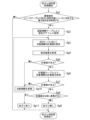
- FIG. 17 is a flowchart explaining the processing of the tampering determination unit 504 in this embodiment.
- the tampering determination unit 504 determines whether or not the aggregation provider name is present by obtaining the aggregation provider name corresponding to the resource that is the target of the tampering determination from the resource table (step Sn1). If it is determined that the aggregation provider name is present (step Sn1-Yes), the tampering determination unit 504 obtains the IP address (destination IP address) associated with the aggregation provider name obtained in step Sn1 from the authentication information table (step Sn2).
- IP address destination IP address
- the tampering determination unit 504 requests metric value information for the period targeted for tampering determination from the aggregation server 700 of the IP address acquired in step Sn2 (step Sn3).
- the tampering determination unit 504 acquires the result of the request in step Sn3 (step Sn4).
- the tampering determination unit 504 determines whether or not the request result acquired in step Sn4 contains metric value information (step Sn5-Yes). If it is determined that the request result contains metric value information (step Sn5-Yes), the tampering determination unit 504 acquires metric value information for the target period from the metric value table (step Sn6).
- the tampering determination unit 504 determines whether or not measurement value information for the target period was obtained in step Sn6, i.e., whether or not measurement value information for the target period is available (step Sn7). If it is determined that measurement value information for the target period is available (step Sn7-Yes), the tampering determination unit 504 compares the measurement value information determined to be available in step Sn5 with the measurement value information determined to be available in step Sn7, and determines whether or not there is a difference between them (step Sn8). Note that, for example, if one of the measurement values has been calculated by interpolation, the tampering determination unit 504 may determine that there is no difference even if the measurement value information does not match completely, as long as the difference is within a predetermined range.
- step Sn8-No If it is determined that there is no difference (step Sn8-No), the tampering determination unit 504 determines that there is no tampering (step Sn9). On the other hand, if it is determined that there is a difference (step Sn8-Yes), the tampering determination unit 504 determines that there is tampering (step Sn11).
- step Sn5-none if it is determined in step Sn5 that there is no measurement value information (step Sn5-none), or if it is determined in step Sn7 that there is no measurement value information (step Sn7-none), the tampering determination unit 504 updates the target period and returns to step Sn3.Furthermore, if it is determined in step Sn1 that there is no aggregation operator name (step Sn1-none), the tampering determination unit 504 ends the process.
- FIG. 18 is an ER diagram explaining the relationship between the information stored in the measurement value storage unit 712 and the master storage unit 713 in this embodiment.
- One element of consumer-specific resource information 713-1 includes a key resource identification number, a resource type, a consumer name, and a power company name.
- Multiple elements of measurement value information 712-1 are associated with one element of consumer-specific resource information 713-1.
- One element of measurement value information 712-1 includes a key resource identification number and measurement time, and a measurement value.
- B-route applied business information 713-2 is associated with one element of consumer-specific resource information 713-1.
- One element of B-route applied business information 713-2 includes key resource identification information and the power company name.
- One element of authentication information 713-3 is associated with one element or multiple elements of B-route applied business information 713-2.
- One element of authentication information 713-3 includes key power company name, IP address, authentication ID, and authentication password.
- one element of matching information 713-4 includes an authentication ID that serves as a key, and an authentication password.
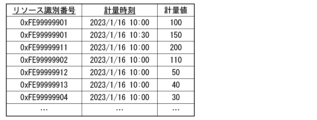
- the measurement value storage unit 712 stores, as measurement value information, a resource identification number "0xFE99999901", a measurement time "2023/1/16 10:00", and a measurement value "100" in association with each other.
- the measurement value storage unit 712 stores, as measurement value information, a resource identification number "0xFE99999901", a measurement time "2023/1/16 10:30", and a measurement value "150” in association with each other.
- the measurement value storage unit 712 stores, as measurement value information, a resource identification number "0xFE99999911", a measurement time "2023/1/16 10:00", and a measurement value "200” in association with each other.
- the measurement value storage unit 712 stores the resource identification number "0xFE99999902", the measurement time "2023/1/16 10:00", and the measurement value "110" in association with each other.
- the measurement value storage unit 712 stores the resource identification number "0xFE99999912", the measurement time “2023/1/16 10:00", and the measurement value "50” in association with each other.
- the measurement value storage unit 712 stores the resource identification number "0xFE99999913", the measurement time “2023/1/16 10:00", and the measurement value "40” in association with each other.
- the measurement value storage unit 712 stores the resource identification number "0xFE99999904", the measurement time "2023/1/16 10:00", and the measurement value "30" in association with each other.
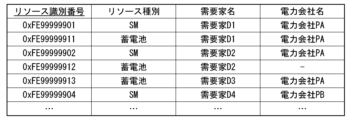
- the master storage unit 713 stores, as consumer-specific resource information, a resource identification number "0xFE99999901", a resource type "SM", a consumer name "Consumer D1", and a power company name "Power Company PA” in association with each other.
- the resource type "SM” represents a smart meter.
- the master storage unit 713 stores a resource identification number "0xFE99999911”, a resource type “storage battery”, a consumer name "Consumer D1", and a power company name "Power Company PA” in association with each other.
- the resource type "storage battery” represents that the distributed power source 100 controlled by the PCS 200 is a storage battery.
- the master memory unit 713 stores the resource identification number "0xFE99999902", the resource type "SM”, the consumer name “Consumer D2”, and the power company name "Power Company PA” in association with each other.
- the master memory unit 713 stores the resource identification number "0xFE99999912", the resource type "storage battery”, the consumer name "Consumer D2", and the power company name "-” in association with each other.
- the power company name "-" indicates that there is no power company (HES server 500) that is collecting the measurement values of the corresponding resource.
- the master memory unit 713 stores the resource identification number "0xFE99999913", the resource type "storage battery”, the consumer name "consumer D3", and the power company name "power company PA” in association with each other.
- the master memory unit 713 stores the resource identification number "0xFE99999904”, the resource type "SM”, the consumer name "consumer D4", and the power company name "power company PB” in association with each other.
- FIG. 21 is a table showing an example of route B applied business information stored in the master storage unit 713 in this embodiment.
- the master storage unit 713 stores the resource identification number "0xFE99999901" and the power company name "Power Company PA” in association with each other as route B applied business information.
- the master storage unit 713 stores the resource identification number "0xFE99999902" and the power company name "Power Company PA” in association with each other.
- the master storage unit 713 stores the resource identification number "0xFE99999904" and the power company name "Power Company PB" in association with each other.
- FIG. 22 is a table showing an example of authentication information stored by the master storage unit 713 in this embodiment.
- the master storage unit 713 stores, as authentication information, the power company name "Power Company PA”, the IP address "111.111.111.111”, the authentication ID "HES-A”, and the authentication password "HES-A-PASSWORD", in association with each other.
- the master storage unit 713 stores, as authentication information, the power company name "Power Company PB", the IP address "111.222.222.222", the authentication ID "HES-B”, and the authentication password "HES-B-PASSWORD", in association with each other.
- FIG. 23 is a table showing an example of matching information stored in the master storage unit 713 in this embodiment.
- the master storage unit 713 stores, as matching information, an authentication ID "AGG-A” and an authentication password "AGG-A-PASSWORD" in association with each other.
- FIG. 24 is a sequence diagram explaining an example of authentication processing when the aggregation server 700 in this embodiment connects to the HES server 500 for communication.
- the communication unit 701 sends a Get() of HTTP (Hypertext Transfer Protocol) to the communication unit 501 (sequence Sa1).
- the communication unit 501 receives the Get() of sequence Sa1, it returns 401 Unauthorized to the communication unit 701 indicating authentication failure because the aggregation server 700 has not been authenticated (sequence Sa2).
- the communication unit 70 upon receiving 401 Unauthorized in sequence Sa2, requests the authentication unit 703 to acquire authentication information including the IP address of the HES server 500 (sequence Sa3).
- the authentication unit 703 Upon receiving the request to acquire authentication information in sequence Sa3, the authentication unit 703 refers to the authentication information 713-3 in the master storage unit 713 (sequence Sa4) and acquires the authentication information (authentication ID, authentication password) for the IP address included in the request to acquire authentication information (sequence Sa5).
- the authentication unit 703 returns the acquired authentication information to the communication unit 701 as a response to sequence Sa3 (sequence Sa6).
- the communication unit 701 When the communication unit 701 receives the authentication information of sequence Sa6, it sends Get() including the authentication information to the communication unit 501 (sequence Sa7).
- the communication unit 501 receives Get() including the authentication information of sequence Sa7, it passes a matching request including the authentication information to the authentication information matching unit 506 (sequence Sa8).
- the authentication information matching unit 506 receives the matching request of sequence Sa8, it refers to the matching information 513-4 in the master storage unit 513 (sequence Sa9) and acquires the matching information (sequence Sa10).
- the authentication information matching unit 506 then invokes a process to match the authentication information received in sequence Sa8 with the matching information acquired in sequence Sa10 (sequence Sa11) and acquires the matching result (sequence Sa12).
- the authentication information and the matching information match, so the authentication information matching unit 506 returns a matching result to the communication unit 501 as a response to sequence Sa8 (sequence Sa13).
- the communication unit 501 transmits 200 OK, indicating that authentication has been achieved, to the communication unit 701 as a response to sequence Sa7 (sequence Sa14).
- FIG. 25 is a sequence diagram explaining an example of the process of updating consumer-specific resource information in this embodiment.
- the metered value collection unit 702 or the master information update unit 711 requests the addition of a resource (addition of one element of consumer-specific resource information) to the consumer-specific resource information 713-1 in the master memory unit 713 (sequence Sb1).
- the master memory unit 713 adds the consumer-specific resource information and then notifies the update request unit 708 of the resource addition (sequence Sb2).
- the master memory unit 713 adds the resource identification number, resource type, and consumer name, and does not include the power company name at this timing. Note that the power company name is included in the request to add resources.
- the update request unit 708 When the update request unit 708 receives the notification of sequence Sb2, it requests the consumer-specific resource information 713-1 to obtain the consumer name of the added consumer-specific resource information (hereinafter referred to as update information), as well as the power company name and resource identification number associated with the same consumer name and resource type "SM" (sequence Sb3).
- the master memory unit 713 obtains the power company name and resource identification number requested in sequence Sb3 from the consumer-specific resource information 713-1 and returns them to the update request unit 708 (sequence Sb4).
- the master memory unit 713 references the resource identification number "0xFE99999904," the resource type "SM,” the consumer name “Consumer D4,” and the power company name "Power Company PB" in the consumer-specific resource information 713-1, and returns the power company PB and 0xFE99999904 to the update request unit 708.
- the update request unit 708 When the update request unit 708 receives the power company name and resource identification number in sequence Sb4, it requests the authentication information 713-3 in the master memory unit 713 to obtain the IP address associated with the power company name (sequence Sb5).
- the master memory unit 713 obtains the IP address requested in sequence Sb5 from the authentication information 713-3 and returns it to the update request unit 708 (sequence Sb6). Note that in sequence Sb6, in addition to the IP address, the authentication ID and authentication password are also passed to the update request unit 708.
- the update request unit 708 makes an update request for the update information to the communication unit 701 (sequence Sb7).
- the IP address, authentication ID, and authentication password passed to the update request unit 708 in sequence Sb6 are also passed to the communication unit 701, and the update information includes the resource identification number received in sequence Sb4, i.e., the resource identification number of the smart meter 400.
- the communication unit 701 requests authentication from the communication unit 501 (sequence Sb8).
- the communication unit 701 uses the passed IP address, authentication ID, and authentication password.
- the communication unit 501 authenticates the aggregation server 700 in the same manner as the authentication process shown in FIG. 24 (sequence Sb9) and returns 200 OK to the communication unit 701 (sequence Sb10).
- communication unit 701 When communication unit 701 receives the 200 OK of sequence Sb10, it sends the update information to communication unit 501 using HTTP Put() (sequence Sb11).
- communication unit 501 receives the update information of sequence Sb11, it makes an update request including the update information to update unit 507 (sequence Sb12).
- update unit 507 receives the update request including the update information of sequence Sb12, it makes an update request including the update information to resource information 513-1 in master memory unit 513 (sequence Sb13).
- master memory unit 513 has resource information 513-1 whose resource identification number matches the update information, it adds the name of the aggregation provider of aggregation server 700 that sent the update information to resource information 513-1.
- the master storage unit 513 does not have resource information 513-1 whose resource identification number matches the update information, it does not add anything to the resource information 513-1.
- the master storage unit 513 When the master storage unit 513 receives the update request of sequence Sb13 and updates the resource information 513-1 by adding the aggregation operator name, it returns the update result (here, the update was successful) to the update unit 507 (sequence Sb14).
- the update unit 507 receives the update result of sequence Sb14, it returns the update result to the communication unit 501 as a response to the update request of sequence Sb12 (sequence Sb15).
- the communication unit 501 receives the update result of sequence Sb15, it returns the update result to the communication unit 701 as a response to the Put of sequence Sb11 (sequence Sb16).
- the communication unit 701 When the communication unit 701 receives the update result of sequence Sb16, it returns the update result to the update request unit 708 in response to the update request of sequence Sb7 (sequence Sb17).
- the update request unit 708 receives the update result of sequence Sb17, the update result is a successful update, so it adds the power company name to the consumer-specific resource information 713-1 in the master memory unit 713 (sequence Sb18).
- the master memory unit 713 returns the update result from the addition to the update request unit 708 (sequence Sb19).
- the HES server 500 of the power company name stores the same resource identification number, that is, the HES server 500 collects the metered values of the same distributed power source 100 via the IoT route, so the update request unit 708 adds the power company name in the consumer-specific resource information requested to be added to the consumer-specific resource information 713-1.
- the update result is not a successful update (update failure)
- FIG. 26 is a sequence diagram showing an example of the tampering determination process of the aggregation server 700 in this embodiment.
- the tampering determination unit 704 specifies the resource identification number of the PCS 200 of the distributed power source 100 for which tampering is to be determined, and obtains the power company name associated with the resource identification number from the consumer resource information 713-1 in the master storage unit 713 (sequences Sd1 and Sd2).
- the tampering determination unit 704 obtains the IP address, authentication ID, and authentication password associated with the obtained power company name from the authentication information 713-3 in the master storage unit 713 (sequences Sd3 and Sd4).
- the tamper determination unit 704 requests the communication unit 701 for the resource identification number for which tamper determination is to be performed and the measurement value information for the target period (sequence Sd5). At this time, the tamper determination unit 704 also passes the IP address, authentication ID, and authentication password acquired in sequences Sd3 and Sd4 to the communication unit 701. From here on, sequences Sd6 to Sd14 are the same as sequences Sc10 to Sc18 in Figure 13, if the missing period is read as the target period.
- the communication unit 701 returns the measurement value information returned in sequence Sd14 to the tampering determination unit 704 as a response to the request in sequence Sd5 (sequence Sd15).
- sequence Sd15 the tampering determination unit 704 invokes a determination process (sequence Sd16).
- the tampering determination unit 704 obtains the resource identification number for which the tampering determination is to be performed and the measurement value for the target period from the measurement value information 712-1 in the measurement value storage unit 712 (sequences Sd17, Sd18), and compares the obtained measurement value information with the measurement value information returned in sequence Sd15 to determine whether tampering has occurred (sequence Sd19).
- the tampering determination unit 704 may determine whether or not tampering has occurred in sequence Sd19, if the measurement time of the measurement value information obtained from the HES server 500 does not match the collection period or collection start timing of the measurement value information stored in the measurement value storage unit 712, the tampering determination unit 704 may determine whether or not tampering has occurred by using values obtained by interpolating the measurement value obtained from the HES server 500. Specifically, the tampering determination unit 704 may make the determination as follows.
- the measurement value of the HES server 500 is interpolated (by linear interpolation, etc.) to match the collection start timing of the aggregation server 700 and used for tampering determination.
- a metric value of the least common multiple of the collection cycles is used to determine whether or not data has been tampered with.
- the long-period measurement values are interpolated (by linear interpolation, etc.) to match the periods of the short-period measurement values and used to determine whether or not the data has been tampered with.
- FIG. 27 is a sequence diagram showing an example of the missing data completion process of the aggregation server 700 in this embodiment.
- the missing data completion unit 709 calls the missing data confirmation process by specifying a resource identification number and a period (sequence Sc1).
- the missing data completion unit 709 obtains the measurement value information for the specified resource identification number and period from the measurement value information 712-1 in the measurement value storage unit 712 (sequences Sc2 and Sc3), and checks whether the measurement time of the measurement value information is in a specified cycle. If even a part of the measurement value does not follow the specified cycle, the missing data completion unit 709 sets the period that does not follow the specified cycle as a missing period (sequence Sc4).
- the missing data completion unit 709 obtains the name of the power company to be stored in association with the specified resource identification number from the consumer resource information 713-1 in the master storage unit 713 (sequences Sc5 and Sc6). Next, the missing data completion unit 709 obtains the IP address, authentication ID, and authentication password to be stored in association with the obtained power company name from the authentication information 713-3 in the master storage unit 713 (sequences Sc7 and Sc8).
- the missing data completion unit 709 requests the communication unit 701 for the specified resource identification number and measurement value information for the missing period (sequence Sc9). At this time, the missing data completion unit 709 also passes the IP address, authentication ID, and authentication password acquired in sequences Sc7 and Sc8 to the communication unit 701. The communication unit 701 performs authentication processing with the communication unit 501 using the passed IP address, authentication ID, and authentication password in the same manner as in FIG. 24 (sequences Sc10, Sc11, Sc12).
- the communication unit 701 sends Get() including the resource identification number and missing period requested in sequence Sc9 to the communication unit 501 (sequence Sc13).
- the communication unit 501 receives Get() in sequence Sc13, it requests the resource identification number and measurement value information for the missing period included in Get() from the metric value request response generation unit 510 (sequence Sc14).
- the metric value request response generation unit 510 obtains the measurement value information from the metric value storage unit 512 in accordance with the request (sequences Sc15 and Sc16).
- the measurement value request response generation unit 510 returns the acquired measurement value information to the communication unit 501 as a response to sequence Sc14 (sequence Sc17).
- the communication unit 501 returns the measurement value information returned in sequence Sc17 to the communication unit 701 as a response to Get() in sequence Sc13 (sequence Sc18).
- the communication unit 701 returns the measurement value information returned in sequence Sc18 to the missing value completion unit 709 as a response to the request in sequence Sc9 (sequence Sc19).
- the missing data completion unit 709 calls the missing data completion process (sequence Sc20), uses the measurement value information to complete the missing parts of the measurement value information 712-1 (sequences Sc21, Sc22), and ends the missing data completion process (sequence Sc23).
- the missing value completion unit 709 may complete the measurement value using a value obtained by interpolating the measurement value acquired from the HES server 500.
- the missing value completion unit 709 may perform completion as follows.
- the collection cycle is the interval between the measurement times of the measurement value information.
- the collection start timing indicates the time at which the measurement time of the measurement value information starts from.
- the interpolation process refers to calculating the measurement value at measurement time T3 by linear interpolation or the like using at least the measurement value at measurement time T1 and the measurement value at measurement time T2.
- the measurement value of the HES server 500 is interpolated (linearly interpolated, etc.) to match the collection start timing of the aggregation server 700 and used for missing data completion.
- the metric value of the least common multiple of the collection cycles is used for missing data completion.
- - Short-term metric values are used to complement missing long-term metric values.
- - Long-period metric values are interpolated (linearly, etc.) to match the periods of short-period metric values and used to fill in missing data.
- FIG. 28 is a flowchart explaining the processing of the update request unit 708 in this embodiment.
- the update request unit 708 acquires the consumer name of the distributed power source 100 to be updated from the consumer-specific resource information 713-1 (consumer-specific resource table) (step Se1).
- the update request unit 708 acquires the power company name of resource type "SM" linked to the same consumer name from the consumer-specific resource table (step Se2).
- the update request unit 708 determines whether the power company name acquired in step Se2 is in the consumer-specific resource table (step Se3). Note that the update request unit 708 may determine that the power company name is present if the power company name can be acquired in step Se2, and may determine that the power company name is not present if the power company name cannot be acquired.
- the update request unit 708 acquires an IP address (destination IP address) associated with the power company name from the authentication information 713-3 (authentication information table) (step Se4).
- the update request unit 708 transmits update information for the distributed power source 100 to the HES server 500 with the IP address acquired in step Se4 (step Se5).
- the update information for the distributed power source 100 may be information for adding the distributed power source 100, or may be information for updating information related to the distributed power source.
- the update request unit 708 then acquires the update result from the HES server 500 (step Se6).
- the update request unit 708 then refers to the acquired update result and determines whether or not the information of the distributed power source 100 has been updated in the HES server 500 (step Se7). Note that the update request unit 708 may determine that the information of the distributed power source 100 has been updated if the update result is a successful update, and may determine that the information of the distributed power source 100 has not been updated if the update result is a failed update.
- step Se7-Yes If it is determined that the information on the distributed power source 100 has been updated (step Se7-Yes), the update request unit 708 updates the power company name of the resource to be updated in the consumer resource table to the power company name acquired in step Se2 (step Se8). If it is determined in step Se3 that there is no power company name (step Se3-No) or if it is determined in step Se7 that the information on the distributed power source 100 has not been updated (step Se7-No), the update request unit 708 ends the process.
- FIG. 29 is a flowchart explaining the processing of the tampering determination unit 704 in this embodiment.
- the tampering determination unit 704 determines whether or not the power company name is present by obtaining the power company name corresponding to the resource that is the target of the tampering determination from the consumer-specific resource table (step Sg1). If it is determined that the power company name is present (step Sg1-Yes), the tampering determination unit 704 obtains the IP address (destination IP address) associated with the power company name obtained in step Sg1 from the authentication information table (step Sg2).
- IP address destination IP address
- the tampering determination unit 704 requests measurement value information for the period targeted for tampering determination from the HES server 500 with the IP address acquired in step Sg2 (step Sg3).
- the tampering determination unit 704 acquires the result of the request in step Sg3 (step Sg4).
- the tampering determination unit 704 determines whether or not the request result acquired in step Sg4 contains measurement value information (step Sg5). If it is determined that the request result contains measurement value information (step Sg5-Yes), the tampering determination unit 704 acquires measurement value information for the target period from the measurement value table (step Sg6).
- the tampering determination unit 704 determines whether or not measurement value information for the target period was obtained in step Sg6, i.e., whether or not measurement value information for the target period is available (step Sg7). If it is determined that measurement value information for the target period is available (step Sg7-Yes), the tampering determination unit 704 compares the measurement value information determined to be available in step Sg5 with the measurement value information determined to be available in step Sg7, and determines whether or not there is a difference between them (step Sg8). Note that, for example, if one of the measurement values has been calculated by interpolation, the tampering determination unit 704 may determine that there is no difference even if the measurement value information does not match completely, as long as the difference is within a predetermined range.
- step Sg8-no If it is determined that there is no difference (step Sg8-no), the tampering determination unit 704 determines that there is no tampering (step Sg9). On the other hand, if it is determined that there is a difference (step Sg8-yes), the tampering determination unit 704 determines that there is tampering (step Sg11).
- step Sg5 determines whether measurement value information (step Sg5-none) or in step Sg7 that there is no measurement value information (step Sg7-none).
- step Sg7 determines whether measurement value information (step Sg7-none) or in step Sg7 that there is no measurement value information (step Sg7-none).
- FIG. 30 is a flowchart explaining the processing of the missing data completion unit 709 in this embodiment.
- the missing data completion unit 709 refers to the measurement value information 712-1 (measurement value table) to calculate the missing data period for the target resource and time period, and determines whether or not there is a missing data period (step Sf1). If it is determined that there is a missing data period (step Sf1-Yes), the missing data completion unit 709 refers to the consumer resource table and obtains the name of the power company corresponding to the target resource, thereby determining whether or not there is a power company name (step Sf2).
- the missing data completion unit 709 obtains the IP address (destination address) associated with the electric power company name obtained in step Sf2 from the authentication information table (step Sf3). Next, the missing data completion unit 709 requests the HES server 500 of the IP address obtained in step Sf3 to obtain measurement values (missing values) for the missing period (step Sf4). Next, the missing data completion unit 709 obtains the result of the request in step Sf4 (step Sf5).
- the missing data completion unit 709 determines whether the results obtained in step Sf5 contain metric values that complete the missing data (step Sf6). If it is determined that there are metric values that complete the missing data (missing data completion values) (step Sf6-Yes), the missing data completion unit 709 registers the missing data completion values in the metric value table (step Sf7).
- step Sf1-None if it is determined in step Sf1 that there is no missing period (step Sf1-None), if it is determined in step Sf2 that there is no power company name (step Sf2-None), or if it is determined in step Sf6 that there is no missing completion value (step Sf6-No), the missing completion unit 709 ends the process.
- FIG. 31 is a diagram showing an example of an output screen by the determination result output unit 705 in this embodiment.
- the example in FIG. 31 is an output screen when the tampering determination unit 704 determines that tampering has occurred.
- the output screen in FIG. 31 includes "notification time: yyyy:mm:dd hh:mm:ss" which is the year, month, day, hour, minute, and second when the tampering detection was notified, "resource identification number: 0xFE99999911” which indicates the resource of the measurement value for which tampering was detected, "resource type: storage battery” which indicates the type of the resource, and "consumer name: consumer D1" which indicates the consumer corresponding to the resource.
- the output screen of the determination result output unit 505 may also be similar to FIG. 31.
- FIG. 32 is an explanatory diagram illustrating the hardware configuration of each device according to this embodiment.
- the devices are the PCS 200, the IoT root terminal 300, the smart meter 400, the HES server 500, the VPP control terminal 600, and the aggregation server 700.
- Each device is configured to include an input/output module I, a storage module M, and a control module P.
- the input/output module I is realized by including a communication module H11, a connection module H12, a pointing device H21, a keyboard H22, a display H23, a button H3, a microphone H41, a speaker H42, a camera H51, or a part or all of a sensor H52.
- the storage module M is realized by including a drive H7.
- the storage module M may further be configured to include a part or all of a memory H8.
- the control module P is realized by including a memory H8 and a processor H9. These hardware components are connected to each other so as to be able to communicate with each other via a bus (Bus), and are supplied with power from a power source H6.
- Bus bus
- the connection module H12 is a digital input/output port such as a USB (Universal Serial Bus).
- the pointing device H21, the keyboard H22, and the display H23 are touch panels.
- the sensor H52 is an acceleration sensor, a gyro sensor, a GPS receiving module, a proximity sensor, etc.
- the power source H6 is a power supply unit that supplies the electricity required to operate each device. In the case of a portable device, the power source H6 is a battery.
- the drive H7 is an auxiliary storage medium such as a hard disk drive or a solid state drive.
- the drive H7 may be a non-volatile memory such as an EEPROM or a flash memory, or a magneto-optical disk drive or a flexible disk drive.
- the drive H7 is not limited to a drive built into each device, but may be an external storage device connected to the connector of the connection module H12.
- the memory H8 is a main storage medium such as a random access memory.
- the memory H8 may be a cache memory.
- the memory H8 stores instructions when the instructions are executed by one or more processors H9.
- the processor H9 is a CPU (Central Processing Unit).
- the processor H9 may be an MPU (Microprocessing Unit) or a GPU (Graphics Processing Unit).
- the processor H9 reads programs and various data from the drive H7 via the memory H8 and performs calculations to execute the instructions stored in the one or more memories H8.
- the input/output module I is used in the PCS 200, IoT root terminal 300, smart meter 400, HES server 500, VPP control terminal 600, and aggregation server 700.
- the memory module M realizes the measurement value memory units 512, 712 and master memory units 513, 713.
- the control module P is used to implement each part of the HES server 500 and aggregation server 700.
- the descriptions PCS200, IoT root terminal 300, smart meter 400, HES server 500, VPP control terminal 600, and aggregation server 700 may be replaced with the description control module P.
- the metered value is described as the amount of electricity, but may include the amount of gas or water usage.
- the smart meter 400 may transmit the amount of gas or water usage to the aggregation server 700 using route B.
- the VPP control terminal 600 may transmit the amount of gas or water usage to the aggregation server 700 without using route B.
- the name of the power company is used as information for identifying the power company, other information such as the identification number of the power company may be used.
- the name of the aggregation business operator is used as information for identifying the aggregation business operator, other information such as the identification number of the aggregation business operator may be used.
- the name of the consumer is used as information for identifying the consumer, other information such as the identification number of the consumer may be used.
- One embodiment is a power information management device that includes an information storage unit that stores resource identification information that identifies a distributed power source connected to a power distribution system and provider identification information that identifies an electric power company or an aggregation provider in association with each other, and a tampering determination unit that obtains measurement values of the distributed power source from a device corresponding to the provider identification information and compares the measurement values of the distributed power source stored in the device with the measurement values obtained from the device corresponding to the provider identification information to determine whether or not the measurement values have been tampered with.
- the power management device is configured such that the tampering determination unit determines whether or not tampering has occurred by using an interpolated value of a measurement value obtained from a device corresponding to the business operator identification information.
- the power management device includes a missing value complement unit that, when a missing value is detected in the measurement value of the distributed power source stored in the device itself, acquires the measurement value for the period corresponding to the missing value from a device corresponding to the business operator identification information and complements the measurement value of the distributed power source stored in the device itself.
- the power management device is the one described in any one of (1) to (3), and the missing value complement unit complements the measurement value of the distributed power source stored in the device by using a value obtained by interpolating a measurement value obtained from a device corresponding to the business operator identification information.
- the power management device is described in any one of (1) to (4), and the information storage unit stores, in addition to the resource identification information and the business identification information, consumer identification information that identifies a consumer corresponding to the distributed power source in association with each other.
- the power management device is the one described in any one of (1) to (4), and the information storage unit stores, in addition to the resource identification information and the business identification information, the resource identification information of a smart meter corresponding to the distributed power source in association with each other.
- FIG. (7) Another embodiment is a power information management system including a power management device and a VPP (Virtual Power Plant) control terminal, the power management device including an information storage unit that stores resource identification information identifying a distributed power source connected to a power distribution system and business identification information identifying a power company or an aggregation business operator in association with each other, and a tamper determination unit that acquires measurement values of the distributed power source from a device corresponding to the business identification information, compares the measurement values of the distributed power source stored in the device with the measurement values acquired from the device corresponding to the business identification information, and determines whether or not the measurement values have been tampered with, and the VPP control terminal transmits the measurement values of the distributed power source to the power management device.
- VPP Virtual Power Plant
- Another embodiment is the power information management system described in (7), which includes a device corresponding to the business operator identification information, a smart meter, and an IoT root terminal, and the device corresponding to the business operator identification information acquires the measurement values of the distributed power source from a device that controls the distributed power source via the IoT root terminal and the smart meter.
- the power management device includes an information storage unit that stores resource identification information that identifies a distributed power source connected to a power distribution system and business identification information that identifies a power company or an aggregation business operator in association with each other, and a tampering determination unit that acquires measurement values of the distributed power source from a device corresponding to the business identification information, compares the measurement values of the distributed power source stored in the device itself with the measurement values acquired from the device corresponding to the business identification information, and determines whether or not the measurement values have been tampered with.
- the measurement values of the distributed power source are transmitted from a device that controls the distributed power source to the power management device via the IoT root terminal and the smart meter.
- FIG. 10 Another embodiment is the power information management system described in (9), which includes a device corresponding to the business operator identification information and a VPP (Virtual Power Plant) control terminal, and the VPP control terminal transmits the measurement values of the distributed power source to the device corresponding to the business operator identification information.
- VPP Virtual Power Plant
- Another embodiment is a power information management method having a step of storing resource identification information that identifies a distributed power source connected to a power distribution system in association with business operator identification information that identifies a power company or an aggregation business operator, and a step of acquiring measurement values of the distributed power source from a device corresponding to the business operator identification information, comparing the measurement values of the distributed power source stored in the device with the measurement values acquired from the device corresponding to the business operator identification information, and determining whether or not the measurement values have been tampered with.
- Another embodiment is a program for causing a computer to function as an information storage unit that stores resource identification information identifying a distributed power source connected to a power distribution system in association with business operator identification information identifying a power company or an aggregation business operator, and a tamper determination unit that obtains measurement values of the distributed power source from a device corresponding to the business operator identification information, compares the measurement values of the distributed power source stored in the device with the measurement values obtained from the device corresponding to the business operator identification information, and determines whether or not the measurement values have been tampered with.
- a program for realizing the functions of the HES server 500 and the aggregation server 700 in FIG. 1 may be recorded on a computer-readable recording medium, and the program recorded on this recording medium may be read into a computer system and executed to realize the HES server 500 and the aggregation server 700.
- the "computer system” referred to here includes hardware such as the OS and peripheral devices.
- Computer-readable recording media refers to portable media such as flexible disks, optical magnetic disks, ROMs, and CD-ROMs, as well as storage devices such as hard disks built into computer systems.
- “computer-readable recording media” also includes devices that dynamically store programs for a short period of time, such as communication lines when sending programs over networks such as the Internet or communication lines such as telephone lines, and devices that store programs for a certain period of time, such as volatile memory within computer systems that act as servers or clients in such cases.
- the above programs may be ones that realize some of the functions described above, or may be ones that can realize the functions described above in combination with programs already recorded in the computer system.
- Power information management system 100 Distributed power source 200 PCS 300 IoT root terminal 400 Smart meter 500 HES server 501 Communication unit 502 Measurement value collection unit 503 Authentication unit 504 Tampering determination unit 505 Determination result output unit 506 Authentication information matching unit 507 Update unit 508 Update request unit 509 Missing value complement unit 510 Measurement value request response generation unit 511 Master information update unit 512 Measurement value storage unit 513 Master storage unit 600 VPP control terminal 700 Aggregation server 701 Communication unit 702 Measurement value collection unit 703 Authentication unit 704 Tampering determination unit 705 Determination result output unit 706 Authentication information matching unit 707 Update unit 708 Update request unit 709 Missing value complement unit 710 Metric value request response generating unit 711 Master information updating unit 712 Metric value storage unit 713 Master storage unit
Landscapes
- Engineering & Computer Science (AREA)
- Power Engineering (AREA)
- Computer Networks & Wireless Communication (AREA)
- Remote Monitoring And Control Of Power-Distribution Networks (AREA)
- Supply And Distribution Of Alternating Current (AREA)
- Management, Administration, Business Operations System, And Electronic Commerce (AREA)
Abstract
配電系統に接続された分散電源を識別するリソース識別情報と、電力会社あるいはアグリゲーション事業者を識別する事業者識別情報とを対応付けて記憶する情報記憶部と、分散電源の計量値を、事業者識別情報に対応する装置から取得し、自装置が記憶する分散電源の計量値と、事業者識別情報に対応する装置から取得した計量値と比較して、改ざんの有無を判定する改ざん判定部とを備える電力情報管理装置。
Description
本開示は、電力情報管理装置、電力情報管理システム、電力情報管理方法、およびプログラムに関する。
現行のヘッドエンドシステムはスマートメータの計量値を収集するが、「特定計量制度に係るガイドライン」の施行に伴い次世代のヘッドエンドシステムはスマートメータの計量値と共に分散電源の計量値も専用網(通称Aルート)で取得される見込みである。
特許文献1では、分散電源を遠隔・統合制御してVPP(Virtual Power Plant)とするアグリゲーターのシステムが、Aルートでのスマートメータの計量値とBルートでのスマートメータの計量値を照合することで、Bルートでのスマートメータの計量値の改ざんの有無を判定する技術が開示されている。
しかしながら、特許文献1に記載のシステムにおいては、分散電源の計量値については改ざん検知ができないという問題がある。
本開示は、このような事情に鑑みてなされたもので、分散電源の計量値について改ざん検知することができる電力情報管理装置、電力情報管理システム、電力情報管理方法、およびプログラムを提供する。
この開示は上述した課題を解決するためになされたもので、本開示の一態様は、配電系統に接続された分散電源を識別するリソース識別情報と、電力会社あるいはアグリゲーション事業者を識別する事業者識別情報とを対応付けて記憶する情報記憶部と、前記分散電源の計量値を、前記事業者識別情報に対応する装置から取得し、自装置が記憶する前記分散電源の計量値と、前記事業者識別情報に対応する装置から取得した計量値と比較して、改ざんの有無を判定する改ざん判定部とを備える電力情報管理装置である。
また、本開示の他の一態様は、上述の電力情報管理装置であって、前記改ざん判定部は、前記事業者識別情報に対応する装置から取得した計量値を補間処理した値を用いて、改ざんの有無を判定する。
また、本開示の他の一態様は、上述の電力情報管理装置であって、自装置が記憶する前記分散電源の計量値に欠測を検出した場合、前記欠測に対応する期間の計量値を、前記事業者識別情報に対応する装置から取得し、自装置が記憶する前記分散電源の計量値を補完する欠測補完部を備える。
また、本開示の他の一態様は、上述の電力情報管理装置であって、前記欠測補完部は、前記事業者識別情報に対応する装置から取得した計量値を補間処理した値を用いて、自装置が記憶する前記分散電源の計量値を補完する。
また、本開示の他の一態様は、上述の電力情報管理装置であって、前記情報記憶部は、前記リソース識別情報と、前記事業者識別情報とに加えて、前記分散電源に対応する需要家を識別する需要家識別情報を対応付けて記憶する。
また、本開示の他の一態様は、上述の電力情報管理装置であって、前記情報記憶部は、前記リソース識別情報と、前記事業者識別情報とに加えて、前記分散電源に対応するスマートメータのリソース識別情報を対応付けて記憶する。
また、本開示の他の一態様は、電力管理装置と、VPP(Virtual Power Plant)制御端末とを備える電力情報管理システムであって、前記電力管理装置は、配電系統に接続された分散電源を識別するリソース識別情報と、電力会社あるいはアグリゲーション事業者を識別する事業者識別情報とを対応付けて記憶する情報記憶部と、前記分散電源の計量値を、前記事業者識別情報に対応する装置から取得し、自装置が記憶する前記分散電源の計量値と、前記事業者識別情報に対応する装置から取得した計量値と比較して、改ざんの有無を判定する改ざん判定部とを備え、前記VPP制御端末は、前記分散電源の計量値を前記電力管理装置に送信する。
また、本開示の他の一態様は、上述した電力情報管理システムであって、前記事業者識別情報に対応する装置と、スマートメータと、IoTルート端末とを備え、前記事業者識別情報に対応する装置は、前記分散電源の計量値を、前記分散電源を制御する装置から、前記IoTルート端末と、前記スマートメータとを経由して取得する。
また、本開示の他の一態様は、電力管理装置と、スマートメータと、IoTルート端末とを備える電力情報管理システムであって、前記電力管理装置は、配電系統に接続された分散電源を識別するリソース識別情報と、電力会社あるいはアグリゲーション事業者を識別する事業者識別情報とを対応付けて記憶する情報記憶部と、前記分散電源の計量値を、前記事業者識別情報に対応する装置から取得し、自装置が記憶する前記分散電源の計量値と、前記事業者識別情報に対応する装置から取得した計量値と比較して、改ざんの有無を判定する改ざん判定部とを備え、前記分散電源の計量値は、前記分散電源を制御する装置から、前記IoTルート端末と、前記スマートメータとを経由して、前記電力管理装置に送信される。
また、本開示の他の一態様は、上述した電力情報管理システムであって、前記事業者識別情報に対応する装置と、VPP(Virtual Power Plant)制御端末とを備え、前記VPP制御端末は、前記分散電源の計量値を前記事業者識別情報に対応する装置に送信する。
また、本開示の他の一態様は、配電系統に接続された分散電源を識別するリソース識別情報と、電力会社あるいはアグリゲーション事業者を識別する事業者識別情報とを対応付けて記憶するステップと、前記分散電源の計量値を、前記事業者識別情報に対応する装置から取得し、自装置が記憶する前記分散電源の計量値と、前記事業者識別情報に対応する装置から取得した計量値と比較して、改ざんの有無を判定するステップとを有する電力情報管理方法である。
また、本開示の他の一態様は、コンピュータを、配電系統に接続された分散電源を識別するリソース識別情報と、電力会社あるいはアグリゲーション事業者を識別する事業者識別情報とを対応付けて記憶する情報記憶部、前記分散電源の計量値を、前記事業者識別情報に対応する装置から取得し、自装置が記憶する前記分散電源の計量値と、前記事業者識別情報に対応する装置から取得した計量値と比較して、改ざんの有無を判定する改ざん判定部として機能させるためのプログラムである。
本開示の電力情報管理装置、電力情報管理システム、電力情報管理方法、およびプログラムは、分散電源の計量値について改ざん検知することができる。
以下、図面を参照して、本開示の第1の実施形態について説明する。図1は、この開示の第1の実施形態による電力情報管理システム10の構成を示す概略ブロック図である。電力情報管理システム10は、分散電源100、PCS(Power Conditioning System)200、IoTルート端末300、スマートメータ400、HES(Head End System)サーバ500(電力情報管理装置)、VPP(Virtual Power Plant)制御端末600、アグリゲーションサーバ700(電力情報管理装置)を備える。なお、図1は、分散電源100、PCS200、IoTルート端末300、スマートメータ400、HESサーバ500、VPP制御端末600、アグリゲーションサーバ700を1つずつ示したが、いずれも複数であってもよい。
分散電源100は、需要家エリアに隣接して分散配置される小規模な発電設備である。分散電源100は、太陽光発電、風力発電、水力発電、地熱発電、燃料電池、ガスタービン、蓄電池、電気自動車など、いずれの電源であってもよい。複数の分散電源100は、アグリゲーション事業者により遠隔・統合制御されることで、電力の需給バランス調整に用いられる。
PCS200は、分散電源100を制御する。PCS200は、分散電源100の計量値(例えば、供給電力量、消費電力量)を提供する。IoTルート端末300は、PCS200から分散電源100の計量値を取得し、スマートメータ400を介して、HESサーバ500に提供する。また、VPP制御端末600は、PCS200から分散電源100の計量値を取得し、アグリゲーションサーバ700に提供する。
IoTルート端末300は、ECHONETLite(登録商標)などのプロトコルにより、PCS200とスマートメータ400との通信を中継する。IoTルート端末300からスマートメータ400までのルートは、いわゆるIoTルートである。
スマートメータ400は、需要家の計量値(例えば、消費電力量)と分散電源100の計量値を、HESサーバ500に供給する。この供給ルートは、いわゆるAルートである。また、スマートメータ400は、需要家の計量値を、VPP制御端末600を介して、アグリゲーションサーバ700に供給することもできる。この供給ルートは、いわゆるBルートである。
HESサーバ500は、電力会社が運用するサーバであり、需要家の計量値と分散電源100の計量値とを収集し、記憶する。
VPP制御端末600は、アグリゲーション事業者が分散電源100を統合制御するために、需要家側に設置する端末であり、ECHONETLite(登録商標)などのプロトコルを用いて、PCS200を制御する。
アグリゲーションサーバ700は、アグリゲーション事業者が運用するサーバであり、需要家の計量値と分散電源100の計量値とを収集し、記憶する。なお、アグリゲーション事業者は、複数の分散電源100を遠隔・統合制御することで、発電所と同様の機能を送配電事業者に提供する。
図2は、本実施形態におけるHESサーバ500の構成を示す概略ブロック図である。HESサーバ500は、通信部501、計量値収集部502、認証部503、改ざん判定部504、判定結果出力部505、認証情報照合部506、更新部507、更新要求部508、欠測補完部509、計量値要求応答生成部510、マスター情報更新部511、計量値記憶部512、マスター記憶部513(情報記憶部)を備える。
通信部501は、スマートメータ400、アグリゲーションサーバ700などの他装置との通信を行う。HESサーバ500を構成する各部は、通信部501を介して他装置との通信を行う。
計量値収集部502は、スマートメータ400から需要家の計量値および分散電源100の計量値を取得して、計量値記憶部512に記憶させる。以下では、計量値を提供するPCS200と分散電源100の組み合わせ、およびスマートメータ400を、リソースと呼ぶ。
認証部503は、アグリゲーションサーバ700に認証情報を送信して認証を要求する。
改ざん判定部504は、リソースの計量値を、アグリゲーションサーバ700から取得し、自装置が記憶する計量値を、アグリゲーションサーバ700から取得した計量値と比較して、改ざんの有無を判定する。このときのリソースの計量値は、リソースを識別するリソース識別情報と対応付けて記憶するアグリゲーション事業者名(事業者識別情報)に対応するアグリゲーションサーバ700から取得される。
判定結果出力部505は、改ざん判定部504による判定結果を、例えば、HESサーバ500の操作画面、通知用画面などに出力する。出力先は、HESサーバ500と通信可能な、操作端末、保守用端末の画面であってもよいし、音声による出力であってもよい。
認証情報照合部506は、アグリゲーションサーバ700から受信した認証情報を、マスター記憶部513が記憶する照合情報と比較して、アグリゲーションサーバ700の認証を行う。認証情報照合部506は、認証結果をアグリゲーションサーバ700に送信する。
更新部507は、アグリゲーションサーバ700から受信したリソース情報の更新要求を受けて、マスター記憶部513が記憶するリソース情報を更新する。
更新要求部508は、マスター記憶部513が記憶するリソース情報に変更があった場合に、アグリゲーションサーバ700に対して需要家リソース情報の更新要求を送信する。
欠測補完部509は、計量値記憶部512が記憶する分散電源の計量値に欠測を検出した場合、該欠測に対応する期間の計量値を、アグリゲーションサーバ700から取得し、自装置が記憶する前記計量値を補完する。このときのリソースの計量値は、リソースを識別するリソース識別情報と対応付けて記憶するアグリゲーション事業者名に対応するアグリゲーションサーバ700から取得される。
計量値要求応答生成部510は、アグリゲーションサーバ700から要求された計量値情報を計量値記憶部512から読み出し、アグリゲーションサーバ700に送信する。
マスター情報更新部511は、HESサーバ500のオペレータの入力操作などに基づきマスター記憶部513が記憶するリソース情報、Bルート加入事業者情報、認証情報、照合情報を更新する。
計量値記憶部512は、計量値情報を記憶する。計量値情報は、リソース識別番号と、計量時刻と、計量値とを含む情報である。リソース識別番号は、PCS200、スマートメータ400の各々を識別する情報であり、例えば、ECHONETLite(登録商標)プロトコル番号であってもよいし、製造者と製品のシリアル番号とを組み合わせた番号であってもよいし、その他の情報であってもよい。
マスター記憶部513は、リソース情報、Bルート提供事業者情報、認証情報、照合情報を記憶する。リソース情報は、リソース各々に関する情報であり、リソース識別番号(リソース識別情報)、リソース種別、アグリゲーション事業者名(事業者識別情報)を含む。さらに、リソース情報は、リソース種別がスマートメータでない場合は、当該リソースがIoTルートで接続されるスマートメータ400のリソース識別番号を含んでよい。Bルート提供事業者情報は、スマートメータ400各々に関する情報であり、リソース識別番号と、当該スマートメータ400がBルートでの計量値の提供を行うアグリゲーション事業者名とを含む。認証情報は、アグリゲーション事業者各々に関する情報であり、アグリゲーション事業者名、アグリゲーションサーバ700のIPアドレス、認証ID、認証Passwordを含む。照合情報は、当該HESサーバ500と通信接続するための認証の際に、認証情報と照合される情報であり、認証ID、認証Passwordを含む。照合情報は、HESサーバ500と通信接続する装置によって異なっていてもよい。
図3は、本実施形態におけるアグリゲーションサーバ700の構成を示す概略ブロック図である。アグリゲーションサーバ700は、通信部701、計量値収集部702、認証部703、改ざん判定部704、判定結果出力部705、認証情報照合部706、更新部707、更新要求部708、欠測補完部709、計量値要求応答生成部710、マスター情報更新部711、計量値記憶部712、マスター記憶部713(情報記憶部)を備える。
通信部701は、VPP制御端末600、HESサーバ500などの他装置との通信を行う。アグリゲーションサーバ700を構成する各部は、通信部701を介して他装置との通信を行う。
計量値収集部702は、VPP制御端末600経由で需要家の計量値および分散電源100の計量値を取得して、計量値記憶部712に記憶させる。
認証部703は、HESサーバ500に認証情報を送信して認証を要求する。
改ざん判定部704は、リソースの計量値を、HESサーバ500から取得し、自装置が記憶する計量値を、HESサーバ500から取得した計量値と比較して、改ざんの有無を判定する。このときのリソースの計量値は、リソースを識別するリソース識別情報と対応付けて記憶する電力会社名(事業者識別情報)のHESサーバ500から取得される。
判定結果出力部705は、改ざん判定部704による判定結果を、例えば、アグリゲーションサーバ700の操作画面、通知用画面などに出力する。出力先は、アグリゲーションサーバ700と通信可能な、操作端末、保守用端末の画面であってもよいし、音声による出力であってもよい。
認証情報照合部706は、HESサーバ500から受信した認証情報を、マスター記憶部713が記憶する照合情報と比較して、HESサーバ500の認証を行う。認証情報照合部706は、認証結果をHESサーバ500に送信する。
更新部707は、HESサーバ500から受信した需要家別リソース情報の更新要求を受けて、マスター記憶部713が記憶する需要家別リソース情報を更新する。
更新要求部708は、マスター記憶部713が記憶するリソース情報に変更があった場合に、HESサーバ500に対してリソース情報の更新要求を送信する。
欠測補完部709は、計量値記憶部712が記憶する分散電源の計量値に欠測を検出した場合、該欠測に対応する期間の計量値を、HESサーバ500から取得し、自装置が記憶する前記計量値を補完する。このときのリソースの計量値は、リソースを識別するリソース識別情報と対応付けて記憶する電力会社名に対応するHESサーバ500から取得される。
計量値要求応答生成部710は、HESサーバ500から要求された計量値情報を計量値記憶部712から読み出し、HESサーバ500に送信する。
マスター情報更新部711は、アグリゲーションサーバ700のオペレータの入力操作などに基づきマスター記憶部713が記憶する需要家別リソース情報、Bルート申請事業者情報、認証情報、照合情報を更新する。
計量値記憶部712は、計量値情報を記憶する。
マスター記憶部713は、需要家別リソース情報、Bルート申請事業者情報、認証情報、照合情報を記憶する。需要家別リソース情報は、リソース各々に関する情報であり、リソース識別番号、リソース種別、需要家名、電力会社名(事業者識別情報)を含む。Bルート申請事業者情報は、Bルートを申請したスマートメータ400各々に関する情報であり、リソース識別番号と、電力会社名とを含む。認証情報は、電力会社各々に関する情報であり、電力会社名、HESサーバ500のIPアドレス、認証ID、認証Passwordを含む。照合情報は、当該アグリゲーションサーバ700と通信接続するための認証の際に、認証情報と照合される情報であり、認証ID、認証Passwordを含む。照合情報は、アグリゲーションサーバ700と通信接続する装置によって異なっていてもよい。
図4は、本実施形態におけるリソースとHESサーバ500およびアグリゲーションサーバ700の関係例を示す模式図である。図4に示す関係は、各リソースによる計量値が、どのHESサーバ500およびアグリゲーションサーバ700により収集されているかを示す図である。なお、スマートメータ400による計量値は、需要家の計量値であり、PCS200による計量値は、分散電源の計量値である。
図4に示す例では、需要家D1のスマートメータ400-1による計量値は、電力会社PAのHESサーバ500-Aと、アグリゲーション事業者AAのアグリゲーションサーバ700の-Aにより収集されている。また、需要家D1のPCS200-1による計量値は、電力会社PAのHESサーバ500-Aと、アグリゲーション事業者AAのアグリゲーションサーバ700の-Aにより収集されている。
需要家D2のスマートメータ400-2による計量値は、電力会社PAのHESサーバ500-Aと、アグリゲーション事業者AAのアグリゲーションサーバ700の-Aにより収集されている。また、需要家D2のPCS200-1による計量値は、アグリゲーション事業者AAのアグリゲーションサーバ700の-Aにより収集されている。
需要家D3のスマートメータ400-3による計量値は、電力会社PAのHESサーバ500-Aにより収集されている。また、需要家D3のPCS200-3による計量値は、電力会社PAのHESサーバ500-Aと、アグリゲーション事業者AAのアグリゲーションサーバ700の-Aにより収集されている。
需要家D4のスマートメータ400-4による計量値は、電力会社PBのHESサーバ500-Bと、アグリゲーション事業者AAのアグリゲーションサーバ700-Aにより収集されている。
需要家D5のスマートメータ400-5による計量値は、電力会社PAのHESサーバ500-Aと、アグリゲーション事業者ABのアグリゲーションサーバ700の-Bにより収集されている。また、需要家D5のPCS200-5による計量値は、アグリゲーション事業者ABのアグリゲーションサーバ700の-Bにより収集されている。
このように、PCS200による計量値は、HESサーバ500により収集されるとは限らないが、HESサーバ500に収集される場合は、そのPCS200と同じ需要家のスマートメータ400による計量値を収集しているHESサーバ500により収集されている。また、PCS200による計量値を収集しているアグリゲーションサーバ700は、該PCS200と同じ需要家のスマートメータ400による計量値も収集している。
図5は、本実施形態における計量値記憶部512とマスター記憶部513が記憶する情報の関係を説明するER(Entity Relationship)図である。一要素のリソース情報513-1は、キーとなるリソース識別番号と、リソース種別と、アグリゲーション事業者名と、リソース識別番号(IoTルート接続のスマートメータ400)とを含む。一要素のリソース情報513-1に対して、複数要素の計量値情報512-1が対応付けられる。一要素の計量値情報512-1は、キーとなるリソース識別番号および計量時刻と、計量値とを含む。
また、一要素のリソース情報513-1に対して、0または一要素のBルート提供事業者情報513-2が対応付けられる。一要素のBルート提供事業者情報513-2は、キーとなるリソース識別情報と、アグリゲーション事業者名とを含む。一要素または複数要素のBルート提供事業者情報513-2に対して、一要素の認証情報513-3が対応付けられる。一要素の認証情報513-3は、キーとなるアグリゲーション事業者名と、IPアドレスと、認証IDと、認証Passwordとを含む。
また、一要素の照合情報513-4は、キーとなる認証IDと、認証Passwordとを含む。
図6、本実施形態における計量値記憶部512が記憶する計量値情報の例を示す表である。図6の例では、計量値記憶部512は、計量値情報として、リソース識別番号「0xFE99999901」と、計量時刻「2023/1/16 10:00」と、計量値「100」とを対応付けて記憶する。同様に、計量値記憶部512は、リソース識別番号「0xFE99999901」と、計量時刻「2023/1/16 10:30」と、計量値「150」とを対応付けて記憶する。計量値記憶部512は、リソース識別番号「0xFE99999911」と、計量時刻「2023/1/16 10:00」と、計量値「200」とを対応付けて記憶する。計量値記憶部512は、リソース識別番号「0xFE99999902」と、計量時刻「2023/1/16 10:00」と、計量値「50」とを対応付けて記憶する。
計量値記憶部512は、リソース識別番号「0xFE99999903」と、計量時刻「2023/1/16 10:00」と、計量値「60」とを対応付けて記憶する。計量値記憶部512は、リソース識別番号「0xFE99999913」と、計量時刻「2023/1/16 10:00」と、計量値「120」とを対応付けて記憶する。計量値記憶部512は、リソース識別番号「0xFE99999905」と、計量時刻「2023/1/16 10:00」と、計量値「20」とを対応付けて記憶する。
図7は、本実施形態におけるマスター記憶部513が記憶するリソース情報の例を示す表である。図7の例では、マスター記憶部513は、リソース情報として、リソース識別番号「0xFE99999901」と、リソース種別「SM」と、アグリゲーション事業者名「アグリゲーション事業者AA」と、リソース識別番号(IoTルート接続のスマートメータ400)「-」とを対応付けて記憶する。なお、リソース識別番号(IoTルート接続のスマートメータ400)「-」は、該当するスマートメータ400が無いことを表す。また、マスター記憶部513は、同様に、リソース識別番号「0xFE99999911」と、リソース種別「蓄電池」と、アグリゲーション事業者名「アグリゲーション事業者AA」と、リソース識別番号(IoTルート接続のスマートメータ400)「0xFE99999901」とを対応付けて記憶する。
マスター記憶部513は、リソース識別番号「0xFE99999902」と、リソース種別「SM」と、アグリゲーション事業者名「アグリゲーション事業者AA」と、リソース識別番号(IoTルート接続のスマートメータ400)「-」とを対応付けて記憶する。マスター記憶部513は、リソース識別番号「0xFE99999903」と、リソース種別「SM」と、アグリゲーション事業者名「-」と、リソース識別番号(IoTルート接続のスマートメータ400)「-」とを対応付けて記憶する。アグリゲーション事業者名「-」は、対応するリソースの計量値を収集しているアグリゲーション事業者(アグリゲーションサーバ700)がないことを示す。
マスター記憶部513は、リソース識別番号「0xFE99999913」と、リソース種別「蓄電池」と、アグリゲーション事業者名「アグリゲーション事業者AA」と、リソース識別番号(IoTルート接続のスマートメータ400)「0xFE99999903」とを対応付けて記憶する。マスター記憶部513は、リソース識別番号「0xFE99999905」と、リソース種別「SM」と、アグリゲーション事業者名「アグリゲーション事業者AB」と、リソース識別番号(IoTルート接続のスマートメータ400)「-」とを対応付けて記憶する。
図8は、本実施形態におけるマスター記憶部513が記憶するBルート提供事業者情報の例を示す表である。図8の例では、マスター記憶部513は、Bルート提供事業者情報として、リソース識別番号「0xFE99999901」と、アグリゲーション事業者名「アグリゲーション事業者AA」とを対応付けて記憶する。同様に、マスター記憶部513は、リソース識別番号「0xFE99999902」と、アグリゲーション事業者名「アグリゲーション事業者AA」とを対応付けて記憶する。マスター記憶部513は、リソース識別番号「0xFE99999905」と、アグリゲーション事業者名「アグリゲーション事業者AB」とを対応付けて記憶する。
図9は、本実施形態におけるマスター記憶部513が記憶する認証情報の例を示す表である。図9の例では、マスター記憶部513は、認証情報として、アグリゲーション事業者名「アグリゲーション事業者AA」と、IPアドレス「222.111.111.111」と、認証ID「AGG-A」と、認証Password「AGG-A-PASSWORD」とを対応付けて記憶する。同様に、マスター記憶部513は、アグリゲーション事業者名「アグリゲーション事業者AB」と、IPアドレス「222.222.222.222」と、認証ID「AGG-B」と、認証Password「AGG-B-PASSWORD」とを対応付けて記憶する。
図10は、本実施形態におけるマスター記憶部513が記憶する照合情報の例を示す表である。図10の例では、マスター記憶部513は、照合情報として、認証ID「HES-A」と、認証Password「HES-A-PASSWORD」とを対応付けて記憶する。
図11は、本実施形態におけるHESサーバ500がアグリゲーションサーバ700に通信接続する際の認証処理の例を説明するシーケンス図である。通信部501が、HTTPのGet()を通信部701に送信する(シーケンスSh1)。通信部701は、シーケンスSh1のGet()を受信すると、HESサーバ500を未認証のため、認証失敗を示す401 Unauthorizedを通信部501に返す(シーケンスSh2)。
通信部501は、シーケンスSh2の401 Unauthorizedを受けて、アグリゲーションサーバ700のIPアドレスを含む認証情報取得の要求を認証部503に要求する(シーケンスSh3)。認証部503は、シーケンスSh3の認証情報取得の要求を受けて、該マスター記憶部513の認証情報513-3を参照して(シーケンスSh4)、認証情報取得の要求に含まれていたIPアドレスの認証情報(認証ID、認証Password)を取得する(シーケンスSh5)。認証部503は、取得した認証情報を通信部501に、シーケンスSh3の応答として返す(シーケンスSh6)。
通信部501は、シーケンスSh6の認証情報を受けると、認証情報を含むGet()を通信部701に送信する(シーケンスSh7)。通信部701は、シーケンスSh7の認証情報を含むGet()を受信すると、該認証情報を含む照合要求を認証情報照合部706に渡す(シーケンスSh8)。認証情報照合部706は、シーケンスSh8の照合要求を受けると、マスター記憶部713の照合情報713-4を参照して(シーケンスSh9)、照合情報を取得する(シーケンスSh10)。
次に、認証情報照合部706は、シーケンスSh8により受け取った認証情報を、シーケンスSh10により取得した照合情報と照合する処理を呼び出し(シーケンスSh11)、照合結果を取得する(シーケンスSh12)。ここでは、認証情報と照合情報とは一致するので、認証情報照合部706は、シーケンスSh8の応答として、照合結果一致を通信部701に返す(シーケンスSh13)。通信部701は、シーケンスSh13の照合結果一致を受けて、認証されたことを示す200 OKを、シーケンスSh7の応答として通信部501に送信する(シーケンスSh14)。
図12は、本実施形態におけるリソース情報更新の処理例を説明するシーケンス図である。アグリゲーションする分散電源100が追加されると、計量値収集部502あるいはマスター情報更新部511が、マスター記憶部513のリソース情報513-1に対してリソースの追加(一要素のリソース情報の追加)を要求する(シーケンスSi1)。マスター記憶部513は、シーケンスSi1のリソース追加の要求を受けて、リソース情報513-1にリソースを追加した後、更新要求部508に、リソース追加を通知する(シーケンスSi2)。このとき、リソース情報513-1に追加される情報には、リソース識別番号、リソース種別、リソース識別番号(IoTルート接続SM)が含まれるが、アグリゲーション事業者名は含まれない。なお、アグリゲーション事業者名は、リソースの追加の要求には含まれている。
更新要求部508は、シーケンスSi2の通知を受けると、リソース情報513-1に対して、追加されたリソース情報(以降、更新情報という)のリソース識別番号(IoTルート接続のスマートメータ400)の取得を要求する(シーケンスSi3)。マスター記憶部513は、リソース情報513-1から、シーケンスSbiで要求されたリソース識別番号を取得して、更新要求部508に返す(シーケンスSi4)。
更新要求部508は、シーケンスSi4のリソース識別番号を受けると、マスター記憶部513の認証情報513-3に対して、追加されたリソース情報に含まれるアグリゲーション事業者名と対応付けられたIPアドレスの取得を要求する(シーケンスSi5)。マスター記憶部513は、認証情報513-3から、シーケンスSi5で要求されたIPアドレスを取得して、更新要求部508に返す(シーケンスSi6)。なお、シーケンスSi6では、IPアドレスに加えて、認証ID、認証Passwordも更新要求部508に渡される。
更新要求部508は、通信部501に対して、更新情報の更新要求を行う(シーケンスSi7)。このとき、シーケンスSi6で更新要求部508に渡されたIPアドレス、認証ID、認証Passwordも、通信部501に渡され、更新情報には、シーケンスSi4で受けたリソース識別番号、すなわちスマートメータ400のリソース識別番号を含める。通信部501は、シーケンスSi7の更新要求を受けて、通信部701に対して認証を要求する(シーケンスSi8)。このとき、通信部501は、渡されたIPアドレス、認証ID、認証Passwordを用いる。通信部701は、図11に示した認証処理と同様にして、HESサーバ500の認証を行い(シーケンスSi9)、200 OKを通信部501に返す(シーケンスSi10)。
通信部501は、シーケンスSi10の200 OKを受けると、HTPPのPut()を用いて更新情報を、通信部701に送信する(シーケンスSi11)。通信部701は、シーケンスSi11の更新情報を受けると、該更新情報を含む更新要求を、更新部707に対して行う(シーケンスSi12)。更新部707は、シーケンスSi12の更新情報を含む更新要求を受けると、該更新情報を含む更新要求を、マスター記憶部713の需要家別リソース情報713-1に対して行う(シーケンスSi13)。マスター記憶部713は、リソース識別番号が更新情報と一致する需要家別リソース情報713-1を有しているときは、更新情報を送信してきたHESサーバ500の電力会社名を、需要家別リソース情報713-1に追記する。なお、マスター記憶部713は、リソース識別番号が更新情報と一致する需要家別リソース情報713-1を有していないときは、需要家別リソース情報713-1への追記を行わない。
マスター記憶部713が、シーケンスSi13の更新要求を受けて需要家別リソース情報713-1に電力会社名を追記する更新をした場合、該更新の更新結果(ここでは更新成功)を更新部707に返す(シーケンスSi14)。更新部707は、シーケンスSi14の更新結果を受けると、シーケンスSi12の更新要求への応答として、該更新結果を通信部701に返す(シーケンスSi15)。通信部701は、シーケンスSi15の更新結果を受けると、シーケンスSi11のPutへの応答として、該更新結果を通信部501に返す(シーケンスSi16)。
通信部501は、シーケンスSi16の更新結果を受けると、シーケンスSi7の更新要求への応答として、該更新結果を更新要求部508に返す(シーケンスSi17)。更新要求部508は、シーケンスSi17の更新結果を受けると、該更新結果が更新成功であるので、マスター記憶部513のリソース情報513-1に、アグリゲーション事業者名を追記する(シーケンスSi18)。マスター記憶部513は、該追記による更新結果を更新要求部508に返す(シーケンスSi19)。なお、更新結果が更新成功である場合は、アグリゲーション事業者名のアグリゲーションサーバ700が同じリソース識別番号を記憶している、すなわち該アグリゲーションサーバ700が同じ分散電源100の計量値をBルートで収集している場合であるので、更新要求部508は、追加を要求されたリソース情報中のアグリゲーション事業者名をリソース情報513-1に追記している。更新結果が更新成功でない(更新失敗である)場合は、アグリゲーション事業者名のアグリゲーションサーバ700が同じリソース識別番号を記憶していない、すなわち該アグリゲーションサーバ700が同じ分散電源100の計量値をBルートで収集していることを確認できない場合であるので、更新要求部508は、追加を要求されたリソース情報中のアグリゲーション事業者名をリソース情報513-1に追記しない。
図13は、本実施形態におけるHESサーバ500の改ざん判定の処理例を示すシーケンス図である。まず、改ざん判定部504は、改ざん判定を行う分散電源100のPCS200のリソース識別番号を指定して、該リソース識別番号に対応付けられたアグリゲーション事業者名を、マスター記憶部513のリソース情報513-1から取得する(シーケンスSk1、Sk2)。次に、改ざん判定部504は、取得したアグリゲーション事業者名に対応付けられたIPアドレス、認証ID、認証Passwordを、マスター記憶部513の認証情報513-3から取得する(シーケンスSk3、Sk4)。
改ざん判定部504は、改ざん判定を行うリソース識別番号、対象期間の計量値情報の要求を通信部501に行う(シーケンスSk5)。このとき、改ざん判定部504は、シーケンスSk3、Sk4で取得したIPアドレス、認証ID、認証Passwordも、通信部501に渡す。以降、シーケンスSk6からシーケンスSk14までは、欠測期間を対象期間に読み替えれば、図26のシーケンスSj10からSj18と同様である。
通信部501は、シーケンスSk14で返された計量値情報を、シーケンスSk5の要求への応答として、改ざん判定部504に返す(シーケンスSk15)。改ざん判定部504は、シーケンスSk15で計量値情報を返されると、判定処理を呼び出す(シーケンスSk16)。改ざん判定部504は、判定処理において、改ざん判定を行うリソース識別番号、対象期間の計量値を、計量値記憶部512の計量値情報512-1から取得し(シーケンスSk17、Sk18)、取得した計量値情報を、シーケンスSk15で返された計量値情報と比較して改ざんの判定を行う(シーケンスSk19)。
なお、改ざん判定部504は、シーケンスSk19にて、改ざんの判定をする際に、アグリゲーションサーバ700から取得した計量値情報の計量時刻が、計量値記憶部512が記憶する計量値情報の収集周期、収集起点タイミングと一致しないときは、アグリゲーションサーバ700から取得した計量値を補間処理した値を用いて、改ざん判定してもよい。具体的には、改ざん判定部504は、以下のようにして判定するようにしてもよい。
a)収集周期は同一であるが、収集起点タイミングが異なる場合
・HESサーバ500の収集起点タイミングに合わせてアグリゲーションサーバ700の計量値を補間(線形補間等)し、改ざん判定に利用する。
b)収集周期が異なり、収集起点タイミングが同一の場合
・収集周期の最小公倍数のタイミングの計量値を利用し、改ざん判定に利用する。
・長周期の計量値を短周期の計量値の周期に合わせて補間(線形補間等)し、改ざん判定に利用する。
c)収集周期が異なり、収集起点タイミングも異なる場合
・同一時刻に収集するタイミングの計量値を利用し、改ざん判定に利用する。
・長周期の収集タイミングに合わせて、短周期の計量値を補間(線形補間等)し、改ざん判定に利用する。
・HESサーバ500の収集起点タイミングに合わせてアグリゲーションサーバ700の計量値を補間(線形補間等)し、改ざん判定に利用する。
b)収集周期が異なり、収集起点タイミングが同一の場合
・収集周期の最小公倍数のタイミングの計量値を利用し、改ざん判定に利用する。
・長周期の計量値を短周期の計量値の周期に合わせて補間(線形補間等)し、改ざん判定に利用する。
c)収集周期が異なり、収集起点タイミングも異なる場合
・同一時刻に収集するタイミングの計量値を利用し、改ざん判定に利用する。
・長周期の収集タイミングに合わせて、短周期の計量値を補間(線形補間等)し、改ざん判定に利用する。
図14は、本実施形態におけるHESサーバ500の欠測補完の処理例を示すシーケンス図である。欠測補完部509は、リソース識別番号と期間とを指定して欠測確認処理を呼び出す(シーケンスSj1)。欠測補完部509は、欠測確認処理において、計量値記憶部512の計量値情報512-1から指定されたリソース識別番号、期間の計量値情報を取得し(シーケンスSj2、Sj3)、計量値情報の計量時刻が所定の周期となっているか確認する。一部でも、所定の周期となっていない場合、欠測補完部509は、所定の周期となっていない期間を欠測期間とする(シーケンスSj4)。
欠測補完部509は、欠測期間が決まると、指定されたリソース識別番号と対応付けて記憶するアグリゲーション事業者名を、マスター記憶部513のリソース情報513-1から取得する(シーケンスSj5、Sj6)。次に、欠測補完部509は、取得したアグリゲーション事業者名と対応付けて記憶するIPアドレス、認証ID、認証Passwordを、マスター記憶部513の認証情報513-3から取得する(シーケンスSj7、Sj8)。
欠測補完部509は、指定されたリソース識別番号、欠測期間の計量値情報の要求を通信部501に行う(シーケンスSj9)。このとき、欠測補完部509は、シーケンスSj7、Sj8で取得したIPアドレス、認証ID、認証Passwordも、通信部501に渡す。通信部501は、渡されたIPアドレス、認証ID、認証Passwordで、図11と同様にして通信部701と認証処理を行う(シーケンスSj10、Sj11、Sj12)。
通信部501は、認証処理が終了すると、シーケンスSj9で要求されたリソース識別番号、欠測期間を含むGet()を通信部701に送信する(シーケンスSj13)。通信部701は、シーケンスSj13のGet()を受信すると、計量値要求応答生成部710に、Get()に含まれていたリソース識別番号、欠測期間の計量値情報の要求を行う(シーケンスSj14)。計量値要求応答生成部710は、該要求に従い計量値記憶部712から計量値情報を取得する(シーケンスSj15、Sj16)。
計量値要求応答生成部710は、取得した計量値情報を、シーケンスSj14への応答として通信部701に返す(シーケンスSj17)。通信部701は、シーケンスSj17で返された計量値情報を、シーケンスSj13のGet()への応答として通信部501に返す(シーケンスSj18)。通信部501は、シーケンスSj18で返された計量値情報を、シーケンスSj9の要求への応答として、欠測補完部509に返す(シーケンスSj19)。
欠測補完部509は、シーケンスSj19で計量値情報を返されると、欠測補完処理を呼び出し(シーケンスSj20)、該計量値情報を用いて、計量値情報512-1の欠測部分を補完し(シーケンスSj21、Sj22)、欠測補完処理を終了する(シーケンスSj23)。
なお、欠測補完部509は、シーケンスSj21にて、欠測部分を補完する際に、アグリゲーションサーバ500から取得した計量値情報の計量時刻が、計量値記憶部512が記憶する計量値情報の収集周期、収集起点タイミングと一致しないときは、アグリゲーションサーバ500から取得した計量値を補間処理した値を用いて、計量値を補完してもよい。具体的には、欠測補完部509は、以下のようにして補完するようにしてもよい。なお、収集周期は、計量値情報の計量時刻の間隔である。収集起点タイミングは、計量値情報の計量時刻が、どの時刻を起点とした収集周期となっているかを示す。
a)収集周期は同一であるが、収集起点タイミングが異なる場合
・HESサーバ500の収集起点タイミングに合わせてアグリゲーションサーバ700の計量値を補間(線形補間等)し、欠測補完に利用する。
b)収集周期が異なり、収集起点タイミングが同一の場合
・収集周期の最小公倍数のタイミングの計量値を利用し、欠測補完に利用する。
・短周期の計量値を長周期の計量値の欠測補完に利用する。
・長周期の計量値を短周期の計量値の周期に合わせて補間(線形補間等)し、欠測補完に利用する。
c)収集周期が異なり、収集起点タイミングも異なる場合
・同一時刻に収集するタイミングの計量値を利用し、欠測補完に利用する。
・長周期の収集タイミングに合わせて、短周期の計量値を補間(線形補間等)し、欠測補完に利用する。
・HESサーバ500の収集起点タイミングに合わせてアグリゲーションサーバ700の計量値を補間(線形補間等)し、欠測補完に利用する。
b)収集周期が異なり、収集起点タイミングが同一の場合
・収集周期の最小公倍数のタイミングの計量値を利用し、欠測補完に利用する。
・短周期の計量値を長周期の計量値の欠測補完に利用する。
・長周期の計量値を短周期の計量値の周期に合わせて補間(線形補間等)し、欠測補完に利用する。
c)収集周期が異なり、収集起点タイミングも異なる場合
・同一時刻に収集するタイミングの計量値を利用し、欠測補完に利用する。
・長周期の収集タイミングに合わせて、短周期の計量値を補間(線形補間等)し、欠測補完に利用する。
図15は、本実施形態における更新要求部508の処理を説明するフローチャートである。まず、更新要求部508は、リソース情報513-1(リソーステーブル)で更新対象の分散電源100とIoTルート接続するスマートメータ400のリソース識別番号を取得する(ステップSl1)。次に、更新要求部508は、リソーステーブルで、ステップSl1で取得したリソース識別番号のスマートメータ400がBルートを提供するアグリゲーション事業者名を取得する(ステップSe2)。次に、更新要求部508は、ステップSl2において取得の対象となったアグリゲーション事業者名がリソーステーブルに有るか否かを判定する(ステップSl3)。なお、更新要求部708は、ステップSl2において、アグリゲーション事業者名が取得できたときは、アグリゲーション事業者名が有ると判定し、取得できなかったときは、アグリゲーション事業者名が無いと判定してもよい。
アグリゲーション事業者名が有ると判定した場合は(ステップSl3-Yes)、更新要求部508は、認証情報513-3(認証情報テーブル)より該電力会社名に対応付けられたIPアドレス(宛先IPアドレス)を取得する(ステップSl4)。次に、更新要求部508は、ステップSl4で取得したIPアドレスのアグリゲーションサーバ700に対して、分散電源100の更新情報を送信する(ステップSl5)。なお、分散電源100の更新情報は、分散電源100を追加する情報であってもよいし、分散電源に関する情報を更新する情報であってもよい。
次に、更新要求部508は、アグリゲーションサーバ700から更新結果を取得する(ステップSl6)。次に、更新要求部508は、取得した更新結果を参照して、アグリゲーションサーバ700において分散電源100の情報が更新されたか否かを判定する(ステップSl7)。なお、更新要求部508は、更新結果が更新成功であれば、分散電源100の情報が更新されたと判定し、更新結果が更新失敗であれば、分散電源100の情報が更新されなかったと判定してもよい。
分散電源100の情報が更新されたと判定した場合は(ステップSl7-Yes)、更新要求部508は、リソーステーブルの更新対象リソースのアグリゲーション事業者名を、ステップSl2で取得したアグリゲーション事業者名に更新する(ステップSl8)。ステップSl3でアグリゲーション事業者名が無いと判定した場合(ステップSl3-No)、ステップSl7で分散電源100の情報が更新されなかったと判定した場合(ステップSl7-No)には、更新要求部508は、処理を終了する。
図16は、本実施形態における欠測補完部509の処理を説明するフローチャートである。まず、欠測補完部509は、計量値情報512-1(計量値テーブル)を参照して、対象リソース、期間における欠測期間を算出し、欠測期間の有無を判定する(ステップSm1)。欠測期間が有ると判定した場合は(ステップSm1-有り)、欠測補完部509は、リソーステーブルを参照し、対象リソースに対応するアグリゲーション事業者名を取得することで、該アグリゲーション事業者名の有無を判定する(ステップSm2)。
該アグリゲーション事業者名があると判定した場合は(ステップSm2-有り)、欠測補完部509は、認証情報テーブルよりステップSm2で取得した電力会社名に対応付けられたIPアドレス(宛先IPアドレス)を取得する(ステップSm3)。次に、欠測補完部509は、ステップSm3で取得したIPアドレスのアグリゲーションサーバ700に対して、欠測期間の計量値(欠測値)の取得を要求する(ステップSm4)。次に、欠測補完部509は、ステップSm4の要求の結果を取得する(ステップSm5)。
次に、欠測補完部509は、ステップSm5で取得した結果に、欠測を補完する計量値があるか否かを判定する(ステップSm6)。欠測を補完する計量値(欠測補完値)があると判定した場合は(ステップSm6-Yes)、欠測補完部509は、計量値テーブルに欠測補完値を登録する(ステップSm7)。
一方、ステップSm1で欠測期間が無いと判定した場合(ステップSm1-無し)、ステップSm2でアグリゲーション事業者名が無いと判定した場合(ステップSm2-無し)、ステップSm6で欠測補完値が無いと判定した場合(ステップSm6-No)、欠測補完部509は、処理を終了する。
図17は、本実施形態における改ざん判定部504の処理を説明するフローチャートである。まず、改ざん判定部504は、リソーステーブルから、改ざん判定の対象リソースに対応するアグリゲーション事業者名を取得することで、該アグリゲーション事業者名の有無を判定する(ステップSn1)。アグリゲーション事業者名が有ると判定した場合(ステップSn1-有り)、改ざん判定部504は、認証情報テーブルから、ステップSn1で取得したアグリゲーション事業者名に対応付けられたIPアドレス(宛先IPアドレス)を取得する(ステップSn2)。
次に、改ざん判定部504は、ステップSn2で取得したIPアドレスのアグリゲーションサーバ700に対して、改ざん判定の対象期間の計量値情報を要求する(ステップSn3)。次に、改ざん判定部504は、ステップSn3の要求結果を取得する(ステップSn4)。次に、改ざん判定部504は、ステップSn4で取得した要求結果に含まれる計量値情報の有無を判定する(ステップSn5)。要求結果に含まれる計量値情報が有ると判定した場合(ステップSn5-有り)、改ざん判定部504は、計量値テーブルから、対象期間の計量値情報を取得する(ステップSn6)。
次に、改ざん判定部504は、ステップSn6で対象期間の計量値情報を取得できたか否か、すなわち対象期間の計量値情報の有無を判定する(ステップSn7)。対象期間の計量値情報が有ると判定した場合(ステップSn7-有り)、改ざん判定部504は、ステップSn5で有ると判定した計量値情報と、ステップSn7で有ると判定した計量値情報とを比較して、これらの間の差異の有無を判定する(ステップSn8)。なお、例えば、どちらかの計量値が補間により算出されている場合などに、改ざん判定部504は、これらの計量値情報が完全に一致していなくても、差異が予め決められた範囲内であれば、差異無しと判定するようにしてもよい。
差異が無いと判定した場合(ステップSn8-無し)、改ざん判定部504は、改ざん無しと判定する(ステップSn9)。また、差異が有ると判定した場合(ステップSn8-有り)、改ざん判定部504は、改ざん有りと判定する(ステップSn11)。
また、ステップSn5で計量値情報が無いと判定した場合(ステップSn5-無し)と、ステップSn7で計量値情報が無いと判定した場合(ステップSn7-無し)、改ざん判定部504は、対象期間を更新してステップSn3に戻る。また、ステップSn1でアグリゲーション事業者名が無いと判定した場合(ステップSn1-無し)、改ざん判定部504は、処理を終了する。
図18は、本実施形態における計量値記憶部712とマスター記憶部713が記憶する情報の関係を説明するER図である。一要素の需要家別リソース情報713-1は、キーとなるリソース識別番号と、リソース種別と、需要家名と、電力会社名とを含む。一要素の需要家別リソース情報713-1に対して、複数要素の計量値情報712-1が対応付けられる。一要素の計量値情報712-1は、キーとなるリソース識別番号および計量時刻と、計量値とを含む。
また、一要素の需要家別リソース情報713-1に対して、0または一要素のBルート申請事業者情報713-2が対応付けられる。一要素のBルート申請事業者情報713-2は、キーとなるリソース識別情報と、電力会社名とを含む。一要素または複数要素のBルート申請事業者情報713-2に対して、一要素の認証情報713-3が対応付けられる。一要素の認証情報713-3は、キーとなる電力会社名と、IPアドレスと、認証IDと、認証Passwordとを含む。
また、一要素の照合情報713-4は、キーとなる認証IDと、認証Passwordとを含む。
図19は、本実施形態における計量値記憶部712が記憶する計量値情報の例を示す表である。図19の例では、計量値記憶部712は、計量値情報として、リソース識別番号「0xFE99999901」と、計量時刻「2023/1/16 10:00」と、計量値「100」とを対応付けて記憶する。同様に、計量値記憶部712は、リソース識別番号「0xFE99999901」と、計量時刻「2023/1/16 10:30」と、計量値「150」とを対応付けて記憶する。計量値記憶部712は、リソース識別番号「0xFE99999911」と、計量時刻「2023/1/16 10:00」と、計量値「200」とを対応付けて記憶する。計量値記憶部712は、リソース識別番号「0xFE99999902」と、計量時刻「2023/1/16 10:00」と、計量値「110」とを対応付けて記憶する。
計量値記憶部712は、リソース識別番号「0xFE99999912」と、計量時刻「2023/1/16 10:00」と、計量値「50」とを対応付けて記憶する。計量値記憶部712は、リソース識別番号「0xFE99999913」と、計量時刻「2023/1/16 10:00」と、計量値「40」とを対応付けて記憶する。計量値記憶部712は、リソース識別番号「0xFE99999904」と、計量時刻「2023/1/16 10:00」と、計量値「30」とを対応付けて記憶する。
図20は、本実施形態におけるマスター記憶部713が記憶する需要家別リソース情報の例を示す表である。図20の例では、マスター記憶部713は、需要家別リソース情報として、リソース識別番号「0xFE99999901」と、リソース種別「SM」と、需要家名「需要家D1」と、電力会社名「電力会社PA」とを対応付けて記憶する。なお、リソース種別「SM」は、スマートメータを表す。また、マスター記憶部713は、同様に、リソース識別番号「0xFE99999911」と、リソース種別「蓄電池」と、需要家名「需要家D1」と、電力会社名「電力会社PA」とを対応付けて記憶する。なお、リソース種別「蓄電池」は、PCS200により制御される分散電源100が蓄電池であることを表す。
マスター記憶部713は、リソース識別番号「0xFE99999902」と、リソース種別「SM」と、需要家名「需要家D2」と、電力会社名「電力会社PA」とを対応付けて記憶する。マスター記憶部713は、リソース識別番号「0xFE99999912」と、リソース種別「蓄電池」と、需要家名「需要家D2」と、電力会社名「-」とを対応付けて記憶する。電力会社名「-」は、対応するリソースの計量値を収集している電力会社(HESサーバ500)がないことを示す。
マスター記憶部713は、リソース識別番号「0xFE99999913」と、リソース種別「蓄電池」と、需要家名「需要家D3」と、電力会社名「電力会社PA」とを対応付けて記憶する。マスター記憶部713は、リソース識別番号「0xFE99999904」と、リソース種別「SM」と、需要家名「需要家D4」と、電力会社名「電力会社PB」とを対応付けて記憶する。
図21は、本実施形態におけるマスター記憶部713が記憶するBルート申請事業者情報の例を示す表である。図21の例では、マスター記憶部713は、Bルート申請事業者情報として、リソース識別番号「0xFE99999901」と、電力会社名「電力会社PA」とを対応付けて記憶する。同様に、マスター記憶部713は、リソース識別番号「0xFE99999902」と、電力会社名「電力会社PA」とを対応付けて記憶する。マスター記憶部713は、リソース識別番号「0xFE99999904」と、電力会社名「電力会社PB」とを対応付けて記憶する。
図22は、本実施形態におけるマスター記憶部713が記憶する認証情報の例を示す表である。図22の例では、マスター記憶部713は、認証情報として、電力会社名「電力会社PA」と、IPアドレス「111.111.111.111」と、認証ID「HES-A」と、認証Password「HES-A-PASSWORD」とを対応付けて記憶する。同様に、マスター記憶部713は、電力会社名「電力会社PB」と、IPアドレス「111.222.222.222」と、認証ID「HES-B」と、認証Password「HES-B-PASSWORD」とを対応付けて記憶する。
図23は、本実施形態におけるマスター記憶部713が記憶する照合情報の例を示す表である。図23の例では、マスター記憶部713は、照合情報として、認証ID「AGG-A」と、認証Password「AGG-A-PASSWORD」とを対応付けて記憶する。
図24は、本実施形態におけるアグリゲーションサーバ700がHESサーバ500に通信接続する際の認証処理の例を説明するシーケンス図である。通信部701が、HTTP(Hypertext Transfer Protocol)のGet()を通信部501に送信する(シーケンスSa1)。通信部501は、シーケンスSa1のGet()を受信すると、アグリゲーションサーバ700を未認証のため、認証失敗を示す401 Unauthorizedを通信部701に返す(シーケンスSa2)。
通信部701は、シーケンスSa2の401 Unauthorizedを受けて、HESサーバ500のIPアドレスを含む認証情報取得の要求を認証部703に要求する(シーケンスSa3)。認証部703は、シーケンスSa3の認証情報取得の要求を受けて、該マスター記憶部713の認証情報713-3を参照して(シーケンスSa4)、認証情報取得の要求に含まれていたIPアドレスの認証情報(認証ID、認証Password)を取得する(シーケンスSa5)。認証部703は、取得した認証情報を通信部701に、シーケンスSa3の応答として返す(シーケンスSa6)。
通信部701は、シーケンスSa6の認証情報を受けると、認証情報を含むGet()を通信部501に送信する(シーケンスSa7)。通信部501は、シーケンスSa7の認証情報を含むGet()を受信すると、該認証情報を含む照合要求を認証情報照合部506に渡す(シーケンスSa8)。認証情報照合部506は、シーケンスSa8の照合要求を受けると、マスター記憶部513の照合情報513-4を参照して(シーケンスSa9)、照合情報を取得する(シーケンスSa10)。
次に、認証情報照合部506は、シーケンスSa8により受け取った認証情報を、シーケンスSa10により取得した照合情報と照合する処理を呼び出し(シーケンスSa11)、照合結果を取得する(シーケンスSa12)。ここでは、認証情報と照合情報とは一致するので、認証情報照合部506は、シーケンスSa8の応答として、照合結果一致を通信部501に返す(シーケンスSa13)。通信部501は、シーケンスSa13の照合結果一致を受けて、認証されたことを示す200 OKを、シーケンスSa7の応答として通信部701に送信する(シーケンスSa14)。
図25は、本実施形態における需要家別リソース情報更新の処理例を説明するシーケンス図である。アグリゲーションする分散電源100が追加されると、計量値収集部702あるいはマスター情報更新部711が、マスター記憶部713の需要家別リソース情報713-1に対してリソースの追加(一要素の需要家別リソース情報の追加)を要求する(シーケンスSb1)。マスター記憶部713は、シーケンスSb1のリソース追加の要求を受けて、需要家別リソース情報を追記した後、更新要求部708に、リソース追加を通知する(シーケンスSb2)。なお、マスター記憶部713による追記対象は、リソース識別番号、リソース種別、需要家名であり、このタイミングでは電力会社名は含まれない。なお、電力会社名は、リソースの追加の要求には含まれている。
更新要求部708は、シーケンスSb2の通知を受けると、需要家別リソース情報713-1に対して、追加された需要家別リソース情報(以降、更新情報という)の需要家名と、同一の需要家名およびリソース種別「SM」と対応付けられた電力会社名とリソース識別番号の取得を要求する(シーケンスSb3)。マスター記憶部713は、需要家別リソース情報713-1から、シーケンスSb3で要求された電力会社名とリソース識別番号を取得して、更新要求部708に返す(シーケンスSb4)。
例えば、需要家別リソース情報713-1の内容が、図7に示す例であった場合に、需要家名「需要家D4」を含む需要家別リソース情報が追加されると、マスター記憶部713は、需要家別リソース情報713-1のうち、リソース識別番号「0xFE99999904」、リソース種別「SM」、需要家名「需要家D4」、電力会社名「電力会社PB」を参照して、電力会社PBと0xFE99999904を更新要求部708に返す。
更新要求部708は、シーケンスSb4の電力会社名とリソース識別番号を受けると、マスター記憶部713の認証情報713-3に対して、該電力会社名と対応付けられたIPアドレスの取得を要求する(シーケンスSb5)。マスター記憶部713は、認証情報713-3から、シーケンスSb5で要求されたIPアドレスを取得して、更新要求部708に返す(シーケンスSb6)。なお、シーケンスSb6では、IPアドレスに加えて、認証ID、認証Passwordも更新要求部708に渡される。
更新要求部708は、通信部701に対して、更新情報の更新要求を行う(シーケンスSb7)。このとき、シーケンスSb6で更新要求部708に渡されたIPアドレス、認証ID、認証Passwordも、通信部701に渡され、更新情報には、シーケンスSb4で受けたリソース識別番号、すなわちスマートメータ400のリソース識別番号を含める。通信部701は、シーケンスSb7の更新要求を受けて、通信部501に対して認証を要求する(シーケンスSb8)。このとき、通信部701は、渡されたIPアドレス、認証ID、認証Passwordを用いる。通信部501は、図24に示した認証処理と同様にして、アグリゲーションサーバ700の認証を行い(シーケンスSb9)、200 OKを通信部701に返す(シーケンスSb10)。
通信部701は、シーケンスSb10の200 OKを受けると、HTPPのPut()を用いて更新情報を、通信部501に送信する(シーケンスSb11)。通信部501は、シーケンスSb11の更新情報を受けると、該更新情報を含む更新要求を、更新部507に対して行う(シーケンスSb12)。更新部507は、シーケンスSb12の更新情報を含む更新要求を受けると、該更新情報を含む更新要求を、マスター記憶部513のリソース情報513-1に対して行う(シーケンスSb13)。マスター記憶部513は、リソース識別番号が更新情報と一致するリソース情報513-1を有しているときは、更新情報を送信してきたアグリゲーションサーバ700のアグリゲーション事業者名を、リソース情報513-1に追記する。なお、マスター記憶部513は、リソース識別番号が更新情報と一致するリソース情報513-1を有していないときは、リソース情報513-1への追記を行わない。
マスター記憶部513が、シーケンスSb13の更新要求を受けてリソース情報513-1にアグリゲーション事業者名を追記する更新をした場合、該更新の更新結果(ここでは更新成功)を更新部507に返す(シーケンスSb14)。更新部507は、シーケンスSb14の更新結果を受けると、シーケンスSb12の更新要求への応答として、該更新結果を通信部501に返す(シーケンスSb15)。通信部501は、シーケンスSb15の更新結果を受けると、シーケンスSb11のPutへの応答として、該更新結果を通信部701に返す(シーケンスSb16)。
通信部701は、シーケンスSb16の更新結果を受けると、シーケンスSb7の更新要求への応答として、該更新結果を更新要求部708に返す(シーケンスSb17)。更新要求部708は、シーケンスSb17の更新結果を受けると、該更新結果が更新成功であるので、マスター記憶部713の需要家別リソース情報713-1に、電力会社名を追記する(シーケンスSb18)。マスター記憶部713は、該追記による更新結果を更新要求部708に返す(シーケンスSb19)。なお、更新結果が更新成功である場合は、電力会社名のHESサーバ500が同じリソース識別番号を記憶している、すなわち該HESサーバ500が同じ分散電源100の計量値をIoTルートで収集している場合であるので、更新要求部708は、追加を要求された需要家別リソース情報中の電力会社名を需要家別リソース情報713-1に追記している。更新結果が更新成功でない(更新失敗である)場合は、電力会社名のHESサーバ500が同じリソース識別番号を記憶していない、すなわち該HESサーバ500が同じ分散電源100の計量値をIoTルートで収集していることを確認できない場合であるので、更新要求部708は、追加を要求された需要家別リソース情報中の電力会社名を需要家別リソース情報713-1に追記しない。
図26は、本実施形態におけるアグリゲーションサーバ700の改ざん判定の処理例を示すシーケンス図である。まず、改ざん判定部704は、改ざん判定を行う分散電源100のPCS200のリソース識別番号を指定して、該リソース識別番号に対応付けられた電力会社名を、マスター記憶部713の需要家別リソース情報713-1から取得する(シーケンスSd1、Sd2)。次に、改ざん判定部704は、取得した電力会社名に対応付けられたIPアドレス、認証ID、認証Passwordを、マスター記憶部713の認証情報713-3から取得する(シーケンスSd3、Sd4)。
改ざん判定部704は、改ざん判定を行うリソース識別番号、対象期間の計量値情報の要求を通信部701に行う(シーケンスSd5)。このとき、改ざん判定部704は、シーケンスSd3、Sd4で取得したIPアドレス、認証ID、認証Passwordも、通信部701に渡す。以降、シーケンスSd6からシーケンスSd14までは、欠測期間を対象期間に読み替えれば、図13のシーケンスSc10からSc18と同様である。
通信部701は、シーケンスSd14で返された計量値情報を、シーケンスSd5の要求への応答として、改ざん判定部704に返す(シーケンスSd15)。改ざん判定部704は、シーケンスSd15で計量値情報を返されると、判定処理を呼び出す(シーケンスSd16)。改ざん判定部704は、判定処理において、改ざん判定を行うリソース識別番号、対象期間の計量値を、計量値記憶部712の計量値情報712-1から取得し(シーケンスSd17、Sd18)、取得した計量値情報を、シーケンスSd15で返された計量値情報と比較して改ざんの判定を行う(シーケンスSd19)。
なお、改ざん判定部704は、シーケンスSd19にて、改ざんの判定をする際に、HESサーバ500から取得した計量値情報の計量時刻が、計量値記憶部712が記憶する計量値情報の収集周期、収集起点タイミングと一致しないときは、HESサーバ500から取得した計量値を補間処理した値を用いて、改ざん判定してもよい。具体的には、改ざん判定部704は、以下のようにして判定するようにしてもよい。
a)収集周期は同一であるが、収集起点タイミングが異なる場合
・アグリゲーションサーバ700の収集起点タイミングに合わせてHESサーバ500の計量値を補間(線形補間等)し、改ざん判定に利用する。
b)収集周期が異なり、収集起点タイミングが同一の場合
・収集周期の最小公倍数のタイミングの計量値を利用し、改ざん判定に利用する。
・長周期の計量値を短周期の計量値の周期に合わせて補間(線形補間等)し、改ざん判定に利用する。
c)収集周期が異なり、収集起点タイミングも異なる場合
・同一時刻に収集するタイミングの計量値を利用し、改ざん判定に利用する。
・長周期の収集タイミングに合わせて、短周期の計量値を補間(線形補間等)し、改ざん判定に利用する。
・アグリゲーションサーバ700の収集起点タイミングに合わせてHESサーバ500の計量値を補間(線形補間等)し、改ざん判定に利用する。
b)収集周期が異なり、収集起点タイミングが同一の場合
・収集周期の最小公倍数のタイミングの計量値を利用し、改ざん判定に利用する。
・長周期の計量値を短周期の計量値の周期に合わせて補間(線形補間等)し、改ざん判定に利用する。
c)収集周期が異なり、収集起点タイミングも異なる場合
・同一時刻に収集するタイミングの計量値を利用し、改ざん判定に利用する。
・長周期の収集タイミングに合わせて、短周期の計量値を補間(線形補間等)し、改ざん判定に利用する。
図27は、本実施形態におけるアグリゲーションサーバ700の欠測補完の処理例を示すシーケンス図である。欠測補完部709は、リソース識別番号と期間とを指定して欠測確認処理を呼び出す(シーケンスSc1)。欠測補完部709は、欠測確認処理において、計量値記憶部712の計量値情報712-1から指定されたリソース識別番号、期間の計量値情報を取得し(シーケンスSc2、Sc3)、計量値情報の計量時刻が所定の周期となっているか確認する。一部でも、所定の周期となっていない場合、欠測補完部709は、所定の周期となっていない期間を欠測期間とする(シーケンスSc4)。
欠測補完部709は、欠測期間が決まると、指定されたリソース識別番号と対応付けて記憶する電力会社名を、マスター記憶部713の需要家別リソース情報713-1から取得する(シーケンスSc5、Sc6)。次に、欠測補完部709は、取得した電力会社名と対応付けて記憶するIPアドレス、認証ID、認証Passwordを、マスター記憶部713の認証情報713-3から取得する(シーケンスSc7、Sc8)。
欠測補完部709は、指定されたリソース識別番号、欠測期間の計量値情報の要求を通信部701に行う(シーケンスSc9)。このとき、欠測補完部709は、シーケンスSc7、Sc8で取得したIPアドレス、認証ID、認証Passwordも、通信部701に渡す。通信部701は、渡されたIPアドレス、認証ID、認証Passwordで、図24と同様にして通信部501と認証処理を行う(シーケンスSc10、Sc11、Sc12)。
通信部701は、認証処理が終了すると、シーケンスSc9で要求されたリソース識別番号、欠測期間を含むGet()を通信部501に送信する(シーケンスSc13)。通信部501は、シーケンスSc13のGet()を受信すると、計量値要求応答生成部510に、Get()に含まれていたリソース識別番号、欠測期間の計量値情報の要求を行う(シーケンスSc14)。計量値要求応答生成部510は、該要求に従い計量値記憶部512から計量値情報を取得する(シーケンスSc15、Sc16)。
計量値要求応答生成部510は、取得した計量値情報を、シーケンスSc14への応答として通信部501に返す(シーケンスSc17)。通信部501は、シーケンスSc17で返された計量値情報を、シーケンスSc13のGet()への応答として通信部701に返す(シーケンスSc18)。通信部701は、シーケンスSc18で返された計量値情報を、シーケンスSc9の要求への応答として、欠測補完部709に返す(シーケンスSc19)。
欠測補完部709は、シーケンスSc19で計量値情報を返されると、欠測補完処理を呼び出し(シーケンスSc20)、該計量値情報を用いて、計量値情報712-1の欠測部分を補完し(シーケンスSc21、Sc22)、欠測補完処理を終了する(シーケンスSc23)。
なお、欠測補完部709は、シーケンスSc21にて、欠測部分を補完する際に、HESサーバ500から取得した計量値情報の計量時刻が、計量値記憶部712が記憶する計量値情報の収集周期、収集起点タイミングと一致しないときは、HESサーバ500から取得した計量値を補間処理した値を用いて、計量値を補完してもよい。具体的には、欠測補完部709は、以下のようにして補完するようにしてもよい。なお、収集周期は、計量値情報の計量時刻の間隔である。収集起点タイミングは、計量値情報の計量時刻が、どの時刻を起点とした収集周期となっているかを示す。なお、補間処理とは、計量時刻T1の計量値と、計量時刻T2の計量値とを少なくとも用いて、一次補間などにより、計量時刻T3の計量値を算出することを指す。
a)収集周期は同一であるが、収集起点タイミングが異なる場合
・アグリゲーションサーバ700の収集起点タイミングに合わせてHESサーバ500の計量値を補間(線形補間等)し、欠測補完に利用する。
b)収集周期が異なり、収集起点タイミングが同一の場合
・収集周期の最小公倍数のタイミングの計量値を利用し、欠測補完に利用する。
・短周期の計量値を長周期の計量値の欠測補完に利用する。
・長周期の計量値を短周期の計量値の周期に合わせて補間(線形補間等)し、欠測補完に利用する。
c)収集周期が異なり、収集起点タイミングも異なる場合
・同一時刻に収集するタイミングの計量値を利用し、欠測補完に利用する。
・長周期の収集タイミングに合わせて、短周期の計量値を補間(線形補間等)し、欠測補完に利用する。
・アグリゲーションサーバ700の収集起点タイミングに合わせてHESサーバ500の計量値を補間(線形補間等)し、欠測補完に利用する。
b)収集周期が異なり、収集起点タイミングが同一の場合
・収集周期の最小公倍数のタイミングの計量値を利用し、欠測補完に利用する。
・短周期の計量値を長周期の計量値の欠測補完に利用する。
・長周期の計量値を短周期の計量値の周期に合わせて補間(線形補間等)し、欠測補完に利用する。
c)収集周期が異なり、収集起点タイミングも異なる場合
・同一時刻に収集するタイミングの計量値を利用し、欠測補完に利用する。
・長周期の収集タイミングに合わせて、短周期の計量値を補間(線形補間等)し、欠測補完に利用する。
図28は、本実施形態における更新要求部708の処理を説明するフローチャートである。まず、更新要求部708は、需要家別リソース情報713-1(需要家別リソーステーブル)で更新対象の分散電源100の需要家名を取得する(ステップSe1)。次に、更新要求部708は、需要家別リソーステーブルで、同一需要家名に紐づくリソース種別「SM」の電力会社名を取得する(ステップSe2)。次に、更新要求部708は、ステップSe2において取得の対象となった電力会社名が需要家別リソーステーブルに有るか否かを判定する(ステップSe3)。なお、更新要求部708は、ステップSe2において、電力会社名が取得できたときは、電力会社名が有ると判定し、取得できなかったときは、電力会社名が無いと判定してもよい。
電力会社名が有ると判定した場合は(ステップSe3-Yes)、更新要求部708は、認証情報713-3(認証情報テーブル)より該電力会社名に対応付けられたIPアドレス(宛先IPアドレス)を取得する(ステップSe4)。次に、更新要求部708は、ステップSe4で取得したIPアドレスのHESサーバ500に対して、分散電源100の更新情報を送信する(ステップSe5)。なお、分散電源100の更新情報は、分散電源100を追加する情報であってもよいし、分散電源に関する情報を更新する情報であってもよい。
次に、更新要求部708は、HESサーバ500から更新結果を取得する(ステップSe6)。次に、更新要求部708は、取得した更新結果を参照して、HESサーバ500において分散電源100の情報が更新されたか否かを判定する(ステップSe7)。なお、更新要求部708は、更新結果が更新成功であれば、分散電源100の情報が更新されたと判定し、更新結果が更新失敗であれば、分散電源100の情報が更新されなかったと判定してもよい。
分散電源100の情報が更新されたと判定した場合は(ステップSe7-Yes)、更新要求部708は、需要家別リソーステーブルの更新対象リソースの電力会社名を、ステップSe2で取得した電力会社名に更新する(ステップSe8)。ステップSe3で電力会社名が無いと判定した場合(ステップSe3-No)、ステップSe7で分散電源100の情報が更新されなかったと判定した場合(ステップSe7-No)には、更新要求部708は、処理を終了する。
図29は、本実施形態における改ざん判定部704の処理を説明するフローチャートである。まず、改ざん判定部704は、需要家別リソーステーブルから、改ざん判定の対象リソースに対応する電力会社名を取得することで、該電力会社名の有無を判定する(ステップSg1)。電力会社名が有ると判定した場合(ステップSg1-有り)、改ざん判定部704は、認証情報テーブルから、ステップSg1で取得した電力会社名に対応付けられたIPアドレス(宛先IPアドレス)を取得する(ステップSg2)。
次に、改ざん判定部704は、ステップSg2で取得したIPアドレスのHESサーバ500に対して、改ざん判定の対象期間の計量値情報を要求する(ステップSg3)。次に、改ざん判定部704は、ステップSg3の要求結果を取得する(ステップSg4)。次に、改ざん判定部704は、ステップSg4で取得した要求結果に含まれる計量値情報の有無を判定する(ステップSg5)。要求結果に含まれる計量値情報が有ると判定した場合(ステップSg5-有り)、改ざん判定部704は、計量値テーブルから、対象期間の計量値情報を取得する(ステップSg6)。
次に、改ざん判定部704は、ステップSg6で対象期間の計量値情報を取得できたか否か、すなわち対象期間の計量値情報の有無を判定する(ステップSg7)。対象期間の計量値情報が有ると判定した場合(ステップSg7-有り)、改ざん判定部704は、ステップSg5で有ると判定した計量値情報と、ステップSg7で有ると判定した計量値情報とを比較して、これらの間の差異の有無を判定する(ステップSg8)。なお、例えば、どちらかの計量値が補間により算出されている場合などに、改ざん判定部704は、これらの計量値情報が完全に一致していなくても、差異が予め決められた範囲内であれば、差異無しと判定するようにしてもよい。
差異が無いと判定した場合(ステップSg8-無し)、改ざん判定部704は、改ざん無しと判定する(ステップSg9)。また、差異が有ると判定した場合(ステップSg8-有り)、改ざん判定部704は、改ざん有りと判定する(ステップSg11)。
また、ステップSg5で計量値情報が無いと判定した場合(ステップSg5-無し)と、ステップSg7で計量値情報が無いと判定した場合(ステップSg7-無し)、改ざん判定部704は、対象期間を更新してステップSg3に戻る。また、ステップSg1で電力会社名が無いと判定した場合(ステップSg1-無し)、改ざん判定部704は、処理を終了する。
図30は、本実施形態における欠測補完部709の処理を説明するフローチャートである。まず、欠測補完部709は、計量値情報712-1(計量値テーブル)を参照して、対象リソース、期間における欠測期間を算出し、欠測期間の有無を判定する(ステップSf1)。欠測期間が有ると判定した場合は(ステップSf1-有り)、欠測補完部709は、需要家別リソーステーブルを参照し、対象リソースに対応する電力会社名を取得することで、該電力会社名の有無を判定する(ステップSf2)。
該電力会社名があると判定した場合は(ステップSf2-有り)、欠測補完部709は、認証情報テーブルよりステップSf2で取得した電力会社名に対応付けられたIPアドレス(宛先アドレス)を取得する(ステップSf3)。次に、欠測補完部709は、ステップSf3で取得したIPアドレスのHESサーバ500に対して、欠測期間の計量値(欠測値)の取得を要求する(ステップSf4)。次に、欠測補完部709は、ステップSf4の要求の結果を取得する(ステップSf5)。
次に、欠測補完部709は、ステップSf5で取得した結果に、欠測を補完する計量値があるか否かを判定する(ステップSf6)。欠測を補完する計量値(欠測補完値)があると判定した場合は(ステップSf6-Yes)、欠測補完部709は、計量値テーブルに欠測補完値を登録する(ステップSf7)。
一方、ステップSf1で欠測期間が無いと判定した場合(ステップSf1-無し)、ステップSf2で電力会社名が無いと判定した場合(ステップSf2-無し)、ステップSf6で欠測補完値が無いと判定した場合(ステップSf6-No)、欠測補完部709は、処理を終了する。
図31は、本実施形態における判定結果出力部705による出力画面例を示す図である。図31の例は、改ざん判定部704により改ざん有りと判定された場合の出力画面である。図31の出力画面は、改ざんの検知を通知した年月日時分秒である「通知時刻:yyyy:mm:dd hh:mm:ss」と、改ざんを検知した計量値のリソースを示す「リソース識別番号:0xFE99999911」と、該リソースの種別を示す「リソース種別:蓄電池」と、該リソースに対応する需要家を示す「需要家名:需要家D1」とを含む。判定結果出力部505の出力画面も、図31と同様であってもよい。
図32は、本実施形態に係る各装置のハードウェア構成を説明する説明図である。
各装置とは、PCS200、IoTルート端末300、スマートメータ400、HESサーバ500、VPP制御端末600、アグリゲーションサーバ700である。各装置は、入出力モジュールI、記憶モジュールM、及び制御モジュールPを含んで構成される。入出力モジュールIは、通信モジュールH11、接続モジュールH12、ポインティングデバイスH21、キーボードH22、ディスプレイH23、ボタンH3、マイクH41、スピーカH42、カメラH51、又はセンサH52の一部或いは全部を含んで実現される。記憶モジュールMは、ドライブH7を含んで実現される。記憶モジュールMは、さらに、メモリH8の一部或いは全部を含んで構成されてもよい。制御モジュールPは、メモリH8及びプロセッサH9を含んで実現される。これらのハードウェア構成要素は、バス(Bus)を介して、相互に通信可能に接続されるとともに、電源H6から電力を供給されている。
各装置とは、PCS200、IoTルート端末300、スマートメータ400、HESサーバ500、VPP制御端末600、アグリゲーションサーバ700である。各装置は、入出力モジュールI、記憶モジュールM、及び制御モジュールPを含んで構成される。入出力モジュールIは、通信モジュールH11、接続モジュールH12、ポインティングデバイスH21、キーボードH22、ディスプレイH23、ボタンH3、マイクH41、スピーカH42、カメラH51、又はセンサH52の一部或いは全部を含んで実現される。記憶モジュールMは、ドライブH7を含んで実現される。記憶モジュールMは、さらに、メモリH8の一部或いは全部を含んで構成されてもよい。制御モジュールPは、メモリH8及びプロセッサH9を含んで実現される。これらのハードウェア構成要素は、バス(Bus)を介して、相互に通信可能に接続されるとともに、電源H6から電力を供給されている。
接続モジュールH12は、USB(Universal Seriul Bus)等のデジタル入出力ポートである。携帯機器の場合、ポインティングデバイスH21、キーボードH22、及びディスプレイH23は、タッチパネルである。センサH52は、加速度センサ、ジャイロセンサ、GPS受信モジュール、近接センサ等である。電源H6は、各装置を動かすために必要な電気を供給する電源ユニットである。携帯機器の場合、電源H6は、バッテリーである。ドライブH7は、ハードディスクドライブやソリッドステートドライブ等の補助記憶媒体である。ドライブH7は、EEPROMやフラッシュメモリ等の不揮発性メモリ、又は、光磁気ディスクドライブやフレキシブルディスクドライブであってもよい。また、ドライブH7は、例えば、各装置に内蔵されるものに限らず、接続モジュールH12のコネクタに接続された外付け型の記憶装置でもよい。メモリH8は、ランダムアクセスメモリ等の主記憶媒体である。なお、メモリH8は、キャッシュメモリであってもよい。メモリH8は、一又は複数のプロセッサH9によって命令が実行されるときに、これらの命令を格納する。プロセッサH9は、CPU(中央演算装置)である。プロセッサH9は、MPU(マイクロプロセッシングユニット)又はGPU(グラフィックスプロセッシングユニット)であってもよい。プロセッサH9は、メモリH8を介してドライブH7から、プログラム及び各種データを読み出して演算を行うことで、一又は複数のメモリH8に格納した命令を実行する。
入出力モジュールIは、PCS200、IoTルート端末300、スマートメータ400、HESサーバ500、VPP制御端末600、アグリゲーションサーバ700PCS200、IoTルート端末300、スマートメータ400、HESサーバ500、VPP制御端末600、アグリゲーションサーバ700などに用いられる。記憶モジュールMは、計量値記憶部512、712、マスター記憶部513、713を実現する。制御モジュールPは、HESサーバ500、アグリゲーションサーバ700の各部の実装に用いられる。なお、本明細書等において、PCS200、IoTルート端末300、スマートメータ400、HESサーバ500、VPP制御端末600、アグリゲーションサーバ700PCS200、IoTルート端末300、スマートメータ400、HESサーバ500、VPP制御端末600、アグリゲーションサーバ700との記載は、制御モジュールPとの記載に置き換えられてもよい。
なお、上述の実施形態において、計量値は電力量であるとして説明したが、ガス、あるいは水道の使用量を含んでいてもよい。スマートメータ400は、ガス、あるいは水道の使用量を、Bルートを用いて、アグリゲーションサーバ700に送信してもよい。また、Bルートを用いずに、VPP制御端末600が、ガス、あるいは水道の使用量を、アグリゲーションサーバ700に送信してもよい。
また、電力会社を識別する情報として、電力会社名が用いられたが、電力会社の識別番号など他の情報が用いられてもよい。アグリゲーション事業者の識別する情報として、アグリゲーション事業者名が用いられたが、アグリゲーション事業者の識別番号など他の情報が用いられてもよい。需要家を識別する情報として、需要家名が用いられたが、需要家の識別番号など他の情報が用いられてもよい。
また、電力会社を識別する情報として、電力会社名が用いられたが、電力会社の識別番号など他の情報が用いられてもよい。アグリゲーション事業者の識別する情報として、アグリゲーション事業者名が用いられたが、アグリゲーション事業者の識別番号など他の情報が用いられてもよい。需要家を識別する情報として、需要家名が用いられたが、需要家の識別番号など他の情報が用いられてもよい。
また、以下のような実施形態であってもよい。
(1)一実施形態は、配電系統に接続された分散電源を識別するリソース識別情報と、電力会社あるいはアグリゲーション事業者を識別する事業者識別情報とを対応付けて記憶する情報記憶部と、前記分散電源の計量値を、前記事業者識別情報に対応する装置から取得し、自装置が記憶する前記分散電源の計量値と、前記事業者識別情報に対応する装置から取得した計量値と比較して、改ざんの有無を判定する改ざん判定部とを備える電力情報管理装置である。
(1)一実施形態は、配電系統に接続された分散電源を識別するリソース識別情報と、電力会社あるいはアグリゲーション事業者を識別する事業者識別情報とを対応付けて記憶する情報記憶部と、前記分散電源の計量値を、前記事業者識別情報に対応する装置から取得し、自装置が記憶する前記分散電源の計量値と、前記事業者識別情報に対応する装置から取得した計量値と比較して、改ざんの有無を判定する改ざん判定部とを備える電力情報管理装置である。
(2)また、他の一実施形態は、(1)に記載の電力管理装置であって、前記改ざん判定部は、前記事業者識別情報に対応する装置から取得した計量値を補間処理した値を用いて、改ざんの有無を判定する。
(3)また、他の一実施形態は、(1)または(2)に記載の電力管理装置であって、自装置が記憶する前記分散電源の計量値に欠測を検出した場合、前記欠測に対応する期間の計量値を、前記事業者識別情報に対応する装置から取得し、自装置が記憶する前記分散電源の計量値を補完する欠測補完部を備える。
(4)また、他の一実施形態は、(1)から(3)のいずれかに記載の電力管理装置であって、前記欠測補完部は、前記事業者識別情報に対応する装置から取得した計量値を補間処理した値を用いて、自装置が記憶する前記分散電源の計量値を補完する。
(5)また、他の一実施形態は、(1)から(4)のいずれかに記載の電力管理装置であって、前記情報記憶部は、前記リソース識別情報と、前記事業者識別情報とに加えて、前記分散電源に対応する需要家を識別する需要家識別情報を対応付けて記憶する。
(6)また、他の一実施形態は、(1)から(4)のいずれかに記載の電力管理装置であって、前記情報記憶部は、前記リソース識別情報と、前記事業者識別情報とに加えて、前記分散電源に対応するスマートメータのリソース識別情報を対応付けて記憶する。
(7)また、他の一実施形態は、電力管理装置と、VPP(Virtual Power Plant)制御端末とを備える電力情報管理システムであって、前記電力管理装置は、配電系統に接続された分散電源を識別するリソース識別情報と、電力会社あるいはアグリゲーション事業者を識別する事業者識別情報とを対応付けて記憶する情報記憶部と、前記分散電源の計量値を、前記事業者識別情報に対応する装置から取得し、自装置が記憶する前記分散電源の計量値と、前記事業者識別情報に対応する装置から取得した計量値と比較して、改ざんの有無を判定する改ざん判定部とを備え、前記VPP制御端末は、前記分散電源の計量値を前記電力管理装置に送信する、電力情報管理システムである。
(8)また、他の一実施形態は、(7)に記載の電力情報管理システムであって、前記事業者識別情報に対応する装置と、スマートメータと、IoTルート端末とを備え、前記事業者識別情報に対応する装置は、前記分散電源の計量値を、前記分散電源を制御する装置から、前記IoTルート端末と、前記スマートメータとを経由して取得する。
(9)また、他の一実施形態は、電力管理装置と、スマートメータと、IoTルート端末とを備える電力情報管理システムであって、前記電力管理装置は、配電系統に接続された分散電源を識別するリソース識別情報と、電力会社あるいはアグリゲーション事業者を識別する事業者識別情報とを対応付けて記憶する情報記憶部と、前記分散電源の計量値を、前記事業者識別情報に対応する装置から取得し、自装置が記憶する前記分散電源の計量値と、前記事業者識別情報に対応する装置から取得した計量値と比較して、改ざんの有無を判定する改ざん判定部とを備え、前記分散電源の計量値は、前記分散電源を制御する装置から、前記IoTルート端末と、前記スマートメータとを経由して、前記電力管理装置に送信される、電力情報管理システムである。
(10)また、他の一実施形態は、(9)に記載の電力情報管理システムであって、前記事業者識別情報に対応する装置と、VPP(Virtual Power Plant)制御端末とを備え、前記VPP制御端末は、前記分散電源の計量値を前記事業者識別情報に対応する装置に送信する。
(11)また、他の一実施形態は、配電系統に接続された分散電源を識別するリソース識別情報と、電力会社あるいはアグリゲーション事業者を識別する事業者識別情報とを対応付けて記憶するステップと、前記分散電源の計量値を、前記事業者識別情報に対応する装置から取得し、自装置が記憶する前記分散電源の計量値と、前記事業者識別情報に対応する装置から取得した計量値と比較して、改ざんの有無を判定するステップとを有する電力情報管理方法である。
(12)また、他の一実施形態は、コンピュータを、配電系統に接続された分散電源を識別するリソース識別情報と、電力会社あるいはアグリゲーション事業者を識別する事業者識別情報とを対応付けて記憶する情報記憶部、前記分散電源の計量値を、前記事業者識別情報に対応する装置から取得し、自装置が記憶する前記分散電源の計量値と、前記事業者識別情報に対応する装置から取得した計量値と比較して、改ざんの有無を判定する改ざん判定部として機能させるためのプログラムである。
また、図1におけるHESサーバ500、アグリゲーションサーバ700の機能を実現するためのプログラムをコンピュータ読み取り可能な記録媒体に記録して、この記録媒体に記録されたプログラムをコンピュータシステムに読み込ませ、実行することによりHESサーバ500、アグリゲーションサーバ700を実現してもよい。なお、ここでいう「コンピュータシステム」とは、OSや周辺機器等のハードウェアを含むものとする。
また、「コンピュータ読み取り可能な記録媒体」とは、フレキシブルディスク、光磁気ディスク、ROM、CD-ROM等の可搬媒体、コンピュータシステムに内蔵されるハードディスク等の記憶装置のことをいう。さらに「コンピュータ読み取り可能な記録媒体」とは、インターネット等のネットワークや電話回線等の通信回線を介してプログラムを送信する場合の通信線のように、短時間の間、動的にプログラムを保持するもの、その場合のサーバやクライアントとなるコンピュータシステム内部の揮発性メモリのように、一定時間プログラムを保持しているものも含むものとする。また上記プログラムは、前述した機能の一部を実現するためのものであっても良く、さらに前述した機能をコンピュータシステムにすでに記録されているプログラムとの組み合わせで実現できるものであっても良い。
以上、この開示の実施形態を図面を参照して詳述してきたが、具体的な構成はこの実施形態に限られるものではなく、この開示の要旨を逸脱しない範囲の設計変更等も含まれる。
10 電力情報管理システム
100 分散電源
200 PCS
300 IoTルート端末
400 スマートメータ
500 HESサーバ
501 通信部
502 計量値収集部
503 認証部
504 改ざん判定部
505 判定結果出力部
506 認証情報照合部
507 更新部
508 更新要求部
509 欠測補完部
510 計量値要求応答生成部
511 マスター情報更新部
512 計量値記憶部
513 マスター記憶部
600 VPP制御端末
700 アグリゲーションサーバ
701 通信部
702 計量値収集部
703 認証部
704 改ざん判定部
705 判定結果出力部
706 認証情報照合部
707 更新部
708 更新要求部
709 欠測補完部
710 計量値要求応答生成部
711 マスター情報更新部
712 計量値記憶部
713 マスター記憶部
100 分散電源
200 PCS
300 IoTルート端末
400 スマートメータ
500 HESサーバ
501 通信部
502 計量値収集部
503 認証部
504 改ざん判定部
505 判定結果出力部
506 認証情報照合部
507 更新部
508 更新要求部
509 欠測補完部
510 計量値要求応答生成部
511 マスター情報更新部
512 計量値記憶部
513 マスター記憶部
600 VPP制御端末
700 アグリゲーションサーバ
701 通信部
702 計量値収集部
703 認証部
704 改ざん判定部
705 判定結果出力部
706 認証情報照合部
707 更新部
708 更新要求部
709 欠測補完部
710 計量値要求応答生成部
711 マスター情報更新部
712 計量値記憶部
713 マスター記憶部
Claims (12)
- 配電系統に接続された分散電源を識別するリソース識別情報と、電力会社あるいはアグリゲーション事業者を識別する事業者識別情報とを対応付けて記憶する情報記憶部と、
前記分散電源の計量値を、前記事業者識別情報に対応する装置から取得し、自装置が記憶する前記分散電源の計量値と、前記事業者識別情報に対応する装置から取得した計量値と比較して、改ざんの有無を判定する改ざん判定部と
を備える電力情報管理装置。 - 前記改ざん判定部は、前記事業者識別情報に対応する装置から取得した計量値を補間処理した値を用いて、改ざんの有無を判定する、請求項1に記載の電力情報管理装置。
- 自装置が記憶する前記分散電源の計量値に欠測を検出した場合、前記欠測に対応する期間の計量値を、前記事業者識別情報に対応する装置から取得し、自装置が記憶する前記分散電源の計量値を補完する欠測補完部を備える、請求項1に記載の電力情報管理装置。
- 前記欠測補完部は、前記事業者識別情報に対応する装置から取得した計量値を補間処理した値を用いて、自装置が記憶する前記分散電源の計量値を補完する、請求項3に記載の電力情報管理装置。
- 前記情報記憶部は、前記リソース識別情報と、前記事業者識別情報とに加えて、前記分散電源に対応する需要家を識別する需要家識別情報を対応付けて記憶する、請求項1から請求項4のいずれかの項に記載の電力情報管理装置。
- 前記情報記憶部は、前記リソース識別情報と、前記事業者識別情報とに加えて、前記分散電源に対応するスマートメータのリソース識別情報を対応付けて記憶する、請求項1から請求項4のいずれかの項に記載の電力情報管理装置。
- 電力管理装置と、VPP(Virtual Power Plant)制御端末とを備える電力情報管理システムであって、
前記電力管理装置は、
配電系統に接続された分散電源を識別するリソース識別情報と、電力会社あるいはアグリゲーション事業者を識別する事業者識別情報とを対応付けて記憶する情報記憶部と、
前記分散電源の計量値を、前記事業者識別情報に対応する装置から取得し、自装置が記憶する前記分散電源の計量値と、前記事業者識別情報に対応する装置から取得した計量値と比較して、改ざんの有無を判定する改ざん判定部と
を備え、
前記VPP制御端末は、前記分散電源の計量値を前記電力管理装置に送信する、
電力情報管理システム。 - 前記事業者識別情報に対応する装置と、スマートメータと、IoTルート端末とを備え、
前記事業者識別情報に対応する装置は、前記分散電源の計量値を、前記分散電源を制御する装置から、前記IoTルート端末と、前記スマートメータとを経由して取得する、
請求項7に記載の電力情報管理システム。 - 電力管理装置と、スマートメータと、IoTルート端末とを備える電力情報管理システムであって、
前記電力管理装置は、
配電系統に接続された分散電源を識別するリソース識別情報と、電力会社あるいはアグリゲーション事業者を識別する事業者識別情報とを対応付けて記憶する情報記憶部と、
前記分散電源の計量値を、前記事業者識別情報に対応する装置から取得し、自装置が記憶する前記分散電源の計量値と、前記事業者識別情報に対応する装置から取得した計量値と比較して、改ざんの有無を判定する改ざん判定部と
を備え、
前記分散電源の計量値は、前記分散電源を制御する装置から、前記IoTルート端末と、前記スマートメータとを経由して、前記電力管理装置に送信される、
電力情報管理システム。 - 前記事業者識別情報に対応する装置と、VPP(Virtual Power Plant)制御端末とを備え、
前記VPP制御端末は、前記分散電源の計量値を前記事業者識別情報に対応する装置に送信する、
請求項9に記載の電力情報管理システム。 - 配電系統に接続された分散電源を識別するリソース識別情報と、電力会社あるいはアグリゲーション事業者を識別する事業者識別情報とを対応付けて記憶するステップと、
前記分散電源の計量値を、前記事業者識別情報に対応する装置から取得し、自装置が記憶する前記分散電源の計量値と、前記事業者識別情報に対応する装置から取得した計量値と比較して、改ざんの有無を判定するステップと
を有する電力情報管理方法。 - コンピュータを、
配電系統に接続された分散電源を識別するリソース識別情報と、電力会社あるいはアグリゲーション事業者を識別する事業者識別情報とを対応付けて記憶する情報記憶部、
前記分散電源の計量値を、前記事業者識別情報に対応する装置から取得し、自装置が記憶する前記分散電源の計量値と、前記事業者識別情報に対応する装置から取得した計量値と比較して、改ざんの有無を判定する改ざん判定部
として機能させるためのプログラム。
Priority Applications (2)
| Application Number | Priority Date | Filing Date | Title |
|---|---|---|---|
| PCT/JP2023/021510 WO2024252662A1 (ja) | 2023-06-09 | 2023-06-09 | 電力情報管理装置、電力情報管理システム、電力情報管理方法、およびプログラム |
| JP2023562173A JP7438469B1 (ja) | 2023-06-09 | 2023-06-09 | 電力情報管理装置、電力情報管理システム、電力情報管理方法、およびプログラム |
Applications Claiming Priority (1)
| Application Number | Priority Date | Filing Date | Title |
|---|---|---|---|
| PCT/JP2023/021510 WO2024252662A1 (ja) | 2023-06-09 | 2023-06-09 | 電力情報管理装置、電力情報管理システム、電力情報管理方法、およびプログラム |
Publications (1)
| Publication Number | Publication Date |
|---|---|
| WO2024252662A1 true WO2024252662A1 (ja) | 2024-12-12 |
Family
ID=90011381
Family Applications (1)
| Application Number | Title | Priority Date | Filing Date |
|---|---|---|---|
| PCT/JP2023/021510 Ceased WO2024252662A1 (ja) | 2023-06-09 | 2023-06-09 | 電力情報管理装置、電力情報管理システム、電力情報管理方法、およびプログラム |
Country Status (2)
| Country | Link |
|---|---|
| JP (1) | JP7438469B1 (ja) |
| WO (1) | WO2024252662A1 (ja) |
Citations (4)
| Publication number | Priority date | Publication date | Assignee | Title |
|---|---|---|---|---|
| US20130254881A1 (en) * | 2012-03-23 | 2013-09-26 | Infineon Technologies Austria Ag | Method to Detect Tampering of Data |
| JP2018164244A (ja) * | 2017-03-27 | 2018-10-18 | 東芝ライテック株式会社 | クラウド装置、サーバ装置、通信方法及び通信プログラム |
| JP2020052549A (ja) * | 2018-09-25 | 2020-04-02 | シャープ株式会社 | 受電点電力予測装置、受電点電力予測方法、およびプログラム |
| JP2021105926A (ja) * | 2019-12-27 | 2021-07-26 | 中部電力株式会社 | 太陽光発電設備の利用権買取支援システム及び方法 |
-
2023
- 2023-06-09 WO PCT/JP2023/021510 patent/WO2024252662A1/ja not_active Ceased
- 2023-06-09 JP JP2023562173A patent/JP7438469B1/ja active Active
Patent Citations (4)
| Publication number | Priority date | Publication date | Assignee | Title |
|---|---|---|---|---|
| US20130254881A1 (en) * | 2012-03-23 | 2013-09-26 | Infineon Technologies Austria Ag | Method to Detect Tampering of Data |
| JP2018164244A (ja) * | 2017-03-27 | 2018-10-18 | 東芝ライテック株式会社 | クラウド装置、サーバ装置、通信方法及び通信プログラム |
| JP2020052549A (ja) * | 2018-09-25 | 2020-04-02 | シャープ株式会社 | 受電点電力予測装置、受電点電力予測方法、およびプログラム |
| JP2021105926A (ja) * | 2019-12-27 | 2021-07-26 | 中部電力株式会社 | 太陽光発電設備の利用権買取支援システム及び方法 |
Also Published As
| Publication number | Publication date |
|---|---|
| JP7438469B1 (ja) | 2024-02-26 |
| JPWO2024252662A1 (ja) | 2024-12-12 |
Similar Documents
| Publication | Publication Date | Title |
|---|---|---|
| CN108431845A (zh) | 基于区块链的分布式一致性控制的使用 | |
| US8893227B2 (en) | System and method for providing privacy in smart meter deployment | |
| JP2017084407A5 (ja) | ||
| CN103092602A (zh) | 软件开发套件以及终端装置 | |
| JP2009303411A (ja) | 発電計画作成装置及び電力マネージメントシステム | |
| JP7438469B1 (ja) | 電力情報管理装置、電力情報管理システム、電力情報管理方法、およびプログラム | |
| WO2018164107A1 (ja) | 管理装置、中継装置、フィールド無線システム、設定方法、プログラム及び記録媒体 | |
| US10929863B2 (en) | Distributed forecasting and pricing system | |
| JP2011174737A (ja) | 補間装置、補間方法およびプログラム | |
| JP5228475B2 (ja) | プレゼンス合成装置、プレゼンス合成プログラム、およびプレゼンス合成方法 | |
| JP2013254308A (ja) | サポートシステム、サポート方法 | |
| JP2024514857A5 (ja) | ||
| US20210135849A1 (en) | Share generating device, share converting device, secure computation system, share generation method, share conversion method, program, and recording medium | |
| WO2021223492A1 (en) | Method and system for determining blockchain-based gridlock resolution | |
| JP5323113B2 (ja) | 電力利用調整装置、システムおよびプログラム | |
| CN114217924A (zh) | 一种算力网络编排管理方法及系统 | |
| JP2019113950A (ja) | センサ管理装置とその方法およびプログラム、マッチング装置とその方法およびプログラム | |
| CN110781540B (zh) | 设计方案的分析方法、装置、存储介质及计算机设备 | |
| WO2021246156A1 (ja) | プログラム、情報処理方法、及び情報処理装置 | |
| WO2016132796A1 (ja) | 電力消費量推定装置、電力消費量推定方法およびプログラム | |
| JP5300899B2 (ja) | 電力利用調整装置、システムおよびプログラム | |
| Ambassa et al. | Secure and reliable power consumption monitoring in untrustworthy micro-grids | |
| JP7267042B2 (ja) | 情報処理装置、プログラムおよび勤怠管理システム | |
| EP4123557A1 (en) | Mediating server, trading system, mediating method, and program | |
| JP7711817B2 (ja) | ノード、方法、及びプログラム |
Legal Events
| Date | Code | Title | Description |
|---|---|---|---|
| WWE | Wipo information: entry into national phase |
Ref document number: 2023562173 Country of ref document: JP |
|
| 121 | Ep: the epo has been informed by wipo that ep was designated in this application |
Ref document number: 23940760 Country of ref document: EP Kind code of ref document: A1 |
|
| NENP | Non-entry into the national phase |
Ref country code: DE |