WO2024251744A1 - Reaktoren zur zersetzung von nh3 bei hohen temperaturen - Google Patents

Reaktoren zur zersetzung von nh3 bei hohen temperaturen Download PDF

Info

Publication number
WO2024251744A1
WO2024251744A1 PCT/EP2024/065354 EP2024065354W WO2024251744A1 WO 2024251744 A1 WO2024251744 A1 WO 2024251744A1 EP 2024065354 W EP2024065354 W EP 2024065354W WO 2024251744 A1 WO2024251744 A1 WO 2024251744A1
Authority
WO
WIPO (PCT)
Prior art keywords
metal alloy
content
total weight
chromium
weight
Prior art date
Legal status (The legal status is an assumption and is not a legal conclusion. Google has not performed a legal analysis and makes no representation as to the accuracy of the status listed.)
Ceased
Application number
PCT/EP2024/065354
Other languages
English (en)
French (fr)
Inventor
Ruth Kremer
Tobias Fischer
Thorsten Brakhane
Current Assignee (The listed assignees may be inaccurate. Google has not performed a legal analysis and makes no representation or warranty as to the accuracy of the list.)
ThyssenKrupp AG
ThyssenKrupp Industrial Solutions AG
Original Assignee
ThyssenKrupp AG
ThyssenKrupp Uhde GmbH
Priority date (The priority date is an assumption and is not a legal conclusion. Google has not performed a legal analysis and makes no representation as to the accuracy of the date listed.)
Filing date
Publication date
Priority claimed from LU103141A external-priority patent/LU103141B1/de
Priority claimed from DE102023114700.5A external-priority patent/DE102023114700A1/de
Application filed by ThyssenKrupp AG, ThyssenKrupp Uhde GmbH filed Critical ThyssenKrupp AG
Priority to CN202480038060.4A priority Critical patent/CN121335750A/zh
Priority to EP24731874.4A priority patent/EP4719640A1/de
Priority to KR1020257040274A priority patent/KR20260005380A/ko
Publication of WO2024251744A1 publication Critical patent/WO2024251744A1/de
Anticipated expiration legal-status Critical
Ceased legal-status Critical Current

Links

Classifications

    • CCHEMISTRY; METALLURGY
    • C01INORGANIC CHEMISTRY
    • C01BNON-METALLIC ELEMENTS; COMPOUNDS THEREOF; METALLOIDS OR COMPOUNDS THEREOF NOT COVERED BY SUBCLASS C01C
    • C01B3/00Hydrogen; Gaseous mixtures containing hydrogen; Separation of hydrogen from mixtures containing it; Purification of hydrogen; Reversible storage of hydrogen
    • C01B3/02Production of hydrogen; Production of gaseous mixtures containing hydrogen
    • C01B3/04Production of hydrogen; Production of gaseous mixtures containing hydrogen by decomposition of inorganic compounds
    • C01B3/047Decomposition of ammonia
    • BPERFORMING OPERATIONS; TRANSPORTING
    • B01PHYSICAL OR CHEMICAL PROCESSES OR APPARATUS IN GENERAL
    • B01JCHEMICAL OR PHYSICAL PROCESSES, e.g. CATALYSIS OR COLLOID CHEMISTRY; THEIR RELEVANT APPARATUS
    • B01J19/00Chemical, physical or physico-chemical processes in general; Their relevant apparatus
    • B01J19/02Apparatus characterised by being constructed of material selected for its chemically-resistant properties
    • BPERFORMING OPERATIONS; TRANSPORTING
    • B01PHYSICAL OR CHEMICAL PROCESSES OR APPARATUS IN GENERAL
    • B01JCHEMICAL OR PHYSICAL PROCESSES, e.g. CATALYSIS OR COLLOID CHEMISTRY; THEIR RELEVANT APPARATUS
    • B01J19/00Chemical, physical or physico-chemical processes in general; Their relevant apparatus
    • B01J19/24Stationary reactors without moving elements inside
    • B01J19/2415Tubular reactors
    • B01J19/2425Tubular reactors in parallel
    • BPERFORMING OPERATIONS; TRANSPORTING
    • B01PHYSICAL OR CHEMICAL PROCESSES OR APPARATUS IN GENERAL
    • B01JCHEMICAL OR PHYSICAL PROCESSES, e.g. CATALYSIS OR COLLOID CHEMISTRY; THEIR RELEVANT APPARATUS
    • B01J23/00Catalysts comprising metals or metal oxides or hydroxides, not provided for in group B01J21/00
    • B01J23/70Catalysts comprising metals or metal oxides or hydroxides, not provided for in group B01J21/00 of the iron group metals or copper
    • B01J23/76Catalysts comprising metals or metal oxides or hydroxides, not provided for in group B01J21/00 of the iron group metals or copper combined with metals, oxides or hydroxides provided for in groups B01J23/02 - B01J23/36
    • B01J23/84Catalysts comprising metals or metal oxides or hydroxides, not provided for in group B01J21/00 of the iron group metals or copper combined with metals, oxides or hydroxides provided for in groups B01J23/02 - B01J23/36 with arsenic, antimony, bismuth, vanadium, niobium, tantalum, polonium, chromium, molybdenum, tungsten, manganese, technetium or rhenium
    • B01J23/85Chromium, molybdenum or tungsten
    • B01J23/86Chromium
    • B01J23/866Nickel and chromium
    • BPERFORMING OPERATIONS; TRANSPORTING
    • B01PHYSICAL OR CHEMICAL PROCESSES OR APPARATUS IN GENERAL
    • B01JCHEMICAL OR PHYSICAL PROCESSES, e.g. CATALYSIS OR COLLOID CHEMISTRY; THEIR RELEVANT APPARATUS
    • B01J23/00Catalysts comprising metals or metal oxides or hydroxides, not provided for in group B01J21/00
    • B01J23/70Catalysts comprising metals or metal oxides or hydroxides, not provided for in group B01J21/00 of the iron group metals or copper
    • B01J23/76Catalysts comprising metals or metal oxides or hydroxides, not provided for in group B01J21/00 of the iron group metals or copper combined with metals, oxides or hydroxides provided for in groups B01J23/02 - B01J23/36
    • B01J23/84Catalysts comprising metals or metal oxides or hydroxides, not provided for in group B01J21/00 of the iron group metals or copper combined with metals, oxides or hydroxides provided for in groups B01J23/02 - B01J23/36 with arsenic, antimony, bismuth, vanadium, niobium, tantalum, polonium, chromium, molybdenum, tungsten, manganese, technetium or rhenium
    • B01J23/85Chromium, molybdenum or tungsten
    • B01J23/88Molybdenum
    • B01J23/887Molybdenum containing in addition other metals, oxides or hydroxides provided for in groups B01J23/02 - B01J23/36
    • B01J23/8878Chromium
    • BPERFORMING OPERATIONS; TRANSPORTING
    • B01PHYSICAL OR CHEMICAL PROCESSES OR APPARATUS IN GENERAL
    • B01JCHEMICAL OR PHYSICAL PROCESSES, e.g. CATALYSIS OR COLLOID CHEMISTRY; THEIR RELEVANT APPARATUS
    • B01J7/00Apparatus for generating gases
    • BPERFORMING OPERATIONS; TRANSPORTING
    • B01PHYSICAL OR CHEMICAL PROCESSES OR APPARATUS IN GENERAL
    • B01JCHEMICAL OR PHYSICAL PROCESSES, e.g. CATALYSIS OR COLLOID CHEMISTRY; THEIR RELEVANT APPARATUS
    • B01J2219/00Chemical, physical or physico-chemical processes in general; Their relevant apparatus
    • B01J2219/00049Controlling or regulating processes
    • B01J2219/00051Controlling the temperature
    • B01J2219/00159Controlling the temperature controlling multiple zones along the direction of flow, e.g. pre-heating and after-cooling

Definitions

  • the invention relates to reactors and reactor components which have good resistance to NFL and N2 and possibly H2O at high temperatures and medium pressure, so that they can be used in the catalytic decomposition of NH3 to N2 and H2 on an industrial scale.
  • H2 can be obtained electrolytically from H2O using renewable energy and then converted into NH3 with N2.
  • NH3 can be stored and transported much more safely than H2.
  • NH3 can then be broken down into H2 and N2. After N2 has been separated, H2 has a wide variety of industrial applications.
  • the reaction temperature at which the catalytic decomposition of NH3 takes place is determined in particular by the choice of the NH3 decomposition catalyst.
  • a variety of materials have been proposed as catalysts for the decomposition of NH3, which are active at different temperatures (see, for example, II. Lucentini et al., Ind. Eng. Chem. Res. 2021, 60, 18560-18611).
  • Ruthenium-based NFL decomposition catalysts have the advantage that conversions of more than 90% can be achieved at comparatively low temperatures. However, the maximum achievable conversions are limited, so that a considerable residual content of non-decomposed NH3 remains in the product gas, which, given the amount, may have to be separated by additional measures.
  • Nickel-based NFL decomposition catalysts have the advantage that significantly higher conversions can be achieved. In the product gas, therefore, only a small residual content of non-decomposed NH3 remains, which can be removed by conventional measures for purifying FL, in particular by pressure swing adsorption, without the need for additional measures. However, the temperatures required for nickel-based NHs decomposition catalysts are significantly higher.
  • Reactors designed analogously to primary reformers are particularly suitable for such a reaction.
  • the combustion gas and the reaction gas are physically separated from one another and passed through the reactor, but are in heat exchange with one another.
  • the combustion gas is burned with the aid of burners and with the supply of combustion air in a combustion chamber, from which a heat flow flows into at least one physically separated reaction chamber.
  • the NFF reduction catalyst is arranged in the reaction chamber and the reaction gas flows through it, so that the catalyzed reaction takes place there.
  • several reaction chambers can be designed as tubes, each of which is filled with NFF reduction catalyst and the reaction gas flows through it in parallel. These tubes are arranged, for example, as a bundle within the combustion chamber, without the combustion gas and reaction gas mixing.
  • the materials from which the reaction chambers and other components of such reactors are made must withstand considerable loads at considerable temperatures.
  • the temperatures generated by the combustion of the combustion gas in the combustion chamber are significantly higher than the temperatures of the reaction gas in the reaction chamber.
  • the heat flow from the combustion chamber to the reaction chamber is based on this temperature gradient, among other things.
  • K. Tjorko et al., Oxidation of Metals Vol. 44, 453-474 (1995) relates to a comparison of internal nitridation in NH; and in N2.
  • Nitriding requires the dissociation of N2 or NH3.
  • the dissociation of N2 only occurs to a significant extent above about 700°C. Therefore, at temperatures below about 700°C, nitriding is determined by the presence of NH3. Even at very high temperatures (1000°C), nitriding is stronger with NH3 than with N2.
  • HJ Grabke et al., Materials and Corrosion 2003, 54(11), 895-902 concerns investigations in which iron, nickel, ferritic 1-18%Cr steels, austenitic 18%Cr-9%Ni and 20%Cr-3 ⁇ Ni steels and a 16% CrNi base alloy were exposed at 500°C in He-30%H 2 O and 70%H 2 O-30% NH 3 in order to compare the corrosion behaviour of these materials in water vapour as in conventional power plants with their behaviour in a NH 3 TUO mixture, ie under the conditions of the "Kalina cycle".
  • Nitridation explains why nitridation occurs and how it attacks various metals, in some cases penetrating deeper than oxidation. Nitridation and its effects on metals and alloys in high temperature air as well as in NH3-H 2 O, NH3, H2-N2-NH3 and N2 environments are discussed.
  • MO Cojocaru et al., Materials 2021, 14, 2432 concerns the effects of modifying the activity of nitrating agents by diluting ammonia with nitrogen.
  • E. Wolowiec-Korecka et al., Coatings 2023, 13, 257, 1-12 concerns the stability of layered nitrides during nitriding under low pressure.
  • NH3 is often mixed with traces of H2O for storage and transport in order to reduce the risk of stress corrosion cracking for unalloyed steel. This increases the oxygen partial pressure in the reactor at high temperatures, so that oxidation can also play a role in addition to nitriding.
  • the reverse process is the synthesis of NH3 from N2 and H2 in the Haber-Bosch process.
  • Alloy 600 Another material suitable for the Haber-Bosch process is Alloy 600, which, however, is only approved for temperatures of up to 649°C according to The American Society of Mechanical Engineers (ASME) Boiler and Pressure Vessel Code (BPVC) Sec II-D.
  • ASME American Society of Mechanical Engineers
  • BPVC Pressure Vessel Code
  • the reaction mechanisms that take place can usually correspond more to those of a fluid or a gas. This typically depends on the medium itself and on other different parameters.
  • the density is a determining parameter. At low density, the behavior is more like that of a gas, while at high density the behavior of a liquid predominates (limit low - high approx. 0.2 g/ml).
  • supercritical CO2 for example, the water content, the content of impurities and the temperature are determining parameters. At high temperatures, in dry CO2, classic high-temperature processes. Traces of water lead to significant erosive corrosion.
  • the supercritical behavior of CO2 and NH3 can be considered comparable to a first approximation. NH3 often contains traces of water. As with supercritical CO2, condensation would be possible and not just gas phase reactions.
  • the other properties of the metal alloy are also crucial, in particular hardness, tensile strength, elongation, elongation at break, yield strength, elastic modulus, density, electrical resistance, melting range, thermal conductivity, specific heat capacity, etc. Processability, in particular weldability, also plays a role.
  • the production of H2 should be safe, economical and possible on an industrial scale.
  • a first aspect of the invention relates to a plant for producing H2 by catalytic decomposition of NH3 to N2 and H2; wherein the plant comprises a reactor which contains an NFF decomposition catalyst; wherein the reactor comprises at least one component which is at least partially made of a metal alloy; wherein the metal alloy comes into direct contact with the NH3 and/or N2 at least in one area of its surface during operation of the reactor; preferably with NH3, N2 and H2O or their dissociation products; and wherein the metal alloy contains nickel, chromium or both nickel and chromium, wherein the total content of nickel and/or chromium is at least 15% by weight, based on the total weight of the metal alloy.
  • total content of "A and/or B” means that the metal alloy according to the invention contains either (i) both A and B, and the total content is then the sum of the two individual contents of A and B, or (ii) does not contain B, so that the total content then refers to the content of A alone, or (iii) does not contain A, so that the total content then refers to the content of B alone.
  • the metal alloy contains nickel and chromium with a total content of nickel and chromium of at least 15 wt.%, based on the total weight of the metal alloy.
  • the metal alloy according to the invention contains at least two metals selected from the group consisting of nickel, cobalt, chromium, iron, molybdenum, manganese, niobium, cerium, aluminum, titanium, silicon, tungsten, copper, boron, zirconium, lanthanum and yttrium.
  • the metal alloy according to the invention contains at least three metals selected from the group consisting of nickel, cobalt, chromium, iron, molybdenum, manganese, niobium, cerium, aluminum, titanium, silicon, tungsten, copper, boron, zirconium, lanthanum and yttrium.
  • the metal alloy according to the invention contains at least four metals selected from the group consisting of nickel, cobalt, chromium, iron, molybdenum, manganese, niobium, cerium, aluminum, titanium, silicon, tungsten, copper, boron, zirconium, lanthanum and yttrium.
  • the metal alloy according to the invention contains at least five metals selected from the group consisting of nickel, cobalt, chromium, iron, molybdenum, manganese, niobium, cerium, aluminum, titanium, silicon, tungsten, copper, boron, zirconium, lanthanum and yttrium.
  • the content of nickel and possibly also cobalt is an important parameter for sufficient resistance to nitriding. This is particularly due to the fact that nickel and cobalt in iron-based alloys reduce the solubility of nitrogen, which makes internal nitriding more difficult.
  • the total content of nickel or nickel and cobalt is preferably at least 40% by weight, based on the total weight of the metal alloy.
  • chromium is rather disadvantageous in terms of resistance to nitriding. This is particularly due to the fact that chromium increases the solubility of nitrogen in nickel-based alloys and thus the tendency towards nitriding.
  • an oxide covering layer is formed when the partial pressure of O 2 is sufficiently high.
  • the partial pressure of O 2 and H 2 is determined thermodynamically by the equilibrium 2 H 2 O «-> 2 H 2 + O 2. If the partial pressure of O 2 is lower than the equilibrium pressure of O 2 for the metal/metal oxide equilibrium, no oxide is formed.
  • chromium has a beneficial effect on corrosion resistance, because chromium forms the stable oxide CYOs.
  • CYO3 is also very low partial pressures of O 2 , unlike iron oxides. Even a low content of a few ppm of H 2 O can lead to a covering layer of C'nCf, which significantly reduces nitriding. This is the case, for example, when the NH3 gas mixtures at 900°C contain only 45 ppm H 2 O.
  • the chromium content must be high enough so that a sufficiently dense covering layer of C'nCh can form and is also maintained. The latter means that the supply of chromium must be guaranteed in order to ensure the stable growth of a covering layer of Cr20s.
  • the chromium content is preferably at least 18 wt.%, based on the total weight of the metal alloy.
  • the metal alloy according to the invention therefore contains at least 30% by weight, preferably at least 33% by weight of nickel and/or cobalt (total content) and at least 15% by weight, preferably at least 19% by weight of chromium, in each case based on the total weight of the metal alloy. In preferred embodiments, the metal alloy according to the invention contains at least 40% by weight of nickel and/or cobalt (total content) and at least 20% by weight of chromium, in each case based on the total weight of the metal alloy.
  • the metal alloy according to the invention therefore contains at least 30% by weight, preferably at least 33% by weight, of nickel and at least 15% by weight, preferably at least 19% by weight, of chromium, in each case based on the total weight of the metal alloy. In preferred embodiments, the metal alloy according to the invention contains at least 40% by weight of nickel and at least 20% by weight of chromium, in each case based on the total weight of the metal alloy.
  • the metal alloy according to the invention therefore contains at least 33% by weight of cobalt and at least 15% by weight of chromium, each based on the total weight of the metal alloy. In preferred embodiments, the metal alloy according to the invention contains at least 40% by weight of cobalt and at least 20% by weight of chromium, each based on the total weight of the metal alloy.
  • the metal alloy according to the invention contains nickel, chromium and iron, wherein the nickel content is preferably greater than the chromium content.
  • the metal alloy according to the invention contains nickel, cobalt, chromium and iron, wherein the total content of nickel and cobalt is preferably greater than the content of chromium.
  • a "reactor” is a device for the catalytic decomposition of NH3 to N2 and H2.
  • the reactor according to the invention is typically a confined space which has been specially designed and manufactured in order to be able to carry out and control the catalytic decomposition of NH3 to N2 and H2 under defined conditions.
  • a "metal alloy” is a macroscopically homogeneous metallic material which is typically obtained by melting together various metals, whereby non-metals and/or semi-metals can also be included. The metals, non-metals and/or semi-metals can be present in elemental form, as intermetallic phases and/or as other compounds.
  • the metal alloy can be crystalline, semi-crystalline or amorphous.
  • Metals which are particularly important according to the invention and which can be included in the metal alloy according to the invention are nickel, cobalt, chromium and iron, but also possibly aluminum and titanium.
  • Other metals which can be included in the metal alloy according to the invention are, for example, molybdenum, tungsten, niobium, copper, aluminum, titanium, silicon, boron, lanthanum, manganese, vanadium, cerium, yttrium, zirconium, lead and others.
  • Particularly important non-metals and semi-metals according to the invention, which can be contained in the metal alloy according to the invention are boron, carbon, silicon, nitrogen, phosphorus, sulfur, and others.
  • an "NH 3 decomposition catalyst” catalyzes the decomposition of NH 3 to N 2 and H 2. To achieve yields greater than 90%, elevated temperatures of the NH 3 are usually required, preferably at least 500°C.
  • in direct contact with the NH3 and/or N2 means that at least in one area between the metal alloy and the NH3 and/or N2 no further material is arranged and that the NH3 and/or N2 can interact with the surface of the metal alloy in at least this area.
  • modifications to the surface of the metal alloy are permissible for direct contact within the meaning of the invention, for example the formation of covering layers of oxides and nitrides.
  • the metal alloy does not have to come into complete contact with the NH3 and/or N2, or its surface does not have to come into full contact with the NH3 and/or N2.
  • the metal alloy comes into direct contact with NH3, N2 and H2O or their dissociation products (N2, H2 or O2) at least in one area of its surface.
  • the plant according to the invention comprises a reactor in which, during operation of the plant, NH3 is catalytically decomposed to form a product gas which comprises N2, H2 and possibly undecomposed NH3.
  • the system according to the invention comprises one or more of the following devices which are in fluid communication with one another:
  • the reactor according to the invention preferably comprises a plurality of chambers which are physically separated from one another.
  • the reactor preferably comprises at least one reaction chamber and at least one combustion chamber.
  • the reactor according to the invention is preferably designed analogously to a primary reformer.
  • the reactor according to the invention preferably comprises
  • combustion chambers for the combustion of a combustion gas to produce combustion heat and a flue gas (exhaust gas);
  • reaction chambers for the catalytic decomposition of NH3 to produce a product gas comprising N2, H2 and possibly undecomposed NH3.
  • Combustion chamber(s) and reaction chamber(s) are preferably physically separated from one another so that there is no mixing of combustion gas on the one hand and NH3 (reactant gas) or product gas on the other hand during operation of the reactor.
  • Combustion chamber(s) and reaction chamber(s) are preferably configured such that when the reactor is operating, a heat flow of the generated combustion heat occurs from the combustion chamber(s) to the reaction chamber(s). When the reactor is operating, this heat flow preferably serves to maintain the endothermic catalytic decomposition of NH3.
  • the reaction chamber(s) are tubular, i.e. have a cylindrical shape.
  • several such tubular reaction chambers are arranged parallel to one another as a bundle in a common combustion chamber.
  • Each combustion chamber preferably contains one or more burners for the combustion of combustion gas.
  • the flame formed in this way is preferably located in spatial proximity to the outer wall of at least one reaction chamber which contains NfL formation catalyst during operation of the reactor.
  • combustion heat then preferably flows from the interior of the combustion chamber through the wall of the at least one reaction chamber and thus carries heat up to towards the NHs decomposition catalyst, through which NH3 flows and where the endothermic decomposition of NH3 takes place.
  • the reactor according to the invention also comprises at least one component which is at least partially constructed from a metal alloy which comes into direct contact with the NH3 and/or N2 during operation of the reactor.
  • the component is a reaction chamber or an element of a reaction chamber, wherein the NH3 decomposition catalyst is arranged in the interior of the reaction chamber.
  • the reactor according to the invention then preferably contains a reaction chamber which comprises the component and the NH3 decomposition catalyst.
  • the component is constructed entirely from the metal alloy according to the invention, i.e. the component consists entirely of the metal alloy.
  • the wall of the reaction chamber consists of the component and thus entirely of the metal alloy.
  • the inner surface of the wall of the reaction chamber faces the NEE decomposition catalyst and the metal alloy from which the wall of the reaction chamber is made comes into direct contact with the NH3 and/or N2 in at least one area when the reactor is in operation.
  • the wall of the reaction chamber preferably comprises the component.
  • the component can be tubular and arranged concentrically within another tubular element with which it together forms the wall of the reaction chamber.
  • the inner surface of the component then faces the NCH decomposition catalyst and the metal alloy from which the inner component of the wall is made comes into direct contact with the NH3 and/or N2 in at least one area when the reactor is in operation.
  • the component is only partially constructed from the metal alloy according to the invention.
  • the component can be multi-layered, with one of the layers of the component, preferably an outer layer, being constructed from the metal alloy according to the invention, i.e. this layer of the component consists of the metal alloy, whereas other layers of the component can consist of other materials and/or of alloys according to the invention of the same or a different composition.
  • the component only partially constructed from the metal alloy according to the invention is a reaction chamber in the interior of which the NIL decomposition catalyst is arranged
  • the component can be a reaction chamber with a multi-layer wall, wherein the multi-layer wall has an inner layer and an outer layer.
  • the inner surface of the inner layer of the The component then faces the NH3 decomposition catalyst and the metal alloy of which the inner layer is made comes into direct contact with the NH3 and/or N2 in at least one area during operation of the reactor.
  • the entire inner surface of the reaction chamber which faces the NH3 decomposition catalyst and which comes into direct contact with the NH3 and/or N2 during operation of the reactor, is constructed from the metal alloy.
  • the entire inner surface of the reactor which comes into direct contact with the NH3 and/or N2 during operation of the reactor, is constructed from the metal alloy.
  • the reactor according to the invention contains an NH3 decomposition catalyst. If NH3 flows through the NfU decomposition catalyst under reaction conditions, it catalyzes the decomposition of NH3 to N2 and H2.
  • NH3 decomposition catalyst various materials can be considered as NH3 decomposition catalyst.
  • the reaction temperature at which the catalytic decomposition of NH3 takes place is determined in particular by the choice of the NH3 decomposition catalyst.
  • the NPh decomposition catalyst is catalytically active with respect to the decomposition of NH3 at a temperature in the range of at least 500°C, preferably at least 520°C, more preferably at least 540°C, even more preferably at least 550°C, most preferably at least 580°C and in particular at least 600°C.
  • Catalyst active means that conversions of at least 90% of decomposition products N2 and H2 are obtained in relation to the amount of NH3 used (measured under standard conditions in pure NH3 at a pressure of 1013 hPa and a space velocity of 36 LgKat' 1 ).
  • the NH3 decomposition catalyst has an apparent activation energy E app of at least 50 kJ-mol 1 , more preferably at least 75 kJ-mol 1 , even more preferably at least 100 kJ-mol 1 , most preferably at least 125 kJ-mol 1 , and in particular at least 150 kJ-mol 1 with respect to the decomposition of NH3.
  • apparent activation energy E app is known to a person skilled in the art, for example by determination from Arrhenius plots based on measurements under standard conditions in pure NH3 at a pressure of 1013 hPa and a space velocity of 36 LgKat 1 .
  • a nickel-based NFF decomposition catalyst is used.
  • the reaction temperature determines the equilibrium conversion. At 900°C and 20 bar pressure, the decomposition of NH3 is almost quantitative. At 650°C, the conversion of NH3 is about 98.5%, at 500°C only about 95%.
  • reaction temperatures are preferably set in the range from about 600°C to about 900°C, preferably about 600°C to about 700°C, so that a high conversion is achieved. With regard to energy balance and conversion, optimal Reaction temperatures in the range of about 630°C to 640°C.
  • Nickel-based NH 3 decomposition catalysts are advantageous despite the comparatively high reaction temperature.
  • the NH 3 decomposition catalyst preferably comprises supported nickel.
  • Preferred carrier materials are selected from the group consisting of Al2O3, MgO, SiO2, mesoporous SiO2 (e.g. MCF-17, MCM-41, SBA-15), zeolite (e.g.
  • the metal alloy according to the invention contains nickel and chromium with a total nickel and chromium content of at least 15% by weight, based on the total weight of the metal alloy.
  • the total nickel and chromium content is at least 15.5% by weight, preferably at least 16.0% by weight, preferably at least 16.5% by weight, more preferably at least 17.0% by weight, even more preferably at least 17.5% by weight, most preferably at least 18.0% by weight, and in particular at least 18.5% by weight, in each case based on the total weight of the metal alloy.
  • the total content of nickel and chromium is at least 20 wt.%, preferably at least 25 wt.%, more preferably at least 30 wt.%, even more preferably at least 35 wt.%, most preferably at least 40 wt.%, and in particular at least 45 wt.%, in each case based on the total weight of the metal alloy.
  • the total content of nickel and chromium is at least 50 wt.%, preferably at least 55 wt.%, more preferably at least 60 wt.%, even more preferably at least 65 wt.%, most preferably at least 70 wt.%, and in particular at least 75 wt.%, in each case based on the total weight of the metal alloy.
  • the total content of nickel and chromium is at least 80 wt.%, preferably at least 85 wt.%, more preferably at least 90 wt.%, in each case based on the total weight of the metal alloy.
  • the total content of nickel and chromium is at most 85 wt.%, preferably at most 80 wt.%, more preferably at most 75 wt.%. %, more preferably at most 70 wt. %, most preferably at most 65 wt. %, and in particular at most 60 wt. %, each based on the total weight of the metal alloy.
  • the metal alloy according to the invention contains nickel.
  • the nickel content is at least 5.0 wt.%, preferably at least 10 wt.%, more preferably at least 15 wt.%, even more preferably at least 20 wt.%, most preferably at least 30 wt.%, and in particular at least 35 wt.%, in each case based on the total weight of the metal alloy.
  • the nickel content is at least 40 wt.%, preferably at least 45 wt.%, more preferably at least 50 wt.%, even more preferably at least 55 wt.%, most preferably at least 60 wt.%, and in particular at least 65 wt.%, in each case based on the total weight of the metal alloy.
  • the nickel content is at least 70 wt.%, preferably at least 75 wt.%, in each case based on the total weight of the metal alloy.
  • the nickel content is in increasing order of preference in the range of 20 ⁇ 15 wt.%, 20 ⁇ 10 wt.%, or 20 ⁇ 5.0 wt.%, each based on the total weight of the metal alloy.
  • the nickel content is in ascending order of preference in the range of 30 ⁇ 25 wt.%, 30 ⁇ 20 wt.%, 30 ⁇ 15 wt.%, 30 ⁇ 10 wt.%, or 30 ⁇ 5.0 wt.%, each based on the total weight of the metal alloy.
  • the nickel content is in increasing order of preference in the range of 40 ⁇ 35 wt.%, 40 ⁇ 30 wt.%, 40 ⁇ 25 wt.%, 40 ⁇ 20 wt.%, 40 ⁇ 15 wt.%, 40 ⁇ 10 wt.%, or 40 ⁇ 5.0 wt.%, each based on the total weight of the metal alloy.
  • the nickel content is in increasing order of preference in the range of 50 ⁇ 30 wt.%, 50 ⁇ 25 wt.%, 50 ⁇ 20 wt.%, 50 ⁇ 15 wt.%, 50 ⁇ 10 wt.%, or 50 ⁇ 5.0 wt.%, each based on the total weight of the metal alloy.
  • the nickel content is in the range of 60 ⁇ 20 wt.%, 60 ⁇ 15 wt.%, 60 ⁇ 10 wt.%, or 60 ⁇ 5.0 wt.%, in increasing order of preference, in each case based on the total weight of the metal alloy.
  • the nickel content is, with increasing preference, in the range of 70 ⁇ 10 wt.%, or 70 ⁇ 5.0 wt.%, in each case based on the total weight of the metal alloy.
  • the nickel content is at most 60 wt.%, preferably at most 55 wt.%, more preferably at most 50 wt.%, even more preferably at most 45 wt.%, most preferably at most 40 wt.%, and in particular at most 35 wt.%, in each case based on the total weight of the metal alloy.
  • the metal alloy according to the invention contains chromium.
  • the chromium content is at most 40 wt.%, preferably at most 38 wt.%, more preferably at most 36 wt.%, even more preferably at most 35 wt.%, most preferably at most 34 wt.%, and in particular at most 32 wt.%, in each case based on the total weight of the metal alloy.
  • the chromium content is at most 30 wt.%, preferably at most 28 wt.%, more preferably at most 26 wt.%, even more preferably at most 24 wt.%, most preferably at most 22 wt.%, and in particular at most 20 wt.%, in each case based on the total weight of the metal alloy.
  • the chromium content is at least 12% by weight, preferably at least 15% by weight, more preferably at least 18% by weight, even more preferably at least 21% by weight, most preferably at least 24% by weight, and in particular at least 27% by weight, in each case based on the total weight of the metal alloy.
  • the chromium content is, with increasing preference, in the range of 10 ⁇ 7.5 wt.%, 10 ⁇ 5.0 wt.%, or 10 ⁇ 2.5 wt.%, in each case based on the total weight of the metal alloy.
  • the chromium content is, with increasing preference, in the range of 12.5 ⁇ 10 wt.%, 12.5 ⁇ 7.5 wt.%, 12.5 ⁇ 5.0 wt.%, or 12.5 ⁇ 2.5 wt.%, in each case based on the total weight of the metal alloy.
  • the chromium content is, with increasing preference, in the range of 15 ⁇ 12.5 wt.%, 15 ⁇ 10 wt.%, 15 ⁇ 7.5 wt.%, 15 ⁇ 5.0 wt.%, or 15 ⁇ 2.5 wt.%, in each case based on the total weight of the metal alloy.
  • the chromium content is in the range of 17.5 ⁇ 15 wt.%, 17.5 ⁇ 12.5 wt.%, 17.5 ⁇ 10 wt.%, 17.5 ⁇ 7.5 wt.%, 17.5 ⁇ 5.0 wt.%, or 17.5 ⁇ 2.5 wt.%, in increasing order of preference, in each case based on the total weight of the metal alloy.
  • the chromium content is in the range of 19 ⁇ 17.5 wt.%, 19 ⁇ 15 wt.%, 19 ⁇ 12.5 wt.%, 19 ⁇ 10 wt.%, 19 ⁇ 7.5 wt.%, 19 ⁇ 5.0 wt.%, or 19 ⁇ 2.5 wt.%, in increasing order of preference, in each case based on the total weight of the metal alloy.
  • the chromium content is in increasing order of preference in the range of 20 ⁇ 17.5 wt.%, 20 ⁇ 15 wt.%, 20 ⁇ 12.5 wt.%, 20 ⁇ 10 wt.%, 20 ⁇ 7.5 wt.%, 20 ⁇ 5.0 wt.%, or 20 ⁇ 2.5 wt.%, each based on the total weight of the metal alloy.
  • the chromium content is in increasing order of preference in the range of 22.5 ⁇ 20 wt.%, 22.5 ⁇ 17.5 wt.%, 22.5 ⁇ 15 wt.%, 22.5 ⁇ 12.5 wt.%, 22.5 ⁇ 10 wt.%, 22.5 ⁇ 7.5 wt.%, 22.5 ⁇ 5.0 wt.%, or 22.5 ⁇ 2.5 wt.%, each based on the total weight of the metal alloy.
  • the chromium content is in increasing order of preference in the range of 25 ⁇ 22.5 wt.%, 25 ⁇ 20 wt.%, 25 ⁇ 17.5 wt.%, 25 ⁇ 15 wt.%, 25 ⁇ 12.5 wt.%, 25 ⁇ 10 wt.%, 25 ⁇ 7.5 wt.%, 25 ⁇ 5.0 wt.%, or 25 ⁇ 2.5 wt.%, each based on the total weight of the metal alloy.
  • the chromium content is in ascending order of preference in the range of 27.5 ⁇ 25 wt.%, 27.5 ⁇ 22.5 wt.%, 27.5 ⁇ 20 wt.%, 27.5 ⁇ 17.5 wt.%, 27.5 ⁇ 15 wt.%, 27.5 ⁇ 12.5 wt.%, 27.5 ⁇ 10 wt.%, 27.5 ⁇ 7.5 wt.%, 27.5 ⁇ 5.0 wt.%, or
  • the chromium content is in the range of 30 ⁇ 27.5 wt.%, 30 ⁇ 25 wt.%, 30 ⁇ 22.5 wt.%, 30 ⁇ 20 wt.%,
  • the chromium content is in increasing order of preference in the range of 32.5 ⁇ 30 wt.%, 32.5 ⁇ 27.5 wt.%, 32.5 ⁇ 25 wt.%, 32.5 ⁇ 22.5 wt.%, 32.5 ⁇ 20 wt.%, 32.5 ⁇ 17.5 wt.%, 32.5 ⁇ 15 wt.%, 32.5 ⁇ 12.5 wt.%, 32.5 ⁇ 10 wt.%,
  • Preferred embodiments ZI to Z72 have the following nickel and chromium content in wt.%, each based on the total weight of the metal alloy:
  • the metal alloy according to the invention additionally contains cobalt.
  • the total content of nickel and optionally cobalt is at least 20 wt.%, preferably at least 25 wt.%, more preferably at least 30 wt.%, even more preferably at least 35 wt.%, most preferably at least 40 wt.%, and in particular at least 45 wt.%, in each case based on the total weight of the metal alloy.
  • the total content of nickel and optionally cobalt is at least 50% by weight, preferably at least 54% by weight, more preferably at least 58% by weight, even more preferably at least 62% by weight, most preferably at least 66% by weight, and in particular at least 70% by weight, in each case based on the total weight of the metal alloy.
  • the total content of nickel and optionally cobalt is at least 70% by weight, preferably at least 75% by weight, in each case based on the total weight of the metal alloy.
  • the total content of nickel and optionally cobalt is, with increasing preference, in the range of 20 ⁇ 15 wt.%, 20 ⁇ 10 wt.%, or 20 ⁇ 5.0 wt.%, in each case based on the total weight of the metal alloy.
  • the total content of nickel and optionally cobalt is, with increasing preference, in the range of 30 ⁇ 25 wt.%, 30 ⁇ 20 wt.%, 30 ⁇ 15 wt.%, 30 ⁇ 10 wt.%, or 30 ⁇ 5.0 wt.%, in each case based on the total weight of the metal alloy.
  • the total content of nickel and optionally cobalt is in the range of 40 ⁇ 35 wt.%, 40 ⁇ 30 wt.%, 40 ⁇ 25 wt.%, %, 40 ⁇ 20 wt.%, 40 ⁇ 15 wt.%, 40 ⁇ 10 wt.%, or 40 ⁇ 5.0 wt.%, each based on the total weight of the metal alloy.
  • the total content of nickel and optionally cobalt is, with increasing preference, in the range of 50 ⁇ 30 wt.%, 50 ⁇ 25 wt.%, 50 ⁇ 20 wt.%, 50 ⁇ 15 wt.%, 50 ⁇ 10 wt.%, or 50 ⁇ 5.0 wt.%, in each case based on the total weight of the metal alloy.
  • the total content of nickel and optionally cobalt is, with increasing preference, in the range of 60 ⁇ 20 wt.%, 60 ⁇ 15 wt.%, 60 ⁇ 10 wt.%, or 60 ⁇ 5.0 wt.%, in each case based on the total weight of the metal alloy.
  • the total content of nickel and optionally cobalt is, with increasing preference, in the range of 70 ⁇ 10 wt.%, or 70 ⁇ 5.0 wt.%, in each case based on the total weight of the metal alloy.
  • the total content of nickel and optionally cobalt is at most 60 wt.%, preferably at most 55 wt.%, more preferably at most 50 wt.%, even more preferably at most 45 wt.%, most preferably at most 40 wt.%, and in particular at most 35 wt.%, in each case based on the total weight of the metal alloy.
  • total content of nickel and optionally cobalt means that the metal alloy according to the invention either (i) contains both nickel and cobalt, and the total content then refers to the sum of the two individual contents of nickel and cobalt, or (ii) contains no cobalt, so that the total content then refers to the content of nickel alone.
  • the cobalt content is at least 4.0 wt.%, preferably at least 8.0 wt.%, more preferably at least 12 wt.%, even more preferably at least 16 wt.%, most preferably at least 20 wt.%, and in particular at least 24 wt.%, in each case based on the total weight of the metal alloy.
  • the cobalt content is at most 15% by weight, preferably at most 12.5% by weight, more preferably at most 10% by weight, even more preferably at most 7.5% by weight, most preferably at most 5.0% by weight, and in particular at most 2.5% by weight, in each case based on the total weight of the metal alloy.
  • the metal alloy according to the invention contains at most very small amounts of cobalt, preferably at most 1.0 wt.%, more preferably at most 0.5 wt.%, even more preferably at most 0.1 wt.%, most preferably cobalt is nominally not contained.
  • Preferred embodiments Al to ⁇ 72 have the following content of nickel, optionally cobalt and chromium in wt.%, each based on the total weight of the metal alloy:
  • the content of nickel or the total content of nickel and cobalt in the metal alloy according to the invention has an important influence on the solubility of nitrogen and thus on nitridation. As the content of nickel or the total content of nickel and cobalt increases, the solubility of nitrogen in the metal alloy decreases. The lower the solubility of nitrogen, the lower the tendency towards (internal) nitridation.
  • the metal alloy according to the invention can additionally contain aluminum and/or titanium. Even if aluminum and titanium are not preferred per se, it may be advantageous, e.g. for reasons of strength, to use raw materials which may contain comparatively small amounts of aluminum and/or titanium to produce the metal alloy according to the invention. Even if aluminum and titanium are not preferred per se, certain amounts can be tolerated.
  • Both aluminum and titanium are often contained in technical metal alloys, although not always in large quantities, in order to increase mechanical strength and creep resistance. Aluminum can also improve oxidation resistance. Both metals have a pronounced tendency to form nitrides at high temperatures and in contact with nitrogen, particularly in their depth (internal nitriding). It has been found that the depth of internal nitriding of metal alloys containing aluminum and/or titanium is increased compared to metal alloys containing neither aluminum nor titanium. It has also been found that higher chromium contents additionally promote the internal nitriding of aluminum and titanium.
  • the total content of aluminum and/or titanium is at most 5.5 wt.%, preferably at most 5.0 wt.%, more preferably at most 4.5 wt.%, even more preferably at most 4.0 wt.%, most preferably at most 3.5 wt.%, and in particular at most 3.0 wt.%, in each case based on the total weight of the metal alloy.
  • total content of aluminum and/or titanium means that the metal alloy according to the invention either (i) contains both aluminum and titanium, and the total content then refers to the sum of the two individual contents of aluminum and titanium, or (ii) contains no aluminum, so that the total content then refers to the content of titanium alone, or (iii) contains no titanium, so that the total content then refers to the content of aluminum alone.
  • the metal alloy according to the invention contains at most very small amounts of aluminum and/or titanium, preferably at most 1.0 wt.%, more preferably at most 0.5 wt.%, even more preferably at most 0.1 wt.%, most preferably aluminum and titanium are nominally not contained.
  • the metal alloy according to the invention may additionally contain aluminum.
  • the aluminum content is preferably at most 6.0 wt.%, preferably at most 5.5 wt.%, more preferably at most 5.0 wt.%, even more preferably at most 4.5 wt.%, most preferably at most 4.0 wt.%, and in particular at most 3.5 wt.%, in each case based on the total weight of the metal alloy.
  • the aluminum content is preferably at most 3.0 wt.%, preferably at most 2.5 wt.%, more preferably at most 2.0 wt.%, even more preferably at most 1.5 wt.%, most preferably at most 1.0 wt.%, and in particular at most 0.5 wt.%, in each case based on the total weight of the metal alloy.
  • Al2O3 is also very stable, even at low partial pressures of O2.
  • oxide covering layers made of Al2O3 grow even more slowly than oxide covering layers made of C ⁇ CE, since the formation of Al2O3 is kinetically inhibited at comparatively low temperatures.
  • higher contents of aluminum > 5 wt. %) make the weldability of the metal alloy more difficult and there is also a strong tendency to form highly embrittled nitrides.
  • the metal alloy according to the invention contains at most very small amounts of aluminum, preferably at most 1.0 wt.%, more preferably at most 0.5 wt.%, even more preferably at most 0.1 wt.%, most preferably aluminum is nominally not contained.
  • the metal alloy according to the invention may additionally contain titanium.
  • the titanium content is preferably at most 4.5 wt.%, preferably at most 4.0 wt.%, more preferably at most 3.5 wt.%, even more preferably at most 3.0 wt.%, most preferably at most 2.5 wt.%, and in particular at most 2.0 wt.%, in each case based on the total weight of the metal alloy.
  • the metal alloy according to the invention contains at most very small amounts of titanium, preferably at most 1.0 wt.%, more preferably at most 0.6 wt.%, even more preferably at most 0.5 wt.%, most preferably at most 0.1 wt.%, and in particular titanium is nominally not contained.
  • the metal alloy according to the invention additionally contains iron.
  • the metal alloy according to the invention is a steel, preferably an austenitic steel.
  • the iron content is at most 85 wt.%, preferably at most 80 wt.%, more preferably at most 75 wt.%, even more preferably at most 70 wt.%, most preferably at most 65 wt.%, and in particular at most 50 wt.%, in each case based on the total weight of the metal alloy.
  • the iron content is at most 45 wt.%, preferably at most 40 wt.%, more preferably at most 35 wt.%, even more preferably at most 30 wt.%, most preferably at most 25 wt.%, and in particular at most 20 wt.%, in each case based on the total weight of the metal alloy.
  • the iron content is at most 15 wt.%, preferably at most 10 wt.%, more preferably at most 5.0 wt.%, in each case based on the total weight of the metal alloy.
  • the iron content is in the range of 10 ⁇ 5 wt.%, based on the total weight of the metal alloy.
  • the iron content is, with increasing preference, in the range of 20 ⁇ 15 wt.%, 20 ⁇ 10 wt.%, or 20 ⁇ 5.0 wt.%, in each case based on the total weight of the metal alloy.
  • the iron content is in increasing order of preference in the range of 30 ⁇ 25 wt.%, 30 ⁇ 20 wt.%, 30 ⁇ 15 wt.%, 30 ⁇ 10 wt.%, or 30 ⁇ 5.0 wt.%, each based on the total weight of the metal alloy.
  • the iron content is in the range of 40 ⁇ 35 wt.%, 40 ⁇ 30 wt.%, 40 ⁇ 25 wt.%, 40 ⁇ 20 wt.%, 40 ⁇ 15 % by weight, 40 ⁇ 10 % by weight, or 40 ⁇ 5.0 % by weight, each based on the total weight of the metal alloy.
  • the iron content is in increasing order of preference in the range of 50 ⁇ 30 wt.%, 50 ⁇ 25 wt.%, 50 ⁇ 20 wt.%, 50 ⁇ 15 wt.%, 50 ⁇ 10 wt.%, or 50 ⁇ 5.0 wt.%, each based on the total weight of the metal alloy.
  • the iron content is in increasing order of preference in the range of 60 ⁇ 20 wt.%, 60 ⁇ 15 wt.%, 60 ⁇ 10 wt.%, or 60 ⁇ 5.0 wt.%, each based on the total weight of the metal alloy.
  • the iron content is, with increasing preference, in the range of 70 ⁇ 10 wt.%, or 70 ⁇ 5.0 wt.%, in each case based on the total weight of the metal alloy.
  • the metal alloy according to the invention contains at most small amounts of iron, preferably at most 1.5% by weight, more preferably at most 1.0% by weight, even more preferably at most 0.5% by weight, most preferably at most 0.1% by weight, and in particular iron is nominally not contained.
  • the metal alloy according to the invention preferably contains silicon.
  • SiCE is thermodynamically more stable than CnO;.
  • SiC>2 can therefore form on the surface in oxygen-poor atmospheres instead of CnO; and thus hinder nitridation.
  • the silicon content is limited metallurgically. Therefore, a dense SiO2 layer is usually not formed, which reduces the protective effect. If the CnO; is stable, SiO2 can form at the inner phase boundary, which also reduces the tendency to nitride. But here too, the SiO2 layer is usually not continuous or mixed oxides are formed.
  • the silicon content is at least 0.1 wt.%, preferably at least 0.2 wt.%, more preferably at least 0.3 wt.%, even more preferably at least 0.4 wt.%, most preferably at least 0.5 wt.%, and in particular at least 0.6 wt.%, in each case based on the total weight of the metal alloy.
  • the silicon content is at most 4.0 wt.%, preferably at most 3.5 wt.%, more preferably at most 3.0 wt.%, even more preferably at most 2.5 wt.%, most preferably at most 2.0 wt.%, and in particular at most 1.5 wt.%, in each case based on the total weight of the metal alloy.
  • the metal alloy according to the invention preferably contains carbon.
  • the carbon content is at least 0.010 wt.%, preferably at least 0.020 wt.%, more preferably at least 0.030 wt.%, even more preferably at least 0.040 wt.%, most preferably at least 0.050 wt.%, and in particular at least 0.060 wt.%, in each case based on the total weight of the metal alloy.
  • the carbon content is in the range of 0.1 to 0.5% by weight, based on the total weight of the metal alloy. This is preferably the case in particular with cast alloys.
  • the carbon content is at most 0.10 wt.%, preferably at most 0.09 wt.%, more preferably at most 0.08 wt.%, even more preferably at most 0.07 wt.%, most preferably at most 0.06 wt.%, and in particular at most 0.05 wt.%, in each case based on the total weight of the metal alloy.
  • iron-based alloys In iron-based alloys, atomic hydrogen can react with carbides such as iron carbide to form methane.
  • carbides such as iron carbide
  • Low-alloyed chromium and chromium-molybdenum steels become increasingly more stable against this form of high-temperature embrittlement (HTHA) with increasing Cr content, since chromium carbides are significantly more stable than iron carbide.
  • Austenitic steels and nickel-based alloys are therefore highly resistant to high-temperature embrittlement.
  • nickel-based alloys can become embrittled due to hydrogen "trapping" on chromium carbides during thermal aging.
  • the metal alloy according to the invention preferably contains molybdenum.
  • the molybdenum content is at least 0.1 wt.%, preferably at least 0.2 wt.%, more preferably at least 0.3 wt.%, even more preferably at least 0.4 wt.%, most preferably at least 0.5 wt.%, and in particular at least 0.6 wt.%, in each case based on the total weight of the metal alloy.
  • the metal alloy contains molybdenum and the molybdenum content is at least 1.0 wt.%, preferably at least 2.0 wt.%, more preferably at least 3.0 wt.%, even more preferably at least 4.0 wt.%, most preferably at least 5.0 wt.%, and in particular at least 6.0 wt.%, in each case based on the total weight of the metal alloy.
  • the molybdenum content is at most 12 wt.%, preferably at most 11 wt.%, more preferably at most 10 wt.%, even more preferably at most 9.0 wt.%, most preferably at most 8.0 wt.%, and in particular at most 7.0 wt.%, in each case based on the total weight of the metal alloy.
  • the molybdenum content is at most 4.0 wt.%, preferably at most 3.5 wt.%, more preferably at most 3.0 wt.%, even more preferably at most 2.5 wt.%, most preferably at most 2.0 wt.%, and in particular at most 1.5 wt.%, each based on the total weight of the metal alloy.
  • the metal alloy according to the invention contains at most very small amounts of molybdenum, preferably at most 1.0 wt.%, more preferably at most 0.5 wt.%, even more preferably at most 0.1 wt.%, most preferably molybdenum is nominally not contained.
  • the metal alloy contains molybdenum and the total content of nickel, chromium and molybdenum is at most 85 wt.%, preferably at most 80 wt.%, more preferably at most 75 wt.%, even more preferably at most 70 wt.%, most preferably at most 65 wt.%, and in particular at most 60 wt.%, in each case based on the total weight of the metal alloy.
  • the metal alloy according to the invention preferably contains vanadium.
  • the content of vanadium is at least 0.1 wt.%, preferably at least 0.2 wt.%, more preferably at least 0.3 wt.%, even more preferably at least 0.4 wt.%, most preferably at least 0.5 wt.%, and in particular at least 0.6 wt.%, in each case based on the total weight of the metal alloy.
  • the content of vanadium is at most 4.0 wt.%, preferably at most 3.5 wt.%, more preferably at most 3.0 wt.%, even more preferably at most 2.5 wt.%, most preferably at most 2.0 wt.%, and in particular at most 1.5 wt.%, in each case based on the total weight of the metal alloy.
  • the metal alloy according to the invention contains at most very small amounts of vanadium, preferably at most 1.0 wt.%, more preferably at most 0.5 wt.%, even more preferably at most 0.1 wt.%, most preferably vanadium is nominally not contained.
  • the metal alloy according to the invention preferably contains manganese.
  • the manganese content is at least 0.1 wt.%, preferably at least 0.2 wt.%, more preferably at least 0.3 wt.%, even more preferably at least 0.4 wt.%, most preferably at least 0.5 wt.%, and in particular at least 0.6 wt.%, in each case based on the total weight of the metal alloy.
  • the manganese content is at most 4.0 wt.%, preferably at most 3.5 wt.%, more preferably at most 3.0 wt.%, even more preferably at most 2.5 wt.%, most preferably at most 2.0 wt.%, and in particular at most 1.5 wt.%, in each case based on the total weight of the metal alloy.
  • the metal alloy according to the invention contains at most very small amounts of manganese, preferably at most 1.0 wt.%, more preferably at most 0.5 wt.%, even more preferably at most 0.2 wt.%, most preferably manganese is nominally not contained.
  • the metal alloy according to the invention preferably contains zirconium.
  • the zirconium content is at least 0.1 wt.%, preferably at least 0.2 wt.%, more preferably at least 0.3 wt.%, even more preferably at least 0.4 wt.%, most preferably at least 0.5 wt.%, and in particular at least 0.6 wt.%, in each case based on the total weight of the metal alloy.
  • the zirconium content is at most 4.0 wt.%, preferably at most 3.5 wt.%, more preferably at most 3.0 wt.%, even more preferably at most 2.5 wt.%, most preferably at most 2.0 wt.%, and in particular at most 1.5 wt.%, in each case based on the total weight of the metal alloy.
  • the metal alloy according to the invention contains at most very small amounts of zirconium, preferably at most 1.0 wt.%, more preferably at most 0.5 wt.%, even more preferably at most 0.1 wt.%, most preferably zirconium is nominally not contained.
  • the metal alloy according to the invention preferably contains copper.
  • the copper content is at least 0.1 wt.%, preferably at least 0.2 wt.%, more preferably at least 0.3 wt.%, even more preferably at least 0.4 wt.%, most preferably at least 0.5 wt.%, and in particular at least 0.6 wt.%, in each case based on the total weight of the metal alloy.
  • the copper content is at most 4.0 wt.%, preferably at most 3.5 wt.%, more preferably at most 3.0 wt.%, even more preferably at most 2.5 wt.%, most preferably at most 2.0 wt.%, and in particular at most 1.5 wt.%, in each case based on the total weight of the metal alloy.
  • the metal alloy according to the invention contains at most very small amounts of copper, preferably at most 1.0 wt.%, more preferably at most 0.5 wt.%, even more preferably at most 0.1 wt.%, most preferably copper is nominally not contained.
  • the metal alloy according to the invention preferably contains niobium.
  • the content of niobium is at least 0.1 wt.%, preferably at least 0.2 wt.%, more preferably at least 0.3 wt.%, even more preferably at least 0.4 wt.%, most preferably at least 0.5 wt.%, and in particular at least 0.6 wt.%, in each case based on the total weight of the metal alloy.
  • the content of niobium is at most 5.5 wt.%, preferably at most 5.0 wt.%, more preferably at most 4.5 wt.%, even more preferably at most 4.0 wt.%, most preferably at most 3.5 wt.%, and in particular at most 3.0 wt.%, in each case based on the total weight of the metal alloy.
  • the metal alloy according to the invention contains at most very small amounts of niobium, preferably at most 1.5 wt.%, more preferably at most 1.0 wt.%, even more preferably 0.5 wt.%, even more preferably at most 0.1 wt.%, most preferably niobium is nominally not contained.
  • the metal alloy according to the invention preferably contains tungsten.
  • the tungsten content is at least 0.1 wt.%, preferably at least 0.2 wt.%, more preferably at least 0.3 wt.%, even more preferably at least 0.4 wt.%, most preferably at least 0.5 wt.%, and in particular at least 0.6 wt.%, in each case based on the total weight of the metal alloy.
  • the metal alloy contains tungsten and the tungsten content is at least 1.0 wt.%, preferably at least 2.0 wt.%, more preferably at least 3.0 wt.%, even more preferably at least 4.0 wt.%, most preferably at least 5.0 wt.%, and in particular at least 6.0 wt.%, in each case based on the total weight of the metal alloy.
  • the tungsten content is at most 20 wt.%, preferably at most 19 wt.%, more preferably at most 18 wt.%, even more preferably at most 17 wt.%, most preferably at most 16 wt.%, and in particular at most 15 wt.%, in each case based on the total weight of the metal alloy.
  • the tungsten content is at most 5.0 wt.%, preferably at most 4.0 wt.%, more preferably at most 3.0 wt.%, even more preferably at most 2.5 wt.%, most preferably at most 2.0 wt.%, and in particular at most 1.5 wt.%, in each case based on the total weight of the metal alloy.
  • the metal alloy according to the invention contains at most very small amounts of tungsten, preferably at most 1.0 wt.%, more preferably at most 0.5 % by weight, more preferably at most 0.1 % by weight, most preferably tungsten is nominally not included.
  • the metal alloy contains tungsten and the total content of nickel, chromium and tungsten is at most 95 wt.%, preferably at most 90 wt.%, more preferably at most 85 wt.%, even more preferably at most 80 wt.%, most preferably at most 75 wt.%, and in particular at most 70 wt.%, in each case based on the total weight of the metal alloy.
  • the metal alloy according to the invention preferably contains molybdenum and tungsten.
  • the metal alloy contains molybdenum and tungsten and the total content of nickel, chromium, molybdenum and tungsten is at most 95 wt. %, preferably at most 90 wt. %, more preferably at most 85 wt. %, even more preferably at most 80 wt. %, most preferably at most 75 wt. %, and in particular at most 70 wt. %, in each case based on the total weight of the metal alloy.
  • the content of ⁇ [(molybdenum content) + 0.5 x (tungsten content)] ⁇ is less than 1.5 wt.%.
  • the content of ⁇ [(content of molybdenum) + 0.5 x (content of tungsten)] ⁇ is at most 1.4 wt. %, preferably at most 1.2 wt. %, more preferably at most 1.0 wt. %, even more preferably at most 0.8 wt. %, most preferably at most 0.6 wt. %, and in particular at most 0.4 wt. %, in each case based on the total weight of the metal alloy.
  • the content of ⁇ [(molybdenum content) + 0.5 x (tungsten content)] ⁇ is more than 8.5 wt.%.
  • the content of ⁇ [(content of molybdenum) + 0.5 x (content of tungsten)] ⁇ is at least 8.6 wt.%, preferably at least 8.8 wt.%, more preferably at least 9.0 wt.%, even more preferably at least 10 wt.%, most preferably at least 13 wt.%, and in particular at least 16 wt.%, in each case based on the total weight of the metal alloy.
  • the content of (1.8 x chromium / ⁇ [(molybdenum content) + 0.5 x (tungsten content)] ⁇ ) is less than 3.0 wt.%.
  • the content of (1.8 x chromium / ⁇ [(content of molybdenum) + 0.5 x (content of tungsten)] ⁇ ) is at most 2.9 wt. %, preferably at most 2.6 wt. %, more preferably at most 2.3 wt. %, even more preferably at most 2.0 wt. %, most preferably at most 1.7 wt. %, and in particular at most 1.4 wt. %, in each case based on the total weight of the metal alloy.
  • the content of (1.8 x chromium / ⁇ [(content of molybdenum) + 0.5 x (content of tungsten)] ⁇ ) is more than 10 wt.%.
  • the content of (1.8 x chromium / ⁇ [(content of molybdenum) + 0.5 x (content of tungsten)] ⁇ ) is at least 30 wt.%, preferably at least 50 wt.%, more preferably at least 70 wt.%, even more preferably at least 75 wt.%, most preferably at least 80 wt.%, and in particular at least 85 wt.%, in each case based on the total weight of the metal alloy.
  • the metal alloy according to the invention preferably contains a rare earth metal, preferably selected from the group consisting of scandium, lanthanum, cerium, praseodymium, neodymium, promethium, samarium, europium, yttrium, gadolinium, terbium, dysprosium, holmium, erbium, thulium, ytterbium and lutetium; more preferably scandium, lanthanum, cerium, neodymium and yttrium. It has been found that rare earths (in particular cerium and yttrium) can improve the adhesion of the nitride in the case of external nitriding (low oxygen partial pressure).
  • the total content of rare earth metals is at least 0.01 wt.%, preferably at least 0.02 wt.%, more preferably at least 0.03 wt.%, even more preferably at least 0.04 wt.%, most preferably at least 0.05 wt.%, and in particular at least 0.06 wt.%, in each case based on the total weight of the metal alloy.
  • the total content of rare earth metals is at most 0.6 wt.%, preferably at most 0.5 wt.%, more preferably at most 0.4 wt.%, even more preferably at most 0.3 wt.%, most preferably at most 0.2 wt.%, and in particular at most 0.1 wt.%, in each case based on the total weight of the metal alloy.
  • the metal alloy according to the invention contains at most very small amounts of rare earth metals, preferably at most 0.10 wt.%, more preferably at most 0.09 wt.%, even more preferably at most 0.08 wt.%, most preferably rare earth metals are nominally not contained.
  • the metal alloy according to the invention preferably contains cerium.
  • the cerium content is at least 0.01 wt.%, preferably at least 0.02 wt.%, more preferably at least 0.03 wt.%, even more preferably at least 0.04 wt.%, most preferably at least 0.05 wt.%, and in particular at least 0.06 wt.%, in each case based on the total weight of the metal alloy.
  • the cerium content is at most 0.6 wt.%, preferably at most 0.5 wt.%, more preferably at most 0.4 wt.%, even more preferably at most 0.3 wt.%, most preferably at most 0.2 wt.%, and in particular at most 0.1 wt.%, each based on the total weight of the metal alloy.
  • the metal alloy according to the invention contains at most very small amounts of cerium, preferably at most 1.0 wt.%, more preferably at most 0.5 wt.%, even more preferably at most 0.1 wt.%, most preferably cerium is nominally not contained.
  • the metal alloy according to the invention preferably contains yttrium.
  • the yttrium content is at least 0.01 wt.%, preferably at least 0.02 wt.%, more preferably at least 0.03 wt.%, even more preferably at least 0.04 wt.%, most preferably at least 0.05 wt.%, and in particular at least 0.06 wt.%, in each case based on the total weight of the metal alloy.
  • the yttrium content is at most 0.6 wt.%, preferably at most 0.5 wt.%, more preferably at most 0.4 wt.%, even more preferably at most 0.3 wt.%, most preferably at most 0.2 wt.%, and in particular at most 0.1 wt.%, in each case based on the total weight of the metal alloy.
  • the metal alloy according to the invention contains at most very small amounts of yttrium, preferably at most 0.10 wt.%, more preferably at most 0.09 wt.%, even more preferably at most 0.08 wt.%, most preferably yttrium is nominally not contained.
  • the metal alloy according to the invention preferably contains lanthanum.
  • the content of lanthanum is at least 0.01 wt.%, preferably at least 0.02 wt.%, more preferably at least 0.03 wt.%, even more preferably at least 0.04 wt.%, most preferably at least 0.05 wt.%, and in particular at least 0.06 wt.%, in each case based on the total weight of the metal alloy.
  • the content of lanthanum is at most 0.6 wt.%, preferably at most 0.5 wt.%, more preferably at most 0.4 wt.%, even more preferably at most 0.3 wt.%, most preferably at most 0.2 wt.%, and in particular at most 0.15 wt.%, in each case based on the total weight of the metal alloy.
  • the metal alloy according to the invention contains at most very small amounts of lanthanum, preferably at most 0.10 wt.%, more preferably at most 0.09 wt.%, even more preferably at most 0.08 wt.%, most preferably lanthanum is nominally not contained.
  • the metal alloy according to the invention preferably contains boron.
  • the boron content is at least 0.1 wt.%, preferably at least 0.2 wt.%, more preferably at least 0.3 wt.%, even more preferably at least 0.4 wt.%, most preferably at least 0.5 wt.%, and in particular at least 0.6 wt.%, in each case based on the total weight of the metal alloy.
  • the boron content is at most 4.0 wt.%, preferably at most 3.5 wt.%, more preferably at most 3.0 wt.%, even more preferably at most 2.5 wt.%, most preferably at most 2.0 wt.%, and in particular at most 1.5 wt.%, in each case based on the total weight of the metal alloy.
  • the metal alloy according to the invention contains at most very small amounts of boron, preferably at most 0.1% by weight, more preferably at most 0.01% by weight, even more preferably at most 0.001% by weight, most preferably boron is nominally not contained.
  • the total content of aluminium and/or titanium does not exceed 2.1% by weight, based on the total weight of the metal alloy.
  • the chromium content is at least 26% by weight, based on the total weight of the metal alloy.
  • the chromium content is in the range of 15 to 35 wt.%
  • the aluminium content does not exceed 2.5% by weight
  • the titanium content does not exceed 0.6% by weight, based on the total weight of the metal alloy.
  • the chromium content is in the range of 19 to 35 wt.%
  • the aluminium content does not exceed 2.5% by weight
  • the titanium content does not exceed 0.6% by weight, each based on the total weight of the metal alloy.
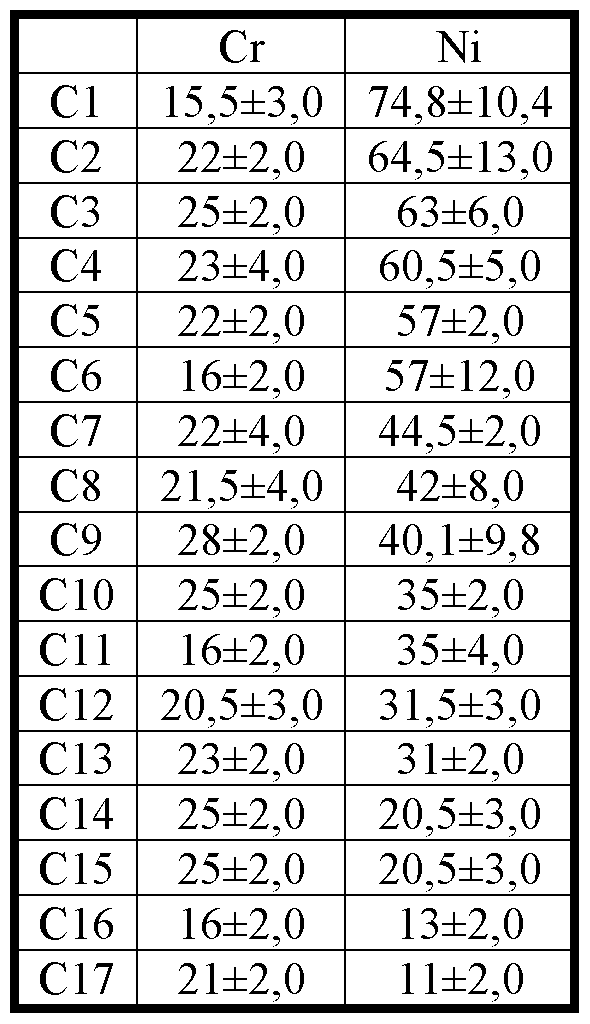
  • the metal alloy is selected from the group consisting of metal alloys Al to A 12, Bl to Bl 7, CI to CI 7, Dl to D17, or El to El 7, which each contain the following content of chromium and nickel in wt.% based on the total weight of the metal alloy, wherein further components not listed in the tables may be included:
  • the metal alloy is selected from the group consisting of metal alloys Fl to Fl 2, Gl to Gl 7, Hl to Hl 7, II to 117, or J1 to J17, which each contain the following content of iron, chromium and nickel in % by weight based on the total weight of the metal alloy, wherein further components not listed in the tables may be included:
  • the metal alloy is selected from the group consisting of metal alloys K1 to K12, LI to L17, M1 to M17, NI to N17, or 01 to 017, which each contain the following content of chromium, nickel and optionally cobalt in wt.% based on the total weight of the metal alloy, wherein further components not listed in the tables may be included:
  • the metal alloy is selected from the group consisting of metal alloys PI to P12, Ql to Q17, RI to R17, S1 to S17, or TI to T17, which each contain the following content of optionally iron, chromium, nickel and optionally cobalt in wt.% based on the total weight of the metal alloy, wherein in each case further constituents not listed in the tables may be included:
  • the metal alloy is selected from the group consisting of metal alloys Ul to Ul 2, VI to VI 7, W1 to W 17, XI to XI 7, or Y1 to Y17, which each contain the following content of iron, chromium, nickel, cobalt, aluminum and titanium in % by weight based on the total weight of the metal alloy, wherein further components not listed in the tables may be included:
  • the metal alloy according to the invention is selected from the group consisting of materials according to DIN/EN X9CrNiSiNCe21-1 l-2, X8CrNiNbl6-13, X12CrNi25-21, X10NiCrAlTi32-20, X5NiCrAlTi31-20, X12NiCrSi35-16, 35Ni25Crl.5SiCeN, NiFe30Cr21Mo3, NiCr23Col2Mo, NiMol6Crl5Fe6W4, NiCr22W14Mo, NiCr23Fel5Al, NiCr25FeAlY,
  • NiCr22Mo9Nb, and NiCrl5Fe are NiCr22Mo9Nb, and NiCrl5Fe.
  • the metal alloy according to the invention is selected from the group consisting of materials according to material class DIN No. 1.4820, 1.4821, 1.4822, 1.4823, 1.4824, 1.4825, 1.4826, 1.4827, 1.4828, 1.4829, 1.4830, 1.4831, 1.4832, 1.4833, 1.4834, 1.4835, 1.4836, 1.4837, 1.4838,
  • the metal alloy according to the invention is selected from the group consisting of materials according to material class DIN No. 1.4948, 1.4949, 1.4950, 1.4951, 1.4952, 1.4953, 1.4954, 1.4955, 1.4956, 1.4957, 1.4958, 1.4959, 1.4960, 1.4961, 1.4962, 1.4963, 1.4964, 1.4965, 1.4966, 1.4967, 1.4968, 1.4969, 1.4970, and 1.4971.
  • the metal alloy according to the invention is selected from the group consisting of materials according to material class DIN No. 2.4630, 2.4633, 2.4650, 2.4653, 2.4654, 2.4655, 2.4656, 2.4657, 2.4658, 2.4659, 2.4660, 2.4661, 2.4662, 2.4663, 2.4664, 2.4665, 2.4666, 2.4667, 2.4668, 2.4669, 2.4670, 2.4671, 2.4672, and 2.4673.
  • the metal alloy according to the invention is selected from the group consisting of materials according to material class DIN No. 2.4723, 2.4724, 2.4725, 2.4726, 2.4727, 2.4728, 2.4729, 2.4730, 2.4731, 2.4732, 2.4733, 2.4734, 2.4735, 2.4736, 2.4737, 2.4738, 2.4739, 2.4740, 2.4741, 2.4742, and 2.4743.
  • the metal alloy according to the invention is selected from the group consisting of materials according to material class DIN No. 2.4806, 2.4807, 2.4808, 2.4809, 2.4810, 2.4811, 2.4812, 2.4813, 2.4814, 2.4815, 2.4816, 2.4817, 2.4818, 2.4819, 2.4820, 2.4821, 2.4822, 2.4823, 2.4824,
  • the metal alloy comes into direct contact with gaseous NH;.
  • the metal alloy does not come into direct contact with NH; in the supercritical state.
  • a further aspect of the invention relates to a process for the catalytic decomposition of NH3 to N2 and H2 in a plant according to the invention as described above, wherein the NH3 is introduced into the reactor at a temperature of at least 500°C, more preferably at least 530°C, even more preferably at least 560°C, most preferably at least 590°C, and in particular at least 620°C.
  • the component is exposed to a temperature of at least 500°C, more preferably at least 530°C, even more preferably at least 560°C, most preferably at least 590°C, and in particular at least 620°C.
  • the component is exposed to a temperature of at least 650°C, more preferably at least 680°C, even more preferably at least 710°C, most preferably at least 740°C, and in particular at least 770°C.
  • the component is exposed to a temperature of at least 800°C, more preferably at least 830°C, even more preferably at least 860°C, most preferably at least 890°C, and in particular at least 920°C.
  • the NH3 is present in the reactor in gaseous state.
  • the NH3 in the reactor is not in a supercritical state.
  • FIG. 1 schematically illustrates a preferred embodiment of a reactor 1 according to the invention, which comprises, for example, four tubular reaction chambers 2, each of which contains NH3 decomposition catalyst.
  • the reactor 1 forms a combustion chamber 3 in its interior, in which the four tubular reaction chambers 2 are arranged in parallel as a bundle.
  • NH3 reactant gas
  • the product gas which comprises N2 and H2, is discharged from the reaction chambers 2 and the reactor 1 via discharge system 5.
  • combustion gas is fed via feed line 6 into the combustion chamber 3, where it is burned to form flame 7.
  • Combustion heat generated during combustion flows from the interior of the combustion chamber 3 through the walls of the reaction chambers 2 to the NFfi decomposition catalyst.
  • the flue gas generated during combustion is discharged from the combustion chamber 3 and the reactor 1 via discharge line 8.

Landscapes

  • Chemical & Material Sciences (AREA)
  • Organic Chemistry (AREA)
  • Chemical Kinetics & Catalysis (AREA)
  • Engineering & Computer Science (AREA)
  • Materials Engineering (AREA)
  • Health & Medical Sciences (AREA)
  • General Health & Medical Sciences (AREA)
  • Combustion & Propulsion (AREA)
  • Inorganic Chemistry (AREA)
  • Catalysts (AREA)

Abstract

Die Erfindung betrifft Reaktoren und Reaktorbauteile, welche bei hohen Temperaturen und mittlerem Druck eine gute Beständigkeit gegenüber NH3 und N2 und ggf. H2O aufweisen, so dass sie bei der katalytischen Zersetzung von NH3 zu N2 und H2 in großtechnischem Maßstab eingesetzt werden können.

Description

REAKTOREN ZUR ZERSETZUNG VON NH3 BEI HOHEN TEMPERATUREN
[0001] Es wird die Priorität der luxemburgischen Patentanmeldung Nr. LU 103141 vom 5. Juni 2023 beansprucht.
[0002] Die Erfindung betrifft Reaktoren und Reaktorbauteile, welche bei hohen Temperaturen und mittlerem Druck eine gute Beständigkeit gegenüber NFL und N2 und ggf. H2O aufweisen, so dass sie bei der katalytischen Zersetzung von NH3 zu N2 und H2 in großtechnischem Maßstab eingesetzt werden können.
[0003] H2 kann durch erneuerbare Energien elektrolytisch aus H2O gewonnen und anschließend mit N2 in NH3 umgewandelt werden. NH3 lässt sich weitaus sicherer als H2 speichern und transportieren. An- schließend kann NH3 wieder zu H2 und N2 zersetzt werden. Nach Abtrennung von N2 findet H2 unter- schiedlichste industrielle Anwendungen.
[0004] Die Zersetzung von NH3 zu N2 und H2 ist eine endotherme Reaktion (AH° = 45,9 kJ-mol 1), bei der sich die Stoffmenge verdoppelt (2 NH3 N2 + 3 H2), so dass die Reaktion grundsätzlich durch hohe Temperaturen sowie niedrige Drücke begünstigt wird. Je höher der Druck ist, desto höher muss die Temperatur sein, um noch zufriedenstellende Reaktionsausbeuten zu erreichen.
[0005] Die Reaktionstemperatur, bei der die katalytische Zersetzung von NH3 abläuft, ist insbesondere durch die Wahl des NH3 -Zersetzungskatalysators vorgegeben. Als Katalysatoren für die Zersetzung von NH3 wurde eine Vielzahl von Materialien vorgeschlagen, welche bei unterschiedlichen Temperaturen aktiv sind (vgl. z.B. II. Lucentini et al., Ind. Eng. Chem. Res. 2021, 60, 18560-18611).
[0006] Für großtechnische Umsetzungen sind jedoch vieler dieser NFL-Zersetzungskatalysatoren nicht wirtschaftlich einsetzbar. Für großtechnische Umsetzungen kommen insbesondere Ruthenium-basierte NFL-Zersetzungskatalysatoren und Nickel-basierte NFL-Zcrsctzungskatalysatorcn in Betracht.
[0007] Ruthenium-basierte NFL-Zersetzungskatalysatoren haben den Vorteil, dass bei vergleichsweise niedrigen Temperaturen Umsätze von mehr als 90% erreicht werden können. Allerdings sind die maxi- mal erreichbaren Umsätze begrenzt, so dass im Produktgas ein erheblicher Restgehalt an nicht zersetz- tem NH3 verbleibt, welches in Anbetracht der Menge ggf. durch zusätzliche Maßnahmen abgetrennt werden muss.
[0008] Nickel-basierte NFL-Zersetzungskatalysatoren haben den Vorteil, dass deutlich höhere Umsätze erreicht werden können. Im Produktgas verbleibt daher ein allenfalls geringer Restgehalt an nicht zer- setztem NH3, welcher ggf. durch herkömmliche Maßnahmen zur Aufreinigung von FL, insbesondere durch Druckwechseladsorption, mit abgetrennt werden kann, ohne dass es zusätzlicher Maßnahmen be- darf. Die erforderlichen Temperaturen für Nickel-basierte NHs-Zersetzungskatalysatoren liegen aller- dings deutlich höher.
[0009] Zahlreiche Verfahren zur katalytischen Zersetzung von NH3 sind im Stand der Technik be- schrieben und es wurden unterschiedliche Reaktortypen vorgeschlagen (vgl. z.B. US 4 704 267 A, US 2009/280024 Al, US 2020/0123006 Al, FR 1 469 045 A, GB 768 091 A, CN 111 957 270 A, CN 113 896 168 A, WO 2011/107279 Al, WO 2012/090739 Al, WO 2020/095467 A, WO 2021/257944 Al, WO 2022/096529 Al, WO 2022/153720 Al, WO 2022/243410 Al, WO 2022/265647 Al, WO 2022/265648 Al, WO 2022/265649 Al, WO 2022/265650 Al und WO 2022/265651 Al).
[0010] Da die katalytische Zersetzung von NH3 endotherm verläuft und hohe Temperaturen erfordert, muss Wärme in den Reaktor eingebracht werden. Neben elektrischen Heizsystemen werden dazu ins- besondere Verbrennungsprozesse vorgeschlagen, bei denen ein Verbrennungsgas verbrannt wird und die dabei erzeugte Wärme für die katalytische Zersetzung von NH3 genutzt wird.
[0011] Für eine solche Reaktionsfiihrung sind insbesondere Reaktoren geeignet, welche analog zu Pri- märreformem ausgebildet sind. Das Verbrennungsgas und das Reaktionsgas werden dabei physikalisch voneinander separiert durch den Reaktor geleitet, stehen jedoch im Wärmeaustausch miteinander. Das Verbrennungsgas wird mit Hilfe von Brennern und unter Zufuhr von Verbrennungsluft in einer Brenn- kammer verbrannt, von der aus ein Wärmestrom in mindestens eine physikalisch abgetrennte Reakti- onskammer fließt. In der Reaktionskammer ist der NFF-Zcrsctzungskatalysator angeordnet und wird von dem Reaktionsgas durchströmt, so dass dort die katalysierte Reaktion abläuft. Beispielsweise kön- nen mehrere Reaktionskammem als Röhren ausgebildet sein, welche jeweils mit NFF-Zcrsctzungskata- lysator und parallel vom Reaktionsgas durchströmt werden. Diese Röhren sind z.B. als Bündel innerhalb der Brennkammer angeordnet, ohne dass es zur Durchmischung von Verbrennungsgas und Reaktions- gas kommt.
[0012] Die Materialien, aus denen die Reaktionskammem und auch andere Bauteile solcher Reaktoren gefertigt sind, müssen erheblichen Belastungen bei erheblichen Temperaturen standhaften. Dabei liegen die Temperaturen, welche durch die Verbrennung des Verbrennungsgases in der Brennkammer erzeugt werden, deutlich oberhalb der Temperaturen des Reaktionsgases in der Reaktionskammer. Auf diesem Temperaturgefälle basiert u.a. der Wärmestrom von der Brennkammer in die Reaktionskammer.
[0013] Werden solche Reaktoren für die katalytische Zersetzung von NH3 an Nickel-basierten NH3- Zersetzungskatalysatoren eingesetzt, so kommt erschwerend hinzu, dass in Anbetracht der hohen Kon- zentration an NH3 bzw. N2, dem hohen Druck und den hohen Temperaturen zahlreiche Metalllegierun- gen korrodieren, und zwar durch äußere und/oder innere Nitridierung (in diesem Kontext häufig auch als "Nitrierung" bezeichnet). [0014] R.P. Rubly et al., Oxidation of Metals Vol. 35, 3-4 (1991) betrifft die interne Nitridierung von Nickel-Chrom-Legierungen. Das Nitrierverhalten von Nickel-Chrom-Legierungen wird in Ammoniak- Wasserstoff-Gemischen im Bereich von 700-900°C untersucht. CrN bildete sich bei allen Expositions- bedingungen, CßN konnte nicht nachgewiesen werden. Der Übergang von innerer zur äußeren Nit- ridbildung liegt bei 900°C zwischen 30-40% Cr.
[0015] J.J. Barnes et al., Journal de Physique III, Vol. 3, 1993, 167-174 diskutiert Faktoren, welche das Verhalten von Fe-, Ni- und Co-basierten Metalllegierungen im Hinblick auf eine Nitridierung bei hohen Temperaturen (1093°C) beeinflussen.
[0016] K. Tjorko et al., Oxidation of Metals Vol. 44, 453-474 (1995) betrifft einen Vergleich der in- ternen Nitridierung in NH; und in N2. Die Nitridierung setzt die Dissoziation von N2 bzw. NH3 voraus. Die Dissoziation von N2 erfolgt in nennenswertem Umfang erst oberhalb von ca. 700°C. Daher ist bei Temperaturen unterhalb von ca. 700°C die Nitridierung durch die Gegenwart von NH3 bestimmt. Auch bei sehr hohen Temperaturen (1000°C) ist die Nitridierung mit NH3 stärker als mit N2.
[0017] U. Krupp et al., Oxidation of Metals Vol. 52, 277-298 (1999) betrifft die interne Nitridierung von Nickel-basierten Legierungen, insbesondere das Verhalten von binären und ternären Legierungen des Ni-Cr- Al -Ti-Systems.
[0018] U. Krupp et al., Oxidation of Metals Vol. 52, 299-320 (1999) betrifft ebenfalls die interne Nit- ridierung von Nickel-basierten Legierungen, insbesondere das Verhalten von quaternären Ni-Cr-Al-Ti Legierungen und eine computer-basierte Beschreibung unter Berücksichtigung der thermodynamischen Daten eingebaut in eine FEM-Diffusionsberechnung.
[0019] H.J. Grabke et al., Materials and Corrosion 2003, 54(11), 895-902 betrifft Untersuchungen, bei denen Eisen, Nickel, ferritische l-18%Cr-Stähle, austenitische 18%Cr-9%Ni- und 20%Cr-3 ^Ni- Stähle sowie eine 16% CrNi-Basislegierung bei 500°C in He-30%H2O und 70%H20-30%NH3 exponiert wurden, um das Korrosionsverhalten dieser Werkstoffe in Wasserdampf wie in konventionellen Kraft- werken mit ihrem Verhalten in einem NHsTUO-Gemisch, d.h. unter den Bedingungen des "Kalina- Zyklus" zu vergleichen.
[0020] G.Y. Lai, High-Temperature Corrosion and Materials Applications, ASM International, 2007, Kapitel 4: Nitridation erklärt, warum Nitridierung auftritt und wie sie verschiedene Metalle angreift, wobei sie in einigen Fällen tiefer eindringt als die Oxidation. Die Nitridierung und ihre Auswirkungen auf Metalle und Legierungen in Hochtemperaturluft sowie in NH3-H2O-, NH3-, H2-N2-NH3- und N2- Umgebungen werden diskutiert.
[0021] M.O. Cojocaru et al., Materials 2021, 14, 2432 betrifft die Auswirkungen der Veränderung der Aktivität von Nitriermitteln durch Verdünnung von Ammoniak mit Stickstoff. [0022] E. Wolowiec-Korecka et al., Coatings 2023, 13, 257, 1-12 betrifft die Stabilität von Schicht- nitriden bei Nitridierung unter geringem Druck.
[0023] Ferner ist zu berücksichtigen, dass NH; für Lagerung und Transport häufig mit Spuren an H2O versetzt wird, um das Risiko von Spannungsrisskorrosion für unlegierten Stahl zu reduzieren. Dadurch wird bei hohen Temperaturen im Reaktor der Sauerstoffpartialdruck erhöht, so dass neben der Nitridie- rung auch die Oxidation eine Rolle spielen kann. Die Nitridierung von Metalllegierungen in NH3 (bzw. in Gemischen aus NH3, N2 und H2, wie sie im Verlauf der Zersetzungsreaktion gebildet werden) bei hohen Temperaturen, z.B. im Bereich von 650-750°C, wurde bisher kaum untersucht, schon gar nicht in Gegenwart von Spuren an H2O.
[0024] Der umgekehrte Prozess ist die Synthese von NH3 aus N2 und H2 im Haber-Bosch-Verfahren.
[0025] American fron and Steel Institute, A Designer's Handbook Series No. 9013. 1978, Nickel Insti- tute, 4-23 betrifft nichtrostende Stähle für die Ammoniakproduktion.
[0026] Aus der Technologie zum Haber-Bosch-Verfahren können im Hinblick auf geeignete Metallle- gierungen für die katalytische Zersetzung von NH3 kaum Erkenntnisse gewonnen werden, denn beim Haber-Bosch-Verfahren sind die Temperaturen deutlich geringer. Die Temperatur hat jedoch einen ent- scheidenden Einfluss auf die Nitridierung. Für Reaktoren und Bauteile beim Haber-Bosch-Verfahren sind austenitische Stähle oft ausreichend. Sie können bei Temperaturen von bis zu ca. 480°C eingesetzt werden, bei größeren Wandstärken auch bei etwas höheren Temperaturen (bis ca. 510°C). Ein weiteres, für das Haber-Bosch-Verfahren geeignetes Material ist Alloy 600, welches gemäß The American Society of Mechanical Engineers (ASME) Boiler and Pressure Vessel Code (BPVC) Sec II-D allerdings nur bis zu Temperaturen von 649°C zugelassen ist.
[0027] Auch aus Technologien mit NHs-Atmosphäre unter superkritischen Bedingungen, z.B. zur Ge- winnung von Nitrid-Einkristallen, können im Hinblick auf geeignete Metalllegierungen für die kataly- tische Zersetzung von NH3 kaum Erkenntnisse gewonnen werden. Die Gewinnung von Nitrid-Einkris- tallen erfolgt üblicherweise bei deutlich niedrigeren Temperaturen von z.B. ca. 133°C und entsprechend hohen Drücken von z.B. 11,3 MPa. Zudem sollte zwischen den Reaktionsmechanismen von elektroche- mischen Reaktionen an der Oberfläche (z.B. bei einem Fluid) einerseits und von diffusionskontrollierten Mechanismen im Grundmaterial und in der Reaktionsschicht (z.B. bei einem Gas) andererseits unter- schieden werden. In superkritischen Medien können die ablaufenden Reaktionsmechanismen üblicher- weise eher denen eines Fluids oder denen eines Gases entsprechen. Dies hängt typischerweise vom Me- dium selbst sowie von weiteren unterschiedlichen Parametern ab. Bei superkritischem Wasser beispiels- weise ist die Dichte ein bestimmender Parameter. Bei niedriger Dichte entspricht das Verhalten mehr dem eines Gases, während bei hoher Dichte das Verhalten einer Flüssigkeit überwiegt (Grenze niedrig - hoch ca. 0.2 g/ml). In superkritischem CO2 beispielsweise sind der Wassergehalt, der Gehalt an Ver- unreinigungen sowie die Temperatur bestimmende Parameter. Bei hohen Temperaturen überwiegen in trockenem CO2 klassische Hochtemperaturprozesse. Spuren an Wasser fuhren zu einer deutlichen ab- tragenden Korrosion. Das superkritische Verhalten von CO2 und NH3 kann in erster Näherung als ver- gleichbar betrachtet werden. NH3 enthält oftmals Spuren an Wasser. Darm wäre wie bei superkritischem CO2 eine Kondensation möglich und damit nicht nur Gasphasenreaktionen.
[0028] Neben der Korrosionsbeständigkeit bei hohen Temperaturen in Gegenwart von N2, NH3 und ggf. H2O sind auch die weiteren Eigenschaften der Metalllegierung entscheidend, insbesondere Härte, Zugfestigkeit, Dehnung, Bruchdehnung, Dehngrenze, Elastizitätsmodul, Dichte, elektrischer Wider- stand, Schmelzbereich, Wärmeleitfähigkeit, spezifische Wärmekapazität, etc. Auch die Verarbeitbar- keit, insbesondere Schweißbarkeit, spielt eine Rolle.
[0029] Es besteht ein Bedarf an verbesserten Reaktoren, welche wirtschaftlich in großtechnischem Maßstab für die katalytische Zersetzung von NH3 zu N2 und H2 eingesetzt werden können und welche bei hohen Temperaturen (z.B. 650-750°C) eine zufriedenstellende oder im Vergleich zu herkömmlich für diesen Zweck eingesetzten Reaktoren verlängerte Standzeit haben. Die zur Fertigung der Reaktoren eingesetzten Materialien sollten einen Ausgleich schaffen zwischen zufriedenstellenden Eigenschaften einerseits und Anschaffungskosten andererseits.
[0030] Es ist eine Aufgabe der Erfindung, verbesserte Reaktoren für die Herstellung von H2 durch ka- talytische Zersetzung von NH3 bereitzustellen. Die Herstellung von H2 sollte sicher, wirtschaftlich und in großtechnischem Maßstab möglich sein.
[0031] Diese Aufgabe wird durch den Gegenstand der Patentansprüche gelöst.
[0032] Ein erster Aspekt der Erfindung betrifft eine Anlage zur Herstellung von H2 durch katalytische Zersetzung von NH3 zu N2 und H2; wobei die Anlage einen Reaktor umfasst, welcher einen NFF-Zcrsctzungskatalysator enthält; wobei der Reaktor mindestens ein Bauteil umfasst, welches wenigstens teilweise aus einer Metalllegie- rung aufgebaut ist; wobei die Metalllegierung bei Betrieb des Reaktors zumindest in einem Bereich ihrer Oberfläche mit dem NH3 und/oder N2 in direkten Kontakt kommt; bevorzugt mit NH3, N2 und H2O bzw. deren Disso- ziationsprodukten; und wobei die Metalllegierung Nickel, Chrom oder sowohl Nickel als auch Chrom enthält, wobei der Ge- samtgehalt an Nickel und/oder Chrom mindestens 15 Gew.-% beträgt, bezogen auf das Gesamtgewicht der Metalllegierung.
[0033] Zum Zwecke der Beschreibung bedeutet Gesamtgehalt an "A und/oder B", dass die erfindungs- gemäße Metalllegierung entweder (i) sowohl A als auch B enthält, und sich der Gesamtgehalt dann auf die Summe der beiden Einzelgehalte an A und B bezieht, oder (ii) kein B enthält, so dass sich der Ge- samtgehalt dann auf den Gehalt von A alleine bezieht, oder (iii) kein A enthält, so dass sich der Gesamt- gehalt dann auf den Gehalt von B alleine bezieht.
[0034] Bevorzugt enthält die Metalllegierung Nickel und Chrom mit einem Gesamtgehalt an Nickel und Chrom von mindestens 15 Gew.-%, bezogen auf das Gesamtgewicht der Metalllegierung.
[0035] In bevorzugten Ausführungsformen enthält die erfmdungsgemäße Metalllegierung wenigstens zwei Metalle ausgewählt aus der Gruppe bestehend aus Nickel, Kobalt, Chrom, Eisen, Molybdän, Man- gan, Niob, Cer, Aluminium, Titan, Silizium, Wolfram, Kupfer, Bor, Zirkonium, Lanthan und Yttrium.
[0036] In bevorzugten Ausführungsformen enthält die erfmdungsgemäße Metalllegierung wenigstens drei Metalle ausgewählt aus der Gruppe bestehend aus Nickel, Kobalt, Chrom, Eisen, Molybdän, Man- gan, Niob, Cer, Aluminium, Titan, Silizium, Wolfram, Kupfer, Bor, Zirkonium, Lanthan und Yttrium.
[0037] In bevorzugten Ausführungsformen enthält die erfmdungsgemäße Metalllegierung wenigstens vier Metalle ausgewählt aus der Gruppe bestehend aus Nickel, Kobalt, Chrom, Eisen, Molybdän, Man- gan, Niob, Cer, Aluminium, Titan, Silizium, Wolfram, Kupfer, Bor, Zirkonium, Lanthan und Yttrium.
[0038] In bevorzugten Ausführungsformen enthält die erfmdungsgemäße Metalllegierung wenigstens fünf Metalle ausgewählt aus der Gruppe bestehend aus Nickel, Kobalt, Chrom, Eisen, Molybdän, Man- gan, Niob, Cer, Aluminium, Titan, Silizium, Wolfram, Kupfer, Bor, Zirkonium, Lanthan und Yttrium.
[0039] Es wurde gefunden, dass für eine ausreichende Beständigkeit gegenüber Nitridierung der Gehalt an Nickel und ggf. auch Kobalt ein wichtiger Parameter ist. Dies ist insbesondere darauf zurückzufüh- ren, dass Nickel und Kobalt in Eisenbasislegierungen die Löslichkeit von Stickstoff reduzieren, was die innere Nitridierung erschwert. Um eine hinreichende Stabilität gegenüber Nitridierung zu erhalten, be- trägt der Gesamtgehalt an Nickel bzw. Nickel und Kobalt bevorzugt mindestens 40 Gew.-%, bezogen auf das Gesamtgewicht der Metalllegierung.
[0040] Ferner wurde gefunden, dass Chrom im Hinblick auf die Beständigkeit gegenüber Nitridierung an sich eher von Nachteil ist. Dies ist insbesondere darauf zurückzuführen, dass Chrom die Löslichkeit von Stickstoff in Nickelbasislegierungen und damit die Neigung zur Nitridierung erhöht.
[0041] Sobald die Gastatmosphäre neben N2 und NH3 jedoch zusätzlich auch H2O enthält, spielen wei- tere Faktoren eine wichtige Rolle, insbesondere die Bildung einer Oxiddeckschicht an der Oberfläche der Metalllegierung. Eine Oxiddeckschicht wird gebildet, wenn der Partialdruck von O2 hinreichend hoch ist. Der Partialdruck von O2 und H2 wird thermodynamisch durch das Gleichgewicht 2 H2O «-> 2 H2 + O2 bestimmt. Ist der Partialdruck von O2 niedriger als der Gleichgewichtsdruck von O2 für das Metall/Metalloxid-Gleichge wicht, so bildet sich kein Oxid.
[0042] Es wurde gefunden, dass in Gegenwart von H2O Chrom einen günstigen Effekt im Hinblick auf die Korrosionsbeständigkeit hat, denn Chrom bildet das stabile Oxid CYOs. CYO3 ist auch bei sehr niedrigen Partialdrücken von O2 stabil, anders als die Eisenoxide. Selbst ein geringer Gehalt von weni- gen ppm an H2O kann zu einer Deckschicht von C’nCf fuhren, was die Nitridierung deutlich reduziert. Dies ist z.B. der Fall, wenn die NH3 -Gasgemische bei z.B. 900°C lediglich 45 ppm H2O enthalten. Es wurde gefunden, dass der Gehalt an Chrom hoch genug sein muss, damit sich eine hinreichend dichte Deckschicht von C’nCh ausbilden kann und diese auch aufrecht erhalten wird. Letzteres bedeutet, dass die Nachlieferung an Chrom gewährleistet sein muss, um das stabile Wachstum einer Deckschicht aus Cr20s sicherzustellen. Bevorzugt beträgt der Gehalt an Chrom mindestens 18 Gew.-%, bezogen auf das Gesamtgewicht der Metalllegierung.
[0043] In bevorzugten Ausführungsformen enthält die erfindungsgemäße Metalllegierung daher min- destens 30 Gew.-%, bevorzugt mindestens 33 Gew.-% Nickel und/oder Kobalt (Gesamtgehalt) sowie mindestens 15 Gew.-%, bevorzugt mindestens 19 Gew.-% Chrom, jeweils bezogen auf das Gesamtge- wicht der Metalllegierung. In bevorzugten Ausfuhrungsformen enthält die erfindungsgemäße Metallle- gierung mindestens 40 Gew.-% Nickel und/oder Kobalt (Gesamtgehalt) sowie mindestens 20 Gew.-% Chrom, jeweils bezogen auf das Gesamtgewicht der Metalllegierung.
[0044] In bevorzugten Ausfuhrungsformen enthält die erfindungsgemäße Metalllegierung daher min- destens 30 Gew.-%, bevorzugt mindestens 33 Gew. -% Nickel sowie mindestens 15 Gew.-%, bevorzugt mindestens 19 Gew.-% Chrom, jeweils bezogen auf das Gesamtgewicht der Metalllegierung. In bevor- zugten Ausfuhrungsformen enthält die erfindungsgemäße Metalllegierung mindestens 40 Gew.-% Ni- ckel sowie mindestens 20 Gew.-% Chrom, jeweils bezogen auf das Gesamtgewicht der Metalllegierung.
[0045] In bevorzugten Ausfuhrungsformen enthält die erfindungsgemäße Metalllegierung daher min- destens 33 Gew.-% Kobalt sowie mindestens 15 Gew.-% Chrom, jeweils bezogen auf das Gesamtge- wicht der Metalllegierung. In bevorzugten Ausfuhrungsformen enthält die erfindungsgemäße Metallle- gierung mindestens 40 Gew.-% Kobalt sowie mindestens 20 Gew.-% Chrom, jeweils bezogen auf das Gesamtgewicht der Metalllegierung.
[0046] In bevorzugten Ausfuhrungsformen enthält die erfindungsgemäße Metalllegierung Nickel, Chrom und Eisen, wobei der Gehalt an Nickel bevorzugt größer ist als der Gehalt an Chrom.
[0047] In bevorzugten Ausführungsformen enthält die erfindungsgemäße Metalllegierung Nickel, Ko- balt, Chrom und Eisen, wobei der Gesamtgehalt an Nickel und Kobalt bevorzugt größer ist als der Gehalt an Chrom.
[0048] Zum Zwecke der Beschreibung ist ein "Reaktor" eine Vorrichtung für die katalytische Zerset- zung von NH3 zu N2 und H2. Der erfindungsgemäße Reaktor ist typischerweise ein abgegrenzter Raum, welcher speziell dafür konstruiert und hergestellt wurde, um darin unter definierten Bedingungen die katalytische Zersetzung von NH3 zu N2 und H2 ablaufen lassen und steuern zu können. [0049] Zum Zwecke der Beschreibung ist eine "Metalllegierung" ein makroskopisch homogener me- tallischer Werkstoff, welcher typischerweise durch Zusammenschmelzen verschiedener Metalle erhal- ten wird, wobei auch Nichtmetalle und/oder Halbmetalle enthalten sein können. Die Metalle, Nichtme- talle und/oder Halbmetalle können dabei in elementarer Form, als intermetallische Phasen und/oder als andere Verbindungen vorliegen. Die Metalllegierung kann kristallin, teilkristallin oder amorph sein. Erfindungsgemäß besonders bedeutsame Metalle, welche in der erfmdungsgemäßen Metalllegierung enthalten sein können, sind Nickel, Kobalt, Chrom und Eisen, daneben aber auch ggf. Aluminium und Titan. Weitere Metalle, welche in dem erfmdungsgemäßen Metalllegierung enthalten sein können, sind beispielsweise Molybdän, Wolfram, Niob, Kupfer, Aluminium, Titan, Silizium, Bor, Lanthan, Mangan, Vanadium, Cer, Yttrium, Zirkonium, Blei und andere. Erfindungsgemäß besonders bedeutsame Nicht- metalle und Halbmetalle, welche in der erfmdungsgemäßen Metalllegierung enthalten sein können, sind Bor, Kohlenstoff, Silizium, Stickstoff, Phosphor, Schwefel, und andere.
[0050] Zum Zwecke der Beschreibung katalysiert ein "NH 3-Zersetzungskatalysator" die Zersetzung von NH3 zu N2 und H2. Um Ausbeuten von mehr als 90% zu erreichen, sind üblicherweise erhöhte Temperaturen des NH3 erforderlich, bevorzugt mindestens 500°C.
[0051] Zum Zwecke der Beschreibung bedeutet "mit dem NH3 und/oder N2 in direkten Kontakt", dass zumindest in einem Bereich zwischen der Metalllegierung und dem NH3 und/oder N2 kein weiteres Material angeordnet ist und dass das NH3 und/oder N2 mit der Oberfläche der Metalllegierung in we- nigstens diesem Bereich interagieren kann. Modifizierungen an der Oberfläche der Metalllegierung sind jedoch für einen direkten Kontakt im Sinne der Erfindung zulässig, beispielsweise die Ausbildung von Deckschichten aus Oxiden und Nitriden. Die Metalllegierung muss nicht vollständig bzw. ihre Oberflä- che muss nicht vollflächig mit dem NH3 und/oder N2 in Kontakt kommen. So reicht es aus, wenn es wenigstens einen Bereich gibt, in dem NH3 und/oder N2 mit der Oberfläche der Metalllegierung intera- gieren kann. Da das NH3 in dem erfmdungsgemäßen Reaktor auf dem Weg vom Eintritt in den Reaktor bis zum Austritt aus dem Reaktor zersetzt wird, ist bei Betrieb des Reaktors die Menge an NH3 am Eintritt des Reaktors deutlich höher als am Austritt des Reaktors. Umgekehrt verhält es sich mit der Menge des durch Zersetzung des NH3 gebildeten N2. Bevorzugt kommt die Metalllegierung bei Betrieb des Reaktors zumindest in einem Bereich ihrer Oberfläche mit NH3, N2 und H2O bzw. deren Dissozia- tionsprodukten (N2, H2 bzw. O2) in direkten Kontakt.
[0052] Sofern nicht ausdrücklich etwas anderes angegeben ist, sind alle Prozentangaben Gewichtspro- zent [Gew.-%]. Bei Bereichen, welche mit "±" definiert sind, z.B. A±B, ergibt sich die numerische Un- tergrenze des Bereichs als A-B und die numerische Obergrenze des Bereichs als A+B. Ist der Wert für B derselbe wie für A, ergibt die Untergrenze 0, so dass die jeweilige Komponente auch vollständig fehlen kann. Sofern nicht ausdrücklich etwas anderes angegeben ist, addieren sich die Gehaltsangaben in Gew.-% nicht auf 100 Gew.-%, d.h. es können zusätzlich neben den genannten Komponenten auch noch weitere, nicht genannte Komponenten enthalten sein. [0053] Die erfindungsgemäße Anlage umfasst einen Reaktor, in dem beim Betrieb der Anlage NH3 katalytisch zersetzt wird unter Bildung eines Produktgases, welches N2, H2 und ggf. nicht zersetztes NH3 umfasst.
[0054] In bevorzugten Ausführungsformen der Erfindung umfasst die erfindungsgemäße Anlage eine oder mehrere der folgenden Vorrichtungen, welche miteinander in Fluidverbindung stehen:
(i) eine Vorrichtung zur Lagerung von flüssigem NH3;
(ii) eine Vorrichtung zur Erwärmung und Verdampfung des flüssigen NH3;
(iii) den erfindungsgemäßen Reaktor;
(iv) eine Vorrichtung zur Aufreinigung von H2 aus dem Produktgas; und
(v) eine Vorrichtung zur Rückgewinnung von Prozesswärme.
[0055] Der erfindungsgemäße Reaktor umfasst bevorzugt mehrere Kammern, welche voneinander physikalisch getrennt sind. Bevorzugt umfasst der Reaktor mindestens eine Reaktionskammer und min- destens eine Brennkammer.
[0056] Der erfindungsgemäße Reaktor ist bevorzugt analog einem Primärreformer ausgebildet.
[0057] Der erfindungsgemäße Reaktor umfasst bevorzugt
- eine Brennkammer oder mehrere Brennkammern zur Verbrennung eines Verbrennungsgases unter Erzeugung von Verbrennungswärme und einem Rauchgas (Abgas); und
- eine Reaktionskammer oder mehrere Reaktionskammem zur katalytischen Zersetzung von NH3 un- ter Erzeugung eines Produktgases umfassend N2, H2 und ggf. nicht zersetztes NH3.
[0058] Brennkammer(n) und Reaktionskammer(n) sind bevorzugt physikalisch voneinander getrennt, so dass es bei Betrieb des Reaktors zu keiner Durchmischung von Verbrennungsgas einerseits und NH3 (Eduktgas) bzw. Produktgas andererseits kommt.
[0059] Brennkammer(n) und Reaktionskammer(n) sind bevorzugt so konfiguriert, dass es bei Betrieb des Reaktors zu einem Wärmestrom der erzeugten Verbrennungswärme von Brennkammer(n) in Reak- tionskammer(n) kommt. Dieser Wärmestrom dient bei Betrieb des Reaktors bevorzugt der Aufrechter- haltung der endothermen katalytischen Zersetzung von NH3.
[0060] In bevorzugten Ausführungsformen der Erfindung sind die Reaktionskammem(n) röhrenförmig ausgebildet, d.h. haben eine zylindrische Form. Bevorzugt sind mehrere solcher röhrenförmigen Reak- tionskammem parallel zueinander als Bündel in einer gemeinsamen Brennkammer angeordnet.
[0061] Jede Brennkammer enthält bevorzugt einen Brenner oder mehrere Brenner zur Verbrennung von Verbrennungsgas. Die dabei gebildete Flamme befindet sich bei Betrieb des Reaktors bevorzugt in räumlicher Nähe zur Außenwand mindestens einer Reaktionskammer, welche NfL-Zcrsctungskatalysa- tor enthält. Bei Betrieb des Reaktors strömt dann bevorzugt Verbrennungswärme vom Innern der Brenn- kammer durch die Wandung der mindestens eine Reaktionskammer hindurch und trägt so Wärme bis hin zum NHs-Zersetungskatalysator ein, der von NH3 durchströmt wird und an dem die endotherme Zersetzung von NH3 verläuft.
[0062] Der erfindungsgemäße Reaktor umfasst zudem mindestens ein Bauteil, welches wenigstens teil- weise aus einer Metalllegierung aufgebaut ist, welche bei Betrieb des Reaktors mit dem NH3 und/oder N2 in direkten Kontakt kommt.
[0063] Bevorzugt ist das Bauteil eine Reaktionskammer oder ein Element einer Reaktionskammer, wo- bei im Innenraum der Reaktionskammer der Nkh-Zcrsctzungskatalysator angeordnet ist. Der Erfin- dungsgemäße Reaktor enthält dann bevorzugt eine Reaktionskammer, welche das Bauteil und den NH3- Zersetzungskatalysator umfasst.
[0064] In bevorzugten Ausfiihrungsformen der Erfindung ist das Bauteil vollständig aus der erfin- dungsgemäßen Metalllegierung aufgebaut, d.h. das Bauteil besteht vollständig aus der Metalllegierung.
[0065] Ist das vollständig aus der erfindungsgemäßen Metalllegierung aufgebaute Bauteil eine Reakti- onskammer, in deren Innenraum der Nkh-Zcrsctzungskatalysator angeordnet ist, so besteht die Wan- dung der Reaktionskammer aus dem Bauteil und damit vollständig aus der Metalllegierung. Die innere Oberfläche der Wandung der Reaktionskammer ist dem NEE-Zersetzungskatalysator zugewandt und die Metalllegierung, aus der die Wandung der Reaktionskammer besteht, kommt bei Betrieb des Reaktors zumindest in einem Bereich mit dem NH3 und/oder N2 in direkten Kontakt.
[0066] Ist das vollständig aus der erfindungsgemäßen Metalllegierung aufgebaute Bauteil ein Element einer Reaktionskammer, in deren Innenraum der Nkh-Zcrsctzungskatalysator angeordnet ist, so umfasst die Wandung der Reaktionskammer bevorzugt das Bauteil. Beispielsweise kann das Bauteil röhrenför- mig ausgebildet und konzentrisch innerhalb eines anderen, röhrenförmigen Elements angeordnet sein, mit dem es zusammen die Wandung der Reaktionskammer bildet. Die innere Oberfläche des Bauteils ist dann dem NEE-Zersetzungskatalysator zugewandt und die Metalllegierung, aus der das innenliegende Bauteil der Wandung besteht, kommt bei Betrieb des Reaktors zumindest in einem Bereich mit dem NH3 und/oder N2 in direkten Kontakt.
[0067] In anderen bevorzugten Ausfiihrungsformen ist das Bauteil nur teilweise aus der erfindungsge- mäßen Metalllegierung aufgebaut. Beispielsweise kann das Bauteil mehrschichtig sein, wobei eine der Schichten des Bauteils, bevorzugt eine außenliegende Schicht, aus der erfindungsgemäßen Metalllegie- rung aufgebaut ist, d.h. diese Schicht des Bauteils besteht aus der Metalllegierung, wohingegen andere Schichten des Bauteils aus anderen Materialien bestehen können und/oder aus erfindungsgemäßen Le- gierungen gleicher oder anderer Zusammensetzung.
[0068] Ist das nur teilweise aus der erfindungsgemäßen Metalllegierung aufgebaute Bauteil eine Reak- tionskammer, in deren Innenraum der NIL-Zersetzungskatalysator angeordnet ist, so kann das Bauteil eine Reaktionskammer mit einer mehrschichtigen Wandung sein, wobei die mehrschichtige Wandung eine innere Schicht und eine äußere Schicht aufweist. Die innere Oberfläche der inneren Schicht des Bauteils ist dann dem NHs-Zersetzungskatalysator zugewandt und die Metalllegierung, aus der die in- nere Schicht besteht, kommt bei Betrieb des Reaktors zumindest in einem Bereich mit dem NH3 und/oder N2 in direkten Kontakt.
[0069] Bevorzugt ist die gesamte innere Oberfläche der Reaktionskammer, welche dem NHs-Zerset- zungskatalysator zugewandt ist und welche bei Betrieb des Reaktors mit dem NH3 und/oder N2 in di- rekten Kontakt kommt, aus der Metalllegierung aufgebaut.
[0070] Bevorzugt ist die gesamte innere Oberfläche des Reaktors, welche bei Betrieb des Reaktors mit dem NH3 und/oder N2 in direkten Kontakt kommt, aus der Metalllegierung aufgebaut.
[0071] Der erfmdungsgemäße Reaktor enthält einen NH3 -Zersetzungskatalysator. Wird der NfU-Zcr- setzungskatalysator unter Reaktionsbedingungen von NH3 durchströmt, so katalysiert er die Zersetzung von NH3 zu N2 und H2.
[0072] Als NHs-Zersetzungskatalysator kommen erfindungsgemäß verschiedene Materialien in Be- tracht. Die Reaktionstemperatur, bei der die katalytische Zersetzung von NH3 abläuft, ist insbesondere durch die Wahl des NH3 -Zersetzungskatalysators vorgegeben.
[0073] In bevorzugten Ausfuhrungsformen der Erfindung ist der NPh-Zcrsctzungskataly sator im Hin- blick auf die Zersetzung von NH3 bei einer Temperatur im Bereich von mindestens 500°C katalytisch aktiv, bevorzugt mindestens 520°C, bevorzugter mindestens 540°C, noch bevorzugter mindestens 550°C, am bevorzugtesten mindestens 580°C und insbesondere mindestens 600°C. Dabei bedeutet "katalytisch aktiv", dass Umsätze von mindestens 90% an Zersetzungsprodukten N2 und H2 erhalten werden in Bezug auf die eingesetzte Menge an NH3 (gemessen unter Standardbedingungen in reinem NH3 bei einem Druck von 1013 hPa und einer Raumgeschwindigkeit von 36 LgKat'1).
[0074] In bevorzugten Ausfuhrungsformen der Erfindung weist der NH3 -Zersetzungskatalysator im Hinblick auf die Zersetzung von NH3 eine scheinbare Aktivierungsenergie Eapp von mindestens 50 kJ-mol 1, bevorzugter mindestens 75 kJ-mol 1, noch bevorzugter mindestens 100 kJ-mol 1, am bevorzug- testen mindestens 125 kJ-mol 1, und insbesondere mindestens 150 kJ-mol 1. Methoden zur Bestimmung der scheinbare Aktivierungsenergie Eapp sind einem Fachmann bekannt, beispielsweise durch Ermittlung aus Arrhenius-Plots auf Grundlage von Messungen unter Standardbedingungen in reinem NH3 bei ei- nem Druck von 1013 hPa und einer Raumgeschwindigkeit von 36 LgKat 1.
[0075] In bevorzugten Ausfuhrungsformen der Erfindung wird ein Nickel-basierter NFF-Zcrsctzungs- katalysator eingesetzt. Die Reaktionstemperatur bestimmt den Gleichgewichtsumsatz. Bei 900°C und 20 bar Druck verläuft die Zersetzung von NH3 beinahe quantitativ. Bei 650°C beträgt der Umsatz an NH3 etwa 98,5%, bei 500°C nur noch etwa 95%. Erfindungsgemäß werden bevorzugt Reaktionstempe- raturen im Bereich von etwa 600°C bis etwa 900°C, bevorzugt etwa 600°C bis etwa 700°C eingestellt, so dass ein hoher Umsatz erreicht wird. Im Hinblick auf Energiebilanz und Umsatz liegen optimale Reaktionstemperaturen im Bereich von etwa 630°C bis 640°C. Nickel-basierte NH3-Zersetzungskataly- satoren sind trotz der vergleichsweise hohen Reaktionstemperatur vorteilhaft. Wegen des hohen Umsat- zes ist der verbleidende Restgehalt an nicht zersetztem NH3 im Produktgas vergleichsweise gering, so dass bevorzugt auf eine separate Abscheidung von nicht zersetztem NH3 für dessen Rückgewinnung verzichtet wird. Stattdessen erfolgt dann die gemeinsame Abscheidung von N2 und nicht zersetztem NH3 aus dem Produktgas durch Druckwechseladsorption im Zuge der Aufreinigung von H2 zusammen- gefasst werden. [0076] Bevorzugt umfasst der NH3-Zersetzungskatalysator geträgertes Nickel. Bevorzugte Trägerma- terialien sind ausgewählt aus der Gruppe bestehend aus Al2O3, MgO, SiO2, mesoporöses SiO2 (z.B. MCF-17, MCM-41, SBA-15), Zeolith (z.B. HY, H-ZSM-5), BaMnO3, BaTiO3, BaZrO3, CaMnO3, Ca- TiO3, CaZrO3, CeO2, Gd2O3, GdAlO3, KNbO3, La2O3, LaAlO3, MnO2, NaNbO3, Nb2O5, Sm2O3, SmAlO3, SrMnO3, SrTiO3, SrZrO3, TiO2, Y2O3, ZrO2, Kohlenstoff (z.B. CNTs, SWCNTs, AX-21, MSC-30, MESO-C, GNP, Aktivkohle, Graphen, Graphenoxid), Attapulgit, Hydrocalumit, Sepiolit, und Mischungen daraus. [0077] Die erfindungsgemäße Metalllegierung enthält Nickel und Chrom mit einem Gesamtgehalt an Nickel und Chrom von mindestens 15 Gew.-%, bezogen auf das Gesamtgewicht der Metalllegierung. [0078] In bevorzugten Ausführungsformen der Erfindung beträgt der Gesamtgehalt an Nickel und Chrom mindestens 15,5 Gew.-%, bevorzugt mindestens 16,0 Gew.-%, bevorzugt mindestens 16,5 Gew.- %, bevorzugter mindestens 17,0 Gew.-%, noch bevorzugter mindestens 17,5 Gew.-%, am bevorzugtes- ten mindestens 18,0 Gew.-%, und insbesondere mindestens 18,5 Gew.-% beträgt, jeweils bezogen auf das Gesamtgewicht der Metalllegierung. [0079] In bevorzugten Ausführungsformen der Erfindung beträgt der Gesamtgehalt an Nickel und Chrom mindestens 20 Gew.-%, bevorzugt mindestens 25 Gew.-%, bevorzugter mindestens 30 Gew.-%, noch bevorzugter mindestens 35 Gew.-%, am bevorzugtesten mindestens 40 Gew.-%, und insbesondere mindestens 45 Gew.-% beträgt, jeweils bezogen auf das Gesamtgewicht der Metalllegierung. [0080] In bevorzugten Ausführungsformen der Erfindung beträgt der Gesamtgehalt an Nickel und Chrom mindestens 50 Gew.-%, bevorzugt mindestens 55 Gew.-%, bevorzugter mindestens 60 Gew.-%, noch bevorzugter mindestens 65 Gew.-%, am bevorzugtesten mindestens 70 Gew.-%, und insbesondere mindestens 75 Gew.-% beträgt, jeweils bezogen auf das Gesamtgewicht der Metalllegierung. [0081] In bevorzugten Ausführungsformen der Erfindung beträgt der Gesamtgehalt an Nickel und Chrom mindestens 80 Gew.-%, bevorzugt mindestens 85 Gew.-%, bevorzugter mindestens 90 Gew.-%, jeweils bezogen auf das Gesamtgewicht der Metalllegierung. [0082] In bevorzugten Ausführungsformen der Erfindung beträgt der Gesamtgehalt an Nickel und Chrom höchstens 85 Gew.-% beträgt, bevorzugt höchstens 80 Gew.-%, bevorzugter höchstens 75 Gew.- %, noch bevorzugter höchstens 70 Gew.-%, am bevorzugtesten höchstens 65 Gew.-%, und insbesondere höchstens 60 Gew.-%, jeweils bezogen auf das Gesamtgewicht der Metalllegierung.
[0083] Die erfindungsgemäße Metalllegierung enthält Nickel.
[0084] In bevorzugten Ausführungsformen der Erfindung beträgt der Gehalt an Nickel mindestens 5,0 Gew.-%, bevorzugt mindestens 10 Gew.-%, bevorzugter mindestens 15 Gew.-%, noch bevorzugter min- destens 20 Gew.-%, am bevorzugtesten mindestens 30 Gew.-%, und insbesondere mindestens 35 Gew.- %, jeweils bezogen auf das Gesamtgewicht der Metalllegierung.
[0085] In bevorzugten Ausführungsformen der Erfindung beträgt der Gehalt an Nickel mindestens 40 Gew.-%, bevorzugt mindestens 45 Gew.-%, bevorzugter mindestens 50 Gew.-%, noch bevorzugter min- destens 55 Gew.-%, am bevorzugtesten mindestens 60 Gew.-%, und insbesondere mindestens 65 Gew.- %, jeweils bezogen auf das Gesamtgewicht der Metalllegierung.
[0086] In bevorzugten Ausführungsformen der Erfindung beträgt der Gehalt an Nickel mindestens 70 Gew.-%, bevorzugt mindestens 75 Gew.-%, jeweils bezogen auf das Gesamtgewicht der Metalllegie- rung.
[0087] In bevorzugten Ausführungsformen der Erfindung liegt der Gehalt an Nickel mit aufsteigender Bevorzugung im Bereich von 20±15 Gew.-%, 20±10 Gew.-%, oder 20±5,0 Gew. -%, jeweils bezogen auf das Gesamtgewicht der Metalllegierung.
[0088] In bevorzugten Ausführungsformen der Erfindung liegt der Gehalt an Nickel mit aufsteigender Bevorzugung im Bereich von 30±25 Gew.-%, 30±20 Gew.-%, 30±15 Gew.-%, 30±10 Gew.-%, oder 30±5,0 Gew. -%, jeweils bezogen auf das Gesamtgewicht der Metalllegierung.
[0089] In bevorzugten Ausführungsformen der Erfindung liegt der Gehalt an Nickel mit aufsteigender Bevorzugung im Bereich von 40±35 Gew.-%, 40±30 Gew.-%, 40±25 Gew.-%, 40±20 Gew.-%, 40±15 Gew.-%, 40±10 Gew.-%, oder 40±5,0 Gew.-%, jeweils bezogen auf das Gesamtgewicht der Metallle- gierung.
[0090] In bevorzugten Ausführungsformen der Erfindung liegt der Gehalt an Nickel mit aufsteigender Bevorzugung im Bereich von 50±30 Gew.-%, 50±25 Gew.-%, 50±20 Gew.-%, 50±15 Gew.-%, 50±10 Gew.-%, oder 50±5,0 Gew. -%, jeweils bezogen auf das Gesamtgewicht der Metalllegierung.
[0091] In bevorzugten Ausführungsformen der Erfindung liegt der Gehalt an Nickel mit aufsteigender Bevorzugung im Bereich von 60±20 Gew.-%, 60±15 Gew.-%, 60±10 Gew.-%, oder 60±5,0 Gew.-%, jeweils bezogen auf das Gesamtgewicht der Metalllegierung.
[0092] In bevorzugten Ausführungsformen der Erfindung liegt der Gehalt an Nickel mit aufsteigender Bevorzugung im Bereich von 70±10 Gew.-%, oder 70±5,0 Gew.-%, jeweils bezogen auf das Gesamt- gewicht der Metalllegierung. [0093] bevorzugten Ausfuhrungsformen der Erfindung beträgt der Gehalt an Nickel höchstens 60 Gew.-%, bevorzugt höchstens 55 Gew.-%, bevorzugter höchstens 50 Gew.-%, noch bevorzugter höchs- tens 45 Gew.-%, am bevorzugtesten höchstens 40 Gew.-%, und insbesondere höchstens 35 Gew.-%, jeweils bezogen auf das Gesamtgewicht der Metalllegierung.
[0094] Die erfindungsgemäße Metalllegierung enthält Chrom.
[0095] In bevorzugten Ausfuhrungsformen der Erfindung beträgt der Gehalt an Chrom höchstens 40 Gew.-%, bevorzugt höchstens 38 Gew.-%, bevorzugter höchstens 36 Gew.-%, noch bevorzugter höchs- tens 35 Gew.-%, am bevorzugtesten höchstens 34 Gew.-%, und insbesondere höchstens 32 Gew.-%, jeweils bezogen auf das Gesamtgewicht der Metalllegierung.
[0096] In bevorzugten Ausfuhrungsformen der Erfindung beträgt der Gehalt an Chrom höchstens 30 Gew.-%, bevorzugt höchstens 28 Gew.-%, bevorzugter höchstens 26 Gew.-%, noch bevorzugter höchs- tens 24 Gew.-%, am bevorzugtesten höchstens 22 Gew.-%, und insbesondere höchstens 20 Gew.-%, jeweils bezogen auf das Gesamtgewicht der Metalllegierung.
[0097] In anderen bevorzugten Ausfuhrungsformen beträgt der Gehalt an Chrom mindestens 12 Gew.- %, bevorzugt mindestens 15 Gew.-%, bevorzugter mindestens 18 Gew.-%, noch bevorzugter mindes- tens 21 Gew.-%, am bevorzugtesten mindestens 24 Gew.-%, und insbesondere mindestens 27 Gew.-%, jeweils bezogen auf das Gesamtgewicht der Metalllegierung.
[0098] In bevorzugten Ausfuhrungsformen der Erfindung liegt der Gehalt an Chrom mit aufsteigender Bevorzugung im Bereich von 10±7,5 Gew.-%, 10±5,0 Gew.-%, oder 10±2,5 Gew. -%, jeweils bezogen auf das Gesamtgewicht der Metalllegierung.
[0099] In bevorzugten Ausfuhrungsformen der Erfindung liegt der Gehalt an Chrom mit aufsteigender Bevorzugung im Bereich von 12,5±10 Gew.-%, I2,5±7,5 Gew.-%, I2,5±5,0 Gew.-%, oder 12,5±2,5 Gew.-%, jeweils bezogen auf das Gesamtgewicht der Metalllegierung.
[0100] In bevorzugten Ausfuhrungsformen der Erfindung liegt der Gehalt an Chrom mit aufsteigender Bevorzugung im Bereich von 15±12,5 Gew.-%, 15±10 Gew.-%, I5±7,5 Gew.-%, 15±5,0 Gew.-%, oder 15±2,5 Gew. -%, jeweils bezogen auf das Gesamtgewicht der Metalllegierung.
[0101] In bevorzugten Ausfuhrungsformen der Erfindung liegt der Gehalt an Chrom mit aufsteigender Bevorzugung im Bereich von 17,5±15 Gew.-%, 17,5±12,5 Gew.-%, 17,5±10 Gew.-%, I7,5±7,5 Gew.- %, I7,5±5,0 Gew.-%, oder 17,5±2,5 Gew. -%, jeweils bezogen auf das Gesamtgewicht der Metalllegie- rung.
[0102] In bevorzugten Ausfuhrungsformen der Erfindung hegt der Gehalt an Chrom mit aufsteigender Bevorzugung im Bereich von 19±17,5 Gew.-%, 19±15 Gew.-%, 19±12,5 Gew.-%, 19±10 Gew.-%, 19±7,5 Gew.-%, 19±5,0 Gew.-%, oder 19±2,5 Gew.-%, jeweils bezogen auf das Gesamtgewicht der Metalllegierung. [0103] In bevorzugten Ausfuhrungsformen der Erfindung liegt der Gehalt an Chrom mit aufsteigender Bevorzugung im Bereich von 20±17,5 Gew.-%, 20±15 Gew.-%, 20±12,5 Gew.-%, 20±10 Gew.-%, 20±7,5 Gew.-%, 20±5,0 Gew.-%, oder 20±2,5 Gew.-%, jeweils bezogen auf das Gesamtgewicht der Metalllegierung.
[0104] In bevorzugten Ausfuhrungsformen der Erfindung liegt der Gehalt an Chrom mit aufsteigender Bevorzugung im Bereich von 22,5±20 Gew.-%, 22,5±17,5 Gew.-%, 22,5±15 Gew.-%, 22,5±12,5 Gew.- %, 22,5±10 Gew.-%, 22,5±7,5 Gew.-%, 22,5±5,0 Gew.-%, oder 22,5±2,5 Gew. -%, jeweils bezogen auf das Gesamtgewicht der Metalllegierung.
[0105] In bevorzugten Ausfuhrungsformen der Erfindung liegt der Gehalt an Chrom mit aufsteigender Bevorzugung im Bereich von 25±22,5 Gew.-%, 25±20 Gew.-%, 25±17,5 Gew.-%, 25±15 Gew.-%, 25±12,5 Gew.-%, 25±10 Gew.-%, 25±7,5 Gew.-%, 25±5,0 Gew.-%, oder 25±2,5 Gew. -%, jeweils be- zogen auf das Gesamtgewicht der Metalllegierung.
[0106] In bevorzugten Ausfuhrungsformen der Erfindung liegt der Gehalt an Chrom mit aufsteigender Bevorzugung im Bereich von 27,5±25 Gew.-%, 27,5±22,5 Gew.-%, 27,5±20 Gew.-%, 27,5±17,5 Gew.- %, 27,5±15 Gew.-%, 27,5±12,5 Gew.-%, 27,5±10 Gew.-%, 27,5±7,5 Gew.-%, 27,5±5,0 Gew.-%, oder
27,5±2,5 Gew.-%, jeweils bezogen auf das Gesamtgewicht der Metalllegierung.
[0107] In bevorzugten Ausfuhrungsformen der Erfindung liegt der Gehalt an Chrom mit aufsteigender Bevorzugung im Bereich von 30±27,5 Gew.-%, 30±25 Gew.-%, 30±22,5 Gew.-%, 30±20 Gew.-%,
30±17,5 Gew.-%, 30±15 Gew.-%, 30±12,5 Gew.-%, 30±10 Gew.-%, 30±7,5 Gew.-%, 30±5,0 Gew.-% oder 30±2,5 Gew.-%, jeweils bezogen auf das Gesamtgewicht der Metalllegierung.
[0108] In bevorzugten Ausfuhrungsformen der Erfindung liegt der Gehalt an Chrom mit aufsteigender Bevorzugung im Bereich von 32,5±30 Gew.-%, 32,5±27,5 Gew.-%, 32,5±25 Gew.-%, 32,5±22,5 Gew.- %, 32,5±20 Gew.-%, 32,5±17,5 Gew.-%, 32,5±15 Gew.-%, 32,5±12,5 Gew.-%, 32,5±10 Gew.-%,
32,5±7,5 Gew.-%, 32,5±5,0 Gew.-%, oder 32,5±2,5 Gew.-%, jeweils bezogen auf das Gesamtgewicht der Metalllegierung.
[0109] Bevorzugte Ausfuhrungsformen ZI bis Z72 weisen folgenden Gehalt an Nickel und Chrom in Gew.-% auf, jeweils bezogen auf das Gesamtgewicht der Metalllegierung:
Figure imgf000017_0001
Figure imgf000018_0001
[0110] Bevorzugt enthält die erfindungsgemäße Metalllegierung zusätzlich Kobalt.
[0111] In bevorzugten Ausfiihrungsformen der Erfindung beträgt der Gesamtgehalt an Nickel und ggf. Kobalt mindestens 20 Gew.-%, bevorzugt mindestens 25 Gew.-%, bevorzugter mindestens 30 Gew.-%, noch bevorzugter mindestens 35 Gew.-%, am bevorzugtesten mindestens 40 Gew.-%, und insbesondere mindestens 45 Gew.-% beträgt, jeweils bezogen auf das Gesamtgewicht der Metalllegierung.
[0112] In bevorzugten Ausfiihrungsformen der Erfindung beträgt der Gesamtgehalt an Nickel und ggf. Kobalt mindestens 50 Gew.-%, bevorzugt mindestens 54 Gew.-%, bevorzugter mindestens 58 Gew.-%, noch bevorzugter mindestens 62 Gew.-%, am bevorzugtesten mindestens 66 Gew.-%, und insbesondere mindestens 70 Gew.-%, jeweils bezogen auf das Gesamtgewicht der Metalllegierung. In bevorzugten Ausfiihrungsformen der Erfindung beträgt der Gesamtgehalt an Nickel und ggf. Kobalt mindestens 70 Gew.-%, bevorzugt mindestens 75 Gew.-%, jeweils bezogen auf das Gesamtgewicht der Metalllegie- rung.
[0113] In bevorzugten Ausfiihrungsformen der Erfindung liegt der Gesamtgehalt an Nickel und ggf. Kobalt mit aufsteigender Bevorzugung im Bereich von 20±15 Gew.-%, 20±10 Gew.-%, oder 20±5,0 Gew.-%, jeweils bezogen auf das Gesamtgewicht der Metalllegierung.
[0114] In bevorzugten Ausfiihrungsformen der Erfindung liegt der Gesamtgehalt an Nickel und ggf. Kobalt mit aufsteigender Bevorzugung im Bereich von 30±25 Gew.-%, 30±20 Gew.-%, 30±15 Gew.- %, 30±10 Gew.-%, oder 30±5,0 Gew.-%, jeweils bezogen auf das Gesamtgewicht der Metalllegierung.
[0115] In bevorzugten Ausfiihrungsformen der Erfindung liegt der Gesamtgehalt an Nickel und ggf. Kobalt mit aufsteigender Bevorzugung im Bereich von 40±35 Gew.-%, 40±30 Gew.-%, 40±25 Gew.- %, 40±20 Gew.-%, 40±15 Gew.-%, 40±10 Gew.-%, oder 40±5,0 Gew.-%, jeweils bezogen auf das Ge- samtgewicht der Metalllegierung.
[0116] In bevorzugten Ausfuhrungsformen der Erfindung liegt der Gesamtgehalt an Nickel und ggf. Kobalt mit aufsteigender Bevorzugung im Bereich von 50±30 Gew.-%, 50±25 Gew.-%, 50±20 Gew.- %, 50±15 Gew.-%, 50±10 Gew.-%, oder 50±5,0 Gew.-%, jeweils bezogen auf das Gesamtgewicht der Metalllegierung.
[0117] In bevorzugten Ausfuhrungsformen der Erfindung liegt der Gesamtgehalt an Nickel und ggf. Kobalt mit aufsteigender Bevorzugung im Bereich von 60±20 Gew.-%, 60±15 Gew.-%, 60±10 Gew.- %, oder 60±5,0 Gew. -%, jeweils bezogen auf das Gesamtgewicht der Metalllegierung.
[0118] In bevorzugten Ausfuhrungsformen der Erfindung liegt der Gesamtgehalt an Nickel und ggf. Kobalt mit aufsteigender Bevorzugung im Bereich von 70±10 Gew.-%, oder 70±5,0 Gew.-%, jeweils bezogen auf das Gesamtgewicht der Metalllegierung.
[0119] In bevorzugten Ausfuhrungsformen der Erfindung beträgt der Gesamtgehalt an Nickel und ggf. Kobalt höchstens 60 Gew.-%, bevorzugt höchstens 55 Gew.-%, bevorzugter höchstens 50 Gew.-%, noch bevorzugter höchstens 45 Gew.-%, am bevorzugtesten höchstens 40 Gew.-%, und insbesondere höchs- tens 35 Gew. -%, jeweils bezogen auf das Gesamtgewicht der Metalllegierung.
[0120] Zum Zwecke der Beschreibung bedeutet ''Gesamtgehalt an Nickel und ggf. Kobalt", dass die erfmdungsgemäße Metalllegierung entweder (i) sowohl Nickel als auch Kobalt enthält, und sich der Gesamtgehalt dann auf die Summe der beiden Einzelgehalte an Nickel und Kobalt bezieht, oder (ii) kein Kobalt enthält, so dass sich der Gesamtgehalt dann auf den Gehalt von Nickel alleine bezieht.
[0121] In bevorzugten Ausführungsformen der Erfindung beträgt der Gehalt an Kobalt mindestens 4,0 Gew.-%, bevorzugt mindestens 8,0 Gew.-%, bevorzugter mindestens 12 Gew.-%, noch bevorzugter mindestens 16 Gew.-%, am bevorzugtesten mindestens 20 Gew.-%, und insbesondere mindestens 24 Gew.-%, jeweils bezogen auf das Gesamtgewicht der Metalllegierung.
[0122] In anderen bevorzugten Ausfuhrungsformen beträgt der Gehalt an Kobalt höchstens 15 Gew.- %, bevorzugt höchstens 12,5 Gew.-%, bevorzugter höchstens 10 Gew.-%, noch bevorzugter höchstens 7,5 Gew.-%, am bevorzugtesten höchstens 5,0 Gew.-%, und insbesondere höchstens 2,5 Gew.-%, je- weils bezogen auf das Gesamtgewicht der Metalllegierung.
[0123] In anderen bevorzugten Ausfuhrungsformen enthält die erfmdungsgemäße Metalllegierung al- lenfalls sehr geringe Mengen an Kobalt, bevorzugt höchstens 1,0 Gew.-%, bevorzugter höchstens 0,5 Gew.-%, noch bevorzugter höchstens 0,1 Gew.-%, am bevorzugtesten ist Kobalt nominell nicht enthal- ten.
[0124] Bevorzugte Ausfuhrungsformen Al bis Ä72 weisen folgenden Gehalt an Nickel, ggf. Kobalt und Chrom in Gew.-% auf, jeweils bezogen auf das Gesamtgewicht der Metalllegierung:
Figure imgf000020_0001
[0125] Es wurde gefunden, dass der Gehalt von Nickel bzw. der Gesamtgehalt von Nickel und Kobalt in der erfindungsgemäßen Metalllegierung einen wichtigen Einfluss hat auf die Löslichkeit von Stick- stoff und damit auf die Nitridierung haben kann. Mit steigendem Gehalt von Nickel bzw. Gesamtgehalt von Nickel und Kobalt nimmt die Löslichkeit von Stickstoff in der Metalllegierung ab. Je geringer die Löslichkeit für Stickstoff ist, desto geringer ist auch die Neigung zur (inneren) Nitridierung.
[0126] Lerner wurde gefunden, dass aufgrund der höheren Löslichkeit von Stickstoff in austenitischen Stählen diese stärker zur (inneren) Nitridierung neigen als Nickel-Basiswerkstoffe. In Nickel-Basis- werkstoffen kann ein Gehalt an Nickel im Bereich von 40 bis 50 Gew.-% eine zufriedenstellende Be- ständigkeit gegen Nitridierung gewährleisten.
[0127] Es scheint, dass der Gehalt an Chrom einen begünstigenden Einfluss auf die innere Nitridierung bei höheren Temperaturen hat, vermutlich auch nach langen Auslagerungszeiten. Ein hoher Gehalt an Chrom kann daher von Nachteil sein. [0128] Ist das NH3 mit Spuren von Wasser versetzt oder enthält das NH3 Spuren an O2, so ist Partial- druck von O2 erhöht, was sich günstig auf die Stabilität von Oxid-Deckschichten an der Oberfläche der Metalllegierung auswirken kann. Es wurde gefunden, dass Chrom darauf einen günstigen Einfluss hat.
[0129] Die erfmdungsgemäße Metalllegierung kann zusätzlich Aluminium und/oder Titan enthalten. Auch wenn Aluminium und Titan an sich nicht bevorzugt sind, kann es ggf. von Vorteil sein, z.B. aus Gründen der Festigkeit, zur Herstellung der erfmdungsgemäßen Metalllegierung Rohstoffe einzusetzen, welche ggf. vergleichsweise geringe Mengen an Aluminium und/oder Titan enthalten. Auch wenn Alu- minium und Titan an sich nicht bevorzugt sind, können gewisse Mengen toleriert werden.
[0130] Sowohl Aluminium als auch Titan sind in technischen Metalllegierungen häufig enthalten, wenn auch nicht immer in großer Menge um die mechanische Festigkeit sowie die Kriechbeständigkeit zu erhöhen. Aluminium kann zudem die Oxidationsbeständigkeit verbessern. Beide Metalle haben bei hohen Temperaturen und Kontakt mit Stickstoff eine ausgeprägte Neigung zur Ausbildung von Nitriden, und zwar insbesondere in deren Tiefe (innere Nitridierung). Es wurde gefunden, dass die Tiefe der in- neren Nitridierung von Metalllegierungen, welche Aluminium und/oder Titan enthalten, erhöht ist im Vergleich zu Metalllegierungen, welche weder Aluminium noch Titan enthalten. Ferner wurde gefun- den, dass höhere Gehalte an Chrom die innere Nitridierung von Aluminium und Titan zusätzlich fördern.
[0131] Es wurde gefunden, dass das vergleichsweise große Volumen der gebildeten Nitride (Nitrid- Ausscheidungen) zu einer unerwünschten Versprödung der Metalllegierungen führt.
[0132] Ferner wurde gefunden, dass die mit der inneren Nitridierung und/oder Versprödung einherge- henden Volumenspannungen ihrerseits zu einem Abplatzen der Deckschicht an der Oberfläche der Me- talllegierung führen können. Diese Deckschicht kann aus Oxiden und/oder Nitriden bestehen. Durch das Abplatzen der Deckschicht geht deren schützende Wirkung lokal verloren, was die Geschwindigkeit der unerwünschten Nitridierung erhöht. Die Aufnahme von Stickstoff ist dann infolge der fehlenden Deck- schicht begünstigt.
[0133] Es scheint, dass Wasser (oder Spuren an Sauerstoff) die Duktilität von äußeren Nitrid-Deck- schichten erhöht, so dass das Risiko des Abplatzens reduziert wird. Ist das NH3 daher mit Spuren von Wasser versetzt, so kann sich dies ggf. günstig auf die Beständigkeit der Nitrid-Deckschichten auswir- ken und ggf. auf diese Weise eine innere Nitridierung unterdrücken oder vermindern.
[0134] Außerdem kann die innere Nitridierung zu einer Verarmung und damit Erniedrigung der Kriech- und Nitrierbeständigkeit führen. Aufgrund einer Verarmung deckschichtbildender Elemente wie Cr, Si oder Al kann es zu einem Versagen der schützenden Deckschicht kommen.
[0135] Daher sollte eine innere Nitridierung möglichst unterdrückt werden oder allenfalls in vergleichs- weise geringem Umfang erfolgen. [0136] In bevorzugten Ausfuhrungsformen der Erfindung beträgt der Gesamtgehalt an Aluminium und/oder Titan höchstens 5,5 Gew.-%, bevorzugt höchstens 5,0 Gew.-%, bevorzugter höchstens 4,5 Gew.-%, noch bevorzugter höchstens 4,0 Gew.-%, am bevorzugtesten höchstens 3,5 Gew.-%, und ins- besondere höchstens 3,0 Gew. -%, jeweils bezogen auf das Gesamtgewicht der Metalllegierung.
[0137] Zum Zwecke der Beschreibung bedeutet ''Gesamtgehalt an Aluminium und/oder Titan", dass die erfindungsgemäße Metalllegierung entweder (i) sowohl Aluminium als auch Titan enthält, und sich der Gesamtgehalt dann auf die Summe der beiden Einzelgehalte an Aluminium und Titan bezieht, oder (ii) kein Aluminium enthält, so dass sich der Gesamtgehalt dann auf den Gehalt von Titan alleine be- zieht, oder (iii) kein Titan enthält, so dass sich der Gesamtgehalt dann auf den Gehalt von Aluminium alleine bezieht.
[0138] In bevorzugten Ausfuhrungsformen der Erfindung enthält die erfmdungsgemäße Metalllegie- rung allenfalls sehr geringe Mengen an Aluminium und/oder Titan, bevorzugt höchstens 1,0 Gew.-%, bevorzugter höchstens 0,5 Gew.-%, noch bevorzugter höchstens 0,1 Gew.-%, am bevorzugtesten sind Aluminium und Titan nominell nicht enthalten.
[0139] Die erfmdungsgemäße Metalllegierung kann zusätzlich Aluminium enthalten.
[0140] In bevorzugten Ausfuhrungsformen der Erfindung beträgt der Gehalt an Aluminium bevorzugt höchstens 6,0 Gew.-%, bevorzugt höchstens 5,5 Gew.-%, bevorzugter höchstens 5,0 Gew.-%, noch be- vorzugter höchstens 4,5 Gew.-%, am bevorzugtesten höchstens 4,0 Gew.-%, und insbesondere höchs- tens 3,5 Gew.-%, jeweils bezogen auf das Gesamtgewicht der Metalllegierung.
[0141] In bevorzugten Ausfuhrungsformen der Erfindung beträgt der Gehalt an Aluminium bevorzugt höchstens 3,0 Gew.-%, bevorzugt höchstens 2,5 Gew.-%, bevorzugter höchstens 2,0 Gew.-%, noch be- vorzugter höchstens 1,5 Gew.-%, am bevorzugtesten höchstens 1,0 Gew.-%, und insbesondere höchs- tens 0,5 Gew. -%, jeweils bezogen auf das Gesamtgewicht der Metalllegierung.
[0142] Wie Cr20s ist auch AI2O3 sehr stabil, selbst bei geringen Partialdrücken von O2. Oxiddeck- schichten aus AI2O3 wachsen aber noch langsamer als Oxiddeckschichten aus C^CE, da die Bildung von AI2O3 bei vergleichsweise niedrigen Temperaturen kinetisch gehemmt ist. Zudem wurde gefunden, dass höhere Gehalte an Aluminium (> 5 Gew.-%) die Schweißbarkeit der Metalllegierung erschweren und zudem eine starke Neigung zur Bildung von stark versprödend wirkenden Nitriden besteht.
[0143] In anderen bevorzugten Ausfuhrungsformen enthält die erfmdungsgemäße Metalllegierung al- lenfalls sehr geringe Mengen an Aluminium, bevorzugt höchstens 1,0 Gew.-%, bevorzugter höchstens 0,5 Gew.-%, noch bevorzugter höchstens 0,1 Gew.-%, am bevorzugtesten ist Aluminium nominell nicht enthalten.
[0144] Die erfmdungsgemäße Metalllegierung kann zusätzlich Titan enthalten. [0145] In bevorzugten Ausfuhrungsformen der Erfindung beträgt der Gehalt an Titan bevorzugt höchs- tens 4,5 Gew.-%, bevorzugt höchstens 4,0 Gew.-%, bevorzugter höchstens 3,5 Gew.-%, noch bevorzug- ter höchstens 3,0 Gew.-%, am bevorzugtesten höchstens 2,5 Gew.-%, und insbesondere höchstens 2,0 Gew.-%, jeweils bezogen auf das Gesamtgewicht der Metalllegierung.
[0146] In anderen bevorzugten Ausfuhrungsformen enthält die erfmdungsgemäße Metalllegierung al- lenfalls sehr geringe Mengen an Titan, bevorzugt höchstens 1,0 Gew.-%, bevorzugter höchstens 0,6 Gew.-%, noch bevorzugter höchstens 0,5 Gew.-%, am bevorzugtesten höchstens 0,1 Gew.-%, und ins- besondere ist Titan nominell nicht enthalten.
[0147] Bevorzugt enthält die erfmdungsgemäße Metalllegierung zusätzlich Eisen.
[0148] In bevorzugten Ausfuhrungsformen der Erfindung handelt es sich bei der erfmdungsgemäßen Metalllegierung um einen Stahl, bevorzugt um einen austenitischen Stahl.
[0149] In bevorzugten Ausfuhrungsformen der Erfindung beträgt der Gehalt an Eisen höchstens 85 Gew.-%, bevorzugt höchstens 80 Gew.-%, bevorzugter höchstens 75 Gew.-%, noch bevorzugter höchs- tens 70 Gew.-%, am bevorzugtesten höchstens 65 Gew.-%, und insbesondere höchstens 50 Gew.-%, jeweils bezogen auf das Gesamtgewicht der Metalllegierung.
[0150] In bevorzugten Ausfuhrungsformen der Erfindung beträgt der Gehalt an Eisen höchstens 45 Gew.-%, bevorzugt höchstens 40 Gew.-%, bevorzugter höchstens 35 Gew.-%, noch bevorzugter höchs- tens 30 Gew.-%, am bevorzugtesten höchstens 25 Gew.-%, und insbesondere höchstens 20 Gew.-%, jeweils bezogen auf das Gesamtgewicht der Metalllegierung.
[0151] In bevorzugten Ausfuhrungsformen der Erfindung beträgt der Gehalt an Eisen höchstens 15 Gew.-%, bevorzugt höchstens 10 Gew.-%, bevorzugter höchstens 5,0 Gew.-%, jeweils bezogen auf das Gesamtgewicht der Metalllegierung.
[0152] In bevorzugten Ausfuhrungsformen der Erfindung liegt der Gehalt an Eisen im Bereich von 10±5 Gew.-%, bezogen auf das Gesamtgewicht der Metalllegierung.
[0153] In bevorzugten Ausfuhrungsformen der Erfindung liegt der Gehalt an Eisen mit aufsteigender Bevorzugung im Bereich von 20±15 Gew.-%, 20±10 Gew.-%, oder 20±5,0 Gew. -%, jeweils bezogen auf das Gesamtgewicht der Metalllegierung.
[0154] In bevorzugten Ausfuhrungsformen der Erfindung liegt der Gehalt an Eisen mit aufsteigender Bevorzugung im Bereich von 30±25 Gew.-%, 30±20 Gew.-%, 30±15 Gew.-%, 30±10 Gew.-%, oder 30±5,0 Gew. -%, jeweils bezogen auf das Gesamtgewicht der Metalllegierung.
[0155] In bevorzugten Ausfuhrungsformen der Erfindung liegt der Gehalt an Eisen mit aufsteigender Bevorzugung im Bereich von 40±35 Gew.-%, 40±30 Gew.-%, 40±25 Gew.-%, 40±20 Gew.-%, 40±15 Gew.-%, 40±10 Gew.-%, oder 40±5,0 Gew.-%, jeweils bezogen auf das Gesamtgewicht der Metallle- gierung.
[0156] In bevorzugten Ausführungsformen der Erfindung liegt der Gehalt an Eisen mit aufsteigender Bevorzugung im Bereich von 50±30 Gew.-%, 50±25 Gew.-%, 50±20 Gew.-%, 50±15 Gew.-%, 50±10 Gew.-%, oder 50±5,0 Gew. -%, jeweils bezogen auf das Gesamtgewicht der Metalllegierung.
[0157] In bevorzugten Ausfuhrungsformen der Erfindung liegt der Gehalt an Eisen mit aufsteigender Bevorzugung im Bereich von 60±20 Gew.-%, 60±15 Gew.-%, 60±10 Gew.-%, oder 60±5,0 Gew.-%, jeweils bezogen auf das Gesamtgewicht der Metalllegierung.
[0158] In bevorzugten Ausfuhrungsformen der Erfindung liegt der Gehalt an Eisen mit aufsteigender Bevorzugung im Bereich von 70±10 Gew.-%, oder 70±5,0 Gew.-%, jeweils bezogen auf das Gesamt- gewicht der Metalllegierung.
[0159] In anderen bevorzugten Ausfuhrungsformen enthält die erfmdungsgemäße Metalllegierung al- lenfalls geringe Mengen an Eisen, bevorzugt höchstens 1,5 Gew.-%, bevorzugter höchstens 1,0 Gew.- %, noch bevorzugter höchstens 0,5 Gew.-%, am bevorzugtesten höchstens 0,1 Gew.-%, und insbeson- dere ist Eisen nominell nicht enthalten.
[0160] Bevorzugt enthält die erfmdungsgemäße Metalllegierung Silizium.
[0161] Es wurde gefunden, dass SiCE thermodynamisch stabiler als CnO; ist. Zum einen kann sich SiC>2 daher in sauerstoffarmen Atmosphären an der Oberfläche anstelle von CnO; bilden und so die Nitridierung behindern. Zum anderen sind metallurgisch die Gehalte an Silizium limitiert. Daher wird zumeist keine dichte SiO2-Schicht gebildet, was die Schutzwirkung reduziert. Im Fall einer Stabilität des CnO; kann sich SiO2 an der inneren Phasengrenze bilden, was ebenso die Nitriemeigung reduziert. Aber auch hier ist die SiO2-Schicht zumeist nicht durchgängig bzw. es werden Mischoxide gebildet.
[0162] In bevorzugten Ausfuhrungsformen der Erfindung beträgt der Gehalt an Silizium mindestens 0, 1 Gew.-%, bevorzugt mindestens 0,2 Gew.-%, bevorzugter mindestens 0,3 Gew.-%, noch bevorzugter mindestens 0,4 Gew.-%, am bevorzugtesten mindestens 0,5 Gew.-%, und insbesondere mindestens 0,6 Gew.-%, jeweils bezogen auf das Gesamtgewicht der Metalllegierung.
[0163] Es ist bekannt, dass Zusätze an Silizium die Beständigkeit bestimmter Metalllegierungen ge- genüber Oxidation verbessern können. Experimentelle Erkenntnisse deuten jedoch daraufhin, dass Si- lizium allerdings offenbar nicht die Beständigkeit gegenüber Nitridierung erhöht.
[0164] In bevorzugten Ausführungsformen der Erfindung beträgt der Gehalt an Silizium höchstens 4,0 Gew.-%, bevorzugt höchstens 3,5 Gew.-%, bevorzugter höchstens 3,0 Gew.-%, noch bevorzugter höchstens 2,5 Gew.-%, am bevorzugtesten höchstens 2,0 Gew.-%, und insbesondere höchstens 1,5 Gew.-%, jeweils bezogen auf das Gesamtgewicht der Metalllegierung. [0165] Bevorzugt enthält die erfindungsgemäße Metalllegierung Kohlenstoff.
[0166] In bevorzugten Ausfiihrungsformen der Erfindung beträgt der Gehalt an Kohlenstoff mindes- tens 0,010 Gew.-%, bevorzugt mindestens 0,020 Gew.-%, bevorzugter mindestens 0,030 Gew.-%, noch bevorzugter mindestens 0,040 Gew.-%, am bevorzugtesten mindestens 0,050 Gew.-%, und insbeson- dere mindestens 0,060 Gew.-%, jeweils bezogen auf das Gesamtgewicht der Metalllegierung.
[0167] In bevorzugten Ausführungsformen der Erfindung, hegt der Gehalt an Kohlenstoff im Bereich von 0,1 bis 0,5 Gew.-%, bezogen auf das Gesamtgewicht der Metalllegierung. Dies ist bevorzugt insbe- sondere bei Gusslegierungen der Fall.
[0168] In bevorzugten Ausfiihrungsformen der Erfindung beträgt der Gehalt an Kohlenstoff höchstens 0,10 Gew.-%, bevorzugt höchstens 0,09 Gew.-%, bevorzugter höchstens 0,08 Gew.-%, noch bevorzug- ter höchstens 0,07 Gew.-%, am bevorzugtesten höchstens 0,06 Gew.-%, und insbesondere höchstens 0,05 Gew.-%, jeweils bezogen auf das Gesamtgewicht der Metalllegierung.
[0169] In Eisenbasislegierungen kann atomarer Wasserstoff mit Karbiden wie dem Eisenkarbid zu Me- than reagieren. Niedrig legierte Chrom- und Chrom-Molybdän-Stähle werden mit steigendem Cr-Gehalt zunehmend stabiler gegen diese Form der Hochtemperatur-Versprödung (HTHA), da Chromcarbide deutlich stabiler sind als Eisencarbid. Daher sind austenitische Stähle und Nickelbasislegierungen gut beständig gegenüber Hochtemperatur-Versprödung. Jedoch können Nickelbasislegierungen durch ein "Trapping" des Wasserstoffs an Chromcarbiden beim thermischen Altem verspröden.
[0170] Bevorzugt enthält die erfindungsgemäße Metalllegierung Molybdän.
[0171] In bevorzugten Ausführungsformen der Erfindung beträgt der Gehalt an Molybdän mindestens 0, 1 Gew.-%, bevorzugt mindestens 0,2 Gew.-%, bevorzugter mindestens 0,3 Gew.-%, noch bevorzugter mindestens 0,4 Gew.-%, am bevorzugtesten mindestens 0,5 Gew.-%, und insbesondere mindestens 0,6 Gew.-%, jeweils bezogen auf das Gesamtgewicht der Metalllegierung.
[0172] In bevorzugten Ausführungsformen der Erfindung enthält die Metalllegierung Molybdän und der Gehalt an Molybdän beträgt mindestens 1,0 Gew.-%, bevorzugt mindestens 2,0 Gew.-%, bevorzug- ter mindestens 3,0 Gew.-%, noch bevorzugter mindestens 4,0 Gew.-%, am bevorzugtesten mindestens 5,0 Gew.-%, und insbesondere mindestens 6,0 Gew.-%, jeweils bezogen auf das Gesamtgewicht der Metalllegierung.
[0173] In bevorzugten Ausführungsformen der Erfindung beträgt der Gehalt an Molybdän höchstens 12 Gew.-%, bevorzugt höchstens 11 Gew.-%, bevorzugter höchstens 10 Gew.-%, noch bevorzugter höchstens 9,0 Gew.-%, am bevorzugtesten höchstens 8,0 Gew.-%, und insbesondere höchstens 7,0 Gew.-%, jeweils bezogen auf das Gesamtgewicht der Metalllegierung.
[0174] In bevorzugten Ausführungsformen der Erfindung beträgt der Gehalt an Molybdän höchstens 4,0 Gew.-%, bevorzugt höchstens 3,5 Gew.-%, bevorzugter höchstens 3,0 Gew.-%, noch bevorzugter höchstens 2,5 Gew.-%, am bevorzugtesten höchstens 2,0 Gew.-%, und insbesondere höchstens 1,5 Gew.-%, jeweils bezogen auf das Gesamtgewicht der Metalllegierung.
[0175] In anderen bevorzugten Ausführungsformen enthält die erfindungsgemäße Metalllegierung al- lenfalls sehr geringe Mengen an Molybdän, bevorzugt höchstens 1,0 Gew.-%, bevorzugter höchstens 0,5 Gew.-%, noch bevorzugter höchstens 0,1 Gew.-%, am bevorzugtesten ist Molybdän nominell nicht enthalten.
[0176] In bevorzugten Ausfuhrungsformen der Erfindung enthält die Metalllegierung Molybdän und der Gesamtgehalt an Nickel, Chrom und Molybdän beträgt höchstens 85 Gew.-%, bevorzugt höchstens 80 Gew.-%, bevorzugter höchstens 75 Gew.-%, noch bevorzugter höchstens 70 Gew.-%, am bevorzug- testen höchstens 65 Gew.-%, und insbesondere höchstens 60 Gew. -%, jeweils bezogen auf das Gesamt- gewicht der Metalllegierung.
[0177] Bevorzugt enthält die erfindungsgemäße Metalllegierung Vanadium.
[0178] In bevorzugten Ausführungsformen der Erfindung beträgt der Gehalt an Vanadium mindestens 0, 1 Gew.-%, bevorzugt mindestens 0,2 Gew.-%, bevorzugter mindestens 0,3 Gew.-%, noch bevorzugter mindestens 0,4 Gew.-%, am bevorzugtesten mindestens 0,5 Gew.-%, und insbesondere mindestens 0,6 Gew.-%, jeweils bezogen auf das Gesamtgewicht der Metalllegierung.
[0179] In bevorzugten Ausfuhrungsformen der Erfindung beträgt der Gehalt an Vanadium höchstens 4,0 Gew.-%, bevorzugt höchstens 3,5 Gew.-%, bevorzugter höchstens 3,0 Gew.-%, noch bevorzugter höchstens 2,5 Gew.-%, am bevorzugtesten höchstens 2,0 Gew.-%, und insbesondere höchstens 1,5 Gew.-%, jeweils bezogen auf das Gesamtgewicht der Metalllegierung.
[0180] In anderen bevorzugten Ausfuhrungsformen enthält die erfindungsgemäße Metalllegierung al- lenfalls sehr geringe Mengen an Vanadium, bevorzugt höchstens 1,0 Gew.-%, bevorzugter höchstens 0,5 Gew.-%, noch bevorzugter höchstens 0,1 Gew.-%, am bevorzugtesten ist Vanadium nominell nicht enthalten.
[0181] Bevorzugt enthält die erfindungsgemäße Metalllegierung Mangan.
[0182] Es wurde gefunden, dass Mangan bei Gegenwart von Chrom zur Bildung von Spinellen neigt (MnC^CE), welche thermodynamisch stabiler als CnOs sind und sich insbesondere bei niedrigen Sau- erstoffpartialdrücken bilden. Die Wachstumsgeschwindigkeit der Spinelle ist höher als die Wachstums- geschwindigkeit von CnOs.
[0183] In bevorzugten Ausführungsformen der Erfindung beträgt der Gehalt an Mangan mindestens 0, 1 Gew.-%, bevorzugt mindestens 0,2 Gew.-%, bevorzugter mindestens 0,3 Gew.-%, noch bevorzugter mindestens 0,4 Gew.-%, am bevorzugtesten mindestens 0,5 Gew.-%, und insbesondere mindestens 0,6 Gew.-%, jeweils bezogen auf das Gesamtgewicht der Metalllegierung. [0184] In bevorzugten Ausführungsformen der Erfindung beträgt der Gehalt an Mangan höchstens 4,0 Gew.-%, bevorzugt höchstens 3,5 Gew.-%, bevorzugter höchstens 3,0 Gew.-%, noch bevorzugter höchstens 2,5 Gew.-%, am bevorzugtesten höchstens 2,0 Gew.-%, und insbesondere höchstens 1,5 Gew.-%, jeweils bezogen auf das Gesamtgewicht der Metalllegierung.
[0185] In anderen bevorzugten Ausfuhrungsformen enthält die erfmdungsgemäße Metalllegierung al- lenfalls sehr geringe Mengen an Mangan, bevorzugt höchstens 1,0 Gew.-%, bevorzugter höchstens 0,5 Gew.-%, noch bevorzugter höchstens 0,2 Gew.-%, am bevorzugtesten ist Mangan nominell nicht ent- halten.
[0186] Bevorzugt enthält die erfmdungsgemäße Metalllegierung Zirkonium.
[0187] In bevorzugten Ausfuhrungsformen der Erfindung beträgt der Gehalt an Zirkonium mindestens 0,1 Gew.-%, bevorzugt mindestens 0,2 Gew.-%, bevorzugter mindestens 0,3 Gew.-%, noch bevorzugter mindestens 0,4 Gew.-%, am bevorzugtesten mindestens 0,5 Gew.-%, und insbesondere mindestens 0,6 Gew.-%, jeweils bezogen auf das Gesamtgewicht der Metalllegierung.
[0188] In bevorzugten Ausfuhrungsformen der Erfindung beträgt der Gehalt an Zirkonium höchstens 4,0 Gew.-%, bevorzugt höchstens 3,5 Gew.-%, bevorzugter höchstens 3,0 Gew.-%, noch bevorzugter höchstens 2,5 Gew.-%, am bevorzugtesten höchstens 2,0 Gew.-%, und insbesondere höchstens 1,5 Gew.-%, jeweils bezogen auf das Gesamtgewicht der Metalllegierung.
[0189] In anderen bevorzugten Ausfuhrungsformen enthält die erfmdungsgemäße Metalllegierung al- lenfalls sehr geringe Mengen an Zirkonium, bevorzugt höchstens 1,0 Gew.-%, bevorzugter höchstens 0,5 Gew.-%, noch bevorzugter höchstens 0,1 Gew.-%, am bevorzugtesten ist Zirkonium nominell nicht enthalten.
[0190] Bevorzugt enthält die erfmdungsgemäße Metalllegierung Kupfer.
[0191] In bevorzugten Ausfuhrungsformen der Erfindung beträgt der Gehalt an Kupfer mindestens 0, 1 Gew.-%, bevorzugt mindestens 0,2 Gew.-%, bevorzugter mindestens 0,3 Gew.-%, noch bevorzugter mindestens 0,4 Gew.-%, am bevorzugtesten mindestens 0,5 Gew.-%, und insbesondere mindestens 0,6 Gew.-%, jeweils bezogen auf das Gesamtgewicht der Metalllegierung.
[0192] In bevorzugten Ausfuhrungsformen der Erfindung beträgt der Gehalt an Kupfer höchstens 4,0 Gew.-%, bevorzugt höchstens 3,5 Gew.-%, bevorzugter höchstens 3,0 Gew.-%, noch bevorzugter höchstens 2,5 Gew.-%, am bevorzugtesten höchstens 2,0 Gew.-%, und insbesondere höchstens 1,5 Gew.-%, jeweils bezogen auf das Gesamtgewicht der Metalllegierung.
[0193] In anderen bevorzugten Ausfuhrungsformen enthält die erfmdungsgemäße Metalllegierung al- lenfalls sehr geringe Mengen an Kupfer, bevorzugt höchstens 1,0 Gew.-%, bevorzugter höchstens 0,5 Gew.-%, noch bevorzugter höchstens 0,1 Gew.-%, am bevorzugtesten ist Kupfer nominell nicht enthal- ten. [0194] Bevorzugt enthält die erfindungsgemäße Metalllegierung Niob.
[0195] In bevorzugten Ausfiihrungsformen der Erfindung beträgt der Gehalt an Niob mindestens 0,1 Gew.-%, bevorzugt mindestens 0,2 Gew.-%, bevorzugter mindestens 0,3 Gew.-%, noch bevorzugter mindestens 0,4 Gew.-%, am bevorzugtesten mindestens 0,5 Gew.-%, und insbesondere mindestens 0,6 Gew.-%, jeweils bezogen auf das Gesamtgewicht der Metalllegierung.
[0196] In bevorzugten Ausfiihrungsformen der Erfindung beträgt der Gehalt an Niob höchstens 5,5 Gew.-%, bevorzugt höchstens 5,0 Gew.-%, bevorzugter höchstens 4,5 Gew.-%, noch bevorzugter höchstens 4,0 Gew.-%, am bevorzugtesten höchstens 3,5 Gew.-%, und insbesondere höchstens 3,0 Gew.-%, jeweils bezogen auf das Gesamtgewicht der Metalllegierung.
[0197] In anderen bevorzugten Ausfiihrungsformen enthält die erfindungsgemäße Metalllegierung al- lenfalls sehr geringe Mengen an Niob, bevorzugt höchstens 1,5 Gew.-%, bevorzugter höchstens 1,0 Gew% , noch bevorzugter 0,5 Gew.-%, noch bevorzugter höchstens 0,1 Gew.-%, am bevorzugtesten ist Niob nominell nicht enthalten.
[0198] Bevorzugt enthält die erfindungsgemäße Metalllegierung Wolfram.
[0199] In bevorzugten Ausfiihrungsformen der Erfindung beträgt der Gehalt an Wolfram mindestens 0, 1 Gew.-%, bevorzugt mindestens 0,2 Gew.-%, bevorzugter mindestens 0,3 Gew.-%, noch bevorzugter mindestens 0,4 Gew.-%, am bevorzugtesten mindestens 0,5 Gew.-%, und insbesondere mindestens 0,6 Gew.-%, jeweils bezogen auf das Gesamtgewicht der Metalllegierung.
[0200] In bevorzugten Ausfiihrungsformen der Erfindung enthält die Metalllegierung Wolfram und der Gehalt an Wolfram beträgt mindestens 1,0 Gew.-%, bevorzugt mindestens 2,0 Gew.-%, bevorzugter mindestens 3,0 Gew.-%, noch bevorzugter mindestens 4,0 Gew.-%, am bevorzugtesten mindestens 5,0 Gew.-%, und insbesondere mindestens 6,0 Gew.-%, jeweils bezogen auf das Gesamtgewicht der Me- talllegierung.
[0201] In bevorzugten Ausfiihrungsformen der Erfindung beträgt der Gehalt an Wolfram höchstens 20 Gew.-%, bevorzugt höchstens 19 Gew.-%, bevorzugter höchstens 18 Gew.-%, noch bevorzugter höchs- tens 17 Gew.-%, am bevorzugtesten höchstens 16 Gew.-%, und insbesondere höchstens 15 Gew.-%, jeweils bezogen auf das Gesamtgewicht der Metalllegierung.
[0202] In bevorzugten Ausfiihrungsformen der Erfindung beträgt der Gehalt an Wolfram höchstens 5,0 Gew.-%, bevorzugt höchstens 4,0 Gew.-%, bevorzugter höchstens 3,0 Gew.-%, noch bevorzugter höchstens 2,5 Gew.-%, am bevorzugtesten höchstens 2,0 Gew.-%, und insbesondere höchstens 1,5 Gew.-%, jeweils bezogen auf das Gesamtgewicht der Metalllegierung.
[0203] In anderen bevorzugten Ausfiihrungsformen enthält die erfindungsgemäße Metalllegierung al- lenfalls sehr geringe Mengen an Wolfram, bevorzugt höchstens 1,0 Gew.-%, bevorzugter höchstens 0,5 Gew.-%, noch bevorzugter höchstens 0,1 Gew.-%, am bevorzugtesten ist Wolfram nominell nicht ent- halten.
[0204] In bevorzugten Ausfuhrungsformen der Erfindung enthält die Metalllegierung Wolfram und der Gesamtgehalt an Nickel, Chrom und Wolfram beträgt höchstens 95 Gew.-%, bevorzugt höchstens 90 Gew.-%, bevorzugter höchstens 85 Gew.-%, noch bevorzugter höchstens 80 Gew.-%, am bevorzugtes- ten höchstens 75 Gew.-%, und insbesondere höchstens 70 Gew. -%, jeweils bezogen auf das Gesamtge- wicht der Metalllegierung.
[0205] Bevorzugt enthält die erfmdungsgemäße Metalllegierung Molybdän und Wolfram.
[0206] In bevorzugten Ausfuhrungsformen der Erfindung enthält die Metalllegierung Molybdän und Wolfram und der Gesamtgehalt an Nickel, Chrom, Molybdän und Wolfram beträgt höchstens 95 Gew.- %, bevorzugt höchstens 90 Gew.-%, bevorzugter höchstens 85 Gew.-%, noch bevorzugter höchstens 80 Gew.-%, am bevorzugtesten höchstens 75 Gew.-%, und insbesondere höchstens 70 Gew.-%, jeweils bezogen auf das Gesamtgewicht der Metalllegierung.
[0207] In bevorzugten Ausfuhrungsformen der Erfindung beträgt der Gehalt an { [(Gehalt an Molyb- dän) + 0,5 x (Gehalt an Wolfram)]} weniger als 1,5 Gew.-%.
[0208] In bevorzugten Ausfuhrungsformen der Erfindung beträgt der Gehalt an {[(Gehalt an Molyb- dän) + 0,5 x (Gehalt an Wolfram)]} höchstens 1,4 Gew.-%, bevorzugt höchstens 1,2 Gew.-%, bevor- zugter höchstens 1,0 Gew.-%, noch bevorzugter höchstens 0,8 Gew.-%, am bevorzugtesten höchstens 0,6 Gew.-%, und insbesondere höchstens 0,4 Gew.-%, jeweils bezogen auf das Gesamtgewicht der Me- talllegierung.
[0209] In bevorzugten Ausfuhrungsformen der Erfindung beträgt der Gehalt an { [(Gehalt an Molyb- dän) + 0,5 x (Gehalt an Wolfram)]} mehr als 8,5 Gew.-%.
[0210] In bevorzugten Ausfuhrungsformen der Erfindung beträgt der Gehalt an {[(Gehalt an Molyb- dän) + 0,5 x (Gehalt an Wolfram)]} mindestens 8,6 Gew.-%, bevorzugt mindestens 8,8 Gew.-%, bevor- zugter mindestens 9,0 Gew.-%, noch bevorzugter mindestens 10 Gew.-%, am bevorzugtesten mindes- tens 13 Gew.-%, und insbesondere mindestens 16 Gew.-%, jeweils bezogen auf das Gesamtgewicht der Metalllegierung.
[0211] In bevorzugten Ausfuhrungsformen der Erfindung beträgt der Gehalt an (1,8 x Chrom / {[(Ge- halt an Molybdän) + 0,5 x (Gehalt an Wolfram)]}) weniger als 3,0 Gew.-%.
[0212] In bevorzugten Ausfuhrungsformen der Erfindung beträgt der Gehalt an (1,8 x Chrom / {[(Ge- halt an Molybdän) + 0,5 x (Gehalt an Wolfram)]}) höchstens 2,9 Gew.-%, bevorzugt höchstens 2,6 Gew.-%, bevorzugter höchstens 2,3 Gew.-%, noch bevorzugter höchstens 2,0 Gew.-%, am bevorzug- testen höchstens 1,7 Gew.-%, und insbesondere höchstens 1,4 Gew.-%, jeweils bezogen auf das Ge- samtgewicht der Metalllegierung. [0213] In bevorzugten Ausfuhrungsformen der Erfindung beträgt der Gehalt an (1,8 x Chrom / {[(Ge- halt an Molybdän) + 0,5 x (Gehalt an Wolfram)]}) mehr als 10 Gew.-%.
[0214] In bevorzugten Ausfuhrungsformen der Erfindung beträgt der Gehalt an (1,8 x Chrom / {[(Ge- halt an Molybdän) + 0,5 x (Gehalt an Wolfram)]}) mindestens 30 Gew.-%, bevorzugt mindestens 50 Gew.-%, bevorzugter mindestens 70 Gew.-%, noch bevorzugter mindestens 75 Gew.-%, am bevorzug- testen mindestens 80 Gew.-%, und insbesondere mindestens 85 Gew.-%, jeweils bezogen auf das Ge- samtgewicht der Metalllegierung.
[0215] Bevorzugt enthält die erfindungsgemäße Metalllegierung ein Metall der Selten Erden, vorzugs- weise ausgewählt aus der Gruppe bestehend aus Scandium, Lanthan, Cer, Praseodym, Neodym, Prome- thium, Samarium, Europium, Yttrium, Gadolinium, Terbium, Dysprosium, Holmium, Erbium, Thulium, Ytterbium und Lutetium; bevorzugter Scandium, Lanthan, Cer, Neodym und Yttrium. Es wurde gefun- den, dass seltene Erden (insbesondere Cer und Yttrium) bei einer äußeren Nitridierung (niedrigem Sau- erstoffpartialdruck) die Haftung des Nitrids verbessern kann.
[0216] In bevorzugten Ausfuhrungsformen der Erfindung beträgt der Gesamtgehalt an Metallen der Selten Erden mindestens 0,01 Gew.-%, bevorzugt mindestens 0,02 Gew.-%, bevorzugter mindestens 0,03 Gew.-%, noch bevorzugter mindestens 0,04 Gew.-%, am bevorzugtesten mindestens 0,05 Gew.- %, und insbesondere mindestens 0,06 Gew.-%, jeweils bezogen auf das Gesamtgewicht der Metallle- gierung.
[0217] In bevorzugten Ausfuhrungsformen der Erfindung beträgt der Gesamtgehalt an Metallen der Selten Erden höchstens 0,6 Gew.-%, bevorzugt höchstens 0,5 Gew.-%, bevorzugter höchstens 0,4 Gew.- %, noch bevorzugter höchstens 0,3 Gew.-%, am bevorzugtesten höchstens 0,2 Gew.-%, und insbeson- dere höchstens 0, 1 Gew.-%, jeweils bezogen auf das Gesamtgewicht der Metalllegierung.
[0218] In anderen bevorzugten Ausfuhrungsformen enthält die erfindungsgemäße Metalllegierung al- lenfalls sehr geringe Mengen an Metallen der Selten Erden, bevorzugt höchstens 0,10 Gew.-%, bevor- zugter höchstens 0,09 Gew.-%, noch bevorzugter höchstens 0,08 Gew.-%, am bevorzugtesten sind Me- talle der Selten Erden nominell nicht enthalten.
[0219] Bevorzugt enthält die erfindungsgemäße Metalllegierung Cer.
[0220] In bevorzugten Ausfuhrungsformen der Erfindung beträgt der Gehalt an Cer mindestens 0,01 Gew.-%, bevorzugt mindestens 0,02 Gew.-%, bevorzugter mindestens 0,03 Gew.-%, noch bevorzugter mindestens 0,04 Gew.-%, am bevorzugtesten mindestens 0,05 Gew.-%, und insbesondere mindestens 0,06 Gew.-%, jeweils bezogen auf das Gesamtgewicht der Metalllegierung.
[0221] In bevorzugten Ausfuhrungsformen der Erfindung beträgt der Gehalt an Cer höchstens 0,6 Gew.-%, bevorzugt höchstens 0,5 Gew.-%, bevorzugter höchstens 0,4 Gew.-%, noch bevorzugter höchstens 0,3 Gew.-%, am bevorzugtesten höchstens 0,2 Gew.-%, und insbesondere höchstens 0,1 Gew.-%, jeweils bezogen auf das Gesamtgewicht der Metalllegierung.
[0222] In anderen bevorzugten Ausfuhrungsformen enthält die erfindungsgemäße Metalllegierung al- lenfalls sehr geringe Mengen an Cer, bevorzugt höchstens 1,0 Gew.-%, bevorzugter höchstens 0,5 Gew.- %, noch bevorzugter höchstens 0,1 Gew.-%, am bevorzugtesten ist Cer nominell nicht enthalten.
[0223] Bevorzugt enthält die erfindungsgemäße Metalllegierung Yttrium.
[0224] In bevorzugten Ausfuhrungsformen der Erfindung beträgt der Gehalt an Yttrium mindestens 0,01 Gew.-%, bevorzugt mindestens 0,02 Gew.-%, bevorzugter mindestens 0,03 Gew.-%, noch bevor- zugter mindestens 0,04 Gew.-%, am bevorzugtesten mindestens 0,05 Gew.-%, und insbesondere min- destens 0,06 Gew. -%, jeweils bezogen auf das Gesamtgewicht der Metalllegierung.
[0225] In bevorzugten Ausfuhrungsformen der Erfindung beträgt der Gehalt an Yttrium höchstens 0,6 Gew.-%, bevorzugt höchstens 0,5 Gew.-%, bevorzugter höchstens 0,4 Gew.-%, noch bevorzugter höchstens 0,3 Gew.-%, am bevorzugtesten höchstens 0,2 Gew.-%, und insbesondere höchstens 0,1 Gew. -%, jeweils bezogen auf das Gesamtgewicht der Metalllegierung.
[0226] In anderen bevorzugten Ausfuhrungsformen enthält die erfindungsgemäße Metalllegierung al- lenfalls sehr geringe Mengen an Yttrium, bevorzugt höchstens 0,10 Gew.-%, bevorzugter höchstens 0,09 Gew.-%, noch bevorzugter höchstens 0,08 Gew.-%, am bevorzugtesten ist Yttrium nominell nicht enthalten.
[0227] Bevorzugt enthält die erfindungsgemäße Metalllegierung Lanthan.
[0228] In bevorzugten Ausfuhrungsformen der Erfindung beträgt der Gehalt an Lanthan mindestens 0,01 Gew.-%, bevorzugt mindestens 0,02 Gew.-%, bevorzugter mindestens 0,03 Gew.-%, noch bevor- zugter mindestens 0,04 Gew.-%, am bevorzugtesten mindestens 0,05 Gew.-%, und insbesondere min- destens 0,06 Gew. -%, jeweils bezogen auf das Gesamtgewicht der Metalllegierung.
[0229] In bevorzugten Ausfuhrungsformen der Erfindung beträgt der Gehalt an Lanthan höchstens 0,6 Gew.-%, bevorzugt höchstens 0,5 Gew.-%, bevorzugter höchstens 0,4 Gew.-%, noch bevorzugter höchstens 0,3 Gew.-%, am bevorzugtesten höchstens 0,2 Gew.-%, und insbesondere höchstens 0,15 Gew.-%, jeweils bezogen auf das Gesamtgewicht der Metalllegierung.
[0230] In anderen bevorzugten Ausfuhrungsformen enthält die erfindungsgemäße Metalllegierung al- lenfalls sehr geringe Mengen an Lanthan, bevorzugt höchstens 0,10 Gew.-%, bevorzugter höchstens 0,09 Gew.-%, noch bevorzugter höchstens 0,08 Gew.-%, am bevorzugtesten ist Lanthan nominell nicht enthalten.
[0231] Bevorzugt enthält die erfindungsgemäße Metalllegierung Bor. [0232] In bevorzugten Ausfuhrungsformen der Erfindung beträgt der Gehalt an Bor mindestens 0,1 Gew.-%, bevorzugt mindestens 0,2 Gew.-%, bevorzugter mindestens 0,3 Gew.-%, noch bevorzugter mindestens 0,4 Gew.-%, am bevorzugtesten mindestens 0,5 Gew.-%, und insbesondere mindestens 0,6 Gew.-%, jeweils bezogen auf das Gesamtgewicht der Metalllegierung.
[0233] In bevorzugten Ausfuhrungsformen der Erfindung beträgt der Gehalt an Bor höchstens 4,0 Gew.-%, bevorzugt höchstens 3,5 Gew.-%, bevorzugter höchstens 3,0 Gew.-%, noch bevorzugter höchstens 2,5 Gew.-%, am bevorzugtesten höchstens 2,0 Gew.-%, und insbesondere höchstens 1,5 Gew.-%, jeweils bezogen auf das Gesamtgewicht der Metalllegierung.
[0234] In anderen bevorzugten Ausfuhrungsformen enthält die erfindungsgemäße Metalllegierung al- lenfalls sehr geringe Mengen an Bor, bevorzugt höchstens 0,1 Gew.-%, bevorzugter höchstens 0,01 Gew.-%, noch bevorzugter höchstens 0,001 Gew.-%, am bevorzugtesten ist Bor nominell nicht enthal- ten.
[0235] Bevorzugt beträgt
- der Gesamtgehalt an Nickel und ggf. Kobalt mindestens 54 Gew.-%,
- der Gehalt an Chrom höchstens 24 Gew.-%, und
- der Gesamtgehalt an Aluminium und/oder Titan höchstens 2, 1 Gew.-%, jeweils bezogen auf das Gesamtgewicht der Metalllegierung.
[0236] Bevorzugt beträgt
- der Gesamtgehalt an Nickel und ggf. Kobalt mindestens 57 Gew.-%, und
- der Gehalt an Chrom mindestens 26 Gew.-%, jeweils bezogen auf das Gesamtgewicht der Metalllegierung.
[0237] Bevorzugt beträgt bzw. liegt
- der Gesamtgehalt an Nickel und ggf. Kobalt mindestens 30 Gew.-%,
- der Gehalt an Chrom im Bereich von 15 bis 35 Gew.-%,
- der Gehalt an Aluminium höchstens 2,5 Gew.-%, und
- der Gehalt an Titan höchstens 0,6 Gew.-%, jeweils bezogen auf das Gesamtgewicht der Metalllegierung.
[0238] Bevorzugt beträgt bzw. liegt
- der Gesamtgehalt an Nickel und ggf. Kobalt mindestens 30 Gew.-%,
- der Gehalt an Chrom im Bereich von 19 bis 35 Gew.-%,
- der Gehalt an Aluminium höchstens 2,5 Gew.-%, und
- der Gehalt an Titan höchstens 0,6 Gew.-%, jeweils bezogen auf das Gesamtgewicht der Metalllegierung.
[0239] Bevorzugt ist die Metalllegierung ausgewählt aus der Gruppe bestehend aus Metalllegierungen Al bis A 12, Bl bis Bl 7, CI bis CI 7, Dl bis D17, oder El bis El 7, welche jeweils bezogen auf das Gesamtgewicht der Metalllegierung folgenden Gehalt an Chrom und Nickel in Gew.-% enthalten, wobei jeweils weitere, nicht in den Tabellen aufgeführte Bestandteile enthalten sein können:
Figure imgf000033_0002
Figure imgf000033_0001
Figure imgf000033_0003
Figure imgf000033_0004
Figure imgf000033_0005
[0240] Bevorzugt ist die Metalllegierung ausgewählt aus der Gruppe bestehend aus Metalllegierungen Fl bis Fl 2, Gl bis Gl 7, Hl bis Hl 7, II bis 117, oder J1 bis J17, welche jeweils bezogen auf das Ge- samtgewicht der Metalllegierung folgenden Gehalt an ggf. Eisen, Chrom und Nickel in Gew.-% enthal- ten, wobei jeweils weitere, nicht in den Tabellen aufgeführte Bestandteile enthalten sein können:
Figure imgf000034_0002
Figure imgf000034_0001
Figure imgf000034_0003
Figure imgf000034_0004
Figure imgf000034_0005
Figure imgf000035_0001
[0241] Bevorzugt ist die Metalllegierung ausgewählt aus der Gruppe bestehend aus Metalllegierungen Kl bis K12, LI bis L17, Ml bis M17, NI bis N17, oder 01 bis 017, welche jeweils bezogen auf das Gesamtgewicht der Metalllegierung folgenden Gehalt an Chrom, Nickel und ggf. Kobalt in Gew.-% enthalten, wobei jeweils weitere, nicht in den Tabellen aufgeführte Bestandteile enthalten sein können:
Figure imgf000035_0003
Figure imgf000035_0002
Figure imgf000035_0005
Figure imgf000035_0004
Figure imgf000035_0006
Figure imgf000036_0001
[0242] Bevorzugt ist die Metalllegierung ausgewählt aus der Gruppe bestehend aus Metalllegierungen PI bis P12, Ql bis Q17, RI bis R17, S1 bis S17, oder TI bis T17, welche jeweils bezogen auf das Gesamtgewicht der Metalllegierung folgenden Gehalt an ggf. Eisen, Chrom, Nickel und ggf. Kobalt in Gew.-% enthalten, wobei jeweils weitere, nicht in den Tabellen aufgeführte Bestandteile enthalten sein können:
Figure imgf000036_0002
Figure imgf000036_0003
Figure imgf000037_0001
Figure imgf000037_0002
Figure imgf000037_0003
Figure imgf000037_0004
Figure imgf000038_0001
[0243] Bevorzugt ist die Metalllegierung ausgewählt aus der Gruppe bestehend aus Metalllegierungen Ul bis Ul 2, VI bis VI 7, W1 bis W 17, XI bis XI 7, oder Y1 bis Y17, welche jeweils bezogen auf das Gesamtgewicht der Metalllegierung folgenden Gehalt an ggf. Eisen, Chrom, Nickel, ggf. Kobalt, ggf. Aluminium und ggf. Titan in Gew.-% enthalten, wobei jeweils weitere, nicht in den Tabellen aufgeführte Bestandteile enthalten sein können:
Figure imgf000038_0002
Figure imgf000038_0003
Figure imgf000039_0001
Figure imgf000039_0002
Figure imgf000039_0003
Figure imgf000039_0004
Lt
Figure imgf000040_0001
[0244] Bevorzugt ist die erfindungsgemäße Metalllegierung ausgewählt aus der Gruppe bestehend aus Werkstoffen gemäß DIN/EN X9CrNiSiNCe21-l l-2, X8CrNiNbl6-13, X12CrNi25-21, X10NiCrAlTi32-20, X5NiCrAlTi31-20, X12NiCrSi35-16, 35Ni25Crl.5SiCeN, NiFe30Cr21Mo3, NiCr23Col2Mo, NiMol6Crl5Fe6W4, NiCr22W14Mo, NiCr23Fel5Al, NiCr25FeAlY,
NiCr22Mo9Nb, und NiCrl5Fe.
[0245] Bevorzugt ist die erfindungsgemäße Metalllegierung ausgewählt aus der Gruppe bestehend aus Werkstoffen gemäß Werkstoffklasse DIN-Nr. 1.4820, 1.4821, 1.4822, 1.4823, 1.4824, 1.4825, 1.4826, 1.4827, 1.4828, 1.4829, 1.4830, 1.4831, 1.4832, 1.4833, 1.4834, 1.4835, 1.4836, 1.4837, 1.4838,
1.4839, 1.4840, 1.4841, 1.4842, 1.4843, 1.4844, 1.4845, 1.4846, 1.4847, 1.4848, 1.4849, 1.4850,
1.4851, 1.4852, 1.4853, 1.4854, 1.4855, 1.4856, 1.4857, 1.4858, 1.4859, 1.4860, 1.4861, 1.4862,
1.4863, 1.4864, 1.4865, 1.4866, 1.4867, 1.4868, 1.4869, 1.4870, 1.4871, 1.4872, 1.4873, 1.4874,
1.4875, 1.4876, 1.4877, 1.4878, 1.4879, 1.4880, 1.4881, 1.4882, 1.4883, 1.4884, 1.4885, und 1.4886.
[0246] Bevorzugt ist die erfindungsgemäße Metalllegierung ausgewählt aus der Gruppe bestehend aus Werkstoffen gemäß Werkstoffklasse DIN-Nr. 1.4948, 1.4949, 1.4950, 1.4951, 1.4952, 1.4953, 1.4954, 1.4955, 1.4956, 1.4957, 1.4958, 1.4959, 1.4960, 1.4961, 1.4962, 1.4963, 1.4964, 1.4965, 1.4966, 1.4967, 1.4968, 1.4969, 1.4970, und 1.4971.
[0247] Bevorzugt ist die erfindungsgemäße Metalllegierung ausgewählt aus der Gruppe bestehend aus Werkstoffen gemäß Werkstoffklasse DIN-Nr. 2.4630, 2.4633, 2.4650, 2.4653, 2.4654, 2.4655, 2.4656, 2.4657, 2.4658, 2.4659, 2.4660, 2.4661, 2.4662, 2.4663, 2.4664, 2.4665, 2.4666, 2.4667, 2.4668, 2.4669, 2.4670, 2.4671, 2.4672, und 2.4673.
[0248] Bevorzugt ist die erfindungsgemäße Metalllegierung ausgewählt aus der Gruppe bestehend aus Werkstoffen gemäß Werkstoffklasse DIN-Nr. 2.4723, 2.4724, 2.4725, 2.4726, 2.4727, 2.4728, 2.4729, 2.4730, 2.4731, 2.4732, 2.4733, 2.4734, 2.4735, 2.4736, 2.4737, 2.4738, 2.4739, 2.4740, 2.4741, 2.4742, und 2.4743.
[0249] Bevorzugt ist die erfindungsgemäße Metalllegierung ausgewählt aus der Gruppe bestehend aus Werkstoffen gemäß Werkstoffklasse DIN-Nr. 2.4806, 2.4807, 2.4808, 2.4809, 2.4810, 2.4811, 2.4812, 2.4813, 2.4814, 2.4815, 2.4816, 2.4817, 2.4818, 2.4819, 2.4820, 2.4821, 2.4822, 2.4823, 2.4824,
2.4825, 2.4826, 2.4827, 2.4828, 2.4829, 2.4830, 2.4831, 2.4832, 2.4833, 2.4834, 2.4835, 2.4836,
2.4837, 2.4838, 2.4839, 2.4840, 2.4841, 2.4842, 2.4843, 2.4844, 2.4845, 2.4846, 2.4847, 2.4848, 2.4849, 2.4850, 2.4851, 2.4852, 2.4853, 2.4854, 2.4855, 2.4856, 2.4857, 2.4858, 2.4859, 2.4860, 2.4861, 2.4862, 2.4863, 2.4864, 2.4865, 2.4866, 2.4867, 2.4868, und 2.4879.
[0250] Bevorzugt kommt die Metalllegierung mit gasförmigem NH; in direkten Kontakt.
[0251] Bevorzugt kommt die Metalllegierung nicht mit NH; in superkritischem Zustand in direkten Kontakt.
[0252] Ein weiterer Aspekt der Erfindung betrifft ein Verfahren zur katalytischen Zersetzung von NH; zu N2 und H2 in einer vorstehend beschriebenen, erfmdungsgemäßen Anlage, wobei das NH3 in den Reaktor mit einer Temperatur von mindestens 500°C, bevorzugter mindestens 530°C, noch bevorzugter mindestens 560°C, am bevorzugtesten mindestens 590°C, und insbesondere mindestens 620°C einge- leitet wird.
[0253] Bevorzugt wird das Bauteil einer Temperatur von mindestens 500°C, bevorzugter mindestens 530°C, noch bevorzugter mindestens 560°C, am bevorzugtesten mindestens 590°C, und insbesondere mindestens 620°C ausgesetzt. Bevorzugt wird das Bauteil einer Temperatur von mindestens 650°C, be- vorzugter mindestens 680°C, noch bevorzugter mindestens 710°C, am bevorzugtesten mindestens 740°C, und insbesondere mindestens 770°C ausgesetzt. Bevorzugt wird das Bauteil einer Temperatur von mindestens 800°C, bevorzugter mindestens 830°C, noch bevorzugter mindestens 860°C, am bevor- zugtesten mindestens 890°C, und insbesondere mindestens 920°C ausgesetzt.
[0254] Bevorzugt liegt das NH3 in dem Reaktor in gasförmigem Zustand vor.
[0255] Bevorzugt befindet das NH3 sich in dem Reaktor nicht in superkritischem Zustand.
[0256] Abbildung 1 illustriert schematisch eine bevorzugte Ausfiihrungsform eines erfmdungsgemä- ßen Reaktors 1, der beispielhaft vier röhrenförmige Reaktionskammem 2 umfasst, welche jeweils NH3- Zersetzungskatalysator enthalten. Der Reaktor 1 bildet in seinem Innern eine Brennkammer 3, in der die vier röhrenförmigen Reaktionskammem 2 parallel als Bündel angeordnet sind. Über ein Zuleitungssys- tem 4 wird NH3 (Eduktgas) in den Reaktor 1 und in jede der Reaktionskammem 2 geleitet, um dort an dem NEfi-Zersetzungskatalysator zu Produktgas zu reagieren. Das Produktgas, welches N2 und H2 um- fasst, wird über Ableitungssystem 5 aus den Reaktionskammem 2 und dem Reaktor 1 abgeleitet. In paralleler Strömungsrichtung zum NH3 wird Verbrennungsgas über Zuleitung 6 in die Brennkammer 3 geleitet, wo es unter Bildung von Flamme 7 verbrannt wird. Bei der Verbrennung gebildete Verbren- nungswärme strömt vom Innern der Brennkammer 3 in durch die Wandung der Reaktionskammem 2 hindurch zum NFfi-Zersetzungskatalysator. Das bei der Verbrennung gebildete Rauchgas wird über Ab- leitung 8 aus der Brennkammer 3 und dem Reaktor 1 abgeleitet.
Bezugszeichenliste:
1 - Reaktor
2 - Reaktionskammer - Brennkammer - Zuleitungssystem fur NH; - Ableitungssystem für Produktgas - Zuleitung für Verbrennungsgas - Flamme - Ableitung für Rauchgas

Claims

Patentansprüche:
1. Eine Anlage zur Herstellung von H2 durch katalytische Zersetzung von NH3 zu N2 und H2; wobei die Anlage einen Reaktor umfasst, welcher einen NHs-Zersetzungskatalysator enthält; wobei der Reaktor mindestens ein Bauteil umfasst, welches wenigstens teilweise aus einer Me- talllegierung aufgebaut ist; wobei die Metalllegierung bei Betrieb des Reaktors zumindest in einem Bereich ihrer Oberfläche mit dem NH3 und/oder N2 in direkten Kontakt kommt; und wobei die Metalllegierung Nickel und Chrom mit einem Gesamtgehalt an Nickel und Chrom von mindestens 15 Gew.-% enthält, bezogen auf das Gesamtgewicht der Metalllegierung.
2. Die Anlage nach Anspruch 1, wobei die Metalllegierung optional zusätzlich Kobalt enthält, wobei der Gesamtgehalt an Nickel und ggf. Kobalt mindestens 20 Gew.-%, bevorzugt mindestens 25 Gew.-%, bevorzugter mindestens 30 Gew.-%, noch bevorzugter mindestens 35 Gew.-%, am be- vorzugtesten mindestens 40 Gew.-%, und insbesondere mindestens 45 Gew.-% beträgt, jeweils bezogen auf das Gesamtgewicht der Metalllegierung.
3. Die Anlage nach Anspruch 2, wobei der Gesamtgehalt an Nickel und ggf. Kobalt mindestens 50 Gew.-% beträgt, bevorzugt mindestens 54 Gew.-%, bevorzugter mindestens 58 Gew.-%, noch bevorzugter mindestens 62 Gew.-%, am bevorzugtesten mindestens 66 Gew.-%, und insbeson- dere mindestens 70 Gew. -%, jeweils bezogen auf das Gesamtgewicht der Metalllegierung.
4. Die Anlage nach einem der vorstehenden Ansprüche, wobei der Gesamtgehalt an Nickel und ggf. Kobalt höchstens 60 Gew.-% beträgt, bevorzugt höchstens 55 Gew.-%, bevorzugter höchstens 50 Gew.-%, noch bevorzugter höchstens 45 Gew.-%, am bevorzugtesten höchstens 40 Gew.-%, und insbesondere höchstens 35 Gew. -%, jeweils bezogen auf das Gesamtgewicht der Metalllegierung.
5. Die Anlage nach einem der vorstehenden Ansprüche, wobei der Gehalt an Nickel mindestens 5,0 Gew.-% beträgt, bevorzugt mindestens 10 Gew.-%, bevorzugter mindestens 15 Gew.-%, noch bevorzugter mindestens 20 Gew.-%, am bevorzugtesten mindestens 30 Gew.-%, und insbeson- dere mindestens 35 Gew. -%, jeweils bezogen auf das Gesamtgewicht der Metalllegierung.
6. Die Anlage nach einem der vorstehenden Ansprüche, wobei der Gehalt an Nickel höchstens 60 Gew.-% beträgt, bevorzugt höchstens 55 Gew.-%, bevorzugter höchstens 50 Gew.-%, noch be- vorzugter höchstens 45 Gew.-%, am bevorzugtesten höchstens 40 Gew.-%, und insbesondere höchstens 35 Gew.-%, jeweils bezogen auf das Gesamtgewicht der Metalllegierung.
7. Die Anlage nach einem der vorstehenden Ansprüche, wobei die Metalllegierung Kobalt enthält.
8. Die Anlage nach einem der vorstehenden Ansprüche, wobei die Metalllegierung Kobalt enthält und wobei der Gehalt an Kobalt mindestens 4,0 Gew.-% beträgt, bevorzugt mindestens 8,0 Gew.- %, bevorzugter mindestens 12 Gew.-%, noch bevorzugter mindestens 16 Gew.-%, am bevorzug- testen mindestens 20 Gew.-%, und insbesondere mindestens 24 Gew. -%, jeweils bezogen auf das Gesamtgewicht der Metalllegierung. e
9. Die Anlage nach einem der vorstehenden Ansprüche, wobei der Gehalt an Chrom mindestens 12 Gew.-% beträgt, bevorzugt mindestens 15 Gew.-%, bevorzugter mindestens 18 Gew.-%, noch bevorzugter mindestens 21 Gew.-%, am bevorzugtesten mindestens 24 Gew.-%, und insbeson- dere mindestens 27 Gew.-%, jeweils bezogen auf das Gesamtgewicht der Metalllegierung.
10. Die Anlage nach einem der vorstehenden Ansprüche, wobei der Gehalt an Chrom höchstens 40 Gew.-% beträgt, bevorzugt höchstens 38 Gew.-%, bevorzugter höchstens 36 Gew.-%, noch be- vorzugter höchstens 35 Gew.-%, am bevorzugtesten höchstens 34 Gew.-%, und insbesondere höchstens 32 Gew.-%, jeweils bezogen auf das Gesamtgewicht der Metalllegierung.
11. Die Anlage nach einem der vorstehenden Ansprüche, wobei der Gehalt an Chrom höchstens 30 Gew.-% beträgt, bevorzugt höchstens 28 Gew.-%, bevorzugter höchstens 26 Gew.-%, noch be- vorzugter höchstens 24 Gew.-%, am bevorzugtesten höchstens 22 Gew.-%, und insbesondere höchstens 20 Gew.-%, jeweils bezogen auf das Gesamtgewicht der Metalllegierung.
12. Die Anlage nach einem der vorstehenden Ansprüche, wobei der Gehalt an Chrom mit aufsteigen- der Bevorzugung im Bereich hegt von 15±12,5 Gew.-%, 15±10 Gew.-%, 15±7,5 Gew.-%, 15±5,0 Gew.-%, oder 15±2,5 Gew.-%, jeweils bezogen auf das Gesamtgewicht der Metalllegierung.
13. Die Anlage nach einem der vorstehenden Ansprüche, wobei der Gehalt an Chrom mit aufsteigen- der Bevorzugung im Bereich liegt von 20±17,5 Gew.-%, 20±15 Gew.-%, 20±12,5 Gew.-%, 20±10 Gew.-%, 20±7,5 Gew.-%, 20±5,0 Gew.-%, oder 20±2,5 Gew. -%, jeweils bezogen auf das Gesamtgewicht der Metalllegierung.
14. Die Anlage nach einem der vorstehenden Ansprüche, wobei der Gehalt an Chrom mit aufsteigen- der Bevorzugung im Bereich liegt von 25±22,5 Gew.-%, 25±20 Gew.-%, 25±17,5 Gew.-%, 25±15 Gew.-%, 25±12,5 Gew.-%, 25±10 Gew.-%, 25±7,5 Gew.-%, 25±5,0 Gew.-%, oder 25±2,5 Gew.-%, jeweils bezogen auf das Gesamtgewicht der Metalllegierung.
15. Die Anlage nach einem der vorstehenden Ansprüche, wobei der Gesamtgehalt an Nickel und Chrom mindestens 20 Gew.-% beträgt, bevorzugt mindestens 25 Gew.-%, bevorzugter mindes- tens 30 Gew.-%, noch bevorzugter mindestens 35 Gew.-%, am bevorzugtesten mindestens 40 Gew.-%, und insbesondere mindestens 45 Gew.-% beträgt, jeweils bezogen auf das Gesamtge- wicht der Metalllegierung.
16. Die Anlage nach einem der vorstehenden Ansprüche, wobei der Gesamtgehalt an Nickel und Chrom höchstens 85 Gew.-% beträgt, bevorzugt höchstens 80 Gew.-%, bevorzugter höchstens 75 Gew.-%, noch bevorzugter höchstens 70 Gew.-%, am bevorzugtesten höchstens 65 Gew.-%, und insbesondere höchstens 60 Gew. -%, jeweils bezogen auf das Gesamtgewicht der Metalllegierung.
17. Die Anlage nach einem der vorstehenden Ansprüche, wobei die Metalllegierung Molybdän ent- hält.
18. Die Anlage nach einem der vorstehenden Ansprüche, wobei die Metalllegierung Molybdän ent- hält und der Gehalt an Molybdän mindestens 1,0 Gew.-% beträgt, bevorzugt mindestens 2,0 Gew.-%, bevorzugter mindestens 3,0 Gew.-%, noch bevorzugter mindestens 4,0 Gew.-%, am be- vorzugtesten mindestens 5,0 Gew.-%, und insbesondere mindestens 6,0 Gew. -%, jeweils bezogen auf das Gesamtgewicht der Metalllegierung.
19. Die Anlage nach einem der vorstehenden Ansprüche, wobei die Metalllegierung Molybdän ent- hält und der Gesamtgehalt an Nickel, Chrom und Molybdän höchstens 85 Gew.-% beträgt, be- vorzugt höchstens 80 Gew.-%, bevorzugter höchstens 75 Gew.-%, noch bevorzugter höchstens 70 Gew.-%, am bevorzugtesten höchstens 65 Gew.-%, und insbesondere höchstens 60 Gew.-%, jeweils bezogen auf das Gesamtgewicht der Metalllegierung.
20. Die Anlage nach einem der vorstehenden Ansprüche, wobei die Metalllegierung Wolfram enthält.
21. Die Anlage nach einem der vorstehenden Ansprüche, wobei die Metalllegierung Wolfram enthält und der Gehalt an Wolfram mindestens 1,0 Gew.-% beträgt, bevorzugt mindestens 2,0 Gew.-%, bevorzugter mindestens 3,0 Gew.-%, noch bevorzugter mindestens 4,0 Gew.-%, am bevorzugtes- ten mindestens 5,0 Gew.-%, und insbesondere mindestens 6,0 Gew.-%, jeweils bezogen auf das Gesamtgewicht der Metalllegierung.
22. Die Anlage nach einem der vorstehenden Ansprüche, wobei die Metalllegierung Wolfram enthält und der Gesamtgehalt an Nickel, Chrom und Wolfram höchstens 95 Gew.-% beträgt, bevorzugt höchstens 90 Gew.-%, bevorzugter höchstens 85 Gew.-%, noch bevorzugter höchstens 80 Gew.- %, am bevorzugtesten höchstens 75 Gew.-%, und insbesondere höchstens 70 Gew.-%, jeweils bezogen auf das Gesamtgewicht der Metalllegierung.
23. Die Anlage nach einem der vorstehenden Ansprüche, wobei die Metalllegierung Molybdän und Wolfram enthält.
24. Die Anlage nach einem der vorstehenden Ansprüche, wobei die Metalllegierung Molybdän und Wolfram enthält und der Gesamtgehalt an Nickel, Chrom, Molybdän und Wolfram höchstens 95 Gew.-% beträgt, bevorzugt höchstens 90 Gew.-%, bevorzugter höchstens 85 Gew.-%, noch be- vorzugter höchstens 80 Gew.-%, am bevorzugtesten höchstens 75 Gew.-%, und insbesondere höchstens 70 Gew.-%, jeweils bezogen auf das Gesamtgewicht der Metalllegierung.
25. Die Anlage nach einem der vorstehenden Ansprüche, wobei der Gehalt an { [(Gehalt an Molyb- dän) + 0,5 x (Gehalt an Wolfram)]} weniger als 1,5 Gew.-% beträgt.
26. Die Anlage nach einem der vorstehenden Ansprüche, wobei der Gehalt an {[(Gehalt an Molyb- dän) + 0,5 x (Gehalt an Wolfram)]} höchstens 1,4 Gew. -% beträgt, bevorzugt höchstens 1,2 Gew.- %, bevorzugter höchstens 1,0 Gew.-%, noch bevorzugter höchstens 0,8 Gew.-%, am bevorzug- testen höchstens 0,6 Gew.-%, und insbesondere höchstens 0,4 Gew.-%, jeweils bezogen auf das Gesamtgewicht der Metalllegierung.
27. Die Anlage nach einem der vorstehenden Ansprüche, wobei der Gehalt an {[(Gehalt an Molyb- dän) + 0,5 x (Gehalt an Wolfram)]} mehr als 8,5 Gew.-% beträgt.
28. Die Anlage nach einem der vorstehenden Ansprüche, wobei der Gehalt an {[(Gehalt an Molyb- dän) + 0,5 x (Gehalt an Wolfram)]} mindestens 8,6 Gew.-% beträgt, bevorzugt mindestens 8,8 Gew.-%, bevorzugter mindestens 9,0 Gew.-%, noch bevorzugter mindestens 10 Gew.-%, am be- vorzugtesten mindestens 13 Gew.-%, und insbesondere mindestens 16 Gew. -%, jeweils bezogen auf das Gesamtgewicht der Metalllegierung.
29. Die Anlage nach einem der vorstehenden Ansprüche, wobei der Gehalt an (1,8 x Chrom / {[(Ge- halt an Molybdän) + 0,5 x (Gehalt an Wolfram)]}) weniger als 3,0 Gew.-% beträgt.
30. Die Anlage nach einem der vorstehenden Ansprüche, wobei der Gehalt an (1,8 x Chrom / {[(Ge- halt an Molybdän) + 0,5 x (Gehalt an Wolfram)]}) höchstens 2,9 Gew.-% beträgt, bevorzugt höchstens 2,6 Gew.-%, bevorzugter höchstens 2,3 Gew.-%, noch bevorzugter höchstens 2,0 Gew.-%, am bevorzugtesten höchstens 1,7 Gew.-%, und insbesondere höchstens 1,4 Gew.-%, jeweils bezogen auf das Gesamtgewicht der Metalllegierung.
31. Die Anlage nach einem der vorstehenden Ansprüche, wobei der Gehalt an ( 1,8 x Chrom / { [(Ge- halt an Molybdän) + 0,5 x (Gehalt an Wolfram)]}) mehr als 10 Gew.-% beträgt.
32. Die Anlage nach einem der vorstehenden Ansprüche, wobei der Gehalt an (1,8 x Chrom / {[(Ge- halt an Molybdän) + 0,5 x (Gehalt an Wolfram)]}) mindestens 30 Gew.-% beträgt, bevorzugt mindestens 50 Gew.-%, bevorzugter mindestens 70 Gew.-%, noch bevorzugter mindestens 75 Gew.-%, am bevorzugtesten mindestens 80 Gew.-%, und insbesondere mindestens 85 Gew.-%, jeweils bezogen auf das Gesamtgewicht der Metalllegierung.
33. Die Anlage nach einem der vorstehenden Ansprüche, wobei
- die Metalllegierung optional zusätzlich Kobalt enthält, wobei der Gesamtgehalt an Nickel und ggf. Kobalt mindestens 40 Gew.-% beträgt, und
- der Gehalt an Chrom mindestens 20 Gew.-% beträgt, jeweils bezogen auf das Gesamtgewicht der Metalllegierung.
34. Die Anlage nach einem der vorstehenden Ansprüche, wobei die Metalllegierung Aluminium und/oder Titan enthält.
35. Die Anlage nach einem der vorstehenden Ansprüche, wobei die Metalllegierung Aluminium und/oder Titan enthält und wobei der Gesamtgehalt an Aluminium und/oder Titan höchstens 4,5 Gew.-% beträgt, bevorzugt höchstens 4,0 Gew.-%, bevorzugter höchstens 3,5 Gew.-%, noch be- vorzugter höchstens 3,0 Gew.-%, am bevorzugtesten höchstens 2,5 Gew.-%, und insbesondere höchstens 2,0 Gew. -%, jeweils bezogen auf das Gesamtgewicht der Metalllegierung.
36. Die Anlage nach einem der vorstehenden Ansprüche, wobei der Gehalt an Aluminium bevorzugt höchstens 3,0 Gew.-% beträgt, bevorzugt höchstens 2,5 Gew.-%, bevorzugter höchstens 2,0 Gew.-%, noch bevorzugter höchstens 1,5 Gew.-%, am bevorzugtesten höchstens 1,0 Gew.-%, und insbesondere höchstens 0,5 Gew. -%, jeweils bezogen auf das Gesamtgewicht der Metallle- gierung.
37. Die Anlage nach einem der vorstehenden Ansprüche, wobei die erfmdungsgemäße Metalllegie- rung allenfalls sehr geringe Mengen an Titan enthält, bevorzugt höchstens 1,0 Gew.-%, bevor- zugter höchstens 0,6 Gew.-%, noch bevorzugter höchstens 0,5 Gew.-%, am bevorzugtesten höchstens 0,1 Gew.-%, und insbesondere ist Titan nominell nicht enthalten.
38. Die Anlage nach einem der vorstehenden Ansprüche, wobei
- der Gesamtgehalt an Nickel und ggf. Kobalt mindestens 54 Gew.-% beträgt,
- der Gehalt an Chrom höchstens 24 Gew.-% beträgt, und
- der Gesamtgehalt an Aluminium und/oder Titan höchstens 2, 1 Gew.-% beträgt, jeweils bezogen auf das Gesamtgewicht der Metalllegierung.
39. Die Anlage nach einem der vorstehenden Ansprüche, wobei
- der Gesamtgehalt an Nickel und ggf. Kobalt mindestens 57 Gew.-% beträgt, und
- der Gehalt an Chrom mindestens 26 Gew.-% beträgt, jeweils bezogen auf das Gesamtgewicht der Metalllegierung.
40. Die Anlage nach einem der vorstehenden Ansprüche, wobei
- der Gesamtgehalt an Nickel und ggf. Kobalt mindestens 30 Gew.-% beträgt,
- der Gehalt an Chrom im Bereich von 15 bis 35 Gew.-% liegt, bevorzugt 19 bis 35 Gew.-%,
- der Gehalt an Aluminium höchstens 2,5 Gew.-% beträgt, und
- der Gehalt an Titan höchstens 0,6 Gew.-% beträgt, jeweils bezogen auf das Gesamtgewicht der Metalllegierung.
41. Die Anlage nach einem der vorstehenden Ansprüche, wobei der NHs-Zersetzungskatay sator Ni- ckel-basiert ist.
42. Die Anlage nach einem der vorstehenden Ansprüche, wobei der NHs-Zersetzungskataysator im Hinblick auf die Zersetzung von NH; eine scheinbare Aktivierungsenergie Eapp von mindestens 50 kJ-mol 1 aufweist.
43. Die Anlage nach einem der vorstehenden Ansprüche, wobei die Anlage eine oder mehrere der folgende Vorrichtungen umfasst, welche miteinander in Fluidverbindung stehen:
(i) eine Vorrichtung zur Lagerung von flüssigem NH;,:
(ii) eine Vorrichtung zur Erwärmung und Verdampfung des flüssigen NH;:
(iii) den Reaktor;
(iv) eine Vorrichtung zur Aufreinigung von H2 aus dem Produktgas; und (v) eine Vorrichtung zur Rückgewinnung von Prozesswärme.
44. Die Anlage nach einem der vorstehenden Ansprüche, wobei die Metalllegierung mit gasförmigem NH3 in direkten Kontakt kommt.
45. Die Anlage nach einem der vorstehenden Ansprüche, wobei die Metalllegierung nicht mit NH3 in superkritischem Zustand in direkten Kontakt kommt.
46. Ein Verfahren zur katalytischen Zersetzung von NH3 zu N2 und H2 in einer Anlage nach einem der vorstehenden Ansprüche, wobei das NH3 in den Reaktor mit einer Temperatur von mindestens 500°C, bevorzugter mindestens 530°C, noch bevorzugter mindestens 560°C, am bevorzugtesten mindestens 590°C, und insbesondere mindestens 620°C eingeleitet wird.
47. Das Verfahren nach Anspruch 46, wobei das NH3 in dem Reaktor in gasförmigem Zustand vor- liegt.
48. Das Verfahren nach Anspruch 46 oder 47, wobei das NH3 sich in dem Reaktor nicht in superkri- tischem Zustand befindet.
PCT/EP2024/065354 2023-06-05 2024-06-04 Reaktoren zur zersetzung von nh3 bei hohen temperaturen Ceased WO2024251744A1 (de)

Priority Applications (3)

Application Number Priority Date Filing Date Title
CN202480038060.4A CN121335750A (zh) 2023-06-05 2024-06-04 用于在高温下分解nh3的反应器
EP24731874.4A EP4719640A1 (de) 2023-06-05 2024-06-04 Reaktoren zur zersetzung von nhbei hohen temperaturen
KR1020257040274A KR20260005380A (ko) 2023-06-05 2024-06-04 고온에서 nh3를 분해하기 위한 반응기

Applications Claiming Priority (4)

Application Number Priority Date Filing Date Title
LU103141A LU103141B1 (de) 2023-06-05 2023-06-05 Reaktoren und Reaktorbauteile zur Zersetzung von NH3 bei hohen Temperaturen
DE102023114700.5 2023-06-05
LULU103141 2023-06-05
DE102023114700.5A DE102023114700A1 (de) 2023-06-05 2023-06-05 Reaktoren und Reaktorbauteile zur Zersetzung von NH3 bei hohen Temperaturen

Publications (1)

Publication Number Publication Date
WO2024251744A1 true WO2024251744A1 (de) 2024-12-12

Family

ID=91465442

Family Applications (1)

Application Number Title Priority Date Filing Date
PCT/EP2024/065354 Ceased WO2024251744A1 (de) 2023-06-05 2024-06-04 Reaktoren zur zersetzung von nh3 bei hohen temperaturen

Country Status (4)

Country Link
EP (1) EP4719640A1 (de)
KR (1) KR20260005380A (de)
CN (1) CN121335750A (de)
WO (1) WO2024251744A1 (de)

Families Citing this family (1)

* Cited by examiner, † Cited by third party
Publication number Priority date Publication date Assignee Title
CN121513890B (zh) * 2026-01-16 2026-04-10 浙江省白马湖实验室有限公司 一种基于二氧化铈反相催化剂进行氨分解制氢的方法

Citations (20)

* Cited by examiner, † Cited by third party
Publication number Priority date Publication date Assignee Title
GB768091A (en) 1954-04-09 1957-02-13 Ici Ltd Improvements in and relating to the decomposition of ammonia
FR1469045A (fr) 1965-12-16 1967-02-10 Azote Office Nat Ind Générateur d'hydrogène
US3455659A (en) * 1967-09-06 1969-07-15 American Cyanamid Co Superheating ammonia
US4704267A (en) 1986-05-21 1987-11-03 Air Products And Chemicals, Inc. Production of hydrogen from ammonia
US20090280024A1 (en) 2005-08-25 2009-11-12 Solvolthermal Crystal Growth Technology Research Alliance Ni-based corrosion resistant alloy and corrosion resistant member for supercritical ammonia reactor made of the alloy
WO2011107279A1 (en) 2010-03-02 2011-09-09 Amminex A/S Apparatus for generating hydrogen from ammonia stored in solid materials and integration thereof into low temperature fuel cells
WO2012090739A1 (ja) 2010-12-30 2012-07-05 株式会社豊田中央研究所 水素発生装置および水素発生装置を備える内燃機関
US20200123006A1 (en) 2017-08-24 2020-04-23 Haldor Topsøe A/S Autothermal ammonia cracking process
WO2020095467A1 (ja) 2018-11-09 2020-05-14 好朗 岩井 水素ガス製造装置
CN111957270A (zh) 2020-09-03 2020-11-20 福州大学化肥催化剂国家工程研究中心 一种氨分解制氢系统及加氢站系统
WO2021257944A1 (en) 2020-06-18 2021-12-23 Air Products And Chemicals, Inc. Ammonia cracking for green hydrogen
CN113896168A (zh) 2021-10-14 2022-01-07 西南化工研究设计院有限公司 一种两段法氨裂解制氢气或制还原气的方法
WO2022096529A1 (en) 2020-11-04 2022-05-12 Haldor Topsøe A/S Method for cracking ammonia
WO2022153720A1 (ja) 2021-01-14 2022-07-21 三菱重工エンジニアリング株式会社 アンモニア分解装置
WO2022243410A1 (en) 2021-05-21 2022-11-24 Casale Sa Ammonia cracking for hydrogen production
WO2022265648A1 (en) 2021-06-18 2022-12-22 Air Products And Chemicals, Inc. Ammonia cracking for green hydrogen with nox removal
WO2022265649A1 (en) 2021-06-18 2022-12-22 Air Products And Chemicals, Inc. Ammonia cracking for green hydrogen
WO2022265650A1 (en) 2021-06-18 2022-12-22 Air Products And Chemicals, Inc. Ammonia cracking process
WO2022265651A1 (en) 2021-06-18 2022-12-22 Air Products And Chemicals, Inc. Ammonia cracking for green hydrogen
WO2022265647A1 (en) 2021-06-18 2022-12-22 Air Products And Chemicals, Inc. Recovery of a renewable hydrogen product from an ammonia cracking process

Patent Citations (20)

* Cited by examiner, † Cited by third party
Publication number Priority date Publication date Assignee Title
GB768091A (en) 1954-04-09 1957-02-13 Ici Ltd Improvements in and relating to the decomposition of ammonia
FR1469045A (fr) 1965-12-16 1967-02-10 Azote Office Nat Ind Générateur d'hydrogène
US3455659A (en) * 1967-09-06 1969-07-15 American Cyanamid Co Superheating ammonia
US4704267A (en) 1986-05-21 1987-11-03 Air Products And Chemicals, Inc. Production of hydrogen from ammonia
US20090280024A1 (en) 2005-08-25 2009-11-12 Solvolthermal Crystal Growth Technology Research Alliance Ni-based corrosion resistant alloy and corrosion resistant member for supercritical ammonia reactor made of the alloy
WO2011107279A1 (en) 2010-03-02 2011-09-09 Amminex A/S Apparatus for generating hydrogen from ammonia stored in solid materials and integration thereof into low temperature fuel cells
WO2012090739A1 (ja) 2010-12-30 2012-07-05 株式会社豊田中央研究所 水素発生装置および水素発生装置を備える内燃機関
US20200123006A1 (en) 2017-08-24 2020-04-23 Haldor Topsøe A/S Autothermal ammonia cracking process
WO2020095467A1 (ja) 2018-11-09 2020-05-14 好朗 岩井 水素ガス製造装置
WO2021257944A1 (en) 2020-06-18 2021-12-23 Air Products And Chemicals, Inc. Ammonia cracking for green hydrogen
CN111957270A (zh) 2020-09-03 2020-11-20 福州大学化肥催化剂国家工程研究中心 一种氨分解制氢系统及加氢站系统
WO2022096529A1 (en) 2020-11-04 2022-05-12 Haldor Topsøe A/S Method for cracking ammonia
WO2022153720A1 (ja) 2021-01-14 2022-07-21 三菱重工エンジニアリング株式会社 アンモニア分解装置
WO2022243410A1 (en) 2021-05-21 2022-11-24 Casale Sa Ammonia cracking for hydrogen production
WO2022265648A1 (en) 2021-06-18 2022-12-22 Air Products And Chemicals, Inc. Ammonia cracking for green hydrogen with nox removal
WO2022265649A1 (en) 2021-06-18 2022-12-22 Air Products And Chemicals, Inc. Ammonia cracking for green hydrogen
WO2022265650A1 (en) 2021-06-18 2022-12-22 Air Products And Chemicals, Inc. Ammonia cracking process
WO2022265651A1 (en) 2021-06-18 2022-12-22 Air Products And Chemicals, Inc. Ammonia cracking for green hydrogen
WO2022265647A1 (en) 2021-06-18 2022-12-22 Air Products And Chemicals, Inc. Recovery of a renewable hydrogen product from an ammonia cracking process
CN113896168A (zh) 2021-10-14 2022-01-07 西南化工研究设计院有限公司 一种两段法氨裂解制氢气或制还原气的方法

Non-Patent Citations (10)

* Cited by examiner, † Cited by third party
Title
"A Designer's Handbook", 1978, AMERICAN IRON AND STEEL INSTITUTE, pages: 4 - 23
E. WOLOWIEC-KORECKA ET AL., COATINGS, vol. 13, no. 257, 2023, pages 1 - 12
H.J. GRABKE ET AL., MATERIALS AND CORROSION, vol. 54, no. 11, 2003, pages 895 - 902
IL. LUCENTINI ET AL., IND. ENG. CHEM. RES., vol. 60, 2021, pages 18560 - 18611
J.J. BARNES ET AL., JOURNAL DE PHYSIQUE, vol. 3, 1993, pages 167 - 174
K. TJORKO ET AL., OXIDATION OF METALS, vol. 44, 1995, pages 453 - 474
M.O. COJOCARU ET AL., MATERIALS, vol. 14, 2021, pages 2432
R.P. RUBLY ET AL., OXIDATION OFMETALS, vol. 35, 1991, pages 3 - 4
U. KRUPP ET AL., OXIDATION OF METALS, vol. 52, 1999, pages 277 - 298
U. KRUPP ET AL., OXIDATION OFMETALS, vol. 52, 1999, pages 299 - 320

Also Published As

Publication number Publication date
KR20260005380A (ko) 2026-01-09
EP4719640A1 (de) 2026-04-08
CN121335750A (zh) 2026-01-13

Similar Documents

Publication Publication Date Title
EP3330390B1 (de) Nickel-chrom-legierung
DE1285660B (de) Verfahren zur Herstellung von Gasgemischen, die H2 und CO und/oder CO2 und gegebenenfalls N2 enthalten, durch Reformieren von Kohlenwasserstoffen oder Mischungen derselben
DE60100918T2 (de) Verfahren zur Herstellung eines wasserstoffreichen Gases
DE2459615A1 (de) Verfahren zur gleichzeitigen behandlung von abwaessern und abgasen aus ammoniak- synthesegas herstellenden anlagen
EP2043783A2 (de) Verfahren zur herstellung metalldotierter zeolithe und ihre verwendung bei der katalytischen umwandlung von stickoxiden
WO2008000740A1 (de) Reaktor aus aufplattiertem rostfreiem stahl für die kontinuierliche heterogene katalysierte partielle dehydrierung wenigstens eines zu dehydrierenden kohlenwasserstoffs und verfahren
WO2024251744A1 (de) Reaktoren zur zersetzung von nh3 bei hohen temperaturen
DE1667272C3 (de) Katalysator und dessen Verwendung
NO801915L (no) Fremgangsmaate for fremstilling av en hydrogenholdig gass
LU103141B1 (de) Reaktoren und Reaktorbauteile zur Zersetzung von NH3 bei hohen Temperaturen
DE2914806C2 (de)
EP1586365B1 (de) Verwendung eines Katalysators zur Zersetzung von Distickstoffmonoxid (N2O) beim Ostwaldprozess
EP0928630B1 (de) Katalysator und Verfahren zur katalytischen Zersetzung von Ammoniak und Cyanwasserstoff aus Kokereiabgasen
DE102023114700A1 (de) Reaktoren und Reaktorbauteile zur Zersetzung von NH3 bei hohen Temperaturen
DE2743346A1 (de) Verfahren zur herstellung von hydroxylammoniumsalzen
DE69014628T2 (de) Katalysator für die heterogene katalyse, der aus einer legierung von übergangsmetallen besteht.
DE69903473T2 (de) Hochfeste legierung angepasst zu sauerstoffhaltigen hochtemperaturumgebungen
DE60113596T2 (de) Gasreformer zur Rückgewinnung von Wasserstoff
DE4033338C2 (de) Eisen-Aluminide und Nickel-Aluminide als Stoffe für die chemische Auftrennung von Luft
WO2002100540A1 (de) Vollmetallischer oxidationskatalysator
DE102010061853A1 (de) Verfahren und Anlage zur Reinigung von Brennrohgasen der Biomassevergasung
EP4375236A1 (de) Anlage zur ammoniakspaltung
EP4637972A1 (de) Verminderung von nox und no2 im abgas von mit nh 3 betriebenen feuerungsanlagen
DE102005023605A1 (de) Katalysatoren und Verfahren zur Oxidation von Ammoniak
DE10128130A1 (de) Verfahren zur oxidativen Reinigung von gasförmigen Medien sowie Vollmetallkatalysator

Legal Events

Date Code Title Description
121 Ep: the epo has been informed by wipo that ep was designated in this application

Ref document number: 24731874

Country of ref document: EP

Kind code of ref document: A1

ENP Entry into the national phase

Ref document number: 1020257040274

Country of ref document: KR

Free format text: ST27 STATUS EVENT CODE: A-0-1-A10-A15-NAP-PA0105 (AS PROVIDED BY THE NATIONAL OFFICE)

WWE Wipo information: entry into national phase

Ref document number: 1020257040274

Country of ref document: KR

ENP Entry into the national phase

Ref document number: 2025570650

Country of ref document: JP

Kind code of ref document: A

WWE Wipo information: entry into national phase

Ref document number: 2025570650

Country of ref document: JP

ENP Entry into the national phase

Ref document number: 2024731874

Country of ref document: EP

Effective date: 20260105

WWE Wipo information: entry into national phase

Ref document number: 2024731874

Country of ref document: EP

WWP Wipo information: published in national office

Ref document number: 1020257040274

Country of ref document: KR

ENP Entry into the national phase

Ref document number: 2024731874

Country of ref document: EP

Effective date: 20260105

ENP Entry into the national phase

Ref document number: 2024731874

Country of ref document: EP

Effective date: 20260105

ENP Entry into the national phase

Ref document number: 2024731874

Country of ref document: EP

Effective date: 20260105

ENP Entry into the national phase

Ref document number: 2024731874

Country of ref document: EP

Effective date: 20260105

ENP Entry into the national phase

Ref document number: 2024731874

Country of ref document: EP

Effective date: 20260105

WWP Wipo information: published in national office

Ref document number: 2024731874

Country of ref document: EP