WO2024247037A1 - 歯車研削加工方法 - Google Patents
歯車研削加工方法 Download PDFInfo
- Publication number
- WO2024247037A1 WO2024247037A1 PCT/JP2023/019894 JP2023019894W WO2024247037A1 WO 2024247037 A1 WO2024247037 A1 WO 2024247037A1 JP 2023019894 W JP2023019894 W JP 2023019894W WO 2024247037 A1 WO2024247037 A1 WO 2024247037A1
- Authority
- WO
- WIPO (PCT)
- Prior art keywords
- workpiece
- grinding wheel
- machining
- gear
- threaded grinding
- Prior art date
- Legal status (The legal status is an assumption and is not a legal conclusion. Google has not performed a legal analysis and makes no representation as to the accuracy of the status listed.)
- Ceased
Links
Images


Classifications
-
- B—PERFORMING OPERATIONS; TRANSPORTING
- B23—MACHINE TOOLS; METAL-WORKING NOT OTHERWISE PROVIDED FOR
- B23F—MAKING GEARS OR TOOTHED RACKS
- B23F5/00—Making straight gear teeth involving moving a tool relatively to a workpiece with a rolling-off or an enveloping motion with respect to the gear teeth to be made
- B23F5/02—Making straight gear teeth involving moving a tool relatively to a workpiece with a rolling-off or an enveloping motion with respect to the gear teeth to be made by grinding
-
- F—MECHANICAL ENGINEERING; LIGHTING; HEATING; WEAPONS; BLASTING
- F16—ENGINEERING ELEMENTS AND UNITS; GENERAL MEASURES FOR PRODUCING AND MAINTAINING EFFECTIVE FUNCTIONING OF MACHINES OR INSTALLATIONS; THERMAL INSULATION IN GENERAL
- F16H—GEARING
- F16H55/00—Elements with teeth or friction surfaces for conveying motion; Worms, pulleys or sheaves for gearing mechanisms
- F16H55/02—Toothed members; Worms
- F16H55/22—Toothed members; Worms for transmissions with crossing shafts, especially worms, worm-gears
-
- B—PERFORMING OPERATIONS; TRANSPORTING
- B23—MACHINE TOOLS; METAL-WORKING NOT OTHERWISE PROVIDED FOR
- B23F—MAKING GEARS OR TOOTHED RACKS
- B23F21/00—Tools specially adapted for use in machines for manufacturing gear teeth
- B23F21/02—Grinding discs; Grinding worms
Definitions
- the present invention relates to a gear grinding method.
- the gear to be machined and the threaded grinding wheel of the machining tool are rotated synchronously, and the gear is ground using the threaded grinding wheel.
- the configuration disclosed in Patent Document 1 uses a barrel-shaped threaded grinding wheel, and the axis crossing angle between the threaded grinding wheel and the gear is increased as the radial change of the threaded grinding wheel increases, thereby increasing the sliding speed between the threaded grinding wheel and the gear, improving the cutting quality of the threaded grinding wheel, and improving machining accuracy and extending the tool life.
- Patent Document 2 uses a barrel-shaped threaded grinding wheel that gradually becomes smaller from the axial middle portion toward both axial ends in accordance with the amount of removal of the internal gear by the threaded grinding wheel, thereby reducing the processing load and uneven wear and improving processing accuracy.
- JP 2010-158749 A Patent No. 4875602
- the end of the threaded grinding wheel is further reduced in diameter, but if the grinding allowance is large, uneven contact occurs at the end of the threaded grinding wheel even if the grinding allowance is smaller than the amount of reduction in diameter of the end of the threaded grinding wheel, resulting in uneven wear of the threaded grinding wheel.
- This disclosure has been made in light of these circumstances, and aims to provide a gear grinding method that can prevent the occurrence of partial contact in the threaded grinding wheel and extend the life of the threaded grinding wheel.
- One aspect of the present disclosure is a gear grinding method in which a workpiece, which is a gear, and a threaded grinding wheel, which is a processing tool, are rotated synchronously while the workpiece is ground by the threaded grinding wheel, a first machining step in which a first machining process is performed by moving the threaded grinding wheel in a radial direction of the workpiece to grind the workpiece at a plurality of axial positions by sequentially changing an axial position of the workpiece;
- the gear grinding method includes a second processing step, which is performed after the first processing step, in which the workpiece is ground by moving the threaded grinding wheel in the axial direction of the workpiece, thereby processing the workpiece into a target shape.
- the workpiece is processed by a first process in which the axial position of the workpiece is changed sequentially and the threaded grinding wheel is moved radially of the workpiece at multiple axial positions to perform grinding.
- the first process is a plunge process in which the workpiece is ground by moving the threaded grinding wheel radially of the workpiece, so uneven contact is relatively unlikely to occur. This makes it possible to prevent the occurrence of uneven contact, thereby preventing uneven wear at the end of the threaded grinding wheel and extending the life of the threaded grinding wheel.
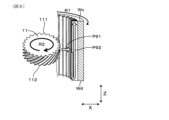
- FIG. 1 is a conceptual diagram showing the configuration of a threaded grinding wheel and a gear for carrying out a gear grinding method according to a first embodiment.
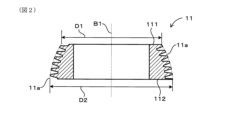
- FIG. 2 is an axial cross-sectional view of the threaded grinding wheel according to the first embodiment.
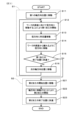
- FIG. 3 is a flow diagram of the gear grinding method of the first embodiment.
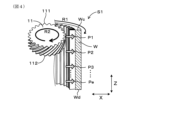
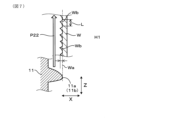
- FIG. 4 is a conceptual diagram illustrating the first processing step in the gear grinding method of the first embodiment.
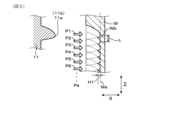
- FIG. 5 is another conceptual diagram illustrating the first processing step in the gear grinding method according to the first embodiment.
- FIG. 6 is a conceptual diagram illustrating the second processing step in the gear grinding method of the first embodiment.
- FIG. 7 is another conceptual diagram illustrating the second processing step in the gear grinding method of the first embodiment.
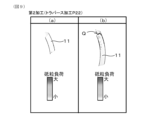
- FIG. 8 is a conceptual diagram for explaining a conventional gear grinding method as a comparative example.
- FIG. 9 is a diagram showing test results of the gear grinding methods of the first embodiment and the comparative example in the confirmation test.
- the workpiece W to be machined by the gear grinding method of the present embodiment 1 is a gear, and may be either an internal gear or an external gear.
- an internal gear having a tooth surface on the inner peripheral surface of the workpiece W is used as shown in FIG.
- a gear that is, a workpiece W
- the apparatus is appropriately selected according to the gear shape to be machined.
- an internal gear generating grinding machine (not shown) is used as the gear grinding apparatus 1.
- the gear grinding apparatus has a threaded grinding wheel 11, which is a machining tool, as shown in FIG. 1.
- the workpiece W is attached to the gear grinding apparatus (not shown) so as to be rotatable around a workpiece rotation axis C1 R1 parallel to the vertical direction (Z-axis direction).
- a predetermined tooth shape is formed in advance in the workpiece W as shown in FIG. 1, and the axial direction of the workpiece W is parallel to the Z-axis direction.
- the gear grinding device also supports a grinding wheel arbor 12 rotatably around the grinding wheel rotation axis B1 R2.
- the grinding wheel arbor 12 is movable in a direction in which the distance between the workpiece rotation axis C1 and the grinding wheel rotation axis B1 is adjusted (hereinafter referred to as the X-axis direction), in a direction perpendicular to the grinding wheel rotation axis B1 (hereinafter referred to as the Y-axis direction), and in the Z-axis direction.
- a threaded grinding wheel 11 for grinding the workpiece W is attached to the tip of the grinding wheel arbor 12. Therefore, by moving the grinding wheel arbor 12 in the X-axis, Y-axis, and Z-axis directions and rotating it around the grinding wheel rotation axis B1, the threaded grinding wheel 11 moves and rotates together with the grinding wheel arbor 12.
- the grinding wheel rotation axis B1 of the grinding wheel arbor 12 is inclined relative to the workpiece rotation axis C1, and the two intersect at an axial angle ⁇ .
- the axial angle ⁇ is adjustable, and during grinding, the threaded grinding wheel 11 rotates around the grinding wheel rotation axis B1, which intersects with the workpiece rotation axis C1 of the workpiece W at an axial angle ⁇ .
- the object to be machined is an external gear
- it is possible to grind the external gear by attaching a grinding wheel gear for external tooth grinding to the tip of the grinding wheel arbor 12 instead of the threaded grinding wheel 11.
- a rotation locus 11a of the outer circumferential surface of the threaded grinding wheel has a diameter D1 of a rotation locus of the outer circumferential surface of a first end 111, which is one axial end of the threaded grinding wheel 11, which is smaller than a diameter D2 of a rotation locus of the outer circumferential surface of a second end 112, which is the other axial end.
- the rotation locus 11a of the outer circumferential surface of the threaded grinding wheel 11 at least the rotation locus of the outer circumferential surface of the second end 112 has a maximum diameter D2.
- the threaded grinding wheel 11 reduces in diameter from the second end 112 to the first end 111.
- the threaded grinding wheel 11 may have a region in which the diameter of the rotational path does not change from the first end 111 to the second end 112.
- the rotational path of the outer circumferential surface of the threaded grinding wheel 11 may be cylindrical in shape, with the diameter of the rotational path not changing from the first end 111 to the second end 112.
- the gear grinding method of this embodiment includes a first processing step S1 and a second processing step S2 as shown in Fig. 3.
- a first processing step is performed multiple times using the threaded grinding wheel 11
- a second processing step is performed using the threaded grinding wheel 11.
- the tooth trace of the workpiece W is inclined with respect to the axial direction Z of the workpiece W as shown in Fig. 1, but for the sake of convenience, in Figs. 4 and 6, the tooth trace of the workpiece W is shown as extending parallel to the axial direction Z.
- First processing step S1 In the first machining step S1, in step S11 shown in Fig. 3, the threaded grinding wheel 11 is moved to a first axial position.
- the first axial position is not limited, but is preferably an end portion of the workpiece W in the axial direction Z.
- the position is a position near the upper end Wc of the workpiece W in the axial direction Z, where the arrow P1 is located. This position is defined as a first axial position.
- step S12 shown in FIG. 3 the threaded grinding wheel 11 is moved in the radial direction X toward the inner peripheral surface of the workpiece W as shown by the arrow P1 in FIG. 4 to start the first processing, and the threaded grinding wheel 11 is moved a predetermined amount in step S13.
- the amount of movement of the threaded grinding wheel 11 in the radial direction X in the first processing in step S13 is not limited, but as shown in FIG.
- the outermost part of the threaded grinding wheel 11 in the radial direction X of the gear formed on the workpiece W (the tip 11b in the radial direction X of the rotation trajectory 11a) reaches the target shape Wa of the gear to be formed on the workpiece W at the axial position where the first processing is performed.
- the amount of movement of the threaded grinding wheel 11 in the radial direction X in the first processing corresponds to the cutting depth of the workpiece W in the first processing.
- the cutting depth of the workpiece W in the first processing can be in the range of several tens of ⁇ m to several hundreds of ⁇ m.
- the first processing is also called plunge processing because it is a processing in which the workpiece W is ground in the radial direction X.
- step S14 After moving a predetermined amount in step S13, in step S14, the threaded grinding wheel 11 is moved in the radial direction X away from the inner peripheral surface of the workpiece W, i.e., in the opposite direction to the arrow P1 in FIG. 4. Then, in step S15 shown in FIG. 3, it is determined whether or not a preset end position of the first processing has been reached.
- the end position of the first processing is not limited, but in this embodiment, the end position of the first processing is a position in the axial direction Z near the lower end Wd on the opposite side to the start position of the first processing in the axial direction Z, and is the position in the axial direction Z where the arrow Pe shown in FIG. 4 is located.
- step S15 shown in FIG. 3 If it is determined in step S15 shown in FIG. 3 that the threaded grinding wheel 11 has not reached the end position of the first processing, proceed to No in step S14, and in step S16, move the threaded grinding wheel 11 to the next axial position. In this embodiment, it moves from the first processing position where the arrow P1 is located to the second processing position where the next axial position, that is, the arrow P2 is located. Then, steps S12 to S15 are performed again. Therefore, the first processing is repeatedly performed while changing the axial position until the threaded grinding wheel 11 reaches the end position Pe of the first processing. In this embodiment, the first processing is repeatedly performed in the order of the first processing position where the arrow P1 is located in FIG. 4, the second processing position where the arrow P2 is located, the third processing position where the arrow P3 is located, ... and the end position where the arrow Pe is located.
- step S15 shown in FIG. 3 when it is determined that the threaded grinding wheel 11 has reached the preset end position Pe of the first machining process, the process proceeds to Yes in step S15, and the first machining process S1 is terminated.
- the interval between the machining positions in the first machining step S1, i.e., the pitch of the machining positions, which is the interval between adjacent arrows P1 to Pe, is not limited and can be set appropriately based on the shape of the threaded grinding wheel 11 and the shape of the workpiece W.
- the pitch of the machining positions can be at least smaller than the pitch of the multiple teeth provided on the threaded grinding wheel 11.
- the pitch L of the machining positions is set to an equal interval, as shown in FIG. 5.
- an uncut area Wb is formed, which is the difference between the shape of the workpiece W at the end of the first machining step S1 and the target shape Wa.
- the pitch of the machining position in the first machining step S1 is set so that the uncut area Wb at the end of the first machining step S1 is large enough not to come into contact with the axial end 111 of the threaded grinding wheel 11 shown in FIG. 2 in the second machining in the second machining step S2 described later, and the first machining is performed.
- the workpiece W is ground in the first machining step S1, so that the uncut area Wb is formed into an approximately fan-shaped shape.
- the uncut area Wb has a shape in which a plurality of approximately fan-shaped shapes are arranged at a predetermined interval in the axial direction Z in a cross section parallel to the axial direction Z.
- the radial size H1 of the uncut area Wb can be 10 ⁇ m or less.
- the first machining at each axial position is performed by grinding until the tip 11b reaches the target shape Wa in one machining operation.
- this is not limited to the above, and the cutting depth of the first machining at each axial position may be reduced and the first machining at each axial position may be performed in multiple operations.
- Second processing step S2 After the first machining step S1 is completed, the second machining step S2 is performed. In the second machining step S2, the threaded grinding wheel 11 is moved to a start position of the second machining in step S21 shown in FIG.
- the start position of the second machining is not limited, but in this embodiment, it is set to the position of the lower end Wd of the workpiece W as shown by the arrow P21 in FIG. Alternatively, the position may be the position of the portion Wc.
- step S22 shown in FIG. 3 the threaded grinding wheel 11 is moved in the axial direction Z of the workpiece W to start the second machining process.
- the second machining process removes the uncut area Wb at the end of the first machining process S1 by moving the threaded grinding wheel 11 in the axial direction Z as shown by the arrow P22 in FIG. 6.
- the uncut area Wb removed in the second machining process S2 is sufficiently smaller than the amount of cut-off material removed from the workpiece W in the first machining process.
- the second processing is completed in one grinding process by performing the second processing so that the outermost part of the threaded grinding wheel 11 (the tip 11b in the radial direction X of the rotation trajectory 11a) coincides with the target shape Wa.
- the second processing is also called traverse processing because it is processing in which the workpiece W is ground in the axial direction Z.
- step S23 when the threaded grinding wheel 11 reaches the end position of the second machining, the second machining step S2 is completed and the flow ends.
- the end position of the second machining is not limited, but in this embodiment, it is set to the position of the upper end Wc of the workpiece W, opposite the lower end Wd of the workpiece W, which is the start position. Note that if the start position of the second machining is set to the position of the upper end Wc, the end position can be set to the position of the lower end Wd of the workpiece W.
- the second processing is performed in a single grinding process from the start position Wd to the end position Wc, but this is not limited to the above, and the second processing may be performed in multiple grinding processes.
- the axial position of the workpiece W constituting the gear is sequentially changed to perform a first process in which the threaded grinding wheel 11 is moved to a plurality of axial positions in the radial direction X of the workpiece W for grinding, and then a second process in which the threaded grinding wheel 11 is moved to the axial direction Z of the workpiece W for grinding, thereby machining the workpiece W into a target shape.
- the first process is a plunge machining in which the threaded grinding wheel 11 is moved to the radial direction X of the workpiece W for grinding, so that uneven contact is relatively unlikely to occur. This makes it possible to prevent the occurrence of uneven contact, thereby preventing uneven wear in the threaded grinding wheel 11 and extending the life of the threaded grinding wheel.
- a second processing step is included in which the workpiece W is ground by moving the threaded grinding wheel 11 in the axial direction Z of the workpiece W, thereby processing the workpiece W into a target shape.
- the second processing is a traverse processing in which the threaded grinding wheel 11 is moved in the axial direction Z of the workpiece W to perform grinding, and thus uneven contact is likely to occur. Then, by performing the first processing in which uneven contact is unlikely to occur as described above before the second processing in which uneven contact is likely to occur, it is possible to reduce the amount of cutting in the radial direction X in the second processing, since it is only necessary to remove the remaining cutting portion Wb in the previous first processing during the second processing.
- the occurrence of uneven contact can be suppressed overall.
- by reducing the amount of cutting in the radial direction X in the second processing it is possible to prevent the occurrence of uneven contact that occurred at the end of the threaded grinding wheel 11 in the past, and therefore uneven wear in the threaded grinding wheel 11 can be prevented, thereby extending the life of the threaded grinding wheel.
- the first machining step S1 is performed so that the remaining cutting area Wb, which is the difference between the shape of the workpiece W at the end of the first machining step S1 and the target shape, is large enough not to come into contact with the axial end 111 of the threaded grinding wheel 11 in the second machining step S2.
- the cross-sectional shape parallel to the axial direction Z of the uncut area Wb in the first processing step S1 is a shape in which multiple approximately sector shapes are arranged at predetermined intervals in the axial direction Z.
- the threaded grinding wheel 11 in the first machining step S1, the threaded grinding wheel 11 is moved in one direction in the axial direction Z to change the axial position to perform the first machining, and in the second machining step S2, the threaded grinding wheel 11 is moved in the other direction in the axial direction Z to perform the second machining.
- This makes it possible to shorten the distance by which the threaded grinding wheel 11 is moved to the start position of the second machining step S2 when transitioning from the first machining step S1 to the second machining step S2, thereby improving work efficiency.
- the direction in which the axial position is changed in the first machining step S1 and the direction in which the threaded grinding wheel 11 is moved in the second machining step S2 may be the same. In this case, the effect of improving the work efficiency described above is not achieved, but other operational effects can be achieved.
- the rotation trajectory 11a of the outer peripheral surface of the first end 111 which is one axial end of the threaded grinding wheel 11
- the rotation trajectory 11a of the outer peripheral surface of the second end 112 which is the other axial end
- at least the rotation trajectory of the outer peripheral surface of the second end 112 has the largest diameter in the rotation trajectory 11a of the outer peripheral surface of the threaded grinding wheel 11.
- the amount of material removed from the workpiece W in the first machining step S1 is greater than the amount of material removed from the workpiece W in the second machining step S2. This allows for a smaller amount of material to be removed in the second machining step S2, further preventing uneven contact during the second machining step.
- the first machining is performed at each of multiple axial positions where the first machining is performed until the outermost portion 11b of the threaded grinding wheel 11 in the radial direction X of the workpiece W reaches the target shape Wa. Then, in the second machining step S2, the remaining uncut area Wb, which is the difference between the shape of the workpiece W at the end of the first machining step S1 and the target shape, is removed. As a result, the amount of removal required in the second machining step S2 is small, which further prevents the occurrence of uneven contact in the second machining.
Landscapes
- Engineering & Computer Science (AREA)
- General Engineering & Computer Science (AREA)
- Mechanical Engineering (AREA)
- Polishing Bodies And Polishing Tools (AREA)
Priority Applications (5)
| Application Number | Priority Date | Filing Date | Title |
|---|---|---|---|
| PCT/JP2023/019894 WO2024247037A1 (ja) | 2023-05-29 | 2023-05-29 | 歯車研削加工方法 |
| DE112024002296.0T DE112024002296T5 (de) | 2023-05-29 | 2024-03-15 | Zahnradschleifverfahren |
| CN202480030832.XA CN121079169A (zh) | 2023-05-29 | 2024-03-15 | 齿轮磨削加工方法 |
| PCT/JP2024/010326 WO2024247442A1 (ja) | 2023-05-29 | 2024-03-15 | 歯車研削加工方法 |
| JP2025523289A JPWO2024247442A1 (https=) | 2023-05-29 | 2024-03-15 |
Applications Claiming Priority (1)
| Application Number | Priority Date | Filing Date | Title |
|---|---|---|---|
| PCT/JP2023/019894 WO2024247037A1 (ja) | 2023-05-29 | 2023-05-29 | 歯車研削加工方法 |
Publications (1)
| Publication Number | Publication Date |
|---|---|
| WO2024247037A1 true WO2024247037A1 (ja) | 2024-12-05 |
Family
ID=93656986
Family Applications (2)
| Application Number | Title | Priority Date | Filing Date |
|---|---|---|---|
| PCT/JP2023/019894 Ceased WO2024247037A1 (ja) | 2023-05-29 | 2023-05-29 | 歯車研削加工方法 |
| PCT/JP2024/010326 Ceased WO2024247442A1 (ja) | 2023-05-29 | 2024-03-15 | 歯車研削加工方法 |
Family Applications After (1)
| Application Number | Title | Priority Date | Filing Date |
|---|---|---|---|
| PCT/JP2024/010326 Ceased WO2024247442A1 (ja) | 2023-05-29 | 2024-03-15 | 歯車研削加工方法 |
Country Status (4)
| Country | Link |
|---|---|
| JP (1) | JPWO2024247442A1 (https=) |
| CN (1) | CN121079169A (https=) |
| DE (1) | DE112024002296T5 (https=) |
| WO (2) | WO2024247037A1 (https=) |
Citations (5)
| Publication number | Priority date | Publication date | Assignee | Title |
|---|---|---|---|---|
| JPS59219116A (ja) * | 1983-05-27 | 1984-12-10 | Nagata Tekko | 歯車の歯面研削仕上げ法 |
| JP2009045681A (ja) * | 2007-08-17 | 2009-03-05 | Mitsubishi Heavy Ind Ltd | 樽形ウォーム状工具のドレッシング方法及びドレッシング装置及び内歯車研削盤 |
| JP2013018089A (ja) * | 2011-07-13 | 2013-01-31 | Mitsubishi Heavy Ind Ltd | 歯車研削方法 |
| JP2017170539A (ja) * | 2016-03-18 | 2017-09-28 | 本田技研工業株式会社 | 歯車の研削加工方法 |
| JP2021013989A (ja) * | 2019-07-12 | 2021-02-12 | 株式会社ジェイテクト | 砥石による研削加工方法 |
Family Cites Families (8)
| Publication number | Priority date | Publication date | Assignee | Title |
|---|---|---|---|---|
| DE3344548A1 (de) * | 1983-12-09 | 1985-06-20 | Carl Hurth Maschinen- und Zahnradfabrik GmbH & Co, 8000 München | Verfahren und vorrichtung zum herstellen und bearbeiten von zahnraedern |
| JP3601066B2 (ja) * | 1993-11-30 | 2004-12-15 | アイシン精機株式会社 | 歯車ホーニング盤における内歯車形ホーニング砥石による歯車ホーニング加工方法 |
| JP4406895B2 (ja) * | 1998-08-28 | 2010-02-03 | 清和鉄工株式会社 | 歯車のホーニング加工方法と歯車のホーニング加工方法に使用する歯付ドレッサ |
| JP2009034785A (ja) * | 2007-08-02 | 2009-02-19 | Honda Motor Co Ltd | 歯車加工方法 |
| JP4875602B2 (ja) | 2007-12-14 | 2012-02-15 | 三菱重工業株式会社 | 可変ノズル機構 |
| JP5419473B2 (ja) * | 2009-01-09 | 2014-02-19 | 三菱重工業株式会社 | 内歯車加工方法 |
| JP2014217905A (ja) * | 2013-05-07 | 2014-11-20 | 株式会社唐津鐵工所 | 歯車研削方法及び装置 |
| IN2014DE00219A (https=) * | 2014-01-24 | 2015-07-31 | Shivam Autotech Ltd |
-
2023
- 2023-05-29 WO PCT/JP2023/019894 patent/WO2024247037A1/ja not_active Ceased
-
2024
- 2024-03-15 CN CN202480030832.XA patent/CN121079169A/zh active Pending
- 2024-03-15 JP JP2025523289A patent/JPWO2024247442A1/ja active Pending
- 2024-03-15 WO PCT/JP2024/010326 patent/WO2024247442A1/ja not_active Ceased
- 2024-03-15 DE DE112024002296.0T patent/DE112024002296T5/de active Pending
Patent Citations (5)
| Publication number | Priority date | Publication date | Assignee | Title |
|---|---|---|---|---|
| JPS59219116A (ja) * | 1983-05-27 | 1984-12-10 | Nagata Tekko | 歯車の歯面研削仕上げ法 |
| JP2009045681A (ja) * | 2007-08-17 | 2009-03-05 | Mitsubishi Heavy Ind Ltd | 樽形ウォーム状工具のドレッシング方法及びドレッシング装置及び内歯車研削盤 |
| JP2013018089A (ja) * | 2011-07-13 | 2013-01-31 | Mitsubishi Heavy Ind Ltd | 歯車研削方法 |
| JP2017170539A (ja) * | 2016-03-18 | 2017-09-28 | 本田技研工業株式会社 | 歯車の研削加工方法 |
| JP2021013989A (ja) * | 2019-07-12 | 2021-02-12 | 株式会社ジェイテクト | 砥石による研削加工方法 |
Also Published As
| Publication number | Publication date |
|---|---|
| JPWO2024247442A1 (https=) | 2024-12-05 |
| WO2024247442A1 (ja) | 2024-12-05 |
| DE112024002296T5 (de) | 2026-03-19 |
| CN121079169A (zh) | 2025-12-05 |
Similar Documents
| Publication | Publication Date | Title |
|---|---|---|
| TWI451926B (zh) | Internal gear machining method | |
| KR100865053B1 (ko) | 기어 연삭기, 나사형 연삭휠을 드레싱하는 방법 및가공물을 연삭하는 방법 | |
| JP5846082B2 (ja) | スカイビング加工用カッターの研削方法 | |
| KR20100116530A (ko) | 단부절삭 공작물 휠의 2차 버를 제거하기 위한 방법 및 장치 | |
| CN110121393B (zh) | 对内部齿形部分硬表面加工的方法和适合该方法的机床 | |
| JP2014500153A (ja) | 航空機ターボシャフトエンジンのケーシングを機械加工するための方法および前記方法を実施するためのスクレーパ工具 | |
| US10295039B2 (en) | Convex gear tooth edge break | |
| US7175509B2 (en) | Grinder and method of and apparatus for non-contact conditioning of tool | |
| CN111479646A (zh) | 用于加工齿部的方法、以及齿部加工机器及其控制程序 | |
| TW201908040A (zh) | 螺紋切削加工裝置和螺紋切削加工方法 | |
| KR20180029972A (ko) | 작업 대상물을 연마하는 방법 및 연삭기 | |
| WO2024247037A1 (ja) | 歯車研削加工方法 | |
| KR20240011689A (ko) | 피가공물 치형 배열체의 치형 플랭크 영역을 기계가공하기 위한 방법, 챔퍼링 공구, 이 방법을 수행하기 위한 제어 명령어를 갖는 제어 프로그램, 및 기어 절삭기 | |
| JP6819099B2 (ja) | 歯車加工方法 | |
| JP7439403B2 (ja) | 砥石による研削加工方法 | |
| JP6023101B2 (ja) | ギヤのホーニング加工方法 | |
| JP2019089153A (ja) | 歯切り工具及び歯車加工装置 | |
| JP2018520014A (ja) | 歯部仕上げ加工方法およびこの方法を実行する仕上げ加工機ならびにこの加工機を制御するコンピュータープログラム | |
| JP2012130990A (ja) | ドレッシング方法およびドレッシング装置 | |
| CN113579369B (zh) | 用于加工齿顶圆直径的方法和用于产生齿轮的工具 | |
| JP6561596B2 (ja) | 切削装置及び切削方法 | |
| JP4929790B2 (ja) | 砥石車のツルーイング方法 | |
| CN116133780B (zh) | 用于磨削工件的齿或轮廓的方法 | |
| JP2015006713A (ja) | 歯車加工装置 | |
| JP7557039B1 (ja) | らせん溝の加工方法 |
Legal Events
| Date | Code | Title | Description |
|---|---|---|---|
| 121 | Ep: the epo has been informed by wipo that ep was designated in this application |
Ref document number: 23939517 Country of ref document: EP Kind code of ref document: A1 |
|
| NENP | Non-entry into the national phase |
Ref country code: DE |