WO2024241504A1 - インモールド成形方法 - Google Patents
インモールド成形方法 Download PDFInfo
- Publication number
- WO2024241504A1 WO2024241504A1 PCT/JP2023/019190 JP2023019190W WO2024241504A1 WO 2024241504 A1 WO2024241504 A1 WO 2024241504A1 JP 2023019190 W JP2023019190 W JP 2023019190W WO 2024241504 A1 WO2024241504 A1 WO 2024241504A1
- Authority
- WO
- WIPO (PCT)
- Prior art keywords
- mold
- resin
- insert body
- opening
- insert
- Prior art date
- Legal status (The legal status is an assumption and is not a legal conclusion. Google has not performed a legal analysis and makes no representation as to the accuracy of the status listed.)
- Ceased
Links
Images




Classifications
-
- B—PERFORMING OPERATIONS; TRANSPORTING
- B29—WORKING OF PLASTICS; WORKING OF SUBSTANCES IN A PLASTIC STATE IN GENERAL
- B29C—SHAPING OR JOINING OF PLASTICS; SHAPING OF MATERIAL IN A PLASTIC STATE, NOT OTHERWISE PROVIDED FOR; AFTER-TREATMENT OF THE SHAPED PRODUCTS, e.g. REPAIRING
- B29C33/00—Moulds or cores; Details thereof or accessories therefor
- B29C33/12—Moulds or cores; Details thereof or accessories therefor with incorporated means for positioning inserts, e.g. labels
- B29C33/14—Moulds or cores; Details thereof or accessories therefor with incorporated means for positioning inserts, e.g. labels against the mould wall
-
- B—PERFORMING OPERATIONS; TRANSPORTING
- B29—WORKING OF PLASTICS; WORKING OF SUBSTANCES IN A PLASTIC STATE IN GENERAL
- B29C—SHAPING OR JOINING OF PLASTICS; SHAPING OF MATERIAL IN A PLASTIC STATE, NOT OTHERWISE PROVIDED FOR; AFTER-TREATMENT OF THE SHAPED PRODUCTS, e.g. REPAIRING
- B29C45/00—Injection moulding, i.e. forcing the required volume of moulding material through a nozzle into a closed mould; Apparatus therefor
- B29C45/14—Injection moulding, i.e. forcing the required volume of moulding material through a nozzle into a closed mould; Apparatus therefor incorporating preformed parts or layers, e.g. injection moulding around inserts or for coating articles
-
- B—PERFORMING OPERATIONS; TRANSPORTING
- B29—WORKING OF PLASTICS; WORKING OF SUBSTANCES IN A PLASTIC STATE IN GENERAL
- B29C—SHAPING OR JOINING OF PLASTICS; SHAPING OF MATERIAL IN A PLASTIC STATE, NOT OTHERWISE PROVIDED FOR; AFTER-TREATMENT OF THE SHAPED PRODUCTS, e.g. REPAIRING
- B29C45/00—Injection moulding, i.e. forcing the required volume of moulding material through a nozzle into a closed mould; Apparatus therefor
- B29C45/17—Component parts, details or accessories; Auxiliary operations
Definitions
- the present invention relates to an in-mold molding method.
- a manufacturing method for an insert molded product in which a resin insert body is integrally joined by insert molding to a plate-shaped molded product body made of a resin material with a melting point higher than that of the constituent resin of the insert body includes the steps of preparing an insert body having a recess on the joining surface with the molded product body, and a molding die having a molding cavity formed therein, the molding cavity comprising a receiving portion in which the insert body is placed and a molding portion having a shape corresponding to the molded product body, and a molding portion which forms a joining portion of the molded product body with the insert body when the insert body is placed in the receiving portion of the molding cavity.
- a method for manufacturing an insert molded product includes the steps of preparing an insert molding mold in which the joint forming portion includes a portion having a flow path width that is larger than the flow path width of the portion of the molded part other than the joint forming portion by at least the depth of the recess of the insert body, and accommodating the insert body in an accommodating portion of a molding cavity formed inside the insert molding mold, and then introducing the constituent resin of the molded product body in a molten state into the molding portion of the molding cavity to perform insert molding, thereby molding the molded product body and integrally joining the insert body to the molded product body (Patent Document 1).
- a method for manufacturing an integrated conductive circuit molded product includes the steps of preparing a lower conductive circuit sheet including a base sheet, a circuit pattern formed on the base sheet, and resin through-holes formed in areas other than the circuit pattern, placing the lower conductive circuit sheet in a cavity of an injection molding die, and injecting molten resin into the cavity to pass the resin through the resin through-holes formed in the lower conductive circuit sheet, pressing an end of the lower conductive circuit sheet down into a recess for forming an engagement portion formed in the lower surface side die, filling the recess for forming the engagement portion with resin, rolling in the end of the lower conductive circuit sheet, and engaging the lower conductive circuit sheet with the underside of a resin molded product (Patent Document 2).
- the present invention provides an in-mold molding method that can integrate a portion of an insert body into the molding resin without forming a cavity on one of the mold faces.
- the in-mold molding method comprises: An in-mold molding method in which an insert body is placed in a mold for resin molding, and a resin injected into the mold and the insert body are integrally molded, an insert body preparation step of forming a first opening in the insert body; a sheet-like body preparation step of forming second openings in the sheet-like body, the second openings overlapping and communicating with the first openings so as to include a part or all of the first openings in a plan view; a positioning step of arranging the sheet-like body and the insert body, which are bonded together while aligning the first opening and the second opening, at predetermined positions in the mold; a mold clamping step of closing the mold with the sheet-like body and the insert body disposed therein; a molding process of injecting a resin into the clamped mold and passing the resin through the first opening to the second opening to integrally mold the insert body and the resin; A peeling step of opening the mold and peeling the sheet-like body from
- the invention described in claim 2 is the in-mold molding method described in claim 1,
- the sheet-like body has a weak adhesive layer having a weak adhesive strength on the surface to be attached to the insert body. It is characterized by:
- the invention described in claim 3 is the in-mold molding method described in claim 2,
- the resin is filled into the second opening from the first opening to form a pressing shape that presses the insert body. It is characterized by:
- the invention according to claim 4 provides the in-mold molding method according to any one of claims 1 to 3, In the insert body preparation step, an intrusion restricting body is further provided to restrict intrusion of the resin between the insert body and the resin in a region where the first opening is formed.
- an intrusion restricting body is further provided to restrict intrusion of the resin between the insert body and the resin in a region where the first opening is formed.
- the in-mold molding method comprises: An in-mold molding method in which an insert body is placed in a mold for resin molding, and a resin injected into the mold and the insert body are integrally molded, an insert body preparation step of forming a hole in the insert body; a boss-shaped body preparation process for forming a boss-shaped body having a first through hole having an axis and serving as a flow path for the resin, and a second through hole communicating with the first through hole in a direction intersecting the first through hole and serving as the flow path for the resin; a positioning step of fitting the shaft portion of the boss-shaped body into the hole of the insert body to place the boss-shaped body and the insert body at predetermined positions within the mold; a mold clamping step of closing the mold with the boss-shaped body and the insert body disposed therein; a molding process of injecting the resin into the clamped mold, and integrally molding the insert body and the resin in a state in which the boss-shaped body is embedded in
- the invention according to claim 6 provides the in-mold molding method according to claim 5, the boss-shaped body has a flange portion larger than the hole of the insert body, and when the shaft portion is fitted into the hole of the insert body, the flange portion is in close contact with one surface of the insert body via a weak adhesive layer having a weak adhesive strength; It is characterized by:
- a portion of the insert body can be integrated into the molding resin without forming a cavity on one of the mold faces.
- the sheet-like body can be peeled off from the insert body while preventing misalignment between the sheet-like body and the insert body.
- the insert body and the resin can be integrated.
- a portion of the insert body can be integrated into the molding resin without forming a cavity on one of the mold faces.
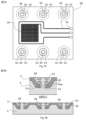
- FIG. 1A is a schematic plan view showing an example of a circuit board manufactured by the in-mold molding method according to the first embodiment, and FIG. 1B is a schematic cross-sectional view.
- 11 is a diagram showing an example of overlap between a first opening and a second opening formed in a sheet-like body
- FIG. 3A is a schematic plan view showing an example of a circuit board provided with an entrance restrictor
- FIG. 3B is a schematic cross-sectional view.
- FIG. 4A is a schematic plan view showing an example of an insert body having a first opening formed therein
- FIG. 4B is a schematic cross-sectional view explaining the flow of resin in an injection molding die that integrally molds the insert body and a resin layer.
- FIG. 1A is a schematic plan view showing an example of a circuit board manufactured by the in-mold molding method according to the first embodiment
- FIG. 1B is a schematic cross-sectional view.
- 11 is a diagram showing an example of overlap between a first opening and
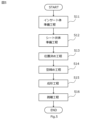
- FIG. 2 is a flow chart showing an example of a schematic procedure of an in-mold molding method according to the first embodiment for integrally molding an insert body and a resin layer.
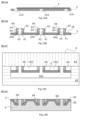
- 3A to 3C are schematic partial cross-sectional views of a circuit board during a manufacturing process thereof.
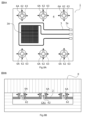
- FIG. 7A is a schematic plan view showing an example of a circuit board manufactured by the in-mold molding method according to the second embodiment, and
- FIG. 7B is a schematic cross-sectional view.
- FIG. 8A is a schematic plan view showing an example of an insert body into which a boss-shaped body is fitted
- FIG. 8B is a schematic cross-sectional view explaining the flow of resin in an injection molding die that integrally molds the insert body and a resin layer.
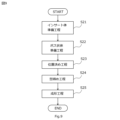
- 11 is a flow chart showing an example of a schematic procedure of an in-mold molding method according to a second embodiment for integrally molding an insert body and a resin layer.
- 11A to 11C are schematic partial cross-sectional views of a circuit board in a manufacturing process of the circuit board according to the second embodiment.
- 1A to 1C are schematic cross-sectional views showing a method for producing a molded body in which a sheet-like body is placed on one of the parting surfaces of a mold and a resin is injected into the mold.
- FIG. 1A is a schematic plan view showing an example of a circuit board 1 manufactured by the in-mold molding method of this embodiment
- Figure 1B is a schematic cross-sectional view
- Figure 2 is a diagram showing an example of overlap between a first opening 21 and a second opening 31 formed in a sheet-like body
- Figure 3A is a schematic plan view showing an example of a circuit board 1 provided with an entry restrictor 7
- Figure 3B is a schematic cross-sectional view
- Figure 4A is a schematic plan view showing an example of an insert body 4 in which a first opening 21 is formed
- Figure 4B is a schematic cross-sectional view explaining the flow of resin in an injection molding die K that integrally molds the insert body 4 and the resin layer 5.
- the configuration of the circuit board 1 will be described below with reference to the drawings.
- the circuit board 1 is configured with an insert body 4 having a conductive pattern 3 formed on a first surface 2a of the substrate 2, a resin layer 5 covering a second surface 2b of the substrate 2 opposite the first surface 2a, and a pressing feature 6 that fixes the second surface 2b of the substrate 2 and the resin layer 5 so that they come into contact with each other on the first surface 2a side of the substrate 2.
- the substrate 2 is a deformable insulating film- or plate-shaped substrate made of a synthetic resin material.
- the term "deformable substrate” refers to a substrate that can be deformed after the conductive pattern 3 is disposed thereon, i.e., a substrate that can be deformed from a substantially flat two-dimensional shape to a substantially solid three-dimensional shape by thermoforming, vacuum forming, pressure forming, or the like.
- the substrate 2 may be, for example, an insulating film made of a thermoplastic resin material such as polyesters such as polyethylene terephthalate (PET) and polyethylene naphthalate (PEN), polyamides (PA) such as nylon 6-10 and nylon 46, polyether ether ketone (PEEK), acryl butadiene styrene (ABS), polymethyl methacrylate (PMMA), or polyvinyl chloride (PVC), an insulating film made of a thermosetting resin material such as phenol, epoxy, polyimide (PI), unsaturated polyester, polyurethane, silicone, or oxetane, or an insulating plate such as glass epoxy (FR-4) or glass composite (CEM3).
- a thermoplastic resin material such as polyesters such as polyethylene terephthalate (PET) and polyethylene naphthalate (PEN), polyamides (PA) such as nylon 6-10 and nylon 46, polyether ether ketone (PEEK), acryl butadiene s
- the resin layer 5 is insert molded into the insert body 4 having the conductive pattern 3 formed on the first surface 2a of the substrate 2 without using an adhesive layer. Therefore, there is no need to consider the adhesion between the substrate 2 and the resin layer 5, and the material of the substrate 2 can be not only a thermoplastic resin but also a thermosetting resin.
- thermosetting resin materials include phenolic resin, epoxy resin, polyimide resin, unsaturated polyester resin, polyurethane resin, silicone resin, and oxetane resin, and among these, polyimide resin (PI) is particularly suitable.
- the thickness of the substrate 2 is not particularly limited, but is preferably 5 ⁇ m to 3 mm, more preferably 12 ⁇ m to 1 mm, and most preferably 50 ⁇ m to 200 ⁇ m. If the substrate 2 is too thin, the strength may be insufficient and the substrate 2 may be significantly distorted during the plating process of the conductive pattern 3. Note that this thickness is a condition when the substrate 2 is a film-like substrate, and the substrate 2 to which the present invention is applied is not limited to a film-like substrate.
- the surface of the substrate 2 is subjected to surface treatments such as corona treatment, plasma treatment, solvent treatment, and primer treatment in order to apply the conductive ink containing metal nanoparticles evenly.
- the base material 2 also has a first opening 21 formed therein.
- the first opening 21 is formed so as to penetrate in the thickness direction, and the resin forming the resin layer 5 (described later) penetrates through the first opening 21 to form the pressing shape 6, thereby integrating the insert body 4 and the resin layer 5.
- FIG. 2 shows an example of overlap between the first opening 21 and a second opening 31 formed in a sheet body 30, which will be described later.
- second openings 31 are formed that overlap and communicate with part or all of the first openings 21 in a plan view, in comparison with the first openings 21 formed in the substrate 2.
- Fig. 2A shows an example in which the second openings 31 overlap and communicate with all of the first openings 21, and
- Fig. 2B shows an example in which the second openings 31 overlap and communicate with all of the multiple first openings 21.
- Fig. 2C shows an example in which the second openings 31 overlap and communicate with part of the first openings 21, and
- Fig. 2D shows an example in which the second openings 31 overlap and communicate with part of the multiple first openings 21.
- Electrode 1A shows an example in which the conductive pattern 3 is arranged as a touch sensor 3A, but a plurality of electronic components 3B (not shown) may be attached to the conductive pattern 3.
- the electronic components 3B include a control circuit, a contact sensing component such as strain, resistance, capacitance, TIR, and a light detection component, a tactile component or a vibration component such as a piezoelectric actuator or a vibration motor, a light emitting component such as an LED, a sound generating or receiving component such as a microphone and a speaker, a device operating component such as a memory chip, a programmable logic chip, and a CPU, a digital signal processor (DSP), an ALS device, a PS device, a processing device, a MEMS, and the like.
- DSP digital signal processor
- the pressing shape 6 may be formed in a plurality of portions except for the area in which the conductive pattern 3 and electronic components of the insert body 4 are arranged.
- the ingress restriction body 7 that restricts the ingress of the resin layer 5 between the second surface 2b of the substrate 2 and the resin layer 5.
- the ingress restriction body 7 is fixed by adhesion so as to be in close contact with the second surface 2b of the substrate 2 around the periphery of the first opening 21 formed in the substrate 2.
- the adhesion method include fixing with an adhesive or attaching with double-sided tape so that the ingress restriction body 7 does not shift due to the resin pressure of the molten resin.
- the material of the entrance restrictor 7 is not particularly limited, but it is preferable that the entrance restrictor 7 be made of the same thermoplastic resin material as the material of the resin layer 5 .
- the entry restriction body 7 restricts the entry of the resin layer 5 into the second surface 2b of the substrate 2, which is covered by the pressing shape 6 formed integrally with the resin layer 5, thereby suppressing deformation of the substrate 2 due to the resin pressure when the resin layer 5 is injection molded.
- FIG. 5 is a flow chart showing an example of the outline of the procedure of the in-mold molding method for integrally molding the insert body 4 and the resin layer 5
- FIG. 6 is a partial cross-sectional schematic view of the circuit board 1 during the manufacturing process of the circuit board 1.
- the in-mold molding method includes an insert body preparation process S11 in which a first opening 21 is formed in the insert body 4, a sheet body preparation process S12 in which a second opening 31 is formed in the sheet body 30 so as to overlap and communicate with a part or all of the first opening 21 in a plan view, a positioning process S13 in which the sheet body 30 and the insert body 4, which are bonded together by aligning the first opening 21 and the second opening 31, are placed in a predetermined position in the mold K, a mold clamping process S14 in which the mold K is closed with the sheet body 30 and the insert body 4 placed in place, a molding process S15 in which resin is injected into the mold K and the resin penetrates from the first opening 21 to the second opening 31 to integrally mold the insert body 4 and the resin, and a peeling process S16 in which the mold K is opened and the sheet body 30 is peeled off from the insert body 4, the insert body 4 is placed in the mold K for resin molding, and the resin injected into the mold K and the insert body 4
- a first opening 21 penetrating the thickness direction of the substrate 2 is formed in a substantially flat substrate 2 formed in a predetermined shape and size (see FIG. 6A ).
- the first opening 21 is a hole that communicates between the cavity CA1 that forms the resin layer 5 and the cavity CA2 that forms the pressing shape 6, and a plurality of first openings 21 are formed in a size that allows the molten resin to pass through according to the size of the pressing shape 6.
- the opening shape of the first opening 21 is not particularly limited to a circular shape, a polygonal shape, etc., as long as it is a shape that allows the molten resin to pass through.
- a base layer made of catalytic particles such as metal nanoparticles that trigger the growth of metal plating is formed in a predetermined pattern on the substrate 2.
- a surface treatment such as a corona treatment, plasma treatment, solvent treatment, or primer treatment.
- Methods for applying a catalyst ink consisting of catalyst particles such as metal nanoparticles onto the substrate 2 include inkjet printing, silk screen printing, gravure printing, offset printing, flexographic printing, roller coater, brush coating, spraying, knife jet coater, pad printing, gravure offset printing, die coater, bar coater, spin coater, comma coater, impregnation coater, dispenser, and metal mask methods, but in this embodiment, the inkjet printing method is used.
- the base layer formed on the substrate 2 is subjected to electrolytic plating or electroless plating to deposit the plating metal on the surface and inside of the base layer, forming the conductive pattern 3.
- a second opening 31 is formed in a substantially flat sheet-like body 30 formed in a predetermined shape and size, so as to correspond to the first opening 21.
- the second opening 31 is formed so as to overlap and communicate with a part or all of the first opening 21 in a plan view.
- the second opening 31 is formed so as to be larger than the first opening 21 and to be communicated with the entire first opening 21 (see Figs. 2A and 2B).
- the second opening 31 may be formed so as to be the same size as the first opening 21 and to be communicated with a part of the first opening 21 (see Fig. 2C), or may be formed so as to be larger than the first opening 21 and to be communicated with a part of the first opening 21 formed in a plurality of places (see Fig. 2D).
- the sheet-like body 30 is a film-like or plate-like resin sheet made of a synthetic resin material, examples of which include polyesters such as polyethylene terephthalate (PET) and polyethylene naphthalate (PEN), polyamides (PA) such as nylon 6-10 and nylon 46, and thermoplastic resins such as acryl butadiene styrene (ABS), polymethyl methacrylate (PMMA), and polyvinyl chloride (PVC).
- PET polyethylene terephthalate
- PEN polyethylene naphthalate
- PA polyamides
- ABS acryl butadiene styrene
- PMMA polymethyl methacrylate
- PVC polyvinyl chloride
- PET polyethylene terephthalate
- PET polyethylene terephthalate
- PET is preferred due to its good balance of economy, a certain degree of heat resistance, chemical resistance, etc.
- a weak adhesive layer 32 having a weak adhesive strength is formed on the surface of the sheet-like body 30 that is bonded to the insert body 4.
- the adhesive that constitutes the weak adhesive layer 32 preferably has an adhesive strength sufficient to prevent the sheet-like body 30 and the insert body 4 from shifting when bonded together during insert molding, and is adhesive enough to allow the sheet-like body 30 to be easily peeled off from the insert body 4 after insert molding.
- adhesives include polyacrylic acid ester copolymer adhesives, polyisobutylene adhesives, and styrene-ethylene-butylene-styrene block copolymer adhesives, but silicone rubber is preferred from the viewpoint of excellent heat resistance and ability to maintain weak adhesion even during insert molding.
- the entry restriction body 7 is attached by adhesion to the second surface 2b of the substrate 2 in the region where the pressing shape 6 of the substrate 2 is formed (see FIG. 6B).
- the entry restriction body 7 is attached by adhesion around the first opening 21 formed in the substrate 2 so as to be in close contact with the second surface 2b of the substrate 2.
- the sheet-like body 30 is in-bonded to the first surface 2a of the substrate 2 by aligning the first opening 21 and the second opening 31 (see FIG. 6B).
- the sheet-like body 30 may be constructed by overlapping a resin sheet 30B in which no openings are formed on a resin sheet in which a second opening 31 is formed (see FIG. 6C). By blocking one end of the second opening 31 with the resin sheet 30B, one end of the cavity that forms the pressing shape 6 is formed of the highly smooth resin sheet 30B, and the pressing shape 6 formed by filling the second opening 31 with resin can be easily released when the mold K is opened.
- the insert body 4 with the sheet-like body 30 bonded thereto while aligning the first opening 21 and the second opening 31 is placed on a dividing surface of one of the dies (fixed side K1 in this embodiment) of the die K (see FIG. 6D ).
- mold clamping process S14 In the mold clamping step S14, the sheet-like body 30 and the insert body 4, which have been aligned with the first opening 21 and the second opening 31 and bonded together, are placed on the dividing surface of one mold (fixed side K1), and the other mold (movable side K2) is moved and brought into contact with the one mold (fixed side K1) to clamp the mold. As a result, the bonded sheet-like body 30 and the insert body 4 are sandwiched and fixed between both dividing surfaces of the mold K, and the cavity CA1 that forms the resin layer 5 and the cavity CA2 that forms the pressing shape 6 are closed and formed in the mold K.
- molding step S15 resin is injected into the clamped mold K to fill the cavity CA1.
- the resin filled in the cavity CA1 forms a resin layer 5 that covers the second surface 2b of the substrate 2.
- the resin filled in the cavity CA1 passes through the first opening 21 formed in the substrate 2 and then fills the second opening 31 (cavity CA2) formed in the sheet-like body 30.
- the resin filled in the cavity CA2 forms a pressing shape 6, and the insert body 4 and the resin layer 5 are integrally molded.
- peeling step S16 In the peeling step S16, the mold K is opened and the sheet-like body 30 is peeled off from the insert body 4 (see the arrow in FIG. 6E ) to obtain the circuit board 1 in which the insert body 4 and the resin layer 5 are integrally molded (see FIG. 6E ).
- the sheet-like body 30 is attached to the insert body 4 by the weak adhesive layer 32, so that it can be easily peeled off from the insert body 4.
- the circuit board 1 from which the sheet-like body 30 has been peeled off is fixed by the pressing shape 6 so that the insert body 4 and the resin layer 5 are in contact with each other.
- a sheet-like body 30 having a second opening 31 formed therein so as to overlap and communicate with a part or all of the first opening 21 formed in the insert body 4 is attached to the insert body 4, and the sheet-like body 30 and the insert body 4 are placed at predetermined positions in a mold K, and resin is injected into the mold K to penetrate the resin from the first opening 21 to the second opening 31, integrally molding the insert body 4 and the resin layer 5.
- the sheet-like body 30 is then peeled off from the insert body 4 to obtain a circuit board 1 in which the insert body 4 and the resin layer 5 are integrally molded. This makes it possible to integrate a part of the insert body 4 with the resin layer 5 without forming a cavity on one of the mold faces.
- an in-mold molding method has been described in which the sheet-like body 30 is attached to the insert body 4, placed at a predetermined position in the mold K, and resin is injected into the mold K to integrally mold the insert body 4 and the resin layer 5.
- it is also possible to impart a predetermined shape or design to one side of the molded body S without forming a cavity on the surface of one of the molds by placing only the sheet-like body 30A having a predetermined shape or design on one side on the dividing surface of one of the molds (fixed side K1) and injecting resin into the mold K, and then peeling and removing the sheet-like body 30 from the molded body S.
- FIG. 11 is a schematic cross-sectional view showing a method for producing a molded body S in which a sheet-like body 30A is placed on the parting surface of one of the dies (fixed side K1) and a resin is injected into the die K.
- the sheet-like body 30A has a design including a predetermined shape consisting of projections and recesses or a smooth surface formed on one surface 30Aa.
- a weak adhesive layer 32 having a weak adhesive strength is formed on the other surface 30Ab opposite to the one surface 30Aa.
- the weak adhesive layer 32 preferably has an adhesive strength sufficient to prevent the sheet-like body 30A attached to the divided surface of one mold (fixed side K1) from shifting, and has an adhesiveness sufficient to easily peel the sheet-like body 30A from the molded body S after insert molding. It is preferable to provide the weak adhesive layer 32 on the one surface 30Aa, excluding the design surface.
- the sheet-like body 30A is placed on the dividing surface of one of the molds (fixed side K1) of the mold K, and the other mold (movable side K2) is moved and brought into contact with the one of the molds (fixed side K1) to clamp the mold.
- the sheet-like body 30A is clamped and fixed between both dividing surfaces of the mold K, and the cavity CA that forms the resin layer 5 within the mold K is closed.
- Resin is injected into the clamped mold K to fill the cavity CA.
- the specified shape or design formed on one side 30Aa of the sheet-like body 30A is transferred to the resin filling the cavity CA, and the mold K is opened to peel the sheet-like body 30A from the molded body S (see Figure 11C). This makes it possible to impart a specified shape or design to one side of the molded body S without forming a cavity on the surface of one of the molds (fixed side K1).
- Figure 7A is a schematic plan view showing an example of a circuit board 1A manufactured by the in-mold molding method of this embodiment
- Figure 7B is a schematic cross-sectional view
- Figure 8A is a schematic plan view showing an example of an insert body 4 into which a boss-shaped body 6A is fitted
- Figure 8B is a schematic cross-sectional view explaining the flow of resin in an injection molding die K that integrally molds the insert body 4 and the resin layer 5.
- the circuit board 1A according to this embodiment is provided with a boss-shaped body 6A that is embedded in the insert body 4 on the first surface 2a side of the substrate 2 and fixes the second surface 2b of the substrate 2 to abut against the resin layer 5, and differs from the circuit board 1 according to the first embodiment that is provided with a pressing shape 6 that fixes the second surface 2b of the substrate 2 to abut against the resin layer 5 on the first surface 2a side of the substrate 2. Therefore, the same reference numerals are used for the components common to the circuit board 1 according to the first embodiment, and detailed description thereof will be omitted.
- the circuit board 1A is configured to include an insert body 4 having a conductive pattern 3 formed on a first surface 2a of a substrate 2, a resin layer 5 covering a second surface 2b of the substrate 2 opposite the first surface 2a, and a boss-shaped body 6A that is embedded in the insert body 4 on the first surface 2a side of the substrate 2 and fixes the second surface 2b of the substrate 2 to abut against the resin layer 5.
- a hole 21A (see FIG. 10A) of a first size is formed in the base material 2.
- the hole 21A is formed so as to penetrate in the thickness direction, and a shaft portion 61 of a boss-shaped body 6A (described later) is fitted into the hole 21A.
- the boss-shaped body 6A has a shaft portion 61 and is formed with a first through hole 62 which serves as a flow path for the resin, and a second through hole 63 which serves as a flow path for the resin and communicates with the first through hole 62 in a direction intersecting the first through hole 62.
- the boss-shaped body 6A also has a flange portion 64 which is centered on the shaft portion 61 and expands in a direction intersecting the flow direction of the resin in the first through hole 62.
- the flange 64 comes into contact with the first surface 2a of the base material 2 on one surface 64a, where a weak adhesive layer 64b (not shown) having a weak adhesive strength is formed.
- the adhesive constituting the weak adhesive layer 64b is not particularly limited as long as it has an adhesive strength sufficient to prevent the boss-shaped body 6A and the insert body 4 from shifting during insert molding.
- the boss-shaped body 6A fixes the second surface 2b of the substrate 2 and the resin layer 5 in contact with each other in a state where the resin forming the resin layer 5 penetrates the first through hole 62 and the second through hole 63 that communicates with the first through hole 62 and is embedded in the insert body 4.
- FIG. 9 is a flow chart showing an example of the general procedure of the in-mold molding method for integrally molding the insert body 4 and the resin layer 5, and FIG. 10 is a partial cross-sectional schematic diagram of the circuit board 1A during the manufacturing process of the circuit board 1A.
Landscapes
- Engineering & Computer Science (AREA)
- Mechanical Engineering (AREA)
- Manufacturing & Machinery (AREA)
- Injection Moulding Of Plastics Or The Like (AREA)
- Moulds For Moulding Plastics Or The Like (AREA)
Priority Applications (2)
| Application Number | Priority Date | Filing Date | Title |
|---|---|---|---|
| PCT/JP2023/019190 WO2024241504A1 (ja) | 2023-05-23 | 2023-05-23 | インモールド成形方法 |
| JP2023551693A JP7432911B1 (ja) | 2023-05-23 | 2023-05-23 | インモールド成形方法 |
Applications Claiming Priority (1)
| Application Number | Priority Date | Filing Date | Title |
|---|---|---|---|
| PCT/JP2023/019190 WO2024241504A1 (ja) | 2023-05-23 | 2023-05-23 | インモールド成形方法 |
Publications (1)
| Publication Number | Publication Date |
|---|---|
| WO2024241504A1 true WO2024241504A1 (ja) | 2024-11-28 |
Family
ID=89904344
Family Applications (1)
| Application Number | Title | Priority Date | Filing Date |
|---|---|---|---|
| PCT/JP2023/019190 Ceased WO2024241504A1 (ja) | 2023-05-23 | 2023-05-23 | インモールド成形方法 |
Country Status (2)
| Country | Link |
|---|---|
| JP (1) | JP7432911B1 (https=) |
| WO (1) | WO2024241504A1 (https=) |
Citations (5)
| Publication number | Priority date | Publication date | Assignee | Title |
|---|---|---|---|---|
| JPH0691660A (ja) * | 1992-09-09 | 1994-04-05 | Mitsubishi Gas Chem Co Inc | 切断加工面の仕上げ方法 |
| JP2000263590A (ja) * | 1999-03-19 | 2000-09-26 | Nissha Printing Co Ltd | 加飾成形品の製造方法 |
| JP2009190359A (ja) * | 2008-02-18 | 2009-08-27 | Nishikawa Rubber Co Ltd | 芯材のインサート成形方法 |
| JP2011187690A (ja) * | 2010-03-09 | 2011-09-22 | Toppan Printing Co Ltd | プラスチック筐体 |
| JP2018024141A (ja) * | 2016-08-09 | 2018-02-15 | Nissha株式会社 | 加飾品の製造方法と加飾品の製造装置 |
Family Cites Families (1)
| Publication number | Priority date | Publication date | Assignee | Title |
|---|---|---|---|---|
| JP2012148554A (ja) * | 2010-12-28 | 2012-08-09 | Toray Ind Inc | Icタグ一体成形品の製造方法 |
-
2023
- 2023-05-23 WO PCT/JP2023/019190 patent/WO2024241504A1/ja not_active Ceased
- 2023-05-23 JP JP2023551693A patent/JP7432911B1/ja active Active
Patent Citations (5)
| Publication number | Priority date | Publication date | Assignee | Title |
|---|---|---|---|---|
| JPH0691660A (ja) * | 1992-09-09 | 1994-04-05 | Mitsubishi Gas Chem Co Inc | 切断加工面の仕上げ方法 |
| JP2000263590A (ja) * | 1999-03-19 | 2000-09-26 | Nissha Printing Co Ltd | 加飾成形品の製造方法 |
| JP2009190359A (ja) * | 2008-02-18 | 2009-08-27 | Nishikawa Rubber Co Ltd | 芯材のインサート成形方法 |
| JP2011187690A (ja) * | 2010-03-09 | 2011-09-22 | Toppan Printing Co Ltd | プラスチック筐体 |
| JP2018024141A (ja) * | 2016-08-09 | 2018-02-15 | Nissha株式会社 | 加飾品の製造方法と加飾品の製造装置 |
Also Published As
| Publication number | Publication date |
|---|---|
| JPWO2024241504A1 (https=) | 2024-11-28 |
| JP7432911B1 (ja) | 2024-02-19 |
Similar Documents
| Publication | Publication Date | Title |
|---|---|---|
| TWI590957B (zh) | 多層體 | |
| US20070069418A1 (en) | In mold manufacturing of an object comprising a functional element | |
| CN101341500A (zh) | 制造包括射频识别(rfid)天线的导电图案的方法和材料 | |
| CN107405812B (zh) | 用于生产复合制品的方法以及复合制品 | |
| WO2024241504A1 (ja) | インモールド成形方法 | |
| US9865561B2 (en) | Electronic package having a supporting board and package carrier thereof | |
| US11039531B1 (en) | System and method for in-molded electronic unit using stretchable substrates to create deep drawn cavities and features | |
| US10194532B1 (en) | Thinned electronic product and manufacturing method thereof | |
| JP7553929B1 (ja) | 回路構造体及びその製造方法 | |
| JP7057987B1 (ja) | 電子装置及びその製造方法 | |
| JP7178682B1 (ja) | 電子装置及びその製造方法 | |
| JPH0439011A (ja) | 複合プリント配線板及びその製造方法 | |
| JP7531193B1 (ja) | 回路構造体及びその製造方法 | |
| JP7054149B1 (ja) | 回路基板及びその製造方法 | |
| JP7117706B1 (ja) | 表示装置及びその製造方法 | |
| WO2008069018A1 (ja) | 凹凸パターン形成方法 | |
| WO2004030936A1 (ja) | 転写材 | |
| WO2012043391A1 (ja) | 樹脂成形品及び樹脂成形品製造用金型 | |
| JPH031992A (ja) | Icカードおよびicカード製造方法 | |
| KR100990407B1 (ko) | 평면 균일 전송 선로 제조 방법 | |
| JP7026367B1 (ja) | 配線基板及びその製造方法 | |
| JP2019091777A (ja) | 回路シートの製造方法 | |
| JP4404598B2 (ja) | 成形同時加飾成形品の製造方法 | |
| JP4690888B2 (ja) | キートップ及びその製造方法 | |
| JP2019079592A (ja) | 入力装置およびその製造方法 |
Legal Events
| Date | Code | Title | Description |
|---|---|---|---|
| WWE | Wipo information: entry into national phase |
Ref document number: 2023551693 Country of ref document: JP |
|
| 121 | Ep: the epo has been informed by wipo that ep was designated in this application |
Ref document number: 23938469 Country of ref document: EP Kind code of ref document: A1 |
|
| NENP | Non-entry into the national phase |
Ref country code: DE |