WO2024237273A1 - チオウレタンフィルム、ロール状巻物、レンズ、メガネ、(チオ)ウレタン系樹脂フィルムの製造方法および積層レンズの製造方法 - Google Patents
チオウレタンフィルム、ロール状巻物、レンズ、メガネ、(チオ)ウレタン系樹脂フィルムの製造方法および積層レンズの製造方法 Download PDFInfo
- Publication number
- WO2024237273A1 WO2024237273A1 PCT/JP2024/017943 JP2024017943W WO2024237273A1 WO 2024237273 A1 WO2024237273 A1 WO 2024237273A1 JP 2024017943 W JP2024017943 W JP 2024017943W WO 2024237273 A1 WO2024237273 A1 WO 2024237273A1
- Authority
- WO
- WIPO (PCT)
- Prior art keywords
- film
- thiourethane
- group
- less
- bis
- Prior art date
- Legal status (The legal status is an assumption and is not a legal conclusion. Google has not performed a legal analysis and makes no representation as to the accuracy of the status listed.)
- Ceased
Links
Images
Classifications
-
- C—CHEMISTRY; METALLURGY
- C08—ORGANIC MACROMOLECULAR COMPOUNDS; THEIR PREPARATION OR CHEMICAL WORKING-UP; COMPOSITIONS BASED THEREON
- C08J—WORKING-UP; GENERAL PROCESSES OF COMPOUNDING; AFTER-TREATMENT NOT COVERED BY SUBCLASSES C08B, C08C, C08F, C08G or C08H
- C08J5/00—Manufacture of articles or shaped materials containing macromolecular substances
- C08J5/18—Manufacture of films or sheets
-
- B—PERFORMING OPERATIONS; TRANSPORTING
- B29—WORKING OF PLASTICS; WORKING OF SUBSTANCES IN A PLASTIC STATE IN GENERAL
- B29C—SHAPING OR JOINING OF PLASTICS; SHAPING OF MATERIAL IN A PLASTIC STATE, NOT OTHERWISE PROVIDED FOR; AFTER-TREATMENT OF THE SHAPED PRODUCTS, e.g. REPAIRING
- B29C51/00—Shaping by thermoforming, i.e. shaping sheets or sheet like preforms after heating, e.g. shaping sheets in matched moulds or by deep-drawing; Apparatus therefor
- B29C51/10—Forming by pressure difference, e.g. vacuum
-
- B—PERFORMING OPERATIONS; TRANSPORTING
- B32—LAYERED PRODUCTS
- B32B—LAYERED PRODUCTS, i.e. PRODUCTS BUILT-UP OF STRATA OF FLAT OR NON-FLAT, e.g. CELLULAR OR HONEYCOMB, FORM
- B32B27/00—Layered products comprising a layer of synthetic resin
- B32B27/40—Layered products comprising a layer of synthetic resin comprising polyurethanes
-
- C—CHEMISTRY; METALLURGY
- C08—ORGANIC MACROMOLECULAR COMPOUNDS; THEIR PREPARATION OR CHEMICAL WORKING-UP; COMPOSITIONS BASED THEREON
- C08G—MACROMOLECULAR COMPOUNDS OBTAINED OTHERWISE THAN BY REACTIONS ONLY INVOLVING UNSATURATED CARBON-TO-CARBON BONDS
- C08G18/00—Polymeric products of isocyanates or isothiocyanates
- C08G18/06—Polymeric products of isocyanates or isothiocyanates with compounds having active hydrogen
- C08G18/08—Processes
-
- C—CHEMISTRY; METALLURGY
- C08—ORGANIC MACROMOLECULAR COMPOUNDS; THEIR PREPARATION OR CHEMICAL WORKING-UP; COMPOSITIONS BASED THEREON
- C08G—MACROMOLECULAR COMPOUNDS OBTAINED OTHERWISE THAN BY REACTIONS ONLY INVOLVING UNSATURATED CARBON-TO-CARBON BONDS
- C08G18/00—Polymeric products of isocyanates or isothiocyanates
- C08G18/06—Polymeric products of isocyanates or isothiocyanates with compounds having active hydrogen
- C08G18/28—Polymeric products of isocyanates or isothiocyanates with compounds having active hydrogen characterised by the compounds used containing active hydrogen
- C08G18/30—Low-molecular-weight compounds
- C08G18/38—Low-molecular-weight compounds having heteroatoms other than oxygen
-
- C—CHEMISTRY; METALLURGY
- C08—ORGANIC MACROMOLECULAR COMPOUNDS; THEIR PREPARATION OR CHEMICAL WORKING-UP; COMPOSITIONS BASED THEREON
- C08G—MACROMOLECULAR COMPOUNDS OBTAINED OTHERWISE THAN BY REACTIONS ONLY INVOLVING UNSATURATED CARBON-TO-CARBON BONDS
- C08G18/00—Polymeric products of isocyanates or isothiocyanates
- C08G18/06—Polymeric products of isocyanates or isothiocyanates with compounds having active hydrogen
- C08G18/70—Polymeric products of isocyanates or isothiocyanates with compounds having active hydrogen characterised by the isocyanates or isothiocyanates used
- C08G18/72—Polyisocyanates or polyisothiocyanates
- C08G18/73—Polyisocyanates or polyisothiocyanates acyclic
-
- C—CHEMISTRY; METALLURGY
- C08—ORGANIC MACROMOLECULAR COMPOUNDS; THEIR PREPARATION OR CHEMICAL WORKING-UP; COMPOSITIONS BASED THEREON
- C08G—MACROMOLECULAR COMPOUNDS OBTAINED OTHERWISE THAN BY REACTIONS ONLY INVOLVING UNSATURATED CARBON-TO-CARBON BONDS
- C08G18/00—Polymeric products of isocyanates or isothiocyanates
- C08G18/06—Polymeric products of isocyanates or isothiocyanates with compounds having active hydrogen
- C08G18/70—Polymeric products of isocyanates or isothiocyanates with compounds having active hydrogen characterised by the isocyanates or isothiocyanates used
- C08G18/72—Polyisocyanates or polyisothiocyanates
- C08G18/74—Polyisocyanates or polyisothiocyanates cyclic
- C08G18/75—Polyisocyanates or polyisothiocyanates cyclic cycloaliphatic
-
- C—CHEMISTRY; METALLURGY
- C08—ORGANIC MACROMOLECULAR COMPOUNDS; THEIR PREPARATION OR CHEMICAL WORKING-UP; COMPOSITIONS BASED THEREON
- C08G—MACROMOLECULAR COMPOUNDS OBTAINED OTHERWISE THAN BY REACTIONS ONLY INVOLVING UNSATURATED CARBON-TO-CARBON BONDS
- C08G18/00—Polymeric products of isocyanates or isothiocyanates
- C08G18/06—Polymeric products of isocyanates or isothiocyanates with compounds having active hydrogen
- C08G18/70—Polymeric products of isocyanates or isothiocyanates with compounds having active hydrogen characterised by the isocyanates or isothiocyanates used
- C08G18/72—Polyisocyanates or polyisothiocyanates
- C08G18/74—Polyisocyanates or polyisothiocyanates cyclic
- C08G18/76—Polyisocyanates or polyisothiocyanates cyclic aromatic
-
- C—CHEMISTRY; METALLURGY
- C08—ORGANIC MACROMOLECULAR COMPOUNDS; THEIR PREPARATION OR CHEMICAL WORKING-UP; COMPOSITIONS BASED THEREON
- C08J—WORKING-UP; GENERAL PROCESSES OF COMPOUNDING; AFTER-TREATMENT NOT COVERED BY SUBCLASSES C08B, C08C, C08F, C08G or C08H
- C08J3/00—Processes of treating or compounding macromolecular substances
- C08J3/28—Treatment by wave energy or particle radiation
-
- C—CHEMISTRY; METALLURGY
- C08—ORGANIC MACROMOLECULAR COMPOUNDS; THEIR PREPARATION OR CHEMICAL WORKING-UP; COMPOSITIONS BASED THEREON
- C08J—WORKING-UP; GENERAL PROCESSES OF COMPOUNDING; AFTER-TREATMENT NOT COVERED BY SUBCLASSES C08B, C08C, C08F, C08G or C08H
- C08J7/00—Chemical treatment or coating of shaped articles made of macromolecular substances
- C08J7/04—Coating
- C08J7/046—Forming abrasion-resistant coatings; Forming surface-hardening coatings
-
- G—PHYSICS
- G02—OPTICS
- G02B—OPTICAL ELEMENTS, SYSTEMS OR APPARATUS
- G02B1/00—Optical elements characterised by the material of which they are made; Optical coatings for optical elements
- G02B1/04—Optical elements characterised by the material of which they are made; Optical coatings for optical elements made of organic materials, e.g. plastics
-
- G—PHYSICS
- G02—OPTICS
- G02B—OPTICAL ELEMENTS, SYSTEMS OR APPARATUS
- G02B1/00—Optical elements characterised by the material of which they are made; Optical coatings for optical elements
- G02B1/04—Optical elements characterised by the material of which they are made; Optical coatings for optical elements made of organic materials, e.g. plastics
- G02B1/041—Lenses
-
- G—PHYSICS
- G02—OPTICS
- G02C—SPECTACLES; SUNGLASSES OR GOGGLES INSOFAR AS THEY HAVE THE SAME FEATURES AS SPECTACLES; CONTACT LENSES
- G02C7/00—Optical parts
-
- G—PHYSICS
- G02—OPTICS
- G02C—SPECTACLES; SUNGLASSES OR GOGGLES INSOFAR AS THEY HAVE THE SAME FEATURES AS SPECTACLES; CONTACT LENSES
- G02C7/00—Optical parts
- G02C7/02—Lenses; Lens systems ; Methods of designing lenses
-
- C—CHEMISTRY; METALLURGY
- C08—ORGANIC MACROMOLECULAR COMPOUNDS; THEIR PREPARATION OR CHEMICAL WORKING-UP; COMPOSITIONS BASED THEREON
- C08J—WORKING-UP; GENERAL PROCESSES OF COMPOUNDING; AFTER-TREATMENT NOT COVERED BY SUBCLASSES C08B, C08C, C08F, C08G or C08H
- C08J2327/00—Characterised by the use of homopolymers or copolymers of compounds having one or more unsaturated aliphatic radicals, each having only one carbon-to-carbon double bond, and at least one being terminated by a halogen; Derivatives of such polymers
- C08J2327/02—Characterised by the use of homopolymers or copolymers of compounds having one or more unsaturated aliphatic radicals, each having only one carbon-to-carbon double bond, and at least one being terminated by a halogen; Derivatives of such polymers not modified by chemical after-treatment
- C08J2327/12—Characterised by the use of homopolymers or copolymers of compounds having one or more unsaturated aliphatic radicals, each having only one carbon-to-carbon double bond, and at least one being terminated by a halogen; Derivatives of such polymers not modified by chemical after-treatment containing fluorine atoms
-
- C—CHEMISTRY; METALLURGY
- C08—ORGANIC MACROMOLECULAR COMPOUNDS; THEIR PREPARATION OR CHEMICAL WORKING-UP; COMPOSITIONS BASED THEREON
- C08J—WORKING-UP; GENERAL PROCESSES OF COMPOUNDING; AFTER-TREATMENT NOT COVERED BY SUBCLASSES C08B, C08C, C08F, C08G or C08H
- C08J2367/00—Characterised by the use of polyesters obtained by reactions forming a carboxylic ester link in the main chain; Derivatives of such polymers
- C08J2367/02—Polyesters derived from dicarboxylic acids and dihydroxy compounds
-
- C—CHEMISTRY; METALLURGY
- C08—ORGANIC MACROMOLECULAR COMPOUNDS; THEIR PREPARATION OR CHEMICAL WORKING-UP; COMPOSITIONS BASED THEREON
- C08J—WORKING-UP; GENERAL PROCESSES OF COMPOUNDING; AFTER-TREATMENT NOT COVERED BY SUBCLASSES C08B, C08C, C08F, C08G or C08H
- C08J2375/00—Characterised by the use of polyureas or polyurethanes; Derivatives of such polymers
- C08J2375/04—Polyurethanes
-
- C—CHEMISTRY; METALLURGY
- C08—ORGANIC MACROMOLECULAR COMPOUNDS; THEIR PREPARATION OR CHEMICAL WORKING-UP; COMPOSITIONS BASED THEREON
- C08J—WORKING-UP; GENERAL PROCESSES OF COMPOUNDING; AFTER-TREATMENT NOT COVERED BY SUBCLASSES C08B, C08C, C08F, C08G or C08H
- C08J2475/00—Characterised by the use of polyureas or polyurethanes; Derivatives of such polymers
Definitions
- the present invention relates to a thiourethane film, a rolled product, a lens, glasses, a method for manufacturing a (thio)urethane resin film, and a method for manufacturing a laminated lens.
- Patent Document 1 is an example of a document related to such a functional layer using a polymerizable composition.
- Patent Document 1 describes a method for molding a transparent resin laminate having a functional resin layer on at least one surface of a transparent resin substrate, the method comprising the steps of: (1) a first step of preparing a seat mold having a concave surface corresponding to the underside of the transparent resin substrate, and dripping a monomer (including a prepolymer; the same applies below) of a thermosetting molding material onto the concave surface in an amount in excess of the amount required to form the functional resin layer; (2) a second step of exposing an assembly in which the transparent resin substrate is placed on the dripped monomer to an atmosphere at a temperature at which the molding material can gel for a predetermined period of time, thereby diffusing and gelling the monomer on the underside of the transparent resin substrate while removing air between the seat mold and the transparent resin substrate, thereby shaping the monomer; and (3) a third step of curing the gelled shaped material in the assembly after the second step and releasing it from the mold (claim 1 of Patent Document 1).
- Patent Document 1 also describes a molding material composition for the functional resin layer or the upper and lower transparent resin layers used in the molding method, which is a thiourethane resin composition characterized in that the NCO component is composed of or is mainly composed of an alicyclic diisocyanate, the average number of functional groups of the SH component is 3.0 or more, and further contains EOPO or an EOPO chain-containing polyol as a modifying component, so that the viscosity of the monomer after dropping is adjusted to the diffusible level when the transparent resin base is placed (claim 8 of Patent Document 1).
- the NCO component is composed of or is mainly composed of an alicyclic diisocyanate
- the average number of functional groups of the SH component is 3.0 or more
- EOPO or an EOPO chain-containing polyol as a modifying component
- Patent Document 1 describes that the molding method provides a method for molding a transparent resin laminate that does not require an adhesive tape or gasket for forming a cavity in the functional resin layer, which is expected to reduce labor hours, suppresses the production of waste by-products, and improves the adhesion of the functional resin layer to the transparent resin base.
- the present invention provides a method for producing a thiourethane film and a (thio)urethane resin film with improved winding properties.
- the present invention can be expressed, for example, as follows:
- a thiourethane film comprising a cured product of a photopolymerizable composition comprising a difunctional or higher polythiol (A), an isocyanate compound (B), and a photopolymerization initiator (C), A thiourethane film having a product E' x T of a storage modulus E' at 40°C and a thickness T of the thiourethane film of 50 MPa ⁇ mm or more and 1800 MPa ⁇ mm or less.
- the thiourethane film according to [1] which has a restoring force of 40.0 N/m or less when measured according to the following ⁇ Conditions>.
- the thiourethane film is cut into strips with a width of 1 cm and a length of 12 cm, and one end (a) of the thiourethane film is fixed to a resin cylinder with an outer diameter of 10 cm with adhesive tape and wrapped around the resin cylinder. Next, a plate with a width of 1 cm and a length of 15 cm is placed horizontally, with the end (b) of the thiourethane film opposite to the end (a) as a contact point.
- one end (c) of the plate is overlapped with the end of the one end (b) of the thiourethane film by 1 cm in the length direction, and the end (d) of the plate opposite to the one end (c) is placed so as to be in contact with the upper side of the measurement axis of the digital force gauge.
- the plate is fixed with clay 7.5 cm from the one end (d), and is set so as to be movable with the point fixed with clay as a fulcrum.
- the bifunctional or higher functional polythiol (A) is 5,7-dimercaptomethyl-1,11-dimercapto-3,6,9-trithiaundecane, 4,7-dimercaptomethyl-1,11-dimercapto-3,6,9-trithiaundecane, 4,8-dimercaptomethyl-1,11-dimercapto-3,6,9-trithiaundecane, 4-mercaptomethyl-1,8-dimercapto-3,6-dithiaoctane, pentaerythritol tetrakis(3-mercaptopropionate), pentaerythritol tetrakis(2-mercaptoacetate), 2,5-bis(mercaptomethyl)-
- the thiourethane film according to any one of [1] to [12], which contains at least one selected from the group consisting of 1,4-dithiane, bis(2-mercaptoethyl)sulfide, 1,1,
- the isocyanate compound (B) is at least one selected from the group consisting of pentamethylene diisocyanate, hexamethylene diisocyanate, xylylene diisocyanate, isophorone diisocyanate, bis(isocyanatomethyl)cyclohexane, bis(isocyanatocyclohexyl)methane, 2,5-bis(isocyanatomethyl)bicyclo-[2.2.1]-heptane, 2,6-bis(isocyanatomethyl)bicyclo-[2.2.1]-heptane, tolylene diisocyanate, 4,4'-diphenylmethane diisocyanate, and phenylene diisocyanate.
- the isocyanate compound (B) is at least one selected from the group consisting of pentamethylene diisocyanate, hexamethylene diisocyanate, xylylene diisocyanate, isophorone diisocyanate, bis(isocyan
- a roll-shaped wound product comprising the thiourethane film according to any one of [1] to [19] and a winding core, the thiourethane film being wound around the winding core in a roll shape.
- a lens comprising the thiourethane film according to any one of [1] to [19].
- Glasses comprising the lens according to [21] or [22].
- a method for manufacturing a laminated lens comprising: [31] The method for producing a laminated lens according to [30], wherein the lens substrate contains at least one selected from the group consisting of poly(meth)acrylate, polyethylene terephthalate, polycarbonate, polytriacetyl cellulose, polyvinyl alcohol, polyester, polyamide, polyepoxy, polyepisulfide, polyurethane, and polythiourethane.
- the present invention provides a method for producing a thiourethane film and a (thio)urethane resin film with improved winding properties.
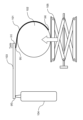
- FIG. 1 is a schematic diagram showing a state in which a restoring force is measured (at the start of a test).
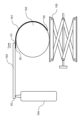
- FIG. 13 is a schematic diagram showing a state in which a restoring force is measured (when a digital force gauge is reading the force);
- a to B indicating a numerical range means A or more and B or less unless otherwise specified.
- film is a concept that includes what is generally called a "sheet.”
- thiourethane refers to a compound having a thiourethane bond formed by reaction of a polythiol component with an isocyanate component.
- the thiourethane film of the present embodiment is a thiourethane film containing a cured product of a photopolymerizable composition containing a difunctional or higher polythiol (A), an isocyanate compound (B), and a photopolymerization initiator (C), and the product E' x T of the storage modulus E' at 40°C and the thickness T of the thiourethane film is 50 MPa ⁇ mm or more and 1800 MPa ⁇ mm or less.
- A difunctional or higher polythiol
- B isocyanate compound
- C photopolymerization initiator
- the inventors' research has revealed that the winding properties of a thiourethane film can be improved by producing the film using a photopolymerizable composition containing a specific polythiol, an isocyanate compound, and a photopolymerization initiator, and setting the product E' x T of the storage modulus E' at 40°C of the thiourethane film and the thickness T of the thiourethane film within a specific range.
- the product E' ⁇ T of the storage modulus E' at 40° C. of the thiourethane film of this embodiment and the thickness T of the thiourethane film is 50 MPa ⁇ mm or more, preferably 100 MPa ⁇ mm or more, more preferably 300 MPa ⁇ mm or more, even more preferably 500 MPa ⁇ mm or more, even more preferably 700 MPa ⁇ mm or more, and even more preferably 800 MPa ⁇ mm or more, from the viewpoint of further improving the performance balance of the winding property of the thiourethane film, the blocking property, and the releasability of the protective film described later, and is 1800 MPa ⁇ mm or less, preferably 1600 MPa ⁇ mm or less, more preferably 1400 MPa ⁇ mm or less, even more preferably 1200 MPa ⁇ mm or less, and even more preferably 1150 MPa ⁇ mm or less, from the viewpoint of further improving the winding property of the thiourethane film.
- the product E' x T of the storage modulus E' at 40°C of the thiourethane film of this embodiment and the thickness T of the thiourethane film is, from the viewpoint of further improving the performance balance of the winding property, blocking property, and releasability of the protective film described later of the thiourethane film, 50 MPa ⁇ mm or more and 1800 MPa ⁇ mm or less, preferably 100 MPa ⁇ mm or more and 1600 MPa ⁇ mm or less, more preferably 300 MPa ⁇ mm or more and 1600 MPa ⁇ mm or less, even more preferably 500 MPa ⁇ mm or more and 1400 MPa ⁇ mm or less, even more preferably 700 MPa ⁇ mm or more and 1200 MPa ⁇ mm or less, and even more preferably 800 MPa ⁇ mm or more and 1150 MPa ⁇ mm or less.
- the storage modulus E' of the thiourethane film at 40°C is preferably 1500 MPa or more, more preferably 2000 MPa or more, and even more preferably 2300 MPa or more, and is preferably 8000 MPa or less, more preferably 7500 MPa or less, even more preferably 7000 MPa or less, even more preferably 6500 MPa or less, even more preferably 6000 MPa or less, even more preferably 5700 MPa or less, even more preferably 5500 MPa or less, even more preferably 5000 MPa or less, even more preferably 4500 MPa or less, even more preferably 4000 MPa or less, preferably 3800 MPa or less, more preferably 3500 MPa or less, and even more preferably 3300 MPa or less.
- the storage modulus E' of the thiourethane film at 40°C is preferably 1500 MPa or more and 8000 MPa or less, more preferably 1500 MPa or more and 7500 MPa or less, even more preferably 1500 MPa or more and 7000 MPa or less, even more preferably 1500 MPa or more and 6500 MPa or less, even more preferably 2000 MPa or more and 6000 MPa or less, even more preferably 2000 MPa or more and 5500 MPa or less, even more preferably 2000 MPa or more and 5000 MPa or less, even more preferably 2300 MPa or more and 4500 MPa or less, and even more preferably 2300 MPa or more and 4000 MPa or less.
- the storage modulus of the thiourethane film at 40° C. can be measured as follows. A test piece having a width of 5 mm and a length of 30 mm is cut out from the thiourethane film, and a solid viscoelasticity temperature dispersion measurement is carried out under the conditions described below to measure the storage modulus E' (MPa) at 40°C.
- Apparatus Dynamic viscoelasticity measuring device Deformation mode: Tensile Heating rate: 2°C/min Frequency: 1 Hz Set distortion: 0.1% Environment: Air atmosphere
- the thiourethane film of the present embodiment preferably has a restoring force of 40.0 N/m or less when measured under the following ⁇ Conditions>.
- ⁇ Conditions> The thiourethane film is cut into strips of width 1 cm x length 12 cm, and one end (a) of the thiourethane film is fixed to a resin cylinder with an outer diameter of 10 cm with adhesive tape and wrapped around the resin cylinder.
- the resin cylinder is fixed in place and does not rotate.
- a plate with a width of 1 cm x length of 15 cm is installed horizontally, with one end (b) opposite to one end (a) of the thiourethane film as a contact point.
- one end (c) of the plate is overlapped with the end of the one end (b) side of the thiourethane film by 1 cm in the length direction, and one end (d) opposite to one end (c) of the plate is installed so as to be in contact with the upper side of the measurement axis of the digital force gauge.
- the plate is fixed with clay 7.5 cm from one end (d), and is installed so as to be movable with the point fixed with clay as a fulcrum.
- the above-mentioned "the 1 cm portion where the plate and the thiourethane film overlap is completely in contact” means that the thiourethane film is pushed up from below the plate, and a portion 1 cm long and 1 cm wide from one end (c) of the plate and a portion 1 cm long and 1 cm wide from one end (b) of the thiourethane film are in contact with each other without any gaps over the entire surface.
- the restoring force of the thiourethane film measured under the above conditions is preferably 40.0 N/m or less, more preferably 35.0 N/m or less, even more preferably 30.0 N/m or less, even more preferably 25.0 N/m or less, even more preferably 20.0 N/m or less, even more preferably 15.0 N/m or less, even more preferably 12.0 N/m or less, and even more preferably 10.0 N/m or less, from the viewpoint of further improving the balance of the performance of the film's winding property, blocking property, and the release property of the protective film described below, preferably 0 N/m or more, more preferably 0.3 N/m or more, even more preferably 0.5 N/m or more, even more preferably 0.8 N/m or more, even more preferably 1.0 N/m or more, even more preferably 1.5 N/m or more, even more preferably 3.0 N/m or more, even more preferably 5.0 N/m or more, and even more preferably 7.0 N/m or more.
- the restoring force of the thiourethane film per 1 m width and 300 ⁇ m thickness is, from the viewpoint of further improving the winding property of the film, preferably 20.0 N/m or less, more preferably 15.0 N/m or less, even more preferably 12.0 N/m or less, and even more preferably 10.0 N/m or less; from the viewpoint of further improving the performance balance of the winding property, blocking property, and releasability of the protective film described later of the film, it is preferably 0 N/m or more, more preferably 0.5 N/m or more, even more preferably 0.8 N/m or more, even more preferably 1.0 N/m or more, even more preferably 1.5 N/m or more, even more preferably 2.0 N/m or more, even more preferably 3.0 N/m or more, and even more preferably 6.0 N/m or more.
- the thickness T of the thiourethane film is preferably 50 ⁇ m or more, more preferably 70 ⁇ m or more, even more preferably 100 ⁇ m or more, even more preferably 130 ⁇ m or more, even more preferably 150 ⁇ m or more, even more preferably 200 ⁇ m or more, even more preferably 250 ⁇ m or more, even more preferably 300 ⁇ m or more, and preferably 3000 ⁇ m or less, more preferably 2000 ⁇ m or less, even more preferably 1000 ⁇ m or less, even more preferably 800 ⁇ m or less, even more preferably 650 ⁇ m or less, even more preferably 600 ⁇ m or less, even more preferably 500 ⁇ m or less, even more preferably 450 ⁇ m or less, even more preferably 400 ⁇ m or less.
- the thickness T of the thiourethane film is preferably 50 ⁇ m or more and 3000 ⁇ m or less, more preferably 70 ⁇ m or more and 2000 ⁇ m or less, even more preferably 100 ⁇ m or more and 1000 ⁇ m or less, even more preferably 130 ⁇ m or more and 800 ⁇ m or less, even more preferably 150 ⁇ m or more and 650 ⁇ m or less, even more preferably 200 ⁇ m or more and 600 ⁇ m or less, even more preferably 250 ⁇ m or more and 500 ⁇ m or less, even more preferably 300 ⁇ m or more and 450 ⁇ m or less, and even more preferably 300 ⁇ m or more and 400 ⁇ m or less.
- the winding property of the thiourethane film is further improved. Furthermore, by setting the thickness T of the thiourethane film to be equal to or greater than the above lower limit, E'xT and the restoring force can be further improved, and by setting the thickness T of the thiourethane film to be equal to or less than the above upper limit, E'xT and the restoring force can be further reduced.
- the thickness T of the thiourethane film can be measured using a digimatic indicator.
- the photopolymerizable composition in the thiourethane film of this embodiment contains a di- or higher functional polythiol (A). This allows the formation of a thiourethane bond between the di- or higher functional polythiol (A) and the isocyanate compound (B) described below.
- the polythiol has high nucleophilicity and high reactivity with the isocyanate compound.
- polythiol (A) having two or more functionalities preferably, 5,7-dimercaptomethyl-1,11-dimercapto-3,6,9-trithiaundecane, 4,7-dimercaptomethyl-1,11-dimercapto-3,6,9-trithiaundecane, 4,8-dimercaptomethyl-1,11-dimercapto-3,6,9-trithiaundecane, 4-mercaptomethyl-1,8-dimercapto- 3,6-dithiaoctane, pentaerythritol tetrakis(3-mercaptopropionate), pentaerythritol tetrakis(2-mercaptoacetate), 2,5-bis(mercaptomethyl)-1,4-dithiane, bis(2-mercaptoethyl)sulfide, 1,1,3,3-tetrakis(mercaptomethylthio)propane, 4,6-bis(mercaptomethylthiomethyl
- the di- or higher functional polythiol (A) preferably includes both a di-functional polythiol and a tri- or higher functional polythiol. This brings the flexibility of the resulting film into a more appropriate range, making it suitable for use in vacuum molding or pressure molding.
- the thiol equivalent of the bifunctional polythiol can be appropriately selected depending on the type of isocyanate compound (B). From the viewpoint of appropriately improving the flexibility of the obtained film, it is preferably 0% or more, more preferably 1% or more, even more preferably 5% or more, even more preferably 10% or more, even more preferably 15% or more, even more preferably 18% or more, even more preferably 20% or more, even more preferably 30% or more, even more preferably 40% or more, based on 100% of the total thiol equivalent of the bifunctional polythiol and the trifunctional or higher polythiol, and from the viewpoint of appropriately hardening the obtained film, it is preferably 80% or less, more preferably 70% or less, even more preferably 60% or less.
- bifunctional polythiols examples include methanedithiol, ethanedithiol, 1,3-propanedithiol, 1,2-cyclohexanedithiol, bis(2-mercaptoethyl)ether, diethylene glycol bis(2-mercaptoacetate), diethylene glycol bis(3-mercaptopropionate), ethylene glycol bis(2-mercaptoacetate), ethylene glycol bis(3-mercaptopropionate), bis(mercaptomethyl)sulfide, bis(mercaptomethyl)disulfide, bis(mercaptoethyl)disulfide, and bis mercaptopropyl)sulfide, bis(mercaptomethylthio)methane, bis(2-mercaptoethylthio)methane, bis(3-mercaptopropylthio)methane, 1,2-bis(mercaptomethylthio)ethane, 1,2-bis(2-mercaptomethylthio)ethane, 1,
- the bifunctional polythiol contains one or more selected from the group consisting of 2,5-bis(mercaptomethyl)-1,4-dithiane, bis(2-mercaptoethyl)sulfide, and 4,6-bis(mercaptomethylthio)-1,3-dithiane.
- polythiols having three or more functional groups include 1,2,3-propane trithiol, tetrakis(mercaptomethyl)methane, trimethylolpropane tris(2-mercaptoacetate), trimethylolpropane tris(3-mercaptopropionate), trimethylolethane tris(2-mercaptoacetate), trimethylolethane tris(3-mercaptopropionate), pentaerythritol tetrakis(2-mercaptoacetate), pentaerythritol tetrakis(3-mercaptopropionate), 1,2,3-tris(mercaptomethylthio)propane, 1,2,3-tris(2-mercaptoethylthio)propane, 1,2,3-tris(3-mercapto tetrakis(mercaptomethylthiomethyl)methane, tetrakis(2-mercaptoeth
- Polythiols with three or more functionalities include 4-mercaptomethyl-1,8-dimercapto-3,6-dithiaoctane, 5,7-dimercaptomethyl-1,11-dimercapto-3,6,9-trithiaundecane, 4,7-dimercaptomethyl-1,11-dimercapto-3,6,9-trithiaundecane, 4,8-dimercaptomethyl-1,11-dimercapto-3,6,9-trithiaundecane, pentaerythritol tetrakis(2-mercaptoacetate), pentaerythritol tetrakis(3-mercaptopropionate), 1,1,3,3-tetrakis(mercaptomethylthio)propane, 2-(2,2-bis(mercaptomethylthio)propane, It is preferable that the mercaptomethylthioethyl)-1,3-dithietane, 1,1,2,2-
- the mercaptomethylthioethyl)-1,3-dithietane, 4-mercaptomethyl-1,8-dimercapto-3,6-dithiaoctane, and pentaerythritol tetrakis(3-mercaptopropionate) are included, and it is even more preferable that the mercaptomethylthioethyl)-1,3-dithietane, 1,1,2,2-tetrakis(mercaptomethylthio)ethane, 3-mercaptomethyl-1,5-dimercapto-2,4-dithiapentane, and tris(mercaptomethylthio)methane are included, and it is even more preferable that the mercaptomethylthioethyl)-1,3-dithietane, 4-mercaptomethyl-1,8-dimercapto-3,6-dithiaoctane, are included.
- the polythiol (A) having two or more functionalities in this embodiment preferably contains one or more difunctional polythiols selected from the group consisting of 2,5-bis(mercaptomethyl)-1,4-dithiane, bis(2-mercaptoethyl)sulfide, and 4,6-bis(mercaptomethylthio)-1,3-dithiane, and 4-mercaptomethyl-1,8-dimercapto-3,6-dithiaoctane, which is a polythiol having three or more functionalities, and more preferably contains bis(2-mercaptoethyl)sulfide and 4-mercaptomethyl-1,8-dimercapto-3,6-dithiaoctane.
- difunctional polythiols selected from the group consisting of 2,5-bis(mercaptomethyl)-1,4-dithiane, bis(2-mercaptoethyl)sulfide, and 4,6-bis(mercaptomethylthio)-1,3
- the photopolymerizable composition in the thiourethane film of the present embodiment contains an isocyanate compound (B).
- the isocyanate compound (B) is preferably pentamethylene diisocyanate, hexamethylene diisocyanate, xylylene diisocyanate, isophorone diisocyanate, bis(isocyanatomethyl)cyclohexane, bis(isocyanatocyclohexyl)methane, 2,5-bis(isocyanatomethyl)bicyclo-[2.2.1]-heptane, 2,6-bis(isocyanatomethyl)bicyclo-[2.2.1]-heptane, It contains one or more selected from the group consisting of tolylene diisocyanate, 4,4'-diphenylmethane diisocyanate, and phenylene diisocyanate, and more preferably contains one or more selected from the group consisting of 2,5-bis(isocyana
- the equivalent ratio (thiol group/isocyanato group) of the thiol group in the difunctional or higher polythiol (A) to the isocyanato group in the isocyanate compound (B) is preferably 0.8 or more, more preferably 0.85 or more, even more preferably 0.9 or more, and is preferably 1.2 or less, more preferably 1.15 or less, even more preferably 1.1 or less. This makes it possible to obtain a thiourethane that is suitable for use as a lens material.
- the total content of the difunctional or higher polythiol (A) and the isocyanate compound (B) is preferably 50% by mass or more, more preferably 70% by mass or more, even more preferably 80% by mass or more, even more preferably 90% by mass or more, even more preferably 95% by mass or more, even more preferably 97% by mass or more, even more preferably 99% by mass or more, and is preferably less than 100% by mass, when the entire photopolymerizable composition is taken as 100% by mass.
- the photopolymerizable composition in the thiourethane film of the present embodiment contains a photopolymerization initiator (C).
- the photopolymerization initiator (C) is an initiator capable of photopolymerization, and preferably contains one or more types selected from the group consisting of radical polymerization initiators and base generators, and more preferably contains a base generator from the viewpoint of further improving photopolymerizability.
- the base generator preferably includes a compound comprising an organic boron anion and a counter cation.
- the organic boron anion more preferably contains one or more types selected from the group consisting of a phenyl group, an alkyl group, and an aryl group, and even more preferably contains one or more types selected from the group consisting of a phenyl group and an alkyl group.
- the counter cation more preferably contains one or more selected from the group consisting of ammonium or ammonium salts, and further preferably contains an ammonium salt.
- the base generator more preferably contains one or more compounds selected from the group consisting of compounds represented by the following formula (1) and compounds represented by the following formula (2).
- R 1 to R 4 preferably each independently represent an alkyl group having 1 to 8 carbon atoms
- R 5 to R 8 preferably each independently represent an alkyl group having 1 to 8 carbon atoms, a phenyl group, a naphthyl group, an anthracenyl group, or a phenanthryl group
- the phenyl group, naphthyl group, anthracenyl group, and phenanthryl group may be substituted by a halogen atom, an alkyl group, an aryl group, an alkenyl group, a cycloalkyl group, or a heterocyclic group.
- R 1 to R 4 are preferably the same.
- R 1 to R 4 are more preferably an alkyl group having 2 to 5 carbon atoms, even more preferably a straight-chain alkyl group, and even more preferably an n-butyl group.
- R 8 is more preferably an alkyl group having 2 to 5 carbon atoms, even more preferably a straight-chain alkyl group, and even more preferably an n-butyl group.
- R 5 to R 7 are preferably the same.
- R 5 to R 7 are more preferably a phenyl group, a butylphenyl group or a naphthyl group, and even more preferably a phenyl group, a 4-tert-butylphenyl group, a 1-naphthyl group or a 4-methyl-1-naphthyl group.
- R 5 to R 7 contain an aromatic ring, the aromatic ring may be substituted with an alkyl group, an aryl group, or the like.
- R 1 to R 7 each independently represent an alkyl group having 1 to 8 carbon atoms or a cycloalkyl group having 3 to 8 carbon atoms
- R 8 to R 11 each independently represent an alkyl group having 1 to 8 carbon atoms, a phenyl group, a naphthyl group, an anthracenyl group or a phenanthryl group
- the phenyl group, naphthyl group, anthracenyl group and phenanthryl group may be substituted with a halogen atom, an alkyl group, an aryl group, an alkenyl group, a cycloalkyl group or a heterocyclic group.
- R 1 to R 7 are preferably the same.
- R 1 to R 7 are preferably alkyl groups having 2 to 5 carbon atoms, more preferably straight-chain alkyl groups, and even more preferably n-butyl groups.
- R 11 is more preferably an alkyl group having 2 to 5 carbon atoms, even more preferably a straight-chain alkyl group, and even more preferably an n-butyl group.
- R 8 to R 10 are preferably the same.
- R 8 to R 10 are more preferably a phenyl group, a butylphenyl group or a naphthyl group, and even more preferably a phenyl group, a 4-tert-butylphenyl group, a 1-naphthyl group or a 4-methyl-1-naphthyl group.
- R 8 to R 10 contain an aromatic ring, the aromatic ring may be substituted with an alkyl group, an aryl group, or the like.
- the above-mentioned compounds consisting of organic boron anions and counter cations can be commercially available.
- Examples of commercially available products include Karenz (registered trademark) N3B and Karenz (registered trademark) P3B (both manufactured by Resonac Corporation), WPBG-300, and WPBG-345 (both manufactured by Fujifilm Corporation).
- radical polymerization initiator a known thermal radical polymerization initiator and a known photoradical polymerization initiator can be used.
- thermal radical polymerization initiators include dialkyl peroxides such as dicumyl peroxide, t-butylcumyl peroxide, 2,5-bis(t-butylperoxy)2,5-dimethylhexane, 2,5-bis(t-butylperoxy)2,5-dimethylhexyne-3, di-t-butyl peroxide, isopropylcumyl-t-butyl peroxide, and bis( ⁇ -t-butylperoxyisopropyl)benzene; 1,1-bis(t-butylperoxy)cyclohexane, 1,1-bis(t-butylperoxy)3,3,5-trimethylcyclohexane, 1,1-bis(t-butylperoxy)cyclododecane
- peroxy ketals such as bis(t-butylperoxy)isophthalate, t-butyl peroxybenzoate, t-butyl peroxyacetate, etc.; hydroperoxides such as t-butyl hydroperoxide, t-hexyl hydroperoxide, cumin hydroperoxide, 1,1,3,3-tetramethylbutyl hydroperoxide, diisopropylbenzene hydroperoxide, p-menthane hydroperoxide, etc.; bibenzyl compounds such as 2,3-dimethyl-2,3-diphenylbutane, etc.; 3,3,5,7,7-pentamethyl-1,2,4-trioxepane, etc.
- photoradical polymerization initiators examples include benzoin alkyl ethers, benzyl dimethyl ketal, 1-hydroxycyclohexyl phenyl ketone, 2-hydroxy-2-methyl-1-phenylpropan-1-one, benzophenone, methylbenzoyl formate, isopropyl thioxanthone, and mixtures of two or more of these.
- sensitizers can be used together with these photoradical polymerization initiators.
- sensitizers include carbonyl compounds such as anthraquinone, 1,2-naphthoquinone, 1,4-naphthoquinone, benzanthrone, p,p'-tetramethyldiaminobenzophenone, and chloranil; nitro compounds such as nitrobenzene, p-dinitrobenzene, and 2-nitrofluorene; aromatic hydrocarbons such as anthracene and chrysene; sulfur compounds such as diphenyl disulfide; and nitrogen compounds such as nitroaniline, 2-chloro-4-nitroaniline, 5-nitro-2-aminotoluene, and tetracyanoethylene.
- carbonyl compounds such as anthraquinone, 1,2-naphthoquinone, 1,4-naphthoquinone, benzanthrone, p,p'-tetramethyldiaminobenzophenone, and chloranil
- the content of the photopolymerization initiator (C) is preferably 250 mass ppm or more, more preferably 300 mass ppm or more, even more preferably 500 mass ppm or more, and even more preferably 700 mass ppm or more, relative to the total amount of the difunctional or higher polythiol (A) and the isocyanate compound (B), and is also preferably 20,000 mass ppm or less, more preferably 15,000 mass ppm or less, even more preferably 12,000 mass ppm or less, even more preferably 10,000 mass ppm or less, even more preferably 8,000 mass ppm or less, and even more preferably 6,000 mass ppm or less.
- the content of the photopolymerization initiator (C) is more preferably 1000 ppm by mass or more, more preferably 1200 ppm by mass or more, more preferably 1300 ppm by mass or more, more preferably 1400 ppm by mass or more, more preferably 1500 ppm by mass or more, and even more preferably 2000 ppm by mass or more, based on the total amount of the difunctional or higher polythiol (A) and the isocyanate compound (B);
- the content is more preferably 5000 ppm by mass or less, more preferably 4500 ppm by mass or less, and even more preferably 4000 ppm by mass or less; from the viewpoint of moderately increasing the Young's modulus of the film and further improving the winding property, the content is more preferably 2500 ppm by mass or less; and from the viewpoint of the viewpoint of moderately increasing the Young's modulus of the film and further improving the winding property, the content is more preferably 2500 ppm by mass or less; and from the
- the content of the photopolymerization initiator (C) is preferably 250 ppm by mass or more and 20,000 ppm by mass or less, more preferably 300 ppm by mass or more and 15,000 ppm by mass or less, even more preferably 500 ppm by mass or more and 10,000 ppm by mass or less, even more preferably 700 ppm by mass or more and 8,000 ppm by mass or less, and even more preferably 700 ppm by mass or more and 6,000 ppm by mass or less, based on the total amount of the bifunctional or higher polythiol (A) and the isocyanate compound (B).
- the content of the photopolymerization initiator (C) is more preferably 1000 mass ppm or more and 5000 mass ppm or less, more preferably 1200 mass ppm or more and 4500 mass ppm or less, more preferably 1300 mass ppm or more and 4500 mass ppm or less, more preferably 1400 mass ppm or more and 4000 mass ppm or less, more preferably 1500 mass ppm or more and 2500 mass ppm or less, and more preferably 2000 mass ppm or more and 2300 mass ppm or less, based on the total amount of the difunctional or higher polythiol (A) and the isocyanate compound (B).
- the content of the photopolymerization initiator (C) is 1000 mass ppm or more, the Young's modulus of the obtained thiourethane film can be further reduced, and the winding property can be further improved.
- the content of the photopolymerization initiator (C) is 5000 mass ppm or less, the coloring of the film can be further suppressed
- the content of the photopolymerization initiator (C) is 2500 mass ppm or less
- the Young's modulus of the film can be moderately increased, and the winding property can be further improved
- the content of the photopolymerization initiator (C) is 2300 mass ppm or less, the yellowness (YI value) of the film can be further reduced, and the appearance of the film can be further improved.
- the unit of the content of the photopolymerization initiator (C) (ppm by mass) represents the content (mg) of the photopolymerization initiator (C) per 1 kg of the total of the difunctional or higher polythiol (A) and the isocyanate compound (B), i.e., mg/kg.
- the thiourethane film of the present embodiment preferably contains elemental boron.
- the thiourethane film contains the above-mentioned photopolymerization initiator (C)
- the thiourethane film contains boron element derived from the photopolymerization initiator (C).
- the boron content of the thiourethane film can be analyzed by combining elemental analysis such as X-ray fluorescence analysis or ICP emission analysis, X-ray photoelectron spectroscopy (XPS/ESCA) and time-of-flight secondary ion mass spectrometry (TOF-SIMS).
- the thiourethane film can be decomposed with an acid using a microwave acid decomposition device, and then the boron content can be measured by the standard addition method using inductively coupled plasma mass spectrometry (ICP-MS).
- the boron content in the thiourethane film is preferably 10 ppm or more and 300 ppm or less.
- the unit of boron content "ppm" represents the content (mg) of boron element per 1 kg of thiourethane film, i.e. mg/kg.
- the boron element content in the thiourethane film is preferably 5 ppm or more, more preferably 10 ppm or more, even more preferably 15 ppm or more, and even more preferably 20 ppm or more, and is preferably 200 ppm or less, more preferably 180 ppm or less, even more preferably 160 ppm or less, even more preferably 130 ppm or less, even more preferably 100 ppm or less, even more preferably 80 ppm or less, and even more preferably 50 ppm or less.
- the boron element content in the thiourethane film is preferably 5 ppm or more and 200 ppm or less, more preferably 5 ppm or more and 180 ppm or less, even more preferably 10 ppm or more and 160 ppm or less, even more preferably 10 ppm or more and 130 ppm or less, even more preferably 15 ppm or more and 100 ppm or less, even more preferably 15 ppm or more and 80 ppm or less, and even more preferably 20 ppm or more and 50 ppm or less.
- the boron element content in the thiourethane film can be measured, for example, by subjecting the thiourethane film to acid decomposition by a wet decomposition method, followed by inductively coupled plasma mass spectrometry (ICP-MS). A specific measurement method is described in the Examples section.
- Metal catalyst (D) The photopolymerizable composition in the thiourethane film of this embodiment preferably further contains a metal catalyst (D).
- the metal catalyst (D) include organotin compounds, organolead compounds, organonickel compounds, organocupper compounds, organobismuth compounds, potassium salts, and the like. Among these, it is preferable that the metal catalyst (D) contains an organotin compound.
- organotin compounds include tin acetate, tin octoate, tin oleate, tin laurate, monobutyltin trioctoate, dibutyltin diacetate, dimethyltin dilaurate, dibutyltin dilaurate, dibutyltin dimercaptide, dibutyltin maleate, dibutyltin dineodecanoate, dioctyltin dimercaptide, dioctyltin dilaurate, dimethyltin dichloride, dibutyltin dichloride, etc., and preferably include one or two selected from the group consisting of dimethyltin dichloride and dibutyltin dichloride.
- the content of the metal catalyst (D) is preferably 0.1 ppm or more, more preferably 0.5 ppm or more, even more preferably 1 ppm or more, and even more preferably 5 ppm or more, and is preferably 45 ppm or less, more preferably 40 ppm or less, and even more preferably 35 ppm or less, based on the total of the difunctional or higher polythiol (A) and the isocyanate compound (B).
- the unit (ppm) of the content of the metal catalyst (D) represents the content (mg) of the metal catalyst (D) per 1 kg of the total of the difunctional or higher polythiol (A) and the isocyanate compound (B), i.e., mg/kg.
- the photopolymerizable composition of the present embodiment may further contain an ultraviolet absorber, an antioxidant, a light stabilizer, a sensitizer, a release agent, a solvent, a bluing agent, an IR cut agent, a blue light cut agent, a reactive diluent, an oil-soluble dye, a pigment, a coloring matter, a fragrance, a filler, an adhesion improver such as a coupling agent, a chain extender, a crosslinking agent, an antifoaming agent, a suspending agent, a dispersing agent, a plasticizer, an anti-sagging agent, an antifouling agent, a preservative, a bactericide, an antibacterial agent, an antifungal agent, a matting agent, a thickener, a pigment dispersing agent, a cissing prevention agent, an abrasion resistance improver, a slip agent, a surface modifier, a color separation prevention agent, an emulsifier
- release agents include acidic phosphate ester compounds, polyether-modified silicones, alkyl-modified silicones, polyester-modified silicones, dimethylpolysiloxanes, polyoxyalkylene glycol monoalkyl ether compounds, polyoxyalkylene glycol monoester compounds, fluorine atom-containing compounds, surfactants, nonionic surfactants, and acrylic surfactants.
- the content of the release agent is preferably 20 ppm or more, more preferably 50 ppm or more, even more preferably 100 ppm or more, even more preferably 200 ppm or more, even more preferably 500 ppm or more, even more preferably 1000 ppm or more, and preferably 5000 ppm or less, more preferably 4500 ppm or less, even more preferably 4000 ppm or less, even more preferably 3500 ppm or less, even more preferably 3000 ppm or less, even more preferably 2000 ppm or less, even more preferably 1800 ppm or less, even more preferably 1500 ppm or less, even more preferably 1300 ppm or less, based on the total of the difunctional or higher polythiol (A) and the isocyanate compound (B).
- the thiourethane film of the present embodiment is preferably formed by irradiating a photopolymerizable composition with ultraviolet light to polymerize a portion of the photopolymerizable composition, and then heating the photopolymerizable composition to further polymerize it.
- This makes it easier to set the E'xT and restoring force of the film of this embodiment within the above ranges, which in turn improves the winding properties when the thiourethane film is wound around a core.
- This also allows the thickness of the thiourethane film to be within an appropriate range.
- the parts that are unpolymerized upon UV irradiation can be polymerized to obtain a completely polymerized polymer.
- This also prevents unreacted isocyanate groups in the isocyanate compound (B) from reacting, thereby preventing an increase in the hygroscopicity of the polymerized product of the photopolymerizable composition, and prevents poor appearance due to the generation of air or water bubbles when the thiourethane film is attached to a lens substrate.
- Ultraviolet rays include UVC with a wavelength of 250 to 260 nm and UVA with a wavelength of 320 to 390 nm, and it is UVC that has an effect on photopolymerization.
- a light source such as sunlight, a chemical lamp, a mercury lamp, a metal halide lamp, or a UVLED can be used.
- the integrated light amount of ultraviolet irradiation is preferably 500 mJ or more, more preferably 1000 mJ or more, even more preferably 1200 mJ or more, and even more preferably 1500 mJ or more, and is preferably 10,000 mJ or less, more preferably 9,500 mJ or less, even more preferably 9,000 mJ or less, even more preferably 6,000 mJ or less, even more preferably 5,000 mJ or less, even more preferably 4,000 mJ or less, even more preferably 3,800 mJ or less, even more preferably 3,500 mJ or less, and even more preferably 3,000 mJ or less.
- the integrated light amount of ultraviolet irradiation refers to the total integrated light amount of UVC and UVA.
- the irradiation intensity of the ultraviolet irradiation is preferably 100 mW or more, more preferably 150 mW or more, and even more preferably 200 mW or more, and is preferably 2000 mW or less, more preferably 1800 mW or less, even more preferably 1600 mW or less, even more preferably 1000 mW or less, more preferably 800 mW or less, even more preferably 600 mW or less, and even more preferably 400 mW or less.
- the irradiation intensity of ultraviolet irradiation refers to the total irradiation intensity of UVC and UVA.
- the integrated light amount of UVC in the ultraviolet irradiation is preferably 100 mJ or more, more preferably 200 mJ or more, and even more preferably 250 mJ or more, and is preferably 4000 mJ or less, more preferably 3000 mJ or less, more preferably 2500 mJ or less, more preferably 1200 mJ or less, more preferably 1000 mJ or less, more preferably 800 mJ or less, more preferably 600 mJ or less, more preferably 500 mJ or less, and even more preferably 300 mJ or less.
- the irradiation intensity of UVC in ultraviolet irradiation is preferably 10 mW or more, more preferably 20 mW or more, even more preferably 30 mW or more, even more preferably 40 mW or more, even more preferably 50 mW or more, even more preferably 60 mW or more, and is preferably 200 mW or less, more preferably 150 mW or less, even more preferably 100 mW or less.
- the integrated light amount of UVA in ultraviolet irradiation is preferably 500 mJ or more, more preferably 1000 mJ or more, even more preferably 1300 mJ or more, and is preferably 8000 mJ or less, even more preferably 7000 mJ or less, even more preferably 4000 mJ or less, even more preferably 3500 mJ or less, even more preferably 2000 mJ or less.
- the irradiation intensity of UVA in ultraviolet irradiation is preferably 50 mW or more, more preferably 100 mW or more, even more preferably 150 mW or more, and is preferably 3000 mW or less, more preferably 2500 mW or less, even more preferably 800 mW or less, even more preferably 500 mW or less, even more preferably 300 mW or less.
- the photopolymerizable composition can be irradiated with ultraviolet light after a film having a certain thickness is formed from the photopolymerizable composition.
- the thickness of the film formed by the photopolymerizable composition is preferably 50 ⁇ m or more, more preferably 100 ⁇ m or more, even more preferably 150 ⁇ m or more, even more preferably 200 ⁇ m or more, even more preferably 250 ⁇ m or more, and is preferably 3000 ⁇ m or less, more preferably 1000 ⁇ m or less, even more preferably 600 ⁇ m or less, even more preferably 400 ⁇ m or less.
- a film using the photopolymerizable composition there are no limitations on the formation of a film using the photopolymerizable composition, but it can be performed, for example, by arranging two glass plates with a gap in the above-mentioned range, placing a PTFE sheet around all four sides of the glass plates, injecting the photopolymerizable composition, and clamping and fixing the two glass plates with clips.
- the photopolymerizable composition can also be used to form a film on a substrate by coating the composition on a substrate using a conventional method such as a bar coater, a spin coater, or a dip coater.
- a release film can be used as the substrate, and the release film contains at least one material selected from the group consisting of polyethylene terephthalate and fluororesin.
- the film when a film is formed using a photopolymerizable composition by applying it onto a substrate, the film preferably further has a protective film on the side opposite the substrate when the film is heated after irradiation with ultraviolet light.
- the protective film is not limited as long as it can prevent the intrusion of oxygen and moisture and has heat resistance, but is preferably a release film from the viewpoint of easy peeling after heating.
- a polyethylene terephthalate film can be used as the release film.
- the thickness of the protective film is preferably 5 ⁇ m or more and 150 ⁇ m or less from the viewpoint of easy peeling after heating.
- the heating temperature when heating the photopolymerizable composition is preferably 80°C or higher, more preferably 100°C or higher, and even more preferably 110°C or higher, from the viewpoint of more sufficiently polymerizing the photopolymerizable composition, and is preferably 140°C or lower, and more preferably 130°C or lower, from the viewpoint of further improving the winding property of the obtained thiourethane film.
- the heating time when the photopolymerizable composition is heated is preferably 10 minutes or more, more preferably 30 minutes or more, even more preferably 50 minutes or more, even more preferably 60 minutes or more, and is preferably 300 minutes or less, more preferably 150 minutes or less, even more preferably 120 minutes or less, even more preferably 100 minutes or less, even more preferably 80 minutes or less.
- the glass transition temperature Tg of the thiourethane film is preferably 60°C or higher, more preferably 70°C or higher, from the viewpoint of further improving heat resistance, and is preferably 130°C or lower, more preferably 120°C or lower, from the viewpoint of further improving flexibility.
- the glass transition temperature of the thiourethane film can be measured as follows. A test piece 5 mm wide and 30 mm long is cut out from the thiourethane film, and a solid viscoelasticity temperature dispersion measurement is carried out under the following conditions to measure the glass transition temperature Tg (° C.), where Tg is the peak temperature of tan ⁇ .
- Apparatus Dynamic viscoelasticity measuring device Deformation mode: Tensile Heating rate: 3°C/min Frequency: 1 Hz Set distortion: 0.1% Environment: Nitrogen atmosphere
- the degree of polymerization is preferably 50% or more, more preferably 60% or more, even more preferably 70% or more, and even more preferably 80% or more, and is preferably 100% or less, more preferably 90% or less.
- the photopolymerizable composition is polymerized to a greater extent, making it possible to form a thiourethane film, and the Young's modulus can be reduced, leading to improved winding properties.
- the Young's modulus can be appropriately improved, leading to improved winding properties.
- the degree of polymerization was calculated from the absorbance of the NCO absorption peak measured by FT-IR (ATR method) with the unpolymerized state as the standard. Specific details are shown in the Examples section.
- the yellowness index (YI value) measured in accordance with JIS K7373:2006 at a thickness of 2 mm is, from the viewpoint of further suppressing yellowing and further improving the appearance, preferably less than 3.0, more preferably 2.5 or less, even more preferably 2.3 or less, even more preferably 2.0 or less, even more preferably 1.9 or less, even more preferably 1.5 or less, and even more preferably 1.3 or less.
- the yellowness index (YI value) measured in accordance with JIS K7373:2006 at a thickness of 2 mm is not limited to a lower limit, but may be, for example, ⁇ 1.0 or more, ⁇ 0.6 or more, 0.0 or more, or 0.3 or more.
- the haze measured in accordance with JIS K7136:2000 at a thickness of 2 mm is preferably 1.0% or less, more preferably 0.8% or less, and even more preferably 0.6% or less, from the viewpoint of further improving transparency.
- the Young's modulus measured using a tensile tester in accordance with JIS K7171:2016 on a test piece having a length of 65 mm, a width of 25 mm, and a thickness of 2 mm under conditions of a measurement temperature of 23° C., a measurement humidity of 50% RH, a tensile speed of 1 mm/min, and a support distance of 34 mm, is preferably 100 MPa or more, more preferably 300 MPa or more, even more preferably 500 MPa or more, even more preferably 700 MPa or more, even more preferably 900 MPa or more, and is preferably 5000 MPa or less, more preferably 4000 MPa or less, even more preferably 3500 MPa or less, even more preferably 3000 MPa or less, even more preferably 2500 MPa or less, and even more preferably 2300 MPa or less.
- the thiourethane film becomes appropriately hard and the winding property is improved.
- the thiourethane film becomes soft and the winding property is improved.
- the yellowness index (YI value), haze, and Young's modulus of the 2 mm thick thiourethane film can also be measured by stacking multiple thiourethane films and press molding (temperature: 150°C, pressure: 5 MPa) to form a 2 mm film.
- the thiourethane film of the present embodiment can be used for the purpose of imparting functionality to lens substrates, etc. More specifically, optical properties can be imparted by blending a functional dye such as a photochromic dye, a polarizing dye, or a specific wavelength cut dye. Furthermore, a thiourethane film that does not contain a functional component such as a dye can be attached to a lens substrate or the like to further improve the strength of the lens or the like. Furthermore, as described below, when a hard coat layer is formed on the thiourethane film of this embodiment by coating, the hard coat layer can be formed directly on the thiourethane film without an adhesive layer or the like.
- the thiourethane film may further include one or more layers selected from the group consisting of a hard coat layer and an antireflection layer.
- the hard coat layer and the antireflection layer are preferably provided on the side of the thiourethane film opposite to the primer layer.
- the hard coat layer can be formed on the lens substrate, and then the anti-reflection layer can be formed on the hard coat layer.
- the hard coat layer is a coating layer intended to impart functions such as scratch resistance, abrasion resistance, moisture resistance, warm water resistance, heat resistance, and weather resistance to the lens surface, and its film thickness is, for example, from 0.3 ⁇ m to 30 ⁇ m.
- the hard coat layer generally uses a hard coat composition containing a curable organosilicon compound and one or more fine particles composed of one or more oxide fine particles of an element selected from the group consisting of Si, Al, Sn, Sb, Ta, Ce, La, Fe, Zn, W, Zr, In and Ti, and/or a composite oxide of two or more elements selected from this group.
- the hard coat layer is formed, for example, by applying a hard coat composition by a known application method such as spin coating or dip coating, followed by curing.
- a hard coat composition by a known application method such as spin coating or dip coating, followed by curing.
- the curing method include heat curing and curing by irradiation with energy rays such as ultraviolet rays or visible light.
- energy rays such as ultraviolet rays or visible light.
- it is preferable that the difference in refractive index between the hard coat layer and the lens is within ⁇ 0.1.
- an anti-reflection layer is formed on a hard coat layer as required.
- the anti-reflection layer may be a single layer or a multi-layer.
- Anti-reflection layers are classified into inorganic and organic types.
- inorganic types inorganic oxides such as SiO 2 and TiO 2 are used and the layers are formed by dry methods such as vacuum deposition, sputtering, ion plating, ion beam assisted, and CVD.
- the layers are formed by wet methods using a composition containing an organosilicon compound and silica-based fine particles having internal cavities.
- an anti-fog coating layer, an anti-pollution layer, a water-repellent layer, etc. may be formed on the anti-reflection layer.
- the method for forming the anti-fog coating layer, the anti-pollution layer, the water-repellent layer, etc. is not particularly limited, and any conventionally known method can be applied.
- the water contact angle of the surface of the thiourethane film is preferably 50.0° or more, more preferably 55.0° or more, even more preferably 60.0° or more, and is preferably 90.0° or less, more preferably 85.0° or less, even more preferably 80.0° or less.
- the water contact angle of the surface of the thiourethane film is within the above range, even when the thiourethane film has one or two layers selected from the group consisting of a hard coat layer and an antireflection layer and the hard coat layer or the antireflection layer is formed directly on the thiourethane film without using an adhesive layer described later, the interlayer adhesion between the thiourethane film and the one or two layers selected from the group consisting of a hard coat layer and an antireflection layer is further improved.
- the water contact angle can be measured in an atmosphere of 23° C. and 50% RH using a contact angle meter in accordance with JIS R3257:1999.
- the thiourethane film of the present embodiment may further include an adhesive layer on one surface thereof, thereby improving the interlayer adhesion between the thiourethane film and one or more layers selected from the group consisting of a lens substrate, a hard coat layer, and an antireflection layer.
- the adhesive layer is preferably made of a material having high adhesion to one or more selected from the group consisting of a lens substrate, a hard coat layer, and an anti-reflection layer, and examples thereof include adhesive compositions mainly composed of one or more selected from the group consisting of a urethane resin, an epoxy resin, a polyester resin, a melamine resin, and a polyvinyl acetal, and preferably contains a polyurethane-based aqueous dispersion.
- the adhesive layer also preferably contains one or more selected from the group consisting of a urethane (meth)acrylate, a (meth)acrylic monomer, a (meth)acrylic resin, a urethane resin, and an ester resin.
- the adhesive layer is formed, for example, by a coating method or a dry method.
- the adhesive composition is applied by a known coating method such as spin coating or dip coating, and then solidified to form the adhesive layer.
- the adhesive layer is formed by a known dry method such as a CVD method or a vacuum deposition method.
- the thiourethane film has an adhesive layer and a hard coat layer
- the thiourethane film of this embodiment can be directly bonded to a hard coat layer. Also, by bonding the lens substrate to the thiourethane film via an adhesive layer, the lens substrate can be more firmly bonded to the thiourethane film.
- the lens substrate contains at least one selected from the group consisting of polythiourethane, poly(meth)acrylate, polycarbonate, polyallyl carbonate, polyethylene terephthalate, polytriacetyl cellulose, polyvinyl alcohol, polyester, polyamide, polyepoxy, polyepisulfide, and polyurethane, more preferably contains at least one selected from the group consisting of polythiourethane, polyurethane, and polyepisulfide, and even more preferably contains polythiourethane.
- the lens substrate contains polythiourethane
- it is made of the same material as the thiourethane film, and therefore after the thiourethane film is bonded to the lens substrate, it is easy to polish it into the shape of, for example, a spectacle lens.
- the laminate structure may be, for example, thiourethane film/lens substrate, thiourethane film/adhesive layer, hard coat layer/thiourethane film, anti-reflective layer/hard coat layer/thiourethane film, hard coat layer/thiourethane film/adhesive layer, anti-reflective layer/hard coat layer/thiourethane film/adhesive layer, thiourethane film/adhesive layer/lens substrate, hard coat layer/thiourethane film/adhesive layer/lens substrate, anti-reflective layer/hard coat layer/thiourethane film/adhesive layer/lens substrate, etc.
- the thiourethane film of the present embodiment can be used for various plastic lenses such as display components, display components for AR (Augmented Reality)/VR (Virtual Reality) devices, plastic eyeglass lenses, sunglasses, goggles, eyeglass lenses for vision correction, lenses for imaging devices, Fresnel lenses for liquid crystal projectors, and lenticular lenses.
- various plastic lenses such as display components, display components for AR (Augmented Reality)/VR (Virtual Reality) devices, plastic eyeglass lenses, sunglasses, goggles, eyeglass lenses for vision correction, lenses for imaging devices, Fresnel lenses for liquid crystal projectors, and lenticular lenses.
- the roll-shaped wound material of this embodiment includes the thiourethane film of this embodiment and a winding core, with the thiourethane film wound around the winding core in a roll shape.
- the thiourethane film of this embodiment has improved winding properties when wound around a core.
- the lens of the present embodiment is a lens including the thiourethane film of the present embodiment, for example, a lens substrate to which the thiourethane film of the present embodiment is bonded.
- the lens of the present embodiment may have the thiourethane film and the lens substrate in direct contact with each other.
- the lens substrate can be made of the above-mentioned materials. Examples of the lenses include the above-mentioned plastic eyeglass lenses, sunglasses, goggles, eyeglass lenses for vision correction, lenses for imaging devices, Fresnel lenses for liquid crystal projectors, lenticular lenses, and other various plastic lenses.
- the laminate structure may have the above-mentioned laminate order.
- the method for producing the laminated lens of this embodiment includes a step of obtaining the thiourethane film of this embodiment, and a lamination step of laminating the obtained thiourethane film to a lens substrate.
- the lamination step in the manufacturing method of the laminated lens of this embodiment it is preferable to laminate the thiourethane film to the lens substrate by one or two methods selected from the group consisting of vacuum molding and pressure molding, and it is more preferable to carry out the vacuum molding and pressure molding simultaneously. In addition, heating may be carried out while carrying out the vacuum molding or pressure molding as necessary.
- the thiourethane film of the present embodiment is used, and therefore the thiourethane film has a suitable degree of flexibility and can be vacuum molded or pressure molded.
- the glasses of this embodiment preferably include the lenses of this embodiment described above, that is, the glasses include the thiourethane film of this embodiment.
- the method for producing a (thio)urethane-based resin film of this embodiment includes a first polymerization step of irradiating with ultraviolet light a film made of a photopolymerizable composition that contains an active hydrogen compound, an isocyanate compound, a photopolymerization initiator, and a metal catalyst and that is provided on a substrate, thereby polymerizing a portion of the photopolymerizable composition, and a second polymerization step of heating the photopolymerizable composition after the first polymerization step, thereby further polymerizing the photopolymerizable composition.
- the thiourethane film of the present embodiment described above can be produced by using a polythiol described below as the active hydrogen compound in the method for producing a (thio)urethane resin film of the present embodiment.
- (thio)urethane resin films can be produced by casting, shrinkage marks may occur during molding using the casting method. These shrinkage marks are presumably caused by the film shrinking when it is cooled. According to the method for producing a (thio)urethane resin film of the present embodiment, the appearance of the obtained film is improved, and production efficiency can be improved. The reason is not clear, but it is considered as follows. Although the (thio)urethane-based resin film can be polymerized only by the step of heating the photopolymerizable composition, it takes a long time to complete polymerization. The polymerization time can be shortened by performing a photopolymerization step of irradiating the photopolymerizable composition with ultraviolet light before the heating step.
- the (thio)urethane resin refers to one or more selected from the group consisting of thiourethane, urethane, and urethane urea.
- Thiourethane refers to a compound having a thiourethane bond formed by the reaction of a polythiol component with an isocyanate component
- urethane refers to a compound having a urethane bond formed by the reaction of a polyol component with an isocyanate component
- urethane urea refers to a compound having a urethane urea bond formed by the reaction of a polyamine component with an isocyanate component.
- thiourethane and urethane are preferred, and thiourethane is more preferred.
- (thio)urethane resin films one or more selected from the group consisting of thiourethane film and urethane film are preferred, and thiourethane film is more preferred.
- the photopolymerizable composition in the method for producing a (thio)urethane resin film of this embodiment contains an active hydrogen compound.
- the active hydrogen compound preferably contains at least one selected from the group consisting of polythiol, polyol, and polyamine, which allows a thiourethane bond, a urethane bond, or a urea bond to be formed between the active hydrogen compound and an isocyanate compound described below, thereby forming a thiourethane, a urethane, or a urethane urea.
- the active hydrogen compound more preferably includes a polythiol from the viewpoint of having high nucleophilicity and further improving the reactivity with an isocyanate compound.
- the polythiol is preferably 5,7-dimercaptomethyl-1,11-dimercapto-3,6,9-trithiaundecane, 4,7-dimercaptomethyl-1,11-dimercapto-3,6,9-trithiaundecane, 4,8-dimercaptomethyl-1,11-dimercapto-3,6,9-trithiaundecane, 4-mercaptomethyl-1,8-dimercapto-3,6-dithiaoctane, pentaerythritol tetrakis(3-mercaptopropionate), pentaerythritol tetrakis(2-mercaptoacetate), 2,5-
- the compound includes at least one selected from the group consisting of bis(mercaptomethyl)-1,4-dithiane, bis(2-mercaptoethyl)sulfide, 1,1,3,3-tetrakis(mercaptomethylthio)propane, 4,
- it is one or more selected from the group consisting of bis(2-mercaptoethyl)sulfide, 4-mercaptomethyl-1,8-dimercapto-3,6-dithiaoctane, and pentaerythritol tetrakis(3-mercaptopropionate), and even more preferably, it is one or two selected from the group consisting of bis(2-mercaptoethyl)sulfide and 4-mercaptomethyl-1,8-dimercapto-3,6-dithiaoctane.
- the polythiol preferably includes both difunctional polythiols and tri- or higher functional polythiols. This brings the flexibility of the resulting film into a more appropriate range, making it suitable for use in vacuum molding or pressure molding.
- the thiol equivalent of the bifunctional polythiol can be appropriately selected depending on the type of isocyanate compound. From the viewpoint of appropriately softening the resulting film, it is preferably 15% or more, more preferably 30% or more, even more preferably 40% or more, even more preferably 50% or more, and even more preferably 60% or more, based on 100% of the total thiol equivalent of the bifunctional polythiol and tri- or higher functional polythiol. From the viewpoint of appropriately hardening the resulting film, it is preferably 95% or less, more preferably 90% or less, and even more preferably 80% or less.
- bifunctional polythiols examples include methanedithiol, ethanedithiol, 1,3-propanedithiol, 1,2-ethanedithiol, 1,2-cyclohexanedithiol, bis(2-mercaptoethyl)ether, diethylene glycol bis(2-mercaptoacetate), diethylene glycol bis(3-mercaptopropionate), ethylene glycol bis(2-mercaptoacetate), ethylene glycol bis(3-mercaptopropionate), bis(mercaptomethyl)sulfide, bis(mercaptomethyl)disulfide, bis(mercaptoethyl)sulfide, and bis(mercaptomethyl)sulfide.
- mercaptoethyl) disulfide bis(mercaptopropyl) sulfide, bis(mercaptomethylthio)methane, bis(2-mercaptoethylthio)methane, bis(3-mercaptopropylthio)methane, 1,2-bis(mercaptomethylthio)ethane, 1,2-bis(2-mercaptoethylthio)ethane, 1,2-bis(3-mercaptopropylthio)ethane, 2,5-dimercaptomethyl-1,4-dithiane, 2,5-dimercapto-1,4-dithiane, 2,5-dimercaptomethyl-2,5-dimethyl-1,4-dithiane, and their esters of thioglycolic acid and mercaptopropionic acid; Bis(2-mercaptoethyl)sulfide, hydroxymethyl sulfide bis(2-mercaptoacetate), hydroxymethyl sulfide bis(
- the bifunctional polythiol includes one or more selected from the group consisting of 2,5-bis(mercaptomethyl)-1,4-dithiane, bis(2-mercaptoethyl)sulfide, and 4,6-bis(mercaptomethylthio)-1,3-dithiane.
- polythiols having three or more functional groups include 1,2,3-propane trithiol, tetrakis(mercaptomethyl)methane, trimethylolpropane tris(2-mercaptoacetate), trimethylolpropane tris(3-mercaptopropionate), trimethylolethane tris(2-mercaptoacetate), trimethylolethane tris(3-mercaptopropionate), pentaerythritol tetrakis(2-mercaptoacetate), pentaerythritol tetrakis(3-mercaptopropionate), 1,2,3-tris(mercaptomethylthio)propane, 1,2,3-tris(2-mercaptoethylthio)propane, 1,2,3-tris(3-mercapto tetrakis(mercaptomethylthiomethyl)methane, tetrakis(2-mercaptoeth
- Polythiols with three or more functionalities include 4-mercaptomethyl-1,8-dimercapto-3,6-dithiaoctane, 5,7-dimercaptomethyl-1,11-dimercapto-3,6,9-trithiaundecane, 4,7-dimercaptomethyl-1,11-dimercapto-3,6,9-trithiaundecane, 4,8-dimercaptomethyl-1,11-dimercapto-3,6,9-trithiaundecane, pentaerythritol tetrakis(2-mercaptoacetate), ...
- more preferable is one or more selected from the group consisting of 4-mercaptomethyl-1,8-dimercapto-3,6-dithiaoctane, and pentaerythritol tetrakis (3-mercaptopropionate), and even more preferable is 4-mercaptomethyl-1,8-dimercapto-3,6-dithiaoctane.
- the polythiol of this embodiment preferably contains one or more bifunctional polythiols selected from the group consisting of 2,5-bis(mercaptomethyl)-1,4-dithiane, bis(2-mercaptoethyl)sulfide, and 4,6-bis(mercaptomethylthio)-1,3-dithiane, and 4-mercaptomethyl-1,8-dimercapto-3,6-dithiaoctane, which is a trifunctional or higher polythiol. It is more preferable that the polythiol contains bis(2-mercaptoethyl)sulfide and 4-mercaptomethyl-1,8-dimercapto-3,6-dithiaoctane.
- polyols examples include aliphatic polyols such as ethylene glycol, diethylene glycol, propylene glycol, dipropylene glycol, tripropylene glycol, butylene glycol, neopentyl glycol, glycerin, trimethylolethane, trimethylolpropane, ditrimethylolpropane, butanetriol, pentaerythritol, sorbitol, triethylene glycol, polyethylene glycol, cyclohexanediol, cyclohexanedimethanol, and tricyclo[5.2.1.02,6]decane-dimethanol; and aromatic polyols such as dihydroxynaphthalene, trihydroxynaphthalene, tetrahydroxynaphthalene, dihydroxybenzene, benzenetriol, biphenyltetraol, pyrogallol, (hydroxynaphthyl)pyrogallol, trihydroxyphen
- polyamine examples include low molecular weight diamines such as ethylenediamine, 1,3-propanediamine, 1,3- or 1,4-butanediamine, 1,6-hexamethylenediamine, 1,4-cyclohexanediamine, 3-aminomethyl-3,5,5-trimethylcyclohexylamine (isophoronediamine), 4,4'-dicyclohexylmethanediamine, 2,5(2,6)-bis(aminomethyl)bicyclo[2.2.1]heptane, 1,3-bis(aminomethyl)cyclohexane, hydrazine, o, m or p-tolylenediamine (TDA, OTD), low molecular weight triamines such as diethylenetriamine, and low molecular weight polyamines having four or more amino groups such as triethylenetetramine and tetraethylenepentamine. These polyamines can be used alone or in combination of two or more.
- diamines such as ethylenediamine, 1,3
- the photopolymerizable composition in the method for producing a (thio)urethane resin film of the present embodiment contains an isocyanate compound.
- the isocyanate compound preferably includes at least one selected from the group consisting of pentamethylene diisocyanate, hexamethylene diisocyanate, xylylene diisocyanate, isophorone diisocyanate, bis(isocyanatomethyl)cyclohexane, bis(isocyanatocyclohexyl)methane, 2,5-bis(isocyanatomethyl)bicyclo-[2.2.1]-heptane, 2,6-bis(isocyanatomethyl)bicyclo-[2.2.1]-heptane, tolylene diisocyanate, 4,4'-diphenylmethane diisocyanate, and phenylene diisocyanate, and more preferably includes at least one selected from the group consisting of 2,5-bis(isocyanatomethyl)
- the equivalent ratio of the thiol group in the polythiol to the isocyanato group in the isocyanate compound (thiol group/isocyanato group) is preferably 0.8 or more, more preferably 0.85 or more, even more preferably 0.9 or more, and is preferably 1.2 or less, more preferably 1.15 or less, even more preferably 1.1 or less.
- the equivalent ratio of hydroxyl groups in the polyol to the isocyanato groups in the isocyanate compound (hydroxyl groups/isocyanato groups) is preferably 0.8 or more, more preferably 0.85 or more, even more preferably 0.9 or more, and is preferably 1.2 or less, more preferably 1.15 or less, even more preferably 1.1 or less.
- the equivalent ratio of the amino groups in the polyamine to the isocyanato groups in the isocyanate compound is preferably 0.8 or more, more preferably 0.85 or more, even more preferably 0.9 or more, and is preferably 1.2 or less, more preferably 1.15 or less, even more preferably 1.1 or less.
- the equivalent ratio of the active hydrogen generating functional group in the active hydrogen compound to the isocyanato group in the isocyanate compound is within the above range, it is possible to obtain a thiourethane, urethane or urethane urea that is suitable for use as a lens material.
- the total content of the active hydrogen compound and the isocyanate compound, when the entire photopolymerizable composition is taken as 100% by mass, is preferably 50% by mass or more, more preferably 70% by mass or more, even more preferably 80% by mass or more, even more preferably 90% by mass or more, even more preferably 95% by mass or more, even more preferably 97% by mass or more, even more preferably 99% by mass or more, and is preferably 100% by mass or less, and more preferably less than 100% by mass.
- the photopolymerizable composition contains a photopolymerization initiator.
- the photopolymerization initiator is an initiator capable of photopolymerization, and preferably contains one or more types selected from the group consisting of radical polymerization initiators and base generators, and more preferably contains a base generator from the viewpoint of further improving photopolymerizability.
- the base generator preferably includes a compound comprising an organic boron anion and a counter cation.
- the organic boron anion more preferably contains one or more types selected from the group consisting of a phenyl group, an alkyl group, and an aryl group, and even more preferably contains one or more types selected from the group consisting of a phenyl group and an alkyl group.
- the counter cation more preferably contains one or more selected from the group consisting of ammonium or ammonium salts, and further preferably contains an ammonium salt.
- the base generator more preferably contains one or more compounds selected from the group consisting of compounds represented by the following formula (1) and compounds represented by the following formula (2).
- R 1 to R 4 preferably each independently represent an alkyl group having 1 to 8 carbon atoms
- R 5 to R 8 preferably each independently represent an alkyl group having 1 to 8 carbon atoms, a phenyl group, a naphthyl group, an anthracenyl group, or a phenanthryl group
- the phenyl group, naphthyl group, anthracenyl group, and phenanthryl group may be substituted by a halogen atom, an alkyl group, an aryl group, an alkenyl group, a cycloalkyl group, or a heterocyclic group.
- R 1 to R 4 are preferably the same.
- R 1 to R 4 are more preferably an alkyl group having 2 to 5 carbon atoms, even more preferably a straight-chain alkyl group, and even more preferably an n-butyl group.
- R 8 is more preferably an alkyl group having 2 to 5 carbon atoms, even more preferably a straight-chain alkyl group, and even more preferably an n-butyl group.
- R 5 to R 7 are preferably the same.
- R 5 to R 7 are more preferably a phenyl group, a butylphenyl group or a naphthyl group, and even more preferably a phenyl group, a 4-tert-butylphenyl group, a 1-naphthyl group or a 4-methyl-1-naphthyl group.
- R 5 to R 7 contain an aromatic ring, the aromatic ring may be substituted with an alkyl group, an aryl group, or the like.
- R 1 to R 7 each independently represent an alkyl group having 1 to 8 carbon atoms or a cycloalkyl group having 3 to 8 carbon atoms
- R 8 to R 11 each independently represent an alkyl group having 1 to 8 carbon atoms, a phenyl group, a naphthyl group, an anthracenyl group or a phenanthryl group
- the phenyl group, naphthyl group, anthracenyl group and phenanthryl group may be substituted with a halogen atom, an alkyl group, an aryl group, an alkenyl group, a cycloalkyl group or a heterocyclic group.
- R 1 to R 7 are preferably the same.
- R 1 to R 7 are preferably alkyl groups having 2 to 5 carbon atoms, more preferably straight-chain alkyl groups, and even more preferably n-butyl groups.
- R 11 is more preferably an alkyl group having 2 to 5 carbon atoms, even more preferably a straight-chain alkyl group, and even more preferably an n-butyl group.
- R 8 to R 10 are preferably the same.
- R 8 to R 10 are more preferably a phenyl group, a butylphenyl group or a naphthyl group, and even more preferably a phenyl group, a 4-tert-butylphenyl group, a 1-naphthyl group or a 4-methyl-1-naphthyl group.
- R 8 to R 10 contain an aromatic ring, the aromatic ring may be substituted with an alkyl group, an aryl group, or the like.
- radical polymerization initiator a known thermal radical polymerization initiator and a known photoradical polymerization initiator can be used.
- thermal radical polymerization initiators include dialkyl peroxides such as dicumyl peroxide, t-butylcumyl peroxide, 2,5-bis(t-butylperoxy)2,5-dimethylhexane, 2,5-bis(t-butylperoxy)2,5-dimethylhexyne-3, di-t-butyl peroxide, isopropylcumyl-t-butyl peroxide, and bis( ⁇ -t-butylperoxyisopropyl)benzene; 1,1-bis(t-butylperoxy)cyclohexane, 1,1-bis(t-butylperoxy)3,3,5-trimethylcyclohexane, 1,1-bis(t-butylperoxy)cyclododecane
- peroxy ketals such as bis(t-butylperoxy)isophthalate, t-butyl peroxybenzoate, t-butyl peroxyacetate, etc.; hydroperoxides such as t-butyl hydroperoxide, t-hexyl hydroperoxide, cumin hydroperoxide, 1,1,3,3-tetramethylbutyl hydroperoxide, diisopropylbenzene hydroperoxide, p-menthane hydroperoxide, etc.; bibenzyl compounds such as 2,3-dimethyl-2,3-diphenylbutane, etc.; 3,3,5,7,7-pentamethyl-1,2,4-trioxepane, etc.
- photoradical polymerization initiators examples include benzoin alkyl ethers, benzyl dimethyl ketal, 1-hydroxycyclohexyl phenyl ketone, 2-hydroxy-2-methyl-1-phenylpropan-1-one, benzophenone, methylbenzoyl formate, isopropyl thioxanthone, and mixtures of two or more of these.
- sensitizers can be used together with these photoradical polymerization initiators.
- sensitizers include carbonyl compounds such as anthraquinone, 1,2-naphthoquinone, 1,4-naphthoquinone, benzanthrone, p,p'-tetramethyldiaminobenzophenone, and chloranil; nitro compounds such as nitrobenzene, p-dinitrobenzene, and 2-nitrofluorene; aromatic hydrocarbons such as anthracene and chrysene; sulfur compounds such as diphenyl disulfide; and nitrogen compounds such as nitroaniline, 2-chloro-4-nitroaniline, 5-nitro-2-aminotoluene, and tetracyanoethylene.
- carbonyl compounds such as anthraquinone, 1,2-naphthoquinone, 1,4-naphthoquinone, benzanthrone, p,p'-tetramethyldiaminobenzophenone, and chloranil
- the content of the photopolymerization initiator is, from the viewpoint of further improving photopolymerizability, preferably 250 ppm by mass or more, more preferably 300 ppm by mass or more, even more preferably 500 ppm by mass or more, even more preferably 700 ppm by mass or more, even more preferably 1000 ppm by mass or more, even more preferably 1200 ppm by mass or more, even more preferably 1300 ppm by mass or more, even more preferably 1400 ppm by mass or more, even more preferably 1500 ppm by mass or more, and even more preferably 2000 ppm by mass or more, based on the total amount of the active hydrogen compound and the isocyanate compound.
- ppm by mass more preferably less than 15,000 ppm by mass, even more preferably less than 12,000 ppm by mass, even more preferably less than 10,000 ppm by mass, even more preferably less than 8,000 ppm by mass, even more preferably less than 6,000 ppm by mass, even more preferably less than 5,000 ppm by mass, even more preferably less than 4,500 ppm by mass, even more preferably less than 4,000 ppm by mass, even more preferably less than 3,500 ppm by mass, even more preferably less than 3,000 ppm by mass, even more preferably less than 2,500 ppm by mass, even more preferably less than 2,300 ppm by mass, and even more preferably less than 2,100 ppm by mass.
- the content of the photopolymerization initiator is preferably from 250 ppm by mass to 20,000 ppm by mass, more preferably from 300 ppm by mass to 15,000 ppm by mass, even more preferably from 500 ppm by mass to 10,000 ppm by mass, even more preferably from 700 ppm by mass to preferably 8,000 ppm by mass, and even more preferably from 700 ppm by mass to preferably 6,000 ppm by mass, based on the total combined amount of the active hydrogen compound and the isocyanate compound.
- the content of the photopolymerization initiator is more preferably 1,000 ppm by mass or more and 5,000 ppm by mass or less, more preferably 1,200 ppm by mass or more and 4,500 ppm by mass or less, more preferably 1,300 ppm by mass or more and 4,500 ppm by mass or less, more preferably 1,400 ppm by mass or more and 4,000 ppm by mass or less, more preferably 1,500 ppm by mass or more and 2,500 ppm by mass or less, and more preferably 2,000 ppm by mass or more and 2,300 ppm by mass or less, based on the total amount of the active hydrogen compound and the isocyanate compound.
- the content of the photopolymerization initiator is 1000 mass ppm or more, so that the Young's modulus of the obtained film can be further reduced and the winding property can be further improved.
- the content of the photopolymerization initiator is 5000 mass ppm or less, so that the coloring of the film can be further suppressed
- the content of the photopolymerization initiator is 2500 mass ppm or less, so that the Young's modulus of the film can be moderately increased and the winding property can be further improved
- the content of the photopolymerization initiator is 2300 mass ppm or less, so that the yellowness (YI value) of the film can be further reduced and the appearance of the film can be further improved.
- the unit of the content of the photopolymerization initiator (ppm by mass) represents the content (mg) of the photopolymerization initiator per 1 kg of the total of the active hydrogen compound and the isocyanate compound, that is, mg/kg.
- the photopolymerizable composition includes a metal catalyst.
- the metal catalyst include an organotin compound, an organolead compound, an organonickel compound, an organocopper compound, an organobismuth compound, a potassium salt, etc.
- the metal catalyst contains an organotin compound.
- organic tin compounds include tin acetate, tin octoate, tin oleate, tin laurate, monobutyltin trioctoate, dibutyltin diacetate, dimethyltin dilaurate, dibutyltin dilaurate, dibutyltin dimercaptide, dibutyltin maleate, dibutyltin dineodecanoate, dioctyltin dimercaptide, dioctyltin dilaurate, dimethyltin dichloride, dibutyltin dichloride, and the like. Of these, one or more selected from the group consisting of dimethyltin dichloride and dibutyltin dichloride are preferred.
- the content of the metal catalyst is, from the viewpoint of further improving the polymerizability and further improving the viscosity of mixture A described later, preferably 0.1 ppm or more, more preferably 0.5 ppm or more, even more preferably 1 ppm or more, and still more preferably 5 ppm or more, based on the total amount of the active hydrogen compound and the isocyanate compound, and from the viewpoint of preventing the viscosity of mixture A described later from increasing too much, the content is preferably 45 ppm or less, more preferably 40 ppm or less, and still more preferably 35 ppm or less.
- the unit of the metal catalyst content (ppm) represents the content (mg) of the metal catalyst per 1 kg of the total of the active hydrogen compound and the isocyanate compound, that is, mg/kg.
- the photopolymerizable composition of the present embodiment may further contain an ultraviolet absorber, an antioxidant, a light stabilizer, a sensitizer, a release agent, a solvent, a bluing agent, an IR cut agent, a blue light cut agent, a reactive diluent, an oil-soluble dye, a pigment, a coloring matter, a fragrance, a filler, an adhesion improver such as a coupling agent, a chain extender, a crosslinking agent, an antifoaming agent, a suspending agent, a dispersing agent, a plasticizer, an anti-sagging agent, an antifouling agent, a preservative, a bactericide, an antibacterial agent, an antifungal agent, a matting agent, a thickener, a pigment dispersing agent, a cissing prevention agent, an abrasion resistance improver, a slip agent, a surface modifier, a color separation prevention agent, an emulsifier
- release agents include acidic phosphate ester compounds, polyether-modified silicones, alkyl-modified silicones, polyester-modified silicones, dimethylpolysiloxanes, polyoxyalkylene glycol monoalkyl ether compounds, polyoxyalkylene glycol monoester compounds, fluorine atom-containing compounds, surfactants, nonionic surfactants, and acrylic surfactants.
- the content of the release agent is preferably 20 ppm or more, more preferably 50 ppm or more, even more preferably 100 ppm or more, even more preferably 200 ppm or more, even more preferably 500 ppm or more, even more preferably 1000 ppm or more, and preferably 5000 ppm or less, more preferably 3000 ppm or less, even more preferably 2000 ppm or less, even more preferably 1800 ppm or less, even more preferably 1500 ppm or less, even more preferably 1300 ppm or less, based on the total combined amount of the active hydrogen compound and the isocyanate compound.
- the first polymerization step is a step in which a film made of a photopolymerizable composition provided on a substrate is irradiated with ultraviolet light to polymerize a part of the photopolymerizable composition.
- the polymerization time can be shortened by including a step of irradiating the photopolymerizable composition with ultraviolet light.
- Ultraviolet rays include UVC with a wavelength of 250 to 260 nm and UVA with a wavelength of 320 to 390 nm. Of the ultraviolet rays irradiated in the first polymerization step, it is UVC that has an effect on photopolymerization.
- a light source such as sunlight, a chemical lamp, a mercury lamp, a metal halide lamp, or a UVLED can be used.
- the integrated light amount of ultraviolet irradiation in the first polymerization step is preferably 500 mJ or more, more preferably 1000 mJ or more, even more preferably 1200 mJ or more, and even more preferably 1500 mJ or more, and is preferably 10,000 mJ or less, more preferably 9,500 mJ or less, even more preferably 9,000 mJ or less, even more preferably 6,000 mJ or less, even more preferably 5,000 mJ or less, even more preferably 4,000 mJ or less, more preferably 3,800 mJ or less, even more preferably 3,500 mJ or less, and even more preferably 3,000 mJ or less.
- the integrated light amount of ultraviolet irradiation refers to the total integrated light amount of UVC and UVA.
- the irradiation intensity of ultraviolet irradiation in the first polymerization step is preferably 100 mW or more, more preferably 150 mW or more, and even more preferably 200 mW or more, and is preferably 2000 mW or less, more preferably 1800 mW or less, even more preferably 1600 mW or less, even more preferably 1000 mW or less, more preferably 800 mW or less, even more preferably 600 mW or less, and even more preferably 400 mW or less.
- the irradiation intensity of ultraviolet irradiation refers to the total irradiation intensity of UVC and UVA.
- the integrated amount of UVC light in the ultraviolet irradiation in the first polymerization step is preferably 100 mJ or more, more preferably 150 mJ or more, even more preferably 200 mJ or more, and even more preferably 250 mJ or more, and is preferably 4000 mJ or less, more preferably 3500 mJ or less, even more preferably 3000 mJ or less, even more preferably 2500 mJ or less, even more preferably 2000 mJ or less, even more preferably 1200 mJ or less, even more preferably 1000 mJ or less, even more preferably 800 mJ or less, even more preferably 600 mJ or less, even more preferably 500 mJ or less, and even more preferably 300 mJ or less.
- the irradiation intensity of UVC in the ultraviolet irradiation in the first polymerization step is preferably 10 mW or more, more preferably 20 mW or more, even more preferably 30 mW or more, even more preferably 40 mW or more, even more preferably 50 mW or more, even more preferably 60 mW or more, and is preferably 200 mW or less, more preferably 150 mW or less, even more preferably 100 mW or less.
- the integrated amount of UVA light in the ultraviolet irradiation in the first polymerization step is preferably 500 mJ or more, more preferably 1000 mJ or more, even more preferably 1300 mJ or more, and preferably 8000 mJ or less, more preferably 7500 mJ or less, even more preferably 7000 mJ or less, even more preferably 5000 mJ or less, even more preferably 4000 mJ or less, more preferably 3800 mJ or less, even more preferably 3500 mJ or less, even more preferably 2000 mJ or less.
- the irradiation intensity of UVA in the ultraviolet irradiation in the first polymerization step is preferably 50 mW or more, more preferably 100 mW or more, even more preferably 150 mW or more, and is preferably 3000 mW or less, more preferably 2500 mW or less, even more preferably 800 mW or less, even more preferably 500 mW or less, even more preferably 300 mW or less.
- the first polymerization step preferably further comprises the step of applying the photopolymerizable composition onto a substrate to form a film.
- the thickness of the photopolymerizable composition applied onto a substrate is preferably 50 ⁇ m or more, more preferably 100 ⁇ m or more, even more preferably 150 ⁇ m or more, even more preferably 200 ⁇ m or more, even more preferably 250 ⁇ m or more, and is preferably 3 mm or less, more preferably 2 mm or less, even more preferably 1 mm or less, even more preferably 600 ⁇ m or less, even more preferably 400 ⁇ m or less.
- the (thio)urethane resin film can be easily peeled off from the substrate.
- the composition can be applied with a uniform thickness.
- the thickness of the resulting (thio)urethane resin film can be set within the range described below.
- the photopolymerizable composition can be applied by a conventional method, for example, by using a bar coater, a spin coater, a dip coater, or the like.
- the substrate used in the first polymerization step is preferably a release film.
- the release film contains at least one selected from the group consisting of polyethylene terephthalate and fluororesin, and more preferably contains polyethylene terephthalate.
- the release film is preferably silicone-coated or non-silicone-coated, and more preferably is a non-silicone-coated polyethylene terephthalate film.
- An example of a commercially available product of such a non-silicone coated polyethylene terephthalate film is Therapeel (registered trademark) manufactured by Toray Industries, Inc.
- the thickness of the substrate used in the first polymerization step is preferably 30 ⁇ m or more, more preferably 100 ⁇ m or more, even more preferably 150 ⁇ m or more, even more preferably 200 ⁇ m or more, and is preferably 1 mm or less, more preferably 800 ⁇ m or less, even more preferably 500 ⁇ m or less, even more preferably 300 ⁇ m or less.
- the water contact angle of the substrate surface used in the first polymerization step is preferably 60.0° or more, more preferably 63.0° or more, even more preferably 65.0° or more, and even more preferably 68.0° or more, from the viewpoint of further improving the releasability of the substrate and making it easier to peel off the substrate after complete polymerization of the photopolymerizable composition, and is preferably 100.0° or less, more preferably 90.0° or less, even more preferably 80.0° or less, and even more preferably 75.0° or less, from the viewpoint of further improving the wettability of the substrate and further improving the coatability of the photopolymerizable composition.
- the method for producing a (thio)urethane resin film of the present embodiment preferably further includes a viscosity adjusting step of adjusting the viscosity of the mixed liquid A containing the active hydrogen compound, the isocyanate compound, and the metal catalyst.
- the viscosity adjusting step is preferably carried out before the first polymerization step.
- the viscosity of mixed liquid A in the viscosity adjustment step is preferably 50 mPa ⁇ s or more, more preferably 80 mPa ⁇ s or more, even more preferably 100 mPa ⁇ s or more, even more preferably 130 mPa ⁇ s or more, even more preferably 150 mPa ⁇ s or more, even more preferably 170 mPa ⁇ s or more, and preferably 2000 mPa ⁇ s or less, more preferably 1500 mPa ⁇ s or less, even more preferably 1000 mPa ⁇ s or less, even more preferably 700 mPa ⁇ s or less, even more preferably 600 mPa ⁇ s or less, even more preferably 500 mPa ⁇ s or less, even more preferably 400 mPa ⁇ s or less, even more preferably 300 mPa ⁇ s or less, even more preferably 200 mPa ⁇ s or less.
- the photopolymerizable composition When the viscosity of the mixed liquid A is equal to or higher than the above lower limit, the photopolymerizable composition can be applied thickly and uniformly. When the viscosity of the mixed liquid A is equal to or lower than the above upper limit, the coatability when applying the photopolymerizable composition can be improved and the pot life can be extended.
- the viscosity of the mixed liquid A in the viscosity adjustment step is measured using a vibration viscometer at 23° C. As the vibration viscometer, a VM-10A-M model manufactured by Secomic Co., Ltd. can be used.
- the mixed solution A containing the active hydrogen compound, the isocyanate compound and the metal catalyst is heated to form a prepolymer, thereby adjusting the viscosity to within the above range.
- the heating temperature of the mixed liquid A in the viscosity adjustment step is preferably 70° C. or more, more preferably 75° C. or more, from the viewpoint of appropriately increasing the viscosity of the mixed liquid A, and is preferably 90° C. or less, more preferably 85° C. or less, from the viewpoint of preventing the viscosity of the mixed liquid A from increasing too much.
- the heating time of mixed liquid A in the viscosity adjusting step is preferably 120 minutes or more, more preferably 150 minutes or more, even more preferably 200 minutes or more, and even more preferably 220 minutes or more, from the viewpoint of appropriately increasing the viscosity of mixed liquid A, and is preferably 300 minutes or less, more preferably 280 minutes or less, from the viewpoint of preventing an excessive increase in the viscosity of mixed liquid A.
- the method for producing a (thio)urethane resin film of the present embodiment preferably further includes, after the viscosity adjusting step, a step of mixing the mixed liquid A with a mixed liquid B containing an isocyanate compound and a photopolymerization initiator.
- the step of mixing the mixed liquid A and the mixed liquid B can be carried out before the first polymerization step.
- mixed liquid A containing an active hydrogen compound, an isocyanate compound, and a metal catalyst
- mixed liquid B containing an isocyanate compound and a photopolymerization initiator
- the method for producing a (thio)urethane resin film of this embodiment includes a second polymerization step of heating the photopolymerizable composition after the first polymerization step to further polymerize the photopolymerizable composition.
- the second polymerization step is a step of polymerizing the unpolymerized portion in the first polymerization step to obtain a completely polymerized polymer.
- the heating temperature in the second polymerization step is, from the viewpoint of more sufficiently polymerizing the photopolymerizable composition, preferably a temperature of 80° C. or higher, more preferably a temperature of 85° C. or higher, even more preferably a temperature of 90° C. or higher, even more preferably a temperature of 100° C. or higher, and even more preferably a temperature of 110° C. or higher, and, from the viewpoint of further improving the winding property of the obtained (thio)urethane resin film, is preferably 140° C. or lower, more preferably 130° C. or lower, and even more preferably 125° C. or lower.
- the heating time in the second polymerization step is preferably 10 minutes or more, more preferably 20 minutes or more, even more preferably 30 minutes or more, even more preferably 50 minutes or more, and preferably 300 minutes or less, more preferably 150 minutes or less, even more preferably 120 minutes or less, even more preferably 100 minutes or less, even more preferably 80 minutes or less.
- the (thio)urethane resin film preferably further comprises a protective film on the surface opposite to the substrate.
- the protective film may be any film capable of preventing the intrusion of oxygen and moisture and having heat resistance, but is preferably a release film from the viewpoint of facilitating peeling after the completion of the second polymerization step, and the higher the release property, the thinner the (thio)urethane resin film can be, which is preferable.
- the release film for example, a polyethylene terephthalate film can be used.
- the thickness of the protective film is preferably from 5 ⁇ m to 150 ⁇ m from the viewpoint of making it easy to peel off after the second polymerization step is completed.
- the contact angle of the substrate with the mixed liquid A is preferably 10° or more, more preferably 13° or more, even more preferably 15° or more, and is preferably 90° or less, more preferably 70° or less, even more preferably 50° or less, even more preferably 30° or less.
- the contact angle of the substrate with respect to the mixed liquid A is within the above range, the photopolymerizable composition can be easily applied to the substrate.
- the contact angle (°) of the substrate with the mixed liquid A is calculated by measuring the arithmetic average of contact angles at five points on the same sample cut to 9 cm x 9 cm using the mixed liquid A containing an active hydrogen compound, an isocyanate compound, and a metal catalyst, in accordance with JIS R 3257:1999.
- the thickness of the (thio)urethane resin film is preferably 50 ⁇ m or more, more preferably 70 ⁇ m or more, even more preferably 100 ⁇ m or more, even more preferably 130 ⁇ m or more, even more preferably 150 ⁇ m or more, even more preferably 200 ⁇ m or more, even more preferably 250 ⁇ m or more, even more preferably 300 ⁇ m or more, and is preferably 3 mm or less, more preferably 2 mm or less, even more preferably 1 mm or less, even more preferably 800 ⁇ m or less, even more preferably 650 ⁇ m or less, even more preferably 600 ⁇ m or less, even more preferably 500 ⁇ m or less, even more preferably 400 ⁇ m or less.
- the thickness of the (thio)urethane resin film is preferably 50 ⁇ m or more and 3000 ⁇ m or less, more preferably 70 ⁇ m or more and 2000 ⁇ m or less, even more preferably 100 ⁇ m or more and 1000 ⁇ m or less, even more preferably 130 ⁇ m or more and 800 ⁇ m or less, even more preferably 150 ⁇ m or more and 650 ⁇ m or less, even more preferably 200 ⁇ m or more and 600 ⁇ m or less, even more preferably 250 ⁇ m or more and 500 ⁇ m or less, even more preferably 300 ⁇ m or more and 450 ⁇ m or less, and even more preferably 300 ⁇ m or more and 400 ⁇ m or less.
- the (thio)urethane resin film may further include a primer layer, preferably on the surface opposite to the substrate.
- the (thio)urethane resin film of the present embodiment can be attached to an eyeglass lens substrate via a primer layer.
- the primer layer is preferably made of a material that has high adhesion to the lens substrate, and examples of such primer compositions include those containing a urethane resin, an epoxy resin, a polyester resin, a melamine resin, or polyvinyl acetal as a main component, and preferably contains a polyurethane-based aqueous dispersion.
- the primer layer is formed, for example, by a coating method or a dry method.
- the primer composition is applied by a known coating method such as spin coating or dip coating, and then solidified to form the primer layer.
- the primer layer is formed by a known dry method such as a CVD method or a vacuum deposition method.
- the (thio)urethane resin film preferably further comprises at least one layer selected from the group consisting of a hard coat layer and an antireflection layer.
- the hard coat layer and the antireflection layer are preferably provided on the side of the (thio)urethane resin film opposite to the primer layer.
- the hard coat layer can be formed on the lens substrate, and then the anti-reflection layer can be formed on the hard coat layer.
- the hard coat layer is a coating layer intended to impart functions such as scratch resistance, abrasion resistance, moisture resistance, warm water resistance, heat resistance, and weather resistance to the lens surface, and its film thickness is, for example, from 0.3 ⁇ m to 30 ⁇ m.
- the hard coat layer generally uses a hard coat composition containing a curable organosilicon compound and one or more fine particles composed of one or more oxide fine particles of an element selected from the group consisting of Si, Al, Sn, Sb, Ta, Ce, La, Fe, Zn, W, Zr, In and Ti, and/or a composite oxide of two or more elements selected from this group.
- the hard coat composition preferably contains at least one of amines, amino acids, metal acetylacetonate complexes, organic acid metal salts, perchloric acids, salts of perchloric acids, acids, metal chlorides, and polyfunctional epoxy compounds.
- the hard coat composition may be used in an appropriate solvent that does not affect the lens, or may be used without a solvent.
- the hard coat layer is usually formed by applying a hard coat composition by a known application method such as spin coating or dip coating, followed by curing.
- a hard coat composition by a known application method such as spin coating or dip coating, followed by curing.
- the curing method include heat curing and curing by irradiation with energy rays such as ultraviolet rays or visible light.
- energy rays such as ultraviolet rays or visible light.
- the difference in refractive index between the hard coat layer and the lens is within ⁇ 0.1.
- An anti-reflection layer is usually formed on the hard coat layer, if necessary.
- the anti-reflection layer may be a single layer or a multi-layer.
- Anti-reflection layers are classified into inorganic and organic types.
- inorganic types inorganic oxides such as SiO 2 and TiO 2 are used and the layers are formed by dry methods such as vacuum deposition, sputtering, ion plating, ion beam assisted, and CVD.
- the layers are formed by wet methods using a composition containing an organosilicon compound and silica-based fine particles having internal cavities.
- An anti-fog coating layer, an anti-pollution layer, a water-repellent layer, etc. may be formed on the anti-reflection layer as necessary.
- the method for forming the anti-fog layer, the anti-pollution layer, the water-repellent layer, etc. is not particularly limited, and any conventionally known method can be applied.
- the method for producing the laminated lens of the present embodiment includes a step of obtaining a (thio)urethane-based resin film by the method for producing a (thio)urethane-based resin film of the present embodiment, and a lamination step of laminating the obtained (thio)urethane-based resin film to a lens substrate.
- the lamination step in the manufacturing method of the laminated lens of this embodiment it is preferable to laminate the (thio)urethane resin film to the lens substrate by one or two methods selected from the group consisting of vacuum molding and pressure molding, and it is more preferable to carry out the vacuum molding and pressure molding simultaneously. Furthermore, heating may be carried out while carrying out the vacuum molding or pressure molding as necessary.
- a (thio)urethane-based resin film obtained by the manufacturing method of a (thio)urethane-based resin film of the present embodiment is used. Therefore, the (thio)urethane-based resin film has appropriate flexibility and can be vacuum molded or compressed air molded.
- the vacuum forming can be performed under vacuum conditions of, for example, 0.2 kPa or more and 3 kPa or less.
- the pressure conditions for the pressure molding can be, for example, about 100 kPa or more and 300 kPa or less.
- the heating temperature can be, for example, about 100° C. or higher and 140° C. or lower.
- the lens substrate used in the manufacturing method of the laminated lens of this embodiment preferably contains at least one selected from the group consisting of poly(meth)acrylate, polyethylene terephthalate, polycarbonate, polytriacetyl cellulose, polyvinyl alcohol, polyester, polyamide, polyepoxy, polyepisulfide, polyurethane, and polythiourethane, more preferably contains at least one selected from the group consisting of polyepisulfide, polyurethane, and polythiourethane, and even more preferably contains at least one selected from the group consisting of polyurethane and polythiourethane.
- the (thio)urethane resin film obtained by the (thio)urethane resin film production method of the present embodiment can be used for various plastic lenses, such as display members, plastic eyeglass lenses, sunglasses, goggles, eyeglass lenses for vision correction, lenses for imaging devices, Fresnel lenses for liquid crystal projectors, and lenticular lenses.
- Polythiol 1 bis(2-mercaptoethyl)sulfide
- Polythiol 2 4-mercaptomethyl-1,8-dimercapto-3,6-dithiaoctane
- Polythiol 3 pentaerythritol tetrakis(3-mercaptopropionate)
- Isocyanate compound 1 Mixture of 2,5-bis(isocyanatomethyl)bicyclo-[2.2.1]-heptane and 2,6-bis(isocyanatomethyl)bicyclo-[2.2.1]-heptane
- Isocyanate compound 2 Xylylene diisocyanate
- Release agent 1 Polyether modified silicone (DOWSIL SH-3749, manufactured by Dow Toray Co., Ltd.)
- Example 1a Isocyanate compound 1: 100 parts by mass of a mixture of 2,5-bis(isocyanatomethyl)bicyclo-[2.2.1]-heptane and 2,6-bis(isocyanatomethyl)bicyclo-[2.2.1]-heptane, 84.2 parts by mass of 4-mercaptomethyl-1,8-dimercapto-3,6-dithiaoctane, 3000 ppm of base generator 1 relative to the total of polythiol compound (A) and isocyanate compound (B), and 3000 ppm of release agent 1 were charged to prepare a mixed solution.
- This mixed solution was stirred at 25°C for 10 minutes to completely dissolve, degassed at 600 Pa for 1 hour, and filtered with a 1 ⁇ m PTFE filter to obtain a prepared liquid (photopolymerizable composition).
- Two glass plates, each 15 cm long and 2 mm thick, were placed with a gap of 350 ⁇ m between them, and a 200 ⁇ m thick PTFE sheet was placed around all four sides of the glass plates with a width of 1 cm.
- the prepared liquid was poured into the glass plate, which was then sandwiched between the pair of glass plates and fixed with clips.
- the surface of the prepared liquid was polymerized by irradiating it with UVA at an irradiation intensity of 200 mW and an irradiation dose of 6000 mJ, and UVC at an irradiation intensity of 70 mW and an irradiation dose of 2100 mJ, to obtain a semi-cured product sandwiched between glass plates.
- This semi-cured product was heated at 120°C for 2 hours, and then peeled off from the glass plates to obtain a thiourethane film measuring approximately 13 cm x 13 cm. Also, a 30 cm x 30 cm thiourethane film was obtained in the same manner as above, except that two glass plates, each 40 cm long and 2 mm thick, were used.
- Example 2a to 6a and Comparative Example 2a A thiourethane film was obtained in the same manner as in Example 1a, except that the composition and conditions were as shown in Table 1.
- Comparative Example 1a As Comparative Example 1a, a polyester film, Lumirror H10 (thickness: 500 ⁇ m), manufactured by Toray Industries, Inc., was used.
- the storage modulus E', glass transition temperature Tg, thickness T, water contact angle, presence or absence of boron element, and restoring force of each example film were evaluated using a thiourethane film of about 13 cm x 13 cm size. From the results of storage modulus E' and thickness T, E' x T was calculated. In addition, a thiourethane film having a width of 5 cm and a length of 30 cm was cut out from the thiourethane film having a size of 30 cm x 30 cm, and the winding properties (1) and (2) were evaluated. The results are shown in Table 1.
- the thickness T of the film in each example was determined by measuring the thickness at any ten points on each film using a Digimatic Indicator (ID-H0560, manufactured by Mitutoyo Corporation) and averaging the measured thicknesses.
- ID-H0560 Digimatic Indicator
- the water contact angle of the film of each example was measured in an atmosphere of 23° C. and 50% RH using a contact angle meter (DMs-401 model, manufactured by Kyowa Interface Science Co., Ltd.) in accordance with JIS R3257:1999.
- the film was cut into a 10 cm square, and the arithmetic average value of contact angles at five points within the same sample was taken as the water contact angle (°).
- the film of each example was cut into a size of 20 mm x 20 mm with a cutter to prepare a sample.
- the sample had a shape close to a square with one side of 20 mm.
- 5 g of the obtained sample was added to a hydrogen fluoride solution, and then the sample was dissolved under sealed conditions using a microwave wet decomposition method to obtain a measurement solution.
- the obtained measurement solution was diluted to a constant volume and appropriately diluted, and the boron element content (ppm) in the film was quantitatively analyzed by ICP-AES: 720-ES (manufactured by Agilent Technologies, Inc.).
- a calibration curve for boron was prepared, and the content (ppm) of boron element in the film was determined by the external standard method.
- the method for measuring the restoring force will be described with reference to FIGS.
- the film of each example was cut from the center of the film in the width direction into a strip of 1 cm width x 12 cm length to prepare a test piece (101).
- One end (a) of the test piece (101) was fixed to a resin cylinder (material: ABS) (102) with an outer diameter of 10 cm with adhesive tape (not shown), and the test piece was wrapped around the resin cylinder (102).
- the resin cylinder (102) was fixed on a height-adjustable jack (105) so as not to rotate.
- a rectangular parallelepiped plate (103) material: stainless steel, weight: 7.3 g
- a width of 1 cm, a length of 15 cm, and a thickness of 0.1 cm was placed horizontally, with the end (b) of the test piece (101) opposite to the end (a) as a contact point.
- One end (c) of the plate (103) was overlapped with the end of the test piece (101) on the side of the end (b) by 1 cm in the length direction, and the end (d) of the plate (103) opposite to the end (c) was placed in contact with the upper side of the measurement axis of a digital force gauge (104) (manufactured by Nidec-Shimpo Corporation, product name: FGP-0.2).
- the plate (103) was fixed at a portion 7.5 cm from the end (d) using a stand, clamps, and clay (not shown), and was set so that it could move around the point fixed by the clay as a fulcrum. This state was the start of the test and is shown in FIG. 1.
- the jack (105) was moved to raise the height of the plastic cylinder (102), so that the test piece (101) rose along the underside of the plate (103), until the plate (103) and the tangent to the outer periphery of the plastic cylinder (102) overlapped, and the 1 cm portion where the plate (103) and the test piece (101) overlapped completely came into contact (this state is shown in FIG.
- the 1 cm portion where the plate (103) and the test piece (101) overlap is completely in contact means that, as shown in FIG. 2, the test piece (101) is pushed up from below the plate (103), and a portion of the plate (103) measuring 1 cm in length and 1 cm in width from one end (c) and a portion of the test piece (101) measuring 1 cm in length and 1 cm in width from one end (b) are in contact with each other without any gaps over the entire surface.
- the restoring force (N/m) per meter of width of the test piece (101) was calculated according to the following formula (1).
- Restoring force (N/m) (G (g) x 9.80665/1000) x 100
- the restoring force (N/m) per 1 m width and 300 ⁇ m thickness of the test piece (101) was calculated according to the following formula (2).
- Equation (2): Restoring force (N/m) (G (g) x 9.80665/1000 x 100) / thickness of test piece ( ⁇ m) x 300 ( ⁇ m)
- 9.80665 in the above formulas (1) and (2) represents the acceleration of gravity (m/s 2 ).
- Windability Evaluation (1) The film of each example, 5 cm wide and 30 cm long, was wound into a roll around a core (large core) (material: ABS) with an outer diameter of 7.62 cm and width of 20 cm, and a core (small core) (material: ABS) with an outer diameter of 4 cm and width of 20 cm, at a winding speed of 100 cm/min.
- the ends of the wound film were fixed with adhesive tape (Scotch tape manufactured by 3M) with a width of 18 mm and length of 3 cm, and the film was allowed to stand for 30 minutes, after which it was confirmed whether or not it would rewind.
- the rewinding of the film means that the adhesive tape comes off or the part fixed with the adhesive tape shifts.
- the rolled product was observed after winding, and the winding properties were evaluated according to the following criteria, with A and B being considered acceptable.
- Winding property evaluation (2) For each example of the thiourethane film, the winding property was evaluated based on the obtained restoring force (N/m) per meter of width and according to the following criteria.
- Polythiol 1 bis(2-mercaptoethyl)sulfide
- Polythiol 2 4-mercaptomethyl-1,8-dimercapto-3,6-dithiaoctane
- Isocyanate compound 1 Mixture of 2,5-bis(isocyanatomethyl)bicyclo-[2.2.1]-heptane and 2,6-bis(isocyanatomethyl)bicyclo-[2.2.1]-heptane
- Example 1b Thiourethane slabs and films were prepared as follows. A mixture of 100 parts by mass of 2,5-bis(isocyanatomethyl)bicyclo-[2.2.1]-heptane and 2,6-bis(isocyanatomethyl)bicyclo-[2.2.1]-heptane, 42.1 parts by mass of 4-mercaptomethyl-1,8-dimercapto-3,6-dithiaoctane, 37.4 parts by mass of bis(2-mercaptoethyl)sulfide, 750 ppm of base generator 1 relative to the total of polythiol compound (A) and isocyanate compound (B), and 2000 ppm of release agent 2 were charged to prepare a mixed solution.
- the thiourethane slabs were prepared as follows. A casting mold was prepared by fixing two glass molds with a diameter of 7.7 cm and a thickness of 5 mm with tape so that the interval between them was 2 mm.
- the obtained preparation was poured into the obtained casting mold, and ultraviolet light was irradiated with a UVA irradiation intensity of 186 mW, an accumulated light quantity of 1488 mJ, and a UVC irradiation intensity of 32.5 mW, an accumulated light quantity of 260 mJ, to obtain a semi-cured product sandwiched between glass plates.
- the obtained semi-cured product was heated at 120°C for 3 hours, and then released from the glass mold to obtain a thiourethane plate with a thickness of 2 mm.
- the thiourethane film was prepared as follows.
- the obtained mixed solution was poured into the glass plate, and the plate was sandwiched between a pair of glass plates and fixed with clips.
- the plate was irradiated with ultraviolet light at an irradiation intensity of UVA of 186 mW and an accumulated light quantity of 1488 mJ, and an irradiation intensity of UVC of 32.5 mW and an accumulated light quantity of 260 mJ, to obtain a semi-cured product sandwiched between the glass plates.
- the obtained semi-cured product was heated at 120° C. for 3 hours, and then released from the glass mold to obtain a thiourethane film with a thickness of 220 ⁇ m.
- Example 2b to 6b and Comparative Example 1b Thiourethane slabs and thiourethane films of each example were obtained in the same manner as in Example 1b, except that the compositions and preparation conditions were as shown in Table 2.
- the degree of polymerization, boron element content, slab thickness, haze, yellowness (YI value), and Young's modulus were measured as follows.
- the film thickness T, restoring force, and storage modulus E' were measured as follows.
- E' x T was calculated from the storage modulus E' and thickness T. Additionally, winding properties (1), winding properties (2), appearance evaluation, and hue evaluation were performed. The results are shown in Table 2.
- the degree of polymerization (%) of the thiourethane plate of each example was measured by FT-IR (ATR method).
- the absorbance of the 2254 cm peak derived from the isocyanato group was measured by FT-IR (ATR method).
- the degree of polymerization was calculated according to the following formula (4), with the absorbance measured for the unpolymerized monomer solution being taken as the standard for a degree of polymerization of 0%.
- the absorbance in the above formula (4) is the absorbance of the peak at 2254 cm ⁇ 1 .
- the thickness T of the plate and the film in each example was determined by measuring the thickness at any ten points on each plate and each film using a Digimatic Indicator (ID-H0560, manufactured by Mitutoyo Corporation) and using the average value thereof.
- ID-H0560 Digimatic Indicator
- the thiourethane plate of each example was cut into a test piece having a length of 65 mm and a width of 25 mm, and the Young's modulus was measured in accordance with JIS K7171:2016 using a tensile tester (Autograph AGS-X (5 kN), manufactured by Shimadzu Corporation) under the conditions of measurement temperature: 23°C, measurement humidity: 50% RH, tensile speed: 1 mm/min, and support distance: 34 mm.
- a tensile tester Autograph AGS-X (5 kN), manufactured by Shimadzu Corporation
- the method for measuring the restoring force will be described with reference to FIGS.
- the film of each example was cut from the center of the film in the width direction into a strip of 1 cm width x 12 cm length to prepare a test piece (101).
- One end (a) of the test piece (101) was fixed to a resin cylinder (material: ABS) (102) with an outer diameter of 10 cm with adhesive tape (not shown), and the test piece was wrapped around the resin cylinder (102).
- the resin cylinder (102) was fixed on a height-adjustable jack (105) so as not to rotate.
- a rectangular parallelepiped plate (103) material: stainless steel, weight: 7.3 g
- a width of 1 cm, a length of 15 cm, and a thickness of 0.1 cm was placed horizontally, with the end (b) of the test piece (101) opposite to the end (a) as a contact point.
- One end (c) of the plate (103) was overlapped with the end of the test piece (101) on the side of the end (b) by 1 cm in the length direction, and the end (d) of the plate (103) opposite to the end (c) was placed in contact with the upper side of the measurement axis of a digital force gauge (104) (manufactured by Nidec-Shimpo Corporation, product name: FGP-0.2).
- the plate (103) was fixed at a portion 7.5 cm from the end (d) using a stand, clamps, and clay (not shown), and was set so that it could move around the point fixed by the clay as a fulcrum. This state was the start of the test and is shown in FIG. 1.
- the jack (105) was moved to raise the height of the plastic cylinder (102), so that the test piece (101) rose along the underside of the plate (103), until the plate (103) and the tangent to the outer periphery of the plastic cylinder (102) overlapped, and the 1 cm portion where the plate (103) and the test piece (101) overlapped completely came into contact (this state is shown in FIG.
- the 1 cm portion where the plate (103) and the test piece (101) overlap is completely in contact means that, as shown in FIG. 2, the test piece (101) is pushed up from below the plate (103), and a portion of the plate (103) measuring 1 cm in length and 1 cm in width from one end (c) and a portion of the test piece (101) measuring 1 cm in length and 1 cm in width from one end (b) are in contact with each other without any gaps over the entire surface.
- the restoring force (N/m) per meter of width of the test piece (101) was calculated according to the following formula (2).
- the restoring force (N/m) per 1 m width and 300 ⁇ m thickness of the test piece (101) was calculated according to the following formula (3).
- Equation (3): Restoring force (N/m) (G (g) x 9.80665/1000 x 100) / thickness of test piece ( ⁇ m) x 300 ( ⁇ m)
- the number 9.80665 in the above equations (2) and (3) represents the acceleration due to gravity (m/s 2 ).
- [Storage modulus E′] A test piece having a width of 5 mm and a length of 30 mm was cut out from the film of each example under the following conditions, and a solid viscoelasticity temperature dispersion measurement was carried out, and the storage modulus E' (MPa) at 40° C. was measured.
- Apparatus Dynamic viscoelasticity measuring device RSA-III (manufactured by TA Instruments) Deformation mode: Tensile Heating rate: 2°C/min Frequency: 1Hz Set distortion: 0.1% Environment: Air atmosphere
- Windability Evaluation (1) A film measuring 5 cm wide and 30 cm long was cut out from each film of the examples and wound into a roll on a core (large core) (material: ABS) having an outer diameter of 7.62 cm and a width of 20 cm and a core (small core) (material: ABS) having an outer diameter of 4 cm and a width of 20 cm at a winding speed of 100 cm/min.
- the ends of the wound film were fixed with adhesive tape (Scotch tape manufactured by 3M) having a width of 18 mm and a length of 3 cm, and the film was allowed to stand for 30 minutes, after which it was confirmed whether or not it would rewind.
- the rewinding of the film means that the adhesive tape comes off or the part fixed with the adhesive tape shifts.
- the rolled product was observed after winding, and the winding properties were evaluated according to the following criteria, with A and B being considered acceptable.
- Winding property evaluation (2) For each example of the thiourethane film, the winding property was evaluated based on the obtained restoring force (N/m) per meter of width and according to the following criteria.
- Polythiol 1 Bis(2-mercaptoethyl)sulfide
- Polythiol 2 4-mercaptomethyl-1,8-dimercapto-3,6-dithiaoctane
- Isocyanate compound 1 Mixture of 2,5-bis(isocyanatomethyl)bicyclo-[2.2.1]-heptane and 2,6-bis(isocyanatomethyl)bicyclo-[2.2.1]-heptane
- Isocyanate compound 2 Xylylene diisocyanate
- Metal catalyst 1 Dimethyltin dichloride
- Release agent 1 Polyether modified silicone (DOWSIL SH-3749, manufactured by Dow Toray Co., Ltd.)
- Release agent 2 Polyether modified silicone (KF-351A, manufactured by Shin-Etsu Chemical Co., Ltd.)
- Release agent 3 Phosphat
- Example 1c Preparation of Photopolymerizable Composition
- a mixed solution was prepared by adding 0.006 parts by mass of dimethyltin dichloride, 100 parts by mass of a mixture of 2,5-bis(isocyanatomethyl)bicyclo-[2.2.1]-heptane and 2,6-bis(isocyanatomethyl)bicyclo-[2.2.1]-heptane, 27.7 parts by mass of 4-mercaptomethyl-1,8-dimercapto-3,6-dithiaoctane, 57.5 parts by mass of bis(2-mercaptoethyl)sulfide, and 0.19 parts by mass of a release agent.
- the resulting mixed solution was stirred at 25°C for 10 minutes to completely dissolve, degassed at 600 Pa for 1 hour, and filtered with a 1 ⁇ m PTFE filter to obtain a mixed solution A.
- the resulting mixed solution A was heated at 80°C for 4.5 hours to obtain a prepolymerized polymerizable composition having a viscosity of 182 mPa ⁇ s.
- the prepared liquid applied onto the release film was irradiated with ultraviolet light at a UVA irradiation intensity of 200 mW and an irradiation amount of 1000 mJ, and at a UVC irradiation intensity of 70 mW and an irradiation amount of 360 mJ, thereby polymerizing the vicinity of the surface of the prepared liquid and obtaining a semi-cured product.
- the production efficiency was evaluated according to the following criteria based on the time required to obtain a thiourethane film of 8 cm x 8 cm size, that is, the time required from the start of preparation of the mixed solution in [Preparation of photopolymerizable composition] to the time required to peel off the release film and protective film from the thiourethane film in [Second polymerization step].
- Examples 2c to 6c A thiourethane film was obtained in the same manner as in Example 1c, except that the composition and conditions were as shown in Table 3.
- the bar coater was set to give a thickness of 300 ⁇ m, but due to the low viscosity, the thickness was in the range of 50 to 150 ⁇ m.
- the thickness T of the resulting thiourethane film was determined by measuring the thickness at any ten points on each film using a Digimatic Indicator (ID-H0560, manufactured by Mitutoyo Corporation) and taking the average value thereof.
- the film of each example was cut into a size of 20 mm x 20 mm with a cutter to prepare a sample.
- the sample had a shape close to a square with one side of 20 mm.
- 5 g of the obtained sample was added to a hydrogen fluoride solution, and then the sample was dissolved under sealed conditions using a microwave wet decomposition method to obtain a measurement solution.
- the obtained measurement solution was diluted to a constant volume and appropriately diluted, and the boron element content (ppm) in the film was quantitatively analyzed by ICP-AES: 720-ES (manufactured by Agilent Technologies, Inc.).
- a calibration curve for boron was prepared, and the content (ppm) of elemental boron in the film was determined by the external standard method.
- [Storage modulus E′] A test piece having a width of 5 mm and a length of 30 mm was cut out from the film of each example under the following conditions, and a solid viscoelasticity temperature dispersion measurement was carried out, and the storage modulus E' (MPa) at 40° C. was measured.
- Apparatus Dynamic viscoelasticity measuring device RSA-III (manufactured by TA Instruments) Deformation mode: Tensile Heating rate: 2°C/min Frequency: 1Hz Set distortion: 0.1% Environment: air atmosphere. From the storage modulus E' and thickness T, E' ⁇ T was calculated.
- the method for measuring the restoring force will be described with reference to FIGS.
- the film of each example was cut from the center of the film in the width direction into a strip of 1 cm width x 12 cm length to prepare a test piece (101).
- One end (a) of the test piece (101) was fixed to a resin cylinder (material: ABS) (102) with an outer diameter of 10 cm with adhesive tape (not shown), and the test piece was wrapped around the resin cylinder (102).
- the resin cylinder (102) was fixed on a height-adjustable jack (105) so as not to rotate.
- a rectangular parallelepiped plate (103) material: stainless steel, weight: 7.3 g
- a width of 1 cm, a length of 15 cm, and a thickness of 0.1 cm was placed horizontally, with the end (b) of the test piece (101) opposite to the end (a) as a contact point.
- One end (c) of the plate (103) was overlapped with the end of the test piece (101) on the side of the end (b) by 1 cm in the length direction, and the end (d) of the plate (103) opposite to the end (c) was placed in contact with the upper side of the measurement axis of a digital force gauge (104) (manufactured by Nidec-Shimpo Corporation, product name: FGP-0.2).
- the plate (103) was fixed at a portion 7.5 cm from the end (d) using a stand, clamps, and clay (not shown), and was set so that it could move around the point fixed by the clay as a fulcrum. This state was the start of the test and is shown in FIG. 1.
- the jack (105) was moved to raise the height of the plastic cylinder (102), so that the test piece (101) rose along the underside of the plate (103), until the plate (103) and the tangent to the outer periphery of the plastic cylinder (102) overlapped, and the 1 cm portion where the plate (103) and the test piece (101) overlapped completely came into contact (this state is shown in FIG.
- Windability Evaluation (1) A film measuring 5 cm wide and 30 cm long was cut out from the thiourethane film of each example and wound into a roll onto a core (large core) (material: ABS) with an outer diameter of 7.62 cm and width of 20 cm and a core (small core) (material: ABS) with an outer diameter of 4 cm and width of 20 cm at a winding speed of 100 cm/min.
- the ends of the wound film were fixed with adhesive tape (Scotch tape manufactured by 3M) with a width of 18 mm and length of 3 cm and left to stand for 30 minutes, after which the presence or absence of rewinding of the film was confirmed.
- the rewinding of the film means that the adhesive tape comes off or the part fixed with the adhesive tape shifts.
- the rolled product was observed after winding, and the winding properties were evaluated according to the following criteria, with A and B being considered acceptable.
- Winding property evaluation (2) For each example of the thiourethane film, the winding property was evaluated based on the obtained restoring force (N/m) per meter of width and according to the following criteria.
- a thiourethane film comprising a cured product of a photopolymerizable composition comprising a difunctional or higher polythiol (A), an isocyanate compound (B), and a photopolymerization initiator (C), A thiourethane film having a product E' x T of a storage modulus E' at 40°C and a thickness T of the thiourethane film of 50 MPa ⁇ mm or more and 1800 MPa ⁇ mm or less.
- a thiourethane film comprising a cured product of a photopolymerizable composition comprising a difunctional or higher polythiol (A), an isocyanate compound (B), and a photopolymerization initiator (C), A thiourethane film having a restoring force of 40.0 N/m or less, measured according to the following conditions.
- the thiourethane film is cut into strips with a width of 1 cm and a length of 12 cm, and one end (a) of the thiourethane film is fixed to a resin cylinder with an outer diameter of 10 cm with adhesive tape and wrapped around the resin cylinder.
- a plate with a width of 1 cm and a length of 15 cm is placed horizontally, with the end (b) of the thiourethane film opposite to the end (a) as a contact point.
- one end (c) of the plate is overlapped with the end of the one end (b) of the thiourethane film by 1 cm in the length direction, and the end (d) of the plate opposite to the one end (c) is placed so as to be in contact with the upper side of the measurement axis of the digital force gauge.
- the plate is fixed with clay 7.5 cm from the one end (d), and is set so as to be movable with the point fixed with clay as a fulcrum.
- the photopolymerization initiator (C) contains a base generator composed of an organic boron anion and a counter cation.
- A4 The thiourethane film according to A3, wherein the base generator contains a compound represented by the following formula (1): A5.
- A6 The thiourethane film according to any one of A1. to A5., wherein the content of the photopolymerization initiator (C) is 500 ppm or more and 5000 ppm or less relative to the total content of the difunctional or higher polythiol (A) and the isocyanate compound (B).
- A8. The thiourethane film according to any one of A1. to A7., wherein the photopolymerizable composition is irradiated with ultraviolet light to polymerize a portion of the photopolymerizable composition, and then the photopolymerizable composition is heated to further polymerize it.
- A9 The thiourethane film according to any one of A1. to A8., having a thickness of 50 ⁇ m or more and 1000 ⁇ m or less.
- the polythiol (A) is 5,7-dimercaptomethyl-1,11-dimercapto-3,6,9-trithiaundecane, 4,7-dimercaptomethyl-1,11-dimercapto-3,6,9-trithiaundecane, 4,8-dimercaptomethyl-1,11-dimercapto-3,6,9-trithiaundecane, 4-mercaptomethyl-1,8-dimercapto-3,6-dithiaoctane, pentaerythritol tetrakis(3-mercaptopropionate), pentaerythritol tetrakis(2-mercaptoacetate), 2,5-bis( The thiourethane film according to any one of A1.
- A9 which contains at least one member selected from the group consisting of 1,2-dimercaptomethyl-2,4-dithiapentane, 2-(2,2-bis(mercaptomethylthio)ethyl)-1,3-dithiane, 1,1,2,2-tetrakis(mercaptomethylthio)ethane, 3-mercaptomethyl-1,5-dimercapto-2,4-dithiapentane, and tris(mercaptomethylthio)methane.
- A11 The thiourethane film according to any one of A1.
- the isocyanate compound (B) includes at least one selected from the group consisting of pentamethylene diisocyanate, hexamethylene diisocyanate, xylylene diisocyanate, isophorone diisocyanate, bis(isocyanatomethyl)cyclohexane, bis(isocyanatocyclohexyl)methane, 2,5-bis(isocyanatomethyl)bicyclo-[2.2.1]-heptane, 2,6-bis(isocyanatomethyl)bicyclo-[2.2.1]-heptane, tolylene diisocyanate, 4,4'-diphenylmethane diisocyanate, and phenylene diisocyanate.
- pentamethylene diisocyanate hexamethylene diisocyanate
- xylylene diisocyanate xylylene diisocyanate
- isophorone diisocyanate bis(isocyanatomethyl)cyclohexane
- A12 The thiourethane film according to any one of A1. to A11., further comprising one or two layers selected from the group consisting of a hard coat layer and an antireflection layer.
- A13. The thiourethane film according to any one of A1. to A12., wherein the water contact angle of the surface of the thiourethane film is 50.0° or more and 90.0° or less.
- A14. The thiourethane film according to any one of A1. to A13., further comprising an adhesive layer on one surface of the thiourethane film.
- A15 A roll-shaped wound product comprising the thiourethane film according to any one of A1. to A14.
- a lens comprising the thiourethane film according to any one of A1. to A14.
- a polymerizable composition for forming a thiourethane film comprising a difunctional or higher polythiol (A), an isocyanate compound (B), and a photopolymerization initiator (C),
- the polymerizable composition for forming a thiourethane film wherein the content of the photopolymerization initiator (C) relative to the total amount of the di- or higher functional polythiol (A) and the isocyanate compound (B) is 250 ppm by mass or more.
- the polymerizable composition for forming a thiourethane film according to any one of B1. to B4., wherein the difunctional or higher polythiol (A) includes a difunctional polythiol and a trifunctional or higher polythiol. B6.
- the bifunctional or higher polythiol (A) is 5,7-dimercaptomethyl-1,11-dimercapto-3,6,9-trithiaundecane, 4,7-dimercaptomethyl-1,11-dimercapto-3,6,9-trithiaundecane, 4,8-dimercaptomethyl-1,11-dimercapto-3,6,9-trithiaundecane, 4-mercaptomethyl-1,8-dimercapto-3,6-dithiaoctane, pentaerythritol tetrakis(3-mercaptopropionate), pentaerythritol tetrakis(2-mercaptoacetate), 2,5- The polymerizable composition for forming a thiourethane film according to any one of B1.
- B5. which contains at least one selected from the group consisting of bis(mercaptomethyl)-1,4-dithiane, bis(2-mercaptoethyl)sulfide, 1,1,3,3-tetrakis(mercaptomethylthio)propane, 4,6-bis(mercaptomethylthio)-1,3-dithiane, 2-(2,2-bis(mercaptomethylthio)ethyl)-1,3-dithietane, 1,1,2,2-tetrakis(mercaptomethylthio)ethane, 3-mercaptomethyl-1,5-dimercapto-2,4-dithiapentane, and tris(mercaptomethylthio)methane.
- B7 which contains at least one selected from the group consisting of bis(mercaptomethyl)-1,4-dithiane, bis(2-mercaptoethyl)sulfide, 1,1,3,3-tetrakis(mercaptomethylthio)propane, 4,6
- the polymerizable composition for forming a thiourethane film according to any one of B1. to B6., wherein the isocyanate compound (B) is at least one selected from the group consisting of pentamethylene diisocyanate, hexamethylene diisocyanate, xylylene diisocyanate, isophorone diisocyanate, bis(isocyanatomethyl)cyclohexane, bis(isocyanatocyclohexyl)methane, 2,5-bis(isocyanatomethyl)bicyclo-[2.2.1]-heptane, 2,6-bis(isocyanatomethyl)bicyclo-[2.2.1]-heptane, tolylene diisocyanate, 4,4'-diphenylmethane diisocyanate, and phenylene diisocyanate.
- the isocyanate compound (B) is at least one selected from the group consisting of pentamethylene diisocyanate, hexamethylene
- B8 The polymerizable composition for forming a thiourethane film according to any one of B1 to B7, wherein the equivalent ratio (thiol group/isocyanato group) of the thiol group in the difunctional or higher polythiol (A) to the isocyanato group in the isocyanate compound (B) is 0.8 or more and 1.2 or less.
- B9 The polymerizable composition for forming a thiourethane film according to any one of B1.
- a casting mold is prepared by fixing two glass molds with a diameter of 7.7 cm and a thickness of 5 mm with tape so that the interval between them is 2 mm, and the polymerizable composition for forming a thiourethane film is injected into the casting mold, and ultraviolet light is irradiated with a UVA irradiation intensity of 186 mW, an accumulated light amount of 1488 mJ, and a UVC irradiation intensity of 32.5 mW, an accumulated light amount of 260 mJ to obtain a semi-cured product sandwiched between the glass plates.
- the obtained semi-cured product is heated at 120°C for 3 hours, and then released from the glass mold to prepare a thiourethane plate with a thickness of 2 mm, and the yellowness index (YI value) of the thiourethane plate is measured in accordance with JIS K7373:2006.
- B11 The polymerizable composition for forming a thiourethane film according to any one of B1. to B10., wherein the haze measured by the following method 2 is 1.0% or less.
- Method 2 A casting mold is prepared by fixing two glass molds with a diameter of 7.7 cm and a thickness of 5 mm with tape so that the interval between them is 2 mm, and the polymerizable composition for forming a thiourethane film is injected into the casting mold, and ultraviolet light is irradiated with a UVA irradiation intensity of 186 mW, an accumulated light amount of 1488 mJ, and a UVC irradiation intensity of 32.5 mW, an accumulated light amount of 260 mJ to obtain a semi-cured product sandwiched between the glass plates.
- the obtained semi-cured product is heated at 120°C for 3 hours, and then released from the glass mold to prepare a thiourethane plate with a thickness of 2 mm, and the haze of the thiourethane plate is measured in accordance with JIS K7136:2000.
- B12. The polymerizable composition for forming a thiourethane film according to any one of B1. to B11., wherein the Young's modulus measured by the following method 3 is 100 MPa or more and 5000 MPa or less.
- a casting mold is prepared by fixing two glass molds with a diameter of 7.7 cm and a thickness of 5 mm with tape so that the interval between them is 2 mm, and the polymerizable composition for forming a thiourethane film is injected into the casting mold, and ultraviolet light is irradiated with a UVA irradiation intensity of 186 mW, an accumulated light amount of 1488 mJ, and a UVC irradiation intensity of 32.5 mW, an accumulated light amount of 260 mJ to obtain a semi-cured product sandwiched between the glass plates.
- the obtained semi-cured product is heated at 120°C for 3 hours, and then released from the glass mold to prepare a thiourethane plate with a thickness of 2 mm, and a test piece with a length of 65 mm, a width of 25 mm, and a thickness of 2 mm is cut out from the obtained thiourethane plate.
- the Young's modulus of the obtained test piece is measured using a tensile tester in accordance with JIS K7171:2016 under conditions of a measurement temperature of 23°C, a measurement humidity of 50% RH, a tensile speed of 1 mm/min, and a support distance of 34 mm. B13.
- a thiourethane film comprising a cured product of the polymerizable composition for molding a thiourethane film according to any one of B1. to B12.
- B14. The thiourethane film according to B13, having a thickness of 50 ⁇ m or more and 1000 ⁇ m or less.
- An adhesive layer is provided on one side of the thiourethane film.
- the thiourethane film according to B15. wherein the adhesive layer contains one or more selected from the group consisting of urethane (meth)acrylates, (meth)acrylic monomers, (meth)acrylic resins, urethane resins, and ester resins.
- a hard coat layer is provided on one surface of the thiourethane film.
- the thiourethane film has the hard coat layer on one side thereof, The thiourethane film according to B17., further comprising an adhesive layer and an optical substrate in this order on the surface opposite to the hard coat layer.
- the optical substrate comprises at least one selected from the group consisting of polythiourethane, poly(meth)acrylate, polycarbonate, polyallyl carbonate, polyethylene terephthalate, polytriacetyl cellulose, polyvinyl alcohol, polyester, polyamide, polyepoxy, polyepisulfide, and polyurethane.
- a first polymerization step of irradiating a film of a photopolymerizable composition comprising an active hydrogen compound and an isocyanate compound and provided on a substrate with ultraviolet light to polymerize a part of the photopolymerizable composition; a second polymerization step of heating the photopolymerizable composition after the first polymerization step to further polymerize the photopolymerizable composition.
- C2. The method for producing a (thio)urethane resin film according to C1., wherein the photopolymerizable composition further contains a photopolymerization initiator.
- the method for producing a (thio)urethane resin film according to C3. further comprising a viscosity adjusting step of adjusting the viscosity of the mixed solution A containing the active hydrogen compound, the isocyanate compound, and the metal catalyst to 50 mPa ⁇ s or more and 700 mPa ⁇ s or less.
- C5. The method for producing a (thio)urethane resin film according to C4., further comprising the step of mixing the mixed liquid A with a mixed liquid B containing the isocyanate compound and the photopolymerization initiator after the viscosity adjusting step.
- C6 The method for producing a (thio)urethane resin film according to any one of C1.
- the method for producing a (thio)urethane resin film according to any one of C1. to C12., wherein the isocyanate compound includes at least one selected from the group consisting of pentamethylene diisocyanate, hexamethylene diisocyanate, xylylene diisocyanate, isophorone diisocyanate, bis(isocyanatomethyl)cyclohexane, bis(isocyanatocyclohexyl)methane, 2,5-bis(isocyanatomethyl)bicyclo-[2.2.1]-heptane, 2,6-bis(isocyanatomethyl)bicyclo-[2.2.1]-heptane, tolylene diisocyanate, 4,4'-diphenylmethane diisocyanate, and phenylene diisocyanate.
- the isocyanate compound includes at least one selected from the group consisting of pentamethylene diisocyanate, hexamethylene diisocyanate, xyly
- C14 The method for producing a (thio)urethane resin film according to any one of C1. to C13., wherein the active hydrogen compound includes at least one selected from the group consisting of polythiol, polyol, and polyamine.
- C15 The method for producing a (thio)urethane resin film according to any one of C1. to C14., wherein the (thio)urethane resin film further comprises a primer layer on a surface opposite to the substrate.
- C16 The method for producing a (thio)urethane resin film according to C15., wherein the primer layer contains a polyurethane aqueous dispersion.
- C17 The method for producing a (thio)urethane resin film according to C15.
- the (thio)urethane resin film further comprises at least one layer selected from the group consisting of a hard coat layer and an antireflection layer.
- C18. A step of obtaining a (thio)urethane resin film by the method for producing a (thio)urethane resin film according to any one of C1. to C17.; a step of laminating the obtained (thio)urethane resin film onto a lens substrate; A method for manufacturing a laminated lens, comprising: C19.
- the method for producing a laminated lens according to C18. wherein the lens substrate contains at least one selected from the group consisting of poly(meth)acrylate, polyethylene terephthalate, polycarbonate, polytriacetyl cellulose, polyvinyl alcohol, polyester, polyamide, polyepoxy, polyepisulfide, polyurethane, and polythiourethane.
- the lens substrate contains at least one selected from the group consisting of poly(meth)acrylate, polyethylene terephthalate, polycarbonate, polytriacetyl cellulose, polyvinyl alcohol, polyester, polyamide, polyepoxy, polyepisulfide, polyurethane, and polythiourethane.
- C20 The method for producing a laminated lens according to C18. or C19., wherein in the laminating step, the (thio)urethane resin film is laminated to the lens substrate by one or two methods selected from the group consisting of vacuum molding and pressure molding.
Landscapes
- Chemical & Material Sciences (AREA)
- Health & Medical Sciences (AREA)
- Medicinal Chemistry (AREA)
- Organic Chemistry (AREA)
- Polymers & Plastics (AREA)
- Chemical Kinetics & Catalysis (AREA)
- Physics & Mathematics (AREA)
- Ophthalmology & Optometry (AREA)
- General Physics & Mathematics (AREA)
- Optics & Photonics (AREA)
- Engineering & Computer Science (AREA)
- Manufacturing & Machinery (AREA)
- General Health & Medical Sciences (AREA)
- Materials Engineering (AREA)
- Mechanical Engineering (AREA)
- Polyurethanes Or Polyureas (AREA)
- Manufacture Of Macromolecular Shaped Articles (AREA)
Priority Applications (4)
| Application Number | Priority Date | Filing Date | Title |
|---|---|---|---|
| KR1020257034095A KR20250169555A (ko) | 2023-05-17 | 2024-05-15 | 싸이오유레테인 필름, 롤상 권취물, 렌즈, 안경, (싸이오)유레테인계 수지 필름의 제조 방법 및 적층 렌즈의 제조 방법 |
| CN202480026706.7A CN121039211A (zh) | 2023-05-17 | 2024-05-15 | 硫代氨基甲酸酯膜、辊状卷曲物、镜片、眼镜、(硫代)氨基甲酸酯系树脂膜的制造方法及层叠镜片的制造方法 |
| JP2025520612A JPWO2024237273A1 (https=) | 2023-05-17 | 2024-05-15 | |
| EP24807224.1A EP4715004A1 (en) | 2023-05-17 | 2024-05-15 | Thiourethane film, roll, lens, glasses, method for producing (thio)urethane resin film, and method for producing multilayer lens |
Applications Claiming Priority (6)
| Application Number | Priority Date | Filing Date | Title |
|---|---|---|---|
| JP2023081880 | 2023-05-17 | ||
| JP2023-081880 | 2023-05-17 | ||
| JP2023081879 | 2023-05-17 | ||
| JP2023-081879 | 2023-05-17 | ||
| JP2023170313 | 2023-09-29 | ||
| JP2023-170313 | 2023-09-29 |
Publications (1)
| Publication Number | Publication Date |
|---|---|
| WO2024237273A1 true WO2024237273A1 (ja) | 2024-11-21 |
Family
ID=93519718
Family Applications (1)
| Application Number | Title | Priority Date | Filing Date |
|---|---|---|---|
| PCT/JP2024/017943 Ceased WO2024237273A1 (ja) | 2023-05-17 | 2024-05-15 | チオウレタンフィルム、ロール状巻物、レンズ、メガネ、(チオ)ウレタン系樹脂フィルムの製造方法および積層レンズの製造方法 |
Country Status (6)
| Country | Link |
|---|---|
| EP (1) | EP4715004A1 (https=) |
| JP (1) | JPWO2024237273A1 (https=) |
| KR (1) | KR20250169555A (https=) |
| CN (1) | CN121039211A (https=) |
| TW (1) | TW202502921A (https=) |
| WO (1) | WO2024237273A1 (https=) |
Citations (7)
| Publication number | Priority date | Publication date | Assignee | Title |
|---|---|---|---|---|
| JP2003535197A (ja) * | 2000-05-26 | 2003-11-25 | アクゾ ノーベル ナムローゼ フェンノートシャップ | 光活性化可能なコーティング組成物 |
| US20190300641A1 (en) * | 2016-08-24 | 2019-10-03 | Board Of Regents, The University Of Texas System | Amorphous thermoset thiourethane polymers, method of synthesis thereof and use in bio-electronic devices |
| JP2022158759A (ja) | 2021-03-31 | 2022-10-17 | 忠史 鳥居 | 透明樹脂積層体の成形方法 |
| WO2023063398A1 (ja) * | 2021-10-15 | 2023-04-20 | 三井化学株式会社 | 光硬化性組成物、硬化物、積層体、硬化物の製造方法、及び、レンズの製造方法 |
| JP2023081880A (ja) | 2015-10-02 | 2023-06-13 | ザ ボード オブ トラスティーズ オブ ザ レランド スタンフォード ジュニア ユニバーシティー | 磁気浮上を用いた生物学的および非生物学的な部分の選別 |
| JP2023081879A (ja) | 2021-12-01 | 2023-06-13 | 株式会社サンセイアールアンドディ | 遊技機 |
| JP2023170313A (ja) | 2022-05-19 | 2023-12-01 | パナソニックIpマネジメント株式会社 | 排泄物画像表示システムおよび便器 |
-
2024
- 2024-05-15 CN CN202480026706.7A patent/CN121039211A/zh active Pending
- 2024-05-15 EP EP24807224.1A patent/EP4715004A1/en active Pending
- 2024-05-15 KR KR1020257034095A patent/KR20250169555A/ko active Pending
- 2024-05-15 JP JP2025520612A patent/JPWO2024237273A1/ja active Pending
- 2024-05-15 WO PCT/JP2024/017943 patent/WO2024237273A1/ja not_active Ceased
- 2024-05-17 TW TW113118327A patent/TW202502921A/zh unknown
Patent Citations (7)
| Publication number | Priority date | Publication date | Assignee | Title |
|---|---|---|---|---|
| JP2003535197A (ja) * | 2000-05-26 | 2003-11-25 | アクゾ ノーベル ナムローゼ フェンノートシャップ | 光活性化可能なコーティング組成物 |
| JP2023081880A (ja) | 2015-10-02 | 2023-06-13 | ザ ボード オブ トラスティーズ オブ ザ レランド スタンフォード ジュニア ユニバーシティー | 磁気浮上を用いた生物学的および非生物学的な部分の選別 |
| US20190300641A1 (en) * | 2016-08-24 | 2019-10-03 | Board Of Regents, The University Of Texas System | Amorphous thermoset thiourethane polymers, method of synthesis thereof and use in bio-electronic devices |
| JP2022158759A (ja) | 2021-03-31 | 2022-10-17 | 忠史 鳥居 | 透明樹脂積層体の成形方法 |
| WO2023063398A1 (ja) * | 2021-10-15 | 2023-04-20 | 三井化学株式会社 | 光硬化性組成物、硬化物、積層体、硬化物の製造方法、及び、レンズの製造方法 |
| JP2023081879A (ja) | 2021-12-01 | 2023-06-13 | 株式会社サンセイアールアンドディ | 遊技機 |
| JP2023170313A (ja) | 2022-05-19 | 2023-12-01 | パナソニックIpマネジメント株式会社 | 排泄物画像表示システムおよび便器 |
Non-Patent Citations (1)
| Title |
|---|
| SHIN JUNGHWAN, LEE JOONMO, JEONG HAN MO: "Properties of polythiourethanes prepared by thiol-isocyanate click reaction", JOURNAL OF APPLIED POLYMER SCIENCE, JOHN WILEY & SONS, INC., US, vol. 135, no. 14, 1 April 2018 (2018-04-01), US , pages 46070, XP093057064, ISSN: 0021-8995, DOI: 10.1002/app.46070 * |
Also Published As
| Publication number | Publication date |
|---|---|
| JPWO2024237273A1 (https=) | 2024-11-21 |
| CN121039211A (zh) | 2025-11-28 |
| EP4715004A1 (en) | 2026-03-25 |
| TW202502921A (zh) | 2025-01-16 |
| KR20250169555A (ko) | 2025-12-03 |
Similar Documents
| Publication | Publication Date | Title |
|---|---|---|
| US10663622B2 (en) | Plastic polarized lens and method of producing the same | |
| EP3109268B1 (en) | Method for manufacturing optical material | |
| EP3269525B1 (en) | Process for producing plastic lens, film positioning method | |
| EP3178859B1 (en) | Polymerizable composition, molded object, and use thereof | |
| WO2009098886A1 (ja) | プラスチック偏光レンズ及びその製造方法 | |
| KR101855034B1 (ko) | 광학 재료용 중합성 조성물 및 그 용도 | |
| JP2015504099A (ja) | 重合性組成物、これを用いて得られる光学部材、およびその光学部材の製造方法 | |
| KR20190039259A (ko) | 광학 재료용 중합성 조성물, 해당 조성물로부터 얻어진 광학 재료 및 그 제조 방법 | |
| KR20140029298A (ko) | 티오우레탄계 광학재료의 제조방법 | |
| WO2017022855A1 (ja) | 光学材料用重合性組成物の製造方法および光学材料用重合性組成物 | |
| US10344116B2 (en) | Polymerizable composition for optical material and use thereof | |
| WO2024237273A1 (ja) | チオウレタンフィルム、ロール状巻物、レンズ、メガネ、(チオ)ウレタン系樹脂フィルムの製造方法および積層レンズの製造方法 | |
| JP2026049495A (ja) | 重合性組成物、ガラス積層体およびその製造方法 | |
| JP2025109549A (ja) | ガスバリア性光学フィルム、積層体、表示装置および太陽電池 | |
| KR20250123883A (ko) | 조성물, 조성물 키트, 경화물, 적층체 및 경화물의 제조 방법 | |
| JP2024145733A (ja) | イソシアネート組成物、重合性組成物、樹脂、光学材料、及び眼鏡レンズ |
Legal Events
| Date | Code | Title | Description |
|---|---|---|---|
| 121 | Ep: the epo has been informed by wipo that ep was designated in this application |
Ref document number: 24807224 Country of ref document: EP Kind code of ref document: A1 |
|
| ENP | Entry into the national phase |
Ref document number: 1020257034095 Country of ref document: KR Free format text: ST27 STATUS EVENT CODE: A-0-1-A10-A15-NAP-PA0105 (AS PROVIDED BY THE NATIONAL OFFICE) |
|
| WWE | Wipo information: entry into national phase |
Ref document number: KR1020257034095 Country of ref document: KR Ref document number: 1020257034095 Country of ref document: KR |
|
| WWE | Wipo information: entry into national phase |
Ref document number: CN2024800267067 Country of ref document: CN |
|
| ENP | Entry into the national phase |
Ref document number: 2025520612 Country of ref document: JP Kind code of ref document: A |
|
| WWP | Wipo information: published in national office |
Ref document number: 1020257034095 Country of ref document: KR |
|
| WWE | Wipo information: entry into national phase |
Ref document number: 2024807224 Country of ref document: EP |
|
| NENP | Non-entry into the national phase |
Ref country code: DE |
|
| ENP | Entry into the national phase |
Ref document number: 2024807224 Country of ref document: EP Effective date: 20251217 |
|
| ENP | Entry into the national phase |
Ref document number: 2024807224 Country of ref document: EP Effective date: 20251217 |
|
| ENP | Entry into the national phase |
Ref document number: 2024807224 Country of ref document: EP Effective date: 20251217 |
|
| ENP | Entry into the national phase |
Ref document number: 2024807224 Country of ref document: EP Effective date: 20251217 |
|
| ENP | Entry into the national phase |
Ref document number: 2024807224 Country of ref document: EP Effective date: 20251217 |
|
| ENP | Entry into the national phase |
Ref document number: 2024807224 Country of ref document: EP Effective date: 20251217 |
|
| ENP | Entry into the national phase |
Ref document number: 2024807224 Country of ref document: EP Effective date: 20251217 |
|
| ENP | Entry into the national phase |
Ref document number: 2024807224 Country of ref document: EP Effective date: 20251217 |
|
| WWP | Wipo information: published in national office |
Ref document number: 2024807224 Country of ref document: EP |