WO2024232111A1 - セルロース誘導体及びその製造方法、並びにセルロース誘導体を含む組成物 - Google Patents
セルロース誘導体及びその製造方法、並びにセルロース誘導体を含む組成物 Download PDFInfo
- Publication number
- WO2024232111A1 WO2024232111A1 PCT/JP2023/033248 JP2023033248W WO2024232111A1 WO 2024232111 A1 WO2024232111 A1 WO 2024232111A1 JP 2023033248 W JP2023033248 W JP 2023033248W WO 2024232111 A1 WO2024232111 A1 WO 2024232111A1
- Authority
- WO
- WIPO (PCT)
- Prior art keywords
- group
- cellulose derivative
- formula
- represented
- above formula
- Prior art date
- Legal status (The legal status is an assumption and is not a legal conclusion. Google has not performed a legal analysis and makes no representation as to the accuracy of the status listed.)
- Ceased
Links
Classifications
-
- Y—GENERAL TAGGING OF NEW TECHNOLOGICAL DEVELOPMENTS; GENERAL TAGGING OF CROSS-SECTIONAL TECHNOLOGIES SPANNING OVER SEVERAL SECTIONS OF THE IPC; TECHNICAL SUBJECTS COVERED BY FORMER USPC CROSS-REFERENCE ART COLLECTIONS [XRACs] AND DIGESTS
- Y02—TECHNOLOGIES OR APPLICATIONS FOR MITIGATION OR ADAPTATION AGAINST CLIMATE CHANGE
- Y02P—CLIMATE CHANGE MITIGATION TECHNOLOGIES IN THE PRODUCTION OR PROCESSING OF GOODS
- Y02P20/00—Technologies relating to chemical industry
- Y02P20/50—Improvements relating to the production of bulk chemicals
- Y02P20/55—Design of synthesis routes, e.g. reducing the use of auxiliary or protecting groups
Definitions
- the present disclosure relates to a cellulose derivative and a method for producing the same, as well as a composition containing the cellulose derivative.
- Cellulose derivatives are semi-synthetic materials obtained by chemically treating cellulose, a natural polymer. By chemically treating cellulose, which does not dissolve in water or common organic solvents, various cellulose derivatives with different solubility, thermal properties, and chemical properties can be obtained. Specific examples include cellulose esters, including cellulose acetate, cellulose acetate butyrate, cellulose acetate propionate, cellulose acetate phthalate, and nitrocellulose, as well as cellulose ethers, including methylcellulose, ethylcellulose, benzylcellulose, cyanoethylcellulose, hydroxyethylcellulose, hydroxypropylcellulose, hydroxypropylmethylcellulose, and carboxymethylcellulose.
- cellulose esters including cellulose acetate, cellulose acetate butyrate, cellulose acetate propionate, cellulose acetate phthalate, and nitrocellulose
- cellulose ethers including methylcellulose, ethylcellulose, benzylcellulose, cyanoethy
- carboxymethylcellulose (hereinafter sometimes referred to as CMC) has excellent thickening, water absorption, and water retention properties, and is used in a wide range of applications including food, pharmaceuticals, cosmetics, and construction. Furthermore, by amide-modifying carboxymethylcellulose, its solubility in water and general organic solvents can be changed.
- Patent Document 1 describes a method for producing alkylamide-modified carboxymethylcellulose by dissolving carboxymethylcellulose in an ionic liquid, adding an alkylamine having 1 to 6 carbon atoms or ammonia as an amidating agent, and heating at 120°C to 160°C.
- Patent Document 2 describes a method for producing an aliphatic amide-modified carboxyl-containing polysaccharide, in particular an aliphatic amide-modified carboxymethylcellulose, by converting carboxymethylcellulose (CMC) into an aliphatic amine salt in an ethanol/water solvent and heating the resulting solid in xylene at 140°C.
- CMC carboxymethylcellulose
- Patent Document 3 describes a method for forming a polysaccharide acid amide composition by reacting the hydroxyl groups of a polysaccharide with an alkali metal cyanide compound in the presence of a primary or secondary aliphatic amine.
- Patent Document 3 requires the use of a cyanide that is highly toxic and requires careful handling, making it difficult to carry out industrially.
- none of the documents describes an example using an aromatic amine with low nucleophilicity.
- This disclosure discloses a method for directly obtaining amide-modified CMC by using a cellulose derivative that is soluble in a general-purpose organic solvent as a raw material and reacting it with an intermediate that reacts at a low temperature.
- the object of the present disclosure is to produce an amide-modified cellulose ether by a simple method, and to provide an amide-modified cellulose ether using an aromatic amide.
- a first aspect of the present disclosure relates to a cellulose derivative having a repeating unit represented by the following formula (1), in which the total average substitution degree of a hydroxyl-protecting group, a group represented by the following formula (1-a), and a group represented by the following formula (1-b) is 1.5 or more.
- R may be the same or different and is a hydrogen atom, a protecting group for a hydroxyl group, a group represented by the following formula (1-a), or a group represented by the following formula (1-b).
- R contained in the cellulose derivative having a repeating unit represented by the above formula (1) at least one is a group represented by the following formula (1-a)]
- X may be the same or different and represents a hydrogen atom or a methyl group.
- Ar represents a monocyclic aromatic hydrocarbon group or a polycyclic aromatic hydrocarbon group.
- X may be the same or different and represents a hydrogen atom or a methyl group.
- Ar represents a monocyclic aromatic hydrocarbon group or a polycyclic aromatic hydrocarbon group.
- a second aspect of the present disclosure is a method for producing the cellulose derivative, comprising the steps of:
- the present invention relates to a method for producing a cellulose derivative, the method comprising: a step (i) of reacting a hydroxyl group at the 2-, 3- or 6-position of a cellulose derivative having a repeating unit represented by the following formula (2) with an ⁇ -bromocarboxamide represented by the following formula (3) in the presence of a base catalyst.
- R is the same or different and is a hydrogen atom, a protecting group for a hydroxyl group, a group represented by the above formula (1-a), or a group represented by the above formula (1-b).
- At least one of all R contained in the cellulose derivative having a repeating unit represented by the above formula (2) is a hydrogen atom.
- X is the same or different and represents a hydrogen atom or a methyl group.
- Ar is a monocyclic aromatic hydrocarbon group or a polycyclic aromatic hydrocarbon group.
- the present disclosure makes it possible to produce amide-modified cellulose ethers using a simple method, and to provide amide-modified cellulose ethers using aromatic amides.
- cellulose derivative (1) has a repeating unit represented by the following formula (1) (hereinafter may be referred to as a "glucose unit”), and has a total average substitution degree of 1.5 or more for the protecting group of a hydroxyl group, the group represented by the following formula (1-a), and the group represented by the following formula (1-b):
- R may be the same or different and is a hydrogen atom, a protecting group for a hydroxyl group, a group represented by the following formula (1-a), or a group represented by the following formula (1-b).
- R contained in the cellulose derivative having a repeating unit represented by the above formula (1) at least one is a group represented by the following formula (1-a)]
- X may be the same or different and represents a hydrogen atom or a methyl group.
- Ar represents a monocyclic aromatic hydrocarbon group or a polycyclic aromatic hydrocarbon group.
- X may be the same or different and represents a hydrogen atom or a methyl group.
- Ar represents a monocyclic aromatic hydrocarbon group or a polycyclic aromatic hydrocarbon group.
- the total average degree of substitution of the hydroxyl-protecting group, the group represented by the following formula (1-a), and the group represented by the following formula (1-b) is 1.5 or more, preferably 1.7 or more, more preferably 1.8 or more, even more preferably 2.0 or more, and particularly preferably 2.5 or more.
- the total average degree of substitution may be 3 or less.
- the average degree of substitution refers to the average value of the degree of substitution of hydrogen atoms of hydroxyl groups at positions 2, 3, and 6 of glucose units constituting a cellulose derivative with groups other than hydrogen atoms
- the total average degree of substitution refers to the sum of the average degrees of substitution of the protecting groups of hydroxyl groups, the group represented by the following formula (1-a), and the group represented by the following formula (1-b).
- At least one of all R contained in the cellulose derivative (1) is a group represented by the above formula (1-a), and the average degree of substitution of the group represented by the above formula (1-a) may be greater than 0.
- the average degree of substitution of the group represented by the above formula (1-a) is preferably 0.1 or more, more preferably 0.5 or more, even more preferably 1.7 or more, even more preferably 1.8 or more, and particularly preferably 2.0 or more.
- the average degree of substitution of the group represented by the above formula (1-a) may be 3 or less.
- the average substitution degree of the hydroxyl protecting groups in the cellulose derivative (1) may be 0 or more and less than 3.
- the average substitution degree of the hydroxyl protecting groups is preferably 2.5 or less, more preferably 2.2 or less, and even more preferably 1.1 or less.
- the average substitution degree of the acetyl group is preferably 1.5 or more and less than 3.0, more preferably 1.5 or more and 2.5 or less, even more preferably 1.7 or more and 2.5 or less, and particularly preferably 1.7 or more and 2.2 or less.
- the average substitution degree of the trityl group is greater than 0 and preferably 2.5 or less, more preferably 2.2 or less, and even more preferably 1.1 or less.
- X may be the same or different and represents a hydrogen atom or a methyl group, and it is preferable that at least one of X is a methyl group, and it is particularly preferable that all of X are methyl groups, because this is because the cellulose derivative (1) can be obtained in a particularly excellent yield in the following step (i) or (iii) in the production method of the cellulose derivative (1) of the present disclosure.
- Ar is a monocyclic aromatic hydrocarbon group or a polycyclic aromatic hydrocarbon group.
- the monocyclic aromatic hydrocarbon group includes monocyclic aromatic hydrocarbon groups in which hydrogen in an aromatic hydrocarbon is replaced with another group and unsubstituted monocyclic aromatic hydrocarbon groups
- the polycyclic aromatic hydrocarbon group includes polycyclic aromatic hydrocarbon groups in which hydrogen in a polycyclic aromatic hydrocarbon is replaced with another group and unsubstituted polycyclic aromatic hydrocarbon groups.
- the polycyclic aromatic hydrocarbon group is a group having a hydrocarbon in which two or more aromatic rings are condensed.
- Ar is not an aliphatic hydrocarbon group but a monocyclic aromatic hydrocarbon group or a polycyclic aromatic hydrocarbon group, and therefore in the production method for cellulose derivative (1) of the present disclosure, an ⁇ -ketoaziridine derivative represented by the following formula (3-a), which is an intermediate in the reaction of the following step (i) or (iii), is easily produced, and the cellulose derivative (1) can be obtained in an excellent yield.
- monocyclic aromatic hydrocarbon groups include unsubstituted phenyl groups, and substituted monocyclic aromatic hydrocarbon groups, such as monocyclic aromatic hydrocarbon groups in which the hydrogen atom in the phenyl group is substituted with a halogen atom, an alkyl group having 1 to 24 carbon atoms, an alkenyl group having 1 to 24 carbon atoms, an alkynyl group having 1 to 24 carbon atoms, an alkoxy group having 1 to 24 carbon atoms, an acyl group having 1 to 24 carbon atoms, an alkoxycarbonyl group (ester group) having 1 to 24 carbon atoms, etc., a trifluoromethyl group, or a nitro group.
- monocyclic aromatic hydrocarbon groups in which the hydrogen atom in the phenyl group is substituted with a halogen atom, an alkyl group having 1 to 24 carbon atoms, an alkenyl group having 1 to 24 carbon atoms, an alkynyl group having 1 to 24 carbon
- the number of substituents in the monocyclic aromatic hydrocarbon group may be 1, 2, 3, 4, or 5, and the position of the substituent is not limited.
- a phenyl group is preferred from the viewpoint of chemical stability.
- an alkyl group-substituted monocyclic aromatic hydrocarbon group is preferred.
- polycyclic aromatic hydrocarbon groups include monovalent substituents in which one hydrogen atom has been replaced from unsubstituted polycyclic aromatic hydrocarbons such as naphthalene, anthracene, phenanthrene, pyrene, triphenylene, and tetracene, as well as substituted polycyclic aromatic hydrocarbon groups such as polycyclic aromatic hydrocarbon groups in which a hydrogen atom in the polycyclic aromatic hydrocarbon has been replaced with a halogen atom, an alkyl group having 1 to 24 carbon atoms, an alkenyl group having 1 to 24 carbon atoms, an alkynyl group having 1 to 24 carbon atoms, an alkoxy group having 1 to 24 carbon atoms, an acyl group having 1 to 24 carbon atoms, an alkoxycarbonyl group (ester group) having 1 to 24 carbon atoms, etc., a trifluoromethyl group, and a nitro group.
- substituents in the polycyclic aromatic hydrocarbons such as
- hydroxyl-protecting group includes well-known and commonly used protecting groups, for example, silyl-based protecting groups such as trimethylsilyl, triethylsilyl, triisopropylsilyl, triphenylsilyl, t-butyldimethylsilyl, dimethylthexylsilyl, and t-butyldiphenylsilyl; acetal-based protecting groups such as tetrahydropyranyl and methoxymethyl; aralkyl groups having 6 to 15 carbon atoms such as benzyl and p-methoxybenzyl; These include alkenyl groups such as allyl group, ether-based protecting groups such as trityl group and methoxytrityl group, aliphatic acyl groups having 1 to 5 carbon atoms, such as acetyl group, pivaloyl group, benzoyl group and trimethylbenzo
- silyl-based protecting groups such as trimethylsilyl, tri
- the acetyl group or trityl group is preferred from the viewpoints that it can be subjected to weakly basic reaction conditions, the cellulose derivative as the raw material becomes soluble in a commonly used organic solvent, and it can be deprotected with an inexpensive acid or base.
- At least one may be a group represented by the following formula (1-b), and the average substitution degree of the group represented by the following formula (1-b) may be greater than 0 but is preferably 1 or less, more preferably 0.6 or less.
- the group represented by the following formula (1-b) is preferably 50 mol % or less, more preferably 30 mol % or less, and even more preferably 20 mol % or less, based on the total number of moles of the group represented by the following formula (1-a) and the group represented by the following formula (1-b).
- X may be the same or different and represents a hydrogen atom or a methyl group.
- Ar represents a monocyclic aromatic hydrocarbon group or a polycyclic aromatic hydrocarbon group.
- each X is a methyl group. This is because the cellulose derivative (1) can be obtained in a particularly excellent yield in the following step (i) or (iii) in the method for producing the cellulose derivative (1) of the present disclosure.
- Ar is not an aliphatic hydrocarbon group but a monocyclic aromatic hydrocarbon group or a polycyclic aromatic hydrocarbon group, which makes it easier to produce the ⁇ -ketoaziridine derivative represented by the above formula (3-a), which is a reaction intermediate in the production method of the cellulose derivative (1) of the present disclosure, and makes it possible to obtain the cellulose derivative (1) in an excellent yield.
- Examples of monocyclic aromatic hydrocarbon groups and polycyclic aromatic hydrocarbon groups include the same ones exemplified as Ar in formula (1-a) above.
- the form of the cellulose derivative (1) disclosed herein is not particularly limited and can be used as a resin molding material, for example, in the form of powder, fiber, granules, or sheet.
- Cellulose-based materials generally have the properties of being water-soluble, having excellent water permeability, and being stain-resistant. At least one of all R contained in the cellulose derivative (1) of the present disclosure is a group represented by the above formula (1-a) and has an amide group, so in addition to these properties, the cellulose derivative (1) of the present disclosure has excellent alkali resistance. In particular, it has better alkali resistance than cellulose esters. Therefore, the cellulose derivative (1) of the present disclosure is suitable as a material for water treatment membranes, which require alkali resistance and chemical resistance.
- composition of the present disclosure is a composition containing the above-mentioned cellulose derivative (1).
- the above composition may contain optional components other than the above cellulose derivatives depending on the application.
- optional components include plasticizers, stabilizers (e.g., antioxidants, UV absorbers, heat stabilizers, light resistance stabilizers, etc.), colorants (e.g., dyes, pigments, etc.), flame retardants, antistatic agents, lubricants, antiblocking agents, dispersants, fluidizing agents, drip prevention agents, and antibacterial agents.
- plasticizer examples include di-C 1-12 alkyl phthalates such as dimethyl phthalate, diethyl phthalate, dibutyl phthalate, dihexyl phthalate, dioctyl phthalate, and di-2-ethylhexyl phthalate; C 1-6 alkoxy C 1-12 alkyl phthalates such as dimethoxyethyl phthalate; C 1-12 alkyl-aryl-C 1-3 alkyl phthalates such as butyl benzyl phthalate; C 1-6 alkyl phthalyl C 2-4 alkylene glycolates such as ethyl phthalyl ethylene glycolate and butyl phthalyl butylene glycolate; tri-C 1-12 alkyl esters of trimellitic acid such as trimethyl trimellitate, triethyl trimellitate, trioctyl trimellitate, and tri-2-ethylhexyl trimellitate; and tetra-C pyromellitic acid
- the plasticizer may contain aromatic carboxylate esters such as 1-12 alkyl esters; azelaic acid esters such as diethyl azelate, dibutyl azelate, dioctyl azelate, etc., sebacic acid esters such as dibutyl sebacate, dioctyl sebacate, etc., fatty acid esters such as butyl oleate, methylacetyl ricinoleate, etc.; triacetin, diglycerin tetraacetate, etc.; lower fatty acid esters of polyhydric alcohols such as glycerin, trimethylolpropane, pentaerythritol, sorbitol, etc.; benzoic acid esters of polyhydric alcohols such as glycol ester dipropylene glycol dibenzoate, etc.; citric acid esters such as acetyl tributyl citrate, etc.; amides such as N-butyl
- the cellulose derivative (1) of the present disclosure can be produced, for example, by the following production method: A method for producing a cellulose derivative, comprising a step (i) of reacting a hydroxyl group at the 2-, 3- or 6-position of a cellulose derivative having a repeating unit represented by the following formula (2) (hereinafter, sometimes referred to as "cellulose derivative (2)”) with an ⁇ -bromocarboxamide represented by the following formula (3) in the presence of a base catalyst.
- the cellulose derivative (2) of the present disclosure has a repeating unit represented by the following formula (2).
- R is the same or different and is a hydrogen atom, a protecting group for a hydroxyl group, a group represented by the above formula (1-a), or a group represented by the above formula (1-b). At least one of all R contained in the cellulose derivative having a repeating unit represented by the above formula (2) is a hydrogen atom.
- At least one of all R contained in the cellulose derivative (2) is a hydrogen atom. Furthermore, when at least one is a hydroxyl-protecting group, a group represented by the above formula (1-a), or a group represented by the above formula (1-b), the total average substitution degree of the hydroxyl-protecting group, the group represented by the above formula (1-a), and the group represented by the above formula (1-b) may be 0.1 or more, 0.5 or more, 1.0 or more, 1.5 or more, 1.7 or more, 1.8 or more, 2.0 or more, or 2.5 or more, and may be less than 3.
- the average substitution degree of the protecting group of the hydroxyl group in the cellulose derivative (2) may be 0 or more and less than 3.
- the average substitution degree of the protecting group of the hydroxyl group is preferably 2.5 or less, more preferably 2.2 or less, and even more preferably 1.1 or less.
- the average substitution degree of the acetyl group is preferably 1.5 or more and less than 3.0, more preferably 1.5 or more and 2.5 or less, even more preferably 1.7 or more and 2.5 or less, and particularly preferably 1.7 or more and 2.2 or less.
- the average substitution degree of the trityl group is greater than 0 and preferably 2.5 or less, more preferably 2.2 or less, and even more preferably 1.1 or less.
- the average degree of substitution of the group represented by the above formula (1-a) in the cellulose derivative (2) may be 0.
- the cellulose derivative (2) is not limited as long as it has the repeating unit represented by the above formula (2), but specific examples of cellulose derivatives that are soluble in general-purpose organic solvents such as acetonitrile (hereinafter sometimes referred to as AN) and tetrahydrofuran (hereinafter sometimes referred to as THF) include cellulose acetate, trityl cellulose, cellulose acetate propionate, and cellulose acetate butyrate.
- Cellulose derivative (1) can also be a cellulose derivative (2).
- the hydroxyl-protecting group in the production method of the cellulose derivative (1) of the present disclosure is preferably an acetyl group or a trityl group, from the viewpoints that the cellulose derivative as the raw material is soluble in a general-purpose organic solvent and can be deprotected with an inexpensive acid or base.
- ⁇ -bromocarboxamide ( ⁇ -bromocarboxamide)
- X is the same or different and represents a hydrogen atom or a methyl group.
- Ar is a monocyclic aromatic hydrocarbon group or a polycyclic aromatic hydrocarbon group.
- X may be the same or different and represents a hydrogen atom or a methyl group. It is preferable that at least one of X is a methyl group, and it is particularly preferable that all X are methyl groups. This is because the yield of the cellulose derivative (1) obtained by the production method of the present disclosure can be further increased.
- Ar is a monocyclic aromatic hydrocarbon group or a polycyclic aromatic hydrocarbon group.
- Ar is not an aliphatic hydrocarbon group but a monocyclic aromatic hydrocarbon group or a polycyclic aromatic hydrocarbon group, which makes it easier to produce the ⁇ -ketoaziridine derivative represented by the above formula (3-a), which is an intermediate in the reaction of the above step (i) or (iii), and the cellulose derivative (1) can be obtained in high yield. Therefore, by changing the substituent of the monocyclic aromatic hydrocarbon group or the polycyclic aromatic hydrocarbon group, it is possible to produce cellulose derivatives (1) having various substituents.
- the amount of ⁇ -bromocarboxamide represented by the above formula (3) used is preferably 1 to 3 molar equivalents, more preferably 1 to 2 molar equivalents, and even more preferably 1 to 1.5 molar equivalents per mole of the total hydroxyl groups at the 2-, 3- or 6-positions of the entire cellulose derivative (2).
- the base catalyst used in the above step (i) is not particularly limited as long as it can catalyze the reaction in the above step (i), and examples thereof include non-nucleophilic inorganic bases such as carbonates including sodium carbonate, potassium carbonate, and cesium carbonate (Cs 2 CO 3 ), and phosphates such as sodium phosphate, potassium phosphate, and cesium phosphate.
- non-nucleophilic inorganic bases such as carbonates including sodium carbonate, potassium carbonate, and cesium carbonate (Cs 2 CO 3 ), and phosphates such as sodium phosphate, potassium phosphate, and cesium phosphate.
- carbonates and phosphates are preferred from the viewpoint of suppressing the decomposition reaction of ⁇ -bromocarboxamide
- potassium salts are more preferred as metal ions from the viewpoint of increasing the activation effect in the reaction
- cesium salts are more preferred.
- Cesium carbonate is particularly preferred.
- carbonates and phosphates are preferred from the viewpoint of suppressing the decomposition reaction of ⁇ -bromocarboxamide, and potassium and cesium are more preferred as metal ions from the viewpoint of suppressing the decomposition reaction of ⁇ -bromocarboxamide.
- the amount of base catalyst used in step (i) above is preferably 1 to 5 molar equivalents, more preferably 1 to 3 molar equivalents, and even more preferably 1 to 2 molar equivalents per mole of ⁇ -bromocarboxamide used.
- the reaction in step (i) may be a reaction in the presence of a copper compound, a copper ligand in the copper compound, and the base catalyst.
- the substitution reaction with the group represented by formula (1-a) proceeds preferentially over the group represented by formula (1-b), so that the degree of substitution with the group represented by formula (1-a) for the hydroxyl groups at the 2-, 3-, or 6-position of the cellulose derivative (2) can be increased compared to the degree of substitution with the group represented by formula (1-b).
- the copper compound also acts as a catalyst for the reaction in step (i).
- the ratio of the average substitution degree of the group represented by formula (1-a) to the total value of the average substitution degrees of the group represented by formula (1-a) and the group represented by formula (1-b) substituted in the reaction of step (i) above may be, for example, 50% or more, 70% or more, or 90% or more.
- the copper compound is not particularly limited, but examples thereof include monovalent, divalent, or trivalent copper compounds; inorganic copper compounds; and organic copper compounds.
- monovalent copper compounds include copper chloride (I), copper bromide (I), copper bromide (I) dimethyl sulfide complex, and copper halides including copper iodide (I), oxygen-coordinated copper such as copper oxide (I), copper acetate (I), and copper 2-thiophene carboxylate (I), as well as copper cyanide (I).
- divalent copper compounds include copper chloride (II), copper halides including copper bromide (II), copper oxide (I), and copper acetate (I).
- monovalent copper compounds are preferred from the viewpoint of increasing the activation effect in the reaction, and among these, copper chloride (I), copper bromide (I), copper bromide (I) dimethyl sulfide complex, and copper iodide (I) are more preferred.
- the amount of copper compound used in the reaction of step (i) above is preferably 0.005 to 0.3 molar equivalents, more preferably 0.01 to 0.2 molar equivalents, and even more preferably 0.01 to 0.1 molar equivalents per mole of the total hydroxyl groups at the 2-, 3- or 6-positions of the entire cellulose derivative (2).
- the above copper compounds are preferably used in combination with copper ligands in the copper compounds, as this increases the activation effect in the reaction.
- the copper ligand in the copper compound is not particularly limited, but examples thereof include monodentate phosphine ligands and bidentate phosphine ligands.
- monodentate phosphine ligands include triphenylphosphine, tri(o-tolyl)phosphine, tri(2-furyl)phosphine, cyclohexyldiphenylphosphine, dicyclohexylphenylphosphine, dicyclohexylphosphino-2',6'-dimethoxybiphenyl, tricyclohexylphosphine, dicyclohexylphosphino-2',4',6'-triisopropylbiphenyl, tricyclohexylphosphine, tri-n-butylphosphine, tri-t-butylphosphine, and tri-t-butylphosphinium tetrafluoroborate.
- bidentate phosphine ligands include bisdiphenylphosphinoferrocene, bisdiphenylphosphinopropane, bisdiphenylphosphinoethane, and bisdiphenylphosphinomethane.
- monodentate phosphine ligands are preferred from the viewpoint of increasing the activation effect in the reaction, and among these, triphenylphosphine and tricyclohexylphosphine are more preferred.
- the amount of copper ligand in the copper compound used in combination with the copper compound in the reaction of step (i) above is preferably 1 to 3 molar equivalents, more preferably 1 to 2 molar equivalents, and even more preferably 1 to 1.5 molar equivalents per mole of the copper compound used.
- the reaction in the step (i) is preferably carried out in the presence of a solvent.
- a solvent an aprotic solvent can be used, and specifically, for example, aromatic hydrocarbons such as benzene, toluene, xylene, ethylbenzene, etc.; halogenated hydrocarbons such as chloroform, dichloromethane, 1,2-dichloroethane, etc.; ethers such as diethyl ether, dimethoxyethane, tetrahydrofuran, dioxane, etc.; ketones such as acetone, methyl ethyl ketone, methyl isobutyl ketone, etc.; esters such as methyl acetate, ethyl acetate, isopropyl acetate, butyl acetate, etc.; amides such as N,N-dimethylformamide, N,N-dimethylacetamide, etc.; nitriles such
- aromatic hydrocarbons ethers, esters, and nitriles are preferred from the viewpoint of less occurrence of side reactions, and acetonitrile or tetrahydrofuran is more preferred from the viewpoint of low boiling point, easy recovery, and excellent versatility.
- the amount of the solvent used may be, for example, 1 to 20 mL, preferably 1 to 10 mL, and more preferably 1 to 5 mL per 1 mmol of the raw cellulose derivative, in order to increase the reaction rate.
- the atmosphere for the reaction in step (i) above is not particularly limited as long as it does not inhibit the reaction, and may be, for example, an air atmosphere, a nitrogen atmosphere, an argon atmosphere, etc.
- the reaction temperature in step (i) above can be adjusted appropriately depending on the solvent used, and may be, for example, 20°C (room temperature) to 150°C, or 20°C (room temperature) to 100°C, and is preferably about 20°C (room temperature) to 60°C.
- the reaction time is, for example, 3 to 24 hours, preferably 5 to 24 hours or 5 to 15 hours, but may be 24 hours or longer.
- the reaction mechanism of the above step (i) is that the ⁇ -ketoaziridine derivative represented by the above formula (3-a), which is a reaction intermediate, is generated from the ⁇ -bromocarboxamide represented by the above formula (3) in the presence of a base catalyst, and the ⁇ -ketoaziridine derivative reacts with the hydroxyl group at the 2-, 3- or 6-position of the cellulose derivative (2) to produce the cellulose derivative (1).
- the reaction in the reaction of an ⁇ -ketoaziridine derivative with a hydroxyl group at the 2-, 3- or 6-position of a cellulose derivative (2), the reaction may be substituted with a group represented by the above formula (1-b), and the resulting cellulose derivative (1) may have a group represented by the above formula (1-b) in addition to the group represented by the above formula (1-a).
- reaction of the above step (i) is a reaction carried out in the presence of a copper compound, a copper ligand in the copper compound, and the above base catalyst, in the reaction with the hydroxyl group at the 2-, 3- or 6-position of the cellulose derivative (2), as shown in the following reaction formula, a group represented by (1-a) is preferentially produced by oxidative addition to a carbon-bromine bond, followed by ligand exchange by the hydroxyl group, and reductive elimination, and therefore the average substitution degree of the group represented by the above formula (1-a) in the obtained cellulose derivative (1) can be increased.
- the cellulose derivative (1) can be produced in an excellent yield.
- the yield in the above step (i) may be 30% or more, preferably 50% or more, more preferably 70% or more, even more preferably 80% or more, and particularly preferably 90% or more.
- the yield in the above step (i) refers to the ratio of the number of moles of the cellulose derivative (1), which is the product of the above step (i), to the number of moles of the cellulose derivative having the repeating unit represented by the above formula (2) charged in the above step (i).
- the method for producing the cellulose derivative (1) may include, after the step (i), a step (ii) of removing the protecting group for the hydroxyl group and replacing it with a hydroxyl group.
- the method for removing the protecting group for the hydroxyl group and substituting it with a hydroxyl group can be a method known for each of the well-known and conventional protecting groups mentioned above.
- the protecting group is a silyl group, it is a method of treating with a fluoride; when the protecting group is an acetal-based protecting group, it is a method of treating with an acid such as hydrochloric acid, acetic acid, or hydrogen bromide; when the protecting group is a C1-5 aliphatic acyl group or a C6-15 aromatic acyl group, it is a method of treating under basic conditions such as treating with potassium carbonate in an alcohol/water such as methanol; when the protecting group is an ether-based protecting group, it is a C7-15 aralkyl group, allyl group, or the like, it is a method of treating by hydrogenation in the presence of a catalyst such as palladium/carbon; and when the protecting group is a trityl group, it is a
- step (ii) contains a trityl group and the trityl group is eliminated
- the acid used in step (ii) above is not particularly limited as long as it can eliminate the trityl group and replace it with a hydroxyl group, but examples include hydrochloric acid, hydrobromic acid, a hydrobromic acid/acetic acid solution, and hydroiodic acid. Among these, a hydrobromic acid/acetic acid solution is preferred from the viewpoints of high compatibility with organic solvents and easy reaction progress.
- the reaction in step (ii) is preferably carried out in the presence of a solvent.
- a solvent include halogenated hydrocarbons such as chloroform and dichloromethane.
- the amount of the solvent used may be, for example, 1 to 20 mL, preferably 1 to 10 mL, and more preferably 1 to 5 mL per 1 mmol of the raw cellulose derivative, in order to increase the reaction rate.
- the atmosphere for the reaction in step (ii) above is not particularly limited as long as it does not inhibit the reaction, and may be, for example, an air atmosphere, a nitrogen atmosphere, an argon atmosphere, etc.
- the reaction temperature in step (ii) above can be adjusted appropriately depending on the solvent used, and may be, for example, room temperature to 60°C or room temperature to 40°C, with room temperature of about 25°C being preferred.
- the reaction time may be, for example, 5 to 180 minutes, 5 to 60 minutes, or 5 to 30 minutes.
- step (ii) contains a trityl group and the trityl group is eliminated.
- the yield in the above step (ii) may be 30% or more, preferably 50% or more, more preferably 70% or more, even more preferably 80% or more, and particularly preferably 90% or more.
- the yield in the above step (ii) refers to the ratio of the number of moles of the cellulose derivative (1), which is the product of the above step (ii), to the number of moles of the cellulose derivative having the repeating unit represented by the above formula (2) charged in the above step (i).
- the method for producing the cellulose derivative (1) of the present disclosure may include a step (iii) of reacting, in the presence of a base catalyst, the hydroxyl group at the 2-, 3-, or 6-position of the cellulose derivative obtained by the step (ii) above, including the hydroxyl group substituted with a hydrogen atom from the protecting group by the step (ii) above, with an ⁇ -bromocarboxamide represented by the formula (3) above.
- the base catalyst used in the above step (iii) is not particularly limited as long as it can catalyze the reaction in the above step (iii), and the same catalyst as in the above step (i) can be used.
- cesium carbonate is preferable from the viewpoint of suppressing the decomposition reaction of ⁇ -bromocarboxamide.
- phosphate is preferable, and potassium phosphate is more preferable, from the viewpoint of suppressing the decomposition reaction of ⁇ -bromocarboxamide by coexistence with the above copper compound and the copper ligand in the copper compound.
- the amount of base catalyst used is preferably 1 to 5 molar equivalents, more preferably 1 to 3 molar equivalents, and even more preferably 1 to 2 molar equivalents, per mole of ⁇ -bromocarboxamide used.
- the reaction in step (iii) may be a reaction in the presence of a copper compound, a copper ligand in the copper compound, and the base catalyst.
- the substitution reaction with the group represented by formula (1-a) proceeds preferentially over the group represented by formula (1-b), so that the degree of substitution with the group represented by formula (1-a) for the hydroxyl groups at the 2-, 3-, or 6-position, including the hydroxyl group substituted in step (ii), in the cellulose derivative obtained in step (ii) can be increased to a degree higher than that of substitution with the group represented by formula (1-b).
- the copper compound also acts as a catalyst for the reaction in step (iii).
- the ratio of the average substitution degree of the group represented by formula (1-a) to the total value of the average substitution degrees of the group represented by formula (1-a) and the group represented by formula (1-b) substituted in the reaction of step (iii) above may be, for example, 50% or more, 70% or more, or 90% or more.
- the copper compound used in step (iii) above can be any of those exemplified in step (i) above, and can be used in the amounts exemplified.
- the copper compound used in the above step (iii) is preferably used in combination with a copper ligand in the copper compound, as in the above step (i), and can be used in the amount exemplified in the above step (i).
- step (iii) is preferably carried out in the presence of a solvent, and the same solvent as in step (i) can be used.
- a solvent used in step (iii)
- acetonitrile or tetrahydrofuran is preferred because of its low boiling point, ease of recovery, and versatility.
- the amount of the solvent used may be, for example, 1 to 20 mL, preferably 1 to 10 mL, and more preferably 1 to 5 mL per 1 mmol of the raw cellulose derivative, in order to increase the reaction rate.
- the atmosphere for the reaction in step (iii) above is not particularly limited as long as it does not inhibit the reaction, and may be, for example, an air atmosphere, a nitrogen atmosphere, an argon atmosphere, etc.
- the reaction temperature in the above step (iii) can be adjusted appropriately depending on the solvent used, and may be, for example, 20°C (room temperature) to 150°C, or 20°C (room temperature) to 100°C, with room temperature of about 20°C (room temperature) to 60°C being preferred.
- the reaction time is, for example, 3 to 24 hours, preferably 5 to 24 hours or 5 to 15 hours, but may be 24 hours.
- the yield in the above step (iii) may be 30% or more, preferably 50% or more, more preferably 70% or more, even more preferably 80% or more, and particularly preferably 90% or more.
- the yield in the above step (iii) refers to the ratio of the number of moles of the cellulose derivative (1), which is the product of the above step (iii), to the number of moles of the cellulose derivative having the repeating unit represented by the above formula (2) charged in the above step (i).
- reaction products obtained by steps (i), (ii), and (iii) can be separated and purified by separation means such as reprecipitation, filtration, drying, concentration, distillation, extraction, crystallization, adsorption, recrystallization, column chromatography, or a combination of these.
- R may be the same or different and is a hydrogen atom, a protecting group for a hydroxyl group, a group represented by the following formula (1-a), or a group represented by the following formula (1-b).
- R contained in the cellulose derivative having a repeating unit represented by the above formula (1) at least one is a group represented by the following formula (1-a)]
- X may be the same or different and represents a hydrogen atom or a methyl group.
- Ar represents a monocyclic aromatic hydrocarbon group or a polycyclic aromatic hydrocarbon group.
- X may be the same or different and represents a hydrogen atom or a methyl group.
- Ar represents a monocyclic aromatic hydrocarbon group or a polycyclic aromatic hydrocarbon group.
- [Item 7] 7 A composition comprising the cellulose derivative according to any one of items 1 to 6.
- [Item 8] A method for producing the cellulose derivative according to item 1, comprising the steps of: A method for producing a cellulose derivative, comprising: a step (i) of reacting a hydroxyl group at the 2-, 3- or 6-position of a cellulose derivative having a repeating unit represented by the following formula (2) with an ⁇ -bromocarboxamide represented by the following formula (3) in the presence of a base catalyst.
- R is the same or different and is a hydrogen atom, a protecting group for a hydroxyl group, a group represented by the above formula (1-a), or a group represented by the above formula (1-b). At least one of all R contained in the cellulose derivative having a repeating unit represented by the above formula (2) is a hydrogen atom.
- X is the same or different and represents a hydrogen atom or a methyl group.
- Ar is a monocyclic aromatic hydrocarbon group or a polycyclic aromatic hydrocarbon group.
- Item 14 A method for producing a cellulose derivative according to item 12 or 13, comprising a step (iii) of reacting, in the presence of a base catalyst, an ⁇ -bromocarboxamide represented by formula (3) with a hydroxyl group at the 2-, 3- or 6-position of the cellulose derivative obtained in the step (ii), including the hydroxyl group substituted in the step (ii).
- [Item 15] 15 The method for producing a cellulose derivative according to any one of items 8 to 14, wherein the reaction in step (i) is a reaction in the presence of a copper compound, a copper ligand in the copper compound, and the base catalyst.
- the reaction in step (iii) is a reaction in the presence of a copper compound, a copper ligand in the copper compound, and the base catalyst.
- Example 1 Cellulose acetate (1 in the following reaction formula (R1), product name "LL-10" (manufactured by Daicel Corporation, average substitution degree of acetyl group about 1.7, 0.10 g, 0.41 mmol) was placed in a two-necked eggplant flask as a raw cellulose derivative, and acetonitrile (0.86 mL) was added under a nitrogen atmosphere and stirred to dissolve.
- R1 Cellulose acetate (1 in the following reaction formula (R1), product name "LL-10" (manufactured by Daicel Corporation, average substitution degree of acetyl group about 1.7, 0.10 g, 0.41 mmol) was placed in a two-necked eggplant flask as a raw cellulose derivative, and acetonitrile (0.86 mL) was added under a nitrogen atmosphere and stirred to dissolve.
- the average degree of substitution of the acetyl group in the obtained cellulose derivative was calculated to be about 1.7, the average degree of substitution of the group represented by the above formula (1-a) or (1-b) to be about 1.3, and the total average degree of substitution to be about 3.0.
- Example 2 Cellulose acetate (1 in the following reaction formula (R1), product name "FL-70” (manufactured by Daicel Corporation, average substitution degree of acetyl group about 2.1, 0.10 g, 0.40 mmol) was placed in a two-necked eggplant flask as a raw cellulose derivative, and tetrahydrofuran (0.86 mL) was added under a nitrogen atmosphere and stirred to dissolve.
- R1 reaction formula (R1), product name "FL-70” (manufactured by Daicel Corporation, average substitution degree of acetyl group about 2.1, 0.10 g, 0.40 mmol) was placed in a two-necked eggplant flask as a raw cellulose derivative, and tetrahydrofuran (0.86 mL) was added under a nitrogen atmosphere and stirred to dissolve.
- the average degree of substitution of the acetyl group in the obtained cellulose derivative was calculated to be about 2.1, the average degree of substitution of the group represented by the above formula (1-a) or (1-b) was about 0.9, and the total average degree of substitution was calculated to be about 3.0.
- Trityl cellulose (4 in the following reaction formula (R2), average substitution degree of trityl group about 1.0, 0.16 g, 0.40 mmol) was placed in a two-necked eggplant flask as a raw cellulose derivative, and tetrahydrofuran (0.86 mL) was added under a nitrogen atmosphere and stirred to dissolve.
- ⁇ -bromodimethylacetanilide (2 in the following reaction formula (R2), 0.29 g, 1.20 mmol, 1.5 equivalents) and cesium carbonate (0.78 g, 2.40 mmol, 3.0 equivalents) were added as ⁇ -bromocarboxamide, and the mixture was stirred at room temperature for 24 hours.
- reaction solution was poured into an aqueous methanol solution (1/1, v/v) and the resulting solid was collected by suction filtration.
- the obtained solid was washed with diethyl ether and dried in vacuum to obtain a cellulose derivative (0.250 g, yield: 86%) having a repeating unit represented by 5 in the following reaction formula (R2) as a pale orange solid.
- the average degree of substitution of the trityl group in the obtained cellulose derivative was calculated to be about 1.0, the average degree of substitution of the group represented by the above formula (1-a) or (1-b) to be about 2.0, and the total average degree of substitution to be about 3.0.
- Example 4 The same procedure as in Example 3 was carried out except that ⁇ -bromodimethylaceto(3,4,5-trimethoxy)anilide (6 in the following reaction formula (R3), 0.40 g, 1.20 mmol, 1.5 equivalents) was used instead of ⁇ -bromodimethylacetanilide as the ⁇ -bromocarboxamide, to obtain a cellulose derivative having a repeating unit represented by 7 in (R3) (0.214 g, yield: 59%) as a pale orange solid.
- R3 reaction formula 0.40 g, 1.20 mmol, 1.5 equivalents
- the average degree of substitution of the trityl group in the obtained cellulose derivative was calculated to be about 1.0, the average degree of substitution of the group represented by the above formula (1-a) or (1-b) to be about 2.0, and the total average degree of substitution to be about 3.0.
- Example 5 The same procedure as in Example 3 was carried out except that ⁇ -bromodimethylaceto(4-trifluoromethyl)anilide (8 in the following reaction formula (R4), 0.37 g, 1.20 mmol, 1.5 equivalents) was used instead of ⁇ -bromodimethylacetanilide as the ⁇ -bromocarboxamide, to obtain a cellulose derivative having a repeating unit represented by 9 in (R2) (0.288 g, yield: 72%) as a pale orange solid.
- R4 reaction formula 0.37 g, 1.20 mmol, 1.5 equivalents
- the average degree of substitution of the trityl group in the obtained cellulose derivative was calculated to be about 1.0, the average degree of substitution of the group represented by the above formula (1-a) or (1-b) to be about 2.0, and the total average degree of substitution to be about 3.0.
- Example 6 The same procedure as in Example 3 was carried out except that 1-( ⁇ -bromodimethylacetoxy)aminopyrene (10 in the following reaction formula (R5), 0.44 g, 1.20 mmol, 1.5 equivalents) was used instead of ⁇ -bromodimethylacetanilide as the ⁇ -bromocarboxamide, to obtain a cellulose derivative (0.260 g, yield: 67%) having a repeating unit represented by 11 in (R5) as a pale orange solid.
- 1-( ⁇ -bromodimethylacetoxy)aminopyrene 10 in the following reaction formula (R5), 0.44 g, 1.20 mmol, 1.5 equivalents
- ⁇ -bromodimethylacetanilide as the ⁇ -bromocarboxamide
- the average degree of substitution of the trityl group in the obtained cellulose derivative was calculated to be about 1.0, the average degree of substitution of the group represented by the above formula (1-a) or (1-b) to be about 2.0, and the total average degree of substitution to be about 3.0.
- Example 7 The same procedure as in Example 3 was carried out except that ⁇ -bromoacetanilide (12 in the following reaction formula (R6), 0.26 g, 1.20 mmol, 1.5 equivalents) was used instead of ⁇ -bromodimethylacetanilide as the ⁇ -bromocarboxamide, thereby obtaining a cellulose derivative (0.187 g, yield: 70%) having a repeating unit represented by 13 in (R6) as a pale orange solid.
- the average degree of substitution of the trityl group in the obtained cellulose derivative was calculated to be about 1.0, the average degree of substitution of the group represented by the above formula (1-a) or (1-b) to be about 2.0, and the total average degree of substitution to be about 3.0.
- Example 8 The cellulose derivative obtained in Example 3 (5, 0.15 g, 0.20 mmol of the following reaction formula (R7)) was placed in a two-necked eggplant flask as a raw cellulose derivative, and chloroform (1 mL) was added under a nitrogen atmosphere and stirred to dissolve. A 30 wt % hydrogen bromide solution in acetic acid (0.4 mL, 2 mmol) was added and stirred at room temperature (25 ° C) for 5 minutes. The reaction liquid was poured into an aqueous methanol solution (1/1, v/v) to reprecipitate the solid obtained, which was collected by suction filtration and washed with ethanol. The obtained solid was vacuum dried to obtain a cellulose derivative (0.080 g, yield: 82%) having a repeating unit represented by 14 in the following reaction formula (R7) as a pale orange solid.
- the average degree of substitution of the group represented by the above formula (1-a) or (1-b) in the obtained cellulose derivative was calculated to be about 2.0, and the total average degree of substitution was calculated to be about 2.0.
- the 1 H-NMR measurement data of the cellulose derivative obtained in Example 8 is shown in FIG. 2, and the chemical shift values are shown below.
- 1 H-NMR 500MHz, DMSO-d6, rt.: ⁇ 9.5-10.0 (br, NH), 7.6 (br), 7.25 (br), 7.0 (br) 6.4-6.8 (br), 2.5-5.5 (br, CH, CH 2 :cellulose, overlapped wi th H 2 O), 0.8-1.7 (br, CH 3 : (1-a) or (1-b))
- Example 9 The cellulose derivative obtained in Example 8 (14 in the following reaction formula (R8), 0.096 g, 0.20 mmol) was placed in a two-necked eggplant flask as a raw cellulose derivative, and tetrahydrofuran (0.86 mL) was added under a nitrogen atmosphere and stirred to dissolve.
- ⁇ -bromocarboxamide ⁇ -bromodimethylacetanilide (2 in the following reaction formula (R8), 0.073 g, 0.30 mmol, 1.5 equivalents) and cesium carbonate (0.20 g, 0.60 mmol, 3.0 equivalents) were added and stirred at room temperature (25° C.) for 18 hours.
- reaction solution was poured into an aqueous methanol solution (1/1, v/v) to reprecipitate, and the obtained solid was collected by suction filtration and washed with diethyl ether.
- the obtained solid was vacuum dried to obtain a cellulose derivative (0.044 g, yield: 34%) having a repeating unit represented by 15 in the following reaction formula (R8) as a pale orange solid.
- Trityl cellulose (4 in the following reaction formula (R9), average substitution degree of trityl group about 1.0, 0.315 g, 0.78 mmol) was placed in a two-necked eggplant flask as a raw material cellulose derivative, and pyridine (3.1 mL) was added under a nitrogen atmosphere and stirred to dissolve.
- 3-Phenylpropionic acid chloride (described in the following reaction formula (R9), 0.58 mL, 3.90 mmol, 5 equivalents) was added and stirred at 80°C for 24 hours.
- the reaction solution was poured into methanol for reprecipitation, and the resulting solid was collected by suction filtration.
- the average degree of substitution of the trityl group in the obtained cellulose derivative was calculated to be about 1.0, the average degree of substitution of the 3-phenylpropanoyl group to be about 2.0, and the total average degree of substitution to be about 3.0.
- Table 1 shows that aromatic amide-modified cellulose with a high degree of substitution was obtained in good yield.
- Example 3 The cellulose derivative obtained in Example 3 (0.071 g, 0.1 mmol), the cellulose derivative obtained in Example 24 below (0.070 g, 0.1 mmol), or the 3-phenylpropanoyl cellulose derivative obtained in Comparative Example 1 (0.067 g, 0.1 mmol) was placed in a two-necked eggplant flask as a raw cellulose derivative, and tetrahydrofuran (1 mL) was added under a nitrogen atmosphere and stirred to dissolve. A 10 wt % aqueous sodium hydroxide solution (0.1 mL) was added and stirred at room temperature. After 24 hours, a saturated ammonium chloride solution was added to stop the reaction.
- the target substance was extracted from the aqueous layer with dichloromethane, dried with sodium sulfate, and the solvent was distilled off with an evaporator. The residue was dried in a vacuum, and the degree of substitution was evaluated by 1 H-NMR measurement. The results are shown in Table 2.
- Example 10 Cellulose acetate (1 in the following reaction formula (R10), product name "LL-10" (manufactured by Daicel Corporation, average substitution degree of acetyl group about 1.7, 0.100 g, 0.41 mmol) was placed in a two-necked eggplant flask as a raw cellulose derivative, and acetonitrile (1.6 mL) was added under a nitrogen atmosphere and stirred to dissolve.
- R10 Cellulose acetate (1 in the following reaction formula (R10), product name "LL-10" (manufactured by Daicel Corporation, average substitution degree of acetyl group about 1.7, 0.100 g, 0.41 mmol) was placed in a two-necked eggplant flask as a raw cellulose derivative, and acetonitrile (1.6 mL) was added under a nitrogen atmosphere and stirred to dissolve.
- ⁇ -bromocarboxamide As ⁇ -bromocarboxamide, ⁇ -bromodimethylacetanilide (2 in the following reaction formula (R10), 0.15 g, 0.61 mmol, 1.5 equivalents), tripotassium phosphate (0.26 g, 1.2 mmol, 3.0 equivalents), copper (I) iodide (1.6 mg, 8.6 ⁇ mol, 0.02 equivalents), and triphenylphosphine (3.3 mg, 13 ⁇ mol, 0.03 equivalents) were added and stirred at room temperature for 24 hours. The reaction solution was poured into an aqueous methanol solution (1/1, v/v) to cause reprecipitation, and the resulting solid was collected by suction filtration. The obtained solid was washed with diethyl ether and dried in vacuum to obtain a cellulose derivative (0.111 g, yield: 70%) having a repeating unit represented by 17 in the following reaction formula (R10) as a pale orange solid.
- the average degree of substitution of the acetyl group in the obtained cellulose derivative was calculated to be about 1.7, the average degree of substitution of the group represented by the above formula (1-a) or (1-b) to be about 1.3, and the total average degree of substitution to be about 3.0.
- Example 11 Cellulose acetate (1 in the following reaction formula (R10), product name "FL-70" (manufactured by Daicel Corporation, average substitution degree of acetyl group about 2.1, 0.10 g, 0.40 mmol) was placed in a two-necked eggplant flask as a raw cellulose derivative, and tetrahydrofuran (1.6 mL) was added under a nitrogen atmosphere and stirred to dissolve.
- R10 reaction formula (R10), product name "FL-70” (manufactured by Daicel Corporation, average substitution degree of acetyl group about 2.1, 0.10 g, 0.40 mmol) was placed in a two-necked eggplant flask as a raw cellulose derivative, and tetrahydrofuran (1.6 mL) was added under a nitrogen atmosphere and stirred to dissolve.
- ⁇ -bromocarboxamide As ⁇ -bromocarboxamide, ⁇ -bromodimethylacetanilide (2 in the following reaction formula (R10), 0.15 g, 0.60 mmol, 1.5 equivalents), tripotassium phosphate (0.25 g, 1.2 mmol, 3.0 equivalents), copper (I) iodide (1.6 mg, 8.4 ⁇ mol, 0.02 equivalents), and triphenylphosphine (3.2 mg, 12 ⁇ mol, 0.03 equivalents) were added and stirred at room temperature for 24 hours. The reaction solution was poured into an aqueous methanol solution (1/1, v/v) to cause reprecipitation, and the resulting solid was collected by suction filtration. The obtained solid was washed with diethyl ether and dried in vacuum to obtain a cellulose derivative (0.148 g, yield: 84%) having a repeating unit represented by 17 in the following reaction formula (R10) as a pale orange solid.
- the average degree of substitution of the acetyl group in the obtained cellulose derivative was calculated to be about 2.1, the average degree of substitution of the group represented by the above formula (1-a) or (1-b) was about 0.9, and the total average degree of substitution was calculated to be about 3.0.
- Trityl cellulose (4 in the following reaction formula (R11), average substitution degree of trityl group about 1.0, 0.100 g, 0.25 mmol) was placed in a two-necked eggplant flask as a raw cellulose derivative, and tetrahydrofuran (1.0 mL) was added under a nitrogen atmosphere and stirred to dissolve.
- ⁇ -bromocarboxamide As ⁇ -bromocarboxamide, ⁇ -bromodimethylacetanilide (4 in the following reaction formula (R11), 0.18 g, 0.75 mmol, 1.5 equivalents), tripotassium phosphate (0.32 g, 1.5 mmol, 3.0 equivalents), copper (I) iodide (1.0 mg, 5.2 ⁇ mol, 0.01 equivalents), and triphenylphosphine (2.0 mg, 7.6 ⁇ mol, 0.015 equivalents) were added and stirred at room temperature for 24 hours. The reaction solution was poured into an aqueous methanol solution (1/1, v/v) to reprecipitate, and the resulting solid was collected by suction filtration. The obtained solid was washed with diethyl ether and dried in a vacuum to obtain a cellulose derivative (0.131 g, yield: 73%) having a repeating unit represented by 18 in the following reaction formula (R11) as a pale orange solid.
- Example 13-14 The cellulose derivative of Example 13 (0.135 g, yield: 75%) and the cellulose derivative of Example 14 (0.140 g, yield: 77%) were obtained as pale orange solids in the same manner as in Example 12, except that the amount of copper iodide (I) was changed to (0.5 mg, 2.6 ⁇ mol, 0.005 equivalents) and the amount of triphenylphosphine was changed to (1.0 mg, 3.8 ⁇ mol, 0.0075 equivalents) (Example 13), and the amount of copper iodide (I) was changed to (2.4 mg, 12 ⁇ mol, 0.025 equivalents), and the amount of triphenylphosphine was changed to (4.9 mg, 19 ⁇ mol, 0.0375 equivalents) (Example 14).
- Example 15-16 The cellulose derivatives were obtained as pale orange solids in the same manner as in Example 12, except that the stirring time after the addition of ⁇ -bromocarboxamide, base catalyst, copper compound, and ligand was changed to 15 hours (Example 15) or 5 hours (Example 16). These were the cellulose derivative (1) of Example 15 (0.142 g, yield: 78%) and the cellulose derivative of Example 16 (0.134 g, yield: 74%).
- Example 17 A cellulose derivative having a repeating unit represented by 18 in the following reaction formula (R12) was obtained as a pale orange solid in the same manner as in Example 12, except that copper iodide (I) was changed to copper bromide (I) (0.7 mg, 5 ⁇ mol, 0.01 equivalent) (Example 17), copper chloride (I) (0.5 mg, 5 ⁇ mol, 0.01 equivalent) (Example 18), or copper chloride (II) (0.7 mg, 5 ⁇ mol, 0.01 equivalent) (Example 19).
- copper iodide (I) was changed to copper bromide (I) (0.7 mg, 5 ⁇ mol, 0.01 equivalent) (Example 17), copper chloride (I) (0.5 mg, 5 ⁇ mol, 0.01 equivalent) (Example 18), or copper chloride (II) (0.7 mg, 5 ⁇ mol, 0.01 equivalent) (Example 19).
- Example 20 A cellulose derivative having a repeating unit represented by 20 of (R13) (0.220 mg, yield: 100%) was obtained as a pale orange solid by carrying out the same procedure as in Example 12, except that ⁇ -bromodimethylaceto(3,4,5-trimethoxy)anilide (6 in the following reaction formula (R13), 0.25 g, 0.74 mmol, 1.5 equivalents) was used instead of ⁇ -bromodimethylacetanilide as the ⁇ -bromocarboxamide.
- ⁇ -bromodimethylaceto(3,4,5-trimethoxy)anilide 6 in the following reaction formula (R13), 0.25 g, 0.74 mmol, 1.5 equivalents
- Example 21 A cellulose derivative (0.156 g, yield: 73%) having a repeating unit represented by 21 in (R14) was obtained as a pale orange solid by carrying out the same procedure as in Example 12, except that ⁇ -bromodimethylaceto(4-trifluoromethyl)anilide (8 in the following reaction formula (R14) (0.23 g, 0.74 mmol, 1.5 equivalents) was used instead of ⁇ -bromodimethylacetanilide as the ⁇ -bromocarboxamide.
- Example 22 A cellulose derivative having a repeating unit represented by 22 in (R15) (0.130 g, yield: 54%) was obtained as a pale orange solid by carrying out the same procedure as in Example 12, except that 1-( ⁇ -bromodimethylacetoxy)aminopyrene (10 in the above reaction formula (R15) (0.27 g, 0.74 mmol, 1.5 equivalents) was used instead of ⁇ -bromodimethylacetanilide as the ⁇ -bromocarboxamide.
- Example 23 The cellulose derivative obtained in Example 12 (18 in the following reaction formula (R16), 0.15 g, 0.20 mmol) was placed in a two-necked eggplant flask as a raw cellulose derivative, and dichloromethane (1 mL) was added under a nitrogen atmosphere and stirred to dissolve. A 30 wt% hydrogen bromide solution in acetic acid (0.4 mL, 2 mmol) was added and stirred at room temperature (25°C) for 5 minutes. The reaction solution was poured into an aqueous methanol solution (1/1, v/v) to reprecipitate the solid obtained, which was collected by suction filtration and washed with ethanol. The obtained solid was vacuum dried to obtain a cellulose derivative (0.083 g, yield: 83%) having a repeating unit represented by 23 in the following reaction formula (R16) as a pale orange solid.
- the average degree of substitution of the group represented by the above formula (1-a) or (1-b) of the obtained cellulose derivative was calculated to be about 2.0, and the total average degree of substitution was calculated to be about 2.0.
- the 1 H-NMR measurement data of the cellulose derivative obtained in Example 23 is shown in FIG. 5, and the chemical shift values are shown below.
- 1 H-NMR 500MHz, DMSO-d6, rt.: ⁇ 9.5-10.0 (br, NH), 7.6 (br), 7.25 (br), 7.0 (br) 6.4-6.8 (br), 2.5-5.5 (br, CH, CH 2 :cellulose, overlapped wi th H 2 O), 0.8-1.7 (br, CH 3 : (1-a) or (1-b))
- Example 24 The cellulose derivative obtained in Example 23 (23 in the following reaction formula (R17), 0.083 g, 0.17 mmol) was placed in a two-necked eggplant flask as a raw cellulose derivative, and tetrahydrofuran (0.68 mL) was added under a nitrogen atmosphere and stirred to dissolve.
- ⁇ -bromocarboxamide As ⁇ -bromocarboxamide, ⁇ -bromodimethylacetanilide (2 in the following reaction formula (R17), 0.062 g, 0.26 mmol, 1.5 equivalents), tripotassium phosphate (0.11 g, 0.51 mmol, 3.0 equivalents), copper (I) iodide (0.7 mg, 3.7 ⁇ mol, 0.02 equivalents), and triphenylphosphine (1.4 mg, 5.3 ⁇ mol, 0.03 equivalents) were added and stirred at room temperature (25 ° C.) for 24 hours.
- reaction formula (R17) As ⁇ -bromocarboxamide, ⁇ -bromodimethylacetanilide (2 in the following reaction formula (R17), 0.062 g, 0.26 mmol, 1.5 equivalents), tripotassium phosphate (0.11 g, 0.51 mmol, 3.0 equivalents), copper (I) iodide (0.7 mg, 3.7 ⁇ mol, 0.02 equivalent
- reaction solution was poured into an aqueous methanol solution (1/1, v/v) and reprecipitated to obtain a solid, which was collected by suction filtration and washed with diethyl ether.
- the obtained solid was dried in a vacuum to obtain a cellulose derivative (0.092 g, yield: 80%) having a repeating unit represented by 24 in the following reaction formula (R17) as a pale orange solid.
- Table 3 shows that aromatic amide-modified cellulose with a high average substitution degree of the group represented by formula (1-a) or (1-b) above could be obtained in good yield.
Landscapes
- Polysaccharides And Polysaccharide Derivatives (AREA)
Abstract
本開示の目的は、アミド変性セルロースエーテルを簡便な方法で製造すること、並びに、芳香族アミドによるアミド変性セルロースエーテルを提供することにある。 下記式(1)で表される繰り返し単位を有し、水酸基の保護基、特定の式(1-a)で表される基、及び特定の式(1-b)で表される基の総平均置換度が1.5以上である、セルロース誘導体。
Description
本開示は、セルロース誘導体及びその製造方法、並びにセルロース誘導体を含む組成物に関するものである。
セルロース誘導体は、天然高分子であるセルロースを化学的に処理することにより得られる半合成材料であり、水や一般的な有機溶媒へは溶解しないセルロースを、化学的に処理することにより溶解性、熱的性質、及び化学的性質等が異なる様々なセルロース誘導体が得られる。具体的には、例えば、セルロースアセテート、セルロースアセテートブチレート、セルロースアセテートプロピオネート、セルロースアセテートフタレート、及びニトロセルロース等を含むセルロースエステル類、並びに、メチルセルロース、エチルセルロース、ベンジルセルロース、シアノエチルセルロース、ヒドロキシエチルセルロース、ヒドロキシプロピルセルロース、ヒドロキシプロピルメチルセルロース、及びカルボキシメチルセルロース等を含むセルロースエーテル類が挙げられる。
これらのうち、例えば、カルボキシメチルセルロース(以下、CMCと称することがある。)は優れた増粘性・吸水性・保水性を有し、食品、医薬品、化粧品、及び建築を含む広い用途に使用されており、さらに、カルボキシメチルセルロースをアミド変性すること等により、水や一般的な有機溶媒への溶解性を変化させることができる。
特許文献1には、カルボシキメチルセルロースをイオン液体に溶解させ、アミド化剤として、炭素数1~6のアルキルアミンまたはアンモニアを加えて120℃~160℃で加熱することで、アルキルアミド変性カルボシキメチルセルロースを製造する方法が記載されている。
特許文献2は、カルボキシメチルセルロース(CMC)をエタノール/水溶媒中で脂肪族アミン塩へと変換し、得られた固体をキシレン中、140℃で加熱することによって、脂肪族アミド変性したカルボキシル含有多糖類、特に脂肪族アミド変性カルボキシメチルセルロースの製造法が記載されている。
特許文献3には、1級または2級脂肪族アミンの存在下において、多糖類の水酸基をアルカリ金属シアン化合物と反応させることにより、多糖類酸アミド組成物を形成する方法が記載されている。
アミド変性カルボキシメチルセルロースを得るためには一般的にはカルボキシメチルセルロースを原料とすることが必要である。しかしながら、カルボキシメチルセルロースはカルボキシメチル基の置換度が増加するにつれ水溶性となるため、脱水反応であるアミド化に適した溶媒の存在下変性させることが困難となる。特許文献1に記載のイオン液体を用いる場合は、例えば芳香族アミンのような高沸点のアミンを用いた場合、イオン液体を回収することが困難となる。また、総平均置換度が高いCMCを用いた例については記載されていない。特許文献1、2に記載の方法は、120℃以上の高温での反応が必要であり、工業的な反応容器で実施することが難しい。特許文献3に記載の方法は、毒性が高く取り扱いに注意を要するシアン化物を使用する必要があり、工業的な実施が困難である。また、何れの文献においても、求核性の低い芳香族アミンを用いた実施例は記載されていない。本開示は、原料として汎用的な有機溶媒に可溶なセルロース誘導体に対して原料として使用し、低温で反応する中間体と反応させることで直接アミド変性CMCを得る方法を開示するものである。
本開示の目的は、アミド変性セルロースエーテルを簡便な方法で製造すること、並びに、芳香族アミドによるアミド変性セルロースエーテルを提供することにある。
本開示の第一は、下記式(1)で表される繰り返し単位を有し、水酸基の保護基、下記式(1-a)で表される基、及び下記式(1-b)で表される基の総平均置換度が1.5以上である、セルロース誘導体に関する。
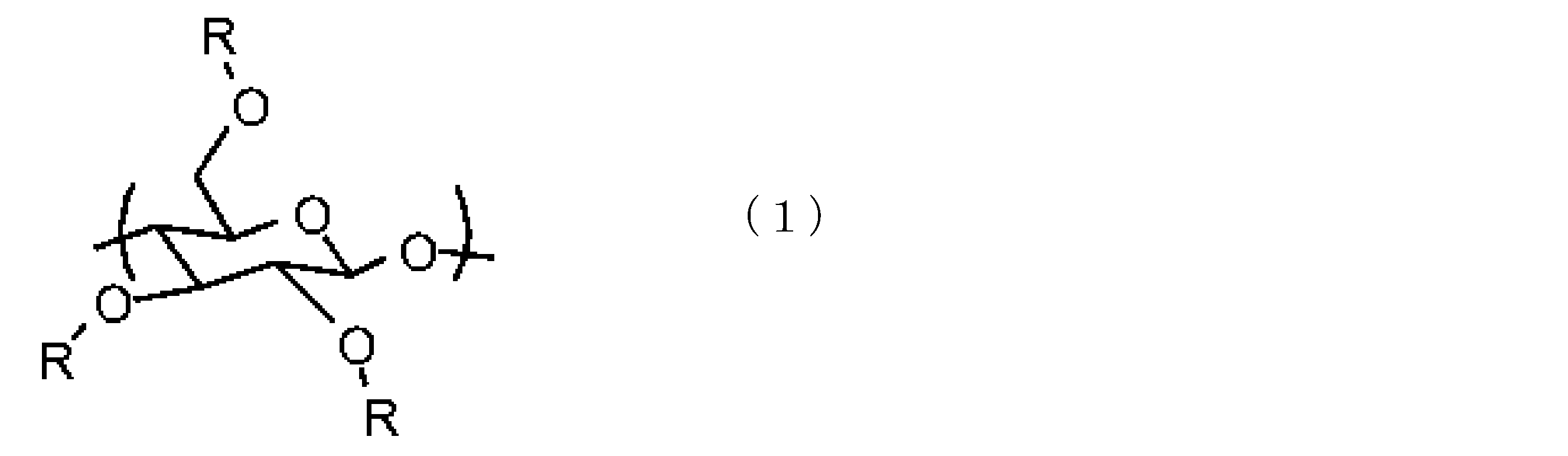
[上記式(1)中、Rは、同一又は異なって、水素原子、水酸基の保護基、下記式(1-a)で表される基、又は下記式(1-b)で表される基である。尚、上記式(1)で表される繰り返し単位を有するセルロース誘導体に含まれる全てのRのうち、少なくとも1つは下記式(1-a)で表される基である。]

(上記式(1-a)中、Xは、同一又は異なって、水素又はメチル基を示す。また、上記式(1-a)中、Arは、単環芳香族炭化水素基又は多環芳香族炭化水素基である。)

(上記式(1-b)中、Xは、同一又は異なって、水素又はメチル基を示す。また、上記式(1-b)中、Arは、単環芳香族炭化水素基又は多環芳香族炭化水素基である。)
本開示の第二は、上記セルロース誘導体の製造方法であって、
塩基触媒の存在下、下記式(2)で表される繰り返し単位を有するセルロース誘導体の2、3又は6位の水酸基に、下記式(3)で表されるαブロモカルボキサミドを反応させる工程(i)を含む、セルロース誘導体の製造方法に関する。
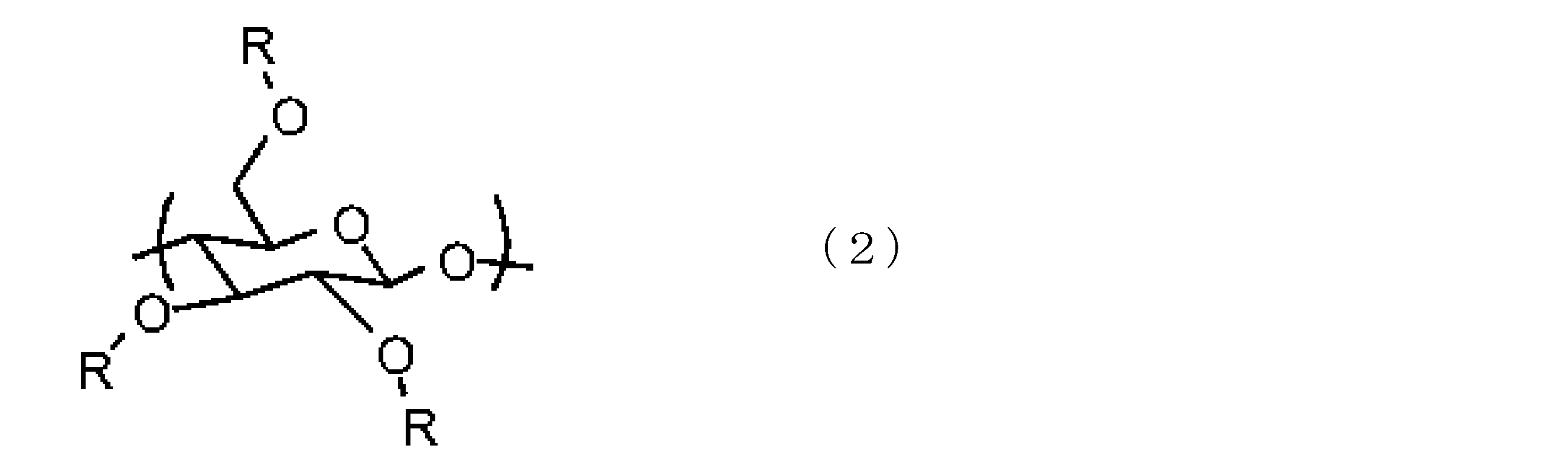
[上記式(2)中、Rは、同一又は異なって、水素原子、水酸基の保護基、上記式(1-a)で表される基、又は上記式(1-b)で表される基である。尚、上記式(2)で表される繰り返し単位を有するセルロース誘導体に含まれる全てのRのうち、少なくとも1つは水素原子である。]

[上記式(3)中、Xは、同一又は異なって、水素又はメチル基を示す。また、上記式(3)中、Arは、単環芳香族炭化水素基又は多環芳香族炭化水素基である。]
塩基触媒の存在下、下記式(2)で表される繰り返し単位を有するセルロース誘導体の2、3又は6位の水酸基に、下記式(3)で表されるαブロモカルボキサミドを反応させる工程(i)を含む、セルロース誘導体の製造方法に関する。
本開示によれば、アミド変性セルロースエーテルを簡便な方法で製造すること、並びに、芳香族アミドによるアミド変性セルロースエーテルを提供することができる。
[セルロース誘導体]
本開示のセルロース誘導体(以下、「セルロース誘導体(1)」と称する場合がある)は、下記式(1)で表される繰り返し単位(以下、「グルコース単位」と称する場合がある)を有し、水酸基の保護基、下記式(1-a)で表される基、及び下記式(1-b)で表される基の総平均置換度が1.5以上である。

[上記式(1)中、Rは、同一又は異なって、水素原子、水酸基の保護基、下記式(1-a)で表される基、又は下記式(1-b)で表される基である。尚、上記式(1)で表される繰り返し単位を有するセルロース誘導体に含まれる全てのRのうち、少なくとも1つは下記式(1-a)で表される基である。]

(上記式(1-a)中、Xは、同一又は異なって、水素又はメチル基を示す。また、上記式(1-a)中、Arは、単環芳香族炭化水素基又は多環芳香族炭化水素基である。)

(上記式(1-b)中、Xは、同一又は異なって、水素又はメチル基を示す。また、上記式(1-b)中、Arは、単環芳香族炭化水素基又は多環芳香族炭化水素基である。)
本開示のセルロース誘導体(以下、「セルロース誘導体(1)」と称する場合がある)は、下記式(1)で表される繰り返し単位(以下、「グルコース単位」と称する場合がある)を有し、水酸基の保護基、下記式(1-a)で表される基、及び下記式(1-b)で表される基の総平均置換度が1.5以上である。
(上記式(1-b)中、Xは、同一又は異なって、水素又はメチル基を示す。また、上記式(1-b)中、Arは、単環芳香族炭化水素基又は多環芳香族炭化水素基である。)
(置換度)
セルロース誘導体(1)における、水酸基の保護基、下記式(1-a)で表される基、及び下記式(1-b)で表される基の総平均置換度は、1.5以上であるところ、1.7以上が好ましく、1.8以上がより好ましく、2.0以上がさらに好ましく、2.5以上が特に好ましい。また、上記総平均置換度は、3以下であってよい。
セルロース誘導体(1)における、水酸基の保護基、下記式(1-a)で表される基、及び下記式(1-b)で表される基の総平均置換度は、1.5以上であるところ、1.7以上が好ましく、1.8以上がより好ましく、2.0以上がさらに好ましく、2.5以上が特に好ましい。また、上記総平均置換度は、3以下であってよい。
本開示において、平均置換度とは、セルロース誘導体を構成するグルコース単位の2、3及び6位の水酸基の水素原子の、水素原子以外の基への置換度の平均値をいい、特に、総平均置換度とは、水酸基の保護基、下記式(1-a)で表される基、及び下記式(1-b)で表される基の各平均置換度の合計をいう。
セルロース誘導体(1)に含まれる全てのRのうち、少なくとも1つは上記式(1-a)で表される基であり、上記式(1-a)で表される基の平均置換度は0より大きければよい。上記式(1-a)で表される基の平均置換度は、0.1以上が好ましく、0.5以上がより好ましく、1.7以上がさらに好ましく、1.8以上がさらに一層好ましく、2.0以上が特に好ましい。また、上記式(1-a)で表される基の平均置換度は、3以下であってよい。セルロース誘導体(1)に含まれる全てのRのうち、上記式(1-a)で表される基及び上記式(1-b)で表される基の平均置換度の合計値における、上記式(1-a)で表される基の平均置換度の割合が高い方が、より耐アルカリ性に優れる。
セルロース誘導体(1)における水酸基の保護基の平均置換度は0以上3未満であってよい。水酸基の保護基の平均置換度は2.5以下が好ましく、2.2以下がより好ましく、1.1以下がさらに好ましい。
セルロース誘導体(1)における水酸基の保護基が下記のアセチル基を含む場合、アセチル基の平均置換度は、1.5以上3.0未満が好ましく、1.5以上2.5以下がより好ましく、1.7以上2.5以下がさらに好ましく、1.7以上2.2以下が特に好ましい。
セルロース誘導体(1)における水酸基の保護基が下記のトリチル基を含む場合、トリチル基の平均置換度は0より大きく、2.5以下が好ましく、2.2以下がより好ましく、1.1以下がさらに好ましい。
((1-a)で表される基)
上記式(1-a)中、Xは、同一又は異なって、水素又はメチル基を示すものであるところ、Xのうち、少なくとも1つはメチル基であることが好ましく、Xは何れもメチル基であることが特に好ましい。本開示のセルロース誘導体(1)の製造方法における下記工程(i)又は(iii)で、セルロース誘導体(1)が特に優れた収率で得られるためである。
上記式(1-a)中、Xは、同一又は異なって、水素又はメチル基を示すものであるところ、Xのうち、少なくとも1つはメチル基であることが好ましく、Xは何れもメチル基であることが特に好ましい。本開示のセルロース誘導体(1)の製造方法における下記工程(i)又は(iii)で、セルロース誘導体(1)が特に優れた収率で得られるためである。
上記式(1-a)中、Arは、単環芳香族炭化水素基又は多環芳香族炭化水素基である。本開示において、単環芳香族炭化水素基は、芳香族炭化水素中の水素が他の基で置換された単環芳香族炭化水素基及び無置換の単環芳香族炭化水素基を含み、多環芳香族炭化水素基は、多環芳香族炭化水素中の水素が他の基で置換された多環芳香族炭化水素基及び無置換の多環芳香族炭化水素基を含む。また、多環芳香族炭化水素基とは、2以上の芳香族環が縮環した炭化水素を有する基である。
上記式(1-a)中、Arは、脂肪族炭化水素基ではなく、単環芳香族炭化水素基又は多環芳香族炭化水素基であることにより、本開示のセルロース誘導体(1)の製造方法において、下記工程(i)又は(iii)の反応の中間体である下記式(3-a)で表されるαケトアジリジン誘導体が生成しやすくなり、セルロース誘導体(1)を優れた収率で得ることができる。

単環芳香族炭化水素基としては、例えば、無置換の単環芳香族炭化水素基であるフェニル基、並びに置換された単環芳香族炭化水素基として、フェニル基中の水素原子がハロゲン原子、炭素数が1~24のアルキル基、炭素数が1~24のアルケニル基、炭素数が1~24のアルキニル基、炭素数が1~24のアルコキシ基、炭素数が1~24のアシル基、炭素数が1~24等のアルコキシカルボニル基(エステル基)、トリフルオロメチル基、ニトロ基等に置換された単環芳香族炭化水素基が挙げられる。単環芳香族炭化水素基における置換基の数は1、2、3、4及び5の何れであってよく、置換基の位置も限定されるものではない。単環芳香族炭化水素基としては、化学的な安定性の観点からはフェニル基が好ましい。また、樹脂として可塑性が向上する観点から、アルキル基置換の単環芳香族炭化水素基が好ましい。
上記式(1-a)中、Arが単環芳香族炭化水素基であり、その単環芳香族炭化水素基がフェニル基である場合、上記式(1-a)中のXのうち、少なくとも一つはメチル基であることが好ましい。すなわち、上記式(1-a)中の2つのXは、両者ともメチル基であるか、又は一方が水素でもう一方がメチル基であることが好ましい。さらに、上記式(1-a)中の2つのXは、両者ともメチル基であることがより好ましい。
多環芳香族炭化水素基としては、例えば、無置換の多環芳香族炭化水素である、ナフタレン、アントラセン、フェナントレン、ピレン、トリフェニレン、及びテトラセン等から水素を1つ置換した1価の置換基、並びに置換された多環芳香族炭化水素基として、さらに多環芳香族炭化水素中の水素原子がハロゲン原子、炭素数が1~24のアルキル基、炭素数が1~24のアルケニル基、炭素数が1~24のアルキニル基、炭素数が1~24のアルコキシ基、炭素数が1~24のアシル基、炭素数が1~24等のアルコキシカルボニル基(エステル基)、トリフルオロメチル基、ニトロ基等に置換された多環芳香族炭化水素基が挙げられる。多環芳香族炭化水素基における置換基の数は限定されず、例えば1~12であってよく、置換基の位置も限定されるものではない。
(水酸基の保護基)
上記水酸基の保護基としては、周知慣用の保護基が挙げられ、例えば、トリメチルシリル基、トリエチルシリル基、トリイソプロピルシリル基、トリフェニルシリル基、t-ブチルジメチルシリル基、ジメチルテキシルシリル基、t-ブチルジフェニルシリル等のシリル系保護基;テトラヒドロピラニル基、メトキシメチル基等のアセタール系保護基;ベンジル基、p-メトキシベンジル基等の炭素数が6~15のアラルキル基;
アリル基等のアルケニル基;トリチル基、メトキシトリチル基等のエーテル系保護基;アセチル基、ピバロイル基、ベンゾイル基、トリメチルベンゾイル基等の炭素数が1~5の脂肪族アシル基又は炭素数が6~15の芳香族アシル基;p-トルエンスルホニル基等のエステル系保護基等が含まれる。これらの中でも、弱塩基性の反応条件に付すことができ、原料となるセルロース誘導体が汎用的な有機溶媒に可溶になり、安価な酸や塩基で脱保護可能になるという観点からアセチル基又はトリチル基が好ましい。
上記水酸基の保護基としては、周知慣用の保護基が挙げられ、例えば、トリメチルシリル基、トリエチルシリル基、トリイソプロピルシリル基、トリフェニルシリル基、t-ブチルジメチルシリル基、ジメチルテキシルシリル基、t-ブチルジフェニルシリル等のシリル系保護基;テトラヒドロピラニル基、メトキシメチル基等のアセタール系保護基;ベンジル基、p-メトキシベンジル基等の炭素数が6~15のアラルキル基;
アリル基等のアルケニル基;トリチル基、メトキシトリチル基等のエーテル系保護基;アセチル基、ピバロイル基、ベンゾイル基、トリメチルベンゾイル基等の炭素数が1~5の脂肪族アシル基又は炭素数が6~15の芳香族アシル基;p-トルエンスルホニル基等のエステル系保護基等が含まれる。これらの中でも、弱塩基性の反応条件に付すことができ、原料となるセルロース誘導体が汎用的な有機溶媒に可溶になり、安価な酸や塩基で脱保護可能になるという観点からアセチル基又はトリチル基が好ましい。
((1-b)で表される基)
本開示のセルロース誘導体(1)に含まれる全てのRのうち、少なくとも1つは下記式(1-b)で表される基であってもよく、下記式(1-b)で表される基の平均置換度は0より大きくてよいが、1以下が好ましく、0.6以下がより好ましい。
本開示のセルロース誘導体(1)に含まれる全てのRのうち、少なくとも1つは下記式(1-b)で表される基であってもよく、下記式(1-b)で表される基の平均置換度は0より大きくてよいが、1以下が好ましく、0.6以下がより好ましい。
また、セルロース誘導体(1)の6位のRにおいて、下記式(1-a)で表される基及び下記式(1-b)で表される基の合計モル数に対する、下記式(1-b)で表される基は、50モル%以下が好ましく、30モル%以下がより好ましく、20モル%以下がさらに好ましい。

(上記式(1-b)中、Xは、同一又は異なって、水素又はメチル基を示す。また、上記式(1-b)中、Arは、単環芳香族炭化水素基又は多環芳香族炭化水素基である。)
上記式(1-b)中、Xは何れもメチル基であることが好ましい。本開示のセルロース誘導体(1)の製造方法における下記工程(i)又は(iii)で特に優れた収率で得られるためである。
上記式(1-b)中、Arは、脂肪族炭化水素基ではなく、単環芳香族炭化水素基又は多環芳香族炭化水素基であることにより、本開示のセルロース誘導体(1)の製造方法における反応の中間体である上記式(3-a)で表されるαケトアジリジン誘導体が生成しやすくなり、セルロース誘導体(1)を優れた収率で得ることができる。
単環芳香族炭化水素基及び多環芳香族炭化水素基としては、上記式(1-a)中、Arとして例示したものと同じものを例示できる。
上記式(1-b)中、Arが単環芳香族炭化水素基であり、その単環芳香族炭化水素基がフェニル基である場合、上記式(1-b)中のXのうち、少なくとも一つはメチル基であることが好ましい。すなわち、上記式(1-b)中の2つのXは、両者ともメチル基であるか、又は一方が水素でもう一方がメチル基であることが好ましい。さらに、上記式(1-b)中の2つのXは、両者ともメチル基であることがより好ましい。
本開示のセルロース誘導体(1)の形態は特に制限されず、樹脂成形材料として使用することができ、例えば、粉末状、繊維状、顆粒状、シート状が挙げられる。
セルロース系材料の一般的な性質として、水性を有し、透水性に優れ、汚れにくいという性質がある。本開示のセルロース誘導体(1)に含まれる全てのRのうち、少なくとも1つは上記式(1-a)で表される基であり、アミド基を有するため、そのような性質に加え、本開示のセルロース誘導体(1)は、耐アルカリ性に優れる。特に、セルロースエステルよりも耐アルカリ性に優れる。そのため、本開示のセルロース誘導体(1)は、耐アルカリ性、耐薬品性が求められる、水処理膜用の材料として好適である。
[組成物]
本開示の組成物は、上記セルロース誘導体(1)を含む組成物である。
本開示の組成物は、上記セルロース誘導体(1)を含む組成物である。
上記組成物は、用途に応じ、上記セルロース誘導体以外の任意成分を含有することができる。上記任意成分としては、例えば、可塑剤、安定化剤(例えば、酸化防止剤、紫外線吸収剤、熱安定剤、耐光安定剤等)、着色剤(例えば、染料、顔料等)、難燃剤、帯電防止剤、滑剤、アンチブロッキング剤、分散剤、流動化剤、ドリッピング防止剤、及び抗菌剤等が挙げられる。
可塑剤としては、例えば、フタル酸ジメチル、フタル酸ジエチル、フタル酸ジブチル、フタル酸ジヘキシル、フタル酸ジオクチル、フタル酸ジ-2-エチルヘキシル等のフタル酸ジC1-12アルキルエステル、フタル酸ジメトキシエチル等のフタル酸C1-6アルコキシC1-12アルキルエステル、フタル酸ブチルベンジル等のフタル酸C1-12アルキル・アリール-C1-3アルキルエステル、エチルフタリルエチレングリコレート、ブチルフタリルブチレングリコレート等のC1-6アルキルフタリルC2-4アルキレングリコレート、トリメリット酸トリメチル、トリメリット酸トリエチル、トリメリット酸トリオクチル、トリメリット酸トリ2-エチルヘキシル等のトリメリット酸トリC1-12アルキルエステル、ピロメリット酸テトラオクチル等のピロメリット酸テトラC1-12アルキルエステル等の芳香族カルボン酸エステル;アゼライン酸ジエチル、アゼライン酸ジブチル、アゼライン酸ジオクチル等のアゼライン酸エステル、セバシン酸ジブチル、セバシン酸ジオクチル等のセバシン酸エステル、オレイン酸ブチル、リシノール酸メチルアセチル等の脂肪酸エステル;トリアセチン、ジグリセリンテトラアセテート等;グリセリン、トリメチロールプロパン、ペンタエリスリトール、ソルビトール等の多価アルコールの低級脂肪酸エステル;グリコールエステルジプロピレングリコールジベンゾエート等の多価アルコールの安息香酸エステル;クエン酸アセチルトリブチル等のクエン酸エステル;N-ブチルベンゼンスルホンアミド等のアミド類;カプロラクトンオリゴマー等のエステルオリゴマーを含有してもよい。これらの可塑剤は、単独で又は二種以上組み合わせて使用してもよい。
[セルロース誘導体の製造方法]
本開示のセルロース誘導体(1)は、例えば、下記の製造方法により製造することができる。塩基触媒の存在下、下記式(2)で表される繰り返し単位を有するセルロース誘導体(以下、「セルロース誘導体(2)」と称する場合がある)の2、3又は6位の水酸基に、下記式(3)で表されるαブロモカルボキサミドを反応させる工程(i)を含む、セルロース誘導体の製造方法。
本開示のセルロース誘導体(1)は、例えば、下記の製造方法により製造することができる。塩基触媒の存在下、下記式(2)で表される繰り返し単位を有するセルロース誘導体(以下、「セルロース誘導体(2)」と称する場合がある)の2、3又は6位の水酸基に、下記式(3)で表されるαブロモカルボキサミドを反応させる工程(i)を含む、セルロース誘導体の製造方法。
(セルロース誘導体(2))
本開示のセルロース誘導体(2)は、下記式(2)で表される繰り返し単位を有する。
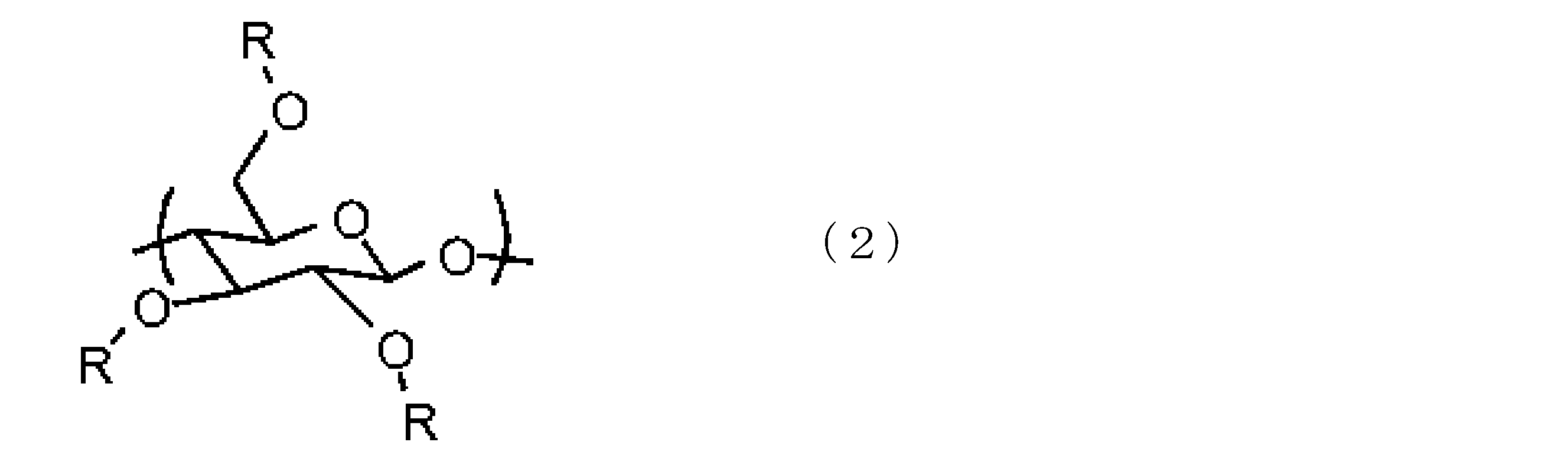
[上記式(2)中、Rは、同一又は異なって、水素原子、水酸基の保護基、上記式(1-a)で表される基、又は上記式(1-b)で表される基である。尚、上記式(2)で表される繰り返し単位を有するセルロース誘導体に含まれる全てのRのうち、少なくとも1つは水素原子である。]
本開示のセルロース誘導体(2)は、下記式(2)で表される繰り返し単位を有する。
(置換度)
セルロース誘導体(2)に含まれる全てのRのうち、少なくとも1つは水素原子である。さらに少なくとも1つが水酸基の保護基、上記式(1-a)で表される基、又は上記式(1-b)で表される基である場合、水酸基の保護基、上記式(1-a)で表される基、及び上記式(1-b)で表される基の総平均置換度は、0.1以上、0.5以上、1.0以上、1.5以上、1.7以上、1.8以上、2.0以上、又は2.5以上であってよく、3未満であればよい。
セルロース誘導体(2)に含まれる全てのRのうち、少なくとも1つは水素原子である。さらに少なくとも1つが水酸基の保護基、上記式(1-a)で表される基、又は上記式(1-b)で表される基である場合、水酸基の保護基、上記式(1-a)で表される基、及び上記式(1-b)で表される基の総平均置換度は、0.1以上、0.5以上、1.0以上、1.5以上、1.7以上、1.8以上、2.0以上、又は2.5以上であってよく、3未満であればよい。
セルロース誘導体(2)における水酸基の保護基の平均置換度は0以上3未満であってよい。水酸基の保護基の平均置換度は2.5以下が好ましく、2.2以下がより好ましく、1.1以下がさらに好ましい。
セルロース誘導体(2)における水酸基の保護基が下記のアセチル基を含む場合、アセチル基の平均置換度は、1.5以上3.0未満が好ましく、1.5以上2.5以下がより好ましく、1.7以上2.5以下がさらに好ましく、1.7以上2.2以下が特に好ましい。
セルロース誘導体(2)における水酸基の保護基が下記のトリチル基を含む場合、トリチル基の平均置換度は0より大きく、2.5以下が好ましく、2.2以下がより好ましく、1.1以下がさらに好ましい。
セルロース誘導体(2)における上記式(1-a)で表される基の平均置換度は0であってよい。
セルロース誘導体(2)としては、上記式(2)で表される繰り返し単位を有するものであれば限定されないが、アセトニトリル(以下、ANと称することがある)及びテトラヒドロフラン(以下、THFと称することがある)等の汎用的な有機溶媒に可溶なものとして、具体的には、例えば、酢酸セルロース、トリチルセルロース、酢酸プロピオン酸セルロース、酢酸酪酸セルロース等が挙げられる。また、セルロース誘導体(1)もまたセルロース誘導体(2)になり得る。
((1-a)で表される基)
セルロース誘導体(2)が上記式(1-a)で表される基を有する場合、セルロース誘導体(2)における上記式(1-a)で表される基に関する説明は、上記セルロース誘導体(1)の「((1-a)で表される基)」の項における(1-a)で表される基そのものに関する説明のとおりである。
セルロース誘導体(2)が上記式(1-a)で表される基を有する場合、セルロース誘導体(2)における上記式(1-a)で表される基に関する説明は、上記セルロース誘導体(1)の「((1-a)で表される基)」の項における(1-a)で表される基そのものに関する説明のとおりである。
(水酸基の保護基)
セルロース誘導体(2)が水酸基の保護基を有する場合、セルロース誘導体(2)における水酸基の保護基の具体例としては、上記セルロース誘導体(1)における「(水酸基の保護基)」の項で挙げた具体例と共通する。また、本開示のセルロース誘導体(1)の製造方法における水酸基の保護基としては、原料となるセルロース誘導体が汎用的な有機溶媒に可溶になり、安価な酸や塩基で脱保護可能になるという観点からアセチル基又はトリチル基が好ましい。
セルロース誘導体(2)が水酸基の保護基を有する場合、セルロース誘導体(2)における水酸基の保護基の具体例としては、上記セルロース誘導体(1)における「(水酸基の保護基)」の項で挙げた具体例と共通する。また、本開示のセルロース誘導体(1)の製造方法における水酸基の保護基としては、原料となるセルロース誘導体が汎用的な有機溶媒に可溶になり、安価な酸や塩基で脱保護可能になるという観点からアセチル基又はトリチル基が好ましい。
((1-b)で表される基)
セルロース誘導体(2)が上記式(1-b)で表される基を有する場合、セルロース誘導体(2)における上記式(1-b)で表される基に関する説明は、上記セルロース誘導体(1)の「((1-b)で表される基)」の項における(1-b)で表される基そのものに関する説明のとおりである。
セルロース誘導体(2)が上記式(1-b)で表される基を有する場合、セルロース誘導体(2)における上記式(1-b)で表される基に関する説明は、上記セルロース誘導体(1)の「((1-b)で表される基)」の項における(1-b)で表される基そのものに関する説明のとおりである。
(αブロモカルボキサミド)
本開示のαブロモカルボキサミドは、下記式(3)で表されるものである。

[上記式(3)中、Xは、同一又は異なって、水素又はメチル基を示す。また、上記式(3)中、Arは、単環芳香族炭化水素基又は多環芳香族炭化水素基である。]
本開示のαブロモカルボキサミドは、下記式(3)で表されるものである。
上記式(3)中、Xは、同一又は異なって、水素又はメチル基を示すものであるところ、Xのうち、少なくとも1つはメチル基であることが好ましく、Xは何れもメチル基であることが特に好ましい。本開示の製造方法により得られるセルロース誘導体(1)の収率をより高めることができるためである。
尚、上記式(3)中、Xのうち1つが水素、もう1つがメチル基であるものは、αメチルカルボキサミドといい、Xが何れもメチル基であるものは、αジメチルカルボキサミドと言い換えることができる。本実施形態では、上記式(3)で表される化合物のうち、αメチルカルボキサミド又はαジメチルカルボキサミドを使用することが好ましい。
上記式(3)中、Arは、単環芳香族炭化水素基又は多環芳香族炭化水素基である。上記式(3)中、Arは、脂肪族炭化水素基ではなく、単環芳香族炭化水素基又は多環芳香族炭化水素基であることにより、上記工程(i)又は(iii)の反応の中間体である上記式(3-a)で表されるαケトアジリジン誘導体が生成しやすくなり、高い収率でセルロース誘導体(1)が得られるため、単環芳香族炭化水素基又は多環芳香族炭化水素基の置換基を変えることにより、様々な置換基を有するセルロース誘導体(1)を製造することができる。
上記式(3)における単環芳香族炭化水素基及び多環芳香族炭化水素基の具体例及びそのうち好適な置換基に関する説明は、上記式(1-a)における単環芳香族炭化水素基及び多環芳香族炭化水素基の具体例及び好適な置換基に関する説明のとおりである。
上記式(3)中、Arが単環芳香族炭化水素基であり、その単環芳香族炭化水素基がフェニル基である場合、上記式(3)中のXのうち、少なくとも一つはメチル基であることが好ましい。すなわち、上記式(3)中の2つのXは、両者ともメチル基であるか、又は一方が水素でもう一方がメチル基であることが好ましい。さらに、上記式(3)中の2つのXは、両者ともメチル基であることがより好ましい。
上記工程(i)における、上記式(3)で表されるαブロモカルボキサミドの使用量としては、セルロース誘導体(2)全体の2、3又は6位の水酸基の合計水酸基1モル当たり、1~3モル当量が好ましく、1~2モル当量がより好ましく、1~1.5モル当量がさらに好ましい。
(塩基触媒)
上記工程(i)で用いる塩基触媒としては、上記工程(i)の反応を触媒できるものであれば特に限定されるものではないが、例えば、炭酸ナトリウム、炭酸カリウム、炭酸セシウム(Cs2CO3)を含む炭酸塩、並びにリン酸ナトリウム、リン酸カリウム、リン酸セシウム等のリン酸塩等の非求核性の無機塩基が挙げられる。これらの中でも、αブロモカルボキサミドの分解反応が抑制される観点から、炭酸塩、リン酸塩が好ましく、金属イオンとしては反応における活性化効果が大きくなる観点から、カリウム塩が好ましく、より好ましくはセシウム塩である。特に好ましくは炭酸セシウムである。下記の銅化合物及び当該銅化合物中の銅の配位子との共存下においては、αブロモカルボキサミドの分解反応が抑制される観点から、炭酸塩、リン酸塩が好ましく、金属イオンとしてはαブロモカルボキサミドの分解反応が抑制される観点からから、カリウム、セシウムがより好ましい。
上記工程(i)で用いる塩基触媒としては、上記工程(i)の反応を触媒できるものであれば特に限定されるものではないが、例えば、炭酸ナトリウム、炭酸カリウム、炭酸セシウム(Cs2CO3)を含む炭酸塩、並びにリン酸ナトリウム、リン酸カリウム、リン酸セシウム等のリン酸塩等の非求核性の無機塩基が挙げられる。これらの中でも、αブロモカルボキサミドの分解反応が抑制される観点から、炭酸塩、リン酸塩が好ましく、金属イオンとしては反応における活性化効果が大きくなる観点から、カリウム塩が好ましく、より好ましくはセシウム塩である。特に好ましくは炭酸セシウムである。下記の銅化合物及び当該銅化合物中の銅の配位子との共存下においては、αブロモカルボキサミドの分解反応が抑制される観点から、炭酸塩、リン酸塩が好ましく、金属イオンとしてはαブロモカルボキサミドの分解反応が抑制される観点からから、カリウム、セシウムがより好ましい。
上記工程(i)における、塩基触媒の使用量としては、使用するαブロモカルボキサミド1モル当たり、1~5モル当量が好ましく、1~3モル当量がより好ましく、1~2モル当量がさらに好ましい。
また、上記工程(i)の反応は、銅化合物、当該銅化合物中の銅の配位子及び上記塩基触媒の存在下での反応であってよい。銅化合物及び当該銅化合物中の銅の配位子を上記塩基触媒と共存させることにより、上記式(1-b)で表される基よりも、上記式(1-a)で表される基による置換反応が優先的に進むため、セルロース誘導体(2)の2、3又は6位の水酸基に対する、上記式(1-b)で表される基による置換度よりも、上記式(1-a)で表される基による置換度を高めることができる。尚、銅化合物は、上記工程(i)の反応の触媒としても作用する。
上記工程(i)の反応で置換される上記式(1-a)で表される基及び上記式(1-b)で表される基の平均置換度の合計値における、上記式(1-a)で表される基の平均置換度の割合としては、例えば、50%以上、70%以上、又は90%以上であってよい。
上記銅化合物としては、特に限定されるものではないが、例えば、1価、2価又は3価の銅化合物;無機銅化合物;又は有機銅化合物が挙げられる。1価の銅化合物としては、塩化銅(I)、臭化銅(I)、臭化銅(I)ジメチルスルフィド錯体、及びヨウ化銅(I)を含むハロゲン化銅、酸化銅(I)、酢酸銅(I)、2-オフェンカルボン酸銅(I)等の酸素配位銅、並びにシアン化銅(I)等が挙げられ、2価の銅化合物としては、塩化銅(II)、及び臭化銅(II)を含むハロゲン化銅、酸化銅(I)、並びに酢酸銅(I)が挙げられる。これらの中でも、反応における活性化効果が大きくなる観点から、1価の銅化合物が好ましく、中でも、塩化銅(I)、臭化銅(I)、臭化銅(I)ジメチルスルフィド錯体、ヨウ化銅(I)がより好ましい。
上記工程(i)の反応における、銅化合物の使用量としては、セルロース誘導体(2)全体の2、3又は6位の水酸基の合計水酸基1モル当たり、0.005~0.3モル当量が好ましく、0.01~0.2モル当量がより好ましく、0.01~0.1モル当量がさらに好ましい。
上記銅化合物は、当該銅化合物中の銅の配位子と併用することが反応における活性化効果が大きくなる観点から好ましい。
上記銅化合物中の銅の配位子としては、特に限定されるものではないが、例えば、1座のホスフィン配位子及び2座のホスフィン配位子が挙げられる。1座のホスフィン配位子としては、トリフェニルホスフィン、トリ(o-トリル)ホスフィン、トリ(2-フリル)ホスフィン、シクロヘキシルジフェニルホスフィン、ジシクロヘキシルフェニルホスフィン、ジシクロヘキシルホスフィノ-2’、6’-ジメトキシビフェニル、トリシクロヘキシルホスフィン、ジシクロヘキシルホスフィノ-2’、4’、6’-トリイソプロピルビフェニル、トリシクロヘキシルホスフィン、トリn-ブチルホスフィン、トリt-ブチルホスフィン、及びトリt-ブチルホスフィニウムテトラフルオロボレート等が挙げられる、2座のホスフィン配位子としては、ビスジフェニルホスフィノフェロセン、ビスジフェニルホスフィノプロパン、ビスジフェニルホスフィノエタン、及びビスジフェニルホスフィノメタン等が挙げられる。これらの中でも、反応における活性化効果が大きくなる観点から、1座のホスフィン配位子が好ましく、中でも、トリフェニルホスフィン、トリシクロヘキシルホスフィンがより好ましい。
また、上記工程(i)の反応における、銅化合物と併用する当該銅化合物中の銅の配位子の使用量としては、使用する銅化合物1モル当たり、1~3モル当量が好ましく、1~2モル当量がより好ましく、1~1.5モル当量がさらに好ましい。
(溶媒)
上記工程(i)の反応は、溶媒の存在下で行うことが好ましい。上記溶媒としては、非プロトン性の溶媒を用いることができ、具体的には、例えば、ベンゼン、トルエン、キシレン、エチルベンゼン等の芳香族炭化水素;クロロホルム、ジクロロメタン、1,2-ジクロロエタン等のハロゲン化炭化水素;ジエチルエーテル、ジメトキシエタン、テトラヒドロフラン、ジオキサン等のエーテル;アセトン、メチルエチルケトン、メチルイソブチルケトン等のケトン;酢酸メチル、酢酸エチル、酢酸イソプロピル、酢酸ブチル等のエステル;N,N-ジメチルホルムアミド、N,N-ジメチルアセトアミド等のアミド;アセトニトリル、プロピオニトリル、ベンゾニトリル等のニトリル;ジメチルスルホキシド等が挙げられる。これらは1種を単独で、又は2種以上を組み合わせて使用することができる。これらの中でも、副反応がおこりにくいという観点から、芳香族炭化水素、エーテル、エステル、ニトリルが好ましく、さらに沸点が低く回収が容易であること、汎用性に優れることからアセトニトリル又はテトラヒドロフランが好ましい。
上記工程(i)の反応は、溶媒の存在下で行うことが好ましい。上記溶媒としては、非プロトン性の溶媒を用いることができ、具体的には、例えば、ベンゼン、トルエン、キシレン、エチルベンゼン等の芳香族炭化水素;クロロホルム、ジクロロメタン、1,2-ジクロロエタン等のハロゲン化炭化水素;ジエチルエーテル、ジメトキシエタン、テトラヒドロフラン、ジオキサン等のエーテル;アセトン、メチルエチルケトン、メチルイソブチルケトン等のケトン;酢酸メチル、酢酸エチル、酢酸イソプロピル、酢酸ブチル等のエステル;N,N-ジメチルホルムアミド、N,N-ジメチルアセトアミド等のアミド;アセトニトリル、プロピオニトリル、ベンゾニトリル等のニトリル;ジメチルスルホキシド等が挙げられる。これらは1種を単独で、又は2種以上を組み合わせて使用することができる。これらの中でも、副反応がおこりにくいという観点から、芳香族炭化水素、エーテル、エステル、ニトリルが好ましく、さらに沸点が低く回収が容易であること、汎用性に優れることからアセトニトリル又はテトラヒドロフランが好ましい。
上記工程(i)の反応を溶媒の存在下で行う場合、反応速度を上げる観点から、溶媒の使用量としては、原料のセルロース誘導体1mmolに対して、例えば、1~20mL、好ましくは1~10mL、より好ましくは1~5mLであってよい。
上記工程(i)の反応の雰囲気としては、反応を阻害しない限り特に限定されず、例えば、空気雰囲気、窒素雰囲気、アルゴン雰囲気等の何れであってもよい。
上記工程(i)の反応温度は、使用する溶媒に応じて適宜調整することができ、例えば、20℃(室温)~150℃、20℃(室温)~100℃であってよく、20℃(室温)~60℃程度が好ましい。また、反応時間は、例えば、3~24時間、好ましくは5~24時間又は5~15時間であるが、24時間以上であってもよい。
上記工程(i)の反応機構としては、塩基触媒により、上記式(3)で表されるαブロモカルボキサミドから反応の中間体である上記式(3-a)で表されるαケトアジリジン誘導体が発生し、そのαケトアジリジン誘導体がセルロース誘導体(2)の2、3又は6位の水酸基と反応することにより、セルロース誘導体(1)を生成するものである。
下記反応式に示すように、αケトアジリジン誘導体とセルロース誘導体(2)の2、3又は6位の水酸基との反応において、上記式(1-b)で表される基に置換される場合も含まれ、当該生成されるセルロース誘導体(1)は上記式(1-a)で表される基とともに、上記式(1-b)で表される基を有してもよい。
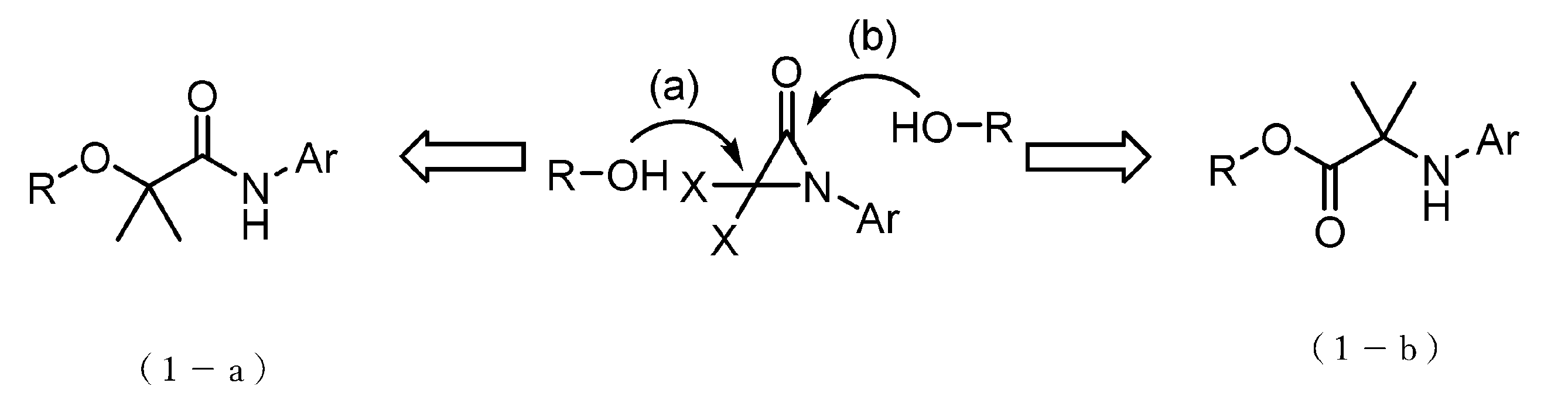
上記工程(i)の反応が銅化合物、当該銅化合物中の銅の配位子及び上記塩基触媒の存在下での反応である場合、セルロース誘導体(2)の2、3又は6位の水酸基との反応において、下記反応式に示すように、炭素-臭素結合への酸化的付加、続く水酸基による配位子交換、及び還元的脱離により(1-a)で表される基が優先的に生成するため、得られるセルロース誘導体(1)における上記式(1-a)で表される基の平均置換度を高めることができる。

上記工程(i)によれば、優れた収率でセルロース誘導体(1)を製造することができる。上記工程(i)における収率としては、30%以上であってよく、50%以上が好ましく、70%以上がより好ましく、80%以上がさらに好ましく、90%以上が特に好ましい。上記工程(i)における収率とは、上記工程(i)における、上記式(2)で表される繰り返し単位を有するセルロース誘導体の仕込みモル数に対する、上記工程(i)の生成物であるセルロース誘導体(1)のモル数の割合をいう。
また、本開示のセルロース誘導体(1)の製造方法は、上記セルロース誘導体(2)に含まれる全てのRのうち、少なくとも1つが水酸基の保護基である場合、上記工程(i)の後、上記水酸基の保護基を脱離して水酸基に置換する工程(ii)を含んでもよい。
上記水酸基の保護基を脱離して水酸基に置換する方法としては、上記の周知慣用の保護基毎に既知の方法を用いることができ、例えば、保護基がシリル基であれば、フッ化物で処理する方法;保護基がアセタール系保護基であれば、塩酸、酢酸や臭化水素等の酸を用いて処理する方法;保護基がC1-5脂肪族アシル基又はC6-15芳香族アシル基であれば、メタノール等のアルコール/水中、炭酸カリウム、で処理する等塩基性条件で処理する方法;エーテル系の保護基のうち、C7-15アラルキル基、アリル基等であれば、パラジウム/炭素等の触媒の存在下に水素添加によって処理する方法;保護基がトリチル基であれば、酢酸や塩酸等の酸を用いて処理する方法等が挙げられる。
工程(ii)における水酸基の保護基がトリチル基を含む場合であって、トリチル基を脱離する場合について、以下説明する。上記工程(ii)で用いる酸としては、トリチル基を脱離して水酸基に置換できるものであれば特に限定されるものではないが、例えば、塩酸、臭化水素酸、臭化水素酸/酢酸溶液、ヨウ化水素酸等が挙げられる。これらの中でも、有機溶媒との相溶性が高く、反応が容易に進行する観点から、臭化水素酸/酢酸溶液が好ましい。
上記工程(ii)の反応は、溶媒の存在下で行うことが好ましい。上記溶媒としては、例えば、クロロホルムやジクロロメタン等のハロゲン化炭化水素等が挙げられる。
また、上記工程(ii)の反応を溶媒の存在下で行う場合、反応速度を上げる観点から、溶媒の使用量としては、原料のセルロース誘導体1mmolに対して、例えば、1~20mL、好ましくは1~10mL、より好ましくは1~5mLであってよい。
上記工程(ii)の反応の雰囲気としては、反応を阻害しない限り特に限定されず、例えば、空気雰囲気、窒素雰囲気、アルゴン雰囲気等の何れであってもよい。
上記工程(ii)の反応温度は、使用する溶媒に応じて適宜調整することができ、例えば、室温~60℃、室温~40℃であってよく、25℃程度の室温が好ましい。また、反応時間は、例えば、5~180分間、5~60分間、5~30分間であってよい。
上記工程(ii)における水酸基の保護基がトリチル基を含む場合であって、トリチル基を脱離する場合の説明は以上である。
上記工程(ii)を含む場合も、優れた収率でセルロース誘導体(1)を製造することができる。上記工程(ii)における収率としては、30%以上であってよく、50%以上が好ましく、70%以上がより好ましく、80%以上がさらに好ましく、90%以上が特に好ましい。上記工程(ii)における収率とは、上記工程(i)における、上記式(2)で表される繰り返し単位を有するセルロース誘導体の仕込みモル数に対する、上記工程(ii)の生成物であるセルロース誘導体(1)のモル数の割合をいう。
さらに、本開示のセルロース誘導体(1)の製造方法は、上記工程(ii)により得られたセルロース誘導体における、上記工程(ii)により保護基から水素原子に置換された水酸基を含む2、3又は6位の水酸基に、塩基触媒の存在下、上記式(3)で表されるαブロモカルボキサミドを反応させる工程(iii)を含んでもよい。
上記工程(iii)で用いる塩基触媒としては、上記工程(iii)の反応を触媒できるものであれば特に限定されず、上記工程(i)と同じものを用いることができる。上記工程(iii)で用いる塩基触媒としても、αブロモカルボキサミドの分解反応が抑制される観点から、炭酸セシウムが好ましい。また、上記工程(i)と同様に、上記の銅化合物及び当該銅化合物中の銅の配位子との共存により、αブロモカルボキサミドの分解反応が抑制される観点からは、リン酸塩が好ましく、リン酸カリウムがより好ましい。
上記工程(iii)における、塩基触媒の使用量としては、使用するαブロモカルボキサアミド1モル当たり、1~5モル当量が好ましく、1~3モル当量がより好ましく、1~2モル当量がさらに好ましい。
また、上記工程(iii)の反応は、銅化合物、当該銅化合物中の銅の配位子、及び上記塩基触媒の存在下での反応であってよい。銅化合物及び当該銅化合物中の銅の配位子を上記塩基触媒と共存させることにより、上記式(1-b)で表される基よりも、上記式(1-a)で表される基による置換反応が優先的に進むため、上記工程(ii)により得られたセルロース誘導体における、上記工程(ii)により置換された水酸基を含む2、3又は6位の水酸基に対する、上記式(1-b)で表される基による置換度よりも、上記式(1-a)で表される基による置換度を高めることができる。尚、銅化合物は、上記工程(iii)の反応の触媒としても作用する。
上記工程(iii)の反応で置換される上記式(1-a)で表される基及び上記式(1-b)で表される基の平均置換度の合計値における、上記式(1-a)で表される基の平均置換度の割合としては、例えば、50%以上、70%以上、又は90%以上であってよい。
上記工程(iii)で用いる銅化合物としては、上記工程(i)で例示したもの、及び例示した使用量で用いることができる。
上記工程(iii)で用いる銅化合物は、上記工程(i)と同様に、当該銅化合物中の銅の配位子と併用することが好ましく、上記工程(i)で例示した使用量で用いることができる。
上記工程(iii)の反応は、溶媒の存在下で行うことが好ましく、上記工程(i)と同じものを用いることができる。上記工程(iii)で用いる溶媒としても、沸点が低く、回収が容易であること、汎用性に優れることから、アセトニトリル又はテトラヒドロフランが好ましい。
上記工程(iii)の反応を溶媒の存在下で行う場合、反応速度を上げる観点から、溶媒の使用量としては、原料のセルロース誘導体1mmolに対して、例えば、1~20mL、好ましくは1~10mL、より好ましくは1~5mLであってよい。
上記工程(iii)の反応の雰囲気としては、反応を阻害しない限り特に限定されず、例えば、空気雰囲気、窒素雰囲気、アルゴン雰囲気等の何れであってもよい。
上記工程(iii)の反応温度は、使用する溶媒に応じて適宜調整することができ、例えば、20℃(室温)~150℃、20℃(室温)~100℃であってよく、20℃(室温)~60℃程度の室温が好ましい。また、反応時間は、例えば、3~24時間、好ましくは5~24時間又は5~15時間であるが、24時間であってもよい。
上記工程(iii)を含む場合も、優れた収率でセルロース誘導体(1)を製造することができる。上記工程(iii)における収率としては、30%以上であってよく、50%以上が好ましく、70%以上がより好ましく、80%以上がさらに好ましく、90%以上が特に好ましい。上記工程(iii)における収率とは、上記工程(i)における、上記式(2)で表される繰り返し単位を有するセルロース誘導体の仕込みモル数に対する、上記工程(iii)の生成物であるセルロース誘導体(1)のモル数の割合をいう。
上記工程(i)、上記工程(ii)、及び上記工程(iii)の各工程により、得られた各反応生成物は、例えば、再沈殿、ろ過、乾燥、濃縮、蒸留、抽出、晶析、吸着、再結晶、カラムクロマトグラフィー等の分離手段や、これらを組み合わせた分離手段により分離精製できる。
以上、本開示の各構成及びそれらの組み合わせ等は、一例であって、本開示の主旨から逸脱しない範囲内で、適宜、構成の付加、省略、置換、及びその他の変更が可能である。本開示は、実施形態によって限定されることはなく、クレームの範囲によってのみ限定される。
また、本明細書に開示された各々の態様は、本明細書に開示された他のいかなる特徴とも組み合わせることができる。
以下の各項目では、本開示における好ましい態様を列挙するが、本発明は以下の項目に限定されるものではない。
[項目1]
下記式(1)で表される繰り返し単位を有し、水酸基の保護基、下記式(1-a)で表される基、及び下記式(1-b)で表される基の総平均置換度が1.5以上である、セルロース誘導体。
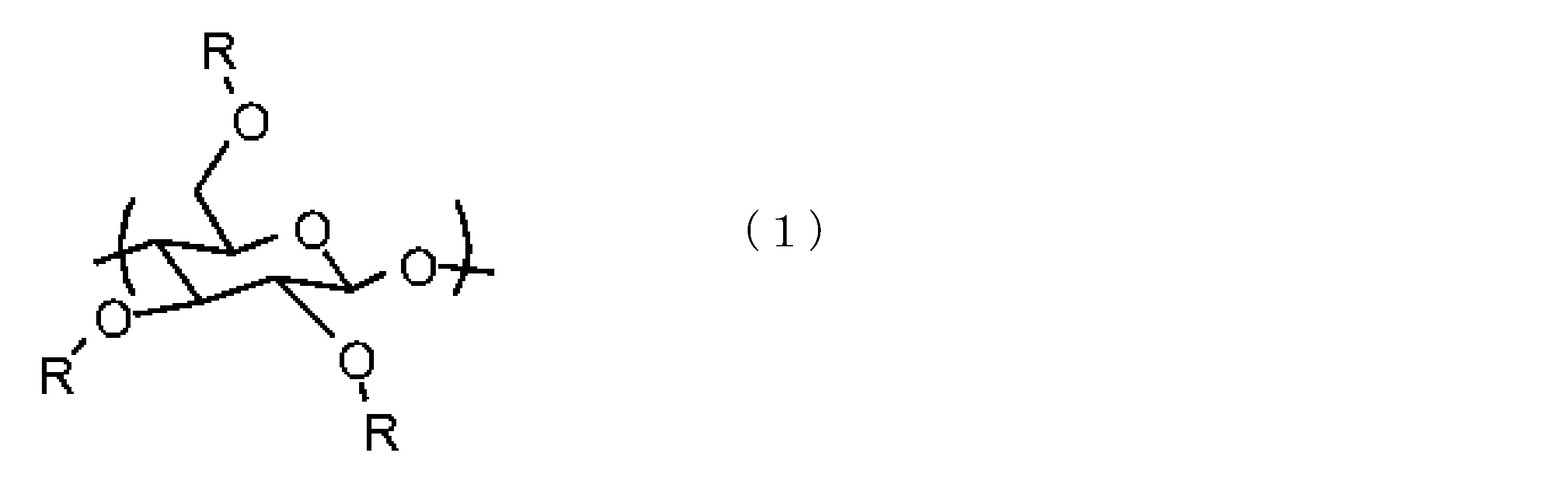
[上記式(1)中、Rは、同一又は異なって、水素原子、水酸基の保護基、下記式(1-a)で表される基、又は下記式(1-b)で表される基である。尚、上記式(1)で表される繰り返し単位を有するセルロース誘導体に含まれる全てのRのうち、少なくとも1つは下記式(1-a)で表される基である。]

(上記式(1-a)中、Xは、同一又は異なって、水素又はメチル基を示す。また、上記式(1-a)中、Arは、単環芳香族炭化水素基又は多環芳香族炭化水素基である。)

(上記式(1-b)中、Xは、同一又は異なって、水素又はメチル基を示す。また、上記式(1-b)中、Arは、単環芳香族炭化水素基又は多環芳香族炭化水素基である。)
[項目2]
上記式(1-a)又は(1-b)中、Arが単環芳香族炭化水素基である、項目1に記載のセルロース誘導体。
[項目3]
上記式(1-a)又は(1-b)中、Arが多環芳香族炭化水素基である、項目1に記載のセルロース誘導体。
[項目4]
上記総平均置換度が1.7以上である、項目1~3の何れか一項に記載のセルロース誘導体。
[項目5]
上記水酸基の保護基がアセチル基又はトリチル基である、項目1~4の何れか一項に記載のセルロース誘導体。
[項目6]
上記式(1)で表される繰り返し単位を有するセルロース誘導体に含まれる全てのRのうち、少なくとも1つは上記式(1-b)で表される基である、項目1~5の何れか一項に記載のセルロース誘導体。
[項目7]
項目1~6の何れか一項に記載のセルロース誘導体を含む組成物。
[項目8]
項目1に記載のセルロース誘導体の製造方法であって、
塩基触媒の存在下、下記式(2)で表される繰り返し単位を有するセルロース誘導体の2、3又は6位の水酸基に、下記式(3)で表されるαブロモカルボキサミドを反応させる工程(i)を含む、セルロース誘導体の製造方法。
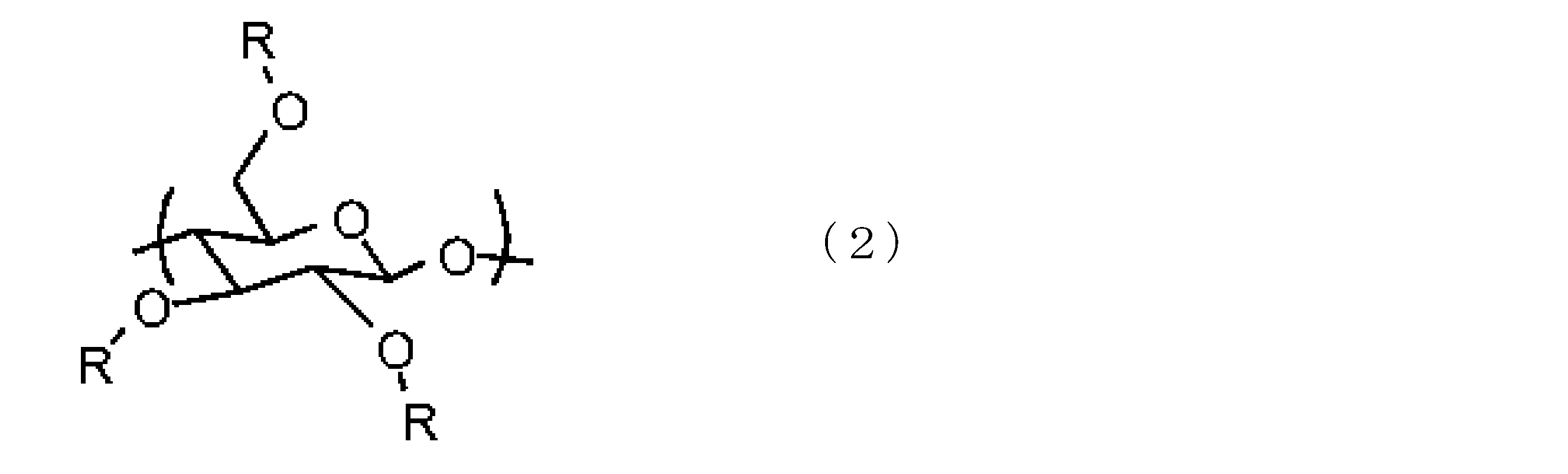
[上記式(2)中、Rは、同一又は異なって、水素原子、水酸基の保護基、上記式(1-a)で表される基、又は上記式(1-b)で表される基である。尚、上記式(2)で表される繰り返し単位を有するセルロース誘導体に含まれる全てのRのうち、少なくとも1つは水素原子である。]

[上記式(3)中、Xは、同一又は異なって、水素又はメチル基を示す。また、上記式(3)中、Arは、単環芳香族炭化水素基又は多環芳香族炭化水素基である。]
[項目9]
上記式(2)で表される繰り返し単位を有するセルロース誘導体に含まれる全てのRのうち、少なくとも1つが水酸基の保護基、上記式(1-a)で表される基、又は上記式(1-b)で表される基であって、上記式(2)で表される繰り返し単位を有するセルロース誘導体は、上記水酸基の保護基、上記式(1-a)で表される基、及び上記式(1-b)で表される基の総平均置換度が1.5以上である、項目8に記載のセルロース誘導体の製造方法。
[項目10]
上記式(3)中、Arが単環芳香族炭化水素基である、項目8又は9に記載のセルロース誘導体の製造方法。
[項目11]
上記式(3)中、Arが多環芳香族炭化水素基である、項目8又は9に記載のセルロース誘導体の製造方法。
[項目12]
上記式(2)で表される繰り返し単位を有するセルロース誘導体に含まれる全てのRのうち、少なくとも1つが水酸基の保護基であって、
上記工程(i)の後、上記水酸基の保護基を脱離して水酸基に置換する工程(ii)を含む、項目8~11の何れか一項に記載のセルロース誘導体の製造方法。
[項目13]
上記水酸基の保護基がアセチル基又はトリチル基である、項目8~12の何れか一項に記載のセルロース誘導体の製造方法。
[項目14]
上記工程(ii)により得られたセルロース誘導体における、上記工程(ii)により置換された水酸基を含む2、3又は6位の水酸基に、塩基触媒の存在下、上記式(3)で表されるαブロモカルボキサミドを反応させる工程(iii)を含む、項目12又は13に記載のセルロース誘導体の製造方法。
[項目15]
上記工程(i)の反応が、銅化合物、当該銅化合物中の銅の配位子及び上記塩基触媒の存在下での反応である、項目8~14の何れか一項に記載のセルロース誘導体の製造方法。
[項目16]
上記工程(iii)の反応が、銅化合物、当該銅化合物中の銅の配位子及び上記塩基触媒の存在下での反応である、項目14に記載のセルロース誘導体の製造方法。
[項目1]
下記式(1)で表される繰り返し単位を有し、水酸基の保護基、下記式(1-a)で表される基、及び下記式(1-b)で表される基の総平均置換度が1.5以上である、セルロース誘導体。
[項目2]
上記式(1-a)又は(1-b)中、Arが単環芳香族炭化水素基である、項目1に記載のセルロース誘導体。
[項目3]
上記式(1-a)又は(1-b)中、Arが多環芳香族炭化水素基である、項目1に記載のセルロース誘導体。
[項目4]
上記総平均置換度が1.7以上である、項目1~3の何れか一項に記載のセルロース誘導体。
[項目5]
上記水酸基の保護基がアセチル基又はトリチル基である、項目1~4の何れか一項に記載のセルロース誘導体。
[項目6]
上記式(1)で表される繰り返し単位を有するセルロース誘導体に含まれる全てのRのうち、少なくとも1つは上記式(1-b)で表される基である、項目1~5の何れか一項に記載のセルロース誘導体。
[項目7]
項目1~6の何れか一項に記載のセルロース誘導体を含む組成物。
[項目8]
項目1に記載のセルロース誘導体の製造方法であって、
塩基触媒の存在下、下記式(2)で表される繰り返し単位を有するセルロース誘導体の2、3又は6位の水酸基に、下記式(3)で表されるαブロモカルボキサミドを反応させる工程(i)を含む、セルロース誘導体の製造方法。
[項目9]
上記式(2)で表される繰り返し単位を有するセルロース誘導体に含まれる全てのRのうち、少なくとも1つが水酸基の保護基、上記式(1-a)で表される基、又は上記式(1-b)で表される基であって、上記式(2)で表される繰り返し単位を有するセルロース誘導体は、上記水酸基の保護基、上記式(1-a)で表される基、及び上記式(1-b)で表される基の総平均置換度が1.5以上である、項目8に記載のセルロース誘導体の製造方法。
[項目10]
上記式(3)中、Arが単環芳香族炭化水素基である、項目8又は9に記載のセルロース誘導体の製造方法。
[項目11]
上記式(3)中、Arが多環芳香族炭化水素基である、項目8又は9に記載のセルロース誘導体の製造方法。
[項目12]
上記式(2)で表される繰り返し単位を有するセルロース誘導体に含まれる全てのRのうち、少なくとも1つが水酸基の保護基であって、
上記工程(i)の後、上記水酸基の保護基を脱離して水酸基に置換する工程(ii)を含む、項目8~11の何れか一項に記載のセルロース誘導体の製造方法。
[項目13]
上記水酸基の保護基がアセチル基又はトリチル基である、項目8~12の何れか一項に記載のセルロース誘導体の製造方法。
[項目14]
上記工程(ii)により得られたセルロース誘導体における、上記工程(ii)により置換された水酸基を含む2、3又は6位の水酸基に、塩基触媒の存在下、上記式(3)で表されるαブロモカルボキサミドを反応させる工程(iii)を含む、項目12又は13に記載のセルロース誘導体の製造方法。
[項目15]
上記工程(i)の反応が、銅化合物、当該銅化合物中の銅の配位子及び上記塩基触媒の存在下での反応である、項目8~14の何れか一項に記載のセルロース誘導体の製造方法。
[項目16]
上記工程(iii)の反応が、銅化合物、当該銅化合物中の銅の配位子及び上記塩基触媒の存在下での反応である、項目14に記載のセルロース誘導体の製造方法。
以下、実施例により本開示をより具体的に説明するが、本発明はこれらの実施例により限定されるものではない。
(実施例1)
二口ナスフラスコに原料セルロース誘導体として酢酸セルロース(下記反応式(R1)の1、商品名「LL-10」(株)ダイセル製、アセチル基の平均置換度約1.7、0.10g、0.41mmol)を入れ、窒素雰囲気下、アセトニトリル(0.86mL)を加えて撹拌し、溶解させた。αブロモカルボキサミドとして、αブロモジメチルアセトアニリド(下記反応式(R1)の2、0.24g、0.80mmol、1.5当量)、炭酸セシウム(0.52g、1.60mmol、3.0当量)を加え室温(以下、「rt」ともいう。25℃)で5時間撹拌した。反応液をメタノール水溶液(1/1、v/v)に注いで再沈殿することにより生じた固体を吸引ろ過により回収した。得られた固体をジエチルエーテルで洗浄し、真空乾燥することで下記反応式(R1)の3で表される繰り返し単位を有するセルロース誘導体(0.146g、収率:92%)を淡橙色固体として得た。尚、ここで、「当量」とは、原料セルロース誘導体全体の2、3又は6位の合計水酸基1モルに対する相対量である(以下、実施例及び比較例について同じ)。
二口ナスフラスコに原料セルロース誘導体として酢酸セルロース(下記反応式(R1)の1、商品名「LL-10」(株)ダイセル製、アセチル基の平均置換度約1.7、0.10g、0.41mmol)を入れ、窒素雰囲気下、アセトニトリル(0.86mL)を加えて撹拌し、溶解させた。αブロモカルボキサミドとして、αブロモジメチルアセトアニリド(下記反応式(R1)の2、0.24g、0.80mmol、1.5当量)、炭酸セシウム(0.52g、1.60mmol、3.0当量)を加え室温(以下、「rt」ともいう。25℃)で5時間撹拌した。反応液をメタノール水溶液(1/1、v/v)に注いで再沈殿することにより生じた固体を吸引ろ過により回収した。得られた固体をジエチルエーテルで洗浄し、真空乾燥することで下記反応式(R1)の3で表される繰り返し単位を有するセルロース誘導体(0.146g、収率:92%)を淡橙色固体として得た。尚、ここで、「当量」とは、原料セルロース誘導体全体の2、3又は6位の合計水酸基1モルに対する相対量である(以下、実施例及び比較例について同じ)。
1H-NMR測定の結果から、得られたセルロース誘導体のアセチル基の平均置換度は約1.7、上記式(1-a)又は(1-b)で表される基の平均置換度は約1.3、総平均置換度は約3.0と算出された。
実施例1により得られたセルロース誘導体の1H-NMRスペクトルの化学シフト値を以下に示す。
1H-NMR(500MHz,CDCl3,r.t.):δ 8.4-8.7(br)、7.6(br), 7.2-7.4(br、overlaped with CHCl3), 6.3-6.9(br), 2.8-5.9(br、CH、CH2:セルロース),1.8-2.2(br、CH3:アセチル)1.2-1.8(br、CH3:(1-a)又は(1-b))
1H-NMR(500MHz,CDCl3,r.t.):δ 8.4-8.7(br)、7.6(br), 7.2-7.4(br、overlaped with CHCl3), 6.3-6.9(br), 2.8-5.9(br、CH、CH2:セルロース),1.8-2.2(br、CH3:アセチル)1.2-1.8(br、CH3:(1-a)又は(1-b))
(実施例2)
二口ナスフラスコに原料セルロース誘導体として酢酸セルロース(下記反応式(R1)の1、商品名「FL-70」(株)ダイセル製、アセチル基の平均置換度約2.1、0.10g、0.40mmol)を入れ、窒素雰囲気下、テトラヒドロフラン(0.86mL)を加えて撹拌し、溶解させた。αブロモカルボキサミドとして、αブロモジメチルアセトアニリド(下記反応式(R1)の2、0.13g、0.54mmol、1.5当量)、炭酸セシウム(0.35g、0.11mmol、3.0当量)を加え室温で24時間撹拌した。反応液をメタノール水溶液(1/1、v/v)に注いで再沈殿することにより生じた固体を吸引ろ過により回収した。得られた固体をジエチルエーテルで洗浄し、真空乾燥することで下記反応式(R1)の3で表される繰り返し単位を有するセルロース誘導体(0.151g、収率:86%)を淡橙色固体として得た。
二口ナスフラスコに原料セルロース誘導体として酢酸セルロース(下記反応式(R1)の1、商品名「FL-70」(株)ダイセル製、アセチル基の平均置換度約2.1、0.10g、0.40mmol)を入れ、窒素雰囲気下、テトラヒドロフラン(0.86mL)を加えて撹拌し、溶解させた。αブロモカルボキサミドとして、αブロモジメチルアセトアニリド(下記反応式(R1)の2、0.13g、0.54mmol、1.5当量)、炭酸セシウム(0.35g、0.11mmol、3.0当量)を加え室温で24時間撹拌した。反応液をメタノール水溶液(1/1、v/v)に注いで再沈殿することにより生じた固体を吸引ろ過により回収した。得られた固体をジエチルエーテルで洗浄し、真空乾燥することで下記反応式(R1)の3で表される繰り返し単位を有するセルロース誘導体(0.151g、収率:86%)を淡橙色固体として得た。
1H-NMR測定の結果から、得られたセルロース誘導体のアセチル基の平均置換度は約2.1、上記式(1-a)又は(1-b)で表される基の平均置換度は約0.9、総平均置換度は約3.0と算出された。

実施例2により得られたセルロース誘導体の1H-NMRスペクトルデータを図1に、化学シフト値を以下に示す。
1H-NMR(500MHz,CDCl3,r.t.):δ 8.4-8.7(br)、7.6(br), 7.2-7.4(br、overlaped with CHCl3), 6.3-6.9(br), 2.8-5.9(br、CH、CH2:セルロース),1.8-2.2(br、CH3:アセチル)1.2-1.8(br、CH3:(1-a)又は(1-b))
1H-NMR(500MHz,CDCl3,r.t.):δ 8.4-8.7(br)、7.6(br), 7.2-7.4(br、overlaped with CHCl3), 6.3-6.9(br), 2.8-5.9(br、CH、CH2:セルロース),1.8-2.2(br、CH3:アセチル)1.2-1.8(br、CH3:(1-a)又は(1-b))
(実施例3)
二口ナスフラスコに原料セルロース誘導体としてトリチルセルロース(下記反応式(R2)の4、トリチル基の平均置換度約1.0、0.16g、0.40mmol)を入れ、窒素雰囲気下、テトラヒドロフラン(0.86mL)を加えて撹拌し、溶解させた。αブロモカルボキサミドとして、αブロモジメチルアセトアニリド(下記反応式(R2)の2、0.29g、1.20mmol、1.5当量)、炭酸セシウム(0.78g、2.40mmol、3.0当量)を加え室温で24時間撹拌した。反応液をメタノール水溶液(1/1、v/v)に注いで再沈殿することにより生じた固体を吸引ろ過により回収した。得られた固体をジエチルエーテルで洗浄し、真空乾燥することで下記反応式(R2)の5で表される繰り返し単位を有するセルロース誘導体(0.250g、収率:86%)を淡橙色固体として得た。
二口ナスフラスコに原料セルロース誘導体としてトリチルセルロース(下記反応式(R2)の4、トリチル基の平均置換度約1.0、0.16g、0.40mmol)を入れ、窒素雰囲気下、テトラヒドロフラン(0.86mL)を加えて撹拌し、溶解させた。αブロモカルボキサミドとして、αブロモジメチルアセトアニリド(下記反応式(R2)の2、0.29g、1.20mmol、1.5当量)、炭酸セシウム(0.78g、2.40mmol、3.0当量)を加え室温で24時間撹拌した。反応液をメタノール水溶液(1/1、v/v)に注いで再沈殿することにより生じた固体を吸引ろ過により回収した。得られた固体をジエチルエーテルで洗浄し、真空乾燥することで下記反応式(R2)の5で表される繰り返し単位を有するセルロース誘導体(0.250g、収率:86%)を淡橙色固体として得た。
1H-NMR測定の結果から、得られたセルロース誘導体のトリチル基の平均置換度は約1.0、上記式(1-a)又は(1-b)で表される基の平均置換度は約2.0、総平均置換度は約3.0と算出された。
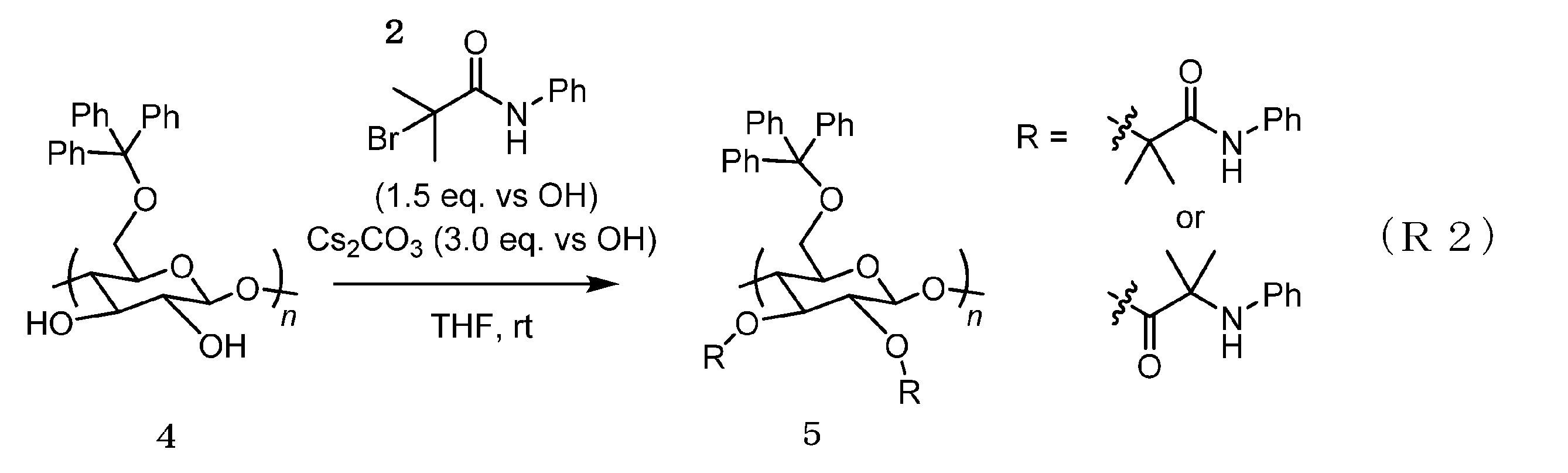
実施例3により得られたセルロース誘導体の1H-NMRスペクトルの化学シフト値を以下に示す。
1H-NMR(500MHz,CDCl3,r.t.):δ 8.9-9.8(br、NH)、 6.8-8.0(br、overlaped with CHCl3), 6.3-6.8(br), 2.8-6.0(br、CH、CH2:セルロース),0.7-1.8(br、CH3:(1-a)又は(1-b))
1H-NMR(500MHz,CDCl3,r.t.):δ 8.9-9.8(br、NH)、 6.8-8.0(br、overlaped with CHCl3), 6.3-6.8(br), 2.8-6.0(br、CH、CH2:セルロース),0.7-1.8(br、CH3:(1-a)又は(1-b))
(実施例4)
αブロモカルボキサミドとして、αブロモジメチルアセトアニリドの代わりに、αブロモジメチルアセト(3,4,5-トリメトキシ)アニリド(下記反応式(R3)の6、0.40g、1.20mmol、1.5当量)を用いた以外は実施例3と同様に実施することで(R3)の7で表される繰り返し単位を有するセルロース誘導体(0.214g、収率:59%)を淡橙色固体として得た。
αブロモカルボキサミドとして、αブロモジメチルアセトアニリドの代わりに、αブロモジメチルアセト(3,4,5-トリメトキシ)アニリド(下記反応式(R3)の6、0.40g、1.20mmol、1.5当量)を用いた以外は実施例3と同様に実施することで(R3)の7で表される繰り返し単位を有するセルロース誘導体(0.214g、収率:59%)を淡橙色固体として得た。
1H-NMR測定の結果から、得られたセルロース誘導体のトリチル基の平均置換度は約1.0、上記式(1-a)又は(1-b)で表される基の平均置換度は約2.0、総平均置換度は約3.0と算出された。
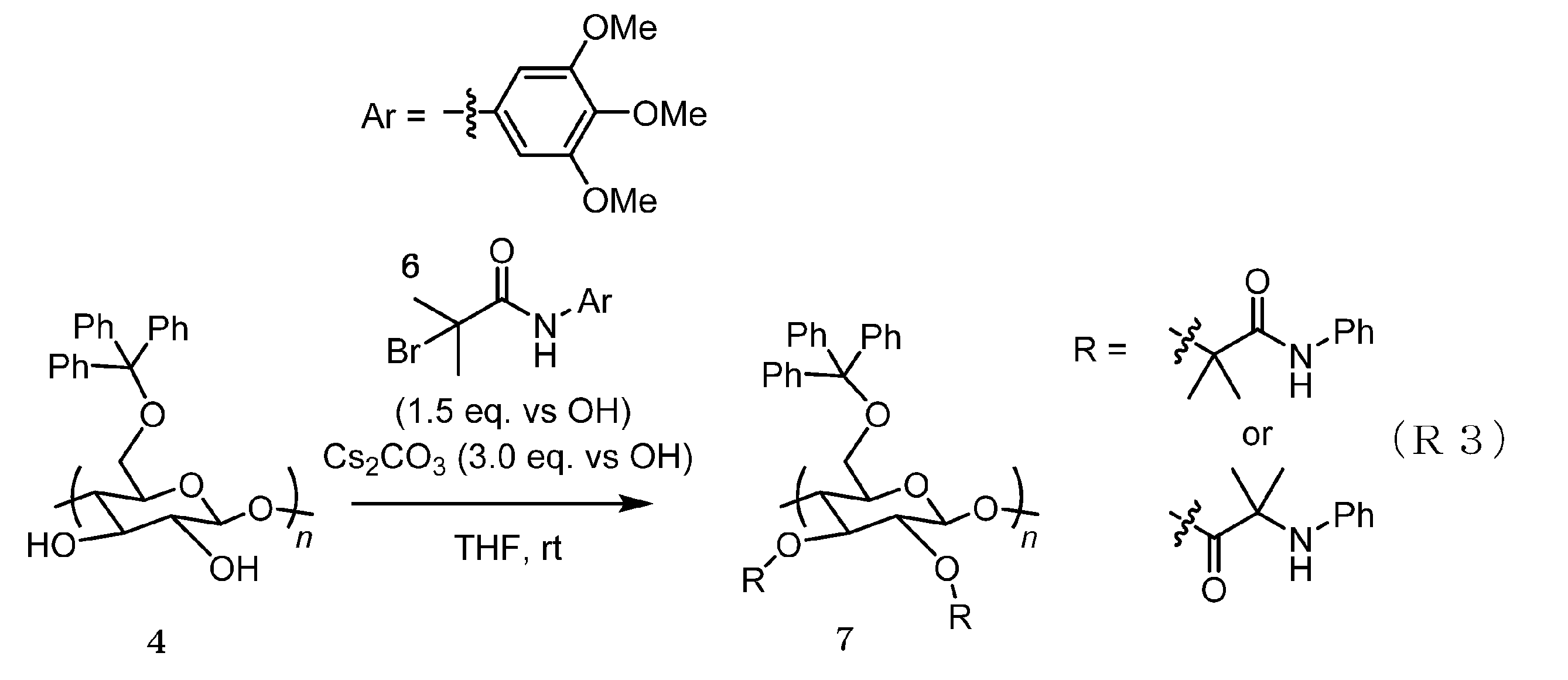
実施例4により得られたセルロース誘導体の化学シフト値を以下に示す。
1H-NMR(500MHz,CDCl3,r.t.):δ 9.1-9.4(br、NH)、 8.4(s)、6.6-7.8(br、overlaped with CHCl3),6.8(s)、 6.2-6.6(br), 2.3-5.0(br、CH、CH2:セルロース),3.85(s)、3.80(s)、1.3-1.7(br、CH3:(1-a)又は(1-b))
1H-NMR(500MHz,CDCl3,r.t.):δ 9.1-9.4(br、NH)、 8.4(s)、6.6-7.8(br、overlaped with CHCl3),6.8(s)、 6.2-6.6(br), 2.3-5.0(br、CH、CH2:セルロース),3.85(s)、3.80(s)、1.3-1.7(br、CH3:(1-a)又は(1-b))
(実施例5)
αブロモカルボキサミドとして、αブロモジメチルアセトアニリドの代わりに、αブロモジメチルアセト(4-トリフルオロメチル)アニリド(下記反応式(R4)の8、0.37g、1.20mmol、1.5当量)を用いた以外は実施例3と同様に実施することで(R2)の9で表される繰り返し単位を有するセルロース誘導体(0.288g、収率:72%)を淡橙色固体として得た。
αブロモカルボキサミドとして、αブロモジメチルアセトアニリドの代わりに、αブロモジメチルアセト(4-トリフルオロメチル)アニリド(下記反応式(R4)の8、0.37g、1.20mmol、1.5当量)を用いた以外は実施例3と同様に実施することで(R2)の9で表される繰り返し単位を有するセルロース誘導体(0.288g、収率:72%)を淡橙色固体として得た。
1H-NMR測定の結果から、得られたセルロース誘導体のトリチル基の平均置換度は約1.0、上記式(1-a)又は(1-b)で表される基の平均置換度は約2.0、総平均置換度は約3.0と算出された。
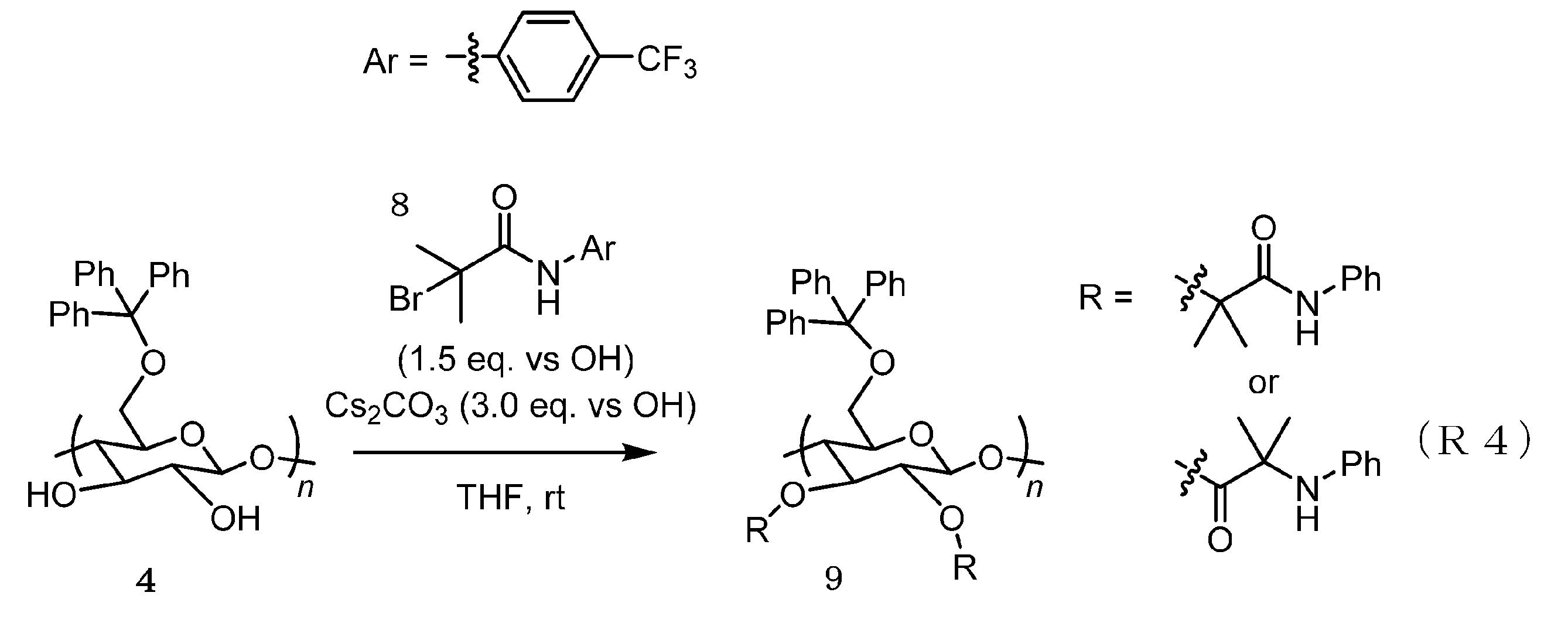
実施例5により得られたセルロース誘導体の化学シフト値を以下に示す。
1H-NMR(500MHz,CDCl3,r.t.):δ 9.3-9.8(br、NH)、 6.8-8.2(br、overlaped with CHCl3)、 6.2-6.6(br), 2.5-5.7(br、CH、CH2:セルロース),0.7-2.3(br、CH3:(1-a)又は(1-b))
1H-NMR(500MHz,CDCl3,r.t.):δ 9.3-9.8(br、NH)、 6.8-8.2(br、overlaped with CHCl3)、 6.2-6.6(br), 2.5-5.7(br、CH、CH2:セルロース),0.7-2.3(br、CH3:(1-a)又は(1-b))
(実施例6)
αブロモカルボキサミドとして、αブロモジメチルアセトアニリドの代わりに、1-(αブロモジメチルアセトキシ)アミノピレン(下記反応式(R5)の10、0.44g、1.20mmol、1.5当量)を用いた以外は実施例3と同様に実施することで(R5)の11で表される繰り返し単位を有するセルロース誘導体(0.260g、収率:67%)を淡橙色固体として得た。
αブロモカルボキサミドとして、αブロモジメチルアセトアニリドの代わりに、1-(αブロモジメチルアセトキシ)アミノピレン(下記反応式(R5)の10、0.44g、1.20mmol、1.5当量)を用いた以外は実施例3と同様に実施することで(R5)の11で表される繰り返し単位を有するセルロース誘導体(0.260g、収率:67%)を淡橙色固体として得た。
1H-NMR測定の結果から、得られたセルロース誘導体のトリチル基の平均置換度は約1.0、上記式(1-a)又は(1-b)で表される基の平均置換度は約2.0、総平均置換度は約3.0と算出された。

実施例6により得られたセルロース誘導体の化学シフト値を以下に示す。
1H-NMR(500MHz,CDCl3,r.t.):δ 9.5-10.2(br、NH)、 7.6-8.4(br)、6.6-7.6(br、overlaped with CHCl3), 2.5-5.0(br、CH、CH2:セルロース),0.8-2.0(br、CH3:(1-a)又は(1-b)、overlaped with H2O)
1H-NMR(500MHz,CDCl3,r.t.):δ 9.5-10.2(br、NH)、 7.6-8.4(br)、6.6-7.6(br、overlaped with CHCl3), 2.5-5.0(br、CH、CH2:セルロース),0.8-2.0(br、CH3:(1-a)又は(1-b)、overlaped with H2O)
(実施例7)
αブロモカルボキサミドとして、αブロモジメチルアセトアニリドの代わりに、αブロモアセトアニリド(下記反応式(R6)の12、0.26g、1.20mmol、1.5当量)を用いた以外は実施例3と同様に実施することで(R6)の13で表される繰り返し単位を有するセルロース誘導体(0.187g、収率:70%)を淡橙色固体として得た。
αブロモカルボキサミドとして、αブロモジメチルアセトアニリドの代わりに、αブロモアセトアニリド(下記反応式(R6)の12、0.26g、1.20mmol、1.5当量)を用いた以外は実施例3と同様に実施することで(R6)の13で表される繰り返し単位を有するセルロース誘導体(0.187g、収率:70%)を淡橙色固体として得た。
1H-NMR測定の結果から、得られたセルロース誘導体のトリチル基の平均置換度は約1.0、上記式(1-a)又は(1-b)で表される基の平均置換度は約2.0、総平均置換度は約3.0と算出された。
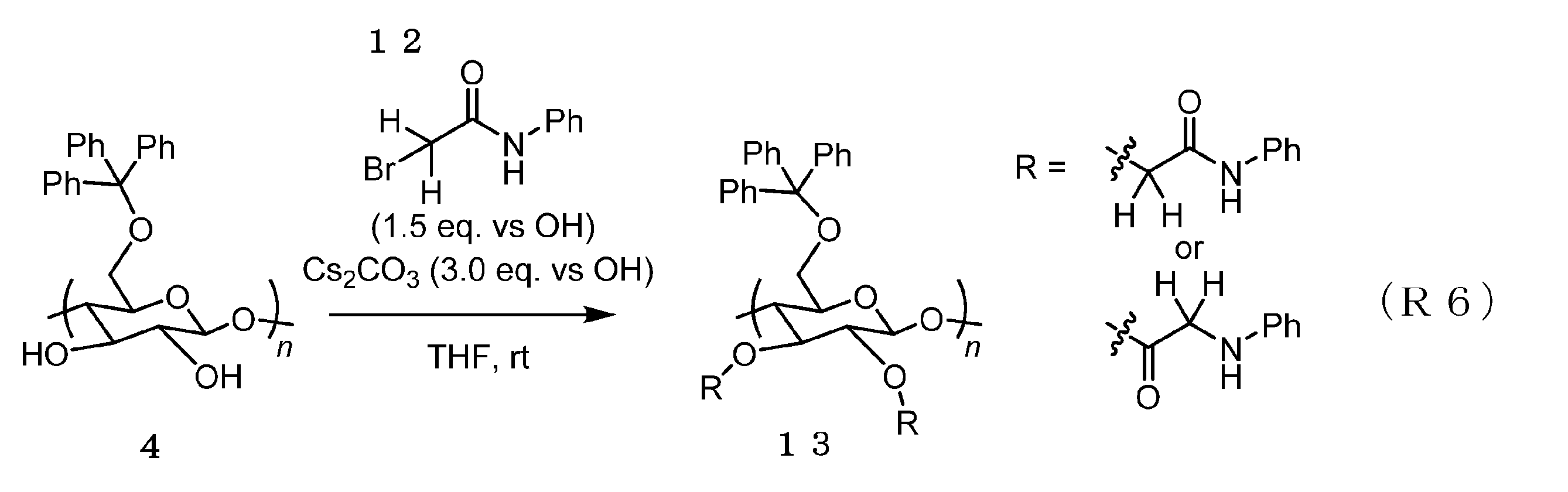
実施例7により得られたセルロース誘導体の化学シフト値を以下に示す。
1H-NMR(500MHz,CDCl3,r.t.):δ 6.8-7.7(br、overlaped with CHCl3), 2.3-4.8(br、CH、CH2:セルロース),4.6(s、CH2:(1-a)又は(1-b))
1H-NMR(500MHz,CDCl3,r.t.):δ 6.8-7.7(br、overlaped with CHCl3), 2.3-4.8(br、CH、CH2:セルロース),4.6(s、CH2:(1-a)又は(1-b))
(実施例8)
二口ナスフラスコに原料セルロース誘導体として実施例3により得られたセルロース誘導体(下記反応式(R7)の5、0.15g、0.20mmolモル)を入れ、窒素雰囲気下、クロロホルム(1mL)を加えて撹拌し、溶解させた。30wt%臭化水素の酢酸溶液(0.4mL、2mmol)を加え室温(25℃)で5分間撹拌した。反応液をメタノール水溶液(1/1、v/v)に注いで再沈殿することにより得られた固体を吸引ろ過により回収し、エタノールで洗浄した。得られた固体を真空乾燥し、下記反応式(R7)の14で表される繰り返し単位を有するセルロース誘導体(0.080g、収率:82%)を淡橙色固体として得た。
二口ナスフラスコに原料セルロース誘導体として実施例3により得られたセルロース誘導体(下記反応式(R7)の5、0.15g、0.20mmolモル)を入れ、窒素雰囲気下、クロロホルム(1mL)を加えて撹拌し、溶解させた。30wt%臭化水素の酢酸溶液(0.4mL、2mmol)を加え室温(25℃)で5分間撹拌した。反応液をメタノール水溶液(1/1、v/v)に注いで再沈殿することにより得られた固体を吸引ろ過により回収し、エタノールで洗浄した。得られた固体を真空乾燥し、下記反応式(R7)の14で表される繰り返し単位を有するセルロース誘導体(0.080g、収率:82%)を淡橙色固体として得た。
1H-NMR測定の結果から、得られたセルロース誘導体の上記式(1-a)又は(1-b)で表される基の平均置換度は約2.0、総平均置換度は約2.0と算出された。
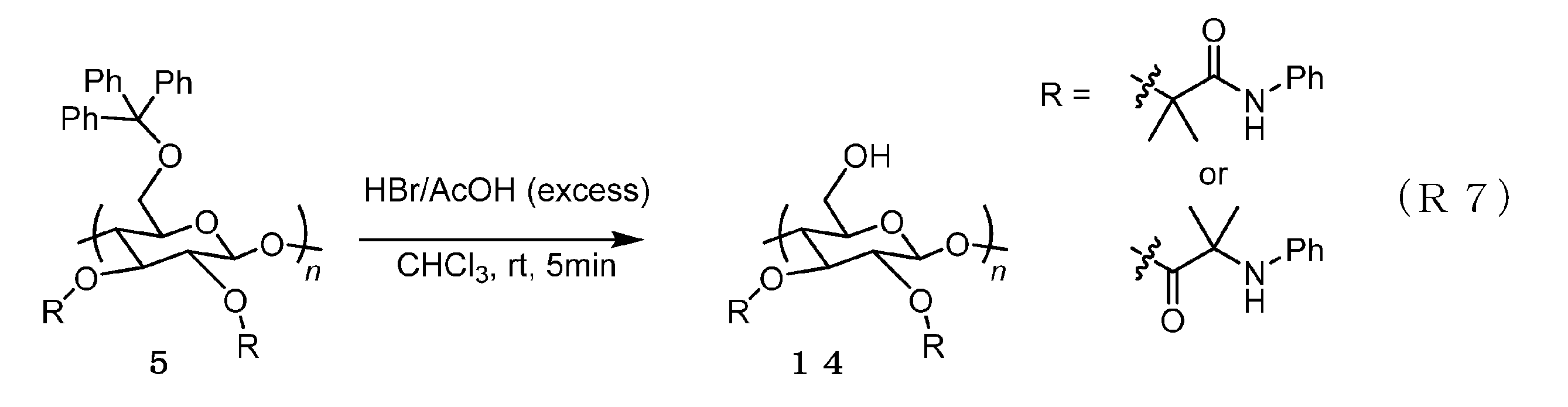
実施例8により得られたセルロース誘導体の1H-NMR測定データを図2に、化学シフト値を以下に示す。
1H-NMR(500MHz,DMSO―d6,r.t.):δ 9.5-10.0(br、NH)、 7.6(br)、7.25(br)、7.0(br) 6.4-6.8(br), 2.5-5.5(br、CH、CH2:セルロース、overlaped with H2O),0.8-1.7(br、CH3:(1-a)又は(1-b))
1H-NMR(500MHz,DMSO―d6,r.t.):δ 9.5-10.0(br、NH)、 7.6(br)、7.25(br)、7.0(br) 6.4-6.8(br), 2.5-5.5(br、CH、CH2:セルロース、overlaped with H2O),0.8-1.7(br、CH3:(1-a)又は(1-b))
(実施例9)
二口ナスフラスコに原料セルロース誘導体として実施例8により得られたセルロース誘導体(下記反応式(R8)の14、0.096g、0.20mmol)を入れ、窒素雰囲気下、テトラヒドロフラン(0.86mL)を加えて撹拌し、溶解させた。αブロモカルボキサミドとして、αブロモジメチルアセトアニリド(下記反応式(R8)の2、0.073g、0.30mmol、1.5当量)、炭酸セシウム(0.20g、0.60mmol、3.0当量)を加え室温(25℃)で18時間撹拌した。反応液をメタノール水溶液(1/1、v/v)に注いで再沈殿することにより得られた固体を吸引ろ過により回収し、ジエチルエーテルで洗浄した。得られた固体を真空乾燥し、下記反応式(R8)の15で表される繰り返し単位を有するセルロース誘導体(0.044g、収率:34%)を淡橙色固体として得た。
二口ナスフラスコに原料セルロース誘導体として実施例8により得られたセルロース誘導体(下記反応式(R8)の14、0.096g、0.20mmol)を入れ、窒素雰囲気下、テトラヒドロフラン(0.86mL)を加えて撹拌し、溶解させた。αブロモカルボキサミドとして、αブロモジメチルアセトアニリド(下記反応式(R8)の2、0.073g、0.30mmol、1.5当量)、炭酸セシウム(0.20g、0.60mmol、3.0当量)を加え室温(25℃)で18時間撹拌した。反応液をメタノール水溶液(1/1、v/v)に注いで再沈殿することにより得られた固体を吸引ろ過により回収し、ジエチルエーテルで洗浄した。得られた固体を真空乾燥し、下記反応式(R8)の15で表される繰り返し単位を有するセルロース誘導体(0.044g、収率:34%)を淡橙色固体として得た。
1H-NMR測定の結果から、得られたセルロース誘導体の上記式(1-a)又は(1-b)で表される基の平均置換度は約3.0、総平均置換度は約3.0と算出された。

実施9により得られたセルロース誘導体の1H-NMRスペクトルの測定データを図3に、化学シフト値を以下に示す。
1H-NMR(500MHz,DMSO―d6,r.t.):δ 9.6-10.4(br、NH)、 7.6(br)、7.25(br)、7.0(br) 6.3-6.6(br), 3.0-6.1(br、CH、CH2:セルロース、overlaped with H2O),0.9-1.8(br、CH3:(1-a)又は(1-b))
1H-NMR(500MHz,DMSO―d6,r.t.):δ 9.6-10.4(br、NH)、 7.6(br)、7.25(br)、7.0(br) 6.3-6.6(br), 3.0-6.1(br、CH、CH2:セルロース、overlaped with H2O),0.9-1.8(br、CH3:(1-a)又は(1-b))
(比較例1)
二口ナスフラスコに原料セルロース誘導体としてトリチルセルロース(下記反応式(R9)の4、トリチル基の平均置換度約1.0、0.315g、0.78mmol)を入れ、窒素雰囲気下、ピリジン(3.1mL)を加えて撹拌し、溶解させた。3-フェニルプロピオン酸塩化物(下記反応式(R9)に記載、0.58mL、3.90mmol、5当量)を加え80℃で24時間撹拌した。反応液をメタノールに注いで再沈殿することにより生じた固体を吸引ろ過により回収した。得られた固体をメタノールで洗浄し、真空乾燥することで下記反応式(R9)の16で表される繰り返し単位を有する3-フェニルプロパノイルセルロース誘導体(0.493g、収率:94%)を淡橙色固体として得た。
二口ナスフラスコに原料セルロース誘導体としてトリチルセルロース(下記反応式(R9)の4、トリチル基の平均置換度約1.0、0.315g、0.78mmol)を入れ、窒素雰囲気下、ピリジン(3.1mL)を加えて撹拌し、溶解させた。3-フェニルプロピオン酸塩化物(下記反応式(R9)に記載、0.58mL、3.90mmol、5当量)を加え80℃で24時間撹拌した。反応液をメタノールに注いで再沈殿することにより生じた固体を吸引ろ過により回収した。得られた固体をメタノールで洗浄し、真空乾燥することで下記反応式(R9)の16で表される繰り返し単位を有する3-フェニルプロパノイルセルロース誘導体(0.493g、収率:94%)を淡橙色固体として得た。
1H-NMR測定の結果から、得られたセルロース誘導体のトリチル基の平均置換度は約1.0、3-フェニルプロパノイル基の平均置換度は約2.0、総平均置換度は約3.0と算出された。
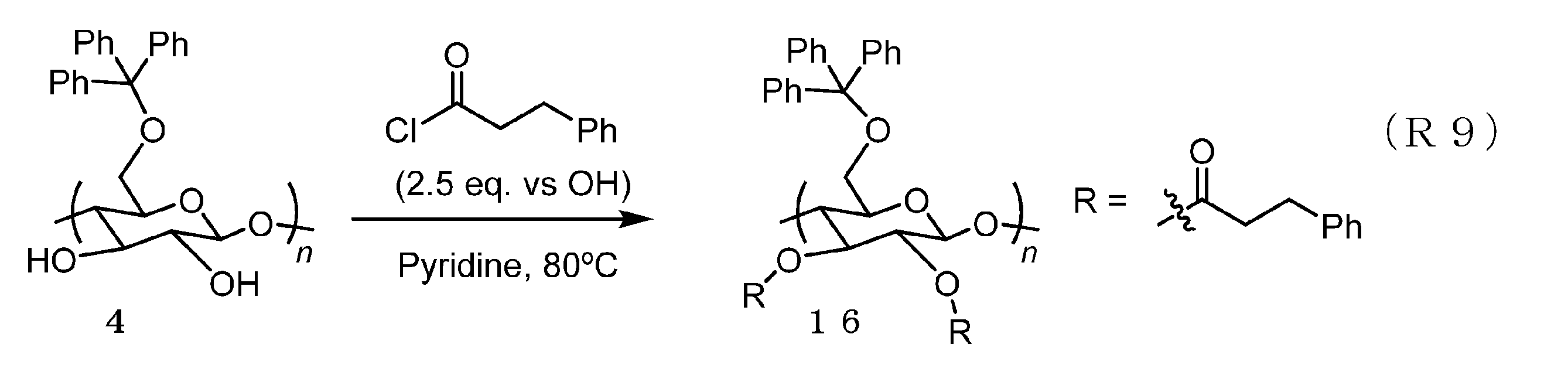
比較例1により得られたセルロース誘導体の1H-NMRスペクトルの化学シフト値を以下に示す。
1H-NMR(500MHz,CDCl3,r.t.):δ 6.2-7.8(br、overlaped with CHCl3)、 1.7-5.4(br、CH、CH2:セルロース、CH2:3-フェニルプロパノイル)
1H-NMR(500MHz,CDCl3,r.t.):δ 6.2-7.8(br、overlaped with CHCl3)、 1.7-5.4(br、CH、CH2:セルロース、CH2:3-フェニルプロパノイル)
実施例1~9及び比較例1の結果は表1に示すとおりである。
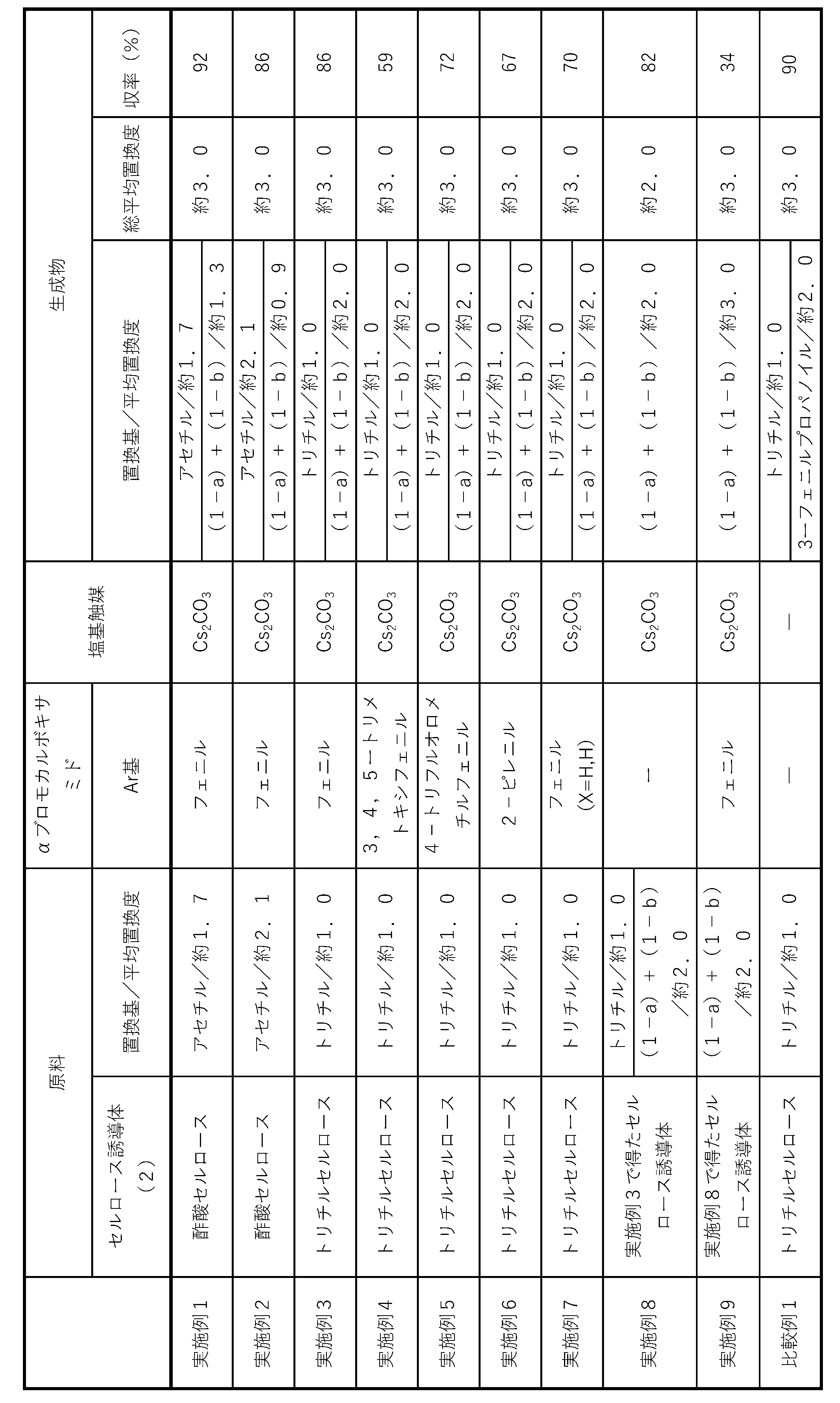
表1より、高置換度の芳香族アミド変性セルロースを収率よく得ることができたことがわかる。
(評価)
実施例3、及び下記の実施例24で得られたセルロース誘導体、並びに比較例1で得られた3-フェニルプロパノイルセルロース誘導体について、加水分解反応に付して、置換基の平均置換度の時間変化から耐アルカリ性を下記の方法により評価した。
実施例3、及び下記の実施例24で得られたセルロース誘導体、並びに比較例1で得られた3-フェニルプロパノイルセルロース誘導体について、加水分解反応に付して、置換基の平均置換度の時間変化から耐アルカリ性を下記の方法により評価した。
二口ナスフラスコに原料セルロース誘導体として、実施例3により得られたセルロース誘導体(0.071g、0.1mmol)、下記の実施例24により得られたセルロース誘導体(0.070g、0.1mmol)又は比較例1で得られた3-フェニルプロパノイルセルロース誘導体(0.067g、0.1mmol)を入れ、窒素雰囲気下、テトラヒドロフラン(1mL)を加えて撹拌し、溶解させた。10wt%水酸化ナトリウム水溶液を(0.1mL)加え室温で撹拌した。24時間後、飽和塩化アンモニウム溶液を加えて反応を停止させた。ジクロロメタンで水層から目的物を抽出し、硫酸ナトリウムで乾燥させ、エバポレーターで溶媒を留去した。残差を真空乾燥し、1H-NMR測定により置換度を評価した。結果を表2に示す。
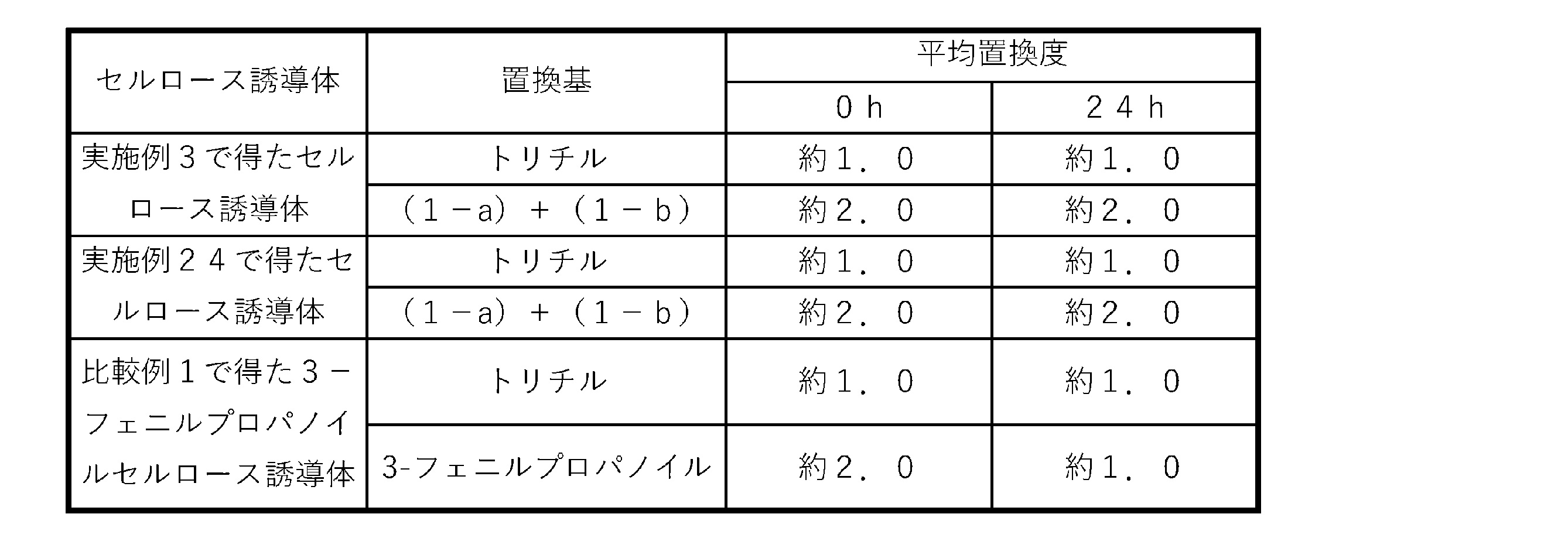
表2に示した通り、実施例3及び24で得られたセルロース誘導体はアルカリ加水分解条件に付しても平均置換度の低下が見られず、アミド変性セルロースとすることで耐アルカリ性が向上することが分かる。
(実施例10)
二口ナスフラスコに原料セルロース誘導体として酢酸セルロース(下記反応式(R10)の1、商品名「LL-10」(株)ダイセル製、アセチル基の平均置換度約1.7、0.100g、0.41mmol)を入れ、窒素雰囲気下、アセトニトリル(1.6mL)を加えて撹拌し、溶解させた。αブロモカルボキサミドとして、αブロモジメチルアセトアニリド(下記反応式(R10)の2、0.15g、0.61mmol、1.5当量)、リン酸三カリウム(0.26g、1.2mmol、3.0当量)、ヨウ化銅(I)(1.6mg、8.6μmol、0.02当量)、トリフェニルホスフィン(3.3mg、13μmol、0.03当量)を加え室温で24時間撹拌した。反応液をメタノール水溶液(1/1、v/v)に注いで再沈殿することにより生じた固体を吸引ろ過により回収した。得られた固体をジエチルエーテルで洗浄し、真空乾燥することで下記反応式(R10)の17で表される繰り返し単位を有するセルロース誘導体(0.111g、収率:70%)を淡橙色固体として得た。
二口ナスフラスコに原料セルロース誘導体として酢酸セルロース(下記反応式(R10)の1、商品名「LL-10」(株)ダイセル製、アセチル基の平均置換度約1.7、0.100g、0.41mmol)を入れ、窒素雰囲気下、アセトニトリル(1.6mL)を加えて撹拌し、溶解させた。αブロモカルボキサミドとして、αブロモジメチルアセトアニリド(下記反応式(R10)の2、0.15g、0.61mmol、1.5当量)、リン酸三カリウム(0.26g、1.2mmol、3.0当量)、ヨウ化銅(I)(1.6mg、8.6μmol、0.02当量)、トリフェニルホスフィン(3.3mg、13μmol、0.03当量)を加え室温で24時間撹拌した。反応液をメタノール水溶液(1/1、v/v)に注いで再沈殿することにより生じた固体を吸引ろ過により回収した。得られた固体をジエチルエーテルで洗浄し、真空乾燥することで下記反応式(R10)の17で表される繰り返し単位を有するセルロース誘導体(0.111g、収率:70%)を淡橙色固体として得た。
1H-NMR測定の結果から、得られたセルロース誘導体のアセチル基の平均置換度は約1.7、上記式(1-a)又は(1-b)で表される基の平均置換度は約1.3、総平均置換度は約3.0と算出された。
実施例10により得られたセルロース誘導体の1H-NMRスペクトルの化学シフト値を以下に示す。
1H-NMR(500MHz,CDCl3,r.t.):δ 8.4-8.7(br)、7.6(br), 7.2-7.4(br、overlaped with CHCl3), 6.3-6.9(br), 2.8-5.9(br、CH、CH2:セルロース),1.8-2.2(br、CH3:アセチル)1.2-1.8(br、CH3:(1-a)又は(1-b))
1H-NMR(500MHz,CDCl3,r.t.):δ 8.4-8.7(br)、7.6(br), 7.2-7.4(br、overlaped with CHCl3), 6.3-6.9(br), 2.8-5.9(br、CH、CH2:セルロース),1.8-2.2(br、CH3:アセチル)1.2-1.8(br、CH3:(1-a)又は(1-b))
(実施例11)
二口ナスフラスコに原料セルロース誘導体として酢酸セルロース(下記反応式(R10)の1、商品名「FL-70」(株)ダイセル製、アセチル基の平均置換度約2.1、0.10g、0.40mmol)を入れ、窒素雰囲気下、テトラヒドロフラン(1.6mL)を加えて撹拌し、溶解させた。αブロモカルボキサミドとして、αブロモジメチルアセトアニリド(下記反応式(R10)の2、0.15g、0.60mmol、1.5当量)、リン酸三カリウム(0.25g、1.2mmol、3.0当量)、ヨウ化銅(I)(1.6mg、8.4μmol、0.02当量)、トリフェニルホスフィン(3.2mg、12μmol、0.03当量)を加え室温で24時間撹拌した。反応液をメタノール水溶液(1/1、v/v)に注いで再沈殿することにより生じた固体を吸引ろ過により回収した。得られた固体をジエチルエーテルで洗浄し、真空乾燥することで下記反応式(R10)の17で表される繰り返し単位を有するセルロース誘導体(0.148g、収率:84%)を淡橙色固体として得た。
二口ナスフラスコに原料セルロース誘導体として酢酸セルロース(下記反応式(R10)の1、商品名「FL-70」(株)ダイセル製、アセチル基の平均置換度約2.1、0.10g、0.40mmol)を入れ、窒素雰囲気下、テトラヒドロフラン(1.6mL)を加えて撹拌し、溶解させた。αブロモカルボキサミドとして、αブロモジメチルアセトアニリド(下記反応式(R10)の2、0.15g、0.60mmol、1.5当量)、リン酸三カリウム(0.25g、1.2mmol、3.0当量)、ヨウ化銅(I)(1.6mg、8.4μmol、0.02当量)、トリフェニルホスフィン(3.2mg、12μmol、0.03当量)を加え室温で24時間撹拌した。反応液をメタノール水溶液(1/1、v/v)に注いで再沈殿することにより生じた固体を吸引ろ過により回収した。得られた固体をジエチルエーテルで洗浄し、真空乾燥することで下記反応式(R10)の17で表される繰り返し単位を有するセルロース誘導体(0.148g、収率:84%)を淡橙色固体として得た。
1H-NMR測定の結果から、得られたセルロース誘導体のアセチル基の平均置換度は約2.1、上記式(1-a)又は(1-b)で表される基の平均置換度は約0.9、総平均置換度は約3.0と算出された。

実施例11により得られたセルロース誘導体の1H-NMRスペクトルデータを図4に、化学シフト値を以下に示す。
1H-NMR(500MHz,CDCl3,r.t.):δ 8.4-8.7(br)、7.6(br), 7.2-7.4(br、overlaped with CHCl3), 6.3-6.9(br), 2.8-5.9(br、CH、CH2:セルロース),1.8-2.2(br、CH3:アセチル)1.2-1.8(br、CH3:(1-a)又は(1-b))
1H-NMR(500MHz,CDCl3,r.t.):δ 8.4-8.7(br)、7.6(br), 7.2-7.4(br、overlaped with CHCl3), 6.3-6.9(br), 2.8-5.9(br、CH、CH2:セルロース),1.8-2.2(br、CH3:アセチル)1.2-1.8(br、CH3:(1-a)又は(1-b))
(実施例12)
二口ナスフラスコに原料セルロース誘導体としてトリチルセルロース(下記反応式(R11)の4、トリチル基の平均置換度約1.0、0.100g、0.25mmol)を入れ、窒素雰囲気下、テトラヒドロフラン(1.0mL)を加えて撹拌し、溶解させた。αブロモカルボキサミドとして、αブロモジメチルアセトアニリド(下記反応式(R11)の4、0.18g、0.75mmol、1.5当量)、リン酸三カリウム(0.32g、1.5mmol、3.0当量)、ヨウ化銅(I)(1.0mg、5.2μmol、0.01当量)、トリフェニルホスフィン(2.0mg、7.6μmol、0.015当量)を加え室温で24時間撹拌した。反応液をメタノール水溶液(1/1、v/v)に注いで再沈殿することにより生じた固体を吸引ろ過により回収した。得られた固体をジエチルエーテルで洗浄し、真空乾燥することで下記反応式(R11)の18で表される繰り返し単位を有するセルロース誘導体(0.131g、収率:73%)を淡橙色固体として得た。
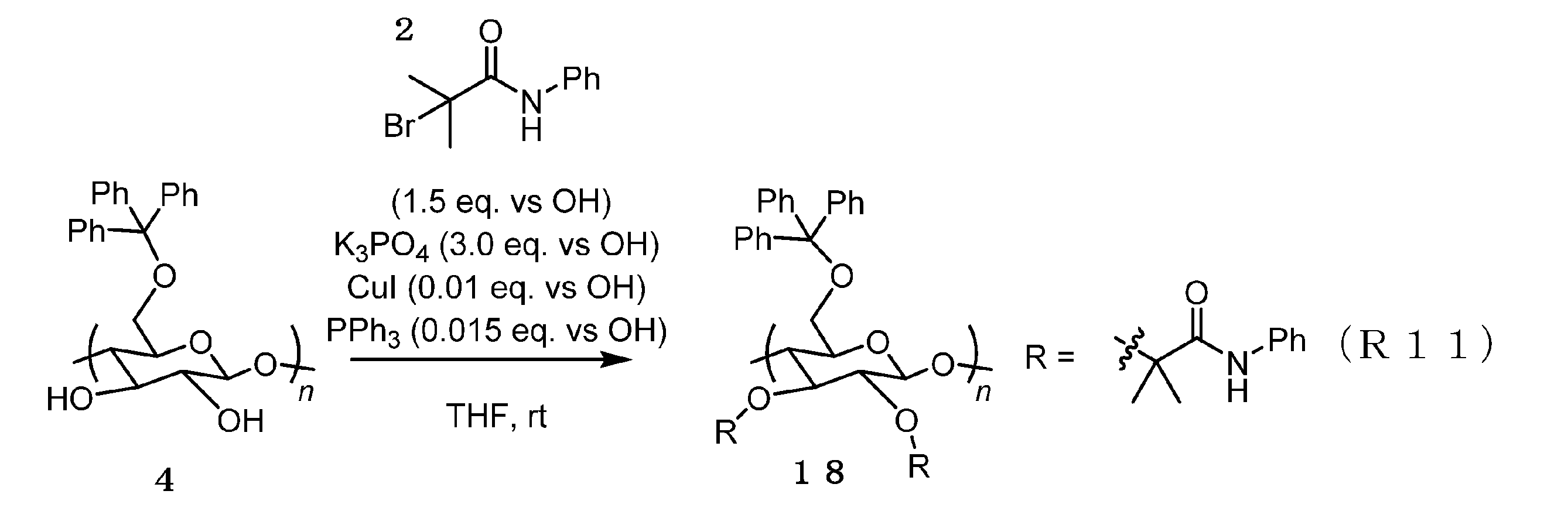
二口ナスフラスコに原料セルロース誘導体としてトリチルセルロース(下記反応式(R11)の4、トリチル基の平均置換度約1.0、0.100g、0.25mmol)を入れ、窒素雰囲気下、テトラヒドロフラン(1.0mL)を加えて撹拌し、溶解させた。αブロモカルボキサミドとして、αブロモジメチルアセトアニリド(下記反応式(R11)の4、0.18g、0.75mmol、1.5当量)、リン酸三カリウム(0.32g、1.5mmol、3.0当量)、ヨウ化銅(I)(1.0mg、5.2μmol、0.01当量)、トリフェニルホスフィン(2.0mg、7.6μmol、0.015当量)を加え室温で24時間撹拌した。反応液をメタノール水溶液(1/1、v/v)に注いで再沈殿することにより生じた固体を吸引ろ過により回収した。得られた固体をジエチルエーテルで洗浄し、真空乾燥することで下記反応式(R11)の18で表される繰り返し単位を有するセルロース誘導体(0.131g、収率:73%)を淡橙色固体として得た。
実施例12により得られたセルロース誘導体の1H-NMRスペクトルの化学シフト値を以下に示す。
1H-NMR(500MHz,CDCl3,r.t.):δ 8.9-9.8(br、NH)、 6.8-8.0(br、overlaped with CHCl3), 6.3-6.8(br), 2.8-6.0(br、CH、CH2:セルロース),0.7-1.8(br、CH3:(1-a)又は(1-b))
1H-NMR(500MHz,CDCl3,r.t.):δ 8.9-9.8(br、NH)、 6.8-8.0(br、overlaped with CHCl3), 6.3-6.8(br), 2.8-6.0(br、CH、CH2:セルロース),0.7-1.8(br、CH3:(1-a)又は(1-b))
(実施例13-14)
ヨウ化銅(I)の量を(0.5mg、2.6μmol、0.005当量)及びトリフェニルホスフィンの量を(1.0mg、3.8μmol、0.0075当量)(実施例13)に、ヨウ化銅(I)の量を(2.4mg、12μmol、0.025当量)、トリフェニルホスフィンの量を(4.9mg、19μmol、0.0375当量)(実施例14)に変更した以外は、実施例12と同様にして、実施例13のセルロース誘導体(0.135g、収率:75%)、実施例14のセルロース誘導体(0.140g、収率:77%)を淡橙色固体として得た。
ヨウ化銅(I)の量を(0.5mg、2.6μmol、0.005当量)及びトリフェニルホスフィンの量を(1.0mg、3.8μmol、0.0075当量)(実施例13)に、ヨウ化銅(I)の量を(2.4mg、12μmol、0.025当量)、トリフェニルホスフィンの量を(4.9mg、19μmol、0.0375当量)(実施例14)に変更した以外は、実施例12と同様にして、実施例13のセルロース誘導体(0.135g、収率:75%)、実施例14のセルロース誘導体(0.140g、収率:77%)を淡橙色固体として得た。
実施例13及び14により得られたセルロース誘導体の1H-NMRスペクトルの化学シフト値を以下に示す。
1H-NMR(500MHz,CDCl3,r.t.):δ 8.9-9.8(br、NH)、 6.8-8.0(br、overlaped with CHCl3), 6.3-6.8(br), 2.8-6.0(br、CH、CH2:セルロース),0.7-1.8(br、CH3:(1-a)又は(1-b))
1H-NMR(500MHz,CDCl3,r.t.):δ 8.9-9.8(br、NH)、 6.8-8.0(br、overlaped with CHCl3), 6.3-6.8(br), 2.8-6.0(br、CH、CH2:セルロース),0.7-1.8(br、CH3:(1-a)又は(1-b))
(実施例15-16)
αブロモカルボキサミド、塩基触媒、銅化合物、及び配位子を加えた後の撹拌時間を15時間(実施例15)又は5時間(実施例16)に変更した以外は、実施例12と同様にして、セルロース誘導体を淡橙色固体として得た。実施例15のセルロース誘導体(1)(0.142g、収率:78%)、実施例16のセルロース誘導体(0.134g、収率:74%)であった。
αブロモカルボキサミド、塩基触媒、銅化合物、及び配位子を加えた後の撹拌時間を15時間(実施例15)又は5時間(実施例16)に変更した以外は、実施例12と同様にして、セルロース誘導体を淡橙色固体として得た。実施例15のセルロース誘導体(1)(0.142g、収率:78%)、実施例16のセルロース誘導体(0.134g、収率:74%)であった。
実施例15及び16により得られたセルロース誘導体の1H-NMRスペクトルの化学シフト値を以下に示す。
1H-NMR(500MHz,CDCl3,r.t.):δ 8.9-9.8(br、NH)、 6.8-8.0(br、overlaped with CHCl3), 6.3-6.8(br), 2.8-6.0(br、CH、CH2:セルロース),0.7-1.8(br、CH3:(1-a)又は(1-b))
1H-NMR(500MHz,CDCl3,r.t.):δ 8.9-9.8(br、NH)、 6.8-8.0(br、overlaped with CHCl3), 6.3-6.8(br), 2.8-6.0(br、CH、CH2:セルロース),0.7-1.8(br、CH3:(1-a)又は(1-b))
(実施例17-19)
ヨウ化銅(I)を臭化銅(I)(0.7mg、5μmol、0.01当量)(実施例17)、塩化銅(I)(0.5mg、5μmol、0.01当量)(実施例18)、又は塩化銅(II)(0.7mg、5μmol、0.01当量)(実施例19)に変更した以外は、実施例12と同様にして、下記反応式(R12)の18で表される繰り返し単位を有するセルロース誘導体を淡橙色固体として得た。実施例17のセルロース誘導体(0.142g、収率:78%)、実施例18のセルロース誘導体(0.136g、収率:75%)、実施例19のセルロース誘導体(0.107g、収率:89%)であった。また、反応式は、下記反応式(R12)に示すとおりである。
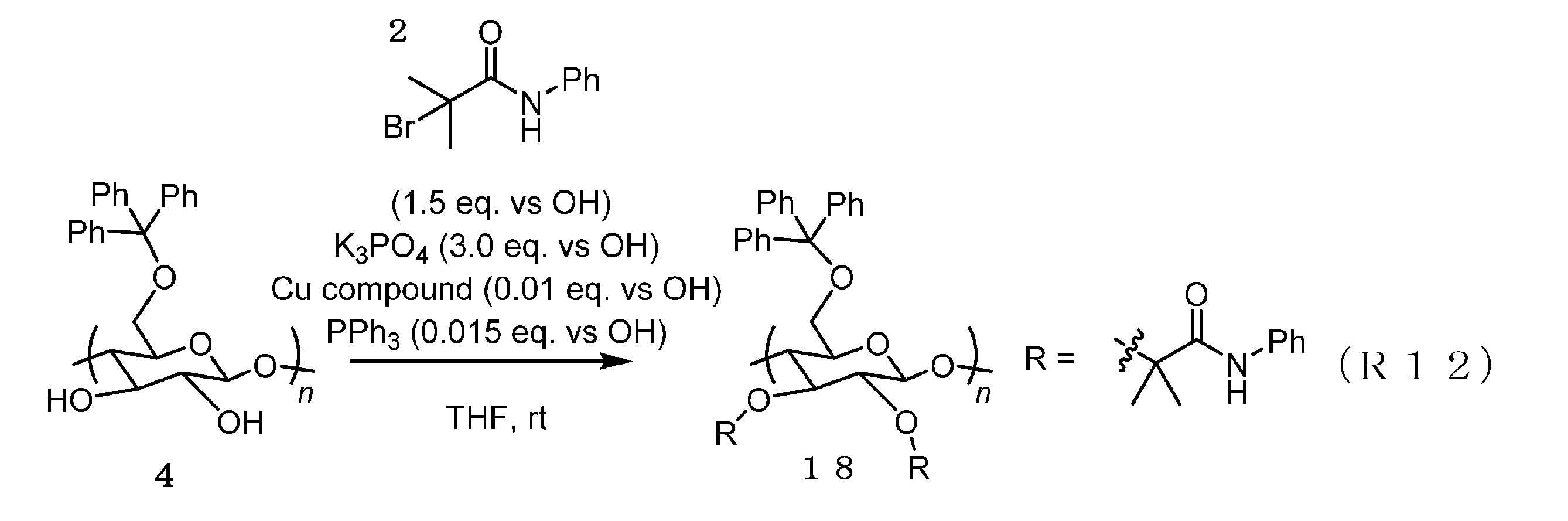
ヨウ化銅(I)を臭化銅(I)(0.7mg、5μmol、0.01当量)(実施例17)、塩化銅(I)(0.5mg、5μmol、0.01当量)(実施例18)、又は塩化銅(II)(0.7mg、5μmol、0.01当量)(実施例19)に変更した以外は、実施例12と同様にして、下記反応式(R12)の18で表される繰り返し単位を有するセルロース誘導体を淡橙色固体として得た。実施例17のセルロース誘導体(0.142g、収率:78%)、実施例18のセルロース誘導体(0.136g、収率:75%)、実施例19のセルロース誘導体(0.107g、収率:89%)であった。また、反応式は、下記反応式(R12)に示すとおりである。
実施例17及び18により得られたセルロース誘導体の1H-NMRスペクトルの化学シフト値を以下に示す。
1H-NMR(500MHz,CDCl3,r.t.):δ 8.9-9.8(br、NH)、 6.8-8.0(br、overlaped with CHCl3), 6.3-6.8(br), 2.8-6.0(br、CH、CH2:セルロース),0.7-1.8(br、CH3:(1-a)又は(1-b))
1H-NMR(500MHz,CDCl3,r.t.):δ 8.9-9.8(br、NH)、 6.8-8.0(br、overlaped with CHCl3), 6.3-6.8(br), 2.8-6.0(br、CH、CH2:セルロース),0.7-1.8(br、CH3:(1-a)又は(1-b))
実施例19により得られたセルロース誘導体の1H-NMRスペクトルの化学シフト値を以下に示す。
1H-NMR(500MHz,CDCl3,r.t.):δ 8.9-9.8(br、NH)、 6.8-8.0(br、overlaped with CHCl3), 6.3-6.8(br), 2.8-6.0(br、CH、CH2:セルロース),0.7-1.8(br、CH3:(1-a)又は(1-b))
1H-NMR(500MHz,CDCl3,r.t.):δ 8.9-9.8(br、NH)、 6.8-8.0(br、overlaped with CHCl3), 6.3-6.8(br), 2.8-6.0(br、CH、CH2:セルロース),0.7-1.8(br、CH3:(1-a)又は(1-b))
(実施例20)
αブロモカルボキサミドとして、αブロモジメチルアセトアニリドの代わりに、αブロモジメチルアセト(3,4,5-トリメトキシ)アニリド(下記反応式(R13)の6、0.25g、0.74mmol、1.5当量)を用いた以外は、実施例12と同様に実施することで(R13)の20で表される繰り返し単位を有するセルロース誘導体(0.220mg、収率:100%)を淡橙色固体として得た。
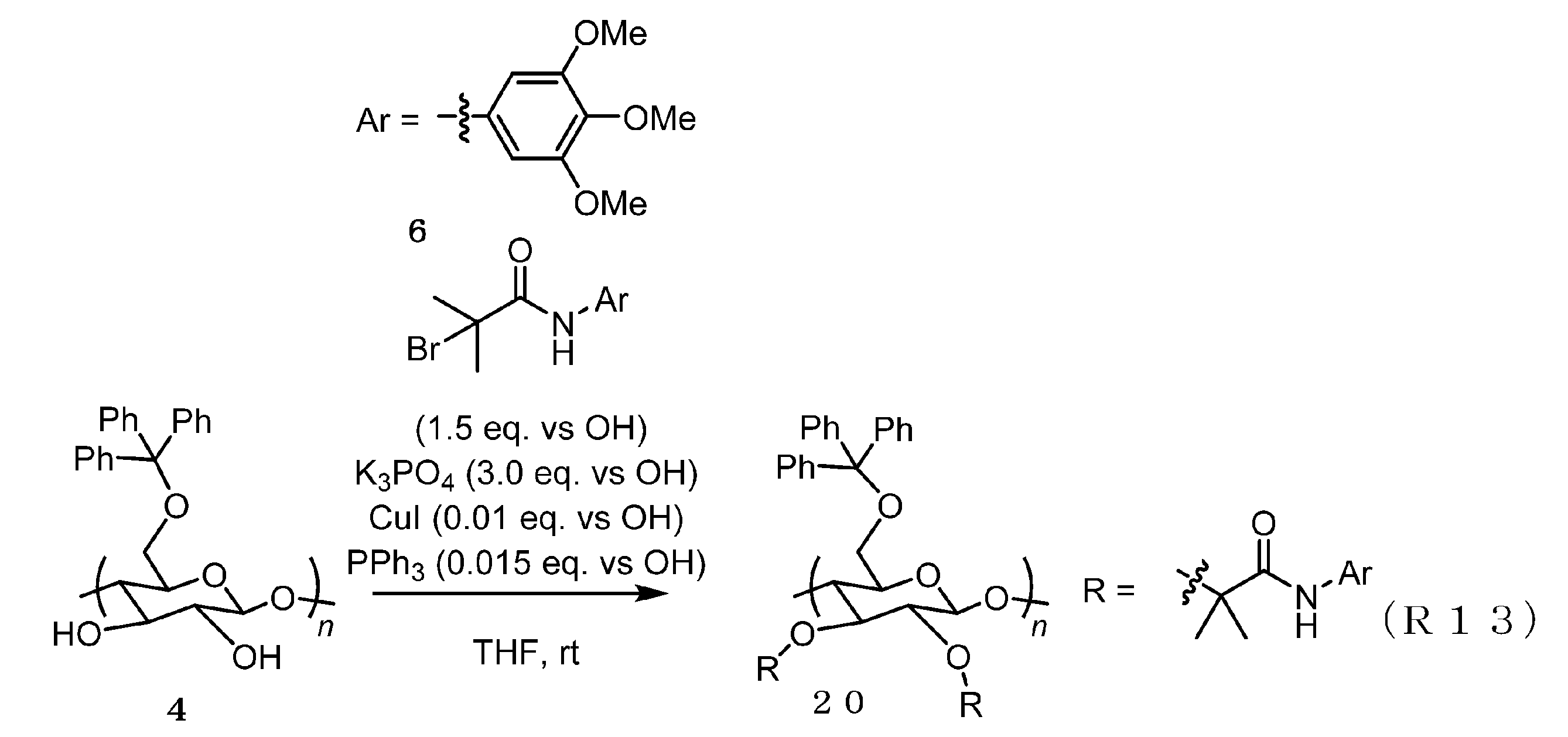
αブロモカルボキサミドとして、αブロモジメチルアセトアニリドの代わりに、αブロモジメチルアセト(3,4,5-トリメトキシ)アニリド(下記反応式(R13)の6、0.25g、0.74mmol、1.5当量)を用いた以外は、実施例12と同様に実施することで(R13)の20で表される繰り返し単位を有するセルロース誘導体(0.220mg、収率:100%)を淡橙色固体として得た。
実施例20により得られたセルロース誘導体の化学シフト値を以下に示す。
1H-NMR(500MHz,CDCl3,r.t.):δ 9.1-9.4(br、NH)、 8.4(s)、6.6-7.8(br、overlaped with CHCl3),6.8(s)、 6.2-6.6(br), 2.3-5.0(br、CH、CH2:セルロース),3.85(s)、3.80(s)、1.3-1.7(br、CH3:(1-a)又は(1-b))
1H-NMR(500MHz,CDCl3,r.t.):δ 9.1-9.4(br、NH)、 8.4(s)、6.6-7.8(br、overlaped with CHCl3),6.8(s)、 6.2-6.6(br), 2.3-5.0(br、CH、CH2:セルロース),3.85(s)、3.80(s)、1.3-1.7(br、CH3:(1-a)又は(1-b))
(実施例21)
αブロモカルボキサミドとして、αブロモジメチルアセトアニリドの代わりに、αブロモジメチルアセト(4-トリフルオロメチル)アニリド(下記反応式(R14)の8、(0.23g、0.74mmol、1.5当量)を用いた以外は、実施例12と同様に実施することで(R14)の21で表される繰り返し単位を有するセルロース誘導体(0.156g、収率:73%)を淡橙色固体として得た。
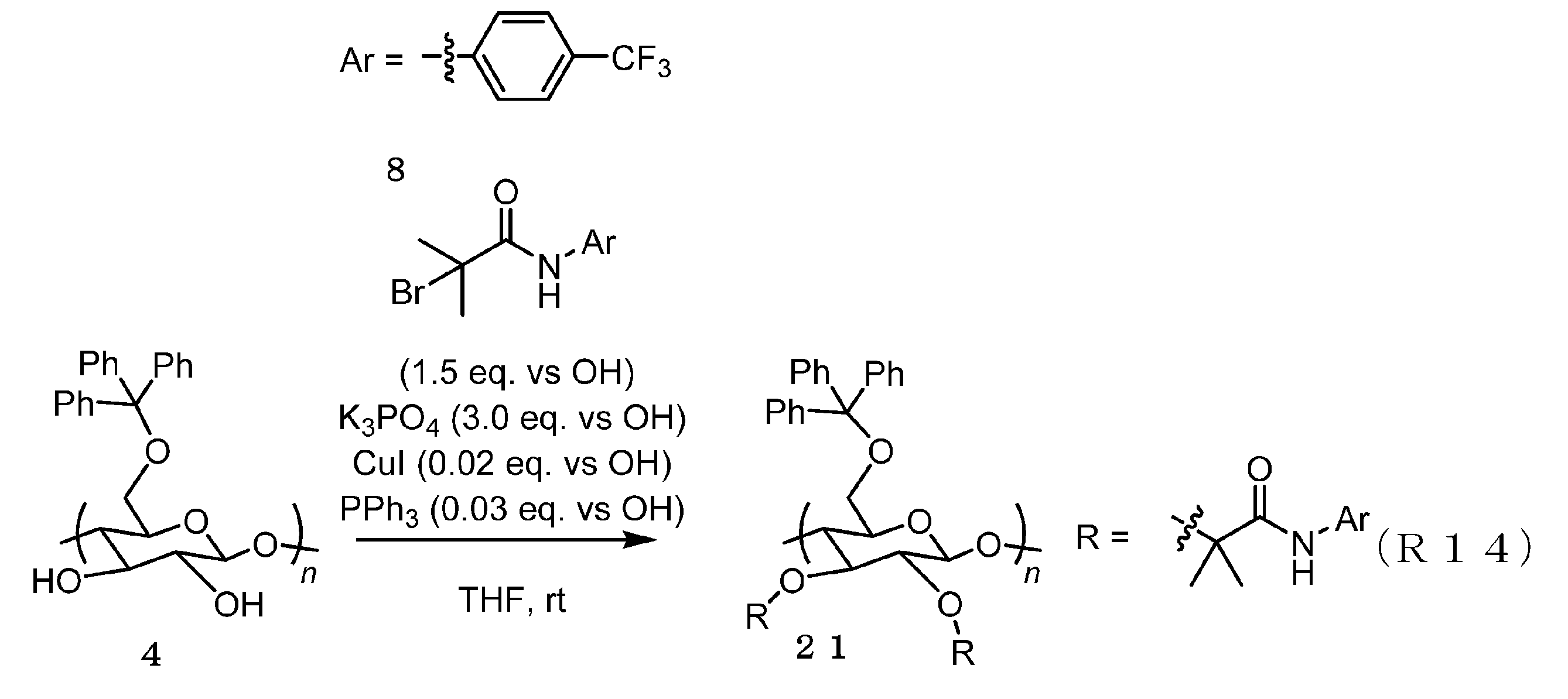
αブロモカルボキサミドとして、αブロモジメチルアセトアニリドの代わりに、αブロモジメチルアセト(4-トリフルオロメチル)アニリド(下記反応式(R14)の8、(0.23g、0.74mmol、1.5当量)を用いた以外は、実施例12と同様に実施することで(R14)の21で表される繰り返し単位を有するセルロース誘導体(0.156g、収率:73%)を淡橙色固体として得た。
実施例21により得られたセルロース誘導体の化学シフト値を以下に示す。
1H-NMR(500MHz,CDCl3,r.t.):δ 9.3-9.8(br、NH)、 6.8-8.2(br、overlaped with CHCl3)、 6.2-6.6(br), 2.5-5.7(br、CH、CH2:セルロース),0.7-2.3(br、CH3:(1-a)又は(1-b))
1H-NMR(500MHz,CDCl3,r.t.):δ 9.3-9.8(br、NH)、 6.8-8.2(br、overlaped with CHCl3)、 6.2-6.6(br), 2.5-5.7(br、CH、CH2:セルロース),0.7-2.3(br、CH3:(1-a)又は(1-b))
(実施例22)
αブロモカルボキサミドとして、αブロモジメチルアセトアニリドの代わりに、1-(αブロモジメチルアセトキシ)アミノピレン(上記反応式(R15)の10(0.27g、0.74mmol、1.5当量)を用いた以外は、実施例12と同様に実施することで(R15)の22で表される繰り返し単位を有するセルロース誘導体(0.130g、収率:54%)を淡橙色固体として得た。
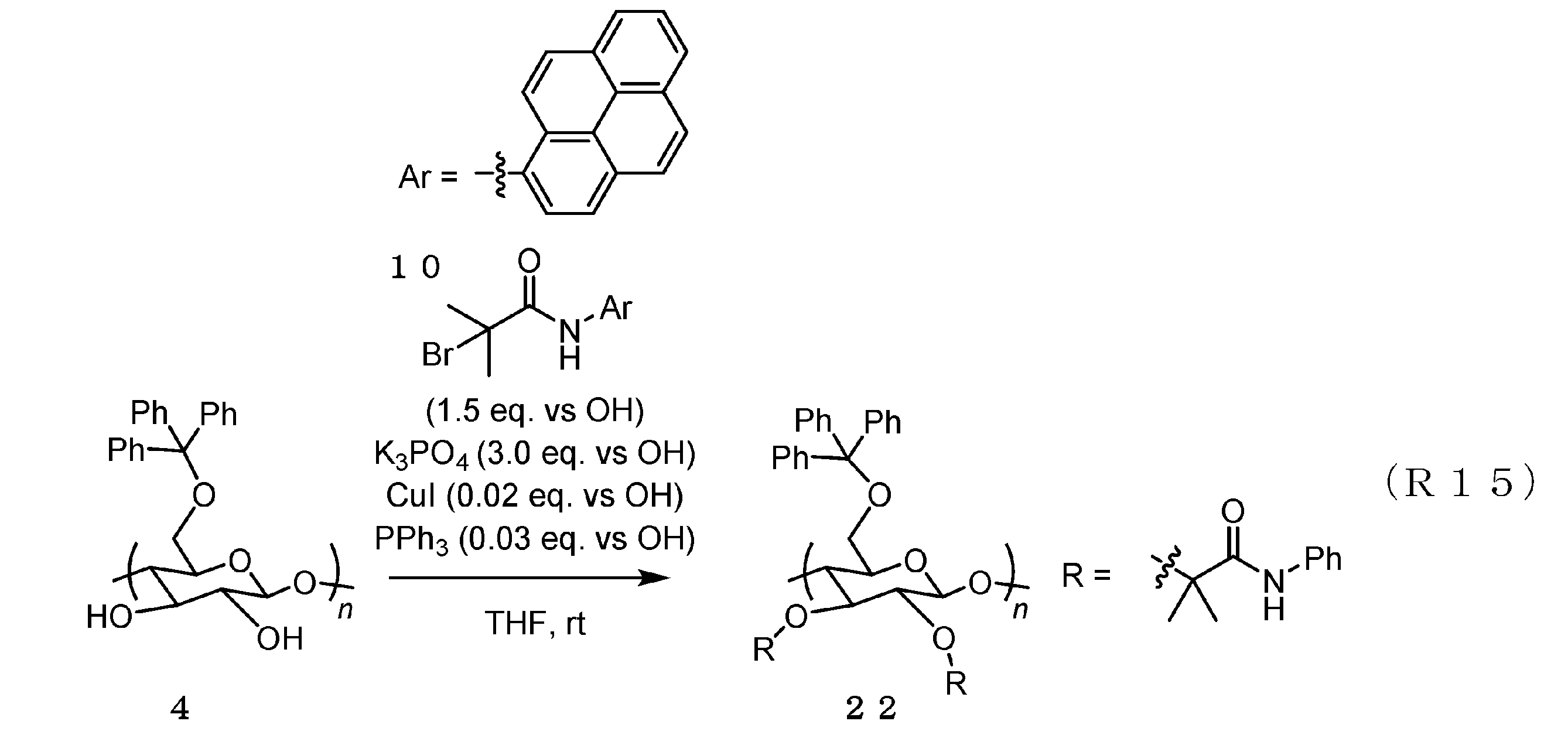
αブロモカルボキサミドとして、αブロモジメチルアセトアニリドの代わりに、1-(αブロモジメチルアセトキシ)アミノピレン(上記反応式(R15)の10(0.27g、0.74mmol、1.5当量)を用いた以外は、実施例12と同様に実施することで(R15)の22で表される繰り返し単位を有するセルロース誘導体(0.130g、収率:54%)を淡橙色固体として得た。
実施例22により得られたセルロース誘導体の化学シフト値を以下に示す。
1H-NMR(500MHz,CDCl3,r.t.):δ 9.5-10.2(br、NH)、 7.6-8.4(br)、6.6-7.6(br、overlaped with CHCl3), 2.5-5.0(br、CH、CH2:セルロース),0.8-2.0(br、CH3:(1-a)又は(1-b)、overlaped with H2O)
1H-NMR(500MHz,CDCl3,r.t.):δ 9.5-10.2(br、NH)、 7.6-8.4(br)、6.6-7.6(br、overlaped with CHCl3), 2.5-5.0(br、CH、CH2:セルロース),0.8-2.0(br、CH3:(1-a)又は(1-b)、overlaped with H2O)
1H-NMR測定の結果から算出した、実施例12~22において得られたセルロース誘導体のトリチル基及び上記式(1-a)又は(1-b)で表される基の平均置換度、並びに総平均置換度はそれぞれ表3のとおりである。尚、付言すると、実施例21及び22について、銅化合物の量をはじめとする種々の反応条件を変更することで、トリチル基の平均置換度が約1.0、上記式(1-a)又は(1-b)で表される基の平均置換度が約1.0~2.0未満の種々のセルロース誘導体が得られる。
(実施例23)
二口ナスフラスコに原料セルロース誘導体として実施例12により得られたセルロース誘導体(下記反応式(R16)の18、0.15g、0.20mmolモル)を入れ、窒素雰囲気下、ジクロロメタン(1mL)を加えて撹拌し、溶解させた。30wt%臭化水素の酢酸溶液(0.4mL、2mmol)を加え室温(25℃)で5分間撹拌した。反応液をメタノール水溶液(1/1、v/v)に注いで再沈殿することにより得られた固体を吸引ろ過により回収し、エタノールで洗浄した。得られた固体を真空乾燥し、下記反応式(R16)の23で表される繰り返し単位を有するセルロース誘導体(0.083g、収率:83%)を淡橙色固体として得た。
二口ナスフラスコに原料セルロース誘導体として実施例12により得られたセルロース誘導体(下記反応式(R16)の18、0.15g、0.20mmolモル)を入れ、窒素雰囲気下、ジクロロメタン(1mL)を加えて撹拌し、溶解させた。30wt%臭化水素の酢酸溶液(0.4mL、2mmol)を加え室温(25℃)で5分間撹拌した。反応液をメタノール水溶液(1/1、v/v)に注いで再沈殿することにより得られた固体を吸引ろ過により回収し、エタノールで洗浄した。得られた固体を真空乾燥し、下記反応式(R16)の23で表される繰り返し単位を有するセルロース誘導体(0.083g、収率:83%)を淡橙色固体として得た。
1H-NMR測定の結果から、得られたセルロース誘導体の上記式(1-a)又は(1-b)で表される基の平均置換度は約2.0、総平均置換度は約2.0と算出された。

実施例23により得られたセルロース誘導体の1H-NMR測定データを図5に、化学シフト値を以下に示す。
1H-NMR(500MHz,DMSO―d6,r.t.):δ 9.5-10.0(br、NH)、 7.6(br)、7.25(br)、7.0(br) 6.4-6.8(br), 2.5-5.5(br、CH、CH2:セルロース、overlaped with H2O),0.8-1.7(br、CH3:(1-a)又は(1-b))
1H-NMR(500MHz,DMSO―d6,r.t.):δ 9.5-10.0(br、NH)、 7.6(br)、7.25(br)、7.0(br) 6.4-6.8(br), 2.5-5.5(br、CH、CH2:セルロース、overlaped with H2O),0.8-1.7(br、CH3:(1-a)又は(1-b))
(実施例24)
二口ナスフラスコに原料セルロース誘導体として実施例23により得られたセルロース誘導体(下記反応式(R17)の23、0.083g、0.17mmol)を入れ、窒素雰囲気下、テトラヒドロフラン(0.68mL)を加えて撹拌し、溶解させた。αブロモカルボキサミドとして、αブロモジメチルアセトアニリド(下記反応式(R17)の2、0.062g、0.26mmol、1.5当量)、リン酸三カリウム(0.11g、0.51mmol、3.0当量)、ヨウ化銅(I)(0.7mg、3.7μmol、0.02当量)、トリフェニルホスフィン(1.4mg、5.3μmol、0.03当量)を加え室温(25℃)で24時間撹拌した。反応液をメタノール水溶液(1/1、v/v)に注いで再沈殿することにより得られた固体を吸引ろ過により回収し、ジエチルエーテルで洗浄した。得られた固体を真空乾燥し、下記反応式(R17)の24で表される繰り返し単位を有するセルロース誘導体(0.092g、収率:80%)を淡橙色固体として得た。
二口ナスフラスコに原料セルロース誘導体として実施例23により得られたセルロース誘導体(下記反応式(R17)の23、0.083g、0.17mmol)を入れ、窒素雰囲気下、テトラヒドロフラン(0.68mL)を加えて撹拌し、溶解させた。αブロモカルボキサミドとして、αブロモジメチルアセトアニリド(下記反応式(R17)の2、0.062g、0.26mmol、1.5当量)、リン酸三カリウム(0.11g、0.51mmol、3.0当量)、ヨウ化銅(I)(0.7mg、3.7μmol、0.02当量)、トリフェニルホスフィン(1.4mg、5.3μmol、0.03当量)を加え室温(25℃)で24時間撹拌した。反応液をメタノール水溶液(1/1、v/v)に注いで再沈殿することにより得られた固体を吸引ろ過により回収し、ジエチルエーテルで洗浄した。得られた固体を真空乾燥し、下記反応式(R17)の24で表される繰り返し単位を有するセルロース誘導体(0.092g、収率:80%)を淡橙色固体として得た。
1H-NMR測定の結果から、得られたセルロース誘導体の上記式(1-a)又は(1-b)で表される基の平均置換度は約3.0、総平均置換度は約3.0と算出された。
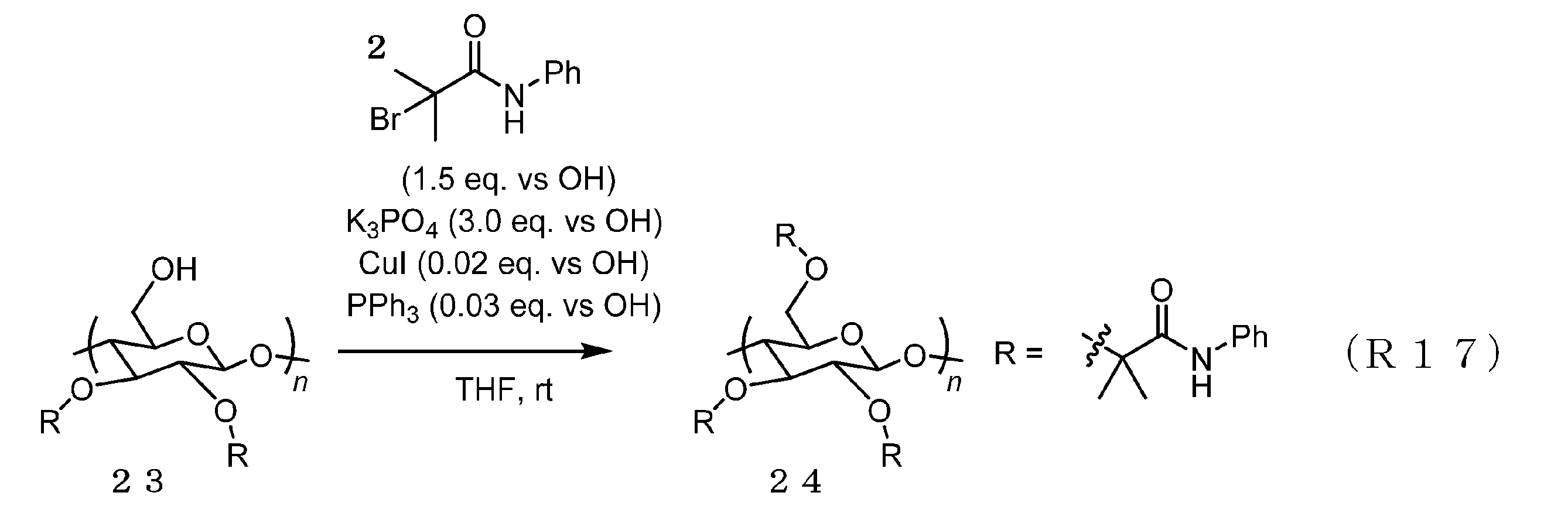
実施例24により得られたセルロース誘導体の1H-NMRスペクトルの測定データを図6に、化学シフト値を以下に示す。
1H-NMR(500MHz,DMSO―d6,r.t.):δ 9.6-10.4(br、NH)、 7.6(br)、7.25(br)、7.0(br) 6.3-6.6(br), 3.0-6.1(br、CH、CH2:セルロース、overlaped with H2O),0.9-1.8(br、CH3:(1-a)又は(1-b))
1H-NMR(500MHz,DMSO―d6,r.t.):δ 9.6-10.4(br、NH)、 7.6(br)、7.25(br)、7.0(br) 6.3-6.6(br), 3.0-6.1(br、CH、CH2:セルロース、overlaped with H2O),0.9-1.8(br、CH3:(1-a)又は(1-b))
実施例10~24の結果は表3に示すとおりである。

表3より、上記式(1-a)又は(1-b)で表される基の平均置換度が高い、高置換度の芳香族アミド変性セルロースを収率よく得ることができたことがわかる。
Claims (16)
- 下記式(1)で表される繰り返し単位を有し、水酸基の保護基、下記式(1-a)で表される基、及び下記式(1-b)で表される基の総平均置換度が1.5以上である、セルロース誘導体。



- 上記式(1-a)又は(1-b)中、Arが単環芳香族炭化水素基である、請求項1に記載のセルロース誘導体。
- 上記式(1-a)又は(1-b)中、Arが多環芳香族炭化水素基である、請求項1に記載のセルロース誘導体。
- 上記総平均置換度が1.7以上である、請求項1に記載のセルロース誘導体。
- 上記水酸基の保護基がアセチル基又はトリチル基である、請求項1に記載のセルロース誘導体。
- 上記式(1)で表される繰り返し単位を有するセルロース誘導体に含まれる全てのRのうち、少なくとも1つは上記式(1-b)で表される基である、請求項1に記載のセルロース誘導体。
- 請求項1~6の何れか一項に記載のセルロース誘導体を含む組成物。
- 請求項1に記載のセルロース誘導体の製造方法であって、
塩基触媒の存在下、下記式(2)で表される繰り返し単位を有するセルロース誘導体の2、3又は6位の水酸基に、下記式(3)で表されるαブロモカルボキサミドを反応させる工程(i)を含む、セルロース誘導体の製造方法。
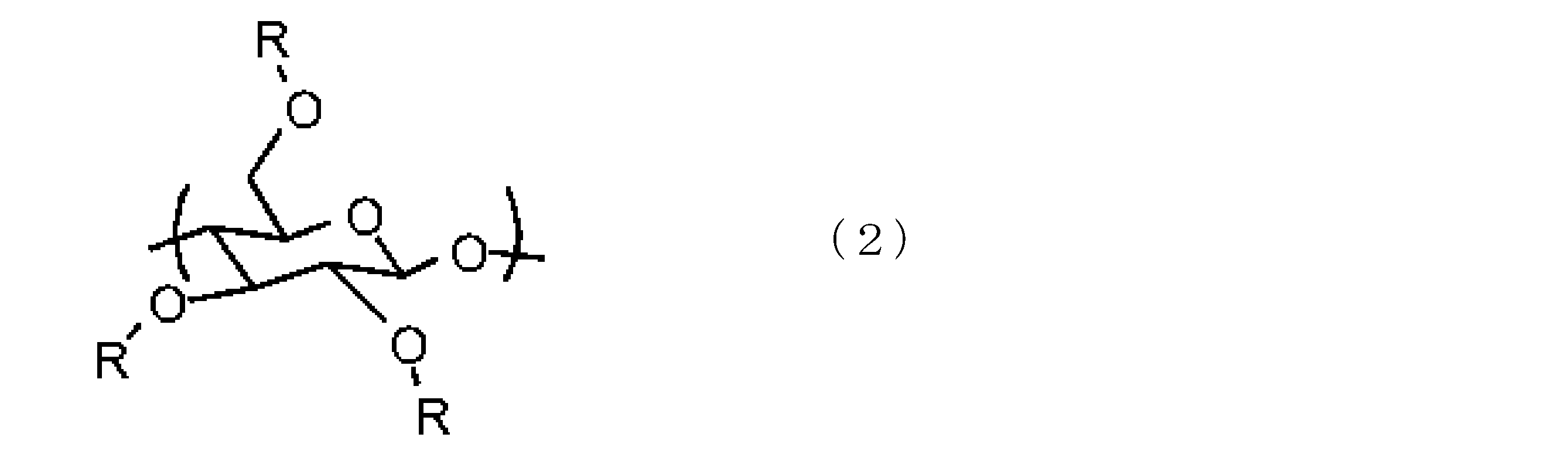

- 上記式(2)で表される繰り返し単位を有するセルロース誘導体に含まれる全てのRのうち、少なくとも1つが水酸基の保護基、上記式(1-a)で表される基、又は上記式(1-b)で表される基であって、上記式(2)で表される繰り返し単位を有するセルロース誘導体は、上記水酸基の保護基、上記式(1-a)で表される基、及び上記式(1-b)で表される基の総平均置換度が1.5以上である、請求項8に記載のセルロース誘導体の製造方法。
- 上記式(3)中、Arが単環芳香族炭化水素基である、請求項8に記載のセルロース誘導体の製造方法。
- 上記式(3)中、Arが多環芳香族炭化水素基である、請求項8に記載のセルロース誘導体の製造方法。
- 上記式(2)で表される繰り返し単位を有するセルロース誘導体に含まれる全てのRのうち、少なくとも1つが水酸基の保護基であって、
上記工程(i)の後、上記水酸基の保護基を脱離して水酸基に置換する工程(ii)を含む、請求項8に記載のセルロース誘導体の製造方法。 - 上記水酸基の保護基がアセチル基又はトリチル基である、請求項8~12の何れか一項に記載のセルロース誘導体の製造方法。
- 上記工程(ii)により得られたセルロース誘導体における、上記工程(ii)により置換された水酸基を含む2、3又は6位の水酸基に、塩基触媒の存在下、上記式(3)で表されるαブロモカルボキサミドを反応させる工程(iii)を含む、請求項12に記載のセルロース誘導体の製造方法。
- 上記工程(i)の反応が、銅化合物、当該銅化合物中の銅の配位子及び上記塩基触媒の存在下での反応である、請求項8に記載のセルロース誘導体の製造方法。
- 上記工程(iii)の反応が、銅化合物、当該銅化合物中の銅の配位子及び上記塩基触媒の存在下での反応である、請求項14に記載のセルロース誘導体の製造方法。
Priority Applications (1)
| Application Number | Priority Date | Filing Date | Title |
|---|---|---|---|
| JP2025519309A JPWO2024232111A1 (ja) | 2023-05-08 | 2023-09-12 |
Applications Claiming Priority (2)
| Application Number | Priority Date | Filing Date | Title |
|---|---|---|---|
| PCT/JP2023/017313 WO2024231986A1 (ja) | 2023-05-08 | 2023-05-08 | セルロース誘導体及びその製造方法、並びにセルロース誘導体を含む組成物 |
| JPPCT/JP2023/017313 | 2023-05-08 |
Publications (1)
| Publication Number | Publication Date |
|---|---|
| WO2024232111A1 true WO2024232111A1 (ja) | 2024-11-14 |
Family
ID=93431443
Family Applications (2)
| Application Number | Title | Priority Date | Filing Date |
|---|---|---|---|
| PCT/JP2023/017313 Ceased WO2024231986A1 (ja) | 2023-05-08 | 2023-05-08 | セルロース誘導体及びその製造方法、並びにセルロース誘導体を含む組成物 |
| PCT/JP2023/033248 Ceased WO2024232111A1 (ja) | 2023-05-08 | 2023-09-12 | セルロース誘導体及びその製造方法、並びにセルロース誘導体を含む組成物 |
Family Applications Before (1)
| Application Number | Title | Priority Date | Filing Date |
|---|---|---|---|
| PCT/JP2023/017313 Ceased WO2024231986A1 (ja) | 2023-05-08 | 2023-05-08 | セルロース誘導体及びその製造方法、並びにセルロース誘導体を含む組成物 |
Country Status (2)
| Country | Link |
|---|---|
| JP (1) | JPWO2024232111A1 (ja) |
| WO (2) | WO2024231986A1 (ja) |
Citations (3)
| Publication number | Priority date | Publication date | Assignee | Title |
|---|---|---|---|---|
| JP2002179701A (ja) * | 2000-12-15 | 2002-06-26 | Fuji Photo Film Co Ltd | セルロースアシレート |
| JP2013033040A (ja) * | 2011-07-27 | 2013-02-14 | Pall Corp | 混合モード配位子 |
| JP2019509853A (ja) * | 2016-03-30 | 2019-04-11 | コンバテック・テクノロジーズ・インコーポレイテッドConvatec Technologies Inc | 変性された創傷包帯 |
-
2023
- 2023-05-08 WO PCT/JP2023/017313 patent/WO2024231986A1/ja not_active Ceased
- 2023-09-12 JP JP2025519309A patent/JPWO2024232111A1/ja active Pending
- 2023-09-12 WO PCT/JP2023/033248 patent/WO2024232111A1/ja not_active Ceased
Patent Citations (3)
| Publication number | Priority date | Publication date | Assignee | Title |
|---|---|---|---|---|
| JP2002179701A (ja) * | 2000-12-15 | 2002-06-26 | Fuji Photo Film Co Ltd | セルロースアシレート |
| JP2013033040A (ja) * | 2011-07-27 | 2013-02-14 | Pall Corp | 混合モード配位子 |
| JP2019509853A (ja) * | 2016-03-30 | 2019-04-11 | コンバテック・テクノロジーズ・インコーポレイテッドConvatec Technologies Inc | 変性された創傷包帯 |
Non-Patent Citations (1)
| Title |
|---|
| HAMDAOUI, LAHCEN EL ET AL.: "Synthesis and characterization of cellulose-acetanilide ether and its antibacterial activity", POLYMER BULLETIN, vol. 75, no. 6, 2017, pages 2401 - 2413, XP036503695, DOI: 10.1007/s00289-017-2164-2 * |
Also Published As
| Publication number | Publication date |
|---|---|
| WO2024231986A1 (ja) | 2024-11-14 |
| JPWO2024232111A1 (ja) | 2024-11-14 |
Similar Documents
| Publication | Publication Date | Title |
|---|---|---|
| JP6954959B2 (ja) | 抗ウイルス化合物を調製するためのプロセス | |
| KR102559870B1 (ko) | 카르밤산염 화합물의 제조방법 | |
| CN114105978A (zh) | 一种氧化吲哚类化合物及其制备方法和应用 | |
| CN101186625B (zh) | 亚乙撑双二茂铁衍生物及合成方法 | |
| JP7144873B2 (ja) | スガマデクスナトリウム塩の製造方法 | |
| WO2024232111A1 (ja) | セルロース誘導体及びその製造方法、並びにセルロース誘導体を含む組成物 | |
| CN105585584B (zh) | 氮杂环卡宾铜配合物的合成方法 | |
| WO2022103804A1 (en) | Selective cyclocarbonylative coupling of 2-iodophenols with terminal alkynes catalyzed by bridged bis(nhc)pd(ii)br2 catalysts | |
| DK142413B (da) | Analogifremgangsmåde til fremstilling af 1-acyloxymethyl-5-fluoruracilderivater. | |
| IL139528A (en) | Platinum bracelets, processes for their preparation and pharmaceutical preparations containing them | |
| JP2010235601A5 (ja) | ||
| CN101560191A (zh) | α-萘甲基取代的螺环双噁唑啉配体、合成方法及其在合成吡唑烷衍生物中的应用 | |
| JP2009522210A (ja) | 2,2’,6,6’−テトラオキサゾリンビフェニル配位子およびその調製方法 | |
| EP3398970B1 (en) | A method of synthesizing cellulose carbonate | |
| KR20030022262A (ko) | 살렌 화합물의 망간 착물의 제조방법 | |
| CN114105989A (zh) | 一种碘代吡咯并三嗪胺类化合物的制备方法和应用 | |
| CN108456172B (zh) | 一种具有苯并咪唑骨架的手性氮杂环卡宾前体化合物及其制备方法和应用 | |
| CN105837555B (zh) | 加雷沙星及其中间体制备方法 | |
| CN110950836B (zh) | 一种苯并二硫杂环戊烯类骨架化合物的制备方法 | |
| CN113979947A (zh) | 一种氟化咪唑配体的合成方法 | |
| CN118324710B (zh) | 一种噁二唑化合物的制备方法 | |
| CN113004248A (zh) | 一种钴催化碳氢胺化反应合成咔唑类化合物的方法 | |
| CN102807571A (zh) | 一种适于工业化生产坦西莫司的制备方法 | |
| CN109053847B (zh) | 一种17β-咪唑烷基溴盐-去氢表雄烷衍生物及其制备方法和应用 | |
| CN104817512B (zh) | 一种噁唑啉类医药中间体化合物的合成方法 |
Legal Events
| Date | Code | Title | Description |
|---|---|---|---|
| 121 | Ep: the epo has been informed by wipo that ep was designated in this application |
Ref document number: 23936659 Country of ref document: EP Kind code of ref document: A1 |
|
| ENP | Entry into the national phase |
Ref document number: 2025519309 Country of ref document: JP Kind code of ref document: A |
|
| WWE | Wipo information: entry into national phase |
Ref document number: 2025519309 Country of ref document: JP |
|
| NENP | Non-entry into the national phase |
Ref country code: DE |