WO2024225395A1 - 熱伝導性部材、熱伝導性組成物、構造体、及び構造体のリワーク方法 - Google Patents
熱伝導性部材、熱伝導性組成物、構造体、及び構造体のリワーク方法 Download PDFInfo
- Publication number
- WO2024225395A1 WO2024225395A1 PCT/JP2024/016306 JP2024016306W WO2024225395A1 WO 2024225395 A1 WO2024225395 A1 WO 2024225395A1 JP 2024016306 W JP2024016306 W JP 2024016306W WO 2024225395 A1 WO2024225395 A1 WO 2024225395A1
- Authority
- WO
- WIPO (PCT)
- Prior art keywords
- thermally conductive
- conductive member
- less
- phase change
- change material
- Prior art date
- Legal status (The legal status is an assumption and is not a legal conclusion. Google has not performed a legal analysis and makes no representation as to the accuracy of the status listed.)
- Ceased
Links
Images

Classifications
-
- C—CHEMISTRY; METALLURGY
- C09—DYES; PAINTS; POLISHES; NATURAL RESINS; ADHESIVES; COMPOSITIONS NOT OTHERWISE PROVIDED FOR; APPLICATIONS OF MATERIALS NOT OTHERWISE PROVIDED FOR
- C09K—MATERIALS FOR MISCELLANEOUS APPLICATIONS, NOT PROVIDED FOR ELSEWHERE
- C09K5/00—Heat-transfer, heat-exchange or heat-storage materials, e.g. refrigerants; Materials for the production of heat or cold by chemical reactions other than by combustion
- C09K5/02—Materials undergoing a change of physical state when used
- C09K5/06—Materials undergoing a change of physical state when used the change of state being from liquid to solid or vice versa
- C09K5/063—Materials absorbing or liberating heat during crystallisation; Heat storage materials
-
- C—CHEMISTRY; METALLURGY
- C08—ORGANIC MACROMOLECULAR COMPOUNDS; THEIR PREPARATION OR CHEMICAL WORKING-UP; COMPOSITIONS BASED THEREON
- C08K—Use of inorganic or non-macromolecular organic substances as compounding ingredients
- C08K3/00—Use of inorganic substances as compounding ingredients
- C08K3/18—Oxygen-containing compounds, e.g. metal carbonyls
- C08K3/20—Oxides; Hydroxides
- C08K3/22—Oxides; Hydroxides of metals
-
- C—CHEMISTRY; METALLURGY
- C08—ORGANIC MACROMOLECULAR COMPOUNDS; THEIR PREPARATION OR CHEMICAL WORKING-UP; COMPOSITIONS BASED THEREON
- C08K—Use of inorganic or non-macromolecular organic substances as compounding ingredients
- C08K5/00—Use of organic ingredients
- C08K5/01—Hydrocarbons
-
- C—CHEMISTRY; METALLURGY
- C08—ORGANIC MACROMOLECULAR COMPOUNDS; THEIR PREPARATION OR CHEMICAL WORKING-UP; COMPOSITIONS BASED THEREON
- C08K—Use of inorganic or non-macromolecular organic substances as compounding ingredients
- C08K5/00—Use of organic ingredients
- C08K5/04—Oxygen-containing compounds
- C08K5/10—Esters; Ether-esters
- C08K5/101—Esters; Ether-esters of monocarboxylic acids
-
- C—CHEMISTRY; METALLURGY
- C08—ORGANIC MACROMOLECULAR COMPOUNDS; THEIR PREPARATION OR CHEMICAL WORKING-UP; COMPOSITIONS BASED THEREON
- C08L—COMPOSITIONS OF MACROMOLECULAR COMPOUNDS
- C08L101/00—Compositions of unspecified macromolecular compounds
-
- C—CHEMISTRY; METALLURGY
- C08—ORGANIC MACROMOLECULAR COMPOUNDS; THEIR PREPARATION OR CHEMICAL WORKING-UP; COMPOSITIONS BASED THEREON
- C08L—COMPOSITIONS OF MACROMOLECULAR COMPOUNDS
- C08L83/00—Compositions of macromolecular compounds obtained by reactions forming in the main chain of the macromolecule a linkage containing silicon with or without sulfur, nitrogen, oxygen or carbon only; Compositions of derivatives of such polymers
- C08L83/04—Polysiloxanes
-
- H—ELECTRICITY
- H01—ELECTRIC ELEMENTS
- H01M—PROCESSES OR MEANS, e.g. BATTERIES, FOR THE DIRECT CONVERSION OF CHEMICAL ENERGY INTO ELECTRICAL ENERGY
- H01M10/00—Secondary cells; Manufacture thereof
- H01M10/60—Heating or cooling; Temperature control
- H01M10/61—Types of temperature control
- H01M10/613—Cooling or keeping cold
-
- H—ELECTRICITY
- H01—ELECTRIC ELEMENTS
- H01M—PROCESSES OR MEANS, e.g. BATTERIES, FOR THE DIRECT CONVERSION OF CHEMICAL ENERGY INTO ELECTRICAL ENERGY
- H01M10/00—Secondary cells; Manufacture thereof
- H01M10/60—Heating or cooling; Temperature control
- H01M10/62—Heating or cooling; Temperature control specially adapted for specific applications
- H01M10/625—Vehicles
-
- H—ELECTRICITY
- H01—ELECTRIC ELEMENTS
- H01M—PROCESSES OR MEANS, e.g. BATTERIES, FOR THE DIRECT CONVERSION OF CHEMICAL ENERGY INTO ELECTRICAL ENERGY
- H01M10/00—Secondary cells; Manufacture thereof
- H01M10/60—Heating or cooling; Temperature control
- H01M10/65—Means for temperature control structurally associated with the cells
- H01M10/659—Means for temperature control structurally associated with the cells by heat storage or buffering, e.g. heat capacity or liquid-solid phase changes or transition
-
- C—CHEMISTRY; METALLURGY
- C08—ORGANIC MACROMOLECULAR COMPOUNDS; THEIR PREPARATION OR CHEMICAL WORKING-UP; COMPOSITIONS BASED THEREON
- C08K—Use of inorganic or non-macromolecular organic substances as compounding ingredients
- C08K3/00—Use of inorganic substances as compounding ingredients
- C08K3/18—Oxygen-containing compounds, e.g. metal carbonyls
- C08K3/20—Oxides; Hydroxides
- C08K3/22—Oxides; Hydroxides of metals
- C08K2003/2227—Oxides; Hydroxides of metals of aluminium
-
- C—CHEMISTRY; METALLURGY
- C08—ORGANIC MACROMOLECULAR COMPOUNDS; THEIR PREPARATION OR CHEMICAL WORKING-UP; COMPOSITIONS BASED THEREON
- C08K—Use of inorganic or non-macromolecular organic substances as compounding ingredients
- C08K2201/00—Specific properties of additives
- C08K2201/001—Conductive additives
-
- C—CHEMISTRY; METALLURGY
- C08—ORGANIC MACROMOLECULAR COMPOUNDS; THEIR PREPARATION OR CHEMICAL WORKING-UP; COMPOSITIONS BASED THEREON
- C08K—Use of inorganic or non-macromolecular organic substances as compounding ingredients
- C08K2201/00—Specific properties of additives
- C08K2201/002—Physical properties
- C08K2201/005—Additives being defined by their particle size in general
-
- C—CHEMISTRY; METALLURGY
- C08—ORGANIC MACROMOLECULAR COMPOUNDS; THEIR PREPARATION OR CHEMICAL WORKING-UP; COMPOSITIONS BASED THEREON
- C08K—Use of inorganic or non-macromolecular organic substances as compounding ingredients
- C08K2201/00—Specific properties of additives
- C08K2201/014—Additives containing two or more different additives of the same subgroup in C08K
-
- Y—GENERAL TAGGING OF NEW TECHNOLOGICAL DEVELOPMENTS; GENERAL TAGGING OF CROSS-SECTIONAL TECHNOLOGIES SPANNING OVER SEVERAL SECTIONS OF THE IPC; TECHNICAL SUBJECTS COVERED BY FORMER USPC CROSS-REFERENCE ART COLLECTIONS [XRACs] AND DIGESTS
- Y02—TECHNOLOGIES OR APPLICATIONS FOR MITIGATION OR ADAPTATION AGAINST CLIMATE CHANGE
- Y02E—REDUCTION OF GREENHOUSE GAS [GHG] EMISSIONS, RELATED TO ENERGY GENERATION, TRANSMISSION OR DISTRIBUTION
- Y02E60/00—Enabling technologies; Technologies with a potential or indirect contribution to GHG emissions mitigation
- Y02E60/10—Energy storage using batteries
Definitions
- the present invention relates to a thermally conductive member, a thermally conductive composition, a structure, and a method for reworking a structure.
- Thermal conductive compositions are used as a thermally conductive material that is filled between a heating element and a heat sink, and then hardens to transfer heat generated by the heating element to the heat sink.
- the thermally conductive composition has fluidity, allowing it to fill any gaps between the heating element and the heat sink, and it is used as a thermally conductive gap material.
- Patent Document 1 discloses a cross-linked rubber composition based on a room temperature curing silicone elastomer and containing at least one type of phase change material (PCM) as a thermally conductive composition.
- the cross-linked rubber composition described in Patent Document 1 has a Shore A hardness of 20 to 90, and is indicated to be incorporated into a thermal control or regulation system that can be used for passive air conditioning of buildings, heating of passenger cabins or engines of automobiles, airplanes or spacecraft, and underwater pipelines.
- thermally conductive compositions as structural adhesives by being embedded between a lithium-ion battery and a cooling plate in order to efficiently cool the battery mounted in an automobile has been considered.
- an abnormality occurs in the battery, it is necessary to disassemble the battery and the cooling plate to repair or replace the battery.
- the conventional thermally conductive composition has excellent heat resistance and the adhesive strength is not easily reduced once it is bonded, loads are applied to each component during disassembly, and each component may be damaged.
- large-scale equipment is required, and there is also the problem that a great deal of effort must be expended.
- Patent Document 1 discloses that the phase change of the PCM can be used to release or absorb heat, but does not disclose its use to improve reworkability.
- the present invention aims to provide a thermally conductive member and a thermally conductive composition that can exhibit excellent reworkability even after bonding. It also aims to provide a structure with excellent reworkability and a method for reworking a structure.
- the inventors have found that the above-mentioned problems can be solved by incorporating a phase change material having a melting point within a specific range into a thermally conductive member, and by adjusting the weight loss rate of the thermally conductive member when left for a certain period of time under certain conditions to within a predetermined range, and have completed the following invention. That is, the present invention provides the following [1] to [15].
- a thermally conductive member comprising a polymer matrix, a phase change material having a melting point greater than 25°C and less than or equal to 120°C, and a thermally conductive filler, wherein the thermally conductive member has a weight loss rate B of 0.05% or more and 3.0% or less when the thermally conductive member is sandwiched between glass cloth films, compressed by 10%, and left at 90°C for 40 hours.
- the thermally conductive member according to [1] in which the elastic modulus G25 at 25°C and the elastic modulus G90 at 90°C satisfy the relationship of the following formula (1).
- a structure including a heat generating body, a heat sink, and a heat conductive member that bonds the heat generating body and the heat sink, wherein the heat conductive member includes a polymer matrix, a phase change material having a melting point greater than 25°C and less than 120°C, and a heat conductive filler, and the heat conductive member is cut into a shape of 20 mm x 20 mm and a thickness of 2 mm, and the heat conductive member cut into said shape is sandwiched between glass cloth films, compressed by 10%, and left at 90°C for 40 hours. When this shape is then sandwiched between glass cloth films, the heat conductive member has a weight reduction rate B of 0.05% or more and 3.0% or less.
- the heat generating element is a battery cell
- the heat dissipating element is a battery module case, a battery pack case, or a cooling plate.
- a structure including a heating element, a heat sink, and a thermally conductive member that bonds the heating element and the heat sink, wherein the thermally conductive member includes a polymer matrix, a phase change material having a melting point greater than 25°C and less than 120°C, and a thermally conductive filler, wherein the adhesive strength between the heating element and the heat sink at 25°C is 0.05 MPa or more and 2.0 MPa or less, and the adhesive strength between the heating element and the heat sink after heating at 90°C is smaller than the adhesive strength and is 0.2 MPa or less.
- a thermally conductive composition comprising a liquid polymer which is a precursor of a polymer matrix, a phase change material having a melting point greater than 25°C and less than or equal to 120°C, and a thermally conductive filler, wherein a cured product of the thermally conductive composition is sandwiched between glass cloth films, compressed by 10%, and left at 90°C for 40 hours, and has a weight loss rate B of 0.05% or more and 3.0% or less.
- the thermally conductive composition according to [13], comprising a combination of a first agent containing a main agent made of the liquid polymer, a phase change material having a melting point higher than 25°C and lower than 120°C, and a thermally conductive filler, and filled in a first container; and a second agent containing a curing agent made of the liquid polymer, a phase change material having a melting point higher than 25°C and lower than 120°C, and a thermally conductive filler, and filled in a second container.
- a method for reworking a structure including a heating element, a heat sink, and a thermally conductive member disposed between the heating element and the heat sink, the thermally conductive member including a polymer matrix, a phase change material having a melting point greater than 25°C and less than 120°C, and a thermally conductive filler, the method comprising heating the structure to a temperature equal to or greater than the melting point of the phase change material, and then peeling off the heating element and the heat sink.
- the present invention can provide a thermally conductive member and a thermally conductive composition that can exhibit excellent reworkability even after bonding. It can also provide a structure with excellent reworkability and a method for reworking a structure.
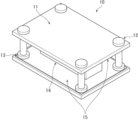
- FIG. 2 is a schematic diagram showing a sample for measuring weight reduction rate B.
- FIG. 2 is a schematic diagram showing a sample for a tensile test when measuring adhesive strength.
- the thermally conductive member of the present invention includes a polymer matrix, a phase change material having a melting point of more than 25° C. and not more than 120° C., and a thermally conductive filler.
- the thermally conductive member of the present invention can be obtained by curing a thermally conductive composition described below.
- the thermally conductive member of the present invention can exhibit excellent reworkability by heating it to a temperature equal to or higher than the melting point of the phase-change material.
- the thermally conductive member of the present invention is temporarily heated above the melting point of the phase change material during actual use, when it is cooled again below the melting point of the phase change material, the phase change material will solidify again, resulting in almost no decrease in adhesive strength compared to before heating.
- the thermal conductive member of the present invention has a weight loss rate B (hereinafter also simply referred to as "weight loss rate B") of 0.05% or more and 3.0% or less when the thermal conductive member is sandwiched between glass cloth films, compressed by 10%, and left at 90 ° C. for 40 hours. If the weight loss rate B is less than 0.05%, the bleed-out of the liquefied phase change material is insufficient, and there is a risk that the reworkability cannot be fully exhibited after the thermal conductive member is bonded.
- weight loss rate B hereinafter also simply referred to as "weight loss rate B”
- the weight loss rate B exceeds 3.0%, the bleed-out of the liquefied phase change material becomes excessive, and for example, when the thermal conductive member is used in a structure described later, the heating element or heat sink may be contaminated, which may cause a malfunction of the heating element or heat sink.
- the weight loss rate B is preferably 0.1% or more and 2.0% or less, and more preferably 0.2% or more and 1.5% or less.
- the weight reduction rate B can be adjusted to a desired range by, for example, the type, melting point, and content of the phase change material.
- the weight reduction rate B can be determined by the following method. 1, a sample 14 made of the thermally conductive member produced in each of the Examples and Comparative Examples is sandwiched between glass cloth films 15 attached to a compression jig 11, and the sample 14 is compressed by 10% by tightening the screws 12 fixed to the spacers 13 to obtain a measurement sample 10. Thereafter, the measurement sample 10 is left in an environment at 90° C. for 40 hours. After the above-mentioned leaving, the measurement sample 10 is returned to room temperature (25°C), the sample 14 is removed from the compression jig 11 to which the glass cloth film 15 is attached, and the weight of the sample 14 is measured and used as the weight of the sample 14 after leaving.
- Weight reduction rate B (%) (weight (g) of sample 14 before being left standing ⁇ weight (g) of sample 14 after being left standing)/weight (g) of sample 14 before being left standing ⁇ 100
- the thermally conductive member of the present invention preferably has an elastic modulus at 25° C. (hereinafter referred to as “G25”) and an elastic modulus at 90° C. (hereinafter referred to as “G90”) that satisfy the relationship of the following formula (1).
- the elastic modulus of the thermal conductive member is greatly reduced by heating the thermal conductive member, and excellent reworkability is easily achieved.
- G25/G90 is more preferably 2.3 or more, and even more preferably 4.5 or more. From the viewpoint of reworkability, the higher the G25/G90, the better, and there is no particular upper limit.
- the elastic modulus in the present invention is a storage elastic modulus measured using a rheometer under the conditions of 1% strain and 1 Hz frequency. Specifically, G25 and G90 can be measured by the method described in the Examples.
- G90 is preferably 800,000 Pa or less, more preferably 500,000 Pa or less, and even more preferably 300,000 Pa or less.
- G25/G90 is set to a certain level or more, and excellent reworkability is easily achieved.
- G25 is preferably 40000 Pa or more, more preferably 50000 Pa or more, and even more preferably 60000 Pa or more. When G25 is equal to or more than the lower limit, excellent reworkability is easily achieved by making G25/G90 equal to or more than a certain value.
- G25 is preferably 1000000 Pa or less, more preferably 950000 Pa or less, and even more preferably 920000 Pa or less, from the viewpoint of easily imparting an appropriate adhesive strength in a 25°C environment.
- the elastic modulus can be adjusted to a desired range by, for example, the type, melting point, and content of the phase change material, the type of the polymer matrix, and the like.
- the thermally conductive member of the present invention preferably has weight reduction rate B, G25, and G90 that satisfy the relationship of the following formula (2).
- B/(G90/G25) When the ratio of the weight reduction rate B to G90/G25 (B/(G90/G25)) is 0.001 or more, excellent reworkability is easily exhibited. On the other hand, if B/(G90/G25) is 1.0 or less, contamination of the heat generating body or heat dissipating body can be easily prevented when the thermal conductive member is used in, for example, a structure described later. Furthermore, by having B/(G90/G25) be 1.0 or less, G90/G25 does not become too small, the rate of decrease in the elastic modulus of the thermal conductive member when heated is suppressed to a certain level or less, and the adhesive strength of the thermal conductive member after it is once heated and then cooled is easily maintained at a certain level or more. From the above viewpoints, B/(G90/G25) is more preferably 0.002 or more and 0.5 or less, even more preferably 0.005 or more and 0.1 or less, and even more preferably 0.011
- the thermal conductivity of the thermally conductive member is preferably 1.0 W/m ⁇ K or more, more preferably 1.5 W/m ⁇ K or more, and even more preferably 2.0 W/m ⁇ K or more.
- the thermal conductivity is good. Therefore, for example, when used as a gap material in a battery cell module, the heat generated from the battery cell can be efficiently transferred to the module housing via the gap material, and an excessive increase in the temperature of the battery cell can be suppressed.
- the higher the thermal conductivity of the thermally conductive member the better, but in practical use, it is, for example, 15 W/m ⁇ K or less.
- the thermal conductivity is measured in accordance with ASTM D5470.
- the thermally conductive member of the present invention includes a phase change material having a melting point of more than 25°C and not more than 120°C. If the melting point of the phase change material is 25°C or less, the adhesive strength may decrease during the actual use of the thermally conductive member, for example, during use in a structure described later. In addition, the phase change material may bleed out from the thermally conductive member, and the heating element or heat sink may be contaminated by the phase change material, and this risk increases especially in the summer. In addition, if the melting point exceeds 120°C, it is necessary to heat the thermally conductive member to a high temperature when reworking it, and the high temperature during reworking may cause problems with the heating element or heat sink.
- the melting point of the phase change material is preferably 30°C or higher and 100°C or lower, more preferably 40°C or higher and 85°C or lower, and further preferably 50°C or higher and 80°C or lower.
- the melting points of the phase change materials can be measured by heating the measurement sample at a heating rate of 10° C./min using a differential scanning calorimeter (DSC) as described in the Examples.
- the melting points of the phase change materials referred to here are melting points measured using thermally conductive members containing each phase change material as the measurement sample.
- the phase change material contained in the thermally conductive member of the present invention is preferably at least one selected from ester compounds and hydrocarbon compounds.
- the ester compound may be a monoester having one ester group, or may be one having two or more ester groups such as a diester, but is preferably a monoester having 12 to 44 carbon atoms.
- a monoester having a carbon number within the above range the melting point of the phase change material can be set within a predetermined range, and a thermally conductive member with excellent reworkability can be obtained. From this perspective, the carbon number of the monoester is more preferably 15 to 44, even more preferably 25 to 44, and even more preferably 28 to 40.
- the ester compound is preferably an ester of a fatty acid and an alcohol.
- the number of carbon atoms in the fatty acid is preferably from 2 to 25, more preferably from 7 to 22, and further preferably from 12 to 18.
- the number of carbon atoms in the fatty acid means the total number of carbon atoms including the carbonyl carbon of the carboxyl group.
- the alcohol may be an alcohol having one hydroxyl group or an alcohol having two or more hydroxyl groups.
- the number of carbon atoms of the alcohol is preferably 2 or more and 25 or less, more preferably 4 or more and 22 or less, and even more preferably 12 or more and 18 or less.
- esters of monocarboxylic acids and alcohols having one hydroxyl group are preferred.
- ester compound examples include stearyl stearate, pentaerythritol distearate, cetyl myristate, myristyl stearate, behenyl behenylate, glycerin monostearyl ester, and ethylene glycol distearyl ester.
- at least one selected from stearyl stearate, cetyl myristate, and behenyl behenylate is preferred.
- stearyl stearate is more preferred from the viewpoint of obtaining the melting point most suitable for reworking the thermally conductive member.
- the ester compounds may be used alone or in combination of two or more kinds.
- the hydrocarbon compound is not particularly limited as long as it has a melting point of more than 25° C. and not more than 120° C., but is preferably an aliphatic hydrocarbon, more preferably paraffin, and further preferably a linear aliphatic hydrocarbon.
- linear aliphatic hydrocarbons examples include n-octadecane (melting point 28° C.), n-nonadecane (melting point 32° C.), n-eicosane (melting point 37° C.), n-henicosane (melting point 40° C.), n-docosane (melting point 44° C.), n-tricosane (melting point 48-50° C.), n-tetracosane (melting point 52° C.), n-pentacosane (melting point 53-56° C.), n-hexacosane (melting point 55-58° C.), n-heptacosane (melting point 60° C.), n-octacosane (melting point 62° C.), and n-nonacosane (melting point 63° C.).
- Examples of such compounds include tritriacontane (melting point 63 to 66° C.), n-triacontane (melting point 66° C.), n-tetratriacontane (melting point 73° C.), pentatriacontane (melting point 75° C.), n-hexatriacontane (melting point 74 to 76° C.), n-heptatriacontane (melting point 77 to 79° C.), n-octatriacontane (melting point 77° C.), n-nonatriacontane (melting point 80 to 82° C.), n-tetracontane (melting point 81° C.), and n-hentetracontane (melting point 74 to 76° C.).
- the hydrocarbon compounds may be used alone or in combination of two or more.
- the thermally conductive member of the present invention preferably uses an ester compound as the phase change material.
- ester compounds Compared to hydrocarbon compounds, ester compounds have relatively low compatibility with polymer matrices, so when an ester compound is included as a phase change material, the ester compound is more likely to bleed out when the thermally conductive member is heated, making it easier to impart excellent reworkability to the thermally conductive member.
- a predetermined amount can be bled out with a small amount of addition, making it easier to relatively increase the content of other components. For example, increasing the content of the polymer matrix makes it easier to increase mechanical strength and adhesiveness, and increasing the content of the thermally conductive filler makes it easier to increase thermal conductivity.
- the content of the phase change material is preferably 10 parts by mass or more and 70 parts by mass or less, more preferably 15 parts by mass or more and 70 parts by mass or less, and even more preferably 20 parts by mass or more and 67 parts by mass or less, per 100 parts by mass of the polymer matrix.
- the content of the phase change material is equal to or more than the lower limit, it becomes easier to impart excellent reworkability to the thermal conductive member.
- the content of the phase change material is equal to or less than the upper limit, the amount of phase change material that bleeds out during rework of the thermal conductive member is suppressed to a certain level or less, thereby preventing contamination of the heating element and heat sink.
- the phase change material may be contained in the thermally conductive member in a powder state, or may be mixed with a compatibilizer, for example, and incorporated into the thermally conductive member in a state where it is dissolved in a polymer matrix. However, it is preferable to contain the phase change material in a powder state in the thermally conductive member.
- the phase change material can be contained in the thermal conductive member in a powder state by mixing the powder state with a liquid polymer without dissolving it in a compatibilizer, etc.
- the phase change material By containing the phase change material in a powder state, it is not necessary to use a compatibilizer, so the proportion of the polymer matrix in the thermal conductive member can be increased, and the phase change material can be contained in the thermal conductive member without reducing the adhesiveness or mechanical strength of the thermal conductive member. Furthermore, when the phase change material is contained in the thermally conductive member in a powder state, it is preferable not to heat the thermally conductive composition to a temperature equal to or higher than the melting point of the phase change material when preparing the thermally conductive composition, and it is more preferable to prepare the thermally conductive composition at a temperature 10° C. or more lower than the melting point of the phase change material.
- the thermally conductive member of the present invention contains a polymer matrix, which is obtained by curing a liquid polymer.
- the liquid polymer is a polymer that is liquid at room temperature (25° C.), and examples thereof include raw materials for obtaining a polymer matrix such as silicone rubber and polyurethane resin.
- the liquid polymer may be a non-reactive compound having no reactive groups, or a reactive compound having reactive groups, such as alkenyl groups, hydrosilyl groups, hydroxyl groups, and isocyanate groups.
- liquid polymers examples include organopolysiloxane, polyol, polyisocyanate, and the like.
- the liquid polymer may be a single component or a mixture of two or more components.
- organopolysiloxane is preferred as the liquid polymer.
- the polymer matrix constituting the thermally conductive member of the present invention is preferably a cured product of organopolysiloxane.
- the organopolysiloxane may be, for example, an organopolysiloxane having a reactive group, or an organopolysiloxane having no reactive group, but is preferably an organopolysiloxane having a reactive group.
- the organopolysiloxane having a reactive group is an organopolysiloxane having a reactive group capable of forming a crosslinked structure, and examples thereof include addition reaction curing silicone, radical reaction curing silicone, condensation reaction curing silicone, ultraviolet or electron beam curing silicone, and moisture curing silicone.
- the organopolysiloxane having a reactive group is preferably an addition reaction curing silicone.
- the polymer matrix constituting the thermally conductive member of the present invention is a cured product of an organopolysiloxane, it is preferably a cured product of an addition reaction curing silicone.
- the addition reaction curing type silicone is more preferably one containing an alkenyl group-containing organopolysiloxane (base resin) and a hydrogen organopolysiloxane (curing agent).
- the above-mentioned alkenyl group-containing organopolysiloxane is preferably an organopolysiloxane having at least two alkenyl groups in one molecule.
- the alkenyl group is not particularly limited, but may be, for example, one having 2 to 8 carbon atoms, such as vinyl group, allyl group, butenyl group, pentenyl group, hexenyl group, heptenyl group, octenyl group, etc.
- the alkenyl group-containing organopolysiloxane may be used alone or in combination of two or more.
- the hydrogen organopolysiloxane is preferably a hydrogen organopolysiloxane having at least two hydrosilyl groups in one molecule.
- the hydrosilyl group means a hydrogen atom bonded to a silicon atom (SiH group).
- the hydrogen organopolysiloxane may be used alone or in combination of two or more.
- the addition reaction curing silicone reacts and cures by addition reaction to form a matrix made of silicone rubber. Since silicone rubber is easily deformed by compression, the cured product formed from the thermally conductive composition of the present invention can be easily assembled between a heat generating body and a heat sink.
- the thermally conductive member of the present invention contains a thermally conductive filler.
- the thermally conductive filler include metals, metal oxides, metal nitrides, metal hydroxides, carbon materials, oxides, nitrides, carbides, etc.
- the shape of the thermally conductive filler includes spherical and amorphous powders.
- examples of metals include aluminum, copper, nickel, etc.
- examples of metal oxides include aluminum oxide, magnesium oxide, zinc oxide, etc., such as alumina
- examples of metal nitrides include aluminum nitride.
- metal hydroxides examples include aluminum hydroxide.
- carbon materials include spherical graphite and diamond.
- oxides, nitrides, and carbides other than metals include quartz, boron nitride, and silicon carbide.
- aluminum oxide and aluminum hydroxide are preferred as thermally conductive fillers, and it is preferred to use aluminum oxide and aluminum hydroxide in combination.
- the average particle size of the thermally conductive filler is preferably 0.1 ⁇ m or more and 200 ⁇ m or less, more preferably 0.3 ⁇ m or more and 100 ⁇ m or less, and even more preferably 0.5 ⁇ m or more and 70 ⁇ m or less. It is preferable to use a small-particle-size thermally conductive filler having an average particle size of 0.1 ⁇ m or more and 5 ⁇ m or less in combination with a large-particle-size thermally conductive filler having an average particle size of more than 5 ⁇ m and 200 ⁇ m or less in combination as the thermally conductive filler. By using thermally conductive fillers with different average particle sizes, the filling rate can be increased.
- the average particle size of the thermally conductive filler can be measured by observation with an electron microscope, etc. More specifically, for example, the particle sizes of 200 arbitrary thermally conductive fillers can be measured using an electron microscope or an optical microscope, and the average value (arithmetic mean value) can be regarded as the average particle size.
- the content of the thermally conductive filler is preferably 100 parts by mass or more and 3,000 parts by mass or less, more preferably 200 parts by mass or more and 2,000 parts by mass or less, and even more preferably 500 parts by mass or more and 1,600 parts by mass or less, relative to 100 parts by mass of the combined amount of the polymer matrix and the phase change material.
- the content of the thermally conductive filler is preferably 100 parts by mass or more and 3,000 parts by mass or less, more preferably 200 parts by mass or more and 2,000 parts by mass or less, and even more preferably 500 parts by mass or more and 1,600 parts by mass or less, relative to 100 parts by mass of the combined amount of the polymer matrix and the phase change material.
- the thermally conductive member of the present invention may contain a dispersant.
- a dispersant By containing a dispersant, it becomes easier to disperse the thermally conductive filler in the polymer matrix, and it becomes easier to impart excellent thermal conductivity to the thermally conductive member.
- a silicon compound is preferable, and at least one selected from the group consisting of an alkoxysilane compound and an alkoxysiloxane compound is more preferable.
- alkoxysilane compounds include methyltrimethoxysilane, dimethyldimethoxysilane, diethyldimethoxysilane, trimethylmethoxysilane, methyltriethoxysilane, dimethyldiethoxysilane, ethyltrimethoxysilane, n-propyltrimethoxysilane, di-n-propyldimethoxysilane, di-n-propyldiethoxysilane, isobutyltrimethoxysilane, isobutyltriethoxysilane, isobutyltrimethoxysilane, isobutyltriethoxysilane, n-hexyltrimethoxysilane, n-hexyltriethoxysilane, methylcyclohexyldimethoxysilane, methylcyclohexyldiethoxysilane, n-octyltrimethoxysilane,
- n-decyltrimethoxysilane, dimethyldimethoxysilane, and n-octyltriethoxysilane are preferred, and n-decyltrimethoxysilane is more preferred.
- alkoxysiloxane compounds include methyl methoxy siloxane oligomer, methyl phenyl methoxy siloxane oligomer, methyl epoxy methoxy siloxane oligomer, methyl mercapto methoxy siloxane oligomer, and methyl acryloyl methoxy siloxane oligomer.
- the dispersant may be used alone or in combination.
- the content of the dispersant is preferably 0.1 parts by mass or more, more preferably 0.5 parts by mass or more, and preferably 5 parts by mass or less, more preferably 3 parts by mass or less, and even more preferably 2 parts by mass or less, relative to 100 parts by mass of the polymer matrix.
- the content of the dispersant is equal to or more than these lower limits, the thermally conductive filler can be easily dispersed in the polymer matrix.
- the content of the dispersant is equal to or less than these upper limit values, a decrease in the heat resistance of the thermal conductive member can be suppressed.
- the dispersant particularly the alkoxysilane compound, may function as a compatibilizer, which will be described later.
- the alkoxysilane compound such as n-decyltrimethoxysilane is volatile, bubbles originating from the alkoxysilane compound may be generated in the thermal conductive member, but by setting the content to the above upper limit or less, the generation of bubbles originating from the alkoxysilane compound is suppressed.
- the thermally conductive member of the present invention preferably contains a catalyst for curing the liquid polymer.
- a catalyst for curing the liquid polymer for example, when the liquid polymer is an addition reaction curable silicone, an addition reaction catalyst such as a platinum catalyst can be used as the catalyst.
- the thermally conductive member may also contain a compatibilizer as described above.
- the compatibilizer is not particularly limited as long as it is a compound that is compatible with a liquid polymer at room temperature (25°C), but is preferably an ester compound that is liquid at 25°C.
- the ester compound used as the compatibilizer may be a monoester or a diester, but is preferably a monoester.
- the ester compound used as the compatibilizer may be, for example, an ester of a fatty acid such as a saturated aliphatic acid and an alcohol such as an alkanol, and examples of the ester compound used as the compatibilizer include octyl laurate, 1-methylheptyl laurate, isopropyl myristate, 1-methylheptyl myristate, and isopropyl palmitate.
- the thermally conductive member may contain additives other than those mentioned above. Examples of such additives include a flame retardant, an antioxidant, and a colorant.
- the thermally conductive composition of the present invention contains a liquid polymer that is a precursor of a polymer matrix, a phase change material having a melting point greater than 25°C and less than or equal to 120°C, and a thermally conductive filler, and the thermally conductive member is obtained by curing the thermally conductive composition.
- a liquid polymer that is a precursor of a polymer matrix
- a phase change material having a melting point greater than 25°C and less than or equal to 120°C
- a thermally conductive filler a thermally conductive filler
- the content of each component in the thermally conductive composition is the same as the content of each component in the thermally conductive member, but the standard amount is 100 parts by mass of liquid polymer instead of 100 parts by mass of polymer matrix.
- the thermally conductive composition of the present invention may contain various additives such as the above-mentioned dispersants, catalysts, and compatibilizers, in addition to the above-mentioned components.
- the thermally conductive composition of the present invention has a weight loss rate B of 0.05% or more and 3.0% or less when the cured product is sandwiched between glass cloth films, compressed by 10%, and left for 40 hours at 90° C.
- the weight loss rate B is preferably 0.1% or more and 2.0% or less, and more preferably 0.2% or more and 1.5% or less.
- the weight loss rate of the cured product of the thermally conductive composition can be obtained by measuring a cured product sample obtained by curing the thermally conductive composition by the same method as that for the thermally conductive member.
- the cured product sample is preferably a substantially completely cured thermally conductive composition, and may be cured by leaving it at room temperature for a long period of time, as described in the examples described later.
- the cured product of the thermally conductive composition of the present invention is similar to the thermally conductive member with respect to G25, G90, the ratio of G25 to G90 (G25/G90), and the ratio of the weight reduction rate B to G90/G25 [B/(G90/G25)], and therefore the description thereof will be omitted.
- the thermally conductive composition of the present invention preferably has a viscosity of 400 Pa ⁇ s or more and 50,000 Pa ⁇ s or less, more preferably 500 Pa ⁇ s or more and 30,000 Pa ⁇ s or less, and even more preferably 800 Pa ⁇ s or more and 100,000 Pa ⁇ s or less, measured by a rheometer at a measurement temperature of 25° C. and a shear rate of 0.1 (1/s). If the viscosity of the thermally conductive composition is equal to or more than the lower limit, the viscosity becomes too low and dripping or the like can be prevented. If the viscosity of the thermally conductive composition is equal to or less than the upper limit, workability such as coatability can be easily improved.
- the thermally conductive composition of the present invention preferably has an adhesive strength after heating to 90°C (hereinafter also referred to as "adhesive strength after heating") of 80% or less, more preferably 75% or less, and even more preferably 40% or less, based on the initial adhesive strength when the thermally conductive composition is used to adhere to an adherend, which is taken as 100%.
- the initial adhesive strength is the adhesive strength at room temperature (25° C.) of a sample obtained by bonding a specific adherend described in the Examples via a thermally conductive composition and curing the thermally conductive composition.
- the post-heating adhesive strength is the adhesive strength after the sample is heated to 90° C.
- the post-heating adhesive strength when the initial adhesive strength is taken as 100% is not particularly limited, but is preferably 3% or more, more preferably 5% or more, and even more preferably 8% or more. If the post-heating adhesive strength when the initial adhesive strength is taken as 100% is set to a certain level or more, it is possible to prevent the adhesive strength from decreasing significantly even when used in a high-temperature environment. In addition, it is easy to make the post-recovery adhesive strength described later to be a certain level or more.
- the initial adhesive strength, the adhesive strength after heating, and the adhesive strength after recovery described below can all be measured by the method described in the Examples.
- the thermally conductive composition of the present invention preferably has an initial adhesive strength of 0.05 MPa or more, more preferably 0.08 MPa or more, and even more preferably 0.1 MPa or more.
- the initial adhesive strength is not particularly limited, but from the viewpoint of appropriately controlling the adhesive strength of the thermal conductive member and improving handleability, it is, for example, 2.0 MPa or less, preferably 1.0 MPa or less, and more preferably 0.5 MPa or less.
- the thermally conductive composition of the present invention preferably has a post-heating adhesive strength of 0.2 MPa or less, more preferably 0.15 MPa or less, and even more preferably 0.07 MPa or less.
- the post-heating adhesive strength is equal to or less than the above upper limit, excellent reworkability is easily achieved.
- the post-heating adhesive strength is preferably 0.003 MPa or more, more preferably 0.005 MPa or more, and even more preferably 0.008 MPa or more.
- the post-heating adhesive strength is the adhesive strength in a heated temperature environment.
- the thermally conductive composition of the present invention preferably has a ratio (post-recovery adhesive strength/initial adhesive strength) of the adhesive strength when heated to 90° C. and then cooled to 25° C. (hereinafter also referred to as "post-recovery adhesive strength") to the initial adhesive strength of 0.7 or more, more preferably 1 or more, and even more preferably 1.05 or more.
- post-recovery adhesive strength/initial adhesive strength is equal to or more than the above lower limit, the thermally conductive member has excellent reworkability and can maintain good adhesive strength even when heated to high temperatures during use.
- the ratio of recovered adhesive strength/initial adhesive strength is not particularly limited, but from the viewpoint of appropriately controlling the adhesive strength of the thermal conductive member and improving handleability, it is, for example, 1.7 or less, and preferably 1.4 or less.
- the post-recovery adhesive strength is preferably 0.05 MPa or more, more preferably 0.08 MPa or more, and even more preferably 0.1 MPa or more. When the post-recovery adhesive strength is equal to or more than the lower limit, the thermal conductive member is likely to exhibit excellent adhesiveness.
- the upper limit of the post-recovery adhesive strength is preferably 2.0 MPa or less, more preferably 1.0 MPa or less, and even more preferably 0.5 MPa or less.
- the above-mentioned adhesive strength after heating and adhesive strength after recovery are shown when a phase change material having a melting point of 85°C or less is used, but the adhesive strength after heating and adhesive strength after recovery of a thermally conductive member using a phase change material having a melting point of more than 85°C and not more than 120°C can be improved by heating to 130°C instead of 90°C.
- the thermally conductive composition of the present invention may be in the form of a one-component type or a two-component type comprising a first part and a second part, but from the viewpoint of storage stability, the two-component type is preferred.
- the mass ratio of the first agent to the second agent is preferably 1 or a value close to 1, specifically, 0.9 or more and 1.1 or less, and more preferably 0.95 or more and 1.05 or less. In this way, by making the mass ratio of the first agent to the second agent a value of 1 or close to 1, the preparation of the thermally conductive composition becomes easy.
- the viscosity ratio of the first agent to the second agent is also preferably 1 or a value close to 1, specifically, 0.5 or more and 2.0 or less, and more preferably 0.8 or more and 1.2 or less. In this way, by making the viscosity ratio of the first agent to the second agent a value of 1 or close to 1, the thermally conductive composition can be easily mixed uniformly.
- the first part contains the alkenyl group-containing organopolysiloxane (base), and the second part contains the hydrogen organopolysiloxane (curing agent).
- the addition reaction catalyst is contained in the first agent, but not in the second agent.
- the phase change material may be contained in at least one of the first and second agents, but is preferably contained in both the first and second agents. If the phase change material is contained in both the first and second agents, it becomes easier to disperse the phase change material uniformly in the polymer matrix.
- the thermally conductive filler may be contained in at least one of the first agent and the second agent, but is preferably contained in both the first agent and the second agent. When the thermally conductive filler is contained in both the first agent and the second agent, the first agent and the second agent are easily mixed.
- the mass ratio and the viscosity ratio of the second agent to the first agent when preparing the thermally conductive composition can be set to 1 or close to 1, making it easy to use as a two-liquid type.
- the second agent preferably contains an alkenyl group-containing organopolysiloxane.
- the mass ratio and viscosity ratio of the second agent to the first agent when preparing the thermally conductive composition can be easily adjusted to 1 or a value close to 1.
- the first agent does not contain the hydrogen organopolysiloxane as the curing agent.
- the viscosity of each of the first and second agents is preferably 400 Pa ⁇ s or more and 50,000 Pa ⁇ s or less, more preferably 500 Pa ⁇ s or more and 30,000 Pa ⁇ s or less, and even more preferably 800 Pa ⁇ s or more and 100,000 Pa ⁇ s or more. If the viscosity of the first and second agents is equal to or more than the above lower limit, it is possible to prevent the viscosity from becoming too low and causing dripping, etc. Furthermore, if the viscosity of the first and second agents is equal to or less than the above upper limit, it is easier to improve workability, such as applicability.
- the first and second agents are preferably stored separately in containers such as syringes, cartridges, pails, drums, etc.
- syringes When syringes are used, they are preferably stored as a first syringe filled with the first agent and a second syringe filled with the second agent.
- the first and second syringes may be arranged in parallel to form a two-liquid parallel type syringe.
- the first syringe may be the first container and the second syringe may be the second container.
- the first and second agents are preferably stored as a first cartridge filled with the first agent, and a second cartridge filled with the second agent.
- the first and second cartridges may be arranged in parallel to form a two-liquid parallel type cartridge.
- the first and second agents are preferably stored as a first pail or drum filled with the first agent, and a second pail or drum filled with the second agent.
- the first agent and the second agent are discharged from the first syringe or the first cartridge and the second syringe or the second cartridge, respectively, and mixed with a static mixer or the like to obtain a thermally conductive composition, which can then be cured to form a thermally conductive member.
- a certain shear force is generated, which reduces the viscosity of the first agent and the second agent, making it easier to discharge.
- the coating formed by discharging is easy to compress and has excellent workability. For example, after discharging a mixture of the first agent and the second agent between a heating element and a heat dissipating element to form a coating of a certain thickness, it becomes easy to stretch the coating thinly with a small load.
- the method for producing the thermally conductive composition of the present invention is not particularly limited, but may be prepared by mixing a liquid polymer, a phase change material, and other optional components such as additives as necessary.
- a known mixing method may be appropriately adopted, and for example, a known kneader, kneading roll, mixer, etc. may be used for mixing.
- the components constituting the first and second agents are mixed to prepare the first and second agents, and then the first and second agents are mixed to obtain the thermally conductive composition.
- the phase change material is preferably dissolved in the compatibilizer and then mixed with the other components.
- the thermally conductive member of the present invention can be used for various applications, for example, batteries, electronic devices, semiconductor devices, etc., and is preferably used for batteries.
- the thermally conductive member is filled between battery cells, between a battery cell and a battery module case, between a battery cell and a battery pack case, between a battery cell and a cooling plate, between a battery module case and a cooling plate, or between a battery pack case and a cooling plate, and the filled gap material may be in close contact with the battery cell, the battery module case, the battery pack case, or the cooling plate.
- the gap material between the battery cells has the function of maintaining the battery cells spaced apart from each other.
- the gap material between the battery cell and the battery module case, between the battery cell and the battery pack case, or between the battery cell and the cooling plate is in close contact with both the battery cell and the battery module case, the battery pack case, or the cooling plate, and has the function of transferring heat generated in the battery cell to the battery module case, the battery pack case, or the cooling plate.
- the thermally conductive member When the thermally conductive member is used for battery applications, it is not particularly limited, but is preferably used in automobiles, and more preferably used in automobiles equipped with lithium ion batteries.
- the thermally conductive member of the present invention has excellent reworkability, so that, for example, when a battery assembled to a chassis of an automobile needs to be repaired or replaced, it is possible to remove only the defective part (e.g., a defective battery module) without applying excessive load to the battery cell, battery module, and other peripheral parts. Furthermore, since no large-scale equipment is required for rework, it is also advantageous in terms of cost.
- the thermally conductive member when peeling off the thermally conductive member, the thermally conductive member is heated to a certain degree, but the thermally conductive member can be peeled off without heating it to a very high temperature, so that the thermally conductive member can be peeled off without causing any problems in the electrolyte of the battery due to high temperature heat. Furthermore, as described above, even if the thermally conductive member of the present invention is temporarily heated, after cooling the adhesive strength hardly decreases compared to before heating, so that the adhesive strength can be prevented from decreasing even if a battery or the like is temporarily heated to a high temperature during use.
- the present invention also provides a structure including a heat generating body, a heat sink, and a thermally conductive member that bonds the heat generating body and the heat sink. More specifically, two types of structures according to the following first and second embodiments are provided.
- the thermally conductive member included in the structure includes a polymer matrix, a phase change material having a melting point greater than 25° C. and less than or equal to 120° C., and a thermally conductive filler.
- a structure in which a heat conductive member included in the structure is cut into a shape of 20 mm ⁇ 20 mm and a thickness of 2 mm, the heat conductive member cut into this shape is sandwiched between glass cloth films, compressed by 10%, and left at 90°C for 40 hours, and the weight reduction rate B of the heat conductive member is 0.05% or more and 3.0% or less.
- a structure in which the adhesive strength between the heating element and the heat sink at 25°C is 0.05 MPa or more and 2.0 MPa or less, and the adhesive strength after heating between the heating element and the heat sink at 90°C is smaller than the above adhesive strength and is 0.2 MPa or less.
- the configuration of the thermally conductive member included in the structure according to the first and second embodiments is as described above, and therefore a detailed description thereof will be omitted.
- the adhesive strength between the heating element and the heat sink at 25°C and the adhesive strength after heating at 90°C can be measured in accordance with the measurement method for adhesive strength and adhesive strength after heating shown in the examples.
- the heat generating element may be, for example, a battery cell, a CPU used inside an electronic device, a power amplifier, a power supply, or other various electronic components
- the heat dissipating element may be, for example, a battery module case, a battery pack case, a cooling plate, a heat sink, a heat pump, or a metal housing for an electronic device, but it is preferable that the heat generating element is a battery cell and the heat dissipating element is a battery module case, a battery pack case, or a cooling plate.
- the thermally conductive member may function as a gap material.
- a thermally conductive member is disposed inside the battery module case or battery pack case.
- the present invention also provides a method for reworking a structure including a heat generating body, a heat sink, and a thermally conductive member disposed between the heat generating body and the heat sink.
- the configurations of the thermally conductive member, the heat generating body, and the heat sink are as described above, and therefore detailed description thereof will be omitted.
- the structure may be reworked by heating the structure to a temperature equal to or higher than the melting point of the phase change material, and then peeling off the heat generating body and the heat dissipating body.
- the heating method is not particularly limited, and may be, for example, heated by a thermostatic bath, a far-infrared heating furnace, or hot air.
- the structure when the heat dissipating body has a structure for circulating a liquid such as a cooling water or a refrigerant, the structure may be heated by circulating a liquid heated to a predetermined temperature.
- the method of circulating a liquid is preferable in that the temperature of the liquid can be easily controlled and heat can be efficiently transferred to the structure, so that excessive heating of the battery can be easily suppressed.
- the structure can be made to exhibit excellent reworkability by heating it to a temperature equal to or higher than the melting point of the phase change material. The principle is unclear, but is presumed to be as follows.
- phase change material When the phase change material is heated to a temperature equal to or higher than its melting point, it becomes liquid, which reduces the elastic modulus of the thermal conductive member, making it easier to peel off the thermal conductive member, and also makes it easier to bleed out of the polymer matrix and localize at the interface between the thermal conductive member and the adherend, resulting in easier interfacial peeling.
- the viscosity of the first and second parts which were the thermally conductive compositions prepared in each of the Examples and Comparative Examples, was measured as follows. The first and second parts were used as samples and the viscosity was measured at a shear rate of 0.1 (1/s) using a rheometer. Specifically, an Anton Paar rheometer MCR-302e equipped with a ⁇ 20 mm parallel plate was used, and the sample was applied to a sample stage, the distance between the parallel plate and the sample stage was adjusted to 1.9 mm, excess sample protruding from the periphery of the parallel plate was removed, and the sample was left at 25° C. for 10 minutes, after which the viscosity was measured.
- the weight reduction rate B was calculated by the method described in the specification.
- a fluororesin-impregnated glass cloth ("FGF-400-2-300w" manufactured by Chukoh Chemical Industry Co., Ltd.) was used, and as the compression jig, a stainless steel plate of 160 mm x 120 mm was used.
- a shape of 20 mm x 20 mm and 2 mm thick was cut out with a cutter from a block-shaped cured product of 20 mm thickness. Then, in each of the examples and comparative examples, the same test was performed twice, and the average value of the two measurements was calculated.
- the thermally conductive members produced in each of the Examples and Comparative Examples were measured for their elastic moduli at 25° C. and 90° C. (G25, G90) by the following measurement method.
- an Anton Paar rheometer MCR-302e equipped with a ⁇ 20 mm parallel plate was used.
- a sample with a thickness of 2 mm was set on the sample stage and compressed so that the gap between the parallel plate and the sample stage was 1.9 mm.
- the sample temperature was then controlled to 25°C and 90°C using a Peltier plate, and the elastic modulus of each sample was measured under conditions of a strain of 1% and a frequency of 1 Hz.
- the ratios G25/G90 and G90/G25 were calculated based on the G25 and G90 obtained by the above measurements.
- the ratio B/(G90/G25) was also calculated based on the weight loss rate B obtained by the above measurements.
- the initial adhesive strength, the adhesive strength after heating to 90°C (post-heating adhesive strength), and the adhesive strength after heating to 90°C and then cooling to 25°C (post-recovery adhesive strength) were each measured using the following measurement method.
- the thermally conductive composition 21 produced in each of the Examples and Comparative Examples was applied to an aluminum jig 22 having a coating surface of 12.7 mm ⁇ 12.7 mm and a thickness of 38.0 mm so that the thickness after curing would be 1.5 mm, and then the applied aluminum jig 22 was attached to an aluminum jig 23 of the same shape, and the composition was left in this state at 25° C.
- the curing conditions at this time were as shown below (described in the procedure of each Example and Comparative Example).
- the initial adhesive strength was measured by a tensile test conforming to JIS K6849 using the above-mentioned measurement sample in an environment of 25° C.
- the post-heat adhesive strength was measured by a tensile test conforming to JIS K6849 using the above-mentioned measurement sample in an environment of 90° C.
- the post-recovery adhesive strength was measured by heating the above-mentioned measurement sample at 90° C. for 30 minutes, leaving it at 25° C. for 60 minutes, cooling it, and then performing a tensile test conforming to JIS K6849 in an environment of 25° C.
- Silicone A agent Contains an alkenyl-containing organopolysiloxane and a small amount of an addition reaction catalyst (platinum catalyst).
- Silicone B agent Contains alkenyl group-containing organopolysiloxane and hydrogen organopolysiloxane.
- phase change material The melting point of the phase change material was measured by weighing 20 mg in an aluminum cell, and then using a Shimadzu DSC-60 under nitrogen flow at a temperature increase rate of 10°C/min from 25°C to 100°C. In addition, the melting point of a phase change material contained in a thermally conductive member was measured by weighing 100 mg of the thermally conductive member in an aluminum cell, and then using the same measurement method.
- Stearyl stearate melting point of 62°C alone, melting point of 58°C in thermally conductive material, carbon number 36
- Cetyl myristate melting point alone is 55°C
- melting point in thermally conductive material is 52°C
- carbon number is 30
- Behenyl behenate melting point alone of 75°C
- Paraffin 1 melting point alone 61°C
- melting point in thermally conductive material 60°C
- Paraffin 2 melting point alone 71°C, melting point in thermally conductive material 70°C
- ⁇ Thermal conductive filler> ⁇ Aluminum oxide, spherical, average particle size 40 ⁇ m - Aluminum hydroxide, irregular shape, average particle size 1 ⁇ m - Aluminum hydroxide, irregular shape, average particle size 10 ⁇ m Aluminum hydroxide, irregular shape, average particle size 100 ⁇ m
- Examples 1 to 10, Comparative Examples 1 to 2 A first agent and a second agent were prepared according to the compositions shown in Tables 1 to 3, and the first agent and the second agent were mixed to obtain a thermally conductive composition.
- the obtained thermally conductive composition was left to stand at 25° C. for 24 hours to harden, thereby obtaining a thermally conductive member.
- the first agent, the second agent, the thermally conductive composition, and the thermally conductive member obtained in each of the examples and comparative examples were used to carry out evaluation tests. The results are shown in Tables 1 to 3.
- the thermally conductive members prepared in the examples had good adhesive strength at room temperature (25°C), but the adhesive strength decreased sufficiently when heated, thereby enabling them to exhibit excellent reworkability.
- the thermally conductive member prepared in the comparative example did not exhibit excellent reworkability because the adhesive strength did not decrease sufficiently when heated.
- the thermally conductive member prepared in the comparative example 2 which contains silicone oil, showed a certain amount of bleeding, but the change in elastic modulus was small, so the adhesive strength did not decrease sufficiently.
Landscapes
- Chemical & Material Sciences (AREA)
- Chemical Kinetics & Catalysis (AREA)
- Organic Chemistry (AREA)
- Health & Medical Sciences (AREA)
- Medicinal Chemistry (AREA)
- Polymers & Plastics (AREA)
- Engineering & Computer Science (AREA)
- Electrochemistry (AREA)
- Manufacturing & Machinery (AREA)
- General Chemical & Material Sciences (AREA)
- Physics & Mathematics (AREA)
- Combustion & Propulsion (AREA)
- Thermal Sciences (AREA)
- Materials Engineering (AREA)
- Compositions Of Macromolecular Compounds (AREA)
- Laminated Bodies (AREA)
- Adhesive Tapes (AREA)
Priority Applications (3)
| Application Number | Priority Date | Filing Date | Title |
|---|---|---|---|
| EP24797140.1A EP4703435A1 (en) | 2023-04-28 | 2024-04-25 | Thermally conductive member, thermally conductive composition, structure, and method for reworking structure |
| JP2024554772A JP7727274B2 (ja) | 2023-04-28 | 2024-04-25 | 熱伝導性部材、熱伝導性組成物、構造体、及び構造体のリワーク方法 |
| CN202480028051.7A CN121057786A (zh) | 2023-04-28 | 2024-04-25 | 导热性构件、导热性组合物、结构体及结构体的再利用方法 |
Applications Claiming Priority (2)
| Application Number | Priority Date | Filing Date | Title |
|---|---|---|---|
| JP2023074821 | 2023-04-28 | ||
| JP2023-074821 | 2023-04-28 |
Publications (1)
| Publication Number | Publication Date |
|---|---|
| WO2024225395A1 true WO2024225395A1 (ja) | 2024-10-31 |
Family
ID=93256600
Family Applications (1)
| Application Number | Title | Priority Date | Filing Date |
|---|---|---|---|
| PCT/JP2024/016306 Ceased WO2024225395A1 (ja) | 2023-04-28 | 2024-04-25 | 熱伝導性部材、熱伝導性組成物、構造体、及び構造体のリワーク方法 |
Country Status (4)
| Country | Link |
|---|---|
| EP (1) | EP4703435A1 (https=) |
| JP (1) | JP7727274B2 (https=) |
| CN (1) | CN121057786A (https=) |
| WO (1) | WO2024225395A1 (https=) |
Citations (7)
| Publication number | Priority date | Publication date | Assignee | Title |
|---|---|---|---|---|
| JP2014028948A (ja) | 2012-07-25 | 2014-02-13 | Hutchinson Sa | シリコーンエラストマーおよびpcmをベースとしたゴム組成物、その調製のための方法、可撓性要素およびそれを組み込んだ熱制御/調節システム |
| WO2016185936A1 (ja) * | 2015-05-15 | 2016-11-24 | ポリマテック・ジャパン株式会社 | 熱伝導性組成物および熱伝導性ペースト |
| WO2019031458A1 (ja) * | 2017-08-10 | 2019-02-14 | デンカ株式会社 | 低誘電率熱伝導性放熱部材 |
| JP2020128463A (ja) * | 2019-02-07 | 2020-08-27 | 信越化学工業株式会社 | 熱伝導性粘着層を有する熱伝導性シリコーンゴムシート |
| WO2022070568A1 (ja) * | 2020-09-30 | 2022-04-07 | 積水ポリマテック株式会社 | 熱伝導性シート、その装着方法及び製造方法 |
| WO2022215510A1 (ja) * | 2021-04-09 | 2022-10-13 | ダウ・東レ株式会社 | 硬化性オルガノポリシロキサン組成物、熱伝導性部材および放熱構造体 |
| WO2023047869A1 (ja) * | 2021-09-27 | 2023-03-30 | 信越化学工業株式会社 | 熱伝導性フィルム |
Family Cites Families (1)
| Publication number | Priority date | Publication date | Assignee | Title |
|---|---|---|---|---|
| US20250277112A1 (en) * | 2021-11-05 | 2025-09-04 | Sekisui Polymatech Co., Ltd. | Thermally conductive composition and thermally conductive member |
-
2024
- 2024-04-25 EP EP24797140.1A patent/EP4703435A1/en active Pending
- 2024-04-25 WO PCT/JP2024/016306 patent/WO2024225395A1/ja not_active Ceased
- 2024-04-25 CN CN202480028051.7A patent/CN121057786A/zh active Pending
- 2024-04-25 JP JP2024554772A patent/JP7727274B2/ja active Active
Patent Citations (7)
| Publication number | Priority date | Publication date | Assignee | Title |
|---|---|---|---|---|
| JP2014028948A (ja) | 2012-07-25 | 2014-02-13 | Hutchinson Sa | シリコーンエラストマーおよびpcmをベースとしたゴム組成物、その調製のための方法、可撓性要素およびそれを組み込んだ熱制御/調節システム |
| WO2016185936A1 (ja) * | 2015-05-15 | 2016-11-24 | ポリマテック・ジャパン株式会社 | 熱伝導性組成物および熱伝導性ペースト |
| WO2019031458A1 (ja) * | 2017-08-10 | 2019-02-14 | デンカ株式会社 | 低誘電率熱伝導性放熱部材 |
| JP2020128463A (ja) * | 2019-02-07 | 2020-08-27 | 信越化学工業株式会社 | 熱伝導性粘着層を有する熱伝導性シリコーンゴムシート |
| WO2022070568A1 (ja) * | 2020-09-30 | 2022-04-07 | 積水ポリマテック株式会社 | 熱伝導性シート、その装着方法及び製造方法 |
| WO2022215510A1 (ja) * | 2021-04-09 | 2022-10-13 | ダウ・東レ株式会社 | 硬化性オルガノポリシロキサン組成物、熱伝導性部材および放熱構造体 |
| WO2023047869A1 (ja) * | 2021-09-27 | 2023-03-30 | 信越化学工業株式会社 | 熱伝導性フィルム |
Also Published As
| Publication number | Publication date |
|---|---|
| CN121057786A (zh) | 2025-12-02 |
| EP4703435A1 (en) | 2026-03-04 |
| JPWO2024225395A1 (https=) | 2024-10-31 |
| JP7727274B2 (ja) | 2025-08-21 |
Similar Documents
| Publication | Publication Date | Title |
|---|---|---|
| JP5423455B2 (ja) | 熱伝導シート、その製造方法及び熱伝導シートを用いた放熱装置 | |
| JP5699556B2 (ja) | 熱伝導シート、熱伝導シートの製造方法、及び放熱装置 | |
| JP5760397B2 (ja) | 熱伝導シート、熱伝導シートの製造方法、及び放熱装置 | |
| JP2014028948A (ja) | シリコーンエラストマーおよびpcmをベースとしたゴム組成物、その調製のための方法、可撓性要素およびそれを組み込んだ熱制御/調節システム | |
| US11214721B2 (en) | Thermally conductive composite silicone rubber sheet and method for manufacturing same | |
| JP2010132866A (ja) | 熱伝導シート、この熱伝導シートの製造方法及び熱伝導シートを用いた放熱装置 | |
| CN109397797A (zh) | 导热片、导热片的制作方法、以及散热装置 | |
| JP7467017B2 (ja) | 熱伝導性シリコーン組成物及びその硬化物 | |
| EP3428221A1 (en) | Thermally-conductive composition, thermally-conductive sheet, and method for producing thermally-conductive sheet | |
| KR20240004493A (ko) | 경화성 오르가노폴리실록산 조성물 및 반도체 장치 | |
| JPWO2020050334A1 (ja) | 熱伝導性シート | |
| KR20220121805A (ko) | 열전도성 실리콘 조성물 | |
| WO2023080202A1 (ja) | 熱伝導性組成物、及び熱伝導性部材 | |
| EP4446376A1 (en) | Curable composition | |
| JP2023016821A (ja) | 熱伝導性組成物、熱伝導性部材、バッテリモジュール | |
| JP7727274B2 (ja) | 熱伝導性部材、熱伝導性組成物、構造体、及び構造体のリワーク方法 | |
| EP4502102A1 (en) | Thermally-conductive composition, two-part thermally-conductive material, delivery form of thermally-conductive composition, thermally-conductive member, battery module, and method for manufacturing delivery form of thermally-conductive composition | |
| KR20250086764A (ko) | 경화성 오르가노폴리실록산 조성물 및 반도체 장치 | |
| WO2022163192A1 (ja) | 熱伝導性シート、その装着方法及び製造方法 | |
| WO2022210422A1 (ja) | 熱伝導性組成物、熱伝導性部材、バッテリモジュール | |
| JP6561410B2 (ja) | 熱伝導性組成物および熱伝導性部材 | |
| WO2025206350A1 (ja) | 共重合体化合物、樹脂組成物 | |
| EP4660243A1 (en) | Curable composition and thermally conductive member | |
| JP2024098493A (ja) | 粘土状熱伝導性組成物 | |
| KR20240031111A (ko) | 조성물 |
Legal Events
| Date | Code | Title | Description |
|---|---|---|---|
| WWE | Wipo information: entry into national phase |
Ref document number: 2024554772 Country of ref document: JP |
|
| 121 | Ep: the epo has been informed by wipo that ep was designated in this application |
Ref document number: 24797140 Country of ref document: EP Kind code of ref document: A1 |
|
| WWE | Wipo information: entry into national phase |
Ref document number: 2024797140 Country of ref document: EP |
|
| NENP | Non-entry into the national phase |
Ref country code: DE |
|
| ENP | Entry into the national phase |
Ref document number: 2024797140 Country of ref document: EP Effective date: 20251128 |
|
| ENP | Entry into the national phase |
Ref document number: 2024797140 Country of ref document: EP Effective date: 20251128 |
|
| ENP | Entry into the national phase |
Ref document number: 2024797140 Country of ref document: EP Effective date: 20251128 |
|
| ENP | Entry into the national phase |
Ref document number: 2024797140 Country of ref document: EP Effective date: 20251128 |
|
| ENP | Entry into the national phase |
Ref document number: 2024797140 Country of ref document: EP Effective date: 20251128 |
|
| ENP | Entry into the national phase |
Ref document number: 2024797140 Country of ref document: EP Effective date: 20251128 |
|
| ENP | Entry into the national phase |
Ref document number: 2024797140 Country of ref document: EP Effective date: 20251128 |
|
| ENP | Entry into the national phase |
Ref document number: 2024797140 Country of ref document: EP Effective date: 20251128 |
|
| ENP | Entry into the national phase |
Ref document number: 2024797140 Country of ref document: EP Effective date: 20251128 |
|
| WWP | Wipo information: published in national office |
Ref document number: 2024797140 Country of ref document: EP |