WO2024225136A1 - 電極形成用スラリー、非水電解液二次電池及びその製造方法、並びに分散剤 - Google Patents
電極形成用スラリー、非水電解液二次電池及びその製造方法、並びに分散剤 Download PDFInfo
- Publication number
- WO2024225136A1 WO2024225136A1 PCT/JP2024/015278 JP2024015278W WO2024225136A1 WO 2024225136 A1 WO2024225136 A1 WO 2024225136A1 JP 2024015278 W JP2024015278 W JP 2024015278W WO 2024225136 A1 WO2024225136 A1 WO 2024225136A1
- Authority
- WO
- WIPO (PCT)
- Prior art keywords
- active material
- electrode active
- mass
- slurry
- polymer
- Prior art date
- Legal status (The legal status is an assumption and is not a legal conclusion. Google has not performed a legal analysis and makes no representation as to the accuracy of the status listed.)
- Ceased
Links
Images
Classifications
-
- H—ELECTRICITY
- H01—ELECTRIC ELEMENTS
- H01M—PROCESSES OR MEANS, e.g. BATTERIES, FOR THE DIRECT CONVERSION OF CHEMICAL ENERGY INTO ELECTRICAL ENERGY
- H01M4/00—Electrodes
- H01M4/02—Electrodes composed of, or comprising, active material
- H01M4/36—Selection of substances as active materials, active masses, active liquids
- H01M4/58—Selection of substances as active materials, active masses, active liquids of inorganic compounds other than oxides or hydroxides, e.g. sulfides, selenides, tellurides, halogenides or LiCoFy; of polyanionic structures, e.g. phosphates, silicates or borates
- H01M4/5825—Oxygenated metallic salts or polyanionic structures, e.g. borates, phosphates, silicates, olivines
-
- H—ELECTRICITY
- H01—ELECTRIC ELEMENTS
- H01M—PROCESSES OR MEANS, e.g. BATTERIES, FOR THE DIRECT CONVERSION OF CHEMICAL ENERGY INTO ELECTRICAL ENERGY
- H01M4/00—Electrodes
- H01M4/02—Electrodes composed of, or comprising, active material
- H01M4/62—Selection of inactive substances as ingredients for active masses, e.g. binders, fillers
- H01M4/621—Binders
- H01M4/622—Binders being polymers
-
- H—ELECTRICITY
- H01—ELECTRIC ELEMENTS
- H01M—PROCESSES OR MEANS, e.g. BATTERIES, FOR THE DIRECT CONVERSION OF CHEMICAL ENERGY INTO ELECTRICAL ENERGY
- H01M4/00—Electrodes
- H01M4/02—Electrodes composed of, or comprising, active material
- H01M4/13—Electrodes for accumulators with non-aqueous electrolyte, e.g. for lithium-accumulators; Processes of manufacture thereof
-
- H—ELECTRICITY
- H01—ELECTRIC ELEMENTS
- H01M—PROCESSES OR MEANS, e.g. BATTERIES, FOR THE DIRECT CONVERSION OF CHEMICAL ENERGY INTO ELECTRICAL ENERGY
- H01M4/00—Electrodes
- H01M4/02—Electrodes composed of, or comprising, active material
- H01M4/13—Electrodes for accumulators with non-aqueous electrolyte, e.g. for lithium-accumulators; Processes of manufacture thereof
- H01M4/139—Processes of manufacture
- H01M4/1397—Processes of manufacture of electrodes based on inorganic compounds other than oxides or hydroxides, e.g. sulfides, selenides, tellurides, halogenides or LiCoFy
-
- H—ELECTRICITY
- H01—ELECTRIC ELEMENTS
- H01M—PROCESSES OR MEANS, e.g. BATTERIES, FOR THE DIRECT CONVERSION OF CHEMICAL ENERGY INTO ELECTRICAL ENERGY
- H01M4/00—Electrodes
- H01M4/02—Electrodes composed of, or comprising, active material
- H01M4/36—Selection of substances as active materials, active masses, active liquids
- H01M4/58—Selection of substances as active materials, active masses, active liquids of inorganic compounds other than oxides or hydroxides, e.g. sulfides, selenides, tellurides, halogenides or LiCoFy; of polyanionic structures, e.g. phosphates, silicates or borates
- H01M4/583—Carbonaceous material, e.g. graphite-intercalation compounds or CFx
-
- H—ELECTRICITY
- H01—ELECTRIC ELEMENTS
- H01M—PROCESSES OR MEANS, e.g. BATTERIES, FOR THE DIRECT CONVERSION OF CHEMICAL ENERGY INTO ELECTRICAL ENERGY
- H01M10/00—Secondary cells; Manufacture thereof
- H01M10/05—Accumulators with non-aqueous electrolyte
- H01M10/056—Accumulators with non-aqueous electrolyte characterised by the materials used as electrolytes, e.g. mixed inorganic/organic electrolytes
- H01M10/0564—Accumulators with non-aqueous electrolyte characterised by the materials used as electrolytes, e.g. mixed inorganic/organic electrolytes the electrolyte being constituted of organic materials only
- H01M10/0566—Liquid materials
- H01M10/0568—Liquid materials characterised by the solutes
-
- H—ELECTRICITY
- H01—ELECTRIC ELEMENTS
- H01M—PROCESSES OR MEANS, e.g. BATTERIES, FOR THE DIRECT CONVERSION OF CHEMICAL ENERGY INTO ELECTRICAL ENERGY
- H01M10/00—Secondary cells; Manufacture thereof
- H01M10/05—Accumulators with non-aqueous electrolyte
- H01M10/056—Accumulators with non-aqueous electrolyte characterised by the materials used as electrolytes, e.g. mixed inorganic/organic electrolytes
- H01M10/0564—Accumulators with non-aqueous electrolyte characterised by the materials used as electrolytes, e.g. mixed inorganic/organic electrolytes the electrolyte being constituted of organic materials only
- H01M10/0566—Liquid materials
- H01M10/0569—Liquid materials characterised by the solvents
-
- H—ELECTRICITY
- H01—ELECTRIC ELEMENTS
- H01M—PROCESSES OR MEANS, e.g. BATTERIES, FOR THE DIRECT CONVERSION OF CHEMICAL ENERGY INTO ELECTRICAL ENERGY
- H01M4/00—Electrodes
- H01M4/02—Electrodes composed of, or comprising, active material
- H01M2004/026—Electrodes composed of, or comprising, active material characterised by the polarity
- H01M2004/027—Negative electrodes
-
- H—ELECTRICITY
- H01—ELECTRIC ELEMENTS
- H01M—PROCESSES OR MEANS, e.g. BATTERIES, FOR THE DIRECT CONVERSION OF CHEMICAL ENERGY INTO ELECTRICAL ENERGY
- H01M4/00—Electrodes
- H01M4/02—Electrodes composed of, or comprising, active material
- H01M2004/026—Electrodes composed of, or comprising, active material characterised by the polarity
- H01M2004/028—Positive electrodes
-
- H—ELECTRICITY
- H01—ELECTRIC ELEMENTS
- H01M—PROCESSES OR MEANS, e.g. BATTERIES, FOR THE DIRECT CONVERSION OF CHEMICAL ENERGY INTO ELECTRICAL ENERGY
- H01M2300/00—Electrolytes
- H01M2300/0017—Non-aqueous electrolytes
- H01M2300/0025—Organic electrolyte
- H01M2300/0028—Organic electrolyte characterised by the solvent
- H01M2300/0037—Mixture of solvents
-
- Y—GENERAL TAGGING OF NEW TECHNOLOGICAL DEVELOPMENTS; GENERAL TAGGING OF CROSS-SECTIONAL TECHNOLOGIES SPANNING OVER SEVERAL SECTIONS OF THE IPC; TECHNICAL SUBJECTS COVERED BY FORMER USPC CROSS-REFERENCE ART COLLECTIONS [XRACs] AND DIGESTS
- Y02—TECHNOLOGIES OR APPLICATIONS FOR MITIGATION OR ADAPTATION AGAINST CLIMATE CHANGE
- Y02E—REDUCTION OF GREENHOUSE GAS [GHG] EMISSIONS, RELATED TO ENERGY GENERATION, TRANSMISSION OR DISTRIBUTION
- Y02E60/00—Enabling technologies; Technologies with a potential or indirect contribution to GHG emissions mitigation
- Y02E60/10—Energy storage using batteries
Definitions
- the present invention relates to a slurry for forming electrodes in non-aqueous electrolyte secondary batteries, a non-aqueous electrolyte secondary battery and its manufacturing method, and a dispersant.
- Non-aqueous electrolyte secondary batteries such as lithium-ion secondary batteries
- larger batteries are being used in automobiles and other transportation equipment, and their use as storage devices for nighttime electricity and electricity generated by natural energy sources is also progressing.
- Patent Document 1 discloses a technique for making an electrode active material layer function as a secondary battery in a state of a slurry containing a high amount of active material.
- a positive electrode made of a non-bound body the positive electrode including a first active material and an electrolytic solution in a first non-aqueous liquid electrolyte
- a negative electrode made of a non-bound body the negative electrode including a second active material and an electrolytic solution in a second non-aqueous liquid electrolyte
- an ion-permeable membrane disposed between the positive electrode and the negative electrode
- An electrochemical cell comprising: The positive electrode and the negative electrode each have a thickness of about 200 ⁇ m to about 3000 ⁇ m. An electrochemical cell is described.
- the electrode active material layers (positive and negative active material layers) contain an electrolyte and are in a slurry-like, unbound state, so that the electrode active material layers can be made thick while maintaining their flexibility, and no binder is required to bind the solid particles together, so that the charge capacity and overall energy density can be significantly increased while maintaining the flexibility of the battery.
- a nonaqueous electrolytic secondary battery in which the electrode active material layer is formed in a slurry-like state containing an electrolytic solution (electrolyte) as described in Patent Document 1 may be referred to as a quasi-solid secondary battery in the following description.
- the electrode forming slurry used to form the slurry-like electrode active material layer is increased in content of solid particle electrode active material, and this is applied to the current collector.
- the electrode active material is highly contained in the slurry, the properties of the slurry become similar to that of a powder, even though it contains an electrolyte. As a result, the fluidity of the slurry decreases, making it difficult to apply it uniformly, and the performance of the obtained quasi-solid secondary batteries is prone to variation and also tends to be inferior in battery performance (resistance, capacity, etc.).
- the present invention relates to a technology that can sufficiently increase the fluidity of an electrode-forming slurry that contains an electrode active material, a conductive assistant, and a non-aqueous electrolyte (a "nonaqueous electrolyte” is a liquid composed of an electrolyte and a non-aqueous solvent) even when the electrode active material is highly contained, thereby improving the handling properties (manufacturing suitability) and the performance of the resulting non-aqueous electrolyte secondary battery (quasi-solid secondary battery).
- a nonaqueous electrolyte is a liquid composed of an electrolyte and a non-aqueous solvent
- the present invention provides the following electrode formation slurry, nonaqueous electrolyte secondary battery and manufacturing method thereof, and dispersant.
- a slurry for forming an electrode comprising an electrode active material, a conductive assistant, a non-aqueous electrolyte, and a dispersant, the dispersant being made of a polymer having a weight average molecular weight of 1000 to 15000, the polymer containing 80 to 99 mass % of a component represented by the following formula (1) and 1 to 20 mass % in total of a component represented by the following formula (2) or (3):
- * indicates the linkage site.
- R1 represents a hydrocarbon group having 1 to 8 carbon atoms.
- R 2 to R 6 each represent a hydrogen atom or methyl.
- R7 represents a hydrocarbon group having 5 to 18 carbon atoms.
- R 8 represents a group having 1 to 12 carbon atoms and having a nitrogen atom. n is a number from 3 to 30.
- [4] The electrode-forming slurry according to [2] or [3], wherein the content of the dispersant is 0.1 to 5.0 parts by mass per 100 parts by mass of the total of the nonaqueous electrolyte and the dispersant.
- [5] A non-aqueous electrolyte secondary battery having an electrode active material layer formed from the electrode-forming slurry according to any one of [1] to [4].
- [6] A method for producing a non-aqueous electrolyte secondary battery, comprising forming an electrode active material layer from the electrode-forming slurry according to any one of [1] to [4].
- a dispersant comprising the following polymer for use in an electrode-forming slurry containing an electrode active material, a conductive assistant, and a non-aqueous electrolyte solution:
- ⁇ Polymer> A polymer containing 80 to 99% by mass of a component represented by the following formula (1) and 1 to 20% by mass in total of a component represented by the following formula (2) or (3), and having a weight average molecular weight of 1,000 to 15,000.
- * indicates the linkage site.
- R1 represents a hydrocarbon group having 1 to 8 carbon atoms.
- R 2 to R 6 each represent a hydrogen atom or methyl.
- R7 represents a hydrocarbon group having 5 to 18 carbon atoms.
- R 8 represents a group having 1 to 12 carbon atoms and having a nitrogen atom.
- n is a number from 3 to 30.
- a numerical range expressed using “to” means a range including the numerical values before and after “to” as the lower and upper limits.
- the term “non-aqueous electrolyte” refers to an electrolyte that does not substantially contain water. That is, the “non-aqueous electrolyte” may contain a small amount of water within a range that does not impede the effects of the present invention.
- the "non-aqueous electrolyte” has a water concentration of 200 ppm (by mass) or less, preferably 100 ppm or less, and more preferably 20 ppm or less.
- the "non-aqueous solvent” also means a solvent that does not substantially contain water. That is, the “non-aqueous solvent” may contain a small amount of water within a range that does not impede the effects of the present invention.
- the "non-aqueous solvent” has a water concentration of 200 ppm (by mass) or less, preferably 100 ppm or less, and more preferably 20 ppm or less. Note that it is practically difficult to make a non-aqueous solvent completely anhydrous, and it usually contains 1 ppm or more of water.
- the electrode-forming slurry of the present invention can sufficiently increase the fluidity and has excellent handleability even when the electrode active material is highly contained, and can provide good performance for a nonaqueous electrolyte secondary battery (quasi-solid secondary battery) having a slurry-like electrode active material layer made of this slurry.
- the nonaqueous electrolyte secondary battery of the present invention is a nonaqueous electrolyte secondary battery having a slurry-like electrode active material layer made of the electrode-forming slurry of the present invention. According to the manufacturing method of the nonaqueous electrolyte secondary battery of the present invention, the nonaqueous electrolyte secondary battery of the present invention can be obtained.
- the fluidity of the slurry can be sufficiently increased even when the electrode active material is highly contained in the slurry.
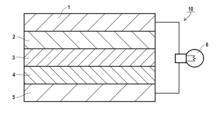
- FIG. 1 is a vertical cross-sectional view showing a schematic diagram of a basic layered structure of one embodiment of a nonaqueous electrolyte secondary battery.
- the electrode forming slurry of the present invention (also referred to as “the slurry of the present invention”) is a slurry (suspension, dispersion) containing an electrode active material, a conductive assistant, and a non-aqueous electrolyte, and is suitable for forming an electrode active material layer in a non-aqueous electrolyte secondary battery (i.e., a quasi-solid secondary battery) having a slurry-like electrode active material layer.
- the slurry of the present invention contains, as a dispersant, a polymer having a specific structure and a molecular weight within a specific range. Each component constituting the slurry of the present invention will be described.
- the polymer constituting the dispersant has a structure containing 80 to 99% by mass of a component represented by the following formula (1) and 1 to 20% by mass in total of a component represented by the following formula (2) or (3).
- "containing 1 to 20% by mass in total of a component represented by the following formula (2) or (3)” means that when the polymer has a component represented by the following formula (2) and does not have a component represented by the following formula (3), the content of the component represented by the following formula (2) in the polymer is 1 to 20% by mass.
- the content of the component represented by the following formula (3) in the polymer is 1 to 20% by mass.
- the total content of the component represented by the following formula (2) and the component represented by the following formula (3) in the polymer is 1 to 20% by mass.
- the polymer constituting the dispersant preferably contains 83 to 97% by mass of a component represented by the following formula (1) and 3 to 17% by mass in total of a component represented by the following formula (2) or (3), more preferably contains 85 to 95% by mass of a component represented by the following formula (1) and 5 to 15% by mass in total of a component represented by the following formula (2) or (3), still more preferably contains 87 to 95% by mass of a component represented by the following formula (1) and 5 to 13% by mass in total of a component represented by the following formula (2) or (3), and still more preferably contains 87 to 93% by mass of a component represented by the following formula (1) and 7 to 13% by mass in total of a component represented by the following formula (2) or (3).
- the weight average molecular weight (Mw) of the above polymer is in the range of 1,000 to 15,000.
- the Mw of the polymer can be determined by the following method.
- the Mw of the polymer is measured by gel permeation chromatography (GPC).
- the Mw is calculated based on polyethylene oxide.
- the Mw is measured by the following method. However, depending on the type of polymer, an appropriate eluent (carrier) is selected and used.
- Measuring instrument HLC-8320GPC (product name, manufactured by Tosoh Corporation) Column: TOSOH TSKgel guard column Super HZ-L, Super HZM-H, Super HZ4000, Super HZ2000 (product names, manufactured by Tosoh Corporation) Carrier: Tetrahydrofuran solution Measurement temperature: 40°C Carrier flow rate: 0.35 ml/min Sample concentration: 0.2% by mass Detector: RI (refractive index) detector
- the Mw of the polymer is preferably in the range of 1500 to 14,000, more preferably in the range of 2,000 to 13,000, even more preferably in the range of 2,500 to 12,000, and even more preferably in the range of 2,500 to 10,000.
- the polymer contains the specific amounts of each of the above components and has an Mw controlled within the above range, so that it is liquid at room temperature (25°C) and is compatible with the non-aqueous solvent or electrolyte in the slurry of the present invention (i.e., it can exist uniformly in the slurry without phase separation or precipitation).
- the polymer may contain components (other components) other than the components represented by each of the formulas (1) to (3) below.
- the content of the other components in the polymer is preferably 10% by mass or less, more preferably 8% by mass or less, even more preferably 6% by mass or less, even more preferably 4% by mass or less, even more preferably 2% by mass or less, even more preferably 1% by mass or less, and even more preferably 0.5% by mass or less.
- the polymer does not contain other components.
- * represents a linking site for incorporation into a polymer structure.
- R1 represents a hydrocarbon group having 1 to 8 carbon atoms.
- R2 to R6 represent a hydrogen atom or methyl.
- R7 represents a hydrocarbon group having 5 to 18 carbon atoms.
- R8 represents a group having 1 to 12 carbon atoms and a nitrogen atom.
- n is a number from 3 to 30.
- the R 1 in formula (1) is preferably a chain (non-cyclic) hydrocarbon group.
- This chain hydrocarbon group may be linear or branched, and is preferably linear.
- the above R 1 is preferably a hydrocarbon group having 1 to 6 carbon atoms, more preferably 1 to 5 carbon atoms, even more preferably 1 to 4 carbon atoms, and even more preferably 1 to 3 carbon atoms.
- the above R 1 is more preferably methyl or ethyl, and particularly preferably methyl.
- n is the average number of moles of oxyalkylene groups added. n is preferably 5 to 30, more preferably 6 to 25, even more preferably 7 to 20, and even more preferably 8 to 15.
- the R7 in formula (2) may be a chain (non-cyclic) hydrocarbon group or a hydrocarbon group having a cyclic structure, and is preferably a hydrocarbon group having a cyclic structure.
- R7 is a chain hydrocarbon group, it may be linear or branched, and is preferably linear.
- R7 is a hydrocarbon group having a cyclic structure, it is preferably a hydrocarbon group having an aromatic ring, and is more preferably a hydrocarbon group having a benzene ring or a naphthalene ring.
- R7 is preferably a hydrocarbon group having 6 to 17 carbon atoms, more preferably 6 to 16 carbon atoms, even more preferably 6 to 15 carbon atoms, even more preferably 6 to 14 carbon atoms, still more preferably 7 to 12 carbon atoms, and particularly preferably 7 to 11 carbon atoms.
- R8 in formula (3) is bonded to the carbon atom to which R8 is bonded (same meaning as the carbon atom to which R6 is bonded) via a nitrogen atom.
- the component represented by formula (3) is a component derived from a (meth)acrylamide compound (an acrylamide compound or a methacrylamide compound).
- the number of nitrogen atoms in R8 is preferably 1 to 3, more preferably 1 or 2, and even more preferably 1.
- R8 contains carbon atoms and hydrogen atoms as constituent elements other than nitrogen atoms.
- R8 contains an oxygen atom. This oxygen atom is preferably present as a constituent element of a carbonyl group.
- the number of oxygen atoms in R8 is preferably 1 to 3, more preferably 1 or 2, and even more preferably 1.
- the R 8 may have a chain structure or a cyclic structure. When the R 8 has a chain structure, it may have a branch.
- the above R 8 preferably has 2 to 12 carbon atoms, more preferably 3 to 12 carbon atoms, and even more preferably 4 to 12 carbon atoms.
- the component represented by formula (1) mainly exhibits affinity to the non-aqueous electrolyte (non-aqueous solvent), and the component represented by formula (2) or (3) mainly exhibits affinity to the electrode active material.
- the above polymer may be any of a random polymer, a block polymer, and a graft polymer, and is preferably a random polymer.
- the content of the dispersant (polymer) in the slurry of the present invention is preferably 0.1 to 5.0 parts by mass, more preferably 0.2 to 4.0 parts by mass, even more preferably 0.4 to 3.0 parts by mass, even more preferably 0.6 to 2.5 parts by mass, even more preferably 0.7 to 2.0 parts by mass, even more preferably 0.8 to 1.8 parts by mass, even more preferably 0.8 to 1.6 parts by mass, also preferably 0.8 to 1.4 parts by mass, and also preferably 0.8 to 1.2 parts by mass, per 100 parts by mass of the total of the nonaqueous electrolyte and the dispersant.
- the slurry of the present invention contains a positive electrode active material as an electrode active material when used to form a positive electrode active material layer, and contains a negative electrode active material as an electrode active material when used to form a negative electrode active material layer.
- the positive electrode active material is preferably one that can reversibly insert and release lithium ions.
- the material is not particularly limited as long as it exhibits the desired electronic conductivity, and examples of the material include transition metal oxides, organic substances, and substances that can be composited with Li, such as sulfur, and also include composites of sulfur and metals.
- the positive electrode active material it is preferable to use a lithium-containing transition metal oxide, and a lithium-containing transition metal oxide having a transition metal element M a (one or more elements selected from Co, Ni, Fe, Mn, Cu and V) is more preferable.
- this lithium-containing transition metal oxide may be mixed with an element M b (an element of the first (Ia) group of the periodic table other than lithium, an element of the second (IIa) group, Al, Ga, In, Ge, Sn, Pb, Sb, Bi, Si, P or B, etc.).
- the amount of the mixture is preferably 0 to 30 mol% with respect to the amount of the transition metal element M a (100 mol%). It is more preferable to mix and synthesize the Li/M a so that the molar ratio is 0.3 to 2.2.
- lithium-containing transition metal oxide examples include (MA) a lithium-containing transition metal oxide having a layered rock salt structure, (MB) a lithium-containing transition metal oxide having a spinel structure, (MC) a lithium-containing transition metal phosphate compound, (MD) a lithium-containing transition metal halide phosphate compound, and (ME) a lithium-containing transition metal silicate compound.
- MA a lithium-containing transition metal oxide having a layered rock salt structure
- MB lithium-containing transition metal oxide having a spinel structure
- MC lithium-containing transition metal phosphate compound
- MD lithium-containing transition metal halide phosphate compound
- ME lithium-containing transition metal silicate compound
- lithium - containing transition metal oxides having a layered rock salt structure include LiCoO2 (lithium cobalt oxide [LCO]), LiNi2O2 (lithium nickel oxide ) , LiNi0.85Co0.10Al0.05O2 (lithium nickel cobalt aluminum oxide [NCA]), LiNi1 /3Co1 / 3Mn1 / 3O2 (lithium nickel manganese cobalt oxide [NMC]), and LiNi0.5Mn0.5O2 (lithium manganese nickel oxide ) .
- LiCoO2 lithium cobalt oxide [LCO]
- LiNi2O2 lithium nickel oxide
- LiNi0.85Co0.10Al0.05O2 lithium nickel cobalt aluminum oxide [NCA]
- LiNi1 /3Co1 / 3Mn1 / 3O2 lithium nickel manganese cobalt oxide [NMC]
- LiNi0.5Mn0.5O2 lithium manganese nickel oxide
- lithium - containing transition metal oxides having a spinel structure examples include LiMn2O4 ( LMO ) , LiCoMnO4 , Li2FeMn3O8 , Li2CuMn3O8 , Li2CrMn3O8 , and Li2NiMn3O8 .
- lithium-containing transition metal phosphate compounds include olivine-type iron phosphates such as LiFePO4 and Li3Fe2 ( PO4 ) 3 , iron pyrophosphates such as LiFeP2O7 , cobalt phosphates such as LiCoPO4 , and monoclinic Nasicon-type vanadium phosphates such as Li3V2 ( PO4 ) 3 (lithium vanadium phosphate).
- the lithium-containing transition metal halophosphate compound include iron fluorophosphates such as Li 2 FePO 4 F, manganese fluorophosphates such as Li 2 MnPO 4 F, and cobalt fluorophosphates such as Li 2 CoPO 4 F.
- the positive electrode active material is preferably a lithium-containing transition metal phosphate compound (MC), more preferably LiFePO4 .
- the shape of the positive electrode active material is not particularly limited, and a particulate shape is preferred.
- the average particle diameter (average particle diameter in terms of sphere) of the positive electrode active material is not particularly limited and may be, for example, 0.1 to 50 ⁇ m, preferably 0.2 to 30 ⁇ m, more preferably 0.5 to 20 ⁇ m, and even more preferably 0.8 to 10 ⁇ m.
- a conventional pulverizer or classifier may be used.
- the positive electrode active material obtained by the firing method may be used after being washed with water, an acidic aqueous solution, an alkaline aqueous solution, or an organic solvent.
- the average particle size of the positive electrode active material is the value listed in the manufacturer's catalog.
- the positive electrode active material is dispersed in water and the particle size value (volume-based median diameter D50 in water) obtained by measuring with a laser diffraction/scattering type particle size distribution measuring device (e.g., Particle LA-960V2 manufactured by HORIBA) is used. This also applies to the average particle size of solid particles other than the positive electrode active material.
- the chemical formula of the compound obtained by the above calcination method can be measured using inductively coupled plasma (ICP) emission spectroscopy, or, as a simplified method, calculated from the mass difference of the powder before and after calcination.
- ICP inductively coupled plasma
- the surface of the positive electrode active material may be coated with an oxide such as another metal oxide, a carbon-based material, etc. These surface coating layers can function as an interface resistance stabilizing layer.
- Surface coatings include metal oxides containing Ti, Nb, Ta, W, Zr, Al, Si, or Li.
- the oxides include titanate spinel, tantalum oxides, niobium oxides, and lithium niobate compounds, such as Li4Ti5O12 , Li2Ti2O5 , LiTaO3 , LiNbO3 , LiAlO2 , Li2ZrO3 , Li2WO4 , Li2TiO3 , Li2B4O7 , Li3PO4 , Li2MoO4 , Li3BO3 , LiBO2 , Li2CO3 , Li2SiO3 , SiO2 , TiO2 , ZrO2 , Al2O3 , B2O3 , and Li3 AlF6 .
- Carbon-based materials such as C, SiC, and SiOC (carbon-doped silicon oxide) can also be used as the surface coating material.
- the positive electrode active material may be surface-coated with a carbon-based material in order to increase the electronic conductivity to a desired level.
- the positive electrode active material is preferably surface-coated with carbon (C).
- the carbon surface coating can be formed by baking the positive electrode active material in the presence of an additive (organic substance) that serves as a carbon source.
- additives organic substance
- examples of additives that can be used include styrene-maleic anhydride copolymer, polystyrene, polycarbonate, etc.
- the surface of the positive electrode active material may be treated with sulfur or phosphorus. Furthermore, the particle surfaces of the positive electrode active material may be subjected to a surface treatment with active rays or active gas (plasma, etc.) before or after the above-mentioned surface coating.
- the above positive electrode active materials may be used alone or in combination of two or more.
- the content of the positive electrode active material in the slurry solids is preferably 95.00 to 99.95 mass%, more preferably 96.00 to 99.90 mass%, and even more preferably 97.00 to 99.80 mass%, depending on the content of the conductive assistant.
- the slurry of the present invention contains a positive electrode active material (when it is a slurry for forming a positive electrode), it is preferable to increase the content of the positive electrode active material in the slurry as much as possible within a range in which the desired low viscosity can be achieved.
- the content of the positive electrode active material in the slurry can be 60 to 90 mass%, more preferably 65 to 88 mass%, even more preferably 70 to 86 mass%, even more preferably 72 to 85 mass%, also preferably 73 to 84 mass%, also preferably 73 to 83 mass%, also preferably 73 to 82 mass%, and also preferably 73 to 81 mass%.
- the negative electrode active material is preferably one that can reversibly absorb and release lithium ions.
- the material is not particularly limited as long as it has the desired characteristics, and examples thereof include carbonaceous materials, silicon-based materials, metal oxides, metal composite oxides, lithium alone, lithium alloys, and negative electrode active materials that can form alloys with lithium. Among these, carbonaceous materials or silicon-based materials are preferably used from the viewpoint of reliability.
- the carbonaceous material used as the negative electrode active material is a material that is substantially composed of carbon.
- Examples include carbon black such as petroleum pitch, graphite (natural graphite, artificial graphite such as vapor-grown graphite, etc.), and carbonaceous materials obtained by baking various synthetic resins such as PAN (polyacrylonitrile)-based resins or furfuryl alcohol resins.
- Further examples include various carbon fibers such as PAN-based carbon fiber, cellulose-based carbon fiber, pitch-based carbon fiber, vapor-grown carbon fiber, dehydrated PVA (polyvinyl alcohol)-based carbon fiber, lignin carbon fiber, glassy carbon fiber, and activated carbon fiber, mesophase microspheres, graphite whiskers, and tabular graphite.
- the metal oxide and metal composite oxide used as the negative electrode active material are not particularly limited as long as they are oxides capable of absorbing and releasing lithium, and amorphous oxides are preferred, and chalcogenides that are reaction products of metal elements and elements of group 16 of the periodic table are also preferred.
- amorphous as used herein means that the oxide has a broad scattering band with a peak in the 2 ⁇ value range of 20° to 40° in an X-ray diffraction method using CuK ⁇ radiation, and may have crystalline diffraction lines.
- amorphous oxides or the above-mentioned chalcogenides of metalloid elements are more preferable, and oxides or chalcogenides of one or a combination of two or more of the elements of Groups 13 (IIIB) to 15 (VB) of the periodic table, Al, Ga, Si, Sn, Ge, Pb, Sb, and Bi, are particularly preferable.
- preferred amorphous oxides and chalcogenides include Ga2O3 , GeO , PbO , PbO2 , Pb2O3 , Pb2O4 , Pb3O4 , Sb2O3 , Sb2O4 , Sb2O8Bi2O3 , Sb2O8Si2O3 , Sb2O5 , Bi2O3 , Bi2O4 , GeS , PbS , PbS2 , Sb2S3 and Sb2S5 .
- the metal (composite) oxide and the above chalcogenide preferably contain at least one of titanium and lithium as a component from the viewpoint of charge/discharge characteristics at high current density.
- the metal composite oxide containing lithium (lithium composite metal oxide) include composite oxides of lithium oxide and the above metal (composite) oxide or the above chalcogenide, more specifically Li 2 SnO 2 .
- the negative electrode active material preferably contains titanium atoms. More specifically, TiNb 2 O 7 (niobium titanate oxide [NTO]) and Li 4 Ti 5 O1 2 (lithium titanate [LTO]) are preferred because they have small volumetric fluctuations during the absorption and release of lithium ions, and therefore have excellent rapid charge and discharge characteristics, suppress electrode deterioration, and enable an improvement in the life of the lithium ion secondary battery.
- NTO niobium titanate oxide
- Li 4 Ti 5 O1 2 lithium titanate
- the lithium alloy used as the negative electrode active material is not particularly limited as long as it is an alloy that is typically used as a negative electrode active material in secondary batteries, and an example of such an alloy is a lithium aluminum alloy.
- the negative electrode active material capable of forming an alloy with lithium is not particularly limited as long as it is one that is normally used as a negative electrode active material for secondary batteries. Such active materials expand and contract greatly due to charging and discharging, and as described above, the binding property of the solid particles decreases, but in the present invention, high binding property can be achieved by the above-mentioned binder.
- active materials include negative electrode active materials having silicon atoms or tin atoms, and metals such as Al and In.
- a negative electrode active material having silicon atoms (silicon atom-containing active material) that enables a higher battery capacity is preferable, and a silicon atom-containing active material having a silicon atom content of 40 mol% or more of the total constituent atoms is more preferable.
- negative electrodes containing these negative electrode active materials can absorb more Li ions than carbon negative electrodes (e.g., graphite and acetylene black). That is, the amount of Li ions absorbed per unit mass increases. Therefore, the battery capacity (energy density) can be increased. As a result, there is an advantage that the battery driving time can be extended.
- silicon-atom-containing active materials include silicon materials such as Si and SiOx (0 ⁇ x ⁇ 1), alloys containing titanium, vanadium, chromium, manganese, nickel, copper, or lanthanum (e.g., LaSi2 , VSi2 ), or structured active materials (e.g., LaSi2/Si), and active materials containing silicon and tin atoms such as SnSiO3 and SnSiS3 .
- SiOx itself can be used as a negative electrode active material (semi-metal oxide), and can be used as an active material (precursor material) that can be alloyed with lithium because it produces Si when the battery is operated.
- Examples of the negative electrode active material having tin atoms include Sn, SnO, SnO2 , SnS, SnS2 , and the above-mentioned active materials containing silicon atoms and tin atoms . Also included are composite oxides with lithium oxide, such as Li2SnO2 .
- the shape of the negative electrode active material is not particularly limited, but particulate is preferred.
- the average particle size of the negative electrode active material is preferably 0.1 to 60 ⁇ m.
- a conventional grinder or classifier is used.
- a mortar, ball mill, sand mill, vibration ball mill, satellite ball mill, planetary ball mill, swirling airflow type jet mill, or sieve is preferably used.
- wet grinding can also be performed in the presence of water or an organic solvent such as methanol.
- Classification is preferably performed to obtain the desired particle size. There is no particular limitation on the classification method, and a sieve, wind classifier, or the like can be used as desired. Classification can be performed both dry and wet.
- the negative electrode active material may be used alone or in combination of two or more. Among them, a combination of a silicon atom-containing active material and a carbonaceous material is preferred, and a combination of SiOx (0 ⁇ x ⁇ 1) and graphite is particularly preferred. When SiOx (0 ⁇ x ⁇ 1) and graphite are combined, the mass ratio (SiOx/graphite) is preferably 2 or less, more preferably 1 or less, and even more preferably 0.5 or less. When forming the negative electrode active material layer, the mass (mg) (weight per unit area) of the negative electrode active material layer per unit area (cm 2 ) is not particularly limited and can be appropriately determined depending on the designed battery capacity.
- the content of the negative electrode active material in the slurry solids is preferably 95.00 to 99.95 mass%, more preferably 96.00 to 99.90 mass%, and even more preferably 97.00 to 99.80 mass%, depending on the content of the conductive assistant.
- the slurry of the present invention contains a negative electrode active material (when it is a slurry for forming a negative electrode), it is preferable to increase the content of the negative electrode active material in the slurry as much as possible within the range in which the desired low viscosity can be achieved.
- the content of the negative electrode active material in the slurry can be 50 to 80 mass%, more preferably 55 to 78 mass%, even more preferably 58 to 76 mass%, even more preferably 60 to 75 mass%, also preferably 62 to 74 mass%, and also preferably 63 to 73 mass%.
- the slurry of the present invention contains a conductive assistant.
- the conductive assistant may be an electron conductive material such as graphites such as natural graphite and artificial graphite, carbon blacks such as acetylene black, ketjen black, and furnace black, amorphous carbon such as needle coke, carbon fibers such as vapor-grown carbon fibers or carbon nanotubes, carbonaceous materials such as graphene or fullerene, metal powders or metal fibers such as copper and nickel, or conductive polymers such as polyaniline, polypyrrole, polythiophene, polyacetylene, and polyphenylene derivatives.
- conductive assistants those that do not insert or release Li when the battery is charged and discharged and do not function as an active material are considered to be conductive assistants. Therefore, among the conductive assistants, those that can function as an active material in the active material layer when the battery is charged and discharged are classified as active materials rather than conductive assistants. Whether or not they function as an active material when the battery is charged and discharged is not unique, but is determined by the combination with the active material.
- the conductive assistant may be used alone or in combination of two or more.
- the shape of the conductive assistant is not particularly limited, but a particulate shape is preferred.
- the average particle diameter (average particle diameter in terms of sphere) of the conductive assistant is not particularly limited and is, for example, preferably 0.01 to 50 ⁇ m, more preferably 0.1 to 10 ⁇ m, and further preferably 0.2 to 2.0 ⁇ m.
- the content of the conductive assistant in the solid content of the slurry of the present invention is preferably 0.05 to 5.00 mass%, more preferably 0.10 to 4.00 mass%, and even more preferably 0.20 to 3.00 mass%.
- the content of the conductive assistant in the slurry of the present invention can be, for example, 0.1 to 10 mass%, preferably 0.1 to 7 mass%, more preferably 0.2 to 5 mass%, even more preferably 0.4 to 3 mass%, and even more preferably 0.6 to 2 mass%.
- the non-aqueous electrolyte contained in the slurry of the present invention is composed of an electrolyte (electrolyte salt) and a non-aqueous solvent that dissolves the electrolyte.
- electrolyte any electrolyte that can be used as an electrolytic solution for a quasi-solid secondary battery can be used appropriately.
- the electrolyte is preferably a metal salt, such as a lithium salt, a potassium salt, a sodium salt, a calcium salt, or a magnesium salt.
- a lithium salt lithium salts that are usually used as electrolytes for lithium ion secondary batteries are preferable, and examples thereof include the following lithium salts.
- Inorganic lithium salts inorganic fluoride salts such as LiPF 6 , LiBF 4 , LiAsF 6 , and LiSbF 6 , perhalogenates such as LiClO 4 , LiBrO 4 , and LiIO 4 , and inorganic chloride salts such as LiAlCl 4 , etc.
- Oxalatoborate salts lithium bis(oxalato)borate, lithium difluorooxalatoborate, etc.
- LiPF 6 LiBF 4 , LiAsF 6 , LiSbF 6 , LiClO 4 , Li ( Rf1SO3 ), LiN( Rf1SO2 ) 2 , LiN( FSO2 ) 2 , or LiN (Rf1SO2)(Rf2SO2) are preferred, LiPF 6, LiBF 4, LiN(Rf1SO2)2, LiN(FSO2)2 , or LiN ( Rf1SO2 ) ( Rf2SO2 ) are more preferred , and LiPF 6 is particularly preferred.
- Rf1 and Rf2 each represent a perfluoroalkyl group, and preferably have 1 to 6 carbon atoms.
- the non-aqueous electrolyte may contain one electrolyte alone or two or more electrolytes in any combination.
- the electrolyte concentration in the non-aqueous electrolyte is not particularly limited as long as it functions as a non-aqueous electrolyte.
- it can be 10.0 to 50.0 mass%, and preferably 15.0 to 30.0 mass%.
- the molar concentration is preferably 0.5 to 1.5 M.
- Non-aqueous solvent As the non-aqueous solvent which is the medium for the non-aqueous electrolyte, an aprotic organic solvent is preferable, and among them, an aprotic organic solvent having 2 to 10 carbon atoms is more preferable.
- non-aqueous solvents include linear or cyclic carbonate compounds, lactone compounds, linear or cyclic ether compounds, ester compounds, nitrile compounds, amide compounds, oxazolidinone compounds, nitro compounds, linear or cyclic sulfone or sulfoxide compounds, and phosphate ester compounds. Of these, compounds having an ether bond, a carbonyl bond, an ester bond or a carbonate bond are preferred. These compounds may have a substituent.
- Non-aqueous solvents include, for example, ethylene carbonate, fluorinated ethylene carbonate, vinylene carbonate, propylene carbonate, butylene carbonate, dimethyl carbonate, diethyl carbonate, ethyl methyl carbonate, methyl propyl carbonate, ⁇ -butyrolactone, ⁇ -valerolactone, 1,2-dimethoxyethane, tetrahydrofuran, 2-methyltetrahydrofuran, tetrahydropyran, 1,3-dioxolane, 4-methyl-1,3-dioxolane, 1,3-dioxane, 1,4-dioxane, methyl acetate
- the solvent include ethyl acetate, methyl propionate, ethyl propionate, methyl butyrate, methyl isobutyrate, methyl trimethylacetate, ethyl trimethylacetate, acetonitrile, glutaronitrile, adip
- ethylene carbonate, propylene carbonate, dimethyl carbonate, diethyl carbonate, ethyl methyl carbonate, and ⁇ -butyrolactone is preferred, and a combination of a high-viscosity (high-dielectric constant) solvent (e.g., relative dielectric constant ⁇ 30) such as ethylene carbonate or propylene carbonate with a low-viscosity solvent (e.g., viscosity ⁇ 1 mPa ⁇ s) such as dimethyl carbonate, ethyl methyl carbonate, or diethyl carbonate is more preferred.
- a high-viscosity (high-dielectric constant) solvent e.g., relative dielectric constant ⁇ 30
- ethylene carbonate or propylene carbonate e.g., relative dielectric constant ⁇ 30
- a low-viscosity solvent e.g., viscosity ⁇ 1 mPa ⁇ s
- the nonaqueous solvent is particularly preferably a combination of ethylene carbonate, dimethyl carbonate, and ethyl methyl carbonate.
- the content of the nonaqueous electrolyte in the slurry of the present invention is preferably 8 to 38% by mass, more preferably 10 to 33% by mass, even more preferably 12 to 28% by mass, also preferably 13 to 26% by mass, also preferably 14 to 25% by mass, also preferably 16 to 25% by mass, also preferably 18 to 25% by mass, and also preferably 20 to 25% by mass.
- the content of the nonaqueous electrolyte in the slurry for forming the negative electrode is preferably 18 to 48% by mass, more preferably 20 to 43% by mass, even more preferably 22 to 40% by mass, even more preferably 23 to 38% by mass, also preferably 24 to 36% by mass, and also preferably 25 to 35% by mass.
- the slurry of the present invention may contain, as desired, an ionic liquid, a thickener, an antifoaming agent, a leveling agent, a dehydrating agent, an antioxidant, etc. These may be any of those commonly used in non-aqueous electrolyte secondary batteries.
- the content of the other components is preferably 0.05 to 1.5 parts by mass, and more preferably 0.1 to 1.0 part by mass, per 100 parts by mass of the total content of the electrode active material and the conductive assistant.
- the slurry of the present invention can be obtained by uniformly mixing the components that make up the slurry.
- a non-aqueous solvent, an electrolyte, and a polymer can be mixed to obtain a solution in which the non-aqueous electrolyte and the polymer are compatible, and this solution can be mixed with an electrode active material and a conductive assistant to obtain a slurry in which the electrode active material and the conductive assistant are dispersed in the solution.
- a non-aqueous solvent, an electrolyte, and a polymer can be mixed to obtain a solution in which the non-aqueous electrolyte and the polymer are compatible, and this solution can be mixed with an electrode active material and a conductive assistant to obtain a slurry in which the electrode active material and the conductive assistant are dispersed in the solution.
- the nonaqueous electrolyte secondary battery of the present invention (hereinafter also referred to as "secondary battery of the present invention") is a nonaqueous electrolyte secondary battery having an electrode active material layer formed from the slurry of the present invention. That is, it is a so-called quasi-solid secondary battery in which at least one of the positive electrode active material layer and the negative electrode active material layer is made of the slurry of the present invention.
- the battery has a positive electrode active material layer, a separator, a negative electrode active material layer, and a negative electrode current collector in this order, and at least one of the positive electrode active material layer and the negative electrode active material layer is made of the slurry of the present invention.
- both the positive electrode active material layer and the negative electrode active material layer are preferably formed from the slurry of the present invention.
- FIG. 1 is a cross-sectional view showing a typical laminated structure of a nonaqueous electrolyte secondary battery 10, including the working electrode when the battery is operated.
- the nonaqueous electrolyte secondary battery 10 has a laminated structure (hereinafter also referred to as an electrode laminate) having a negative electrode current collector 1, a negative electrode active material layer 2, a separator 3, a positive electrode active material layer 4, and a positive electrode current collector 5 in this order, as viewed from the negative electrode side.
- the negative electrode active material layer 2 and the positive electrode active material layer 4 are filled with a nonaqueous electrolyte (not shown) and are separated by the separator 3.
- the separator 3 has pores, and in a normal battery use state, it functions as a separator membrane for the positive and negative electrodes that insulates between the positive and negative electrodes while allowing the electrolyte and ions to pass through the pores.
- the lithium ions (Li + ) stored in the negative electrode are returned to the positive electrode side through the electrolyte, and electrons are supplied to the operating part 6.
- a light bulb is used as the operating part 6, and this is turned on by discharging.
- the electrode active material layer of the quasi-solid secondary battery is formed in a slurry state containing the electrode active material and the electrolyte. Therefore, the electrode active material layer is a layer using a slurry (suspension, dispersion) in which the electrode active material is dispersed in a non-aqueous electrolyte, and thus the structure of the quasi-solid secondary battery is different from that of a general non-aqueous electrolyte secondary battery.
- a coating solution is prepared by dispersing an electrode active material in a medium that does not contain an electrolyte, and the coating solution is applied to a current collector to form a coating film, and the coating film is dried to form a thin-film electrode active material layer.
- a binder is usually blended into the coating solution, and a hard electrode active material layer in which the electrode active material particles are firmly bound to each other is formed.
- the electrode active material layer is in the state of a hard solid particle layer as a whole, and is not a slurry layer.
- the electrode active material layer is an electrode slurry layer formed by dispersing solid particles containing an electrode active material and a conductive assistant in a non-aqueous electrolyte solution obtained by dissolving an electrolyte such as a lithium salt in a non-aqueous solvent.
- the electrode slurry layer functions as an electrode active material layer, strong binding between the electrode active material particles is not required, and therefore the electrode slurry layer usually does not contain a binder. Except for the fact that the electrode active material layer is an electrode slurry layer and that the electrode slurry layer is in contact with the separator, the basic layer structure of the quasi-solid secondary battery is the same as the layer structure shown in FIG.
- At least one of the positive electrode active material layer and the negative electrode active material layer is a slurry layer formed from the slurry of the present invention.
- both the positive electrode active material layer and the negative electrode active material layer are slurry layers formed from the slurry of the present invention.
- the secondary battery of the present invention is not particularly limited in terms of the materials and components of the positive electrode collector, negative electrode collector, separator, etc. These materials and components can be appropriately applied from those used in ordinary secondary batteries.
- the components and manufacturing methods usually used in these secondary batteries reference can be made, for example, to JP 2016-201308 A, JP 2005-108835 A, JP 2012-185938 A, WO 2018/135395, etc.
- the thickness of the electrode active material layer is not particularly limited and can be, for example, 5 to 500 ⁇ m, preferably 20 to 400 ⁇ m, more preferably 40 to 400 ⁇ m, and even more preferably 80 to 350 ⁇ m.
- the method for producing a non-aqueous electrolyte secondary battery of the present invention includes forming an electrode active material layer using the slurry of the present invention.
- the slurry of the present invention is applied onto an electrode current collector to form a slurry.
- the electrode is a positive electrode
- a positive electrode forming slurry containing a positive electrode active material is applied onto a positive electrode current collector.
- a negative electrode forming slurry containing a negative electrode active material as the slurry of the present invention is applied onto the negative electrode current collector.
- the method of applying the slurry is not particularly limited.
- the slurry may be applied using a roll coater, drop coating, or the slurry may be evenly applied on the current collector and then pressed (by roll pressing or flat pressing), or the slurry may be applied by a method according to the specified method.
- the slurry can be applied by placing it within a thickness frame and spreading it out.
- a conventional method can be appropriately adopted, except that the electrode active material layer is formed using the slurry of the present invention.
- Publication No. 2016-201308, Publication No. 2005-108835, Publication No. 2012-185938, Publication No. 2017-147222, etc. can be referred to as appropriate.
- the nonaqueous electrolyte secondary battery of the present invention can be installed in electronic devices such as notebook computers, pen-input computers, mobile computers, electronic book players, mobile phones, cordless phone handsets, pagers, handheld terminals, mobile fax machines, mobile copiers, mobile printers, headphone stereos, video movie machines, liquid crystal televisions, handheld cleaners, portable CDs, mini-discs, electric shavers, transceivers, electronic organizers, calculators, memory cards, portable tape recorders, radios, backup power supplies, and memory cards. It can also be installed in consumer devices such as automobiles, electric vehicles, motors, lighting equipment, toys, game equipment, road conditioners, watches, strobes, cameras, and medical equipment (pacemakers, hearing aids, shoulder massagers, etc.). It can also be used for various military and space applications. It can also be combined with solar cells.
- electronic devices such as notebook computers, pen-input computers, mobile computers, electronic book players, mobile phones, cordless phone handsets, pagers, handheld terminals, mobile
- Polymer 1 was prepared by mixing the monomers in the amounts (parts by mass) shown in Table 1 below. The details are described below.
- Solution A was prepared by mixing 18 g of methoxypolyethylene glycol monomethacrylate (MPEGM), 2 g of butyl methacrylate (MBu), 3.5 g of azobisisobutyronitrile, and 40 g of methyl ethyl ketone at room temperature.
- Polymers 2 to 4, 5a, 5e, 5f, 5h and 6 to 17 were prepared in the same manner as polymer 1, except that the types and amounts of monomers used in polymer 1 were as shown in Table 1 below.
- Polymers 5e, 5f and 5h are polymers 5a in which n in the component represented by general formula (1) (component derived from MPEGM) was changed to 3, 30 and 50, respectively, as shown in Table 2 below.
- Polymers 5b, 5c, 5d and 5g were prepared in the same manner as in the preparation of Polymer 5a, except that the amount of azobisisobutyronitrile added was changed so that the resulting polymers had Mws shown in Table 2 below.
- Polyvinylpyrrolidone (referred to as PVP, manufactured by Sigma-Aldrich, trade name: PVP10) was used as polymer 18.
- Polyvinyl alcohol (hereinafter referred to as PVA, manufactured by Sigma-Aldrich, saponification degree 80%) was used as polymer 19.
- MPEGM methoxypolyethylene glycol monomethacrylate
- MPPGM methoxypolypropylene glycol monomethacrylate
- MPEGA methoxypolyethylene glycol monoacrylate
- MBu butyl methacrylate
- MPe pentyl methacrylate
- MSt stearyl methacrylate
- MDc docosyl methacrylate
- MBn benzyl methacrylate
- MNpM (2-naphthyl)methyl methacrylate
- ABn benzyl acrylate
- NVF N-vinylformamide
- NVP N-vinylpyrrolidone
- TBMA N-t-butyl methacrylamide
- NVC N-vinylcarbazole
- a positive electrode active material of 74 mass% LiFePO4 (manufactured by Gelon), a conductive additive of 1.5 mass% acetylene black (Denka Black manufactured by Denka Company, Ltd.), and the above non-aqueous electrolyte of 24.5 mass% were uniformly mixed using a centrifugal planetary mixer (manufactured by Thinky Corporation, product name: Awatori Rentaro) to obtain a positive electrode forming slurry corresponding to each polymer type.
- the slurry for forming the positive electrode was applied to an aluminum collector having a length of 8 cm and a width of 5 cm, and the slurry for forming the negative electrode was applied to a copper collector having a length of 8 cm and a width of 5 cm, each with a thickness of 300 ⁇ m.
- a positive electrode having a positive electrode active material layer (slurry layer) on the positive electrode collector and a negative electrode having a negative electrode active material layer (slurry layer) on the negative electrode collector were prepared.
- a separator was placed on the negative electrode active material layer of the negative electrode, and the positive electrode was placed on the separator so that the positive electrode active material layer was in contact with the separator.
- An aluminum tab was attached to the end of the aluminum collector, and a nickel tab was attached to the end of the copper collector by ultrasonic welding to form an electrode group.
- This electrode group was sandwiched between two aluminum laminate films, three sides were heat sealed, and the remaining side was vacuum sealed to prepare a laminated battery. In this way, a quasi-solid secondary battery corresponding to each polymer type was obtained.
- Comparative Example 1 in which no dispersant was added, resulted in poor slurry fluidity. Furthermore, the battery of Comparative Example 1 had a resistance of 30 ⁇ cm2 or more even in a state in which no polymer (insulating material) was included. Comparative Examples 2, 3, and 5, in which the polymer constituting the dispersant contained the component represented by formula (1) but did not contain any of the components represented by formulas (2) and (3), showed poor slurry fluidity. The battery resistance of these comparative examples rose to 40 ⁇ cm 2 or more. Comparative Example 7, in which the polymer constituting the dispersant did not contain the component represented by formula (1), also showed similar results.
- Comparative Example 4 in which the content ratio of the constituent components did not meet the requirements of the present invention, resulted in poor slurry fluidity. Also, the battery resistance of these Comparative Examples rose to 40 ⁇ cm2 or more . Although the structure and content ratio of the constituent components of the polymer constituting the dispersant satisfied the requirements of the present invention, Comparative Example 6, in which the Mw did not satisfy the requirements of the present invention, resulted in poor slurry fluidity. Also, the battery resistance of these Comparative Examples rose to 40 ⁇ cm2 or more .
- Comparative Example 8 in which the polymer constituting the dispersant was PVP containing none of the components represented by the formulas (1), (2), and (3), the polymer did not dissolve in the electrolyte solution and did not function as a dispersant in the electrode-forming slurry envisioned by the present invention.
- Comparative Example 9 in which the polymer constituting the dispersant was PVA, the polymer dissolved in the electrolyte solution, but the slurry had poor fluidity.
- the battery resistance of this comparative example rose to 40 ⁇ cm 2 or more.
- Non-aqueous electrolyte secondary battery 1 Negative electrode current collector 2 Negative electrode active material layer 3 Separator 4 Positive electrode active material layer 5 Positive electrode current collector 6 Working part (light bulb)
Landscapes
- Chemical & Material Sciences (AREA)
- Chemical Kinetics & Catalysis (AREA)
- Electrochemistry (AREA)
- General Chemical & Material Sciences (AREA)
- Inorganic Chemistry (AREA)
- Engineering & Computer Science (AREA)
- Materials Engineering (AREA)
- Manufacturing & Machinery (AREA)
- Crystallography & Structural Chemistry (AREA)
- Battery Electrode And Active Subsutance (AREA)
- Secondary Cells (AREA)
- Compositions Of Macromolecular Compounds (AREA)
Priority Applications (4)
| Application Number | Priority Date | Filing Date | Title |
|---|---|---|---|
| CN202480027470.9A CN121153120A (zh) | 2023-04-28 | 2024-04-17 | 电极形成用浆料、非水电解液二次电池及其制造方法、以及分散剂 |
| EP24796889.4A EP4704174A1 (en) | 2023-04-28 | 2024-04-17 | Slurry for forming electrode, nonaqueous electrolyte secondary battery and method for manufacturing same, and dispersant |
| JP2025516756A JPWO2024225136A1 (https=) | 2023-04-28 | 2024-04-17 | |
| US19/363,654 US20260045499A1 (en) | 2023-04-28 | 2025-10-21 | Slurry for forming electrode, non-aqueous electrolytic solution secondary battery and method for manufacturing the same, and dispersant |
Applications Claiming Priority (2)
| Application Number | Priority Date | Filing Date | Title |
|---|---|---|---|
| JP2023074129 | 2023-04-28 | ||
| JP2023-074129 | 2023-04-28 |
Related Child Applications (1)
| Application Number | Title | Priority Date | Filing Date |
|---|---|---|---|
| US19/363,654 Continuation US20260045499A1 (en) | 2023-04-28 | 2025-10-21 | Slurry for forming electrode, non-aqueous electrolytic solution secondary battery and method for manufacturing the same, and dispersant |
Publications (1)
| Publication Number | Publication Date |
|---|---|
| WO2024225136A1 true WO2024225136A1 (ja) | 2024-10-31 |
Family
ID=93256311
Family Applications (1)
| Application Number | Title | Priority Date | Filing Date |
|---|---|---|---|
| PCT/JP2024/015278 Ceased WO2024225136A1 (ja) | 2023-04-28 | 2024-04-17 | 電極形成用スラリー、非水電解液二次電池及びその製造方法、並びに分散剤 |
Country Status (5)
| Country | Link |
|---|---|
| US (1) | US20260045499A1 (https=) |
| EP (1) | EP4704174A1 (https=) |
| JP (1) | JPWO2024225136A1 (https=) |
| CN (1) | CN121153120A (https=) |
| WO (1) | WO2024225136A1 (https=) |
Citations (10)
| Publication number | Priority date | Publication date | Assignee | Title |
|---|---|---|---|---|
| JP2001256980A (ja) * | 2000-03-09 | 2001-09-21 | Nippon Zeon Co Ltd | リチウムイオン二次電池電極用バインダーおよびその利用 |
| JP2005108835A (ja) | 2003-09-26 | 2005-04-21 | Samsung Sdi Co Ltd | リチウムイオン二次電池 |
| JP2012185938A (ja) | 2011-03-03 | 2012-09-27 | Sharp Corp | 非水系二次電池 |
| WO2013081152A1 (ja) * | 2011-12-02 | 2013-06-06 | 三菱レイヨン株式会社 | 非水二次電池電極用バインダ樹脂、非水二次電池電極用バインダ樹脂組成物、非水二次電池電極用スラリー組成物、非水二次電池用電極、非水二次電池 |
| JP2015135773A (ja) * | 2014-01-17 | 2015-07-27 | 東洋インキScホールディングス株式会社 | 二次電池電極形成用組成物、二次電池用電極および二次電池 |
| JP2016201308A (ja) | 2015-04-13 | 2016-12-01 | 富士フイルム株式会社 | 非水電解液および非水二次電池 |
| JP2017147222A (ja) | 2016-02-12 | 2017-08-24 | 三洋化成工業株式会社 | リチウムイオン電池 |
| WO2018135395A1 (ja) | 2017-01-20 | 2018-07-26 | 富士フイルム株式会社 | 非水二次電池用電解液、非水二次電池及び金属錯体 |
| JP2022139794A (ja) | 2021-03-12 | 2022-09-26 | 株式会社Gsユアサ | 非水電解質蓄電素子 |
| JP2023074129A (ja) | 2021-11-17 | 2023-05-29 | 日立Astemo株式会社 | 撮像装置 |
-
2024
- 2024-04-17 WO PCT/JP2024/015278 patent/WO2024225136A1/ja not_active Ceased
- 2024-04-17 CN CN202480027470.9A patent/CN121153120A/zh active Pending
- 2024-04-17 EP EP24796889.4A patent/EP4704174A1/en active Pending
- 2024-04-17 JP JP2025516756A patent/JPWO2024225136A1/ja active Pending
-
2025
- 2025-10-21 US US19/363,654 patent/US20260045499A1/en active Pending
Patent Citations (10)
| Publication number | Priority date | Publication date | Assignee | Title |
|---|---|---|---|---|
| JP2001256980A (ja) * | 2000-03-09 | 2001-09-21 | Nippon Zeon Co Ltd | リチウムイオン二次電池電極用バインダーおよびその利用 |
| JP2005108835A (ja) | 2003-09-26 | 2005-04-21 | Samsung Sdi Co Ltd | リチウムイオン二次電池 |
| JP2012185938A (ja) | 2011-03-03 | 2012-09-27 | Sharp Corp | 非水系二次電池 |
| WO2013081152A1 (ja) * | 2011-12-02 | 2013-06-06 | 三菱レイヨン株式会社 | 非水二次電池電極用バインダ樹脂、非水二次電池電極用バインダ樹脂組成物、非水二次電池電極用スラリー組成物、非水二次電池用電極、非水二次電池 |
| JP2015135773A (ja) * | 2014-01-17 | 2015-07-27 | 東洋インキScホールディングス株式会社 | 二次電池電極形成用組成物、二次電池用電極および二次電池 |
| JP2016201308A (ja) | 2015-04-13 | 2016-12-01 | 富士フイルム株式会社 | 非水電解液および非水二次電池 |
| JP2017147222A (ja) | 2016-02-12 | 2017-08-24 | 三洋化成工業株式会社 | リチウムイオン電池 |
| WO2018135395A1 (ja) | 2017-01-20 | 2018-07-26 | 富士フイルム株式会社 | 非水二次電池用電解液、非水二次電池及び金属錯体 |
| JP2022139794A (ja) | 2021-03-12 | 2022-09-26 | 株式会社Gsユアサ | 非水電解質蓄電素子 |
| JP2023074129A (ja) | 2021-11-17 | 2023-05-29 | 日立Astemo株式会社 | 撮像装置 |
Non-Patent Citations (1)
| Title |
|---|
| See also references of EP4704174A1 |
Also Published As
| Publication number | Publication date |
|---|---|
| EP4704174A1 (en) | 2026-03-04 |
| JPWO2024225136A1 (https=) | 2024-10-31 |
| US20260045499A1 (en) | 2026-02-12 |
| CN121153120A (zh) | 2025-12-16 |
Similar Documents
| Publication | Publication Date | Title |
|---|---|---|
| US12218350B2 (en) | Negative electrode for lithium metal battery and lithium metal battery comprising same | |
| JP6621532B2 (ja) | 固体電解質組成物、固体電解質含有シート、全固体二次電池用電極シートおよび全固体二次電池ならびに固体電解質含有シート、全固体二次電池用電極シートおよび全固体二次電池の製造方法 | |
| JP6318099B2 (ja) | 固体電解質組成物およびこれを用いた電池用電極シートならびに電池用電極シートおよび全固体二次電池の製造方法 | |
| JP6332882B2 (ja) | 全固体二次電池、固体電解質組成物、これを用いた電池用電極シート、電池用電極シートの製造方法および全固体二次電池の製造方法 | |
| WO2020036222A1 (ja) | 非水系電解液、及び非水系電解液二次電池 | |
| WO2011129066A1 (ja) | リチウムイオン二次電池 | |
| WO2021210604A1 (ja) | 非水二次電池用バインダー組成物、電極用組成物、電極シート、及び非水二次電池、並びに、これら電極シート及び非水二次電池の製造方法 | |
| JP7597825B2 (ja) | 二次電池用バインダー組成物、電極用組成物、電極シート及び二次電池、並びに、これら電極シート及び二次電池の製造方法 | |
| JP2022058021A (ja) | 二次電池用バインダー、二次電池用バインダーの水溶液又は水分散液、電極用組成物、電極シート及び二次電池、並びに、これら電極シート及び二次電池の製造方法 | |
| JP6933260B2 (ja) | リチウムイオン二次電池用非水電解液およびそれを用いたリチウムイオン二次電池 | |
| WO2021210603A1 (ja) | 非水電解液二次電池用バインダー組成物、電極用組成物、電極シート、及び非水電解液二次電池、並びに、これら電極シート及び二次電池の製造方法 | |
| WO2024225136A1 (ja) | 電極形成用スラリー、非水電解液二次電池及びその製造方法、並びに分散剤 | |
| JP2005243448A (ja) | 非水電解質二次電池 | |
| EP4614623A1 (en) | Slurry for nonaqueous electrolyte secondary batteries, nonaqueous electrolyte secondary battery, and method for producing nonaqueous electrolyte secondary battery | |
| JP2026016108A (ja) | 非水電解液二次電池の電極用組成物、非水電解液二次電池用電極、及び非水電解液二次電池 | |
| WO2024247853A1 (ja) | 非水電解液二次電池の製造方法及び非水電解液二次電池 | |
| WO2025070177A1 (ja) | 非水電解液二次電池の電極形成用スラリー、及び非水電解液二次電池 | |
| WO2025192647A1 (ja) | 非水電解液二次電池の電極形成用スラリー、非水電解液二次電池、及び非水電解液二次電池の製造方法 | |
| US20250096326A1 (en) | Manufacturing method of non-aqueous electrolytic solution secondary battery, slurry for non-aqueous electrolytic solution secondary battery, and non-aqueous electrolytic solution secondary battery | |
| WO2025164523A1 (ja) | 非水電解液二次電池 | |
| JP2026016107A (ja) | 非水電解液二次電池の正極用組成物、正極、及び非水電解液二次電池 | |
| WO2024143388A1 (ja) | 非水電解液二次電池の電極形成用スラリー、非水電解液二次電池、及び非水電解液二次電池の製造方法 | |
| WO2024204384A1 (ja) | 非水電解液二次電池の正極形成用スラリー、非水電解液二次電池、及び非水電解液二次電池の製造方法 | |
| WO2024095972A1 (ja) | 非水電解液二次電池用電解液、非水電解液二次電池、及び非水電解液二次電池の製造方法 | |
| WO2024048117A1 (ja) | 非水電解質二次電池 |
Legal Events
| Date | Code | Title | Description |
|---|---|---|---|
| 121 | Ep: the epo has been informed by wipo that ep was designated in this application |
Ref document number: 24796889 Country of ref document: EP Kind code of ref document: A1 |
|
| ENP | Entry into the national phase |
Ref document number: 2025516756 Country of ref document: JP Kind code of ref document: A |
|
| WWE | Wipo information: entry into national phase |
Ref document number: 2025516756 Country of ref document: JP |
|
| WWE | Wipo information: entry into national phase |
Ref document number: 2024796889 Country of ref document: EP |
|
| NENP | Non-entry into the national phase |
Ref country code: DE |
|
| ENP | Entry into the national phase |
Ref document number: 2024796889 Country of ref document: EP Effective date: 20251128 |
|
| ENP | Entry into the national phase |
Ref document number: 2024796889 Country of ref document: EP Effective date: 20251128 |
|
| ENP | Entry into the national phase |
Ref document number: 2024796889 Country of ref document: EP Effective date: 20251128 |
|
| ENP | Entry into the national phase |
Ref document number: 2024796889 Country of ref document: EP Effective date: 20251128 |
|
| ENP | Entry into the national phase |
Ref document number: 2024796889 Country of ref document: EP Effective date: 20251128 |
|
| ENP | Entry into the national phase |
Ref document number: 2024796889 Country of ref document: EP Effective date: 20251128 |
|
| ENP | Entry into the national phase |
Ref document number: 2024796889 Country of ref document: EP Effective date: 20251128 |
|
| ENP | Entry into the national phase |
Ref document number: 2024796889 Country of ref document: EP Effective date: 20251128 |
|
| ENP | Entry into the national phase |
Ref document number: 2024796889 Country of ref document: EP Effective date: 20251128 |
|
| WWP | Wipo information: published in national office |
Ref document number: 2024796889 Country of ref document: EP |