WO2024225107A1 - 含フッ素エーテル化合物、磁気記録媒体用潤滑剤および磁気記録媒体 - Google Patents
含フッ素エーテル化合物、磁気記録媒体用潤滑剤および磁気記録媒体 Download PDFInfo
- Publication number
- WO2024225107A1 WO2024225107A1 PCT/JP2024/015070 JP2024015070W WO2024225107A1 WO 2024225107 A1 WO2024225107 A1 WO 2024225107A1 JP 2024015070 W JP2024015070 W JP 2024015070W WO 2024225107 A1 WO2024225107 A1 WO 2024225107A1
- Authority
- WO
- WIPO (PCT)
- Prior art keywords
- formula
- group
- compound
- represented
- fluorine
- Prior art date
- Legal status (The legal status is an assumption and is not a legal conclusion. Google has not performed a legal analysis and makes no representation as to the accuracy of the status listed.)
- Ceased
Links
Images
Classifications
-
- C—CHEMISTRY; METALLURGY
- C07—ORGANIC CHEMISTRY
- C07C—ACYCLIC OR CARBOCYCLIC COMPOUNDS
- C07C233/00—Carboxylic acid amides
- C07C233/01—Carboxylic acid amides having carbon atoms of carboxamide groups bound to hydrogen atoms or to acyclic carbon atoms
- C07C233/16—Carboxylic acid amides having carbon atoms of carboxamide groups bound to hydrogen atoms or to acyclic carbon atoms having the nitrogen atom of at least one of the carboxamide groups bound to a carbon atom of a hydrocarbon radical substituted by singly-bound oxygen atoms
- C07C233/17—Carboxylic acid amides having carbon atoms of carboxamide groups bound to hydrogen atoms or to acyclic carbon atoms having the nitrogen atom of at least one of the carboxamide groups bound to a carbon atom of a hydrocarbon radical substituted by singly-bound oxygen atoms with the substituted hydrocarbon radical bound to the nitrogen atom of the carboxamide group by an acyclic carbon atom
- C07C233/18—Carboxylic acid amides having carbon atoms of carboxamide groups bound to hydrogen atoms or to acyclic carbon atoms having the nitrogen atom of at least one of the carboxamide groups bound to a carbon atom of a hydrocarbon radical substituted by singly-bound oxygen atoms with the substituted hydrocarbon radical bound to the nitrogen atom of the carboxamide group by an acyclic carbon atom having the carbon atom of the carboxamide group bound to a hydrogen atom or to a carbon atom of an acyclic saturated carbon skeleton
-
- C—CHEMISTRY; METALLURGY
- C07—ORGANIC CHEMISTRY
- C07C—ACYCLIC OR CARBOCYCLIC COMPOUNDS
- C07C255/00—Carboxylic acid nitriles
- C07C255/01—Carboxylic acid nitriles having cyano groups bound to acyclic carbon atoms
- C07C255/11—Carboxylic acid nitriles having cyano groups bound to acyclic carbon atoms containing cyano groups and singly-bound oxygen atoms bound to the same saturated acyclic carbon skeleton
- C07C255/13—Carboxylic acid nitriles having cyano groups bound to acyclic carbon atoms containing cyano groups and singly-bound oxygen atoms bound to the same saturated acyclic carbon skeleton containing cyano groups and etherified hydroxy groups bound to the carbon skeleton
-
- C—CHEMISTRY; METALLURGY
- C07—ORGANIC CHEMISTRY
- C07C—ACYCLIC OR CARBOCYCLIC COMPOUNDS
- C07C43/00—Ethers; Compounds having groups, groups or groups
- C07C43/02—Ethers
- C07C43/03—Ethers having all ether-oxygen atoms bound to acyclic carbon atoms
- C07C43/04—Saturated ethers
- C07C43/10—Saturated ethers of polyhydroxy compounds
- C07C43/11—Polyethers containing —O—(C—C—O—)n units with ≤ 2 n≤ 10
-
- C—CHEMISTRY; METALLURGY
- C07—ORGANIC CHEMISTRY
- C07C—ACYCLIC OR CARBOCYCLIC COMPOUNDS
- C07C43/00—Ethers; Compounds having groups, groups or groups
- C07C43/02—Ethers
- C07C43/03—Ethers having all ether-oxygen atoms bound to acyclic carbon atoms
- C07C43/04—Saturated ethers
- C07C43/13—Saturated ethers containing hydroxy or O-metal groups
-
- C—CHEMISTRY; METALLURGY
- C07—ORGANIC CHEMISTRY
- C07C—ACYCLIC OR CARBOCYCLIC COMPOUNDS
- C07C43/00—Ethers; Compounds having groups, groups or groups
- C07C43/02—Ethers
- C07C43/03—Ethers having all ether-oxygen atoms bound to acyclic carbon atoms
- C07C43/14—Unsaturated ethers
- C07C43/178—Unsaturated ethers containing hydroxy or O-metal groups
-
- C—CHEMISTRY; METALLURGY
- C08—ORGANIC MACROMOLECULAR COMPOUNDS; THEIR PREPARATION OR CHEMICAL WORKING-UP; COMPOSITIONS BASED THEREON
- C08G—MACROMOLECULAR COMPOUNDS OBTAINED OTHERWISE THAN BY REACTIONS ONLY INVOLVING UNSATURATED CARBON-TO-CARBON BONDS
- C08G65/00—Macromolecular compounds obtained by reactions forming an ether link in the main chain of the macromolecule
- C08G65/02—Macromolecular compounds obtained by reactions forming an ether link in the main chain of the macromolecule from cyclic ethers by opening of the heterocyclic ring
- C08G65/32—Polymers modified by chemical after-treatment
- C08G65/329—Polymers modified by chemical after-treatment with organic compounds
- C08G65/331—Polymers modified by chemical after-treatment with organic compounds containing oxygen
-
- C—CHEMISTRY; METALLURGY
- C10—PETROLEUM, GAS OR COKE INDUSTRIES; TECHNICAL GASES CONTAINING CARBON MONOXIDE; FUELS; LUBRICANTS; PEAT
- C10M—LUBRICATING COMPOSITIONS; USE OF CHEMICAL SUBSTANCES EITHER ALONE OR AS LUBRICATING INGREDIENTS IN A LUBRICATING COMPOSITION
- C10M105/00—Lubricating compositions characterised by the base-material being a non-macromolecular organic compound
- C10M105/50—Lubricating compositions characterised by the base-material being a non-macromolecular organic compound containing halogen
- C10M105/54—Lubricating compositions characterised by the base-material being a non-macromolecular organic compound containing halogen containing carbon, hydrogen, halogen and oxygen
-
- C—CHEMISTRY; METALLURGY
- C10—PETROLEUM, GAS OR COKE INDUSTRIES; TECHNICAL GASES CONTAINING CARBON MONOXIDE; FUELS; LUBRICANTS; PEAT
- C10M—LUBRICATING COMPOSITIONS; USE OF CHEMICAL SUBSTANCES EITHER ALONE OR AS LUBRICATING INGREDIENTS IN A LUBRICATING COMPOSITION
- C10M105/00—Lubricating compositions characterised by the base-material being a non-macromolecular organic compound
- C10M105/56—Lubricating compositions characterised by the base-material being a non-macromolecular organic compound containing nitrogen
-
- C—CHEMISTRY; METALLURGY
- C10—PETROLEUM, GAS OR COKE INDUSTRIES; TECHNICAL GASES CONTAINING CARBON MONOXIDE; FUELS; LUBRICANTS; PEAT
- C10M—LUBRICATING COMPOSITIONS; USE OF CHEMICAL SUBSTANCES EITHER ALONE OR AS LUBRICATING INGREDIENTS IN A LUBRICATING COMPOSITION
- C10M105/00—Lubricating compositions characterised by the base-material being a non-macromolecular organic compound
- C10M105/56—Lubricating compositions characterised by the base-material being a non-macromolecular organic compound containing nitrogen
- C10M105/58—Amines, e.g. polyalkylene polyamines, quaternary amines
-
- C—CHEMISTRY; METALLURGY
- C10—PETROLEUM, GAS OR COKE INDUSTRIES; TECHNICAL GASES CONTAINING CARBON MONOXIDE; FUELS; LUBRICANTS; PEAT
- C10M—LUBRICATING COMPOSITIONS; USE OF CHEMICAL SUBSTANCES EITHER ALONE OR AS LUBRICATING INGREDIENTS IN A LUBRICATING COMPOSITION
- C10M107/00—Lubricating compositions characterised by the base-material being a macromolecular compound
- C10M107/38—Lubricating compositions characterised by the base-material being a macromolecular compound containing halogen
-
- C—CHEMISTRY; METALLURGY
- C10—PETROLEUM, GAS OR COKE INDUSTRIES; TECHNICAL GASES CONTAINING CARBON MONOXIDE; FUELS; LUBRICANTS; PEAT
- C10M—LUBRICATING COMPOSITIONS; USE OF CHEMICAL SUBSTANCES EITHER ALONE OR AS LUBRICATING INGREDIENTS IN A LUBRICATING COMPOSITION
- C10M107/00—Lubricating compositions characterised by the base-material being a macromolecular compound
- C10M107/40—Lubricating compositions characterised by the base-material being a macromolecular compound containing nitrogen
- C10M107/44—Macromolecular compounds obtained otherwise than by reactions only involving carbon-to-carbon unsaturated bonds
-
- G—PHYSICS
- G11—INFORMATION STORAGE
- G11B—INFORMATION STORAGE BASED ON RELATIVE MOVEMENT BETWEEN RECORD CARRIER AND TRANSDUCER
- G11B5/00—Recording by magnetisation or demagnetisation of a record carrier; Reproducing by magnetic means; Record carriers therefor
- G11B5/62—Record carriers characterised by the selection of the material
- G11B5/72—Protective coatings, e.g. anti-static or antifriction
- G11B5/725—Protective coatings, e.g. anti-static or antifriction containing a lubricant, e.g. organic compounds
-
- G—PHYSICS
- G11—INFORMATION STORAGE
- G11B—INFORMATION STORAGE BASED ON RELATIVE MOVEMENT BETWEEN RECORD CARRIER AND TRANSDUCER
- G11B5/00—Recording by magnetisation or demagnetisation of a record carrier; Reproducing by magnetic means; Record carriers therefor
- G11B5/84—Processes or apparatus specially adapted for manufacturing record carriers
-
- C—CHEMISTRY; METALLURGY
- C10—PETROLEUM, GAS OR COKE INDUSTRIES; TECHNICAL GASES CONTAINING CARBON MONOXIDE; FUELS; LUBRICANTS; PEAT
- C10N—INDEXING SCHEME ASSOCIATED WITH SUBCLASS C10M RELATING TO LUBRICATING COMPOSITIONS
- C10N2040/00—Specified use or application for which the lubricating composition is intended
- C10N2040/14—Electric or magnetic purposes
- C10N2040/18—Electric or magnetic purposes in connection with recordings on magnetic tape or disc
Definitions
- the present invention relates to a fluorine-containing ether compound, a lubricant for a magnetic recording medium, and a magnetic recording medium.
- a magnetic recording medium in which a recording layer is formed on a substrate, and a protective layer made of carbon or the like is formed on the recording layer.
- the protective layer protects the information recorded on the recording layer and improves the sliding properties of the magnetic head.
- the durability of the magnetic recording medium cannot be sufficiently obtained by simply providing a protective layer on the recording layer. For this reason, a lubricant is generally applied to the surface of the protective layer to form a lubricating layer.
- lubricants for use in forming a lubricating layer on a magnetic recording medium for example, those containing a compound having a polar group such as a hydroxyl group or an amino group at the end of a fluorine-based polymer having a repeating structure including --CF 2 -- have been proposed.
- Patent Documents 1 and 2 disclose fluorine-containing ether compounds having a skeleton in which two perfluoropolyether chains are bonded to both ends of a glycerin structure (-O-CH 2 -CH(OH)-CH 2 -O-) via a divalent linking group in which a methylene group (-CH 2 -) is bonded, and in which terminal groups having polar groups are bonded to both ends of the skeleton via a methylene group.
- Patent Document 3 and Patent Document 4 disclose a fluorine-containing ether compound that contains a methylene group and a group in which one of the hydrogen atoms of the methylene group is replaced with a hydroxyl group (-CH(OH)-), has a skeleton in which two perfluoropolyether chains are linked via a divalent linking group having two hydroxyl groups, and has terminal groups, which are organic groups having polar groups, linked to both ends of the skeleton via the methylene group.
- Patent Document 5 discloses a fluorine-containing ether compound having a skeleton in which three perfluoropolyether chains are bonded via methylene groups and glycerin structures, with terminal groups having polar groups bonded to both sides of the skeleton via methylene groups.
- reducing the thickness of the lubricating layer tends to reduce the corrosion resistance of the magnetic recording medium. Also, reducing the flying height of the magnetic head can cause pickup, in which the fluorine-containing ether compounds in the lubricating layer adhere to the magnetic head.
- the present invention has been made in consideration of the above circumstances, and has an object to provide a fluorine-containing ether compound which has excellent corrosion resistance and is capable of forming a lubricating layer capable of suppressing pick-up, and which can be suitably used as a material for a lubricant for a magnetic recording medium.
- Another object of the present invention is to provide a lubricant for magnetic recording media which contains the fluorine-containing ether compound of the present invention and is capable of forming a lubricating layer which has good corrosion resistance and a high pick-up suppression effect.
- Another object of the present invention is to provide a magnetic recording medium which has a lubricating layer containing the fluorinated ether compound of the present invention, and which has good corrosion resistance and a high pick-up suppression effect.
- the present invention includes the following aspects:
- x represents an integer of 1 to 2.
- R 2 is a perfluoropolyether chain. Some or all of the (x+1) R 2s may be the same or different from each other.
- R 3 is a divalent linking group having 1 to 4 polar groups. When x is 2, the two R 3s may be the same or different from each other.
- R 1 and R 4 are terminal groups having 1 to 4 polar groups and having 1 to 50 carbon atoms. R 1 and R 4 may be the same or different from each other.
- At least one of R 1 and R 4 is a terminal group represented by the following formula (2).) -O-X-CH(OH) -CH2OH (2) (In formula (2), X is a divalent organic group having 2 to 30 carbon atoms which may contain at least one of 1 to 2 polar groups and 1 to 3 ether oxygen atoms. X contains at least one carbon atom which is not bonded to any of the polar groups and the ether oxygen atoms.)
- l represents an integer of 1 to 3.
- l's m each independently represents an integer of 1 to 6.
- l's n each independently represents an integer of 1 to 6.
- B represents an alkyl group which may have only one polar group, an organic group containing a carbon-carbon unsaturated bond, or a hydrogen atom.
- p represents an integer of 0 to 3.
- q represents an integer of 0 to 2.
- r represents an integer of 0 to 5. The total value of p and r is 1 to 5.
- D represents a polar group, a vinyl group, an ethynyl group, or an aryl group which may have a substituent.
- s represents an integer of 0 to 2.
- t represents an integer of 1 to 5.
- u1 represents an integer of 0 to 6
- u2 represents an integer of 0 to 6, provided that at least one of u1 and u2 is 0.
- the oxygen atom at the left end of formula (4-1) is bonded to the methylene group on the R1 side in formula (1), and the oxygen atom at the right end is bonded to the methylene group on the R4 side in formula (1).
- v represents an integer of 1 to 2.
- the oxygen atom at the left end of formula (4-2) is bonded to the methylene group on the R1 side in formula (1), and the oxygen atom at the right end is bonded to the methylene group on the R4 side in formula (1).
- w represents an integer of 0 to 6.
- the oxygen atom at the left end of formula (4-3) is bonded to the methylene group on the R1 side in formula (1), and the oxygen atom at the right end is bonded to the methylene group on the R4 side in formula (1).
- x1 represents an integer of 0 to 5
- x2 represents an integer of 0 to 5, provided that at least one of x1 and x2 is an integer of 1 to 5.
- the oxygen atom at the left end of formula (4-4) is bonded to the methylene group on the R1 side in formula (1), and the oxygen atom at the right end is bonded to the methylene group on the R4 side in formula (1).
- y1 represents an integer of 1 to 5
- y2 represents an integer of 1 to 5.
- the oxygen atom at the left end of formula (4-5) is bonded to the methylene group on the R1 side in formula (1), and the oxygen atom at the right end is bonded to the methylene group on the R4 side in formula (1).
- z represents an integer of 1 to 6.
- the z Rc and Rd each independently represent a hydrogen atom, a fluorine atom, or a methyl group.
- the oxygen atom at the left end of formula (4-6) is bonded to the methylene group on the R1 side in formula (1), and the oxygen atom at the right end is bonded to the methylene group on the R4 side in formula (1).
- w1 and w6 represent an average value representing the number of CF2 and each independently represents 1 to 3. There is no particular restriction on the arrangement order of the repeating units (CF 2 O), (CF 2 CF 2 O), (CF 2 CF 2 CF 2 O), and (CF 2 CF 2 CF 2 O) in formula (5).)
- a magnetic recording medium comprising at least a magnetic layer, a protective layer, and a lubricating layer provided in that order on a substrate, The magnetic recording medium, wherein the lubricating layer contains the fluorine-containing ether compound according to any one of [1] to [12].
- the lubricating layer has an average thickness of 0.5 nm to 2.0 nm.
- the fluorine-containing ether compound of the present invention is a compound represented by the above formula (1), and is therefore suitable as a material for a lubricant for a magnetic recording medium. Since the lubricant for magnetic recording media of the present invention contains the fluorine-containing ether compound of the present invention, it is possible to form a lubricating layer that has good corrosion resistance and a high pick-up suppressing effect.
- the magnetic recording medium of the present invention has a lubricating layer that contains the fluorine-containing ether compound of the present invention. Therefore, the magnetic recording medium of the present invention has good corrosion resistance, a high pick-up suppression effect, and excellent reliability and durability. In addition, since the magnetic recording medium of the present invention has a lubricating layer that has good corrosion resistance and suppresses pick-up, the thickness of the lubricating layer can be made thin, and the flying height of the magnetic head can be further reduced.
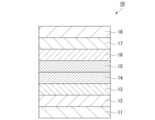
- FIG. 1 is a schematic cross-sectional view showing one embodiment of a magnetic recording medium of the present invention.
- fluorine-containing ether compounds having a polar group such as a hydroxyl group have been preferably used as materials for lubricants for magnetic recording media (hereinafter sometimes abbreviated as "lubricants") that are applied to the surface of a protective layer.
- the fluorine-containing ether compound having a polar group includes a terminal group having a plurality of polar groups at the end of a chain structure, and also includes a fluorine-containing ether compound having a plurality of perfluoropolyether chains, with a linking group having a polar group being disposed between adjacent perfluoropolyether chains.
- a thin lubricating layer is formed on a protective layer using a conventional fluorine-containing ether compound having a polar group, it is difficult to realize a lubricating layer having good corrosion resistance and a high pick-up suppression effect, as will be described below.
- the polar groups in the fluorine-containing ether compound bond with active sites on the protective layer, improving the adhesion of the lubricating layer to the protective layer. If the adhesion of the lubricating layer to the protective layer is insufficient, the lubricating layer will not cover the protective layer properly, making it easier for water, which causes corrosion, to be absorbed into the protective layer, and sufficient corrosion resistance will not be obtained. Furthermore, if the adhesion of the lubricating layer to the protective layer is insufficient, the lubricating layer may rise up from the protective layer and collide with the magnetic head, causing pick-up.
- the polar groups in the fluorine-containing ether compound not only bind to active sites on the protective layer and participate in interactions with the protective layer, but also participate in intramolecular and intermolecular interactions. If there are not enough polar groups involved in intermolecular interactions between fluorine-containing ether compounds, the fluorine-containing ether compound in the lubricating layer will easily move from the protective layer to the magnetic head, making pick-up more likely to occur.
- the fluorine-containing ether compound must contain sufficient polar groups involved in interactions with the protective layer and intermolecular interactions so that it can form a lubricating layer with good corrosion resistance and suppressed pick-up.
- the number of polar groups in the fluorine-containing ether compound is increased, the hydrophobicity of the lubricating layer containing it decreases, making it impossible to obtain sufficient corrosion resistance.
- the inventors therefore conducted extensive research, focusing on the strength of polarity of the polar groups contained in the fluorinated ether compound and the interactions of the polar groups. As a result, they came to the conclusion that at least a portion of the polar groups in the fluorinated ether compound should be hydroxyl groups of a 1,2-diol structure located at the end of the perfluoropolyether chain. In this case, as shown below, it is possible to ensure hydroxyl groups that can interact with the protective layer and hydroxyl groups that can participate in intermolecular interactions, while suppressing the decrease in hydrophobicity caused by the hydroxyl groups contained in the 1,2-diol structure.
- a 1,2-diol structure (-CH(OH)-CH 2 OH)
- the carbon atoms to which hydroxyl groups are bonded are bonded to each other, so that the distance between the hydroxyl groups is short, and steric and electrostatic repulsion between the hydroxyl groups is likely to occur.
- the two hydroxyl groups contained in the 1,2-diol structure are in an opposite conformation to the carbon atom to which the 1,2-diol structure is bonded. Therefore, the dipole moments generated by the two hydroxyl groups contained in the 1,2-diol structure cancel each other out, and an increase in the polarity of the entire fluorine-containing ether compound molecule is suppressed.
- the distance between active points on the protective layer is sufficiently larger than the distance between hydroxyl groups contained in the 1,2-diol structure.
- the two hydroxyl groups contained in the 1,2-diol structure are in an opposite conformation with respect to the carbon atom to which the 1,2-diol structure is bonded. Therefore, the two hydroxyl groups contained in the 1,2-diol structure are not in a direction approaching the protective layer at the same time, and only one of the two hydroxyl groups can interact with the active points on the protective layer. Therefore, the other of the two hydroxyl groups can participate in the intermolecular interaction between the fluorine-containing ether compounds.
- the present inventors deliberately made some of the polar groups in the fluorinated ether compound hydroxyl groups having a 1,2-diol structure, thereby securing polar groups that can participate in intermolecular interactions between fluorinated ether compounds, and then considered that it would be sufficient to adjust the number of polar groups that can interact with active sites on the protective layer as necessary.
- the present inventors have conducted extensive research into a fluorine-containing ether compound having a 1,2-diol structure at one or both ends of a perfluoropolyether chain, in order to improve the corrosion resistance of a lubricating layer containing this compound and to suppress pick-up.
- the number of polar groups is appropriate, and some of the polar groups are hydroxyl groups of a 1,2-diol structure located at the end of the perfluoropolyether chain, so that it is possible to suppress the decrease in hydrophobicity caused by the polar groups, while ensuring a sufficient number of polar groups that can interact with the protective layer and polar groups that can participate in intermolecular interactions.
- the terminal group represented by formula (2) arranged at at least one end contains at least one carbon atom that is not bonded to either a polar group or an ether oxygen atom.
- This carbon atom has an extremely low affinity for water, and therefore strongly impedes the interaction between the fluorinated ether compound molecule and water. Therefore, even if the fluorinated ether compound contains multiple polar groups, sufficient hydrophobicity can be obtained. Furthermore, since the movement of the above carbon atom is restricted, it provides the fluorinated ether compound molecule with an appropriate rigidity, suppresses intramolecular interactions between polar groups, and makes it easier for the polar groups to participate in intermolecular interactions between fluorinated ether compounds.
- a divalent linking group having one to four polar groups is bonded between two or three perfluoropolyether chains.
- the distance between this divalent linking group and adjacent end groups across the perfluoropolyether chain, and the distance between other divalent linking groups adjacent across the perfluoropolyether chain when there are three perfluoropolyether chains, are both determined appropriately by the perfluoropolyether chain. Therefore, the polar group of the divalent linking group is less likely to be inhibited from interacting with the protective layer by the polar groups of adjacent end groups or other adjacent divalent linking groups, and can participate in the interaction with the protective layer.
- the above-mentioned fluorine-containing ether compound is able to maintain low polarity while ensuring the number of polar groups involved in the interaction with the protective layer, and has sufficient hydrophobicity.
- lubricants containing this compound are less likely to absorb water, which causes corrosion, and have excellent corrosion resistance.
- the above-mentioned fluorine-containing ether compound easily generates polar groups that are not involved in either the interaction with the protective layer or intramolecular interactions, and the polar groups easily form intermolecular interactions.
- the fluorine-containing ether compound in the lubricating layer is less likely to move from above the protective layer to the magnetic head, suppressing pick-up.
- the terminal group located at least one of the terminals does not contain a carbon atom bonded to neither a polar group nor an ether oxygen atom, and the fluorine-containing ether compound is too flexible
- the polar group contained in the fluorine-containing ether compound is more likely to form intramolecular interactions, and therefore the polar group is less likely to participate in intermolecular interactions.
- all of the multiple polar groups contained in the fluorinated ether compound are arranged with a sufficient distance between adjacent polar groups, all of the polar groups are likely to be involved in interactions with the protective layer, and sufficient interaction between the fluorinated ether compounds due to the polar groups is not obtained.
- the center of the chain structure of the fluorine-containing ether compound cannot be sufficiently adsorbed to the protective layer.
- the lubricating layer is likely to float up from the protective layer, which makes it easy for pickup to occur due to the lubricating layer floating up from the protective layer colliding with the magnetic head.
- the inventors have confirmed that by using a lubricant containing the above-mentioned fluorine-containing ether compound, it is possible to form a lubricating layer that has good corrosion resistance and a high pick-up suppression effect even when the thickness is thin, and have arrived at the present invention.
- the fluorine-containing ether compound, the lubricant for magnetic recording media, and the magnetic recording media of the present invention are described in detail below. Note that the present invention is not limited to the embodiments shown below.
- the fluorine-containing ether compound of the present embodiment is represented by the following formula (1).
- R 1 -CH 2 -R 2 [-CH 2 -R 3 -CH 2 -R 2 ] x -CH 2 -R 4 (1)
- x represents an integer of 1 to 2.
- R 2 is a perfluoropolyether chain. Some or all of the (x+1) R 2s may be the same or different from each other.
- R 3 is a divalent linking group having 1 to 4 polar groups. When x is 2, the two R 3s may be the same or different from each other.
- R 1 and R 4 are terminal groups having 1 to 4 polar groups and having 1 to 50 carbon atoms. R 1 and R 4 may be the same or different from each other. At least one of R 1 and R 4 is a terminal group represented by the following formula (2).
- X is a divalent organic group having 2 to 30 carbon atoms which may contain at least one of 1 to 2 polar groups and 1 to 3 ether oxygen atoms. X contains at least one carbon atom that is not bonded to either a polar group or an ether oxygen atom.
- the fluorine-containing ether compound of this embodiment has a skeleton in which a divalent linking group represented by R3 and two or three perfluoropolyether chains represented by R2 (hereinafter, sometimes referred to as PFPE chains) are linked via methylene groups, as shown in formula ( 1) .
- a terminal group represented by R1 is bonded to one end of the skeleton via a methylene group
- a terminal group represented by R4 is bonded to the other end of the skeleton via a methylene group.
- x is 1 or 2
- the number of PFPE chains represented by R 2 (x+1) is 2 or 3. Therefore, in the fluorine-containing ether compound represented by formula (1), unlike a compound having one PFPE chain, R 3 , a divalent linking group having one to four polar groups, is arranged between adjacent R 2. As a result, the fluorine-containing ether compound represented by formula (1) can form a lubricating layer that has excellent adhesion to the protective layer and is less likely to cause corrosion and pick-up of the magnetic recording medium compared to, for example, a compound having one PFPE chain.
- the fluorine-containing ether compound represented by formula (1) can prevent the molecules from becoming too large and move freely compared to a compound having four or more PFPE chains. For this reason, the fluorine-containing ether compound represented by formula (1) can form a lubricating layer that is more likely to wet and spread on the protective layer and has a thin and uniform film thickness compared to a compound having four or more PFPE chains.
- R 1 , R 3 and R 4 each have 1 to 4 polar groups.
- the total number of polar groups contained in R 1 , polar groups contained in R 4 and x polar groups contained in R 3 is preferably 6 to 12, more preferably 7 to 10, and most preferably 7 to 8.
- the fluorine-containing ether compound is capable of forming a lubricating layer with good adhesion to the protective layer. This results in a lubricating layer with better pick-up resistance.
- the polarity of the fluorine-containing ether compound is too high, and it is possible to prevent the absorption of water, which causes corrosion. This results in a lubricating layer with better corrosion resistance.
- R1 and R4 are terminal groups having 1 to 4 polar groups and 1 to 50 carbon atoms. R1 and R4 may be the same or different. At least one of R1 and R4 is a terminal group represented by the above formula (2).
- R 1 and R 4 When one of R 1 and R 4 is a terminal group not corresponding to formula (2), the number of polar groups contained in the terminal group not corresponding to formula (2) among R 1 and R 4 is 1 or more.
- the terminal group represented by formula (2) contains at least two hydroxyl groups of a 1,2-diol structure, and has two or more polar groups.
- a lubricating layer is formed on a protective layer using a lubricant containing a fluorine-containing ether compound represented by formula (1), even when one of R 1 and R 4 is a terminal group represented by formula (2), or even when both R 1 and R 4 are terminal groups represented by formula (2), a polar group that can interact with the protective layer and a polar group that can participate in intermolecular interactions are obtained by the polar groups contained in R 1 and R 4.
- the lubricating layer containing the fluorine-containing ether compound represented by formula (1) has good corrosion resistance and a high pick-up suppression effect.
- the number of polar groups contained in R 1 and R 4 is preferably 2 or more.
- the number of polar groups that can interact with the protective layer and the number of polar groups that can participate in the interaction between molecules are increased, so that the fluorine-containing ether compound can form a lubricating layer that has better corrosion resistance and high pick-up suppression effect.
- the number of polar groups contained in R 1 and R 4 is 4 or less. Therefore, in the lubricating layer containing the fluorine-containing ether compound, the aggregation of the polar groups of the terminal groups represented by R 1 and R 4 can be effectively suppressed. Therefore, the fluorine-containing ether compound can be suppressed from aggregating into a mass, which can prevent the smoothness of the lubricating layer from being lost, and the occurrence of pick-up due to the collision of the lubricating layer with the magnetic head can be suppressed.
- the fluorine-containing ether compound can form a lubricating layer with high corrosion resistance and pick-up suppression effect.
- the number of polar groups contained in R1 and R4 is preferably 3 or less.
- the total number of polar groups that R 1 and R 4 have in formula (1) is 3 or more, and more preferably 4 or more. Since the total number of the polar groups is 3 or more, the polar groups contained in R 1 and R 4 provide a polar group that can interact with the protective layer and a polar group that can participate in intermolecular interactions. As a result, the lubricating layer containing the fluorine-containing ether compound represented by formula (1) has excellent adhesion to the protective layer, good corrosion resistance, and high pick-up suppression effect.
- the total number of polar groups that R 1 and R 4 have in formula (1) is preferably 6 or less.
- the total number of the polar groups is 6 or less, the polarity of the fluorine-containing ether compound is too high, and the magnetic recording medium having the lubricating layer containing the fluorine-containing ether compound can be more effectively prevented from being taken in by water that causes corrosion.
- R 8 and R 9 may bond to each other to form a ring
- R 10 and R 11 may bond to each other to form a ring.
- R 8 , R 9 , R 10 and R 11 are preferably each independently selected from the group consisting of a hydrogen atom, a methyl group, an ethyl group, a propyl group and a butyl group.
- the term "polar group” does not include halogeno groups (--F, -Cl, -Br, etc.) or ether bonds (--O--).
- the polar group contained in the end group that does not fall under formula (2) and the polar group that may be contained in X in formula (2) preferably contain at least one polar group selected from the group consisting of hydroxyl group, cyano group, and group with amide bond. This is because the group with hydroxyl group, cyano group, and group with amide bond is chemically stable, and the lubricating layer containing the fluorine-containing ether compound having these polar groups does not deteriorate over a long period of time.In addition, the group with hydroxyl group, cyano group, and group with amide bond is not too acidic, and does not corrode the substrate easily.
- the end group not corresponding to formula (2) preferably contains at least one hydroxyl group, because this results in a more uniform coating state of the fluorine-containing ether compound on the protective layer. Even when one of R1 and R4 is a terminal group represented by formula (2) or when both of R1 and R4 are terminal groups represented by formula (2), it is more preferable that the polar groups in R1 and the polar groups in R4 are all hydroxyl groups, because this leads to a more uniform coating state of the fluorine-containing ether compound on the protective layer.
- the polar group contained in the end group not corresponding to formula (2) and the polar group that may be contained in X in formula (2) may be partly or entirely the same or different from each other.
- the number of polar groups in R1 and the number of polar groups in R4 may be the same or different. It is preferable that the number of polar groups in R1 and the number of polar groups in R4 are the same, because the coating state of the fluorine-containing ether compound on the protective layer becomes more uniform, and a lubricating layer having better adhesion can be formed.
- the number of carbon atoms contained in the terminal group that does not fall under formula (2) among R 1 and R 4 is 1 or more.
- the terminal group represented by formula (2) contains at least two carbon atoms of the 1,2-diol structure and two or more carbon atoms of X, and has a total of 4 or more carbon atoms. Since the number of carbon atoms of the terminal group represented by R 1 and R 4 is 1 or more, the hydrophobicity of the terminal group can be guaranteed, and the lubricating layer is prevented from attracting water that causes corrosion, and a lubricating layer with good corrosion resistance can be formed.
- the number of carbon atoms contained in the terminal group that does not fall under formula (2) among R 1 and R 4 is preferably 3 or more, more preferably 4 or more.
- the number of carbon atoms contained in the terminal group not corresponding to formula (2) among R 1 and R 4 is 50 or less.
- the terminal group represented by formula (2) contains two carbon atoms of the 1,2-diol structure and 30 or less carbon atoms of X, and has a total of 32 or less carbon atoms. Since the number of carbon atoms of the terminal groups represented by R 1 and R 4 is 50 or less, respectively, the terminal groups have a flexible structure, and the adhesion between the lubricating layer containing the fluorine-containing ether compound and the protective layer is good. As a result, it is possible to form a lubricating layer that can suppress pick-up.
- the number of carbon atoms of the terminal groups represented by R 1 and R 4 is preferably 20 or less, more preferably 15 or less.
- R 1 and R 4 are terminal groups represented by the following formula (2).
- X is a divalent organic group having 2 to 30 carbon atoms which may contain at least one of 1 to 2 polar groups and 1 to 3 ether oxygen atoms. X contains at least one carbon atom which is not bonded to any of the polar groups and the ether oxygen atoms.
- the terminal group represented by formula (2) has an oxygen atom bonded to a methylene group (-CH 2 -) bonded to R 2.
- the oxygen atom located at the end of the terminal group represented by formula (2) forms an ether bond (-O-) with the atoms bonded to both sides of it.
- This ether bond imparts appropriate flexibility to the fluorine-containing ether compound represented by formula (1) and increases the affinity between the polar group of the terminal group represented by formula (2) and the protective layer.
- the fluorine-containing ether compound represented by formula (1) can form a lubricating layer that has excellent adhesion to the protective layer.
- the terminal group represented by formula (2) contains a 1,2-diol structure, and as described above, can ensure a hydroxyl group capable of interacting with the protective layer and a hydroxyl group capable of participating in intermolecular interactions while suppressing the decrease in hydrophobicity caused by the hydroxyl group contained in the 1,2-diol structure.
- the lubricating layer containing the fluorine-containing ether compound represented by formula (1) has low affinity with water, is not likely to take in water that causes corrosion, and is excellent in corrosion resistance. Furthermore, the polar group that is not involved in the interaction with the protective layer easily forms intermolecular interaction, so that the fluorine-containing ether compound in the lubricating layer is not likely to move from the protective layer to the magnetic head, and pickup is suppressed.
- X in the terminal group represented by formula (2) contains at least one carbon atom that is not bonded to either a polar group or an ether oxygen atom. Therefore, the lubricating layer containing the fluorine-containing ether compound represented by formula (1) has low affinity for water. Furthermore, the above carbon atom provides the fluorine-containing ether compound molecule with appropriate rigidity, suppresses intramolecular interactions between polar groups, and makes the polar groups more likely to participate in intermolecular interactions between fluorine-containing ether compounds. Therefore, the above carbon atom contained in X in the terminal group represented by formula (2) contributes to the formation of a lubricating layer that has good corrosion resistance and a high pick-up suppression effect.
- a lubricating layer containing such a fluorine-containing ether compound has a higher affinity for water and a lower corrosion resistance than a lubricating layer containing a fluorine-containing ether compound represented by formula (1), and also has a lower pick-up resistance due to a lack of polar groups that can participate in intermolecular interactions.
- the organic group represented by X in formula (2) has 2 or more carbon atoms, which provides appropriate rigidity and suppresses intramolecular interactions between polar groups, making the polar groups more likely to participate in intermolecular interactions between fluorinated ether compounds, while at the same time preventing interactions with water and improving hydrophobicity.
- the organic group represented by X has 30 or less carbon atoms, which prevents the terminal group represented by formula (2) from becoming too bulky, thereby preventing the movement of the polar groups contained in the fluorinated ether compound and inhibiting the interaction between the polar groups and the protective layer.
- the organic group represented by X preferably has 2 to 15 carbon atoms, and more preferably has 3 to 10 carbon atoms.
- the organic group represented by X contains at least one carbon atom that is not bonded to either polar group or ether oxygen atom.
- Examples of the carbon atom that is not bonded to either polar group or ether oxygen atom include the carbon atom of a methylene group, a methine group, or a group in which these are fluorinated that is not bonded to either polar group or ether oxygen atom.
- the fluoro group is not included in the polar group.
- the organic group represented by X has a polar group containing a carbon atom (for example, a carboxy group, a formyl group, a carbonyl group, a cyano group, or a group having an amide bond)
- the carbon atom contained in the polar group is not included in the "carbon atom that is not bonded to either a polar group or an ether oxygen atom.”
- the number of carbon atoms that are not bonded to either polar groups or ether oxygen atoms may be 1 or more, and may be, for example, 1 to 6, or may be 1 to 4.
- the hydrophobicity of the lubricating layer containing the fluorine-containing ether compound is good.
- the ratio of the number of carbon atoms to the number of polar groups is appropriate, the polarity of the molecule is appropriate, and the ratio of the number of carbon atoms to the number of ether oxygen atoms is appropriate, resulting in a fluorine-containing ether compound with appropriate molecular flexibility.
- the compound contains multiple carbon atoms that are not bonded to either polar groups or ether oxygen atoms, the carbon atoms that are not bonded to either polar groups or ether oxygen atoms may be bonded to each other.
- the fluorine-containing ether compound molecule becomes more rigid, the intramolecular interaction between the polar groups is suppressed, and the polar groups are more likely to be involved in the intermolecular interaction between the fluorine-containing ether compounds.
- the organic group represented by X in formula (2) may contain one or two polar groups.
- the organic group represented by X in formula (2) contains one or two polar groups, the adhesion of the fluorine-containing ether compound represented by formula (1) to the protective layer is improved, and a lubricating layer that provides a sufficient coating state even when the thickness is reduced is easily formed.
- the organic group represented by X in formula (2) contains a polar group, the number of polar groups is preferably one. This is because the fluorine-containing ether compound represented by formula (1) is too hydrophilic, which can suppress the induction of water that causes corrosion.
- the polar group is preferably a polar group selected from the group consisting of a hydroxyl group, a cyano group, and a group having an amide bond, as described above.
- the organic group represented by X in formula (2) may contain one to three ether bonds.
- the oxygen atom forming the ether bond imparts an appropriate degree of flexibility to the fluorinated ether compound represented by formula (1), and increases the affinity between the polar group and the protective layer.
- the number of ether bonds is preferably one or two. This is to prevent the fluorinated ether compound represented by formula (1) from becoming too flexible, which would easily generate polar groups involved in intramolecular interactions.
- the organic group represented by X in formula (2) may be partially fluorinated.
- the hydrophilicity of the organic group represented by X in formula (2) decreases compared to when the organic group represented by X is not fluorinated.
- the fluorine-containing ether compound can suppress the induction of water that causes corrosion and can form a lubricating layer with better corrosion resistance.
- the organic group represented by X is preferably a non-cyclic organic group.
- the organic group represented by X is not too bulky compared to when X is an organic group having a cyclic structure. Therefore, the organic group represented by X can prevent the movement of the polar group contained in the fluorine-containing ether compound from being hindered, and the interaction between the polar group and the protective layer can be prevented from being inhibited.
- the non-cyclic organic group may be linear or branched.
- the organic group represented by X preferably does not contain an unsaturated carbon-carbon bond.
- the orientation of the molecules contained in the organic group represented by X is restricted, compared to when X contains an unsaturated carbon-carbon bond, and the movement of the polar groups contained in the fluorine-containing ether compound is hindered, which can suppress the inhibition of the interaction between the polar groups and the protective layer.
- terminal group represented by formula (2) is preferably an terminal group represented by any one of the following formulas (2-1) to (2-7).
- the terminal group represented by formula (2-1) is a terminal group represented by formula (2) in which -X- is -CH 2 -CH(OH)-(CH 2 ) a -O-(CH 2 ) b -CH 2 -, where a is an integer of 1 to 8 and b is an integer of 1 to 7.
- the terminal group represented by formula (2-1) has a linking group formed by b+1 methylene groups being bonded between the 1,2-diol structure (-CH(OH)-CH 2 OH) located at the terminal of formula (2) and the ether oxygen atom forming the ether bond contained in X in formula (2).
- This linking group has b carbon atoms that are not bonded to either a polar group or an ether oxygen atom.
- the terminal group represented by formula (2-1) has a suitable rigidity resulting from the linking group consisting of b+1 methylene groups, and can suppress the formation of intramolecular interactions between the hydroxyl group of the terminal group represented by formula (2-1).
- the terminal group represented by formula (2-1) has a carbon atom that is not bonded to either a polar group or an ether oxygen atom, and sufficient hydrophobicity is obtained.
- the terminal group represented by formula (2-1) does not become too bulky, which hinders the movement of the hydroxyl group of the terminal group represented by formula (2-1) and inhibits the interaction with the protective layer.
- b is preferably 1 to 5, and more preferably 1 to 3.
- the terminal group represented by formula (2-1) has a linking group in which a methylene groups are bonded between the carbon atom to which the secondary hydroxyl group on the perfluoropolyether chain is bonded and the ether oxygen atom forming the ether bond. Since a in formula (2-1) is 1 or more, the terminal group represented by formula (2-1) has sufficient hydrophobicity. Furthermore, since a is 8 or less, the terminal group represented by formula (2-1) does not become too bulky, which hinders the movement of the hydroxyl group of the terminal group represented by formula (2-1) and inhibits the interaction with the protective layer. a is preferably 1 to 6, and more preferably 1 to 4.
- the sum of a and b of the terminal group represented by formula (2-1) is preferably 9 or less. If the sum of a and b is 9 or less, the terminal group represented by formula (2-1) becomes too bulky, which effectively prevents the movement of the hydroxyl group of the terminal group represented by formula (2-1) from being hindered and the interaction with the protective layer from being inhibited. It is more preferable that the sum of a and b is 6 or less.
- the terminal group represented by formula (2-1) has a moderate mobility because X in formula (2) contains an ether bond. Therefore, when only one of the two hydroxyl groups in the 1,2-diol structure in formula (2-1) interacts with the protective layer, the other hydroxyl group is more likely to interact with a polar group in another fluorine-containing ether compound. Therefore, the hydroxyl group in formula (2-1) can easily form an intermolecular interaction. For this reason, a lubricating layer containing a fluorine-containing ether compound having an end group represented by formula (2-1) is less likely to move from above the protective layer to the magnetic head, and pickup is suppressed.
- the terminal group represented by formula (2-2) is a group in which -X- in formula (2) is -CH 2 -CH(OH)-CH 2 -(CH 2 ) c -O-CH 2 -, where c is an integer of 1 to 7.
- the terminal group represented by formula (2-2) has a linking group formed by bonding c+1 methylene groups between the carbon atom bonded to the secondary hydroxyl group on the perfluoropolyether chain side and the ether oxygen atom forming the ether bond contained in X in formula (2).
- This linking group has c carbon atoms that are not bonded to either the polar group or the ether oxygen atom. Therefore, the terminal group represented by formula (2-2) has a suitable rigidity due to the linking group consisting of c+1 methylene groups, and can suppress the formation of intramolecular interactions of the hydroxyl group of the terminal group represented by formula (2-2).
- c in formula (2-2) is 1 or more, the terminal group represented by formula (2-2) has a carbon atom that is not bonded to either a polar group or an ether oxygen atom, and sufficient hydrophobicity is obtained.
- c is 7 or less, it is possible to prevent the terminal group represented by formula (2-2) from becoming too bulky, which would impede the movement of the hydroxyl group in the terminal group represented by formula (2-2) and inhibit the interaction with the protective layer.
- c is preferably 1 to 5, and more preferably 1 to 3.
- the terminal group represented by formula (2-2) has high mobility because X in formula (2) contains an ether bond, and the ether oxygen atom forming the ether bond is bonded to the carbon atom bonded to the 1,2-diol structure (-CH(OH)-CH 2 OH). Therefore, of the two hydroxyl groups in the 1,2-diol structure in formula (2-2), only one hydroxyl group is likely to interact with the protective layer, and the other hydroxyl group is likely to interact with a polar group in another fluorine-containing ether compound. Therefore, the hydroxyl group in formula (2-2) can easily form an intermolecular interaction. For this reason, the lubricating layer containing the fluorine-containing ether compound having the terminal group represented by formula (2-2) is unlikely to move from above the protective layer to the magnetic head, and pickup is suppressed.
- the terminal group represented by formula (2-3) is a group in which --X-- in formula (2) is --CH 2 --CH(OH)--(CH 2 ) d --, where d is an integer of 1 to 6.
- the terminal group represented by formula (2-3) has a linking group formed by d methylene groups bonded between the 1,2-diol structure (-CH(OH)-CH 2 OH) and the carbon atom to which the secondary hydroxyl group contained in X in formula (2) is bonded.
- This linking group has d carbon atoms that are not bonded to either a polar group or an ether oxygen atom. Therefore, the terminal group represented by formula (2-3) has appropriate rigidity due to the linking group consisting of d methylene groups, and the hydroxyl group of the terminal group represented by formula (2-3) can be prevented from forming an intramolecular interaction.
- d in formula (2-3) is 1 or more, the terminal group represented by formula (2-3) has a carbon atom that is not bonded to either a polar group or an ether oxygen atom, and sufficient hydrophobicity is obtained. Furthermore, since d is 6 or less, the terminal group represented by formula (2-3) does not become too bulky, which hinders the movement of the hydroxyl group of the terminal group represented by formula (2-3) and inhibits the interaction with the protective layer.
- d is preferably 1 to 4, and more preferably 2 to 4.
- the terminal group represented by formula (2-3) does not contain an ether bond, which is a hydrophilic moiety, in formula (2) where X is the end group represented by formula (2-3). Therefore, the terminal group represented by formula (2-3) has low affinity for water and good hydrophobicity. For this reason, a fluorine-containing ether compound having a terminal group represented by formula (2-3) is even less likely to absorb water, which causes corrosion, and can form a lubricating layer with better corrosion resistance.
- the terminal group represented by formula (2-4) is one in which -X- in formula (2) is -CH 2 -CH(OH)-CH 2 -O-CH 2 -(CR a R b ) e -CH 2 -O-CH 2 -.
- e represents an integer of 1 to 6, and e R a and R b each independently represent a hydrogen atom or a methyl group. That is, e (-CR a R b -) in the terminal group represented by formula (2-4) may each be any of -CH 2 -, -CH(CH 3 )-, or -C(CH 3 ) 2 -.
- the terminal group represented by formula (2-4) is one in which X in formula (2) contains two ether bonds, and has a linking group between the oxygen atoms forming the two ether bonds, the linking group containing a group (-CR a R b -) having at least e carbon atoms that are not bonded to either a polar group or an ether oxygen atom.
- e in formula (2-4) is 1 or more, the terminal group represented by formula (2-4) has a carbon atom that is not bonded to either a polar group or an ether oxygen atom, and sufficient hydrophobicity is obtained. Furthermore, since e is 6 or less, the terminal group represented by formula (2-4) does not become too bulky, which hinders the movement of the hydroxyl group of the terminal group represented by formula (2-4) and inhibits the interaction with the protective layer.
- e is preferably 1 to 4, and more preferably 1 to 2.
- the hydroxyl group in formula (2-4) can easily form an intermolecular interaction, and therefore the lubricating layer containing the fluorine-containing ether compound having the terminal group represented by formula (2-4) is less likely to move from the protective layer to the magnetic head, and pickup is suppressed.
- X in formula (2) in the terminal group represented by formula (2-4) has a linking group having a structure with a branch between the oxygen atoms forming two ether bonds (i.e., when it contains -CH(CH 3 )- and/or -C(CH 3 ) 2 -), X becomes moderately rigid. Therefore, it is possible to effectively suppress the formation of intramolecular interactions between the hydroxyl groups of the terminal group represented by formula (2-4), and the hydroxyl groups in formula (2-4) can easily form intermolecular interactions. For this reason, a lubricating layer containing a fluorine-containing ether compound having an terminal group represented by formula (2-4) is unlikely to move from above the protective layer to the magnetic head, and has excellent pick-up resistance.
- the terminal group represented by formula (2-5) is a group in which -X- in formula (2) is -CH 2 -CH(OH)-CH 2 -O-CH 2 -(CF 2 ) f -CH 2 -O-CH 2 -, where f is an integer of 1 to 6.
- the terminal group represented by formula (2-5) is one in which X in formula (2) contains two ether bonds, and between the oxygen atoms forming the two ether bonds, there is a linking group having f carbon atoms that are not bonded to either a polar group or an ether oxygen atom.
- the terminal group represented by formula (2-5) contains a linear perfluoroalkylene chain (-(CF 2 ) f -) having 1 to 6 carbon atoms.
- the linear perfluoroalkylene chain having 1 to 6 carbon atoms has excellent hydrophobicity and reduces the affinity of the lubricating layer containing a fluorinated ether compound with water.
- the terminal group represented by formula (2-5) has a linking group consisting of a saturated hydrocarbon group containing a linear perfluoroalkylene chain having 1 to 6 carbon atoms (-CH 2 -(CF 2 ) f -CH 2 - in formula (2-5)) between the oxygen atoms forming the two ether bonds.
- a lubricating layer containing a fluorinated ether compound having an terminal group represented by formula (2-5) has low affinity for water, which causes corrosion, is less likely to absorb water, and has even better corrosion resistance.
- f in formula (2-5) is 1 or more, the terminal group represented by formula (2-5) has a carbon atom that is not bonded to either a polar group or an ether oxygen atom, and thus has sufficient hydrophobicity and is moderately rigid, which can prevent the hydroxyl groups of the terminal group represented by formula (2-5) from forming intramolecular interactions with each other. Furthermore, since f is 6 or less, the terminal group represented by formula (2-5) becomes too bulky, which can prevent the movement of the hydroxyl groups of the terminal group represented by formula (2-5) from being hindered, and can prevent the interaction with the protective layer from being inhibited. f is preferably 1 to 4, and more preferably 2 to 4.
- the terminal group represented by formula (2-6) is a group in which --X-- in formula (2) is --(CH 2 ) g --CH 2 --, where g is an integer of 1 to 6.
- the terminal group represented by formula (2-6) has a linking group formed by bonding g+1 methylene groups between the 1,2-diol structure (-CH(OH)-CH 2 OH) and the ether oxygen atom at the bond end.
- the terminal group represented by formula (2-6) has g carbon atoms that are not bonded to either a polar group or an ether oxygen atom. Therefore, the terminal group represented by formula (2-6) has a suitable rigidity due to the linking group consisting of g+1 methylene groups, and it is possible to suppress the formation of intramolecular interactions between the hydroxyl group of the terminal group represented by formula (2-6).
- the terminal group represented by formula (2-6) has a carbon atom that is not bonded to either a polar group or an ether oxygen atom, and is appropriately rigid, which can prevent the hydroxyl group of the 1,2-diol structure from forming an intramolecular interaction. Furthermore, since g in formula (2-6) is 6 or less, it can prevent the terminal group represented by formula (2-6) from becoming too bulky, which can prevent the movement of the hydroxyl group of the 1,2-diol structure from being hindered and the interaction with the protective layer from being inhibited. g is preferably 1 to 5, and more preferably 1 to 3.
- the terminal group represented by formula (2-6) does not contain a polar group or an ether bond, which are hydrophilic moieties, in the formula (2) where X is the terminal group represented by formula (2-6). Therefore, the terminal group represented by formula (2-6) has low affinity for water and good hydrophobicity. For this reason, a fluorine-containing ether compound having a terminal group represented by formula (2-6) is even less likely to absorb water, which causes corrosion, and can form a lubricating layer with better corrosion resistance.
- the terminal group represented by formula (2-7) has the organic group represented by X in formula (2) being -(CH 2 ) g2 -CH 2 -CH(OH)-CH 2 -O-CH 2 -, where g2 represents an integer of 1 to 6.
- the terminal group represented by formula (2-7) has a glycerin structure (-O-CH 2 -CH(OH)-CH 2 OH) at the terminal portion. Since the glycerin structure has high mobility, when one of the two hydroxyl groups at the terminal portion interacts with the protective layer, the other hydroxyl group is likely to interact intermolecularly with a polar group in another fluorinated ether compound.
- the polar group in the fluorinated ether compound represented by formula (1) can more easily form an intermolecular interaction.
- the lubricant containing the fluorinated ether compound represented by formula (1) is less likely to migrate from above the protective layer to the magnetic head, and has excellent pick-up resistance.
- formula (2-7) Since g2 in formula (2-7) is 1 or more, formula (2-7) becomes moderately rigid, and the hydroxyl groups of the 1,2-diol structure are less likely to form intramolecular interactions. In addition, since g2 in formula (2-7) is 6 or less, the terminal group represented by formula (2-7) does not become too bulky, and the movement of the hydroxyl groups is prevented from being hindered, which prevents the interaction with the protective layer from being hindered. g2 is preferably 1 to 5, and more preferably 1 to 3.
- R1 and R4 in formula (1) may each independently be a terminal group represented by formula (2), or only one of R1 and R4 may be a terminal group represented by formula (2).
- R 1 and R 4 may be the same or different. It is preferable that R 1 and R 4 are the same. This is because the fluorine-containing ether compound can be easily and efficiently produced.
- "R 1 and R 4 are the same” means that the atoms contained in R 1 and the atoms contained in R 4 are arranged symmetrically with respect to -CH 2 -R 2 [-CH 2 -R 3 -CH 2 -R 2 ] x -CH 2 -.
- both of R 1 and R 4 may be terminal groups represented by formula (2), or only one of R 1 and R 4 may be a terminal group represented by formula (2) and the other may be a terminal group not corresponding to formula (2).
- the terminal group not corresponding to formula (2) may be a terminal group having 1 to 4 polar groups and 1 to 50 carbon atoms, as described above.
- l represents an integer of 1 to 3.
- l's m each independently represents an integer of 1 to 6.
- l's n each independently represents an integer of 1 to 6.
- B represents an alkyl group which may have only one polar group, an organic group containing a carbon-carbon unsaturated bond, or a hydrogen atom.
- the terminal group represented by formula (3) has an oxygen atom bonded to a methylene group (-CH 2 -) bonded to R 2.
- the oxygen atom located at the end of the terminal group represented by formula (3) forms an ether bond (-O-) with the atoms bonded to both sides of it.
- This ether bond imparts appropriate flexibility to the fluorine-containing ether compound represented by formula (1) and increases the affinity between the polar group of the terminal group represented by formula (3) and the protective layer.
- the fluorine-containing ether compound represented by formula (1) can form a lubricating layer that has excellent adhesion to the protective layer.
- l is an integer of 1 to 3, preferably an integer of 1 to 2, and most preferably 1.
- l in formula (3) is 3 or less, the number of hydroxyl groups in the terminal groups represented by formula (3) is too large, which can prevent water, which causes corrosion, from being attracted to the lubricating layer, and a lubricating layer with good corrosion resistance can be obtained.
- l in formula (3) is 2 or 3, the combinations of m and n in the two or three repeating units (-(CH 2 ) m -CH(OH)-(CH 2 ) n -O-) may be different from one another or some or all of them may be the same.
- l m's each independently represent an integer from 1 to 6
- l n's each independently represent an integer from 1 to 6.
- one repeating unit in formula (3) (-(CH 2 ) m -CH(OH)-(CH 2 ) n -O-)
- at least one of m and n is 1. This is because the mobility of the hydroxyl group in the repeating unit is not reduced due to the excessive number of carbon atoms in the alkylene group between the carbon atom to which the hydroxyl group is bonded and the ether oxygen atom.
- l m's each independently represent an integer of 1 to 4.
- l n's each independently represent an integer of 1 to 4.
- B represents an alkyl group which may have only one polar group, an organic group containing a carbon-carbon unsaturated bond, or a hydrogen atom.
- B in formula (3) is an alkyl group not having a polar group
- specific examples of B include a methyl group, an ethyl group, a propyl group, a butyl group, a pentyl group, and a hexyl group.
- the polar group is preferably one of those listed as preferred examples of polar groups contained in a terminal group that does not fall under formula (2).
- the polar group is a polar group selected from the group consisting of a hydroxyl group, a cyano group, and a group having an amide bond.
- examples of B include 2-hydroxyethyl group, 3-hydroxypropyl group, 4-hydroxybutyl group, 5-hydroxypentyl group, 6-hydroxyhexyl group, 2-aminoethyl group, 3-aminopropyl group, 1-carboxymethyl group, 2-carboxyethyl group, 3-carboxypropyl group, 1-carbonylmethyl group, 2-carbonylethyl group, 3-carbonylpropyl group, 1-acetylmethyl group, 2-acetylethyl group, 3-acetylpropyl group, 2-sulfoethyl group, 3-sulfopropyl group, 1-cyanomethyl group, 2-cyanoethyl group, 3-cyanopropyl group, 4-cyanobutyl group, 2-acetamidoethyl group, 3-acetamidopropyl group, 4-acetamidobutyl group, 1-carboxamidomethyl group, 2-carboxamidomethyl group, 2-carboxyl group, 4-hydroxybut
- any of the following is preferred: 2-hydroxyethyl, 3-hydroxypropyl, 4-hydroxybutyl, 5-hydroxypentyl, 6-hydroxyhexyl, 1-cyanomethyl, 2-cyanoethyl, 3-cyanopropyl, 2-acetamidoethyl, 1-carboxamidomethyl, 2-carboxamidoethyl, and 3-carboxamidopropyl groups, and any of the following is more preferred: 2-hydroxyethyl, 3-hydroxypropyl, 2-cyanoethyl, 3-cyanopropyl, 2-acetamidoethyl, and 1-carboxamidomethyl groups.
- examples of B include an organic group containing at least one selected from an aromatic hydrocarbon, an unsaturated heterocycle, an alkenyl group, and an alkynyl group.
- examples of B include a phenyl group, a methoxyphenyl group, a fluorinated phenyl group, an acetamidophenyl group, a carboxamidophenyl group, a cyanophenyl group, a naphthyl group, a phenethyl group, a methoxyphenethyl group, a fluorinated phenethyl group, a benzyl group, a methoxybenzyl group, a naphthylmethyl group, a methoxynaphthyl group, a pyrrolyl group, a pyrazolyl group, a methylpyrazolylmethyl group, an imidazolyl group, a furyl group, a furfuryl group, an oxazolyl group, an isoxazolyl group, a thienyl group,
- alkyl group examples include ethyl, isothiazolyl, pyridyl, pyrimidinyl, pyridazinyl, pyrazinyl, indolinyl, benzofuranyl, benzothienyl, benzimidazolyl, benzoxazolyl, benzothiazolyl, benzopyrazolyl, benzoisoxazolyl, benzoisothiazolyl, quinolyl, isoquinolyl, quinazolinyl, quinoxalinyl, phthalazinyl, cinnolinyl, vinyl, allyl, butenyl, propynyl, propargyl, butynyl, methylbutynyl, pentynyl, methylpentynyl, and hexynyl groups.
- any of the following is preferred: phenyl, methoxyphenyl, acetamidophenyl, carboxamidophenyl, cyanophenyl, naphthyl, phenethyl, methoxyphenethyl, fluorinated phenethyl, thienylethyl, allyl, butenyl, and propargyl groups, and in particular any of the following is more preferred: phenyl, methoxyphenyl, carboxamidophenyl, allyl, and butenyl groups. This is because they are sufficiently hydrophobic and not too bulky, preventing the movement of the hydroxyl group in formula (3) from being hindered, thereby preventing the interaction with the protective layer from being inhibited.
- B in formula (3) is a hydrogen atom
- B forms a hydroxyl group together with the oxygen atom in formula (3).
- R 1 and R 4 are a terminal group represented by formula (3), it is more preferably a terminal group represented by formula (3-1) or (3-2).
- p represents an integer of 0 to 3
- q represents an integer of 0 to 2
- r represents an integer of 0 to 5.
- D represents a polar group, a vinyl group, an ethynyl group, or an aryl group which may have a substituent.
- s represents an integer of 0 to 2.
- t represents an integer of 1 to 5.
- Each polar group contained in the terminal group represented by formula (3-1) and (3-2) is bonded to a different carbon atom.
- the carbon atoms bonded to the polar groups are bonded to each other via a linking group containing a carbon atom not bonded to the polar group.
- the linking group containing a carbon atom not bonded to the polar group in formula (3-1) or (3-2) can be oriented so that both the terminal polar group in formula (3-1) or (3-2) and the hydroxyl group adjacent to the terminal polar group can be adhered to the protective layer. Therefore, a strong interaction with the protective layer is obtained.
- R 1 or R 4 is a terminal group represented by formula (3-1) or formula (3-2)
- the polar groups in the terminal group are unlikely to aggregate with each other and are likely to interact with the protective layer.
- R 1 or R 4 is a terminal group represented by formula (3-1) or formula (3-2)
- the terminal portion in the fluorine-containing ether compound is unlikely to lift up and the adhesion to the protective layer is unlikely to decrease, compared with the case where a terminal group in which the carbon atoms to which the polar groups are bonded are directly bonded to each other is arranged.
- the linking group between the carbon atom to which D selected from a polar group, a vinyl group, an ethynyl group, or an aryl group which may have a substituent is bonded at the terminal, and the carbon atom to which the hydroxyl group adjacent to D is bonded at the terminal, contains an oxygen atom forming an ether bond.
- p represents an integer of 0 to 3
- q represents an integer of 0 to 2
- r represents an integer of 0 to 5
- the sum of p and r is 1 to 5. Therefore, the above linking group has a linear structure consisting of 2 to 7 atoms, including a carbon atom to which no polar group is bonded.
- the linking group contains an oxygen atom forming an ether bond, and has a linear structure consisting of two or more atoms including a carbon atom not bonded to a polar group, so that the distance between D and the hydroxyl group adjacent to D is appropriate. This makes it possible to suppress interaction between D and the hydroxyl group adjacent to D within the molecule, and the polar group in the terminal group represented by formula (3-1) can efficiently adhere to the protective layer.
- the linking group since the linking group has a linear structure consisting of two or more atoms, even if it contains an oxygen atom forming an ether bond, it becomes a fluorine-containing ether compound with good hydrophobicity.
- the linking group has a linear structure consisting of two or more atoms, even if it contains an oxygen atom forming an ether bond, the molecular mobility is appropriate, intramolecular aggregation is unlikely to occur, and there is excellent adhesion to the protective layer.
- the linking group contains an oxygen atom forming an ether bond and has a linear structure consisting of 7 or less atoms including a carbon atom not bonded to a polar group, so that the adhesion between the lubricating layer containing a fluorine-containing ether compound and the protective layer is not impaired due to the linking group being too hydrophobic.
- a lubricating layer containing a fluorine-containing ether compound having an end group represented by formula (3-1), in which the linking group is a linear structure consisting of 2 to 7 atoms including a carbon atom not bonded to a polar group, has excellent adhesion to a protective layer, exhibits high corrosion resistance, and has a high pick-up suppression effect.
- the sum of p and r is 1 to 5, preferably 1 to 3.
- the carbon atom contained in the linking group arranged between the carbon atoms to which the polar groups are bonded prevents the intramolecular interaction between adjacent polar groups from occurring in preference to the interaction between the polar groups and the protective layer, improving the adhesion between the polar groups in formula (3-1) and the protective layer.
- the flexibility of the terminal group represented by formula (3-1) decreases, making it difficult to uniformly coat the protective layer.
- the sum of p and r is 5 or less, so that the alkylene chain in the main chain portion of formula (3-1) is not too long. Therefore, the rigid alkylene chain is long, which reduces the flexibility of the terminal portion and weakens the interaction with the protective layer, preventing the terminal portion from lifting up.
- p is preferably 0 or 1, more preferably 0.
- r is preferably 1 or 2, more preferably 1.
- D in formula (3-1) represents a polar group, a vinyl group, an ethynyl group, or an aryl group which may have a substituent.
- D is a polar group
- D is preferably one of the preferred examples of the polar group contained in the terminal group not corresponding to formula (2).
- D is more preferable that D is a polar group selected from the group consisting of a hydroxyl group, a cyano group, and a group having an amide bond.
- D is an aryl group which may have a substituent
- an aryl group which may have a substituent and which is contained in the organic group which can be used when B in the above formula (3) is an organic group containing a carbon-carbon unsaturated bond can be used.
- q represents an integer of 0 to 2.
- the number of polar groups in formula (3-1) is q+2 when D is a polar group, and q+1 when D is a vinyl group or an ethynyl group.
- the number of polar groups contained in R 1 and R 4 is preferably 2 to 3, respectively. Therefore, q in formula (3-1) is preferably 0 or 1 when D is a polar group, and is preferably 1 or 2 when D is a vinyl group or an ethynyl group.
- D is an aryl group which may have a substituent, it is preferable to select q so that the number of polar groups in formula (3-1) is 2 or 3.
- the linking group between the carbon atom to which the terminal hydroxyl group is bonded and the carbon atom to which the hydroxyl group adjacent to the terminal hydroxyl group is bonded does not contain an oxygen atom. This reduces intramolecular interactions and makes intramolecular aggregation less likely to occur, resulting in excellent adhesion to the protective layer.
- t in formula (3-2) represents an integer of 1 to 5. Therefore, the linking group has a linear structure consisting of 1 to 5 atoms, including a carbon atom to which no hydroxyl group is bonded.
- the linking group contained in formula (3-2) has a linear structure composed of one or more atoms including a carbon atom not bonded to a hydroxyl group, and therefore the distance between a terminal hydroxyl group and a hydroxyl group adjacent to the terminal hydroxyl group is appropriate, so that intramolecular aggregation is unlikely to occur and the linking group has good hydrophobicity.
- the linking group contained in formula (3-2) does not contain an oxygen atom forming an ether bond, and has a linear structure consisting of five or less atoms including a carbon atom not bonded to a hydroxyl group. Therefore, the linking group does not have excessively high hydrophobicity, which impairs adhesion to the protective layer, and the linking group does not become too bulky, which has a small effect of hindering the movement of the hydroxyl group.
- a lubricating layer containing a fluorine-containing ether compound in which the linking group does not contain an oxygen atom forming an ether bond and has a linear structure consisting of 1 to 5 atoms including a carbon atom not bonded to a hydroxyl group has excellent adhesion to the protective layer, exhibits high corrosion resistance, and has a high pick-up suppression effect.
- t is preferably 1 or 2, and more preferably 1.
- s represents an integer of 0 to 2.
- the number of polar groups in formula (3-2) is s+2, and as described above, the number of polar groups contained in each of R1 and R4 is preferably 2 to 3. Therefore, s in formula (3-2) is preferably 0 or 1.
- x R 3 is a divalent linking group having 1 to 4 polar groups.
- R 3 is arranged between adjacent PFPE chains via a methylene group. This allows R 3 to adhere the fluorine-containing ether compound to the protective layer.
- the lubricant containing the fluorine-containing ether compound of this embodiment can form a thin lubricating layer with a sufficient coverage.
- two R 3 may be the same or different, and preferably are the same.When two R 3 are the same, the coating state of the fluorine-containing ether compound on the protective layer becomes more uniform, and the lubricating layer having better adhesion can be formed.In addition, when two R 3 are the same, the fluorine-containing ether compound can be easily and efficiently produced.
- Each of x R3 in formula (1) contains one or more polar groups.Therefore, when a lubricating layer is formed on a protective layer using the lubricant containing fluorine-containing ether compound, a favorable interaction occurs between the lubricating layer and the protective layer.Therefore, the fluorine-containing ether compound represented by formula (1) can form a lubricating layer that has excellent adhesion with the protective layer and has high pick-up suppression effect.
- the number of polar groups contained in R 3 is 4 or less, in the lubricating layer containing the fluorine-containing ether compound, the polarity of the fluorine-containing ether compound is too high, and the fluorine-containing ether compound aggregates to form a lump, and the smoothness of the lubricating layer can be suppressed. Therefore, the occurrence of pickup due to the collision between the lubricating layer and the magnetic head can be suppressed.
- the number of polar groups contained in R 3 is 4 or less, the hydrophilicity of the fluorine-containing ether compound becomes too high, and water that causes corrosion can be prevented from being taken into the magnetic recording medium. As a result, the fluorine-containing ether compound can form a lubricating layer with high corrosion resistance.
- the number of polar groups contained in R 3 is preferably 3 or less.
- R 8 and R 9 may bond to each other to form a ring
- R 10 and R 11 may bond to each other to form a ring.
- R 8 , R 9 , R 10 and R 11 are preferably each independently selected from the group consisting of a hydrogen atom, a methyl group, an ethyl group, a propyl group and a butyl group.
- each R3 independently comprises at least one polar group selected from the group consisting of hydroxyl group, cyano group, and group having amide bond.
- hydroxyl group, cyano group, and group having amide bond are chemically stable, and the lubricating layer containing the fluorine-containing ether compound having these polar groups does not deteriorate over a long period of time.
- hydroxyl group, cyano group, and group having amide bond are not too acidic, and do not corrode the substrate.
- the 1 to 4 polar groups each contained in x R 3 may be partly or entirely the same or different from each other.
- each of x R3 contains at least one hydroxyl group, and it is more preferable that all of the polar groups possessed by x R3 are hydroxyl groups, because this leads to a more uniform coating state of the fluorine-containing ether compound on the protective layer.
- Each of the x R 3 in formula (1) is preferably a linking group having 1 to 50 carbon atoms, more preferably a linking group having 3 to 50 carbon atoms, even more preferably a linking group having 3 to 20 carbon atoms, and most preferably a linking group having 4 to 15 carbon atoms.
- R 3 When the number of carbon atoms of the linking group represented by R 3 is 1 or more, the hydrophobicity of the linking group can be ensured, so that it is possible to prevent water, which causes corrosion, from being attracted to the lubricating layer, and a lubricating layer with good corrosion resistance can be formed.
- the linking group represented by R 3 When the number of carbon atoms of the linking group represented by R 3 is 50 or less, the linking group has a flexible structure, and the adhesion between the lubricating layer containing the fluorine-containing ether compound and the protective layer is good. As a result, a lubricating layer that can suppress pick-up is obtained.
- Each of the x R 3 in formula (1) is preferably a divalent linking group having an oxygen atom at both ends.
- the oxygen atoms at both ends of the divalent linking group represented by R 3 form an ether bond (-O-) with the methylene groups (-CH 2 -) located on both sides of R 3.
- ether bonds impart appropriate flexibility to the fluorine-containing ether compound represented by formula (1) and increase the affinity between the polar group of the divalent linking group represented by R 3 and the protective layer.
- the x R3s in formula (1) are each independently a divalent linking group having 1 to 3 hydroxyl groups and oxygen atoms at both ends bonding to adjacent methylene groups, and having 3 to 50 carbon atoms. More specifically, it is preferable that x R 3s are each independently any one selected from the linking groups represented by the following formulas (4-1) to (4-6).
- u1 represents an integer of 0 to 6
- u2 represents an integer of 0 to 6, provided that at least one of u1 and u2 is 0.
- the oxygen atom at the left end of formula (4-1) is bonded to the methylene group on the R1 side in formula (1), and the oxygen atom at the right end is bonded to the methylene group on the R4 side in formula (1).
- v represents an integer of 1 to 2.
- the oxygen atom at the left end of formula (4-2) is bonded to the methylene group on the R1 side in formula (1), and the oxygen atom at the right end is bonded to the methylene group on the R4 side in formula (1).
- w represents an integer of 0 to 6.
- the oxygen atom at the left end of formula (4-3) is bonded to the methylene group on the R1 side in formula (1), and the oxygen atom at the right end is bonded to the methylene group on the R4 side in formula (1).
- x1 represents an integer of 0 to 5
- x2 represents an integer of 0 to 5, provided that at least one of x1 and x2 is an integer of 1 to 5.
- the oxygen atom at the left end of formula (4-4) is bonded to the methylene group on the R1 side in formula (1), and the oxygen atom at the right end is bonded to the methylene group on the R4 side in formula (1).
- y1 represents an integer of 1 to 5
- y2 represents an integer of 1 to 5.
- the oxygen atom at the left end of formula (4-5) is bonded to the methylene group on the R1 side in formula (1), and the oxygen atom at the right end is bonded to the methylene group on the R4 side in formula (1).
- z represents an integer of 1 to 6.
- the z Rc and Rd each independently represent a hydrogen atom, a fluorine atom, or a methyl group.
- the oxygen atom at the left end of formula (4-6) is bonded to the methylene group on the R1 side in formula (1), and the oxygen atom at the right end is bonded to the methylene group on the R4 side in formula (1).
- the linking group represented by formula (4-1) has a glycerin structure (-OCH 2 CH(OH)CH 2 O-) or a structure in which one to six methylene groups have been added to the glycerin structure. Therefore, the linking group represented by formula (4-1) contains only one hydroxyl group, and the polarity of the linking group is kept low. As a result, the intrusion of water, which causes corrosion of magnetic recording media, can be effectively inhibited, and a lubricating layer having a high corrosion suppression effect on magnetic recording media can be formed.
- the fluorine-containing ether compound represented by formula (1) since at least one of u1 and u2 is 0, the fluorine-containing ether compound represented by formula (1) has excellent flexibility, and the state of coating of the fluorine-containing ether compound with the protective layer becomes more uniform.
- the value of the non-zero one of u1 and u2 is 1 to 6, preferably 1 to 4, and more preferably 1 to 3. This is because the linking group is not too rigid, and a lubricating layer having good adhesion and excellent pick-up resistance can be formed.
- the linking group represented by formula (4-2) is a structure in which 2 to 3 glycerin structures (-OCH 2 CH(OH)CH 2 O-) are linked together. Since the glycerin structure imparts flexibility to the linking group, the linking group represented by formula (4-2) is extremely flexible. As a result, the fluorine-containing ether compound represented by formula (1) has better adhesion and can form a lubricating layer with better pick-up resistance.
- v represents an integer of 1 to 2, and is preferably 1. When v is 2 or less, the polarity of the fluorinated ether compound represented by formula (1) is kept low, and a lubricating layer having better corrosion resistance can be formed.
- the linking group represented by formula (4-3) has a structure in which the carbon atoms bonded to hydroxyl groups are directly bonded to each other, or are bonded via an alkylene group having 1 to 6 carbon atoms and not including an ether bond. For this reason, the linking group represented by formula (4-3) maintains a low polarity compared to, for example, a linking group having a structure in which the carbon atoms bonded to hydroxyl groups are bonded to each other via an oxygen atom forming an ether bond and an alkylene group. As a result, the intrusion of water, which causes corrosion of magnetic recording media, can be effectively prevented, and a lubricating layer having a high corrosion-inhibiting effect on magnetic recording media can be formed.
- w represents an integer of 0 to 6, and is preferably 0 to 4.
- the linking group represented by formula (4-3) does not become too rigid, resulting in a fluorine-containing ether compound that has better adhesion and can form a lubricating layer with excellent pick-up resistance.
- the linking group represented by formula (4-4) has a structure in which carbon atoms bonded to hydroxyl groups are bonded to each other via a linear linking chain of four or more atoms including an oxygen atom forming an ether bond.
- the distance between the two hydroxyl groups in formula (4-4) is sufficiently maintained, so that the intramolecular interaction of the hydroxyl groups is suppressed, and a lubricating layer having good adsorption ability to the protective layer can be formed. Therefore, the lubricating layer containing the fluorine-containing ether compound represented by formula (1) has better adhesion and is even more excellent in pick-up resistance.
- x1 and x2 each independently represent an integer of 0 to 5, and at least one of x1 and x2 is an integer of 1 to 5.
- the linking group represented by formula (4-4) has a total value of x1 and x2 of 1 or more, so that the hydrophobicity of the fluorine-containing ether compound is good, and the lubricating layer containing this is less likely to absorb water that causes corrosion, and has good corrosion resistance. It is preferable that x1 and x2 each independently represent an integer of 3 or less. This is because the linking group is not too rigid, and a lubricating layer having good adhesion and excellent pick-up resistance can be formed. In addition, it is preferable that the total value of x1 and x2 is 4 or less. It is preferable that one of x1 and x2 is 0 in order to impart appropriate flexibility to the linking group represented by formula (4-4).
- the linking group represented by formula (4-5) has three hydroxyl groups, and has a structure in which carbon atoms to which adjacent hydroxyl groups are bonded are bonded via a linear linking chain of four or more atoms including an oxygen atom forming an ether bond.
- the fluorine-containing ether compound having a linking group represented by formula (4-5) has three hydroxyl groups, so that the interaction between the hydroxyl group and the protective layer is easily formed, and a lubricating layer having good adhesion to the protective layer can be formed.
- the fluorine-containing ether compound having a linking group represented by formula (4-5) has the distance between the adjacent hydroxyl groups of the three hydroxyl groups in formula (4-5) sufficiently maintained, so that the intramolecular interaction of the hydroxyl groups is suppressed, and a lubricating layer having good adsorption ability to the protective layer can be formed.
- the lubricating layer containing the fluorine-containing ether compound represented by formula (1) has better adhesion and is even more excellent in pick-up resistance.
- y1 and y2 each independently represent an integer of 1 to 5.
- the hydrophobicity of the fluorinated ether compound is good, and the lubricating layer containing this is less likely to absorb water that causes corrosion, and has good corrosion resistance.
- y1 and y2 each independently are preferably 1 to 3, and most preferably both are 1.
- y1 and y2 are the same.
- the linking group represented by formula (4-6) has a structure in which the carbon atoms bonded to hydroxyl groups are bonded to each other via a linear linking chain of 7 or more atoms including two ether bonds.
- the linking group represented by formula (4-6) has good adsorption ability to the protective layer.
- a fluorine-containing ether compound having a linking group represented by formula (4-6) can form a lubricating layer with better adhesion and excellent pick-up resistance.
- z represents an integer of 1 to 6. In order to impart appropriate flexibility to the linking group represented by formula (4-6), z is preferably 4 or less. In order to impart sufficient hydrophobicity to the linking group represented by formula (4-6), z is preferably 2 or more.
- z Rc and Rd each independently represent a hydrogen atom, a fluorine atom , or a methyl group.
- z ( -CRcRd- ) each is preferably any one of -CH2- , -CH( CH3 )-, -C( CH3 ) 2- , or -CF2- .
- the linking group represented by formula (4-6) becomes more flexible, which is preferable, compared with the case where the z (-CR c R d -)s each consist of only one or more -CH 2 -, for example, the linking group represented by formula (4-6) becomes more flexible, as compared with the case where the z ( -CR c R d -)s each consist of -CH(CH 3 )- and/or -C(CH 3 ) 2 -.
- the polymer becomes appropriately bulky compared with the case where all of the z (-CR c R d -)s are -CH 2 -, and intramolecular interactions between the hydroxyl groups in the linking group represented by formula (4-6) can be effectively suppressed, which is preferable.
- the z (--CR c R d -)s each contain one or more -CF 2 -, the affinity of the linking group represented by formula (4-6) for water decreases, making it even less likely to take up water that causes corrosion, which is preferable.
- each of (x+1 ) R2 is independently a perfluoropolyether chain (hereinafter, sometimes referred to as "PFPE chain").
- PFPE chain a perfluoropolyether chain
- the PFPE chain represented by R2 covers the surface of the protective layer and imparts lubricity to the lubricating layer to reduce the frictional force between the magnetic head and the protective layer.
- the PFPE chain represented by R2 is appropriately selected according to the performance required for the lubricant containing the fluorine-containing ether compound.
- (x+1) R2 may be partially or entirely the same, or may be different from each other.
- (x+1) R2 are preferably all the same. This is because the fluorine-containing ether compound is uniformly coated on the protective layer, resulting in a lubricating layer with better adhesion.
- (x+1) R2 having two or more R2 being the same means that (x+1) R2 have two or more R2 having the same structure of the repeating unit of PFPE chain.
- the same R2 also includes repeating units having the same structure but different average polymerization degrees.
- the PFPE chain represented by R2 may be a polymer or copolymer of perfluoroalkylene oxide.
- perfluoroalkylene oxide include perfluoromethylene oxide, perfluoroethylene oxide, perfluoro-n-propylene oxide, perfluoroisopropylene oxide, and perfluorobutylene oxide.
- the (x+1) R 2s in formula (1) are each independently a PFPE chain represented by the following formula (5) derived from a polymer or copolymer of a perfluoroalkylene oxide.
- a PFPE chain represented by the following formula (5) derived from a polymer or copolymer of a perfluoroalkylene oxide.
- w2, w3, w4, and w5 represent an average degree of polymerization and each independently represents 0 to 20.
- w1 and w6 represent an average value representing the number of CF2 and each independently represents 1 to 3. There is no particular restriction on the arrangement order of the repeating units (CF 2 O), (CF 2 CF 2 O), (CF 2 CF 2 CF 2 O), and (CF 2 CF 2 CF 2 O) in formula (5).)
- w2, w3, w4, and w5 each independently represent an average degree of polymerization of 0 to 20, preferably 0 to 15, and more preferably 0 to 10.
- w1 and w6 are average values indicating the number of CF2 , and each independently represents 1 to 3.
- w1 and w6 are determined depending on the structure of the repeating unit arranged at the end of the chain structure in the PFPE chain represented by formula (5), etc.
- (CF 2 O), (CF 2 CF 2 O), (CF 2 CF 2 CF 2 O), and (CF 2 CF 2 CF 2 O) are repeating units. There is no particular restriction on the arrangement order of the repeating units in formula (5). There is also no particular restriction on the number of types of repeating units in formula (5).
- the (x+1) R 2s in formula (1) are each independently any one of PFPE chains selected from the PFPE chains represented by the following formulas (5-1) to (5-4).
- (x+1) R 2 are each independently any one selected from the PFPE chains represented by formulas (5-1) to (5-4)
- a fluorine-containing ether compound is obtained that can provide a lubricating layer with good lubricity.
- (x+1) R 2 are each independently any one selected from the PFPE chains represented by formulas (5-1) to (5-4)
- the ratio of the number of oxygen atoms (the number of ether bonds (-O-)) to the number of carbon atoms in the PFPE chain is appropriate.
- a fluorine-containing ether compound having a moderate hardness is obtained. Therefore, the fluorine-containing ether compound applied on the protective layer is less likely to aggregate on the protective layer, and a lubricating layer with a thinner thickness can be formed with a sufficient coverage.
- formula (5-1) there is no particular restriction on the arrangement order of the repeating units (OCF 2 CF 2 ) and (OCF 2 ).
- the number h of (OCF 2 CF 2 ) and the number i of (OCF 2 ) may be the same or different.
- the PFPE chain represented by formula (5-1) may be a polymer of (OCF 2 CF 2 ).
- the PFPE chain represented by formula (5-1) may be any of a random copolymer, a block copolymer, and an alternating copolymer composed of (OCF 2 CF 2 ) and (OCF 2 ).
- h which indicates the average degree of polymerization
- i which is 0 to 20
- h and i which indicate the average degree of polymerization
- j is 15 or less
- k is 10 or less, so the viscosity of the fluorine-containing ether compound is not too high, and the lubricant containing this is easy to apply, which is preferable.
- h, i, j, and k which indicate the average degree of polymerization, are preferably 1 to 10, more preferably 1.5 to 8, and even more preferably 2 to 7, so that the fluorine-containing ether compound can easily wet and spread on the protective layer and easily provide a lubricating layer with a uniform thickness.
- the arrangement order of the repeating units (CF 2 CF 2 CF 2 O) and (CF 2 CF 2 O) is not particularly limited.
- the number w8 of (CF 2 CF 2 O) and the number w9 of (CF 2 CF 2 O) showing the average degree of polymerization may be the same or different.
- Formula (5-4) may include any of a random copolymer, a block copolymer, and an alternating copolymer composed of monomer units (CF 2 CF 2 CF 2 O) and (CF 2 CF 2 O ).
- w8 and w9 each representing the average degree of polymerization is independently 1 to 20, preferably 1 to 15, and more preferably 1 to 10.
- w7 and w10 are average values indicating the number of CF2 , and each independently represents 1 to 2. w7 and w10 are determined depending on the structure of the repeating unit arranged at the end of the chain structure in the PFPE chain represented by formula (5-4), etc.
- the fluorine-containing ether compound represented by formula (1) is preferably any of the compounds represented by the following formulae (AA) to (AT), (BA) to (BL), (CA) to (CF), and (DA) to (DH).
- the fluorine-containing ether compound represented by formula (1) is any of the compounds represented by the following formulae (AA) to (AT), (BA) to (BL), (CA) to (CF), and (DA) to (DH)
- the raw materials are easily available, and a lubricating layer can be formed which has better corrosion resistance and a high pick-up suppression effect even if it is thin.
- Rf 1 , Rf 2 , and Rf 3 which represent PFPE chains, respectively have the following structures. That is, in the compounds represented by the following formulae (AA) to (AT), (BA) to (BJ), (CA) to (CF), (DA), and (DB), Rf 1 is a PFPE chain represented by the above formula (5-1). In the compounds represented by the following formulae (BK), and (DC) to (DH), Rf 2 is a PFPE chain represented by the above formula (5-2).
- Rf 3 is a PFPE chain represented by the above formula (5-3).
- h and i in Rf1 , j in Rf2 , and k in Rf3 representing the PFPE chain in the formulae (AA) to (AT), (BA) to (BL), (CA) to (CF), and (DA) to (DH ) are values indicating the average degree of polymerization, and therefore are not necessarily integers.
- x in formula (1) is 1.
- R 1 and R 4 are the same and are terminal groups represented by any one of the above formulae (2-1) to (2-6).
- Two R 2 are the same and are PFPE chains represented by the above formula (5-1).
- R 3 is a linking group represented by the above formula (4-1).
- R 1 is an end group represented by the above formula (2-1)
- R 4 is an end group represented by any one of the above formulae (3-1), (3-2), and (3) other than formula (3-1) and (3-2).
- Two R 2 are the same and are PFPE chains represented by the above formula (5-1).
- R 3 is a linking group represented by the above formula (4-1).
- x in formula (1) is 1.
- R1 and R4 are the same and are terminal groups represented by the above formula (2-1).
- Two R2s are the same and are PFPE chains represented by the above formula (5-1).
- R3 is a linking group represented by any of the above formulae (4-1) to (4-6).
- x in formula (1) is 1.
- R1 and R4 are the same and are terminal groups represented by the above formula (2-1).
- Two R2s are the same and are PFPE chains represented by the above formula (5-2) or (5-3).
- R3 is a linking group represented by the above formula (4-1).
- x in formula (1) is 2.
- R 1 and R 4 are the same and are terminal groups represented by any one of the above formulae (2-1) to (2-4).
- Three R 2 are the same and are PFPE chains represented by the above formula (5-1).
- Two R 3 are the same and are linking groups represented by the above formula (4-1).
- x in formula (1) is 2.
- R1 and R4 are the same and are terminal groups represented by the above formula (2-1).
- Three R2s are the same and are PFPE chains represented by the above formula (5-1).
- Two R3s are the same and are linking groups represented by the above formula (4-2) or (4-3).
- h and i represent an average degree of polymerization, h represents 1 to 20, and i represents 0 to 20. h and i in the two Rf 1s may be the same or different.
- h and i represent an average degree of polymerization, h represents 1 to 20, and i represents 0 to 20. h and i in the two Rf 1s may be the same or different.
- h and i represent an average degree of polymerization, h represents 1 to 20, and i represents 0 to 20.
- h and i in the two Rf 1s may be the same or different.
- h and i in the two Rf 1s may be the same or different.
- h and i in the two Rf 1s may be the same or different.
- AE In the two Rf 1s in formula (AE), h and i represent an average degree of polymerization, h represents 1 to 20, and i represents 0 to 20.
- h and i in the two Rf 1s may be the same or different.
- h and i represent an average degree of polymerization, h represents 1 to 20, and i represents 0 to 20. h and i in the two Rf 1s may be the same or different.
- h and i represent an average degree of polymerization, h represents 1 to 20, and i represents 0 to 20. h and i in the two Rf 1s may be the same or different.
- h and i represent an average degree of polymerization, h represents 1 to 20, and i represents 0 to 20.
- h and i in the two Rf 1s may be the same or different.
- h and i in the two Rf 1s may be the same or different.
- h and i in the two Rf 1s may be the same or different.
- h and i in the two Rf 1s may be the same or different.
- h and i in the two Rf 1s may be the same or different.
- h and i represent an average degree of polymerization, h represents 1 to 20, and i represents 0 to 20. h and i in the two Rf 1s may be the same or different.
- h and i represent an average degree of polymerization, h represents 1 to 20, and i represents 0 to 20. h and i in the two Rf 1s may be the same or different.
- h and i represent an average degree of polymerization, h represents 1 to 20, and i represents 0 to 20.
- h and i in the two Rf 1s may be the same or different.
- h and i represent an average degree of polymerization, h represents 1 to 20, and i represents 0 to 20.
- h and i in the two Rf 1s may be the same or different.
- h and i represent an average degree of polymerization, h represents 1 to 20, and i represents 0 to 20.
- h and i in the two Rf 1s may be the same or different.
- h and i represent an average degree of polymerization, h represents 1 to 20, and i represents 0 to 20. h and i in the two Rf 1s may be the same or different.
- h and i represent an average degree of polymerization, h represents 1 to 20, and i represents 0 to 20. h and i in the two Rf 1s may be the same or different.
- h and i represent an average degree of polymerization, h represents 1 to 20, and i represents 0 to 20.
- h and i in the two Rf 1s may be the same or different.
- h and i in the two Rf 1s may be the same or different.
- h and i in the two Rf 1s may be the same or different.
- AT In the two Rf 1s in formula (AT), h and i represent an average degree of polymerization, h represents 1 to 20, and i represents 0 to 20.
- h and i in the two Rf 1s may be the same or different.
- h and i represent an average degree of polymerization, h represents 1 to 20, and i represents 0 to 20. h and i in the two Rf 1s may be the same or different.
- h and i represent an average degree of polymerization, h represents 1 to 20, and i represents 0 to 20. h and i in the two Rf 1s may be the same or different.
- h and i represent an average degree of polymerization, h represents 1 to 20, and i represents 0 to 20.
- h and i in the two Rf 1s may be the same or different.
- h and i represent an average degree of polymerization, h represents 1 to 20, and i represents 0 to 20.
- h and i in the two Rf 1s may be the same or different.
- h and i represent an average degree of polymerization, h represents 1 to 20, and i represents 0 to 20.
- h and i in the two Rf 1s may be the same or different.
- h and i represent an average degree of polymerization, h represents 1 to 20, and i represents 0 to 20. h and i in the two Rf 1s may be the same or different.
- BG In the two Rf 1s in formula (BG), h and i represent an average degree of polymerization, h represents 1 to 20, and i represents 0 to 20. h and i in the two Rf 1s may be the same or different.
- h and i represent an average degree of polymerization, h represents 1 to 20, and i represents 0 to 20.
- h and i in the two Rf 1s may be the same or different.
- h and i represent an average degree of polymerization, h represents 1 to 20, and i represents 0 to 20.
- h and i in the two Rf 1s may be the same or different.
- h and i represent an average degree of polymerization, h represents 1 to 20, and i represents 0 to 20.
- h and i in the two Rf 1s may be the same or different.
- j represents an average degree of polymerization and is 1 to 15.
- the j in the two Rf 2 may be the same or different.
- k represents an average degree of polymerization and represents 1 to 10.
- the k in the two Rf 3 may be the same or different.
- h and i represent an average degree of polymerization, h represents 1 to 20, and i represents 0 to 20.
- the h and i in the three Rf 1s may be different from each other, or some or all of them may be the same.
- h and i represent an average degree of polymerization, h represents 1 to 20, and i represents 0 to 20.
- the h and i in the three Rf 1s may be different from each other, or some or all of them may be the same.
- h and i represent an average degree of polymerization, h represents 1 to 20, and i represents 0 to 20.
- the h and i in the three Rf 1s may be different from each other, or some or all of them may be the same.
- h and i represent an average degree of polymerization, h represents 1 to 20, and i represents 0 to 20. The h and i in the three Rf 1s may be different from each other, or some or all of them may be the same.
- h and i represent an average degree of polymerization, h represents 1 to 20, and i represents 0 to 20. The h and i in the three Rf 1s may be different from each other, or some or all of them may be the same.
- h and i represent an average degree of polymerization, h represents 1 to 20, and i represents 0 to 20. The h and i in the three Rf 1s may be different from each other, or some or all of them may be the same.
- x in formula (1) is 1.
- R 1 and R 4 are the same and are terminal groups represented by any one of the above formulae (2-1), (2-2), (2-6), and (2-7).
- Two R 2 are the same and are PFPE chains represented by the above formula (5-1) or (5-2).
- R 3 is a linking group represented by the above formula (4-1) or (4-4).
- x in formula (1) is 2.
- R1 and R4 are the same and are terminal groups represented by the above formula (2-2).
- Three R2 are the same and are PFPE chains represented by the above formula (5-2).
- Two R3 are the same and are linking groups represented by the above formula (4-1).
- h and i represent an average degree of polymerization, h represents 1 to 20, and i represents 0.
- the hs in the two Rf 1s may be the same or different.
- DB In the two Rf 1s in formula (DB), h and i represent an average degree of polymerization, h represents 1 to 20, and i represents 0.
- the hs in the two Rf 1s may be the same or different.
- DC In the two Rf 2 in formula (DC), j represents an average degree of polymerization and is 1 to 15. The j in the two Rf 2 may be the same or different.
- j represents an average degree of polymerization and is 1 to 15.
- the j in the two Rf 2 may be the same or different.
- j represents an average degree of polymerization and is 1 to 15.
- the j in the two Rf 2 may be the same or different.
- DF represents an average degree of polymerization and is 1 to 15.
- the j in the two Rf 2 may be the same or different.
- DG represents an average degree of polymerization and is 1 to 15.
- the j in the two Rf 2 may be the same or different.
- In the three Rf2 in formula (DH), j represents an average degree of polymerization and is 1 to 15.
- the j in the three Rf2 may be different from each other, or some or all of them may be the same.
- the number average molecular weight (Mn) of the fluorine-containing ether compound of this embodiment is preferably in the range of 500 to 10,000, more preferably in the range of 500 to 5,000, and particularly preferably in the range of 1,000 to 3,000.
- the lubricating layer made of the lubricant containing the fluorine-containing ether compound of this embodiment has excellent heat resistance.
- the number average molecular weight of the fluorine-containing ether compound is more preferably 1,000 or more.
- the viscosity of the fluorine-containing ether compound becomes appropriate, and a thin lubricating layer can be easily formed by applying a lubricant containing this.
- the number average molecular weight of the fluorine-containing ether compound is preferably 5,000 or less, since this results in an easy-to-handle viscosity when applied to a lubricant.
- the number average molecular weight (Mn) of the fluorine-containing ether compound is a value measured by 1 H-NMR and 19 F-NMR using an AVANCEIII400 manufactured by Bruker Biospin. Specifically, the number of repeating units of the PFPE chain is calculated from the integral value measured by 19 F-NMR to obtain the number average molecular weight.
- NMR nuclear magnetic resonance
- the sample is diluted in a hexafluorobenzene/d-acetone (4/1 v/v) solvent and measured.
- the reference of the 19 F-NMR chemical shift is the hexafluorobenzene peak at -164.7 ppm.
- the reference of the 1 H-NMR chemical shift is the acetone peak at 2.2 ppm.
- the fluorinated ether compound of the present embodiment is preferably subjected to molecular weight fractionation by an appropriate method to have a molecular weight dispersity (ratio of weight average molecular weight (Mw)/number average molecular weight (Mn)) of 1.3 or less.
- the method of molecular weight fractionation is not particularly limited, but for example, molecular weight fractionation by a silica gel column chromatography method, a gel permeation chromatography (GPC) method, or the like, molecular weight fractionation by a supercritical extraction method, or the like can be used.
- the method for producing the fluorinated ether compound of the present embodiment is not particularly limited, and the compound can be produced by a conventionally known production method.
- the fluorinated ether compound of the present embodiment can be produced, for example, by the production method shown below.
- the hydroxyl group of the first raw material compound When reacting the fluorine-based compound with the first raw material compound, the hydroxyl group of the first raw material compound may be protected with an appropriate protecting group before being reacted with the fluorine-based compound.
- Ts represents a tosyl group.
- MOM represents a methoxymethyl group.
- the alcohol compound may be one in which the two hydroxyl groups of the 1,2-diol structure are appropriately protected.
- a halogen compound in this embodiment, a halogen compound obtained by brominating the hydroxyl group of solketal
- mCPBA m-chloroperbenzoic acid
- mCPBA m-chloroperbenzoic acid
- a halogen compound in which two hydroxyl groups of the 1,2-diol structure are appropriately protected may be used.
- a halogen compound in this embodiment, a halogen compound obtained by brominating the hydroxyl group of solketal
- the obtained alcohol compound is reacted with epibromohydrin represented by formula (8-1), which is a halogen compound having a portion corresponding to a portion of X in formula (2) and an epoxy group, to produce the epoxy compound.
- epibromohydrin represented by formula (8-1) which is a halogen compound having a portion corresponding to a portion of X in formula (2) and an epoxy group, to produce the epoxy compound.
- formula (7-3) a halogen compound in which two hydroxyl groups of the 1,2-diol structure are appropriately protected may be used as the halogen compound, similar to the halogen compound used in the method shown in formula (7-2).
- the hydroxyl group of the hydroxymethyl group located at one terminal of the intermediate compound 1 produced in the above-mentioned first reaction is reacted with a compound having an epoxy group at one terminal of a portion corresponding to R3 in formula (1) and a halogen bonded to the other terminal, or a compound having epoxy groups at both terminals of a portion corresponding to R3 in formula (1) (second raw material compound) (second reaction).
- the second raw material compound which is a compound having an epoxy group at one end of the moiety corresponding to R3 in formula (1) and a halogen bonded to the other end, or a compound having epoxy groups at both ends of the moiety corresponding to R3 in formula (1)
- compounds represented by the following formulae (8-1) to (8-12) can be used.
- THP in the following formula (8-7) represents a tetrahydropyranyl group.
- the second raw material compound can be produced, for example, by the following method: That is, it can be produced by reacting a diol corresponding to a part of the linking group represented by R3 with epibromohydrin in a molar amount twice as large as that of the diol.
- a compound represented by formula (8-8) which is an example of the second raw material compound
- the compound can be produced by a method of reacting 1,4-butanediol with twice the molar amount of epibromohydrin represented by formula (8-1), as shown in the following formula (9-1).
- the second raw material compound may be produced by the following method. That is, a halogen compound having an epoxy group corresponding to a part of the linking group represented by R 3 is subjected to an addition reaction with an alcohol having an alkenyl group corresponding to a part of the linking group represented by R 3. At this time, an alcohol having an alkenyl group is reacted with the halogen compound in a molar amount twice that of the halogen compound. Then, the obtained compound is reacted with m-chloroperbenzoic acid (mCPBA) to oxidize it, and the compound can be produced by the method. Before the compound obtained by the addition reaction is reacted with m-chloroperbenzoic acid (mCPBA) to oxidize it, the hydroxyl group generated by the addition reaction may be protected by a known method.
- mCPBA m-chloroperbenzoic acid
- the compound represented by formula (8-7) which is another example of the second raw material compound, can be produced by adding epibromohydrin represented by formula (8-1) to twice the molar amount of 3-buten-1-ol as shown in formula (9-2) below, protecting the hydroxyl group generated by the addition reaction with dihydropyran (DHP) and oxidizing it with m-chloroperbenzoic acid (mCPBA).
- DHP dihydropyran
- mCPBA m-chloroperbenzoic acid
- the intermediate compound 1a obtained in the first reaction is reacted with any compound selected from the above-mentioned second raw material compounds to produce an intermediate compound 2a having a group corresponding to R1 at one end of the perfluoropolyether chain corresponding to R2 on the R1 side and an epoxy group corresponding to R3 at the other end (third reaction).
- a compound having an epoxy group at one end of a moiety corresponding to R3 in formula (1) and an alkenyl group bonded to the other end may be used, and the double bond of the resulting compound may be oxidized to produce intermediate compound 2a having an epoxy group.
- the intermediate compound 1b obtained in the second reaction is reacted with the intermediate compound 2a obtained in the third reaction (fourth reaction).
- a fluorine-based compound is prepared in which a hydroxymethyl group (-CH 2 OH) is arranged at each end of the perfluoropolyether chain corresponding to R 2 at the center of the molecule in formula (1).
- the hydroxyl groups of the hydroxymethyl groups arranged at both ends of the fluorine-based compound are then reacted with any compound selected from the second raw material compounds described above. This produces an intermediate compound 3a having an epoxy group corresponding to R 3 at both ends of the perfluoropolyether chain corresponding to R 2 at the center of the molecule (second reaction).
- a compound having an epoxy group at one end of a moiety corresponding to R3 in formula (1) and an alkenyl group bonded to the other end may be used, and the double bond of the produced compound may be oxidized to produce intermediate compound 3a having epoxy groups at both ends. Thereafter, the hydroxyl group of the hydroxymethyl group located at one terminal of the intermediate compound 1 obtained in the first reaction is reacted with the epoxy groups located at both terminals of the intermediate compound 3a (third reaction).
- a deprotection reaction is carried out by a known method.
- a fluorine-containing ether compound in which x in formula (1) is 2, R 1 and R 4 are the same, two R 3s are the same, and R 2 on the R 1 side and R 2 on the R 4 side are the same can be produced.
- a deprotection reaction is carried out by a known method.
- a fluorine-containing ether compound in which x in formula (1) is 2, R3 on the R1 side and R3 on the R4 side are the same, R1 and R4 are different, and/or R2 on the R1 side and R2 on the R4 side are different can be produced.
- the resulting compound is then reacted with any one compound selected from the second raw material compounds described above and having a portion corresponding to R 3 on the R 4 side to obtain intermediate compound 3b. Thereafter, the third reaction is carried out in the same manner as in the third production method, except that the intermediate compound 3b is used instead of the intermediate compound 3a.
- a deprotection reaction is carried out by a known method.
- a fluorine-containing ether compound in which x in formula (1) is 2, R3 on the R1 side is different from R3 on the R4 side, R1 and R4 are the same, and R2 on the R1 side is the same as R2 on the R4 side can be produced.
- the fluorine-based compound having a perfluoropolyether chain corresponding to R 2 at the center of the molecule which is used in the third to fifth production processes for producing a fluorine-containing ether compound in which x in formula (1) is 2, may be the same as or different from the fluorine-based compound having a perfluoropolyether chain corresponding to the other R 2 .
- the method for producing the fluorinated ether compound of this embodiment is not limited to the above-mentioned first to fifth production methods, and for example, the following method may be used.
- a fluorine-based compound is prepared in which a hydroxymethyl group (-CH 2 OH) is arranged on both ends of the perfluoropolyether chain corresponding to R 2 in formula ( 1 ) (when x is 2 , the perfluoropolyether chain corresponding to R 2 on the R 1 side and/or R 2 on the R 4 side).
- intermediate compound 1c having a vinyl group at one end of a chain structure containing a perfluoropolyether chain.
- intermediate compound 1a instead of intermediate compound 1, intermediate compound 1a, or intermediate compound 1b in Production Methods 1 to 5, intermediate compound 1c is used to carry out the processes up to the final reaction in Production Methods 1 to 5. This produces a compound having a vinyl group at one or both ends of a chain structure containing a perfluoropolyether chain.
- the vinyl groups at one or both ends of the obtained compound are oxidized to obtain a compound having an epoxy group at one or both ends of a chain structure containing a perfluoropolyether chain, and then the epoxy group arranged at one or both ends of the obtained compound is subjected to a ring-opening reaction to convert the epoxy group into a 1,2-diol.
- the fluorine-containing ether compound represented by formula (1) can also be produced by carrying out the above steps.
- the lubricant for a magnetic recording medium of this embodiment contains a fluorine-containing ether compound represented by the above formula (1).
- the lubricant of the present embodiment can be used by mixing, as necessary, known materials used as lubricant materials, so long as the properties resulting from the inclusion of the fluorinated ether compound represented by the above formula (1) are not impaired.
- the known material to be mixed with the lubricant of this embodiment has a number average molecular weight of 1,000 to 10,000.
- the content of the fluorine-containing ether compound represented by the above formula (1) in the lubricant of this embodiment is preferably 70 mass% or more, more preferably 90 mass% or more, and even more preferably 95 mass% or more.
- the lubricant of this embodiment contains a fluorine-containing ether compound represented by the above formula (1), and therefore has excellent corrosion resistance and can form a lubricating layer with a high pick-up suppression effect.
- the magnetic recording medium of this embodiment has at least a magnetic layer, a protective layer, and a lubricating layer provided in this order on a substrate.
- one or more underlayers may be provided between the substrate and the magnetic layer, if necessary.
- at least one of an adhesive layer and a soft magnetic layer may be provided between the underlayer and the substrate.
- FIG. 1 is a schematic cross-sectional view showing one embodiment of a magnetic recording medium of the present invention.
- the magnetic recording medium 10 of this embodiment has a structure in which an adhesive layer 12, a soft magnetic layer 13, a first underlayer 14, a second underlayer 15, a magnetic layer 16, a protective layer 17, and a lubricating layer 18 are sequentially provided on a substrate 11.
- the substrate 11 may be, for example, a non-magnetic substrate in which a film made of NiP or a NiP alloy is formed on a base made of a metal or alloy material such as Al or an Al alloy. Furthermore, the substrate 11 may be a non-magnetic substrate made of a non-metallic material such as glass, ceramics, silicon, silicon carbide, carbon, or resin, or a non-magnetic substrate having a NiP or NiP alloy film formed on a base made of these non-metallic materials.
- the adhesion layer 12 prevents the progress of corrosion of the substrate 11, which occurs when the substrate 11 and the soft magnetic layer 13 provided on the adhesion layer 12 are disposed in contact with each other.
- the material of the adhesion layer 12 can be appropriately selected from, for example, Cr, a Cr alloy, Ti, a Ti alloy, CrTi, NiAl, an AlRu alloy, etc.
- the adhesion layer 12 can be formed by, for example, a sputtering method.
- the soft magnetic layer 13 preferably has a structure in which a first soft magnetic film, an intermediate layer made of a Ru film, and a second soft magnetic film are laminated in this order. That is, the soft magnetic layer 13 preferably has a structure in which the intermediate layer made of a Ru film is sandwiched between two soft magnetic films, so that the soft magnetic films above and below the intermediate layer are anti-ferro-coupling (AFC).
- AFC anti-ferro-coupling
- the first and second soft magnetic films may be made of a material such as a CoZrTa alloy or a CoFe alloy. It is preferable to add any one of Zr, Ta, and Nb to the CoFe alloy used for the first and second soft magnetic films. This promotes the amorphization of the first and second soft magnetic films. As a result, it is possible to improve the orientation of the first underlayer (seed layer) and reduce the flying height of the magnetic head.
- the soft magnetic layer 13 can be formed by, for example, a sputtering method.
- the first underlayer 14 is a layer that controls the orientation and crystal size of the second underlayer 15 and the magnetic layer 16 that are provided thereon.
- the first underlayer 14 may be, for example, a Cr layer, a Ta layer, a Ru layer, or a CrMo alloy layer, a CoW alloy layer, a CrW alloy layer, a CrV alloy layer, or a CrTi alloy layer.
- the first underlayer 14 can be formed by, for example, a sputtering method.
- the second underlayer 15 is a layer that controls good orientation of the magnetic layer 16.
- the second underlayer 15 is preferably a layer made of Ru or a Ru alloy.
- the second underlayer 15 may be a layer consisting of one layer, or may be composed of multiple layers. When the second underlayer 15 is composed of multiple layers, all the layers may be composed of the same material, or at least one layer may be composed of a different material.
- the second underlayer 15 can be formed by, for example, a sputtering method.
- the magnetic layer 16 is a magnetic film with an easy axis of magnetization oriented perpendicular or parallel to the substrate surface.
- the magnetic layer 16 is a layer containing Co and Pt.
- the magnetic layer 16 may be a layer containing an oxide, Cr, B, Cu, Ta, Zr, or the like to improve the SNR characteristics. Examples of oxides contained in the magnetic layer 16 include SiO2 , SiO, Cr2O3 , CoO, Ta2O3 , and TiO2 .
- the magnetic layer 16 may be composed of a single layer, or may be composed of multiple magnetic layers made of materials with different compositions.
- the first magnetic layer is preferably a granular structure made of a material containing Co, Cr, Pt, and further containing an oxide.
- an oxide of Cr, Si, Ta, Al, Ti, Mg, Co, etc. can be preferably used.
- TiO 2 , Cr 2 O 3 , SiO 2, etc. can be particularly preferably used.
- the first magnetic layer is preferably made of a composite oxide to which two or more kinds of oxides are added.
- Cr 2 O 3 -SiO 2 , Cr 2 O 3 -TiO 2 , SiO 2 -TiO 2, etc. can be particularly preferably used.
- the first magnetic layer may contain one or more elements selected from B, Ta, Mo, Cu, Nd, W, Nb, Sm, Tb, Ru, and Re in addition to Co, Cr, Pt, and oxides.
- the second magnetic layer may be made of the same material as the first magnetic layer, and preferably has a granular structure.
- the third magnetic layer preferably has a non-granular structure made of a material that contains Co, Cr, and Pt and does not contain oxides.
- the third magnetic layer may contain, in addition to Co, Cr, and Pt, one or more elements selected from B, Ta, Mo, Cu, Nd, W, Nb, Sm, Tb, Ru, Re, and Mn.
- the magnetic layer 16 When the magnetic layer 16 is formed of multiple magnetic layers, it is preferable to provide a non-magnetic layer between adjacent magnetic layers. When the magnetic layer 16 is composed of three layers, a first magnetic layer, a second magnetic layer, and a third magnetic layer, it is preferable to provide a non-magnetic layer between the first magnetic layer and the second magnetic layer, and between the second magnetic layer and the third magnetic layer.
- the non-magnetic layer provided between adjacent magnetic layers of the magnetic layer 16 can be, for example, Ru, Ru alloy, CoCr alloy, CoCrX1 alloy (X1 represents one or more elements selected from Pt, Ta, Zr, Re, Ru, Cu, Nb, Ni, Mn, Ge, Si, O, N, W, Mo, Ti, V, and B), etc.
- the non-magnetic layer provided between the adjacent magnetic layers of the magnetic layer 16 it is preferable to use an alloy material containing an oxide, a metal nitride , or a metal carbide.
- an alloy material containing an oxide, a metal nitride , or a metal carbide Specifically, for example, SiO2 , Al2O3 , Ta2O5 , Cr2O3 , MgO, Y2O3 , TiO2 , etc. can be used as the oxide.
- AlN , Si3N4 , TaN, CrN, etc. can be used as the metal nitride.
- TaC, BC , SiC, etc. can be used as the metal carbide.
- the nonmagnetic layer can be formed by, for example, a sputtering method.
- the magnetic layer 16 is preferably a magnetic layer for perpendicular magnetic recording in which the axis of easy magnetization is oriented perpendicular to the substrate surface, but may also be a magnetic layer for in-plane magnetic recording.
- the magnetic layer 16 may be formed by any conventionally known method such as vapor deposition, ion beam sputtering, magnetron sputtering, etc.
- the magnetic layer 16 is usually formed by sputtering.
- the protective layer 17 protects the magnetic layer 16.
- the protective layer 17 may be composed of one layer or multiple layers. Examples of materials for the protective layer 17 include carbon, carbon containing nitrogen, and silicon carbide. A carbon-based protective layer can be preferably used as the protective layer 17, and an amorphous carbon protective layer is particularly preferred. If the protective layer 17 is a carbon-based protective layer, the interaction with the polar group (particularly the hydroxyl group) contained in the fluorine-containing ether compound in the lubricating layer 18 is further enhanced, so that it is preferable.
- the adhesion between the carbon-based protective layer and the lubricating layer 18 can be controlled by making the carbon-based protective layer hydrogenated carbon and/or nitrogenated carbon and adjusting the hydrogen content and/or nitrogen content in the carbon-based protective layer.
- the hydrogen content in the carbon-based protective layer is preferably 3 atomic % to 20 atomic % when measured by hydrogen forward scattering (HFS).
- the nitrogen content in the carbon-based protective layer is preferably 4 atomic % to 15 atomic % when measured by X-ray photoelectron spectroscopy (XPS).
- the hydrogen and/or nitrogen contained in the carbon-based protective layer does not need to be uniformly contained throughout the entire carbon-based protective layer. It is preferable that the carbon-based protective layer be a compositionally graded layer, for example, in which nitrogen is contained on the lubricating layer 18 side of the protective layer 17, and hydrogen is contained on the magnetic layer 16 side of the protective layer 17. In this case, the adhesion between the magnetic layer 16 and the lubricating layer 18 and the carbon-based protective layer is further improved.
- the thickness of the protective layer 17 is preferably 1 nm to 7 nm. If the thickness of the protective layer 17 is 1 nm or more, sufficient performance as the protective layer 17 can be obtained. If the thickness of the protective layer 17 is 7 nm or less, it is preferable from the viewpoint of making the protective layer 17 thinner.
- the protective layer 17 can be formed by sputtering using a target material containing carbon, CVD (chemical vapor deposition) using a hydrocarbon source such as ethylene or toluene, or IBD (ion beam deposition).
- a carbon-based protective layer is formed as the protective layer 17, it can be deposited by, for example, a DC magnetron sputtering method.
- a carbon-based protective layer is formed as the protective layer 17, it is preferable to deposit an amorphous carbon protective layer by a plasma CVD method.
- the amorphous carbon protective layer deposited by the plasma CVD method has a uniform surface with small roughness.
- the lubricating layer 18 prevents contamination of the magnetic recording medium 10. In addition, the lubricating layer 18 reduces the frictional force of the magnetic head of the magnetic recording and reproducing device sliding on the magnetic recording medium 10, thereby improving the durability of the magnetic recording medium 10. 1, the lubricating layer 18 is formed on and in contact with the protective layer 17. The lubricating layer 18 is formed by applying the magnetic recording medium lubricant of the above-mentioned embodiment onto the protective layer 17. Thus, the lubricating layer 18 contains the above-mentioned fluorine-containing ether compound.
- the lubricating layer 18 bonds with the protective layer 17 with a high bonding strength, especially when the protective layer 17 disposed below the lubricating layer 18 is a carbon-based protective layer. As a result, even if the thickness of the lubricating layer 18 is thin, it is easy to obtain a magnetic recording medium 10 in which the surface of the protective layer 17 is coated with a high coverage rate, and contamination of the surface of the magnetic recording medium 10 can be effectively prevented.
- the average thickness of the lubricating layer 18 is preferably 0.5 nm (5 ⁇ ) to 2.0 nm (20 ⁇ ), and more preferably 0.5 nm (5 ⁇ ) to 1.2 nm (12 ⁇ ).
- the average thickness of the lubricating layer 18 is 0.5 nm or more, the lubricating layer 18 is formed with a uniform thickness without being island-shaped or mesh-shaped. Therefore, the surface of the protective layer 17 can be covered with the lubricating layer 18 with a high coverage rate.
- the lubricating layer 18 can be made sufficiently thin, and the flying height of the magnetic head can be sufficiently reduced.
- Method of forming lubricating layer 18 includes, for example, preparing a magnetic recording medium in the middle of manufacture in which all layers up to the protective layer 17 are formed on the substrate 11, applying a solution for forming a lubricating layer onto the protective layer 17, and drying the solution.
- the lubricant layer forming solution can be obtained by dispersing and dissolving the lubricant for magnetic recording media of the above-mentioned embodiment in a solvent as necessary, and adjusting the viscosity and concentration to be suitable for the coating method.
- the solvent used in the lubricant layer-forming solution include fluorine-based solvents such as Vertrel (registered trademark) XF (product name, manufactured by Mitsui DuPont Fluorochemicals Co., Ltd.) and/or Asahiklin (registered trademark) AE-3000 (product name, manufactured by AGC).
- the method for applying the solution for forming the lubricating layer is not particularly limited, but examples thereof include spin coating, spraying, paper coating, and dipping.
- the dip method for example, the following method can be used.
- the substrate 11 on which each layer up to the protective layer 17 has been formed is immersed in a lubricant layer forming solution placed in an immersion tank of a dip coater.
- the substrate 11 is lifted from the immersion tank at a predetermined speed.
- the lubricant layer forming solution is applied to the surface of the substrate 11 above the protective layer 17.
- the lubricant layer forming solution can be applied uniformly onto the surface of the protective layer 17, and the lubricant layer 18 can be formed on the protective layer 17 with a uniform thickness.
- the heat treatment temperature is preferably 100° C. to 180° C., and more preferably 100° C. to 160° C. If the heat treatment temperature is 100° C. or higher, the effect of improving the adhesion between the lubricating layer 18 and the protective layer 17 can be sufficiently obtained. Furthermore, by setting the heat treatment temperature to 180° C. or lower, thermal decomposition of the lubricating layer 18 due to the heat treatment can be prevented.
- the heat treatment time can be appropriately adjusted depending on the heat treatment temperature, and is preferably 10 minutes to 120 minutes.
- the lubricating layer 18 may be irradiated with ultraviolet (UV) light before or after the heat treatment.
- UV ultraviolet
- the magnetic recording medium 10 of this embodiment has at least a magnetic layer 16, a protective layer 17, and a lubricating layer 18 sequentially provided on a substrate 11.
- a lubricating layer 18 containing the above-mentioned fluorine-containing ether compound is formed on the protective layer 17. Even if the lubricating layer 18 is thin, it has good corrosion resistance and a high pick-up suppression effect. Therefore, the magnetic recording medium 10 of this embodiment has excellent reliability, especially corrosion resistance and pick-up suppression, and durability.
- the magnetic recording medium 10 of this embodiment can contribute to reducing magnetic spacing, can reduce the magnetic head flying height (for example, 10 nm or less), and operates stably for a long period of time even in harsh environments associated with diversification of applications. Therefore, the magnetic recording medium 10 of this embodiment is particularly suitable as a magnetic disk to be mounted on a magnetic disk device of the LUL (Load Unload) type.
- LUL Load Unload
- Example 1 The compound represented by the above formula (AA) was obtained by the method described below. In a nitrogen gas atmosphere, 12.5 g of a compound represented by HOCH 2 CF 2 O (CF 2 CF 2 O) h (CF 2 O) i CF 2 CH 2 OH (where h indicating the average degree of polymerization is 4.5, and i indicating the average degree of polymerization is 4.5) (number average molecular weight 1000, molecular weight distribution 1.1), 2.70 g of a compound represented by the above formula (6-1) (first raw material compound), and 12 mL of t-butanol were charged into a 100 mL eggplant flask, and stirred at room temperature until homogenous to obtain a mixture. 1.10 g of potassium tert-butoxide was added to this mixture, and the mixture was reacted by stirring at 70 ° C. for 16 hours.
- the compound represented by formula (6-1) was produced using the method shown in formula (7-1). That is, the 1,2-diol moiety of 1,2,4-butanetriol was protected using acetone. Then, the hydroxyl group of the obtained compound was reacted with epibromohydrin represented by formula (8-1) to synthesize it.
- reaction product obtained after the reaction was cooled to 25°C, transferred to a separatory funnel containing 100 mL of water, and extracted three times with 100 mL of ethyl acetate.
- the organic layer was washed with water and dehydrated with anhydrous sodium sulfate. After filtering off the drying agent, the filtrate was concentrated, and the residue was purified by silica gel column chromatography to obtain 7.21 g of the compound represented by the following formula (10-1) as intermediate compound 1.
- Rf 1 in formula (10-1) is a PFPE chain represented by the above formula (5-1).
- h representing the average degree of polymerization is 4.5
- i representing the average degree of polymerization is 4.5.
- reaction solution obtained after the reaction was returned to room temperature, 10 g of a 10% hydrogen chloride-methanol solution (hydrogen chloride-methanol reagent (5-10%), manufactured by Tokyo Chemical Industry Co., Ltd.) was added, and the mixture was stirred at room temperature for 4 hours. Thereafter, the reaction solution was transferred little by little to a separatory funnel containing 25 mL of saturated sodium bicarbonate water, and extracted twice with 50 mL of ethyl acetate. The organic layer was washed with 25 mL of saline, 25 mL of saturated sodium bicarbonate water, and 25 mL of saline, in that order, and dehydrated with anhydrous sodium sulfate.
- a 10% hydrogen chloride-methanol solution hydrogen chloride-methanol reagent (5-10%), manufactured by Tokyo Chemical Industry Co., Ltd.
- Example 2 The compound represented by the above formula (AB) was obtained by the method described below. The same operation as in Example 1 was performed except that a compound (first raw material compound) represented by formula (6-2) was used instead of the compound represented by formula (6-1), to obtain 3.61 g of compound (AB) (two Rf 1 in formula (AB) are PFPE chains represented by the above formula (5-1). In the two Rf 1 , h representing the average degree of polymerization is 4.5, and i representing the average degree of polymerization is 4.5).
- the compound represented by formula (6-2) was synthesized by protecting the 1,2-diol moiety of 1,2,6-hexanetriol with acetone, and then reacting the hydroxyl group at the 6-position with epibromohydrin.
- Example 3 The compound represented by the above formula (AC) was obtained by the method described below. The same operation as in Example 1 was performed except that a compound represented by formula (6-4) (first raw material compound) was used instead of the compound represented by formula (6-1), to obtain 3.53 g of compound (AC) (two Rf 1 in formula (AC) are PFPE chains represented by the above formula (5-1). In the two Rf 1 , h representing the average degree of polymerization is 4.5, and i representing the average degree of polymerization is 4.5).
- the compound represented by formula (6-4) was produced by the method shown below. That is, the 1,2-diol moiety of 1,2,4-butanetriol was protected using acetone. The hydroxyl group at the 4-position was then brominated and reacted with 3-buten-1-ol. The vinyl group of the compound thus obtained was oxidized using mCPBA (m-chloroperbenzoic acid). Through the above steps, the compound represented by formula (6-4) was synthesized.
- Example 4 The compound represented by the above formula (AD) was obtained by the method described below. The same operation as in Example 1 was performed except that a compound (first raw material compound) represented by formula (6-5) was used instead of the compound represented by formula (6-1), to obtain 3.67 g of compound (AD) (two Rf 1 in formula (AD) are PFPE chains represented by the above formula (5-1). In the two Rf 1 , h representing the average degree of polymerization is 4.5, and i representing the average degree of polymerization is 4.5).
- the compound represented by formula (6-5) was produced using the method shown in formula (7-2). That is, 3-buten-1-ol was reacted with a halogen compound obtained by brominating the hydroxyl group of solketal (2,2-dimethyl-1,3-dioxolane-4-methanol), and the vinyl group of the resulting compound was oxidized using mCPBA.
- Example 5 The compound represented by the above formula (AE) was obtained by the method described below. The same operation as in Example 1 was performed except that a compound (first raw material compound) represented by formula (6-6) was used instead of the compound represented by formula (6-1), to obtain 3.52 g of compound (AE) (two Rf 1 in formula (AE) are PFPE chains represented by the above formula (5-1). In the two Rf 1 , h representing the average degree of polymerization is 4.5, and i representing the average degree of polymerization is 4.5).
- the compound represented by formula (6-6) was synthesized by reacting 5-hexen-1-ol with a halogen compound in which the hydroxyl group of solketal is brominated, and then oxidizing the vinyl group of the resulting compound using mCPBA.
- Example 6 The compound represented by the above formula (AF) was obtained by the method described below. The same operation as in Example 1 was performed except that a compound represented by formula (6-8) (first raw material compound) was used instead of the compound represented by formula (6-1), to obtain 3.43 g of compound (AF) (two Rf 1 in formula (AF) are PFPE chains represented by the above formula (5-1). In the two Rf 1 , h representing the average degree of polymerization is 4.5, and i representing the average degree of polymerization is 4.5).
- the compound represented by formula (6-8) was produced by the following method. That is, the epoxy group of 1,2-epoxy-5-hexene was ring-opened using dilute sulfuric acid. The 1,2-diol moiety of the resulting compound was protected using acetone. Then, the vinyl group of the resulting compound was synthesized by oxidizing it using mCPBA.
- Example 7 The compound represented by the above formula (AG) was obtained by the method described below. The same operation as in Example 1 was performed except that a compound represented by formula (6-9) (first raw material compound) was used instead of the compound represented by formula (6-1), to obtain 3.15 g of compound (AG) (two Rf 1 in formula (AG) are PFPE chains represented by the above formula (5-1). In the two Rf 1 , h representing the average degree of polymerization is 4.5, and i representing the average degree of polymerization is 4.5).
- the compound represented by formula (6-9) was produced by the following method. That is, one of the vinyl groups of 1,7-octadiene was oxidized using mCPBA. The resulting epoxy group was ring-opened using dilute sulfuric acid. The 1,2-diol site of the resulting compound was protected using acetone. The vinyl group of the resulting compound was then oxidized using mCPBA to synthesize it.
- Example 8 The compound represented by the above formula (AH) was obtained by the method described below. The same operation as in Example 1 was performed except that a compound represented by formula (6-10) (first raw material compound) was used instead of the compound represented by formula (6-1), to obtain 3.91 g of compound (AH) (two Rf 1 in formula (AH) are PFPE chains represented by the above formula (5-1). In the two Rf 1 , h representing the average degree of polymerization is 4.5, and i representing the average degree of polymerization is 4.5).
- the compound represented by formula (6-10) was produced using the method shown in formula (7-3). That is, one of the hydroxyl groups of 1,3-propanediol was reacted with a halogen compound obtained by brominating the hydroxyl group of solketal. Then, the hydroxyl group of the resulting alcohol compound was reacted with epibromohydrin represented by formula (8-1) to synthesize the compound.
- Example 9 The compound represented by the above formula (AI) was obtained by the method described below. The same operation as in Example 1 was performed except that a compound represented by formula (6-11) (first raw material compound) was used instead of the compound represented by formula (6-1), to obtain 3.72 g of compound (AI) (two Rf 1 in formula (AI) are PFPE chains represented by the above formula (5-1). In the two Rf 1 , h representing the average degree of polymerization is 4.5, and i representing the average degree of polymerization is 4.5).
- the compound represented by formula (6-11) was produced by the following method. That is, one of the hydroxyl groups of 2,2-dimethyl-1,3-propanediol was reacted with a halogen compound obtained by brominating the hydroxyl group of solketal. Then, the hydroxyl group of the resulting alcohol compound was reacted with epibromohydrin to synthesize the compound.
- Example 10 The compound represented by the above formula (AJ) was obtained by the method described below. The same operation as in Example 1 was performed except that a compound (first raw material compound) represented by formula (6-12) was used instead of the compound represented by formula (6-1), to obtain 3.43 g of compound (AJ) (two Rf 1 in formula (AJ) are PFPE chains represented by the above formula (5-1). In the two Rf 1 , h representing the average degree of polymerization is 4.5, and i representing the average degree of polymerization is 4.5).
- the compound represented by formula (6-12) was produced by the following method. That is, one of the hydroxyl groups of 1,4-butanediol was reacted with a halogen compound obtained by brominating the hydroxyl group of solketal. Then, the hydroxyl group of the resulting alcohol compound was reacted with epibromohydrin to synthesize the compound.
- Example 11 The compound represented by the above formula (AK) was obtained by the method described below. The same operation as in Example 1 was performed except that a compound (first raw material compound) represented by formula (6-13) was used instead of the compound represented by formula (6-1), to obtain 3.61 g of compound (AK) (two Rf 1 in formula (AK) are PFPE chains represented by the above formula (5-1). In the two Rf 1 , h representing the average degree of polymerization is 4.5, and i representing the average degree of polymerization is 4.5).
- the compound represented by formula (6-13) was produced by the following method. That is, one of the hydroxyl groups of 2,3-dimethyl-1,4-butanediol was reacted with a halogen compound obtained by brominating the hydroxyl group of solketal. Then, the hydroxyl group of the resulting alcohol compound was reacted with epibromohydrin to synthesize the compound.
- Example 12 The compound represented by the above formula (AL) was obtained by the method described below. The same operation as in Example 1 was performed except that a compound (first raw material compound) represented by formula (6-15) was used instead of the compound represented by formula (6-1), to obtain 4.21 g of compound (AL) (two Rf 1 in formula (AL) are PFPE chains represented by the above formula (5-1). In the two Rf 1 , h representing the average degree of polymerization is 4.5, and i representing the average degree of polymerization is 4.5).
- the compound represented by formula (6-15) was produced by the following method. That is, one of the hydroxyl groups of 2,2,3,3-tetrafluoro-1,4-butanediol was reacted with a halogen compound obtained by brominating the hydroxyl group of solketal. Then, the hydroxyl group of the resulting alcohol compound was reacted with epibromohydrin to synthesize the compound.
- Example 13 The compound represented by the above formula (AM) was obtained by the method described below. In a nitrogen gas atmosphere, 15 g of a compound represented by HOCH 2 CF 2 O(CF 2 CF 2 O) h (CF 2 O) i CF 2 CH 2 OH (where h indicating the average degree of polymerization is 4.5, and i indicating the average degree of polymerization is 4.5) (number average molecular weight 1000, molecular weight distribution 1.1), 4.50 g of 1-bromo-4-pentene, and 30 mL of N,N-dimethylformamide were charged into a 100 mL recovery flask, and stirred at room temperature until it became homogeneous to obtain a mixture. 1.20 g of sodium hydride (purity 60%, containing mineral oil) was added to this mixture, and the mixture was reacted by stirring at 70°C for 16 hours.
- sodium hydride purity 60%, containing mineral oil
- reaction product obtained after the reaction was cooled to 25°C, transferred to a separatory funnel containing 50 mL of water, and extracted three times with 100 mL of ethyl acetate.
- the organic layer was washed with water and dehydrated with anhydrous sodium sulfate. After filtering off the drying agent, the filtrate was concentrated and the residue was purified by silica gel column chromatography to obtain 6.81 g of the compound represented by the following formula (10-2) as intermediate compound 1c.
- Rf 1 in formula (10-2) is a PFPE chain represented by the above formula (5-1).
- h representing the average degree of polymerization is 4.5
- i representing the average degree of polymerization is 4.5.
- the reaction product obtained after the reaction was cooled to 25°C, transferred to a separatory funnel containing 50 mL of water, and extracted three times with 100 mL of ethyl acetate.
- the organic layer was washed with water and dehydrated with anhydrous sodium sulfate. After filtering off the drying agent, the filtrate was concentrated, and the residue was purified by silica gel column chromatography to obtain 4.85 g of the compound represented by the following formula (10-3) as an intermediate compound.
- reaction solution obtained after the reaction was neutralized by adding 20 mL of saturated sodium bicarbonate water, and the resulting solid was filtered off. Then, the mixture was transferred to a separatory funnel and extracted three times with 100 mL of ethyl acetate. The organic layer was washed with water and dehydrated with anhydrous sodium sulfate. After filtering off the desiccant, the filtrate was concentrated, and the residue was purified by silica gel column chromatography to obtain 3.63 g of compound (AM) (the two Rf 1s in formula (AM) are PFPE chains represented by the above formula (5-1). In the two Rf 1s , h representing the average degree of polymerization is 4.5, and i representing the average degree of polymerization is 4.5).
- Example 14 The compound represented by the above formula (AN) was obtained by the method described below. (First reaction) The same procedure as in the first reaction of Example 1 was carried out to obtain 7.25 g of the compound represented by the above formula (10-1) as intermediate compound 1a.
- Rf 1 in formula (10-5) is a PFPE chain represented by the above formula (5-1).
- h representing the average degree of polymerization is 4.5
- i representing the average degree of polymerization is 4.5.
- reaction product obtained after the reaction was cooled to 25°C, transferred to a separatory funnel containing 50 mL of water, and extracted three times with 100 mL of ethyl acetate.
- the organic layer was washed with water and dehydrated with anhydrous sodium sulfate. After filtering off the drying agent, the filtrate was concentrated and the residue was purified by silica gel column chromatography to obtain 4.81 g of the compound represented by the following formula (10-6) as intermediate compound 2a.
- Rf 1 in formula (10-6) is a PFPE chain represented by the above formula (5-1).
- h representing the average degree of polymerization is 4.5
- i representing the average degree of polymerization is 4.5.
- reaction solution obtained after the reaction was returned to room temperature, 50 g of a 10% hydrogen chloride-methanol solution (hydrogen chloride-methanol reagent (5-10%) manufactured by Tokyo Chemical Industry Co., Ltd.) was added, and the mixture was stirred at room temperature for 4 hours. Thereafter, the reaction solution was transferred little by little to a separatory funnel containing 100 mL of saturated sodium bicarbonate water, and extracted twice with 200 mL of ethyl acetate. The organic layer was washed with 100 mL of saline, 100 mL of saturated sodium bicarbonate water, and 100 mL of saline in that order, and dehydrated with anhydrous sodium sulfate.
- a 10% hydrogen chloride-methanol solution hydrogen chloride-methanol reagent (5-10%) manufactured by Tokyo Chemical Industry Co., Ltd.
- Example 15 The compound represented by the above formula (AO) was obtained by the method described below. The same operation as in Example 14 was performed except that a compound represented by formula (6-17) (third raw material compound) was used instead of the compound represented by formula (6-5), to obtain 3.51 g of compound (AO) (two Rf 1 in formula (AO) are PFPE chains represented by the above formula (5-1). In the two Rf 1 , h representing the average degree of polymerization is 4.5, and i representing the average degree of polymerization is 4.5).
- the compound represented by formula (6-17) was synthesized by protecting the hydroxyl group of ethylene glycol monoallyl ether with dihydropyran and then oxidizing the vinyl group with mCPBA.
- Example 16 The compound represented by the above formula (AP) was obtained by the method described below. The same operation as in Example 14 was performed except that a compound represented by formula (6-18) (third raw material compound) was used instead of the compound represented by formula (6-5), to obtain 3.66 g of compound (AP) (two Rf 1 in formula (AP) are PFPE chains represented by the above formula (5-1). In the two Rf 1 , h representing the average degree of polymerization is 4.5, and i representing the average degree of polymerization is 4.5).
- the compound represented by formula (6-18) was produced by the following method. That is, epichlorohydrin was reacted with twice the molar amount of 3-buten-1-ol. The hydroxyl group generated by this reaction was then protected with dihydropyran, and one of the vinyl groups was oxidized with mCPBA to synthesize the compound.
- Example 17 The compound represented by the above formula (AQ) was obtained by the method shown below. The same operation as in Example 14 was performed except that a compound represented by formula (6-19) (third raw material compound) was used instead of the compound represented by formula (6-5), to obtain 3.42 g of compound (AQ) (two Rf 1 in formula (AQ) are PFPE chains represented by the above formula (5-1). In the two Rf 1 , h representing the average degree of polymerization is 4.5, and i representing the average degree of polymerization is 4.5).
- the compound represented by formula (6-19) was synthesized by reacting the hydroxyl group of 2-acetamidoethanol with epibromohydrin.
- Example 18 The compound represented by the above formula (AR) was obtained by the method described below. The same operation as in Example 14 was performed except that a compound represented by formula (6-20) (third raw material compound) was used instead of the compound represented by formula (6-5), to obtain 3.78 g of compound (AR) (two Rf 1 in formula (AR) are PFPE chains represented by the above formula (5-1). In the two Rf 1 , h representing the average degree of polymerization is 4.5, and i representing the average degree of polymerization is 4.5).
- the compound represented by formula (6-20) was synthesized by reacting the hydroxyl group of 3-cyanopropanol with epibromohydrin.
- Example 19 The compound represented by the above formula (AS) was obtained by the method described below. The same operation as in Example 14 was performed except that a compound represented by formula (6-21) (third raw material compound) was used instead of the compound represented by formula (6-5), to obtain 3.44 g of compound (AS) (two Rf 1 in formula (AS) are PFPE chains represented by the above formula (5-1). In the two Rf 1 , h representing the average degree of polymerization is 4.5, and i representing the average degree of polymerization is 4.5).
- the compound represented by formula (6-21) was synthesized by protecting the hydroxyl group of 3-buten-1-ol with dihydropyran and then oxidizing the vinyl group with mCPBA.
- Example 20 The compound represented by the above formula (AT) was obtained by the method described below. The same operation as in Example 14 was performed except that a compound represented by formula (6-22) (third raw material compound) was used instead of the compound represented by formula (6-5), to obtain 3.32 g of compound (AT) (two Rf 1 in formula (AT) are PFPE chains represented by the above formula (5-1). In the two Rf 1 , h representing the average degree of polymerization is 4.5, and i representing the average degree of polymerization is 4.5).
- the compound represented by formula (6-22) was synthesized by protecting the two hydroxyl groups of 3-allyloxy-1,2-propanediol with dihydropyran and then oxidizing the vinyl group with mCPBA.
- Example 21 The compound represented by the above formula (BA) was obtained by the method described below. The same operation as in Example 1 was performed except that a compound (second raw material compound) represented by formula (8-2) was used instead of epibromohydrin, to obtain 3.21 g of compound (BA) (two Rf 1 in formula (BA) are PFPE chains represented by the above formula (5-1). In the two Rf 1 , h representing the average degree of polymerization is 4.5, and i representing the average degree of polymerization is 4.5).
- Example 22 The compound represented by the above formula (BB) was obtained by the method described below. The same operation as in Example 1 was performed except that a compound (second raw material compound) represented by formula (8-3) was used instead of epibromohydrin, to obtain 2.96 g of compound (BB) (two Rf 1 in formula (BB) are PFPE chains represented by the above formula (5-1). In the two Rf 1 , h representing the average degree of polymerization is 4.5, and i representing the average degree of polymerization is 4.5).
- Example 23 The compound represented by the above formula (BC) was obtained by the method described below. The same operation as in Example 1 was performed except that a compound (second raw material compound) represented by formula (8-4) was used instead of epibromohydrin, to obtain 3.04 g of compound (BC) (two Rf 1 in formula (BC) are PFPE chains represented by the above formula (5-1). In the two Rf 1 , h representing the average degree of polymerization is 4.5, and i representing the average degree of polymerization is 4.5).
- Example 24 The compound represented by the above formula (BD) was obtained by the method described below. The same operation as in Example 1 was performed except that a compound (second raw material compound) represented by formula (8-5) was used instead of epibromohydrin, to obtain 3.43 g of compound (BD) (the two Rf 1s in formula (BD) are PFPE chains represented by the above formula (5-1). In the two Rf 1s , h representing the average degree of polymerization is 4.5, and i representing the average degree of polymerization is 4.5).
- Example 25 The compound represented by the above formula (BE) was obtained by the method described below. The same operation as in Example 1 was performed except that a compound (second raw material compound) represented by formula (8-6) was used instead of epibromohydrin, to obtain 3.61 g of compound (BE) (two Rf 1 in formula (BE) are PFPE chains represented by the above formula (5-1). In the two Rf 1 , h representing the average degree of polymerization is 4.5, and i representing the average degree of polymerization is 4.5).
- the compound represented by formula (8-6) was synthesized by reacting 3-buten-1-ol with epibromohydrin and then oxidizing the vinyl group with mCPBA.
- Example 26 The compound represented by the above formula (BF) was obtained by the method described below. The same operation as in Example 1 was performed except that a compound (second raw material compound) represented by formula (8-7) was used instead of epibromohydrin, to obtain 3.20 g of compound (BF) (the two Rf 1s in formula (BF) are PFPE chains represented by the above formula (5-1). In the two Rf 1s , h representing the average degree of polymerization is 4.5, and i representing the average degree of polymerization is 4.5).
- the compound represented by formula (8-7) was produced using the method shown in formula (9-2). That is, epibromohydrin represented by formula (8-1) was reacted with twice the molar amount of 3-buten-1-ol, and the resulting hydroxyl group was protected with dihydropyran, and the vinyl groups at both ends were oxidized with mCPBA.
- Example 27 The compound represented by the above formula (BG) was obtained by the method described below. The same operation as in Example 1 was performed except that a compound (second raw material compound) represented by formula (8-8) was used instead of epibromohydrin, to obtain 3.41 g of compound (BG) (two Rf 1 in formula (BG) are PFPE chains represented by the above formula (5-1). In the two Rf 1 , h representing the average degree of polymerization is 4.5, and i representing the average degree of polymerization is 4.5).
- the compound represented by formula (8-8) was produced using the method shown in formula (9-1). That is, it was synthesized by reacting 1,4-butanediol with twice the molar amount of epibromohydrin represented by formula (8-1).
- Example 28 The compound represented by the above formula (BH) was obtained by the method described below. The same operation as in Example 1 was performed except that a compound (second raw material compound) represented by formula (8-9) was used instead of epibromohydrin, to obtain 3.37 g of compound (BH) (the two Rf 1s in formula (BH) are PFPE chains represented by the above formula (5-1). In the two Rf 1s , h representing the average degree of polymerization is 4.5, and i representing the average degree of polymerization is 4.5).
- the compound represented by formula (8-9) was synthesized by reacting 2,2-dimethyl-1,3-propanediol with twice the molar amount of epibromohydrin.
- Example 29 The compound represented by the above formula (BI) was obtained by the method described below. The same operation as in Example 1 was performed except that a compound (second raw material compound) represented by formula (8-10) was used instead of epibromohydrin, to obtain 3.58 g of compound (BI) (two Rf 1 in formula (BI) are PFPE chains represented by the above formula (5-1). In the two Rf 1 , h representing the average degree of polymerization is 4.5, and i representing the average degree of polymerization is 4.5).
- the compound represented by formula (8-10) was synthesized by reacting 2,3-dimethyl-1,4-butanediol with epibromohydrin in a molar amount twice that of the 2,3-dimethyl-1,4-butanediol.
- Example 30 The compound represented by the above formula (BJ) was obtained by the method described below. The same operation as in Example 1 was performed except that a compound (second raw material compound) represented by formula (8-11) was used instead of epibromohydrin, to obtain 3.97 g of compound (BJ) (two Rf 1 in formula (BJ) are PFPE chains represented by the above formula (5-1). In the two Rf 1 , h representing the average degree of polymerization is 4.5, and i representing the average degree of polymerization is 4.5).
- the compound represented by formula (8-11) was synthesized by reacting 2,2,3,3-tetrafluoro-1,4-butanediol with epibromohydrin in a molar amount twice that of the tetrafluoroethylene.
- Example 31 The compound represented by the above formula (BK) was obtained by the method described below. The same operations as in Example 1 were carried out except that a compound (number average molecular weight 1000, molecular weight distribution 1.1) represented by HOCH 2 CF 2 O(CF 2 CF 2 O ) h ( CF 2 O ) i CF 2 CH 2 OH (in which j indicating the average degree of polymerization is 4.5) was used instead of the compound represented by HOCH 2 CF 2 O(CF 2 CF 2 O ) h (CF 2 O) i CF 2 CH 2 OH, to obtain 3.48 g of compound (BK) (the two Rf 2 in formula (BK) are PFPE chains represented by the above formula (5-2). In the two Rf 2 , j indicating the average degree of polymerization is 4.5).
- Example 32 The compound represented by the above formula (BL) was obtained by the method described below. The same operations as in Example 1 were carried out except that a compound (number average molecular weight 1000, molecular weight distribution 1.1) represented by HOCH 2 CF 2 O(CF 2 CF 2 O ) h ( CF 2 O ) i CF 2 CH 2 OH (k indicating the average degree of polymerization in the formula is 3.0) was used instead of the compound represented by HOCH 2 CF 2 O(CF 2 CF 2 O) h ( CF 2 O) i CF 2 CH 2 OH, to obtain 3.38 g of compound (BL) (Rf 3 in formula (BL) is a PFPE chain represented by the above formula (5-3). In Rf 3 , k indicating the average degree of polymerization is 3.0).
- Example 33 The compound represented by the above formula (CA) was obtained by the method described below.
- a compound represented by the following formula (10-7) was obtained as intermediate compound 3a by reacting a compound (number average molecular weight: 1000 , molecular weight distribution: 1.1) represented by HOCH 2 CF 2 O(CF 2 CF 2 O) h ( CF 2 O) i CF 2 CH 2 OH (where h indicating the average degree of polymerization is 4.5, and i indicating the average degree of polymerization is 4.5) with epibromohydrin (second raw material compound).
- Rf 1 in formula (10-7) is a PFPE chain represented by the above formula (5-1).
- h representing the average degree of polymerization is 4.5
- i representing the average degree of polymerization is 4.5.
- Example 1 the same operation as in Example 1 was carried out except that in the reaction of the compound represented by formula (10-1) with epibromohydrin in Example 1, a compound represented by formula (10-7), which is intermediate compound 3a, was used instead of epibromohydrin, to obtain 4.75 g of compound (CA) (the three Rf 1 in formula (CA) are PFPE chains represented by the above formula (5-1). In the three Rf 1 , h representing the average degree of polymerization is 4.5, and i representing the average degree of polymerization is 4.5).
- Example 34 The compound represented by the above formula (CB) was obtained by the method described below. In producing the compound represented by formula (10-1) in Example 1, the same operation as in Example 33 was carried out except that the compound represented by formula (6-5) (first raw material compound) was used instead of the compound represented by formula (6-1), to obtain 4.51 g of compound (CB) (the three Rf 1 in formula (CB) are PFPE chains represented by the above formula (5-1). In the three Rf 1 , h representing the average degree of polymerization is 4.5, and i representing the average degree of polymerization is 4.5).
- Example 35 The compound represented by the above formula (CC) was obtained by the method described below. In producing the compound represented by formula (10-1) in Example 1, the same operation as in Example 33 was carried out except that the compound represented by formula (6-8) (first raw material compound) was used instead of the compound represented by formula (6-1), to obtain 4.15 g of compound (CC) (the three Rf 1 in formula (CC) are PFPE chains represented by the above formula (5-1). In the three Rf 1 , h representing the average degree of polymerization is 4.5, and i representing the average degree of polymerization is 4.5).
- Example 36 The compound represented by the above formula (CD) was obtained by the method described below. In producing the compound represented by formula (10-1) in Example 1, the same operation as in Example 33 was carried out except that the compound represented by formula (6-10) (first raw material compound) was used instead of the compound represented by formula (6-1), to obtain 4.36 g of compound (CD) (the three Rf 1 in formula (CD) are PFPE chains represented by the above formula (5-1). In the three Rf 1 , h representing the average degree of polymerization is 4.5, and i representing the average degree of polymerization is 4.5). The resulting compound (CD) was subjected to 1 H-NMR and 19 F-NMR measurements, and the structure was identified from the following results.
- Example 37 The compound represented by the above formula (CE) was obtained by the method described below.
- a compound (number average molecular weight 1000, molecular weight distribution 1.1) represented by HOCH 2 CF 2 O(CF 2 CF 2 O) h (CF 2 O) i CF 2 CH 2 OH (where h, which indicates the average degree of polymerization, is 4.5, and i, which indicates the average degree of polymerization, is 4.5) was reacted with allyl glycidyl ether.
- the hydroxyl group of the compound produced by the reaction was protected with dihydropyran, and then the double bond of the compound was oxidized with mCPBA to obtain a compound represented by the following formula (10-8) as intermediate compound 3a.
- Rf 1 in formula (10-8) is a PFPE chain represented by the above formula (5-1).
- h representing the average degree of polymerization is 4.5
- i representing the average degree of polymerization is 4.5
- THP represents a tetrahydropyranyl group.
- Example 1 the same operation as in Example 1 was carried out except that in the reaction of the compound represented by formula (10-1) with epibromohydrin in Example 1, a compound represented by formula (10-8), which is intermediate compound 3a, was used instead of epibromohydrin, to obtain 4.56 g of compound (CE) (the three Rf 1s in formula (CE) are PFPE chains represented by the above formula (5-1). In the three Rf 1s , h representing the average degree of polymerization is 4.5, and i representing the average degree of polymerization is 4.5).
- Example 38 The compound represented by the above formula (CF) was obtained by the method shown below. The same operation as in Example 37 was performed except that 1,2-epoxy-5-hexene was used instead of allyl glycidyl ether, to obtain 3.87 g of compound (CF) (the three Rf 1 in formula (CF) are PFPE chains represented by the above formula (5-1). In the three Rf 1 , h representing the average degree of polymerization is 4.5, and i representing the average degree of polymerization is 4.5).
- Example 39 The compound represented by the above formula (DA) was obtained by the method described below. The same operations as in Example 1 were carried out except that a compound represented by HOCH 2 CF 2 O(CF 2 CF 2 O) h (CF 2 O) i CF 2 CH 2 OH (wherein h indicating the average degree of polymerization is 7.0 and i indicating the average degree of polymerization is 0) was used instead of the compound represented by HOCH 2 CF 2 O(CF 2 CF 2 O) h (CF 2 O) i CF 2 CH 2 OH (wherein h indicating the average degree of polymerization is 7.0 and i indicating the average degree of polymerization is 0) was used instead of the compound represented by HOCH 2 CF 2 O(CF 2 CF 2 O) h (CF 2 O) i CF 2 CH 2 OH (wherein h indicating the average degree of polymerization is 7.0 and i indicating the average degree of polymerization is 0), to obtain 3.
- Example 40 The compound represented by the above formula (DB) was obtained by the method described below. The same operation as in Example 39 was performed except that the compound represented by formula (6-5) was used instead of the compound represented by formula (6-1), to obtain 3.81 g of compound (DB) (the two Rf 1 in formula (DB) are PFPE chains represented by the above formula (5-1). In the two Rf 1 , h representing the average degree of polymerization is 7.0, and i representing the average degree of polymerization is 0). The resulting compound (DB) was subjected to 1 H-NMR and 19 F-NMR measurements, and the structure was identified from the following results.
- Example 41 The compound represented by the above formula (DC) was obtained by the method shown below. The same operation as in Example 31 was performed except that the compound represented by formula (6-5) was used instead of the compound represented by formula (6-1), to obtain 3.61 g of compound (DC) (two Rf 2 in formula (DC) are PFPE chains represented by the above formula (5-2). In the two Rf 2 , j representing the average degree of polymerization is 4.5). The resulting compound (DC) was subjected to 1 H-NMR and 19 F-NMR measurements, and the structure was identified from the following results.
- Example 42 The compound represented by the above formula (DD) was obtained by the method described below. The same operation as in Example 41 was performed except that the compound represented by formula (8-6) (second raw material compound) was used instead of epibromohydrin, to obtain 3.42 g of compound (DD) (two Rf 2 in formula (DD) are PFPE chains represented by the above formula (5-2). In the two Rf 2 , j representing the average degree of polymerization is 4.5). The resulting compound (DD) was subjected to 1 H-NMR and 19 F-NMR measurements, and the structure was identified from the following results.
- Example 43 The compound represented by the above formula (DE) was obtained by the method described below. The same operation as in Example 41 was performed except that the compound represented by formula (8-12) (second raw material compound) was used instead of epibromohydrin, to obtain 3.71 g of compound (DE) (two Rf 2 in formula (DE) are PFPE chains represented by the above formula (5-2). In the two Rf 2 , j representing the average degree of polymerization is 4.5).
- the compound represented by formula (8-12) was synthesized by reacting 5-hexen-1-ol with epibromohydrin, and then oxidizing the vinyl group with mCPBA.
- Example 44 The compound represented by the above formula (DF) was obtained by the method shown below. Under a nitrogen gas atmosphere, 12 g of a compound represented by HOCH 2 CF 2 CF 2 O(CF 2 CF 2 O) j CF 2 CF 2 CH 2 OH (j in the formula, which indicates the average degree of polymerization, is 4.5) (number average molecular weight: 1000, molecular weight distribution: 1.1), 1.81 g of a compound represented by the above formula (6-24), and 20 mL of N,N-dimethylformamide were charged into a 100 mL recovery flask, and stirred at room temperature until the mixture became homogenous to obtain a mixture.
- a compound represented by the above formula (DF) was obtained by the method shown below. Under a nitrogen gas atmosphere, 12 g of a compound represented by HOCH 2 CF 2 CF 2 O(CF 2 CF 2 O) j CF 2 CF 2 CH 2 OH (j in the formula, which indicates the average degree of polymerization
- the organic layer was washed with 25 mL of saline, 25 mL of saturated sodium bicarbonate water, and 25 mL of saline, in that order, and dehydrated with anhydrous sodium sulfate. After filtering off the desiccant, the filtrate was concentrated, and the residue was purified by silica gel column chromatography to obtain 3.31 g of compound (DF) (the two Rf 2 in formula (DF) are PFPE chains represented by the above formula (5-2). In the two Rf 2 , j, which indicates the average degree of polymerization, is 4.5.). The obtained compound (DF) was subjected to 1 H-NMR and 19 F-NMR measurements, and the structure was identified from the following results.
- Example 45 The compound represented by the above formula (DG) was obtained by the method described below. The same operation as in Example 44 was performed except that epibromohydrin represented by the above formula (8-1) was used instead of the compound represented by formula (8-12), and the compound represented by formula (6-25) was used instead of the compound represented by formula (6-24), to obtain 3.36 g of compound (DG) (two Rf 2 in formula (DG) are PFPE chains represented by the above formula (5-2). In the two Rf 2 , j representing the average degree of polymerization is 4.5). The compound represented by formula (6-25) was synthesized by the following method.
- the hydroxyl group of 5-hexen-1-ol was protected using dihydropyran, and then the alkenyl group was oxidized with m-chloroperbenzoic acid. Then, the obtained compound was reacted with solketal, and the secondary hydroxyl group of the resulting compound was protected with chloromethyl methyl ether.
- the obtained compound represented by the following formula (6-25A) was treated with an acid to selectively deprotect the THP group, and then the primary hydroxyl group was reacted with paratoluenesulfonyl chloride to obtain the compound represented by formula (6-25).
- the selective deprotection of the THP group was performed by adding 1.21 g (4.83 mmol) of pyridinium p-toluenesulfonate as an acid catalyst to a mixture of 9.09 g (24.2 mmol) of the compound represented by formula (6-25A) and a mixed solvent of 40 g of 2-propanol and 40 g of acetone, and stirring the mixture in an air atmosphere at a reaction temperature of 55° C. for 7 hours.
- the resulting compound (DG) was subjected to 1 H-NMR and 19 F-NMR measurements, and the structure was identified from the following results.
- Example 46 The compound represented by the above formula (DH) was obtained by the method described below. The same operations as in Example 34 were carried out except that a compound (number average molecular weight 1000, molecular weight distribution 1.1) represented by HOCH 2 CF 2 O(CF 2 CF 2 O ) h ( CF 2 O ) i CF 2 CH 2 OH ( j in the formula, indicating the average degree of polymerization, is 4.5) was used instead of the compound represented by HOCH 2 CF 2 O(CF 2 CF 2 O ) h (CF 2 O) i CF 2 CH 2 OH, to obtain 3.21 g of compound (DH) (the three Rf 2 in formula (DH) are PFPE chains represented by the above formula (5-2).
- a compound (number average molecular weight 1000, molecular weight distribution 1.1) represented by HOCH 2 CF 2 O(CF 2 CF 2 O ) h ( CF 2 O ) i CF 2 CH 2 OH ( j in the formula
- the three Rf 1s in formula (ZE) are PFPE chains represented by the above formula (5-1).
- h representing the average degree of polymerization is 4.5
- i representing the average degree of polymerization is 4.5.
- a lubricant layer-forming solution was prepared using the compounds obtained in Examples 1 to 46 and Comparative Examples 1 to 5 by the method described below.
- the lubricant layer-forming solution obtained was then used to form a lubricant layer for the magnetic recording medium by the method described below, thereby obtaining the magnetic recording media of Examples 1 to 46 and Comparative Examples 1 to 5.
- “Lubricant layer forming solution” The fluorine-containing ether compounds obtained in Examples 1 to 46 and Comparative Examples 1 to 5 were each dissolved in a fluorine-based solvent, Vertrel (registered trademark) XF (product name, manufactured by Mitsui DuPont Fluorochemicals Co., Ltd.), to form a protective layer. The solution was diluted with Vertrel XF so that the film thickness when applied onto the substrate would be 9.0 ⁇ to 9.5 ⁇ , to prepare a solution for forming a lubricating layer.
- Vertrel registered trademark
- Vertrel XF product name, manufactured by Mitsui DuPont Fluorochemicals Co., Ltd.
- Magnetic recording media A magnetic recording medium was prepared by successively providing an adhesive layer, a soft magnetic layer, a first underlayer, a second underlayer, a magnetic layer, and a protective layer on a substrate having a diameter of 65 mm.
- the protective layer was made of carbon.
- the lubricant layer forming solutions of Examples 1 to 46 and Comparative Examples 1 to 5 were applied by dipping. The dipping was performed under the conditions of an immersion speed of 10 mm/sec, an immersion time of 30 sec, and a pull-up speed of 1.2 mm/sec.
- the magnetic recording medium coated with the lubricant layer-forming solution was placed in a thermostatic chamber, and a heat treatment was performed at 120°C for 10 minutes to remove the solvent in the lubricant layer-forming solution and improve the adhesion between the protective layer and the lubricant layer, forming a lubricant layer on the protective layer and obtaining a magnetic recording medium.
- Corrosion resistance evaluation criteria A+: less than 100 corrosion spots A: 100 or more but less than 300 corrosion spots B: 300 or more but less than 500 corrosion spots C: 500 or more but less than 1000 corrosion spots D: 1000 or more corrosion spots
- R 1 and R 4 are terminal groups represented by formula (2-1), a is 1 and b is 1, in Examples 21, 24 and 38 using compound (BA) in which R 3 is a linking group represented by formula (4-1), u1 is 0 and u2 is 1, compound (BD) in which R 3 is a linking group represented by formula (4-3), w is 4 and compound (CF) in which w is 2, the evaluation of the corrosion resistance test was A+, which showed good results.
- linking groups represented by formulas (4-1) and (4-3) have two or less hydroxyl groups, have no ether bonds other than at both ends of the linking group, and contain carbon atoms that are not bonded to either polar groups or ether oxygen atoms, thereby forming a lubricating layer with superior hydrophobicity.
- compound (ZA) used in Comparative Example 1 and compound (ZC) used in Comparative Example 3 have 1,2-diol structures at both ends, but the end groups do not contain carbon atoms that are not bonded to either polar groups or ether oxygen atoms. For this reason, the lubricating layers using compounds (ZA) and (ZC) do not have sufficient hydrophobicity and tend to absorb water, which causes corrosion, which is thought to be why the corrosion resistance tests in Comparative Examples 1 and 3 received a D.
- Compound (ZB) used in Comparative Example 2 and compound (ZE) used in Comparative Example 5 contain a carbon atom between the two hydroxyl groups contained in each of the terminal groups that is not bonded to either a polar group or an ether oxygen atom, and do not have a 1,2-diol structure. For this reason, in compounds (ZB) and (ZE), all hydroxyl groups are positioned sufficiently far away from adjacent hydroxyl groups, making all hydroxyl groups likely to interact with the protective layer.
- the compound (ZD) used in Comparative Example 4 has 1,2-diol structures at both ends, but the end groups do not contain carbon atoms that are not bonded to either polar groups or ether oxygen atoms. For this reason, compound (ZD) does not obtain the appropriate rigidity that comes from having end groups that contain carbon atoms that are not bonded to either polar groups or ether oxygen atoms, and the two hydroxyl groups that make up the 1,2-diol structure tend to interact within the molecule.
- a lubricant for magnetic recording media that contains the fluorine-containing ether compound of the present invention, it is possible to form a lubricating layer that has good corrosion resistance and a high pick-up suppression effect, even if it is thin.
Landscapes
- Chemical & Material Sciences (AREA)
- Organic Chemistry (AREA)
- Chemical Kinetics & Catalysis (AREA)
- General Chemical & Material Sciences (AREA)
- Oil, Petroleum & Natural Gas (AREA)
- Health & Medical Sciences (AREA)
- Emergency Medicine (AREA)
- Medicinal Chemistry (AREA)
- Polymers & Plastics (AREA)
- Lubricants (AREA)
- Organic Low-Molecular-Weight Compounds And Preparation Thereof (AREA)
Priority Applications (2)
| Application Number | Priority Date | Filing Date | Title |
|---|---|---|---|
| JP2024560455A JPWO2024225107A1 (https=) | 2023-04-28 | 2024-04-16 | |
| CN202480002349.0A CN119233962A (zh) | 2023-04-28 | 2024-04-16 | 含氟醚化合物、磁记录介质用润滑剂和磁记录介质 |
Applications Claiming Priority (2)
| Application Number | Priority Date | Filing Date | Title |
|---|---|---|---|
| JP2023074982 | 2023-04-28 | ||
| JP2023-074982 | 2023-04-28 |
Publications (1)
| Publication Number | Publication Date |
|---|---|
| WO2024225107A1 true WO2024225107A1 (ja) | 2024-10-31 |
Family
ID=93256516
Family Applications (1)
| Application Number | Title | Priority Date | Filing Date |
|---|---|---|---|
| PCT/JP2024/015070 Ceased WO2024225107A1 (ja) | 2023-04-28 | 2024-04-16 | 含フッ素エーテル化合物、磁気記録媒体用潤滑剤および磁気記録媒体 |
Country Status (3)
| Country | Link |
|---|---|
| JP (1) | JPWO2024225107A1 (https=) |
| CN (1) | CN119233962A (https=) |
| WO (1) | WO2024225107A1 (https=) |
Citations (8)
| Publication number | Priority date | Publication date | Assignee | Title |
|---|---|---|---|---|
| JPH06309654A (ja) * | 1993-04-20 | 1994-11-04 | Hitachi Maxell Ltd | 磁気記録媒体 |
| WO2005068534A1 (ja) * | 2004-01-13 | 2005-07-28 | Asahi Glass Company, Limited | 含フッ素ポリエーテル化合物 |
| WO2016084781A1 (ja) * | 2014-11-28 | 2016-06-02 | 株式会社Moresco | フルオロポリエーテル化合物、潤滑剤、磁気ディスクならびにその製造方法 |
| WO2018159250A1 (ja) * | 2017-03-02 | 2018-09-07 | 昭和電工株式会社 | 含フッ素エーテル化合物、磁気記録媒体用潤滑剤および磁気記録媒体 |
| US20200002640A1 (en) * | 2018-07-02 | 2020-01-02 | Seagate Technology Llc | Polyfluoro lubricant compositions |
| WO2021002178A1 (ja) * | 2019-07-03 | 2021-01-07 | 株式会社Moresco | パーフルオロポリエーテル化合物、潤滑剤および磁気ディスク |
| WO2024024781A1 (ja) * | 2022-07-29 | 2024-02-01 | 株式会社レゾナック | 含フッ素エーテル化合物、磁気記録媒体用潤滑剤および磁気記録媒体 |
| JP2024052300A (ja) * | 2022-09-30 | 2024-04-11 | 株式会社Moresco | フルオロポリエーテル化合物、潤滑剤、磁気ディスク、およびフルオロポリエーテル化合物の製造方法 |
-
2024
- 2024-04-16 JP JP2024560455A patent/JPWO2024225107A1/ja active Pending
- 2024-04-16 CN CN202480002349.0A patent/CN119233962A/zh active Pending
- 2024-04-16 WO PCT/JP2024/015070 patent/WO2024225107A1/ja not_active Ceased
Patent Citations (8)
| Publication number | Priority date | Publication date | Assignee | Title |
|---|---|---|---|---|
| JPH06309654A (ja) * | 1993-04-20 | 1994-11-04 | Hitachi Maxell Ltd | 磁気記録媒体 |
| WO2005068534A1 (ja) * | 2004-01-13 | 2005-07-28 | Asahi Glass Company, Limited | 含フッ素ポリエーテル化合物 |
| WO2016084781A1 (ja) * | 2014-11-28 | 2016-06-02 | 株式会社Moresco | フルオロポリエーテル化合物、潤滑剤、磁気ディスクならびにその製造方法 |
| WO2018159250A1 (ja) * | 2017-03-02 | 2018-09-07 | 昭和電工株式会社 | 含フッ素エーテル化合物、磁気記録媒体用潤滑剤および磁気記録媒体 |
| US20200002640A1 (en) * | 2018-07-02 | 2020-01-02 | Seagate Technology Llc | Polyfluoro lubricant compositions |
| WO2021002178A1 (ja) * | 2019-07-03 | 2021-01-07 | 株式会社Moresco | パーフルオロポリエーテル化合物、潤滑剤および磁気ディスク |
| WO2024024781A1 (ja) * | 2022-07-29 | 2024-02-01 | 株式会社レゾナック | 含フッ素エーテル化合物、磁気記録媒体用潤滑剤および磁気記録媒体 |
| JP2024052300A (ja) * | 2022-09-30 | 2024-04-11 | 株式会社Moresco | フルオロポリエーテル化合物、潤滑剤、磁気ディスク、およびフルオロポリエーテル化合物の製造方法 |
Also Published As
| Publication number | Publication date |
|---|---|
| JPWO2024225107A1 (https=) | 2024-10-31 |
| CN119233962A (zh) | 2024-12-31 |
Similar Documents
| Publication | Publication Date | Title |
|---|---|---|
| JP7213813B2 (ja) | 含フッ素エーテル化合物、磁気記録媒体用潤滑剤および磁気記録媒体 | |
| WO2019039265A1 (ja) | 含フッ素エーテル化合物、磁気記録媒体用潤滑剤および磁気記録媒体 | |
| JP7754327B2 (ja) | 含フッ素エーテル化合物、磁気記録媒体用潤滑剤および磁気記録媒体 | |
| WO2021131961A1 (ja) | 含フッ素エーテル化合物、磁気記録媒体用潤滑剤および磁気記録媒体 | |
| WO2023224093A1 (ja) | 含フッ素エーテル化合物、磁気記録媒体用潤滑剤および磁気記録媒体 | |
| US12531088B2 (en) | Fluorine-containing ether compound, lubricant for magnetic recording medium, and magnetic recording medium | |
| JP7835281B2 (ja) | 含フッ素エーテル化合物、磁気記録媒体用潤滑剤および磁気記録媒体 | |
| WO2021157563A1 (ja) | 含フッ素エーテル化合物、磁気記録媒体用潤滑剤および磁気記録媒体 | |
| US20250129208A1 (en) | Fluorine-containing ether compound, lubricant for magnetic recording medium, and magnetic recording medium | |
| WO2024225107A1 (ja) | 含フッ素エーテル化合物、磁気記録媒体用潤滑剤および磁気記録媒体 | |
| JP7764975B2 (ja) | 含フッ素エーテル化合物、磁気記録媒体用潤滑剤および磁気記録媒体 | |
| JP7764974B2 (ja) | 含フッ素エーテル化合物、磁気記録媒体用潤滑剤および磁気記録媒体 | |
| JP7764969B2 (ja) | 含フッ素エーテル化合物およびその製造方法、磁気記録媒体用潤滑剤および磁気記録媒体 | |
| WO2024225106A1 (ja) | 含フッ素エーテル化合物、磁気記録媒体用潤滑剤および磁気記録媒体 | |
| WO2025115753A1 (ja) | 含フッ素エーテル化合物、磁気記録媒体用潤滑剤および磁気記録媒体 | |
| WO2025164046A1 (ja) | 含フッ素エーテル化合物、塗布物、磁気記録媒体用潤滑剤および磁気記録媒体 | |
| JP7806934B2 (ja) | 含フッ素エーテル化合物、磁気記録媒体用潤滑剤および磁気記録媒体 | |
| WO2025220682A1 (ja) | 含フッ素エーテル化合物、塗布物、磁気記録媒体用潤滑剤、及び磁気記録媒体 | |
| CN121039096A (zh) | 含氟醚化合物、磁记录介质用润滑剂及磁记录介质 | |
| WO2024177047A1 (ja) | 含フッ素エーテル化合物、磁気記録媒体用潤滑剤および磁気記録媒体 | |
| CN119110793A (zh) | 含氟醚化合物、磁记录介质用润滑剂以及磁记录介质 | |
| WO2024224939A1 (ja) | 含フッ素エーテル化合物、磁気記録媒体用潤滑剤および磁気記録媒体 | |
| WO2022138478A1 (ja) | 含フッ素エーテル化合物、磁気記録媒体用潤滑剤および磁気記録媒体 | |
| WO2022163708A1 (ja) | 含フッ素エーテル化合物、磁気記録媒体用潤滑剤および磁気記録媒体 |
Legal Events
| Date | Code | Title | Description |
|---|---|---|---|
| WWE | Wipo information: entry into national phase |
Ref document number: 2024560455 Country of ref document: JP |
|
| WWE | Wipo information: entry into national phase |
Ref document number: 202480002349.0 Country of ref document: CN |
|
| 121 | Ep: the epo has been informed by wipo that ep was designated in this application |
Ref document number: 24796861 Country of ref document: EP Kind code of ref document: A1 |
|
| WWP | Wipo information: published in national office |
Ref document number: 202480002349.0 Country of ref document: CN |
|
| NENP | Non-entry into the national phase |
Ref country code: DE |