WO2024224939A1 - 含フッ素エーテル化合物、磁気記録媒体用潤滑剤および磁気記録媒体 - Google Patents
含フッ素エーテル化合物、磁気記録媒体用潤滑剤および磁気記録媒体 Download PDFInfo
- Publication number
- WO2024224939A1 WO2024224939A1 PCT/JP2024/013222 JP2024013222W WO2024224939A1 WO 2024224939 A1 WO2024224939 A1 WO 2024224939A1 JP 2024013222 W JP2024013222 W JP 2024013222W WO 2024224939 A1 WO2024224939 A1 WO 2024224939A1
- Authority
- WO
- WIPO (PCT)
- Prior art keywords
- formula
- group
- represented
- compound
- fluorine
- Prior art date
- Legal status (The legal status is an assumption and is not a legal conclusion. Google has not performed a legal analysis and makes no representation as to the accuracy of the status listed.)
- Ceased
Links
Images
Classifications
-
- C—CHEMISTRY; METALLURGY
- C07—ORGANIC CHEMISTRY
- C07C—ACYCLIC OR CARBOCYCLIC COMPOUNDS
- C07C43/00—Ethers; Compounds having groups, groups or groups
- C07C43/02—Ethers
- C07C43/03—Ethers having all ether-oxygen atoms bound to acyclic carbon atoms
- C07C43/04—Saturated ethers
- C07C43/13—Saturated ethers containing hydroxy or O-metal groups
-
- C—CHEMISTRY; METALLURGY
- C08—ORGANIC MACROMOLECULAR COMPOUNDS; THEIR PREPARATION OR CHEMICAL WORKING-UP; COMPOSITIONS BASED THEREON
- C08G—MACROMOLECULAR COMPOUNDS OBTAINED OTHERWISE THAN BY REACTIONS ONLY INVOLVING UNSATURATED CARBON-TO-CARBON BONDS
- C08G65/00—Macromolecular compounds obtained by reactions forming an ether link in the main chain of the macromolecule
- C08G65/02—Macromolecular compounds obtained by reactions forming an ether link in the main chain of the macromolecule from cyclic ethers by opening of the heterocyclic ring
- C08G65/32—Polymers modified by chemical after-treatment
- C08G65/329—Polymers modified by chemical after-treatment with organic compounds
- C08G65/337—Polymers modified by chemical after-treatment with organic compounds containing other elements
-
- C—CHEMISTRY; METALLURGY
- C10—PETROLEUM, GAS OR COKE INDUSTRIES; TECHNICAL GASES CONTAINING CARBON MONOXIDE; FUELS; LUBRICANTS; PEAT
- C10M—LUBRICATING COMPOSITIONS; USE OF CHEMICAL SUBSTANCES EITHER ALONE OR AS LUBRICATING INGREDIENTS IN A LUBRICATING COMPOSITION
- C10M105/00—Lubricating compositions characterised by the base-material being a non-macromolecular organic compound
- C10M105/50—Lubricating compositions characterised by the base-material being a non-macromolecular organic compound containing halogen
- C10M105/54—Lubricating compositions characterised by the base-material being a non-macromolecular organic compound containing halogen containing carbon, hydrogen, halogen and oxygen
-
- C—CHEMISTRY; METALLURGY
- C10—PETROLEUM, GAS OR COKE INDUSTRIES; TECHNICAL GASES CONTAINING CARBON MONOXIDE; FUELS; LUBRICANTS; PEAT
- C10N—INDEXING SCHEME ASSOCIATED WITH SUBCLASS C10M RELATING TO LUBRICATING COMPOSITIONS
- C10N2030/00—Specified physical or chemical properties which is improved by the additive characterising the lubricating composition, e.g. multifunctional additives
- C10N2030/06—Oiliness; Film-strength; Anti-wear; Resistance to extreme pressure
-
- C—CHEMISTRY; METALLURGY
- C10—PETROLEUM, GAS OR COKE INDUSTRIES; TECHNICAL GASES CONTAINING CARBON MONOXIDE; FUELS; LUBRICANTS; PEAT
- C10N—INDEXING SCHEME ASSOCIATED WITH SUBCLASS C10M RELATING TO LUBRICATING COMPOSITIONS
- C10N2040/00—Specified use or application for which the lubricating composition is intended
- C10N2040/14—Electric or magnetic purposes
- C10N2040/18—Electric or magnetic purposes in connection with recordings on magnetic tape or disc
Definitions
- the present invention relates to a fluorine-containing ether compound, a lubricant for a magnetic recording medium, and a magnetic recording medium.
- a magnetic recording medium in which a recording layer is formed on a substrate, and a protective layer made of carbon or the like is formed on the recording layer.
- the protective layer protects the information recorded on the recording layer and improves the sliding properties of the magnetic head.
- the protective layer also covers the recording layer to prevent the metal contained in the recording layer from being corroded by environmental substances.
- the durability of a magnetic recording medium cannot be sufficiently achieved by simply providing a protective layer on the recording layer. For this reason, a lubricant is applied to the surface of the protective layer to form a lubricating layer.
- the lubricating layer placed on the outermost surface of a magnetic recording medium is required to improve the durability and protective power of the protective layer, as well as to improve the flying stability and wear resistance of the magnetic head.
- lubricants for use in forming a lubricating layer on a magnetic recording medium lubricants containing a compound having a polar group such as a hydroxyl group at the end of a fluorine-based polymer having a repeating structure containing -CF 2 - have been proposed (see, for example, Patent Documents 1 to 6).
- Patent Documents 1 to 4 disclose fluorine-containing ether compounds having a skeleton in which a plurality of perfluoropolyether chains are bonded via linking groups having secondary hydroxyl groups in the molecule, and terminal groups having polar groups are bonded to both sides of the skeleton via methylene groups (-CH 2 -).
- Patent document 5 discloses a method for producing a polyol perfluoropolyether compound useful as a lubricant for magnetic media.
- Patent document 5 describes the production of a polyol (per)fluoropolyether derivative by reacting a triol with an activator to synthesize an activated protected triol, and then carrying out a nucleophilic substitution reaction with hydroxyl groups located at both ends of a functional (per)fluoropolyether.
- Patent Document 6 discloses a fluorine-containing ether compound that contains one perfluoropolyether chain in the molecule, with terminal groups containing two primary hydroxyl groups bonded to both sides of the chain.
- the present invention was made in consideration of the above circumstances, and aims to provide a fluorine-containing ether compound that has excellent abrasion resistance, can form a lubricating layer with good smoothness, and can be suitably used as a material for lubricants for magnetic recording media.
- Another object of the present invention is to provide a lubricant for magnetic recording media which contains the fluorine-containing ether compound of the present invention and which is capable of forming a lubricating layer having excellent abrasion resistance and good smoothness.
- Another object of the present invention is to provide a magnetic recording medium which contains the fluorine-containing ether compound of the present invention and has a lubricating layer which has excellent wear resistance and good smoothness.
- a fluorine-containing ether compound having a skeleton having two or three perfluoropolyether chains in which a divalent linking group having only one secondary hydroxyl group is bonded between adjacent perfluoropolyether chains via a methylene group (-CH 2 -), in which a specific branched end group consisting of an organic group having 3 to 35 carbon atoms and in which two groups having no secondary hydroxyl group or tertiary hydroxyl group but one primary hydroxyl group are bonded to a tri-substituted carbon atom via a methylene group is disposed at at least one end of the skeleton, and when only one end is the branched end group, an organic group having 3 to 35 carbon atoms and having 1 to 3 polar groups is disposed at the other end via a methylene group, which led to the invention. That is, the present invention relates to the following.
- R2 is a perfluoropolyether chain. Some or all of the (z+1) R2s may be the same or different from each other.
- R1 is a branched terminal group having 3 to 35 constituent carbon atoms and represented by the following formula (2).
- R4 is an organic group having 3 to 35 constituent carbon atoms and having 1 to 3 polar groups, and may be the same as or different from R1.
- R3 is a divalent linking group represented by the following formula (4). When z is 2, the two R3s may be the same or different.
- R5 and R6 are organic groups containing one primary hydroxyl group but not a secondary hydroxyl group or a tertiary hydroxyl group, and may be the same or different.
- x is an integer of 0 to 3.
- h is an integer from 1 to 3
- i is an integer from 1 to 3.
- a is an integer of 1 to 3
- b is an integer of 1 to 4.
- X 1 is a hydrogen atom or a group represented by formula (3).
- X 2 is a group represented by formula (3).
- X 1 and X 2 may be the same or different.
- c is an integer of 0 to 3
- d and e are each independently an integer of 1 to 5.
- X3 and X4 are each independently a hydrogen atom or a group represented by formula (3).
- X3 and X4 may be the same or different.
- f is an integer of 2 to 5
- g is 1 or 2.
- y1 is 1 or 2, and y2 is an integer of 0 to 3.
- X5 is an aromatic hydrocarbon group, an unsaturated heterocyclic group, an alkenyl group, an alkynyl group, or a polar group. When y1 is 1, X5 is a polar group. When X5 is an aromatic hydrocarbon group or an unsaturated heterocyclic group, an atom constituting a ring structure in X5 bonds to the methylene group adjacent to X5 .
- X5 is an alkenyl group or an alkynyl group, a carbon atom constituting an unsaturated bond in X5 bonds to the methylene group adjacent to X5 .
- y3 is an integer of 1 to 3
- y4 is 0 or 1
- y5 is an integer of 0 to 3.
- X5 is an aromatic hydrocarbon group, an unsaturated heterocyclic group, an alkenyl group, an alkynyl group, or a polar group.
- y4 is 0, X5 is a polar group.
- X5 is an aromatic hydrocarbon group or an unsaturated heterocyclic group, an atom constituting a ring structure in X5 bonds to the methylene group adjacent to X5 .
- X5 is an alkenyl group or an alkynyl group, a carbon atom constituting an unsaturated bond in X5 bonds to the methylene group adjacent to X5 .
- y6 is 0 or 1
- y7 is an integer from 1 to 3
- y8 is an integer from 1 to 3.
- X5 is an aromatic hydrocarbon group, an unsaturated heterocyclic group, an alkenyl group, an alkynyl group, or a polar group.
- y6 is 0, X5 is a polar group.
- X5 is an aromatic hydrocarbon group or an unsaturated heterocyclic group, an atom constituting a ring structure in X5 bonds to the methylene group adjacent to X5 .
- X5 is an alkenyl group or an alkynyl group, a carbon atom constituting an unsaturated bond in X5 bonds to the methylene group adjacent to X5 .
- w1 and w6 represent an average value representing the number of CF2 and each independently represents 1 to 3. There is no particular restriction on the arrangement order of the repeating units (CF 2 O), (CF 2 CF 2 O), (CF 2 CF 2 CF 2 O), and (CF 2 CF 2 CF 2 O) in formula (5).)
- a magnetic recording medium comprising at least a magnetic layer, a protective layer, and a lubricating layer provided in that order on a substrate, A magnetic recording medium, wherein the lubricating layer contains the fluorine-containing ether compound according to any one of [1] to [10].
- the lubricating layer has an average thickness of 0.5 nm to 2.0 nm.
- the fluorine-containing ether compound of the present invention is a compound represented by the above formula (1), and is suitable as a material for a lubricant for a magnetic recording medium. Since the lubricant for magnetic recording media of the present invention contains the fluorine-containing ether compound of the present invention, it is possible to form a lubricating layer having excellent wear resistance and smoothness even when the thickness is reduced.
- the magnetic recording medium of the present invention has a lubricating layer containing the fluorinated ether compound of the present invention and having excellent wear resistance and smoothness, and therefore has excellent reliability and durability.
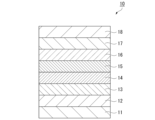
- FIG. 1 is a schematic cross-sectional view showing one embodiment of a magnetic recording medium of the present invention.
- Fluorine-containing ether compounds having a polar group such as a hydroxyl group have conventionally been used as materials for lubricants for magnetic recording media (hereinafter sometimes abbreviated as "lubricants") that are applied to the surface of a protective layer.
- fluorine-containing ether compounds have a terminal group having multiple polar groups at the end of a chain structure.
- Other fluorine-containing ether compounds have multiple perfluoropolyether chains, with linking groups having polar groups between adjacent perfluoropolyether chains.
- the polar groups contained in the fluorine-containing ether compound bond with active sites on the protective layer, improving the adhesion of the lubricating layer to the protective layer.
- conventional lubricating layers containing fluorine-containing ether compounds sometimes did not provide sufficient adhesion to the protective layer, even when the lubricating layer was formed using a fluorine-containing ether compound having multiple polar groups in the molecule.
- One possible method for improving the adhesion of the lubricating layer to the protective layer is to use a fluorine-containing ether compound with a larger number of polar groups.
- lubricating layers formed using such fluorine-containing ether compounds sometimes did not provide sufficient smoothness and wear resistance for the magnetic recording medium.
- a lubricating layer containing the fluorinated ether compound represented by the above formula (1) exhibits good smoothness and excellent wear resistance due to the synergistic effects of the actions and functions described below.
- the secondary hydroxyl group of the linking group represented by formula (4) and the primary hydroxyl group of the branched terminal group represented by formula (2) contained in the fluorinated ether compound represented by formula (1) are likely to be involved in bonding with active sites present on the protective layer for the reasons ⁇ 1> to ⁇ 3> described below.
- a divalent linking group represented by formula (4) having only one secondary hydroxyl group is bonded between two or three perfluoropolyether chains. Therefore, for example, when there are two divalent linking groups represented by formula (4), a perfluoropolyether chain is arranged between the divalent linking groups. Therefore, even if there are two divalent linking groups represented by formula (4), the distance between the secondary hydroxyl groups is not too close. Therefore, even if there are two divalent linking groups represented by formula (4), the two secondary hydroxyl groups are not inhibited from bonding with the active sites on the protective layer by the adjacent secondary hydroxyl groups.
- the secondary hydroxyl group contained in the divalent linking group represented by formula (4) is not too close to the polar groups contained in both of the terminal groups.
- the secondary hydroxyl group contained in the divalent linking group represented by formula (4) is not hindered from bonding with the active sites on the protective layer by the polar groups contained in both of the terminal groups. Therefore, the secondary hydroxyl group contained in the divalent linking group represented by formula (4) is easily involved in bonding with the active sites on the protective layer.
- At least one of the terminal groups is a branched terminal group represented by formula (2) in which two organic groups each containing one primary hydroxyl group are bonded to a trisubstituted carbon atom, and the distance between the two primary hydroxyl groups contained in formula (2) is appropriate. Therefore, in the fluorine-containing ether compound represented by formula (1), aggregation due to the distance between the two primary hydroxyl groups contained in the branched terminal group represented by formula (2) being too close is unlikely to occur, and the two primary hydroxyl groups do not inhibit each other from bonding with the active sites on the protective layer.
- the branched terminal group represented by the above formula (2) is an organic group having 3 to 35 constituent carbon atoms, the distance between the two primary hydroxyl groups contained in the branched terminal group is not too far. Therefore, when one of the primary hydroxyl groups contained in the branched terminal group represented by formula (2) bonds with the protective layer, the other primary hydroxyl group also becomes closer to the protective layer. As a result, the other primary hydroxyl group can assume an orientation that easily induces adsorption to the protective layer. Therefore, the two primary hydroxyl groups contained in the branched terminal group represented by formula (2) easily bond with active sites on the protective layer at the same time.
- the branched end group represented by formula (2) is a group in which two organic groups containing one primary hydroxyl group but no secondary or tertiary hydroxyl group are bonded to a tri-substituted carbon atom. Therefore, for example, the area around the two primary hydroxyl groups contained in the branched end group represented by formula (2) is sterically empty compared to the area around the secondary hydroxyl group bonded to the carbon atom forming the chain structure of the fluorine-containing ether compound. In addition, since two organic groups containing one primary hydroxyl group are bonded to the tri-substituted carbon atom, the distance between the two primary hydroxyl groups and the adjacent perfluoropolyether chain is appropriate.
- the two primary hydroxyl groups are unlikely to be inhibited from bonding with the active sites on the protective layer by the adjacent perfluoropolyether chain, which is a bulky part in the fluorine-containing ether compound represented by formula (1), and the tri-substituted carbon atom in the branched end group represented by formula (2).
- primary hydroxyl groups generally have a high degree of freedom and can move more freely than secondary and tertiary hydroxyl groups. Therefore, the two primary hydroxyl groups contained in the branched terminal group represented by formula (2) can each move spontaneously toward the active points on the protective layer. Therefore, both of the two primary hydroxyl groups contained in the branched terminal group can easily form bonds with the active points on the protective layer.
- the secondary hydroxyl group of the linking group represented by formula (4) and the primary hydroxyl group of the branched terminal group represented by formula (2) contained in the fluorine-containing ether compound represented by formula (1) are likely to participate in bonding with active sites present on the protective layer. Therefore, the lubricating layer containing the fluorine-containing ether compound represented by formula (1) is adhered to the protective layer by the secondary hydroxyl group contained in the linking group represented by formula (4) located between adjacent perfluoropolyether chains and the two primary hydroxyl groups of the branched terminal group represented by formula (2) located at at least one end, and has good adhesion to the protective layer.
- the lubricating layer containing the fluorine-containing ether compound represented by formula (1) has a moderate flexibility due to the bond to the adjacent methylene group via an ether bond, since the end bonded to the adjacent methylene group in the branched terminal group represented by formula (2) is an oxygen atom. Furthermore, the lubricating layer containing the fluorine-containing ether compound represented by formula (1) has sufficient fluidity and flexibility due to the high mobility of the two primary hydroxyl groups contained in the branched terminal group represented by formula (2). For these reasons, the lubricating layer containing the fluorine-containing ether compound represented by formula (1) has very good adhesion to the protective layer.
- the fluorine-containing ether compound represented by formula (1) can form a lubricating layer with good adhesion to the protective layer, and the perfluoropolyether chains in the fluorine-containing ether compound contained in the lubricating layer can form a structure that adheres closely to the protective layer without being too far away from the protective layer. Therefore, the state on the protective layer is unlikely to be bulky, and a lubricating layer with reduced surface unevenness can be obtained, and a lubricating layer with good coverage that easily wets and spreads on the protective layer and has a uniform coating state can be formed. As a result, it is presumed that the fluorine-containing ether compound represented by formula (1) can form a lubricating layer that has excellent wear resistance and good smoothness.
- the lubricating layer containing the fluorine-containing ether compound represented by formula (1) has sufficient fluidity and flexibility, even if a part of the lubricating layer is deformed by wear and the fluorine-containing ether compound in the lubricating layer moves to another location, it has a high ability to restore to its original position. From this, it is presumed that the lubricating layer containing the fluorine-containing ether compound represented by formula (1) has better smoothness and excellent wear resistance.
- the fluorine-containing ether compound contains polar groups that are not involved in bonding with the active points on the protective layer, the adhesion between the lubricating layer and the protective layer will be insufficient.
- the fluorine-containing ether compounds contained in the lubricating layer will locally aggregate with each other, or some of the molecules of the fluorine-containing ether compound will float from the surface of the protective layer, forming unevenness on the surface of the lubricating layer. For this reason, the state of the lubricant in the lubricating layer will be bulky, the coating state of the lubricating layer on the protective layer will be uneven, and it will be difficult to obtain a lubricating layer with good coating properties and smoothness.
- the adhesion between the lubricating layer and the protective layer is insufficient, the state of the lubricating layer present on the surface of the magnetic recording medium will change when the magnetic recording medium is rotated at high speed, the wear resistance of the lubricating layer will decrease, and the durability and reliability of the magnetic recording medium will decrease.
- a divalent linking group having two or more secondary hydroxyl groups when arranged instead of a divalent linking group represented by formula (4) having only one secondary hydroxyl group, the two or more secondary hydroxyl groups of the divalent linking group tend to inhibit each other from bonding with the active points on the protective layer. For this reason, at least a part of the two or more secondary hydroxyl groups tends to become polar groups that are not involved in bonding with the active points on the protective layer, and the polar groups that are not involved in bonding with the active points on the protective layer may attract intermolecular and/or intramolecular polar groups, resulting in a fluorine-containing ether compound that tends to aggregate. Therefore, when a divalent linking group having two or more secondary hydroxyl groups is arranged instead of a divalent linking group represented by formula (4), it is difficult to form a lubricating layer with good wear resistance and smoothness.
- a lubricating layer with excellent wear resistance and good smoothness can be formed, and have arrived at the present invention.
- the fluorine-containing ether compound, lubricant for magnetic recording media, and magnetic recording media of the present invention are described in detail below.
- the present invention is not limited to the embodiments shown below.
- the present invention allows additions, omissions, substitutions, and changes to the numbers, amounts, ratios, compositions, types, positions, materials, configurations, and the like, without departing from the spirit of the present invention.
- the fluorine-containing ether compound of the present embodiment is represented by the following formula (1).
- z is 1 or 2.
- R2 is a perfluoropolyether chain. Some or all of the (z+1) R2s may be the same or different from each other.
- R1 is a branched terminal group having 3 to 35 constituent carbon atoms and represented by the following formula (2).
- R4 is an organic group having 3 to 35 constituent carbon atoms and having 1 to 3 polar groups, and may be the same as or different from R1.
- R3 is a divalent linking group represented by the following formula (4). When z is 2, the two R3s may be the same or different.
- R5 and R6 are organic groups containing one primary hydroxyl group but not a secondary hydroxyl group or a tertiary hydroxyl group, and may be the same or different.
- x is an integer of 0 to 3.
- h is an integer from 1 to 3
- i is an integer from 1 to 3.
- z is 1 or 2. In the fluorine-containing ether compound represented by formula (1), z is 2 or less, so the molecule does not become too large. This allows the fluorine-containing ether compound to move freely on the protective layer, to easily wet and spread on the protective layer, and to easily obtain a lubricating layer with a uniform thickness.
- a divalent linking group represented by formula (4) having a secondary hydroxyl group can be arranged between adjacent perfluoropolyether chains.
- each of (z+1 ) R2 is independently a perfluoropolyether chain (hereinafter, sometimes referred to as "PFPE chain").
- PFPE chain a perfluoropolyether chain
- the PFPE chain represented by R2 covers the surface of the protective layer and imparts lubricity to the lubricating layer to reduce the frictional force between the magnetic head and the protective layer.
- the PFPE chain represented by R2 is appropriately selected according to the performance required for the lubricant containing the fluorine-containing ether compound.
- (z+1) R2 may be partially or entirely the same, or may be different from each other.
- (z+1) R2 are preferably all the same. This is because the fluorine-containing ether compound is uniformly coated on the protective layer, resulting in a lubricating layer with better adhesion.
- (z+1) R2 having two or more R2 being the same means that (z+1) R2 have two or more R2 having the same structure of the repeating unit of PFPE chain.
- the same R2 also includes repeating units having the same structure but different average polymerization degrees.
- the PFPE chain represented by R2 may be a polymer or copolymer of perfluoroalkylene oxide.
- perfluoroalkylene oxide include perfluoromethylene oxide, perfluoroethylene oxide, perfluoro-n-propylene oxide, perfluoroisopropylene oxide, and perfluorobutylene oxide.
- the (z+1) R 2s in formula (1) are each independently a PFPE chain represented by the following formula (5) derived from a polymer or copolymer of a perfluoroalkylene oxide.
- formula (5) derived from a polymer or copolymer of a perfluoroalkylene oxide.
- w2, w3, w4, and w5 represent an average degree of polymerization and each independently represents 0 to 20.
- w1 and w6 represent an average value representing the number of CF2 and each independently represents 1 to 3. There is no particular restriction on the arrangement order of the repeating units (CF 2 O), (CF 2 CF 2 O), (CF 2 CF 2 CF 2 O), and (CF 2 CF 2 CF 2 O) in formula (5).)
- w2, w3, w4, and w5 each independently represent an average degree of polymerization of 0 to 20, preferably 0 to 15, and more preferably 0 to 10.
- w1 and w6 are average values indicating the number of CF2 , and each independently represents 1 to 3.
- w1 and w6 are determined depending on the structure of the repeating unit arranged at the end of the chain structure in the PFPE chain represented by formula (5), etc.
- (CF 2 O), (CF 2 CF 2 O), (CF 2 CF 2 CF 2 O), and (CF 2 CF 2 CF 2 O) are repeating units. There is no particular restriction on the arrangement order of the repeating units in formula (5). There is also no particular restriction on the number of types of repeating units in formula (5).
- the (z+1) R 2s in formula (1) are each independently any one of PFPE chains selected from the PFPE chains represented by the following formulas (5-1) to (5-4).
- (z+1) R 2 are each independently one of the PFPE chains represented by formulas (5-1) to (5-4)
- a fluorine-containing ether compound is obtained that can provide a lubricating layer with good lubricity.
- (z+1) R 2 are each independently one of the PFPE chains represented by formulas (5-1) to (5-4)
- the ratio of the number of oxygen atoms (the number of ether bonds (-O-)) to the number of carbon atoms in the PFPE chain is appropriate. Therefore, a fluorine-containing ether compound having a suitable hardness is obtained. Therefore, the fluorine-containing ether compound applied on the protective layer is less likely to aggregate on the protective layer, and a lubricating layer with a thinner thickness can be formed with a sufficient coverage.
- formula (5-1) there is no particular restriction on the arrangement order of the repeating units (OCF 2 CF 2 ) and (OCF 2 ).
- the number j of (OCF 2 CF 2 ) and the number k of (OCF 2 ) may be the same or different.
- the PFPE chain represented by formula (5-1) may be a polymer of (OCF 2 CF 2 ).
- the PFPE chain represented by formula (5-1) may be any of a random copolymer, a block copolymer, and an alternating copolymer composed of (OCF 2 CF 2 ) and (OCF 2 ).
- j which indicates the average degree of polymerization
- k which is 0 to 20
- l which is 1 to 15, and m, which is 1 to 10
- j and k which indicate the average degree of polymerization
- l is 15 or less
- m is 10 or less, so that the viscosity of the fluorine-containing ether compound is not too high, and the lubricant containing this is easy to apply, which is preferable.
- j, k, l, and m which indicate the average degree of polymerization, are preferably 1 to 10, more preferably 1.5 to 8, and even more preferably 2 to 7, so that the fluorine-containing ether compound can easily wet and spread on the protective layer and easily provide a lubricating layer with a uniform thickness.
- the arrangement order of the repeating units (CF 2 CF 2 CF 2 O) and (CF 2 CF 2 O) is not particularly limited.
- the number w8 of (CF 2 CF 2 CF 2 O) and the number w9 of (CF 2 CF 2 O) may be the same or different.
- Formula (5-4) may include any of a random copolymer, a block copolymer, and an alternating copolymer composed of monomer units (CF 2 CF 2 CF 2 O) and (CF 2 CF 2 O).
- w8 and w9 each represent an average degree of polymerization and are each independently 1 to 20, preferably 1 to 15, and more preferably 1 to 10.
- w7 and w10 are average values indicating the number of CF2 , and each independently represents 1 to 2.
- w7 and w10 are determined depending on the structure of the repeating unit arranged at the end of the chain structure in the perfluoropolyether chain represented by formula (5-4), etc.
- R 3 is a divalent linking group represented by formula (4).
- the z R 3s are each arranged between the PFPE chains represented by (z+1) R 2s . As a result, R 3 brings the fluorine-containing ether compound and the protective layer into close contact with each other, forming a thin lubricating layer with a sufficient coverage.
- the divalent linking group represented by R3 has only one secondary hydroxyl group, and is arranged between adjacent PFPE chains.Therefore, the secondary hydroxyl group in R3 is not easily inhibited from bonding with the active site on the protective layer, and is bonded with the active site on the protective layer to improve adhesion with the protective layer.As a result, the lubricating layer containing the fluorine-containing ether compound represented by formula (1) is suppressed from being too far away from the protective layer by the PFPE chains arranged at both ends of R3 , and has excellent smoothness with reduced surface irregularities.
- h and i are integers of 1 to 3, and at least one of h and i is preferably 1.
- at least one of h and i is 1, production of the fluorinated ether compound becomes easy, which is preferable.
- h is 1 and i is 1.
- two R 3 may be the same or different.
- R 3 is the same, the covering state of the fluorine-containing ether compound with respect to the protective layer becomes more uniform, and a lubricating layer having better adhesion can be formed.
- two R 3 are the same means that the atoms contained in two R 3 are symmetrically arranged with respect to R 2 in the center of the molecule.
- the terminal group represented by R 1 is a branched terminal group having 3 to 35 constituent carbon atoms and represented by the following formula (2):
- the branched terminal group represented by formula (2) has two organic groups (R 5 and R 6 ) that contain no secondary or tertiary hydroxyl groups but one primary hydroxyl group bonded to a tri-substituted carbon atom that is a branch point.
- R5 and R6 are organic groups containing one primary hydroxyl group but not a secondary hydroxyl group or a tertiary hydroxyl group, and may be the same or different.
- x is an integer of 0 to 3.
- the branched terminal group represented by formula (2) has 3 to 35 carbon atoms, preferably 3 to 20, and more preferably 3 to 12.
- the branched terminal group may have 3 to 5 carbon atoms, 5 to 10 carbon atoms, or 10 to 15 carbon atoms. Since the branched terminal group represented by formula (2) has 35 or less constituent carbon atoms, the distance between the two primary hydroxyl groups contained in the branched terminal group is not too far. Therefore, the two primary hydroxyl groups contained in the branched terminal group represented by formula (2) can easily assume an orientation that allows both to be easily adsorbed to the protective layer, and are easily bonded to the active site on the protective layer.
- the branched terminal group represented by formula (2) since the branched terminal group represented by formula (2) has 3 to 35 constituent carbon atoms, the ratio of the number of carbon atoms to the number of hydroxyl groups is appropriate, and the polarity of the molecule is appropriate to obtain a fluorine-containing ether compound. In addition, if the branched terminal group represented by formula (2) has 3 to 12 constituent carbon atoms, the ratio of fluorine atoms in the fluorine-containing ether compound molecule is reduced, and the surface free energy of the entire molecule is prevented from increasing.
- x represents an integer of 0 to 3. It is preferable that x is 1 to 3.
- the interatomic distance between the perfluoropolyether chain represented by R 2 and the tri-substituted carbon atom contained in formula (2) becomes more appropriate. Therefore, the interatomic distance between the perfluoropolyether chain represented by R 2 and the two primary hydroxyl groups contained in formula (2) also becomes more appropriate. Therefore, both of the two primary hydroxyl groups contained in formula (2) become less susceptible to the influence of the bulkiness of the adjacent perfluoropolyether chain, and are more likely to be adsorbed to the protective layer. As a result, a lubricating layer having even better adhesion to the protective layer and excellent wear resistance can be obtained.
- R 5 and R 6 are each independently an organic group that does not contain a secondary hydroxyl group or a tertiary hydroxyl group, contains one primary hydroxyl group, and is bonded to a tri-substituted carbon atom. Therefore, the number of carbon atoms constituting R 5 and R 6 is 1 or more.
- the organic groups represented by R 5 and R 6 may each independently be linear or branched, and are preferably linear. When the organic group represented by R 5 (or R 6 ) is linear, the primary hydroxyl group of R 5 (or R 6 ) can move freely compared to when the organic group represented by R 5 (or R 6 ) is branched. Therefore, the primary hydroxyl group of R 5 (or R 6 ) can more easily form a bond with the active site on the protective layer.
- the two primary hydroxyl groups contained in R 5 and R 6 in formula (2) are preferably 5 atoms or more apart.
- the oxygen atom of one of the two primary hydroxyl groups contained in R 5 and R 6 is preferably bonded to the oxygen atom of the other primary hydroxyl group via a linking group in which 5 or more atoms including a tri-substituted carbon atom are linked.
- the distance between the two primary hydroxyl groups in formula (2) is sufficiently far away, and the interaction between the primary hydroxyl groups is unlikely to be dominant, and the inhibition of the bond with the protective layer by the adjacent primary hydroxyl groups can be more effectively suppressed.
- the two primary hydroxyl groups contained in R 5 and R 6 are 5 atoms or more apart, the two primary hydroxyl groups contained in R 5 and R 6 can more easily form a bond with the active site on the protective layer, and a lubricating layer with even better smoothness can be formed.
- the organic group represented by R5 and/or R6 in formula (2) preferably contains one or more ether bonds (-O-).
- the branched terminal group represented by formula (2) has appropriate flexibility, and therefore the lubricating layer containing the fluorine-containing ether compound represented by formula (1) has even better adhesion to the protective layer.
- the organic group represented by R 5 (or R 6 ) in formula (2) has a plurality of ether bonds, adjacent ether bonds are preferably bonded to each other via a linking group having two or more carbon atoms linked thereto. In this case, the distance between adjacent ether bonds becomes appropriate, resulting in a fluorine-containing ether compound that is less likely to aggregate.
- the formula (2) is preferably a branched terminal group of either the formula (2-1) or (2-2) below.
- the formula (2) is a branched terminal group of either the formula (2-1) or (2-2)
- the carbon atoms to which the two primary hydroxyl groups contained in the formula (2-1) or (2-2) are bonded are bonded via any linking group selected from a linking group consisting of a methine group, a linking group containing a methine group and a methylene group, and a linking group containing a methine group, a methylene group, and an ether bond.
- the distance between the two primary hydroxyl groups of the branched terminal group is appropriate, and the two primary hydroxyl groups do not inhibit each other from bonding with the active sites on the protective layer. Therefore, the two primary hydroxyl groups of the formula (2-1) or (2-2) can interact with the protective layer independently.
- formula (2) is a branched end group of either formula (2-1) or (2-2)
- the number of constituent carbon atoms in the branched end group is not too large, and the molecular weight of formula (2-1) or (2-2) is not too large. Therefore, the proportion of fluorine atoms in the fluorine-containing ether compound molecule is unlikely to decrease, and the surface free energy of the entire molecule can be prevented from increasing.
- a is an integer of 1 to 3
- b is an integer of 1 to 4.
- X 1 is a hydrogen atom or a group represented by formula (3).
- X 2 is a group represented by formula (3).
- X 1 and X 2 may be the same or different.
- c is an integer of 0 to 3
- d and e are each independently an integer of 1 to 5.
- X3 and X4 are each independently a hydrogen atom or a group represented by formula (3).
- X3 and X4 may be the same or different.
- f is an integer of 2 to 5
- g is 1 or 2.
- a represents an integer of 1 to 3. Since a in formula (2-1) is an integer of 1 to 3, the interatomic distance between the perfluoropolyether chain represented by R 2 and the tri-substituted carbon atom contained in formula (2-1) is appropriate. Therefore, both of the two primary hydroxyl groups contained in formula (2-1) are less susceptible to the influence of the bulkiness of the adjacent perfluoropolyether chain, and are more likely to be adsorbed to the protective layer. As a result, a lubricating layer with even better wear resistance can be formed. Since a is easy to secure the ratio of fluorine atoms in the fluorine-containing ether compound molecule, it is preferable that a is an integer of 1 or 2, and most preferably 1.
- b represents an integer of 1 to 4.
- X 1 is formula (3)
- b is an integer of 1 or 2, since it is easier to ensure the ratio of fluorine atoms in the fluorine-containing ether compound molecule.
- b in formula (2-1) is preferably 2 to 4, more preferably 3 or 4.
- b in formula (2-1) is 2 or more, the interatomic distance between the two primary hydroxyl groups contained in formula (2-1) becomes more appropriate.
- X 1 in formula (2-1) is a hydrogen atom or a group represented by formula (3).
- X 2 is a group represented by formula (3).
- X 1 and X 2 may be the same or different.
- X 1 and X 2 are both groups represented by formula (3) and are the same, production of the fluorine-containing ether compound may be facilitated, which is preferable.
- X 1 and X 2 are different, it is easier to ensure the proportion of fluorine atoms in the fluorine-containing ether compound molecule, so that X 1 is preferably a hydrogen atom.
- c represents an integer of 0 to 3.
- c is preferably an integer of 0 to 2, since it is easier to ensure the proportion of fluorine atoms in the fluorine-containing ether compound molecule.
- the interatomic distance between the perfluoropolyether chain represented by R 2 and the tri-substituted carbon atom contained in formula (2-2) becomes more appropriate, and the interatomic distance between the perfluoropolyether chain represented by R 2 and the two primary hydroxyl groups contained in formula (2-2) tends to become more appropriate, so c is more preferably 1 or 2.
- d and e each independently represent an integer of 1 to 5. Since d and e are easy to secure the ratio of fluorine atoms in the fluorine-containing ether compound molecule, each independently is preferably an integer of 1 to 3, more preferably 1 or 2. d and e may be the same or different. Since d and e are easy to manufacture the fluorine-containing ether compound, it is preferable that they are the same. In addition, since the interatomic distance between the two primary hydroxyl groups contained in formula (2-2) is appropriate, the sum of d and e is preferably 4 or more.
- the sum of c and d and the sum of c and e are each preferably 3 or more.
- X3 and X4 in formula (2-2) are hydrogen atoms or groups represented by formula (3).
- X3 and X4 may be the same or different.
- X3 and X4 are the same, it is preferable because the production of the fluorine-containing ether compound is easy.
- X3 and/or X4 are preferably hydrogen atoms, because it is easy to ensure the ratio of fluorine atoms in the fluorine-containing ether compound molecule, and it is more preferable that both X3 and X4 are hydrogen atoms.
- f represents an integer of 2 to 5.
- f is preferably an integer of 2 to 4, and more preferably 2 or 3.
- f in formula (3) is appropriately determined depending on the values of a and b in formula (2-1) and the type of X1 , the values of c, d, and e in formula (2-2), etc.
- f in formula (3) is preferably 2 or 3. This is because the interatomic distance between the two primary hydroxyl groups contained in formula (2-1) is more likely to be appropriate.
- X3 and/or X4 in formula (2-2) are formula (3), f in formula (3) is preferably 2 or 3 because it becomes easier to ensure the proportion of fluorine atoms in the fluorine-containing ether compound molecule.
- g represents 1 or 2.
- f in each [-(CH 2 ) f -O-] may be the same or different.
- g in formula (3) is preferably 1, since this makes it easier to ensure the proportion of fluorine atoms in the fluorine-containing ether compound molecule.
- the terminal group represented by R4 is an organic group having 1 to 3 polar groups and 3 to 35 constituent carbon atoms.
- the terminal group represented by R4 is preferably an organic group having 3 to 20 constituent carbon atoms, and more preferably an organic group having 3 to 12 constituent carbon atoms.
- the ratio of the number of carbon atoms to the number of polar groups becomes appropriate, resulting in a fluorine-containing ether compound with appropriate molecular polarity.
- the end group represented by R4 is preferably an oxygen atom at the end that is bonded to the adjacent methylene group.
- R4 is bonded to the adjacent methylene group via an ether bond, and thus becomes a fluorine-containing ether compound having appropriate hardness. Therefore, the fluorine-containing ether compound applied on the protective layer is unlikely to aggregate on the protective layer, and even if the thickness is reduced, a lubricating layer having better covering property and smoothness can be formed.
- R 10 and R 11 may bond to each other to form a ring
- R 12 and R 13 may bond to each other to form a ring.
- R 10 , R 11 , R 12 and R 13 are preferably each independently selected from the group consisting of a hydrogen atom, a methyl group, an ethyl group, a propyl group and a butyl group.
- the terminal group represented by R4 has a polar group containing a carbon atom (for example, a carboxy group, a formyl group, a carbonyl group, a cyano group, or a group having an amide bond)
- the carbon atom contained in the polar group is included in the number of carbon atoms constituting the terminal group represented by R4 .
- the number of polar groups possessed by the terminal group represented by R4 is 1 to 3, preferably 2 or 3, in order to obtain a fluorine-containing ether compound capable of forming a lubricating layer having even better adhesion to a protective layer.
- the number of polar groups is 3 or less, in a magnetic recording medium having a lubricating layer containing a fluorine-containing ether compound, aggregation of the fluorine-containing ether compound due to too many polar groups contained in the fluorine-containing ether compound can be prevented, which would otherwise cause a decrease in smoothness.
- R4 contains two or more polar groups
- the two or more polar groups are bonded to different carbon atoms, and that one or more carbon atoms are included between the carbon atoms to which adjacent polar groups are bonded.
- the adjacent polar groups are bonded with an appropriate interatomic distance. Therefore, the multiple polar groups in R4 are all oriented so that they can be adhered to the protective layer. Therefore, the multiple polar groups in R4 are less likely to aggregate, and can easily form bonds with the active sites on the protective layer.
- the terminal group represented by R4 may be an organic group having 1 to 3 polar groups and further having a carbon-carbon unsaturated bond site.
- the terminal group represented by R4 has a carbon-carbon unsaturated bond site, the terminal group is preferably an organic group having at least one selected from the group consisting of an aromatic hydrocarbon group, an unsaturated heterocyclic group, an alkenyl group, and an alkynyl group.
- aromatic hydrocarbon groups examples include phenyl groups, methoxyphenyl groups, fluorinated phenyl groups, naphthyl groups, and methoxynaphthyl groups.
- aromatic hydrocarbon groups also include groups in which a substituent such as a methoxy group or a fluoro group is bonded to an aromatic hydrocarbon.
- unsaturated heterocyclic groups include pyrrolyl, pyrazolyl, methylpyrazolyl, imidazolyl, furyl, furfuryl, oxazolyl, isoxazolyl, thienyl, thiazolyl, isothiazolyl, pyridyl, pyrimidinyl, pyridazinyl, pyrazinyl, indolinyl, benzofuranyl, benzothienyl, benzimidazolyl, benzoxazolyl, benzothiazolyl, benzopyrazolyl, benzoisoxazolyl, benzoisothiazolyl, quinolyl, isoquinolyl, quinazolinyl, quinoxalinyl, phthalazinyl, and cinnolinyl groups.
- Unsaturated heterocyclic groups include groups in which a substituent such as a methyl group is bonded to an unsaturated heterocycle, as described above.
- alkenyl group examples include a vinyl group, an allyl group, a butenyl group, a pentenyl group, and a hexenyl group.
- alkynyl group examples include a 1-propynyl group, a propargyl group, a butynyl group, a pentynyl group, and a hexynyl group.
- the lubricating layer containing the fluorine-containing ether compound has excellent adhesion to the protective layer, and can be made thinner, which is preferable. The reason is explained below.
- the hydroxyl groups contained in R 1 and R 3 in formula (1) (and the hydroxyl groups when R 4 has a hydroxyl group) and the carbon-carbon unsaturated bond sites contained in the terminal group represented by R 4 are adsorbed to different sites on the protective layer.
- the hydroxyl groups contained in R1 and R3 in formula (1) exhibit adsorptivity by interacting with locally charged sites on the protective layer via hydrogen bonds between hydrogen atoms.
- the carbon-carbon unsaturated bond site contained in the terminal group represented by R4 has a delocalized charge and therefore exhibits adsorptivity by interacting with sites on the protective layer where the charge distribution is widespread.
- the hydroxyl groups contained in R 1 and R 3 in formula (1) (and the hydroxyl group when R 4 has a hydroxyl group) and the carbon-carbon unsaturated bond moiety contained in the terminal group represented by R 4 can each independently interact with an active site on the protective layer.
- a lubricating layer containing a fluorine-containing ether compound in which the terminal group represented by R 4 has a carbon-carbon unsaturated bond moiety has even better adhesion to the protective layer, better smoothness, and higher wear resistance.
- the terminal group represented by R4 may contain two primary hydroxyl groups. In this case, it is preferable that R4 does not contain a polar group other than the two primary hydroxyl groups.
- R4 does not contain a polar group other than the two primary hydroxyl groups having high mobility and adsorptivity, the polar groups that can participate in adsorption with the protective layer become excessive, and the polar groups that cannot be adsorbed to the protective layer and become free can be prevented from being generated. Therefore, it is possible to prevent the polar groups between molecules and/or within the molecule from coagulating with each other.
- R4 may be a branched terminal group represented by the formula (2) as in R1 .
- the two primary hydroxyl groups contained in the formula (2) of R4 are likely to be involved in bonding with the active sites present on the protective layer as in the two primary hydroxyl groups contained in the formula (2) of R1 .
- R4 is a branched terminal group represented by the formula (2), as in R1 , it has moderate flexibility due to bonding to adjacent methylene groups via ether bonds, and has sufficient fluidity and flexibility due to the high mobility of the two primary hydroxyl groups contained in the branched terminal group represented by the formula (2). Therefore, it is presumed that the lubricating layer containing the fluorine-containing ether compound represented by the formula (1) has good adhesion to the protective layer, good smoothness, and excellent wear resistance.
- R4 is a branched terminal group represented by formula (2)
- R4 is preferably a branched terminal group represented by either formula (2-1) or (2-2).
- the preferred values of a and b in formula (2-1), c to e in formula (2-2), and f and g in formula (3) are the same as those in the case where R1 is a branched terminal group represented by formula (2-1) or (2-2).
- R 4 when R 4 is a branched terminal group represented by formula (2), it is more preferable that both R 1 and R 4 are branched terminal groups represented by formula (2-1) or (2-2).
- R 1 and R 4 when R 4 is a branched terminal group represented by formula (2), it is preferable that R 1 and R 4 are the same, and it is more preferable that both R 1 and R 4 are the above formula (2-1) or (2-2).
- R 1 and R 4 are the same, the coating state of the fluorine-containing ether compound on the protective layer becomes more uniform, and a lubricating layer having better adhesion can be formed.
- the fluorine-containing ether compound represented by formula (1) it is preferable that z is 1, R1 and R4 are the same, and two R2 are the same. This is because it becomes a fluorine-containing ether compound that is easy to synthesize.
- the fluorine-containing ether compound having a symmetric structure is more likely to wet and spread on the protective layer, and can form a lubricating layer with good covering properties.
- z is preferably 2, R 1 and R 4 are the same, and three R 2 are preferably the same. This is because it becomes a fluorine-containing ether compound that is easy to synthesize. Furthermore, when z is 2, it is preferably that two R 3 are the same. This is because it becomes a fluorine-containing ether compound that is even easier to synthesize.
- the fluorine-containing ether compound having a symmetric structure is more likely to wet and spread on the protective layer, and can form a lubricating layer with good covering properties.
- the terminal group represented by R 4 is preferably a terminal group containing two or three polar groups, at least one of which is a secondary hydroxyl group.
- the terminal group represented by R 4 is preferably any of the terminal groups represented by the following formulas (6-1) to (6-3).
- y1 is 1 or 2, and y2 is an integer of 0 to 3.
- X5 is an aromatic hydrocarbon group, an unsaturated heterocyclic group, an alkenyl group, an alkynyl group, or a polar group. When y1 is 1, X5 is a polar group. When X5 is an aromatic hydrocarbon group or an unsaturated heterocyclic group, an atom constituting a ring structure in X5 bonds to the methylene group adjacent to X5 .
- X5 is an alkenyl group or an alkynyl group, a carbon atom constituting an unsaturated bond in X5 bonds to the methylene group adjacent to X5 .
- y3 is an integer of 1 to 3
- y4 is 0 or 1
- y5 is an integer of 0 to 3.
- X5 is an aromatic hydrocarbon group, an unsaturated heterocyclic group, an alkenyl group, an alkynyl group, or a polar group.
- y4 is 0, X5 is a polar group.
- X5 is an aromatic hydrocarbon group or an unsaturated heterocyclic group, an atom constituting a ring structure in X5 bonds to the methylene group adjacent to X5 .
- X5 is an alkenyl group or an alkynyl group, a carbon atom constituting an unsaturated bond in X5 bonds to the methylene group adjacent to X5 .
- y6 is 0 or 1
- y7 is an integer from 1 to 3
- y8 is an integer from 1 to 3.
- X5 is an aromatic hydrocarbon group, an unsaturated heterocyclic group, an alkenyl group, an alkynyl group, or a polar group.
- y6 is 0, X5 is a polar group.
- X5 is an aromatic hydrocarbon group or an unsaturated heterocyclic group, an atom constituting a ring structure in X5 bonds to the methylene group adjacent to X5 .
- X5 is an alkenyl group or an alkynyl group, a carbon atom constituting an unsaturated bond in X5 bonds to the methylene group adjacent to X5 .
- X 5 when X 5 is an alkenyl group, the carbon atom constituting the unsaturated bond in X 5 bonds to the methylene group adjacent to X 5.
- Each of the organic groups represented by R 14 to R 19 is preferably a hydrocarbon group having 1 to 3 carbon atoms.
- X 5 in formulae (6-1) to (6-3) is an alkenyl group
- X 5 when X 5 is an alkynyl group, a carbon atom constituting an unsaturated bond in X 5 bonds to a methylene group adjacent to X 5.
- examples of X 5 include -C ⁇ CH and -C ⁇ CR 20 (R 20 is an organic group).
- the organic group represented by R 20 is preferably a hydrocarbon group having 1 to 3 carbon atoms.
- X 5 in formulae (6-1) to (6-3) is an alkynyl group
- X 5 is preferably -C ⁇ CH since it becomes a terminal group having appropriate bulkiness.
- X5 when X5 is a polar group, the polar groups exemplified above can be used as X5 .
- X5 is preferably a hydroxyl group, a group having an amide bond, or a cyano group.
- X5 when X5 is a hydroxyl group, a group having an amide bond, or a cyano group, when a lubricating layer is formed on a protective layer using a lubricant containing this, a more suitable interaction occurs between the lubricating layer and the protective layer.
- the lubricating layer containing the fluorine-containing ether compound is more excellent in adhesion to the protective layer and can be made thinner, which is preferable. The reason is explained below.
- the secondary hydroxyl groups in formulas (6-1) to (6-3) and X5 are bonded via a divalent organic group which may contain an ether bond. Therefore, even if X5 is a polar group, the distance between the secondary hydroxyl groups in formulas (6-1) to (6-3) and the polar group represented by X5 is appropriate. As a result, the secondary hydroxyl groups in formulas (6-1) to (6-3) and the polar group represented by X5 are not easily inhibited from bonding with the active sites on the protective layer by other polar groups. In addition, the secondary hydroxyl groups in formulas (6-1) to (6-3) and the polar group represented by X5 are not easily aggregated.
- the secondary hydroxyl group in formulas (6-1) to (6-3) and the polar group represented by X5 can each independently be adsorbed to the active site on the protective layer.
- the lubricating layer containing the fluorine-containing ether compound having a terminal group in which X5 in formulas (6-1) to (6-3) is a polar group has even better adhesion to the protective layer, good smoothness, and excellent wear resistance even when thin.
- y1 is 1 or 2
- y2 is an integer of 0 to 3.
- X5 is a polar group
- formula (6-1) has two polar groups.
- X5 may be any of an aromatic hydrocarbon group, an unsaturated heterocyclic group, an alkenyl group, an alkynyl group, and a polar group.
- formula (6-1) When y1 is 2 and X5 is any of an aromatic hydrocarbon group, an unsaturated heterocyclic group, an alkenyl group, and an alkynyl group, formula (6-1) also has two polar groups. Therefore, a lubricating layer with good adhesion to the protective layer can be formed.
- X5 is an aromatic hydrocarbon group, an unsaturated heterocyclic group, an alkenyl group, or an alkynyl group, a lubricating layer having excellent smoothness and wear resistance can be formed by the ⁇ - ⁇ interaction between the carbon-carbon unsaturated bond site of X5 and the protective layer without impairing the adhesion of the two hydroxyl groups contained in formula (6-1) to the protective layer.
- formula (6-1) when y1 is 2 and X5 is a polar group, formula (6-1) has three polar groups. Therefore, a lubricating layer having better adhesion to the protective layer can be formed.
- y2 is an integer of 0 to 3.
- X 5 in formula (6-1) is a polar group
- the distance between X 5 and the secondary hydroxyl group in formula (6-1) is not too close, so the polar group in formula (6-1) is unlikely to aggregate.
- y2 is preferably 1 or more.
- y2 is 3 or less, so that the mobility of X 5 in formula (6-1) is not too high, and each polar group of the terminal group can sufficiently adhere to the protective layer. It is more preferable that y2 is 2 or less.
- y3 is an integer of 1 to 3.
- X5 is a polar group. Since y3 is an integer of 1 or more, when y4 is 0, the distance between X5 and the secondary hydroxyl group in formula (6-2) is appropriate, and even if X5 is a polar group, the polar group in formula (6-2) is unlikely to aggregate. Furthermore, since y3 is an integer of 1 or more, when y4 is 1, the distance between the secondary hydroxyl groups in formula (6-2) is not too close, and the secondary hydroxyl groups in formula (6-2) are unlikely to aggregate.
- y3 is 3 or less, so that the mobility of the terminal group represented by formula (6-2) is not too high, and each polar group of the terminal group can be sufficiently adhered to the protective layer. It is preferable that y3 is 2 or less.
- y4 is 0 or 1.
- X 5 is a polar group
- formula (6-2) has two polar groups.
- a lubricating layer with good adhesion to the protective layer can be formed.
- X 5 may be any of an aromatic hydrocarbon group, an unsaturated heterocyclic group, an alkenyl group, an alkynyl group, and a polar group.
- formula (6-2) also has two polar groups.
- a lubricating layer with good adhesion to the protective layer can be formed.
- X5 is an aromatic hydrocarbon group, an unsaturated heterocyclic group, an alkenyl group, or an alkynyl group
- a lubricating layer having excellent smoothness and wear resistance can be formed by the ⁇ - ⁇ interaction between the carbon-carbon unsaturated bond site of X5 and the protective layer without impairing the adhesion of the two hydroxyl groups contained in formula (6-2) to the protective layer.
- formula (6-2) has three polar groups. Therefore, a lubricating layer having excellent adhesion to the protective layer can be formed.
- y5 is an integer of 0 to 3.
- the distance between X 5 and the secondary hydroxyl group in formula (6-2) is not too close, so the polar group in formula (6-2) is unlikely to aggregate.
- X 5 in formula (6-2) is a polar group
- the distance between X 5 and the secondary hydroxyl group in formula (6-2) is more appropriate, so y5 is preferably 1 or more.
- y4 is 0, even if y5 is 0, the distance between the polar group X 5 and the secondary hydroxyl group in formula (6-2) is appropriate due to y3 methylene groups.
- y4 When y4 is 0, when y5 is 1 or more, the distance between the polar group X 5 and the secondary hydroxyl group in formula (6-2) is more appropriate due to y3+y5 methylene groups, so it is preferable.
- the terminal group represented by formula (6-2) since y5 is 3 or less, the mobility of X5 in formula (6-2) is not too high, and each polar group of the terminal group can sufficiently adhere to the protective layer.
- y5 is preferably 2 or less.
- y6 is 0 or 1.
- X 5 is a polar group
- formula (6-3) has two polar groups.
- a lubricating layer with good adhesion to the protective layer can be formed.
- y6 is 1, X 5 may be any of an aromatic hydrocarbon group, an unsaturated heterocyclic group, an alkenyl group, an alkynyl group, and a polar group.
- y6 is 1 and X 5 is an aromatic hydrocarbon group, an unsaturated heterocyclic group, an alkenyl group, or an alkynyl group
- formula (6-3) also has two polar groups.
- a lubricating layer with good adhesion to the protective layer can be formed.
- X5 is an aromatic hydrocarbon group, an unsaturated heterocyclic group, an alkenyl group, or an alkynyl group
- a lubricating layer having excellent smoothness and wear resistance can be formed by the ⁇ - ⁇ interaction between the carbon-carbon unsaturated bond site of X5 and the protective layer without impairing the adhesion of the two hydroxyl groups contained in formula (6-3) to the protective layer.
- formula (6-3) has three polar groups. Therefore, a lubricating layer having excellent adhesion to the protective layer can be formed.
- y7 is an integer from 1 to 3. Since y7 is 1 or more, when y6 is 1, the secondary hydroxyl groups in formula (6-3) do not become too close to each other. Therefore, the secondary hydroxyl groups in formula (6-3) are less likely to aggregate. In the terminal group represented by formula (6-3), since y7 is 3 or less, the mobility of the terminal group represented by formula (6-3) does not become too high, and each polar group possessed by the terminal group can sufficiently adhere to the protective layer. It is preferable that y7 is 2 or less.
- y8 is an integer of 1 to 3. In the terminal group represented by formula (6-3), y8 is 1 or more, so even if X 5 in formula (6-3) is a polar group, the distance between X 5 and the secondary hydroxyl group in formula (6-3) is not too close. Therefore, the polar group in formula (6-3) is less likely to aggregate. When X 5 in formula (6-3) is a polar group, the distance between X 5 and the secondary hydroxyl group in formula (6-3) becomes more appropriate, so y8 is preferably 2 or more. In the terminal group represented by formula (6-3), y8 is 3 or less, so that the mobility of X 5 in formula (6-3) is not too high, and each polar group of the terminal group can sufficiently adhere to the protective layer.
- the types of the terminal groups represented by R 1 and R 4 can be appropriately selected depending on the performance required of a lubricant containing the fluorinated ether compound.
- the fluorine-containing ether compound represented by (1) is preferably any of the compounds represented by the following formulae (1A) to (1O) and (2A) to (2O).
- the compound represented by formula (1) is any of the compounds represented by the following formulae (1A) to (1O) and (2A) to (2O)
- the raw materials are easy to obtain, and even if the compound is thin, it has excellent adhesion and can form a lubricating layer with even better smoothness and wear resistance.
- Rf 1 and Rf 2 representing PFPE chains have the following structures, respectively. That is, in the compounds represented by the following formulae (1A) to (1F), (1J), (1K), (1N), (2A) to (2F), (2J), (2K), and (2N), Rf 2 is a PFPE chain represented by the following formula (7-2).
- Rf 1 is a PFPE chain represented by the following formula (7-1).
- p and q in Rf 1 and r in Rf 2 representing the PFPE chain in formulae (1A) to (1O) and (2A) to (2O) are values indicating the average degree of polymerization, and therefore are not necessarily integers.
- r represents an average degree of polymerization and is 1 to 15.
- the r in the two Rf 2 may be the same or different.
- r represents an average degree of polymerization and is 1 to 15.
- the r in the two Rf 2 may be the same or different.
- r represents an average degree of polymerization and is 1 to 15.
- the r in the two Rf 2 may be the same or different.
- r represents an average degree of polymerization and represents 1 to 15.
- the r in the two Rf 2 may be the same or different.
- In the two Rf 2 in formula (1E r represents an average degree of polymerization and is 1 to 15.
- the r in the two Rf 2 may be the same or different.
- r represents an average degree of polymerization and represents 1 to 15.
- the r in the two Rf 2 may be the same or different.
- p and q represent an average degree of polymerization, where p represents 1 to 20 and q represents 0 to 20.
- p and q in the two Rf 1s may be the same or different.
- p and q represent an average degree of polymerization, where p represents 1 to 20 and q represents 0 to 20.
- p and q in the two Rf 1s may be the same or different.
- p and q represent an average degree of polymerization, where p represents 1 to 20 and q represents 0 to 20.
- p and q in the two Rf 1s may be the same or different.
- r represents an average degree of polymerization and is 1 to 15. The r in the two Rf 2 may be the same or different.
- r represents an average degree of polymerization and is 1 to 15.
- the r in the two Rf 2 may be the same or different.
- p and q represent an average degree of polymerization, where p represents 1 to 20 and q represents 0 to 20.
- p and q in the two Rf 1s may be the same or different.
- p and q represent an average degree of polymerization, where p represents 1 to 20 and q represents 0 to 20.
- p and q in the two Rf 1s may be the same or different.
- r represents an average degree of polymerization and represents 1 to 15. The r in the two Rf 2 may be the same or different.
- p and q represent an average degree of polymerization, where p represents 1 to 20 and q represents 0 to 20. p and q in the two Rf 1s may be the same or different.
- r represents an average degree of polymerization and is 1 to 15. The r in the three Rf2 may be different from each other, or some or all of them may be the same.
- r represents an average degree of polymerization and is 1 to 15. The r in the three Rf2 may be different from each other, or some or all of them may be the same.
- r represents an average degree of polymerization and is 1 to 15. The r in the three Rf2 may be different from each other, or some or all of them may be the same.
- r represents an average degree of polymerization and is 1 to 15.
- the r in the three Rf2 may be different from each other, or some or all of them may be the same.) (In the three Rf 2 in formula (2E), r represents an average degree of polymerization and is 1 to 15. The r in the three Rf 2 may be different from each other, or some or all of them may be the same.)
- r represents an average degree of polymerization and is 1 to 15. The r in the three Rf2 may be different from each other, or some or all of them may be the same.
- p and q represent an average degree of polymerization, where p represents 1 to 20 and q represents 0 to 20.
- p and q in the three Rf 1s may be different from each other or may be the same in part or in whole.
- p and q represent an average degree of polymerization, where p represents 1 to 20 and q represents 0 to 20.
- p and q in the three Rf 1s may be different from each other or may be the same in part or in whole.
- p and q represent an average degree of polymerization, where p represents 1 to 20 and q represents 0 to 20.
- p and q in the three Rf 1s may be different from each other or may be the same in part or in whole.
- r represents an average degree of polymerization and is 1 to 15. The r in the three Rf2 may be different from each other, or some or all of them may be the same.
- r represents an average degree of polymerization and is 1 to 15. The r in the three Rf2 may be different from each other, or some or all of them may be the same.
- p and q represent an average degree of polymerization, where p represents 1 to 20 and q represents 0 to 20.
- p and q in the three Rf 1s may be different from each other or may be the same in part or in whole.
- p and q represent an average degree of polymerization, where p represents 1 to 20 and q represents 0 to 20.
- p and q in the three Rf 1s may be different from each other or may be the same in part or in whole.
- r represents an average degree of polymerization and is 1 to 15. The r in the three Rf2 may be different from each other, or some or all of them may be the same.
- p and q represent an average degree of polymerization, where p represents 1 to 20 and q represents 0 to 20. p and q in the three Rf 1s may be different from each other or may be the same in part or in whole.
- the fluorine-containing ether compound of this embodiment preferably has a number average molecular weight (Mn) in the range of 500 to 10,000, more preferably in the range of 500 to 5,000, and particularly preferably in the range of 1,000 to 3,000. If the number average molecular weight is 500 or more, the lubricant containing the fluorine-containing ether compound of this embodiment is less likely to evaporate, and the lubricant can be prevented from evaporating and transferring to the magnetic head. Furthermore, if the number average molecular weight is 10,000 or less, the viscosity of the fluorine-containing ether compound is appropriate, and a thin lubricating layer can be easily formed by applying a lubricant containing this. If the number average molecular weight is 5,000 or less, the viscosity becomes easy to handle when applied to a lubricant, and this is more preferable.
- Mn number average molecular weight
- the number average molecular weight (Mn) of the fluorine-containing ether compound is a value measured by 1 H-NMR and 19 F-NMR using AVANCEIII400 manufactured by Bruker Biospin. Specifically, the number of repeating units of the PFPE chain is calculated from the integral value measured by 19 F-NMR to obtain the number average molecular weight.
- NMR nuclear magnetic resonance
- the sample was diluted in a single or mixed solvent such as hexafluorobenzene, d-acetone, or d-tetrahydrofuran and used for the measurement.
- the reference of the 19 F-NMR chemical shift was set to the peak of hexafluorobenzene at -164.7 ppm.
- the reference of the 1 H-NMR chemical shift was set to the peak of acetone at 2.2 ppm.
- the fluorinated ether compound of the present embodiment is preferably subjected to molecular weight fractionation by an appropriate method to have a molecular weight dispersity (ratio of weight average molecular weight (Mw)/number average molecular weight (Mn)) of 1.3 or less.
- the method of molecular weight fractionation is not particularly limited, but for example, molecular weight fractionation by a silica gel column chromatography method, a gel permeation chromatography (GPC) method, or the like, molecular weight fractionation by a supercritical extraction method, or the like can be used.
- the method for producing the fluorinated ether compound of the present embodiment is not particularly limited, and the compound can be produced by a conventionally known production method.
- the fluorinated ether compound of the present embodiment can be produced, for example, by the production method shown below.
- a production method selected from the first to fourth production methods shown below can be used.
- a production method selected from the fifth and sixth production methods shown below can be used.
- R 2 is the same as R 2 in formula (1).
- PG 1 , PG 2 and PG 3 each represent a protecting group and may be the same or different.
- X represents a (pseudo)halogen group.
- s representing the number of methylene groups is an integer corresponding to b in formula (2-1).
- a fluorine-based compound having hydroxymethyl groups (-CH 2 OH) at both ends of a PFPE chain corresponding to R 2 in formula (1) is prepared.
- a suitable protecting group (PG 1 ) is bonded to the hydroxymethyl group at one end of the fluorine-based compound to produce a first intermediate compound.
- the epoxy compound used in the second reaction has a group corresponding to -(CH 2 ) a -CH(OX 2 )-(CH 2 ) b -OX 1 in the group represented by formula (2-1).
- an epoxy compound is used which corresponds to -(CH 2 ) a -CH(OX 2 )-(CH 2 ) b -OX 1 in the group represented by formula (2-1) where a is 1, b is s, and X 1 is a hydrogen atom.
- Such an epoxy compound may be produced by a known method, or a commercially available product may be used.
- the (pseudo) alkyl halide compound (X-(CH 2 ) t -O-PG 3 ) used in the third reaction has a group corresponding to -OX 2 (X 2 is a group represented by formula (3)) in the group represented by formula (2-1).
- X 2 is a group represented by formula (3)
- a (pseudo) alkyl halide compound is used that corresponds to the group represented by formula (3) (-((CH 2 ) f -O) g -H) where f is t and g is 1.
- Such a (pseudo) alkyl halide compound may be produced by a known method, or a commercially available product may be used.
- reaction ratio of the third intermediate compound to the (pseudo)halogenated epoxy compound is preferably about 2:1 (molar ratio).
- the (pseudo)halogenated epoxy compound used in the fourth reaction has a group corresponding to the group represented by formula (4) (-O(CH 2 ) h -CH(OH)-(CH 2 ) i O-).
- a (pseudo)halogenated epoxy compound is used which corresponds to the group represented by formula (4) (-O(CH 2 ) h -CH(OH)-(CH 2 ) i O-) where h and i are 1.
- Such a (pseudo)halogenated epoxy compound may be produced by a known method, or a commercially available product may be used.
- a fluorinated ether compound can be produced in which z in formula (1) is 1, R 1 and R 4 are the same, a group represented by formula (2-1), a is 1, X 1 is a hydrogen atom, the two PFPE chains represented by R 2 are the same, and h and i in formula (4) represented by R 3 are 1.
- an example has been described in which an epoxy compound corresponding to the group represented by formula (2-1) in which a is 1 and X 1 is a hydrogen atom is used as the epoxy compound used in the second reaction, but an epoxy compound corresponding to the group represented by formula (3) in which X 1 is a group represented by formula (3) may also be used.
- the epoxy compound corresponding to the group represented by formula (3) in which X 1 is a group may be produced by a known method, or a commercially available product may be used.
- R 2 is the same as R 2 in formula (1).
- PG 4 represents a protecting group.
- LG represents a leaving group obtained by reacting a hydroxyl group with an activator.
- R represents an organic group having a partial structure corresponding to —(CH 2 ) x —CH(R 5 )R 6 of R 1 ( ⁇ R 4 ) in formula (1).
- X represents a (pseudo)halogen group.
- a first intermediate compound having a protecting group (PG 4 ) bonded to one end of a PFPE chain corresponding to R 2 in formula (1) is produced in the same manner as in the first reaction in the above-mentioned first production method.
- the hydroxymethyl group at one end of the first intermediate compound obtained by the first reaction is reacted with a known activating agent to produce a second intermediate compound in which the end opposite the protecting group (PG 4 ) of the first intermediate compound is converted to a leaving group (LG).
- the leaving group (LG) that can be used include a chloro group, a bromo group, an iodo group, a p-toluenesulfonyloxy group, a methanesulfonyloxy group, a trifluoromethanesulfonyloxy group, a perfluoroalkylsulfonyloxy group, and a nitrobenzenesulfonyloxy group.
- reaction ratio of the third intermediate compound to the (pseudo)halogenated epoxy compound is preferably about 2:1 (molar ratio).
- the (pseudo)halogenated epoxy compound used in the fourth reaction the same compounds as those usable in the fourth reaction of the first production method can be used.
- the polar group that is not involved in the bond with the second intermediate compound in the third reaction may be protected with an appropriate protecting group before use in the third reaction.
- the protecting group of the polar group can be deprotected under appropriate conditions after the third reaction or the fourth reaction.
- R 2 is the same as R 2 in formula (1).
- X represents a (pseudo)halogen group.
- R′ represents an organic group having a partial structure corresponding to —(CH 2 ) x —CH(R 5 )R 6 of R 1 ( ⁇ R 4 ) in formula (1).
- a fluorine-based compound having hydroxymethyl groups (-CH 2 OH) at both ends of the PFPE chain corresponding to R 2 in formula (1) is prepared.
- This produces a first intermediate compound having a terminal group corresponding to -(CH 2 ) x -CH(R 5 )R 6 of R 1 ( R 4 ) at one end of the PFPE chain corresponding to R 2.
- reaction ratio of the first intermediate compound to the (pseudo)halogenated epoxy compound is preferably about 2:1 (molar ratio).
- the (pseudo)halogenated epoxy compound used in the second reaction the same compounds as those usable in the fourth reaction of the first production method can be used.
- those that are not involved in the bond with the fluorine-based compound in the first reaction may be protected with an appropriate protecting group before use in the first reaction.
- the protecting group of the polar group can be deprotected under appropriate conditions after the first reaction or the second reaction.
- a (pseudo)halogenated epoxy compound corresponding to the group represented by formula (4) (-O(CH 2 ) h -CH(OH)-(CH 2 ) i O-) in which h and i are 1 is used as the (pseudo)halogenated epoxy compound.
- a (pseudo)halogenated epoxy compound or a (pseudo)halogenated alkyl compound corresponding to the group represented by formula (4) in which h and/or i are 2 or 3 may also be used.
- a (pseudo)halogenated epoxy compound or a (pseudo)halogenated alkyl compound corresponding to the group represented by formula (4) in which h and/or i are 2 or 3 can be produced by a known method.
- reaction ratio of the first intermediate compound and the (pseudo) halogenated epoxy compound is preferably about 1:1 (molar ratio).
- the (pseudo) halogenated epoxy compound the same one as that usable in the fourth reaction of the above-mentioned first production method can be used.
- a fluorine-based compound having hydroxymethyl groups (-CH 2 OH) at both terminals of a PFPE chain corresponding to R 2 in formula (1) is prepared, and the hydroxymethyl group at one terminal is reacted with a compound containing a structure corresponding to any of the groups represented by formulae (6-1) to (6-3) by a known method.
- the polar group contained in the terminal group R 1 and/or the terminal group R 4 may be protected by an appropriate protecting group. In that case, the protecting group of the polar group can be deprotected under appropriate conditions after the second reaction or the fourth reaction.
- the first reaction, the second reaction, and the third reaction are carried out in this order.
- the order in which the third reaction is carried out may be before the first reaction or between the first and second reactions, and is not particularly limited.
- the first intermediate compound obtained in the first reaction is used in the second reaction, but the third intermediate compound obtained in the third reaction may be used instead of the first intermediate compound. In this case, the first intermediate compound is used instead of the third intermediate compound in the fourth reaction.
- the reaction ratio of the fluorine-based compound to the (pseudo)halogenated epoxy compound is preferably about 1:2 (molar ratio).
- the (pseudo)halogenated epoxy compound the same one that can be used in the fourth reaction of the first production method described above can be used.
- the reaction ratio of the first intermediate compound to the second intermediate compound is preferably about 2:1 (molar ratio).
- the polar group contained in the terminal group R 1 ( ⁇ R 4 ) may be protected by an appropriate protecting group.
- the protecting group of the polar group can be deprotected under appropriate conditions after the first reaction or the third reaction.
- the second reaction is carried out after the first reaction, but the first reaction may be carried out after the second reaction.
- a fourth reaction is carried out in which a second intermediate compound is reacted with the first intermediate compound obtained by the first reaction, and a fifth reaction is carried out in which a third intermediate compound is reacted with the fourth intermediate compound obtained by the fourth reaction.
- the polar group contained in the terminal group R 1 and/or R 4 may be protected by an appropriate protecting group.
- the protecting group of the polar group can be deprotected under appropriate conditions at any stage after the second reaction to the fifth reaction.
- the first reaction, the second reaction, and the third reaction were carried out in that order.
- the order in which the first reaction is carried out may be between the second and third reactions, or after the third reaction, and is not particularly limited.
- the second intermediate compound is used in the fourth reaction and the third intermediate compound is used in the fifth reaction, but it is also possible to use the third intermediate compound in the fourth reaction and the second intermediate compound in the fifth reaction.
- the (pseudo)halogen group (X) contained in the (pseudo)halogenated alkyl compound and (pseudo)halogenated epoxy compound used in the above-mentioned first to sixth manufacturing methods can be, for example, at least one selected from a chloro group, a bromo group, an iodine group, a p-toluenesulfonyloxy group, a methanesulfonyloxy group, a trifluoromethanesulfonyloxy group, a perfluoroalkylsulfonyloxy group, and a nitrobenzenesulfonyloxy group.
- the lubricant for a magnetic recording medium of this embodiment contains a fluorine-containing ether compound represented by formula (1).
- the lubricant of the present embodiment can be used by mixing, as necessary, known materials used as lubricant materials, so long as the properties resulting from the inclusion of the fluorinated ether compound represented by the above formula (1) are not impaired.
- the known material to be mixed with the lubricant of this embodiment preferably has a number average molecular weight of 500 to 10,000.
- the content of the fluorine-containing ether compound represented by formula (1) in the lubricant of this embodiment is preferably 50 mass% or more, and more preferably 70 mass% or more.
- the content of the fluorine-containing ether compound represented by formula (1) may be 80 mass% or more, or may be 90 mass% or more.
- the lubricant of this embodiment contains a fluorine-containing ether compound represented by the above formula (1), and therefore has excellent adhesion to the protective layer, and even if the thickness is thin, the surface of the protective layer can be covered with a high coverage rate, forming a lubricating layer with good coverage. Therefore, according to the lubricant of this embodiment, even if the thickness is thin, a lubricating layer with excellent wear resistance and smoothness can be formed.
- the magnetic recording medium of this embodiment has at least a magnetic layer, a protective layer, and a lubricating layer provided in this order on a substrate.
- one or more underlayers may be provided between the substrate and the magnetic layer, if necessary.
- an adhesive layer and/or a soft magnetic layer may be provided between the underlayer and the substrate.
- FIG. 1 is a schematic cross-sectional view showing one embodiment of a magnetic recording medium of the present invention.
- the magnetic recording medium 10 of this embodiment has a structure in which an adhesive layer 12, a soft magnetic layer 13, a first underlayer 14, a second underlayer 15, a magnetic layer 16, a protective layer 17, and a lubricating layer 18 are sequentially provided on a substrate 11.
- the substrate 11 may be, for example, a non-magnetic substrate in which a film made of NiP or a NiP alloy is formed on a base made of a metal or alloy material such as Al or an Al alloy. Furthermore, the substrate 11 may be a non-magnetic substrate made of a non-metallic material such as glass, ceramics, silicon, silicon carbide, carbon, or resin, or a non-magnetic substrate having a NiP or NiP alloy film formed on a base made of these non-metallic materials.
- the adhesion layer 12 prevents the progress of corrosion of the substrate 11, which occurs when the substrate 11 and the soft magnetic layer 13 provided on the adhesion layer 12 are disposed in contact with each other.
- the material of the adhesion layer 12 can be appropriately selected from, for example, Cr, a Cr alloy, Ti, a Ti alloy, CrTi, NiAl, an AlRu alloy, etc.
- the adhesion layer 12 can be formed by, for example, a sputtering method.
- the soft magnetic layer 13 preferably has a structure in which a first soft magnetic film, an intermediate layer made of a Ru film, and a second soft magnetic film are laminated in this order. That is, the soft magnetic layer 13 preferably has a structure in which the intermediate layer made of a Ru film is sandwiched between two soft magnetic films, so that the soft magnetic films above and below the intermediate layer are anti-ferro-coupling (AFC).
- AFC anti-ferro-coupling
- the first and second soft magnetic films may be made of a material such as a CoZrTa alloy or a CoFe alloy. It is preferable to add any one of Zr, Ta, and Nb to the CoFe alloy used for the first and second soft magnetic films. This promotes the amorphization of the first and second soft magnetic films. As a result, it is possible to improve the orientation of the first underlayer (seed layer) and reduce the flying height of the magnetic head.
- the soft magnetic layer 13 can be formed by, for example, a sputtering method.
- the first underlayer 14 is a layer that controls the orientation and crystal size of the second underlayer 15 and the magnetic layer 16 that are provided thereon.
- the first underlayer 14 may be, for example, a Cr layer, a Ta layer, a Ru layer, or a CrMo alloy layer, a CoW alloy layer, a CrW alloy layer, a CrV alloy layer, or a CrTi alloy layer.
- the first underlayer 14 can be formed by, for example, a sputtering method.
- the second underlayer 15 is a layer that controls good orientation of the magnetic layer 16.
- the second underlayer 15 is preferably a layer made of Ru or a Ru alloy.
- the second underlayer 15 may be a layer consisting of one layer, or may be composed of multiple layers. When the second underlayer 15 is composed of multiple layers, all the layers may be composed of the same material, or at least one layer may be composed of a different material.
- the second underlayer 15 can be formed by, for example, a sputtering method.
- the magnetic layer 16 is a magnetic film with an easy axis of magnetization oriented perpendicular or parallel to the substrate surface.
- the magnetic layer 16 is a layer containing Co and Pt.
- the magnetic layer 16 may be a layer containing an oxide, Cr, B, Cu, Ta, Zr, or the like to improve the SNR characteristics. Examples of oxides contained in the magnetic layer 16 include SiO2 , SiO, Cr2O3 , CoO, Ta2O3 , and TiO2 .
- the magnetic layer 16 may be composed of a single layer, or may be composed of multiple magnetic layers made of materials with different compositions.
- the first magnetic layer is preferably a granular structure made of a material containing Co, Cr, Pt, and further containing an oxide.
- an oxide of Cr, Si, Ta, Al, Ti, Mg, Co, etc. can be preferably used.
- TiO 2 , Cr 2 O 3 , SiO 2, etc. can be particularly preferably used.
- the first magnetic layer is preferably made of a composite oxide to which two or more kinds of oxides are added.
- Cr 2 O 3 -SiO 2 , Cr 2 O 3 -TiO 2 , SiO 2 -TiO 2, etc. can be particularly preferably used.
- the first magnetic layer may contain one or more elements selected from B, Ta, Mo, Cu, Nd, W, Nb, Sm, Tb, Ru, and Re in addition to Co, Cr, Pt, and oxides.
- the second magnetic layer may be made of the same material as the first magnetic layer, and preferably has a granular structure.
- the third magnetic layer preferably has a non-granular structure made of a material that contains Co, Cr, and Pt and does not contain oxides.
- the third magnetic layer may contain, in addition to Co, Cr, and Pt, one or more elements selected from B, Ta, Mo, Cu, Nd, W, Nb, Sm, Tb, Ru, Re, and Mn.
- the magnetic layer 16 When the magnetic layer 16 is formed of multiple magnetic layers, it is preferable to provide a non-magnetic layer between adjacent magnetic layers. When the magnetic layer 16 is composed of three layers, a first magnetic layer, a second magnetic layer, and a third magnetic layer, it is preferable to provide a non-magnetic layer between the first magnetic layer and the second magnetic layer, and between the second magnetic layer and the third magnetic layer.
- the non-magnetic layer provided between adjacent magnetic layers of the magnetic layer 16 can be, for example, Ru, Ru alloy, CoCr alloy, CoCrX1 alloy (X1 represents one or more elements selected from Pt, Ta, Zr, Re, Ru, Cu, Nb, Ni, Mn, Ge, Si, O, N, W, Mo, Ti, V, and B), etc.
- the non-magnetic layer provided between the adjacent magnetic layers of the magnetic layer 16 it is preferable to use an alloy material containing an oxide, a metal nitride , or a metal carbide.
- an alloy material containing an oxide, a metal nitride , or a metal carbide Specifically, for example, SiO2 , Al2O3 , Ta2O5 , Cr2O3 , MgO, Y2O3 , TiO2 , etc. can be used as the oxide.
- AlN , Si3N4 , TaN, CrN, etc. can be used as the metal nitride.
- TaC, BC , SiC, etc. can be used as the metal carbide.
- the nonmagnetic layer can be formed by, for example, a sputtering method.
- the magnetic layer 16 is preferably a magnetic layer for perpendicular magnetic recording in which the axis of easy magnetization is oriented perpendicular to the substrate surface, but may also be a magnetic layer for in-plane magnetic recording.
- the magnetic layer 16 may be formed by any known method such as vapor deposition, ion beam sputtering, magnetron sputtering, etc.
- the magnetic layer 16 is usually formed by sputtering.
- the protective layer 17 protects the magnetic layer 16.
- the protective layer 17 may be composed of one layer or multiple layers. Examples of materials for the protective layer 17 include carbon, carbon containing nitrogen, and silicon carbide. A carbon-based protective layer can be preferably used as the protective layer 17, and an amorphous carbon protective layer is particularly preferred. If the protective layer 17 is a carbon-based protective layer, the interaction with the polar group contained in the fluorine-containing ether compound in the lubricating layer 18 is further enhanced, so this is preferred.
- the adhesion between the carbon-based protective layer and the lubricating layer 18 can be controlled by making the carbon-based protective layer hydrogenated carbon and/or nitrogenated carbon and adjusting the hydrogen content and/or nitrogen content in the carbon-based protective layer.
- the hydrogen content in the carbon-based protective layer is preferably 3 atomic % to 20 atomic % when measured by hydrogen forward scattering (HFS).
- the nitrogen content in the carbon-based protective layer is preferably 4 atomic % to 15 atomic % when measured by X-ray photoelectron spectroscopy (XPS).
- the hydrogen and/or nitrogen contained in the carbon-based protective layer does not need to be uniformly contained throughout the entire carbon-based protective layer. It is preferable that the carbon-based protective layer be a compositionally graded layer, for example, in which nitrogen is contained on the lubricating layer 18 side of the protective layer 17, and hydrogen is contained on the magnetic layer 16 side of the protective layer 17. In this case, the adhesion between the magnetic layer 16 and the lubricating layer 18 and the carbon-based protective layer is further improved.
- the thickness of the protective layer 17 is preferably 1 nm to 7 nm. If the thickness of the protective layer 17 is 1 nm or more, sufficient performance as the protective layer 17 can be obtained. If the thickness of the protective layer 17 is 7 nm or less, it is preferable from the viewpoint of making the protective layer 17 thinner.
- the protective layer 17 can be formed by sputtering using a target material containing carbon, CVD (chemical vapor deposition) using a hydrocarbon source such as ethylene or toluene, or IBD (ion beam deposition).
- a carbon-based protective layer is formed as the protective layer 17, it can be deposited by, for example, a DC magnetron sputtering method.
- a carbon-based protective layer is formed as the protective layer 17, it is preferable to deposit an amorphous carbon protective layer by a plasma CVD method.
- the amorphous carbon protective layer deposited by the plasma CVD method has a uniform surface with small roughness.
- the lubricating layer 18 prevents contamination of the magnetic recording medium 10. In addition, the lubricating layer 18 reduces the frictional force of the magnetic head of the magnetic recording and reproducing device sliding on the magnetic recording medium 10, thereby improving the durability of the magnetic recording medium 10. 1, the lubricating layer 18 is formed on and in contact with the protective layer 17.
- the lubricating layer 18 contains the above-mentioned fluorine-containing ether compound.
- the lubricating layer 18 bonds with the protective layer 17 with a high bonding strength, especially when the protective layer 17 disposed below the lubricating layer 18 is a carbon-based protective layer. As a result, even if the thickness of the lubricating layer 18 is thin, it is easy to obtain a magnetic recording medium 10 in which the surface of the protective layer 17 is coated with a high coverage rate, and contamination of the surface of the magnetic recording medium 10 can be effectively prevented.
- the average thickness of the lubricating layer 18 is preferably 0.5 nm (5 ⁇ ) to 2.0 nm (20 ⁇ ), and more preferably 0.5 nm (5 ⁇ ) to 1.0 nm (10 ⁇ ).
- the lubricating layer 18 is formed with a uniform thickness without being island-shaped or mesh-shaped. This allows the lubricating layer 18 to cover the surface of the protective layer 17 with a high coverage rate.
- the lubricating layer 18 can be made sufficiently thin, and the flying height of the magnetic head can be sufficiently reduced.
- the surface of the protective layer 17 is not covered with the lubricating layer 18 at a sufficiently high coverage rate, environmental substances adsorbed to the surface of the magnetic recording medium 10 will pass through the gaps in the lubricating layer 18 and penetrate into the layer below the lubricating layer 18.
- the environmental substances that penetrate into the layer below the lubricating layer 18 will be adsorbed and bonded to the protective layer 17, generating contaminants. Then, during magnetic recording and playback, these contaminants (aggregated components) will adhere (transfer) to the magnetic head as smear, damaging the magnetic head or reducing the magnetic recording and playback characteristics of the magnetic recording and playback device.
- Environmental substances that generate pollutants include, for example, siloxane compounds (cyclic siloxanes, linear siloxanes), ionic impurities, relatively high molecular weight hydrocarbons such as octacosane, and plasticizers such as dioctyl phthalate.
- Metal ions contained in ionic impurities include, for example, sodium ions and potassium ions.
- Inorganic ions contained in ionic impurities include, for example, chloride ions, bromide ions, nitrate ions, sulfate ions, and ammonium ions.
- Organic ions contained in ionic impurities include, for example, oxalate ions and formate ions.
- Method of forming lubricating layer 18 includes, for example, preparing a magnetic recording medium in the middle of manufacture in which all layers up to the protective layer 17 are formed on the substrate 11, applying a solution for forming a lubricating layer onto the protective layer 17, and drying the solution.
- the lubricant layer forming solution can be obtained by dispersing and dissolving the lubricant for magnetic recording media of the above-mentioned embodiment in a solvent as necessary, and adjusting the viscosity and concentration to be suitable for the coating method.
- the solvent used in the lubricant layer-forming solution include fluorine-based solvents such as Vertrel (registered trademark) XF (product name, manufactured by Mitsui DuPont Fluorochemicals Co., Ltd.) and/or Asahiklin (registered trademark) AE-3000 (product name, manufactured by AGC).
- the method for applying the solution for forming the lubricating layer is not particularly limited, but examples thereof include spin coating, spraying, paper coating, and dipping.
- the dip method for example, the following method can be used.
- the substrate 11 on which each layer up to the protective layer 17 has been formed is immersed in a lubricant layer forming solution placed in an immersion tank of a dip coater.
- the substrate 11 is lifted from the immersion tank at a predetermined speed.
- the lubricant layer forming solution is applied to the surface of the substrate 11 above the protective layer 17.
- the lubricant layer forming solution can be applied uniformly onto the surface of the protective layer 17, and the lubricant layer 18 can be formed on the protective layer 17 with a uniform thickness.
- the heat treatment temperature is preferably 100 to 180° C. If the heat treatment temperature is 100° C. or higher, the effect of improving the adhesion between the lubricating layer 18 and the protective layer 17 can be sufficiently obtained. Furthermore, by setting the heat treatment temperature to 180° C. or lower, thermal decomposition of the lubricating layer 18 can be prevented.
- the heat treatment time is preferably 10 to 120 minutes.
- the magnetic recording medium 10 of this embodiment has at least a magnetic layer 16, a protective layer 17, and a lubricating layer 18 sequentially formed on a substrate 11.
- a lubricating layer 18 containing the above-mentioned fluorine-containing ether compound is formed on and in contact with the protective layer 17.
- This lubricating layer 18 has excellent adhesion to the protective layer 17, and even though it is thin, it can cover the surface of the protective layer 17 with a high coverage rate, and has excellent wear resistance and smoothness. Therefore, in the magnetic recording medium 10 of this embodiment, the magnetic head can be stably floated, and it has good long-term reliability and durability.
- Example 1 The compound represented by the above formula (1A) was obtained by the method described below.
- (Production process of first intermediate compound (1A-1)) In a nitrogen gas atmosphere, 20 g of a compound represented by HOCH 2 CF 2 CF 2 O (CF 2 CF 2 O) r CF 2 CF 2 CH 2 OH (r in the formula indicating the average degree of polymerization is 3.8) (number average molecular weight 909, molecular weight distribution 1.1), 1.95 g of 3,4-dihydro-2H-pyran, and 44 mL of a mixed solution (volume ratio 1:1) of fluorine-based solvent Asahiklin (registered trademark) AE-3000 (manufactured by AGC Inc.) and dichloromethane were charged into a 300 mL eggplant flask, and stirred until homogenized at 0 ° C.
- Asahiklin registered trademark
- AE-3000 manufactured by AGC Inc.
- the reaction product obtained after the reaction was cooled to 0°C, and 50 mL of saturated aqueous sodium bicarbonate was added to stop the reaction.
- the resulting reaction liquid was transferred to a separatory funnel and extracted three times with 100 mL of ethyl acetate.
- the organic layer was washed with saline and dehydrated with anhydrous sodium sulfate. After filtering off the drying agent, the filtrate was concentrated, and the residue was purified by silica gel column chromatography to obtain 10.8 g of the compound represented by the following formula (11) as the first intermediate compound (1A-1).
- THP represents a tetrahydropyranyl group
- r which represents the average degree of polymerization, is 3.8.
- THP represents a tetrahydropyranyl group.
- reaction product obtained after the reaction was cooled to 25°C, transferred to a separatory funnel containing 100 mL of water, and extracted three times with 100 mL of ethyl acetate.
- the organic layer was washed with water and dehydrated with anhydrous sodium sulfate. After filtering off the drying agent, the filtrate was concentrated and the residue was purified by silica gel column chromatography to obtain 10.0 g of the compound represented by the following formula (13) as the second intermediate compound (1A-2).
- THP represents a tetrahydropyranyl group
- Rf2 is represented by the above formula
- r representing the average degree of polymerization in Rf2 is 3.8.
- THP represents a tetrahydropyranyl group.
- reaction solution obtained after the reaction was returned to room temperature, 23 g of a 10% hydrogen chloride-methanol solution (hydrogen chloride-methanol reagent (5-10%), manufactured by Tokyo Chemical Industry Co., Ltd.) was added, and the mixture was stirred at room temperature for 2 hours.
- the reaction solution was transferred little by little to a separatory funnel containing 100 mL of saline, and extracted three times with 200 mL of ethyl acetate.
- the organic layer was washed with 100 mL of saline, 100 mL of saturated sodium bicarbonate solution, and 100 mL of saline, in that order, and dehydrated using anhydrous sodium sulfate.
- Rf2 is represented by the above formula, and r representing the average degree of polymerization in Rf2 is 3.8.
- reaction product obtained after the reaction was cooled to 25°C, transferred to a separatory funnel containing 100mL of water, and extracted three times with 100mL of ethyl acetate.
- the organic layer was washed with water and dehydrated with anhydrous sodium sulfate. After filtering off the desiccant, the filtrate was concentrated, and the residue was purified by silica gel column chromatography to obtain 4.5g (number average molecular weight 2110) of compound (1A) (r, which indicates the average degree of polymerization in the two Rf2s in formula (1A), is 3.8).
- Example 2 The same operations as in Example 1 were carried out except that in the production process of the third intermediate compound (1A-3) in Example 1, 2.9 g (molecular weight 223, 13.0 mmol) of a (pseudo) alkyl halide compound, compound (B-1), represented by the following formula (16), was used instead of compound (A-2) represented by formula (14), to obtain 4.6 g (number average molecular weight 2138) of compound (1B) (in the two Rf 2s in formula (1B), r representing the average degree of polymerization is 3.8).
- THP represents a tetrahydropyranyl group.
- Example 3 The same operations as in Example 1 were carried out except that in the production process of the second intermediate compound (1A-2) in Example 1, 2.1 g (molecular weight 172, 12.1 mmol) of compound (C-1), which is an epoxy compound synthesized by the following method and is represented by formula (17), was used instead of compound (A-1) represented by formula (12) above, to obtain 4.6 g (number average molecular weight 2138) of compound (1C) (in the two Rf 2s in formula (1C), r indicating the average degree of polymerization is 3.8).
- THP represents a tetrahydropyranyl group.
- Compound (C-1) represented by formula (17) was obtained by protecting the hydroxyl group of 3-buten-1-ol with 3,4-dihydro-2H-pyran and oxidizing the double bond of the resulting compound.
- Example 4 In the production process of the second intermediate compound (1A-2) in Example 1, except that 2.1 g (molecular weight 172, 12.1 mmol) of compound (D-1) represented by the following formula (18), which is an epoxy compound synthesized by the following method, was used instead of compound (A-1) represented by the above formula (12), the same operation as in Example 1 was performed to obtain 4.4 g (number average molecular weight 2166) of compound (1D) (in the two Rf 2s in formula (1D), r indicating the average degree of polymerization is 3.8).
- THP represents a tetrahydropyranyl group.
- Compound (D-1) represented by formula (18) was obtained by protecting the hydroxyl group of 4-penten-1-ol with 3,4-dihydro-2H-pyran and oxidizing the double bond of the resulting compound.
- Example 5 In the production process of the second intermediate compound (1A-2) in Example 1, the same operation as in Example 1 was performed except that 2.4 g (molecular weight 202, 12.1 mmol) of compound (E-1) represented by the following formula (19), which is an epoxy compound synthesized by the following method, was used instead of compound (A-1) represented by the above formula (12), to obtain 4.5 g (number average molecular weight 2198) of compound (1E) (in the two Rf 2s in formula (1E), r indicating the average degree of polymerization is 3.8).
- compound (E-1) represented by the following formula (19) which is an epoxy compound synthesized by the following method
- THP represents a tetrahydropyranyl group.
- Compound (E-1) represented by formula (19) was obtained by protecting the hydroxyl group of ethylene glycol monoallyl ether with 3,4-dihydro-2H-pyran and oxidizing the double bond of the resulting compound.
- Example 6 In the production process of the second intermediate compound (1A-2) in Example 1, except that 2.4 g (molecular weight 200, 12.1 mmol) of compound (F-1) represented by the following formula (20), which is an epoxy compound synthesized by the following method, was used instead of compound (A-1) represented by the above formula (12), the same operation as in Example 1 was performed to obtain 4.5 g (number average molecular weight 2194) of compound (1F) (in the two Rf 2s in formula (1F), r indicating the average degree of polymerization is 3.8).
- compound (F-1) represented by the following formula (20) which is an epoxy compound synthesized by the following method
- THP represents a tetrahydropyranyl group.
- Compound (F-1) represented by formula (20) was obtained by protecting the hydroxyl group of 5-hexen-1-ol with 3,4-dihydro-2H-pyran and oxidizing the double bond of the resulting compound.
- Example 7 In the production process of the first intermediate compound (1A-1) in Example 1, a first intermediate compound (1G-1) was synthesized using 20 g of a compound represented by HOCH 2 CF 2 O(CF 2 CF 2 O ) p (CF 2 O) q CF 2 CH 2 OH (wherein p representing the average degree of polymerization is 4.0 and q representing the average degree of polymerization is 4.0) (number average molecular weight 906, molecular weight distribution 1.1) instead of HOCH 2 CF 2 CF 2 O(CF 2 CF 2 O) r CF 2 CF 2 CH 2 OH (wherein r representing the average degree of polymerization is 3.8).
- Example 8 (Production process of first intermediate compound (1H-1)) A first intermediate compound (1H-1) represented by the following formula (21) was synthesized by carrying out the same operations as in the production process of the first intermediate compound (1G-1) in Example 7.
- THP represents a tetrahydropyranyl group
- p representing the average degree of polymerization
- q representing the average degree of polymerization
- reaction product obtained after the reaction was cooled to 25°C and neutralized with a 5% aqueous solution of citric acid. It was transferred to a separatory funnel and extracted three times with 100 mL of dichloromethane. The organic layer was washed with water and dehydrated with anhydrous sodium sulfate. After filtering off the drying agent, the filtrate was concentrated and the residue was purified by silica gel column chromatography to obtain 12.0 g of the compound represented by the following formula (22) as the second intermediate compound (1H-2).
- THP represents a tetrahydropyranyl group
- Nf represents a nonafluorobutanesulfonyl group
- Rf1 is represented by the above formula
- p representing the average degree of polymerization in Rf1 represents 4.0
- q representing the average degree of polymerization represents 4.0.
- reaction solution obtained after the reaction was returned to room temperature, 25 g of a 10% hydrogen chloride-methanol solution (hydrogen chloride-methanol reagent (5-10%), manufactured by Tokyo Chemical Industry Co., Ltd.) was added, and the mixture was stirred at room temperature for 2 hours.
- the reaction solution was transferred little by little to a separatory funnel containing 100 mL of saline, and extracted three times with 200 mL of ethyl acetate.
- the organic layer was washed with 100 mL of saline, 100 mL of saturated sodium bicarbonate solution, and 100 mL of saline, in that order, and dehydrated using anhydrous sodium sulfate.
- Rf1 is represented by the above formula, p representing the average degree of polymerization in Rf1 is 4.0, and q representing the average degree of polymerization is 4.0.
- reaction product obtained after the reaction was cooled to 25°C, transferred to a separatory funnel containing 100mL of water, and extracted three times with 100mL of ethyl acetate.
- the organic layer was washed with water and dehydrated with anhydrous sodium sulfate. After filtering off the desiccant, the filtrate was concentrated, and the residue was purified by silica gel column chromatography to obtain 4.5g (number average molecular weight 2016) of compound (1H) (in the two Rf 1s in formula (1H), p indicating the average degree of polymerization is 4.0, and q indicating the average degree of polymerization is 4.0).
- Example 9 In Example 8, in the production process of the first intermediate compound (1H-1), HOCH 2 CF 2 O(CF 2 CF 2 O) p (CF 2 O) q CF 2 CH 2 OH (where p indicating the average degree of polymerization is 4.0, and q indicating the average degree of polymerization is 4.0) was replaced with HOCH 2 CF 2 O(CF 2 CF 2 O) p (CF 2 O) q CF 2 CH 2 The same operations as in Example 8 were carried out except that 20 g of a compound (number average molecular weight 909, molecular weight distribution 1.1) represented by OH (wherein p indicating the average degree of polymerization is 6.3, and q indicating the average degree of polymerization is 0) was used, and in the production process of the third intermediate compound (1H-3), instead of the compound (H-1) represented by the above formula (23), 2.1 g (molecular weight 146, 14.1 mmol) of a compound (I-1)
- Example 10 In the production process of the first intermediate compound (1H-1) in Example 8, HOCH 2 CF 2 O(CF 2 CF 2 O) p (CF 2 O) q CF 2 CH 2 OH (where p indicating the average degree of polymerization is 4.0, and q indicating the average degree of polymerization is 4.0) was replaced with HOCH 2 CF 2 CF 2 O(CF 2 CF 2 CF 2 O) r CF 2 CF 2 CH 2
- 20 g of a compound (number average molecular weight 909, molecular weight distribution 1.1) represented by OH (wherein r indicating the average degree of polymerization is 3.8) was used, and in the production process of the third intermediate compound (1H-3), 4.1 g (molecular weight 288, 14.1 mmol) of compound (J-1) represented by the following formula (26), which is an alcohol compound, was used instead of compound (H-1) represented by the above formula (23), to synthe
- THP represents a tetrahydropyranyl group.
- Example 11 The same operations as in Example 10 were performed except that in the production process of the third intermediate compound (1J-3) in Example 10, 4.3 g (molecular weight 302, 14.2 mmol) of compound (K-1) represented by the following formula (27), which is an alcohol compound synthesized by the following method, was used instead of compound (J-1) represented by the above formula (26), to obtain 4.9 g (number average molecular weight 2106) of compound (1K) (in the two Rf 2s in formula (1K), r indicating the average degree of polymerization is 3.8).
- THP represents a tetrahydropyranyl group.
- Compound (K-1) represented by formula (27) was produced by the method shown below.
- the hydroxyl group of ethyl 3-hydroxypropanoate was protected using 3,4-dihydro-2H-pyran, and the ⁇ -position of the ester group of the resulting compound was reacted with (3-bromopropoxy)tetrahydro-2H-pyran represented by formula (16) above to construct a tri-substituted carbon atom.
- the ester group of the compound having a tri-substituted carbon atom was then reduced. This resulted in the compound (K-1) represented by formula (27).
- Example 12 In the production process of the third intermediate compound (1I-3) in Example 9, except that 4.3 g (molecular weight 302, 14.2 mmol) of compound (L-1) represented by the following formula (28), which is an alcohol compound synthesized by the following method, was used instead of compound (I-1) represented by the above formula (25), the same operation as in Example 9 was performed to obtain 4.8 g (number average molecular weight 2106) of compound (1L) (in the two Rf 1s in formula (1L), p indicating the average degree of polymerization is 6.3 and q indicating the average degree of polymerization is 0).
- THP represents a tetrahydropyranyl group.
- Example 13 The same operations as in Example 8 were performed except that, in the production process of the third intermediate compound (1H-3) in Example 8, 4.3 g (molecular weight 302, 14.2 mmol) of compound (M-1) represented by the following formula (29), which is an alcohol compound synthesized by the following method, was used instead of compound (H-1) represented by the above formula (23), to obtain 4.9 g (number average molecular weight 2101) of compound (1M) (in the two Rf 1s in formula (1M), p indicating the average degree of polymerization is 4.0 and q indicating the average degree of polymerization is 4.0).
- THP represents a tetrahydropyranyl group.
- Example 14 The same operations as in Example 10 were performed except that in the production process of the third intermediate compound (1J-3) in Example 10, 4.5 g (molecular weight 316, 14.2 mmol) of compound (N-1) represented by the following formula (30), which is an alcohol compound synthesized by the following method, was used instead of compound (J-1) represented by the above formula (26), to obtain 5.0 g (number average molecular weight 2134) of compound (1N) (in the two Rf 2s in formula (1N), r indicating the average degree of polymerization is 3.8).
- compound (N-1) represented by the following formula (30) which is an alcohol compound synthesized by the following method
- THP represents a tetrahydropyranyl group.
- Compound (N-1) represented by formula (30) was synthesized by the following method. First, the hydroxyl group of 1,5-dihydroxy-3-pentanone was protected using 3,4-dihydro-2H-pyran, and the ketone group was converted to an unsaturated ester using triethyl phosphonoacetate. The carbon-carbon unsaturated bond and ester group of the obtained compound were then reduced to obtain compound (N-1) represented by formula (30).
- Example 15 In the production process of the third intermediate compound (1I-3) in Example 9, except that 4.7 g (molecular weight 330, 14.2 mmol) of compound (O-1) represented by the following formula (31), which is an alcohol compound synthesized by the following method, was used instead of compound (I-1) represented by the above formula (25), the same operation as in Example 9 was performed to obtain 5.0 g (number average molecular weight 2162) of compound (1O) (in the two Rf 1s in formula (1O), p indicating the average degree of polymerization is 6.3 and q indicating the average degree of polymerization is 0).
- THP represents a tetrahydropyranyl group.
- Compound (O-1) represented by formula (31) was synthesized by the following method. First, the hydroxyl group of 1,6-dihydroxy-3-hexanone was protected using 3,4-dihydro-2H-pyran, and the ketone group was converted to an unsaturated ester using triethyl phosphonoacetate. The carbon-carbon unsaturated bond and ester group of the obtained compound were then reduced to obtain compound (O-1) represented by formula (31).
- Example 16 (Production process of first intermediate compound (2A-1))
- a compound number average molecular weight 610, molecular weight distribution 1.1
- HOCH 2 CF 2 CF 2 O(CF 2 CF 2 CF 2 O) r CF 2 CF 2 CH 2 OH wherein r representing the average degree of polymerization is 2.0
- r representing the average degree of polymerization is 2.0
- r representing the average degree of polymerization is 3.8
- the same operations as those in the production process of third intermediate compound (1A-3) in Example 1 were carried out to obtain 6.0 g of a first intermediate compound (2A-1) represented by the following formula (32).
- Rf2 is represented by the above formula, and r representing the average degree of polymerization in Rf2 is 2.0.
- reaction product obtained after the reaction was cooled to 25°C, transferred to a separatory funnel containing 100 mL of water, and extracted three times with 100 mL of ethyl acetate.
- the organic layer was washed with water and dehydrated with anhydrous sodium sulfate. After filtering off the drying agent, the filtrate was concentrated and the residue was purified by silica gel column chromatography to obtain 8.0 g of the compound represented by the following formula (33) as the second intermediate compound (2A-2).
- reaction product obtained after the reaction was cooled to 25°C, transferred to a separatory funnel containing 100mL of water, and extracted three times with 100mL of ethyl acetate.
- the organic layer was washed with water and dehydrated with anhydrous sodium sulfate. After filtering off the desiccant, the filtrate was concentrated, and the residue was purified by silica gel column chromatography to obtain 4.5g (number average molecular weight 2123) of compound (2A) (r, which indicates the average degree of polymerization in the three Rf2s in formula (2A), is 2.0).
- Example 17 The same operations as in Example 16 were carried out except that in the production process of the first intermediate compound (2A-1) in Example 16, 3.9 g (molecular weight 223, 13.0 mmol) of the compound (B-1) represented by the above formula (16) was used instead of the compound (A-2) represented by the formula (14), to obtain 6.1 g (number average molecular weight 2151) of compound (2B) (in the three Rf 2s in formula (2B), r indicating the average degree of polymerization is 2.0).
- Example 18 The same operations as in Example 16 were carried out except that in the production process of the first intermediate compound (2A-1) in Example 16, 5.9 g (molecular weight 172, 34.6 mmol) of compound (C-1) represented by the above formula (17) was used instead of compound (A-1) represented by the above formula (12), to obtain 6.0 g (number average molecular weight 2151) of compound (2C) (in the three Rf 2s in formula (2C), r indicating the average degree of polymerization is 2.0).
- Example 19 The same operations as in Example 16 were carried out except that in the production process of the first intermediate compound (2A-1) in Example 16, 6.4 g (molecular weight 186, 34.6 mmol) of compound (D-1) represented by the above formula (18) was used instead of compound (A-1) represented by the above formula (12), to obtain 6.2 g (number average molecular weight 2179) of compound (2D) (in the three Rf 2s in formula (2D), r indicating the average degree of polymerization is 2.0).
- Example 20 The same operations as in Example 16 were carried out except that in the production process of the first intermediate compound (2A-1) in Example 16, 7.0 g (molecular weight 202, 34.6 mmol) of compound (E-1) represented by the above formula (19) was used instead of compound (A-1) represented by the above formula (12), to obtain 6.4 g (number average molecular weight 2211) of compound (2E) (in the three Rf 2s in formula (2E), r indicating the average degree of polymerization is 2.0).
- Example 21 The same operations as in Example 16 were carried out except that in the production process of the first intermediate compound (2A-1) in Example 16, 6.9 g (molecular weight 200, 34.6 mmol) of compound (F-1) represented by the above formula (20) was used instead of compound (A-1) represented by the above formula (12), to obtain 6.3 g (number average molecular weight 2207) of compound (2F) (in the three Rf 2s in formula (2F), r indicating the average degree of polymerization is 2.0).
- Example 22 (Production process of first intermediate compound (2G-1))
- HOCH 2 CF 2 CF 2 O(CF 2 CF 2 CF 2 O) r CF 2 CF 2 CH 2 OH (where r, which indicates the average degree of polymerization, is 2.0), was replaced with HOCH 2 CF 2 O(CF 2 CF 2 O) p (CF 2 O) q CF 2 CH 2
- 20 g of a compound (number average molecular weight 614, molecular weight distribution 1.1) represented by OH (wherein p indicating the average degree of polymerization is 2.4, and q indicating the average degree of polymerization is 2.4) was used, 6.89 g (molecular weight 200, 34.4 mmol) of compound (F-1) represented by the above formula (20), which is an epoxy compound, was used instead of compound (A-1) represented by formula (12), and 3.7 g (
- a second intermediate compound ( 2G -2) was produced by the same procedure as in Example 16, except that in the production process of the second intermediate compound (2A-2) in Example 16, 10 g of a compound represented by HOCH 2 CF 2 O(CF 2 CF 2 O ) p ( CF 2 O ) q CF 2 CH 2 OH (wherein p representing the average degree of polymerization is 2.4 and q representing the average degree of polymerization is 2.4) (number average molecular weight: 614, molecular weight distribution: 1.1) was used instead of HOCH 2 CF 2 CF 2 O(CF 2 CF 2 O) r CF 2 CF 2 CH 2 OH (wherein r representing the average degree of polymerization is 2.0).
- Example 23 (Production process of first intermediate compound (2H-1))
- the same operations as those up to the production process of the third intermediate compound (1H-3) in Example 8 were performed to obtain 6.0 g of a first intermediate compound (2H-1) represented by the following formula (34).
- Rf1 is represented by the above formula, p representing the average degree of polymerization in Rf1 is 2.4, and q representing the average degree of polymerization is 2.4.
- reaction product obtained after the reaction was cooled to 25°C, transferred to a separatory funnel containing 100mL of water, and extracted three times with 100mL of ethyl acetate.
- the organic layer was washed with water and dehydrated with anhydrous sodium sulfate. After filtering off the desiccant, the filtrate was concentrated, and the residue was purified by silica gel column chromatography to obtain 4.6g (number average molecular weight 2049) of compound (2H) (in the three Rf 1s in formula (2H), p indicating the average degree of polymerization is 2.4, and q indicating the average degree of polymerization is 2.4).
- Example 24 (Production process of first intermediate compound (2I-1))
- HOCH 2 CF 2 O(CF 2 CF 2 O) p (CF 2 O) q CF 2 CH 2 OH (where p indicating the average degree of polymerization is 2.4, and q indicating the average degree of polymerization is 2.4) was replaced with HOCH 2 CF 2 O(CF 2 CF 2 O) p (CF 2 O) q CF 2 CH 2
- a first intermediate compound (2I-1) was produced by the same operation as in Example 23, except that 20 g of a compound (number average molecular weight: 618, molecular weight distribution: 1.1) represented by formula (OH) (wherein p representing the average degree of polymerization is 3.8, and q representing the average degree of polymerization is 0) was used, and 2.7 g of compound (I-1) represented by formula (25) above, which is an alcohol compound, was used instead of compound (H-1)
- a second intermediate compound (2I-2) was produced by the same procedure as in Example 16, except that in the production process of the second intermediate compound ( 2A -2) in Example 16, 10 g of a compound represented by HOCH 2 CF 2 O(CF 2 CF 2 O ) p ( CF 2 O ) q CF 2 CH 2 OH (wherein p representing the average degree of polymerization is 3.8, and q representing the average degree of polymerization is 0) (number average molecular weight: 618 , molecular weight distribution: 1.1) was used instead of HOCH 2 CF 2 CF 2 O(CF 2 CF 2 O) r CF 2 CF 2 CH 2 OH (wherein r representing the average degree of polymerization is 2.0).
- Example 25 (Production process of first intermediate compound (2J-1))
- HOCH 2 CF 2 O(CF 2 CF 2 O) p (CF 2 O) q CF 2 CH 2 OH (where p indicating the average degree of polymerization is 2.4, and q indicating the average degree of polymerization is 2.4) was replaced with HOCH 2 CF 2 CF 2 O(CF 2 CF 2 CF 2 O) r CF 2 CF 2 CH 2
- a first intermediate compound (2J-1) was produced by the same operation as in Example 23, except that 20 g of a compound (number average molecular weight: 610, molecular weight distribution: 1.1) represented by formula (OH) (wherein r representing the average degree of polymerization is 2.0) was used, and 4.1 g (molecular weight: 288, 14.1 mmol) of compound (J-1) represented by formula (26), which is an alcohol compound, was used instead of compound (H-1) represented
- Example 26 The same operations as in Example 25 were performed except that in the production process of the first intermediate compound (2J-1) in Example 25, 5.6 g (molecular weight 302, 18.4 mmol) of compound (K-1), which is an alcohol compound, represented by the above formula (27) was used instead of compound (J-1) represented by the above formula (26), to obtain 4.7 g (number average molecular weight 2119) of compound (2K) (in the three Rf 2s in formula (2K), r indicating the average degree of polymerization is 2.0).
- Example 27 The same operations as in Example 24 were carried out except that in the production process of the first intermediate compound (2I-1) in Example 24, 5.6 g (molecular weight 302, 18.4 mmol) of the alcohol compound (L-1) represented by the above formula (28) was used instead of the compound (I-1) represented by the above formula (25), to obtain 4.7 g (number average molecular weight 2145) of compound (2L) (in the three Rf 1s in formula (2L), p indicating the average degree of polymerization is 3.8, and q indicating the average degree of polymerization is 0).
- Example 28 The same operations as in Example 23 were carried out except that in the production process of the first intermediate compound (2H-1) in Example 23, 5.5 g (molecular weight 302, 18.4 mmol) of the alcohol compound (M-1) represented by the above formula (29) was used instead of the compound (H-1) represented by the above formula (23), to obtain 4.8 g (number average molecular weight 2133) of compound (2M) (in the three Rf 1s in formula (2M), p indicating the average degree of polymerization is 2.4 and q indicating the average degree of polymerization is 2.4).
- Example 29 The same operations as in Example 25 were carried out except that in the production process of the first intermediate compound (2J-1) in Example 25, 5.8 g (molecular weight 316, 18.4 mmol) of compound (N-1) represented by the above formula (30), which is an alcohol compound, was used instead of compound (J-1) represented by the above formula (26), to obtain 4.9 g (number average molecular weight 2147) of compound (2N) (in the three Rf 2s in formula (2N), r indicating the average degree of polymerization is 2.0).
- Example 30 The same operations as in Example 24 were performed except that 6.0 g (molecular weight 330, 18.4 mmol) of compound (O-1) represented by the above formula (31), which is an alcohol compound, was used instead of compound (I-1) represented by the above formula (25) in the production process of the first intermediate compound (2I-1) in Example 24, to obtain 5.0 g (number average molecular weight 2201) of compound (2O) (in the three Rf 1s in formula (2O), p indicating the average degree of polymerization is 3.8 and q indicating the average degree of polymerization is 0).
- Rf2 is represented by the above formula, and r representing the average degree of polymerization in Rf2 is 3.8.
- Rf2 is represented by the above formula, and r representing the average degree of polymerization in Rf2 is 3.8.
- Rf1 is represented by the above formula, p representing the average degree of polymerization in Rf1 is 3.8, and q representing the average degree of polymerization is 0.
- Rf 1 is represented by the above formula, and in the central Rf 1 , p indicating the average degree of polymerization is 3.8, and q indicating the average degree of polymerization is 0. In the two terminal Rf 1s , p indicating the average degree of polymerization is 2.4, and q indicating the average degree of polymerization is 2.4.
- Rf1 is represented by the above formula, p representing the average degree of polymerization in Rf1 is 4.5, and q representing the average degree of polymerization is 4.5.
- Rf1 is represented by the above formula, p representing the average degree of polymerization in Rf1 is 4.5, and q representing the average degree of polymerization is 4.5.
- Rf1 is represented by the above formula, p representing the average degree of polymerization in Rf1 is 4.5, and q representing the average degree of polymerization is 4.5.
- the number average molecular weights (Mn) of the compounds of Examples 1 to 30 and Comparative Examples 1 to 7 thus obtained were determined from the above-mentioned 1 H-NMR and 19 F-NMR measurement results. The results are shown in Tables 6 and 7. It is estimated that the average molecular weights of the synthesized compounds vary by about 1 to 5 due to the molecular weight distribution of the fluoropolyether used as the raw material of the compounds, differences in the operations used in synthesizing the compounds, and the like.
- a lubricant layer-forming solution was prepared using the compounds obtained in Examples 1 to 30 and Comparative Examples 1 to 7 according to the method described below.
- the lubricant layer-forming solution obtained was then used to form a lubricant layer for the magnetic recording medium according to the method described below, thereby obtaining the magnetic recording media of Examples 1 to 30 and Comparative Examples 1 to 7.
- “Lubricant layer forming solution” The fluorine-containing ether compounds obtained in Examples 1 to 30 and Comparative Examples 1 to 7 were each dissolved in a fluorine-based solvent, Vertrel (registered trademark) XF (product name, manufactured by Mitsui DuPont Fluorochemicals Co., Ltd.), to form a protective layer. The solution was diluted with Vertrel XF so that the film thickness when applied onto the substrate would be 9 ⁇ to 10 ⁇ , to prepare a solution for forming a lubricating layer.
- Vertrel registered trademark
- Vertrel XF product name, manufactured by Mitsui DuPont Fluorochemicals Co., Ltd.
- Magnetic recording media A magnetic recording medium was prepared by successively providing an adhesive layer, a soft magnetic layer, a first underlayer, a second underlayer, a magnetic layer, and a protective layer on a substrate having a diameter of 65 mm.
- the protective layer was made of carbon.
- the lubricant layer forming solutions of Examples 1 to 30 and Comparative Examples 1 to 7 were applied by dipping. The dipping was performed under the conditions of an immersion speed of 10 mm/sec, an immersion time of 30 sec, and a pull-up speed of 1.2 mm/sec.
- the magnetic recording medium coated with the lubricant layer-forming solution was placed in a thermostatic chamber at 120°C and heated for 10 minutes to remove the solvent in the lubricant layer-forming solution, thereby forming a lubricant layer on the protective layer and obtaining the magnetic recording medium.
- a disk was prepared by sequentially providing an adhesive layer, a soft magnetic layer, a first underlayer, a second underlayer, a magnetic layer, and a protective layer on a substrate having a diameter of 65 mm.
- a lubricating layer was formed on the protective layer of the disk with a thickness of 6 to 20 ⁇ (in increments of 2 ⁇ ).
- the increment in film thickness from the disk surface on which no lubricating layer was formed was measured using an ellipsometer, and this was taken as the film thickness of the lubricating layer.
- the peak height in the C-F vibration stretching was measured using FT-IR. Then, a correlation equation was obtained between the peak height obtained by FT-IR and the film thickness of the lubricating layer obtained by using an ellipsometer.
- the time until the friction coefficient increases sharply can be used as an indicator of the wear resistance of the lubricating layer for the following reasons.
- the lubricating layer of a magnetic recording medium wears away as the magnetic recording medium is used, and when the lubricating layer is worn away, the contact and protective layer come into direct contact, causing a sharp increase in the friction coefficient.
- the time until the friction coefficient increases sharply is thought to correlate with friction tests.
- TDp “Smoothness test” Touch-down power
- TDp was measured as an index for evaluating the smoothness of the lubricating layer surface.
- TDp was measured using a writing tester (DFH tester) as follows.
- the magnetic recording medium to be evaluated was rotated at 5400 rpm, and the magnetic head was placed facing the magnetic recording medium at a position 18 mm in radius from the center.
- the heater power of the writing element (DFH element) of the magnetic head was gradually increased, and the DFH element was thermally expanded by the heat generated by the heater.
- the heater power at the time when the tip of the DFH element, which protruded due to the thermal expansion of the DFH element, contacted the lubricating layer of the magnetic recording medium was measured as TDp (unit: mW).
- the contact between the tip of the DFH element and the lubricating layer of the magnetic recording medium was detected by an acoustic emission (AE) sensor.
- AE acoustic emission
- the thinner the lubricating layer the greater the TDp required for the DFH element to contact the surface of the lubricating layer.
- the greater the surface unevenness of the lubricating layer the greater the maximum height of the lubricating layer, and therefore the smaller the TDp value.
- “Smoothness evaluation criteria” The smoothness of the lubricating layer of the magnetic recording medium using the compounds of Examples 1 to 30 and the compounds of Comparative Examples 1 to 7 was evaluated as follows. A: TDp value 51.5 mW or more (very small surface irregularities) B: TDp value 51.0 to 51.4 mW (small surface irregularities) C: TDp value 50.5 to 50.9 mW (large surface unevenness) D: TDp value 50.4 mW or less (surface unevenness is very large)
- evaluation criteria for overall evaluation A: A rating for both abrasion resistance and smoothness.
- D At least one of the evaluations of abrasion resistance and smoothness is D.
- the magnetic recording media of Examples 1 to 30 were all rated “A” or “B” in the wear resistance test and the smoothness test, and the overall rating was "A” or "B.” This confirmed that the magnetic recording media of Examples 1 to 30 had good wear resistance and high smoothness. This is presumably because the compounds represented by (1A) to (1O) and (2A) to (2O) which form the lubricating layers of the magnetic recording media of Examples 1 to 30 all satisfy formula (1).
- the lubricating layers of the magnetic recording media of Examples 1 to 7, 11, 12, 14 to 22, 26, 27, 29, and 30, which used compounds (1A) to (1G), (1K), (1L), (1N), (1O), (2A) to (2G), (2K), (2L), (2N), and (2O), were all rated "A" in the smoothness test.
- the two primary hydroxyl groups contained in the branched terminal group are positioned at a distance of 5 atoms or more from each other, so the two primary hydroxyl groups are less likely to aggregate with each other and are more likely to interact independently with the protective layer. This is thought to be why the compound easily wets and spreads evenly on the protective layer, forming a lubricating layer with good coating properties and providing particularly excellent smoothness.
- the lubricating layers of the magnetic recording media of Examples 3-7, 12-15, 18-22, and 27-30 which used compounds (1C)-(1G), (1L)-(1O), (2C)-(2G), and (2L)-(2O), were all rated "A" in the wear resistance test.
- the distance between the perfluoropolyether chain and the two primary hydroxyl groups contained in the branched end group is sufficiently large.
- the two primary hydroxyl groups contained in the branched end group are not affected by the bulkiness caused by the perfluoropolyether chain. Therefore, both of the two primary hydroxyl groups contained in the branched end group have high mobility and freedom, and are highly adsorbed to the protective layer.
- the lubricating layer in the above examples has sufficient fluidity and flexibility due to the high mobility of the two primary hydroxyl groups contained in the branched end group.
- the lubricating layer has a high repair ability to return to its original position. As a result, it is presumed that particularly excellent wear resistance was obtained.
- Comparative Examples 1 to 7 which had a lubricating layer formed using any of compounds (3A) to (3G), were all rated "C” or “D” in the wear resistance test and smoothness test, which were inferior to Examples 1 to 30. This is presumably because Comparative Examples 1 to 7 formed the lubricating layer using a compound that does not satisfy formula (1).
- the magnetic recording media of Comparative Examples 1 to 4 have lubricating layers formed using compounds (3A) to (3D).
- Compounds (3A) to (3D) have a linking group having a secondary hydroxyl group disposed between two or three perfluoropolyether chains, and have terminal groups in which a secondary hydroxyl group and a primary hydroxyl group are disposed in this order at both ends of the perfluoropolyether chain.
- the compounds (3A) to (3D) used in the lubricating layers of Comparative Examples 1 to 4 have a linking group having a hydroxyl group between two or three perfluoropolyether chains. Therefore, the center of the chain structure of the compounds (3A) to (3D) is adhered to the protective layer.
- the compounds (3A) to (3D) have secondary hydroxyl groups with low degree of freedom in both terminal groups, so that the adsorptivity to the protective layer is insufficient and the perfluoropolyether chains are easily lifted up.
- the linking groups arranged between two or three perfluoropolyether chains each have two secondary hydroxyl groups. It is presumed that when the number of secondary hydroxyl groups contained in the linking group is large, the secondary hydroxyl groups inhibit each other from bonding with the active sites on the protective layer. As a result, it is presumed that the polar groups that are not involved in bonding with the active sites on the protective layer aggregate by attracting intermolecular and/or intramolecular polar groups, resulting in insufficient abrasion resistance and smoothness.
- Compound (3E) has only one perfluoropolyether chain, and at both ends of the chain, terminal groups containing two primary hydroxyl groups are arranged.
- both the wear resistance test and the smoothness test were "D".
- Compound (3E) has only one perfluoropolyether chain, and the structure containing polar group is not arranged in the center of chain structure.Therefore, in the lubricating layer of the magnetic recording medium of Comparative Example 5, only both ends of the molecule of compound (3E) are in close contact with protective layer, and the center of chain structure is separated from protective layer.As a result, it is considered that abrasion resistance and smoothness are insufficient.
- the magnetic recording media of Comparative Examples 6 and 7 each have a lubricating layer formed using compound (3F) and (3G).
- the magnetic recording media of Comparative Example 6 using compound (3F) received a grade of "D” in both the wear resistance test and the smoothness test
- the magnetic recording media of Comparative Example 7 using compound (3G) received a grade of "D” in the wear resistance test and a grade of "C” in the smoothness test.
- Each of the compounds (3F) and (3G) has only one perfluoropolyether chain, and has an end group structure in which a plurality of hydroxyl groups, each of which includes two primary hydroxyl groups, are arranged on both ends of the chain.
- both end groups of compounds (3F) and (3G) each contain a secondary hydroxyl group with low degree of freedom, two in compound (3F) and one in compound (3G).
- Compound (3F) has eight hydroxyl groups in its molecule, and compound (3G) has six hydroxyl groups in its molecule.
- a lubricant for magnetic recording media containing the fluorine-containing ether compound of the present invention it is possible to form a lubricating layer that has excellent abrasion resistance and good smoothness even if it is thin.
- 10 magnetic recording medium
- 11 substrate
- 12 adhesion layer
- 13 soft magnetic layer
- 14 first underlayer
- 15 second underlayer
- 16 magnetic layer
- 17 protective layer
- 18 lubricating layer.
Landscapes
- Chemical & Material Sciences (AREA)
- Organic Chemistry (AREA)
- General Chemical & Material Sciences (AREA)
- Health & Medical Sciences (AREA)
- Chemical Kinetics & Catalysis (AREA)
- Medicinal Chemistry (AREA)
- Polymers & Plastics (AREA)
- Emergency Medicine (AREA)
- Oil, Petroleum & Natural Gas (AREA)
- Lubricants (AREA)
- Organic Low-Molecular-Weight Compounds And Preparation Thereof (AREA)
Priority Applications (2)
| Application Number | Priority Date | Filing Date | Title |
|---|---|---|---|
| CN202480002362.6A CN119212971A (zh) | 2023-04-25 | 2024-03-29 | 含氟醚化合物、磁记录介质用润滑剂及磁记录介质 |
| JP2024558344A JP7838674B2 (ja) | 2023-04-25 | 2024-03-29 | 含フッ素エーテル化合物、磁気記録媒体用潤滑剤および磁気記録媒体 |
Applications Claiming Priority (2)
| Application Number | Priority Date | Filing Date | Title |
|---|---|---|---|
| JP2023-071338 | 2023-04-25 | ||
| JP2023071338 | 2023-04-25 |
Publications (1)
| Publication Number | Publication Date |
|---|---|
| WO2024224939A1 true WO2024224939A1 (ja) | 2024-10-31 |
Family
ID=93256152
Family Applications (1)
| Application Number | Title | Priority Date | Filing Date |
|---|---|---|---|
| PCT/JP2024/013222 Ceased WO2024224939A1 (ja) | 2023-04-25 | 2024-03-29 | 含フッ素エーテル化合物、磁気記録媒体用潤滑剤および磁気記録媒体 |
Country Status (3)
| Country | Link |
|---|---|
| JP (1) | JP7838674B2 (https=) |
| CN (1) | CN119212971A (https=) |
| WO (1) | WO2024224939A1 (https=) |
Citations (4)
| Publication number | Priority date | Publication date | Assignee | Title |
|---|---|---|---|---|
| JP2010540742A (ja) * | 2007-10-05 | 2010-12-24 | ソルヴェイ・ソレクシス・エッセ・ピ・ア | ポリオールペルフルオロポリエーテル誘導体を製造する方法 |
| WO2021251335A1 (ja) * | 2020-06-11 | 2021-12-16 | 昭和電工株式会社 | 含フッ素エーテル化合物、磁気記録媒体用潤滑剤および磁気記録媒体 |
| WO2023286626A1 (ja) * | 2021-07-14 | 2023-01-19 | 昭和電工株式会社 | 含フッ素エーテル化合物、磁気記録媒体用潤滑剤および磁気記録媒体 |
| WO2024024781A1 (ja) * | 2022-07-29 | 2024-02-01 | 株式会社レゾナック | 含フッ素エーテル化合物、磁気記録媒体用潤滑剤および磁気記録媒体 |
-
2024
- 2024-03-29 WO PCT/JP2024/013222 patent/WO2024224939A1/ja not_active Ceased
- 2024-03-29 JP JP2024558344A patent/JP7838674B2/ja active Active
- 2024-03-29 CN CN202480002362.6A patent/CN119212971A/zh active Pending
Patent Citations (4)
| Publication number | Priority date | Publication date | Assignee | Title |
|---|---|---|---|---|
| JP2010540742A (ja) * | 2007-10-05 | 2010-12-24 | ソルヴェイ・ソレクシス・エッセ・ピ・ア | ポリオールペルフルオロポリエーテル誘導体を製造する方法 |
| WO2021251335A1 (ja) * | 2020-06-11 | 2021-12-16 | 昭和電工株式会社 | 含フッ素エーテル化合物、磁気記録媒体用潤滑剤および磁気記録媒体 |
| WO2023286626A1 (ja) * | 2021-07-14 | 2023-01-19 | 昭和電工株式会社 | 含フッ素エーテル化合物、磁気記録媒体用潤滑剤および磁気記録媒体 |
| WO2024024781A1 (ja) * | 2022-07-29 | 2024-02-01 | 株式会社レゾナック | 含フッ素エーテル化合物、磁気記録媒体用潤滑剤および磁気記録媒体 |
Also Published As
| Publication number | Publication date |
|---|---|
| CN119212971A (zh) | 2024-12-27 |
| JPWO2024224939A1 (https=) | 2024-10-31 |
| JP7838674B2 (ja) | 2026-04-01 |
Similar Documents
| Publication | Publication Date | Title |
|---|---|---|
| JP7213813B2 (ja) | 含フッ素エーテル化合物、磁気記録媒体用潤滑剤および磁気記録媒体 | |
| JP7149947B2 (ja) | 含フッ素エーテル化合物、磁気記録媒体用潤滑剤および磁気記録媒体 | |
| JP7647578B2 (ja) | 含フッ素エーテル化合物、磁気記録媒体用潤滑剤および磁気記録媒体 | |
| JP7643346B2 (ja) | 含フッ素エーテル化合物、磁気記録媒体用潤滑剤および磁気記録媒体 | |
| JPWO2019087548A1 (ja) | 含フッ素エーテル化合物、磁気記録媒体用潤滑剤および磁気記録媒体 | |
| WO2019039265A1 (ja) | 含フッ素エーテル化合物、磁気記録媒体用潤滑剤および磁気記録媒体 | |
| WO2020184653A1 (ja) | 含フッ素エーテル化合物、磁気記録媒体用潤滑剤および磁気記録媒体 | |
| JP7790354B2 (ja) | 含フッ素エーテル化合物、磁気記録媒体用潤滑剤および磁気記録媒体 | |
| WO2021132252A1 (ja) | 含フッ素エーテル化合物、磁気記録媒体用潤滑剤および磁気記録媒体 | |
| WO2023033055A1 (ja) | 含フッ素エーテル化合物、磁気記録媒体用潤滑剤および磁気記録媒体 | |
| JP7835281B2 (ja) | 含フッ素エーテル化合物、磁気記録媒体用潤滑剤および磁気記録媒体 | |
| JP7658370B2 (ja) | 含フッ素エーテル化合物、磁気記録媒体用潤滑剤および磁気記録媒体 | |
| JP7635726B2 (ja) | 含フッ素エーテル化合物、磁気記録媒体用潤滑剤および磁気記録媒体 | |
| JP7838674B2 (ja) | 含フッ素エーテル化合物、磁気記録媒体用潤滑剤および磁気記録媒体 | |
| JP7342875B2 (ja) | 含フッ素エーテル化合物、磁気記録媒体用潤滑剤および磁気記録媒体 | |
| WO2023112813A1 (ja) | 含フッ素エーテル化合物、磁気記録媒体用潤滑剤および磁気記録媒体 | |
| JP7764974B2 (ja) | 含フッ素エーテル化合物、磁気記録媒体用潤滑剤および磁気記録媒体 | |
| JP7764975B2 (ja) | 含フッ素エーテル化合物、磁気記録媒体用潤滑剤および磁気記録媒体 | |
| JP7764969B2 (ja) | 含フッ素エーテル化合物およびその製造方法、磁気記録媒体用潤滑剤および磁気記録媒体 | |
| WO2025142490A1 (ja) | 含フッ素エーテル化合物、磁気記録媒体用潤滑剤および磁気記録媒体 | |
| JP7786454B2 (ja) | 含フッ素エーテル化合物、磁気記録媒体用潤滑剤および磁気記録媒体 | |
| WO2025142321A1 (ja) | 含フッ素エーテル化合物、磁気記録媒体用潤滑剤および磁気記録媒体 | |
| WO2024122569A1 (ja) | 含フッ素エーテル化合物、磁気記録媒体用潤滑剤および磁気記録媒体 | |
| JP2024090085A (ja) | 含フッ素エーテル化合物、磁気記録媒体用潤滑剤および磁気記録媒体 | |
| WO2025115753A1 (ja) | 含フッ素エーテル化合物、磁気記録媒体用潤滑剤および磁気記録媒体 |
Legal Events
| Date | Code | Title | Description |
|---|---|---|---|
| WWE | Wipo information: entry into national phase |
Ref document number: 2024558344 Country of ref document: JP |
|
| WWE | Wipo information: entry into national phase |
Ref document number: 202480002362.6 Country of ref document: CN Ref document number: 18861252 Country of ref document: US |
|
| 121 | Ep: the epo has been informed by wipo that ep was designated in this application |
Ref document number: 24796697 Country of ref document: EP Kind code of ref document: A1 |
|
| WWP | Wipo information: published in national office |
Ref document number: 202480002362.6 Country of ref document: CN |
|
| NENP | Non-entry into the national phase |
Ref country code: DE |
|
| 122 | Ep: pct application non-entry in european phase |
Ref document number: 24796697 Country of ref document: EP Kind code of ref document: A1 |