WO2024219468A1 - 混注装置 - Google Patents
混注装置 Download PDFInfo
- Publication number
- WO2024219468A1 WO2024219468A1 PCT/JP2024/015446 JP2024015446W WO2024219468A1 WO 2024219468 A1 WO2024219468 A1 WO 2024219468A1 JP 2024015446 W JP2024015446 W JP 2024015446W WO 2024219468 A1 WO2024219468 A1 WO 2024219468A1
- Authority
- WO
- WIPO (PCT)
- Prior art keywords
- syringe
- infusion
- unit
- needle
- mixing
- Prior art date
- Legal status (The legal status is an assumption and is not a legal conclusion. Google has not performed a legal analysis and makes no representation as to the accuracy of the status listed.)
- Ceased
Links
Images










Classifications
-
- A—HUMAN NECESSITIES
- A61—MEDICAL OR VETERINARY SCIENCE; HYGIENE
- A61J—CONTAINERS SPECIALLY ADAPTED FOR MEDICAL OR PHARMACEUTICAL PURPOSES; DEVICES OR METHODS SPECIALLY ADAPTED FOR BRINGING PHARMACEUTICAL PRODUCTS INTO PARTICULAR PHYSICAL OR ADMINISTERING FORMS; DEVICES FOR ADMINISTERING FOOD OR MEDICINES ORALLY; BABY COMFORTERS; DEVICES FOR RECEIVING SPITTLE
- A61J1/00—Containers specially adapted for medical or pharmaceutical purposes
- A61J1/14—Details; Accessories therefor
- A61J1/20—Arrangements for transferring or mixing fluids, e.g. from vial to syringe
-
- A—HUMAN NECESSITIES
- A61—MEDICAL OR VETERINARY SCIENCE; HYGIENE
- A61J—CONTAINERS SPECIALLY ADAPTED FOR MEDICAL OR PHARMACEUTICAL PURPOSES; DEVICES OR METHODS SPECIALLY ADAPTED FOR BRINGING PHARMACEUTICAL PRODUCTS INTO PARTICULAR PHYSICAL OR ADMINISTERING FORMS; DEVICES FOR ADMINISTERING FOOD OR MEDICINES ORALLY; BABY COMFORTERS; DEVICES FOR RECEIVING SPITTLE
- A61J1/00—Containers specially adapted for medical or pharmaceutical purposes
- A61J1/14—Details; Accessories therefor
- A61J1/20—Arrangements for transferring or mixing fluids, e.g. from vial to syringe
- A61J1/2003—Accessories used in combination with means for transfer or mixing of fluids, e.g. for activating fluid flow, separating fluids, filtering fluid or venting
- A61J1/2006—Piercing means
- A61J1/201—Piercing means having one piercing end
-
- A—HUMAN NECESSITIES
- A61—MEDICAL OR VETERINARY SCIENCE; HYGIENE
- A61J—CONTAINERS SPECIALLY ADAPTED FOR MEDICAL OR PHARMACEUTICAL PURPOSES; DEVICES OR METHODS SPECIALLY ADAPTED FOR BRINGING PHARMACEUTICAL PRODUCTS INTO PARTICULAR PHYSICAL OR ADMINISTERING FORMS; DEVICES FOR ADMINISTERING FOOD OR MEDICINES ORALLY; BABY COMFORTERS; DEVICES FOR RECEIVING SPITTLE
- A61J1/00—Containers specially adapted for medical or pharmaceutical purposes
- A61J1/14—Details; Accessories therefor
- A61J1/20—Arrangements for transferring or mixing fluids, e.g. from vial to syringe
- A61J1/2096—Combination of a vial and a syringe for transferring or mixing their contents
-
- A—HUMAN NECESSITIES
- A61—MEDICAL OR VETERINARY SCIENCE; HYGIENE
- A61J—CONTAINERS SPECIALLY ADAPTED FOR MEDICAL OR PHARMACEUTICAL PURPOSES; DEVICES OR METHODS SPECIALLY ADAPTED FOR BRINGING PHARMACEUTICAL PRODUCTS INTO PARTICULAR PHYSICAL OR ADMINISTERING FORMS; DEVICES FOR ADMINISTERING FOOD OR MEDICINES ORALLY; BABY COMFORTERS; DEVICES FOR RECEIVING SPITTLE
- A61J3/00—Devices or methods specially adapted for bringing pharmaceutical products into particular physical or administering forms
- A61J3/002—Compounding apparatus specially for enteral or parenteral nutritive solutions
-
- B—PERFORMING OPERATIONS; TRANSPORTING
- B01—PHYSICAL OR CHEMICAL PROCESSES OR APPARATUS IN GENERAL
- B01F—MIXING, e.g. DISSOLVING, EMULSIFYING OR DISPERSING
- B01F35/00—Accessories for mixers; Auxiliary operations or auxiliary devices; Parts or details of general application
- B01F35/71—Feed mechanisms
- B01F35/713—Feed mechanisms comprising breaking packages or parts thereof, e.g. piercing or opening sealing elements between compartments or cartridges
- B01F35/7131—Breaking or perforating packages, containers or vials
-
- B—PERFORMING OPERATIONS; TRANSPORTING
- B01—PHYSICAL OR CHEMICAL PROCESSES OR APPARATUS IN GENERAL
- B01F—MIXING, e.g. DISSOLVING, EMULSIFYING OR DISPERSING
- B01F35/00—Accessories for mixers; Auxiliary operations or auxiliary devices; Parts or details of general application
- B01F35/71—Feed mechanisms
- B01F35/717—Feed mechanisms characterised by the means for feeding the components to the mixer
- B01F35/7174—Feed mechanisms characterised by the means for feeding the components to the mixer using pistons, plungers or syringes
-
- A—HUMAN NECESSITIES
- A61—MEDICAL OR VETERINARY SCIENCE; HYGIENE
- A61M—DEVICES FOR INTRODUCING MEDIA INTO, OR ONTO, THE BODY; DEVICES FOR TRANSDUCING BODY MEDIA OR FOR TAKING MEDIA FROM THE BODY; DEVICES FOR PRODUCING OR ENDING SLEEP OR STUPOR
- A61M2205/00—General characteristics of the apparatus
- A61M2205/14—Detection of the presence or absence of a tube, a connector or a container in an apparatus
-
- A—HUMAN NECESSITIES
- A61—MEDICAL OR VETERINARY SCIENCE; HYGIENE
- A61M—DEVICES FOR INTRODUCING MEDIA INTO, OR ONTO, THE BODY; DEVICES FOR TRANSDUCING BODY MEDIA OR FOR TAKING MEDIA FROM THE BODY; DEVICES FOR PRODUCING OR ENDING SLEEP OR STUPOR
- A61M5/00—Devices for bringing media into the body in a subcutaneous, intra-vascular or intramuscular way; Accessories therefor, e.g. filling or cleaning devices, arm-rests
- A61M5/178—Syringes
- A61M5/31—Details
- A61M5/32—Needles; Details of needles pertaining to their connection with syringe or hub; Accessories for bringing the needle into, or holding the needle on, the body; Devices for protection of needles
- A61M5/3205—Apparatus for removing or disposing of used needles or syringes, e.g. containers; Means for protection against accidental injuries from used needles
-
- B—PERFORMING OPERATIONS; TRANSPORTING
- B01—PHYSICAL OR CHEMICAL PROCESSES OR APPARATUS IN GENERAL
- B01F—MIXING, e.g. DISSOLVING, EMULSIFYING OR DISPERSING
- B01F2101/00—Mixing characterised by the nature of the mixed materials or by the application field
- B01F2101/22—Mixing of ingredients for pharmaceutical or medical compositions
Definitions
- This disclosure relates to a co-infusion device.
- Patent Document 1 discloses an example of a co-injection device.
- the co-injection device of Patent Document 1 includes a drug filling section and a co-injection processing section.
- the user places the drug container, each component that may constitute a syringe, and an infusion container in predetermined positions on a tray placed on the work table of the drug filling section, and then loads the tray into the co-injection processing section. This allows the co-injection device of Patent Document 1 to start the co-injection process.
- the co-injection device of Patent Document 1 is equipped with an injection needle attachment/detachment device that attaches and detaches both the needle and needle cap attached to the syringe, or attaches and detaches only the needle cap.
- the co-injection device of Patent Document 1 after the needle cap is attached to the needle of the syringe by the injection needle attachment/detachment device, the syringe is discarded. The user then removes the needle from the discarded syringe in order to separate the syringe and the needle for disposal.
- the first aspect of the present invention aims to relieve the user from the dangerous task of removing the needle from a discarded syringe.
- Patent Document 1 does not disclose specific control of successive co-injection operations.
- the second aspect of the present invention aims to shorten the time required for successive co-injection operations.
- Patent Document 1 does not disclose a specific method for dissolving powdered medicine in an infusion liquid.
- the third aspect of the present invention aims to shorten the time required for the mixing operation of dissolving powdered medicine in an infusion liquid.
- Patent Document 1 does not disclose how the syringe is held when the waste storage chamber is disposed of in the syringe.
- the fourth aspect of the present invention aims to reduce the possibility that the syringe being disposed of will tilt.
- the co-infusion device includes a co-infusion unit that executes a co-infusion operation in which a medicine contained in a medicine container is co-infused with an infusion liquid contained in an infusion liquid container using a syringe with a needle attached, and an external needle removal unit that removes the needle from the syringe used in the co-infusion operation after the co-infusion operation is completed.
- the mixing device includes a mixing unit that performs a mixing operation of dissolving a powdered medicine contained in a medicine container with an infusion liquid based on a prescription data group including a plurality of prescription data, and mixing the infusion liquid containing the dissolved powdered medicine with the infusion liquid contained in an infusion liquid container using a syringe, and an equipment removal unit that removes the syringe, the medicine container, and the infusion liquid container held in the mixing unit from the mixing unit.
- the mixing unit waits a predetermined time after injecting the infusion liquid into the medicine container, and then removes the infusion liquid from the medicine container.
- the equipment removal unit removes the syringe, the medicine container, and the infusion liquid container being used in the first mixing operation from the mixing unit while waiting for the predetermined time in the first mixing operation, and then the mixing unit starts the second mixing operation.
- the co-infusion device is a co-infusion device that performs a co-infusion operation of dissolving a powdered medicine contained in a medicine container with an infusion liquid and injecting the infusion liquid in which the powdered medicine has been dissolved into the infusion liquid contained in an infusion liquid container.
- the infusion liquid in which the powdered medicine has been dissolved is extracted from the medicine container after a first predetermined time has elapsed after performing the dissolving operation of dissolving the powdered medicine into the infusion liquid, and when extracting all of the infusion liquid in which the powdered medicine has been dissolved from the medicine container, the infusion liquid in which the powdered medicine has been dissolved is extracted from the medicine container after a second predetermined time, which is shorter than the first predetermined time, has elapsed after performing the dissolving operation.
- the co-infusion device includes a storage section in which a syringe used in a co-infusion operation for co-injecting a drug contained in a drug container into an infusion liquid contained in an infusion liquid container is disposed, and a holding section that holds the syringe in contact with a flange of the syringe and disposes of the syringe in the storage section by releasing the holding state.
- the first aspect of the present invention relieves the user from the dangerous task of removing needles from discarded syringes.
- the time required for the co-injection operation can be shortened.
- FIG. 1 is a perspective view showing an example of the overall configuration of a co-infusion device.
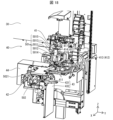
- FIG. 2 is a perspective view showing an example of a schematic internal configuration of the co-infusion device when viewed from the front.
- FIG. 2 is a perspective view showing an example of a schematic internal configuration of the co-infusion device when the co-infusion device is viewed from the rear.
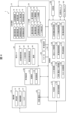
- FIG. 1 is a block diagram showing an example of the overall configuration of a co-infusion device.
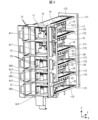
- FIG. 2 is a perspective view showing an example of the overall configuration of a syringe shelf and a vial shelf.
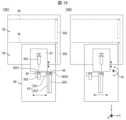
- 13 is a diagram showing an example of the configuration of one syringe shelf and one vial shelf when viewed from the first transport unit side.
- FIG. 1 is a perspective view showing an example of the overall configuration of a co-infusion device.
- FIG. 2 is a perspective view showing an example of a schematic internal configuration of the co-infusion device when viewed from the front.
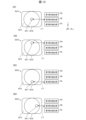
- FIG. 1A and 1B are perspective and bottom views showing an example of a center-mouth syringe and a side-mouth syringe.
- FIG. 13 is a diagram showing a modified example of the instrument holding part.
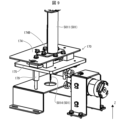
- FIG. 2 is a perspective view showing an example of the appearance of the needle removal unit.
- 1 is a cross-sectional view showing an example of a cross section of a needle removal unit perpendicular to the insertion direction of a needle attached to a syringe.
- FIG. 13 is a schematic perspective view showing an example of the positional relationship between the needle removal unit and a waste bin section.
- FIG. 13A and 13B are diagrams showing a modified example of the needle removal unit.
- FIG. 13 is a schematic diagram showing an example of the positional relationship between a nozzle of a syringe held in an instrument holding section and a nozzle detection section.
- FIG. 4 illustrates an example of a configuration of a first conveying unit.
- FIG. 4 illustrates an example of a configuration of a second conveying unit.
- FIG. 13 is a perspective view showing a modified example of the second conveying section.
- FIG. 2 is a perspective view showing a part of the printing and inspection unit.
- FIG. 2 is a perspective view showing an example of the configuration of a co-infusion unit.
- FIG. 2 is a front view showing an example of a schematic configuration of a co-infusion unit.
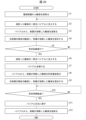
- FIG. 11 is a flowchart showing an example of a process flow when powdered medicine contained in a vial is mixed with an infusion liquid.
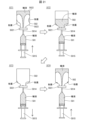
- 13 is a schematic diagram showing an example of the operation of the co-infusion unit when dissolving powdered medicine in an infusion liquid.
- FIG. FIG. 1 is a schematic diagram showing an example of the flow when an infusion solution containing dissolved powdered medicine is extracted from a vial.
- 11A and 11B are schematic diagrams illustrating an outline of an operation of the first transport unit as a vibration unit.
- 13 is a schematic diagram showing an outline of an operation of the first transport unit disposing of the syringe in the trash can section;
- FIG. 11 is a plan view showing an example of a partition member provided on the upper side of the trash can section.
- FIG. 11 is a schematic diagram showing an overview of the pressing operation of the needle cap of the syringe by the first conveying unit;
- the X-axis and Y-axis are two mutually perpendicular axes in a horizontal plane (the contact surface of the co-infusion device 1).
- the positive X-axis direction is sometimes referred to as the rightward direction, and the negative X-axis direction is sometimes referred to as the leftward direction.
- the positive Y-axis direction is sometimes referred to as the farther direction or rearward direction, and the negative Y-axis direction is sometimes referred to as the nearer direction or forward direction.
- the Z-axis is an axis that extends vertically to the XY plane, and the positive Z-axis direction is sometimes referred to as the upward direction, and the negative Z-axis direction is sometimes referred to as the downward direction.
- the co-infusion device 1 is a perspective view showing an example of the overall configuration of a co-infusion device 1.
- the co-infusion device 1 includes a syringe shelf 10, a vial shelf 20, an infusion shelf 30, a printing and inspection unit 50, an infusion receiving shelf 60, a trash can section 70, a touch panel 80, and a button 90.
- the co-infusion device 1 is a device that executes a co-infusion process (co-infusion operation) that mixes a drug and an infusion using a drug, a syringe, and an infusion indicated in data related to preparation and administration (hereinafter referred to as preparation and administration data).
- the infusion used in the co-infusion operation may be, for example, saline (physiological saline) or a liquid containing glucose.
- the co-infusion device 1 uses a syringe to aspirate the drug from a vial (an example of a drug container) in which the drug is stored, and injects the drug from the syringe into an infusion container (infusion bag).
- the drug indicated in the preparation and administration data is a solid drug (powdered drug)
- the co-infusion device 1 uses a syringe to aspirate the infusion liquid from the infusion container and injects the infusion liquid into the vial. This allows the solid drug in the vial to be liquidized.
- the co-infusion device 1 then uses a syringe to inject the liquid drug (infusion liquid in which the drug is dissolved) into the infusion container.
- the co-infusion device 1 thus performs the co-infusion operation.
- the co-infusion operation may include an operation of aspirating the drug from a vial and injecting it into another vial using a syringe. These co-infusion operations are performed by the co-infusion unit 40, which will be described later.
- the user can load syringes, vials, and infusion containers into the co-infusion device 1 by, for example, opening and closing a door.
- the air purifying section described below keeps the inside of the co-infusion device 1 clean, reducing the possibility of contamination of the medicine and infusion during the co-infusion process.
- the inside of the co-infusion device 1 is kept at positive pressure.
- the above preparation and administration data is data required by the control unit 140 (see FIG. 4) of the co-infusion device 1 to perform the co-infusion process. At least a part of the above preparation and administration data may be generated based on prescription data. At least a part of the above preparation and administration data may be prescription data.
- the preparation and administration data includes, for example, information indicating the type of drug used for mixing, the prescribed amount of the drug, information indicating the type of syringe, information indicating the type of infusion (infusion type information), and information indicating the amount of infusion withdrawn from the infusion container.
- the preparation and administration data may also include information indicating the type of infusion container (e.g., size such as volume).
- the information indicating the type of drug may include information indicating whether the drug is a powder or liquid.
- the information indicating the type of syringe may include information indicating whether it is a center-mouth syringe or a side-mouth syringe, and information indicating the size of the syringe.
- the preparation and administration data includes, for example, information about the infusion container into which the medication is injected.
- This information includes, for example, prescription attribute information such as the name of the patient to whom the medication is prescribed, prescription details such as usage and dosage, an order number indicating the order in which the prescription was received, and infusion type information (e.g., infusion name), etc.
- the preparation and administration data shown above is merely an example, and the information used for co-injection, which will be described later, may be included in the preparation and administration data.
- the syringe shelf 10 is an equipment storage shelf capable of storing syringes loaded in the co-infusion device 1.
- the syringe shelf 10 is provided with a syringe side door 16. The user can store the syringe on the syringe shelf 10 by opening and closing the syringe side door 16.
- the vial shelf 20 is an equipment storage shelf capable of storing the vials filled in the co-infusion device 1.
- the vial shelf 20 is provided with a vial-side door 27. The user can store the vial in the vial shelf 20 by opening and closing the vial-side door 27.
- the infusion shelf 30 is an infusion storage shelf capable of storing infusion containers filled in the co-infusion device 1.
- the infusion shelf 30 is provided with an infusion side door 34. The user can hold the infusion container in the infusion side door 34 by opening and closing the infusion side door 34.
- the syringe side door 16, the vial side door 27, and the infusion side door 34 are doors that allow the user to access the syringe shelf 10, the vial shelf 20, or the infusion shelf 30 when open, and can block said access when closed.
- the control unit 140 described below controls the syringe side door 16, the vial side door 27, and the infusion side door 34 so that only one of them is in an unlocked state.
- the printing and inspection unit 50 is a unit that prints a second label and affixes it to the infusion container before or after drug injection.
- the printing and inspection unit 50 may also print an inappropriate information label and affix it to the infusion container after drug injection.
- the printing and inspection unit 50 is also a unit that weighs the infusion container before and after drug injection.
- the first label is also called an infusion label.
- the above-mentioned information about the infusion container into which the drug has been injected is information that is given to the infusion container into which the drug is to be injected, and is different information from the information contained in the first label that is affixed to the infusion container in advance.
- the printing and inspection unit 50 prints the contents of this information on a label and affixes it to the infusion container as a second label that is different from the first label.
- the inappropriate information label is a label on which inappropriate information is printed.
- the inappropriate information label may be, for example, a label with an X printed on it.
- the inappropriate information may be, for example, information indicating that the weight measured by the printing/inspection unit 50 is inappropriate, and/or information indicating that the information read from the second label does not include the type of drug indicated in the preparation/administration data.
- the weight being inappropriate indicates, for example, that the amount of drug injected (prescribed amount) into the infusion container or the amount of infusion withdrawn from the infusion container does not correspond to the amount indicated in the preparation/administration data.
- the control unit 140 determines whether the weight is appropriate and whether the information read from the second label includes the type of drug indicated in the preparation/administration data.
- the infusion receiving shelf 60 is a unit that receives infusion containers with a second label affixed thereto after drug injection.
- the infusion receiving shelf 60 is provided with an infusion receiving door 61.
- the trash can section 70 is a box that receives used syringes and vials (syringes and vials used in a mixed injection operation).
- the trash can section 70 also serves as a box that receives needle caps removed from syringes 501.
- the touch panel 80 has the functions of an operation section that receives various operations by the user, and a display section that displays various information.
- the operation section and the display section may be provided as separate components.
- a presentation section e.g., a speaker
- the button 90 is a mechanical button that can accept user operation to unlock the syringe side door 16, the vial side door 27, the infusion side door 34, and the infusion receiving door 61.
- One button is provided for each of the syringe side door 16, the vial side door 27, the infusion side door 34, and the infusion receiving door 61.
- the syringe side door 16, the vial side door 27, the infusion side door 34, and the infusion receiving door 61 are closed, they are locked by a locking mechanism (not shown).
- the syringe side door 16, the vial side door 27, the infusion side door 34, and the infusion receiving door 61 are only unlocked when the user presses the button 90.
- control unit 140 when it becomes possible to unlock any of the doors and set them to an open state, the control unit 140 described below invalidates the user operation on the button 90 corresponding to the closed and locked door. This causes the control unit 140 to keep all doors other than the unlocked door closed and locked.
- the control unit 140 will not release the lock even if the button 90 corresponding to the door of the syringe shelf 10, vial shelf 20, infusion shelf 30, or infusion receiving shelf 60 that is being accessed by the first transport unit 110 or second transport unit 120 described below is pressed.
- light-emitting elements e.g., LEDs; Light Emitting Diodes
- the control unit 140 may light up the light-emitting elements corresponding to the shelves accessed by the first transport unit 110 or the second transport unit 120. In this case, it is not necessarily necessary to provide a locking mechanism for each door.
- the co-infusion device 1 is further provided with a central door 100.
- the central door 100 When the central door 100 is in an open state, it allows the user to access each part provided inside the co-infusion device 1, and when in a closed state, it can block said access. Examples of the parts include the co-infusion unit 40 and the first transport part 110.
- the central door 100 When the co-infusion device 1 is in an operating state, the central door 100 is in a locked state.
- FIG. 2 is a perspective view showing an example of a schematic internal configuration of the co-infusion device 1 when viewed from the front (near side).
- Fig. 3 is a perspective view showing an example of a schematic internal configuration of the co-infusion device 1 when viewed from the rear (rear direction).
- the co-injection device 1 includes the above-mentioned syringe shelf 10, vial shelf 20, infusion shelf 30, printing and inspection unit 50, infusion receiving shelf 60, and trash can section 70, as well as a co-injection unit 40, a first transport section 110, a second transport section 120, an air purifying section 130, and a needle removal unit 170.
- the co-injection device 1 also includes a cap removal unit 180 (see Figure 4), which is not shown in Figures 2 and 3.
- the mixing unit 40 functions as a mixing section that mixes the medicine (powdered medicine or liquid medicine) contained in the vial 502 with the infusion contained in the infusion container 503.
- the mixing unit 40 is located between the syringe shelf 10 and the vial shelf 20 and the infusion shelf 30 and the infusion receiving shelf 60.
- the mixing unit 40 executes the mixing operation based on the preparation and administration data.
- the mixing operation is executed based on the prescription data group.
- the mixing unit 40 executes the mixing operation of mixing the medicine contained in the vial 502 with the infusion liquid contained in the infusion container 503 using the syringe 501.
- the medicine contained in the vial 502 is a powdered medicine
- the mixing unit 40 executes the mixing operation of dissolving the powdered medicine contained in the vial 502 with the infusion liquid, and executing the mixing operation of injecting the infusion liquid in which the powdered medicine has been dissolved into the infusion liquid contained in the infusion container 503 using the syringe 501.
- the syringe 501 includes a syringe (syringe barrel) 5011, a needle 5014, and a plunger 5015.
- the plunger 5015 is a pusher that moves in and out of the syringe 5011. By moving the plunger 5015 in and out of the syringe 5011, it is possible to draw medicine or the like into the syringe 5011 or to expel medicine or the like from the syringe 5011.
- the syringe 5011 includes a needle side end 5012 (see FIG. 7) provided with a nozzle 5017, and a flange 5013 on the opposite end, which is the end on the side where the plunger 5015 moves in and out.
- the needle 5014 is attached to the nozzle 5017.
- an insertion head 5019 is attached to the nozzle 5017, and the needle 5014 is attached to the insertion head 5019, so that the needle 5014 is attached to the syringe 501 via the insertion head 5019.
- the insertion head 5019 has a flange 5020, which is the end that is attached to the nozzle 5017.
- the first transport unit 110 transports the syringe 501 indicated in the preparation/administration data from the syringe shelf 10 to the mixing unit 40, or transports the vial 502 containing the drug indicated in the preparation/administration data from the vial shelf 20 to the mixing unit 40.
- the first transport unit 110 transports the syringe 501 stored on the syringe shelf 10 and the vial 502 stored on the vial shelf 20 to the mixing unit 40.
- the first transport unit 110 grasps the upper part of the body of the syringe 501 stored on the syringe shelf 10 and delivers the syringe 501 to the mixing unit 40.
- the first transport unit 110 grasps the neck of the vial 502 stored on the vial shelf 20 and delivers the vial 502 to the mixing unit 40.
- a needle cap is attached to the needle 5014 of the syringe 501 loaded in the syringe shelf 10. Therefore, the first transport unit 110 transports the syringe 501 stored in the syringe shelf 10 to the cap removal unit 180 before transporting the syringe 501 stored in the syringe shelf 10 to the mixing unit 40. This allows the first transport unit 110 to remove the needle cap attached to the needle 5014 of the syringe 501, and transport the syringe 501 with the needle cap removed to the mixing unit 40. The first transport unit 110 also transports the needle cap removed by the cap removal unit 180 to the trash can unit 70 for disposal.
- the first transport unit 110 transports the syringe 501 used in the co-injection operation (the syringe 501 that is no longer needed) to the needle removal unit 170.
- the first transport unit 110 then transports the syringe 501 from which the needle 5014 has been removed by the needle removal unit 170 to the trash can section 70.
- the first transport unit 110 also transports the vial 502 used in the co-injection operation (the vial 502 that is no longer needed) to the trash can section 70. However, depending on the type of vial 502, the first transport unit 110 does not need to transport it to the trash can section 70.
- the first transport unit 110 functions as a first equipment removal unit that removes the syringe 501 and vial 502 held in the mixing unit 40 from the mixing unit 40.
- the first equipment removal unit is an example of an equipment removal unit.
- the first transport unit 110 removes the syringe 501 and the vial 502 from the mixing unit 40, for example, after the mixing operation by the mixing unit 40 is completed.
- the first transport unit 110 removes the syringe 501 and the vial 502 from the mixing unit 40, for example, to temporarily hold them during the mixing operation by the mixing unit 40.
- the first transport unit 110 is a transport unit that transports the syringe 501 and the vial 502 and is shared by both the syringe 501 and the vial 502, but is not limited to this.
- a transport unit dedicated to transporting the syringe 501 and a transport unit dedicated to transporting the vial 502 may be provided.
- the second transport unit 120 transports the infusion container 503 indicated in the preparation and administration data between the infusion shelf 30, the mixing unit 40, the printing and inspection unit 50, and the infusion receiving shelf 60.
- the second transport unit 120 transports the infusion container 503 to the mixing unit 40.
- the second transport unit 120 transports the infusion container 503 stored on the infusion shelf 30 to the mixing unit 40.
- the second transport unit 120 picks up the body of the infusion container 503 stored on the infusion shelf 30 and hands it over to the mixing unit 40.
- the second transport unit 120 also transports the infusion container 503 between the mixing unit 40 and the printing and inspection unit 50.
- the second transport unit 120 picks up the body of the infusion container 503 after drug injection and transports it to the printing and inspection unit 50.
- the second transport unit 120 also delivers the infusion container 503 to which the second label or the unsuitable information label has been affixed by the printing and inspection unit 50 to the infusion receiving shelf 60.
- the second transport unit 120 functions as a second equipment removal unit that removes the infusion container 503 held in the mixing unit 40 from the mixing unit 40.
- the second equipment removal unit is an example of an equipment removal unit.
- the second transport unit 120 removes the infusion container 503 from the mixing unit 40, for example, after the mixing operation by the mixing unit 40 is completed.
- the second transport unit 120 may remove the infusion container 503 from the mixing unit 40 during the mixing operation by the mixing unit 40 in order to weigh the infusion container 503 in the printing and inspection unit 50 after the infusion liquid that dissolves the powdered medicine has been extracted.
- the first transport unit 110 and the second transport unit 120 are separate transport units that operate independently, but they may be a transport unit that transports the syringe 501, the vial 502, and the infusion container 503 and is shared by the syringe 501, the vial 502, and the infusion container 503.
- the shared transport unit may function as an equipment removal unit for removing the syringe 501, the vial 502, and the infusion container 503 held in the infusion unit 40 from the infusion unit 40.
- the air purification unit 130 purifies and exhausts the air inside the co-injection device 1. In this embodiment, it is provided at the top of the co-injection device 1. The air purified by the air purification unit 130 flows from the top to the bottom of the co-injection device 1.
- the air purification unit 130 has, for example, a HEPA (High Efficiency Particulate Air) filter.
- the needle removal unit 170 is an external needle removal device that removes the needle 5014 from the syringe 501 to which the needle 5014 is attached. Removing the needle 5014 from the syringe 501 means removing the needle 5014 from the syringe 5011 of the syringe 501. The needle removal unit 170 removes the needle 5014 from the syringe 501 when no needle cap is attached.
- the needle removal unit 170 removes the needle 5014 from the syringe 501 used in the mixing operation.
- the needle removal unit 170 removes the needle 5014 from the syringe 501.
- the needle removal unit 170 removes the needle 5014 attached to the syringe 501 used in the mixing operation after the last mixing operation of the successive mixing operations is completed. In this case, the mixing device 1 can reuse the same syringe 501.
- the needle removal unit 170 removes the needle 5014 from the syringe 501 used in the mixed injection operation, the user does not need to remove the needle 5014 from the syringe 501. This relieves the user from the dangerous task of removing the needle 5014 from the syringe 501.
- the cap removal unit 180 is a member that removes the needle cap of the syringe 501.
- the cap removal unit 180 removes the needle cap attached to the needle 5014 of the syringe 501 before it is transported to the mixing unit 40, and holds the needle cap.
- the cap removal unit 180 holds the needle cap attached to the needle 5014 of the syringe 501, thereby removing the needle cap from the syringe 501.
- the cap removal unit 180 removes only the needle cap, without removing the needle 5014 from the syringe 501.
- the infusion shelf 30 includes a push-in portion 31 and a rail portion 36. As shown in FIG. 3, the infusion shelf 30 includes a shutter 37.
- the rail section 36 is provided inside the infusion shelf 30 and is a member that extends from the infusion side door 34 (see FIG. 1) side toward the rear of the co-infusion device 1 (i.e., in the +Y-axis direction).
- the end of the rail section 36 located on the infusion side door 34 side can also be referred to as the door side end, and the end located on the rear side of the co-infusion device 1 can also be referred to as the rear side end.
- Infusion containers 503 are loaded into the rail section 36 from the door side end, and are removed from the rear side end by the second transport section 120. At least one infusion container 503 can be hung from the rail section 36.
- each infusion shelf 30 is provided with a plurality of rail portions 36.
- the number of rail portions 36 provided on each infusion shelf 30 is not limited.
- each rail portion 36 is filled with the same type of infusion container 503 (infusion containers having the same type of infusion contained in the infusion container 503 and the same size of the infusion container 503).
- the infusion containers 503 to be filled are determined for each infusion shelf 30. However, different types of infusion containers 503 may be filled on each rail portion 36.
- the pushing section 31 is a member that can move along the rail section 36 and pushes the infusion container 503 suspended from the rail section 36 from the door side end to the back side end.
- the pushing section 31 is connected to the pushing transport section.
- the pushing transport section is provided along the rail section 36.
- the pushing transport section operates under the control of the pushing control section 147, thereby being able to move the pushing section 31 along the rail section 36.
- the pushing transport section may be, for example, an endless rotating member.
- the size of the pushing section 31 and the positional relationship between the rail section 36 and the pushing transport section 35 are specified so that the infusion container 503 suspended from the rail section 36 can be pushed in by the movement of the pushing section 31.
- the pushing unit 31 pushes the infusion container 503 suspended from the rail portion 36 from the door side end to the rear end.
- the pushing control unit 147 controls the pushing transport unit to move the pushing unit 31 from the door side end to the rear end.
- a detection unit that detects the infusion container 503 present at the rear end is provided at the rear end of the wall that constitutes the infusion shelf 30. The pushing control unit 147 moves the pushing unit 31 toward the rear end until the detection unit detects the infusion container 503.
- the second transport section 120 removes the infusion container 503 located at the rear end.
- the pushing section 31 pushes the remaining infusion containers 503 hanging from the rail section 36 from the door side end to the rear end.
- the pushing control section 147 controls the pushing transport section to move the pushing section 31 further to the rear end.
- the shutter 37 is located at the rear of the infusion shelf 30 when the infusion side door 34 is open, and blocks the rear end from the area toward the rear (+Y axis direction) so that the user cannot touch the second transport section 120 even if he or she puts his or her hand inside the infusion shelf 30 from the infusion side door 34 side.
- the shutter 37 is controlled by the shutter control section 148 so that it can move up and down ( ⁇ Z axis direction).
- the shutter 37 is controlled by the shutter control unit 148 so as to be positioned at the rear side of the infusion shelf 30 corresponding to the infusion side door 34.
- the shutter control unit 148 receives a user operation on a button 90, it moves the shutter 37 to a position opposite the rear end of the infusion shelf 30 corresponding to the button 90.
- the shutter 37 moves to an infusion shelf 30 other than the infusion shelf 30 in which the infusion container 503 is stored.
- the shutter control unit 148 moves the shutter 37 to a position facing another infusion shelf 30.
- the memory unit 200 stores information indicating the storage position of the infusion container 503 on the infusion shelf 30, for example, in association with infusion type information.
- each component in the co-infusion device 1 is not limited to the arrangement described above.
- the syringe shelf 10, the vial shelf 20, and the infusion shelf 30 are each provided with multiple tiers, but each may be provided with one tier.
- the infusion receiving shelf 60 is provided with one tier, but each may be provided with multiple tiers.
- the syringe side door 16 and/or the vial side door 27 may be provided on the side of the co-infusion device 1 (FIG. 2, right side of the paper).
- multiple syringes 501 or multiple vials 502 can be filled from the side of the co-infusion device 1.
- the infusion side door 34 may be provided on the side of the co-infusion device 1 (FIG. 2, left side of the paper).
- Fig. 4 is a block diagram showing an example of the overall configuration of the co-infusion device 1.
- the co-infusion device 1 includes a control unit 140 and a storage unit 200. Note that Fig. 4 shows only the main hardware configuration that can be controlled by the control unit 140 among the hardware configurations included in the co-infusion device 1.
- the control unit 140 controls the overall operation of the co-injection device 1 based on the preparation and administration data.
- the control unit 140 includes, for example, a syringe transport control unit 141, a vial transport control unit 142, a first transport control unit 143, a co-injection unit control unit 144, and a second transport control unit 145.
- the control unit 140 includes, for example, a pushing control unit 147, a shutter control unit 148, a printing and inspection unit control unit 149, a touch panel control unit 150, a judgment unit 151, and a needle removal control unit 154.
- the syringe transport control unit 141 controls the operation of the components related to the transport of the syringe 501 in the syringe shelf 10.
- the vial transport control unit 142 controls the operation of the components related to the transport of the vial 502 in the vial shelf 20.
- the co-injection unit control unit 144 controls the operation of the components provided in the co-injection unit 40.
- the first transport control unit 143 controls the operation of the components included in the first transport unit 110.
- the first transport control unit 143 controls the movement of the first transport unit 110 between, for example, the syringe shelf 10, the vial shelf 20, the mixing unit 40, the waste bin unit 70, the needle removal unit 170, and the cap removal unit 180.
- the second transport control unit 145 controls the operation of the components included in the second transport unit 120.
- the second transport control unit 145 controls the movement of the second transport unit 120 between, for example, the infusion shelf 30, the mixing unit 40, the printing and inspection unit 50, and the infusion receiving shelf 60.
- the push-in control unit 147 controls the operation of the components related to the transportation of the infusion container 503 in the infusion shelf 30.
- the shutter control unit 148 controls the movement of the shutter 37 (see Figure 3).
- the printing and inspection unit control unit 149 controls the operation of the components provided in the printing and inspection unit 50.
- the touch panel control unit 150 controls the touch panel 80.
- the needle removal control unit 154 controls the operation of the components provided in the needle removal unit 170.
- the storage unit 200 also stores data for the control unit 140 to perform various processes (e.g., co-infusion processes).
- the storage unit 200 stores, for example, preparation and administration data.
- the information stored in the storage unit 200 may be stored in a storage device external to the co-infusion device 1.
- FIG. 5 is a perspective view showing an example of the overall configuration of the syringe shelf 10 and the vial shelf 20.
- Fig. 6 is a view showing an example of the configuration of one syringe shelf 10 and one vial shelf 20 when viewed from the first transport unit 110 side.
- the syringe shelf 10 includes a plurality of equipment holding sections 11, an equipment transport section 12, an object detection section 13, a syringe detection section 14, a needle detection section 15, and a syringe detection section 17.
- an equipment holding section 11 is also attached to the attachment section 1211 of the equipment transport section 12 shown in FIG. 5, but is not shown in the figure.
- the user Prior to the mixed injection process, the user loads the syringe 501 into the syringe shelf 10.
- the syringe 501 is loaded into the syringe shelf 10 with the needle 5014 fitted with the needle cap 5016 (see FIG. 8).
- a plurality of holes 172 are formed in the plate-like member 171 that defines each syringe shelf 10. This allows, for example, air purified by the air purification unit 130 (see FIG. 2) to flow efficiently from the top to the bottom of the co-infusion device 1.
- the multiple equipment holding parts 11 are members (holding parts) capable of holding syringes 501 to be loaded into the co-infusion device 1.
- one equipment holding part 11 holds one syringe 501, but one equipment holding part 11 may hold multiple syringes 501.
- the equipment holding part 11 includes a free roller 1111 and an equipment clamping part 1112.
- the member described as clamping an object is merely an example, and the member may be any member capable of holding an object.
- the equipment clamping parts 1112 clamp the syringe 501.
- the equipment clamping parts 1112 clamp the flange 5013 of the syringe 501.
- the equipment clamping parts 1112 are provided at a height such that the syringe 501 does not touch the plate-like member 171 when the syringe 501 is held by the equipment holding part 11.
- the pair of equipment clamping parts 1112 are biased in directions approaching each other so that they can clamp the syringe 501.
- a free roller 1111 is provided below the tip of the equipment clamping portion 1112, which has a rotation axis extending in the vertical direction and is rotatable on the XY plane.
- the free roller 1111 holds the vicinity of the flange 5013 of the syringe 5011 clamped by the equipment clamping portion 1112.
- the equipment transport unit 12 is a member that transports at least one of the multiple equipment holding units 11 to the working area Ar1.
- the equipment transport unit 12 is an endless rotating member (rotating belt) to which the multiple equipment holding units 11 are connected. Therefore, in this embodiment, the equipment transport unit 12 transports the equipment holding units 11 one by one to the working area Ar1.
- the equipment transport unit 12 may also be a transport unit that transports multiple equipment holding units 11 to the working area Ar1 at once.
- the working area Ar1 is an area where the user causes at least one of the multiple equipment holding parts 11 to hold the syringe 501.
- the working area Ar1 is also an area where the user removes the syringe 501 held by at least one of the multiple equipment holding parts 11.
- the working area Ar1 is an area where the user causes one equipment holding part 11 to hold the syringe 501, and where the user removes the syringe 501 held by one equipment holding part 11.
- the working area Ar1 may function only as an area where the user causes at least one of the multiple equipment holding parts 11 to hold the syringe 501. In this case, the area where the user removes the syringe 501 held in the equipment holding part 11 may be provided in a position separate from the working area Ar1.
- the working area Ar1 may function only as an area where the user removes the syringe 501 held in the equipment holding part 11. In this case, the area where the user causes the syringe 501 to be held in the equipment holding part 11 may be provided in a position separate from the working area Ar1.
- the equipment transport unit 12 transports another equipment holding unit 11 instead of the equipment holding unit 11 located in the working area Ar1 when the object detection unit 13 detects an object (e.g., the user's hand) and then stops detecting the object, triggering the transport unit 12 to transport another equipment holding unit 11 instead of the equipment holding unit 11 located in the working area Ar1.
- the user's hand is inserted into the working area Ar1
- the user causes the equipment holding unit 11 to hold the syringe 501
- the equipment transport unit 12 transports another equipment holding unit 11 to the working area Ar1.
- the equipment transport unit 12 may transport another equipment holding unit 11 to the working area Ar1 when the syringe detection unit 14 detects the syringe 501 held by the equipment holding unit 11 or when the syringe detection unit 14 can no longer detect the syringe 501 held by the equipment holding unit 11.
- the equipment transport unit 12 may transport another equipment holding unit 11 in place of the equipment holding unit 11 located in the working area Ar1 in response to a transport instruction from the user.
- the syringe transport control unit 141 may receive the user's transport instruction via, for example, the touch panel 80.
- the equipment transport unit 12 changes the equipment holding unit 11 located in the working area Ar1, for example by rotating counterclockwise. This transport operation makes it possible to transport to the working area Ar1 another equipment holding unit 11 not holding a syringe 501, in place of the equipment holding unit 11 holding a syringe 501 in the working area Ar1.
- the object detection unit 13 is a component that detects an object inserted into the working area Ar1. In this embodiment, the object detection unit 13 detects the user's hand or arm when it is inserted into the working area Ar1.
- the syringe detection unit 14 is a member that detects the syringe 501 held by the equipment holding unit 11 located in the working area Ar1. In this embodiment, the syringe detection unit 14 detects the syringe 5011 when the syringe 501 is held by the equipment holding unit 11.
- the needle detection unit 15 is a detection unit that detects the needle 5014 of the syringe 501 held by the equipment holding unit 11 located in the working area Ar1. In this embodiment, the needle detection unit 15 detects the needle cap 5016 attached to the needle 5014.
- the needle detection unit 15 may function as a syringe detection unit. In this case, the syringe detection unit 14 does not need to be provided.
- the syringe detection unit 17 is a member capable of detecting the thickness of the syringe 5011.
- the syringe detection unit 17 is provided at a position where it can detect the syringe 5011 being transported by the instrument transport unit 12.
- the syringe detection unit 17, for example, continues to detect the syringe 5011 being transported.
- the syringe shelf 10 may be provided with a nozzle detector 18 that detects the nozzle of a syringe 5011 held in the equipment holder 11 located in the working area Ar1.
- the nozzle detector 18 may be provided, for example, below the syringe detector 14 so that it can detect the nozzle 5017 of the syringe 501 held in the equipment holder 11.
- Reference numeral 1011 in Fig. 7 is a perspective view and a bottom view showing an example of a medium-mouth syringe 501A in which the nozzle 5017 of the syringe 5011 is of a medium-mouth type.
- Reference numeral 1012 in Fig. 7 is a perspective view and a bottom view showing an example of a side-mouth syringe 501B in which the nozzle 5017 of the syringe 5011 is of a side-mouth type.
- the middle-mouth syringe 501A is a syringe in which the nozzle 5017 is provided at the center of the bottom 5018 of the syringe 5011, as shown by reference numeral 1011 in FIG. 7.
- the side-mouth syringe 501B is a syringe in which the nozzle 5017 is provided at a position offset from the center of the bottom 5018 of the syringe 5011, as shown by reference numeral 1012 in FIG. 7.
- the capacity (thickness; outer diameter of the syringe 501) of the center-mouth syringe 501A and the side-mouth syringe 501B may be different from each other.
- the capacity (thickness) of the side-mouth syringe 501B may be larger than the capacity (thickness) of the center-mouth syringe 501A.
- the syringe shelf 10 may house a medium-mouth syringe 501A and a side-mouth syringe 501B as the syringes 501.
- the co-injection device 1 can use the medium-mouth syringe 501A and the side-mouth syringe 501B for the co-injection operation.
- FIG. 8 is a diagram showing the equipment holding section 11A, which is a modified example of the equipment holding section 11.
- Reference numeral 1021 in FIG. 8 is an oblique view of the equipment holding section 11A
- reference numeral 1022 in FIG. 8 is a bottom view of the equipment holding section 11A.
- FIG. 8 shows an example in which a side-mouth syringe 501B is attached to the equipment holding section 11A.
- the equipment holding part 11A is provided with a fixing member 19 that fixes the position of the syringe 501 held by the equipment holding part 11A.
- the fixing member 19 fixes the side-mouth syringe 501B held by the equipment holding part 11A so that the side-mouth syringe 501B does not rotate around the axis of the side-mouth syringe 501B.
- the fixing member 19 includes a first insertion portion 191 into which the syringe 5011 is inserted, and a second insertion portion 192 into which the nozzle 5017 is inserted.
- the first insertion portion 191 has a shape and size that allows the insertion of the center-mouth syringe 501A and the side-mouth syringe 501B. Specifically, the shape and size of the first insertion portion 191 are specified so that the nozzle 5017 (needle cap 5016) can be inserted into the second insertion portion 192 whether the center-mouth syringe 501A or the side-mouth syringe 501B is inserted.
- the second insertion portion 192 has a shape and size that allows the nozzles 5017 of the center-mouth syringe 501A and the side-mouth syringe 501B inserted into the first insertion portion 191 to be inserted therein, and that allows the side-mouth syringe 501B inserted into the first insertion portion 191 to be prevented from rotating about its axis.
- the second insertion portion 192 may be in the shape of a groove that extends in the direction in which the syringe 501 is inserted into the equipment holding portion 11A.
- the scale of the side-mouth syringe 501B is provided on the surface of the syringe 5011, on the side opposite the central axis of the side-mouth syringe 501B from the side on which the nozzle 5017 is provided.
- the shape of the second insertion portion 192 is specified so that the side-mouth syringe 501B can be held in the equipment holding portion 11A with the scale thus provided facing forward (front side).
- the user can have the equipment holding part 11A hold the side-mouth syringe 501B so that the scale faces forward.
- the first transport part 110 can have the mixing unit 40 hold the side-mouth syringe 501B so that the scale faces the front side of the mixing unit 40 (in this embodiment, the +X-axis direction).
- the vial shelf 20 comprises a plurality of instrument holders 21, an instrument transport unit 22, an object detector 23, and a vial detector 24. Also, as indicated by reference numeral 1001 in Figure 6, the vial shelf 20 comprises a first reader 25, and a roller driver 26. Note that the instrument holders 21 are also attached to the mounting portion 221 of the instrument transport unit 22 shown in Figure 5, but are not shown in the figure.
- the vial shelf 20 Prior to the co-injection process, the vial shelf 20 is filled with vials 502 by the user.
- the vials 502 are provided with stoppers (rubber stoppers) 5021 (see FIG. 18) that close the openings and lids that are placed on the stoppers 5021.
- the vials 502 are loaded into the vial shelf 20 with the lids removed.
- a plurality of holes 172 are formed in the plate-like member 171 that defines each vial shelf 20.
- the equipment holding part 21 is a member capable of holding a vial 502. In this embodiment, one equipment holding part 21 holds one vial 502, but one equipment holding part 21 may hold multiple vials 502.
- the equipment holding section 21 includes a free roller 211, an equipment clamping section 212, a drive roller 213, and a first magnet gear 214.
- the equipment clamping parts 212 clamp the vial 502.
- the equipment clamping parts 212 clamp the neck of the vial 502.
- the pair of equipment clamping parts 212 are biased in a direction approaching each other so that they can clamp the vial 502.
- a free roller 211 is provided at the tip of the equipment clamping part 212, which has a rotation axis extending in the vertical direction and is rotatable on the XY plane.
- the free roller 211 supports the neck of the vial 502 at three points together with a drive roller 213 provided at a position opposite the center of the free roller 211 on the side on which the equipment clamping part 212 is axially supported.
- a first magnet gear 214 is provided on the top of the drive roller 213.
- the drive roller 213 and the first magnet gear 214 are connected to a common rotation axis that extends in the vertical direction, and can rotate on the XY plane.
- the drive roller 213 rotates in conjunction with the rotation of the second magnet gear 261 provided in the roller drive unit 26, the drive roller 213 also rotates.
- the equipment transport unit 22 is a member that transports at least one of the multiple equipment holding units 21 to the working area Ar2.
- the equipment transport unit 22 has the same function and structure as the equipment transport unit 12.
- the transportation of the equipment holding unit 21 is controlled based on the detection results of the object detection unit 23 and the vial detection unit 24 instead of the detection results of the object detection unit 13 and the syringe detection unit 14.
- the transportation of the equipment holding unit 21 may also be controlled based on a transport instruction from the user.
- the working area Ar2 has the same function as the working area Ar1, except that the object to be attached to the equipment holding unit 21 or removed from the equipment holding unit 21 is a vial 502.
- the object detection unit 23 is a member that detects an object inserted into the working area Ar2.
- the object detection unit 23 detects the user's hand or arm inserted into the working area Ar2.
- the vial detection unit 24 detects the vial 502 held by the equipment holding unit 21 located in the working area Ar2.
- the first reading unit 25 is a member that reads type information indicating the type of drug contained in the vial 502, which is indicated on the surface of the vial 502, in a portion of the transport path along which the equipment transport unit 22 transports multiple equipment holding units 21.
- the first reading unit 25 reads the type information (e.g., a barcode) at the removal position PO11 where the first transport unit 110 removes the vial 502.
- the roller drive unit 26 is a motor that rotates the second magnet gear 261 attached to the roller drive unit 26 in order to rotate the drive roller 213 of the equipment holding unit 21.
- the roller drive unit 26 rotates the second magnet gear 261
- the drive roller 213 rotates via the first magnet gear 214. This causes the vial 502 in contact with the drive roller 213 to rotate. Therefore, no matter where on the surface of the vial 502 the type information is attached, the first reading unit 25 can read the type information.
- FIG. 9 is a perspective view showing an example of the appearance of the needle removal unit 170.
- Fig. 10 is a cross-sectional view showing an example of a cross section of the needle removal unit 170 parallel to the insertion direction of the needle 5014 attached to the syringe 501.
- Fig. 10 is also a cross-sectional view showing an example of a cross section passing through the insertion port 174A provided in the first member 174 and perpendicular to the rotation shaft 176A.
- Reference numeral 1031 in Fig. 10 is a diagram showing a state before the needle removal unit 170 removes the needle 5014 from the syringe 501.
- Reference numeral 1032 in Fig. 10 is a diagram showing a state when the needle 5014 is removed from the syringe 501 by the needle removal unit 170.
- the needle removal unit 170 includes a first member 174, a second member 175, a rotating body 176, a first detection unit 177, a second detection unit 178, and a drive mechanism 179.
- the first member 174 is a member having an insertion port 174A into which the insertion head 5019 and needle 5014 attached to the syringe 501 are inserted, and a receiving portion 174B that receives the syringe 5011.
- the first transport unit 110 removes the syringe 501 from the mixing unit 40 after the mixing operation by the mixing unit 40 is completed.
- the first transport unit 110 transports the syringe 501 removed from the mixing unit 40 to the needle removal unit 170, and inserts the insertion head 5019 and needle 5014 of the syringe 501 into the insertion port 174A.
- a part of the syringe 501 (specifically, the nozzle 5017) is inserted into the insertion port 174A.
- the needle cap 5016 is not attached to the needle 5014.
- the needle cap 5016 attached to the needle 5014 of the syringe 501 is removed from the syringe 501 by the cap removal unit 180 before the needle 5014 is removed.
- the cap removal unit 180 removes the needle cap 5016 from the syringe 501, for example, before the co-infusion operation (before the needle 5014 is inserted into the infusion container 503 or vial 502).
- the shape of the receiving portion 174B is a concave shape that approximately matches the shape of the bottom 5018 (see FIG. 7) of the syringe 5011 where the nozzle 5017 is provided. This allows the bottom 5018 of the syringe 5011 to be stably abutted against the receiving portion 174B when the insertion head 5019 and needle 5014 of the syringe 501 are inserted into the insertion port 174A. This allows the position of the syringe 501 to be stabilized when the insertion head 5019 and needle 5014 are inserted into the insertion port 174A.
- the shape of the receiving portion 174B is cone-shaped.
- the insertion port 174A is provided at the bottom of the receiving portion 174B, and may have any shape that allows the insertion head 5019 to be inserted.
- the receiving portion 174B holds the syringe 5011 so that the syringe 5011 does not move in that insertion direction.
- the second member 175 faces the surface of the first member 174 opposite the surface into which the needle 5014 attached to the syringe 501 is inserted, and moves toward or away from the first member 174. In this embodiment, the second member 175 moves in the vertical direction.
- the first conveying unit 110 inserts the insertion head 5019 and needle 5014 of the syringe 501 into the insertion port 174A when the second member 175 is located at a position farthest from the first member 174.
- the rotating body 176 has a rotating shaft 176A that extends in a direction perpendicular to the insertion direction of the needle 5014 attached to the syringe 501, and a claw portion 176B that can come into contact with the flange 5020 of the insertion head 5019 inserted from the insertion port 174A.
- the rotating body 176 rotates around the rotating shaft 176A to bring the claw portion 176B into contact with the flange 5020 and apply a force to the flange 5020 in the insertion direction of the needle 5014.
- This causes the needle removal unit 170 to remove the insertion head 5019 and the needle 5014 from the syringe 501. In this way, the needle removal unit 170 can autonomously remove the needle 5014 inserted into the insertion port 174A from the syringe 501.
- the rotating body 176 also has an insertion portion 176C inserted into a long hole 175A provided in the upper part of the second member 175.
- the long hole 175A is a hole portion that extends perpendicular to the insertion direction of the needle 5014 and the extension direction of the rotating shaft 176A.
- the insertion portion 176C is fixed to the rotating body 176.
- the rotating body 176 rotates around the rotating shaft 176A as the second member 175 moves in the insertion direction of the needle 5014 or in the opposite direction.
- the insertion portion 176C can slide within the long hole 175A in the extension direction of the long hole 175A.
- the insertion portion 176C slides within the long hole 175A, allowing the rotating body 176 to rotate around the rotating shaft 176A.
- claw portion 176B moves in the direction of insertion of needle 5014 and comes into contact with flange 5020 of insertion head 5019. Then, as rotating body 176 continues to rotate so that claw portion 176B moves in the direction of insertion of needle 5014, claw portion 176B, which is in contact with flange 5020, continues to press flange 5020 toward second member 175. This pushing by claw portion 176B allows insertion head 5019 with attached needle 5014 to be removed from syringe 501.
- the position of the rotating body 176 when the second member 175 is at the farthest position from the first member 174 is determined so that the insertion head 5019 and needle 5014 do not come into contact with the claw portion 176B when they are inserted into the insertion port 174A.
- the position of the rotating body 176 is also determined so that the claw portion 176B abuts against the flange 5020 when the rotating body 176 rotates so that the insertion head 5019 inserted from the insertion port 174A can be removed from the nozzle 5017.
- the first detection unit 177 is a detection unit that detects the syringe 5011 of the injector 501 when the insertion head 5019 and the needle 5014 are inserted into the insertion port 174A.
- the first detection unit 177 may be, for example, an optical sensor having a light receiving unit that receives light reflected by the syringe 5011.
- the optical sensor may have an emission unit that emits light.
- the first detection unit 177 may be an imaging unit (camera) that images the syringe 5011.
- Other detection units may also be realized by an optical sensor that receives light reflected by an object, or an imaging unit that images an object.
- the second detection unit 178 is a detection unit that detects the needle 5014 inserted from the insertion port 174A.
- the needle removal control unit 154 moves the second member 175 in the direction opposite to the insertion direction of the needle 5014, and rotates the rotating body 176 around the rotation axis 176A.
- the second detection unit 178 may function as a detection unit that detects the insertion head 5019 inserted from the insertion port 174A.
- the needle removal control unit 154 moves the second member 175 in the direction opposite to the insertion direction of the needle 5014. Thereafter, when the second detection unit 178 no longer detects the needle 5014 or the insertion head 5019, the needle removal control unit 154 moves the second member 175 in the insertion direction of the needle 5014 to move the second member 175 to its original initial position.
- the first transport control unit 143 controls the first transport unit 110 to remove the syringe 501 (syringe 5011 and plunger 5015) from which the insertion head 5019 and needle 5014 have been removed, from the needle removal unit 170.
- the co-infusion device 1 may include at least the second detection unit 178.
- the control unit 140 may execute the above-described processing based on whether or not the needle 5014 or the insertion head 5019 is detected by the second detection unit 178.
- the drive mechanism 179 is connected to the second member 175, and is a mechanism that moves the second member 175 relative to the first member 174 along the insertion direction of the needle 5014 or the opposite direction under the control of the needle removal control unit 154.
- the needle removal control unit 154 controls the drive mechanism 179 to move the second member 175 in the opposite direction to the insertion direction of the needle 5014.
- the needle removal control unit 154 controls the drive mechanism 179 to move the second member 175 in the insertion direction of the needle 5014.
- the driving mechanism 179 may be connected to the first member 174 instead of the second member 175, and may be a mechanism that moves the first member 174 relative to the second member 175 along the insertion direction of the needle 5014 or the opposite direction.
- the rotating body 176 rotates around the rotation axis 176A in conjunction with the movement of the first member 174, causing the claw portion 176B to come into contact with the flange 5020 and apply a force to the flange 5020 in the insertion direction of the needle 5014.
- the co-infusion device 1 includes a first member 174 that holds the syringe 501 to which the needle 5014 is attached, and a second detection unit 178 that detects the needle 5014 of the syringe 501 held by the first member 174.
- the co-infusion device 1 further includes a removal portion that removes the needle 5014 from the syringe 501 when the second detection unit 178 detects the needle 5014.
- the removal portion may include, for example, the first member 174 or the second member 175 that are relatively movable, a rotating body 176, and a drive mechanism 179.
- ⁇ Positional relationship between staple removal unit and waste bin> 11 is a schematic perspective view showing an example of the positional relationship between the needle removal unit 170 and the trash can section 70.
- the co-infusion device 1 includes a first storage section 70A that stores the needle 5014 and a second storage section 70B that stores the syringe 501 without the needle 5014 attached as the trash can section 70.
- the trash can section 70 is provided on the front side inside the co-infusion device 1 in consideration of ease of removal.
- the first storage section 70A is provided on the front side inside the second storage section 70B.
- the insertion head 5019 and needle 5014 removed by the needle removal unit 170 fall due to the weight of the insertion head 5019 and needle 5014. For this reason, the needle removal unit 170 is provided above the first storage section 70A. As a result, the needle 5014 with the insertion head 5019 attached that is removed from the syringe 501 by the needle removal unit 170 is discarded in the first storage section 70A.
- the first transport unit 110 transports the syringe 501 (syringe 5011 and plunger 5015) without the insertion head 5019 and the needle 5014 attached to it to the second storage unit 70B.
- the syringe 501 with the needle 5014 to which the insertion head 5019 is attached removed by the needle removal unit 170 is discarded in the second storage unit 70B.
- the co-infusion device 1 can separate and discard the needle 5014 with the insertion head 5019 attached and the syringe 501 without the insertion head 5019 or needle 5014 attached.
- the volume of the syringe 501 is larger than the volume of the needle 5014. Therefore, when the syringes 501 with the needles 5014 attached are disposed of in a specified space, the number of such syringes 501 will be smaller than when the needles 5014 are disposed of in the specified space. Furthermore, when the syringes 501 with the needles 5014 attached are disposed of, the same disposal cost is required as when the needles 5014 are disposed of.
- the same disposal cost is required as when the needles 5014 are disposed of, even though the number of the syringes 501 with the needles 5014 attached is smaller than the number of the needles 5014.
- the disposal cost of the needle 5014 is higher than the disposal cost of the components of the syringe 501 other than the needle 5014. Therefore, when disposing of the syringe 501 with the needle 5014 attached in a specified space, the disposal cost is higher than when disposing of the syringe 501 without the needle 5014 attached.
- the needle removal unit 170 removes the needle 5014 from the syringe 501, allowing the syringe 501 to be discarded without the needle 5014 attached. This reduces disposal costs compared to when the syringe 501 is discarded with the needle 5014 attached.
- the needle removal unit 170 is provided above the first storage section 70A, but the needle removal unit 170 does not have to be provided above the first storage section 70A.
- the first transport section 110 may hold the insertion head 5019 and needle 5014 removed by the needle removal unit 170, transport them to the first storage section 70A and discard them.
- the syringe 501 with the insertion head 5019 and needle 5014 removed may be dropped by its own weight into the second storage section 70B.
- the needle removal unit 170 may be provided above the second storage section 70B.
- the needle removal unit 170 may have any mechanism capable of removing the needle 5014 from the syringe 501.
- the needle removal unit 170 may have a mechanism for pulling out only the needle 5014 from the syringe 501. In this case, only the needle 5014 is discarded in the first storage section 70A, and the syringe 501 (syringe 5011, plunger 5015, and insertion head 5019) without the needle 5014 attached is discarded in the second storage section 70B.
- the shape of the insertion port 174A may be any shape that allows the needle 5014 to be inserted.
- the needle cap 5016 removed by the cap removal unit 180 is discarded in the second storage unit 70B. If the co-infusion device 1 has a third storage unit different from the first storage unit 70A and the second storage unit 70B, the needle cap 5016 removed by the cap removal unit 180 may be discarded in the third storage unit. In this way, by discarding the needle 5014 and the needle cap 5016 in separate spaces, the needle 5014 and the needle cap 5016 can be collected separately. In addition, the vial 502 used in the co-infusion operation may be discarded in the second storage unit 70B.
- Example of co-infusion device operation (Example of operation when the co-infusion device is equipped with a needle removal unit)
- the co-infusion device 1 operates, for example, as follows.
- the first transport unit 110 removes the syringe 501 from the syringe shelf 10 and then transports it to the cap removal unit 180.
- the cap removal unit 180 removes the needle cap 5016 from the syringe 501.
- the first transport unit 110 transports the syringe 501 from which the needle cap 5016 has been removed to the co-injection unit 40.
- the first transport unit 110 also removes the needle cap 5016 removed by the cap removal unit 180 from the cap removal unit 180, transports it to the second storage unit 70B, and discards it.
- the first transporting unit 110 transports the syringe 501 used in the mixing operation to the needle removal unit 170.
- the needle removal unit 170 removes the needle 5014 from the syringe 501 used in the mixing operation.
- the first transporting unit 110 does not hold the syringe 501 when the needle removal unit 170 removes the needle 5014.
- the first transporting unit 110 places the syringe 5011 on the receiving portion 174B of the first member 174, and then releases the hold on the syringe 501.
- the first member 174 on which the syringe 5011 is placed does not move, so there is no need for the first transporting unit 110 to hold the syringe 501 when the needle removal unit 170 removes the needle 5014. Then, as described above, the needle 5014 removed from the syringe 501 is discarded in the first storage section 70A, and the syringe 501 with the needle 5014 removed is discarded in the second storage section 70B.
- the co-infusion device 1 is described as having the needle removal unit 170, but the co-infusion device 1 does not necessarily have to have the needle removal unit 170. In this case, the waste box section 70 does not have to have the first storage section 70A.
- the co-infusion device 1 operates, for example, as follows.
- the first transport unit 110 removes the syringe 501 from the syringe shelf 10 and then transports it to the cap removal unit 180.
- the cap removal unit 180 removes the needle cap 5016 from the syringe 501.
- the first transport unit 110 transports the syringe 501 from which the needle cap 5016 has been removed to the co-injection unit 40.
- the cap removal unit 180 holds the needle cap 5016 until the co-injection operation using the syringe 501 is completed.
- the first transport unit 110 transports the syringe 501 used in the co-injection operation to the cap removal unit 180.
- the cap removal unit 180 attaches the needle cap 5016 that it holds to the needle 5014 of the syringe 501.
- the cap removal unit 180 functions as a cap attachment/detachment unit that attaches and detaches the needle cap 5016 to and from the needle 5014 of the syringe 501.
- the first transport unit 110 then transports the syringe 501 with the needle cap 5016 attached to the waste bin unit 70.
- the co-infusion device 1 includes the needle removal unit 170, the co-infusion device 1 does not need to attach the needle cap 5016 to the needle 5014 of the syringe 501 used in the co-infusion operation before discarding the syringe 501 used in the co-infusion operation. Therefore, the co-infusion device 1 can reduce the time required for the co-infusion operation by the time required to perform this operation.
- the cap removal unit 180 may not be able to perform the operation of attaching the needle cap 5016 to the needle 5014. If the co-infusion device 1 is equipped with the needle removal unit 170, this operation does not need to be performed. This makes it possible to avoid situations in which such errors occur.
- the cap removal unit 180 does not need to include a mechanism for attaching the needle cap 5016 to the needle 5014 of the syringe 501 used in the co-infusion operation.
- the cap removal unit 180 may be provided with a mechanism for attaching a needle cap 5016 to the needle 5014 of the syringe 501 used in the co-injection operation.
- the cap removal unit 180 holds the needle cap 5016 removed before the co-injection operation, and attaches the needle cap 5016 to the needle 5014 after the co-injection operation.
- the needle removal unit 170 then removes the needle 5014 together with the needle cap 5016 from the syringe 501. This allows the syringe 5011 and plunger 5015 and the needle 5014 with the needle cap 5016 attached to be separated and discarded.
- the needle removal unit 170 can remove the needle 5014 together with the needle cap 5016 from the syringe 501 by abutting the claw portion 176B against the flange 5020 and applying a force in the direction of the needle 5014 insertion.
- Fig. 12 is a diagram showing a needle removal unit 170A which is a modified example of the needle removal unit 170.
- Reference numeral 1041 in Fig. 12 is a plan view which shows a schematic example of the first needle removal unit 1701 (first needle removal external).
- Reference numeral 1042 in Fig. 12 is a plan view which shows a schematic example of the second needle removal unit 1702 (second needle removal external).
- the first needle removal unit 1701 and the second needle removal unit 1702 have the same functions as the needle removal unit 170.
- the shape of the first needle removal unit 1701 is the same as that of the needle removal unit 170.
- the shape of the second needle removal unit 1702 is the same as that of the needle removal unit 170, except that the shape of the receiving portion 174B provided in the first member 174 (the position of the insertion port 174A) is different. Therefore, FIG. 12 shows only plan views of the first needle removal unit 1701 and the second needle removal unit 1702 (only the plan view of the first member 174).
- the needle removal unit 170A may include a first needle removal unit 1701 and a second needle removal unit 1702.
- the first needle removal unit 1701 is a member that removes the needle 5014 attached to the center-mouth syringe 501A from the center-mouth syringe 501A.
- the second needle removal unit 1702 is a member that removes the needle 5014 attached to the side-mouth syringe 501B from the side-mouth syringe 501B.
- the receiving portion 174B is shaped like a mortar. As shown by reference numeral 1041 in FIG. 12, when the receiving portion 174B is viewed from above, an insertion opening 174A is provided at the center of the receiving portion 174B.
- the shape of the receiving portion 174B and the position of the insertion port 174A are concave shapes that roughly match the shape of the bottom 5018 (the end where the nozzle 5017 is provided) of the syringe 5011 included in the middle-mouth syringe 501A. Therefore, when the insertion head 5019 and needle 5014 of the middle-mouth syringe 501A are inserted into the insertion port 174A, the bottom 5018 of the syringe 5011 of the middle-mouth syringe 501A can be stably abutted against the receiving portion 174B.
- the receiving portion 174B is also shaped like a mortar. However, as shown by reference numeral 1042 in FIG. 12, when the receiving portion 174B is viewed in a plan view, the insertion opening 174A is provided at a position offset from the center of the receiving portion 174B.
- the shape of the receiving portion 174B and the position of the insertion port 174A are concave shapes that roughly match the shape of the bottom 5018 (the end where the nozzle 5017 is provided) of the syringe 5011 included in the side-port syringe 501B. Therefore, when the insertion head 5019 and needle 5014 of the side-port syringe 501B are inserted into the insertion port 174A, the bottom 5018 of the syringe 5011 of the side-port syringe 501B can be stably abutted against the receiving portion 174B.
- the needle removal unit 170A can remove the needle 5014 from both the middle-mouth syringe 501A and the side-mouth syringe 501B.
- the control unit 140 may include a determination unit 151.
- the determination unit 151 determines whether the syringe 501 used in the co-injection operation is a center-mouth syringe 501A or a side-mouth syringe 501B. Based on the determination result of the determination unit 151, the first transport control unit 143 controls the first transport unit 110 to transport the center-mouth syringe 501A used in the co-injection operation to the first needle removal unit 1701 and transport the side-mouth syringe 501B used in the co-injection operation to the second needle removal unit 1702.
- the determination unit 151 may determine the type of syringe 501 held in the equipment holding unit 11 based on the detection results of the needle detection unit 15, the nozzle detection unit 18, or the syringe detection unit 17 provided on the syringe shelf 10.
- FIG. 13 is a schematic diagram showing an example of the positional relationship between the nozzle 5017 of the syringe 501 held by the instrument holding section 11 and the nozzle detection section 18.
- FIG. 13 is a schematic diagram of the syringe 501 held by the instrument holding section 11 in the working area Ar1 as viewed from below.
- the nozzle detector 18 may include a first nozzle detector 18a, a second nozzle detector 18b, and a third nozzle detector 18c.
- the first nozzle detector 18a is in the depth direction (+Y-axis direction), and the syringe side door 16 is provided on the third nozzle detector 18c side.
- the second barrel tip detection section 18b detects light L11 reflected by the barrel tip 5017 of the middle-mouth syringe 501A.
- the first barrel tip detection section 18a and the third barrel tip detection section 18c detect light L11 reflected by the barrel tip 5017 of the side-mouth syringe 501B when the side-mouth syringe 501B is held by the instrument holding section 11.
- the second barrel tip detection section 18b detects light L11 reflected by the barrel tip 5017 of the side-mouth syringe 501B when the side-mouth syringe 501B is held by the instrument holding section 11 in a state rotated 90 degrees around the axis from the state shown by reference numerals 1052 and 1053 in FIG. 13.
- FIG. 13 indicates an example of the above positional relationship when the side-mouth syringe 501B is held by the instrument holding part 11 in a state rotated 90 degrees around the axis from the state shown by the reference numerals 1052 and 1053 in FIG. 13.
- Reference numeral 1054 in FIG. 13 indicates a case where the nozzle 5017 is located on the second nozzle detection part 18b side from the center of the bottom part 5018 of the syringe 5011 when the side-mouth syringe 501B is viewed from below.
- the nozzle 5017 may be located at a position farther away from the second nozzle detection part 18b than the center of the bottom part 5018.
- the determination unit 151 determines that the syringe 501 held in the equipment holder 11 is the side-mouth syringe 501B.
- the first time it takes for the light emitted by the second barrel tip detection unit 18b to be reflected by the middle-mouth syringe 501A and return to the second barrel tip detection unit 18b, and the second time it takes for the light to be reflected by the side-mouth syringe 501B and return to the second barrel tip detection unit 18b are different from each other.
- the distance between the nozzle 5017 of the side-mouth syringe 501B and the second nozzle detection part 18b is longer than the distance between the nozzle 5017 of the middle-mouth syringe 501A and the second nozzle detection part 18b when held by the instrument holding part 11. Therefore, when the side-mouth syringe 501B is held by the instrument holding part 11 with the nozzle 5017 located further from the second nozzle detection part 18b than the center of the bottom part 5018, the second time is longer than the first time.
- the determination unit 151 can determine whether the syringe 501 held in the equipment holding unit 11 is a center-mouth syringe 501A or a side-mouth syringe 501B based on the time it takes for the emitted light to be reflected by the syringe 501 and return to the second nozzle detection unit 18b.
- control unit 140 measures the time it takes for the light emitted by the second nozzle detection unit 18b to be reflected by the syringe 501 and return to the second nozzle detection unit 18b.
- the determination unit 151 determines whether the syringe 501 held in the equipment holding unit 11 is a middle-mouth syringe 501A or a side-mouth syringe 501B by determining whether the measured time is between the first threshold value T11 and the second threshold value T12.
- the determination unit 151 determines that the measured time is between the first threshold value T11 and the second threshold value T12 (when T11 ⁇ measured time ⁇ T12), it determines that the syringe 501 held in the equipment holding unit 11 is a middle-mouth syringe 501A.
- the determination unit 151 determines that the measured time is less than the first threshold value T11 or greater than the second threshold value T12 (when the measured time ⁇ T11 or T12 ⁇ measured time)
- it determines that the syringe 501 held in the equipment holding unit 11 is a side-mouth syringe 501B.
- the first threshold value T11 and the second threshold value T12 need only be determined, for example, through experiments, etc., so that when the second nozzle detector 18b detects light L11, it can be determined whether the syringe 501 held in the equipment holder 11 is a middle-mouth syringe 501A or a side-mouth syringe 501B.
- the determination unit 151 may determine whether the syringe 501 held in the equipment holding unit 11 is a center-mouth syringe 501A or a side-mouth syringe 501B based on the detection results of the three needle detection units 15.
- the memory unit 200 also stores information indicating the speed of the equipment transport unit 12 in front of the syringe detection unit 17, and information indicating the thickness of various syringes 5011 that may be used in mixed injection.
- the control unit 140 calculates the thickness of the syringe 5011 that has passed in front of the syringe detection unit 17 based on the detection time of the syringe 5011 by the syringe detection unit 17 and the speed of the equipment transport unit 12. This allows the control unit 140 to identify the thickness of the syringe 5011 that has passed in front of the syringe detection unit 17 (the type of syringe 501 held by the equipment holding unit 11).
- the thicknesses of the center-mouth syringe 501A and the side-mouth syringe 501B used in the co-infusion device 1 may be different from each other.
- the determination unit 151 can determine whether the syringe 501 held in the equipment holding unit 11 is a center-mouth syringe 501A or a side-mouth syringe 501B, based on the thickness of the syringe 5011 that has passed in front of the syringe detection unit 17.
- the co-infusion device 1 may be equipped with a camera that captures an image of the syringe 501 held in the equipment holding section 11.
- a camera that captures an image of the syringe 501 held in the equipment holding section 11.
- an image of a center-mouth syringe 501A and an image of a side-mouth syringe 501B are stored in the memory section 200.
- the determination section 151 may determine whether the syringe 501 held in the equipment holding section 11 is a center-mouth syringe 501A or a side-mouth syringe 501B based on the image captured by the camera and the image stored in the memory section 200.
- the determination unit 151 determines whether the syringe 501 held in the equipment holding unit 11 is a center-mouth syringe 501A or a side-mouth syringe 501B. However, this is not limited thereto, and the determination unit 151 may determine, for example, whether the syringe 501 held in the syringe holding unit 41 (see FIG. 18) of the mixing unit 40 is a center-mouth syringe 501A or a side-mouth syringe 501B.
- a detection unit that detects the syringe 5011, needle 5014, or nozzle 5017 of the syringe 501 held in the mixing unit 40 is provided at a position where the syringe 5011, needle 5014, or nozzle 5017 can be detected.
- Fig. 14 is a diagram showing an example of the configuration of the first transport unit 110.
- the first transport unit 110 includes a first claw portion 111, a second claw portion 112, and a rotating shaft portion 113.
- the first claw portion 111 and the second claw portion 112 are members that respectively grip the upper portion of the syringe 5011 of the injector 501 or the neck portion of the vial 502.
- the rotating shaft portion 113 is a shaft portion that extends in the vertical direction, and rotates the first claw portion 111 and the second claw portion 112 on the XY plane.
- the first claw portion 111 and the second claw portion 112 may have any structure as long as they can hold the syringe 501 and the vial 502, respectively.
- the mixing unit 40 holds the lower part of the syringe 5011 of the syringe 501 and the body part of the vial 502. Therefore, in this embodiment, the first conveying part 110 is configured to grip the upper part of the syringe 5011 of the syringe 501, or the neck part of the vial 502.
- one of the first claw portion 111 and the second claw portion 112 is made to function as a claw portion that holds a new syringe 501 or vial 502 to be used in the next co-injection operation.
- one of the claw portions is made to function as a claw portion for transporting the syringe 501 or vial 502 from the syringe shelf 10 or the vial shelf 20 to the co-injection unit 40.
- the other of the first claw portion 111 and the second claw portion 112 is made to function as a claw portion that holds the syringe 501 or vial 502 used in the co-injection operation.
- the other claw portion is made to function as a claw portion for transporting the syringe 501 or vial 502 from the co-injection unit 40 to the waste bin portion 70 or the needle removal unit 170.
- first claw portion 111 and the second claw portion 112 function as claw portions for holding the syringe 501 or vial 502 to be used in the next co-injection operation, or as claw portions for holding the syringe 501 or vial 502 used in the co-injection operation.
- the first conveying unit 110 has a first claw portion 111 and a second claw portion 112 as equipment holding units that hold the syringe 501 and the vial 502, but may have three or more equipment holding units. In other words, the first conveying unit 110 may have multiple equipment holding units.
- the syringe 501 and the vial 502 are transported using the other equipment holders.
- the first claw 111 is broken, the syringe 501 and the vial 502 are transported using the second claw 112 regardless of the above settings. Therefore, the overall operation associated with the co-injection is slower than when the syringe 501 and the vial 502 are transported using multiple equipment holders.
- the touch panel control unit 150 may notify the touch panel 80 that operation has slowed. In this case, the user can recognize that the co-infusion device 1 is operating in a slow mode. Therefore, the co-infusion device 1 can prevent the user from worrying about the slow operation.
- the first transport unit 110 may also include a detection unit that detects the syringe 501 or vial 502 held by each of the equipment holding units. If the detection unit does not detect the syringe 501 or vial 502 after performing an operation to cause the equipment holding unit to hold the syringe 501 or vial 502, the first transport control unit 143 may determine that the equipment holding unit has failed.
- Fig. 15 is a diagram showing an example of the configuration of the second transport unit 120. As shown in Fig. 15, the second transport unit 120 includes an adsorption unit 121 and a third reading unit 122.
- three suction parts 121 are provided along the vertical direction at positions facing the infusion container 503 in the second transport section 120.
- the three suction parts 121 include a main suction part 121A and two sub suction parts 121B.
- the suction part 121 may have multiple main suction parts 121A, and may have only one or three or more sub suction parts 121B.
- the main suction part 121A is always used to adsorb the infusion container 503 when the second transport part 120 holds the infusion container 503.
- the main suction part 121A is provided in a position that allows it to face all of the infusion containers 503 of different sizes that can be stored in the co-infusion device 1.
- the two sub-suction parts 121B adsorb the infusion container 503 together with the main suction part 121A depending on the vertical size of the infusion container 503. Therefore, at least one of the two sub-suction parts 121B may not adsorb the infusion container 503 depending on the size of the infusion container 503.
- the type (size) of the infusion container 503 and the suction part 121 used to adsorb the infusion container 503 are determined in advance, and information associating these is stored in the memory unit 200. Therefore, the second transport control unit 145 can identify the type of infusion container 503 to be used for mixing based on the preparation and administration data, and thereby identify the suction part 121 to be used to adsorb the infusion container 503.
- the positional relationship between the adsorption location of the infusion container 503 (e.g., the infusion shelf 30 and the mixing unit 40) and the second transport unit 120 is determined in advance so that the main suction part 121A is always used when the second transport unit 120 holds the infusion container 503.
- the third reading unit 122 reads the information contained in the first label attached to the body 5031 of the infusion container 503. If the information contained in the first label is contained in a barcode, the third reading unit 122 may be realized by a barcode reader.
- Fig. 16 is a perspective view showing an example of a second transport section 120A which is a modified example of the second transport section 120.
- the second transport section 120A includes a transparent plate 126 and a support section 127.
- a base section 125 to which the main suction section 121A and the sub suction section 121B are attached can move in the front-rear direction ( ⁇ Y axis direction) under the control of the second transport control section 145.
- Fig. 16 shows a state in which the base section 125 has moved forward.
- the transparent plate 126 is a member that presses the infusion container 503 to be held by the second transport unit 120A.
- the transparent plate 126 is provided above the main suction unit 121A.
- the third reading unit 122 reads the information on the first label affixed to the infusion container 503 through the transparent plate 126.
- the body 5031 of the infusion container 503 is made of a material that is easily deformed, wrinkles are likely to form in the body 5031. Wrinkles are particularly likely to form in the upper region of the body 5031. If a first label is attached to the upper region of the body 5031, the first label may become distorted, and the third reading unit 122 may not be able to read the information on the first label.
- the second transport control unit 145 adjusts the height of the second transport unit 120A so that the transparent plate 126 faces the affixing position of the first label on the body 5031. This allows the second transport unit 120A to hold the infusion container 503 with the affixing position of the first label facing the transparent plate 126.
- the memory unit 200 stores information on whether the infusion container 503 is one for which the information on the first label can be read through the transparent plate 126.
- the affixing position of the first label may also be identified by, for example, analyzing an image of the infusion container 503 captured by an imaging unit provided in the second transport unit 120A.
- the printing and inspection unit 50 includes an attachment section 54 and a guide section 56.
- FIG. 17 is an oblique view showing a part of the printing and inspection unit 50.
- the attachment section 54 adsorbs the second label LA12 or the unsuitable information label and moves to the attachment position PO50
- the second transport section 120A presses the infusion container 503 after drug injection against the guide section 56 at the attachment position PO50.
- the second label LA12 or the unsuitable information label is attached to the infusion container 503 after drug injection.
- the second transport control unit 145 moves the base 125 forward and presses the infusion container 503 held by the second transport unit 120A against the guide unit 56 of the printing and inspection unit 50. This makes it possible to make the attachment position of the first label sandwiched between the transparent plate 126 and the guide unit 56 flat.
- the third reading unit 122 reads the information on the first label through the transparent plate 126. Because the attachment position of the first label is flat, the third reading unit 122 can read the information on the first label.
- the guide unit 56 is an example of a pressing target for the infusion container 503, and as long as the attachment position of the first label can be made flat, the second transport unit 120A may press the infusion container 503 against any position on the co-infusion device 1.
- the support portion 127 is a member that supports the neck portion 5033 (see FIG. 15) of the infusion container 503 held by the second transport portion 120A.
- the support portion 127 By providing the support portion 127, the position of the neck portion 5033 of the infusion container 503 can be stabilized. Therefore, a member that holds the neck portion 5033 of the infusion container 503, such as the infusion container holding portion 43 (see FIG. 18) described below, can easily receive the infusion container 503 from the second transport portion 120A.
- the support portion 127 is a rod-shaped member.
- the third reading unit 122 reads the information on the first label without going through the transparent plate 126.
- the base 125 does not move forward, if the support portion 127 is not rod-shaped, there is a possibility that the support portion 127 will be included in the information reading range of the third reading unit 122. Making the support portion 127 rod-shaped makes it easier for the third reading unit 122 to read the information on the first label.
- the surface facing the neck part 5033 of the infusion container 503 may be flat. In this case, it is easier to stabilize the position of the neck part 5033.
- the support part 127 may be rectangular.
- the second transport unit 120 includes three suction units 121 (one equipment holder) as an equipment holder that holds one infusion container 503.
- the second transport unit 120 may include a plurality of equipment holders that hold a plurality of infusion containers 503, respectively.
- Fig. 18 is a perspective view showing an example of the configuration of the co-infusion unit 40.
- the co-infusion unit 40 includes a syringe holder 41, a vial holder 42, and an infusion container holder 43.
- the syringe holding unit 41 is a member that holds the syringe 501 transported by the first transport unit 110.
- the syringe holding unit 41 includes a moving unit 411, a position fixing unit 412, a first syringe holding unit 416, and a plunger clamping unit 417.
- the moving parts 411 are a pair of moving parts that move between positions close to each other and positions separated from each other. When the moving parts 411 are positioned close to each other, they clamp the needle 5014. The moving parts 411 clamp the needle 5014 and position the tip of the needle 5014 at a fixed position. This allows even a bent needle 5014 to be punctured into the desired position (correct position) of the stopper provided on the infusion container 503 during the co-infusion operation.
- the first syringe holding section 416 is a member that initially holds the syringe 501 that the first transport section 110 transports from the syringe shelf 10.
- the first syringe holding section 416 clamps the side of the syringe 5011 (e.g., the lower part of the syringe 5011) inserted into the first syringe holding section 416.
- the position fixing portion 412 is a member that fixes the position of the syringe 501 in the extension direction of the syringe 501 at the needle side end portion 5012 and the flange 5013.
- the relative positions of the second syringe holding portion 413 and the third syringe holding portion 414 that constitute the position fixing portion 412 can be changed along the extension direction of the syringe 501.
- the second syringe holding portion 413 and the third syringe holding portion 414 are attached so that at least one of the second syringe holding portion 413 and the third syringe holding portion 414 can move along the extension direction of the syringe 501.
- the second syringe holding part 413 abuts from the underside of the needle side end part 5012, and the third syringe holding part 414 abuts from the upper side of the flange 5013. This allows the position fixing part 412 to clamp the syringe 501 along the extension direction of the syringe 501.
- the plunger clamping portion 417 is a member that clamps the plunger 5015.
- the plunger clamping portion 417 clamps the tip of the plunger 5015.
- the plunger clamping portion 417 moves in the vertical direction relative to the moving portion 411, the position fixing portion 412, and the first syringe holding portion 416, thereby allowing the plunger 5015 to move relative to the syringe 5011.
- the vial holding section 42 is a member that holds the vial 502 (the vial 502 transported by the first transport section 110) that contains the medicine to be injected into the infusion container 503.
- the vial holding section 42 is also a member that holds the vial 502 that contains the infusion in which the powdered medicine is dissolved, that is to be injected into the infusion container 503. In this embodiment, the vial holding section 42 clamps the neck of the vial 502.
- the infusion container holding section 43 is a member that holds the infusion container 503 (the infusion container 503 transported by the second transport section 120).
- the infusion container holding section 43 includes an infusion clamping section 431 that clamps the neck of the infusion container 503, and a mounting table 432 on which the infusion container 503 is placed when withdrawing infusion from the infusion container 503 or when injecting infusion into the infusion container 503.
- the co-infusion device 1 may also include an imaging unit that images the infusion clamping unit 431.
- the imaging unit images the infusion clamping unit 431 when the second transport unit 120 delivers the infusion container 503 to the infusion clamping unit 431.
- the second transport control unit 145 analyzes the image captured by the imaging unit to adjust the positional relationship between the neck 5033 of the infusion container 503 and the infusion clamping unit 431, and then delivers the infusion container 503 held by the second transport unit 120 to the infusion clamping unit 431.
- FIG. 19 is a front view showing an example of the schematic configuration of the mixing unit 40, and is a diagram for explaining an example of the operation of the mixing unit 40.
- the mixing unit 40 is provided on the side wall of the infusion shelf 30.
- the mixing unit 40 is arranged so that the syringe holding section 41, the vial holding section 42, and the infusion container holding section 43 face toward the syringe shelf 10 and the vial shelf 20 (positive X-axis direction).
- the syringe holding part 41 can move in the vertical direction. This allows the needle 5014 to puncture the vial 502 or infusion container 503 located directly below the syringe 501 held by the syringe holding part 41.
- the vial holding part 42 and the infusion container holding part 43 are movable in the front-to-rear direction ( ⁇ Y-axis direction) of the co-infusion device 1.
- the vial holding part 42 and the infusion container holding part 43 are attached to a base 44, and the base 44 moves in the front-to-rear direction of the co-infusion device 1.
- the position shown by reference numeral 1061 in FIG. 19 is the first puncture position when the needle 5014 punctures the vial 502, and the position shown by reference numeral 1062 in FIG.
- the needle 5014 of the syringe 501 held by the syringe holder 41 can be inserted into the stopper 5021 of the vial 502 held by the vial holder 42, or into the stopper 5035 of the infusion container 503 held by the infusion container holder 43.
- the syringe holder 41 instead of the base 44, may move in the forward and backward directions of the co-infusion device 1.
- the mixing unit 40 is rotatable around a rotation axis Ax (Ax is the rotation axis).
- the rotation axis Ax is an axis that extends perpendicularly ( ⁇ X-axis direction) to the base on which the syringe holder 41, the vial holder 42, and the infusion container holder 43 are provided.
- the mixing unit 40 rotates about the rotation axis Ax, thereby moving the vial 502 above the syringe 501.
- the mixing unit 40 rotates about the rotation axis Ax, thereby moving the infusion container 503 above the syringe 501.
- the mixing unit 40 can move liquid in and out between the syringe 501 and the vial 502 or the infusion container 503 by moving the plunger 5015.
- Fig. 20 is a flow chart showing an example of a process flow when powdered medicine contained in a vial 502 is mixed and injected into an infusion.
- a syringe 501, a vial 502, and an infusion container 503 used for mixing are held in the mixing unit 40.
- Fig. 21 is a schematic diagram showing an example of the operation of the mixing unit 40 when dissolving powdered medicine in an infusion.
- Fig. 22 is a schematic diagram showing an example of the operation of the mixing unit 40 when extracting the infusion in which the powdered medicine is dissolved from the vial 502.
- the mixing unit control unit 144 controls the syringe holding unit 41 to insert the needle 5014 of the syringe 501 into the stopper 5035 of the infusion container 503, and then withdraws the infusion from the infusion container 503 (S1).
- the amount of infusion that the mixing unit control unit 144 withdraws from the infusion container 503 is the amount of infusion withdrawn indicated in the above-mentioned preparation and administration data. This amount withdrawn may be set to be greater than the specified amount. If the specified amount is, for example, 5 mL, the mixing unit control unit 144 withdraws, for example, 10 mL of infusion from the infusion container 503.
- the specified amount is the amount of infusion liquid that can be injected into the vial 502, and is determined for each type of vial 502 that contains powdered medicine.
- infusion liquid When infusion liquid is injected into the vial 502, the internal pressure of the vial 502 rises. If the internal pressure continues to rise, cracks may occur in the stopper 5021, and the infusion liquid may spray out from the stopper 5021.
- the specified amount may be determined, for example, through experiments, to an amount that does not cause cracks even if the infusion liquid or gas is not removed from the vial 502 to create negative pressure.
- the type of vial 502 that contains powdered medicine and the specified amount of infusion liquid that can be injected into the vial 502 are stored in association with each other in the memory unit 200. However, the specified amount may be determined uniformly for all vials 502. The information indicating the type of vial 502 described above is included in the preparation and administration data.
- the mixing unit control unit 144 removes the needle 5014 of the syringe 501 from the stopper 5035, moves the base 44, and then inserts the needle 5014 attached to the syringe 501 into the stopper 5021.
- the mixing unit control unit 144 then rotates the mixing unit 40 around the Ax axis until the vial 502 is positioned directly above the syringe 501.
- the mixing unit control unit 144 controls the plunger clamping unit 417 to move the plunger 5015, thereby injecting a portion of the infusion liquid contained in the syringe 501 into the vial 502 containing the powdered medicine (S2). This injection allows the powdered medicine to dissolve in the infusion liquid in the vial 502.
- the mixing unit control unit 144 injects, for example, a specified amount of infusion liquid (e.g., 5 mL out of 10 mL) into the vial 502 as part of the infusion liquid contained in the syringe 501.
- a specified amount of infusion liquid e.g., 5 mL out of 10 mL
- Information indicating the amount of infusion liquid injected into the vial 502 is stored in the memory unit 200.
- the plunger clamping portion 417 injects (sprays) the infusion liquid contained in the syringe 501 into the vial 502 with the tip of the needle 5014 attached to the syringe 501 facing upward and puncturing the stopper 5021.
- the mixed injection unit control unit 144 controls the plunger clamping unit 417 to move the plunger 5015, thereby extracting the infusion liquid with the powdered medicine dissolved therein from the vial 502 into which the infusion liquid was injected in S2 using the same syringe 501 as the syringe 501 that injected the infusion liquid in S2 (S3).
- the infusion liquid with the powdered medicine dissolved therein extracted in S3 is mixed with the remaining infusion liquid of the syringe 501 that was not injected into the vial 502.
- Reference numeral 1072 in FIG. 21 indicates the state in which the injection of the infusion liquid into the vial 502 by the plunger clamping portion 417 has been completed. While maintaining this state, the mixing unit control portion 144 draws the infusion liquid containing dissolved powder medicine contained in the vial 502 into the syringe 501, as shown by reference numeral 1073 in FIG. 21. In this way, the syringe 501 containing the remaining infusion liquid is used to extract the infusion liquid containing dissolved powder medicine from the vial 502 into which the infusion liquid was injected in S2, thereby allowing the remaining infusion liquid and the infusion liquid containing dissolved powder medicine to be mixed inside the syringe 501.
- the mixing unit control unit 144 determines whether the processes of S2 to S4 have been performed a predetermined number of times (S5).
- the predetermined number of times is a value indicating a preset specified number of times - 1.
- Information indicating the specified number of times is stored in the storage unit 200.
- the specified number of times may be a constant value regardless of the type of powder, or may be a value set for each type of powder.
- the specified number of times is set to a value of 2 or more.
- the specified number of times may be determined, for example, through experiments, to be the number of times at which the powder contained in the vial 502 is sufficiently dissolved in the infusion liquid.
- the mixing unit control unit 144 determines that the processes of S2 to S4 have not been performed the predetermined number of times (NO in S5), it returns to the process of S2 and performs the processes of S2 to S4 until the predetermined number of times is reached.
- the mixing unit 40 (plunger clamping unit 417) injects the infusion liquid in which the powdered medicine has been dissolved (part of the infusion liquid mixed in S4) into the vial 502 as part of the infusion liquid to be injected into the vial 502. As shown by reference numerals 1073 and 1074 in FIG.
- the mixing unit control unit 144 injects the infusion liquid in which the powdered medicine has been dissolved, which has been drawn into the syringe 501, into the vial 502 while keeping the needle 5014 of the syringe 501 pierced into the stopper 5021.
- the remaining infusion liquid in the syringe 501 is the infusion liquid in which the powdered medicine has been dissolved.
- the amount of infusion liquid injected from the second or subsequent times may be less than the specified amount.
- the mixing unit control unit 144 determines that the processes of S2 to S4 have been executed a predetermined number of times (YES in S5), it injects the infusion liquid in which the powdered medicine has been dissolved, which was extracted from the vial 502, into the vial 502 (S6).
- the mixing unit control section 144 rotates the mixing unit 40 to tilt the vial 502 from a first state in which the stopper 5021 faces downward to a second state in which the stopper faces the horizontal surface (S7).
- the mixing unit control section 144 controls the plunger clamping section 417 to extract the infusion liquid in which the powdered medicine has been dissolved from the vial 502 (S8). This causes the infusion liquid in which the powdered medicine has been dissolved extracted in S8 to be mixed with the remaining infusion liquid in the syringe 501 (S9).
- the vial 502 When the infusion liquid with the powdered medicine dissolved therein is extracted from the vial 502, the vial 502 is tilted so that the vial 502 is in a second state that is closer to the horizontal plane than the first state. This makes it easier for the infusion liquid with the powdered medicine dissolved therein, which is attached to the bottom 5022 of the vial 502, to flow toward the stopper 5021 due to its own weight.
- the mixing unit control unit 144 determines whether a predetermined time has elapsed after extracting a predetermined amount of the infusion liquid in which the powdered medicine is dissolved from the vial 502 in S8 (S10). The mixing unit control unit 144 waits until the predetermined time has elapsed (if NO in S10). If the mixing unit control unit 144 determines that the predetermined time has elapsed (if YES in S10), it controls the plunger clamping unit 417 to extract the infusion liquid in which the powdered medicine is dissolved again from the vial 502 (S12). This allows the infusion liquid in which the powdered medicine is dissolved to be extracted from the vial 502 by a predetermined extraction amount or a part thereof. The amount of the infusion liquid in which the powdered medicine is dissolved, which is finally extracted from the vial 502 (referred to as the final extraction amount), is stored in the memory unit 200. The amount of the infusion liquid may be included in the preparation and administration data.
- bubbles may form depending on the type of powdered medicine.
- the mixing unit control unit 144 When bubbles are generated as shown by reference numeral 1081 in FIG. 22, the mixing unit control unit 144 performs a process of extracting a predetermined amount of the infusion liquid in which the powdered medicine has been dissolved (the process of S8 shown in FIG. 20), thereby extracting only the infusion liquid as shown by reference numeral 1082 in FIG. 22. Then, by extracting only the infusion liquid from the vial 502, the inside of the vial 502 can be made negative pressure. This negative pressure can eliminate bubbles generated by the injection of the infusion liquid and turn it into liquid as shown by reference numeral 1083 in FIG. 22. Therefore, the infusion liquid that has turned from bubbles into liquid can be extracted more quickly than by waiting for the bubbles to disappear naturally before extracting the infusion liquid.
- the predetermined amount is set to an amount less than the amount of infusion injected into the vial 502. This is to prevent the amount of infusion that has turned into foam from being withdrawn.
- Information indicating the predetermined amount and information indicating the predetermined time are stored in the memory unit 200.
- the predetermined amount and the predetermined time may be constant values regardless of the type of powder, or may be values set for each type of powder.
- the predetermined amount may be determined, for example, through experiments, etc., in consideration of the proportion of the injected infusion that turns into foam.
- the predetermined time may be determined, for example, through experiments, etc., in consideration of the time it takes for foam to turn into liquid.
- the specified time may vary depending on the method for extracting the infusion liquid in which the powdered medicine is dissolved from vial 502.
- Fractional extraction means extracting a portion of the infusion liquid in which the powdered medicine contained in vial 502 is dissolved from vial 502.
- Total extraction means extracting the entire amount of the infusion liquid in which the powdered medicine contained in vial 502 is dissolved from vial 502.
- the amount of powdered medicine contained in some or all of the infusion liquid in which the powdered medicine has been dissolved and extracted from vial 502 in S12 is the prescribed amount (the amount indicated in the prescription).
- the powdered medicine is dissolved almost uniformly in the infusion liquid through the processing up to S12. Therefore, even if a fractional amount is collected, the prescribed amount of powdered medicine can be extracted in the processing of S12.
- the mixing unit control unit 144 may extract from the vial 502 an amount of infusion liquid with the powdered medicine dissolved therein, slightly more than the final amount to be extracted.
- gas in the vial 502 may enter the syringe 501, and the amount of infusion liquid extracted by the syringe 501 may be reduced by the amount of gas that enters the syringe 501.
- the mixing unit control unit 144 may extract from the vial 502 an amount of infusion liquid with the powdered medicine dissolved therein, slightly more than the final amount to be extracted, and then move the plunger 5015 to the position of the scale indicating the final amount to be extracted by the amount of the excess amount extracted.
- the mixing unit control unit 144 controls the movement of the plunger 5015 while maintaining the positional relationship between the syringe 501 and the vial 502 (i.e., while maintaining the state of reference numeral 1083 in FIG. 22). However, instead of performing this control in S12, the mixing unit control unit 144 may extract the infusion solution in which the powdered medicine has been dissolved from the vial 502 for the final extraction amount.
- the specified time set in response to fractional collection may be a second specified time that is shorter than the first specified time.
- the first and second predetermined times are set for each of the multiple types of powdered medicine that can be handled by the co-infusion device 1.
- the first and second predetermined times can be set taking into consideration that the time it takes for the foam to turn into a liquid varies depending on the type of powdered medicine.
- the first and second predetermined times are stored in the memory unit 200 in association with information indicating the type of medicine.
- the co-infusion unit control unit 144 specifies the first or second predetermined time corresponding to the powdered medicine to be co-infused, which is included in the prescription data, and stops the co-infusion operation for the specified first or second predetermined time.
- the co-infusion unit control unit 144 starts counting the first and second predetermined times, for example, from the point at which the process of S6 is completed.
- the first and second predetermined times may be, for example, the point at which the process of S8 is completed.
- the co-injection device 1 can shorten the time required for the co-injection operation while ensuring sampling accuracy. Both the first specified time and the second specified time need only be set to a time that does not affect sampling accuracy. When collecting a fractional amount, any remaining bubbles will affect sampling accuracy, so the second specified time is set to the time it takes for most of the bubbles to turn into liquid.
- the infusion liquid is injected into and extracted from the vial 502 multiple times.
- the extraction of the infusion liquid in which the prescribed amount of powdered medicine has been dissolved from the vial 502 in S12 is the final extraction of the infusion liquid from the vial 502.
- the mixing unit control unit 144 waits for the bubbles generated by the injection of the infusion liquid to disappear for a first or second specified time. In other words, after performing the dissolving operation, the mixing unit control unit 144 performs the final extraction of the infusion liquid in which the powdered medicine has been dissolved from the vial 502 after the first or second specified time has elapsed.
- the mixing unit control unit 144 waits for the bubbles generated by the injection of the infusion liquid to disappear for a first or second predetermined time before the withdrawal.
- the first withdrawal of infusion liquid from the vial 502 corresponds to the final withdrawal of the infusion liquid that has dissolved the powdered medicine from the vial 502 described above.
- the mixing unit control section 144 rotates the mixing unit 40 to tilt the vial 502 so that the stopper 5021 faces downward more than in the second state (S11).
- the mixing unit control section 144 changes the attitude of the vial 502 from the second state to the first state. This makes it easier for most of the infusion liquid remaining in the shoulder portion 5023 to flow toward the stopper 5021.
- the mixing unit control unit 144 waits a predetermined time after injecting the infusion into the vial 502, and then extracts the infusion from the vial 502. Specifically, as described above, in S10, the mixing unit control unit 144 waits a predetermined time for bubbles generated by the injection of the infusion to disappear.
- this mixing operation is referred to as the first mixing operation for the first prescription data
- the mixing operation for the second prescription data executed after the first mixing operation is referred to as the second mixing operation.
- the first transport control unit 143 controls the first transport unit 110 to remove the syringe 501 and vial 502 being used in the first co-infusion operation from the co-infusion unit 40.
- the second transport control unit 145 controls the second transport unit 120 to remove the infusion container 503 being used in the first co-infusion operation from the co-infusion unit 40.
- the control unit 140 may start controlling the first transport unit 110 and/or the second transport unit 120 when it starts timing the predetermined time.
- the first transport control unit 143 controls the first transport unit 110 to remove the syringe 501 and vial 502 to be used in the second co-infusion operation from the syringe shelf 10 and vial shelf 20, respectively, and hold them in the syringe holding unit 41 and vial holding unit 42 of the co-infusion unit 40.
- the needle cap 5016 of the syringe 501 is removed by the cap removal unit 180, and then the syringe 501 is transported to the co-infusion unit 40.
- the second transport control unit 145 controls the second transport unit 120 to remove the infusion container 503 to be used in the second co-infusion operation from the infusion shelf 30, and hold them in the infusion container holding unit 43 of the co-infusion unit 40.
- the co-infusion unit control unit 144 then starts the second co-infusion operation by the co-infusion unit 40.
- the co-infusion device 1 can perform the second co-infusion operation during the predetermined waiting time in the first co-infusion operation. Therefore, the co-infusion device 1 can reduce the time required for the co-infusion operation.
- the first transport unit 110 includes a first claw portion 111 and a second claw portion 112.
- the first transport unit 110 holds the syringe 501 being used in the first co-infusion operation with the first claw portion 111, and transports the syringe 501 to a waiting space where the syringe 501 is temporarily placed on standby.
- the waiting space may be provided with a locking portion that locks the syringe 501.
- the first transport unit 110 holds the vial 502 being used in the first co-infusion operation with the first claw portion 111.
- control unit 140 determines based on the prescription data that the same powdered medicine is used in the first and second co-infusion operations and that there is no infusion liquid remaining in the syringe 501 being used in the first co-infusion operation, the control unit 140 can perform the following process.
- the control unit 140 may leave the syringe 501 held in the first transport unit 110 in order to use the syringe 501 in the second co-infusion operation.
- the second transport unit 120 causes the suction unit 121 to suction the infusion container 503 being used in the first co-infusion operation, and then transports the infusion container 503 to a waiting space where the infusion container 503 is kept waiting.
- the waiting space may be provided with a locking unit that locks the infusion container 503.
- the first conveying control unit 143 controls the first conveying unit 110 to remove the syringe 501 and vial 502 used in the second mixing operation and discard them in the trash can unit 70.
- the first conveying control unit 143 then transfers the syringe 501 and vial 502 used in the first mixing operation that have been removed from the mixing unit 40 to the mixing unit 40.
- the first conveying unit 110 transfers the vial 502 that it is holding to the vial holding unit 42.
- the first conveying unit 110 then holds the syringe 501 waiting in the waiting space and transfers it to the syringe holding unit 41.
- the second transport control unit 145 controls the second transport unit 120 to remove the infusion container 503 used in the second mixing operation and transport it to the printing and inspection unit 50. After that, the second transport control unit 145 transfers the infusion container 503 used in the first mixing operation that was removed from the mixing unit 40 to the mixing unit 40. In this embodiment, the second transport unit 120 holds the infusion container 503 waiting in the waiting space and transfers it to the infusion container holding unit 43. If the above-mentioned predetermined time has elapsed after the syringe 501, vial 502, and infusion container 503 used in the first mixing operation are transferred to the mixing unit 40, the mixing unit control unit 144 resumes the first mixing operation.
- the first transport unit 110 holds the vial 502 until the first co-infusion operation is resumed. Therefore, it is not necessary to provide a waiting space in the co-infusion device 1 to hold the vial 502.
- the first transport unit 110 holds the syringe 501 instead of the vial 502.
- the first transport unit 110 holds the syringe 501 and holds the vial 502 in the waiting space until the first co-infusion operation is resumed. Therefore, in this case, it is not necessary to provide a waiting space in the co-infusion device 1 to hold the syringe 501.
- the syringe 501, vial 502, and infusion container 503 being used in the first infusion operation may be delivered to the infusion unit 40 immediately after the second infusion operation is completed (immediately after the procedure executed in the second infusion operation is completed). Or, for example, the second transport unit 120 may deliver the infusion container 503 after the second infusion operation to the infusion receiving shelf 60.
- the mixing unit control unit 144 may continue the second mixing operation even if the above-mentioned predetermined time has elapsed during the execution of the second mixing operation. In this case, the mixing unit control unit 144 resumes the first mixing operation after the second mixing operation has ended, so that it is possible to reduce the possibility of control becoming complicated when the first mixing operation and the second mixing operation are performed in parallel.
- the first transport control unit 143 may cause one claw to hold the syringe 501 being used in the first co-infusion operation, and another claw to hold the vial 502 being used in the first co-infusion operation.
- some of the multiple claws hold at least one of the syringe 501 and vial 502 being used in the first co-infusion operation until the first co-infusion operation is resumed.
- the first transport unit 110 holds both the syringe 501 and the vial 502 being used in the first co-infusion operation until the first co-infusion operation is resumed, it is not necessary to provide a waiting space for the syringe 501 or a waiting space for the vial 502 in the co-infusion device 1.
- the second transport control unit 145 may cause some of the suction unit groups to hold the infusion containers 503 being used in the first co-infusion operation until the first co-infusion operation is resumed. In this case, it is not necessary to provide a waiting space in the co-infusion device 1 for waiting the infusion containers 503.
- the equipment handling section (first transport section 110, second transport section 120) has multiple equipment holding sections.
- some of the multiple equipment holding sections may hold at least one of the syringe 501, vial 502, and infusion container 503 being used in the first co-infusion operation until the co-infusion unit 40 resumes the first co-infusion operation.
- the mixing device 1 can hold equipment for the second mixing operation in an equipment holding section that is not holding equipment removed by the equipment removal unit. Therefore, the equipment removal unit can hold equipment for the first mixing operation, and can also hold equipment for the second mixing operation. Therefore, the equipment removal unit can be used in common for both the first mixing operation and the second mixing operation.
- the control unit 140 starts the second mixing operation in S10 while waiting for a predetermined time in the first mixing operation.
- the mixing unit control unit 144 may wait for a predetermined time for the powdered medicine to dissolve in the infusion liquid, for example, after processing in S2.
- the control unit 140 may start the second mixing operation while waiting for a predetermined time for this dissolution (stirring) in the first mixing operation.
- the mixing unit control unit 144 starts counting the predetermined time, for example, from the point at which processing in S2 ends.
- the mixing unit control unit 144 may wait a predetermined time for the powdered medicine to dissolve in the infusion liquid, for example, after processing S3. In this case, the mixing unit control unit 144 starts counting the predetermined time from the point in time when processing S3 ends. In addition, the predetermined time for waiting for the bubbles generated by the injection of the infusion liquid to disappear may be the predetermined time for waiting for the powdered medicine to dissolve in the infusion liquid.
- control unit 140 determines whether the first prescription data and the second prescription data belong to the same group when the first co-infusion operation is stopped in S10, for example.
- the control unit 140 determines that the first prescription data and the second prescription data belong to the same group.
- the first transport control unit 143 and the second transport control unit 145 remove the syringe 501, vial 502, and infusion container 503 being used in the first mixing operation from the mixing unit 40.
- the first transport unit 110 and the second transport unit 120 remove the syringe 501, vial 502, and infusion container 503 during the first mixing operation, thereby enabling the mixing unit 40 to start the second mixing operation.
- the control unit 140 determines that the first prescription data and the second prescription data belong to different groups.
- the first transport control unit 143 controls the first transport unit 110 to remove the syringe 501 and vial 502 used in the first mixing operation from the mixing unit 40 after the first mixing operation is completed.
- the second transport control unit 145 controls the second transport unit 120 to remove the infusion container 503 used in the first mixing operation from the mixing unit 40 after the first mixing operation is completed.
- the mixing unit 40 is not in a state where it can start the second mixing operation until the first mixing operation is completed.
- the control unit 140 controls each part of the co-infusion device 1 to continuously execute the co-infusion operation (preparation) for multiple patients admitted to ward A.
- the control unit 140 may start the second co-infusion operation in the middle of the first co-infusion operation, as described above.
- the control unit 140 does not execute the co-infusion operation for patients admitted to ward B until the co-infusion operation for the last patient is completed.
- the control unit 140 may change the order of the mixing operation for each of the multiple prescription data.
- the control unit 140 may change the order of the mixing operation so that the mixing operation of the powdered medicine and the mixing operation of the liquid medicine can be performed alternately.
- the control unit 140 performs the mixing operation of the powdered medicine as the first mixing operation
- the control unit 140 starts the mixing operation of the liquid medicine as the second mixing operation during a predetermined waiting time in the first mixing operation.
- the control unit 140 is causing bubbles to disappear in the mixing operation of the powdered medicine, it is possible to perform the mixing operation of the liquid medicine that does not require the process shown in FIG. 20 (process for dissolving and stirring the powdered medicine in the infusion). Since the time required for the mixing operation of the liquid medicine is shorter than the time required for the mixing operation of the powdered medicine, the time required for the mixing operation for the entire multiple prescription data can be shortened.
- control unit 140 may refer to the information and change the order of the mixing operations so as to minimize the time required for the mixing operations for all of the multiple prescription data.
- Timing for restarting the first co-infusion operation The timing of resuming the first co-infusion operation does not have to be after the end of the second co-infusion operation, and may be after the end of a predetermined procedure of the second co-infusion operation. For example, when executing a powdered medicine co-infusion operation as the second co-infusion operation, the control unit 140 may resume the first co-infusion operation during a predetermined waiting time during the second co-infusion operation.
- the mixing unit control section 144 may determine whether the processes of S2 to S4 have been performed a specified number of times. If the processes of S2 to S4 have been performed a specified number of times, the mixing unit control section 144 may proceed to the process of S12. In addition, the mixing unit control section 144 may only perform the processes of S2 to S4 once.
- the mixing unit control unit 144 may not perform the process of tilting the vial 502 (processes S7 and S11).
- the mixing unit control unit 144 may not perform the process of extracting the remaining infusion from the vial 502 after a predetermined time has elapsed since a predetermined amount of infusion is injected into the vial 502 (processes S8, S10, and S12).
- the mixing unit control unit 144 may perform the processes S8, S10, and S12 only for powdered medicine that is likely to foam when the infusion is injected into the vial 502, for example.
- the mixing unit control unit 144 may perform the process S8 only for powdered medicine that takes time for the foam to disappear, for example.
- Information indicating the necessity of the processes S8, S10, and/or S12 may be stored in the storage unit 200 in association with information indicating the type of medicine.
- the co-infusion unit control unit 144 may also perform the process of S10 even if it does not perform the process of S8.
- the time from performing the dissolving operation of dissolving the powdered medicine in the infusion liquid in S2 to S4, or S2 to S4 and S6, until the infusion liquid in which the powdered medicine has been dissolved is removed from the vial 502 in S12 may be different depending on whether a fractional amount is collected or the entire amount is collected.
- the control unit 140 stores in a volatile memory the type of the syringe 501 or vial 502 being transported by the first transport unit 110. Therefore, if the power supply of the co-infusion device 1 is turned off due to a power outage or the like while the first transport unit 110 is transporting the syringe 501 or the vial 502, the control unit 140 may not be able to manage whether the object held by the first transport unit 110 is the syringe 501 or the vial 502. Therefore, after the power supply is restored, the control unit 140 removes from the first transport unit 110 the object held by the first transport unit 110 when the power supply was turned off, and makes it possible to redo the co-infusion operation.
- the co-infusion device 1 may, for example, be equipped with a camera that captures images of the syringe 501 and vial 502 being transported by the first transport unit 110. After power is restored, the control unit 140 may determine whether the equipment being transported by the first transport unit 110 is the syringe 501 or the vial 502, based on images captured by the camera while the co-infusion device 1 is in operation. For the syringe 501, the control unit 140 may determine whether a needle cap 5016 is attached to the needle 5014 of the syringe 501 being transported by the first transport unit 110.
- the control unit 140 compares the silhouette image of the equipment shown in the image with the image of the syringe 501 and the silhouette image of the vial 502 stored in the memory unit 200 to determine whether the equipment being transported is a syringe 501 or a vial 502.
- the control unit 140 also compares the silhouette image of the equipment shown in the image with the image of the syringe 501 with the needle cap 5016 attached and the image of the syringe 501 without the needle cap 5016 attached, which are stored in the memory unit 200. In this way, the control unit 140 determines whether the needle cap 5016 is attached to the needle 5014 of the syringe 501 being transported.
- the component that detects the equipment being transported may be a component other than a camera.
- the co-infusion device 1 includes the needle removal unit 170. Therefore, after power is restored, if the control unit 140 determines that the equipment being transported is a syringe 501 without a needle cap 5016 attached, the first transport control unit 143 transports the syringe 501 to the needle removal unit 170. The needle removal control unit 154 removes the needle 5014 from the syringe 501. As a result, the needle 5014 is discarded in the first storage unit 70A. In addition, the first transport control unit 143 transports the syringe 501 from which the needle 5014 has been removed to the second storage unit 70B and discards it.
- the control unit 140 After power is restored, if the control unit 140 determines that the equipment being transported is a syringe 501 with a needle cap 5016 attached, it performs control to have the user retrieve the syringe 501. Specifically, the first transport control unit 143 turns the first claw portion 111 or the second claw portion 112 holding the syringe 501 toward the central door 100, and then the control unit 140 releases the locked state of the central door 100. This allows the user to open the central door 100 and remove the syringe 501. When the control unit 140 releases the locked state of the central door 100, the touch panel control unit 150 may display a notification image on the touch panel 80 to encourage the user to remove the syringe 501 from the co-infusion device 1.
- the control unit 140 determines that the object being transported is a vial 502
- the first transport control unit 143 transports the vial 502 to the second storage unit 70B.
- the co-infusion device 1 does not include a needle removal unit 170.
- control unit 140 may perform, for example, the following process.
- the first transport control unit 143 transports the syringe 501 to the cap removal unit 180.
- the control unit 140 controls the cap removal unit 180 to attach a needle cap 5016 to the needle 5014 attached to the syringe 501.
- the first transport control unit 143 then transports the syringe 501 with the needle cap 5016 attached to a trash can unit 70 to which the first storage unit 70A is not attached for disposal.
- control unit 140 After power is restored, if the control unit 140 determines that the equipment being transported is a syringe 501 with a needle cap 5016 attached, it performs control to have the user retrieve the syringe 501.
- An example of this control has been described above, so a description of it will be omitted here.
- the co-infusion device 1 includes the needle removal unit 170 that removes the needle 5014 from the syringe 501.
- the needle 5014 may not be completely removed from the syringe 5011 depending on the operation of the needle removal unit 170.
- the co-infusion device 1 may include a vibration unit that applies vibrations to the syringe 501 after the needle removal unit 170 has performed the needle 5014 removal operation. This makes it easier to completely remove the needle 5014 from the syringe 5011 even if there is infusion between the needle 5014 and the syringe 5011.
- the first conveying unit 110 may function as a vibration unit. Specifically, the first conveying unit 110 may vibrate the syringe 501 by lifting the syringe 501 from the needle removal unit 170 after the needle 5014 has been removed by the needle removal unit 170, and then releasing the syringe 501 from its holding state and dropping it into the needle removal unit 170. This makes it possible to vibrate the syringe 501 and make it easier for the needle 5014 to be completely removed from the syringe 501 without adding any component for vibrating the syringe 501.
- the first conveying unit 110 After vibrating the syringe 501, the first conveying unit 110 holds the syringe 501 again and conveys it to the wastebasket unit 70 (see FIG. 11).
- the first conveying unit 110 may be an example of a holding unit that holds the syringe 501 after the removal operation.
- FIG. 23 is a schematic diagram showing an outline of the operation of the first conveying unit 110 as a vibration unit.
- Reference numeral 2301 in FIG. 23 indicates a state in which the needle 5014 remains in the syringe 501 after the needle removal unit 170 has performed the needle 5014 removal operation.
- the needle removal control unit 154 determines that the needle 5014 has not been removed from the syringe 5011 if the second detection unit 178 (see FIG. 10) still detects the needle 5014 or the insertion head 5019 (see FIG. 10) even after the needle removal unit 170 has performed the needle 5014 removal operation. If the needle removal control unit 154 determines that the needle 5014 has not been removed from the syringe 5011, the first conveying unit 110 holds the syringe 501, as shown by reference numeral 2301 in FIG. 23.
- the first transport unit 110 lifts the syringe 501 from the needle removal unit 170, as shown by reference numeral 2302 in FIG. 23. Thereafter, the first transport unit 110 releases the syringe 501 from its holding state and drops it into the needle removal unit 170, as shown by reference numeral 2303 in FIG. 23. As a result, the syringe 501 collides with the needle removal unit 170, causing vibrations in the syringe 501, which causes the needle 5014 to drop from the syringe 501.
- the flange 5020 (see FIG. 10) of the insertion head 5019 may get caught on the edge of the insertion port 174A (see FIG. 10) of the needle removal unit 170, causing the syringe 501 to tilt. In this case, the needle 5014 and the insertion head 5019 may not be inserted into the insertion port 174A.
- the first transport unit 110 may hold the syringe 501 again after dropping the syringe 501. This makes it possible to correct the inclination of the syringe 501 even if it tilts. Therefore, even if the needle 5014 and the insertion head 5019 get caught on the edge of the insertion port 174A, the catch can be released and the needle 5014 and the insertion head 5019 can be inserted into the insertion port 5014.
- the first conveying unit 110 may vibrate all syringes 501 after the removal operation by the needle removal unit 170. Alternatively, as described above, the first conveying unit 110 may vibrate only those syringes 501 from which the needle 5014 has not been removed after the removal operation by the needle removal unit 170. For example, if the second detection unit 178 still detects the needle 5014 after the needle removal operation by the needle removal unit 170, the first conveying unit 110 may vibrate the syringe 501, assuming that the needle 5014 has not been removed from the syringe 501.
- the co-infusion device 1 may also include a vibration unit separate from the first conveying unit 110 for vibrating the syringe 501.
- the co-infusion device 1 may include a vibration unit that vibrates the syringe 501 by impacting the side of the syringe 5011.
- the first transport unit 110 transports the syringe 501 from which the needle 5014 has been removed by the needle removal unit 170 to the trash can unit 70. At this time, the first transport unit 110 may hold the syringe 501 in a state in which the syringe 501 is in contact with the flange 5013 of the syringe 501, and may discard the syringe 501 in the trash can unit 70 by releasing the held state.
- the first transport unit 110 may be an example of a holding unit that holds the syringe 501 used in the co-injection operation.
- FIG. 24 is a schematic diagram showing an outline of the operation of the first transport unit 110 to discard the syringe 501 into the trash can section 70.
- the first transport unit 110 transports the syringe 501 from which the needle 5014 has been removed by the needle removal unit 170 to directly above the opening 71A of the trash can section 70.
- the first transport unit 110 may be holding the syringe 501 in contact with the vicinity of the center of the syringe 5011.
- the trash can section 70 is an example of a storage section in which the syringe 501 used in the co-injection operation is discarded.
- the opening 71A may be an opening of the second storage section 70B, and the syringe 501 used in the co-injection operation may be discarded in the second storage section 70B.
- the first conveying unit 110 descends toward the opening 71A. At this time, the first conveying unit 110 temporarily releases the holding state of the syringe 501, thereby causing the syringe 501 to fall relative to the first conveying unit 110. At this time, the syringe 501 moves downward further than the first conveying unit 110. Furthermore, this movement causes the first claw portion 111 or the second claw portion 112 (see FIG. 14) of the first conveying unit 110 holding the syringe 501 to abut against the flange 5013. The first conveying unit 110 re-holds the syringe 501 with the flange 5013 abutting against it.
- the first conveying unit 110 holds the syringe 501 with the flange 5013 abutting against it. Thereafter, as shown by reference numeral 2403 in FIG. 24, the first transport unit 110 releases the syringe 501 from its holding state again, thereby disposing of the syringe 501 in the wastebasket unit 70.
- the first conveying unit 110 releases the syringe 501 while holding the syringe 5011 at a position away from the flange 5013 (e.g., near the center of the syringe 5011), there is a possibility that the syringe 501 may fall in an inclined state.
- the size of the opening 71A is ensured to be large enough that the syringe 501 can pass through the opening 71A even in an inclined state.
- the inclination of the syringe 501 is likely to be small when the syringe 501 is discarded in the trash can unit 70. Therefore, the size of the opening 71A of the trash can unit 70 that receives the discarded syringe 501 can be reduced.
- the first transport unit 110 may hold the syringe 501 in a state of contact with the flange 5013 when the first transport unit 110 transports the syringe 501 from which the needle 5014 has been removed directly above the opening 71A of the trash can unit 70.
- the first transport unit 110 may immediately release the syringe 501 from its holding state and discard the syringe 501 in the trash can unit 70.
- the first transport unit 110 may also release the syringe 501 from its holding state after the tip of the syringe 501 has descended to a position lower than the opening 71A. In this way, if the size of the opening 71A is made relatively small, the syringe 501 can be disposed of in the trash can unit 70 even if the syringe 501 tilts after the first transport unit 110 releases the syringe 501 from its holding state.
- FIG. 25 is a plan view showing an example of a partition member 71 provided on the upper side of the trash can section 70.
- the partition member 71 is a substantially flat member that covers the entire upper side of the trash can section 70.
- the partition member 71 separates a mixed injection space in which the transport and mixed injection operation of instruments such as the syringe 501 is performed from a space in which the trash can section 70 is placed.
- the partition member 71 is provided with a needle removal unit 170 and a cap removal unit 180.
- the partition member 71 is also provided with an opening 71A for disposing of the syringe 501 and vial 502 used in the co-injection operation into the trash can section 70.
- the opening 71A may be provided with a shutter that is normally closed and opens only when the syringe 501 and vial 502 are to be disposed of in the trash can section 70.
- the cap removal unit 180 may be located above the second storage section 70B.
- the needle cap 5016 (see FIG. 6) removed by the cap removal unit 180 may be dropped from the cap removal unit 180 into the second storage section 70B, as described below, instead of being transported to the opening 71A by the first transport section 110.
- the partition member 71 may further be provided with a needle removal unit 270.
- the needle removal unit 270 is an opening that allows the user to manually remove the needle 5014 from the syringe 501 and dispose of it in the trash can section 70.
- the needle removal unit 270 includes an introduction section 271 and an outer needle removal section 272.
- the needle removal unit 270 may be located above the first storage section 70A, similar to the needle removal unit 170.
- the introduction section 271 is an opening for introducing the needle 5014 of the syringe 501 into the waste bin section 70.
- the introduction section 271 has a size that allows the flange 5020 (see FIG. 10) of the insertion head 5019 to pass through.
- the needle-removing exterior 272 is a portion for removing the needle 5014 from the syringe 501.
- the needle-removing exterior 272 has a size that allows the nozzle 5017 (see FIG. 7) of the syringe 501 to pass through, but does not allow the flange 5020 to pass through.
- the user When removing the needle 5014 from the syringe 501 using the needle removal unit 270, the user introduces the needle 5014 from the introduction section 271 toward the trash can section 70 so that the height of the nozzle 5017 is equal to the height of the partition member 71. The user then moves the syringe 501 so that the nozzle 5017 moves from the introduction section 271 to the outer needle removal section 272, and then pulls the syringe 501 upward. This causes the flange 5020 to catch on the outer needle removal section 272, and the needle 5014 comes out of the nozzle 5017 and is discarded in the trash can section 70.
- FIG. 26 is a schematic diagram showing an overview of the pressing operation of the needle cap 5016 of the syringe 501 by the first transport unit 110.
- the cap removal unit 180 includes a cap holding unit 181, a first seat 182, a spring 183 which is an example of an elastic member, and a second seat 184.
- the cap holding portion 181 holds the needle cap 5016 attached to the needle 5014 of the syringe 501, or the needle cap 5016 removed from the syringe 501.
- the first base 182 is a base against which the needle cap 5016 is pressed.
- the second base 184 is a base that supports the first base 182.
- the spring 183 is disposed between the first base 182 and the second base 184. The first base 182 can be moved in the vertical direction by the spring 183.
- first base 182, the spring 183, and the second base 184 may be arranged to be movable in the horizontal direction.
- the first base 182, the spring 183, and the second base 184 may be movable between a first position directly below the cap holding portion 181 and a second position other than directly below the cap holding portion 181.
- the first conveying control unit 143 inserts the first conveying unit 110 into the cap removal unit 180 with the first claw unit 111 holding the syringe 5011. At this time, the first conveying control unit 143 moves the first conveying unit 110 toward the first base 182. Since the first base 182 is supported by the second base 184 via the spring 183, the needle cap 5016 is pressed against the injector 501 side (syringe 5011 side) with an appropriate force regardless of the length of the needle 5014 and the needle cap 5016. By pressing the needle cap 5016 against the syringe 5011, the needle 5014 inside the needle cap 5016 is pressed against the syringe 5011 and is firmly held by the syringe 5011.
- the first conveying control unit 143 moves the first conveying unit 110 upward, and moves the needle cap 5016 away from the first base 182.
- the control unit 140 causes the cap holding unit 181 to hold the needle cap 5016.
- the first conveying control unit 143 moves the first conveying unit 110 away from the cap holding unit 181. With this movement, the needle cap 5016 is removed from the needle 5014 of the syringe 501.
- the control unit 140 maintains the needle cap 5016 removed from the needle 5014 held in the cap holding unit 181 until the co-injection unit control unit 144 starts the operation of puncturing the needle 5014 of the syringe 501 into the stopper 5021 (see FIG. 18) of the vial 502. This allows the syringe 501 to be reused by reattaching the needle cap 5016 held in the cap holding unit 181 to the needle 5014 if the puncturing of the stopper 5021 of the needle 5014 is stopped after the needle cap 5016 has been removed from the needle 5014 of the syringe 501.
- the control unit 140 moves the first base 182, the spring 183, and the second base 184 from the first position to the second position after the needle cap 5016 is removed by moving the first transport unit 110. Then, the control unit 140 releases the cap holding unit 181 from holding the needle cap 5016. As a result, the needle cap 5016 is discarded in the waste bin unit 70 located below the cap removal unit 180.
- the first transport unit 110 holds the needle cap 5016 held by the cap holding unit 181, and then the cap holding unit 181 releases its hold. The first transport unit 110 then transports the needle cap 5016 to the waste bin unit 70 for disposal.
- the cap removal unit 180 does not have to include the first base 182, the spring 183, and the second base 184.
- the first transport control unit 143 moves the first transport unit 110 toward the cap removal unit 180 (in the direction of inserting the needle 5014) with the first claw unit 111 holding the syringe 5011 and the cap holding unit 181 holding the needle cap 5016. Because the position of the cap holding unit 181 is fixed, this movement does not move the needle cap 5016. Therefore, this movement presses the needle cap 5016 toward the injector 501 (the syringe 5011). In this case as well, the needle cap 5016 is pressed against the syringe 5011, and the needle 5014 in the needle cap 5016 is pressed against the syringe 5011 and is firmly held by the syringe 5011.
Landscapes
- Health & Medical Sciences (AREA)
- General Health & Medical Sciences (AREA)
- Pharmacology & Pharmacy (AREA)
- Life Sciences & Earth Sciences (AREA)
- Animal Behavior & Ethology (AREA)
- Public Health (AREA)
- Veterinary Medicine (AREA)
- Chemical & Material Sciences (AREA)
- Chemical Kinetics & Catalysis (AREA)
- Nutrition Science (AREA)
- Medicinal Chemistry (AREA)
- Fluid Mechanics (AREA)
- Physics & Mathematics (AREA)
- Medical Preparation Storing Or Oral Administration Devices (AREA)
Priority Applications (3)
| Application Number | Priority Date | Filing Date | Title |
|---|---|---|---|
| EP24792740.3A EP4699594A1 (en) | 2023-04-19 | 2024-04-18 | Injection and mixing device |
| JP2025515288A JPWO2024219468A1 (https=) | 2023-04-19 | 2024-04-18 | |
| US19/361,012 US20260041609A1 (en) | 2023-04-19 | 2025-10-17 | Drug-mixing apparatus |
Applications Claiming Priority (4)
| Application Number | Priority Date | Filing Date | Title |
|---|---|---|---|
| JP2023068731 | 2023-04-19 | ||
| JP2023-068731 | 2023-04-19 | ||
| JP2023185021 | 2023-10-27 | ||
| JP2023-185021 | 2023-10-27 |
Related Child Applications (1)
| Application Number | Title | Priority Date | Filing Date |
|---|---|---|---|
| US19/361,012 Continuation US20260041609A1 (en) | 2023-04-19 | 2025-10-17 | Drug-mixing apparatus |
Publications (1)
| Publication Number | Publication Date |
|---|---|
| WO2024219468A1 true WO2024219468A1 (ja) | 2024-10-24 |
Family
ID=93152919
Family Applications (1)
| Application Number | Title | Priority Date | Filing Date |
|---|---|---|---|
| PCT/JP2024/015446 Ceased WO2024219468A1 (ja) | 2023-04-19 | 2024-04-18 | 混注装置 |
Country Status (4)
| Country | Link |
|---|---|
| US (1) | US20260041609A1 (https=) |
| EP (1) | EP4699594A1 (https=) |
| JP (1) | JPWO2024219468A1 (https=) |
| WO (1) | WO2024219468A1 (https=) |
Citations (3)
| Publication number | Priority date | Publication date | Assignee | Title |
|---|---|---|---|---|
| JPH0889535A (ja) * | 1994-07-25 | 1996-04-09 | Haruo Atsumi | 注射針離脱器 |
| WO2014065196A1 (ja) * | 2012-10-25 | 2014-05-01 | 株式会社湯山製作所 | 混注装置 |
| JP2019063313A (ja) | 2017-10-02 | 2019-04-25 | 株式会社湯山製作所 | 穿刺装置、穿刺方法、穿刺実行プログラム、及び混注装置 |
-
2024
- 2024-04-18 JP JP2025515288A patent/JPWO2024219468A1/ja active Pending
- 2024-04-18 WO PCT/JP2024/015446 patent/WO2024219468A1/ja not_active Ceased
- 2024-04-18 EP EP24792740.3A patent/EP4699594A1/en active Pending
-
2025
- 2025-10-17 US US19/361,012 patent/US20260041609A1/en active Pending
Patent Citations (3)
| Publication number | Priority date | Publication date | Assignee | Title |
|---|---|---|---|---|
| JPH0889535A (ja) * | 1994-07-25 | 1996-04-09 | Haruo Atsumi | 注射針離脱器 |
| WO2014065196A1 (ja) * | 2012-10-25 | 2014-05-01 | 株式会社湯山製作所 | 混注装置 |
| JP2019063313A (ja) | 2017-10-02 | 2019-04-25 | 株式会社湯山製作所 | 穿刺装置、穿刺方法、穿刺実行プログラム、及び混注装置 |
Non-Patent Citations (1)
| Title |
|---|
| See also references of EP4699594A1 |
Also Published As
| Publication number | Publication date |
|---|---|
| JPWO2024219468A1 (https=) | 2024-10-24 |
| US20260041609A1 (en) | 2026-02-12 |
| EP4699594A1 (en) | 2026-02-25 |
Similar Documents
| Publication | Publication Date | Title |
|---|---|---|
| JP7553848B2 (ja) | 混注装置、混注方法、混注制御プログラム | |
| JP7421138B2 (ja) | 混注装置 | |
| JP6311765B2 (ja) | 混注装置 | |
| JP2019217336A (ja) | 混注管理装置、混注装置、混注管理プログラム | |
| JP7235145B2 (ja) | 混注装置、プログラム | |
| KR20160125973A (ko) | 주사 바늘, 주사기, 혼주장치, 혼주방법 | |
| JP2023155508A (ja) | 混注装置 | |
| JP2016040015A (ja) | 混注装置、混注制御プログラム | |
| WO2024219468A1 (ja) | 混注装置 | |
| JP6772706B2 (ja) | 混注装置 | |
| JP2019083886A (ja) | 混注装置 | |
| WO2024225387A1 (ja) | 撹拌装置及び混注装置 | |
| JP2024105050A (ja) | 混注装置 | |
| JP2025073881A (ja) | 取出装置、保持装置、計量装置、及び、混注装置 | |
| JP2025167755A (ja) | 搬送装置、混注装置、及び、注入装置 | |
| JP6962060B2 (ja) | 混注制御装置、混注装置、混注制御プログラム | |
| TW202333640A (zh) | 混合注射裝置 | |
| JP2024002885A (ja) | 混注装置 | |
| WO2024225381A1 (ja) | 混注システム、プログラム | |
| JP2017080165A (ja) | 混注装置 |
Legal Events
| Date | Code | Title | Description |
|---|---|---|---|
| 121 | Ep: the epo has been informed by wipo that ep was designated in this application |
Ref document number: 24792740 Country of ref document: EP Kind code of ref document: A1 |
|
| ENP | Entry into the national phase |
Ref document number: 2025515288 Country of ref document: JP Kind code of ref document: A |
|
| WWE | Wipo information: entry into national phase |
Ref document number: 2025515288 Country of ref document: JP |
|
| WWE | Wipo information: entry into national phase |
Ref document number: 2024792740 Country of ref document: EP |
|
| NENP | Non-entry into the national phase |
Ref country code: DE |
|
| ENP | Entry into the national phase |
Ref document number: 2024792740 Country of ref document: EP Effective date: 20251119 |
|
| ENP | Entry into the national phase |
Ref document number: 2024792740 Country of ref document: EP Effective date: 20251119 |
|
| ENP | Entry into the national phase |
Ref document number: 2024792740 Country of ref document: EP Effective date: 20251119 |
|
| ENP | Entry into the national phase |
Ref document number: 2024792740 Country of ref document: EP Effective date: 20251119 |
|
| ENP | Entry into the national phase |
Ref document number: 2024792740 Country of ref document: EP Effective date: 20251119 |
|
| ENP | Entry into the national phase |
Ref document number: 2024792740 Country of ref document: EP Effective date: 20251119 |
|
| ENP | Entry into the national phase |
Ref document number: 2024792740 Country of ref document: EP Effective date: 20251119 |
|
| ENP | Entry into the national phase |
Ref document number: 2024792740 Country of ref document: EP Effective date: 20251119 |
|
| ENP | Entry into the national phase |
Ref document number: 2024792740 Country of ref document: EP Effective date: 20251119 |
|
| WWP | Wipo information: published in national office |
Ref document number: 2024792740 Country of ref document: EP |