WO2024214803A1 - ビームスプリッターおよび光波長選択スイッチ装置 - Google Patents
ビームスプリッターおよび光波長選択スイッチ装置 Download PDFInfo
- Publication number
- WO2024214803A1 WO2024214803A1 PCT/JP2024/014759 JP2024014759W WO2024214803A1 WO 2024214803 A1 WO2024214803 A1 WO 2024214803A1 JP 2024014759 W JP2024014759 W JP 2024014759W WO 2024214803 A1 WO2024214803 A1 WO 2024214803A1
- Authority
- WO
- WIPO (PCT)
- Prior art keywords
- light
- circularly polarized
- liquid crystal
- polarized light
- beam splitter
- Prior art date
- Legal status (The legal status is an assumption and is not a legal conclusion. Google has not performed a legal analysis and makes no representation as to the accuracy of the status listed.)
- Ceased
Links
Images



Classifications
-
- G—PHYSICS
- G02—OPTICS
- G02F—OPTICAL DEVICES OR ARRANGEMENTS FOR THE CONTROL OF LIGHT BY MODIFICATION OF THE OPTICAL PROPERTIES OF THE MEDIA OF THE ELEMENTS INVOLVED THEREIN; NON-LINEAR OPTICS; FREQUENCY-CHANGING OF LIGHT; OPTICAL LOGIC ELEMENTS; OPTICAL ANALOGUE/DIGITAL CONVERTERS
- G02F1/00—Devices or arrangements for the control of the intensity, colour, phase, polarisation or direction of light arriving from an independent light source, e.g. switching, gating or modulating; Non-linear optics
- G02F1/01—Devices or arrangements for the control of the intensity, colour, phase, polarisation or direction of light arriving from an independent light source, e.g. switching, gating or modulating; Non-linear optics for the control of the intensity, phase, polarisation or colour
- G02F1/13—Devices or arrangements for the control of the intensity, colour, phase, polarisation or direction of light arriving from an independent light source, e.g. switching, gating or modulating; Non-linear optics for the control of the intensity, phase, polarisation or colour based on liquid crystals, e.g. single liquid crystal display cells
- G02F1/137—Devices or arrangements for the control of the intensity, colour, phase, polarisation or direction of light arriving from an independent light source, e.g. switching, gating or modulating; Non-linear optics for the control of the intensity, phase, polarisation or colour based on liquid crystals, e.g. single liquid crystal display cells characterised by the electro-optical or magneto-optical effect, e.g. field-induced phase transition, orientation effect, guest-host interaction or dynamic scattering
- G02F1/139—Devices or arrangements for the control of the intensity, colour, phase, polarisation or direction of light arriving from an independent light source, e.g. switching, gating or modulating; Non-linear optics for the control of the intensity, phase, polarisation or colour based on liquid crystals, e.g. single liquid crystal display cells characterised by the electro-optical or magneto-optical effect, e.g. field-induced phase transition, orientation effect, guest-host interaction or dynamic scattering based on orientation effects in which the liquid crystal remains transparent
- G02F1/1396—Devices or arrangements for the control of the intensity, colour, phase, polarisation or direction of light arriving from an independent light source, e.g. switching, gating or modulating; Non-linear optics for the control of the intensity, phase, polarisation or colour based on liquid crystals, e.g. single liquid crystal display cells characterised by the electro-optical or magneto-optical effect, e.g. field-induced phase transition, orientation effect, guest-host interaction or dynamic scattering based on orientation effects in which the liquid crystal remains transparent the liquid crystal being selectively controlled between a twisted state and a non-twisted state, e.g. TN-LC cell
-
- G—PHYSICS
- G02—OPTICS
- G02B—OPTICAL ELEMENTS, SYSTEMS OR APPARATUS
- G02B5/00—Optical elements other than lenses
- G02B5/18—Diffraction gratings
-
- G—PHYSICS
- G02—OPTICS
- G02B—OPTICAL ELEMENTS, SYSTEMS OR APPARATUS
- G02B5/00—Optical elements other than lenses
- G02B5/30—Polarising elements
-
- G—PHYSICS
- G02—OPTICS
- G02F—OPTICAL DEVICES OR ARRANGEMENTS FOR THE CONTROL OF LIGHT BY MODIFICATION OF THE OPTICAL PROPERTIES OF THE MEDIA OF THE ELEMENTS INVOLVED THEREIN; NON-LINEAR OPTICS; FREQUENCY-CHANGING OF LIGHT; OPTICAL LOGIC ELEMENTS; OPTICAL ANALOGUE/DIGITAL CONVERTERS
- G02F1/00—Devices or arrangements for the control of the intensity, colour, phase, polarisation or direction of light arriving from an independent light source, e.g. switching, gating or modulating; Non-linear optics
- G02F1/01—Devices or arrangements for the control of the intensity, colour, phase, polarisation or direction of light arriving from an independent light source, e.g. switching, gating or modulating; Non-linear optics for the control of the intensity, phase, polarisation or colour
- G02F1/13—Devices or arrangements for the control of the intensity, colour, phase, polarisation or direction of light arriving from an independent light source, e.g. switching, gating or modulating; Non-linear optics for the control of the intensity, phase, polarisation or colour based on liquid crystals, e.g. single liquid crystal display cells
- G02F1/133—Constructional arrangements; Operation of liquid crystal cells; Circuit arrangements
- G02F1/1333—Constructional arrangements; Manufacturing methods
- G02F1/1335—Structural association of cells with optical devices, e.g. polarisers or reflectors
- G02F1/133528—Polarisers
Definitions
- the present invention relates to the field of optical communication technology, and in particular to beam splitters and optical wavelength selection switch devices.
- optical wavelength selective switches used in wavelength multiplexing communications, as well as an increase in the number of units that can be used through device miniaturization.
- beam splitters are used to separate and adjust input or output beams.
- the following method is usually used:
- the input beam is adjusted in light spread by a microlens array or a collimating lens, etc., and is incident on the beam splitter.
- a beam displacer or a Wollaston prism is used, and after passing through the element, it is split into two beams.
- the polarization state of these beams is linearly polarized with the polarization directions perpendicular to each other, but the polarization state of one of the beams is rotated by a phase difference plate, so that the polarization direction is linearly polarized with the polarization direction parallel to each other.
- the two beams can be made to have the same optical path by being incident on the desired location of the element.
- the materials of these beam splitters are made of MgF 2 , YVO 4 , calcite, etc.
- the thickness of these beam splitters is large. Also, the position of the element needs to be adjusted to properly separate and adjust the light in the desired direction, but this requires additional space around the element, which is also a rate-limiting factor in making the entire device smaller. In addition, the smoothness of the surface is extremely important, so high-precision polishing technology is required, and assembling the elements also requires a complex process.
- the objective of the present invention is to provide a thin beam splitter and an optical wavelength selection switch device using the same.
- the present invention has the following configuration.
- a light separation element that separates incident light into transmitted light and transmitted diffracted light;
- a beam splitter having a light collimating member for collimating the separated light, the beam splitter being characterized in that the separation angle between the transmitted light and the transmitted diffracted light is 10° or more.
- the light parallelizing member is a transmissive liquid crystal diffraction element having a twisted liquid crystal structure.
- the present invention not only makes it possible to make the element itself thinner, but also to miniaturize the entire device.
- the present invention can also provide an optical system.
- FIG. 1 is a conceptual diagram of the configuration of the present invention.
- FIG. 1 is a conceptual diagram of the configuration of the present invention.
- FIG. 1 is a conceptual diagram of the configuration of the present invention.
- FIG. 1 is a conceptual diagram of the configuration of the present invention.
- FIG. 1 is a conceptual diagram of the configuration of the present invention.
- FIG. 1 is a conceptual diagram of the configuration of the present invention.
- FIG. 1 is a conceptual diagram of the configuration of the present invention.
- a numerical range expressed using “to” means a range that includes the numerical values before and after “to” as the lower and upper limits.
- each component may be used alone or in combination of two or more substances corresponding to each component.
- the content of the component refers to the total content of the substances used in combination, unless otherwise specified.
- (meth)acrylate is used to mean “either one or both of acrylate and methacrylate.”
- FIG. 1 is a diagram conceptually showing the configuration of a beam splitter according to the present invention.
- the beam splitter shown in FIG. 1 includes a light separation element 10 , a light parallelizing member 11 , and a phase difference plate 12 .
- the light separation element 10 is a diffraction element that diffracts and transmits one circularly polarized component of the incident light, and transmits the other circularly polarized component without diffracting it.
- the angle of separation of light by the light separation element 10 i.e., the angle between the light transmitted through the optical molecular element 10 and the transmitted and diffracted light, is 10° or more.
- the light splitting element 10 is a diffraction element that transmits right-handed circularly polarized light as is and diffracts left-handed circularly polarized light and transmits it. Therefore, when unpolarized light I0 is incident on the light splitting element 10, only the left-handed circularly polarized light component of the incident light I0 is diffracted and exits as left-handed circularly polarized light I L1 .
- the right-handed circularly polarized light component of the incident light I0 exits as right-handed circularly polarized light I R1 .
- the diffracted left-handed circularly polarized light I L1 exits at an angle ⁇ with respect to the normal to the light splitting element 10.
- the angle ⁇ includes an error of about ⁇ 0.1°.
- the light separation element 10 separates the incident light I0, which is incident perpendicularly to the surface of the light separation element 10 from the left side in the figure, into two circularly polarized lights.
- the right-handed circularly polarized light I R1 that is transmitted without diffracting travels to the right in the figure, and the left-handed circularly polarized light I L1 that is diffracted and transmitted travels in the lower right direction in the figure.
- the left-handed circularly polarized light I L1 is incident on the light collimating member 11 .
- the light parallelizing member 11 is a member that changes the direction of travel of the light separated by the light separation element 10, traveling in two different directions, so that the light remains separated and travels in parallel directions.
- the light parallelizing member 11 is disposed on the optical path of the diffracted left-handed circularly polarized light I L1 , and deflects the left-handed circularly polarized light I L1 incident from the upper left direction in the figure so that it travels in the right direction in the figure.
- the right-handed circularly polarized light I R1 and the right-handed circularly polarized light I R2 travel in directions parallel to each other.
- the parallel right-handed circularly polarized light I R1 and right-handed circularly polarized light I R2 (or left-handed circularly polarized light I L2 ) are incident on the phase difference plate 12 .
- the light parallelizing member 11 when the light parallelizing member 11 polarizes the incident circularly polarized light, the light parallelizing member 11 may polarize the light while maintaining the polarization state of the circularly polarized light, or may convert the circularly polarized light into an orthogonal polarized light and then polarize the light. That is, the light parallelizing member 11 may polarize the incident left-handed circularly polarized light I L1 as it is, or may convert the incident left-handed circularly polarized light I L1 into right-handed circularly polarized light I R2 and then polarize it.
- the light parallelizing member 11 is configured to deflect only the circularly polarized light diffracted by the light splitting element 10 to make the two lights parallel, but this is not limited thereto, and the light parallelizing member 11 may be configured to deflect only the circularly polarized light not diffracted by the light splitting element 10 to make the two lights parallel.
- the light parallelizing member 11 may be disposed on the optical path of the circularly polarized light not diffracted by the light splitting element 10, and may deflect the traveling direction of this circularly polarized light so that it is parallel to the traveling direction of the circularly polarized light diffracted by the light splitting element 10.
- the light parallelizing member 11 may be configured to deflect each of the two circularly polarized lights separated by the light splitting element 10 to make the two lights parallel.
- the optical element 10 includes a retardation plate 12.
- the retardation plate 12 is a member that changes the polarization state of the light separated by the optical separation element 10.
- the retardation plate 12 is disposed on the exit side of the light parallelizing member 11, and converts the incident right-handed circularly polarized light I R1 into linearly polarized light (P-polarized light I P1 ), and also converts the incident right-handed circularly polarized light I R2 (or left-handed circularly polarized light I L2 ) into linearly polarized light (P-polarized light I P2 ). That is, in the example shown in Fig.
- the retardation plate 12 converts two circularly polarized lights into linearly polarized light having the same polarization direction.
- the linearly polarized light exiting from the retardation plate 12 being P-polarized means that the linearly polarized light is in a polarized state that is incident as P-polarized light on an optical member disposed downstream of the retardation plate 12.
- the retardation plate 12 is a ⁇ /4 plate. Furthermore, when the rotation directions of the two circularly polarized lights are opposite to each other, the direction of the slow axis of the region 12a on which the right-handed circularly polarized light I R1 is incident differs by approximately 90° from that of the region 12b on which the left-handed circularly polarized light I L2 is incident.
- the beam splitter shown in Figure 1 can split the incident light into two linearly polarized lights and emit the two linearly polarized lights in directions parallel to each other.
- the beam splitter of the present invention uses a diffraction element as the light separation element, which separates incident light into transmitted light and transmitted diffracted light, so that the light separation element can be made thin even when the light separation angle of the light separation element is 10° or more.
- the light separation angle of the light separation element is 10° or more, the separated light can be kept sufficiently apart and its traveling direction can be made parallel even if the distance between the light separation element and the light parallelizing member is short. This allows the entire device to be made thin (small).
- the retardation plate 12 is disposed on the output side of the light parallelizing member 11, but this is not limited thereto, and the retardation plate 12 may be disposed between the light separation element 10 and the light parallelizing member 11. This also applies to the examples described below.
- the retardation plate 12 converts the two circularly polarized lights that are incident on it into linearly polarized lights in the same direction, but this is not limited to this, and the retardation plate 12 may convert the two circularly polarized lights into linearly polarized lights that are orthogonal to each other. This also applies to the examples described below.
- the example shown in FIG. 1 has a configuration including a retardation plate 12, a configuration without a retardation plate is also possible.
- the beam splitter can emit the separated circularly polarized light in directions parallel to each other. This is the same in each of the examples described below.
- the light separation element 10 shown in FIG. 1 is a transmission type diffraction element represented by a liquid crystal diffraction element having a support, a photo-alignment film, and an optically anisotropic film, and a surface relief type element having a fine uneven pattern.
- the optically anisotropic film has a predetermined liquid crystal orientation pattern in which the direction of the optical axis derived from the liquid crystal compound, formed using a composition containing a liquid crystal compound, rotates in one direction in the plane.
- the optically anisotropic film has a so-called twist structure in which the direction of the molecular axis of the liquid crystal compound changes continuously from one interface side to the other interface side in the thickness direction.
- this twist structure By setting the rotation direction of this twist structure to one direction (right twist or left twist), it is possible to separate the light into transmitted light and transmitted diffracted light.
- the surface relief type element diffracts the S-polarized component and hardly diffracts the P-polarized component for light incident obliquely, so that it can be separated into transmitted light and transmitted diffracted light.
- the twist of the twisted structure in the thickness direction in a transmissive liquid crystal diffraction element is less than one rotation, that is, the twist angle is less than 360°.
- the twist angle of the liquid crystal compound in the thickness direction is preferably about 10° to 200°, and more preferably about 20° to 180°.
- the twist angle is 360° or more and the liquid crystal layer has selective reflectivity that reflects specific circularly polarized light in a specific wavelength range.
- "twisted orientation" does not include cholesteric orientation, and selective reflectivity does not occur in a liquid crystal diffraction element (optically anisotropic film) with a twisted orientation.
- liquid crystal diffraction element support, photo-alignment film, and optically anisotropic film
- support, photo-alignment film, and optically anisotropic film reference can be made to International Publication No. 2021/256413 and the like.
- the wavelength used is infrared. Note that since it is the optically anisotropic film that functions as the liquid crystal diffraction element, it is not necessary to have a support and/or a photo-alignment film.
- a transmission type liquid crystal diffraction element diffracts the incident circularly polarized light according to the rotation direction.
- the transmission type liquid crystal diffraction element has a twist structure in which the orientation of the liquid crystal compound changes continuously in the thickness direction of the optically anisotropic film, the diffraction efficiency for one circularly polarized light can be high and the diffraction efficiency for the other circularly polarized light can be low.
- a liquid crystal diffraction element with a twist structure can transmit and diffract one circularly polarized light and transmit the other circularly polarized light without diffracting it, and can separate the light into transmitted light and transmitted diffracted light.
- the diffraction angle in a transmissive liquid crystal diffraction element is determined according to the distance (in-plane pitch a) over which the orientation of the liquid crystal compound continuously changes from 0 to 180° in a given liquid crystal orientation pattern in which the orientation of the optical axis derived from the liquid crystal compound rotates in one direction in the plane.
- the liquid crystal material and film thickness can be appropriately selected so that ⁇ n ⁇ d, which is the product of the refractive index anisotropy ⁇ n ⁇ at the wavelength ⁇ [nm] of the optically anisotropic film and the film thickness d [nm] of the liquid crystal layer, is ⁇ /2.
- the in-plane pitch a [nm] is determined from the following formula for first-order diffracted light, and the photo-alignment film is also subjected to appropriate interference exposure based on the in-plane pitch a [nm].
- n ⁇ a ⁇ (sin ⁇ sin ⁇ ) ⁇
- the in-plane pitch a is the distance over which the orientation of the molecular axis of the liquid crystal compound changes continuously from 0 to 180° in the plane.
- n is the environmental refractive index on the incident light side in contact with the liquid crystal diffraction element
- ⁇ is the angle between the light incident on the liquid crystal diffraction element and the normal to the liquid crystal diffraction element surface
- ⁇ is the angle between the transmitted diffracted light and the normal to the liquid crystal diffraction element surface
- ⁇ is the wavelength of the incident light [nm].
- in-plane alignment pattern there is no particular limitation in forming an in-plane orientation pattern required for diffraction, but interference exposure using circularly polarized light may be used, as in the exposure apparatus described in FIG. 3 of WO 2021/256413.
- the optical elements of the exposure apparatus may be installed so that the absolute value of the angle of incidence of each interference exposure is the same angle with respect to the normal direction of the photo-alignment film surface.
- left-handed circularly polarized light I L1 diffracted and emitted from the light splitting element 10 enters the light collimating member 11 and becomes parallel light together with right-handed circularly polarized light I R1 transmitted through the light splitting element 10 .
- the parallel light does not necessarily mean strictly parallel light, but may be parallel light to such an extent that it can be used as a wavelength selective switch, with an error of about ⁇ 0.1°.
- the light collimating member for collimating the separated light may be any one of a refractive element, a diffractive element, and a reflective element, but is not limited thereto.
- the refractive element is a lens or a prism
- the reflective element is a mirror.
- the diffractive element is a liquid crystal diffractive element is preferable in that the entire device can be made small due to the thinness of the element itself and the ability to be bonded.
- the retardation plate is not particularly limited, but it is preferable to linearly polarize the polarization state of light after passing through it in order to prevent polarization changes due to reflection, refraction, etc.
- the material There is also no particular limit to the material, and known materials such as polymers, liquid crystals, and inorganic substances can be used.
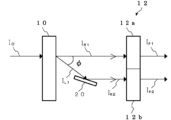
- FIG. 2 is a diagram conceptually showing another example of the configuration of the beam splitter of the present invention.
- the beam splitter shown in Fig. 2 has a light separation element 10, a mirror 20 as a light parallelizing member, and a retardation plate 12.
- the example shown in Fig. 2 has the same configuration as the example shown in Fig. 1 except for the mirror 20 as a light parallelizing member, so the following description will mainly focus on the differences.
- the mirror 20 is disposed on the optical path of the left circularly polarized light IL1 separated by the light separation element 10, and reflects the incident left circularly polarized light IL1 to change its traveling direction.
- the mirror 20 reflects the left circularly polarized light IL1 traveling in the lower right direction in the figure so that it travels in the right direction in the figure.
- the polarization direction of the circularly polarized light reflected by the mirror 20 is changed, and the light is output as right circularly polarized light IR2 .
- the left-handed circularly polarized light I L1 reflected by the mirror 20 enters the region 12b of the phase difference plate 12 and is converted into linearly polarized light I P2
- the right-handed circularly polarized light I R1 that is transmitted through the light separation element 10 without being diffracted directly enters the region 12a of the phase difference plate 12 and is converted into linearly polarized light I P1 .
- the beam splitter shown in Figure 2 can split the incident light into two linearly polarized lights and emit the two linearly polarized lights in directions parallel to each other.
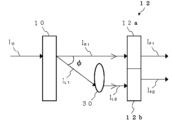
- FIG. 3 is a diagram conceptually showing another example of the configuration of the beam splitter of the present invention.
- the beam splitter shown in Fig. 3 has a light separation element 10, a lens 30 as a light parallelizing member, and a retardation plate 12.
- the example shown in Fig. 3 has the same configuration as the example shown in Fig. 1 except for the inclusion of the lens 30 as a light parallelizing member, and therefore the following description will mainly focus on the differences.
- the lens 30 is a convex lens (condensing lens) that changes the traveling direction of the left-handed circularly polarized light I L1 separated by the light separation element 10 to a direction parallel to the right-handed circularly polarized light I R1 by its condensing action.
- convex lens condensing lens
- the left-handed circularly polarized light IL1 separated by the light separation element 10 travels in a lower right direction in the figure and enters the vicinity of the lower end of the lens 30 in the figure.
- the left-handed circularly polarized light IL1 that entered the lens 30 has its traveling direction bent toward the central axis by the focusing effect of the lens 30 and is emitted in a rightward direction in the figure.
- the left-handed circularly polarized light IL1 that entered the lens 30 is emitted as left-handed circularly polarized light IL2 .
- the left-handed circularly polarized light I L2 emitted from the lens 30 enters the region 12b of the retardation plate 12 and is converted into linearly polarized light I P2 .
- the right-handed circularly polarized light I R1 that is transmitted through the light separation element 10 without being diffracted directly enters the region 12a of the retardation plate 12 and is converted into linearly polarized light I P1 .
- the beam splitter shown in Figure 3 can split the incident light into two linearly polarized lights and emit the two linearly polarized lights in directions parallel to each other.
- FIG. 4 is a diagram conceptually showing another example of the configuration of the beam splitter of the present invention.
- the beam splitter shown in Fig. 4 has a light separation element 10, a prism 40 as a light parallelizing member, and a retardation plate 12.
- the example shown in Fig. 4 has the same configuration as the example shown in Fig. 1 except for the inclusion of the prism 40 as a light parallelizing member, and therefore the following description will mainly focus on the differences.
- the prism 40 is a so-called triangular prism that is arranged on the optical path of the left-handed circularly polarized light I L1 diffracted by the light separating element 10 and bends the traveling direction of the left-handed circularly polarized light I L1 to change the direction to be parallel to the right-handed circularly polarized light I R1 that has transmitted through the light separating element 10.
- the prism 40 is disposed such that the surface onto which the left-handed circularly polarized light IL1 is incident (hereinafter referred to as the incident surface) is inclined with respect to the surface of the light separation element 10, and the left-handed circularly polarized light IL1 is incident from an oblique direction to the incident surface.
- the incident surface the surface onto which the left-handed circularly polarized light IL1 is incident
- the prism 40 is disposed such that the incident angle of the left-handed circularly polarized light IL1 is large.
- the left-handed circularly polarized light IL1 that is incident on the prism 40 at a large angle of incidence changes its traveling direction significantly and is emitted to the right in the figure.
- the left-handed circularly polarized light IL1 that is incident on the prism 40 is emitted as left-handed circularly polarized light IL2 .
- the left-handed circularly polarized light I L2 emitted from the prism 40 enters the region 12b of the phase difference plate 12 and is converted into linearly polarized light I P2 .
- the right-handed circularly polarized light I R1 that is transmitted through the light separation element 10 without being diffracted directly enters the region 12a of the phase difference plate 12 and is converted into linearly polarized light I P1 .
- the beam splitter shown in Figure 4 can split the incident light into two linearly polarized lights and emit the two linearly polarized lights in directions parallel to each other.
- FIG. 5 is a diagram conceptually showing another example of the configuration of the beam splitter of the present invention.
- the beam splitter shown in Fig. 5 has a light separation element 10, a transmissive liquid crystal diffraction element 50 as a light parallelizing member, and a retardation plate 12.
- the example shown in Fig. 5 has the same configuration as the example shown in Fig. 1 except for having the transmissive liquid crystal diffraction element 50 as a light parallelizing member, so the following description will mainly focus on the differences.
- the transmissive liquid crystal diffraction element 50 is disposed on the optical path of the left circularly polarized light I L1 transmitted and diffracted by the light splitting element 10.
- the left circularly polarized light I L1 transmitted and diffracted by the light splitting element 10 enters the transmissive liquid crystal diffraction element 50.
- the transmissive liquid crystal diffraction element 50 diffracts the incident circularly polarized light according to the rotation direction.
- the transmissive liquid crystal diffraction element 50 has an optically anisotropic film, which can be formed using a composition containing a liquid crystal compound and has a predetermined liquid crystal orientation pattern in which the direction of the optical axis derived from the liquid crystal compound rotates in one direction in the plane.
- the optically anisotropic film of the transmissive liquid crystal diffraction element 50 is preferable in terms of high efficiency of diffracted light and polarization maintenance if it has a so-called twist structure in which the direction of the molecular axis of the liquid crystal compound changes continuously from one interface side to the other interface side in the thickness direction.
- the transmissive liquid crystal diffraction element 50 may have a support and/or an orientation film in addition to the optically anisotropic film.
- the transmissive liquid crystal diffraction element 50 diffracts the left-handed circularly polarized light IL1 incident from the upper left direction so that it travels to the right.
- the circularly polarized light that has passed through the transmissive liquid crystal diffraction element 50 has its rotation direction changed, and is output as right-handed circularly polarized light IR2 .
- the beam splitter shown in Figure 5 can split the incident light into two linearly polarized lights and emit the two linearly polarized lights in directions parallel to each other.
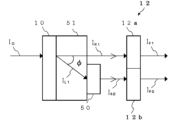
- FIG. 6 is a diagram conceptually showing another example of the configuration of the beam splitter of the present invention.
- the beam splitter shown in Fig. 6 has a light separation element 10, a transmissive liquid crystal diffraction element 50 as a light parallelizing member, a support 51, and a retardation plate 12.
- the example shown in Fig. 5 has the same configuration as the example shown in Fig. 5 except for having the support 51, so the following description will mainly focus on the differences.
- the light splitting element 10 is disposed on the surface of the support 51 on which the light I0 is incident, and the transmissive liquid crystal diffraction element 50 is disposed on the other surface. That is, the support 51 supports the light splitting element 10 and the transmissive liquid crystal diffraction element 50, and holds the light splitting element 10 and the transmissive liquid crystal diffraction element 50 in a predetermined positional relationship.
- the support 51 is formed of a material that has high optical transparency to the target light, such as glass or resin.
- the left-handed circularly polarized light I L1 diffracted by the light splitting element 10 passes through the support 51 and enters the transmissive liquid crystal diffraction element 50, where it is deflected to travel to the right in the figure by the transmissive liquid crystal diffraction element 50 and is converted into right-handed circularly polarized light I R2 .
- the right-handed circularly polarized light I R1 that is transmitted through the light splitting element 10 without being diffracted passes through the support 51 and is emitted to the right in the figure.
- the right-handed circularly polarized light I R2 emitted from the transmissive liquid crystal diffraction element 50 enters the region 12b of the retardation plate 12 and is converted into linearly polarized light I P2 .
- the right-handed circularly polarized light I R1 that has been transmitted through the light separation element 10 and the support 51 enters the region 12a of the retardation plate 12 and is converted into linearly polarized light I P1 .
- the beam splitter shown in Figure 6 can split the incident light into two linearly polarized lights and emit the two linearly polarized lights in directions parallel to each other.
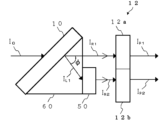
- FIG. 7 is a diagram conceptually showing another example of the configuration of the beam splitter of the present invention.
- the beam splitter shown in Fig. 7 has a light separation element 10, a transmissive liquid crystal diffraction element 50 as a light parallelizing member, a prism 60, and a retardation plate 12.
- the example shown in Fig. 6 has the same configuration as the example shown in Fig. 6 except that it has a prism 60 instead of the support 51, so the following description will mainly focus on the differences.
- the prism 60 is a so-called triangular prism, with the light separation element 10 disposed on one of the non-parallel surfaces of the prism 60 (hereinafter also referred to as the entrance surface of the prism 60), and the transmissive liquid crystal diffraction element 50 disposed on the other surface (hereinafter also referred to as the exit surface of the prism 60).
- the prism 60 supports the light separation element 10 and the transmissive liquid crystal diffraction element 50, and also functions as a support that holds the light separation element 10 and the transmissive liquid crystal diffraction element 50 in a predetermined positional relationship.
- the prism 60 is formed from a material that has high optical transparency to the target light, such as glass or resin.
- the prism 60 is arranged so that the incident light I0 is incident from a direction perpendicular to the exit surface of the prism 60. Therefore, the incident light I0 is incident on the light separation element 10 (the entrance surface of the prism 60) from an oblique direction.
- the transmissive liquid crystal diffraction element 50 is arranged in an area below the exit surface of the prism 60. In other words, the exit surface of the prism 60 has an area where the transmissive liquid crystal diffraction element 50 is not arranged.
- the right-handed circularly polarized component of the incident light I0 that is incident on the light separation element 10 from an oblique direction is diffracted and emitted as left-handed circularly polarized light I L1 .
- the left-handed circularly polarized light I L1 is diffracted so as to travel in the lower right direction in the figure, passes through the prism 60, and enters the transmissive liquid crystal diffraction element 50.
- the left-handed circularly polarized light I L1 is deflected by the transmissive liquid crystal diffraction element 50 so as to travel in the right direction in the figure, and is converted into right-handed circularly polarized light I R2 .
- the right-handed circularly polarized light I R1 that has been transmitted through the light separation element 10 passes through the prism 60 and is emitted to the right in the figure from a region of the exit surface where the transmissive liquid crystal diffraction element 50 is not disposed. At that time, the right-handed circularly polarized light I R1 is incident perpendicularly on the exit surface of the prism 60, so it travels straight without being bent and is emitted to the right.
- the right-handed circularly polarized light I R2 emitted from the transmissive liquid crystal diffraction element 50 enters the region 12b of the retardation plate 12 and is converted into linearly polarized light I P2 .
- the right-handed circularly polarized light I R1 that is transmitted through the light separation element 10 without being diffracted and then transmitted through the prism 60 enters the region 12a of the retardation plate 12 and is converted into linearly polarized light I P1 .
- the beam splitter shown in Figure 7 can split the incident light into two linearly polarized lights and emit the two linearly polarized lights in directions parallel to each other.
- the beam splitter of the present invention can be used in an optical wavelength selection switch device.
- An optical wavelength selective switch device has the function of separating each wavelength component contained in an optical signal transmitted over an optical fiber in wavelength multiplexing mode communication, and distributing each to a specified route.
- An optical wavelength selective switch device has a wavelength dispersion element that spatially separates the incident light by wavelength and outputs it, and a deflection unit that distributes the light to a specified route by variably deflecting the reflection angle or transmission angle of the light incident from the wavelength dispersion element for each wavelength.
- Wavelength dispersion elements include prisms, surface relief gratings (SRG), and arrayed waveguide gratings (AWG).
- the deflection section can be a micromirror device or a liquid crystal optical element such as LCOS (Liquid Crystal On Silicon).
- LCOS Liquid Crystal On Silicon
- the beam splitter of the present invention is disposed on the input side of an optical wavelength selective switch device, i.e., upstream of the wavelength dispersion element, and can be used to separate the light input to the optical wavelength selective switch device and to cause the separated light to enter the wavelength dispersion element.
- the diffraction efficiency of a diffraction element (particularly a surface relief diffraction element) as a wavelength dispersion element possessed by an optical wavelength selective switch device has polarization dependence, so the diffraction efficiency can be stabilized by inputting P-polarized light.
- One method is to convert the incident light into P-polarized light using a polarizing plate, but this reduces the amount of light by approximately half. In contrast, the reduction in the amount of light can be suppressed by converting the incident light into P-polarized light using a beam splitter.
- the beam splitter of the present invention can be placed on the output side of an optical wavelength selective switch device, i.e., downstream of the deflection section, and used to further separate at least one of the lights separated by wavelength by the optical wavelength selective switch device.
- the diffraction element 1 (light separation element 10) had an in-plane pitch of 2.4 [ ⁇ m], and the amount of the right chiral agent added was adjusted so that the twist angle was 110 °, forming an optically anisotropic film having a right twist structure, and a transmission type liquid crystal diffraction element having a separation angle of 40 ° and a film thickness of 0.78 [ ⁇ m] with respect to a wavelength of 1550 [nm] was prepared.
- the diffraction element 2 transmission type liquid crystal diffraction element 50
- the optical alignment film was 80 [nm], the total thickness was about 1.6 [mm], and the separation distance was 1.2 [mm].
- the separation distance when the light struck graph paper placed 10 cm away from the element was the same as the separation distance when the light struck graph paper placed 300 cm away, it was confirmed that the separated light was parallel light.
- the separation distance is the distance between position A and position B, where A is positioned so that one transmitted light enters the photodiode power sensor (S122C, manufactured by Thorlabs) perpendicularly, and B is moved parallel to that position and the other transmitted light similarly enters perpendicularly
- arctan is the inverse trigonometric function of the tangent.
- a beam displacer type separation element made of YVO4 was used as a comparative example. This element needed to have a thickness of 12 mm in order to achieve a separation angle of 5° and a separation distance of 1.2 mm.
- the beam splitter of the embodiment of the present invention is extremely thin, about one-seventh the thickness of the beam splitter of the comparative example, in order to obtain the same separation distance. Furthermore, it is easily possible to make it even thinner by selecting an even thinner support material, for example.
- Light separation element transmissive liquid crystal diffraction element
- Support glass
- Light parallelizing member Phase difference plate 12a, 12b Region 20
- Mirror 30 Lens
- Transmissive liquid crystal diffraction element 40 60 Prism I 0 Incident light I R1 Separated right circularly polarized light I L1 Separated left circularly polarized light I R2 Parallelized right circularly polarized light I L2 Parallelized left circularly polarized light I P1 , I P2 P-polarized light (linearly polarized light) ⁇ Separation angle
Landscapes
- Physics & Mathematics (AREA)
- Nonlinear Science (AREA)
- General Physics & Mathematics (AREA)
- Optics & Photonics (AREA)
- Chemical & Material Sciences (AREA)
- Crystallography & Structural Chemistry (AREA)
- Mathematical Physics (AREA)
- Polarising Elements (AREA)
- Spectrometry And Color Measurement (AREA)
- Liquid Crystal (AREA)
Priority Applications (3)
| Application Number | Priority Date | Filing Date | Title |
|---|---|---|---|
| CN202480025084.6A CN120936921A (zh) | 2023-04-13 | 2024-04-12 | 光束分离器及光波长选择开关装置 |
| JP2025514023A JPWO2024214803A1 (https=) | 2023-04-13 | 2024-04-12 | |
| US19/355,062 US20260036857A1 (en) | 2023-04-13 | 2025-10-10 | Beam splitter and optical wavelength selective switch system |
Applications Claiming Priority (2)
| Application Number | Priority Date | Filing Date | Title |
|---|---|---|---|
| JP2023-065728 | 2023-04-13 | ||
| JP2023065728 | 2023-04-13 |
Related Child Applications (1)
| Application Number | Title | Priority Date | Filing Date |
|---|---|---|---|
| US19/355,062 Continuation US20260036857A1 (en) | 2023-04-13 | 2025-10-10 | Beam splitter and optical wavelength selective switch system |
Publications (1)
| Publication Number | Publication Date |
|---|---|
| WO2024214803A1 true WO2024214803A1 (ja) | 2024-10-17 |
Family
ID=93059537
Family Applications (1)
| Application Number | Title | Priority Date | Filing Date |
|---|---|---|---|
| PCT/JP2024/014759 Ceased WO2024214803A1 (ja) | 2023-04-13 | 2024-04-12 | ビームスプリッターおよび光波長選択スイッチ装置 |
Country Status (4)
| Country | Link |
|---|---|
| US (1) | US20260036857A1 (https=) |
| JP (1) | JPWO2024214803A1 (https=) |
| CN (1) | CN120936921A (https=) |
| WO (1) | WO2024214803A1 (https=) |
Citations (8)
| Publication number | Priority date | Publication date | Assignee | Title |
|---|---|---|---|---|
| JP2003255113A (ja) * | 2002-02-28 | 2003-09-10 | Canon Inc | 光分離素子およびそれを用いた光学機器 |
| JP2004184505A (ja) * | 2002-11-29 | 2004-07-02 | Asahi Glass Co Ltd | 偏光ビームスプリッタ及びこれを用いた光情報記録装置並びに光情報記録再生装置 |
| JP2006189695A (ja) * | 2005-01-07 | 2006-07-20 | Ricoh Co Ltd | 液晶回折光学素子及び光ヘッド装置及び光ディスクドライブ装置 |
| JP2006318515A (ja) * | 2004-09-10 | 2006-11-24 | Ricoh Co Ltd | ホログラム素子及びその製造方法及び光ヘッド装置 |
| JP2009093795A (ja) * | 2001-02-14 | 2009-04-30 | Asahi Glass Co Ltd | 波長選択性回折素子および光ヘッド装置 |
| JP2016085228A (ja) * | 2010-07-30 | 2016-05-19 | ケーエルエー−テンカー コーポレイション | 照射サブシステム |
| WO2021235416A1 (ja) * | 2020-05-20 | 2021-11-25 | 富士フイルム株式会社 | 透過型液晶回折素子 |
| JP2024007447A (ja) * | 2022-06-29 | 2024-01-18 | 株式会社フォトニックラティス | 光学素子及びレーザ加工装置 |
-
2024
- 2024-04-12 CN CN202480025084.6A patent/CN120936921A/zh active Pending
- 2024-04-12 WO PCT/JP2024/014759 patent/WO2024214803A1/ja not_active Ceased
- 2024-04-12 JP JP2025514023A patent/JPWO2024214803A1/ja active Pending
-
2025
- 2025-10-10 US US19/355,062 patent/US20260036857A1/en active Pending
Patent Citations (8)
| Publication number | Priority date | Publication date | Assignee | Title |
|---|---|---|---|---|
| JP2009093795A (ja) * | 2001-02-14 | 2009-04-30 | Asahi Glass Co Ltd | 波長選択性回折素子および光ヘッド装置 |
| JP2003255113A (ja) * | 2002-02-28 | 2003-09-10 | Canon Inc | 光分離素子およびそれを用いた光学機器 |
| JP2004184505A (ja) * | 2002-11-29 | 2004-07-02 | Asahi Glass Co Ltd | 偏光ビームスプリッタ及びこれを用いた光情報記録装置並びに光情報記録再生装置 |
| JP2006318515A (ja) * | 2004-09-10 | 2006-11-24 | Ricoh Co Ltd | ホログラム素子及びその製造方法及び光ヘッド装置 |
| JP2006189695A (ja) * | 2005-01-07 | 2006-07-20 | Ricoh Co Ltd | 液晶回折光学素子及び光ヘッド装置及び光ディスクドライブ装置 |
| JP2016085228A (ja) * | 2010-07-30 | 2016-05-19 | ケーエルエー−テンカー コーポレイション | 照射サブシステム |
| WO2021235416A1 (ja) * | 2020-05-20 | 2021-11-25 | 富士フイルム株式会社 | 透過型液晶回折素子 |
| JP2024007447A (ja) * | 2022-06-29 | 2024-01-18 | 株式会社フォトニックラティス | 光学素子及びレーザ加工装置 |
Also Published As
| Publication number | Publication date |
|---|---|
| US20260036857A1 (en) | 2026-02-05 |
| CN120936921A (zh) | 2025-11-11 |
| JPWO2024214803A1 (https=) | 2024-10-17 |
Similar Documents
| Publication | Publication Date | Title |
|---|---|---|
| US10859740B2 (en) | Bragg liquid crystal polarization gratings | |
| JP4148343B2 (ja) | 偏光分離素子、偏光変換システムおよび投射型ディスプレイシステム | |
| KR20010089321A (ko) | 위상자 및 이것을 탑재한 광헤드 장치 | |
| US20030161043A1 (en) | Beam splitting element and optical apparatus using it | |
| US11988880B2 (en) | Optical coupling system and optical communication device | |
| WO2023063414A1 (ja) | 光結合システムおよび光通信デバイス | |
| JP4106981B2 (ja) | 光減衰器 | |
| WO2024214803A1 (ja) | ビームスプリッターおよび光波長選択スイッチ装置 | |
| WO2024214807A1 (ja) | ビームスプリッター、光波長選択スイッチ装置 | |
| US12007594B2 (en) | Polarization conversion element | |
| JP7426468B2 (ja) | 光通信デバイス | |
| WO2024214808A1 (ja) | ビームスプリッター、および、光波長選択スイッチ装置 | |
| JP3711652B2 (ja) | 偏光回折素子及びそれを用いた光ヘッド装置 | |
| US20240365028A1 (en) | Wavelength selective switch and optical cross-connect device including wavelength selective switch | |
| US20260110850A1 (en) | Angle insensitive optical arrangement for optical switch | |
| US20240369900A1 (en) | Wavelength selective switch | |
| CN120028969A (zh) | 为硅基液晶(lcos)射束转向生成重叠偏振射束的光学装置 | |
| CN118575128A (zh) | 波长选择开关 | |
| WO2025249413A1 (ja) | 光学素子および伝送システム | |
| WO2025164430A1 (ja) | 光サーキュレータ | |
| CN117406461A (zh) | 一种可调光分路器 | |
| CN121002411A (zh) | 波长选择性相位差板、光学元件 | |
| CN121115314A (zh) | 一种光栅偏振分束器及光学装置 | |
| CN118575113A (zh) | 波长选择开关及使用了该波长选择开关的光交叉连接装置 | |
| GB2415057A (en) | Polarisation splitter with inclined non-parallel sets of interfaces and anisotropic material |
Legal Events
| Date | Code | Title | Description |
|---|---|---|---|
| 121 | Ep: the epo has been informed by wipo that ep was designated in this application |
Ref document number: 24788825 Country of ref document: EP Kind code of ref document: A1 |
|
| ENP | Entry into the national phase |
Ref document number: 2025514023 Country of ref document: JP Kind code of ref document: A |
|
| WWE | Wipo information: entry into national phase |
Ref document number: 2025514023 Country of ref document: JP |
|
| NENP | Non-entry into the national phase |
Ref country code: DE |
|
| 122 | Ep: pct application non-entry in european phase |
Ref document number: 24788825 Country of ref document: EP Kind code of ref document: A1 |