WO2024210146A1 - 感光性樹脂フィルム、プリント配線板及び半導体パッケージ - Google Patents
感光性樹脂フィルム、プリント配線板及び半導体パッケージ Download PDFInfo
- Publication number
- WO2024210146A1 WO2024210146A1 PCT/JP2024/013720 JP2024013720W WO2024210146A1 WO 2024210146 A1 WO2024210146 A1 WO 2024210146A1 JP 2024013720 W JP2024013720 W JP 2024013720W WO 2024210146 A1 WO2024210146 A1 WO 2024210146A1
- Authority
- WO
- WIPO (PCT)
- Prior art keywords
- photosensitive resin
- resin film
- component
- epoxy resins
- type epoxy
- Prior art date
- Legal status (The legal status is an assumption and is not a legal conclusion. Google has not performed a legal analysis and makes no representation as to the accuracy of the status listed.)
- Ceased
Links
Images


Classifications
-
- C—CHEMISTRY; METALLURGY
- C08—ORGANIC MACROMOLECULAR COMPOUNDS; THEIR PREPARATION OR CHEMICAL WORKING-UP; COMPOSITIONS BASED THEREON
- C08K—Use of inorganic or non-macromolecular organic substances as compounding ingredients
- C08K3/00—Use of inorganic substances as compounding ingredients
- C08K3/18—Oxygen-containing compounds, e.g. metal carbonyls
- C08K3/20—Oxides; Hydroxides
- C08K3/22—Oxides; Hydroxides of metals
-
- C—CHEMISTRY; METALLURGY
- C08—ORGANIC MACROMOLECULAR COMPOUNDS; THEIR PREPARATION OR CHEMICAL WORKING-UP; COMPOSITIONS BASED THEREON
- C08K—Use of inorganic or non-macromolecular organic substances as compounding ingredients
- C08K3/00—Use of inorganic substances as compounding ingredients
- C08K3/34—Silicon-containing compounds
- C08K3/36—Silica
-
- C—CHEMISTRY; METALLURGY
- C08—ORGANIC MACROMOLECULAR COMPOUNDS; THEIR PREPARATION OR CHEMICAL WORKING-UP; COMPOSITIONS BASED THEREON
- C08K—Use of inorganic or non-macromolecular organic substances as compounding ingredients
- C08K7/00—Use of ingredients characterised by shape
- C08K7/16—Solid spheres
- C08K7/18—Solid spheres inorganic
-
- G—PHYSICS
- G03—PHOTOGRAPHY; CINEMATOGRAPHY; ANALOGOUS TECHNIQUES USING WAVES OTHER THAN OPTICAL WAVES; ELECTROGRAPHY; HOLOGRAPHY
- G03F—PHOTOMECHANICAL PRODUCTION OF TEXTURED OR PATTERNED SURFACES, e.g. FOR PRINTING, FOR PROCESSING OF SEMICONDUCTOR DEVICES; MATERIALS THEREFOR; ORIGINALS THEREFOR; APPARATUS SPECIALLY ADAPTED THEREFOR
- G03F7/00—Photomechanical, e.g. photolithographic, production of textured or patterned surfaces, e.g. printing surfaces; Materials therefor, e.g. comprising photoresists; Apparatus specially adapted therefor
- G03F7/004—Photosensitive materials
-
- G—PHYSICS
- G03—PHOTOGRAPHY; CINEMATOGRAPHY; ANALOGOUS TECHNIQUES USING WAVES OTHER THAN OPTICAL WAVES; ELECTROGRAPHY; HOLOGRAPHY
- G03F—PHOTOMECHANICAL PRODUCTION OF TEXTURED OR PATTERNED SURFACES, e.g. FOR PRINTING, FOR PROCESSING OF SEMICONDUCTOR DEVICES; MATERIALS THEREFOR; ORIGINALS THEREFOR; APPARATUS SPECIALLY ADAPTED THEREFOR
- G03F7/00—Photomechanical, e.g. photolithographic, production of textured or patterned surfaces, e.g. printing surfaces; Materials therefor, e.g. comprising photoresists; Apparatus specially adapted therefor
- G03F7/004—Photosensitive materials
- G03F7/027—Non-macromolecular photopolymerisable compounds having carbon-to-carbon double bonds, e.g. ethylenic compounds
-
- H—ELECTRICITY
- H05—ELECTRIC TECHNIQUES NOT OTHERWISE PROVIDED FOR
- H05K—PRINTED CIRCUITS; CASINGS OR CONSTRUCTIONAL DETAILS OF ELECTRIC APPARATUS; MANUFACTURE OF ASSEMBLAGES OF ELECTRICAL COMPONENTS
- H05K1/00—Printed circuits
- H05K1/02—Details
- H05K1/03—Use of materials for the substrate
Definitions
- This disclosure relates to photosensitive resin films, printed wiring boards, and semiconductor packages.
- a conventional method for manufacturing a printed wiring board is a build-up method (see, for example, Patent Document 1) in which an interlayer insulating layer and a conductor circuit layer are sequentially laminated to form a printed wiring board.
- a semi-additive method in which circuits are formed by plating has become mainstream for printed wiring boards.
- the conventional semi-additive method for example, (1) a thermosetting resin film is laminated on a conductor circuit, and then the thermosetting resin film is heated to harden the film to form an "interlayer insulating layer”.
- vias for interlayer connection are formed by laser processing, and then desmearing and roughening are performed by alkaline permanganate treatment or the like.
- Patent Document 2 one of the problems is to suppress the decrease in adhesion with copper plating caused by using a photosensitive resin composition instead of a conventional thermosetting resin composition as a material for an interlayer insulating layer or a surface protective layer, and further, the resolution of vias and adhesion with silicon substrates and chip components are also identified as problems, and these are claimed to have been solved.
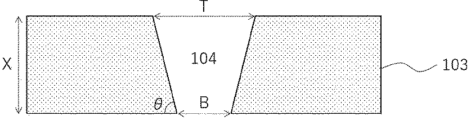
- the shape of a via formed by exposing and developing the photosensitive resin film has a shape in which the diameter at the bottom of the via (hereinafter also referred to as the "bottom diameter") is too small compared to the diameter at the top of the via, which is the exposed surface (hereinafter also referred to as the "top diameter"), i.e., the via has an excessively tapered shape when viewed in cross section, and good resolution cannot be obtained.
- the purpose of this disclosure is to provide a photosensitive resin film with excellent resolution, and a printed wiring board and a semiconductor package that use this photosensitive resin film.
- the present disclosure includes the following embodiments [1] to [11].
- This disclosure makes it possible to provide a photosensitive resin film with excellent resolution, and a printed wiring board and a semiconductor package using the photosensitive resin film.
- FIG. 2 is a schematic diagram showing the lamination step (1).
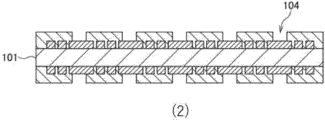
- FIG. 13 is a schematic diagram showing a photovia forming step (2).
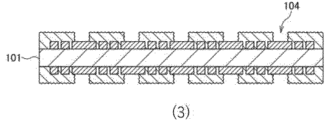
- FIG. 2 is a schematic diagram showing the roughening treatment step (3).
- FIG. 1 is a schematic diagram showing a circuit pattern forming step (4).
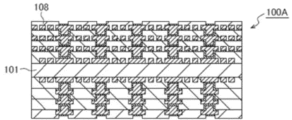
- FIG. 1 is a schematic diagram of a multilayer printed wiring board.
- FIG. 4 is a schematic diagram for explaining a taper angle.
- the upper or lower limit of the numerical range may be replaced with the values shown in the examples.
- the lower and upper limits of a numerical range may be arbitrarily combined with the lower or upper limit of another numerical range.
- the numerical values AA and BB at both ends are included in the numerical range as the lower and upper limits, respectively.
- the description "10 or more” means 10 and a numerical value exceeding 10, and the same applies when the numerical values are different.
- the description "10 or less” means 10 and a numerical value less than 10, and the same applies when the numerical values are different.
- the content of each component means the total content of the multiple substances present in the photosensitive resin film, unless otherwise specified.
- the "number of ring carbon atoms" refers to the number of carbon atoms necessary to form a ring, and does not include the number of carbon atoms of the substituents of the ring. For example, the number of ring carbon atoms is 6 in both the cyclohexane skeleton and the methylcyclohexane skeleton.
- the "number of ring atoms” refers to the number of atoms necessary to form a ring, and does not include the number of substituent atoms of the ring. For example, the number of ring atoms is 6 in both the pyridine skeleton and the methylpyridine skeleton.
- the term "XX (meth)acrylate” means one or both of XX acrylate and XX methacrylate.
- (meth)acryloyl group” means one or both of acryloyl group and methacryloyl group.
- the "resin component” refers to component (A) described below, and also includes other components that may be contained as necessary (e.g., components (C), (D), (E), (F), (G), etc.), but does not include inorganic compounds such as inorganic filler (B) and pigment (H).
- the "solid content” refers to the non-volatile content excluding water and the diluent described below contained in the photosensitive resin film, and includes those that are liquid at room temperature.
- room temperature means 25°C.
- any combination of the descriptions in this disclosure is also included in this embodiment.
- the photosensitive resin film of this embodiment is A photosensitive resin film comprising: (A) a photopolymerizable compound having an ethylenically unsaturated group and an acidic substituent; and (B) an inorganic filler, The content of the (B) inorganic filler is 25% by volume or more, The photosensitive resin film has a refractive index of 1.550 or more when cured.
- the photosensitive resin film of this embodiment is suitable for via formation (also referred to as photovia formation) by photolithography, and is therefore suitable for the formation of one or more selected from the group consisting of photovias and interlayer insulating layers.
- layer includes not only a solid layer, but also a layer that is not a solid layer but at least a part of which is island-like, a layer that has holes, and a layer in which the interface with an adjacent layer is unclear.
- the solid layer refers to a sheet-like layer that has not been particularly processed.
- the photosensitive resin film of this embodiment is suitable as a negative type photosensitive resin film.
- the refractive index of the cured product of the photosensitive resin film of this embodiment is 1.550 or more.
- the photosensitive resin film of the present embodiment has excellent resolution. Although the reason for this is unclear, it is presumed that when the refractive index of the cured product is 1.550 or more, the diffusion of the energy rays incident on the photosensitive resin film during exposure is suppressed, and the curing of the light-shielding parts is suppressed.
- the refractive index of the cured product of the photosensitive resin film of this embodiment is preferably 1.551 to 1.680, more preferably 1.552 to 1.640, and even more preferably 1.553 to 1.600.
- the refractive index of the cured photosensitive resin film can be measured by the method described in the Examples.
- the component (A) is a photopolymerizable compound having an ethylenically unsaturated group and an acidic substituent.
- the component (A) may be used alone or in combination of two or more types.
- the component (A) is a compound that has an ethylenically unsaturated group and thus exhibits photopolymerizability, in particular radical polymerizability.
- the ethylenically unsaturated group contained in the component (A) include photopolymerizable functional groups such as a vinyl group, an allyl group, a propargyl group, a butenyl group, an ethynyl group, a phenylethynyl group, a maleimide group, a nadimide group, a (meth)acryloyl group, etc.
- a (meth)acryloyl group is preferred from the viewpoints of reactivity and via resolution.
- the component (A) has an acidic substituent from the viewpoint of enabling alkaline development.
- the acidic substituent that the component (A) has include a carboxy group, a sulfonic acid group, a phenolic hydroxyl group, etc. Of these, from the viewpoint of via resolution, a carboxy group is preferred.
- the acid value of component (A) is preferably 20 to 200 mgKOH/g, more preferably 40 to 180 mgKOH/g, and even more preferably 50 to 150 mgKOH/g.
- component (A) When the acid value of component (A) is equal to or more than the lower limit, the solubility of the photosensitive resin film in a dilute alkaline solution tends to be excellent, and when it is equal to or less than the upper limit, the dielectric properties tend to be excellent.
- the acid value of component (A) can be measured by the method described in the Examples. Two or more types of (A) components having different acid values may be used in combination. In this case, it is preferable that the weighted average acid value of the acid values of the two or more types of (A) components falls within any one of the above ranges.
- the weight average molecular weight (Mw) of component (A) is preferably 600 to 30,000, more preferably 800 to 25,000, and even more preferably 1,000 to 18,000.
- the weight average molecular weight (Mw) of component (A) is within the above range, the adhesive strength with copper plating, heat resistance, and insulation reliability tend to be excellent.
- the weight average molecular weight is a value determined by gel permeation chromatography (GPC) using tetrahydrofuran as a solvent and converted into standard polystyrene, and in detail, is a value measured according to the method described in the examples.
- the (A) component is preferably an acid-modified vinyl-group-containing epoxy resin obtained by reacting (a1) an epoxy resin with (a2) an ethylenically unsaturated group-containing organic acid (hereinafter sometimes referred to as (A') component) with (a3) a saturated or unsaturated group-containing polybasic acid anhydride.
- the term "acid-modified” in the acid-modified vinyl-group-containing epoxy resin means that it has an acidic substituent
- "vinyl group” means that it has an ethylenically unsaturated group
- "epoxy resin” means that an epoxy resin is used as a raw material, and the acid-modified vinyl-group-containing epoxy resin does not necessarily have to have an epoxy group, and may not have an epoxy group.
- preferred embodiments of the component (A) obtained from (a1) an epoxy resin, (a2) an ethylenically unsaturated group-containing organic acid, and (a3) a saturated or unsaturated group-containing polybasic acid anhydride will be described.
- the (a1) epoxy resin is preferably an epoxy resin having two or more epoxy groups.
- the epoxy resin (a1) may be used alone or in combination of two or more kinds.
- Epoxy resins are classified into glycidyl ether type epoxy resins, glycidyl amine type epoxy resins, glycidyl ester type epoxy resins, etc. Among these, glycidyl ether type epoxy resins are preferred.
- Epoxy resins can be classified into various epoxy resins depending on the difference in the main skeleton, and can be classified into epoxy resins having an alicyclic skeleton, novolac type epoxy resins, bisphenol type epoxy resins, aralkyl type epoxy resins, other epoxy resins, etc. Among these, epoxy resins having an alicyclic skeleton, novolac type epoxy resins, and bisphenol type epoxy resins are preferred, and novolac type epoxy resins and bisphenol type epoxy resins are more preferred.
- novolac type epoxy resins include bisphenol novolac type epoxy resins such as bisphenol A novolac type epoxy resins, bisphenol F novolac type epoxy resins, and bisphenol S novolac type epoxy resins, phenol novolac type epoxy resins, cresol novolac type epoxy resins, biphenyl novolac type epoxy resins, naphthol novolac type epoxy resins, etc. Among these, cresol novolac type epoxy resins are preferred.
- bisphenol type epoxy resins include bisphenol A type epoxy resins, bisphenol F type epoxy resins, bisphenol S type epoxy resins, etc. Among these, bisphenol A type epoxy resins are preferred.
- the ethylenically unsaturated group-containing organic acid (a2) is preferably an ethylenically unsaturated group-containing monocarboxylic acid.
- Examples of the ethylenically unsaturated group contained in the component (a2) include the same groups as those exemplified as the ethylenically unsaturated group contained in the component (A).
- the component (a2) examples include acrylic acid, acrylic acid dimers, methacrylic acid, ⁇ -furfurylacrylic acid, ⁇ -styrylacrylic acid, cinnamic acid, crotonic acid, and ⁇ -cyanocinnamic acid and other acrylic acid derivatives; Half-ester compounds which are reaction products of hydroxyl-containing acrylates and dibasic acid anhydrides; half-ester compounds which are reaction products of vinyl-containing monoglycidyl ethers or vinyl-containing monoglycidyl esters and dibasic acid anhydrides, etc. Examples include: The component (a2) may be used alone or in combination of two or more types.
- the amount of the (a2) component used relative to 1 equivalent of the epoxy group of the (a1) component is preferably 0.6 to 1.05 equivalents, more preferably 0.7 to 1.02 equivalents, and even more preferably 0.8 to 1.0 equivalents.
- the components (a1) and (a2) are preferably dissolved in an organic solvent and reacted.
- a catalyst for accelerating the reaction, a polymerization inhibitor for preventing polymerization during the reaction, and the like may be used, if necessary.
- the (A') component obtained by reacting the (a1) component with the (a2) component has a hydroxyl group formed by a ring-opening addition reaction between the epoxy group of the (a1) component and the carboxyl group of the (a2) component.
- an acid-modified vinyl group-containing epoxy resin can be obtained in which the hydroxyl group of the (A') component (including the hydroxyl group originally present in the (a1) component) and the acid anhydride group of the (a3) component are semi-esterified.
- the (a3) component may contain a saturated group or an unsaturated group.
- the (a3) component include succinic anhydride, maleic anhydride, tetrahydrophthalic anhydride, phthalic anhydride, methyltetrahydrophthalic anhydride, ethyltetrahydrophthalic anhydride, hexahydrophthalic anhydride, methylhexahydrophthalic anhydride, ethylhexahydrophthalic anhydride, and itaconic anhydride.
- tetrahydrophthalic anhydride is preferred from the viewpoint of via resolution.
- the (a3) component may be used alone or in combination of two or more.
- the acid value of the acid-modified vinyl group-containing epoxy resin can be adjusted by reacting 0.1 to 1.0 equivalent of component (a3) with 1 equivalent of hydroxyl groups in component (A').
- the content of component (A) in the photosensitive resin film of this embodiment is not particularly limited, but from the viewpoints of resolution, heat resistance, and chemical resistance, it is preferably 10 to 80% by mass, more preferably 30 to 70% by mass, and even more preferably 50 to 65% by mass, based on the total amount of resin components in the photosensitive resin film.
- the photosensitive resin film of the present embodiment further contains an inorganic filler as component (B).
- an inorganic filler as component (B).
- the inorganic filler (B) may be used alone or in combination of two or more kinds.
- the inorganic filler is not particularly limited, but examples thereof include silica, alumina, titanium oxide, mica, beryllia, barium titanate, potassium titanate, strontium titanate, calcium titanate, aluminum carbonate, magnesium hydroxide, aluminum hydroxide, aluminum silicate, calcium carbonate, calcium silicate, magnesium silicate, silicon nitride, boron nitride, clay, molybdic acid compounds, talc, aluminum borate, silicon carbide, and composite particles of two or more metal oxides.
- the metal oxide other than silica is preferably titania from the viewpoint of easily adjusting the refractive index of the cured product of the photosensitive resin film to a range of 1.550 or more. That is, the composite particle of silica and a metal oxide other than silica is preferably a silica-titania composite particle.
- the volume average particle size of component (B) is preferably 0.01 to 20 ⁇ m, more preferably 0.1 to 10 ⁇ m, even more preferably 0.2 to 1 ⁇ m, and particularly preferably 250 to 700 nm.
- the volume average particle diameter is a value obtained by measuring particles dispersed in a solvent with a refractive index of 1.38 using a submicron particle analyzer (manufactured by Beckman Coulter, Inc., product name: N5) in accordance with the international standard ISO 13321, and determining the particle diameter equivalent to an integrated value of 50% (volume basis) in the particle size distribution.
- the refractive index of component (B) is not particularly limited, but is preferably 1.520 to 1.680, more preferably 1.530 to 1.640, and even more preferably 1.535 to 1.600.
- the shape of the (B) inorganic filler may be, for example, spherical or crushed. Among these, a spherical shape is preferred from the viewpoint of making it easier to adjust the refractive index of the cured product of the photosensitive resin film of this embodiment to a range of 1.550 or more.
- the particles can be observed, for example, using a scanning electron microscope (SEM) at 5,000x magnification, and the average area and average perimeter of any 10 particles can be used as the area and perimeter values, respectively, in the above formula.
- the content of the component (B) in the photosensitive resin film of this embodiment is 25 vol% or more, preferably 30 to 80 vol%, more preferably 40 to 70 vol%, and even more preferably 50 to 60 vol%, from the viewpoints of resolution and low thermal expansion. From the viewpoint of improving the resolution, the content of the component (B) in the photosensitive resin film of the present embodiment may be 26 to 55 volume %, 27 to 45 volume %, or 28 to 35 volume %.
- the content of the component (B) in the photosensitive resin film of the present embodiment on a mass basis is preferably 40 to 90 mass%, more preferably 50 to 85 mass%, and even more preferably 60 to 80 mass%, from the viewpoints of resolution and low thermal expansion. Furthermore, from the viewpoint of improving the resolution, the content of the component (B) on a mass basis in the photosensitive resin film of this embodiment may be 42 to 75 mass%, 43 to 65 mass%, or 45 to 55 mass%.
- the photosensitive resin film of the present embodiment preferably further contains a thermosetting resin as component (C).
- component (C) does not include component (A).
- the thermosetting resin (C) may be used alone or in combination of two or more types.
- Thermosetting resins include epoxy resins, phenolic resins, unsaturated imide resins, cyanate resins, isocyanate resins, benzoxazine resins, oxetane resins, amino resins, unsaturated polyester resins, allyl resins, dicyclopentadiene resins, silicone resins, triazine resins, melamine resins, etc. Also, without being particularly limited to these, any known thermosetting resin can be used. Among these, epoxy resins are preferred from the viewpoints of adhesive strength with copper plating, insulation reliability, and heat resistance.
- the epoxy resin is preferably an epoxy resin having two or more epoxy groups.
- Epoxy resins are classified into glycidyl ether type epoxy resins, glycidyl amine type epoxy resins, glycidyl ester type epoxy resins, etc. Among these, glycidyl ether type epoxy resins are preferred.
- Epoxy resins are also classified into various epoxy resins based on the difference in the main skeleton, and each of the above types of epoxy resins is further classified as follows: Specifically, bisphenol-based epoxy resins such as bisphenol A type epoxy resin, bisphenol F type epoxy resin, and bisphenol S type epoxy resin; bisphenol-based novolac type epoxy resins such as bisphenol A novolac type epoxy resin and bisphenol F novolac type epoxy resin; novolac type epoxy resins other than the above bisphenol-based novolac type epoxy resins, such as phenol novolac type epoxy resin, cresol novolac type epoxy resin, and biphenyl novolac type epoxy resin; phenol aralkyl type epoxy resin; stilbene type epoxy resin; naphtha type epoxy resin; They are classified into naphthalene skeleton-containing epoxy resins such as novolac type epoxy resins, naphthol type epoxy resins, naphthol aralkyl type epoxy resins, and naphthylene ether type epoxy resins; bipheny
- the equivalent ratio [epoxy group/acidic substituent] of the acidic substituent of component (A) to the epoxy group of component (C) in the photosensitive resin film of this embodiment is not particularly limited, but from the viewpoints of insulation reliability, dielectric properties, heat resistance, and adhesive strength with copper plating, it is preferably 0.5 to 6.0, more preferably 0.7 to 4.0, even more preferably 0.8 to 2.0, and particularly preferably 0.9 to 1.8.
- the content of component (C) is not particularly limited, but from the viewpoints of insulation reliability, dielectric properties, heat resistance, and adhesive strength with copper plating, it is preferably 1 to 50 mass %, more preferably 5 to 40 mass %, and even more preferably 15 to 40 mass %, based on the total amount of resin components in the photosensitive resin film.
- the photosensitive resin film of this embodiment preferably further contains a crosslinking agent as component (D).
- the crosslinking agent is preferably a crosslinking agent having two or more ethylenically unsaturated groups and no acidic substituent.
- the crosslinking agent reacts with the ethylenically unsaturated group of component (A) to increase the crosslinking density of the photosensitive resin film after curing. Therefore, the photosensitive resin film of this embodiment tends to have improved heat resistance and dielectric properties by containing a crosslinking agent.
- the component (D) may be used alone or in combination of two or more types.
- Examples of the component (D) include a bifunctional monomer having two ethylenically unsaturated groups and a polyfunctional monomer having three or more ethylenically unsaturated groups.
- the component (D) preferably contains the polyfunctional monomer.
- Examples of the ethylenically unsaturated group contained in the component (D) include the same as the ethylenically unsaturated group contained in the component (A), and preferred embodiments are also the same.
- bifunctional monomer examples include aliphatic di(meth)acrylates such as trimethylolpropane di(meth)acrylate, polypropylene glycol di(meth)acrylate, and polyethylene glycol di(meth)acrylate; di(meth)acrylates having an alicyclic skeleton such as dicyclopentadiene di(meth)acrylate and tricyclodecane dimethanol di(meth)acrylate; and aromatic di(meth)acrylates such as 2,2-bis(4-(meth)acryloxypolyethoxypolypropoxyphenyl)propane and bisphenol A diglycidyl ether di(meth)acrylate.
- di(meth)acrylates having an alicyclic skeleton are preferred, and tricyclodecane dimethanol diacrylate is more preferred.
- polyfunctional monomer examples include (meth)acrylate compounds having a skeleton derived from trimethylolpropane, such as trimethylolpropane tri(meth)acrylate; (meth)acrylate compounds having a skeleton derived from tetramethylolmethane, such as tetramethylolmethane tri(meth)acrylate and tetramethylolmethane tetra(meth)acrylate; (meth)acrylate compounds having a skeleton derived from pentaerythritol, such as pentaerythritol tri(meth)acrylate and pentaerythritol tetra(meth)acrylate; (meth)acrylate compounds having a skeleton derived from dipentaerythritol, such as dipentaerythritol penta(meth)acrylate and dipentaerythritol hexa(meth)acrylate; (meth)acrylate
- a (meth)acrylate compound having a skeleton derived from dipentaerythritol is preferred, and dipentaerythritol hexa(meth)acrylate is more preferred.
- the "(meth)acrylate compound having a skeleton derived from XXX” (wherein XXX is the name of the compound) means an esterification product of XXX and (meth)acrylic acid, and the esterification product also includes a compound modified with an alkyleneoxy group.
- the content of component (D) is not particularly limited, but from the viewpoint of heat resistance and dielectric properties, it is preferably 5 to 50 parts by mass, more preferably 10 to 40 parts by mass, and even more preferably 15 to 30 parts by mass per 100 parts by mass of component (A).
- the photosensitive resin film of the present embodiment preferably further contains a photopolymerization initiator as component (E).
- a photopolymerization initiator As component (E), the photosensitive resin film of the present embodiment tends to improve the resolution of vias.
- the photopolymerization initiator (E) may be used alone or in combination of two or more. From the viewpoint of via resolution, the photosensitive resin film of the present embodiment preferably contains two or more components (E).
- the content of component (E) is not particularly limited, but from the viewpoint of resolution and heat resistance, it is preferably 0.01 to 20 mass %, more preferably 0.05 to 10 mass %, and even more preferably 0.05 to 3 mass %, based on the total amount of resin components in the photosensitive resin film.
- the photosensitive resin film of the present embodiment preferably contains a photosensitizer as the component (F) as necessary.
- the photosensitizer (F) may be used alone or in combination of two or more. From the viewpoint of via resolution, the photosensitive resin film of the present embodiment may contain two or more components (F).
- photosensitizers include thioxanthone compounds such as 2,4-dimethylthioxanthone, 2,4-diethylthioxanthone, 2-chlorothioxanthone, and 2,4-diisopropylthioxanthone; tertiary amines such as trialkylamines and triethanolamine; dialkylaminobenzoic acid alkyl esters such as ethyl N,N-dimethylaminobenzoate and amyl N,N-dimethylaminobenzoate; bis(dialkylamino)benzophenones such as 4,4'-bis(dimethylamino)benzophenone and 4,4'-bis(diethylamino)benzophenone; phosphine compounds such as triphenylphosphine; toluidine compounds such as N,N-dimethyltoluidine; anthracene compounds such as 9,10-dimethoxyanthrac
- the content of component (F) is not particularly limited, but from the viewpoint of easily adjusting the degree of curing of the photosensitive resin film to an appropriate range, it is preferably 0.01 to 5 mass %, more preferably 0.05 to 3 mass %, and even more preferably 0.1 to 1 mass %, based on the total amount of resin components in the photosensitive resin film.
- the photosensitive resin film of the present embodiment preferably contains a coupling agent as the component (G) as necessary.
- the coupling agent (G) may be used alone or in combination of two or more kinds.
- Examples of the (G) coupling agent include aminosilane coupling agents, epoxysilane coupling agents, phenylsilane coupling agents, alkylsilane coupling agents, alkenylsilane coupling agents, alkynylsilane coupling agents, haloalkylsilane coupling agents, siloxane coupling agents, hydrosilane coupling agents, silazane coupling agents, alkoxysilane coupling agents, chlorosilane coupling agents, (meth)acrylic silane coupling agents, isocyanurate silane coupling agents, ureido silane coupling agents, mercapto silane coupling agents, sulfide silane coupling agents, isocyanate silane coupling agents, etc.
- the photosensitive resin film of the present embodiment contains the component (G)
- the content of the component (G) is not particularly limited, but is preferably 0.01 to 5 mass %, more preferably 0.05 to 3 mass %, and even more preferably 0.1 to 1 mass %, based on the total amount of the resin components in the photosensitive resin film.
- the photosensitive resin film of the present embodiment preferably contains a pigment as the component (H) as necessary.
- the pigment (H) may be used alone or in combination of two or more kinds. Examples of the pigment (H) include phthalocyanine blue, phthalocyanine green, iodine green, diazo yellow, crystal violet, titanium oxide, carbon black, and naphthalene black.
- the content of the component (H) is not particularly limited, but is preferably 0.01 to 5 mass %, more preferably 0.05 to 3 mass %, and even more preferably 0.1 to 1.5 mass %, based on the total amount of the resin components in the photosensitive resin film.
- the thickness of the photosensitive resin film of the present embodiment is not particularly limited, but from the viewpoint of insulation properties and thinning of the printed wiring board, it is preferably 1 to 100 ⁇ m, more preferably 3 to 50 ⁇ m, and even more preferably 5 to 40 ⁇ m.
- the present disclosure also provides a photosensitive resin film for photovia formation made of the photosensitive resin film of this embodiment.
- the photosensitive resin film of the present embodiment is useful as an interlayer insulating layer for printed wiring boards, and is also useful for use as a solder resist.
- the photosensitive resin film of the present embodiment can be produced by forming a photosensitive resin composition containing each of the components constituting the photosensitive resin film of the present embodiment into a film shape.
- the photosensitive resin composition can be obtained by kneading and mixing the components with a roll mill, a bead mill, or the like.
- the photosensitive resin composition may be made into a varnish containing a diluent as necessary to facilitate application.
- a preferred method for forming the photosensitive resin composition into a film is to coat the photosensitive resin composition in a varnish form on a carrier film and then dry it.
- the carrier film include polyesters such as polyethylene terephthalate and polybutylene terephthalate, and polyolefins such as polypropylene and polyethylene.
- the thickness of the carrier film is preferably 5 to 100 ⁇ m, more preferably 7 to 50 ⁇ m, and even more preferably 10 to 30 ⁇ m.
- Examples of a method for applying the varnish-like photosensitive resin composition to a carrier film include a method using a known coating device such as a comma coater, a bar coater, a kiss coater, a roll coater, a gravure coater, or a die coater.
- a drying after coating a dryer using hot air, far infrared rays, or near infrared rays can be used.
- the drying temperature is preferably 60 to 150° C., more preferably 70 to 120° C., and even more preferably 80 to 110° C.
- the drying time is preferably 1 to 60 minutes, more preferably 2 to 30 minutes, and even more preferably 5 to 20 minutes.
- the photosensitive resin film of this embodiment can also have a protective film on the side opposite to the side in contact with the carrier film.
- Polymer films such as polyethylene and polypropylene can be used as the protective film.
- the printed wiring board of this embodiment includes a cured product of the photosensitive resin film of this embodiment. In other words, it includes an interlayer insulating layer formed using the photosensitive resin film of this embodiment.
- the expression "including an interlayer insulating layer” includes a case where the interlayer insulating layer is included as it is, and a case where the interlayer insulating layer is included after being subjected to, for example, processing such as via formation, various treatments such as roughening treatment, and wiring formation.
- a method for manufacturing a printed wiring board according to an embodiment of the present disclosure is a method for manufacturing a printed wiring board, which includes the following (1) to (4).
- circuit pattern forming step (4) Forming a circuit pattern on the interlayer insulating layer (hereinafter referred to as “circuit pattern forming step (4)").
- circuit pattern forming step (4) Forming a circuit pattern on the interlayer insulating layer (hereinafter referred to as “circuit pattern forming step (4)").
- the lamination step (1) is a step of laminating the photosensitive resin film of this embodiment onto one or both sides of a circuit board (substrate 101 having a circuit pattern 102) using a vacuum laminator (see FIG. 1).
- the photosensitive resin film When a protective film is provided on the photosensitive resin film, after peeling or removing the protective film, the photosensitive resin film can be laminated to the circuit board by pressing and heating while being in contact with the circuit board.
- the lamination can be carried out, for example, after preheating the photosensitive resin film and the circuit board as necessary, under reduced pressure at a pressure of 70 to 130° C., a pressure of 0.1 to 1.0 MPa, and an air pressure of 20 mmHg (26.7 hPa) or less, but is not particularly limited to these conditions.
- the lamination method may be a batch method or a continuous method using a roll.
- the photosensitive resin film laminated to the circuit board is cooled to about 25° C. to form the interlayer insulating layer 103. If the photosensitive resin film has a carrier film, the carrier film may be peeled off at this stage, or may be peeled off after exposure, as described below.
- Photovia Forming Process (2) In the photovia forming process (2), at least a part of the photosensitive resin film laminated on the circuit board is exposed to light, and then developed. By exposure, the part irradiated with active light is photocured to form a pattern.
- the exposure method There is no particular limitation on the exposure method, and for example, a method of irradiating active light in an image-like manner by passing through a negative or positive mask pattern called artwork (mask exposure method) may be adopted, or a method of irradiating active light in an image-like manner by a direct writing exposure method such as LDI (Laser Direct Imaging) exposure method or DLP (Digital Light Processing) exposure method may be adopted.
- LDI Laser Direct Imaging
- DLP Digital Light Processing
- the light source include gas lasers such as carbon arc lamps, mercury vapor arc lamps, high pressure mercury lamps, xenon lamps, and argon lasers; solid lasers such as YAG lasers; and semiconductor lasers that effectively radiate ultraviolet rays or visible light.
- gas lasers such as carbon arc lamps, mercury vapor arc lamps, high pressure mercury lamps, xenon lamps, and argon lasers
- solid lasers such as YAG lasers
- semiconductor lasers that effectively radiate ultraviolet rays or visible light.
- the exposure amount is appropriately selected depending on the light source used and the thickness of the photosensitive resin film, and for example, in the case of ultraviolet irradiation from a high pressure mercury lamp, for a photosensitive resin film having a thickness of 1 to 100 ⁇ m, it is usually preferably about 10 to 1,000 mJ/cm 2 , more preferably 50 to 700 mJ/cm 2 , even more preferably 150 to 550 mJ/cm 2 , and particularly preferably 250 to 500 mJ/cm 2 .
- the uncured portions of the photosensitive resin film are removed from the substrate, and the photocured portions are formed on the substrate as an interlayer insulating layer.
- a carrier film is present on the photosensitive layer, the carrier film is removed before removing (developing) the unexposed portion.
- the developing method includes wet development and dry development, either of which may be adopted, but wet development is widely used and can be adopted in the present embodiment.
- wet development a developer corresponding to the photosensitive resin film is used to develop the film by a known development method. Examples of the development method include a dip method, a battle method, a spray method, brushing, slapping, scraping, and swing immersion.
- the spray method is preferred, and among the spray methods, the high-pressure spray method is more preferred.
- the development may be performed by one method, or may be performed by combining two or more methods.
- the composition of the developer is appropriately selected depending on the composition of the photosensitive resin film, and examples of the developer include an alkaline aqueous solution, a water-based developer, and an organic solvent-based developer, with an alkaline aqueous solution being preferred.
- a post UV cure with an exposure amount of about 0.2 to 10 J/ cm2 (preferably 0.5 to 5 J/ cm2 ) and a post thermal cure at a temperature of about 60 to 250°C (preferably 120 to 200°C) may be performed as necessary to further harden the interlayer insulating layer, and further hardening is also preferred.
- a post UV cure with an exposure amount of about 0.2 to 10 J/ cm2 (preferably 0.5 to 5 J/ cm2 ) and a post thermal cure at a temperature of about 60 to 250°C (preferably 120 to 200°C) may be performed as necessary to further harden the interlayer insulating layer, and further hardening is also preferred.
- an interlayer insulating layer having vias 104 is formed (see FIG. 2).
- the size of the via 104 formed by this process is not particularly limited, and may be, for example, 5 to 300 ⁇ m, 10 to 100 ⁇ m, or 15 to 80 ⁇ m.
- the photosensitive resin film of this embodiment has excellent resolution and is therefore suitable for forming small diameter vias, and from this perspective, the size of the via may be less than 40 ⁇ m, or 35 ⁇ m or less.
- the via size refers to the maximum length of the via when the interlayer insulating layer is viewed in a plan view, and in the case of a circular via, refers to the diameter.
- the roughening treatment step (3) In the roughening process (3), the surfaces of the vias and the interlayer insulating layer are roughened (see FIG. 3). The roughening process forms anchors with fine projections and recesses on the surfaces of the vias and the interlayer insulating layer.
- the roughening treatment method is not particularly limited, and any known roughening treatment method for vias and interlayer insulating layers can be used.
- the roughening treatment method is not particularly limited, but includes a method using a roughening solution, a method using dry etching, and the like.
- the circuit pattern forming step (4) is a step of forming a circuit pattern on the interlayer insulating layer after the roughening treatment step (3) (see FIG. 4). From the viewpoint of forming fine wiring, it is preferable to form the circuit pattern by a semi-additive process, which forms the circuit pattern and also provides electrical continuity through the vias.
- a post-baking process is preferably performed.
- the post-baking process can sufficiently heat-cure unreacted thermosetting components, which tends to improve the insulation reliability, curing characteristics, and adhesive strength with copper plating.
- the heat-curing conditions vary depending on the type of resin composition, but a curing temperature of 150 to 240°C and a curing time of 15 to 100 minutes are preferable.
- the post-baking process completes the manufacturing process of the printed wiring board 100A using the photovia method, but a multi-layered printed wiring board 100A can be manufactured by repeating this process according to the number of interlayer insulating layers required (see Figure 5).
- a solder resist layer 108 is preferably formed on the outermost layer.
- the present disclosure also provides a semiconductor package including the printed wiring board of the present embodiment and a semiconductor element.
- the semiconductor package of the present embodiment can be manufactured by mounting a semiconductor element such as a semiconductor chip or memory at a predetermined position on the printed wiring board of the present embodiment, and then sealing the semiconductor element with a sealing resin or the like.
- the acid value of component (A) was calculated from the amount of aqueous potassium hydroxide solution required to neutralize component (A).
- GPC measuring device High-speed GPC apparatus "HCL-8320GPC", detector is differential refractometer or UV, manufactured by Tosoh Corporation Column: Column TSKgel SuperMultipore HZ-H (column length: 15 cm, column inner diameter: 4.6 mm), manufactured by Tosoh Corporation (measurement conditions) Solvent: Tetrahydrofuran (THF) Measurement temperature: 40°C Flow rate: 0.35 ml/min Sample concentration: 10 mg/5 ml THF Injection volume: 20 ⁇ l
- MVLP-500 press-type vacuum laminator
- the evaluation laminate was exposed from above the carrier film using an i-line stepper (UX-7, manufactured by Ushio Inc.) with a step tablet and a via evaluation mask at an exposure dose (wavelength 365 nm) shown in Table 1. Then, after peeling off the carrier film, development was carried out using a spray developer with a 1 mass % sodium carbonate aqueous solution at 30° C. for the development time shown in Table 1, thereby forming circular vias having a diameter of 60 ⁇ m in a plan view of the evaluation laminate.
- UX-7 i-line stepper
- B1 Silica titania particles (volume average particle size: 500 nm, refractive index: 1.541, shape: spherical)
- B2 Silica titania particles (volume average particle size: 300 nm, refractive index: 1.542, shape: spherical)
- B3 Silica titania particles (volume average particle size: 300 nm, refractive index: 1.573, shape: spherical)
- B4 Silica titania particles (volume average particle size: 300 nm, refractive index: 1.592, shape: spherical)
- B5 Spherical fused silica (volume average particle size: 500 nm, refractive index: 1.46, shape: spherical)
- B6 Spherical silica particles (volume average particle size: 300 nm, refractive index: 1.46, shape: spherical)
Landscapes
- Chemical & Material Sciences (AREA)
- Physics & Mathematics (AREA)
- Health & Medical Sciences (AREA)
- Chemical Kinetics & Catalysis (AREA)
- Medicinal Chemistry (AREA)
- Polymers & Plastics (AREA)
- Organic Chemistry (AREA)
- General Physics & Mathematics (AREA)
- Spectroscopy & Molecular Physics (AREA)
- Engineering & Computer Science (AREA)
- Microelectronics & Electronic Packaging (AREA)
- Materials For Photolithography (AREA)
Priority Applications (3)
| Application Number | Priority Date | Filing Date | Title |
|---|---|---|---|
| KR1020257021918A KR20250168158A (ko) | 2023-04-06 | 2024-04-03 | 감광성 수지 필름, 프린트 배선판 및 반도체 패키지 |
| CN202480002334.4A CN119137540A (zh) | 2023-04-06 | 2024-04-03 | 感光性树脂膜、印刷布线板及半导体封装 |
| JP2025513158A JPWO2024210146A1 (https=) | 2023-04-06 | 2024-04-03 |
Applications Claiming Priority (2)
| Application Number | Priority Date | Filing Date | Title |
|---|---|---|---|
| JP2023-061898 | 2023-04-06 | ||
| JP2023061898 | 2023-04-06 |
Publications (1)
| Publication Number | Publication Date |
|---|---|
| WO2024210146A1 true WO2024210146A1 (ja) | 2024-10-10 |
Family
ID=92973101
Family Applications (1)
| Application Number | Title | Priority Date | Filing Date |
|---|---|---|---|
| PCT/JP2024/013720 Ceased WO2024210146A1 (ja) | 2023-04-06 | 2024-04-03 | 感光性樹脂フィルム、プリント配線板及び半導体パッケージ |
Country Status (5)
| Country | Link |
|---|---|
| JP (1) | JPWO2024210146A1 (https=) |
| KR (1) | KR20250168158A (https=) |
| CN (1) | CN119137540A (https=) |
| TW (1) | TW202448971A (https=) |
| WO (1) | WO2024210146A1 (https=) |
Cited By (1)
| Publication number | Priority date | Publication date | Assignee | Title |
|---|---|---|---|---|
| WO2026078787A1 (ja) * | 2024-10-08 | 2026-04-16 | 株式会社レゾナック | 感光性エレメント、プリント配線板及びプリント配線板の製造方法 |
Citations (2)
| Publication number | Priority date | Publication date | Assignee | Title |
|---|---|---|---|---|
| WO2014080908A1 (ja) * | 2012-11-26 | 2014-05-30 | 東レ株式会社 | ネガ型感光性樹脂組成物 |
| JP2017037287A (ja) * | 2015-08-13 | 2017-02-16 | 太陽インキ製造株式会社 | 感光性樹脂組成物、ドライフィルムおよびプリント配線板 |
Family Cites Families (2)
| Publication number | Priority date | Publication date | Assignee | Title |
|---|---|---|---|---|
| JP3290296B2 (ja) | 1994-05-13 | 2002-06-10 | 太陽インキ製造株式会社 | 多層プリント配線板及びその製造方法 |
| JP7018168B2 (ja) | 2015-12-22 | 2022-02-10 | 昭和電工マテリアルズ株式会社 | 感光性樹脂組成物、それを用いたドライフィルム、プリント配線板、及びプリント配線板の製造方法 |
-
2024
- 2024-04-03 JP JP2025513158A patent/JPWO2024210146A1/ja active Pending
- 2024-04-03 CN CN202480002334.4A patent/CN119137540A/zh active Pending
- 2024-04-03 KR KR1020257021918A patent/KR20250168158A/ko active Pending
- 2024-04-03 WO PCT/JP2024/013720 patent/WO2024210146A1/ja not_active Ceased
- 2024-04-08 TW TW113112885A patent/TW202448971A/zh unknown
Patent Citations (2)
| Publication number | Priority date | Publication date | Assignee | Title |
|---|---|---|---|---|
| WO2014080908A1 (ja) * | 2012-11-26 | 2014-05-30 | 東レ株式会社 | ネガ型感光性樹脂組成物 |
| JP2017037287A (ja) * | 2015-08-13 | 2017-02-16 | 太陽インキ製造株式会社 | 感光性樹脂組成物、ドライフィルムおよびプリント配線板 |
Cited By (1)
| Publication number | Priority date | Publication date | Assignee | Title |
|---|---|---|---|---|
| WO2026078787A1 (ja) * | 2024-10-08 | 2026-04-16 | 株式会社レゾナック | 感光性エレメント、プリント配線板及びプリント配線板の製造方法 |
Also Published As
| Publication number | Publication date |
|---|---|
| CN119137540A (zh) | 2024-12-13 |
| JPWO2024210146A1 (https=) | 2024-10-10 |
| KR20250168158A (ko) | 2025-12-02 |
| TW202448971A (zh) | 2024-12-16 |
Similar Documents
| Publication | Publication Date | Title |
|---|---|---|
| JP7683756B2 (ja) | 感光性樹脂組成物、感光性樹脂フィルム、多層プリント配線板及び半導体パッケージ、並びに多層プリント配線板の製造方法 | |
| JP7354664B2 (ja) | 感光性樹脂組成物、感光性樹脂フィルム、多層プリント配線板及び半導体パッケージ、並びに多層プリント配線板の製造方法 | |
| CN110018613A (zh) | 树脂组合物 | |
| JP2023059897A (ja) | 感光性フィルム | |
| JP2025124702A (ja) | 感光性樹脂組成物、感光性樹脂フィルム、多層プリント配線板及び半導体パッケージ、並びに多層プリント配線板の製造方法 | |
| US20220169772A1 (en) | Photosensitive resin composition, photosensitive resin film, printed wiring board, semiconductor package, and method for producing printed wiring board | |
| JP6825580B2 (ja) | プリント配線板の製造方法 | |
| JP2018165796A (ja) | 感光性樹脂組成物 | |
| WO2024210146A1 (ja) | 感光性樹脂フィルム、プリント配線板及び半導体パッケージ | |
| JP7779051B2 (ja) | 感光性樹脂組成物、感光性樹脂フィルム、多層プリント配線板及び半導体パッケージ、並びに多層プリント配線板の製造方法 | |
| JP2018165795A (ja) | 感光性樹脂組成物 | |
| JP2018165799A (ja) | 感光性樹脂組成物 | |
| WO2024185060A1 (ja) | 感光性樹脂組成物、感光性樹脂フィルム、多層プリント配線板及び半導体パッケージ、並びに多層プリント配線板の製造方法 | |
| JP2020166032A (ja) | 感光性樹脂組成物、感光性樹脂フィルム、多層プリント配線板及び半導体パッケージ、並びに多層プリント配線板の製造方法 | |
| TWI895452B (zh) | 感光性樹脂組成物、感光性樹脂膜、多層印刷配線板及半導體封裝、以及多層印刷配線板的製造方法 | |
| JP2005037754A (ja) | 感光性樹脂組成物、それを用いた感光性フィルム、及びその製造方法 | |
| JP7848452B2 (ja) | 感光性樹脂組成物、感光性樹脂フィルム、多層プリント配線板及び半導体パッケージ、並びに多層プリント配線板の製造方法 | |
| JP2020166031A (ja) | 感光性樹脂組成物、感光性樹脂フィルム、多層プリント配線板及び半導体パッケージ、並びに多層プリント配線板の製造方法 | |
| KR102959152B1 (ko) | 감광성 수지 조성물, 감광성 수지 필름, 다층 프린트 배선판 및 반도체 패키지, 및 다층 프린트 배선판의 제조 방법 | |
| WO2026078785A1 (ja) | 感光性樹脂組成物、感光性エレメント、プリント配線板、及びプリント配線板の製造方法 | |
| WO2026079081A1 (ja) | 感光性樹脂組成物、感光性エレメント、プリント配線板、及びプリント配線板の製造方法 | |
| WO2026078787A1 (ja) | 感光性エレメント、プリント配線板及びプリント配線板の製造方法 | |
| WO2024219251A1 (ja) | プリント配線板の製造方法、感光性樹脂組成物、感光性樹脂フィルム、プリント配線板及び半導体パッケージ | |
| WO2026078796A1 (ja) | 感光性樹脂組成物、感光性エレメント、プリント配線板、及びプリント配線板の製造方法 | |
| JP2026005399A (ja) | 感光性樹脂組成物、感光性エレメント、プリント配線板、及びプリント配線板の製造方法 |
Legal Events
| Date | Code | Title | Description |
|---|---|---|---|
| WWE | Wipo information: entry into national phase |
Ref document number: 18855850 Country of ref document: US |
|
| WWE | Wipo information: entry into national phase |
Ref document number: 202480002334.4 Country of ref document: CN |
|
| 121 | Ep: the epo has been informed by wipo that ep was designated in this application |
Ref document number: 24784930 Country of ref document: EP Kind code of ref document: A1 |
|
| WWE | Wipo information: entry into national phase |
Ref document number: 2025513158 Country of ref document: JP |
|
| NENP | Non-entry into the national phase |
Ref country code: DE |
|
| 122 | Ep: pct application non-entry in european phase |
Ref document number: 24784930 Country of ref document: EP Kind code of ref document: A1 |