WO2024209614A1 - 磁電変換装置 - Google Patents
磁電変換装置 Download PDFInfo
- Publication number
- WO2024209614A1 WO2024209614A1 PCT/JP2023/014189 JP2023014189W WO2024209614A1 WO 2024209614 A1 WO2024209614 A1 WO 2024209614A1 JP 2023014189 W JP2023014189 W JP 2023014189W WO 2024209614 A1 WO2024209614 A1 WO 2024209614A1
- Authority
- WO
- WIPO (PCT)
- Prior art keywords
- magnetostrictive member
- magnetoelectric conversion
- conversion device
- magnetostrictive
- magnetic field
- Prior art date
- Legal status (The legal status is an assumption and is not a legal conclusion. Google has not performed a legal analysis and makes no representation as to the accuracy of the status listed.)
- Ceased
Links
Images











Classifications
-
- G—PHYSICS
- G01—MEASURING; TESTING
- G01B—MEASURING LENGTH, THICKNESS OR SIMILAR LINEAR DIMENSIONS; MEASURING ANGLES; MEASURING AREAS; MEASURING IRREGULARITIES OF SURFACES OR CONTOURS
- G01B7/00—Measuring arrangements characterised by the use of electric or magnetic techniques
Definitions
- This disclosure relates to a magnetoelectric conversion device that converts a magnetic field generated by an object into electricity for use.
- This current sensor includes a piezoelectric element and first and second magnetostrictive bodies laminated on the upper and lower surfaces of the piezoelectric element, and measures the current flowing through the current line based on the voltage between the electrodes of the piezoelectric element, which deforms in response to deformation of the first and second magnetostrictive bodies by a magnetic field.
- Patent Document 1 the use of the device described in Patent Document 1 is limited to use as a current sensor, and it cannot be used for purposes such as displacement measurement or power storage.
- the purpose of this disclosure is to provide a magnetoelectric conversion device that can convert a magnetic field generated by an object into electricity and use it for purposes such as displacement measurement or power storage.
- the magnetoelectric conversion device disclosed herein is a device that converts a magnetic field generated from an object into electricity, and is characterized by having a magnetostrictive member that is deformed by the magnetic field, a piezoelectric member that is fixed to the magnetostrictive member and curves due to the deformation of the magnetostrictive member, and a calculation unit that receives a voltage output from the piezoelectric member due to the bending of the piezoelectric member and calculates the position of the object based on the voltage.
- Another magnetoelectric conversion device disclosed herein is a device that converts a magnetic field generated by an object into electricity and utilizes it, and is characterized by having a magnetostrictive member that is deformed by the magnetic field, a piezoelectric member that is fixed to the magnetostrictive member and bends due to the deformation of the magnetostrictive member, and a power storage unit that receives a voltage output from the piezoelectric member due to the bending of the piezoelectric member and stores power based on the voltage in a storage battery.
- the device disclosed herein can convert the magnetic field generated by an object into electricity and use it for purposes such as displacement measurement or power storage.
- FIG. 1 is a schematic diagram showing a configuration of a magnetoelectric conversion device (electricity storage device) according to a first embodiment
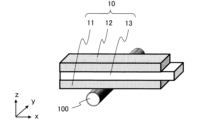
- 2 is a schematic perspective view showing a configuration of a magnetoelectric converting unit of the magnetoelectric converting device according to the first embodiment
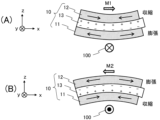
- FIG. 5A and 5B are schematic cross-sectional views illustrating the operation of a magnetoelectric converting unit of a magnetoelectric converting device according to the first embodiment
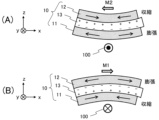
- 13A and 13B are schematic cross-sectional views showing another example of the operation of the magnetoelectric conversion unit of the magnetoelectric conversion device according to the first embodiment.
- FIG. 13 is a schematic diagram showing a configuration of a magnetoelectric conversion device (electricity storage device) according to a modified example of the first embodiment.
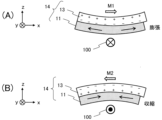
- FIG. 13A and 13B are schematic cross-sectional views illustrating the operation of a magnetoelectric converting unit of a magnetoelectric converting device according to a modified example of the first embodiment.
- 11 is a schematic diagram showing a configuration of a magnetoelectric conversion device (electricity storage device) according to a second embodiment.
- FIG. 13A and 13B are schematic cross-sectional views illustrating the operation of a magnetoelectric conversion unit of a magnetoelectric conversion device according to a second embodiment.
- FIG. 13 is a schematic diagram showing a configuration of a magnetoelectric conversion device (electricity storage device) according to a first modification of the second embodiment.
- FIG. 13A and 13B are schematic cross-sectional views illustrating the operation of a magnetoelectric converting unit of a magnetoelectric converting device according to a first modification of the second embodiment.
- FIG. 13 is a schematic diagram showing a configuration of a magnetoelectric conversion device (electricity storage device) according to a second modification of the second embodiment.
- FIG. 13 is a schematic diagram showing a configuration of a magnetoelectric conversion device (electricity storage device) according to a third modification of the second embodiment.
- FIG. 11 is a schematic diagram showing a configuration of a magnetoelectric conversion device (displacement measuring device) according to a third embodiment.
- 11 is a schematic perspective view showing a configuration of a magnetoelectric converting unit of a magnetoelectric converting device according to a third embodiment.
- FIG. 13 is a schematic diagram showing a configuration of a magnetoelectric conversion device (electricity storage device) according to a second modification of the second embodiment.
- FIG. 11 is a schematic diagram showing a configuration of
- FIG. 13A and 13B are schematic cross-sectional views showing the operation of a magnetoelectric conversion unit of a magnetoelectric conversion device according to a third embodiment.
- FIG. 13 is a schematic diagram showing a configuration of a magnetoelectric conversion device (displacement measuring device) according to a fourth embodiment.
- 13 is a schematic perspective view showing a configuration of a magnetoelectric converting unit of a magnetoelectric converting device according to a fourth embodiment.
- FIG. 13A and 13B are schematic cross-sectional views showing the operation of a magnetoelectric conversion unit of a magnetoelectric conversion device according to a fourth embodiment.
- FIG. 13 is a schematic diagram showing a configuration of a magnetoelectric conversion device (displacement measuring device) according to a fifth embodiment.
- FIG. 13 is a schematic perspective view showing a configuration of a magnetoelectric converting unit of a magnetoelectric converting device according to a fifth embodiment.
- FIG. 13A and 13B are schematic cross-sectional views showing the operation of a magnetoelectric conversion unit of a magnetoelectric conversion device according to a fifth embodiment.
- FIG. 13 is a schematic diagram showing the configuration of a magnetoelectric conversion device (displacement measuring device) according to a sixth embodiment.
- 13 is a schematic perspective view showing a configuration of a magnetoelectric converting unit of a magnetoelectric converting device according to a sixth embodiment.
- FIG. 13A and 13B are schematic cross-sectional views showing the operation of a magnetoelectric conversion unit of a magnetoelectric conversion device according to a sixth embodiment.
- FIG. 13A and 13B are schematic cross-sectional views showing the operation of a magnetoelectric conversion unit of a magnetoelectric conversion device according to a sixth embodiment.
- FIG. 13 is a schematic diagram showing the configuration of a magnetoelectric conversion device (displacement measuring device) according to a seventh embodiment.
- FIG. 13 is a schematic diagram showing a configuration of a magnetoelectric conversion device (electricity storage device) according to an eighth embodiment.
- FIG. 13 is a schematic diagram showing a configuration of a magnetoelectric conversion device (electricity storage device) according to a ninth embodiment.
- the x-axis is the coordinate axis extending in the longitudinal direction of the magnetostrictive member and the piezoelectric member
- the y-axis is the coordinate axis extending in the width direction (i.e., the short direction) of the magnetostrictive member and the piezoelectric member
- the z-axis is the coordinate axis extending in the thickness direction of the piezoelectric member.
- the same reference numerals are used for the same configuration or configurations having similar functions.
- the magnetoelectric conversion device is a device that converts the magnetic field generated from an object into electricity for use.
- An example of a magnetic field generated from an object is a magnetic field generated from a current line through which an AC current or a DC current (period of fluctuation in the current value) flows.
- Another example of a magnetic field generated from an object is a magnetic field generated from a moving (including vibrating) magnet.
- An example of a magnetoelectric conversion device is a displacement measurement device that measures the displacement (e.g., position or distance) of an object based on electricity (e.g., voltage) converted from a magnetic field.
- Another example of a magnetoelectric conversion device is a power storage device that stores electricity converted from a magnetic field in a storage battery.
- Fig. 1 is a schematic diagram showing the configuration of a magnetoelectric conversion device 1 according to embodiment 1.
- Fig. 2 is a schematic perspective view showing the configuration of a magnetoelectric conversion unit 10 of the magnetoelectric conversion device 1.
- the magnetoelectric conversion device 1 is a device that converts a magnetic field generated from a current line 100, which is an object arranged at a position facing the lower surface of the magnetoelectric conversion unit 10, into electricity and utilizes the electricity.
- the magnetoelectric conversion device 1 is an electricity storage device.
- the magnetoelectric conversion device 1 has magnetostrictive members 11 and 12 that are deformed by a magnetic field, a piezoelectric member (i.e., a piezoelectric element) 13 that is fixed to the magnetostrictive members 11 and 12 and curves due to the deformation of the magnetostrictive members 11 and 12, and a storage unit 60 that receives a voltage output from the piezoelectric member 13 due to the bending of the piezoelectric member 13 and stores electric power based on this voltage in a storage battery.
- PZT lead zirconate titanate
- Terfenol-D which is made of iron (Fe), dysprosium (Dy), and terbium (Tb), is used as a magnetostrictive material that forms the magnetostrictive members 11 and 12.
- the magnetostrictive members 11 and 12 are arranged so as to sandwich the piezoelectric member 13.
- the magnetostrictive members 11 and 12 are fixed to both sides of the piezoelectric member 13 by, for example, an adhesive.
- the magnetostrictive member 11 is also called the "first magnetostrictive member".
- Magnetostrictive member 12 is also referred to as the "second magnetostrictive member.” Magnetostrictive members 11 and 12 each have, for example, a thickness of 1.0 mm, a width in the y direction of 6 mm, and a length in the x direction of 12 mm, and the length of piezoelectric member 13 in the x direction is 15 mm.
- the magnetostrictive members 11 and 12 are plate-shaped and elongated in the x direction.
- the magnetostrictive members 11 and 12 expand or contract in the longitudinal direction of the magnetostrictive members 11 and 12 due to a magnetic field.
- one of the magnetostrictive members 11 and 12 expands in the longitudinal direction, and the other of the magnetostrictive members 11 and 12 contracts in the longitudinal direction.
- the magnetostrictive members 11 and 12 and the piezoelectric member 13 constitute the magnetoelectric conversion unit 10.
- Figures 3(A) and (B) are schematic cross-sectional views showing the operation of the magnetoelectric conversion unit 10 of the magnetoelectric conversion device 1 according to the first embodiment.
- Figure 3(A) shows how the magnetostrictive member 11 expands (extends in the x direction) and the magnetostrictive member 12 contracts (shrinks in the x direction) when a magnetic field M1 in the +x direction is applied to the magnetostrictive members 11 and 12 by a current flowing through the current line 100.
- the piezoelectric member 13 curves downwardly convexly (i.e., upwardly concavely).
- Figure 3(B) shows how the magnetostrictive member 11 contracts (shrinks in the x direction) and the magnetostrictive member 12 expands (extends in the x direction) when a magnetic field M2 in the -x direction is applied to the magnetostrictive members 11 and 12 by a current flowing through the current line 100.
- the piezoelectric member 13 curves upwardly convexly (i.e., downwardly concavely).
- Figures 4(A) and (B) are schematic cross-sectional views showing another example of the operation of the magnetoelectric conversion unit of the magnetoelectric conversion device 1 according to the first embodiment.
- Figure 4(A) shows how the magnetostrictive member 11 expands (extends in the x direction) and the magnetostrictive member 12 contracts (shrinks in the x direction) when a magnetic field M2 in the -x direction is applied to the magnetostrictive members 11 and 12 by a current flowing through the current line 100.
- the piezoelectric member 13 curves downwardly convexly (i.e., upwardly concavely).
- Figure 4(B) shows how the magnetostrictive member 11 contracts (shrinks in the x direction) and the magnetostrictive member 12 expands (extends in the x direction) when a magnetic field M1 in the +x direction is applied to the magnetostrictive members 11 and 12 by a current flowing through the current line 100.
- the piezoelectric member 13 curves upwardly convexly (i.e., downwardly concavely).
- the power storage unit 60 includes a rectifier circuit 61 that rectifies (e.g., full-wave rectification) the AC voltage generated by repeating the operations shown in Figs. 3(A) and (B) or Figs. 4(A) and (B), and a power storage circuit 62 that stores power based on the rectified AC voltage in a storage battery.
- the storage battery is provided inside or outside the power storage unit 60.
- the power storage unit 60 may have a processor that operates by software.
- FIG. 5 is a schematic diagram showing the configuration of a magnetoelectric conversion device 1a according to a modified example of embodiment 1.
- FIGS. 6(A) and (B) are schematic cross-sectional views showing the operation of the magnetoelectric conversion unit 14 of the magnetoelectric conversion device 1a.
- the magnetoelectric conversion device 1a is a device that converts a magnetic field generated from a current line 100, which is an object arranged in a position facing the underside of the magnetoelectric conversion unit 10a, into electricity and utilizes it.
- the magnetoelectric conversion device 1a is an electricity storage device.
- the magnetoelectric conversion device 1a shown in FIG. 5 differs from the magnetoelectric conversion device 1 shown in FIG. 1 in that the magnetoelectric conversion unit 14 is composed of a magnetostrictive member 11 and a piezoelectric member 13 fixed thereto. As shown in FIG. 5, the magnetostrictive member 11 does not necessarily have to be provided on both sides of the piezoelectric member 13.
- the magnetoelectric conversion unit may also be composed of the magnetostrictive member 12 shown in FIG. 1 and the piezoelectric member 13 fixed thereto.
- the magnetoelectric conversion unit 10a composed of one magnetostrictive member and a piezoelectric member 13 can also be applied to embodiments 2 to 9 described below.
- the magnetoelectric conversion devices 1 and 1a can use the power stored in the storage battery to drive a Hall element (not shown) or a current sensor (not shown) for detecting the current flowing through the current line 100.
- the power stored in the storage battery can also be used to drive an environmental sensor (not shown) such as a temperature (humidity) sensor to monitor the environment around the current line 100, such as the temperature and humidity.
- the power stored in the storage battery can also be used to drive a wireless communication device such as Bluetooth (registered trademark), allowing sensor information to be transmitted wirelessly. In this case, it is possible to eliminate wiring from an external power source for the current sensor, environmental sensor, and wireless communication device, and also to eliminate wiring for transmitting detected data.
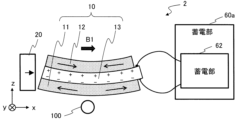
- Fig. 7 is a schematic diagram showing the configuration of a magnetoelectric conversion device 2 according to embodiment 2.
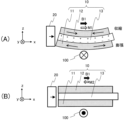
- Figs. 8(A) and (B) are schematic cross-sectional views showing the operation of the magnetoelectric conversion unit 10 of the magnetoelectric conversion device 2.
- the magnetoelectric conversion device 2 is a device that converts a magnetic field generated from a current line 100, which is an object arranged at a position facing the lower surface of the magnetoelectric conversion unit 10, into electricity and utilizes the electricity.
- the magnetoelectric conversion device 2 is an electricity storage device.
- the magnetoelectric conversion device 2 shown in FIG. 7 differs from the magnetoelectric conversion device 1 shown in FIG. 1 in that it further includes a bias magnet 20 that applies a bias magnetic field B1 that expands the magnetostrictive member 11 and contracts the magnetostrictive member 12.
- a bias magnet 20 that applies a bias magnetic field B1 that expands the magnetostrictive member 11 and contracts the magnetostrictive member 12.
- the bias magnet 20 is, for example, an NdFeB magnet, which is a rare earth magnet.
- the NdFeB magnet is a magnet whose main components are neodymium (Nd), iron (Fe), and boron (B).
- the dimensions of the bias magnet 20 are, for example, 4 mm x 4 mm x 2 mm, and the dimensions in the magnetization direction shown in FIG. 1 are, for example, 2 mm.
- the bias magnet 20 applies a magnetic field in the longitudinal direction of the magnetostrictive members 11 and 12. By changing the strength of the magnetic field applied from the bias magnet 20 to the magnetoelectric conversion unit 10, the magnitude of the voltage generated in the piezoelectric member 13 is changed.
- the bias magnet 20 is arranged to face one end of the magnetoelectric conversion unit 10 in the longitudinal direction so that the magnetization direction is parallel to the longitudinal direction of the magnetoelectric conversion unit 10.
- An electromagnet can also be used as the excitation source.
- a rectifier circuit may also be provided in the power storage unit 60a.
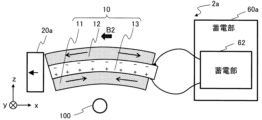
- Figure 9 is a schematic diagram showing the configuration of a magnetoelectric conversion device 2a relating to variant example 1 of embodiment 2.
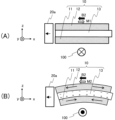
- Figures 10 (A) and (B) are schematic cross-sectional views showing the operation of the magnetoelectric conversion unit 10 of the magnetoelectric conversion device 2a.
- the magnetoelectric conversion device 2a is a device that converts a magnetic field generated from a current line 100 as an object arranged in a position opposite the underside of the magnetoelectric conversion unit 10 into electricity and utilizes it.
- the magnetoelectric conversion device 2a is an electricity storage device.
- the magnetoelectric conversion device 2a shown in Figure 9 differs from the magnetoelectric conversion device 1 shown in Figure 1 in that it further has a bias magnet 20a that applies a bias magnetic field B2 that contracts the magnetostrictive member 11 and expands the magnetostrictive member 12.
- a bias magnetic field B2 that contracts the magnetostrictive member 11 and expands the magnetostrictive member 12.
- FIG. 9 in the magnetoelectric conversion device 2a, when no current flows through the current line 100, the magnetoelectric conversion unit 10 is curved by the bias magnetic field B2, and as shown in FIGS. 10(A) and (B), even when a current flows through the current line 100, the magnetoelectric conversion unit 10 is only curved upwardly convexly.
- a rectifier circuit may also be provided in the power storage unit 60a.
- FIG. 11 is a schematic diagram showing the configuration of a magnetoelectric conversion device 2b according to a second modification of the second embodiment.
- the magnetoelectric conversion device 2b is a device that converts a magnetic field generated from a current line 100 as an object arranged in a position facing the lower surface of the magnetoelectric conversion unit 10 into electricity and utilizes it.
- the magnetoelectric conversion device 2b is an electricity storage device.
- the magnetoelectric conversion device 2b shown in FIG. 11 differs from the magnetoelectric conversion device 1 shown in FIG. 1 in that it further has a bias magnet 20b that applies a bias magnetic field B1 that contracts the magnetostrictive member 12. As shown in FIG.
- the magnetoelectric conversion unit 10 in the magnetoelectric conversion device 2b, when no current flows through the current line 100, the magnetoelectric conversion unit 10 is curved by the bias magnetic field B1. Even in this case, the curvature of the magnetoelectric conversion unit 10 can be limited to a downward convex shape, making it possible to simplify the electricity storage unit.
- FIG. 12 is a schematic diagram showing the configuration of a magnetoelectric conversion device 2c according to a third modified example of the second embodiment.
- the magnetoelectric conversion device 2c is a device that converts a magnetic field generated from a current line 100 as an object arranged in a position facing the lower surface of the magnetoelectric conversion unit 10 into electricity and utilizes it.
- the magnetoelectric conversion device 2c is an electricity storage device.
- the magnetoelectric conversion device 2c shown in FIG. 12 differs from the magnetoelectric conversion device 1 shown in FIG. 1 in that it further has a bias magnet 20b that applies a bias magnetic field B1 that contracts the magnetostrictive member 12, and a bias magnet 20c that applies a bias magnetic field B2 that expands the magnetostrictive member 11. As shown in FIG.
- the magnetoelectric conversion unit 10 in the magnetoelectric conversion device 2c, when no current flows through the current line 100, the magnetoelectric conversion unit 10 is curved by the bias magnetic fields B1 and B2. Even in this case, the curvature of the magnetoelectric conversion unit 10 can be made only convex downward, and the electricity storage unit can be simplified.
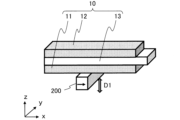
- Fig. 13 is a schematic diagram showing the configuration of a magnetoelectric conversion device 3 according to embodiment 3.
- Fig. 14 is a schematic perspective view showing the configuration of a magnetoelectric conversion unit 10 of the magnetoelectric conversion device 3.
- the magnetoelectric conversion device 3 is a device that converts a magnetic field generated from a magnet 200 as an object arranged at a position facing the lower surface of the magnetoelectric conversion unit 10 into electricity and utilizes it.
- the magnetoelectric conversion device 3 is a displacement measurement device that measures the displacement of the magnet 200 in the z direction.
- the displacement measurement device is a distance measurement device that measures the distance in the z direction or a position measurement device that measures the position in the z direction.
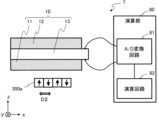
- the magnetoelectric conversion device 3 has magnetostrictive members 11, 12 that are deformed by a magnetic field, a piezoelectric member 13 that is fixed to the magnetostrictive members 11, 12 and curves due to the deformation of the magnetostrictive members 11, 12, and a calculation unit 80 that receives a voltage output from the piezoelectric member 13 due to the bending of the piezoelectric member 13 and performs calculations based on this voltage.
- the calculation unit 80 has, for example, an A/D conversion circuit 81 that performs analog-to-digital (A/D) conversion of the output of the piezoelectric member 13 that curves in response to the magnetic field applied to the magnetostrictive members 11, 12, and a calculation circuit 82 that calculates the displacement in the z direction (D1) based on the output of the A/D conversion circuit 81.
- the magnetostrictive members 11, 12 are arranged so as to sandwich the piezoelectric member 13.
- the magnetostrictive members 11, 12 are fixed to both sides of the piezoelectric member 13 by, for example, an adhesive.
- the calculation unit 80 may have a processor that operates by software.
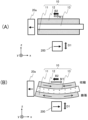
- FIG. 15(A) and (B) are schematic cross-sectional views showing the operation of the magnetoelectric conversion unit 10 of the magnetoelectric conversion device 3 according to the third embodiment.
- FIG. 15(A) shows a state in which the magnet 200 that generates a magnetic field in the x direction is away from the magnetoelectric conversion unit 10, and almost no magnetic field is applied to the magnetostrictive members 11 and 12 (a weak magnetic field M1 is applied). At this time, the magnetoelectric conversion unit 10 is not curved.
- FIG. 15(A) shows a state in which the magnet 200 that generates a magnetic field in the x direction is away from the magnetoelectric conversion unit 10, and almost no magnetic field is applied to the magnetostrictive members 11 and 12 (a weak magnetic field M1 is applied). At this time, the magnetoelectric conversion unit 10 is not curved.
- FIG. 15(B) shows a state in which the magnetostrictive member 11 expands (extends in the x direction) and the magnetostrictive member 12 contracts (shrinks in the x direction) when the magnet 200 approaches the magnetoelectric conversion unit 10 and a stronger magnetic field M1 than that in FIG. 15(A) is applied to the magnetostrictive members 11 and 12.
- the magnetoelectric conversion unit 10 curves downwardly convexly (i.e., upwardly concavely).
- the magnetoelectric conversion device 3 can measure the amount of displacement (i.e., distance or position) of the magnet 200 (i.e., a component equipped with the magnet 200) in the D1 direction.
- Fig. 16 is a schematic diagram showing the configuration of a magnetoelectric conversion device 4 according to embodiment 4.
- Fig. 17 is a schematic perspective view showing the configuration of a magnetoelectric conversion unit 10 of the magnetoelectric conversion device 4.
- the magnetoelectric conversion device 4 is a device that converts a magnetic field generated from a magnet 200 as an object arranged at a position facing the lower surface of the magnetoelectric conversion unit 10 into electricity and utilizes it.
- the magnetoelectric conversion device 4 is a displacement measuring device that measures the displacement of the magnet 200 in the z direction (D1 direction).
- the displacement measuring device is a distance measuring device that measures the distance in the z direction or a position measuring device that measures the position in the z direction.
- FIG. 18(A) and (B) are schematic cross-sectional views showing the operation of the magnetoelectric conversion unit 10 of the magnetoelectric conversion device 4.
- the magnetoelectric conversion device 4 shown in FIG. 16 differs from the magnetoelectric conversion device 3 shown in FIG. 13 in that it further includes a bias magnet 20a that applies a bias magnetic field B2.
- the bias magnet 20a is provided with a mechanism that allows the distance between the magnetoelectric conversion unit 10 and the position in the z direction relative to the magnetoelectric conversion unit 10 to be adjusted.
- the magnetoelectric conversion device 4 can measure the amount of displacement (i.e., distance or position) of the magnet 200 (i.e., a component equipped with the magnet 200) in the D1 direction.
- the sensitivity can be adjusted by adjusting the position of the bias magnet 20a.
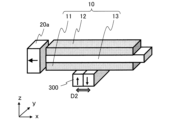
- Fig. 19 is a schematic diagram showing the configuration of a magnetoelectric conversion device 5 according to embodiment 5.
- Fig. 20 is a schematic perspective view showing the configuration of a magnetoelectric conversion unit 10 of the magnetoelectric conversion device 5.
- the magnetoelectric conversion device 5 is a device that converts a magnetic field generated from a magnet 300 as an object arranged at a position facing the lower surface of the magnetoelectric conversion unit 10 into electricity and utilizes it.
- the magnetoelectric conversion device 5 is a displacement measurement device that measures the displacement of the magnet 300 in the x direction (D2 direction).
- the displacement measurement device is a distance measurement device that measures the distance in the x direction from a reference position, or a position measurement device that measures the position in the x direction.
- FIG. 21(A) and (B) are schematic cross-sectional views showing the operation of the magnetoelectric conversion unit 10 of the magnetoelectric conversion device 5.
- the magnetoelectric conversion device 5 shown in FIG. 19 differs from the magnetoelectric conversion device 3 shown in FIG. 13 in that the magnet 300 has a portion that generates a magnetic field in the +z direction and a portion that generates a magnetic field in the opposite direction, the -z direction, and the magnet 300 moves in the D2 direction.
- FIG. 21(A) in the magnetoelectric conversion device 5, the magnetic field M2 applied to the magnetostrictive members 11 and 12 becomes weaker depending on the amount of displacement of the magnet 300 from the center position of the magnetoelectric conversion unit 10 in the z direction, and as shown in FIG.
- Fig. 22 is a schematic diagram showing the configuration of a magnetoelectric conversion device 6 according to embodiment 6.
- Fig. 23 is a schematic perspective view showing the configuration of a magnetoelectric conversion unit 10 of the magnetoelectric conversion device 6.
- the magnetoelectric conversion device 6 is a device that converts a magnetic field generated from a magnet 300 as an object arranged at a position facing the lower surface of the magnetoelectric conversion unit 10 into electricity for use.
- the magnetoelectric conversion device 6 is a displacement measurement device that measures the displacement of the magnet 300 in the y direction (D2 direction).
- the displacement measurement device is a distance measurement device that measures the distance in the x direction or a position measurement device that measures the position in the x direction.
- FIG. 24(A) and (B) are schematic cross-sectional views showing the operation of the magnetoelectric conversion unit 10 of the magnetoelectric conversion device 6.
- the magnetoelectric conversion device 6 shown in FIG. 22 differs from the magnetoelectric conversion device 5 shown in FIG. 19 in that it further includes a bias magnet 20a that applies a bias magnetic field B2.
- FIG. 24(A) in the magnetoelectric conversion device 6, the magnetoelectric conversion unit 10 is maintained in an uncurved state by the bias magnetic field B2, and as shown in FIG. 24(B), when the magnet 300 approaches the end of the magnetoelectric conversion unit 10, the magnetoelectric conversion unit 10 is curved in an upward convex shape.
- the bias magnet 20a is provided with a mechanism that allows the distance between the magnetoelectric conversion unit 10 and the position in the z direction relative to the magnetoelectric conversion unit 10 to be adjusted.
- the magnetoelectric conversion device 6 can measure the amount of displacement (i.e., distance or position) of the magnet 300 (i.e., a member equipped with the magnet 300) in the D2 direction. In addition, the sensitivity can be adjusted by adjusting the position of the bias magnet 20a.
- FIG. 25 is a schematic diagram showing the configuration of a magnetoelectric conversion device 7 according to the seventh embodiment.
- the magnetoelectric conversion device 7 is a device that converts the magnetic field generated from the magnet 300a as an object arranged at a position facing the lower surface of the magnetoelectric conversion unit 10 into electricity and utilizes it.
- the magnetoelectric conversion device 7 is a displacement measurement device that measures the displacement of the magnet 300a in the x direction (D2 direction).
- the displacement measurement device is, for example, a linear encoder. In the magnetoelectric conversion device 7 shown in FIG.
- the magnet 300a has a part that generates a magnetic field in the +z direction and a part that generates a magnetic field in the opposite direction, that is, the -z direction, alternately, and the magnet 300a moves in the D2 direction.
- the number of magnet parts that configure the magnet 300a is not limited to four, and may be five or more.
- Embodiment 26 is a schematic diagram showing the configuration of a magnetoelectric converter 8 according to embodiment 8.
- the magnetoelectric converter 8 is a device that converts a magnetic field generated from a magnet 200, which is an object disposed at a position facing the lower surface of the magnetoelectric converter 10, into electricity for use.
- the magnetoelectric converter 8 is a power storage device having a power storage unit 60b.
- the magnetoelectric conversion device 8 shown in FIG. 26 differs from the magnetoelectric conversion device 2 according to embodiment 2 (FIG. 7) in that it further includes a pickup coil 30 arranged to surround the magnetostrictive members 11, 12 and through which an induced current flows due to the deformation of the magnetostrictive members 11, 12, and in that the power storage unit 60b also stores in the storage battery the power based on the induced current of the pickup coil 30. That is, in the magnetoelectric conversion device 8, the power storage unit 60b not only charges the storage battery with power based on the voltage generated by the curvature of the piezoelectric member 13, but also stores in the storage battery the power based on the induced current flowing in the pickup coil 30 due to the displacement of the magnet 200 (for example, vibration in the D1 direction).
- the magnet 200 may be a magnet that displaces in the x direction (D2 direction) relative to the magnetoelectric conversion unit 10.
- the power stored in the battery in the power storage unit 60b can be used to drive an environmental sensor (not shown) such as a temperature (humidity) sensor to monitor the environment around the current line 100, such as the temperature and humidity, and the power stored in the battery can be used to drive a wireless communication device to wirelessly transmit sensor information.
- an environmental sensor such as a temperature (humidity) sensor
- the power stored in the battery can be used to drive a wireless communication device to wirelessly transmit sensor information.
- a wireless communication device to wirelessly transmit sensor information.
- the magnetoelectric conversion device 9 is a device that converts a magnetic field generated from a bias magnet 20 as an object arranged at a position facing an end of a magnetoelectric conversion unit 10 into electricity for use.
- the magnetoelectric conversion device 9 is a power storage device having a power storage unit 60b.
- the magnetoelectric conversion device 9 has a leaf spring 41 that supports the bias magnet 20 and the magnetoelectric conversion unit 10, and a weight 42 fixed to the leaf spring 41.
- the leaf spring 41 is supported by a vibrating device 40 that applies vibrations to the bias magnet 20 and the magnetoelectric conversion unit 10 via the leaf spring 41. Electricity generated by changes in the relative positions of the bias magnet 20 and the magnetoelectric conversion unit 10 with respect to the pickup coil 30 is stored in the power storage unit 60b.
- the structure of the leaf spring 41 is not limited to the example shown in the figure, and other structures may be used as long as they generate changes in the relative positions of the bias magnet 20 and the magnetoelectric conversion unit 10 with respect to the pickup coil 30 (i.e., changes in the magnetic flux passing through the pickup coil 30).
- weight 42 is not a required component.
- equipment 40 include micro-vibrating bodies such as machinery in a factory that generates vibrations, structures such as bridges that vibrate due to vehicle traffic, and floors that vibrate due to people walking, as well as reciprocating structures such as the machining shaft of a machine tool, and opening and closing windows and doors.
- the leaf spring 41 may be an elastic body of other shapes, such as a U-shaped spring or a coil spring.
- 1, 1a, 2, 2a-2c, 8, 9 magnetoelectric conversion device (electricity storage device), 3-7: magnetoelectric conversion device (displacement measurement device), 11, 12: magnetostrictive member, 13: piezoelectric member, 20, 20a, 20b: bias magnet, 30: pickup coil, 40: device, 60, 60a, 60b: electricity storage unit, 61: rectifier circuit, 62: electricity storage circuit, 80: calculation unit, 81: A/D conversion circuit, 82: calculation circuit, 100: current line, 200: magnet, 300, 300a: magnet.
Landscapes
- Physics & Mathematics (AREA)
- General Physics & Mathematics (AREA)
- General Electrical Machinery Utilizing Piezoelectricity, Electrostriction Or Magnetostriction (AREA)
- Measurement Of Length, Angles, Or The Like Using Electric Or Magnetic Means (AREA)
Priority Applications (3)
| Application Number | Priority Date | Filing Date | Title |
|---|---|---|---|
| JP2024549138A JPWO2024209614A1 (https=) | 2023-04-06 | 2023-04-06 | |
| PCT/JP2023/014189 WO2024209614A1 (ja) | 2023-04-06 | 2023-04-06 | 磁電変換装置 |
| JP2025036101A JP7774753B2 (ja) | 2023-04-06 | 2025-03-07 | 磁電変換装置 |
Applications Claiming Priority (1)
| Application Number | Priority Date | Filing Date | Title |
|---|---|---|---|
| PCT/JP2023/014189 WO2024209614A1 (ja) | 2023-04-06 | 2023-04-06 | 磁電変換装置 |
Publications (1)
| Publication Number | Publication Date |
|---|---|
| WO2024209614A1 true WO2024209614A1 (ja) | 2024-10-10 |
Family
ID=92971478
Family Applications (1)
| Application Number | Title | Priority Date | Filing Date |
|---|---|---|---|
| PCT/JP2023/014189 Ceased WO2024209614A1 (ja) | 2023-04-06 | 2023-04-06 | 磁電変換装置 |
Country Status (2)
| Country | Link |
|---|---|
| JP (2) | JPWO2024209614A1 (https=) |
| WO (1) | WO2024209614A1 (https=) |
Citations (8)
| Publication number | Priority date | Publication date | Assignee | Title |
|---|---|---|---|---|
| JPS4843975A (https=) * | 1971-10-06 | 1973-06-25 | ||
| JP2006322811A (ja) * | 2005-05-19 | 2006-11-30 | Uchiyama Mfg Corp | 磁気エンコーダ及び被検出部材 |
| JP2015142137A (ja) * | 2014-01-28 | 2015-08-03 | コリア インスティチュート オブ マシナリー アンド マテリアルズ | 単結晶圧電繊維含有複合体およびこれを含む磁気電気複合材料積層体 |
| JP2016145721A (ja) * | 2015-02-06 | 2016-08-12 | 日立金属株式会社 | 距離測定システム及び距離測定方法 |
| JP2017092208A (ja) * | 2015-11-09 | 2017-05-25 | 三井化学株式会社 | エネルギー変換デバイス |
| WO2017094828A1 (ja) * | 2015-12-04 | 2017-06-08 | 日本電産サンキョー株式会社 | 位置検出装置 |
| JP2019011989A (ja) * | 2017-06-29 | 2019-01-24 | Fdk株式会社 | 電流センサ |
| JP2021002609A (ja) * | 2019-06-24 | 2021-01-07 | 国立大学法人東北大学 | 圧電磁歪複合体および発電素子 |
Family Cites Families (5)
| Publication number | Priority date | Publication date | Assignee | Title |
|---|---|---|---|---|
| JPH0495891A (ja) * | 1990-08-10 | 1992-03-27 | Taisuke Inoue | 電力ケーブルの埋設位置探査器 |
| ES2478217T3 (es) * | 2006-06-22 | 2014-07-21 | Cooper Tire & Rubber Company | Generación de potencia remota magnetoestrictiva/piezoeléctrica, batería y método |
| JP5055505B2 (ja) * | 2007-11-21 | 2012-10-24 | 並木精密宝石株式会社 | 磁歪式多軸駆動アクチュエータ |
| JP6359846B2 (ja) * | 2014-03-17 | 2018-07-18 | 大阪瓦斯株式会社 | 埋設金属の探知方法及びその探知装置 |
| CN112881781A (zh) * | 2021-01-20 | 2021-06-01 | 西南交通大学 | 一种无源雷电流传感器 |
-
2023
- 2023-04-06 JP JP2024549138A patent/JPWO2024209614A1/ja active Pending
- 2023-04-06 WO PCT/JP2023/014189 patent/WO2024209614A1/ja not_active Ceased
-
2025
- 2025-03-07 JP JP2025036101A patent/JP7774753B2/ja active Active
Patent Citations (8)
| Publication number | Priority date | Publication date | Assignee | Title |
|---|---|---|---|---|
| JPS4843975A (https=) * | 1971-10-06 | 1973-06-25 | ||
| JP2006322811A (ja) * | 2005-05-19 | 2006-11-30 | Uchiyama Mfg Corp | 磁気エンコーダ及び被検出部材 |
| JP2015142137A (ja) * | 2014-01-28 | 2015-08-03 | コリア インスティチュート オブ マシナリー アンド マテリアルズ | 単結晶圧電繊維含有複合体およびこれを含む磁気電気複合材料積層体 |
| JP2016145721A (ja) * | 2015-02-06 | 2016-08-12 | 日立金属株式会社 | 距離測定システム及び距離測定方法 |
| JP2017092208A (ja) * | 2015-11-09 | 2017-05-25 | 三井化学株式会社 | エネルギー変換デバイス |
| WO2017094828A1 (ja) * | 2015-12-04 | 2017-06-08 | 日本電産サンキョー株式会社 | 位置検出装置 |
| JP2019011989A (ja) * | 2017-06-29 | 2019-01-24 | Fdk株式会社 | 電流センサ |
| JP2021002609A (ja) * | 2019-06-24 | 2021-01-07 | 国立大学法人東北大学 | 圧電磁歪複合体および発電素子 |
Also Published As
| Publication number | Publication date |
|---|---|
| JP7774753B2 (ja) | 2025-11-21 |
| JP2025078812A (ja) | 2025-05-20 |
| JPWO2024209614A1 (https=) | 2024-10-10 |
Similar Documents
| Publication | Publication Date | Title |
|---|---|---|
| JP5888486B2 (ja) | 発電装置、発電装置の制御方法、電子機器、および移動手段 | |
| US8222775B2 (en) | Electromechanical energy harvesting system | |
| US9461237B2 (en) | Power generation switch | |
| US7345372B2 (en) | Electromechanical generator for, and method of, converting mechanical vibrational energy into electrical energy | |
| CN102986129B (zh) | 发电元件及具备发电元件的发电装置 | |
| US20110057458A1 (en) | Piezoelectric energy harvester and method of manufacturing the same | |
| US11451168B2 (en) | Strain-relieved compliant structures for flextensional transduction | |
| US12225827B2 (en) | Power generation element and power generation apparatus | |
| JP7774753B2 (ja) | 磁電変換装置 | |
| Perez-Rodriguez et al. | Design of electromagnetic inertial generators for energy scavenging applications | |
| JP2021141723A (ja) | 発電装置 | |
| JP2023135152A (ja) | 力覚センサ | |
| JP6009426B2 (ja) | タイヤ状態監視装置 | |
| JP2019011989A (ja) | 電流センサ | |
| JP2021191054A (ja) | 発電装置 | |
| CN103580443B (zh) | 能量转换器和无线设备 | |
| KR20230044108A (ko) | 자가발전 IoT를 위한 에너지 하베스팅 장치 | |
| WO2020241573A1 (ja) | 発電素子、および発電素子を用いた装置 | |
| WO2021240205A1 (en) | Strain-relieved compliant structures for flextensional transduction | |
| CN116839719A (zh) | 一种基于锯齿形结构的压电传感器及自供电振动监测装置 | |
| WO2026023591A1 (ja) | 振動発電機、低負荷デバイス及び蓄電システム | |
| JP2021191021A (ja) | 発電装置 | |
| Ahmed | Energy-Based Constitutive Modeling and Finite Element Analysis of Magnetostrictive Energy Harvesters | |
| KR100569108B1 (ko) | 듀얼 매스 플라이휠을 이용한 엔진 출력 측정 시스템 | |
| He et al. | Sub-g vibration-threshold triggered dual functions of energy-harvesting and vibration-sensing |
Legal Events
| Date | Code | Title | Description |
|---|---|---|---|
| WWE | Wipo information: entry into national phase |
Ref document number: 2024549138 Country of ref document: JP |
|
| 121 | Ep: the epo has been informed by wipo that ep was designated in this application |
Ref document number: 23932025 Country of ref document: EP Kind code of ref document: A1 |
|
| NENP | Non-entry into the national phase |
Ref country code: DE |
|
| 122 | Ep: pct application non-entry in european phase |
Ref document number: 23932025 Country of ref document: EP Kind code of ref document: A1 |