WO2024195803A1 - 情報提供装置、情報提供方法、及びプログラム - Google Patents
情報提供装置、情報提供方法、及びプログラム Download PDFInfo
- Publication number
- WO2024195803A1 WO2024195803A1 PCT/JP2024/010835 JP2024010835W WO2024195803A1 WO 2024195803 A1 WO2024195803 A1 WO 2024195803A1 JP 2024010835 W JP2024010835 W JP 2024010835W WO 2024195803 A1 WO2024195803 A1 WO 2024195803A1
- Authority
- WO
- WIPO (PCT)
- Prior art keywords
- information
- power supply
- supply device
- harsh
- battery
- Prior art date
- Legal status (The legal status is an assumption and is not a legal conclusion. Google has not performed a legal analysis and makes no representation as to the accuracy of the status listed.)
- Ceased
Links
Images






Classifications
-
- B—PERFORMING OPERATIONS; TRANSPORTING
- B60—VEHICLES IN GENERAL
- B60L—PROPULSION OF ELECTRICALLY-PROPELLED VEHICLES; SUPPLYING ELECTRIC POWER FOR AUXILIARY EQUIPMENT OF ELECTRICALLY-PROPELLED VEHICLES; ELECTRODYNAMIC BRAKE SYSTEMS FOR VEHICLES IN GENERAL; MAGNETIC SUSPENSION OR LEVITATION FOR VEHICLES; MONITORING OPERATING VARIABLES OF ELECTRICALLY-PROPELLED VEHICLES; ELECTRIC SAFETY DEVICES FOR ELECTRICALLY-PROPELLED VEHICLES
- B60L58/00—Methods or circuit arrangements for monitoring or controlling batteries or fuel cells, specially adapted for electric vehicles
- B60L58/10—Methods or circuit arrangements for monitoring or controlling batteries or fuel cells, specially adapted for electric vehicles for monitoring or controlling batteries
-
- G—PHYSICS
- G01—MEASURING; TESTING
- G01R—MEASURING ELECTRIC VARIABLES; MEASURING MAGNETIC VARIABLES
- G01R31/00—Arrangements for testing electric properties; Arrangements for locating electric faults; Arrangements for electrical testing characterised by what is being tested not provided for elsewhere
- G01R31/36—Arrangements for testing, measuring or monitoring the electrical condition of accumulators or electric batteries, e.g. capacity or state of charge [SoC]
- G01R31/392—Determining battery ageing or deterioration, e.g. state of health
-
- H—ELECTRICITY
- H02—GENERATION; CONVERSION OR DISTRIBUTION OF ELECTRIC POWER
- H02J—ELECTRIC POWER NETWORKS; CIRCUIT ARRANGEMENTS OR SYSTEMS FOR SUPPLYING OR DISTRIBUTING ELECTRIC POWER; SYSTEMS FOR STORING ELECTRIC ENERGY
- H02J7/00—Circuit arrangements for charging or discharging batteries or for supplying loads from batteries
Definitions
- the present invention relates to an information providing device, an information providing method, and a program.
- This application claims priority based on Japanese Patent Application No. 2023-044216, filed on March 20, 2023, the contents of which are incorporated herein by reference.
- the degree of deterioration of secondary batteries and fuel cells (hereafter referred to as power supply devices) installed in vehicles is affected by their temperature. For example, if the power supply device is higher or lower than room temperature, the degree of deterioration will be greater than when it is at room temperature.
- power supply devices there are battery deterioration determination devices that correct the battery's state quantity based on the battery temperature to determine battery deterioration (see, for example, Patent Document 1).
- Vehicles are sometimes used in harsh environments such as extreme heat or cold, and in these cases the deterioration of the power supply device installed in the vehicle tends to progress at an accelerated rate.
- the present invention was made in consideration of these circumstances, and one of its objectives is to provide an information providing device, an information providing method, and a program that can provide information regarding deterioration.
- An information providing device includes an identification unit that identifies harsh environmental conditions that create a harsh environment for a power supplying device mounted on a vehicle; an acquisition unit that acquires temperature information on the temperature of the power supplying device and usage information on the usage of the power supplying device; a determination unit that determines whether the power supplying device has been used in the harsh environment based on a comparison result between the temperature information and the usage information and the harsh environmental conditions; and a provision unit that provides the harsh environmental conditions to a terminal device when it is determined that the power supplying device has been used in the harsh environment.
- An information providing device includes an identification unit that identifies harsh environmental conditions that create a harsh environment for a power supply device mounted on a vehicle, an acquisition unit that acquires temperature information on the temperature of the power supply device and usage information on the usage status of the power supply device, a determination unit that determines whether the power supply device has been used in the harsh environment based on a comparison result between the temperature information and the usage status information and the harsh environmental conditions, and a provision unit that provides degradation information generated based on the result of the determination.
- the harsh environmental conditions include the temperature of the power supply device and the conditions of the usage of the power supply device.
- the determination unit counts the number of times the power supply device is used when the temperature and usage conditions of the power supply device satisfy the harsh environmental conditions, calculates the difference between the counted number of times of use and a reference value set for the state satisfying the harsh environmental conditions, and the provision unit counts down the remaining number of times until the number of times of use reaches the reference value and provides it.
- the reference value is determined according to the aspect when the power supply device is reused.
- the providing unit provides an image of the deterioration of the power supply device caused by use of the power supply device in the harsh environment.
- the providing unit further provides information on how many times the deterioration caused by using the power supply device in a harsh environment corresponds to the deterioration caused by using the power supply device in a normal environment.
- An information providing method is an information providing method in which an information providing device identifies harsh environmental conditions that cause a power supply device mounted on a vehicle to be in a harsh environment, acquires temperature information on the temperature of the power supply device and usage information on the usage status of the power supply device, determines whether the power supply device has been used in the harsh environment based on a comparison result between the temperature information and the usage status information and the harsh environmental conditions, and provides the harsh environmental conditions to a terminal device if it is determined that the power supply device has been used in the harsh environment.
- a program causes a processor of an information providing device to identify harsh environmental conditions that cause a power supply device mounted on a vehicle to be in a harsh environment, acquire temperature information on the temperature of the power supply device and usage information on the usage of the power supply device, determine whether the power supply device has been used in the harsh environment based on a comparison result between the temperature information and the usage information and the harsh environmental conditions, and if it is determined that the power supply device has been used in the harsh environment, provide the harsh environmental conditions to a terminal device.
- FIG. 1 is a diagram illustrating an example of a usage environment and a configuration of an information providing device 100 according to an embodiment.
- FIG. 1 is a diagram illustrating an example of the configuration of a vehicle 10.
- FIG. 13 is a diagram showing an example of the contents of a harsh environmental condition 152.
- FIG. 11 is a diagram showing an example of the contents of reference value information 154.
- FIG. 13 is a diagram showing an example of the contents of count information 156.
- FIG. 11 is a diagram showing an example of the contents of harsh environment use information 160.
- 4 is a flowchart showing an example of a process in the information providing device 100.
- 13 is a diagram showing an example of an image displayed on a display unit of an information terminal device 80.
- FIG. 13 is a diagram showing an example of an image displayed on a display unit of an information terminal device 80.
- FIG. 1 is a diagram illustrating an example of the configuration of a vehicle 10.
- FIG. 13 is a diagram showing an example of the contents
- FIG. 1 is a diagram showing an example of the usage environment and configuration of an information providing device 100 according to an embodiment.
- the information providing device 100 communicates with, for example, a vehicle 10 and an information terminal device 80 via a network NW.
- the information providing device 100 generates information to be provided to the information terminal device 80 based on information transmitted by the vehicle 10, etc., and provides the information to the information terminal device 80.
- the motor 12 is, for example, a three-phase AC motor.
- the rotor of the motor 12 is connected to the drive wheels 14.
- the motor 12 outputs power to the drive wheels 14 using the supplied electric power.
- the motor 12 also generates electricity using the kinetic energy of the vehicle when the vehicle decelerates.
- the vehicle sensor 20 includes, for example, a vehicle speed sensor, an acceleration sensor, a yaw rate sensor, and a direction sensor.
- the vehicle speed sensor detects the speed of the vehicle 10.
- the acceleration sensor detects the acceleration of the vehicle 10.
- the yaw rate sensor detects the angular velocity of the vehicle 10 around the vertical axis.
- the direction sensor detects the direction of the vehicle 10.
- the ignition switch 22 is the main power switch of the vehicle 10.
- the ignition switch 22 is provided, for example, near the driver's seat of the vehicle 10.
- the ignition switch 22 may be a mechanical switch or a GUI (Graphical User Interface) that is displayed on a display.
- the ignition switch 22 outputs an activation signal to the control unit 36 based on the operation of the driver of the vehicle 10.
- the PCU 30 includes, for example, a converter 32, a VCU (Voltage Control Unit) 34, and a control unit 36. Note that these components are collectively configured as the PCU 34, which is merely an example, and these components may be arranged in a distributed manner.
- the converter 32 is, for example, an AC-DC converter.
- the DC side terminal of the converter 32 is connected to the DC link DL.
- the battery 40 is connected to the DC link DL via the VCU 34.
- the converter 32 converts the AC generated by the motor 12 into DC and outputs it to the DC link DL.
- the VCU 34 is, for example, a DC-DC converter.
- the VCU 34 boosts the power supplied by the battery 40 and outputs it to the DC link DL.
- the control unit 36 includes, for example, a motor control unit, a brake control unit, and a battery/VCU control unit.
- the motor control unit, the brake control unit, and the battery/VCU control unit may each be replaced with a separate control device, such as a motor ECU, a brake ECU, and a battery ECU.
- the motor control unit controls the motor 12 based on the output of the vehicle sensor 20.
- the brake control unit controls the brake device 16 based on the output of the vehicle sensor 20.
- the battery/VCU control unit calculates the SOC (State of Charge) of the battery 40 based on the output of a battery sensor 42 attached to the battery 40, and outputs it to the VCU 34.
- the VCU 34 increases the voltage of the DC link DL according to instructions from the battery/VCU control.
- the control unit 36 starts the VCU 34 and makes the vehicle 10 ready to run.
- the VCU 34 starts, power is supplied to the VCU 36 from the battery 40, and power generation by the fuel cell 50 begins.
- the battery 40 and the fuel cell 50 start up when a start signal is output by the ignition switch 22.
- the control unit 36 calculates the speed and acceleration of the vehicle 10 based on the information output by the vehicle sensor 20. When a start signal is output by the ignition switch 22, the control unit 36 outputs control start information to the communication device 60. After the VCU 34 is started, the control unit 36 outputs acceleration information indicating the calculated acceleration of the vehicle 10, etc. to the communication device 60.
- Battery 40 is a secondary battery, such as a lithium ion battery, that can be repeatedly charged and discharged. Battery 40 supplies power for driving vehicle 10. Battery 40 has positive and negative electrodes. The electrodes of battery 40, mainly the positive electrode, deteriorate as battery 40 is charged and discharged.
- the fuel cell 50 is mounted on the vehicle 10.
- the fuel cell 50 generates electricity, for example, by causing a chemical reaction between hydrogen and oxygen.
- the fuel cell 50 supplies the generated electricity to a boost converter 52.
- the boost converter 52 boosts the supplied electricity to an appropriate voltage and supplies it to the VCU 34.
- the fuel cell 50 supplies power to the VCU 34 via the boost converter 52 for driving the vehicle 10.
- the fuel cell 50 comprises an electrode (positive electrode) to which oxygen is supplied for a chemical reaction, an electrode (negative electrode) to which hydrogen is supplied, and a catalyst made of platinum, cobalt alloy, or the like.
- the electrodes and catalyst of the fuel cell 50 deteriorate as the fuel cell 50 generates electricity, with the catalyst in particular deteriorating significantly.
- the fuel cell 50 is an example of a power supply device.
- the communication device 60 includes a wireless module for connecting to a cellular network or a Wi-Fi network.
- the communication device 60 may also include a wireless module for using Bluetooth (registered trademark) or the like.
- the communication device 60 inputs and outputs signals between the control unit 36 and the battery 40 by communication in the wireless module.
- the communication device 60 acquires information such as control start information and acceleration information output by the control unit 36, temperature information output by the battery 40, and fast charging information.
- the control start information and acceleration information output by the control unit 36, and the fast charging information output by the battery 40 are information related to the usage status of the battery 40.
- the communication device 60 transmits the acquired information to the information providing device 100 via the network NW shown in FIG. 1.
- the information terminal device 80 is, for example, a computer device with communication and display functions, such as a smartphone, tablet terminal, or personal computer.
- the information terminal device 80 is managed, for example, by a user who owns or manages the vehicle 10.
- the information terminal device 80 is, for example, owned by the user, installed in an office or home used by the user, or provided within the vehicle 10.
- the information terminal device 80 is an example of a terminal device.
- the information terminal device 80 comprises a UA (User Agent) 82 and a display unit 84.
- the UA 82 is, for example, an application program or a browser, and acquires content such as web pages from a web server via the network NW, and displays the content on the display unit 84, such as a touch panel or a display.
- a user of the information terminal device 80 uses the UA 82 to receive, for example, a membership-based service provided by the information providing device 100.
- the information terminal device 80 receives battery degradation-related information regarding the deterioration of the battery 40 installed in the vehicle 10.
- the information terminal device 80 transmits request information directed to the information providing device 100.
- the information terminal device 80 receives the battery degradation-related information transmitted in response to the request information.
- the information terminal device 80 displays the received battery degradation-related information on the display unit 84.
- the information providing device 100 is, for example, a device operated by an automobile manufacturer, and provides an information providing service for owners in conjunction with the sale of a vehicle 10 as an example of a membership-based service.
- the information providing device 100 receives request information transmitted by the information terminal device 80, it generates battery degradation-related information and transmits it to the information terminal device 80.
- the information providing device 100 includes, for example, a communication unit 112, an acquisition unit 114, an identification unit 116, a determination unit 118, a provision unit 120, and a memory unit 150.
- Components other than the communication unit 112 and the memory unit 150 are realized, for example, by a hardware processor such as a CPU (Central Processing Unit) executing a program (software).
- a hardware processor such as a CPU (Central Processing Unit) executing a program (software).
- Some or all of these components may be realized by hardware (including circuitry) such as an LSI (Large Scale Integration), an ASIC (Application Specific Integrated Circuit), an FPGA (Field-Programmable Gate Array), or a GPU (Graphics Processing Unit), or may be realized by collaboration between software and hardware.
- LSI Large Scale Integration
- ASIC Application Specific Integrated Circuit
- FPGA Field-Programmable Gate Array
- GPU Graphics Processing Unit
- the program may be stored in advance in a storage device (a storage device with a non-transient storage medium) such as a hard disk drive (HDD) or flash memory, or may be stored in a removable storage medium (a non-transient storage medium) such as a DVD or CD-ROM, and installed by inserting the storage medium into a drive device.
- a storage device a storage device with a non-transient storage medium
- HDD hard disk drive
- flash memory or may be stored in a removable storage medium (a non-transient storage medium) such as a DVD or CD-ROM, and installed by inserting the storage medium into a drive device.
- the storage unit 150 is realized, for example, by a HDD, a flash memory, an EEPROM (Electrically Erasable Programmable Read Only Memory), a ROM (Read Only Memory), or a RAM (Random Access Memory).
- the storage unit 150 stores, for example, harsh environmental conditions 152, reference value information 154, a degradation image 158, and harsh environment usage information 160.
- the communication unit 112 is a communication interface for connecting to the network NW.
- the communication unit 112 is, for example, a network card.
- the communication unit 112 communicates with the vehicle 10, the information terminal device 80, and other external devices via the network NW.
- the communication unit 112 receives, for example, information transmitted by the communication device 60 of the vehicle 10 or the information terminal device 80.
- the communication unit 112 transmits, for example, information provided by the providing unit 120 to the information terminal device 80.
- the acquisition unit 114 acquires request information transmitted by the information terminal device 80 and received by the communication unit 112.
- the acquisition unit 114 acquires information received by the communication unit 112.
- the acquisition unit 114 acquires, for example, control start information, acceleration information, temperature information, and fast charging information transmitted by the communication device 60 of the vehicle 10 and received by the communication unit 112.
- the acquisition unit 114 acquires the acquired control start information, acceleration information, temperature information, and fast charging information as usage status information indicating the usage status of the battery 40.
- the battery 40 is started when the vehicle 10 is started. Therefore, the control start information becomes usage status information indicating the start-up as the usage status of the battery 40.
- the battery 40 supplies power in accordance with the running or acceleration. Therefore, the acceleration information becomes usage status information indicating the usage status of the battery 40 when the vehicle 10 accelerates again.
- the identification unit 116 identifies the harsh environmental conditions that cause the battery 40 mounted on the vehicle 10 to be in a harsh environment.
- the identification unit 116 identifies the harsh environmental conditions, for example, by reading out the harsh environmental conditions 152 stored in the memory unit 150.
- the harsh environmental conditions 152 include, for example, the temperature and usage conditions of the battery 40.
- only one harsh environmental condition 152 is set, but multiple harsh environmental conditions 152 may be set.
- the harsh environmental conditions 152 may be set, for example, regardless of the type of battery 40, or may be set for each type of battery 40.
- the harsh environmental conditions 152 may be set regardless of the characteristics of the vehicle 10 in which the battery 40 is mounted, such as the vehicle type, year, mileage, parts replacement history, etc., or may be set according to the characteristics of the vehicle 10 in which the battery 40 is mounted.
- the identification unit 116 may identify harsh environmental conditions according to the type of battery 40 and the characteristics of the vehicle 10 in which the battery 40 is mounted.
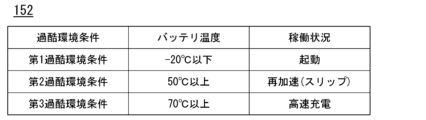
- FIG. 3 is a diagram showing an example of the contents of the harsh environmental conditions 152.
- the example shown in FIG. 3 is the harsh environmental conditions set for the battery 40, and the first to third harsh environmental conditions are set as the harsh environmental conditions.
- the first harsh environmental condition is when the battery 40 starts up in an environment where the temperature of the battery 40 is -20°C or lower.
- the second harsh environmental condition is when the vehicle 10 accelerates again due to tire slippage or the like in an environment where the temperature of the battery 40 is 50°C or higher.
- the third harsh environmental condition is when the battery 40 is fast-charged in an environment where the temperature of the battery 40 is 70°C or higher.
- the determination unit 118 compares the temperature information and usage status information acquired by the acquisition unit 114 with the harsh environmental conditions 152 identified by the identification unit 116. The determination unit 118 determines whether the battery 40 is being used in harsh environmental conditions based on the comparison result between the temperature information and usage status information and the harsh environmental conditions 152.
- the determination unit 118 When the battery 40 is used in harsh environmental conditions, the determination unit 118 counts the number of times it is used under conditions that satisfy the harsh environmental conditions (hereinafter, the number of times it is used in harsh environments). The determination unit 118 determines the deterioration of the battery 40 based on the number of times it is used in harsh environments and the reference value included in the reference value information 154 stored in the memory unit 150.
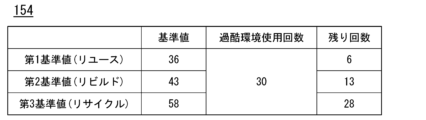
- FIG. 4 is a diagram showing an example of the contents of the reference value information 154.
- the reference value information 154 includes a first reference value, a second reference value, and a third reference value that are set as reference values.
- the determination unit 118 further generates count information 156 including the number of times the battery 40 can be used in a state where the battery 40 satisfies the harsh environment conditions until the temperature and usage conditions of the battery 40 reach the harsh environment usage count and each reference value (hereinafter, the remaining number of times).
- the determination unit 118 calculates the difference between the harsh environment usage count and the reference value as the remaining number of times.
- the providing unit 120 generates battery degradation-related information including the harsh environment conditions 152, the number of times information 156, the degradation image 158, and the harsh environment use information 160.
- the determining unit 118 determines whether the battery was used in a harsh environment, the providing unit 120 transmits the battery degradation-related information to the information terminal device 80 to provide it.
- the deterioration image 158 is an image that represents the deterioration state of the positive electrode material provided in the battery 40.
- the deterioration image 158 includes a first deterioration image 158-1, a second deterioration image 158-2, and a third deterioration image 158-3, which differ depending on the degree of deterioration.
- the providing unit 120 provides the information terminal device 80 with harsh environment usage information 160 along with battery degradation-related information.
- the harsh environment usage information 160 is information indicating how many times the degradation caused by use of the battery 40 in a harsh environment corresponds to the degradation caused by use in a normal environment.
- the providing unit 120 provides the remaining number of times calculated by the determining unit 118 as the harsh environment usage information 160 in a countdown format such as "xx times remaining.”
- FIG. 6 is a diagram showing an example of the contents of the harsh environment usage information 160.
- the harsh environment usage information 160 is information indicating the number of times that the deterioration caused by use of the battery 40 under harsh environmental conditions is equivalent to the deterioration caused by use of the battery 40 under normal environmental conditions (hereinafter, normal environmental conditions).
- Normal environmental conditions are, for example, driving on an ordinary road at normal temperature.
- use of the battery 40 in a state that satisfies the first harsh environmental condition is equivalent to 30 uses of the battery 40 in a state that satisfies the normal environmental condition.
- Use of the battery 40 in a state that satisfies the second harsh environmental condition is equivalent to 25 uses of the battery 40 in a state that satisfies the normal environmental condition.
- Use of the battery 40 in a state that satisfies the third harsh environmental condition is equivalent to 20 uses of the battery 40 in a state that satisfies the normal environmental condition.
- the harsh environment usage information 160 is obtained in advance and stored in the memory unit 150.
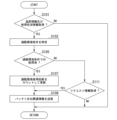
- FIG. 7 is a flowchart showing an example of the processing in the information providing device 100.
- the processing shown in FIG. 7 is repeated at regular intervals.
- the information providing device 100 determines whether the temperature information and the usage status information transmitted by the communication device 60 of the vehicle 10 and received by the communication unit 112 have been acquired by the acquisition unit 114 (step S101).
- the acquisition unit 114 advances the process to step S111. If it is determined that the acquisition unit 114 has acquired the temperature information and usage information, the identification unit 116 reads out and identifies the harsh environmental conditions 152 stored in the storage unit 150 (step S103). If multiple harsh environmental conditions 152 are set, the harsh environmental conditions 152 may be selected and identified according to the vehicle 10 equipped with the communication device 60 that transmitted the acquired temperature information and usage information and the battery 40 equipped in the vehicle 10.
- the determination unit 118 determines whether the battery 40 was used under harsh environmental conditions based on the temperature information and usage status information acquired by the acquisition unit 114 and the harsh environmental conditions 152 identified by the identification unit 116 (step S105). If it is determined that the battery 40 was used under harsh environmental conditions, the determination unit 118 counts and updates the number of times the battery 40 was used in the usage environment according to the usage status (step S107).
- the providing unit 120 generates battery degradation-related information including the degradation progress information, the harsh environmental conditions 152, the number of times information 156, the degradation image 158, and the harsh environment use information 160, and causes the communication unit 112 to transmit the information to the information terminal device 80 (step S111). In this way, the information providing device 100 ends the process shown in FIG. 7.
- the acquisition unit 114 determines whether or not it has acquired request information transmitted by the information terminal device 80 and received by the communication unit 112 (step S111). If it is determined that the acquisition unit 114 has acquired the request information, the provision unit 120 generates battery degradation-related information including the harsh environmental conditions 152, the number of times information 156, the degradation image 158, and the harsh environment use information 160, and has the communication unit 112 transmit the information to the information terminal device 80 (step S109). In this way, the information providing device 100 ends the process shown in FIG. 7. If it is determined that the acquisition unit 114 has not acquired the request information, the information providing device 100 ends the process shown in FIG. 7.
- FIG. 8 is a diagram showing an example of an image displayed on the display unit of the information terminal device 80.
- FIG. 8 shows an image in which the battery degradation-related information includes degradation progress information.
- the display unit 84 has, for example, a first display area GA11, a second display area GA12, and a third display area GA13 set thereon.
- the first display area GA11 is an area in which an image including a degradation progress message and a harsh environment message according to the degradation progress information included in the battery degradation related information, the harsh environmental conditions 152, and the harsh environment usage information 160 is displayed.
- the information terminal device 80 displays the degradation progress message and the harsh environment message in the first display area GA11.
- the deterioration progress message is, for example, a standard message saying "An operation that significantly deteriorated the battery occurred.” There may be one type of deterioration progress message, or multiple types.
- Battery deterioration related information is generated and transmitted to the information terminal device 80 when the information providing device 100 determines that the battery has been used in a harsh environment, or when it determines that requested information has been acquired. Of these, the battery deterioration related information generated when it is determined that requested information has been acquired does not include deterioration progress information.
- the information terminal device 80 does not display a deterioration progress message in the first display area GA11, but instead displays a harsh environment message.
- the harsh environment message is a message that explains the harsh environmental conditions.
- the harsh environment message is a standard message such as "starting in low temperature conditions", “re-acceleration in high temperature conditions”, and “rapid charging in very high temperature conditions”.
- “-20°C or below” is expressed as “low temperature”
- “50°C or above” is expressed as “high temperature”
- “70°C or above” is expressed as "very high temperature”, but these may also be expressed using specific numerical values.
- the information terminal device 80 displays a harsh environment message, it also displays the degree of deterioration of the battery 40 in that harsh environment compared to a normal environment.
- the degree of deterioration of the battery 40 in a harsh environment compared to a normal environment is based on the harsh environment usage information 160 included in the battery deterioration related information. For example, in response to a harsh environment message of "starting up in low temperature conditions", the information terminal device 80 also displays the message "30 times the normal environment”.
- the second display area GA12 is an area where a deterioration image 158 included in the battery deterioration related information is displayed.
- the information terminal device 80 displays the deterioration image transmitted by the information providing device 100 in the second display area GA12. There may be one deterioration image or multiple deterioration images.
- the information terminal device 80 may display in the second display area GA12 a deterioration image corresponding to the harsh environment in which the battery 40 is used.
- the third display area GA13 is an area where an image corresponding to the number of times information 156 included in the battery degradation related information is displayed.
- the information terminal device 80 displays each message such as "XX times remaining until reuse determination” (hereinafter, first message), "XX times remaining until rebuild determination” (hereinafter, second message), and "XX times remaining until recycle determination” (hereinafter, third message) in the third display area GA13.
- "Reuse determination”, “rebuild determination”, and “recycle determination” here refer to the determination that the reuse state of the battery 40 is reuse, rebuild, or recycle when the battery 40 is reused, respectively.
- the number displayed in the first message is the number of remaining times for the first reference value included in the count information 156.
- the number displayed in the second message is the number of remaining times for the second reference value included in the count information 156.
- the number displayed in the third message is the number of remaining times for the third reference value included in the count information 156.
- the first GUI switch BA11 is displayed at the bottom of the third display area GA13.
- the first GUI switch BA11 is a GUI switch that displays the word "History.”
- the history of the use of the battery 40 under conditions that satisfy harsh environmental conditions is displayed.
- FIG. 9 is a diagram showing an example of an image displayed on the display unit of the information terminal device 80.
- FIG. 9 shows an example of an image displayed on the display unit 84 by operating the first GUI switch BA11.
- the image in the third display area GA13 of the image shown in FIG. 8 changes, and the history of use of the battery 40 in a state satisfying harsh environmental conditions and the second GUI switch BA21 are displayed in the third display area GA13.
- the second GUI switch BA21 is operated, the information terminal device 80 returns the image shown on the display unit 84 to the image shown in FIG. 8.
- the information providing device 100 of the above embodiment determines whether the battery 40 has been used in a harsh environment by comparing the harsh environmental conditions 152 with the temperature information and usage status information of the battery 40. When it is determined whether the battery 40 has been used in a harsh environment, the information providing device 100 transmits the harsh environmental conditions 152 to the information terminal device 80. Therefore, it is possible to inform the user that the battery 40 has been used in a harsh environment as information regarding deterioration.
- the information providing device 100 provides the number of times the battery 40 has been used in a harsh environment to the information terminal device 80 as degradation information of the battery 40 based on the determination result, and also counts down and provides the number of times the battery 40 can be used (remaining number of times) when the battery 40 satisfies the harsh environmental conditions.
- the information regarding degradation can be provided to the user as information on the deterioration of the battery 40 due to use in a harsh environment and how much more use will be required before the battery 40's behavior when reused will change.
- the information providing device 100 generates battery degradation-related information for the battery 40 and provides it to the information terminal device 80, but the information providing device 100 may also target the fuel cell 50 instead of or in addition to the battery 40.
- the fuel cell 50 the platinum catalyst deteriorates significantly due to use in a harsh environment.
- the storage unit 150 stores the harsh environmental conditions set for the fuel cell 50, and the identification unit 116 may set the harsh environmental conditions for the fuel cell 50 in the same manner as when the harsh environmental conditions are identified for the battery 40.
- the acquisition unit 114 may acquire the usage status of the fuel cell 50 in the same manner as the usage status of the battery 40.
- the temperature of the fuel cell 50 may be the temperature of the battery 40 as is, or may be a temperature corrected using a coefficient based on the temperature characteristics of the battery 40 and the fuel cell 50.
- a battery temperature sensor may be provided to detect the temperature of the fuel cell 50, and the temperature detected by the battery temperature sensor may be used.
- the information providing device 100 may determine the value of the battery 40 after it has deteriorated, and provide the value to the information terminal device 80 by including it in the battery deterioration-related information.
- the value of the battery 40 after it has deteriorated may be, for example, the price of the battery 40 when the battery 40 is reused, rebuilt, or recycled.
- a storage medium for storing computer-readable instructions
- the processor executes the computer-readable instructions to: Identifying harsh environmental conditions that cause a power supply device mounted on a vehicle to be in a harsh environment; acquiring temperature information relating to a temperature of the power supply device and usage status information relating to a usage status of the power supply device; determining whether the power supply device has been used in the harsh environment based on a comparison result between the temperature information and the usage status information and the harsh environmental condition; When it is determined that the device has been used in the harsh environment, the harsh environment condition is provided to the terminal device. Information providing device.
Landscapes
- Engineering & Computer Science (AREA)
- Power Engineering (AREA)
- Physics & Mathematics (AREA)
- General Physics & Mathematics (AREA)
- Life Sciences & Earth Sciences (AREA)
- Sustainable Development (AREA)
- Sustainable Energy (AREA)
- Transportation (AREA)
- Mechanical Engineering (AREA)
- Charge And Discharge Circuits For Batteries Or The Like (AREA)
Priority Applications (1)
| Application Number | Priority Date | Filing Date | Title |
|---|---|---|---|
| JP2025508582A JPWO2024195803A1 (https=) | 2023-03-20 | 2024-03-19 |
Applications Claiming Priority (2)
| Application Number | Priority Date | Filing Date | Title |
|---|---|---|---|
| JP2023044216 | 2023-03-20 | ||
| JP2023-044216 | 2023-03-20 |
Publications (1)
| Publication Number | Publication Date |
|---|---|
| WO2024195803A1 true WO2024195803A1 (ja) | 2024-09-26 |
Family
ID=92841724
Family Applications (1)
| Application Number | Title | Priority Date | Filing Date |
|---|---|---|---|
| PCT/JP2024/010835 Ceased WO2024195803A1 (ja) | 2023-03-20 | 2024-03-19 | 情報提供装置、情報提供方法、及びプログラム |
Country Status (2)
| Country | Link |
|---|---|
| JP (1) | JPWO2024195803A1 (https=) |
| WO (1) | WO2024195803A1 (https=) |
Citations (6)
| Publication number | Priority date | Publication date | Assignee | Title |
|---|---|---|---|---|
| JP2005227141A (ja) * | 2004-02-13 | 2005-08-25 | Hitachi Ltd | 車両診断システム |
| JP2008058278A (ja) * | 2006-09-04 | 2008-03-13 | Toyota Motor Corp | 二次電池の内部状態推定装置、二次電池の内部状態推定方法、プログラム、および記録媒体 |
| JP2013172476A (ja) * | 2012-02-17 | 2013-09-02 | Toyota Motor Corp | 情報報知システム |
| JP2020058122A (ja) * | 2018-10-01 | 2020-04-09 | 本田技研工業株式会社 | 提示装置、提示方法、及びプログラム |
| JP2020189516A (ja) * | 2019-05-20 | 2020-11-26 | 本田技研工業株式会社 | 影響度合表示装置、影響度合表示方法、及びプログラム |
| JP2021034149A (ja) * | 2019-08-20 | 2021-03-01 | 本田技研工業株式会社 | 表示制御装置、表示制御方法、及びプログラム |
-
2024
- 2024-03-19 WO PCT/JP2024/010835 patent/WO2024195803A1/ja not_active Ceased
- 2024-03-19 JP JP2025508582A patent/JPWO2024195803A1/ja active Pending
Patent Citations (6)
| Publication number | Priority date | Publication date | Assignee | Title |
|---|---|---|---|---|
| JP2005227141A (ja) * | 2004-02-13 | 2005-08-25 | Hitachi Ltd | 車両診断システム |
| JP2008058278A (ja) * | 2006-09-04 | 2008-03-13 | Toyota Motor Corp | 二次電池の内部状態推定装置、二次電池の内部状態推定方法、プログラム、および記録媒体 |
| JP2013172476A (ja) * | 2012-02-17 | 2013-09-02 | Toyota Motor Corp | 情報報知システム |
| JP2020058122A (ja) * | 2018-10-01 | 2020-04-09 | 本田技研工業株式会社 | 提示装置、提示方法、及びプログラム |
| JP2020189516A (ja) * | 2019-05-20 | 2020-11-26 | 本田技研工業株式会社 | 影響度合表示装置、影響度合表示方法、及びプログラム |
| JP2021034149A (ja) * | 2019-08-20 | 2021-03-01 | 本田技研工業株式会社 | 表示制御装置、表示制御方法、及びプログラム |
Also Published As
| Publication number | Publication date |
|---|---|
| JPWO2024195803A1 (https=) | 2024-09-26 |
Similar Documents
| Publication | Publication Date | Title |
|---|---|---|
| JP6911747B2 (ja) | 電池情報処理装置、電池製造支援装置、組電池、電池情報処理方法、及び組電池の製造方法 | |
| JP5210591B2 (ja) | 二次電池の制御システムおよびそれを搭載した電動車両ならびに二次電池の制御方法 | |
| CN111751751B (zh) | 寿命预测装置、寿命预测方法及存储介质 | |
| JP2008058278A (ja) | 二次電池の内部状態推定装置、二次電池の内部状態推定方法、プログラム、および記録媒体 | |
| JP7116015B2 (ja) | 非常用電力供給システム、非常用電力供給方法、およびプログラム | |
| CN112713623A (zh) | 管理装置、管理方法及记录介质 | |
| JP7285321B2 (ja) | 情報処理装置、情報処理方法、およびプログラム | |
| WO2012063606A1 (ja) | 車両用電池の診断装置 | |
| CN112534671B (zh) | 提示装置、提示方法以及存储介质 | |
| JP2020038102A (ja) | 容量推定システム、容量推定方法、及びプログラム | |
| US11404893B2 (en) | Vehicle power supply control system, vehicle power supply control method, and storage medium | |
| JP7048519B2 (ja) | 二次電池状態検知システム、二次電池状態検知装置および二次電池状態検知方法 | |
| CN114683970A (zh) | 电池能量管理方法、装置、设备及介质 | |
| US11511643B2 (en) | Displaying an influence degree used to inhibit the deterioration of a secondary cell | |
| US20240127196A1 (en) | Control system of mobile body and program thereof | |
| CN110871710B (zh) | 信息提供装置、信息提供方法及存储介质 | |
| WO2024195803A1 (ja) | 情報提供装置、情報提供方法、及びプログラム | |
| US20220227255A1 (en) | Information processing device, information processing method, and program | |
| JP2023049589A (ja) | 制御装置、およびプログラム | |
| CN110879365B (zh) | 信息提供装置、信息提供方法及存储介质 | |
| CN113682188B (zh) | 控制装置、控制系统、控制方法及存储介质 | |
| JP7232330B2 (ja) | 管理装置、管理方法、及びプログラム | |
| JP7149226B2 (ja) | 電動車両の製造管理装置、製造方法、製造管理方法、及びプログラム | |
| JP2024136835A (ja) | 情報提供装置、情報提供方法、及びプログラム | |
| US20220085627A1 (en) | Battery identification system and battery identification method |
Legal Events
| Date | Code | Title | Description |
|---|---|---|---|
| 121 | Ep: the epo has been informed by wipo that ep was designated in this application |
Ref document number: 24774937 Country of ref document: EP Kind code of ref document: A1 |
|
| ENP | Entry into the national phase |
Ref document number: 2025508582 Country of ref document: JP Kind code of ref document: A |
|
| WWE | Wipo information: entry into national phase |
Ref document number: 2025508582 Country of ref document: JP |
|
| NENP | Non-entry into the national phase |
Ref country code: DE |
|
| 122 | Ep: pct application non-entry in european phase |
Ref document number: 24774937 Country of ref document: EP Kind code of ref document: A1 |