WO2024195024A1 - イオンミリング装置 - Google Patents
イオンミリング装置 Download PDFInfo
- Publication number
- WO2024195024A1 WO2024195024A1 PCT/JP2023/011087 JP2023011087W WO2024195024A1 WO 2024195024 A1 WO2024195024 A1 WO 2024195024A1 JP 2023011087 W JP2023011087 W JP 2023011087W WO 2024195024 A1 WO2024195024 A1 WO 2024195024A1
- Authority
- WO
- WIPO (PCT)
- Prior art keywords
- power transmission
- stage
- ion milling
- milling apparatus
- rotation
- Prior art date
- Legal status (The legal status is an assumption and is not a legal conclusion. Google has not performed a legal analysis and makes no representation as to the accuracy of the status listed.)
- Ceased
Links
Images





Classifications
-
- H—ELECTRICITY
- H01—ELECTRIC ELEMENTS
- H01J—ELECTRIC DISCHARGE TUBES OR DISCHARGE LAMPS
- H01J37/00—Discharge tubes with provision for introducing objects or material to be exposed to the discharge, e.g. for the purpose of examination or processing thereof
- H01J37/02—Details
- H01J37/20—Means for supporting or positioning the object or the material; Means for adjusting diaphragms or lenses associated with the support
-
- H—ELECTRICITY
- H01—ELECTRIC ELEMENTS
- H01J—ELECTRIC DISCHARGE TUBES OR DISCHARGE LAMPS
- H01J37/00—Discharge tubes with provision for introducing objects or material to be exposed to the discharge, e.g. for the purpose of examination or processing thereof
- H01J37/30—Electron-beam or ion-beam tubes for localised treatment of objects
- H01J37/305—Electron-beam or ion-beam tubes for localised treatment of objects for casting, melting, evaporating, or etching
Definitions
- the present invention relates to an ion milling device.
- Ion milling devices irradiate samples (such as metals, semiconductors, glass, ceramics, etc.) that are to be observed with an electron microscope with an unfocused ion beam.
- samples such as metals, semiconductors, glass, ceramics, etc.
- the sputtering phenomenon that accompanies ion beam irradiation causes atoms on the sample surface to be ejected, allowing the sample surface to be polished without stress or the internal structure of the sample to be exposed.
- the polished or exposed surface becomes the observation surface for a scanning electron microscope or transmission electron microscope, so ion milling devices are used as sample pretreatment devices.
- planar milling There are several methods for processing samples using ion milling devices, but the method of ion milling the surface of a rotating sample by irradiating it with an ion beam at an angle is called planar milling. In addition to polishing the sample surface, planar milling can be performed by aligning the center of the sample rotation with the center of the ion beam, which allows processing into a conical shape, so in recent years planar milling has been applied to delayering semiconductors (flash memory).
- Patent Document 1 describes a technique related to a sample stage in a charged particle beam device.
- the document aims to "make it possible to quickly position and replace samples in a charged particle beam device," and describes the following technique: "The charged particle beam device includes a charged particle beam lens barrel that irradiates a sample with a charged particle beam, a rotating stage 5A having a base portion 5d and a rotary moving portion that rotates about a rotation axis R1 relative to the base portion 5d, and is equipped with a sample stage that moves the sample relative to the charged particle beam lens barrel, a rotary connector 56 that is arranged coaxially with the rotation axis R1 and interposed between the base portion 5d and the rotary moving portion, and a contact pin 55a that is arranged on the top of the sample stage and electrically connected to the rotary connector 56" (see abstract).
- an ion milling device to process a line shape using the planar milling method, it is necessary to place the rotating part of the sample stage at the bottom and place the sample movement stage (hereafter referred to as the one-axis horizontally movable stage) above it. This is because the sample is sputtered into a cone shape by irradiating it with an ion beam while rotating the rotating stage, and the processing position is moved horizontally by the horizontally movable stage to form the line shape.
- the sample movement stage hereafter referred to as the one-axis horizontally movable stage
- the horizontally movable stage moves horizontally, for example, using a motor, so it is necessary to supply power to the drive mechanism. In other words, it is necessary to connect wiring for supplying power to the horizontally movable stage and then supply power to this wiring. If this wiring is directly connected to a power source, there is a possibility that the wiring will become twisted as the stage rotates. Therefore, when placing the horizontally movable stage on top of the rotating stage, it is thought that it is necessary to use rotary contacts to ensure a power path.
- Rotary contact wiring uses mercury in the contact area to ensure contact. If a rotary contact structure is brought into the sample chamber of an ion milling device with a high vacuum (up to 10 ⁇ 3 Pa or less), the mercury will sublime, making it difficult to use rotary contact wiring in the sample chamber of an ion milling device.
- Patent Document 1 describes a structure in which a one-axis horizontally movable stage is placed on a rotating body.
- the one-axis horizontally movable stage is placed on the sample rotation axis, there is a high risk of the wiring becoming twisted and breaking, making it difficult to supply power. It is possible that this point has not been fully considered in this document.
- the present invention was made in consideration of the above problems, and aims to provide an ion milling device that places a horizontally movable stage on a sample rotation stage and is capable of supplying power to the horizontally movable stage.
- the ion milling apparatus comprises a rotating stage, a movable stage installed on the upper surface of the rotating stage, and a fixed base section supporting the rotating stage, the rotating stage comprising a first power transmission section, the fixed base section comprising a second power transmission section, and the ion milling apparatus further comprising a member that exerts a force pressing the first power transmission section and the second power transmission section against each other.
- the ion milling apparatus can provide an ion milling apparatus in which a horizontally movable stage is disposed on a sample rotation stage and power can be supplied to the horizontally movable stage.
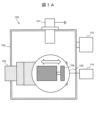
- FIG. 1 is a top view of an ion milling apparatus 100 according to a first embodiment.
- FIG. 1 is a front view of an ion milling apparatus 100.
- FIG. 1C is an enlarged view of the stage mechanism of FIG. 1B.
- 1 is a schematic diagram showing an ion source 101 employing the Penning method and a power supply circuit that applies a control voltage to electrode components of the ion source 101.
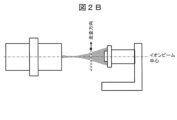
- FIG. The figure shows how the beam probe is scanned over the ion beam emitted from the ion source.
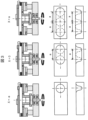
- 3 shows the profile of an ion beam. The processed shape is shown when the central axis of the sample rotation and the central axis of the ion beam are offset.
- FIG. 11 is an enlarged view of the periphery of a stage of an ion milling apparatus 100 according to a second embodiment.
- ⁇ First embodiment> 1A is a top view of an ion milling apparatus 100 according to a first embodiment of the present invention.
- the ion milling apparatus 100 includes an ion source 101, a sample chamber 102, a stage tilt unit 103, a one-axis horizontally movable stage 104, a one-axis horizontally movable stage holder 105, a control unit 114, and a vacuum exhaust unit 115.
- the ion milling apparatus 100 is used as a pretreatment apparatus for observing the surface or cross section of a sample by a scanning electron microscope or a transmission electron microscope, and is also applied to semiconductor delayering.
- the sample chamber 102 during ion milling is always kept at a high vacuum (10 ⁇ 3 Pa or less) by the vacuum exhaust unit 115.
- Ar gas introduced from the outside is ionized by discharging in the ion source 101, and the ion beam is irradiated onto the sample.
- the control unit 114 controls each part of the ion milling apparatus 100.
- FIG. 1B is a front view of the ion milling apparatus 100.
- the ion milling apparatus 100 further includes a power transmission section 106 (first power transmission section) of the rotating stage, a power transmission section 107 (second power transmission section) of the fixed base section, an insulator section 108, a permanent magnet 109 (contact maintaining member), a fixed base section 110, a stage rotation bearing 111, a stage rotation section 112, a stage rotation shaft 113, and a rotation sensor 116.
- the sample is placed on a single-axis horizontally movable stage 104.
- the single-axis horizontally movable stage 104 is placed on a single-axis horizontally movable stage holder 105.
- the wiring of the single-axis horizontally movable stage 104 is connected to a power transmission unit 106 of the rotation stage.
- the single-axis horizontally movable stage holder 105 is arranged on a stage rotation unit 112 and a stage rotation shaft 113, so it can rotate freely (i.e., it can operate as a rotation stage).
- the stage rotation unit 112 is fixed inside the stage rotation bearing 111, and the power transmission unit 107 of the fixed base is fixed outside the stage rotation bearing 111.
- the rotation sensor 116 is composed of two members.
- the first member is attached to the fixed base 110 side (e.g., the power transmission unit 107), and the second member is attached to the rotating stage side (e.g., the power transmission unit 106).
- the rotating stage rotates
- the first member detects the rotation of the second member.
- the second member is composed of a permanent magnet, and the first member is configured as a sensor that detects the magnetic force of the second member every time it approaches. This makes it possible to detect the rotation of the rotating stage. Since the first member operates as a sensor, it is desirable to place it in a position where it can receive a power supply (in this example, in contact with the power transmission unit 107).
- the rotation sensor 116 only needs to be able to detect the rotation of the rotating stage, and is not limited to the configuration shown in FIG. 1B.
- FIG. 1C is an enlarged view of the stage mechanism in FIG. 1B.
- a magnetic material Fe, Ni, etc.
- the power transmission section 106 is attracted by a permanent magnet 109 arranged between the power transmission section 107 and the insulator section 108. This allows the power transmission section 106 of the rotating stage to rotate while sliding, while maintaining close contact with the power transmission section 107.
- the power transmission section 107, the insulator section 108, and the permanent magnet 109 are fixed to the fixed base section 110.
- the one-axis horizontally movable stage 104 can be moved via the power transmission section 106 of the rotation stage.
- the configuration includes a one-axis horizontally movable stage, but a two-axis horizontally movable stage may also be used.
- a magnet that is not highly magnetic such as a samarium-cobalt magnet.
- FIG. 2A is a schematic diagram showing an ion source 101 that employs the Penning method and a power supply circuit that applies a control voltage to the electrode components of the ion source 101.
- the ion source 101 has, as its main components, a first cathode 201, a second cathode 202, an anode 203, a permanent magnet 204, an acceleration electrode 205, a gas pipe 206, and a gas flow control unit 207.
- argon gas is injected into the ion source 101 through a gas pipe 206.
- a first cathode 201 and a second cathode 202 which are set to the same potential via a permanent magnet 204, are arranged facing each other, and an anode 203 is arranged between the first cathode 201 and the second cathode 202.
- a discharge voltage Vd is applied from a high-voltage power supply in the control unit 114 to the first cathode 201, the second cathode 202, and the anode 203, and electrons are generated.
- a Lorentz force acts on the generated electrons by the permanent magnet 204 arranged in the ion source 101, causing the electrons to move in a spiral motion.
- An acceleration voltage Va is applied between the anode 203 and the acceleration electrode 205 from a high-voltage power supply included in the control unit 114.
- the generated argon ions are extracted by the acceleration electrode 205 and emitted as an ion beam.
- Figure 2B shows how the beam probe is scanned over the ion beam emitted from the ion source.
- Figure 2C shows the profile of the ion beam.
- Figure 2D shows the processed shape when the sample rotation axis and the ion beam axis are eccentric. Eccentricity allows for wider processing. It has been confirmed that increasing the amount of eccentricity results in a flat surface (2.0 mm eccentricity in Figure 2D), but excessive eccentricity causes the flat surface to be lost (2.5 mm and 3.0 mm eccentricity in Figure 2D). By applying this result, a linear shape can be processed by moving the sample while maintaining the alignment of the sample rotation axis and the ion beam axis. As shown in Figure 2D, as the amount of eccentricity increases, the processed shape gradually deviates from the Gaussian distribution shape, so considering the ease of control of the processed shape, it is desirable for the amount of eccentricity to be 0. In other words, it is desirable for the sample rotation axis and the ion beam axis to be aligned.
- Figure 3 shows the processed shape of the sample when the X coordinate is moved little by little using a stage with the structure shown in Figure 1.
- the sample rotation axis coincides with the central axis of the ion beam and is always rotating.
- the X coordinate of the processing start point is -a (mm).
- the processed shape at this time follows the shape of the beam profile, so it is cut into a shape that can be approximated as a cone.
- the X axis is moved in the range of -a to 0 (mm), it can be confirmed that the processed shape of the sample is cut into a long hole shape when viewed from above.
- the length of the long hole shape (the length at this time is the distance between the centers of the circles at both ends) is a (mm), which is the same as the movement distance of the X axis.
- the processed shape is a long hole shape with a length of 2a.
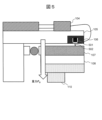
- FIG. 4 shows a flow chart explaining the procedure for processing a sample using a stage having the structure of FIG. 1. Each step is performed by the control unit 114 controlling each part. Each step in FIG. 4 is explained below.
- S301 Place the sample on the one-axis horizontally movable stage 104. Taking into consideration that the sample rotation axis and the center of the ion beam are aligned, the processing start point is determined.
- the sample chamber 102 is evacuated by the vacuum exhaust unit 115.
- S303 Set the driving range of the single-axis horizontally movable stage 104.
- the single-axis horizontally movable stage 104 will move back and forth within the driving range set in this flow.
- the driving range can be set to be a single stroke, and the stage can be set to move back and forth between the start point and end point.
- S304 Check whether the drive range set in S303 can be driven without problems, including the rotary contact part (the part where the power transmission part 106 of the rotating stage and the power transmission part 107 of the fixed base part rotate while in contact). If the single-axis horizontally movable stage 104 does not move, the sensor built into the single-axis horizontally movable stage 104 detects this, and proceeds to S305. If the rotary contact part does not move, the rotation sensor 116 detects this, and proceeds to S305. If it moves without problems, proceeds to S306.
- the rotary contact part the part where the power transmission part 106 of the rotating stage and the power transmission part 107 of the fixed base part rotate while in contact.
- S306 Set the output conditions of the ion beam, and tilt the stage tilting portion 103 to set the irradiation angle of the ion beam.
- S308 Check whether the machining has been performed sufficiently based on the drive range set in S303. If it has not been performed sufficiently, return to S303, reset the drive range of the single-axis horizontally movable stage 104, and resume machining. If it has been performed sufficiently, proceed to S309.
- a power transmission unit 106 is disposed in a one-axis horizontally movable stage holder 105 constituting a rotation stage, and power is supplied to the one-axis horizontally movable stage 104 via the power transmission units 106 and 107.
- a magnetic material is embedded in the power transmission unit 106, and a permanent magnet 109 attracts the power transmission unit 106, generating a force that presses the power transmission units 106 and 107 against each other, thereby maintaining close contact between the power transmission units 106 and 107. Therefore, the rotation stage can be rotated while sliding.
- This structure rotates while contacting the conductor unit, similar to rotary contact wiring. Therefore, it is possible to install a one-axis movable stage on the sample rotation stage without using mercury.
- FIG. 5 is an enlarged view of the stage and the periphery of the ion milling apparatus 100 according to the second embodiment of the present invention.
- a structure in which a magnet is embedded in the fixed base portion in order to ensure contact between the power transmission units 106 and 107 has been described.
- a pin 502 incorporating a compression spring 501 is incorporated in the power transmission unit 106 of the rotating stage, and when the power transmission units 106 and 107 slide, the incorporated spring presses the pin against the power transmission unit 107, so that the two are always in contact with each other.
- the compression spring 501 and the pin 502 play the role of a contact maintaining member that maintains contact between the power transmission units 106 and 107 by exerting a force to press the power transmission units 106 and 107 against each other.
- the power transmission unit 107 supports the power transmission unit 106 at points via the pin 502 (convex portion). This makes it possible to minimize the contact area between the power transmission units 106 and 107. This makes it possible to suppress the frictional heat that occurs as the rotating stage rotates.
- the power supplied from the power transmission unit 107 is transmitted to the one-axis horizontally movable stage 104 via the pin 502 and compression spring 501 (and wiring).
- the power transmission unit 107 provides point support to the power transmission unit 106 via the pin 502.
- a similar structure can also be provided in the first embodiment. That is, the bottom surface of the power transmission unit 106 can be partially protruded to form a convex portion, and the power transmission unit 107 can be configured to provide point support to the power transmission unit 106 via the convex portion. This makes it possible to suppress frictional heat in the same way as in the second embodiment.
- control unit 114 can be configured by hardware such as a circuit device that implements its functions, or can be configured by a calculation device such as a CPU (Central Processing Unit) executing software that implements its functions.
- hardware such as a circuit device that implements its functions
- a calculation device such as a CPU (Central Processing Unit) executing software that implements its functions.
- Ion milling device 104 One-axis horizontally movable stage 105: One-axis horizontally movable stage holder 106: Power transmission section of the rotation stage 107: Power transmission section of the fixed base section 108: Insulator section 109: Permanent magnet 114: Control unit 501: Compression spring 502: Pin
Landscapes
- Chemical & Material Sciences (AREA)
- Analytical Chemistry (AREA)
- Physics & Mathematics (AREA)
- Engineering & Computer Science (AREA)
- Plasma & Fusion (AREA)
- Sampling And Sample Adjustment (AREA)
- Drying Of Semiconductors (AREA)
Priority Applications (3)
| Application Number | Priority Date | Filing Date | Title |
|---|---|---|---|
| KR1020257028124A KR20250137690A (ko) | 2023-03-22 | 2023-03-22 | 이온 밀링 장치 |
| PCT/JP2023/011087 WO2024195024A1 (ja) | 2023-03-22 | 2023-03-22 | イオンミリング装置 |
| JP2025507993A JPWO2024195024A1 (https=) | 2023-03-22 | 2023-03-22 |
Applications Claiming Priority (1)
| Application Number | Priority Date | Filing Date | Title |
|---|---|---|---|
| PCT/JP2023/011087 WO2024195024A1 (ja) | 2023-03-22 | 2023-03-22 | イオンミリング装置 |
Publications (1)
| Publication Number | Publication Date |
|---|---|
| WO2024195024A1 true WO2024195024A1 (ja) | 2024-09-26 |
Family
ID=92841100
Family Applications (1)
| Application Number | Title | Priority Date | Filing Date |
|---|---|---|---|
| PCT/JP2023/011087 Ceased WO2024195024A1 (ja) | 2023-03-22 | 2023-03-22 | イオンミリング装置 |
Country Status (3)
| Country | Link |
|---|---|
| JP (1) | JPWO2024195024A1 (https=) |
| KR (1) | KR20250137690A (https=) |
| WO (1) | WO2024195024A1 (https=) |
Citations (2)
| Publication number | Priority date | Publication date | Assignee | Title |
|---|---|---|---|---|
| JP2018013133A (ja) * | 2016-07-19 | 2018-01-25 | 株式会社デンソー | 電磁クラッチ |
| JP2018166042A (ja) * | 2017-03-28 | 2018-10-25 | 株式会社日立ハイテクサイエンス | 荷電粒子ビーム装置 |
-
2023
- 2023-03-22 KR KR1020257028124A patent/KR20250137690A/ko active Pending
- 2023-03-22 WO PCT/JP2023/011087 patent/WO2024195024A1/ja not_active Ceased
- 2023-03-22 JP JP2025507993A patent/JPWO2024195024A1/ja active Pending
Patent Citations (2)
| Publication number | Priority date | Publication date | Assignee | Title |
|---|---|---|---|---|
| JP2018013133A (ja) * | 2016-07-19 | 2018-01-25 | 株式会社デンソー | 電磁クラッチ |
| JP2018166042A (ja) * | 2017-03-28 | 2018-10-25 | 株式会社日立ハイテクサイエンス | 荷電粒子ビーム装置 |
Also Published As
| Publication number | Publication date |
|---|---|
| JPWO2024195024A1 (https=) | 2024-09-26 |
| KR20250137690A (ko) | 2025-09-18 |
Similar Documents
| Publication | Publication Date | Title |
|---|---|---|
| JP4070602B2 (ja) | イオン注入用のハイブリッド走査システム及び方法 | |
| CN101061563B (zh) | 经改进的扫描离子注入期间的离子束利用 | |
| US11562886B2 (en) | Ion milling apparatus and sample holder | |
| TWI743879B (zh) | 離子槍及離子銑削裝置 | |
| WO2024195024A1 (ja) | イオンミリング装置 | |
| JP2009070886A (ja) | イオン注入方法及びイオン注入装置 | |
| KR102720982B1 (ko) | 이온 밀링 장치 | |
| JP4193264B2 (ja) | 監視回路付基板保持装置 | |
| JP2007317650A (ja) | 高速原子線源および高速原子線放出方法ならびに表面改質装置 | |
| JP5490098B2 (ja) | イオンエッチングされた面を有する加工物の製造方法 | |
| US7550715B2 (en) | Fast atom bombardment source, fast atom beam emission method, and surface modification apparatus | |
| KR102904382B1 (ko) | 이온 밀링 장치 및 그것을 이용한 가공 방법 | |
| WO2024195014A1 (ja) | イオンミリング装置及びそれを用いた加工方法 | |
| JP7672500B2 (ja) | イオンミリング装置 | |
| CN115763202B (zh) | 法拉第杯装置 | |
| JPH073131U (ja) | イオン注入装置 | |
| KR20040052411A (ko) | 극성 변환 장치 및 이를 갖는 이온 주입 장치 | |
| JP2990086B2 (ja) | イオン注入装置 | |
| WO2024201722A1 (ja) | イオンミリング装置、メンテナンス方法及びイオンミリング装置の収束電極 | |
| JP2026512720A (ja) | イオン及び中性粒子のための出口角度調整可能なソース | |
| KR20050069673A (ko) | 이온주입장치용 아크챔버의 비임포커스슬릿 | |
| JPS6383265A (ja) | 電界電離ガスイオン源 | |
| KR20230116916A (ko) | 이온 밀링 장치 | |
| KR20070075860A (ko) | 이온 주입 장치 | |
| KR20010073703A (ko) | 추출전극의 마모를 보상할 수 있는 수단을 포함하는이온주입장치 |
Legal Events
| Date | Code | Title | Description |
|---|---|---|---|
| 121 | Ep: the epo has been informed by wipo that ep was designated in this application |
Ref document number: 23927840 Country of ref document: EP Kind code of ref document: A1 |
|
| ENP | Entry into the national phase |
Ref document number: 2025507993 Country of ref document: JP Kind code of ref document: A |
|
| WWE | Wipo information: entry into national phase |
Ref document number: 2025507993 Country of ref document: JP |
|
| ENP | Entry into the national phase |
Ref document number: 1020257028124 Country of ref document: KR Free format text: ST27 STATUS EVENT CODE: A-0-1-A10-A15-NAP-PA0105 (AS PROVIDED BY THE NATIONAL OFFICE) |
|
| WWE | Wipo information: entry into national phase |
Ref document number: 1020257028124 Country of ref document: KR |
|
| NENP | Non-entry into the national phase |
Ref country code: DE |
|
| 122 | Ep: pct application non-entry in european phase |
Ref document number: 23927840 Country of ref document: EP Kind code of ref document: A1 |