WO2024190087A1 - ポリウレタンフォーム及び靴用インソール - Google Patents
ポリウレタンフォーム及び靴用インソール Download PDFInfo
- Publication number
- WO2024190087A1 WO2024190087A1 PCT/JP2024/001741 JP2024001741W WO2024190087A1 WO 2024190087 A1 WO2024190087 A1 WO 2024190087A1 JP 2024001741 W JP2024001741 W JP 2024001741W WO 2024190087 A1 WO2024190087 A1 WO 2024190087A1
- Authority
- WO
- WIPO (PCT)
- Prior art keywords
- less
- polyurethane foam
- raw material
- parts
- foam
- Prior art date
- Legal status (The legal status is an assumption and is not a legal conclusion. Google has not performed a legal analysis and makes no representation as to the accuracy of the status listed.)
- Ceased
Links
Images

Classifications
-
- C—CHEMISTRY; METALLURGY
- C08—ORGANIC MACROMOLECULAR COMPOUNDS; THEIR PREPARATION OR CHEMICAL WORKING-UP; COMPOSITIONS BASED THEREON
- C08G—MACROMOLECULAR COMPOUNDS OBTAINED OTHERWISE THAN BY REACTIONS ONLY INVOLVING UNSATURATED CARBON-TO-CARBON BONDS
- C08G18/00—Polymeric products of isocyanates or isothiocyanates
- C08G18/06—Polymeric products of isocyanates or isothiocyanates with compounds having active hydrogen
- C08G18/28—Polymeric products of isocyanates or isothiocyanates with compounds having active hydrogen characterised by the compounds used containing active hydrogen
- C08G18/65—Low-molecular-weight compounds having active hydrogen with high-molecular-weight compounds having active hydrogen
- C08G18/66—Compounds of groups C08G18/42, C08G18/48, or C08G18/52
- C08G18/6666—Compounds of group C08G18/48 or C08G18/52
- C08G18/667—Compounds of group C08G18/48 or C08G18/52 with compounds of group C08G18/32 or polyamines of C08G18/38
- C08G18/6674—Compounds of group C08G18/48 or C08G18/52 with compounds of group C08G18/32 or polyamines of C08G18/38 with compounds of group C08G18/3203
-
- A—HUMAN NECESSITIES
- A43—FOOTWEAR
- A43B—CHARACTERISTIC FEATURES OF FOOTWEAR; PARTS OF FOOTWEAR
- A43B17/00—Insoles for insertion, e.g. footbeds or inlays, for attachment to the shoe after the upper has been joined
- A43B17/14—Insoles for insertion, e.g. footbeds or inlays, for attachment to the shoe after the upper has been joined made of sponge, rubber, or plastic materials
-
- C—CHEMISTRY; METALLURGY
- C08—ORGANIC MACROMOLECULAR COMPOUNDS; THEIR PREPARATION OR CHEMICAL WORKING-UP; COMPOSITIONS BASED THEREON
- C08G—MACROMOLECULAR COMPOUNDS OBTAINED OTHERWISE THAN BY REACTIONS ONLY INVOLVING UNSATURATED CARBON-TO-CARBON BONDS
- C08G18/00—Polymeric products of isocyanates or isothiocyanates
-
- C—CHEMISTRY; METALLURGY
- C08—ORGANIC MACROMOLECULAR COMPOUNDS; THEIR PREPARATION OR CHEMICAL WORKING-UP; COMPOSITIONS BASED THEREON
- C08G—MACROMOLECULAR COMPOUNDS OBTAINED OTHERWISE THAN BY REACTIONS ONLY INVOLVING UNSATURATED CARBON-TO-CARBON BONDS
- C08G18/00—Polymeric products of isocyanates or isothiocyanates
- C08G18/06—Polymeric products of isocyanates or isothiocyanates with compounds having active hydrogen
- C08G18/28—Polymeric products of isocyanates or isothiocyanates with compounds having active hydrogen characterised by the compounds used containing active hydrogen
- C08G18/30—Low-molecular-weight compounds
- C08G18/32—Polyhydroxy compounds; Polyamines; Hydroxyamines
- C08G18/3203—Polyhydroxy compounds
- C08G18/3206—Polyhydroxy compounds aliphatic
-
- C—CHEMISTRY; METALLURGY
- C08—ORGANIC MACROMOLECULAR COMPOUNDS; THEIR PREPARATION OR CHEMICAL WORKING-UP; COMPOSITIONS BASED THEREON
- C08G—MACROMOLECULAR COMPOUNDS OBTAINED OTHERWISE THAN BY REACTIONS ONLY INVOLVING UNSATURATED CARBON-TO-CARBON BONDS
- C08G18/00—Polymeric products of isocyanates or isothiocyanates
- C08G18/06—Polymeric products of isocyanates or isothiocyanates with compounds having active hydrogen
- C08G18/28—Polymeric products of isocyanates or isothiocyanates with compounds having active hydrogen characterised by the compounds used containing active hydrogen
- C08G18/40—High-molecular-weight compounds
- C08G18/48—Polyethers
- C08G18/4829—Polyethers containing at least three hydroxy groups
-
- C—CHEMISTRY; METALLURGY
- C08—ORGANIC MACROMOLECULAR COMPOUNDS; THEIR PREPARATION OR CHEMICAL WORKING-UP; COMPOSITIONS BASED THEREON
- C08G—MACROMOLECULAR COMPOUNDS OBTAINED OTHERWISE THAN BY REACTIONS ONLY INVOLVING UNSATURATED CARBON-TO-CARBON BONDS
- C08G18/00—Polymeric products of isocyanates or isothiocyanates
- C08G18/06—Polymeric products of isocyanates or isothiocyanates with compounds having active hydrogen
- C08G18/28—Polymeric products of isocyanates or isothiocyanates with compounds having active hydrogen characterised by the compounds used containing active hydrogen
- C08G18/65—Low-molecular-weight compounds having active hydrogen with high-molecular-weight compounds having active hydrogen
- C08G18/66—Compounds of groups C08G18/42, C08G18/48, or C08G18/52
-
- C—CHEMISTRY; METALLURGY
- C08—ORGANIC MACROMOLECULAR COMPOUNDS; THEIR PREPARATION OR CHEMICAL WORKING-UP; COMPOSITIONS BASED THEREON
- C08G—MACROMOLECULAR COMPOUNDS OBTAINED OTHERWISE THAN BY REACTIONS ONLY INVOLVING UNSATURATED CARBON-TO-CARBON BONDS
- C08G18/00—Polymeric products of isocyanates or isothiocyanates
- C08G18/06—Polymeric products of isocyanates or isothiocyanates with compounds having active hydrogen
- C08G18/70—Polymeric products of isocyanates or isothiocyanates with compounds having active hydrogen characterised by the isocyanates or isothiocyanates used
- C08G18/72—Polyisocyanates or polyisothiocyanates
- C08G18/74—Polyisocyanates or polyisothiocyanates cyclic
- C08G18/76—Polyisocyanates or polyisothiocyanates cyclic aromatic
- C08G18/7657—Polyisocyanates or polyisothiocyanates cyclic aromatic containing two or more aromatic rings
- C08G18/7664—Polyisocyanates or polyisothiocyanates cyclic aromatic containing two or more aromatic rings containing alkylene polyphenyl groups
- C08G18/7671—Polyisocyanates or polyisothiocyanates cyclic aromatic containing two or more aromatic rings containing alkylene polyphenyl groups containing only one alkylene bisphenyl group
-
- C—CHEMISTRY; METALLURGY
- C08—ORGANIC MACROMOLECULAR COMPOUNDS; THEIR PREPARATION OR CHEMICAL WORKING-UP; COMPOSITIONS BASED THEREON
- C08K—Use of inorganic or non-macromolecular organic substances as compounding ingredients
- C08K3/00—Use of inorganic substances as compounding ingredients
- C08K3/18—Oxygen-containing compounds, e.g. metal carbonyls
- C08K3/20—Oxides; Hydroxides
- C08K3/22—Oxides; Hydroxides of metals
-
- C—CHEMISTRY; METALLURGY
- C08—ORGANIC MACROMOLECULAR COMPOUNDS; THEIR PREPARATION OR CHEMICAL WORKING-UP; COMPOSITIONS BASED THEREON
- C08L—COMPOSITIONS OF MACROMOLECULAR COMPOUNDS
- C08L75/00—Compositions of polyureas or polyurethanes; Compositions of derivatives of such polymers
- C08L75/04—Polyurethanes
- C08L75/08—Polyurethanes from polyethers
-
- C—CHEMISTRY; METALLURGY
- C08—ORGANIC MACROMOLECULAR COMPOUNDS; THEIR PREPARATION OR CHEMICAL WORKING-UP; COMPOSITIONS BASED THEREON
- C08G—MACROMOLECULAR COMPOUNDS OBTAINED OTHERWISE THAN BY REACTIONS ONLY INVOLVING UNSATURATED CARBON-TO-CARBON BONDS
- C08G2101/00—Manufacture of cellular products
-
- C—CHEMISTRY; METALLURGY
- C08—ORGANIC MACROMOLECULAR COMPOUNDS; THEIR PREPARATION OR CHEMICAL WORKING-UP; COMPOSITIONS BASED THEREON
- C08G—MACROMOLECULAR COMPOUNDS OBTAINED OTHERWISE THAN BY REACTIONS ONLY INVOLVING UNSATURATED CARBON-TO-CARBON BONDS
- C08G2410/00—Soles
-
- C—CHEMISTRY; METALLURGY
- C08—ORGANIC MACROMOLECULAR COMPOUNDS; THEIR PREPARATION OR CHEMICAL WORKING-UP; COMPOSITIONS BASED THEREON
- C08K—Use of inorganic or non-macromolecular organic substances as compounding ingredients
- C08K3/00—Use of inorganic substances as compounding ingredients
- C08K3/18—Oxygen-containing compounds, e.g. metal carbonyls
- C08K3/20—Oxides; Hydroxides
- C08K3/22—Oxides; Hydroxides of metals
- C08K2003/2227—Oxides; Hydroxides of metals of aluminium
Definitions
- the present invention relates to polyurethane foam and shoe insoles, and more specifically to polyurethane foam with high resilience and excellent flexibility, and shoe insoles using the same.
- Polyurethane is a polymeric compound that has a urethane bond (-NH-C(O)O-).
- Polyurethane is generally obtained by reacting the hydroxyl group (-OH) of a polyol with the isocyanate group (-NCO) of a polyisocyanate. It is known that polyurethane can exhibit a wide variety of properties by optimizing the type of polyol and/or polyisocyanate. For this reason, polyurethane is used in a variety of automobile parts, synthetic leather, paints, adhesives, and more.
- Polyurethane foam which is made by expanding polyurethane, is also used in insulation and cushioning materials.
- High-resilience polyurethane foam Polyurethane foam with enhanced resilience is also known as "high-resilience polyurethane foam.” High-resilience polyurethane foam has strong restoring power and does not easily become worn out, so it is used in apparel, sports equipment, toys, bedding, interior decoration, and more.
- Patent Document 1 states: (a) polytetramethylene ether glycol having an average functionality of 2 and a number average molecular weight of 2000: 85 parts, (b) polyoxypropylene polyol having an average functionality of 3 and a number average molecular weight of 3,000: 10 parts, (c) 1,4-butanediol: 5 parts, (d) silicone foam stabilizer: 1 part, (e) Water: 0.31 part, (f) ultraviolet absorber: 0.8 parts, (g) dioctyltin dilaurate: 0.005 parts, (h) A polyurethane elastomer foam is disclosed, which is obtained by foaming and curing a raw material mixture containing 103.8 parts of an isocyanate-terminated prepolymer obtained by reacting 40 parts of MDI with 66.1 parts of polytetramethylene ether glycol having a molecular weight of 2000, using a combination of mechanical foam
- the document states that by such a method, (A) the pad density is 0.425 g/cm 3 (425 kg/m 3 ); (B) the break strength (TB) is 1.3 MPa; (C) the elongation at break (EB) is 240%; (D) The compression set (50% compression, 70°C x 22h) is 2.7%; (E) It is described that a foamed polyurethane elastomer having a rebound resilience of 79% can be obtained.
- Patent Document 2 does not describe a high-resilience polyurethane foam, but (a) polyether polyol having a functionality of 3 and a molecular weight of 6,000: 32.4 parts, (b) polyether polyol having 3 functional groups and a molecular weight of 700: 27.8 parts, (c) polyether polyol having 3 functional groups and a molecular weight of 300: 32.4 parts, (d) 1,4-butanediol: 7.4 parts, (e) foam stabilizer (product name: L-6168): 0.1 part, (f) foam stabilizer (product name: B-8462): 0.1 part, (g) Water: 5.1 parts, (h) antioxidant: 1.4 parts, (i) a catalyst having a boiling point of 250° C. or higher: 1.1 parts, (j) A polyurethane foam for automobile molded ceilings is disclosed, which is obtained by reacting and foaming a raw material mixture containing 148 parts of polymeric MDI.
- the document states that by such a method, (A) There is little odor problem. (B) the foam density is 26 kg/ m3 ; (C) a tensile strength of 21 N/ cm2 (0.21 MPa); (D) It is described that a polyurethane foam having an elongation of 18% can be obtained.
- the problem that this invention aims to solve is to provide a polyurethane foam with high resilience and excellent flexibility, and a shoe insole using the same.
- the polyurethane foam according to the present invention comprises: The impact resilience is 40% or more, The elongation is 200% or more, The compression set is 20% or less, The density is 150 kg/m3 or more and 800 kg/m3 or less.
- the polyurethane foam according to the present invention is The foam is obtained by reacting and foaming a raw material mixture containing a polyol component, a chain extender, a foam stabilizer, a catalyst, a polyisocyanate component, and a foam-forming gas
- the polyol component includes a polyether polyol A having a functional group number of 3 or more and 4 or less and a weight average molecular weight of 3,500 or more and 13,000 or less
- the chain extender comprises a diol having a molecular weight of 200 or less
- the polyisocyanate component preferably contains a difunctional isocyanate.
- the shoe insole of the present invention is equipped with the polyurethane foam of the present invention.
- the reason for the improvement in resilience is (a) A low molecular weight chain extender and a bifunctional isocyanate react first to form a hard segment, and then a high molecular weight polyol is added to the hard segment to form a soft segment, and (b) This is believed to be because the hard segments are bonded to each other via hydrogen bonds to form a crystalline phase, promoting phase separation between the long branched main chains (soft segments) and the short chains (hard segments). The increase in elongation is believed to be due to a moderate decrease in crosslink density caused by the use of high molecular weight polyol.
- the polyurethane foam according to the present invention is obtained by reacting and foaming a raw material mixture containing a polyol component, a chain extender, a foam stabilizer, a catalyst, a polyisocyanate component, and a foam-forming gas.
- the raw material mixture may further contain at least one selected from the group consisting of a nucleating agent, a moisture absorbent, and an antioxidant.
- the polyol component is a component necessary for forming a soft segment of polyurethane.
- the polyol component includes polyether polyol A.
- Polyether polyol A refers to a polyether polyol having a functional group number of 3 or more and 4 or less and a weight average molecular weight of 3,500 or more and 13,000 or less.
- the polyol component may consist only of polyether polyol A, or may contain a polyether polyol other than polyether polyol A.
- the polyol component preferably consists only of polyether polyol A.
- the weight average molecular weight of the polyether polyol A is preferably 3500 or more.
- the weight average molecular weight is more preferably 4000 or more, 5000 or more, or 6000 or more.
- the weight average molecular weight of the polyether polyol A is preferably 13,000 or less.
- the weight average molecular weight is more preferably 12,000 or less, 11,000 or less, or 10,000 or less.
- the chain extender is a component necessary for forming a hard segment of polyurethane.
- the chain extender contains a diol having a molecular weight of 200 or less.
- the diol may have a linear structure or a branched structure.
- Diols with a straight-chain structure are particularly preferred.
- the diol has a straight-chain structure, it becomes easier to achieve a high level of resilience, elongation, and tensile strength all at the same time. This is thought to be because the urethane bond (-NH-C(O)O-) in one hard segment and the urethane bond in another adjacent hard segment are more likely to be linked via hydrogen bonds, making it easier to form crosslinks with large molecular weights.
- the diol has a branched structure
- the resilience, elongation, and/or tensile strength may decrease. This is thought to be because the hard segments formed from the diol with a branched structure have steric hindrance (side chains), making it difficult for hydrogen bonds to form between adjacent hard segments.
- chain extenders examples include: (a) Diols having a linear structure, such as ethylene glycol, 1,4-butanediol, and 1,6-hexanediol; (b) Diols having a branched structure such as 2-methyl-1,3-propanediol and 3-methyl-1,5-pentanediol.
- the raw material mixture may contain any one of these chain extenders, or may contain two or more of them.
- the foam stabilizer is used to facilitate the dispersion of entrained gas when the raw material mixture is mechanically foamed, stabilize the bubbles, and adjust the bubble structure.
- the type of foam stabilizer is not particularly limited.
- the foam stabilizer include silicone-based foam stabilizers and fluorine-containing compound-based foam stabilizers.
- the raw material mixture may contain any one of these foam stabilizers, or may contain two or more of them.
- the catalyst is an additive for accelerating the resinification reaction.
- the type of catalyst is not particularly limited. Examples of the catalyst include amine catalysts and metal catalysts.
- Examples of the amine catalyst include: N,N-dimethylcyclohexylamine, N,N-dimethylbenzylamine, N,N-dimethylaminoethanol, Examples include N,N',N'-trimethylaminoethylpiperazine and triethylenediamine.
- the raw material mixture may contain a nucleating agent.
- the nucleating agent is an additive that functions as a starting point for foam nuclei during the foam formation process. When the nucleating agent is added to the raw material mixture, foam nuclei are more likely to be formed at the interface between the liquid raw material and the nucleating agent. As a result, fine bubbles can be uniformly formed within the foam.
- the type of nucleating agent is not particularly limited as long as it exhibits the above-mentioned functions.
- metal hydroxides such as aluminum hydroxide (Al(OH) 3 ), magnesium hydroxide (Mg(OH) 2 ), and calcium hydroxide (Ca(OH) 2 );
- talc talc
- e silica powder, etc.
- the raw material mixture may contain any one of these nucleating agents, or may contain two or more of them.
- the raw material mixture may contain a moisture absorbent.
- the moisture absorbent is an additive for removing moisture that is inevitably mixed into the raw material mixture.
- foaming is performed using the mechanical froth method, if moisture is mixed into the raw material mixture, the water reacts with the polyisocyanate to generate CO2 .
- CO2 carbon dioxide
- a moisture absorbent is added to the raw material mixture, unintended reactions between water and polyisocyanate are suppressed, and as a result, it becomes easier to form fine bubbles uniformly.
- the raw material mixture may contain an antioxidant.
- the antioxidant is used to suppress deterioration of the polyurethane due to oxidation.
- the type of antioxidant is not particularly limited. Examples of the antioxidant include hindered phenol-based antioxidants, amine-based antioxidants, sulfur-based antioxidants, and phosphorus-based antioxidants.
- the polyisocyanate component is a component necessary for forming a urethane bond in a polymer chain.
- the polyisocyanate component contains a difunctional isocyanate.
- the polyisocyanate component may consist only of a difunctional isocyanate, or may contain a polyisocyanate having a functionality of more than 2.
- the polyisocyanate component is preferably composed only of a difunctional isocyanate.
- bifunctional isocyanates include (a) Diisocyanates such as diphenylmethane diisocyanate (MDI), tolylene diisocyanate (TDI), naphthalene diisocyanate (NDI), p-phenylene diisocyanate (PPDI), xylene diisocyanate (XDI), tetramethylxylene diisocyanate (TMXDI), and tolidine diisocyanate (TODI); (b) a difunctional isocyanate-terminated prepolymer obtained by reacting a diol with a diisocyanate; (c) A mixture of a diisocyanate (eg, 4,4'-MDI) and a difunctional isocyanate group-terminated prepolymer.
- MDI diphenylmethane diisocyanate
- TDI tolylene diisocyanate
- NDI naphthalene diisocyanate
- PPDI p-
- the raw material mixture may contain any one of these difunctional isocyanates, or may contain two or more of them.
- the bifunctional isocyanate preferably contains a bifunctional isocyanate-terminated prepolymer.
- the bifunctional isocyanate-terminated prepolymer already has a molecular structure corresponding to the hard segment of polyurethane. Therefore, when a polyurethane foam is produced using this, it is considered that the formation of a crosslinking point with a large molecular weight (a physical crosslinking point where adjacent hard segments are connected via hydrogen bonds) is facilitated. As a result, it is considered that a polyurethane foam having high resilience and excellent flexibility can be obtained.
- Foam-forming gas The foam-forming gas is not particularly limited so long as it does not adversely affect the reaction between the polyol and the polyisocyanate.
- Examples of the gas for forming bubbles include: (a) dry air; (b) Inert gases such as nitrogen.
- the “content (parts by mass)" of each component (excluding the polyisocyanate component and the foam-forming gas) contained in the raw material mixture refers to the mass of each component when the mass of polyether polyol A is taken as 100.
- the chain extender has a higher collision probability with the bifunctional isocyanate than the high molecular weight polyether polyol A. Therefore, when a raw material mixture containing polyether polyol A, a chain extender, and a bifunctional isocyanate is reacted, it is considered that the chain extender reacts with the bifunctional isocyanate first to form a hard segment. Then, it is considered that polyether polyol A is added to the hard segment to form a soft segment.
- the amount of chain extender is preferably 1.3 parts by mass or more.
- the amount is more preferably 1.5 parts by mass or more, or 1.7 parts by mass or more.
- the chain extender content is preferably 8.5 parts by mass or less.
- the content is more preferably 8.2 parts by mass or less, 8.0 parts by mass or less, or 7.8 parts by mass or less.
- the content of the foam stabilizer is preferably 5.0 parts by mass or more.
- the content is more preferably 6.0 parts by mass or more, or 7.0 parts by mass or more.
- the subcomponents contained in the foam stabilizer for example, monol or diol used as a diluent
- the content of the foam stabilizer is preferably 15.0 parts by mass or less.
- the content is more preferably 14.0 parts by mass or less, and even more preferably 13.0 parts by mass or less.
- the catalyst content is preferably 1.0 part by mass or more.
- the content is more preferably 1.5 parts by mass or more, or 2.0 parts by mass or more.
- the catalyst content is preferably 10.0 parts by mass or less.
- the content is more preferably 9.0 parts by mass or less, or 8.0 parts by mass or less.
- the content of the nucleating agent is preferably 3.0 parts by mass or more.
- the content is more preferably 4.0 parts by mass or more, or 5.0 parts by mass or more.
- the content of the nucleating agent is excessive, the nucleating agent may be easily separated from the raw material mixture.
- an excessive amount of the nucleating agent may cause a decrease in the strength and surface properties of the polyurethane foam. Therefore, the content of the nucleating agent is preferably 20.0 parts by mass or less.
- the content is more preferably 19.0 parts by mass or less, or 18.0 parts by mass or less.
- the content of the moisture absorbent is preferably 0.1 parts by mass or more.
- the content is more preferably 0.3 parts by mass or more, or 0.5 parts by mass or more.
- the moisture absorbent may function as a catalyst for the resinification reaction. Therefore, if the moisture absorbent content is excessive, the reactivity of the raw material mixture may become excessively high. Therefore, the moisture absorbent content is preferably 3.0 parts by mass or less. The content is more preferably 2.8 parts by mass or less, or 2.6 parts by mass or less.
- the content of the antioxidant is preferably 0.05 parts by mass or more.
- the content is more preferably 0.07 parts by mass or more, or 0.10 parts by mass or more.
- the antioxidant content is preferably 0.5 parts by mass or less.
- the content is more preferably 0.4 parts by mass or less, or 0.3 parts by mass or less.
- isocyanate index refers to the ratio of the equivalent weight of isocyanate groups of the polyisocyanate in the raw material mixture to the equivalent weight of active hydrogen groups in the raw material mixture, multiplied by 100.
- the isocyanate index is preferably 97 or more.
- the isocyanate index is more preferably 98 or more, 99 or more, or 100 or more.
- the isocyanate index is preferably 115 or less.
- the isocyanate index is more preferably 114 or less, 113 or less, or 112 or less.
- the “content of foam-forming gas” refers to the volume of the foam-forming gas when the volume of the raw material excluding the foam-forming gas is taken as 100.
- the content of the foam-forming gas is preferably 10 parts by volume or more.
- the content is more preferably 40 parts by volume or more, or 50 parts by volume or more.
- the content of the foam-forming gas is preferably 95 parts by volume or less.
- the content is more preferably 85 parts by volume or less, or 75 parts by volume or less.
- the polyurethane foam according to the present invention is produced by a mechanical froth method. (a) using a high shear mixer, mixing the raw material mixture while blowing in an inert gas to obtain a foaming raw material mixture containing fine bubbles; (b) applying the foaming raw material mixture to the surface of a substrate (e.g., a PET film); (c) A method of heating the coating film to a specified temperature and hardening it.
- the reaction conditions for the raw material mixture are not particularly limited, and optimal conditions can be selected depending on the purpose.
- Rebound resilience refers to a value measured in accordance with JIS K 6400-3.
- the polyurethane foam of the present invention exhibits high resilience because it uses polyether polyol A, a chain extender, and a bifunctional isocyanate that satisfy specified conditions as raw materials.
- the resilience is 40% or more.
- the resilience is 45% or more, or 50% or more.
- Elongation refers to a value measured in accordance with JIS K 6251:2010.
- the polyurethane foam of the present invention exhibits high elongation because it uses polyether polyol A, a chain extender, and a bifunctional isocyanate that satisfy specified conditions as raw materials.
- the elongation becomes 200% or more.
- the elongation becomes 220% or more, 240% or more, 260% or more, 280% or more, 300% or more, or 320% or more.
- Compression residual set refers to a value measured in accordance with JIS K 6401:2011.
- the polyurethane foam of the present invention exhibits low compression set because it uses polyether polyol A, a chain extender, and a bifunctional isocyanate that satisfy the specified conditions as raw materials.
- the compression set is 20% or less.
- the compression set is 10% or less, or 5% or less.
- Density refers to a value measured in accordance with JIS K 6401:2011.
- the polyurethane foam according to the present invention is produced by the mechanical froth method, so that the density can be controlled in a wide range.
- a polyurethane foam having a density of 150 kg/m3 or more and 800 kg/m3 or less can be obtained.
- the density can be 600 kg/m3 or less , or 400 kg/m3 or less .
- Tensile strength refers to a value measured in accordance with JIS K 6251:2010.
- the polyurethane foam of the present invention exhibits high tensile strength because it uses polyether polyol A, a chain extender, and a bifunctional isocyanate that satisfy specified conditions as raw materials.
- the tensile strength becomes 0.20 MPa or more.
- the tensile strength becomes 0.30 MPa or more, 0.40 MPa or more, 0.50 MPa or more, 0.60 MPa or more, or 0.70 MPa or more.
- Storage modulus refers to a value measured under the conditions described below.
- Difference in storage modulus ( ⁇ LOG(G')) refers to the absolute value of the difference between the common logarithm of the storage modulus G' at -40°C and the common logarithm of the storage modulus G' at 30°C.
- the polyurethane foam of the present invention does not harden easily even at low temperatures because it uses polyether polyol A, a chain extender, and a bifunctional isocyanate that satisfy the specified conditions as raw materials.
- the polyurethane foam of the present invention exhibits a storage modulus close to that of room temperature even at low temperatures.
- the storage modulus difference is less than 1.40 MPa.
- the storage modulus difference is 1.20 MPa or less, 1.00 MPa or less, or 0.80 MPa or less.
- the polyurethane foam according to the present invention can be used for apparel products, sporting goods, toys, bedding, interior goods, shoe insoles, inter-cell cushions for EV batteries, cushions for pressure-sensitive sensors, and the like.
- the polyurethane foam according to the present invention is particularly suitable as an insole for shoes.
- the polyurethane foam according to the present invention exhibits viscoelasticity even at low temperatures, and is therefore suitable for use as packaging materials, cushioning materials, and heat insulating materials for cold climates, which are intended to be used below freezing.
- the reason for the improvement in resilience is (a) A low molecular weight chain extender and a bifunctional isocyanate react first to form a hard segment, and then a high molecular weight polyol is added to the hard segment to form a soft segment, and (b) This is believed to be because the hard segments are bonded to each other via hydrogen bonds to form a crystalline phase, promoting phase separation between the long branched main chains (soft segments) and the short chains (hard segments). The increase in elongation is believed to be due to a moderate decrease in crosslink density caused by the use of high molecular weight polyol.
- the above raw materials were mixed in a specified ratio.
- the raw material mixture was placed in a mixing head and stirred to homogenize while mixing in an inert gas (nitrogen), obtaining a foaming raw material mixture containing fine bubbles.
- the foaming raw material mixture was applied to a PET film, and the coating was heated and cured at 200°C.
- the amount of inert gas mixed in was set so that the volume of the inert gas was 70 when the volume of the raw materials was 100.
- Test Method 2.1 Density A 50 mm x 50 mm rectangular column-shaped test piece was prepared from the polyurethane foam. The density of the obtained test piece was measured in accordance with JIS K 6401:2011.
- test piece measuring 50 mm ⁇ 50 mm ⁇ 50 mm was prepared from the polyurethane foam. The obtained test piece was used to measure the impact resilience in accordance with JIS K 6255.
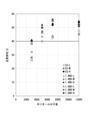
- Figure 1 shows the relationship between the weight average molecular weight of a polyol and the impact resilience.
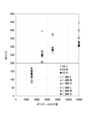
- Figure 2 shows the relationship between the weight average molecular weight of a polyol and the elongation.
- EG represents ethylene glycol
- 1,4BD represents 1,4-butanediol
- 1,6HD represents 1,6-hexanediol.
- L represents that the amount of chain extender added is equivalent to 0.023 mol
- M represents that the amount of chain extender added is equivalent to 0.046 mol
- “H” represents that the amount of chain extender added is equivalent to 0.069 mol.
- Comparative Example 1 has low elongation and tensile strength. This is believed to be because the degree of crosslinking was excessively high due to the use of crude MDI having a functionality of 2.4 as the polyisocyanate component.
- the weight average molecular weight of the polyol was 3,000 (Comparative Examples 2 to 9 and 11), the elongation was less than 200% regardless of the type of chain extender. Moreover, except for Comparative Examples 4, 6 and 7, the impact resilience was less than 40%.
- Comparative Example 10 had a rebound resilience of 51%, an elongation of 305%, and a tensile strength of 1.09 MPa. This is believed to be because the weight-average molecular weight of the polyol was 3,500 or more, and the chain extender had a linear structure. However, the compression set of Comparative Example 10 was 23.4%. This is believed to be because an excessive number of reaction intermediates between 1,6-hexanediol and diisocyanate formed in the early stages of the reaction, and because the reactivity of the main polyol with diisocyanate decreased.
- Examples 29 to 32 Comparative Example 16
- Table 6 shows a list of the raw materials used.
- the raw materials in Table 6 were mixed in a predetermined ratio.
- the raw material mixture was put into a mixing head, and was stirred and mixed to be homogeneous while mixing in an inert gas (nitrogen), to obtain a foaming raw material mixture containing fine bubbles.
- the foaming raw material mixture was applied onto release paper, and the coating was heated and cured at 200°C.
- Test Method 2.1 Storage modulus The viscoelasticity of the resulting polyurethane foam was measured. A TA Instruments ARE-G2 viscoelasticity measuring device was used as the measuring device. Periodic strain was applied to the sample by vibration, and the storage modulus, loss modulus, and loss tangent were measured from the shear stress waveform as a response and their phase difference. The glass transition point was defined as the temperature at which the peak value of the loss tangent appeared. Detailed measurement conditions were as follows:
- Measurement temperature range -80°C ⁇ 50°C Heating rate: 3°C/min Mode: Parallel blade mode Sample size: 8mm ⁇ Strain: 0.5% Frequency: 1Hz
- Table 7 also shows the raw material composition of each sample. The numerical value of each raw material indicates parts by mass.
- Figure 3 shows the relationship between the storage modulus G' and the 25% CLD hardness of the polyurethane foam obtained in Example 29. The following can be seen from Table 7 and Figure 3.
- the polyurethane foam of the present invention can be used for apparel products, sporting goods, toys, bedding, interior goods, shoe insoles, inter-cell cushions for EV batteries, cushions for pressure-sensitive sensors, etc.
Landscapes
- Chemical & Material Sciences (AREA)
- Health & Medical Sciences (AREA)
- Chemical Kinetics & Catalysis (AREA)
- Medicinal Chemistry (AREA)
- Polymers & Plastics (AREA)
- Organic Chemistry (AREA)
- Polyurethanes Or Polyureas (AREA)
Priority Applications (4)
| Application Number | Priority Date | Filing Date | Title |
|---|---|---|---|
| KR1020257031792A KR20250152654A (ko) | 2023-03-13 | 2024-01-23 | 폴리우레탄 폼 및 신발용 깔창 |
| CN202480017823.7A CN120858125A (zh) | 2023-03-13 | 2024-01-23 | 聚氨酯泡沫及鞋用鞋垫 |
| JP2024559577A JPWO2024190087A1 (https=) | 2023-03-13 | 2024-01-23 | |
| TW113104339A TW202446820A (zh) | 2023-03-13 | 2024-02-05 | 聚胺基甲酸酯發泡體及鞋用內墊 |
Applications Claiming Priority (2)
| Application Number | Priority Date | Filing Date | Title |
|---|---|---|---|
| JP2023039003 | 2023-03-13 | ||
| JP2023-039003 | 2023-03-13 |
Publications (1)
| Publication Number | Publication Date |
|---|---|
| WO2024190087A1 true WO2024190087A1 (ja) | 2024-09-19 |
Family
ID=92754812
Family Applications (1)
| Application Number | Title | Priority Date | Filing Date |
|---|---|---|---|
| PCT/JP2024/001741 Ceased WO2024190087A1 (ja) | 2023-03-13 | 2024-01-23 | ポリウレタンフォーム及び靴用インソール |
Country Status (5)
| Country | Link |
|---|---|
| JP (1) | JPWO2024190087A1 (https=) |
| KR (1) | KR20250152654A (https=) |
| CN (1) | CN120858125A (https=) |
| TW (1) | TW202446820A (https=) |
| WO (1) | WO2024190087A1 (https=) |
Citations (6)
| Publication number | Priority date | Publication date | Assignee | Title |
|---|---|---|---|---|
| JP2009167285A (ja) * | 2008-01-16 | 2009-07-30 | Bridgestone Corp | ポリウレタン発泡体成形物 |
| JP2011038005A (ja) * | 2009-08-12 | 2011-02-24 | Nippon Polyurethane Ind Co Ltd | 発泡ポリウレタンエラストマーの製造方法 |
| JP2011513568A (ja) * | 2008-03-14 | 2011-04-28 | ビーエーエスエフ ソシエタス・ヨーロピア | 粗い気泡のポリウレタンエラストマー |
| JP2015013985A (ja) * | 2013-06-03 | 2015-01-22 | 三洋化成工業株式会社 | 低温低反発性ポリウレタン樹脂 |
| WO2018155372A1 (ja) * | 2017-02-22 | 2018-08-30 | 三井化学株式会社 | 発泡ポリウレタンエラストマー原料、発泡ポリウレタンエラストマーおよび発泡ポリウレタンエラストマーの製造方法 |
| JP2022532665A (ja) * | 2019-05-16 | 2022-07-15 | ビーエーエスエフ ソシエタス・ヨーロピア | 引裂きの強い低密度ポリウレタンフォームシステム |
Family Cites Families (10)
| Publication number | Priority date | Publication date | Assignee | Title |
|---|---|---|---|---|
| JP2995082B2 (ja) * | 1990-11-30 | 1999-12-27 | 三井化学株式会社 | 共重合ポリオール |
| JP3355620B2 (ja) * | 1995-12-22 | 2002-12-09 | 日本ポリウレタン工業株式会社 | スノーモービル用シートクッション材の製造方法 |
| JP2000038441A (ja) * | 1998-07-22 | 2000-02-08 | Toho Rika Kogyo Kk | ポリエステルポリオール組成物及びポリウレタンフォーム |
| JP2004231899A (ja) * | 2003-01-31 | 2004-08-19 | Sanyo Chem Ind Ltd | 軟質ポリウレタンフォームの製造方法 |
| KR100667364B1 (ko) * | 2006-02-03 | 2007-01-10 | 주식회사 소일콘 | 저온 내충격성 및 표면광택이 우수한 우레탄 탄성포장용조성물 및 이를 이용한 탄성포장체 |
| WO2016125905A1 (ja) * | 2015-02-05 | 2016-08-11 | 三井化学株式会社 | 光弾性ポリウレタン樹脂、検知部材、ロボット、および、光弾性ポリウレタン樹脂の製造方法 |
| JP6635852B2 (ja) * | 2016-03-31 | 2020-01-29 | 日本発條株式会社 | 打球バット用発泡ポリウレタン素材 |
| JP7334429B2 (ja) | 2018-03-13 | 2023-08-29 | 東ソー株式会社 | ポリウレタンスラブフォーム形成用組成物、ポリウレタンスラブフォーム、及びその製造方法 |
| CN108559057B (zh) * | 2018-05-03 | 2021-02-12 | 东莞市雄林新材料科技股份有限公司 | 一种新型复合发泡材料及其制备方法 |
| US20240199789A1 (en) * | 2021-05-21 | 2024-06-20 | Inoac Corporation | Polyurethane foam and cushioning material |
-
2024
- 2024-01-23 JP JP2024559577A patent/JPWO2024190087A1/ja active Pending
- 2024-01-23 WO PCT/JP2024/001741 patent/WO2024190087A1/ja not_active Ceased
- 2024-01-23 CN CN202480017823.7A patent/CN120858125A/zh active Pending
- 2024-01-23 KR KR1020257031792A patent/KR20250152654A/ko active Pending
- 2024-02-05 TW TW113104339A patent/TW202446820A/zh unknown
Patent Citations (6)
| Publication number | Priority date | Publication date | Assignee | Title |
|---|---|---|---|---|
| JP2009167285A (ja) * | 2008-01-16 | 2009-07-30 | Bridgestone Corp | ポリウレタン発泡体成形物 |
| JP2011513568A (ja) * | 2008-03-14 | 2011-04-28 | ビーエーエスエフ ソシエタス・ヨーロピア | 粗い気泡のポリウレタンエラストマー |
| JP2011038005A (ja) * | 2009-08-12 | 2011-02-24 | Nippon Polyurethane Ind Co Ltd | 発泡ポリウレタンエラストマーの製造方法 |
| JP2015013985A (ja) * | 2013-06-03 | 2015-01-22 | 三洋化成工業株式会社 | 低温低反発性ポリウレタン樹脂 |
| WO2018155372A1 (ja) * | 2017-02-22 | 2018-08-30 | 三井化学株式会社 | 発泡ポリウレタンエラストマー原料、発泡ポリウレタンエラストマーおよび発泡ポリウレタンエラストマーの製造方法 |
| JP2022532665A (ja) * | 2019-05-16 | 2022-07-15 | ビーエーエスエフ ソシエタス・ヨーロピア | 引裂きの強い低密度ポリウレタンフォームシステム |
Also Published As
| Publication number | Publication date |
|---|---|
| CN120858125A (zh) | 2025-10-28 |
| KR20250152654A (ko) | 2025-10-23 |
| TW202446820A (zh) | 2024-12-01 |
| JPWO2024190087A1 (https=) | 2024-09-19 |
Similar Documents
| Publication | Publication Date | Title |
|---|---|---|
| US6872758B2 (en) | Polyurethane foams and method of manufacture thereof | |
| US5965778A (en) | Polyurethane elastomers having improved green strength and demold time, and polyoxyalkylene polyols suitable for their preparation | |
| US8859632B2 (en) | Foamed resin product having shape-formable properties, method of using the same and cushion material to be worn by human body | |
| JP6838133B2 (ja) | 発泡ポリウレタンエラストマー原料、発泡ポリウレタンエラストマーおよび発泡ポリウレタンエラストマーの製造方法 | |
| KR101465486B1 (ko) | 발포 폴리우레탄 엘라스토머의 제조 방법 | |
| CN108602934B (zh) | 含有聚轮烷的聚氨酯泡沫用组合物、源自该组合物的聚氨酯泡沫和聚氨酯泡沫的制造方法 | |
| JP2011038005A (ja) | 発泡ポリウレタンエラストマーの製造方法 | |
| JP4708251B2 (ja) | 発泡ポリウレタンエラストマーおよびその製造方法並びに鉄道用パッド | |
| CA2523398A1 (en) | Flexible foams with low bulk densities and compressive strengths | |
| JP2007106881A (ja) | 連続気泡構造を有する硬質ポリウレタン発泡体の製造方法 | |
| TWI891677B (zh) | 低密度熱塑性聚氨酯可撓性發泡體之原位形成 | |
| JP4459711B2 (ja) | 鉄道用パッドの製造方法 | |
| JP7193934B2 (ja) | ポリウレタンフォーム | |
| WO2024190087A1 (ja) | ポリウレタンフォーム及び靴用インソール | |
| JP2006342305A (ja) | 硬質ポリウレタン発泡体の製造方法 | |
| KR20050016753A (ko) | 성형 폴리우레탄 재료의 제조 방법 | |
| JP4220632B2 (ja) | フローリング材用接着剤組成物 | |
| JP4314120B2 (ja) | ポリウレタンフォーム及びその製造方法 | |
| CN109937220B (zh) | 具有足够硬度和良好挠性的聚氨酯泡沫 | |
| TW202440706A (zh) | 聚胺基甲酸酯發泡體及緩衝材 | |
| TW201938625A (zh) | 聚胺甲酸酯發泡體及鞋底構件 | |
| TW202428679A (zh) | 低回彈性聚胺基甲酸酯發泡體 | |
| JP2024116506A (ja) | ポリウレタンフォーム、衝撃吸収材、及び、物品 | |
| WO2024122477A1 (ja) | ポリウレタンフォーム | |
| WO2023084651A1 (ja) | 発泡体形成用組成物及びウレタンフォーム |
Legal Events
| Date | Code | Title | Description |
|---|---|---|---|
| WWE | Wipo information: entry into national phase |
Ref document number: 2024559577 Country of ref document: JP |
|
| 121 | Ep: the epo has been informed by wipo that ep was designated in this application |
Ref document number: 24768892 Country of ref document: EP Kind code of ref document: A1 |
|
| WWE | Wipo information: entry into national phase |
Ref document number: 202480017823.7 Country of ref document: CN |
|
| ENP | Entry into the national phase |
Ref document number: 1020257031792 Country of ref document: KR Free format text: ST27 STATUS EVENT CODE: A-0-1-A10-A15-NAP-PA0105 (AS PROVIDED BY THE NATIONAL OFFICE) |
|
| NENP | Non-entry into the national phase |
Ref country code: DE |
|
| WWP | Wipo information: published in national office |
Ref document number: 1020257031792 Country of ref document: KR |
|
| WWP | Wipo information: published in national office |
Ref document number: 202480017823.7 Country of ref document: CN |
|
| 122 | Ep: pct application non-entry in european phase |
Ref document number: 24768892 Country of ref document: EP Kind code of ref document: A1 |