WO2024190021A1 - 把持装置及び自動分析装置 - Google Patents
把持装置及び自動分析装置 Download PDFInfo
- Publication number
- WO2024190021A1 WO2024190021A1 PCT/JP2023/044575 JP2023044575W WO2024190021A1 WO 2024190021 A1 WO2024190021 A1 WO 2024190021A1 JP 2023044575 W JP2023044575 W JP 2023044575W WO 2024190021 A1 WO2024190021 A1 WO 2024190021A1
- Authority
- WO
- WIPO (PCT)
- Prior art keywords
- light
- gripping
- state
- actuator
- sensor
- Prior art date
- Legal status (The legal status is an assumption and is not a legal conclusion. Google has not performed a legal analysis and makes no representation as to the accuracy of the status listed.)
- Ceased
Links
Images




Classifications
-
- B—PERFORMING OPERATIONS; TRANSPORTING
- B25—HAND TOOLS; PORTABLE POWER-DRIVEN TOOLS; MANIPULATORS
- B25J—MANIPULATORS; CHAMBERS PROVIDED WITH MANIPULATION DEVICES
- B25J15/00—Gripping heads and other end effectors
- B25J15/08—Gripping heads and other end effectors having finger members
- B25J15/10—Gripping heads and other end effectors having finger members with three or more finger members
-
- G—PHYSICS
- G01—MEASURING; TESTING
- G01N—INVESTIGATING OR ANALYSING MATERIALS BY DETERMINING THEIR CHEMICAL OR PHYSICAL PROPERTIES
- G01N35/00—Automatic analysis not limited to methods or materials provided for in any single one of groups G01N1/00 - G01N33/00; Handling materials therefor
- G01N35/0099—Automatic analysis not limited to methods or materials provided for in any single one of groups G01N1/00 - G01N33/00; Handling materials therefor comprising robots or similar manipulators
Definitions
- the present invention relates to a gripping device and an automatic analysis device.
- a known analytical device detects a measurement target contained in a sample and processes the sample by reacting it with a reagent in a container.
- a container transport mechanism for gripping the container and moving it horizontally and vertically has been disclosed (see Patent Document 1).
- Patent Document 1 based on the operating state of the actuator and the state of the gripping member detected by the sensor, three states are distinguished: a state in which the gripping member is closed and not gripping anything, a state in which the gripping member is open and not gripping anything, and a state in which the gripping member is gripping a container as the object to be gripped.
- the present invention includes multiple means for solving the above problems, and an example thereof includes a gripping portion that grips an object to be gripped by pinching it between two or more members that are opened and closed by an actuator, a first sensor having a first light-emitting portion that emits a first detection light and a first light-receiving portion that receives the first detection light, and a second sensor having a second light-emitting portion that emits a second detection light and a second light-receiving portion that receives the second detection light, and a determination is made regarding three states of the member based on detection information from the first sensor and the second sensor: a state in which the member is open without gripping the object to be gripped, a state in which the member is closed without gripping the object to be gripped, and a state in which the object to be gripped is being gripped.
- the actuator includes a determination unit that determines whether the actuator is opening or closing the member, a first light-shielding member that is interlocked with the actuator, and a second light-shielding member that is interlocked with one or more of the members, and the first sensor detects whether the actuator is opening or closing the member when the first light-shielding member comes between the first light-projecting unit and the first light-receiving unit and blocks the first detection light, and the second sensor detects whether the member is closed, open, or gripping the gripping target when the second light-shielding member comes between the second light-projecting unit and the second light-receiving unit and blocks the second detection light.
- the present invention makes it possible to distinguish between the three states with greater accuracy than conventional methods. Problems, configurations, and advantages other than those described above will become clear from the description of the embodiments below.
- FIG. 1 is a plan view showing an example of the configuration of an automatic analyzer according to an embodiment.
- FIG. 4 is a detailed explanatory diagram of a consumable transport unit in the automatic analyzer according to the embodiment.
- 3 is a cross-sectional view taken along the line B-B of FIG. 2 .
- FIG. 2 is an external view of a container gripping device of the automatic analyzer according to the embodiment.
- FIG. 2 is a front view showing a state in which the gripping member of the container gripping device of the automatic analyzer according to the embodiment is closed.
- 5A is a view taken along the line CC in FIG.
- FIG. 5; 4 is a cross-sectional view showing the positional relationship between a sensor and a light blocking member in a state where a gripping member is closed in the container gripping device of the automatic analyzer according to the embodiment.
- FIG. 4 is a cross-sectional view showing the positional relationship between a sensor and a light blocking member in a state where a gripping member is open in the container gripping device of the automatic analyzer according to the embodiment.
- FIG. 4 is a cross-sectional view showing the positional relationship between a sensor and a light blocking member in a state where a container is gripped in the container gripping device of the automatic analyzer according to the embodiment.
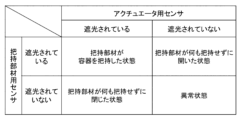
- FIG. FIG. 11 is a matrix diagram for determining the gripping state in the automatic analyzer of the embodiment.
- the gripping device of the present invention is provided in a consumable transport unit 112 in an automatic analyzer, but the gripping device of the present invention can be applied to a reaction vessel transport unit 114, other gripping mechanisms, or various mechanisms for holding objects.
- the objects to be grasped will be described as various containers used in the above-mentioned automatic analyzer, but the objects to be grasped are not limited to such containers.
- FIG. 1 is a schematic diagram of the immunoanalyzer in this embodiment.
- the immunoassay device shown in FIG. 1 comprises a sample transport unit 102 that transports a sample container 101, such as a blood collection tube, containing a sample to be analyzed to a sample suction position 110, a reagent storage unit 104 that controls the temperature of a reagent container 103 containing a reagent to be used in the analysis so that the temperature of the reagent is within a certain range, a sample dispensing unit 105 that dispenses the sample in the sample container 101 into a reaction vessel, a reagent dispensing unit 106 that dispenses the reagent in the reagent container 103 into a reaction vessel, and a mixing unit 108 that mixes particles in the liquid in the reagent container 103, which is open at the top.
- a sample transport unit 102 that transports a sample container 101, such as a blood collection tube, containing a sample to be analyzed to a sample suction position 110
- a reagent storage unit 104 that controls the temperature of
- agitation unit 107 It is composed of an agitation unit 107, a cleaning unit 115 for cleaning the agitation unit 107, a reaction promotion unit 108 for placing a reaction vessel containing a reaction liquid in which a sample and a reagent are mixed and controlling the reaction liquid to be within a certain temperature range, a measurement unit 109 for optically measuring the amount of a substance in the reaction liquid whose reaction has been promoted by the reaction promotion unit, an environmental temperature measurement sensor (not shown for convenience of illustration) for measuring the temperature of the surrounding environment in which the immunoassay device is placed, and a control device 113 for controlling the operation of each of the above-mentioned units.
- the sample transport unit 102 is a mechanism for transporting a sample rack containing one or more sample containers 101 to a destination. Note that a sample disk arranged on the circumference of a disk can be used instead of or in addition to the transport unit. In the case of a sample rack, the sample rack is transported to the suction position of the sample dispensing unit by a transport device such as a transport belt mechanism or a robot arm.
- the reagent storage unit 104 is configured to arrange multiple reagent containers 103 on a circle and rotate them to transport any reagent container to a desired position, but the reagent containers may be arranged in a single row or multiple rows vertically and horizontally.
- the measurement unit 109 performs optical or electrical measurements on the reaction liquid in the reaction vessel transported from the reaction promotion unit 108 by the reaction vessel transport section 114. At that time, the reaction liquid in the flow path is measured while being controlled within a certain temperature range. Examples of measurement operations include measuring the absorbance of the reaction liquid, measuring the amount of light emitted when a reagent is added to the reaction liquid or a voltage is applied to it, measuring the number of particles in the reaction liquid, and measuring the fluctuations in the current and voltage values when the reaction liquid comes into contact with an electrode film. For this reason, the measurement unit 109 is provided with a photometer such as a photomultiplier tube or a photometer, an imaging element such as a CCD, an ammeter for measuring fluctuations in the current and voltage values, and a voltmeter.
- a photometer such as a photomultiplier tube or a photometer
- an imaging element such as a CCD
- an ammeter for measuring fluctuations in the current and voltage values
- the reaction promotion unit 108 allows a stable reaction to proceed by maintaining the temperature of the reaction vessel within a specified temperature range. Specifically, it is an incubator in which multiple reaction vessels are arranged on a circumference and the temperature is controlled by heating the surrounding area with a heater or the like. Another example of the reaction promotion unit 108 may be a constant temperature bath in which the reaction vessels are immersed in a tank in which a liquid controlled to a certain temperature range circulates.
- the specimen dispensing unit 105 dispenses the specimen from the specimen container 101 into a reaction vessel, but depending on the analytical performance required of the analyzer, it is necessary to take into consideration the effects of carryover between specimens. For this reason, the specimen dispensing unit 105 uses a replaceable dispensing tip for each specimen in the part that comes into contact with the specimen when dispensing the specimen, or uses an unused reaction vessel each time. In this case, the dispensing tip and reaction vessel that have been used once are discarded.
- the consumable transport unit 112 is configured to be movable in the horizontal and vertical directions, and is configured to be movable above the consumable storage unit 111, the reaction promotion unit 108, the disposal hole 117, and the stirring means 116.
- the consumables storage unit 111 is configured to be detachable from the immunoassay device, and is placed on the top surface of the immunoassay device by the operator with multiple containers placed on it.
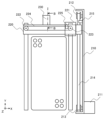
- the consumable transport unit 112 shown in FIG. 2 is equipped with a Y-axis frame 210 extending in the Y-axis direction, and an X-axis frame 220 extending in a direction perpendicular to the Y-axis frame 210.
- the X-axis frame 220 is attached so as to be movable relative to the Y-axis frame 210.
- a Z carrier 230 is attached to this X-axis frame 220 so as to be movable in the X-axis direction.
- a container gripping device 240 is attached inside the Z carrier 230 so as to be movable in the Z-axis direction. In other words, this transport mechanism is movable in three axial directions.
- the container gripping device 240 grips unused containers one by one from the consumable storage unit 111 and moves them to the reaction promotion unit 108 and the stirring means 116.
- the consumable transport unit 112 also grasps used containers and moves them to the disposal hole 117. Used containers are expected to have specimens or the like attached to them, and direct contact may pose a risk of infection, so by disposing of the containers in a disposal box placed below the disposal hole 117, for example, the risk of direct contact can be reduced by finally disposing of the entire disposal box.
- a Y drive motor 211 and a Y driven pulley 212 are attached to the Y axis frame 210.
- a Y drive pulley 213 is attached to the drive shaft of the Y drive motor 211.
- a Y toothed belt 214 is suspended between the Y drive pulley 213 and the Y driven pulley 212. A part of the X carrier is fixed to this Y toothed belt 214.
- a Y home sensor 215 is attached to the Y-axis frame 210.
- the Y home sensor 215 is composed of a photocoupler, and a Y detection plate fixed to part of the X-axis frame 220 is positioned between the photocouplers and blocks the light emitted from the light-emitting part of the photocoupler, thereby making it possible to detect the position of the Y detection plate, i.e., the position of the X-axis frame 220.
- the Y home sensor 215 detects the Y home position of the X-axis frame 220.
- the X-axis frame 220 operates as follows.
- An X drive motor 221 and an X driven pulley 222 are attached to the X axis frame 220.
- An X drive pulley 223 is attached to the drive shaft of the X drive motor 221.
- An X toothed belt 224 is suspended between the X drive pulley 223 and the X driven pulley 222.
- a Z carrier 230 is connected to the X toothed belt 224.
- An X-home sensor 225 is attached to the X-axis frame 220.
- the X-home sensor 225 is composed of a photocoupler, and an X-detection plate fixed to a part of the Z carrier 230 is positioned between the photocouplers to block the light emitted from the light-emitting diode of the photocoupler, thereby making it possible to detect the position of the X-detection plate, i.e., the position of the Z carrier 230.
- the X-home sensor 225 detects the X-home position of the Z carrier 230.
- the Z carrier 230 operates as follows. That is, when the X drive motor 221 rotates, this rotational force is transmitted to the X toothed belt 224 via the X drive pulley 223, and the Z carrier 230 fixed to the X toothed belt 224 is moved in the X-axis direction.
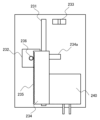
- the Z carrier 230 is fitted with a Z-axis linear guide 231, a Z drive motor 232, and a Z home sensor 233.
- a container gripping device 240 is attached to a sliding piece 234 that can move along the Z-axis linear guide 231.
- An L-shaped detection piece 234a is attached to the sliding piece 234, and the Z home position can be detected when the tip of this detection piece 234a crosses the gap between the light-emitting diode and photodiode of the Z home sensor 233, which is made up of a photocoupler.
- a rack 235 is engraved on the left end of the sliding piece, which meshes with a pinion 236 attached to the Z drive motor 232.
- the container gripping device 240 operates as follows. That is, when the Z drive motor 232 rotates, this rotational force is transmitted via the pinion 236 to the rack 235 engraved on the sliding piece 234, and the container gripping device 240 fixed to the sliding piece 234 is moved in the Z-axis direction.
- Figure 4 is a diagram showing the external appearance of the container gripping device 240 for transporting containers.
- Figure 5 is a front view of the container gripping device 240, and
- Figure 6 is a view taken along the arrows C-C in Figure 5.
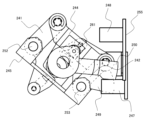
- the container gripping device 240 further includes gripping members 241, 242, an actuator 243, a gripping member connecting member 244, a gripping portion base 245, a gripping member pull spring 246, a gripping member sensor 247, an actuator sensor 248, a gripping member sensor light shielding member 249, and an actuator sensor light shielding member 250.
- Guide pins 252 and 253 are fixed to the actuator base 251.
- the gripper base 245 is fitted to these guide pins 252 and 253 so that it can move up and down.
- the gripper member 241 is attached to the guide pin 252 so that it can rotate and move up and down.
- the gripper member 242 is also attached to the guide pin 253 so that it can rotate and move up and down.
- a compression spring 254 is attached between the actuator base 251 and the gripper base 245 around the guide pins 252, 253, which constantly presses the gripper base 245 downward against the actuator base 251. Therefore, the gripping members 241, 242 engaged with the gripper base 245 are also constantly pressed downward.
- An obstacle sensor 256 is attached to a sensor base 255 attached to the gripper base 245.
- the obstacle sensor 256 has a photocoupler and detects the presence or absence of an obstacle depending on whether a detection plate 251a fixed to the actuator base 251 blocks light from the photocoupler.
- the gripping members 241, 242 stop their descent, but as the container gripping device 240 continues to descend while compressing the compression spring 254, the detection plate 251a fixed to the actuator base 251 blocks the light from the photocoupler and detects the presence of the obstacle.
- the gripping member connecting member 244 is rotatably attached to the gripping members 241 and 242 by pins 257 and 258.
- the gripping portion base, gripping members 241 and 242, and gripping member connecting member 244 form a four-joint link.
- the four-bar link formed by the gripping portion base 245, gripping member 241, gripping member 242, and gripping member connecting member 244 is a parallel link in which the opposing axes are parallel and have equal distances between them. Therefore, gripping member 241 and gripping member 242 rotate in conjunction with each other.
- a gripping member pull spring 246 is suspended between spring pin 259 attached to gripping member 241 and spring pin 260 attached to gripping member 242.
- a force in the closing direction is always acting on gripping members 241, 242, and when gripping a container, a force is applied to press down on the container from the outside, and when opening gripping members 241, 242, a force is applied to bring gripping member connecting member 244 into contact with cam 261 attached to actuator 243.
- cam 261 attached to actuator 243 comes into contact with gripping member connecting member 244, the rotational movement of actuator 243 is transmitted to gripping member connecting member 244.
- gripping members 241, 242 When the movement of gripping member connecting member 244 is transmitted to gripping members 241, 242 by the parallel link mechanism, gripping members 241, 242 can be opened. That is, the gripping members 241 and 242 open and close using the actuator 243, forming a gripping section that grips the object to be gripped by pinching it.
- FIGS. 7 to 9 are views taken along the line D-D in FIG. 5.
- FIG. 7 shows the gripping members 241, 242 of the container gripping device 240 in a closed state
- FIG. 8 shows the gripping members 241, 242 of the container gripping device 240 in an open state
- FIG. 9 shows the container gripping device 240 gripping a container.
- the container gripping device 240 is equipped with an actuator sensor 248, an actuator sensor light shielding member 250 that is linked to the actuator 243, a gripping member sensor 247, and a gripping member sensor light shielding member 249 that is linked to one or more of the gripping members 241 and 242.
- the actuator sensor 248 has a first light-projecting section that projects a first detection light, and a first light-receiving section that receives the first detection light.
- the first light-projecting section and the first light-receiving section are arranged so that the first detection light is blocked by the actuator sensor light-shielding member 250 when the actuator 243 rotates by the first angle.
- the actuator sensor 248 detects whether the actuator 243 is opening or closing the gripping members 241, 242 when the actuator sensor light shielding member 250 comes between the first light emitting section and the first light receiving section to block the first detection light.
- the actuator sensor light shielding member 250 enters the actuator sensor 248 attached to the sensor base 255, and the actuator sensor 248 is in a light-shielded state. Also, when the actuator 243 rotates to open the gripping members 241, 242, the actuator sensor light shielding member 250 comes off the actuator sensor 248, and the actuator sensor 248 is not in a light-shielded state.
- the gripping member sensor 247 has a second light-projecting section that projects the second detection light, and a second light-receiving section that receives the second detection light.
- the second light-projecting section and the second light-receiving section are arranged so that the second detection light is blocked by the gripping member sensor light-shielding member 249 when the gripping members 241, 242 rotate by the second angle.
- the gripping member sensor 247 detects whether the gripping members 241, 242 are closed, open, or gripping an object by the gripping member sensor light-shielding member 249 being placed between the second light-emitting section and the second light-receiving section to block the second detection light.
- the gripping member sensor light shielding member 249 which is part of the gripping member 242, comes off the gripping member sensor 247 attached to the sensor base 255, and the gripping member sensor 247 is not shielded from light.
- the gripping members 241 and 242 are open, the gripping member sensor light shielding member 249 enters the gripping member sensor 247, and the gripping member sensor 247 is shielded from light.
- the actuator 243 performs a closing operation, but the gripping members 241 and 242 pinch the container to prevent the gripping member sensor light shielding member 249 from coming off the gripping member sensor 247.
- the control device 113 then controls the operation of the gripping unit, and determines the container gripping state of the container gripping device 240 based on the detection information of the actuator sensor 248 and the gripping member sensor 247, from three states: a state in which the gripping members 241, 242 are open and not gripping the gripping object, a state in which they are closed and not gripping the gripping object, and a state in which they are gripping the gripping object.
- three states can be determined: (1) when the actuator sensor 248 is shielded from light, the gripping member sensor 247 is not shielded from light (the gripping members 241, 242 are closed and not gripping anything); (2) when the actuator sensor 248 is not shielded from light, the gripping member sensor 247 is shielded from light (the gripping members 241, 242 are open and not gripping anything); and (3) when the actuator sensor 248 is shielded from light, the gripping member sensor 247 is shielded from light (the gripping members 241, 242 are gripping a container).
- the actuator sensor 248 is not shaded and the gripping member sensor 247 detects that it is not shaded, this can be determined as an abnormal state because such a state would not be detected under normal operation.
- control device 113 when control is performed to transition from the first of the above three states to a second of the three states that is different from the first state, if the control device 113 determines that it is in the first state or the third state, the control device 113 compares the detection information of the actuator sensor 248 in the second state with the detection information of the actuator sensor 248 in the first state or the third state, and if they differ, determines that there is an abnormality in the actuator 243, and/or the gripping members 241, 242, if they match. Specific examples are described below.
- the container gripping device 240 grips a container held in the consumable storage unit 111 or the like
- the container gripping device 240 moves horizontally above the container, and then the actuator 243 opens, causing the gripping members 241, 242 to transition from a state in which they are closed and not gripping anything to a state in which they are open and not gripping anything, and after the container gripping device 240 descends vertically to a height at which it can grip a container, the actuator 243 closes, causing the gripping members 241, 242 to transition from a state in which they are open and not gripping anything to a state in which they are gripping a container, and the container gripping device 240 rises vertically.
- the gripping members 241, 242 transition from a closed state where they are not gripping anything to an open state where they are not gripping anything during the above operation, if the container gripping state of the container gripping device 240 based on the detection information of the actuator sensor 248 and the gripping member sensor 247 is a state different from the open state where they are not gripping anything, it can be determined that an abnormality has occurred in the operation of the container gripping device 240 to open the gripping members 241, 242.
- the gripping members 241, 242 transition from an open state where they are not gripping anything to a state where they are gripping a container during the above operation, if the container gripping state of the container gripping device 240 based on the detection information of the actuator sensor 248 and the gripping member sensor 247 is a state different from the state in which the gripping members 241, 242 are gripping a container, it can be determined that an abnormality has occurred in the operation of the container gripping device 240 to grip the container.
- the container holding device 240 moves horizontally above the disposal position, and then the holding members 241, 242 transition from a state in which they hold a container to a state in which they are open and not holding anything, and after the container is disposed of, the holding members 241, 242 transition from a state in which they are open and not holding anything to a state in which they are closed and not holding anything.
- the gripping members 241, 242 transition from a state in which they grip a container to a state in which they are open and not gripping anything during the above operation, if the container gripping state of the container gripping device 240 based on the detection information of the actuator sensor 248 and the gripping member sensor 247 is a state different from the open state in which they grip nothing, it can be determined that an abnormality has occurred in the operation of the container gripping device 240 to open the gripping members 241, 242.
- the gripping members 241, 242 transition from an open state where they are not gripping anything to a closed state where they are not gripping anything during the above operation, if the container gripping state of the container gripping device 240 based on the detection information of the actuator sensor 248 and the gripping member sensor 247 is a state different from the closed state where the gripping members 241, 242 are not gripping anything, it can be determined that an abnormality has occurred in the operation of the container gripping device 240 to close the gripping members 241, 242.
- the normal state changes of the container gripping device 240 are: (1) a change from a state in which the gripping members 241, 242 are closed and gripping nothing to a state in which the gripping members 241, 242 are open and gripping nothing; (2) a change from a state in which the gripping members 241, 242 are open and gripping nothing to a state in which the gripping members 241, 242 are gripping a container; (3) a change from a state in which the gripping members 241, 242 are gripping a container to a state in which the gripping members 241, 242 are open and gripping nothing; and (4) a change from a state in which the gripping members 241, 242 are open and gripping nothing to a state in which the gripping members 241, 242 are closed and gripping nothing.
- the state of the actuator 243 changes before and after all four of these state changes. In other words, if the light-blocking state of the actuator sensor 248 does not change before and after operation when an abnormality occurs, it can be determined that there is an abnormality on the actuator 243 side. Also, if the light-blocking state of the actuator sensor 248 changes before and after operation when an abnormality occurs, it can be determined that the actuator 243 is operating normally and that there is an abnormality in the state of parts other than the actuator 243, such as the gripping members 241, 242, the connections between the gripping members 241, 242 and the actuator 243, or the gripping state of the container.
- the container gripping device 240 of the present embodiment described above includes a gripping section that grips a container by pinching it between two or more gripping members 241, 242 that are opened and closed by an actuator 243, an actuator sensor 248 having a first light-emitting section that emits a first detection light and a first light-receiving section that receives the first detection light, a gripping member sensor 247 having a second light-emitting section that emits a second detection light and a second light-receiving section that receives the second detection light, a control device 113 that determines whether the gripping members 241, 242 are in one of three states based on the detection information of the actuator sensor 248 and the gripping member sensor 247: an open state without gripping a container, a closed state without gripping a container, and a state gripping a container, and is linked to the actuator 243.
- the actuator sensor light shielding member 250 and the gripping member sensor light shielding member 249 that is interlocked with one or more of the gripping members 241 and 242 are provided.
- the actuator sensor 248 detects whether the actuator 243 is opening or closing the gripping members 241 and 242 when the actuator sensor light shielding member 250 comes between the first light projecting unit and the first light receiving unit to block the first detection light
- the gripping member sensor 247 detects whether the gripping members 241 and 242 are closed, open, or gripping a container when the gripping member sensor light shielding member 249 comes between the second light projecting unit and the second light receiving unit to block the second detection light.
- the gripping section is opened and closed by the rotation of the actuator 243 and the rotation of the gripping members 241 and 242 linked to the rotation of the actuator 243.
- the first light projecting section and the first light receiving section are arranged so that the first detection light is blocked by the actuator sensor light blocking member 250 when the actuator 243 rotates a first angle
- the second light projecting section and the second light receiving section are arranged so that the second detection light is blocked by the gripping member sensor light blocking member 249 when the gripping members 241 and 242 rotate a second angle.
- the gripping portion opens and closes by the rotation of the actuator 243 and the rotation of the gripping members 241, 242 linked to the rotation of the actuator 243.
- the first light-projecting portion and the first light-receiving portion are positioned such that the first detection light is blocked by the actuator sensor light-shielding member 250 when the actuator 243 rotates a first angle
- the second light-projecting portion and the second light-receiving portion are positioned such that the second detection light is blocked by the gripping member sensor light-shielding member 249 when the gripping members 241, 242 rotate a second angle. This makes it easier to identify the location of an abnormality and can further speed up recovery when an abnormality occurs.
Landscapes
- Engineering & Computer Science (AREA)
- Robotics (AREA)
- Physics & Mathematics (AREA)
- Health & Medical Sciences (AREA)
- Life Sciences & Earth Sciences (AREA)
- Chemical & Material Sciences (AREA)
- Analytical Chemistry (AREA)
- Biochemistry (AREA)
- General Health & Medical Sciences (AREA)
- General Physics & Mathematics (AREA)
- Immunology (AREA)
- Pathology (AREA)
- Mechanical Engineering (AREA)
- Automatic Analysis And Handling Materials Therefor (AREA)
Priority Applications (3)
| Application Number | Priority Date | Filing Date | Title |
|---|---|---|---|
| EP23927625.6A EP4679098A1 (en) | 2023-03-10 | 2023-12-13 | Gripping device and automatic analysis device |
| JP2025506487A JPWO2024190021A1 (https=) | 2023-03-10 | 2023-12-13 | |
| CN202380094511.1A CN120835995A (zh) | 2023-03-10 | 2023-12-13 | 把持装置以及自动分析装置 |
Applications Claiming Priority (2)
| Application Number | Priority Date | Filing Date | Title |
|---|---|---|---|
| JP2023037441 | 2023-03-10 | ||
| JP2023-037441 | 2023-03-10 |
Publications (1)
| Publication Number | Publication Date |
|---|---|
| WO2024190021A1 true WO2024190021A1 (ja) | 2024-09-19 |
Family
ID=92754587
Family Applications (1)
| Application Number | Title | Priority Date | Filing Date |
|---|---|---|---|
| PCT/JP2023/044575 Ceased WO2024190021A1 (ja) | 2023-03-10 | 2023-12-13 | 把持装置及び自動分析装置 |
Country Status (4)
| Country | Link |
|---|---|
| EP (1) | EP4679098A1 (https=) |
| JP (1) | JPWO2024190021A1 (https=) |
| CN (1) | CN120835995A (https=) |
| WO (1) | WO2024190021A1 (https=) |
Citations (4)
| Publication number | Priority date | Publication date | Assignee | Title |
|---|---|---|---|---|
| JPH1125551A (ja) * | 1997-07-02 | 1999-01-29 | Fujitsu Ltd | ライブラリ装置用カートリッジ移送ロボット |
| WO2014002953A1 (ja) * | 2012-06-25 | 2014-01-03 | 協和メデックス株式会社 | 容器把持装置 |
| JP2016095251A (ja) * | 2014-11-14 | 2016-05-26 | シスメックス株式会社 | 検体測定装置および検体測定方法 |
| JP2018169165A (ja) | 2017-03-29 | 2018-11-01 | 株式会社日立ハイテクノロジーズ | 容器搬送機構およびこれを備えた分析装置 |
-
2023
- 2023-12-13 JP JP2025506487A patent/JPWO2024190021A1/ja active Pending
- 2023-12-13 CN CN202380094511.1A patent/CN120835995A/zh active Pending
- 2023-12-13 EP EP23927625.6A patent/EP4679098A1/en active Pending
- 2023-12-13 WO PCT/JP2023/044575 patent/WO2024190021A1/ja not_active Ceased
Patent Citations (4)
| Publication number | Priority date | Publication date | Assignee | Title |
|---|---|---|---|---|
| JPH1125551A (ja) * | 1997-07-02 | 1999-01-29 | Fujitsu Ltd | ライブラリ装置用カートリッジ移送ロボット |
| WO2014002953A1 (ja) * | 2012-06-25 | 2014-01-03 | 協和メデックス株式会社 | 容器把持装置 |
| JP2016095251A (ja) * | 2014-11-14 | 2016-05-26 | シスメックス株式会社 | 検体測定装置および検体測定方法 |
| JP2018169165A (ja) | 2017-03-29 | 2018-11-01 | 株式会社日立ハイテクノロジーズ | 容器搬送機構およびこれを備えた分析装置 |
Non-Patent Citations (1)
| Title |
|---|
| See also references of EP4679098A1 |
Also Published As
| Publication number | Publication date |
|---|---|
| EP4679098A1 (en) | 2026-01-14 |
| JPWO2024190021A1 (https=) | 2024-09-19 |
| CN120835995A (zh) | 2025-10-24 |
Similar Documents
| Publication | Publication Date | Title |
|---|---|---|
| US8097211B2 (en) | Analyzer | |
| JP4485137B2 (ja) | 臨床分析機の校正方法および臨床分析機のディスペンサーの自動整合方法 | |
| EP3508858B1 (en) | Sample measurement method and sample measurement device | |
| JP5377866B2 (ja) | 検体分析装置 | |
| JP5210903B2 (ja) | 試料分析装置 | |
| US20090325299A1 (en) | Analyzer and method for aspirating specimen | |
| JPH05240868A (ja) | 標本の自動分析装置 | |
| CN107407689A (zh) | 自动分析装置 | |
| US11846632B2 (en) | Sample measurement device and sample measurement method | |
| US10048285B2 (en) | Sample processing apparatus | |
| US8507280B2 (en) | Method of normalizing surface tension of a sample fluid | |
| EP2299282B1 (en) | Sample processing apparatus, sample transporting device, and sample rack transporting method | |
| WO2024190021A1 (ja) | 把持装置及び自動分析装置 | |
| CN116034277B (zh) | 自动分析装置 | |
| US9114970B2 (en) | Dispensing device and nucleic acid analyzer | |
| JP7773353B2 (ja) | 自動分析装置 | |
| JP2590688Y2 (ja) | 血液凝固分析装置 | |
| US20210263060A1 (en) | Automatic analyzing apparatus | |
| US20250076330A1 (en) | Measuring chip, automatic analyzing apparatus, reaction cuvette, and automatic analyzing system | |
| EP4678355A1 (en) | Gripping device, automatic analysis device, and gripping method | |
| JP2025035385A (ja) | 測定チップ、自動分析装置、及び、自動分析システム | |
| AU2014200240B2 (en) | Method of normalizing surface tension of a sample fluid | |
| WO2024101025A1 (ja) | 自動分析装置 | |
| JPS62255870A (ja) | 光学測定装置 | |
| BR112017025551B1 (pt) | Método e sistema automatizado para obter e preparar amostra de micro-organismos tanto para identificação quanto para testes de susceptibilidade a antibióticos |
Legal Events
| Date | Code | Title | Description |
|---|---|---|---|
| 121 | Ep: the epo has been informed by wipo that ep was designated in this application |
Ref document number: 23927625 Country of ref document: EP Kind code of ref document: A1 |
|
| WWE | Wipo information: entry into national phase |
Ref document number: 202380094511.1 Country of ref document: CN |
|
| ENP | Entry into the national phase |
Ref document number: 2025506487 Country of ref document: JP Kind code of ref document: A |
|
| WWE | Wipo information: entry into national phase |
Ref document number: 2025506487 Country of ref document: JP |
|
| WWE | Wipo information: entry into national phase |
Ref document number: 2023927625 Country of ref document: EP |
|
| NENP | Non-entry into the national phase |
Ref country code: DE |
|
| WWP | Wipo information: published in national office |
Ref document number: 202380094511.1 Country of ref document: CN |
|
| ENP | Entry into the national phase |
Ref document number: 2023927625 Country of ref document: EP Effective date: 20251010 |
|
| ENP | Entry into the national phase |
Ref document number: 2023927625 Country of ref document: EP Effective date: 20251010 |
|
| ENP | Entry into the national phase |
Ref document number: 2023927625 Country of ref document: EP Effective date: 20251010 |
|
| ENP | Entry into the national phase |
Ref document number: 2023927625 Country of ref document: EP Effective date: 20251010 |
|
| WWP | Wipo information: published in national office |
Ref document number: 2023927625 Country of ref document: EP |