WO2024185893A1 - 蓄電装置 - Google Patents
蓄電装置 Download PDFInfo
- Publication number
- WO2024185893A1 WO2024185893A1 PCT/JP2024/009157 JP2024009157W WO2024185893A1 WO 2024185893 A1 WO2024185893 A1 WO 2024185893A1 JP 2024009157 W JP2024009157 W JP 2024009157W WO 2024185893 A1 WO2024185893 A1 WO 2024185893A1
- Authority
- WO
- WIPO (PCT)
- Prior art keywords
- axis direction
- energy storage
- duct
- main body
- storage elements
- Prior art date
- Legal status (The legal status is an assumption and is not a legal conclusion. Google has not performed a legal analysis and makes no representation as to the accuracy of the status listed.)
- Ceased
Links
Images






Classifications
-
- H—ELECTRICITY
- H01—ELECTRIC ELEMENTS
- H01G—CAPACITORS; CAPACITORS, RECTIFIERS, DETECTORS, SWITCHING DEVICES, LIGHT-SENSITIVE OR TEMPERATURE-SENSITIVE DEVICES OF THE ELECTROLYTIC TYPE
- H01G11/00—Hybrid capacitors, i.e. capacitors having different positive and negative electrodes; Electric double-layer [EDL] capacitors; Processes for the manufacture thereof or of parts thereof
- H01G11/10—Multiple hybrid or EDL capacitors, e.g. arrays or modules
- H01G11/12—Stacked hybrid or EDL capacitors
-
- H—ELECTRICITY
- H01—ELECTRIC ELEMENTS
- H01G—CAPACITORS; CAPACITORS, RECTIFIERS, DETECTORS, SWITCHING DEVICES, LIGHT-SENSITIVE OR TEMPERATURE-SENSITIVE DEVICES OF THE ELECTROLYTIC TYPE
- H01G11/00—Hybrid capacitors, i.e. capacitors having different positive and negative electrodes; Electric double-layer [EDL] capacitors; Processes for the manufacture thereof or of parts thereof
- H01G11/14—Arrangements or processes for adjusting or protecting hybrid or EDL capacitors
-
- H—ELECTRICITY
- H01—ELECTRIC ELEMENTS
- H01G—CAPACITORS; CAPACITORS, RECTIFIERS, DETECTORS, SWITCHING DEVICES, LIGHT-SENSITIVE OR TEMPERATURE-SENSITIVE DEVICES OF THE ELECTROLYTIC TYPE
- H01G11/00—Hybrid capacitors, i.e. capacitors having different positive and negative electrodes; Electric double-layer [EDL] capacitors; Processes for the manufacture thereof or of parts thereof
- H01G11/78—Cases; Housings; Encapsulations; Mountings
-
- H—ELECTRICITY
- H01—ELECTRIC ELEMENTS
- H01M—PROCESSES OR MEANS, e.g. BATTERIES, FOR THE DIRECT CONVERSION OF CHEMICAL ENERGY INTO ELECTRICAL ENERGY
- H01M50/00—Constructional details or processes of manufacture of the non-active parts of electrochemical cells other than fuel cells, e.g. hybrid cells
- H01M50/20—Mountings; Secondary casings or frames; Racks, modules or packs; Suspension devices; Shock absorbers; Transport or carrying devices; Holders
- H01M50/204—Racks, modules or packs for multiple batteries or multiple cells
- H01M50/207—Racks, modules or packs for multiple batteries or multiple cells characterised by their shape
- H01M50/209—Racks, modules or packs for multiple batteries or multiple cells characterised by their shape adapted for prismatic or rectangular cells
-
- H—ELECTRICITY
- H01—ELECTRIC ELEMENTS
- H01M—PROCESSES OR MEANS, e.g. BATTERIES, FOR THE DIRECT CONVERSION OF CHEMICAL ENERGY INTO ELECTRICAL ENERGY
- H01M50/00—Constructional details or processes of manufacture of the non-active parts of electrochemical cells other than fuel cells, e.g. hybrid cells
- H01M50/20—Mountings; Secondary casings or frames; Racks, modules or packs; Suspension devices; Shock absorbers; Transport or carrying devices; Holders
- H01M50/289—Mountings; Secondary casings or frames; Racks, modules or packs; Suspension devices; Shock absorbers; Transport or carrying devices; Holders characterised by spacing elements or positioning means within frames, racks or packs
- H01M50/291—Mountings; Secondary casings or frames; Racks, modules or packs; Suspension devices; Shock absorbers; Transport or carrying devices; Holders characterised by spacing elements or positioning means within frames, racks or packs characterised by their shape
-
- H—ELECTRICITY
- H01—ELECTRIC ELEMENTS
- H01M—PROCESSES OR MEANS, e.g. BATTERIES, FOR THE DIRECT CONVERSION OF CHEMICAL ENERGY INTO ELECTRICAL ENERGY
- H01M50/00—Constructional details or processes of manufacture of the non-active parts of electrochemical cells other than fuel cells, e.g. hybrid cells
- H01M50/30—Arrangements for facilitating escape of gases
- H01M50/35—Gas exhaust passages comprising elongated, tortuous or labyrinth-shaped exhaust passages
- H01M50/358—External gas exhaust passages located on the battery cover or case
-
- H—ELECTRICITY
- H01—ELECTRIC ELEMENTS
- H01M—PROCESSES OR MEANS, e.g. BATTERIES, FOR THE DIRECT CONVERSION OF CHEMICAL ENERGY INTO ELECTRICAL ENERGY
- H01M50/00—Constructional details or processes of manufacture of the non-active parts of electrochemical cells other than fuel cells, e.g. hybrid cells
- H01M50/30—Arrangements for facilitating escape of gases
- H01M50/35—Gas exhaust passages comprising elongated, tortuous or labyrinth-shaped exhaust passages
- H01M50/367—Internal gas exhaust passages forming part of the battery cover or case; Double cover vent systems
-
- H—ELECTRICITY
- H01—ELECTRIC ELEMENTS
- H01M—PROCESSES OR MEANS, e.g. BATTERIES, FOR THE DIRECT CONVERSION OF CHEMICAL ENERGY INTO ELECTRICAL ENERGY
- H01M50/00—Constructional details or processes of manufacture of the non-active parts of electrochemical cells other than fuel cells, e.g. hybrid cells
- H01M50/50—Current conducting connections for cells or batteries
- H01M50/502—Interconnectors for connecting terminals of adjacent batteries; Interconnectors for connecting cells outside a battery casing
- H01M50/507—Interconnectors for connecting terminals of adjacent batteries; Interconnectors for connecting cells outside a battery casing comprising an arrangement of two or more busbars within a container structure, e.g. busbar modules
-
- H—ELECTRICITY
- H01—ELECTRIC ELEMENTS
- H01M—PROCESSES OR MEANS, e.g. BATTERIES, FOR THE DIRECT CONVERSION OF CHEMICAL ENERGY INTO ELECTRICAL ENERGY
- H01M50/00—Constructional details or processes of manufacture of the non-active parts of electrochemical cells other than fuel cells, e.g. hybrid cells
- H01M50/20—Mountings; Secondary casings or frames; Racks, modules or packs; Suspension devices; Shock absorbers; Transport or carrying devices; Holders
- H01M50/271—Lids or covers for the racks or secondary casings
-
- Y—GENERAL TAGGING OF NEW TECHNOLOGICAL DEVELOPMENTS; GENERAL TAGGING OF CROSS-SECTIONAL TECHNOLOGIES SPANNING OVER SEVERAL SECTIONS OF THE IPC; TECHNICAL SUBJECTS COVERED BY FORMER USPC CROSS-REFERENCE ART COLLECTIONS [XRACs] AND DIGESTS
- Y02—TECHNOLOGIES OR APPLICATIONS FOR MITIGATION OR ADAPTATION AGAINST CLIMATE CHANGE
- Y02E—REDUCTION OF GREENHOUSE GAS [GHG] EMISSIONS, RELATED TO ENERGY GENERATION, TRANSMISSION OR DISTRIBUTION
- Y02E60/00—Enabling technologies; Technologies with a potential or indirect contribution to GHG emissions mitigation
- Y02E60/10—Energy storage using batteries
Definitions
- the present invention relates to a storage device equipped with multiple storage elements.
- this storage module 400 is composed of a cooling structure 401 and a storage block 402.
- the storage block 402 is equipped with an element stack 405 in which a plurality of single cells 403 are stacked, and a duct device 450 as a pressing device that presses the element stack 405 toward the cooling structure 401.
- the element stack 405 includes a plurality of single cells 403 and a plurality of battery holders 404a, 404b.
- Each single cell 403 includes a rectangular battery container consisting of a battery can and a battery lid 403a.
- the battery lid 403a is provided with a positive terminal 403b and a negative terminal 403c.
- the battery lid 403a is provided with a gas exhaust valve 403d.
- the gas exhaust valve 403d opens to exhaust the gas from the inside, thereby reducing the pressure inside the battery container.
- the multiple single cells 403 are stacked in the front-rear direction via the battery holders 404a, 404b to form the element stack 405. This element stack 405 is held by an integration mechanism.
- the integration mechanism includes a pair of end plates 410 and a pair of side frames 411, and secures the multiple single cells 403 stacked via the battery holders 404a, 404b.
- the pair of end plates 410 are disposed at the front and rear of the element stack 405, respectively, and sandwich the element stack 405 in the front-to-rear direction, i.e., the stacking direction.
- the pair of side frames 411 are disposed symmetrically on the left and right of the element stack 405.
- the element stack 405, which is secured and integrated by the integration mechanism configured in this way, is assembled to the cooling structure 401.
- the cooling structure 401 has a rectangular heat transfer plate 401a and a cooling pipe 401b arranged inside the heat transfer plate 401a.
- a duct device 450 is provided on the upper part of the element stack 405 to guide gas discharged from the gas exhaust valve 403d of each of the multiple single cells 403 to the outside of the vehicle.
- This duct device 450 has a gas guide section 451 that extends along the stacking direction of the element stack 405, i.e., the front-to-rear direction.
- the gas guide section 451 is a hollow rectangular tubular member that forms a flow path with a rectangular cross section by an upper plate, a lower plate, and a pair of side plates connecting the upper plate and the lower plate.
- An opening for introducing gas is formed in the lower plate of this gas guide section 451 at a position facing the gas exhaust valve 403d of each single cell 403.
- the duct device 450 has a pair of legs 452 extending downward from the front end of the gas guide section 451, and a pair of legs 452 extending downward from the rear end of the gas guide section 451.
- Each leg 452 is provided with a leg attachment piece 452a that is screwed to the heat transfer plate 401a with a screw 455.
- a guide attachment piece 451a that is screwed to the end plate 410 with a screw 456 is provided near the front end and rear end of the gas guide section 451.
- the gas guide section 451 In the energy storage module configured as described above, only the front and rear ends of the gas guide section 451 are fixed to the element stack 405. For this reason, when gas is discharged from the gas exhaust valve 403d of the single cell 403, the gas pressure or the like can cause the middle part of the gas guide section 451 to shift (move) from its position, resulting in gas leakage between the gas guide section 451 and the element stack 405.
- the purpose of this embodiment is to provide an electricity storage device that can suppress movement of the duct part from its engagement position.
- the power storage device of this embodiment is A plurality of electric storage elements arranged in a first direction, the electric storage elements each having a gas exhaust valve facing a second direction perpendicular to the first direction; a duct portion that overlaps with the gas exhaust valve of the energy storage element in the second direction and guides the gas exhausted from the gas exhaust valve; an adjacent member including a main body portion located between adjacent energy storage elements in the first direction, and a locking piece extending from the main body portion along the duct portion in a direction away from the main body portion in the second direction and locking the duct portion; and an abutment portion that abuts against the locking piece from the opposite side of the duct portion in a third direction perpendicular to both the first direction and the second direction.
- FIG. 1 is a perspective view of the electricity storage device according to the present embodiment.
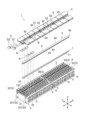
- FIG. 2 is an exploded perspective view of the electricity storage device.
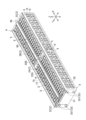
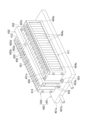
- FIG. 3 is a perspective view of the device body with the duct portion attached.
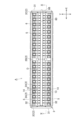
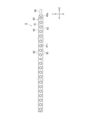
- FIG. 4 is a view of the device body with the duct portion attached, viewed from one side in the Z-axis direction.
- FIG. 5 is an exploded perspective view of the device main body.
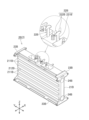
- FIG. 6 is a perspective view of a first adjacent member included in the device body.
- FIG. 7 is a perspective view of a second adjacent member included in the device body.
- FIG. 8 is a view of the duct portion as viewed from the Y-axis direction.
- FIG. 9 is a view of the duct portion as viewed from the other side in the Z-axis direction.
- FIG. 1 is a perspective view of the electricity storage device according to the present embodiment.
- FIG. 2 is an exploded perspective view of the electricity storage device.
- FIG. 3 is a perspective view
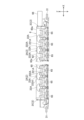
- FIG. 10 is an enlarged view of the upper part of the cross section taken along the line XX in FIG.
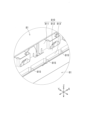
- FIG. 11 is an enlarged view of the area indicated by XI in FIG.
- FIG. 12 is a diagram of the range indicated by XI in FIG. 2 as viewed from one side in the Z-axis direction.
- FIG. 13 is a view of the range indicated by XIII in FIG. 1 as viewed from one side in the Z-axis direction.
- FIG. 14 is an enlarged view of the duct portion and its surroundings in a cut end surface taken along the line XIV-XIV in FIG.
- FIG. 15 is a cross-sectional end view of a duct portion and its periphery in a power storage device according to another embodiment.
- FIG. 16 is an enlarged perspective view of a pair of first locking pieces of a first adjacent member according to another embodiment and the surrounding area thereof.
- FIG. 17 is a perspective view of a conventional electricity storage module.
- An electric storage device comprises: A plurality of electric storage elements arranged in a first direction, the electric storage elements each having a gas exhaust valve facing a second direction perpendicular to the first direction; a duct portion that overlaps with the gas exhaust valve of the energy storage element in the second direction and guides the gas exhausted from the gas exhaust valve; an adjacent member including a main body portion located between adjacent energy storage elements in the first direction, and a locking piece extending from the main body portion along the duct portion in a direction away from the main body portion in the second direction and locking the duct portion; and an abutment portion that abuts against the locking piece from the opposite side of the duct portion in a third direction perpendicular to both the first direction and the second direction.
- the duct portion is locked to an adjacent member by a locking piece, and then the abutting portion is abutted against the locking piece from the opposite side of the duct portion in the third direction, so that the abutting portion prevents the locking piece from moving away from the duct portion in the third direction.
- the abutment portion may press the locking piece toward the duct portion.
- the locking piece is pressed against the duct portion, so that movement of the locking piece in a direction away from the duct portion in the third direction is more reliably suppressed. Even if the locking piece is not pressed against the abutment portion and a gap occurs between the locking piece and the duct portion due to manufacturing errors or the like, the locking piece is pressed against the duct portion by the abutment portion, so that the gap is suppressed. Therefore, with the above configuration, movement of the duct portion from the locking position is more reliably suppressed.
- a cover portion that covers a bus bar that electrically connects the energy storage elements to each other, the cover portion being arranged at a position that overlaps with one of the energy storage elements and the adjacent member on one side in the second direction; the duct portion is disposed on one side of the energy storage element in the second direction,
- the cover portion may have the abutment portion.
- the cover portion is positioned so as to overlap one of the energy storage element and the adjacent member on one side in the second direction, so that the abutment portion abuts against the locking piece, thereby simplifying the assembly work of the energy storage device.
- the energy storage device 1 includes a plurality of energy storage elements 10 arranged in a first direction, the energy storage elements 10 having gas exhaust valves 132, a duct portion 6 that overlaps with the gas exhaust valves 132 of the energy storage elements 10 and guides gas exhausted from the gas exhaust valves 132, an adjacent member 2 having locking pieces 22A and 22B that lock the duct portion 6, and an abutment portion that abuts against the locking pieces 22A and 22B.
- the energy storage device 1 includes a cover portion C that covers a bus bar B that electrically connects the energy storage elements 10 to each other.
- the abutment portion is a portion or member that presses the locking pieces 22A and 22B toward the duct portion 6, and is constituted by a protrusion 815 that is a part of the cover portion C (see Fig. 13).
- the energy storage device 1 comprises an apparatus main body A including a plurality of energy storage elements 10, a duct portion 6 attached to the apparatus main body A, a seal portion 7 disposed between the apparatus main body A and the duct portion 6, and a cover portion C overlapped on the portion of the apparatus main body A where the duct portion 6 is attached.
- first direction is defined as the X-axis direction of a Cartesian coordinate system
- second direction is defined as the Z-axis direction of the Cartesian coordinate system
- third direction is defined as the Y-axis direction of the Cartesian coordinate system.
- the device body A includes a stack D in which a plurality of energy storage elements 10 and adjacent members 2 are arranged alternately in the X-axis direction, and a holding portion 3 that holds the stack D.
- the device body A includes a first fixing portion 4 that fixes the adjacent members 2 to the holding portion 3, and an insulator 5 that provides insulation between the stack D and the holding portion 3.
- the energy storage element 10 is a primary battery, a secondary battery, a capacitor, etc.
- the energy storage element 10 of this embodiment is a non-aqueous electrolyte secondary battery that can be charged and discharged. More specifically, the energy storage element 10 is a lithium ion secondary battery that utilizes the electron transfer that occurs with the movement of lithium ions.
- the energy storage element 10 comprises an electrode body, a case 11 that houses the electrode body together with an electrolyte, a terminal 14 partially exposed to the outside of the case 11, and a current collector that connects the electrode body and the terminal 14.
- the energy storage element 10 of this embodiment comprises a pair of terminals 14.
- the pair of terminals 14 are arranged at a distance in the Y-axis direction at an end of the energy storage element 10 on one side in the Z-axis direction (the upper side in FIG. 5).
- positive and negative plates are stacked alternately with separators between them.
- the energy storage element 10 is charged and discharged as lithium ions move between the positive and negative plates in the electrode body.
- the case 11 has a case body 12 with an opening at one end in the Z-axis direction, and a plate-shaped cover plate 13 that covers (closes) the opening of the case body 12.
- the case body 12 has a rectangular tube shape (i.e., a bottomed rectangular tube shape) with the end on the other side in the Z-axis direction (the lower side in Figure 5) that is closed.
- the case 11 has a rectangular parallelepiped shape (six-sided shape).
- the case body 12 comprises a plate-shaped blocking portion 121 and a cylindrical body portion (peripheral wall) 122 extending from the periphery of the blocking portion 121.
- the blocking portion 121 is a portion that is located at the bottom end of the case body 12 when the case body 12 is placed with the opening facing upwards (i.e., it becomes the bottom wall of the case body 12 when the opening faces upwards).
- the blocking portion 121 is rectangular when viewed from the Z-axis direction.
- the body 122 has a rectangular cylindrical shape, more specifically, a flattened rectangular cylindrical shape.
- the body 122 has a pair of long wall portions 123 extending from the long sides at the periphery of the blocking portion 121, and a pair of short wall portions 124 extending from the short sides at the periphery of the blocking portion 121.
- the short wall portions 124 connect the ends of the pair of long wall portions 123 that face each other in the X-axis direction, thereby forming the rectangular cylindrical body 122.
- the cover plate 13 is a plate-shaped member that closes the opening of the case body 12.
- the cover plate 13 has a cover plate body 131 that is a long rectangular plate in the Y-axis direction, and a gas exhaust valve 132 that is arranged on the cover plate body 131.
- the gas exhaust valve 132 exhausts gas to the outside when gas is generated inside the case 11 and the pressure inside the case 11 exceeds a predetermined value.
- the gas exhaust valve 132 is disposed in the center of the cover plate main body 131 in the Y-axis direction. In this embodiment, the gas exhaust valve 132 is circular when viewed in the Z-axis direction.
- the cover plate 13 thus configured is joined to the case body 12 with the peripheral portion of the cover plate 13 overlapping the peripheral portion of the opening of the case body 12, thereby forming the case 11.
- the pair of terminals 14 are electrically connected to the terminals 14 of other energy storage elements 10 or to external devices.
- Each terminal 14 is made of a conductive material.
- the terminals 14 are made of an aluminum-based metal material such as aluminum or an aluminum alloy, or a copper-based metal material such as copper or a copper alloy.
- the pair of terminals 14 are disposed at both ends of the cover plate 13 in the Y-axis direction.
- the pair of terminals 14 are disposed at a position on the cover plate 13 sandwiching the gas exhaust valve 132 therebetween.
- the above energy storage element 10 has a flat rectangular parallelepiped shape.
- the multiple energy storage elements 10 are lined up in the X-axis direction with the wide faces (long wall portions 123) of the case 11 facing each other with adjacent members 2 between them.
- the gas exhaust valves 132 of the multiple energy storage elements 10 are lined up in a row in the X-axis direction.
- One terminal 14 and the other terminal 14 of the energy storage element 10 are lined up in the X-axis direction at each position sandwiching the gas exhaust valve 132 therebetween.
- the adjacent members 2 are insulating and are disposed between the energy storage elements 10 aligned in the X-axis direction, or between the energy storage elements 10 and a member aligned in the X-axis direction relative to the energy storage elements 10 (in this embodiment, the terminal portion 31, which is part of the holding portion 3).
- the adjacent members 2 are formed from resin.
- the adjacent members 2 form flow paths R between adjacent energy storage elements 10, through which a temperature-regulating fluid (in this embodiment, a gas such as air) can flow.
- the adjacent members 2 include multiple types of adjacent members 2A, 2B, and 2C.
- the adjacent members 2 include intermediate adjacent members (adjacent members) 2A, 2B that are arranged between two adjacent energy storage elements 10, and an end adjacent member 2C that is arranged between the holding portion 3 and the energy storage element 10 that is at the very end in the X-axis direction.
- multiple intermediate adjacent members are arranged.
- the multiple intermediate adjacent members include a first adjacent member 2A that is arranged between two adjacent energy storage elements 10 and is not fixed to the holding portion 3, and a second adjacent member 2B that is arranged between two adjacent energy storage elements 10 and is fixed to the holding portion 3.
- the energy storage device 1 of this embodiment includes a plurality of first adjacent members 2A, one second adjacent member 2B, and two (a pair) end adjacent members 2C.
- the first adjacent members 2A are arranged between the energy storage elements 10, excluding between the energy storage elements 10 between which the second adjacent members 2B are arranged.
- the multiple first adjacent members 2A have a first main body portion (main body portion) 21A located between adjacent energy storage elements 10 in the X-axis direction, and a first locking piece (locking piece) 22A extending from the first main body portion 21A to lock the duct portion 6.
- locking means that two parts abut (contact) with each other, so that one suppresses the movement of the other.
- the first locking piece 22A which will be described later, fixes the duct portion 6 by abutting (contacting) the locked portion 65 of the duct portion 6 so as to engage with it by hooking or the like.
- the first adjacent member 2A has a first main body portion 21A that extends in a direction perpendicular to the X-axis direction between adjacent energy storage elements 10 in the X-axis direction, and a first locking piece 22A that extends (protrudes) from the first main body portion 21A toward one side in the Z-axis direction.
- the first locking piece 22A locks the duct portion 6 to the first main body portion 21A.
- the first adjacent member 2A has a first regulating portion 23A that regulates the movement of the energy storage element 10 adjacent to the first main body portion 21A relative to the first main body portion 21A.
- the first body portion 21A is a portion that faces the long wall portion 123 of the case 11 of the energy storage element 10 with a portion of the body abutting against it.
- the first body portion 21A cooperates with an adjacent energy storage element 10 to form a flow path R between the energy storage element 10 and the long wall portion 123, through which a temperature-regulating fluid can flow.
- the first body portion 21A is a rectangular plate of a size that faces the entire surface of the long wall portion 123 of the case 11 of the energy storage element 10 when viewed from the X-axis direction, and the cross-sectional shape along the X-Z plane (a plane including the X-axis direction and the Z-axis direction) is a rectangular waveform.
- the two first locking pieces 22A extend from positions spaced apart in the Y-axis direction at one end of the first main body portion 21A in the Z-axis direction.
- the distance between the two first locking pieces 22A in the Y-axis direction corresponds to the dimension of the duct portion 6 in the Y-axis direction (a dimension that can lock the locked portion 65 of the duct portion 6 described below).
- the first locking piece 22A extends in the Z-axis direction along the duct portion 6.
- the first locking piece 22A is plate-shaped with the Y-axis direction as its thickness direction (in other words, plate-shaped along the X-Z plane).
- the first locking piece 22A has a locking piece main body 221A that extends from the first main body portion 21A along the duct portion 6 in the Z-axis direction (the opposing direction of the gas exhaust valve 132 and the duct portion 6), and a locking portion 222A that engages with the duct portion 6 (more specifically, the locked portion 65 of the duct portion main body 60 described below).
- the locking piece main body 221A is a strip-shaped portion that extends straight from the first main body portion 21A to one side in the Z-axis direction.
- the locking piece main body 221A is strip-shaped with a constant dimension in the X-axis direction at each position in the Z-axis direction.
- the locking portion 222A is a portion of the locking piece main body 221A that extends in the X-axis direction (the direction in which the duct portion 6 extends) from a position spaced apart on one side in the Z-axis direction from the first main body portion 21A.
- the locking portion 222A extends from the locking piece main body 221A to one side and the other side in the X-axis direction.
- the first locking piece 22A has two locking portions 222A.
- the first regulating portion 23A extends in the X-axis direction from a corner of the rectangular first body portion 21A and abuts against the energy storage element 10 (more specifically, the case 11) adjacent to the first body portion 21A from the outside in the Y-Z plane direction, thereby regulating the relative movement of the energy storage element 10 in the Y-Z plane direction with respect to the first body portion 21A.
- the first regulating portion 23A extends from the first body portion 21A toward one side and the other side in the X-axis direction.
- the second adjacent member 2B has a second main body portion (main body portion) 21B located between adjacent energy storage elements 10 in the X-axis direction, and a second locking piece (locking piece) 22B extending from the second main body portion 21B and locking the duct portion 6.
- the second adjacent member 2B has a second main body portion 21B that extends in a direction perpendicular to the X-axis direction between adjacent energy storage elements 10 in the X-axis direction, and a second locking piece 22B that extends (protrudes) from the second main body portion 21B toward one side in the Z-axis direction and locks the duct portion 6 to the second main body portion 21B.
- the second adjacent member 2B has a second restricting portion 23B that restricts the movement of the energy storage element 10 adjacent to the second main body portion 21B relative to the second main body portion 21B, and a second fixing portion 24B that is used to fix the second adjacent member 2B to the holding portion 3.
- the second body portion 21B is a portion that faces the long wall portion 123 of the case 11 of the energy storage element 10 with a portion of the long wall portion 123 being in contact with the long wall portion 123.
- the second body portion 21B cooperates with the adjacent energy storage element 10 to form a flow path R through which a temperature-regulating fluid can flow between the energy storage element 10 and the second body portion 21B.
- the dimension of the second body portion 21B in the X-axis direction is larger than the dimension of the first body portion 21A in the X-axis direction (i.e., it is thick).
- the second body portion 21B is a rectangular plate of a size that faces the entire surface of the long wall portion 123 of the case 11 of the energy storage element 10 when viewed from the X-axis direction.
- the second body portion 21B has a plurality of ridges 211B that extend in the Y-axis direction and are spaced apart in the Z-axis direction.
- the plurality of ridges 211B protrude from the surface 212B of the second body portion 21B that faces the energy storage element 10.
- the two second locking pieces 22B extend from positions spaced apart in the Y-axis direction at one end of the second main body portion 21B in the Z-axis direction.
- the distance between the two second locking pieces 22B in the Y-axis direction corresponds to the dimension of the duct portion 6 in the Y-axis direction (a dimension that allows the second locking pieces 22B to be locked with the locked portion 65 of the duct portion 6 described below), similar to the two first locking pieces 22A of the first adjacent member 2A.
- the second locking pieces 22B extend in the Z-axis direction along the duct portion 6.
- the configuration of each of the two second locking pieces 22B is the same as the configuration of the first locking piece 22A.
- the second locking piece 22B has a locking piece main body 221B and a locking portion 222B.
- the second restricting portion 23B extends in the X-axis direction from a corner of the rectangular second body portion 21B and contacts the energy storage element 10 (more specifically, the case 11) adjacent to the second body portion 21B from the outside in the Y-Z plane direction, thereby restricting the relative movement of the energy storage element 10 in the Y-Z plane direction with respect to the second body portion 21B.
- the second restricting portion 23B extends from the second body portion 21B toward one side and the other side in the X-axis direction.
- the second fixing portion 24B is disposed at the end of the second main body portion 21B in the Y-axis direction.
- the second fixing portion 24B engages with the first fixing portion 4 to fix the second adjacent member 2B and the retaining portion 3.
- the second fixing portion 24B in this embodiment is an insert nut.
- Each first fixing portion 4 in this embodiment is a bolt, which is inserted through the retaining portion 3 and screwed into the second fixing portion 24B to fix the retaining portion 3 to the second adjacent member 2B.
- the end adjacent member 2C has a third body portion 21C that overlaps with the energy storage element 10 when viewed from the X-axis direction, and a third restricting portion 23C that restricts the movement of the energy storage element 10 adjacent to the third body portion 21C relative to the third body portion 21C.
- the end adjacent member 2C forms a flow path R between the adjacent energy storage elements 10, through which a temperature-regulating fluid can flow.
- the third body portion 21C is a portion that faces the long wall portion 123 of the energy storage element 10 with a portion of the long wall portion 123 abutting against it. Like the first body portion 21A of the first adjacent member 2A and the second body portion 21B of the second adjacent member 2B, the third body portion 21C cooperates with the adjacent energy storage element 10 to form a flow path R through which a temperature-regulating fluid can flow between the energy storage element 10 and the third body portion 21C.
- the third body portion 21C of this embodiment is a rectangular plate of a size that faces the entire surface of the long wall portion 123 of the case 11 of the energy storage element 10 when viewed from the X-axis direction.
- the third body portion 21C has a plurality of ridges 211C that extend in the Y-axis direction and are spaced apart in the Z-axis direction.
- the plurality of ridges 211C protrude from the surface 212C of the third body portion 21C that faces the energy storage element 10.
- the third restricting portion 23C extends in the X-axis direction from a corner of the rectangular third main body portion 21C and restricts the relative movement of the energy storage element 10 in the Y-Z plane direction with respect to the third main body portion 21C by abutting the energy storage element 10 (more specifically, the case 11) adjacent to the third main body portion 21C from the outside in the Y-Z plane direction.
- the third restricting portion 23C extends from the third main body portion 21C in a direction toward the energy storage element 10 in the X-axis direction.
- the holding portion 3 holds the stack D by surrounding the stack D.
- the holding portion 3 holds the multiple energy storage elements 10 and the multiple adjacent members 2 together by surrounding the multiple energy storage elements 10 and the multiple adjacent members 2.
- the holding portion 3 is made of metal, resin, or the like.
- the holding portion 3 has a pair of end portions 31 arranged on either side of the laminate D in the X-axis direction, an extension portion 32 that extends in the X-axis direction along the laminate D at a position aligned with the laminate D in the Y-axis direction, and a connecting portion 33 that connects the end portion 31 and the extension portion 32.
- the holding portion 3 in this embodiment has a pair of extension portions 32 that are spaced apart in the Y-axis direction so that the laminate D is located between them.
- the terminal portion 31 is arranged so as to sandwich the end adjacent member 2C between it and the energy storage element 10 arranged at the end in the X-axis direction.
- the terminal portion 31 has a terminal portion main body 311 that spreads along the Y-Z plane direction, and a flange portion 313 that extends from the terminal portion main body 311 in a direction away from the energy storage element 10 in the X-axis direction.
- the terminal body 311 is rectangular and sized to face the entire surface of the long wall portion 123 of the case 11 of the energy storage element 10 when viewed from the X-axis direction.
- the terminal body 311 is rectangular and elongated in the Y-axis direction, and has a plurality of through holes 312 spaced apart in the Z-axis direction at both ends in the Y-axis direction.
- the flange portion 313 extends in the X-axis direction and the Y-axis direction from one end of the terminal body 311 in the Z-axis direction.
- the pair of extension portions 32 include an extension portion main body 320 that faces the short wall portion 124 of each storage element 10, a first piece portion 321 that extends from one end of the extension portion main body 320 in the Z-axis direction along the cover plate 13 of each storage element 10 in the Y-axis direction and also in the X-axis direction, a second piece portion 322 that extends from the other end of the extension portion main body 320 in the Z-axis direction along the blocking portion 121 of each storage element 10 in the Y-axis direction and also in the X-axis direction, and a pair of third pieces 323 that extend from each end of the extension portion main body 320 in the X-axis direction along the terminal portion 31 in the Y-axis direction and also in the Z-axis direction.
- the extension body 320 is a plate-like portion that extends along the short wall portions 124 of the multiple energy storage elements 10, and has multiple ventilation holes 3201 that penetrate in the Y-axis direction to allow temperature-regulating fluid to flow in and out of the flow path R, and multiple first fixing holes 3202 that penetrate in the Y-axis direction at a position opposite the second fixing portion 24B of the second adjacent member 2B.
- the first fixing portion 4 is inserted into the first fixing holes 3202.
- the first piece 321 is a strip-shaped portion that is long in the X-axis direction
- the second piece 322 is also a strip-shaped portion that is long in the X-axis direction.
- the width of the second piece 322 excluding both ends in the X-axis direction (dimension in the Y-axis direction) is greater than the width of the first piece 321.
- the pair of third pieces 323 have a number of second fixing holes 3231 that are spaced apart in the Z-axis direction.
- the second fixing holes 3231 are located opposite the through holes 312 of the terminal end portion 31.
- the connecting portion 33 connects the terminal end portion 31 and the extension portion 32 by being inserted through the through hole 312 of the terminal end portion 31 and the second fixing hole 3231 of the extension portion 32 (more specifically, the third piece portion 323).
- the connecting portion 33 in this embodiment is composed of a bolt 331 and a nut 332.
- the insulator 5 has insulating properties.
- the insulator 5 is disposed between the extension portion 32 and the laminate D.
- the energy storage device 1 includes a pair of insulators 5.
- the insulator 5 covers the area of the extension portion 32 that faces the multiple energy storage elements 10. As a result, the insulator 5 provides insulation between the extension portion 32 and the multiple energy storage elements 10.
- the insulator 5 has a ventilation area 51 of the same size and shape as the ventilation holes 3201 of the extension portion main body 320 at a position facing each ventilation hole 3201 of the extension portion main body 320.
- the sealing portion 7 is a portion or member disposed between the device main body A and the duct portion 6 to suppress gas leakage from between the device main body A and the duct portion 6.
- the sealing portion 7 has a sealing portion communication hole 71 that communicates between the gas exhaust valve 132 and the guide space S.
- the sealing portion 7 is disposed at one end of the device main body A in the Z-axis direction, in a position facing the gas exhaust valve 132 of the energy storage element 10 in the Z-axis direction, and extends in the X-axis direction.
- the sealing portion 7 in this embodiment is formed from a foam such as a fluorine-based, silicone-based, or urethane-based resin, and provides a seal between the device main body A and the duct portion 6.
- the seal portion 7 is a band-shaped member whose width direction is the Y-axis direction and whose length direction is the X-axis direction, and has a seal portion communication hole 71 at a position facing the gas exhaust valve 132 of the energy storage element 10 (more specifically, at a position overlapping with the gas exhaust valve 132 when viewed from the Z-axis direction).
- the seal portion 7 has multiple seal portion communication holes 71.
- the multiple seal portion communication holes 71 are arranged in a row with spaces between them in the X-axis direction.
- the width (dimension in the Y-axis direction) of the seal portion 7 in this embodiment is the same as that of the duct portion 6.
- the shape of the seal portion communication hole 71 as viewed in the Z-axis direction is preferably similar to that of the gas exhaust valve 132, and more preferably the same shape.
- the size of the seal portion communication hole 71 as viewed in the Z-axis direction is preferably approximately the same as that of the gas exhaust valve 132.
- the seal portion communication hole 71 in this embodiment is a circular hole with a diameter the same as or approximately the same as that of the gas exhaust valve 132.
- the duct portion 6 is disposed along the X-axis direction, facing the gas exhaust valve 132 in the Z-axis direction. In this embodiment, the duct portion 6 extends along the multiple storage elements 10 from the storage element 10 at one end in the X-axis direction to the storage element 10 at the other end.
- the duct portion 6 has a duct portion main body 60 that extends in the X-axis direction and guides gas discharged from the gas exhaust valve 132 of the energy storage element 10 in the X-axis direction, and a joint portion 66 that extends from an end portion 60a of the duct portion main body 60 in the X-axis direction.
- the duct portion 6 also has an engaging portion 65 that engages with the engaging pieces 22A, 22B (more specifically, the engaging portions 222A, 222B of the engaging pieces 22A, 22B) of the adjacent member 2 (see FIG. 10).
- the duct portion 6 of this embodiment is made of resin such as polybutylene terephthalate or glass fiber blended resin (polybutylene terephthalate-glass fiber).
- the duct section main body 60 is a hollow cylindrical section that extends in the X-axis direction and has a guide space S inside.
- the duct section main body 60 extends from one end of the device main body A in the X-axis direction (the left side in FIG. 4) to the other end (the right side in FIG. 4), with the end on one side (the side opposite the joint section 66) being closed.
- the duct section main body 60 is positioned so as to overlap the gas exhaust valve 132 of the energy storage element 10 (see FIG. 4).
- the duct body 60 has a bottom wall 61 that faces the device body A (multiple energy storage elements 10), a pair of side wall portions 62 that extend from both ends of the bottom wall portion 61 in the Y-axis direction to one side in the Z-axis direction, and a top wall portion 63 that connects the ends of the pair of side wall portions 62 on one side in the Z-axis direction.
- the space surrounded by the bottom wall portion 61, the pair of side wall portions 62, and the top wall portion 63 constitutes a guide space S that can guide gas discharged from the gas discharge valve 132 to the joint portion 66.
- the bottom wall portion 61 is a band-shaped portion whose width direction is the Y-axis direction and whose length direction is the X-axis direction, and is the portion of the duct portion main body 60 that sandwiches the seal portion 7 between itself and the device main body A.
- the bottom wall portion 61 has a bottom wall communication hole 611 that communicates the seal portion communication hole 71 with the guide space S at a position facing the seal portion communication hole 71 of the seal portion 7 in the Z-axis direction (a position facing the gas exhaust valve 132 of the energy storage element 10 in the Z-axis direction).
- the bottom wall portion 61 has a plurality of bottom wall communication holes 611. The multiple bottom wall communication holes 611 are arranged in a row at intervals in the X-axis direction on the bottom wall portion 61.
- Each of the pair of side wall portions 62 is a band-shaped portion that extends in the X-Z plane direction, with the Z axis direction as the width direction and the X axis direction as the length direction.
- the outer surfaces 62a of the pair of side wall portions 62 form the end faces of the duct portion 6 in the Y axis direction, and are the surfaces with which the first locking piece 22A of the first adjacent member 2A and the second locking piece 22B of the second adjacent member 2B come into surface contact.
- the interlocking portions 65 are the portions where the interlocking pieces 22A, 22B of the adjacent members 2A, 2B engage (in this embodiment, get caught) in order to fix the duct portion 6 to the adjacent members 2A, 2B (i.e., the device main body A).
- the interlocking portions 65 protrude outward in the Y-axis direction from the side wall portion 62.
- the interlocking portions 65 are arranged at intervals in the X-axis direction on the side wall portion 62.
- the interlocking portions 65 are arranged in positions opposite in the Y-axis direction to the position in the X-axis direction of the bottom wall communication hole 611 of the bottom wall portion 61.
- the joint portion 66 is connected to another member, and is capable of releasing the gas guided to the end portion 60a of the duct body 60 to the other member.
- the joint portion 66 is cylindrical and connects the guide space S to the external space.
- the duct portion 6 is attached to the device main body A with the seal portion 7 sandwiched between it and the device main body A.
- the locking piece bodies 221A, 221B of the adjacent members 2A, 2B are positioned between adjacent locked portions 65 spaced apart in the X-axis direction.
- the locking portions 222A, 222B extending from the locking piece bodies 221A, 221B abut (engage) with the locked portions 65 adjacent to the locking piece bodies 221A, 221B in the X-axis direction from one side in the Z-axis direction. This causes the duct portion 6 to be locked to the device main body A (each adjacent member 2A, 2B).
- the cover part C is a member that is arranged at a position that overlaps at least one of the energy storage elements 10 and the adjacent member 2 on one side in the Z-axis direction.
- the cover part C is a member that is arranged on the device main body A to accommodate the bus bar B that conductively connects the energy storage elements 10 to each other.
- the cover part C in this embodiment is a resin member, and is overlapped on one side in the Z-axis direction with the device main body A in a state in which the duct part 6 is attached.
- the cover part C includes a plurality of bus bars B, a cover part main body 8 that houses (covers) the plurality of bus bars B, and a harness 9 that has a plurality of electric wires that are connected to the plurality of bus bars B.
- a harness 9 that has a plurality of electric wires that are connected to the plurality of bus bars B.
- FIG. 2 in order to explain the configuration, some of the plurality of bus bars B arranged within the cover part C are shown outside the cover part C.
- the bus bar B is a plate-like member having electrical conductivity such as metal, and connects the terminals 14 of different energy storage elements 10.
- the bus bar B connects the terminals 14 of adjacent energy storage elements 10 to each other, thereby providing electrical conductivity between them.
- each bus bar B is welded to a terminal 14.
- the harness 9 has a cable portion 91 having multiple electric wires, and a connector 92 arranged at the end of the cable portion 91.
- the other end of each electric wire in the cable portion 91 is connected to a bus bar B or the like, and one end of each electric wire is connected to the connector 92.
- the cable portion 91 is formed by bundling at least some of a number of electric wires whose other ends are connected to a bus bar B or the like.
- the cable portion 91 is arranged on the cover portion main body 8 with one end protruding from the cover portion main body 8 in the X-axis direction.
- a connector 92 is attached to the tip of the cable portion 91 in the protruding direction.
- the connector 92 in this embodiment is a multi-core connector, and two connectors are arranged.
- the cover body 8 is made of an insulating material such as resin, and is a plate-shaped part or member that covers the surface of the device body A on which the terminals 14 are arranged.
- the cover body 8 is a rectangular member whose dimension in the Z-axis direction is smaller than its dimensions in the X-axis direction and Y-axis direction.
- the cover body 8 in this embodiment is large enough to cover the device body A when viewed from the Z-axis direction.
- the cover body 8 has two busbar accommodating sections 81 that accommodate the busbar B connected to the terminals 14 of the energy storage element 10, a duct arrangement section 82 formed between the two busbar accommodating sections 81, an electric wire arrangement section 83 in which the harness 9 is arranged, and multiple lid sections 84.
- the cover body 8 has multiple connection sections 85 that connect the two busbar accommodating sections 81.
- the multiple connection sections 85 are arranged at intervals in the X-axis direction.
- the two busbar accommodating sections 81 are arranged with a gap in the Y-axis direction.
- the busbar accommodating section 81 has an accommodating section main body 810 that accommodates at least one busbar B (two in this embodiment) with the periphery of the busbar B surrounded by a wall, and a protrusion 815 that is arranged inside the accommodating section main body 810 in the Y-axis direction and restricts the movement of the locking pieces 22A, 22B that engage the duct section 6.
- Each busbar accommodating section 81 in this embodiment has a plurality of protrusions 815.
- the protrusions 815 are arranged in positions facing the locking pieces 22A, 22B of the intermediate adjacent members 2A, 2B in the X-axis direction.
- the protrusions 815 constitute the above-mentioned abutment section (the portion or member that presses the locking pieces 22A, 22B toward the duct section 6).
- the storage unit main body 810 has a bus bar holding portion 811 that holds the bus bar B with the bus bar surrounded by a wall, a first portion 812 that extends inward in the Y-axis direction from the bus bar holding portion 811 in a cross section taken along the Y-Z plane, and a second portion 813 that extends from the tip of the first portion 812 toward the other side in the Z-axis direction in a cross section taken along the Y-Z plane.
- the first portion 812 is a band-shaped portion whose width direction is the Y-axis direction and whose length direction is the X-axis direction
- the second portion 813 is a band-shaped portion whose width direction is the Z-axis direction and whose length direction is the X-axis direction.
- the multiple protrusions 815 protrude inward in the Y-axis direction from the second portion 813 and extend in the Z-axis direction. As shown in Figures 13 and 14, the protrusions 815 are disposed in positions facing the locking pieces 22A, 22B that lock the duct portion 6 to the adjacent members 2A, 2B in the Y-axis direction, and abut against the locking pieces 22A, 22B from the outside in the Y-axis direction. In this embodiment, each protrusion 815 presses the locking pieces 22A, 22B that lock the duct portion 6 toward the duct portion 6 in the Y-axis direction.
- the convex portion 815 is a triangular prism whose dimension in the X-axis direction decreases as it approaches the tip in the protruding direction (Y-axis direction) (see Figures 12 and 13), and has an inclined surface 815a at the other end in the Z-axis direction that is positioned outward in the Y-axis direction as it approaches the other side in the Z-axis direction (see Figure 14).
- the duct arrangement section 82 is constituted by the space formed between the two busbar accommodating sections 81, and is the region in which the duct section 6 (the duct section in which the locking pieces 22A, 22B of the adjacent members 2A, 2B are engaged (hooked) with the locking section 65) is located when attached to the device main body A.
- the duct arrangement section 82 extends from one end to the other end in the X-axis direction of the cover main body 8, and the dimension in the Y-axis direction corresponds to the dimension in the Y-axis direction of the duct section 6 (the dimension is large enough to accommodate the duct section 6 and the locking pieces 22A, 22B that lock the duct section 6 on both sides in the Y-axis direction).
- the other side in the Z-axis direction of the duct arrangement section 82 is open.
- the duct section 6 enters the duct arrangement section 82 (the space between the two busbar accommodating sections 81) from this open region.
- the electric wire placement section 83 is a groove-shaped portion in the cover body 8, and the cable section 91 of the harness 9 is placed inside.
- the lid portion 84 is a plate-like portion that can be opened and closed to cover an end opening on one side in the Z-axis direction of the wall surrounding the bus bar B in the bus bar accommodating portion 81.
- the lid portion 84 is a rectangular plate, and part of the periphery is connected to part of the wall surrounding the bus bar B.
- the duct portion 6 is attached to the device main body A, and then the cover portion C is attached to the device main body A.
- the duct portion 6 is pushed between the pair of locking pieces 22A, 22B of the intermediate adjacent members 2A, 2B of the device body A.
- the pair of locking pieces of the intermediate adjacent members 2A, 2B are pushed apart by the duct portion 6 in a direction that increases the distance between their tips in the Y-axis direction, and are bent (elastically deformed).
- the pair of locking pieces 22A, 22B return from the bent state to their original state, and the locking portions 222A, 222B of the locking pieces 22A, 22B are hooked onto the locked portion 65 (abutting from one side in the Z-axis direction) (see FIG. 10).
- This causes the duct portion 6 to be locked to the intermediate adjacent members 2A, 2B.
- the duct portion 6 is fixed to the device body A.
- the cover part C (more specifically, the cover part main body 8) is aligned with the device main body A and overlapped on the device main body A toward the other side in the Z-axis direction so that the duct part 6 engaged with the intermediate adjacent members 2A, 2B of the device main body A (i.e., attached to the device main body A) fits into the duct arrangement part (the space formed between the two bus bar accommodating parts 81) 82 from the other side in the Z-axis direction.
- the cover part C When the cover part C is placed (attached) to the device main body A with the duct part 6 attached, the duct part 6 fits into the duct arrangement part 82.
- the busbar accommodating sections 81 are arranged in adjacent positions on both sides of the duct section 6 in the Y-axis direction.
- the busbar accommodating sections 81 have protrusions 815 at positions facing the X-axis locking pieces 22A, 22B on the inside of the Y-axis direction, so that the protrusions 815 abut against the locking pieces 22A, 22B of the intermediate adjacent members 2A, 2B that lock the duct section 6 from the outside in the Y-axis direction, pressing them toward the duct section 6.
- the locking pieces 22A, 22B are pressed against the side wall section 62 of the duct section 6 while abutting against the locked section 65 from one side in the Z-axis direction (see Figures 13 and 14).
- the energy storage device 1 of this embodiment configured as described above includes a plurality of energy storage elements 10 arranged in the X-axis direction (first direction), the energy storage elements 10 having gas exhaust valves facing the Z-axis direction (second direction), a duct portion 6 that overlaps with the gas exhaust valves 132 of the energy storage elements 10 in the Z-axis direction and guides the gas exhausted from the gas exhaust valves 132, main body portions 21A, 21B located between the energy storage elements 10 adjacent in the X-axis direction, intermediate adjacent members 2A, 2B that extend from the main body portions 21A, 21B along the duct portion 6 in a direction away from the main body portions 21A, 21B in the Z-axis direction and have locking pieces 22A, 22B that lock the duct portion 6, and a convex portion (contact portion) 815 that contacts the locking pieces 22A, 22B from the opposite side of the duct portion 6 in the Y-axis direction (third direction).
- the duct portion 6 is locked to the intermediate adjacent members 2A and 2B by the locking pieces 22A and 22B, and then the protrusions 815 are brought into contact with the locking pieces 22A and 22B from the opposite side of the duct portion 6 in the Y-axis direction, so that the movement of the locking pieces 22A and 22B, such as bending, away from the duct portion 6 in the Y-axis direction is suppressed by the protrusions 815.
- the convex portion (contact portion) 815 presses the locking pieces 22A, 22B toward the duct portion 6.
- the convex portion (contact portion) 815 presses the locking pieces 22A, 22B toward the duct portion 6.
- movement of the locking pieces 22A, 22B in a direction away from the duct portion 6 in the Y-axis direction is more reliably suppressed.
- the locking pieces 22A, 22B are not pressed by the convex portion 815 and a gap occurs between the locking pieces 22A, 22B and the duct portion 6 due to manufacturing errors or the like, the locking pieces 22A, 22B are pressed against the duct portion 6 by the convex portion 815, thereby suppressing the gap.
- movement of the duct portion 6 from the locking position is more reliably suppressed.
- the energy storage device 1 of this embodiment includes a cover portion C that covers the bus bar B that electrically connects the energy storage elements 10 to each other, and is arranged at a position that overlaps with the energy storage element 10 and one of the intermediate adjacent members 2A, 2B on one side in the Z axis direction.
- the cover portion C has an abutment portion (convex portion) 815.
- a part of the cover portion C (convex portion 815) forms an abutment portion that abuts against the locking pieces 22A, 22B from the opposite side of the duct portion 6 in the Y axis direction (third direction).
- the cover part C is positioned so as to overlap the energy storage element 10 and one of the intermediate adjacent members 2A, 2B on one side in the Z-axis direction, so that the protrusions 815 abut against the locking pieces 22A, 22B. This simplifies the assembly work of the energy storage device 1 compared to when the abutment parts (protrusions 815) are separate from the cover part C.
- the energy storage device of the present invention is not limited to the above-described embodiment, and various modifications can be made without departing from the spirit of the present invention.
- the configuration of one embodiment can be added to the configuration of another embodiment, and part of the configuration of one embodiment can be replaced with the configuration of another embodiment. Part of the configuration of one embodiment can be deleted.
- the abutment portion (a portion or member that abuts against the locking pieces 22A, 22B from the opposite side of the duct portion 6 in the Y-axis direction) is configured by a part (convex portion) 815 of the cover portion C, but is not limited to this configuration.
- the abutment portion may be separate from the cover portion C.
- the abutment portion may be a single member or component, etc., and may be configured by a part of a member other than the cover portion (member that covers or houses the bus bar B) C and the adjacent member 2.
- the protrusions (contact portions) 815 press the locking pieces 22A and 22B toward the duct portion 6, but this configuration is not limited to this.
- the protrusions (contact portions) 815 may be in contact with the locking pieces 22A and 22B without being pressed.
- the portion (protrusion) 815 that protrudes from the second portion 813 of the storage unit main body 810 toward the locking pieces 22A and 22B constitutes the abutment portion.
- the protrusion 815 abuts against the locking pieces 22A and 22B (in the above embodiment, it presses against the locking pieces 22A and 22B) to restrict the movement of the locking pieces 22A and 22B, but is not limited to this configuration.
- protrusions 223A protruding outward in the Y-axis direction from locking piece bodies 221A, 221B of locking pieces 22A, 22B may be configured to restrict outward movement of locking pieces 22A, 22B in the Y-axis direction.
- second portion 813 (wall-like portion extending in the X-Z plane direction) of cover C fixed to device body A is the abutment portion.
- protrusions 223A have a shape (triangular or trapezoidal when viewed from the X-axis direction) with an inclined portion in the mounting direction of cover C to device body A (Z-axis direction in the example shown in Fig. 15) because this reduces interference when mounting cover C to device body A.
- one abutment portion (convex portion 815) is arranged for one locking piece 22A, 22B, but this configuration is not limited to this.
- a convex strip (abutment portion) that protrudes inward in the Y-axis direction from a portion (second portion 813 in the above embodiment) whose position is fixed relative to the device main body A and extends in the X-axis direction and abuts (presses) against (presses against) the multiple locking pieces 22A, 22B that are arranged at intervals in the X-axis direction may be arranged so that one abutment portion (convex portion) is arranged for multiple locking pieces 22A, 22B.
- the specific configuration of the protrusion (contact portion) 815 is not limited.
- the contact portion may be configured to contact (or press) the locking pieces 22A, 22B from the opposite side of the duct portion 6 in the Y-axis direction, and to be fixed in position relative to the device main body A.
- the convex portion 815 has a shape in which the contact portion with the locking pieces 22A, 22B and the cover part C is linear. Linear contact between the convex portion 815 and the locking pieces 22A, 22B and the cover part C reduces interference when the cover part C is attached to the device main body A, making it easier to attach the cover part C.
- the width of the linear contact portion may be a surface having a width of about several centimeters.
- the storage element is described as being used as a chargeable and dischargeable non-aqueous electrolyte secondary battery (lithium ion secondary battery), but the type and size (capacity) of the storage element are arbitrary.
- the present invention is also applicable to storage elements of various secondary batteries, as well as other primary batteries and capacitors such as electric double layer capacitors.
- Gas exhaust valve 404a... battery holder, 405... element stack, 410... end plate, 411... side frame, 450... duct device, 451... gas guide portion, 451a... guide portion mounting piece, 452... leg portion, 452a ...Leg mounting piece, 455, 456...Screw, A...Device body, B...Bus bar, C...Cover part, D...Laminate, R...Flow path, S...Guide space
Landscapes
- Engineering & Computer Science (AREA)
- Power Engineering (AREA)
- Chemical & Material Sciences (AREA)
- Chemical Kinetics & Catalysis (AREA)
- Electrochemistry (AREA)
- General Chemical & Material Sciences (AREA)
- Microelectronics & Electronic Packaging (AREA)
- Battery Mounting, Suspending (AREA)
- Gas Exhaust Devices For Batteries (AREA)
Priority Applications (3)
| Application Number | Priority Date | Filing Date | Title |
|---|---|---|---|
| JP2025505693A JPWO2024185893A1 (https=) | 2023-03-08 | 2024-03-08 | |
| CN202480016411.1A CN120731537A (zh) | 2023-03-08 | 2024-03-08 | 蓄电装置 |
| EP24767258.7A EP4679605A1 (en) | 2023-03-08 | 2024-03-08 | Power storage device |
Applications Claiming Priority (2)
| Application Number | Priority Date | Filing Date | Title |
|---|---|---|---|
| JP2023-035324 | 2023-03-08 | ||
| JP2023035324 | 2023-03-08 |
Publications (1)
| Publication Number | Publication Date |
|---|---|
| WO2024185893A1 true WO2024185893A1 (ja) | 2024-09-12 |
Family
ID=92675301
Family Applications (1)
| Application Number | Title | Priority Date | Filing Date |
|---|---|---|---|
| PCT/JP2024/009157 Ceased WO2024185893A1 (ja) | 2023-03-08 | 2024-03-08 | 蓄電装置 |
Country Status (4)
| Country | Link |
|---|---|
| EP (1) | EP4679605A1 (https=) |
| JP (1) | JPWO2024185893A1 (https=) |
| CN (1) | CN120731537A (https=) |
| WO (1) | WO2024185893A1 (https=) |
Cited By (1)
| Publication number | Priority date | Publication date | Assignee | Title |
|---|---|---|---|---|
| WO2025105402A1 (ja) * | 2023-11-14 | 2025-05-22 | 株式会社Gsユアサ | 蓄電装置 |
Citations (5)
| Publication number | Priority date | Publication date | Assignee | Title |
|---|---|---|---|---|
| JP2010251019A (ja) * | 2009-04-13 | 2010-11-04 | Sanyo Electric Co Ltd | バッテリシステム |
| JP2011014321A (ja) * | 2009-06-30 | 2011-01-20 | Sanyo Electric Co Ltd | バッテリシステム |
| JP5649811B2 (ja) * | 2009-11-09 | 2015-01-07 | 三洋電機株式会社 | 車両用電源装置及びこれを備える車両並びに車両用電源装置の製造方法 |
| JP2017212214A (ja) | 2013-06-06 | 2017-11-30 | 日立オートモティブシステムズ株式会社 | 蓄電モジュール、電池モジュールの製造方法 |
| JP2023108789A (ja) * | 2022-01-26 | 2023-08-07 | 株式会社Gsユアサ | 蓄電装置 |
-
2024
- 2024-03-08 JP JP2025505693A patent/JPWO2024185893A1/ja active Pending
- 2024-03-08 EP EP24767258.7A patent/EP4679605A1/en active Pending
- 2024-03-08 CN CN202480016411.1A patent/CN120731537A/zh active Pending
- 2024-03-08 WO PCT/JP2024/009157 patent/WO2024185893A1/ja not_active Ceased
Patent Citations (5)
| Publication number | Priority date | Publication date | Assignee | Title |
|---|---|---|---|---|
| JP2010251019A (ja) * | 2009-04-13 | 2010-11-04 | Sanyo Electric Co Ltd | バッテリシステム |
| JP2011014321A (ja) * | 2009-06-30 | 2011-01-20 | Sanyo Electric Co Ltd | バッテリシステム |
| JP5649811B2 (ja) * | 2009-11-09 | 2015-01-07 | 三洋電機株式会社 | 車両用電源装置及びこれを備える車両並びに車両用電源装置の製造方法 |
| JP2017212214A (ja) | 2013-06-06 | 2017-11-30 | 日立オートモティブシステムズ株式会社 | 蓄電モジュール、電池モジュールの製造方法 |
| JP2023108789A (ja) * | 2022-01-26 | 2023-08-07 | 株式会社Gsユアサ | 蓄電装置 |
Non-Patent Citations (1)
| Title |
|---|
| See also references of EP4679605A1 |
Cited By (1)
| Publication number | Priority date | Publication date | Assignee | Title |
|---|---|---|---|---|
| WO2025105402A1 (ja) * | 2023-11-14 | 2025-05-22 | 株式会社Gsユアサ | 蓄電装置 |
Also Published As
| Publication number | Publication date |
|---|---|
| EP4679605A1 (en) | 2026-01-14 |
| CN120731537A (zh) | 2025-09-30 |
| JPWO2024185893A1 (https=) | 2024-09-12 |
Similar Documents
| Publication | Publication Date | Title |
|---|---|---|
| US12500286B2 (en) | Battery module comprising side separator with a biasing portion | |
| US11158911B2 (en) | Terminal connection structure, battery stack body, and method for forming terminal connection structure | |
| KR20240049824A (ko) | 이차 전지 | |
| US20190051871A1 (en) | Energy storage apparatus, moving body, and energy storage system | |
| JP7828545B2 (ja) | 蓄電装置 | |
| JP7605204B2 (ja) | 蓄電設備 | |
| WO2024185893A1 (ja) | 蓄電装置 | |
| US20250372805A1 (en) | Energy storage apparatus | |
| JP7324428B2 (ja) | 蓄電装置 | |
| WO2024185894A1 (ja) | 蓄電装置 | |
| JP2022123240A (ja) | 蓄電装置 | |
| JP7716645B2 (ja) | 蓄電装置 | |
| JP2023136719A (ja) | 蓄電装置 | |
| JP2023136602A (ja) | 蓄電装置 | |
| JP2025070562A (ja) | 蓄電装置 | |
| WO2025105402A1 (ja) | 蓄電装置 | |
| EP4354596B1 (en) | Battery module | |
| JP7753711B2 (ja) | 蓄電装置 | |
| JP7681259B2 (ja) | 蓄電装置 | |
| JP7748619B2 (ja) | 蓄電装置 | |
| WO2024185895A1 (ja) | 蓄電装置 | |
| WO2023145586A1 (ja) | 蓄電装置 | |
| US20230037871A1 (en) | Battery module and battery pack including the same | |
| WO2026083820A1 (ja) | 蓄電装置 | |
| KR20250136518A (ko) | 인터버스바 유닛, 이를 포함하는 팩 하우징, 이를 포함하는 배터리 팩 및 이의 제조 방법 |
Legal Events
| Date | Code | Title | Description |
|---|---|---|---|
| 121 | Ep: the epo has been informed by wipo that ep was designated in this application |
Ref document number: 24767258 Country of ref document: EP Kind code of ref document: A1 |
|
| WWE | Wipo information: entry into national phase |
Ref document number: 2025505693 Country of ref document: JP |
|
| WWE | Wipo information: entry into national phase |
Ref document number: 202480016411.1 Country of ref document: CN |
|
| WWP | Wipo information: published in national office |
Ref document number: 202480016411.1 Country of ref document: CN |
|
| WWE | Wipo information: entry into national phase |
Ref document number: 2024767258 Country of ref document: EP |
|
| NENP | Non-entry into the national phase |
Ref country code: DE |
|
| ENP | Entry into the national phase |
Ref document number: 2024767258 Country of ref document: EP Effective date: 20251008 |
|
| ENP | Entry into the national phase |
Ref document number: 2024767258 Country of ref document: EP Effective date: 20251008 |
|
| ENP | Entry into the national phase |
Ref document number: 2024767258 Country of ref document: EP Effective date: 20251008 |
|
| ENP | Entry into the national phase |
Ref document number: 2024767258 Country of ref document: EP Effective date: 20251008 |