WO2024185328A1 - 電波反射板 - Google Patents
電波反射板 Download PDFInfo
- Publication number
- WO2024185328A1 WO2024185328A1 PCT/JP2024/002023 JP2024002023W WO2024185328A1 WO 2024185328 A1 WO2024185328 A1 WO 2024185328A1 JP 2024002023 W JP2024002023 W JP 2024002023W WO 2024185328 A1 WO2024185328 A1 WO 2024185328A1
- Authority
- WO
- WIPO (PCT)
- Prior art keywords
- inclined surface
- plane
- intensity
- reflected wave
- respect
- Prior art date
- Legal status (The legal status is an assumption and is not a legal conclusion. Google has not performed a legal analysis and makes no representation as to the accuracy of the status listed.)
- Ceased
Links
Images






Classifications
-
- H—ELECTRICITY
- H01—ELECTRIC ELEMENTS
- H01Q—ANTENNAS, i.e. RADIO AERIALS
- H01Q15/00—Devices for reflection, refraction, diffraction or polarisation of waves radiated from an antenna, e.g. quasi-optical devices
- H01Q15/14—Reflecting surfaces; Equivalent structures
- H01Q15/18—Reflecting surfaces; Equivalent structures comprising plurality of mutually inclined plane surfaces, e.g. corner reflector
Definitions
- This disclosure relates to a radio wave reflector.
- conventional corner reflectors enable retroreflection over a wide range of incident angles due to the pyramidal recess. For this reason, for example, if conventional corner reflectors are used as reflectors in a radar system that reflects radio waves to detect targets, and multiple corner reflectors are placed in a small space, the reflected waves from adjacent corner reflectors may be retroreflected, leading to erroneous detection of targets.
- the objective is to provide a radio wave reflector that can reflect radio waves within a narrow angular range in the front direction.
- the radio wave reflecting plate of the embodiment of the present disclosure includes a first plane that reflects radio waves, and a first inclined surface that is connected to at least a portion of the outer edge of the first plane, is inclined relative to the first plane, and reflects radio waves, and the area of the first plane and the area of the first inclined surface have a relationship such that the difference between the maximum intensity of the reflected wave from the first plane and the maximum intensity of the reflected wave from the first inclined surface is equal to or less than a predetermined value, and the first inclined surface is inclined relative to the first plane such that in the angular distribution of the reflected wave with respect to a normal line passing through the center of the first plane, the reflected wave from the first plane and the reflected wave from the first inclined surface overlap in an angular range of equal to or greater than the predetermined intensity.
- FIGS. 1A and 1B are diagrams illustrating an example of a configuration of a radio wave reflector according to an embodiment.
- 1A and 1B are diagrams illustrating an example of a configuration of a radio wave reflector according to an embodiment.
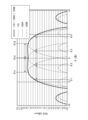
- 5 is a diagram showing an example of an angular distribution of a reflected wave from the radio wave reflecting plate of the embodiment.
- FIG. FIG. 1D is an enlarged view of a portion of FIG. 1C.
- 11A and 11B are diagrams illustrating an example of a configuration of a radio wave reflecting plate according to a first modified example of an embodiment.
- 11A and 11B are diagrams illustrating an example of a configuration of a radio wave reflecting plate according to a first modified example of an embodiment.
- FIG. 13 is a diagram showing an example of an angular distribution of a reflected wave from a radio wave reflecting plate according to a first modified example of an embodiment.
- FIG. FIG. 11 is a diagram showing another example of the angular distribution of the reflected wave of the radio wave reflecting plate according to the first modified example of the embodiment.
- 13A and 13B are diagrams illustrating an example of a configuration of a radio wave reflecting plate according to a second modified example of an embodiment.
- 13A and 13B are diagrams illustrating another example of the configuration of the radio wave reflecting plate according to the second modified example of the embodiment.
- 13A and 13B are diagrams illustrating an example of a configuration of a radio wave reflecting plate according to another modified example of the embodiment.
- 13A and 13B are diagrams illustrating an example of a configuration of a radio wave reflecting plate according to another modified example of the embodiment.
- 13A and 13B are diagrams illustrating an example of a configuration of a radio wave reflecting plate according to another modified example of the embodiment.
- 13A and 13B are diagrams illustrating an example of a configuration of a radio wave reflecting plate according to another modified example of the embodiment.
- the XYZ coordinate system is defined and explained below.
- the direction parallel to the X axis (X direction), the direction parallel to the Y axis (Y direction), and the direction parallel to the Z axis (Z direction) are mutually perpendicular.
- the XYZ coordinate system is an example of an orthogonal coordinate system. Viewing from the XY plane is referred to as a front view.
- the length, width, thickness, etc. of each part may be exaggerated to make the configuration easier to understand.
- terms such as parallel, right angle, orthogonal, horizontal, vertical, up and down, etc. are permitted to be misaligned to an extent that does not impair the effect of the embodiment.
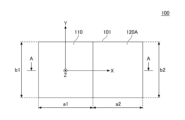
- FIGS. 1A and 1B are diagrams showing an example of the configuration of a radio wave reflector 100 according to an embodiment of the present invention, in which Fig. 1A is a front view, and Fig. 1B is a diagram showing an example of the configuration of a cross section taken along the line AA in Fig. 1A.
- the radio wave reflector 100 includes a base 101, a first plane 110, and a first inclined surface 120A.
- the radio wave reflector 100 is a radio wave reflector that reflects radio waves at the first plane 110 and the first inclined surface 120A and can reflect radio waves within a narrow angle range in the front direction.
- the origin of the XYZ coordinates is set at the center of the first plane 110
- the first plane 110 is parallel to the XY plane
- the XYZ coordinates are defined so that the normal line passing through the center of the first plane 110 coincides with the Z axis.
- the first plane 110 is included in the XY plane.
- the front direction of the radio wave reflector 100 is the Z direction.
- the front direction of the radio wave reflector 100 coincides with the extension direction of the normal line of the first plane 110.
- the front direction of the radio wave reflector 100 is defined by the extension direction of the normal line of the first plane 110.
- Figure 1B is a cross section of the radio wave reflector 100 shown in Figure 1A cut along the XZ plane.
- the narrow angle range (narrow angle range) in the front direction is a range defined by a narrow angle centered on the normal (Z axis) passing through the center of the first plane 110. More specifically, the narrow angle range (narrow angle range) in the front direction is a range defined by a narrow angle centered on the normal (Z axis) passing through the center of the first plane 110, in a plane (here, the XZ plane) that is parallel to a plane (here, the XZ plane) that includes a direction (here, the X direction) connecting the first plane 110 and the adjacent inclined surface (here, the first inclined surface 120A) and the front direction (Z direction), and that includes the normal (Z axis) passing through the center of the first plane 110.
- the narrow angle range is an angle range of ⁇ 10 degrees centered on the normal (Z axis), more preferably an angle range of ⁇ 5 degrees centered on the normal (Z axis), and even more preferably an angle range of ⁇ 3 degrees centered on the normal (Z axis).
- the base 101 is a member having a first plane 110 and a first inclined surface 120A formed on the +Z direction side.
- the base 101 is, as an example, a bent plate-like member common to the first plane 110 and the first inclined surface 120A, but the base 101 is not limited to a bent plate-like member and may be, for example, a box-shaped housing or the like.
- the base 101 may be a member capable of forming the first plane 110 and the first inclined surface 120A.
- the base 101 may be configured such that the portions on which the first plane 110 and the first inclined surface 120A are formed are separately configured.
- the base 101 can be made of resin, metal, glass, or the like, for example.
- the first plane 110 and the first inclined surface 120A which are the surfaces of the base 101, need to be conductive surfaces, so if the base 101 is made of resin or glass, the first plane 110 and the first inclined surface 120A can be formed from surfaces that have been subjected to conductor plating or the like.
- the resin can be, for example, acrylic, polyvinyl chloride, polyester, or other resin.
- the metal can be, for example, aluminum, or the like.
- the first plane 110 is a reflective surface perpendicular to the front direction of the radio wave reflector 100. This is because the front direction of the radio wave reflector 100 is determined by the extension direction of the normal to the first plane 110.
- the first plane 110 is a flat surface. As an example, the first plane 110 is rectangular in front view.
- the first plane 110 is the only reflective surface of the radio wave reflector 100 that is perpendicular to the front direction.
- the length of the first plane 110 in the X direction is a1
- the length in the Y direction is b1 .
- the angle ⁇ (degrees) with respect to the normal (Z axis) passing through the center of the first plane 110.
- the angle ⁇ is used to express the reflection direction of the reflected wave within the XZ plane.
- the angle ⁇ is expressed as a positive angle when it is tilted from the +Z direction toward the +X direction when viewed from the XZ plane, and as a negative angle when it is tilted from the +Z direction toward the -X direction when viewed from the XZ plane, opposite to the angle ⁇ shown in FIG. 1B.
- the first plane 110 is not limited to a rectangular shape, and may have any shape such as a polygon, a circle, or an ellipse.
- the outer edge of the first plane 110 may have a shape that corresponds to at least a part of a polygon, a circle, or an ellipse.
- the first inclined surface 120A is a reflective surface that is connected to one of the four sides of the first plane 110 on the +X-direction side and extends in the Y-direction, and is configured as a flat surface that is inclined with respect to the first plane 110.
- the length in the lateral direction of the first inclined surface 120A as viewed from the extension direction of the normal line n1 (hereinafter, the length in the lateral direction of the first inclined surface 120A) is a2
- the length in the Y direction is The area of the first inclined surface 120A may be different from the area of the first flat surface 110, but it is preferable that the difference between the areas is small.
- the length a2 of the first plane 110 in the X direction is equal to a1
- the length b2 of the first inclined surface 120A in the Y direction is equal to the length b1 of the first plane 110 in the Y direction. Therefore, as an example, the area of the first inclined surface 120A is equal to the area of the first flat surface 110.
- the first inclined surface 120A is rectangular, and the side extending in the Y direction on the -X direction side is connected to the first plane 110.
- the first inclined surface 120A is not limited to a rectangular shape, and may have any shape such as a polygonal shape, a circle, or an ellipse.
- the first inclined surface 120A only needs to be inclined with respect to the first plane 110 while being connected to at least a portion of the outer edge of the first plane 110.
- Such a first inclined surface 120A has the following relationship with the first plane 110.
- the area of the first plane 110 and the area of the first inclined surface 120A have a relationship such that the difference between the maximum intensity of the reflected wave from the first plane 110 and the maximum intensity of the reflected wave from the first inclined surface 120A is equal to or less than a predetermined value.
- the first inclined surface 120A is inclined with respect to the first plane 110 such that in the angular distribution of the reflected wave with respect to the normal line passing through the center of the first plane 110, the reflected wave from the first plane 110 and the reflected wave from the first inclined surface 120A overlap in an angular range of a predetermined intensity or more.
- ⁇ Evaluation criteria for reflected wave strength> As an example of a criterion for evaluating the strength of the reflected wave, RCS (Radar Cross Section) is used. The unit of RCS is dBsm.
- RCS Radar Cross Section
- the unit of RCS is dBsm.
- the angular distribution of the reflected wave from the radio wave reflector 100 is evaluated using the angular distribution of the reflected wave with respect to a normal line passing through the center of the first plane 110.
- the RCS of the reflected wave from the first plane 110 in the front direction of the rectangular radio wave reflector 100 is given by the following formula (1) using the length a 1 in the X direction and the length b 1 in the Y direction of the first plane 110.
- ⁇ is the wavelength of the radio wave in free space.
- the RCS of the reflected wave of the first inclined surface 120A in the front direction of the radio wave reflector 100 can be expressed by the following formula (2) using the horizontal length a 2 and the Y-direction length b 2 of the first inclined surface 120A.
- ⁇ is the wavelength of the radio wave in free space.
- the Z' axis is an axis parallel to the Z axis. Formula (2) is used to calculate the RCS of the first inclined surface 120A in the front direction of the radio wave reflector 100.
- the radio wave reflector 100 reflects radio waves within a narrow angle range in the front direction
- the angle ⁇ of the first inclined surface 120A with respect to the front direction of the radio wave reflector 100 is very small.
- the absolute value of the angle ⁇ is, for example, about 0.5 degrees to 5 degrees.
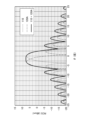
- 1C is a diagram showing an example of the angular distribution of the reflected wave of the radio wave reflector 100.
- the angular distribution of the reflected wave of the radio wave reflector 100 shown in FIG. 1C is the angular distribution of the reflected wave with respect to the normal line (Z axis) passing through the center of the first plane 110, and is the result of calculation by electromagnetic field simulation.
- the angle between the normal line n1 of the first inclined surface 120A and the Z axis was set to 3 degrees.
- the RCS was calculated using formula (1) for both the first plane 110 and the first inclined surface 120A under the condition that the areas of the first plane 110 and the first inclined surface 120A are equal, as an example.
- the horizontal axis represents the angle ⁇ (degrees), and the vertical axis represents the RCS (dBsm).
- the angle ⁇ on the horizontal axis is a positive angle when it is tilted from the +Z direction toward the +X direction when viewed from the XZ plane, and a negative angle when it is tilted from the +Z direction toward the -X direction when viewed from the XZ plane.
- Figure 1C shows an example of the angular distribution of the reflected wave when radio waves are incident on the radio wave reflector 100 from the -Z direction.
- the dashed line represents the angular distribution of the intensity of the reflected wave reflected by the first plane 110.
- the dashed line represents the angular distribution of the intensity of the reflected wave reflected by the first inclined surface 120A.
- the solid line represents the sum of the angular distributions of the dashed line and the dashed line. In other words, the solid line represents the angular distribution of the sum of the intensity of the reflected wave reflected by the first plane 110 and the reflected wave reflected by the first inclined surface 120A.
- the maximum RCS value was obtained when the angle ⁇ was 0 degrees. It is believed that the maximum RCS value was obtained when the angle ⁇ was 0 degrees because the first plane 110 reflects radio waves in the +Z direction.
- the maximum RCS value was approximately 7.4 dBsm.
- the intensity of the reflected wave decreased as the absolute value of the angle ⁇ increased, and the RCS was approximately 0 dBsm when the angle ⁇ was approximately +2.3 degrees and when the angle ⁇ was approximately -2.3 degrees.
- the RCS was approximately 0 dBsm or less in the angle range where the angle ⁇ was approximately +2.3 degrees or more and in the angle range where the angle ⁇ was approximately -2.3 degrees or less.
- the maximum RCS value was obtained when the angle ⁇ was approximately -3 degrees.
- the first inclined surface 120A is located on the +X side of the first plane 110 and is inclined so as to approach the +Z axis, and reflects the radio waves more toward the -X direction than the +Z direction, which is thought to be why the maximum RCS value was obtained when the angle ⁇ was in the negative range.
- the maximum RCS value of the first inclined surface 120A was approximately 7.4 dBsm.
- the strength of the reflected wave from the first inclined surface 120A decreased as the angle ⁇ moved away from approximately -3 degrees, and the RCS was approximately 0 dBsm when the angle ⁇ was approximately -0.7 degrees and when the angle ⁇ was approximately -5.3 degrees.
- the RCS was approximately 0 dBsm or less in the angle range where the angle ⁇ was approximately -0.7 degrees or more and in the angle range where the angle ⁇ was approximately -5.3 degrees or less.
- the maximum RCS value is obtained when the angle ⁇ is in the range of 0 degrees to approximately -3 degrees.
- the maximum RCS value was approximately 7.4 dBsm.
- the RCS was approximately 0 dBsm when the angle ⁇ was approximately +2.3 degrees and approximately -5.3 degrees. In the angle range where the angle ⁇ was approximately +2.3 degrees or more and the angle range where the angle ⁇ was approximately -5.3 degrees or less, the RCS was approximately 0 dBsm or less.
- the angular distribution (solid line) of the total intensity of the reflected waves reflected by the first flat surface 110 and the first inclined surface 120A showed good values with an RCS of approximately 3 dBsm or more when the angle ⁇ was in the range of approximately -5 degrees to +2.3 degrees. Furthermore, in other ranges (angle ranges where the angle ⁇ was approximately -5 degrees or less and +2.3 degrees or more), the RCS dropped sharply, confirming that it was possible to reflect radio waves within a narrow angular range in the forward direction.
- the angle ⁇ between the normal n1 of the first inclined surface 120A and the Z axis is very small, by making the areas of the first plane 110 and the first inclined surface 120A equal, the angular distribution of the total intensity of the reflected waves in a narrow angle range including the front direction becomes approximately flat and approximately uniform. From this, it was confirmed that it is preferable for the difference between the areas of the first plane 110 and the first inclined surface 120A to be small.
- FIG. 1D is an enlarged view of the range in FIG. 1C where the angle ⁇ is within ⁇ 10 degrees and the range where the RCS is -10 dBsm or more.
- the angle ⁇ is shown on the horizontal axis at the top and bottom.
- the first inclined surface 120A was inclined with respect to the first plane 110 so that the angle range ⁇ 2 to ⁇ 3, where the intensity of the reflected wave from the first plane 110 is half the maximum value, overlaps with the angle range ⁇ 1 to ⁇ 2, where the intensity of the reflected wave from the first inclined surface 120A is half the maximum value.
- the angle range in which the intensity of the reflected wave from the first plane 110 is half the maximum value is the angle range ⁇ 2 to ⁇ 3 in which the intensity of the reflected wave from the first plane 110 is 3 dB lower than the maximum value (approximately 4.4 dBsm).
- the angle range in which the intensity of the reflected wave from the first inclined surface 120A is half the maximum value is the angle range ⁇ 1 to ⁇ 2 in which the intensity of the reflected wave from the first inclined surface 120A is 3 dB lower than the maximum value (approximately 4.4 dBsm).
- the angle range ⁇ 2 to ⁇ 3 in which the intensity of the reflected wave from the first plane 110 is half its maximum value and the angle range ⁇ 1 to ⁇ 2 in which the intensity of the reflected wave from the first inclined plane 120A is half its maximum value overlap at the angle ⁇ 2.
- the angle range in which the intensity of the reflected wave from the first plane 110 is half its maximum value and the angle range in which the intensity of the reflected wave from the first inclined plane 120A is half its maximum value will no longer overlap.
- the angle ⁇ of the first inclined surface 120A is made larger than the angle ⁇ when the results of Figures 1C and 1D are obtained, the angular ranges of half the maximum value of the reflected wave intensity of the first flat surface 110 and the first inclined surface 120A will no longer overlap, and a valley lower than the maximum value will appear near the front direction in the angular distribution of the total intensity of the reflected waves.
- the first inclined surface 120A only needs to be inclined with respect to the first plane 110 so that in the angular distribution of the reflected waves with respect to the normal line passing through the center of the first plane 110, the reflected waves of the first plane 110 and the first inclined surface 120A overlap in an angular range of a predetermined intensity or more.
- the predetermined intensity needs to be equal to or greater than the reflected wave intensity at the valley described above.
- the areas of the first plane 110 and the first inclined surface 120A are equal, the maximum values of the reflected wave intensity are equal. It was confirmed that in order to increase the intensity of the total reflected wave near the front direction to a certain extent, it is preferable that the difference between the areas of the first plane 110 and the first inclined surface 120A is small. In other words, it was confirmed that it is preferable that the areas of the first plane 110 and the first inclined surface 120A have a relationship such that the difference between the maximum value of the reflected wave intensity of the first plane 110 and the maximum value of the reflected wave intensity of the first inclined surface 120A is equal to or less than a predetermined value.
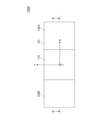
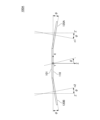
- FIGS. 2A and 2B are diagrams showing an example of the configuration of a radio wave reflector 100A according to a first modified example of the embodiment, in which Fig. 2A is a front view, and Fig. 2B is a diagram showing an example of the configuration of a cross section taken along the line B-B of Fig. 2A.
- the radio wave reflector 100A includes a base 101, a first plane 110, a first inclined surface 120A, and a second inclined surface 120B.
- the radio wave reflector 100A of the first modified embodiment has a configuration in which a second inclined surface 120B is added to the radio wave reflector 100 of the embodiment (see Figures 1A and 1B).
- the radio wave reflector 100A is a radio wave reflector that reflects radio waves at the first plane 110, the first inclined surface 120A, and the second inclined surface 120B, and can reflect radio waves within a narrow angle range in the front direction. The following will focus on the differences from the radio wave reflector 100.
- the base 101 of the first modified embodiment is a member having a first plane 110, a first inclined surface 120A, and a second inclined surface 120B formed on the +Z direction side.
- the base 101 is, as an example, a bent plate-like member common to the first plane 110, the first inclined surface 120A, and the second inclined surface 120B, but the base 101 is not limited to a bent plate-like member, and may be, for example, a box-shaped housing or the like.
- the base 101 may be a member capable of forming the first plane 110 and the first inclined surface 120A.
- the base 101 may be configured such that the parts on which the first plane 110 and the first inclined surface 120A are formed are separately formed.
- the material of the base 101 is the same as that of the base 101 shown in FIG. 1A and FIG. 1B.
- the second inclined surface 120B is located on the opposite side to the first inclined surface 120A across the first plane 110.
- the second inclined surface 120B is located on the ⁇ X direction side of the four sides of the first plane 110 and is inclined in the Y direction.
- the second inclined surface 120B is a reflective surface that is connected to a side extending in the direction of the first plane 110 and is a flat surface that is inclined with respect to the first plane 110.
- the area of the second inclined surface 120B may be different from the area of the first plane 110.
- the area of the second inclined surface 120B may be different from the area of the first inclined surface 120A, but it is preferable that the difference between the areas be small.
- the horizontal length of the second inclined surface 120B as viewed from the extension direction of the normal n2 (hereinafter referred to as the horizontal length of the second inclined surface 120B) is equal to the X-direction length of the first plane 110 and is also equal to the horizontal length of the first inclined surface 120A.
- the Y-direction length of the second inclined surface 120B is equal to the Y-direction length of the first plane 110 and is also equal to the Y-direction length of the first inclined surface 120A. Therefore, as an example, the area of the second inclined surface 120B is equal to the areas of the first plane 110 and the first inclined surface 120A.
- the second inclined surface 120B is inclined with respect to the first plane 110 so that the boundary with the first plane 110 forms a valley fold.
- the second inclined surface 120B is inclined so as to be located on the -X direction side of the first plane 110 and approach the +Z axis in the XZ plane view.
- the angle of the second inclined surface 120B with respect to the first plane 110 may be different from the angle of the first inclined surface 120A with respect to the first plane 110, but from the viewpoint of symmetry, it is preferable that the inclination angles are equal.
- the angles (inclination angles) of the second inclined surface 120B and the first inclined surface 120A with respect to the first plane 110 are both ⁇ in absolute value.
- the second inclined surface 120B is rectangular, and the side extending in the Y direction on the +X direction side is connected to the first plane 110.
- the second inclined surface 120B is not limited to a rectangular shape, and may have any shape such as a polygonal shape, a circle, or an ellipse.
- the second inclined surface 120B may be inclined with respect to the first plane 110 while being connected to at least a part of the outer edge of the first plane 110.
- the shape of the second inclined surface 120B is the same as the shape of the first inclined surface 120A, and in this case, it is most preferable that the areas of the second inclined surface 120B and the first inclined surface 120A are equal, and that the angles with respect to the first plane 110 are equal.
- Such a second inclined surface 120B has the following relationship with the first plane 110.
- the area of the first plane 110 and the area of the second inclined surface 120B have a relationship such that the difference between the maximum intensity of the reflected wave from the first plane 110 and the maximum intensity of the reflected wave from the second inclined surface 120B is equal to or less than a predetermined value.
- the second inclined surface 120B is inclined with respect to the first plane 110 such that in the angular distribution of the reflected wave with respect to the normal line passing through the center of the first plane 110, the reflected wave from the first plane 110 and the reflected wave from the second inclined surface 120B overlap in an angular range of a predetermined intensity or more. This is similar to the relationship between the first plane 110 and the first inclined surface 120A.
- 2C is a diagram showing an example of the angular distribution of the reflected wave of the radio wave reflector 100A.
- the angular distribution of the reflected wave of the radio wave reflector 100A shown in FIG. 2C is the angular distribution of the reflected wave with respect to the normal (Z axis) passing through the center of the first plane 110, and is the result of calculation by electromagnetic field simulation.
- the angle between the normal n1 of the first inclined surface 120A and the Z axis is set to 3 degrees in absolute value
- the angle between the normal n2 of the second inclined surface 120B and the Z axis is set to 3 degrees in absolute value.
- the RCS was calculated using formula (1) for all of the first plane 110, the first inclined surface 120A, and the second inclined surface 120B under the condition that the areas of the first plane 110, the first inclined surface 120A, and the second inclined surface 120B are equal, as an example.
- the horizontal axis represents the angle ⁇ (degrees), and the vertical axis represents the RCS (dBsm).
- the angle ⁇ on the horizontal axis is a positive angle when it is tilted from the +Z direction toward the +X direction when viewed from the XZ plane, and a negative angle when it is tilted from the +Z direction toward the -X direction when viewed from the XZ plane.
- FIG. 2C shows an example of the angular distribution of the reflected wave when radio waves are incident on the radio wave reflector 100A from the -Z direction.
- the dashed line represents the angular distribution of the intensity of the reflected wave reflected by the first plane 110.
- the dashed line represents the angular distribution of the intensity of the reflected wave reflected by the first inclined plane 120A.
- the dashed line represents the angular distribution of the intensity of the reflected wave reflected by the second inclined plane 120B.
- the solid line represents the sum of the angular distributions of the dashed line, dashed line, and dashed line. In other words, the solid line represents the angular distribution of the sum of the intensity of the reflected wave reflected by the first plane 110, the reflected wave reflected by the first inclined plane 120A, and the reflected wave reflected by the second inclined plane 120B.
- the second inclined surface 120B is located on the -X side of the first plane 110 and is inclined so as to approach the +Z axis, and reflects radio waves more toward the +X direction than the +Z direction, which is thought to be why the maximum RCS value was obtained when the angle ⁇ was in the positive range.
- the maximum value of the RCS of the second inclined surface 120B is approximately equal to the maximum values of the first plane 110 and the first inclined surface 120A, which is approximately 7.4 dBsm.
- the maximum RCS value is obtained when the angle ⁇ is in the range of approximately -3 degrees to approximately +3 degrees.
- a characteristic is obtained in which the maximum RCS value of the reflected wave from the first inclined surface 120A ( ⁇ ⁇ -3 degrees) and the maximum RCS value of the reflected wave from the second inclined surface 120B ( ⁇ ⁇ +3 degrees) are connected in a flat manner.
- the maximum RCS value was approximately 7.4 dBsm.
- the RCS was approximately 0 dBsm when the angle ⁇ was approximately -5.5 degrees and approximately +5.5 degrees.
- the RCS was approximately 0 dBsm or less in the angle range where the angle ⁇ was approximately -5.5 degrees or less and in the angle range where the angle ⁇ was approximately +5.5 degrees or more.
- the angular distribution (solid line) of the total intensity of the reflected waves reflected by the first flat surface 110, the first inclined surface 120A, and the second inclined surface 120B obtained favorable values with an RCS of approximately 3 dBsm or more when the angle ⁇ was in the range of approximately -4.8 degrees to +5 degrees. Furthermore, in other ranges (angle ranges where the angle ⁇ was approximately -4.8 degrees or less and +5 degrees or more), the RCS dropped sharply, confirming that it was possible to reflect radio waves within a narrow angular range in the forward direction.
- the angle ⁇ between the normal of the first inclined surface 120A and the Z axis is very small, by making the areas of the first plane 110, the first inclined surface 120A, and the second inclined surface 120B equal, the angular distribution of the total intensity of the reflected waves in a narrow angle range including the front direction becomes approximately flat and approximately uniform. From this, it was confirmed that it is preferable for the difference in areas of the first plane 110, the first inclined surface 120A, and the second inclined surface 120B to be small.
- the first inclined surface 120A was inclined with respect to the first plane 110 so that the angle range ⁇ 2 to ⁇ 3 in which the intensity of the reflected wave from the first plane 110 is half the maximum value overlaps with the angle range ⁇ 3 to ⁇ 4 in which the intensity of the reflected wave from the second inclined surface 120B is half the maximum value.
- the angle range ⁇ 2 to ⁇ 3 in which the intensity of the reflected wave from the first plane 110 is half the maximum value overlaps with the angle range ⁇ 1 to ⁇ 2 in which the intensity of the reflected wave from the first inclined surface 120A is half the maximum value, as explained using FIG. 1D.
- the angle range in which the intensity of the reflected wave from the second inclined surface 120B is half the maximum value (approximately 7.4 dBsm) is the angle range ⁇ 3 to ⁇ 4 in which the intensity of the reflected wave from the second inclined surface 120B is 3 dB lower than the maximum value (approximately 4.4 dBsm).
- the angle range ⁇ 2 to ⁇ 3 in which the intensity of the reflected wave from the first plane 110 is half its maximum value and the angle range ⁇ 3 to ⁇ 4 in which the intensity of the reflected wave from the second inclined surface 120B is half its maximum value overlap at the angle ⁇ 3.
- the absolute value of the angle ⁇ of the second inclined surface 120B becomes larger than this, the angle range in which the intensity of the reflected wave from the second inclined surface 120B is half its maximum value and the angle range in which the intensity of the reflected wave from the first inclined surface 120A is half its maximum value will no longer overlap.
- the angle ranges ⁇ 1- ⁇ 2 and ⁇ 2- ⁇ 3 overlap, and the angle ranges ⁇ 2- ⁇ 3 and ⁇ 3- ⁇ 4 overlap, so that the angular distribution (solid line) of the total intensity of the reflected wave becomes a nearly flat value in a narrow angle range that includes the front direction ( ⁇ 0 degrees) between angle ⁇ t1, where the intensity of the reflected wave from the first inclined surface 120A is at its maximum, and angle ⁇ t3, where the intensity of the reflected wave from the second inclined surface 120B is at its maximum.
- the angle ⁇ of the second inclined surface 120B is made larger than the angle ⁇ when the result of Figure 2C is obtained, the angular ranges of half the maximum value of the reflected wave intensity of the first plane 110 and the second inclined surface 120B will no longer overlap, and a valley lower than the maximum value will appear near the front direction in the angular distribution of the total intensity of the reflected waves.
- the second inclined surface 120B only needs to be inclined with respect to the first plane 110 so that in the angular distribution of the reflected waves with respect to the normal line passing through the center of the first plane 110, the reflected waves of the first plane 110 and the second inclined surface 120B overlap in an angular range of a predetermined intensity or more.
- the predetermined intensity needs to be equal to or greater than the reflected wave intensity at the valley described above. This also applies to the relationship between the first plane 110 and the first inclined surface 120A, as described using Figures 1A to 1D.
- the areas of the first plane 110, the first inclined surface 120A, and the second inclined surface 120B are equal, the maximum values of the reflected wave intensity are equal. It was confirmed that in order to increase the intensity of the total reflected wave near the front direction to a certain extent, it is preferable that the difference in the areas of the first plane 110, the first inclined surface 120A, and the second inclined surface 120B is small.
- the areas of the first plane 110, the first inclined surface 120A, and the second inclined surface 120B have a relationship such that the difference between the maximum value of the reflected wave intensity of the first plane 110, the maximum value of the reflected wave intensity of the first inclined surface 120A, and the maximum value of the reflected wave intensity of the second inclined surface 120B is equal to or less than a predetermined value.
- the characteristics shown in FIG. 2D are obtained.
- FIG. 2D is a diagram showing another example of the angular distribution of the reflected waves of the radio wave reflector 100A according to the first modified example of the embodiment.
- the characteristics in FIG. 2D were calculated by electromagnetic field simulation, similar to FIG. 2C.
- the dashed line represents the angular distribution of the intensity of the reflected wave reflected by the first plane 110
- the dashed line represents the angular distribution of the intensity of the reflected wave reflected by the first inclined surface 120A
- the dashed line represents the angular distribution of the intensity of the reflected wave reflected by the second inclined surface 120B
- the solid line represents the angular distribution of the total intensity of the reflected waves reflected by the first plane 110, the first inclined surface 120A, and the second inclined surface 120B.
- the areas of the first inclined surface 120A and the second inclined surface 120B are greater than the area of the first plane 110.
- the areas of the first inclined surface 120A and the second inclined surface 120B are equal.
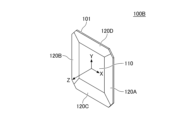
- FIG. 3A is a diagram showing an example of the configuration of a radio wave reflector 100B according to a second modified example of the embodiment.
- the radio wave reflector 100B has a configuration in which a trapezoidal first inclined surface 120A to a fourth inclined surface 120D are provided along the rectangular outer edge (four sides) of the first plane 110.
- the base 101 has a different shape from the base 101 shown in Figures 1A, 1B, 2A, and 2B.
- the radio wave reflector 100B has a configuration in which the first inclined surface 120A and the second inclined surface 120B shown in Figures 2A and 2B are changed to a trapezoid shape, a trapezoidal third inclined surface 120C is connected to the end edge on the -Y direction side of the first plane 110, and a trapezoidal fourth inclined surface 120D is connected to the end edge on the +Y direction side of the first plane 110.
- the first inclined surface 120A, the second inclined surface 120B, the third inclined surface 120C, and the fourth inclined surface 120D have their sides corresponding to the upper base of the trapezoid connected to the four sides of the first plane 110.
- the cross section of the radio wave reflector 100B cut in the XZ plane passing through the center of the first plane 110 is the same as that in FIG. 2B, and the cross section of the radio wave reflector 100B cut in the XY plane passing through the center of the first plane 110 has a configuration in which the first inclined surface 120A and the second inclined surface 120B in FIG. 2B are replaced with the third inclined surface 120C and the fourth inclined surface 120D.
- the intensity distribution of the reflected wave reflected by the radio wave reflector 100B is such that the reflected wave intensity is high on both sides of 0 degrees, as shown in Figure 2C or Figure 2D, in both the XY cross section and the XZ cross section passing through the center of the first plane 110.
- the first inclined surface 120A, the third inclined surface 120C, the second inclined surface 120B, and the fourth inclined surface 120D are trapezoidal in shape and are arranged in this order surrounding the four sides of the rectangular outer edge of the first plane 110 when viewed from the front direction.
- the first inclined surface 120A, the third inclined surface 120C, the second inclined surface 120B, and the fourth inclined surface 120D are configured in a cone shape or tapered shape without gaps along the four sides of the first plane 110. Therefore, the reflected waves of the first inclined surface 120A and the second inclined surface 120B are combined symmetrically and more evenly, and the reflected waves of the third inclined surface 120C and the fourth inclined surface 120D are combined symmetrically and more evenly.
- the inclination angles of the first inclined surface 120A and the second inclined surface 120B with respect to the first plane 110 may be equal, and the inclination angles of the third inclined surface 120C and the fourth inclined surface 120D with respect to the first plane 110 may be equal.
- the inclination angles of the first inclined surface 120A and the third inclined surface 120C with respect to the first plane 110 may be equal. In this case, in both the XY cross section and the XZ cross section passing through the center of the first plane 110, a distribution in which the reflected wave intensity is high on both sides of 0 degrees is obtained, and the angular distribution in both the XY cross section and the XZ cross section passing through the center of the first plane 110 can be equalized.
- the inclination angles of the first inclined surface 120A and the second inclined surface 120B with respect to the first plane 110 do not have to be equal.
- the inclination angles of the third inclined surface 120C and the fourth inclined surface 120D with respect to the first plane 110 do not have to be equal.
- the areas of the first plane 110, the first inclined surface 120A, the second inclined surface 120B, the third inclined surface 120C, and the fourth inclined surface 120D may be equal.
- the total reflected wave intensity of the waves reflected by the five reflecting surfaces can be equalized in both the XY cross section and the XZ cross section within a narrow angle range including the front direction.
- first inclined surface 120A may be inclined with respect to the first plane 110 so that, in the angular distribution of the reflected wave with respect to the normal line passing through the center of the first plane 110, the angular range in which the intensity of the reflected wave from the first plane 110 is half its maximum value overlaps with the angular range in which the intensity of the reflected wave from the first inclined surface 120A is half its maximum value.
- the second inclined surface 120B may be inclined with respect to the first plane 110 so that, in the angular distribution of the reflected wave with respect to the normal line passing through the center of the first plane 110, the angular range in which the intensity of the reflected wave from the first plane 110 is half its maximum value overlaps with the angular range in which the intensity of the reflected wave from the second inclined surface 120B is half its maximum value.
- the third inclined surface 120C may be inclined with respect to the first plane 110 so that, in the angular distribution of the reflected wave with respect to the normal line passing through the center of the first plane 110, the angular range in which the intensity of the reflected wave from the first plane 110 is half its maximum value overlaps with the angular range in which the intensity of the reflected wave from the third inclined surface 120C is half its maximum value.
- the fourth inclined surface 120D may be inclined with respect to the first plane 110 so that, in the angular distribution of the reflected wave with respect to the normal line passing through the center of the first plane 110, the angular range in which the intensity of the reflected wave from the first plane 110 is half its maximum value overlaps with the angular range in which the intensity of the reflected wave from the fourth inclined surface 120D is half its maximum value.
- the angle range in which the maximum reflected wave intensity is obtained can be expanded.
- the radio wave reflector 100B may have four corners of the first inclined surface 120A, the third inclined surface 120C, the second inclined surface 120B, and the fourth inclined surface 120D that are chamfered.
- the trapezoidal shapes of the first inclined surface 120A, the third inclined surface 120C, the second inclined surface 120B, and the fourth inclined surface 120D are meant to include such shapes.
- the radio wave reflector 100B may be configured to include any three of the first inclined surface 120A, the third inclined surface 120C, the second inclined surface 120B, and the fourth inclined surface 120D around the first plane 110.
- FIGS. 4A to 4D are diagrams showing examples of the configurations of radio wave reflecting plates 100C1 to 100C4 according to other modified examples of embodiment 1.
- the base 101 is omitted, and only the configuration of the reflecting surface is shown in front view.
- the radio wave reflector 100C1 shown in FIG. 4A has a configuration in which the first flat surface 110, the first inclined surface 120A, and the second inclined surface 120B of the radio wave reflector 100A shown in FIG. 2A are modified into ellipses.
- the shapes of the first flat surface 110, the first inclined surface 120A, and the second inclined surface 120B may be circular instead of elliptical.
- such a shape may be used in accordance with constraints such as the surrounding configuration of the location where the base 101 is installed.
- the radio wave reflector 100C2 shown in FIG. 4B has a configuration in which the first plane 110, the first inclined surface 120A, and the second inclined surface 120B of the radio wave reflector 100A shown in FIG. 2A are modified into a hexagon (polygon).
- the polygon may be any polygon having three or more sides, and in the case of a quadrilateral, it may be a rhombus or the like. Such a shape may be used in accordance with constraints such as the configuration of the surroundings of the location where the base 101 is installed. Note that the positions of the first inclined surface 120A and the second inclined surface 120B relative to the first plane 110 may be shifted in the Y direction.
- the radio wave reflector 100C3 shown in FIG. 4C has a configuration in which the first flat surface 110 and the first inclined surface 120A of the radio wave reflector 100 shown in FIG. 1A are modified into a triangular shape.
- this shape may be used in accordance with constraints such as the surrounding configuration of the location where the base 101 is installed.
- the radio wave reflector 100C4 shown in FIG. 4D has a configuration in which the first flat surface 110, the first inclined surface 120A, the second inclined surface 120B, the third inclined surface 120C, and the fourth inclined surface 120D of the radio wave reflector 100B shown in FIG. 3A are modified into ellipses.
- the shapes of the first flat surface 110, the first inclined surface 120A, the second inclined surface 120B, the third inclined surface 120C, and the fourth inclined surface 120D may be circular instead of elliptical.
- such a shape may be used in accordance with constraints such as the surrounding configuration of the place where the base 101 is installed.
- the outer edge of at least one of the multiple reflecting surfaces may have a shape that corresponds to at least a portion of a polygon, a circle, or an ellipse. It is possible to provide a radio wave reflector 100 with a highly flexible shape to suit various applications and surrounding constraints, etc.
- the first inclined surface 120A may also be an inclined surface that surrounds the entire outer edge of the first flat surface 110.
- the first flat surface 110 may be circular or elliptical
- the first inclined surface 120A may be a cone-shaped or tapered inclined surface that surrounds the entire outer edge of the circular or elliptical first flat surface 110.
- such a shape may be used in accordance with constraints such as the surrounding configuration of the location where the base 101 is installed. It is possible to provide a radio wave reflector 100 with a highly flexible shape in accordance with various uses and surrounding constraints.
- the radio wave reflecting plate 100 includes a first plane 110 that reflects radio waves, and a first inclined surface 120A that is connected to at least a part of the outer edge of the first plane 110, is inclined with respect to the first plane 110, and reflects radio waves, the area of the first plane 110 and the area of the first inclined surface 120A have a relationship in which the difference between the maximum value of the intensity of the reflected wave of the first plane 110 and the maximum value of the intensity of the reflected wave of the first inclined surface 120A is equal to or less than a predetermined value, and the first inclined surface 120A is inclined with respect to the first plane 110 so that the angle range of the reflected wave of the first plane 110 and the reflected wave of the first inclined surface 120A that are equal to or greater than a predetermined intensity overlap in the angular distribution of the reflected wave with respect to a normal line passing through the center of the first plane 110. Therefore, a radio wave reflecting plate 100 having a desired angle range (narrow angle range) in the front direction is obtained.
- radio wave reflector 100 that can reflect radio waves within a narrow angular range in the front direction.
- the first plane 110 may also be rectangular. This allows for easy processing and provides a radio wave reflector 100 that can reflect radio waves within a narrow angle range in the front direction.
- the first inclined surface 120A may also be rectangular. This makes it possible to provide a radio wave reflector 100 that is easy to process and can reflect radio waves within a narrow angle range in the front direction.
- the first plane 110 may further include a second inclined surface 120B that is connected to at least a portion of the outer edge of the first plane 110, is inclined relative to the first plane 110, and reflects radio waves, the second inclined surface 120B being located on the opposite side of the first plane 110 to the first inclined surface 120A, and the area of the first plane 110 and the area of the second inclined surface 120B have a relationship such that the difference between the maximum intensity of the reflected wave from the first plane 110 and the maximum intensity of the reflected wave from the second inclined surface 120B is equal to or less than a predetermined value, and the second inclined surface 120B may be inclined relative to the first plane 110 such that in the angular distribution of the reflected wave relative to a normal line passing through the center of the first plane 110, the reflected wave from the first plane 110 and the reflected wave from the second inclined surface 120B overlap in an angular range of equal to or greater than a predetermined intensity.
- the inclination angles of the first inclined surface 120A and the second inclined surface 120B with respect to the first plane 110 may be equal.
- the reflected waves of the first plane 110, the first inclined surface 120A, and the second inclined surface 120B are combined, the reflected waves of the first inclined surface 120A and the second inclined surface 120B are combined symmetrically and more evenly, and a radio wave reflector 100 with high symmetry and even radio wave intensity can be provided within a desired angle range (narrow angle range) in the front direction.
- the areas of the first plane 110 and the first inclined surface 120A may be equal.
- the reflected waves of the first plane 110, the first inclined surface 120A, and the second inclined surface 120B are combined, the reflected waves of the first inclined surface 120A and the second inclined surface 120B are combined symmetrically and more evenly, and a radio wave reflector 100 with high symmetry and even radio wave intensity can be provided in the desired angle range (narrow angle range) in the front direction.
- the first inclined surface 120A may be inclined with respect to the first plane 110 so that, in the angular distribution of the reflected wave with respect to the normal line passing through the center of the first plane 110, the angular range in which the intensity of the reflected wave from the first plane 110 is half of the maximum value overlaps with the angular range in which the intensity of the reflected wave from the first inclined surface 120A is half of the maximum value.
- This makes it possible to make the angular distribution of the total intensity of the reflected wave in a narrow angle range including the front direction substantially flat and substantially uniform, and to provide a radio wave reflector 100 that has high symmetry and characteristics of uniform and flat radio wave intensity in the desired angle range (narrow angle range) in the front direction.
- Radio wave reflecting plate 101 Base 110 First plane 120A First slope 120B Second slope 120C Third slope 120D Fourth slope
Landscapes
- Physics & Mathematics (AREA)
- Electromagnetism (AREA)
- Aerials With Secondary Devices (AREA)
Priority Applications (3)
| Application Number | Priority Date | Filing Date | Title |
|---|---|---|---|
| EP24766703.3A EP4679635A1 (en) | 2023-03-06 | 2024-01-24 | Radio wave reflecting plate |
| JP2025505112A JP7833613B2 (ja) | 2023-03-06 | 2024-01-24 | 電波反射板 |
| US19/312,972 US20250379368A1 (en) | 2023-03-06 | 2025-08-28 | Radio wave reflector |
Applications Claiming Priority (2)
| Application Number | Priority Date | Filing Date | Title |
|---|---|---|---|
| JP2023033934 | 2023-03-06 | ||
| JP2023-033934 | 2023-03-06 |
Related Child Applications (1)
| Application Number | Title | Priority Date | Filing Date |
|---|---|---|---|
| US19/312,972 Continuation US20250379368A1 (en) | 2023-03-06 | 2025-08-28 | Radio wave reflector |
Publications (1)
| Publication Number | Publication Date |
|---|---|
| WO2024185328A1 true WO2024185328A1 (ja) | 2024-09-12 |
Family
ID=92674376
Family Applications (1)
| Application Number | Title | Priority Date | Filing Date |
|---|---|---|---|
| PCT/JP2024/002023 Ceased WO2024185328A1 (ja) | 2023-03-06 | 2024-01-24 | 電波反射板 |
Country Status (4)
| Country | Link |
|---|---|
| US (1) | US20250379368A1 (https=) |
| EP (1) | EP4679635A1 (https=) |
| JP (1) | JP7833613B2 (https=) |
| WO (1) | WO2024185328A1 (https=) |
Citations (4)
| Publication number | Priority date | Publication date | Assignee | Title |
|---|---|---|---|---|
| JPS6385504A (ja) | 1986-09-29 | 1988-04-16 | Reiko Co Ltd | 熱線遮蔽性透明フイルム |
| JP2004023257A (ja) * | 2002-06-13 | 2004-01-22 | Ntt Docomo Inc | アンテナ装置 |
| JP2006108841A (ja) * | 2004-10-01 | 2006-04-20 | Ntt Docomo Inc | アンテナ装置 |
| JP2023033934A (ja) | 2021-08-30 | 2023-03-13 | ブラザー工業株式会社 | 印刷システム及び制御装置 |
-
2024
- 2024-01-24 JP JP2025505112A patent/JP7833613B2/ja active Active
- 2024-01-24 EP EP24766703.3A patent/EP4679635A1/en active Pending
- 2024-01-24 WO PCT/JP2024/002023 patent/WO2024185328A1/ja not_active Ceased
-
2025
- 2025-08-28 US US19/312,972 patent/US20250379368A1/en active Pending
Patent Citations (4)
| Publication number | Priority date | Publication date | Assignee | Title |
|---|---|---|---|---|
| JPS6385504A (ja) | 1986-09-29 | 1988-04-16 | Reiko Co Ltd | 熱線遮蔽性透明フイルム |
| JP2004023257A (ja) * | 2002-06-13 | 2004-01-22 | Ntt Docomo Inc | アンテナ装置 |
| JP2006108841A (ja) * | 2004-10-01 | 2006-04-20 | Ntt Docomo Inc | アンテナ装置 |
| JP2023033934A (ja) | 2021-08-30 | 2023-03-13 | ブラザー工業株式会社 | 印刷システム及び制御装置 |
Non-Patent Citations (1)
| Title |
|---|
| See also references of EP4679635A1 |
Also Published As
| Publication number | Publication date |
|---|---|
| EP4679635A1 (en) | 2026-01-14 |
| JPWO2024185328A1 (https=) | 2024-09-12 |
| JP7833613B2 (ja) | 2026-03-19 |
| US20250379368A1 (en) | 2025-12-11 |
Similar Documents
| Publication | Publication Date | Title |
|---|---|---|
| JP7339207B2 (ja) | メタサーフェス反射板アレイ | |
| EP2687865B1 (en) | Object detecting apparatus | |
| JP6549951B2 (ja) | レーダ装置を取り付けた構造体、レーダ装置の取り付け方法、および、ブラケット | |
| CN110582706B (zh) | 雷达装置 | |
| EP0470156A1 (en) | Radar reflecting target for reducing radar cross-section | |
| US12603423B2 (en) | Radome design | |
| WO2017130879A1 (ja) | 反射体および反射体の製造方法 | |
| JP7005549B2 (ja) | レーダ装置、及びレーダ装置の寸法決定方法 | |
| WO2024185328A1 (ja) | 電波反射板 | |
| JP6790184B2 (ja) | レーダ装置を取り付けた構造体、レーダ装置の取り付け方法、および、ブラケット | |
| CN215181134U (zh) | 透镜模块及包括该透镜模块的相机模块 | |
| JP6919752B2 (ja) | 電波透過性カバーの板厚設定方法及び検知装置 | |
| KR20100079855A (ko) | 재귀 반사 시트 | |
| EP1935056B1 (en) | Cladding for a microwave antenna | |
| JP2010181213A (ja) | 反射装置 | |
| JP7057457B2 (ja) | ホーンアンテナ及びホーンアンテナアレイ | |
| JP6852005B2 (ja) | レーダ装置に取り付けられる構造体 | |
| JP7304560B2 (ja) | レーダ装置 | |
| CN217589423U (zh) | 雷达探测装置 | |
| CN223193111U (zh) | 一种角反射器 | |
| JP6873802B2 (ja) | ホーンアンテナ及びホーンアンテナアレイ | |
| JP2023165333A (ja) | 電波反射装置 | |
| JPS62204605A (ja) | 円偏波変形ビ−ムアンテナ | |
| JPWO2024185328A5 (https=) | ||
| JPS6128247B2 (https=) |
Legal Events
| Date | Code | Title | Description |
|---|---|---|---|
| 121 | Ep: the epo has been informed by wipo that ep was designated in this application |
Ref document number: 24766703 Country of ref document: EP Kind code of ref document: A1 |
|
| ENP | Entry into the national phase |
Ref document number: 2025505112 Country of ref document: JP Kind code of ref document: A |
|
| WWE | Wipo information: entry into national phase |
Ref document number: 2025505112 Country of ref document: JP |
|
| WWE | Wipo information: entry into national phase |
Ref document number: 2024766703 Country of ref document: EP |
|
| NENP | Non-entry into the national phase |
Ref country code: DE |
|
| ENP | Entry into the national phase |
Ref document number: 2024766703 Country of ref document: EP Effective date: 20251006 |
|
| ENP | Entry into the national phase |
Ref document number: 2024766703 Country of ref document: EP Effective date: 20251006 |
|
| ENP | Entry into the national phase |
Ref document number: 2024766703 Country of ref document: EP Effective date: 20251006 |
|
| ENP | Entry into the national phase |
Ref document number: 2024766703 Country of ref document: EP Effective date: 20251006 |
|
| WWP | Wipo information: published in national office |
Ref document number: 2024766703 Country of ref document: EP |