WO2024181537A1 - 回転切削工具、インサート、およびホルダ - Google Patents
回転切削工具、インサート、およびホルダ Download PDFInfo
- Publication number
- WO2024181537A1 WO2024181537A1 PCT/JP2024/007552 JP2024007552W WO2024181537A1 WO 2024181537 A1 WO2024181537 A1 WO 2024181537A1 JP 2024007552 W JP2024007552 W JP 2024007552W WO 2024181537 A1 WO2024181537 A1 WO 2024181537A1
- Authority
- WO
- WIPO (PCT)
- Prior art keywords
- insert
- holder
- cutting tool
- rotary cutting
- axial direction
- Prior art date
- Legal status (The legal status is an assumption and is not a legal conclusion. Google has not performed a legal analysis and makes no representation as to the accuracy of the status listed.)
- Ceased
Links
Images






Classifications
-
- B—PERFORMING OPERATIONS; TRANSPORTING
- B23—MACHINE TOOLS; METAL-WORKING NOT OTHERWISE PROVIDED FOR
- B23C—MILLING
- B23C5/00—Milling-cutters
- B23C5/02—Milling-cutters characterised by the shape of the cutter
- B23C5/10—Shank-type cutters, i.e. with an integral shaft
-
- B—PERFORMING OPERATIONS; TRANSPORTING
- B23—MACHINE TOOLS; METAL-WORKING NOT OTHERWISE PROVIDED FOR
- B23C—MILLING
- B23C5/00—Milling-cutters
- B23C5/02—Milling-cutters characterised by the shape of the cutter
- B23C5/10—Shank-type cutters, i.e. with an integral shaft
- B23C5/1009—Ball nose end mills
- B23C5/1027—Ball nose end mills with one or more removable cutting inserts
-
- B—PERFORMING OPERATIONS; TRANSPORTING
- B23—MACHINE TOOLS; METAL-WORKING NOT OTHERWISE PROVIDED FOR
- B23B—TURNING; BORING
- B23B31/00—Chucks; Expansion mandrels; Adaptations thereof for remote control
- B23B31/008—Chucks; Expansion mandrels; Adaptations thereof for remote control with arrangements for transmitting torque
-
- B—PERFORMING OPERATIONS; TRANSPORTING
- B23—MACHINE TOOLS; METAL-WORKING NOT OTHERWISE PROVIDED FOR
- B23B—TURNING; BORING
- B23B31/00—Chucks; Expansion mandrels; Adaptations thereof for remote control
- B23B31/02—Chucks
- B23B31/10—Chucks characterised by the retaining or gripping devices or their immediate operating means
- B23B31/11—Retention by threaded connection
- B23B31/1107—Retention by threaded connection for conical parts
- B23B31/1122—Retention by threaded connection for conical parts using cylindrical threads
-
- B—PERFORMING OPERATIONS; TRANSPORTING
- B23—MACHINE TOOLS; METAL-WORKING NOT OTHERWISE PROVIDED FOR
- B23C—MILLING
- B23C5/00—Milling-cutters
- B23C5/16—Milling-cutters characterised by physical features other than shape
- B23C5/20—Milling-cutters characterised by physical features other than shape with removable cutter bits or teeth or cutting inserts
- B23C5/22—Securing arrangements for bits or teeth or cutting inserts
-
- B—PERFORMING OPERATIONS; TRANSPORTING
- B23—MACHINE TOOLS; METAL-WORKING NOT OTHERWISE PROVIDED FOR
- B23C—MILLING
- B23C2210/00—Details of milling cutters
- B23C2210/02—Connections between the shanks and detachable cutting heads
-
- B—PERFORMING OPERATIONS; TRANSPORTING
- B23—MACHINE TOOLS; METAL-WORKING NOT OTHERWISE PROVIDED FOR
- B23C—MILLING
- B23C2210/00—Details of milling cutters
- B23C2210/16—Fixation of inserts or cutting bits in the tool
- B23C2210/165—Fixation bolts
-
- B—PERFORMING OPERATIONS; TRANSPORTING
- B23—MACHINE TOOLS; METAL-WORKING NOT OTHERWISE PROVIDED FOR
- B23C—MILLING
- B23C2220/00—Details of milling processes
- B23C2220/64—Using an endmill, i.e. a shaft milling cutter, to generate profile of a crankshaft or camshaft
-
- B—PERFORMING OPERATIONS; TRANSPORTING
- B23—MACHINE TOOLS; METAL-WORKING NOT OTHERWISE PROVIDED FOR
- B23C—MILLING
- B23C2240/00—Details of connections of tools or workpieces
- B23C2240/24—Connections using screws
-
- B—PERFORMING OPERATIONS; TRANSPORTING
- B23—MACHINE TOOLS; METAL-WORKING NOT OTHERWISE PROVIDED FOR
- B23D—PLANING; SLOTTING; SHEARING; BROACHING; SAWING; FILING; SCRAPING; LIKE OPERATIONS FOR WORKING METAL BY REMOVING MATERIAL, NOT OTHERWISE PROVIDED FOR
- B23D2277/00—Reaming tools
- B23D2277/02—Cutting head and shank made from two different components which are releasably or non-releasably attached to each other
-
- B—PERFORMING OPERATIONS; TRANSPORTING
- B23—MACHINE TOOLS; METAL-WORKING NOT OTHERWISE PROVIDED FOR
- B23D—PLANING; SLOTTING; SHEARING; BROACHING; SAWING; FILING; SCRAPING; LIKE OPERATIONS FOR WORKING METAL BY REMOVING MATERIAL, NOT OTHERWISE PROVIDED FOR
- B23D77/00—Reaming tools
Definitions
- the present invention relates to a rotary cutting tool, an insert, and a holder.
- Rotary cutting tools such as end mills are known (see, for example, Patent Documents 1-3).
- end mill described in Patent Document 1 a male thread formed on the end mill body on which the peripheral cutting edge is formed is screwed into a female thread formed on the shank, thereby fixing the shank and the end mill body by screwing them together.
- tip-removable rotary tool described in Patent Document 2 a mounting screw that passes through the tip is screwed into a female thread formed on the body, thereby fixing the body and the tip.
- a mounting screw that passes through the replaceable cutting tool is screwed into a female thread formed on the shank, thereby fixing the shank and the replaceable cutting tool.
- the present invention has been made to solve at least some of the problems mentioned above, and aims to reduce costs while improving the centering accuracy of rotary cutting tools in which the holder and insert are separate.
- the present invention has been made to solve at least some of the problems described above, and can be realized in the following form.
- a rotary cutting tool comprising a holder and an insert fixed to the holder.
- the insert has a cutting edge formed on at least one of the end and side of the insert in the axial direction, a convex portion formed on the other end of the insert in the axial direction and protruding along the axial direction of the insert, and a through hole penetrating the insert along the axial direction of the insert
- the convex portion has a tapered surface so that the outer diameter of the convex portion decreases from the one end side of the insert to the other end side
- the holder has an elongated shape, and a recess is formed along the axial direction of the holder at one end to which the insert is fixed, the recess is a concave-shaped accommodation portion in which the convex portion of the insert is accommodated, the accommodation portion has a tapered seat surface formed so that the inner diameter increases from the other end side of the holder to the one end side,
- a screw is inserted into the through hole of the insert, and the male thread of the inserted screw is screwed into the female thread of the holder, thereby fixing the insert to the holder.
- the holder and the insert are formed separately, if the cutting edge of the insert is damaged, only the insert can be replaced without replacing the entire rotary cutting tool including the holder.
- centerless machining which is performed on the holder when the holder and the insert are integrated, does not need to be performed when replacing the insert.
- the insert can be replaced while the holder is attached to the device that rotates the rotary cutting tool, the time required to adjust the origin of the rotary cutting tool relative to the device can be reduced.
- the cost of the rotary cutting tool and the manufacturing cost of the parts cut by the tool can be reduced.
- the tapered seat formed in the housing of the holder and the tapered surface formed in the convex part of the insert come into contact with each other.
- the screw is rotated in the tightening direction after contact, the holder and insert approach each other in the axial direction, and the tapered seat and tapered surface come into contact with each other to align their central axes.
- the shapes of the tapered seat formed on the holder and the tapered surface formed on the insert are not complicated, so machining the recess of the holder and the protrusion of the insert are simple.
- positioning is achieved by the engagement of the tapered seat and tapered surface, misalignment of the insert relative to the holder can be suppressed.
- the angle between the tapered seat surface and the axis of the holder may be greater than or equal to 30 degrees and less than or equal to 60 degrees. According to this configuration, since the angle between the tapered seat surface and the axis of the holder is 30 degrees or more, the thickness of the part where the recess is formed in the holder does not become too thin, and the decrease in rigidity of the holder can be suppressed.
- the angle between the tapered seat surface and the axis of the holder is 60 degrees or less, misalignment of the insert with respect to the holder during fastening can be suppressed, and the insert can be prevented from being fixed at an angle with respect to the holder.
- the insert is fixed to the holder by a bolt inserted into the through hole and screwed into the female threaded portion, and the rotary cutting tool may further include an anti-rotation mechanism that restricts the insert from rotating relative to the holder around the axis of the holder.
- the insert fixed to the holder by the anti-rotation mechanism is prevented from rotating about its axis relative to the holder, so that the insert can fully function as a rotary cutting tool.
- the through hole may have an inner diameter on the one end side of the insert that is larger than the inner diameter on the other end side, and an engagement surface may be formed at a position where the inner diameters change. According to this configuration, the head of the bolt inserted into the through hole can be caught on the engagement surface, thereby restricting the position of the bolt in the axial direction relative to the insert.
- the cutting edge may be an end mill having at least one of a peripheral cutting edge and a bottom cutting edge. This configuration makes it possible to provide an end mill at a reduced cost.
- an insert fixed to a holder of a rotary cutting tool for use comprising a cutting edge formed at one end in an axial direction of the insert, a convex portion formed at the other end in the axial direction of the insert and projecting along the axial direction of the insert, and a through hole penetrating the insert along the axial direction of the insert, the convex portion having a tapered surface such that an outer diameter of the convex portion decreases from the one end side to the other end side of the insert.
- a holder for use in a rotary cutting tool and for fixing an insert
- the holder having an elongated shape, a recess formed in at least one of one end and a side surface to which the insert is fixed, the recess being recessed along an axial direction of the holder, the recess being a concave-shaped accommodation portion for accommodating at least a part of the insert, the accommodation portion having a tapered seating surface formed such that the inner diameter increases from the other end side of the holder toward the one end side, and a female thread portion located closer to the other end side of the holder than the accommodation portion and formed along the axial direction of the holder, the open end of the female thread portion being connected to the accommodation portion.
- the present invention can be realized in various forms, for example, rotary cutting tools, holders, inserts, end mills, reamers, cutters and systems including these, methods of manufacturing rotary cutting tools and systems including these, etc.
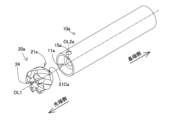
- FIG. 1 is a schematic perspective view of a rotary cutting tool according to an embodiment of the present invention
- FIG. 1 is a schematic exploded perspective view of a rotary cutting tool.
- 1 is a schematic cross-sectional view of a rotary cutting tool.
- FIG. 13 is a schematic exploded perspective view of a holder and an insert according to a second embodiment.
- FIG. 5 is a schematic cross-sectional view of a rotary cutting tool according to a second embodiment.
- FIG. 13 is a schematic exploded perspective view of a holder and an insert according to a third embodiment.
- FIG. 13 is an enlarged perspective view of a recess of the holder according to the third embodiment.
- FIG. 11 is a schematic cross-sectional view of a rotary cutting tool according to a third embodiment.
- FIG. 13 is a schematic exploded perspective view of a holder and an insert according to a fourth embodiment.
- FIG. 10 is a schematic cross-sectional view of a rotary cutting tool according
- FIG. 1 is a schematic perspective view of a rotary cutting tool 100 according to one embodiment of the present invention.
- a holder 10 that is attached to an apparatus and rotates around a central axis OL1 and an insert 20 that has a cutting edge 25 formed on its outer circumferential surface and is attached to the holder 10 are configured as separate, removable components. Therefore, even if the cutting edge 25 is damaged due to its lifespan or the like, the damaged insert 20 can be removed and replaced with a new insert 20, eliminating the need to replace the holder 10. This allows the cost of the rotary cutting tool 100 to be reduced.
- the rotary cutting tool 100 of this embodiment includes an insert 20 having a cutting edge 25 formed at one end in the axial direction of a central axis OL1, a holder 10 having an elongated shape along the central axis OL1, a bolt 30 that fixes the insert 20 to the holder 10 by bolt fastening, and a cylindrical pin 40.
- the holder 10, the insert 20, and the bolt 30 are fixed so that the central axis of the holder 10, the central axis of the insert 20, and the central axis of the bolt 30 all overlap the central axis OL1.
- the holder 10 side along the central axis OL1 will also be referred to as the base end side
- the insert 10 side will also be referred to as the tip end side.
- FIG 2 is a schematic exploded perspective view of the rotary cutting tool 100.
- the insert 20 has, in addition to the cutting edge 25, a convex portion 21 that protrudes along the central axis OL1 on the base end side, and a through hole 24 that penetrates the insert 20 along the central axis OL1.
- the cutting edge 25 has a bottom edge 25b formed on the end face on the tip side of the insert 20, and a peripheral edge 25o formed on the outer peripheral side surface on the tip side.
- the rotary cutting tool 100 of this embodiment is an end mill that rotates around the central axis OL1.
- FIG. 3 is a schematic cross-sectional view of the rotary cutting tool 100.
- FIG. 3 shows a longitudinal section passing through the central axis OL1 and parallel to the central axis OL1.
- the protruding portion 21 has a tapered surface 21A, which is a part of a conical surface with the central axis OL1 as an axis, formed on the tip side, a bottom surface 21B, which is formed on the base end side and perpendicular to the central axis OL1, and a notch 21C formed in a part of the tapered surface 21A.
- the tapered surface 21A is a conical surface in which the outer diameter of the protruding portion 21 decreases from the tip side to the base end side along the central axis OL1.
- the tapered surface 21A is formed by machining based on the central axis of the insert (the same axis as the central axis OL1 in FIGS. 1 to 3).
- the notch 21C is a surface obtained by cutting out a part of the tapered surface 21A along an axis perpendicular to the radial direction of the bottom surface 21B. Details of the notch 21C will be described later together with the pin 40.
- the through hole 24 formed in the insert 20 has a base end side hole 24A formed on the base end side along the central axis OL1, and a tip end side hole 24B connected to the base end side hole 24A and formed on the tip end side along the central axis OL1.
- the base end side hole 24A and the tip end side hole 24B are holes with circular cross sections of different inner diameters extending along the central axis OL1.
- the inner diameter of the base end side hole 24A is smaller than the inner diameter of the tip end side hole 24B. Therefore, as shown in FIG. 3, a step (engagement surface) ST is formed at the position where the inner diameters of the base end side hole 24A and the tip end side hole 24B change.
- the inner diameter of the base end side hole 24A is larger than the inner diameter of the cross section of the male threaded portion 31 of the bolt 30 and smaller than the inner diameter of the cross section of the head 32 of the bolt 30.
- the inner diameter of the tip side hole 24B is larger than the inner diameter of the cross section of the male threaded portion 31 and the inner diameter of the cross section of the head 32. Therefore, the position of the head 32 of the bolt 30 inserted from the tip side of the through hole 24 along the central axis OL1 is restricted by the step ST.
- the length along the central axis OL1 of the tip side hole 24B is formed so that the end face of the tip side of the bolt 30 is located closer to the base end than the end face of the tip side of the insert 20 when the bolt 30 fixes the insert 20 to the holder 10.
- the holder 10 is a member with a circular cross section perpendicular to the central axis OL1.
- a recess 11 is formed at the tip side of the holder 10, recessed along the central axis OL1.
- a cylindrical pin hole 15 is formed in the holder 10, perpendicular to the central axis OL1 and penetrating along the central axis OL2.
- the central axis OL2 is an axis perpendicular to the radial direction of the cross section of the holder 10.
- a pin 40 is inserted into the pin hole 15. Note that the pin 40 inserted into the pin hole 15 is not shown in FIG. 2.
- the recess 11 is formed by a tapered seat 12, a bottom surface 14, and a female thread portion 13.
- the tapered seat 12 is part of a conical surface formed on the tip side of the recess 11 and having a central axis OL1 as its axis.
- the inner diameter of the tapered seat 12 increases from the base end side to the tip side along the central axis OL1.
- the tapered seat 12 is formed by machining based on the central axis of the holder 10 (the same axis as the central axis OL1 in FIGS. 1 to 3).
- the bottom surface 14 is a circular plane that connects to the base end side of the tapered seat 12 and is perpendicular to the central axis OL1.
- the inner diameter of the tip side of the tapered seat 12 is larger than the inner diameter of the bottom surface 21B on the base end side of the convex portion 21 of the insert 20, and smaller than the inner diameter of the tip side of the tapered surface 21A of the convex portion 21.
- the inner diameter of the bottom surface 14 of the recess 11 is smaller than the inner diameter of the bottom surface 21B of the convex portion 21. Therefore, at least a part of the convex portion 21 is accommodated in a concave-shaped accommodation portion formed by the tapered seat 12 and the bottom surface 14, and the bottom surface 21B of the convex portion 21 does not contact the bottom surface 14 of the recess 11. Note that, as shown in FIG.
- a part of the tapered seat 12 and the bottom surface 14 are cut into a pin hole 15.
- the angle between the tapered seat 12 and the central axis OL1 is 30 degrees.
- the angle between the tapered surface 21A of the insert 20 and the central axis OL1 is 30 degrees, the same as the angle between the tapered seat surface of the holder 10.
- the female thread portion 13 is formed in the center of the bottom surface 14 so as to extend along the central axis OL1 toward the base end.
- the female thread portion 13 is formed on the base end side of the tapered seat surface 12 and the bottom surface 14.
- the open end on the tip side of the female thread portion 13 is connected to the base end side of the bottom surface 14.
- the shape of the pin 40 inserted into the pin hole 15 of the holder 10 has a cross section with an outer diameter shorter than the overall length of the pin hole 15 and slightly smaller than the inner diameter of the pin hole 15.
- the longitudinal section shown in FIG. 3 is a cross section perpendicular to the central axis OL2 of the pin hole 15.
- the part of the cylindrical side of the pin 40 located at the most distal end is located at the distal end side of the bottom surface 21B of the insert 20.
- the notch 21C formed in the insert 20 prevents the convex portion 21 of the insert 20 from contacting the pin 40.
- the notch 21C of the convex portion 21 contacts the pin 40.
- the tapered surface 21C contacts the pin 40, the relative rotation of the insert is restricted by this contact. That is, the pin 40 inserted into the pin hole 15 formed in the holder 10 functions as a rotation prevention mechanism that restricts the rotation of the insert 20 fixed to the holder 10 relative to the central axis OL1 with respect to the holder 10.
- the bolt 30 is inserted into the through hole 24 from the tip side where the cutting edge 25 of the insert 20 is formed.
- the insert 20 moves together with the bolt 30 toward the base end side approaching the holder 10 along the central axis OL1.
- the tapered surface 21A of the protruding portion 21 of the insert 20 begins to contact the tapered seating surface 12 in the recess 11 of the holder 10.
- the tapered seating surface 12 of the recess 11 comes into contact with the tapered surface 21A of the protrusion 21, aligning the central axis of the holder in which the recess 11 is formed with the central axis of the insert 20 in which the protrusion 21 is formed.
- the pin 40 is inserted into the pin hole 15 of the holder 10, restricting the rotation of the insert 20 fixed to the holder 10 about the central axis OL1.
- the bolt 30 is rotated in the loosening direction about the central axis OL1.
- the insert 20 has a convex portion 21 that protrudes along the central axis OL1 on the base end side, and a through hole 24 that penetrates the insert 20 along the central axis OL1.
- the tapered surface 21A formed on the convex portion 21 is a conical surface whose outer diameter decreases from the tip side to the base end side along the central axis OL1.
- a recess 11 that is recessed along the central axis OL1 is formed on the tip side of the holder 10 to which the insert 20 is fixed.
- the tapered seating surface 12 formed in the recess 11 has an inner diameter that increases from the base end side to the tip side along the central axis OL1.
- the convex portion 21 is accommodated in a concave-shaped accommodation portion formed by the tapered seating surface 12 and the bottom surface 14.
- the female thread portion 13 is formed on the base end side of the tapered seating surface 12 and the bottom surface 14.
- the holder 10 and the insert 20 approach each other along the central axis OL1, and the tapered seating surface 12 and the tapered surface 21A come into contact with each other to align their central axes.
- the shapes of the tapered seating surface 12 formed on the holder 10 and the tapered surface 21A formed on the insert 20 are not complicated, so that the machining of the recess 11 of the holder 10 and the machining of the protruding portion 21 of the insert 20 are simplified.
- the positioning is achieved by the engagement of the tapered seating surface 12 and the tapered surface 21A, misalignment of the insert 20 with respect to the holder 10 can be suppressed.
- the angle between the tapered seat 12 and the central axis OL1 is 30 degrees.
- the thickness of the portion of the holder 10 where the recess 11 is formed does not become too thin, and a decrease in the rigidity of the holder 10 can be suppressed.
- the angle between the tapered seat 12 and the central axis OL1 of the holder 10 is 60 degrees or less, misalignment of the insert 20 with respect to the holder 10 during fastening can be suppressed, and the insert 20 can be prevented from being fixed at an angle with respect to the holder 10.
- the pin 40 inserted into the pin hole 15 formed in the holder 10 functions as a rotation prevention mechanism that restricts the rotation of the insert 20 fixed to the holder 10 relative to the central axis OL1 with respect to the holder 10.
- the fixed insert 20 is prevented from rotating around the central axis OL1 with respect to the holder 10, so that the rotary cutting tool 100 can fully function as a tool.
- a step ST is formed at the position where the inner diameter of the base end hole 24A and the tip end hole 24B of the through hole 24 change. Therefore, the head 32 of the bolt 30 inserted into the through hole 24 can be hooked onto the step ST. This makes it possible to regulate the position of the bolt 30 along the central axis OL1 relative to the insert 20.
- Second Embodiment Fig. 4 is a schematic exploded perspective view of the holder 10a and the insert 20a of the second embodiment.
- Fig. 5 is a schematic cross-sectional view of the rotary cutting tool 100a of the second embodiment.
- the rotary cutting tool 100a of the second embodiment has a different anti-rotation mechanism for the insert 20a compared to the rotary cutting tool 100 of the first embodiment. Therefore, in the second embodiment, the anti-rotation mechanism different from that of the first embodiment will be described, and the description of the same configuration as that of the first embodiment will be omitted.
- the holder 10a of the second embodiment is formed with a pin hole 15a along the central axis OL2a that is along the radial direction of the cross section of the central axis OL1.
- FIG. 5 shows a longitudinal section parallel to both the central axis OL1 and the central axis OL2a.
- the pin hole 15a does not penetrate the entire holder 10a along the cross section of the holder 10a.
- the tapered seat surface 12a and the bottom surface 14a that form the recess 11a are partially cut away by the pin hole 15a.
- the pin 40a has a circular cross section that is slightly smaller than the pin hole 15a, and has a cylindrical shape that extends along the central axis OL2a as shown in FIG. 5.
- a notch 21Ca is formed in the protrusion 21a.
- the notch 21Ca is formed at a position where the protrusion 21a does not contact the pin 40a when the pin 40a is inserted into the pin hole 15a and the insert 20a is fixed to the holder 10a.
- the portion of the cylindrical side surface of the pin 40a located at the most distal end is located further toward the distal end than the bottom surface 21Ba of the insert 20a. Therefore, when the insert 20a rotates around the central axis OL1 relative to the holder 10a, the notch 21Ca in the protrusion 21a contacts the pin 40a.
- the pin 40a inserted into the pin hole 15a formed in the holder 10a functions as a rotation prevention mechanism.
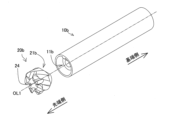
- Third Embodiment 6 is a schematic exploded perspective view of the holder 10b and the insert 20b of the third embodiment.
- FIG. 7 is an enlarged perspective view of the recess 11b of the holder 10b of the third embodiment.
- FIG. 8 is a schematic cross-sectional view of the rotary cutting tool 100b of the third embodiment.
- the rotation prevention mechanism of the insert 20b is different from that of the rotary cutting tool 100 of the first embodiment and the rotary cutting tool 100a of the second embodiment. Therefore, in the third embodiment, a rotation prevention mechanism different from that of the first and second embodiments will be described, and a description of the same configuration as that of the first and second embodiments will be omitted.
- FIG. 7 shows a schematic enlarged perspective view of the recess 11b shown in FIG. 6.
- the holder 10b of the third embodiment is formed with an end face 17 that connects the recess 11b to the outer peripheral surface of the holder 10b.
- the end face 17 has a shape in which the hollow portion of the recess 11b is carved out with respect to a circle perpendicular to the central axis OL1.
- the end face 17 is located at the most tip side of the holder 10b.
- a protrusion 16 that protrudes toward the radial center is formed on a portion of the tapered seat surface 12b that forms the recess 11b.
- the protrusion 16 has a protruding surface 16c that protrudes from the end face 17 toward the radial center along a cross section parallel to the end face 17, and a sloped surface 16s that is connected to the protruding surface 16c.
- the sloped surface 16s is a slope that slopes toward the center as it moves from the connected protruding surface 16c toward the base end side.
- the sloped surface 16s is connected to the open end face of the female threaded portion 13.
- a notch 21Cb is formed by cutting out a portion of the tapered surface 21Ab in a portion of the protruding portion 21b of the insert 20b.
- the notch 21Cb is a slope formed to engage with the slope 16s of the protruding portion 16 when the insert 20b is fixed to the holder 10b.
- the notch 21Cb is a slope that approaches the center as it approaches the base end.
- the angle that the slope of the notch 21C makes with the central axis OL1 is the same as the angle that the slope 16s of the holder 10b makes with the central axis OL1.
- the protrusion 16 in the recess 11b of the holder 10b protrudes radially toward the center beyond the tapered seat surface 12b and the tapered surface 21Ab in the protrusion 21b of the insert 20b. Therefore, when the insert 20b rotates relatively to the holder 10b around the central axis OL1, the protrusion 16 comes into contact with the tapered surface 21Cb. In other words, the protrusion 16 formed in the recess 11b of the holder 10b functions as a rotation prevention mechanism.
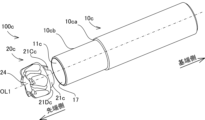
- Fig. 9 is a schematic exploded perspective view of the holder 10c and the insert 20c of the fourth embodiment.
- Fig. 10 is a schematic cross-sectional view of the rotary cutting tool 100c of the fourth embodiment.
- the rotation prevention mechanism of the insert 20c is different from that of the rotary cutting tool 100 of the first embodiment to the rotary cutting tool 100b of the third embodiment. Therefore, in the fourth embodiment, the rotation prevention mechanism different from that of the first embodiment to the third embodiment will be described, and the description of the same configuration as that of the first embodiment to the third embodiment will be omitted.
- the holder 10c of the fourth embodiment has an end face 17 that connects the recess 11c to the outer circumferential surface of the holder 10c.
- the end face 17 has a shape in which the hollow portion of the recess 11c is carved out with respect to a circle perpendicular to the central axis OL1.
- the end face 17 is located at the tip end side of the holder 10c.
- an insertion hole 18 is formed in a portion of the tapered seat 12c that forms the recess 11c, extending from the tip end side to the base end side in a direction parallel to the rotation axis OL1, and the insertion hole 18 and the through hole 24 are separated by a partition wall.
- a rotation prevention pin 50 that protrudes from the insertion hole 18 onto the tapered seat 12c is inserted (pressed) into the insertion hole 18.
- the insertion hole 18 and the rotation prevention pin 50 have a circular cross section in the optimal embodiment, but in the present invention, the cross-sectional shape of the insertion hole is not limited to this and also includes polygonal shapes.
- the insertion hole 18 is formed penetrating from the tip end side to the base end side in the holder 10c, but this shows the optimal embodiment, and penetrating is not essential, and it is sufficient that a rotation prevention pin described later can be inserted, so it may be formed as a blind hole.
- a groove 21Cc is formed in part of the protruding portion 21c of the insert 20c by cutting out a part of the tapered surface 21Ac in a square shape.
- the groove 21Cc is an engagement groove formed to engage with the anti-rotation pin 50 inserted into the insertion hole 18 when the insert 20c is fixed to the holder 10c.
- the notch 21Cc is formed by hollowing out part of the protruding portion 21c of the insert 20c toward the through hole 24.
- the anti-rotation pin 50 inserted into the insertion hole 18 in the recess 11c of the holder 10c protrudes radially toward the center beyond the tapered seating surface 12c and the tapered surface 21Ac in the protruding portion 21c of the insert 20c. Therefore, when the insert 20c rotates relative to the holder 10c around the central axis OL1, the anti-rotation pin 50 contacts the groove 21Cc in the tapered surface 21c.
- the tip 50c of the pin 50 formed in the recess 11c of the holder 10c functions as a rotation prevention mechanism.
- the anti-rotation pin 50 is pressed into the holder 10c perpendicularly, i.e., parallel to the rotation axis OL1. Even if a load is applied to the anti-rotation pin 50 due to the rotation of the tool during use, the anti-rotation pin 50 will not come loose and can still function as a rotation stopper for the insert 20c during use.
- the sides of the tip 50c of the anti-rotation pin 50 can be held by both side walls of the groove 21Cc even if a force in the rotation direction, that is, a force lateral to the axial direction of the anti-rotation pin 50, is applied to the tip 50c.
- a step 10ca is formed on the peripheral surface closer to the tip side than the base end side, and a thin diameter section 10cb is formed on the tip side of the holder 10c, with the diameter of the holder 10c being narrower than the step 10ca.
- this thin diameter section 10cb the outer shape of the holder 10c becomes relatively thin compared to the outer diameter of the insert 20c, which is effective in preventing the holder 10c from coming into contact with the workpiece during machining.
- the outer shape of the holder 10, 10a or 10b shown in the first to third embodiments is made thinner to form the thin diameter section 10cb, the thickness of the end of the end face 17 of the holder 10c becomes thin, and there is a concern that the strength of supporting the insert 20c during cutting will be reduced.
- the size of the tapered surface is smaller than the size of the insert 20c, so there is a concern that the insert 20c will float up and the contact area between the holder and the insert cannot be sufficiently ensured.
- it is necessary to reduce the taper size on the insert side, but reducing the size of the entire insert means that the cutting edge on the side of the insert will be shorter, which places restrictions on the cutting depth during cutting.
- a step 21Dc is formed between the protrusion 21c of the insert 20c and the blade, making the insert stepped. This makes it possible to reduce the size of the tapered surface 21Ac while ensuring the length of the cutting edge on the side, thereby ensuring the contact area between the holder 10c and the insert 20c while also ensuring the length of the cutting edge.
- the rotary cutting tool 100 is described as an example including a holder 10 having a recess 11, an insert 20 having a protrusion 21 at least partially accommodated in the recess 11, and a bolt 30 inserted into a through hole 24 of the insert 20 and screwed into the female thread 13 of the holder 10.
- the configuration of the rotary cutting tool 100 can be modified.
- the rotary cutting tool 100 may be composed of only the holder 10 and the insert 20 without the bolt 30 and the pin 40.
- the rotary cutting tool 100 may be a tool other than an end mill, such as a reamer or a cutter.
- the cutting edge 25 may have at least one of the outer peripheral edge 25o and the bottom edge 25b.
- only the holder 10 or the insert 20 may be distributed as a part of the rotary cutting tool 100.
- the angles formed by the tapered seat 12 of the holder 10 and the tapered surface 21A of the insert 20 with the central axis of each member were 30 degrees, but they may be less than 30 degrees or greater than 30 degrees.
- the angle formed by the tapered seat 12 and the central axis is preferably 30 degrees or more in order to suppress a decrease in the rigidity of the holder 10.
- the angle formed by the tapered seat 12 and the central axis is preferably 60 degrees or less in order to stabilize the blade vibration (inclination) of the cutting edge 25 of the insert 20 fixed to the holder 10.
- the anti-rotation mechanism in each of the first to third embodiments is an example, and a well-known configuration can be used.
- the central axis of the holder 10 and the central axis of the insert 20 are described as overlapping the central axis OL1 for convenience and are the same axis.
- the step ST formed at the position where the inner diameters of the base end hole 24A and the tip end hole 24B in the through hole 24 change regulates the position along the central axis OL1 of the head 32 of the bolt 30 inserted into the through hole 24.
- the shape of the engagement surface that engages with the head 32 of the bolt 30 to regulate the position of the bolt 30 may be a shape other than the step ST and can be modified.
- it may be a tapered surface formed by a taper in which the inner diameter of the base end hole 24A gradually becomes smaller toward the open end surface of the tip end hole 24B.
Landscapes
- Engineering & Computer Science (AREA)
- Mechanical Engineering (AREA)
- Milling Processes (AREA)
- Cutting Tools, Boring Holders, And Turrets (AREA)
Priority Applications (4)
| Application Number | Priority Date | Filing Date | Title |
|---|---|---|---|
| CN202480004950.3A CN120225299A (zh) | 2023-03-02 | 2024-02-29 | 旋转切削工具、刀片和保持件 |
| EP24764014.7A EP4674549A1 (en) | 2023-03-02 | 2024-02-29 | Rotary cutting tool, insert, and holder |
| KR1020257025277A KR20250155513A (ko) | 2023-03-02 | 2024-02-29 | 회전 절삭 공구, 인서트 및 홀더 |
| JP2025503991A JPWO2024181537A1 (https=) | 2023-03-02 | 2024-02-29 |
Applications Claiming Priority (2)
| Application Number | Priority Date | Filing Date | Title |
|---|---|---|---|
| JP2023031912 | 2023-03-02 | ||
| JP2023-031912 | 2023-03-02 |
Publications (1)
| Publication Number | Publication Date |
|---|---|
| WO2024181537A1 true WO2024181537A1 (ja) | 2024-09-06 |
Family
ID=92589945
Family Applications (1)
| Application Number | Title | Priority Date | Filing Date |
|---|---|---|---|
| PCT/JP2024/007552 Ceased WO2024181537A1 (ja) | 2023-03-02 | 2024-02-29 | 回転切削工具、インサート、およびホルダ |
Country Status (5)
| Country | Link |
|---|---|
| EP (1) | EP4674549A1 (https=) |
| JP (1) | JPWO2024181537A1 (https=) |
| KR (1) | KR20250155513A (https=) |
| CN (1) | CN120225299A (https=) |
| WO (1) | WO2024181537A1 (https=) |
Cited By (1)
| Publication number | Priority date | Publication date | Assignee | Title |
|---|---|---|---|---|
| CN119426645A (zh) * | 2025-01-10 | 2025-02-14 | 赣州澳克泰工具技术有限公司 | 切削刀具 |
Citations (6)
| Publication number | Priority date | Publication date | Assignee | Title |
|---|---|---|---|---|
| JPH11285912A (ja) * | 1998-02-05 | 1999-10-19 | Toshiba Corp | エンドミル及びこれを用いた切削加工法 |
| JP4791826B2 (ja) | 2006-01-06 | 2011-10-12 | オーエスジー株式会社 | 刃具交換式回転工具、その刃具交換式回転工具に用いられる交換刃具およびホルダー |
| JP5731643B2 (ja) | 2011-06-08 | 2015-06-10 | オーエスジー株式会社 | チップ着脱式回転工具 |
| WO2019188135A1 (ja) | 2018-03-27 | 2019-10-03 | 日本特殊陶業株式会社 | エンドミル本体及びエンドミル |
| JP2021516169A (ja) * | 2018-03-15 | 2021-07-01 | 益壯企業有限公司 | 加工工具の組立中央位置決め構造 |
| JP2022085831A (ja) * | 2020-11-27 | 2022-06-08 | 新添 張 | 組立式面取りカッター |
-
2024
- 2024-02-29 JP JP2025503991A patent/JPWO2024181537A1/ja active Pending
- 2024-02-29 KR KR1020257025277A patent/KR20250155513A/ko active Pending
- 2024-02-29 EP EP24764014.7A patent/EP4674549A1/en active Pending
- 2024-02-29 CN CN202480004950.3A patent/CN120225299A/zh active Pending
- 2024-02-29 WO PCT/JP2024/007552 patent/WO2024181537A1/ja not_active Ceased
Patent Citations (6)
| Publication number | Priority date | Publication date | Assignee | Title |
|---|---|---|---|---|
| JPH11285912A (ja) * | 1998-02-05 | 1999-10-19 | Toshiba Corp | エンドミル及びこれを用いた切削加工法 |
| JP4791826B2 (ja) | 2006-01-06 | 2011-10-12 | オーエスジー株式会社 | 刃具交換式回転工具、その刃具交換式回転工具に用いられる交換刃具およびホルダー |
| JP5731643B2 (ja) | 2011-06-08 | 2015-06-10 | オーエスジー株式会社 | チップ着脱式回転工具 |
| JP2021516169A (ja) * | 2018-03-15 | 2021-07-01 | 益壯企業有限公司 | 加工工具の組立中央位置決め構造 |
| WO2019188135A1 (ja) | 2018-03-27 | 2019-10-03 | 日本特殊陶業株式会社 | エンドミル本体及びエンドミル |
| JP2022085831A (ja) * | 2020-11-27 | 2022-06-08 | 新添 張 | 組立式面取りカッター |
Non-Patent Citations (1)
| Title |
|---|
| See also references of EP4674549A1 |
Cited By (1)
| Publication number | Priority date | Publication date | Assignee | Title |
|---|---|---|---|---|
| CN119426645A (zh) * | 2025-01-10 | 2025-02-14 | 赣州澳克泰工具技术有限公司 | 切削刀具 |
Also Published As
| Publication number | Publication date |
|---|---|
| KR20250155513A (ko) | 2025-10-30 |
| CN120225299A (zh) | 2025-06-27 |
| EP4674549A1 (en) | 2026-01-07 |
| JPWO2024181537A1 (https=) | 2024-09-06 |
Similar Documents
| Publication | Publication Date | Title |
|---|---|---|
| US6530728B2 (en) | Rotatable tool having a replaceable tip at the chip removing free end of the tool | |
| US20110097168A1 (en) | Lathe Tool, In Particular Boring Tool | |
| CN101032766B (zh) | 切削刀具 | |
| RU2753933C2 (ru) | Инструмент для обработки отверстий и механизм регулировки направляющей пластины для него | |
| CN108025374B (zh) | 用于切槽操作的刀具本体和车削刀具 | |
| EP0812245B1 (en) | Fastening arrangement for cutting inserts | |
| CN101426607A (zh) | 具有相配合的主接合装置和辅助接合装置的用于去屑加工的刀具和切削刀片 | |
| CA3178641A1 (en) | Tool adaptor having an insert receiving pocket and a fastening bore, and cutting tool assembly | |
| WO2024181537A1 (ja) | 回転切削工具、インサート、およびホルダ | |
| JP7516771B2 (ja) | 刃先交換式ドリル | |
| JP2009119591A (ja) | 切刃付リング | |
| KR101997374B1 (ko) | 기계 가공 공구 | |
| WO2015129770A1 (ja) | 切削インサート、工具ボデーおよび切削工具 | |
| US10144071B2 (en) | Tool holder having position adjustment arrangement and cutting tool | |
| JP2007210090A (ja) | 丸駒インサート着脱式切削工具および丸駒インサート | |
| CN107073605B (zh) | 刀具主体、刀片支承机构以及切削刀具 | |
| US20120051861A1 (en) | Guide arrangement for a cutting tool and cutting tool including a guide arrangement | |
| US11298757B2 (en) | Firmly assembled cutter holding assembly | |
| JP7242997B2 (ja) | 刃先交換式エンドミルのエンドミル本体 | |
| JP4262049B2 (ja) | 切削工具 | |
| US11883888B2 (en) | Modular drill with enhanced bump-off capability | |
| JP4971649B2 (ja) | 切削工具 | |
| JP2007130739A (ja) | 穴加工工具 | |
| JP2008272851A (ja) | 切削工具 | |
| JP2001121318A (ja) | スローアウェイ切削工具用ホルダ及びスローアウェイ切削工具 |
Legal Events
| Date | Code | Title | Description |
|---|---|---|---|
| 121 | Ep: the epo has been informed by wipo that ep was designated in this application |
Ref document number: 24764014 Country of ref document: EP Kind code of ref document: A1 |
|
| DPE1 | Request for preliminary examination filed after expiration of 19th month from priority date (pct application filed from 20040101) | ||
| WWE | Wipo information: entry into national phase |
Ref document number: 2025503991 Country of ref document: JP |
|
| WWE | Wipo information: entry into national phase |
Ref document number: CN2024800049503 Country of ref document: CN Ref document number: 202480004950.3 Country of ref document: CN |
|
| WWP | Wipo information: published in national office |
Ref document number: 202480004950.3 Country of ref document: CN |
|
| ENP | Entry into the national phase |
Ref document number: 1020257025277 Country of ref document: KR Free format text: ST27 STATUS EVENT CODE: A-0-1-A10-A15-NAP-PA0105 (AS PROVIDED BY THE NATIONAL OFFICE) |
|
| WWE | Wipo information: entry into national phase |
Ref document number: 2024764014 Country of ref document: EP |
|
| NENP | Non-entry into the national phase |
Ref country code: DE |
|
| WWP | Wipo information: published in national office |
Ref document number: 1020257025277 Country of ref document: KR |
|
| ENP | Entry into the national phase |
Ref document number: 2024764014 Country of ref document: EP Effective date: 20251002 |
|
| ENP | Entry into the national phase |
Ref document number: 2024764014 Country of ref document: EP Effective date: 20251002 |
|
| ENP | Entry into the national phase |
Ref document number: 2024764014 Country of ref document: EP Effective date: 20251002 |
|
| WWP | Wipo information: published in national office |
Ref document number: 2024764014 Country of ref document: EP |