WO2024181459A1 - セラミックス、プローブ案内部品、プローブカードおよびパッケージ検査用ソケット - Google Patents
セラミックス、プローブ案内部品、プローブカードおよびパッケージ検査用ソケット Download PDFInfo
- Publication number
- WO2024181459A1 WO2024181459A1 PCT/JP2024/007139 JP2024007139W WO2024181459A1 WO 2024181459 A1 WO2024181459 A1 WO 2024181459A1 JP 2024007139 W JP2024007139 W JP 2024007139W WO 2024181459 A1 WO2024181459 A1 WO 2024181459A1
- Authority
- WO
- WIPO (PCT)
- Prior art keywords
- mass
- ceramic
- content
- probe
- zro2
- Prior art date
- Legal status (The legal status is an assumption and is not a legal conclusion. Google has not performed a legal analysis and makes no representation as to the accuracy of the status listed.)
- Ceased
Links
Images


Classifications
-
- C—CHEMISTRY; METALLURGY
- C04—CEMENTS; CONCRETE; ARTIFICIAL STONE; CERAMICS; REFRACTORIES
- C04B—LIME, MAGNESIA; SLAG; CEMENTS; COMPOSITIONS THEREOF, e.g. MORTARS, CONCRETE OR LIKE BUILDING MATERIALS; ARTIFICIAL STONE; CERAMICS; REFRACTORIES; TREATMENT OF NATURAL STONE
- C04B35/00—Shaped ceramic products characterised by their composition; Ceramics compositions; Processing powders of inorganic compounds preparatory to the manufacturing of ceramic products
- C04B35/01—Shaped ceramic products characterised by their composition; Ceramics compositions; Processing powders of inorganic compounds preparatory to the manufacturing of ceramic products based on oxide ceramics
- C04B35/48—Shaped ceramic products characterised by their composition; Ceramics compositions; Processing powders of inorganic compounds preparatory to the manufacturing of ceramic products based on oxide ceramics based on zirconium or hafnium oxides, zirconates, zircon or hafnates
- C04B35/486—Fine ceramics
- C04B35/488—Composites
-
- G—PHYSICS
- G01—MEASURING; TESTING
- G01R—MEASURING ELECTRIC VARIABLES; MEASURING MAGNETIC VARIABLES
- G01R3/00—Apparatus or processes specially adapted for the manufacture or maintenance of measuring instruments, e.g. of probe tips
-
- C—CHEMISTRY; METALLURGY
- C04—CEMENTS; CONCRETE; ARTIFICIAL STONE; CERAMICS; REFRACTORIES
- C04B—LIME, MAGNESIA; SLAG; CEMENTS; COMPOSITIONS THEREOF, e.g. MORTARS, CONCRETE OR LIKE BUILDING MATERIALS; ARTIFICIAL STONE; CERAMICS; REFRACTORIES; TREATMENT OF NATURAL STONE
- C04B35/00—Shaped ceramic products characterised by their composition; Ceramics compositions; Processing powders of inorganic compounds preparatory to the manufacturing of ceramic products
- C04B35/622—Forming processes; Processing powders of inorganic compounds preparatory to the manufacturing of ceramic products
- C04B35/64—Burning or sintering processes
- C04B35/645—Pressure sintering
-
- C—CHEMISTRY; METALLURGY
- C04—CEMENTS; CONCRETE; ARTIFICIAL STONE; CERAMICS; REFRACTORIES
- C04B—LIME, MAGNESIA; SLAG; CEMENTS; COMPOSITIONS THEREOF, e.g. MORTARS, CONCRETE OR LIKE BUILDING MATERIALS; ARTIFICIAL STONE; CERAMICS; REFRACTORIES; TREATMENT OF NATURAL STONE
- C04B35/00—Shaped ceramic products characterised by their composition; Ceramics compositions; Processing powders of inorganic compounds preparatory to the manufacturing of ceramic products
- C04B35/622—Forming processes; Processing powders of inorganic compounds preparatory to the manufacturing of ceramic products
- C04B35/64—Burning or sintering processes
- C04B35/645—Pressure sintering
- C04B35/6455—Hot isostatic pressing
-
- G—PHYSICS
- G01—MEASURING; TESTING
- G01R—MEASURING ELECTRIC VARIABLES; MEASURING MAGNETIC VARIABLES
- G01R1/00—Details of instruments or arrangements of the types included in groups G01R5/00 - G01R13/00 and G01R31/00
- G01R1/02—General constructional details
- G01R1/04—Housings; Supporting members; Arrangements of terminals
- G01R1/0408—Test fixtures or contact fields; Connectors or connecting adaptors; Test clips; Test sockets
- G01R1/0433—Sockets for IC's or transistors
- G01R1/0441—Details
- G01R1/0458—Details related to environmental aspects, e.g. temperature
-
- G—PHYSICS
- G01—MEASURING; TESTING
- G01R—MEASURING ELECTRIC VARIABLES; MEASURING MAGNETIC VARIABLES
- G01R31/00—Arrangements for testing electric properties; Arrangements for locating electric faults; Arrangements for electrical testing characterised by what is being tested not provided for elsewhere
- G01R31/26—Testing of individual semiconductor devices
-
- H—ELECTRICITY
- H10—SEMICONDUCTOR DEVICES; ELECTRIC SOLID-STATE DEVICES NOT OTHERWISE PROVIDED FOR
- H10P—GENERIC PROCESSES OR APPARATUS FOR THE MANUFACTURE OR TREATMENT OF DEVICES COVERED BY CLASS H10
- H10P74/00—Testing or measuring during manufacture or treatment of wafers, substrates or devices
-
- C—CHEMISTRY; METALLURGY
- C04—CEMENTS; CONCRETE; ARTIFICIAL STONE; CERAMICS; REFRACTORIES
- C04B—LIME, MAGNESIA; SLAG; CEMENTS; COMPOSITIONS THEREOF, e.g. MORTARS, CONCRETE OR LIKE BUILDING MATERIALS; ARTIFICIAL STONE; CERAMICS; REFRACTORIES; TREATMENT OF NATURAL STONE
- C04B2235/00—Aspects relating to ceramic starting mixtures or sintered ceramic products
- C04B2235/02—Composition of constituents of the starting material or of secondary phases of the final product
- C04B2235/30—Constituents and secondary phases not being of a fibrous nature
- C04B2235/32—Metal oxides, mixed metal oxides, or oxide-forming salts thereof, e.g. carbonates, nitrates, (oxy)hydroxides, chlorides
- C04B2235/3205—Alkaline earth oxides or oxide forming salts thereof, e.g. beryllium oxide
- C04B2235/3206—Magnesium oxides or oxide-forming salts thereof
-
- C—CHEMISTRY; METALLURGY
- C04—CEMENTS; CONCRETE; ARTIFICIAL STONE; CERAMICS; REFRACTORIES
- C04B—LIME, MAGNESIA; SLAG; CEMENTS; COMPOSITIONS THEREOF, e.g. MORTARS, CONCRETE OR LIKE BUILDING MATERIALS; ARTIFICIAL STONE; CERAMICS; REFRACTORIES; TREATMENT OF NATURAL STONE
- C04B2235/00—Aspects relating to ceramic starting mixtures or sintered ceramic products
- C04B2235/02—Composition of constituents of the starting material or of secondary phases of the final product
- C04B2235/30—Constituents and secondary phases not being of a fibrous nature
- C04B2235/32—Metal oxides, mixed metal oxides, or oxide-forming salts thereof, e.g. carbonates, nitrates, (oxy)hydroxides, chlorides
- C04B2235/3205—Alkaline earth oxides or oxide forming salts thereof, e.g. beryllium oxide
- C04B2235/3208—Calcium oxide or oxide-forming salts thereof, e.g. lime
-
- C—CHEMISTRY; METALLURGY
- C04—CEMENTS; CONCRETE; ARTIFICIAL STONE; CERAMICS; REFRACTORIES
- C04B—LIME, MAGNESIA; SLAG; CEMENTS; COMPOSITIONS THEREOF, e.g. MORTARS, CONCRETE OR LIKE BUILDING MATERIALS; ARTIFICIAL STONE; CERAMICS; REFRACTORIES; TREATMENT OF NATURAL STONE
- C04B2235/00—Aspects relating to ceramic starting mixtures or sintered ceramic products
- C04B2235/02—Composition of constituents of the starting material or of secondary phases of the final product
- C04B2235/30—Constituents and secondary phases not being of a fibrous nature
- C04B2235/32—Metal oxides, mixed metal oxides, or oxide-forming salts thereof, e.g. carbonates, nitrates, (oxy)hydroxides, chlorides
- C04B2235/3217—Aluminum oxide or oxide forming salts thereof, e.g. bauxite, alpha-alumina
-
- C—CHEMISTRY; METALLURGY
- C04—CEMENTS; CONCRETE; ARTIFICIAL STONE; CERAMICS; REFRACTORIES
- C04B—LIME, MAGNESIA; SLAG; CEMENTS; COMPOSITIONS THEREOF, e.g. MORTARS, CONCRETE OR LIKE BUILDING MATERIALS; ARTIFICIAL STONE; CERAMICS; REFRACTORIES; TREATMENT OF NATURAL STONE
- C04B2235/00—Aspects relating to ceramic starting mixtures or sintered ceramic products
- C04B2235/02—Composition of constituents of the starting material or of secondary phases of the final product
- C04B2235/30—Constituents and secondary phases not being of a fibrous nature
- C04B2235/32—Metal oxides, mixed metal oxides, or oxide-forming salts thereof, e.g. carbonates, nitrates, (oxy)hydroxides, chlorides
- C04B2235/3224—Rare earth oxide or oxide forming salts thereof, e.g. scandium oxide
-
- C—CHEMISTRY; METALLURGY
- C04—CEMENTS; CONCRETE; ARTIFICIAL STONE; CERAMICS; REFRACTORIES
- C04B—LIME, MAGNESIA; SLAG; CEMENTS; COMPOSITIONS THEREOF, e.g. MORTARS, CONCRETE OR LIKE BUILDING MATERIALS; ARTIFICIAL STONE; CERAMICS; REFRACTORIES; TREATMENT OF NATURAL STONE
- C04B2235/00—Aspects relating to ceramic starting mixtures or sintered ceramic products
- C04B2235/02—Composition of constituents of the starting material or of secondary phases of the final product
- C04B2235/30—Constituents and secondary phases not being of a fibrous nature
- C04B2235/32—Metal oxides, mixed metal oxides, or oxide-forming salts thereof, e.g. carbonates, nitrates, (oxy)hydroxides, chlorides
- C04B2235/3224—Rare earth oxide or oxide forming salts thereof, e.g. scandium oxide
- C04B2235/3225—Yttrium oxide or oxide-forming salts thereof
-
- C—CHEMISTRY; METALLURGY
- C04—CEMENTS; CONCRETE; ARTIFICIAL STONE; CERAMICS; REFRACTORIES
- C04B—LIME, MAGNESIA; SLAG; CEMENTS; COMPOSITIONS THEREOF, e.g. MORTARS, CONCRETE OR LIKE BUILDING MATERIALS; ARTIFICIAL STONE; CERAMICS; REFRACTORIES; TREATMENT OF NATURAL STONE
- C04B2235/00—Aspects relating to ceramic starting mixtures or sintered ceramic products
- C04B2235/02—Composition of constituents of the starting material or of secondary phases of the final product
- C04B2235/30—Constituents and secondary phases not being of a fibrous nature
- C04B2235/32—Metal oxides, mixed metal oxides, or oxide-forming salts thereof, e.g. carbonates, nitrates, (oxy)hydroxides, chlorides
- C04B2235/3224—Rare earth oxide or oxide forming salts thereof, e.g. scandium oxide
- C04B2235/3227—Lanthanum oxide or oxide-forming salts thereof
-
- C—CHEMISTRY; METALLURGY
- C04—CEMENTS; CONCRETE; ARTIFICIAL STONE; CERAMICS; REFRACTORIES
- C04B—LIME, MAGNESIA; SLAG; CEMENTS; COMPOSITIONS THEREOF, e.g. MORTARS, CONCRETE OR LIKE BUILDING MATERIALS; ARTIFICIAL STONE; CERAMICS; REFRACTORIES; TREATMENT OF NATURAL STONE
- C04B2235/00—Aspects relating to ceramic starting mixtures or sintered ceramic products
- C04B2235/02—Composition of constituents of the starting material or of secondary phases of the final product
- C04B2235/30—Constituents and secondary phases not being of a fibrous nature
- C04B2235/32—Metal oxides, mixed metal oxides, or oxide-forming salts thereof, e.g. carbonates, nitrates, (oxy)hydroxides, chlorides
- C04B2235/3224—Rare earth oxide or oxide forming salts thereof, e.g. scandium oxide
- C04B2235/3229—Cerium oxides or oxide-forming salts thereof
-
- C—CHEMISTRY; METALLURGY
- C04—CEMENTS; CONCRETE; ARTIFICIAL STONE; CERAMICS; REFRACTORIES
- C04B—LIME, MAGNESIA; SLAG; CEMENTS; COMPOSITIONS THEREOF, e.g. MORTARS, CONCRETE OR LIKE BUILDING MATERIALS; ARTIFICIAL STONE; CERAMICS; REFRACTORIES; TREATMENT OF NATURAL STONE
- C04B2235/00—Aspects relating to ceramic starting mixtures or sintered ceramic products
- C04B2235/02—Composition of constituents of the starting material or of secondary phases of the final product
- C04B2235/30—Constituents and secondary phases not being of a fibrous nature
- C04B2235/32—Metal oxides, mixed metal oxides, or oxide-forming salts thereof, e.g. carbonates, nitrates, (oxy)hydroxides, chlorides
- C04B2235/3231—Refractory metal oxides, their mixed metal oxides, or oxide-forming salts thereof
- C04B2235/3232—Titanium oxides or titanates, e.g. rutile or anatase
-
- C—CHEMISTRY; METALLURGY
- C04—CEMENTS; CONCRETE; ARTIFICIAL STONE; CERAMICS; REFRACTORIES
- C04B—LIME, MAGNESIA; SLAG; CEMENTS; COMPOSITIONS THEREOF, e.g. MORTARS, CONCRETE OR LIKE BUILDING MATERIALS; ARTIFICIAL STONE; CERAMICS; REFRACTORIES; TREATMENT OF NATURAL STONE
- C04B2235/00—Aspects relating to ceramic starting mixtures or sintered ceramic products
- C04B2235/02—Composition of constituents of the starting material or of secondary phases of the final product
- C04B2235/30—Constituents and secondary phases not being of a fibrous nature
- C04B2235/32—Metal oxides, mixed metal oxides, or oxide-forming salts thereof, e.g. carbonates, nitrates, (oxy)hydroxides, chlorides
- C04B2235/3231—Refractory metal oxides, their mixed metal oxides, or oxide-forming salts thereof
- C04B2235/3244—Zirconium oxides, zirconates, hafnium oxides, hafnates, or oxide-forming salts thereof
-
- C—CHEMISTRY; METALLURGY
- C04—CEMENTS; CONCRETE; ARTIFICIAL STONE; CERAMICS; REFRACTORIES
- C04B—LIME, MAGNESIA; SLAG; CEMENTS; COMPOSITIONS THEREOF, e.g. MORTARS, CONCRETE OR LIKE BUILDING MATERIALS; ARTIFICIAL STONE; CERAMICS; REFRACTORIES; TREATMENT OF NATURAL STONE
- C04B2235/00—Aspects relating to ceramic starting mixtures or sintered ceramic products
- C04B2235/02—Composition of constituents of the starting material or of secondary phases of the final product
- C04B2235/30—Constituents and secondary phases not being of a fibrous nature
- C04B2235/32—Metal oxides, mixed metal oxides, or oxide-forming salts thereof, e.g. carbonates, nitrates, (oxy)hydroxides, chlorides
- C04B2235/3231—Refractory metal oxides, their mixed metal oxides, or oxide-forming salts thereof
- C04B2235/3251—Niobium oxides, niobates, tantalum oxides, tantalates, or oxide-forming salts thereof
-
- C—CHEMISTRY; METALLURGY
- C04—CEMENTS; CONCRETE; ARTIFICIAL STONE; CERAMICS; REFRACTORIES
- C04B—LIME, MAGNESIA; SLAG; CEMENTS; COMPOSITIONS THEREOF, e.g. MORTARS, CONCRETE OR LIKE BUILDING MATERIALS; ARTIFICIAL STONE; CERAMICS; REFRACTORIES; TREATMENT OF NATURAL STONE
- C04B2235/00—Aspects relating to ceramic starting mixtures or sintered ceramic products
- C04B2235/02—Composition of constituents of the starting material or of secondary phases of the final product
- C04B2235/30—Constituents and secondary phases not being of a fibrous nature
- C04B2235/32—Metal oxides, mixed metal oxides, or oxide-forming salts thereof, e.g. carbonates, nitrates, (oxy)hydroxides, chlorides
- C04B2235/3231—Refractory metal oxides, their mixed metal oxides, or oxide-forming salts thereof
- C04B2235/3256—Molybdenum oxides, molybdates or oxide forming salts thereof, e.g. cadmium molybdate
-
- C—CHEMISTRY; METALLURGY
- C04—CEMENTS; CONCRETE; ARTIFICIAL STONE; CERAMICS; REFRACTORIES
- C04B—LIME, MAGNESIA; SLAG; CEMENTS; COMPOSITIONS THEREOF, e.g. MORTARS, CONCRETE OR LIKE BUILDING MATERIALS; ARTIFICIAL STONE; CERAMICS; REFRACTORIES; TREATMENT OF NATURAL STONE
- C04B2235/00—Aspects relating to ceramic starting mixtures or sintered ceramic products
- C04B2235/02—Composition of constituents of the starting material or of secondary phases of the final product
- C04B2235/30—Constituents and secondary phases not being of a fibrous nature
- C04B2235/38—Non-oxide ceramic constituents or additives
- C04B2235/3817—Carbides
- C04B2235/3826—Silicon carbides
-
- C—CHEMISTRY; METALLURGY
- C04—CEMENTS; CONCRETE; ARTIFICIAL STONE; CERAMICS; REFRACTORIES
- C04B—LIME, MAGNESIA; SLAG; CEMENTS; COMPOSITIONS THEREOF, e.g. MORTARS, CONCRETE OR LIKE BUILDING MATERIALS; ARTIFICIAL STONE; CERAMICS; REFRACTORIES; TREATMENT OF NATURAL STONE
- C04B2235/00—Aspects relating to ceramic starting mixtures or sintered ceramic products
- C04B2235/02—Composition of constituents of the starting material or of secondary phases of the final product
- C04B2235/30—Constituents and secondary phases not being of a fibrous nature
- C04B2235/38—Non-oxide ceramic constituents or additives
- C04B2235/3852—Nitrides, e.g. oxynitrides, carbonitrides, oxycarbonitrides, lithium nitride, magnesium nitride
- C04B2235/386—Boron nitrides
-
- C—CHEMISTRY; METALLURGY
- C04—CEMENTS; CONCRETE; ARTIFICIAL STONE; CERAMICS; REFRACTORIES
- C04B—LIME, MAGNESIA; SLAG; CEMENTS; COMPOSITIONS THEREOF, e.g. MORTARS, CONCRETE OR LIKE BUILDING MATERIALS; ARTIFICIAL STONE; CERAMICS; REFRACTORIES; TREATMENT OF NATURAL STONE
- C04B2235/00—Aspects relating to ceramic starting mixtures or sintered ceramic products
- C04B2235/02—Composition of constituents of the starting material or of secondary phases of the final product
- C04B2235/30—Constituents and secondary phases not being of a fibrous nature
- C04B2235/38—Non-oxide ceramic constituents or additives
- C04B2235/3852—Nitrides, e.g. oxynitrides, carbonitrides, oxycarbonitrides, lithium nitride, magnesium nitride
- C04B2235/3865—Aluminium nitrides
-
- C—CHEMISTRY; METALLURGY
- C04—CEMENTS; CONCRETE; ARTIFICIAL STONE; CERAMICS; REFRACTORIES
- C04B—LIME, MAGNESIA; SLAG; CEMENTS; COMPOSITIONS THEREOF, e.g. MORTARS, CONCRETE OR LIKE BUILDING MATERIALS; ARTIFICIAL STONE; CERAMICS; REFRACTORIES; TREATMENT OF NATURAL STONE
- C04B2235/00—Aspects relating to ceramic starting mixtures or sintered ceramic products
- C04B2235/02—Composition of constituents of the starting material or of secondary phases of the final product
- C04B2235/30—Constituents and secondary phases not being of a fibrous nature
- C04B2235/38—Non-oxide ceramic constituents or additives
- C04B2235/3852—Nitrides, e.g. oxynitrides, carbonitrides, oxycarbonitrides, lithium nitride, magnesium nitride
- C04B2235/3873—Silicon nitrides, e.g. silicon carbonitride, silicon oxynitride
-
- C—CHEMISTRY; METALLURGY
- C04—CEMENTS; CONCRETE; ARTIFICIAL STONE; CERAMICS; REFRACTORIES
- C04B—LIME, MAGNESIA; SLAG; CEMENTS; COMPOSITIONS THEREOF, e.g. MORTARS, CONCRETE OR LIKE BUILDING MATERIALS; ARTIFICIAL STONE; CERAMICS; REFRACTORIES; TREATMENT OF NATURAL STONE
- C04B2235/00—Aspects relating to ceramic starting mixtures or sintered ceramic products
- C04B2235/02—Composition of constituents of the starting material or of secondary phases of the final product
- C04B2235/50—Constituents or additives of the starting mixture chosen for their shape or used because of their shape or their physical appearance
- C04B2235/54—Particle size related information
- C04B2235/5418—Particle size related information expressed by the size of the particles or aggregates thereof
- C04B2235/5436—Particle size related information expressed by the size of the particles or aggregates thereof micrometer sized, i.e. from 1 to 100 micron
-
- C—CHEMISTRY; METALLURGY
- C04—CEMENTS; CONCRETE; ARTIFICIAL STONE; CERAMICS; REFRACTORIES
- C04B—LIME, MAGNESIA; SLAG; CEMENTS; COMPOSITIONS THEREOF, e.g. MORTARS, CONCRETE OR LIKE BUILDING MATERIALS; ARTIFICIAL STONE; CERAMICS; REFRACTORIES; TREATMENT OF NATURAL STONE
- C04B2235/00—Aspects relating to ceramic starting mixtures or sintered ceramic products
- C04B2235/02—Composition of constituents of the starting material or of secondary phases of the final product
- C04B2235/50—Constituents or additives of the starting mixture chosen for their shape or used because of their shape or their physical appearance
- C04B2235/54—Particle size related information
- C04B2235/5418—Particle size related information expressed by the size of the particles or aggregates thereof
- C04B2235/5445—Particle size related information expressed by the size of the particles or aggregates thereof submicron sized, i.e. from 0,1 to 1 micron
-
- C—CHEMISTRY; METALLURGY
- C04—CEMENTS; CONCRETE; ARTIFICIAL STONE; CERAMICS; REFRACTORIES
- C04B—LIME, MAGNESIA; SLAG; CEMENTS; COMPOSITIONS THEREOF, e.g. MORTARS, CONCRETE OR LIKE BUILDING MATERIALS; ARTIFICIAL STONE; CERAMICS; REFRACTORIES; TREATMENT OF NATURAL STONE
- C04B2235/00—Aspects relating to ceramic starting mixtures or sintered ceramic products
- C04B2235/65—Aspects relating to heat treatments of ceramic bodies such as green ceramics or pre-sintered ceramics, e.g. burning, sintering or melting processes
- C04B2235/656—Aspects relating to heat treatments of ceramic bodies such as green ceramics or pre-sintered ceramics, e.g. burning, sintering or melting processes characterised by specific heating conditions during heat treatment
- C04B2235/6567—Treatment time
-
- C—CHEMISTRY; METALLURGY
- C04—CEMENTS; CONCRETE; ARTIFICIAL STONE; CERAMICS; REFRACTORIES
- C04B—LIME, MAGNESIA; SLAG; CEMENTS; COMPOSITIONS THEREOF, e.g. MORTARS, CONCRETE OR LIKE BUILDING MATERIALS; ARTIFICIAL STONE; CERAMICS; REFRACTORIES; TREATMENT OF NATURAL STONE
- C04B2235/00—Aspects relating to ceramic starting mixtures or sintered ceramic products
- C04B2235/70—Aspects relating to sintered or melt-casted ceramic products
- C04B2235/74—Physical characteristics
- C04B2235/76—Crystal structural characteristics, e.g. symmetry
- C04B2235/762—Cubic symmetry, e.g. beta-SiC
-
- C—CHEMISTRY; METALLURGY
- C04—CEMENTS; CONCRETE; ARTIFICIAL STONE; CERAMICS; REFRACTORIES
- C04B—LIME, MAGNESIA; SLAG; CEMENTS; COMPOSITIONS THEREOF, e.g. MORTARS, CONCRETE OR LIKE BUILDING MATERIALS; ARTIFICIAL STONE; CERAMICS; REFRACTORIES; TREATMENT OF NATURAL STONE
- C04B2235/00—Aspects relating to ceramic starting mixtures or sintered ceramic products
- C04B2235/70—Aspects relating to sintered or melt-casted ceramic products
- C04B2235/74—Physical characteristics
- C04B2235/77—Density
-
- C—CHEMISTRY; METALLURGY
- C04—CEMENTS; CONCRETE; ARTIFICIAL STONE; CERAMICS; REFRACTORIES
- C04B—LIME, MAGNESIA; SLAG; CEMENTS; COMPOSITIONS THEREOF, e.g. MORTARS, CONCRETE OR LIKE BUILDING MATERIALS; ARTIFICIAL STONE; CERAMICS; REFRACTORIES; TREATMENT OF NATURAL STONE
- C04B2235/00—Aspects relating to ceramic starting mixtures or sintered ceramic products
- C04B2235/70—Aspects relating to sintered or melt-casted ceramic products
- C04B2235/96—Properties of ceramic products, e.g. mechanical properties such as strength, toughness, wear resistance
-
- C—CHEMISTRY; METALLURGY
- C04—CEMENTS; CONCRETE; ARTIFICIAL STONE; CERAMICS; REFRACTORIES
- C04B—LIME, MAGNESIA; SLAG; CEMENTS; COMPOSITIONS THEREOF, e.g. MORTARS, CONCRETE OR LIKE BUILDING MATERIALS; ARTIFICIAL STONE; CERAMICS; REFRACTORIES; TREATMENT OF NATURAL STONE
- C04B2235/00—Aspects relating to ceramic starting mixtures or sintered ceramic products
- C04B2235/70—Aspects relating to sintered or melt-casted ceramic products
- C04B2235/96—Properties of ceramic products, e.g. mechanical properties such as strength, toughness, wear resistance
- C04B2235/9607—Thermal properties, e.g. thermal expansion coefficient
Definitions
- the present invention relates to ceramics, probe guide components, probe cards, and sockets for package inspection.
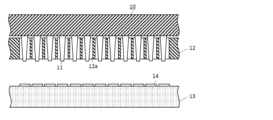
- FIG. 1 shows a cross-sectional view illustrating the configuration of a probe card
- FIG. 2 shows a top view illustrating the configuration of a probe guide.
- a probe card 10 is an inspection jig that includes needle-shaped probes 11 and a probe guide (probe guide component) 12 that has a number of through holes 12a for inserting each probe 11.
- An IC chip 14 is inspected by bringing the multiple probes 11 into contact with the IC chip 14 formed on a wafer 13.
- Patent Document 1 discloses ceramics made mainly of, by mass%, 20.0 to 60.0% Si 3 N 4 and 25.0 to 70.0% ZrO 2.
- the ceramics disclosed in Patent Document 1 are excellent in strength, processability, etc., and are therefore suitable for use in probe guides and the like.
- the present invention aims to provide ceramics that have a large coefficient of thermal expansion and can suppress dimensional changes.
- the present invention has been made to solve the above problems, and is based on the following ceramics, probe guide components, probe cards, and package inspection sockets.
- the chemical composition is In terms of mass% based on oxides, Contains Al 2 O 3 : 0 to 25%; In terms of mass% based on nitride, Si3N4 : 0-20 %, and BN: 0-20%,
- the chemical composition is In terms of mass% based on oxides, The ceramic according to (1) above, containing 0 to 5% of one or more selected from TiO 2 , MoO 3 , Ta 2 O 5 , Yb 2 O 3 , and LaO.
- the chemical composition is In terms of mass% based on oxides, The ceramic according to (2) above, containing 0 to 5% of one or more selected from TiO 2 , MoO 3 , Ta 2 O 5 , Yb 2 O 3 and LaO.
- a probe guide component comprising the ceramic described in any one of (1) to (4) above.
- a package inspection socket comprising the ceramic described in any one of (1) to (4) above.
- the present invention makes it possible to obtain ceramics that have a large coefficient of thermal expansion and are capable of suppressing dimensional changes.
- FIG. 1 is a cross-sectional view illustrating the configuration of a probe card.
- FIG. 2 is a top view illustrating the configuration of the probe guide.
- FIG. 3 is a diagram showing an example of the results of XRD measurement when identifying the crystal phase.
- FIG. 4 is a schematic diagram of a processed surface when evaluating the dimensions of the laser processability.
- the inventors investigated ceramics that can be used in probe guides even when the wafer is at high temperatures, and obtained the following findings.
- the probe guide does not directly contact the wafer, and heat is conducted through the probe, for example, so that the temperature of the probe guide rises but is lower than that of the wafer. For this reason, even if the temperature is lower than that of the wafer, it is required to have the same thermal expansion as the wafer.
- the thermal expansion coefficient of a silicon wafer is about 2.6 ⁇ 10 ⁇ 6 /°C.
- the thermal expansion coefficient of wafer materials such as SiC and GaN, which have been used in recent years and can be used at high temperatures, is quite high, about 4.0 to 6.0 ⁇ 10 ⁇ 6 . Therefore, it is preferable that the thermal expansion coefficient is higher than that of the wafer, specifically, 7.0 ⁇ 10 ⁇ 6 /°C or more.
- ZrO 2 is a substance that has a crystal structure of either monoclinic, tetragonal, or cubic, and the crystal structure changes due to phase transformation. If ZrO 2 contains a certain amount of tetragonal or monoclinic, the dimensions will change when it is used multiple times as a probe guide. This is because the crystal structure changes in a usage environment where heating and stress loads occur repeatedly, and the original dimensions will not return when cooled. In addition, if the tetragonal crystal is contained in a certain amount or more, it may cause a chemical reaction with moisture, etc. For this reason, ZrO 2 must mainly have a cubic crystal structure.
- ZrO2 1-1 Mass fraction of ZrO2 ZrO2 is effective in imparting a high thermal expansion coefficient to ceramics. For this reason, the ceramics of this embodiment contains 66.5% or more of ZrO2 , expressed as mass% on an oxide basis.
- the content of ZrO2 is preferably 70.0% or more, and more preferably 80.0% or more.
- the upper limit of the ZrO2 content is not particularly limited, but in order to obtain a desired amount of cubic ZrO2 , the ZrO2 content, expressed as mass% on an oxide basis, is preferably 90.0% or less.
- ZrO2 Crystal Structure
- ZrO2 zirconium oxide, also known as "zirconia”
- zirconia zirconium oxide, also known as "zirconia”
- ZrO2 has a monoclinic, tetragonal or cubic crystal structure.
- tetragonal ZrO2 in which a few percent of oxides are dissolved is preferably used.
- this tetragonal ZrO2 undergoes a phase transition to monoclinic when exposed to low temperatures, for example, temperatures below 200°C, for a long period of time.
- the dimensions of the ceramic change. This phase transition progresses, for example, at 40°C or higher, and progresses more remarkably at 150°C or higher.
- the crystal structure of ZrO 2 is a cubic crystal.
- the crystal structure of ZrO 2 is a cubic crystal
- peak intensity is measured by XRD, and the peak intensity of each crystal phase (monoclinic, cubic, tetragonal) on the (200) plane of ZrO 2 is obtained as shown in FIG. 3.
- 34.2° indicated by ⁇ is the monoclinic peak
- 34.9° indicated by ⁇ is the cubic peak
- 35.3° indicated by ⁇ is the tetragonal peak.
- the determination is made at the intensity where the diffraction angle 2 ⁇ is around 35°.
- the crystal structure of ZrO 2 is determined to be a cubic crystal.
- a baseline is drawn within the range of diffraction angle 2 ⁇ of 32 to 38°, and the above-mentioned peak intensity is obtained.
- the ceramic of this embodiment may contain Al 2 O 3 as necessary in addition to the above-mentioned ZrO 2.
- Al 2 O 3 may be used as a sintering aid in some cases.
- Al 2 O 3 can impart high strength, such as bending strength, to ceramics.
- it can improve laser processability.
- the content of Al 2 O 3 is preferably 25% or less, and more preferably 20 % or less.
- the content of 3 is more preferably 15% or less.
- the content of Al2O3 is preferably 0.5% or more, more preferably 3% or more, more preferably 5% or more, and even more preferably 10% or more.
- each compound is calculated based on the element amount measured by ICP emission spectrometry, which will be described later.
- the content when the total amount of Al is converted into Al 2 O 3 , which is an oxide is theoretically calculated. This value means the mass % display based on the oxide. Therefore, for example, even if Al 2 O 3 is not used in the raw material but AlN is used, and AlN is contained in the ceramic of the final product, the Al content in the AlN is converted and calculated as the content of Al 2 O 3 , which is an oxide.
- Al 2 O 3 and AlN may be contained as compounds containing Al, but other compounds containing Al may be contained in addition to these compounds as long as they do not impair the effects of the ceramic of this embodiment.
- Any Al compound is converted into the content of Al 2 O 3.
- the same conversion method is used for other stabilizers and sintering aids that are expressed in mass% based on oxides.
- Al 2 O 3 when Al 2 O 3 is actually contained, bending strength is improved, and when AlN is contained, laser processability is improved, but even when AlN is contained, it is converted into Al 2 O 3 .
- the ceramic of the present embodiment may contain one or more selected from Si 3 N 4 (silicon nitride) and BN (boron nitride).
- Si3N4 0-20 % Si 3 N 4 is effective in imparting high strength, for example bending strength, to ceramics. It also has the effect of improving laser processability. Therefore, it may be contained as necessary. However, if Si 3 N 4 is excessively contained, it becomes difficult to obtain a thermal expansion coefficient of 7.0 ⁇ 10 ⁇ 6 /° C. or more. In addition, the laser processability is also deteriorated. For this reason, The content of Si 3 N 4 expressed in mass % is preferably 20% or less.
- the content of Si 3 N 4 is more preferably 15% or less.
- the content of Si 3 N 4 is preferably 0.5% or more, more preferably 3% or more, more preferably 5% or more, more preferably 7% or more, and even more preferably 10% or more, in terms of mass% based on the nitride.
- Al 2 O 3 in the case of Si 3 N 4 , in the case of a compound containing Si, all are converted as the content of Si 3 N 4 , which is a nitride.
- SiC in addition to Si 3 N 4 , SiC may be contained as a compound containing Si, but in addition to these compounds, other compounds containing Si may be contained as long as they do not inhibit the effect of the ceramic of this embodiment. Any Si compound is converted as the content of Si 3 N 4. The same applies to the case of BN.
- BN 0-20% BN is effective in imparting laser processability and machinability. Therefore, it may be contained as necessary. However, if BN is contained in excess, bending strength decreases. Therefore, the BN content is preferably 20% or less in mass% on the basis of nitride. The BN content is more preferably 15% or less, and even more preferably 10% or less in mass% on the basis of nitride. On the other hand, in order to obtain the above effect, the BN content is preferably 0.5% or more, more preferably 3% or more, more preferably 5% or more, more preferably 7% or more, and even more preferably 10% or more in mass% on the basis of nitride.
- Stabilizers In order to make the crystal structure of ZrO2 cubic, it is necessary to include a compound called a stabilizer.
- the most common stabilizer is Y2O3 ( yttrium oxide, also called “ yttria "), but other stabilizers include CaO (calcium oxide), MgO (magnesium oxide, also called “magnesia”), CeO2 (cerium oxide), and HfO2 (hafnium oxide).
- the ceramic of this embodiment contains, in mass % on an oxide basis, 10 to 30% in total of one or more compounds selected from Y 2 O 3 , CaO, MgO, CeO 2 , and HfO 2.
- one or more compounds selected from Y 2 O 3 , CaO, MgO, CeO 2 , and HfO 2 are collectively referred to as Group A compounds.
- the stabilizer When the total content of the A group compounds is less than 10% by mass% based on the oxides, the stabilizer is insufficient and cubic ZrO2 is not formed. Therefore, when the total content of the A group compounds is 10% or more by mass% based on the oxides, the total content of the A group compounds is preferably 12% or more by mass% based on the oxides. On the other hand, when the total content of the A group compounds is more than 30% by mass% based on the oxides, the stabilizer becomes excessive, and the thermal expansion coefficient is likely to decrease. Therefore, when the total content of the A group compounds is 30% or less by mass% based on the oxides, the total content of the A group compounds is preferably 20% or less, and more preferably 18% or less by mass% based on the oxides. Each compound will be described individually below.
- Y2O3 Y 2 O 3 is the most common stabilizer and may be included as necessary. It also acts as a sintering aid as described below. However, if the content of Y 2 O 3 is excessive, it becomes difficult to obtain a thermal expansion coefficient of 7.0 ⁇ 10 ⁇ 6 /°C or more. For this reason, the content of Y 2 O 3 is preferably 20% or less, expressed as mass% based on oxide. On the other hand, in order to obtain the effect as the above stabilizer, the content of Y 2 O 3 is preferably 5.4% or more, more preferably 8.0% or more, and even more preferably 10% or more, expressed as mass% based on oxide.
- CaO CaO like Y 2 O 3 , is a stabilizer and may be included as necessary. It also acts as a sintering aid as described below. However, if the CaO content is excessive, it becomes difficult to obtain a thermal expansion coefficient of 7.0 ⁇ 10 ⁇ 6 /°C or more. For this reason, the CaO content is preferably 20% or less, expressed as mass% on an oxide basis. On the other hand, in order to obtain the above-mentioned effect as a stabilizer, the CaO content is preferably 5.4% or more, more preferably 8.0% or more, and even more preferably 10% or more, expressed as mass% on an oxide basis.
- MgO MgO is a stabilizer and may be included as necessary. It also has the effect of increasing the thermal expansion coefficient. In addition, it also acts as a sintering aid as described below. However, if the content of MgO is excessive, the bending strength decreases. For this reason, the content of MgO is preferably 20% or less, more preferably 15% or less, expressed as mass% based on the oxide. On the other hand, in order to obtain the effect as the stabilizer, the content of MgO is preferably 5.4% or more, more preferably 8.0% or more, and even more preferably 10% or more, expressed as mass% based on the oxide.
- CeO2 CeO2 is a stabilizer and may be included as necessary. It also acts as a sintering aid as described below. However, if the CeO2 content is excessive, it becomes difficult to obtain a thermal expansion coefficient of 7.0 x 10⁻⁶ /°C or more. For this reason, the CeO2 content is preferably 20% or less, expressed as mass% on an oxide basis. On the other hand, in order to obtain the effect as a stabilizer, the CeO2 content is preferably 5.4% or more, more preferably 8.0% or more, and even more preferably 10% or more, expressed as mass% on an oxide basis.
- HfO2 HfO 2 is also a stabilizer, like Y 2 O 3 , and may be included as necessary. In addition, it also acts as a sintering aid as described below. However, if the content of HfO 2 is excessive, it becomes difficult to obtain a thermal expansion coefficient of 7.0 ⁇ 10 ⁇ 6 /°C or more. For this reason, the content of HfO 2 is preferably 20% or less, expressed as mass% on an oxide basis. On the other hand, in order to obtain the effect as the above stabilizer, the content of HfO 2 is preferably 5.4% or more, more preferably 8.0% or more, and even more preferably 10% or more, expressed as mass% on an oxide basis.
- the ceramic of this embodiment may contain the following sintering aids as necessary in addition to the above components. That is, the lower limit of the sintering aid is 0%.
- the sintering aid refers to a compound added to promote and stabilize the sintering of ceramics, and the content of these sintering aids is a value expressed in mass% on an oxide basis.
- sintering aids include TiO2 (titanium oxide), MoO3 (molybdenum oxide ), Ta2O5 (tantalum pentoxide), Yb2O3 (ytterbium oxide), and LaO.
- the content of the sintering aid is not particularly limited, but in order to obtain dense ceramics, it is preferable to contain, for example, 0 to 5% of one or more selected from TiO 2 , MoO 3 , Ta 2 O 5 , Yb 2 O 3 , and LaO, expressed as mass % on an oxide basis. If the total content of the above compounds exceeds 5%, expressed as mass % on an oxide basis, the grain boundary phase composed of low-strength glass or crystals increases, and the strength is likely to decrease.
- each compound is measured, for example, by the following procedure.
- the amount of Zr is specified using an ICP emission spectrometer, and the amount is calculated as the content of ZrO2 in terms of oxide.
- the contents of Al2O3 , stabilizer , and sintering aid are calculated by converting the amount of each element contained into an oxide.
- the content of Si3N4 or BN is calculated by specifying the amount of Si or B, and converting the specified amount into a nitride.
- the ICP emission spectrometer used was an Agilent Technologies 5110, and measurements were taken three times, with the amount of each element determined based on the average value. Other measurement conditions were RF power 1200 W, auxiliary gas flow rate 1 L/min, nebulizer gas flow rate 0.7 L/min, plasma gas flow rate 12 L/min, and the gas type was Ar.
- the thermal expansion coefficient of the ceramic of this embodiment is preferably 7.0 ⁇ 10 ⁇ 6 /°C or more. This is because even if the wafer is at a high temperature, specifically 125 to 250°C, and a temperature difference occurs between the wafer and the probe guide, the ceramic is likely to thermally expand to the same extent as the wafer.
- the thermal expansion coefficient of the ceramic of this embodiment is preferably 7.0 to 10 ( ⁇ 10 ⁇ 6 /°C), and more preferably 7.0 to 9.0 ( ⁇ 10 ⁇ 6 /°C).
- the upper limit of the thermal expansion coefficient is not particularly limited, but is preferably 1.2 ⁇ 10 ⁇ 5 /°C.
- the thermal expansion coefficient is measured using a thermal dilatometer at a heating rate of 5°C/min, and the average linear expansion coefficient from -50 to 200°C is calculated. Measurements can also be performed based on JIS R 3251:1990.
- the thermal conductivity of the ceramics of this embodiment is preferably 10 W/m ⁇ K or less, more preferably 7 W/m ⁇ K or less, and even more preferably 5 W/m ⁇ K or less.
- the thermal conductivity of the workpiece is low, heat transfer to the periphery of the laser irradiated part is hindered, and it becomes easier to suppress the thermal influence on the part other than the part to be processed, such as a phenomenon such as melting. As a result, the shape accuracy is improved.
- the lower limit of the thermal conductivity is not particularly limited, but it is preferable to set it to 1.0 W/m ⁇ K.
- the thermal conductivity is measured by calculating from the flash method based on JIS R 1611:2010. For the measurement, a thermal constant measuring device may be used.
- the bending strength is not particularly limited. When used for applications such as a probe guide, for example, it is preferably 350 MPa or more, more preferably 400 MPa or more, and even more preferably 500 MPa or more.
- the upper limit of the bending strength is not particularly limited, but it is preferably 800 MPa.
- the bending strength refers to the three-point bending strength, and is calculated based on JIS R 1601:2008.
- the ceramic of the present embodiment is suitable for, for example, a probe guide or a probe card including a probe guide.
- the ceramic of the present embodiment is also suitable for a socket for package inspection.
- the ceramic of this embodiment can be stably manufactured, for example, by the following manufacturing method.
- Powders of ZrO2 , A group compound, one or more selected from Al2O3 , AlN , Si3N4 , SiC, and BN, which are added as necessary, and sintering aids, which are added as necessary, are mixed by a known method such as a ball mill so as to obtain a desired composition. That is, the powders are mixed in a container with a solvent and ceramic or resin balls with an iron core to form a slurry. In this case, water or alcohol can be used as the solvent. Furthermore, additives such as dispersants and binders may be used as necessary.
- the particle size of the AlN used as the raw material is not particularly limited, but if it is too large, the bending strength varies widely, so the average particle size is preferably less than 2 ⁇ m. Also, it is preferable that the AlN is present in a dispersed state in the ceramics mainly composed of ZrO 2 .
- the particle size of Si3N4 used as a raw material is not particularly limited, but if it is too large, the variation in bending strength will increase, so it is preferable that the average particle size is less than 20 ⁇ m, preferably less than 10 ⁇ m, more preferably less than 5 ⁇ m, and even more preferably less than 2 ⁇ m. It is also preferable that it exists in a dispersed state in a ceramic mainly composed of ZrO2 .
- the particle size of SiC used as a raw material is not particularly limited, but if it is too large, the variation in volume resistivity will increase, so it is preferable that the average particle size is less than 2 ⁇ m. It is also preferable that it exists in a dispersed state in a ceramic mainly composed of ZrO2 .
- the BN used as a raw material is either hexagonal BN (h-BN) or cubic BN (c-BN), but c-BN has a higher hardness, so it is better to use h-BN.
- h-BN hexagonal BN
- c-BN cubic BN
- the average particle size of the BN it is preferable for the average particle size to be less than 5 ⁇ m, and more preferably less than 2 ⁇ m.
- the resulting slurry is granulated using known methods such as spray drying or a reduced pressure evaporator. That is, it is granulated by spray drying using a spray dryer, or dried into powder using a reduced pressure evaporator.
- the resulting powder is sintered under high temperature and pressure using known methods such as hot pressing or HIP (hot isostatic pressing) to obtain a sintered ceramic body.
- hot pressing firing may be performed in a nitrogen atmosphere or pressurized nitrogen.
- the firing temperature should be in the range of 1200 to 1700°C. If the temperature is too low, sintering will be insufficient, and if it is too high, problems such as the dissolution of oxide components will occur. In order to increase bending strength, it is preferable to use a lower firing temperature within the above range.
- the appropriate pressure range is 15 to 35 MPa. In order to increase the thermal expansion coefficient, it is preferable to apply a higher pressure within the above range.
- the duration of pressure application depends on the temperature and dimensions, but is usually about 1 to 3 hours.
- the firing conditions such as temperature and pressure can be set appropriately. Other known firing methods such as normal pressure firing and atmospheric pressure firing may also be used.
- Powder raw materials were prepared in the proportions shown in Table 1. Note that ZrO2 previously containing 5.4 mass% of Y2O3 as a stabilizer was used.
- This powdered raw material was mixed with water, dispersant, resin, and ceramic balls, and the resulting slurry was spray-dried using a spray dryer to form granules.
- the resulting granules were filled into a graphite die (mold) and hot-pressed for 2 hours at a temperature range of 1300-1700°C depending on the raw material while applying a pressure of 30 MPa in a nitrogen atmosphere, obtaining test materials measuring 150 mm long, 150 mm wide, and 30 mm thick. Test pieces were taken from the resulting test materials and various tests were performed. The content of the test pieces was also measured using an ICP emission spectroscopic analyzer.
- the ZrO2 content was determined by specifying the amount of Zr in the test piece and converting this amount into an oxide.
- the Al2O3 content was determined by specifying the amount of Al in the test piece and converting it into an oxide.
- the contents of the stabilizer and sintering aid were determined by converting the amount of each element contained into an oxide.
- the Si3N4 or BN content was determined by specifying the amount of Si or B and converting the specified amount into a nitride.
- the ICP emission spectrometer used was an Agilent Technologies 5110, and measurements were taken three times, with the amount of each element being determined based on the average value. Other measurement conditions were RF power 1200 W, auxiliary gas flow rate 1 L/min, nebulizer gas flow rate 0.7 L/min, plasma gas flow rate 12 L/min, and the gas type was Ar.
- the chemical composition is summarized below in Table 2. The crystal structure was also measured and described using the following procedure.
- the thermal expansion coefficient was measured by measuring the temperature at a rate of 5° C./min using a thermal dilatometer and calculating the average linear expansion coefficient from ⁇ 50 to 200° C. The measurement was also performed based on JIS R 3251:1990.
- the thermal conductivity was determined by a flash method based on JIS R 1611: 2010. A thermal constant measuring device was used for the measurement.
- FIG. 4 is a schematic diagram of the surface to be laser processed from the laser incidence direction. In this schematic diagram, the laser exit side and the laser entrance side overlap. If the laser processability is poor, the upper surface (laser entrance side) is laser processed while the square of the lower surface is processed first (laser exit side), and the dimensional accuracy is reduced. For this reason, in evaluating the laser processability, the dimensional difference was evaluated, that is, the average value of the vertical length and horizontal length of the laser processing (average value of a total of 32 sides) was obtained, and the dimensional difference was evaluated. When the dimensional difference was 10 ⁇ m or less, it was determined that the laser processability was good. The results are summarized in Table 3 below.
- Inventive Examples 1 to 12 which satisfy the requirements of this embodiment, have a thermal expansion coefficient of 7.0 ⁇ 10 ⁇ 6 /°C or more, and the crystal structure of ZrO 2 is also cubic. Therefore, the thermal expansion coefficient is good and dimensional change can be suppressed.
- the chemical composition is In terms of mass% based on oxides, Contains Al 2 O 3 : 0 to 25%; In terms of mass% based on nitride, Si3N4 : 0-20 %, and BN: 0-20%,
- the chemical composition is In terms of mass% based on oxides,
- a probe guide component comprising the ceramic described in any one of (1) to (5) above.
- a package inspection socket comprising the ceramic described in any one of (1) to (5) above.
- Probe card 11. Probe 12. Probe guide (probe guide part) 12a. Through hole 13. Silicon wafer 14. IC chip
Landscapes
- Chemical & Material Sciences (AREA)
- Engineering & Computer Science (AREA)
- Ceramic Engineering (AREA)
- Manufacturing & Machinery (AREA)
- Composite Materials (AREA)
- Organic Chemistry (AREA)
- Structural Engineering (AREA)
- Materials Engineering (AREA)
- General Physics & Mathematics (AREA)
- Physics & Mathematics (AREA)
- Inorganic Chemistry (AREA)
- Microelectronics & Electronic Packaging (AREA)
- Computer Hardware Design (AREA)
- Compositions Of Oxide Ceramics (AREA)
- Testing Or Measuring Of Semiconductors Or The Like (AREA)
- Measuring Leads Or Probes (AREA)
Priority Applications (4)
| Application Number | Priority Date | Filing Date | Title |
|---|---|---|---|
| EP24763938.8A EP4656616A1 (en) | 2023-03-02 | 2024-02-27 | Ceramic, probe guidance component, probe card, and socket for package inspection |
| CN202480015522.0A CN120826382A (zh) | 2023-03-02 | 2024-02-27 | 陶瓷、探针导向部件、探针卡和封装检验用插座 |
| JP2025503946A JPWO2024181459A1 (https=) | 2023-03-02 | 2024-02-27 | |
| KR1020257030889A KR20250152077A (ko) | 2023-03-02 | 2024-02-27 | 세라믹스, 프로브 안내 부품, 프로브 카드 및 패키지 검사용 소켓 |
Applications Claiming Priority (2)
| Application Number | Priority Date | Filing Date | Title |
|---|---|---|---|
| JP2023031963 | 2023-03-02 | ||
| JP2023-031963 | 2023-03-02 |
Publications (1)
| Publication Number | Publication Date |
|---|---|
| WO2024181459A1 true WO2024181459A1 (ja) | 2024-09-06 |
Family
ID=92589826
Family Applications (1)
| Application Number | Title | Priority Date | Filing Date |
|---|---|---|---|
| PCT/JP2024/007139 Ceased WO2024181459A1 (ja) | 2023-03-02 | 2024-02-27 | セラミックス、プローブ案内部品、プローブカードおよびパッケージ検査用ソケット |
Country Status (6)
| Country | Link |
|---|---|
| EP (1) | EP4656616A1 (https=) |
| JP (1) | JPWO2024181459A1 (https=) |
| KR (1) | KR20250152077A (https=) |
| CN (1) | CN120826382A (https=) |
| TW (1) | TWI898450B (https=) |
| WO (1) | WO2024181459A1 (https=) |
Citations (8)
| Publication number | Priority date | Publication date | Assignee | Title |
|---|---|---|---|---|
| JPS59157558A (ja) * | 1983-02-26 | 1984-09-06 | Nisshin Steel Co Ltd | 酸素ブロ−ブ用固体電解質 |
| JPH0440351A (ja) * | 1990-06-05 | 1992-02-10 | Nitsukatoo:Kk | 溶融材料中の酸素量測定センサ用固体電解質 |
| JPH11349378A (ja) * | 1998-04-22 | 1999-12-21 | Soc Europ Prod Refractaire | ジルコン及びジルコニアから生成された新規な焼結材料、その使用方法並びに焼結材料の成形体の製造方法 |
| JP2003286076A (ja) * | 2002-03-27 | 2003-10-07 | Sumitomo Metal Ind Ltd | 快削性セラミックスとその製造方法およびプローブ案内部品 |
| JP2005119941A (ja) * | 2003-09-25 | 2005-05-12 | Sumitomo Metal Ind Ltd | 快削性セラミックスとその製造方法およびプローブ案内部品 |
| JP2007169142A (ja) * | 2005-11-28 | 2007-07-05 | Kyocera Corp | ジルコニア焼結体 |
| WO2019093370A1 (ja) * | 2017-11-10 | 2019-05-16 | 株式会社フェローテックセラミックス | セラミックス、プローブ案内部品、プローブカードおよびパッケージ検査用ソケット |
| WO2021206148A1 (ja) * | 2020-04-10 | 2021-10-14 | 株式会社フェローテックマテリアルテクノロジーズ | セラミックス、プローブ案内部品、プローブカードおよびパッケージ検査用ソケット |
Family Cites Families (3)
| Publication number | Priority date | Publication date | Assignee | Title |
|---|---|---|---|---|
| KR102517378B1 (ko) * | 2016-11-07 | 2023-04-04 | 더 리젠츠 오브 더 유니버시티 오브 콜로라도, 어 바디 코포레이트 | 테크니컬 세라믹의 개선된 성능 |
| WO2018181716A1 (ja) * | 2017-03-30 | 2018-10-04 | 出光興産株式会社 | ガーネット化合物、酸化物焼結体、酸化物半導体薄膜、薄膜トランジスタ、電子機器、およびイメージセンサー |
| NL2019905B1 (en) | 2017-11-14 | 2019-05-20 | Mat | Systems and methods for segmenting images |
-
2024
- 2024-02-27 CN CN202480015522.0A patent/CN120826382A/zh active Pending
- 2024-02-27 JP JP2025503946A patent/JPWO2024181459A1/ja active Pending
- 2024-02-27 TW TW113107010A patent/TWI898450B/zh active
- 2024-02-27 EP EP24763938.8A patent/EP4656616A1/en active Pending
- 2024-02-27 WO PCT/JP2024/007139 patent/WO2024181459A1/ja not_active Ceased
- 2024-02-27 KR KR1020257030889A patent/KR20250152077A/ko active Pending
Patent Citations (8)
| Publication number | Priority date | Publication date | Assignee | Title |
|---|---|---|---|---|
| JPS59157558A (ja) * | 1983-02-26 | 1984-09-06 | Nisshin Steel Co Ltd | 酸素ブロ−ブ用固体電解質 |
| JPH0440351A (ja) * | 1990-06-05 | 1992-02-10 | Nitsukatoo:Kk | 溶融材料中の酸素量測定センサ用固体電解質 |
| JPH11349378A (ja) * | 1998-04-22 | 1999-12-21 | Soc Europ Prod Refractaire | ジルコン及びジルコニアから生成された新規な焼結材料、その使用方法並びに焼結材料の成形体の製造方法 |
| JP2003286076A (ja) * | 2002-03-27 | 2003-10-07 | Sumitomo Metal Ind Ltd | 快削性セラミックスとその製造方法およびプローブ案内部品 |
| JP2005119941A (ja) * | 2003-09-25 | 2005-05-12 | Sumitomo Metal Ind Ltd | 快削性セラミックスとその製造方法およびプローブ案内部品 |
| JP2007169142A (ja) * | 2005-11-28 | 2007-07-05 | Kyocera Corp | ジルコニア焼結体 |
| WO2019093370A1 (ja) * | 2017-11-10 | 2019-05-16 | 株式会社フェローテックセラミックス | セラミックス、プローブ案内部品、プローブカードおよびパッケージ検査用ソケット |
| WO2021206148A1 (ja) * | 2020-04-10 | 2021-10-14 | 株式会社フェローテックマテリアルテクノロジーズ | セラミックス、プローブ案内部品、プローブカードおよびパッケージ検査用ソケット |
Also Published As
| Publication number | Publication date |
|---|---|
| CN120826382A (zh) | 2025-10-21 |
| KR20250152077A (ko) | 2025-10-22 |
| JPWO2024181459A1 (https=) | 2024-09-06 |
| TWI898450B (zh) | 2025-09-21 |
| TW202442611A (zh) | 2024-11-01 |
| EP4656616A1 (en) | 2025-12-03 |
Similar Documents
| Publication | Publication Date | Title |
|---|---|---|
| JP7010967B2 (ja) | セラミックス、プローブ案内部品、プローブカードおよびパッケージ検査用ソケット | |
| Witek et al. | Effects of CaO on the strength and toughness of AIN | |
| JP5481137B2 (ja) | 窒化珪素・メリライト複合焼結体 | |
| JP7373651B2 (ja) | セラミックス、プローブ案内部品、プローブカードおよびパッケージ検査用ソケット | |
| JP2026013149A (ja) | セラミックス、プローブ案内部品、プローブカードおよびパッケージ検査用ソケット | |
| WO2024181459A1 (ja) | セラミックス、プローブ案内部品、プローブカードおよびパッケージ検査用ソケット | |
| US20250340490A1 (en) | Silicon nitride composite material and probe-guiding part | |
| HK40126880A (zh) | 陶瓷、探针导向部件、探针卡和封装检验用插座 | |
| JP6698395B2 (ja) | プローブ案内部材及びその製造方法 | |
| TW202530159A (zh) | 用於探針卡之陶瓷板之製造之陶瓷 | |
| HK40081816A (en) | Ceramic, probe-guiding part, probe card and socket for inspecting package | |
| HK40081816B (en) | Ceramic, probe-guiding part, probe card and socket for inspecting package | |
| US20240336532A1 (en) | Ceramic sintered body, ceramic substrate, mounting substrate, electronic device, and method for manufacturing ceramic sintered body | |
| HK40028016A (en) | Ceramic, probe guidance component, probe card, and package inspecting socket | |
| TW202506601A (zh) | 氧化鋁質燒結體、及靜電夾頭 | |
| Yoon et al. | The Effect of 3 mol% Y2O3 doped ZrO2 on the Flexural Strength of AlN Ceramics | |
| Raether et al. | High strength and high thermal conductivity of aluminium nitride ceramics by microstructural design | |
| JP2008024530A (ja) | 快削性セラミックス焼結体及びプローブガイド部品 | |
| JP2018158863A (ja) | 複合焼結体 |
Legal Events
| Date | Code | Title | Description |
|---|---|---|---|
| 121 | Ep: the epo has been informed by wipo that ep was designated in this application |
Ref document number: 24763938 Country of ref document: EP Kind code of ref document: A1 |
|
| ENP | Entry into the national phase |
Ref document number: 2025503946 Country of ref document: JP Kind code of ref document: A |
|
| WWE | Wipo information: entry into national phase |
Ref document number: 2025503946 Country of ref document: JP |
|
| WWE | Wipo information: entry into national phase |
Ref document number: 202480015522.0 Country of ref document: CN |
|
| ENP | Entry into the national phase |
Ref document number: 1020257030889 Country of ref document: KR Free format text: ST27 STATUS EVENT CODE: A-0-1-A10-A15-NAP-PA0105 (AS PROVIDED BY THE NATIONAL OFFICE) |
|
| NENP | Non-entry into the national phase |
Ref country code: DE |
|
| WWP | Wipo information: published in national office |
Ref document number: 202480015522.0 Country of ref document: CN |
|
| WWP | Wipo information: published in national office |
Ref document number: 1020257030889 Country of ref document: KR |
|
| WWP | Wipo information: published in national office |
Ref document number: 2024763938 Country of ref document: EP |