WO2024181385A1 - クロマトグラフィー用カラム充填剤、クロマトグラフィー用カラム、クロマトグラフィー用カラムの製造方法、クロマトグラフィー分析装置、及び分析方法 - Google Patents
クロマトグラフィー用カラム充填剤、クロマトグラフィー用カラム、クロマトグラフィー用カラムの製造方法、クロマトグラフィー分析装置、及び分析方法 Download PDFInfo
- Publication number
- WO2024181385A1 WO2024181385A1 PCT/JP2024/006895 JP2024006895W WO2024181385A1 WO 2024181385 A1 WO2024181385 A1 WO 2024181385A1 JP 2024006895 W JP2024006895 W JP 2024006895W WO 2024181385 A1 WO2024181385 A1 WO 2024181385A1
- Authority
- WO
- WIPO (PCT)
- Prior art keywords
- group
- column
- chromatography
- silica
- chemical formula
- Prior art date
- Legal status (The legal status is an assumption and is not a legal conclusion. Google has not performed a legal analysis and makes no representation as to the accuracy of the status listed.)
- Ceased
Links
Images


Classifications
-
- B—PERFORMING OPERATIONS; TRANSPORTING
- B01—PHYSICAL OR CHEMICAL PROCESSES OR APPARATUS IN GENERAL
- B01D—SEPARATION
- B01D15/00—Separating processes involving the treatment of liquids with solid sorbents; Apparatus therefor
- B01D15/08—Selective adsorption, e.g. chromatography
- B01D15/10—Selective adsorption, e.g. chromatography characterised by constructional or operational features
- B01D15/16—Selective adsorption, e.g. chromatography characterised by constructional or operational features relating to the conditioning of the fluid carrier
- B01D15/166—Fluid composition conditioning, e.g. gradient
-
- B—PERFORMING OPERATIONS; TRANSPORTING
- B01—PHYSICAL OR CHEMICAL PROCESSES OR APPARATUS IN GENERAL
- B01J—CHEMICAL OR PHYSICAL PROCESSES, e.g. CATALYSIS OR COLLOID CHEMISTRY; THEIR RELEVANT APPARATUS
- B01J20/00—Solid sorbent compositions or filter aid compositions; Sorbents for chromatography; Processes for preparing, regenerating or reactivating thereof
- B01J20/281—Sorbents specially adapted for preparative, analytical or investigative chromatography
- B01J20/282—Porous sorbents
- B01J20/283—Porous sorbents based on silica
-
- B—PERFORMING OPERATIONS; TRANSPORTING
- B01—PHYSICAL OR CHEMICAL PROCESSES OR APPARATUS IN GENERAL
- B01D—SEPARATION
- B01D15/00—Separating processes involving the treatment of liquids with solid sorbents; Apparatus therefor
- B01D15/08—Selective adsorption, e.g. chromatography
- B01D15/10—Selective adsorption, e.g. chromatography characterised by constructional or operational features
- B01D15/16—Selective adsorption, e.g. chromatography characterised by constructional or operational features relating to the conditioning of the fluid carrier
-
- B—PERFORMING OPERATIONS; TRANSPORTING
- B01—PHYSICAL OR CHEMICAL PROCESSES OR APPARATUS IN GENERAL
- B01D—SEPARATION
- B01D15/00—Separating processes involving the treatment of liquids with solid sorbents; Apparatus therefor
- B01D15/08—Selective adsorption, e.g. chromatography
- B01D15/10—Selective adsorption, e.g. chromatography characterised by constructional or operational features
- B01D15/20—Selective adsorption, e.g. chromatography characterised by constructional or operational features relating to the conditioning of the sorbent material
- B01D15/206—Packing or coating
-
- B—PERFORMING OPERATIONS; TRANSPORTING
- B01—PHYSICAL OR CHEMICAL PROCESSES OR APPARATUS IN GENERAL
- B01D—SEPARATION
- B01D15/00—Separating processes involving the treatment of liquids with solid sorbents; Apparatus therefor
- B01D15/08—Selective adsorption, e.g. chromatography
- B01D15/26—Selective adsorption, e.g. chromatography characterised by the separation mechanism
- B01D15/265—Adsorption chromatography
-
- B—PERFORMING OPERATIONS; TRANSPORTING
- B01—PHYSICAL OR CHEMICAL PROCESSES OR APPARATUS IN GENERAL
- B01J—CHEMICAL OR PHYSICAL PROCESSES, e.g. CATALYSIS OR COLLOID CHEMISTRY; THEIR RELEVANT APPARATUS
- B01J20/00—Solid sorbent compositions or filter aid compositions; Sorbents for chromatography; Processes for preparing, regenerating or reactivating thereof
- B01J20/02—Solid sorbent compositions or filter aid compositions; Sorbents for chromatography; Processes for preparing, regenerating or reactivating thereof comprising inorganic material
- B01J20/10—Solid sorbent compositions or filter aid compositions; Sorbents for chromatography; Processes for preparing, regenerating or reactivating thereof comprising inorganic material comprising silica or silicate
-
- B—PERFORMING OPERATIONS; TRANSPORTING
- B01—PHYSICAL OR CHEMICAL PROCESSES OR APPARATUS IN GENERAL
- B01J—CHEMICAL OR PHYSICAL PROCESSES, e.g. CATALYSIS OR COLLOID CHEMISTRY; THEIR RELEVANT APPARATUS
- B01J20/00—Solid sorbent compositions or filter aid compositions; Sorbents for chromatography; Processes for preparing, regenerating or reactivating thereof
- B01J20/281—Sorbents specially adapted for preparative, analytical or investigative chromatography
-
- B—PERFORMING OPERATIONS; TRANSPORTING
- B01—PHYSICAL OR CHEMICAL PROCESSES OR APPARATUS IN GENERAL
- B01J—CHEMICAL OR PHYSICAL PROCESSES, e.g. CATALYSIS OR COLLOID CHEMISTRY; THEIR RELEVANT APPARATUS
- B01J20/00—Solid sorbent compositions or filter aid compositions; Sorbents for chromatography; Processes for preparing, regenerating or reactivating thereof
- B01J20/281—Sorbents specially adapted for preparative, analytical or investigative chromatography
- B01J20/286—Phases chemically bonded to a substrate, e.g. to silica or to polymers
-
- B—PERFORMING OPERATIONS; TRANSPORTING
- B01—PHYSICAL OR CHEMICAL PROCESSES OR APPARATUS IN GENERAL
- B01J—CHEMICAL OR PHYSICAL PROCESSES, e.g. CATALYSIS OR COLLOID CHEMISTRY; THEIR RELEVANT APPARATUS
- B01J20/00—Solid sorbent compositions or filter aid compositions; Sorbents for chromatography; Processes for preparing, regenerating or reactivating thereof
- B01J20/281—Sorbents specially adapted for preparative, analytical or investigative chromatography
- B01J20/286—Phases chemically bonded to a substrate, e.g. to silica or to polymers
- B01J20/288—Polar phases
-
- G—PHYSICS
- G01—MEASURING; TESTING
- G01N—INVESTIGATING OR ANALYSING MATERIALS BY DETERMINING THEIR CHEMICAL OR PHYSICAL PROPERTIES
- G01N30/00—Investigating or analysing materials by separation into components using adsorption, absorption or similar phenomena or using ion-exchange, e.g. chromatography or field flow fractionation
- G01N30/02—Column chromatography
- G01N30/26—Conditioning of the fluid carrier; Flow patterns
-
- G—PHYSICS
- G01—MEASURING; TESTING
- G01N—INVESTIGATING OR ANALYSING MATERIALS BY DETERMINING THEIR CHEMICAL OR PHYSICAL PROPERTIES
- G01N30/00—Investigating or analysing materials by separation into components using adsorption, absorption or similar phenomena or using ion-exchange, e.g. chromatography or field flow fractionation
- G01N30/02—Column chromatography
- G01N30/26—Conditioning of the fluid carrier; Flow patterns
- G01N30/28—Control of physical parameters of the fluid carrier
- G01N30/34—Control of physical parameters of the fluid carrier of fluid composition, e.g. gradient
-
- G—PHYSICS
- G01—MEASURING; TESTING
- G01N—INVESTIGATING OR ANALYSING MATERIALS BY DETERMINING THEIR CHEMICAL OR PHYSICAL PROPERTIES
- G01N30/00—Investigating or analysing materials by separation into components using adsorption, absorption or similar phenomena or using ion-exchange, e.g. chromatography or field flow fractionation
- G01N30/02—Column chromatography
- G01N30/50—Conditioning of the sorbent material or stationary liquid
- G01N30/52—Physical parameters
-
- G—PHYSICS
- G01—MEASURING; TESTING
- G01N—INVESTIGATING OR ANALYSING MATERIALS BY DETERMINING THEIR CHEMICAL OR PHYSICAL PROPERTIES
- G01N30/00—Investigating or analysing materials by separation into components using adsorption, absorption or similar phenomena or using ion-exchange, e.g. chromatography or field flow fractionation
- G01N30/02—Column chromatography
- G01N30/50—Conditioning of the sorbent material or stationary liquid
- G01N30/56—Packing methods or coating methods
-
- B—PERFORMING OPERATIONS; TRANSPORTING
- B01—PHYSICAL OR CHEMICAL PROCESSES OR APPARATUS IN GENERAL
- B01D—SEPARATION
- B01D15/00—Separating processes involving the treatment of liquids with solid sorbents; Apparatus therefor
- B01D15/08—Selective adsorption, e.g. chromatography
- B01D15/26—Selective adsorption, e.g. chromatography characterised by the separation mechanism
- B01D15/30—Partition chromatography
- B01D15/305—Hydrophilic interaction chromatography [HILIC]
-
- B—PERFORMING OPERATIONS; TRANSPORTING
- B01—PHYSICAL OR CHEMICAL PROCESSES OR APPARATUS IN GENERAL
- B01D—SEPARATION
- B01D15/00—Separating processes involving the treatment of liquids with solid sorbents; Apparatus therefor
- B01D15/08—Selective adsorption, e.g. chromatography
- B01D15/26—Selective adsorption, e.g. chromatography characterised by the separation mechanism
- B01D15/32—Bonded phase chromatography
- B01D15/325—Reversed phase
- B01D15/327—Reversed phase with hydrophobic interaction
Definitions
- This disclosure relates to a chromatography column packing material, a chromatography column, a method for manufacturing a chromatography column, a chromatography analysis device, and an analysis method.
- Chromatography is generally used as a method for separating mixtures.
- the carrier used to transport the sample is a gas, liquid, supercritical fluid, etc., depending on the characteristics of the components to be separated, but liquid chromatography is mainly used for the separation and analysis of plant components.
- Hydrophobic silica gel modified with octadecylsilyl groups (hereinafter sometimes referred to as "ODS groups") is widely used as a column packing material for liquid chromatography (Patent Document 1).
- the present disclosure therefore aims to provide a chromatography column packing material, a chromatography column, a method for manufacturing a chromatography column, a chromatography analysis device, and an analysis method that are suitable for separating mixtures containing various analytes.
- the chromatography column packing material of the present disclosure comprises:
- the filler is characterized in that the silanol groups of the silica contained in the filler are modified with a group represented by the following chemical formula (I).
- R 1 is a methylene group, one or more hydrogen atoms of which may or may not be further substituted with a substituent
- m is an integer of 1 or more
- n is 0 or a positive integer
- X is a methyl group, a linear or branched alkyl group, an amino group, an amido group, a cyano group, an aryl group, an alkylaryl group, a carboxy group, or a carbamoyl group, and one or more hydrogen atoms of the alkyl group, the amino group, the aryl group, the alkylaryl group, the carboxy group, or the carbamoyl group may or may not be further substituted with a substituent; At least one of Y1 and
- the silica modified with a reaction reagent represented by the following chemical formula (II) is included: Chromatography column packing material.
- R 1 is a methylene group, one or more hydrogen atoms of which may or may not be further substituted with a substituent
- R2 is a methyl group, a linear or branched alkyl group, one or more hydrogen atoms of which may or may not be further substituted with a substituent
- m is an integer of 1 or more
- n is 0 or a positive integer
- X is a methyl group, a linear or branched alkyl group, an amino group, an amido group, a cyano group, an aryl group, an alkylaryl group, a carboxy group, or a carbamoyl group, and one or more hydrogen atoms of the alkyl group, the amino group, the aryl group, the alkylaryl group, the carboxy group, or the carbamoyl group may or may not be
- the chromatography column of the present disclosure is packed with the packing material of the present disclosure.
- the method of manufacturing a chromatography column according to the present disclosure includes the steps of:
- the method includes a modification step and a filling step,
- the modification step is a step of modifying silanol groups of silica gel particles contained in a filler,
- the packing step is a step of packing the modified silica into a chromatography column.
- the method of manufacturing a chromatography column according to the present disclosure includes the steps of: A modification step, a filling step, and
- the modification step is a step of modifying a silanol group of the monolithic silica contained in the filler
- the packing step is a step of packing the unmodified silica into a chromatography column.
- the chromatography analysis device of the present disclosure includes: A chromatograph, an eluent, and an analytical column;
- the analytical column is a chromatographic column of the present disclosure.
- the analytical method disclosed herein uses the analytical device disclosed herein.
- the present disclosure provides a chromatography column packing material, a chromatography column, a method for manufacturing a chromatography column, a chromatography analysis device, and an analysis method that are suitable for separating mixtures containing various analytes.
- FIG. 1 is a plot of methylene group selectivity ⁇ on the vertical axis and the reaction reagent delivery time (reaction time) on the horizontal axis for columns 1 to 15.
- FIG. 2 is a chromatogram showing the separation of components contained in black tea (Darjeeling) using columns 1 and 15.
- Figure 3 shows chromatograms obtained by separating components contained in five types of tea using column 1.
- FIG. 4 shows chromatograms comparing the difference in separation ability due to differences in mobile phases when components contained in black tea (Darjeeling) were separated using column 1.
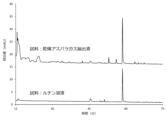
- FIG. 5 is a chromatogram showing the separation of a component (rutin) contained in asparagus using column 1.
- mass may be read as “weight” unless otherwise specified.
- mass ratio may be read as “weight ratio” unless otherwise specified
- mass % may be read as “weight %” unless otherwise specified.
- any of the isomers can be used in the present disclosure, unless otherwise specified.
- a substituent or compound e.g., a group represented by the above chemical formula (I) or a compound represented by the below-mentioned chemical formula (II), etc.
- any of the isomers can be used in the present disclosure, unless otherwise specified.
- a compound can form a salt
- the salt can also be used in the present disclosure, unless otherwise specified.
- the salt may be an acid addition salt or a base addition salt.
- the acid that forms the acid addition salt may be an inorganic acid or an organic acid
- the base that forms the base addition salt may be an inorganic base or an organic base.
- the inorganic acid is not particularly limited, but examples thereof include sulfuric acid, phosphoric acid, hydrofluoric acid, hydrochloric acid, carbonic acid, hydrobromic acid, hydroiodic acid, hypofluorite acid, hypochlorous acid, hypobromite acid, hypoiodite acid, fluorite acid, chlorous acid, bromite acid, iodite acid, fluorine acid, chlorine acid, bromine acid, iodic acid, perfluorine acid, perchloric acid, perbromine acid, and periodic acid.
- the organic acid is also not particularly limited, but examples thereof include p-toluenesulfonic acid, methanesulfonic acid, oxalic acid, p-bromobenzenesulfonic acid, succinic acid, citric acid, benzoic acid, and acetic acid.
- the inorganic base is not particularly limited, but examples thereof include ammonium hydroxide, alkali metal hydroxide, alkaline earth metal hydroxide, carbonate, and hydrogen carbonate, and more specifically, examples thereof include sodium hydroxide, potassium hydroxide, potassium carbonate, sodium carbonate, sodium hydrogen carbonate, potassium hydrogen carbonate, calcium hydroxide, and calcium carbonate.
- the organic base is also not particularly limited, but examples thereof include ethanolamine, triethylamine, and tris(hydroxymethyl)aminomethane.
- the method for producing these salts is also not particularly limited, and for example, they can be produced by a method in which the above-mentioned acid or base is appropriately added to the compound by a known method.
- a chain-like substituent e.g., a hydrocarbon group such as an alkyl group or an unsaturated aliphatic hydrocarbon group
- a chain-like substituent may be linear or branched, and the number of carbon atoms is not particularly limited, but may be, for example, 1 to 40, 1 to 32, 1 to 24, 1 to 18, 1 to 12, 1 to 6, or 1 to 2 (2 or more in the case of an unsaturated hydrocarbon group).
- the number of ring members (the number of atoms constituting the ring) of a cyclic group is not particularly limited, but may be, for example, 5 to 32, 5 to 24, 6 to 18, 6 to 12, or 6 to 10.
- any isomer may be used unless otherwise specified.
- a "naphthyl group” it may be a 1-naphthyl group or a 2-naphthyl group.
- R 1 is a methylene group, and one or more hydrogen atoms of the methylene group may or may not be further substituted with a substituent, but is preferably not substituted.
- the substituent is preferably substituted with, for example, a hydrophobic group.
- m is an integer of 1 or more, and may be, for example, 10 or less, 5 or less, 3 or less, or 2 or less, and is preferably 1.
- n is 0 or a positive integer, and may be, for example, 1 or more, 2 or more, 3 or more, 4 or more, 5 or more, 7 or more, 9 or more, 11 or more, 13 or more, 15 or more, or 17 or more, and may be 29 or less, 27 or less, 25 or less, 23 or less, 21 or less, or 19 or less.
- the n may be, for example, 0 to 29, 0 to 3, or 2 to 3.
- X is a methyl group, a linear or branched alkyl group, an amino group, an amido group, a cyano group, an aryl group, an alkylaryl group, a carboxy group, or a carbamoyl group.
- One or more hydrogen atoms of the alkyl group, the amino group, the aryl group, the alkylaryl group, the carboxy group, or the carbamoyl group may or may not be further substituted with a substituent.
- a non-aromatic hydrocarbon group which may be linear or branched, saturated or unsaturated, and may or may not contain a cyclic structure
- an aromatic group for example, an aromatic group (aryl group) that does not contain a heteroatom, a heteroaromatic group (heteroaryl group) that contains a heteroatom, and may be a monocyclic or condensed ring
- a halogen an amino group, a nitro group, a sulfo group, or a cyano group, and at least one hydrogen atom of each substituent may or may not be further substituted with any other substituent.
- the linear or branched alkyl group is, for example, a linear or branched alkyl group having 1 or more, 4 or more, 5 or more, 8 or more, or 10 or more carbon atoms, and 30 or less, 24 or less, 18 or less, or 12 or less.
- At least one of Y 1 and Y 2 is a hydrophilic group.
- both Y 1 and Y 2 may be hydrophilic groups, only one of Y 1 and Y 2 may be a hydrophilic group, or one of Y 1 and Y 2 may be a hydrophobic group.
- the hydrophilic group include a hydroxy group, a carboxy group, an amino group, and the like, which may be ionized to -O - , -COO - , -NH 3 + , and the like.
- hydrophobic group examples include a methyl group, a linear or branched alkyl group, an alkenyl group, an aryl group, an alkylaryl group, and a polycyclic aryl group. At least one hydrogen atom of each substituent may be further substituted with any other substituent or may not be substituted.
- Y 1 and Y 2 may be the same or different.
- the bond position is, for example, the bond position of a bond formed after dehydration condensation between a compound having a group represented by the chemical formula (I) and a silanol group of the silica.
- the ratio of silanol groups (a) contained in the silica after the modification to silanol groups (b) contained in the silica before the modification may be, for example, 100 mol % or more.
- the ratio can be expressed, for example, by the formula "a (mol)/b (mol) x 100".
- the packing material of the present disclosure includes Y 1 and Y 2 as shown in the chemical formula (I). For example, if at least one of Y 1 and Y 2 is a hydroxyl group, the ratio is 100 mol% or more. That is, for example, if only one of Y 1 and Y 2 is a hydroxyl group, the ratio is 100 mol%, and if both Y 1 and Y 2 contain a hydroxyl group, the ratio exceeds 100 mol%.
- the silanol group of the packing material of the present disclosure is modified with a hydroxyl group, which is a hydrophilic group, so that, for example, when analyzing a mixture containing at least one hydrophilic or amphiphilic analyte, the affinity with the hydrophilic or amphiphilic analyte is improved, which is particularly effective when separating them.
- the ratio may, for example, have a lower limit of 100 mol% or more, 110 mol% or more, or 116 mol% or more, and an upper limit of 135 mol% or less, 130 mol% or less, or 125 mol% or less.
- the ratio is, for example, 100 to 135 mol%, 110 to 130 mol%, or 116 to 125 mol%.
- the ratio can be calculated, for example, as follows: Note that the calculation method differs depending on whether Y 1 and Y 2 in the chemical formula (I) are hydroxyl groups or whether only one of Y 1 and Y 2 is a hydroxyl group.
- the carbon content D is related to the number of moles of the substituent bonded per 1 m2 of the silica, i.e., the density of the substituent E ( ⁇ mol/ m2 ), as shown in the following formula (4).
- x in formula (4) is determined to be 0.1848 and y is determined to be ⁇ 0.3744.
- E ( ⁇ mol/m 2 ) xD+y (4)
- the amount of unmodified silanol groups on the silica surface is, for example, 8 ⁇ mol/ m2 according to the literature (Yoshihisa Sudo et al. (2011). CHROMATOGRAPHY, Vol. 32 No. 2). Therefore, if the silanol groups newly generated by the bonding of substituents are not taken into consideration, the amount of silanol groups present on the silica surface after modification is "8-E ( ⁇ mol/ m2 )."
- the ratio may be calculated by various quantitative analyses.
- quantitative analysis of the silanol groups before and after modification of the silica may be performed using energy dispersive X-ray analysis (EDX, EDS), wavelength dispersive X-ray analysis (WDS), X-ray photoelectron analysis (XPS, ESCA), scanning electron microscope with energy dispersive X-ray analysis (SEM-EDS), mass spectrometry (MS), infrared spectroscopy, Raman spectroscopy, etc., and the ratio may be calculated from the results of the quantitative analysis.
- EDX energy dispersive X-ray analysis
- WDS wavelength dispersive X-ray analysis
- XPS X-ray photoelectron analysis
- SEM-EDS scanning electron microscope with energy dispersive X-ray analysis
- MS mass spectrometry
- infrared spectroscopy Raman spectroscopy, etc.
- R 1 is a methylene group, and one or more hydrogen atoms of the methylene group may or may not be further substituted with a substituent, but is preferably not substituted.
- the substituent is preferably substituted with, for example, a hydrophobic group.
- m is an integer of 1 or more, and may be, for example, 10 or less, 5 or less, 3 or less, or 2 or less, and is preferably 1.
- n is 0 or a positive integer, and may be, for example, 1 or more, 2 or more, 3 or more, 4 or more, 5 or more, 7 or more, 9 or more, 11 or more, 13 or more, 15 or more, or 17 or more, and may be 29 or less, 27 or less, 25 or less, 23 or less, 21 or less, or 19 or less.
- the n may be, for example, 0 to 29, 0 to 3, or 2 to 3.
- X is a methyl group, a linear or branched alkyl group, an amino group, an amido group, a cyano group, an aryl group, an alkylaryl group, a carboxy group, or a carbamoyl group.
- One or more hydrogen atoms of the alkyl group, the amino group, the aryl group, the alkylaryl group, the carboxy group, or the carbamoyl group may or may not be further substituted with a substituent.
- a non-aromatic hydrocarbon group which may be linear or branched, saturated or unsaturated, and may or may not contain a cyclic structure
- an aromatic group for example, an aromatic group (aryl group) that does not contain a heteroatom, a heteroaromatic group (heteroaryl group) that contains a heteroatom, and may be a monocyclic or condensed ring
- a halogen an amino group, a nitro group, a sulfo group, or a cyano group, and at least one hydrogen atom of each substituent may or may not be further substituted with any other substituent.
- the linear or branched alkyl group is, for example, a linear or branched alkyl group having 1 or more, 4 or more, 5 or more, 8 or more, or 10 or more carbon atoms, and 30 or less, 24 or less, 18 or less, or 12 or less.
- At least one of Y 11 and Y 12 may be a functional group capable of forming a silanol group.
- at least one of them is a linear or branched alkoxy group, a halogen atom, or a hydrophilic group, and one or more hydrogen atoms of the alkoxy group may or may not be further substituted with a substituent.
- a non-aromatic hydrocarbon group which may be linear or branched, may be saturated or unsaturated, may or may not contain a cyclic structure
- an aromatic group for example, an aromatic group (aryl group) that does not contain a heteroatom, may be a heteroaromatic group (heteroaryl group) that contains a heteroatom, may be a monocyclic or condensed ring
- a halogen an amino group, a nitro group, a sulfo group, or a cyano group, and at least one hydrogen atom of each substituent may or may not be further substituted with another optional substituent.
- the linear or branched alkoxy group is, for example, a linear or branched alkoxy group having 1 or more, 3 or more, or 5 or more carbon atoms, and a linear or branched alkoxy group having 10 or less, 8 or less, or 6 or less.
- Examples of the linear or branched alkoxy group include a methoxy group, an ethoxy group, a propoxy group, an isopropoxy group, an n-butoxy group, an isobutoxy group, a sec-butoxy group, and a tert-butoxy group.
- the halogen atom include a fluorine atom, a chlorine atom, a bromine atom, and an iodine atom.
- hydrophilic group examples include a hydroxy group, a carboxy group, an amino group, a dimethylamino group, and a diethylamino group, and these may be ionized, such as -O - , -COO - , and -NH 3 + .
- hydrophobic group examples include a methyl group, a linear or branched alkyl group, an alkenyl group, an aryl group, an alkylaryl group, and a polycyclic aryl group. At least one hydrogen atom of each substituent may be further substituted with another optional substituent or may not be substituted.
- Y 11 and Y 12 may be the same or different.
- reaction reagents represented by the chemical formula (II) are shown in the following compounds 1-1 to 11-25.
- the column of the present disclosure is a chromatography column packed with the packing material of the present disclosure.
- the column is, for example, a packed column prepared by modifying the silanol groups of silica gel particles or the like and then packing the silica into a column, or a capillary column prepared by preparing (packing) silica such as monolithic silica in a column and then modifying the silanol groups of the silica.
- the column size is not particularly limited.
- the column length may be, for example, 50 mm or more, 75 mm or more, 100 mm or more, 125 mm or more, or 150 mm or more, and may be 1000 mm or less, 750 mm or less, 500 mm or less, 300 mm or less, 250 mm or less, or 200 mm or less.
- the column inner diameter may be, for example, 1.0 mm or more, 1.5 mm or more, 2.0 mm or more, 3.0 mm or more, or 4.0 mm or more, and may be 20 mm or less, 10 mm or less, 7.5 mm or less, 6.0 mm or less, or 4.5 mm or less.
- the column size is not particularly limited.
- the column length may be, for example, 150 mm or more, 250 mm or more, or 700 mm or more, and may be 5000 mm or less, 3000 mm or less, or 2000 mm or less.
- the column inner diameter may be, for example, 0.01 mm or more, 0.05 mm or more, or 0.1 mm or more, and may be 1 mm or less, 0.5 mm or less, or 0.2 mm or less.
- the shape of the capillary column may be a long, thin tube, and for example, a groove of a size equivalent to a capillary tube formed by micromachining on a glass plate may be used as the column tube.
- the silica contained in the filler is, for example, silica gel particles or monolithic silica.
- the silica gel particles are, for example, silica gel particles after the silanol groups have been modified, and the monolithic silica is, for example, monolithic silica before the silanol groups have been modified.
- the column of the present disclosure is, for example, a chromatography column for analyzing plant-derived components.
- the plant is not particularly limited, but may be, for example, ginkgo, fennel, turmeric, Corydalis chinensis, Scutellaria baicalensis, Coptis japonica, Zedoary, licorice, cinnamon bark, magnolia, magnolia, Chinese cherries, Dioscorea chinensis, Rehmannia rhizome, Lithospermum rhizome, Peony root, Chinese ginger, Chinese ginger, Cnidium rhizome, Swertia japonica, Sophora japonica, Perilla arvensis, Rhubarb, Chinese laurel, Tangerine, Clove, Chinese chimney, Japanese angelica, Eucommia ulmoides, carrot, Pinellia arvensis, and Bucconus ulmoides.
- Herbal medicines listed in the Japanese Pharmacopoeia such as Root, Botanpi, Ryokyo, and Ginseng
- herbal medicines listed in ISO/TR 23022-2018 Traditional Chinese medicine
- tea leaves such as green tea, matcha, and black tea
- foods such as coffee beans, sesame, onions, yuzu, mandarin oranges, bell peppers, chrysanthemum, perilla, grapes, blueberries, spinach, and broccoli.
- the plant-derived components include, for example, at least one of a hydrophilic compound and an amphipathic compound, and may also include, for example, a hydrophobic compound.
- the plant-derived components are not particularly limited, but are compounds having a structure including, for example, phenols and their glycosides, coumarins and their glycosides, flavonoids and their glycosides, chalcones and their glycosides, anthocyanidins and their glycosides, anthraquinones and their glycosides, indoles and their glycosides, nitriles and their glycosides, steroids and their glycosides, alkaloids and their glycosides, etc.
- the method for producing a chromatography column according to the present disclosure includes a modification step and a packing step.
- the method for producing a chromatography column according to the present disclosure may, for example, perform the packing step after the modification step.
- the column according to the present disclosure is a capillary column
- the method for producing a chromatography column according to the present disclosure may, for example, perform the modification step after the packing step.
- the method for producing a chromatography column according to the present disclosure may further include a drying step.
- the modification step may, for example, include a heating step, a reaction reagent washing step, a substitution step, and a substitution reagent washing step, which will be described later.
- the column of the present disclosure can be manufactured, for example, by the following method.
- a column in which silica has been formed in advance (hereinafter, sometimes simply referred to as a "column before modification") is dried, or silica before being packed into a column is dried (drying step).
- the silica may be, for example, monolithic silica or silica gel particles.
- the drying step removes, for example, moisture present on the surface of the silica.
- the drying may be, for example, heat drying, reduced pressure drying, or reduced pressure heat drying.
- the reduced pressure conditions during the drying may be, for example, 1 kPa or more, 5 kPa or more, or 10 kPa or more, and may be 100 kPa or less, 80 kPa or less, or 50 kPa or less.
- the heating temperature during the drying may be, for example, 80°C or more, 100°C or more, or 120°C or more, and may be 300°C or less, 200°C or less, or 150°C or less.
- the drying time may be, for example, 1 hour or more, 2 hours or more, or 5 hours or more, and may be 24 hours or less, 18 hours or less, or 12 hours or less.
- the dried unmodified column is connected to a liquid delivery device and heated while delivering the reaction reagent (heating step).
- the heating step modifies the silica with the reaction reagent.
- the heating temperature during the modification may be, for example, 60°C or more, 80°C or more, or 100°C or more, and may be 200°C or less, 180°C or less, or 150°C or less.
- the heating time during the modification may be, for example, 3 hours or more, 6 hours or more, or 10 hours or more, and may be 48 hours or less, 36 hours or less, or 24 hours or less.
- the liquid delivery device can deliver the reaction reagent into the column by, for example, pressurization, and examples of such devices include a syringe pump and a pump for liquid chromatography.
- the liquid delivery may be by, for example, pressurizing a gas.
- the silica gel particles are dried under the above conditions, weighed into a flask or the like, and then modified with a reaction reagent.
- the amount of the reaction reagent may be any amount within the range of 10% by weight to 500% by weight relative to 100% by weight of silica gel.
- the heating temperature and heating time during modification with the reaction reagent are the same as those in the heating step for the capillary column.
- the modified silica gel is filtered and washed by a known method, and the silica gel is then packed into a column tube to obtain the packed column.
- reaction reagent can be the reaction reagent represented by the following chemical formula (II).
- m is an integer of 1 or more, and may be, for example, 10 or less, 5 or less, 3 or less, or 2 or less, and is preferably 1.
- n is 0 or a positive integer, and may be, for example, 1 or more, 2 or more, 3 or more, 4 or more, 5 or more, 7 or more, 9 or more, 11 or more, 13 or more, 15 or more, or 17 or more, and may be 29 or less, 27 or less, 25 or less, 23 or less, 21 or less, or 19 or less.
- the n may be, for example, 0 to 29, 0 to 3, or 2 to 3.
- X is a methyl group, a linear or branched alkyl group, an amino group, an amido group, a cyano group, an aryl group, an alkylaryl group, a carboxy group, or a carbamoyl group.
- One or more hydrogen atoms of the alkyl group, the amino group, the aryl group, the alkylaryl group, the carboxy group, or the carbamoyl group may or may not be further substituted with a substituent.
- a non-aromatic hydrocarbon group which may be linear or branched, saturated or unsaturated, and may or may not contain a cyclic structure
- an aromatic group for example, an aromatic group (aryl group) that does not contain a heteroatom, a heteroaromatic group (heteroaryl group) that contains a heteroatom, and may be a monocyclic or condensed ring
- a halogen an amino group, a nitro group, a sulfo group, or a cyano group, and at least one hydrogen atom of each substituent may or may not be further substituted with any other substituent.
- the linear or branched alkyl group is, for example, a linear or branched alkyl group having 1 or more, 4 or more, 5 or more, 8 or more, or 10 or more carbon atoms, and 30 or less, 24 or less, 18 or less, or 12 or less.
- At least one of Y 11 and Y 12 is a functional group capable of forming a silanol group.
- at least one of Y 11 and Y 12 may be a functional group capable of forming a silanol group by a substitution step described later.
- at least one of them is a linear or branched alkoxy group, a halogen atom, or a hydrophilic group, and one or more hydrogen atoms of the alkoxy group may or may not be further substituted with a substituent.
- a non-aromatic hydrocarbon group which may be linear or branched, may be saturated or unsaturated, may or may not contain a cyclic structure
- an aromatic group for example, an aromatic group (aryl group) that does not contain a heteroatom, may be a heteroaromatic group (heteroaryl group) that contains a heteroatom, may be a monocyclic or condensed ring
- a halogen an amino group, a nitro group, a sulfo group, or a cyano group, and at least one hydrogen atom of each substituent may or may not be further substituted with another arbitrary substituent.
- the linear or branched alkoxy group is, for example, a linear or branched alkoxy group having 1 or more, 3 or more, or 5 or more carbon atoms, and is, for example, a linear or branched alkoxy group having 10 or less, 8 or less, or 6 or less carbon atoms.
- Examples of the linear or branched alkoxy group include a methoxy group, an ethoxy group, a propoxy group, an isopropoxy group, an n-butoxy group, an isobutoxy group, a sec-butoxy group, and a tert-butoxy group.
- halogen atom examples include a fluorine atom, a chlorine atom, a bromine atom, and an iodine atom.
- hydrophilic group examples include a hydroxy group, a carboxy group, an amino group, a dimethylamino group, and a diethylamino group, and these may be ionized, for example, -O - , -COO - , and -NH 3 + .
- hydrophobic group examples include a methyl group, a linear or branched alkyl group, an alkenyl group, an aryl group, an alkylaryl group, and a polycyclic aryl group. At least one hydrogen atom of each substituent may be further substituted or unsubstituted with any other substituent.
- Y 11 and Y 12 may be the same or different.
- R 1 is a methylene group, and one or more hydrogen atoms of the methylene group may or may not be further substituted with a substituent, but is preferably unsubstituted. When substituted with a substituent, the substituent is preferably substituted with, for example, a hydrophobic group.
- R2 is a methyl group, a linear or branched alkyl group, and one or more hydrogen atoms of the alkyl group may or may not be further substituted with a substituent.
- a substituent When substituted, it may be, for example, a non-aromatic hydrocarbon group (which may be linear or branched, saturated or unsaturated, and may or may not contain a cyclic structure), an aromatic group (e.g., an aromatic group (aryl group) that does not contain a heteroatom, a heteroaromatic group (heteroaryl group) that contains a heteroatom, and may be a single ring or a condensed ring), a halogen, an amino group, a nitro group, a sulfo group, or a cyano group, and at least one hydrogen atom of each substituent may or may not be further substituted with any other substituent.
- a non-aromatic hydrocarbon group which may be linear or branched, saturated or unsaturated
- the linear or branched alkyl group is, for example, a linear or branched alkyl group having 1 to 12 carbon atoms, and examples thereof include a methyl group, an ethyl group, a propyl group, an n-butyl group, an isobutyl group, a sec-butyl group, a tert-butyl group, a pentyl group, a hexyl group, a heptyl group, an octyl group, a nonyl group, a decyl group, an undecyl group, and a dodecyl group (a lauryl group).
- the modification is carried out by a condensation reaction between R 2 —O— in the chemical formula (II) and a silanol group of the silica.
- the reaction reagent may be, for example, the above-mentioned compounds 1-1 to 11-25.
- the reaction reagent may or may not contain other components.
- the other components include solvents and catalysts.
- the solvent include alcohols such as water, methanol, ethanol, isopropyl alcohol (IPA), n-butyl alcohol, sec-butyl alcohol, isobutyl alcohol, and t-butyl alcohol (TBA); ketones such as acetone, methyl ethyl ketone, methyl isobutyl ketone, and cyclopentanone; esters such as methyl acetate, ethyl acetate, and butyl acetate; ethers such as diisopropyl ether, propylene glycol monomethyl ether, 2-methoxyethanol, ethyl cellosolve, and butyl cellosolve; glycols such as ethylene glycol and propylene glycol; aliphatic hydrocarbons such as hexane, heptane, and octane; aromatic hydrocarbons such as benzen
- Examples of the catalyst include amine catalysts.
- Examples of the amine catalyst include diethylamine, triethylamine, diisopropylethylamine, phenethylamine, pyridine, lutidine, 4-dimethylaminopyridine, phenethylamine, piperidine, morpholine, and 1,4-diazabicyclo[2.2.2]octane.
- reaction reagent washing step is, for example, a step of pumping a solvent into the column after the heating step.
- the solvent is, for example, the same as the solvent contained as the other component.
- the time of the liquid pumping is not particularly limited as long as it is a time that allows the unreacted reaction reagent to be washed away, and is, for example, 1 hour or more, 6 hours or more, or 12 hours or more, and 72 hours or less, 48 hours or less, or 24 hours or less.
- the method may further include a step of substituting the group other than the hydrophilic group with a hydrophilic group (substitution step).
- substitution step is, for example, a step of further hydrolyzing the silica after the modification, and may be a step of substituting at least one of Y11 and Y12 in the chemical formula (II) bonded to the modified silica with a hydroxyl group (i.e., a step of forming a silanol group).
- the substitution step is, for example, a step of sending a substitution reagent into the column after the heating step.
- the substitution reagent may include, for example, a solvent, an acid, etc.
- the solvent is, for example, the same as the solvent included as the other component.
- the acid may be, for example, an organic acid or an inorganic acid.
- the organic acid is not particularly limited, but examples thereof include acetic acid, formic acid, difluoroacetic acid, and trifluoroacetic acid.
- Examples of the inorganic acid include sulfuric acid, phosphoric acid, hydrofluoric acid, hydrochloric acid, hydrobromic acid, hydroiodic acid, hypofluorite acid, hypochlorous acid, hypobromite acid, hypoiodite acid, fluorite acid, chlorous acid, bromite acid, iodite acid, fluorine acid, chlorine acid, bromine acid, iodic acid, perfluorine acid, perchloric acid, perbromine acid, and periodic acid.
- the pH of the substitution reagent is preferably, for example, acidic, and is, for example, pH 4 or less, pH 3 or less, pH 2 or less, or pH 1 or less.
- the temperature in the substitution step is, for example, 20°C or more, 40°C or more, or 60°C or more, and 120°C or less, 100°C or less, or 80°C or less.
- the liquid transfer time in the liquid transfer step is not particularly limited as long as it is a time that allows the groups other than the hydrophilic groups to be replaced with hydrophilic groups, and is, for example, 1 hour or more, 3 hours or more, or 6 hours or more, and 48 hours or less, 24 hours or less, or 12 hours or less.
- the replacement step may be followed by a washing step (replacement reagent washing step).
- the replacement reagent washing step is, for example, a step of pumping a solvent into the column after the replacement step.
- the solvent is, for example, the same as the solvent contained as the other component.
- the time for the liquid pumping is not particularly limited as long as it is a time that allows the unreacted reaction reagent to be washed away, and is, for example, 1 hour or more, 3 hours or more, or 6 hours or more, and 48 hours or less, 24 hours or less, or 12 hours or less.
- the chromatography analysis device is, for example, a liquid chromatography analysis device.
- the liquid chromatography analysis device includes, for example, a liquid delivery section, a gradient elution section, a sample injection section (injector), a detection section, a data processing section, and the like.
- the analytical column is preferably connected, for example, to any location between the sample injection section and the detection section.
- the gradient elution section is preferably connected, for example, to any location between the liquid delivery section and the sample injection section.
- the number of analytical columns is not particularly limited and may be determined taking into consideration, for example, analytical conditions, etc., and one or two or more columns may be used.
- the eluent is, for example, a three-liquid or more eluent that combines water and two or more water-soluble organic solvents.
- the water-soluble organic solvents may be, for example, two or more, three or more, four or more, or five or more, or eight or less, seven or less, or six or less.
- the number of liquid systems in the eluent varies depending on the number of solvents to be combined, but it is preferable that the eluent is a three-liquid or more eluent.
- the water-soluble organic solvent include alcohol-based solvents and nitrile-based solvents.
- the water-soluble organic solvent may include, for example, at least one of the alcohol-based solvents and the nitrile-based solvents.
- Examples of the alcohol-based solvent include methanol, ethanol, isopropyl alcohol (IPA), n-propyl alcohol, n-butyl alcohol, sec-butyl alcohol, isobutyl alcohol, t-butyl alcohol (TBA), 2-methoxyethanol, etc., and methanol is preferable.
- Examples of the nitrile-based solvent include acetonitrile, etc.
- the gradient elution section performs gradient elution by, for example, changing the solvent composition using the eluent as the mobile phase.
- the solvent composition of the eluent may be, for example, gradient elution performed at a flow rate of 20 nL to 100 mL/min, 100 nL to 1 mL/min, or 300 nL to 0.01 mL/min.
- gradient elution may be performed by changing the solvent composition of at least one of the eluents, for example, from 0 to 100%, 10 to 90%, or 20 to 80%, from the start of elution to the end of elution.
- the chromatography analysis device of the present disclosure may further include, for example, another analysis device, such as a mass spectrometer.
- the other analysis devices may be, for example, integrated with the analysis device of the present disclosure, or may be separate devices that are connected together for use.
- the analytical method of the present disclosure is an analytical method that uses the analytical device of the present disclosure.
- the analytical method of the present disclosure is, for example, a method for analyzing an analyte that contains at least one of a hydrophilic compound and an amphipathic compound.
- the analytical method of the present disclosure is, for example, a method for analyzing a plant-derived component.
- the plant and the plant-derived component are, for example, the same as those described for the column of the present disclosure.
- Example 1 a chromatography column 1 (hereinafter sometimes referred to as "column 1") containing the chromatography column packing material of the present disclosure was produced.
- a monolithic silica capillary (inner diameter 0.1 mm, length 750 mm, manufactured by Shinwa Kako Co., Ltd.) was dried under reduced pressure at 140°C for 6 hours.
- the dried monolithic silica capillary was connected to a liquid delivery device (pump) including a heating furnace, and a reaction was carried out while a reaction reagent was delivered to the monolithic silica capillary under a condition of 100°C.
- the reaction reagent was a mixture of 23 mL of toluene, 2 mL of a toluene solution containing 10 volume% phenethylamine acting as a catalyst, and 2 mL of octadecyltriethoxysilane.
- the reaction reagent was delivered for 40 hours. After that, toluene was delivered at room temperature for 24 hours to wash and remove the unreacted reaction reagent.
- a substitution reagent was delivered to the monolithic silica capillary after the reaction under a condition of 60°C, and the unreacted leaving group of the octadecyltriethoxysilane after the reaction was hydrolyzed to obtain a silanol group.
- the replacement reagent was a mixture of 80 mL of acetonitrile, 20 mL of ultrapure water, and 0.1 mL of formic acid, and had a pH of about 2.
- the replacement reagent was pumped for 20 hours.
- methanol was pumped as an organic solvent at room temperature for 24 hours to produce column 1.
- the end of column 1 was cut to a length of 700 mm.
- the ⁇ (methylene group selectivity) of column 1 was measured by high performance liquid chromatography (HPLC).
- HPLC conditions were set as follows. Uracil, butylbenzene, and amylbenzene were used as samples, with respective concentrations of 0.05 mg/mL, 0.5 ⁇ L/mL, and 0.5 ⁇ L/mL.
- the uracil peak was set as t 0
- the butylbenzene and amylbenzene peaks were set as t R , respectively, and the ⁇ of column 1 and the proportion (%) of silanol groups remaining on the silica surface after the modification reaction were calculated from the above-mentioned formulas (1) to (5).
- Table 1 The results are shown in Table 1 below.
- Example 2 to 14 and Comparative Example 1 chromatography columns 2 to 14 (hereinafter sometimes referred to as “columns 2 to 14") containing the chromatography column packing material of the present disclosure and a comparative chromatography column (hereinafter sometimes referred to as "column 15”) were produced as Examples 2 to 14 and Comparative Example 1.
- columns 2 to 14 were produced in the same manner as in Example 1, except that the delivery time of the reaction reagent was changed to the time shown in Table 1 below.
- Comparative Example 1 a column (column 15) was produced in the same manner as in Example 1, except that instead of the reaction reagent used in Example 1, a mixture of 9 mL of toluene and 1 mL of octadecyldimethyl(dimethylamino)silane was used as the reaction reagent.
- the silanol groups of the silica contained in the packing material were modified with a substituent that contained a hydrophilic group (silanol group), and the proportion of silanol groups remaining on the silica surface after the modification reaction was 100 mol % or more.
- the silanol groups of the silica contained in the packing material were modified with a substituent that did not contain a hydrophilic group (silanol group), and the proportion of silanol groups remaining on the silica surface after the modification reaction was less than 100 mol %.
- Figure 1 is a plot of columns 1 to 15, with the methylene group selectivity ⁇ on the vertical axis and the reaction reagent delivery time (reaction time) on the horizontal axis.
- the value of ⁇ changes from 1.30 to 1.40 when the delivery time of the reaction reagent containing octadecyltriethoxysilane is between 15 and 40 hours, and it was found that when the delivery time exceeds 40 hours, columns with ⁇ values in the range of 1.40 to 1.48 can be stably manufactured.
- hydrophilic groups (silanol groups) in the packing material before modification (untreated silica), column 1 (Example 1), and column 15 (Comparative Example 1) were quantified before and after modification.
- a scanning electron microscope equipped with an energy dispersive X-ray analyzer (manufactured by JEOL Ltd., product name: JSM-7100) was used for the quantification. The results are shown in Table 2 below.
- O/Si ratio the ratio of the number of oxygen atoms (O) to the number of silicon atoms (Si) in untreated silica
- O/Si ratio the ratio of the number of oxygen atoms (O) to the number of silicon atoms (Si) in untreated silica
- the packing material in column 1 had a higher O/Si ratio than untreated silica.
- the amount of hydroxyl groups was increased in column 1.
- the packing material in column 15 had a lower O/Si ratio than untreated silica. In other words, it was found that the amount of hydroxyl groups was decreased in column 15.
- Figure 2 shows a chromatogram of the components contained in black tea (Darjeeling) separated using columns 1 and 15.
- the vertical axis represents the detection value (mAU) and the horizontal axis represents the elution time (min).
- column 1 when column 1 was used, peaks of components contained in black tea were detected over a wide range.
- column 1 which contains the chromatography column packing material of the present disclosure, was able to adsorb and separate a wide range of black tea components.
- column 15 only weakly adsorbed the components contained in black tea, and they eluted at an early time. In this way, it was found that column 1, which has many silanol groups remaining on the silica surface of the chromatography column packing material, is suitable for retaining and separating plant components.
- Analytical samples were prepared in the same manner as in the above-mentioned "Separation of components contained in black tea", except that commercially available black tea teabags (Earl Grey), green tea, roasted green tea, and sweet tea were used instead of commercially available black tea teabags (Darjeeling), and analytical samples of 0.5 mg/mL were obtained for five types of tea (Darjeeling, Earl Grey, green tea, roasted green tea, and sweet tea).
- Figure 3 shows chromatograms obtained when components contained in five types of tea (Darjeeling, Earl Grey, green tea, roasted green tea, and sweet tea) were separated using column 1.
- the vertical axis represents the detection value (mAU) and the horizontal axis represents the elution time (min).
- Figure 4 shows chromatograms comparing the difference in separation ability due to differences in mobile phases when components contained in black tea (Darjeeling) were separated using column 1.
- the vertical axis is the detection value (mAU) and the horizontal axis is the elution time (min).
- the number of detected peaks was 62 in gradient elution (condition 1) using a binary solvent of water and methanol, which is widely used in general HPLC.
- the number of detected peaks was 89 in gradient elution using a ternary solvent of water-methanol-acetonitrile (condition 2).
- a column containing the chromatography column packing material of the present disclosure can effectively separate plant components using gradient elution using a binary solvent of water and methanol, but more components can be separated using gradient elution using a ternary solvent of water-methanol-acetonitrile. This shows that a column containing the chromatography column packing material of the present disclosure is useful for analyzing the components of plants, which contain a wide variety of components.
- An analytical sample was prepared in the same manner as in the above-mentioned "Separation of components contained in black tea", except that commercially available asparagus dried under reduced pressure at 40°C was used instead of commercially available tea leaves in tea bags (Darjeeling), and a 0.5 mg/mL analytical sample was obtained for the dried asparagus extract.
- the rutin solution used as a standard was prepared as follows: 0.1 mg of rutin (manufactured by Fujifilm Wako Pure Chemical Industries, Ltd.) was placed in a sample tube, and a 50/50 (v/v) water/methanol solvent was added to give a concentration of 0.1 mg/mL, followed by stirring for 10 seconds using a vortex mixer. After stirring, the solution was left to stand for 10 minutes. After leaving the solution to stand, 10 ⁇ L of the supernatant and 990 ⁇ L of a 0.2% by volume aqueous solution of phosphoric acid were added to a 2 mL sample bottle, which was then shaken to obtain a 0.001 mg/mL analytical sample.
- Figure 5 shows chromatograms obtained when a component (rutin) contained in asparagus was separated using column 1.
- the vertical axis represents the detection value (mAU) and the horizontal axis represents the elution time (min).
- a column containing the chromatography column packing material disclosed herein enables more sensitive component analysis than conventional columns.
- a column containing the chromatography column packing material of the present disclosure is suitable for connection to a mass spectrometer that requires vaporization of the sample during component analysis, for example, because less solvent is discharged from the column along with the separated components. Therefore, a liquid chromatography mass spectrometer equipped with a column containing the chromatography column packing material of the present disclosure is more sensitive than a liquid chromatography mass spectrometer that uses a conventional column.
- R 1 is a methylene group, one or more hydrogen atoms of which may or may not be further substituted with a substituent
- m is an integer of 1 or more
- n is 0 or a positive integer
- X is a methyl group, a linear or branched alkyl group, an amino group, an amido group, a cyano group, an aryl group, an alkylaryl group, a carboxy group, or a carbamoyl group, and one or more hydrogen atoms of the alkyl group, the amino group, the aryl group, the alkylaryl group, the carboxy group, or the carbamoyl group may or may not be further substituted with a substituent; At least one of Y1 and Y2 is a hydrophilic group, and Y1 and Y2 may be the same or different.
- R 1 is a methylene group, one or more hydrogen atoms of which may or may not be further substituted with a substituent
- R2 is a methyl group, a linear or branched alkyl group, one or more hydrogen atoms of which may or may not be further substituted with a substituent
- m is an integer of 1 or more
- n is 0 or a positive integer
- X is a methyl group, a linear or branched alkyl group, an amino group, an amido group, a cyano group, an aryl group, an alkylaryl group, a carboxy group, or a carbamoyl group, and one or more hydrogen atoms of the alkyl group, the amino group, the aryl group, the alkylaryl group, the carboxy group, or the carbamoyl
- (Appendix 6) A chromatography column packed with the packing material according to any one of claims 1 to 5.
- (Appendix 7) A chromatography column according to claim 6 for analyzing plant-derived components.
- the method includes a modification step and a filling step,
- the modification step is a step of modifying silanol groups of silica gel particles contained in a filler,
- the packing step is a step of packing the modified silica into a chromatography column.
- a modification step, a filling step, and The modification step is a step of modifying a silanol group of the monolithic silica contained in the filler
- the packing step is a step of packing the unmodified silica into a chromatography column.
- a method for producing a chromatography column according to claim 6 or 7. (Appendix 10) A chromatograph, an eluent, and an analytical column; The analytical column is a chromatography column according to appendix 6 or 7. Chromatography analysis equipment.
- the chromatograph includes a gradient elution section; the eluent is a three-liquid or more eluent comprising water and two or more water-soluble organic solvents; The gradient elution section performs gradient elution by changing the solvent composition of the eluent at a flow rate of 20 nL/min to 100 mL/min using the eluent as a mobile phase.
- the water-soluble organic solvent includes at least one of an alcohol-based solvent and a nitrile-based solvent. 12.
- the analytical apparatus of claim 11. An analysis method using the analysis device according to any one of appendices 10 to 12.
- Appendix 14 A method for analyzing an analyte containing at least one of a hydrophilic compound and an amphipathic compound, by the analytical method according to appendix 13.
- Appendix 15 A method for analyzing plant-derived components using the analytical method described in Appendix 14.
- the present disclosure can provide a chromatography column packing material, a chromatography column, a method for manufacturing a chromatography column, a chromatography analysis device, and an analysis method that are suitable for separating mixtures containing various analytes. They are particularly suitable for separating plant components that contain many hydrophilic and amphiphilic analytes.
- the applications of the present disclosure are not particularly limited and are arbitrary, and can be used for a wide range of applications, such as the analysis, testing, and diagnosis of foods, pharmaceuticals, chemicals, etc.
Landscapes
- Chemical & Material Sciences (AREA)
- Analytical Chemistry (AREA)
- Chemical Kinetics & Catalysis (AREA)
- Organic Chemistry (AREA)
- Biochemistry (AREA)
- Life Sciences & Earth Sciences (AREA)
- Health & Medical Sciences (AREA)
- General Health & Medical Sciences (AREA)
- General Physics & Mathematics (AREA)
- Immunology (AREA)
- Pathology (AREA)
- Physics & Mathematics (AREA)
- Inorganic Chemistry (AREA)
- Solid-Sorbent Or Filter-Aiding Compositions (AREA)
Priority Applications (4)
| Application Number | Priority Date | Filing Date | Title |
|---|---|---|---|
| CN202480021817.9A CN120882486A (zh) | 2023-02-27 | 2024-02-26 | 色谱用柱填充剂、色谱用柱、色谱用柱的制造方法、色谱分析装置和分析方法 |
| KR1020257021864A KR20250116115A (ko) | 2023-02-27 | 2024-02-26 | 크로마토그래피용 칼럼 충전제, 크로마토그래피용 칼럼, 크로마토그래피용 칼럼의 제조 방법, 크로마토그래피 분석 장치, 및 분석 방법 |
| JP2025503896A JPWO2024181385A1 (https=) | 2023-02-27 | 2024-02-26 | |
| EP24763865.3A EP4656287A1 (en) | 2023-02-27 | 2024-02-26 | Column filler for chromatography, column for chromatography, manufacturing method for column for chromatography, chromatography analyzer, and analysis method |
Applications Claiming Priority (2)
| Application Number | Priority Date | Filing Date | Title |
|---|---|---|---|
| JP2023029001 | 2023-02-27 | ||
| JP2023-029001 | 2023-02-27 |
Publications (1)
| Publication Number | Publication Date |
|---|---|
| WO2024181385A1 true WO2024181385A1 (ja) | 2024-09-06 |
Family
ID=92590640
Family Applications (1)
| Application Number | Title | Priority Date | Filing Date |
|---|---|---|---|
| PCT/JP2024/006895 Ceased WO2024181385A1 (ja) | 2023-02-27 | 2024-02-26 | クロマトグラフィー用カラム充填剤、クロマトグラフィー用カラム、クロマトグラフィー用カラムの製造方法、クロマトグラフィー分析装置、及び分析方法 |
Country Status (5)
| Country | Link |
|---|---|
| EP (1) | EP4656287A1 (https=) |
| JP (1) | JPWO2024181385A1 (https=) |
| KR (1) | KR20250116115A (https=) |
| CN (1) | CN120882486A (https=) |
| WO (1) | WO2024181385A1 (https=) |
Citations (6)
| Publication number | Priority date | Publication date | Assignee | Title |
|---|---|---|---|---|
| JPS573043A (en) * | 1980-05-05 | 1982-01-08 | Varian Associates | Production of mixed phase chromatography composite |
| JPH08310809A (ja) * | 1995-05-17 | 1996-11-26 | Wako Pure Chem Ind Ltd | 新規な変性シリカゲル |
| US6375846B1 (en) * | 2001-11-01 | 2002-04-23 | Harry Wellington Jarrett | Cyanogen bromide-activation of hydroxyls on silica for high pressure affinity chromatography |
| JP2007522476A (ja) * | 2004-02-12 | 2007-08-09 | バリアン・インコーポレイテッド | クロマトグラフ分離のための極性修飾結合相材料 |
| JP2010529431A (ja) * | 2007-05-25 | 2010-08-26 | ダイオネックス コーポレイション | クロマトグラフィー固定相として有用な組成物 |
| JP2016538128A (ja) * | 2013-09-20 | 2016-12-08 | メディソーテック | 多官能吸着材及びその使用 |
Family Cites Families (2)
| Publication number | Priority date | Publication date | Assignee | Title |
|---|---|---|---|---|
| JP3970702B2 (ja) | 2001-09-27 | 2007-09-05 | 関東化学株式会社 | 液体クロマトグラフィー用ods化シリカゲル充填剤の製造方法 |
| JP7526147B2 (ja) | 2021-08-20 | 2024-07-31 | 信越ポリマー株式会社 | バルーンカテーテル |
-
2024
- 2024-02-26 WO PCT/JP2024/006895 patent/WO2024181385A1/ja not_active Ceased
- 2024-02-26 JP JP2025503896A patent/JPWO2024181385A1/ja active Pending
- 2024-02-26 KR KR1020257021864A patent/KR20250116115A/ko active Pending
- 2024-02-26 EP EP24763865.3A patent/EP4656287A1/en active Pending
- 2024-02-26 CN CN202480021817.9A patent/CN120882486A/zh active Pending
Patent Citations (6)
| Publication number | Priority date | Publication date | Assignee | Title |
|---|---|---|---|---|
| JPS573043A (en) * | 1980-05-05 | 1982-01-08 | Varian Associates | Production of mixed phase chromatography composite |
| JPH08310809A (ja) * | 1995-05-17 | 1996-11-26 | Wako Pure Chem Ind Ltd | 新規な変性シリカゲル |
| US6375846B1 (en) * | 2001-11-01 | 2002-04-23 | Harry Wellington Jarrett | Cyanogen bromide-activation of hydroxyls on silica for high pressure affinity chromatography |
| JP2007522476A (ja) * | 2004-02-12 | 2007-08-09 | バリアン・インコーポレイテッド | クロマトグラフ分離のための極性修飾結合相材料 |
| JP2010529431A (ja) * | 2007-05-25 | 2010-08-26 | ダイオネックス コーポレイション | クロマトグラフィー固定相として有用な組成物 |
| JP2016538128A (ja) * | 2013-09-20 | 2016-12-08 | メディソーテック | 多官能吸着材及びその使用 |
Non-Patent Citations (1)
| Title |
|---|
| See also references of EP4656287A1 * |
Also Published As
| Publication number | Publication date |
|---|---|
| EP4656287A1 (en) | 2025-12-03 |
| KR20250116115A (ko) | 2025-07-31 |
| CN120882486A (zh) | 2025-10-31 |
| JPWO2024181385A1 (https=) | 2024-09-06 |
Similar Documents
| Publication | Publication Date | Title |
|---|---|---|
| Eisath et al. | Supercritical fluid chromatography in natural product analysis–an update | |
| Mottaleb et al. | Solid‐Phase Microextraction and Its Application to Natural Products and Biological Samples | |
| Wu et al. | Isolation and purification of alkaloids from lotus leaves by ionic‐liquid‐modified high‐speed countercurrent chromatography | |
| Mifsud et al. | A novel chiral GC/MS method for the analysis of fluoxetine and norfluoxetine enantiomers in biological fluids | |
| Sim et al. | Identification of alkaloid constituents from Fangchi species using pH control liquid‐liquid extraction and liquid chromatography coupled to quadrupole time‐of‐flight mass spectrometry | |
| Núñez et al. | Fast liquid chromatography-mass spectrometry methods in food and environmental analysis | |
| Wu et al. | Polyamide and deep eutectic solvent assisted matrix solid-phase dispersion microextraction for strong hydrophobic compounds | |
| WO2024181385A1 (ja) | クロマトグラフィー用カラム充填剤、クロマトグラフィー用カラム、クロマトグラフィー用カラムの製造方法、クロマトグラフィー分析装置、及び分析方法 | |
| Chen et al. | Environmentally friendly ionic liquid-in-water microemulsions for extraction of hydrophilic and lipophilic components from Flos Chrysanthemi | |
| CN112285222A (zh) | 百药煎中药饮片的检测方法 | |
| Qian et al. | Ultrasound‐assisted matrix solid‐phase extraction based on deep eutectic solvents and zinc oxide: Extraction and determination of six active ingredients in Ligustri Lucidi Fructus | |
| Dai et al. | Isolation of achiral aliphatic acid derivatives from Piper kadsura using preparative two-dimensional chiral supercritical fluid chromatography | |
| CN103837614A (zh) | 一种测定双酚类物质迁移量的方法 | |
| CN112213407B (zh) | 一种左奥硝唑有关物质的检测方法 | |
| Li et al. | Development and validation of ultra-high performance supercritical fluid chromatography method for quantitative determination of four target flavonoids components in citrus samples | |
| CN110066256B (zh) | 一种5-氯-2-甲基-4-异噻唑啉-3-酮的提纯方法 | |
| Dasgupta et al. | Spectroscopic & chromatographic methods for quantitative analysis of phospholipid complexes of flavonoids–a comparative study | |
| Heo et al. | Synthesis and application of new calix [4] arenes‐containing (R)‐phenylglycinol chiral stationary phases for enantioseparation | |
| Li et al. | Preparative separation of patchouli alcohol from patchouli oil using high performance centrifugal partition chromatography | |
| CN111272941A (zh) | 一种痰热清注射液中熊胆粉超高效液相色谱测定法 | |
| Young et al. | Improved sensitivity and specificity for trans-resveratrol in red wine analysis with HPLC-UV and LC-MS | |
| Wang et al. | Chiral resolution of cypermethrin on cellulose-tris (3, 5-dimethylphenyl-carbamate) chiral stationary phase | |
| Wang et al. | Green synthesis of a urea–melamine–hexamethylenetetramine resin for efficient extraction and determination of Berberine hydrochloride in Pudilan antiphlogistic oral liquid | |
| Liu et al. | Determination and isolation of purpurin and mollugin from Rubiae Radix ET Rhizoma based on a monolithic adsorbent prepared by bio-monomer | |
| CN120142504B (zh) | 一种棕榈炭配方颗粒的特征图谱检测方法及其应用 |
Legal Events
| Date | Code | Title | Description |
|---|---|---|---|
| 121 | Ep: the epo has been informed by wipo that ep was designated in this application |
Ref document number: 24763865 Country of ref document: EP Kind code of ref document: A1 |
|
| WWE | Wipo information: entry into national phase |
Ref document number: 2025503896 Country of ref document: JP |
|
| WWP | Wipo information: published in national office |
Ref document number: 1020257021864 Country of ref document: KR |
|
| WWE | Wipo information: entry into national phase |
Ref document number: 202480021817.9 Country of ref document: CN |
|
| NENP | Non-entry into the national phase |
Ref country code: DE |
|
| WWP | Wipo information: published in national office |
Ref document number: 202480021817.9 Country of ref document: CN |
|
| WWP | Wipo information: published in national office |
Ref document number: 2024763865 Country of ref document: EP |