WO2024181149A1 - 非水電解質二次電池 - Google Patents
非水電解質二次電池 Download PDFInfo
- Publication number
- WO2024181149A1 WO2024181149A1 PCT/JP2024/005262 JP2024005262W WO2024181149A1 WO 2024181149 A1 WO2024181149 A1 WO 2024181149A1 JP 2024005262 W JP2024005262 W JP 2024005262W WO 2024181149 A1 WO2024181149 A1 WO 2024181149A1
- Authority
- WO
- WIPO (PCT)
- Prior art keywords
- positive electrode
- active material
- material layer
- electrode active
- region
- Prior art date
- Legal status (The legal status is an assumption and is not a legal conclusion. Google has not performed a legal analysis and makes no representation as to the accuracy of the status listed.)
- Ceased
Links
Images


Classifications
-
- H—ELECTRICITY
- H01—ELECTRIC ELEMENTS
- H01M—PROCESSES OR MEANS, e.g. BATTERIES, FOR THE DIRECT CONVERSION OF CHEMICAL ENERGY INTO ELECTRICAL ENERGY
- H01M10/00—Secondary cells; Manufacture thereof
- H01M10/05—Accumulators with non-aqueous electrolyte
- H01M10/052—Li-accumulators
-
- H—ELECTRICITY
- H01—ELECTRIC ELEMENTS
- H01M—PROCESSES OR MEANS, e.g. BATTERIES, FOR THE DIRECT CONVERSION OF CHEMICAL ENERGY INTO ELECTRICAL ENERGY
- H01M10/00—Secondary cells; Manufacture thereof
- H01M10/05—Accumulators with non-aqueous electrolyte
- H01M10/058—Construction or manufacture
-
- H—ELECTRICITY
- H01—ELECTRIC ELEMENTS
- H01M—PROCESSES OR MEANS, e.g. BATTERIES, FOR THE DIRECT CONVERSION OF CHEMICAL ENERGY INTO ELECTRICAL ENERGY
- H01M10/00—Secondary cells; Manufacture thereof
- H01M10/05—Accumulators with non-aqueous electrolyte
- H01M10/058—Construction or manufacture
- H01M10/0587—Construction or manufacture of accumulators having only wound construction elements, i.e. wound positive electrodes, wound negative electrodes and wound separators
-
- H—ELECTRICITY
- H01—ELECTRIC ELEMENTS
- H01M—PROCESSES OR MEANS, e.g. BATTERIES, FOR THE DIRECT CONVERSION OF CHEMICAL ENERGY INTO ELECTRICAL ENERGY
- H01M50/00—Constructional details or processes of manufacture of the non-active parts of electrochemical cells other than fuel cells, e.g. hybrid cells
- H01M50/40—Separators; Membranes; Diaphragms; Spacing elements inside cells
- H01M50/409—Separators, membranes or diaphragms characterised by the material
- H01M50/411—Organic material
- H01M50/414—Synthetic resins, e.g. thermoplastics or thermosetting resins
- H01M50/417—Polyolefins
-
- H—ELECTRICITY
- H01—ELECTRIC ELEMENTS
- H01M—PROCESSES OR MEANS, e.g. BATTERIES, FOR THE DIRECT CONVERSION OF CHEMICAL ENERGY INTO ELECTRICAL ENERGY
- H01M50/00—Constructional details or processes of manufacture of the non-active parts of electrochemical cells other than fuel cells, e.g. hybrid cells
- H01M50/40—Separators; Membranes; Diaphragms; Spacing elements inside cells
- H01M50/489—Separators, membranes, diaphragms or spacing elements inside the cells, characterised by their physical properties, e.g. swelling degree, hydrophilicity or shut down properties
- H01M50/494—Tensile strength
-
- H—ELECTRICITY
- H01—ELECTRIC ELEMENTS
- H01M—PROCESSES OR MEANS, e.g. BATTERIES, FOR THE DIRECT CONVERSION OF CHEMICAL ENERGY INTO ELECTRICAL ENERGY
- H01M4/00—Electrodes
- H01M4/02—Electrodes composed of, or comprising, active material
- H01M2004/021—Physical characteristics, e.g. porosity, surface area
-
- H—ELECTRICITY
- H01—ELECTRIC ELEMENTS
- H01M—PROCESSES OR MEANS, e.g. BATTERIES, FOR THE DIRECT CONVERSION OF CHEMICAL ENERGY INTO ELECTRICAL ENERGY
- H01M4/00—Electrodes
- H01M4/02—Electrodes composed of, or comprising, active material
- H01M2004/026—Electrodes composed of, or comprising, active material characterised by the polarity
- H01M2004/028—Positive electrodes
-
- Y—GENERAL TAGGING OF NEW TECHNOLOGICAL DEVELOPMENTS; GENERAL TAGGING OF CROSS-SECTIONAL TECHNOLOGIES SPANNING OVER SEVERAL SECTIONS OF THE IPC; TECHNICAL SUBJECTS COVERED BY FORMER USPC CROSS-REFERENCE ART COLLECTIONS [XRACs] AND DIGESTS
- Y02—TECHNOLOGIES OR APPLICATIONS FOR MITIGATION OR ADAPTATION AGAINST CLIMATE CHANGE
- Y02E—REDUCTION OF GREENHOUSE GAS [GHG] EMISSIONS, RELATED TO ENERGY GENERATION, TRANSMISSION OR DISTRIBUTION
- Y02E60/00—Enabling technologies; Technologies with a potential or indirect contribution to GHG emissions mitigation
- Y02E60/10—Energy storage using batteries
-
- Y—GENERAL TAGGING OF NEW TECHNOLOGICAL DEVELOPMENTS; GENERAL TAGGING OF CROSS-SECTIONAL TECHNOLOGIES SPANNING OVER SEVERAL SECTIONS OF THE IPC; TECHNICAL SUBJECTS COVERED BY FORMER USPC CROSS-REFERENCE ART COLLECTIONS [XRACs] AND DIGESTS
- Y02—TECHNOLOGIES OR APPLICATIONS FOR MITIGATION OR ADAPTATION AGAINST CLIMATE CHANGE
- Y02P—CLIMATE CHANGE MITIGATION TECHNOLOGIES IN THE PRODUCTION OR PROCESSING OF GOODS
- Y02P70/00—Climate change mitigation technologies in the production process for final industrial or consumer products
- Y02P70/50—Manufacturing or production processes characterised by the final manufactured product
Definitions
- This disclosure relates to a non-aqueous electrolyte secondary battery.
- Patent Document 1 proposes a "spiral electrode group for a battery in which a thin nickel positive electrode and a thin metal hydride negative electrode are wound in a spiral shape with a separator between them, the thin nickel positive electrode being formed by sequentially winding a plurality of positive electrode plates in series, the thin metal hydride negative electrode being formed by sequentially winding one or a plurality of negative electrode plates in series, (3) the plurality of electrode plates are combined so that the total weight of the active material and/or the semi-active material of each electrode is kept at a substantially constant value in the electrode composed of the plurality of electrode plates, the plurality of electrode plates in the electrode composed of the plurality of electrode plates are wound in series with a space therebetween, and the thickness of the electrode at the start of winding is thinner than that at the end of winding in the electrode composed of the plurality of electrode plates," and "each of the plurality of electrode plates constituting the positive electrode and the negative electrode has at least two corners chamfered.”
- a non-aqueous electrolyte secondary battery comprising a positive electrode, a negative electrode, a separator interposed between the positive electrode and the negative electrode, and a non-aqueous electrolyte
- the positive electrode comprising a positive electrode current collector, a positive electrode active material layer, and a positive electrode tab
- the positive electrode current collector having a first region and a second region, the first region supporting the positive electrode active material layer, the second region not supporting the positive electrode active material layer and having a tab connection portion, the positive electrode tab being connected to the tab connection portion, when the positive electrode is viewed in plan
- the periphery of the positive electrode active material layer has at least one first side adjacent to the second region, a plurality of second sides not adjacent to the second region, and a first corner where the first side and the second side intersect, and the positive electrode active material layer is chamfered at the first corner.
- a non-aqueous electrolyte secondary battery comprising a positive electrode, a negative electrode, a separator interposed between the positive electrode and the negative electrode, and a non-aqueous electrolyte
- the positive electrode comprising a positive electrode current collector, a positive electrode active material layer, and a positive electrode tab
- the positive electrode current collector having a first region and a second region, the first region supporting the positive electrode active material layer, the second region not supporting the positive electrode active material layer and having a tab connection portion, the positive electrode tab being connected to the tab connection portion, when the positive electrode is viewed in plan
- the outer periphery of the positive electrode active material layer has at least one first side adjacent to the second region and a plurality of second sides not adjacent to the second region, and the cross-sectional shape in the thickness direction of the end of the positive electrode active material layer corresponding to the first side is chamfered.
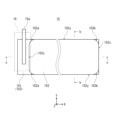
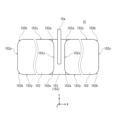
- FIG. 2 is a plan view conceptually illustrating a structure of an example of a positive electrode according to the present disclosure.
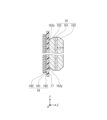
- FIG. 2 is a vertical cross-sectional view conceptually showing a part of a laminated structure of a positive electrode, a negative electrode, and a separator.
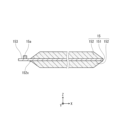
- FIG. 2 is a cross-sectional view along the longitudinal direction of an example of a positive electrode according to the present disclosure.
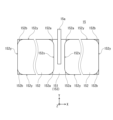
- FIG. 2 is a plan view conceptually illustrating the structure of another example of a positive electrode according to the present disclosure.
- FIG. 2 is a plan view conceptually illustrating the structure of yet another example of a positive electrode according to the present disclosure.
- FIG. 2 is a plan view conceptually illustrating the structure of yet another example of a positive electrode according to the present disclosure.
- FIG. 1 is a longitudinal sectional view that illustrates a schematic diagram of an example of a cylindrical nonaqueous electrolyte secondary battery.
- the present disclosure encompasses a combination of the features of two or more claims arbitrarily selected from the multiple claims set forth in the appended claims.
- the features of two or more claims arbitrarily selected from the multiple claims set forth in the appended claims may be combined, provided that no technical contradiction arises.
- the non-aqueous electrolyte secondary battery includes a positive electrode, a negative electrode, a separator, and a non-aqueous electrolyte.
- the positive electrode, the negative electrode, and the separator may be strip-shaped.
- the positive electrode, the negative electrode, and the separator may be laminated to form a laminated electrode group.
- the non-aqueous electrolyte may be of a wound type or a laminated type.
- the non-aqueous electrolyte has, for example, lithium ion conductivity.
- the positive electrode comprises a positive electrode current collector, a positive electrode active material layer, and a positive electrode tab.
- the positive electrode tab is a current collecting member that conducts current from the positive electrode to an external terminal, and is usually a ribbon-, strip-, or rectangular-shaped conductive member (e.g., metal foil).
- the positive electrode tab is also called a positive electrode lead.
- the positive electrode current collector has a first region and a second region.
- the first region supports a positive electrode active material layer.
- the majority of the positive electrode current collector is the first region.
- the second region is a region that does not support a positive electrode active material layer.
- the second region has an exposed portion of the positive electrode current collector, and the second region has a tab connection portion.
- the positive electrode tab is connected to the tab connection portion.
- the tab connection portion is connected to the exposed portion of the positive electrode current collector.
- the tab connection portion may be referred to as a positive electrode lead connection portion, etc.
- the tab connection portion is a region having sides to which a portion of the positive electrode tab is connected and from which the remaining portion of the positive electrode tab (i.e., the protruding portion) protrudes, and is usually a rectangular region.
- the tab connection portion is a rectangular region that at least partially overlaps with the portion of the positive electrode tab other than the protruding portion.
- the entire tab connection portion does not necessarily overlap with the tab.
- the tab connection portion may constitute the entire second region, or may constitute at least a portion of the second region. At least a portion of the tab connection portion may be shielded with an insulating tape, film, etc.
- the outer periphery (outer shape) of the positive electrode active material layer has at least one first side adjacent to the second region and multiple second sides that are not adjacent to the second region. Note that, if the second region has an area other than the tab connection portion, the first side is the side adjacent to the tab connection portion.
- the positive electrode current collector has a second region consisting of a single rectangular region at one end in the longitudinal direction, and the remainder of the positive electrode current collector is the first region. In this case, the entire second region is the tab connection portion.
- the outer periphery of the positive electrode active material layer has one first side and three second sides.
- the positive electrode disclosed herein satisfies at least one of the following conditions (A) and (B):
- the outer periphery of the positive electrode active material layer when the positive electrode is viewed in a plan view (hereinafter also simply referred to as the "outer periphery of the positive electrode active material layer") has a first corner where the first side and the second side intersect, and the positive electrode active material layer is chamfered at the first corner.
- the outer periphery of the positive electrode active material layer is chamfered in the cross-sectional shape in the thickness direction of the end of the positive electrode active material layer corresponding to the first side.
- Condition (A) is, in other words, a condition that the corner (first corner) of the positive electrode active material layer near the positive electrode tab is chamfered.
- the "cross-sectional shape" in condition (B) refers to the shape of the cross section formed when a region including the first side of the positive electrode active material layer (i.e., a region including the boundary between the first and second regions of the positive electrode current collector) is cut parallel to the thickness direction and perpendicular to the first side.
- the outer periphery of the positive electrode active material layer may have a second corner where the second sides intersect.
- the positive electrode active material layer may be further chamfered at the second corner. This further reduces the probability of localized current concentration in the positive electrode.
- a certain effect of suppressing current concentration can be obtained as long as at least one second corner is chamfered.
- the outer periphery of the positive electrode active material layer may have a third corner where the first sides intersect.
- the second region is a rectangular region having a side from which the protruding portion of the positive electrode tab protrudes, the remaining three sides of the second region may all be the first sides.
- the positive electrode active material layer may further be chamfered at the third corner. This further reduces the probability of localized current concentration in the positive electrode. If there are multiple third corners, a certain effect of suppressing current concentration can be obtained as long as at least one third corner is chamfered.
- the state in which the positive electrode active material layer is chamfered may include a state in which both the positive electrode active material layer and the positive electrode current collector are chamfered.
- the corner (first corner, second corner, or third corner) of the positive electrode active material layer and the positive electrode current collector present thereunder may be chamfered together.
- the shape of the chamfer in conditions (A) and (B) is not particularly limited, and may be, for example, a C-chamfer shape or an R-chamfer shape.
- the angle with respect to the first side is usually 45°, but may be a slope with an angle in the range of 30 to 60°.
- an R-chamfer shape is more desirable than a C-chamfer shape.
- the radius of curvature of the part with the greatest curvature may be, for example, 0.5 mm or more and 10 mm or less, or 1 mm or more and 3 mm or less.
- the length of the slope of the chamfered portion may be, for example, 0.5 mm or more and 10 mm or less, or 1 mm or more and 3 mm or less.
- the radius of curvature of the part with the greatest curvature may be equal to or less than the thickness T of the positive electrode active material layer, and may be, for example, 0.01 mm or more, or 0.05 mm or more.
- the inclination angle of the slope (tapered surface) of the chamfered portion with respect to the surface of the positive electrode current collector may be 1° or more and 80° or less, or 10° or more and 45° or less.
- the length of the slope (tapered surface) of the chamfered portion may be, for example, 150% or more and 30,000% or less, or 2,000% or more and 15,000% or less of the thickness T of the positive electrode active material layer.
- the nonaqueous electrolyte secondary battery according to the present disclosure may be a lithium secondary battery (lithium metal secondary battery) in which lithium metal is precipitated at the negative electrode during charging and the lithium metal dissolves during discharging.
- the negative electrode has at least a negative electrode current collector.
- Lithium metal is precipitated on the negative electrode current collector.
- Lithium secondary batteries are charged and discharged by a mechanism that precipitates lithium metal between the electrodes, so the effect of satisfying at least one of conditions (A) and (B) is particularly large.
- the lithium secondary battery may include a spacer disposed between at least one of the positive electrode and the negative electrode and the separator.
- the spacer has at least the role of ensuring a space for lithium metal to precipitate between the electrodes.
- the positive electrode and the negative electrode may be wound via the separator and the spacer to form a wound electrode group.
- the positive electrode, the negative electrode, the separator, and the spacer may be stacked to form a stacked electrode group.
- lithium secondary batteries for example, 70% or more of the rated capacity is achieved by the deposition and dissolution of lithium metal.
- the movement of electrons at the negative electrode during charging and discharging is mainly due to the deposition and dissolution of lithium metal at the negative electrode.
- 70-100% (for example, 80-100% or 90-100%) of the movement of electrons (current from another perspective) at the negative electrode during charging and discharging is due to the deposition and dissolution of lithium metal.
- the negative electrode of a lithium secondary battery is different from a negative electrode in which the movement of electrons at the negative electrode during charging and discharging is mainly due to the absorption and release of lithium ions by the negative electrode active material (such as graphite).
- FIG. 1A is a plan view conceptually showing the structure of an example of a positive electrode 15 when viewed in a plan view.
- a plan view refers to viewing the positive electrode 15 from a direction parallel to the thickness direction of the positive electrode (the Z direction in FIG. 1A).
- the XY plane in FIG. 1A is parallel to the surface of the positive electrode current collector.
- the positive electrode collector 151 is divided into a first region that carries the positive electrode active material layer 152 and a second region that does not carry the positive electrode active material layer 152.
- the second region is an exposed portion of the positive electrode collector 151, and has a tab connection portion 153 at one end in the longitudinal direction of the positive electrode collector 151, and has tiny approximately triangular regions at both corners of the other end.
- the positive electrode tab 15a is connected to the tab connection portion 153.
- a part of the tab connection portion 153, together with a part of the positive electrode tab 15a, is covered with an insulating tape 19, the outline of which is indicated by a dashed line.
- the outer periphery of the positive electrode active material layer 152 has one first side 152x parallel to the Y direction adjacent to the second region, and three second sides 152y not adjacent to the second region.
- the positive electrode active material layer 152 is chamfered at the first corner 152a where the first side 152x and the second side 152y intersect. Therefore, condition (A) is satisfied.
- the positive electrode active material layer 152 is also chamfered at the second corner 152b where the second sides 152y intersect, but chamfering the second corner 152b is not essential.
- FIG. 1B is a longitudinal cross-sectional view conceptually showing part of the structure of an example of an electrode group.
- FIG. 1B shows a laminated structure of the positive electrode 15, negative electrode 16, and separator 17 interposed therebetween, as shown in FIG. 1A.
- the longitudinal cross-sectional view of the positive electrode 15 is a cross-sectional view in the YZ plane of FIG. 1A, and corresponds to the view seen from the arrows b-b of FIG. 1A.
- FIG. 1B shows a state in which the cross-sectional shape in the thickness direction of the end of the positive electrode active material layer 152 corresponding to the second side 152y parallel to the X direction is C-chamfered.
- FIG. 1C is a cross-sectional view along the longitudinal direction of the positive electrode 15 shown in FIG. 1A.
- the cross-sectional view of the positive electrode 15 is a cross-sectional view along the ZX plane in FIG. 1A, and corresponds to the view seen from the c-c arrow in FIG. 1A.
- FIG. 1C shows a state in which the cross-sectional shape in the thickness direction of the end of the positive electrode active material layer 152 corresponding to the first side 152x parallel to the Y direction is C-chamfered.
- the positive electrode 15 also satisfies condition (B).
- FIG. 2A is a plan view conceptually illustrating the structure of another example of the positive electrode 15 when viewed in plan.
- the positive electrode collector 151 has two first regions that support the positive electrode active material layer 152. Between the two first regions, an exposed portion of the positive electrode collector 151 that does not support the positive electrode active material layer 152 is provided as a tab connection portion 153.
- the second region has the central tab connection portion 153 and tiny approximately triangular regions at the four corners on both ends of the positive electrode 15.
- the positive electrode tab 15a is connected to the central tab connection part 153.
- the insulating tape covering the tab connection part 153 is omitted from the illustration.
- the outer periphery of each of the two positive electrode active material layers 152 has one first side 152x parallel to the Y direction adjacent to the second region, and three second sides 152y that are not adjacent to the second region.
- the positive electrode active material layer 152 is R-chamfered at the four first corners 152a where the first side 152x and the second side 152y intersect. Therefore, condition (A) is satisfied.
- the positive electrode active material layer 152 is also R-chamfered at the second corners 152b where the second sides 152y intersect.
- FIG. 2B is a plan view conceptually illustrating the structure of yet another example of the positive electrode 15 when viewed in plan.
- the positive electrode 15 in FIG. 2B has the same structure as the positive electrode in FIG. 2A, except that both the positive electrode active material layer 152 and the positive electrode current collector 151 are chamfered in the tiny, roughly triangular regions at the four corners of both ends.
- FIG. 3 is a plan view conceptually showing the structure of yet another example of the positive electrode 15 when viewed in plan.
- exposed portions of multiple positive electrode collectors 151 are provided as a second region at an edge portion including one end in the short side direction (Y direction) of the positive electrode.
- Each exposed portion of the multiple positive electrode collectors 151 is a tab connection portion 153. That is, multiple tab connection portions 153 are provided intermittently along the longitudinal direction (X direction) of the positive electrode.
- the width of the edge portion extending from one end in the short side direction of the positive electrode 15 toward the center of the positive electrode 15 (depth of the tab connection portion 153) is, for example, 8 mm or more and 12 mm or less.
- the outer periphery of the positive electrode active material layer 152 has 2n first corners 152a where a first side 152x parallel to the Y direction intersects with a second side 152y parallel to the X direction, and 2n third corners 152c where a first side 152x parallel to the X direction intersects with a first side 152x parallel to the Y direction, following the shape of the tab connection portion 153.
- n indicates the number of tab connection portions 153.
- the exposed portions of the positive electrode active material layer 152 or the positive electrode current collector 151 are R-chamfered.
- the nonaqueous electrolyte secondary battery according to the present disclosure may be a liquid secondary battery containing an electrolytic solution as the electrolyte, or may be an all-solid-state secondary battery containing a solid electrolyte as the electrolyte.
- a nonaqueous electrolyte secondary battery will be specifically described using a lithium ion secondary battery or a lithium secondary battery as an example.
- FIG. 4 is a longitudinal cross-sectional view of a cylindrical nonaqueous electrolyte secondary battery that is an example of an embodiment of the present disclosure.
- the present disclosure is not limited to the following configuration.
- the secondary battery 10 comprises an electrode group 18, an electrolyte (not shown), and a cylindrical battery can 22 with a bottom that contains these.
- a sealing body 11 is crimped and fixed to the opening of the battery can 22 via a gasket 21. This seals the inside of the battery.
- the sealing body 11 comprises a valve body 12, a metal plate 13, and an annular insulating member 14 interposed between the valve body 12 and the metal plate 13.
- the valve body 12 and the metal plate 13 are connected to each other at their respective centers.
- a positive electrode tab (positive electrode lead) 15a derived from the positive electrode 15 is connected to the metal plate 13.
- the valve body 12 functions as an external terminal for the positive electrode.
- a negative electrode tab (negative electrode lead) 16a derived from the negative electrode 16 is connected to the inner bottom surface of the battery can 22.
- An annular groove portion 22a is formed near the open end of the battery can 22.
- a first insulating plate 23 is disposed between one end face of the electrode group 18 and the annular groove portion 22a.
- a second insulating plate 24 is disposed between the other end face of the electrode group 18 and the bottom of the battery can 22.
- the electrode group 18 is formed by winding a positive electrode 15 and a negative electrode 16 with a separator 17 interposed therebetween.
- FIG. 4 is a cross-sectional view parallel to the Y direction and passing through the winding axis of the electrode group.
- the positive electrode has the above-mentioned characteristics.
- the positive electrode includes a positive electrode current collector and a positive electrode active material layer.
- the positive electrode active material layer is composed of a positive electrode mixture.
- the positive electrode mixture includes a positive electrode active material as an essential component, and may include optional components.
- the optional components may include a binder, a conductive assistant, a thickener, etc.
- the positive electrode active material layer is considerably harder than the negative electrode, the separator, lithium metal, etc.
- the greater the thickness of such a hard positive electrode active material layer the more significant the effect of satisfying at least one of conditions (A) and (B).
- the thickness of the positive electrode active material layer may be, for example, 30 ⁇ m or more and 200 ⁇ m or less, 30 ⁇ m or more and 160 ⁇ m or less, 50 ⁇ m or more and 150 ⁇ m or less, or 50 ⁇ m or more and 100 ⁇ m or less.
- the thickness of the positive electrode tab is, for example, 50 ⁇ m or more and 300 ⁇ m or less, and may be 0.5 to 2 times the thickness T of the positive electrode active material layer.
- the average particle size (D50) of the positive electrode active material particles is, for example, 1 ⁇ m or more and 50 ⁇ m or less, and may be 5 ⁇ m or more and 25 ⁇ m or less.
- the average particle size (D50) refers to the median diameter when the cumulative volume is 50% in the volume-based particle size distribution.
- the positive electrode active material may contain a lithium-containing transition metal oxide. From the viewpoint of increasing capacity, it is desirable for the lithium-containing transition metal oxide to contain lithium nickel oxide (composite oxide N) that contains lithium and Ni and has a layered rock-salt crystal structure.
- the proportion of the complex oxide N in the positive electrode active material is, for example, 70 mass% or more, or may be 90 mass% or more, or may be 95 mass% or more.
- the proportion of Ni in the metal elements other than Li contained in the complex oxide N may be 50 atomic% or more.
- the composite oxide N is represented by, for example, the formula (1): Li ⁇ Ni x1 M1 x2 M2 (1-x1-x2) O 2 + ⁇ .
- the element M1 is at least one selected from the group consisting of V, Co, and Mn.
- the element M2 is at least one selected from the group consisting of Mg, Al, Ca, Ti, Cu, Zn, and Nb.
- the formula (1) satisfies 0.95 ⁇ 1.05, -0.05 ⁇ 0.05, 0.5 ⁇ x1 ⁇ 1, 0 ⁇ x2 ⁇ 0.5, and 0 ⁇ 1-x1-x2 ⁇ 0.5. ⁇ increases or decreases due to charging and discharging.
- the composite oxide N may contain Ni and may contain at least one element selected from the group consisting of Co, Mn, and Al as element M1 and element M2. Co, Mn, and Al contribute to stabilizing the crystal structure of the composite oxide N.
- the composite oxide N may be represented by, for example, formula (2): Li ⁇ Ni (1-y1-y2-y3-z) Co y1 Mn y2 Al y3 M z O 2+ ⁇ .
- the element M is an element other than Li, Ni, Co, Mn, Al, and oxygen, and may be at least one selected from the group consisting of Ti, Zr, Nb, Mo, W, Fe, Zn, B, Si, Mg, Ca, Sr, Sc, and Y.
- formula (2) satisfies 0.95 ⁇ 1.05, ⁇ 0.05 ⁇ 0.05, 0 ⁇ y1 ⁇ 0.1, 0 ⁇ y2 ⁇ 0.1, 0 ⁇ y3 ⁇ 0.1, and 0 ⁇ z ⁇ 0.10.
- v representing the atomic ratio of Ni is, for example, 0.8 or more, or may be 0.85 or more, or 0.90 or more, or 0.95 or more. Also, v representing the atomic ratio of Ni may be 0.98 or less, or may be 0.95 or less.
- the positive electrode current collector a sheet-like conductive material (metal foil, mesh, net, punched sheet, etc.) is used. Among these, metal foil is preferred. Examples of the material of the positive electrode core body include stainless steel, aluminum, aluminum alloy, and titanium. As the positive electrode current collector, a material in which a metal material is applied to the surface of a resin film by physical vapor deposition (PVD) or the like may be used.
- the thickness of the positive electrode current collector is not particularly limited, but may be, for example, 1 to 50 ⁇ m, or 5 to 30 ⁇ m.
- the negative electrode includes at least a negative electrode current collector, and may include a negative electrode active material layer.
- the negative electrode active material layer may be composed of a negative electrode mixture.
- the negative electrode mixture includes a negative electrode active material as an essential component, and may include optional components.
- the optional components may include a binder, a conductive assistant, a thickener, and the like.
- the negative electrode active material layer may be formed by attaching a lithium metal foil or a lithium alloy foil to the surface of the negative electrode current collector. That is, the negative electrode current collector may be provided with a base layer (a layer of lithium metal or lithium alloy (hereinafter also referred to as a "lithium base layer”)) containing lithium metal in advance.
- a base layer a layer of lithium metal or lithium alloy (hereinafter also referred to as a "lithium base layer"
- the lithium alloy may contain elements such as aluminum, magnesium, indium, zinc, copper, and silver in addition to lithium. By providing a lithium metal base layer and depositing lithium metal on it during charging, dendritic deposition can be more effectively suppressed.
- the thickness of the lithium metal base layer is not particularly limited, but may be in the range of 5 ⁇ m to 25 ⁇ m, for example.
- Anode active materials include materials that electrochemically absorb and release lithium ions, lithium metal, lithium alloys, etc.
- Carbon materials, alloy-based materials, etc. are used as materials that electrochemically absorb and release lithium ions.
- Examples of carbon materials include graphite, graphitizable carbon (soft carbon), and non-graphitizable carbon (hard carbon). Among them, graphite is preferred because of its excellent charge/discharge stability and low irreversible capacity.
- Alloy-based materials include those that contain at least one metal that can form an alloy with lithium, and specific examples include silicon, tin, silicon alloys, tin alloys, and silicon compounds. Silicon oxide, tin oxide, etc. may also be used, and other silicon-containing materials may also be used.
- a non-porous conductive substrate such as metal foil
- a porous conductive substrate such as mesh, net, or punched sheet
- the material of the negative electrode current collector include stainless steel, nickel, nickel alloy, copper, copper alloy, and oxygen-free copper foil.
- a composite current collector having a resin film and a transition metal layer laminated with the resin film can also be used.
- the resin film may contain one or more of polyester resin, olefin resin, polyphenylene sulfide resin, acrylic resin, polycarbonate resin, polyether ether ketone resin, polyether sulfone resin, polyamide resin, polyimide resin, nylon resin, polyvinylidene chloride resin, ethylene-vinyl alcohol copolymer, polyvinyl alcohol resin, polystyrene resin, epoxy resin, and urethane resin.
- the transition metal layer contains at least one of copper, nickel, chromium, titanium, iron, silver, gold, tin, copper alloy, stainless steel, and nickel alloy.
- the transition metal layer is formed on one or both sides of the resin film by a known formation method such as vapor deposition, atomic layer deposition (ALD), sputtering, electroless plating, etc.
- the composite current collector may further include a surface resin layer between the resin film and the transition metal layer, and the surface resin layer includes a polymer having at least one bond selected from the group consisting of a urethane bond, a urea bond, a melamine bond, an amide bond, an aramid bond, and an imide bond.
- the separator has high ion permeability and has appropriate mechanical strength and insulating properties.
- Examples of the separator include a microporous thin film, a woven fabric, and a nonwoven fabric.
- the thickness of the separator is, for example, 10 ⁇ m, and may be 15 ⁇ m or more, 20 ⁇ m or more, or 30 ⁇ m or more. However, from the viewpoint of energy density, it is preferable that the separator is thinner than the positive electrode.
- the thickness of the separator is, for example, preferably less than 80 ⁇ m, and more preferably less than 50 ⁇ m.
- the separator preferably has layers with an MD/TD ratio (ratio of tensile strength in the longitudinal direction (MD) to tensile strength in the transverse direction (TD)) of 4.5 or more.
- MD/TD ratio ratio of tensile strength in the longitudinal direction (MD) to tensile strength in the transverse direction (TD)
- the MD/TD ratio may be 5.0 or more. From the viewpoint of ensuring sufficient flexibility of the separator, the MD/TD ratio is preferably 10 or less.
- polyolefins such as polypropylene and polyethylene are used as the separator material.
- the separator material contains polypropylene, the effect of satisfying at least one of conditions (A) and (B) is more pronounced.
- Polyolefins have low polarity and excellent resistance to non-aqueous electrolytes.
- Polypropylene has higher strength than polyethylene and excellent compression resistance.
- the separator may have a base layer and a heat-resistant layer laminated on the base layer.
- the base layer may be a microporous thin film, a woven fabric, a nonwoven fabric, or the like.
- the heat-resistant layer may be provided on at least one surface of the base layer. It is desirable to provide the heat-resistant layer at least on the positive electrode side of the separator.
- the heat-resistant layer may contain an inorganic oxide filler as a main component (e.g., 80% by mass or more of the heat-resistant layer), or may contain a heat-resistant resin as a main component (e.g., 40% by mass or more of the heat-resistant layer).
- the heat-resistant resin may be a polyamide resin such as aromatic polyamide (aramid), a polyimide resin, a polyamide-imide resin, a polyacrylic acid resin, or a polyvinylidene fluoride resin.
- Non-aqueous electrolyte The non-aqueous electrolyte of the lithium ion secondary battery or the lithium secondary battery has lithium ion conductivity.
- the non-aqueous electrolyte may be a liquid electrolyte (electrolytic solution) or a solid electrolyte.
- the solid electrolyte for example, a solid or gel-like polymer electrolyte, an inorganic solid electrolyte, etc. can be used.
- the inorganic solid electrolyte a material known in all-solid-state lithium ion secondary batteries, etc. (for example, an oxide-based solid electrolyte, a sulfide-based solid electrolyte, a halogen-based solid electrolyte, etc.) can be used.
- the polymer electrolyte includes, for example, a lithium salt and a matrix polymer, or a non-aqueous solvent, a lithium salt, and a matrix polymer.
- the matrix polymer for example, a polymer material that absorbs a non-aqueous solvent and gels is used.
- the polymer material for example, a fluororesin, an acrylic resin, a polyether resin, etc. can be used.
- the electrolyte contains a non-aqueous solvent and an electrolyte salt.
- the electrolyte salt contains at least a lithium salt.
- the concentration of the lithium salt in the electrolyte is, for example, 0.5 mol/L or more and 2 mol/L or less.
- the non-aqueous electrolyte may contain known additives.
- non-aqueous solvents examples include cyclic carbonates, chain carbonates, and cyclic carboxylates.
- cyclic carbonates include propylene carbonate (PC) and ethylene carbonate (EC).
- chain carbonates include diethyl carbonate (DEC), ethyl methyl carbonate (EMC), and dimethyl carbonate (DMC).
- cyclic carboxylates include ⁇ -butyrolactone (GBL) and ⁇ -valerolactone (GVL).
- One type of non-aqueous solvent may be used alone, or two or more types may be used in combination.
- lithium salts of chlorine-containing acids LiClO4 , LiAlCl4 , LiB10Cl10 , etc.
- lithium salts of fluorine-containing acids LiPF6 , LiBF4 , LiSbF6 , LiAsF6 , LiCF3SO3 , LiCF3CO2 , etc.
- lithium salts of fluorine-containing acid imides LiN( SO2F ) 2 , LiN( CF3SO2 ) 2 , LiN(CF3SO2)(C4F9SO2 ) , LiN( C2F5SO2 ) 2 , etc.
- lithium halides LiCl , LiBr , LiI, etc.
- oxalate complex salts lithium bisoxalate borate, lithium difluorooxalate borate ( BF2 ( C2O 4 ) - , PF4 ( C2O4 ) - , PF2 ( C2O4 ) 2- , etc.
- the lithium salt may be used alone or in combination of two or more kinds.
- the positive electrode includes a positive electrode current collector, a positive electrode active material layer, and a positive electrode tab,
- the positive electrode current collector has a first region and a second region, the first region supports the positive electrode active material layer, the second region does not support the positive electrode active material layer and has a tab connection portion, the positive electrode tab is connected to the tab connection portion,
- an outer periphery of the positive electrode active material layer has at least one first side adjacent to the second region, a plurality of second sides not adjacent to the second region, and a first corner where the first side and the second side intersect, the positive electrode active material layer is chamfered at the first corner.
- the outer periphery of the positive electrode active material layer further has a second corner where the second sides intersect, 2.
- the outer periphery of the positive electrode active material layer further has a third corner where the first sides intersect with each other, 3.
- the positive electrode includes a positive electrode current collector, a positive electrode active material layer, and a positive electrode tab,
- the positive electrode current collector has a first region and a second region, the first region supports the positive electrode active material layer, the second region does not support the positive electrode active material layer and has a tab connection portion, the positive electrode tab is connected to the tab connection portion,
- an outer periphery of the positive electrode active material layer has at least one first side adjacent to the second region and a plurality of second sides not adjacent to the second region, a cross-sectional shape in a thickness direction of the end portion of the positive electrode active material layer corresponding to the first side is chamfered.
- (Technique 12) 12 12. The nonaqueous electrolyte secondary battery according to any one of claims 1 to 11, wherein the material of the separator includes polypropylene.
- NCA rock salt type lithium-containing transition metal oxide
- AB conductive material
- PVdF polyvinylidene fluoride
- NMP N-methyl-2-pyrrolidone
- the obtained positive electrode mixture slurry was applied to both sides of a strip-shaped Al foil (positive electrode current collector) having a thickness of 15 ⁇ m, and then dried, and the coating film of the positive electrode mixture was rolled using a roller.
- the obtained laminate of the positive electrode current collector and the positive electrode composite coating film was cut to a predetermined electrode size (5 x 8 cm) to obtain a positive electrode having a positive electrode active material layer of 80 ⁇ m thickness on each side of the positive electrode current collector.
- the positive electrode active material layer (positive electrode composite material) was peeled off from one end in the longitudinal direction of the positive electrode, and the exposed portion of the positive electrode current collector as shown in FIG. 1A was formed as a tab connection portion.
- the positive electrode current collector was divided into a first region carrying the positive electrode active material layer and a second region not carrying the positive electrode active material layer.
- the outer periphery of the positive electrode active material layer has one first side adjacent to the second region and three second sides not adjacent to the second region.
- the positive electrode active material layer was chamfered into an arc shape with a curvature radius of 5 mm to obtain a positive electrode that satisfied condition (A).
- a positive electrode tab (thickness 150 ⁇ m) was connected to the tab connection portion, and a part of the tab connection portion and a part of the positive electrode tab were covered with insulating tape.
- Separator A microporous polyethylene thin film having a thickness of 20 ⁇ m was prepared as a separator.
- the MD/TD ratio of the separator was set to 1.0.
- a dispersion of spacer material was prepared by mixing 60 parts by volume of insulating particles (median diameter 3 ⁇ m, volume resistivity 10 ⁇ cm), 39 parts by volume of binder resin, 1 part by volume of CMC (sodium salt), and water as a dispersion medium.
- a dispersion of spacer material was dispensed in a specified pattern onto one side of each of a pair of microporous thin films, and the coating was vacuum dried to form the spacers.
- Example 2 (1) Fabrication of Positive Electrode A positive electrode was fabricated in the same manner as in Example 1, except that a laminate of a positive electrode current collector and a positive electrode composite coating film was cut into a predetermined band-shaped electrode size.
- the positive electrode had a positive electrode active material layer with a thickness of 80 ⁇ m on both sides of a positive electrode current collector, a tab connection portion at one end in the longitudinal direction, and a first corner where the positive electrode active material layer was R-chamfered into an arc shape with a curvature radius of 5 mm.
- the positive electrode and the negative electrode current collector were spirally wound with the separator interposed therebetween to prepare a wound electrode group.
- the separators were arranged so that the spacers formed on one side of each of the pair of separators faced the negative electrode.
- the electrode group was housed in a bag-shaped exterior body formed of a laminate sheet having an Al layer, and after injecting a non-aqueous electrolyte, the exterior body was sealed to complete the battery A2 of Example 2.
- Example 3 A battery A3 of Example 3 was completed in the same manner as in Example 1, except that the positive electrode active material layer was also rounded in an arc shape at the two second corners where the second sides intersected each other.
- Example 4 A battery A4 of Example 4 was completed in the same manner as in Example 3, except that the thickness of the positive electrode active material layer was changed to 160 ⁇ m.
- Example 5 A battery A5 of Example 5 was completed in the same manner as in Example 1, except that the two first corners were not R-chamfered, and the cross-sectional shape in the thickness direction of the end of the positive electrode active material layer corresponding to the first side was C-chamfered (slope length 10 mm).
- Example 6 A battery A6 of Example 6 was completed in the same manner as in Example 2, except that the two first corners were not R-chamfered, the cross-sectional shape in the thickness direction of the end of the positive electrode active material layer corresponding to the first side was C-chamfered (slope length: 10 mm), and the thickness of the positive electrode active material layer was changed to 160 ⁇ m.
- Example 7 Furthermore, a battery A7 of Example 7 was completed in the same manner as in Example 6, except that the cross-sectional shape in the thickness direction of the end portion of the positive electrode active material layer corresponding to the second side along the longitudinal direction was C-chamfered (slope length 10 mm).
- Example 8 Battery A8 of Example 8 was completed in the same manner as in Example 2, except that at two second corners where the second sides intersect, the positive electrode active material layer was R-chamfered in an arc shape, the cross-sectional shape in the thickness direction of the end of the positive electrode active material layer corresponding to the first side was C-chamfered (slope length 10 mm), and further, the cross-sectional shape in the thickness direction of the end of the positive electrode active material layer corresponding to the second side along the longitudinal direction was C-chamfered (slope length 10 mm), and the thickness of the positive electrode active material layer was changed to 160 ⁇ m.
- Example 9 A battery A9 of Example 9 was completed in the same manner as in Example 8, except that the thickness of the positive electrode active material layer was changed to 80 ⁇ m.
- Example 10 A battery A10 of Example 10 was completed in the same manner as in Example 9, except that the thickness of the separator was changed to 40 ⁇ m.
- Example 11 A battery A11 of Example 11 was completed in the same manner as in Example 10, except that the MD/TD ratio of the separator was changed to 5.5.
- Example 12 A battery A12 of Example 12 was completed in the same manner as in Example 11, except that the material of the separator was changed to polypropylene.
- Comparative Example 1 A battery B1 of Comparative Example 1 was completed in the same manner as in Example 1, except that the two first corners were not R-chamfered and the two second corners were R-chamfered.
- Comparative Example 2 A battery B2 of Comparative Example 2 was completed in the same manner as in Example 2, except that the two first corners were not R-chamfered and the two second corners were R-chamfered.
- Comparative Example 3 A battery B3 of Comparative Example 3 was completed in the same manner as in Comparative Example 2, except that the two second corners were not rounded.
- Comparative Example 4 Battery B4 of Comparative Example 4 was completed in the same manner as in Comparative Example 3, except that the thickness of the separator was changed to 40 ⁇ m, the MD/TD ratio of the separator was changed to 5.5, and the material of the separator was changed to polypropylene.
- the battery was charged at a constant current of 2.15 mA per unit area (cm 2 ) of the electrode until the battery voltage reached 4.1 V, and then charged at a constant voltage of 4.1 V until the current value per unit area of the electrode reached 0.54 mA.
- the above charge and discharge constituted one cycle, and the cycles were repeated until an increase in apparent charge capacity due to an internal short circuit was observed.
- the number of cycles at that time is shown in Table 1 as a relative value along with the battery configuration, with the number of cycles for battery B being 100.
- a short circuit was determined to have occurred when the relationship between the apparent capacity at the cycle number at which the apparent capacity began to increase (A) and the maximum apparent capacity for the immediately following 20 cycles (B) satisfied B/A>1.1.
- the number of cycles showing the maximum value (B) was taken as the number of cycles in which the short circuit occurred.
- the nonaqueous electrolyte secondary battery according to the present disclosure is useful as a main power source for mobile communication devices, portable electronic devices, electric vehicles, and the like, for example.
Landscapes
- Chemical & Material Sciences (AREA)
- Chemical Kinetics & Catalysis (AREA)
- Electrochemistry (AREA)
- General Chemical & Material Sciences (AREA)
- Engineering & Computer Science (AREA)
- Manufacturing & Machinery (AREA)
- Secondary Cells (AREA)
- Battery Electrode And Active Subsutance (AREA)
Priority Applications (3)
| Application Number | Priority Date | Filing Date | Title |
|---|---|---|---|
| JP2025503764A JPWO2024181149A1 (https=) | 2023-02-28 | 2024-02-15 | |
| CN202480012671.1A CN120677577A (zh) | 2023-02-28 | 2024-02-15 | 非水电解质二次电池 |
| EP24763632.7A EP4675742A1 (en) | 2023-02-28 | 2024-02-15 | Non-aqueous electrolyte secondary battery |
Applications Claiming Priority (2)
| Application Number | Priority Date | Filing Date | Title |
|---|---|---|---|
| JP2023-030106 | 2023-02-28 | ||
| JP2023030106 | 2023-02-28 |
Publications (1)
| Publication Number | Publication Date |
|---|---|
| WO2024181149A1 true WO2024181149A1 (ja) | 2024-09-06 |
Family
ID=92589783
Family Applications (1)
| Application Number | Title | Priority Date | Filing Date |
|---|---|---|---|
| PCT/JP2024/005262 Ceased WO2024181149A1 (ja) | 2023-02-28 | 2024-02-15 | 非水電解質二次電池 |
Country Status (4)
| Country | Link |
|---|---|
| EP (1) | EP4675742A1 (https=) |
| JP (1) | JPWO2024181149A1 (https=) |
| CN (1) | CN120677577A (https=) |
| WO (1) | WO2024181149A1 (https=) |
Cited By (2)
| Publication number | Priority date | Publication date | Assignee | Title |
|---|---|---|---|---|
| WO2025239268A1 (ja) * | 2024-05-14 | 2025-11-20 | パナソニックIpマネジメント株式会社 | 円筒形電池 |
| WO2026063121A1 (ja) * | 2024-09-19 | 2026-03-26 | パナソニックIpマネジメント株式会社 | 電極板および蓄電装置 |
Citations (7)
| Publication number | Priority date | Publication date | Assignee | Title |
|---|---|---|---|---|
| JP2002134161A (ja) | 2000-10-26 | 2002-05-10 | Isao Matsumoto | 電池用渦巻状電極群及び電池 |
| JP2010202828A (ja) * | 2009-03-05 | 2010-09-16 | Asahi Kasei E-Materials Corp | ポリオレフィン製微多孔膜 |
| JP2016219255A (ja) * | 2015-05-20 | 2016-12-22 | 日産自動車株式会社 | 電池、電池モジュールおよび電池の設計方法 |
| JP2018142513A (ja) * | 2017-02-28 | 2018-09-13 | 株式会社豊田自動織機 | 蓄電装置 |
| JP2018206465A (ja) * | 2015-11-06 | 2018-12-27 | 三洋電機株式会社 | 蓄電装置用電極板及びそれを備える蓄電装置 |
| JP2022091362A (ja) * | 2020-12-09 | 2022-06-21 | 本田技研工業株式会社 | 電極、及びそれを用いたリチウムイオン二次電池 |
| JP2023030106A (ja) | 2018-04-09 | 2023-03-07 | サインパス ファルマ,インク. | 増殖性障害の治療のための投薬レジメン |
-
2024
- 2024-02-15 EP EP24763632.7A patent/EP4675742A1/en active Pending
- 2024-02-15 CN CN202480012671.1A patent/CN120677577A/zh active Pending
- 2024-02-15 WO PCT/JP2024/005262 patent/WO2024181149A1/ja not_active Ceased
- 2024-02-15 JP JP2025503764A patent/JPWO2024181149A1/ja active Pending
Patent Citations (7)
| Publication number | Priority date | Publication date | Assignee | Title |
|---|---|---|---|---|
| JP2002134161A (ja) | 2000-10-26 | 2002-05-10 | Isao Matsumoto | 電池用渦巻状電極群及び電池 |
| JP2010202828A (ja) * | 2009-03-05 | 2010-09-16 | Asahi Kasei E-Materials Corp | ポリオレフィン製微多孔膜 |
| JP2016219255A (ja) * | 2015-05-20 | 2016-12-22 | 日産自動車株式会社 | 電池、電池モジュールおよび電池の設計方法 |
| JP2018206465A (ja) * | 2015-11-06 | 2018-12-27 | 三洋電機株式会社 | 蓄電装置用電極板及びそれを備える蓄電装置 |
| JP2018142513A (ja) * | 2017-02-28 | 2018-09-13 | 株式会社豊田自動織機 | 蓄電装置 |
| JP2023030106A (ja) | 2018-04-09 | 2023-03-07 | サインパス ファルマ,インク. | 増殖性障害の治療のための投薬レジメン |
| JP2022091362A (ja) * | 2020-12-09 | 2022-06-21 | 本田技研工業株式会社 | 電極、及びそれを用いたリチウムイオン二次電池 |
Non-Patent Citations (1)
| Title |
|---|
| See also references of EP4675742A1 |
Cited By (2)
| Publication number | Priority date | Publication date | Assignee | Title |
|---|---|---|---|---|
| WO2025239268A1 (ja) * | 2024-05-14 | 2025-11-20 | パナソニックIpマネジメント株式会社 | 円筒形電池 |
| WO2026063121A1 (ja) * | 2024-09-19 | 2026-03-26 | パナソニックIpマネジメント株式会社 | 電極板および蓄電装置 |
Also Published As
| Publication number | Publication date |
|---|---|
| EP4675742A1 (en) | 2026-01-07 |
| JPWO2024181149A1 (https=) | 2024-09-06 |
| CN120677577A (zh) | 2025-09-19 |
Similar Documents
| Publication | Publication Date | Title |
|---|---|---|
| KR101500545B1 (ko) | 부극 및 2차 전지 | |
| US7556881B2 (en) | Lithium secondary battery | |
| CN112204791A (zh) | 电池及电池包 | |
| US20140255779A1 (en) | Secondary battery | |
| JP2002324585A (ja) | 非水電解質二次電池およびその容量回復方法 | |
| JP5231505B2 (ja) | リチウムイオン二次電池 | |
| US20080171264A1 (en) | Nonaqueous electrolyte secondary battery and fabrication method thereof | |
| WO2024181149A1 (ja) | 非水電解質二次電池 | |
| US20070054191A1 (en) | Non- aqueous electrolyte secondary battery | |
| JP2001085042A (ja) | リチウム二次電池及び捲回型電極体の作製方法 | |
| JP2012124026A (ja) | 非水電解液二次電池 | |
| JP2006344505A (ja) | 電解液および電池 | |
| JP2001236946A (ja) | 非水電解質二次電池用極板およびこれを用いた非水電解質二次電池 | |
| JPH06196169A (ja) | 非水電解液二次電池 | |
| US8980482B2 (en) | Nonaqueous electrolyte lithium ion secondary battery | |
| JP2001068160A (ja) | 扁平形非水電解質二次電池 | |
| KR20040087936A (ko) | 전해액 및 이를 이용한 전지 | |
| JP7270142B2 (ja) | リチウム二次電池 | |
| JP2019121500A (ja) | 円筒形二次電池 | |
| JP4582684B2 (ja) | 非水二次電池 | |
| CN111697261A (zh) | 锂二次电池 | |
| JP2002324584A (ja) | リード端子付扁平形非水電解質二次電池 | |
| JP2016207447A (ja) | 非水電解液二次電池 | |
| WO2023008474A1 (ja) | 二次電池用正極および二次電池 | |
| JPH0541244A (ja) | 非水電解液二次電池 |
Legal Events
| Date | Code | Title | Description |
|---|---|---|---|
| 121 | Ep: the epo has been informed by wipo that ep was designated in this application |
Ref document number: 24763632 Country of ref document: EP Kind code of ref document: A1 |
|
| WWE | Wipo information: entry into national phase |
Ref document number: 202480012671.1 Country of ref document: CN |
|
| WWE | Wipo information: entry into national phase |
Ref document number: 202517078347 Country of ref document: IN |
|
| ENP | Entry into the national phase |
Ref document number: 2025503764 Country of ref document: JP Kind code of ref document: A |
|
| WWE | Wipo information: entry into national phase |
Ref document number: 2025503764 Country of ref document: JP |
|
| WWP | Wipo information: published in national office |
Ref document number: 202480012671.1 Country of ref document: CN |
|
| WWE | Wipo information: entry into national phase |
Ref document number: 2024763632 Country of ref document: EP |
|
| NENP | Non-entry into the national phase |
Ref country code: DE |
|
| ENP | Entry into the national phase |
Ref document number: 2024763632 Country of ref document: EP Effective date: 20250929 |
|
| ENP | Entry into the national phase |
Ref document number: 2024763632 Country of ref document: EP Effective date: 20250929 |
|
| ENP | Entry into the national phase |
Ref document number: 2024763632 Country of ref document: EP Effective date: 20250929 |
|
| WWP | Wipo information: published in national office |
Ref document number: 202517078347 Country of ref document: IN |
|
| WWP | Wipo information: published in national office |
Ref document number: 2024763632 Country of ref document: EP |