WO2024177064A1 - スパウトおよび包装容器 - Google Patents
スパウトおよび包装容器 Download PDFInfo
- Publication number
- WO2024177064A1 WO2024177064A1 PCT/JP2024/006027 JP2024006027W WO2024177064A1 WO 2024177064 A1 WO2024177064 A1 WO 2024177064A1 JP 2024006027 W JP2024006027 W JP 2024006027W WO 2024177064 A1 WO2024177064 A1 WO 2024177064A1
- Authority
- WO
- WIPO (PCT)
- Prior art keywords
- spout
- packaging bag
- resin
- packaging
- polyethylene
- Prior art date
- Legal status (The legal status is an assumption and is not a legal conclusion. Google has not performed a legal analysis and makes no representation as to the accuracy of the status listed.)
- Ceased
Links
Images



Classifications
-
- B—PERFORMING OPERATIONS; TRANSPORTING
- B65—CONVEYING; PACKING; STORING; HANDLING THIN OR FILAMENTARY MATERIAL
- B65D—CONTAINERS FOR STORAGE OR TRANSPORT OF ARTICLES OR MATERIALS, e.g. BAGS, BARRELS, BOTTLES, BOXES, CANS, CARTONS, CRATES, DRUMS, JARS, TANKS, HOPPERS, FORWARDING CONTAINERS; ACCESSORIES, CLOSURES, OR FITTINGS THEREFOR; PACKAGING ELEMENTS; PACKAGES
- B65D75/00—Packages comprising articles or materials partially or wholly enclosed in strips, sheets, blanks, tubes or webs of flexible sheet material, e.g. in folded wrappers
- B65D75/52—Details
- B65D75/58—Opening or contents-removing devices added or incorporated during package manufacture
- B65D75/5861—Spouts
- B65D75/5872—Non-integral spouts
- B65D75/5883—Non-integral spouts connected to the package at the sealed junction of two package walls
-
- B—PERFORMING OPERATIONS; TRANSPORTING
- B65—CONVEYING; PACKING; STORING; HANDLING THIN OR FILAMENTARY MATERIAL
- B65D—CONTAINERS FOR STORAGE OR TRANSPORT OF ARTICLES OR MATERIALS, e.g. BAGS, BARRELS, BOTTLES, BOXES, CANS, CARTONS, CRATES, DRUMS, JARS, TANKS, HOPPERS, FORWARDING CONTAINERS; ACCESSORIES, CLOSURES, OR FITTINGS THEREFOR; PACKAGING ELEMENTS; PACKAGES
- B65D2575/00—Packages comprising articles or materials partially or wholly enclosed in strips, sheets, blanks, tubes or webs of flexible sheet material, e.g. in folded wrappers
- B65D2575/52—Details
- B65D2575/58—Opening or contents-removing devices added or incorporated during package manufacture
- B65D2575/583—Opening or contents-removing devices added or incorporated during package manufacture the non-integral spout having an elongate cross-sectional shape, e.g. canoe or boat shaped
Definitions
- the present invention relates to a spout and a packaging container.
- This application claims priority based on Japanese Patent Application No. 2023-025826, filed on February 22, 2023, the contents of which are incorporated herein by reference.
- paragraph 0010 of Patent Document 1 describes a conventional packaging bag, which uses a laminate film in which a sealant such as polyethylene (PE) or polypropylene (PP) is laminated with a stretched film such as polyethylene terephthalate (PET), nylon (Ny), or PP.
- a sealant such as polyethylene (PE) or polypropylene (PP) is laminated with a stretched film such as polyethylene terephthalate (PET), nylon (Ny), or PP.
- PET polyethylene terephthalate
- Ny nylon
- Paragraph 0011 also describes that the spout has a thermoplastic resin layer that can be welded to the sealant of the packaging bag, and that PE, PP, PET, Ny, etc. can be used.
- the present invention was made in consideration of the above circumstances, and aims to provide a spout and packaging container that have excellent welding properties even for mono-material packaging bags made of polyethylene-based resins, etc.
- the first aspect of the present invention is a spout that is welded to a packaging bag, and has an attachment portion that is welded to the packaging bag and a pouring portion that protrudes outward from the attachment portion, and is characterized in that the outer periphery of the attachment portion that is welded to the packaging bag has four or more ribs, each having a width of 1 mm or more, that are arranged in parallel in the direction in which the pouring portion protrudes from the attachment portion.
- the ribs are arranged side by side with spaces between them in the direction in which the pouring portion protrudes from the attachment portion. It is preferable that the ribs are parallel to each other, but they do not have to be strictly parallel as long as there is a space between them.
- the second aspect is characterized in that the surface of the rib that is welded to the packaging bag in the first aspect is subjected to a matte finish.
- the matte finish refers to a surface treatment that creates fine irregularities on the surface to give it a rough texture.
- at least the outer periphery of the mounting portion is made of a polyethylene resin, whereby the surface of the rib that is welded to the packaging bag is made of a polyethylene resin.
- a fourth aspect is characterized in that, in any one of the first to third aspects, the packaging bag is made of a laminated film having two or more layers of resin film (resin layer), and the two or more layers of resin film (resin layer) are formed only from a polyethylene-based resin.
- the polyethylene-based resin forming each resin film (resin layer) may be completely the same or may have a different composition.
- a fifth aspect is a packaging container characterized in that the spout according to any one of the first to fourth aspects is welded to a packaging bag.
- the sixth aspect is characterized in that, in the fifth aspect, the packaging bag is made of a laminated film having two or more layers of resin film (resin layer), and the two or more layers of resin film (resin layer) are formed only from a polyethylene-based resin.
- the present invention provides a spout and packaging container that have excellent heat-welding properties even for mono-material packaging bags.
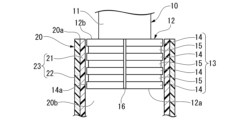
- FIG. 2 is a front view showing an example of a spout of the embodiment. 10 is a cross-sectional view showing an example of welding the spout of the embodiment to a packaging bag.
- FIG. FIG. 2 is a cross-sectional view showing an example of a laminated film used for a packaging bag.
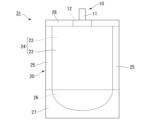
- FIG. 2 is a front view showing a first example of a packaging container.
- FIG. 11 is a front view showing a second example of a packaging container.
- FIG. 1 illustrates a spout 10 according to an embodiment.
- FIG. 2 illustrates the location where the spout 10 is welded to the packaging bag 20.
- the spout 10 in the illustrated example is welded to the packaging bag 20 and used in a packaging container having the spout 10 and the packaging bag 20.
- the spout 10 in the illustrated example has an attachment portion 12 with an outer periphery 13 that is welded to the packaging bag 20, and a spout portion 11 that protrudes from the attachment portion 12 to the outside of the packaging bag 20.
- the attachment portion 12 is disposed along the edge portion 20a of the packaging bag 20.
- the spout 11 is cylindrical and has a flow path inside that allows the contents of the packaging bag 20 to be poured out.
- the flow path inside the spout 10 is formed to penetrate from the base end 12a of the attachment part 12 to the tip end 11a of the spout 11.
- the flow path of the spout 10 opens toward the internal space 20b of the packaging bag 20 on the base end 12a side.
- the shape of the pouring portion 11 is not particularly limited, but may be, for example, cylindrical, elliptical, or rectangular.
- a lid member such as a cap may be attached to the pouring portion 11.
- a flange portion 17, a male thread portion 18, or the like may be formed on the outer circumferential surface of the pouring portion 11.
- a female thread portion is provided on the lid member.
- the method of attaching the lid member to the pouring portion 11 is not limited to screw connection, and may be fitting, engagement, or the like.
- the direction in which the spout 11 protrudes is the direction in which the spout 11 protrudes from the mounting part 12, from the base end 12a towards the tip end 11a of the mounting part 12.
- the flow path is formed straight from the base end 12a to the tip end 11a, and the direction in which the spout 11 protrudes is the up-down direction in Figures 1 and 2.
- the spout 11 stands vertically from the center of the top surface of the base end 12.
- the boundary 12b between the pouring portion 11 and the mounting portion 12 is stepped.
- the cross-sectional shape of the mounting portion 12 on a plane perpendicular to the protruding direction of the pouring portion 11 is larger than the cross-sectional shape of the pouring portion 11.
- the mounting portion 12 may have the same cross-sectional shape as the pouring portion 11.
- the pouring portion 11 and the mounting portion 12 may be cylindrical with approximately the same diameter.
- the cross-sectional shape of the mounting portion 12 is not particularly limited, but examples of the cross-sectional shape in a plane perpendicular to the protruding direction of the pouring portion 11 include a circular shape, an elliptical shape, and a boat shape.
- a boat shape means that when the mounting portion 12 is viewed in a plan view, both ends of the mounting portion 12 in the longitudinal direction protrude in a roughly triangular shape toward each tip 16, and both side surfaces of the mounting portion 12 are curved in a roughly arc shape.
- the mounting portion 12 is thickest in the minor axis direction at the center in the major axis direction. In the illustrated example, the major axis direction is the left-right direction in FIG. 1, and the minor axis direction is the left-right direction in FIG. 2.
- the cross-sectional shape of the flow path inside the spout 10 is not particularly limited, but examples of the cross-sectional shape on a plane perpendicular to the protruding direction of the pouring portion 11 include a circle, an ellipse, a polygon, and the like.
- the inner surface of the flow path may be concentric with the outer surface of the pouring portion 11.
- the inside of the flow path may be a single space, or may be partitioned into multiple spaces (flow paths) via a partition wall extending in the longitudinal direction of the pouring portion 11.
- the shape of the flow path along the protruding direction of the pouring portion 11 is not particularly limited, but may be linear, curved, curved, bent, etc. Although not specifically shown, in the attachment portion 12, the same flow path may branch into two or more paths at the tip side of the pouring portion 11. Alternatively, the tip of the flow path of the spout 10 may open toward the side of the pouring portion 11 without opening at the tip portion 11a of the pouring portion 11.
- the pouring portion 11 does not have to protrude straight and perpendicularly from the mounting portion 12.
- the pouring portion 11 may protrude at an angle from the upper surface of the mounting portion 12, or the pouring portion 11 may be curved in its longitudinal direction. Regardless of whether the central axis of the pouring portion 11 is straight or not, it is preferable that the periphery of the boundary portion 12b is disposed flush with the edge portion 20a of the packaging bag 20.
- the spout 10 of this embodiment has multiple ribs 14 on the outer periphery 13 of the attachment portion 12. Gaps 15 are arranged between these ribs 14. As shown in FIG. 2, in a direction perpendicular to the protruding direction of the spouting portion 11, the surface 14a of the rib 14 facing the packaging bag 20 protrudes beyond the gaps 15. Furthermore, the multiple ribs 14 are arranged in parallel in the protruding direction of the spouting portion 11 in a number of four or more. Any number greater than four may be used, but four to six is preferable, and four to five is more preferable.
- each rib 14 extends parallel to the boundary 12b between the spout 11 and the attachment portion 12.
- each rib 14 extends parallel to the edge 20a of the packaging bag 20.
- Each rib 14 preferably extends over the entire length of the side of the spout 11 between the left and right ends 16.
- the ribs 14 are preferably parallel to each other, but do not have to be strictly parallel as long as there is a gap between them.
- the width of each rib 14 may be constant in the longitudinal direction of the rib 14, but may also be a shape in which the width is not constant but changes periodically, for example, in the longitudinal direction of the rib 14.
- the method of welding the spout 10 is not particularly limited, but a heating member may be placed on the outside of the packaging bag 20 and heat the packaging bag 20 so that part of the resin melts between the packaging bag 20 and the spout 10.
- Specific examples of welding methods include heat sealing, ultrasonic sealing, high frequency sealing, impulse sealing, etc.
- the packaging material 23 forming the packaging bag 20 is welded to the surface 14a of each rib 14, multiple seals are formed along the edge 20a of the packaging bag 20. This allows the contents (not shown) contained in the internal space 20b of the packaging bag 20 to be liquid-tightly sealed without leaking from the welded portion between the spout 10 and the packaging bag 20.
- packaging bags 20 made of mono-materials with relatively low melting points, such as polyethylene resins.
- packaging bags 20 are made from thin packaging materials 23, such as resin films, while spouts are made from thick molded products. In other words, it is thought that the outer surface of the spout is difficult to melt, and excessive heat is applied to the packaging bag 20 before welding is complete, making it easy for the packaging material 23 to melt first.
- the outer periphery 13 of the mounting portion 12 does not have an uneven structure caused by the ribs 14 and gaps 15 and has a smooth surface, the heat and pressure during welding tend to be applied uniformly to the entire outer periphery 13. This makes it difficult for the outer periphery 13 to melt, making welding defects more likely to occur.
- the same can be said to apply when there is only one rib 14 formed on the outer periphery 13. If there is only one rib 14 and the rib is wide, there is also the problem that sink marks are likely to occur during molding.
- the heat and pressure applied during welding are distributed to the surfaces 14a of the three ribs 14.
- the surfaces 14a of the ribs 14 may not be aligned on the same plane.
- the heating temperature is high, it is easy to deform a part of the rib 14 by melting, but there is a risk of excessive melting of the packaging bag 20.
- the heating temperature is low, there is a risk of uneven heating and pressure being applied to the three ribs 14. In particular, welding becomes unstable at the two ribs 14 on the base end 12a side and the boundary 12b side, and there is a risk of poor welding if liquid tightness is not ensured with only the one rib 14 in the middle.
- the number of ribs 14 formed on the outer periphery 13 is four or more, in addition to the two ribs 14 on the base end 12a side and the boundary 12b side, two or more ribs 14 are arranged side by side between them. Therefore, even if there are circumstances that prevent even welding, such as uneven heights of the surfaces 14a of the ribs 14, it is possible to weld at least two or more ribs 14. Liquid-tightness can be ensured with two or more ribs 14.
- each rib 14 in the protruding direction of the spout portion 11 is preferably 1 mm or more. If the width of the rib 14 is too narrow, the sealing portion becomes too thin, making it difficult to achieve good sealing properties. There is no particular upper limit to the width of the rib 14, but the width of the rib 14 may be 3 mm or less, or 2 mm or less.
- the surface 14a of each rib 14 is preferably flat in the width direction of the rib 14, but both ends of the width direction of the rib 14 may be slightly chamfered, or the rib 14 may be slightly curved in a convex or concave manner in the width direction.
- the width of the gap 15 is not limited, but is preferably 1 mm or more and 7 mm or less, and may be 2 mm or more and 6 mm or less.
- the area ratio of the gap 15 to the entire side surface of the mounting portion 12 is not limited, but may be 20% or more and 85% or less, or 40% or more and 70% or less. In these ranges, the temperature of the rib 14 rises quickly during sealing, making welding easy, and the strength after welding is also good. After welding, the tip of the rib 14 may melt and fuse with the packaging bag 20. After forming the seal portion, a small gap may be formed between the gap 15 and the inner surface of the packaging bag 20, or the recess due to the gap 15 may be filled with a sealing material.
- the surface 14a of the rib 14 facing the packaging bag 20 is preferably given a matte finish.
- Matte finish is a process that creates minute irregularities on the surface 14a.
- the surface 14a may be randomly roughened by sanding or blasting, or the irregularities may be transferred by embossing or the like that has an irregular surface complementary to the desired matte finish.
- the mold surface that forms the rib 14 may be given a matte finish.
- Such matte finish enhances the anchor effect on the sealing material after welding, improving the strength of the weld.
- the spout 10 is preferably formed from a polyolefin resin such as a polyethylene resin or a polypropylene resin.
- the method for forming the spout 10 is not particularly limited, but examples include injection molding and extrusion molding.
- the resin used to mold the spout 10 is not particularly limited, but examples of polyethylene resins include high density polyethylene (HDPE), medium density polyethylene (MDPE), low density polyethylene (LDPE), linear low density polyethylene (LLDPE), etc., and examples of polypropylene resins include propylene homopolymer, block copolymer, random copolymer, etc.
- polyethylene resins include high density polyethylene (HDPE), medium density polyethylene (MDPE), low density polyethylene (LDPE), linear low density polyethylene (LLDPE), etc.
- examples of polypropylene resins include propylene homopolymer, block copolymer, random copolymer, etc.
- the spout 10 may be formed from one type of resin, or may be formed from a blend or laminate of two or more types of resin. At least a portion of the resin used in the spout 10 may be a resin recycled from used resin. It is preferable that at least the outer periphery 13 of the mounting portion 12 is formed from a polyethylene-based resin or a polypropylene-based resin.
- the inner surface of the flow path arranged in the pouring portion 11 and the mounting portion 12 may be formed from an appropriate material different from the outer periphery 13 of the mounting portion 12, such as a cyclic olefin resin.
- the packaging material 23 forming the packaging bag 20 may be formed from one type of resin, or may be formed by blending or laminating two or more types of resins. It is preferable that at least one of the resins used in the packaging material 23 is a polyolefin-based resin. At least a portion of the resin used in the packaging bag 20 may be a resin recycled from used resin.
- the packaging material 23 may contain multiple resin films, such as a sealant 21 and a base material 22.
- the resin film contained in the packaging material 23 is preferably only a polyolefin-based resin, and more preferably only a polypropylene-based resin or a polyethylene-based resin.
- the resin film contained in the packaging material 23 may be only a polyethylene-based resin.
- the material of the sealant 21 may be a polyolefin resin such as a polyethylene resin or a polypropylene resin.
- a polyethylene resin specific examples include LLDPE and LDPE.
- the material forming the sealant 21 may be one type of resin or a blend of two or more types of resin.
- the thickness of the sealant 21 is not particularly limited, but may be, for example, about 60 to 180 ⁇ m.
- the material of the substrate 22 is not particularly limited, and examples thereof include resin, paper, cellophane, metal foil, etc.
- the resin of the substrate 22 is not particularly limited, and examples thereof include polyolefin resins such as polyethylene resins and polypropylene resins, polyester resins such as PET, polyamide resins such as Ny, etc.
- polyolefin resins such as polyethylene resins and polypropylene resins
- resin films such as LLDPE, LDPE, MDPE, HDPE, and PP.
- the thickness of the base material 22 is not particularly limited, but examples include approximately 10 to 50 ⁇ m for each layer thickness or total thickness.
- the substrate 22 may include a stretched resin film.
- a stretched resin film for example, as shown in FIG. 3, when the laminated film 40 that becomes the packaging material 23 includes a sealant resin film 41, an intermediate resin film 42, and an outer resin film 43, it is preferable to use a stretched resin film for the intermediate resin film 42 adjacent to the sealant resin film 41.
- the intermediate resin film 42 is preferably a uniaxially or biaxially stretched polyethylene-based resin film.
- the stretching direction and stretching ratio of the stretched resin film are not particularly limited, but it may be stretched in the machine direction (MD) and the cross direction (TD).
- the stretching ratio is preferably within the range of 2 to 10 times in both the MD and TD directions.
- the stretching ratio in the MD direction and the stretching ratio in the TD direction may be the same or different.
- an intermediate resin film 42 and an outer resin film 43 are used as the substrate 22
- a biaxially oriented polyethylene resin film may be used for the intermediate resin film 42
- a uniaxially oriented polyethylene resin film may be used for the outer resin film 43.
- the sealant resin film 41 may be a non-oriented polyethylene resin film.
- the layers in the packaging material 23, such as the laminated film 40 may be laminated via adhesive layers 44, 45 by dry lamination, sandwich lamination, etc. Multiple resin films may be laminated by co-extrusion, heat lamination, extrusion lamination, etc., while omitting the adhesive layers 44, 45. It is also possible for the same laminated film 40 to be used in both lamination with adhesive layers 44, 45 between layers and lamination without adhesive layers 44, 45 between layers.
- the adhesive layers 44, 45 are formed by the dry lamination method, although there are no particular limitations, urethane-based compounds, epoxy-based compounds, isocyanate-based compounds, polyethyleneimine, organic titanium compounds such as titanium alkoxides, and the like may be used.
- adhesive resins such as polyolefin resins, such as polyethylene resins and polypropylene resins, and modified resins may be used.
- a printed layer, vapor deposition layer, etc. may be formed on at least one side of each resin film.
- the printed layer may be formed using a solvent-based ink, or may be formed without a solvent using a curable ink such as an electron beam curable or ultraviolet ray curable ink.
- the vapor deposition layer may be formed from a metal such as aluminum, or an inorganic compound such as silica or alumina. Metal foil may be laminated onto the resin film. In mono-material packaging, no metal foil is used, and only a thin vapor deposition layer may be used, or no vapor deposition layer may be used at all.
- the sealant 21 and the substrate 22, particularly the sealant resin film 41 and the intermediate resin film 42, may be laminated only via the adhesive layers 44 and 45 without forming a printed layer or barrier layer.
- a printed layer or barrier layer may be laminated inside the substrate 22, for example, between the intermediate resin film 42 and the outer resin film 43.
- the polyolefin resin used in the spout 10, packaging material 23, laminated film 40, etc. may be a homopolymer of a specific olefin, or a copolymer mainly made of a specific olefin.
- polyethylene resins ethylene is the specific olefin
- propylene is the specific olefin.
- the ratio of the specific olefin to the constituent monomers is preferably 50% by weight or more, and may be, for example, 80 to 100% by weight. In homopolymers, the ratio of the specific olefin to the constituent monomers is substantially about 100% by weight. In copolymers, monomers other than the specific olefin are copolymerized in appropriate proportions.
- Monomers used in polyolefin polymers include one or more of ⁇ -olefins such as ethylene, propylene, 1-butene, 1-hexene, and 1-octene, cyclic olefins such as norbornene, and vinyl monomers such as vinyl acetate, vinyl chloride, and acrylic acid.
- ⁇ -olefins such as ethylene, propylene, 1-butene, 1-hexene, and 1-octene
- cyclic olefins such as norbornene
- vinyl monomers such as vinyl acetate, vinyl chloride, and acrylic acid.
- These monomers may be derived from fossil resources such as petroleum, or from biomass such as plants. At least some of the monomers may be obtained by recycling used resins.
- the resin used in the spout 10 and/or the packaging bag 20 may contain other resins and/or additives to an appropriate extent.
- resin additives include antioxidants, lubricants, antiblocking agents, flame retardants, UV absorbers, light stabilizers, antistatic agents, colorants, crosslinking agents, etc.
- a molded product (spout 10 or resin film) mainly made of polyolefin-based resin may contain an appropriate proportion of resin other than polyolefin-based resin.
- a molded product (spout 10 or resin film) mainly made of polyethylene-based resin may contain an appropriate proportion of resin other than polyethylene-based resin.
- the packaging material 23 such as the laminated film 40 is also mainly made of a polyethylene-based resin.
- the proportion of polyethylene-based resin contained in the spout 10 and/or the packaging bag 20 is preferably 50% by weight or more, and may be, for example, 80 to 100% by weight.
- the packaging bag 20 is formed from a packaging material 23 such as a laminated film 40 having two or more layers of resin film
- the two or more layers of resin film may be formed only from a polyethylene-based resin.
- the total of the specific resins is 80% by weight or more and the total of materials other than the specific resins is 20% by weight or less of the total weight of these, and it is more preferable that the total of the specific resins is 90% by weight or more and the total of materials other than the specific resins is 10% by weight or less.
- the specific resin for example, any one of polyethylene-based resins, polypropylene-based resins, and polyolefin-based resins may be selected.
- packaging bag 20 examples include, but are not limited to, three-sided sealed bags, four-sided sealed bags, pillow bags, flat bags, gusset bags, standing pouches, etc.
- Figures 4 and 5 show specific examples of packaging containers 31, 32 using a standing pouch packaging bag 20. In these figures, the ribs 14 of the attachment portion 12 are omitted.
- the packaging bag 20 used for the packaging containers 31, 32 is formed by sandwiching a bottom member 26 between a pair of packaging materials 23 that form a body member 24.
- the bottom member 26 is folded in half and placed under the body member 24.
- body seals 25 are formed on the left and right sides to join the front and rear body members 24.
- the bottom member 26 is joined to the body member 24 by a bottom seal 27.
- the packaging bag 20 can be made to stand on its own by unfolding the bottom member 26.
- the spout 10 is attached facing upward to the center of the upper seal portion 28, sealing the inside of the packaging bag 20.
- an opening 29 is formed at the top of the body member 24, contacting one side of the body seal portion 25.
- a part of the upper seal portion 28 is formed at an angle, and the spout 10 is attached at an angle. After the contents are filled into the packaging bag 20 through the opening 29, the unsealed part of the opening 29 can be joined to seal the packaging bag 20.
- the orientation of the spout 10 relative to the top-bottom direction of the packaging bag 20 is not particularly limited, and can be selected from any appropriate orientation, such as upward, diagonally upward, sideways, or downward. Two or more spouts 10 may be attached to the same packaging bag 20.
- the dimensions of the packaging bag 20 are not particularly limited, but for example, when used as a refill container, the vertical height is about 100 to 500 mm, the horizontal width is about 70 to 300 mm, and the filling amount is about 100 cm 3 to 5000 cm 3 .
- the state of the contents contained in the packaging bag 20 is not particularly limited, but examples include fluids such as liquids, powders, and granules, or solids such as objects.
- the types of contents are not particularly limited, but examples include detergents, medicines, cosmetics, pharmaceuticals, beverages, seasonings, inks, paints, fuels, etc.
- the method for recycling the spout 10 or packaging bag 20 of the embodiment after use is not particularly limited, but can be selected appropriately depending on the condition at the time of collection. According to the embodiment, the proportion of polyolefin resin can be increased, so both chemical recycling and mechanical recycling are possible. By recycling, it is also possible to regenerate the spout 10 or packaging bag 20 into the same type of product.
- the recycled material may be used for products such as paints, molded products, and hydrocarbon oils.
- spouts of Comparative Examples 1 to 4 and Examples 1 to 2 were produced by changing the number of ribs, the width of the ribs, and the presence or absence of matte finish, as shown in Table 1.
- Table 1 the total width of one rib and the width of one gap was 2.8 mm when the rib width was 0.7 mm, 3.0 mm when the rib width was 1.0 mm, and 3.3 mm when the rib width was 1.4 mm.
- the total width of one rib and the width of one gap was 4.3 mm (rib width 1.4 mm).
- the shape of the attachment part was boat-shaped in plan view, the longitudinal dimension of the attachment part was 35 mm, the maximum thickness of the attachment part in the width direction in plan view was 18 mm, and the height of the side of the attachment part was 10 mm.
- the outer peripheral surface of the attachment part where the spout is sealed to the packaging bag was inspected for the presence of sink marks. The formability of the spout was evaluated as good ( ⁇ ) when there were no sink marks, and as poor ( ⁇ ) when there were sink marks.
- the packaging material used to make the packaging bags was a laminated film made by dry laminating a three-layer structure of uniaxially oriented polyethylene 25 ⁇ m/biaxially oriented polyethylene 25 ⁇ m/sealant polyethylene 150 ⁇ m.
- the laminated film was placed on the outer periphery of the spout and sealed for 0.5 seconds using a mold at a specified temperature (135°C or 140°C), after which the appearance of the sealed area was inspected and the seal strength was measured.
- the appearance of the sealed portion was evaluated as good ( ⁇ ) when there were no holes in the laminated film at the sealed portion, and as poor ( ⁇ ) when holes were found.
- the seal strength was rated as good ( ⁇ ) if the laminated film did not peel off at the interface with the spout and did not break between the sealed and unsealed parts even when a tensile force within a practical range was applied, and as poor ( ⁇ ) if the peel or break strength was insufficient.
- the stability was evaluated as good ( ⁇ ) when there was no difference in the evaluation results regardless of whether the sealing temperature was 135° C. or 140° C., and as poor ( ⁇ ) when the evaluation results of the appearance or strength differed depending on the sealing temperature. The results are summarized in Table 1.
- the spouts of Examples 1 and 2 had excellent moldability and sealing properties.
- the spout of Comparative Example 1 which had no ribs, had poor moldability and strength.
Landscapes
- Engineering & Computer Science (AREA)
- Mechanical Engineering (AREA)
- Bag Frames (AREA)
Priority Applications (3)
| Application Number | Priority Date | Filing Date | Title |
|---|---|---|---|
| EP24760362.4A EP4671151A1 (en) | 2023-02-22 | 2024-02-20 | POURING SPOUT AND PACKAGING CONTAINER |
| CN202480005199.9A CN120225437A (zh) | 2023-02-22 | 2024-02-20 | 容器嘴以及包装容器 |
| JP2025502739A JPWO2024177064A1 (https=) | 2023-02-22 | 2024-02-20 |
Applications Claiming Priority (2)
| Application Number | Priority Date | Filing Date | Title |
|---|---|---|---|
| JP2023-025826 | 2023-02-22 | ||
| JP2023025826 | 2023-02-22 |
Publications (1)
| Publication Number | Publication Date |
|---|---|
| WO2024177064A1 true WO2024177064A1 (ja) | 2024-08-29 |
Family
ID=92501391
Family Applications (1)
| Application Number | Title | Priority Date | Filing Date |
|---|---|---|---|
| PCT/JP2024/006027 Ceased WO2024177064A1 (ja) | 2023-02-22 | 2024-02-20 | スパウトおよび包装容器 |
Country Status (4)
| Country | Link |
|---|---|
| EP (1) | EP4671151A1 (https=) |
| JP (1) | JPWO2024177064A1 (https=) |
| CN (1) | CN120225437A (https=) |
| WO (1) | WO2024177064A1 (https=) |
Citations (10)
| Publication number | Priority date | Publication date | Assignee | Title |
|---|---|---|---|---|
| JP2004155493A (ja) * | 2002-11-08 | 2004-06-03 | Showa Marutsutsu Co Ltd | 容器用注出口部のシール構造 |
| JP2006007630A (ja) | 2004-06-28 | 2006-01-12 | Fujimori Kogyo Co Ltd | 製袋方法及び製袋機 |
| JP2014073858A (ja) * | 2012-10-05 | 2014-04-24 | Morinaga & Co Ltd | 袋状容器用スパウト及びスパウト付き袋状容器 |
| JP2014237466A (ja) * | 2013-06-07 | 2014-12-18 | 日本クロージャー株式会社 | スパウト |
| JP2017095178A (ja) * | 2015-11-18 | 2017-06-01 | フジモリプラケミカル株式会社 | スパウト付きガゼット袋 |
| JP2019072875A (ja) * | 2017-10-13 | 2019-05-16 | セイコーエプソン株式会社 | インク収容パック |
| JP2020147308A (ja) * | 2019-03-12 | 2020-09-17 | 凸版印刷株式会社 | 包装袋 |
| JP2021130482A (ja) * | 2020-02-19 | 2021-09-09 | 押尾産業株式会社 | 注出口具 |
| JP2021523858A (ja) * | 2018-05-18 | 2021-09-09 | ダウ グローバル テクノロジーズ エルエルシー | スパウトパウチおよびそれを作製する方法 |
| JP2023025826A (ja) | 2021-08-11 | 2023-02-24 | キヤノン株式会社 | 画像形成装置 |
-
2024
- 2024-02-20 JP JP2025502739A patent/JPWO2024177064A1/ja active Pending
- 2024-02-20 WO PCT/JP2024/006027 patent/WO2024177064A1/ja not_active Ceased
- 2024-02-20 EP EP24760362.4A patent/EP4671151A1/en active Pending
- 2024-02-20 CN CN202480005199.9A patent/CN120225437A/zh active Pending
Patent Citations (10)
| Publication number | Priority date | Publication date | Assignee | Title |
|---|---|---|---|---|
| JP2004155493A (ja) * | 2002-11-08 | 2004-06-03 | Showa Marutsutsu Co Ltd | 容器用注出口部のシール構造 |
| JP2006007630A (ja) | 2004-06-28 | 2006-01-12 | Fujimori Kogyo Co Ltd | 製袋方法及び製袋機 |
| JP2014073858A (ja) * | 2012-10-05 | 2014-04-24 | Morinaga & Co Ltd | 袋状容器用スパウト及びスパウト付き袋状容器 |
| JP2014237466A (ja) * | 2013-06-07 | 2014-12-18 | 日本クロージャー株式会社 | スパウト |
| JP2017095178A (ja) * | 2015-11-18 | 2017-06-01 | フジモリプラケミカル株式会社 | スパウト付きガゼット袋 |
| JP2019072875A (ja) * | 2017-10-13 | 2019-05-16 | セイコーエプソン株式会社 | インク収容パック |
| JP2021523858A (ja) * | 2018-05-18 | 2021-09-09 | ダウ グローバル テクノロジーズ エルエルシー | スパウトパウチおよびそれを作製する方法 |
| JP2020147308A (ja) * | 2019-03-12 | 2020-09-17 | 凸版印刷株式会社 | 包装袋 |
| JP2021130482A (ja) * | 2020-02-19 | 2021-09-09 | 押尾産業株式会社 | 注出口具 |
| JP2023025826A (ja) | 2021-08-11 | 2023-02-24 | キヤノン株式会社 | 画像形成装置 |
Also Published As
| Publication number | Publication date |
|---|---|
| JPWO2024177064A1 (https=) | 2024-08-29 |
| EP4671151A1 (en) | 2025-12-31 |
| CN120225437A (zh) | 2025-06-27 |
Similar Documents
| Publication | Publication Date | Title |
|---|---|---|
| US11713172B2 (en) | Sheet material container | |
| EP3140218B1 (en) | Flexible container | |
| CN115023345A (zh) | 层叠体、包装袋及其制造方法 | |
| US20190152669A1 (en) | Flexible Container | |
| JP2023105476A (ja) | フィルム、積層フィルムおよび包装袋 | |
| US20200148454A1 (en) | Flexible Container | |
| US20190270564A1 (en) | Self-standing bag and method for manufacturing the same | |
| US5654051A (en) | Packaging material and packaging containers produced therefrom | |
| WO2024177064A1 (ja) | スパウトおよび包装容器 | |
| JP3984327B2 (ja) | スタンディングパウチ | |
| JP6718667B2 (ja) | 包装袋用積層体の製造方法、包装袋の製造方法 | |
| CN116368073B (zh) | 包装袋 | |
| JP2023080884A (ja) | 積層体および包装袋 | |
| JP2026010927A (ja) | 包装容器 | |
| US20260103318A1 (en) | Packaging Container | |
| WO2026013550A1 (ja) | 包装容器 | |
| JP2024047809A (ja) | 包装容器、スパウト、積層体 | |
| JP5915211B2 (ja) | 蓋材 | |
| JP2024047811A (ja) | 包装容器の製造方法および製造装置 | |
| JP2025018128A (ja) | 共押出フィルム、積層フィルムおよび包装袋 | |
| JP2002002737A (ja) | 注出口組合体 | |
| JP4743407B2 (ja) | 紙容器 | |
| JP2023105762A (ja) | 注出口付きパウチ | |
| US20250153470A1 (en) | Laminated film and package | |
| JP2020040702A (ja) | 自立型包装袋、スパウト付自立型包装袋、内容物入り自立型包装袋及び内容物入りスパウト付自立型包装袋 |
Legal Events
| Date | Code | Title | Description |
|---|---|---|---|
| 121 | Ep: the epo has been informed by wipo that ep was designated in this application |
Ref document number: 24760362 Country of ref document: EP Kind code of ref document: A1 |
|
| WWE | Wipo information: entry into national phase |
Ref document number: 2025502739 Country of ref document: JP |
|
| WWE | Wipo information: entry into national phase |
Ref document number: CN2024800051999 Country of ref document: CN Ref document number: 202480005199.9 Country of ref document: CN |
|
| WWP | Wipo information: published in national office |
Ref document number: 202480005199.9 Country of ref document: CN |
|
| WWE | Wipo information: entry into national phase |
Ref document number: 2501004719 Country of ref document: TH |
|
| WWE | Wipo information: entry into national phase |
Ref document number: 2024760362 Country of ref document: EP |
|
| NENP | Non-entry into the national phase |
Ref country code: DE |
|
| ENP | Entry into the national phase |
Ref document number: 2024760362 Country of ref document: EP Effective date: 20250922 |
|
| ENP | Entry into the national phase |
Ref document number: 2024760362 Country of ref document: EP Effective date: 20250922 |
|
| WWP | Wipo information: published in national office |
Ref document number: 2024760362 Country of ref document: EP |