WO2024176309A1 - 数値制御装置 - Google Patents
数値制御装置 Download PDFInfo
- Publication number
- WO2024176309A1 WO2024176309A1 PCT/JP2023/006024 JP2023006024W WO2024176309A1 WO 2024176309 A1 WO2024176309 A1 WO 2024176309A1 JP 2023006024 W JP2023006024 W JP 2023006024W WO 2024176309 A1 WO2024176309 A1 WO 2024176309A1
- Authority
- WO
- WIPO (PCT)
- Prior art keywords
- section
- vibration
- speed
- control device
- numerical control
- Prior art date
- Legal status (The legal status is an assumption and is not a legal conclusion. Google has not performed a legal analysis and makes no representation as to the accuracy of the status listed.)
- Ceased
Links
Images






Classifications
-
- G—PHYSICS
- G05—CONTROLLING; REGULATING
- G05B—CONTROL OR REGULATING SYSTEMS IN GENERAL; FUNCTIONAL ELEMENTS OF SUCH SYSTEMS; MONITORING OR TESTING ARRANGEMENTS FOR SUCH SYSTEMS OR ELEMENTS
- G05B19/00—Program-control systems
- G05B19/02—Program-control systems electric
- G05B19/18—Numerical control [NC], i.e. automatically operating machines, in particular machine tools, e.g. in a manufacturing environment, so as to execute positioning, movement or co-ordinated operations by means of program data in numerical form
- G05B19/416—Numerical control [NC], i.e. automatically operating machines, in particular machine tools, e.g. in a manufacturing environment, so as to execute positioning, movement or co-ordinated operations by means of program data in numerical form characterised by control of velocity, acceleration or deceleration
- G05B19/4163—Adaptive control of feed or cutting velocity
-
- B—PERFORMING OPERATIONS; TRANSPORTING
- B23—MACHINE TOOLS; METAL-WORKING NOT OTHERWISE PROVIDED FOR
- B23B—TURNING; BORING
- B23B25/00—Accessories or auxiliary equipment for turning-machines
- B23B25/02—Arrangements for chip-breaking in turning-machines
-
- B—PERFORMING OPERATIONS; TRANSPORTING
- B23—MACHINE TOOLS; METAL-WORKING NOT OTHERWISE PROVIDED FOR
- B23Q—DETAILS, COMPONENTS, OR ACCESSORIES FOR MACHINE TOOLS, e.g. ARRANGEMENTS FOR COPYING OR CONTROLLING; MACHINE TOOLS IN GENERAL CHARACTERISED BY THE CONSTRUCTION OF PARTICULAR DETAILS OR COMPONENTS; COMBINATIONS OR ASSOCIATIONS OF METAL-WORKING MACHINES, NOT DIRECTED TO A PARTICULAR RESULT
- B23Q15/00—Automatic control or regulation of feed movement, cutting velocity or position of tool or work
- B23Q15/007—Automatic control or regulation of feed movement, cutting velocity or position of tool or work while the tool acts upon the workpiece
- B23Q15/013—Control or regulation of feed movement
Definitions
- This disclosure relates to a numerical control device that is a control device for a machine tool.
- the relative movement speed which is the relative movement speed between the cutting tool and the workpiece during forward motion
- the relative movement speed during non-vibration machining which is normal machining that does not involve vibration cutting, so even when a backward motion is performed, it is possible to make the average relative movement speed, which is the sum of forward and backward motions, equivalent to the relative movement speed during non-vibration machining, which makes it possible to apply vibration cutting without changing the machining time, i.e., productivity.
- Patent Document 1 when the vibration cutting function is used, the relative movement speed during forward movement is faster than in non-vibration machining, and the load between the tool and workpiece temporarily increases. At this time, problems such as accelerated tool wear or tool damage may occur due to excessive cutting force or cutting heat, or machining conditions such as feed rate, which indicates the relative movement speed between the tool and workpiece, spindle rotation speed, which indicates the relative rotation speed between the tool and workpiece, and cutting thickness may not be satisfied, resulting in a deterioration in machined surface quality, which indicates the smoothness of the machined surface.
- the present disclosure has been made in consideration of the above, and aims to provide a numerical control device that can reduce machining problems caused by the increase in the relative movement speed between the tool and the workpiece during vibration cutting.
- the numerical control device disclosed herein includes a rotation command output unit that outputs a rotation command to rotate the workpiece and the tool relatively, and a feed command output unit that outputs a feed command to move the workpiece and the tool relatively, and the feed command can include a vibration operation command that alternately repeats forward and backward movements.
- One vibration in the vibration operation command includes a first section in which the tool moves at a first speed, which is the moving speed during forward movement, a second section in which the tool moves at a second speed, which is the moving speed during backward movement, and a third section in which the tool moves at a third speed, which is the moving speed during forward movement and is slower than the first speed.
- the numerical control device disclosed herein has the effect of reducing machining problems caused by the increase in the relative movement speed between the tool and the workpiece during vibration cutting.
- FIG. 1 is a block diagram showing a configuration example of a numerical control device according to a first embodiment
- FIG. 1 is an explanatory diagram of a method for determining an end point of a retreating motion of the numerical control device according to the first embodiment
- FIG. 1 is an explanatory diagram of a method for determining a waveform of a forward motion of the numerical control device according to the first embodiment
- Diagram explaining how to determine the basic vibration waveform FIG. 1 is an explanatory diagram of a method for determining a vibration waveform having a third section in a numerical control device according to a first embodiment
- FIG. 13 is an explanatory diagram of a method for determining another basic vibration waveform that does not have a third section in the numerical control device of the first embodiment.
- FIG. 1 is a block diagram showing a configuration example of a numerical control device according to a first embodiment
- FIG. 1 is an explanatory diagram of a method for determining an end point of a retreating motion of the numerical control device according to the first embodiment
- FIG. 13 is an explanatory diagram of a method for determining another vibration waveform having a third section in the numerical control device according to the first embodiment;
- FIG. 13 is an explanatory diagram of a method for determining another vibration waveform having a third section in the numerical control device according to the first embodiment;
- FIG. 13 is an explanatory diagram of another method for determining a vibration waveform having a third section in the numerical control device of the first embodiment.
- FIG. 13 is an explanatory diagram of another method for determining a vibration waveform having a third section in the numerical control device of the first embodiment.
- FIG. 13 is an explanatory diagram of another method for determining a vibration waveform having a third section in the numerical control device of the first embodiment.
- FIG. 13 is an explanatory diagram of another method for determining a vibration waveform having a third section in the numerical control device of the first embodiment.
- FIG. 13 is an explanatory diagram of another method for determining a vibration waveform having a third section in the numerical control device of the first embodiment.
- FIG. 13 is an explanatory diagram of another method for determining a vibration waveform having a third section in the numerical control device of the first embodiment.
- FIG. 13 is a diagram showing an example of a data table used to create a vibration waveform having a third section in the numerical control device of the first embodiment.
- FIG. 13 is a diagram showing another example of a data table used to create a vibration waveform having a third section in the numerical control device of the first embodiment.
- FIG. 13 is a block diagram showing a configuration during learning of a numerical control device according to a third embodiment.
- Embodiment 1. 1 is a block diagram showing a configuration example of a numerical control device according to embodiment 1.
- the numerical control device 1 in this embodiment has a machining program analysis unit 10, an interval ratio determination unit 15, a vibration command generation unit 11, a feed command output unit 12, a rotation command output unit 13, and a load information acquisition unit 14.
- the machining program analysis unit 10 analyzes the machining program 16 and outputs information on the operation commands described in the machining program 16 to each section ratio determination unit 15 and the vibration command generation unit 11.
- the format of the machining program 16 does not matter; for example, it may be a character string in the EIA (Electronic Industries Alliance)/ISO (International Organization for Standardization) format, or it may be a program called an interactive program that includes information such as the shape of the workpiece, the machining shape, and dimensions.
- EIA Electronic Industries Alliance
- ISO International Organization for Standardization
- the information on the motion command includes the coordinate values of the start and end points that define the relative movement path between the tool and workpiece, the interpolation method for the movement path connecting the start and end points (linear interpolation, circular interpolation, etc.), the feed rate during movement, the number of rotations of the spindle, the direction of rotation, etc.
- the information on the motion command may include information specifying whether vibration cutting is effective or not, and the shape of the vibration waveform.
- Information specifying the shape of the vibration waveform may include the vibration frequency, vibration amplitude, the number of vibrations per unit time or the number of vibrations per unit time, and information regarding the ratio of each section, which will be described later. Note that it is not necessary to specify all of this information specifying the shape of the vibration waveform, and some of it may be omitted.
- the section ratio determination unit 15 determines the ratios of the first section, second section, and third section in one vibration (hereinafter, may be referred to as section ratios, section ratios, etc.).
- One vibration is a unit of vibration that is superimposed on the normal machining movement operation in vibration cutting. For example, when the number of vibrations N is 1.0, the rotation angle of the spindle per vibration is 360 degrees.
- the section ratio determination unit 15 outputs the determined ratios to the vibration command generation unit 11.
- the section ratios may be determined based on information from the machining program analysis unit 10, or may be determined based on the values of external information such as pre-defined parameters.
- the vibration command generation unit 11 calculates a vibration waveform based on information from the machining program analysis unit 10, and creates a feed command for the feed axis and a rotation command for the spindle. The method of calculating the vibration waveform will be described later.
- the ratio of each section in the vibration operation may use information input from the section ratio determination unit 15, or may refer to information such as pre-defined parameters and be determined based on the value.
- the feed command output unit 12 outputs the feed command generated by the vibration command generation unit 11 to the feed unit 2 of the machine tool to be controlled.
- the feed unit 2 is assumed to be a servo motor and a servo amplifier that controls the servo motor, but there are no particular limitations as long as it is a means that can realize relative movement between the workpiece and the tool and realize vibration operation.
- the rotation command output unit 13 outputs the rotation command generated by the vibration command generation unit 11 to the rotating unit 3 of the machine tool to be controlled.
- the rotating unit 3 is assumed to be a spindle motor and a spindle amplifier that controls the spindle motor, but there are no particular limitations as long as it is a means that can realize the relative rotation of the workpiece and the tool.
- Machining by vibration cutting is achieved by the feed unit 2 and rotation unit 3 moving and rotating the workpiece and tool relatively in accordance with the feed command and rotation command generated by the vibration command generation unit 11.
- the workpiece is cut by contacting the relatively rotating workpiece and tool, and the relative movement achieves machining into the desired shape.
- forward and backward movements cause misses, i.e., the cutting process is interrupted, and the effect of vibration cutting is exerted, breaking up the chips into small pieces.
- the unit of the feed speed may be the amount of movement per unit time, for example, mm/min, or the amount of movement per one rotation of the spindle, for example, mm/rev.
- the explanation will be given using the amount of movement per one rotation of the spindle.
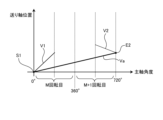
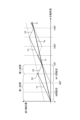
- FIG. 2 is an explanatory diagram of a method for determining the end point of the retreat operation of the numerical control device of the first embodiment.
- the vertical axis indicates the position of the feed axis
- the horizontal axis indicates the spindle angle.
- Va indicates the movement speed (movement waveform) of the feed axis during non-vibration machining, which is normal machining without vibration cutting.
- V1 indicates the movement speed (movement waveform) of the forward movement during vibration machining.
- V2 indicates the movement speed (movement waveform) of the retreat operation during vibration machining.
- the number of vibrations N per spindle rotation is 0.5, so the waveforms for two spindle rotations, that is, the waveforms for the Mth spindle rotation and the M+1th spindle rotation, are shown.
- the initial angle of the spindle at the Mth rotation is 0 degrees.
- the end point E2 of the movement waveform V2 of the backward movement is taken on the straight line that indicates the feed shaft speed Va during non-vibration machining. Also, since the number of vibrations N per rotation of the spindle is 0.5, the end point E2 of the movement waveform V2 of the backward movement is 720 degrees from the start point S1 of the movement waveform V1 of the forward movement, which is the position at the time when the spindle has rotated. In this way, the end point E2 of the movement waveform V2 of the backward movement is determined.
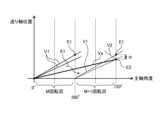
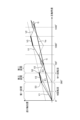
- FIG. 3 is an explanatory diagram of the method for determining the waveform of the forward movement of the numerical control device of the first embodiment.
- the vertical axis indicates the position of the feed axis
- the horizontal axis indicates the spindle angle.
- Va indicates the moving speed of the feed axis during non-vibration machining.
- V1 indicates the moving speed of the forward movement during vibration machining.
- V2 indicates the moving speed of the retreating movement during vibration machining.
- the amplitude at the tool cutting edge may be attenuated below the commanded amplitude, and the chips may not be broken up. This is thought to be due to the influence of the drive feed mechanism, such as the ball screw, and the mechanical structure, such as the tool post, that exist between the motor and the tool cutting edge. Therefore, in practice, it is desirable to make the end point E1 of the forward movement greater than the end point E2 of the backward movement, and to adjust the vibration waveform so that a certain amount of leeway ⁇ is allowed for the occurrence of an idle section.
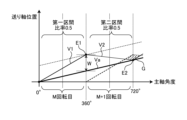
- FIG. 4 is an explanatory diagram of a method for determining a basic vibration waveform. As shown in FIG. 4, if the ratio between the first section, which is the section of the forward motion, and the second section, which is the section of the backward motion, is set to, for example, 0.5:0.5, the end point E1 of the forward motion is determined. With this end point E1 as the starting point, the slope of the moving waveform V2 of the backward motion is also determined, and the second speed, which is the moving speed V2 of the backward motion, is determined.
- a basic vibration waveform that includes the forward motion of the first section and the backward motion of the second section, but does not include the third section is calculated, and the vibration amplitude W is also determined.
- the vibration amplitude W is expressed, for example, as the distance between the end point E1 of the forward motion and the position during non-vibration machining that corresponds to this end point E1.
- the above is the basic method for calculating the vibration waveform.
- the method for calculating the vibration waveform is not limited to this, and for example, a method is also conceivable in which the vibration waveform is calculated from the vibration frequency, and the presence or absence and size of a miss-swing area are determined and the amplitude is adjusted.
- the hatched area is the miss-swing area G.
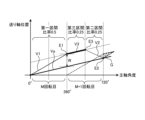
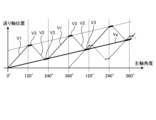
- a third section for forward movement at a third speed V3 slower than the first speed is provided between a first section for forward movement at a first speed V1 and a second section for backward movement at a second speed V2.
- a method for calculating a vibration waveform having a third section for movement at the third speed V3 is described below.
- a case is described in which the ratio of the first section is not changed, the second section is halved, half of the second section is the second section, and the remaining half of the second section is the third section.
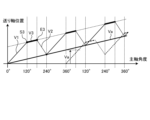
- Figure 5 is an explanatory diagram of a method for determining a vibration waveform having a third section in a numerical control device of embodiment 1.
- the third speed V3 is set to be the same as the moving speed Va of the feed axis during non-vibration machining.
- the end point E3 of the waveform at the third speed V3 is calculated according to the ratio of the third section, and the second speed V2 is determined by calculating the waveform of the backward movement with this end point E3 as the start point and the end point E2 of the backward movement as the end point.
- a vibration waveform having a section of the third speed V3 can be calculated without changing the vibration amplitude W.
- the third speed V3 is the same as the feed axis movement speed Va during non-vibration machining, but the third speed V3 may be any other speed as long as it is lower than the first speed V1.
- the waveform of the feed axis position during non-vibration machining is the feed axis position required to obtain the desired shape through machining.
- the desired shape will be cut into, and if the opposite is true, some part will be left uncut. If some part is left uncut, it is possible to achieve the desired shape through additional processing, but once the part has been cut into, it cannot be restored using normal cutting processing, so cutting into the workpiece must be avoided.
- vibration cutting is performed while avoiding chipping by matching the top dead center or bottom dead center of the vibration to the waveform of the feed axis position during non-vibration machining.
- FIG. 6 is an explanatory diagram of a method for determining another basic vibration waveform that does not have a third section in the numerical control device of embodiment 1.
- the ratio of the first section is three times the ratio of the second section.
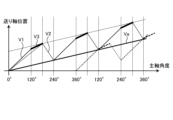
- FIG. 7 is an explanatory diagram of a method for determining another vibration waveform that has a third section in the numerical control device of embodiment 1.
- the start point S2 of the second section is set as the end point E3 of the third section, and the start point S3 of the third section is calculated in the opposite manner to the previous example.
- the first speed is determined by setting the start point S3 of this third section as the end point E1 of the first section.
- the third speed V3 is set to the same as the movement speed Va of the feed axis during non-vibration machining.
- FIG. 8 is an explanatory diagram of a method for determining another vibration waveform having a third section in the numerical control device of embodiment 1.
- the third speed V3 is slower than the first speed V1 and is different from the moving speed Va of the feed axis during non-vibration machining.
- the end position of the first section changes.
- FIG. 9 is an explanatory diagram of another method for determining a vibration waveform having a third section in the numerical control device of embodiment 1.
- the rotation angle of the spindle per vibration is 240 degrees.
- the length of each section is determined by dividing this rotation angle of the spindle per vibration by the ratio of each section.
- the start point S3 and end point E3 of the third section are determined as shown in Figure 10, and the first speed V1 is determined by dividing the distance to the start point S3 of the third section by the length of the first section (spindle angle).
- the second speed can be calculated in a similar manner. Note that the end point E2 of the second section is a position where the spindle angle has advanced 240 degrees at the normal feed speed without adding vibration.
- FIG. 11 is an explanatory diagram of another method for determining a vibration waveform having a third section in the numerical control device of embodiment 1.
- Figure 12 is an explanatory diagram of another method for determining a vibration waveform having a third section in the numerical control device of embodiment 1.
- a third section operating at a third speed V3 is provided at both the point of change from the first speed V1 to the second speed V2 and the point of change from the second speed V2 to the first speed V1.
- FIG. 13 is an explanatory diagram of another method for determining a vibration waveform having a third section in the numerical control device of embodiment 1.
- a third section operating at a third speed V3 is provided in the middle of the first section, in the middle of the second section, at the point of switch from the first speed V1 to the second speed V2, and at the point of switch from the second speed V2 to the first speed V1.
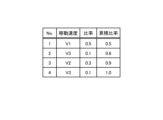
- Fig. 14 is a diagram showing an example of a data table used for creating a vibration waveform having a third section in the numerical control device of the first embodiment.
- Fig. 15 is a diagram showing another example of a data table used for creating a vibration waveform having a third section in the numerical control device of the first embodiment.
- a third section operating at a third speed V3 is provided at the switching point from the first section operating at the first speed V1 to the second section operating at the second speed V2, and at the switching point from the second section to the first section.
- a third section operating at a third speed V3 is provided in the middle of the first section, in the middle of the second section, at the switching point from the first speed V1 to the second speed V2, and at the switching point from the second speed V2 to the first speed V1.
- the numerical control device provides a third section in which machining is performed at a third speed V3, which is slower than the first speed V1, and therefore can reduce machining problems caused by high feed rates. For example, by reducing the cutting force and cutting heat generated during machining, it is expected that the tool life will be extended and the quality of the machined surface will be improved.
- the cutting force is reduced in the area machined at the third speed V3 compared to the area machined at the first speed V1, so that the amount of elastic deformation occurring in the workpiece can be reduced, and the effect of easily breaking up the chips is achieved.
- the amount of elastic deformation increases if the rigidity of the workpiece itself or the tool support structure including the machine, tool, tool rest, etc. is low.
- the effect of breaking up the chips in vibration cutting is achieved by the reciprocating movement passing again the part machined one spindle revolution ago, causing the workpiece and the tool to strike an idle, making the machining intermittent.
- the numerical control device of the first embodiment can solve this problem.
- the numerical control device of the first embodiment by providing a third section in which machining is performed at a third speed V3 in the switching section between the first speed V1 and the second speed V2, it is possible to suppress abrupt speed changes and reduce acceleration during reversal. This makes it possible to reduce various problems caused by vibrations due to acceleration.
- the third section is not provided, forward and backward movements are switched instantly, so that the feed axis performing the vibration cutting operation generates a large acceleration during reversal operation.
- the acceleration generated in the feed axis not only deteriorates the quality of the machined surface by exciting the relative vibration between the workpiece and the tool, but also becomes a vibration source that vibrates the entire machine, causing problems such as machine resonance and vibration of the machine structure.
- the numerical control device of the first embodiment for example, it is possible to prevent deterioration of the quality of the machined surface due to tool vibration, and prevent wear of fastening parts due to machine vibration.
- the speed may be changed smoothly at the switching points between each speed range.
- a smoothing filter such as a moving average filter in the vibration command generating unit 11 immediately before outputting a feed command that includes vibration, thereby smoothing the speed change. This is expected to further reduce the acceleration caused by the change between each speed, and to further suppress vibration.
- a waveform equivalent to the waveforms described above may be generated by superimposing multiple sine waves that differ from one another in one or more of the following: phase, frequency, and amplitude.
- Embodiment 2 In the second embodiment, a more detailed description will be given of a method for determining the ratio of each section performed by each section ratio determination unit 15.
- the configuration of the numerical control device 1 in the second embodiment is the same as that of the numerical control device 1 shown in Fig. 1, and therefore a duplicated description will be omitted.
- the method for determining the ratio of each section is as follows: (1) A method using input from the machining program 16; (2) A method using load information of the feeding unit 2 or the rotating unit 3; (3) A method using predetermined parameters will be described. Note that other methods may be used, or a combination of methods (1) to (3) may be used.
- the numerical control device 1 has a load information acquisition unit 14 as shown in FIG. 1.
- the load information acquisition unit 14 acquires load information representing the load from the feed unit 2 and the rotation unit 3 at any time.
- the servo motor when a servo motor and a servo amplifier are used as the feed unit 2, the servo motor generates torque to achieve the desired operation while resisting the load generated by the machining. If the load increases, the opposing torque also increases, so a large current flows in proportion to the torque. Therefore, an example of the load information acquired by the load information acquisition unit 14 is feedback information of this current.
- Other examples of the load information may be a torque feedback value, or an actual load value acquired by an acceleration sensor attached to the servo motor or a pressure gauge such as a load cell.
- the section ratio determination unit 15 which has acquired load information from the load information acquisition unit 14, determines whether chip breakage has occurred based on the load information, and if it determines that chip breakage will not occur, increases the ratio of the movement section at the third speed. This reduces the machining load and increases the possibility of chip breakage occurring.
- the extent to which the ratio of the third section is increased may be determined in advance by a parameter or the like, or may be determined to be proportional to the magnitude of the load information. If the load does not decrease even when the ratio of the third section is changed, the ratio of the third section may be further increased, and this may be repeated until a decrease in the load occurs.
- the ratio of each section itself may be left unchanged, but the first section may be divided and a third section added between the divided first sections.
- the first section may be divided and a third section added between the divided first sections.
- the section ratios may be adjusted to lower the first speed. For example, one possible method is to increase the ratio of the first section.
- Each section ratio determination unit 15 determines the ratio of each section according to predetermined parameters.
- a plurality of ratio setting values may be set, and the ratio to be used may be switched according to various threshold values. Examples of threshold values include feed speed, spindle speed, vibration frequency, number of vibrations, and vibration amplitude. Also, combinations of various conditions and threshold values may be prepared in the form of a table or matrix, and selection may be made.
- the ratio of each section is determined by each of the above methods, and the vibration command generating unit 11 generates a vibration waveform based on the ratio.
- the method of generating the vibration waveform and subsequent operations are the same as those in the first embodiment described above, so a description thereof will be omitted here.
- the second embodiment it is possible to adjust the ratio of each section depending on the situation. This allows vibration cutting to be performed with a vibration waveform that suits the machining situation, and makes it possible to appropriately adjust the load during machining and the acceleration that occurs. Furthermore, by changing the ratio of each section based on information about the load generated on the tool or workpiece, it is possible to automatically adjust each speed and each section ratio appropriately at all times, and chip shearing can be reliably generated.
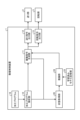
- FIG. 16 is a block diagram showing a configuration of a numerical control device according to the third embodiment during learning.
- the state acquisition unit 20 acquires state variables as input values for machine learning while machining by vibration cutting is being performed.
- the state variables may include data representing machining conditions, data representing vibration conditions, data representing feed operation content, and data representing the respective ratios of the first section, the second section, and the third section in one vibration, i.e., data representing the ratios of each section.
- the data representing machining conditions includes, for example, the above-mentioned operation command information, and is acquired from the machining program analysis unit 10.
- the data representing vibration conditions includes, for example, information specifying the shape of the above-mentioned vibration waveform, and is acquired from the vibration command generation unit 11.
- the data representing feed operation content includes, for example, the above-mentioned feed command, and is acquired from the vibration command generation unit 11.
- the data representing the ratios of each section is acquired from the vibration command generation unit 11.
- the judgment unit 22 judges whether the machining by vibration cutting is good or bad based on the load information acquired from the load information acquisition unit 14.
- the judgment result is output to the learning unit 21 as machining good or bad judgment data.
- the method of judging the good or bad may be to judge whether or not a miss occurred simply from the load information, or to use the load exceeding a certain threshold as a criterion.
- the judgment may also be made using statistics of the load over a certain period of time. For example, when the load varies greatly, speed changes occur frequently and there is a concern of a decrease in the quality of the machined surface, so the judgment may be negative.
- the learning unit 21 learns the rules for determining the ratios of each section according to a training data set created based on a combination of the state variables output from the state acquisition unit 20 and the processing quality judgment data output from the judgment unit 22. In other words, the learning unit 21 generates a trained model that infers the optimal ratios of each section from the state variables and the processing quality judgment data.
- the state variables include data representing machining conditions, data representing vibration conditions, data representing the feed operation content, and data representing each section ratio.
- the feed speed which is an example of data representing machining conditions
- the load associated with machining tends to be high even during non-vibration machining, and it is thought that the load during vibration cutting will be even higher.
- the tendency for the judgment of machining quality to be negative is higher than when the feed speed is low.
- the vibration amplitude which is an example of data that represents vibration conditions
- the area of missed strikes tends to become larger, which increases the tendency for chip breakage to occur and for the machining quality to be judged as good.
- feed commands which are an example of data that indicates the content of a feed operation
- differences in characteristics due to the axis that contains the vibration command may affect the judgment of whether the machining is good or bad. For example, when an axis that operates in the direction of gravity vibrates, the amplitude tends to attenuate in the direction against gravity, making it difficult for chip breakage to occur. Or, from the perspective of machine structure, when an axis carrying a heavy structure vibrates, the amplitude also tends to attenuate, making it difficult for chip breakage to occur, and in either case, the machining quality is more likely to be judged as bad.
- the learning unit 21 learns the rules for determining the optimal ratios for each section from the tendency of the combination of each state variable and the processing quality judgment data.
- the learning algorithm used by the learning unit 21 can be any known algorithm, such as supervised learning, unsupervised learning, or reinforcement learning.
- supervised learning unsupervised learning
- reinforcement learning we will explain the application of a neural network as an example.
- the learning unit 21 learns the optimal combination of each section ratio by so-called supervised learning, for example, according to a neural network model.
- supervised learning refers to a method of providing pairs of input and result (label) data to the numerical control device 1, learning the characteristics of the learning data, and inferring the result from the input.
- a neural network is composed of an input layer consisting of multiple neurons, an intermediate layer (hidden layer) consisting of multiple neurons, and an output layer consisting of multiple neurons. There may be one intermediate layer, or two or more layers.
- FIG. 17 is a diagram showing an example of the configuration of a neural network used in a numerical control device of embodiment 3.
- a weight W1 w11-w16
- Y1-Y2 the intermediate layer
- W2 w21-w26
- Z1-Z3 the output layer
- the neural network learns the optimal ratios for each section by so-called supervised learning according to learning data created based on a combination of the state variables acquired by the state acquisition unit 20 and the processing quality judgment data output from the judgment unit 22. That is, the neural network learns by inputting the state variables to the input layer and adjusting the weights W1 and W2 so that the results output from the output layer approach the processing quality judgment data.
- the learning unit 21 generates and outputs a learned model by executing the above-mentioned learning.
- the trained model storage unit 23 stores the trained model output from the training unit 21.
- FIG. 18 is a flowchart relating to the learning process of the numerical control device 1 of the third embodiment.
- the state acquisition unit 20 acquires state variables
- the judgment unit 22 acquires load information to judge the quality of machining, and outputs machining quality judgment data. Note that the state variables and machining quality judgment data are acquired and output simultaneously, but it is sufficient that the state variables and machining quality judgment data are input in association with each other, and the state variables and machining quality judgment data may be acquired and output at different times.
- step b2 the learning unit 21 learns the optimal ratios of each section by so-called supervised learning according to learning data created based on a combination of the state variables acquired by the state acquisition unit 20 and the machining quality judgment data output from the judgment unit 22, and generates a learned model.
- step b3 the learned model storage unit 23 stores the learned model generated by the learning unit 21.
- FIG. 19 is a block diagram showing the configuration of the numerical control device according to the third embodiment at the time of inference.
- the inference unit 24 infers the optimal interval ratio obtained by using the learned model stored in the learned model storage unit 23. That is, by inputting the state variables acquired by the state acquisition unit 20 to this learned model, it is possible to output the optimal interval ratio inferred from the state variables. Note that while the inference unit 24 has been described as outputting the optimal interval ratio using the learned model learned by the state acquisition unit 20 of the numerical control device 1, it may also be possible to acquire a learned model from outside, such as another numerical control device, and output the optimal interval ratio based on this learned model.
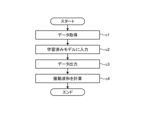
- FIG. 20 is a flowchart relating to the inference process of the numerical control device 1 of embodiment 3.
- the state acquisition unit 20 obtains the state variables.
- the inference unit 24 inputs the state variables into the trained model stored in the trained model storage unit 23 to obtain the optimal ratio for each section.
- the inference unit 24 outputs the optimal ratio for each section obtained by the trained model to the numerical control device 1.
- the numerical control device 1 calculates a vibration waveform using the output optimal ratio for each section. This makes it possible to optimally adjust the state of machining using vibration cutting.
- supervised learning is applied to the learning algorithm used by the learning unit 21, but the present invention is not limited to this.
- learning algorithm in addition to supervised learning, reinforcement learning, unsupervised learning, semi-supervised learning, etc. can also be applied.
- Deep learning which learns to extract the feature amount itself, can also be used, and machine learning may be performed according to other known methods, such as genetic programming, functional logic programming, and support vector machines.
- the third embodiment it is possible to determine the optimal ratio of each section depending on the machining conditions using vibration cutting. Since learning is performed while actually performing machining, an accurate method for determining the ratio of each section is learned. Furthermore, since a trained model that has been trained while actually performing machining is used, accurate inference is possible. For example, in turning, in order to obtain the desired shape, cutting is gradually made in multiple steps. For example, machining is divided into rough machining, semi-finishing machining, finishing machining, etc. Therefore, since similar machining paths are repeatedly performed, it is also possible to optimize the ratio of each section as machining progresses.
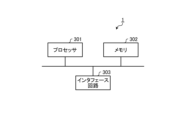
- FIG. 21 is a diagram showing an example of the hardware configuration of the numerical control device 1 according to the first to third embodiments.
- the numerical control device 1 can be realized by the processor 301, memory 302, and interface circuit 303 shown in FIG. 21.
- An example of the processor 301 is a CPU (also called a Central Processing Unit, central processing unit, processing unit, arithmetic unit, microprocessor, microcomputer, processor, or DSP (Digital Signal Processor)) or a system LSI (Large Scale Integration).
- An example of the memory 302 is a RAM (Random Access Memory) or a ROM (Read Only Memory).
- the numerical control device 1 is realized by the processor 301 reading and executing a program for executing the operation of the numerical control device 1, which is stored in the memory 302. This program can also be said to cause a computer to execute the procedure or method of the numerical control device 1.
- the memory 302 is also used as a temporary memory when the processor 301 executes various processes. Note that some of the functions of the numerical control device 1 may be realized by dedicated hardware and some by software or firmware.
Landscapes
- Engineering & Computer Science (AREA)
- Mechanical Engineering (AREA)
- Human Computer Interaction (AREA)
- Manufacturing & Machinery (AREA)
- Physics & Mathematics (AREA)
- General Physics & Mathematics (AREA)
- Automation & Control Theory (AREA)
- Numerical Control (AREA)
- Automatic Control Of Machine Tools (AREA)
- Turning (AREA)
Priority Applications (5)
| Application Number | Priority Date | Filing Date | Title |
|---|---|---|---|
| PCT/JP2023/006024 WO2024176309A1 (ja) | 2023-02-20 | 2023-02-20 | 数値制御装置 |
| JP2023534376A JP7422949B1 (ja) | 2023-02-20 | 2023-02-20 | 数値制御装置 |
| US19/143,407 US20260118853A1 (en) | 2023-02-20 | 2023-02-20 | Numerical control device |
| CN202380078442.5A CN120322740B (zh) | 2023-02-20 | 2023-02-20 | 数控装置 |
| DE112023004395.7T DE112023004395B4 (de) | 2023-02-20 | 2023-02-20 | Numerische-Steuerung-Gerät |
Applications Claiming Priority (1)
| Application Number | Priority Date | Filing Date | Title |
|---|---|---|---|
| PCT/JP2023/006024 WO2024176309A1 (ja) | 2023-02-20 | 2023-02-20 | 数値制御装置 |
Publications (1)
| Publication Number | Publication Date |
|---|---|
| WO2024176309A1 true WO2024176309A1 (ja) | 2024-08-29 |
Family
ID=89620860
Family Applications (1)
| Application Number | Title | Priority Date | Filing Date |
|---|---|---|---|
| PCT/JP2023/006024 Ceased WO2024176309A1 (ja) | 2023-02-20 | 2023-02-20 | 数値制御装置 |
Country Status (5)
| Country | Link |
|---|---|
| US (1) | US20260118853A1 (https=) |
| JP (1) | JP7422949B1 (https=) |
| CN (1) | CN120322740B (https=) |
| DE (1) | DE112023004395B4 (https=) |
| WO (1) | WO2024176309A1 (https=) |
Families Citing this family (2)
| Publication number | Priority date | Publication date | Assignee | Title |
|---|---|---|---|---|
| WO2026028284A1 (ja) * | 2024-07-30 | 2026-02-05 | ファナック株式会社 | 制御装置 |
| WO2026033616A1 (ja) * | 2024-08-06 | 2026-02-12 | 三菱電機株式会社 | 数値制御装置および数値制御方法 |
Citations (3)
| Publication number | Priority date | Publication date | Assignee | Title |
|---|---|---|---|---|
| JP5781241B1 (ja) * | 2014-03-17 | 2015-09-16 | 三菱電機株式会社 | 数値制御装置 |
| WO2021166974A1 (ja) * | 2020-02-19 | 2021-08-26 | ファナック株式会社 | 工作機械の制御装置 |
| JP7158604B1 (ja) * | 2021-06-02 | 2022-10-21 | 三菱電機株式会社 | 数値制御装置、学習装置、推論装置、および数値制御方法 |
Family Cites Families (6)
| Publication number | Priority date | Publication date | Assignee | Title |
|---|---|---|---|---|
| JP2014050897A (ja) * | 2012-09-05 | 2014-03-20 | Saitama Prefecture | 振動波形発生装置,振動付加装置,振動加工装置 |
| EP2957972B1 (en) * | 2014-04-23 | 2018-06-13 | Mitsubishi Electric Corporation | Numerical control apparatus |
| EP3187290B1 (en) | 2014-08-29 | 2023-08-02 | Citizen Watch Co., Ltd. | Method for machining a workpiece by a machine tool |
| JP6994838B2 (ja) * | 2017-03-27 | 2022-01-14 | シチズン時計株式会社 | 工作機械の制御装置および工作機械 |
| CN108723900B (zh) * | 2018-04-25 | 2019-06-21 | 北京航空航天大学 | 一种旋转超声振动铣磨的全域切削力建模方法与装置 |
| CN114378653B (zh) * | 2022-01-27 | 2022-12-13 | 上海机床厂有限公司 | 基于bp神经网络外圆磨削颤振在线识别和监测方法 |
-
2023
- 2023-02-20 DE DE112023004395.7T patent/DE112023004395B4/de active Active
- 2023-02-20 WO PCT/JP2023/006024 patent/WO2024176309A1/ja not_active Ceased
- 2023-02-20 JP JP2023534376A patent/JP7422949B1/ja active Active
- 2023-02-20 US US19/143,407 patent/US20260118853A1/en active Pending
- 2023-02-20 CN CN202380078442.5A patent/CN120322740B/zh active Active
Patent Citations (3)
| Publication number | Priority date | Publication date | Assignee | Title |
|---|---|---|---|---|
| JP5781241B1 (ja) * | 2014-03-17 | 2015-09-16 | 三菱電機株式会社 | 数値制御装置 |
| WO2021166974A1 (ja) * | 2020-02-19 | 2021-08-26 | ファナック株式会社 | 工作機械の制御装置 |
| JP7158604B1 (ja) * | 2021-06-02 | 2022-10-21 | 三菱電機株式会社 | 数値制御装置、学習装置、推論装置、および数値制御方法 |
Also Published As
| Publication number | Publication date |
|---|---|
| DE112023004395T5 (de) | 2025-08-07 |
| CN120322740B (zh) | 2026-01-13 |
| CN120322740A (zh) | 2025-07-15 |
| DE112023004395B4 (de) | 2026-05-07 |
| JP7422949B1 (ja) | 2024-01-26 |
| US20260118853A1 (en) | 2026-04-30 |
| JPWO2024176309A1 (https=) | 2024-08-29 |
Similar Documents
| Publication | Publication Date | Title |
|---|---|---|
| JP6698603B2 (ja) | 数値制御システム、及び運転状態異常検知方法 | |
| JP6698604B2 (ja) | 数値制御システム、及び工具状態検知方法 | |
| JP7609958B2 (ja) | 工作機械の制御装置 | |
| WO2024176309A1 (ja) | 数値制御装置 | |
| JP6843314B1 (ja) | 数値制御装置、数値制御方法および機械学習装置 | |
| JP5258921B2 (ja) | 工作機械及びその加工制御装置 | |
| JP6898530B2 (ja) | 数値制御装置および数値制御方法 | |
| US10802461B2 (en) | Controller for machine tool | |
| WO2022085114A1 (ja) | 数値制御装置及び数値制御方法 | |
| JP6912506B2 (ja) | 工作機械の制御装置 | |
| CN110874082B (zh) | 工件拐角的切割路径确定方法、设备和存储介质 | |
| JP7044734B2 (ja) | サーボ制御装置 | |
| TW201619726A (zh) | 數値控制裝置 | |
| JP7007531B1 (ja) | 情報処理装置、工作機械の制御装置、及びコンピュータプログラム | |
| WO2020261581A1 (ja) | 数値制御装置、機械学習装置および数値制御方法 | |
| JPWO2023053400A5 (https=) | ||
| JP6693927B2 (ja) | 制御装置 | |
| JP7280310B2 (ja) | 数値制御装置 | |
| JPWO2023053399A5 (https=) | ||
| JP7252061B2 (ja) | 数値制御装置及び工作機械 | |
| JP7824325B2 (ja) | 情報処理装置、工作機械の制御装置、及びコンピュータプログラム | |
| JP2006007363A (ja) | Ncプログラム修正装置及びこれを備えたncプログラム生成装置 | |
| JP6836540B2 (ja) | 情報処理装置及び情報処理方法 | |
| JP7829757B2 (ja) | 数値制御装置および数値制御方法 | |
| WO2025027767A1 (ja) | 数値制御装置および数値制御方法 |
Legal Events
| Date | Code | Title | Description |
|---|---|---|---|
| WWE | Wipo information: entry into national phase |
Ref document number: 2023534376 Country of ref document: JP |
|
| 121 | Ep: the epo has been informed by wipo that ep was designated in this application |
Ref document number: 23923965 Country of ref document: EP Kind code of ref document: A1 |
|
| WWE | Wipo information: entry into national phase |
Ref document number: CN2023800784425 Country of ref document: CN Ref document number: 202380078442.5 Country of ref document: CN |
|
| WWE | Wipo information: entry into national phase |
Ref document number: 112023004395 Country of ref document: DE |
|
| WWP | Wipo information: published in national office |
Ref document number: 202380078442.5 Country of ref document: CN |
|
| WWP | Wipo information: published in national office |
Ref document number: 112023004395 Country of ref document: DE |
|
| 122 | Ep: pct application non-entry in european phase |
Ref document number: 23923965 Country of ref document: EP Kind code of ref document: A1 |