WO2024172057A1 - 人工miRNA構築物 - Google Patents
人工miRNA構築物 Download PDFInfo
- Publication number
- WO2024172057A1 WO2024172057A1 PCT/JP2024/004958 JP2024004958W WO2024172057A1 WO 2024172057 A1 WO2024172057 A1 WO 2024172057A1 JP 2024004958 W JP2024004958 W JP 2024004958W WO 2024172057 A1 WO2024172057 A1 WO 2024172057A1
- Authority
- WO
- WIPO (PCT)
- Prior art keywords
- mirna
- sequence
- mirna construct
- construct
- rna
- Prior art date
- Legal status (The legal status is an assumption and is not a legal conclusion. Google has not performed a legal analysis and makes no representation as to the accuracy of the status listed.)
- Ceased
Links
Images





Classifications
-
- A—HUMAN NECESSITIES
- A61—MEDICAL OR VETERINARY SCIENCE; HYGIENE
- A61P—SPECIFIC THERAPEUTIC ACTIVITY OF CHEMICAL COMPOUNDS OR MEDICINAL PREPARATIONS
- A61P29/00—Non-central analgesic, antipyretic or antiinflammatory agents, e.g. antirheumatic agents; Non-steroidal antiinflammatory drugs [NSAID]
-
- A—HUMAN NECESSITIES
- A61—MEDICAL OR VETERINARY SCIENCE; HYGIENE
- A61K—PREPARATIONS FOR MEDICAL, DENTAL OR TOILETRY PURPOSES
- A61K31/00—Medicinal preparations containing organic active ingredients
- A61K31/70—Carbohydrates; Sugars; Derivatives thereof
- A61K31/7088—Compounds having three or more nucleosides or nucleotides
-
- C—CHEMISTRY; METALLURGY
- C12—BIOCHEMISTRY; BEER; SPIRITS; WINE; VINEGAR; MICROBIOLOGY; ENZYMOLOGY; MUTATION OR GENETIC ENGINEERING
- C12N—MICROORGANISMS OR ENZYMES; COMPOSITIONS THEREOF; PROPAGATING, PRESERVING, OR MAINTAINING MICROORGANISMS; MUTATION OR GENETIC ENGINEERING; CULTURE MEDIA
- C12N15/00—Mutation or genetic engineering; DNA or RNA concerning genetic engineering, vectors, e.g. plasmids, or their isolation, preparation or purification; Use of hosts therefor
- C12N15/09—Recombinant DNA-technology
- C12N15/11—DNA or RNA fragments; Modified forms thereof; Non-coding nucleic acids having a biological activity
- C12N15/113—Non-coding nucleic acids modulating the expression of genes, e.g. antisense oligonucleotides; Antisense DNA or RNA; Triplex- forming oligonucleotides; Catalytic nucleic acids, e.g. ribozymes; Nucleic acids used in co-suppression or gene silencing
-
- C—CHEMISTRY; METALLURGY
- C12—BIOCHEMISTRY; BEER; SPIRITS; WINE; VINEGAR; MICROBIOLOGY; ENZYMOLOGY; MUTATION OR GENETIC ENGINEERING
- C12N—MICROORGANISMS OR ENZYMES; COMPOSITIONS THEREOF; PROPAGATING, PRESERVING, OR MAINTAINING MICROORGANISMS; MUTATION OR GENETIC ENGINEERING; CULTURE MEDIA
- C12N15/00—Mutation or genetic engineering; DNA or RNA concerning genetic engineering, vectors, e.g. plasmids, or their isolation, preparation or purification; Use of hosts therefor
- C12N15/09—Recombinant DNA-technology
- C12N15/87—Introduction of foreign genetic material using processes not otherwise provided for, e.g. co-transformation
- C12N15/88—Introduction of foreign genetic material using processes not otherwise provided for, e.g. co-transformation using microencapsulation, e.g. using amphiphile liposome vesicle
-
- C—CHEMISTRY; METALLURGY
- C12—BIOCHEMISTRY; BEER; SPIRITS; WINE; VINEGAR; MICROBIOLOGY; ENZYMOLOGY; MUTATION OR GENETIC ENGINEERING
- C12N—MICROORGANISMS OR ENZYMES; COMPOSITIONS THEREOF; PROPAGATING, PRESERVING, OR MAINTAINING MICROORGANISMS; MUTATION OR GENETIC ENGINEERING; CULTURE MEDIA
- C12N2310/00—Structure or type of the nucleic acid
- C12N2310/10—Type of nucleic acid
- C12N2310/14—Type of nucleic acid interfering nucleic acids [NA]
- C12N2310/141—MicroRNAs, miRNAs
Definitions
- Chronic inflammation is the underlying pathology of many diseases, including age-related diseases such as osteoarthritis, autoimmune diseases such as rheumatoid arthritis, respiratory diseases such as asthma, allergies such as atopic dermatitis, and metabolic syndromes such as diabetes.
- age-related diseases such as osteoarthritis
- autoimmune diseases such as rheumatoid arthritis
- respiratory diseases such as asthma
- allergies such as atopic dermatitis
- metabolic syndromes such as diabetes.
- therapeutic drugs that suppress inflammation are limited to steroids and non-steroidal anti-inflammatory drugs, and due to their insufficient effectiveness against inflammatory destruction of tissues and side effects, there is a need to develop effective treatments based on elucidation of the molecular mechanisms of chronic inflammation.
- cytokines such as TNF- ⁇ and IL-1 ⁇
- matrix degrading enzymes such as MMP-13 and ADAMTS5
- mRNA of these genes plays an important role in the host defense reaction and homeostasis through acute inflammatory action and tissue remodeling, but their expression is strictly regulated not only at the transcriptional level, but also by the stability of mRNA at the post-transcriptional level and protein degradation, so that it remains transient.
- RNA-binding proteins and miRNAs microRNAs
- Non-Patent Document 1 Non-Patent Document 2
- miRNAs are single-stranded RNAs of about 21 to 25 bases that are not translated into proteins. They are incorporated into the RNA-induced silencing complex (RISC), where they recognize the 3'UTR of target genes and destabilize or suppress the translation of the mRNA, thereby suppressing protein production.
- miR-146 specifically recognizes the 3'UTR of the mRNA of inflammatory cytokines such as TNF- ⁇ , and suppresses their expression.
- RNA-binding proteins and miRNA mRNA suppression mechanisms shorten the half-life of the mRNA for inflammatory cytokines and tissue-degrading enzymes, and they are only expressed transiently; however, in chronic inflammatory conditions, these systems do not function sufficiently, causing inflammation to persist and contributing to the onset and progression of the disease. Therefore, there is a need to develop further therapeutic strategies that can control the expression of target mRNAs.
- the present inventors have developed a novel artificial miRNA construct useful for post-transcriptional mRNA regulation of genes involved in the onset and progression of chronic inflammatory diseases, etc.
- the miRNA construct of the present invention can specifically recognize target mRNA by a seed sequence that specifically recognizes the binding motif of an RNA-binding protein, and can control its expression. Therefore, the miRNA construct of the present invention can provide a novel therapeutic or preventive approach for chronic inflammatory diseases, etc.
- the miRNA construct of the present invention can recognize and regulate the expression of multiple target mRNAs, and is therefore useful as a novel therapeutic or preventive approach for diseases in which simultaneous suppression of the expression of multiple genes is useful, such as chronic inflammatory diseases.
- the method for designing a miRNA construct of the present invention can be applied to the design of miRNA constructs that target various genes.
- Such a therapeutic strategy based on the design of artificial miRNA that does not naturally occur in the body has not been reported to date, and was discovered for the first time by the present inventors.
- the seed sequence of miRNA is the 2nd to 7th or 8th bases (ugcagca) on the 5' side.
- Non-Patent Document 8 bases uaaauauu from 11th to 18th
- the sequence of ugcagca is involved in suppressing the expression of mRNA (e.g., Bcl2). Therefore, the direct control of TNFa by miR-16 shown in Non-Patent Document 8 has been denied, and no follow-up report supporting this has been found.
- Non-Patent Document 8 also states that the action of miR-16 cannot be seen without TTP, which suggests that the seed hypothesis is incorrect.
- miR-ARE which is an artificial miRNA
- IL-1b can cover, for example, all of IL-1b, MMP-13, ADAMTS-5, etc., which are involved in the exacerbation of pathology in osteoarthritis (OA), and can cover all of TNFa, IL-6, and MMP-3, which are the pathological gene expressions of various cell groups in rheumatoid arthritis (RA).
- OA osteoarthritis
- RA rheumatoid arthritis
- a miRNA construct comprising: i) a seed sequence that recognizes a binding motif for an RNA-binding protein; ii) an adenine or uracil residue located 5' to the seed sequence, and iii) a scrambled sequence located 3' to the seed sequence; An miRNA construct, wherein the scrambled sequence has a sequence such that the GC content of the entire miRNA construct is 40 to 60%.
- the binding motif for the RNA-binding protein is an AU-rich element, a stem-loop motif, a GU-rich element, or a Pumilio binding motif.
- RNA-binding protein is a binding motif of an RNA-binding protein selected from the group consisting of tristetraprolin (TPP), BRF1, BRF2, AUF1, KSRP, Regnase-1, Roquin, CUGBP1, and Pumilio.
- TPP tristetraprolin
- BRF1, BRF2, AUF1, KSRP, Regnase-1, Roquin, CUGBP1, and Pumilio The miRNA construct according to any one of aspects 1 to 3, having a length of 19 to 25 bases.
- the binding motif for the RNA-binding protein is a binding motif present in the mRNA of a gene involved in inflammatory diseases and/or cancer.
- a method for designing a miRNA construct comprising: i) selecting a seed sequence that recognizes a binding motif of an RNA-binding protein; ii) positioning an adenine or uracil residue 5' to the seed sequence; iii) placing a scrambled sequence 3' to the seed sequence;
- the method for designing a miRNA construct comprises configuring the scrambled sequence so that the GC content of the entire miRNA construct is 40 to 60%.
- a method for screening miRNA constructs comprising: i) a seed sequence that recognizes a binding motif for an RNA-binding protein; ii) an adenine or uracil residue located 5' to the seed sequence, and iii) a scrambled sequence located 3' to the seed sequence; creating a library of miRNA constructs, the scrambled sequences having a GC content of 40-60% throughout the miRNA construct; and selecting an miRNA construct based on whether or not the miRNA construct has the effect of suppressing the expression of at least one gene involved in an inflammatory disease or the effect of ameliorating inflammation in a subject.
- a pharmaceutical composition comprising at least one substance selected from the group consisting of the miRNA construct according to any one of aspects 1 to 5, a mimic of said miRNA construct, and DNA encoding said miRNA construct.
- Aspect 9 9. The pharmaceutical composition according to aspect 8, which is an anti-inflammatory agent.
- Aspect 11 11. The pharmaceutical composition according to any one of aspects 8 to 10, wherein said miRNA construct or mimic of a miRNA construct comprises a modified nucleic acid.
- Aspect 12 12.
- the pharmaceutical composition according to any one of aspects 8 to 11 for use in the treatment of a chronic inflammatory disease.
- Aspect 13 The pharmaceutical composition according to any one of aspects 8 to 12, for suppressing the expression of at least one gene involved in an inflammatory disease.
- FIG. 1 is a schematic diagram showing the mechanism of mRNA degradation by TTP.
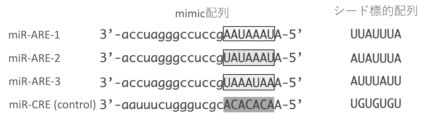
- FIG. 1 shows the sequences of the designed miR-AREs.
- 1 is a graph showing the results of suppressing the induction of expression of inflammatory cytokines and tissue damaging factors by introduction of miR-ARE.
- 1 is a graph showing the results of a comprehensive analysis of genes whose expression is induced and suppressed by introduction of miR-ARE2.
- 1 shows the results of suppression of arthritis by administration of miR-ARE.
- A Photographs showing the results of Safranin-O staining of knee joints administered with miRNA.
- B Results of scoring the severity of knee joints based on OARSI.
- FIG. 1 is a graph showing the results of a comprehensive analysis of genes whose expression is induced and suppressed by the introduction of miR-ARE2.
- Down genes whose expression is decreased
- non-DEG genes whose expression is not changed
- up genes whose expression is increased.
- 1 shows the novel designs of seed sequences, #1 to #23 each having a seed sequence complementary to a different ARE.
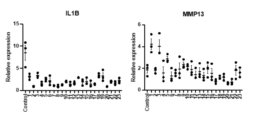
- FIG. 1 shows suppression of expression of IL1B and MMP13 by newly designed miR-ARE. This figure shows the results of a comprehensive analysis of genes whose expression was suppressed by the newly designed miR-AR.
- Genes whose expression was significantly altered were defined as those whose log2FC (x-axis) was 1 or more or -1 or less and p-value (y-axis) was less than 0.05. Genes whose expression was altered are indicated by ⁇ . 1 shows the results of a comprehensive analysis of genes whose expression is suppressed by the newly designed miR-AR. Analysis of specificity of miR-ARE. The darker the color, the stronger the suppression of expression. 1 shows the results of a comprehensive analysis of genes whose expression is suppressed by the newly designed miR-AR, and GO analysis of genes whose expression is reduced by introduction of miR-ARE-N2, N8, and N21.
- 1 shows the results of a comprehensive analysis of genes whose expression is suppressed by the newly designed miR-AR, showing changes in gene expression and genes whose expression is reduced by the introduction of miR-ARE-N2, N8, and N21.
- 1 is a graph showing the suppression of target genes by LNP-miRNA.
- One aspect of the present invention relates to a novel artificial miRNA construct.
- miRNAs are short, 20-24 nucleotide non-coding RNAs that are involved in the post-transcriptional regulation of gene expression in multicellular organisms by influencing both mRNA stability and translation.
- miRNAs are transcribed by RNA polymerase II as part of a capped, polyadenylated initial transcript (pri-miRNA), which may or may not code for a protein.
- This initial transcript is cleaved by the Drosha ribonuclease III enzyme to generate a ⁇ 70 nucleotide stem-loop precursor miRNA (pre-miRNA), which is further cleaved by the cytoplasmic Dicer ribonuclease to generate the mature miRNA and its antisense miRNA*.
- the mature miRNA is then loaded into the RNA-induced silencing complex (RISC), which recognizes the target mRNA through imperfect base pairing with the miRNA, typically resulting in translational inhibition or destabilization of the target mRNA.
- RISC
- the present inventors have developed a novel artificial miRNA construct that can regulate the post-transcriptional mRNA of a target gene like the above-mentioned mature miRNA (endogenous miRNA). i) a seed sequence that recognizes a binding motif for an RNA-binding protein; ii) an adenine or uracil residue located on the 5' side of the seed sequence, and iii) a scrambled sequence located on the 3' side of the seed sequence.
- the miRNA construct of the present invention comprises a seed sequence that recognizes a binding motif for an RNA-binding protein that binds to the target mRNA.
- TTP binds to an AU-rich element (ARE) (AUUUA) present in the 3'UTR of target mRNA of inflammatory cytokines such as IL-1 ⁇ and tissue damage factors such as MMP13 (the 3'UTR sequence of IL-1 ⁇ is shown in SEQ ID NO: 1, and the 3'UTR sequence of MMP13 is shown in SEQ ID NO: 2), and recruits deadenylase to the target mRNA, thereby inducing degradation of the mRNA through degradation of the polyA tail.
- the miRNA construct of the present invention contains a seed sequence that recognizes the binding motif of such an RNA-binding protein, and is thereby capable of specifically recognizing a target mRNA having the binding motif and controlling its expression.
- the binding motif of an RNA-binding protein that can be targeted by the miRNA construct of the present invention can be any binding motif present in the mRNA of the target gene.
- the binding motif can be a binding motif of an RNA-binding protein involved in post-transcriptional mRNA regulation.
- the binding motif is a binding motif present in the 3' untranslated region of the mRNA of the target gene.
- binding motifs include AU-rich elements present in the 3'-untranslated regions of inflammatory cytokines and matrix degrading enzymes involved in chronic inflammation, and to which the above-mentioned TTP and its family proteins BRF1 (Zfp36L1), BRF2 (Zfp36L2), as well as AUF1, KSRP, and the like can bind; stem-loop motifs present in the 3'-untranslated regions of IL-6, ICOS, TNF- ⁇ , and the like can bind to Regnase-1, Roquin, and the like; GU-rich elements (GRE: GU Rich Element) (UGUUUGUUUGU (SEQ ID NO: 3) and the like) to which CUGBP1 binds; and Pumilio binding motifs (PRE: Pumilio response element, UGUANAUA, etc.
- the binding motif for the RNA binding protein is an AU-rich element.
- Target genes that can be recognized by the seed sequence of the miRNA construct of the present invention and whose protein expression can be regulated include genes involved in inflammatory diseases, such as inflammatory cytokines (e.g., IL-6, TNF ⁇ , IL-1 ⁇ (also referred to as IL-1B), IL-12A, IL-18, IL-11, IL23A, LTA), chemokines (e.g., CXCL8, CXCL5, CCL20, CCL2, CCL1, CCL7), and tissue damage factors such as matrix degrading enzymes.
- inflammatory cytokines e.g., IL-6, TNF ⁇ , IL-1 ⁇ (also referred to as IL-1B), IL-12A, IL-18, IL-11, IL23A, LTA
- chemokines e.g., CXCL8, CXCL5, CCL20, CCL2, CCL1, CCL7
- tissue damage factors such as matrix degrading enzymes.
- the miRNA construct of the present invention can simultaneously suppress the expression of mRNA of one or more target genes selected from these gene groups.
- the miRNA construct of the present invention can provide a novel therapeutic and preventive approach that is useful for diseases that require the control of the expression of multiple proteins, such as chronic inflammation.
- Non-limiting examples of the artificial miRNA constructs of the present invention include: miR-ARE1: 5'-AUAAAUAAgccuccgggaucca-3' (SEQ ID NO: 4) (seed target sequence: 5'-UUAUUUA-3'), miR-ARE2: 5'-AUAAAUAUgccuccgggaucca-3' (SEQ ID NO: 5) (seed target sequence: 5'-AUAUUUA-3'), miR-ARE3: 5'-AAAUAAAUgccuccgggaucca-3' (SEQ ID NO: 6) (seed target sequence: 5'-AUUUAUU-3').
- a sequence in which the adenine base on the 5' side of the seed sequence is replaced with a uracil base can also be preferably used.
- Additional non-limiting examples of artificial miRNA constructs of the present invention include: miR-ARE4: 5'-uAAAAUUAgccuccgggauccaTT-3' (SEQ ID NO: 8) (seed target sequence: 5'-UUUUAAU-3') miR-ARE5: 5'-uAUAAAUgccuccgggauccaTT-3' (SEQ ID NO: 9) (seed target sequence: 5'-AAUUUAU-3')
- the first base, u is phosphorylated so that the 5′ side is incorporated into miRNA RISC.
- artificial miRNA constructs of the present invention include artificial miRNA constructs comprising the seed sequences shown in FIG. 7 (from 3' to 5', UAAAUAA, UAAAUAU, UAAAUA, UAAAAAA, UAAAAAAU, UAAAAAAU, AAAAUAA, AAAAUUA, AAAAUAU, AAAAAU, UAUAAAAU, AUUAAAAU, AAAAAAA, UAUAAAAAA, UAUAAAAAA, AUUAAAAAAA, UAUAAAAAA, AUAAAU, UUAAAUA, UUAAAUA, AUAAAU, AAAAAUA, AUAAA ...
- Another aspect of the present invention relates to a method for designing an artificial miRNA construct. i) a seed sequence that recognizes a binding motif for an RNA-binding protein; ii) an adenine or uracil residue located 5' to the seed sequence, and iii) a scrambled sequence located 3' to the seed sequence; By designing the scrambled sequence so that the GC content of the entire miRNA construct is 40-60%, it is possible to obtain a miRNA construct that recognizes a target mRNA having a desired RNA-binding protein binding motif and controls its expression.
- the method for designing an artificial miRNA construct of the present invention is not limited to the target mRNA involved in the above-mentioned inflammatory diseases, and it is possible to design miRNA constructs that target various mRNAs.
- an aspect of the present invention also relates to a method for screening the artificial miRNA construct of the present invention.
- the screening method of the present invention comprises: i) a seed sequence that recognizes a binding motif for an RNA-binding protein; ii) an adenine or uracil residue located 5' to the seed sequence, and iii) a scrambled sequence located 3' to the seed sequence; creating a library of miRNA constructs, the scrambled sequences having a GC content of 40-60% throughout the miRNA construct; and selecting the miRNA construct based on whether or not it has an effect of suppressing the expression of at least one gene involved in an inflammatory disease or an effect of ameliorating inflammation in a subject.
- the step of determining whether or not the miRNA construct has an effect of suppressing the expression of at least one gene involved in an inflammatory disease or an effect of improving inflammation in a subject includes a step of contacting the library of miRNA constructs with a sample containing a target mRNA.
- the target mRNA means an mRNA whose expression is intended to be regulated by the miRNA construct of the present invention.
- the sample containing the target mRNA may be any of an in vitro sample, an ex vivo sample, and an in vivo sample.
- the effect of suppressing the expression of genes involved in inflammatory diseases can be evaluated using quantitative real-time PCR, immunostaining, or any other method known to those skilled in the art.
- the effect of improving inflammation in a subject can be assessed using the OARSI score in an arthritis model, as well as any other method known to one of skill in the art.
- the screening method of the present invention comprises: i) a seed sequence that recognizes a binding motif for a given RNA-binding protein; ii) an adenine or uracil residue located 5' to the seed sequence, and iii) a scrambled sequence located 3' to the seed sequence; providing an miRNA construct, the scrambled sequence having a GC content of 40-60% throughout the miRNA construct; contacting the miRNA construct with a sample containing the mRNA of a candidate gene; and determining that a candidate gene is under the influence of a binding motif for a given RNA-binding protein if expression of the candidate gene is reduced upon contact with the miRNA construct.
- a "gene under the influence of a binding motif of a specific RNA-binding protein” refers to a gene whose expression can be regulated by any action on the specific binding motif (e.g., binding of a specific molecule such as an RNA-binding protein or miRNA).
- Expression of the candidate genes can be assessed using quantitative real-time PCR, immunostaining, or any other method known to those skilled in the art.
- one aspect of the present invention relates to a pharmaceutical composition comprising the artificial miRNA construct of the present invention.
- the present inventors have revealed that by introducing the artificial miRNA construct of the present invention into cells, the expression of target mRNA involved in chronic inflammatory diseases is suppressed in the absence of a corresponding RNA-binding protein, that is, by supplementing with the artificial miRNA construct of the present invention, a novel therapeutic or preventive approach for chronic inflammatory diseases, etc.
- some aspects of the present invention relate to pharmaceutical compositions containing the artificial miRNA construct of the present invention.
- RNA synthesized based on the sequence of the miRNA construct of the present invention can be used as the mature miRNA.
- nucleic acids modified with 2'O-methyl modification or bridged nucleic acids BNA may be used. Methods for synthesizing such nucleic acids are known to those skilled in the art.
- the pharmaceutical composition of the present invention may contain a mimic of the artificial miRNA construct of the present invention instead of the artificial miRNA construct of the present invention.
- a mimic refers to a short synthetic double-stranded RNA that mimics the artificial miRNA construct of the present invention.
- the mimic of the miRNA construct of the present invention has at least 80% homology with the miRNA construct it mimics, more preferably at least 90%, and even more preferably at least 95% (including 100%).
- the artificial miRNA constructs and mimics thereof of the present invention may contain modified nucleic acids such as 2'-MOE, 2'-O-MCE, LNA (2'-4'BNA), ENA, AmNA, GuNA, scpBNA, 2'-OMe, and phosphorothioate modifications.
- modified nucleic acids such as 2'-MOE, 2'-O-MCE, LNA (2'-4'BNA), ENA, AmNA, GuNA, scpBNA, 2'-OMe, and phosphorothioate modifications.
- the pharmaceutical composition of the present invention may contain DNA encoding the miRNA construct instead of the artificial miRNA construct of the present invention.
- the sequence of the miRNA construct of the present invention may be introduced into various expression vectors or various viral vectors, etc., and RNA may be synthesized by transcription within the cell.
- the artificial miRNA constructs of the present invention mimics of the miRNA constructs, and DNA encoding the miRNA constructs can be synthesized chemically, biochemically, or biologically. Such synthesis methods are well known to those skilled in the art.
- the pharmaceutical composition according to the present invention may take any form, such as a tablet, powder, liquid, or semisolid, and may contain appropriate excipients and additives in addition to the artificial miRNA construct of the present invention, a mimic of the miRNA construct, and/or DNA encoding the miRNA construct.
- the pharmaceutical composition according to the present invention may also contain other anti-inflammatory agents, etc.
- the amount of each component may be appropriately determined within a medicament-acceptable range.
- the dosage of the composition may be appropriately determined depending on the type of nucleic acid used and the subject to which it is administered.
- the route of administration may also be appropriately determined depending on the type of nucleic acid used and the subject to which it is administered.
- the artificial miRNA construct of the present invention can control the expression of a desired target mRNA by changing the target of its seed sequence. Therefore, the pharmaceutical composition of the present invention can be used for the treatment and prevention of various diseases, and can be effectively used in the treatment and prevention of diseases involving cytokines or matrix degrading enzymes. Examples of diseases involving cytokines or matrix degrading enzymes include chronic inflammatory diseases, age-related diseases such as osteoarthritis, autoimmune diseases such as rheumatoid arthritis, respiratory diseases such as asthma, allergies such as atopic dermatitis, metabolic syndromes such as diabetes, viral infections, and cytokine storms in sepsis. Therefore, the pharmaceutical composition of the present invention can be an anti-inflammatory agent.
- the pharmaceutical composition according to the present invention can be suitably used in the treatment and prevention of diseases involving deficiency or decreased expression of RNA-binding proteins, such as cancer (breast cancer, cervical cancer, colon cancer, gastric cancer, liver cancer, lung cancer, pancreatic cancer, skin cancer (e.g., DMBA/TPA-induced skin cancer, etc.), cachexia, keratosis, gastritis, increased anti-DNA antibodies, Crohn's disease, colitis (e.g., DSS-induced colitis), fatty liver, etc.
- the pharmaceutical composition according to the present invention can be effectively used for diseases requiring control of the expression of multiple genes, such as chronic inflammatory diseases.
- the diseases exemplified above may be collectively referred to as "chronic inflammatory diseases, etc.”
- One aspect of the present invention relates to a pharmaceutical composition for use in the treatment and/or prevention of chronic inflammatory diseases, etc., which comprises the artificial miRNA construct of the present invention, a mimic of the miRNA construct, and/or DNA encoding the miRNA construct as an active ingredient.
- a pharmaceutical composition for use in the treatment and/or prevention of chronic inflammatory diseases, etc. which comprises the artificial miRNA construct of the present invention, a mimic of the miRNA construct, and/or DNA encoding the miRNA construct as an active ingredient.
- one aspect of the present invention relates to the use of the artificial miRNA construct of the present invention, a mimic of the miRNA construct, and/or DNA encoding the miRNA construct in the manufacture of a pharmaceutical for the treatment and/or prevention of chronic inflammatory diseases, etc.
- the content of the active ingredient (the artificial miRNA construct of the present invention, the mimic of the miRNA construct, and/or the DNA encoding the miRNA construct) in 100% by weight of the pharmaceutical composition can be appropriately set in the range of 0.001 to 99.99% by weight.
- the pharmaceutical composition may contain an agent that promotes the introduction of nucleic acids or proteins into cells.
- Other ingredients in the pharmaceutical composition of the present invention are not particularly limited and can be appropriately selected depending on the purpose, and examples thereof include pharma- ceutical acceptable carriers or additives.
- the carriers or additives can be appropriately selected depending on the dosage form, etc., and may include any carrier, diluent, excipient, suspending agent, lubricant, adjuvant, vehicle, delivery system, nucleic acid introduction promoter, emulsifier, tablet disintegrant, absorbent, preservative, surfactant, colorant, flavor, or sweetener.
- the content in the pharmaceutical composition of the present invention can be appropriately selected depending on the purpose.
- the dosage form of the pharmaceutical composition according to the present invention is not particularly limited and can be appropriately selected according to the desired administration method.
- the dosage form include injections (solutions, suspensions, solids to be dissolved when used, etc.), solids (tablets, capsules, suppositories, powders, etc.).
- a pH regulator, buffer, stabilizer, isotonicity agent, local anesthetic, etc. can be added to the composition to produce an injection for subcutaneous, intra-articular, intramuscular, intravenous, etc., by a conventional method.
- pH regulators and buffers include sodium citrate, sodium acetate, sodium phosphate, etc.
- stabilizers include sodium pyrosulfite, EDTA, thioglycolic acid, thiolactic acid, etc.
- isotonicity agents include sodium chloride, glucose, etc.
- local anesthetics include procaine hydrochloride, lidocaine hydrochloride, etc.
- the solids may be enteric coated.
- the method of administration of the pharmaceutical composition of the present invention is not particularly limited, and either local administration or systemic administration can be selected depending on, for example, the dosage form of the pharmaceutical composition, the condition of the patient, etc.
- Administration can be performed, for example, by intra-articular administration, intravenous administration, subcutaneous administration, intramuscular administration, oral administration, enteral administration, enema administration, tube feeding, etc.
- the subjects for administration of the pharmaceutical composition of the present invention are not particularly limited and can be appropriately selected depending on the purpose, and examples include humans and non-human mammals such as mice, rats, cows, pigs, monkeys, dogs, and cats, but are preferably humans, and in particular human patients who have developed joint diseases.
- the pharmaceutical composition of the present invention may be administered for the purpose of preventing the onset of the target disease, and in particular for the purpose of preventing recurrence.
- the dosage of the pharmaceutical composition of the present invention is not particularly limited and can be appropriately selected depending on the dosage form, age and body weight of the subject, the degree of the desired effect, etc.
- the dosage of the pharmaceutical composition of the present invention can be, for example, 0.01 to 1,000,000 nmol per day, preferably 0.1 to 100,000 nmol, more preferably 1 to 50,000 nmol, and particularly preferably 10 to 10,000 nmol
- the administration frequency can be, for example, 1 to 100 times per month, preferably 1 to 50 times per month
- the administration period can be 1 day to 24 months, preferably 1 day to 12 months, for example 1 day to 6 months.
- the timing of administration of the pharmaceutical composition of the present invention is not particularly limited and can be appropriately selected depending on the purpose. For example, it may be administered prophylactically to patients susceptible to the above-mentioned diseases, or it may be administered therapeutically to patients exhibiting symptoms. Furthermore, there is no particular limit to the number of administrations, and it can be appropriately selected depending on the age, weight, and degree of the desired effect of the subject.
- One aspect of the present invention relates to a method for treating and/or preventing chronic inflammation in a subject in need of treatment and/or prevention, comprising administering an effective amount of an active ingredient (the artificial miRNA construct of the present invention, a mimic of the miRNA construct, and/or a DNA encoding the miRNA construct) to the subject.
- the subject in need of treatment and/or prevention is a mammal, for example, a human.
- the dosage can be appropriately determined depending on the type of drug used and the subject to which it is administered.
- the route of administration can also be appropriately determined depending on the type of drug used and the subject to which it is administered.
- Preferred routes of administration include, for example, intra-articular administration, subcutaneous administration, and intravenous administration.
- AU-rich element As described above, AU-rich element (ARE) is known to have a consensus sequence consisting of 9 bases of WWAUUUAWW. W is A or U, and either base is acceptable. As long as either the 3rd base A or the 7th base A is A, the other may be U.
- miR-ARE1 to 3 SEQ ID NO: 4, 5, 6) were designed as miRNAs targeting ARE.
- the 2nd to 8th bases on the 5' side of the miRNA are called the seed sequence, which forms a complementary strand with the target mRNA and is an important region in determining target specificity, so a miRNA having a seed sequence complementary to the ARE was designed.
- the 3' side of the seed sequence was designed to be a scrambled sequence that does not cause complementary base pairing with human and mouse transcripts, and the GC content was designed to be about 50% in the entire miRNA.
- the sequence of each miR-ARE is shown in FIG.
- a miR-CRE sequence targeting a GU repeat sequence: 5'-AACACACAcgcuggggugucuuuaa-3' (SEQ ID NO: 7) was designed. miRNA was synthesized as a miRNA mimic from Ambion.
- Example 2 Suppression of the expression of inflammatory cytokines and tissue damage factors by miR-ARE introduction (qPCR) miR-ARE1-3 (final concentration 50 nM), and miR-CRE and scramble (RNA consisting of the scramble sequence of miR-ARE1-3) as negative controls were introduced into SW1353 cells, which are human chondrosarcoma cells, using Lipofectamine RNAi Max (Thermo Fisher Scientific), and the cells were cultured for 48 hours. After stimulation with 20 ng/ml human IL-1 ⁇ for 6 hours, RNA was purified, and the expression of IL-1B and MMP13 was examined by quantitative PCR (qPCR) after reverse transcription. The expression level of each gene was calculated as a relative value to the expression of GAPDH. The results are shown in FIG. 3. The expression of IL-1B and MMP13 was decreased by introduction of miR-ARE1 to 3. Furthermore, no decrease in expression was observed with the negative controls miR-CRE and scramble.
- qPCR quantitative PCR
- RNA-Seq miR-ARE2 introduction
- miR-ARE2 reduced the expression of inflammatory cytokines (IL-6, TNF ⁇ , IL-1 ⁇ , IL-12A, IL-18, IL-11), chemokines (CXCL8, CXCL5, CCL20), tissue damage factors (MMP3, MMP13), hematopoietic factors/growth factors (CSF2, CSF3, HBEGF), receptors, signal transduction factors, and transcription factors (IL1RAP, IL1R, ITGB8, TRAF4, CD83, NFKB2).
- IL6 inflammatory cytokines
- CXCL8 CXCL5
- CSF2 hematopoietic factors/growth factors
- IL1RAP IL1R
- ITGB8 hematopoietic factor/growth factors
- NFKB2 transcription factors
- Example 4 Evaluation of arthritis suppression by administration of miR-ARE (DMM) To investigate the therapeutic effect of miR-ARE on arthritis, a destabilization of the medial meniscus (DMM) model was used. Arthritis was surgically induced in the right knee medial meniscus ligament of 10-week-old C57BL/6J mice using DMM.
- DMM medial meniscus
- the administration of miRNA was performed twice a week for 8 weeks, and the joint was collected 8 weeks after surgery, fixed with 4% paraformaldehyde, decalcified with formic acid/sodium citrate solution, and then sectioned and stained with Safranin-O or hematoxylin and eosin (the results are shown in FIG. 5(A)).
- the extracellular matrix of the joint surface layer disappeared and arthritis progressed, whereas the cartilage tissue was maintained in the mouse group introduced with miR-AREs as well as miR-140 used as a positive control.
- the mice into which miR-AREs had been introduced had lower scores and the severity of arthritis was suppressed compared to the negative control (the results are shown in FIG. 5(B)).
- Example 5 De novo design of miR-ARE Twenty-three types of 7-base miRNA seed sequences were designed for the ARE consensus sequence (WWAUUUAWW) according to the following design rules. 1. The seed sequence of miRNA is 7 bases long. 2. W in the ARE consensus sequence is A or U. 3. The A at the 2nd or 7th base may be U. In that case, either one must be A. 4. The non-seed sequences were random sequences that were not complementary to the human and mouse transcripts. 5. miRNA was designed to have an overall GC content of 40-60%. We designed seed sequences for 23 types of miRNA that can be designed according to this rule. The first base of the guide strand is A or U (U was used in this example).
- the first base, U is phosphorylated so that the 5' side can be incorporated into miRNA RISC.
- An LNA modification was introduced into the 5' side of the passenger strand to prevent it from being incorporated into miRNA RISC.
- Two LNA-modified T's were introduced into the 3' ends of both the guide strand and the passenger strand to prevent degradation by exonuclease.
- Figure 7 shows an exemplary passenger strand (5'-TggaucccggaggcauauuuauTT-3'; SEQ ID NO:10) and guide strand (5'-unnnnnnnngccuccgggauccaTT-3'; SEQ ID NO:11), where capital T represents LNA and lower case n represents any base.
- Example 6 Suppression of gene expression by newly designed miRNAs Each miRNA was introduced into SW1353 cells at a final concentration of 10 nM using Lipofectamine RNAi Max (Thermo Fisher Scientific). After 48 hours, the cells were stimulated with 20 ng/ml human IL-1 ⁇ (Wako Pure Chemical Industries) for 6 hours. RNA was then purified and reverse transcribed with random primers. Expression of IL1B and MMP13 was quantified by real-time PCR using HPRT as an endogenous control. The results are shown in Figure 8. As a result, the expression of IL-1B and MMP13 was reduced by the introduction of miR-ARE.
- IL1B expression was observed for all the prepared miRNAs, whereas the reduction in MMP13 expression was observed only for some of the miRNAs.
- seed sequences with particularly high suppression efficiency include #17 UAAUUUU and #20 AAUUUAU.
- FWD QuantSeq 3' mRNA-Seq Library Prep Kit
- the resulting fastq files were mapped to the human genome hg38.
- Count data for each gene was obtained from the mapping data using HTseq, and differentially expressed genes were quantified using edgeR ( FIG. 9A ).
- the sequence containing the seed sequence of each miR-ARE was divided into 7-base segments, and genes with sequences complementary to these 7-base segments in the 3'UTR were extracted.
- the reduced expression of these genes was analyzed, and it was revealed that, among the 23 types of miRNAs, miR-ARE-N2, N8, and N21 in particular had higher expression suppression efficiency and specificity (Figure 9B).
- Example 8 Suppression of target gene expression by introduction of LNP-miRNA Ionized lipid (DLin-MC3-DMA or SM-102), phospholipid (1,2-DSPC), cholesterol, PEGylated lipid (DMG-PEG (2000)) were dissolved in ethanol and mixed at a molar ratio of 50:10:38.5:1.5. After mixing the miRNA dissolved in sodium acetate with the lipid solution, the mixture was passed through a 100 nm filter to adjust the particle size. After dialysis against PBS, LNP was concentrated using ultrafiltration.
- SW1353 cells were added with LNP (2 ⁇ g in terms of base) containing control miRNA or miR-ARE-N2 in the medium, and 48 hours later, the cells were stimulated with 20 ng/ml human IL-1 ⁇ (Wako Pure Chemical Industries) for 6 hours. RNA was then purified and reverse transcribed with random primers. The expression of IL-1B and MMP13 was quantified by real-time PCR using HPRT as an endogenous control. As a result, the expression of IL-1B and MMP13 was decreased by the introduction of miR-ARE (Figure 10). It was also revealed that the use of DLin-MC3-DMA as an ionized lipid had a higher inhibitory effect (Figure 10).
- the present inventors have developed a novel artificial miRNA construct useful for post-transcriptional mRNA control, and have demonstrated that supplementation with this miRNA construct can provide a novel approach to treating or preventing chronic inflammatory diseases, etc.
- the present inventors are the first to discover a therapeutic strategy based on the design of miRNA that does not naturally exist in the body, such as the artificial miRNA construct of the present invention, and the present invention may be extremely useful in treating and preventing chronic inflammatory diseases, etc.
Landscapes
- Health & Medical Sciences (AREA)
- Life Sciences & Earth Sciences (AREA)
- Genetics & Genomics (AREA)
- Engineering & Computer Science (AREA)
- Chemical & Material Sciences (AREA)
- Organic Chemistry (AREA)
- Biomedical Technology (AREA)
- General Health & Medical Sciences (AREA)
- General Engineering & Computer Science (AREA)
- Molecular Biology (AREA)
- Biotechnology (AREA)
- Bioinformatics & Cheminformatics (AREA)
- Zoology (AREA)
- Wood Science & Technology (AREA)
- Biochemistry (AREA)
- Public Health (AREA)
- Plant Pathology (AREA)
- Biophysics (AREA)
- Physics & Mathematics (AREA)
- Veterinary Medicine (AREA)
- Microbiology (AREA)
- Animal Behavior & Ethology (AREA)
- Pharmacology & Pharmacy (AREA)
- Medicinal Chemistry (AREA)
- Nuclear Medicine, Radiotherapy & Molecular Imaging (AREA)
- General Chemical & Material Sciences (AREA)
- Chemical Kinetics & Catalysis (AREA)
- Rheumatology (AREA)
- Pain & Pain Management (AREA)
- Epidemiology (AREA)
- Pharmaceuticals Containing Other Organic And Inorganic Compounds (AREA)
- Medicines That Contain Protein Lipid Enzymes And Other Medicines (AREA)
Priority Applications (3)
| Application Number | Priority Date | Filing Date | Title |
|---|---|---|---|
| JP2025501166A JPWO2024172057A1 (https=) | 2023-02-15 | 2024-02-14 | |
| EP24756898.3A EP4667571A1 (en) | 2023-02-15 | 2024-02-14 | Artificial mirna construct |
| AU2024221034A AU2024221034A1 (en) | 2023-02-15 | 2024-02-14 | Artificial mirna construct |
Applications Claiming Priority (2)
| Application Number | Priority Date | Filing Date | Title |
|---|---|---|---|
| JP2023021890 | 2023-02-15 | ||
| JP2023-021890 | 2023-02-15 |
Publications (1)
| Publication Number | Publication Date |
|---|---|
| WO2024172057A1 true WO2024172057A1 (ja) | 2024-08-22 |
Family
ID=92420145
Family Applications (1)
| Application Number | Title | Priority Date | Filing Date |
|---|---|---|---|
| PCT/JP2024/004958 Ceased WO2024172057A1 (ja) | 2023-02-15 | 2024-02-14 | 人工miRNA構築物 |
Country Status (4)
| Country | Link |
|---|---|
| EP (1) | EP4667571A1 (https=) |
| JP (1) | JPWO2024172057A1 (https=) |
| AU (1) | AU2024221034A1 (https=) |
| WO (1) | WO2024172057A1 (https=) |
Citations (12)
| Publication number | Priority date | Publication date | Assignee | Title |
|---|---|---|---|---|
| JP2008206482A (ja) * | 2007-02-27 | 2008-09-11 | Hiroshima Univ | 癌の浸潤を指標とした診断マーカーおよび癌治療遺伝子 |
| JP2010503414A (ja) * | 2006-09-15 | 2010-02-04 | エンゾン ファーマスーティカルズ インコーポレイテッド | 正に荷電した部分を含有するポリマー複合体 |
| JP2010531662A (ja) * | 2007-07-03 | 2010-09-30 | ボード オブ リージェンツ, ザ ユニバーシティ オブ テキサス システム | P53のモジュレータ及び癌の標的であるtrim24(tif−1a) |
| JP2011093892A (ja) * | 2009-09-30 | 2011-05-12 | Japan Health Science Foundation | がん抑制的マイクロrnaを含む腫瘍増殖抑制剤 |
| WO2013162041A1 (ja) * | 2012-04-27 | 2013-10-31 | 国立大学法人 東京大学 | 核酸デリバリー用ユニット構造型医薬組成物 |
| WO2015068713A1 (ja) * | 2013-11-05 | 2015-05-14 | 国立大学法人大阪大学 | miR-340を用いた大腸癌の治療剤 |
| CN109055522A (zh) * | 2018-07-03 | 2018-12-21 | 吉林大学 | C4orf38在制备用于检测或治疗神经性疼痛的产品中的应用 |
| WO2020111280A1 (ja) * | 2018-11-30 | 2020-06-04 | 協和キリン株式会社 | 核酸複合体 |
| WO2021159008A2 (en) * | 2020-02-07 | 2021-08-12 | Maze Therapeutics, Inc. | Compositions and methods for treating neurodegenerative diseases |
| CN113717971A (zh) * | 2021-08-10 | 2021-11-30 | 南通大学 | PGK1靶向siRNA干扰库及其应用 |
| WO2021239825A1 (en) * | 2020-05-27 | 2021-12-02 | Silence Therapeutics Gmbh | Nucleic acids for inhibiting expression of cnnm4 in a cell |
| WO2023157891A1 (ja) * | 2022-02-16 | 2023-08-24 | 国立大学法人 東京医科歯科大学 | がん,炎症性疾患,または肥満の治療に用いるための組成物およびその使用 |
-
2024
- 2024-02-14 JP JP2025501166A patent/JPWO2024172057A1/ja active Pending
- 2024-02-14 EP EP24756898.3A patent/EP4667571A1/en active Pending
- 2024-02-14 AU AU2024221034A patent/AU2024221034A1/en active Pending
- 2024-02-14 WO PCT/JP2024/004958 patent/WO2024172057A1/ja not_active Ceased
Patent Citations (12)
| Publication number | Priority date | Publication date | Assignee | Title |
|---|---|---|---|---|
| JP2010503414A (ja) * | 2006-09-15 | 2010-02-04 | エンゾン ファーマスーティカルズ インコーポレイテッド | 正に荷電した部分を含有するポリマー複合体 |
| JP2008206482A (ja) * | 2007-02-27 | 2008-09-11 | Hiroshima Univ | 癌の浸潤を指標とした診断マーカーおよび癌治療遺伝子 |
| JP2010531662A (ja) * | 2007-07-03 | 2010-09-30 | ボード オブ リージェンツ, ザ ユニバーシティ オブ テキサス システム | P53のモジュレータ及び癌の標的であるtrim24(tif−1a) |
| JP2011093892A (ja) * | 2009-09-30 | 2011-05-12 | Japan Health Science Foundation | がん抑制的マイクロrnaを含む腫瘍増殖抑制剤 |
| WO2013162041A1 (ja) * | 2012-04-27 | 2013-10-31 | 国立大学法人 東京大学 | 核酸デリバリー用ユニット構造型医薬組成物 |
| WO2015068713A1 (ja) * | 2013-11-05 | 2015-05-14 | 国立大学法人大阪大学 | miR-340を用いた大腸癌の治療剤 |
| CN109055522A (zh) * | 2018-07-03 | 2018-12-21 | 吉林大学 | C4orf38在制备用于检测或治疗神经性疼痛的产品中的应用 |
| WO2020111280A1 (ja) * | 2018-11-30 | 2020-06-04 | 協和キリン株式会社 | 核酸複合体 |
| WO2021159008A2 (en) * | 2020-02-07 | 2021-08-12 | Maze Therapeutics, Inc. | Compositions and methods for treating neurodegenerative diseases |
| WO2021239825A1 (en) * | 2020-05-27 | 2021-12-02 | Silence Therapeutics Gmbh | Nucleic acids for inhibiting expression of cnnm4 in a cell |
| CN113717971A (zh) * | 2021-08-10 | 2021-11-30 | 南通大学 | PGK1靶向siRNA干扰库及其应用 |
| WO2023157891A1 (ja) * | 2022-02-16 | 2023-08-24 | 国立大学法人 東京医科歯科大学 | がん,炎症性疾患,または肥満の治療に用いるための組成物およびその使用 |
Non-Patent Citations (11)
| Title |
|---|
| CARBALLO E ET AL.: "Feedback Inhibition of Macrophage Tumor Necrosis Factor-a Production by Tristetraprolin", SCIENCE, vol. 281, no. 5379, 1998, pages 1001 - 1005 |
| IWASAKI H ET AL.: "The I B kinase complex regulates the stability of cytokine-encoding mRNA induced by TLR-IL-IR by controlling degradation of regnase-1", NAT IMMUNOL., vol. 12, no. 12, 2011, pages 1167 - 75 |
| LIAN-QUN QIU ET AL.: "Myeloid-specific tristetraprolin deficiency in mice results in extreme lipopolysaccharide sensitivity in an otherwise minimal phenotype", J IMMUNOL., vol. 188, no. 10, 2012, pages 5150 - 9 |
| MA FENG, LIU XINGGUANG, LI DONG, WANG PIN, LI NAN, LU LIWEI, CAO XUETAO: "MicroRNA-466l Upregulates IL-10 Expression in TLR-Triggered Macrophages by Antagonizing RNA-Binding Protein Tristetraprolin-Mediated IL-10 mRNA Degradation", THE JOURNAL OF IMMUNOLOGY, WILLIAMS & WILKINS CO., US, vol. 184, no. 11, 1 June 2010 (2010-06-01), US , pages 6053 - 6059, XP093201639, ISSN: 0022-1767, DOI: 10.4049/jimmunol.0902308 * |
| MITSUMURA ET AL.: "Ablation of miR-146b in mice causes hematopoietic malignancy", BLOODADV., vol. 2, no. 23, 2018, pages 3483 - 3491 |
| NAKASA ET AL.: "Expression of microRNA-146 in rheumatoid arthritis synovial tissue", ARTHRITIS RHEUM., vol. 58, no. 5, 2008, pages 1284 - 92 |
| QING JING ET AL.: "Involvement of MicroRNA in AU-Rich Element-Mediated mRNA Instability", CELL, vol. 120, 2005, pages 623 - 634 |
| See also references of EP4667571A1 |
| TAYLOR GA ET AL.: "A Pathogenetic Role for TNF in the Syndrome of Cachexia, Arthritis, and Autoimmunity Resulting from Tristetraprolin (TTP) Deficiency", IMMUNITY, vol. 4, 1996, pages 445 - 454 |
| VASUDEVAN SHOBHA, YINGCHUN TONG, JOAN A. STEITZ: "Switching from Repression to Activation: MicroRNAs Can Up-Regulate Translation", SCIENCE, AMERICAN ASSOCIATION FOR THE ADVANCEMENT OF SCIENCE, US, vol. 318, no. 5858, 21 December 2007 (2007-12-21), US , pages 1931 - 1934, XP093201643, ISSN: 0036-8075, DOI: 10.1126/science.1148992 * |
| YU D ET AL.: "Roquin represses autoimmunity by limiting inducible T-cell co-stimulator messenger RNA", NATURE., vol. 450, no. 7167, 2007, pages 299 - 303 |
Also Published As
| Publication number | Publication date |
|---|---|
| JPWO2024172057A1 (https=) | 2024-08-22 |
| EP4667571A1 (en) | 2025-12-24 |
| AU2024221034A1 (en) | 2025-10-02 |
Similar Documents
| Publication | Publication Date | Title |
|---|---|---|
| EP3305302B1 (en) | Compositions and methods for modulation of smn2 splicing in a subject | |
| EP2208499A1 (en) | Nucleic acid capable of regulating the proliferation of cell | |
| HK1246648A1 (en) | Compositions and methods for modulation of smn2 splicing in a subject | |
| EP2683411B1 (en) | Methods of using microrna-26a to promote angiogenesis | |
| CN116171160A (zh) | 用于治疗代谢综合征的组合物和方法 | |
| JP7756166B2 (ja) | Rna治療薬及びその使用方法 | |
| TWI868755B (zh) | 抑制跨膜絲胺酸蛋白酶6(tmprss6)表現的組成物及方法 | |
| CN116814620A (zh) | 用于抑制syn2a的多核苷酸、含有其的外泌体及其用途 | |
| WO2017135397A1 (ja) | 補体b因子の発現を抑制するアンチセンスオリゴヌクレオチド | |
| WO2011019074A1 (ja) | 細胞または臓器の線維化を制御する核酸 | |
| WO2016192669A1 (zh) | 通过miR-96进行减肥、降血糖和降血脂的方法和药物及其应用 | |
| WO2024172057A1 (ja) | 人工miRNA構築物 | |
| JP7788561B2 (ja) | アンチセンスオリゴヌクレオチド及びその使用 | |
| WO2025002247A1 (zh) | 靶向人血管生成素样蛋白3的核酸及其用途 | |
| CN114729363A (zh) | Il-34反义剂及其使用方法 | |
| EP4653447A1 (en) | Modified nucleoside monomer and double-stranded ribonucleic acid | |
| EP4537833A1 (en) | Pharmaceutical composition for fibrosis treatment | |
| WO2020245749A1 (en) | Use of mir-204 inhibitor to increase nurr1 protein expression | |
| EP4421173A1 (en) | Use of micrornas in the treatment of lung diseases | |
| JP2021524450A (ja) | マイクロrna関連疾患の処置のための薬学的組成物 | |
| CN102988985A (zh) | miR-146a作为调节血管生长靶标的用途 | |
| WO2026026534A1 (zh) | 抑制ANGTPL3的siRNA及其修饰物与应用 | |
| WO2024251244A9 (zh) | 多核苷酸、药物组合物及其用途 | |
| US20230279393A1 (en) | Treatment of Airway Conditions by Modulation of MiR200 Family MicroRNAs | |
| WO2024098061A2 (en) | Oligonucleotide-based therapeutics targeting cyclin d2 for the treatment of heart failure |
Legal Events
| Date | Code | Title | Description |
|---|---|---|---|
| 121 | Ep: the epo has been informed by wipo that ep was designated in this application |
Ref document number: 24756898 Country of ref document: EP Kind code of ref document: A1 |
|
| DPE1 | Request for preliminary examination filed after expiration of 19th month from priority date (pct application filed from 20040101) | ||
| WWE | Wipo information: entry into national phase |
Ref document number: 2025501166 Country of ref document: JP |
|
| WWE | Wipo information: entry into national phase |
Ref document number: AU2024221034 Country of ref document: AU |
|
| WWE | Wipo information: entry into national phase |
Ref document number: 2024756898 Country of ref document: EP |
|
| NENP | Non-entry into the national phase |
Ref country code: DE |
|
| ENP | Entry into the national phase |
Ref document number: 2024221034 Country of ref document: AU Date of ref document: 20240214 Kind code of ref document: A |
|
| ENP | Entry into the national phase |
Ref document number: 2024756898 Country of ref document: EP Effective date: 20250915 |
|
| WWP | Wipo information: published in national office |
Ref document number: 2024756898 Country of ref document: EP |