WO2024166757A1 - 低次酸化チタン粉末 - Google Patents
低次酸化チタン粉末 Download PDFInfo
- Publication number
- WO2024166757A1 WO2024166757A1 PCT/JP2024/002994 JP2024002994W WO2024166757A1 WO 2024166757 A1 WO2024166757 A1 WO 2024166757A1 JP 2024002994 W JP2024002994 W JP 2024002994W WO 2024166757 A1 WO2024166757 A1 WO 2024166757A1
- Authority
- WO
- WIPO (PCT)
- Prior art keywords
- low
- titanium oxide
- oxide powder
- order titanium
- less
- Prior art date
- Legal status (The legal status is an assumption and is not a legal conclusion. Google has not performed a legal analysis and makes no representation as to the accuracy of the status listed.)
- Ceased
Links
Images
Classifications
-
- C—CHEMISTRY; METALLURGY
- C01—INORGANIC CHEMISTRY
- C01G—COMPOUNDS CONTAINING METALS NOT COVERED BY SUBCLASSES C01D OR C01F
- C01G23/00—Compounds of titanium
- C01G23/04—Oxides; Hydroxides
- C01G23/043—Titanium sub-oxides
-
- C—CHEMISTRY; METALLURGY
- C01—INORGANIC CHEMISTRY
- C01G—COMPOUNDS CONTAINING METALS NOT COVERED BY SUBCLASSES C01D OR C01F
- C01G23/00—Compounds of titanium
- C01G23/04—Oxides; Hydroxides
-
- C—CHEMISTRY; METALLURGY
- C01—INORGANIC CHEMISTRY
- C01P—INDEXING SCHEME RELATING TO STRUCTURAL AND PHYSICAL ASPECTS OF SOLID INORGANIC COMPOUNDS
- C01P2002/00—Crystal-structural characteristics
- C01P2002/70—Crystal-structural characteristics defined by measured X-ray, neutron or electron diffraction data
-
- C—CHEMISTRY; METALLURGY
- C01—INORGANIC CHEMISTRY
- C01P—INDEXING SCHEME RELATING TO STRUCTURAL AND PHYSICAL ASPECTS OF SOLID INORGANIC COMPOUNDS
- C01P2004/00—Particle morphology
- C01P2004/51—Particles with a specific particle size distribution
-
- C—CHEMISTRY; METALLURGY
- C01—INORGANIC CHEMISTRY
- C01P—INDEXING SCHEME RELATING TO STRUCTURAL AND PHYSICAL ASPECTS OF SOLID INORGANIC COMPOUNDS
- C01P2006/00—Physical properties of inorganic compounds
- C01P2006/12—Surface area
-
- C—CHEMISTRY; METALLURGY
- C01—INORGANIC CHEMISTRY
- C01P—INDEXING SCHEME RELATING TO STRUCTURAL AND PHYSICAL ASPECTS OF SOLID INORGANIC COMPOUNDS
- C01P2006/00—Physical properties of inorganic compounds
- C01P2006/60—Optical properties, e.g. expressed in CIELAB-values
- C01P2006/62—L* (lightness axis)
-
- C—CHEMISTRY; METALLURGY
- C01—INORGANIC CHEMISTRY
- C01P—INDEXING SCHEME RELATING TO STRUCTURAL AND PHYSICAL ASPECTS OF SOLID INORGANIC COMPOUNDS
- C01P2006/00—Physical properties of inorganic compounds
- C01P2006/60—Optical properties, e.g. expressed in CIELAB-values
- C01P2006/63—Optical properties, e.g. expressed in CIELAB-values a* (red-green axis)
-
- C—CHEMISTRY; METALLURGY
- C01—INORGANIC CHEMISTRY
- C01P—INDEXING SCHEME RELATING TO STRUCTURAL AND PHYSICAL ASPECTS OF SOLID INORGANIC COMPOUNDS
- C01P2006/00—Physical properties of inorganic compounds
- C01P2006/60—Optical properties, e.g. expressed in CIELAB-values
- C01P2006/64—Optical properties, e.g. expressed in CIELAB-values b* (yellow-blue axis)
Definitions
- the present invention relates to low-order titanium oxide powder.
- Patent Document 1 describes a method in which titanium dioxide (white titanium oxide) is heated and reduced to 600° C. or higher in a reducing atmosphere of hydrogen gas, ammonia gas, or the like to form black low-order titanium oxide, and this sintered body is mechanically pulverized to obtain black titanium oxide powder (paragraph 0002 of Patent Document 1, etc.).
- paragraph 0057 of Patent Document 2 describes that titanium oxides with a higher degree of reduction (such as Ti 3 O 5 and Ti 4 O 7 ) generally have a black color.
- Ti 3 O 5 which is one of the low-order titanium oxides, undergoes five phase transitions, namely, ⁇ phase, ⁇ phase, ⁇ phase, ⁇ phase, and ⁇ phase.
- TiO2 is fired with a reducing agent at a high temperature of about 1000°C or higher, high-temperature stable phases called ⁇ -phase and ⁇ -phase are formed, and ⁇ - Ti3O5 and ⁇ - Ti3O5 are obtained.
- the present inventors have found that when TiO2 is fired with a reducing agent, the grain growth of particles containing Ti3O5 is suppressed, thereby stabilizing the metastable ⁇ -phase ( ⁇ - Ti3O5 ), and therefore the L * value of the resulting low-order titanium oxide can be made lower.
- the inventors discovered that by adding fine particles composed of a composition that is not easily substituted for Ti in Ti3O5 during the reduction and firing of TiO2 , the grain growth of particles containing Ti3O5 can be suppressed, thereby obtaining a low-order titanium oxide powder containing ⁇ -Ti3O5 having a sufficiently low L * value and excellent blackness, and that at this time, the fine particles remain attached to the surface of the base particles containing ⁇ - Ti3O5 , which led to the completion of the present invention.
- the following low-order titanium oxide powder is provided.
- the low-order titanium oxide powder according to 1. The low-order titanium oxide powder, wherein the fine particles contain one or more elements selected from the group consisting of SiO 2 , Si 3 N 4 , B 4 C, and MgO. 3.
- the content of ⁇ -Ti 3 O 5 contained in the low-order titanium oxide powder is 10 mass% or more based on a total of 100 mass% of Ti 2 O 3 , ⁇ -Ti 3 O 5 , ⁇ -Ti 3 O 5 , ⁇ -Ti 3 O 5 , ⁇ -Ti 3 O 5 and Ti 4 O 7 .
- the low-order titanium oxide powder according to any one of 1. to 3. A low-order titanium oxide powder having an L * value of 15.0 or less, an a * value of 5.0 or less, and ab * value of 1.0 or less in an L * a * b * color space. 5.
- a low-order titanium oxide powder in which, when the particle diameter at which the cumulative value is 50% in the volume frequency particle size distribution of the low-order titanium oxide powder measured by a laser diffraction scattering method is defined as d50, the particle diameter is 0.001 ⁇ m or more and 3.0 ⁇ m or less.
- the present invention provides a low-order titanium oxide powder with excellent blackness.
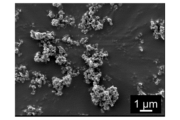
- FIG. 1 is an SEM image of the low-order titanium oxide powder of Example 1.
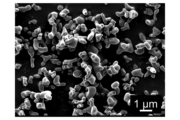
- 1 is an SEM image of the low-order titanium oxide powder of Comparative Example 2.
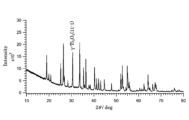
- FIG. 2 is a diagram showing the X-ray diffraction pattern of the low-order titanium oxide powder of Example 1.
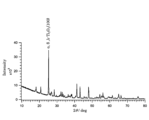
- FIG. 2 is a diagram showing the X-ray diffraction pattern of the low-order titanium oxide powder of Comparative Example 2.
- the low-order titanium oxide powder of this embodiment is a powder (particle group) containing TiO x (where X is in the range of 1.50 ⁇ X ⁇ 1.75), and is configured to include base particles containing ⁇ -Ti 3 O 5 and fine particles having a particle size smaller than the particle size of the base particles, with multiple fine particles attached to the surface of one base particle.
- ⁇ -Ti 3 O 5 has a lower L * value than any of ⁇ , ⁇ , or ⁇ -Ti 3 O 5. Therefore, it has been found that a low-order titanium oxide powder containing ⁇ -Ti 3 O 5 with excellent blackness can be obtained.
- the low-order titanium oxide powder of this embodiment can be used for various purposes, but can also be used as a black pigment (black filler) to be added to a dispersion medium such as a resin.
- the low-order titanium oxide powder is less likely to scatter into space than carbon black, a common black pigment, and therefore has excellent low dust properties.
- the low-order titanium oxide powder has a composition represented by TiO2X .
- X in TiO x is a value in the range of 1.50 ⁇ X ⁇ 1.75.
- X in TiO x is expressed as a weighted average, for example, with the mass ratio of the crystal composition contained in the low-order titanium oxide powder being used as the weight.
- TiO x means their average composition.
- the mass ratios of the crystal compositions contained in the low-order titanium oxide powder can be calculated by Rietveld analysis of the X-ray diffraction pattern of the low-order titanium oxide powder.
- Rietveld method software for example, Rigaku Corporation's integrated powder X-ray analysis software PDXL2
- the crystal structures are obtained from the crystal structure database (Pearson's Crystal Data) as follows: Ti 2 O 3 is 1243140 (Journal of Applied Physics 119, 014905(2016)), ⁇ -Ti 3 O 5 is 1127327 (Chemistry An Asian Journal 6, 1886(2011), ⁇ -Ti 3 O 5 is 1944823 (Journal of Solid State Chemistry 192, 356(2012)), ⁇ -Ti 3 O 5 is 1900755 (Journal of Solid State Chemistry 20, 29(1977)), ⁇ -Ti 3 O 5 is 1900755 (Journal of Solid State Chemistry 20, 29(1977)), and ⁇ -Ti 3 O 5 is 1900755 (Journal of Solid State Chemistry 20, 29(1977)).
- the above mass ratio (%) is calculated by using the mass ratio (%) of 1127327 (Chemistry An Asian Journal 6, 1886 (2011)
- the crystal composition of the low-order titanium oxide powder needs to contain at least ⁇ -Ti 3 O 5 , and may contain two or more selected from the group consisting of Ti 2 O 3 , ⁇ -Ti 3 O 5 , ⁇ -Ti 3 O 5 , ⁇ -Ti 3 O 5 , ⁇ -Ti 3 O 5 , and Ti 4 O 7 .
- the lower limit of the content of ⁇ -Ti 3 O 5 contained in the low-order titanium oxide powder is, for example, 10 mass % or more, preferably 20 mass % or more, and more preferably 30 mass % or more , based on a total of 100 mass % of Ti 2 O 3 , ⁇ -Ti 3 O 5 , ⁇ -Ti 3 O 5 , ⁇ -Ti 3 O 5, ⁇ -Ti 3 O 5, and Ti 4 O 7. This makes it possible to further reduce the L * value of the low-order titanium oxide powder.
- the upper limit of the content of the above-mentioned ⁇ -Ti 3 O 5 is not particularly limited, but may be, for example, 90 mass % or less, 85 mass % or less, or 80 mass % or less, relative to 100 mass % in total of Ti 2 O 3 , ⁇ -Ti 3 O 5 , ⁇ - Ti 3 O 5 , ⁇ -Ti 3 O 5 , ⁇ -Ti 3 O 5 , and Ti 4 O 7. This makes it possible to adjust the saturation, and to adjust the powder to have the desired blackness and saturation.
- the low-order titanium oxide powder may contain other low-order titanium oxides besides the above Ti2O3, Ti3O5, and Ti4O7 , for example , one or more of other low-order titanium oxides such as Ti2.5O4 , TiO, and Ti3O , as long as the effects of the present invention are not impaired.
- the total content of Na, K and P contained in the low-order titanium oxide powder is, for example, 2000 mass ppm or less, preferably 1000 mass ppm or less, more preferably 500 mass ppm or less, and further preferably 100 mass ppm or less. This improves reactivity and makes it easier to obtain a desired crystal phase.
- the total content of Pb, Cd and Cr contained in the low-order titanium oxide powder may be, for example, 200 mass ppm or less, preferably 100 mass ppm or less, more preferably 50 mass ppm or less, and further preferably 30 mass ppm or less. This improves reactivity and makes it easier to obtain a desired crystal phase.
- the content (mass conversion) of elements contained in the low-order titanium oxide powder can be calculated from the analysis results of the elemental composition obtained by ICP optical emission spectrometry using, for example, Agilent 5110 ICP-OES (manufactured by Agilent Technologies, Inc.).
- the low-order titanium oxide powder contains base particles containing ⁇ -Ti 3 O 5 as particles, and fine particles having a composition different from that of the base particles.
- the base particle may be configured to include primary particles and/or secondary particles.
- the shape of the primary particles contained in the base particle may be any of spherical, plate-like, needle-like, polygonal and irregular shapes, and one or more of these may be contained.
- the secondary particles may include aggregates formed by aggregating a plurality of primary particles, or links formed by linking a plurality of primary particles, etc.
- the fine particles in the low order titanium oxide powder may include particles that are attached to a portion of the surface of the base particle and/or particles that are not attached to the base particle.
- one or more of the microparticles attached to a portion of the surface of the base particle are present discontinuously on that portion of the surface of the base particle.
- the microparticles are scattered on the surface of the base particle.
- the microparticles do not cover the entire surface of the base particle continuously.
- the fine particles are considered to be attached to the base particles if they are simply in physical contact with each other.
- the base particles and the fine particles may or may not be chemically bonded to each other.
- the fine particles may be any particles that do not contain any metal easily substituted for Ti, and examples thereof include SiO 2 , Si 3 N 4 , B 4 C, and MgO. These may be used alone or in combination of two or more kinds. Although the detailed mechanism is unclear, it is presumed that since Si, B, or Mg are metal elements that are difficult to replace with Ti in Ti3O5 , oxides or nitrides of Si, B, or Mg adhere to the particle surfaces containing Ti3O5 during reduction and firing of TiO2 , thereby suppressing the grain growth of these particles.
- the fine particles do not contain easily-substitutable metals for Ti means that the main raw material constituting the fine particles is not easily-substitutable metals for Ti, but the fine particles may contain easily-substitutable metals for Ti that are unavoidably mixed in the raw materials and during the production process, and specifically, the total content of easily-substitutable metals for Ti in terms of oxide in the entire low-order titanium oxide powder may be defined as, for example, 3 mass% or less.
- the lower limit of the content of the Si element contained in the low-order titanium oxide powder is, for example, 0.04 mass% or more, preferably 0.5 mass% or more, and more preferably 0.7 mass% or more. This allows the L * value of the low-order titanium oxide powder to be further reduced.
- the upper limit of the content of the Si element is, for example, 20 mass % or less, preferably 15 mass % or less, and more preferably 8 mass % or less. This allows the particle size to be made small.
- the content of the B element contained in the low-order titanium oxide powder may be, for example, 0.02% by mass or more and 20% by mass or less.
- the content of the Mg element contained in the low-order titanium oxide powder may be, for example, 0.01% by mass or more and 20% by mass or less.
- the content of the element Si, B, or Mg contained in the low-order titanium oxide powder can be measured by the above-mentioned ICP emission spectroscopic analysis.
- the lower limit of the specific surface area of the low-order titanium oxide powder as measured by the BET method is, for example, 1.0 m 2 /g or more, preferably 3.0 m 2 /g or more, and more preferably 5.0 m 2 /g or more. This allows the L * value of the low-order titanium oxide powder to be further reduced.
- the upper limit of the specific surface area of the low-order titanium oxide powder as measured by the BET method is, for example, 30 m 2 /g or less, preferably 20 m 2 /g or less, and more preferably 10 m 2 /g or less. This can improve the handleability of the powder.
- a specific surface area measuring device e.g., Macsorb HM model-1201, manufactured by Mountech
- the particle size at which the cumulative value is 50% is defined as d50.
- the upper limit of d50 of the low-order titanium oxide powder is, for example, 3.0 ⁇ m or less, preferably 1.5 ⁇ m or less, and more preferably 1.0 ⁇ m or less. This allows the L * value of the low-order titanium oxide powder to be further reduced.
- the lower limit of d50 of the low-order titanium oxide powder is, for example, 0.001 ⁇ m or more, preferably 0.01 ⁇ m or more, and more preferably 0.23 ⁇ m or more. This can improve the coloring power when mixed with a medium.
- the particle size distribution of the low-order titanium oxide powder is measured by the following procedure. First, 100 mg of low-order titanium oxide powder and 50 mL of ion-exchanged water are placed in a polystyrene sample bottle (volume: 100 mL (e.g., AS ONE, PS-100)), and an ultrasonic homogenizer (e.g., Branson Ultrasonics Corporation, model: DIGITALSONIFIER450) is used to perform ultrasonic dispersion treatment for 60 seconds at an output of 10% amplitude.
- an ultrasonic homogenizer e.g., Branson Ultrasonics Corporation, model: DIGITALSONIFIER450
- a particle size distribution measuring device using a laser diffraction scattering method (e.g., Beckman Coulter, model LS 13 320) is used to measure the volume-based particle size distribution of the dispersed low-order titanium oxide powder under the following measurement conditions.
- the low-order titanium oxide powder may be configured so that the L * value in the L * a * b * color space is 15.0 or less, the a * value is 5.0 or less, and the b * value is 1.0 or less. This results in a low-order titanium oxide powder with excellent blackness.
- the upper limit of the L * value may be, for example, 15.0 or less, 14.0 or less, or 13.0 or less, preferably 12.0 or less, more preferably 11.6 or less, and even more preferably 11.2.
- the lower limit of the L * value may be, for example, 8.0 or more, 8.5 or more, or 9.0 or more.
- the upper limit of the a * value is, for example, 5.0 or less, preferably 2.0 or less, and more preferably 1.5 or less, while the lower limit of the a * value is, for example, -2.0 or more, preferably -1.5 or more, and more preferably -1.0 or more.
- the upper limit of the b * value is, for example, 1.0 or less, preferably -0.1 or less, more preferably -1.0 or less, and even more preferably -2.0 or less, while the lower limit of the b * value is, for example, -6.0 or more, preferably -5.0 or more, and more preferably -4.0 or more.
- a colorimeter e.g., ZE-2000 (manufactured by Nippon Denshoku Industries Co., Ltd.)
- the low-order titanium oxide powder of this embodiment is suitable for use as a pigment (colored filler) such as a black pigment, but the use is not limited to this.
- the pigment (colored filler) is used, for example, in cosmetics, electronic components such as semiconductors, coating materials such as paints and inks, etc.
- the low-order titanium oxide powder may be used, for example, dispersed in a dispersion medium. That is, the dispersion of this embodiment contains the low-order titanium oxide powder and a dispersion medium described above. This makes it possible to sufficiently improve the blackness of the dispersion even with the addition of a small amount.
- the dispersion medium is appropriately selected depending on the application of the dispersion, and may be, for example, water, alcohol, ketone, ester, resin, etc.
- resins include epoxy resin, silicone resin, phenol resin, melamine resin, urea resin, unsaturated polyester, fluororesin, polyimide, polyamideimide, polyetherimide, polybutylene terephthalate, polyethylene terephthalate, polyphenylene sulfide, wholly aromatic polyester, polysulfone, liquid crystal polymer, polyethersulfone, polycarbonate, maleimide-modified resin, ABS (acrylonitrile butadiene styrene) resin, AAS (acrylonitrile acrylic rubber styrene) resin, AES (acrylonitrile ethylene propylene diene rubber styrene) resin, etc.
- An example of a method for producing a low-order titanium oxide powder includes a firing step in which a mixture containing, as raw materials, TiO2 powder and fine powder not containing easily replaceable metals such as SiO2 , and TiH2 powder as a reducing agent is heated under an inert gas atmosphere.
- the firing process reduces TiO2 to produce low-order titanium oxide.
- the fine particles that do not contain metals that are easily substituted for Ti, such as SiO2 can suppress the grain growth of Ti3O5 particles contained in the low-order titanium oxide powder.
- the powder is classified into large fine powders having a particle size of more than 5 ⁇ m and not more than 100 ⁇ m, medium fine powders having a particle size of more than 0.1 ⁇ m and not more than 5 ⁇ m, and small fine powders having a particle size of 0.1 ⁇ m or less.
- the particle size is the median diameter (the particle size at which the cumulative value is 50% in the volume frequency particle size distribution measured by the laser diffraction scattering method is d50).
- the particle size and specific surface area of the raw material, reducing agent, etc. can be selected according to the particle size of the desired low-order titanium oxide powder.
- the raw material and fine powder not containing a metal easily replaceable with Ti may be selected so that the particle size of the TiO2 powder is greater than the particle size of the SiO2 powder, or the specific surface area of the TiO2 powder is less than the specific surface area of the SiO2 powder.
- the fine particles do not contain the above-mentioned Ti-substitutable metal, they can be used without being limited to SiO 2 powder.
- powder containing one or more selected from the group consisting of SiO 2 , Si 3 N 4 , B 4 C, and MgO can be used.
- the molar ratio of TiO2 to TiH2 contained in the mixture is, for example, 3.2 or more and 6.0 or less, preferably 3.5 or more and 5.5 or less, and more preferably 3.8 or more and 5.2 or less.
- the heating temperature in the firing step is, for example, 800°C or higher and 1200°C or lower, preferably 900°C or higher and 1150°C or lower, and more preferably 950°C or higher and 1100°C or lower.
- the mixture is placed in a known firing furnace such as an electric furnace, and the firing step is carried out.
- the inert gas atmosphere may contain, for example, Ar gas or He gas, and preferably contains Ar gas. Note that instead of the inert gas atmosphere, a vacuum atmosphere may be used. If necessary, a gaseous reducing agent may be introduced.
- the heating time in the calcination step may be, for example, 1 hour or more, 2 hours or more, or 4 hours or more in order to allow the reduction reaction to proceed sufficiently, and may be, for example, 24 hours or less, 18 hours or less, or 12 hours or less in order to appropriately suppress the growth of the low-order titanium oxide powder and make it easy to collect it in a powder state.
- the method for producing a low-order titanium oxide powder of the present embodiment may further include a washing step of washing the low-order titanium oxide powder obtained in the firing step.
- the washing step can remove impurities in the low-order titanium oxide powder.
- the washing is carried out with at least one selected from the group consisting of hot water, alcohol, and organic acid.
- the alcohol may be, for example, methanol, ethanol, or a mixture thereof.
- the organic acid may be, for example, acetic acid. From the viewpoint of suppressing the incorporation of ionic impurities such as halide ions into the powder of low-order titanium oxide, washing with an organic acid is preferred.
- the method for producing a low-order titanium oxide powder of this embodiment may further include a particle size adjustment step of pulverizing and classifying the low-order titanium oxide powder after the firing step, if necessary.
- the pulverization method may be a method using various pulverizers such as a mortar, a ball mill, a jet mill, or a fine mill.
- the pulverization step may be performed once or may be performed two or more times. When the pulverization step is performed two or more times, the pulverization method used in each pulverization step may be different from each other. By performing the pulverization step, the chromaticity and specific surface area of the low-order titanium oxide powder can be adjusted.
- this manufacturing method may include a firing step, a washing step, and a pulverization step in this order, or may include a firing step, a pulverization step, and a washing step in this order.
- a step of drying the low-order titanium oxide powder may be further carried out between the washing step and the pulverization step.
- the drying temperature in the drying step may be, for example, 100°C or higher and 200°C or lower.
- the drying time may be, for example, 10 hours or higher and 20 hours or lower.
- Eirich mixer Nippon Eirich Co., Ltd.
- the obtained mixture was transferred to an alumina crucible and heated in an electric furnace (Fuji Denpa Kogyo Co., Ltd., Hi-Multi 10000) under an Ar atmosphere at a temperature increased from room temperature at a rate of 10°C/min to 1100°C (calcination temperature) for 12 hours (calcination time). After heating, the obtained powder was pulverized in a mortar for 5 minutes to obtain a low-order titanium oxide powder.
- an electric furnace Fluji Denpa Kogyo Co., Ltd., Hi-Multi 10000
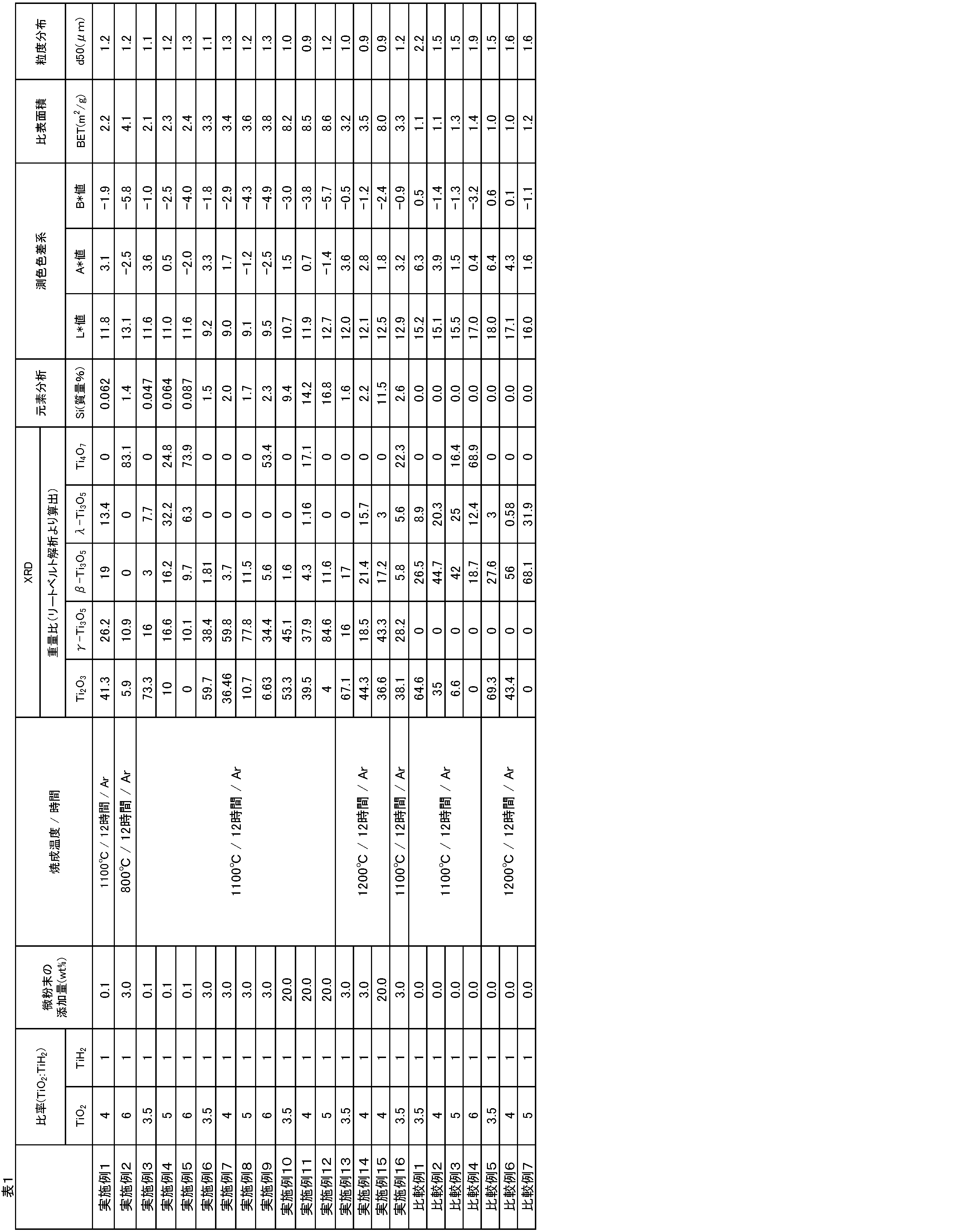
- Example 2 to 16 A low-order titanium oxide powder was obtained in the same manner as in Example 1, except that the molar ratio of TiO2 : TiH2 , the proportion (wt%) of fine powder added to the mixture of TiO2 and TiH2 , the firing temperature, and the firing time were changed to the values shown in Table 1.
- Himulti 5000 was used in the electric furnace instead of Himulti 10000.
- the obtained low-order titanium oxide powder was subjected to powder X-ray diffraction measurement. Specifically, the X-ray diffraction pattern was measured under the following measurement conditions using a horizontal sample type multipurpose X-ray diffractometer (Rigaku Corporation, RINT-Ultima IV). The obtained X-ray diffraction patterns confirmed that each low-order titanium oxide powder had the crystal composition shown in Table 1.
- the results of the X-ray diffraction patterns showed that the low-order titanium oxide powders of Examples 1 to 16 contained a peak corresponding to ⁇ -Ti 3 O 5 (a peak with a diffraction angle 2 ⁇ in the range of 30.0° to 31.0°), but the low-order titanium oxide powders of Comparative Examples 1 to 7 did not contain a peak corresponding to ⁇ -Ti 3 O 5 .
- the X-ray diffraction patterns of Example 1 and Comparative Example 2 are shown in FIG. 3 and FIG. 4, respectively.
- the mass fraction (mass%) of each crystal composition in the obtained low-order titanium oxide powder was calculated using Rietveld method software (Rigaku Corporation, integrated powder X-ray analysis software PDXL2).
- the crystal structure is given in the crystal structure database (Pearson's Crystal Data) as 1243140 for Ti 2 O 3 (Journal of Applied Physics 119, 014905(2016)), 1127327 for ⁇ -Ti 3 O 5 (Chemistry An Asian Journal 6, 1886(2011)), 1944823 for ⁇ -Ti 3 O 5 (Journal of Solid State Chemistry 192, 356(2012)), 1900755 for ⁇ -Ti 3 O 5 (Journal of Solid State Chemistry 20, 29(1977)), and 1127327 for ⁇ -Ti 3 O 5 (Chemistry An Asian Journal 6, 1886 (2011) was used.
- Table 1 ⁇ -Ti 3 O 5 was not confirmed in each of the examples and comparative examples.
- the particle size distribution of the obtained low-order titanium oxide powder was measured by the following procedure.
- the measurement results of the particle diameter (d50) at which the cumulative value becomes 50% are shown in Table 1.
- 100 mg of low-order titanium oxide powder and 50 mL of ion-exchanged water are placed in a polystyrene sample bottle (volume: 100 mL (e.g., AS ONE, PS-100)), and an ultrasonic homogenizer (e.g., Branson Ultrasonics Corporation, model: DIGITALSONIFIER450) is used to perform ultrasonic dispersion treatment for 60 seconds at an output of 10% amplitude.
- an ultrasonic homogenizer e.g., Branson Ultrasonics Corporation, model: DIGITALSONIFIER450
- a particle size distribution measuring device using a laser diffraction scattering method (e.g., Beckman Coulter, model LS 13 320) was used to measure the volumetric particle size distribution of the dispersed low-order titanium oxide powder under the following measurement conditions.
- the obtained low-order titanium oxide powder was subjected to elemental analysis using an Agilent 5110 ICP-OES (manufactured by Agilent Technologies, Inc.). Specifically, 0.1 g of the powder was weighed into a platinum crucible, 1 ml each of HF and HCl was added, and pressure acid decomposition was carried out at 150°C for 4 hours. Thereafter, the volume was adjusted to 6 ml, and after confirming that there was no unnecessary residue, ICP emission spectrometry was carried out. The results are shown in Table 1.
- the low-order titanium oxide powders in each of Examples 1 to 16 had a lower L * value in the L * a * b * color space than Comparative Examples 1 to 7, and therefore showed excellent blackness.
Landscapes
- Chemical & Material Sciences (AREA)
- Organic Chemistry (AREA)
- Life Sciences & Earth Sciences (AREA)
- Environmental & Geological Engineering (AREA)
- General Life Sciences & Earth Sciences (AREA)
- Geology (AREA)
- Inorganic Chemistry (AREA)
- Inorganic Compounds Of Heavy Metals (AREA)
Abstract
Description
例えば、特許文献1には、二酸化チタン(白色酸化チタン)を水素ガス、アンモニアガスなどの還元雰囲気で600℃以上に加熱還元することにより黒色の低次酸化チタンとし、この焼結体を機械的に粉砕して黒色酸化チタン粉末を得る方法が記載されている(特許文献1の段落0002等)。
また、特許文献2の段落0057には、還元度がより大きな酸化チタン(例えば、Ti3O5、Ti4O7など)は、一般に、色味が黒色であることが記載されている。
TiO2を還元剤と約1000℃以上の高温で焼成すると、α相やλ相という高温安定相が形成され、α-Ti3O5やλ-Ti3O5が得られ、その後約200℃以下まで降温する、もしくは室温で押すや擦るといった機械的刺激により、α相もしくはλ相の一部がβ相という低温相に相転移することで、β-Ti3O5が得られるが、これらのTi3O5のいずれも、L*値を十分に低く出来なかった。
1. TiOX(式中のXは1.50≦X≦1.75の範囲である)を含む低次酸化チタン粉末であって、
γ-Ti3O5を含むベース粒子と、
前記ベース粒子よりも粒径が小さい微粒子と、を含み、
一つの前記ベース粒子の表面に、複数の前記微粒子が付着している、低次酸化チタン粉末。
2. 1.に記載の低次酸化チタン粉末であって、
前記微粒子が、SiO2、Si3N4、B4C、およびMgOからなる群から選ばれる一または二以上を含む、低次酸化チタン粉末。
3. 1.または2.に記載の低次酸化チタン粉末であって、
当該低次酸化チタン粉末に含まれるγ-Ti3O5の含有量が、Ti2O3、α-Ti3O5、β-Ti3O5、γ-Ti3O5、λ-Ti3O5およびTi4O7の合計100質量%中、10質量%以上である、低次酸化チタン粉末。
4. 1.~3.のいずれか一つに記載の低次酸化チタン粉末であって、
L*a*b*色空間において、L*値が15.0以下であり、a*値が5.0以下であり、b*値が1.0以下である、低次酸化チタン粉末。
5. 1.~4.のいずれか一つに記載の低次酸化チタン粉末であって、
BET法による比表面積が、1.0m2/g以上30m2/g以下である、低次酸化チタン粉末。
6. 1.~5.のいずれか一つに記載の低次酸化チタン粉末であって、
ICP発光分光分析により測定される、当該低次酸化チタン粉末中に含まれるSi元素の含有量が、0.04質量%以上20質量%以下である、低次酸化チタン粉末。
7. 1.~6.のいずれか一つに記載の低次酸化チタン粉末であって、
レーザー回折散乱法で測定される当該低次酸化チタン粉末の体積頻度粒度分布において、累積値が50%となる粒子径をd50としたとき、d50が0.001μm以上3.0μm以下である、低次酸化チタン粉末。
低次酸化チタン粉末がTi2O3、γ-Ti3O5、およびTi4O7からなる群から選ばれる二つ以上を含む場合、TiOxは、これらの平均組成を意味する。
具体的には、リートベルト法ソフトウェア(例えば、リガク社製、統合粉末X線解析ソフトウェアPDXL2)を使用し、結晶構造は、結晶構造データベース(Pearson's Crystal Data)より、Ti2O3として1243140(Journal of Applied Physics 119, 014905(2016))、α-Ti3O5として1127327(Chemistry An Asian Journal 6, 1886(2011)、β-Ti3O5として1944823(Journal of Solid State Chemistry 192, 356(2012))、γ-Ti3O5として1900755(Journal of Solid State Chemistry 20, 29(1977))、λ-Ti3O5として1127327(Chemistry An Asian Journal 6, 1886(2011)を使用することにより、上記質量比(%)が算出される。
一方、上記γ-Ti3O5の含有量の上限は、とくに限定されないが、Ti2O3、α-Ti3O5、β-Ti3O5、γ-Ti3O5、λ-Ti3O5、およびTi4O7の合計100質量%中、例えば、90質量%以下でもよく、85質量%以下でもよく、80質量%以下でもよい。これにより、彩度を調整することが出来、好みの黒色度と彩度を持つ粉末に調整することができる。
また、低次酸化チタン粉末に含まれるPb、Cd及びCrの含有量の合計は、例えば、200質量ppm以下、好ましくは100質量ppm以下、より好ましくは50質量ppm以下、さらに好ましくは30質量ppm以下であってよい。これにより、反応性が向上し、望みの結晶相が得られやすくなる。
低次酸化チタン粉末に含まれる元素の含有量(質量換算)は、例えばAgilent5110ICP-OES(アジレントテクノロジー株式会社製)を使用し、ICP発光分光分析法により得られた元素組成の分析結果から算出できる。
ベース粒子に含まれる一次粒子の形状は、球状、板状、針状、多角形状、不定形状のいずれでもよく、これらが1又は2以上含まれていてもよい。
二次粒子は、複数の一次粒子が凝集した凝集体、複数の一次粒子が連結した連結体等を含んでもよい。
また、ベース粒子の表面の一部に付着した微粒子の1個または2個以上は、ベース粒子の表面の一部に、非連続的に存在している。別の言い方として、微粒子は、ベース粒子の表面に散在している。微粒子は、ベース粒子の表面の全部を連続的に覆っているわけではない。
本実施形態においては、ベース粒子と微粒子とが、単に物理的に触れていれば、ベース粒子に微粒子が付着しているものとする。ベース粒子と微粒子とは、化学結合していてもよいし、化学結合していなくてもよい。
詳細なメカニズムは定かではないが、Si、B、またはMgはTi3O5中のTiと置換し難い金属元素のため、Si、B、またはMgの酸化物や窒化物は、TiO2の還元焼成中、Ti3O5を含む粒子表面に付着し、この粒子の粒成長を抑制できると推察される。
本明細書中、微粒子がTi置換容易性金属を含まないとは、微粒子を構成する主原料がTi置換容易性金属ではないことを意味し、原料及び製造過程で不可避的に混入してしまうTi置換容易性金属は含んでも良く、具体的には低次酸化チタン粉末全体で、酸化物換算におけるTi置換容易性金属の合計含有量が例えば3質量%以下と定義してもよい。
一方、上記Si元素の含有量の上限は、例えば、20質量%以下、好ましくは15質量%以下、より好ましくは8質量%以下である。これにより、小粒径化できる。
また、微粒子がB4Cを含む場合、低次酸化チタン粉末に含まれるB元素の含有量は、例えば、0.02質量%以上20質量%以下を満たしてもよい。微粒子がMgOを含む場合、低次酸化チタン粉末に含まれるMg元素の含有量は、例えば、0.01質量%以上20質量%以下を満たしてもよい。
なお、低次酸化チタン粉末に含まれるSi、B、またはMg元素の含有量は、上述のICP発光分光分析により測定できる。
一方、低次酸化チタン粉末のBET法による比表面積の上限は、例えば、30m2/g以下、好ましくは20m2/g以下、より好ましくは10m2/g以下である。これにより、粉末の操作性を向上できる。
低次酸化チタン粉末のd50の上限は、例えば、3.0μm以下、好ましくは1.5μm以下、より好ましくは1.0μm以下である。これにより、低次酸化チタン粉末のL*値を一層低減できる。
一方、低次酸化チタン粉末のd50の下限は、例えば、0.001μm以上、好ましくは0.01μm以上、より好ましくは0.23μm以上である。これにより、媒体に混合した時の着色力を向上させられる。
まず、低次酸化チタン粉末100mgとイオン交換水50mLとを、ポリスチレン製のサンプル菅瓶(容量:100mL(例えば、アズワン社、PS-100))に入れ、超音波ホモジナイザー(例えば、Branson Ultrasonics Corporation、モデル:DIGITALSONIFIER450)を使用し、Amplitude:10%の出力にて、60秒間の超音波分散処理を施す。続いて、超音波分散処理が終了してから30秒以内に、レーザー回折散乱法による粒度分布測定装置(例えば、Beckman Coulter社、型式LS 13 320)を用いて、以下の測定条件にて、分散された低次酸化チタンの粉末の体積基準の粒度分布を測定する。
(測定条件)
分散媒:水
屈折率:2.71
測定間隔:log(d2/d1)=0.04となる間隔
上記L*値の上限は、例えば15.0以下、14.0以下、13.0以下でもよく、好ましくは12.0以下、より好ましくは11.6以下、さらに好ましくは11.2であり。一方、上記L*値の下限は、例えば8.0以上、8.5以上、又は9.0以上であってもよい。
また、上記a*値の上限は、例えば5.0以下、好ましくは2.0以下、より好ましくは1.5以下である。一方、上記a*値の下限は、例えば-2.0以上、好ましくは-1.5以上、より好ましくは-1.0以上である。
また、上記b*値の上限は、例えば1.0以下、好ましくは-0.1以下、より好ましくは-1.0以下、さらに好ましくは-2.0以下である。一方、上記b*値の下限は、例えば-6.0以上、好ましくは-5.0以上、より好ましくは-4.0以上である。
焼成工程により、TiO2が還元され、低次酸化チタンが生成する。また、SiO2等のTi置換容易性金属を含まない微粒子により、低次酸化チタン粉末に粒子の含まれるTi3O5の粒成長を抑制できる。
所望の低次酸化チタン粉末の粒径に応じて、原料や還元剤等の粒径や比表面積を選択できる。例えば、TiO2の粉体の粒径>SiO2の粉体の粒径、あるいは、TiO2の粉体の比表面積<SiO2の粉体の比表面積となるように、原料とTi置換容易性金属を含まない微粉体とを選択してもよい。
洗浄は、例えば、熱水、アルコール及び有機酸からなる群より選ばれる少なくとも一種によって行われる。アルコールは、例えば、メタノール、エタノール、又はこれらの混合物であってよい。有機酸は、例えば酢酸であってよい。ハロゲン化物イオンなどのイオン性不純物の低次酸化チタンの粉末への混入を抑制できる観点から、有機酸で洗浄することが好ましい。
粉砕方法は、乳鉢、ボールミル、ジェットミル、ファインミルなどの各種粉砕機を用いた方法が挙げられる。粉砕工程は、一回行われてよく、二回以上行われてもよい。粉砕工程が二回以上行われる場合、各粉砕工程で用いられる粉砕方法は、互いに異なっていてよい。粉砕工程を行うことにより、低次酸化チタン粉末の色度及び比表面積を調整することができる。
[実施例1]
TiO2の粉末(東邦チタニウム社品、HT0514、TiO2純度99.9%、平均粒径約0.7μm、比表面積6~7m2/g)、TiH2の粉末(トーホーテック社品、TCH450、Ti純度99.8%、平均粒径~45μm)、SiO2の微粉末(日本アエロジル社製、AEROSIL NX90G、SiO2純度99.0%、比表面積50~80m2/g)を、TiO2:TiH2=4:1(モル比)の混合物に0.1wt%となるように、アイリッヒミキサー(日本アイリッヒ株式会社製)を用いて混合し、混合物を得た。
得られた混合物をアルミナ坩堝に移し、電気炉(富士電波工業株式会社、ハイマルチ10000)中で、Ar雰囲気下、室温から10℃/分で昇温させ、1100℃(焼成温度)で12時間(焼成時間)の条件にて加熱した。
加熱後、得られた粉末を乳鉢で5分間粉砕することで、低次酸化チタン粉末を得た。
TiO2:TiH2のモル比率、TiO2およびTiH2の混合物に対する微粉末の添加割合(重量%)、焼成温度、および焼成時間を、表1に記載の値に変更した以外、実施例1と同様にして、低次酸化チタン粉末を得た。
ただし、実施例16では、SiO2微粉末に代えて、Si3N4微粉末(H.C.Starck社製、α相:β相=13:87)を使用し、ハイマルチ10000に代えてハイマルチ5000を電気炉に使用した。
SiO2微粉末を添加しないで、表1の焼成条件を採用した以外は、実施例1と同様にして、低次酸化チタン粉末を得た。
得られた低次酸化チタン粉末について、粉末X線回折測定を行った。具体的には、試料水平型多目的X線回折装置(リガク社製、RINT-UltimaIV)を用い、下記の測定条件でX線回折パターンを測定した。
得られたX線回折パターンにより、各低次酸化チタン粉末が、表1に示す結晶組成を有することが確認された。X線回折パターンの結果から、実施例1~16の低次酸化チタン粉末は、γ-Ti3O5に対応するピーク(回折角2θが30.0°以上31.0°以下の範囲内にあるピーク)を含むが、比較例1~7の低次酸化チタン粉末は、γ-Ti3O5に対応するピークを含まないことが分かった。
一例として、実施例1、比較例2のX線回折パターンを、それぞれ図3,図4に示す。
(測定条件)
X線源:Cu-Kα線(λ=1.54184Å)
管電圧:40kV、管電流:40mA
測定時の光学条件:発散スリット=2/3°
散乱スリット:8mm
受光スリット=0.15mm
回折ピークの位置=2θ(回折角)
スキャン速度:4.0°(2θ)/min、連続スキャン
測定範囲:2θ=10°~80°
なお、表1中、各実施例および各比較例において、α-Ti3O5は確認されなかった。
得られた低次酸化チタン粉末について、走査型電子顕微鏡を用いて観察し、SEM画像を取得した。
実施例1~16では、一つのベース粒子表面において、ベース粒子の粒径よりも小さい粒径を有する微粒子の複数が付着していることを確認した。一方、比較例1~7では、一つのベース粒子表面において微粒子が付着していないことが確認された。
一例として、実施例1、比較例2のSEM画像を、それぞれ図1,図2に示す。
得られた低次酸化チタン粉末について、比表面積測定器(Macsorb HM model-1201、Mountech社製)を用いて比表面積を測定した。脱気は、窒素ガスフロー(大気圧)により200℃で10分間行った。測定条件は、窒素ガス吸着で平衡相対圧約0.3により、n=2の条件とした。結果を表1に示す。
得られた低次酸化チタン粉末の粒度分布測定は、以下の手順で実施し、累積値が50%となる粒子径(d50)の測定結果を表1に示す。
まず、低次酸化チタン粉末100mgとイオン交換水50mLとを、ポリスチレン製のサンプル菅瓶(容量:100mL(例えば、アズワン社、PS-100))に入れ、超音波ホモジナイザー(例えば、Branson Ultrasonics Corporation、モデル:DIGITALSONIFIER450)を使用し、Amplitude:10%の出力にて、60秒間の超音波分散処理を施す。続いて、超音波分散処理が終了してから30秒以内に、レーザー回折散乱法による粒度分布測定装置(例えば、Beckman Coulter社、型式LS 13 320)を用いて、以下の測定条件にて、分散された低次酸化チタンの粉末の体積基準の粒度分布を測定した。
(測定条件)
分散媒:水
屈折率:2.71
測定間隔:log(d2/d1)=0.04となる間隔
得られた低次酸化チタン粉末について、Agilent5110ICP-OES(アジレントテクノロジー株式会社製)を用いて元素分析を行った。具体的には、粉末0.1gを白金坩堝に秤取り、HF及びHClをそれぞれ1ml添加し、150℃、4時間の条件で加圧酸分解を行った。その後、6mlに定容し、不要残渣が無いことを確認後、ICP発光分光分析を行った。結果を表1に示す。
得られた低次酸化チタン粉末について、測色色差計ZE-2000(日本電色工業株式会社製)を用いて色度(L*a*b*色空間におけるL*値、a*値及びb*値)を測定した。より具体的には、まず、暗視野用の円筒で零点補正をした後、標準白色板(X=91.71、Y=93.56、Z=110.52)で標準合わせを行った。次いで、35φ×15Hの丸セルに約3gの粉末を入れて、色度を測定した。結果を表1に示す。
Claims (7)
- TiOX(式中のXは1.50≦X≦1.75の範囲である)を含む低次酸化チタン粉末であって、
γ-Ti3O5を含むベース粒子と、
前記ベース粒子よりも粒径が小さい微粒子と、を含み、
一つの前記ベース粒子の表面に、複数の前記微粒子が付着している、低次酸化チタン粉末。 - 請求項1に記載の低次酸化チタン粉末であって、
前記微粒子が、SiO2、Si3N4、B4C、およびMgOからなる群から選ばれる一または二以上を含む、低次酸化チタン粉末。 - 請求項1または2に記載の低次酸化チタン粉末であって、
当該低次酸化チタン粉末に含まれるγ-Ti3O5の含有量が、Ti2O3、α-Ti3O5、β-Ti3O5、γ-Ti3O5、λ-Ti3O5およびTi4O7の合計100質量%中、10質量%以上である、低次酸化チタン粉末。 - 請求項1または2に記載の低次酸化チタン粉末であって、
L*a*b*色空間において、L*値が15.0以下であり、a*値が5.0以下であり、b*値が1.0以下である、低次酸化チタン粉末。 - 請求項1または2に記載の低次酸化チタン粉末であって、
BET法による比表面積が、1.0m2/g以上30m2/g以下である、低次酸化チタン粉末。 - 請求項1または2に記載の低次酸化チタン粉末であって、
ICP発光分光分析により測定される、当該低次酸化チタン粉末中に含まれるSi元素の含有量が、0.04質量%以上20質量%以下である、低次酸化チタン粉末。 - 請求項1または2に記載の低次酸化チタン粉末であって、
レーザー回折散乱法で測定される当該低次酸化チタン粉末の体積頻度粒度分布において、累積値が50%となる粒子径をd50としたとき、d50が0.001μm以上3.0μm以下である、低次酸化チタン粉末。
Priority Applications (3)
| Application Number | Priority Date | Filing Date | Title |
|---|---|---|---|
| CN202480011559.6A CN120677127A (zh) | 2023-02-10 | 2024-01-31 | 低价氧化钛粉末 |
| JP2024576266A JPWO2024166757A1 (ja) | 2023-02-10 | 2024-01-31 | |
| KR1020257027474A KR20250135864A (ko) | 2023-02-10 | 2024-01-31 | 저차 산화 타이타늄 분말 |
Applications Claiming Priority (2)
| Application Number | Priority Date | Filing Date | Title |
|---|---|---|---|
| JP2023-019372 | 2023-02-10 | ||
| JP2023019372 | 2023-02-10 |
Publications (1)
| Publication Number | Publication Date |
|---|---|
| WO2024166757A1 true WO2024166757A1 (ja) | 2024-08-15 |
Family
ID=92262473
Family Applications (1)
| Application Number | Title | Priority Date | Filing Date |
|---|---|---|---|
| PCT/JP2024/002994 Ceased WO2024166757A1 (ja) | 2023-02-10 | 2024-01-31 | 低次酸化チタン粉末 |
Country Status (5)
| Country | Link |
|---|---|
| JP (1) | JPWO2024166757A1 (ja) |
| KR (1) | KR20250135864A (ja) |
| CN (1) | CN120677127A (ja) |
| TW (1) | TW202440467A (ja) |
| WO (1) | WO2024166757A1 (ja) |
Citations (3)
| Publication number | Priority date | Publication date | Assignee | Title |
|---|---|---|---|---|
| WO2022039111A1 (ja) * | 2020-08-21 | 2022-02-24 | デンカ株式会社 | 特定の低次酸化チタンの結晶組成を有する粒子、並びにその製造方法 |
| WO2022158390A1 (ja) * | 2021-01-25 | 2022-07-28 | デンカ株式会社 | 特定の低次酸化チタンの結晶組成を有する粒子及びその製造方法、並びに分散体 |
| WO2023276761A1 (ja) * | 2021-07-01 | 2023-01-05 | デンカ株式会社 | 粉体及び分散体 |
Family Cites Families (2)
| Publication number | Priority date | Publication date | Assignee | Title |
|---|---|---|---|---|
| JP3470591B2 (ja) | 1998-04-08 | 2003-11-25 | 三菱マテリアル株式会社 | 低抵抗黒色酸化チタンの製造方法 |
| JP6879066B2 (ja) | 2017-06-14 | 2021-06-02 | コニカミノルタ株式会社 | 中間転写体、その製造方法および画像形成装置 |
-
2024
- 2024-01-31 CN CN202480011559.6A patent/CN120677127A/zh active Pending
- 2024-01-31 KR KR1020257027474A patent/KR20250135864A/ko active Pending
- 2024-01-31 JP JP2024576266A patent/JPWO2024166757A1/ja active Pending
- 2024-01-31 WO PCT/JP2024/002994 patent/WO2024166757A1/ja not_active Ceased
- 2024-02-07 TW TW113104844A patent/TW202440467A/zh unknown
Patent Citations (3)
| Publication number | Priority date | Publication date | Assignee | Title |
|---|---|---|---|---|
| WO2022039111A1 (ja) * | 2020-08-21 | 2022-02-24 | デンカ株式会社 | 特定の低次酸化チタンの結晶組成を有する粒子、並びにその製造方法 |
| WO2022158390A1 (ja) * | 2021-01-25 | 2022-07-28 | デンカ株式会社 | 特定の低次酸化チタンの結晶組成を有する粒子及びその製造方法、並びに分散体 |
| WO2023276761A1 (ja) * | 2021-07-01 | 2023-01-05 | デンカ株式会社 | 粉体及び分散体 |
Also Published As
| Publication number | Publication date |
|---|---|
| JPWO2024166757A1 (ja) | 2024-08-15 |
| TW202440467A (zh) | 2024-10-16 |
| CN120677127A (zh) | 2025-09-19 |
| KR20250135864A (ko) | 2025-09-15 |
Similar Documents
| Publication | Publication Date | Title |
|---|---|---|
| EP3521242B1 (en) | Zirconium nitride powder and method for producing same | |
| JP7634015B2 (ja) | 特定の低次酸化チタンの結晶組成を有する粒子、並びにその製造方法 | |
| EP3636591B1 (en) | Zirconium nitride powder and production method therefor | |
| EP3546426B1 (en) | Black-film-forming mixed powder and production method therefor | |
| EP4282825A1 (en) | Particles having specific low-order titanium oxide crystal composition, method for producing same, and dispersion | |
| WO2012057053A1 (ja) | インジウム錫酸化物粉末、その製造方法、分散液、塗料、及び機能性薄膜 | |
| JP2007522062A (ja) | 火炎加水分解により製造され、広い表面積を有する酸化アルミニウム粉末 | |
| JP7682271B2 (ja) | 粉体及び分散体 | |
| WO2023032986A1 (ja) | 電子材料用シリカ及びその製造方法 | |
| JP2019104651A (ja) | 窒化ジルコニウム系黒色フィラー及びその製造方法、そのフィラーを含有する塗料組成物及びその塗膜 | |
| KR100818469B1 (ko) | 복합 흑색 산화물 입자, 그 제조방법, 흑색 도료 및 블랙매트릭스 | |
| WO2024166758A1 (ja) | 低次酸化チタン粉末 | |
| WO2024166756A1 (ja) | 低次酸化チタン粉末 | |
| JP5829386B2 (ja) | 結晶性の高い微細なito粉末とその用途および製造方法等 | |
| TW202440467A (zh) | 低氧化鈦粉末 | |
| KR20240012486A (ko) | 무기 산화물 분말 및 그 제조 방법, 그리고 수지 조성물 | |
| WO2018088163A1 (ja) | 酸化スズ粒子及びその製造方法 | |
| CN1863735A (zh) | 复合黑色氧化物粒子、其制造方法、黑色涂料及黑色矩阵 | |
| WO2025182878A1 (ja) | 球状シリカ粒子粉体及び球状シリカ粒子粉体の製造方法 |
Legal Events
| Date | Code | Title | Description |
|---|---|---|---|
| 121 | Ep: the epo has been informed by wipo that ep was designated in this application |
Ref document number: 24753201 Country of ref document: EP Kind code of ref document: A1 |
|
| ENP | Entry into the national phase |
Ref document number: 2024576266 Country of ref document: JP Kind code of ref document: A |
|
| WWE | Wipo information: entry into national phase |
Ref document number: 2024576266 Country of ref document: JP |
|
| WWE | Wipo information: entry into national phase |
Ref document number: 202480011559.6 Country of ref document: CN |
|
| WWE | Wipo information: entry into national phase |
Ref document number: 1020257027474 Country of ref document: KR |
|
| NENP | Non-entry into the national phase |
Ref country code: DE |
|
| WWP | Wipo information: published in national office |
Ref document number: 202480011559.6 Country of ref document: CN |
|
| 122 | Ep: pct application non-entry in european phase |
Ref document number: 24753201 Country of ref document: EP Kind code of ref document: A1 |