WO2024162067A1 - 化合物、薄膜形成用原料、薄膜及び薄膜の製造方法 - Google Patents
化合物、薄膜形成用原料、薄膜及び薄膜の製造方法 Download PDFInfo
- Publication number
- WO2024162067A1 WO2024162067A1 PCT/JP2024/001654 JP2024001654W WO2024162067A1 WO 2024162067 A1 WO2024162067 A1 WO 2024162067A1 JP 2024001654 W JP2024001654 W JP 2024001654W WO 2024162067 A1 WO2024162067 A1 WO 2024162067A1
- Authority
- WO
- WIPO (PCT)
- Prior art keywords
- thin film
- raw material
- compound
- group
- lanthanum
- Prior art date
- Legal status (The legal status is an assumption and is not a legal conclusion. Google has not performed a legal analysis and makes no representation as to the accuracy of the status listed.)
- Ceased
Links
Images



Classifications
-
- C—CHEMISTRY; METALLURGY
- C07—ORGANIC CHEMISTRY
- C07F—ACYCLIC, CARBOCYCLIC OR HETEROCYCLIC COMPOUNDS CONTAINING ELEMENTS OTHER THAN CARBON, HYDROGEN, HALOGEN, OXYGEN, NITROGEN, SULFUR, SELENIUM OR TELLURIUM
- C07F5/00—Compounds containing elements of Groups 3 or 13 of the Periodic Table
- C07F5/003—Compounds containing elements of Groups 3 or 13 of the Periodic Table without C-Metal linkages
-
- C—CHEMISTRY; METALLURGY
- C07—ORGANIC CHEMISTRY
- C07C—ACYCLIC OR CARBOCYCLIC COMPOUNDS
- C07C257/00—Compounds containing carboxyl groups, the doubly-bound oxygen atom of a carboxyl group being replaced by a doubly-bound nitrogen atom, this nitrogen atom not being further bound to an oxygen atom, e.g. imino-ethers, amidines
- C07C257/10—Compounds containing carboxyl groups, the doubly-bound oxygen atom of a carboxyl group being replaced by a doubly-bound nitrogen atom, this nitrogen atom not being further bound to an oxygen atom, e.g. imino-ethers, amidines with replacement of the other oxygen atom of the carboxyl group by nitrogen atoms, e.g. amidines
- C07C257/12—Compounds containing carboxyl groups, the doubly-bound oxygen atom of a carboxyl group being replaced by a doubly-bound nitrogen atom, this nitrogen atom not being further bound to an oxygen atom, e.g. imino-ethers, amidines with replacement of the other oxygen atom of the carboxyl group by nitrogen atoms, e.g. amidines having carbon atoms of amidino groups bound to hydrogen atoms
-
- C—CHEMISTRY; METALLURGY
- C23—COATING METALLIC MATERIAL; COATING MATERIAL WITH METALLIC MATERIAL; CHEMICAL SURFACE TREATMENT; DIFFUSION TREATMENT OF METALLIC MATERIAL; COATING BY VACUUM EVAPORATION, BY SPUTTERING, BY ION IMPLANTATION OR BY CHEMICAL VAPOUR DEPOSITION, IN GENERAL; INHIBITING CORROSION OF METALLIC MATERIAL OR INCRUSTATION IN GENERAL
- C23C—COATING METALLIC MATERIAL; COATING MATERIAL WITH METALLIC MATERIAL; SURFACE TREATMENT OF METALLIC MATERIAL BY DIFFUSION INTO THE SURFACE, BY CHEMICAL CONVERSION OR SUBSTITUTION; COATING BY VACUUM EVAPORATION, BY SPUTTERING, BY ION IMPLANTATION OR BY CHEMICAL VAPOUR DEPOSITION, IN GENERAL
- C23C16/00—Chemical coating by decomposition of gaseous compounds, without leaving reaction products of surface material in the coating, i.e. chemical vapour deposition [CVD] processes
- C23C16/06—Chemical coating by decomposition of gaseous compounds, without leaving reaction products of surface material in the coating, i.e. chemical vapour deposition [CVD] processes characterised by the deposition of metallic material
- C23C16/18—Chemical coating by decomposition of gaseous compounds, without leaving reaction products of surface material in the coating, i.e. chemical vapour deposition [CVD] processes characterised by the deposition of metallic material from metallo-organic compounds
-
- C—CHEMISTRY; METALLURGY
- C07—ORGANIC CHEMISTRY
- C07F—ACYCLIC, CARBOCYCLIC OR HETEROCYCLIC COMPOUNDS CONTAINING ELEMENTS OTHER THAN CARBON, HYDROGEN, HALOGEN, OXYGEN, NITROGEN, SULFUR, SELENIUM OR TELLURIUM
- C07F5/00—Compounds containing elements of Groups 3 or 13 of the Periodic Table
-
- C—CHEMISTRY; METALLURGY
- C23—COATING METALLIC MATERIAL; COATING MATERIAL WITH METALLIC MATERIAL; CHEMICAL SURFACE TREATMENT; DIFFUSION TREATMENT OF METALLIC MATERIAL; COATING BY VACUUM EVAPORATION, BY SPUTTERING, BY ION IMPLANTATION OR BY CHEMICAL VAPOUR DEPOSITION, IN GENERAL; INHIBITING CORROSION OF METALLIC MATERIAL OR INCRUSTATION IN GENERAL
- C23C—COATING METALLIC MATERIAL; COATING MATERIAL WITH METALLIC MATERIAL; SURFACE TREATMENT OF METALLIC MATERIAL BY DIFFUSION INTO THE SURFACE, BY CHEMICAL CONVERSION OR SUBSTITUTION; COATING BY VACUUM EVAPORATION, BY SPUTTERING, BY ION IMPLANTATION OR BY CHEMICAL VAPOUR DEPOSITION, IN GENERAL
- C23C16/00—Chemical coating by decomposition of gaseous compounds, without leaving reaction products of surface material in the coating, i.e. chemical vapour deposition [CVD] processes
- C23C16/06—Chemical coating by decomposition of gaseous compounds, without leaving reaction products of surface material in the coating, i.e. chemical vapour deposition [CVD] processes characterised by the deposition of metallic material
-
- C—CHEMISTRY; METALLURGY
- C23—COATING METALLIC MATERIAL; COATING MATERIAL WITH METALLIC MATERIAL; CHEMICAL SURFACE TREATMENT; DIFFUSION TREATMENT OF METALLIC MATERIAL; COATING BY VACUUM EVAPORATION, BY SPUTTERING, BY ION IMPLANTATION OR BY CHEMICAL VAPOUR DEPOSITION, IN GENERAL; INHIBITING CORROSION OF METALLIC MATERIAL OR INCRUSTATION IN GENERAL
- C23C—COATING METALLIC MATERIAL; COATING MATERIAL WITH METALLIC MATERIAL; SURFACE TREATMENT OF METALLIC MATERIAL BY DIFFUSION INTO THE SURFACE, BY CHEMICAL CONVERSION OR SUBSTITUTION; COATING BY VACUUM EVAPORATION, BY SPUTTERING, BY ION IMPLANTATION OR BY CHEMICAL VAPOUR DEPOSITION, IN GENERAL
- C23C16/00—Chemical coating by decomposition of gaseous compounds, without leaving reaction products of surface material in the coating, i.e. chemical vapour deposition [CVD] processes
- C23C16/22—Chemical coating by decomposition of gaseous compounds, without leaving reaction products of surface material in the coating, i.e. chemical vapour deposition [CVD] processes characterised by the deposition of inorganic material, other than metallic material
- C23C16/30—Deposition of compounds, mixtures or solid solutions, e.g. borides, carbides, nitrides
- C23C16/34—Nitrides
-
- C—CHEMISTRY; METALLURGY
- C23—COATING METALLIC MATERIAL; COATING MATERIAL WITH METALLIC MATERIAL; CHEMICAL SURFACE TREATMENT; DIFFUSION TREATMENT OF METALLIC MATERIAL; COATING BY VACUUM EVAPORATION, BY SPUTTERING, BY ION IMPLANTATION OR BY CHEMICAL VAPOUR DEPOSITION, IN GENERAL; INHIBITING CORROSION OF METALLIC MATERIAL OR INCRUSTATION IN GENERAL
- C23C—COATING METALLIC MATERIAL; COATING MATERIAL WITH METALLIC MATERIAL; SURFACE TREATMENT OF METALLIC MATERIAL BY DIFFUSION INTO THE SURFACE, BY CHEMICAL CONVERSION OR SUBSTITUTION; COATING BY VACUUM EVAPORATION, BY SPUTTERING, BY ION IMPLANTATION OR BY CHEMICAL VAPOUR DEPOSITION, IN GENERAL
- C23C16/00—Chemical coating by decomposition of gaseous compounds, without leaving reaction products of surface material in the coating, i.e. chemical vapour deposition [CVD] processes
- C23C16/22—Chemical coating by decomposition of gaseous compounds, without leaving reaction products of surface material in the coating, i.e. chemical vapour deposition [CVD] processes characterised by the deposition of inorganic material, other than metallic material
- C23C16/30—Deposition of compounds, mixtures or solid solutions, e.g. borides, carbides, nitrides
- C23C16/40—Oxides
-
- C—CHEMISTRY; METALLURGY
- C23—COATING METALLIC MATERIAL; COATING MATERIAL WITH METALLIC MATERIAL; CHEMICAL SURFACE TREATMENT; DIFFUSION TREATMENT OF METALLIC MATERIAL; COATING BY VACUUM EVAPORATION, BY SPUTTERING, BY ION IMPLANTATION OR BY CHEMICAL VAPOUR DEPOSITION, IN GENERAL; INHIBITING CORROSION OF METALLIC MATERIAL OR INCRUSTATION IN GENERAL
- C23C—COATING METALLIC MATERIAL; COATING MATERIAL WITH METALLIC MATERIAL; SURFACE TREATMENT OF METALLIC MATERIAL BY DIFFUSION INTO THE SURFACE, BY CHEMICAL CONVERSION OR SUBSTITUTION; COATING BY VACUUM EVAPORATION, BY SPUTTERING, BY ION IMPLANTATION OR BY CHEMICAL VAPOUR DEPOSITION, IN GENERAL
- C23C16/00—Chemical coating by decomposition of gaseous compounds, without leaving reaction products of surface material in the coating, i.e. chemical vapour deposition [CVD] processes
- C23C16/22—Chemical coating by decomposition of gaseous compounds, without leaving reaction products of surface material in the coating, i.e. chemical vapour deposition [CVD] processes characterised by the deposition of inorganic material, other than metallic material
- C23C16/30—Deposition of compounds, mixtures or solid solutions, e.g. borides, carbides, nitrides
- C23C16/40—Oxides
- C23C16/405—Oxides of refractory metals or yttrium
-
- C—CHEMISTRY; METALLURGY
- C23—COATING METALLIC MATERIAL; COATING MATERIAL WITH METALLIC MATERIAL; CHEMICAL SURFACE TREATMENT; DIFFUSION TREATMENT OF METALLIC MATERIAL; COATING BY VACUUM EVAPORATION, BY SPUTTERING, BY ION IMPLANTATION OR BY CHEMICAL VAPOUR DEPOSITION, IN GENERAL; INHIBITING CORROSION OF METALLIC MATERIAL OR INCRUSTATION IN GENERAL
- C23C—COATING METALLIC MATERIAL; COATING MATERIAL WITH METALLIC MATERIAL; SURFACE TREATMENT OF METALLIC MATERIAL BY DIFFUSION INTO THE SURFACE, BY CHEMICAL CONVERSION OR SUBSTITUTION; COATING BY VACUUM EVAPORATION, BY SPUTTERING, BY ION IMPLANTATION OR BY CHEMICAL VAPOUR DEPOSITION, IN GENERAL
- C23C16/00—Chemical coating by decomposition of gaseous compounds, without leaving reaction products of surface material in the coating, i.e. chemical vapour deposition [CVD] processes
- C23C16/44—Chemical coating by decomposition of gaseous compounds, without leaving reaction products of surface material in the coating, i.e. chemical vapour deposition [CVD] processes characterised by the method of coating
- C23C16/455—Chemical coating by decomposition of gaseous compounds, without leaving reaction products of surface material in the coating, i.e. chemical vapour deposition [CVD] processes characterised by the method of coating characterised by the method used for introducing gases into reaction chamber or for modifying gas flows in reaction chamber
- C23C16/45523—Pulsed gas flow or change of composition over time
- C23C16/45525—Atomic layer deposition [ALD]
- C23C16/45553—Atomic layer deposition [ALD] characterized by the use of precursors specially adapted for ALD
Definitions
- the present invention relates to a compound having a specific structure, a raw material for forming a thin film, a thin film formed from the raw material for forming a thin film, a method for producing a thin film, and the compound.
- Thin film formation raw materials containing lanthanum atoms are used as materials for manufacturing DRAM gates, Logic transistors, etc.
- the above-mentioned thin films can be manufactured by sputtering, ion plating, MOD methods such as coating pyrolysis and sol-gel methods, and chemical vapor deposition, but chemical vapor deposition (hereinafter sometimes simply referred to as CVD (Chemical Vapor Deposition)), including atomic layer deposition (hereinafter sometimes simply referred to as ALD (Atomic Layer Deposition)), is the optimal manufacturing process because it has many advantages such as excellent composition controllability and step coverage, suitability for mass production, and the possibility of hybrid integration.
- CVD Chemical Vapor Deposition
- ALD atomic layer deposition
- Patent Document 1 discloses a lanthanum compound coordinated with a ketoimine ligand and an alkoxy group
- Patent Document 2 discloses a lanthanum amidinate
- Patent Document 3 discloses a lanthanum compound coordinated with an N-heterocyclic carbene and an alkoxy group.
- the present invention therefore aims to provide a thin film forming material capable of producing a high-quality thin film containing lanthanum atoms with little residual carbon (hereinafter sometimes referred to as a "lanthanum-containing thin film”), and a method for producing a thin film using the same.
- the first aspect of the present invention is a compound represented by the following general formula (1):
- R1 and R2 each independently represent an alkyl group having 1 to 8 carbon atoms
- R3 represents a hydrogen atom or an alkyl group having 1 to 5 carbon atoms.
- R1 and R2 are different groups.
- the second aspect of the present invention is a thin film forming material containing the above compound.
- the third aspect of the present invention is a thin film formed from the thin film forming raw material.
- the fourth aspect of the present invention is a method for producing a thin film, which uses the above-mentioned thin film forming raw material to form a thin film containing lanthanum atoms on the surface of a substrate.
- R1 and R2 each independently represent an alkyl group having 1 to 8 carbon atoms
- R3 represents a hydrogen atom or an alkyl group having 1 to 5 carbon atoms.
- R1 and R2 are different groups.
- the compounds disclosed in this specification can provide a thin film forming material that can produce high-quality lanthanum-containing thin films with little residual carbon, and a method for producing thin films using the same.
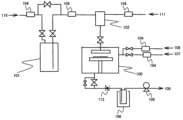
- FIG. 1 is a schematic diagram showing an example of an ALD apparatus used in the thin film manufacturing method according to the fourth aspect of the present invention.
- FIG. 2 is a schematic diagram showing another example of an ALD apparatus used in the thin film manufacturing method according to the fourth aspect of the present invention.
- FIG. 3 is a schematic diagram showing another example of an ALD apparatus used in the thin film manufacturing method according to the fourth aspect of the present invention.
- FIG. 4 is a schematic diagram showing another example of an ALD apparatus used in the thin film manufacturing method according to the fourth aspect of the present invention.
- R1 and R2 each independently represent an alkyl group having 1 to 8 carbon atoms
- R3 represents a hydrogen atom or an alkyl group having 1 to 5 carbon atoms, provided that R1 and R2 are different groups.
- Examples of the alkyl group having 1 to 8 carbon atoms represented by R1 and R2 include a methyl group, an ethyl group, an n-propyl group, an isopropyl group, an n-butyl group, an isobutyl group, a sec-butyl group, a tert-butyl group, an n-pentyl group, an isopentyl group, a sec-pentyl group (2-pentyl group), a 3-pentyl group, a neopentyl group, an n-hexyl group, an isohexyl group, a sec-hexyl group, a tert-hexyl group, an n-heptyl group, an isoheptyl group, a sec-heptyl group, a tert-heptyl group, an n-octyl group, an isooctyl group, a sec-h
- Examples of the alkyl group having 1 to 5 carbon atoms represented by R3 include a methyl group, an ethyl group, an n-propyl group, an isopropyl group, an n-butyl group, an isobutyl group, a sec-butyl group, a tert-butyl group, an n-pentyl group, an isopentyl group, and a neopentyl group.
- R 1 and R 2 are preferably an alkyl group having 1 to 6 carbon atoms, more preferably an alkyl group having 3 to 6 carbon atoms, still more preferably a branched alkyl group having 3 to 6 carbon atoms, and particularly preferably any one of an isopropyl group, a sec-butyl group, a sec-pentyl group (2-pentyl group), or a 3-pentyl group.
- the combination of R 1 and R 2 is preferably such that both R 1 and R 2 are selected from alkyl groups having 3 to 6 carbon atoms, more preferably such that both R 1 and R 2 are selected from branched alkyl groups having 3 to 6 carbon atoms, further preferably such that either one of R 1 and R 2 is selected from a sec-butyl group, a sec-pentyl group (2-pentyl group) or a 3-pentyl group, and the other is an isopropyl group, particularly preferably such that either one of R 1 and R 2 is selected from a sec-butyl group or a sec-pentyl group (2-pentyl group), and the other is an isopropyl group, and most preferably such that either one of R 1 and R
- R3 is preferably a hydrogen atom or an alkyl group having 1 to 3 carbon atoms, more preferably a hydrogen atom or a methyl group, and particularly preferably a hydrogen atom.
- R 3 is a hydrogen atom or a methyl group
- R 1 and R 2 are both selected from alkyl groups having 3 to 6 carbon atoms, more preferably selected from branched alkyl groups having 3 to 6 carbon atoms, further preferably such that one of R 1 and R 2 is selected from a sec-butyl group, a sec-pentyl group (2-pentyl group) or a 3-pentyl group, and the other is an isopropyl group, particularly preferably such that one of R 1 and R 2 is selected from a sec-butyl group or a sec-pentyl group (2-pentyl group), and the other is an isoprop
- Preferred specific examples of the compound represented by general formula (1) used in the thin film forming material of the present invention include the following compounds No. 1 to No. 120, but the present invention is not limited to these compounds.
- “Me” represents a methyl group
- "Et” represents an ethyl group
- "nPr” represents an n-propyl group
- "iPr” represents an isopropyl group
- "nBu” represents an n-butyl group
- iBu represents an isobutyl group
- sBu represents a sec-butyl group
- tBu represents a tert-butyl group
- “nPe” represents an n-pentyl group
- "iPe” represents an isopentyl group
- "sPe” represents a sec-pentyl group (2-pentyl group)
- "3Pe” represents a 3-pentyl group.
- compounds No. 33, No. 37 and No. 38 are preferred, compounds No. 33 and No. 37 are more preferred, and compound No. 37 is most preferred.
- the compound of the present invention is not particularly limited by its manufacturing method, and can be manufactured by applying a well-known synthesis method.
- the compound represented by general formula (1) can be obtained by mixing La[N( SiMe3 ) 2 ] 3 and a ligand having a corresponding structure in the presence or absence of a solvent, stirring and reacting the mixture, removing the solvent, and then distilling the mixture.
- the thin film forming raw material of the second aspect of the present invention contains a compound represented by the above general formula (1).
- the thin film forming raw material of the present invention may contain a compound represented by the general formula (1) as a precursor of the thin film, and the composition varies depending on the type of the target thin film. For example, when producing a thin film containing only lanthanum atoms as metals, the thin film forming raw material does not contain metal compounds and metalloid compounds other than lanthanum.
- the thin film forming raw material can contain, in addition to the compound represented by the general formula (1), a compound containing a desired metal and/or a compound containing a metalloid (hereinafter, sometimes referred to as "other precursors").
- the other precursors mentioned above include, for example, compounds of silicon or a metal with one or more compounds selected from the group consisting of compounds used as organic ligands, such as alcohol compounds, glycol compounds, ⁇ -diketone compounds, cyclopentadiene compounds, and organic amine compounds.
- compounds used as organic ligands such as alcohol compounds, glycol compounds, ⁇ -diketone compounds, cyclopentadiene compounds, and organic amine compounds.
- metal species of the precursor include lithium, sodium, potassium, magnesium, calcium, strontium, barium, titanium, zirconium, hafnium, vanadium, niobium, tantalum, chromium, molybdenum, tungsten, manganese, iron, osmium, ruthenium, cobalt, rhodium, iridium, nickel, palladium, platinum, copper, silver, gold, zinc, aluminum, gallium, indium, germanium, lead, antimony, bismuth, radium, scandium, yttrium, lanthanum, cerium, praseodymium, neodymium, promethium, samarium, europium, gadolinium, terbium, dysprosium, holmium, erbium, thulium, ytterbium, and lutetium.
- alkyl alcohols such as methanol, ethanol, propanol, isopropyl alcohol, butanol, sec-butyl alcohol, isobutyl alcohol, tert-butyl alcohol, pentyl alcohol, isopentyl alcohol, and tert-pent
- ether alcohols such as 2-butoxy-1,1-dimethylethanol, 2-(2-methoxyethoxy)-1,1-dimethylethanol, 2-propoxy-1,1-diethylethanol, 2-sec-butoxy-1,1-diethylethanol, and 3-methoxy-1,1-dimethylpropanol; and dialkylamino alcohols such as dimethylaminoethanol, ethylmethylaminoethanol, diethylaminoethanol, dimethylamino-2-pentanol, ethylmethylamino-2-pentanol, dimethylamino-2-methyl-2-pentanol, ethylmethylamino-2-methyl-2-pentanol, and diethylamino-2-methyl-2-pentanol.
- dialkylamino alcohols such as dimethylaminoethanol, ethylmethylaminoethanol, diethylaminoethanol, dimethylamino-2-pentanol, e
- glycol compounds used as organic ligands for the other precursors include 1,2-ethanediol, 1,2-propanediol, 1,3-propanediol, 2,4-hexanediol, 2,2-dimethyl-1,3-propanediol, 2,2-diethyl-1,3-propanediol, 1,3-butanediol, 2,4-butanediol, 2,2-diethyl-1,3-butanediol, 2-ethyl-2-butyl-1,3-propanediol, 2,4-pentanediol, 2-methyl-1,3-propanediol, 2-methyl-2,4-pentanediol, 2,4-hexanediol, and 2,4-dimethyl-2,4-pentanediol.
- Beta-diketone compounds that can be used as organic ligands for the other precursors described above include, for example, acetylacetone, hexane-2,4-dione, 5-methylhexane-2,4-dione, heptane-2,4-dione, 2-methylheptane-3,5-dione, 5-methylheptane-2,4-dione, 6-methylheptane-2,4-dione, 2,2-dimethylheptane-3,5-dione, 2,6-dimethylheptane-3,5-dione, 2,2,6-trimethylheptane-3,5-dione, 2,2,6,6-tetramethylheptane-3,5-dione, octane-2,4-dione, 2,2,6-trimethyloctane-3,5-dione, 2,6-dimethyloctane-3,5-dione, 2,9-dimethylnonane-4
- Cyclopentadiene compounds used as organic ligands for the other precursors mentioned above include, for example, cyclopentadiene, methylcyclopentadiene, ethylcyclopentadiene, propylcyclopentadiene, isopropylcyclopentadiene, butylcyclopentadiene, sec-butylcyclopentadiene, isobutylcyclopentadiene, tert-butylcyclopentadiene, dimethylcyclopentadiene, tetramethylcyclopentadiene, pentamethylcyclopentadiene, etc.
- Organic amine compounds that can be used as organic ligands for the other precursors mentioned above include methylamine, ethylamine, propylamine, isopropylamine, butylamine, sec-butylamine, tert-butylamine, isobutylamine, dimethylamine, diethylamine, dipropylamine, diisopropylamine, ethylmethylamine, propylmethylamine, isopropylmethylamine, etc.
- the precursor when an alcohol compound is used as the organic ligand, the precursor can be manufactured by reacting the inorganic salt of the metal or its hydrate described above with an alkali metal alkoxide of the alcohol compound.
- the inorganic salt of the metal or its hydrate include metal halides and nitrates.
- the alkali metal alkoxide include sodium alkoxide, lithium alkoxide, potassium alkoxide, etc.
- the multi-component ALD method there are a method in which each component of the thin film forming raw material is vaporized and supplied independently (hereinafter sometimes referred to as the "single source method"), and a method in which a mixed raw material in which multi-component raw materials are mixed in advance in a desired composition is vaporized and supplied (hereinafter sometimes referred to as the "cocktail source method").
- the other precursors mentioned above are preferably compounds whose thermal decomposition and/or oxidative decomposition behavior is similar to that of the compound represented by general formula (1).
- the other precursors mentioned above are preferably compounds whose thermal decomposition and/or oxidative decomposition behavior is similar to that of the compound represented by general formula (1) and which do not undergo deterioration due to chemical reactions, etc. when mixed.
- a mixture of the compound represented by general formula (1) and other precursors, or a mixed solution in which the mixture is dissolved in an organic solvent can be used as a raw material for forming a thin film.
- organic solvent examples include acetates such as ethyl acetate, butyl acetate, and methoxyethyl acetate; ethers such as tetrahydrofuran, tetrahydropyran, ethylene glycol dimethyl ether, diethylene glycol dimethyl ether, triethylene glycol dimethyl ether, dibutyl ether, and dioxane; ketones such as methyl butyl ketone, methyl isobutyl ketone, ethyl butyl ketone, dipropyl ketone, diisobutyl ketone, methyl amyl ketone, cyclohexanone, and methylcyclohexanone; hydrocarbons such as hexane, cyclohexane, methylcyclohexane, dimethylcyclohexane, ethylcyclohexane,
- the thin film-forming raw material of the present invention is a mixed liquid containing the above organic solvent, from the viewpoint of facilitating the formation of a high-quality lanthanum-containing thin film with little residual carbon, it is preferable to adjust the total amount of precursors in the thin film-forming raw material to 0.01 mol/L to 2.0 mol/L, and more preferably to adjust it to 0.05 mol/L to 1.0 mol/L.
- the total amount of precursors refers to the amount of the compound represented by general formula (1) when the thin film forming raw material does not contain any precursors other than the compound represented by general formula (1).
- the total amount refers to the total amount of the compound represented by general formula (1) and the other precursors.
- the thin film-forming material of the present invention may contain a nucleophilic reagent, if necessary, in order to improve the stability of the compound represented by the general formula (1) and other precursors.
- the nucleophilic reagent include ethylene glycol ethers such as glyme, diglyme, triglyme, and tetraglyme; crown ethers such as 18-crown-6, dicyclohexyl-18-crown-6, 24-crown-8, dicyclohexyl-24-crown-8, and dibenzo-24-crown-8; ethylenediamine, N,N'-tetramethylethylenediamine, diethylenetriamine, triethylenetetramine, tetraethylenepentamine, pentaethylenehexamine, 1,1,4,7,7-pentamethyldiethylenetriamine, and 1,1,4,7,10,10-hexamethyltriethylenetetramine;
- the nucleophilic reagent include polyamines such as triethoxy
- the amount of these nucleophilic reagents used is preferably in the range of 0.1 mol to 10 mol, and more preferably in the range of 1 mol to 4 mol, relative to 1 mol of the total amount of the precursor.
- the thin film forming raw material of the present invention contains as little impurity metal elements, impurity halogens such as impurity chlorine, and impurity organic matter as possible other than the components that constitute the thin film.
- the impurity metal element content is preferably 100 ppb or less per element, more preferably 10 ppb or less, and the total amount is preferably 1 ppm or less, more preferably 100 ppb or less.
- the impurity halogen content is preferably 100 ppm or less, more preferably 10 ppm or less, and even more preferably 1 ppm or less.
- the impurity organic content is preferably 500 ppm or less in total, more preferably 50 ppm or less, and even more preferably 10 ppm or less.
- moisture can cause particle generation in the thin film forming raw material and during thin film formation, so it is better to remove as much moisture as possible from the precursor, organic solvent, and nucleophilic reagent before use in order to reduce the moisture content of each.
- the moisture content of each of the precursor, organic solvent, and nucleophilic reagent is preferably 10 ppm or less, and more preferably 1 ppm or less.
- the thin film forming raw material of the present invention makes it easier to form a high-quality lanthanum-containing thin film with little residual carbon.
- the thin film forming raw material of the present invention is preferably free of particles as much as possible in order to reduce or prevent particle contamination of the thin film to be formed.
- the number of particles larger than 0.3 ⁇ m in 1 mL of thin film forming raw material is 100 or less, and the number of particles larger than 0.2 ⁇ m in 1 mL of thin film forming raw material is 100 or less.
- the method for producing a thin film of the present invention involves forming a lanthanum-containing thin film on the surface of a substrate using the above-mentioned thin film-forming raw material.
- the method further includes a precursor thin film formation step of forming a precursor thin film on the surface of the substrate using the thin film forming raw material between the raw material introduction step and the thin film formation step, and that the thin film formation step is a step of heating and/or plasmatizing a compound represented by general formula (1) in the presence of a reactive gas.
- the raw material introduction step in the present invention is a step of introducing a raw material gas obtained by vaporizing a thin film forming raw material into a film formation chamber (100) in which a substrate is placed.
- Methods for introducing the source gas obtained by vaporizing the thin film-forming source into a film-forming chamber in which a substrate is placed include a gas transport method, a liquid transport method, a single source method, a cocktail source method, and the like.
- a carrier gas such as argon, nitrogen, or helium
- the single source method is a method for transporting and supplying a thin film forming material containing precursors of multiple components, and includes a method in which each precursor is vaporized and supplied independently.
- the cocktail source method includes, for example, a method of vaporizing and supplying a mixed material in which precursors of multiple components are mixed in advance in a desired composition.
- the thin film forming material containing the precursors of multiple components may contain the above-mentioned nucleophilic reagent, etc.
- the step of vaporizing the thin film-forming raw material of the present invention to obtain a raw material gas may be carried out in a raw material container or in a vaporization chamber, as described above. In either case, it is preferable to vaporize the thin film-forming raw material at 0° C. to 200° C. in order to easily form a high-quality thin film.
- the pressure in the raw material container and the pressure in the vaporization chamber are preferably within the range of 1 Pa to 10,000 Pa from the viewpoint of achieving good vaporization of the thin film forming raw material.
- the material of the substrate placed in the deposition chamber (100) may be, for example, silicon; ceramics such as silicon nitride, titanium nitride, tantalum nitride, titanium oxide, molybdenum oxide, zirconium oxide, hafnium oxide, and lanthanum oxide; glass; and metals such as metallic cobalt and metallic molybdenum.
- the shape of the substrate may be plate-like, spherical, fibrous, or scaly.
- the surface of the substrate may be flat or may have a three-dimensional structure such as a trench structure.
- the thin film formation step is a step of heating and/or plasmatizing the compound represented by general formula (1) (hereinafter, "heating and/or plasmatizing” may be referred to as “heating” or the like) to form a lanthanum-containing thin film on the surface of a substrate.
- heatating and/or plasmatizing may be referred to as “heating” or the like
- the thin film formation process is carried out in a deposition chamber (100) in which a substrate is placed.
- a compound in a source gas introduced into the deposition chamber (100) is heated or the like to decompose the compound, and metallic lanthanum or a compound containing lanthanum is deposited on the surface of the substrate to form a lanthanum-containing thin film.
- Figures 1 to 4 show an example in which a compound in a source gas introduced into the deposition chamber (100) is heated in the presence of a reactive gas.
- a lanthanum-containing thin film is formed by a reaction between the compound and the reactive gas.
- the heating temperature of the compound in the thin film formation step may be in the range of room temperature to 700° C., but from the viewpoint of facilitating the formation of a high-quality lanthanum-containing thin film, it is preferably in the range of 150° C. to 600° C.
- the conditions for applying a voltage to the compound to generate plasma are preferably a power of 10 W to 1,500 W, more preferably a power of 50 W to 600 W, since excessive power can cause significant damage to the substrate.
- the precursor thin film formation process described later is further included between the raw material introduction process and the thin film formation process, it is preferable to heat and/or plasmatize the compound in the presence of a reactive gas, and it is more preferable to heat the compound in the presence of a reactive gas, from the viewpoint of easily obtaining a high-quality lanthanum-containing thin film with little residual carbon.
- the reactive gas examples include oxidizing gases such as oxygen, ozone, nitrogen dioxide, nitric oxide, water vapor, hydrogen peroxide, formic acid, acetic acid, and acetic anhydride, reducing gases such as hydrogen, organic amine compounds such as monoalkylamines, dialkylamines, trialkylamines, and alkylenediamines, and nitriding gases such as hydrazine and ammonia. These reactive gases may be used alone or in combination of two or more.
- oxidizing gases such as oxygen, ozone, nitrogen dioxide, nitric oxide, water vapor, hydrogen peroxide, formic acid, acetic acid, and acetic anhydride
- reducing gases such as hydrogen
- organic amine compounds such as monoalkylamines, dialkylamines, trialkylamines, and alkylenediamines
- nitriding gases such as hydrazine and ammonia.
- a reactive gas containing at least one selected from the group consisting of hydrogen, ammonia, oxygen, ozone, and water vapor from the viewpoint of easily forming a high-quality lanthanum-containing thin film with little residual carbon. Since the compound represented by the general formula (1) has a property of reacting well with an oxidizing gas, it is more preferable to use an oxidizing gas such as water vapor as the reactive gas.
- the thin film manufacturing method of the present invention preferably further comprises a precursor thin film forming step of forming a precursor thin film on the surface of the substrate using a thin film forming raw material between the raw material introduction step and the thin film forming step.
- the precursor thin film may be any precursor thin film capable of forming a lanthanum-containing thin film in the thin film forming step.
- Such a precursor thin film can be formed by depositing (adsorbing) the compound represented by the general formula (1) in the source gas introduced into a deposition chamber (100) in which a substrate is placed on the surface of the substrate. At this time, the substrate or the inside of the deposition chamber (100) may be heated.
- the conditions for forming the precursor thin film are not particularly limited, and for example, the reaction temperature (temperature of the substrate when the compound is deposited on the substrate surface), reaction pressure (pressure in the deposition chamber when the compound is deposited on the substrate surface), deposition rate, etc. can be appropriately determined depending on the type of raw material for forming the thin film.
- the reaction temperature is preferably in the range of 0°C to 700°C, and more preferably in the range of 150°C to 600°C.
- the thin film manufacturing method of the present invention preferably further includes an exhaust step of exhausting the source gas, unreacted reactive gas, and by-product gas from the film formation chamber (100) after the formation of the precursor thin film in the precursor thin film formation step or after the formation of the lanthanum-containing thin film in the thin film formation step.
- an exhaust step of exhausting the source gas, unreacted reactive gas, and by-product gas from the film formation chamber (100) after the formation of the precursor thin film in the precursor thin film formation step or after the formation of the lanthanum-containing thin film in the thin film formation step.
- exhaust methods include a method of purging the system of the film formation chamber with an inert gas such as helium, nitrogen, or argon, a method of exhausting by reducing the pressure in the system, and a combination of these methods.
- the degree of reduction in pressure is preferably within the range of 0.01 Pa to 300 Pa, and more preferably within the range of 0.01 Pa to 100 Pa from the viewpoint of accelerating the exhaust of the source gas, unreacted reactive gas, and by-product gas.
- the thin film manufacturing method of the present invention may further include an annealing step after the formation of the thin film in order to improve the electrical properties of the lanthanum-containing thin film.
- the annealing treatment may be performed in an inert atmosphere, an oxidizing atmosphere, or a reducing atmosphere, and a reflow step may be provided if step filling is required.
- the temperature in the annealing step is preferably within the range of 250°C to 500°C.
- the thin film manufacturing method of the present invention may be a method in which the thin film formation step is carried out only once, or may be a method in which the thin film formation step is carried out two or more times, but is preferably a method in which the thin film formation step is carried out two or more times.
- the raw material introduction step, precursor thin film formation step, exhaust step, thin film formation step, and exhaust step are carried out in order, and the formation of a lanthanum-containing thin film by a series of operations is considered to be one cycle, and this cycle may be repeated multiple times until a lanthanum-containing thin film of the required thickness is obtained, thereby forming a lanthanum-containing thin film having a desired thickness.
- the thickness of the lanthanum-containing thin film formed can be controlled by the number of cycles. From the viewpoint of facilitating the production of a uniform lanthanum-containing thin film, the deposition rate of the lanthanum-containing thin film obtained per cycle is preferably within the range of 0.001 nm/min to 100 nm/min, and more preferably within the range of 0.005 nm/min to 50 nm/min.
- the thin film of the present invention Since the thin film of the present invention has excellent electrical and optical properties, it can be widely used in the manufacture of, for example, electrode materials for memory elements such as DRAM elements, wiring materials used in semiconductor elements such as logic elements, diamagnetic films used in the recording layers of hard disks, and catalyst materials for solid polymer fuel cells.
- the carbon content in the thin film is preferably 1 atm % or less, more preferably 0.5 atm % or less, and even more preferably 0.1 atm % or less.
- Example 1-1 Preparation of a precursor of the ligand of compound No. 33 Isopropyl isocyanate was added dropwise to a solution of 57.4 g (0.78 mol) of sec-butylamine and 800 mL of THF under ice-water cooling, and the mixture was stirred overnight at room temperature. The solvent was removed, dichloromethane (1 L) and 270 g (2.67 mol) of triethylamine were added, and a solution of 299 g (1.57 mol) of p-toluenesulfonyl chloride cooled with ice-water and 300 mL of dichloromethane was added dropwise, and the mixture was refluxed and stirred for 3 hours.
- Example 1-2 Preparation of the ligand of compound No. 33
- a hexane solution of 46.3 g (0.33 mol) of diisobutylaluminum hydride (DIBAL) cooled with ice water was added dropwise, and the mixture was stirred at room temperature overnight.
- DIBAL diisobutylaluminum hydride
- the mixture was washed with a 30% Rochelle salt aqueous solution, and the organic layer was dried with sodium sulfate. After removing the solvent, the mixture was distilled to obtain 33.9 g of the target product (yield 77%).
- Example 1-3 Preparation of Compound No. 33 Under an argon atmosphere, La[N(SiMe 3 ) 2 ] 3 (2.21 g, 3.56 mmol) and toluene (5.2 mL) were charged into a 100 mL three-neck flask, and the ligand (1.61 g, 7.12 mmol) obtained in Example 1-2 was added dropwise at room temperature. The mixture was stirred at room temperature for 24 hours, and then the solvent was removed. The residue was distilled in a Kugelrohr distillation apparatus at a temperature of 160° C. and a pressure of 35 Pa, and the target product was obtained in an amount of 0.40 g and a yield of 20%.
- Example 2-1 Preparation of a precursor of the ligand of compound No. 37 Under an argon atmosphere, a 1L four-neck flask was charged with isopropyl isothiocyanate (13.2 g, 0.13 mol) and diethyl ether (406 mL) and cooled with ice. 2-aminopentane (11.3 g, 0.13 mol) was added dropwise thereto, and the mixture was warmed to room temperature and stirred for 18 hours. After removing the solvent, dichloromethane (307 mL) and triethylamine (46.0 g, 0.46 mol) were added thereto and cooled to -35°C.
- Example 2-2 Preparation of the ligand of compound No. 37
- the precursor obtained in Example 2-1 (9.87 g, 63.6 mmol) and THF (51.4 mL) were charged into a 300 mL three-neck flask and cooled with ice.
- a 1 M diisobutylaluminum hydride hexane solution (63.4 mL, 63.4 mmol) was added dropwise thereto, and the mixture was heated to room temperature and stirred for 22 hours. After quenching with a saturated Rochelle salt aqueous solution, diethyl ether was added to extract the target substance into the organic layer.
- the organic layer was dried with sodium sulfate, filtered and desolvated, and the resulting residue was distilled at a bath temperature of 87°C and a pressure of 540 Pa to obtain the target colorless transparent liquid in an amount of 7.15 g and a yield of 72%.
- Example 2-3 Preparation of Compound No. 37 Under an argon atmosphere, La[N(SiMe 3 ) 2 ] 3 (30.8 g, 0.0496 mol) and toluene (158 mL) were charged into a 300 mL three-neck flask and cooled with ice. The ligand (23.3 g, 0.1488 mol) obtained in Example 2-2 was added dropwise thereto. After heating to room temperature, the mixture was stirred for 21 hours, and then the solvent was removed. The residue was distilled at a bath temperature of 167° C. and a pressure of 79 Pa to obtain the target product in an amount of 21.8 g and a yield of 73%.
- Example 3-1 Preparation of a precursor of the ligand of compound No. 38 Under an argon atmosphere, a 1L three-neck flask was charged with isopropyl isothiocyanate (13.2 g, 0.13 mol) and diethyl ether (406 mL) and cooled with ice. 3-aminopentane (11.3 g, 0.13 mol) dissolved in diethyl ether (203 mL) was added dropwise thereto, and the mixture was heated to room temperature and stirred for 17 hours. After removing the solvent, dichloromethane (307 mL) and triethylamine (46.0 g, 0.46 mol) were added thereto and cooled to -55°C.
- Example 3-2 Preparation of the ligand of compound No. 38
- the precursor obtained in Example 3-1 (6.05 g, 39.2 mmol) and THF (31.8 mL) were charged into a 200 mL four-neck flask and cooled with ice.
- a 1.02 M diisobutylaluminum hydride hexane solution (38.5 mL, 39.2 mmol) was added dropwise thereto, and the mixture was warmed to room temperature and stirred overnight. After quenching with a saturated Rochelle salt aqueous solution, diethyl ether was added to extract the target substance into the organic layer.
- the organic layer was dried with sodium sulfate, filtered and desolvated, and the resulting residue was distilled at a bath temperature of 85° C. and a pressure of 370 Pa to obtain the target substance in an amount of 2.39 g and a yield of 39%.
- Example 3-3 Preparation of Compound No. 38 Under an argon atmosphere, La[N(SiMe 3 ) 2 ] 3 (2.00 g, 3.23 mmol) and toluene (10.3 mL) were charged into a 200 mL four-neck flask and cooled with ice. The ligand (1.51 g, 9.68 mmol) obtained in Example 3-2 was added dropwise thereto. After warming to room temperature, the mixture was stirred overnight, and then the solvent was removed. The residue was distilled at a bath temperature of 152° C. and a pressure of 27 Pa to obtain the target product in an amount of 0.95 g and a yield of 49%.
- the temperature of comparative compound 1 at 50% mass reduction in normal pressure TG-DTA was 270°C
- the temperatures of the compounds obtained in Examples 1 to 3 at 50% mass reduction in normal pressure TG-DTA were all 265°C or lower, indicating that they were compounds with high vapor pressure.
- the melting point of comparative compound 1 was 170°C
- the compounds obtained in Examples 1 and 2 all had melting points of 150°C or lower, indicating that they were compounds with excellent transport properties.
- the compound obtained in Example 2 had a melting point of 55°C, indicating that it was a compound with particularly excellent transport properties.
- the detection limit is 0.1 atm%.
- the carbon content in the lanthanum oxide thin film obtained by the ALD method was 4 atm% in Comparative Examples 1 and 2, whereas it was less than the detection limit of 0.1 atm% in Examples 4 to 6. This shows that a high-quality lanthanum oxide thin film can be obtained by using the compound of the present invention. Furthermore, the thickness of the thin film obtained was 2.9 nm or less in Comparative Examples 1 and 2, whereas it was 3.8 nm or more in Examples 4 to 6, and the lanthanum oxide thin film was obtained with high productivity by using the compound of the present invention. In particular, the thickness of the thin film obtained was 3.9 nm or more in Examples 4 and 5, and the lanthanum oxide thin film was obtained with higher productivity. In particular, the thickness of the thin film obtained in Example 5 was 4.0 nm, and the lanthanum oxide thin film was obtained with particularly high productivity.
- compounds of the present invention are compounds with high vapor pressure and low melting point, and when used as chemical vapor growth raw materials, they can obtain high quality thin films with high productivity, demonstrating their superiority as chemical vapor growth raw materials.
- compounds No. 33 and No. 37 are compounds with high vapor pressure and low melting point, and when used as chemical vapor growth raw materials, they can obtain thin films with high productivity, demonstrating their superiority as chemical vapor growth raw materials.
- compound No. 37 is a compound with high vapor pressure and particularly low melting point, and when used as chemical vapor growth raw materials, they can obtain thin films with particularly high productivity, demonstrating their superiority as chemical vapor growth raw materials.
Landscapes
- Chemical & Material Sciences (AREA)
- Organic Chemistry (AREA)
- General Chemical & Material Sciences (AREA)
- Chemical Kinetics & Catalysis (AREA)
- Engineering & Computer Science (AREA)
- Materials Engineering (AREA)
- Mechanical Engineering (AREA)
- Metallurgy (AREA)
- Inorganic Chemistry (AREA)
- Chemical Vapour Deposition (AREA)
- Heterocyclic Compounds Containing Sulfur Atoms (AREA)
Priority Applications (4)
| Application Number | Priority Date | Filing Date | Title |
|---|---|---|---|
| JP2024574453A JPWO2024162067A1 (https=) | 2023-02-01 | 2024-01-22 | |
| IL322134A IL322134A (en) | 2023-02-01 | 2024-01-22 | Compound, raw material for forming a thin layer, thin layer and method for producing a thin layer |
| EP24750019.2A EP4660187A1 (en) | 2023-02-01 | 2024-01-22 | Compound, raw material for thin film formation, thin film, and method for producing thin film |
| KR1020257028474A KR20250142364A (ko) | 2023-02-01 | 2024-01-22 | 화합물, 박막 형성용 원료, 박막 및 박막의 제조 방법 |
Applications Claiming Priority (2)
| Application Number | Priority Date | Filing Date | Title |
|---|---|---|---|
| JP2023013693 | 2023-02-01 | ||
| JP2023-013693 | 2023-02-01 |
Publications (1)
| Publication Number | Publication Date |
|---|---|
| WO2024162067A1 true WO2024162067A1 (ja) | 2024-08-08 |
Family
ID=92146398
Family Applications (1)
| Application Number | Title | Priority Date | Filing Date |
|---|---|---|---|
| PCT/JP2024/001654 Ceased WO2024162067A1 (ja) | 2023-02-01 | 2024-01-22 | 化合物、薄膜形成用原料、薄膜及び薄膜の製造方法 |
Country Status (6)
| Country | Link |
|---|---|
| EP (1) | EP4660187A1 (https=) |
| JP (1) | JPWO2024162067A1 (https=) |
| KR (1) | KR20250142364A (https=) |
| IL (1) | IL322134A (https=) |
| TW (1) | TW202442654A (https=) |
| WO (1) | WO2024162067A1 (https=) |
Citations (4)
| Publication number | Priority date | Publication date | Assignee | Title |
|---|---|---|---|---|
| JP2012153688A (ja) | 2011-01-25 | 2012-08-16 | Air Products & Chemicals Inc | 金属含有膜被着のための金属錯体 |
| JP2017122273A (ja) | 2002-11-15 | 2017-07-13 | プレジデント アンド フェローズ オブ ハーバード カレッジ | 金属アミジナートを用いる原子層の析出 |
| WO2021200218A1 (ja) * | 2020-04-01 | 2021-10-07 | 株式会社Adeka | 原子層堆積法用薄膜形成用原料及び薄膜の製造方法 |
| JP2022077508A (ja) | 2020-11-11 | 2022-05-23 | ハンソル ケミカル カンパニー リミテッド | 希土類前駆体、その製造方法及びこれを用いて薄膜を形成する方法 |
-
2024
- 2024-01-22 IL IL322134A patent/IL322134A/en unknown
- 2024-01-22 JP JP2024574453A patent/JPWO2024162067A1/ja active Pending
- 2024-01-22 EP EP24750019.2A patent/EP4660187A1/en active Pending
- 2024-01-22 WO PCT/JP2024/001654 patent/WO2024162067A1/ja not_active Ceased
- 2024-01-22 KR KR1020257028474A patent/KR20250142364A/ko active Pending
- 2024-01-29 TW TW113103347A patent/TW202442654A/zh unknown
Patent Citations (4)
| Publication number | Priority date | Publication date | Assignee | Title |
|---|---|---|---|---|
| JP2017122273A (ja) | 2002-11-15 | 2017-07-13 | プレジデント アンド フェローズ オブ ハーバード カレッジ | 金属アミジナートを用いる原子層の析出 |
| JP2012153688A (ja) | 2011-01-25 | 2012-08-16 | Air Products & Chemicals Inc | 金属含有膜被着のための金属錯体 |
| WO2021200218A1 (ja) * | 2020-04-01 | 2021-10-07 | 株式会社Adeka | 原子層堆積法用薄膜形成用原料及び薄膜の製造方法 |
| JP2022077508A (ja) | 2020-11-11 | 2022-05-23 | ハンソル ケミカル カンパニー リミテッド | 希土類前駆体、その製造方法及びこれを用いて薄膜を形成する方法 |
Non-Patent Citations (3)
| Title |
|---|
| BEER SEBASTIAN M, BOYSEN NILS, MURIQI ARBRESHA, ZANDERS DAVID, BERNING THOMAS, ROGALLA DETLEF, BOCK CLAUDIA, NOLAN MICHAEL, DEVI A: "A study on the influence of ligand variation on formamidinate complexes of yttrium: new precursors for atomic layer deposition of yttrium oxide ", DALTON TRANSACTIONS, vol. 50, 1 January 2021 (2021-01-01), pages 12944 - 12956, XP093197091, DOI: 10.1039/d1dt01634b * |
| KRASNOPOLSKI MICHAEL, HRIB CRISTIAN G, SEIDEL RUDIGER W, WINTER MANUELA, BECKER HANS-WERNER, ROGALLA DETLEF, FISCHER ROLAND A, EDE: "Homoleptic Gadolinium Amidinates as Precursors for MOCVD of Oriented Gadolinium Nitride (GdN) Thin Films", INORGANIC CHEMISTRY, vol. 52, no. 1, 1 January 2013 (2013-01-01), pages 286 - 296, XP093197089, DOI: 10.1021/ic301826s * |
| See also references of EP4660187A1 |
Also Published As
| Publication number | Publication date |
|---|---|
| TW202442654A (zh) | 2024-11-01 |
| KR20250142364A (ko) | 2025-09-30 |
| JPWO2024162067A1 (https=) | 2024-08-08 |
| EP4660187A1 (en) | 2025-12-10 |
| IL322134A (en) | 2025-09-01 |
Similar Documents
| Publication | Publication Date | Title |
|---|---|---|
| JP7368372B2 (ja) | 薄膜の製造方法 | |
| JPWO2019203035A1 (ja) | 原子層堆積法用薄膜形成用原料及び薄膜の製造方法 | |
| EP3712159B1 (en) | Ruthenium compound, raw material for forming thin film, and method for producing thin film | |
| JP7717051B2 (ja) | 原子層堆積法用薄膜形成用原料及び薄膜の製造方法 | |
| JP7592611B2 (ja) | 新規スズ化合物、該化合物を含有する薄膜形成用原料、該薄膜形成用原料を用いて形成される薄膜、該薄膜を製造するために該化合物をプリカーサとして用いる方法、及び該薄膜の製造方法 | |
| WO2022190877A1 (ja) | 原子層堆積法用薄膜形成用原料、薄膜、薄膜の製造方法及び亜鉛化合物 | |
| JP7554763B2 (ja) | 新規化合物、該化合物を含有する薄膜形成用原料及び薄膜の製造方法 | |
| CN113195784A (zh) | 原子层沉积法用薄膜形成原料、薄膜的制造方法以及醇盐化合物 | |
| JP7710437B2 (ja) | 亜鉛化合物、薄膜形成用原料、薄膜及びその製造方法 | |
| WO2022145267A1 (ja) | 原子層堆積法用薄膜形成原料、薄膜の製造方法及びアルミニウム化合物 | |
| JP7796014B2 (ja) | 薄膜形成用原料、薄膜及び薄膜の製造方法 | |
| JP2025081785A (ja) | 原子層堆積法用薄膜形成用原料、薄膜及び薄膜の製造方法 | |
| JP7573514B2 (ja) | 薄膜形成用原料、薄膜の製造方法及び新規なスカンジウム化合物 | |
| JP7730762B2 (ja) | 化合物、薄膜形成用原料及び薄膜の製造方法 | |
| WO2024162067A1 (ja) | 化合物、薄膜形成用原料、薄膜及び薄膜の製造方法 | |
| JP7701969B2 (ja) | スズ化合物、薄膜形成用原料、薄膜、薄膜の製造方法及びハロゲン化合物 | |
| WO2021054160A1 (ja) | 原子層堆積法のための薄膜形成原料及びそれを用いた亜鉛含有薄膜の製造方法 | |
| JP7565270B2 (ja) | ルテニウム化合物、薄膜形成用原料及び薄膜の製造方法 | |
| JP7758681B2 (ja) | 原子層堆積法用薄膜形成原料及び薄膜の製造方法 | |
| WO2025052926A1 (ja) | 薄膜形成用原料、薄膜、薄膜の製造方法及びランタン化合物 | |
| JP7516092B2 (ja) | 薄膜形成原料、薄膜及びその製造方法 | |
| WO2026023467A1 (ja) | 薄膜形成用原料、薄膜、薄膜の製造方法及び化合物 | |
| KR20260019524A (ko) | 화합물, 박막 형성용 원료, 박막 및 박막의 제조 방법 | |
| JP2024117104A (ja) | 薄膜形成用原料、薄膜及び薄膜の製造方法 | |
| WO2023276716A1 (ja) | 薄膜形成用原料、薄膜及び薄膜の製造方法 |
Legal Events
| Date | Code | Title | Description |
|---|---|---|---|
| 121 | Ep: the epo has been informed by wipo that ep was designated in this application |
Ref document number: 24750019 Country of ref document: EP Kind code of ref document: A1 |
|
| WWE | Wipo information: entry into national phase |
Ref document number: 2024574453 Country of ref document: JP |
|
| WWE | Wipo information: entry into national phase |
Ref document number: 322134 Country of ref document: IL |
|
| ENP | Entry into the national phase |
Ref document number: 1020257028474 Country of ref document: KR Free format text: ST27 STATUS EVENT CODE: A-0-1-A10-A15-NAP-PA0105 (AS PROVIDED BY THE NATIONAL OFFICE) |
|
| NENP | Non-entry into the national phase |
Ref country code: DE |
|
| WWP | Wipo information: published in national office |
Ref document number: 2024750019 Country of ref document: EP |