WO2024162041A1 - バッテリ遮断ユニット - Google Patents
バッテリ遮断ユニット Download PDFInfo
- Publication number
- WO2024162041A1 WO2024162041A1 PCT/JP2024/001461 JP2024001461W WO2024162041A1 WO 2024162041 A1 WO2024162041 A1 WO 2024162041A1 JP 2024001461 W JP2024001461 W JP 2024001461W WO 2024162041 A1 WO2024162041 A1 WO 2024162041A1
- Authority
- WO
- WIPO (PCT)
- Prior art keywords
- current
- battery
- unit
- fuse
- pyro
- Prior art date
- Legal status (The legal status is an assumption and is not a legal conclusion. Google has not performed a legal analysis and makes no representation as to the accuracy of the status listed.)
- Ceased
Links
Images


Classifications
-
- B—PERFORMING OPERATIONS; TRANSPORTING
- B60—VEHICLES IN GENERAL
- B60L—PROPULSION OF ELECTRICALLY-PROPELLED VEHICLES; SUPPLYING ELECTRIC POWER FOR AUXILIARY EQUIPMENT OF ELECTRICALLY-PROPELLED VEHICLES; ELECTRODYNAMIC BRAKE SYSTEMS FOR VEHICLES IN GENERAL; MAGNETIC SUSPENSION OR LEVITATION FOR VEHICLES; MONITORING OPERATING VARIABLES OF ELECTRICALLY-PROPELLED VEHICLES; ELECTRIC SAFETY DEVICES FOR ELECTRICALLY-PROPELLED VEHICLES
- B60L3/00—Electric devices on electrically-propelled vehicles for safety purposes; Monitoring operating variables, e.g. speed, deceleration or energy consumption
- B60L3/04—Cutting off the power supply under fault conditions
-
- B—PERFORMING OPERATIONS; TRANSPORTING
- B60—VEHICLES IN GENERAL
- B60L—PROPULSION OF ELECTRICALLY-PROPELLED VEHICLES; SUPPLYING ELECTRIC POWER FOR AUXILIARY EQUIPMENT OF ELECTRICALLY-PROPELLED VEHICLES; ELECTRODYNAMIC BRAKE SYSTEMS FOR VEHICLES IN GENERAL; MAGNETIC SUSPENSION OR LEVITATION FOR VEHICLES; MONITORING OPERATING VARIABLES OF ELECTRICALLY-PROPELLED VEHICLES; ELECTRIC SAFETY DEVICES FOR ELECTRICALLY-PROPELLED VEHICLES
- B60L50/00—Electric propulsion with power supplied within the vehicle
- B60L50/50—Electric propulsion with power supplied within the vehicle using propulsion power supplied by batteries or fuel cells
- B60L50/60—Electric propulsion with power supplied within the vehicle using propulsion power supplied by batteries or fuel cells using power supplied by batteries
- B60L50/64—Constructional details of batteries specially adapted for electric vehicles
-
- B—PERFORMING OPERATIONS; TRANSPORTING
- B60—VEHICLES IN GENERAL
- B60L—PROPULSION OF ELECTRICALLY-PROPELLED VEHICLES; SUPPLYING ELECTRIC POWER FOR AUXILIARY EQUIPMENT OF ELECTRICALLY-PROPELLED VEHICLES; ELECTRODYNAMIC BRAKE SYSTEMS FOR VEHICLES IN GENERAL; MAGNETIC SUSPENSION OR LEVITATION FOR VEHICLES; MONITORING OPERATING VARIABLES OF ELECTRICALLY-PROPELLED VEHICLES; ELECTRIC SAFETY DEVICES FOR ELECTRICALLY-PROPELLED VEHICLES
- B60L58/00—Methods or circuit arrangements for monitoring or controlling batteries or fuel cells, specially adapted for electric vehicles
- B60L58/10—Methods or circuit arrangements for monitoring or controlling batteries or fuel cells, specially adapted for electric vehicles for monitoring or controlling batteries
-
- H—ELECTRICITY
- H02—GENERATION; CONVERSION OR DISTRIBUTION OF ELECTRIC POWER
- H02H—EMERGENCY PROTECTIVE CIRCUIT ARRANGEMENTS
- H02H3/00—Emergency protective circuit arrangements for automatic disconnection directly responsive to an undesired change from normal electric working condition with or without subsequent reconnection ; integrated protection
- H02H3/08—Emergency protective circuit arrangements for automatic disconnection directly responsive to an undesired change from normal electric working condition with or without subsequent reconnection ; integrated protection responsive to excess current
- H02H3/087—Emergency protective circuit arrangements for automatic disconnection directly responsive to an undesired change from normal electric working condition with or without subsequent reconnection ; integrated protection responsive to excess current for DC applications
-
- H—ELECTRICITY
- H02—GENERATION; CONVERSION OR DISTRIBUTION OF ELECTRIC POWER
- H02H—EMERGENCY PROTECTIVE CIRCUIT ARRANGEMENTS
- H02H7/00—Emergency protective circuit arrangements specially adapted for specific types of electric machines or apparatus or for sectionalised protection of cable or line systems, and effecting automatic switching in the event of an undesired change from normal working conditions
- H02H7/18—Emergency protective circuit arrangements specially adapted for specific types of electric machines or apparatus or for sectionalised protection of cable or line systems, and effecting automatic switching in the event of an undesired change from normal working conditions for batteries; for accumulators
-
- H—ELECTRICITY
- H02—GENERATION; CONVERSION OR DISTRIBUTION OF ELECTRIC POWER
- H02J—ELECTRIC POWER NETWORKS; CIRCUIT ARRANGEMENTS OR SYSTEMS FOR SUPPLYING OR DISTRIBUTING ELECTRIC POWER; SYSTEMS FOR STORING ELECTRIC ENERGY
- H02J7/00—Circuit arrangements for charging or discharging batteries or for supplying loads from batteries
-
- Y—GENERAL TAGGING OF NEW TECHNOLOGICAL DEVELOPMENTS; GENERAL TAGGING OF CROSS-SECTIONAL TECHNOLOGIES SPANNING OVER SEVERAL SECTIONS OF THE IPC; TECHNICAL SUBJECTS COVERED BY FORMER USPC CROSS-REFERENCE ART COLLECTIONS [XRACs] AND DIGESTS
- Y02—TECHNOLOGIES OR APPLICATIONS FOR MITIGATION OR ADAPTATION AGAINST CLIMATE CHANGE
- Y02E—REDUCTION OF GREENHOUSE GAS [GHG] EMISSIONS, RELATED TO ENERGY GENERATION, TRANSMISSION OR DISTRIBUTION
- Y02E60/00—Enabling technologies; Technologies with a potential or indirect contribution to GHG emissions mitigation
- Y02E60/10—Energy storage using batteries
Definitions
- This disclosure relates to a battery cutoff unit for use in transportation equipment.
- Patent document 1 describes a system that causes a fuse to cut off a current path based on a current value detected by a current sensor.
- Patent Document 1 The system described in Patent Document 1 above may not be able to safely interrupt the current path in transportation equipment such as electric vehicles equipped with large-capacity batteries.
- the present disclosure provides a battery cutoff unit that can safely cut off the current path in transportation equipment equipped with a large-capacity battery.
- a battery cutoff unit is a battery cutoff unit used in a transportation device having a battery and a load, the battery cutoff unit comprising a pyrofuse, a mechanical relay having a first contact and a second contact, a current sensor, and a cutoff control circuit connected to the current sensor and the pyrofuse, the current sensor outputs a current value of a current flowing in a current path between the battery and the load to the cutoff control circuit, the cutoff control circuit outputs an ignition signal to the pyrofuse based on the current value, the pyrofuse cuts off the current path by the ignition signal, and the mechanical relay is turned ON/OFF by a control signal from outside the battery cutoff unit.
- the battery cutoff unit can safely cut off the current path in transportation equipment equipped with a large-capacity battery.
- FIG. 1 is an external view illustrating an example of a battery cutoff unit according to an embodiment
- FIG. 2 is a configuration diagram illustrating an example of a battery cutoff unit according to an embodiment
- 1 is a cross-sectional view showing an example of a pyrofuse according to an embodiment
- 5 is a diagram showing current-voltage characteristics of the battery cutoff unit in the embodiment.
- FIG. FIG. 1 is a side view illustrating an example of a mechanical relay according to an embodiment.
- FIG. 1 is an external view showing an example of a battery cutoff unit 100 according to an embodiment. Note that in the external view shown in FIG. 1, terminals and wiring are omitted, and each component is also shown as a schematic rectangular parallelepiped.
- the battery cutoff unit 100 includes a pyro fuse (ignition-type cutoff device) 20, a mechanical relay 30, a current sensor 40, a cutoff control circuit 10, and one rigid part 110.
- the rigid part 110 fixes the pyrofuse 20, the mechanical relay 30, the current sensor 40, and the shutoff control circuit 10.
- the rigid part 110 is, for example, a base on which the pyrofuse 20, the mechanical relay 30, the current sensor 40, and the shutoff control circuit 10 are placed.
- the rigid part 110 may be a metal plate or the like, and may dissipate heat as a heat sink. For example, no parts other than those related to the pyrofuse 20, the mechanical relay 30, the current sensor 40, and the shutoff control circuit 10 are fixed to the rigid part 110.
- the shutoff control circuit 10 is formed on a substrate, and in the example shown in FIG. 1, the substrate on which the shutoff control circuit 10 is formed is fixed upright to the end of the rigid part 110.
- the battery cutoff unit 100 includes a lid 120, which covers the pyrofuse 20, the mechanical relay 30, and the current sensor 40.
- the lid 120 does not have to cover the cutoff control circuit 10, and the cutoff control circuit 10 may form the wall of the battery cutoff unit 100.
- the pyrofuse 20, the mechanical relay 30, and the current sensor 40 are covered by the substrate forming the cutoff control circuit 10 and the lid 120.
- the top surface of the lid 120 may have a hole as shown in FIG. 1, which can improve heat dissipation.
- the lid 120 may be made of resin.
- the battery cutoff unit 100 is a single unit centered around one rigid part 110.
- the rigid part 110 may be a housing that covers and secures the pyrofuse 20, the mechanical relay 30, the current sensor 40, and the cutoff control circuit 10.
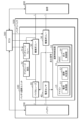
- FIG. 2 is a configuration diagram showing an example of a battery cutoff unit 100 according to an embodiment.
- the battery cutoff unit 100 is used in a transport device that includes an electronic control unit (ECU) 300, a battery 200, and a load 400.
- FIG. 2 also shows the battery 200, a battery pack 500 that covers the battery 200, the ECU 300, and the load 400 that are included in the transport device.
- the battery 200, the ECU 300, and the load 400 are provided outside the battery cutoff unit 100.
- the lines connecting the battery 200 and the load 400 indicate the flow of current (power), and the arrows indicate the flow of signals.
- the ECU 300 is connected to the battery 200 and the load 400 without being connected to the current sensor 40, and outputs a control signal.
- the battery cutoff unit 100 is used as a transport device, for example, in an electric vehicle.
- Battery 200 is, for example, a battery capable of applying a high voltage to load 400.
- battery 200 is a main battery (for example, a lithium-ion battery) in an electric vehicle, and is not a sub-battery such as a lead-acid battery also used in transportation equipment equipped with a gasoline engine. Battery 200 is covered by a battery pack 500.
- the load 400 is, for example, the motor and inverter of an electric vehicle.
- the electric vehicle is driven by power being supplied from the battery 200 to the load 400.
- a large current may flow through the current path connecting the battery 200 and the load 400 due to a short circuit, which may cause the battery 200 to smoke or catch fire. Therefore, the battery cutoff unit 100 is used in transportation equipment.
- the ECU 300 is a device for controlling the battery 200, the load 400, and various other components (such as steering, various sensors, communication devices, and IVI (In Vehicle Infotainment)) of the transportation equipment.
- the ECU 300 may be composed of multiple ECUs.
- the ECU 300 is connected to the battery 200, can send and receive signals to and from the battery 200, and can monitor the state of the battery 200.
- the ECU 300 is connected to the load 400, can send and receive signals to and from the load 400, and can monitor the state of the load 400.
- the ECU 300 controls the mechanical relay 30 and the like provided in the battery cutoff unit 100.
- the mechanical relay 30 is turned ON/OFF by a control signal from outside the battery cutoff unit 100 (specifically, a control signal from the ECU 300).
- a control signal from the ECU 300 specifically, a control signal from the ECU 300.
- the mechanical relay 30 is turned on/off by a control signal based on information from the battery 200 or the load 400 acquired by the ECU 300.
- the battery cutoff unit 100 is a unit for cutting off the current path connecting the battery 200 and the load 400.
- the current path connecting the battery 200 and the load 400 may be a path connecting the positive terminal of the battery 200 and the positive terminal of the load 400, or a path connecting the negative terminal of the battery 200 and the negative terminal of the load 400.
- the current path may be cut off by cutting a wiring (e.g., a bus bar) through which a current flows, or by turning off a relay that is inserted in the current path and forms part of the current path.
- the battery cutoff unit 100 includes a cutoff control circuit 10, a pyro fuse 20, a mechanical relay 30, a precharge relay 31, a precharge resistor 32, and a current sensor 40. As shown in FIG. 2, the battery cutoff unit 100 may include a plurality of mechanical relays 30. For example, the battery cutoff unit 100 is covered by the battery pack 500 together with the battery 200, but may be provided separately from the battery pack 500.
- the shutoff control circuit 10 is connected to the current sensor 40 and the pyrofuse 20.
- the current sensor 40 outputs the current value of the current flowing through the current path between the battery 200 and the load 400 to the shutoff control circuit 10, and the shutoff control circuit 10 outputs an ignition signal to the pyrofuse 20 based on the current value, and the pyrofuse 20 shuts off the current path using the ignition signal.
- the cutoff control circuit 10 may recognize that an arc discharge is occurring in the mechanical relay 30 based on a change in the current value from the current sensor 40, and output an ignition signal to the pyro-fuse 20.
- the shutoff control circuit 10 may store a first time from the output of the ignition signal to the occurrence of an arc discharge in the pyrofuse 20, and use multiple current values measured at different times input from the current sensor 40 and the first time to predict the time when the current value of the current flowing through the current path will exceed a threshold current, and based on the prediction, output an ignition signal to the pyrofuse 20 so that an arc discharge occurs in the mechanical relay 30 after an arc discharge occurs in the pyrofuse 20, and so that the period during which an arc discharge occurs in the mechanical relay 30 overlaps with the period during which an arc discharge occurs in the pyrofuse 20.
- the cutoff control circuit 10 cuts off the connection between the load 400 and the battery 200 by outputting an ignition signal to the pyrofuse 20 after an arc discharge occurs when contact 305 (see FIG. 5 described later) and contact 306 (see FIG. 5 described later) of the mechanical relay 30 separate, and an arc discharge occurs both between the first and second contacts and at the part of the current path that is divided by the pyrofuse 20.
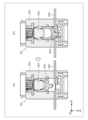
- FIG. 3 is a cross-sectional view showing an example of a pyrofuse 20 according to an embodiment.
- FIG. 3(a) shows the state before the busbar 204 constituting the current path is severed
- FIG. 3(b) shows the state after the busbar 204 is severed. Note that the pyrofuse 20 shown in FIG. 3 is merely one example.
- the pyrofuse 20 has a casing portion 201 that forms the outer shell of the pyrofuse 20, a piston 203 that can move in a first direction d1, an ignition portion 202 that activates the piston 203, and a busbar 204 that is inserted into the current path and becomes part of the current path.
- the casing portion 201 has a cylindrical shape and is arranged along the first direction d1. Inside the casing portion 201, the center portion of the bus bar 204, the piston 203, and the ignition portion 202 are arranged. On the outside of the casing portion 201, both ends of the bus bar 204 are arranged.
- the bus bar 204 is a linear, flat conductor and is arranged along a second direction d2 that intersects with the first direction d1. In this example, the second direction d2 is perpendicular to the first direction d1.
- the bus bar 204 extending in the second direction d2 penetrates the side surface of the casing portion 201, and both ends of the bus bar 204 protrude outward from the side surface of the casing portion 201.
- the ignition unit 202 is provided inside the casing unit 201.
- the ignition unit 202 activates the piston 203.
- the ignition unit 202 ignites explosives to rapidly expand the gas inside the casing unit 201, thereby moving the piston 203 at high speed in the first direction d1.
- Piston 203 has a cylindrical shape and is disposed inside casing portion 201 so as to extend along first direction d1.
- ignition portion 202 When ignition portion 202 is ignited, piston 203 moves in first direction d1 and severs busbar 204 (see FIG. 3(b)).
- piston 203 severs busbar 204, it collides with busbar 204 or a part of casing portion 201, generating vibration in first direction d1.
- the pyrofuse 20 is a fuse for cutting off the current path when a large current flows through the current path connecting the battery 200 and the load 400 due to a short circuit abnormality.
- the pyrofuse 20 has explosives built in, and ignites the explosives based on a signal from outside the pyrofuse 20, thereby irreversibly cutting off the current path with the explosive force generated by the explosive ignition, thereby cutting off the current path.
- the pyrofuse 20 cuts off the current path in response to an ignition signal from the cutoff control circuit 10.
- the pyrofuse 20 is provided in the current path connecting the positive terminal of the battery 200 and the positive terminal of the load 400, and cuts off the current path in response to an ignition signal from the cutoff control circuit 10.
- pyrofuse 20 can continuously pass a current of 500 A or less, and can pass a current of about 1200 A for a few to tens of seconds. Also, for example, pyrofuse 20 can be applied with a voltage of 500 V to 1000 V or less and can cut off a current path through which a current of 16,000 A to 25,000 A or less flows. In pyrofuse 20, the current path (current path) and the ignition signal path are insulated, so that high voltage is not applied to the ignition signal path.
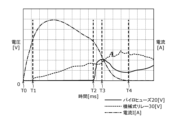
- FIG. 4 shows the current-voltage characteristics of the battery cutoff unit 100 in an embodiment of the present disclosure, and shows the change in current monitored by the current sensor 40.
- the current value monitored by the current sensor 40 is sent to the cutoff control circuit 10, and at time T0 the current I starts to rise. At time T1, the current value is greater than the short circuit withstand current (threshold current) of the mechanical relay 30, and when an overcurrent is flowing, the contacts 305 and 306 separate from each other, and an arc discharge occurs between the contacts 305 and 306 (at time T1 in Figure 4, the voltage of the mechanical relay 30 rises).
- Time T1 is the timing when arc discharge begins in the mechanical relay 30. At this time, the current path is not interrupted by the pyro-fuse 20, and no arc discharge occurs in the pyro-fuse 20. Note that the ECU 300 may send a disconnection signal (OFF signal) to the mechanical relay 30 at a timing around time T1.
- OFF signal disconnection signal
- the shutoff control circuit 10 sends an ignition signal to the pyrofuse 20 based on the current value (monitoring current information) from the current sensor 40. This causes the pyrofuse 20 to cut off the current path, and an arc discharge also occurs at the part of the current path cut by the pyrofuse 20 (the voltage of the pyrofuse 20 (the voltage at the cut part) rises at time T2 in Figure 4).
- an arc discharge occurs in both the mechanical relay 30 (specifically, between contacts 305 and 306) and the pyrofuse 20 (specifically, the portion of the current path that is interrupted by the pyrofuse 20).
- the period from time T2 to time T3 is a period in which the current value decreases, following the period from time T1 to time T2. However, the rate of decrease in the current value from time T2 to time T3 is greater than the rate of decrease in the current value from time T1 to time T2.
- the cutoff control circuit 10 sends an ignition signal to the pyro-fuse 20 based on the current value (current information) from the current sensor 40 at the timing of time T2 (or the period from time T2 to time T3) according to the current value (current information) from the current sensor 40.
- the shutoff control circuit 10 stores the time (called the first time) from the output of the ignition signal to the occurrence of arc discharge in the pyrofuse 20, and predicts the time when the short circuit withstand current (threshold current) will be exceeded using multiple current values (current information) with different times (called measurement times) for measuring the current value input from the current sensor 40 and the first time described above, and outputs an ignition signal to the pyrofuse 20 based on the prediction described above so that an arc discharge will occur in the pyrofuse 20 after an arc discharge occurs in the mechanical relay 30, and so that the period during which an arc discharge occurs in the mechanical relay 30 overlaps with the period during which an arc discharge occurs in the pyrofuse 20.
- the shutoff control circuit 10 may also use a different method for determining the timing to send an ignition signal to the pyrofuse 20. For example, the current value may rise and exceed a current value greater than the short circuit withstand current (threshold current), the current value may rise further, reach a maximum value after a period of time, and then the current value may fall, and the shutoff control circuit 10 may send an ignition signal to the pyrofuse 20 at this timing (time T2 in FIG. 4).
- the timing for sending an ignition signal to the pyro-fuse 20 may be determined as the timing when the current value rises to a value that exceeds a current value greater than the short circuit withstand current (threshold current), reaches a maximum value after a period of time, and then drops to a value lower than a certain value (reference value for determining whether to cut off).
- the shutoff control circuit 10 can recognize that an arc discharge has occurred in the mechanical relay 30, and the shutoff control circuit 10 can output an ignition signal to the pyro-fuse 20 based on the change in the current value from the current sensor 40.
- pyroelectric fuse 20 receives an ignition signal and cuts off the current path, causing the potential difference between one end and the other end of the cut-off portion of the current path to rise. This potential difference then decreases, and at time T3, current I begins to drop sharply. Then, at time T4, the current flowing between battery 200 and load 400 is completely cut off.
- the battery cutoff unit 100 is characterized in that the cutoff instructions to the mechanical relay 30 and the pyro-fuse 20 are sent from separate circuits (specifically, the ECU 300 and the cutoff control circuit 10).
- the ECU 300 installed in the transport equipment sends a signal to the mechanical relay 30, which turns the mechanical relay 30 OFF.
- the mechanical relay 30 is turned OFF when various faults occur in the transport equipment other than a fault that causes an overcurrent to flow. This allows the battery cut-off unit 100 to cut off (ON/OFF) the current path using the mechanical relay 30 on multiple (repeated) occasions.
- the battery cutoff unit 100 is capable of cutting off the pyro-fuse 20 by an ignition signal from the cutoff control circuit 10 when an overcurrent occurs based on the current value (monitoring current information) from the current sensor 40.
- a signal is sent to the mechanical relay 30 from the transportation equipment's ECU 300 (outside the battery cutoff unit 100), and a signal is sent to the pyrofuse 20 from the cutoff control circuit 10 within the battery cutoff unit 100, allowing appropriate cutoff in a variety of situations.
- the cutoff control circuit 10 provided in the battery cutoff unit 100 is not connected to the ECU 300 provided outside the battery cutoff unit 100, and there is no need for information to be shared (sharing judgment) between the cutoff control circuit 10 and the ECU 300.
- the current sensor 40 provided in the battery cutoff unit 100 is not connected to the ECU 300 provided outside the battery cutoff unit 100, and the ECU 300 does not need to recognize the current value (current information) from the current sensor 40. In other words, whether or not the overcurrent is exceeded, appropriate cutoff can be performed using the mechanical relay 30 and pyro fuse 20.
- the pyrofuses 20 are used in the battery cutoff unit 100 instead of blow fuses because it is difficult to achieve both response time and durability with blow fuses, whereas pyrofuses 20 can achieve both.
- FIG. 5 is a side view showing an example of a mechanical relay 30 according to an embodiment.
- the mechanical relay 30 includes a first circuit section 301, a second circuit section 302, a movable terminal 303, a fixed terminal 304, a contact 305, a contact 306, and a movable section 307, and controls the movable terminal 303 and the fixed terminal 304 to be in contact or separated in order to electrically connect or disconnect the first circuit section 301 and the second circuit section 302.
- the contact 305 is an example of a first contact
- the contact 306 is an example of a second contact.
- the precharge relay 31 also has the configuration shown in FIG. 5.
- the mechanical relay 30 is also a switch that switches the supply of power from the battery 200 to the load 400 ON/OFF.
- the mechanical relay 30 is turned ON/OFF by a control signal from the ECU 300. For example, when the transportation equipment is started, the mechanical relay 30 is turned ON by a control signal from the ECU 300, and the supply of power to the load 400 is started.
- the mechanical relay 30 is also turned OFF by a control signal from the ECU 300.
- the control signal from the ECU 300 to the mechanical relay 30 may be a signal generated based on the detection result of a fault in the transport equipment.
- the ECU 300 detects a fault in the transport equipment.
- the fault in the transport equipment is a fault outside the battery cutoff unit 100.
- the fault in the transport equipment is a fault other than a fault in which an overcurrent flows in the current path (for example, a fault in the battery 200 or the load 400).
- the ECU 300 detects a fault in the transport equipment and generates a control signal to turn off the mechanical relay 30 and outputs it to the mechanical relay 30, even if the output of the battery 200 is turned off (including a case where the driver turns it off by operating the start button) while the mechanical relay 30 is on and power supply to the load 400 continues, the ECU 300 detects a fault in the transport equipment, generates a control signal to turn off the mechanical relay 30, and outputs it to the mechanical relay 30.
- the mechanical relay 30 can cut off the current path.
- the ECU 300 which can monitor various conditions of the transportation equipment, such as the conditions of the battery 200 and the load 400, can cut off the current path by turning off the mechanical relay 30 in the event of a fault in the transportation equipment.
- the mechanical relay 30 is provided in each of the current paths connecting the positive terminal of the battery 200 and the positive terminal of the load 400, and the current paths connecting the negative terminal of the battery 200 and the negative terminal of the load 400.
- the pyro fuse 20 is provided on the battery 200 side of the mechanical relay 30 in the current paths.
- a high voltage of 100V or more can be applied to the mechanical relay 30, and the mechanical relay 30 can be repeatedly turned ON/OFF tens of thousands of times or more.
- the mechanical relay 30 can continuously pass a current of 300A or less, and can interrupt (ON/OFF) a current path through which a current of 300A or less flows multiple times.
- the mechanical relay 30 can be applied with a voltage of 1000V or less and interrupt the current path through which a current of 2000A or less flows.
- the reason why the mechanical relay 30 is used instead of the semiconductor relay in the battery cutoff unit 100 is that in order to make the semiconductor relay have a small current resistance like the mechanical relay 30, many semiconductor relays must be connected in parallel, which has the disadvantages of cost and size.
- the battery cutoff unit 100 is provided with a precharge relay 31 and a precharge resistor 32 as a measure against the inrush current.
- the precharge relay 31 is turned on/off by a signal from the ECU 300.
- the precharge relay 31 and the precharge resistor 32 are connected in series, and the circuit in which the precharge relay 31 and the precharge resistor 32 are connected in series is connected in parallel with the mechanical relay 30.
- the mechanical relay 30 provided in the current path on the positive terminal side is turned off, the precharge relay 31 is turned on, and the mechanical relay 30 provided in the current path on the negative terminal side is turned on.
- This allows current to flow to the load 400 via the precharge resistor 32, thereby suppressing the occurrence of inrush current.
- the voltage of the smoothing capacitance of the load 400 becomes approximately the same as the voltage of the battery 200, and the mechanical relay 30 provided in the current path on the positive terminal side is turned on, starting normal operation.
- the precharge relay 31 is of the same type as the mechanical relay 30. Also, the precharge relay 31 can use the same configuration as the mechanical relay 30. On the other hand, the precharge relay 31 may use a semiconductor relay.
- the current sensor 40 is a sensor that detects the current value of the current flowing in the current path connecting the battery 200 and the load 400.
- the current sensor 40 can continuously pass a current of 300 A or less.
- the current sensor 40 is a shunt type sensor (for example, a shunt resistor: for example, about 20 ⁇ to 80 ⁇ ).
- the current sensor 40 outputs the detected current value (analog value) to the cutoff control circuit 10.
- the current sensor 40 may be a sensor such as a Hall element.
- the pyro-fuse 20, the mechanical relay 30, or the current sensor 40 may fail. For example, if a large current continues to flow through the current path, the mechanical relay 30 may explode.
- the failure characteristics of the mechanical relay 30 will be described. If a current of 500 A flows through the current path, the mechanical relay 30 will not fail (e.g. explode) even if the current continues to flow through the current path until 100,000 ms have elapsed, but will fail if the current continues to flow for 100,000 ms or more. Also, if a current of 6000 A, which is greater than 500 A, flows through the current path, the mechanical relay 30 will fail if the current continues to flow for 200 ms or more.
- the cutoff control circuit 10 determines whether the current flowing through the current path is an overcurrent based on the current value of the current flowing through the current path, and outputs an ignition signal to the pyrofuse 20. If the current flowing through the current path is an overcurrent, the pyrofuse 20 is caused to cut off the current path.
- the shutoff control circuit 10 is a circuit that shuts off the current path by driving the pyrofuse 20.
- the shutoff control circuit 10 is realized, for example, by a microcontroller (MCU: Micro Controller Unit) or the like.
- the shutoff control circuit 10 may also be realized, for example, by an ASIC (Application Specific Integrated Circuit) or the like.
- the shutoff control circuit 10 includes a current acquisition unit 11, a shutoff determination unit 12, and an ignition control unit 14.
- the current acquisition unit 11 and the shutoff determination unit 12 are realized by a microcontroller 13, and the ignition control unit 14 is realized by an ASIC 15.
- the current acquisition unit 11 is an AD converter that acquires the current value (analog value) of the current flowing through the current path detected by the current sensor 40 and converts it into a digital value (called an AD value).
- the current acquisition unit 11 outputs the AD value to the interruption determination unit 12.
- the current acquisition unit 11 converts the current value detected by the current sensor 40 into an AD value at regular time intervals and outputs it to the interruption determination unit 12.
- the interruption determination unit 12 determines whether the current flowing through the current path is an overcurrent. Specifically, the interruption determination unit 12 determines whether to drive the pyro-fuse 20 (i.e., to interrupt the current path) based on whether the current value detected by the current sensor 40 (specifically, the AD value acquired from the current acquisition unit 11) is an overcurrent.
- the ignition control unit 14 When the cutoff determination unit 12 determines that the current flowing through the current path is an overcurrent (i.e., when it determines that the pyrofuse 20 should be driven), the ignition control unit 14 outputs an ignition signal to the pyrofuse 20 to drive the pyrofuse 20. This makes it possible to cut off the current path.
- the method by which the interruption determination unit 12 determines whether the current flowing through the current path is an overcurrent is not particularly limited. However, it is necessary to distinguish whether the current flowing through the current path is noise or an overcurrent. Therefore, for example, the interruption determination unit 12 may be equipped with a filter that removes noise. Also, for example, the interruption determination unit 12 may average the current value detected by the current sensor 40 over a certain period of time, and determine whether the current flowing through the current path is an overcurrent depending on whether the average value is equal to or greater than a predetermined value.
- the cutoff determination unit 12 can determine whether the overcurrent is not a temporary one caused by noise, but is flowing continuously through the current path, and if an overcurrent is flowing continuously, the current path can be cut off by driving the pyro-fuse 20 via the ignition control unit 14.
- the battery cutoff unit 100 may be provided with two current sensors 40.
- the current sensors 40 may be provided in the current path so that the same current value is detected, and the cutoff determination unit 12 may detect a failure of the current sensor 40 using two AD values. If the two AD values are different values, the cutoff determination unit 12 can determine that at least one of the two current sensors 40 is faulty.
- the two AD values should be the same value, but if they are different values, it is highly likely that at least one of the two current sensors 40 is faulty.
- the current sensor 40 For example, if it is determined that at least one of the two current sensors 40 is faulty, a notification to that effect is given to the user or manager of the transport equipment, and the current sensor 40 is repaired. This makes it possible to suppress the malfunction of devices such as the mechanical relay 30 provided in the current path, while also suppressing the mistaken activation of the pyrofuse 20 due to a malfunction of the current sensor 40. In particular, when the time integral value is used to determine an overcurrent, it is possible to suppress the malfunction of devices such as the mechanical relay 30 provided in the current path, while also suppressing the mistaken activation of the pyrofuse 20 due to a malfunction of the current sensor 40.
- the disadvantage of the pyro fuse 20 is that once it has been operated, the transportation equipment cannot be restored unless it is replaced, whereas the advantage of the mechanical relay 30 is that it can be repeatedly turned on and off after the abnormality has been corrected or if there was no fault in the first place. Therefore, faults other than those in which an overcurrent flows through the current path are detected by the ECU 300, and the mechanical relay 30 is turned on and off based on the results of this fault detection.
- This disclosure can also be applied to transportation equipment such as hybrid vehicles that are also equipped with engines, but it is preferable for it to be used in pure electric vehicles that require larger capacity batteries than hybrid vehicles.
- a very large current may flow in the current path connecting the battery 200 and the load 400 in the event of an abnormality.
- the pyrofuse 20 can cut off the current path even when a large current of tens of thousands of A flows through the current path, so the battery cutoff unit 100 equipped with the pyrofuse 20 can safely cut off the current path.
- the pyrofuse 20 and the cutoff control circuit 10 that outputs an ignition signal to the pyrofuse 20 are provided in one rigid part 110, when the cutoff control circuit 10 determines that the current flowing through the current path is an overcurrent, the cutoff control circuit 10, which is provided in one rigid part 110 and therefore located close to each other, can instantly transmit an ignition signal to the pyrofuse 20. Therefore, in a transportation device equipped with a large-capacity battery 200, the current path can be cut off quickly and safely.
- the mechanical relay 30 can improve the interruption performance without increasing the size and cost compared to semiconductor relays, it is possible to suppress the increase in size and cost of the battery interruption unit 100 in transportation equipment equipped with a large-capacity battery 200 through which a large current can flow. Furthermore, since the ECU 300 can detect failures in the transportation equipment, for failures other than those in which an overcurrent flows in the current path, the current path can be interrupted by turning off the mechanical relay 30.
- Each component included in the shutoff control circuit 10 of the above embodiment may be realized as a dedicated or general-purpose circuit.
- each component included in the shutoff control circuit 10 of the above embodiment may be realized as an LSI (Large Scale Integration) which is an integrated circuit (IC).
- LSI Large Scale Integration
- IC integrated circuit
- the integrated circuit is not limited to an LSI, and may be realized by a dedicated circuit or a general-purpose processor.
- a programmable FPGA (Field Programmable Gate Array) or a reconfigurable processor that allows the connections and settings of circuit cells inside the LSI to be reconfigured may also be used.
- shutoff control circuit 10 can be integrated into an integrated circuit using that technology.
- this disclosure also includes forms obtained by applying various modifications to the embodiments that a person skilled in the art may conceive, and forms realized by arbitrarily combining the components and functions of each embodiment within the scope that does not deviate from the spirit of this disclosure.
- a battery cutoff unit used in a transportation device having a battery and a load comprising a pyro fuse, a mechanical relay having a first contact and a second contact, a current sensor, and a cutoff control circuit connected to the current sensor and the pyro fuse, the current sensor outputs a current value of a current flowing in a current path between the battery and the load to the cutoff control circuit, the cutoff control circuit outputs an ignition signal to the pyro fuse based on the current value, the pyro fuse cuts off the current path by the ignition signal, and the mechanical relay is turned on/off by a control signal from outside the battery cutoff unit.
- mechanical relays can improve interruption performance without increasing the size and cost compared to semiconductor relays, so it is possible to prevent the battery interruption unit from becoming larger and more expensive in transportation equipment equipped with large-capacity batteries through which large currents can flow.
- the current path can be cut off by turning off the mechanical relay using a control signal from an electronic control unit installed outside the battery cutoff unit.
- the shutoff control circuit can recognize that an arc discharge has occurred in the mechanical relay, and the shutoff control circuit can output an ignition signal to the pyro-fuse based on the change in the current value of the current sensor 4.
- the current path may be interrupted based on a prediction of when the current value of the current flowing through the current path will exceed the threshold current.
- an ignition signal is output to the pyro fuse to disconnect the load from the battery, and then an arc discharge occurs in the mechanical relay and pyro fuse.
- the transport equipment includes an electronic control unit that is provided outside the battery cutoff unit, is connected to the battery and the load without being connected to the current sensor, and outputs the control signal, and the mechanical relay is turned on/off by the control signal based on information from the battery or the load.
- a battery cutoff unit according to any one of techniques 1 to 4.
- the electronic control unit installed outside the battery cutoff unit can monitor the battery or load in the transportation equipment for abnormalities, and if an abnormality occurs in the battery or load, the current path can be cut off by turning off the mechanical relay.
- the electronic control unit generates a control signal based on the detection result of a fault in the transportation equipment and outputs the control signal to the mechanical relay, so that the mechanical relay can be turned ON/OFF depending on the detection result of the fault in the transportation equipment.
- These pyrofuses have the ability to cut off the current path even when a large current of tens of thousands of amperes flows through the current path.
- the current sensor's performance makes it possible to detect the current flowing through the current path in transportation equipment equipped with large-capacity batteries.
- the battery cutoff unit is provided with two or more of the current sensors, and the cutoff control circuit detects failures of two or more of the current sensors based on the current values of the two or more current sensors.
- a battery cutoff unit according to any one of techniques 1 to 9.
- Two current sensors are provided in the current path so that each detects the same current value, and if the two current values are different, it can be determined that at least one of the two current sensors is faulty.
- Shunt-type current sensors can detect large currents. Therefore, in transportation equipment equipped with large-capacity batteries, even if a large current flows through the current path, the shunt-type current sensor can detect the current flowing through the current path.
- the battery cutoff unit according to any one of technologies 1 to 12, wherein the cutoff control circuit has a current acquisition unit, a cutoff determination unit, and an ignition control unit, the current acquisition unit acquires a current value of the current flowing through the current path, the cutoff determination unit determines whether the current flowing through the current path is an overcurrent, and the ignition control unit outputs the ignition signal to the pyro-fuse when it is determined that the current flowing through the current path is an overcurrent.
- a cutoff control circuit can be realized by the current acquisition unit, cutoff determination unit, and ignition control unit.
- This disclosure can be applied to systems that cut off a current path by activating a pyro-fuse.
Landscapes
- Engineering & Computer Science (AREA)
- Power Engineering (AREA)
- Life Sciences & Earth Sciences (AREA)
- Sustainable Development (AREA)
- Sustainable Energy (AREA)
- Transportation (AREA)
- Mechanical Engineering (AREA)
- Emergency Protection Circuit Devices (AREA)
Priority Applications (1)
| Application Number | Priority Date | Filing Date | Title |
|---|---|---|---|
| JP2024574435A JPWO2024162041A1 (https=) | 2023-02-02 | 2024-01-19 |
Applications Claiming Priority (2)
| Application Number | Priority Date | Filing Date | Title |
|---|---|---|---|
| JP2023-014678 | 2023-02-02 | ||
| JP2023014678 | 2023-02-02 |
Publications (1)
| Publication Number | Publication Date |
|---|---|
| WO2024162041A1 true WO2024162041A1 (ja) | 2024-08-08 |
Family
ID=92146463
Family Applications (1)
| Application Number | Title | Priority Date | Filing Date |
|---|---|---|---|
| PCT/JP2024/001461 Ceased WO2024162041A1 (ja) | 2023-02-02 | 2024-01-19 | バッテリ遮断ユニット |
Country Status (2)
| Country | Link |
|---|---|
| JP (1) | JPWO2024162041A1 (https=) |
| WO (1) | WO2024162041A1 (https=) |
Citations (3)
| Publication number | Priority date | Publication date | Assignee | Title |
|---|---|---|---|---|
| JP2020051863A (ja) * | 2018-09-26 | 2020-04-02 | 株式会社豊田自動織機 | 電流センサの故障判定装置 |
| WO2020196465A1 (ja) * | 2019-03-26 | 2020-10-01 | パナソニックIpマネジメント株式会社 | 保護システム |
| JP2022014988A (ja) * | 2020-07-08 | 2022-01-21 | 株式会社オートネットワーク技術研究所 | 配電モジュール |
-
2024
- 2024-01-19 JP JP2024574435A patent/JPWO2024162041A1/ja active Pending
- 2024-01-19 WO PCT/JP2024/001461 patent/WO2024162041A1/ja not_active Ceased
Patent Citations (3)
| Publication number | Priority date | Publication date | Assignee | Title |
|---|---|---|---|---|
| JP2020051863A (ja) * | 2018-09-26 | 2020-04-02 | 株式会社豊田自動織機 | 電流センサの故障判定装置 |
| WO2020196465A1 (ja) * | 2019-03-26 | 2020-10-01 | パナソニックIpマネジメント株式会社 | 保護システム |
| JP2022014988A (ja) * | 2020-07-08 | 2022-01-21 | 株式会社オートネットワーク技術研究所 | 配電モジュール |
Also Published As
| Publication number | Publication date |
|---|---|
| JPWO2024162041A1 (https=) | 2024-08-08 |
Similar Documents
| Publication | Publication Date | Title |
|---|---|---|
| CN113169388B (zh) | 电池组、电源系统 | |
| KR101891687B1 (ko) | 배터리 모듈 분리 장치 | |
| CN108466552B (zh) | 故障诊断装置、蓄电装置以及故障诊断方法 | |
| CN108604809B (zh) | 继电器装置以及电源装置 | |
| JP7119401B2 (ja) | 故障診断装置、蓄電装置、故障診断方法 | |
| JP7695606B2 (ja) | 蓄電装置、接続状態の判定方法 | |
| US20210039576A1 (en) | Method for operating an electrically drivable motor vehicle and a device therefor | |
| EP2811549B1 (en) | Over-current responsive device | |
| CN114824514A (zh) | 电池装置、机动车和用于运行电池装置的方法 | |
| JP2016134962A (ja) | 蓄電システム | |
| US20170153285A1 (en) | Method and device for detecting arcs | |
| JP7559401B2 (ja) | 蓄電装置 | |
| WO2024162041A1 (ja) | バッテリ遮断ユニット | |
| JP2014048281A (ja) | 電源装置および故障検出回路 | |
| JP2011016391A (ja) | 回路遮断器 | |
| JP7754757B2 (ja) | 車両用電力制御装置 | |
| CN119343734A (zh) | 直流短路保护装置 | |
| CN110027411A (zh) | 电动车的电池组系统、运行电池组系统的方法和电动车 | |
| JP6648217B2 (ja) | スイッチユニットおよび電池装置 | |
| KR102589023B1 (ko) | 차량용 배터리 시스템 및 그 제어방법 | |
| JP6718351B2 (ja) | 電圧検出装置 | |
| WO2025158837A1 (ja) | バッテリ遮断ユニットおよびバッテリ遮断方法 | |
| WO2025248904A1 (ja) | 遮断システムおよび遮断方法 | |
| CN113039693A (zh) | 用于电化学的蓄能系统的分开装置 | |
| WO2024202917A1 (ja) | 電流遮断モジュール |
Legal Events
| Date | Code | Title | Description |
|---|---|---|---|
| 121 | Ep: the epo has been informed by wipo that ep was designated in this application |
Ref document number: 24749994 Country of ref document: EP Kind code of ref document: A1 |
|
| ENP | Entry into the national phase |
Ref document number: 2024574435 Country of ref document: JP Kind code of ref document: A |
|
| WWE | Wipo information: entry into national phase |
Ref document number: 2024574435 Country of ref document: JP |
|
| NENP | Non-entry into the national phase |
Ref country code: DE |
|
| 122 | Ep: pct application non-entry in european phase |
Ref document number: 24749994 Country of ref document: EP Kind code of ref document: A1 |