WO2024161982A1 - 円筒形の非水電解質二次電池 - Google Patents
円筒形の非水電解質二次電池 Download PDFInfo
- Publication number
- WO2024161982A1 WO2024161982A1 PCT/JP2024/000992 JP2024000992W WO2024161982A1 WO 2024161982 A1 WO2024161982 A1 WO 2024161982A1 JP 2024000992 W JP2024000992 W JP 2024000992W WO 2024161982 A1 WO2024161982 A1 WO 2024161982A1
- Authority
- WO
- WIPO (PCT)
- Prior art keywords
- negative electrode
- facing portion
- facing
- secondary battery
- electrolyte secondary
- Prior art date
- Legal status (The legal status is an assumption and is not a legal conclusion. Google has not performed a legal analysis and makes no representation as to the accuracy of the status listed.)
- Ceased
Links
Images






Classifications
-
- H—ELECTRICITY
- H01—ELECTRIC ELEMENTS
- H01M—PROCESSES OR MEANS, e.g. BATTERIES, FOR THE DIRECT CONVERSION OF CHEMICAL ENERGY INTO ELECTRICAL ENERGY
- H01M10/00—Secondary cells; Manufacture thereof
- H01M10/05—Accumulators with non-aqueous electrolyte
- H01M10/058—Construction or manufacture
- H01M10/0587—Construction or manufacture of accumulators having only wound construction elements, i.e. wound positive electrodes, wound negative electrodes and wound separators
-
- H—ELECTRICITY
- H01—ELECTRIC ELEMENTS
- H01M—PROCESSES OR MEANS, e.g. BATTERIES, FOR THE DIRECT CONVERSION OF CHEMICAL ENERGY INTO ELECTRICAL ENERGY
- H01M10/00—Secondary cells; Manufacture thereof
- H01M10/04—Construction or manufacture in general
- H01M10/0422—Cells or battery with cylindrical casing
-
- H—ELECTRICITY
- H01—ELECTRIC ELEMENTS
- H01M—PROCESSES OR MEANS, e.g. BATTERIES, FOR THE DIRECT CONVERSION OF CHEMICAL ENERGY INTO ELECTRICAL ENERGY
- H01M10/00—Secondary cells; Manufacture thereof
- H01M10/04—Construction or manufacture in general
- H01M10/0431—Cells with wound or folded electrodes
-
- H—ELECTRICITY
- H01—ELECTRIC ELEMENTS
- H01M—PROCESSES OR MEANS, e.g. BATTERIES, FOR THE DIRECT CONVERSION OF CHEMICAL ENERGY INTO ELECTRICAL ENERGY
- H01M4/00—Electrodes
- H01M4/02—Electrodes composed of, or comprising, active material
- H01M4/13—Electrodes for accumulators with non-aqueous electrolyte, e.g. for lithium-accumulators; Processes of manufacture thereof
-
- H—ELECTRICITY
- H01—ELECTRIC ELEMENTS
- H01M—PROCESSES OR MEANS, e.g. BATTERIES, FOR THE DIRECT CONVERSION OF CHEMICAL ENERGY INTO ELECTRICAL ENERGY
- H01M50/00—Constructional details or processes of manufacture of the non-active parts of electrochemical cells other than fuel cells, e.g. hybrid cells
- H01M50/50—Current conducting connections for cells or batteries
- H01M50/531—Electrode connections inside a battery casing
- H01M50/533—Electrode connections inside a battery casing characterised by the shape of the leads or tabs
-
- H—ELECTRICITY
- H01—ELECTRIC ELEMENTS
- H01M—PROCESSES OR MEANS, e.g. BATTERIES, FOR THE DIRECT CONVERSION OF CHEMICAL ENERGY INTO ELECTRICAL ENERGY
- H01M4/00—Electrodes
- H01M4/02—Electrodes composed of, or comprising, active material
- H01M2004/026—Electrodes composed of, or comprising, active material characterised by the polarity
- H01M2004/027—Negative electrodes
-
- H—ELECTRICITY
- H01—ELECTRIC ELEMENTS
- H01M—PROCESSES OR MEANS, e.g. BATTERIES, FOR THE DIRECT CONVERSION OF CHEMICAL ENERGY INTO ELECTRICAL ENERGY
- H01M2200/00—Safety devices for primary or secondary batteries
-
- Y—GENERAL TAGGING OF NEW TECHNOLOGICAL DEVELOPMENTS; GENERAL TAGGING OF CROSS-SECTIONAL TECHNOLOGIES SPANNING OVER SEVERAL SECTIONS OF THE IPC; TECHNICAL SUBJECTS COVERED BY FORMER USPC CROSS-REFERENCE ART COLLECTIONS [XRACs] AND DIGESTS
- Y02—TECHNOLOGIES OR APPLICATIONS FOR MITIGATION OR ADAPTATION AGAINST CLIMATE CHANGE
- Y02E—REDUCTION OF GREENHOUSE GAS [GHG] EMISSIONS, RELATED TO ENERGY GENERATION, TRANSMISSION OR DISTRIBUTION
- Y02E60/00—Enabling technologies; Technologies with a potential or indirect contribution to GHG emissions mitigation
- Y02E60/10—Energy storage using batteries
-
- Y—GENERAL TAGGING OF NEW TECHNOLOGICAL DEVELOPMENTS; GENERAL TAGGING OF CROSS-SECTIONAL TECHNOLOGIES SPANNING OVER SEVERAL SECTIONS OF THE IPC; TECHNICAL SUBJECTS COVERED BY FORMER USPC CROSS-REFERENCE ART COLLECTIONS [XRACs] AND DIGESTS
- Y02—TECHNOLOGIES OR APPLICATIONS FOR MITIGATION OR ADAPTATION AGAINST CLIMATE CHANGE
- Y02P—CLIMATE CHANGE MITIGATION TECHNOLOGIES IN THE PRODUCTION OR PROCESSING OF GOODS
- Y02P70/00—Climate change mitigation technologies in the production process for final industrial or consumer products
- Y02P70/50—Manufacturing or production processes characterised by the final manufactured product
Definitions
- This disclosure relates to a cylindrical non-aqueous electrolyte secondary battery.
- Patent Document 1 A conventional cylindrical non-aqueous electrolyte secondary battery is described in Patent Document 1.
- the negative electrode provided with the negative electrode mixture layer has a non-facing portion that does not face the positive electrode at the start of winding the electrode body, and this non-facing portion exists for two or more revolutions.
- this non-aqueous electrolyte secondary battery suppresses deformation at the start of winding the electrode body.
- cylindrical non-aqueous electrolyte secondary batteries if the hollow part of the electrode body becomes blocked due to melting of the separator during abnormal heat generation, it may become impossible to secure a sufficient exhaust path to the outside via the hollow part, and high-temperature gas may not be able to be smoothly exhausted to the outside. Therefore, there is a need for a cylindrical non-aqueous electrolyte secondary battery that can prevent the hollow part of the electrode body from becoming blocked even when abnormal heat is generated, and can smoothly exhaust gas to the outside via the hollow part.
- a configuration can be considered in which a non-facing portion is formed at the winding start end of the negative electrode, wound so as not to face the positive electrode, and the negative electrode tab is joined to this non-facing portion while being wound 0.75 turns or more, thereby preventing blockage of the hollow portion of the electrode body in the event of abnormal heat generation.
- both ends of the negative electrode tab in the winding direction become angular, which may increase the diameter of the wound electrode body and make it difficult to insert it into the outer can.
- the battery is repeatedly charged and discharged, there is a risk that the electrode plate will buckle, starting from the angular parts of the negative electrode tab.
- the objective of this disclosure is to provide a cylindrical nonaqueous electrolyte secondary battery that can smoothly exhaust gas to the outside through the hollow portion of the electrode body even if abnormal heat is generated, and that can prevent both ends of the negative electrode tab from becoming angular in the winding direction.
- the cylindrical nonaqueous electrolyte secondary battery according to the present disclosure is a cylindrical nonaqueous electrolyte secondary battery comprising an electrode assembly in which a long positive electrode and a long negative electrode are wound with a separator interposed therebetween, a nonaqueous electrolyte, and an exterior can housing the electrode assembly and the nonaqueous electrolyte,
- the negative electrode includes a non-facing portion wound from a portion facing the inside of the winding of the starting end of the positive electrode in the winding direction to the winding start side in a state where it does not face the positive electrode, and a negative electrode tab joined to the non-facing portion
- the negative electrode tab includes a negative electrode facing portion facing the negative electrode, and a lead-out portion that is shorter in length than a portion having a maximum length of the negative electrode facing portion in the longitudinal direction of the negative electrode in the deployed state and is led outward from one end of the negative electrode in the width direction, the portion having the maximum length of the negative electrode facing portion is wound 0.75 turns or more,
- the cylindrical nonaqueous electrolyte secondary battery disclosed herein allows gas to be smoothly exhausted to the outside through the hollow portion of the electrode body even if abnormal heat is generated, and prevents the ends of the negative electrode tab from becoming angular in the winding direction.
- FIG. 1 is an axial cross-sectional view of a cylindrical nonaqueous electrolyte secondary battery according to an embodiment of the present disclosure.
- FIG. 2 is a perspective view of an electrode assembly of the nonaqueous electrolyte secondary battery.
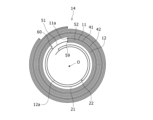
- 4 is a plan view showing the winding structure at the winding start side of the electrode body.
- FIG. FIG. 2 is a diagram showing the outer surface of a rolled long negative electrode.
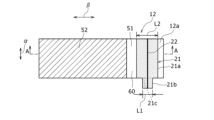
- 4A is a cross-sectional view taken along line AA in FIG. 4, and
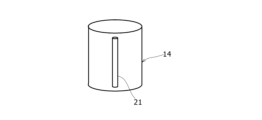
- FIG. 13 is a schematic diagram showing a state in which a blockage prevention portion for a hollow portion of an electrode body is formed by a negative electrode tab.
- FIG. 5 is a view corresponding to FIG.
- FIG. 4 of a negative electrode constituting a cylindrical nonaqueous electrolyte secondary battery according to another example of the embodiment.
- FIG. 5 is a view corresponding to FIG. 4 of a negative electrode constituting a cylindrical nonaqueous electrolyte secondary battery according to another example of the embodiment.
- the sealing body 17 side in the axial direction (height direction) of the cylindrical nonaqueous electrolyte secondary battery 10 is referred to as "upper”
- the bottom 68 side of the exterior can 16 in the axial direction is referred to as "lower”.
- FIG. 1 is an axial cross-sectional view of a cylindrical nonaqueous electrolyte secondary battery 10 according to an embodiment of the present disclosure
- FIG. 2 is a perspective view of an electrode body 14 of the nonaqueous electrolyte secondary battery 10.
- the nonaqueous electrolyte secondary battery 10 includes a wound electrode body 14, a nonaqueous electrolyte (not shown), a cylindrical metal exterior can 16 with a bottom that contains the electrode body 14 and the nonaqueous electrolyte, and a sealing body 17 that closes the opening of the exterior can 16.
- the electrode body 14 has a wound structure in which a long positive electrode 11 and a long negative electrode 12 are wound with a long separator 13 interposed therebetween.
- the negative electrode 12 is formed with dimensions slightly larger than the positive electrode 11 to prevent lithium precipitation. That is, the negative electrode 12 is formed longer in the longitudinal direction and width direction (short direction) than the positive electrode 11.
- the two separators 13 are formed with dimensions at least slightly larger than the positive electrode 11, and are arranged, for example, to sandwich the positive electrode 11.
- the negative electrode 12 may form the winding start end of the electrode body 14. However, in general, the separator 13 extends beyond the winding start end of the negative electrode 12, and the winding start end of the separator 13 becomes the winding start end of the electrode body 14.
- the non-aqueous electrolyte includes a non-aqueous solvent and an electrolyte salt dissolved in the non-aqueous solvent.
- an electrolyte salt dissolved in the non-aqueous solvent.
- esters, ethers, nitriles, amides, and mixed solvents of two or more of these may be used as the non-aqueous solvent.
- the non-aqueous solvent may contain a halogen-substituted body in which at least a part of the hydrogen atoms of these solvents is replaced with a halogen atom such as fluorine.
- the non-aqueous electrolyte is not limited to a liquid electrolyte, and may be a solid electrolyte using a gel polymer or the like.
- a lithium salt such as LiPF6 is used as the electrolyte salt.
- the positive electrode 11 has a positive electrode core 41 (see FIG. 3) and a positive electrode mixture layer 42 (see FIG. 3) formed on both sides of the positive electrode core 41.
- a metal foil that is stable in the potential range of the positive electrode 11, such as aluminum or an aluminum alloy, or a film with the metal disposed on the surface layer can be used.
- the positive electrode mixture layer 42 contains a positive electrode active material, a conductive agent, and a binder.
- the positive electrode 11 can be produced, for example, by applying a positive electrode mixture slurry containing a positive electrode active material, a conductive agent, and a binder onto the positive electrode core 41, drying the coating, and then compressing it to form the positive electrode mixture layer 42 on both sides of the positive electrode core 41.
- the positive electrode active material is composed mainly of a lithium-containing metal composite oxide.
- Metal elements contained in the lithium-containing metal composite oxide include Ni, Co, Mn, Al, B, Mg, Ti, V, Cr, Fe, Cu, Zn, Ga, Sr, Zr, Nb, In, Sn, Ta, and W.
- An example of a preferred lithium-containing metal composite oxide is a composite oxide containing at least one of Ni, Co, Mn, and Al.
- Examples of the conductive agent contained in the positive electrode mixture layer 42 include carbon materials such as carbon black, acetylene black, ketjen black, and graphite.
- Examples of the binder contained in the positive electrode mixture layer 42 include fluororesins such as polytetrafluoroethylene (PTFE) and polyvinylidene fluoride (PVdF), polyacrylonitrile (PAN), polyimide resin, acrylic resin, and polyolefin resin. These resins may be used in combination with cellulose derivatives such as carboxymethylcellulose (CMC) or its salts, and polyethylene oxide (PEO).
- the negative electrode 12 has a negative electrode core 51 (see FIG. 3) and a negative electrode mixture layer 52 (see FIG. 3) formed on both sides of the negative electrode core 51.
- a metal foil that is stable in the potential range of the negative electrode 12, such as copper or a copper alloy, or a film with the metal disposed on the surface layer can be used.
- the negative electrode mixture layer 52 contains a negative electrode active material and a binder.
- the negative electrode 12 can be produced, for example, by applying a negative electrode mixture slurry containing a negative electrode active material and a binder, etc., onto the negative electrode core 51, drying the coating, and then compressing it to form the negative electrode mixture layer 52 on both sides of the negative electrode core 51.
- the negative electrode active material generally uses a carbon material that reversibly absorbs and releases lithium ions.
- Preferred carbon materials are graphites such as natural graphites such as flake graphite, lump graphite, and earthy graphite, and artificial graphites such as lump artificial graphite and graphitized mesophase carbon microbeads.
- the negative electrode mixture layer 52 may contain a Si material containing silicon (Si) as the negative electrode active material. In this case, the negative electrode mixture layer 52 may contain silicon oxide represented by SiO x (0.5 ⁇ x ⁇ 1.6).
- the negative electrode active material may use a metal that alloys with lithium other than Si, an alloy containing the metal, a compound containing the metal, or the like.
- the binder contained in the negative electrode mixture layer 52 may be fluororesin, PAN, polyimide resin, acrylic resin, polyolefin resin, etc., but styrene-butadiene rubber (SBR) or a modified form thereof is preferably used.
- the negative electrode mixture layer 52 may contain, in addition to SBR, CMC or a salt thereof, polyacrylic acid (PAA) or a salt thereof, polyvinyl alcohol, etc.
- a porous sheet having ion permeability and insulating properties is used.
- the porous sheet include a microporous thin film, a woven fabric, and a nonwoven fabric.
- a polyolefin resin such as polyethylene or polypropylene, or cellulose, etc. is preferable.
- the separator 13 may have either a single layer structure or a laminated structure. A heat-resistant layer or the like may be formed on the surface of the separator 13.
- a positive electrode tab 20 is joined to the positive electrode 11, and a negative electrode tab 21 is joined to the winding start side of the negative electrode 12.
- the positive electrode tab 20 is a strip-shaped conductive member. There are no particular limitations on the material of the positive electrode tab 20.
- the positive electrode tab 20 is preferably made of a metal containing aluminum as a main component.
- the negative electrode tab 21 is a strip-shaped conductive member. There are no particular limitations on the material of the negative electrode tab 21.
- the negative electrode tab 21 is preferably made of a metal containing nickel or copper as a main component, or a metal containing both nickel and copper.
- the battery 10 has an insulating plate 18 above the electrode body 14, and an insulating plate 19 below the electrode body 14.
- the positive electrode tab 20 extends through a through hole in the insulating plate 18 toward the sealing body 17, and the negative electrode tab 21 extends through a through hole in the insulating plate 19 toward the bottom 68 of the outer can 16.
- the positive electrode tab 20 is connected to the underside of the internal terminal plate 23 of the sealing body 17 by welding or the like.
- the terminal cap 27 constituting the top plate of the sealing body 17 is electrically connected to the internal terminal plate 23, and the terminal cap 27 serves as the positive electrode terminal.
- the negative electrode tab 21 is connected to the inner surface of the bottom 68 of the metal outer can 16 by welding or the like, and the outer can 16 serves as the negative electrode terminal.
- the positive electrode tab 20 is electrically connected to an intermediate portion such as the center portion in the winding direction of the positive electrode core 41.
- the negative electrode tab 21 is electrically connected to the winding start end of the negative electrode core 51, and the winding end end of the negative electrode core 51 is abutted against the inner surface of the outer can 16. In this way, both the winding start side and the winding end side of the negative electrode 12 are electrically connected to the negative terminal, thereby reducing the current path and the electrical resistance.
- one negative electrode tab may be electrically connected to the winding start end of the negative electrode core without abutting the winding end end of the negative electrode core against the inner surface of the outer can.
- the electrode body may have two negative electrode tabs, one negative electrode tab may be electrically connected to the winding start end of the negative electrode core, and the other negative electrode tab may be electrically connected to the winding end of the negative electrode core.
- the battery 10 further includes a resin gasket 28 disposed between the exterior can 16 and the sealing body 17.
- the sealing body 17 is crimped and fixed to the opening of the exterior can 16 via the gasket 28. This seals the internal space of the battery 10.
- the gasket 28 is sandwiched between the exterior can 16 and the sealing body 17, and insulates the sealing body 17 from the exterior can 16.
- the gasket 28 acts as a sealing material to maintain airtightness inside the battery, and as an insulating material to insulate the exterior can 16 and the sealing body 17.
- the outer can 16 contains the electrode body 14 and the non-aqueous electrolyte, and has a shoulder 38, a grooved portion 34, a cylindrical portion 30, and a bottom 68.
- the grooved portion 34 can be formed, for example, by spinning a portion of the side of the outer can 16 radially inward to create an annular recess radially inward.
- the shoulder portion 38 is formed by bending the upper end of the outer can 16 inward toward the peripheral portion 45 of the sealing body 17 when the sealing body 17 is crimped and fixed to the outer can 16.
- the sealing body 17 has a structure in which, in order from the electrode body 14 side, an internal terminal plate 23, a lower valve body 24, an insulating member 25, an upper valve body 26, and a terminal cap 27 are stacked.
- Each member constituting the sealing body 17 has, for example, a disk or ring shape, and each member except for the insulating member 25 is electrically connected to each other.
- the internal terminal plate 23 has at least one through hole 23a.
- the lower valve body 24 and the upper valve body 26 are connected at their respective centers, and an insulating member 25 is interposed between their respective peripheral edges.
- the lower valve body 24 deforms and breaks as it pushes the upper valve body 26 towards the terminal cap 27, cutting off the current path between the lower valve body 24 and the upper valve body 26.
- the upper valve body 26 breaks and gas is discharged from the through hole 27a of the terminal cap 27. This gas discharge prevents the internal pressure of the battery 10 from rising excessively, which could cause the battery 10 to explode, thereby increasing the safety of the battery 10.
- FIG. 3 is a plan view showing the winding structure at the start of winding in the electrode body 14.
- the separator is not shown in FIG. 3.
- the negative electrode 12 includes a non-facing portion 60 that is wound 0.75 turns or more from a facing portion 59 that faces the inside of the winding of the starting end 11a of the positive electrode 11 in the winding direction to the start of winding, without facing the positive electrode 11.
- the non-facing portion 60 is preferably wound 2 turns or less, and more preferably wound 1.5 turns or less.
- the negative electrode 12 includes a negative electrode tab 21 joined to the non-opposing portion 60.
- the negative electrode tab 21 is joined to the outer winding surface 12a of the negative electrode core 51 that constitutes the innermost circumference of the negative electrode 12.
- the negative electrode tab 21 is wound to a length of one revolution or less.
- FIG. 4 is a diagram showing the outer winding surface 12a of the long negative electrode 12 in an unfolded state. As shown in FIG. 4, it is preferable that the length of the negative electrode 12 and the length of the overlap of the negative electrode tab 21 with respect to the negative electrode 12 in the width direction of the negative electrode 12 are equal to each other.
- the length of the overlap of the negative electrode tab 21 with respect to the negative electrode 12 in the width direction of the negative electrode 12 can also be made smaller than the length of the negative electrode 12.
- the length of the negative electrode in the width direction of the negative electrode 12 is a [mm] and the length of the overlap of the negative electrode tab 21 with respect to the negative electrode 12 is b [mm], it is preferable that b ⁇ 0.8a is satisfied.
- the negative electrode tab 21 also includes a rectangular plate-shaped negative electrode facing portion 21a facing the negative electrode 12, and a rectangular plate-shaped lead-out portion 21b led out from the lower end, which is one end in the width direction (the direction of the arrow ⁇ in Figures 1 and 4) of the negative electrode 12.
- the width direction of the negative electrode 12 coincides with the direction of the winding axis O of the electrode body 14.
- the length L1 of the lead-out portion 21b is smaller than the length L2 of the portion having the maximum length of the negative electrode facing portion 21a.
- the longitudinal direction of the negative electrode 12 coincides with the winding direction of the electrode body 14, and the portion having the maximum length of the negative electrode facing portion 21a is wound 0.75 turns or more.
- the entire negative electrode facing portion 21a is a rectangular plate with a length L2 in the longitudinal direction of the negative electrode 12.
- the negative electrode tab 21 is composed of a narrow lead-out portion 21b and a wide negative electrode facing portion 21a. A part of the narrow rectangular plate portion of the negative electrode tab 21 may be arranged to face the negative electrode 12 together with the wide rectangular plate portion.
- the base portion 21c which is the boundary between the lead-out portion 21b and the negative electrode facing portion 21a, is wound less than 0.5 turns. This allows the lead-out portion 21b to be easily bent along the bottom portion 68 of the exterior can 16.
- Fig. 5(a) is a cross-sectional view taken along line A-A in Fig. 4, and Fig. 5(b) is an enlarged view of part B in Fig. 5(a).
- the outer surface of the negative electrode facing part 21a is provided with at least one groove 22 that extends linearly along the width direction of the negative electrode 12 (the direction of the arrow ⁇ in Fig. 4). This makes it possible to prevent both ends of the negative electrode tab 21 in the winding direction from becoming angular when the electrode body 14 is formed, as described below.
- one groove 22 is provided in the center of the negative electrode facing portion 21a of the negative electrode tab 21 in the longitudinal direction of the negative electrode 12 in the unfolded state, and the groove 22 is provided continuously throughout the entire negative electrode facing portion 21a along the width direction of the negative electrode 12.
- a lead-out portion 21b is provided in the longitudinal center of the negative electrode 12.
- the groove 22 has a depth d1 that is 10% or more and 50% or less of the thickness T of the negative electrode tab 21. This ensures the strength of the negative electrode tab 21 so that it is not divided by the groove 22, and also allows the negative electrode tab 21 to be smoothly curved along the curved shape of the non-facing portion 60 when the electrode body 14 is manufactured. This makes it possible to more efficiently prevent both ends of the negative electrode tab 21 in the winding direction from becoming angular. Also, as shown in FIG. 5(b), the groove 22 has a V-shaped cross-sectional shape.
- the battery 10 includes a non-facing portion 60 that is wound from the facing portion 59 toward the winding start side without facing the positive electrode 11, and the negative electrode tab 21 is joined to the non-facing portion 60 and wound 0.75 turns or more. Therefore, the highly rigid negative electrode tab 21 can surround the hollow portion 14a of the electrode body 14 over a long distance in the circumferential direction.
- FIG. 6 is a schematic diagram showing the hollow portion of the electrode body 14 surrounded by a circumferentially long enclosure shape of the negative electrode tab 21. Other structures forming the electrode body 14 are omitted from FIG. 14. As shown in FIG. 6, the highly rigid structure of the negative electrode tab 21 can cover the hollow portion 14a (FIG. 1) of the electrode body 14. This prevents the hollow portion 14a from becoming blocked even if the battery 10 generates abnormal heat. As a result, gas is smoothly exhausted to the outside through the hollow portion 14a, improving the safety of the battery 10.
- the base portion 21c which is the boundary between the lead-out portion 21b of the negative electrode tab 21 and the negative electrode facing portion 21a, is wound less than 0.5 turns.
- the negative electrode facing portion 21a is provided with at least one groove 22 extending along the negative electrode width direction.
- the negative electrode tab 21 can be easily bent so that the width of the groove 22 is wider at both sides of the groove 22. This makes it possible to prevent the negative electrode tab 21 from becoming angular at both ends in the winding direction when the electrode body 14 is produced. This prevents the diameter of the wound electrode body 14 from becoming large, making it difficult to insert the electrode body 14 into the outer can 16.
- the negative electrode 12 can also be prevented from buckling from the angular parts of the negative electrode tab 21.
- FIG. 7 is a diagram corresponding to FIG. 4 of the negative electrode 40 constituting a battery according to another embodiment.
- the negative electrode tab 71 joined to the winding outer surface 40a of the non-facing portion 60 includes a negative electrode facing portion 71a and a lead-out portion 71b.
- the lead-out portion 71b is provided on the negative electrode tab 71, biased toward one side in the longitudinal direction of the negative electrode 12.
- a groove 72 is provided continuously along the width direction of the negative electrode 40 on the extension line of the edge of the lead-out portion 71b in the winding direction of the negative electrode 40, throughout the entire negative electrode facing portion 71a.
- the other configurations and functions are the same as those of FIGS. 1 to 6.
- FIG. 8 is a diagram corresponding to FIG. 5(b) of the negative electrode constituting a battery according to another embodiment.
- the cross-sectional shape of the groove 74 provided on the outer surface of the negative electrode facing portion 73a of the negative electrode tab 73 and the lead-out portion is U-shaped.
- the other configurations and functions are the same as those of FIGS. 1 to 6.
- FIG. 9 is a diagram corresponding to FIG. 4 of the negative electrode 80 constituting a battery according to another embodiment.
- the negative electrode tab 81 joined to the outer winding surface 80a of the non-facing portion 60 includes a negative electrode facing portion 81a and a lead-out portion 81b.
- the lead-out portion 81b is provided on the negative electrode tab 81, offset to one side in the longitudinal direction of the negative electrode 80, similar to the configuration shown in FIG. 7.
- grooves 82 are provided at positions that equally divide the negative electrode facing portion 81a of the negative electrode tab 81 in the longitudinal direction of the negative electrode 80 in the unfolded state.
- two grooves 82 are provided at positions that equally divide the negative electrode facing portion 81a of the negative electrode tab 81 into three in the longitudinal direction of the negative electrode 80 in the unfolded state.
- One of the two grooves 82 is provided on an extension line of one edge of the lead-out portion 81b in the winding direction of the negative electrode 80 in the negative electrode facing portion 81a.
- the other configurations and functions are the same as those in FIGS. 1 to 6.
- the negative electrode tab By providing grooves at positions that evenly divide the negative electrode facing portion in the longitudinal direction of the negative electrode, the negative electrode tab can be curved more smoothly to follow the curved shape of the non-facing portion of the negative electrode core when the electrode body is formed. By providing multiple grooves, the above effect is more pronounced.
- the negative electrode tab is joined to the outer winding surface at the non-facing portion of the negative electrode.
- the negative electrode tab may be joined to the inner winding surface of the non-facing portion.
- the number of grooves provided in the negative electrode tab is not limited to one or two, but may be any number of three or more.
- the groove provided in the negative electrode facing portion of the negative electrode tab may be a groove that extends along the width direction of the negative electrode, and some of the grooves may be discontinuous.
- REFERENCE SIGNS LIST 10 battery 11 positive electrode, 11a starting end, 12 negative electrode, 12a outer surface of winding, 13 separator, 14 electrode body, 14a hollow portion, 16 outer can, 17 sealing body, 18, 19 insulating plate, 20 positive electrode tab, 21 negative electrode tab, 21a negative electrode facing portion, 21b lead-out portion, 21c base portion, 22 groove, 23 internal terminal plate, 23a through hole, 24 lower valve body, 25 insulating member, 26 upper valve body, 27 terminal cap, 27a through hole, 28 gasket, 30 cylindrical portion, 34 grooved portion, 38 shoulder portion, 40 negative electrode, 40a outer surface of winding, 41 positive electrode core, 42 Positive electrode mixture layer, 45 peripheral portion, 51 negative electrode core, 52 negative electrode mixture layer, 59 opposing portion, 60 non-opposing portion, 68 bottom portion, 71 tab, 71a negative electrode opposing portion, 71b lead-out portion, 72 groove, 73 tab, 73a negative electrode opposing portion, 74 groove, 80 negative electrode, 80a outer winding surface, 81
Landscapes
- Chemical & Material Sciences (AREA)
- Chemical Kinetics & Catalysis (AREA)
- Electrochemistry (AREA)
- General Chemical & Material Sciences (AREA)
- Engineering & Computer Science (AREA)
- Manufacturing & Machinery (AREA)
- Materials Engineering (AREA)
- Secondary Cells (AREA)
- Connection Of Batteries Or Terminals (AREA)
Priority Applications (3)
| Application Number | Priority Date | Filing Date | Title |
|---|---|---|---|
| JP2024574396A JPWO2024161982A1 (https=) | 2023-01-31 | 2024-01-16 | |
| CN202480009010.3A CN120604394A (zh) | 2023-01-31 | 2024-01-16 | 圆筒形的非水电解质二次电池 |
| EP24749936.1A EP4661194A1 (en) | 2023-01-31 | 2024-01-16 | Cylindrical nonaqueous electrolyte secondary battery |
Applications Claiming Priority (2)
| Application Number | Priority Date | Filing Date | Title |
|---|---|---|---|
| JP2023-012600 | 2023-01-31 | ||
| JP2023012600 | 2023-01-31 |
Publications (1)
| Publication Number | Publication Date |
|---|---|
| WO2024161982A1 true WO2024161982A1 (ja) | 2024-08-08 |
Family
ID=92146578
Family Applications (1)
| Application Number | Title | Priority Date | Filing Date |
|---|---|---|---|
| PCT/JP2024/000992 Ceased WO2024161982A1 (ja) | 2023-01-31 | 2024-01-16 | 円筒形の非水電解質二次電池 |
Country Status (4)
| Country | Link |
|---|---|
| EP (1) | EP4661194A1 (https=) |
| JP (1) | JPWO2024161982A1 (https=) |
| CN (1) | CN120604394A (https=) |
| WO (1) | WO2024161982A1 (https=) |
Citations (8)
| Publication number | Priority date | Publication date | Assignee | Title |
|---|---|---|---|---|
| JPS57128467A (en) * | 1981-01-30 | 1982-08-10 | Matsushita Electric Ind Co Ltd | Cylindrical non-aqueous electrolytic solution battery |
| JPH07134981A (ja) * | 1993-11-08 | 1995-05-23 | Toshiba Battery Co Ltd | 円筒形アルカリ二次電池 |
| JP2000306572A (ja) * | 1999-04-20 | 2000-11-02 | Nec Corp | 非水電解液二次電池及びその製造方法 |
| JP2004146160A (ja) * | 2002-10-23 | 2004-05-20 | Sony Corp | 電極リード、卷回電極体、および電池 |
| JP2007103218A (ja) * | 2005-10-06 | 2007-04-19 | Gs Yuasa Corporation:Kk | 電池 |
| JP2007194129A (ja) * | 2006-01-20 | 2007-08-02 | Sony Corp | 電池 |
| JP2008181850A (ja) * | 2006-10-19 | 2008-08-07 | Sanyo Electric Co Ltd | 非水電解質二次電池 |
| JP2013137946A (ja) | 2011-12-28 | 2013-07-11 | Panasonic Corp | 非水電解液二次電池 |
-
2024
- 2024-01-16 JP JP2024574396A patent/JPWO2024161982A1/ja active Pending
- 2024-01-16 WO PCT/JP2024/000992 patent/WO2024161982A1/ja not_active Ceased
- 2024-01-16 CN CN202480009010.3A patent/CN120604394A/zh active Pending
- 2024-01-16 EP EP24749936.1A patent/EP4661194A1/en active Pending
Patent Citations (8)
| Publication number | Priority date | Publication date | Assignee | Title |
|---|---|---|---|---|
| JPS57128467A (en) * | 1981-01-30 | 1982-08-10 | Matsushita Electric Ind Co Ltd | Cylindrical non-aqueous electrolytic solution battery |
| JPH07134981A (ja) * | 1993-11-08 | 1995-05-23 | Toshiba Battery Co Ltd | 円筒形アルカリ二次電池 |
| JP2000306572A (ja) * | 1999-04-20 | 2000-11-02 | Nec Corp | 非水電解液二次電池及びその製造方法 |
| JP2004146160A (ja) * | 2002-10-23 | 2004-05-20 | Sony Corp | 電極リード、卷回電極体、および電池 |
| JP2007103218A (ja) * | 2005-10-06 | 2007-04-19 | Gs Yuasa Corporation:Kk | 電池 |
| JP2007194129A (ja) * | 2006-01-20 | 2007-08-02 | Sony Corp | 電池 |
| JP2008181850A (ja) * | 2006-10-19 | 2008-08-07 | Sanyo Electric Co Ltd | 非水電解質二次電池 |
| JP2013137946A (ja) | 2011-12-28 | 2013-07-11 | Panasonic Corp | 非水電解液二次電池 |
Non-Patent Citations (1)
| Title |
|---|
| See also references of EP4661194A1 |
Also Published As
| Publication number | Publication date |
|---|---|
| JPWO2024161982A1 (https=) | 2024-08-08 |
| EP4661194A1 (en) | 2025-12-10 |
| CN120604394A (zh) | 2025-09-05 |
Similar Documents
| Publication | Publication Date | Title |
|---|---|---|
| JP7709293B2 (ja) | 円筒形電池 | |
| WO2018061381A1 (ja) | 非水電解質二次電池 | |
| CN112236895B (zh) | 非水电解质二次电池 | |
| JP7720310B2 (ja) | 非水電解質二次電池 | |
| WO2018168628A1 (ja) | 非水電解質二次電池 | |
| JP7422680B2 (ja) | ガスケット、及び円筒形電池 | |
| WO2021106729A1 (ja) | 密閉電池 | |
| JP7634180B2 (ja) | 電池 | |
| WO2023281983A1 (ja) | 円筒形電池 | |
| WO2022202395A1 (ja) | 円筒形電池 | |
| WO2022202692A1 (ja) | 密閉電池 | |
| JP7832192B2 (ja) | 非水電解質二次電池 | |
| WO2023163139A1 (ja) | 円筒形の非水電解質二次電池 | |
| JP7664220B2 (ja) | 密閉電池 | |
| JP7809687B2 (ja) | 円筒形電池 | |
| US20250273834A1 (en) | Cylindrical battery | |
| WO2023189790A1 (ja) | 円筒形電池 | |
| WO2024161982A1 (ja) | 円筒形の非水電解質二次電池 | |
| WO2024161960A1 (ja) | 円筒形の非水電解質二次電池 | |
| WO2024070513A1 (ja) | 円筒形電池 | |
| WO2025182651A1 (ja) | 円筒形電池 | |
| WO2026048538A1 (ja) | 円筒形電池 | |
| WO2025182714A1 (ja) | 非水電解質二次電池 | |
| WO2024048147A1 (ja) | 円筒形電池 | |
| WO2026048533A1 (ja) | 円筒形二次電池 |
Legal Events
| Date | Code | Title | Description |
|---|---|---|---|
| 121 | Ep: the epo has been informed by wipo that ep was designated in this application |
Ref document number: 24749936 Country of ref document: EP Kind code of ref document: A1 |
|
| ENP | Entry into the national phase |
Ref document number: 2024574396 Country of ref document: JP Kind code of ref document: A |
|
| WWE | Wipo information: entry into national phase |
Ref document number: 2024574396 Country of ref document: JP |
|
| WWE | Wipo information: entry into national phase |
Ref document number: 202517069560 Country of ref document: IN |
|
| WWE | Wipo information: entry into national phase |
Ref document number: 202480009010.3 Country of ref document: CN |
|
| NENP | Non-entry into the national phase |
Ref country code: DE |
|
| WWP | Wipo information: published in national office |
Ref document number: 202517069560 Country of ref document: IN Ref document number: 202480009010.3 Country of ref document: CN |
|
| WWP | Wipo information: published in national office |
Ref document number: 2024749936 Country of ref document: EP |