WO2024158019A1 - コンピュータプログラム、情報処理方法、及び情報処理装置 - Google Patents
コンピュータプログラム、情報処理方法、及び情報処理装置 Download PDFInfo
- Publication number
- WO2024158019A1 WO2024158019A1 PCT/JP2024/002108 JP2024002108W WO2024158019A1 WO 2024158019 A1 WO2024158019 A1 WO 2024158019A1 JP 2024002108 W JP2024002108 W JP 2024002108W WO 2024158019 A1 WO2024158019 A1 WO 2024158019A1
- Authority
- WO
- WIPO (PCT)
- Prior art keywords
- data
- features
- substrate processing
- learning model
- predicted value
- Prior art date
- Legal status (The legal status is an assumption and is not a legal conclusion. Google has not performed a legal analysis and makes no representation as to the accuracy of the status listed.)
- Ceased
Links
Images



Classifications
-
- G—PHYSICS
- G06—COMPUTING OR CALCULATING; COUNTING
- G06V—IMAGE OR VIDEO RECOGNITION OR UNDERSTANDING
- G06V10/00—Arrangements for image or video recognition or understanding
- G06V10/70—Arrangements for image or video recognition or understanding using pattern recognition or machine learning
- G06V10/77—Processing image or video features in feature spaces; using data integration or data reduction, e.g. principal component analysis [PCA] or independent component analysis [ICA] or self-organising maps [SOM]; Blind source separation
- G06V10/776—Validation; Performance evaluation
-
- G—PHYSICS
- G06—COMPUTING OR CALCULATING; COUNTING
- G06T—IMAGE DATA PROCESSING OR GENERATION, IN GENERAL
- G06T7/00—Image analysis
- G06T7/0002—Inspection of images, e.g. flaw detection
- G06T7/0004—Industrial image inspection
- G06T7/001—Industrial image inspection using an image reference approach
-
- G—PHYSICS
- G06—COMPUTING OR CALCULATING; COUNTING
- G06N—COMPUTING ARRANGEMENTS BASED ON SPECIFIC COMPUTATIONAL MODELS
- G06N20/00—Machine learning
- G06N20/20—Ensemble learning
-
- G—PHYSICS
- G06—COMPUTING OR CALCULATING; COUNTING
- G06N—COMPUTING ARRANGEMENTS BASED ON SPECIFIC COMPUTATIONAL MODELS
- G06N20/00—Machine learning
-
- G—PHYSICS
- G06—COMPUTING OR CALCULATING; COUNTING
- G06T—IMAGE DATA PROCESSING OR GENERATION, IN GENERAL
- G06T7/00—Image analysis
- G06T7/0002—Inspection of images, e.g. flaw detection
- G06T7/0004—Industrial image inspection
-
- G—PHYSICS
- G06—COMPUTING OR CALCULATING; COUNTING
- G06V—IMAGE OR VIDEO RECOGNITION OR UNDERSTANDING
- G06V10/00—Arrangements for image or video recognition or understanding
- G06V10/40—Extraction of image or video features
-
- G—PHYSICS
- G06—COMPUTING OR CALCULATING; COUNTING
- G06V—IMAGE OR VIDEO RECOGNITION OR UNDERSTANDING
- G06V10/00—Arrangements for image or video recognition or understanding
- G06V10/70—Arrangements for image or video recognition or understanding using pattern recognition or machine learning
- G06V10/77—Processing image or video features in feature spaces; using data integration or data reduction, e.g. principal component analysis [PCA] or independent component analysis [ICA] or self-organising maps [SOM]; Blind source separation
- G06V10/7715—Feature extraction, e.g. by transforming the feature space, e.g. multi-dimensional scaling [MDS]; Mappings, e.g. subspace methods
-
- G—PHYSICS
- G06—COMPUTING OR CALCULATING; COUNTING
- G06T—IMAGE DATA PROCESSING OR GENERATION, IN GENERAL
- G06T2207/00—Indexing scheme for image analysis or image enhancement
- G06T2207/20—Special algorithmic details
- G06T2207/20081—Training; Learning
-
- G—PHYSICS
- G06—COMPUTING OR CALCULATING; COUNTING
- G06T—IMAGE DATA PROCESSING OR GENERATION, IN GENERAL
- G06T2207/00—Indexing scheme for image analysis or image enhancement
- G06T2207/20—Special algorithmic details
- G06T2207/20084—Artificial neural networks [ANN]
-
- G—PHYSICS
- G06—COMPUTING OR CALCULATING; COUNTING
- G06T—IMAGE DATA PROCESSING OR GENERATION, IN GENERAL
- G06T2207/00—Indexing scheme for image analysis or image enhancement
- G06T2207/30—Subject of image; Context of image processing
- G06T2207/30108—Industrial image inspection
- G06T2207/30121—CRT, LCD or plasma display
-
- G—PHYSICS
- G06—COMPUTING OR CALCULATING; COUNTING
- G06T—IMAGE DATA PROCESSING OR GENERATION, IN GENERAL
- G06T2207/00—Indexing scheme for image analysis or image enhancement
- G06T2207/30—Subject of image; Context of image processing
- G06T2207/30108—Industrial image inspection
- G06T2207/30148—Semiconductor; IC; Wafer
-
- G—PHYSICS
- G06—COMPUTING OR CALCULATING; COUNTING
- G06V—IMAGE OR VIDEO RECOGNITION OR UNDERSTANDING
- G06V10/00—Arrangements for image or video recognition or understanding
- G06V10/70—Arrangements for image or video recognition or understanding using pattern recognition or machine learning
- G06V10/82—Arrangements for image or video recognition or understanding using pattern recognition or machine learning using neural networks
-
- G—PHYSICS
- G06—COMPUTING OR CALCULATING; COUNTING
- G06V—IMAGE OR VIDEO RECOGNITION OR UNDERSTANDING
- G06V2201/00—Indexing scheme relating to image or video recognition or understanding
- G06V2201/06—Recognition of objects for industrial automation
Definitions
- the present invention relates to a computer program, an information processing method, and an information processing device.
- Virtual measurement technology has been increasingly used in the field of substrate processing.
- measurement data obtained during processing of an object such as a substrate is analyzed, and a predicted value for the resulting product is calculated.
- the present disclosure provides a computer program, an information processing method, and an information processing device that can perform analysis that takes spatial correlation into account using a learning model.
- a computer program is a computer program for causing a computer to execute a process of acquiring data related to substrate processing, extracting features of the acquired data using a first learning model trained to output features of the data in response to input of the data, converting the extracted features into features of a set target dimension, and inputting the dimension-converted features into a second learning model trained to output predicted values related to substrate processing in response to input of features having the target dimension to obtain predicted values.
- analysis that takes spatial correlation into account can be performed using a learning model.
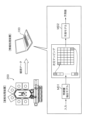
- FIG. 1 is an explanatory diagram illustrating a configuration of an information processing system according to an embodiment.
- FIG. 2 is an explanatory diagram illustrating a prediction method according to the first embodiment.
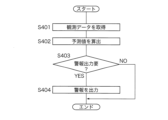
- 1 is a block diagram showing an internal configuration of an information processing device; 1 is a flowchart showing a procedure for generating a prediction model. 1 is a flowchart showing a prediction procedure using a prediction model.
- FIG. 1 is an explanatory diagram for explaining performance evaluation of a prediction model. 1 is a graph showing the spatial distribution of importance of each observation data.
- 13 is a flowchart showing a procedure of a process executed by an information processing device according to a second embodiment.
- FIG. 13 is an explanatory diagram illustrating a prediction method in embodiment 3.
- 13 is a flowchart showing a procedure of a process executed by an information processing device according to a fourth embodiment. 13 is a flowchart showing a procedure of a process executed by an information processing device according to a fifth embodiment.
- (Embodiment 1) 1 is a diagram illustrating a configuration of an information processing system according to an embodiment of the present invention, which includes an information processing apparatus 100 and a substrate processing apparatus 200 that are communicatively connected to each other.
- the substrate processing apparatus 200 is, for example, a semiconductor manufacturing apparatus including at least one of an exposure apparatus, an etching apparatus, a film forming apparatus, an ion implantation apparatus, an ashing apparatus, a sputtering apparatus, etc.
- the substrate processing apparatus 200 may be a display manufacturing apparatus that manufactures FDPs (Flat Display Panels) such as liquid crystal display panels and organic EL (Electro-Luminescence) panels.
- various set values are set, such as the substrate temperature, the pressure and gas flow rate in the chamber, and the voltage applied from the high frequency power source.
- the set values are given, for example, by a process recipe.
- the substrate processing apparatus 200 is also provided with various sensors and devices for measuring the substrate temperature, the pressure and gas flow rate in the chamber, the voltage applied to the upper and lower electrodes, and the plasma emission intensity, and various measurement values are measured during the process.
- the substrate processing apparatus 200 also collects appropriate time series data such as images (RGB data) of the substrate (wafer) before and after the process and process logs at any time.
- the substrate processing apparatus 200 outputs the measurement values, images, time series data, etc. obtained during the process to the information processing apparatus 100 as observation data.
- the information processing device 100 acquires observation data from the substrate processing device 200 as data related to the substrate processing.
- the information processing device 100 calculates predicted values related to the substrate processing based on the acquired observation data.
- Virtual measurements using observational data have been performed in the past.
- some input signal such as a sensor measurement value, image data, or time series data is input to a machine learning model that corresponds to the input signal, and the required predicted value is obtained by executing a calculation using the machine learning model.
- a model that introduces dimensional mapping is proposed as a prediction model MD2 that takes spatial correlation into account.
- Dimension mapping refers to converting the dimensions of features (variables that serve as clues for prediction) extracted from observed data to match the physical dimensions (target dimensions) to be calculated as predicted values.
- a machine learning learning model hereinafter referred to as feature extraction model MD1
- dimensional mapping is introduced into a unimodal network structure to explicitly take spatial correlation into account, thereby improving accuracy and interpretability.
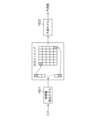
- FIG. 2 is an explanatory diagram explaining the prediction method in the first embodiment.
- the information processing device 100 acquires data related to substrate processing from the substrate processing device 200.
- the data acquired by the information processing device 100 is arbitrary, and is observation data including measurement data output from sensors of the substrate processing device 200, image data obtained by capturing an image of the substrate to be processed, and time series data such as process logs.
- the information processing device 100 extracts features of the observation data acquired from the substrate processing device 200 using a feature extraction model MD1 (first learning model) that is trained to take the observation data as input and output the features of the observation data.
- MD1 first learning model
- the features to be extracted are preferably variables that provide clues for prediction.
- a machine learning learning model including deep learning can be used as the feature extraction model MD1.
- learning models based on CNN Convolutional Neural Network
- Transformer Recurrent Neural Networks
- LSTM Long Short Term Memory
- MLP Multi-Layer Perceptrons
- learning models other than deep learning such as an autoregressive model, a moving average model, or an autoregressive moving average model, may be used.
- the learning model used for the feature extraction model MD1 is set appropriately according to the input observation data and the features to be extracted.
- the feature extraction model MD1 for example, has an input layer, one or more intermediate layers, and an output layer, and is trained to output features from the output layer in response to observation data input to the input layer. Alternatively, a value output from one of the intermediate layers may be used as a feature.
- the feature extraction model MD1 may be configured to have only an input layer and an output layer, without having an intermediate layer. In this embodiment, the feature output from the feature extraction model MD1 is described as being one-dimensional, but the feature may be two or more dimensional.
- the information processing device 100 converts (dimension mapping) the dimension of the extracted feature quantity to match the target dimension (physical dimension to be calculated as a predicted value).
- the dimension of the extracted feature quantity may be converted to two dimensions.
- FIG. 2 shows dimensional mapping from one-dimensional feature quantity to two-dimensional feature quantity. Any dimension may be used before and after the conversion, and is appropriately set according to the observation data used and the predicted value to be calculated.
- the target dimension may be expanded or reduced, or may be equal to the dimension of the feature quantity before the conversion.
- the one-dimensional feature quantity can be converted to a two-dimensional feature quantity by rearranging (mapping) each element into an N x ⁇ N y matrix.
- the information processing device 100 uses the dimensionally mapped features as input to obtain a predicted value regarding the substrate processing using a prediction model MD2 (second learning model) that has been trained to output a predicted value regarding the substrate processing.
- MD2 second learning model
- a machine learning learning model including deep learning can be used as the prediction model MD2.
- a learning model based on CNN, Transformer, RNN, LSTM, MLP, etc. can be used.
- a learning model other than deep learning such as an autoregressive model, a moving average model, or an autoregressive moving average model, may be used.
- the learning model used for the prediction model MD2 is set appropriately according to the target dimension of the input feature amount and the predicted value to be calculated.
- dimensional mapping is described as an independent process, but it may be a process executed inside the prediction model MD2.
- the prediction model MD2 is also called a dimensional mapping model.
- the feature extraction model MD1 and the prediction model MD2 are described as independent learning models, but they may be constructed as a single learning model. In this case, feature extraction, dimensional mapping, and calculation of predicted values are performed within a single learning model.
- FIG. 3 is a block diagram showing the internal configuration of the information processing device 100.
- the information processing device 100 is, for example, a dedicated or general-purpose computer including a control unit 101, a storage unit 102, a communication unit 103, an operation unit 104, and a display unit 105.
- the control unit 101 includes a CPU (Central Processing Unit), a ROM (Read Only Memory), a RAM (Random Access Memory), etc.
- the ROM included in the control unit 101 stores control programs and the like that control the operation of each piece of hardware included in the information processing device 100.
- the CPU in the control unit 101 reads and executes the control programs stored in the ROM and computer programs (described below) stored in the memory unit 102, and controls the operation of each piece of hardware, causing the entire device to function as the information processing device of the present disclosure.
- the RAM included in the control unit 101 temporarily stores data used during the execution of calculations.
- control unit 101 is configured to include a CPU, ROM, and RAM, but the configuration of the control unit 101 is not limited to the above.
- the control unit 101 may be, for example, one or more control circuits or arithmetic circuits including a GPU (Graphics Processing Unit), an FPGA (Field Programmable Gate Array), a DSP (Digital Signal Processor), a quantum processor, volatile or non-volatile memory, etc.
- the control unit 101 may have functions such as a clock that outputs date and time information, a timer that measures the elapsed time from when an instruction to start measurement is given to when an instruction to end measurement is given, and a counter that counts numbers.
- the memory unit 102 includes a storage device such as a hard disk drive (HDD), a solid state drive (SSD), or an electronically erasable programmable read only memory (EEPROM).
- the memory unit 102 stores various computer programs executed by the control unit 101 and various data used by the control unit 101.
- the computer program (program product) stored in the storage unit 102 includes a prediction processing program PG1 for causing a computer to execute a process for obtaining predicted values related to substrate processing from observation data of the substrate processing apparatus 200.
- the prediction processing program PG1 may be a single computer program, or may be a program group consisting of multiple computer programs.
- the prediction processing program PG1 may be executed by multiple computers in cooperation. Furthermore, the prediction processing program PG1 may partially use an existing library.
- a computer program including the prediction processing program PG1 is provided by a non-transitory recording medium RM on which the computer program is recorded in a readable manner.
- the recording medium RM is a portable memory such as a CD-ROM, USB memory, a Secure Digital (SD) card, a micro SD card, or a Compact Flash (registered trademark).
- the control unit 101 reads various computer programs from the recording medium RM using a reading device not shown in the figure, and stores the various computer programs that have been read in the memory unit 102.
- the computer programs stored in the memory unit 102 may also be provided by communication. In this case, the control unit 101 acquires the computer program by communication via the communication unit 103, and stores the acquired computer program in the memory unit 102.
- the memory unit 102 also stores a feature extraction model MD1 used in a process for extracting features from observed data, and a prediction model MD2 used in a process for determining a predicted value related to substrate processing from features after conversion to the target dimension.
- the feature extraction model MD1 and the prediction model MD2 may be stored in an external device.
- the control unit 101 of the information processing device 100 may access the external device via a communication network, transmit the observed data acquired from the substrate processing device 200 to the external device, and acquire the predicted value obtained as a result of calculation by the external device via the communication network.
- the communication unit 103 has a communication interface for transmitting and receiving various data to and from an external device.
- a communication interface conforming to a communication standard such as LAN (Local Area Network) can be used as the communication interface of the communication unit 103.
- the external device is the above-mentioned substrate processing apparatus 200 or a user terminal (not shown).
- the communication unit 103 transmits the data to the destination external device, and when data transmitted from the external device is received, the communication unit 103 outputs the received data to the control unit 101.
- the operation unit 104 includes operation devices such as a touch panel, a keyboard, and switches, and accepts various operations and settings by the user.
- the control unit 101 performs appropriate control based on various operation information provided by the operation unit 104, and stores setting information in the storage unit 102 as necessary.
- the display unit 105 includes a display device such as a liquid crystal monitor or an organic EL (Electro-Luminescence) monitor, and displays information to be notified to the user, etc., in response to instructions from the control unit 101.
- a display device such as a liquid crystal monitor or an organic EL (Electro-Luminescence) monitor, and displays information to be notified to the user, etc., in response to instructions from the control unit 101.
- the information processing device 100 may be a single computer, or may be a computer system composed of multiple computers and peripheral devices.
- the information processing device 100 may be a virtual machine whose entity has been virtualized, or may be a cloud.
- the information processing device 100 and the substrate processing device 200 are described as separate entities, but the information processing device 100 may be provided inside the substrate processing device 200.
- the operation of the information processing device 100 will be described below.
- the information processing apparatus 100 according to this embodiment generates a prediction model MD2 in a learning phase before the substrate processing apparatus 200 starts to be put into actual operation.
- Figure 4 is a flowchart showing the procedure for generating the prediction model MD2.
- training data required for learning is collected. For example, when the etching shape at each location on the substrate surface is obtained as a predicted value based on the plasma emission intensity, measurement data of the plasma emission intensity measured by an OES (Optical Emission Spectrometer) and measurement data of the etching shape at each location measured using an optical observation device or an ultrasonic microscope are collected as training data.
- the training data is not limited to the measurement data of the plasma emission intensity and the etching shape, but observation data of values used for prediction and actual measured values of values to be predicted are collected as training data.
- the collected training data is stored in the memory unit 102 of the information processing device 100. It is assumed that the feature extraction model MD1 has been generated in advance using a known algorithm.
- the control unit 101 reads out the training data stored in the memory unit 102 (step S101), and selects a set of training data from the read out training data (step S102).
- the control unit 101 inputs the observation data (values used for prediction) included in the selected training data into the feature extraction model MD1, and extracts features of the observation data by executing a calculation by the feature extraction model MD1 (step S103).
- the control unit 101 converts the dimension of the feature extracted from the observation data into the target dimension (step S104). That is, the control unit 101 performs dimension mapping on the extracted feature dimension to match the physical dimension to be calculated as a predicted value.
- the control unit 101 inputs the feature quantities converted into the target dimensions into the prediction model MD2, and executes calculations using the prediction model MD2 to obtain a predicted value for each location (step S105). Before learning begins, it is assumed that initial values are set for the model parameters of the prediction model MD2. Also, in this flowchart, the dimensional mapping process and the calculation process using the prediction model MD2 are described as independent processes, but the dimensional mapping may be executed within the processing of the prediction model MD2.
- the control unit 101 evaluates the predicted value calculated in step S105 (step S106) and determines whether learning is complete (step S107).
- a known loss function is used to evaluate the predicted value. If the value of the loss function becomes less than a threshold value in the process of optimizing (minimizing) the loss function, the control unit 101 can determine that learning of the prediction model MD2 is complete.
- control unit 101 updates the model parameters (weighting coefficients and biases between nodes) in the prediction model MD2 (step S108) and returns the process to step S102.
- step S109 If it is determined that learning is complete (S107: YES), a trained model is obtained, and the control unit 101 stores the model in the storage unit 102 as a trained prediction model MD2 (step S109).
- FIG. 5 is a flowchart showing the prediction procedure using the prediction model MD2.
- the control unit 101 of the information processing device 100 acquires observation data to be used for prediction from the substrate processing device 200, for example, via the communication unit 103 (step S121).
- the control unit 101 inputs the acquired observation data into the feature extraction model MD1 and executes calculations using the feature extraction model MD1 to extract features from the observation data (step S122).
- the control unit 101 converts the dimension of the feature extracted from the observation data into the target dimension (step S123). In other words, the control unit 101 performs dimension mapping on the extracted feature dimension to match the physical dimension to be calculated as a predicted value.
- the control unit 101 inputs the features converted into the target dimensions into the prediction model MD2, and performs calculations using the prediction model MD2 to obtain a predicted value for each location (step S124).
- the control unit 101 outputs the prediction result based on the prediction model MD2 (step S125).
- the control unit 101 may display the prediction result on the display unit 105, or may notify the user terminal or the like via the communication unit 103.
- FIG. 6 is an explanatory diagram for explaining the performance evaluation of the prediction model MD2.
- Each graph in FIG. 6 shows the in-plane distribution when the etching shape (opening width) is virtually or actually measured.
- the horizontal axis of each graph corresponds to a first direction in the substrate plane, and the horizontal axis corresponds to a second direction of the substrate perpendicular to the first direction.
- the shading shown in each graph corresponds to the width of the opening width, with areas with lower concentration indicating wider opening widths and areas with higher concentration indicating narrower opening widths.
- FIG. 6A shows the prediction results (virtual measurement) using a conventional method
- FIG. 6B shows the prediction results (virtual measurement) using the method disclosed herein
- FIG. 6C shows the actual values obtained by actual measurement.
- the design value of the opening width was set to be constant regardless of the location where the opening was formed, but when the opening width of the openings actually formed in the substrate was measured, it was confirmed that the opening width was widest near the center of the substrate surface and narrowed toward the periphery, as shown in Figure 6C.
- Figure 6 shows the prediction results using captured images as observation data, but when the aperture width was predicted using plasma emission intensity and process logs as observation data, it was found that the method disclosed herein improved prediction accuracy compared to conventional methods.
- a method in which spatial correlation is introduced into a machine learning learning model using dimensional mapping, and virtual measurement is performed using the learning model (prediction model MD2).
- prediction model MD2 the learning model
- the information processing device 100 uses the prediction model MD2 to calculate the importance (contribution) of features for each location.
- known methods such as Lime (Local Interpretable Model-Agnostic Explanations), SHAP (Shapley Additive exPlanations), and CAM (Class Activation Mapping) are used.
- Lime and SHAP are methods that identify how much the output has changed when the input is reduced, and determine that the greater the change in output, the higher the importance.
- CAM is a method that calculates the importance by using error backpropagation during learning.
- Figure 7 is a graph showing the spatial distribution of importance for each observation data.
- Figure 7A shows the spatial distribution of importance when using plasma emission intensity (OES)
- Figure 7B shows captured images (wafer optical inspection system)
- Figure 7C shows process logs (P-logs) as the observation data.
- the horizontal axis of each graph corresponds to a first direction in the substrate surface, and the horizontal axis corresponds to a second direction on the substrate perpendicular to the first direction.
- the shading shown in each graph corresponds to high or low importance. Areas with high density on the graph indicate places with high importance, and areas with low density indicate places with low importance.
- training may be performed using a loss function with weighting adjusted for each location.
- a prediction model MD2 specialized for the peripheral area may be generated by training using a loss function with a larger weighting for the peripheral area.
- images captured by a wafer optical inspection system are used as the observation data, a prediction model MD2 specialized for the central area may be generated by training using a loss function with a larger weighting for the central area.
- a prediction model MD2 specialized for the peripheral area can be created using the above-mentioned method, and the process can be improved by taking into account the prediction results from the prediction model MD2.
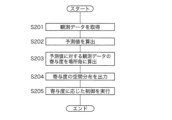
- FIG. 8 is a flowchart showing the procedure of processing executed by the information processing device 100 according to the second embodiment.
- the control unit 101 of the information processing device 100 acquires observation data to be used for prediction from the substrate processing device 200, for example, via the communication unit 103 (step S201).
- the control unit 101 calculates a predicted value for each location based on the acquired observation data (step S202).
- the method of calculating the predicted value is the same as in embodiment 1. That is, the control unit 101 inputs the acquired observation data into a feature extraction model MD1 to extract features, and performs dimensional mapping of the extracted features to a target dimension (a physical dimension for which a predicted value is to be calculated). Next, the control unit 101 inputs the dimensionally mapped features into a prediction model MD2 and performs a calculation to calculate a predicted value for each location.
- the control unit 101 calculates the contribution of the observed data to the calculated predicted value for each location (step S203).
- the contribution is a SHAP value that can be calculated using, for example, the prediction model MD2.
- the SHAP value is a value that corresponds to the difference between a predicted value calculated by inputting multiple observed data into the prediction model MD2 and a predicted value calculated by the prediction model MD2 when one of the multiple observed data is not present.
- the contribution is not limited to the SHAP value, and can be calculated using existing methods such as Lime or CAM.
- the control unit 101 outputs the spatial distribution of the contribution degree (step S204). Based on the contribution degree for each location calculated in step S203, the control unit 101 creates a graph (color contour map) such as those shown in Figures 7A to 7C, for example, and displays it on the display unit 105. The control unit 101 may also transmit the created graph to the user terminal.
- a graph color contour map
- the control unit 101 executes control according to the degree of contribution of each location (step S205).
- the control unit 101 adjusts the parameters for the control object according to the degree of contribution of each location, and controls the process according to the adjusted parameters. For example, if it is found that the plasma emission intensity of a particular frequency contributes well near the peripheral portion, the gas flow rate can be adjusted to increase the emission intensity, thereby enabling process control to improve in-plane uniformity.
- the amount of adjustment of the parameters relative to the degree of contribution is determined, for example, on a rule basis.
- step S204 the spatial distribution of the contribution degree is output in step S204, and then control according to the contribution degree is executed in step S205.
- steps S204 the spatial distribution of the contribution degree is output in step S204, and then control according to the contribution degree is executed in step S205.
- steps S204 control according to the contribution degree is executed in step S205.
- the importance (contribution) of features is calculated for each location, and the spatial distribution of the calculated importance is output, making it possible to understand which parameters are likely to have an effect on which locations, which can lead to process improvement and control.
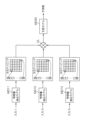
- FIG. 9 is an explanatory diagram explaining a prediction method in embodiment 3.
- multimodal virtual measurement that takes spatial correlation into account will be explained.
- the information processing device 100 acquires multiple types of observation data.
- inputs 1 to 3 are observation data input to feature extraction models MD11, MD12, and MD13, respectively.
- input 1 is plasma emission intensity by OES
- input 2 is an image captured by a wafer optical inspection system
- input 3 is a process log.
- the types of observation data used for prediction are not limited to three, and may be two, four, or more than three.
- Feature extraction model MD11 is a model corresponding to feature extraction model MD1 described in embodiment 1, and is trained to output the features of observed data when observation data of input 1 is input. The same is true for feature extraction models MD12 and MD13, which are trained to output the respective features when observation data of input 1 and input 2 are input, respectively. Trained feature extraction models MD11, MD12, and MD13 are stored in memory unit 102 of information processing device 100.
- the information processing device 100 uses feature extraction models MD11 to MD13 to extract features of inputs 1 to 3, respectively, and converts the dimensions of each extracted feature into features of a target dimension.
- the dimension mapping described in the first embodiment is used for the feature dimension conversion.
- the feature extracted from the feature extraction model MD11 is converted into a two-dimensional feature of, for example, N x ⁇ N y
- the feature extracted from the feature extraction models MD12 and MD13 are also converted into a two-dimensional feature of N x ⁇ N y .
- the information processing device 100 concatenates the features after the dimension conversion in a concatenation layer CL.
- a channel can be added and the features can be concatenated in the channel direction as Nx x Ny x C.
- the information processing device 100 inputs the feature quantities linked by the linking layer CL into the prediction model MD20 to obtain a predicted value.
- the prediction model MD20 is a model corresponding to the prediction model MD2 described in the first embodiment, and is trained to output a predicted value related to substrate processing in response to the input of the feature quantities.
- the types of models that can be used in the prediction model MD20 and the model training method are the same as those in the first embodiment.
- the memory unit 102 of the information processing device 100 stores the trained prediction model MD20.
- the information processing device 100 uses the prediction model MD20 stored in the memory unit 102 to calculate a predicted value at each location on the substrate.
- a method for performing multimodal virtual measurement using a learning model (prediction model MD20) that introduces spatial correlation has been disclosed.
- the prediction model MD20 By applying the method disclosed in the second embodiment to the prediction model MD20, it is possible to calculate the contribution of features for each modality and location. This makes it possible to understand the locations within the dimensions that each modality is good at, improving interpretability.
- each modal excels at. For example, prediction accuracy can be improved by predicting the edge of the substrate using the plasma emission intensity and process logs from OES, and predicting the area excluding the edge of the substrate using images captured by a wafer optical inspection system. Furthermore, it is possible to analyze which modal has an effect on which location, leading to improvements in the model and process.
- FIG. 10 is a flowchart showing the procedure of processing executed by the information processing device 100 according to the fourth embodiment.
- the control unit 101 of the information processing device 100 acquires observation data to be used for prediction from the substrate processing device 200, for example, via the communication unit 103 (step S401).
- the control unit 101 calculates a predicted value for each location based on the acquired observation data (step S402).
- the method of calculating the predicted value is the same as in embodiment 1. That is, the control unit 101 inputs the acquired observation data into a feature extraction model MD1 to extract features, and performs dimensional mapping of the extracted features to the target dimensions. Next, the control unit 101 inputs the dimensionally mapped features into a prediction model MD2 and performs a calculation to calculate a predicted value for each location.
- the control unit 101 may calculate a predicted value using the prediction model MD20 using the method disclosed in embodiment 3.
- the control unit 101 determines whether or not an alarm needs to be issued based on the calculated predicted value (step S403). For example, the control unit 101 compares the calculated predicted value with a preset threshold value, and determines that an alarm needs to be issued if the predicted value exceeds the threshold value (or is less than the threshold value). Alternatively, the control unit 101 may determine whether or not the predicted value falls within a preset normal range, and determine that an alarm needs to be issued if the predicted value falls outside the normal range.
- the threshold value and normal range may be set for each location to be predicted.
- control unit 101 ends the processing according to this flowchart without outputting an alarm.
- the control unit 101 If it is determined that an alarm output is necessary (S403: YES), the control unit 101 outputs an alarm (step S404). For example, the control unit 101 outputs an alarm by displaying information that the substrate processing is not normal on the display unit 105. Alternatively, the control unit 101 may notify the communication unit 103 of the information that the substrate processing is not normal to a user terminal or the like.
- predictions are made using prediction models that take spatial correlation into account (prediction models MD2 and MD20), so more accurate predicted values can be obtained.
- prediction models MD2 and MD20 are highly accurate predicted values.
- highly accurate predicted values are compared with thresholds and normal ranges, so it is possible to more accurately determine whether or not an alarm needs to be issued.
- FIG. 11 is a flowchart showing the procedure of processing executed by the information processing device 100 according to the fifth embodiment.
- the control unit 101 of the information processing device 100 acquires observation data to be used for prediction from the substrate processing device 200, for example, via the communication unit 103 (step S501).
- the control unit 101 calculates a predicted value for each location based on the acquired observation data (step S502).
- the method of calculating the predicted value is the same as in embodiment 1. That is, the control unit 101 inputs the acquired observation data into a feature extraction model MD1 to extract features, and performs dimensional mapping of the extracted features to the target dimensions. Next, the control unit 101 inputs the dimensionally mapped features into a prediction model MD2 and performs a calculation to calculate a predicted value for each location.
- the control unit 101 may calculate a predicted value using the prediction model MD20 using the method disclosed in embodiment 3.
- the control unit 101 executes control over substrate processing in the substrate processing apparatus 200 based on the calculated predicted value (step S503). For example, the control unit 101 compares the calculated predicted value with a preset reference value, and determines a control value for the substrate processing apparatus 200 (e.g., a control value that brings the predicted value closer to the reference value) based on the deviation between the predicted value and the reference value.
- the reference value may be set for each location to be predicted.
- the control unit 101 performs control over substrate processing by outputting a control command including the determined control value to the substrate processing apparatus 200.
- predictions are made using prediction models that take spatial correlation into account (prediction models MD2 and MD20), so more accurate prediction values can be obtained.
- substrate processing is controlled based on these highly accurate prediction values, which can lead to process improvements.
- REFERENCE SIGNS LIST 100 Information processing device 101 Control unit 102 Storage unit 103 Communication unit 104 Operation unit 105 Display unit 200 Substrate processing device PG1 Prediction processing program MD1 Feature extraction model MD2 Prediction model RM Recording medium
Landscapes
- Engineering & Computer Science (AREA)
- Theoretical Computer Science (AREA)
- Computer Vision & Pattern Recognition (AREA)
- Physics & Mathematics (AREA)
- General Physics & Mathematics (AREA)
- Software Systems (AREA)
- Evolutionary Computation (AREA)
- Multimedia (AREA)
- Medical Informatics (AREA)
- Artificial Intelligence (AREA)
- Computing Systems (AREA)
- Databases & Information Systems (AREA)
- General Health & Medical Sciences (AREA)
- Health & Medical Sciences (AREA)
- Quality & Reliability (AREA)
- Data Mining & Analysis (AREA)
- General Engineering & Computer Science (AREA)
- Mathematical Physics (AREA)
- Drying Of Semiconductors (AREA)
- Image Analysis (AREA)
- General Factory Administration (AREA)
- Testing Or Measuring Of Semiconductors Or The Like (AREA)
Priority Applications (4)
| Application Number | Priority Date | Filing Date | Title |
|---|---|---|---|
| KR1020257028227A KR20250143092A (ko) | 2023-01-26 | 2024-01-24 | 기록 매체, 정보 처리 방법 및 정보 처리 장치 |
| JP2024573217A JPWO2024158019A1 (https=) | 2023-01-26 | 2024-01-24 | |
| CN202480009371.8A CN120604246A (zh) | 2023-01-26 | 2024-01-24 | 计算机程序、信息处理方法、以及信息处理装置 |
| US19/280,446 US20250348999A1 (en) | 2023-01-26 | 2025-07-25 | Recording medium, information processing method, and information processing apparatus |
Applications Claiming Priority (2)
| Application Number | Priority Date | Filing Date | Title |
|---|---|---|---|
| JP2023-010470 | 2023-01-26 | ||
| JP2023010470 | 2023-01-26 |
Related Child Applications (1)
| Application Number | Title | Priority Date | Filing Date |
|---|---|---|---|
| US19/280,446 Continuation US20250348999A1 (en) | 2023-01-26 | 2025-07-25 | Recording medium, information processing method, and information processing apparatus |
Publications (1)
| Publication Number | Publication Date |
|---|---|
| WO2024158019A1 true WO2024158019A1 (ja) | 2024-08-02 |
Family
ID=91970682
Family Applications (1)
| Application Number | Title | Priority Date | Filing Date |
|---|---|---|---|
| PCT/JP2024/002108 Ceased WO2024158019A1 (ja) | 2023-01-26 | 2024-01-24 | コンピュータプログラム、情報処理方法、及び情報処理装置 |
Country Status (6)
| Country | Link |
|---|---|
| US (1) | US20250348999A1 (https=) |
| JP (1) | JPWO2024158019A1 (https=) |
| KR (1) | KR20250143092A (https=) |
| CN (1) | CN120604246A (https=) |
| TW (1) | TW202503592A (https=) |
| WO (1) | WO2024158019A1 (https=) |
Citations (4)
| Publication number | Priority date | Publication date | Assignee | Title |
|---|---|---|---|---|
| JP2018091836A (ja) * | 2016-11-14 | 2018-06-14 | ヴェリティー インストルメンツ,インコーポレイテッド | 半導体処理システム内の光信号の校正のためのシステムおよび方法 |
| CN112301322A (zh) * | 2020-12-21 | 2021-02-02 | 上海陛通半导体能源科技股份有限公司 | 具有工艺参数智能调节功能的气相沉积设备及方法 |
| JP2021086572A (ja) * | 2019-11-29 | 2021-06-03 | 東京エレクトロン株式会社 | 予測装置、予測方法及び予測プログラム |
| JP2022504561A (ja) * | 2018-10-09 | 2022-01-13 | アプライド マテリアルズ インコーポレイテッド | 先進の半導体プロセス最適化および生産中の適応制御 |
-
2024
- 2024-01-12 TW TW113101325A patent/TW202503592A/zh unknown
- 2024-01-24 CN CN202480009371.8A patent/CN120604246A/zh active Pending
- 2024-01-24 KR KR1020257028227A patent/KR20250143092A/ko active Pending
- 2024-01-24 JP JP2024573217A patent/JPWO2024158019A1/ja active Pending
- 2024-01-24 WO PCT/JP2024/002108 patent/WO2024158019A1/ja not_active Ceased
-
2025
- 2025-07-25 US US19/280,446 patent/US20250348999A1/en active Pending
Patent Citations (4)
| Publication number | Priority date | Publication date | Assignee | Title |
|---|---|---|---|---|
| JP2018091836A (ja) * | 2016-11-14 | 2018-06-14 | ヴェリティー インストルメンツ,インコーポレイテッド | 半導体処理システム内の光信号の校正のためのシステムおよび方法 |
| JP2022504561A (ja) * | 2018-10-09 | 2022-01-13 | アプライド マテリアルズ インコーポレイテッド | 先進の半導体プロセス最適化および生産中の適応制御 |
| JP2021086572A (ja) * | 2019-11-29 | 2021-06-03 | 東京エレクトロン株式会社 | 予測装置、予測方法及び予測プログラム |
| CN112301322A (zh) * | 2020-12-21 | 2021-02-02 | 上海陛通半导体能源科技股份有限公司 | 具有工艺参数智能调节功能的气相沉积设备及方法 |
Also Published As
| Publication number | Publication date |
|---|---|
| KR20250143092A (ko) | 2025-09-30 |
| JPWO2024158019A1 (https=) | 2024-08-02 |
| TW202503592A (zh) | 2025-01-16 |
| US20250348999A1 (en) | 2025-11-13 |
| CN120604246A (zh) | 2025-09-05 |
Similar Documents
| Publication | Publication Date | Title |
|---|---|---|
| CN114930117B (zh) | 结合物理建模与机器学习 | |
| JP5959648B2 (ja) | プロセス認識メトロロジー | |
| US11237544B2 (en) | Information processing device, program, process treatment executing device, and information processing system | |
| KR101848958B1 (ko) | 분광 정보를 툴 동작 파라미터 및 재료 측정치와 연결하는 것에 의한 툴 성능의 개선 | |
| KR20190105646A (ko) | 생산 공정을 제어 또는 모니터링하기 위한 예상 데이터 생성 | |
| US12511574B2 (en) | Processing condition search device and processing condition search method | |
| KR20220164786A (ko) | 스펙트럼 기반 계측 및 프로세스 제어를 위한 머신 및 딥 러닝 방법 | |
| TW202002119A (zh) | 程序及計量控制、基於景觀資訊之程序指標及根本原因分析工具 | |
| WO2024117019A1 (ja) | コンピュータプログラム、情報処理装置及び情報処理方法 | |
| JP2010034180A (ja) | 半導体製造装置の制御方法および半導体装置の製造方法 | |
| JP5198519B2 (ja) | 欠陥解析方法、欠陥解析装置 | |
| WO2024158019A1 (ja) | コンピュータプログラム、情報処理方法、及び情報処理装置 | |
| TWI748110B (zh) | 在成像技術中估計振幅及相位不對稱性以用於在疊對計量中達到高精準度 | |
| KR20210124377A (ko) | 데이터 세트로부터의 피쳐의 추출 | |
| JP2025186217A (ja) | 製造システムにおけるマルチレベルrfパルス監視およびrfパルス化パラメータ最適化 | |
| US20190121237A1 (en) | Predictive modeling of metrology in semiconductor processes | |
| WO2024210013A1 (ja) | コンピュータプログラム、情報処理装置、及び情報処理方法 | |
| KR20260045806A (ko) | 평가 방법, 평가 장치 및 컴퓨터 프로그램 | |
| TWI875474B (zh) | 半導體裝置的量測方法及半導體裝置的量測裝置 | |
| US20240152675A1 (en) | Determining substrate characteristics by virtual substrate measurement | |
| TW202518626A (zh) | 基板處理操作分析應用與可視圖像生成 | |
| Altin et al. | Toward ML-enhanced Design and Fabrication of Resonant Nanoelectromechanical IR Sensor | |
| US10678226B1 (en) | Adaptive numerical aperture control method and system | |
| TW201905492A (zh) | 感測器位置判定技術 |
Legal Events
| Date | Code | Title | Description |
|---|---|---|---|
| 121 | Ep: the epo has been informed by wipo that ep was designated in this application |
Ref document number: 24747343 Country of ref document: EP Kind code of ref document: A1 |
|
| ENP | Entry into the national phase |
Ref document number: 2024573217 Country of ref document: JP Kind code of ref document: A |
|
| WWE | Wipo information: entry into national phase |
Ref document number: 2024573217 Country of ref document: JP |
|
| WWE | Wipo information: entry into national phase |
Ref document number: 202480009371.8 Country of ref document: CN |
|
| ENP | Entry into the national phase |
Ref document number: 1020257028227 Country of ref document: KR Free format text: ST27 STATUS EVENT CODE: A-0-1-A10-A15-NAP-PA0105 (AS PROVIDED BY THE NATIONAL OFFICE) |
|
| NENP | Non-entry into the national phase |
Ref country code: DE |
|
| WWE | Wipo information: entry into national phase |
Ref document number: 11202504975X Country of ref document: SG |
|
| WWP | Wipo information: published in national office |
Ref document number: 11202504975X Country of ref document: SG |
|
| WWP | Wipo information: published in national office |
Ref document number: 202480009371.8 Country of ref document: CN |
|
| 122 | Ep: pct application non-entry in european phase |
Ref document number: 24747343 Country of ref document: EP Kind code of ref document: A1 |