WO2024157895A1 - ポリアミド複合断面繊維、ポリアミドマルチフィラメント及びポリアミド複合断面仮撚加工糸 - Google Patents
ポリアミド複合断面繊維、ポリアミドマルチフィラメント及びポリアミド複合断面仮撚加工糸 Download PDFInfo
- Publication number
- WO2024157895A1 WO2024157895A1 PCT/JP2024/001468 JP2024001468W WO2024157895A1 WO 2024157895 A1 WO2024157895 A1 WO 2024157895A1 JP 2024001468 W JP2024001468 W JP 2024001468W WO 2024157895 A1 WO2024157895 A1 WO 2024157895A1
- Authority
- WO
- WIPO (PCT)
- Prior art keywords
- polyamide
- section
- cross
- orientation
- fiber
- Prior art date
- Legal status (The legal status is an assumption and is not a legal conclusion. Google has not performed a legal analysis and makes no representation as to the accuracy of the status listed.)
- Ceased
Links
Images

Classifications
-
- D—TEXTILES; PAPER
- D01—NATURAL OR MAN-MADE THREADS OR FIBRES; SPINNING
- D01F—CHEMICAL FEATURES IN THE MANUFACTURE OF ARTIFICIAL FILAMENTS, THREADS, FIBRES, BRISTLES OR RIBBONS; APPARATUS SPECIALLY ADAPTED FOR THE MANUFACTURE OF CARBON FILAMENTS
- D01F8/00—Conjugated, i.e. bi- or multicomponent, artificial filaments or the like; Manufacture thereof
- D01F8/04—Conjugated, i.e. bi- or multicomponent, artificial filaments or the like; Manufacture thereof from synthetic polymers
- D01F8/12—Conjugated, i.e. bi- or multicomponent, artificial filaments or the like; Manufacture thereof from synthetic polymers with at least one polyamide as constituent
-
- D—TEXTILES; PAPER
- D01—NATURAL OR MAN-MADE THREADS OR FIBRES; SPINNING
- D01D—MECHANICAL METHODS OR APPARATUS IN THE MANUFACTURE OF ARTIFICIAL FILAMENTS, THREADS, FIBRES, BRISTLES OR RIBBONS
- D01D5/00—Formation of filaments, threads, or the like
- D01D5/22—Formation of filaments, threads, or the like with a crimped or curled structure; with a special structure to simulate wool
-
- D—TEXTILES; PAPER
- D01—NATURAL OR MAN-MADE THREADS OR FIBRES; SPINNING
- D01D—MECHANICAL METHODS OR APPARATUS IN THE MANUFACTURE OF ARTIFICIAL FILAMENTS, THREADS, FIBRES, BRISTLES OR RIBBONS
- D01D5/00—Formation of filaments, threads, or the like
- D01D5/253—Formation of filaments, threads, or the like with a non-circular cross section; Spinnerette packs therefor
-
- D—TEXTILES; PAPER
- D01—NATURAL OR MAN-MADE THREADS OR FIBRES; SPINNING
- D01D—MECHANICAL METHODS OR APPARATUS IN THE MANUFACTURE OF ARTIFICIAL FILAMENTS, THREADS, FIBRES, BRISTLES OR RIBBONS
- D01D5/00—Formation of filaments, threads, or the like
- D01D5/28—Formation of filaments, threads, or the like while mixing different spinning solutions or melts during the spinning operation; Spinnerette packs therefor
- D01D5/30—Conjugate filaments; Spinnerette packs therefor
- D01D5/32—Side-by-side structure; Spinnerette packs therefor
-
- D—TEXTILES; PAPER
- D01—NATURAL OR MAN-MADE THREADS OR FIBRES; SPINNING
- D01D—MECHANICAL METHODS OR APPARATUS IN THE MANUFACTURE OF ARTIFICIAL FILAMENTS, THREADS, FIBRES, BRISTLES OR RIBBONS
- D01D5/00—Formation of filaments, threads, or the like
- D01D5/28—Formation of filaments, threads, or the like while mixing different spinning solutions or melts during the spinning operation; Spinnerette packs therefor
- D01D5/30—Conjugate filaments; Spinnerette packs therefor
- D01D5/34—Core-skin structure; Spinnerette packs therefor
-
- D—TEXTILES; PAPER
- D02—YARNS; MECHANICAL FINISHING OF YARNS OR ROPES; WARPING OR BEAMING
- D02G—CRIMPING OR CURLING FIBRES, FILAMENTS, THREADS, OR YARNS; YARNS OR THREADS
- D02G1/00—Producing crimped or curled fibres, filaments, yarns, or threads, giving them latent characteristics
- D02G1/02—Producing crimped or curled fibres, filaments, yarns, or threads, giving them latent characteristics by twisting, fixing the twist and backtwisting, i.e. by imparting false twist
- D02G1/0206—Producing crimped or curled fibres, filaments, yarns, or threads, giving them latent characteristics by twisting, fixing the twist and backtwisting, i.e. by imparting false twist by false-twisting
-
- D—TEXTILES; PAPER
- D10—INDEXING SCHEME ASSOCIATED WITH SUBLASSES OF SECTION D, RELATING TO TEXTILES
- D10B—INDEXING SCHEME ASSOCIATED WITH SUBLASSES OF SECTION D, RELATING TO TEXTILES
- D10B2331/00—Fibres made from polymers obtained otherwise than by reactions only involving carbon-to-carbon unsaturated bonds, e.g. polycondensation products
- D10B2331/02—Fibres made from polymers obtained otherwise than by reactions only involving carbon-to-carbon unsaturated bonds, e.g. polycondensation products polyamides
Definitions
- the present invention relates to polyamide composite cross-section fibers that have excellent crimping properties with soft stretchability when made into fabric, and also provides polyamide composite cross-section fibers that have greatly improved crimping properties in terms of abrasion resistance.
- Polyamide fibers such as polycaproamide and polyhexamethylene adipamide, have excellent mechanical properties and dimensional stability, and are therefore widely used not only for clothing applications but also for interior and vehicle interiors and industrial applications.
- false twisted yarns in which polyamide fibers have been given crimping properties are particularly suitable for use in stretchable woven and knitted fabrics, but it is difficult to obtain woven and knitted fabrics with good stretchability by false twisting polyamide fibers alone.
- polyamide composite cross-section fibers have been proposed in which two crystalline polyamides with different compositions are combined in an eccentric core-sheath structure, and the water absorption rate and heat shrinkage stress are specified (Patent Document 1)
- polyamide composite cross-section fibers have been proposed in which two polyamides with different viscosities are combined in a side-by-side or eccentric core-sheath structure, and the CF value is specified (Patent Document 2).
- the polyamide composite cross-section fiber described in Patent Document 1 which is an eccentric core-sheath composite of two crystalline polyamides with different compositions, has issues such as inferior abrasion resistance when made into a fabric because the fiber orientation characteristics necessary for abrasion resistance are not properly controlled.
- polyamide fibers made solely from polyamide although both are crystalline polyamides, they are simply bonded together with different compositions, so peeling is likely to occur, which is one of the factors that significantly reduces abrasion resistance.
- the polyamide composite cross-section fiber described in Patent Document 2 which is a side-by-side or eccentric core-sheath combination of two polyamides with different viscosities, also has the same problems as the polyamide composite cross-section fiber described in Patent Document 1, such as inferior abrasion resistance. It is true that abrasion resistance may be improved when polyamides with the same composition are bonded together, but only when the viscosity is different, but this is only true for polyamide composite cross-section fibers, and the abrasion resistance is inevitably inferior to that of polyamide fibers alone.
- the objective of the present invention is to provide polyamide composite cross-section fibers that have both excellent abrasion resistance and crimp properties, something that was difficult to achieve with conventional technology, by appropriately controlling the fiber orientation characteristics necessary for abrasion resistance.
- a polyamide bicomponent cross-section fiber made of two types of polyamides which satisfies the following items A to C:
- the composite form of the fiber cross section of the polyamide composite cross section fiber is a side-by-side type or an eccentric core-sheath type.
- the difference in the orientation parameters of the two polyamides is 0.20 or more in absolute value.
- the orientation parameter of the low-oriented polyamide is in the range of 1.50 to 3.00.
- a polyamide multifilament comprising the polyamide bicomponent cross section fiber according to (1) or (2) above, and having a stretch extension rate of 1.0% or more.
- a polyamide composite cross section false twist textured yarn consisting of two types of polyamide, which satisfies the following items D to G.
- the composite form of the fiber cross section of the polyamide composite cross section false twist textured yarn is a side-by-side type or an eccentric core-sheath type.
- the stretch elongation of the polyamide composite cross section false twisted yarn is 30.0% or more.
- the difference in the orientation parameters of the two polyamides is 0.05 or more in absolute value.
- the crystallinity of the low-oriented polyamide is in the range of 10.0 to 40.0%.
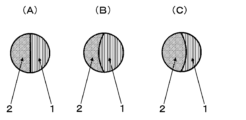
- FIG. 1 shows an example of the cross section of the polyamide composite cross section fiber of the present invention, where (A) to (C) are schematic diagrams of a side-by-side type.
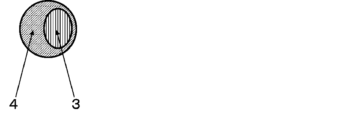
- FIG. 2 shows an example of the cross section of the polyamide composite cross section fiber of the present invention, and is a schematic diagram of an eccentric core-sheath type.
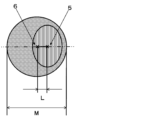
- FIG. 3 is a schematic diagram illustrating the degree of eccentricity of the eccentric core-sheath type in an example of the cross section of the polyamide composite cross section fiber of the present invention.
- FIG. 1 shows an example of the cross section of the polyamide composite cross section fiber of the present invention, where (A) to (C) are schematic diagrams of a side-by-side type.
- FIG. 2 shows an example of the cross section of the polyamide composite cross section fiber of the present invention, and is a schematic diagram of an eccentric core-sheath type.
- FIG. 3 is a schematic diagram illustrating the degree of eccentricity of the eccentric core-sheath type in an example of
- FIG. 4 illustrates the composite interface of the extruded yarn and the direction of yarn cooling air in an example of a production method for a polyamide composite cross-section fiber of the present invention, in which (A) is a schematic diagram showing an example of the present invention, and (B) is a schematic diagram showing an example of the production method described in Japanese Patent No. 3769434 (JP 2000-328349 A).
- the polyamide composite cross-section fiber according to an embodiment of the present invention (hereinafter also referred to as the present embodiment) is made of two types of polyamide. From the viewpoint of abrasion resistance, it is important that both types of polyamide are polyamide to increase the affinity of the composite interface and suppress interfacial peeling.
- the polyamide in this embodiment is a polymer in which so-called hydrocarbons are linked to the main chain via amide bonds.
- polyamides examples include polycaproamide, polyundecane amide, polydodecane amide, polytetramethylene adipamide, polypentamethylene adipamide, polypentamethylene sebacamide, polyhexamethylene adipamide, polyhexamethylene sebacamide, polyhexamethylene dodecane amide, polyhexamethylene tridecane amide, and copolymers containing them as main components.
- main component means that the content is 50 parts by mass or more in 100 parts by mass of the copolymer.
- the two types of polyamides mentioned above are not limited as long as there is a difference in the degree of orientation, i.e., a difference in the orientation parameters.
- the two types of polyamides mentioned above may be of the same composition or different compositions, but in order to obtain the desired crimping properties, polyamides of different compositions are preferred, such as polyamides composed of aminocaproic acid units, such as polycaproamide, and polyamides composed of dicarboxylic acid and diamine units, such as polyhexamethylenesebacamide.
- polyamides of different compositions are preferred, such as polyamides composed of aminocaproic acid units, such as polycaproamide, and polyamides composed of dicarboxylic acid and diamine units, such as polyhexamethylenesebacamide.
- Examples of composite forms of fiber cross sections include side-by-side, eccentric sheath-core, double sheath-core, sea-island, and multi-layer laminated types.
- the polyamide composite cross section fiber of this embodiment is either a side-by-side type or an eccentric sheath-core type.
- the side-by-side type in the composite form of the polyamide composite cross section fiber of this embodiment refers to a composite form as shown in FIG. 1, and the eccentric sheath-core type refers to a composite form as shown in FIG. 2.
- the composite interface (lamination surface) of polyamide (A) 1 and polyamide (B) 2 may be straight as shown in FIG. 1 (A), or curved as shown in FIG. 1 (B) and FIG. 1 (C).
- the composite ratio of the two polyamide components is preferably in the range of 2:1 to 1:2 in terms of the cross-sectional area ratio.
- the degree of eccentricity of the eccentric sheath-core type as shown in FIG.
- L is the line segment between the center 6 of the composite cross section fiber and the center 5 of the core component as shown in FIG. 3
- M is the line segment between the intersections of the extension of line segment L and the outer periphery of the composite cross section fiber.
- the polyamide composite cross-section fiber of this embodiment it is extremely important from the standpoint of abrasion resistance to properly control the orientation characteristics.
- the polyamide composite cross-section fibers described in Patent Documents 1 and 2 do not properly control this, and therefore have good crimp performance but poor abrasion resistance.
- the Raman band of polyamide near 1640 cm ⁇ 1 is attributed to the stretching vibration mode of C ⁇ O, and the stretching vibration direction is a mode perpendicular to the molecular chain, and the polarizability changes in the direction perpendicular to the molecular chain direction. Since Raman scattering is strong when the stretching vibration direction of the molecular chain coincides with the polarization direction of the incident light, the Raman scattering intensity I 1640 of the stretching vibration mode of C ⁇ O changes in correlation with the degree of orientation. In other words, the ratio of the Raman scattering intensity with vertical polarization to the Raman scattering intensity with parallel polarization is taken as a parameter for evaluating the degree of orientation.
- the Raman scattering intensity I 1450 at the C-H bending band (near 1450 cm ⁇ 1 ), which has small anisotropy with respect to orientation, can be standardized for each polarization condition (vertical/parallel) as an orientation parameter.
- Orientation parameter (I 1640 /I 1450 ) perpendicular polarization/(I 1640 /I 1450 ) parallel polarization
- Perpendicular condition fiber longitudinal direction and polarization direction are perpendicular.
- Parallel condition fiber longitudinal direction and polarization direction are parallel.
- I 1640 Perpendicular Intensity of Raman band at 1640 cm -1 under perpendicular conditions.
- I 1450 Perpendicular Intensity of Raman band at 1450 cm -1 under perpendicular conditions.
- I 1640 Parallel Intensity of Raman band at 1640 cm -1 under parallel conditions.
- I 1450 Parallel Intensity of Raman band at 1450 cm -1 under parallel conditions.
- the difference in the orientation parameters of the two polyamides is 0.20 or more in absolute value, preferably 0.30 or more. By setting it in this range, the crimping performance of the fiber becomes good, and fabrics and textile products with excellent soft stretchability can be obtained. If the difference in the orientation parameters of the two polyamides is less than 0.20 in absolute value, or if the difference in the orientation parameters of the two polyamides in the polyamide composite cross-section false twist textured yarn of this embodiment described later is less than 0.05 in absolute value, the fiber does not exhibit crimping properties, and fabrics and textile products with excellent soft stretchability cannot be obtained.
- the difference in the orientation parameters of the two polyamides is preferably high as long as it does not impair the effects of this embodiment, but is preferably 2.00 or less in consideration of the stable manufacturing process of the polyamide composite cross-section fiber. If the difference in the orientation parameters of the two polyamides exceeds 2.00, there is a possibility that defects, fluff, etc. may occur in the winding package form.
- Absolute value of difference in orientation parameters (orientation parameter of highly oriented polyamide) - (orientation parameter of less oriented polyamide)
- the highly oriented polyamide refers to the polyamide having the higher orientation parameter value of the two types of polyamides mentioned above
- the low oriented polyamide refers to the polyamide having the lower orientation parameter value of the two types of polyamides mentioned above.
- the orientation parameter of the low-orientation polyamide is in the range of 1.50 to 3.00. By setting it in this range, the abrasion resistance of the fiber becomes good, and it is possible to obtain fabrics and fiber products with excellent soft stretchability and significantly improved abrasion resistance, which was difficult to achieve with conventional technology. If the orientation parameter of the low-orientation polyamide is less than 1.50, the strength and elongation of the fiber is significantly reduced, and as with conventional technology, only fabrics and fiber products with poor abrasion resistance can be obtained, even if they have excellent crimping performance. If the orientation parameter of the low-orientation polyamide is more than 3.00, the fiber becomes rigid, and therefore only fabrics and fiber products with poor abrasion resistance can be obtained, even if they have excellent crimping performance.
- the polyamide composite cross-section fiber of this embodiment is not simply a composite of two types of polyamides, but focuses on the orientation characteristics of the polyamide composite cross-section fiber, and only by appropriately controlling the orientation parameters of the two types of polyamides can it be possible to obtain a polyamide composite cross-section fiber that is excellent in both abrasion resistance and crimp performance.
- the crystallinity of the polyamide composite cross-section fiber of this embodiment refers to the crystallinity obtained by converting the half-width of the Raman band from the calibration data obtained by laser Raman spectroscopy and X-ray diffraction, and the gist of this is described below.
- the Raman band of polyamide near 1640 cm ⁇ 1 is attributed to the stretching vibration mode of C ⁇ O, and is also used for analyzing crystallinity.
- the degree of crystallinity increases, the molecular arrangement becomes uniform, and the peak position of the molecular vibration frequency becomes uniform.
- the band width becomes sharp, and analyzing the band width becomes a parameter related to crystallinity.
- the crystallinity is calculated from the band half width of the Raman band with unpolarized light near 1640 cm ⁇ 1 and the peak area ratio of the broad peak indicating amorphous and the sharp peak indicating crystal obtained by X-ray diffraction method, and calibration data for the band width and crystallinity are created. This allows the crystallinity of each component in the polyamide composite cross-section fiber of this embodiment to be calculated using laser Raman spectroscopy, which allows local measurement. The crystallinity will be described in detail in the examples.
- the crystallinity of the polyamide on the low orientation side is preferably in the range of 10.0 to 40.0%, and more preferably in the range of 20.0 to 35.0%.
- the crystallinity of the polyamide on the low orientation side is 10.0% or more, the crystal structure of the polyamide composite cross-section fiber is stabilized, making stable advanced processing, such as false twisting, weaving, knitting, and dyeing, possible even after long-term storage.
- the crystallinity of the polyamide on the low orientation side is 40.0% or less, it is possible to further improve abrasion resistance while maintaining crimp performance.
- the preferred stretch elongation rate of the polyamide multifilament made of the polyamide composite cross section fiber of this embodiment is 1.0% or more.
- the polyamide multifilament made of the polyamide composite cross section fiber of this embodiment may be a so-called drawn yarn obtained by a one-step method, a two-step method, or a partially oriented yarn (POY: semi-drawn yarn).
- POY partially oriented yarn
- the preferred range of the stretching extension rate is different for each method, and the preferred stretching extension rate for the drawn yarn is 20.0 to 100.0%, and the preferred stretching extension rate for the POY is 1.00 to 100.0%.
- the preferred stretching extension rate for obtaining a fabric or fiber product that maintains the crimping performance and is rich in soft stretchability is 20.0% or more
- the drawn yarn that is directly input to product processing such as weaving has a stretching extension rate of 20.0% or more.
- a stretching extension rate of 20.0% or more is not necessary when input to false twist processing, but if there is a stretching extension rate of 1.0% or more, it is easy to achieve a stretching extension rate of 30.0% or more, which is higher than that of the drawn yarn, when false twist processing is performed.
- a POY having a stretching extension rate of 1.0% or more has, for example, coil shrinkage to the extent that it stretches.
- the stretching extension rate is preferably high as long as it does not impair the effects of this embodiment, but in consideration of the stable manufacturing process of polyamide composite cross-section fiber, it is preferably 100.0% or less. If the stretching extension rate exceeds 100.0%, there is a possibility that defects, fluff, etc. will occur in the wound package form.
- the stretch elongation rate of the polyamide multifilament of this embodiment is a value measured according to JIS L 1013 (Method C) (2010 edition).
- the single yarn fineness of the polyamide composite cross-section fiber of this embodiment is not particularly limited as long as it does not impair the effects of this embodiment, but if the single yarn fineness is in the range of 1.0 to 6.0 dtex, it can be suitably used for innerwear, outerwear, etc. Also, considering the use in clothing, it is preferable that the total fineness of the polyamide multifilament is in the range of 20.0 to 200.0 dtex.
- the polyamide composite cross-section fiber of this embodiment may contain various additives as long as they do not impair the effects of this embodiment.
- additives include pigments such as titanium oxide and carbon black, light resistance agents such as manganese compounds, antioxidants such as hindered phenols and phosphorus compounds, heat resistance agents, flame retardants, conductivity imparting agents, fibrous reinforcing agents, etc.
- the cross-sectional shape of the polyamide composite cross-section fiber of this embodiment may be appropriately selected within a range that does not impair the effects of this embodiment, as long as the composite form is a side-by-side type or an eccentric core-sheath type. In the case of an eccentric core-sheath type as shown in FIG.
- the core component polyamide (A) 3 may be a low-orientation side polyamide and the sheath component polyamide (B) 4 may be a high-orientation side polyamide, or the core component polyamide (A) 3 may be a high-orientation side polyamide and the sheath component polyamide (B) 4 may be a low-orientation side polyamide, but preferably the core component polyamide (A) 3 is a high-orientation side polyamide and the sheath component polyamide (B) 4 is a low-orientation side polyamide.
- Examples include a perfect circle, ellipse, trilobe, tetralobe, cross, hollow, flat cross section, etc., but a perfect circle is preferable from the viewpoint of melt spinnability and ease of spinning.
- the polyamide multifilament made of polyamide composite cross-section fiber of this embodiment includes drawn yarn and POY: semi-drawn yarn, and by further false-twisting these, it is possible to further greatly improve both abrasion resistance and crimping properties. From the viewpoint of ease of processing, it is preferable to add POY to the false-twisting process, but it is also possible to add drawn yarn to the false-twisting process to further improve the stretching and elongation rate.
- the composite fiber cross section of the polyamide composite cross section fiber of this embodiment has a side-by-side composite cross section
- the composite fiber cross section of the polyamide composite cross section false twisted yarn obtained by false twisting this fiber will also have a side-by-side composite cross section.
- the composite fiber cross section of the polyamide composite cross section fiber of this embodiment has an eccentric core-sheath composite cross section
- the composite fiber cross section of the polyamide composite cross section false twisted yarn obtained by false twisting this fiber will also have an eccentric core-sheath composite cross section.
- the difference in the orientation parameters of the two types of polyamide is an absolute value of 0.05 or more, and preferably 0.09 or more. If the difference in the orientation parameters of the two types of polyamide is less than 0.05 in absolute value, crimp is poor and soft stretchability cannot be obtained.
- the polyamide composite cross section false twist textured yarn is made of composite cross section fibers in which two types of polyamide (high orientation polyamide and low orientation polyamide) are either of the side-by-side type or eccentric core-sheath type.
- the method for calculating the orientation parameter and the absolute value of the difference in the orientation parameters for the polyamide composite cross-section false twisted yarn of this embodiment are the same as the method for calculating the orientation parameter and the absolute value of the difference in the orientation parameters for the polyamide composite cross-section fiber of this embodiment.
- the polyamide composite cross section false twisted yarn of this embodiment has a stretching extension rate of 30.0% or more, preferably 50.0% or more.
- a stretching extension rate of 20.0% or more is preferable for obtaining a fabric or fiber product that maintains shrinkage performance and is rich in soft stretchability, but in order to obtain the ultimate soft stretchability, it is important to false twist the polyamide multifilament made of the polyamide composite cross section fiber of this embodiment to obtain a stretching extension rate of 30.0% or more.
- the orientation characteristics of the precursor polyamide composite cross section fiber are appropriately controlled, and by false twisting it, it is possible to obtain a false twisted yarn with a higher stretching extension rate.
- the method for measuring the stretching extension rate of the polyamide composite cross section false twisted yarn of this embodiment is the same as the method for measuring the stretching extension rate of the polyamide multifilament of this embodiment.
- the crystallinity of the polyamide on the low orientation side is in the range of 10.0 to 40.0%, preferably in the range of 20.0 to 35.0%.
- the crystallinity of the polyamide on the low orientation side is 10.0% or more, the crystal structure of the false twisted yarn is stabilized, making stable high-order processing, such as weaving, knitting, dyeing, etc. possible even after long-term storage.
- the crystallinity of the polyamide on the low orientation side is 40.0% or less, it is possible to further improve abrasion resistance while maintaining crimp performance.
- the method for measuring the crystallinity of the polyamide on the low orientation side of the polyamide composite cross-section false twisted yarn of this embodiment is the same as the method for measuring the crystallinity of the polyamide on the low orientation side of the polyamide composite cross-section fiber of this embodiment.
- the polyamide composite cross-section fiber and polyamide composite cross-section false twist textured yarn of this embodiment can be woven or knitted according to known methods.
- the structure of the woven or knitted fabric is not limited. In the case of a woven fabric, the structure may be any of a plain weave, twill weave, satin weave, or a variation or mixed structure of these depending on the application, but to make a woven fabric with a firm texture and a fluffy feel, a plain weave with many restraint points, or a ripstop structure combining a plain weave with a stone or nanaco weave is preferred.
- the structure may be any of a plain weave, an interlock weave, a half weave of a warp knit, a satin weave, or a jacquard weave, or a variation or mixed structure of these depending on the application, but a half weave of a single tricot knit is preferred because the knitted fabric is thin and stable and has excellent elongation.
- the applications of the woven or knitted fabric of this embodiment are not limited, but are preferably for clothing applications, and more preferably for sportswear, such as down jackets, windbreakers, golf wear, rainwear, and casual wear, as well as women's and men's clothing.
- the two polyamides used in the polyamide composite cross-section fiber of this embodiment may be of the same or different composition, but in order to obtain the desired crimping properties, it is preferable to use polyamides of different compositions.
- polycaproamide and polyhexamethylene sebacamide are one of the preferred combinations.
- the composite cross-section fiber is made of polyamides of the same composition, it is sufficient to make a difference in the degree of polymerization between the two, but this does not apply when a composition difference is caused, for example, by mixing titanium oxide with only one of the polyamides.
- the polyamide composite cross-section fiber described in Patent Documents 1 and 2 specifies the difference in the degree of polymerization and the melt viscosity between the two preferred polyamides, but these are not particularly important.
- the melting part of the manufacturing process will now be described.
- a pressure melter method or an extruder method can be used, but is not particularly limited to these.
- the melting temperature can be appropriately determined in consideration of the melting point of the polyamide resin, but it is preferable to melt the two types of polyamide separately at a temperature 20 to 60°C higher than the melting point.
- the spinning temperature may be appropriately determined in consideration of the melting point of the polyamide resin, similarly to the melting temperature.
- the spinning temperature here refers to the so-called heat retention temperature (spin block temperature) at which the polymer piping, metering pump, spinneret, etc. are kept warm.
- the direct spinning and drawing method is superior, and an example of a manufacturing method using the direct spinning and drawing method is given below.
- two kinds of polyamides melted separately are metered and fed to a composite spinneret 9 forming a side-by-side type or an eccentric sheath-core type.
- the two kinds of polyamides join together and are discharged from a spinneret discharge hole 10 as a side-by-side type or an eccentric sheath-core type polyamide composite cross section fiber.
- the side-by-side type where the composite interface is a straight line as shown in Fig.
- the two kinds of polyamides it is preferable to dispose the two kinds of polyamides so that the composite interface 11 is parallel to the direction of the yarn cooling air 8 described later by a yarn cooling device such as a chimney 7, and discharge the yarn, i.e., the polyamide composite cross section fiber.
- a yarn cooling device such as a chimney 7
- the yarn i.e., the polyamide composite cross section fiber.
- the two kinds of polyamides it is preferable to dispose the two kinds of polyamides so that the straight line connecting the ends of two points of the composite interface is parallel to the direction of the yarn cooling air, and in the case of the eccentric sheath-core type where the longitudinal direction of the core component polyamide is parallel to the direction of the yarn cooling air.
- the high shrinkage (high orientation side) polymer 14 corresponds to the high orientation side in this embodiment
- the low shrinkage (low orientation side) polymer 15 corresponds to the low orientation side in this embodiment.
- improvements in crimp performance and abrasion resistance are achieved by appropriately controlling the spinning draft and draw ratio described below.
- FIG. 4(A) it is preferable from the viewpoint of spinning operability to discharge two types of polyamide so that the composite interface 11 is parallel to the direction of the yarn cooling air 8 and to uniformly cool the two types of polyamide.
- the yarn After the gaseous low-polymer components coming out of the discharged yarn are removed by suction (MO suction), the yarn is cooled to room temperature by blowing cooling air onto it using a yarn cooling device such as a chimney, oiled and focused using an oiling device, and entangled in a fluid treatment device. If necessary, the yarn is oiled and focused again using an oiling device, receives an appropriate spinning draft on a take-up roller, and passes through a stretching roller, during which it is appropriately stretched according to the ratio of the peripheral speeds of the take-up roller and the stretching roller. It is highly recommended that the fiber after stretching, whether it is a drawn yarn or a POY:semi-drawn yarn, be heat-set, and then it is wound up using a winding device.
- the polyamide composite cross-section fiber and the method for producing the polyamide multifilament made therefrom have a spinning draft of preferably 100 to 300, more preferably 150 to 250.
- spinning draft refers to the peripheral speed of the take-up roller divided by the linear discharge speed of the die.
- linear discharge speed of the die refers to the discharge volume (volume) calculated by dividing the discharge mass per die discharge hole by the molten polymer density, and then divided by the cross-sectional area of the die discharge hole.
- the orientation characteristics of the two polyamides in this embodiment can be appropriately controlled, making it possible to obtain polyamide composite cross-section fibers that are excellent in both abrasion resistance and crimping performance, and fabrics and textile products that are rich in soft stretchability can be obtained.
- the spinning draft is less than 100, there is no difference in the orientation parameters of the two polyamides, so the crimping properties of the fiber do not appear, and fabrics and textile products that are rich in soft stretchability tend not to be obtained.
- the spinning draft exceeds 300, the orientation parameter of the low-orientation polyamide becomes high, so the fiber becomes rigid, and as with conventional technology, even if the crimping performance is excellent, the fabric or fiber product tends to have poor abrasion resistance.
- the stretching ratio is preferably in the range of 1.05 to 2.40 times, and more preferably in the range of 1.07 to 2.00 times.
- the "stretching ratio" here is the value obtained by dividing the peripheral speed of the stretching roller by the peripheral speed of the take-up roller.
- the orientation parameter of the polyamide on the low orientation side also becomes small, so that the strength and elongation of the fiber decreases, and the practical durability when made into a fabric or textile product tends to decrease significantly. If the stretch ratio exceeds 2.40 times, the orientation parameter of the polyamide on the low orientation side becomes high, so the fiber becomes rigid, and as with conventional technology, even if the crimping performance is excellent, the resulting fabric or fiber product tends to have poor abrasion resistance.
- the heat setting temperature is preferably in the range of 100 to 200°C, and more preferably in the range of 130 to 190°C. If the heat setting temperature is 100°C or higher, the orientation parameters obtained by appropriately controlling the spinning draft and the draw ratio are not relaxed, and as a result, the difference in the orientation parameters of the two polyamides can be maintained, the crimping properties of the fiber are expressed, and fabrics and textile products with excellent soft stretch properties can be obtained.
- the crystallinity of the polyamide on the low orientation side is also high, so the crystal structure is stable, and stable high-order processing (false twisting, weaving, knitting, dyeing, etc.) is possible even after long-term storage.
- the heat setting temperature is 200°C or lower, the orientation parameter of the polyamide on the low orientation side is low, so the flexibility of the fiber can be maintained, and fabrics and textile products with excellent both soft stretch properties and abrasion resistance can be obtained.
- the polyamide multifilament made of polyamide composite cross-section fiber of this embodiment is available in drawn yarn and POY (semi-drawn yarn) forms, but it is preferable to heat set the POY as well, as described above.
- polyamide POY is often not heat set. This is because heat setting at the POY stage promotes crystallization of the fiber, reducing the amorphous distorted portion that is subject to twist deformation, and the resulting false twist textured yarn has poor crimp performance.
- control of the orientation parameters is more important, and it is preferable to heat set the POY as well in order to appropriately control the orientation parameters.
- the yarn is brought into contact with a heater after drawing.
- a preferred method is to provide a heater inside the drawing roller and heat set the yarn held (in contact) by the drawing roller.
- the winding speed may be appropriately set within a range in which various parameters of the two types of polyamide in this embodiment, such as the orientation parameter, crystallinity, and stretch elongation rate, fall within the desired range and stable production is possible, but a range of 3000 to 5000 m/min is preferable.
- the polyamide composite cross-section false twist textured yarn of the present embodiment can be obtained by a conventionally known false twist texture technique, and is preferably false twist textured by a draw-friction false twist texture device.
- the polyamide yarn for false twisting of this embodiment supplied to the stretch-friction false twisting device is sent to the supply roller via the desired yarn guide and fluid treatment device. It is then guided to the stretching roller through a heated false twist heater, a cooling plate, and a twisting body that performs the stretch-friction false twisting, and is wound up as a false twisted yarn.
- the yarn may be stretched using a hot pin or hot plate before reaching the supply roller of the stretch-friction false twisting device, and then the friction false twisting may be performed, or the yarn may be stretched between the supply roller and the stretching roller while being stretched.
- the twisting body is not limited to pin type, friction type, belt nip type, etc. It is preferable to use the pin type when you want to strengthen the crimp, and it is preferable to use the friction type or belt nip type when you want to increase the processing speed and reduce production costs.
- the heating method can be a high-temperature contact heater or a high-temperature non-contact heater, but is not limited to this.
- a high-temperature contact heater is preferred, and the processing temperature, i.e. the heater setting temperature of the contact hot plate, is preferably 170 to 200°C.
- Cooling methods include, but are not limited to, methods using a cooling plate, air cooling, and water cooling.
- the water cooling method has the highest cooling efficiency but causes the most damage to the yarn, while the air cooling method has the lowest cooling efficiency but causes the least damage to the yarn. Note that the water cooling method tends to have a complicated process and poor productivity. Considering efficiency and damage to the yarn, it is preferable to use a cooling plate.
- the ratio of the untwisting tension T2 to the twisting tension T1 is preferably 0.7 to 1.0.
- T2/T1 is 1.0 or less, that is, when the untwisting tension T2 is small, the generation of fuzz, i.e., single yarn breakage, can be suppressed, so that yarn breakage after the twisting body is reduced, stable stretch-friction false twist processing is possible, and the resulting false twisted yarn is of excellent quality.
- T2/T1 0.7 or more poor untwisting can be suppressed, so high crimp can be obtained.
- twisting tension is the tension in the part upstream of the twisting body where the twist is applied
- untwisting tension is the tension in the part downstream of the twisting body where the twist is unwound.
- the twisting tension and untwisting tension can be measured with a tension meter.
- the ratio of the surface speed D of the twisting body to the speed Y of the stretching roller which is the yarn running speed (D/Y ratio) is preferably 1.0 to 2.0.
- D/Y ratio 1.0 or more
- the balance between the twisting tension T1 and the untwisting tension T2 is good, and stretch-friction false twist processing can be performed without fuzz or yarn breakage.
- D/Y ratio 2.0 or less surface wear of the twisting body is suppressed, and the quality of the yarn in the longitudinal direction is stable even during continuous operation lasting several tens of hours, and stretch-friction false twist processing without fuzz or yarn breakage is achieved.
- orientation parameter was measured by Raman spectroscopy using a Jobin Yvon/Atago Bussan T-64000 under the following conditions: measurement mode: microscopic Raman, objective lens: ⁇ 100, beam diameter: 1 ⁇ m, light source: Ar+laser/514.5 nm, laser power: 100 mW, diffraction grating: Single 600, 1800 gr/mm, slit: 100 ⁇ m, detector: Jobin Yvon CCD 1024 ⁇ 256.
- one single yarn was taken out of the multifilament and fixed in a curled state according to the crimp of the single yarn.
- the inside of the curl was the highly oriented polyamide, and the outside was the low oriented polyamide.
- the analysis was performed by irradiating polarized light perpendicularly to each component.
- the irradiated polarized light was parallel (
- the Raman band at about 1450 cm -1 which is attributed to the deformation band of C-H
- the measurement was performed on five single yarns randomly taken from the multifilament, and the average value of three measurements was used for each component of each single yarn (highly oriented polyamide, low oriented polyamide).
- Orientation parameter (I 1640 /I 1450 ) perpendicular polarization/(I 1640 /I 1450 ) parallel polarization.
- the conversion from the half-width to the crystallinity was performed by preparing single yarns of polyamide with different crystallinity in advance, measuring the half-width and XRD to create a calibration curve, and converting it. The measurement was performed using the average value of three measurements of the low orientation side polyamide component of each single yarn for five single yarns randomly taken from the multifilament.
- Stretching and elongation rate was measured according to JIS L 1013 (C method) (2010 edition). However, the heat treatment method was treatment in hot water at a temperature of 90° C. for 20 minutes without applying load.
- Fabric Abrasion Resistance (Martindale Method) Abrasion resistance was measured according to JIS L 1096 (Method A) (friction strength: 2010 edition) Method E. The measurement results were classified into the following categories, with passing being indicated by ⁇ and passing by ⁇ . ⁇ : Grade 5 ⁇ : Grade 4 or higher but less than grade 5 ⁇ : Grade 3 or higher but less than grade 4 ⁇ : Less than grade 3.
- Examples 1 to 4, 6, and 7, Comparative Examples 3 to 5 Polycaproamide (relative viscosity in 98% sulfuric acid: 3.25, chip moisture content: 100 ppm) as the core component polyamide (A) was melted at 290°C, and polyhexamethylenesebacamide (relative viscosity in 98% sulfuric acid: 2.70, chip moisture content: 1500 ppm) as the sheath component polyamide (B) was melted at 270°C in a pressure melter, and extruded using an eccentric core-sheath composite spinneret (24 holes x 2 groups, round holes).
- polycaproamide is also referred to as N6, and polyhexamethylenesebacamide is also referred to as N610.
- polyamide (A) polyamide (B) (polyamide A/polyamide B), L/M (where L is the line segment between the center of the entire composite cross-section fiber and the center of the core, and M is the line segment between the intersection points of a straight line extending line L and the outer periphery of the composite cross-section fiber), and the spinning draft are as shown in Table 1.
- polyamide (A) and polyamide (B) were positioned and discharged so that the direction of the yarn cooling air was parallel to the direction of the composite interface.
- the discharged yarn was sucked up by MO, and cooling air (wind speed 30 m/min, air temperature 20°C) was blown onto it by a uniflow chimney to cool and solidify the yarn to room temperature.
- the cooled and solidified yarn was oiled with a water-containing oil agent by an oiling device, then entangled in a fluid treatment device, and again oiled with a water-containing oil agent by the oiling device.
- the drawing roller peripheral speed, drawing roller peripheral speed, and drawing ratio are as shown in Table 1, and heat setting is performed by contacting the drawing roller with a heater installed inside the drawing roller, and the drawing roller surface temperature (heat setting temperature) is as shown in Table 1.
- the material is wound up on a winder to obtain a multifilament consisting of polyamide eccentric core-sheath cross-section fiber of 66 dtex and 24 filaments.
- the orientation parameters of the polyamide on the low and high orientation sides were measured.
- the difference in orientation parameters (absolute value) was measured.
- the number of yarn breakages when one ton of polyamide eccentric sheath-core cross section fiber was produced was also counted.
- the orientation parameter difference, the crystallinity of the polyamide on the low orientation side, the stretch extension rate, and the total fineness of the resulting false twist textured yarn were measured. These results are shown in Table 1.
- the composite form of the false twist textured yarn was the same as that of the polyamide composite cross section fiber used in the production of the false twist textured yarn.
- the resulting false twist textured yarn was used to produce a flat weave fabric with a warp density of 116 threads/2.54 cm and a weft density of 84 threads/2.54 cm.
- the fabric was then refined and dyed using a liquid flow, and the dry heat setting of the fabric was adjusted appropriately.
- the fabric stretch and abrasion resistance (Martindale method) of the resulting fabric were measured. The results are shown in Table 1.
- Example 5 The polymer composition, temperature, and composite form were the same as in Example 1, except that heat setting after drawing was not performed, and the other conditions were as shown in Table 2. Melt spinning was performed to obtain a polyamide eccentric sheath-core cross section fiber of 66 dtex and 24 filaments. For the obtained polyamide eccentric sheath-core cross section fiber, the orientation parameters of the low and high orientation polyamides, the difference in orientation parameters (absolute value), the crystallinity of the low orientation polyamide, the stretch extension rate, the total fineness, and the single yarn fineness were measured. In addition, the number of yarn breakages when 1 ton of polyamide eccentric sheath-core cross section fibers was produced was also counted. These results are shown in Table 2.
- the obtained polyamide eccentric core-sheath cross section fiber was false-twisted in the same manner as in Example 1 to obtain a false-twisted yarn of about 56 dtex and 24 filaments.
- the orientation parameter difference, the crystallinity of the polyamide on the low orientation side, the stretch extension rate, and the total fineness of the false-twisted yarn were measured.
- the results are shown in Table 2.
- the false twist textured yarn thus obtained was subjected to the same high-level processing as in Example 1 to obtain a fabric.
- the fabric stretch and fabric abrasion resistance (Martindale method) of the obtained fabric were measured. The results are shown in Table 2.
- the number of yarn breakages per ton of polyhexamethylene adipamide fiber produced was also counted. The results are shown in Table 2.
- the resulting polyhexamethylene adipamide fiber was false-twisted in the same manner as in Example 1, except that the processing temperature was 195° C., to obtain a false-twisted yarn of about 56 dtex and 24 filaments.
- the stretch elongation and total fineness of the resulting false-twisted yarn were measured.
- the results are shown in Table 2.
- the false twist textured yarn thus obtained was subjected to the same high-level processing as in Example 1 to obtain a fabric.
- the fabric stretch and fabric abrasion resistance (Martindale method) of the obtained fabric were measured. The results are shown in Table 2.
- the obtained polyamide double core-sheath (concentric circle) cross section fiber was measured for the stretch elongation rate, total fineness, and single yarn fineness. In addition, the number of yarn breakages when one ton of polyamide double core-sheath (concentric circle) cross section fiber was produced was also counted. These results are shown in Table 2.
- the obtained polyamide double core-sheath (concentric circle) cross section fiber was false twisted in the same manner as in Example 1 to obtain a false twist textured yarn of about 56 dtex and 24 filaments. The stretch elongation and total fineness of the obtained false twist textured yarn were measured. The results are shown in Table 2.
- the false twist textured yarn thus obtained was subjected to the same high-level processing as in Example 1 to obtain a fabric.
- the fabric stretch and fabric abrasion resistance (Martindale method) of the obtained fabric were measured. The results are shown in Table 2.
- Example 8 Melt spinning was performed in the same manner as in Example 1, except that polyamide (A) and polyamide (B) were arranged so that the direction of the yarn cooling air and the direction of the composite interface were perpendicular (polyamide (A) on the windward side of the cooling air, and polyamide (B) on the leeward side), to obtain a polyamide eccentric core-sheath cross section fiber of approximately 66 dtex and 24 filaments.
- the obtained polyamide eccentric sheath-core cross section fiber was measured for the orientation parameters of the low and high orientation polyamides, the difference in the orientation parameters (absolute value), the crystallinity of the low orientation polyamide, the stretch elongation rate, the total fineness, and the single yarn fineness.
- the number of yarn breakages when one ton of polyamide eccentric sheath-core cross section fiber was produced was also counted. These results are shown in Table 2.
- the obtained polyamide eccentric core-sheath cross section fiber was false-twisted in the same manner as in Example 1 to obtain a false-twisted yarn of about 56 dtex and 24 filaments.
- the orientation parameter difference, the crystallinity of the polyamide on the low orientation side, the stretch extension rate, and the total fineness of the false-twisted yarn were measured.
- the results are shown in Table 2.
- the false twist textured yarn thus obtained was subjected to the same high-level processing as in Example 1 to obtain a fabric.
- the fabric stretch and fabric abrasion resistance (Martindale method) of the obtained fabric were measured. The results are shown in Table 2.
- Example 9 Polycaproamide (relative viscosity in 98% sulfuric acid: 3.25, chip moisture content: 100 ppm) as the core component polyamide (A) and polyhexamethylene adipamide (relative viscosity in 98% sulfuric acid: 2.63, chip moisture content: 1100 ppm) as the sheath component polyamide (B) were melted at 290° C. in a pressure melter, respectively, and melt spinning was performed in the same manner as in Example 1 to obtain a polyamide eccentric core-sheath cross section fiber of approximately 66 dtex and 24 filaments.
- the obtained polyamide eccentric sheath-core cross section fibers were measured for the orientation parameters of the low and high orientation polyamides, the difference in the orientation parameters (absolute value), the crystallinity of the low orientation polyamide, the stretch elongation rate, the total fineness, and the single yarn fineness.
- the number of yarn breakages when one ton of polyamide eccentric sheath-core cross section fibers was produced was also counted.
- the results are shown in Table 1.
- the obtained polyamide eccentric core-sheath cross section fiber was false-twisted in the same manner as in Example 1 to obtain a false-twisted yarn of about 56 dtex and 24 filaments.
- the orientation parameter difference, the crystallinity of the polyamide on the low orientation side, the stretch extension rate, and the total fineness of the false-twisted yarn were measured. The results are shown in Table 2.
- the false twist textured yarn thus obtained was subjected to the same high-level processing as in Example 1 to obtain a fabric.
- the fabric stretch and fabric abrasion resistance (Martindale method) of the obtained fabric were measured. The results are shown in Table 2.
- Example 10 Polycaproamide (relative viscosity in 98% sulfuric acid: 3.25, chip moisture content: 100 ppm) as the core component polyamide (A) was melted at 290°C, and polycaproamide (relative viscosity in 98% sulfuric acid: 2.10, chip moisture content: 100 ppm) as the sheath component polyamide (B) was melted at 270°C in a pressure melter, and melt spinning was performed in the same manner as in Example 1 to obtain a polyamide eccentric core-sheath cross section fiber of approximately 66 dtex and 24 filaments.
- the obtained polyamide eccentric sheath-core cross section fiber was measured for the orientation parameters of the low and high orientation polyamides, the difference in the orientation parameters (absolute value), the crystallinity of the low orientation polyamide, the stretch elongation rate, the total fineness, and the single yarn fineness. The number of yarn breakages when one ton of polyamide eccentric sheath-core cross section fiber was produced was also counted. These results are shown in Table 2.
- the obtained polyamide eccentric core-sheath cross section fiber was false-twisted in the same manner as in Example 1 to obtain a false-twisted yarn of about 56 dtex and 24 filaments.
- the orientation parameter difference, the crystallinity of the polyamide on the low orientation side, the stretch extension rate, and the total fineness of the false-twisted yarn were measured. The results are shown in Table 2.
- the false twist textured yarn thus obtained was subjected to the same high-level processing as in Example 1 to obtain a fabric.
- the fabric stretch and fabric abrasion resistance (Martindale method) of the obtained fabric were measured. The results are shown in Table 2.
- melt spinning was performed in the same manner as in Example 1, except that the melt spinning process shown in Table 3 was performed, to obtain a polyamide side-by-side cross section fiber of about 63 dtex and 24 filaments.
- the obtained polyamide side-by-side cross section fiber was measured for the orientation parameters of the low and high orientation polyamides, the difference in the orientation parameters (absolute value), the crystallinity of the low orientation polyamide, the stretch elongation rate, the total fineness, and the single yarn fineness.
- the number of yarn breakages when one ton of polyamide side-by-side cross section fiber was produced was also counted.
- the orientation parameter difference, the crystallinity of the low orientation side polyamide, the stretch extension rate, and the total fineness of the obtained false twist textured yarn were measured. These results are shown in Table 3.
- the false twist textured yarn thus obtained was subjected to the same high-level processing as in Example 1 to obtain a fabric.
- the fabric stretch and fabric abrasion resistance (Martindale method) of the fabric thus obtained were measured. The results are shown in Table 3.
- Example 16 to 21 Comparative Examples 9 to 11 Melt spinning was carried out in the same manner as in Example 1, and polyamide eccentric sheath-core cross section fibers of about 56 dtex 24 filaments were obtained by the melt spinning process shown in Table 4.
- the orientation parameters of the low and high orientation polyamides the difference in the orientation parameters (absolute value), the crystallinity of the low orientation polyamide, the stretch elongation rate, the total fineness, and the single yarn fineness were measured.
- the number of yarn breakages when 1 ton of polyamide eccentric sheath-core cross section fibers was produced was also counted.
- the obtained polyamide eccentric core-sheath cross section fiber was not false twisted, but was subjected to the same high-level processing as in Example 1 to obtain a fabric.
- the obtained fabric was measured for fabric stretch and fabric abrasion resistance (Martindale method). The results are shown in Table 4.
- Example 22 Except for arranging polyamide (A) and polyamide (B) so that the direction of the yarn cooling air and the direction of the composite interface are perpendicular (polyamide (A) on the windward side of the cooling air, polyamide (B) on the leeward side), melt spinning was performed in the same manner as in Example 1 to obtain a polyamide eccentric sheath-core cross section fiber of about 56 dtex and 24 filaments.
- the orientation parameters of the low and high orientation polyamides, the difference in the orientation parameters (absolute value), the crystallinity of the low orientation polyamide, the stretch extension rate, the total fineness, and the single yarn fineness were measured.
- Example 23 Polycaproamide (relative viscosity in 98% sulfuric acid: 3.25, chip moisture content: 100 ppm) as the core component polyamide (A) was melted at 290°C, and polyhexamethylene adipamide (relative viscosity in 98% sulfuric acid: 2.63, chip moisture content: 1100 ppm) as the sheath component polyamide (B) was melted at 270°C in a pressure melter, and melt spinning was performed in the same manner as in Example 1 to obtain a polyamide eccentric core-sheath cross section fiber of approximately 66 dtex and 24 filaments.
- the obtained polyamide eccentric sheath-core cross section fibers were measured for the orientation parameters of the low and high orientation polyamides, the difference in the orientation parameters (absolute value), the crystallinity of the low orientation polyamide, the stretch elongation rate, the total fineness, and the single yarn fineness. The number of yarn breakages when one ton of polyamide eccentric sheath-core cross section fibers was produced was also counted. These results are shown in Table 5.
- Example 24 Polycaproamide (relative viscosity in 98% sulfuric acid: 3.25, chip moisture content: 100 ppm) as the core component polyamide (A) was melted at 290°C, and polycaproamide (relative viscosity in 98% sulfuric acid: 2.10, chip moisture content: 100 ppm) as the sheath component polyamide (B) was melted at 270°C in a pressure melter, and melt spinning was performed in the same manner as in Example 1 to obtain a polyamide eccentric core-sheath cross section fiber of approximately 66 dtex and 24 filaments.
- the obtained polyamide eccentric sheath-core cross section fibers were measured for the orientation parameters of the low and high orientation polyamides, the difference in the orientation parameters (absolute value), the crystallinity of the low orientation polyamide, the stretch elongation rate, the total fineness, and the single yarn fineness. The number of yarn breakages when one ton of polyamide eccentric sheath-core cross section fibers was produced was also counted. These results are shown in Table 5.
- the obtained polyamide eccentric core-sheath cross section fiber was not false twisted, but was subjected to the same high-level processing as in Example 1 to obtain a fabric.
- the obtained fabric was measured for fabric stretch and fabric abrasion resistance (Martindale method). The results are shown in Table 5.
- melt spinning was performed in the same manner as in Example 1 under the conditions shown in Table 6, to obtain a polyamide side-by-side cross section fiber having about 56 dtex and 24 filaments.
- the obtained polyamide side-by-side cross section fiber was measured for the orientation parameters of the low and high orientation polyamides, the difference in the orientation parameters (absolute value), the crystallinity of the low orientation polyamide, the stretch elongation rate, the total fineness, and the single yarn fineness.
- the number of yarn breakages when one ton of polyamide side-by-side cross section fiber was produced was also counted.
- the obtained polyamide side-by-side cross section fiber was not false-twisted, but was subjected to the same high-level processing as in Example 1 to obtain a fabric.
- the obtained fabric was measured for fabric stretch and fabric abrasion resistance (Martindale method). The results are shown in Table 6.
- the polyamide composite cross-section fiber of this embodiment has extremely remarkable effects in terms of both excellent abrasion resistance and crimping properties compared to conventional polyamide composite cross-section fibers.
Landscapes
- Engineering & Computer Science (AREA)
- Textile Engineering (AREA)
- Mechanical Engineering (AREA)
- Chemical & Material Sciences (AREA)
- Chemical Kinetics & Catalysis (AREA)
- General Chemical & Material Sciences (AREA)
- Multicomponent Fibers (AREA)
- Yarns And Mechanical Finishing Of Yarns Or Ropes (AREA)
Priority Applications (4)
| Application Number | Priority Date | Filing Date | Title |
|---|---|---|---|
| KR1020257025087A KR20250137596A (ko) | 2023-01-27 | 2024-01-19 | 폴리아미드 복합 단면 섬유, 폴리아미드 멀티 필라멘트 및 폴리아미드 복합 단면 헛꼬임 가공사 |
| EP24747223.6A EP4656781A1 (en) | 2023-01-27 | 2024-01-19 | Polyamide composite cross-section fiber, polyamide multifilament, and polyamide composite cross-section false-twisted yarn |
| CN202480009280.4A CN120603999A (zh) | 2023-01-27 | 2024-01-19 | 聚酰胺复合剖面纤维、聚酰胺复丝及聚酰胺复合剖面假捻加工丝 |
| JP2024508585A JP7648000B2 (ja) | 2023-01-27 | 2024-01-19 | ポリアミド複合断面繊維、ポリアミドマルチフィラメント及びポリアミド複合断面仮撚加工糸 |
Applications Claiming Priority (2)
| Application Number | Priority Date | Filing Date | Title |
|---|---|---|---|
| JP2023010788 | 2023-01-27 | ||
| JP2023-010788 | 2023-01-27 |
Publications (1)
| Publication Number | Publication Date |
|---|---|
| WO2024157895A1 true WO2024157895A1 (ja) | 2024-08-02 |
Family
ID=91970613
Family Applications (1)
| Application Number | Title | Priority Date | Filing Date |
|---|---|---|---|
| PCT/JP2024/001468 Ceased WO2024157895A1 (ja) | 2023-01-27 | 2024-01-19 | ポリアミド複合断面繊維、ポリアミドマルチフィラメント及びポリアミド複合断面仮撚加工糸 |
Country Status (6)
| Country | Link |
|---|---|
| EP (1) | EP4656781A1 (cg-RX-API-DMAC7.html) |
| JP (1) | JP7648000B2 (cg-RX-API-DMAC7.html) |
| KR (1) | KR20250137596A (cg-RX-API-DMAC7.html) |
| CN (1) | CN120603999A (cg-RX-API-DMAC7.html) |
| TW (1) | TW202447011A (cg-RX-API-DMAC7.html) |
| WO (1) | WO2024157895A1 (cg-RX-API-DMAC7.html) |
Cited By (1)
| Publication number | Priority date | Publication date | Assignee | Title |
|---|---|---|---|---|
| WO2026105689A1 (ja) * | 2024-11-12 | 2026-05-21 | 東レ株式会社 | ポリアミド複合断面繊維 |
Citations (5)
| Publication number | Priority date | Publication date | Assignee | Title |
|---|---|---|---|---|
| JP2001279520A (ja) * | 2000-03-29 | 2001-10-10 | Toray Ind Inc | 複合繊維の製造方法および複合紡糸用口金 |
| WO2015151220A1 (ja) * | 2014-03-31 | 2015-10-08 | Kbセーレン株式会社 | ポリアミド潜在捲縮糸及びその製造方法 |
| WO2022018960A1 (ja) * | 2020-07-20 | 2022-01-27 | 東レ株式会社 | 織編物およびそれを含む衣服 |
| WO2022191090A1 (ja) * | 2021-03-08 | 2022-09-15 | 東レ株式会社 | ポリアミド捲縮糸、仮撚加工糸および布帛 |
| WO2023153459A1 (ja) * | 2022-02-14 | 2023-08-17 | 東レ株式会社 | 捲縮繊維 |
Family Cites Families (5)
| Publication number | Priority date | Publication date | Assignee | Title |
|---|---|---|---|---|
| DE4226592A1 (de) * | 1991-08-23 | 1993-03-04 | Inventa Ag | Papiermaschinenfilze und verfahren zur herstellung derselben |
| JP3769434B2 (ja) | 1999-03-12 | 2006-04-26 | 帝人ファイバー株式会社 | サイドバイサイド型複合繊維の溶融紡糸方法及び溶融紡糸装置 |
| JP6699403B2 (ja) | 2016-06-30 | 2020-05-27 | 東レ株式会社 | 仮撚り用複合ポリアミド繊維 |
| AU2017341736B2 (en) | 2016-10-12 | 2022-09-08 | Feldan Bio Inc. | Rationally-designed synthetic peptide shuttle agents for delivering polypeptide cargos from an extracellular space to the cytosol and/or nucleus of a target eukaryotic cell, uses thereof, methods and kits relating to same |
| CN114207200B (zh) | 2019-07-31 | 2024-11-05 | 东丽株式会社 | 聚酰胺复合纤维和加工丝 |
-
2024
- 2024-01-19 WO PCT/JP2024/001468 patent/WO2024157895A1/ja not_active Ceased
- 2024-01-19 EP EP24747223.6A patent/EP4656781A1/en active Pending
- 2024-01-19 KR KR1020257025087A patent/KR20250137596A/ko active Pending
- 2024-01-19 CN CN202480009280.4A patent/CN120603999A/zh active Pending
- 2024-01-19 JP JP2024508585A patent/JP7648000B2/ja active Active
- 2024-01-23 TW TW113102617A patent/TW202447011A/zh unknown
Patent Citations (5)
| Publication number | Priority date | Publication date | Assignee | Title |
|---|---|---|---|---|
| JP2001279520A (ja) * | 2000-03-29 | 2001-10-10 | Toray Ind Inc | 複合繊維の製造方法および複合紡糸用口金 |
| WO2015151220A1 (ja) * | 2014-03-31 | 2015-10-08 | Kbセーレン株式会社 | ポリアミド潜在捲縮糸及びその製造方法 |
| WO2022018960A1 (ja) * | 2020-07-20 | 2022-01-27 | 東レ株式会社 | 織編物およびそれを含む衣服 |
| WO2022191090A1 (ja) * | 2021-03-08 | 2022-09-15 | 東レ株式会社 | ポリアミド捲縮糸、仮撚加工糸および布帛 |
| WO2023153459A1 (ja) * | 2022-02-14 | 2023-08-17 | 東レ株式会社 | 捲縮繊維 |
Non-Patent Citations (1)
| Title |
|---|
| See also references of EP4656781A1 * |
Cited By (1)
| Publication number | Priority date | Publication date | Assignee | Title |
|---|---|---|---|---|
| WO2026105689A1 (ja) * | 2024-11-12 | 2026-05-21 | 東レ株式会社 | ポリアミド複合断面繊維 |
Also Published As
| Publication number | Publication date |
|---|---|
| TW202447011A (zh) | 2024-12-01 |
| JP7648000B2 (ja) | 2025-03-18 |
| CN120603999A (zh) | 2025-09-05 |
| JPWO2024157895A1 (cg-RX-API-DMAC7.html) | 2024-08-02 |
| EP4656781A1 (en) | 2025-12-03 |
| KR20250137596A (ko) | 2025-09-18 |
Similar Documents
| Publication | Publication Date | Title |
|---|---|---|
| JP3769013B2 (ja) | 中空ナイロンフィラメント、中空ナイロン糸、およびその製造法 | |
| JP7689515B2 (ja) | ポリアミド56低沸点水収縮性繊維、その製造方法およびその用途 | |
| CN110088365A (zh) | 偏心芯鞘复合纤维及混纤丝 | |
| US8153253B2 (en) | Conjugate fiber-containing yarn | |
| US7790282B2 (en) | Self-crimping fully drawn high bulky yarns and method of producing thereof | |
| JP6879362B2 (ja) | ポリアミドマルチフィラメントおよびそれを用いたレース編物 | |
| TWI841993B (zh) | 具有改善的後加工性之聚乙烯紗線以及包括其之布料 | |
| CA2519586A1 (en) | Polytrimethylene terephthalate hollow composite staple fibers and process for producing same | |
| US4517149A (en) | Process for producing polyester fiber | |
| JP7648000B2 (ja) | ポリアミド複合断面繊維、ポリアミドマルチフィラメント及びポリアミド複合断面仮撚加工糸 | |
| JP6699403B2 (ja) | 仮撚り用複合ポリアミド繊維 | |
| US6723265B1 (en) | Method for producing polyester-based combined filament yarn | |
| JP2025017421A (ja) | 複合仮撚加工糸 | |
| CN1092721C (zh) | 高支长丝细聚酯纱的制造方法及由该方法制得的产品 | |
| KR102575877B1 (ko) | 흡습성, 주름방지성이 우수한 심초 복합 단면섬유 | |
| WO2022191090A1 (ja) | ポリアミド捲縮糸、仮撚加工糸および布帛 | |
| TWI907745B (zh) | 聚酯纖維及織物 | |
| WO2026105689A1 (ja) | ポリアミド複合断面繊維 | |
| JP4729410B2 (ja) | 捲縮性ポリエステル繊維およびその製造方法 | |
| JPH11117125A (ja) | 太細異収縮混繊マルチフィラメント、その編織物及びその製造方法 | |
| WO2024195613A1 (ja) | ポリアミドマルチフィラメントおよび織編物 | |
| JP2026047063A (ja) | マルチフィラメント | |
| WO2024203952A1 (ja) | マルチフィラメント | |
| CN120677278A (zh) | 聚酯纤维以及特里科经编织物 | |
| CN121874978A (zh) | 假捻加工丝束及其制备方法和纺织品 |
Legal Events
| Date | Code | Title | Description |
|---|---|---|---|
| WWE | Wipo information: entry into national phase |
Ref document number: 2024508585 Country of ref document: JP |
|
| 121 | Ep: the epo has been informed by wipo that ep was designated in this application |
Ref document number: 24747223 Country of ref document: EP Kind code of ref document: A1 |
|
| ENP | Entry into the national phase |
Ref document number: 1020257025087 Country of ref document: KR Free format text: ST27 STATUS EVENT CODE: A-0-1-A10-A15-NAP-PA0105 (AS PROVIDED BY THE NATIONAL OFFICE) |
|
| WWE | Wipo information: entry into national phase |
Ref document number: 202480009280.4 Country of ref document: CN |
|
| NENP | Non-entry into the national phase |
Ref country code: DE |
|
| WWP | Wipo information: published in national office |
Ref document number: 202480009280.4 Country of ref document: CN |
|
| WWP | Wipo information: published in national office |
Ref document number: 2024747223 Country of ref document: EP |