WO2024157321A1 - 空調制御装置 - Google Patents
空調制御装置 Download PDFInfo
- Publication number
- WO2024157321A1 WO2024157321A1 PCT/JP2023/001913 JP2023001913W WO2024157321A1 WO 2024157321 A1 WO2024157321 A1 WO 2024157321A1 JP 2023001913 W JP2023001913 W JP 2023001913W WO 2024157321 A1 WO2024157321 A1 WO 2024157321A1
- Authority
- WO
- WIPO (PCT)
- Prior art keywords
- wireless communication
- antenna
- air conditioning
- control device
- housing
- Prior art date
- Legal status (The legal status is an assumption and is not a legal conclusion. Google has not performed a legal analysis and makes no representation as to the accuracy of the status listed.)
- Ceased
Links
Images






Classifications
-
- F—MECHANICAL ENGINEERING; LIGHTING; HEATING; WEAPONS; BLASTING
- F24—HEATING; RANGES; VENTILATING
- F24F—AIR-CONDITIONING; AIR-HUMIDIFICATION; VENTILATION; USE OF AIR CURRENTS FOR SCREENING
- F24F11/00—Control or safety arrangements
- F24F11/50—Control or safety arrangements characterised by user interfaces or communication
- F24F11/56—Remote control
Definitions
- This disclosure relates to an air conditioning control device.
- An air conditioner (air conditioning device) is equipped with an air conditioning control device that centrally controls the outdoor unit and the indoor unit (for example, Patent Document 1).
- an air conditioning control device that centrally controls the outdoor unit and the indoor unit (for example, Patent Document 1).
- the air conditioning control device To perform wireless communication, the air conditioning control device needs to be equipped with wireless communication equipment.
- the thickness of the air conditioning control device will increase.
- the air conditioning control device may be installed in such a way that part of the air conditioning control device is embedded in the wall to reduce the thickness of the air conditioning control device that protrudes from the wall.
- the wall on which the air conditioning control device is installed has a structure consisting of the wall itself and a panel that covers the wall itself. There is a gap between the wall itself and the panel. The air conditioning control device needs to be installed so that it fits into that gap.
- This disclosure was made based on such development, and its purpose is to provide an air conditioning control device with reduced depth dimensions.
- the air conditioning control device has a wireless communication unit, is an air conditioning control device to be embedded in a wall, and comprises a first housing, a second housing, and a board accommodating section.
- the first housing accommodates a control section.
- the first housing is to be embedded in the wall.
- the second housing is to be arranged so as to protrude from the wall relative to the first housing.
- the board accommodating section is provided within the first housing and accommodates a board electrically connected to the control section.
- the wireless communication unit includes a long-shaped accommodated object to be accommodated in the board accommodating section.
- the long-shaped accommodated object in the wireless communication unit is to be electrically connected to the board in a manner in which it is arranged parallel to the wall.
- a substrate is housed in a substrate housing section provided within the first housing.
- the long-shaped object to be housed in the wireless communication section is electrically connected to the substrate in a manner that the object is arranged parallel to the wall. This makes it possible to reduce the depth dimension of the first housing of the air conditioning control device.
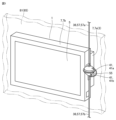
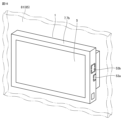
- FIG. 1 is a perspective view showing an air conditioning control device according to an embodiment
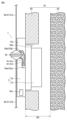
- FIG. 2 is a side view, including a partial cross section, showing the air conditioning control device embedded in a wall in the embodiment.
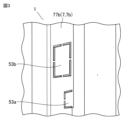
- FIG. 2 is a partial perspective view showing an example of a first lid portion and a second lid portion formed on a housing of the air conditioning control device in the embodiment.
- FIG. 4 is a first partial perspective view showing a procedure for installing an antenna in the embodiment.
- FIG. 11 is a second partial perspective view showing a procedure for installing the antenna in the embodiment. 4 is a perspective view showing an example of an antenna wire routing structure on the rear side of the air conditioning control device in the embodiment.
- FIG. 4 is a partial perspective view showing an example of an antenna wire routing structure on the rear side of the air conditioning control device in the embodiment.
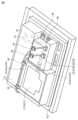
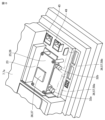
- FIG. 11 is a partially enlarged perspective view showing a board housing section in which an extension board and a wireless communication main body section of the wireless communication unit are housed in the embodiment.
- FIG. 11 is a rear view showing a schematic arrangement of the substrate accommodating section in the housing in the embodiment;
- FIG. 2 is a top view showing the positional relationship between a first extension board and a second extension board in the embodiment.
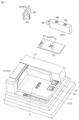
- FIG. 2 is a partially exploded perspective view showing an extension board and a wireless communication main body that are accommodated in a board accommodating section in the embodiment.
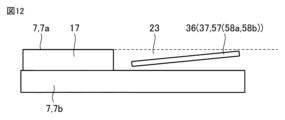
- FIG. 2 is a schematic side view illustrating an arrangement of a wireless communication unit in the embodiment.
- FIG. 2 is a diagram showing an example of a usage mode of the air conditioning control device in the embodiment.
- FIG. 4 is a diagram showing another example of a usage mode of the air conditioning control device in the embodiment.
- FIG. 13 is a partially enlarged perspective view showing a board housing section in which a mounting board and a wireless communication section are housed in an air conditioning apparatus according to a first modified example of the embodiment.
- FIG. 11 is a perspective view showing an air conditioning control device according to a second modified example of the embodiment.
- FIG. 11 is a perspective view showing an air conditioning control device according to a third modified example in the embodiment.
- 13 is a partial perspective view showing another example of a first lid portion and a second lid portion formed on the housing of the air conditioning control device in the embodiment.
- the air conditioning control device 1 has a housing 7 including a first housing 7a housing the control unit 3 and a second housing 7b housing the display panel 5.
- the control unit 3 includes a main body board 11.
- the first housing 7a is embedded in the wall 81.
- the second housing 7b is disposed in a manner that protrudes from the wall 81 relative to the first housing 7a.
- the wall 81 is composed of a wall body 83 and a front board 85.
- the front board 85 includes, for example, a heat insulating material.
- a gap (space) is provided between the wall body 83 and the front board 85.
- the length DE from the front board 85 (surface) to the wall body 83 is a standard set by each country. For example, in Germany, the length DE is set to 59 mm.
- the dimension in the depth direction of the first housing 7a is set to fit within the length DE.
- the front board 85 has an opening 85a that penetrates the front board 85.
- the air conditioning control device 1 is attached to the front board 85 by a mounting bracket (not shown) in such a manner that the first housing 7a is inserted into the opening 85a.
- the air conditioning control device 1 is equipped with a wireless communication unit 36 that performs centralized control wirelessly.
- the wireless communication unit 36 includes a wireless communication main unit 37 and an antenna 57 (see Figures 1 and 8).
- the wireless communication unit 36 can be attached even after the air conditioning control device 1 has been installed on a wall 81.
- the wireless communication main unit 37 in the wireless communication unit 36 is housed in the first housing 7a and the antenna 57 is attached to the second housing 7b.
- the wireless communication main unit 37 is placed inside the wall 81 and the antenna 57 is placed outside the wall 81.
- An antenna stand 55 and an antenna 57 are attached to the side 77b of the second housing 7b, which is positioned to protrude from the wall 81 (front board 85).
- the antenna 57 includes an antenna 57a and an antenna 57b.
- the antenna 57a is attached to the upper surface of the antenna stand 55.
- the antenna 57b is attached to the lower surface of the antenna stand 55.
- the antenna stand 55 is attached to a second opening 54b provided on the side 77b of the second housing 7b.
- the second opening 54b is formed, for example, by opening a slit-type second cover portion 53b.
- the second cover portion 53b functions as an antenna stand attachment portion to which the antenna stand 55 is attached.
- a slit is formed along the area that will become the second opening 54b.
- the slit is formed in the side portion 77b in such a way that the part located inside the slit and the part located outside the slit are connected to each other. By cutting the connected part, the part located inside the slit is removed, and the second opening 54b is formed.
- the antenna stand 55 is inserted into the second opening 54b, and as shown in FIG. 5, the antenna stand 55 is attached to the second housing 7b by screwing it in place.
- the antenna 57 is attached to the antenna stand 55, for example, by a magnet or the like (see FIG. 2).
- the antenna wire 41 is electrically connected to the antenna 57.
- the antenna wire 41 is pulled out from the second housing 7b through a first opening 54a provided in the side portion 77b of the second housing 7b.
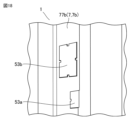
- the first opening 54a is formed, for example, by opening a slit-type first cover portion 53a.
- the first cover portion 53a functions as an antenna wire pull-out portion from which the antenna wire 41 is pulled out.
- a slit is formed along the area that will become the first opening 54a.
- the slit is formed in the side portion 77b in such a way that a portion that is located inside the slit and a portion that is located outside the slit are connected to each other. By cutting the connected portion, the portion that is located inside the slit is removed, and the first opening 54a is formed.
- the antenna wire 41 is pulled out from the first opening 54a to the outside of the housing 7.
- the antenna wire 41 includes an antenna wire 41a and an antenna wire 41b.
- the antenna wire 41a is electrically connected to the antenna 57a.
- the antenna wire 41b is electrically connected to the antenna 57b.
- the other end of the antenna wire 41 is electrically connected to the wireless communication main unit 37 (see FIG. 8) in the wireless communication unit 36.
- the wireless communication main unit 37 is arranged in the board housing section 23 together with the extension board 28.
- the wireless communication main unit 37 and the extension board 25, etc. are covered by the board cover 27.
- the board cover 27 is part of the first housing 7a.
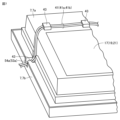
- the antenna wire 41 that electrically connects the wireless communication main body 37 and the antenna 57 is disposed on the back surface of the first housing 7a.
- Hooks 43 for hooking the antenna wire 41 are provided at multiple locations on the back surface of the first housing 7a.
- the antenna wire 41 is led from the wireless communication main body 37 to the outside of the first opening 54a while hooked on the hooks 43.
- the antenna wire 41 By hooking the antenna wire 41 on the hook portion 43, the antenna wire 41 can be prevented from getting caught on the power supply unit 17, for example. This makes it possible to suppress the effects of noise caused by the power supply unit 17.
- the antenna wire 41 can be prevented from crossing the LAN cable 47 connected to the first LAN connector 45 and the LAN cable 51 (Local Area Network) connected to the second LAN connector 49. This makes it possible to suppress the effects of noise caused by the LAN cables 47 and 51.
- the first LAN connector 45 and the second LAN connector 49 are arranged on the opposite side of the power supply unit 17 from the expansion board 28, but it is also possible that the first LAN connector 45 and the second LAN connector 49 are arranged on the opposite side of the power supply unit 17 from the expansion board 28. In this case, it is possible to prioritize not crossing the LAN cable 47 and the LAN cable 51, and to arrange the antenna wire 41 beyond the power supply unit 17. In other words, the antenna wire 41 may be drawn out from the power supply unit 17 side.
- the antenna wire 41 may be arranged so that it passes between the part where the antenna wire 41 is connected to the wireless communication main unit 37 and the power supply unit 17 and is drawn out to the power supply unit 17 side (see the two-dot chain line in FIG. 6).
- the wireless communication main body 37 to which the antenna wire 41 is electrically connected is housed in the board housing 23 (first housing 7a) as a long-shaped housing.
- the board housing 23 first housing 7a
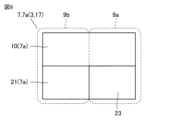
- the control area 9a and a power supply area 9b are provided in the first housing 7a in which the control unit 3 is housed.
- the board housing 23 is provided in the control area 9.
- the board accommodating section 23 is formed by a space recessed toward the wall surface side (second housing 7b side) of the wall 81 in the control area 9a (first housing 7a).
- the space of the board accommodating section 23 is adjacent to the power supply section 17.
- the first housing 7a includes a main cover 10 and a power supply cover 21.
- the board accommodating section 23 is defined by the main cover 10 and the power supply cover 21.
- a wireless dongle is used as the wireless communication main body 37.
- the board housing section 23 houses an extension board 28 as the board 25.
- the extension board 28 includes a first extension board 29 and a second extension board 33.
- the first extension board 29 is disposed so as to face the display panel 5 (see Figure 1).
- the first extension board 29 is disposed substantially parallel to the front board 85.
- the control unit 3 housed in the first housing 7a includes a main board 11.
- a connector 15 is attached to the main board 11.
- a connector 31a is attached to one surface (the display panel 5 side) of the first extension board 29.
- a connector 31b is attached to the other surface (the wall main body 83 side) of the first extension board 29.
- the first extension board 29 is electrically connected to the main board 11 by connecting the connector 31a and the connector 15 to each other.
- a static electricity suppression member 71 such as a sheet-like polycarbonate may be disposed so as to cover the surface of the first extension board 29.
- Connectors 35a and 35b are attached to the second expansion board 33.
- the second expansion board 33 is electrically connected to the first expansion board 29.
- the second expansion board 33 is positioned in an upright position relative to the first expansion board 29.
- the second expansion board 33 is positioned on the first expansion board 29 in such a manner that an imaginary plane parallel to the second expansion board 33 intersects with an imaginary plane parallel to the first expansion board 29.
- Connector 39a of the wireless communication main unit 37 is connected to connector 35b of the second extension board 33.
- the wireless communication main unit 37 is arranged on the second extension board 33 so that the longitudinal direction of the wireless communication main unit 37 is aligned with the first extension board 29.
- connection direction between the connector 15 attached to the main body board 11 and the connector 31a attached to the first extension board 29 is the thickness direction of the first housing 7a.
- connection direction between the connector 31b attached to the first extension board 29 and the connector 35a attached to the second extension board 33 is the thickness direction of the first housing 7a.
- connection direction between the connector 35 attached to the second extension board 33 and the wireless communication main body unit 37 is parallel to the display panel 5.
- the wireless communication main unit 37 is arranged parallel to the display panel 5 on the second extension board 33, which is arranged upright relative to the first extension board 29, which is arranged parallel to the display panel 5. That is, the long wireless communication main unit 37 is arranged with its longitudinal direction parallel to the wall 81 (wall surface).
- “parallel” does not mean strictly parallel in a geometric sense, but means that it is clear at a glance that the wireless communication main unit 37 is arranged along the display panel 5 (wall surface of the wall 81). More specifically, as shown in FIG. 12, the long wireless communication main unit 37 (wireless communication unit 36) may be arranged so that there is no protruding portion on the side of the wall main unit 83 (see FIG. 2) beyond the portion of the first housing 7a (see dotted line) that covers the power supply unit 17.
- the first extension board 29 must not be placed directly below the wireless communication main unit 37. This is to prevent the wireless communication main unit 37 from coming into contact with the first extension board 29 when the wireless communication main unit 37 is connected to the connector 35b, which could result in damage to the circuit elements and electronic components (not shown) mounted on the first extension board 29.
- the wireless communication main body 37 is provided with antenna connection parts 39b and 39c.
- the other end of the antenna wire 41a is electrically connected to the antenna connection part 39b.
- the other end of the antenna wire 41b is electrically connected to the antenna connection part 39c.
- the air conditioning control device 1 according to the embodiment is configured as described above.
- the wireless communication main unit 37 of the wireless communication unit 36 which wirelessly exchanges information with the outside, is housed within the first housing 7a. This makes it possible to prevent theft or damage to the wireless communication main unit 37, compared to when the wireless communication main unit 37 is attached externally to the air conditioning control device 1, for example when the wireless communication main unit 37 is connected to a USB port provided in the second housing 7b.
- the first housing 7a housing the wireless communication main unit 37 is embedded in an opening 85a in the front board 85 (wall 81).
- An antenna stand 55 is attached to the second housing 7b protruding from the front board 85.
- An antenna 57 is installed on the antenna stand 55.
- the antenna 57 and the wireless communication main unit 37 are electrically connected by an antenna wire 41.
- radio waves of the desired strength can be emitted (transmitted) because the antenna 57 is electrically connected to the wireless communication main unit 37.
- radio waves transmitted to the wireless communication main unit 37 can be received more reliably.
- the antenna stand 55 can be attached to the second housing 7b, making it easy to install the antenna 57 on the antenna stand 55.
- the second extension board 33 to which the wireless communication main body 37 is connected is arranged in an upright position relative to the first extension board 29, which is arranged to face the display panel 5.
- the wireless communication main body 37 is connected to the second extension board 33 so that the longitudinal direction of the wireless communication main body 37 is aligned with the first extension board 29.
- the thickness of the first housing 7a (housing 7) in the depth direction increases as a result of accommodating the wireless communication main body 37, but this thickness can be kept to a necessary minimum.
- the thickness of the first housing 7a in the depth direction is significantly reduced compared to when the wireless communication main body 37 is electrically connected to the first extension board 29 with the longitudinal direction of the wireless communication main body 37 being approximately perpendicular to the first extension board 29.
- the first housing 7a (housing 7) can be easily embedded in the front board 85.
- the second extension board 33 is arranged upright relative to the first extension board 29, which is arranged parallel to the display panel 5 (the surface of the wall 81), and the wireless communication main body 37 of the wireless communication unit 36 is connected to the second extension board 33, thereby making it possible to significantly reduce the thickness of the first housing 7a in the depth direction.
- the structure in which the second extension board 33 is arranged in an upright position relative to the first extension board 29 arranged parallel to the display panel 5 (wall surface of the wall 81) allows the wireless communication main unit 37 to be arranged parallel to the display panel 5 (wall surface of the wall 81) when the wireless communication unit 36 (wireless communication main unit 37) is later attached.
- the structure in which the second extension board 33 is arranged in an upright position relative to the first extension board 29 arranged parallel to the display panel 5 (wall surface of the wall 81) can be said to be a structure required for arranging the wireless communication main unit 37 parallel to the display panel 5 (wall surface of the wall 81).
- a dedicated QR code 61 (registered trademark) is printed on the first extension board 29 as an example of an identification code to obtain information (applications, drivers, etc.) for controlling the wireless communication main unit 37 (wireless communication unit 36) and other terminals connected to the extension board 28.
- the identification code is not limited to the QR code 61, and other identification codes such as a barcode may be used.
- the QR code 61 is read by a mobile terminal such as a smartphone (Step A).
- the required application and driver are selected from a number of applications displayed on the mobile terminal (Step B).
- the selected application and driver are installed in the air conditioning control device 1 via an Internet line (Step C).
- the installed application and driver control the terminal connected to the expansion board 28. In this way, required software can be efficiently installed when installing the air conditioning control device 1.
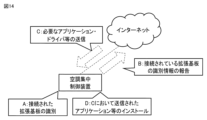
- step A the extension board 28 electrically connected to the main body board 11 is identified (step A).
- step B the identified extension board 28 is reported to a management server or the like via the Internet line (step B).
- Necessary applications, drivers, etc. are transmitted from the management server or the like to the air conditioning control device via the Internet line (step C).
- step D the transmitted applications, etc. are installed (step D). In this way, required software can be efficiently installed when installing the air conditioning control device 1.
- the wireless communication unit 36 has a wireless communication main body 37 and built-in antennas 58a and 58b (see FIG. 15) as long-sized housed bodies.
- a mounting board 26 is accommodated as a board 25 in the board accommodation section 23 (first housing 7a).
- the mounting board 26 is arranged so as to be parallel to the display panel 5 (see FIG. 1).
- "parallel” does not mean strictly parallel in a geometric sense, but means that the mounting board 26 appears to be arranged so as to face the display panel 5 at a glance.
- a wireless communication main body 37 such as a wireless IC (Integrated Circuit), is mounted on the mounting board 26.
- An antenna connector 32a and an antenna connector 32b are attached to the mounting board 26.
- a long built-in antenna 58a is connected to the antenna connector 32a.
- the built-in antenna 58a is bent at a nearly right angle to the direction of connection with the antenna connector 32a.
- a long built-in antenna 58b is connected to the antenna connector 32b.
- the built-in antenna 58b is bent at a nearly right angle to the direction of connection with the antenna connector 32b.
- the built-in antennas 58a and 58b are attached so that their longitudinal directions are parallel to the display panel 5 (the surface of the wall 81).
- the built-in antenna 58a and the built-in antenna 58b should be arranged so that there is no protruding part on the wall main body 83 (see FIG. 2) side beyond the part of the first housing 7a that covers the power supply unit 17 (see dotted line).
- the board accommodation unit 2 first housing 7a
- the wireless communication unit 36 is housed in the first housing 7a in advance, the wireless communication main unit 37 of the wireless communication unit 36 is mounted on a mounting board 26 arranged parallel to the display panel 5 (wall surface of the wall 81), and the long built-in antennas 58a and 58b electrically connected to the wireless communication main unit 37 are arranged parallel to the display panel 5 (wall surface of the wall 81).
- the first housing 7a (housing 7) can be easily embedded in the wall 81 (front board 85) (see FIG. 2).
- Figure 15 shows the state where the board cover 27 (see Figure 6) that covers the board storage section 23 has been removed, but instead of the board cover 27, the board storage section 23 may be covered by the first housing 7a.
- the antenna 57 is attached to the wireless communication main body 37 via the antenna wire 41. If the air conditioning control device 1 is installed in a location where a desired radio wave intensity can be obtained without installing the antenna 57, it is not necessarily necessary to install the antenna 57.
- the first lid portion 53a and the second lid portion 53b are kept in a closed state.
- the design of the air conditioning control device 1 is not compromised.
- the intrusion of external foreign objects into the housing 7 is also suppressed.
- the second lid portion 53b can be closed and only the first lid portion 53a from which the antenna wire 41 is pulled out can be opened.
- an external storage device may be attached to the above-described air conditioning control device 1.
- a USB memory Universal Serial Bus
- USB memory Universal Serial Bus
- an external connector 53c is provided on a side 77b of the second housing 7b.
- a USB memory 59 is inserted into the external connector 53c.
- the position of the antenna 57 on the antenna stand 55 can be shifted so that the antenna 57 does not come into contact with the USB memory 59.
- the first lid portion 53a that functions as the antenna pull-out portion is exemplified by a slit processed portion in which a slit is formed along the position where the first opening 54a is formed.
- the second lid portion 53b that functions as the antenna stand attachment portion is exemplified by a slit processed portion in which a slit is formed along the position where the second opening 54b is formed.
- the first lid portion 53a as the antenna pull-out portion and the second lid portion 53b as the antenna mount attachment portion are not limited to slit processed portions. As shown in FIG. 18, knockout processed portions may be applied as the first lid portion 53a and the second lid portion 53b.
- the thickness of the portion of the second housing 7b located in the area where the first opening 54a is formed is formed to be thinner than the thickness of the portion of the second housing 7b located around it. Also, the thickness of the portion of the second housing 7b located in the area where the second opening 54b is formed is formed to be thinner than the thickness of the portion of the second housing 7b located around it. By removing the portion of the second housing 7b located in the area of the second housing 7b where the thickness is relatively thinner, the first opening 54a and the second opening 54b are formed.
- first lid portion 53a functioning as the antenna pull-out portion and the second lid portion 53b functioning as the antenna stand attachment portion are not limited to slit processed portions and knock-out processed portions, and other structures may be applied, such as providing an openable and closable lid, as long as the antenna wire 41 can be pulled out and the antenna stand 55 can be attached as necessary.
- the air conditioning control device 1 may be an air conditioning control device 1 that controls the outdoor unit and indoor unit of one air conditioner, or an air conditioning control device 1 that centrally controls the outdoor units and indoor units of multiple air conditioners. Also, while the air conditioning control device 1 equipped with a display panel 5 has been given as an example, the air conditioning control device 1 may not be equipped with a display panel 5. Furthermore, the air conditioning control device 1 may be one in which the display panel 5 can be retrofitted inside the second housing 7b.
- the air conditioning control devices described in the embodiments can be combined in various ways as needed.
- This disclosure can be effectively used in air conditioning control devices that house wireless communication devices and are embedded in walls.
- 1 air conditioning control device 3 control unit, 5 display panel, 7 housing, 7a first housing, 7b second housing, 9a control area, 9b power area, 10 main cover, 11 main board, 13 main board cover, 15 connector, 17 power supply unit, 19 power supply board, 21 power supply board cover, 23 board housing section, 25 board, 26 mounting board, 27 board cover, 28 extension board, 29 first extension board, 31a, 31b connector, 32a, 32b antenna connector, 33 second extension board, 35a, 35b connector, 36 wireless communication unit, 37 wireless communication main unit, 39a connector, 39b first antenna Antenna connection part, 39c second antenna connection part, 41 antenna line, 41a first antenna line, 41b second antenna line, 43 hook part, 45 first LAN connector, 47 LAN cable, 49 second LAN connector, 51 LAN cable, 77b side part, 53a first cover part, 53b second cover part, 53c external connector, 54a, 54b opening, 55 antenna stand, 57, 57a, 57b antenna, 58a, 58b built-in antenna,
Landscapes
- Engineering & Computer Science (AREA)
- Human Computer Interaction (AREA)
- Chemical & Material Sciences (AREA)
- Combustion & Propulsion (AREA)
- Mechanical Engineering (AREA)
- General Engineering & Computer Science (AREA)
- Air Conditioning Control Device (AREA)
Priority Applications (3)
| Application Number | Priority Date | Filing Date | Title |
|---|---|---|---|
| DE112023005652.8T DE112023005652T5 (de) | 2023-01-23 | 2023-01-23 | Klimatisierungssteuervorrichtung |
| JP2024572540A JPWO2024157321A1 (https=) | 2023-01-23 | 2023-01-23 | |
| PCT/JP2023/001913 WO2024157321A1 (ja) | 2023-01-23 | 2023-01-23 | 空調制御装置 |
Applications Claiming Priority (1)
| Application Number | Priority Date | Filing Date | Title |
|---|---|---|---|
| PCT/JP2023/001913 WO2024157321A1 (ja) | 2023-01-23 | 2023-01-23 | 空調制御装置 |
Publications (1)
| Publication Number | Publication Date |
|---|---|
| WO2024157321A1 true WO2024157321A1 (ja) | 2024-08-02 |
Family
ID=91970093
Family Applications (1)
| Application Number | Title | Priority Date | Filing Date |
|---|---|---|---|
| PCT/JP2023/001913 Ceased WO2024157321A1 (ja) | 2023-01-23 | 2023-01-23 | 空調制御装置 |
Country Status (3)
| Country | Link |
|---|---|
| JP (1) | JPWO2024157321A1 (https=) |
| DE (1) | DE112023005652T5 (https=) |
| WO (1) | WO2024157321A1 (https=) |
Citations (6)
| Publication number | Priority date | Publication date | Assignee | Title |
|---|---|---|---|---|
| JPH08286925A (ja) * | 1995-04-11 | 1996-11-01 | Toshiba Corp | プログラムロード方法およびそのプログラムロード方法を使用したパーソナルコンピュータ |
| JP2004281717A (ja) * | 2003-03-17 | 2004-10-07 | Fuji Mach Mfg Co Ltd | 対基板作業システムおよびそれに用いられる構成装置管理プログラム |
| JP2007280353A (ja) * | 2006-04-03 | 2007-10-25 | Aopen Inc | アダプタボードと該アダプタボードを備えたモジュラー転送インターフェイスと該モジュラー転送インターフェイスを備えたコンピュータ装置 |
| JP3206882U (ja) * | 2016-07-28 | 2016-10-06 | 株式会社イースタン | 無線式電源制御ユニット及び無線式電源制御システム |
| JP2018170747A (ja) * | 2017-03-30 | 2018-11-01 | パナソニックIpマネジメント株式会社 | 操作装置、機器制御システム |
| WO2022007558A1 (zh) * | 2020-07-10 | 2022-01-13 | 华为技术有限公司 | 一种电源扩展插板及插座 |
-
2023
- 2023-01-23 WO PCT/JP2023/001913 patent/WO2024157321A1/ja not_active Ceased
- 2023-01-23 JP JP2024572540A patent/JPWO2024157321A1/ja active Pending
- 2023-01-23 DE DE112023005652.8T patent/DE112023005652T5/de active Pending
Patent Citations (6)
| Publication number | Priority date | Publication date | Assignee | Title |
|---|---|---|---|---|
| JPH08286925A (ja) * | 1995-04-11 | 1996-11-01 | Toshiba Corp | プログラムロード方法およびそのプログラムロード方法を使用したパーソナルコンピュータ |
| JP2004281717A (ja) * | 2003-03-17 | 2004-10-07 | Fuji Mach Mfg Co Ltd | 対基板作業システムおよびそれに用いられる構成装置管理プログラム |
| JP2007280353A (ja) * | 2006-04-03 | 2007-10-25 | Aopen Inc | アダプタボードと該アダプタボードを備えたモジュラー転送インターフェイスと該モジュラー転送インターフェイスを備えたコンピュータ装置 |
| JP3206882U (ja) * | 2016-07-28 | 2016-10-06 | 株式会社イースタン | 無線式電源制御ユニット及び無線式電源制御システム |
| JP2018170747A (ja) * | 2017-03-30 | 2018-11-01 | パナソニックIpマネジメント株式会社 | 操作装置、機器制御システム |
| WO2022007558A1 (zh) * | 2020-07-10 | 2022-01-13 | 华为技术有限公司 | 一种电源扩展插板及插座 |
Also Published As
| Publication number | Publication date |
|---|---|
| JPWO2024157321A1 (https=) | 2024-08-02 |
| DE112023005652T5 (de) | 2025-10-30 |
Similar Documents
| Publication | Publication Date | Title |
|---|---|---|
| US7447018B2 (en) | Display apparatus | |
| US7667968B2 (en) | Air-cooling system configuration for touch screen | |
| EP3345791A1 (en) | Camera module for vehicle | |
| JP4501245B2 (ja) | ネットワーク接続機器 | |
| JP2021168310A (ja) | 照明装置 | |
| US10847878B2 (en) | Implantable instrument | |
| CN110214452B (zh) | 操作设备 | |
| JP2003065558A (ja) | 空気調和装置の室内ユニット | |
| WO2024157321A1 (ja) | 空調制御装置 | |
| KR101588881B1 (ko) | 올인원 컴퓨터 | |
| JP2007206804A (ja) | 電子機器 | |
| JP5691621B2 (ja) | 電子機器及びアンテナの配設構造 | |
| JP7702079B2 (ja) | コントローラ | |
| JP7401231B2 (ja) | 画像形成装置 | |
| CN215982925U (zh) | 一种室外机及空调器 | |
| JP2008111614A (ja) | 空気調和機 | |
| JPWO2024157321A5 (https=) | ||
| JP7129509B1 (ja) | 情報通信装置 | |
| JP2012029272A (ja) | 無線機、並びにそれを用いた無線式異常報知システム及び無線式遠隔制御システム | |
| JP2019192711A (ja) | 電子機器筐体の配線部材固定構造並びに配線部材固定方法およびこれを用いる電子機器または映像音響機器 | |
| CN218336686U (zh) | 中控设备 | |
| CN223984979U (zh) | 电子设备 | |
| JP7298500B2 (ja) | 電子機器 | |
| CN215648064U (zh) | 门禁控制主机 | |
| JP2020182322A (ja) | 取付構造、ワイヤハーネス、及び、支持部材 |
Legal Events
| Date | Code | Title | Description |
|---|---|---|---|
| 121 | Ep: the epo has been informed by wipo that ep was designated in this application |
Ref document number: 23918294 Country of ref document: EP Kind code of ref document: A1 |
|
| WWE | Wipo information: entry into national phase |
Ref document number: 2024572540 Country of ref document: JP |
|
| WWE | Wipo information: entry into national phase |
Ref document number: 112023005652 Country of ref document: DE |
|
| WWP | Wipo information: published in national office |
Ref document number: 112023005652 Country of ref document: DE |
|
| 122 | Ep: pct application non-entry in european phase |
Ref document number: 23918294 Country of ref document: EP Kind code of ref document: A1 |