WO2024143471A1 - 防汚部材、及び、これを用いたディスプレイ、タッチパネル並びにセンサー、及び、防汚部材の製造方法 - Google Patents
防汚部材、及び、これを用いたディスプレイ、タッチパネル並びにセンサー、及び、防汚部材の製造方法 Download PDFInfo
- Publication number
- WO2024143471A1 WO2024143471A1 PCT/JP2023/046941 JP2023046941W WO2024143471A1 WO 2024143471 A1 WO2024143471 A1 WO 2024143471A1 JP 2023046941 W JP2023046941 W JP 2023046941W WO 2024143471 A1 WO2024143471 A1 WO 2024143471A1
- Authority
- WO
- WIPO (PCT)
- Prior art keywords
- group
- member according
- unevenness
- antifouling
- stain
- Prior art date
- Legal status (The legal status is an assumption and is not a legal conclusion. Google has not performed a legal analysis and makes no representation as to the accuracy of the status listed.)
- Ceased
Links
Images

Classifications
-
- G—PHYSICS
- G06—COMPUTING OR CALCULATING; COUNTING
- G06F—ELECTRIC DIGITAL DATA PROCESSING
- G06F3/00—Input arrangements for transferring data to be processed into a form capable of being handled by the computer; Output arrangements for transferring data from processing unit to output unit, e.g. interface arrangements
- G06F3/01—Input arrangements or combined input and output arrangements for interaction between user and computer
- G06F3/03—Arrangements for converting the position or the displacement of a member into a coded form
- G06F3/041—Digitisers, e.g. for touch screens or touch pads, characterised by the transducing means
- G06F3/0412—Digitisers structurally integrated in a display
-
- C—CHEMISTRY; METALLURGY
- C09—DYES; PAINTS; POLISHES; NATURAL RESINS; ADHESIVES; COMPOSITIONS NOT OTHERWISE PROVIDED FOR; APPLICATIONS OF MATERIALS NOT OTHERWISE PROVIDED FOR
- C09D—COATING COMPOSITIONS, e.g. PAINTS, VARNISHES OR LACQUERS; FILLING PASTES; CHEMICAL PAINT OR INK REMOVERS; INKS; CORRECTING FLUIDS; WOODSTAINS; PASTES OR SOLIDS FOR COLOURING OR PRINTING; USE OF MATERIALS THEREFOR
- C09D5/00—Coating compositions, e.g. paints, varnishes or lacquers, characterised by their physical nature or the effects produced; Filling pastes
- C09D5/16—Antifouling paints; Underwater paints
- C09D5/1693—Antifouling paints; Underwater paints as part of a multilayer system
-
- B—PERFORMING OPERATIONS; TRANSPORTING
- B32—LAYERED PRODUCTS
- B32B—LAYERED PRODUCTS, i.e. PRODUCTS BUILT-UP OF STRATA OF FLAT OR NON-FLAT, e.g. CELLULAR OR HONEYCOMB, FORM
- B32B3/00—Layered products comprising a layer with external or internal discontinuities or unevennesses, or a layer of non-planar shape; Layered products comprising a layer having particular features of form
- B32B3/26—Layered products comprising a layer with external or internal discontinuities or unevennesses, or a layer of non-planar shape; Layered products comprising a layer having particular features of form characterised by a particular shape of the outline of the cross-section of a continuous layer; characterised by a layer with cavities or internal voids ; characterised by an apertured layer
- B32B3/30—Layered products comprising a layer with external or internal discontinuities or unevennesses, or a layer of non-planar shape; Layered products comprising a layer having particular features of form characterised by a particular shape of the outline of the cross-section of a continuous layer; characterised by a layer with cavities or internal voids ; characterised by an apertured layer characterised by a layer formed with recesses or projections, e.g. hollows, grooves, protuberances, ribs
-
- C—CHEMISTRY; METALLURGY
- C09—DYES; PAINTS; POLISHES; NATURAL RESINS; ADHESIVES; COMPOSITIONS NOT OTHERWISE PROVIDED FOR; APPLICATIONS OF MATERIALS NOT OTHERWISE PROVIDED FOR
- C09D—COATING COMPOSITIONS, e.g. PAINTS, VARNISHES OR LACQUERS; FILLING PASTES; CHEMICAL PAINT OR INK REMOVERS; INKS; CORRECTING FLUIDS; WOODSTAINS; PASTES OR SOLIDS FOR COLOURING OR PRINTING; USE OF MATERIALS THEREFOR
- C09D171/00—Coating compositions based on polyethers obtained by reactions forming an ether link in the main chain; Coating compositions based on derivatives of such polymers
- C09D171/02—Polyalkylene oxides
-
- C—CHEMISTRY; METALLURGY
- C09—DYES; PAINTS; POLISHES; NATURAL RESINS; ADHESIVES; COMPOSITIONS NOT OTHERWISE PROVIDED FOR; APPLICATIONS OF MATERIALS NOT OTHERWISE PROVIDED FOR
- C09D—COATING COMPOSITIONS, e.g. PAINTS, VARNISHES OR LACQUERS; FILLING PASTES; CHEMICAL PAINT OR INK REMOVERS; INKS; CORRECTING FLUIDS; WOODSTAINS; PASTES OR SOLIDS FOR COLOURING OR PRINTING; USE OF MATERIALS THEREFOR
- C09D183/00—Coating compositions based on macromolecular compounds obtained by reactions forming in the main chain of the macromolecule a linkage containing silicon, with or without sulfur, nitrogen, oxygen, or carbon only; Coating compositions based on derivatives of such polymers
- C09D183/04—Polysiloxanes
-
- C—CHEMISTRY; METALLURGY
- C09—DYES; PAINTS; POLISHES; NATURAL RESINS; ADHESIVES; COMPOSITIONS NOT OTHERWISE PROVIDED FOR; APPLICATIONS OF MATERIALS NOT OTHERWISE PROVIDED FOR
- C09D—COATING COMPOSITIONS, e.g. PAINTS, VARNISHES OR LACQUERS; FILLING PASTES; CHEMICAL PAINT OR INK REMOVERS; INKS; CORRECTING FLUIDS; WOODSTAINS; PASTES OR SOLIDS FOR COLOURING OR PRINTING; USE OF MATERIALS THEREFOR
- C09D5/00—Coating compositions, e.g. paints, varnishes or lacquers, characterised by their physical nature or the effects produced; Filling pastes
- C09D5/16—Antifouling paints; Underwater paints
- C09D5/1656—Antifouling paints; Underwater paints characterised by the film-forming substance
- C09D5/1662—Synthetic film-forming substance
- C09D5/1675—Polyorganosiloxane-containing compositions
-
- C—CHEMISTRY; METALLURGY
- C09—DYES; PAINTS; POLISHES; NATURAL RESINS; ADHESIVES; COMPOSITIONS NOT OTHERWISE PROVIDED FOR; APPLICATIONS OF MATERIALS NOT OTHERWISE PROVIDED FOR
- C09D—COATING COMPOSITIONS, e.g. PAINTS, VARNISHES OR LACQUERS; FILLING PASTES; CHEMICAL PAINT OR INK REMOVERS; INKS; CORRECTING FLUIDS; WOODSTAINS; PASTES OR SOLIDS FOR COLOURING OR PRINTING; USE OF MATERIALS THEREFOR
- C09D5/00—Coating compositions, e.g. paints, varnishes or lacquers, characterised by their physical nature or the effects produced; Filling pastes
- C09D5/28—Coating compositions, e.g. paints, varnishes or lacquers, characterised by their physical nature or the effects produced; Filling pastes for wrinkle, crackle, orange-peel, or similar decorative effects
-
- C—CHEMISTRY; METALLURGY
- C09—DYES; PAINTS; POLISHES; NATURAL RESINS; ADHESIVES; COMPOSITIONS NOT OTHERWISE PROVIDED FOR; APPLICATIONS OF MATERIALS NOT OTHERWISE PROVIDED FOR
- C09K—MATERIALS FOR MISCELLANEOUS APPLICATIONS, NOT PROVIDED FOR ELSEWHERE
- C09K3/00—Materials not provided for elsewhere
-
- G—PHYSICS
- G02—OPTICS
- G02B—OPTICAL ELEMENTS, SYSTEMS OR APPARATUS
- G02B1/00—Optical elements characterised by the material of which they are made; Optical coatings for optical elements
- G02B1/10—Optical coatings produced by application to, or surface treatment of, optical elements
- G02B1/18—Coatings for keeping optical surfaces clean, e.g. hydrophobic or photo-catalytic films
-
- G—PHYSICS
- G06—COMPUTING OR CALCULATING; COUNTING
- G06F—ELECTRIC DIGITAL DATA PROCESSING
- G06F3/00—Input arrangements for transferring data to be processed into a form capable of being handled by the computer; Output arrangements for transferring data from processing unit to output unit, e.g. interface arrangements
- G06F3/01—Input arrangements or combined input and output arrangements for interaction between user and computer
- G06F3/03—Arrangements for converting the position or the displacement of a member into a coded form
- G06F3/041—Digitisers, e.g. for touch screens or touch pads, characterised by the transducing means
Definitions
- the present invention relates to an anti-fouling member, a display, a touch panel and a sensor that use the same, and a method for manufacturing the anti-fouling member.
- Patent Document 1 JP 2014-218639 A
- Patent Document 2 JP 2017-082194 A
- the average pitch width of the convex portions of the unevenness may be 5 to 18 nm.
- the surface roughness (Rz) measured on the cross section of the irregularities may be 3 to 5 nm.
- the maximum height difference (P-V) measured on the flat surface of the unevenness may be 5 to 15 nm.
- the maximum height difference (P-V) measured on the cross section of the irregularities may be 4 to 8 nm.
- the arithmetic mean roughness (Ra) measured on the uneven surface may be 0.6 to 2.0 nm.
- the arithmetic mean roughness (Ra) measured on the cross section of the irregularities may be 0.6 to 2.0 nm.
- the root mean square roughness (RMS) measured on the uneven surface may be 0.8 to 2.0 nm.
- the antifouling member may include a substrate and an irregularity-forming layer, and irregularities may be formed on the surface of the irregularity-forming layer.
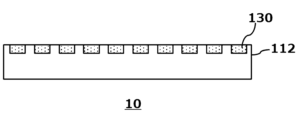
- the antifouling member may include a substrate, and the substrate may have a surface with irregularities.
- the height in the normal direction of one surface of the antifouling layer formed in the recess does not have to exceed the height of the protrusions of the unevenness.
- the contact angle when water comes into contact with one side of the antifouling member may be 105 to 120°.
- the pencil hardness of one side of the antifouling member may be HB or higher.
- the unevenness forming layer may contain a silicone resin.
- composition ratio of carbon atoms in the recesses of the unevenness-forming layer may be higher than that in the protrusions.
- the molar concentration of silanol groups in the recesses of the unevenness-forming layer may be greater than that in the protrusions.
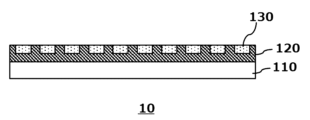
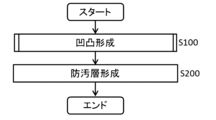
- An example of an antifouling member 10 in this embodiment is shown. Another example of the stain-proof member 10 in this embodiment is shown. An example of a flow of a method for producing the antifouling member 10 of this embodiment will be described below. An example of S100 in the flow of FIG. 3 in the case where the irregularity forming layer 120 is provided will be described below.
- the unevenness-forming layer 120 is provided on one side of the substrate 110, and is a layer that holds the antifouling layer 130 by its unevenness.
- the unevenness-forming layer 120 may further function as a hard coat layer that provides abrasion resistance to the antifouling member 10.
- the unevenness-forming layer 120 may be made of an abrasion-resistant material, for example, an inorganic material such as silica or a metal oxide, or a relatively hard organic material such as a silicone resin, an acrylic resin, a melamine resin, or a urethane resin.
- the unevenness is provided on the unevenness-forming layer 120.
- the unevenness on the unevenness-forming layer 120 which is the layer below the antifouling layer 130
- the antifouling layer 130 is surrounded and protected by the convex parts, and the antifouling layer 130 fits into the concave parts, so that the antifouling layer 130 is firmly bonded to the unevenness-forming layer 120.
- the antifouling layer on the surface of the antifouling member is worn down due to friction such as wiping off dirt or long-term use, and the antifouling performance may not be sustained.
- the average pitch width (average peak-to-peak length) of the convex portions of the unevenness may be 5 to 18 nm, and preferably 7 to 15 nm. If the average pitch width is equal to or less than a predetermined size, the transparency of the antifouling member 10 can be ensured. Furthermore, if the average pitch width is equal to or greater than a predetermined size, the antifouling layer 130 can be held more firmly. In particular, by keeping the average pitch width within a certain range, the unevenness of the unevenness-forming layer and the antifouling layer 130 are firmly bound by an anchor effect, and the holding power of the antifouling layer 130 can be strengthened.
- the average pitch width may be a value measured on a specific cross section or plane using an atomic force microscope or the like.
- the unevenness of the unevenness-forming layer and the antifouling layer 130 are firmly bound by an anchor effect, and the holding power of the antifouling layer 130 can be strengthened.
- the root mean square roughness (RMS) measured on the plane of the unevenness may be 0.8 to 2.0 nm, preferably 0.9 to 1.5 nm.
- the root mean square roughness (RMS) measured on the cross section of the unevenness may be 0.7 to 3.0 nm, preferably 0.9 to 1.5 nm. If the root mean square roughness (RMS) is equal to or less than a predetermined value, the transparency of the antifouling member 10 can be ensured. Furthermore, if the root mean square roughness (RMS) is equal to or greater than a predetermined value, the antifouling layer 130 can be held more firmly.
- the unevenness of the unevenness-forming layer and the antifouling layer 130 are firmly bound by an anchor effect, and the holding power of the antifouling layer 130 can be strengthened.
- the maximum height difference (P-V) measured on the plane of the unevenness may be 5 to 15 nm, and preferably 8 to 12 nm.
- the maximum height difference (P-V) measured on the cross section of the unevenness may be 4 to 8 nm, and preferably 3 to 7 nm. If the maximum height difference (P-V) is equal to or less than a predetermined size, the transparency of the antifouling member 10 can be ensured. Furthermore, if the maximum height difference (P-V) is equal to or greater than a predetermined size, the antifouling layer 130 can be held more firmly. In particular, by keeping the maximum height difference (P-V) within a certain range, the unevenness of the unevenness-forming layer and the antifouling layer 130 are firmly bound by an anchor effect, and the holding power of the antifouling layer 130 can be strengthened.
- the anti-stain layer 130 may be formed not only on the concave portions but also on the convex portions.
- the anti-stain layer 130 on the convex portions may be partially or completely peeled off due to transportation, use, wiping off of deposits, etc. of the product. Even in such a case, the concave portions firmly hold the anti-stain layer 130. Therefore, the anti-stain member 10 can maintain its anti-stain performance.
- the anti-stain layer 130 may be provided at least on the bottom surface of the recess and/or the top surface of the protrusion.
- the anti-stain layer 130 may be provided on the entire or part of the side surface of the recess and/or the protrusion, or may not be provided at all.
- the height in the normal direction (vertical direction in FIG. 1) of one surface of the anti-stain layer 130 formed in the recesses of the unevenness-forming layer 120 may not exceed the convex portions of the unevenness of the unevenness-forming layer 120.
- the height in the normal direction of one surface of the anti-stain layer 130 formed in the recesses is the same as the height of the convex portions of the unevenness-forming layer 120 (i.e., flush with the upper surfaces of the convex portions).
- the thickness of the anti-stain layer 130 on the recesses is preferably 1 to 10 nm.
- the surface portion of the anti-stain layer 130 exhibits anti-stain performance, but if the anti-stain layer 130 in the recesses is too thick, it may cause haze (clouding) of the anti-stain member. By making the anti-stain layer 130 in the recesses not too thick in this way, haze (clouding) of the anti-stain member can be prevented. Note that the thick portions of the anti-stain layer 130 on the convex portions are relatively easily worn away by wiping, etc., so haze (clouding) is less likely to occur.
- the anti-stain layer 130 may be formed from a material that is oil- and/or water-repellent.
- the anti-stain layer 130 may contain a fluorine-containing silane compound.
- fluorine-containing silane compounds include perfluoropolyether-containing silane compounds, perfluoroalkyl group-containing silane compounds, and isocyanuric skeleton-containing silane compounds. Details of the material of the anti-stain layer 130 will be described later.
- the antifouling member 10 may have a contact angle of 105 to 120° when water comes into contact with one side (e.g., the antifouling layer 130 side). This allows the antifouling member 10 to exhibit water repellency and exhibit antifouling performance. Furthermore, the antifouling member 10 may have a contact angle of 90° or more after abrasion test 1 and/or abrasion test 2 described below. This allows the antifouling member 10 to exhibit antifouling performance for a long period of time.
- FIG. 4 shows an example of S100 in the flow of FIG. 3 when providing the unevenness forming layer 120.
- S100 in FIG. 3 may be executed by performing the processes of S110 to S130 in FIG. 4.
- the resin composition for forming projections and recesses applied in S110 is dried.
- heat curing may be performed at a temperature of 100 to 150°C, preferably 120 to 130°C, for 10 to 120 minutes, preferably 30 to 60 minutes. Drying may be performed using a hot air drying oven, a hot plate, an infrared heater, or the like.
- R f2 is -(CF 2 CF 2 CF 2 CF 2 CF 2 CF 2 O) n3 -(CF 2 CF 2 CF 2 O) n4 -(CF 2 CF 2 CF 2 O) n5 -(CF 2 CF 2 CF 2 O) n6 -(CF(CF 3 )CF 2 O) n7 -(CF 2 CF 2 O) n8 -(CF 2 O) n9 - (wherein n3, n4, n5, n6, n7, n8 and n9 are each independently an integer of 0 or more, the sum of n3, n4, n5, n6, n7, n8 and n9 is 2 or more, and each repeat unit may be present in any of block, alternating or random configuration).
- the perfluoroalkyl group-containing silane compound is represented by the following formulae (A1), (A2), (B1), (B2), (C1) and (C2):
- PFPE independently at each occurrence, has the formula: -( OC4F8 ) a - ( OC3F6 ) b -( OC2F4 ) c -( OCF2 ) d -
- a, b, c, and d are each independently an integer of 0 to 200, the sum of a, b, c, and d is at least 1, and the order of occurrence of each repeating unit enclosed in parentheses with the subscript a, b, c, or d is arbitrary in the formula.
- Rf in each occurrence, independently represents an alkyl group having 1 to 16 carbon atoms optionally substituted by one or more fluorine atoms
- R 21 independently at each occurrence represents a hydroxyl group or a hydrolyzable group
- R 22 independently represents a hydrogen atom or an alkyl group having 1 to 22 carbon atoms in each occurrence
- n1 is independently an integer
- PFPE is each independently at each occurrence: -( OC6F12 ) a - ( OC5F10 ) b - ( OC4F8 ) c -( OC3F6 ) d -( OC2F4 ) e - ( OCF2 ) f -
- a, b, c, d, e and f are each independently an integer of 0 to 200, and the sum of a, b, c, d, e and f is at least 1.
- the sum of a, b, c, d, e and f is 5 or more, more preferably 10 or more.
- the above a and b are each preferably independently 0 to 30, and may be 0.
- the sum of a, b, c, and d is preferably 30 or less, more preferably 20 or less, even more preferably 10 or less, and particularly preferably 5 or less.
- -(OC 3 F 6 )- may be any of -(OCF 2 CF 2 CF 2 )-, -(OCF(CF 3 )CF 2 )-, and -(OCF 2 CF(CF 3 ))-, but is preferably -(OCF 2 CF 2 CF 2 )-.
- -(OC 2 F 4 )- may be any of -(OCF 2 CF 2 )- and -(OCF(CF 3 ))-, but is preferably -(OCF 2 CF 2 )-.
- the PFPE is -(OC 3 F 6 ) d - (wherein d is an integer of 1 to 200, preferably 5 to 200, more preferably 10 to 200).
- the PFPE is -(OCF 2 CF 2 CF 2 ) d - (wherein d is an integer of 1 to 200, preferably 5 to 200, more preferably 10 to 200) or -(OCF(CF 3 )CF 2 ) d - (wherein d is an integer of 1 to 200, preferably 5 to 200, more preferably 10 to 200).
- the PFPE is -(OCF 2 CF 2 CF 2 ) d - (wherein d is an integer of 1 to 200, preferably 5 to 200, more preferably 10 to 200).
- the PFPE is -( OC4F8 ) c- (OC3F6 ) d- ( OC2F4 ) e- ( OCF2 ) f- (wherein c and d are each independently an integer of 0 to 30, e and f are each independently an integer of 1 to 200, preferably 5 to 200, more preferably 10 to 200, the sum of c, d, e and f is at least 5, preferably 10 or more, and the order of occurrence of each repeat unit in parentheses with the subscript c, d, e or f is arbitrary in the formula).
- the PFPE is - ( OCF2CF2CF2CF2CF2 ) c- ( OCF2CF2CF2 ) d- ( OCF2CF2 ) e- ( OCF2 ) f- .
- PFPE may be -(OC 2 F 4 ) e -(OCF 2 ) f - (wherein e and f are each independently an integer of 1 or more and 200 or less, preferably 5 or more and 200 or less, more preferably 10 or more and 200 or less, and the order of occurrence of each repeat unit enclosed in parentheses with the subscript e or f is arbitrary in the formula).
- the PFPE is a group represented by -(R 6 -R 7 ) j -, where R 6 is, independently at each occurrence, OCF 2 or OC 2 F 4 , preferably OC 2 F 4 , and where R 7 is, independently at each occurrence, a group selected from OC 2 F 4 , OC 3 F 6 , OC 4 F 8 , OC 5 F 10 and OC 6 F 12 , or a combination of two or three groups independently selected from these groups.
- R7 is a group selected from OC2F4 , OC3F6 and OC4F8 , or a group selected from OC3F6 , OC4F8 , OC5F10 and OC6F12 , or a combination of two or three groups independently selected from these groups.
- the combination of two or three groups independently selected from OC 2 F 4 , OC 3 F 6 and OC 4 F 8 is not particularly limited, and examples thereof include -OC 2 F 4 OC 3 F 6 -, -OC 2 F 4 OC 4 F 8 -, -OC 3 F 6 OC 2 F 4 -, -OC 3 F 6 OC 3 F 6 -, -OC 3 F 6 OC 4 F 8 -, -OC 4 F 8 OC 4 F 8 -, -OC 4 F 8 OC 3 F 6 - , -OC 4 F 8 OC 2 F 4 -, -OC 2 F 4 OC 2 F 4 OC 3 F 6 -, -OC 2F4OC2F4OC4F8- , -OC2F4OC3F6OC2F4- , -OC2F4OC3F6OC3F6- , -OC2F4OC4F8OC2F4- , -OC3F6OC2F4- , -OC3
- the j is an integer of 2 or more, preferably 3 or more, more preferably 5 or more, and 100 or less, preferably 50 or less.
- OC 2 F 4 , OC 3 F 6 , OC 4 F 8 , OC 5 F 10 and OC 6 F 12 may be linear or branched, preferably linear.
- the PFPE is preferably -(OC 2 F 4 -OC 3 F 6 ) j - or -(OC 2 F 4 -OC 4 F 8 ) j -.
- the ratio of e to f (hereinafter referred to as "e/f ratio”) is 0.1 to 10, preferably 0.2 to 5, more preferably 0.2 to 2, and even more preferably 0.2 to 1.5.
- e/f ratio the water repellency, oil repellency, and chemical resistance (e.g., durability against salt water, acid or basic aqueous solutions, acetone, oleic acid, or hexane) of the surface treatment layer obtained from the surface treatment agent of the present disclosure can be further improved.
- the smaller the e/f ratio the more improved the water repellency, oil repellency, and chemical resistance of the surface treatment layer.
- the stability of the compound can be further improved. The larger the e/f ratio, the more improved the stability of the compound.
- Rf represents an alkyl group having 1 to 16 carbon atoms which may be substituted with one or more fluorine atoms.
- alkyl group having 1 to 16 carbon atoms in the alkyl group having 1 to 16 carbon atoms which may be substituted with one or more fluorine atoms may be either linear or branched, and is preferably a linear or branched alkyl group having 1 to 6 carbon atoms, particularly 1 to 3 carbon atoms, and more preferably a linear alkyl group having 1 to 3 carbon atoms.
- Rf is preferably an alkyl group having 1 to 16 carbon atoms substituted with one or more fluorine atoms, more preferably a CF 2 H—C 1-15 fluoroalkylene group, and even more preferably a perfluoroalkyl group having 1 to 16 carbon atoms.
- the perfluoroalkyl group having 1 to 16 carbon atoms may be linear or branched, and is preferably a linear or branched perfluoroalkyl group having 1 to 6 carbon atoms, particularly preferably 1 to 3 carbon atoms , and more preferably a linear perfluoroalkyl group having 1 to 3 carbon atoms, specifically -CF3 , -CF2CF3 , or -CF2CF2CF3 .
- R 21 in each occurrence independently represents a hydroxyl group or a hydrolyzable group.
- R 22 each occurrence independently represents a hydrogen atom or an alkyl group having 1 to 22 carbon atoms, preferably an alkyl group having 1 to 4 carbon atoms.
- n1 is independently an integer of 0 to 3 for each (-SiR 21 n1 R 22 3-n1 ) unit, preferably an integer of 1 to 3, and more preferably an integer of 3. However, in the formula, all n1s are not 0 at the same time. In other words, at least one R 21 is present in the formula.
- X5 each independently represents a single bond or a divalent to decavalent organic group.
- X5 is understood to be a linker that connects the perfluoropolyether portion (Rf-PFPE portion or -PFPE- portion) that mainly provides water repellency and surface slipperiness , and the silane portion (specifically , -SiR21n1R223 -n1 ) that provides the ability to bond to the substrate. Therefore, X5 may be any organic group as long as the compounds represented by formulae (A1) and (A2) can exist stably.
- the above X5 is preferably a divalent to heptavalent, more preferably a divalent to tetravalent, and even more preferably a divalent organic group.
- X 5 is a divalent to tetravalent organic group
- ⁇ is 1 to 3
- ⁇ ′ is 1.
- X5 is a divalent organic group
- ⁇ is 1
- ⁇ ' is 1.
- formulas (A1) and (A2) are represented by the following formulas (A1') and (A2').
- Examples of X5 are not particularly limited, but include a single bond or the following formula: -(R 31 ) p ' -(X a ) q ' - [Wherein: R 31 independently at each occurrence represents a single bond, -(CH 2 ) s' -, or an o-, m-, or p-phenylene group, preferably -(CH 2 ) s' -; s' is an integer from 1 to 20, preferably an integer from 1 to 6, more preferably an integer from 1 to 3, even more preferably 1 or 2; X a independently at each occurrence represents -(X b ) l' -; X b independently in each occurrence represents a group selected from the group consisting of -O-, -S-, o-, m- or p-phenylene group, -C(O)O-, -Si(R 33 ) 2 -, -(Si(R 33 ) 2 O) m'
- R 31 and X a (typically the hydrogen atoms of R 31 and X a ) may be substituted with one or more substituents selected from a fluorine atom, a C 1-3 alkyl group, and a C 1-3 fluoroalkyl group.
- l' is 1.
- X 5 is -(R 31 ) p' -(X a ) q' -R 32 -.
- R 32 represents a single bond, -(CH 2 ) t' -, or an o-, m-, or p-phenylene group, and is preferably -(CH 2 ) t' -.
- t' is an integer of 1 to 20, preferably an integer of 2 to 6, more preferably an integer of 2 to 3.
- R 32 (typically the hydrogen atom of R 32 ) may be substituted with one or more substituents selected from a fluorine atom, a C 1-3 alkyl group, and a C 1-3 fluoroalkyl group.
- X 5 above is a single bond, or -Rf'-X 12 - [wherein X 12 is a C 1-20 alkylene group, -R 31 -X c -R 32 -, or -X d -R 32 - [wherein R 31 and R 32 are as defined above], Rf' is a single bond or -(C l' F 2l' )-, and l' is an integer of 1 to 4.]
- the alkylene group is a group having a -(C n H 2n )- structure, and may be substituted or unsubstituted, and may be linear or branched.
- X5 is -Xf- , —X f —C 1-20 alkylene group, -Xf- ( CH2 ) s'- Xc- , -Xf- ( CH2 ) s'- Xc- ( CH2 ) t'- -Xf - Xd- , or -Xf-Xd- ( CH2 ) t'-
- s′ and t′ are as defined above.
- Xf is an alkylene group having 1 to 6 carbon atoms, preferably 1 to 4 carbon atoms, more preferably 1 to 2 carbon atoms, such as a methylene group.
- X5 is A single bond, or -Rf'-X 13 -
- X 13 is a C 1-20 alkylene group, -( CH2 ) s'- Xc- , -( CH2 ) s'- Xc- ( CH2 ) t'- , -X d -, or -Xd- ( CH2 ) t'-
- s′ and t′ are as defined above.
- Rf' is a single bond or -(C l' F 2l' )-; l' is an integer from 1 to 4. It may be a group represented by the formula:
- Xd is -S-, -C(O)O-, -CONR 34- , —CONR 34 —(CH 2 ) u ′ -(Si(R 33 ) 2 O) m ′ -Si(R 33 ) 2 —, -CONR 34 -(CH 2 ) u ' -N(R 34 )-, or --CONR 34 --(o-, m-, or p-phenylene)-Si(R 33 ) 2 -- [In the formula, each symbol has the same meaning as above.] Represents.
- X5 is Single bond, a C 1-20 alkylene group, -( CH2 ) s'- Xc- ( CH2 ) t'- , or -Xd- ( CH2 ) t'- [In the formula, each symbol has the same meaning as above.] It could be.
- --(C v H 2v )-- may be a straight chain or a branched chain, for example, --CH 2 CH 2 --, --CH 2 CH 2 CH 2 --, --CH(CH 3 )--, or --CH(CH 3 )CH 2 --.
- X5 represents Xe' .
- Xe' is a single bond, an alkylene group having 1 to 6 carbon atoms , -R51 - C6H4 - R52- , -R51 -CONR4 - R52- , -R51-CONR4- C6H4 - R52- , -R51 - CO -R52-, -R51-CO-C6H4-R52-, -R51-SO2NR4-R52- , -R51 - SO2NR4 - C6H4 - R52- , -R51 - SO2 - R52- or -R51 - SO2 - C6H4 - R52- .
- X e′ is preferably -Xf- , an alkylene group having 1 to 6 carbon atoms, preferably 1 to 3 carbon atoms; -Xf - C1-6 alkylene group, preferably -Xf - C1-3 alkylene group, more preferably -X f -C 1-2 alkylene group, -CONR4' - R52'- , -CONR 4 ' -C 6 H 4 -R 52 ' -, -Xf- CONR4' - R52'- , -Xf- CONR4' - C6H4 - R52'- , -R 51 ' -CONR 4 ' -, -R51' - CONR4' - C6H4- , -CONR 4 ' -, -CONR 4 ' -C 6 H 4 -, -Xf - CONR4'-, -C6H4-, -Xf - CONR4'-
- preferred X e′ are an alkylene group having 1 to 6 carbon atoms, perfluoroalkylene groups having 1 to 6 carbon atoms (for example, -CF2- , -( CF2 ) 2- , etc.); -CF2 - C1-6 alkylene group, -CONH-, -CONH- CH2- , -CONH-( CH2 ) 2- , -CONH-( CH2 ) 3- , -CF2CONH- , -CF2CONHCH2- , -CF2CONH ( CH2 ) 2- , -CF2CONH ( CH2 ) 3- , -CON( CH3 )-, -CON( CH3 ) -CH2- , -CON( CH3 )-( CH2 ) 2- , -CON( CH3 )-( CH2 ) 3- , -CF2- CON( CH3 )-, -CF2 -CON( CH3 ) CH2- , -CF2 CON(
- more preferred X e′ are -CONH-, -CONH- CH2- , -CONH-( CH2 ) 2- , -CONH-( CH2 ) 3- , -CF2CONH- , -CF2CONHCH2- , -CF2CONH ( CH2 ) 2- , -CF2CONH ( CH2 ) 3- , -CON( CH3 )-, -CON( CH3 ) -CH2- , -CON( CH3 )-( CH2 ) 2- , -CON( CH3 )-( CH2 ) 3- , -CF2- CON( CH3 )-, -CF2 -CON( CH3 ) CH2- , -CF2 -CON( CH3 )-( CH2 ) 2- , -CF2 -CON( CH3 )-( CH2 ) 3- , —CH 2 —CONH—, —CH 2 —CONH—CH 2 —, --
- Rf and PFPE are defined as in the above formulas (A1) and (A2).
- X 7 each independently represents a single bond or a divalent to decavalent organic group.
- X 7 is understood to be a linker that connects the perfluoropolyether portion (Rf-PFPE portion or -PFPE- portion) that mainly provides water repellency and surface slipperiness, and the silane portion (specifically, -SiR a k1 R b l1 R c m1 group) that provides the ability to bond to the substrate. Therefore, X 7 may be any organic group as long as the compounds represented by formulas (B1) and (B2) can exist stably.
- ⁇ is an integer of 1 to 9
- ⁇ ' is an integer of 1 to 9.
- ⁇ and ⁇ ' are determined according to the valence of X7
- formula (B1) the sum of ⁇ and ⁇ ' is the same as the valence of X7 .
- X7 is a decavalent organic group
- the sum of ⁇ and ⁇ ' is 10, and for example, ⁇ is 9 and ⁇ ' is 1, ⁇ is 5 and ⁇ ' is 5, or ⁇ is 1 and ⁇ ' is 9.
- ⁇ and ⁇ ' are 1.
- ⁇ is a value obtained by subtracting 1 from the value of the valence of X7 .
- the above X7 is preferably a divalent to heptavalent, more preferably a divalent to tetravalent, and even more preferably a divalent organic group.
- X 7 is a divalent to tetravalent organic group, ⁇ is 1 to 3, and ⁇ ′ is 1.
- X7 is a divalent organic group
- ⁇ is 1
- ⁇ ' is 1.
- formulas (B1) and (B2) are represented by the following formulas (B1') and (B2').
- p1 is, independently at each occurrence, an integer from 0 to 3
- q1 is, independently at each occurrence, an integer from 0 to 3
- r1 is, independently at each occurrence, an integer from 0 to 3.
- the sum of p1, q1, and r1 is 3.
- R 82 represents —Y—SiR 85 n2 R 86 3-2n .
- the antifouling layer 130 may be formed by further using a fluoroalkyl silane oligomer mixture in addition to the perfluoroalkyl group-containing silane compound.
- the fluoroalkylsilane compound represented by formula (II) may be used alone or in combination of two or more kinds.
- the fluoroalkylsilane compound represented by formula (II) can be produced by a general production method and is commercially available.
- the fluoroalkylsilane oligomer is a product of hydrolysis of the (SiX 1 ) portions of two or more fluoroalkylsilane compounds represented by the above formula (II) and condensation with each other.
- the fluoroalkylsilane oligomer may usually be a mixture mainly containing 2- to 14-mer polymers.
- the 29 Si-NMR of the fluoroalkylene oligomer mixture shows 0-10%, more preferably 0-5%, and even more preferably 0-3% of the T0 species (40-48 ppm), 0-40%, more preferably 1-30%, and even more preferably 10-25% of the T1 species (48-54 ppm), and 20-80%, more preferably 25-75%, and even more preferably 30-70% of the T2 species (54-63 ppm).
- T0, T1, T2, and T3 are given in "Tatsuya Miyazaki and two others, "Structural Analysis of Silicon-Containing Materials by 29Si NMR Method", [online], Asahi Glass Research Report 66 (2016), pp. 32-36, Internet ⁇ URL: https://www.agc.com/innovation/library/pdf/66-07.pdf>".
- the content ratio (OCH 3 /Si, molar ratio) of methoxy group (OCH 3 ) to silicon (Si) can be preferably 1.5 or more, more preferably 2.0 or more, and even more preferably 2.2 or more. By making this ratio 1.5 or more, friction durability can be further improved.
- the content ratio of methoxy group to silicon can be preferably 2.8 or less, more preferably 2.7 or less, and even more preferably 2.5 or less. By making this ratio 2.8 or less, wear durability can be further improved.
Landscapes
- Engineering & Computer Science (AREA)
- Chemical & Material Sciences (AREA)
- Physics & Mathematics (AREA)
- Materials Engineering (AREA)
- Organic Chemistry (AREA)
- Theoretical Computer Science (AREA)
- General Engineering & Computer Science (AREA)
- Wood Science & Technology (AREA)
- Life Sciences & Earth Sciences (AREA)
- General Physics & Mathematics (AREA)
- Chemical Kinetics & Catalysis (AREA)
- Human Computer Interaction (AREA)
- Optics & Photonics (AREA)
- Laminated Bodies (AREA)
- Position Input By Displaying (AREA)
- Surface Treatment Of Optical Elements (AREA)
- Devices For Indicating Variable Information By Combining Individual Elements (AREA)
Priority Applications (4)
| Application Number | Priority Date | Filing Date | Title |
|---|---|---|---|
| KR1020257024731A KR20250130807A (ko) | 2022-12-28 | 2023-12-27 | 방오 부재, 및 이것을 사용한 디스플레이, 터치 패널 그리고 센서, 및 방오 부재의 제조 방법 |
| CN202380089579.0A CN120500407A (zh) | 2022-12-28 | 2023-12-27 | 防污部件、使用该防污部件的显示器、触摸面板和传感器以及防污部件的制造方法 |
| JP2024567934A JPWO2024143471A1 (https=) | 2022-12-28 | 2023-12-27 | |
| US19/250,763 US20260037084A1 (en) | 2022-12-28 | 2025-06-26 | Antifouling member, and display, touch panel and sensor each using same, and method for producing antifouling member |
Applications Claiming Priority (2)
| Application Number | Priority Date | Filing Date | Title |
|---|---|---|---|
| JP2022-211198 | 2022-12-28 | ||
| JP2022211198 | 2022-12-28 |
Related Child Applications (1)
| Application Number | Title | Priority Date | Filing Date |
|---|---|---|---|
| US19/250,763 Continuation US20260037084A1 (en) | 2022-12-28 | 2025-06-26 | Antifouling member, and display, touch panel and sensor each using same, and method for producing antifouling member |
Publications (1)
| Publication Number | Publication Date |
|---|---|
| WO2024143471A1 true WO2024143471A1 (ja) | 2024-07-04 |
Family
ID=91717845
Family Applications (1)
| Application Number | Title | Priority Date | Filing Date |
|---|---|---|---|
| PCT/JP2023/046941 Ceased WO2024143471A1 (ja) | 2022-12-28 | 2023-12-27 | 防汚部材、及び、これを用いたディスプレイ、タッチパネル並びにセンサー、及び、防汚部材の製造方法 |
Country Status (6)
| Country | Link |
|---|---|
| US (1) | US20260037084A1 (https=) |
| JP (1) | JPWO2024143471A1 (https=) |
| KR (1) | KR20250130807A (https=) |
| CN (1) | CN120500407A (https=) |
| TW (1) | TW202433089A (https=) |
| WO (1) | WO2024143471A1 (https=) |
Families Citing this family (1)
| Publication number | Priority date | Publication date | Assignee | Title |
|---|---|---|---|---|
| EP4382290A4 (en) * | 2021-08-05 | 2025-07-30 | Shinetsu Chemical Co | ARTICLE HAVING A WATER- AND OIL-REPELLENT SURFACE LAYER |
Citations (5)
| Publication number | Priority date | Publication date | Assignee | Title |
|---|---|---|---|---|
| JP2008144182A (ja) * | 2001-08-07 | 2008-06-26 | Hitachi Chem Co Ltd | 撥水処理剤、撥水処理方法 |
| JP2013245849A (ja) * | 2012-05-24 | 2013-12-09 | Konica Minolta Inc | 太陽熱発電用フィルムミラー、太陽熱発電用フィルムミラーの製造方法及び太陽熱発電用反射装置 |
| WO2019078313A1 (ja) * | 2017-10-19 | 2019-04-25 | Agc株式会社 | 透明基板積層体およびその製造方法 |
| JP2020037248A (ja) * | 2018-09-03 | 2020-03-12 | 住友化学株式会社 | 積層体及びその製造方法 |
| JP2020117436A (ja) * | 2014-11-20 | 2020-08-06 | Agc株式会社 | タッチパッド、およびタッチパネル |
Family Cites Families (2)
| Publication number | Priority date | Publication date | Assignee | Title |
|---|---|---|---|---|
| KR101743851B1 (ko) | 2012-11-05 | 2017-06-05 | 다이킨 고교 가부시키가이샤 | 퍼플루오로(폴리)에테르기 함유 실란 화합물 |
| KR101992582B1 (ko) | 2015-07-31 | 2019-06-24 | 다이킨 고교 가부시키가이샤 | 퍼플루오로(폴리)에테르기 함유 실란 화합물 |
-
2023
- 2023-12-27 KR KR1020257024731A patent/KR20250130807A/ko active Pending
- 2023-12-27 WO PCT/JP2023/046941 patent/WO2024143471A1/ja not_active Ceased
- 2023-12-27 JP JP2024567934A patent/JPWO2024143471A1/ja active Pending
- 2023-12-27 CN CN202380089579.0A patent/CN120500407A/zh active Pending
- 2023-12-28 TW TW112151312A patent/TW202433089A/zh unknown
-
2025
- 2025-06-26 US US19/250,763 patent/US20260037084A1/en active Pending
Patent Citations (5)
| Publication number | Priority date | Publication date | Assignee | Title |
|---|---|---|---|---|
| JP2008144182A (ja) * | 2001-08-07 | 2008-06-26 | Hitachi Chem Co Ltd | 撥水処理剤、撥水処理方法 |
| JP2013245849A (ja) * | 2012-05-24 | 2013-12-09 | Konica Minolta Inc | 太陽熱発電用フィルムミラー、太陽熱発電用フィルムミラーの製造方法及び太陽熱発電用反射装置 |
| JP2020117436A (ja) * | 2014-11-20 | 2020-08-06 | Agc株式会社 | タッチパッド、およびタッチパネル |
| WO2019078313A1 (ja) * | 2017-10-19 | 2019-04-25 | Agc株式会社 | 透明基板積層体およびその製造方法 |
| JP2020037248A (ja) * | 2018-09-03 | 2020-03-12 | 住友化学株式会社 | 積層体及びその製造方法 |
Also Published As
| Publication number | Publication date |
|---|---|
| KR20250130807A (ko) | 2025-09-02 |
| JPWO2024143471A1 (https=) | 2024-07-04 |
| TW202433089A (zh) | 2024-08-16 |
| CN120500407A (zh) | 2025-08-15 |
| US20260037084A1 (en) | 2026-02-05 |
Similar Documents
| Publication | Publication Date | Title |
|---|---|---|
| JP7727223B2 (ja) | パーフルオロ(ポリ)エーテル基含有シラン化合物 | |
| CN103551076B (zh) | 表面改性剂 | |
| CN101189278B (zh) | 表面改性剂及其应用 | |
| CN100402618C (zh) | 包括氟化聚醚硅烷部分缩合物的涂料组合物及其应用 | |
| CN112739789B (zh) | 表面处理剂 | |
| US20150118502A1 (en) | Silane compound containing perfluoropolyether group and surface-treating agent | |
| TW201835291A (zh) | 含氟醚組成物、塗佈液及物品 | |
| JP7299546B2 (ja) | 表面処理剤 | |
| WO2017141707A1 (ja) | フルオロポリエーテル基含有ポリマー変性シラン、表面処理剤及び物品 | |
| WO2020166487A1 (ja) | 含フッ素エーテル組成物、コーティング液、物品およびその製造方法 | |
| WO2023199768A1 (ja) | フルオロポリエーテル基含有ポリマー、表面処理剤及び物品 | |
| US20260037084A1 (en) | Antifouling member, and display, touch panel and sensor each using same, and method for producing antifouling member | |
| CN101151269A (zh) | 表面改性剂 | |
| WO2024143479A1 (ja) | 防汚部材、及び、これを用いたディスプレイ、タッチパネル並びにセンサー、及び、防汚部材の製造方法 | |
| JP7295481B2 (ja) | 表面処理剤 | |
| CN114450361B (zh) | 表面处理剂 | |
| WO2023248880A1 (ja) | フルオロポリエーテル基含有ポリマー、表面処理剤及び物品 | |
| WO2018034202A1 (ja) | 組成物 | |
| JP7780106B2 (ja) | 表面処理剤 | |
| KR20230062543A (ko) | 표면 처리 조성물 | |
| WO2022163319A1 (ja) | フルオロポリエーテル基含有シラン化合物を含有する組成物 |
Legal Events
| Date | Code | Title | Description |
|---|---|---|---|
| 121 | Ep: the epo has been informed by wipo that ep was designated in this application |
Ref document number: 23912249 Country of ref document: EP Kind code of ref document: A1 |
|
| WWE | Wipo information: entry into national phase |
Ref document number: 2024567934 Country of ref document: JP Ref document number: 202380089579.0 Country of ref document: CN |
|
| ENP | Entry into the national phase |
Ref document number: 1020257024731 Country of ref document: KR Free format text: ST27 STATUS EVENT CODE: A-0-1-A10-A15-NAP-PA0105 (AS PROVIDED BY THE NATIONAL OFFICE) |
|
| WWE | Wipo information: entry into national phase |
Ref document number: 1020257024731 Country of ref document: KR |
|
| NENP | Non-entry into the national phase |
Ref country code: DE |
|
| WWP | Wipo information: published in national office |
Ref document number: 202380089579.0 Country of ref document: CN |
|
| 122 | Ep: pct application non-entry in european phase |
Ref document number: 23912249 Country of ref document: EP Kind code of ref document: A1 |