WO2024143461A1 - 積層体、電子機器、カバーガラス及び樹脂組成物 - Google Patents
積層体、電子機器、カバーガラス及び樹脂組成物 Download PDFInfo
- Publication number
- WO2024143461A1 WO2024143461A1 PCT/JP2023/046897 JP2023046897W WO2024143461A1 WO 2024143461 A1 WO2024143461 A1 WO 2024143461A1 JP 2023046897 W JP2023046897 W JP 2023046897W WO 2024143461 A1 WO2024143461 A1 WO 2024143461A1
- Authority
- WO
- WIPO (PCT)
- Prior art keywords
- resin layer
- resin
- less
- laminate according
- laminate
- Prior art date
- Legal status (The legal status is an assumption and is not a legal conclusion. Google has not performed a legal analysis and makes no representation as to the accuracy of the status listed.)
- Ceased
Links
Images
Classifications
-
- C—CHEMISTRY; METALLURGY
- C03—GLASS; MINERAL OR SLAG WOOL
- C03C—CHEMICAL COMPOSITION OF GLASSES, GLAZES OR VITREOUS ENAMELS; SURFACE TREATMENT OF GLASS; SURFACE TREATMENT OF FIBRES OR FILAMENTS MADE FROM GLASS, MINERALS OR SLAGS; JOINING GLASS TO GLASS OR OTHER MATERIALS
- C03C17/00—Surface treatment of glass, not in the form of fibres or filaments, by coating
- C03C17/28—Surface treatment of glass, not in the form of fibres or filaments, by coating with organic material
- C03C17/32—Surface treatment of glass, not in the form of fibres or filaments, by coating with organic material with synthetic or natural resins
- C03C17/326—Epoxy resins
-
- B—PERFORMING OPERATIONS; TRANSPORTING
- B32—LAYERED PRODUCTS
- B32B—LAYERED PRODUCTS, i.e. PRODUCTS BUILT-UP OF STRATA OF FLAT OR NON-FLAT, e.g. CELLULAR OR HONEYCOMB, FORM
- B32B17/00—Layered products essentially comprising sheet glass, or glass, slag, or like fibres
- B32B17/06—Layered products essentially comprising sheet glass, or glass, slag, or like fibres comprising glass as the main or only constituent of a layer, next to another layer of a specific material
- B32B17/10—Layered products essentially comprising sheet glass, or glass, slag, or like fibres comprising glass as the main or only constituent of a layer, next to another layer of a specific material of synthetic resin
-
- B—PERFORMING OPERATIONS; TRANSPORTING
- B32—LAYERED PRODUCTS
- B32B—LAYERED PRODUCTS, i.e. PRODUCTS BUILT-UP OF STRATA OF FLAT OR NON-FLAT, e.g. CELLULAR OR HONEYCOMB, FORM
- B32B17/00—Layered products essentially comprising sheet glass, or glass, slag, or like fibres
- B32B17/06—Layered products essentially comprising sheet glass, or glass, slag, or like fibres comprising glass as the main or only constituent of a layer, next to another layer of a specific material
- B32B17/10—Layered products essentially comprising sheet glass, or glass, slag, or like fibres comprising glass as the main or only constituent of a layer, next to another layer of a specific material of synthetic resin
- B32B17/10005—Layered products essentially comprising sheet glass, or glass, slag, or like fibres comprising glass as the main or only constituent of a layer, next to another layer of a specific material of synthetic resin laminated safety glass or glazing
- B32B17/1055—Layered products essentially comprising sheet glass, or glass, slag, or like fibres comprising glass as the main or only constituent of a layer, next to another layer of a specific material of synthetic resin laminated safety glass or glazing characterized by the resin layer, i.e. interlayer
- B32B17/10733—Layered products essentially comprising sheet glass, or glass, slag, or like fibres comprising glass as the main or only constituent of a layer, next to another layer of a specific material of synthetic resin laminated safety glass or glazing characterized by the resin layer, i.e. interlayer containing epoxy
-
- B—PERFORMING OPERATIONS; TRANSPORTING
- B32—LAYERED PRODUCTS
- B32B—LAYERED PRODUCTS, i.e. PRODUCTS BUILT-UP OF STRATA OF FLAT OR NON-FLAT, e.g. CELLULAR OR HONEYCOMB, FORM
- B32B27/00—Layered products comprising a layer of synthetic resin
-
- C—CHEMISTRY; METALLURGY
- C03—GLASS; MINERAL OR SLAG WOOL
- C03C—CHEMICAL COMPOSITION OF GLASSES, GLAZES OR VITREOUS ENAMELS; SURFACE TREATMENT OF GLASS; SURFACE TREATMENT OF FIBRES OR FILAMENTS MADE FROM GLASS, MINERALS OR SLAGS; JOINING GLASS TO GLASS OR OTHER MATERIALS
- C03C17/00—Surface treatment of glass, not in the form of fibres or filaments, by coating
- C03C17/001—General methods for coating; Devices therefor
- C03C17/002—General methods for coating; Devices therefor for flat glass, e.g. float glass
-
- C—CHEMISTRY; METALLURGY
- C03—GLASS; MINERAL OR SLAG WOOL
- C03C—CHEMICAL COMPOSITION OF GLASSES, GLAZES OR VITREOUS ENAMELS; SURFACE TREATMENT OF GLASS; SURFACE TREATMENT OF FIBRES OR FILAMENTS MADE FROM GLASS, MINERALS OR SLAGS; JOINING GLASS TO GLASS OR OTHER MATERIALS
- C03C17/00—Surface treatment of glass, not in the form of fibres or filaments, by coating
- C03C17/34—Surface treatment of glass, not in the form of fibres or filaments, by coating with at least two coatings having different compositions
- C03C17/3405—Surface treatment of glass, not in the form of fibres or filaments, by coating with at least two coatings having different compositions with at least two coatings of organic materials
-
- C—CHEMISTRY; METALLURGY
- C08—ORGANIC MACROMOLECULAR COMPOUNDS; THEIR PREPARATION OR CHEMICAL WORKING-UP; COMPOSITIONS BASED THEREON
- C08G—MACROMOLECULAR COMPOUNDS OBTAINED OTHERWISE THAN BY REACTIONS ONLY INVOLVING UNSATURATED CARBON-TO-CARBON BONDS
- C08G59/00—Polycondensates containing more than one epoxy group per molecule; Macromolecules obtained by polymerising compounds containing more than one epoxy group per molecule using curing agents or catalysts which react with the epoxy groups
- C08G59/18—Macromolecules obtained by polymerising compounds containing more than one epoxy group per molecule using curing agents or catalysts which react with the epoxy groups ; e.g. general methods of curing
- C08G59/20—Macromolecules obtained by polymerising compounds containing more than one epoxy group per molecule using curing agents or catalysts which react with the epoxy groups ; e.g. general methods of curing characterised by the epoxy compounds used
- C08G59/32—Epoxy compounds containing three or more epoxy groups
- C08G59/36—Epoxy compounds containing three or more epoxy groups together with mono-epoxy compounds
-
- C—CHEMISTRY; METALLURGY
- C08—ORGANIC MACROMOLECULAR COMPOUNDS; THEIR PREPARATION OR CHEMICAL WORKING-UP; COMPOSITIONS BASED THEREON
- C08K—Use of inorganic or non-macromolecular organic substances as compounding ingredients
- C08K5/00—Use of organic ingredients
- C08K5/04—Oxygen-containing compounds
- C08K5/15—Heterocyclic compounds having oxygen in the ring
- C08K5/151—Heterocyclic compounds having oxygen in the ring having one oxygen atom in the ring
- C08K5/1515—Three-membered rings
-
- C—CHEMISTRY; METALLURGY
- C08—ORGANIC MACROMOLECULAR COMPOUNDS; THEIR PREPARATION OR CHEMICAL WORKING-UP; COMPOSITIONS BASED THEREON
- C08K—Use of inorganic or non-macromolecular organic substances as compounding ingredients
- C08K5/00—Use of organic ingredients
- C08K5/04—Oxygen-containing compounds
- C08K5/15—Heterocyclic compounds having oxygen in the ring
- C08K5/151—Heterocyclic compounds having oxygen in the ring having one oxygen atom in the ring
- C08K5/1525—Four-membered rings
-
- C—CHEMISTRY; METALLURGY
- C08—ORGANIC MACROMOLECULAR COMPOUNDS; THEIR PREPARATION OR CHEMICAL WORKING-UP; COMPOSITIONS BASED THEREON
- C08L—COMPOSITIONS OF MACROMOLECULAR COMPOUNDS
- C08L63/00—Compositions of epoxy resins; Compositions of derivatives of epoxy resins
-
- C—CHEMISTRY; METALLURGY
- C09—DYES; PAINTS; POLISHES; NATURAL RESINS; ADHESIVES; COMPOSITIONS NOT OTHERWISE PROVIDED FOR; APPLICATIONS OF MATERIALS NOT OTHERWISE PROVIDED FOR
- C09D—COATING COMPOSITIONS, e.g. PAINTS, VARNISHES OR LACQUERS; FILLING PASTES; CHEMICAL PAINT OR INK REMOVERS; INKS; CORRECTING FLUIDS; WOODSTAINS; PASTES OR SOLIDS FOR COLOURING OR PRINTING; USE OF MATERIALS THEREFOR
- C09D163/00—Coating compositions based on epoxy resins; Coating compositions based on derivatives of epoxy resins
-
- C—CHEMISTRY; METALLURGY
- C08—ORGANIC MACROMOLECULAR COMPOUNDS; THEIR PREPARATION OR CHEMICAL WORKING-UP; COMPOSITIONS BASED THEREON
- C08L—COMPOSITIONS OF MACROMOLECULAR COMPOUNDS
- C08L2205/00—Polymer mixtures characterised by other features
- C08L2205/02—Polymer mixtures characterised by other features containing two or more polymers of the same C08L -group
- C08L2205/025—Polymer mixtures characterised by other features containing two or more polymers of the same C08L -group containing two or more polymers of the same hierarchy C08L, and differing only in parameters such as density, comonomer content, molecular weight, structure
-
- C—CHEMISTRY; METALLURGY
- C08—ORGANIC MACROMOLECULAR COMPOUNDS; THEIR PREPARATION OR CHEMICAL WORKING-UP; COMPOSITIONS BASED THEREON
- C08L—COMPOSITIONS OF MACROMOLECULAR COMPOUNDS
- C08L2205/00—Polymer mixtures characterised by other features
- C08L2205/03—Polymer mixtures characterised by other features containing three or more polymers in a blend
Definitions
- the present invention relates to a laminate having excellent impact resistance.
- the present invention also relates to an electronic device and a cover glass using the laminate, and a resin composition used to form a resin layer of the laminate.
- Patent Document 1 describes a protective substrate for a display device comprising glass and a resin layer on one side of the glass, the glass having a thickness of 20 ⁇ m to 200 ⁇ m, the specific gravity of the resin layer being 0.9 g/cm 3 to 1.5 g/cm 3 , and the bending elastic modulus of the resin layer at 25° C. being 1000 MPa to 8000 MPa.
- Patent Document 2 describes an optical laminate having a thin glass having a thickness of 120 ⁇ m or less and an impact absorbing layer having a thickness of 5 ⁇ m or more arranged on one side of the thin glass, the impact absorbing layer having a maximum value of tan ⁇ in the range of 10 1 to 10 15 Hz at 25° C.
- Patent Document 3 describes a cover member having a configuration in which a glass plate having a thickness of 500 ⁇ m or less and a resin film are laminated via an adhesive layer.
- Patent Document 4 describes a display element substrate comprising inorganic glass and resin layers disposed on both sides of the inorganic glass.
- the present invention aims to provide a laminate with excellent impact resistance. It also aims to provide an electronic device and cover glass using the laminate, and a resin composition used to form a resin layer of the laminate.
- Disclosure 1 relates to a laminate (first laminate) having a thin glass sheet having a thickness of 200 ⁇ m or less and a resin layer having a thickness of 5 ⁇ m or more arranged on at least one side of the thin glass sheet, the resin layer having a fracture energy of 1 mJ/mm3 or more and a storage modulus at 25° C. of 2500 MPa or less.
- Disclosure 2 is the laminate of Disclosure 1, wherein the Young's modulus of the resin layer is 50 MPa or more and 1500 MPa or less.
- the present disclosure 3 is the laminate according to the present disclosure 1 or 2, wherein the storage modulus at 25° C. of the resin layer is 2000 MPa or less.
- the present disclosure 9 is the laminate according to the present disclosure 7 or 8, wherein the hydrogenated bisphenol type epoxy resin has an epoxy equivalent of 100 or more and 2000 or less.
- the present disclosure 10 is the laminate according to the present disclosure 6, 7, 8, or 9, wherein the epoxy group-containing compound includes an epoxy resin having a polyether skeleton.
- Disclosure 11 is the laminate of Disclosure 10, wherein the epoxy resin having a polyether skeleton is liquid at 23°C.
- the present disclosure 12 is the laminate according to the present disclosure 6, 7, 8, 9, 10, or 11, wherein the oxetanyl group-containing compound is monofunctional.
- the present disclosure 15 is the laminate of the present disclosure 1, which has a first resin layer having a thickness of 5 ⁇ m or more arranged on one side of the thin glass, and a second resin layer having a thickness of 5 ⁇ m or more arranged on the opposite side of the thin glass from the first resin layer, wherein both of the first resin layer and the second resin layer have a breaking energy of 1 mJ/mm3 or more and a storage modulus at 25° C. of 2500 MPa or less.
- the present disclosure 16 is the laminate of the present disclosure 15, wherein the first resin layer and the second resin layer each have a Young's modulus of 50 MPa or more and 1500 MPa or less.
- the present disclosure 17 is the laminate of the present disclosure 15 or 16, wherein at least one of the first resin layer and the second resin layer has a thickness of 25 ⁇ m or less.
- the present disclosure 18 is the laminate of the present disclosure 15, 16, or 17, wherein at least one of the first resin layer and the second resin layer has a glass transition temperature of 100° C. or lower.
- the present disclosure 19 is the laminate of the present disclosure 15, 16, 17, or 18, wherein at least one of the first resin layer and the second resin layer contains a polymer of a cationic curable resin.
- Disclosure 20 is a laminate (second laminate) having a thin glass sheet having a thickness of 200 ⁇ m or less and a resin layer having a thickness of 5 ⁇ m or more arranged on at least one side of the thin glass sheet, the resin layer having a Young's modulus of 50 MPa or more and 1500 MPa or less.
- Disclosure 21 is the laminate of Disclosure 20, wherein the resin layer has a breaking energy of 1 mJ/mm3 or more .
- Disclosure 22 is the laminate of Disclosure 20 or 21, wherein the resin layer has a storage modulus at 25° C. of 2500 MPa or less.
- Disclosure 23 is the laminate of Disclosure 20, 21, or 22, wherein the resin layer has a glass transition temperature of 100° C. or lower.
- Disclosure 24 is the laminate of Disclosure 20, 21, 22, or 23, wherein the resin layer comprises a polymer of a cationically curable resin.
- the present disclosure 25 is the laminate of the present disclosure 24, wherein the cationically curable resin includes an epoxy group-containing compound and an oxetanyl group-containing compound.
- Disclosure 26 is the laminate of Disclosure 25, wherein the epoxy group-containing compound includes a hydrogenated bisphenol type epoxy resin.
- Disclosure 27 is the laminate of Disclosure 26, wherein the hydrogenated bisphenol epoxy resin contains a hydrogenated bisphenol A skeleton.
- Disclosure 28 is the laminate of Disclosure 26 or 27, wherein the hydrogenated bisphenol type epoxy resin has an epoxy equivalent of 100 or more and 2000 or less.
- the present disclosure 33 is the laminate of the present disclosure 32, wherein the content of the hydrogenated bisphenol type epoxy resin in the resin layer is 20% by weight or more and 60% by weight or less, the content of the epoxy resin having a polyether skeleton is 10% by weight or more and 20% by weight or less, and the content of the oxetanyl group-containing compound is 20% by weight or more and 60% by weight or less.
- the present disclosure 46 is the laminate of the present disclosure 38, 39, 40, 41, 42, 43, 44, or 45, wherein the cationically curable resin contains a hydrogenated bisphenol type epoxy resin, an epoxy resin having a polyether skeleton, and an oxetanyl group-containing compound.
- the present disclosure 47 is the laminate of the present disclosure 46, wherein the content of the hydrogenated bisphenol type epoxy resin in the resin layer containing the polymer of the cationically curable resin is 20% by weight or more and 60% by weight or less, the content of the epoxy resin having a polyether skeleton is 10% by weight or more and 20% by weight or less, and the content of the oxetanyl group-containing compound is 20% by weight or more and 60% by weight or less.
- the present disclosure 53 is the resin composition of the present disclosure 51 or 52, wherein the hydrogenated bisphenol type epoxy resin contains a hydrogenated bisphenol A skeleton.
- Disclosure 54 is the resin composition of Disclosure 51, 52, or 53, wherein the hydrogenated bisphenol type epoxy resin has an epoxy equivalent of 100 or more and 2000 or less.
- Disclosure 55 is the resin composition of Disclosure 51, 52, 53, or 54, wherein the epoxy resin having a polyether skeleton is liquid at 23°C.
- the present disclosure 56 is the resin composition of the present disclosure 51, 52, 53, 54, or 55, wherein the oxetanyl group-containing compound is monofunctional.
- the present inventors have investigated improving the impact resistance of thin glass placed on the display surfaces of electronic devices by laminating a resin layer on its surface, and have found that glass shattering can be effectively prevented by providing resin layers on both sides of the thin glass, and that impact resistance can be improved by adjusting the breaking energy of the first and second resin layers to a combination of breaking energy and storage modulus or Young's modulus within a specific range.
- the present inventors have found a resin composition suitable for forming a resin layer in which the breaking energy, storage modulus at 25° C., and Young's modulus are adjusted to fall within specific ranges. In this manner, the present inventor has completed the present invention.
- the laminate of the present invention (hereinafter, matters common to the first laminate and the second laminate will also be referred to as the "laminate of the present invention") has a thin glass having a thickness of 200 ⁇ m or less and a resin layer having a thickness of 5 ⁇ m or more arranged on at least one side of the thin glass. At least one of the resin layers may be provided in the laminate of the present invention. For example, one or more resin layers may be arranged on one side of the thin glass, or one or more resin layers may be arranged on each of both sides.
- the laminate of the present invention may also have another layer other than the thin glass and the resin layer.
- the resin layer preferably has a storage modulus of 2500 MPa or less at 25°C. If the storage modulus of the resin layer is 2500 MPa or less, the flexibility of the resin layer can be ensured, which is preferable in terms of forming a laminate having the flexibility required to realize a foldable electronic device.
- the storage modulus is more preferably 2000 MPa or less, and even more preferably 1800 MPa or less.
- the lower limit of the storage modulus is not particularly limited, but is, for example, 100 MPa or more from the viewpoint of ensuring the impact resistance of the laminate.
- the thickness of the resin layer is 5 ⁇ m or more. By having a thickness of 5 ⁇ m or more, the flexible resin layer can exhibit a function of absorbing impact, and can impart sufficient impact resistance to thin glass that has been thinned to realize a foldable electronic device.
- the thickness of the resin layer is preferably 10 ⁇ m or more.
- the upper limit of the thickness of the resin layer is not particularly limited, but from the viewpoint of ensuring the foldability of the laminate, it is preferable that it is thinner than thin glass, specifically, it is preferably 100 ⁇ m or less, more preferably 50 ⁇ m or less, even more preferably 30 ⁇ m or less, and particularly preferably 20 ⁇ m or less.
- a preferred embodiment of the first laminate and the second laminate includes a thin glass having a thickness of 200 ⁇ m or less, a first resin layer having a thickness of 5 ⁇ m or more arranged on one side of the thin glass, and a second resin layer having a thickness of 5 ⁇ m or more arranged on the opposite side of the thin glass from the first resin layer side.
- the first resin layer and the second resin layer may be provided in at least one layer within the first laminate and the second laminate.
- the first laminate and the second laminate may have another layer other than the thin glass, the first resin layer, and the second resin layer.
- the breaking energy can be measured in accordance with JIS K7113 "Tensile test method for plastics" using a test piece prepared according to the following procedure.
- a glass plate having a thickness of 0.7 mm the release surface of the polyethylene terephthalate resin film that has been subjected to a release treatment is placed as the upper surface, and a mold of a silicone sheet having a thickness of 0.5 mm that has been punched into a dumbbell shape (SDK-400) is placed.
- the first resin layer and the second resin layer preferably have a Young's modulus of 1500 MPa or less.
- the Young's modulus is 1500 MPa or less, the first resin layer and the second resin layer can have an appropriate flexibility, which is preferable for forming a laminate having the flexibility required to realize a foldable electronic device, and also, when the glass is broken, the resin layer is less likely to break and a shatterproof effect can be obtained.
- the Young's modulus is more preferably 1400 MPa or less, and even more preferably 1300 MPa or less.
- the lower limit of the Young's modulus is not particularly limited, but from the viewpoint of ensuring the impact resistance of the laminate, it is preferably 50 MPa or more.
- the Young's modulus can be calculated by creating a stress-strain curve in the same manner as in the case of measuring the breaking energy, and determining the slope of the stress-strain curve at a strain of 0 to 10%.
- the first resin layer and the second resin layer each preferably have a breaking energy of 1 mJ/mm 3 or more.
- the breaking energy is preferably 1.5 mJ/mm 3 or more, more preferably 2 mJ/mm 3 or more.
- the upper limit of the breaking energy is not particularly limited, but is, for example, 50 mJ/mm 3 or less from the viewpoint of ensuring other properties of the laminate.
- each of the first resin layer and the second resin layer is preferably 5 ⁇ m or more.
- the flexible resin layer can exhibit a function of absorbing impact, and sufficient impact resistance can be imparted to the thin glass that has been thinned to realize a foldable electronic device.
- the thickness of the first resin layer and the second resin layer is more preferably 10 ⁇ m or more.
- the resin composition used to form the resin layer, the first resin layer, and the second resin layer is not particularly limited as long as it can adjust the properties of the resin layer obtained after curing within a desired range, but for example, a resin composition containing a cationic curable resin is preferably used because it has excellent adhesion to glass.
- At least one of the first resin layer and the second resin layer preferably contains a cationic curable resin polymer, and it is more preferable that both the first resin layer and the second resin layer contain a cationic curable resin polymer.
- the hydrogenated bisphenol type epoxy resin is preferably a hydrogenated bisphenol A type epoxy resin containing a hydrogenated bisphenol A skeleton.
- the hydrogenated bisphenol type epoxy resin may be a multimer such as a dimer.
- the hydrogenated bisphenol type epoxy resin preferably has an epoxy equivalent of 100 or more and 2000 or less. By having the epoxy equivalent of 100 or more and 2000 or less, the crosslinking density of the epoxy resin can be controlled within a preferred range, and impact resistance can be further improved.
- the epoxy equivalent is defined as "the mass of a resin containing one equivalent of an epoxy group" and is measured according to a method in accordance with JIS K7236.
- the above-mentioned alicyclic epoxy resins include, for example, 3',4'-epoxycyclohexylmethyl 3,4-epoxycyclohexanecarboxylate, ⁇ -caprolactone-modified 3',4'-epoxycyclohexylmethyl 3,4-epoxycyclohexanecarboxylate, bis(3,4-epoxycyclohexyl)adipate, 1,2-epoxy-4-vinylcyclohexane, 1,4-cyclohexanedimethanol diglycidyl ether, epoxyethyldivinylcyclohexane, diepoxyvinylcyclohexane, 1,2,4-triepoxyethylcyclohexane, limonene dioxide, and alicyclic epoxy group-containing silicone oligomers. These alicyclic epoxy resins may be used alone or in combination of two or more.
- the epoxy resin may be an epoxy resin that is liquid at room temperature (23° C.) or may be an epoxy resin that is solid at room temperature, or may be used in appropriate combination.
- the epoxy resin preferably contains at least one epoxy resin that is liquid at room temperature, and for example, a hydrogenated bisphenol type epoxy resin that is liquid at room temperature or an epoxy resin having a polyether skeleton that is liquid at room temperature is preferably used.
- epoxy resins that are liquid at room temperature include polyether skeleton epoxy resins such as “jER YX7400” and “jER YX7400N” (both manufactured by Mitsubishi Chemical Corporation); bisphenol A type epoxy resins such as “EPICLON 840", “EPICLON 840-S”, “EPICLON 850”, “EPICLON 850-S”, and “EPICLON EXA-850CRP” (both manufactured by DIC Corporation); bisphenol F type epoxy resins such as “EPICLON 830", “EPICLON 830-S”, “EPICLON EXA-830CRP", and “EPICLON EXA-830LVP” (both manufactured by DIC Corporation) and “jER 806H” (manufactured by Mitsubishi Chemical Corporation); naphthalene-type epoxy resins such as “EPICLON HP-4032” and “EPICLON HP-4032D” (all manufactured by DIC Corporation); hydrogenated bisphenol A-type epoxy resins such as "jER
- the above-mentioned epoxy resins that are solid at room temperature include, for example, bisphenol A type epoxy resins such as "EPICLON 860", “EPICLON 10550", and “EPICLON 1055" (all manufactured by DIC Corporation); bisphenol F type epoxy resins such as “jER 4005P” (manufactured by Mitsubishi Chemical Corporation); bisphenol S type epoxy resins such as “EPICLON EXA-1514" (manufactured by DIC Corporation); and "EPICLON HP-470 Naphthalene-type epoxy resins such as “EPICLON HP-4700", “EPICLON HP-4710", and “EPICLON HP-4770” (all manufactured by DIC Corporation); dicyclopentadiene-type epoxy resins such as "EPICLON HP-7200 series” (manufactured by DIC Corporation); and cresol novolac-type epoxy resins such as "EPICLON HP-5000" and "EPICLON EXA-9900” (all manufactured by DIC Corporation
- oxetane resin a monofunctional one is preferably used.
- oxetane resins available commercially include "ETRENACOLL EHO” (manufactured by Ube Industries), "ARON OXT-101", “ARON OXT-121", “ARON OXT-211", “ARON OXT-221", and “ARON OXT-610” (all manufactured by Toagosei Co., Ltd.). These can be used alone or in combination of two or more types.
- the resin composition preferably contains a polymerization initiator.
- the polymerization initiator may be a photopolymerization initiator or a thermal polymerization initiator.
- photopolymerization initiators include compounds consisting of a combination of cations such as diphenyliodonium, 4-methoxydiphenyliodonium, bis(4-methylphenyl)iodonium, bis(4-tert-butylphenyl)iodonium, bis(dodecylphenyl)iodonium, diphenyl-4-thiophenoxyphenylsulfonium, bis[4-(diphenylsulfonio)-phenyl]sulfide, bis[4-(di(4-(2-hydroxyethyl)phenyl)sulfonio)-phenyl]sulfide, ⁇ 5-2,4-(cyclopentadienyl)[1,2,3,4,5,6- ⁇ -(methylethyl
- the content of the polymerization initiator is preferably 0.1 parts by weight at the lower limit and 10 parts by weight at the upper limit relative to 100 parts by weight of the cationic curable resin. If the content of the polymerization initiator is less than 0.1 parts by weight, the cationic polymerization may not proceed sufficiently or the curing reaction may be too slow. If the content of the polymerization initiator is more than 10 parts by weight, the curing reaction of the resin composition may be too fast, resulting in reduced workability and an uneven composition of the resulting resin layer.
- a more preferred lower limit of the content of the polymerization initiator is 0.5 parts by weight and a more preferred upper limit is 5 parts by weight.
- the method for forming the resin layer, the first resin layer, and the second resin layer is not particularly limited, and for example, they can be formed by applying a resin composition onto the surface of the thin glass plate, and then curing the composition by light irradiation, heating, or the like.
- the method for applying the resin composition is not particularly limited, and for example, screen printing, die coating printing, offset printing, gravure printing, inkjet printing, or the like may be used.
- An electronic device comprising the laminate of the present invention is also one aspect of the present invention.
- a foldable electronic device foldable electronic device
- a foldable display device foldable display
- a mobile display terminal such as a smartphone, an electronic book, or a tablet PC
- a display device comprising the first laminate or the second laminate it is preferable that the first resin layer is arranged on the viewing side and the second resin layer is arranged on the display device side.
- the composition of the resin composition of the present invention is the same as that of the resin composition used for forming the resin layer, the first resin layer, and the second resin layer.
- the resin composition of the present invention preferably contains a hydrogenated bisphenol type epoxy resin, an epoxy resin having a polyether skeleton, and an oxetanyl group-containing compound. Such a resin composition can provide particularly excellent impact resistance, and therefore provides good results in the evaluation of shatterproofness by a pen drop test.
- the hydrogenated bisphenol type epoxy resin is preferably a hydrogenated bisphenol A type epoxy resin containing a hydrogenated bisphenol A skeleton.
- the hydrogenated bisphenol type epoxy resin may be a multimer such as a dimer.
- the hydrogenated bisphenol type epoxy resin preferably has an epoxy equivalent of 100 or more and 2000 or less.
- the hydrogenated bisphenol type epoxy resin is preferably liquid at room temperature (23° C.).
- the hydrogenated bisphenol type epoxy resin may be used alone or in combination of two or more kinds.
- the epoxy resin having a polyether skeleton is preferably one that is liquid at room temperature (23° C.)
- the epoxy resin having a polyether skeleton may be used alone or in combination of two or more kinds.
- As the oxetanyl group-containing compound (oxetane resin) a monofunctional compound is preferably used.
- the oxetanyl group-containing compound may be used alone or in combination of two or more kinds.
- the content of the hydrogenated bisphenol epoxy resin is not particularly limited, but is preferably 20% by weight or more, more preferably 40% by weight or more, and is preferably 70% by weight or less, and more preferably 50% by weight or less, based on the total amount of the resin composition of the present invention.
- the content of the epoxy resin having a polyether skeleton is not particularly limited, but is preferably 10% by weight or more, more preferably 12% by weight or more, and is preferably 40% by weight or less, more preferably 30% by weight or less, and even more preferably 20% by weight or less, based on the total amount of the resin composition of the present invention.
- the content of the oxetanyl group-containing compound is not particularly limited, but is preferably 10% by weight or more, more preferably 20% by weight or more, and is preferably 70% by weight or less, more preferably 60% by weight or less, and even more preferably 50% by weight or less, relative to the total amount of the resin composition of the present invention. It is preferred that the content of the hydrogenated bisphenol epoxy resin in the resin composition of the present invention is 20% by weight or more and 60% by weight or less, the content of the epoxy resin having a polyether skeleton is 10% by weight or more and 20% by weight or less, and the content of the oxetanyl group-containing compound is 20% by weight or more and 60% by weight or less.
- the above resin composition is preferably a resin composition used for application to thin glass having a thickness of 200 ⁇ m or less.
- the resin composition may contain a solvent from the viewpoint of coatability, etc.
- a solvent from the viewpoint of coatability, storage stability, etc.
- a nonpolar solvent having a boiling point of 200°C or less or an aprotic polar solvent having a boiling point of 200°C or less is preferable.
- examples of the above-mentioned nonpolar solvent having a boiling point of 200°C or less or an aprotic polar solvent having a boiling point of 200°C or less include ketone-based solvents, ester-based solvents, hydrocarbon-based solvents, halogen-based solvents, ether-based solvents, and nitrogen-containing solvents.
- the boiling point of the above-mentioned nonpolar solvent or aprotic polar solvent is more preferably in the range of 80°C to 180°C.
- the resin composition preferably has a viscosity of 1 to 1000 mPa ⁇ s at 25°C using an E-type viscometer.
- a more preferred range of the viscosity is adjusted depending on the coating method. For example, a range of 5 to 50 mPa ⁇ s is preferred for coating by the inkjet method, a range of 10 to 100 mPa ⁇ s is preferred for coating by the slit coating method, and a range of 100 to 1000 mPa ⁇ s is preferred for coating by the roll coating method or offset printing method.
- the viscosity exceeds 1000 mPa ⁇ s, the leveling property of the coating liquid decreases, and the uniformity of the thickness of the coating film tends to decrease.
- the viscosity can be measured, for example, by using a VISCOMETER TV-22 (manufactured by Toki Sangyo Co., Ltd.) as an E-type viscometer and selecting an appropriate rotation speed from 1 to 100 rpm based on the optimal torque number in each viscosity range with a CP1 cone plate.
- VISCOMETER TV-22 manufactured by Toki Sangyo Co., Ltd.
- the present invention can provide a laminate having excellent impact resistance.
- the present invention can also provide an electronic device and cover glass using the laminate, as well as a resin composition used to form a resin layer of the laminate.
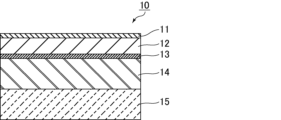
- FIG. 1 is a schematic cross-sectional view showing an example of the configuration of a laminate of the present invention.
- Examples 1 to 12, Comparative Examples 1 to 3 According to the compounding ratios shown in Table 1 below, the curable resin shown in (1), the initiator shown in (2), and the surface modifier shown in (3) were mixed and stirred to obtain a resin composition.
- the obtained resin composition was diluted with a solvent, propylene glycol monomethyl ether acetate, to adjust the viscosity, and applied to a thin glass plate having a thickness of 50 ⁇ m so as to have a thickness of 10 ⁇ m after drying.
- the obtained coating film was dried at a temperature of 100 ° C.
- Curable resin EPICLON EXA-830LVP (a mixture of bisphenol F type liquid epoxy resin and bisphenol A type liquid epoxy resin, manufactured by DIC Corporation) ⁇ jER YX7400 (polyether-based liquid epoxy resin, manufactured by Mitsubishi Chemical Corporation) ⁇ jER 4005P (bisphenol F type solid epoxy resin, manufactured by Mitsubishi Chemical Corporation) ⁇ jER 806H (bisphenol F type liquid epoxy resin, manufactured by Mitsubishi Chemical Corporation) ⁇ jER YX8000 (hydrogenated bisphenol A type epoxy resin, manufactured by Mitsubishi Chemical Corporation, epoxy equivalent 192-220) ⁇ jER YX8034 (hydrogenated bisphenol A type epoxy resin, manufactured by Mitsubishi Chemical Corporation, epoxy equivalent 250 to 360) ⁇ jER YX8040 (hydrogenated bisphenol A type epoxy resin, manufactured by Mitsubishi Chemical Corporation, epoxy equivalent 900 to 1500) Celloxide 2021P (3',4'-epoxycyclohexylmethyl 3,4-epoxycyclohexanecarboxylate, manufactured by Daicel Corporation) ETRE
- CPI-210S (a triarylsulfonium salt type photocationic polymerization initiator, manufactured by San-Apro Co., Ltd.)
- Comparative Example 4 The thin glass sheet of Comparative Example 4 was a thin glass sheet of 50 ⁇ m thickness, the same as that of Examples 1 to 5 and Comparative Examples 1 to 3, on whose surface no resin layer was formed.
- the value of the strain when the test piece broke was taken as the breaking elongation, and the value of the maximum stress when the test piece broke was taken as the breaking strength.
- the Young's modulus was calculated by determining the slope of the stress-strain curve when the strain was 0 to 10%.
- the breaking energy was calculated by determining the area surrounded by the stress-strain curve and the horizontal axis.
- Total Light Transmittance and Haze The total light transmittance and haze were measured using a HazeMeter NDH2000 (manufactured by Nippon Denshoku Industries Co., Ltd.).
- the laminate was evaluated as " ⁇ " when there was no change in appearance before and after the test, as " ⁇ ” when cracks or whitening occurred at the ends after the test but not other than the ends, and as " ⁇ ” when cracks or whitening occurred other than the ends and the appearance changed after the test.
- Example 13 to 25 According to the compounding ratio described in Table 2 below, the curable resin shown in (1), the initiator shown in (2), and the surface modifier shown in (3) were stirred and mixed to obtain a resin composition.
- the obtained resin composition was diluted with a solvent propylene glycol monomethyl ether acetate to adjust the viscosity, and applied to a thin glass plate having a thickness of 50 ⁇ m so as to have a thickness after drying described in Table 2 below.
- the obtained coating film was dried at a temperature of 100 ° C. for 15 minutes, and then irradiated with ultraviolet light having a wavelength of 365 nm at an irradiation dose of 1500 mJ / cm 2 , and further heated at 80 ° C.
- a laminate was obtained having a first resin layer made of a resin cured product on one side (viewing side) of the thin glass plate, and a second resin layer made of a resin cured product on the other side (display element side).
- Curable resin EPICLON EXA-830LVP (a mixture of bisphenol F type liquid epoxy resin and bisphenol A type liquid epoxy resin, manufactured by DIC Corporation) ⁇ jER YX7400N (polyether-based liquid epoxy resin, manufactured by Mitsubishi Chemical Corporation) ⁇ jER 4005P (bisphenol F type solid epoxy resin, manufactured by Mitsubishi Chemical Corporation) ⁇ jER YX8000 (hydrogenated bisphenol A type epoxy resin, manufactured by Mitsubishi Chemical Corporation, epoxy equivalent 192-220) ⁇ jER YX8034 (hydrogenated bisphenol A type epoxy resin, manufactured by Mitsubishi Chemical Corporation, epoxy equivalent weight 250 to 360) ⁇ jER YX8040 (hydrogenated bisphenol A type epoxy resin, manufactured by Mitsubishi Chemical Corporation, epoxy equivalent 900 to 1500) Celloxide 2021P (3',4'-epoxycyclohexylmethyl 3,4-epoxycyclohexanecarboxylate, manufactured by Daicel Corporation) ETRENACOLL EHO (3-ethyl-3-hydroxymethyloxetan
- Initiator CPI-210S (a triarylsulfonium salt type photocationic polymerization initiator, manufactured by San-Apro Co., Ltd.)
- DTS-200 aromatic sulfonium salt type photocationic polymerization initiator, manufactured by Midori Kagaku Co., Ltd.
- Surface modifier BYK-340 (manufactured by BYK-Chemie)
- JAR-33 organically modified polysiloxane, manufactured by Jujo Chemical Co., Ltd.
- a test piece of the cured resin having a thickness of 0.5 mm, a width of 5 mm and a length of 50 mm was prepared, and a dynamic viscoelasticity spectrum was measured from -50°C to 150°C using a viscoelasticity spectrometer (DVA-200, manufactured by IT Measurement & Control Co., Ltd.) under conditions of 10°C/min and 10 Hz in a tensile mode. From the obtained dynamic viscoelasticity spectrum, the storage modulus at 25°C was determined. The temperature at the maximum value of the loss tangent was taken as the glass transition temperature Tg (°C).
- the value of the strain when the test piece broke was taken as the breaking elongation, and the value of the maximum stress when the test piece broke was taken as the breaking strength.
- the Young's modulus was calculated by determining the slope of the stress-strain curve when the strain was 0 to 10%.
- the breaking energy was calculated by determining the area surrounded by the stress-strain curve and the horizontal axis.
- Total Light Transmittance and Haze The total light transmittance and haze were measured using a HazeMeter NDH2000 (manufactured by Nippon Denshoku Industries Co., Ltd.).
- the first resin layer of the laminate was placed on a 10 mm thick artificial marble board ("Corian” manufactured by DuPont), and a ballpoint pen (Orange EG 0.7 manufactured by BIC Japan, nib 0.7 mm ⁇ , weight 5.75 g) was dropped vertically from a predetermined height onto the first resin layer of the laminate with the nib facing downward. The maximum height at which no cracks were generated in the thin glass sheet was recorded as the test result.
- the present invention can provide a laminate having excellent impact resistance.
- the present invention can also provide an electronic device and cover glass using the laminate, as well as a resin composition used to form a resin layer of the laminate.
Landscapes
- Chemical & Material Sciences (AREA)
- Organic Chemistry (AREA)
- Chemical Kinetics & Catalysis (AREA)
- Polymers & Plastics (AREA)
- Health & Medical Sciences (AREA)
- Medicinal Chemistry (AREA)
- Materials Engineering (AREA)
- Engineering & Computer Science (AREA)
- Life Sciences & Earth Sciences (AREA)
- General Chemical & Material Sciences (AREA)
- Geochemistry & Mineralogy (AREA)
- Wood Science & Technology (AREA)
- Laminated Bodies (AREA)
- Epoxy Resins (AREA)
Priority Applications (4)
| Application Number | Priority Date | Filing Date | Title |
|---|---|---|---|
| KR1020257012126A KR20250130284A (ko) | 2022-12-28 | 2023-12-27 | 적층체, 전자 기기, 커버 유리 및 수지 조성물 |
| JP2024542163A JP7628658B2 (ja) | 2022-12-28 | 2023-12-27 | 積層体、電子機器、カバーガラス及び樹脂組成物 |
| CN202380078308.5A CN120112420A (zh) | 2022-12-28 | 2023-12-27 | 层叠体、电子设备、盖板玻璃和树脂组合物 |
| JP2025012829A JP2025063944A (ja) | 2022-12-28 | 2025-01-29 | 積層体、電子機器、カバーガラス及び樹脂組成物 |
Applications Claiming Priority (2)
| Application Number | Priority Date | Filing Date | Title |
|---|---|---|---|
| JP2022211216 | 2022-12-28 | ||
| JP2022-211216 | 2022-12-28 |
Publications (1)
| Publication Number | Publication Date |
|---|---|
| WO2024143461A1 true WO2024143461A1 (ja) | 2024-07-04 |
Family
ID=91717808
Family Applications (1)
| Application Number | Title | Priority Date | Filing Date |
|---|---|---|---|
| PCT/JP2023/046897 Ceased WO2024143461A1 (ja) | 2022-12-28 | 2023-12-27 | 積層体、電子機器、カバーガラス及び樹脂組成物 |
Country Status (5)
| Country | Link |
|---|---|
| JP (2) | JP7628658B2 (https=) |
| KR (1) | KR20250130284A (https=) |
| CN (1) | CN120112420A (https=) |
| TW (1) | TW202444564A (https=) |
| WO (1) | WO2024143461A1 (https=) |
Citations (9)
| Publication number | Priority date | Publication date | Assignee | Title |
|---|---|---|---|---|
| JP2008107510A (ja) * | 2006-10-25 | 2008-05-08 | Nitto Denko Corp | 表示素子用基板およびその製造方法 |
| JP2014523352A (ja) * | 2011-05-27 | 2014-09-11 | コーニング インコーポレイテッド | ガラス−プラスチック積層デバイス、そのための処理ライン及び方法 |
| JP2018159069A (ja) * | 2017-03-22 | 2018-10-11 | パナソニックIpマネジメント株式会社 | 光硬化性樹脂組成物及び接着剤 |
| WO2019066078A1 (ja) * | 2017-09-29 | 2019-04-04 | 大日本印刷株式会社 | 光学フィルムおよび画像表示装置 |
| JP2019167415A (ja) * | 2018-03-22 | 2019-10-03 | パナソニックIpマネジメント株式会社 | 光硬化性樹脂組成物及び接着剤 |
| WO2020153259A1 (ja) * | 2019-01-25 | 2020-07-30 | 株式会社ダイセル | カバー部材 |
| JP2020152050A (ja) * | 2019-03-22 | 2020-09-24 | 三菱ケミカル株式会社 | 積層シート |
| WO2023277060A1 (ja) * | 2021-06-30 | 2023-01-05 | 積水化学工業株式会社 | 積層体、電子機器、樹脂組成物及びカバーガラス |
| WO2023153513A1 (ja) * | 2022-02-14 | 2023-08-17 | 積水化学工業株式会社 | 積層体及び電子機器 |
Family Cites Families (2)
| Publication number | Priority date | Publication date | Assignee | Title |
|---|---|---|---|---|
| JP2013037207A (ja) | 2011-08-09 | 2013-02-21 | Nitto Denko Corp | 表示装置用保護基板 |
| CN110494282B (zh) | 2017-04-11 | 2022-02-22 | 富士胶片株式会社 | 光学层叠体及具有光学层叠体的图像显示装置的前面板、图像显示装置、电阻膜式触摸面板及静电电容式触摸面板 |
-
2023
- 2023-12-27 TW TW112151101A patent/TW202444564A/zh unknown
- 2023-12-27 WO PCT/JP2023/046897 patent/WO2024143461A1/ja not_active Ceased
- 2023-12-27 JP JP2024542163A patent/JP7628658B2/ja active Active
- 2023-12-27 CN CN202380078308.5A patent/CN120112420A/zh active Pending
- 2023-12-27 KR KR1020257012126A patent/KR20250130284A/ko active Pending
-
2025
- 2025-01-29 JP JP2025012829A patent/JP2025063944A/ja active Pending
Patent Citations (9)
| Publication number | Priority date | Publication date | Assignee | Title |
|---|---|---|---|---|
| JP2008107510A (ja) * | 2006-10-25 | 2008-05-08 | Nitto Denko Corp | 表示素子用基板およびその製造方法 |
| JP2014523352A (ja) * | 2011-05-27 | 2014-09-11 | コーニング インコーポレイテッド | ガラス−プラスチック積層デバイス、そのための処理ライン及び方法 |
| JP2018159069A (ja) * | 2017-03-22 | 2018-10-11 | パナソニックIpマネジメント株式会社 | 光硬化性樹脂組成物及び接着剤 |
| WO2019066078A1 (ja) * | 2017-09-29 | 2019-04-04 | 大日本印刷株式会社 | 光学フィルムおよび画像表示装置 |
| JP2019167415A (ja) * | 2018-03-22 | 2019-10-03 | パナソニックIpマネジメント株式会社 | 光硬化性樹脂組成物及び接着剤 |
| WO2020153259A1 (ja) * | 2019-01-25 | 2020-07-30 | 株式会社ダイセル | カバー部材 |
| JP2020152050A (ja) * | 2019-03-22 | 2020-09-24 | 三菱ケミカル株式会社 | 積層シート |
| WO2023277060A1 (ja) * | 2021-06-30 | 2023-01-05 | 積水化学工業株式会社 | 積層体、電子機器、樹脂組成物及びカバーガラス |
| WO2023153513A1 (ja) * | 2022-02-14 | 2023-08-17 | 積水化学工業株式会社 | 積層体及び電子機器 |
Also Published As
| Publication number | Publication date |
|---|---|
| JP2025063944A (ja) | 2025-04-16 |
| CN120112420A (zh) | 2025-06-06 |
| JP7628658B2 (ja) | 2025-02-10 |
| KR20250130284A (ko) | 2025-09-01 |
| TW202444564A (zh) | 2024-11-16 |
| JPWO2024143461A1 (https=) | 2024-07-04 |
Similar Documents
| Publication | Publication Date | Title |
|---|---|---|
| TWI472434B (zh) | Transparent substrate | |
| KR20240026880A (ko) | 적층체, 전자 기기, 수지 조성물 및 커버 유리 | |
| TWI436886B (zh) | Transparent substrate | |
| KR102496513B1 (ko) | 활성 에너지선 경화성 접착제 조성물, 편광판용 접착제 조성물, 편광판용 접착제, 및 이를 사용한 편광판 | |
| KR102006993B1 (ko) | 에너지선 경화성 수지 조성물 | |
| JP7197609B2 (ja) | 封止剤、硬化体、有機エレクトロルミネッセンス表示装置、及び装置の製造方法 | |
| JP7614512B2 (ja) | カチオン硬化性組成物、硬化物および接合体 | |
| KR101671047B1 (ko) | 속경화성이 우수한 에너지선 경화형 에폭시 수지 조성물 | |
| JP5843206B2 (ja) | 仮固定用接着剤組成物、それを用いた構造体及び部材の仮固定方法 | |
| JP6539488B2 (ja) | 硬化物の製造方法、硬化物、硬化性組成物および接着剤 | |
| CN111630114A (zh) | 硬涂层形成用树脂组合物 | |
| KR20200135339A (ko) | 활성 에너지선 경화성 수지 조성물, 편광 필름 보호층 및 편광판 | |
| KR20130141508A (ko) | 양이온 중합성 접착제 및 그것을 사용하여 얻어진 편광판 | |
| WO2023153513A1 (ja) | 積層体及び電子機器 | |
| JP7628658B2 (ja) | 積層体、電子機器、カバーガラス及び樹脂組成物 | |
| JP5634993B2 (ja) | 深部硬化性に優れたエネルギー線硬化型エポキシ樹脂組成物 | |
| JP2005336349A (ja) | カチオン重合型組成物 | |
| JP7196596B2 (ja) | 活性エネルギー線硬化性接着剤組成物、偏光板用接着剤組成物、偏光板用接着剤、及びそれを用いた偏光板 | |
| JP5716221B2 (ja) | カチオン硬化型樹脂組成物 | |
| CN117204120A (zh) | 固化性组合物及有机el显示装置 | |
| KR20160084094A (ko) | 활성에너지선 경화성 수지 조성물, 이를 포함하는 편광판 및 액정표시장치 | |
| CN113661438A (zh) | 液晶密封剂、使用其的液晶显示面板、及其制造方法 | |
| US20250346020A1 (en) | Laminate and display | |
| KR20160085585A (ko) | 활성에너지선 경화성 수지 조성물, 이를 포함하는 편광판 및 액정표시장치 | |
| KR20230000059A (ko) | 편광판용 접착제 조성물, 이를 이용한 편광판 및 이를 포함하는 광학표시장치 |
Legal Events
| Date | Code | Title | Description |
|---|---|---|---|
| WWE | Wipo information: entry into national phase |
Ref document number: 2024542163 Country of ref document: JP |
|
| 121 | Ep: the epo has been informed by wipo that ep was designated in this application |
Ref document number: 23912239 Country of ref document: EP Kind code of ref document: A1 |
|
| WWE | Wipo information: entry into national phase |
Ref document number: 202380078308.5 Country of ref document: CN |
|
| WWP | Wipo information: published in national office |
Ref document number: 202380078308.5 Country of ref document: CN |
|
| NENP | Non-entry into the national phase |
Ref country code: DE |
|
| 122 | Ep: pct application non-entry in european phase |
Ref document number: 23912239 Country of ref document: EP Kind code of ref document: A1 |